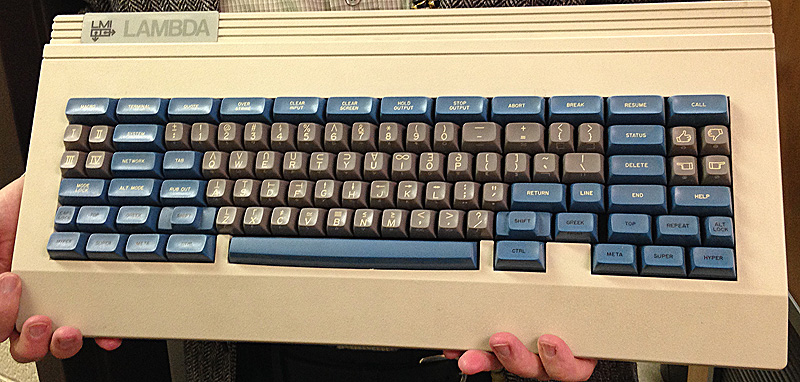
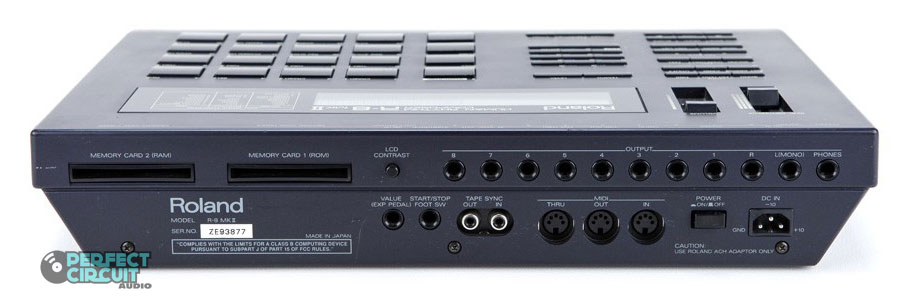
Was Seth the person looking for this stuff? I finally found it! I sent him
an email, but it might not be a current address.
Seth, if you still want this stuff, please let me know!
Cindy Croxton
Electronics Plus
1613 Water Street
Kerrville, TX 78028
830-370-3239 cell
sales at elecplus.com
AOL IM elcpls
---
This email has been checked for viruses by Avast antivirus software.
https://www.avast.com/antivirus
Hi,
The PAL vrs NTSC TV standard complicated things when collecting home
computers from other countries.
In New Zealand we are on PAL. PAL Atari 800s are rarer in the world that
NTSC ones. That being the case I recently settled on an NTSC one for my
collection. Hooking it up to a couple of my PAL TVs (via composite video)
I was surprised to see a reasonable colour image. I then dropped in a UAV
video enhancement board and was surprised to see a very good colour image!
I'm assuming it's because composite input into "relatively" modern can
handle NTSC and PAL? Is this a reasonable thought? The UAV is not an NTSC
converter, and even the inventor was surprised this worked.
Those interested can read about the adventure here:
https://www.classic-computers.org.nz/blog/2018-03-06-Converting%20-NTSC-Ata…
Terry (Tez)
> From: Cindy Croxton
> I finally found it!
Oh, that is so awesome! Thank you for keeping an eye out!
(I'm sure somehow it will get saved - Seth, let us know if you do, otherwise
we can organize something.)
Noel
So I have an M837 (KM8-E Memory Extension and Time-Share option for the
PDP-8/E, -8/F & -8/M) available; got it with a group of other cards, and I
have no use for it.
Anyone want it, and have (or can acquire :-) anything PDP-11ish (boards,
mounting hardware, manuals, prints, I'm not picky - although it has to be
something I need/want, I'm already knee-deep in DL11's :-) to trade for it?
Noel
Hey, all, a quick update on recent progress.
I now have a working prototype to match Dave's (although he's still doing all
the real work), and we've made a minor improvement in them (re-wired things so
we can use shorter cables to the FPGA daughter-card).
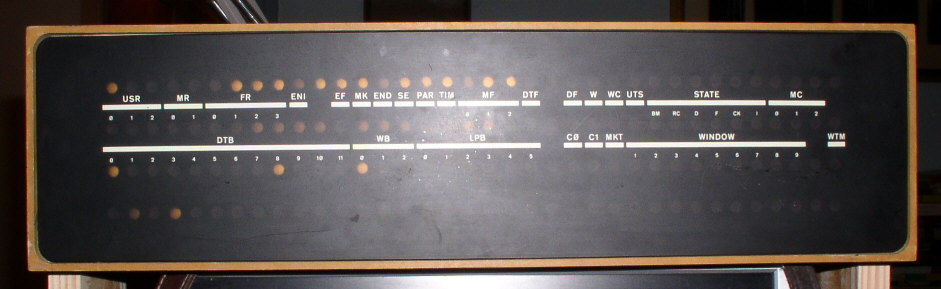
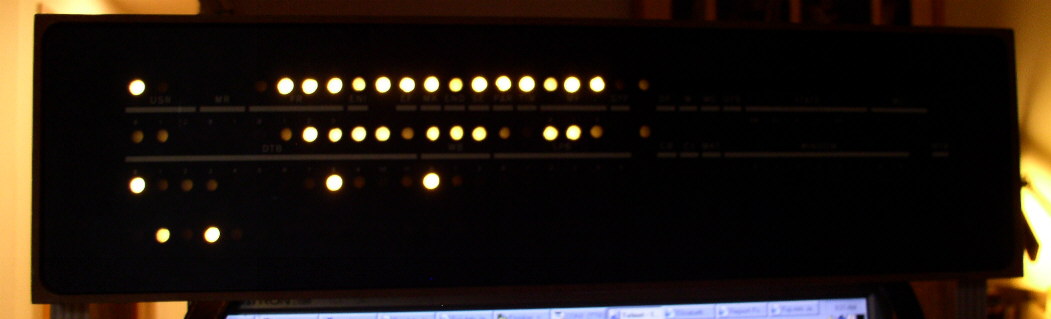
I got my indicator panel working, it looks quite nice:
http://ana-3.lcs.mit.edu/~jnc/tech/QSIC/jpg/DasBlinken2F.jpghttp://ana-3.lcs.mit.edu/~jnc/tech/QSIC/jpg/DasBlinken2NF.jpg
The inlay is an original from a TS08 that I happened to have lying around; Rod
S has made us a large batch of new blanks, but silk-screening of the captions
on the front of those is yet to happen. The bezel is also an original. (I have
a large stock of those, so it'll be a while before we need to work out how to
make new ones - probably resin casting, although 3D printing will be an option
too.) However, the guts are all new, and as you can see, the result looks just
like the real originals.
Dave has also worked out how to connect up the RKV12 (our name for the 22-bit
RK controller, by analogy with the RLV11/RLV12) to the internal 'block' RAM in
the FPGA, and then did the stuff to connect it to both the uSD card and the
internal RAM at the same time, with one drive connected to the RAM, so things
like swapping, etc don't 'waste' uSD writes.
Both of these are working quite reliably; the exciser/tester runs until we get
tired of the noise, and turn the machines off! :-)
His current project is to work out how to talk to the larger external RAM on
the FPGA daughter-board (the internal RAM isn't large enough for even a single
complete RK pack). I'm so looking forward to putting swapping, /tmp, pipes,
etc all on different platters, so as the system (Unix V6, natch :-) runs I can
watch the lights and see _exactly_ what's going on!
After that: turning the RK into an 'RPV12' (which should be pretty easy, the
RK11 and RP11 are very similar), and adding a mux so that the two controllers
can share the storage devices, etc. Those should both be done soon after the
external RAM (and maybe before, if Dave needs a break from that :-).
We also intend to do an 'extended RP11' (name not yet chosen, although I like
'RPV-12D - DEC's last was the RP11-C), which extends all the disk address
fields in the register to use the unused bits, giving us pretty massive
storage capability. With 16 bits of cylinder (up 7), 8 bits of surface (up 3),
4 bits of sector, that gives 28 bits of block number per drive; and with 8
drives per extended RP11, that's a total of 31 bits of block number per
controller. Convert the blocks to bytes, that's 9 bits more, so 2^40 bytes per
extended RP11, or 1TB!
Very shortly now we'll need to turn to starting on the design of the
'production' hardware.
Noel
In doing some research on the operating system for MU5, MUSS, I have been
told that a UK company called Membrain may have acquired it at some point in
the late 70's. Membrain were based in the South of England and made
Automatic Test Equipment.
Does anyone have any information on Membrain? Any software artefacts? Source
code even? I have had a look on BitSavers and Membrain does not feature at
all.
Thanks
Rob
Someone had ?asked me ?about ?they were looking ?for Claude Shannon Bell ?Labs ? ?publications ?for a ?display? Please email me ?off?list
Thanks ?Ed Sharpe archivist? for SMECC
> From: William Donzelli
> Germany often gets the short end of the stick when it come to radar
> tech in World War 2
For those who are interested in German radar, there's a good book:
David Pritchard, "The Radar War: Germany's Pioneering Achievement
1904-45", 1989
which covers their systems in some detail. There's also:
Martin Streetly, "Confound and Destroy: 100 Group and the Bomber
Support Campaign", 1978
which contains a very interesting chapter about an exercise called "Post
Mortem", run immediately after the close of hostilities, from 25 June to 7
July, 1945, in which the Allies observed (from inside) the workings of the
German air warning network, including things like how well it coped with
various kind of jamming (window, as well as active).
Noel
> From: Chuck Guzis
> the magnetron was made out to be a super-secret device, yet there's a
> clear explanation of it in my 1942 "Radio Handbook".
Ordinary magnetrons had indeed been around for a while; they were invented in
1920. The British invention was the _cavity magnetron_, a quite different
beast; it was kind of a cross between a magnetron and a klystron, with the
best features of each.
Buderi (which is indeed an excellent history, perhaps the best in the radar
section of my library) has a good explanation of how it works.
Noel
I recently found a Heathkit card cage ( 85-2001 121476 on backplane ) with
a DEC M7270, M8044, M7946, and M8043. I still have a few Heathkit boards
buried here sonewhere.
Please contact me off list if you have any questions or wish to make an
offer.
Thanks, Paul
> From: Fritz Mueller
> Spring cleaning, Noel? :-)
Yeah, sort of! These came with a bunch of PDP-11 boards I bought on eBay,
and they're just clutter. More stuff coming soon!
Noel
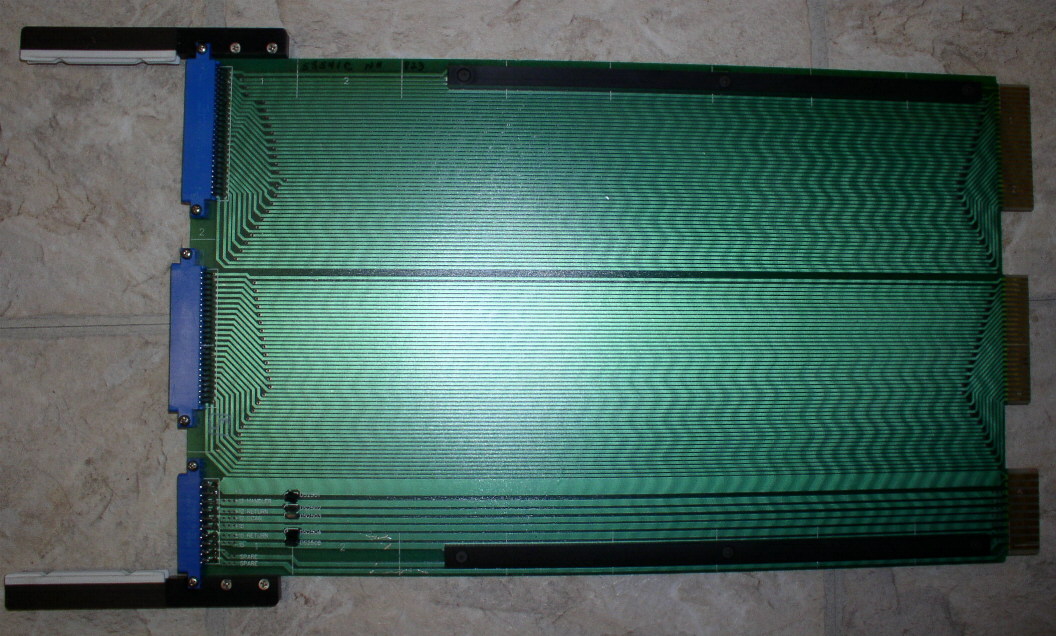
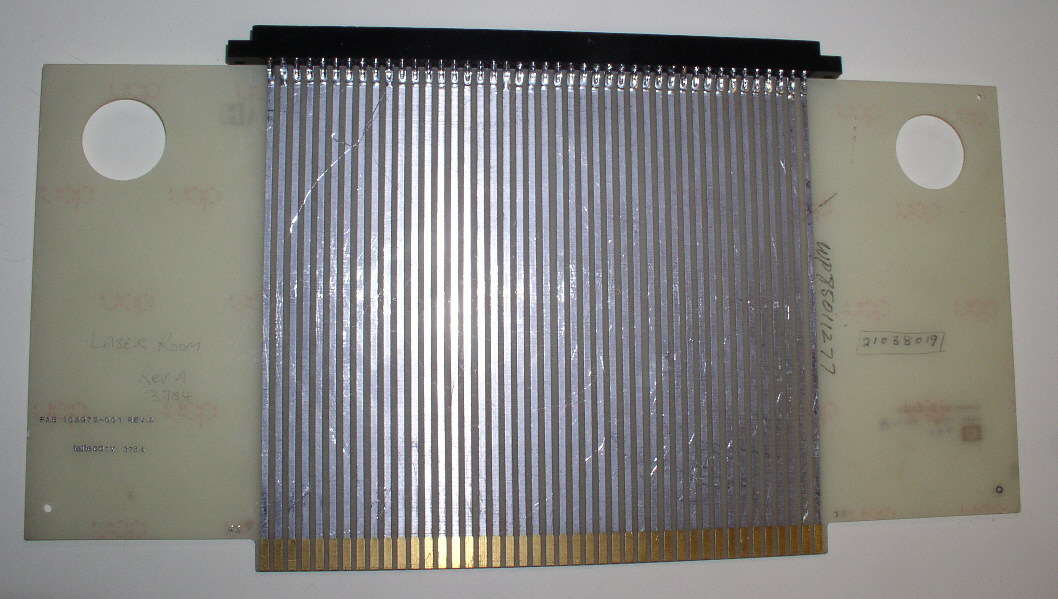
OK, another pair of unknown extender cards:
http://ana-3.lcs.mit.edu/~jnc/tech/jpg/tmp/LargeExtender.jpg
If anyone has a use for one or both, FTGH.
They are 17"x10", and the support arms (nice touch) are about 3" long.
No identifying marks that I can perceive, alas. The power leads are titled
"+5", "+12 Handler", +12 Return", "+12 Scan", "+15", "+- 15 Return", "-15".
Noel
> From: Brian Marstella
> I have a CPU board with similar format that I bought thinking I'd
> eventually figure it out.
A couple of people have replied privately telling me it's for a Motorola
EXORbus/EXORciser.
Noel
Hi all, I have an extra "RX8/RX11 floopy disk system user's manual" I'd like
to trade off for something I'd find useful (anything PDP-11 which I don't
already have, preferably). Anyone?
Noel
> From: Jon Elson
> if they did air raids over France or Germany, that eventually a plane
> with one would get shot down and a magnetron would be obtained in
> relatively good shape. So, likely by 1942 it was considered to no
> longer be a secret.
One was lost near Rotterdam in a raid on Cologne on February 2, 1943 (only
the second raid of the war using centimetric H2S radar which used the cavity
magnetron), and the remains were discovered in relatively good shape by
German technicians. The Germans worked out what it did pretty quickly, and by
the fall of 1943 they had started to deploy microwave detector systems.
Noel
GoMemorable got back to me. They'll still scan for me to QT ProRes on
hard drive for 20 cents a foot for 8mm/Super 8 and 30 cents a foot for 16mm.
- John
While cleaning just now I found one of the metal and black plastic side
bezels for an 8813. If anyone needs one, let me know and I can send it to
you!
--
Ben Sinclair
ben at bensinclair.com
Does anyone have an archive of classiccmp that goes back to the 90's? If
so, could I ask you to "hunt down" an old message of mine? I once wrote a
"reminiscence" of connecting to the ARPANET when I was a kid that I was
rather pleased with. Unfortunately, I seem to have lost it in a disk crash
(actually a couple of disks, primaries and backups).
Thanks,
Bill Sudbrink
---
This email has been checked for viruses by Avast antivirus software.
https://www.avast.com/antivirus
Folks,
I know someone in North Carolina (not on this list) who just found a small pile of IBM System/36 manuals in three ring binders. These are all already on Bitsavers, and these manuals are in pretty rough shape, but if anyone really really wants them, let me know and I'll pass on your contact information
5360 Vol A1 MIMS "Maintenance Information Manual - General Safety Guide (etc.)"
5360 Vol A2 MIMS "Maintenance Information Manual - CPU & Channel (etc.)"
5360 Vol A3 MIMS "Maintenance Information Manual - Work: Station (etc.)"
5360 Vol B2 MAPS "Maintenance Analysis Procedures"
5360 Vol C1 FLDS "Field Logic Diagram"
-Seth
--
Seth Morabito
web at loomcom.com
> From: Jerry Weiss
> Typically execution of the RESET instruction in a user program is
> treated as a NOP
Yeah, that's not documented in most PDP-11 CPU manuals, either. It's one of
the things that makes the PDP-11 impossible to virtualize; only HALT and SPL
trap, IIRC. M[TF]P[ID] doesn't, I think, and neither does WAIT or RT[IT],
IIRC.
Noel
From: Paul Koning
Sent: Monday, February 26, 2018 12:19 PM
>> On Feb 26, 2018, at 12:06 PM, Doug Ingraham via cctalk
>> <cctalk at classiccmp.org>> wrote:
>> The purpose of an emulator is to accurately pretend to be the original
>> hardware. It doesn't matter that the original OS runs on a particular
>> emulator. If a program can be written that runs on the original hardware
>> but fails on the emulator then there is a flaw in that emulator.
> That's true. But it is unfortunately also true that creating a bug for bug
> accurate model of an existing machine is extremely hard.
This is true even in real hardware (or "real" hardware, if you prefer), whether
bug-for-bug or simply correct results for corner cases.
The XKL Toad-1 System was designed to be a superset clone of the KL-10 based
DECSYSTEM-2065 from Digital Equipment Corporation. It implements the full
30-bit extended addressing introduced with TOPS-20 v4, of which the KL-10
provided a 23-bit subset, and provides native support for 10Mbit Ethernet and
FASTWIDE differential SCSI2 (both state of the art in 1991 when the design was
frozen).
As a better DEC-20, the Toad-1 was a success. (We will leave aside the issue
of its market failure, which is irrelevant to the story.)
Fast forward 20 years, to Living Computer Museum, where a KI-10 based DEC-1070
was undergoing restoration. Diagnostics were needed, so the resident TOPS-20
programmer laid hands on the MAINDEC sources for the KI-10 and proceeded to
compile them all and generate paper tapes of the results. All went smashingly
well until the multiplication test.
The diagnostic source for this test uses a macro to build a set of test values
for X**2 where X is a power of 2. Internally, Macro-20 uses the IMULM
instruction to build the results. In the KA-10 manual, IMULx of 2**35 * 2**35
is supposed to store the high order part of the result into the 36 bit word
addressed by the instruction, and set the overflow bit.
On the Toad-1 (and on the Toad-2 prior to our discovery of this bug), a zero is
stored instead. Since we compiled the KI-10 diagnostics on the Toad-1, this
incorrect result was placed on the diagnostic paper tape, and the KI-10 seemed
to fail the diagnostic. Imagine our chagrin when days of trying to correct the
problem led to the conclusion that the diagnostic was incorrect.
Rich
Rich Alderson
Vintage Computing Sr. Systems Engineer
Living Computers: Museum + Labs
2245 1st Avenue S
Seattle, WA 98134
mailto:RichA at LivingComputers.orghttp://www.LivingComputers.org/
> From: Paul Koning
> RTI/RTT are used in the debugger, so they need to work in user mode.
> They refuse to raise your privilege level, though.
I understand that it has uses, but by specifying the 'failure' mode in User
mode (when the contents of the current or previous modes is not User) to be
'ignore', rather than 'trap', that's one more thing that makes the PDP-11
non-virtualizable. (This choice, to ignore, instead of trap, has the same
issue in other places where it's done that way, e.g. RESET.)
Noel
> From: Charles Dickman
> So if the I/O page is completely (all processor modes) unmapped is
> there any way to recover besides a power cycle? Does the RESET
> instruction disable the MMU?
Interesting questions!
The CPU manuals don't say, about the RE$ET; I just tried it on the /23 I
happen to have next to my desktop, and yes, the RESET instruction does clear
bit 0 of SSR0.
Noel
There will be three awesome keynotes for VCF East this spring.
- Friday: our own Bill Dromgoole who'll talk about restoring the VCFed
UNIVAC mainframe.
- Saturday: Don Eyles (NASA contractor who hacked the Apollo Guidance
Computer to save the Apollo 14 mission)
- Sunday: Dave Walden, who programmed the IMP at BBN for the ARPANET
Is there a document that describes the bank 7 memory page and what
addresses are reserved for what?? I think I've seen this before but
can't seem to put my hands on it.
Another question, bootstrap is reserved for 173000, how many words are
allowed there for this?? How do the more complicated bootstraps, e.g.
microPDP11-53, accommodate this limitation?
Doug
Hello Folks.
Forgive me for the intrusion. I know a good soul in Brisbane area in
Queensland, Australia who is looking for some sort of apprenticeship in
electronics or communications/networking. I thought I would ask here in
case this message reaches some of you blokes down there that might be able
to point him in a useful direction. He's in his 30s, very sharp and
capable, gainfully employed in an entirely unrelated field and looking for
a change in his life.
Offline responses welcomed.
Thanks!
Sellam
>From Dennis Boone
> Jonathan Engdahl's homepage shows his email
> address. His changes are explained at the page you linked.
Yes indeed - as I (meant to have) said, no reply to his email listed there.
> The 32MB limit arises due to the use of 16 bit block number fields in
> the protocol.
I understand the issue but alas I'm a mere hardware guy with minimal
software skills so I was looking for a giant to carry me ;).
> if it's useful, you can find it here:
> http://yagi.h-net.msu.edu/vtserver.drb.tar
Perfect - minor mod for my raspberry pi and it works just fine thanks.
Bob
> From: Douglas Taylor
> Is there a document that describes the bank 7 memory page and what
> addresses are reserved for what?
Here's one I collated from a large number of DEC manuals:
http://ana-3.lcs.mit.edu/~jnc/tech/pdp11/UNIBUS_Registers.txt
(Ignore the name, it applies to QBUS machines too.)
> bootstrap is reserved for 173000, how many words are allowed there for
> this?
Well, the space from 773000-773776 (UNIBUS and Q18 - add '17' to the front
for Q22) is used for ROMs, and is the most common; 173000 is of course the
location QBUS processors can be configured to jump to on power on. 765000-776
in also used for some (e.g. M9301's).
> How do the more complicated bootstraps, e.g. microPDP11-53, accommodate
> this limitation?
Bank switching; e.g. the BDV11, KDF11-B have a 'page control register' at
777520 which says which block of ROM is mapped into the 773000 block.
Interestingly, the DEC standard ROMs for the BDV11 and KDF11-B _don't_ copy
all the contents down to real memory, and run from there - the code is
divided into 'pages', only one of which is mapped in at a time, and it's
executed from the ROM.
Noel
> On many of the PDP-11s that page is signified by asserting BBS7
QBUS machines only; the UNIBUS has no equivalent signal.
> FYI the microPDP-11/53 is the 11/23+ cpu card
Err, no; according to the "MicroPDP11/53 System Supplement Manual"
(AZ-GPTAA-MC), pg. 3-1, the CPU card in the /53 is the KDJ11-D. The
/23+ uses the KDF11-B CPU card.
Noel
At 01:09 PM 2/24/2018, Pete Lancashire via cctalk wrote:
>I have a small, 5-20 stack of 16 mm's of movies dealing with computers
>The one in front of me is
>"Once Upon a Punched Card"
>I am looking for a place in the USA with a reasonable price to have them
>digitized and I will place them on both my Google drive and a Youtube
>So far I have only been able to find places I can not afford.
I use https://gomemorable.com/ . I've used them for both 8mm and 16mm.
They have sales now and then that'll drop 40% off the price. They're
running one now until March 3.
They scan digitally with LED illumination, frame by frame. It'll
brighten your old film in ways you can't imagine. They'll scan
to HD (1920x1080) resolution.
I send them a hard drive and they return the files as Quicktime ProRes
movie files. These days, send 'em a bare SATA SSD to save on shipping.
If you didn't want to edit yourself, they can send you a DVD or far better
yet a Blu-ray.
As I look at their web site now, I don't see a link that gets
me to these services I describe, that I've used as recently as a
month or two ago. I'll write them a note to see where the straight-forward
per-foot pricing and hard drive options went.
For 8mm, many old cameras would actually expose more of the width of
the film than you'd ever see on your projector, so I have them scan
the full frame.
Here's an example of a color home movie from the 1940s that I had
converted to VHS in the early 90s via telecine, compared to a modern
digital scan:
https://www.youtube.com/watch?v=f08K0Co3l5s
- John
I've been using vtserver to transfer an OS to a minimal pdp11 (only a HD and console port so far). Works fine but it has a well-documented 32MB file limit. This website http://home.windstream.net/engdahl/vtserver.htm mentions some hacks but I've been unable to contact the author. Anyone have details of either the code or author?
Thanks
Bob
Sent from my iPad
Hello all,
. . . . For those of you who having not been following my trials and tribulations with a 16700A in another topic here is a partial update. I received this LA from a benefactor who has stepped forward. A real big thanks to him. I have run into that incompatibility problem with External CD-ROM Drives.
. . . . I am disabled and partially housebound. I am living on SSD so money is very tight for me. I am looking for a CD-ROM Drive for little or nothing that is compatible with the 16700A I have an NEC 3x Drive that uses the CD Carriers. Remember those. I have installed this and a Maxtor 245MB SCSI drive in an External SCSI box. The Termination on the CD-ROM Drive is turned off and I removed the Termination resistors on the HDD. I have a Terminator installed on the end of the SCSI bus on the External Case. Could someone please help me out? Any and all help is greatly appreciated.
GOD Bless and Thanks,
rich!
---
This email has been checked for viruses by Avast antivirus software.
https://www.avast.com/antivirus
Hi, all,
I'm going through a box of random ICs and one particular item is not
showing up on my searches outside of a couple eBay auctions for chip
collectors.
The IC is a 20-pin ceramic body with side brazed legs, gold pins, chromed
lid, with NEC D2168D on it with "-2" painted on the ceramic and date codes
>from 1984. It's almost certainly a RAM chip of some kind, but I'm not
finding any pinouts or data sheets.
Anyone recognize this? Anyone know a system that uses them? I have more
than 10, and since I haven't run across them before, I probably don't have
a machine that needs them.
Thanks for any tips.
-ethan
The following extract comes from a History of Programming Languages (HOPL)
retrospective on the development of the Ada programming language written by
the individual who was the government lead at DARPA for much of the time of
its development (Colonel William A. Whitaker). I found it humorous.
Perhaps you will too.
-----
The ARPANET connection was inaugurated during a visit to RSRE by Her Royal
Highness Queen Elizabeth II. Her Majesty sent a message of greetings to the
members of the HOLWG from her net account, EIIR, by pressing a red velvet
Royal carriage return. Because the address list was long, it took about 45
seconds for the confirmation to come back, 45 seconds of dead air. Prince
Philip remarked, joking respectfully, that it looked like she broke it.
-----
I suspect that we've "all been there" at one time or another!
paul
What is vintage computing?
I think it's the IBM PC. Anything else is not vintage computing.
b
On Thu, Feb 22, 2018 at 3:36 PM, Evan Koblentz via cctalk <
cctalk at classiccmp.org> wrote:
> It's gone meta: people threadjacking a thread about threadjacking. Now
> it's some posters trying to show others who is smartest about arcane
> details of obsolete email software.
>
From: Paul Koning
Sent: Wednesday, February 21, 2018 6:41 AM
> And while there is roughly-accurate simulation of DECtape in SIMH (presumably
> for TOPS-10 overlapped seek to work?)
It's not for Tops-10. SimH only provides the KS-10 processor[1], so DECtape is
not a possible peripheral.
Rich
[1] Although there is a KA-10 in the works.
> From: Grant Taylor
> I'm on a list where it seems as if a frequent contributer uses an MUA
> that does not send In-Reply-To or References headers at all. It doesn't
> even send a User-Agent header. *sigh*
That's me, I expect.
I used to use a TOPS-20 email reader called MM, and when I moved my email to a
Unix machine, there was a version of MM I used there, then something happened
(I forget what) and I couldn't use that any more.
I do have access to a more modern email reader (Eudora), but don't like it; I
just stick with old, simple stuff I know how to use. I don't have the spare
brain cells / energy to switch.
After going through I've-forgotten-how-many editors (starting with TECO, then
'ed'), text formatting systems, operating systems, email readers, etc, etc I
have a _very_ simple rule about switching software: is the old stuff I'm using
utterly, irretrievably unusable? If not, ignore the new stuff. Eventually
it'll be obsolete too. And in the meantime, I'll have saved countless cycles
by not going through the hassle of switching to it. Life's too short.
Noel
Well, I bought that DEC Pro 350 on ebay. It initially booted up and I got
the error screen. The error code I found on the Internet was related to
the hard disk controller. So, I thought I just needed someone to sell/give
me some systems disks for the unit and I could try to setup the drive again
if it still functioned.
Then, it after a couple of restarts (I re-seated the boards and cleaned the
connectors) it stopped showing the error screen (with picture of the
computer). All the diagnostic lights are red on the back and nothing ever
shows on the screen. The power comes on and then nothing.
If anyone has any thoughts, I would appreciate it. I knew the history of
this type of computer and figured it was a long shot. I am just
disappointed to have gotten really nowhere with it.
Thanks!
Kurt
> From: Kurt Hamm
> If anyone has any thoughts, I would appreciate it.
You probably already know this, but... My sense is that a collector of
classic computers has to be able to diagnose and repair at the component
level - get in there with an oscilloscope and a set of prints (creating the
latter, if need be), and find the busted chip/transistor.
It's like collecting old cars - if you collect old cars, you have to be able
to work on them (or like Jay Leno, be rich and hire someone else who can -
although given that Jay worked at an auto dealer 'back in the day', he
apparently does know a fair amount).
Which isn't going to help much with this particular problem, maybe some of
the other replies will help.
Noel
Hi folks,
I recently discovered a complete Honeywell DDP-516 console on Ebay. It
is a charity auction, ending tomorrow.
I am the high bidder (hachti, 600-some points) and BEG YOU ALL NOT TO
BID on it!
I already entered a crazy high bid anyway bid so please don't bid on it.
I am one of the very very very few people who have an actual DDP-516
machine and can really use this as a spare for a real machine.
Again, PLEASE refrain from bidding up this item!
If you are the owner of a "headless" machine who is in need for the
front panel: please contact me, so we can avoid an explosion on Ebay.
Thank you very much.
Kind regards
Philipp
Hi all --
I'm working on fixing up a Tektronix 4404 workstation (runs
Smalltalk-80!).? Or rather, I'm trying to collect the needed parts to
assemble a complete system so that I might fix up said system -- at the
moment I have only the main CPU unit (but hey, it's a good starting
point).? I am looking for:
- Keyboard (Tektronix P/N 119-1872-00)
- Mouse (Logitech P7-3F-TX-19-1808-00).? This is likely a standard
3-button quadrature mouse but if I can find the exact match, so much the
better...
- Mass Storage (Tektronix model 4944, possibly others?? This is a SCSI
device containing a hard drive on a SCSI->MFM bridge and 5.25" floppy
drive on a custom SCSI->floppy interface.)
If anyone happens to have spares or knows anyone who might, please let
me know.? Thanks as always!
- Josh
So, all this talk about panels made me making an oak frame for an
IBM panel I had lingering around in the attic for a while.
Still need to make a back panel to close it tough.
http://bit.ly/2HI2cHC
The cables were already cut when I got it.
Ed
--
Ik email, dus ik besta.
Hi folks,
I recently, on a trip to Oregon, finally got a compatible ECL monitor for my Sun 2. It came with a rather nice Sun 3/260, which I?d like to run as well.
So I thought I?d put out a beg here- I?m so close to finishing this.
I need to shake loose a keyboard and mouse for a Sun 2.
Would anyone be willing to sell me one? I?m not expecting a handout; they would be paid for and well loved.
On a related note, I?d love to run the 3/260 as well: What I?d like to do for that is hunt down a Sun color framebuffer for it so I can use a more common display. (and of course, enjoy the wonders of color).
I?m not sure what the options there are, but I have a nice scan converter so just about any compatible color framebuffer will do. I can then totally repurpose the monitor I?ve just found for my 2/120.
So, in the words of another immortal list member, ?advice hints ?????
Thanks in advance,
- I
I have a small, 5-20 stack of 16 mm's of movies dealing with computers
The one in front of me is
"Once Upon a Punched Card"
I am looking for a place in the USA with a reasonable price to have them
digitized and I will place them on both my Google drive and a Youtube
So far I have only been able to find places I can not afford.
Suggestions, Ideas, etc ?
-pete
I'm about to acquire a couple of 1980s-vintage military surplus AN/UGC-137A terminals (i.e., glass TTYs with some local message preparation and storage capabilities) which have a bubble memory subsystem. They use plug-in cartridges containing 256 kbytes of storage in the form of two Intel 7110 1 Mbit bubble memory chips and their 7242 formatter/sense amplifiers.
One of the cartridges contains the one and only copy of the terminals' firmware, which I believe they need to load up at each reboot. Naturally, extracting the contents of that irreplaceable cartridge for archival, and potential future emulation, is going to be a very high priority for me. I have a few different approaches in mind for accomplishing that. One approach would be to remove the two memory devices from the critical cartridge in order to dump their contents in an independent bubble memory subsystem.
With that in mind, I'd like to get my hands on a working Intel 7110 bubble memory subsystem, or the parts to build one myself (i.e., a complete 7110/7220/7230/7242/7250/7254 chipset that I could make a board around).
Might anybody here have what I need available for sale or trade? I might be able to use some arbitrary old computer or other device that has a subsystem based around the Intel 7110, or a development kit such as the Intel BPK-72, or a chipset to make my own board.
If I can't acquire or make the hardware to dump the memory chips outside of their native system, then I think my next option would be to passively snoop the host bus interface of the Intel 7220 controller I expect to find inside the terminals as they perform their initial firmware load, so that I can reconstruct the cartridge contents from the trace data.
The terminals were made by the Librascope division of Singer, and brochures can be found here:
http://www.librascopememories.com/Librascope_Memories/Product_Literature_fi…http://www.librascopememories.com/Librascope_Memories/Product_Literature_fi…http://www.librascopememories.com/Librascope_Memories/Product_Literature_fi…
I already have the critical cartridge in hand, and I posted some pictures of it on Twitter:
https://twitter.com/nf6x/status/964578291767173120
--
Mark J. Blair, NF6X <nf6x at nf6x.net>
http://www.nf6x.net/
Recently, I?ve started working on a Canon BX-1 machine dated 1977.
It was CANON's first standalone business / home computer featuring I guess the Motorola MC6809 CPU, one line of gas plasma display a thermal printer and 125k floppy drive.
See pictures here: https://drive.google.com/open?id=1rT4qwtiR68AN5DRqoCwjxGDJvRRdlHha
In working condition but without manuals or disks. Only little can be found for this machine, its not listed in http://www.bitsavers.org/pdf/ nor https://amaus.net/static/S100/
Also http://archive.computerhistory.org/ isn't mentioning the machine.
So I would be happy, if anyone can help in disk images or manual scans (manual front pages are shown in the picture link above)
regards Thomas
Known CANON BX-1 Disk/Documents
Disks:
MCX OPERATING SYS. STANDARD BASIC AND BOOT
MCX SYSTEM DISK
MCX EXTEND BASIC BOOT. PROGRAM, GL SYSTEM, TM_P CALC, FORCE FORM
Manuals:
CANON BX-1 INSTRUCTIONS
CANON THE INSTRUCTION TO THE BX-1
CANON EASY PROGRAMMING PART I
CANON EASY PROGRAMMING PART II
CANON OPERATION MANAUL AND EXPLANATION OF INSTRUCTIONS
https://photos.app.goo.gl/EfDc3rRMfyfTNdgw2
>From my days at Burroughs writing hardware test programs
96 col cards were the standard on the later 1700's
I had full access from midnight to 7AM but the shop was window only
until the next night.
Turn around time during the day could be as much as 4 hours.
-pete
I thought I would post a heads for
https://photos.app.goo.gl/36CxlZQJDssj5uLh1
I have the IBM 360 aluminum plate that goes on top, it is scratched. More
detailed and better pictures as I dig deeper.
For shipping a I will have professional box built by a friend who's hobby
is building
and restoring furniture.
Price to be determined and will go into my estate.
If interested please email me directly
pete at petelancashire dot com
Regards
-pete
> Before that, I have been using pine (nowadays named alpine), which had
> configuration edited via builtin options editor and before that, elm,
> never configured by me (AFAIR - about 20yago). So, with this
> perspective, I can say mutt is not bad and I intend sticking to it for
> a while.
What about mutt do you prefer over alpine?
g.
--
Proud owner of F-15C 80-0007
http://www.f15sim.com - The only one of its kind.
http://www.diy-cockpits.org/coll - Go Collimated or Go Home.
Some people collect things for a hobby. Geeks collect hobbies.
ScarletDME - The red hot Data Management Environment
A Multi-Value database for the masses, not the classes.
http://scarlet.deltasoft.com - Get it _today_!
XT2190s, XT1140s, some of the early ESDI disks...
I have 6 XT2190s at home, and maybe one of the damn things works.
Does anyone out here know, beyond speculation, what some of the common
failure modes of these drives are? I'm not opposed to open-HDA surgery.
And I probably won't do anything.
But the question of WHY this line of drives in particular sucks so much has
haunted me for some time...
- Ian
Honorable mention: CDC Sabre, Wren.
--
Ian Finder
(206) 395-MIPS
ian.finder at gmail.com
Hello, all -
Has anyone run across the subject system - a mid-90s Motorola '030-based
document scanner/retrieval system? KV-F520 seems to be a model of the
unit, along with LF-7300A or LF-7304 5-1/4" MO drives. I have a hold of
some media that I can read, and can see the moral equivalent of files in
Panasonic's own format - I suspect it's thinly veiled TIFF or maybe a
capture format of their own making. Has anyone else run across this before?
- David
> From: Aaron Jackson
> I am wondering if anyone would be willing to sell me an RL02K cartridge
> for a sensible price?
There are a bunch listed on eBait for not wholly unrealistic prices; I
wouldn't buy a bunch there, but it you only need one, for testing... Not sure
if any of the ones for sale there are the moment are in the UK, though. (I
recall some a few months ago, so it's not impossible, and worth a check.)
Noel
> From: geneb
> they've got a DPS-8 maintenance/operator/? panel ... It's fully
> operational and is connected via some magic hardware to a Raspberry Pi
> running a Multics emulator.
Technically it's an H6180; the DPS-8 is a later generation of hardware in the
same family. More here:
http://www.chiappa.net/~jnc/tech/multics/MulticsPanels.html
Alas, as can be seen there, the DPS-8's don't have those wonderful panels
with a zillion lights and switches; just boring modern machines! :-)
Noel
Hi all,
Would anyone here be able to help me troubleshoot my qd32 controller? I
have a pdp11/73 that's mostly working, boots 2.11bsd from rl02 okay, but I
need my big disk to work so I can load the rest of the distro.
I've been following the manual for the qd32 to enter the geometry of my
real working Fuji m2333 (jumpered correctly according to the manuals), but
when I load the special command into the qd32's SP register that's supposed
to load the geometry table I entered in pdp11 memory to the qd32's novram,
I get a bad status value from the qd32's SP register and it remains
unresponsive when I try to store the geometry. If I go ahead and try the
built-in qd32 format command, it responds similarly. When I pull in mkfs
>from tape (vtserver) and try anyway, despite the failures, to run mkfs on
the m2333, I get an !online error from the standalone unix mkfs. The disk
does respond (the select light flashes and I can hear heads actuating), but
without geometry and format, I'm obviously dead in the water.
I understand that there used to exist some Emulex qd32/pdp11 diagnostics
that could help the situation, but my previous attempts to find copies have
come up short.
Any suggestions on how to proceed?
thx
jake
Hi all,
Inspired by CuriousMarc's recent video, I cleaned and fixed my RL02
heads. Not with an ultrasonic cleaner unfortunately, but in a warm IPA
bath. It worked! Loading a crashed pack is obviously not a good idea,
although I cleaned the cartridge well, and figured with bad heads and a
bad pack, I might as well try it. The heads no longer crash and appear
clean after loading, but the cartridge, of course, cannot be read as the
first track has been destroyed from the initial crash. I think the crash
was cause by bad heads before I got the RL02 drive.
I posted some pictures of the process here:
http://aaronsplace.co.uk/blog/2018-02-19-repairing-crashed-RL02-heads.html
I am wondering if anyone would be willing to sell me an RL02K cartridge
for a sensible price?
After the cleaning I am guessing my alignment will be slightly off, but
>from what I have read in the manual, this is will probably just result
in the read/write speed being reduced as the heads have to move slightly
when switching between either side of the platter. Am I right in
thinking this or completely wrong?
Thanks,
Aaron.
--
Aaron Jackson
PhD Student, Computer Vision Laboratory, Uni of Nottingham
http://aaronsplace.co.uk
Here's some news! VCF Southeast is April 21-22, VCF East is May 18-20,
and VCF West is August 4-5.
Exhibit registration is OPEN for Southeast and East.
For details please see www.vcfed.org.
I am having a re-org of the workspace and have decided to release a number
of books acquired over the last 3/4 decades but I am in a quandary as I
can't store them, don't think the local Cat's Protection League can handle
them and I am reluctant to consign them to the skip. While I appreciate that
they may not qualify as true vintage currently they will be before too long,
like PL/1 primers were years ago when folks were skipping them. I have
between two to three dozen (some big) and won't impose here by listing them
all but they include such nuggets as 'Secrets of Windows 2000 Server', 'MTS
Programming in Visual Basic', Kernighan's 'Software Tools in Pascal',
'Understanding and Programming COM+' and 'Developing Professional
Applications in Windows 95 and NT Using MFC'. I have most if not all of the
accompanying CD's. I am afraid my 'Introduction to Programming using Fortran
77' and 'Lepton and Baryon Number Violation in Particle Physics,
Astrophysics and Cosmology' along with my Amiga development manuals are not
up for grabs (cold, dead hands, etc.)
I can't expect anyone crazy enough to take the whole lot (but free for the
collection if you like and welcome) but does anyone know anywhere who would
take them and keep them for posterity? Just can't stand the thought of good
books being destroyed.
Please post here if you can help then we can take it off-list.
James Attfield
Proud owner of:
Amiga 500 (x4), Amiga 1500 (x2), Atari 1024 (maybe), BBC Model 'B', Amiga
3000, Amiga 4000, Cromemco System One
Proud builder of:
Imsai 8080, North Star Horizon, Processor Technology Sol-20, Nascom-I,
Nascom -II
Proud past seller of all of the above plus:
Cromemco, Vector Graphic, Compucolor, Ohio Scientific, Commodore (PET,
VIC-20, 64), South West Technical Products
KIM-1, Osborne-1, Exidy Sorcerer, ITT 2020, Dragon 32, Apricot, Comart, IBM
(maybe)
> From: Al Kossow
>> On 2/18/18 12:20 PM, Brent Hilpert via cctalk wrote:
>> ... his 709 went to the CHM. Anything else of the big stuff?
> the 7094 and 650
A 7094? Neat! Very historic machine.
I wonder if it would be possible to fabricate the extras needed to run CTSS
on it... :-)
Noel
Hello list,
currently, I am in the process of trying to bring back to life a disk drive installation from Control Data known as "841 Multiple Disk Drive" ( MDD ). From the early '70s. It uses hydraulic disk head actuators! Pictures of the subsystem are here:
http://www.digitalheritage.de/peripherals/cdc/841/841.htm
I started with the power supply. Most of the electrolytic capacitors need to be reformed which is being done.?
As far as I know, some computer installations used 400Hz 3-phase back in the days. Does anybody know, if that is the case for this type of drive systems? I couldn't find any indication so far, except for the input filter that supports up to 400Hz (written on it).
I've quite some experience with old linear power supplies, but never worked with three-phase supplies, yet.
Has anybody experience with this? Anything particular to be considered?
There is an operator's manual, but there don't seem to be manuals or schematics about this type of CDC drive nor on bitsavers, neither elsewhere on the net. How could help me in pointing out where to get these?
A lot of questions, I know.... :)
Thanks a lot for any of your precious help,
Pierre
-------------------------------------------------------------------------------
Pierre's collection of classic computers moved to: http://www.digitalheritage.de
The VCF picture album just posted has a shot of a PDP-8e system that looks
like mine. Except that all 3 of my rack toppers are southwestern
red/orange with no logo as opposed to the one on the right with the DEC,
PDP-8e printing.
Does anyone have a scan/stencil/etc. of that panel available?
Thanks,
Marc
This week, I scored four Olympia boxes - an ETX I, an ETX II and two EX 100s.
Googling has not been very fruitful. I have established that the ETX
II and the EX 100 are CP/M machines, SSDD 48 tpi 5.25" and DSDD 48 tpi
5.25" respectively and have seen one assertion that the ETX II is
S-100 based - I won't be able to confirm that until I open it up. I
found nothing on the ETX I. It doesn't seem to have a floppy drive, so
may not be a CP/M box. I guess I'll have to power it on and see if it
gives me a clue as to what's in the firmware.
As best I can figure out, these were sold as add ons for electric
typewriters. You hooked them up, with they typewriter acting as
keyboard and printer and you had a word processor or computer.
I think I have one interface board, that came in a box with the EX I.
Does anybody know anything about these machines? It seems like a boot
disk from an Osborne One would work.
Most immediately, though, does anybody know which typewriters they
worked with? I have an opportunity to go back to where I got them,
today and it would be great if I didn't have to haul off every damn
typewriter with "Olympia" on it!
Thanks
-- Robert
Hi Bill,
If you have tried new media and the problem is on both drives, I have the
M7744 and M7745 boards for $75 each and will throw in the cable between
them. Shipping is $10 within the US.
Thanks, Paul
Here is list of DEC tape related parts. Please contact me off list if you
have any questions or wish to make any offers. One, all, or anywhere in
between. Located in IL
Thanks, Paul
3- M8901
3- M8901YA
6- M8901-YB
2- M8901-YC
M8901-YD
2- M8902
M8902-YA
2- M8904
M8904-YA
3- M8905
M8905-YB
4- M8906
3- M8907
6- M8908
3- M8908-YA
M8912
M8922
M8923
3- M8924
2- M8929
M8931
2- M8933
2- M8937
M8940
3- M8950
M8951
2- M8953
M8955
M8957
M8958
M8960
M8962
M8966
M8967
54-12262
54-12264
This might be a tempest or shielded vaxstation? Anyone speculate or
know for sure.
The vendor may have these mixed in as equivalent to their other
vaxstations. If you search for "DEC vax VS42A-BN"
you end up back at the vendors listing for the ones with plastic
covers. I didn't turn up any info yet, not hoping to.
but the thing has what appears to be optical, and a huge connector which
may be shielded SCSI on the back.
I can't tell from the front, but there may be a hatch to allow it to be
opened and a floppy inserted, not sure from
the photos.
VINTAGE-RARE-DEC-DIGITAL-VAXSTATION-3100-PF-VS42A-AA-RF-VS42A-BN-COMPUTER-SYSTEM/
http://www.ebay.com/itm/370930391341
Kind of an interesting device.
I looped back into the vendors listings to this auction for the plastic
topped version, by the way
VINTAGE-DEC-DIGITAL-VT1300-VAXSTATION-VS42A-BB-COMPUTER-SYSTEM-VT-1300-TERMINAL/
http://www.ebay.com/itm/370912245260
It is badged VT-1300 so may not be a vaxstation. And the other box may
be one of the VT-1300's
that is tempest or shielded.
thanks
Jim
10412-0 2 plus 1 with cables and adapter board and cables
10067-0 2
10001000 has ECO's or modifications
UNIMAP Users Guide 10143X07 possibly for use with 10164 and others
Please contact me off list if you are interested in trading or wish to
make an offer.
Shipping is $10 within the for as many as you want. Please inquire about
shipping outside the US.
Thanks, Paul
I'm trying to track down "MacScheme", an implementation of the Scheme programming language for the Macintosh (68K). It's not even all that old, but it seems to have completely vanished off the face of the earth.
It was published by Lightship Software in the early 1990s. I have found several editions of the user manual that came with a trial version of the software, but of course the original disks are missing.
If anyone has a copy of MacScheme, could you please contact me? I'd like to preserve this title. Willing to buy the physical media if you're willing to sell it.
-Seth
--
Seth Morabito
web at loomcom.com
Spotted next to driveway of 7 Central St, Arlington MA
Model C6075A.
Attached sign says "needs new print head"
https://h10057.www1.hp.com/ecomcat/hpcatalog/specs/provisioner/05/C6075A.htm
is copyright 2006, so perhaps not "classic"
and says:
"HP Designjet 1055cm Printer"
(tho 1055mm seems more likely to me)
Tomorrow (13th) is trash day, current forecast is 0% chance of
precipitation today and tomorrow. You'll need a van or a pickup
truck, it's larger than I could drag home, and I've no place to put
it.
Anyone familiar?with early television closed circuit system at used in conjunction ?with ?the SAGE System?!? Got a ?odd ?little ?group?of ?USAF ?TV ?related papers ?etc... ?but ?some ?tagged ?SAGE...
?
thanks in advance ?Ed# ?
Trying to get a leg up on a project and keep a ratio of peripherals to machines, please let me know if you have one to sell.
Sent from my toaster oven.
Need to start cleaning aut, will have more/better pictures soon
The Alphas have full True64 feature certificates, at least one ran
before going into storage and has 2 72 GBs and at least 3 new 300 GB drives.
One of the Suns is a Sun1 pre-production
https://photos.app.goo.gl/c8dHa89KUaUGVn9n1
The IBM RS6000 has been spoken for
-pete
Hello Folks!
I have accumulated a large assortment of random boards that I need to move
along. There's a bunch of PC stuff and then a bunch of random. It's best
to just view the list and see the accompanying photos and then ask me any
questions you might have.
The list is here:
http://www.vcfed.org/forum/showthread.php?58709-New-Items-For-Sale-Check-th…
For fastest response please inquire directly via e-mail to <
sellam.ismail at gmail.com>.
Thanks!
Sellam
> From: Grant Taylor cctalk at gtaylor.tnetconsulting.net
> Sorry if this comes across wrong. ... I'm replying in an attempt to
> provide a counter point for a discussion of reality. So please don't
> take this as an attack on you, or your laudable appeal.
No problem!
> When I write things for my personal site, I want them first and
> foremost to be on my personal site.
Right, but my question is 'why are you writing them?' Is it just because you
enjoy writing, or do you do it in an attempt to convey information to others?
(Or perhaps some motivation I haven't guessed?)
Because if it's the latter, my point is that people are more likely to find
it, when they're looking for info on a topic, if it's part of something like
the CHWiki, than they are on individual Web sites.
Not only can it be included in an organized way (so that one can start with
the home page, and hopefully click on a few links to get to the topic one's
interested in), but Google et al (the _only_ way people are likely to find a
writeup in a personal Web-site) are likely to show the CHWiki page on a topic
fairly high in their search output. (I just tried a few samples to verify
that claim, so it's not just a supposition on my part! :-)
I'm not sure how their display selection algorithm works (and I gather they
are always tweaking it, both in attempt to make the results more useful, but
also to prevent people from gaming it), but it does seem to like sites that
have a mass of content.
So if you're going to put all that work into writing something up, _and_
the goal is for people to use it...
> Since I'm going to write for my site first, and I'm having to make time
> to do so ... I think it's more important to get things recorded
> somewhere, even if it's not the ideal location, than it is to delay
> getting them recorded elsewhere, if ever.
I agree it's better to have stuff online in a private site, than not at
all. I have done this quite a bit myself, e.g.:
http://www.chiappa.net/~jnc/tech/V6Unix.htmlhttp://www.chiappa.net/~jnc/tech/multics/MulticsPanels.htmlhttp://ana-3.lcs.mit.edu/~jnc/tech/DECIndicatorPanels.html
so I do understand going that way. (The last two could easily be moved to the
CHWiki, if I had the time/energy...)
But speaking of the time to write things, that's another advantage of using
the CHWiki - if you want to mention some technical term/concept, on the
CHWiki you can just link to it with '[[xxx']]', and if some novice reading
the article needs to know more about that topic, they just click on the link;
no need to write explanatory text yourself.
E.g. my 'Bringing up V6 Unix on the Ersatz-11 PDP-11 Emulator' page would
probably have benefitted from that, and been a bit less long-winded as
a result...
Noel
floppies recovered and uploaded to http://bitsavers.org/bits/HP/HP_9000/cpm-68k
I'm pretty sure this will only work in a 9121 single-sided drive but I'll be trying
to boot it soon
> From: Mattis Lind
> Many are already available online but some I cannot find.
Which ones are you missing? I'm curious to see if my set has them.
Noel
> From: Dave Wade
> Or pick up the signals from the wire wrap
I think the OP's approach - disable the on-board console - is probably best:
that port is limited to 2400 baud, and with DL11's being a dime a dozen (OK,
I exaggerate a bit, but only slightly - they're available for about $25)...
And that way you get RS-232 too, and don't have to deal with 20mA - you can
plug straight into a PC.
Noel
For the cost of postage: 2 Sun brackets, part no 330-1806
One is made of clear plastic, the other is purple.
They are located in the Netherlands.
Regards,
Ed
--
Ik email, dus ik besta.
Jorg Hoppe:
I am the proud owner of an old pdp11/05. I does not have a M9970 (nor can I find one). So I cant do 20ma/rs232 output. I read in somebodies note about jumpers @W1 and W2 on the M7261F that I have. Apparently cutting one of these disables the onboard uart and will allow me to put in a serial card. I cant find the jumpers. Nor can I find a print set. Any suggestions?
So I bought some of those fiche that that eBay seller had, for publications I
couldn't locate (either physical, or online), but now that I have a complete
set of fische, the duplicates aren't any use. So, if anyone has a use for
them, let me know, FTGH:
They are:
BA11-N Tech Manual
BA11-N User's Guide
DC11 Tech Manual
DEUNA Tech Manual
DR11-B Maint Manual
FP11-B Maint Manual
KB11-A,D Maint Manual
KD11-D Maint Manual
KK11-A Tech Manual
(Please don't say "I'll take them all", I'd like to 'spread the wealth' around
a bit... :-)
Noel
> From: sop00000h
> I read in somebodies note about jumpers @W1 and W2 on the M7261F that I
> have. Apparently cutting one of these disables the onboard uart and
> will allow me to put in a serial card.
Yes, W1. And it's not cutting, it's inserting.
> I cant find the jumpers.
They aren't labeled, which does not help!
With the board component face up, and the contact fingers at the bottome, W1
is to the right of E69, and W2 is to the right of E73.
> Nor can I find a print set. Any suggestions?
Of the 4 known sets of drawings for the -11/05, 3 are available online. This
page:
http://gunkies.org/wiki/PDP-11/05
gives the names, which should help you locate them (all are in BitSavers,
IIRC).
Noel
> From: Bill Degnan
> What is the OS of the disks, what system was this disk used to
> create/save files to the RL02?
Doesn't really matter, does it, as long as the bits can all be read off the
pack into a file?
Once it's in a file, the appropriate OS, running in a simulator (and most
are, these days) can read the files out. Worst case, someone can write a
program to read the files out (I've done that for V6 filesystems - before I
found http://www.tuhs.org/Archive/Tools/Filesys/) and also 4.2 FFS. (And
somewhere I used to have a program to read DOS disks, but I just looked and
couldn't find it.)
Noel
> From: Grant Taylor
> I've had plenty of things that I've found and referenced over the years
> that have disappeared from where I knew it was.
Ah, bit rot - the scourge of the Web. Thank G-d for the Internet Archive!
Although at least one major list archive had been marked to exclude robots,
or something, because even though I had 'good at one point URLs', the IA
contained... zip.
> I've taken to mirroring copies of it on my site, with proper
> accreditation.
Yes:
http://www.chiappa.net/~jnc/tech/archives.html#Personal
and of course also:
http://ana-3.lcs.mit.edu/~jnc/cctalk/
(need to add a link to that one on my home page...)
Noel
> From: Grant Taylor
>> people are more likely to find it, when they're looking for info on a
>> topic, if it's part of something like the CHWiki, than they are on
>> individual Web sites.
> I question the validity of it.
It wasn't just supposition on my part; as I had mentioned:
>> I just tried a few samples to verify that claim
and I didn't cheat by using, e.g. KT11-B, I tried to use fairly generic
things, e.g. 'RK05 disk drive' (third listing), 'PDP-11' (fifth listing),
etc.
Admittedly, that's hardly cast-iron proof, but it's a lot beter than just 'it
stands to [my] reason'....
> searching Google for CHWiki came up with things that I think were name
> collisions.
Huh? If you do a Google search for 'computer history wiki', it's the first
non-Wikipedia page in the results list.
I call it the CHWiki when typing posts for here since I would get tired of
typing out the whole long 'Computer History wiki' every time, but I will add
that short term to some pages there to help it show up under that name.
> I'd be more likely to publish things on (what I consider to be) an even
> bigger and more well known Wiki, namely Wikipedia.
Be my guest! :-) I've been there, done that, and moved on, because I got
tired of stupidity like this:
https://en.wikipedia.org/wiki/Talk:History_of_the_Internet/Archive_3#Pictur…
Also, the page that started this ("How to enable USB drives in both Windows
98SE AND MS-DOS 7.1") might well be ditched from Wikipedia, for a variety of
Wiki-bureacratic reasons I won't get into here ('no original research', plus
to which it's not really suitable material for a general encyclopaedia).
>> http://www.chiappa.net/~jnc/tech/V6Unix.html
>> http://www.chiappa.net/~jnc/tech/multics/MulticsPanels.html
>> http://ana-3.lcs.mit.edu/~jnc/tech/DECIndicatorPanels.html
>>
>> so I do understand going that way.
> it seems as if you are asking us to do something different than you
> yourself are currently doing
Err, no. The first and third _pre-date_ my joining the CHWiki.
Why I did the second one as a page on my own site, I don't really recall -
maybe because it changed so much in the course of researching it? (It's very
convenient - I had the HTML source on disk opened in a browser window, and
any time I wanted to see what it currently looked like, I just had to hit the
'refresh' button.)
I have done several major things only on the CHWiki, e.g.:
http://gunkies.org/wiki/KT11-B_Technical_Manual
as well as a ton of other stuff.
But clearly you aren't interested in moving off your own personal site -
which is fine.
Noel
Is the code for the KDF11-B ROMs available in machine-readable source
anywhere? I looked with Google, but couldn't find anything.
Eventually I recalled having seen it in the fiche, which was better than
nothing (disassembling something that size to see how it worked was, ah,
unappealing, shall we say?), but it's still pretty hard to work with (where is
'FOO:' in all these pages), hence the interest in the machine-readable source.
BTW, it appears these ROMs can be used in the BDV11, too - which is nice
because the stock BDV11 code only checks 256 KB, whereas the KDF11-B code does
the whole 4MB (and, IIRC, support more devices, too). I bought a BDV11 which
had EPROM's in it which did more than 256KB, and looking at them, they appear
to contain the KDF11-B code. So I promptly made a bunch of copies and installed
them in place of the stock ones in my other BDV11's! :-)
Noel
> From: Terry Stewart
> If I had to go to that extent of writing it as a robust, referenced,
> refereed, definitive technical article, I probably wouldn't bother.
Sure. Neither would I. But how is this relevant to the CHWiki question?
Noel
The title might suggest to topic is not vintage, but the reason I did this
myself was to facilitate classic computer disk imaging.
I?ve recently given USB drive capability to the MS-DOS 7.1 environment in a
Windows 98SE computer I use for the purpose above. It was a bit of work
configuring the machine to ensure both the MS-DOS drivers and the Windows
98SE drivers co-existed peacefully.
I'm no Windows 98 guru (or MS-DOS guru for that matter) so it may not be
the most efficient or elegant of solutions. However, it worked for me. That
being the case I thought I?d document what I did.
Hopefully the article will be useful to others who might want to do this.
http://www.classic-computers.org.nz/blog/2018-02-05-USB-in-MS-DOS-and-Win98…
Terry (Tez)
https://www.ebay.com/itm/311965565048
The same seller has a VT180 and some variant of the VT100 with an expansion board
I don't recognize
Interesting thing about the blank board is it says "VT-11X" on it and it looks like
it would have been an 8-bit CPU looking at the string of DRAMs on it.
I haven't been in the San Francisco area in about 30 years.
I remember a number of used computer/electronics stores back then, can't
remember any names except Weird Stuff Warehouse.
Are there any stores that are worth a visit?
What about outside of the SF area?
Doug
Hi folks,
Clearing out some of the larger DEC pieces I have, does anyone want these before I offer them to the Centre For Computing History? They?d need to be collected from Cambridgeshire, or I can deliver them if the distance is reasonable. I kind of need the space quickly too.
Usual caveat as working-when-last-powered-up :)
3x LA100-CA with keyboards
VRT19 with video cable, last powered up in Dec 2014
VR319 mono VXT monitor
VR261 mono workstation monitor
VXT1200
VXT1000
Alpha 3000-400, maybe 2 if I can find the 2nd one.
Cheers,
?
Adrian/Witchy
Binary Dinosaurs - Celebrating Computing History from 1972 onwards
w: binarydinosaurs.co.uk <http://binarydinosaurs.co.uk/> t: @binarydinosaurs
f: facebook.com/binarydinosaurs
At some point I read an article or a transcript of an interview with an
Intel employee (or former employee) who had been involved with the design
of the 8085, describing how he had specified additional instructions over
those of the 8080, and they had been implemented in the silicon, but then
the decision was made to not document any of the new instructions other
than RIM and SIM.
I no longer recall which Intel employee that was, and can't find the
article or interview. Does anyone else remember that, and perhaps have a
copy?
Eric
> From: Terry Stewart
> http://www.classic-computers.org.nz/blog/2018-02-05-USB-in-MS-DOS-and-Win98…
> Hopefully the article will be useful to others who might want to do
> this.
Hi, can I appeal to you (and everyone else who writes up these kinds of
notes) to put this stuff on the Computer History wiki?
When things like this get placed in the CCTalk archives (for which there is
no search system other than Google), or on people's personal sites (ditto) -
and I have in the past BTDT for both of these, myself - it's probably going
to be hard to find them amidst all the other dross that a Google search
typically produces, a couple of years down the road.
With the CHWiki, we stand a chance of filtering out the useful information
and making available, and _organizing_ all this stuff so that it's possible
to find relevant information when it's needed...
And no, I don't have time to upload all this stuff myself - I have too much
other stuff I'm trying to work on! :-)
So, please - let's get organized!
Noel
What sites still exist that have VMS software? I know the about the OpenVMS Freeware CD?s from HP VMS Engineering.
http://h41379.www4.hpe.com/openvms/freeware/collections.html
As an example, I?ve found part of the old DECwindows archive, but it looks like that site is basically gone.
Zane
Helloooooooooooooo cctalkers.
We've been planning this for almost a year and now it is time for the
inaugural Vintage Computer Festival Pacific Northwest, this weekend
(10am-5pm both days) at Living Computers: Museum+Labs in Seattle.
There will be all the usual goodness that you expect from a Vintage
Computer Federation event: computer museum tours, incredible exhibits,
amazing venue, interesting presentations, consignment booth, food, tours
of the nearby Connections Museum, and you can pick up a snazzy VCFed
mousepad or coffee mug. :)
If you live within a day's drive then you owe it to yourself to check
out this show! All the details are at www.vcfed.org and don't forget to
use #vcfpnw in social media posts.
And of course, if you see me there then please come say hello. I love
meeting Internet people in person.
Special thanks to our supporters: LC:ML, Hackaday, ACM, and the IEEE
History Center.
-Evan
________________________________
Evan Koblentz, director
Vintage Computer Federation
a 501(c)3 educational non-profit
evan at vcfed.org
(646) 546-9999
www.vcfed.orgfacebook.com/vcfederationtwitter.com/vcfederation
Anybody notice this eBay auction? https://cgi.ebay.com/itm/222816138475
I'd guess it was part of a packaged AMD development system, maybe
somebody recalls some specifics...? Or maybe that it was something else?
Google is returning a lot about Age-related Macular Degeneration, and
other misses where they helpfully turn "AMD" into "and" ...
Thanks,
--S.
From: Curious Marc <curiousmarc3 at gmail.com>
>
> On Windows 7, using regedit, set
> ?HKEY_LOCAL_MACHINE\System\CurrentControlSet\Control\Lsa\LMCompatibilityLevel? to ?1?
> You might need to create the new entry under \lsa as a REG_DWORD, set to 1
>
As your friendly neighbourhood infosec type, please be aware that this
setting opens a rather nasty set of possible security issues. Fine on
your lab network, but you probably don't want a machine configured
like that on a possibly hostile network.
KJ
So, I picked up (and I did just carry it into the house, and now I hurt) a
Microvax II from another list member yesterday. Cosmetically it's a
disaster (BA123 has a cracked top panel, broken wheels, missing front door,
missing right-rear panel) but internally it appears to be complete; board
wise we have:
M7606 - CPU
M7608 - 4MB ram
M9047 - grant continuity
M7504 - DEQNA ethernet
M3104 - DHV11 8-port serial
M7555 - RQDX3 disk controller
M7546 - TX50 controller
... it's got a TK50 and hard drive (no idea of capacity).
Operational status is a complete unknown, and I have absolutely zero
knowledge about these systems - so my question at this stage is what
background reading I need to be doing in terms of pre-powerup* checks,
actually hooking a console, if there's a suggested minimal config I can use
to diag the CPU, and then (assuming it gets to that point) how to actually
use the thing (I'm assuming it was running VMS rather than Ultrix, but I
don't know for sure). I'm wondering there aren't any handy tutorials out
there, alongside whatever DEC docs are recommended.
* e.g. for most machines I'd be thinking in terms of pulling all
boards/drives, hooking up a dummy load to whatever PSU rails required it,
and then at least running the PSU up in isolation first, but I don't know
to what extent this machine requires some logic in place for the PSU to
even run.
cheers
Jules
As the title suggests, I'm looking for a copy of the EBBS][ software for a
friend who used to run an Apple based BBS many moons ago and is looking
out for a bit of nostalgia. So far he's been unable to locate the disks
the system used to be on (he suspects damaged in a storage space flood in
the late 90s) and my google fu is weak.
Would anyone be able to help us out here?
Replies should probably be kept off-list.
My thanks to all;
- JP
Hello guys.
I am a passionate collector of old computerhardware (PDP8?s) and terminals from the very early 70ies.
It has always been my aim to be able toconnect a modem or an acoustic coupler directly to one of my ASCII terminals,dial a number and be connected?with Google!
Something like Google-interface but convertedto match ASCII terminals (only text, very simple graphics).
I am aware that all searches that returnpicture sand graphics will not be displayed. But at least search-page should bein plain text, and many websites may as well. Wikipedia would be great?
Does anybody know if there exists such anaccess-number where this conversion is already made, or is there a small deviceon the market that allows on one side connect to a dial-up modem and on theother side to the terminal and doing the ASCII conversion stand-alone?
?It would be really cool to be able todemonstrate to folks that these terminals can actually look up pages on Googleand (with limitations) also access some pages.
Something similar has actually been done in an artisticway a few years ago under: http://www.masswerk.at/googleBBS/orhttp://www.masswerk.at/google60/
But I need the real thing working where I canconnect my terminals to??
Any help is appreciated
Is anyone able to get email from this list via either CLASSICCMP or
RackSpace? When I first changed over to using the healyzh at avanthar.com
address, I was able to receive email from the list for a short time.
I've even tried to subscribe with a gmail account, and no luck. My
aracnet address is no longer reliable, and will not willingly be
renewed.
Zane
On 5 February 2018 at 20:06, Chuck Guzis via cctalk
<cctalk at classiccmp.org> wrote:
> I have a similar gripe with barrel connectors,
> which don't seem to enforce any standard at all regarding polarity or AC
> vs. DC.
.. which led me to accidentally power a USB hub with 12V instead of 5V
- the power supplies looked the same, had the same plug, and I
couldn't read the tiny writing on the warts. That blew the nicest
notebook PC I've ever found - I bought it in Japan at a special price,
the normal price is out of my league.
Since then I have bought a Dymo and, armed with a magnifying glass,
went through all the chargers and warts I own and labelled them. Which
I should have done *before* the accident of course. But what if there
was some kind of standard for barrel connectors instead.. sigh.
Hey everyone, thanks for always serving as a great sounding board and
source of advice!
I have an issue with a PDP8E which has an issue with the power supply.?
The -15V, 15V, and 5V are good, and my Bus Loads board is good, but for
some reason the power supply is bringing down the 3.75V signal from the
bus loads to 0V (this is the DC VOLTS OK grey wire from the power supply).
I'm having troubles finding the schematics of the PDP8e power supply,
also any suggestions on what could be pulling the 3.75V to 0V (tested
multiple Omnibus backplanes, and bus load boards, so I'm fairly certain
it's the PSU).
All help is MUCH appreciated, thanks!
> Date: Thu, 1 Feb 2018 12:55:41 -0500
> From: Douglas Taylor <dj.taylor4 at comcast.net>
> To: "General Discussion: On-Topic Posts" <cctech at classiccmp.org>
> Subject: VMS 8.4 Alpha Hobbyist disk images
> Message-ID: <92b4de6a-b537-4bfb-a1fd-1ebe8133f11a at comcast.net>
> Content-Type: text/plain; charset=utf-8; format=flowed
>
> I'm getting an Alphaserver 1000a and wanted to install VMS 8.4 -
> hobbyist license from CD.
>
> So, I went to the folder on my PC where I have the 8.4 hobbyist
> distribution.? There are 3 ISO files; ALPHA084, ALPHA084LP1 and
> ALPHA084LP2.
>
> I thought I would burn these to CD and up and away.? However, Windows 7
> balks and says, 'The selected disc image file isn't valid'.
>
> Is it Windows 7 or is there something I'm missing?? Is the CD on the
> Alphaserver 2048 byte block size or 512?
>
> Doug
They _are_ 'ISO' images but in a format which Windows 7 or whatever burning
program you're using doesn't understand.
I used Nero (or Daemon I think) to write CDs for my VAX but there will be
plenty of other programs equally suitable.
You don't need to do anything special, just treat them as an ISO image and
let the burning software get on with it.
Once written, Windows won't be able to read them so don't panic. If the
burning software includes verification then it (not Windows) will be able to
read them back OK.
(I'm using VMS v7.3 but I'm sure this is no different).
Generally AFAIK the CD readers on Vaxes (Vaxen - ugh!!) and Alphas will
deliver 512 byte blocks but this isn't relevant for the image itself.
Bob
Hi,
I am working on several projects requiring 2708 and 2716 EPROMs, and
am finding some of my chips will not erase, and some will not take
a program. I've also learned more in the past week than I wanted
to know about repairing Data-I/O 29a/b programmers.
I vaguely remember in the 1990s baking such EPROMs in the oven, but
I do not remember temperature or time. I was surprised that Google
didn't turn up anything useful with this info.
I'm sure someone here will have some notes on EPROM baking.
Mark
--
Mark G. Thomas (Mark at Misty.com), KC3DRE
I'm getting an Alphaserver 1000a and wanted to install VMS 8.4 -
hobbyist license from CD.
So, I went to the folder on my PC where I have the 8.4 hobbyist
distribution.? There are 3 ISO files; ALPHA084, ALPHA084LP1 and ALPHA084LP2.
I thought I would burn these to CD and up and away.? However, Windows 7
balks and says, 'The selected disc image file isn't valid'.
Is it Windows 7 or is there something I'm missing?? Is the CD on the
Alphaserver 2048 byte block size or 512?
Doug
On 6 February 2018 at 06:09, Zane Healy via cctalk
> And obviously I meant to ask, is anyone able to get email from this list via
> either gmail or an email account hosted by RackSpace?
I've always used gmail with the list. There used to be a problem with
automatic de-subscription due to 'excessive bounces', that problem
went away after the list was modified to not show 'From' addresses
directly. Since then the gmail/list combination has worked perfectly.
I've got two RL02 units. One is a parts unit and has an access plate for
the door solenoid. I can open it. The other has no access plate nor is
there a cutout for one. How do I open this cover with the power off? This
is a newer unit as it has head lock screws on the bottom of the drive.
The second question has to do with rack mounting. I want to mount this in
a H960 cabinet but will obviously need to slide it out to replace packs.
All the unit has is a thin rail on both sides that is riveted to the unit.
It looks like chassis slides were there originally. Does anyone have
either the DEC part # for the slides or a contemporary part # for one that
will work?
Thanks,
Marc
The alphaserver 1000a I have has a storageworks array.
The disk carriers are green in color, I see storageworks disks for sale
on ebay that are blue.? What is the difference? Are they interchangeable?
Is it possible (or even wise) to open one of the green carriers and
change the disk out?
Doug
Just put a working one together from parts from two different auctions and
I'd like to find the rest of the documentation.
H-19s are pretty common, H-29s not so much so. Haven't been able to find the
docs on line anywhere.
On Sun, 4 Feb 2018, Pete Lancashire via cctalk wrote:
> One of the Suns is a Sun1 pre-production
Perhaps a pre-production Sparc? I had a long personal relationship with
a Sun-1 and nothing there looks remotely like a Sun-1.
--
Richard Loken VE6BSV : "...underneath those tuques we wear,
Athabasca, Alberta Canada : our heads are naked!"
** rlloken at telus.net ** : - Arthur Black
On Sun, 4 Feb 2018, Douglas Taylor via cctech wrote:
> The alphaserver 1000a I have has a storageworks array.
>
> The disk carriers are green in color, I see storageworks disks for sale on
> ebay that are blue.? What is the difference? Are they interchangeable?
>
> Is it possible (or even wise) to open one of the green carriers and change
> the disk out?
Yes, the disks are interchangeable. I have used blue disks in a green shelf
and green disks in a blue shelf. The modules come apart fairly easily and
you can replace the drives or remove drives and use them as ordinary SCSI
drives elsewhere - I have done that too.
DEC and Compaq also sold DLTs in a StorageWorks module those can also be
taken apart and the drive replaced but they are harder to get apart and
you must pay attention if you hope to get it reassembled properly.
>
> Doug
>
>
--
Richard Loken VE6BSV : "...underneath those tuques we wear,
Athabasca, Alberta Canada : our heads are naked!"
** rlloken at telus.net ** : - Arthur Black
According to the document referenced below the MicroVAX Diagnostic
Monitor, Version 5.0, Release 139 was available a CD-ROM media, where
QZ-K32AA-H8 was the order number of the CD-ROM media kit.
So the question is, does anyone happen to have a copy of that MDM
CD-ROM? Or any versions of MDM on CD-ROM?
MicroVAX Diagnostic Monitor Release Notes
Order Number: AA-PK29E-TE
These release notes describe restrictions, undocumented features, and
other essential information about the MicroVAX Diagnostic Monitor (MDM)
Version 5.0, Release 139. These release notes supersede all other MDM
documentation.
http://manx-docs.org/collections/mds-199909/cd1/vax/pk29ete.pdf
I have a few tubes of ST-branded M27C256B UV-erasable EPROM chips. All of
these fail to program starting at 0x200 until 0x27F. At 0x200, 0x00 is
written, then until 0x27F, the bytes are 0xFF. What would cause this?
Can it be fixed by an extra-long time in the eraser? Should I just break
out the hammer?
At least I know the programmer is capable of programming a TI-branded
27c256 and 29c256 flash chips. Might there be a bug in the programming
software?
FWIW, I'm using a Minipro TL855. Linux software is available at Github:
https://github.com/vdudouyt/minipro
--
David Griffith
dave at 661.org
A: Because it fouls the order in which people normally read text.
Q: Why is top-posting such a bad thing?
A: Top-posting.
Q: What is the most annoying thing in e-mail?
HI Wayne,
I believe the KVA is increased because of the extra memory card. I have a
5100 with 0.4 and another with 0.336. The 0.4 has an extra memory card and
is BASIC and APL as opposed to just BASIC.
The printed 5100 badging on the front is not consistent but sometimes if it
doesn't have it printed on the front, it's on a silver metallic emblem
embedded in the top cover. If the 5100 badging is printed on the front, it
may or may not have the silver metallic badge on the top cover. I have a
top emblem model and a top emblem-less model yet both have the 5100 badging
printed on the front. If you look at other photos on the net, you will see
others with no front printed badging. This particular one had no front
badging but has the emblem in the top cover and I think this is normal.
I'm not sure which one is earlier/later but I would imagine that is why
there is a difference.
I can't explain the 5110/5100 difference on the bottom.
Hope this helps.
On Sat, Feb 3, 2018 at 6:15 PM, Wayne Smith via cctalk <
cctalk at classiccmp.org> wrote:
> Has anyone noted this listing of what the seller is calling an "IBM
> 5100" on Ebay?
>
> https://www.ebay.com/itm/IBM-5100-B1-Basic-Language-16k-Memory-Powers-
> on-monitor-works-but-no-text/112776476816
>
> While it is listed as a 5100, it lacks the 5100 badging on the front
> center panel (to the right of the power switch). In addition, the
> indicia on the bottom
> (https://i.ebayimg.com/images/g/9VYAAOSwaC9aapB-/s-l1600.jpg)
> indicates both models 5100 and 5110, and the KVA is listed at 0.4
> whereas 5100s are 0.336. Compare the typical indicia on the bottom:
> https://tinyurl.com/ybmvms7u.
>
> The serial number is in the 5100 format of 10-1XXXX, but this unit has
> the highest serial number I have seen on a 5100 (10-15687).
>
>
> I am guessing that this is some sort of transitional version or
> perhaps a 5110 "prototype".
>
> Any thoughts?
>
> -W
>
>
>
Has anyone noted this listing of what the seller is calling an "IBM
5100" on Ebay?
https://www.ebay.com/itm/IBM-5100-B1-Basic-Language-16k-Memory-Powers-
on-monitor-works-but-no-text/112776476816
While it is listed as a 5100, it lacks the 5100 badging on the front
center panel (to the right of the power switch). In addition, the
indicia on the bottom
(https://i.ebayimg.com/images/g/9VYAAOSwaC9aapB-/s-l1600.jpg)
indicates both models 5100 and 5110, and the KVA is listed at 0.4
whereas 5100s are 0.336. Compare the typical indicia on the bottom:
https://tinyurl.com/ybmvms7u.
The serial number is in the 5100 format of 10-1XXXX, but this unit has
the highest serial number I have seen on a 5100 (10-15687).
I am guessing that this is some sort of transitional version or
perhaps a 5110 "prototype".
Any thoughts?
-W
I finally got a system running again and hooked up my first
AK6DN RX02 Emulator.? Worked, up to a point.? I can boot
>from it and read and write to it.? However, every once once
and a while after doing a bunch of accesses the Green LED
stays on and the system freezes.? Sometimes I can get back
out of it with Control-C but sometimes it is locked? up so tight
I have to reboot to get out of it.
Anybody else see this behavior?
bill
I need to read a couple of Signetics 82S215 bipolar PROMs with my old Data
IO 29B / Unipak 2B. But it needs a 351B-068 adapter.
Does anyone has information regarding this adapter?
I did find an old post in DATA_IO_EPROM at groups.io mailinglist that a man
named Alfred Marin had boards. I even found his email but it bounced.
Any other pointers in this subject?
/Mattis
> From: Lars Brinkhoff
> notes on his progress are here:
> https://github.com/PDP-10/its/issues/284
Ah, that sounds pretty good. The ability to re-create source, given the FASL,
will really help.
> In 1982 MIT licensed Macsyma to Symbolics, but also made it available
> to the US Department of Energy.
I wasn't involved with this, but my recollection from dribs and drabs I
overheard was that DoE got a copy because they'd been the funding agency for
a lot of the work - i.e. MIT didn't just give a copy to DoE, it was a
requirement.
Noel
On 2/1/2018 1:00 PM, Adrian Stoness wrote:> ibm had 8in floppy drives in
their black from the times of white?
This was dressed to go with the AS/400 line. Mine is dated 1994.
- David
> From: Lars Brinkhoff
> Right, we haven't found sources for everything in Macsyma.
Ow. How much, very roughly, is missing (if you happen to know) - 5%, 50%?
> I'd say we're lucky to have it running at all
Good point!
Noel
I started accessing BBSs back in the early 70s with a 300 baud modem.
>From there it went to 1200; 2400; 9600; 28.8K and 56Kilobaud. All on
dialup! Now at 5 Mbits/sec. here in Ontario. An American friend has
250Mb/s download. Yikes! The classic computer era taught us patience
didn?t it? BTW, one had to have a private phone line not a party line
for a modem to work. Making our hobby more expensive!
On the business-side of computing: Xerox sold 50.1% of its business to
Fujifilm, Japan. Xerox Parc was a seminal institution in early classic
computing era: Mouse and graphics input for instance.
Happy computing!
Murray :)
Sorry for undiggind this subject so many years later, but have you found a
solution to your problem? I am facing exactly the same issue, and i have
tried all possible windows X server options without success. The only
possibility I am working with is with a Mac OS X server, which reports a
5-bit visual.
Hi Guys,
I am new to the group, so let me know if this post is inappropriate.
I have a SuperTerm Maintenance Manual that I am about to put in the bin.
I am prepared to scan it if any one is interested, I could not find it on bitsavers.org, but I guess there may be one in the backlog?
The SuperTerm was manufactured by Intertec Data Systems c. 1978, it was a 180 CPS dot matrix printer (RS232), quite often used as a console printer in place of a LA36, Intertec also did a speed up board for the LA36 (I may have details on that when I get through clearing out my loft), to make it a 150 CPS printer, although it was prone to carriage slams initially, same was true of the SuperTerm for a while, which also resulted in the carriage driver transistors burning out. The company I worked for produced a separate driver board to get around the problem, typical patch at the time.
Regards Mike Norris
This document seems to imply that the Super Foonly and the Foonly F1
were separate machines. When I've seen them discussed, they always
seemed to be uses synonymously.
http://www.bitsavers.org/pdf/dec/pdp10/KC10_Jupiter/memos/foonly_19840410.p…
SUPERFOONLY DESIGNED 1968-71
10,000 TTL IC'S
3 MIPS
F1 (1978)
5,000 ECL IC'S
3.5 MIPS
Also, except for the CCRMA F4 at Computer History Museum, does anyone
know about any Foonly machine having been preserved?
Does anyone have an AIM16 hardware unit made by Connecticut microComputer
company, from the late 70's? I am working through their cassette software,
a box I got years ago from their internal programming department with
versions and variations of same programs.
Bill
> From: Phil Budne
> FWIW, Found these bits
> ...
> Those bits and others can be found
Excellent archaeology! With these, and the ITS sources (for which we have both
the -10 and -11 sides), the register definitions in the early PDP-10 CPU
manual, and the prints, it should be possible to write a programming manual
for the DL10, to replace the one that's now lost. (If it ever existed - does
anyone know?)
Any chance I could convince you to enter all this stuff on the CHWiki DL10
article:
http://gunkies.org/wiki/DL10
Lars (mostly) and I have added a little bit, but there's still a long way to
go!
Noel
> From: Rich Alderson
> I'm going to disagree with the history Al posted, because Dick himself
> told me the story.
What was the history according to Dick, if you recall? Would he still be
available, to write it as he saw it down himself?
Noel
I've become interested in ZCPR2, 3, 33, and 34, and am surprised at how
difficult it is to locate them online. Or maybe I'm just an idiot. Are they
out there somewhere?
It looks like ZCPR3 was on SIG/M volumes 184 to 192, but those specific
volumes seem to be missing from the SIG/M archives I can find.
I'm specifically NOT looking for NZ-COM or Z3PLUS.
Thanks!
Eric
Eric Swenson got the original-ish MACSYMA built and running in ITS.
It's frankensteined together from a mix of source and FASL files from
ITS, Lisp machine Macsyma sources, etc.
Here's a sneak preview of the shirt design for all of the 2018 Vintage
Computer Federation events. As usual, each event will have a different
shirt color.
Dan Roganti aka Ragooman used to design the VCF East shirts. Any
similarity to him or his interests in the current design is purely
coincidental. :)
https://vcfed.org/wp/wp-content/uploads/2018/01/pnw-shirt-front-1.png
Yes, they merged @ 1996 with the new company being named AII ("A" eye-eye). Then the combined company was bought by AGFA @2001. All the big daily newspapers used their photo typesetters, the Autologic model APS6 and/or the III 3850.
They were fast and didn't break much and used Harlequin Rips so publications could have any front end systems that spoke postscript. The Mac was coming into it's own as a relatively inexpensive non-proprietary publishing platform and the publishers and print houses liked that.
Right before the year 2000 scare, all the newspapers bought new ones with the result that Autologic/III made a bundle in 1999, then didn't really have any big orders for the following few years. I know that the LA Times bought 18 of them alone at @ $75K each. As the newspapers transitioned from film to computer-to-plate in the following years, AII couldn't keep up and was ultimately bought by AGFA. There was a lot of competition in the CTP arena back then. I think AGFA moved the company to Cambridge, MA, from Thousand Oaks, California.
<http://aka.ms/weboutlook>
________________________________
From: Paul Koning <paulkoning at comcast.net>
Sent: Wednesday, January 31, 2018 4:23 PM
To: Wayne S
Subject: Re: Foonlies
Triple I / Autologic? Interesting. I remember (from around 1978) III and Autologic as two separate manufacturers of phototypesetting machines, with III rather obscure, very large physically (a small room) and very fast. Did they merge?
paul
> On Jan 31, 2018, at 2:52 PM, Wayne S via cctalk <cctalk at classiccmp.org> wrote:
>
> Was this the machine that Triple I/Autologic created to digitize old color film movies?
> AFIK, it used lasers to scan the film and create digital color seps that were recombined later in the process. It was used in the Kate Winslett / Leonardo DiCaprio remake of "Titanic". Autologic even got a mention in the movie credits.
>
> Autologic donated that machine to UCLA for their film preservation archive project.
>
> Wayne
On Tue, Jan 30, 2018 at 9:29 PM, <wrcooke at wrcooke.net> wrote:
> On January 30, 2018 at 3:21 PM Eric Smith via cctalk wrote:
> Now I'm still looking for ZCPR2, ZCPR33, and ZCPR34.
>
> I believe you will find this site:
>
> http://www.znode51.de/indexe.htm
>
> useful. I could be wrong, but I think it has the most up to date zcpr
> software.
>
That site has NZ-COM and Z3PLUS, but I've dug through it and cannot find
ZCPR2, ZCPR33, or ZCPR34. It's possible that they are there somewhere and I
just didn't find them.
Apparently NZ-COM and Z3PLUS are based on ZCPR34, but are fancy
auto-installing things with no source code, whereas what I'm looking for is
the original ZCPR2, 33, and/or 34 distributions that included source code.
Best regards,
Eric
> From: Marc Howard
> All the unit has is a thin rail on both sides that is riveted to the
> unit. It looks like chassis slides were there originally. Does anyone
> have either the DEC part # for the slides
I sent these to the list a while back, and never added them to the CHWiki once
we gained access to it; I have now added them there:
http://gunkies.org/wiki/RL0x_disk_drive#Installation
Note that i) they are handed, so one needs an L and a R (I have extra lefts,
and would like to trade some for rights), and ii) the same slides are used on
other DEC drives, e.g. the RA81.
Noel
Hi to all!
I'm looking for a boot medium for my NCR 7500.
It is the model with one cassette drive (standard MCs) and
the monitor in vertical position.
I think this model is called 7510 and there should have been
at least an OS "BASIC +6".
Regards
Rolf
Would anyone like a bluebox PCB or two?
This project was inspired by Don Froula's ProjectMF[1] in which he
presents a PIC-based bluebox[2] and PCB (handed out at HOPE in 2008). A
big reason I like AVRs more than PICs is because the development software
is OSS and free. So I reimplemented Don's bluebox in C for an AVR
ATtiny85. The PCB started off an a drop-in replacement, but evolved into
something designed to fit into a Hammond 1591XXM box instead of
functioning as a lid for a Radio Shack 230-1801 box. The Hammond box also
comes in transluscent blue!
The firmware code[3] is done. I just have to do some tweaks once some
test PCBs[4] are made because on the prototype, I wired up the keypad a
bit strangely. The code implements a 13-key bluebox, a DTMF keypad, a
redbox for US, Canada, and UK, greenbox, and 2600 dial pulse. The PCB
needs work to correct some early design decisions that turned out to be
non-optimal.
[1] http://projectmf.org/
[2] http://projectmf.org/bluebox.html
[3] https://github.com/DavidGriffith/bluebox-avr
[4] https://github.com/DavidGriffith/bluebox-esquire
--
David Griffith
dave at 661.org
A: Because it fouls the order in which people normally read text.
Q: Why is top-posting such a bad thing?
A: Top-posting.
Q: What is the most annoying thing in e-mail?
Someone shared the following eBay auction in the
comp.sys.ibm.ps2.hardware newsgroup and I figured that someone
subscribed to cctalk might be interested:
Link - IBM 9331-011 8" External Floppy Drive - eBay 183038271095
- https://www.ebay.com/itm/183038271095
--
Grant. . . .
unix || die
On Tue, Jan 30, 2018 at 11:38 AM, Bill Degnan <billdegnan at gmail.com> wrote:
> https://archive.org/details/LOGIC_AppleII_Disk-CPM014
>
> is this what you mean?
>
While that's useful (thanks!), I'm really looking for the complete ZCPRn
distributions, which included source code for the CCP replacement and the
utilities etc.
That's why ZCPR3 took up _nine_ volumes of the SIG/M library.
The IPA is heated to 60C before the ultrasound is able to remove the oxide
remnants, FWIW.
While we can often get the entire smooth surface of the head clean with
swabs and IPA, it is very difficult to clean all the material that forms in
the cruciform trench recessed into the head (where the read/write and erase
coil poles are visible).
Heads can seem clean to the naked eye, but a good stereo microscope will
insure that you have a clean and smooth surface.
Regards,
Carl
Date: Fri, 26 Jan 2018 12:15:34 -0800
> From: Fritz Mueller <fritzm at fritzm.org>
> To: "General Discussion: On-Topic and Off-Topic Posts"
> <cctalk at classiccmp.org>
> Subject: ultrasonic cleaning for disk heads
> Message-ID: <9F2C2AC7-1B35-46F5-BD92-CC3DFD29FBFA at fritzm.org>
> Content-Type: text/plain; charset=utf-8
>
> I watched with great interest one of curiousmarc?s recent Alto videos,
> wherein they clean a Diablo drive head ultrasonically. I?ve been
> struggling a bit with my restored RK05 drives to completely clean the heads
> after minor head crashes. Not being able to get them really sparkling
> clean makes me always worried about running the drives for more than a few
> minutes at a time, and a little nervous every time I spin them up?.
> Scrubbing and scrubbing and scrubbing with IPA and kimwipes just doesn?t
> seem to get all the crud off.
>
> I do have an alignment pack that I could use to re-align the heads after
> removing them for a proper cleaning this way. Decent ultrasonic cleaners
> aren?t terribly expensive and might be nice to have around the shop anyway
> (I could also do all my eyeglasses :-)
>
> In the video, the heads are submerged in IPA in a glass cylinder, which is
> then placed in the ultrasonic bath.
>
> Has anybody on the list here done this and have tips/advice beyond what
> can be seen in the video? It looked very effective! I?m also having a
> little trouble sourcing the squat form glass graduated cylinder online.
>
> cheers,
> ?FritzM.
>
>
I watched with great interest one of curiousmarc?s recent Alto videos, wherein they clean a Diablo drive head ultrasonically. I?ve been struggling a bit with my restored RK05 drives to completely clean the heads after minor head crashes. Not being able to get them really sparkling clean makes me always worried about running the drives for more than a few minutes at a time, and a little nervous every time I spin them up?. Scrubbing and scrubbing and scrubbing with IPA and kimwipes just doesn?t seem to get all the crud off.
I do have an alignment pack that I could use to re-align the heads after removing them for a proper cleaning this way. Decent ultrasonic cleaners aren?t terribly expensive and might be nice to have around the shop anyway (I could also do all my eyeglasses :-)
In the video, the heads are submerged in IPA in a glass cylinder, which is then placed in the ultrasonic bath.
Has anybody on the list here done this and have tips/advice beyond what can be seen in the video? It looked very effective! I?m also having a little trouble sourcing the squat form glass graduated cylinder online.
cheers,
?FritzM.
Hi all --
Finally got around to fixing the H777 supply in my 11/24 (in the "L-box"
BA11-L chassis) and now I'm looking at getting it to do something.?
First order of business is getting the console SLU hooked up, and I'm
missing the bulkhead panel for it.? There's a 20-pin ribbon cable that
runs from the CPU backplane to this panel, which breaks it out into two
25-pin D-sub serial ports. According to the schematics, this is P/N
54-14218.
Anyone have one of these lying around?? Otherwise I'll just build
something of my own...
Thanks,
Josh
> From: David Bridgham
> Our plan is to produce a Unibus board as well, we just chose the QBUS
> first.
For no particularly strong reasons; I had working QBUS machines, and
prototyping cards, etc, etc.
> (actually, this should work with Q18 QBUS systems as well)
Goodness, never thought of that. Hmmm.. it's probably enough hassle to mod
the software (who ever heard of a 'QBUS map' on a QBUS -11 - but you'd need
it to give DMA devices access to high memory) that it's probably just easier
to go out and get Q22 hardware. Does anyone even have a Q18 /23? I think that
was only the A model, right? I've never seen one.
> we plan to also implement the Able ENABLE+ functionality
In other words, a 'USIC' with Able ENABLE functionality added in.
> This will, of course, require you to modify your OS to support this
> non-standard memory.
We should be programming compatible with the ENABLE, so for OS's where
ENABLE support already exists, it should be a compile-and-go.
> Noel has already done so for v6 Unix.
Back in the day, with a real hardware ENABLE. PWB1, actually (pretty much
V6).
It wasn't too much work; one just changes the address definitions for the
User and Kernel PARs from the DEC addresses to the Able ones, and recompiles
all the kernel modules that touch them. One then has to set up the DEC User
and Kernel PARs (which I did in the assembler startup, which was the only
source module that took any serious changes).
(If your OS uses Supervisor mode, well, err... :-)
There are some other minor tweaks needed, e.g. this comment:
/ these routines are used to access /dev/kmem and look at possible
/ NXM locations in the system. The reason it uses this mechanism
/ is that some locations to be examined are on the bus before the
/ ABLE map, and thus cannot be examined by playing with the ABLE
/ map regs, e.g. using the standard u access routines
.globl _fkbyte, _skbyte
.globl _fkword, _skword
Noel
> That sounds pretty awesome. Good job there!
Thanks.? Feeling good today after a bit of frustration with development
not going faster.
> Do you know how hard it would be to take this design and make a UNIBUS
> version? I have an 11/34 languishing under the bench in my hardware
> lab and one of the principal reasons for the languishing is that I
> don't have any drives to go with it.
Our plan is to produce a Unibus board as well, we just chose the QBUS
first.? A Unibus version of the hardware ought to be a fairly
straightforward adaptation of the QBUS board while the QBUS modules in
Verilog will just have to be replaced with Unibus versions.? The busses
work pretty similarly so we're expecting that to also be relatively
straightforward.? Yeah, I've told myself that before.? :-)
For the Unibus (actually, this should work with Q18 QBUS systems as
well), we plan to also implement the Able ENABLE+ functionality which
would give 11/70 size memory.? We'll have some SDRAM onboard that we'll
use for RAM disks but we'll carve out 4MB of that for machine memory and
include mapping tables to access it.? This will, of course, require you
to modify your OS to support this non-standard memory.? Noel has already
done so for v6 Unix.
For those of you who are following along with our QSIC project, today we
booted v6 Unix successfully for the first time.? We'd first tried this a
week or two back but discovered that Unix does use partial block reads
and writes after all and I hadn't implemented those yet.? We're running
this on an 11/23 using the QSIC with an SD card emulating a couple RK05s.
Moving on to a small RAM disk next so we don't have to swap off the
flash memory.? After that, either a larger RAM disk using the SDRAM or
an RP11 to get larger disks than RK05s.
We're getting close to the time when we need to think about making our
own circuit board rather than using the wire-wrap prototype we've been
having fun with so far.
> From: David Bridgham
> today we booted v6 Unix successfully for the first time.
As in, the OS image was loaded from the SD card, then started up using only
the SD card for 'disk'. So this is a pretty major milestone. It's been a long
road (I just looked, and we started on this in the summer of 2015), but we're
finally getting there!
The Unix file system, including the OS and all the various bits and pieces
needed, like /bin/sh, etc, was prepared on a simulator (stock V6 won't run on
a /23, which has no switch register), and then loaded into the SD card using
'dd' running on a Linux box.
Our emulated RK11 doesn't do a perfect job of emulating an RK11 yet (e.g. for
some reason we haven't yet looked into, the BDV11 ROM code won't load the
bootstrap off the 'disk'; Dave had to manually load in an RK bootstrap using
ODT), but enough is now working to let Unix load and run.
> Unix does use partial block reads and writes after all
For swapping, not for file-system I/O (which is all block-based).
> We're getting close to the time when we need to think about making our
> own circuit board rather than using the wire-wrap prototype we've been
> having fun with so far.
At which point we'll be able to supply them to anyone who wants one...
It will be a while yet, but I think we are 'over the hump' on the project,
with the OS booting and running properly.
Noel
Hi folks,
I have a couple of AT&T 615MT terminals I'd like to get more information
on. I understand they're capable of running Layers (mouseless) on System
V UNIX, but other than that I have no idea what features they have.
If you have any 615MT documentation, could you please let me know?
All the best,
-Seth
--
Seth Morabito
https://loomcom.com/
web at loomcom.com
I was at a small technical conference last weekend (www.devconf.cz) at
the Faculty of Informatics, Brno Masaryk University.
https://www.fi.muni.cz/https://en.wikipedia.org/wiki/Masaryk_University
What I didn't know is that it has its own small museum of computing.
I enjoyed it a lot. There's a good range of Sinclair kit and clones,
including various real ZX Spectrum machines (48, Plus, 128 with
vanishingly rare numeric keypad, Plus 2, Plus 2A, Plus 3, Interface 1
and Microdrives, MGT +D, Opus Discovery) and clones including Soviet
(Orel BK-08), Polish (CZ Spectrum 48) and Czechoslovakian (Didaktik
Gama, Kompakt and Kompakt M, with rare built-in 3?" floppy drive) and
a SAM Coup?. There are other Czechoslovak machines, micros and minis
and mainframe parts.
They have an HP 3000, a PDP-11/34 and multiple RL02s, with both VT-120
and VT-220) and a Soviet PDP-11 clone.
Mechanical and early electronic calculators.
And a mediaeval clock!
In the unlikely even folk are passing, it's well worth a visit. I
spent a happy couple of hours in there.
--
Liam Proven ? Profile: https://about.me/liamproven
Email: lproven at cix.co.uk ? Google Mail/Hangouts/Plus: lproven at gmail.com
Twitter/Facebook/Flickr: lproven ? Skype/LinkedIn: liamproven
UK: +44 7939-087884 ? ?R (+ WhatsApp/Telegram/Signal): +420 702 829 053
Jerry, Noel,
Thanks for your feedback. Also, Noel was correct on the typos I made on DD1, DE1, and DF1. I was copying from a scanned .pdf and some strange OCR translation was occurring and I missed correcting those.
Yesterday I stuck the ADV11-A in a MINC-23 with 256 KB memory and verified that it worked. The CSR is different than a MNCAD and the voltage range bits may be different, but when I connected a 40 pin cable and a IDE to screw terminal connector on the I could match up the +4.5 and -4.5 reference voltage signals with the diagram with the screw terminals and then make voltage changes on channel 0 and see the A/D counts change.
Today, I cut the BDAL18 BC1 trace to ground, verified it still worked in the MINC, then moved it to a PDP-11/73 RSX11M+ system I use for hardware testing. The RSX system was not configured for this card and the default 400 vector conflicts (I think) with the bottom of kernel stack so I?ll need to either move the vector switches on the card down or re-sysgen this test RSX system. Thus, the only quick testing I could do is via the CSR.
Also, to make it easy to see values change I used the 2 digit LED display next to the console port to display the least significant bits of the readings. This is a technique I use to debug interrupt routines as you can write a 2 digit octal number with a simple MOV.
I didn?t loop on the status bit because RSX is multiuser/tasking, but just used a 1 second mark time to assure the conversion was done. This would be changed to an interrupt service routine once I fix the vector issue. Using the LED display made the test code very simple:
.TITLE ADTST
.ENABL LC
.IDENT /280118/
; TKB commands: IDLE/PR:5/-FP=IDLE
.MCALL EXIT$S MRKT$S WTSE$S
LEDCSR = 177524
ADCSR = 170400
ADBUF = 170402
.even
LEDS: MOV #177777,R0
MOV #100,R1 ; COUNT
10$: MOV R0,@#LEDCSR ; Display inverted contents of R0
CLR @#ADCSR ; Clear A/D status register
INC @#ADCSR ; START A/D
MRKT$S #1,#1,#2 ; Set Mark Time for 1 sec on eflg #1
WTSE$S #1 ; Wait for eflg #1
MOV @#ADBUF,R0 ; Get A/D value
BIS #177700,R0 ; Set all bits high but lower 100
; DEC R0 ; this line counts to 77 octal on display
SOB R1,10$
MOV #177777,@#LEDCSR ; Reset LEDs to .
EXIT$S
.END LEDS
So Noel and Jerry, you are correct it is that simple. If the A/D was DMA, that would be another situation (like the RX02 controller).
Best Regards,
Mark
Hi all,
I mentioned this in the thread where I'd asked about basic Microvax II
info, but it may have got lost in traffic...
The machine's H7260 PSU is somewhat unwell - one of the internal +5/12V
supplies appears to be healthy, but the other has outputs which are sitting
at around 2.5V (both on the 5V and 12V rails) under a test load.
Initial questions...
1) Are schematics are available online? I couldn't find them (either under
the DEC p/n or the Astec AA13010 one), but perhaps they're buried in
schematics for a specific DEC machine somewhere.
2) Upon initial glance, the 'first' board of the three in the PSU module
appears to be a pair of control relays, bridge rectifiers and capacitors,
supplying +/- DC voltages to the two individual PSU boards. Does anyone
know if I can disconnect these from the PSU boards safely* and measure
their outputs, and if so what voltages I should expect to see? That might
be a good initial test before pointing a finger at the PSU board associated
with the low outputs.
* I mean without component damage - I expect they might be sitting at a
significant DC voltage, so there's an obvious personal safety aspect too ;-)
cheers
Jules
> From: Mark J. Blair
> I have a single decpack cartridge ... It's marked "decpack 2200 BPI-12"
> and has 12 sector notches in the hub. Does that mean that it was most
> likely used with an RK05 drive in a PDP-11 system?
Yes.
> I hope that I can procure a matching drive for it one of these days
The come by occasionally on eBait; here's the most recent one (October
last year):
http://www.ebay.com/itm/122452738128
They're usually mildly pricy, alas.
Noel
> From: Mark Matlock
> Any device which uses backplane pins BC1, BD1, BEl, BF1 or DC1, 001,
> DEl, OF!
Those last are probably typos for "DD1, DE1, DF1".
> Several other pins are also tied to ground on that connector such as
> BC2, BJ1, and BT1.
Yeah, those are all standard Q22 ground pins.
> When I look at the Board connector B pin C side 1 (component side) the BC1
> pin is tied to ground. .. So it looks like if I simply cut the trace
> between the BC1 finger and its connection to ground on the board it
> would become Q22 compatible.
> Is it that simple?
That would be my take on it, yes.
As Jerry Weiss mentions, since it's not a DMA device, once you do that, it
should be Q22-capable; all QBUS devices are supposed (per the QBUS spec) to
use BBS7, along with BDAL0-12, to listen for register accesses, so the fact
that it's not listening to BDAL18-21 should not be an issue.
(Odd factoid: various QBUS CPU's drive various combinations of BDAL13-21
during references to the I/O page; I forget the details off the top of my
head, but Dave Bridgham and I were just looking at that.)
Noel
Three ?computing? events are happening:
1) The i-Pad was introduced by S. Jobs 8 yrs. ago and defined a ?new?
computing paradigm for the masses. The reason I mention this event is
because a young friend(20 yrs. old) said ?That?s ancient computing!? What
is one to make of classic-computing then?
2) Bitcoin mining ? The energy usage is extreme because of GPUs. Was
16-bit computer era, employing the 80287, such an energy hog?
3) INTEL doesn?t seem to have been hurt by Meltdown & Specture
financially- speaking. Had excellent earnings and profits for the last
quarter but ?may? change this quarter. However, INTEL marches on going from
4004 to 7980XE. AMD was/in the picture but financially-wise?
Happy computing all!
Murray J
I?d like to thank whoever it was who added the Abit K8V Pro/Winbond W83627HF with its test results to the TESTFDC page for writing SSSD disks. I?ve been trying to get a similar setup going for a fortnight now and last week found this motherboard on e*ay for Not Many UK Pounds. Coupled with a scrap Athlon64 system from work and a scratched Windows98 CD I eventually got it going earlier and can now read/write single density floppies meaning I can archive the disks I got with my Research Machines 380Z :D
Typical of my luck a contact has also found an Adaptec 1522A that he?ll hopefully send me too, then I?m covered for all eventualities.
Now where did I put that 8? drive...
?
Adrian/Witchy
Binary Dinosaurs - Celebrating Computing History from 1972 onwards
w: binarydinosaurs.co.uk <http://binarydinosaurs.co.uk/> t: @binarydinosaurs
f: facebook.com/binarydinosaurs
chyron 8 inch disks chyron IV - ?m4100ex-- ? sports disc - fonts - font load?front?compose etc
does anyone had ? this ?chyron and ?firing it ?up? ? some ?discs ?nice ?and ?clean come ?have ? ? foam ?stuck to?envelopes?..
?
maybe ?you have?something? we ?can use ?here.?since? I dont think ?we ?will have the chyron?
?
ed#
> From: Mattis Lind
> I have now scanned the MP00574 / KK11-A printset I have received.
Thank you very much for doing that! Those prints were one of the main missing
PDP-11 print sets.
> Hope the quality is good enough.
It looks good to me.
Noel
I have an ADV11-A that I would like to use in a Q22 RSX11M+ system. The ADV11-C will work in a 22-bit Bus system from what I understand but the ADV11-A was made for 18 bit Bus systems. In the OEM Micronote book, Note 5, it states:
Any device which uses backplane pins BC1, BD1, BEl, BF1 or DC1, 001, DEl, OF!, for purposes other than BDAL18-21 is electrically incompatible with the 22-bit bus and may not be used without modification.
Further down it lists the ADV11-A as a device that does not meet the requirements for a Qbus 22-bit system because:
ADV11 (A012). A/D Converter. (Use of BC1 for purposes other than BDAL18)
When I look at the Board connector B pin C side 1 (component side) the BC1 pin is tied to ground. Several other pins are also tied to ground on that connector such as BC2, BJ1, and BT1. Other than BC1 which is BDAL18 being tied to ground the pins BDAL19 (BD1), BDAL20 (BE1), And BDAL21 (BF1) are all not connected to anything. This also matches the field engineering print for ADV11-A (B-TC-ADBV11-A-1) where BC1 is shown tied to ground on page 21.
So it looks like if I simply cut the trace between the BC1 finger and its connection to ground on the board it would become Q22 compatible.
Is it that simple?
Thanks,
Mark Matlock
> From: Fritz Mueller
> My restored RK05 drives are missing their rear air filters (the ones that
> cover the back of the card cage).
The formal DEC name is "prefilter" (since the air that comes in here goes
through the cards, and the air blower, and then through the absolute filter
on the way to the pack), and the metal thing that holds it on is the "frame".
> I'd really appreciate a few photos so I can see what these looked like
> and how they were put together?
Here you go:
http://gunkies.org/wiki/RK05_disk_drive#Prefilter_frame
pictures and all the dimensions I could think of to measure. (I didn't bother
with the hole locations, since you can get them off the drive.) The little
hand-knob-bolts are DEC standard (used elsewhere too).
Noel
My restored RK05 drives are missing their rear air filters (the ones that cover the back of the card cage). I would like to fashion some sort of replacements. If anybody here has access to drives with the original filters, I?d really appreciate a few photos so I can see what these looked like and how they were put together?
cheers,
?FritzM.
I have now scanned the MP00574 / KK11-A printset I have received.
https://drive.google.com/open?id=0B-rp4vyPPYu1U0tvT0Q5enFpVkZYSW5mMUV4dnJPQ…
Hope the quality is good enough.
BTW. I am looking for the H8822 over the top connector. I just ask here in
case anyone has a spare. Otherwise it wouldn't be that much of a hassle to
make my own.
I do have the H8821 as a trade in case that is of interest.
/Mattis
Hello Plamen -
I use the SCSI controller that is built into the MVME177 transition module.
No, when I RESET the system, I just press the
RESET button on the processor board - usually
when it is hung with my software. On this
system, I only code in 68K assembly and so I do see the "occasional" hang :)
Is the "SCSI reset option" part of the 68K/BUG RESET command?
In my documentation - and I easily may not have
the latest documentation - I only see RESET
options to force a COLD or WARM start on hardware RESET.
The documentation that I have also cautions:
"...may cause the disk controller to be out of
phase with respect to the disk configuration
tables in memory", which certainly makes sense.
However, I do not modify any of those tables from system default.
I appreciate your input.
Regards,
Jack
Evergreen, Colorado
At 11:57 AM 1/23/2018, Plamen Mihaylov wrote:
>What SCSI controller are? you using - MVME320, 327 or 328 ?
>Do you reset the MVME177 board using RESET
>command from 177bug> along with SCSI bus reset? option?
>
>Best regards,
>Plamen
>
>
>On Tue, Jan 23, 2018 at 6:33 PM, Jack Harper via
>cctalk <<mailto:cctalk at classiccmp.org>cctalk at classiccmp.org> wrote:
>
>Greetings to the List from the Snowy Rocky Mountains.
>
>Beautiful clear sunny day here at +9F :)
>
>The SCSI controller on the 68K development
>system (VMEbus) that I have cobbled together
>occasionally hangs after I reset one of the
>processor boards (there are four MVME177-005 68060 boards in the VME rack).
>
>The hang then happens when my software touches
>the SCSI drives via the ROM'd 68K/Bug I/O
>primitives and the hang will not go away even
>after another reset until I cycle power.
>
>I have never before dealt with SCSI as a
>programmer - does this sound like something is configured incorrectly?
>
>There is not much to configure.
>
>I point out that I am not certain that I have
>the termination resistors correct.
>
>
>Thoughts?
>
>I appreciate any advice.
>
>
>Regards,
>
>Jack
>Evergreen Colorado
>
>
>
>
>
>----------------------------------------------------------------------------------
>Jack Harper, President
>Secure Outcomes Inc
>2942 Evergreen Parkway, Suite 300
>Evergreen, Colorado 80439 USA
>
><tel:303.670.8375>303.670.8375
><tel:303.670.3750>303.670.3750? (fax)
>
><http://www.secureoutcomes.net>http://www.secureoutcomes.net
>for Product Info.
>
----------------------------------------------------------------------------------
Jack Harper, President
Secure Outcomes Inc
2942 Evergreen Parkway, Suite 300
Evergreen, Colorado 80439 USA
303.670.8375
303.670.3750 (fax)
http://www.secureoutcomes.net for Product Info.
I've got a fellow with a stock of Teac FD235J (2.88) drives and about a
dozen bare Teac FC-1 SCSI boards.
I'm trying to gauge interest--I don't think he wants to sell them
onesy-twosy, but I'm willing to act as intermediary for single-unit
purchases if there is sufficient interest.
--Chuck
I am clearing these out of my stock:
4 are beige, with no PN on the back. They have a small RJ9 type connector. 3
are missing one or more caps.
4 are dark on top, and beige on the back. There is no PN. These have the
save telephone style connector. All are complete.
These have not been tested or cleaned. I would love ro send all 8 of these
to 1 person J
Pics can be seen here:
https://drive.google.com/drive/folders/1GvCajMJk1EeSLjpGnl4LsGbJPH6l-B2H?usp
=sharing
Cindy Croxton
Electronics Plus
1613 Water Street
Kerrville, TX 78028
830-370-3239 cell
sales at elecplus.com
---
This email has been checked for viruses by Avast antivirus software.
https://www.avast.com/antivirus
?are the bane of my existence and should all rot in hell.
Sorry, I just received an email from a ?keyboard enthusiast? who was looking for
various IBM 327x keyboards and wanted to know if I could help him and I needed
to vent a little.
I sent him a polite ?no way in hell? response but I?m still angry about it. These
terminals are hard enough to find. And more often than not, the keyboard is
missing because some ?enthusiast? thought it would be cool to convert it to a PC
keyboard. ARG! And of course the keyboards that they want are the ?typewriter?
keyboards (all of my 3278 terminals have the ?data entry keyboard?).
TTFN - Guy
> From: Grant Taylor
> I can fairly clearly see the RG-8/U on the side of the cable that David
> is holding ... Sure, there was probably a better alternative that came
> along after, with better shielding and marking bands.
You keep mixing up the 3 Mbit and 10 Mbit. _They were not the same_. (I
_really_ need to retake those photos with a ruler in them...)
The stuff with better shield, marking bands, etc is 10 Mb; it's about 1.05cm
in diagmeter. The black stuff (the stuff Dave is holding in the video) is 3Mb;
the piece I have is .95 cm.
The video, perhaps confusingly, shows a mix of 3Mb and 10Mb gear. The small
aluminium sheet transceiver (the one attached to the black cable when Dave is
doing his spiel) is the 3Mb one; the others are 10Mb.
Noel
Well, let me know if you find another one. Or, if anyone else has one
they'd be willing to part with for reasonable money. The regular 3278
type keyboards won't work on an IBM 3101 - and those are a lot more
common. The one I need looks like this:
https://i.imgur.com/1Cz8hMi.jpg
It has the configuration switches to set the baud rate and such under
that panel at the top.
Without this particular keyboard, the terminal I have is useless - you
can't even have it just receive/display data, since the configuration
switches are in the keyboard.
On Wed, Jan 24, 2018 at 1:42 PM, Electronics Plus <sales at elecplus.com> wrote:
> I had no idea you wanted one! I just sold 1 in superb shape, but yes, the fellow did pay a fortune for them. He is in Canada.
>
> -----Original Message-----
> From: cctalk [mailto:cctalk-bounces at classiccmp.org] On Behalf Of Ian Primus via cctalk
> Sent: Tuesday, January 23, 2018 10:40 PM
> To: Guy Sotomayor; General Discussion: On-Topic and Off-Topic Posts
> Subject: Re: Keyboard "enthusiasts"
>
> On Tue, Jan 23, 2018 at 12:35 PM, Guy Sotomayor via cctalk <cctalk at classiccmp.org> wrote:
>> ?are the bane of my existence and should all rot in hell.
>>
>> Sorry, I just received an email from a ?keyboard enthusiast? who was
>> looking for various IBM 327x keyboards and wanted to know if I could
>> help him and I needed to vent a little.
>
> Ugh. Don't get me started. I collect terminals. Missing keyboards is a perennial problem, but it's gotten WAY worse in recent years. I have two terminals here that are missing the keyboards because some "enthusiast" bought them out from under me during an eBay transaction.
>
> So, now I have an Infoton and an IBM 3101 here that are completely worthless because the keyboards are missing.
>
> And I have no hope of ever finding replacements - especially for the IBM 3101, because that's one of the ones the keyboard jerks really seem to love because it's the older beam spring kind.
>
> Grr.....
>
>
> ---
> This email has been checked for viruses by Avast antivirus software.
> https://www.avast.com/antivirus
>
> From: TeoZ
> mouse (optical mice are better then the old ones with balls). I even
> keep old ball mice around ... and those do wear out)
Huh? I've got old ball mice I've been using for years; they don't wear out.
The wires do get flaky after a long period of use (at which point I stop
using them - easier to switch than to chop an inch off the wire - the issue
is where it goes into the mouse), and you do have to clean them regularly,
but other than that...
Noel
> From: Grant Taylor
> According to the following page, it was not RG-8 cable ... As such it
> was purpose built.
The 10MBit cable, yes; it was custom (you can see 'Ethernet' printed on the
chunk in the picture). (I'd forgotten about the black stripes! I'm not sure
we really bothered to follow that.)
The earlier 3Mbit I'm not so sure about - that has the air of standard
commercial coax.
I wish there was a picture of a 3Mbit transceiver, clamp-on holder, etc! Does
the CHM or LCM have them with their Alto stuff?
Noel
I had forgotten about OrBit. According to this very nice document:
http://xeroxalto.computerhistory.org/Indigo/Spruce/documents/.orbitguide.pr…
... the Orbit hardware was 4 cards in the Alto II backplane. As I recall,
the SLOT interface was only 1 card; it was connected to a slower speed
printer. The only modification to the Alto: wire wrapping the task signals
(don't ask me how I know...)
And yes, I agree, only the high bandwidth I/O used tasks. The use of tasks
and "time sharing" the Alto processor innards is one of the Alto's real
treats.
Is there any interest or value in copies of SR7.0 "Aegis"
or should I just scratch them and add them to my other 8"
disks? (Yes, I used to have an Apollo in my house!! Made
a great heater during those long cold winters.)
bill
So this lot:
https://www.ebay.com/itm//192436422371
claims to be an -11/04, but there are no boards in it. However... the first
backplane (of two) is a DD11-P, which is the backplane for the /34 as well as
the /04. And there are /34 CPU boards available on eBait at the moment. Pick
up a pair (the seller will probably negotiate on price), add an M9301/M9312,
and a DL11 or DL11-W (also available), and away you go.
Noel
> From: Chuck Guzis
> On 01/23/2018 04:04 PM, Al Kossow via cctalk wrote:
>> they mention they used CATV technology (where the vampire taps come
>> from)
> Wasn't that ChaosNet?
The CHAOS net (capitalization varied, but original docs usually use two words)
hardware did use the heavy-duty CATV cable (not the indoor stuff; I have a
chunk of the heavy-duty kind they used too :-), but not vampire taps; the
transceivers had T-connectors on them, and to install one, one put connectors
on the ends of the cable segments, and screwed them onto the T-connector.
Noel