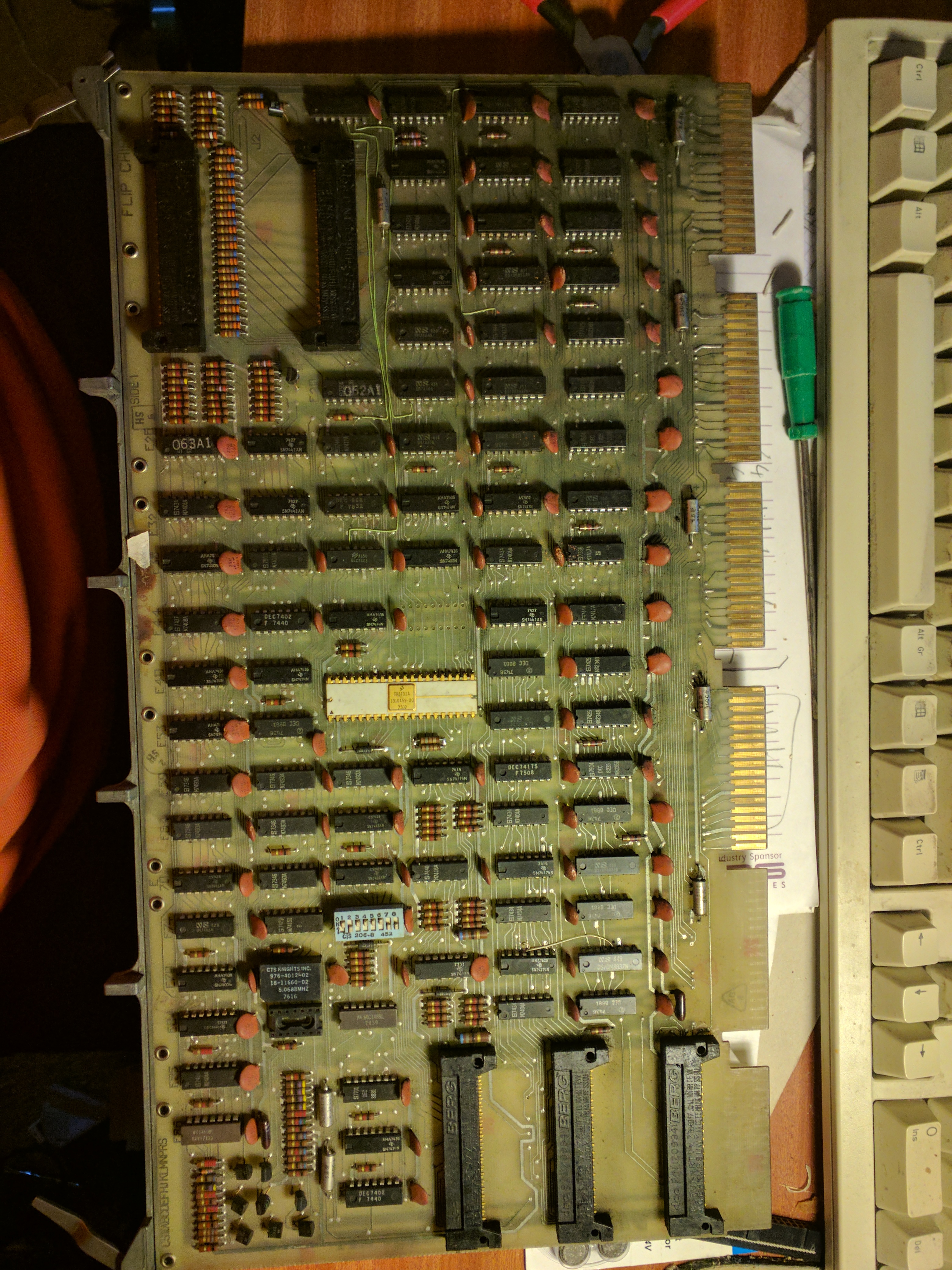
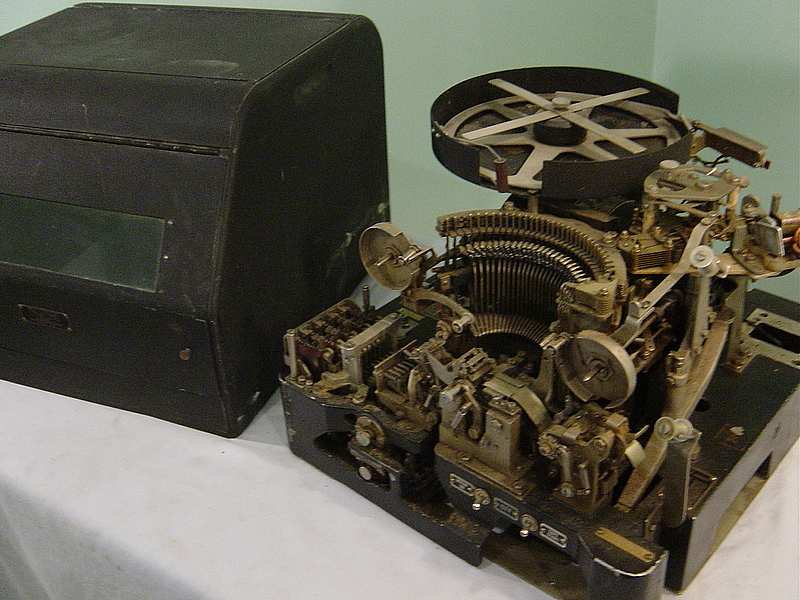
> Wow, sorry about that... Do folks here have an alternative service they
> like/recommend for sharing linked photos to the list?
>
They work fine for me in the "New" Edge, Chrome and Firefox. Noel, do you
have the updated Chromium based Edge or "Legacy" edge ?
Not sure why they don't work for Noel in edge. If anyone still has the old
now called "Legacy" Microsoft Edge note it is no longer supported or updated
and its probably time to ditch it ...
https://www.theverge.com/2021/3/9/22321779/microsoft-edge-legacy-spartan-bro
wser-support-ended
In my experience some one has issues with every photo sharing site I have
used.
> cheers,
> --FritzM.
>
>
Dave
> From: From: Fritz Mueller
> two solutions come to mind -- the one you mention here with nut and
> washer, or inserting a hex-head machine screw in the other direction.
> Either the nut or the hex-head screw could then be secured with a small
> combination wrench.
Well, if you put the bolt in first (which you'd kind of have to do, if going
>from front to back, with the adapter already mounted to the KY11-L), you'd
have to hold it in place while you offer the KY11-L up to the BA11-K. Which
was why I was originally thinking, put the bolt in in the other direction,
which you can do after you put the KY11-L+adapter in place.
But that brings up another idea: put the bolt in place (on the adapter), use
a first (thin) nut (with washer, if necessary) to hold it in place, then bolt
the adapter to the KY11-L bezel, then mount the whole works up to the BA11-K.
Not sure which would work better. I'd probably go with the 'pointing forward'
bolt, and use a lock-washer (or one of those nuts with integral lock-washer),
and then you can mostly tighten with a Phillips driver from the rear. But the
extra washer might be easier to put together (if it doesn't push the KY11-L
bezel too far forward).
Noel
I have some old stuff, that's not really computer stuff, so this might
be the wrong forum to ask.
But it might be the right people.
1. Sears Model 564.21600300 monaural portable tape cassette player,
with external mic and switch. It works, but it needs a new spindle
belt. Tape plays, but only the capstan advances it, so it gets tangled
up inside the box. I found a 5v power cube that works with it, even
though it says it wants 6v.
2. Sony SVR-2000 Tivo DVR. It appears to work, but I don't have the
remote, so it doesn't do anything other than cycle through its warnings
about not having been connected to the telephone and made the monthly
call to collect the fee.
3. Tivo Series 2 DT Digital Video Recorder, model TCD649080. Says
"Welcome! Powering Up..." but I waited for half an hour and it didn't
do anything else. It was connected to my network (the lights on the RJ-
45 socket were blinking) but my router couldn't see it. I have the
remote for this.
Any of these are yours for the price of shipping -- or local pickup in
91214.
Van Snyder
van.snyder at sbcglobal.net
>> From: Fritz Mueller
>> my brackets just have a punched oval hole at the bottom, and not a
>> "tapped hole" per your description above.
> The adapters on mine look _almost_ identical to yours, but _definitly_
> have a #8 press fit threaded bushing at the bottom.
Now that I've thought about it for a bit, I wonder if you can use a
nut-and-washer in place of the press fit threaded bushing at the bottom (but
otherwise all the hardware,and insertion directions, will be the same); it
will be kind of difficult to get the nut in there with the KY11-L pressed up
to the front of the BA11-K (which is probably why they went to the press fit
threaded bushing) - maybe hold it with a pair of needle-nose?
Noel
PS: Thanks for the URL for the knob; I'm going to order a couple of spares
(the DEC originals have a tendency to break).
> From: Fritz Mueller
> Pictures of my brackets should be viewable at
> https://photos.app.goo.gl/wni3mDAQHozK9Ho27
I couldn't get them to display on my modern Window laptop, using either the
Edge or Explorer browsers. I had to get my wife to show them to me on her
Apple laptop. Not a great site to use for photos.
> The interesting/confusing bit for me is the bottom part... In the
> second picture you can see that my brackets just have a punched oval
> hole at the bottom, and not a "tapped hole" per your description above.
Odd. The adapters on mine look _almost_ identical to yours, but _definitly_
have a #8 press fit threaded bushing at the bottom. Then there are a pair of
holes in the folded-over bit, and a pair of machine screws go through
superimposed holes in the flat part, and into tapped holes in the KY11-L
bezel, which hold the adapter to the bezel. The 1" long #8 machine screw
then holds the adapter to the tabs in the BA11-K.
To do the other mounting hardware, in Henk's picture, there's a flat metal
plate, with i) a hole in each end, and ii) a threaded hole in the middle. Two
machine screws (#8, I thihk) hold the flat plate to the bezel, then another
screw (#10, maybe) holds that U-shaped piece in Henk's picture to the flat
piece, and then a pair of #10 screws hold that to the tabs in the BA11-K.
(All machine screws above face forward.)
>> I'm too burned out (COVID long haul) at the moment
> Something a lot of us are going to have to face in the upcoming
> months/years, it seems -- wishing you best!
Hey, it could be worse! :-)
Has the classic computers commuinity lost anyone to COVID? I know we've
lost a few in the last year, but I don't recall if any were COVID.
Noel
Hello all!
I am starting a new job next week and returning to a field where my
roots are (multimedia engineering, signal processing, etc).
Therefore I am vacating my studio workshop and ending a few projects I
was working on until recently. I have a lot of industrial and
enterprise server hardware to sell or give away FTAG (free to a good home).
FTAG: Toten GS Cabinet, 42u, 1000 mm Deep, 800mm Wide, 3 Fixed Shelfs +
2 Fan Units + Cable Management
800mm wide which is easier to work with than a 600mm. However being
1000mm deep it does it mean you can add 670mm servers. It's a
relatively large cabinet so you can fit pretty much most rack-mountable
servers.
It is packaged as a flat-packaged self-assemble rack cabinet in five
large, flat-packaged, boxes. I will of course help move them from my
office to your van (I recommend collection with a van or courier with van).
This item is among the first things I'm giving away because I need to
free up some room. This will make it easier to catalog and sell/give
away. I will be advertising other items too in the next few days.
Post code: N15 4QL (Seven Sisters and Tottenham Hale)
Any recommendations for other mailing lists or web forums to advertize
this offer are welcome too.
Thank you all!!
Kind regards,
Andrew
On 3/3/21 11:11 AM, Al Kossow via cctalk wrote:
>>/On 3/3/21 10:42 AM, Lee Gleason via cctalk wrote: />>//>>>/?? The auction starts at? more than I have in my computer budget this
month />>/I went ahead and bought these, but paypal contributions to my email
would be helpful />>/this is way more than I can afford as well. /
>He listed a 11D utilities source disk over the weekend, so that is on its way now too.
>I asked and he says he doesn't have any more 'red labeled' DEC disk packs.
Did you notice this auction? Looks like not all of his RSX11D stuff is red labelled. This one looks like it might hold a running system.
https://www.ebay.com/itm/PDP-11-RK05-RSX-11D-64K-DEC-Digital-PDP/3534108081…
--
Lee K. Gleason N5ZMR
Control-G Consultants
lee.gleason at comcast.net
Hi all,
I'm reassembling an PDP-11/34 in a BA11-K chassis right now, and am a little puzzled by the front mounting brackets (the ones that hold a KY11-L of either sort on the bottom, and a half trim-panel on the top). In particular, on the bottom half, the available place for screws to go to attach the bracket to the chassis is nearly completely blinded by an overhanging tab.
The engineering drawings I've seen are unfortunately not very clear on this... Anybody have an 11/34 in a BA11-K and care to take a peek and tell me how the hardware here is properly configured? (Hex head instead of DEC's ubiquitous Phillips truss, to allow tightening from the side? Machine screw from back, and a nut on the front? Other?)
cheers,
--FritzM.
> From: Fritz Mueller
> I'm reassembling an PDP-11/34 in a BA11-K chassis right now, and am a
> little puzzled by the front mounting brackets (the ones that hold a
> KY11-L of either sort on the bottom, and a half trim-panel on the top).
> In particular, on the bottom half, the available place for screws to go
> to attach the bracket to the chassis is nearly completely blinded by an
> overhanging tab.
> ..
> Anybody have an 11/34 in a BA11-K and care to take a peek and tell me
> how the hardware here is properly configured?
Well, I have an KY11-LA mounted on a BA11-K; the KY11-LA and -LB use the
same bezel, and should have identical hardware.
There's an intermediate 10" or so high adapter piece (one either side, of
course) mounted to the KY11-L. (That's attached to the KY11-L with short
machine screws which are inserted from the rear, and go into tapped holes in
the KY11-L bezel.) That piece attaches to the BA11-K with different hardware
at the top and bottom: on the bottom, a single 1" or so machine screw (#8, I
think) goes through the vertical tab on the side at the front of the BA11, to
a tapped hole in the adapter piece. At the top, a pair of short countersunk
machine screws (#10, I think - definitely larger than the 1" machine screw at
the bottom) attach a pair (one each side) of those black plastic mounting
widgets which have a pair of balls on stalks; those go into holes on the back
of the blank panels, and those screw also hold the adapter piece to the
BA11-L at the top. (I looked for the DEC formal name for those pieces, but
couldn't find it.)
> I'll get some pictures of the brackets I have, too -- maybe they aren't
> the standard/correct ones for an 11/34...
I'll take a look. I'm too burned out (COVID long haul) at the moment to take
pictures or do a drawing right at the moment; if needed, I can do it tomorrow
(or so).
Noel
PS: A while back you were after measurements on the KY11-L power knob;
did you ever get those: If not, I've got one, and can measure it.
> From: William Donzelli
> Sellers of collectibles and antiques get bombarded with nitpicks and
> corrections. Often these are right, but often they are wrong.
Yeah, that's why I didn't just assert 'this is wrong, X is right', but I gave
them the things to look at so they could verify for themselves that my claim
was correct.
> Passing a URL through the Ebay system is trickly, to say the least
> ... "Check this document 123-456-78 in bitsavers, page 26".
Yeah, I didn't try and pass a URL, too hard; (and in any case, a tricky con
artist could point to a fake document they had posted). I guess I should have
said 'Check the PC05 manual, look on BiSavers in dec/foo/bar to find it, pg.
xyz'.
> From: Bill Degnan
> I went to this guys place and saw the tape reader first hand. Its in
> better condition than mine.
Oh, I didn't have a problem with the condition; just that it was
incorrectly labelled.
> From: Jay West
> I would think the thing that would make it stand out and make him
> change it - tell him a PC05 doesn't connect to a PDP8, it goes with
> something completely different (a PDP11 ofc, correct?).
Yes, the PC05 is for the PDP-11 (and others):
https://gunkies.org/wiki/PC04/PC05_High-Speed_Paper-Tape_Reader/Punch
Yes, what I _should_ have done is say 'the PC05 is for the PDP-11; the PC04
(which this is) won't work on a PDP-11. If a PDP-11 owner buys this for his
PDP-11, he'll probably by unhappy'.
Noel
On 4/9/21 3:23 PM, Nemo Nusquam wrote:
> On 2021-04-08 00:32, Ben Huntsman via cctalk wrote:
>> I know this is a strange place to ask, but it's as good a place as any.
>> Anyone on here used IBM's XLC in very old versions?
>>
>> Anyone know what the argument -qdebug=austlib does?
>
> I have the docs for IBM C Set++ 3.1 for AIX (1993) and it is not there.?
> As you probably know, the Austin lab was known for HPC s/w so they may
> have shipped special debug versions.
[..]
I used xlc in the early 90's at IBM in the Raleigh networking lab, along
with the excellent xcdb debugger - Austin's debug libs weren't a part of
our repertoire. There was plenty going on that was deeper and closer to
the iron in Austin, so it could be just about anything.
AIX 3.2.5 was so much leaner and meaner than 4.x that came along next...
I never did warm up to it the same way.
- David
Hi All,
I'm looking for a H960 to put my 8/e in, either to buy or to trade for
something. (PDP-8/11/VAX/Alpha gear, KIM-1??)
I'm in South-West England and am happy to collect from mainland UK.
I may also be willing to have it shipped internationally.
Regards,
-Tom
hello all
i am looking to purchase qty 2 DEC H8575-A DB25 to MMJ adapters.
anybody have some that they can sell?
also need a couple of mmj to mmj cables, 10' or longer would work.
thanks
tim
timothy rutherford
teor at nmia.com
505-550-5110
I have an 11/03 (unmapped, of course) with 28kW memory and two DLV11s.
I'm trying to build an XXDP image on TU58 that I can boot on this system,
using an XXDP 2.5 RL02 image and simh.
My simh configuration is -
CPU 11/03, NOEIS, NOFIS, BEVENT disabled, autoconfiguration enabled,
idle disabled
.
TTI address=17777560-17777563, vector=60, BR4
TTO address=17777564-17777567, vector=64, BR4
TDC controllers=1, address=17776500-17776507, vector=300*, BR4, 2 units
.
RL RLV12, address=17774400-17774411, vector=160, BR5, 4 units
I can boot from the RL02 OK -
MEMORY MANAGEMENT UNIT NOT FOUND
BOOTING UP XXDP-SM SMALL MONITOR
XXDP-SM SMALL MONITOR - XXDP V2.4
REVISION: D0
BOOTED FROM DL0
28KW OF MEMORY
NON-UNIBUS SYSTEM
RESTART ADDRESS: 152010
TYPE "H" FOR HELP
But running UPDAT to create a new system image on the TU58 dies
.R UPDAT
UPDAT .BIC
HALT instruction, PC: 000010 (000012)
If I change the CPU to an 11/23 (but keep the same memory and other
configuration) then UPDAT works. Is there some issue or limitation in
running XXDP on a 11/03? Is it just UPDAT that doesn't work, or are there
bigger problems?
Thanks
Bob
I'm slightly amazed at how some eBay sellers react. Take this item:
https://www.ebay.com/itm/154404969351
which the seller had listed as a 'PDP-8 PC05'. I sent the person a message
pointing out that it was a PC04 (as shown by the 4 rocker switches, and the
small backplane - PC05's have a larger one to hold more cards).
They sent a nice peply, but didn't alter their listing!
Well, I hope the bider really is a PDP-8 owner who wants a PC04... :-)
Noel
I am looking for a video or photos that show how one removes the printer
>from the keyboard safely on an ASR 33. I need to get to the underside of
the printer levers so I can re-align them. I am getting incorrect
characters when I type over half of the keys. I can see that a few levers
are out of whack or not seated correctly but I believe to get to them
properly I need to put the printer on its side or under a lift to get to
the underside. I am nervous about detaching the "H" shaped gizmo that
connects the keyboard to the printer.
Thanks
Bill
On 4/12/21 1:00 PM, Liam Proven <lproven at gmail.com> wrote:
>> AIX 3.2.5 was so much leaner and meaner than 4.x that came along next...
>> I never did warm up to it the same way.
>
> Twas ever thus, no?
A universal truth.
> I remember an ad campaign for AIX when it was quite new... "We took
> UNIX and added millions of lines of code to it." (Or words to that
> effect.) To me and to a lot of other people, this did not sound like a
> good thing...
The ad campaign I remember was "A disciplined merge of System V and BSD"
This looks relevant, from 1989:
https://technologists.com/sauer/Convergence_of_AIX_and_4.3BSD.pdf
Hello computer friends - all of us down in VCF Midwest Planning
Bunker have decided: VCFMW16 planning must commence! To not do so
would surely set up for failure, if and when conditions continue their
current upward trend and we get the OK to gather again in unlimited
numbers.
So...we're going to have a show!
Our schedule this year will be the same weekend as in 2019, with the
dates this year falling on the 11th and 12th of September. Same
location as well, at Waterford Banquets (and Clarion Inn), Elmhurst,
Illinois.
See our full announcement here: http://vcfmw.org/announce. And fill
out the linked survey if you'd like.
Still much to do - room block reservation, improved table layout
planning, speaker recruitment....and that dang T-shirt. We hope
everyone who is able to travel in September will consider paying us a
visit.
More news to come - check our newly re-themed website for updates as
they occur! http://vcfmw.org
-jt
I am hesitant to post this because I don't want to start a massive debate,
but what Newsreader programs do people use on Windows?
I don't want to use Google Groups because it wants me to sign in to Google.
I am generally reluctant to use a browser based reader because it will want
to track me. So I am after an installable client.
Thanks
Rob
Does anyone recall what kind of hardware/software was used to read/write the
early Mitsubishi Melcard EPROM cards with the PCB edge connector contacts?
It was explained to me by someone that a EPROM programmer could be used,
however I've never seen a socket which fits the edge card connector of these
cards.
I've uploaded an image of the edge contact end of this type of card here:
http://www.hammondorganservice.com/downloads/images/melcard.jpg
Seems these were also available in the SRAM variety as well.
Thanks
Don Resor
I know this is a strange place to ask, but it's as good a place as any.
Anyone on here used IBM's XLC in very old versions?
Anyone know what the argument -qdebug=austlib does?
I can't seem to find any documentation that says... It would have been an argument for the compiler shipping with AIX 3.2.5, I believe.
Thanks in advance!
> From: Jerry Weiss
> I always wondered why the RKV11-D was only 16 bit addressable.
The manual (EK-RKV11-OP-001) says: "Since the 11/03 BUS structure has no
provision for extended addressing, no connection is made to the bus from
these [XM] bits on the RKVII-D." (pg. 3-5).
> The DEC RK05 disk subsystem cost $10K list circa 1978 (drive, RKV-11D
> controller and cabinet), so this wasn't a trivial purchase.
Interesting. Where did you see that listed, just out of curiosity? (I looked
in the Jan '84 PDP-11 Systems and Options, my copy of which just showed up,but
that's too late; I could probably find it if I pawed through all my DEC sales
literature, but I'm too lazy... :-).
Noel
I believe the original Amiga file system also used a linked-list approach. That way you could, theoretically, reconstruct a file from any one of it?s data blocks.
Richard
Sent from Mail for Windows 10
Hi All,
Back after a long time away from this list... I happen to have a small herd
of Apollo DN3500/4500 boxen which i pulled out the other day to see if they
still run. Sure enough they still boot up (one has a flaky PS but i have a
few spares). Anyway, the last time i fired one of them up (runs SR 10.4.1)
was around 2015 and it still was able to deal with the current date back
then. This last time the other day I did an EX CALENDAR to reset the date
to the current date and it defaulted to some date in 2015 again and i
wasn't even able to log on using my known login. I figured it was due to
the well known date bug so i reset the date back to 2013 (of course it
warned me about possible duplicate file IDs, etc) but I was able to log in
again.
My question, has there been any progress in fixing the date bug by anyone
(who still has some of these machines) (I'm thinking guys like R.
Stricklin..). Or is this pretty much a dead end? I know HP put out a
"patch" which according to Jim Rees's page was never really an effective
patch to begin with...Any insight would be appreciated.
-Kurt
On 4/8/21 8:40 AM, Eric Smith wrote:
> On Thu, Apr 8, 2021, 09:34 Chuck Guzis <cclist at sydex.com
> <mailto:cclist at sydex.com>> wrote:
>
> There's a big difference--in a WORM, unwritten sectors *mean* something.
>
>
> For archival purposes, in what way does an unwritten sector on a WORM
> mean more than an unwritten sector (with no data field present) of a
> floppy? Neither can be accurately archived without representing the fact
> that it is unwritten.
Simple--a WORM contains the entire history of information on the disc;
nothing is ever lost. A floppy can have data overwritten--and probably
does (e.g. directories and allocation maps) The only way to update a
WORM is to add to it.
--Chuck
> From: Ethan Dicks
> One of these?
> ..
> Looks neat.
Wow; that's pretty impressive! Not only will it talk to an RK05, it also
works with drives from Ampex, Control Data, Diable, Pertec, etc, etc. I
didn't realize they were all similar enough (in terms to the controller
interface) to be interchanged like that.
For the RK05, it must have used a flat cable from the Berg header on the card
to a custom dual card that plugged into the mini-backplane in the RK05
(similar to the RKV11-D).
> From: Chris Zach
> I have wondered if the Plessy can do 22 bit DMA
Depends on whether or not it's program compatible with the RK11. That's
because on almost alll UNIBUS controllers, DEC was in the habit of putting
the A16/A17 bits of the buffer address in the CSR (usually in the 060 bits).
So they could only handle 18-bit DMA addresses.
Early QBUS contollers just copied that, so that they were then 100% software
compatible. That's why the RLV11 and RLV12 differ a bit: the RLV11 is 18-bit
address only; to add 22-bit capability to the RLV12, they had to add an extra
register (the RLBAE).
(Interestingly, the Dilog card above claims to the RKV11 compatible; but also
says it has "memory addressing capability" to 256KB. They can't both be true,
though; although the RKV11-D has the A16/A18 bits in the CSR, they aren't
connected to anything! See EK-RKV11-OP-001, pg. 3-5.)
Noel
This item:
https://www.ebay.com/itm/383837694443
(described as just an "EIA distribution panel" in the listing) turns out to be
a DZ11 distribution panel, if anyone needs/wants one. The price is vaguely
reasonable, but maybe the seller would accept a lower offer.
Noel
> From: Al Kossow
> I have to find my qbus rk11 card.
The RKV11-D is a set of 4 quad cards (3 of them the same as the RK11-D) and a
custom 4-slot backplane (different from the RK11-D's), along with another
dual QBUS card, connected via flat cables. It was apparently usually supplied
by DEC in a mounting box of its own.
Noel
> From: Al Kossow
> it's a single-card controller made by Xylogics.
Ah; never heard of that. If you don't mind indulging my curiousity, how did it
connect to the drive (if it used RK05's, and not a Diablo, or something)?
Normal flat cables to a dual card (like the RKV11-D), or a connector on the
back edge (like a UNIVERTER; so it could use a BC11A cable)?
Noel
Hi all,
you're invited to the Update computer club[0] public lecture series
"Updateringar"[1]! Update is a Swedish computer club founded in 1983
whose members tinker with all kinds of computers, from Raspberry Pi to
PDP-12. The club has a big collection of historic computers. In this
lecture series we'll talk about everything related to computers:
Historic and modern computers, operating systems, programming, hardware
projects, creating art with computers, building a computer museum, and
more. We'll start with a classic: the PDP-8.
When: 2021-04-10, 19:00 CEST
Where: https://bbb.cryptoparty.se/b/upd-0mo-m2u-aq8
Get to know the PDP-8 through emulation
An emulator is a program that pretends to be a computer different from
the one the emulator is executing on. This allows execution of software
intended for a physical computer that you do not have. In this talk
Pontus will explain the basics by implementing a fully working PDP-8
emulator and explaining each instruction and feature along the way. The
end result is a working emulator in less than 1000 lines of C code. And
hopefully you will walk away with both an understanding of the classic
PDP-8 computer and emulation.
Pontus Pihlgren (Update)
The lecture is free and open to everyone.
Upcoming: 2021-05-08, 19:00: Forth on microcontrollers. Crest (CCCHB)
Hope to see you there,
Anke
[0] http://www.update.uu.se/index_eng.html
[1] https://www.update.uu.se/wiki/doku.php/projekt:updateringar
Looking to buy any of the IR. INTERNATIONAL RECTIFIER KITS WITH SOLAR RADIOS OR SOLAR RADIO EXIMERMENTS? FOR SMECC MUSEUM'S SOLAR ELECTRONICS DISPLAY.? -- ALSO INTERESTED? BY SOME BY OTHER MAKERS TOO ...EMAIL US OFF LIST PLEASE
Sad but true it all looks the same to me most times . In my life time I have typed far more upper case material than upoer...lower stuff..
In usaf the typewriters? we used to send massive? Mars radio messages between name. And families.... had no lower case
Them the years of teletypes,and upoer case computer terminals. .. it's been a hard life... alas
On Sunday, April 4, 2021 Tony Aiuto via cctalk <tony.aiuto at gmail.com; cctalk at classiccmp.org> wrote:
On Sun, Apr 4, 2021 at 9:44 PM Adrian Stoness <tdk.knight at gmail.com> wrote:
> im pritty sure? he uses his teletype to send us emails
>
LOL.? No excuse.? I like old hardware, but that doesn't mean I use it for
real work.
My hand cranked drills are to show my grandchildren. My 18V battery drive
is what
I actually use.
>
> On Sun, Apr 4, 2021 at 8:17 PM Tony Aiuto via cctalk <
> cctalk at classiccmp.org> wrote:
>
>> Ed. When you type in all caps it looks like you've been owned. Can you
>> tone
>> it down so we know it is real mail.
>>
>> On Sun, Apr 4, 2021 at 6:54 PM ED SHARPE via cctalk <
>> cctalk at classiccmp.org>
>> wrote:
>>
>> >
>> >
>> >
>> > Looking to buy any of the IR. INTERNATIONAL RECTIFIER KITS WITH SOLAR
>> > RADIOS OR SOLAR RADIO EXIMERMENTS? FOR SMECC MUSEUM'S SOLAR ELECTRONICS
>> > DISPLAY.? -- ALSO INTERESTED? BY SOME BY OTHER MAKERS TOO ...EMAIL US
>> OFF
>> > LIST PLEASE
>> >
>>
>
Exactly spend years with those too... I am old
On Sunday, April 4, 2021 Chuck Guzis via cctalk <cclist at sydex.com; cctalk at classiccmp.org> wrote:
On 4/4/21 8:28 PM, ED SHARPE via cctalk wrote:
>
> Sad but true it all looks the same to me most times . In my life time I have typed far more upper case material than upoer...lower stuff..
> In usaf the typewriters? we used to send massive? Mars radio messages between name. And families.... had no lower case
>
> Them the years of teletypes,and upoer case computer terminals. .. it's been a hard life... alas
>
What's wrong with upper case?? Do you know of any keypunches with lower
case?
--Chuck
At 12:19 AM 3/04/2021 -0600, you wrote:
>On 4/2/21 10:27 PM, Guy Dunphy via cctalk wrote:
>> There are defects in your 'good' flatbed image too - for eg the
>> bleed-through of the orange lettering on the other side of the
>> sheet. The way to correct that is to use a black, highly light
>> absorbent backing sheet. Eg black velvet.
>
>Hum.
>
>Why do so many scanners come with glossy white (usually on foam) backing
>to hold the image down?
>
>I'm questioning why they do that, not your recommendation.
I think it is a combination of habit, and marketting/customer expectations.
People intuitively expect the white backing, and for many scanning tasks
it is preferable. Yet for scanning anything printed on both sides of thin
paper, it's a real problem.
I have a sheet of matt black plastic, and some black velvet cloth for this.
The plastic is easier to use, but the velvet works better for really
thin paper with a lot of visual bleed through. The more light absorbent
the better. If I ever find a sheet of 'vanta black' (new light absorbent
substance, very close to 100%, look it up) I'll be using that.
That's not the only 'strange & unfortunate lack' in typical scanners.
Another is that the raised plastic bezel goes all the way round the glass,
rather than having at least one of the glass long sides be flat right
to the edge, with the scanner sensor also going very close to the edge.
This is needed for scanning sheets larger than the bed, and also very
essential for scanning pages of books that are too thick to allow getting
any page flat on the typical scanner bed.
There are special 'edge scanners' that allow this - draping the book over
the side of the scanner, so one page can be fully flat on the glass.
They cost _much_ more than normal scanners. And yet the actual
construction has very little that would cost more to manufacture.
Construction is just arranged a little differently. The higher cost is
another case of 'marketting.'
Guy
Minerva and SMSQ/E, both related to Sinclair QDOS, the original OS for
the Sinclair QL.
https://youtu.be/yU0ptNyNqcI
And EmuTOS, a FOSS recreation of Atari TOS & GEM, which reached v1.0
about 6 months ago.
https://youtu.be/eqrM4TE5jTM
I knew about the 1st 2, but this video taught me a lot. It's an
insular community and most materials are aimed at people who already
know about it.
I wrote a blog post to explain a bit of the history and context:
https://liam-on-linux.livejournal.com/78738.html
Found via the m68k.info community:
https://m68k.info/#sinclairql:video:SMSQE:mar2021
Which in turn I found when I asked if there were any 16-bit homebrew
computers out there and learned of the Kiwi 68K:
https://www.ist-schlau.de/
--
Liam Proven ? Profile: https://about.me/liamproven
Email: lproven at cix.co.uk ? gMail/gTalk/gHangouts: lproven at gmail.com
Twitter/Facebook/LinkedIn/Flickr: lproven ? Skype: liamproven
UK: +44 7939-087884 ? ?R (+ WhatsApp/Telegram/Signal): +420 702 829 053
If there is anyone on the list familiar with scanners I'd be most grateful
for some advice please.
Some time ago I bought a HP 8270 sheet feed (full duplex) scanner NOS. I
wanted to digitise a whole heap of old computer documentation and for a
little while I've been working through the big heap of stuff. But for quite
some time I've had an issue with scans that go through the sheet feeder
(irrespective of whether I do them double sided or not). Basically the
problem is that anything that goes via the sheet feeder has issues with
"streaks" in the document whereas anything done on the flat bed is perfect
(I have some links to some examples below).
By way of clarity, anything done on the flatbed the lamp traverses the flat
bed to do the scan. For sheet fed items the lamp is moved to specific slot
on the scanner and the sheet feeder takes over wrapping the document past
the lamp. Given that flat bed scans are OK I don't think its an issue with
the lamp.
I've done the following things to try to resolve the issue with no joy:
* Checked for any specific settings
* Tried doing scans in grayscale
* Tried increasing the resolution (default is 300dpi) to slow the speed that
the document is fed through the feeder.
According to HP the issue is a cleanliness one i.e. dirt on the glass can
cause reflections. I've followed their instructions for cleaning the glass
but still no joy.
Flatbed example.
https://drive.google.com/file/d/1jYiFzERiZiaq7-WoTiQ2eIzITn6giviR/view?usp=s
haring
Sheet feed example.
https://drive.google.com/file/d/1WF4SHbwV3bVET_bzwIUiULywbCGZBf_V/view?usp=s
haring
Thank you!!!
Kevin Parker
> On Apr 1, 2021, at 10:00 AM,Al Kossow <aek at bitsavers.org <mailto:aek at bitsavers.org>> wrote:
>
>
> Interpress had nothing to do with the Alto
>
> Talk to Paul McJones re. Interpress translation
I included Press-to-{PostScript,PDF} conversion in the program that generated http://xeroxalto.computerhistory.org, but I don?t have any code for Interpress.
> From: Al Kossow
> Dover was not an Interpress printer
Yeah, it used Press format. BTW, here:
http://ana-3.lcs.mit.edu/~jnc/tech/unix/s2/press.c
is the program from our V6 Unix machine to produce PRESS format files for the
MIT Dover. (.v was the format for the Varian printer, a poor man's XGP, but
which had finer resolution; our copy of troff had been hacked to produce .v
format output.)
Noel
I'm in the middle of imaging a set of 5 1/4" diskettes from 1988
containing the Interpress conformance test suite.
My plan is to
- convert the MS-DOS backup format images to files (trivial)
- find interpress to postscript converter to print the files.
- compare them to the reference pictures to verify I got them all.
The third part is the hard one. I believe there was a document to go along
with the images, so you could verify they printed as expected. I don't
think I have that any more. I'm looking for pointers to an online copy. My
search has come up empty.
Of course, the alternative is if someone has an interpress printer. We
could just print them. Perhaps Curious Marc has one alongside the Alto?
Hello, DEC enthusiasts -
I've got some 5-1/4" disks here that purport to be from a DECmate
(probably II) and may have data offloaded from a bigger system. But the
disks don't have any recognizable trace of a filesystem on them; just
vast swathes of data that looks like this:
https://drive.google.com/file/d/12EO4Lg1Uh7NvCUJksHQ2AUiK550OX7UJ/view?usp=…
It seems to be a pattern of a near-zero byte followed by some other
byte. It's like they're storing 12-bit words in 16 bits or something.
Does anyone recognize this sort of thing, just eyeballing it?
- David
> Date: Mon, 29 Mar 2021 21:27:58 -0400
> From: Chris Zach <cz at alembic.crystel.com>
> To: dstalk at execulink.com, "General Discussion: On-Topic and Off-Topic
> Posts" <cctalk at classiccmp.org>
> Subject: Re: Pro350/"XT" pre-release documents
> Message-ID: <9f8a2890-d268-bb19-1989-e26364c9c7a8 at alembic.crystel.com>
> Content-Type: text/plain; charset=utf-8; format=flowed
>
> Well, what I have is this:
>
> SPSS/Pro introductory guide
> (2) SPSS/Pro for DEC professional/350
> SPSS-X User's guide, third edition (Think telephone book)
> 4 disks VOL NAME SPSSPRO1 (to 4)
>
>
> Hey, in one of the manuals there is an additional disk SPSS/Pro
> DEMONSTRATION
>
> I guess I can copy them on my Pro/380 to other disks, but does anyone
> have a better way to make a spare copy? They are almost 40 years old at
> this point...
>
> Interesting stuff.
>
> C
Chris,
There was also a SPSS-11 for RSX and your SPSS for Pro/350 would likely be a later version. A few years ago I bought the SPSS-11 manual from an Ebay seller. It looks like SPSS-11 ran a lot like the IBM OS/360 version in that it was feed a file of input and it produced a file of output (like a batch job).
The Pro 350 version was likely a bit more interactive and I would be very interested in getting a copy of it. As far as the best way to get a copy made, it would be great to read them on a M+ system that has TCP/IP or is at least connected to HECnet so the disk images could be uploaded somewhere. Also, the manuals would be of interest as well. The SPSS-11 manual I have is a relatively thin paperback book.
Thanks,
Mark
Also came across a TSX Plus reference guide and install guide, from
1985. These two fill a very large binder, have they already been scanned?
If not I'll burn out my scanner doing these. If so I can pulp or Ebay them.
C
Hi!
Given that other people seem interested in the Pro/350 series systems I
thought I would dig out and scan some of the remaining manuals I have.
These seem to have come from an agreement with SPSS back in 1982 or so
and all appear to be draft documents.
I'll upload them as I scan them (takes time) to https://www.crystel.com/pdp
I'll upload a PDF file along with a zip file of the scans at 300dpi.
Question: Would the SPSS manuals be interesting?
Also I have an RSX11M 3.2 manual set in a big binder, worth scanning or
is that up there already? I'm assuming the Fortran manuals have already
been scanned in the past.
Final thought: Looks like I have the spss/x floppies for the Pro version
1.0, are those out there somewhere already?
Thanks!
Chris
Hopefully this is an easy question - are the sources for the XXDP
diagnostics online anywhere? I particularly looking for NKXA, the
Falcon-11/KXT11/DCT11 one.
Thanks,
Bob
Ladies and Gentlemen,
I was sifting through a huge box of industrial junk in my basement and
found two NIB DEC H8575-A DB25 to MMJ adaptors in their original bags
with a 1991 date code. The DB25 is female and the MMJ is, of course,
a jack.
Does anybody want them for postage from Athabasca, Alberta?
--
Richard Loken VE6BSV : "...underneath those tuques we wear,
Athabasca, Alberta Canada : our heads are naked!"
** rlloken at telus.net ** : - Arthur Black
? Al K has read hundreds of these Whirlwind tapes using a standard
8-track optical reader, so I think we can confirm that it is punched
with the common geometry, except one track narrower, with four bits on
one side of the sprocket holes, and three bits on the other.
? The tapes are for pedagogical purpose, so if I can punch on inch-wide
tape and perhaps trim the width later, that works just fine.
Thanks all!
?/guy
Date: Fri, 26 Mar 2021 16:01:38 -0700 From: Al Kossow
<aek at bitsavers.org> To: cctalk at classiccmp.org Subject: Re: punching
paper tape Message-ID:
<f52af974-dbc4-0a51-409e-b4cc2b9076e9 at bitsavers.org> Content-Type:
text/plain; charset=utf-8; format=flowed On 3/26/21 2:58 PM, Steve
Malikoff via cctalk wrote:
> OK thanks for that. I just had a browse and read that "Whirlwind used
> the same paper tape format that was popular with Teletype machines" so
> I gather it's nothing special after all.
the best picture i have at hand of what a ww tape looks like is on the
right of
http://bitsavers.org/bits/MIT/whirlwind/X4222.2008_Whirlwind_ptp/pictures/s…
you can see it is narrower by one punch than a normal 8-channel tape
Is there someone in North America that might be willing and able to help
out a small historical display project by punching a few short paper tapes?
I'm glad to try to accommodate whatever coding requirements are easiest.
Thanks!
/guy fedorkow
fedorkow at mit.edu
I have an old HP 1630G logic analyser. I am trying to use it to debug a
problem with an 82C206 peripheral controller (or rather I think damage
between the CPU and the peripheral controller). I am not very experienced
with logic analysers and I wonder if I am using it correctly.
What I am trying to do is see which internal registers are being
read/written and the values. To do this there are two signals (XIOR and
XIOW) that trigger the read/write on their rising edge. So I have connected
the XIOR and XIOW signals to the J and K clock inputs and set the LA to
clock on the rising edge. I have then told the LA to trigger on a particular
address range (in the State Trace screen if anyone is familiar with this
LA).
When I run the analyser it complains of a slow clock. This makes sense,
because I am using the read/write signals to drive the clock inputs so that
I only capture actual reads and writes to the peripheral controller.
However, I don't seem to be getting sensible values in the trace and I am
wondering if the LA is really not capturing anything because of the slow
clock?
I don't think it makes sense to clock the LA on the actual clock signal
because I won't be able to capture the address and data values on the rising
edge of the read/write signals and I would end up with traces full of
useless data.
Am I doing it right, or is there a technique that I am missing here?
Thanks
Rob
So, some months ago, I was in an electronics surplus store and picked
up what was obviously an X terminal - tiny metal slab with a VGA
connector, serial & parallel, AT keyboard, and RJ45 "communication"
port. I got it bare, without the external PSU that would've gone with
it, and I've since been unable to determine just what the heck I'm
supposed to feed this thing. It's a standard barrel jack, but there's
no markings on the case or the PCB to give any clue as to what
voltage/amperage or polarity it expects, and Google has been no help
at all. Does anyone have any recollection of these things? Any idea
what they want for juice?
To throw an extra mysterious wrinkle into this, when I popped open the
case to get a look at the PCB, I found that, apart from the CPU, DART,
and ROM, the only non-glue ICs on the board were an 8K SRAM and a
W82C476 RAMDAC - but 8K isn't even remotely enough for a VGA screen,
not even a monochrome one at VGA resolution! Am I missing something on
how these things operated? Given this, my only guess would be some
kind of insane networked-framebuffer scheme where the host would blast
video data in on the fly, but there's no way this was even 100Mbps
Ethernet, and 10Mbps isn't nearly fast enough to transfer 150KB at
60FPS, and there's no memory to buffer it for a slower refresh. What
in the heck is going on here?
Subject line says it all -- I'm working on a restoration that includes one of these, and it looks as if it needs some troubleshooting/repair. I didn't see docs posted at Bitsavers. Anybody have a manual squirreled away?
cheers,
--FritzM.
Hello All,
Does anyone have a copy of the DEC CTI Bus Technical Manual
(EK-00CTI-TM-002) I can scan?
If not, does anyone have an email address for Ken Wellsch or Megan
Gentry as they both appear to be authorities on the CTI bus (see
https://en.wikiversity.org/wiki/DEC_Professional_(computer)/Archive
question 10)?
Thanks in advance!
--Bjoren Davis
Announcing our second Annual Vintage Computer Federation Swap Meet!
Last year's Swap Meet was very successful so ... we are doing it again!
*DATE*: April 24, 2021 (RAIN DATE: April 25, 2021)
*TIME*: 8AM to 2PM
*ADDRESS*:
Parking Lot on Monmouth Boulevard, Wall, NJ
Across from Infoage Museum and Brookdale College
*GPS location*: https://goo.gl/maps/m1AAS4UUziGXnoPeA
(40.1848793,-74.0630848)
*WEBSITE*: http://vcfed.org/wp/vcf-swap-meet
*EMAIL*: swapmeet at vcfed.org
*PHONE*: 732-722-5015
Free to buyers.
Vendor cost is per space. First space is $20, each additional space is $10.
You can park in your space and sell out of your vehicle.
*SEND PAYMENT TO*: paypal at vcfed.org (FRIENDS AND FAMILY OPTION)
Write in the note section:
[your name]
VCF Swap Meet 4/24/2021
Number of spaces:
*SWAP MEET SIGNUP*: https://forms.gle/kNCL8WVxTQcnw5nA6
* Reservation doesn't guarantee sales.
* The Vintage Computer Federation is only providing a space, vendors must
bring their own tables, tents, cars.
* In case of inclement weather, money paid will be refunded.
* All items that you bring must be taken with you. No items are to be left
behind.
* Port-o-potty on site.
Jeff Brace
=========================================
Vice President & Board Member
Vintage Computer Festival East Show-runner
Vintage Computer Federation is a 501c3 charity
http://www.vcfed.org/
What a bunch of ^%#%#@$^. FYI, this is a listserver designed for classic
computer discussions. Please save your diatribes for a more appropriate
venue!!!
Marvin
> Look, TBH, sorry to be That Guy, but what it sounds like is made-up
> mumbo-jumbo with as much basis in science as saying his choler is too
> low and phlegm and bile out of equilibrium.
>
> It's an anti-masker trying to justify killing other people. It's no
> more valid than a gun nut shouting about the constitution when they've
> never been near a "well-organized militia" in their life.
>
> Keep well away from any people like this in real life. Do not come
> into physical contact with them, ever, anywhere.
>
> --
> Liam Proven ? Profile: https://about.me/liamproven
Any ideas what this disc controller is?
https://www.ebay.com/itm/PDP-11-Backplane-Western-Peripherals-DC-230-Disk-C…
Can't find much about this on the 'net, other than that it was a controller
for Diablo/Pertec style drives -- no idea if it's an RK11 clone or
something else entirely. Looks to be suitable for a PDP-11/20 given the
little notch missing from the side there, and the lack of a separate power
harness for the backplane.
- Josh
Hello!
Does anyone have any old documentation for ODE 2.1.1, or relatively close versions? I know "newer" versions have been released and have documentation available, but there are some changes in some of the config files that are very different from older versions.
For example when creating a sandbox, in the sandbox directory there is a subdirectory called rc_files, that is supposed to have two files, "local" and "shared", but they don't work the same way that rc_files/Buildconf and Buildconf.exp work in newer versions...
Anyone on here know anything about ODE, or any other sources of information?
Many thanks!
I had some extra A4 pages with a VAXstation 2000 manual which covered
a preview PK2K kit for VMS, bootloader and ROM to allow use of the
VAXstation 2000 SCSI controller for more than just tapes.
Rough scan at http://sync.absd.org/vax/VAX-PK2K-preview-kit.pdf (the
originals will be sent to someone who can do a better job)
The pages led me to http://ftp.gwdg.de/pub/vms/ which includes some goodies:
- http://ftp.gwdg.de/pub/vms/pk2k - uVAX-2k SCSI patches with source
for boot roms, VMB & VMS
- http://ftp.gwdg.de/pub/vms/ka420 - ROM patches for KA420/KA430 boot
>from >1GB disks
- http://ftp.gwdg.de/pub/vms/dk-552/ - VMS 5.2 patch to allow to
accept more SCSI disk devices
(Starting a new thread in case there is (slightly) more general
interest for anyone interested in using the onboard uVAX-2K SCSI
controller more more than tapes (OK, OK, for anyone not running NetBSD
on their uVAX-2K interested in etc etc) - have cross posted to cctalk
& port-vax - hopefully not violating any conventions there)
David
I have acquired a tiny slice of Orange Wall, and wondered if anyone would
be interested - preference for anyone who is setup to scan and upload the
missing bits to bitsavers or similar :)
These seem to already be generally available online
EK-NETAB-UG-002 Workstations and MicroVAX 2000 Network Guide
EK-VAXAB-OM-002 VAXstation 2000 Owner's Manual (Covers how to replace your
mouse balls, and details exciting options such as LN03, LN03 PLUS, LPS40,
LA210, LA100, LA75, LA50. LGC01, LVP16, DF224, DF124, DF112, VSXXX-AB :-p)
These I cannot immediately find
EK-NETAA-UG-001 VAXstation 2000, MicroVAX 2000 and VAXmate Network Guide
EK-VAXAB-IN-002 VAXstation 2000 Hardware Installation Guide
Likewise these German versions
EK-NETGA-UG-001 VAXstation 2000, MicroVAX 2000 und VAXmate
Netzwerk-Anleitung
EK-A0305-IN 001 VR160 Installations-und Bedienungsanleitung
EK-A0355-OG-001 Grafikkoprozessor (8 Bildebenen) fur die VAXstation 2000
Installations- und Bedienungsanleitung
Thanks
David
My understanding of the OS/8 TC08 bootloader (MI8-EC) is as follows:
0. Rewind tape
1. Set current address (07755) to 07600
2. Set word count (07754) to -0200
3. Read block 0 and wait for flag
4. Continue executing at 07600
However, it appears as though word count will be hit by the loading of the
first block. In fact, my instrumented version of SimH says it's overwritten
with a zero. If that's the case, it would seem as though the word count
overflow flag will never get set. Not to mention, the current address will
be updated next, causing data to be redirected to yet another position.
But according to SimH, a write to the current address, 07755, never
happens. How can this be?
Any help would be appreciated!
Kyle
>
> Date: Sat, 20 Mar 2021 16:21:44 -0400
> From: Kyle Owen <kylevowen at gmail.com>
> Subject: Re: DECtape ancestry
>
> What systems took advantage of the bidirectional nature?
>
> Kyle
>
ADSS on the PDP-9 does an interleave of 6 when reading/writing to the
DECtape. If it runs off the end it reverses direction and keeps going. I
have seen some library files take three passes of the DECtape to fully
search.
--
Michael Thompson
I just read part of the Grant Saviers interview from CHM, where near the end he gives a bit of history of DECtape. In particular, the fact that it was derived from LINCtape though the format details are quite different.
A question popped into my mind, prompted by having read Guy Fedorkow's paper about Whirlwind just a few days earlier: the Whirlwind tape format has 6 physical tracks but 3 logical tracks (each logical track is recorded redundantly on two physical tracks) and one of those tracks is a clock track. LINCtape and DECtape have the same redundant recording scheme, and also have a clock track; the difference is that they add a mark track to enable the recording of block numbers and in-place block writing.
That made me wonder if LINCtape was, in part, inspired by the Whirlwind tape system, or if those analogies are just a concidence.
Incidentally, it's probably not widely known that LINCtape/DECtape is not the only tape system with random block write capability. Another one that does this is the Electrologica X1 tape system, which uses 1/2 inch 10 track tapes, which include a clock and a mark track. An interesting wrinkle is that the X1 tape system lets you chose the block size when formatting the tape, and then data block writes allow for the writing of any block size up to the formatted block size. I'm not sure when that device was introduced; the documentation I have is from 1964. There's no sign the designers knew of DECtape (or vice versa).
paul
Hi,
I just wanted to thank Tony for asking the question (disability vs. masks)
and particularly wanted to thank Robert for the kindness of answering it!
I learned something today!
Stan
Hi all,
Does anyone have any documentation (or perhaps even a copy?) of Oregon
Pascal for the Motorola 68000?
I'm looking for information on its calling convention, if such is
available -- or otherwise a way to run it with arbitrary code and see
how it behaves.
Once again I'm reverse-engineering a 68K-based embedded system... :)
Cheers
Phil.
Hello all,
As you all know by now I probably have cancer and I am selling off
my possessions to finance my travels around the country. I have for sale
one Panavise vise with nylon jaws and a large circuit board holder
adapter. $100 plus shipping. Please reply off list. I live in Reedsburg,
WI 53959. I prefer Paypal F&F. If you use G&S please add the 4.5%
handling fee. Will accept MO, Cashiers Check, and Personal Check (must
clear before shipping)!
GOD Bless and Thanks,
rich!
Hello all,
The Panavise is sold. I appreciate the interest!
GOD Bless and Thanks,
rich!
On 3/18/2021 3:41 PM, Richard R. Pope wrote:
> Hello all,
> As you all know by now I probably have cancer and I am selling off
> my possessions to finance my travels around the country. I have for
> sale one Panavise vise with nylon jaws and a large circuit board
> holder adapter. $100 plus shipping. Please reply off list. I live in
> Reedsburg, WI 53959. I prefer Paypal F&F. If you use G&S please add
> the 4.5% handling fee. Will accept MO, Cashiers Check, and Personal
> Check (must clear before shipping)!
> GOD Bless and Thanks,
> rich!
>
>
> -=-=-=-=-=-=-=-=-=-=-=-
> Groups.io Links: You receive all messages sent to this group.
> View/Reply Online (#47099): https://groups.io/g/HOswap/message/47099
> Mute This Topic: https://groups.io/mt/81439849/89555
> -=-=-
> Help spread the word about HOswap! Tell your friends and groups about
> how great this group is. https://groups.io/g/HOswap
> -=-=-
> Group Owner: HOswap+owner at groups.io
> Unsubscribe: https://groups.io/g/HOswap/unsub [mechanic_2 at charter.net]
> -=-=-=-=-=-=-=-=-=-=-=-
>
>
Hi,
Does anyone remember the product name or number of the tiny HP portable
printer (*not* an HP 2225 of any kind!) that probably came out about the
same time as the HP Omnibook 300 (1993)?
(My google-fu failed me.)
IIRC, it was able to print on regular paper 8.5" wide, probably using a
thinkjet mechanism.
Battery powered, probably black, probably HP-IL interface.
I remember coveting one when I got my first Omnibook, but by that time they
were off the market and the only one I ever saw wasn't for sale (I did
borrow it for a few days, it worked well).
The use of standard (in the U.S.) paper, plus the tiny size, had be
interested in it.
thanks,
Stan
If anyone has a modem made by Datec, a long-defunct manufacturer from
Chapel Hill, NC, please let me know. I used to do customer support for
them back in the early '80s. (They used to run ads in Byte Magazine
touting their "crystal-controlled stability".)
Thanks.
**Richard
For what it's worth I've posted some notes on PDP-10 I/O from a
course taught by Mike Bennett at UWO in the early 1970s.
The monitor at the time was likely prior to 5.06.
See: http://www.execulink.com/~dstalk/pdp-10_io.pdf
Don
Have a bunch of modems as well but first have to get PDP-11 stuff
shipped off to those people who want it. Will see if Value Village
in Kamloops will still take them. For a while they were a great
place to get old electronics like the DAT SCSI drive I picked up for
$5 8 years ago. "high speed" at 50 Kb/sec transfer rate which seemed
fast in 2010 when I picked it up and got all my DAT backup tapes
transferred to "disks" which can only run under BasiliskII now.
>Clearing out stuff at my space, I have the following modems:
>
>NEC UltraLite-Series Image Modem Plus w/box
>CTS Datacomm 2424 ADA modem w/box
>Scout Plus External Data/Fax modem w/box
>Digital DF03 modem
>
>Any offers?
>
>--tom
I have this controller, I bought it from the Netherlands three years ago
with a Cipher horizontal tape drive. It was pulled from a working system
but... no drivers.
Does anyone have any related software for this controller?
It is listed here:
http://www.vcfed.org/forum/showthread.php?66915-Overland-Data-TC-50M-Pertec…
I tried everything from Bitsavers. All drivers, all software. Nothing
works. The board is not listed so I installed and tried everything.
To give something in exchange, I wish to contribute with the full Qualstar
Tapestar for Dos package to bitsavers and archive.org (separate thread).
Hello
I have the Qualstar Tapestar Package for DOS. It is fully working. However
it requires a Microtech MCS1 "TAPE816" 16-bit ISA Pertec controller. I have
the full Ms-Dos package. Where do I send the software package to be
uploaded to bitsavers?
> From: Guy Sotomayor
> the LOADALL instructions including all of it's warts (and its inability
> to switch back from protected mode)
Good to have that confirmed (for the 286; apparently it works in the 386).
> the other way to get back to real mode from protected mode is via a
> triple-fault.
Any insight into why IBM didn't use that, but went with the (allegedly slow)
keyboard hack?
Noel
Hi,
I recently bought a core rope memory unit from a Wagner WAC40, mainly because it?s very aesthetically pleasing and looks good on display: https://i.redd.it/h9sb550uhnm61.jpg
However, i can fine very little about Wagner Computer, the WAC40 (and WAC12), or the man behind the company, G?nter Wagner. Does anyone have any info on any of these subjects?
This links seems to be all i can find: https://blog.hnf.de/gauner-gelder-und-computer/
Thanks,
Josh Rice
I've got a Diversified Tech 286 SBC as well and was able to switch to 3.5 floppies by modifying the BIOS settings. Mine has the Dallas Real Time Clock chip and the battery was dead so the BIOS settings weren't preserved after a reboot. Fortunately I obtained a replacement chip available on ebay to fix that issue. I haven't got a manual to share, but it's a neat little board.
Jonathan
On Tuesday, March 16, 2021, 12:00:02 PM CDT, <cctalk-request at classiccmp.org> wrote:
Send cctalk mailing list submissions to
??? cctalk at classiccmp.org
To subscribe or unsubscribe via the World Wide Web, visit
??? http://www.classiccmp.org/mailman/listinfo/cctalk
or, via email, send a message with subject or body 'help' to
??? cctalk-request at classiccmp.org
You can reach the person managing the list at
??? cctalk-owner at classiccmp.org
When replying, please edit your Subject line so it is more specific
than "Re: Contents of cctalk digest..."
Today's Topics:
? 1. VAX rom patches - VAXstation 2000 SCSI boot, KA420 > 1GB boot
? ? ? (David Brownlee)
? 2. Re: Diversified Technology CAT904 80286 single board PC
? ? ? (david raingeard)
? 3. Re: PDP-10 I/O notes (Lars Brinkhoff)
? 4. who collects modems? (Tom Uban)
? 5. Re: Any info on a Western Peripherals DC-230 disk controller?
? ? ? (Jay Jaeger)
----------------------------------------------------------------------
Message: 1
Date: Mon, 15 Mar 2021 18:36:23 +0000
From: David Brownlee <abs at absd.org>
To: rob at jarratt.me.uk,? "General Discussion: On-Topic and Off-Topic
??? Posts" <cctalk at classiccmp.org>, port-vax List <port-vax at netbsd.org>
Cc: Malte Dehling <mdehling at gmail.com>
Subject: VAX rom patches - VAXstation 2000 SCSI boot, KA420 > 1GB boot
Message-ID:
??? <CAGN_6pbBzUQDJP-YiCQRZsaNOsGye1oWQ_ULyvavEd52ZrYp2Q at mail.gmail.com>
Content-Type: text/plain; charset="UTF-8"
I had some extra A4 pages with a VAXstation 2000 manual which covered
a preview PK2K kit for VMS, bootloader and ROM to allow use of the
VAXstation 2000 SCSI controller for more than just tapes.
Rough scan at http://sync.absd.org/vax/VAX-PK2K-preview-kit.pdf (the
originals will be sent to someone who can do a better job)
The pages led me to http://ftp.gwdg.de/pub/vms/ which includes some goodies:
- http://ftp.gwdg.de/pub/vms/pk2k - uVAX-2k SCSI patches with source
for boot roms, VMB & VMS
- http://ftp.gwdg.de/pub/vms/ka420 - ROM patches for KA420/KA430 boot
>from >1GB disks
- http://ftp.gwdg.de/pub/vms/dk-552/ - VMS 5.2 patch to allow to
accept more SCSI disk devices
(Starting a new thread in case there is (slightly) more general
interest for anyone interested in using the onboard uVAX-2K SCSI
controller more more than tapes (OK, OK, for anyone not running NetBSD
on their uVAX-2K interested in etc etc) - have cross posted to cctalk
& port-vax - hopefully not violating any conventions there)
David
------------------------------
Message: 2
Date: Mon, 15 Mar 2021 16:41:54 +0100
From: david raingeard <david.raingeard at gmail.com>
To: Tom Uban <tom at figureeightbrewing.com>,? "General Discussion:
??? On-Topic Posts" <cctech at classiccmp.org>
Subject: Re: Diversified Technology CAT904 80286 single board PC
Message-ID:
??? <CAFvDS1SvQZFE_dzGQaheyLRpFqh-ZqFZyyWpBaMg_D22gZ+8kA at mail.gmail.com>
Content-Type: text/plain; charset="UTF-8"
i rather do? what doe with ibm dos
Le lun. 15 mars 2021 ? 16:23, Tom Uban via cctech <cctech at classiccmp.org> a
?crit :
> It dawned on me that I probably just need to change a BIOS setting. I
> haven't dealt with PCs in so
> long I've forgotten what to do...
> I would still like to find a manual if someone has one.
>
> > I have a Diversified Technology CAT904 80286 single board PC in a system
> with a 5.25" floppy drive
> running DOS.
> > I would like to switch the system to use a 3.5" drive and am wondering
> if anyone has a manual for
> the dip switch settings for this board or if I can simply add a 3.5" drive
> as a 2nd device on the
> floppy cable (guessing not without switch changes)?
> >
> > --tnx
> > --tom
>
>
------------------------------
Message: 3
Date: Tue, 16 Mar 2021 06:04:44 +0000
From: Lars Brinkhoff <lars at nocrew.org>
To: Don Stalkowski via cctalk <cctalk at classiccmp.org>
Subject: Re: PDP-10 I/O notes
Message-ID: <7wzgz3zlab.fsf at junk.nocrew.org>
Content-Type: text/plain
Don Stalkowski wrote:
> For what it's worth I've posted some notes on PDP-10 I/O from a course
> taught by Mike Bennett at UWO in the early 1970s.
Thank you!
Interesting to see the DECtape file structure format.
------------------------------
Message: 4
Date: Tue, 16 Mar 2021 09:48:33 -0500
From: Tom Uban <tom at figureeightbrewing.com>
To: "General Discussion: On-Topic and Off-Topic Posts"
??? <cctalk at classiccmp.org>
Subject: who collects modems?
Message-ID:
??? <d22a7559-5c13-28e5-eec0-b1587b5c5a79 at figureeightbrewing.com>
Content-Type: text/plain; charset=utf-8
Clearing out stuff at my space, I have the following modems:
NEC UltraLite-Series Image Modem Plus w/box
CTS Datacomm 2424 ADA modem w/box
Scout Plus External Data/Fax modem w/box
Digital DF03 modem
Any offers?
--tom
------------------------------
Message: 5
Date: Tue, 16 Mar 2021 11:23:28 -0500
From: Jay Jaeger <cube1 at charter.net>
To: Josh Dersch via cctalk <cctalk at classiccmp.org>
Subject: Re: Any info on a Western Peripherals DC-230 disk controller?
Message-ID: <0877749a-9d01-466e-9e59-854977e13808 at charter.net>
Content-Type: text/plain; charset=utf-8; format=flowed
I may have a little info - but the info is in storage, and it is just a
"Western Peripherals Instruction Reference Card", apparently referring
to the DC-230, PDP-11 and TC-130 (the latter being a tape controller,
for which I do have some doc.)
Once the weather warms up again - say, maybe this weekend, I'll trot off
to storage, bring it back and scan it.
Back in the 1970's the UW Madison CS Department's 11/20 had a 3rd party
disk controller of some sort - one pack removable, one fixed, but I
don't remember who made it (might have been Wangco).
JRJ
On 3/12/2021 5:02 PM, Josh Dersch via cctalk wrote:
> Any ideas what this disc controller is?
>
> https://www.ebay.com/itm/PDP-11-Backplane-Western-Peripherals-DC-230-Disk-C…
>
> Can't find much about this on the 'net, other than that it was a controller
> for Diablo/Pertec style drives -- no idea if it's an RK11 clone or
> something else entirely. Looks to be suitable for a PDP-11/20 given the
> little notch missing from the side there, and the lack of a separate power
> harness for the backplane.
>
> - Josh
>
End of cctalk Digest, Vol 78, Issue 16
**************************************
i rather do what doe with ibm dos
Le lun. 15 mars 2021 ? 16:23, Tom Uban via cctech <cctech at classiccmp.org> a
?crit :
> It dawned on me that I probably just need to change a BIOS setting. I
> haven't dealt with PCs in so
> long I've forgotten what to do...
> I would still like to find a manual if someone has one.
>
> > I have a Diversified Technology CAT904 80286 single board PC in a system
> with a 5.25" floppy drive
> running DOS.
> > I would like to switch the system to use a 3.5" drive and am wondering
> if anyone has a manual for
> the dip switch settings for this board or if I can simply add a 3.5" drive
> as a 2nd device on the
> floppy cable (guessing not without switch changes)?
> >
> > --tnx
> > --tom
>
>
I have two oddball CTI boards for my DEC Professional: a DEC-made CP/M
board (P/N 54-15641) and a board labelled "VIRTUAL MICROSYSTEMS PRO BD.
REV 1" which appears to be an x86 MS-DOS board (it contains an 8086, a
video controller and a bunch of RAM).
I've managed to get them both functional, I believe, but I don't have
software or documentation for either.
I did find the RCS/RI diskettes at
https://web.archive.org/web/20040113090630/http://starfish.rcsri.org/rcs/pd…,
but although the image files are uncorrupted it appears the diskettes
were not read reliably in the first place.
And I also know that at some point the PC-Bridge software and doc set
was available on eBay
(https://www.worthpoint.com/worthopedia/virtual-microsystems-pc-bridge-2-200…).
Does anyone know where I can get a copy of the diskettes and/or
documentation?
Thanks.
--Bjoren Davis
> From: Jim Stephens
> The 286 can exit protected mode with the LOADALL instruction.
Really? So why all the hullabaloo about Triple Faults:
http://www.rcollins.org/Productivity/TripleFault.html
back in the day; and why did IBM set up the keyboard controller so it could
send a RESET signal (so people could get out of protected mode)? Or is it
that LOADALL (which was also undocumented early on, so maybe that's why the
IBM thing) could be used to cause a triple fault?
Noel
I'd be interested in the guides if you're located in Germany, and I do have access to a book scanner.
Best,
MalteOn Mar 14, 2021 19:08, David Brownlee via cctalk wrote: > > I have acquired a tiny slice of Orange Wall, and wondered if anyone would > be interested - preference for anyone who is setup to scan and upload the > missing bits to bitsavers or similar :) > > These seem to already be generally available online > EK-NETAB-UG-002 Workstations and MicroVAX 2000 Network Guide > EK-VAXAB-OM-002 VAXstation 2000 Owner's Manual (Covers how to replace your > mouse balls, and details exciting options such as LN03, LN03 PLUS, LPS40, > LA210, LA100, LA75, LA50. LGC01, LVP16, DF224, DF124, DF112, VSXXX-AB :-p) > > These I cannot immediately find > EK-NETAA-UG-001 VAXstation 2000, MicroVAX 2000 and VAXmate Network Guide > EK-VAXAB-IN-002 VAXstation 2000 Hardware Installation Guide > > Likewise these German versions > EK-NETGA-UG-001 VAXstation 2000, MicroVAX 2000 und VAXmate > Netzwerk-Anleitung > EK-A0305-IN 001 VR160 Installations-und Bedienungsanleitung > EK-A0355-OG-001 Grafikkoprozessor (8 Bildebenen) fur die VAXstation 2000 > Installations- und Bedienungsanleitung > > Thanks > > David
Howdy,
I more often than not use one of the old style browsers (lynx, dillo
etc). Using search engines with them was rather uncool (unusable links
in search results, wanting to load some bs or js, etc). For this
reason I type my searches using mozilla and very rarely trying this
with duckduckgo and almost never with goog.
Today I noticed that duckduckgo redirects my classic browsers to
lite.duckduckgo.com and I can use the results. Cool!
Tried with dillo and w3m.
--
Regards,
Tomasz Rola
--
** A C programmer asked whether computer had Buddha's nature. **
** As the answer, master did "rm -rif" on the programmer's home **
** directory. And then the C programmer became enlightened... **
** **
** Tomasz Rola mailto:tomasz_rola at bigfoot.com **
I have a DECstation 220 (Olivetti M250E) which is failing POST on a "simple
test of the 80286 protected mode". It says in a service manual I have that
for this test the CPU is set in the protected mode, the machine status word
is checked to see whether it indicates the protected mode and then exits
protected mode. This test seems to be failing. Is there any possible
explanation for this other than a failed 80286 CPU? Could there be any
external reason? This board suffered some battery leak damage. Clearly the
80286 is working well enough to execute this diagnostic and send some text
to the screen, so it basically works.
Thanks
Rob
I?m wondering if anyone recognizes this PCB. Double-sided, 74xx vintage, measuring 14?x15?. There?s a ?B.I.? logo in one corner, but no google match. IC date codes are ?77/?78 vintage.
There?s a pair of DB-25?s, a BCD encoder, and for some reason, two pots. DC rectification appears to take place onboard. I thought perhaps the 112-7753 marking might be a part or catalog number, however the flip side is marked 112-1754, so perhaps not.
Anyone recognize it? -Cory
https://photos.app.goo.gl/dogAPxn7vLV87YRw9
Richardson, TX I assume.
At 09:42 AM 3/11/2021, John, W9DDD wrote:
>I have a Xerox 820 (rev 2 -II?) that will go to it's happy hunting grounds soon unless there is interest.
>
>Pictures if interested, part it out if it gets to that point.
>
>(On topic to the extent it makes room for more Teletype equipment.)
>
>--
>John, W9DDD
>______________________________________________________________
>GreenKeys mailing list
>Home: http://mailman.qth.net/mailman/listinfo/greenkeys
At 09:59 AM 3/11/2021, Tom Uban wrote:
>I am interested if this is not already spoken for.
I'm sorry, I forgot to include the giver's email.
"John, W9DDD" <w9ddd at tapr.org>
Contact him directly.
- John
Does anyone have "in-the-weeds" information on the DECtape read/write
heads? I've got several TU-55 transports and a box of DECtapes (thank you
very much Doug!) _and_ Michael's failed DECtape head from several years ago
that I'm de-potting. I very much want to figure out how to repair
Michael's DECTape head and will return it to him if I can do so.
I've read the document that Al posted a link to in the discussion on DF32s:
Message-ID: <1e97981e-05d9-f272-d2fe-10ae38da6668 at bitsavers.org>
...
"remided me of the problems with rhodium plating on RF08 drives here on
page 9
http://archive.computerhistory.org/resources/access/text/2012/08/102746014-…
"
The "Oral History of Grant Saviers" is interesting and gives a lot of
information about various storage technologies that were used over the
years. It reminded me of my desire to learn everything I can about DECtape
_and_ DECtape transports.
Maybe the CHM or someone else has interviews or tech data that helps answer
my request?
Bob
Gary,
I don't know if you're in Europe or elsewhere. I'm in the Netherlands, and I could do that free of charge. I'd also make a video recording of the process for your sons education.
Camiel
________________________________
From: cctech <cctech-bounces at classiccmp.org> on behalf of Gary Dye via cctech <cctech at classiccmp.org>
Sent: Monday, March 8, 2021 11:30 PM
To: cctalk at classiccmp.org <cctalk at classiccmp.org>
Subject: Need to have a roll of paper punch tape read by a tape reader and printed
Hi folks. I wrote a basketball program in Basic over 40 years ago in high school. I printed the 13 pages of code, and produced a roll of paper punch tape of the code, but the 13 pages were destroyed, leaving me with only the paper tape. My 14-year-old son was pretty fascinated to see the roll of computer punch tape -- paper with holes in it! -- that we used to store files in the old days. And that we didn't have computer screens, but only a teletype element that printed -- one letter at a time -- the back-and-forth information between the timeshare computer and the teletype (output). This paper punch tape is the Basic program that I wrote in high school that played a random basketball game (as called by Bill Schonely, radio voice of the Portland Trailblazers). I'm trying to find someone to run it through a tape reader so that I can retrieve the code and play the game again. I'm hoping to explain the code to Owen so that he might understand the power of coding and get interested in coding.
Is there anyone out there that I can send my roll of paper tape to such that the code can be restored? I could pay some compensation for your troubles.
Much appreciated,
Gary
This e-mail (including any attachments) may contain privileged, confidential, proprietary, private, copyrighted, or other legally protected information. The information is intended to be for the use of the individual or entity designated above. If you are not the intended recipient (even if the e-mail address above is yours), please notify us by return e-mail immediately, and delete the message and any attachments. Any disclosure, reproduction, distribution or other use of this message or any attachments by an individual or entity other than the intended recipient is prohibited.
There's a DF32 on Ebay. I've got a bid in on it, will see what happens.
In the unlikely event I win I'll have to build a system to adapt the
Negibus to the pdp8/L. However did the pdp8/L have 3 cycle data break?
C
FWIW, I went back to the CCTALK archives and could not find the original
message either. Being curious, I went back to the CCTALK archives and
there it was.
> Hi folks. I wrote a basketball program in Basic over 40 years ago in high school. I printed the 13 pages of code, and produced a roll of paper punch tape of the code, but the 13 pages were destroyed, leaving me with only the paper tape. My 14-year-old son was pretty fascinated to see the roll of computer punch tape -- paper with holes in it! -- that we used to store files in the old days. And that we didn't have computer screens, but only a teletype element that printed -- one letter at a time -- the back-and-forth information between the timeshare computer and the teletype (output). This paper punch tape is the Basic program that I wrote in high school that played a random basketball game (as called by Bill Schonely, radio voice of the Portland Trailblazers). I'm trying to find someone to run it through a tape reader so that I can retrieve the code and play the game again. I'm hoping to explain the code to Owen so that he might understand the power of coding and get interested in coding.
>
> Is there anyone out there that I can send my roll of paper tape to such that the code can be restored? I could pay some compensation for your troubles.
>
> Much appreciated,
>
> Gary
Hello,
Someone sent me these magtape images from Tymshare and said "they fell
off the back of a truck on route 62 in Hudson, MASS." I don't know
their provenance.
Sorry, I don't have any good hosting. For now they are here:
https://gitlab.com/larsbrinkhoff/tymshare
The download.sh script will retrieve individual files one by one rather
than cloning the repository; next use cat.sh to get the .tape.bz2 files.
The tape format is close to not not quite FAILSAFE. With help from Joe
Smith, I made a tool to extract the files:
https://github.com/larsbrinkhoff/pdp10-its-disassembler/blob/master/tito.c
At 03:16 AM 3/8/2021, Tor Arntsen via cctalk wrote:
>Linux distros come with a standard tool to do some of that,
>'testdisk'. From the overview:
I'm familiar with the various undelete tools for Windows and Linux.
Such tools may not exist or make sense for older file systems.
Entire files would be great to find, but I suspect interesting
fragments may be more likely.
Running a Windows-based tool like Recuva on a hard drive leads
to such a firehose of fragments if you choose the deep scan that
examines all unused blocks. I've only tried the free version.
Does the pro version give you a way to exclude all the dozens
of OS file types that are probably not the user-made files
that you want?
And for the archaic disk formats, it would be good to have
platform-specific methods of identifying fragments to guess
their file type beyond executable and ASCII. Older run-length
compression image formats may be more possible to recover than
today's block-compressed images.
- John
I was just asked some questions about how RSTS identifies your processor type. Since that topic might be of broader interest I figured I'd do some code reading and summarize the logic.
In the RSTS initialization code (INIT.SYS), the first step is to identify what your hardware looks like. That is a combination of CPU type, bus type, memory layout, and peripheral configuration lookup. They aren't strictly separated into sequential blocks for those four activities, though naturally you'd want to know the bus type before you start looking for I/O devices on that bus.
What I describe here is in RSTS/E V10.1. The general idea of scanning the hardware was introduced in V6B, and I believe is basically the same from that time onward apart from the addition of support for more hardware types. Prior to V6B, the assumption was that you had the hardware you specified during SYSGEN, neither more nor less.
Here is an outline (not all the details) of the hardware scan flow:
1. If word 0 of the boot block contains a zero, this is a Pro (CT bus); otherwise it isn't.
2. Make sure the MMU exist; if not, halt.
3. Check the CPU type (MFPT instruction). If it's an F-11, see if 177570 exist. If yes, 11/24 (Unibus); if no, 11/23 (Qbus). If it's a J-11, read the board type register at 177750 and use the bus type bit to distinguish Qbus from Unibus.
4. Check that there is a clock, and if possible determine the power line frequency.
5. Check if there is a CPU cache, and whether there is a cache error address register.
6. If Qbus, check whether there is memory above the 18 bit range.
7. Check that there is at least 96kW of memory (but the message says that 124kW is required -- the actual check value was apparently overlooked and not updated).
8. Check CPU features: EIS (required), FPP, FIS, switch register, display register, MED, two register sets, system ID register, CIS, Data space.
9. If Unibus, check for UMR.
10. Find where memory is. This is done by looking at every 1kW address to see if it answers. So unlike some other operating systems, RSTS will keep looking if it finds a hole in memory. The kernel needs to be at 0 and contiguous, but holes above that are not a problem.
11. Scan the I/O bus for peripherals. This uses the fixed addresses and float rules for Unibus/Qbus (either, the code doesn't care) or the slot use bits and device type register codes for the Pro.
12. Find the vectors, which for almost every device is done by making it interrupt.
13. Identify specific device models if we care, like RL01 vs. RL02, Massbus disk type, DMC/DMR/DMP, etc.
14. Find which of these devices we were booted from.
That's about it. Once you get past that point the INIT prompt appears and you can ask what INIT found with "HARDWARE LIST".
Incidentally, RSTS doesn't try to identify the exact CPU type you have. Instead, it cares about features or distinctions that affect the code. In a number of cases it does report the type -- if MFPT works then "hardware list" will report that information. But for older CPUs, it doesn't say explicitly, though you can deduce it to some extent. If no type is given but there is cache and more than 128 kW of memory, it's an 11/70. If MED is available, it's an 11/60. If it has FIS, it can only be an 11/40. Etc...
paul
? Saw this on EBAY today - three RK05s with what looks like at least
part of RSX11D on them. Who knows, it might be a distribution - RSX11D
distributions came on 3 RK05s.
https://www.ebay.com/itm/PDP-11-RSX-11D-Executive-Programs-Phase-II-3xRK05-…
? The auction starts at? more than I have in my computer budget this
month, though - would some other RSX historians like to go in together
on this (preferably at least one person with an RK05 drive)?
? I'd just like the contents of the disks - I don't care about the
physical disks, just what's on 'em
--
Lee K. Gleason N5ZMR
Control-G Consultants
lee.gleason at comcast.net
Hi there,
I am working on a 30 minute historical video about the digital group. For source material there isn't a ton of stuff out there unfortunately and much of the account of what happened to the company comes from the late Dr. Robert Suding. In his account, Suding sort of points fingers at Richard "Dick" Bemis for mismanagement of the company.
I am wondering if anyone knows what became of Mr. Bemis after his stint running dg. Apart from a couple of (slightly snarky) letters to Dr. Dobb's Journal when dg was still operational, there's literally no trace of him on the internet. If he's still around I'd love to get his side of the story to balance things out, or at least find out what he did afterwards.
Thought I'd write here in case anyone knew.
Brad
Looking for suggestions on hobbyist PIC setup. So far I have just used
Arduino type direct-connect microcontrollers (back in the day
programmers for general devices were expensive), but the currently
existing SGI proprietary system to PS/2 keyboard adapter is PIC (and I
have a couple different systems that all use my single SGI proprietary
keyboard).
Any gotchas with the PICKit-3 clones out there? I have the feeling that
sticking with PIC would be better than trying to port to Arduino, and
imagine that as things continue to age there will be more applications
for interfaces. Any better but still cheapish alternatives for
programming?
I'm having trouble using DECtapes with TSS/8 under SIMH. I tried with both the
RF image and LCM RK05 image and no mater what I do it hangs if I try to
access a DECtape.
I am trying to use COPY command from account 2.
I attach a dectape in simh then assign it in TSS and then try to get a
directory or zero the tape with copy. Both hang. Anybody with more TSS
knowledge know how to get this to work.
Images from bitsavers http://www.pdp8online.com/ftp/images/bitsavers/unknown/
7196, 7211, 7242, and 7280 have text where TSS/8 was mentioned. These are the
ones I wanted to use TSS to see if I can get a directory.
7241, 7253, 7264, 7265, 7275, 7278, 7291, 7292 have contents but nothing I
can identify.
There are also some LINCtapes that had read issues so unable to determine
what the are.
What I have decoded
http://www.pdp8online.com/images/index.shtml
See last 3.
I am posting, with permission from Daniel, the following "For Sale" message from the HPLX Mailing List for a large collection of HP LX Palmtop hardware, software and books. Daniel Hertrich has been a major contributor to the HPLX List, creating a backlight mod, and doing HPLX repairs. His web site, www.hermocom.com, has been an important repository of information about the HP Palmtops. He can be reached at daniel at hertrich.photo and is located in Bavaria, Germany. I have no interest in the sale, etc.
Regards, Bob
<Begin Forwarded Message>
Hi friends :)
In short (longer text below):
You can see my collection in detail here:
https://360bayern.de/pano/daniels_palmtop_collection/index.html
(zoom in with zoom gesture or scroll wheel)
2,000 ? total for the entire collection. Shipping or delivery from Bavaria, Germany.
You can hover over each item and get a description tooltip (except for items that are self-explanatory, such as the books), some are even clickable, and the click leads to a website describing the item. Most clicks lead you to my own website www.hermocom.com, because I documented a lot of the stuff that I worked on back then. :) If you like to provide more link targets for the items, please do so. then I'll gladly add them.
Note that for the high-resolution image (300 Megapixel) I used panorama software to stitch 10 individual images, so you can zoom in and see a lot of details of the single items. But given the unusual "panorama" setup for capturing the collection, there are stitching errors in the image, so some items look as if they might be broken, but they are not. ;) You can always switch to the lower-resolution standard image (40 Megapixel) to check that there is really no crack in the item. The descriptions and (obviously) the high details when zooming, however, are only available in the high-resolution image.
So here comes the longer text: :)
No, I won't say goodbye to you! I'll stay here with you. And I'll keep a few items from my collection for myself. But the rest of my collection has to go. The Palmtop hobby was a really great one for me, probably the most important one, until I began with photography. I learned so much during all these years since 1997, when I bought my first 200LX. Until 2005 the 200LX even was my main computer (i.e.: the one I used most). I started so many hardware and software projects to support my own work and also the community, and I got a lot of support from you, the community, as well. Thank you so much for that, and for all these years of fun! :) I have (even until now!) never been part of a community that I gave to and got from that much support and heart-warming talks, even if the topic was most of the times a very unemotional one: Computers!
I've even built my own small business around all that ("hermocom - hertrich mobile computing"). The business was never really "successful" in the sense of earning money, but that was not important to me. Important was, that I could take the money earned from it and invest it into new research, new projects, new hardware, to keep it all going and constantly improve.
I think, the most important success (again, not in the monetary sense) was the development of a feasible and relatively affordable backlight solution for the 200LX, made possible by the great help of Hal Goldstein and his team at Thaddeus Computing by handing me over their material they got from their own research in this field.
I will keep two used 200LXs and one 1000CX, as well as a few important accessories (an LED light, one 200LX has a backlight, some PCMCIA cards etc.) and spare parts, but all the remaining parts and devices, even two like-new(!) 200LXs just take up space here and only once a year or so they give me nostalgic feelings and a smile.
Given that I am currently in a financial emergency situation with my photography business, that's heavily damaged due to the Corona situation, I clearly need the money more than the nostalgic feelings. :)
For each item in the collection (except for almost all the books and a few trivial items, which I will add for free), I estimated a value, then summed up these values and resulted in a total value of 2,300 ?.
I would prefer to sell the collection in its entirety, and would offer the entire collection for 2,000 ?.
That price does not include shipping costs.
In case nobody wants to buy the entire collection for a couple of weeks, I'll probably slice the collection into smaller chunks or offer items one by one.
If you are interested in a particular set of items (collection chunk), let me know. I may consider that.
The collection fits into a standard-sized moving box, with not much padding. For shipping, I'd like to add much more padding, so that it would probably take 2 moving boxes for shipping.
Within Germany, I would deliver the collection in my area for free (85077 Manching, near Ingolstadt + 100km). I'd also consider delivering it within a wider distance against a refund of my driving costs. That would maybe be cheaper than parcel shipping for two heavy moving boxes and it would allow for a beer and a good talk :)
Okay, so now have fun exploring my collection. :)
If you are interested or have questions, you may contact me at daniel at hertrich.photo.
....This is quite an emotional step for me... Oh boy.
Daniel
> From: Paul Koning
> Here is an outline (not all the details) of the hardware scan flow:
> ...
> 2. Make sure the MMU exist; if not, halt.
> ...
> If it has FIS, it can only be an 11/40.
You probably know this already, but the KEV1-A floating point chip for
the LSI-11 also implemenred FIS. (Of course, the LSI-11 would fail
step 2, so it's not really a factor here.)
Noel
Hi,
I habe some pdp10 related docs which need to go away.
Anybody interested? Or should I dump it (and reuse the white folders foro pdp8 stuff)?
https://www.icloud.com/sharedalbum/#B0r5oqs3qGclUOi
Kind regards
Philipp
--
Dipl.-Inf. (FH) Philipp Hachtmann
Buchdruck, Bleisatz, Spezialit?ten
Klus 16
31073 Delligsen
Mobil: 0171/2632239
UStdID DE 202668329
> From: John Floren
> Can anyone on the list point me to either an existing archive where
> these exist
The canonical repository for historic documentation online is BitSavers.
It has an almost-complete set of DEC stuff (both manuals and prints. QBUS
devices are at:
http://www.bitsavers.org/pdf/dec/qbus/
QBUS CPU's will be in the relevant model directory, e.g.:
http://www.bitsavers.org/pdf/dec/pdp11/1123/
and disk drives are in:
http://www.bitsavers.org/pdf/dec/disc/
I haven't checked your list, but I suspect most of them are there; I think the
ADV11-A prints are missing, though. You can either send the originals to Al
Kossow, or scan them for him; but check with him first, to make sure he doen't
already have them, just hasn't got around to posting them yet.
There's another site which indexes DEC online documentation:
https://manx-docs.org/
There are a very few things which aren't in Bitsavers, and can be found there.
> KFD11-A cpu
I assume that's a typo for 'KDF11-A'?
Noel
>
>From: John Floren <john at jfloren.net>
>Date: Fri, 5 Mar 2021 14:51:40 -0800
>To: The Eunuchs Hysterical Society <tuhs at tuhs.org>
>Subject: [TUHS] A stack of PDP-11 field maintenance print sets
>
>I've been hauling around a pile of DEC Field Maintenance Print Sets
>for PDP-11 components for over a decade now, intending to see if
>they're worth having scanned or if there are digital versions out
>there already. Can anyone on the list point me to either an existing
>archive where these exist, or an archivist who would be interested in
>scanning them? They're full of exploded diagrams, schematics, and
>assembly listings.
>
>Here's the list of what I have:
>
>Field Maintenance Print Set (17" wide, 11" high):
>RLV11 disk controller
>RL01-AK disk drive
>ADV-11A (??)
>
>Field Maintenance Print Set (14" wide, 8.5" high):
>RL01 disk drive
>DLV11-J serial line controller
>RLV11 disk controller
>KFD11-A cpu
>KEF11-A floating point processor
>PDP11/23
>PDP11/03-L
>
>Absolutely not tossing them, just wondering if there are already
>scanned copies available somewhere, if I should send them off to be
>scanned and put online, or if I should just check in with computer
>museums (I'm near the CHM, for instance)
>
>John Floren
Does anyone out there have a "1" key (the one in the numeric keypad, not
the 1 / ! key) that they are willing to sell: me? I saw a couple of
partial keyboards go fairly cheap on ePay a couple of months ago but didn't
see it until it was sold.
Thanks,
Marc Howard
Hello everyone,
Does anyone have the?Intellec MCS-8 8008 system monitor ROM files?
According to the Intellec MCS-8 manual the System Monitor is contained in five 1702A PROMs.My ROMs have a disk loader, but the disks system is long gone...
Any papertape software is also welcome for this machine!
Thanks in advance!Regards, Roland Huisman
I just acquired a Sun SPARCengine CP1200. To my knowledge the CP1200 is the
only 32bit SPARC with a PCI bus, which makes it pretty cool. It was also
extremely unpopular, because who wants a 100MHz MicroSPARC IIep when you
can have a SPARCengine CP1500 with a 270MHz UltraSPARC IIi (they were
released at the same time, and I suspect the cost difference wasn't all
that much).
Would anyone know where I can find a Sun PROM image? mine has a VxWorks
ROM, but I'd rather run Solaris on it. I've searched everywhere, and
couldn't find anything. Most "usual" places (e.g. the FE handbook) barely
acknowledge its existence if at all. AFAIK this predates field upgradeable
flash PROMs, so it's not hidden in a patch somewhere.
thanks
Rico
IN my continuing Digitalker saga, I did find a couple not horribly
priced Digitalker ICs online and purchased them.? As one arrived, I
found that my original IC was actually OK, but the cable from the
computer to the device has issues.
I've traced it to what looks like a heavy duty 16 pin IC socket on the
board that plugs into the computer, and into which a 16 pin 2x8 .3" DIP
IDC header plugs into (with the IDC cable going to another such header,
which plugs into a similar socket on the main synthesizer PCB).
The socket has the same basic footprint as a normal 2x8 16 pin .3" IC
socket, but it's much heavier duty.? I could replace with a simple leaf
socket, but would prefer to find a direct replacement.
Though I am sure other manufacturers sold similar, I find that Aries
sells that I need.? It's an Aries
16-8430-10 <http://www.beckwithelectronics.com/ARIES/16-8430-10.htm> (or
could be an Aries 16-8480-10
<http://www.beckwithelectronics.com/ARIES/16-8480-10.htm>) elevated IC
socket.? The link below shows the units:
http://www.beckwithelectronics.com/ARIES/8xxx.htm
Digikey has the 14 pin version in stock, but no 16 pin ones, and neither
does Mouser.? I'll keep searching, but they are very expensive and I'm
not sure I need 40 of them (minimum Digikey order).
Thus, I am wondering if someone on list has 1 or 2 they might be
interested in selling for the cause.
The good news is that I was able to get the connection to work, and now
the unit operates as designed. Still, I do not trust the socket.
Jim
--
Jim Brain
brain at jbrain.comwww.jbrain.com
> From: Paul Koning
> There's a good reason why the big disks on many DEC machines were Massbus
> devices until MSCP arrived. It's quite clear on Unibus PDP-11s, which
> needed Massbus both for speed and for a cleaner answer to more-than-18
> bit addressing.
I follow the first sentence, but I'm confused by the second, especially "a
cleaner answer to more-than-18 bit addressing". The UNIBUS MASSBUS
controller/adapter, the RH11, only has 18-bit addressing on the main memory
side. It does have more than 18-bit addressing on the device side, but so does
the RP11 (sort of). Are you thinking of the RH70? That does have access to
more than 2^18 bytes of main memory, but that's because it connects to the
-11/70 memory bus (as well as the UNIBUS, which is only used for control, not
data).
Similar questions about the speed point; passing data through an RH11 doesn't
increase the speed of the UNIBUS? Yes, the RH70 is faster, but that's because
of its connection to the -11/70 memory bus.
Noel
Has anyone noticed a difference in DVI overflow behavior on the PDP-8/I EAE
versus the PDP-8/E EAE? The 8/E EAE claims to be 8/I compatible in Mode A,
and I think I agree, for the most part. At least, it's compatible for the
parts that matter.
When a DVI instruction results in overflow, the EAE immediately returns
with the link set. The results in AC and MQ seem to have no relevance, but
they appear to differ between the 8/E and 8/I.
For instance, running the 8/I MUY/DVI diagnostics under SimH fails due to
the following:
sim> lo maindec/maindec-8i-d0ba-pb.bin
sim> d sr 40
sim> g 201
DIVERR L C(AC) C(MQ) C(MB)
PROB 0 000000000000 000000000000 000000000000
GOOD 1 111111111111 000000000000 000000000000
BAD 1 000000000000 000000000001 000000000000
SCA 000000000000
HALT instruction, PC: 01512 (JMP I 1506)
The link is set, but obviously MQ and AC do not match.
Running the same diagnostic on an 8/I works fine.
I can't imagine a scenario outside of diagnostics where this behavior would
impact the software, but it does seem curious nevertheless that the DVI
approach to handling overflow differs slightly between EAEs on the 8/I and
8/E.
Kyle
I've got rights to a fairly nice system located in St. Louis.? It has
working streaming tapes as well as half inch, all working.
It is on till this coming weekend.
The full system is a single bay, I've been told is 7' tall on casters.?
I won't let it be scrapped if possible, but I'd like it to go off the
floor directly to someone interested and not have to use favors to get
help having it moved out.
It will be skinned of an addin UPS but otherwise disconnected and put to
one side till it can be picked up.
Told the location has dock high, but no word on how that is accessible
or what type it is.? Might be able to move dock high to dock high anyway.
Let me know if there's interest.? I will have to have possession of the
drives, but will make sure the hardware that goes with them is kept.? I
hope I can zero them and pass it along.
Cabling will be boxed as appropriate and will be included.
Let me know if you are interested, and pass it along.? I know it's a
dual processor, but don't have other info right handy here.
thanks
Jim
That appears to be an earlier model of a similar system we had at UBC
which could crunch arrays of FP numbers at 10 Mflops. Had it
connected to an 11/44 and just recall doing some frantic programming
mainly involving using minimal code as had to use memory management
to allocate memory pages to get data into array processor and then
fetch results. Realized at that time that a 56 Kb memory space was a
bit limited for this type of work. Did FFT far faster than 11/23
(which took 1 second for 1024 points using DEC's code that shipped
with MINC) but still had to do overnight runs to analyze a lot of our
data. Likely have bad memories of that part of my programming career
as we were under some rather tight deadlines to analyze data to get a
few papers published and I much preferred writing in PDP11 assembler
as very rarely had to deal with running out of memory issues with
data acquisition code.
Out of curiousity, decided to benchmark one of my old, really cheap
PC laptops that got in 2010 and it managed 30 Mflops using double
precision arithmetic. 10 Mflop performance no longer as impressive
as it used to be.
>I picked this up a number of years ago for reasons that entirely escape
>me. It's certainly neat, but I don't see myself ever actually using it and
>it's large and heavy.
>
>Documented here:
>http://bitsavers.trailing-edge.com/pdf/fps/7259-02_AP-120B_procHbk.pdf
>
>Mine appears to have a DEC-style interface but I'm unsure what it talks to
>on the DEC side of things.
>
>I can take pictures if there's interest, but it's fairly nondescript, just
>a large white box with rack-mount ears and a small panel with some switches
>on it.
>
>It's in the Seattle area if anyone wants it, and it's free! Shipping is...
>not something I really want to think about right now.
>
>- Josh
RLX Technologies pioneered the blade server concept between 1999 and 2005
(when they got acquired by HP). I have two of their early RLX 24 blade
enclosures, one fully populated with 24 transmeta-based processor blades,
and the other with 19 blades.
Julf
I realize these are uncommon; curious if anyone has a spare pair somewhere
(hey, that rhymes.) I'd like to be able to pull out the CPU on my 11/70
without worrying about the whole thing tipping over and crushing people I
care about. It's the little things, really...
Thanks!
- Josh
I picked this up a number of years ago for reasons that entirely escape
me. It's certainly neat, but I don't see myself ever actually using it and
it's large and heavy.
Documented here:
http://bitsavers.trailing-edge.com/pdf/fps/7259-02_AP-120B_procHbk.pdf
Mine appears to have a DEC-style interface but I'm unsure what it talks to
on the DEC side of things.
I can take pictures if there's interest, but it's fairly nondescript, just
a large white box with rack-mount ears and a small panel with some switches
on it.
It's in the Seattle area if anyone wants it, and it's free! Shipping is...
not something I really want to think about right now.
- Josh
> From: Steven Malikoff
> I have yet to machine the bolt head tapers to the originals but lost
> the photo of one that was posted here some time ago.
By "bolt head tapers", do you mean the special bolts with countersunk heads,
or the countersunk holes in the extension feet? Whichever it was, I can
provide photos and/or measurements, as needed.
Noel
Did someone on the list buy the pair of source RK05's on eBay?
https://www.ebay.com/itm/PDP-11-Program-Monitor-V10-02-CUSP-and-Device-Driv…
I bought the fortran source disk that was listed at the same time, but didn't go after these because of the
cost and I may already have it in the archived DECtapes on bitsavers.
In case this link only made it to discord, I'm (re-?)posting here.
Cindy has been extremely helpful and generous and giving of her time to all
in this hobby. It is a very worthy cause.
https://www.gofundme.com/f/electronics-plus
Not too much more to hit their goal. Lets see if we can put them over, I'm
pretty sure most of us have benefited from her efforts.
Cindy, a few things have changed on my end with retirement, but I may be
able to get that website back online for you. Please reach out to me
directly and I'll check.
Best,
J
Hi folks - there used to be a web site where you could register and list
your "classic/old computer(s)". I'm not looking to do that but am trying to
find something from years gone by that I think was on that site.
I thought it was https://www.old-computers.com/ or http://oldcomputers.net/
but it's neither of those.
My googlefoo has been unable to track it down assuming it still exists. I
know at one stage the owner was thinking of closing it down because of hacks
or spamming of forms or something like that.
Does this ring a bell with anyone?
Thank you!!
Kevin Parker
<https://t.sidekickopen08.com/s2t/o/5/f18dQhb0S7n28cFFdQW752kH81jkhdLW1_k-L-
1qZM43W3s0v_y2M0f8BF4c2NfHml5Hf6Bq4h603?si=8000000004908274&pi=997afdd6-85ea
-4056-b2dd-7a9b54226840>
Sent out a request via multiple channels to you WRT a local STL system.?
can you give me a call or ping back.
sent to your emails, discord and other channels.
thanks
Jim
Gavin Scott wrote:
> We all had a love/hate relationship with Fry's, but they were an
> institution and will be missed.
Sometime after his story, Gavin moved to the Bay Area to work for my
company.
One day, I started to buy something at Fry's and they asked for my phone
number.
So, I gave the the office number.
The salesman entered it, and said "thank you, Mr. Scott".
I was still "Gavin Scott" to them 15 years later :)
Oh, the "seal of quality". Not only did it scream "do not buy this item",
but it was a very useful thing ... although not for reasons Fry's
expected. Many times, I'd be looking at some newer tech item (e.g., a
4-bay RAID enclosure), and see that over half of them had the "seal of
quality". I quickly developed a rule: two more seals meant: stay away from
this product!
Stan
I'm making some replacement cables and paddle cards so I'm on the lookout
for these connectors on cable assemblies.
http://bitsavers.org/pdf/ibm/dasd/21ED/chabin_4.jpg
You'd think there would be piles of them around since they were used as
the interplanar connecting cables in lots of IBM products.
Just on a chance, would anybody have the paper workbook that goes with this kit?
It is a 8085 SDK board in a briefcase, power supply and tape player that was probably part of a class they presented.
Mine works fine, including the Sony Walkman in the case, I am listening to the 10 or more training tapes.
The whole kit is pristine, but no paper - the workbook from the kit.
Anybody help me on this, or want it?
I revisit things now and then, and this is one of them. It may need a new home.
Randy
Does anyone have contact information for the proprietor of this site:
http://www.activityclub.org/decnotes/
The site has an index of messages archived from DEC's internal "Notes"
(kind of their equivalent of UseNet).
It appears from the "Download this site" page that at one time it was
possible to download an archive of the actual content, but the hosting used
for that only provides one week of free hosting, which has expired.
I don't need the entire archive (though I'd like to get it), but I'd
especially like to get messages from milkwy::23class_semiconductor and
ricks::decschips.
The PDP-10 KL10 at the RCS/RI was used to control a real-time flight
simulator at Sikorski. It had one of the RH20 Massbus controllers connected
to a DTR01 cabinet holding a DR01 chassis. The DR01 was, I think, connected
to a DR11 chassis that had A/D and D/A converters boards inside. You could
use the same DTR01 subsystem to connect two PDP-10s together with Massbus,
or connect a PDP-10 to a PDP-11 with Massbus.
--
Michael Thompson
Hm, just adding that my venerable SUN SPARC UII runs WEB server, ssh, web
proxy, sub-version, and is my "cloud" via rsync and of course serves email.
Over the last 7 years it got rebooted only twice, because the provider needed
to relocate it in the server farm and during one of these reboots we replaced
a failed disc in the array. I am pretty sure it would have ran without reboot
the full 7 years with one good disc left...
Hi!
Just stumbled over https://www.ebay.de/itm/265064917329 . Is it a
system somebody of you is offering? Given that it would need to be
shipped through Europe and is in unknown condition, I'd probably
bid a few Euros on it.
MfG, JBG
--
On 2/25/21 2:05 AM, Peter Coghlan wrote:
> Chuck Guzis wrote:
> I don't think so. My Raspberry Pi running Linux becomes choked by memory leaks
> when I leave it running more than a few months. No amount of killing processes
> or other fiddling with the operating system tools available allows it to
> recover and the only alternative I can find is to reboot it. My VAX/ALPHA
> machines/clusters just keep on trucking until the next power failure.
I suppose it depends on what's being done. I've got an OrangePi PC
running headless that's nothing more than an email relay and an Internet
radio server. Until we had power cuts because of the summer wildfires,
it ran more than a year. It's been running since power returned.
I've got a OPi Zero hooked to a stereo system (headless again) running
nothing more than mplayer.
Various modems/routers and other appliances have been running BusyBox as
an embedded OS. They pretty much escape notice.
--Chuck
> From: Chris Zach
> technically the MASSBUS cable is just an extension of the Unibus
No.
For one thing, the MASSBUS has no lines for carrying memory addresses. So
there is no way to even build a box that 'translates' MASSBUS to UNIBUS; the
semantics ('the things you can say', basically) of the two busses are so very
different.
(The MASSBUS is actually two separate busses; a control bus, and a data bus.
The former has 5 lines for 'register address', but that's all. While the
control bus is asynchronous, the data bus is synchronous.)
Noel
Hi all!
Spent some serious time this evening with the RX02 drives: I managed to
download the images of the SaturnCalc 3.0, Saturn Graph, and Saturn WP
software to RX02 images. I think it's set right, can someone take a look
at the images and see if they are good? Should be RT11 format, RX02 (of
course), I recorded from both sides of the disks (they're double sided,
hole punched by the vendor) and are at
https://www.crystel.com/bob
You should see the disks and the meta files.
Let me know if they work, I need to get to bed. Either burn them on real
RX02's or read them with a SIMH image.
C
Chris,
I am very interested in Saturn Calc for PDP-11s specifically for RSX.
I downloaded your floppies and will take a look at them soon. You mention
that they are in RT-11 format. Do you know which PDP-11 OS the Saturn
software was for. They had versions also for RT-11, TSX and RSTS. Later
they had native VMS and MSDOS versions.
There are images of RX50s for RSX Saturn Calc, Graph and WPS at
Malcolm?s web site.
https://avitech.com.au/?page_id=2570 <https://avitech.com.au/?page_id=2570>
He also gave me some documentation that I have scanned and put up at
http://www.rsx11m.com/SaturnInstall.pdf <http://www.rsx11m.com/SaturnInstall.pdf>
http://www.rsx11m.com/SaturnCalc.pdf <http://www.rsx11m.com/SaturnCalc.pdf>
http://www.rsx11m.com/SaturnCalcRef.pdf <http://www.rsx11m.com/SaturnCalcRef.pdf>
Saturn products on the PDP-11 and VMS used their own license key
systems. I do have valid licenses for Calc and Graph for VMS and have
them running on a MV3100-80. It would be great to get the RSX version
running. I used it extensively back in the day and it would be wonderful
to preserve it.
Best,
Mark Matlock
Have been told by my wife that PDP-11 stuff not coming along with us
when we're moving and so time to get it off to a good home. All of
it is QBus and material in first batch is what I've got at home and
will try to get pictures of another 2 systems in storage locker this
week. Locker contains 2 QBus systems, one is a small system with
about 64 Kb of RAM and other is larger, also a Qbus system. I
powered them up when I got them but that was close to 30 years ago so
power supplies will need to be checked out first. Also have a small
4 slot Qbus card cage H9281 which has a DRV11 board in it (photo not shown).
Pictures, in order, are 4 channel 12 bit D/A converter, unknown QBus
board, programmable real time clock, what I thought was manual for
DataTranslation A/D converter but not, A/D converter, have no idea
what Dilog board is, box of DEC cables, a few manuals, MINC manuals,
11/23 together with I suspect is a DRV11, not sure what board with
bus extensions on top is, bus extender, blank 2 slot board and
another board which was part of a parallel interface between MINC and 11/34.
Would preferably like to get rid of everything at once. Haven't
looked at cost of shipping out of Canada. Alternatively, send me an
email off list is you want to pick it up in person. I live in Kamloops, BC.
Photographs can be found at:
http://drgimbarzevsky.com/Photo2020/PDP11/20210223_photos/PDP11_index.html
Boris Gimbarzevsky
Hi all!
Spent some serious time this evening with the RX02 drives: I managed to
download the images of the SaturnCalc 3.0, Saturn Graph, and Saturn WP
software to RX02 images. I think it's set right, can someone take a look
at the images and see if they are good? Should be RT11 format, RX02 (of
course), I recorded from both sides of the disks (they're double sided,
hole punched by the vendor) and are at
https://www.crystel.com/bob
You should see the disks and the meta files.
Let me know if they work, I need to get to bed. Either burn them on real
RX02's or read them with a SIMH image.
C
On 2/23/21 7:43 AM, Joshua Rice wrote:
> Deviant Ollam on Youtube does some fantastic lectures/videos on physical
> security, and makes it horrifyingly clear how pointless locks and
> physical security often is.
Locks, of any type, only keep honest people honest.
Actually stopping would be bad actors is an entirely different problem.
To whit, many locks / enclosures are simply tamper evidence tags.
--
Grant. . . .
unix || die
Message: 5
Date: Mon, 22 Feb 2021 21:45:24 -0600
From: Jon Elson <elson at pico-systems.com>
To: Brad H <unclefalter at yahoo.ca>, General at ezwind.net,
Discussion at ezwind.net:On-Topic and Off-Topic Posts
<cctalk at classiccmp.org>
Subject: Re: MSI 6800 EPROM Software
Message-ID: <60347A54.5070803 at pico-systems.com>
Content-Type: text/plain; charset=UTF-8; format=flowed
On 02/22/2021 01:31 PM, Brad H via cctalk wrote:
> Hi there,
>
> A longshot I'm sure - but I am wondering if anyone familiar with MSI
(Midwest Scentific - SS50 bus system) would happen to have a copy of the
software for their 1702A EPROM burner, I think the model is PR-1. I just
picked one up and am eager to see if I can use it to read/burn 1702As,
something that has been an issue for me for a while now.
>
>
Reading them is pretty easy. BURNING them is crazy. They
need an 80 V power supply, and I think you XOR the address
or something as you apply the programming voltage.
Jon
Actually, programming a 1702 only requires a -48 volt pulse for each
address. Here's the datasheet:
https://www.jmargolin.com/patents/1702a.pdf
Does anyone have a collection of Intel Developers' Insight CD-ROMs in
physical form or as images? The only physical CD-ROMs I have are a two
disk set from February 1998. I don't know what time period these were
available. Maybe mid or late 1990s to early 2000s? They have a variety
of information on them such as datasheets and manuals that might not
always be easy to find online anywhere anymore.
As one example of something that I was recently unable to find online
anywhere is a copy of either of these, which might have been available
on some of the Intel Developers' Insight CD-ROMs:
297372 16-Mbit Flash Product Family User?s Manual
297508 FLASHBuilder Design Resource Tool
Those are mentioned in various Intel flash memory datasheets and
databooks from around the 1995 timeframe.
The February 1998 CD-ROMs contain a copy of the Intel Flash
SOFTWAREBuilder, which appears to be related to but different from the
FLASHBuilder tool.
I dropped by the local e-waste recycler and picked up a Startech 25U
server rack for $100. (This one:
https://cdn.cnetcontent.com/75/26/75261816-2cf3-43e9-a0b3-1e63752d781e.pdf).
Heavy bugger, complete with glass door.
I was as surprised as the guy who helped me load it to find that it
barely fit in a Gen2 Prius (I left the truck at home). It came with an
HP EO4500 PDU, with all 4 power strips (I have no use for this, so if
you do, drop me a line. Maybe we can work out something). They also
tossed in all of the bags of unused parts. But--no keys! Do all
Startech Duraracks use the same key? Anyone know?
--Chuck
Hi there,
A longshot I'm sure - but I am wondering if anyone familiar with MSI (Midwest Scentific - SS50 bus system) would happen to have a copy of the software for their 1702A EPROM burner, I think the model is PR-1. I just picked one up and am eager to see if I can use it to read/burn 1702As, something that has been an issue for me for a while now.
Many thanks,
Brad
Hi all --
Thought you all might be interested in an update, and I'm also looking for
advice in debugging the current issue I'm hitting.
After replacing the clock crystal on the TIG, the system started showing
signs of life, but the Load Address switch would stop working after being
powered on for 10-30 seconds, but would work fine single-stepping via the
KM11. Brought the DAP board out onto the extender for debugging and the
problem went away. Reinstalled the board after cleaning the slot (again)
and the problem hasn't recurred since. First bad backplane connection, I'm
sure it won't be the last.
After this, addresses could be loaded, data could be toggled into memory.
But instructions wouldn't execute; Tracing through the microcode with the
KM11 indicated that the microcode flow was aborting early and returning to
the main console loop (via BRK.90) before the instruction fetch at FET.00;
this was due to the TMCB BRQ TRUE H signal being stuck high. Probing of
the TMC board revealed a bad 74H30 at E70, which had its output stuck at
1.65V or so, just high enough to confuse things.
Now instructions would execute but the PC would contain garbage after
execution of an instruction, after tracing the microcode and staring at the
flow diagrams all signs pointed to the PCB register (twin to the PCA
register that is used for storing PC data) having trouble. Garbage in the
PC after execution was always in bits 6-11, everything else was fine, which
pointed to a 74S174 at H47 on the DAP board. Replaced and now instructions
execute!
Mostly. They seem to execute properly when single-stepping instructions,
or running off the RC clock at a clock rate of about 16-20Mhz, any faster
than that and things stop working correctly. This is what I'm currently
banging my head against -- if anyone has any experience with the 11/70 or
wants to stare at the manuals for a bit (and who doesn't?), I'd appreciate
any extra input.
There are a number of different issues, I'm currently focusing on
two-operand instructions that take an immediate argument (MOV #10, R0, or
ADD #42, R5) for example. The behavior here is a bit befuddling and I
can't quite figure out how it ends up happening, given the microcode.
I'll use ADD as a representative example.
An ADD #10, R0 instruction (followed by HALT) poked in at address 1000
executes properly -- R0 gets 10 -- but afterwards the PC is corrupted: it
contains 2, rather than 1004. In the general case, "ADD #X, R0" ends with
PC containing 2 + <original value of R0>. (MOV shows the exact same
behavior, except that there's no addition, obviously.)
This value of PC is shown in the Address lights, as well as when examining
the register from the front panel (at 17777707).
When single-instruction-stepping the processor this instruction executes
perfectly: R0 gets R0+10, PC is 1004 afterwards (both in the Address lights
and when examining from the front panel). I have verified with my logic
analyzer that when running normally (i.e. not single-stepping) the
microcode executes the proper sequence of instructions -- which is the same
as executed when single-stepping except at the very end: In FLOWS 4, after
the D00.90 instruction executes, a branch is taken to BRK.90, which exits
back to the console loop.
I don't believe there should be any other differences in execution between
the two paths -- other than the branch at the end there are no conditional
branches or conditional operations based on whether the CPU is
single-stepping or not. There's a signal somewhere in there that has just
gone a little bit slow... the trick is finding it.
For reference, the microcode sequence (starting at FET.03, see pg. 5 of
http://bitsavers.org/pdf/dec/pdp11/1170/MP0KB11-C0_1170engDrw_Nov75.pdf) is:
334 (FET.03)
260 (FET.10)
343 (IRD.00)
022 (S13.01)
027 (S13.10)
205 (D00.90)
260 (FET.10)
343 (IRD.00)
010 (HLT.00)
316 (HLT.10)
164 (FET.04)
240 (BRK.90)
352 (BRK.00)
170 (CON.00)
You can see it fetching and executing the ADD instruction, then returning
back to FET.10 and executing the next instruction, which is a HALT
instruction (because all other memory contains 0 at this point). I believe
this is what causes the "+2" portion of the final (incorrect) PC value.
(What's extra odd -- literally -- here is that if you start with a "1" in
R0, the final PC is 3... seemingly indicating a fetch/execution of an
instruction at an odd address, which you'd think would cause a trap
instead...)
I've been staring at this awhile and I'm puzzled; everything seems to
execute properly, the instruction is fetched and decoded, and the immediate
value is fetched, the ALU does the right thing and the result is properly
stored in R0. And then the PC gets screwed up, and I'm not quite sure how
that's possible from looking at the microcode, so I'm not quite sure where
to start looking.
I sort of suspect the PCB register again, as this is related to the
difference in behavior between single-stepping and normal execution: the
branch back to the console loop *doesn't* update PCA from PCB, whereas the
branch back to the fetch / decode loop does.
Anyone have any bright ideas as far as what to poke at?
Thanks as always,
- Josh
> From: Lars Brinkhoff
> Anyone ever heard of the Systems Concepts SC-4 computer?
Given the SF address, and Peter Samson's signature, this is the _the_ Systems
Concepts. Never heard of the SC-4, though.
One oddity: the cover letter is dated 1972, but it talks of "the main G.E.
computer". GE's computer business was sold to Honeywell in 1970, though?
Noel
Curious if anyone on here knows if the contents of any of the earlier
IndiZone CDs from SGI are posted? A copy of IndiZone3 came with my copy
of IRIX 6.2 a number of years ago, and while the games aren't the sort
that would impress a modern XBox user I thought they were kind of neat
and showed off the equipment and thoughts of the 1995-era, but I also
have some earlier SGIs that would be IndiZone 1/2 era. I found a couple
lists of the contest winners (but the CDs have more), and an occasional
download link, but nothing complete for either.
Anyone have links or lists of what was on them?
Anyone ever heard of the Systems Concepts SC-4 computer?
"This is an two's-complement 18-bit machine, with 16 general registers
and a 16 level priority interrupt system. Its programming ascpects
are explained in great detail in the SC-4 Reference Manual, of which a
draft is enclosed. Below are times for some typical instructions.
Add word on stack (not top word) to general register 1.5 us
Multiply general register by memory word 6.2 us
Jump 750 ns
Push and Jump 1.5 us
Compare Immediate 750 ns"
>From page 6 here:
http://people.csail.mit.edu/saltzer/Multics/MHP-Saltzer-060508/filedrawers/…
I have a few 8 inch floppy disks coming from a Q1 Lite computer. I tried
reading them on a PC with a Adaptec 1522A floppy controller but it failed
completely.
Then I tried my Catweasel and dumped the raw flux data. The format differs
>from what I have seen before.
I did a quick histogram of the flux lengths and it appears that there are
four groups of sample lengths evenly spaced. Peaks at 30, 48, 66 och 84
samples flux lengths.
The longest flux lengths are interspersed in between more normal flux
lengths in the actual data and I get the same type of result regardless of
reads of the same track and between different tracks. But the relative
frequency is much much lower for the longer flux lengths than the shorter
ones.
An RX02 (MFM ish) had 26, 41, 55 samples as the peaks in the histogram.
As far as I understand cw2dmk software uses 14 MHz setting in the catweasel
so each sample length is around 70ns.
Anyone that has seen this kind of format before? Or is it just a reading
error? I have the same result from several discs though and they look to be
in quite good shape physically.
Link contains histogram files and a raw track flux file.
https://drive.google.com/drive/folders/1URC5i8AsRyP08d_ZhWRovbDp2TMgdj4B?us…
Well my little TK70 here has been squeaking and it looks like the
capstans are frozen/bad. They don't move up and down and they don't spin
well.
Fortunately I have a dead TK70 with good capstans so I figured I would
swap them. Unfortunately I don't have a maintenance manual (does anyone
have one?) so I had to figure out alignment myself. Capstan alignment
seems to be critical, if they are off the unit don't work...
Anyway here is my procedure so far to get the unit to load and unload
tapes on the bench. Not perfect, but a start....
Pulling the capstans requires you to remove the two lock nuts on top
first. I recommend you count the turns from all the way tight if
possible as alignment is critical, and the front and rear ones can be at
different relative heights.
Anyway if you didn't do this you need to adjust the rear height to trip
the optical sensors and the front one to handle tape slew.
Note: All the below is done with the unit on a bench, with a PC power
supply.
The first step is to adjust the rear capstan so the leader tape's wide
hole for the end of tape-stop marker allows light from both LEDs/sensors
to pass through. You do this by tightening the bolt down till snug, then
back off 1/2 turn.
Turn on unit, see if it unlatches. It probably will try to turn the tape
4 times then error out. Fine. Power down, back off the bolt 1/4 turn and
try again.
At some point it will open the latch. Note the # of turns of the bolt
then keep going 1/4 turn at a time till it doesn't work again (too
high). The proper value for your unit in turns is halfway between too
low and too high. Reset the bolt and verify it works several times. For
my unit the right height was about 1.5 turns out.
Then you need to adjust the front capstan. The problem is if the front
is higher or lower than the back you have tape slew errors. Start at the
level of the rear one based on the # of turns minus a bit (1/2 turn).
Then load a tape. It will load, but when you try to unload things will
go bad, the tape will just move forward onto the take up reel 4 times,
and the unit will error out. The reason is it has to read the tape as it
turns to know a tape is loaded (as opposed to the leader where it looks
for the end of leader light). If the capstans are not holding the tape
level against the head it can't read.
Each time it moves forward a bit, try bringing the front up 1/8 turn at
a time. Eventually it will speed up, that means it can read the tape on
one of those moves. It should then unload. Now you have the front
basically set. It will unload the tape, cycle it a few times to make
sure it's working.
That's where I am now. Next step is to see if it will read the tape in
the computer. I'll work on that tomorrow.
Note if you ever shine an led flashlight into a running TK50 or 70 all
hell will break loose as the system will see the light on the tape
sensor and think it has hit BOT. Even worse is if both LED sensors
trigger, then it thinks it is at end of leader and it will throw tape
everywhere.
Ask me how I know....
I've acquired an HP 9000-340C+ and I'd like to kit it out with the maximum RAM, SCSI, and AUI rather than thin Ethernet. Desired:
- RAM boards: HP 98268A RAM board (three of them to get to 16MB, I'd probably buy extra just to be safe)
- AUI LAN board: 98571-66534, aka HP 98235A AUI LAN Upgrade
- SCSI board: HP 98658A SCSI Interface Card
Anyone have any of this stuff that they might be interested in parting with?
I'm also always on the lookout for an HP 98556A 2D/integer graphics accelerator in case anyone happens to have one that needs a home. That's the integer accelerator with a 68020 and some RAM, which piggybacks atop the 98550A (1280x1024 8-bit color card) via its extra Eurocard connector.
-- Chris
> From: Lars Brinkhoff
> I suppose that main computer could be the GE-645 on which Multics was
> developed? And they would still refer to it as G.E.
Oh, it was clearly referring to the Multics machine. I assumed that with the
GE sale being 1970, by '72 it was not a GE machine anymore. But the MIT
Multics site page:
https://multicians.org/site-mit.html
says the H-6180 was installed in November, 1972; shortly after the letter.
Noel
Have one filed in somewhere with all the s-100 boards... now I have a reason to dig it out! Yes... memories of Wirt's projects!
Ed#?? smecc
On Wednesday, December 16, 2020 Bill Degnan via cctalk <billdegnan at gmail.com; cctalk at classiccmp.org> wrote:
Very interesting Stan.
Thank you for sharing this info
Bill Degnan
On Wed, Dec 16, 2020 at 2:43 AM Stan Sieler via cctalk <
cctalk at classiccmp.org> wrote:
> Hi,
>
> Some years back, I was asking if anyone had information about the speech
> synthesizer
> developed for the Altair 8080 by Wirt Atmar of AICS (in New Mexico).
> No "hits".
>
> Most places on the web claimed the Computalker was first, given the date as
> 1976 or 1977.
>
> (Earlier speech synthesizes existed, but they were external boxes that one
> interfaced to,
> or were standalone (often with a large/weird keyboard).)
>
> Today, I stumbled over a fairly bad OCR of Byte magazine from August, 1976
> at
>
> https://archive.org/stream/byte-magazine-1976-08/1976_08_BYTE_00-12_Speech_…
>
> It has two articles about speech synthesizers for S-100 bus systems.
>
> The first is by the Computalker people, who say:
>
> At the time this article
> goes to press, a synthesizer
> module incorporating several
> detail refinements and im-
> provements over the circuits
> of this article is being de-
> veloped by the author and
> associates.
>
> and
>
> A detailed user's
> guide will be supplied with the
> Computalker module
>
>
> Note the future tense!
>
> The second is by Wirt Atmar, whose product *was already shipping*.
>
> Near the end of his Byte article, Wirt lists currently available products:
>
> At the present time, two speech synthesizers
> are both commercially available and affordable by
> the hobbyist.
>
> One is the Votrax produced by:
>
> Vocal Interface Division
>
> Federal Screw Works
>
> 500 Stephenson Dr
>
> Troy Ml 48084
>
> Price, approximately $2,000
>
> Interfacing: Parallel or Serial (RS-232)
>
>
> The second is the Model 1000 manufactured by:
>
> Ai Cybernetic Systems
>
> PO Box 4691
>
> University Park NM 88003
>
> Price, $425
>
>
> Wirt had told me (twenty years ago or so) that he thought his was the first
> for microcomputers (e.g., a user installed card, not an external box).
> Now, I'm sure ... but it was realllly close!
>
> Wirt demonstrated his product at the earlier MITS World Altair Computer
> Conven-
> tion, where it won first prize.
>
> He advertised it poorly/infrequently, since it was mostly a side business.
> And, that shows, since history doesn't remember it.
>
> Stan
>
Has anybody got a DCV54 that they are using?
I am trying to get one working with David Gasswein's mfm board and
having no luck.
The controller is working fine with a standard floppy as an RX33, even
boots the MicroVAX from it.? But on-board diagnostics cannot format or
even recognise the mfm board as a winchester.
Just got the scope out today and found that the drive select lines are
being terminated OK on the mfm board, bit the controller is not even
dropping drive select. (Yes I have tried new cables)
Problem is I don't have anything old enough to test the mfm boards with
other than the Plessey controlelr!
I'm thinking there must be some on-board config that I am missing on the
controller. - It has never had a real mfm drive connected to it.
Any help appreciated,
Nigel
--
Nigel Johnson, MSc., MIEEE, MCSE VE3ID/G4AJQ/VA3MCU
Amateur Radio, the origin of the open-source concept!
Skype: TILBURY2591 nw.johnson at ieee.org
Bill...this just? struck a memory I think I have a Radioshack Digitalker in a packaging? but recall it being just one large chip...? Ed #??? SMECC
On Saturday, February 13, 2021 Bill Gunshannon via cctalk <bill.gunshannon at hotmail.com; cctalk at classiccmp.org> wrote:
On 2/12/21 6:09 PM, Ethan Dicks via cctalk wrote:
> On Fri, Feb 12, 2021 at 6:01 PM Jim Brain via cctalk
> <cctalk at classiccmp.org> wrote:
>> But, I'm sad because no one either has one nor can help me test this
>> one.? So, I cannot enjoy the thrill of making it say inappropriate stuff :-(
>
> I have several vintage speech ICs, but not that one.
>
I do as well.? I have the Radio Shack "Voice Synthesizer IC Set"
sitting on the desk in front of me right now.
bill
I have a bunch of Panasonic/Matsushita 470/940 MB phase-change WORM
discs here--and the appropriate drive (Panasonic LF-5010 SCSI-2) to read
them.
Unlike CD-R media, however, the format of these discs is not anything
standard--they were essentially treated as hard disks. So, adding a
file involves copying the directory and then adding the file information
to the copy. The same applies, of course, for file deletion. If the
drive tries to read a (1,024 byte) sector that hasn't been written to,
it will get an error after a number of retries. I should emphasize that
this drive is *not* fast--throughput seems to be on the order of a
floppy disk.
I can probably (with a bit of head-scratching) figure out the
methodology behind this system, but I'm giving a shout-out to see if
this rings any bells. Phase-change WORM did not enjoy a long life in
the world, being superseded by rewritable media (both CD-RW and MO).
As a point of reference, here's the data from sector 1 of a sample disc
(Sector 0 is not used):
> 00000400 04 0d 04 16 00 0f 0a fe 02 00 20 03 00 03 48 47 |.......... ...HG|
> 00000410 49 42 32 2e 31 31 2d 30 33 2e 30 30 43 72 65 61 |IB2.11-03.00Crea|
> 00000420 74 65 64 3a 20 54 68 72 20 32 32 20 41 70 72 20 |ted: Thr 22 Apr |
> 00000430 31 39 39 33 20 20 20 20 20 31 35 3a 20 32 2e 32 |1993 15: 2.2|
> 00000440 38 3a 35 31 20 20 20 20 4f 70 74 69 73 79 73 20 |8:51 Optisys |
> 00000450 4f 70 74 69 44 69 73 6b 20 28 43 29 20 43 6f 70 |OptiDisk (C) Cop|
> 00000460 79 72 69 67 68 74 20 31 39 38 37 20 2d 20 31 39 |yright 1987 - 19|
> 00000470 39 31 20 20 20 20 20 20 20 20 20 20 20 20 20 20 |91 |
> 00000480 20 20 20 20 20 20 20 20 20 20 20 20 20 20 20 20 | |
If nothing turns up in the community, I'll work out the format and make
details available (as I understand them).
TIA
--Chuck
Most challanging was to figure out to make it say naughty things... and once you did? how it almost caused havoc in AZ
On Tuesday, February 9, 2021 Jim Brain via cctalk <brain at jbrain.com; cctalk at classiccmp.org> wrote:
I suspect the answer to question #1 is no, but thought I would ask.
1) Anyone happen to have a known working Digitalker 54104 IC they are
looking to trade for some cash that does not involve me selling an arm
or a leg :-)?
2) Barring that, anyone have a known working Digitalker-based unit that
might be able to pop in a suspected non working Digitalker IC and test?
I have a Jameco (yep, the parts firm) manufactured Digitalker unit here
called the JE-520 that is my original unit.? It suffered some ROM bit
rot long ago and was not working, but I acquired the ROMs a while back
to repair the unit.
Now, though, as I pull it out for another project, it seems to be
misbehaving.? It's like "address bit 1" on the input commands is acting
up.? For instance, word 48 is "zero", and 49 is "one", but zero will be
followed by "three" and then "zero" and then "three" as one sends values
48,49,50,51 to the unit.? I'm working to confirm the bit 1 on the cable
to the PC is not bad, but initial efforts point to it being the IC.
Jim
--
Jim Brain
brain at jbrain.comwww.jbrain.com
Hi all,
Hopefully the following link works, but someone over on one of the Facebook
vintage groups has this oddball terminal from 1973 that they've been
looking for any information on:
https://drive.google.com/drive/folders/1-2uEFbi3OKBYr06y6yHnygDiLMtw2Qkj
... it's somewhat unconventional in that half the CRT is hidden from view
within the machine, i.e. it only actually displays the top half of the
display to the user - I've no idea if that's because it had a specific
application where space was limited, or if it was simply that memory at the
time was horribly expensive and so it was designed to only use a few lines
(I know some vendors did that, although I think they typically presented
the whole CRT and at least had the option of RAM upgrade to more lines).
The blower assembly seems a little on the homebrew side, but on the other
hand the PCBs and case construction make it seem like a professional product.
The owner says the only label anywhere on the thing is the one on the CRT
saying "Mfd in Japan for Conrac", but that's presumably just the CRT itself
and not the entire machine.
I don't believe there's anything resembling a microprocessor in the system,
it's all just TTL logic (the large white ceramic IC is an ACIA).
Oh, I believe the owner's in Canada, so it may be it was made there and
never exported to other parts of the world.
cheers
Jules
This decade seems to have increased the number of failing things in such
a way that the "to be repaired" backlog is growing much faster than I
can get to diminish it. Argh.? A month ago my trusty HP9000/380 ran just
fine and I booted the different OS's in the SCSI and HPIB drives
connected to it (this particular machine is interesting because the
9000/300 port of NetBSD was partly developed in it: it was Mike
Wolfson's). Yesterday, it failed to turn on; the power supply is dead.?
So I unracked the pile of drives and the computer, checked for obvious
things (the fuse is fine, and nothing in the power supply is swelled up
or leaking, or browned by heat; visually, it looks new; the HV caps seem
to hold a charge).? I need the schematics for the power supply (at least
the output connector; I can work my way back from that)? and also those
for the backplane in this hp9000/380.? A preliminary search at bitsavers
and elsewhere did not help.? Does anybody have these?
In the meantime, I finally improved the mainboard (had the parts for a
long while) from a 380 to a 385 by changing the clock generator, and
replacing the 68040RC25 with an RC33.
I ran this machine as a web server continuously for ten years in the
2000's, totally exposed.? Many tried to hack it... and failed. Another
personal connection to this architecture is that I used Apollos and
hp9000/300 at UW-Madison back in 1989-91.? Boy, did I crunch numbers...
carlos.
What is the best way of dumping the contents of an ESDI disk?
I have an original IBM Enhanced ESDI ISA controller board. Could that be
used under Linux? Or NetBSD/FreeNSD? I googled but didn't find much.
Is there any other way of dumping the disk contents?
In theory it should be just a matter of clocking the raw data and finding
the marks and extracting the data. Has anyone done something similar?
/Mattis
Counting in binary on ones fingers was something I first ran into at
age 11 when found a book on Military Electronics in a surplus
store. Everything simplified, but in computer section found binary
system explained with using fingers to represent bits. That was
something that I used immediately as used to count steps to various
places but after 1000+ steps would often forget where I was so would
increment my binary digital counter every 100 steps. At that age 1
mile was probably about 2500 steps so I my counter would have
overflowed at about 40.9 miles. Also LSB was my left small finger
which seems weird now but suspect that's what illustration in book
showed of how to count in binary on your fingers. Found manual
method easier to use than a pedometer.
>I too count sheep with my fingers, but I never get past zero due to the
>lack of sheep. :-)
>
>Tom Hunter
>
>On Mon, Feb 1, 2021 at 5:34 PM Tor Arntsen via cctalk <cctalk at classiccmp.org>
>wrote:
>
> > On Sat, 30 Jan 2021 at 03:27, dwight via cctalk <cctalk at classiccmp.org>
> > wrote:
> > > If we'd thought about it we could count to 1023 on our fingers.
> > > Dwight
> >
> > Some sheep herders in (IIRC) the Caucasus do, or did at least. I
> > learned about that some decades ago. Counting sheep on their fingers.
> > I use the system sometimes.
> >
> > -Tor
> >
Dear all,
I have been looking to downsize a bit in recent times and am looking to get rid of an IBM AS/400 9404 F10 and an HP 175a oscilloscope. As these things are large they are pickup only in the Petersfield area. I cannot guarantee either work. Although the scope comes with spares and does show some signs of life. It is not my area of expertise and it is probably going to need a full rework, it being from the 60s. The AS/400 is a similar story although will probably be a much simpler task.
Send me an email if you are interested in either one of them or want pictures or have questions. I also realise it is lockdown, but if you send me a line now I can hold them for you rather than them being scrapped.
Thanks,
Al
This evening begins a series of events celebrating the
75th anniversary of the unveiling of the ENIAC at the
University of Pennsylvania.? On the 11th and 18th, the
Philadelphia Venture Cafe will be hosting virtual round
tables with a number of us who have some connection to
the ENIAC and Philadelphia technology.? Included among
the people present will be:
- Bill Mauchly and Chris Eckert, sons of the ENIAC
creators
- Bill Mensch, part of the 6502 engineering team
- Kathy Kleiman, producer of the ENIAC programmers
documentary
(And yes, I'll be there for anyone who wants to get
nerdy and talk about the technical aspects of the
machine and its programming.)
Monday, the 15th is the day of the anniversary, and
there will be a full day of webcasting.? Starting at
10:30 EST, UPenn will be holding a mini-symposium in
recognition of the ENIAC.? Then at 3:30 EST, Unisys
will be webcasting an ENIAC celebration video that
includes a number of panel discussions, as well as
clips from early newsreels, and happy birthday wishes
>from the various locations housing ENIAC artifacts.
More details and links to all the events can be found
here:
http://www.eniacday.org/events/
BLS
On 2/8/21 1:00 PM, Mattis Lind wrote:
> This is highly annoying. Back in 2015 I did exactly this and now I have
> forgotten how.
>
> I dumped a set of RX02 disks with catweasel into .DMK and now I want a raw
> sector image to be able to test them with SimH.
>
> What is a good tool to use? I have some faint memory of glancing through
> hexdumps of .dmk files. Perhaps I did something myself using dmklib by Eric
> Smith? Don't really remember, unfortunately.
>
> But surely someone else has already done this, right?
>
> /Mattis
I wrote my own, not knowing where another one lived. I happen to think
in Java, so that's what it's implemented in.
Description is here:
https://github.com/RetroFloppy/transformenator/wiki/Utility-Functions#dmk2r…
Code is here:
https://github.com/RetroFloppy/transformenator/blob/master/src/org/transfor…
The only thing of interest is the cw2dmk tool would read RX01 disks and
"double" the data - so my tool will make an attempt to detect that and
halve the data back out the other end.
- David
Hello list,
there is an NCR-labelled disk pack offered in the bay with a geometry that I've never come across before:
https://www.ebay.com/itm/353379280282
It seems to be a 14" pack with three platter and six recordable surfaces. The platters themselves are quite thick and the distance between the platters is quite wide compared to the IBM 1316 and 2316 type standards.
Does anybody know if this is really an NCR development or if it is a rebadged pack from another manufacturer?
Any hints to solve this mystery is much appreciated :)
Best regards,
Pierre
PS: I wonder if the seller describing the party dog is describing himself, but partying seemed to be an important part of his life ;)
-----------------------------------------------------------------------------
http://www.digitalheritage.de
Hi all, I wonder if anybody has one with the terminators installed that
can read off the p/n for these SIPs
The manual says they are 8-pin 7 resistor 220/330 ones, but that is not
possible! To put 7 resistor pairs to 220 and 330 you need a 9-pin,
unless you have one resistor SIP for 220 and another for 330!? But there
are 2 so that leaves an odd number! The sockets are 9-pin.? I have yet
to find any 9-pin ones on digikey
cheers,
Nigel
--
Nigel Johnson, MSc., MIEEE, MCSE VE3ID/G4AJQ/VA3MCU
Amateur Radio, the origin of the open-source concept!
Skype: TILBURY2591 nw.johnson at ieee.org
On 2/10/21 1:00 PM, John Many Jars<john at yoyodyne-propulsion.net> wrote:
> So, I have an Apple ][+. It is missing an IC at location a3 on the
> motherboard.
>
> I don't know why. it used to work... I think my mind is going. I have no
> memory or removing it. Anyway, I need another one. The board is marked
> 74166.
>
> Can I put any shift register IC with a similar part no, like this one:
>
> 74166PC | FAIRCHILD | IC DIP-16 Shift Register (icompplus.com)
> <https://www.icompplus.com/en/integrated-circuits/24400/74166PC>
>
> in there, or ?
>
> Thanks,
>
> mark aka john
I have a mobo that has that very part (Fairchild 74166PC), so it's a
good bet it'll work.
- David
Working on fixing a pair of TK70's here to speed up my backups. The TK50
is fine on a TQK70 controller (it streams perfectly) but I am coming
close to filling a tape.
I've managed to assemble a working TK70 out of two unhappy ones, but to
fix the other I need to replace the eject button switch. The
plastic/rubber on it has turned to the usual goo.
Does anyone know the part number for that switch? Taller than a usual
SMD button switch, so a stock one won't work. I could take it apart but
that would be a kludge.
Thanks!
I was just poking around the computerhistory.org website, searching for Knuth stuff.
The second or third hit when I search for "Knuth" is this one: https://computerhistory.org/blog/the-apl-programming-language-source-code/ . It's not just about APL, it actually has a downloadable copy of the source code. And it points to an executable version, apparently a packaged up Hercules running that code.
Nice. I'll have to give it a try.
paul
I suspect the answer to question #1 is no, but thought I would ask.
1) Anyone happen to have a known working Digitalker 54104 IC they are
looking to trade for some cash that does not involve me selling an arm
or a leg :-)?
2) Barring that, anyone have a known working Digitalker-based unit that
might be able to pop in a suspected non working Digitalker IC and test?
I have a Jameco (yep, the parts firm) manufactured Digitalker unit here
called the JE-520 that is my original unit.? It suffered some ROM bit
rot long ago and was not working, but I acquired the ROMs a while back
to repair the unit.
Now, though, as I pull it out for another project, it seems to be
misbehaving.? It's like "address bit 1" on the input commands is acting
up.? For instance, word 48 is "zero", and 49 is "one", but zero will be
followed by "three" and then "zero" and then "three" as one sends values
48,49,50,51 to the unit.? I'm working to confirm the bit 1 on the cable
to the PC is not bad, but initial efforts point to it being the IC.
Jim
--
Jim Brain
brain at jbrain.comwww.jbrain.com
> From: Fritz Mueller
> In at least one case of attempting to recover a pac
BTW, your neat hack to do that only works on the RK11-C, and not the RK11-D:
the latter doesn't implement 'Read/Write-All'.
Noel
> the Unix V6 RK pack formatter ... sets _both_ 'Format' and
> 'Read/Write-All
Oooops; my bad; I mis-read the register description. It's setting 'Inhibit Bus
Address Increment' and 'Format', not 'Format' and 'Read/Write-All'. So ignore my
speculation about 'Read/Write-All' not getting the sector header word from memory.
My bad!
Noel
> Fron: Jon Elson
> The write all function is likely how you format a blank pack.
No, 'Format' is a separate bit in the CSR from 'Read/Write-All', and they do
different things.
The RK11 always re-writes the header word of each sector when it writes a
sector in normal operation; when 'Format' is set on a Write operation, it
merely supresses the 'read header word and check/compare' function (which
normally precedes any disk operation, to make sure the head's at the right
place). Format/Write then goes ahead and writes the header word of the sector,
just as in normal operation. (It is possible to set 'Format' on a Read
operation; that just reads in the sector header words into memory.)
Although in theory one could use 'Read/Write-All/Write' to format packs,
the Unix V6 RK pack formatter:
https://minnie.tuhs.org/cgi-bin/utree.pl?file=V6/usr/source/mdec/rkf.s
sets _both_ 'Format' and 'Read/Write-All', and _doesn't_ set up the sector
header words in the memory buffer, arguing that even with 'Read/Write-All' on,
the hardware is still generating the sector header word contents. (I'm too
lazy to check the RK11-C and RK11-D engineering drawings to confirm that.)
Noel
If you search ebay for "DEC RK11-C Disk Controller", you'll find a listing
of a backplane of flipchip cards, but it's not like any RK11-C I have ever
seen. Am I right, this is a mis-labeled auction?
Bill
> From: Ethan Dicks
> I do have a replica KM-11 set that I need to construct.
You'll need the RK11-C overlays (shown on pg 6-2 of the RK11-c Manual). (My set
of overlays from Guy with his KM11 replica included them; thanks Guy :-).
> From: Fritz Mueller
> The cables are actually in the correct slots -- they connect A30 and
> B30 to the pass-through connectors to support plugging in a pair of
> KM11s from the outside of the rack for debug.
Ah. The Double-Buffered RK11-C doesn't have those; the slots used (looks like
C08 and D08) are used for logic.
Noel
I think we have some old Mac programmers here.
I've dusted off some code that allegedly compiles with CodeWarrior Pro 2, and
it needs CWGUSI, so I installed 1.8.0 (which was on the CW Pro2 Tools CD).
A bit of hacking and everything compiles, but it won't link; it's missing
a symbol _Stdout that CWGUSI apparently requires (I traced it back to a couple
fflush(stdout);
calls). I've got SIOUX, the Metrowerks Standard Library and everything else
I can think of, and while everything else builds, I can't seem to find the
lib with this mysterious _Stdout symbol. Any guesses? Does this sound familiar?
--
------------------------------------ personal: http://www.cameronkaiser.com/ --
Cameron Kaiser * Floodgap Systems * www.floodgap.com * ckaiser at floodgap.com
-- Do I look like I just fell off the turnip truck?! -- Ryoga, "Ranma 1/2" ----
Hello, everyone...
I may have asked here many years ago about this:? Does anybody? have a
binary distribution of Octave for VAX/VMS?? The sources for some early
versions were distributed in the SIG tapes, but I never managed to
complete a VMS build using them.? I tried tracking old octave archives
with binary builds, but they're all gone (it used to be at
ftp.chem.wisc.edu).? I even tried to contact John Eaton about this but
got no response.
Regards,
Carlos.
The guy posted today, saying they're still available...
- John
>From: <highpwr at bellsouth.net>
>To: <greenkeys at mailman.qth.net>
>Date: Sun, 27 Dec 2020 18:23:31 -0500
>Subject: [GreenKeys] Equipment Available
>
>I have the following available for pickup in the Knoxville TN area, it from
>the estate of an old ham buddy that's now in the nursing home with
>Alzheimer's. All was salvaged from his property which was sold to help
>defer his nursing home expenses, and was going to go in the dumpster.
>Really just wanted to save this stuff from the dumpster, and its free to a
>good home, BUT if it works for you (whomever comes and get this stuff) a
>donation that I could forward to his Nephew to help cover his nursing home
>costs would be greatly appreciated.
>
>There are two Teletype Model 35 KSRs and at least one 33 KSR. Also there is
>an model 14 Printing Reperf FRXD (very similar to frxd-1311-04.jpg (800?600)
>(navy-radio.com) <http://navy-radio.com/tty/reperf/frxd-1311-04.jpg> on
>Nick England's site. There may be some other in the future and possibly
>some 11/16 paper tape, but this may be spoken for.
>
>All was stored in a dry outbuilding, but was in the building for well over
>twenty years. It took the best part of a day to dig it out, salvage and
>carry it out of said storage building.
>
>
>
>
>I can provide additional more detailed photos if required, but please don't
>ask unless your really interested and serious. The empty brass nor the gun
>they were fired in are no longer available I'm keeping it.....Ha Ha.
>
>PS this stuff will not be available indefinitely, I don't have the space to
>store it for another twenty years, it will probably go onto the dump or be
>dismantle for parts before the end of February.
>
>Steve
>KM4V
I know it exists, or existed, as there are references all over to it from
the skeletal remains of various BeWare mirrors. However, the package itself
has disappeared. The Intel version is marginally easier to find but if anyone
knows where the *PowerPC* one is (I'll take R3 or R4) please advise.
I guess, since I've got mwcc on it, I could try to reconstruct it, but I
don't know if I would have all the BeOS-specific changes.
--
------------------------------------ personal: http://www.cameronkaiser.com/ --
Cameron Kaiser * Floodgap Systems * www.floodgap.com * ckaiser at floodgap.com
-- My opinions may have changed, but not the fact that I'm still right. -------
This is highly annoying. Back in 2015 I did exactly this and now I have
forgotten how.
I dumped a set of RX02 disks with catweasel into .DMK and now I want a raw
sector image to be able to test them with SimH.
What is a good tool to use? I have some faint memory of glancing through
hexdumps of .dmk files. Perhaps I did something myself using dmklib by Eric
Smith? Don't really remember, unfortunately.
But surely someone else has already done this, right?
/Mattis
Hi all --
Making some progress with the "fire sale" PDP-11/70. Over the past month
I've rebuilt the power supplies and burned them in on the bench, and I've
gotten things cleaned up and reassembled. I'm still waiting on some new
chassis fans but my curiosity overwhelmed my caution and I decided to power
it up for a short time (like 30 seconds) just to see what happens. Good
news: no smoke or fire. Voltages look good (need a tiny bit of adjustment
yet) and AC LO and DC LO looked good everywhere I tested them. Bad news:
processor is almost entirely unresponsive; comes up with the RUN and MASTER
lights on, toggling Halt, and hitting Start causes the RUN light to go out,
but that's the only response I get from the console.
I got out the KM11 boardset and with that installed I can step through
microinstructions and it's definitely executing them, and seems to be
following the flow diagrams in the engineering drawings. Left to its own
devices, however, the processor doesn't seem to be executing
microinstructions at all, it's stuck at uAddress 200.
In the troubleshooting section of the 11/70 service docs (diagram on p.
5-16) it states:
IF LOAD ADRS DOES NOT WORK AND:
- RUN, MASTER & ALL DATA INDICATORS ARE ON
- uADRS = 200 (ZAP)
THEN MEMORY HAS LOST POWER
Which seems to adequately describe the symptoms I'm seeing, but as far as I
can tell the AC and DC LO signals are all fine. (This system has a Setasi
PEP70/Hypercache installed, so there's no separate memory chassis to worry
about.) I'm going to go back and re-check everything, but I was curious if
anyone knows whether loss of AC or DC would prevent the processor from
executing microcode -- from everything I understand it should cause a trap,
and I don't see anything in the docs about inhibiting microcode execution.
But perhaps if this happens at power-up things behave differently? And the
fact that the troubleshooting flowchart calls out these exact symptoms
would seem to indicate that this is expected. But I'm curious why the KM11
can step the processor, in this case.
I'm going to wait until the new fans arrive (hopefully tomorrow or tuesday)
before I poke at this again, just looking for advice here on the off chance
anyone's seen this behavior before.
Thanks as always!
- Josh
Recently acquired an ASR33 with an old EIA (RS-232) Interface convertor
module. ? It came with a two page spec and cable pinout sheet that is
more hole than it is paper. Manufacturer is United Data Services (UDS)
in Phoenix.? Model seems to be 312 A 0568? (might be 0563)? Google
hasn't been much help and Bitsavers is silent as well..? Herb Johnson of
Retrocomputing.com has 312 A 0567 which appears similar but not close
enough to be useful.
Anyone familiar with this unit who could share docs??? (willing to scan
and share if desired)
Steve
Looking at the DEC Pro documentation there's some ambiguity I'm trying to figure out.
The hard drive documentation talks about the "reduced write current" signal. In one place it's explicitly described as relevant to the RD50 only. But later on in the RD50/RD51 chapter the signal is described generally, without any indication that RD51 ignores it.
Does anyone know which is correct? If RD51 also uses it, how does the right value get set? What IS the right value, anyway?
paul
Thanks!??
The radio site aside? from? using low bit rate scan also I think compresses the pdf files.
Ed#
On Wednesday, February 3, 2021 J. David Bryan via cctech <jdbryan at acm.org; cctech at classiccmp.org> wrote:
On Wednesday, February 3, 2021 at 9:25, ED SHARPE via cctech wrote:
> Indeed this site is great for reference but alas are too lo-res for good
> museum display images.
They appear to be scanned at 150 dpi.
The ones here are scanned at 300 dpi:
? http://hparchive.com/hp_journals
? ? ? ? ? ? ? ? ? ? ? ? ? ? ? ? ? ? ? -- Dave
>
>
> Date: Tue, 2 Feb 2021 09:19:08 -0800
> From: Al Kossow <aek at bitsavers.org>
> Subject: Flip-Chip selloff
>
> I don't have any equipment that uses them any more, so I'll be ebaying off
> my
> A-W series flip chips over the next few days. The W's and PT08 boards are
> up now
>
> https://www.ebay.com/itm/184647476832
> https://www.ebay.com/itm/184647420812
>
I am still maintaining a PDP-8/I & TC01, PDP-8/L, PDP-8/S, PDP-9 & TC02,
and PDP-12 for the Rhode Island Computer Museum.
The RICM would happily accept any donated FlipChips, especially the go-fast
B versions and anything else for the PDP-9. You can even get a charitable
tax deduction for the donation.
--
Michael Thompson
At 08:32 AM 2/2/2021, geneb via cctalk wrote:
>On Mon, 1 Feb 2021, Al Kossow via cctalk wrote:
>>and it is the software and the knowledge of what you need to do when
>>recovering media in volume these guys have no clue about
>
>How about helping out instead of bitching from the sidelines?
I was quite eager to hear Kossow's insights. Any engineer or programmer
(or both) worth their salt eagerly seeks and accepts the "but it would be really
handy if it did X, Y and Z" insights, especially if they're coming from
someone with decades of experience in the field in question.
How else will products improve?
- John
Indeed this site is great for reference but alas are too lo-res for good museum display images.
I do use this as a reference source? but need paper copies sometimes? to hi res scan some times!
Ed#
On Tuesday, February 2, 2021 Richard Milward via cctalk <rsmilward at frontier.com; cctalk at classiccmp.org> wrote:
You can find HP Journal issues at
https://worldradiohistory.com/HP-Journal.htm
<https://worldradiohistory.com/HP-Journal.htm>
The World Radio History site is a fantastic resource in general, I use
it regularly.
**Richard
Adam, I have a VAXstation sitting about three metres from me. As is
usually the case, "it worked when I turned it off 20 years ago" I don't
remember how many years ago I turned it off. I think it is a model 30
but casually looking at the box does not show me what model it is. I
pulled out the nicad battery pack many years ago and it is sitting by
my left hand and it does not leak.
I have the system box, the expansion box with its little SCSI disk drive,
the RRD40 and its wierd disc caddies, and the VR--- monochrome monitor,
and probably the keyboard and mouse and documentation if I look around
for half an hour.
I have no idea where you are but I can send it to you for the price of
shipping which would be astronomical I expect. I hesitate to ship the
monitor - that would be had work - but the other components can be managed.
--
Richard Loken VE6BSV : "...underneath those tuques we wear,
Athabasca, Alberta Canada : our heads are naked!"
** rlloken at telus.net ** : - Arthur Black
As long as we?re talking about divesting: if anyone has a VaxStation that they?d sell me for substantially less than eBay prices, I?d be interested. I have a 3100M38, but it doesn?t POST; indeed, a replacement mainboard would be a place I could start. (I did try burning new ROMs and replacing them, but that wasn?t the problem). I?d even consider swapping an 11/730 in unknown condition (this is from the Kaur collection) for a working VaxStation, on two conditions: you have to pick it up, and you have to take an RM80 drive with it and dump it far enough away from my house that no one thinks it was me what done it.
Adam
I have received a few of the above-mentioned DC300-sized QIC carts for
recovery. The usual stuff about tension bands applies, but I'm a bit
stymied.
The official specs for these tapes say that they're SLR 3. I've tried
Tandberg SLR 3, 4 and 5 drives (any of which should be able to read
these) with no luck. I've even tried an SLR2 QIC525, though why someone
would pay for more tape than they need is a mystery.
These would be ca. 1990 and most likely on a Mac, although the latter is
pure conjecture.
Before I unspool some of this tape and have a look with developer, am I
missing something?
--Chuck
> I'm too burned out to look at the engineering drawings and get the part
> number to confirm; I'll do that 'soon'.
The BA11-K FMPS gives the male shell part numbers as 12-09350-06 and -15; the
DD11-C lists the female shell numbers as 12-09351-06 and -15. Those look like
they are DEC numbers:
https://gunkies.org/wiki/DEC_part_numbers
So I'm not sure those are much use. (I'm not going to bother trying to look up
what they translate too; we already have the AMP numbers needed to order them;
so not much to be gained.)
> I took a picture of the male shells, and added it to the CHWiki page
> (I'll add the females tomorrow).
Done.
Noel
TL;DR: getting tired of separating the wheat from the chaff
I have an odd but potentially useful idea for the list server ...
Until we have an AI that can properly read a message and re-write the
subject line,
perhaps the list server would *auto generate* a new subject line
after, say, the 29th reply with the same "Re:".
After 29 "Re: APL\360", the next such msg would have subject line
rewritten to "New topic 1", and the next (up to) 28 "Re: APL\360"
would be similarly re-written (the '28' is decremented for every "Re:
APL\360"
and every "Re: New topic 1").
At that point, the next "Re: APL\360" or next "Re: New topic 1" gets
rewritten as "New topic 2".
(After a reuse counter for a subject has been 0 for two weeks, it could be
reset to 20, to allow much later legitimate replies.)
Yeah, tired of getting hopeful seeing "Re: APL\360" and seeing instead
a discussion of pints, or endianness (big rules, for a number of reasons ...
*even the creator of Intels's memory chip admitted that*), or bit numbering,
or counting sheep!
:)
(And I'm not even complaining about the needless copying of the entire
prior post :)
At 04:58 PM 2/1/2021, geneb wrote:
>I've got one (F7+ Lightning version) and I've used it with 5.25" and 8" disks. I've got plans to use it with 8" disks, but I've not done it yet. You'll need to get the FDADAP from here: http://www.dbit.com/fdadap.html in order to use it with the GW.
Already have one of those. Did you say you have it working with eight inch?
- John