All,
I'm in search of either an XYlogics 472 in the Sun Multibus to VME adapter, or just a Multibus to VME adapter (can get the bare XYlogics boards). I'd prefer the Sun 501-1155 assembly since it has the right back panel connectors, but either way is better than neither way :)
Thanks,
Jonathan
I have an old german PLC on the desk that I need to repair,
it is an Eberle PLS511, build out of a 1Bit CPU build out of 4xxx CMOS
Logic.
I do have two slightly different units, one is equipped with 3 pcs
66S018 Eproms from Intersilm DC is 8319.
I'm unable to find a datasheet for that device but I thin it is
compatible to the old Intersil IM6653 1024x4 Bit Eprom to build the
wordlength of 12 Bits out of 3 Roms..
There is a different memory Card equipped with 2 27C04, the jumpers are
configured for a 2K Rom type..and it seems that the 27C064 ar only
installed because of the CMOS Power consumption..
Can someone plase confirm that the 6653 is compatible to the 66S018
which may be a military variant?
Is there a datasheet perferably including the description of the
programming algorithm?
Thanks in Advance,
Holm
--
Technik Service u. Handel Tiffe, www.tsht.de, Holm Tiffe,
Goethestrasse 15, 09569 Oederan, USt-Id: DE253710583
info at tsht.de Fax +49 37292 709779 Tel +49 37292 709778 Mobil: 0172 8790 741
On Sun, 17 Oct 2021 14:52:33 -0400
Jesse Dougherty via cctalk <cctalk at classiccmp.org> wrote:
> I have A series servers, parts, interface cards, and probably any
> accessory that you might need. If anyone is looking for any HP 1000 A
> series hardware, let me know. I still have a few of these loaded A990
> boxes that I can do $1,700.00 each
>
> www.ebay.com/itm/384211227987
As a satisfied customer, I can vouch for Jesse's offer. I bought one of these
systems over a year ago and it has performed flawlessly ever since. I've used
it with multiple SCSI disks and GPIB disks (including HPDrive).
Cheers,
Lyle
--
73 NM6Y
Bickley Consulting West
https://bickleywest.com
"Black holes are where God is dividing by zero"
Does anyone have information on a SMC*11E controller? Appears to be a two-drive SMD controller for Unibus (hex height module). Looking the connectors over, it looks like it'd probably drop into a MUD slot and use the SPC pins.
Thanks,
Jonathan
I have A series servers, parts, interface cards, and probably any
accessory that you might need. If anyone is looking for any HP 1000 A
series hardware, let me know. I still have a few of these loaded A990
boxes that I can do $1,700.00 each
www.ebay.com/itm/384211227987
Thanks
Jesse
Cypress Technology Inc
Jesse at Cypress-tech.com
http://www.bitsavers.org/bits/IBM/Displaywriter/SSSD_20210926/MSDOS.IMD
I have a copy of the disk this image was made from booted on my DW, and am
trying to load easywriter or a little basrun compatible basic program onto
an 8" disk with my greaseweazle.
Not having much luck with the HxC software or winimage poking at that
image, or loading what I would think would be compatible DOS disks on the
DW.
Does anyone have some pointers on tools to help me read this image, and
make new images and add files?
Thanks,
-Eric
Hey all,
Someone in one of the Facebook vintage groups that I'm in just picked up a
Computhink Eagle 32, an early-ish (appears to be circa 1981/82) 68000-based
machine with integral display and keyboard.
On the rear it has a 50-pin connection for floppy and a 34-pin connection
for a hard disk, but they have no external peripherals for it, and also no
software and documentation. It's quite possible that the floppy connection
is simply Shugart; hard disk *maybe* SASI I suppose, skimping on the number
of ground lines (in which case it likely ran an external bridge to ST412/506).
Online searching shows up very little about this system; does anyone here
happen to have one or know anything about them? This one seems to have a
pair of 256KB memory boards fitted, but also (perhaps worryingly) an empty
"video" slot - although CRT connections apparently route to the main system
board, so there's a chance that there was just a video expansion option not
fitted to this particular machine. Still, even if that's not an issue,
without knowledge of drives and software it might forever remain in boat
anchor territory...
cheers,
Jules
Does anyone have it? It supposedly came with TSX-Plus, which I grabbed
>from the classiccmp site, here, but it seems missing from this distro.
thx
jake
Due to family medical issues I have to downsize and move into a retirement facility at the end of this month. The following are available for local pick up only in the Boston MA metro west region. I can be reached off-list at john at forecast.name.
DEC VT180 with 4 floppy drives
Includes HSC Inc?s CO16 8086 coprocessor with 256KB memory
Full hardware documentation for the CO16
Documentation:
Bios User?s Guide
CP/M Operating System Manual
Multiplan Manuals
Microsoft M80/L80 Manua
MBasic VT180 v5.21 Reference manual
No software available. If/When I find the software I will make it available to whoever
takes this system.
Digital Research CP/M Plus distribution (includes 8? floppies)
Acorn RISC OS 3 Programmers Reference Manuals
Volumes 1 - 5 + Style Guide
(This does not appear to be available on Bitsavers)
Apple Inside Macintosh
Volumes 1 - 6
Quicktime components
Communications toolbox
Apple Resedit reference
Minix Software
Minix 1.5 for Macintosh (including disks)
Minix for the Atari ST
Minix Binaries and Sources for IBM PC/AT (5?? floppies)
Miscellaneous Macintosh Software (Pre MacOS)
At Ease
Kid Pix
Kid Pix Companion
SimEarth
Sim City
Sim Town
Sim City 2000
Sim City 2000 Scenarios - Vol 1 Great Disasters
Sim City Urban Renewal Kit
Microsoft Flight Simulator
Disk Doubler
Auto Doubler
Virtual
Hard Disk Toolkit
Reader Rabbit
Metrowerks CodeWarrior Bronze
Think C Version 5
Think Reference
Miscellaneous Macintosh Books (Pre MacOS)
The Apple Macintosh Book by Cary Lu
Hypercard Developers Guide
Miscellaneous Atari ST Software
Balance Of Power
Omnires Monitor
PC Ditto
Miscellaneous Atari ST Books
Atari ST Internals
Programmer?s Reference Guide
Other:
Atari 400/800 Disk Operating System Reference Manual
Atari 810 Disk Drive Operators Manual
Hello,
Is there a list of codewords for old HP-UX media anywhere? I'm messing
with HP-UX 10.20 and OnlineJFS seems to be present on the first
application CD but is locked behind a codeword, which I can't seem to
find anywhere. I have the December '01 application disks handy but no
codewords.
Thanks.
All,
I've got an Asante Mini EN/SC with PowerBook cable that I'd like to trade for the full-size EN/SC. Turns out you need the special cable even if you're using regular SCSI, and I don't have that one (stacking DB25 on one end, DB25M on the other). I've tested the Mini EN/SC with TangentDelta's PowerBook 180 and it works fine there, so it's definitely just a cabling issue.
I'd like to trade it for a full-size EN/SC, or alternately buy an EN/SC as I may have someone interested in buying the Mini EN/SC for their PowerBook.
Thanks,
Jonathan
All,
I recently picked up an ICE-85 in-circuit emulator from Jack Rubin (thanks Ian and Connor for ferrying it back!). I thought that the stuff it came with included a Prompt-80 as a controller, but it does not: there's an unrelated Prompt-48 board in the boxes. The ICE-85 came with ISIS control software on 8" diskette. So I guess I'm in the market for an Intel MDS-800. Good luck, right? :P
Thanks,
Jonathan
On Tue, 12 Oct 2021 cctalk-request at classiccmp.org wrote:
> Nobody wants to be confused with me.
:)
> Became "Grumpy Ol' Fred" when in an email list with multiple "Fred"s, in
> order to spare the other "Fred"s from bing confused with me.
>
> Now, howzbout a short, quick introduction?
Since you asked, sure ... why not?
Started with tech professionally around 26 years ago, was always
fascinated by it. Started out when DOS and Novell were all the rage.
Worked for a local MSP that mostly serviced banks.
Bounced here and there and was exposed to all sorts of stuff. Printers,
IBM Mainframes running VSE and I think CICS (it was a long time ago),
wireless, networks, and whole host of things in between.
Gained a lot of VMS experience (other than just being a user) by working
for a local financial institution. Had a rather good relationship with
the data processor and that's how I ended up getting my first Alphaserver
and VAX.
Went back to the MSP life for awhile, owners retired, new company that
bought them, no way else to put it - sucked. Worked for a local
manufacturing company for the past 5 years, thought I'd retire from there,
but due to a bad combination of their (lack of) response to covid and
continually resisting getting off a 15 year old (5 years out of support)
ERP system, it was time to go. Time is worth more than money.
Work part time now for a local non-profit as the tech guy. I have more
time on my hands now for home tech projects. Some days I work from home,
which is nice. I've got an iSeries, an Apple //e, and a Commodore 64 that
are all begging to be worked on and resurrected. ... and other stuff too.
Ooops. This is probably not as short as you wanted.
Fred
Cleaning out my parents' house I found a Pro/350 motherboard spare new
in box. I'd use it here, except for the fact that:
It's a spares so it doesn't have chips. Not a biggie as I have plenty of
11/23 CPUs but the FPU was in some sort of carrier so I don't have that.
It doesn't have the boot ROMs
Most important, the Pro/350 didn't have video on board. I don't have the
video cards for a 350, so I can't just swap it into one of my 380's and
expect anything to work other than the serial port.
Let me know.
C
On Thu, 7 Oct 2021 cctalk-request at classiccmp.org wrote:
> Message: 4
> Date: Wed, 6 Oct 2021 22:42:22 +0200
> From: Liam Proven <lproven at gmail.com>
> Subject: Re: cctalk Digest, Vol 85, Issue 3
>
> Miser at miser.net? Still sounds pretty grumpy, though...
Nah, not grumpy. Just cheap and/or frugal. ;)
I also do not claim to the be the other (Grumpy) Fred.
"Asking for a friend"...
Anyone have a spare MK11 box controller? At LSSM, we're bringing up an
11/70 and we need a box controller for the new memory.
If not, we'll get by, but just in case someone has one propping a door
open...
I have a 150cc scooter with a LiteOn MC21 fuel injection ECU that is
malfunctioning. My search for a replacement brain has been unsuccessful.
LiteOn became Delphi which is now part of Borg Warner and I don't see
anything for download (or even purchase).
All I've been able to find online is the "Delphi Small Engine Management
System Service Manual" from 2008, which refers to an apparently
Windows-based program referred to only as "DIAG TOOL". It can display
running engine parameters and malfunction codes, although it does not
appear to be capable of reflashing the ECU.
I'm waiting for a connector kit to come from Amazon (probably via China)
so I can rig it up on the bench with simulated inputs. The unit is
potted in silicone rubber which will be a PITA to remove. I found this
Ukranian site where a member had the fuel injector driver transistor
fail (in his case, shorted) -
http://geon-club.com.ua/forum/viewtopic.php?f=35&t=5735
<http://geon-club.com.ua/forum/viewtopic.php?f=35&t=5735>
If that's my problem it's failed open, but I'm not going to mutilate the
box until I get it powered up on the bench...
Any help with anything relating to the MC21 EFI would be greatly
appreciated. Thanks!
I have another odd preliminary document: Guide to writing a P/OS I/O
Driver and advanced programming notes. Order AA-BT73A-TH
Is there a copy on the net somewhere, or is this another unique oddball
I should scan?
C
> Date: Sat, 2 Oct 2021 19:54:02 -0700
> From: "Ali" <cctalk at ibm51xx.net>
> Procomm was the first terminal program I used that was easy to
> understand and work with. Of course I was using it mainly to dial BBSes
I also started with ProComm Plus for DOS. Just like WordPerfect of the
time (5.x) I sure had all of those key sequences memorized....
I think I still have a copy on my old DOS workstation that I used to use.
Need to fire that up this winter.
> With windows I actually started using ZOC which seemed to run better and
Thank you for this tip. I had an old IBM NetVista all-in-one workstation
that I wanted to resurrect, finally did so within the last month (running
eComStation!) , and of course needed a way to connect to other things on
the network here. A terminal emulator is a must. :)
Installed ZOC, and now replying to this message connected to my Alpha in
the house. (the NetVista workstation is in the back garage....because who
doesn't need a workstation in the garage just in case?)
Now I need to see if I can find a halfway usable web browser...
Fred
Hi all,
you're invited to the Update computer club[0] public lecture series
"Updateringar"[1]!
When: 2021-10-09, 18:00 CEST (Note: one hour earlier than usual!)
Stream: https://streaming.media.ccc.de/vcfb2021/
Q&A: https://bbb.vcfb.de/b/ank-eka-1zw-rkc
Update Computer Club: History and Not-So-Certain Future
At Swedish universities, students organize in clubs for spare time
activities like photography, sports, music and also computers! Update is
the student computer club loosely connected to Uppsala University. We
started out in 1983 around what was then new shiny computers and have
evolved into a caretaker of the old and precious. We have kept the very
DECSYSTEM 2060 around which the club was formed as well as a VAX 8650,
PDP-12, a running PDP-11/70 and many other things. The club is creeping
up on its 40th birthday and we would like to present a retrospective
with anecdotes and trivia. The future is uncertain as the university
department paying for our rooms is moving and will no longer be able to
accomodate Update. What will the next chapter for this old club be? And
how can you help us?
Pontus Pihlgren (Update)
The lecture is free and open to everyone.
Note: This talk is a contribution to the Vintage Computing Festival
Berlin 2021 and therefore happens one hour earlier than our usual time.
The link for participation is also different.
Click here to watch the lecture stream:
https://streaming.media.ccc.de/vcfb2021/
Click here to ask a question or discuss afterwards (no sign-up needed):
https://bbb.vcfb.de/b/ank-eka-1zw-rkc
See also our online exhibition[2] at the event.
Don't want to miss upcoming events? Subscribe to our low-traffic
announcement list by sending a mail with the body "subscribe announce"
to majordomo at update.uu.se!
Hope to see you there,
Anke
[0] https://www.update.uu.se/index_eng.html
[1] https://www.update.uu.se/wiki/doku.php/projekt:updateringar
[2] https://wiki.vcfb.de/2021/en:ausstellungen#the_swedish_educational_computer…
> *Neat*! I was thinking of trying to lay this down on a real 11/23+ here
> at the house, then realized I didn't have two RD51's. Can it gen on an
> RD53 by chance, I could upload one of those to a disk in a weekend or
> immediately with the Dave Gesswin emulator (which I need to return but
> we're just about to pull out those big Perqs)
Chris,
I doubt you'll be able to use anything other than a RD51 drive - as
this ancient V7M doesn't yet support newer drive types. You might
be able to put some of the system files on an RL02 - but I haven't confirmed
there's a RL02 boot loader on this kit.
Back in 1983 the PDP-11/23-PLUS was a relatively *new* machine. There's
later versions of Ultrix-11 (V2 and later) that added support for the 11/73
and bigger drives - look on the Unix Heritage Society site under Unix
Archive. There's a downloadable installation tape for Ultrix-11 there.
https://www.tuhs.org
Tony
--
Tony Nicholson <tony.nicholson at computer.org>
I am hoping someone here knows Richard Cornwell, driving force behind
KL10B SimH and associated forks.
Not sure how to raise the issue of simulated RP07 drives size not
matching RPO7 and looking like RPO6.
Also trying to figure out how to set switches as in other KA/KL sims.
I can't seem to find a means of doing that in RC's KL.
Is there a usage template? I have found the docs that describe it and
tte config but the questions above are not evident in my reading, does
not mean the data is not there, just I have not found the clue path.
thanks for any help or pointers!
bad bob
I found files for my favorite DOS editor on an archive from my OS/2
machine, which replaced my DOS machine in about 1990.
The editor was ETOOL, from Amerisoft.
If anybody wants the files, I'm happy to send them.
-rw-r--r-- 1 vsnyder staff 245248 Mar 8 1988 e/dos/etool.exe
-rw-r--r-- 1 vsnyder staff 1024 Mar 8 1988 e/dos/etool.fig
-rw-r--r-- 1 vsnyder staff 83968 Jul 9 1985 e/dos/etool.hlp
I lost the manual decades ago.
Van Snyder
van.snyder at sbcglobal.net
Recently Al Kossow made available a zip file containing a Micro/PDP-11
installation kit for Unix V7M-11 V1.0 on bitsavers as RX50 disk images.
Tinkering away here in Covid lockdown, I've managed to get this running
under SIMH pdp11 emulating an almost historically accurate PDP-11/23 plus.
I've placed the SIMH initialisation file, a couple of RD51 disk images and
an "installation recipe" for making these disks on GitHub at -
https://github.com/agn453/V7M-11
While I mainly had exposure to later versions of Unix and Ultrix-11 on
a PDP-11/70 as an undergraduate - this one surely brings back memories!
Tony
--
Tony Nicholson <tony.nicholson at computer.org>
I use both Realterm and Tera Term.
Realterm does not emulate terminals - but is able to display ALL the ASCII
characters including the Control Characters and even 8-bit characters.
This has been invaluable to me working with my late 1970's Tektronix 4052
and 4054A computers, which made heavy use of ten of the ASCII control
characters for quick formatting of BASIC PRINT commands without requiring
multiple PRINT commands. Realterm also can capture the entire stream of
ASCII characters to a file - which is invaluable in capturing all the
characters from DC300 Tektronix program tape cartridges. I use the
XON/XOFF feature with both my 4052 and 4054A to send and receive ASCII
programs to the Tektronix computers at 9600 baud.
Here is an example output of Realterm with printed control characters - as
I am debugging my Arduino program to emulate the Tektronix 4924 GPIB tape
drive:
https://www.eevblog.com/forum/projects/tektronix-4924-tape-drive-emulator/m…
I also use Tera Term - as it is able to emulate Tektronix graphics
terminals, both the 4012/4014 vector graphics AND the 'newer' 4100 series
color graphics terminals! My Tektronix 4041 GPIB controller computers
(68000 based) had only a single line LED display, but supported Tektronix
4012/4014 if you had the optional Graphics ROM. I was able to port several
of my 4050 graphics games to 4041 BASIC (Artillery, Lunar Lander, and my
port of Adventure) using Tera Term on my Windows 10 PC as the terminal to
display the graphics/text and for data input. I also recovered the 4041
EZ-TEST (GPIB interactive program development) tapes, which only supported
the 4100 color terminals - and used Tera Term successfully to emulate those
color terminals. Tera Term also supports XON/XOFF and file
capture/restore, so I have been able to use it with my 4041 computer to
replace the internal DC100 tape drive and load and restore programs from my
Windows 10 PC.
See example Tera Term vector graphics screenshots and color terminal
screenshots in my 4041 thread on vcfed.org:
https://www.vcfed.org/forum/forum/genres/other/76507-tektronix-4041-compute…
Monty
> Date: Fri, 1 Oct 2021 19:57:19 -0700
> From: Curious Marc <curiousmarc3 at gmail.com>
> To: lee_courtney at acm.org, Lee Courtney <leec2124 at gmail.com>, "General
> Discussion: On-Topic and Off-Topic Posts" <cctalk at classiccmp.org>
> Subject: Re: Terminal Emulator
> Message-ID: <50E6AD1D-F0D5-42CB-93A8-163B9945BB48 at gmail.com>
> Content-Type: text/plain; charset=utf-8
>
> I use Teraterm too. Works both on Windoze and Mac. I like the ability to
> run scripts.
> Marc
>
> > On Sep 30, 2021, at 5:51 PM, Lee Courtney via cctalk <
> cctalk at classiccmp.org> wrote:
> >
> > ?We use Teraterm at work - adequate, free, open-source(if that's
> important),
> > meets our needs for embedded development across a wide variety of
> > platforms.
> >
> > YMMV,
> >
> > Lee Courtney
> >
> >> On Thu, Sep 30, 2021 at 11:57 AM Mike Katz via cctalk <
> cctalk at classiccmp.org>
> >> wrote:
> >>
> >> I am looking for a good terminal emulator. Not for connecting to older
> >> computers serially but to connect with my embedded designs.
> >> Do any of you have any recommendations.
> >>
> >> I've been using Realterm for years but it's not very good.
> >>
> >> I used UCON, hyper term, terra term, telix (going way back) and a few I
> >> can't remember the name of.
> >>
> >> Here are my needs:
> >>
> >> 1. Runs under Windows 10 (linux optionally)
> >> 2. Has user selectable baud rates (I use 500K baud frequently)
> >> 3. Can use any Windows Com Port.
> >> 4. Can send files as raw binary
> >> 5. Has X-modem built in (nice but optional)
> >> 6. Has some kind of basic VT-100 support
> >> 7. Can display both ascii characters and binary data has hex numbers,
> >> preferably on alternate lines (hex above the ascii character like this:
> >> 45 76 65 72 79
> >> E V E R Y
> >> 8. Can send short manually entered strings in hex or ascii.
> >> 9. Can recognize protocols (based on start and/or end of text
> characters)
> >> 10. Costs less than $100
> >> 11. Can Capture what comes in the port
> >> 12. Has local echo (when connected to systems that don't echo what you
> >> type)
> >> 13. Has a large scroll back buffer.
> >> 14. Has programmable macro buttons or function keys.
> >> 15. Can handle removal and insertion of the TTL to Serial USB converter
> >> without crashing.
> >>
> >> Thank you
> >>
> >>
> >>
> >>
> >>
> >
> > --
> > Lee Courtney
> > +1-650-704-3934 cell
>
I'm trying to list out the document scans I have and work out which are
already on bitsavers and which are not (and, indeed, a fair few of these
are originally from bitsavers anyway). This is probably several thousand
files total, so searching manx by hand is not an option!
I see that manx lists the MD5 checksum for many files, at least it does
for those from bitsavers. Is there a publicly available list of URL and
MD5 checksum? This would make it relatively easy for me to cross check
my files against the list and whittle down to a subset that I should
make available.
Alternatively, is the current manx database available anywhere? I know
the code is on github, but I didn't see the data there. (I do have an
SQL dump from 2010 when manx changed hands, but that's not recent enough
to save much).
I could try to do some parsing of bitsavers-filename => DEC-part-number
and eliminate files that way, but that seems inexact at best. Or I could
just download the DEC subset of files (spread across the mirrors) but
that seems a bit antisocial.
Antonio
--
Antonio Carlini
antonio at acarlini.com
Hi, All,
I'm fiddling with my 11/725 and as part of that, I'm prepping possible
system images to deploy using the 10-year-old 11/730 emulator that's
now part of SIMH. I'm trying to get the original (v3.8) version
working because of the numerous changes to how simh 4.0 works now.
I'm working from the sources on http://www.9track.net/simh/vax730/
They compiled just fine and the binary runs (on Linux, FWIW) but I've
tried booting several different TU58 images and VMS device images and
so far, they all tell me "file open error".
Here's the current config with me trying to run the CRD tape/disk
combo (trimmed just show mounted images on TD0 and RB1).
sim> show conf
VAX730 simulator configuration
CPU, idle disabled, 2048KB, HALT to SIMH
.
.
.
TD, 2 units
TD0, 262KB, attached to BE-T176I-DE.tu58, write enabled
TD1, 262KB, not attached, write enabled
.
.
.
RB, address=FFFB86-FFFB87, vector=2A8, 4 units
RB0, 64MW, not attached, write enabled, RB80
RB1, 5242KW, attached to CRDPACK-RL02.img, write enabled, RB02
RB2, 5242KW, not attached, write enabled, RB02
RB3, 5242KW, not attached, write enabled, RB02
If I have to, I can grab the source for the current version off of
github, but having looked it over, it's essentially this same emulator
(with commit dates of 9-10 years ago) plus some recent structural
cleanup that's similar across all emulators. The functional parts are
this same emulator.
Thanks for any tips.
-ethan
I?ve got a DEC 3000/300 system that has some SCSI drives with aging bearings installed. I?d like to be able to start to migrate some of my systems, like this, to flash media, of some kind, as even my large repository of SCSI disks is starting to dry up.
Here is my SRM level info:
DEC 3000 - M300
Digital Equipment Corporation
VPP PAL V5.56-80800101/OSF PAL V1.45-80800201 - Built on 30-SEP-1996 09:18:31.84
As far as I have read, the SCSI2SD v6 2020 should be compatible with several varieties of DEC hardware, from the VAXen to the Alphas. However, I can?t seem to get anywhere useful with mine. I have the virtual disks configured as follows:
>>> sh dev
BOOTDEV ADDR DEVTYPE NUMBYTES RM/FX WP DEVNAM REV
------- ---- ------- -------- ----- -- ------ ---
ESA0 08-00-2B-3F-4C-9A , TENBT
DKA100 A/1/0 DISK 9.54GB FX RZ40 6.0
DKA300 A/3/0 DISK 9.54GB FX RZ40 6.0
DKA400 A/4/0 RODISK 305.01MB RM WP RRD45 6.0
All three disks are from the SCSI2SD. I have attempted to make the inquiry strings match the originals, as closely as possible. In the SCSI2SD utility, I have the following config:
General page: all defaults, termination off (I have tried parity, scsi2 mode, and setting SCSI speed to sync, with no improvement)
Device 1: enabled, ID 1, device Hard Drive, start sector 0, sector size 512, sector count 18636800, vendor ?DEC ", product ?RZ40 ?, revision ? 6.0?, serial number <random string>
Device 2: enabled, ID 3, device Hard Drive, start sector 18636800, sector size 512, sector count 18636800, vendor ?DEC ", product ?RZ40 ?, revision ? 6.0?, serial number <random string + 1>
Device 3: enabled, ID 4, device CDROM, start sector 37273600, sector size 2048, sector count 148933, vendor ?DEC ", product ?RRD45 ?, revision ? 6.0?, serial number <random string + 2>
I?ve also tried booting from a virtual CDROM, only, with no luck there, either. In all cases, I get the following from SRM:
>>> test scsi
T-STS-SCSI A - Data Trans test
? T-ERR-SCSI A - Data Trans test - nondma/sync inq size miscompare
T-ERR-SCSI A - id = 1 lun = 0
? T-ERR-SCSI A - Data Trans test - nondma/sync inq size miscompare
T-ERR-SCSI A - id = 3 lun = 0
? T-ERR-SCSI A - Data Trans test - nondma/sync inq size miscompare
T-ERR-SCSI A - id = 4 lun = 0
?? 002 SCSI 0x0008
84 FAIL
Does anyone have an idea what might be causing this? Has anyone tried a v6 SCSI2SD in a DEC 3000?
Thanks!
- Alex
Hey all --
I have a TC08 DECtape controller that I'd like to convert to a TC08N (the
negibus version of the TC08). If I'm reading the documentation right, this
involves swapping in a few flip chips -- M100 for the installed M101, M102
for M103, and M633 for M623.
If anyone has any of these, please drop me a line. Curious also if anyone
out there has done this conversion and can comment on whether my assessment
is correct...
Thanks!
- Josh
Got a small batch (8) of Victor 9000 floppies, MSDOS ca. 1985. I
really don't want to write a decoder for such a small batch--I've got
other things on the burner right now. Anyone want to take a crack at
transferring the data? (Funds available).
--Chuck
I've been restoring a PDP-11/05 recently and after replacing several
faulty ICs I have it mostly working. I've run into a bit of a problem
whilst running MAINDEC-11-D0NB (T14 TRAP TEST) though.
The failing instruction sequence is:
7200:?? MOV #6340,R0
7204:?? MOV R0,(R0)+
7206:?? CMP 6340,#6342
7214:?? BEQ 7220
7216:?? HALT
This halts at 7216 with:
? R0 = 6342
? 6340 = 6340
I tried this same set of instructions on a PDP-11/84 and also on Simh
and the result is:
? R0 = 6342
? 6340 = 6342
which is what the diagnostic seems to expect.
I've carefully looked through the PDP-11/05 microprogram listing but I'm
having difficulty seeing where this is going wrong. Here is a brief
extract of the microprogram in the context of the MOV R0,(R0)+
instruction along with my interpretation of what I think is going on:
LOC? NXT? * SOURCE MODE 0 (REGISTER), GET SOURCE DATA
201? 007? S0-1? B=R[S]; BUT BYTE
007? 001? S0-2? R[10]=B; BUT DESTINATION
????????? / IF IR<5:3> = 2 GOTO D2-1
? B = R0 = 6340??? // B = source register
? R10 = B = 6340?? // Source data stored in sratch pad register R10
LOC? NXT? * DEST MODE 2 (AUTO-INC) GET DEST DATA, OP AND REPLACE
105? 331? D2-1? BA=R[D]; DATAIP; ALBYT
331? 341? D2-2? B=R[D]+1+BYTE.BAR
341? 200? D2-3? R[D]=B; BUT JSRMP; GOTO D1-2; CKOFF
????????? / IF INST NOT JMP OR JSR FALL THROUGH TO D1-2
? BA = R0 = 6340??? // Bus address = destination register
? B = R0 + 2 = 6342 // Auto-increment and store in B
? R0 = B = 6342???? // Update destination register
LOC? NXT? * DEST MODE 1 (REG,DEFERRED) GET DEST DATA, OP AND REPLACE
200? 210? D1-2? B=UNIBUS DATA; BUT BYTE
210? 143? D1-3? R[11]=B; BUT UNARY
163? 334? D1-4? B=R[10] OP B; BUT NOMOD
334? 065? D1-5? DATO; ALBYT; CKOFF
065? 305? D1-5? DRIVERS=B; GOTO S2-2 (BUT SERVICE)
? B = (6340) = 0??? // B = value at location pointed to by bus address
? R11 = B = 0?????? // R11 is only used for unary instructions
? B = R10 = 6340??? // B = source data stored previously in R10
? (6340) = B = 6340 // B is written to the address pointed to by bus address
Where have I gone wrong with this? I can't see from the above how the
value at 6340 can possibly be 6342
Matt
Hey all,
According to
http://bitsavers.trailing-edge.com/pdf/hp/9000_200/9000-200_periphSupp_Dec8…
(see PDF page 2), it seems as if HP-UX 5.1 should work on the 9000/217.
http://hparchive.com/Catalogs/HP-Catalog-1986.pdf also seems to confirm
this (PDF page 71 under Series 200 Bundled Systems, it's mentioned that
the Model 217 can run single-user HP-UX). However, there seems to be
conflicted information based on people that I've talked to and the
hpmuseum page with a copy of HP-UX 5.1 whether it should work at all,
whether 5.1 is a unified release where the boot floppy should work on
both series 200 and 300, or whether there's another boot floppy for
series 200 which apparently has not been archived.
I recently obtained a Model 217 and would like to know if anyone has
more info on this, the two people that I know of that have tried it get
a hang on boot.
Thanks,
Larkin
Nostalgia is great for aging baby-boomers as me. Back in 1978 I along
with a friend bought a Heathkit H1 and spent many leisure hours
constructing it and getting it to boot up! By 1984 I moved on to the Coleco
ADAM and learned BASIC(Well more accurately APPLE Basic) spending too much
time on it rather than on my PhD studies. Trying to write my dissertation
using Writer was a challenge as was getting it to print on the included
daisy-wheel printer ? all that clacking. Noise! Noise! as the Grinch says. But
I did get my doctorate but had to go to S. Korea and Univ. of
Education(TESOL program) to use it.
Microsoft?s monopoly began in the earliest days of microcomputing. Read
Gate?s letter to programmers /hobbyists to see how a monopolist thinks.
Linux has come along and poked Microsoft in the eye but hasn?t done too
much damage according to this writer. As written here a nostalgia for the
early years may be what we classic computer-philes find so compelling in
cctalk. And to be honest I?ll move to WIN 11 because the choice(s) are
somewhat limited.
Happy computing.
Murray ?
I found this interesting for perspective. The British media (and
AFAICS of Australia, New Zealand and several bits of Europe) have been
saturated with coverage of a much-loved, widely-celebrated and revered
hero of tech.
As FC points out, even the American _tech_ media barely noticed.
?
The prescient, quirky legacy of U.K. gadget inventor Clive Sinclair
Little known in the U.S., Sinclair democratized computing with his
dirt-cheap 1980s PCs. Even his many failures were decades ahead of
their time.
?
https://www.fastcompany.com/90680349/clive-sinclair-obituary
--
Liam Proven ? Profile: https://about.me/liamproven
Email: lproven at cix.co.uk ? gMail/gTalk/gHangouts: lproven at gmail.com
Twitter/Facebook/LinkedIn/Flickr: lproven ? Skype: liamproven
UK: +44 7939-087884 ? ?R (+ WhatsApp/Telegram/Signal): +420 702 829 053
While restoring and repairing a Data General Nova 2/10 I found a bad
bipolar PROM on the CPU board. The PROM has open-collector outputs and is
organized as 32 words by 8 bits. It appears that one of the open-collector
driver transistors is faulty (but it could also be that a fuse has
"healed").
The part is an Intersil IM5600CP, but these were also made by others, for
example Signetics and Philips made the 82S23 and TI and NTE made the faster
SN74S188N. Some vendors still sell these parts and there are even a few on
Ebay.
How do I program these PROMs? I found one somewhat obscure description of
the algorithm in the NTE datasheet, but I suspect that each manufacturer
had (somewhat) different algorithms.
Is there an affordable commercial programmer out there which can program
these PROMs?
Is there a simple design out there which I could breadboard for a one-off
programming job (maybe using an Arduino to control the programming
sequence)?
Thanks and best regards
Tom Hunter
I quite agree that one OS isn?t better than another. It is one?s personal
choice. However, it would be amiss of me not to acknowledge that some
people prefer one over another and will do so until someone proves
otherwise. My dear friend and I don?t let this situation get in the way of
our relationship though.
In the past I have run both WIN and Linux on my machine ? a dual-boot
situation I will not carry forward with WIN 11 ? and find Linux does some
things better than Windows particularly when I run an emulator(It is based
on a Coleco ADAM I?ve had since1984.)
Happy computing.
Murray ?
Dear List,
I am looking for older versions of MatLab (3.x, 4.x, and 5.x) for Unix
and (Open)VMS. I'm happy to pay a reasonable price for media kits, or,
alternatively, images of the installation media would suffice.
The media for Windows or Mac can be found on the various abandonware
sites, but I've had no luck finding MatLab for Unix / VMS so far.
Cheers
Malte
--
Malte Dehling
<mdehling at gmail.com>
Hi
Looking for a Sparcserver 1000/2000 to add to the sun collection. I?ve never seen one of these in the UK, but hopefully there might be one around. Happy to buy / pickup as I know they are heavy in the UK. Outside UK I might be able to arrange for collection.
Thanks.
I recently rescued two Microvax-2000s but both have dead RD53s.? Does anyone have a ROMable image of the Microvax 2000/Vaxstation 2000 boot-PROM patches from Wolfgang Moeller at?http://ftp.gwdg.de/pub/vms/pk2k/??? ?I'm looking to install NetBSD, not VMS and I don't have any VMS systems on which to run PATCH.? ?Microvax 2000 specs say it can sustain 3.3MB/s I/O, which has to be via the SCSI interface.? So a SCSI emulator should be significantly higher performance than an MFM drive (either 30+ year old drive, or emulator).
Web-searching shows a Sean O'Banion has burned the PROMs successfully; I haven't yet found other names.
If someone is willing to burn at least one set of EPROMs for me, I'd pay for the service (either ship EPROMS, or pay for them).
?
You might want to search the Github repositories of a certain "athornton"
looking for something called "yarr".
Obviously it would be wrong to use it. So don't.
Adam
On Fri, 2021-09-24 at 12:00 -0500, cctalk-request at classiccmp.org wrote:
> > supported by any release licensed by VSI, and they changed the
> > PRODUCER
> > key so you can't use those PAKs on DEC/CPQ/HP variants of VMS.
>
> Part of their licensing agreement with HPE which prohibits them from
> selling/licensing any previous version of OpenVMS that they haven't
> worked on.
>
> > HP stopped issuing new hobbyist PAKs back very early in 2020. I put
> > in
> > for a renew March or so and never got it. They were so
> > disinterested in
> > the program that they didn't mention stopping it, so I guess it
> > isn't
> > surprising that the page is still up.
>
> If it's a VAX PAK you need, contact me and I can send you a copy of
> the last VAX OpenVMS Hobbyist PAK sent out.? Note that it expires on
> 1-JAN-2022 so it's good only for a few more months.
Yeah, would have been nice if they would have handed it off to Montegar
again for VAX/early Alpha with the understanding that (a) it would be
the same restrictions that DEC/CPQ/HP had and (b) they weren't bugged
about it ever again. Sigh. Fits into the HP model of "buy and bury" I
guess. At least VAX has other options.
Anyone succeeded in patching the DCL security hole for VAX? I know it
wasn't officially fixed.
Hi all,
My PDP-11/73 has started misbehaving after several years of being very
stable. It is showing symptoms similar to when I've forgotten to enable
the LTC in the past, except this time, it is enable.
Power supply seems good - +5V, +12V, all seems there and appears to be
stable. I've probed the LTC going onto the backplane and I'm getting
50Hz. It looks a tad noisy, not sure if this is a problem. I will see if
I can get a picture of it, but it has very distinct rises and falls, so
hopefully that's ok. Looks to be about 50% duty cycle.
I've attempted several builds of the kernel, including the
out-of-the-box build from 2.11BSD distribution. I've also compiled a
shrunk down kernel without a bunch of devices I don't have, but it still
fails to work. I am using a SCSI2SD so it's easy for me to copy images
and test them in SIMH - they all boot fine in SIMH with a similar setup
(mscp, tmscp, 11/73, 1MB-ish RAM).
Does anyone have any ideas what might be causing this? I've run out of
ideas unfortunately. I'll stick a dump of the boot below, with debug
flag passed showing output from autoconfig.
I've also tried it without the tmscp card - just CPU, RAM and Emulex
UC07 in MSCP mode for scsi disk. I have tried it with less memory, and
I've tried removing the halt jumper from the 11/73 board (W5 if I
remember correctly)
Cheers,
Aaron
---------
^C
BOOT> DU 0
73Boot from ra(0,0,0) at 0172150
: ra(0,0,0)unix -D
Boot: bootdev=02400 bootcsr=0172150
2.11 BSD UNIX #116: Wed Dec 31 18:01:57 CST 1969
root at localhost.2bsd.com:/usr/src/sys/GENERIC
ra0: Ver 5 mod 13
ra0: RA81 size=1216601
phys mem = 1179648
avail mem = 959040
user mem = 307200
_hkprobe = 0
_hkattach = 143330
_hkVec = 0
hkintr = 120
_htprobe = 0
_htattach = 143550
_htVec = 0
htintr = 150
_raprobe = 0
_raattach = 34270
_raVec = 34200
raintr = 100
_rkprobe = 0
_rkattach = 144650
_rkVec = 0
rkintr = 130
_rlprobe = 0
_rlattach = 144770
_rlVec = 0
rlintr = 110
_tmprobe = 0
_tmattach = 143610
_tmVec = 0
tmintr = 160
_tmsprobe = 0
_tmsattach = 143740
_tmsVec = 143730
tmsintr = 200
_tsprobe = 0
_tsattach = 143660
_tsVec = 0
tsintr = 170
_xpprobe = 0
_xpattach = 0
_xpVec = 0
xpintr = 0
endvec = 1000
_conf_int = 16124
CGOOD = 14
CBAD = 24
_nextiv = 5500
trap = 4150
_version = 17400
KERN_NONSEP = 0
Grab 177440 = 36556hk ? csr 177440 vector 210 skipped: No CSR.
Grab 172440 = 36556ht ? csr 172440 vector 224 skipped: No CSR.
Grab 172150 = 0Grab 156 = 240Grab 154 = 100Stuff 14 @ 154
Stuff 340 @ 156
probe ra: return conf_int:Stuff 100 @ 154
Stuff 240 @ 156
ra ? csr 172150 vector 154 bad probe value 224.
Grab 177400 = 36556rk ? csr 177400 vector 220 skipped: No CSR.
Grab 174400 = 36556rl ? csr 174400 vector 160 skipped: No CSR.
Grab 172520 = 36556tm ? csr 172520 vector 224 skipped: No CSR.
Grab 174500 = 0Grab 262 = 0Grab 260 = 0tms ? csr 174500 vector 260 interrupt vector already in use.
Grab 172520 = 36556ts ? csr 172520 vector 224 skipped: No CSR.
xp ? csr 176700 vector 254 skipped: No autoconfig routines.
At this point it is stuck no matter how long I wait.
> From: Tony Duell <ard.p850ug1 at gmail.com>
> Were there 2 things called the KM11?
> The KM11 that I know is the maintenance unit
> From: Paul Birkel
> I think that we're all talking about the ML11-A, or at least are
> intending to ... although the Subject line has been erroneous from the
> get-go ...
Well, at least your brains are working, unlike mine! (Age starting to catch
up with me?) Yes, the ML11; I tried to correct the erroneous 'KL11' and
changed the wrong letter!
Noel
Hello,
The person that refered me to my present job at a datacenter passed away
this past monday. He was a hardware / software engineer for modcomp
computers. He left me all of the computers and documents. there are too
many books to keep, stuff concerning the modcomp computers that is not
saved anywhere else that i can tell.
I have picked up storage containers for all the books, and i can scan it
all. after that, its all probally going in the recycle bin, as i dont know
where or how i would keep such a large pile of paper manuals on hand.
what is the prefered format to upload things to bitsavers in? is pdf
acceptable?
How can i create a pdf that is not too big on file size? Can the text be
recognized and be made searchable within the scanned pdf?
any input would be appreciated, Thanks.
--Devin D.
> From: Mark Kahrs
There's a typo in your original Subject: line: the KL11 is a very early UNIBUS
(probably the very first UNIBUS device ever, looking at the board's Mxxx
number) asyn serial line interface:
https://gunkies.org/wiki/KL11_asynchronous_serial_line_interface
> manx tells me that these documents were known to exist:
> ..
> But they are not online.
I couldn't find out anything about the KM11 with a Web search, but I did see
that it's in the DEC PDP-11 fiche set. My set does have the KM11 Tech Manual.
I've never heard of the KM11, and as I said, there's nothing about it online.
Is it worth doing a CHWiki page for it? (With the fiche, it would be pretty
easy to whip up one covering the basics: functionality, component boards, etc.
> So I can't say whether they are 18 bit compatible.
Huh? The KM11 doesn't plug into the UNIBUS (or QBUS); it's a MASSBUS device (a
solid-state storage device, actually), so it plugs into an RH11 or RH70 or
something like that. (I should work with the VAX MASSBUS controller, too.)
So the question 'is it 18 bit compatible' makes no sense.
Noel
I've read that there is circuitry in the expansion base (BA40A?) has circuitry . Does anyone know what the circuitry does? Is it required for SCSI operation? (I hope not, or I'll have to kludge one up to make use of pk2k SCSI boot-roms!)
> From: Paul Koning
> But the sector format is a different matter. If it's designed for
> PDP-11 and friends, presumably it has a 512 byte sector size. For
> PDP-10 or -20 use you'd presumably want a sector size consisting of
> some round number of 36 bit words.
Actually, the -10/-20 MASSBUS situation is even more complicated than that.
The MASSBUS can operate in 16 or 18 bit data width (for everyone else; this
is totally different from the Q16/Q18/Q22 of the QBUS, which is _address_
width), so it can support 36-bit words directly, using two extra data lines.
So for the RP04 and other disks, and their 'controllers' (at least, the part
that's in the device), they have to be able to turn the bit-stream from the
mass storage device into 18-bit wide words. (And they actually have different
sector formats depending on whether they are in 16- or 18-bit mode.)
What the KM11 does, I don't know (I'm too lazy to go look at the TM); I would
not at all be suprised to find that it can _only_ operate in 16-bit mode
(i.e. the array of memory chips is 16 bits wide, and it just ships a line at a
time from that out in parallel, so there's no way to even produce 18-bit wide
words). The name of the device (KM11) adds weight to that supposition.
Noel
Subject: Re: PDP-11/73 boot issues
References: <87ilytoikj.fsf at carbon.nat.rhwyd.co.uk> <CADBZjLYN9aUTDHJ6=XJwNnNefTUbzyZis4evRS1Coy2r9xcX5w at mail.gmail.com> <87fstxohuj.fsf at carbon.nat.rhwyd.co.uk> <edde8fc9-6e38-3215-970f-34b9f3a95ce0 at alembic.crystel.com> <21789e85-2aa4-3b61-db31-b21fd8c08a03 at dunnington.plus.com> <87czp1obv4.fsf at carbon.nat.rhwyd.co.uk>
User-agent: mu4e 0.9.18; emacs 27.2
In-reply-to: <87czp1obv4.fsf at carbon.nat.rhwyd.co.uk>
Aaron Jackson via cctalk writes:
> Pete Turnbull via cctalk writes:
>
>> On 21/09/2021 20:34, Chris Zach via cctalk wrote:
>>> Can an MXV11 be used in a 22 bit system? I thought it was an 18 bit
>>> device?
>>
>> MXV11-B is 22-bit. MXV11-A is 18-bit but supposedly can be used in a
>> 22-bit system if the RAM is disabled.
>
> Yeah this is a 22 bit card. Josh sent me an xxdp image which I could
> easily boot from my scsi2sd (thanks!). Seems to be reporting an error
> with the CPU unfortunately:
>
> ]] .R ZKDJ??
> ]] ZKDJB2.BIC
> ]]
> ]] ERROR WHILE TESTING BOARD FUNCTIONS
> ]] ERROR # =001166
> ]] ERROR PC =040662
> ]] 043632
>
> This happens regardless of whether W9 is installed or not (supposedly
> disables the LTC register on the CPU?)
>
> I'll see if I can borrow another CPU card form a friend this
> weekend. Unless anyone else has any ideas? Another suggestion on IRC
> was to disable the PSU LTC and enable the LTC on MXV11 but will need to
> look up some details on how to do this.
Had a nice cycling trip this evening to pick up a spare 11/73
card. Unfortunately it did not fix my issues so I'll have to do some
more digging.
Has anyone disconnected the BEVENT line and used a signal generator to
provide the LTC? Curious to try this to figure out if mine is just being
noisy or something.
Thanks,
Aaron
On Wed, 2021-09-22 at 12:00 -0500, cctalk-request at classiccmp.org wrote:
> Currently the Hobbyist Program covers Alpha and Itanium.? We?ve been
> told it will cover x86 at some point.? I for one can?t wait for x86,
> as I don?t really want to add an Itanium to run some of the newer
> software.
>
> Zane
Not even that... looked at the VSI stuff and it is only the newest
Alphas that are supported. 21064/21164 and, I believe, 21264 are not
supported by any release licensed by VSI, and they changed the PRODUCER
key so you can't use those PAKs on DEC/CPQ/HP variants of VMS.
HP stopped issuing new hobbyist PAKs back very early in 2020. I put in
for a renew March or so and never got it. They were so disinterested in
the program that they didn't mention stopping it, so I guess it isn't
surprising that the page is still up.
Isn't VMS DCL pretty close to RSX? Never used RSX, but that is what I
was always told. Anyway, good system, pretty solid, expect to do a LOT
of typing for commands if you're used to UNIX, and don't put any VAX
with a public DCL account on the Internet because there is a huge
security hole in DCL that was never fixed for VAX.
Hopefully a few of the DEC/VMS fans here might be able to help!
I'm on a bit of a quest. I've been given some old VAX/VMS software -- a
cross compiler and some source code -- that I'd like to get running. My
goal is to get the source code building and experiment with the compiler
a bit.
Problem is that I've never used VMS before, and don't have a clue how to
install or use it.
Can any point me to an idiot's guide to VMS, how to set it up and make
it possible to send files to it from my Linux box?
I'm thinking of using SIMH, unless there's a better emulator available.
I'm still waiting on a reply from HP with a hobbyist licence PAK (I've
filled out the form), but I figure I can get started on the learning
while I wait.
Cheers
Phil.
Hi, Chris,
Where are you, and how long is that cable? I believe that I have a
spare that's around 18".
As luck would have it, I'm moving, and today I'm sorting and culling
the graphics cable tub anyway. If I have a spare I'll save it out.
Doc
I now have a 4-plane color graphics card for my VAXstation 2000, and I'd like to actually connect it to a display.
Does anyone have a DEC BC19S cable that needs a good home? For reference, this has a DA15F connector on one end that plugs into the VAXstation, which leads to a box that screws into the back or base of a display and has the RJ11 and Mini-DIN-7 jacks for keyboard and mouse, and then has three short BNC cables coming out of of it for color video.
I have the parts to make a breakout box if I have to but that'd be more of a pain than giving someone money and having a thing arrive in the mail. :)
-- Chris
A few details for the curious:
It's housed in a BA-11 box with 3 controller cards.
The Massbus paddles fit into that box and terminate in flat ribbon cable,
not the massive cables.
The DRAM chips are 4116s.
manx tells me that these documents were known to exist:
PartTitleStatus
EK-0ML11-TD *ML11 Technical Description
<https://www.vt100.net/manx/part/dec/ek-0ml11-td/>*
EK-0ML11-TM *ML11 Technical Manual
<https://www.vt100.net/manx/part/dec/ek-0ml11-tm/>*
EK-0ML11-UG *ML11 User's Guide
<https://www.vt100.net/manx/part/dec/ek-0ml11-ug/>*
But they are not online.
So I can't say whether they are 18 bit compatible.
Hello,
I had asked this question on the tuhs discord channel, no response yet so i
figured i would try here.
I'm working to get my pdp 11/34 and 11/45 running. I was curious what
versions of unix or bsd would work on the machines i have. I wanted to set
up the systems with a bunch of dumb terminals and show them off at a local
maker fair.
If possible too, id like to be able to telnet in to unix or bsd.I was also
curious if a ethernet interface exists for my unibus systems, or if i could
SLIP/PPP serial to another machine,so i could telnet in as well as use dumb
terminals.
On a bit of a side question, did minix exist for the pdp11? There is
mention of it on wikipedia, but ive not found much other mention of it. I
read the minix book, and have used it quite a bit on the ibm pc, so i
figured i would ask if a copy for the pdp 11 is out there.
--Devin D.
Ok, so out of the basement came a Micrapolis 1325 (the old Dec RD53
disk) with what appears to be stuck heads. Rotor tries to move under
power but can only take out slack. Will move backwards a bit.
Is this stuck head, and what would be the best way to free it? The
reason I'm asking is this disk had a SA1000 adapter mounted under it so
I am pretty sure it was a PERQ disk. Which means data may be priceless.
And of course it's stuck.
Thoughts?
CZ
Clive Sinclair died at 81 after a long illness (probably not Covid)
'course now he is touted as being "the inventor of the pocket calculator"
(as with all "FIRST"s, it leaves out a few predecessors,such as Busicom
(1971, whose contract with Intel led to the 4004), Kilby's 1967 "Cal Tech"
at TI, etc.)
I'm not sure, but the HP35 might even have preceded the Sinclair
calculator.
As with all "FIRST"s, an entry can be saved by redefining the field.
Sinclair's was probably the first one costing 5 pounds or less.
..the compatible Device for the Labtool-48 is the Dataman-48, Software
is here: https://www.dataman.com/dataman-4848lv-resources
Regards,
Holm
----- Forwarded message from Holm Tiffe <holm at freibergnet.de> -----
Date: Wed, 22 Sep 2021 07:45:32 +0200
From: Holm Tiffe <holm at freibergnet.de>
To: Jonathan Stone <kiwi_jonathan at yahoo.com>
Subject: Re: Burnable, patched Microvax-2000 SCSI-boot EPROM images?
Ok..sounds good so far..
I have an Labtool-48 Programmer for example..thats an old Promer with an
parallelport. Software is available for an OEM Device and I'm using that.
Forgot in the moment what this was..but I can check that later.
There are at least 3 Versions of the Promer that are more or less
incompatible to the others, there are "upgrades", with other PCBs in
there..last variant is able to do USB..
I'm owning the "plain" variant.
Another from my stuff is an HiLo ALL07, and I have German made GALEP III
and GALEP IV. All with Centronics Interface.. good Promers.
I think it is ok to have old programmers (and old
programmer-conterollers (old Laptops)) dedicated to them.
I never had to program 3,3V Eproms an such things.. every time old
Devices like Eproms, GALS or even TTL ROMs. 82S100 too..
I'm a german.. and sending Eproms from here seems to be the worst case
to me...
Regards,
Holm
A
A
A
A
A
A
A
A
Jonathan Stone wrote:
>
>
> On Tuesday, September 21, 2021, 05:39:23 AM PDT, Holm Tiffe via cctalk <cctalk at classiccmp.org> wrote:
>
> >I've tried this almost 2 years before..and it worked "somewhat".
> >An VS2000 booted up in the first stage but the NetBSD Kernel couldn't
> >mount root since nothing in the loader expected a disk at the NCR SCSI
> >interface on the VS2000. Ragge agreed to look at this (bootcode) on my
> >VS2000, but I'vwe couldn't get an ssh connection from the internet to
> >an VS3100 M76 to which the VS2000 console was connected to..to work..
>
> I once "owned" the NetBSD MIPS port, and I've done VAX assembly and kernel code j(e.g., VMS device drivers). If I can't figure it out by comparison to 3100 code, I'll contact Ragge and set up remote access via a BCC08, a NetBSD laptop, and serial. (At least one of the VS200s is jumpered to Vaxstation mode, and I have two GPX daughter-cards on order.)
>
> >For yure I could burn the proms, but I think I'm on the other side of
> >the pond..
>
> I am located in the San Francisco Bay Area. I came here for grad school and never left.
>
> It may be time for me to buy a PROM programmer. Anyone got recommendations for a budget device? "Amazon's choice" is https://www.amazon.com/dp/B082D5NQ2P. The costlier option includes 10 different sockets, and it claims support for 29xxx and 29Cxxx EPROMs, plus lots of others.
>
> The DEC-badged Data-IO " on eBay is tempting, but expensive, and I don't know where to find software.
--
Technik Service u. Handel Tiffe, www.tsht.de, Holm Tiffe,
Goethestrasse 15, 09569 Oederan, USt-Id: DE253710583
info at tsht.de Fax +49 37292 709779 Tel +49 37292 709778 Mobil: 0172 8790 741
----- End forwarded message -----
--
Technik Service u. Handel Tiffe, www.tsht.de, Holm Tiffe,
Goethestrasse 15, 09569 Oederan, USt-Id: DE253710583
info at tsht.de Fax +49 37292 709779 Tel +49 37292 709778 Mobil: 0172 8790 741
I have noted that the Computer History Museum has a number of
donations from XKL re Toad1.
Rich Alderson might be the resident expert for this set of questions.
two questions are thus prompted, and a third teased.
1. Does that XKL version run on the KLH10 emulator?
2. Is the tape CHM has been archived anywhere it might be available
for download?
and the teaser
3. Has anyone created an SSH Server for TOPS20?
thanks
bob smith
It turns out the Priam 806 8-inch SCSI HDD circa 1984 is likely the first
HDD to have a native SCSI interface. It shipped a few months before the
Xebec Owl which is likely second. AFAIK all earlier units had a bridge
controller to a more conventional interface.
If anyone has any different info as to dates and models I would appreciate
it.
Does anyone know where a Priam 806 might be, or have any documentation? The
former probably belongs in a museum and the latter on Bitsavers. I will
help facilitate either.
Tom
t.gardner at computer.org
Hello all,
I have a Data General Model 5220 MT terminal I picked up recently. Sadly, no keyboard. I am trying to find out if the terminal will use a standard AT keyboard (based on the connector) or if I need to find a special DG keyboard. Any help is appreciated.. in fact any information about this device is appreciated.. I?m finding nothing about this terminal on the interwebs!
Thanks!
Other places to post this:
Sun Help Rescue list - mostly Sun but there is interest in other stuff
too. http://www.sunhelp.org/mailman/listinfo/rescuehttp://www.irixnet.org/ , forum not mailing list but seems to have
taken over from Nekochan for SGI stuff.
Sadly don't know of much in the OVMS sphere, the openvmshobbyist forum
is basically dead now.
Reminder - The Kennett Classic Vintage Computing event is only 5 days away!
Many have already pre-registered for the all day vintage computing workshop
and there are still spaces for exhibitors available. After we break for
dinner there will be a chip tunes show from 7PM - 11PM
115 S. Union St.
Kennett Square, PA
(across the street from the museum shop)
484 732 7041
What to do in Kennett Square? Here is a sampling of restaurants within
walking distance of the event space - bring the family!
https://www.kennettclassic.com/while-at-kennett-classic-food/
Hope to see you there!
Bill
kennettclassic.com <----directions and registration here
Given the hot real estate market, I've received an unsolicited
offer to purchase my office building and I'd like to accept it.
This means disposing of a great deal of classic computer stuff in
the next 30 days. I need to let go of what isn't sparking joy,
as they say these days. At least I saved the pieces. What will
best let me part with it is knowing that it went to someone who
also appreciates it.
I'm located in Jefferson, WI, halfway between Madison and Milwaukee.
I'd prefer in-person pickup over shipping, as I have a shortage of
time and adequate shipping boxes for heavy stuff.
Sure, I'll take cash but I also realize I may need to be giving
it away. I'm debating how to do it. Facebook Marketplace?
eBay pick-up only? Just here on CCC? A web site? I'll work on
a more detailed list and pics of what has to go and I'll figure out
the best way to post. Yes, it's unfortunate that I didn't take
a van-load to VCF Midwest a few days ago.
Off the top of my head, a Microvax, a MicroPDP-11, an 11-23,
a Vaxstation, a Kaypro, two CBM PETs, a Tandy M-100 or two, a
Zilog development system, two PDQ-1, a Sage, some S-100 cards,
piles of other cards for various systems, probably a pile of Amiga
stuff (A500, A1000, A2000, A3000, Toasters, early developer docs),
some C-64 or C-128 and software, some Apple II and clone stuff,
Macs from classic on up, a great deal of 3D related software and
manuals from 80s/90s for Amiga/PC/Mac/SGI, several SGIs, a Play Trinity
video system, Palm handhelds and developer stuff, Compaq and HP
handhelds, a Pertec 9-track, an ASR-33, bare 8-inch drives
and cabling, a number of tube monitors of sizes from large and
SGI and Trinitron down to smaller terminals. A serial terminal
or two. A few dot-matrix printers and lasers and ink-jets.
A stack of Pentium Pro 200 chips, bags of other CPUs and older
memory chips.
I have either the world's largest or second-largest collection of
Terak computers, on the order of a dozen, and nine or ten need to go.
Plus other interconnecting stuff, BNC cable, serial and parallel, etc.
Docs like a decade of SIGGRAPH proceedings, Inside Mac, years of
MSDN CD sets (Intel/MIPS/AXP era), sets of late-80s early-90s
computer magazines (inc. early BYTE and Kilobaud and Dr. Dobbs,
Amiga mags, video industry mags).
A pile of early WISP outdoor WiFi era antennas (dishes, panels,
directionals of various dB, N connector) and associated heavy coax.
Plus a fair pile of more "contemporary" PC stuff from the last 20 years.
Misc cards, VLB, EISA, etc. A bunch of PCs, plus IDE and SATA drives.
Many misc. consumer firewalls.
Some odd laser and optical stuff. A number of older lab-quality
microscopes like a projector scope, several desk microscopes,
a black Leitz Ortholux, an articulated standing Zeiss surgical scope.
A Leitz Focomat II photo enlarger and all the extras.
An AMRAY electron microscope.
And just to put fear in your heart, what doesn't go will go to you
will go to the electronics scrapper and the dumpster.
Send me an email...
- John
Per https://www.tuhs.org/cgi-bin/utree.pl?file=2.9BSD/usr/doc/2.9_kernel.ms
2.9BSD had a driver for it.
On 9/20/21, cctech-request at classiccmp.org <cctech-request at classiccmp.org> wrote:
> Send cctech mailing list submissions to
> cctech at classiccmp.org
>
> To subscribe or unsubscribe via the World Wide Web, visit
> http://www.classiccmp.org/mailman/listinfo/cctech
> or, via email, send a message with subject or body 'help' to
> cctech-request at classiccmp.org
>
> You can reach the person managing the list at
> cctech-owner at classiccmp.org
>
> When replying, please edit your Subject line so it is more specific
> than "Re: Contents of cctech digest..."
>
>
> Today's Topics:
>
> 1. DEC ML11 (Mark Kahrs)
>
>
> ----------------------------------------------------------------------
>
> Message: 1
> Date: Mon, 20 Sep 2021 10:47:46 -0400
> From: Mark Kahrs <mark.kahrs at gmail.com>
> To: "General Discussion: On-Topic Posts Only" <cctech at classiccmp.org>
> Subject: DEC ML11
> Message-ID:
> <CAEokdfcZ3YZZQ7UuYjV0VEy-AJV2R6CkZH+K6aCJC2gXBAH3vg at mail.gmail.com>
> Content-Type: text/plain; charset="UTF-8"
>
> I've been working on a newly donated PDP 11/70 at the LSSM. I just
> discovered it has a ML11 --- an early Solid State Disk. Does anyone know
> of any schematics, user guides, etc?
>
> Thanks!
>
>
> End of cctech Digest, Vol 84, Issue 14
> **************************************
>
I've been working on a newly donated PDP 11/70 at the LSSM. I just
discovered it has a ML11 --- an early Solid State Disk. Does anyone know
of any schematics, user guides, etc?
Thanks!
Went over to chip away at the Bob basement, and this time Alex came with
me. This is not a bad idea as if one of the piles shift and I get stuck
it would be nice to have someone there to call 911. Anyway we cleared
out a lot of the stuff in the tunnel to the Perqs including:
A Franklin computer, in box.
A TRS80 Model 3
An Apollo 3500 or so server box (heavy)
A Sun2 something
A sun 3/60 (I remember these!)
A Sparcserver 10,000 (heavy beyond belief)
Some sort of an IBM AS400 thing (also heavy)
An Apple II/e.
Few more hard drives
Weird scope like things
The good news is the way to the MicroVax and the Perqs are clear. The
bad news is these are Perq2's which are bulky and there is still a
pedestal mounted Sun 3/110 in the way.
Moral: Do not die with a lot of this stuff in your basement. We were far
more able to move this stuff 30 years ago when we were young than today.
We may need more people. 2 hours of working that pile left us both
trashed. Ian, want to come over sometime?
C
Clive SInclair was a British entrepreneur who designed and built very small
computers back in the early days of 8-bit computing. Whether he created a
'first' as Fred argues doesn't lessen his role in microcomputing history.
Let's celebrate pioneers who gave us what we have today.
Happy computing.
Murray ?
Hello,
You mentioned a VAXstation and a Microvax. What encosures are they in? (That will affect shipping costs).
Is the micro-pdp/11 in a BA23 with complete skins?
thanks
-Jonathan Stone
Only 9 days until the 2nd-annual Kennett Classic
URL for more info: https://www.kennettclassic.com/
Download flyer:
https://www.kennettclassic.com/kc2/kennett-classic-flyer-KC-II.pdf
WHAT: Our yearly event to celebrate another year of operations.
WHERE: 115 S. Union St. Kennett Square, PA USA (Between Philadelphia and
Baltimore). The venue is called "The Garage", it's a large ventilated
building located across the street from the museum.
WHEN:
[ 8AM ] the workshop / hackerspace opens
[ 12 Noon - 5PM ] - open to "the public" exhibits
So far we have about 10 exhibits - We could use a few more, please inquire
if interested.
[ 5-7PM ] - Retooling for the music performances / Dinner
There are a dozen restaurants within walking distance and lots to do in
Kennett Square, PA or you can use that time to tour the museum, or just
stay in the building and continue your work
[ 7PM - 11PM ] Live Chiptune / Wave-bending performances!
--BANDS--
AP0C
Inverse Phase
Cheap Dinosaurs
(sound clip links from kennettclassic.com)
QUESTIONS? https://www.kennettclassic.com/contact.cfm
PFT made MOD-U-LINE MCLS modular aluminum enclosures (sides, top and front/back).
The only information on the web is
https://www.ceitron.com/passive/pft.html
Does anyone still have a copy of their brochure?
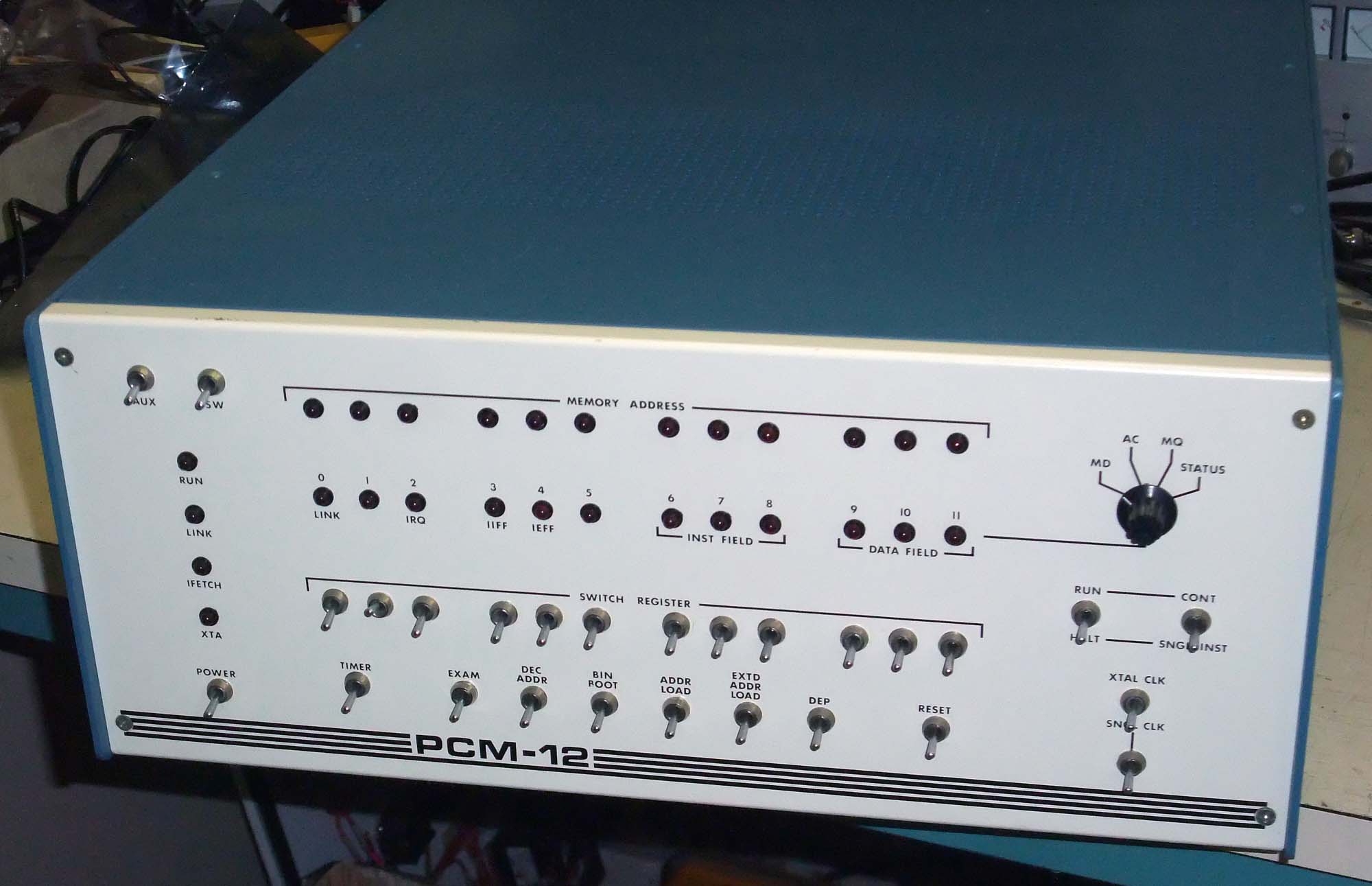
They were used a lot for projects in the 70's and 80's like the PCM-12
The company was bought by Zero Mfg in the 90's. There isn't anyone making
anything like that now.
http://www.dvq.com/oldcomp/PCM12/pcm12-1.jpg
Quick question: I've been cleaning out and repairing an HP5061 supply
for a 1000 computer. However I didn't take a picture of the 4 boards
when I pulled them and I want to make sure they go in the right places.
From the manual (page 99 of 92851-90001_Sections-IXB_Mar-1981.pdf) the
slots are labeled A6-J1 through A6-J5. Does this mean that:
J1 is the
J5 is the control board (A3A5)
J4 is a jumper board for +12 adjustments
J3 is unused (battery backup boards)
J2 is the inverter board (A3A2)
J1 is the pre-regulator board (A3A1)
Seems right but I know how bad things can go :-)
Thanks!
C
Hi,
If anyone is interested, these are available for cost of postage from
Toronto Canada. I will post selected sets but if someone wants the lot,
be quick. First come, first served...
https://imgur.com/MggLbvQ
--Toby
Hi All,
Does anyone by chance have a collection of fans? The one in my Sun Sparc
Classic died and I am having a hard time finding a replacement with the
same specs. Or can anyone recommend a good source?
It's a Nidec BetaV, TA225DC, Model M33402-55
Thanks!
-Kurt
Hi all,
I've been working on a BA11-K PDP-11/34 lately, and wow it sure is a noisy thing...
On my '11/45, the "Boxer" fans were easily disassembled via a cir-clip, and could then have their bearings cleaned/relubed (or worst case replaced). Fan maintenance quieted down the /45 a good bit. But these larger 6" Amphenol units don't look quite as easy to get in to...
Is the plastic rotor on these just a press fit? Any tricks to getting in there for maintenance? Or are these "you have what you have" and the only option if unsatisfied with their current performance to replace them entirely?
cheers,
--FritzM.
I've been having fun this past week trying to get the mechanics of a Canon CX print engine
in a LaserWriter restored. The paper pick and separation rollers have turned to goo.
This got me thinking that people need to start collecting information on rubber parts,
like dimensions, material and durometer values for all of these parts before they fail.
I found nothing on line about making replacement parts for these. No one stocks replacement
parts for anything older than a Canon SX engine (the generation after the CX).
Another problem child are Datamation card readers. It's been 20 years now since the
last ones were pulled out of service after the 2000 election and there seems to be a steady
stream of people trying to make replacements. I think the CHM 1401 guys replaced theirs a
few years ago, don't know if they collected mechanical info or where the repair units were made.
I've also heard that Terry of Terry's Rubber Rollers is recovering from Covid, and a
frequently used place that refurbished typewriter platens has gone out of business.
People have suggested https://www.jjshort.com/Recovered-Rubber-Rollers.php as an
alternative.
With apologies for breaking the threading, as I've just rejoined and I'm
responding to something I've just spotted in the archive ...
Regarding colour separations for scanned documents, GraphicsMagick is
quite capable of producing the required individual colour layers. If
you identify the colours you wish to pull out, you can use the "-fuzz"
and "-opaque" operators to change any given colour range (fuzz uses
Euclidean distance in RGB space) into another one (the current "-fill"
colour).
I haven't finished writing this up, but my workflow tends to be to
produce a Group4 TIFF from the colour scan by simple thresholding (or
first dropping the other colours to white, if they are quite dark), and
then produce all the other separations by dropping black out,
converting your spot colour to black and then thresholding. This way
you get two or more images:
1) PNG(s) containing pixels that are all either white or your spot
colour,
2) a G4 TIFF for the black and white layer.
The PNG must be saved as a two-colour paletted image so that they can
be used as masks in the final PDF. I always apply the black and white
(text) layer on top of every page, so that the fuzzing of the colour
layers doesn't reduce the clarity of the text.
This might sound awkward, but I've found that one fuzz value tends to
work for all the pages when extracting a given colour, so you can
process all pages in a loop. I use the Perl module PDF::Builder to put
my scans together, but I think tumble is capable of overlays too.
PNGs are compressed with deflate. If the spot colours you are
processing apply to text in the document, my first thought was that I
could save a bunch of Group4 TIFFs, one for each colour, and mask those
into the PDF, because Group4 compression is impressive for text. It took
some frustrating experiments before realising the Group4 compression
isn't defined for two colour images in general; it is specifically for
images that are black and white, and PDF won't let you circumvent that!
I've just scanned another document with some blue diagrams and table
backgrounds, if you'd like to see an example:
https://vt100.net/dec/ek-0la75-ug-002.pdf
I might reprocess this later, but for now, I didn't even bother
separating out pages that contain blue from ones that don't; every page
has a blue layer, even if it's blank. If you're wide awake, you may
spot that the blue layer on page 41 doesn't extend to the bottom of the
table. This isn't a processing flaw; the document is actually printed
like that.
Regards,
Paul
Bitraf[1] is moving, and the NDwiki[2] server moves with it. The move
starts Saturday September 11th 2021 at 12:00 hours local time, and is
expected to be completed sometime before midnight.
References:
1) https://bitraf.no/
2) http://www.ndwiki.org/
--
Regards,
Torfinn Ingolfsen
Due to health problems I won't be able to attend vcfmw this year.
I live just outside Champaign, IL, I-57 & I-74, about 2 hours south of
I-80, and 2 hours west of INDY. If anyone is interested in l buying
anything I should be home a few days before, during and after WCFMW.
Please email me with the time and day you would like to stop, and what you
are interested in seeing/buying.
I hoped to hang on to most things for a while, but I'm afraid I'm going to
start letting loose more and more.
Thanks, Paul
I'm located just outside Champaign, IL, I-57 & I-74
Incase anyone hadn't heard or has interest, a lot of arcades will be on the
market for bidding this weekend. Sad but inevitable. Hopefully it's not all
reseller prices and can get into the hands of some other museums and
collectors.
https://www.nbclosangeles.com/news/local/arcade-games-auction-museum-of-pin…
I was digging through the internet and found a post where a 3803 was posted for sale, would there happen to still be one available?Preferably a model 2
Thanks,gcnielson at yahoo.com
I just started working on a Data General NOVA 2/10 which is in quite
reasonable cosmetic condition, but has a number of problems.
The system comes with 8 kwords plus 16 kwords of core boards and a
"Cassette I/O" board and the CPU board.
After reforming the "man sized" caps and verified the power rails I took a
leap of faith and plugged in the CPU and the 16 kword core board. I managed
to deposit a few bit patterns and read back mostly what I deposited. After
a few power cycles I could no longer deposit values and read back what I
deposited. I also noticed that a 30 Ohm resistor rated at 3W which
previously got quite warm now stayed cold. That PCB area around that
resistor has cooked in the past and has changed colour - not dramatic, but
it obviously got quite hot in the past.
Unfortunately I didn't find a good schematic specifically for the Nova
2/10. There is one for the Nova 2/4 up on Bitsavers, but it is hard to read
and does not cover the NOVA 2/10 which is not quite the same as the NOVA
2/4. For example the power supply is completely different.
Until now I have been spoiled with quite decent DEC PDP-8/e documentation
and would be surprised if Data General did not provide a similar level and
quality of documentation. Maybe I am looking in the wrong place.
Thanks
Tom Hunter
I have an Interpro 2020 and a couple of HUGE 19" inch Intergraph
monitors. Frankly they are pretty lousy (fuzzy, not all that
luminescent), heavy and awkward.
Free to a Good Home - cables included. But I won't ship them, though
one could pay someone to crate them up and ship them.
I really don't want them around, and so I just converted my Interpro
2020 to use LCD flatpanels with a DB5w5 to VGA cable.
You can read more about my new cable setup for this machine, and see one
of the old monitors, at:
https://www.computercollection.net/index.php/unix-workstations/#interpro2020
JRJ
Can anyone identify this IC?
https://imgur.com/a/CU7Cn8z
This is from an Omega VLF receiver. I don't see many custom parts within
this unit, but perhaps this is one?
Thanks,
Kyle
Hi,
If you're interested, contact me directly.
It was in my apartment for years, I had to move it to the garage, and I
don't like the idea of leaving it there for the winter.
It's a PDP11/40 in a DEC rack. It was in working condition when I got it,
only the memory card had a problem (1 capacitor has been ripped off), but
reading/writing from/to the registers was working.
No need to say that you have to arrange shipping !
Thanks,
--
St?phane
Hi all,
you're invited to the Update computer club[0] public lecture series
"Updateringar"[1]!
When: 2021-09-11, 19:00 CEST
Where: https://bbb.cryptoparty.se/b/upd-0mo-m2u-aq8
The evolution of TECO and EMACS ? hands-on demo
The Emacs text editor has long been an important tool among programmers,
and has a long and rich history. I will talk about the development of
the TECO and Emacs line of editors throughout history. The emphasis is
on practical demonstration of programs found through software
archaeology. True to form, the bulk of the presentation will be
broadcast using ancient technology.
Lars Brinkhoff (ICtech)
The lecture is free and open to everyone.
Upcoming: 2021-10-09, 19:00: Update Computer Club: History and
not-so-certain future. Pontus Pihlgren (Update)
Don't want to miss upcoming events? Subscribe to our low-traffic
announcement list by sending a mail with the body "subscribe announce"
to majordomo at update.uu.se!
Hope to see you there,
Anke
[0] https://www.update.uu.se/index_eng.html
[1] https://www.update.uu.se/wiki/doku.php/projekt:updateringar
Hi folks,
I'm testing a little BlueSCSI adapter (BlueSCSI <https://scsi.blue/>) which
while being aimed at 68K Macs should also work as an 8 bit target for older
VAXen, it's a newer cheaper SCSI2SD solution and I should point out it
works as intended on a Mac Plus so the module itself is fine.
Nobody appears to have tested on small VAXen yet so tonight I dug out my
VLC to give it a go.
Powering up with nothing attached apart from an MMJ/H8571 cable I get
nothing on the console, I'm using PuTTY via a genuine COM1 port on a PC
which is one level above what I used last time I powered the machine up
(FTDI USB adapter to a laptop). Diagnostic LEDs cycle through the tests and
end up at '1111 0011' which according to the manual is 'entering the
console program'.
Clearly the DALLAS has passed the TOY tests, but if it's not happy would
that stop the console displaying? It doesn't matter how I set S3, next step
I guess is to hook it up to a 'proper' VT.
Cheers,
--
Adrian Graham
Owner of Binary Dinosaurs, the UK's biggest private home computer
collection?
t: @binarydinosaurs f: facebook.com/binarydinosaurs
w: www.binarydinosaurs.co.uk
Another query. The foam filter that sits in the front of my 11/24 CPU is
clearly badly degraded and needs to be replaced. What do people replace this
kind of stuff with? I guess it mustn't be too fine, this mesh seems quite
coarse.
https://rjarratt.files.wordpress.com/2021/09/1124-front-panel-2.jpg
Thanks
Rob
I have a PDP 11/24 which I hope to power up soon. The last time it had power
I noticed a bit of a burning smell which I failed to track down. However, I
did notice one capacitor on a memory board has a strange appearance, almost
as if there is some corrosion under the surface, it doesn't seem to be
bulging though, except along the top, but if it is bulging it is very bumpy.
I have a picture of it here:
https://rjarratt.files.wordpress.com/2021/09/wp_20210904_10_15_28_rich.jpg.
It is marked 47uF 30V, but it is also marked 20v as can be seen in the
picture.
I lifted it to measure its capacitance and ESR. It measures about 80uF and
the ESR seems OK. I am unsure whether to replace it, and if so what voltage
rating should I replace it with? I don't understand if this is a 30V rated
capacitor or 20V. It seems that Unibus has some 20V signals, so I guess 20V
might be right? I don't think 30V or 20V parts exist though, so I would need
to get 35V or 25V. Maybe the voltage rating isn't too critical?
Any advice?
Thanks
Rob
Somehow these were sitting in my basement rafters for years.
The tape seems ok on the big reels but I believe one of the small
reels was gummy. Several write rings on the pile too.
I'd rather not have to box these up TBQH but I will if someone
really wants them.
Location Ottawa Ontario Canada
http://www.db.net/~db/tapes.png
Diane
--
db at FreeBSD.org db at db.nethttp://www.db.net/~db
Hi,
some weeks ago I've purchased a System 37 in ebay. This unit was ebay in
the year 2020 and the owner was made this video too:
https://www.youtube.com/watch?v=F1CZKQtaoSo
When I power up the displays shows a 1. Sometimes if I stop and start fast
the display shows a 2, but in all the cases all the leds stills lighted.
The voltages on the power supply are OK, and in general I the unit have a
good look, I don't see corrosion or leakages from capacitors.
Looking the SPU training PDF of Bitsavers/HPMuseum , looks that maybe is
related with a ROM or the WCS.
Somebody have more info about this error, or know if is possible get some
schematics / service manual?
Thanks a lot
Iban
Is there a simh for the otrona attache? I have some.disk images created
with Dunfield's utility..if not I will try to read them by using the Zorba
portable, which is pretty good with varied formats.
Bill
I found a vintage rackable linear PSU at a sale over the weekend, appears
to be late '70s vintage going by date codes on some of the high-power
components inside.
Front panel is plain black with just a power switch and telltale lamp.
Back has a ratings sticker which says "PPI 1247-000-91 ADDS".
Outputs are +24V at 3A, +12V at 2A, +5V at 30A, -12V at 4A.
Ring a bell with anyone? I'm familiar with ADDS in a terminal context, of
course, but this lump is obviously for something larger - perhaps a
"washing machine size" fixed/removable drive unit or similar, but I'm
surprised there's not obvious branding on it if so.
cheers
Jules
Hello,
Does anyone have HP 9000/200 series running HP-UX instead of HP Basic ?
The 5.1 image from hpmuseum.net can be booted only on 300 series with 68010.
Best regards,
Plamen
Hello all,
Long time lurker, extremely rare poster, I was reading the Wikipedia
article on the IBM 1620 and became quite intrigued. I know that there is a
simulator for it on SimH but I have never ran or simulated any card-driven
machines before. I have all the documentation and the ibm1620.zip file
>from bitsavers but I am not sure what to do next. I know I would like to
try Monitor, Fortran-II and possibly GOTRAN but I have so many questions.
I read the SimH documentation which gave me some understanding but I don't
know exactly how the card decks work, how to install Monitor or how to boot
Monitor once it is installed since I know you have to boot off a deck. My
final question is, is there an easy to use card-driven machine to cut my
teeth on? Also, any anecdotes on any of the old IBM computers would be
both welcome and greatly appreciated.
Thanks in advance
Ray
Its been fun? working with Ultrix-11 and have had success with the help
of the list.? Thanks.? The tape file from Bill Gunshannon will create a
working system.? Yay!
I'm at the point of trying to network the SIMH pdp11 Ultrix-11 system.
I have a few observations:
1. The youtube video 'Ultrix-11' shows connecting to sunOS systems. OK,
he did this by simply issuing a single ifconfig command.? That didn't
work for me.
2. Instead, I used the netsetup script supplied with the system, and had
to reboot to get networking up.? I did seem to come up OK.
3. The SIMH FAQ suggests using a 2nd ethernet port, I was able to do
this.? The linux computer I am running SIMH on has 2 ports.
4. The Ultrix-11 telnet ftp are old, unsecure versions, how do you
connect to a modern Linux machine?? The Linux machines refuse the
connections.
5. I also looked at the tuhs archive.? The Fred build script that
generates a tk50 bootable tape image didn't work for me.? I substituted
a file for the tape device and it caused SIMH to Halt.
Doug
I've written a Venix/86 userland emulator. It uses FreeBSD's vm86 to run
binaries natively and intercepts traps for things like system calls. I
finally have it to the point where it can run the compiler via cc (which
forks and execs c0, copt, cpp, as, ld, etc). My plans to try to recreate
the sources for the binaries for Venix/86 from V7 and other extant sources
have taken a step forward. Don't know if I'll ever get there, but at least
I don't need a working Rainbow and can run the compiler at ~4GHz rather
than ~4MHz....
http://bsdimp.blogspot.com/2021/08/a-new-path-vm86-based-venix-emulator.html
has my latest blog entry on it. The code lives in tools/vm86venix in my
https://github.com/bsdimp/venix repo for those that want to take a look. It
uses vm86 mode of 32-bit intel processors and traps all INT xx and other
privileged instructions and provides appropriate emulation... And the
compiled binary is smaller than the venix kernel (but it does less).
Warner
Back in the 2007 time frame, Andrew Lynch had written a utility to read
Vector Graphic hard-sectored diskettes on a Catweasel board. Called "CWVG",
does anyone have a copy of the program?
Mike Loewen mloewen at cpumagic.scol.pa.us
Old Technology http://q7.neurotica.com/Oldtech/
Has anyone tried to compile the sources? succeeded?
I'm not even going to try, but I think the actual low-level formatter code
is missing. Was curious if anyone else noticed that too.
-chuck
My next project once I finish my IBM 1410 FPGA implementation (so, a
couple of years out, probably) would be to write an emulator for the
boat anchor known as the IBM 8100. I had exposure to these things back
in the 1980s. The project was not really a success: the DPPX operating
system was way overkill for the underpowered machine, and wasn't
reliable enough or capable enough to run them at remote locations with
central administration.
The machine had some fairly sophisticated features:
Two groups of 64 sets of registers with 8 32 bit registers each
Auto increment and auto decrement indexed addressing
Address translation - but not paging
A primitive form of I/O channel
I have a set of install floppies for the DPPX operating system and some
of the associated software (but, sadly, not COBOL or Assembler), imaged,
and verified to contain what the labels say (via dd conv=ascii), but am
short on information.
(Of course, if someone else has floppies, all the better. I can image
them - they are 8" DSDD, with the first track single density, kinda like
an RX02).
I do have the Principles of Operation GA23-0031 and
the DASD devices (including floppy) Description GA23-0053
But in order to manage an emulator and actually install DPPX I would
need just a bit more hardware info - or I would be flying blind to some
degree as far as the operator panel I/O interaction.)
Hardware Manuals:
8130 Processor Description GA27-3196 and/or
8140 Processor Description GA27-2880
(There was also an 8150, but I doubt the releases I have would run on it.)
8140 Processor Operators Guide GA27-3197 and GA27-2879 (Expanded front
panel)
8101/8102 Storage / I/O Unit GA27-2882
Communications: Loop, Display, Printer: GA27-2883
(The "Loop" was a LAN like thing - kind of akin to the Apollo Domain
ring, off of which one hung local terminals, such as the IBM 8775).
Distributed Processing Programming Executive (DPPX) Manuals
Installation Primer: G320-6048
Installation Guide: SC27-0401
IPO Planning Guide: GC20-1883
Assembler: SC27-0412
Assembler Messages: SC27-0416
(The machine also supported APL, PL/I, COBOL (which we used), FORTRAN...
But I don't have floppies for those - heck, if the assembler wasn't
standard (I doubt it was), I don't even have that, even though we had it
at our installation, along with COBOL)
DTMS (database, transaction mgmt.)
Messages: SC26-3918
Customization Guide (SC26-3937)
Application Development Guide (SC26-3938)
Administration Guide (SC26-3939)
Operation Guide (SC26-3940)
Reference (SC26-3941)
True story: The early releases of DPPX were just awful buggy. We ended
up dedicating 3 conference rooms (with the dividers open) for a "warm
room" for something like 3 months, housing our personnel and IBM
personnel up from Texas. At one point one of the IBM'ers was overheard
on a public phone in the hallway of our public building telling someone
he was there "to help the hicks from Wisconsin". That got reported to
our management and to IBM's management, and he was on the next flight
back to Texas. ;)
On the flip side, I was testing database recovery (it was my thing, back
in the day - though we did not end up using the database / transaction
manager). I found some bugs in the database log journal recovery
process. I mentioned it to one of the IBM'ers in passing, also pointing
out it wasn't urgent since we were not going to use DTMS anyway, at
least not soon. He pretty much begged me to report it - and anything
else I found wrong. Completely polar opposite attitude of the guy in
the previous paragraph.
JRJ
What's the recommended method for adjusting the track 0 switch and track 0
stop on a Tandon TM100-2, if you don't have an alignment disk? I do have a
scope.
Mike Loewen mloewen at cpumagic.scol.pa.us
Old Technology http://q7.neurotica.com/Oldtech/
I can archive your disk content if you end up needing some assistance.
I have a few Vector Graphic machines with 100tpi Micropolis and Tandon 100-4M drives as well as Mod-I drives at 48tpi. I also have utilities to archive and recreate disks on these drives by exchanging the disk image with a PC via XMODEM (FLOP2PC and PC2FLOP). Note that these disk images can also be mounted and run under SIMH.
Mike
I just printed some board handles for a 32k OMNIBUS board (thanks Vince
Slyngstad, et al.) I now notice that all the OMNIBUS boards have an extra
0.1in spacer between the board and the handle. UNIBUS and QBus boards and
logic flip chips don't have the spacer.
Anyone else notice this and understand why?
The only thing I can see is that it might adjust for the over the top
connectors used on a lot of OMNIBUS boards.
-chuck
Re:
"My next project once I finish my IBM 1410 FPGA implementation (so, a
couple of years out, probably) would be to write an emulator for the
boat anchor known as the IBM 8100. I had exposure to these things back
in the 1980s."
I encountered one, once. Probably 1979, in a small conference room in
building 47U of Hewlett-Packard's Cupertino site. Sitting all alone in the
room. I was looking at it, and an HP engineer came in and explained
that they were waiting for IBM service to fix the memory board ...
the board HP had removed to look at closely :)
Now that I am finally getting my vintage computer accumulation
in order, I need a punched card file cabinet. Does anyone know
of one that might be available for purchase or trade? I am willing
to pick up anywhere in the western US.
In an ideal world, I would love to find one of the ones with a slanted
front on each drawer that holds a single card for a label.
I have an old wooden library catalog file cabinet (60 drawers) that
I would be willing to trade, as well as some DEC Q-bus chassis.
Any leads would be appreciated.
Alan Frisbie
When I worked at Apparat around 1981, we used a lot of *male* IDC edge card
connectors. I've almost never seen any since, and I couldn't remember the
name of the vendor. I just found out that it was Kel-Am, but the internet
knows almost nothing about them.
Here's an example:
https://www.elliottelectronicsupply.com/connectors/card-edge/male-card-edge…
That photo doesn't show the Kel-Am logo, which is just a stylized "KEL-AM".
There are some eBay auctions of the corresponding female connector (which
other vendors did make), some of which show the logo.
I wonder what happened to Kel-Am. Maybe they were acquired, maybe they went
under. It would be nice to find a copy of their catalog.
Speaking of which, it would also be nice to see some Robinson Nugent
connector catalogs from the late 1970s and early 1980s. I am especially
interested in seeing specs for their bottom-entry square-pin receptacles,
which I think _might_ be the ones used on Apple /// memory boards.
A friend and I are trying to get a PDP-11/70 running, and we'd like to get
a DHU11 async mux board. Anyone have an extra?
There's an Ebay listing claimed to be a DHU11, but that one is actually a
Qbus M3104.
Al Kossow <aek at bitsavers.org> wrote:
> On 8/25/21 4:51 PM, Alan Frisbie via cctalk wrote:
> > I recently acquired a Wilson Laboratories SX-530 disk exerciser
> > for SMD interface disk drives.? Unfortunately, it did not come
> > with a manual.? Does anyone out there have a copy they could
> > make available?? Yes, Bitsavers was the first place I checked.?
> it's up now under test equipment
Thank you very much! I've already downloaded it. I really appreciate
all the work you do to keep this information available.
> do you happen to have any service manuals for century data
> winchesters? i have a bunch of manuals for the removable drives
No, I do not. The only Century Data manuals I have are for the T-302,
which I believe you already have.
Alan Frisbie
Bill Gunshannon wrote:
>
> With 3.1 available why would you want to run 2.0? Someone mentioned
> a 4.0. I don't remember there ever being anything after 3.1 (promised,
> but never saw it delivered) Would be fun to look at. But I suspect
> anything beginning with 4 is actually Ultrix-32 which I think went as
> far as 4.5.
That seems likely, because AFAIR Ultrix-11 never got past 3.X.
In any way I would like to point out that Ultrix-11 and Ultrix-32 are
completely different: Ultrix-11 based on V7 (+addons) and Ultrix-32
based on 4.2BSD (+addons).
I actually still have Ultrix-32 3.1 running on a DECstation. It really
is nothing like running Ultrix-11 3.1, which I did many years ago.
Dennis
Hello,
For the sake of illustration to folks who are not necessarily used to
thinking about what computers do at the machine code level, I'm interested
in collecting examples of single instructions for any CPU architecture that
are unusually prolific in one way or another. This request is highly
underconstrained, so I have to rely on peoples' good taste to determine
what counts as "interesting" here. Perhaps a whole lot of different kinds
of work or lots of different resources accessed is what I'm after. I expect
these kinds of "busy" instructions were more common in architectures that
are now less common, so perhaps this list is a good place to ask.
For example, if we're thinking "number of times an item is retrieved from
RAM", then any application of the x86 string instructions that could walk
over memory for a while perhaps aren't so interesting. By contrast, by my
count, the NS32000 series instruction "addw ext(4), ext(7)" requires at
least five separate noncontiguous retrievals just to fetch the arguments
into the ALU. (Note that I'm not differentiating between different sizes of
data here: loading a 16-bit item and loading a 32-bit address both count as
a "retrieval" in this example.)
Instructions that are simply lengthy might be interesting, but not always:
long literals or lots of redundant prefixes on x86 aren't that impressive,
for example.
Number of registers read or modified might be good too, but just saving or
loading for the sake of subroutine calls (e.g. "movem.l r0-r7/a0-a6,-(sp)"
on the 68k) seems pretty pedestrian.
Other criteria may seem worthwhile; I trust peoples' judgement on this.
Although I don't know it well, I suspect VAX will place well in one way or
another. But to give an example of a candidate instruction that's prolific
in a way I find more noteworthy, I'll go back to the NS32k and offer
addw ext(4)+6[r1:w], ext(7)+12[r2:w]
which in order to get its arguments (I think) requires the five retrievals
already mentioned and adds two shifts and four additions to the bill. I
think this statement reads: "Add the r1'th word counting from 6 bytes past
the fourth address in the current module's link table to the r2'th word
counting from 12 bytes past the seventh address in the current module's
link table". That's a mouthful --- it takes a lot of work to describe what
that one line does! Maybe that's what I'm hoping to share with people.
I hope this is interesting to discuss,
--Tom
Hi!
I'm offering an Atari Portfolio HPC-004 along with a 64 KB Memory Card
for the cost of shipping (located in Germany.) It boots / works (using
batteries), but I'm missing its original wall wart.
Is anybody interested?
Thanks,
Jan-Benedict
--
I've been working on a new memory board for the Apple ///, using (somewhat)
modern and still-in-production components, especially CMOS static RAM
rather than DRAM. Last night I soldered the connectors, sockets, and
passives of my first prototype:
https://flickr.com/photos/_brouhaha_/albums/72157719738576267
I need to do some testing for shorts, etc. before I attempt to actually use
it in an Apple ///. I expect that some debugging of the design will be
required.
The Apple /// design is _much_ more complex that the Apple II and IIe. I
intended this board to provide 512KiB of RAM, but I've already determined
that some design changes will be required for that, so this prototype will
only support 256KiB.
The early Apple /// design, as documented in US patents, would have
supported up to 512KiB of RAM, but the actual shipped design reduced that
to 256KiB. There was a third-party 512Kib emory board from "On Three",
which required pulling various chips from the motherboard and running
cables from those to the memory board.
The SOS operating system, as shipped, only supported 256KiB. On Three
modified the SOS bootloader to detect and use 512KiB. Some Apple ///
application software also had trouble with 512KiB, and On Three patched
some of those.
>Hello,
>
>For the sake of illustration to folks who are not necessarily used to
>thinking about what computers do at the machine code level, I'm interested
>in collecting examples of single instructions for any CPU architecture that
>are unusually prolific in one way or another. This request is highly
>underconstrained, so I have to rely on peoples' good taste to determine
>what counts as "interesting" here.
This is perhaps outside even the vague bounds you were thinking of, but it
probably wins the 'unusually prolific' prize by a gigabyte-mile.
Behold, the hidden, secret and heinous X86 2-byte 'launch instruction' 0x0F, 0x3F.
See this talk about the discovery:
https://www.youtube.com/watch?v=jmTwlEh8L7g
DEF CON 26 - Christopher Domas - GOD MODE UNLOCKED Hardware Backdoors in redacted x86 46:03
DEFCON Conference Oct 23, 2018
Complexity is increasing. Trust eroding. In the wake of Spectre and Meltdown, when it seems that things cannot get any darker for processor security, the last light goes out. This talk will demonstrate what everyone has long feared but never proven: there are hardware backdoors in some x86 processors, and they're buried deeper than we ever imagined possible. While this research specifically examines a third-party processor, we use this as a stepping stone to explore the feasibility of more widespread hardware backdoors.
After which you will never trust your Intel-based PC, ever again.
Guy
The Hitachi SH4 has a set of pipelineable vector instructions that
work on 4x4 and 4x1 length vectors (implemented as 2 sets of 16 FP
registers). Nothing compared to MMX/SSE/AVX, but relatively complex.
There are indications in the KDJ11-B processor spec on bitsavers that the
M8190 could be used in a multiprocessor configuration. For example, bit 10
of the Maintenance Register (17 777 750) is labeled "Multiprocessor Slave"
and indicates that the bus arbitrator is disabled. There is also section
6.6, "Cache Multi-Processor Hooks", that describes cache features that
allow multiprocessor operation.
Would it be as simple as connecting to 11/83 qbus together? And adding the
proper software.
Anybody ever heard of such a thing?
Chuck
I think I may need to get a small part 3d printed (some plastic board
mounting guide rails from a PDP 11/24 H7140 PSU). What software is best for
a novice? Preferably free!
Thanks
Rob
Hello Rob,
FreeCAD is nice for modeling 3D shapes.
For 3D printing, depending on the technology of 3D printer, you need to process original model to convert compact sections into hollow honeycomb structure, and add small plastic bars into empty volumes to support the model while it's printed.
I'm not expert of this latter procedure and tools.
Andrea
Aug 23, 2021 19:07:55 cctech-request at classiccmp.org:
> Send cctech mailing list submissions to
> ? cctech at classiccmp.org
>
> To subscribe or unsubscribe via the World Wide Web, visit
> ? http://www.classiccmp.org/mailman/listinfo/cctech
> or, via email, send a message with subject or body 'help' to
> ? cctech-request at classiccmp.org
>
> You can reach the person managing the list at
> ? cctech-owner at classiccmp.org
>
> When replying, please edit your Subject line so it is more specific
> than "Re: Contents of cctech digest..."
>
>
> Today's Topics:
>
> ?? 1. Tektronix XpressWare 8.1 (Cameron Kaiser)
> ?? 2. Re: Tektronix XpressWare 8.1 (Doc Shipley)
> ?? 3. Re: Ultrix-11 (Peter Allan)
> ?? 4. Need Spectravideo SVI-328 parts.... (geneb)
> ?? 5. 3d modelling software (Rob Jarratt)
>
>
> ----------------------------------------------------------------------
>
> Message: 1
> Date: Sun, 22 Aug 2021 17:16:49 -0700 (PDT)
> From: Cameron Kaiser <spectre at floodgap.com>
> To: cctalk at classiccmp.org
> Cc: Cameron Kaiser <spectre at floodgap.com>
> Subject: Tektronix XpressWare 8.1
> Message-ID: <202108230016.17N0Gn3c16973864 at floodgap.com>
> Content-Type: text/plain; charset=US-ASCII
>
> Bitsavers has 6.3 (thank you Al) but I'm trying to push my luck and find
> 8.1 for this XP421CH Xterm. Anyone know of where it can be found?
>
> --
> ------------------------------------ personal: http://www.cameronkaiser.com/ --
> ? Cameron Kaiser * Floodgap Systems * www.floodgap.com * ckaiser at floodgap.com
> -- FOOLS! I WILL DESTROY YOU ALL! ASK ME HOW! -- "Girl Genius" 8/29/07 --------
>
>
> ------------------------------
>
> Message: 2
> Date: Sun, 22 Aug 2021 21:08:21 -0500
> From: Doc Shipley <doc at vaxen.net>
> To: Cameron Kaiser via cctalk <cctalk at classiccmp.org>
> Subject: Re: Tektronix XpressWare 8.1
> Message-ID: <8c287f5c-4ad8-1002-570c-1c671c689494 at vaxen.net>
> Content-Type: text/plain; charset=utf-8; format=flowed
>
> On 8/22/21 19:16, Cameron Kaiser via cctalk wrote:
>> Bitsavers has 6.3 (thank you Al) but I'm trying to push my luck and find
>> 8.1 for this XP421CH Xterm. Anyone know of where it can be found?
>>
>
> Well....
>
> There's this:
>
> http://bio.gsi.de/DOCS/NCD/www.technogoths.demon.co.uk/tekxp400/node3.html
>
> and there's this:
>
> http://www.docsbox.net/V81106.tgz
>
> Please don't kill my server.
>
> ? It's been a long long time since I had the XP400D, and I don't think I
> ever tried connecting from Windows, so you're kind of on your own.? Good
> luck!
>
>
> ? Doc
>
>
> ------------------------------
>
> Message: 3
> Date: Mon, 23 Aug 2021 10:11:26 +0100
> From: Peter Allan <petermallan at gmail.com>
> To: Warner Losh <imp at bsdimp.com>
> Cc: "General Discussion: On-Topic and Off-Topic Posts"
> ? <cctalk at classiccmp.org>, Ethan Dicks <ethan.dicks at gmail.com>
> Subject: Re: Ultrix-11
> Message-ID:
> ? <CAJCrz55x935vV+O2=eoRyb2ythgQmRVGXx6HGZZFi8rjdv0TEA at mail.gmail.com>
> Content-Type: text/plain; charset="UTF-8"
>
> Thanks Warner and Ethan. That is very helpful.
>
> I had not realised that the partition sizes were REALLY hard wired - as in
> set in the code. That explains why there is no option to set the size at
> installation time.
>
> I will redo the installation with that in mind.
>
> Cheers
>
> Peter
>
> On Fri, 20 Aug 2021 at 22:03, Warner Losh <imp at bsdimp.com> wrote:
>
>>
>>
>> On Fri, Aug 20, 2021, 2:26 PM Peter Allan via cctalk <
>> cctalk at classiccmp.org> wrote:
>>
>>> The idea of using an RA81 drive as it is bigger sounds like a simple
>>> solution, but does it actually give a larger /usr partition? Even though
>>> an
>>> RD54 drive is not huge, most of it is not taken up by the root partition
>>> plus the /usr partition, but is available for use as (on the video at
>>> least) /user1.
>>>
>>> I will give it a try after the weekend and see what happens.
>>>
>>
>> I was going to try tonight. The dksizes.c table suggests that it is 10MB
>> instead of 8.5MB on the RD54. Yet someone else said it was smaller, so I
>> wanted to check....
>>
>> Warner
>>
>>
>> Cheers
>>>
>>> Peter Allan
>>>
>>> On Fri, 20 Aug 2021 at 17:38, Ethan Dicks <ethan.dicks at gmail.com> wrote:
>>>
>>>> On Fri, Aug 20, 2021 at 11:50 AM Peter Allan via cctalk
>>>> <cctalk at classiccmp.org> wrote:
>>>>> I just installed Ultrix-11 3.1 using the ultrix31.tap file from
>>>>> https://pdp-11.org.ru/files.pl?lang=en
>>>>> which is the location from the comments in Stephen's Machine Room
>>> video
>>>> on
>>>>> YouTube that I think started this thread.
>>>>>
>>>>> It installed just fine, but just like the video, I ran out of space on
>>>> /usr.
>>>>
>>>> /usr was usually tight back in the day.
>>>>
>>>>> How can I make a larger /usr partition? Is it possible to do this at
>>>>> installation time? There did not seem to be an option for this. Can
>>> it be
>>>>> done by using an additional disk? That would seem likely, but not
>>> what a
>>>>> system manager back in the 70's or 80's would expect to need to do,
>>>>> especially as there is a relatively large amount of space left to
>>> create
>>>>> /user1.
>>>>
>>>> In the 70s and early 80s, it was not at all uncommon to have multiple
>>>> disk drives mounted to add up to enough space, especially to put user
>>>> files on their own device to keep them from competing with free space
>>>> in the system areas.? Also, older, smaller disks were often cheaper
>>>> than the newest/largest disk drives, or systems would be put together
>>>> from repurposed hardware rather than purchasing new.? For a single
>>>> data point, my employer bought a new RA81 in 1984.? For 424MB it was
>>>> $24,000.? Most machines had a _lot_ less disk in those days.? Our main
>>>> UNIX machine was an old 11/750 (2MB RAM) with 2x RK07 (28MB each).? It
>>>> was quite a jump when I put Ultrix 1.1 on an 11/730 w/RB80.? The CPU
>>>> was 30% slower, but it had 5MB of RAM and a 121MB disk, so as a
>>>> machine that spent most of its time with a single user (me), it was
>>>> fine.
>>>>
>>>> When disks were routinely 1-30MB (RK05... RK07 or RP03), it was
>>>> totally common to have 2-3 disks on a machine.
>>>>
>>>> All that said, I looked over this install write-up and it seems to
>>>> assume you have one disk and it slices and dices with default sizes...
>>>>
>>>>
>>>>
>>> http://ftp.fibranet.cat/UnixArchive/Distributions/DEC/Fred-Ultrix3/setup-3.…
>>>>
>>>> I've installed older versions of UNIX where you had to explicitly set
>>>> up disks and partitions (where you _could_ resize partitions).? Prior
>>>> to restoring the contents from tape.? That didn't appear to be as easy
>>>> with this installer script.
>>>>
>>>>> I noted the options for installing software using soft links to other
>>>>> locations. Was that the preferred method when installing additional
>>>>> software?
>>>>
>>>> That was done, as was mounting an entire second disk for /usr.? One of
>>>> the challenges is making sure you have enough tools accessible on the
>>>> boot device to bring the machine up far enough to mount the additional
>>>> devices.? This is part of why there are system tools in /bin,
>>>> /usr/bin, etc.? You could depend on the contents of /bin being there
>>>> before /usr was mounted.? Also, traditionally, programs in /bin were
>>>> statically linked so that you didn't have to have specific libraries
>>>> available at the time.
>>>>
>>>> The simplest solution, of course, is just get a bigger disk, but where
>>>> that wasn't possible (which was most of the time), people did use soft
>>>> links or multiple spindles to aggregate enough space to get by.
>>>>
>>>> Back in the day, I struggled to get enough disk space to install
>>>> 2.9BSD on an 11/24.? Two RK07s would have been a luxury.? I had an
>>>> RL02 (10MB) and I think maybe an RL01.? I could get the initial
>>>> restore to work but I didn't have enough space to rebuild my kernel.
>>>>
>>>> -ethan
>>>>
>>>
>>
>
>
> ------------------------------
>
> Message: 4
> Date: Mon, 23 Aug 2021 07:57:44 -0700 (PDT)
> From: geneb <geneb at deltasoft.com>
> To: cctalk at classiccmp.org
> Subject: Need Spectravideo SVI-328 parts....
> Message-ID:
> ? <alpine.LRH.2.21.2108230756300.23222 at sidewinder.deltasoft.com>
> Content-Type: text/plain; format=flowed; charset=US-ASCII
>
>
> I've got a very nice SV-328 that's had the sad misfortune of having the
> "K" key rather violently removed. (https://i.imgur.com/IxBIQTj.jpg)
>
> Can someone point me to where I could obtain a replacement key top and
> post?
>
> Thanks!
>
> g.
>
>
> --
> Proud owner of F-15C 80-0007
> http://www.f15sim.com - The only one of its kind.
> http://www.diy-cockpits.org/coll - Go Collimated or Go Home.
> Some people collect things for a hobby.? Geeks collect hobbies.
>
> ScarletDME - The red hot Data Management Environment
> A Multi-Value database for the masses, not the classes.
> http://scarlet.deltasoft.com - Get it _today_!
>
>
> ------------------------------
>
> Message: 5
> Date: Mon, 23 Aug 2021 17:29:08 +0100
> From: "Rob Jarratt" <robert.jarratt at ntlworld.com>
> To: "General Discussion: On-Topic and Off-Topic Posts"
> ? <cctalk at classiccmp.org>
> Subject: 3d modelling software
> Message-ID: <00b401d7983b$ff929d50$feb7d7f0$(a)ntlworld.com>
> Content-Type: text/plain; charset="us-ascii"
>
> I think I may need to get a small part 3d printed (some plastic board
> mounting guide rails from a PDP 11/24 H7140 PSU). What software is best for
> a novice? Preferably free!
>
>
>
> Thanks
>
>
>
> Rob
>
>
>
> End of cctech Digest, Vol 83, Issue 23
> **************************************
The quick-'n-easy solution I found when I needed to model some parts
for a keyboard was https://www.tinkercad.com/ - needs a modern-ish web
browser and a modestly beefy system tho.
I've got a very nice SV-328 that's had the sad misfortune of having the
"K" key rather violently removed. (https://i.imgur.com/IxBIQTj.jpg)
Can someone point me to where I could obtain a replacement key top and
post?
Thanks!
g.
--
Proud owner of F-15C 80-0007
http://www.f15sim.com - The only one of its kind.
http://www.diy-cockpits.org/coll - Go Collimated or Go Home.
Some people collect things for a hobby. Geeks collect hobbies.
ScarletDME - The red hot Data Management Environment
A Multi-Value database for the masses, not the classes.
http://scarlet.deltasoft.com - Get it _today_!
I just installed Ultrix-11 3.1 using the ultrix31.tap file from
https://pdp-11.org.ru/files.pl?lang=en
which is the location from the comments in Stephen's Machine Room video on
YouTube that I think started this thread.
It installed just fine, but just like the video, I ran out of space on /usr.
How can I make a larger /usr partition? Is it possible to do this at
installation time? There did not seem to be an option for this. Can it be
done by using an additional disk? That would seem likely, but not what a
system manager back in the 70's or 80's would expect to need to do,
especially as there is a relatively large amount of space left to create
/user1.
I noted the options for installing software using soft links to other
locations. Was that the preferred method when installing additional
software?
Any help would be greatly appreciated.
Cheers
Peter Allan
Bitsavers has 6.3 (thank you Al) but I'm trying to push my luck and find
8.1 for this XP421CH Xterm. Anyone know of where it can be found?
--
------------------------------------ personal: http://www.cameronkaiser.com/ --
Cameron Kaiser * Floodgap Systems * www.floodgap.com * ckaiser at floodgap.com
-- FOOLS! I WILL DESTROY YOU ALL! ASK ME HOW! -- "Girl Genius" 8/29/07 --------
Hi cctalk,
I'm looking to replicate the 24-contact connector system that IBM used on
SLT and MST cards for many years. Has anyone done this before?
The best photos of this connector that I can find online are on this page:
http://techandtrouble.blogspot.com/2014/04/happy-50th-system360-pt5-anatomy…
I haven't searched Bitsavers documentation extensively for IBM
specifications, but I've seen some details around page 54 of this document:
http://www.bitsavers.org/pdf/ibm/logic/SY22-2798-2_LogicBlocks_AutomatedLog…
I'm interested in reproducing both polarities of this connector: plug and
socket. Also, even though the most familiar use of this connector is for
board-to-board interconnect, I'm most interested in wire-to-board
interconnect. IBM used this method for DC power connectors in its 5100,
5110, and 5120 computers. Here are images of this specific connector:
http://stepleton.com/connector/
taken as still images from a YouTube video on the IBM 5120 by Jerry Walker (
https://www.youtube.com/c/JerryWalker-JMPrecision/videos).
I've designed and built a device that monitors DC power supply voltages for
overvoltage and undervoltage excursions and cuts off all power rails if any
voltage goes out of spec. I hope to use it to protect my own IBM 5100 from
major power supply faults like the one CuriousMarc encountered with his
9825T:
https://www.youtube.com/watch?v=b-eN93L6yX8
In order to put my device between my 5100's power supply and the logic card
backplane, I need to recreate a plug and a socket so that I can fashion a
cable that goes out to my device. If anyone has created dependable modern
versions of these connectors, would you mind sharing any pointers?
Thanks for any help,
--Tom
> From: Bill Degnan
> Was there a UNIBUS storage system that used a cassette player as the
> storage device .., rigged to send receive signals via a serial card
> connection.
Yes and no. There is the TA11 Magnetic Tape Cassette System, which used the
TU60 Dual DECasette Transport (I need to create a page for that in the
CHWiki), but it uses a special controller card, the TA11 Magnetic Tape
Cassette controller:
https://gunkies.org/wiki/TA11_Magnetic_Tape_Cassette_controller
There is a small cheap tape system which used a stock serial interface to talk
to the computer, the TU58, but those used DECtpe-II cartridges, not standard
casettes.
Noel
I just saw there is an ME11 Memory Expansion unit on eBay (not mine), stamped 'M11'.
https://www.ebay.com/itm/114941479208
Until seeing this one I had not heard of any other units out there apart from the one I recovered
(ex-BHP steelworks) a few years ago. Mine was connected by a flexprint cable to a rebadged PDP-11/15.
If anyone here ends up with it, I have an OpenSCAD model of the Mazak bracket p/n 1211221 that holds
the regular 5-1/4" DEC fascia panel onto the front of the H-909 cabinet this unit uses.
This is the same cabinet as the slimline PDP-11/05 and to be honest when I found the ME11 that's
what I thought it was, and that the console and CPU boards were missing. I then found the fascia panel
with the original brackets close by, and it fitted exactly.
I've printed a few from PET and they work as well as the originals (including the threaded hole), so
I could do a few more for whoever gets the eBay one should they want them.
I am slowly scanning the ME11 print set too as I've not found any online copy out there so far.
Steve.
Hi all!
The book about John Nash ("Beautiful Mind'")[1] mentioned that he wrote
computer programs:
"Edward G. Nilges, a programmer who worked in Princeton University?s
computer center from 1987 to 1992, recalled that Nash ?acted frightened and
silent? at first. In Nilges?s last year or two in Princeton, however, Nash
was asking him questions about the Internet and about programs he was
working on. Nilges was impressed: ?Nash?s computer programs were
startlingly elegant.?"
Has anybody seen them?
Are they available somewhere for downloading?
Wondering...
[1] https://en.wikipedia.org/wiki/A_Beautiful_Mind_(book)
At 12:56 AM 7/31/2021, Randy Dawson via cctalk wrote:
>As some here know, I collect some dusty deck fortran graphics. We have MOVIE.BYU up and running! (Thanks Douglas Taylor and Emanuel Steibler).
Once I was in the business of making 3D file format translators,
and I still have code that runs under Windows that can read
and write Movie.BYU format.
- John
Was there a UNIBUS storage system that used a cassette player as the
storage device (like an old Panasonic or RadioShack cassette player),
rigged to send receive signals via a serial card connection. I.e. the
system would have one serial card for the terminal and another serial card
on a different port for the cassette player? It might have to load as if
it was a high-speed papertape but it in theory would work.
Bill
Hi all --
Recently picked up a DH11-AD and now I just need to track down an
appropriate bulkhead panel to go with it. Originally this would have been
the H317-B, I'm not sure if there were others that are directly compatible,
but if anyone has one lying around drop me a line!
Thanks!
- Josh
Charles Dickman <chd at chdickman.com> wrote:
> There are indications in the KDJ11-B processor spec on bitsavers that
> the M8190 could be used in a multiprocessor configuration. For
> example, bit 10 of the Maintenance Register (17 777 750) is labeled
> "Multiprocessor Slave" and indicates that the bus arbitrator is
> disabled. There is also section 6.6, "Cache Multi-Processor Hooks",
> that describes cache features that allow multiprocessor operation.
>
>Would it be as simple as connecting to 11/83 qbus together? And adding
> the proper software.
>
> Anybody ever heard of such a thing?
Such a system was put together and tested at DEC with the RSX group
(who did the PDP-11/74 multiprocessor work). I'm told that while it
worked, it wasn't terrible successful, and the project was abandoned.
I was given a gift of one of the CPU modules that was used in the test
and I might still have it around here. I can't recall for certain,
but I think the module required some ECOs to make it work in a
multi-processor configuration.
The person to ask about this, Brian McCarthy, is unfortunately no
longer with us. :-(
Alan Frisbie
I ran into a YouTube video, that it is 5 years old, titled "Ultrix-11
3.1 on an emulated PDP-11/73" and I found it very interesting.
It shows installation of Ultrix-11 under SIMH.? The fellow steps through
the installation process and appears to be quite knowable.
I wanted to replicate it but couldn't locate the *.tap file used in the
video that was an image of the bootable TK50 distribution.
Bitsavers and tuhs.org have Ultrix-11 files, but not the bootable tape
image.
Anyone know where the tape image is located?
Doug
I have a CDC 9427H drive ( https://i.imgur.com/Wn87MRb.jpg ) that is
absolutely desparate for a new home. It's quite likely over 80lbs, so
shipping would be problematic. I'm in Graham, WA.
It's free, it's lonely, and it's desparate for your gentle touch. Please
won't you think of the disk drives?
g.
--
Proud owner of F-15C 80-0007
http://www.f15sim.com - The only one of its kind.
http://www.diy-cockpits.org/coll - Go Collimated or Go Home.
Some people collect things for a hobby. Geeks collect hobbies.
ScarletDME - The red hot Data Management Environment
A Multi-Value database for the masses, not the classes.
http://scarlet.deltasoft.com - Get it _today_!
Is it still useful to linearize PDFs?
I've been scanning and PDFing manuals for 16 years, and I've been
linearizing them regularly. My understanding is that this made them
accessible on a page-by-page basis in Web browsers without requiring a
complete file download first. But given the increase in typical bandwidth
in 16 years, I wonder if this is still useful. It is an extra step, and it
does make the files somewhat larger.
Recommendations? Does linearizing confer any advantage locally once the
entire file is downloaded?
Thanks.
-- Dave
Hi all,
you're invited to the Update computer club[0] public lecture series
"Updateringar"[1]!
When: 2021-08-14, 19:00 CEST
Where: https://bbb.cryptoparty.se/b/upd-0mo-m2u-aq8
The Whirlwind I
The Whirlwind was a computer of the first generation built at the
servomechanisms lab at MIT. It was the first computer designed to be a
highly reliable part of a system, and to be controlled in real time,
rather than be a programmable calculator for scientific research. Its
interactive nature directly started a tradition of computer engineering
at MIT which includes the TX-0, TX-2 and DEC's PDP line of
minicomputers. Its role in a simulated air defense system led to the
development of the AN/FSQ-7 computer, the center piece of the SAGE
system. In my talk I will give the historical context in which Whirlwind
was designed and built, explain its architecture and block diagrams, go
into how it was built and how it evolved over its lifetime, and of
course show some simple demos in my emulator. Those who want to stick
around for a bit longer are encouraged to join me in a little hands-on
hacking session where we look at some original code, but also write our
own to get a feeling for what programming the Whirlwind is like.
Angelo Papenhoff (Humboldt University of Berlin)
The lecture is free and open to everyone.
Upcoming: 2021-09-11, 19:00: The evolution of TECO and EMACS ? hands-on
demo. Lars Brinkhoff (ICtech)
Hope to see you there,
Anke
[0] http://www.update.uu.se/index_eng.html
[1] https://www.update.uu.se/wiki/doku.php/projekt:updateringar
On Monday, August 16, 2021 at 14:20, Wayne Sudol wrote:
> Out of curiosity, is there a reason you do not use Acrobat for
> creating pdfs?
Primarily because I have not purchased a license for Acrobat. Also, when I
started scanning manuals ten years ago, Al Kossow recommended tumble, which
worked well. And with source available, I've been able to extend it to
give me finer control over some aspects of PDF production.
-- Dave
On Mon, 16 Aug 2021 at 23:21, Wayne Sudol via cctech
<cctech at classiccmp.org> wrote:
>
> Out of curiosity, is there a reason you do not use Acrobat for creating
> pdfs?
I have been making PDFs for at least 20 years now, probably more.
AFAIK I have _never_ used Acrobat to create them. I print from
LibreOffice to its PDF generator, or I use any random Mac OS X app as
under that OS all apps can output PDF -- PDF is the native rendering
format of Mac OS X.
I do not normally use Windows but I believe that most modern Win10
apps can save as PDF.
I mostly use Linux and there is no Acrobat for Linux. The reader app
was discontinued years ago and no longer works on most modern distros.
With considerable effort I have managed to start it inside a Docker
container but it's complex and difficult; normally I just use Xviewer
or Okular.
You ask as if Acrobat were the normal or default way to make PDF
files. I don't think that's been true for decades now.
P.S. Please bottom-post on mailing lists. Thunderbird, for instance,
runs on all major OSes and talks to Hotmail/Outlook.com just fine.
--
Liam Proven ? Profile: https://about.me/liamproven
Email: lproven at cix.co.uk ? gMail/gTalk/gHangouts: lproven at gmail.com
Twitter/Facebook/LinkedIn/Flickr: lproven ? Skype: liamproven
UK: +44 7939-087884 ? ?R (+ WhatsApp/Telegram/Signal): +420 702 829 053
Tickets and News Here:
https://www.kennettclassic.com/2nd-annual-kennett-classic-announced/
Located across the street from Kennett Classic's museum at the Garage
Community Center in downtown Kennett Square, PA (btwn Philadelphia and
Baltimore).
Classic Computing Workshop Hack-a-thon
If a day of vintage computer hacking sounds like fun, register to claim a
workspace for your vintage computing project. The Kennett Square area has
a lot of new hobbyists that would really benefit from the tutelage of
experienced CCTalk members interested in sharing their knowledge.
Exhibitors Show Their Stuff
Exhibitors wanted! This is your chance to show off your favorite
restoration project or your prized retro computer to the public. We have
had many visitors to Kennett Classic this year who expressed interest in
attending this event and are eager to experience how antique computers once
operated.
An Evening of Chiptunes and Computer Music
This year for Kennett Classic?s evening entertainment we have three
talented chiptune / waveform synthesizer music performers/bands.
Thanks for your support of this event.
Bill Degnan
vintagecomputer.netkennettclassic.com
Greetings
I'm looking for any and all information I can find on the DEC Rainbow
ethernet cards.
I know for sure that two exist, both plugged into the communications slot
that most rainbows have filled with a hard disk controller. DEC made one,
and Univation made the other. Univation also advertised a ARCnet card, but
I found that only in one issue of Digital Review and the next issue moved
up to Ethernet.
So far all I've been able to find is DECnet DOS/Rainbow 1.0 which might
have drivers for the former on it. I've seen no trace of the latter.
Also, is there a convenient way to extract teledisk disks these days to
something like an image file on Linux/FreeBSD? MAME almost can do this (I
can read it in with the Rainbow emulator and diskcopy to a flat file that I
can then examine), but I was hoping there was a tar-like tool to do the
deed.
Warner
On Monday, August 16, 2021 at 22:46, Wayne S wrote:
> I asked because i was curious if what you wanted to do could not be
> done in Acrobat.
Never having used Acrobat, I cannot say.
-- Dave
I have these 5-1/4" diagnostics disks but no need for them. If you're
interested, I'll send them to you for the cost of the postage from
Durham, NC.
* Diagnostics for IBM Personal Computer AT, ver. 2.03 copyright 1981, 1986
maroon disk label, p/n 6183111
* Advanced Diagnostics, ver. 2.20, copyright 1981, 1986
dark blue label, p/n 6139804
They are in excellent physical condition. Sorry, I don't have the manuals.
(I used to work for a ComputerLand store in '81-'82 and probably
acquired them there.)
They might be available for download somewhere, but these are the
physical, displayable versions.
**Richard
Scored an A3000. Prior owner cut a hole where the floppy goes and mounted
a PC floppy in there. Looking for an original front plate and the matching
floppy drive to restore machine to original look.
- Ethan
30 years ago this month the IBM PC debuted at $1565. Some say this began
the era of mass-computing and it is now what classiccmp.org
<cctalk at classiccmp.org> is all about! For those interested in the OS world
LINUX is 30 years old. Time has passed but this is what classic computing
is all about.
Happy computing.
Murray ?
It was sitting in the trash. No keyboard, no power cord. Case was open
and some of the bundles of wires inside are disconnected, so I doubt
it's in working condition.
I'm not much of a hardware collector, so I was hoping to put it in the
hands of someone who would like it.
On 8/13/21 7:00 PM, cctalk-request at classiccmp.org wrote:
> Message: 1
> Date: Thu, 12 Aug 2021 13:10:43 -0400
> From: Ethan Dicks<ethan.dicks at gmail.com>
> To: Al Kossow<aek at bitsavers.org>, "General Discussion: On-Topic and
> Off-Topic Posts"<cctalk at classiccmp.org>
> Subject: Re: ISO Laserjet I/II/III firmware
> Message-ID:
> <CAALmimnjndcx5G0mPoP7sPb-c+Aocibms_RfCDQFW7aA5bPs3A at mail.gmail.com>
> Content-Type: text/plain; charset="UTF-8"
>
> On Thu, Aug 12, 2021 at 10:48 AM Al Kossow via cctalk
> <cctalk at classiccmp.org> wrote:
>> I suspect interest in emulating them will die out once they get past the 68000 models.
> I may still have a II, and I definitely still have at least one
> (functional) III and a 4Si
>
> I still use my 4M/L all the time - Postscript + LocalTalk + IEEE1284.
> It's a great little printer.
>
> -ethan
I have a IIp+ that I got for $2 at a hamfest around 15 years ago... I
have repaired it several times (most recently, visibly bad electrolytics
in the switching PS startup circuit). In fact that's the second time the
power supply has failed - the first time was years ago and I just
replaced the board. Now it's crinkling the bottom of pages... there used
to be a kit to fix that.
I love those old "bricks". Although mine is like my grandfather's axe
(new head and new handle but it's still my grandpa's axe) :)
The trick nowadays is finding toner cartridges that weren't just
refilled, but actually rebuilt (with a new wiper blade).
-Charles
Anyone have an early ?80s Motorola semiconductor reference manual? I am attempting to repair a Boschert power supply from ~1983 that is full of Motorola parts marked as 1027 (DO-42ish), 1077 (TO-3ish), 1078 (DO-5ish), etc. It would be extremely helpful to know their specifications, or ideally how to cross-ref them to ?standard? parts.
ok
bear.
There has been some work going on emulating early Laserwriters in MAME and I was wondering
if anyone still has boards or firmware dumps from Laserjets.
It seems most have been scrapped.
"nobody collects printers"
Hi folks,
Could anybody spare a clue or some suggestions on how to access the contents of:
http://bitsavers.trailing-edge.com/bits/DEC/pdp11/floppyimages/rx02/BASIC-1…
under simh? I haven't had any luck mounting the contained BASIC.DSK e.g. on simh RY under RT-11. Looking through a dump of the image, there seems to be an "RT11A" signature. Tried putr under dosbox as well, but it seems to hang mounting the image.
Suggestions appreciated!
--FritzM.
> From: Jay Jaeger
> BTW, I have only the sales brochure for the DM11, near as I can tell.
> 114X-00871-1715/J . If you want me to drag the box of sales lit from
> the garage, and scan it, me know - could do it next week.
No major need for it; I found the DM11-AA Tech Manual in my PDP-11 fiche set.
So I doubt the brochure would answer any of the remaining questions; we'd
probably need the Engineering Drawings for that. But there's so little on the
DM11, it might be interesting to see the brochure.
The big issue with the TM is that it has the same erroneous diagram for i)
the boards in the DM11-A, and ii) their locations in the backplane, as the
one in DEC-11-HDMBA-A-D, "DM11-BB modem control option manual", on pg. 1-5.
The diagram there lists:
M7245 Transmitter E
M7244 Transmitter D
M7245 Receiver
M7242 Control C
M7241 Control B
M7240 Control A
So two 'M7245's, with different functions listed! And no M7243...
The DEC "Spare Module Handbook" shows:
M7243 "DM11 transmitter D"
M7244 "DM11 transmitter E"
M7245 "DM11 receiver"
so the M7245 probably _is_ the receiver; but this list shows that the
'transmitter E' card is the M7244, not the M7243 (as would be if the top line
>from the module diagram had a typo '5' for '3'.
Hence my observation that it would probably take takethe ED tostraighten
thins out. But as I said recently, no real need; the thing is a total
canine, and I doubt very much that there are any left in the world.
Noel
Does anyone have experience running the MTI MXV22M? It's a dual-height QBus card that emulates RX02 but uses a 5.25" 96 TPI drive. I've got a small heap of them and we're trying to get them going.
When trying to format diskettes using the process documented in the manual, the drive selects for maybe a second then deselects, and we get a drive not ready error. The controller isn't using the ready line, as the SA-460 for which it is designed doesn't supply it. No traces physically connect to pin 34.
Since we're close to out of ideas, we've also plugged in a pair of Shugart SA-800s, on the idea that maybe the MXV22M is close enough to the MXV22 to show some signs of life. It doesn't give a drive not ready error, and it will step the heads like it's really formatting, but never loads the heads.
Happy for any input on this one!
Thanks,
Jonathan
My KA655 CPU is freezing during the power up sequence, after test number 04:
KA655-B V5.3, VMB 2.7
Performing normal system tests.
40..39..38..37..36..35..34..33..32..31..30..29..28..27..26..25..
24..23..22..21..20..19..18..17..16..15..14..13..12..11..10..09..
08..07..06..05..04..
Any suggestions as to what might be wrong?
Hi,
I'm not prepared to lay out $200 for these Xerox ROMs, but if I do manage
to get them, I'll read and share them. I did not know there were 5.0 ROMs
for the 820-II, but it appears there were, and they are included.
https://www.ebay.com/itm/184980603844
Mark
--
Mark G. Thomas <Mark at Misty.com>, KC3DRE
Hi,
I'm not prepared to lay out $200 for these Xerox ROMs, but if I do manage
to get them, I'll read and share them. I did not know there were 5.0 ROMs
for the 820-II, but it appears there were, and they are included.
https://www.ebay.com/itm/184980603844
Mark
--
Mark G. Thomas <Mark at Misty.com>, KC3DRE
> From: Jay Jaeger
> ROTFL - especially given the earlier case, and since Noel knows about
> you folks quite well..
The joke's actually on you:
DQ11_RevL_Engineering_Drawings_Aug75.pdf 2021-08-09 14:05
^^^^^^^^^^^^^^^^
I'd actually looked in http://bitsavers.org/pdf/dec/unibus earlier that
morning (before I sent my request), and by chance I still had that
browser window open. I suppose I could have done a screen-shot...
> From: Al Kossow
>> You aren't by any chance sitting any DM11-AA manuals, are you? :-)
> probably. there are still quite a few drawings to go through
That was mostly a joke. I mean, there are no DM11-AA documents of any kind
online, so it would be interesting to get some (there are still a few
un-answered questions); but there's a good DM11 entry in "pdp11 peripherals
and interfacing handbook", 1972 edition, that enabled me to produce a decent
entry:
https://gunkies.org/wiki/DM11_asynchronous_serial_line_interface
which is probably more than good enough - the interface is actually
a dog, I doubt any still exist.
Noel
Hello,
During a clear out I found the following floppy disk sets, I am not sure if they are of any use to anyone:
Pathworks V5.1 (35 disks) plus LAN Mgr Setup - these are copies not originals
Mastering Windows Programming with Borland C++4 (Sams - don't have the book though!)
Borland SQL Link for Windows for Interbase 3.3 (3 disk)
Paradox for Windows V 4.5 (2 disk)
Paradox for Windows Object Converters for Forms (1 disk)
Turbo C++ for Windows 3.1 (7 disks)
Proto Gen V2.2 (1 disk)
Adaptec 7800 Family Manager Set for Win NT 3.5 or Win 95/98 (3 disks)
CDs -
Adaptec EZ-SCSI Deluxe Edition V5
Easy CD Creator & DirectCD
All are untried and I have no means to read them, but have been stored in a clean environment, some still in their original wrapping, free except for the cost of postage (I am in the UK).
Regards Mike Norris
> From: Al Kossow
> Date: Mon Aug 9 14:05:07 CDT 2021
Wow! That was _amazing_ speed, to get that uploaded so quickly (even if you
had already scanned it in), considering I only posted my request at 14:32 EDT!
Thank you very, very much: that allowed me to complete the DQ11 page on the
CHWiki:
https://gunkies.org/wiki/DQ11_NPR_Synchronous_Line_Interface
The MM was unclear on many points (including the backplanes; the MM says, in
2.3.1.2, "double-system unit", making it sound like the option version uses a
9-slot backplane, but it's actually two 4-slot units).
You aren't by any chance sitting any DM11-AA manuals, are you? :-)
(The weirdest interface I've ever seen; the shift registers are kept in main
memory, resulting in many DMA cycles _per character_.)
Noel
I have tried to reach You Raymond.
Presumably You have following tape images:
Sys V/68 Graphic Services Extension R3V6 XW02.10(IR06)
Sys V/88 R3.2V1.2C BOS Obj UZ88.01
We are trying to build a X environment with some success already for Motorola MVME unix computers.
These tapes could help.
Can You comment on this (privately).
BR
Matti Nummi
matti dot-char nummi at-char hotmail dot-char fi
Bell vs gray. The Telephone wars and invention.of telephone etc. History chan. tonight check your TV schedule.
Sent from the all new AOL app for Android
> On Aug 5, 2021, at 8:39 AM, Jay Jaeger via cctech
<cctech at classiccmp.org> wrote:
> I know Paul well (we were contemporaries at U. WI). He does not
do that very often. He did not indicate any issue with a fire at the
building that contains his collection when I last spoke with him.
>
> He does not actually read "blocks". He reads the tape in an
*analog* fashion, and then processes the results with software. That
is how he recovered the IBM 1410 system tapes and diagnostics, for example.
>
> To be honest, I doubt that this content would be such that he
would be likely to volunteer.
Some years ago, inspired by Paul Pierce's earlier program in Java, I
wrote similar software in C to decode the analog waveforms from tapes
in a variety of formats: 7-track NRZI, 9-track NRZI, PE, and 6250 BPI
GCR, and 6-track NRZI for Whirlwind.
https://github.com/LenShustek/readtape
As a one-time physics major, I *am* interested in the Schoonschip
content. I've offered to James Liu to give it a go if he can't get
someone like Chuck to read it in a more straightforward fashion.
It will be at the CHM. The museum is still closed but VCF will be happening. To be consistent with current Santa Clara covid conditions, bring your mask.
see: https://vcfed.org/wp/festivals/vintage-computer-festival-west/
I hope to see you all there.
Dwight
Vintage Computer Festival West 2021 ? Vintage Computer Federation - VCF<https://vcfed.org/wp/festivals/vintage-computer-festival-west/>
Updated 2021-05-23. VCF West is for everyone! Computer geeks, families/children, students, collectors, IT professionals, curious onlookers? VCF West 2021
vcfed.org
Thanks for feedback and offers to assist. I received the tape from
one of the maintainers of Schoonship at CERN, and it was probably made
around 1978 at SLAC.
For some background, Tini Veltman developed Schoonship in the 1960's
at CERN on the CDC 6600. My understanding is that he more or less
insisted on coding in assembly since he thought FORTRAN or other high
level languages would just get in the way and slow things down. The
code was maintained by Veltman and Strubbe well into the 1970's, but
its future was held back by being so closely tied to CDC hardware.
In the mid 1970's, Strubbe began a conversion of Schoonschip to IBM
S/360 and S/370. It was sort of a curious technique, as far as I
gathered. The idea was to first translate CDC COMPASS source to an
intermediate PL/I like language. But then, instead of using the IBM
PL/I compiler, a bunch of macros were developed to implement the PL/I
like language in IBM assembly. This conversion was never fully
completed for reasons unknown to me.
Later on, when Tini joined the University of Michigan (that's where
I'm located), he realized that Schoonschip needed to be updated. But
the update was ... instead of CDC assembly he decided on m68k
assembly. (At this time, in the early 1980's, C probably would have
been the natural language of choice.) Moreover, he insisted on
developing his own toolchain (assembler, linker, etc). This was
before my time at Michigan, but basically he ported Schoonschip to
just about all the m68k machines of that era (Sun, Atari, Amiga, Mac,
NeXT, and others I am not familiar with). We have a pretty good
collection of m68k code
(http://www-personal.umich.edu/~williams/Vsys/index.html), but nothing
earlier.
Getting back to the tape, I'm pretty sure it has Strubbe's PL/I like
code as it is an archive of the PL/I conversion. It may also have CDC
source, but that is less obvious until we can see the contents. The
CDC source is historically the most relevant, and I am hoping it
exists on the tape.
- jim
--
James T. Liu, Professor of Physics
3409 Randall Laboratory, 450 Church Street, Ann Arbor, MI 48109-1040
Tel: 734 763-4314 Fax: 734 763-2213 Email: jimliu at umich.edu
Hi folks,
Does anyone happen to have any links for XENIX on a Tandy 2000?
Cheers,
--
Adrian Graham
Owner of Binary Dinosaurs, the UK's biggest private home computer collection?
t: @binarydinosaurs f: facebook.com/binarydinosaurs
w: www.binarydinosaurs.co.uk
A number of the prior systems were picked up or other arrangements made, and
a couple more pulled from storage to make room. As before, these are FREE
TO A GOOD HOME but you have to come PICK UP from various locations in the
Riverside-San Bernardino, CA region. Contact me privately if interested.
These remaining machines and peripherals will go to the scrapper on August 14
if not otherwise claimed.
NOT WORKING:
Network General Sniffer (Compaq 486 portable). Should "just work" with a
new power supply, but I don't have any time to deal with it anymore and
Wireshark has made it generally obsolete for what I used to use it for.
NOT WORKING:
Macintosh DuoDock, with key. Doesn't feed; this is usually a capacitor
problem. A bit yellowed but otherwise physically intact. I use a different
dock with my 2300 so I don't really need this either.
PARTIALLY WORKING:
500MHz iBook G3 laptop (snow, not colour) M6497 with tray loader optical
drive and power supply. Does boot OS X, but needs a new LCD backlight (mini
VGA port works and you can see the display in bright light) and battery is
of course toast. Otherwise physically intact except that ex-bro-in-law put
grotty stickers on it.
PARTIALLY WORKING:
Sawtooth Power Mac G4 450MHz. No RAM, no video card, no hard disk. Used to
be my file server but had issues with one of the PCI slots. Has optical drive
and ZIP with matching Apple bezels. Does power on, but obviously without RAM
or a video card (AGP) will not pass POST. Add your own USB keyboard and mouse.
Various other items:
Apple II Super Serial card with DB-25 670-0020-? (uses 6551 ACIA) and
Apple IIe 80 column 64K memory expansion 607-0103-K. Can't test them but
both look intact.
Kurta Penmouse. Serial and PS/2 connectors. Seems to have a power supply
jack (9V) but I don't have the power supply and I don't know if it needs
it. Can't test it, no drivers, physically intact.
Sun model 411 SCSI CD-ROM. Requires caddy. Won't mount discs, might need a
recap.
UMAX Astra 2100U flatbed USB scanner with power supply. Powers on. Works
with classic Mac OS but probably most systems. No driver disc.
Pair of Telular SX5 GSM terminals. These were the server room's backup
communication system. They work, but no GSM network to connect to anymore.
Might be fun if you set one up. Real serial ports! Real GSM modem! Full
kits with power supply.
Visual UpTime Select T1 CSU/DSU. Has a Cisco V.35 cable connected and
jacks for Ethernet, serial, DSX-1 and T1. Powers on, obviously goes
right into Red Alarm since there's no network. You telco nerds will love it.
Samsung 17" SyncMaster CRT. Works fine, great shape, just too big to keep
around anymore.
--
------------------------------------ personal: http://www.cameronkaiser.com/ --
Cameron Kaiser * Floodgap Systems * www.floodgap.com * ckaiser at floodgap.com
-- Never say never again. -----------------------------------------------------
FANUC A860-0056-T020 Papertape Reader and DOSTEK 440A BTR
https://www.ebay.com/itm/274883740917
Ebay listing includes my project notes. Hopefully someone here will want
it.
Bill
On 8/3/21 1:12 PM, Paul Koning wrote:
>
>
>> On Aug 3, 2021, at 3:28 PM, Chuck Guzis <cclist at sydex.com> wrote:
>>
>> ...
>> One of my favorite 6000 bits of code was the register save and restore
>> routines (not using CEJ). It was a favorite interview question for
>> those job seekers claiming to be proficient in COMPASS.
>
> ALL the registers, right? I remember seeing that problem description. And later I saw the code, don't remember it but now I know how it is done.
Yup, the trick is getting the first 18 bit register saved. Not obvious
since normal stores are done through the (A6,X6 and A7,X7) registers.
The trick is using RJ instructions to store an indication of each bit of
a B-register. After you get one register saved this way, the rest falls
out like a stacked deck in Solitaire.
--Chuck
I am not a collector exactly -- I just salvaged a bunch when they were
being sent to recycling.
My Model Ms are going strong, no bolt mod needed, but I also have 2
Apple Extended II and an Extended I and both, sadly, need some
attention. I am almost devoid of electronics skills.
Does anyone know of anywhere in Europe that does this kind of
repair/refurb work? I do not want to do intercontinental shipping...
--
Liam Proven ? Profile: https://about.me/liamproven
Email: lproven at cix.co.uk ? gMail/gTalk/gHangouts: lproven at gmail.com
Twitter/Facebook/LinkedIn/Flickr: lproven ? Skype: liamproven
UK: +44 7939-087884 ? ?R (+ WhatsApp/Telegram/Signal): +420 702 829 053
There's a small discussion on S100computers about the terms 'skew' and
'interleave'.
In CP/M documentation 'skew' refers to what's usually called interleave
these days, i.e. offsetting sectors on a track to compensate for the fact
that by the time the computer has processed a given sector the next one has
already passed by, so that the computer has to wait an entire revolution
for it to pass by the head again; in other documentation as in Chuck's
22disk for example this is also called 'interleave'.
However, in later documentation the meaning of 'skew' seems to have changed
to refer to the offset of sectors between adjacent tracks to compensate for
the time required to step the head.
Can anyone (Fred, Chuck?) shed some light on this apparent double meaning
of 'skew'? And if skew was used to describe sector interleave then what was
the offsetting of sectors between tracks called?
Inquiring minds need to know ;-)
m
This was a talk at a recent Chaos Computer Club congress:
https://media.ccc.de/v/rc3-525180-what_have_we_lost#t=1707
?
We have ended up in a world where UNIX and Windows have taken over,
and most people have never experienced anything else. Over the years,
though, many other system designs have come and gone, and some of
those systems have had neat ideas that were nevertheless not enough to
achieve commercial success. We will take you on a tour of a variety of
those systems, talking about what makes them special.
In particular, we'll discuss IBM i, with emphasis on the Single Level
Store, TIMI, and block terminals Interlisp, the Lisp Machine with the
interface of Smalltalk OpenGenera, with a unique approach to UI design
TRON, Japan's ambitious OS standard More may be added as time permits.
?
It talks about Lisp Machine OSes, which interest me, but I especially
liked that there's a demo of Interlisp as well as the better-known
Symbolics OpenGenera. Unlike Genera, Interlisp is now FOSS and there
is an effort afoot to port it to modern OSes and hardware and revive
it as a Lisp IDE.
There's also a not-very-inspiring but all too rare demo of IBM i. It's
not pretty but this descendant of OS/400 is the last living
single-level store in active maintenance and production.
But the big thing that made me link to this after the discussion of
DOS/V, Chinese Windows 3.2 and Japanese DR-DOS and DR GEM, was the
demo of the final version of Japan's TRON OS.
Most people have never heard of TRON but it was extraordinarily
widely-used, embedded in billions of consumer electronics products.
Well, there was also a desktop-PC version, with its own very rich
object-oriented GUI, and this talk contains the only demo of it I've
ever seen.
--
Liam Proven ? Profile: https://about.me/liamproven
Email: lproven at cix.co.uk ? gMail/gTalk/gHangouts: lproven at gmail.com
Twitter/Facebook/LinkedIn/Flickr: lproven ? Skype: liamproven
UK: +44 7939-087884 ? ?R (+ WhatsApp/Telegram/Signal): +420 702 829 053
>Date: Wed, 28 Jul 2021 18:37:17 -0500
>From: Cory Heisterkamp <coryheisterkamp at gmail.com>
> This is a bit of a long shot, but is anyone aware of a successful
> method to read IBM Selectric MT/ST tapes?
> A museum in Australia has a box of them and are interested in the contents.
At the Computer History Museum we sometimes use a software technique
to recover data from the analog waveforms on mag tapes.
https://github.com/LenShustek/readtape
I'd like to try that on MT/ST tapes. Does anyone have a couple of
MT/ST tape cartridges with data that I can experiment with?
Hi,
I have been lurking for a few years, but thought I'd finally speak up
as I just received a 9 track tape purportedly containing the source
code to Schoonschip (https://en.wikipedia.org/wiki/Schoonschip). This
is a 2400' reel recorded at 1600 bpi based on the labels, and a
cursory examination suggests that it is still in pretty good shape
(although I am not sure how it was stored over the years). Here is a
picture of the tape:
https://drive.google.com/file/d/1JgY8QdVDchxubUz39jYn86gEczSvFhcZ/view?usp=…
We no longer have any equipment that can read the tape, so I was
wondering if anyone may be willing to help or if anyone had
suggestions on where to go to get it read. Thanks!
- jim
--
James T. Liu, Professor of Physics
3409 Randall Laboratory, 450 Church Street, Ann Arbor, MI 48109-1040
Tel: 734 763-4314 Fax: 734 763-2213 Email: jimliu at umich.edu
As some here know, I collect some dusty deck fortran graphics. We have MOVIE.BYU up and running! (Thanks Douglas Taylor and Emanuel Steibler).
Ian built AMD 2901 bit slice hardware to run his graphics, it was called SuperSet, and was very quick for the 1980s. Architecture was 48 bit, A=B op C, similar to DSPs. Compiler processed fortran to this 48 bit 2900 hardware (he wrote the compiler too). Small package, a dormitory size refrigerator with all I/O to drive plotters and graphics terminals.
I went to look him up today, as he is not far from me in LA, San Diego, and a fellow R/C flier, and chat about the old Superset days, we did SIGGRAPH many times together.
Well, he is dead I find out, killed last year in Mexico is what the news says, buried in a well with his wife. They went often, many times a year.
Randy
This is a bit of a long shot, but is anyone aware of a successful method to read IBM Selectric MT/ST tapes? A museum in Australia has a box of them and are interested in the contents.
I'm fairly involved in the global Selectric community and while 1 or 2 MT/ST?s exist, they?re non-functional. I know IBM offered a 2495 Tape Reader for the IBM 360, which could be a starting point with modification, but I suspect those are even scarcer than the MT/ST itself.
Even the encoding format appears to be a bit of a secret. Recording is character-by-character, tape spacing controlled by sprocket holes along one edge.
https://obsoletemedia.org/ibm-mtst/ <https://obsoletemedia.org/ibm-mtst/?fbclid=IwAR28c5ej69AlF0os1PcykpHCh0Q_yz…>
Thanks- Cory
The A/C is in and running! Tomorrow and Sunday we reassemble the
exhibit floor and clean up the mess, just in time for the 60-person
group tour on Monday.
--
Dave McGuire, AK4HZ
New Kensington, PA
Thanks to all who contributed to the new A/C!
Yep.
And, it was not appreciated when I suggested an interim release between
the MT/ST emulator and "Full-ST" to be called "Half Full ST"
On Fri, 30 Jul 2021, grif615 at mindspring.com wrote:
> Scope Creep.. no telling how many projects died in stalled development.
>
> On Jul 30, 2021 16:36, Fred Cisin via cctalk <cctalk at classiccmp.org>
> wrote:
>
> On Fri, 30 Jul 2021, Chuck Guzis via cctalk wrote:
> > Not really--it's very old technology, (1964), of limited
> capacity (about
> > 20 KB per tape), was a hideously expensive way to buy a
> typewriter
> > (about USD$7000 in 1964, or about USD$61,000 today), used
> almost
> > exclusively in large corporate offices to create form
> letters and
> > documents. In other words, it was not intended as an
> archival medium.
> > The effort required in preparing a document was
> considerable (one used
> > the mini-keypad for various functions). For a memo, it was
> easiest to
> > use the typewriter as a typewriter.
> > There are more interesting things to look at.
>
> Well, form letters are "important".
> But, once microcomputer word processing matured, they could
> be done easily
> and much better.
>
> An acquaintance was working on creating an emulation of the
> MT/ST, as a
> way for those who were familiar with the MT/ST and/or
> actually liked it,
> to be able to continue unchanged on a microcomputer.
>
> But, then he started adding features. Besides delaying the
> completion
> until it was no longer relevant, it was suggested that he
> change the name
> from "MT/ST" (pronounced "empty ST") to "FULL ST".
I heard a rumor that VCF is going to happen again!
But, I have seen NO MENTION of that on this mailing list.
Is it happening?
Will everybody be there?
It is now relatively short notice, and between that, not having a station
wagon or van, and health issues, I won't be able to pack up and bring a
suitable mass of stuff to peddle on consignment.
--
Grumpy Ol' Fred cisin at xenosoft.com
Does anyone have the Windows (preferably Windows 10) drivers for the Lexar Media GS-UFD-20SA-TP PC card reader? I found a driver online, lexar_card_34806.zip at admirestore.top, but Malwarebytes gives a warning about the download site, so I am hesitant to download that driver. I want to get my old Lexar PC card reader working again so I can read some cards that I used with my Poqet PQ-181.
Bob
I'm running Linux Mint (an ubuntu derivative) and I want to mount ULTRIX
CDROM discs to see what I can see.
(I'm eventually going to image these, but I presume that will "just
work" with dd or ddrescue).
They are supposed to be UFS format (according to the net) and that
usually means you have to tell mount exactly which option to use (as not
all UFS implementations are compatible).
I've tried (all the options I can find) and failed:
$ sudo mount -t ufs? -o ufstype=44bsd /dev/sr1 /tmp/mount
mount: /tmp/mount: wrong fs type, bad option, bad superblock on
/dev/sr1, missing codepage or helper program, or other error.
The CDROM would appear to be readable 9and I've tried a few anyway):
$ sudo file -s /dev/sr1
/dev/sr1: Unix Fast File system [v1] (little-endian), last mounted on
/UPS_MOUNT_TAR_SOURCE, last written at Wed Sep 28 16:27:45 1994, clean
flag 30, number of blocks 243648, number of data blocks 233295, number
of cylinder groups 38, block size 8192, fragment size 1024, minimum
percentage of free blocks 10, rotational delay 0ms, disk rotational
speed 60rps, TIME optimization
A later Digital Unix CDROM behaves the same way with mount and reports
this with file:
$ sudo file -s /dev/sr1
/dev/sr1: Unix Fast File system [v1] (little-endian), last mounted on
/kits/tmp/gendisk17665/mnt, last written at Wed Nov 20 13:38:02 1996,
clean flag 3, number of blocks 151168, number of data blocks 150383,
number of cylinder groups 24, block size 8192, fragment size 1024,
minimum percentage of free blocks 0, rotational delay 0ms, disk
rotational speed 60rps, SPACE optimization
I also have a few OSF/1 CDROMs, which I assume are also the same format.
Any ideas? I can't be the first person to try to do this ...
Antonio
--
Antonio Carlini
antonio at acarlini.com
I found a copy of RP/M2 for the IBM PC by Micro Methods Inc. with manual
and some floppies, 8" and 5.25". According to the manual, this was a
CP/M compatible operating system. Doing a web search doesn't tell me
anything more than a couple offhand comments. Does anyone here know
anything interesting about this?
--
David Griffith
dave at 661.org
A: Because it fouls the order in which people normally read text.
Q: Why is top-posting such a bad thing?
A: Top-posting.
Q: What is the most annoying thing in e-mail?
For a time I had quite a few Compaq Deskpro towers that had acquired (for free) from my employer after they updated to a newer HP Compaq model. These Compaq Deskpros were the white-boxed variety with Pentium III the like processors that date to the later part of the 1990s and into the 2000s. They interested me because they were able to work with the flavors of Linux that were becoming plentiful and useful at the time (like Mandrake, etc.) Anyway, the desktops themselves are gone, as well as the PC keyboards and the monitors that went with them, with this paragraph just setting the scene....
But at the same time I also acquired (pulled) from these same computers and their siblings a whole bunch of wired Ethernet network cards, one or two video cards, a whole bunch of the IDE/PATA 5.25-inch desktop CD drives, and a whole bunch(!) of 10- and 20-GByte IDE/PATA 5.25-inch desktop hard drives. I believe the vintage makes them all PCI cards for the network and video cards. For some reason I must have had it in my head that I would all need these extra cards (and more) to keep these boxes (and other desktops) going into the future when the apocalypse came <grin> !
Now I have no need for any of these parts. I don't want to chuck them to a recycler either, but it is tempting just to get the stuff out of the house (as I need to seriously downsize prior to retirement).
Is there a market for any of this that is worth pursing, or is this all too generic and plentiful to worry about? Giving shipping and that, I am not sure how much of this I'd care to deal with this through resale (eBay or privately) versus just dropping it all at the electronics recycling shop (which fortunately I have locally).
Just starting to sort this out...I've been meaning to send this e-mail for awhile now. Your collective thoughts? I know most of this is too new for most of your interests...
Kevin Anderson, Dubuque, Iowa
I wanted to take a moment to say thank you to everyone who has
contributed to the recent threads related to floppy disk capacity.
I have found the threads to be very insightful and have saved things off
for re-reading when I update my personal notes on the subject.
Thank you!
--
Grant. . . .
unix || die
Hi,
A plea, does anyone have a copy of OpenVMS Alpha V7.3-2? I have looked at all my archives and only have it for VAX. An upgrade would also work as I have V7.3.
If someone has a copy in VMS so-called ISO format that would be great.
Just got a Personal Workstation 500au fully working and would prefer to keep it on V7 VMS.
Many thanks, Mark