Hi folks,
For the last few weeks I?ve been helping the owner of a PPG2.2 synthesizer get the ?computer? side of it, a Waveterm A, running.
The Waveterm is a 6809-based single board computer running FLEX that was designed to use 8? drives, then at some point they modified it slightly to use 5.25? HD drives instead but changed very little - to connect up to the main board they made a 34-50pin adapter. The drives are YE-Data YD380 with a Shugart interface so without some sort of signal bender like a DBit FDADAP I couldn?t just plug them into a PC.
However, the YE-Data YD380B has an IBM interface so we used one of those, same mechanism so we figured it should work.
All the disk images for the Waveterm have been created using programs written by PPG users. For some reason any disk we wrote with them wouldn?t read correctly in the machine itself UNTIL we made a new image of that disk using Teledisk 2.15 then re-wrote it back to the same floppy. My question is why should that make so much of a difference between working and non-working disks?
Trivia: for anyone aware of the 80s UK Music industry this very machine was used for the hit ?You spin me round (like a record)? by Dead Or Alive.
--
adrian/witchy
Owner of Binary Dinosaurs, the UK's biggest home computer collection?
t: @binarydinosaurs f: facebook.com/binarydinosaurs
w: www.binarydinosaurs.co.uk
Hi folks,
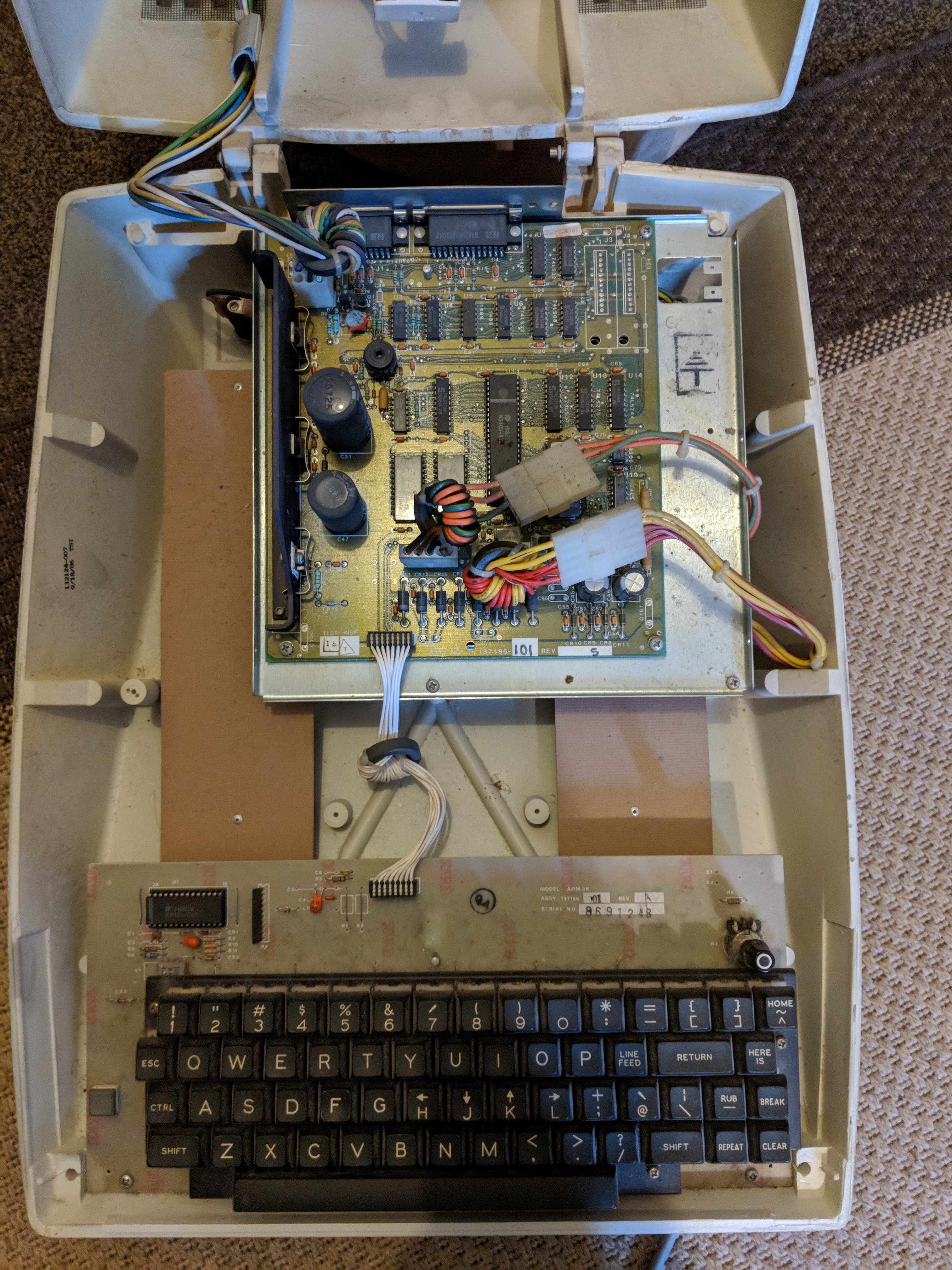
A friend of mine has said ADM-3A and is baffled by the tiny board it contains, not the usual ?covering entire base? discrete logic board they normally have. Centre of this board is the Nat Semi NS405 ?display processor on a chip? which is obviously why the board is so small but neither of us have seen this before in a 3A.
Anyone else? Pic at http://www.binarydinosaurs.co.uk/tonyADM3a.jpg <http://www.binarydinosaurs.co.uk/tonyADM3a.jpg>
cheers!
--
adrian/witchy
Owner of Binary Dinosaurs, the UK's biggest home computer collection?
t: @binarydinosaurs f: facebook.com/binarydinosaurs
w: www.binarydinosaurs.co.uk
Well, not really.
CHM only wants my punched card collection (4000+ cards) which they are
getting when I croak. Did not want the other stuff.
Livingcomputers only interested in miniatures.
I will swear I sent a note to Al Kossow about manuals. No reply.
I would like to have a couple more DEC Mice for some Vaxestations I
have, but they seem to be pretty rare.? At present I only have one mouse
and I move it from machine to machine.
The protocols for the DEC mice and the standard PS/2 mice don't seem to
be that much different.
Is it possible to use an arduino to translate? PS/2 mouse output and
then send it to the vaxstation so that will it mimic a classic DEC mouse?
I was successfull at capturing all the files from a 4051 Graphics T1 tape
last weekend.
Here is the link to a couple of photos of the process:
Capturing Tektronix 4051 Graphics T1 tape files to laptop
<https://drive.google.com/open?id=18hROXB28PD9Z_GYDNNSXGPK4Pv7GQD8w>
First I replaced the disintegrated drive belt with one from a NOS 3M DC6250
cartridge.
I used my 4051 to PC serial transfer program on my recently repaired and
upgraded 4054A.
I set the comm speed of the 4054 serial interface to the maximum 9600 baud,
but as it is 7-bit, my program changes all 32 Tektronix control characters
to "~X~" where X is the ASCII character corresponding to that control
character.
This way I don't lose any of the Tektronix 405x text formatting in the
transfer.
I was using ExtraPutty on the laptop to capture the program text strings,
then copied the statements into Notepad++ and saved each file.
I am also working on a Tektronix 4051/52/54 compatible GPIB MicroSD flash
drive that will emulate the Tektronix 4924 tape drive - for all of us with
these computers to use - since both the tapes and drives are very
problematic after all these years.
This flash drive contains an Arduino with my code - based on the GPIB
flowcharts and info in a 4051 and 4052 GPIB manual.
You will be able to use the existing 405x program statements with @Y for
the drive GPIB address - since I don't know how to write a ROMPACK for any
of the series :)
I plan to organize the different captured tapes in directories on the flash
- and that may mean using a non-4924 GPIB secondary address for that
command. It also likely means I need to change any tape commands in each
program to use the flash drive GPIB address.
That's why I wanted to capture one of the Tektronix tapes with a menu - is
to ensure I could get those files to work on my flash drive design.
Monty McGraw
Hello Folks,
More stuff!
New listings for June 20, 2018
Beck-Tech C64 ROM Emulator
80486 Multi-Master Card
H214 8Kx16 Planar Core Memory
M7504 DEQNA Ethernet Controller
VS40X 4 Plane Color Option
Bit Boffer BB-1
Ricoh V20 MMI Development PCB
EXT 01 slot extender board
Diablo Systems RGEXT slot extender board
Mystery Memory Board
Lexar 48K Memory Expansion Board
National Semiconductor COP402N Processor I/O Board
National Semiconductor 8080 Processor Board Set
Quantum Q2030 hard drive logic board
Anderson Jacobson ADAC 1200 Acoustically Coupled Modem
IEV Corp. VIP-2000
InfoChip Systems 13-000025 Compression Coprocessor Board
International TeleText Communications PC TeleText Decoder
Generic Network Card
Gould K-20 Logic Analyzer
Tektronix C-5A Oscilloscope Camera
List with links to individual items is here:
https://docs.google.com/spreadsheets/d/1I53wxarLHlNmlPVf_HJ5oMKuab4zrApI_hi…
(Please note: the links get screwy as I add/delete items because they are
not anchored to the actual item but to the cell range, still trying to work
on a fix for this. If you link to an item and it's just not there it means
it has sold.)
Instructions, FAQ, everything is at the link above. E-mail directly for
any questions.
Thanks!
Sellam
Hi Folks.
I've reorganized my sales listings into a Google Sheets set. The
introductory page is here:
https://docs.google.com/spreadsheets/d/1I53wxarLHlNmlPVf_HJ5oMKuab4zrApI_hi…
Use the tabs on the bottom of the sheet to navigate to the various "rooms".
New items have been added and are listed here:
https://docs.google.com/spreadsheets/d/1I53wxarLHlNmlPVf_HJ5oMKuab4zrApI_hi…
New items are always added to the New Arrivals Niche, so that's the first
place you should check when you visit my virtual online warehouse. I will
post a message to this list and the VCFed forums whenever new items are
listed, which will occur more regularly.
As always, please inquire directly to me via e-mail for the fastest
response.
Thanks!
Sellam
I was successfull at capturing all the files from a Tektronix 4051 Graphics
T1 tape last weekend.
Here is the link to a couple of photos of the process:
Capturing Tektronix 4051 Graphics T1 tape files to laptop
<https://drive.google.com/open?id=18hROXB28PD9Z_GYDNNSXGPK4Pv7GQD8w>
First I replaced the disintegrated drive belt with one from a NOS 3M DC6250
cartridge.
I used my 4051 to PC serial transfer program on my recently repaired and
upgraded 4054A.
I set the comm speed of the 4054 serial interface to the maximum 9600 baud,
but as it is 7-bit, my program changes all 32 Tektronix control characters
to "~X~" where X is the ASCII character corresponding to that control
character.
This way I don't lose any of the Tektronix 405x text formatting in the
transfer.
I was using ExtraPutty on the laptop to capture the program text strings,
then copied the statements into Notepad++ and saved each file.
I am also working on a Tektronix 4051/52/54 compatible GPIB MicroSD flash
drive that will emulate the Tektronix 4924 tape drive - for all of us with
these computers to use - since both the tapes and drives are very
problematic after all these years.
This flash drive contains an Arduino with my code - based on the GPIB
flowcharts and info in a 4051 and 4052 GPIB manual.
You will be able to use the existing 405x program statements with @Y for
the drive GPIB address - since I don't know how to write a ROMPACK for any
of the series :)
I plan to organize the different captured tapes in directories on the flash
- and that may mean using a non-4924 GPIB secondary address for that
command. It also likely means I need to change any tape commands in each
program to use the flash drive GPIB address.
That's why I wanted to capture one of the Tektronix tapes with a menu - is
to ensure I could get those files to work on my flash drive design.
Monty McGraw
hi
I have a Tek XP400, and a Tek XP217. They are X11-terminals made in
1990s (thus unable to support GTK-v2)
anyway, the XP217 runs with TekXpress v7, I have a copy for my
tftp-boot server and the terminal is happy with it; whereas the XP400
says it needs a more recent software.
does anyone happen to have TekXpress v8, or NCD bridge v4?
let me know
Thanks
FYI, the service under which I have been hosting my website for many,
many years is going away.
So, webpages.charter.net/thecomputercollection
Has been relocated to
www.computercollection.net
(The content is unchanged for now).
This will also give me the freedom to eventually post lots more (and muc
better) photos, put up my manual database and other databases at some
point, and all sorts of cool things over time, but at present I am
focused on my capture of the IBM 1410 Automated Logic Diagrams (ALDs).
(BTW, the capture application (C#) is written, though still being
debugged/improved, and I have already captured one volume of drawings,
and am testing VHDL generation from the captured information.)
JRJ
Is this a 200/DL (RS423 data lines only) board?
https://www.ebay.com/itm/352381870034
A normal 200 would have two large IDC connectors on the pcb for serial I/O
Hi friends,
I just received a refurb'd VT-420 with green screen. I see that I need a special 6 pin/modular-type cable for the comm port. I located the adapter to get to DB25 ( https://www.ebay.com/itm/262041938994 ) but I need the interconnecting cable. Anyone know what it is called? Anyone have one for sale?
73 Eugene W2HX
If anyone is interested, I just published a few videos showing my testing
of PlastiBands for QIC Tape Cartridge replacement.
https://youtu.be/irOrR-ZYwjw
and
https://youtu.be/GVsYHLvCvZY
A special thank you to CuriousMarc, Al Kossow, and Chuck(G) for their help,
leadership and inspiration in this area!
And my page dedicated to QIC Tension Bands...
http://qicreader.blogspot.com/p/drive-belts.html
As always, I welcome feedback, and hope this is of value to some here.
Best always,
-AJ
--
Thanks,
AJ Palmgren
http://QICreader.com
https://www.ebay.com/itm/1372243559202
basic.p11
syslod.p11
rdt.p11
all from mid 1971
original RSTS?
hope the person who got these knows what they bought
Hi,
Anyone interested in three HP 7980 tape drives (9-track, 1600/6250 BPI,
IIRC).
One HP-IB interface, two SCSI interfaces. Rack mountable.
Most likely local pickup only, in Redwood City.
thanks,
Stan
New items added for June 15, 2018:
Panasonic FT-70 Executive Partner
Radio Shack TRS-80 Color Computer Mini Disk
Atari 850 Interface Module
Atari 1010 Program Recorder
Rana Systems 1000 Floppy Disk Drive
Axiom ParallAx CD Printer Interface
Apricorn external parallel port interface
Personal System/2 and Personal Computer BIOS Interface Technical Reference
NETBIOS Application Development Guide
IBM Technical Directory
Cromemco Z2D Computer System
Hayes Micromodem 100
DEC RX50AA
IBM Type 4869 External 5.25" Disk Drive
Byte-Back MD-1 Modem Kit
Radio Shack TRS-80 Modem I
Tandy Serial Mouse (boxed)
Connecticut microComputer Inc. ADA 1450 PET Printer Interface
Control Data Disk Drive Tester/Formatter
Cromemco Z2D case/power supply/backplane
COMPAL-80 case/power supply/backplane
List with links to individual items is here:
https://docs.google.com/spreadsheets/d/1I53wxarLHlNmlPVf_HJ5oMKuab4zrApI_hi…
Instructions, FAQs, everything is at the link above. E-mail directly for
any questions.
Thanks!
Sellam
Has anyone attempted to reassemble and update the microcode on a MicroVAX?
Seems like there's enough stuff here to possibly do it:
http://simh.trailing-edge.com/semi/ucode/
I'm thinking about trying to find a microcoded architecture to play with
before I design something around the Intel 3000 series.
I've got a MicroVAX 3800, so I suppose I could run MICRO2 to assemble the
aforementioned microcode. But then what? I assume PALs would have to be
burned to implement the new microcode. Or is it more complicated than that?
I don't have a PDP-11/60, unfortunately. I do have an 11/45, though...so
with this modification, I suppose one could have some fun:
http://repository.cmu.edu/cgi/viewcontent.cgi?article=3241&context=compsci
Thanks,
Kyle
So someone mentioned this to me:
https://www.ebay.com/itm/222941705847
Now, the crazy thing is that I religously do a search for "PDP-11" for newly
listed items on eBait at least once a day - and this never showed up! I just
did a search for sold "PDP-11" items, and it's not showing up there either -
although a search for sold "PDP-11 parts" turns it up!
Anyone have any idea why it didn't turn up? That is a regular '-', not an
mdash or anything, and those are 1's, not lower-case l's. And it does show up
in the search for "PDP-11 parts". So I can only conclude that somehow eBait's
search function blew out somehow?
Anyway, someone got a total steal: at least _3_ H960's, a TU10, and an -11/45
(can't tell if there's an FP11) - and who knows what else is hidden!
Noel
Summer is almost here and that means it's time to get it in gear and
start planning our next Vintage Computer Festival Midwest. Astute
readers will note that this announcement comes many weeks later than
in past years, but rest assured there is still plenty of time
remaining to make your travel plans, reserve a table or get yourself
into the mood for a full weekend of classic computing fun. Here are
the necessaries:
What: The Thirteenth Vintage Computer Festival Midwest
When: September 15-16, 2018 (note that that's one weekend later than
the usual dates!)
Where: The Holiday Inn Elk Grove Village, Elk Grove Village, Illinois
- about 30 minutes west of Chicago with a free shuttle bus from ORD!
URL: http://vcfmw.org
More info for the uninitiated and VCFMW veterans alike:
- We do not charge admission. Thus, we are a community-supported
show, so we humbly beg your kind donations, which can be made via two
different links at vcfmw.org, or at the show.
- Always an entertaining spectacle, there will once again be an
auction! This is the other way we fund the show, so your donation of
old computers (or anything even marginally related) is greatly
appreciated. If it's a little too nice to put in the Free Pile,
please consider donating it as an auction item.
- Typical show hours are 9am Saturday 'til late night, and then
9am-4pm on Sunday (clean-up begins around 3pm). Early load-in is
usually available on Friday afternoon, hours at the hotel's
discretion.
- The show really begins on Friday night, at least for exhibitors. We
typically go for an informal group dinner and return to the hotel to
complete setup. Don't worry if you're getting into town late, you can
still set up Friday night (until 11pm or so). If you're arriving
Saturday morning, your table will still be reserved.
- Tables fill up quickly! If you'd like to exhibit, please fill out
the table reservation form at http://vcfmw.org/signup.html. If the
form is closed, it's because the buffer filled up and we're still
processing requests. We don't want to reserve space we don't have!
- Hotel rooms at the Holiday Inn are available at the group rate of
$92/night via the link at vcfmw.org, or by calling the hotel at the
number listed on our site. If the online room block is full, please
try calling the hotel directly.
- There is an on-site restaurant in the hotel that serves breakfast
through dinner and a bar that is open late-ish. Consensus seems to be
that they have good food and not having to leave the hotel to eat is a
big plus.
Feel free to forward this email or post its contents to your favorite
forum. We'll see you in September!
-j
Twitter: https://twitter.com/vcfmidwest
Facebook: https://www.facebook.com/events/248644859019545
I have a diskette labeled
UNIX SYSTEM V
VPI UNIX
disk 'A'
(vpi)* 8/85
UniPress Software, Inc.
I have the small installation manual that talks about inserting the disk to
serialize it, and how to install UNIX onto the Lisa 2/10 in Mac XL Mode.
It is a small implementation of AT&T UNIX V.
The disk is bad. Anyone have a process for recovering or reading an Apple
Mac XL disk? This seems like a piece of software that should be preserved,
as a curiosity. Does anyone actually have a working copy of UniPress
Software UNIX for the Lisa XL?
Bill
Someone is selling a drive that was just taken out of service ! And
alignment disks and exercisers for CDC 9762 (it doesn't look like a 9766 /
RM05 even though it says so in the listing)
Probably useful to RM02 or RM03 owners as well.
https://www.ebay.de/sch/rbembenek1/m.html?item=142830473695&rt=nc&_trksid=p…
Video from our speakers at VCF PNW 2018 is now available. For those of you
who have been asking thanks for being patient
https://www.youtube.com/c/VintageComputerFederation501c3
Regards,
Mike
(/me slowly builds up the courage to start planning for VCF PNW 2019)
Anyone want to trade a pdp8e rack header for a PDP 11 (pink/red) header?
Does not have to be perfect. I am located in Landenberg, PA USA. I have
other DEC rack-related parts to trade for this if that's not what you want.
b
I have 3 sunblade 2000 workstations for sale. They arrived as surplus
equipment. One of the machines does not power on, the other two boot up to
sun os with proprietary software that was used from the company they came
from. THe drives must be wiped before i send them out. They are quite
heavy, so that will be a factor in shipping.
I am open to offers on a single machine or the whole lot, if you have any
questions feel free to ask.
I have some spare cpu's that fit the machines as well, although they all
appear to have 2 cpu's installed already.
--Devin D.
Many are appearing on the VCFed mailing list already. Here are mine,
with separate sets for the non-computer (but still interesting) stuff:
http://silent700.blogspot.com/2018/05/vcf-east-2018.html
I had a good time and recommend the show to all who can make it out there.
-j
Anyone have any idea where one might track down a copy of TI System V
for the S1500 series?
I've had these two TI UNIX systems for awhile now, a TI S1505 and a TI
S1507 (68030 and 68040-based, respectively). They came without hard
drives or OS media and so they've basically been doorstops. I asked
around about OS media back when I got them (in 2013) and at the time I
got no leads; I'm guessing things probably haven't changed, but I
figured I'd ask again just in case...
Seem like nice machines, wish I could do something with 'em...
- Josh
I jumped the gun and bought a SCP 200B board. I grew up a DOS kid, so
figured it would be fun to run 86-DOS.
I found out about the SCP 300 board, that contains the boot loader and
serial port. Anyone have an extra they would be interested in unloading?
Thanks
--
: Ethan O'Toole
Anybody need DC600A data cartridges? These are still in the
carrying case, wrapped in the sealed wrapper. I have a box
of 5. They are from early 1990's.
I also have one used cart, but it is pretty dusty.
Jon
I am trying to repair a VAX 4000 power supply. Does anyone have the
schematics? I can't find anything on BitSavers and I'm not completely
convinced it was even designed by DEC.
The VAX turns on and the status LED stays on F. The DC lamp does not
illuminate on the PSU. 5V rail appears fine but there is nothing from
the 12V rail. There were some *very* dodgy looking caps which I have
replaced, and some *very* exploded MOSFETs, which I have also
replaced.
If anyone has schematics, or know where I might find them, it would be
much appreciated.
Thanks,
Aaron.
Hey all;
I'd love to talk to Alan Charlesworth, who used to work for Sun and (I
believe) CRS before that. I'm interested in his perspective on some
historical happenings and Sun design work.
If anyone knows him and might be willing to get me in contact with him I'd
very much appreciate it.
Unfortunately while I can find several papers he's written they all
provide his Sun address, and there are three other prominent Alan
Charlesworths that are making searching for him difficult.
My thanks for your help;
- JP
I, too, have emailed Sellam with no response.
But, I guess I am adding to the "broad-based whine"
Wow.
Kurt.
---------- Forwarded message ----------
From: Sellam Ismail <sellam.ismail at gmail.com>
To: Randy Dawson <rdawson16 at hotmail.com>
Cc: "General Discussion: On-Topic and Off-Topic Posts" <
cctalk at classiccmp.org>
Bcc:
Date: Wed, 6 Jun 2018 21:59:42 -0700
Subject: Re: New Listings for Sellam's Collection Sales
Hi Randy.
I have stuff that you can't find on eBay. And I am not offering the eBay
experience. This is me, Sellam, you are dealing with.
When I can find actual closing sales online (I need some place to start), I
generally go on the lower end of the mean of the data I find. It's a
collectors market, sometimes I'm high, sometimes I'm low, but I'm trying.
Do you know how to assess the value of items as diverse as what I'm
listing? I do, it's a lot of work. Come help out if you have the time,
I'll trade you for stuff.
The listed prices are what I'm asking, as stated. I'm always open to
offers, as stated. I price fairly, to move it, and if something sits for a
while, you have a good chance of negotiating a price more to your liking,
if you ask, but know that I am willing to sit on some things. I invested a
lot of time, effort, blood, sweat, tears and money into my collection over
many years. I'd like to recoup some of it.
All you have done is propounded a broad-based whine. if there's something
that interests you but the price is not right, let me know. I'm making
many sales and many deals, stuff is moving. Ask and ye may well receive.
Just be reasonable.
Sellam
On Wed, Jun 6, 2018 at 7:57 PM, Randy Dawson <rdawson16 at hotmail.com> wrote:
> Inspired by ebay for all the items there that never sell for the asking
> price.
>
>
> C'mon Sellam, you want to get out, how about lowering the prices a bit to
> move things along?
>
>
> ------------------------------
> *From:* cctalk <cctalk-bounces at classiccmp.org> on behalf of Ed Sharpe via
> cctalk <cctalk at classiccmp.org>
> *Sent:* Wednesday, June 6, 2018 7:50 PM
> *To:* sellam.ismail at gmail.com; cctalk at classiccmp.org;
> cctalk at classiccmp.org
> *Subject:* Re: New Listings for Sellam's Collection Sales
>
> do the prices keep increasing?
>
> In a message dated 6/4/2018 10:02:53 PM US Mountain Standard Time,
> cctalk at classiccmp.org writes:
>
>
> Hi Folks.
>
> I've reorganized my sales listings into a Google Sheets set. The
> introductory page is here:
>
> https://docs.google.com/spreadsheets/d/1I53wxarLHlNmlPVf_
> HJ5oMKuab4zrApI_hiX0pNmy48/edit#gid=0
>
> Use the tabs on the bottom of the sheet to navigate to the various
"rooms".
>
> New items have been added and are listed here:
>
> https://docs.google.com/spreadsheets/d/1I53wxarLHlNmlPVf_
> HJ5oMKuab4zrApI_hiX0pNmy48/edit#gid=949372371
>
> New items are always added to the New Arrivals Niche, so that's the first
> place you should check when you visit my virtual online warehouse. I will
> post a message to this list and the VCFed forums whenever new items are
> listed, which will occur more regularly.
>
> As always, please inquire directly to me via e-mail for the fastest
> response.
>
> Thanks!
>
> Sellam
>
Hi, I'm hoping someone here knows the low-level nitty-gritty on how the
characters on the CDC 6600 console CRTs were generated.
Thornton, "Design of a Computer", says "Control of the beam .. is provided by
electrostatic deflection ... electronically converting from the symbol .. to
deflection voltages", but alas, doesn't say how that conversion is done. And I
looked in some CDC 6600 documentation online, alas, even less detail.
But looking at the characters (reproduced on the dust jacket), the curves sure
make it look like it wasn't anything simple (e.g. using display vectors, as
one source indicated). Does anyone know?
(BTW, the VT11 in DEC's GT40 used bit maps for its built-in character geneator,
and the hardware did tiny raster zones to display them!)
Noel
Hi all --
I finally tracked down the EIS option for my 11/40 and I have it up and
running nicely (Ultrix-11 ATM, but I'll be playing with other stuff).
Right now I only have a 4-slot DD11 backplane for SPC/MUD boards and I'd
like a bit more space for expansion.
I have a few DD11-DK backplanes but without modifying the cabling it won't
work in a BA11-F chassis. If anyone has a DD11-DF they'd be up for trading
for the -DK variant (or for something else) please drop me a line.
Thanks!
Josh
The 729 CE manual quotes 555 BPI. I?m not sure when it became 556. http://bitsavers.trailing-edge.com/pdf/ibm/magtape/729/223-6845_729_CEman_1…
The IBM 728 was 248 BPI. Before that it was the nice round number 200 BPI.
I tried permutations of standard IPS and round number data rates and don?t see anything that yields exactly 556BPI.
Tim
> Jon Elson
> How/where should I submit this?
This is now available through here:
http://gunkies.org/wiki/Term-Mite_ST_Smart_Terminal
I put in a little infrastructure around it (articles on the Term-Mite, NS405,
etc), using info I dug up online.
Noel
> From: Toby Thain
> It's suggested there (without any proof though) that the CDC used a
> Fourier process
> ...
> I'd be very interested to know what you find out about the circuitry.
Someone very kindly pointed me at:
http://www.bitsavers.org/pdf/cdc/cyber/cyber_70/fieldEngr/60125000C_6602_66…
(although why it's in the Cyber70 folder, I'm not quite sure :-). I don't
completely understand it (it's only drawings, no text, and the notation is
unfamiliar), but I think I get the general drift - and it's pretty baroque!
Very briefly, it appears to me that characters are generated from short
vector-type strokes placed in a 7x7 matrix, with each stroke being encoded as
motion of 0, 1 or 2 'boxes', both horizontally and vertically, from the 'box'
of the end of the previous stroke. A character can contain up to 22 strokes,
but most seem to average about dozen or so.
The pronounced rounding which I noticed in the characters must be caused by
the limited bandpass of the A-D system, amplifiers, etc - it can't actually do
a sharp corner when going from e.g. a vertical stroke to a diagonal one. Or
something like that.. :-)
Noel
Inspecting a newly acquired HP 2392A I found out the chassis was prone to
whiskering all over the chassis.
Whiskers are small metal hairs growing from pure metal (zinc or tin) and can
when they connect to a power line create a shortage and electric arc
damaging the electronics.
Made some pictures and placed them in:
https://www.flickr.com/photos/hp-fix/41897770664/in/dateposted-public/
It's best to remove them by using scotch brite or fine sanding paper, after
that paint or coat the chassis with a clear paint or other nonconducting
paint.
More info about whiskering can be found at:
https://nepp.nasa.gov/whisker/https://en.wikipedia.org/wiki/Whisker_%28metallurgy%29
-Rik
While cleaning out my office, I found a brand new, unopened copy
of WRQ Reflection 4+ version 5.0 for DOS. It provides (per the
box):
Accurate emulation of Digital VT340, VT320, VT220, VT241, VT102,
and VT52 terminals, with VT420 features.
Windows-like interface with pull-down menus and dialog boxes.
132-column display with EGA, VGA, or special video adapters.
Full keyboard mapping and mouse support.
Etc., etc., etc.
If anyone wants it, just let me know and I'll send it to you in
exchange for the cost of postage (weighs 8 pounds). Otherwise
I will toss it in the recycle bin next week.
Alan "Pack Rat" Frisbie
All,
I have a need at work for an unusual SRAM chip (related to the New Horizons mission).
if you have a source or supply of these parts:
Part #=5962H9954103QXC
Qty=2 (per board)
Description: SRAM 256K x 8
Package=FPK40
Generic part#=LM2M8CRH-Q30X
with which you?d be willing to part for a good cause, we would really like to know about it!
Please contact me off-list, either by email or phone below, and I?ll happily put you in contact with the right folks.
- Mark
210-522-6025 office 210-379-4635 cell
I have two rare desktop telephones taking up space in my basement. I know I
never will play with or display them.
- Pingtel Xpressa PX-1. An early IP telephone
- ATT 8130 "Computer Phone". It has an RS-232 port in the back for
bi-directional comms. I reverse engineered the protocol when I used this in
1996. Crappy software available on request. I may even be able to dig up
the code Larry Wall sent me (Perl, of course) from the same era.
Photos here:
https://photos.google.com/share/AF1QipMJ-iCRhnHmiL9PoswsyJ2fiNTMK5Lw1xf
5TgpYr6UAo6ktLFAe6yEds5XvCIDoCg?key=WldvcDZnNEFlMmNza25ZLUdsN205R24zcFV2MHNR
Local pickup on Long Island or Manhattan, NY. I will mail it to you if you
pay the shipping via paypal or google pay. I will weigh it and calculate
the shipping if there is interest, but I am not going to bother unless
someone is interested.
On Mon, Jun 4, 2018 at 5:13 PM, Paul Koning via cctalk
<cctalk at classiccmp.org> wrote:
>> On Jun 4, 2018, at 1:17 PM, Robert Armstrong via cctalk <cctalk at classiccmp.org> wrote:
>>
>> ... FWIW, I have a 725 complete and working. Well, except for the RC25, which never worked even when they were new.
I had an 11/725 in the 80s and 90s and never had a problem with the
RC25 but they are legendarily terrible.
> Hm. I remember some RC25s on RSTS, and they seemed to be ok. The fact that they had two drives on one motor made it strange, especially if the fixed platter was your system device. We had to teach the OS how to deal with SY: going away temporarily.
Oof, yeah. When I used my 725, I didn't spin the RC25 up and down
except when booting and shutting down. I also had devices like RL02s
for removable storage.
I often wonder how hard it would be to develop some other storage
device for the KELSI but then other projects push to the top of the
stack and I move on.
Mostly, what I need is affordable ($250 or less) Unibus storage with
modern media (Flash or IDE adapter or whatever). I don't really care
what form it takes but Unibus SCSI cards are quite pricey and making a
new controller is even less affordable (I used to make and support
DMA-enabled Unibus communication controllers for a living so I have a
pretty good idea of the amount of effort required).
-ethan
List:
This is one that's bothered me for most of my adult life. As you may or
may not know, there were three industry standard densities for 7 track
1/2" tape: 200, 556 and finally 800 cpi/bpi.
So 200 and 800 are nice decimal multiples of 10. But 556 doesn't fit
that pattern--it's not a "nice' number, being the product of 4 and 139
and doesn't correspond to any computer-related characteristics that I
know of. It's not metric. So why 556 and not 400, 512 or 600?
There's got to be a story there, somewhere. I think the 556 density
came in around the 1401/7090 time with the 729 II.
Anyone know the story?
--Chuck
> From: Ethan Dicks
> Mostly, what I need is affordable ($250 or less) Unibus storage with
> modern media
There's this:
http://www.retrocmp.com/projects/unibone
Not quite there yet, but getting there.
Noel
I Frankensteined a P/390 together out of a P/325 server and the PCI P/390 card back in the day.
I assume you do have the LIC for the P/390 card, without which you?re dead in the water.
At least the PCI model wasn?t picky about the disks it used. And I?m pretty sure it?ll work with whatever the final Warp Server release was (4, maybe?) by which time the native TCP/IP support was a lot better. It was a nice little machine for its day, although Hercules is now many times its speed on modern hardware.
I used mine to run VM/CMS and Linux (under VM) quite well.
Adam
Does anyone have any datasheet/hardware details of the early Mostek
calculator chip MK50312N ?
It may be listed in "Mostek, MOS Integrated Circuit Guide", 1975 - a
magazine sized, 138 page, blue and
silver book.? Which apparently covers the F8 and several early memory
chips and
some calculator chips.
(Not listed in the Mostek 1974 "Integrated circuit guide")
Any help would be appreciated, even just confirmation that it is listed
in the '75 guide.
--Tony
Tony Duell <ard.p850ug1 at gmail.com> wrote:
> > until the 8085 CFE loaded the microcode.
>
> Loaded from a TU58 cartridge, which is the main reason my 11/730 is not
> running at the moment. The hardware is fine, I've rebuilt the drive rollers,
> but as yet don't have a readable tape (not even blank, to write the
> microcode onto).
I'm pretty sure that I have a complete set of 11/730 TU58 tapes in
my storage unit. I might even have some brand new tapes. If I
can find them, I would be happy to send them to you. They have
been sitting in storage for probably 20 years, so there are no
guarantee that they are readable.
I'm cleaning out the storage unit right now, in preparation for
moving, so I'll keep an eye out for them.
Alan "Pack rat" Frisbie
This has probably been asked before, but does anyone have the software
package that came with the HP-IB/RS232 HP10342 bus pre-processor for the
HP1650 series Logic Analyzer (actually I have a 1670G)? It should have a
config file and an inverse assembler file. I'm interested in the HP-IB
files. Can't find it anywhere.
- Marc
hi
I am playing with an old Motorola board and I have a problem
As you well know, the 68020 is a 32-bit microprocessor from Motorola,
released in 1984. Motorola also manufactured MC68EC020 - embedded
version of the MC68020 CPU, housed in different packages than the
Motorola 68020 microprocessor, but even in the case of PGA package of
114-pin PGA, MC68020/PGA is not pin-to-pin compatible with
M68EC020/PGA
They both use 114-pin PGA package, but some pins are different, (Vcc
and gnd are placed differenly in the pinout), and you need an adapter!
My board's socket is designed for M68EC020, but I need to use a M68020
chip because only the goldcap version, i.e. MC68020RC33 114-pin
ceramic PGA, is available at 33Mhz.
Code: Select allCPU: MC68020 114-pin PGA ----[adapter] ---> socket:
MC68EC020 114-pin PGA
Do you happen to know *where* I can find an adaptor M68020-PGA to M68EC020 PGA?
Do you happen to have for sale?
here I am
Thanks!
I'm looking for manual scans, software, really any documentation of any
kind for the Fairchild F9440 or 9445 (aka the MicroFlame) microprocessors.
Yes, bitsavers and a few other places have datasheets for the chips, but
that's really about all the documentation I've found. And yes, I know that
they're Nova clones and can run DG software, but Fairchild had their own
development tools too that seem to have disappeared completely.
In particular, Fairchild had a single board computer for the 9445 called
(I think) the PEP-45. It had a built in EPROM monitor called PEPBUG-45.
I'd love to find manuals and schematics for that gizmo. Actually I'd be
interested in documentation for any systems that used either of the 944x
chips.
Bob
http://downthebunker.chickenkiller.com
DownTheBunker is open!
features:
- bazaar distiller doesn't require to register an account, it sums up
Market place's items for sale or wanted in a nutshell
- person-to-person trading in the Bazaar, you have to register an
account in order to contact people
- mini message-wall; doesn't log the IP and doesn't require you to
register, can be used as a message in the bottle, or a mini chat
- message-board. doesn't request to register but it logs the IP. It's
more advanced and it can be used as mini Wiki
- Chunks (of users/stuff) offers FTP-like with manuals and links to
other sites bookmarks
Durcheinander is an advanced area with the possibility for the (local,
only from the local intranet) user to upload and execute JavaScripts,
JavaAplette, Node.Js code, and Java bytecode. It's not yet safe enough
to be open to the public Internet, and it stills needs to be hardened
in its profile. Due to what happened in December 2017, cyber attacks
destroying the whole website, it's a reserved chunk of priv? stealth
rooms for the team, whose access from the Internet is reserved and
features are reduced e.g. it checks the socket.connect.ip, and if it
comes from outside the intranet it blocks the whole scripting-engine
allowing just a plain text browsing.
My participation to SGI is merely focused on my needs, as I'd like to
port an HDL simulator to Irix.
But I sold my Octane 1 year ago, and I am willing to sell my dual
Tezro rack-mountable racks cause I lost enthusiasm.
Anyway, does anyone happen to have a copy of an Ada95 compiler for
Irix? Or a working copy of GNAT? Needed for IRIX >= 6.5.27
I will for sure sell the Tezro, Maybe I will reconsider the purchase
of a tiny Octane.
I am more focused on Linux/HPPA and Linux/PPC32, which are used for job tasks.
At the moment. I am developing a fast FiberChannel ram-disk for the
radio telescope.
cheers
I agree this is very specific, but I thought perhaps someone could help.
As I look at the '09 datasheets, I can't tell when the data lines become
valid on a write cycle.
I ask because I have created a few projects that place themselves
between the CPU and the CPU socket (CPLD based).
To play nice with a potentially shared address and databus, my code
honors the BA and TSC lines on the IC.? If either line is high, as noted
in the datasheet, I tristate the address and data lines.
Otherwise, the address lines are valid during the entire E cycle.
As for data, it depends on the state of the R/W line.
If R/W is high, the external databus is connected to the CPU databus
during the entire cycle if TSC and BA are both low.
If R/W is low, I initially set the external data bus according to this
assign statement:
assign data_ext = (!r_w & e& !(tsc | ba) ? data_09 : 8'bz);
The '09 boots, but certain devices fail to operate.? If I change the
assign to:
assign data_ext = (!r_w & (e | q) & !(tsc | ba) ? data_09 : 8'bz);
or
assign data_ext = (!r_w& !(tsc | ba) ? data_09 : 8'bz);
The devices begin working.
Either of the modified equations works, but I don't know if can safely
place data on the external databus during the entire cycle, like the
address lines, or if I need to be off the bus for some small portion of
the cycle.? I was hoping the datasheets could help, but I am missing the
key portion of the timing diagrams.
I hope someone can enlighten me.? I have the system working, I just want
to make it as good as possible.
Jim
--
Jim Brain
brain at jbrain.comwww.jbrain.com
If they are still around, this guy had a lot of old DEC stuff.
Not affiliated with seller, etc.
Mitch Miller
| Phone (937) 847-2300 / Fax (937) 847-2350 (Old area code was 513)
|
| Keyways, Inc.
| 204 S. Third St.
| Miamisburg, Ohio 45342 USA
|
| E-mail: miller at keyways.com
| Web: http://www.keyways.com
| Stock List: http://www.keyways.com/stock.html
Cindy Croxton
---
This email has been checked for viruses by Avast antivirus software.
https://www.avast.com/antivirus
Can anyone point me to a technical manual for the DataMedia Elite 2500A
terminal? I'm especially interested in documentation on the escape
sequences and the special character sets. This was a fairly high end smart
terminal from the late 70s or early 80s.
Bitsavers has a short manual for the 1500 which I'm guessing to be
similar, but the 2500 has some extra features (e.g. insert line/character,
delete line/character, etc) that aren't present there.
Thanks,
Bob Armstrong
> From: Dominique Carlier
> I just regret this incredible rise in prices for collector machines
> that, not so long ago, were languishing in wet sheds
Hey, look at the bright side: as a result, they are much less likely to be
simply recycled as scrap.
I took great pleasure in telling one seller who'd pulled a board-set,
and recycled the rest, that the part he'd recycled was worth a lot more
than the part he'd saved. Hopefully that kind of news gets around.
Noel
I received an email from plebourgeois at me.com who said he's in
Mandeville, Lousiana and has an Osborne available with
accessories/manauls to a good home for the cost of shipping. He said
he'll throw it away if he does not find a home for it soon.
That's all I know, do not reply to me or this list, send the guy an
email directly.
________________________________
Evan Koblentz, director
Vintage Computer Federation
a 501(c)3 educational non-profit
evan at vcfed.org
(646) 546-9999
www.vcfed.orgfacebook.com/vcfederationtwitter.com/vcfederation
> From: Henk Gooijen
> My findings so far :
> www.pdp-11.nl/pdp11-35/repair/repair35page.html
> Comments are very welcome!
I got a:
You don't have permission to access to this document on this server.
Apache Server at pdp-11.nl
error message?
> I vaguely remember that there was a difference in the front console For
> the BA11-K and the BA11-F configuration. ... the two ribbon cables from
> the front panel are at the right side for a BA11-K box, and on the left
> side for the BA11-F box. Given the location of the CPU boards in both
> boxes, that makes sense.
They didn't do two different console PCBs, did they? It must be just cabling
routing? I couldn't find any manual/drawings for the BA11-K version, so I
can't tell for sure..
> From: Jon Elson
> I'd get an FPGA development board and download Xilinx's webpack
> software. It would not take real long to design the basic microcode
> engine, and then you could develop some application microcode in
> parallel with the hardware
That approach worked really well for Dave B and I on the QSIC. IIRC, we
bounced around the uengine design concepts for a couple of days, and then
once we decided to go, he had the hardware working in a day or so. It's in
Verilog, so perfect for an FPGA devel board; I think it's in his Github
repository:
https://github.com/dabridgham/QSIC
If you go this route, I have that config-file driven uassembler written in
portable C (compiles on 3 different systems that I know of) which uses only
standard I/O library which you can use for the ucode; it should handle most
any uengine design, unless it has something really wierd.
Noel
> From: Kyle Owen
> I do have an 11/45, though... so with this modification, I suppose one
> could have some fun:
That's for the -11/40 - very different machine, one couldn't use the same
technique on the /45; the /40 is prepared to accept additional ucode on
additional CPU boards, that's how the EIA works:
http://gunkies.org/wiki/KE11-E_Extended_Instruction_Set
And it's custom boards, the design for which is no longer extant (pity, as
I'd love to play with one myself).
Finally, I have this vague memory that they had to put a few minor mods on
some of the existing CPU boards (details also lost), although my memory may
be misleading me on that.
Noel
> From: Kyle Owen
> So the same technique would work on the 11/35, then?
Yes, the /35 and /40 are completely identical, except for the number
painted on the inlay on the front console.
(Well, the /35 was often sold in a BA11-K box, and the /40 in a BA11-F, but
that's just physical configuration, and is just a 'usually' - there are
/35's in BA11-F's [for sure], and probably /40's in BA11-K's.)
Noel
I?m looking for a circa 1974 copy of RSX-11D distribution and the COBOL compiler that was shipped as an add-on product.
I?ve looked through trailing-edge but maybe I am missing the obvious, anyone have any ideas or has a copy?
thanks
Not affiliated with seller, etc.
Intel 386 CPU. Remember when we bought them and thought they were so fast!
Well..maybe someone has that obscure application that needs them.
500pcs
QU80386EX25
NEW UNUSED IN TRAYS
Regards,
Ron Sanders
RBD Electronics, Inc.
63 Flansburg Ave
Dalton, MA 01226
1-413-442-1111
ron at rbdelectronics.com
Cindy Croxton
Electronics Plus
1613 Water Street
Kerrville, TX 78028
830-370-3239 cell
sales at elecplus.com
AOL IM elcpls
---
This email has been checked for viruses by Avast antivirus software.
https://www.avast.com/antivirus
Hello folks,
This weekend I picked up a VT52 DECscope terminal from a fellow collector. It's in fantastic shape, apart from being a little dirty and missing the number "6" keycap from the number pad.
This is a real long shot, but if you have a permanently broken VT52 terminal you're keeping for parts, could you please let me know? I'd like to buy a "6" key and make this one complete.
-Seth
--
Seth Morabito
web at loomcom.com
So I have discovered that the manual and prints for the MM11-F core memory are
not online; it turns out I have a manual/prints set, and at some point will
get them scanned and over to Al.
My question is: is there anyone who has an immediate need for these things?
If so, I will make the scan higher priority, otherwise it'll be a round tuit
number.
Noel
[apologies for lack of context, been away from cctalk a long time and insufficient recall of how this cctalk thing works... yet somehow still remember IAS on an 11/70 from the 1980s]
Pick an RSX layered product and lots of fundamental stuff would probably be compatible between 11M, 11D, and IAS (and/or 11M+). Find the RSX version and see if IAS is mentioned as supported in the SPD or other documentation. It often was, and even if it wasn't, lots of non-priv stuff would just work.
More IAS background from someone (not me) who was there in the IAS development team in DEC Reading:
https://www.john-a-harper.com/ias.html
"This page is dedicated to the best of the many PDP-11 operating systems - IAS
I couldn't find anything else on the Web about IAS? but it deserves better than to fall completely into obscurity.
DEC's approach to operating systems for the PDP-11 was anything but disciplined. New ones got invented every time some engineer or marketing person blinked. In the early days, there was a real-time kernel called RSX-11A, designed for memory-resident applications in what we now call embedded processors. Features got added to this rapidly - code bloat is nothing new. By the time it got to RSX-11D it had a complete disk-based file system, a program development environment, and support for every peripheral in the Small Computer Handbook (and there were plenty of them - peripherals on the PDP-11 obeyed the same strategic imperatives as operating systems - see above). At this time, a bright young engineer called Dave Cutler decided that enough was enough, and set out to create a small system that would do the same, which he called RSX-11M. We all know what happened to him - and he no longer even has the excuse of youthful excess.
(continues...)"
Hth.
For the last five years I've been working with Qualcomm and others to
allow the Computer History Museum to release the source code of what
was, in my opinion, the finest email client ever written: Eudora.
It's finally done!
http://www.computerhistory.org/atchm/the-eudora-email-client-source-code/
Is Linux "classic" enough? If you think not, please ignore this email
I started with Linux kernel version 0.12 (not a typo), which I believe
was the first version that was self-hosting. I subscribed to Linux
Journal from its beginning.
Is there any collector value or interest in old issues of Linux Journal?
I have a continuous run for "several" years, beginning with the very
first issue.
Anyone interested? As many as you want could be yours for the cost of
shipping (USPS Media Mail).
Hey all,
I have an IBM 5140 portable with a printer but I'd really like to use it as
a terminal among other things. Any chance there's documentation available
for that Centronics connector or another internal header with RS232 or
whatever?
=]
--
--
Anders Nelson
+1 (517) 775-6129
www.erogear.com
> From: Eric Smith
> The NS455 has firmware in masked ROM ... The NS405 has the masked ROM
> disabled
Ah, thanks muchly! Do you know of _any_ documentation extant for the 455? I
couldn't find anything..
> I've been searching for the NS405 manual (not the datasheet) for a very
> long time.
The data sheet seems pretty complete - are you sure there ever was a manual?
Noel
This time not so 'classic'
My last job was maintaining IBM p7's and eventually p8's.
One thing I started was putting together a home setup. But like all the
other
projects the gear has become redundant to me.
The 'stack' consists of 2 each IBM p720's, a CR6 HMC, and a KVM drawer.
The p720 do NOT have any hard drives or carriers, but both are available via
Ebay. The carrier was used in more than one model, and in the past I've
bought carriers with small disks for < $20 each, then found larger disks of
various brands.
And the rails are missing from the p720's.
Google "ibm p720"
I can't remember how much RAM, number of CPUs etc but one p720 was
'loaded'.
If interested let me know and
If anyone knows a good AIX list please let me know
I'll try to get a few photo's this weekend.
The 'stack' is located in Portland, Oregon.
NO PACKING OR SHIPPING, must be local pickup.
-pete
> From: Jon Elson
> Steve Ciarcia ... made a board using the NS405 called the Term-Mite.
I decided I'd do an article about the Term-Mite for the CHWiki; I found
Ciarcia's long article about the Term-Mite (in his book, which Google books
has); it talks throughout the article about the NS455 - but it also says
"[t]he Term-Mite actually uses a NS405 chip which is a specialized version of
the generic NS455".
So I went to look up the 405 and 455, to see what the difference was between
the 405 and the 455. I found a data sheet for a 405, but not one for the 455.
Does anyone know where I can find info about the 455 (or, better, yet, know
what the difference is between the two - that would save me some leg-work).
Thanks (I hope :-)!
Noel
I have some Amiga documentation gifted to me a long time ago by an Amiga
enthusiast. Now that I'm moving and downsizing, it has to go.
Free for shipping, USPS media mail.
AmigaDOS User's Manual - paperback book
---------------------------------------
"This manual describes the various AmigaDOS, [sic] and its commands."
Errata to the AmigaDOS User's Manual - photocopy
------------------------------------------------
Amiga Hardware Manual - photocopy
---------------------------------
"... provides information about the Amiga graphics and audio
hardware ... tutorial on writing assembly language programes to directly
control the Amiga's graphics and hardware."
INTERFACING TO THE 68K BUS CONNECTOR ON THE AMIGA
Designing Hardware for the Amiga Expansion Architecture
Drawings of the Expansion Boards for the Amiga
----------------------------------------------
A packet of photocopy documents and schematics.
I didn't see it being mentioned here on cctalk :(
http://archive.is/dJgyQ
but I'm hearing some refugees saying that the chances of the site going back online are not looking good
>
> Date: Mon, 21 May 2018 21:01:59 -0400
> From: Michael Thompson <michael.99.thompson at gmail.com>
> Subject: Re: I ran across this strange modernistic? Data General
> ...odd? computer?
> The RICM has one, but it is not on the WWW site.
>
> Michael Thompson
>
>
I put a picture of the one at RICM here:
http://www.ricomputermuseum.org/Home/equipment/data-general-desktop-generat…
Going from left to right: QIC tape drive, dual floppies, disk drive, card
expansion, CPU, and power supply. We have the monitor, keyboard, and
printer for it too.
Next time I am in the warehouse I will take pictures of the serial/model
number tags of everything.
--
Michael Thompson
Randy,
Although there are people interested in collecting historic software (especially source code), I don?t know of a central place to discuss it. I?ve collected the original IBM 704 Fortran/Fortran II compiler, the original IBM 709x Lisp II interpreter, and various other things (see http://www.softwarepreservation.org/projects). As you build up your collection of CAD-related source code, I would encourage you to offer copies to the Computer History Museum (http://www.computerhistory.org/artifactdonation/) for long-term preservation.
Paul McJones
http://www.mcjones.org/dustydecks/
On May 21, 2018, Randy Dawson <rdawson16 at hotmail.com> wrote:
> For a while I have collected bits of legacy CAD, most recently Martin Hepperle sent me what I believe is the last version of Hank Christianson's MOVIE.BYU, a FORTRAN based 3D modeling and animation system.
> I also have experimented with the original Berkley SPICE, also written in FORTRAN.
> ...
> My question is, did any of the source code for these systems, Applicon, Auto-Trol, Calma, ComputerVision, thousands of lines of primarily FORTRAN ever make it out, where we could read and study this original body of mathematical geometry done on computers?
>
> I know we are primarily a hardware group here, but where is the interest in the software discussed?
>
> Randy
Also, the computer history museum has a listing, so someone might be interested in getting the original code running on an emulator:
http://www.computerhistory.org/collections/catalog/102726903
> On May 26, 2018, at 10:00 AM, steven at malikoff.com wrote:
>
> I don't know if any source is still available, but for a long time I've been fascinated by Ivan Sutherland's Sketchpad running on the TX-2:
> https://www.youtube.com/watch?v=USyoT_Ha_bA
>
> Since Sutherland's technical report is also on the web (https://www.cl.cam.ac.uk/techreports/UCAM-CL-TR-574.html) I reckon it would make for a great 3rd-year Computer Science graphics assignment, to replicate Sketchpad using a high level language. A look through the report shows the use of rings, linked lists, recursion, storage considerations, maths, graphics and so on (only needing to replace the light pen with the mouse of course) which could be a fascinating exercise for a student. Yes there are already Sketchpad-named apps and Sketchpad-like programs, but I'm not sure if there is a near-100% faithful recreation of that original program as demoed in the film out there.
>
> Steve.
Hi guys - wonder if any OCR aficionado can help me out please.
I'm trying to clean up some old computer docs.
One of things I'm doing is running OCR over them, in particular Adobe's ClearScan which I really like for document clarity and small
file sizes.
A few of them are producing the error:
Acrobat could not perform recognition (ocr) on this page because:
ENU
Most OCR errors relate to renderable text but I can't find an explanation for "ENU"
Has anyone encountered this OCR error and can tell me what it means please.
Thank you.
Kevin Parker
Cross-post for the DEC Lovers here.
-----Original Message-----
Sent: Thursday, May 24, 2018 9:52 PM
Subject: [GreenKeys] How to get rid of a DECwriter II?
I'd sure like to get this thing out to make room for more Teletypes.
Located in NW Arkansas.
Jim Haynes <jhhaynes at earthlink.net>
-----
ftp://ftp.irix.cc/pub/nekoware/
-----Urspr?ngliche Nachricht-----
Von: cctalk [mailto:cctalk-bounces at classiccmp.org] Im Auftrag von
cctalk-request at classiccmp.org
Gesendet: Freitag, 25. Mai 2018 19:00
An: cctalk at classiccmp.org
Betreff: cctalk Digest, Vol 44, Issue 24
Send cctalk mailing list submissions to
cctalk at classiccmp.org
To subscribe or unsubscribe via the World Wide Web, visit
http://www.classiccmp.org/mailman/listinfo/cctalk
or, via email, send a message with subject or body 'help' to
cctalk-request at classiccmp.org
You can reach the person managing the list at
cctalk-owner at classiccmp.org
When replying, please edit your Subject line so it is more specific than
"Re: Contents of cctalk digest..."
Ahoy HP Aficionados!
I have for sale here one nice set of documentation for the HP 2116C.
There are a total of three original HP binders, each with a multitude of
individual documents, as follows:
Binder No. 4
HP BASIC (April 1970)
HP FORTRAN (April 1970)
Small Programs Manual
- SIO Teleprinter Driver (LP Compatible) (April 1970)
HP ALGOL (April 1970)
Symbolic Editor (April 1970)
Binder No. 5
12597A-002 Tape Reader Interface Kit Operating and Service Manual (November
1970)
2748A Tape Reader Operating and Service Manual (October 1970)
12531C Buffered Teleprinter Interface Kit Operating and Service Manual
(July 1971)
Manual of Diagnostics
- Alter-Skip Instruction Test (June 1970)
- Memory Reference Instruction Test (June 1970)
- Shift-Rotate Instruction Test (June 1970)
- HP 2116B Low Memory Address Test and HP 2116B High Memory Address Test
(January 1971)
- Tape Reader Test (January 1971)
- Computer Interrupt Diagnostic (June 1970)
- HP 2116C Low Memory Pattern Test and HP 2116C High Memory PatternTest
(September 1970)
- Power Fail Interrupt (February 1970)
- General Purpose Register Diagnostic (May 1971)
- HP 2116 TTY Test (April 1971)
12566A Microcircuit Interface Computer Interface Kit (December 1968)
Binder No. 6
2752A Teleprinter Operating and Service Manual (November 1970)
Teletype Corporation Bulletin 310B Vol 1: Technical Manual, 33
Teletypewriter Sets: Receive-Only (RO), Keyboard Send-Receive (KSR),
Automatic Send-Receive (ASR)
Teletype Corporation Bulletin 310B Vol 2: Technical Manual, 33
Teletypewriter Sets: Keyboard Send-Receive (KSR), Receive-Only (RO),
Automatic Send-Receive (ASR)
Teletype Corporation Bulletin 1184B: 33 Page Printer Set (ASR, KSR AND RO)
Parts
I am asking $250 or best offer. As always, please respond directly via
e-mail if interested.
Thanks!
Sellam
>
>For the last five years I've been working with Qualcomm and others to
>allow the Computer History Museum to release the source code of what
>was, in my opinion, the finest email client ever written: Eudora.
>It's finally done!
Yay! Now someone can fix the bugs :-) (6.2 here. Massive archive of
emails. The search function is superb).
W
My latest score is an HP 9836CU (so, color with a 68010 CPU and HP-UX
support) with a 98625A disk interface. I got the matching monitor, but
I didn't get the video cable.
Googling turns up that it's a very proprietary interface, but I could
find nothing about the cable. It's a 15 pin D-sub at each end and I'm
hoping that it's just straight through, but have been unable to verify
that.
Does anybody know? Or Is there anybody that has a 9836C or CU and
would be willing to examine the video cable, please?
Thanks
Robert
For a while I have collected bits of legacy CAD, most recently Martin Hepperle sent me what I believe is the last version of Hank Christianson's MOVIE.BYU, a FORTRAN based 3D modeling and animation system.
I also have experimented with the original Berkley SPICE, also written in FORTRAN.
This weekend, I am reading "the Engineering Design Revolution", a 650 page history of the CAD industry by David Weisberg, who was there and worked for many of the companies in the beginning of the industry, I highly recommend this for anyone interested in CAD:
www.cadhistory.net<http://www.cadhistory.net>
The Engineering Design Revolution<http://www.cadhistory.net/>
www.cadhistory.net
The Engineering Design Revolution. The People, Companies and Computer Systems That Changed Forever the Practice of Engineering. By. David E. Weisberg
My question is, did any of the source code for these systems, Applicon, Auto-Trol, Calma, ComputerVision, thousands of lines of primarily FORTRAN ever make it out, where we could read and study this original body of mathematical geometry done on computers?
I know we are primarily a hardware group here, but where is the interest in the software discussed?
Randy
Hi,
after my Micro PDP11/83 boots up, I like to connect a Digital VT420
to the console port. This worked approx. 10 years ago. Now when I
poweron the VT420 I get no message on the screen. The f3 key doesn't
give me the configuration menu.
Is it broken? Does it have some invalid configuration in NVRAM and
can be resetted?
I tried changing brightness and contrast, no change.
Is it normal that the right LED is always on? See the picture.
https://debug.openadk.org/pdp11/vt420.jpg
I tried with and without serial connection to another system.
Thanks for any advice,
Waldemar
>
> Date: Sun, 20 May 2018 18:04:00 -0400
> From: Ed Sharpe <couryhouse at aol.com>
> To: cctalk at classiccmp.org
> Subject: I ran across this strange modernistic? Data General ...odd?
> computer?
>
> While? in the warehouse I ran across this strange modernistic? Data
> General ...odd? computer?
> I do not remember buying it!? ?Ed#
> ?
> ?
> "https://www.smythretail.com/wp-content/uploads/2012/05/DG10_1-300x227.jpg
> "
>
>
The RICM has one, but it is not on the WWW site.
Michael Thompson
Sent SMECC Museum PROJECT needs to buy or trade for or beg for the HP hand Held (700 series? help?) that was phone and a computer.... the early ones and also the later Win CE ones.... also need ad materials promo videos... anything related to spice display up... please drop note off list to us. thanks Ed#
AOL Mobile Mail
G'day Zane -
Like every other computer system created, the Desktop Generation has its
own set of quirks and wonders. It was an interesting evolutionary
repackage of the microEclipse processor, but I never saw a customer or
user site actually using the Model 10's MS-DOS "compatibility feature".
The hardware consisted of modular metal frame chassis with snap-on
plastic covers. While great for manufacturing and cost control, the
delicate plastic cover retaining tabs were always breaking and the
covers would pull away from the chassis or just fall off. Only an
annoying cosmetic problem until you find that a "dead man's switch"
interlock was maintained by the power supply chassis front cover. Yes,
the power supply would always be cut off whenever the plastic cover
shifted, vibrated or fell off the chassis. Which happened often. (The
cheapest solution was the unintended, creative use of a ball point pen
combined with nerd engineering.)
Many OEMS delivered DG/RDOS- or AOS-based applications written in ICOBOL
or Business BASIC (i.e. NAPA). These were good systems for OEMs who had
previously developed software for DG - providing their application was
not disk-bound. DG eventually was forced to design and sell a parallel
I/O bus option to help improve disk performance... to the confusion of
customers previously told of the benefits of a serial I/O bus design.
The system was followed by the DG/500, which had a similar hardware
functional microEclipse-based design but enclosed in a then-familiar IBM
PC AT (desktop) form factor. This was the final unsuccessful attempt to
defend the low-end 16-bit Eclipse line from the PC onslaught.
-----
Bruce Ray
Wild Hare Computer Systems, Inc.
Boulder, Colorado USA
bkr at WildHareComputers.com
...preserving the Data General legacy: www.NovasAreForever.org
Message: 20
Date: Wed, 16 May 2018 20:40:04 -0700 (PDT)
From: Fred Cisin <cisin at xenosoft.com>
<snip>
>I remember an interview with Lee Felsenstein, in which he was asked how
>much a battery power unit for the upcoming Osborne would weigh. He
>reponded that the external DC connection was currently for use with a car.
>(Lee was driving a Honda Accord).
Sorry for the late reply, but I was travelling and needed to dig out the unit.
The lead-acid battery for the Osborne Powr-Pak(tm) I own weighs 3.59 kg.
Bob
>From: Al Kossow
> NASTRAN is available
That's a finite element modeling code, isn't it? (I guess it all depends on
what the OP meant by 'CAD'...)
Noel
> From: Randy Dawson
> For a while I have collected bits of legacy CAD
> ...
> My question is, did any of the source code for these systems
> .. ever make it out
Well, not quite what you're asking about, I think (it sounds like you're
interested in MechE CAD, not EE, even though SPICE was mentioned), but the
original Stanford SUDS is still available, I think.
> I know we are primarily a hardware group here, but where is the
> interest in the software discussed?
Is that a plaint ('how come we don't do software'), or a query ('where is
software discussed')? If the latter, it tends to be system specific, from
what I've seen - e.g. there's 'TUHS' for Unix, "its-hackers" for ITS, etc.
Noel
> From: Bob Smith
> 8110 for MOS memory, and 8120 for bipolar memory is what field guyde
> list says.
Well, the early bipolar MS11-C (1K boards) used the M8110 during early
production (see e.g. DEC-11-HMSAA-D-D, pg. 1-1), and apparently then switched
over to the M8120. I've only seen the later MS11-A bipolar (4K boards - dunno
why it's in reverse alpha order) associated with the M8120.
> I think the there was some change from special select parts and a move
> to schottky 74S series around the time of the 45/50 days.
I wondered that, but the MS11-C and MS11-A are the same speed (300 nsec);
although maybe the M8110 was a bit marginal, and component changes in the
M8120 made it more robust?
I guess I'll have to do it the hard way, and compare the ICs... :-(
> 11/40 was faster than 11/35, but if you changed a wire, they were the
> same.
I've heard of other manufacturers doing that, but I thought the /35 and /40
were identical, except for the number on the console inlay, and the sales
channel?
Noel
Fred Cisin <cisin at xenosoft.com> wrote:
> d) The TRULY IMPORTANT issues will never be solved through the use of
> armed forces:
> big-endian V little-endian
> vi v emacs
> DEC V IBM
> CDC V IBM
> TRS80 V Apple
> Atari V Commodore
> IBM V Apple
> Android V IOS
> Linux V Windoze V MacOS
> number of buttons on a mouse
On the other hand, the fight against the X86 architecture might be done
with the help of arm forces...
--Johnny
/\_/\
( *.* )
> ^ <
Hi,
I started to revive an old Micro PDP11/83 I have for over 12 years
now. It is fully assembled and last time I tried to start the
machine it some kind of started.
My biggest issue at the moment is the power supply.
After the machine is running for a while, let's say 10 minutes and
then when I poweroff, the power supply starts producing a lot of
dense smoke. The smell is very penetrant.
What can I do with the power supply? Do I need to exchange it
completely or just parts of it?
At the moment I removed it from the case like described here:
http://www.bitsavers.org/pdf/dec/pdp11/microPDP11/EK-MIC11-TM-002_MicroPDP1…
Thanks in advance for any starting hints,
Waldemar
Greetings!
A friend of mine got a aox double time 16 board into a mac SE
Unfortunately it isn't working (not accelerating the mac) and we're unable
to find any info on it
Any helpers? :o)
thanks
Alexandre
So I notice that M8120 controller card for the MS11 seems to share its etch
with the earlier M8110 variant (the M8120 says "M8110" in the etch :-); so the
differences must be component/configuration/ECO. Does anyone happen to know
what the differences between the two are? Thanks!
Noel
All ?
??????????????? I did a rescue of some vintage HP equipment for VCFE and the donor had the following vintage test and other equipment left over in his storage unit (from his father, who had recently passed, an engineer for North American Bosch). It goes to the dumpster at the end of May. Location is Long Island (Farmingdale). If anyone is interested, please contact me off-list.
Thanks.
??????????????? *????????????? HP 202C Low Frequency Oscillator
??????????????? *????????????? HP 202A Low Frequency Function Generator
??????????????? *????????????? HP 4000 Vacuum Tube Voltmeter
??????????????? *????????????? Heathkit IG-62 color bar generator
??????????????? *????????????? Megadata Multi-video Display (looks like on-screen video titler)
??????????????? *????????????? Invac triple paper tape drive in a 6' rack
??????????????? *????????????? Dumont 403 Oscilloscope
Rich
--
Rich Cini
http://www.classiccmp.org/cinihttp://www.classiccmp.org/altair32
All,
Per the recent discussion on thicknet/early Ethernet, I figured I'd see if
there's any interest in cut-to-length Belden thicknet/10base5 Ethernet
cable. I've got a local surplus guy who's got at least one 1100 foot roll.
It's the real Ethernet spec stuff, sez so on the cable, and it has the
bands to locate your vampire taps.
If there's enough interest, I'll buy the spool off of him and cut it to
length for whoever's interested in buying some. I can crimp N terminations
on as well.
Thanks,
Jonathan
I ran across the following messages in comp.os.os2.marketplace
(referenced from comp.os.os2.programmer.misc) and remembered that there
were a few people talking about IBM's Personal Communications Manger
here, particularly in the context of the P/390. So I figured that I'd
cross post the info. The asking price (free + S&H) seems reasonable.)
--
Grant. . . .
unix || die
> From: Mark Linimon
> Would love to if you can change your mind on shipping?
https://www.pakmail.com/
Like I said, they will come pick things up, as they sit - perfect for Pete's
situation. And from my experience, not _always_ cheap, but _usually_ pretty
good (e.g. a large PDP-11 in a 19" rack from Toronto to Virginia was about
$500, which for international freight on something that big is pretty good.)
Noel
Al uploaded some of my Tennecomp docs onto Bitsavers:
http://bitsavers.org/pdf/tennecomp/
He also already had some brochures, which are very interesting as well.
Anyone else have some Tennecomp stuff? I've got more stuff to scan,
including a bunch of schematics (size C paper, for the most part), as well
as a few other manuals I believe.
I'd be curious to hear any of their history, especially because of their
location in Oak Ridge, TN.
I will also photograph some of my Tennecomp things (my Minidek, some
Omnibus boards, etc.) at some point.
Thanks,
Kyle
P.S. My Minidek came with some carts, but the pressure pads are all rotted.
A cursory glance online didn't turn up any source of replacement pads in
stock for Fidelipacs/Stereo-Paks. Anyone have any suggestions, or tips on
making your own?
I've been doing some sorting looking for some boards for a list member, and
found a few items I will probably never use. Shipping from 61820, and
overseas upon request. Stateside shipping is $16 for as many hex or quad
height boards as you want, and $11 for as many quads as you want.
Looking for offers, the more you want, the better.
M7800 DL11
M7819 DZ11
M8202 DMC11
M8203 DMP11
M8206 DMC11
M8637 MSV11
M8639-YA, YB RQDX
M8722 MS11-MB 11/44
M8728 11/70 MOS
M8743 MS11-PB
Boards only, no cables unless part of board.
This is only the tip of the iceberg, feel free to ask about others.
I do have one 11/70 memory box left. I think it is MOS, and I will check if
requested.
Many thanks, Paul
The following was sent to the list as an attachment so I am forwarding
it. Please don't reply to me but rather to Mr Parker. I have removed his
full address and phone number.
To:? classiccmp.org
Re: HP Series 9000 early 1980?s computer hardware
Hi,
I own several HP 9020 work stations along with peripheral gear
associated with that series. That gear includes several types of hard
drives and tape drives, standalone monitors and even an impact 132
character line printer. I also have a CPU, that I think is a 9000/550.
Not a work station but a more powerful CPU using the same technology as
the 9000/520. Plus cables and extra circuit boards used in that series
equipment. All of the stuff worked the last time it was fired up. I also
have the disks and tapes for the software shipped with that equipment.
I am getting along in years and rather leaving it to be trashed in the
future I am looking for a new home for the stuff. So can you suggest
someone who might be interested in it?
Sincerely,
Charles D. Parker
Howell, MI 48844
Chas.parker at comcast.net
--
Lawrence Wilkinson lawrence at ljw.me.uk
The IBM 360/30 page http://www.ljw.me.uk/ibm360
We have spent many hours the past few days testing and cleaning mice and
trackballs. Right now there are 45 different types listed.
https://www.elecshopper.com/input-devices/mice-and-trackballs.html
ADB, serial, and USB to choose from.
More to come!
Cindy Croxton
Electronics Plus
1613 Water Street
Kerrville, TX 78028
830-370-3239 cell
sales at elecplus.com
AOL IM elcpls
---
This email has been checked for viruses by Avast antivirus software.
https://www.avast.com/antivirus
I've gotten a copy of this Forth from someplace. I was going to play with it some but it has so many non-standard words, I ws hoping someone might have glossary of words for this Forth. Also, it came with a number of game programs that used some graphics output. I was wondering which graphics board it was intended to work with.
Dwight
> On Wed, 16 May 2018, geneb wrote:
>> On Wed, 16 May 2018, Ed Sharpe via cctalk wrote:
>>
>>> OK? I? see there is a? mix? of? photos in this? directory!
>>> some? tape? reader? some? drum? 2? separate? topics.
>>> ?
>> Ed, I don't know if you (or anyone else) can see this, but there's two junk
>> characters at the end of every word you write. I see it in Alpine and it
>> makes your text nearly unreadable. :)
I get the digest and see question mark characters after most words. Perhaps they will show in the above quoted message, which I copied out of the digest.
Bob
Visited an older collector recently, and in his shed he has a strange thing, labeled CDC, that somehow looks like a drum memory, but then again not ( drum looks too small to be usefull )
The controller that goes with is? a transistor based? monster on countless small pluginboards.
Pictures on? ftp://ftp.dreesen.ch/Unknown_CDC_Stuff
Anyone can identify this ?
Jos
Subject says it all :
anyone has datasheets for this obscure single chip Philips P800-type microprocessor ?
Cant find anything but a student's report from 1981, and it is not listed in the Signetics databooks of the time ( +/- 1980)
( this is not related to the General Automation SPC16 family)
Jos
Hi,
I just found a Kaypro 2000 at the local recycler. No power supply.
From what I can find online it has three(3) lead acid batteries. Any
thoughts on getting it to fire up? I do not know the polarity of the
power jack on the back. Once I get that, I was thinking of a 6 volt
supply, more to just turn it on, rather than try to charge the
batteries. Thanks. Joe Heck
I was fortunate enough to acquire a TU56 this week, along with a TD8E
controller.? However, the TU56 lacks the G888 flip-chips necessary to
work with the TD8E; I know these parts are in short supply, but in the
unlikely event that anyone has (a) a set of 5 G888 boards, or (b) a
TC01, TC08 or TC11 DECtape controller in any condition that they would
be interested in selling/trading for, please drop me a line.
Thanks as always!
Josh
I haven't gotten this all together yet, but thought I'd let people here
know first that I have a PDP-11/23 for sale!
I'm just trying to clean things out, and have decided to focus my
collection a bit. I need to go down and inventory everything, but I have a
PDP-11/23 with 64KW of memory (not sure on what boards I have to give it
that yet).
The machine itself works, thanks to some help from people on this list. I
have not gotten around to getting the RL02 working, though I have the
interface and what I believe is the proper cabling. It's a pretty clean
drive, and does power on just fine.
I boot the 11 via a TU-58 emulator, so other than the RL02 I don't have any
physical drives or tapes.
Not sure on the price yet, but thought I'd see if anyone is interested.
Ideally this would be for pickup in Des Moines, Iowa.
Thanks!
--
Ben Sinclair
ben at bensinclair.com
> From: Josh Dersch
> the TU56 lacks the G888 flip-chips necessary to work with the TD8E; I
> know these parts are in short supply, but in the unlikely event that
> anyone has (a) a set of 5 G888 boards,
I have this memory that someone in Scandanavia is well along with the process
of creating new G888's. (If I should not have let that cat out of the bag,
my apologies.)
Noel
On 16 May 2018, at 08:37, Josh Dersch via cctalk <cctalk at classiccmp.org> wrote:
>I was fortunate enough to acquire a TU56 this week, along with a TD8E controller.? However, the TU56 lacks the G888 flip-chips necessary to work with the TD8E; I know these parts are in short supply, but in the unlikely event that anyone has (a) a set of 5 G888 boards, or (b) a TC01, TC08 or TC11 DECtape controller in any condition that they would be interested in selling/trading for, please drop me a line. Thanks as always! Josh
I have a similar problem. Has anyone re-engineered the G888?
I have 4 AS/400s free to a good home.
One is an S20, one is an 820, and 2 are 730. I also have several extra various cards, CRT consoles, cables, etc. for them.
Please come get these as I have moved to a much smaller house and there is just no room for them.
Private emails to leo42i[at]seidkr[dot]com
Thanks!
Philip
Folks,
Just to say I did end up doing a re-install of OS/2 on a smaller drive, which took most of today, but the P390 software is now installed and I have loaded VM/CMS and IPL'd a simple 3-pack system copied from Hercules. The readme that comes with the P/390 V2.5 software explains how to set up the systems so PCOMMS can talk to it. I still don't have the screen resolution working at 1024 x 768 which the manual says it should. Oh and PMVNC also runs so I can remote control the beast. It was all a bit of a slog, mostly because OS/2 is a bit of a slog. The P/390 was the easy part.
Thanks to all who helped,
Dave
I don't see a manual for the HP 12661A DVS (Digital Voltage Source)
interface card on bitsavers, or hpmuseum.net, or anywhere else.
The only reference I have found is in a list of not scanned manuals here:
http://rikers.org/hp2100/jeff/iocards/iocards2.txt
---------- 12661 DIG VOLT SOURCE ----------
MANUAL FOR DIGITAL VOLTAGE SOURCE PROGRAMMER
INTERFACE KIT HP 12661A
MANUAL NO. 12661-90004
APRIL 1971
[Cards #12661-6001 and 12661-6002, connector 02116-6178]
This is the interface card that would be used in an HP 1000 to control
an HP 6130A Digital Voltage Source. See Hewlett-Packard Journal, June
1968.
There is the 14902A BCS driver as listed in
5950-9226_HP_Software_Catalog_Aug1973.pdf
Source code for that driver is available as 14902-80001_Rev-A.src in
the bitsavers HP_1000_software_collection Master Files, Type 4.
Mainly just curious because I have a couple of HP 12661A interface
cards without manuals that I have never tried to use and I was
reminded about them when an HP 6130A made a brief appearance in Marc's
latest Weird Stuff video.
ever wanted to own your own set?McGraw-Hill's Compilation of Open Systems Standards (McGraw-Hill data communications book series) (1991-01-30)?Hardcoverdrop me a line? ?off list...? thx? ? ? Ed#
Any Zenith Z-90 owners out there (which appears to be the same thing as a
Z-89 / Heath H89, but with a DD soft-sectored disk controller)?
I was given one up a couple of days ago which isn't giving the expected
"H:" prompt at power-on - but it *does* give a blinking cursor, and hitting
off-line lets me type, and characters get echoed to the screen.
Right-shift-reset clears the screen and gets me back to the cursor.
Before I dig deeper, I'd like to verify that this isn't a feature, i.e.
that it's not auto-magically dropping into "terminal mode" at startup :-)
Unfortunately while I have masses of documentation for the machine, I'm
lacking a basic user guide which might shed light on any such mode; some of
the more detailed documentation that I have talks about rerouting the port
cabling to use the system purely as a terminal, but doesn't mention doing
any other configuration.
cheers
Jules
> Date: Fri, 11 May 2018 23:11:57 -0500
> From: "Sam O'nella" <barythrin at gmail.com>
> Subject: Re: Sparc Laptops
>
> Yes the IBMs are worth tracking down. I always keep my eye out but rarely
> see them come up for sale but it'd be fun to have an RS/6000 that doesn't
> cause a hernia to move. My only similar one is a tadpole but I don't recall
> the version. I used a universal power supply to get it to run for a little
> while but then I'm pretty sure the backlight on the lcd popped and went
> out. So I'm also a member of the almost but not quite functioning owners
> club. :-) Would gladly get rid of some Ultras if I could upgrade to a
> portable.
>
The Tadpole with the 50MHz PowerPC processor was sold as an IBM N40.
I have one of those too.
--
Michael Thompson
So I've just realized that the KB11-B (the earlier -11/70 CPU, the KB11-C
being the later) FMPS is not online; I couldn't find them (but then my
Google-fu is notoriously weak, q.v. the Motorola 4015 - thanks all, BTW), but
Manx also says:
http://manx-docs.org/details.php/1,9214
they aren't available.
So, I have a set (got it not too long ago on eBait). Does anyone need these?
Only my 8x11 scanner has auto-feed, so I'm not up to doing the whole thing,
but I'm prepared to go through and scan the things that are different from the
KB11-C (the prints for which _are_ available); the M8133 and M8138, and
whatever else is different (flow diagrams, etc).
Noel
Folks,
I am rebuilding a Microchannel server with a P/390 card. It must have come
with a licence for OS/2 Communications Manager as its required to get the
P390 working but despite having several boxes of CDs and Floppy Disks I
can't find a copy of this software anywhere. If anyone has a copy of CM 2.11
they are not using and would be prepared to sell me., I would be pleased to
pay for it.
Dave Wade
G4UGM & EA7KAE
Drums were used as main memory in a number of early computers, and as secondary memory for a while longer. I wonder how fast real ones (actually constructed) managed to be.
What prompted this question is reading an interesting document: https://ir.cwi.nl/pub/9603 (in Dutch), "Principles of electronic calculating machines, course notes February 1948" by Prof. A. van Wijngaarden at the Mathematical Center (now CWI) in Amsterdam. It's quite a fascinating short introduction into computing technology of that era. (One comment in the intro: "The field is new. At the moment, the Eniac is the only working machine..." -- probably not quite accurate given some classified machines, but not too far wrong.)
The section on main memory describes a bunch of different technoly possibilities, one of them drum memory. He writes that a drum of 8 cm diameter (a bit over 3 inches) and "a couple of decimeters height" could hold maybe 100k bits, with a track pitch of "a few millimeters". So far so good. He goes on to suggest that such a drum might spin at 1000 revolutions per second, i.e., 60,000 rpm. That seems amazingly high. I could see it being physically possible for a drum of only 40 mm radius, but it sure doesn't sound easy. It's a good goal to strive for given that the logic, even in the days of vacuum tubes, can run at cycle times of just a couple of microseconds. As one more way to speed things up he suggests having multiple rows of read/write heads, where the addressed word would be picked up by whichever head sees it soonest. 10 rows and 60k rpm would give you 50 microseconds average access time which "even for a parallel computer would be a very attractive number". (Pages 17-18)
I'm wondering what the reality of fast drum memories looked like, and whether anyone came even close to these numbers. Also, am I right in thinking they are at least in principle achievable? I know I could run the stress numbers, but haven't done so.
paul
> From: Pete Lancashire
> NO PACKING OR SHIPPING, must be local pickup.
Just a reminded to everyone; most PakMail franchises are prepared to go
somewhere off-site, pick items up where they sit, and then pack them; I've
used this service several times for 'pick up only' items.
Noel
Hey, all, the RK11-D contoller for the PDP-11 uses Motorola 4015 MSI chips on
one of the boards (M7254), but I can't find out anything about them. Google
didn't turn anything up, and the appendix in the RK11-D Maintenance Manual
that has info about 'all' the MSI chips used in the RK11-D doesn't have this
one. It appears to be a quad flop - anyone have more info? Thanks!
Noel
> From: Pete Lancashire
> Pak Mail is not cheap
Actually, since they buy 'in bulk' from carriers, they are surprisingly
reasonable; their quote to ship an H960 rack from Arizona to me was less
than I was quoted by some carriers.
Noel
> From: Yvan Janssens <ik at yvanj.me>
> ...
> I'm located at the other side of the planet.
> Would PakMail work for that as well?
Pakmail can _send_ to most countries (they can only do _pickups_ in the US
and Canada, that I know of), but of course sending a large object a long way
can be expensive. I don't know if they can do surface (i.e. boat) to
destinations outside North America, or just air - check their Web-site.
Noel
>
> Date: Wed, 9 May 2018 13:08:51 -0400
> Subject: Re: Sparc Laptops
>
> I have a pretty cool DEC 486 laptop. I am unsure if they made a Pentium
> laptop before they were bought out.
> http://www.vintagecomputer.net/digital/DECpc_433SLC/
> DECpc_433SLC_Premium_open2.jpg
> b
>
> On Wed, May 9, 2018 at 11:46 AM, Zane Healy via cctalk <
> cctalk at classiccmp.org> wrote:
>
> > I dream of owning an Alphabook. It?s a silly dream, but it?s one I dream
> > anyway.
> >
> > I have a Sparcbook 3GS (I think that?s the model) somewhere.
> >
> > Zane
>
I have about 15 SPARC based lugables and laptops. Some are TRIgem/RDI
Britelites that have an IPC/IPX/LX motherboard inside, three Voyagers, the
rest are Tadpole SB2, SB3, SB3GX, and Ultrabooks.
Michael Thompson
Maybe not old enough? Not affiliated with seller, etc.
WTS:
(6) Like new Tadpole/RDI/Cycle UltraSPARC II/e Laptops
UltraSPARC 500MHz CPU
2GB Memory
60GB Disk
Complete and tested with AC Power Supply
?Make Offer
george at datalease.com
Best Regards,
George Seldin
Datalease Systems
(714) 632-6986 x200
george at datalease.com
Cindy Croxton
Electronics Plus
1613 Water Street
Kerrville, TX 78028
830-370-3239 cell
sales at elecplus.com
AOL IM elcpls
---
This email has been checked for viruses by Avast antivirus software.
https://www.avast.com/antivirus
> Looking at modern hard disks, I'm unconvinced we could even mass-produce
> something like that today.
>
> A 40mm radius is comparable to a 3.5" disk, which are generally 5,400-7,200
> RPM. 15,000 RPM is the fastest available, but those tend to be low-capacity and
> expensive, and are often 2.5" drives with a huge heatsink. We could perhaps
> rotate a very narrow smaller cylinder faster still but then the capacity
> suffers further, and the seek time would start to dominate.
I Am Not An Engineer(tm) but it seems to me that a taller cylinder
should be less prone to wobbling on its axis than a flat disk,
particularly if it's built at the scale of the drums I've seen at the
CHM where there's room enough to really bolt that sucker down. Bit
different than a 3.5" box with a stack of thin metal platters in it,
I'd think.
I wonder how the late generation paging disks (fixed head per track) like DG used in the 80's compared?
-----Original Message-----
>From: Paul Koning via cctalk <cctalk at classiccmp.org>
>Sent: May 10, 2018 7:29 AM
>To: "General Discussion: On-Topic and Off-Topic Posts" <cctalk at classiccmp.org>
>Subject: how fast were drum memories?
>
>Drums were used as main memory in a number of early computers, and as secondary memory for a while longer. I wonder how fast real ones (actually constructed) managed to be.
>
>What prompted this question is reading an interesting document: https://ir.cwi.nl/pub/9603 (in Dutch), "Principles of electronic calculating machines, course notes February 1948" by Prof. A. van Wijngaarden at the Mathematical Center (now CWI) in Amsterdam. It's quite a fascinating short introduction into computing technology of that era. (One comment in the intro: "The field is new. At the moment, the Eniac is the only working machine..." -- probably not quite accurate given some classified machines, but not too far wrong.)
>
>The section on main memory describes a bunch of different technoly possibilities, one of them drum memory. He writes that a drum of 8 cm diameter (a bit over 3 inches) and "a couple of decimeters height" could hold maybe 100k bits, with a track pitch of "a few millimeters". So far so good. He goes on to suggest that such a drum might spin at 1000 revolutions per second, i.e., 60,000 rpm. That seems amazingly high. I could see it being physically possible for a drum of only 40 mm radius, but it sure doesn't sound easy. It's a good goal to strive for given that the logic, even in the days of vacuum tubes, can run at cycle times of just a couple of microseconds. As one more way to speed things up he suggests having multiple rows of read/write heads, where the addressed word would be picked up by whichever head sees it soonest. 10 rows and 60k rpm would give you 50 microseconds average access time which "even for a parallel computer would be a very attractive number". (Pages 17-18)
>
>I'm wondering what the reality of fast drum memories looked like, and whether anyone came even close to these numbers. Also, am I right in thinking they are at least in principle achievable? I know I could run the stress numbers, but haven't done so.
>
> paul
>
Back in the 1970s and 80s, my brother and I used to frequent computer
swap meets in and around Orange County, CA. We both built S-100 systems
>from the boards we bought there. I sold mine long ago, but my brother
kept at it for several more years. Last December he passed away, and I
discovered that he had kept his "big" system, and had put together a
second as well.
I'm interested to know people's thoughts on what they might be worth,
both as complete systems, which I would prefer, and if sold as
individual components. Everything is located in Santa Ana, CA.
My brother was a fan of OASIS, so his main machine was switch-selectable
to boot either that or CP/M (MP/M). It was almost certainly running when
it was decommissioned (which would have been at least 20 years ago).
OASIS Box
Large (as in washing-machine) enclosure containing:
Four 1/2-height, eight inch floppy drives, in enclosure.
Two eight inch hard drives, probably 10 or 20 MB each, in enclosure.
18-slot CCS mainframe with these cards:
CCS 2805, Rev. D, Terminator/Wallclock (terminator unpopulated)
CCS 2830 Six/SIO, Assy No. 02830-00001, Rev. A
CCS 2832 2 Rev. A, Winchester disk controller (2-board set). Module
9016-Rev02, 7-82.
CCS 2422 Assy No. 02422-0001 Rev. B, Multimode Floppy Disk Controller.
CCS 2066 Rev. B 64K Dynamic RAM, bank selectable
CCS 2066 Rev. A 64K Dynamic RAM, bank selectable
Cromemco 16KZ
Cromemco 16KZ
CCS 2068 Assy No. 02065-00001 Rev. C 64K dynamic Memory
Computer System Resources (CSR) RAM 64D, modified w/external switch(es)
CCS 2820 Assy. No. 02830-00001 System Processor
CCS 2704 Assy No 02704-0000? Rev. ? Terminator Board
The other system is just the mainframe. The manufacture's label is
hidden by the floppies and I was too lazy to remove them to read it.
Black Box
12-slot mainframe, with two 1/2-height 5.25 inch floppy drives (and room
for two more).
Includes these cards:
CCS 2066 Assy. No. 2066-00001 Rev. A 64K Dynamic RAM, bank selectable
CCS 2820 Rev. B System Processor
CCS 2066 2.2K Rev. C 64K Dynamic RAM, bank selectable
CCS 2066 Assy. No. 2066-00001 Rev. A 64K Dynamic RAM, bank selectable
CCS 2066 2.2K Rev. B 64K Dynamic RAM, bank selectable
CCS 2422 Assy No. 02422-0001 Rev. B, Multimode Floppy Disk Controller.
CCS 2805, Rev. D, Terminator/Wallclock (terminator unpopulated)
Konan SMC200 P-SMC-201-A Hard disk controller (no hard disk)
CCS 2830 Six/SIO Rev. C
CCS 2704 Assy No 02704-00001 Rev. C Terminator Board
Separately, he also had:
CCS 2520K Extender/terminator board kit, unassembled, in box with
manual.
Archive Corporation Sidewinder tape drive with two tapes.
Cromemco 16KZ RAM board, with manual
I have photos of everything.
Thanks,
-Nick
I'm experimenting with setting up UUCP and Usenet on a cluster of 3B2/400s, and I've quickly discovered that while it's trivial to find old source code for Usenet (B News and C News), it's virtually impossible to find source code for old news *readers*.
I'm looking especially for nn, which was my go-to at the time. The oldest version I've found so far is nn 6.4, which is too big to compile on a 3B2/400. If I could get my hands on 6.1 or earlier, I think I'd have a good chance.
I also found that trn 3.6 from 1994 works well enough, though it is fairly bloated. Earlier versions of that might be better.
Does anyone have better Google-fu than I do? Or perhaps you've got earlier sources squirreled away?
As an aside: If you were active on Usenet in 1989, what software were you using?
-Seth
--
Seth Morabito
web at loomcom.com
Grant Taylor via cctalk wrote:
> Does anyone have any recommendations for a '90s era PC that has PCI and
> ISA slots? Ideally I'd like to have EISA slots too. ? At least I
> think that's what I want.
EISA is a nice-to-have, especially if you want to run multiple
interfaces (much better irq handling than ISA) and/or higher speed
stuff like FDDI, 100Mb enet, T-3/ATM, etc. Or you already have a
cache of EISA cards. That said (and this is x86 specific, because
there's a whole HPPA EISA world I don't know a lot about with all
sorts of weird stuff):
1) PCI does a better job......usually.
2) EISA motherboards, desktop machines and fun/exotic network cards
seem to be getting increasingly rare and ridiculously expensive, at
least on evil auction sites. On the other hand, 10Mb EISA ethernet
and scsi cards are chump change.
3) There are some interesting network things that just don't seem to
have ever been made for EISA. For example, I've never heard of a fibre
ethernet or HSSI card for EISA.
4) I think EISA limits you to 386 through PII CPUs (and probably PII
as a PPro Overdrive upgrade outside of a server class machine). At
least, I can't think of a P3 machine with EISA. YMMV.
5) The video card options are a bit thin on EISA. The Compaq QVision
VGA is common as dirt (and just as dumb), but outside of that the ELSA
Winner and ATI Mach32 are the only "real" graphics cards I seem to see
often. There's probably some awful TIGA boards out there somewhere.
Go PCI.
I held on to a couple of Intel Xpress machines for the EISA bus. I
doubt I'd pay the premium over a solid PCI/ISA machine.
Chuck Guzis via cctalk wrote:
> Depends on your CPU needs, but if you're willing to settle for P2/P3 era,
> anything using the Intel i440BX or GX generally has very good ISA support.
Yeah, but didn't the GX (and KX) have some pretty serious bugs until
really late steppings? Same to a lesser extent with the NX. The BX
(and FX) however was very reliable, as I recall.
Grant Taylor via cctalk wrote:
> I've long had a soft spot for the Pentium Pro.
Yeah, me too. Great chip with a long useful life. I ran a couple of
Intel PR440FX based machine for years past their expiration date
because they kept up with the load and just wouldn't die.
> A LONG time ago I saw an advertisement for a system that could accept six Pentium Pros.
ALR Revolution server, probably. NCR and Corollary made 8-ways.
> I /think/ it's a Compaq Deskpro XL 560
Great machine; built like a tank. Much better quality than the
Xpress. I had an XL 6200 (200Mhz PPro) for many years and still
regret getting rid of it. Lucky you you got yours back. The HP Vectra
XU was also pretty nice.
Hello Folks.
I've listed a nice California Computer Systems S-100 computer for sale.
Details are here:
http://www.vcfed.org/forum/showthread.php?63588-California-Computer-Systems…
Thanks!
Sellam
P.S. If you're waiting on something from me, know that I have not forgotten
about you, just took most of the last month to setup and plant the garden.
I am getting back up to speed and will respond to everyone and pick up
where we left off promptly, but feel free to nudge me if you somehow fall
through the cracks and are neglected. Forgive me, and please know it is
not intentional.
WTB or? HP 150 and HP 125 and hp 120 computers especially?want large screen touchscreen II 150!
?
also looking? for? rack? mount? hp 85? ?also looking? for? hp 86? / 87
?
any product and point of sale? display materials? for? there are? ?good to sell us? too.? ?they spice up? a? display.
?
drop me? a note off list
Ed Sharpe archivist??for SMECC
?
?
?
?
?
Does anyone know if a non-HP terminal will work as the console for a HP
3000 Series 37? The power-on self-test uses ENQ/ACK to speed sense, but the
manual also implies that it will sense speed from a <CR>. On my 37, the TIC
self-test passes up to the point where it talks to the terminal, but fails to
to speed sense.
Mike Loewen mloewen at cpumagic.scol.pa.us
Old Technology http://q7.neurotica.com/Oldtech/
Can anyone tell what kind of computer this might have been connected to?
https://i.imgur.com/IC3AVCf.jpg
I googled MS8192X26-1.9-RT and found one hit:
http://www.nsn-now.com/Indexing/ViewDetail.aspx?QString=7025013480747
And then FABRI-TECH (maybe miss-spelled) gave a nice broschure:
https://archive.org/details/TNM_Fabri-Tek_Inc_-_Brochure_20170629_0325
The core memory system boxes indeed look similar.
But still no clue what kind of system this has been connected to.
What kind of system made use of 26 bits? Maybe 24 bits + check bits?
It could be flight control related since it is aviation museum that
currently have it. But the person I have contact with don't know the actual
source. Possibly flight simulation since the same guys do have several old
flight simulators.
(Retrying post with different email)
Another quick thought,
Putty ( https://www.putty.org/ )
has serial mode, and an AnswerBack for ENQ (Control-E).
You could try using that, although HPterm escape sequences will not work.
Keven Miller
> ----- Original Message -----
> From: "Mike Loewen via cctalk" <cctalk at classiccmp.org>
> To: <cctalk at classiccmp.org>
> Sent: Mon 07 May 2018 09:36 PM
> Subject: HP 3000/37 console
>
>
>>
>> Does anyone know if a non-HP terminal will work as the console for a
>> HP 3000 Series 37? The power-on self-test uses ENQ/ACK to speed sense,
>> but the manual also implies that it will sense speed from a <CR>. On my
>> 37, the TIC self-test passes up to the point where it talks to the
>> terminal, but fails to to speed sense.
>>
>>
>> Mike Loewen mloewen at cpumagic.scol.pa.us
>> Old Technology http://q7.neurotica.com/Oldtech/
>>
>
(Retrying post, with different email.)
As Ed mentioned, I believe the CISC machines will need the ENQ/ACK.
I thought that speed-sense was only on the CR. But the ENQ/ACK will happen
every 80 chars sent.
I think you can wait on it because it will timeout, and continue.
Or when output pauses, you could type Control-F, as I recall.
If you cannot get your hands on Reflection (
https://www.microfocus.com/products/reflection/ )
(took me a moment to find it, now that microfocus controls it)
or Minisoft Win92/Secure92 (www.minisoft.com),
or an hp terminal, you could try QC-Term.
http://www.3kranger.com/Atmar/AICS_qcterm.shtm
Keven Miller
> ----- Original Message -----
> From: "Mike Loewen via cctalk" <cctalk at classiccmp.org>
> To: <cctalk at classiccmp.org>
> Sent: Mon 07 May 2018 09:36 PM
> Subject: HP 3000/37 console
>
>
>>
>> Does anyone know if a non-HP terminal will work as the console for a
>> HP 3000 Series 37? The power-on self-test uses ENQ/ACK to speed sense,
>> but the manual also implies that it will sense speed from a <CR>. On my
>> 37, the TIC self-test passes up to the point where it talks to the
>> terminal, but fails to to speed sense.
>>
>>
>> Mike Loewen mloewen at cpumagic.scol.pa.us
>> Old Technology http://q7.neurotica.com/Oldtech/
>>
>
I have a T420 which came with a DVD/CD burner. I later replaced this with
a Bluray drive. To make the swap, I had to remove the side catch and rear
stub from the drive. I'd like to swap back to the DVD drive just in case
so as to avoid any needless wear on the blueray drive's mechanism. To do
this, I'd like to get another catch and stub. The problem though, I don't
know what these things are actually called, nor do I know of any sort of
part number to look for. Does anyone here know anything useful on
tracking down these things?
--
David Griffith
dave at 661.org
A: Because it fouls the order in which people normally read text.
Q: Why is top-posting such a bad thing?
A: Top-posting.
Q: What is the most annoying thing in e-mail?
Hi,
Does anyone have any recommendations for a '90s era PC that has PCI and
ISA slots? Ideally I'd like to have EISA slots too. ? At least I
think that's what I want.
I'm developing an itch to play with older networking equipment, Token
Ring, FDDI, etc. and I suspect that a machine running '98 / NT 4, or a
Unix / Linux from the late '90s would be a good candidate to mess with
things.
Obviously I'll need two devices to communicate. I may end up looking
for an older Cisco router that supports the various interface types.
Years ago I had a Compaq desktop that had PCI and EISA slots. I'm
trying to re-acquire it from the friend that it went to.
Does anyone have any Pro Tips on things to look for or avoid? ? One of
the worries that I have about the aforementioned Compaq is that it used
proprietary components (the keyboard connector looked like a PowerBook
SCSI connector) that would be hard to replace if (read: when) a problem
develops.
I would greatly appreciate any tips / tricks / things to avoid.
Thank you in advance.
--
Grant. . . .
unix || die
A friend and colleage of mine says he has two TRS-80s available, or
perhaps very soon to be available, in Ottawa (the capital of Canada).
He says he knows very little about them; apparently it's been something
like a decade since they were even taken out of the boxes. For further
information, I'd suggest contacting him directly - I haven't even so
much as seen the boxes they're in. lucasb at gmail.com is the address he
gave me to pass along.
Mouse
> From: Grant Taylor
> Does anyone have any recommendations for a '90s era PC that has PCI and
> ISA slots?
I have a bunch of HP machines, which are still in heavy use (although upgraded
to Celerons with the PowerLeap iP3/T thingys). Vectra VL6/S8's and VLi8s. I'm
very fond of them - solidly built, well engineered, quite reliable, etc. The
VL5/S4-5 and VL6/S6-7, etc are also OK (very similar, same build quality), but
I prefer the /S8's as they have the 100MHz memory bus.
Noel
I have a later TI 990/12 system with a dead power supply. Looking drawings or schematics andI believe there in the hardware reference manual.? The one manual on bitsavers? under 990/10shows a older type of power supply.? Mine is basically? all on 1 board.? The chassis is a 990 A13
Thanks, Jerry
Fabri-tek was a common supplier for core memory. Many companies used their memories. Fabri-tek Instruments became Nicolet Instruments in 1971.
I'm not sure one could tell what machine it was used for. It was a common memory system. They did make a lot of memories for military use.
Dwight
________________________________
From: cctalk <cctalk-bounces at classiccmp.org> on behalf of Bob Smith via cctalk <cctalk at classiccmp.org>
Sent: Saturday, May 5, 2018 12:36:07 PM
To: Chuck Guzis; General Discussion: On-Topic and Off-Topic Posts
Subject: Re: Old core memory system.
SDS built a 24 bit system with Parity too, the CDC 924 was 24bit,
there were a few others and I believe but can not recall for sure, a
navy 24 bit maybe done by ERA.
bb
On Sat, May 5, 2018 at 2:32 PM, Chuck Guzis via cctalk
<cctalk at classiccmp.org> wrote:
> On 05/05/2018 10:23 AM, Pete Lancashire via cctalk wrote:
>> Core temp was a big issue even in commercial environments. You didn't see
>> it temp but you would see core [driver] current.
>
> The early IBM 7000 series (7070, 7080, 7090) kept core in a
> temperature-regulated oil bath. Later versions used pre-heated air
> (e.g. 7094 core).
>
> On the CDC 7600, hitting the same area of care repeatedly could cause it
> to overheat and throw parity errors. Circuitry to detect this would
> slow-down repeated accesses.
>
> That was for CM. I seem to recall someone telling me that there was no
> such provision in PP core and a "jump to self" was sufficient to throw
> an error--but that may be a shaggy-dog story.
>
> --Chuck
Does anyone have any software for developing for the Intel 3000 series? I
bought some parts on eBay and am contemplating a bit-slice PDP-8 or DG Nova
for fun.
Bitsavers has some 3000 series manuals, but I can't seem to find any "bits"
of software. Looks like CROMIS is the cross microprogram assembler, which
looks like it would've run on an MDS-800.
Apparently the CROMIS sources are in Fortran IV, and provide both XMAS and
XMAP, the cross microassembler and a programming file generator,
respectively.
Anyways, if anyone has any bits of Intel 3000 development software or
simulators, I would be very interested in checking them out.
Thanks!
Kyle
https://www.acrosups.top/vintage-computing-c-29/
Don't pay attention to where it says Old Price.
Click on the item and see the discounted price.
Free shipping over $15.
Not affiliated with seller, etc.
Cindy Croxton
Electronics Plus
1613 Water Street
Kerrville, TX 78028
830-370-3239 cell
sales at elecplus.com
AOL IM elcpls
---
This email has been checked for viruses by Avast antivirus software.
https://www.avast.com/antivirus
Actually, for me, this could probably be expanded to "early 90s SCSI HDD
edition".
As a collector of early 90s Sun systems, I have many Seagate ST1480N
(aka Sun 424 drives). Starting two year ago, they all started dying. Out
of a dozen, I am now down to one working one. Is anyone repairing/saving
these or should I just throw them out when they fail?
alan
> From: Ali
> There is a guy with a listing with missing parts which he is
> advertising as working. It has been listed for over two years now ...
> I offered to buy a part off of it for ~half of what he wanted
> for everything and he replied that "the value was in keeping it all together".
Well, since he's not an expert (which we can deduce from his calling it 'working'
when it's missing bits), perhaps he feared you were trying to grab the 'good bit',
and leave him with un-salable dreck.
Although given the amount you were willing to pay, maybe he is not thinking hard!
Noel
> From: Alan Perry
> They went unsold again and I waited for the next auction run. I offered
> the split-the-difference price again and they countered even higher. I
> got the message and have stopped bidding. That was a couple months ago
> and they still have sold any of those systems.
Eventually they may wise up. I had a guy selling a group of 4 DEC drives,
asking for somewhat over the going rate. I pointed the guy at a prior 'open
bidding' sale for one, demonstrating the 'fair market value', and offered him
4 times that, plus shipping. He comes back with a much higher number. So I
waited a year, they were still there, now he was more willing to be reasonable.
So I suggest waiting for a couple more months and write him a 'I see it's
been X months, my offer of Y is still open' note.
Noel
> From: Rob Jarratt
> I got this:
> ...
> For security, please keep all communication through the eBay message
> system.
Well, that bit sounds positive.
And the feedback sounds good, but 56 items is a bit low - I've heard of scams
where people do a number of small items to build up a feedback, then 'cash
in'.
Overall - I dunno. I'd try asking eBay - 'I've gotten a slightly odd
second-chance offer from this person. Is this legit?'.
Noel
Gentlepeople,
I have a Philips logic analyzer (PM3585) which is about 20 years old at this point. It seems to be basically functional except for the keyboard, which unfortunately is a critical part.
This is one of those molded rubber type, with a circuit board behind the rubber that has contact areas made of carbon film (at least they are black in color) and on the back of each key a small cylindrical bump also coated with carbon. Some of the buttons work but most don't seem to even if I press hard.
I've disassembled the keyboard, which was easy enough. Inspection shows no damage and no signs of corrosion or contamination. I wiped everything with isopropyl alcohol anyway. The result is no change in behavior.
Any suggestions for what to do next?
paul
> From: Fred Cisin
> Adding additional OR'ed terms (eBay does OR with comma delimited list
> in parentheses) sometimes results in FEWER hits, when that SHOULD
> always give more hits
A similar one is that adding more terms (i.e. AND) sometimes turns up things
that didn't turn up before. I guess this 'PDP-11 parts' failure is an example
of that.
> The change of category is reprehensible.
Yeah, it was pretty irritating - I just happened to notice it by chance,
and then for a long time had to manually re-search. It seems to have gone
away (at least on 'pdp-11') in the last few days, though?
Oh, and the corollary (which people with brains faster than mine probably
already realized :-): if you list something (epecially expensive!), wait a
bit and do a search on the obvious terms that people are likely to use - if
it doesn't turn up, cancel and try again (maybe with a slightly different
title).
Noel
> From: Ali
> the real winning price. Basically on second chance he is offering you
> your highest bid price (the one that lost out to the original bad
> bidder). What it should really be is if that guy didn't exist what
> would have been the winning bid?
Good point. That _is_ a bad sign. The seller might not have thought it
through (they do after all only have a feedback of 50, so they don't have
that much experience), and maybe they just made a mistake. But it might be a
scammer/shill who used a high shill bid to find out your top.
(And maybe the 'only use eBait comms' thing was just a double bank shot to
take in people like me...'he says that so he must be honest').
Noel
> From: js
> I've seen similar behavior before, and other search problems. At one
> point in time, eBay's search engine worked just fine. Then, a number of
> years ago, they revised their - supposedly making it 'smarter' - and
> ever since then, it hasn't worked as well
That's troubling. I wonder if there are any heuristics one/we can apply to
work around this failure? We can't really add a zillion different words
('parts', etc) to searches in an attempt to work around this bug.
I'd previously noticed that searches for 'pdp-11' turned up things with
'pdp11' in the title, so they apparently internally drop the '-'. (Google
does a similar thing.) I just tried, and searching for '"pdp-11"' (i.e. exact
multi-word match, which I use for '"Digital Equipment"') still turns up
'pdp11' items. Case ('PDP-11' versus 'pdp-11') doesn't seem to matter
either.
On a whim, I tried searching for '"pdp-11" "pdp-11"' (i.e. just repeated the
keyword), and this time it _did_ turn it up! Very odd. I wonder why that made
a difference? Well, I guess I'll just have to add that to my list of searches.
Until the next one...
Interestingly, this does blow up one theory that I had about what caused the
failure. I had assumed they have lots of threaded lists, with e.g. all 'foo'
items on a list from a 'foo' header, and when given a search for 'foo bar'
they'd just go to the 'foo' list and run down it looking for items with
'bar'. So my theory was that there'd been an error, and the item in question
never made it onto the 'pdp11' list; the 'pdp-11 parts' search found it via
the 'parts' list.
But I have no potential explanation at all how '"pdp-11" "pdp-11"' found it!
FWIW, 'pdp11 pdp11' worked too. Bizarre.
Noel
> From: js
> To take a suggestion from your playbook, I'd try asking eBay - 'I'm
> getting incorrect search results. Why?'
Yeah, that would be something to try, but I was wary of stirring up trouble -
eBay might decide to void the sale, etc. Maybe I should.
My message to this list was as much a warning, as it was a query if anyone
had any idea why this was happening, or if they'd seen similar behaviour
before.
Noel
Hi folks - hope there's a history buff out there that can help me please.
Google has not been my friend or I'm just searching wrong.
I am trying to ascertain what the last computer released by Tandy/Radio Shack was that had the TRS-80 name on it (as opposed to
later machines that used the name Tandy).
I think it was the CoCo 3 in 1986 but I'm trying to nail down the (official) day and month of release (assuming that I'm right and
it was the CoCo 3).
Thank you!!
Kevin Parker
How bad do you want the item? If you can live without it message the seller through eBay and offer him the real winning price. Basically on second chance he is offering you your highest bid price (the one that lost out to the original bad bidder). What it should really be is if that guy didn't exist what would have been the winning bid??
So say three of you guys bid as follows:A: 201 (bad bidder)B: 200 (you)C: 102 (some other guy)
Seller is offering you 200 as second chance but the real winning bid is 104.50.
Of course if you really want/need the item then you are SOL.
One note there is one special ahole out there based in Italy but sells with listing listed in Europe and Alaska. Has a number of handles (scroogemcduckbonaparte, dagobertduckbonaparte, paperonebonaparte, amongst others). He is a pure scamming thief and does shill bid.
Come on people, please i) try doing some actual research to see if theories
hold water, don't just quickly post, and ii) read prior posts thoroughly.
Searching for "pdp-11" (where the "'s are to indicate what's in the search
box, and are _not_ typed into the search box) turns up a host of items - all
PDP-11, and none PDP-8, so it's not searching for "PDP -11".
And as I have pointed out several times already, searching for "PDP-11 parts"
in sold items turns it up, despite there being a "-" in the middle of a search
term).
Noel
I bid on something, 1 hour later I got this:
Due to eBay reporting the highest bidder as a spammer this item is now
available at your last bid price of xxxxx. If you would like to purchase it
please arrange payment and collection. If you're not interested I would
appreciate a quick message as there is another person who is interested if
the item is still available. For security, please keep all communication
through the eBay message system.
And then an hour or so later I got:
Hi (Again) eBay playing strange games removing item after sending second
chance offer!! I've been advised by eBay to re-send this as they removed the
item because I didn't cancel the transaction from the original suspicious
buyer that they had already cancelled the bids from and sent a MC067 notice.
Can you believe it??? So sorry for the duplication, but this is a genuine
second chance offer. If you are interested (or not), please let me know
either way as I have another person interested, but thought it only fair to
give you first refusal.
Feedback is 100% on 56 items.
I am not good at understanding all the possible scams, and I know others
here are.
Regards
Rob
> From: W2HX
> I filter on category "Computers/tablets & Networking." It might not have
> shown up in your search if you searching in "Vintage Computing"
> category.
Oh, I forgot to mention: I always search in 'All Categories' precisely to
avoid misfiled entries (like this one). (For a while it was defaulting to
"Vintage Computing" for the "PDP-11" and "DEC Digital" searches, which I had
to manually reset to 'All Categories'.)
But that's not it: go into the eBait search, enter "PDP-11", and select 'Sold
Items", it's not there; add "parts" to the search, and up it pops! WTF?!?!?
Noel
Hi, All,
I've been doing component-level diagnosis of a bad Amiga 1000 WCS
board and since I was unable to find this information anywhere, I
thought I'd post it to the list so that it's in the hands of more than
one person.
For an Amiga 1000 that starts up with a turquoise screen and never
asks for Kickstart, it means that the WCS RAM test has failed. Common
causes are one or more bad 4464 DRAM chips on the WCS board or a bad
PAL. I don't happen to have the PAL equations but I did spend some
time with a sick Amiga 1000, a Fluke 9010A and a cheap digital scope.
There are hand-drawn schematics floating around but they don't appear
to match the production hardware in either part placement or
completeness (the schematics describe 2 PALs, DAUGCAS and DAUGEN, but
the production hardware has two additional PALs, DPALCAS and DPALEN,
for one specific example).
If one has a Fluke 9010A and 68000 pod, one can test the WCS RAM by
pressing [RUN UUT] and turning on the Amiga and waiting a second or
two for the ROMs to set the right memory map bits to make the WCS
writable. One can then do simple [READ] and [WRITE] tests to the
Amiga at $FC0000-$FFFFFF and even run a [RAM SHORT] on part or all of
that range (a RAM SHORT test on 256Kbytes will take more than a few
minutes).
The memory itself is a bank of 8 4464/50464 64Kx4 DRAMs at U1B-U1E and
U2B-U2E, arranged sensibly in two banks of 128Kbytes. The chips in
row 2 are the lower half ($FC0000-$FDFFFF) and the chips in row 1 are
the upper half ($FE0000-$FFFFFF). The individual bits are arranged as
follows:
U1E/U2E $000F D0-D3
U1D/U2D $00F0 D4-D7
U1C/U2C $0F00 D8-D11
U1B/U2B $F000 D12-D15
For those that want to trace individual bits the order on each DRAM is
pin-3, pin-2, pin-15, pin-17 which is slightly off the given order on
the 4464 datasheet of 2,3,15,17.
By way of verification, the WCS board I'm repairing failed the RAM
test with bad bits at $F000 when I pulled the defective chip from
position U1B. The same chip failed testing in a Ming HT-21 "Handy
Tester" DIP logic and DRAM tester (but passed when tested as a 4416,
because the fault was not in the first 25% of the memory cells).
-ethan
A lengthy interview with the later great Rick Dickinson, product designer
of basically every Sinclair computer, who sadly died of cancer on Tuesday.
https://medium.com/@ghalfacree/an-interview-with-rick-dickinson-3fea60537338
He not only did the ZX 80, ZX 81, ZX Spectrum and the QL, but also the Z88,
the Spectrum Next and others -- along with a lot of other stuff.
I know this is a rather USA-centric list, so probably most of you started
off with things like the Apple II, the first sub-$1000 home computer. But
in Britain and Europe back then, we were a lot poorer, and $1000 was an
impossibly large amount of money -- many months of pay in a good job.
I think in my early home-computer days, I never saw a single Apple II --
they were exotic, expensive foreign machines. I have only seen them in
recent years, as collectible antiques.
In the UK, the revolution was the first sub-?100 home computer, the ZX 81.
I first used a Commodore PET. Later, a few of my richer friends had
Commodore 64s. The super-wealthy might have a BBC Micro. In either case, a
working setup with mass storage -- floppy drives -- was nearing ?1000.
Nobody owned a _monitor_ -- they were exotica for professionals.
Whereas a Spectrum with a Microdrive was a quarter of that and a highly
usable system, with tens of thousands of games, plus mutiple programming
languages, word processors, databases and more.
I think if you ask virtually any British person in their late 30s, 40s or
50s, in anything connected with IT, what their first computer was, the
answer would be a ZX 81 or a ZX Spectrum. It was the single range of
machines that drove the entire computer revolution over here, and also in
the form of a myriad clones in the Communist Bloc.
Later, imitators came along -- the Oric (6502) and Dragon (6809) ranges,
for instance. And of course there were many machines that aspired to be
better: Memotech. Camputers Lynx, Elan Enterprise, etc. All flopped to some
degree.
The only thing that displaced Sinclair was Amstrad, who made more expensive
computers but with much better specifications -- an integrated tape drive,
or floppies, even a printer, and a real monitor. They cost more but still
less than Commodore or Acorn: you got a lot for your money. Amstrad
eventually bought Sinclair's models and name, and later still, it launched
the first _cheap_ PC clones and kick-started the IBM-compatible industry
over here. But it did it standing on Sinclair's shoulders.
Part of the joy of Sinclair machines (like Apple and Commodore) was their
very distinctive look -- black, slablike, with tiny discrete bits of
colour, unlike the grey or beige boxes of virtually all the competition.
And that was down to Rick Dickinson, who only discovered years later how he
had inspired whole generations of people.
--
Liam Proven ? Profile: https://about.me/liamproven
Email: lproven at cix.co.uk ? Google Mail/Hangouts/Plus: lproven at gmail.com
Twitter/Facebook/Flickr: lproven ? Skype/LinkedIn: liamproven
UK: +44 7939-087884 ? ?R (+ WhatsApp/Telegram/Signal): +420 702 829 053
> There are hand-drawn schematics floating around but they don't appear
> to match the production hardware
There is a service manual - "Amiga Computer Model 1000 Preliminary Component Level Repair PN 314038-02" which does show those PALs on page 1-25 "Amiga piggyback PCB assy #327139"
Richard Sheppard
Hi,
I am looking for years now for bootproms for a SPARCserver 600.
I have been able to obtain 2.14 prom images and they work. This
allows upgrading the CPUs to SuperSPARC I. However, you need
2.14.3 to install faster CPUs and some slightly different 2.14.3H
to install HyperSPARC CPUs. There is a set of images going
around in archives, this it?s actually 2.14, rather than 2.14.3.
Does anyone here have prom images of 2.14.3 or 2.14.3H?
thanks,
Dennis
--
Don't suffer from insanity...
Enjoy every minute of it.
It is obvious that the TRS-80 line of computers suffered severe
fragmentation with differing architectures:
TRS-80 Model I, III, and 4(P) are all obviously of a mostly compatible
architecture.
TRS-80 Model II and 16, 68k based "business" machines
TRS-80 CoCo I, II, III (Dragon)
TRS-80 PC-x, various rebadged machines from Sharp, Panasonic, or Casio
TRS-80 MC-10 (a Matra Alice)
TRS-80 Model 100, 102, 200 (rebadged Kyoceras)
So, obviously there were several good sellers in there, and of course for
every good seller there's at least one bad seller. The PC line were mostly
replacements for calculators that were programmable, and the Model 100
derivatives were mostly used as appliances rather than general purpose
machines. Aside from that, it seems like Tandy more than most went off in
the weeds with their own wide variety of machines instead of settling on a
common architecture. Do you think that if they had, say, revised and
extended the Model I system to color/80 column that the rest would have
been mostly redundant?
>
> Date: Thu, 26 Apr 2018 19:17:18 +1000
> From: Huw Davies <huw.davies at kerberos.davies.net.au>
> Subject: Visiting Boston - Classic computer recommendations
>
> I?m in Boston MA (technically Canton) for the next three weeks (April 29
> to May 19). Looking for recommendations on classic computer/classic
> car/sailing things of interest to do on the weekends.
>
> Huw Davies | e-mail: Huw.Davies at kerberos.davies.net.au
> Melbourne | "If soccer was meant to be played in the
> Australia | air, the sky would be painted green"
>
>
Please visit us at the Rhode Island Computer Museum. About 60 miles south
of boaton.
http://www.ricomputermuseum.org/
We will be working in the Learning Lab on Saturdays, and can take you to
the warehouse for a tour of the static storage.
There are classic car museums not far away in Newport and Middletown, and
lots of sail boats in Newport.
--
Michael Thompson
Al, following up on this thread from February, in case you are still looking, I just came across my copies of:
- Z-29 Uers's & Technical Guide (1983)
- Z-29 ASCII character and escape code chart
Despite the claim to be a "Technical" guide, the above is really more of a user manual, containing in-depth description of control codes and operating modes, but not much else (no circuit descriptions nor schematics).
I'll be showing at VCF West in August, and happy to bring these along and donate them to the scan queue if you are still looking for them?
cheers,
--FritzM.
Hello,
this kind of keyboards was made using small pieces of conductive rubber to
close the circuit designed on the PCB.
The rubber was an uniform compound, so even with severe usage, i.e. high
consumption, the conductivity remained constant.
However, in more recent / cheaper products, the rubber is the same for the
whole keyboard, i.e. simple insulating silicone rubber.
The conductive surface is only painted over the silicone.
No doubt it comes away faster...
In this case, cleaning with alcohol just removes the remaining paint,
referring the keyboard useless.
The solution is simple: cover the key contacts with something conductive.
I know that conductive paint is sold somewhere, but it's pricey and don't
think it would last much...
The cheapo solution is to cut small pieces of aluminum foil, and glue it to
the rubber.
Given that the keyboard is almost always made by silicone, I always use
silicone glue to assure the sickness.
Be careful to put a very thin layer of it only over the center of the foil,
then put it in place and press a bit around with the fingertip to let it
take the shape of the contract.
Too much silicone would come out when pressed and would cover the graphite
on the PCB.
This method worked well with several TV remote controls.
I could suggest you to try with one key,
then let the silicone to dry before remounting the keyboard, then check the
result and eventually repeat on other keys.
Andrea
I?m in Boston MA (technically Canton) for the next three weeks (April 29 to May 19). Looking for recommendations on classic computer/classic car/sailing things of interest to do on the weekends.
Huw Davies | e-mail: Huw.Davies at kerberos.davies.net.au
Melbourne | "If soccer was meant to be played in the
Australia | air, the sky would be painted green"
I would like to ensure my PS2Encoder project works on the Apple I, but I
have no unit to test with.
Alternatively, anyone out there with access to an Apple I/Replica
I/functional equivalent who can test and reprogram an Atmel ATMEGA88 or
ATMEGA168?
Jim
--
Jim Brain
brain at jbrain.comwww.jbrain.com
Dear friends
I have a blog in portuguese where I write my adventures in repairing and
maintaining old computers. Today's post is:
http://tabajara-labs.blogspot.com/2018/04/msx-yamaha-yis303yis503-e-seus-ir…
Should I post updates to my blog here? Are these wanted/allowed? I believe
yes to both
Thanks
Alexandre
(and don't forget to click on the ads and share around :) )
(and check often the blog, there are tons of great info :D)
(and google translate is your friend!)
(and the groove is in the heart :D )
I'm trying to understand various hex formats so I can add them as output
options to minipro[1]. I went looking for existing code to convert binary
to Intel hex and found repeated copies and references to "format83.c" by
Erik Lindberg. It seems to do what I want, but I'm unclear what "Intel
HEX 83 format" is supposed to mean. Based on what I see at
http://www.math.purdue.edu/~wilker/misc/DEVEL/0036/A-6804/BIN2INT.C, this
program only creates hex files in the I8HEX format, as described in
https://en.wikipedia.org/wiki/Intel_HEX.
Of course, I'm going to have to support the I16HEX and I32HEX formats too.
Based on what I find in format83.c, this shouldn't be too much trouble,
but I really want to know what "Intel HEX 83" is supposed to mean.
[1] https://github.com/vdudouyt/minipro/
--
David Griffith
dave at 661.org
A: Because it fouls the order in which people normally read text.
Q: Why is top-posting such a bad thing?
A: Top-posting.
Q: What is the most annoying thing in e-mail?
i know of pdp 11 thats going to get lost to a building demolition in
winnipeg if i was in the city i would jump up and down to grab it it my
self ive got most of the paper tapes for it and the drawings i managed to
rescue a while back.. theres a office on the otherside of the floor just
about other side of the wall from the 11 that has more manuals and
documents possibly 8" floppy disk software in said room (more like a closet
8x8 room
there some vandle damage to the front of the 11 was painted with some spray
paint
and the spectrimanalizer its atached to was smashed
also theres also a room with the big built in desk for a control room
dating back to the 60's 70's been striped of some stuff if anyonres looking
for that sorta stuff
For those follow the rescue of equipment from Pete Lancashire's place
outside of Portland ...
I went out there last Friday. Pete was unavailable, so a friend of his
let me and showed me where to avoid stepping.
The amount of stuff there was impressive/amazing/overwhelming. Aside
>from the test equipment and old telecom equipment that was pointed out
when I was shown around, it was hard to focus on one thing because I
would immediately see something else interesting that grabbed my attention.
I picked up seven Sun SPARC systems and three Compaq-branded Alpha systems.
The Alpha systems all went to a local (Seattle) person who is talking to
Bill Gunshannon about possibly getting one out to him. One of the Alphas
was a DS20 deskside and I never figured out what the other two were.
They were narrower and longer than the DS20. There were also some loose
72G Ultra3 SCSI HDDs.
The Suns were a SS1, SS2, two SS5s (one with a Netra top cover), two
SS20s (one with its cover removed and MBus card and memory lying near
it) and a SS1+ "prototype". I am keeping the SS1+ and a SS5. I have
found a home for a couple more of them and will be looking for a home
for the rest.
The SS20s are the most problematic. As you would expect from a system
with its top cover missing, one of the SS20s does not display any
diagnostic output or get to the OBP prompt after being powered on. The
"good" one displays a "replace motherboard" message while going through
its diagnostics.
Also, as you might expect, the one called a prototype was the most
interesting to me. I am a long-time Sun employee and, while I wasn't
around when the SS1+ was developed, I know people who were. It isn't
like any prototype that they knew of. Still trying to figure out exactly
what it is. The top cover is metal and slides over the chassis (not
plastic and pivots into place like a SS1+. There are no external
markings on it. It has a Sun SS1+ motherboard, Sun0424 HDDs, and uses
SS1/SS1+/SS2 HDD carriers, but has a Sony (not Sun) labeled power supply.
As far as the 029 keypunch, it is still there. There was some confusion
and the people who were supposed to come get it didn't. I have described
to them where it is and how I would go about removing it.
alan
Science
The tech you're reading these words on ? you have two Dundee uni
boffins to thank for that
Spear and LeComber stumbled on the thin-film-transistor liquid-crystal
display 40 years ago
By Alistair Dabbs 25 Apr 2018 at 09:15
https://www.theregister.co.uk/2018/04/25/dundee_hidden_home_of_tft/
--
Liam Proven ? Profile: https://about.me/liamproven
Email: lproven at cix.co.uk ? Google Mail/Hangouts/Plus: lproven at gmail.com
Twitter/Facebook/Flickr: lproven ? Skype/LinkedIn: liamproven
UK: +44 7939-087884 ? ?R (+ WhatsApp/Telegram/Signal): +420 702 829 053
Has anyone made a GDB front-end for SimH? Just curious. Seems like it could
be an interesting way to tie an IDE to SimH, if one were inclined.
Thanks,
Kyle