> From: Allison
> FYI this is the same problem designers hit with DRAMS back 40 years ago.
This didn't ring (pun not intended) a bell for me; can you say a bit more?
> From: Chuck Guzis
> I'll offer a suggestion that if your SD card *must* be a significant
> distance from its host
Like I said, this is a pre-prototype; on the production units, there will be
_no_ cable. The SD socket will be about 1-2" from the FPGA.
> From: Dwight Kelvey
> this behavior on my PDP-8/e where a 7474 flip flop chip was bad. The
> input looked great and the output was "half baked"
There's no chip at all on the driving end of the line (just that 470K
resistor); we see this with the SD card _unplugged_. And we see the exact
same thing on several lines.
I'm still not clear, from the discussion, how exactly that nice 'square-wave'
interference is happening - could it be capacitative crosstalk? (I'd have
thought capacitative cross-talk would be inverted - driving a positive voltage
on one 'side' of the 'capacitor' would, I would think, induce an oppposing
voltage on the other. But I'm clearly no EE! :-)
Noel
It's what, 27 years old...
Trying to de-junk my clothes closet, I ran across an XL t-shirt bearing,
on the front, a image of a ladybug with a red circle and bar across is
and the legend "Getting out the last bugs". On the back, it has the Sun
logo and "SunStruck 4.1.89 (Wanda)".
It's in decent condition and probably dates from the time my wife worked
at Sun, even though she had nothing to do with the project in question.
Anyone want it? Pay for first-class mail (I'll stuff it into an
envelope) and it's yours. Otherwise, it goes to Goodwill.
--Chuck
Hi, a question about generic analog stuff.
In the process of getting SD cards to work, Dave is seeing square-wave noise
on a line. (1V of square wave, with pulses about 400ns long, running at
375kHz.) The line runs through a flat cable of modest length, along with
other signal-carrying lines. (No, we were not smart, and didn't put ground
lines between each pair of signal lines!)
Could cross-talk cause this kind of noise? We would have thought that you'd
only get spikes, associated with the rising and trailing edges of a signal in
a parallel wire, not a whole square-wave. During the constant-current period
in the middle of the pulse, there shouldn't be any cross-talk? Is there some
mechanism I/we don't understand that could do that?
(My guess is there's a leakage path in the circuitry on one end or the other,
not cross-talk in the cable, but...)
Thanks!
Noel
Wyse, Link, etc.
Does anyone still use these on actual terminals?
I have some guys coming to scrounge on Saturday, and they want them for is
to desolder the switches.
If you need some for actual use, please let me know the exact model you want
so it does not get parted out.
Cindy Croxton
Electronics Plus
Some time ago I came across the MC6839 ROM which contains floating point
routines for the 6809. The documentation that came with it stated:
Written for Motorola by Joel Boney, 1980
Released into the public domain by Motorola in 1988
Docs and apps for Tandy Color Computer by Rich Kottke, 1989
What I haven't been able to find is the actual *source code* to the
module. Is it available anywhere? I've been playing around the the MC6839
on an emulator but having the source would clear up some issues I've been
having with the code.
-spc
Hi PDP-11 game players ?
I found that the famous QIX game was ported to the PDP-11 !!
See http://imgur.com/a/gtPfh
Back in the days, I spend quite a few Guilders on this addictive game.
Does anybody have a lead to the software? That would be awesome!
Thanks,
Henk
> From: Eugene (W2HX)
> I am still not convinced it is coupling at all. ... I just don't think
> you can get square waves from square waves. ...
> it is even harder to believe one could successfully couple a square
> wave onto such a transmission line unless the signal is actually being
> asserted on the line at a low impedance ...
> Looking at this picture ... this shows exactly what I would expect to
> see with cross talk the little glitches on the CS line that correspond
> to edges on the clock signal.
Exactly. That sort of cross-talk we understand (and have seen before). But
a square wave? How can that be? That was the motivation for my original post.
It's not super-critical to understand, because like I said, this is on a
pre-prototype, and the actual unit will be arranged nothing like this (no
cable, etc, etc), so we're just going to fix this with whatever kludge makes
it go away, so we can focus on the things we really do need to work on.
But we'd still like to understand what is happening here, and how. Could
cross-talk (of whatever form, inductive or capacitive) do this, or does this
more or less have to be signal leakage (on the board at one end, or the
other) somehow?
Noel
On Wed, 29 Mar 2017, W2HX wrote:
> I might have missed it, but did you offer this on the greenkeys list (or
> would you like me to forward it?) they are tty enthusiasts. Eugene
No, I have never been a member of the green keys list and there is no point
in joining now. Punt the message to the green keys list if you can.
I still have (because they are small and portable) a set of model 28
service manuals, a keyboard assembly, a print mechanism (a carriage
assembly?), a box of unperforated five level tape rolls, and a few
unused but quite elderly ribbons if anybody has a use for them.
--
Richard Loken VE6BSV : "...underneath those tuques we wear,
Athabasca, Alberta Canada : our heads are naked!"
** rlloken at telus.net ** : - Arthur Black
So, my ex-wife sent my Model 28 RO and Model 28 ASR (along with a Conn
vacuum tube electronic organ) to the landfill yesterday. I am told by
my son that they went to the Eco Station Reuse Area at either the Ambleside
or kennedale Eco Station.
So, in the unlikely event that somebody wanting a 28 tty and within
travelling distance of Edmonton, Alberta reads this, those items are
reported to be there for taking. Oh, and bring a truck and a very strong
friend.
--
Richard Loken VE6BSV : "...underneath those tuques we wear,
Athabasca, Alberta Canada : our heads are naked!"
** rlloken at telus.net ** : - Arthur Black
"What do an Apple 1, Commodore 65, Enigma Machine, and the inventor of
C++ all have in common?"
"They all be at VCF East this weekend."
You should go, too.
________________________________
Evan Koblentz, director
Vintage Computer Federation
a 501(c)3 educational non-profit
evan at vcfed.org
(646) 546-9999
www.vcfed.orgfacebook.com/vcfederationtwitter.com/vcfederation
> From: Dwight Kelvey
> Is there any load resistance at the end of the line?
Yes, 270K to ground (i.e. pretty large). How does that have an effect on
whether cross-talk can create a square wave? Sorry, I'm not understanding.
Noel
I should mention that this is a pre-prototype; the final thing won't have a
cable at all; so this isn't a fundamental issue with the design (if it is
cross-talk). And the SD card isn't even plugged in when we see this - if it is
cross-talk, it has to be some other signal carried in the cable.
We're just trying to figure out how cross-talk can possibly produce an induced
square-wave.
Noel
Hi folks,
The PSU for my Executel 8085 system is an Astec AC8151-01 40W 5A unit that
puts out +5/+12/-12V. A while back somone suggested using an ATX PSU in its
place which TBH I'd forgotten about untl I saw a breakout board that you
plug a 20 or 24 pin ATX supply into and it terminates each rail in whatever
you choose to solder in. ukp8, rude not to :)
My only worry is an ATX PSU is capable of putting out a lot more than 5A if
it goes wrong so I'd like to protect each rail with an appropriate fuse.
Any downsides to resettable polyfuses?
Cheers,
--
adrian/witchy
Owner of Binary Dinosaurs, the UK's biggest home computer collection?
www.binarydinosaurs.co.uk
I have about four or five hundred things I'm ready to stop owning.
I'm in Boston. If anyone wants a number of objects, I could deliver
to VCF East this weekend.
Inventory list at:
http://threefingered.com/2017_inventory_3.html
I have someone interested in getting all of the TK-50s, OSF/1 and
Digital Unix CDs, and some of the VME boards, so those things might
not be available.
Contact me at decruft @ mirror.to please.
Items I'd especially like to find good homes for are the DECNIS
cables and the Adak ISDN box, anyone interested in those items
is welcome to them for cost of postage and a good story about why
you want it.
Hi,
I came across this on eBay today: www.ebay.com/itm/162446083760
To quote from the listing:
Own a piece of gaming history! This Indy workstation was once owned by
Acclaim Entertainment, the legendary game publisher, and was liquidated
at Acclaim's bankruptcy sale in 2004. It sat untouched in a Brooklyn
warehouse for more than a decade before being recovered last year.
This Indy, "pup," was used for internal Acclaim business operations at
its headquarters in Glen Cove, NY. It features user account information
and internal company files for a number of Acclaim employees:
Andy Skalka: More than a hundred e-mail messages about Acclaim IT
operations (see photos)
Danielle Papsidero: More than five hundred e-mail messages (see photos)
Rob Zimmelman: Image sequence for Dragonheart game combat
EVa motion capture editing software (unlicensed)
BioMotion motion capture editing software (unlicensed)
Motion captured animation data (Dreamworks, baseball, Batman, etc.)
Licenses: various expired and/or inactive licenses for Nichimen N-World
and BioMotionEditor
No affiliation with the seller, but it sounds like an interesting piece of
history. Price is $199 BIN.
Cheers, MJ
--
Michael-John Turner * mj at mjturner.net * http://mjturner.net/
> From: Philipp Hachtmann
> The 11/20 is the simplest 11 as far as I know.
'Simplest' in what sense? They certainly aren't the easiest ones to
understand, with all that random control logic! The -11/04 is far easier
to understand (for me, at least; YMMV).
> From: Ethan Dicks
> Was there ever a quad MOS memory board for the 11/20?
I'm pretty sure there was never a UNIBUS quad memory card from DEC.
> if anyone knows where to get a crate of 110V Boxer fans for around
> $5/each, let me know
New ones (not exactly the same as the originals, but the right size in the
X/Y directions, if not identical in the Z, and 110V, with the same kind of
power connector) are available on eBait for around $10 each. Look for "120mm
110V fan".
Noel
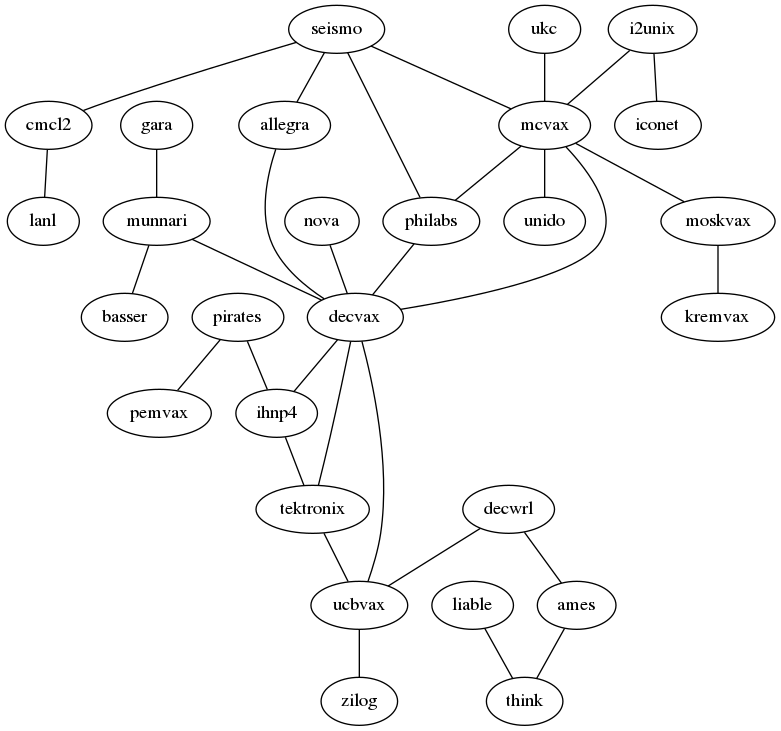
Hi all, as part of the upcoming 50th anniversary of Unix in mid-2019,
a bunch of people are working to rebuild the mid-1980s uucp/Usenet
network using (real/simulated) period-accurate systems. To make things
easier, we are simulating the dialup lines too.
Details of the (nearly) turnkey software to do this is at:
https://github.com/DoctorWkt/4bsd-uucp
A map of what nodes we have so far is at:
https://raw.githubusercontent.com/DoctorWkt/4bsd-uucp/4.3BSD/uucp.png
If you are interested in participating, email me back.
Cheers, Warren
I have not had any emails from cctalk for 2 or 3 weeks. I went to my
subscription details and saw that emails were disabled for me. I re-enabled
them a few days ago but I still have not received any new emails. I can see
that there is traffic by looking at the archives, and if I am not getting
emails I hope to at least see this one appear in the archive and hopefully
read replies there too. Is it just me?
Regards
Rob
I was able to get hold of a lot of boards which had been pulled from two
Decision Data's and a Western Dynex 2400 RPM 10mb (probably) drive.
The Dynex drive is similar to the RL02 and in fact was configurable to
look like one in one of the options. Microdata would have used 24
sector packs vs. the 12 sector packs used by DEC, however.
One of the CPUs is a pretty ordinary Data / Control set made by
Microdata but with most of the etch and silkscreen modified to have
Decision data info. I'm going to check with my Microdata people and see
if anyone recalls if this was done by Microdata, or by DD themselves.
There is a nice find however, a 2901 CPU 16 bit system cpu set and
memory. It also runs in the 130 pin Microdata 1600 backplane, which
makes it interesting. I'd love to get information and drawings as much
as might be around for this set.
May be donating most of it to add to my 1600 system @ the CHM, as there
are boards here which I didn't have examples of to donate at the time.
Will check with them after I fondle the boards for a while.
It's cool to have an additional example of a possible Microdata 1600
type CPU, as this is one of my collecting areas.
I'll be adding in titles and comments on the photos later, but here are
photos of the boards for now.
http://jim-st.blogspot.com/2017/03/microdata-decision-data-and-western.html
Thanks
Jim
FYI
-------- Forwarded Message --------
Subject: 50% DISCOUNT WEBSITE MANUAL & PARTS, ONE WEEK ONLY
Date: Mon, 27 Mar 2017 06:53:02 -0700
From: Tucker Electronics Company <jtucker at tucker.com>
To: aek at bitsavers.org
50% DISCOUNT WEBSITE MANUALS & PARTS, ONE WEEK ONLY
Thanks for your purchases of manuals and parts last week and previously. We have slashed the selling price of most
manuals on eBay by 50-75% in recent months.
Our two websites www.etestmanuals.com <http://na02.mypinpointe.com/link.php?M=48182615&N=48220&L=22673&F=H> and
www.etestparts.com <http://na02.mypinpointe.com/link.php?M=48182615&N=48220&L=22672&F=H> have many more listings than
our eBay site ( teoutlet). Unfortunately, we have not been able to update pricing and shipping costs on these sites.
These manuals and parts were purchased when we had a large repair and calibration lab. Many are one of a kind and
subject to prior sale. We have over 43000 different listings on www.etestmanuals.com
<http://na02.mypinpointe.com/link.php?M=48182615&N=48220&L=22673&F=H>. We have over 12,000 different listings on
www.etestparts.com <http://na02.mypinpointe.com/link.php?M=48182615&N=48220&L=22672&F=H>. THE 50% DISCOUNT APPLIES
TO ALL ITEMS LISTED ON THESE TWO SITES THAT ARE AVAILABLE STILL. The promotion will run from March 27th to April 1st.
All items are subject to prior sale. We want to encourage you to buy especially the next two months. If you are most
comfortable buying on eBay ( our site
is teoutlet), please continue to do so. On US sales, we can make consolidated shipping quotes as needed. We are
very motivated to sell although there are limits to what we can do on eBay.
On our two websites listed above, we encourage you to make a list and contact us at jtucker at tucker.com
<mailto:jtucker at tucker.com> regarding consolidated prices and shipping costs. Our websites can be used to look
equipment up, but not to take advantage of the 50% discount prices this week. We can send you PayPal invoices for any
purchases not done on eBay. In all cases you have the buyer protection of PayPal. We can also take Credit Cards.
Our phone number is 2143488800. We do prefer email to jtucker at tucker.com <mailto:jtucker at tucker.com> as most questions
about manuals require research and can?t be handled by a phone call. Please keep in mind that quantities are limited
on the majority of listings and everything is subject to prior sale.
SOME EQUIPMENT PROMOTIONS FOR THIS WEEK ONLY:
3 each Agilent-HP 6031A Power Supplies, 0-20V, 0-120A, 1000 watts with manual
These have been TESTED and are on eBay at $750 regular price. $550 each this week only by direct purchase.
3 each Tektronix P5205 High Voltage Differential Probes with All Accessories. Regularly listed on eBay at $550.
Price for this week only of $350 each by direct purchase.
Electro Scientific Industries DT72A Standard Decade Transformer. Regular price of $750. Priced to sell this week for
$550.
Thanks again for your business and we look forward to hearing from you soon.
Jim Tucker
Tucker Electronics Company
11448 Pagemill Road
Dallas, TX 75243
jtucker at tucker.com <mailto:jtucker at tucker.com>
2143488800
------------------------------------------------------------------------------------------------------------------------
Sent by Tucker Electronics Company | 11448 Pagemill Road, Dallas, TX 75243 Sent to: "aek at bitsavers.org" | You are
subscribed to "Websites sale list" Change your preferences / opt out
<http://na02.mypinpointe.com/unsubscribe.php?M=48182615&C=e6e8ac0e5788770207…>
www.pinpointe.com <http://na02.mypinpointe.com/link.php?M=48182615&N=48220&L=39695&F=H>
On 24 March 2017 at 18:40, Camiel Vanderhoeven via cctech
<cctech at classiccmp.org> wrote:
> Does anyone have schematics for an STC (StorageTek) 2920 reel-to-reel
> tapedrive?[..]
That drive was discussed on the list some time ago. All the docs
should be available on bitsavers by now, although I don't remember if
it's under 'stc' or 'storagetek' or both.
On 24 March 2017 at 16:34, Alexandre Souza via cctalk
<cctalk at classiccmp.org> wrote:
> Well...there is some description in english, google translate is a very
> useful tool and the post has a pertinent video. I cannot view it as spam.
> Anyway...sorry for bothering :)
>
> Enviado do meu Tele-Movel
>
> On Mar 24, 2017 12:25 PM, "Paul Koning" <paulkoning at comcast.net> wrote:
>
>> It sure has the signature of spam. A link to some random place, without
>> explanation of what it is, text in Portuguese when the list uses English...
Your spam-o-meter isn't accurate.. mine didn't trigger. It isn't spam,
so it's clearly functional. Subject is 'Reparando um Vectrex', which
hardly needs any additional translation. Body said 'New post on blog'.
Blog looks good. Poster is Alexandre, old-timer on the list. All items
ticked OK, all good.
> From: Bill Gunshannon
> I doubt Motorolla was in the business of custom making different size
> chips, even for DEC.
So, that triggered a question in my mind: why was DEC using the 68K on this
board, anyway? They had plenty of in-house chips the could have used, e.g.
the J11. The MC68000 had only a 16-bit bus, so it's not that dissimilar in
capabilities. Why buy out? Did Motorola offer them a price they couldn't
resist, or what?
Noel
I'm trying to track down ROM images from AT&T 3B2 expansion cards.
I've started with the EPORTS serial card, which I have. What I'd love
to find is the ROM from the NI Ethernet card.
Not all ROMs were socketed. Freqently they were soldered, so I know
that getting these probably won't be easy. If I had an NI card of my
own I'd desolder the ROMs, but alas, I do not.
If you have these ROMs, are willing to image them, or -- and this is a
real long shot -- if you're willing to let me borrow a card for a
while, I'd greatly appreciate hearing from you.
Best Wishes,
-Seth
--
Seth Morabito
web at loomcom.com
Hi folks,
I have a PDP-8/e that I've been working on. I have completed construction of AK6DN's RX01/02 emulator. I got to the step tonight where I was trying to boot an OS/8 disk image and nothing was happening. I realized that I do not have the bootstrap diode board in my 8/e so begin the bootstrap triggered by the "SW" switch.
Does anyone have the program I can toggle in for the bootloader? What I found is somewhat confusing. Here is a discussion on this topic.
https://groups.google.com/forum/#!searchin/alt.sys.pdp8/RX01$20boot|sort:re…
It seems one fellow was attempting to edit/improve the bootloader of another fellow. I was wondering if anyone has distilled this into something simple. At the moment, I care only about booting from RX01-Disk0.
Any pointers greatly appreciated. Thanks
Eugene W2HX
For the record, I and I'm sure lots of others look forward to this blog of experience.
-------- Original message --------From: Terry Stewart via cctalk <cctalk at classiccmp.org>
One other question regarding using this MS-DOS 486 to run an 8 inch floppu
So all the DEUNA's I've seen have L10 (ceramic package, 10Mhz) 68K's in them.
Has anyone tried using anything else, and did it work?
I _assume_ an x12 would work, but until someone has acutally tried it...
The Pxx's (plastic packaging) might not work - according to the datasheet,
they are 2mm wider than the ceramics (why, I have no idea - it probably means
they aren't interchangeable, which makes no sense at all to me).
Noel
No.. mine has a 2513 character generator.. the one in the ad uses ram based character generation. ?Based on IC dates my board looks like mid to late 70s.. a fair bit earlier than that one.
Sent from my Samsung device
-------- Original message --------
From: dave.g4ugm at gmail.com
Date: 2017-03-24 2:16 AM (GMT-08:00)
To: 'Brad H' <vintagecomputer at bettercomputing.net>, "'General Discussion: On-Topic and Off-Topic Posts'" <cctalk at classiccmp.org>
Subject: RE: GImix Ghost Video Board
Is it one that's in the catalogue here:-
http://bitsavers.trailing-edge.com/pdf/gimix/Gimix_Catalog_Jun82.pdf
Dave
> -----Original Message-----
> From: cctalk [mailto:cctalk-bounces at classiccmp.org] On Behalf Of Brad H
via
> cctalk
> Sent: 23 March 2017 23:58
> To: 'General Discussion: On-Topic and Off-Topic Posts'
> <cctalk at classiccmp.org>
> Subject: GImix Ghost Video Board
>
> Hoping someone might be able to help me on this.
>
>
>
> I got a Gimix Ghost SS50 video board today and was trying to find a
manual.
> I'm sure these were used in Gimix's own ghost systems but the very limited
> info I've come across out there suggests they may have worked with any
> SS50 system.? It basically provides a direct composite video feed out from
the
> computer, I assume bypassing the need for a terminal.? I plugged it in and
> fired it up on my SWTPC 6800 and it is working - I think - it generates a
full
> screen of readable random characters.? However it does not put up anything
> from the computer - that still goes out via terminal.? I'm assuming Ghost
> systems were wired up somehow to use this.. I'm hoping to find a manual
> that explains how.? I don't see a keyboard interface for it anywhere so
maybe
> this went along as a complete Ghost system with hardware I don't have.
>
>
>
> Thanks if you have anything!
>
>
> From: Bill Gunshannon
> Considering that I have never seen any sockets that were 2mm different
> in width ... I really can't imagine any CPU not fitting.
I think you're right. I took another look at the drawing, and I'd been looking
at the package width dimension: there's also a separate pin-pin distance
(horizontal), and that _is_ the same for plastic and ceramic. Ooops! Sorry.
Noel
> From: John Wilson
> I think this is DELUA?
Yes, that's right - sorry!
> I'm getting old ... could have it wrong.
No, _I_'m the one who's getting old! (But in this case, that's not it - I
always get the names of those two mixed up!)
> I'd be inclined to just try it.
I hadn't bought anything yet... :-) In particular, there's a source of really
cheap P12's, but if the 2mm width difference means the Pxx's won't fit, no use
paying good money for them, right?
> the definitely-fried CPU (right?) that's in there now?
The definitely-missing CPU that's not in there now, actually! ;-)
Noel
Does anyone have schematics for an STC (StorageTek) 2920 reel-to-reel
tapedrive? I?m trying to solve a tape-loading issue that seems to be
power-supply related, and some schematics would be very handy right now?
Camiel.
Hi folks,
I have an Atari colour monitor for the ST series of computers that I'm
looking to rehome. Model number is SC 1224, Version 2.
I've never attempted to power it up and have no idea if it works.
It's free to a good home, provided I don't have to put in a lot of
effort. (I'm currently in the middle of packing for a move; I have
very little spare time or energy.)
I'm in the Toronto area. If anyone wants it, let me know.
--Chris
--
Chris Reuter http://www.blit.ca
"Oh God Lem, you're using science for no good. We took an *oath* we would try
to do that less."
--Better Off Ted
I have a couple more items for the auction block.
Real, original, in good shape: DECWRITER III - LA120 OPERATOR REFERENCE CARD
DIGITAL Alpha Architecture Handbook - Special Announbcement Edition - February 1992 - PRELIMINARY
INMOS Limited occam 2 Reference Manual (ISBN: 0-13-629312-3 Prentice Hall)
Any of them should fit in a USPS Flat Rate Envelope so figure less than $10 postage.
bill
Hoping someone might be able to help me on this.
I got a Gimix Ghost SS50 video board today and was trying to find a manual.
I'm sure these were used in Gimix's own ghost systems but the very limited
info I've come across out there suggests they may have worked with any SS50
system. It basically provides a direct composite video feed out from the
computer, I assume bypassing the need for a terminal. I plugged it in and
fired it up on my SWTPC 6800 and it is working - I think - it generates a
full screen of readable random characters. However it does not put up
anything from the computer - that still goes out via terminal. I'm assuming
Ghost systems were wired up somehow to use this.. I'm hoping to find a
manual that explains how. I don't see a keyboard interface for it anywhere
so maybe this went along as a complete Ghost system with hardware I don't
have.
Thanks if you have anything!
Chuck,
Are these dumb adapters that just convert 34 to 50 or do they so more then that? Thanks.
-Ali
-------- Original message --------
From: Chuck Guzis via cctalk <cctalk at classiccmp.org>
Date: 3/23/17 1:59 PM (GMT-08:00)
To: cctalk at classiccmp.org
Subject: Re: Extracting files off ?unknown? 8 inch disks. Any thoughts?
On 03/23/2017 01:32 PM, Mike Stein via cctalk wrote:
> I was just going to suggest the same thing, but I see you (Tez) are
> going the FDADAP route; more convenient for sure.
>
> But the majority of the 34- and 50-pin signals actually line up 1 to
>? 1 when aligned pin 34 to pin 50; as a matter of fact I have a system
> that uses the same 34-pin cable to connect to both, with just a
> jumper or two to select 5 or 8" (the index signal is one IIRC).
I've still got a couple of the Microsolutions "adapter cards" with 50-
and 34-pin headers.?? They work in reverse as well.
--Chuck
> From: Pontus Pihlgren
> The 11/70 backplane is wirewrapped.
Oh, right you are! I don't know where my brain has fled to these days!
It's actually an MJ11 (-11/70 core memory) backplane (I checked the part
number - plus someone pointed out that you can see "MJ11" written somewhere).
Noel
Hi,
I?ve posted this to the VCF too?apologies for cross-posting.
I?d be grateful for any guidance or comments anyone could give me on this
problem.
Guys in the building next door to me (a Science lab) have found some 8 inch
floppy disks. They want to see what?s on them, or at least to archive
them. They have no idea what machine these disks were used with, or the
software was used to write the files. They may be CP/M, or some other
format entirely.
I?ve got little experience with 8 inch drives or disk formats. However I
have got a bare 8 inch floppy drive (a Mitsubishi M2896-63 Half Height
8inch DSDD), and also a CP/M computer with 8 inch drives (A Panasonic
JD-850M). I?m thinking it might be an interesting challenge/project to see
if I can read these disks and get files off.
However, I imagine given all the unknowns it won?t be easy?perhaps even
impossible
I see two possible approaches. One is to wire up the 8 inch drive to an
MS-DOS machine. I?ll have to build/get a PSU for the drive so it can
supply the necessary 24 Volts required. I?ll also have to make up a
special drive cable. That info is available. In fact, Chuck gave me some
tips a year or so ago. However, once I?ve got the drive successfully
wired up, I then need to somehow analysis the disks to see what format they
are in. Does anyone know of any software that will do this? I?m aware of
disk22, for reading KNOWN CP/M formats but is there anything out there that
will analyse a disk from scratch? Search the web has thrown up a few
possibilies (MMCPC, Cpmtools) but I haven?t explored them at all.
The second approach is to use the Panasonic JD-850M, and find a CP/M
program that will analyse an ?unknown? 8 inch disk and read files from said
disks into the CP/M environment. I?d somehow get the program into one of
my Panasonic 8 inch disks (just how, I?ll need to figure out). I?d also
need to figure out how to get the files out of that environment also.
Anyway, has anyone else faced this kind of challenge and what are your
thoughts? I don?t want to start unless I at least have some chance of
success. I?m not hopeful. The more I read the more you seem to need real
forensic skills and something like Kyroflux that works at low-level.
Thanks
Terry (Tez)
Hi, All,
With all the recent chatter on the VAX8200 on the simh list, I was
motivated to dust mine off and do a little digging. I finally took
the plunge and got a DMB32 (right now, all I have are the 4 built-in
console ports) but while it was easy enough to find the
8.5"x11"-format user guide and technical manual which describe
registers and installation and problem diagnosis, I also want the
internal cable pinouts and schematics. I know it's harder to find
post-Unibus-era C-sized prints since DEC stopped shipping printsets
with every order, so I have to ask, does anyone have any schematics
for either the T1012 module, the H3033 I/O bulkhead board, or both? I
can likely quickly recreate the schematic for the H3033, it's 10
D-shell connectors (8x DB, 1x DC, 1xDD) and 6 30-pin ribbon cable
connectors. Lots of signals, but lots of repetition. The D-shell
pinouts are in the documenation I already have. The 30-pin
connectors/BI fingers are not. But if the schematics are already
available, I don't have to buzz one out.
http://manx-docs.org/collections/antonio/dec/dmb32ug1.pdfhttp://manx-docs.org/collections/antonio/dec/dmb32td1.pdf
ftp://bitsavers.informatik.uni-stuttgart.de/pdf/dec/vax/vaxbi/EY-5554E-SG-0002_VAXBI_Adapters_Student_Guide_Feb87.pdf
Thanks for any new docs.
-ethan
>For what it's worth, unless you're intent on *writing* 8" single-density
>floppies on the PC, the interconnect between the 8" drive 50-conductor
>cable and the PC 34-conductor one is pretty straightforward. You don't
>need a FDADAP board for that, although it's very convenient.
Yes, and I'm all for convenience given that reading these things will be a
challenge enough.
I've ordered an FDADAP board and also an FDDC power converter.
http://www.dbit.com/fddc.htmlhttp://www.dbit.com/fdadap.html
Now I just has to wait a week or two for them to arrive!
Terry (Tez)
This had kept the prices on that model a bit higher. The serial port while smaller is easy to hack a cable for most connections you need. I guess it's not that way for the other models? I hear it very often for the lx-200 pretty exclusively.
-------- Original message --------From: Robert Feldman via cctalk <cctalk at classiccmp.org> Date: 3/23/17 11:20 AM (GMT-06:00) To: cctalk at classiccmp.org Subject: Re: Any faithful VT100 Emulators?
Warren Toomey wrote:
> are there any _good_ VT100 terminal emulators
Another alternative is to get a used HP LX 200 palmtop computer. Its DataComm program has a good VT100 mode.
Bob
Warren Toomey wrote:
> are there any _good_ VT100 terminal emulators
Another alternative is to get a used HP LX 200 palmtop computer. Its DataComm program has a good VT100 mode.
Bob
> Heck, I'd be fascinated to talk to anyone who purchased
> the machines during their lifespan (1997-2001) and could tell me what you
> used them for.
Not the e10k, but Cingular Wireless used clustered e15k's as Oracle
database engines. Dozens of them. Very impressive performance.
KJ
On 22 March 2017 at 02:02, Warren Toomey via cctalk
<cctalk at classiccmp.org> wrote:
> Which raises the question, are there any _good_ VT100 terminal
> emulators, especially for Linux? For any other platforms?
xterm never gives me any problems. But the default terminal emulators
of Gnome or KDE have some issues in my experience. xterm is always
buried in the system somewhere though, and it works. I use it e.g. for
accessing my old minicomputer which has a VT100 setting.
Ethan wrote...
-----
I'm following this thread because I too want a decent terminal emulator that
works with a variety of vintage text editors (that seems to be the torture
test) but for Linux or OS X. Putty seems to be a repeat suggestion but it's
not for my platforms.
------
The most faithful vt100 emulation I've seen myself (not that I've done a big
study or anything) is SecureCRT from Van Dyke. It is a commercial product,
but about the only commercial product I've decided is worth the cost. I use
it daily and pay for upgrades and new releases gladly.
I do know that they came out with a version for OSX a while back. I expect
that to be robust. There is a version for Linux, never tried that as I'm a
FreeBSD zealot. There is also an iphone/ipad app by secureCRT and I've used
it in a few pinches but never on a classic system. And the company has
actually heard of VMS ;)
Their support is off-the-charts. On more than one occasion I've emailed them
asking for this or that... and several times I've seen it implemented on the
next release. They actively listen and implement.
If the linux and OSX and app versions are as good as the windows one... it's
worth a shot.
J
OK, so I don't have a real VT100, so I'm accessing an old 4.3BSD system
with xterm and LXTerminal terminal emulators on Linux. Last night, for a
laugh, I ran vttest from the 1980s and the terminal emulators performed
woefully.
Which raises the question, are there any _good_ VT100 terminal
emulators, especially for Linux? For any other platforms?
Cheers, Warren
Friendly reminder that Vintage Computer Festival East XII is only 10
days away! March 31-April 2 in New Jersey. Two hands-on exhibit halls, a
dozen tech talks, three keynotes, consignment sale, and you can visit
the year-round Vintage Computer Federation museum while you're here. All
the details are here:
http://vcfed.org/wp/festivals/vintage-computer-festival-east/
________________________________
Evan Koblentz, director
Vintage Computer Federation
a 501(c)3 educational non-profit
evan at vcfed.org
(646) 546-9999
www.vcfed.orgfacebook.com/vcfederationtwitter.com/vcfederation
Host is a HP 9000/382
Copied the orig drive using a linux box, adaptec 2940N and good old dd
Then swapped drives, a unused 9 GB 80 pin with a Chinese 80 to 50
adapter.
Did have to issue a spin up command and then copied the data to this drive
again with dd.
Powered all off, added a motor start jumper to the adapter and put it on the
9000/382. Motor will not start, added a jumper right on the drive, no spin.
so .. any ideas what I'm doing wrong, or just try a different drive ?
-pete
I just wanted to share a little project I've been working on, it's an
adaptation of Lee Davison's EhBASIC to become a timeshared multiuser BASIC.
There's still a bit more to do, but here's a video of it in operation:
https://youtu.be/SAJpHiBPMcQ
In that video, it's only running 3 sessions (I had no convenient 4th
terminal) but it's capable of running 4. It is a very very simple
preemptive multitasking 'kernel' providing I/O services and performing
periodic context switches for the instances of the interpreter. It only
runs a fixed number of processes, and all the process memory is statically
allocated. EhBASIC lends itself well to this, the code is position
independent by design, and the memory range is passed in. Everything is
dereferenced relative to the 'start of memory' pointer. This means no need
for an MMU or relocation.
I'm hoping to set this up at VCF MW in September, running 4 terminals.
More info on the hardware I'm using is available here:
https://hackaday.io/project/6150-beckman-du600-reverse-engineering
Pictures:
https://www.dropbox.com/sh/uw6cjqigk2sdwdy/AAAwP55aelyzrYeP1HVUDdMqa?dl=0
And another software project I'm working on as well (a ROM monitor program):
https://github.com/jzatarski/Joe-Mon
Camiel wrote:
> What would the requirements for the system be? How often would it need to
> be online?
I added an answer here:
https://github.com/DoctorWkt/4bsd-uucp#joining-the-growing-uucp-network
For central sites (like decvax) that had a lot of connectivity, you will
be expected to run them continuously. For edge sites which only dial in
to one other site to exchange news and e-mail, you can run them whenever
you want.
It's mostly simulated sites right now, but I'd love to see some real
systems come up and connect in. Not sure how to connect the simulated
sites (using TCP for the dialup links) and the real sites.
Cheers, Warren
I have a clean, and somewhat functional expansion interface that I just
tested over the weekend. Without the EI connected, the model 1 reports
~16K RAM and with the EI the model 1 reports ~48K, so the RAM seems OK.
But, the FD1771 IC, for some reason, was removed from an otherwise
apparently functional EI.
http://imgur.com/a/3NzOh
Is there any reason why this chip would be removed? I see a number of them
on ebay for around $25. The expansion interface hardware manual indicates
it is an FD1771B-01, but the service manual indicates a couple
possibilities....FD1771 A/B -01 -11. Any considerations to look for here?
Thanks,
Win
Hi,
Two years ago I've found scans in PDF with the article (dated 197?, I don't
remember) describing DIY TTL-based calculator. This was microprogrammed
machine (if I remember correctly microproprogram was "stored" in the diode
array). It has LED display and possiblity to calculate square root.
Definitely not talking about EDUC-8 computer from 1975. I think this
calculator was published a little bit earlier.
Unfortunately I'm no longer able to find it. Does anyone associate the name of
that magazine?
Regards,
Jacek
> From: geneb
>> When people decided Steve Jobs had become a god?
> Right about the time that whole "computer for the rest of us" started...
Yes, of course: nobody had thought of a cheap personal computer before him.
(Which reminds me, does the CHM have a Datapoint 2200? If not, we really out
to try to round one up for them.) Or even a personal computer. (Ditto for the
LINC.)
Although I suppose you might have been talking about the software. I mean,
without that whole display/windows/menu/mouse thing he invented, to allow
ordinary people to use a computer, where would we be?
Look, I fully admit that Steve Jobs was a _very_ sharp person who had a
_tremendous_ influence.
(Every time I hear someone saying marketing people are useless - first up
against the wall, etc - I reply 'No, only bad ones - which is a lot of them.
The very best ones, like Steve Jobs, are worth their weight in triple-refined
iridium. A _good_ marketing person can tell you what customers _want_. A
_truly great_ one can tell you what they _need_, but don't yet even realize
they do.')
However, the people (and there are quite a few of them) who have gone way off
the deep edge, and have turned him (and Apple) into some sort of overblown
cult, just don't have a balanced perspective.
There are plenty of people out there who deserve at least as much credit for
the information society we now live in, who are almost totally unknown to the
population at large; starting (probably) with Licklider.
Noel
Dear friends
Is it allowed to request a ROM code?
I lost my XT BASIC ROMS, can someone send me the code so I can burn it
and replace on my XT?
Thanks!
Alexandre
---
On Mar 19, 2017 12:47 PM, "Adam Sampson via cctalk" <cctalk at classiccmp.org>
wrote:
>
> Alexandre Souza via cctalk <cctalk at classiccmp.org> writes:
>
> > I lost my XT BASIC ROMS, can someone send me the code so I can burn it
> > and replace on my XT?
>
> minuszerodegrees.net has several versions of the XT ROM images, along
> with lots of other useful service information for PC/XT/AT machines:
>
> http://www.minuszerodegrees.net/bios/bios.htm
>
> --
> Adam Sampson <ats at offog.org> <http://offog.org/>
Has anyone made a ROM that runs BASIC and allows use of the disk drive to
save on an IBM PC? This always bugged me that if you forgot to insert your
dos disk before the computer powered up that one could not enter a basic
command to tell the system to boot up from the drive without
ctrl-alt-delete and wait....or to boot from the b drive, etc.
Bill Degnan
twitter: billdeg
vintagecomputer.net
FWIW, Dore'[1] doesn't compile out of the box on FreeBSD 10.3-stable:
tingo at kg-core1$ uname -a
FreeBSD kg-core1.kg4.no 10.3-STABLE FreeBSD 10.3-STABLE #0 r310083:
Wed Dec 14 21:00:13 CET 2016
root at kg-core1.kg4.no:/usr/obj/usr/src/sys/GENERIC amd64
Result
tingo at kg-core1$ make -f Makefile.ini World
Building Release 6.1 of Dore.
I hope you checked the configuration parameters in ./config/cf
to see if you need to pass BOOTSTRAPCFLAGS.
Sun Mar 19 22:31:44 CET 2017
cd ./config/imake; make -f Makefile.ini BOOTSTRAPCFLAGS="" clean;
make -f Makefile.ini BOOTSTRAPCFLAGS=""
rm -f ccimake imake.o imake
rm -f *.CKP *.ln *.BAK *.bak *.o core errs ,* *~ *.a tags TAGS make.log \#*
making imake with BOOTSTRAPCFLAGS=
cc -o ccimake -O -I../../include ccimake.c
ccimake.c:42:1: warning: type specifier missing, defaults to 'int'
[-Wimplicit-int]
main()
^~~~
ccimake.c:44:2: warning: implicit declaration of function 'write' is
invalid in C99 [-Wimplicit-function-declaration]
write(1, imake_ccflags, sizeof(imake_ccflags) - 1);
^
ccimake.c:45:2: warning: implicitly declaring library function 'exit'
with type 'void (int) __attribute__((noreturn))'
exit(0);
^
ccimake.c:45:2: note: please include the header <stdlib.h> or
explicitly provide a declaration for 'exit'
3 warnings generated.
cc -c -O -I../../include `./ccimake` imake.c
imake.c:265:1: warning: type specifier missing, defaults to 'int'
[-Wimplicit-int]
main(argc, argv)
^~~~
imake.c:274:2: warning: implicit declaration of function 'init' is
invalid in C99 [-Wimplicit-function-declaration]
init();
^
imake.c:275:2: warning: implicit declaration of function 'SetOpts' is
invalid in C99 [-Wimplicit-function-declaration]
SetOpts(argc, argv);
^
imake.c:278:2: warning: implicit declaration of function
'CheckImakefileC' is invalid in C99 [-Wimplicit-function-declaration]
CheckImakefileC(ImakefileC);
^
imake.c:285:2: warning: implicit declaration of function 'AddMakeArg'
is invalid in C99 [-Wimplicit-function-declaration]
AddMakeArg("-f");
^
imake.c:296:2: warning: implicit declaration of function 'cppit' is
invalid in C99 [-Wimplicit-function-declaration]
cppit(cleanedImakefile, Template, ImakefileC, tmpfd, tmpMakefile);
^
imake.c:300:4: warning: implicit declaration of function 'showit' is
invalid in C99 [-Wimplicit-function-declaration]
showit(tmpfd);
^
imake.c:302:3: warning: implicit declaration of function 'makeit' is
invalid in C99 [-Wimplicit-function-declaration]
makeit();
^
imake.c:303:2: warning: implicit declaration of function 'wrapup' is
invalid in C99 [-Wimplicit-function-declaration]
wrapup();
^
imake.c:307:1: warning: type specifier missing, defaults to 'int'
[-Wimplicit-int]
showit(fd)
^~~~~~
imake.c:315:3: warning: implicit declaration of function
'writetmpfile' is invalid in C99 [-Wimplicit-function-declaration]
writetmpfile(stdout, buf, red, "stdout");
^
imake.c:318:1: warning: control reaches end of non-void function [-Wreturn-type]
}
^
imake.c:320:1: warning: type specifier missing, defaults to 'int'
[-Wimplicit-int]
wrapup()
^~~~~~
imake.c:328:1: warning: control reaches end of non-void function [-Wreturn-type]
}
^
imake.c:345:1: warning: type specifier missing, defaults to 'int'
[-Wimplicit-int]
init()
^~~~
imake.c:361:8: warning: using the result of an assignment as a
condition without parentheses [-Wparentheses]
if (p = getenv("IMAKEINCLUDE")) {
~~^~~~~~~~~~~~~~~~~~~~~~~~
imake.c:361:8: note: place parentheses around the assignment to
silence this warning
if (p = getenv("IMAKEINCLUDE")) {
^
( )
imake.c:361:8: note: use '==' to turn this assignment into an equality
comparison
if (p = getenv("IMAKEINCLUDE")) {
^
==
imake.c:365:3: warning: implicit declaration of function 'AddCppArg'
is invalid in C99 [-Wimplicit-function-declaration]
AddCppArg(p);
^
imake.c:372:8: warning: using the result of an assignment as a
condition without parentheses [-Wparentheses]
if (p = getenv("IMAKECPP"))
~~^~~~~~~~~~~~~~~~~~~~
imake.c:372:8: note: place parentheses around the assignment to
silence this warning
if (p = getenv("IMAKECPP"))
^
( )
imake.c:372:8: note: use '==' to turn this assignment into an equality
comparison
if (p = getenv("IMAKECPP"))
^
==
imake.c:374:8: warning: using the result of an assignment as a
condition without parentheses [-Wparentheses]
if (p = getenv("IMAKEMAKE"))
~~^~~~~~~~~~~~~~~~~~~~~
imake.c:374:8: note: place parentheses around the assignment to
silence this warning
if (p = getenv("IMAKEMAKE"))
^
( )
imake.c:374:8: note: use '==' to turn this assignment into an equality
comparison
if (p = getenv("IMAKEMAKE"))
^
==
imake.c:379:1: warning: control reaches end of non-void function [-Wreturn-type]
}
^
imake.c:381:1: warning: type specifier missing, defaults to 'int'
[-Wimplicit-int]
AddMakeArg(arg)
^~~~~~~~~~
imake.c:389:1: warning: control reaches end of non-void function [-Wreturn-type]
}
^
imake.c:391:1: warning: type specifier missing, defaults to 'int'
[-Wimplicit-int]
AddCppArg(arg)
^~~~~~~~~
imake.c:399:1: warning: control reaches end of non-void function [-Wreturn-type]
}
^
imake.c:401:1: warning: type specifier missing, defaults to 'int'
[-Wimplicit-int]
SetOpts(argc, argv)
^~~~~~~
imake.c:479:1: warning: control reaches end of non-void function [-Wreturn-type]
}
^
imake.c:505:14: warning: cast to 'char *' from smaller integer type
'int' [-Wint-to-pointer-cast]
LogFatal(s, (char *)i);
^
imake.c:527:27: warning: implicitly declaring library function
'strerror' with type 'char *(int)'
fprintf(stderr, "%s: ", strerror(errno));
^
imake.c:527:27: note: please include the header <string.h> or
explicitly provide a declaration for 'strerror'
imake.c:538:1: warning: type specifier missing, defaults to 'int'
[-Wimplicit-int]
showargs(argv)
^~~~~~~~
imake.c:544:1: warning: control reaches end of non-void function [-Wreturn-type]
}
^
imake.c:550:1: warning: type specifier missing, defaults to 'int'
[-Wimplicit-int]
CheckImakefileC(masterc)
^~~~~~~~~~~~~~~
imake.c:561:8: warning: implicitly declaring library function
'strncmp' with type 'int (const char *, const char *, unsigned long)'
strncmp(mkcbuf, TmplDef, sizeof(TmplDef)-1)) ||
^
imake.c:561:8: note: please include the header <string.h> or
explicitly provide a declaration for 'strncmp'
imake.c:573:1: warning: control reaches end of non-void function [-Wreturn-type]
}
^
imake.c:575:1: warning: type specifier missing, defaults to 'int'
[-Wimplicit-int]
cppit(imakefile, template, masterc, outfd, outfname)
^~~~~
imake.c:626:2: warning: implicit declaration of function
'CleanCppOutput' is invalid in C99 [-Wimplicit-function-declaration]
CleanCppOutput(outfd, outfname);
^
imake.c:627:1: warning: control reaches end of non-void function [-Wreturn-type]
}
^
imake.c:629:1: warning: type specifier missing, defaults to 'int'
[-Wimplicit-int]
makeit()
^~~~~~
imake.c:662:1: warning: control reaches end of non-void function [-Wreturn-type]
}
^
imake.c:706:7: warning: implicitly declaring library function 'strcmp'
with type 'int (const char *, const char *)'
if (strcmp(ptoken, "define") &&
^
imake.c:706:7: note: please include the header <string.h> or
explicitly provide a declaration for 'strcmp'
imake.c:747:1: warning: type specifier missing, defaults to 'int'
[-Wimplicit-int]
CleanCppOutput(tmpfd, tmpfname)
^~~~~~~~~~~~~~
imake.c:754:14: warning: using the result of an assignment as a
condition without parentheses [-Wparentheses]
while(input = ReadLine(tmpfd, tmpfname)) {
~~~~~~^~~~~~~~~~~~~~~~~~~~~~~~~~~
imake.c:754:14: note: place parentheses around the assignment to
silence this warning
while(input = ReadLine(tmpfd, tmpfname)) {
^
( )
imake.c:754:14: note: use '==' to turn this assignment into an
equality comparison
while(input = ReadLine(tmpfd, tmpfname)) {
^
==
imake.c:755:7: warning: implicit declaration of function 'isempty' is
invalid in C99 [-Wimplicit-function-declaration]
if (isempty(input)) {
^
imake.c:762:31: warning: implicitly declaring library function
'strlen' with type 'unsigned long (const char *)'
writetmpfile(tmpfd, input, strlen(input), tmpfname);
^
imake.c:762:31: note: please include the header <string.h> or
explicitly provide a declaration for 'strlen'
imake.c:775:1: warning: control reaches end of non-void function [-Wreturn-type]
}
^
imake.c:782:1: warning: type specifier missing, defaults to 'int'
[-Wimplicit-int]
isempty(line)
^~~~~~~
imake.c:819:7: warning: implicitly declaring library function 'strcpy'
with type 'char *(char *, const char *)'
strcpy(pend+1, pend+5);
^
imake.c:819:7: note: please include the header <string.h> or
explicitly provide a declaration for 'strcpy'
imake.c:915:1: warning: type specifier missing, defaults to 'int'
[-Wimplicit-int]
writetmpfile(fd, buf, cnt, fname)
^~~~~~~~~~~~
imake.c:923:1: warning: control reaches end of non-void function [-Wreturn-type]
}
^
48 warnings generated.
cc -o imake imake.o
imake.o: In function `main':
imake.c:(.text+0xb2): warning: warning: mktemp() possibly used
unsafely; consider using mkstemp()
rm -f Makefile.bak; mv Makefile Makefile.bak
mv: rename Makefile to Makefile.bak: No such file or directory
*** Error code 1 (ignored)
./config/imake/imake -I./config/cf -DTOPDIR=. -DCURDIR=.
./config/imake/imake: No such file or directory: Cannot exec
/usr/libexec/cpp. Stop.
./config/imake/imake: Exit code 1. Stop.
*** Error code 1
Stop.
make: stopped in /zs/tingo/work/Dore-6.01
No, I haven't tried digging out the old FreeBSD port files from the
archives yet.
References:
1) https://www.ibiblio.org/pub/packages/development/graphics/Dore/
--
Regards,
Torfinn Ingolfsen
Yepper ...sure... I know that...
But.... we need the physical artifact or at lest the box and a real
manual to lay in the display.
remember 90 percent of what I have to do here is for .... the visual!
thnx Ed#
In a message dated 3/20/2017 2:55:35 A.M. US Mountain Standard Time,
cc at informatik.uni-stuttgart.de writes:
On Mon, 20 Mar 2017, Ed wrote:
> Looking for windows 1.x for HP-150 touchscreen Also looking for
Look at the obvious hpmuseum.net site, it's there.
Christian
Looking for windows 1.x for HP-150 touchscreen Also looking for
Touchscreen II
drop me a line offlist.
Thanks Ed Sharpe archivist for SMECC
In a message dated 3/20/2017 1:06:35 A.M. US Mountain Standard Time,
cctalk at classiccmp.org writes:
Probably you wanna say "original retail package" :)
2017-03-19 21:54 GMT-03:00 Sellam Ismail via cctalk
<cctalk at classiccmp.org>:
> I have for sale a complete copy of Windows 1.0 (release 1.01) in the
> original retail pricing. Please check out my ad on the VCF forums for
> complete info:
>
> http://www.vcfed.org/forum/showthread.php?56814-Microsoft-Windows-1-0-in-
> original-retail-packaging-complete
>
> Thanks!
>
> Sellam
>
Hey guys, figured it was time for an update on the LGP-30 resuscitation.
Some further detective work found a leaky 1500uF cap in one of the B+ supplies which was causing the 'surging' issue on the scope. For good measure I replaced all six 1500 and 3000uF caps even though ripple was low. Better safe than sorry and if it means pulling that chassis and its covers again, all the better. I attempted to weigh it on my shipping scale, but it only registers to 100 lbs and the indicator flew right past that.
There had been a small thermal event in the AC junction box that the twist lock connector mounts to, and I suspect it occurred pre-60's refurb. It's not too surprising as the wiring on the computer side is aluminum and the feed is copper. The box needed replacing but was a unique Hubbell variation of a std 4" box with special ears. I couldn't find anything even close to that at any of the supply houses online, probably because it violates today's conductor fill rules (it's only 1" deep but the socket consumes most of that depth and 75% of the area). I eventually settled on drilling/tapping a standard box and cleaned up the wiring.
The sequencer unit is now working correctly after I found an NOS relay to R&R contacts with. The blower is still steady and quiet with its new bearings, and no issues (knock on wood) with the drum after greasing the end bearing, belt and 'tightening' up the tolerances on the timing and short register heads.
Some good news- I now have three horizontal lines on the scope, rock solid and where they should be. I can get the occasional pattern for Instruction contents, but Order and Accumulator still aren't reading/writing/displaying. All in good time.
http://radar58.com/LGP30/wp-content/uploads/2017/03/lgp.jpg
Even better news is that the three timing tracks appear to be intact on the drum and the supporting hardware is working.
http://radar58.com/LGP30/wp-content/uploads/2017/03/scope-e1489957963176.jpg
(1, 2 and 3 correspond to S1, S2 and S3)
Now to investigate those short registers... -Cory
Hi folks,
8085-based phone system weirdness continues and I'm beginning to wonder if
the PSU rails are all coming up in time for RESET to go high - given there's
4116 DRAMs in there isn't there supposed to be a proper power up order?
While I look at using a 20-pin ATX PSU to run this machine temporarily I
need a safe way to reset the CPU rather than constantly power cycling. The
RESET line comes from an ICL7611 op-amp via an MC14081B through pins 1-4 of
a 74LS04 and I need to pull it low for longer than 3 clock cycles.
I wish I had a schematic to show!
Cheers,
--
Adrian/Witchy
Binary Dinosaurs creator/curator
Www.binarydinosaurs.co.uk - the UK's biggest private home computer
collection?
>
> Date: Sat, 18 Mar 2017 21:46:21 -0500
> From: Jay Jaeger <cube1 at charter.net>
> Subject: Re: LINCtape/DECtape Head Alignment
>
> Curious: How are you measuring the signal from the head? Do you have
> an honest to gosh differential probe, or are you using some other
> technique? (If you have a differential probe, then the TU56 manual
> indicates that you should see 10mv-12mv (the addition of the two paired
> heads together), so as a first guess I am guessing you are looking at
> the coils one at a time.
>
> The reason I ask is that the TU56 that I use most often has gotten a bit
> cranky over the years. Generally I can read and write, but I do
> typically see some errors - unacceptably many, and it *seems* that the
> longer the machine is on, it seems the more mark track errors I get when
> running the ZTCC?? diagnostic (test 3).
>
> I don't have a differential probe, and the A-B math function on my Rigol
> DS2072 scope is not anywhere near fast enough (though maybe a firmware
> patch which I have downloaded will help, but I doubt it will help
> because their is a lot of HF noise on the signals when measuring
> voltages this low). However, if I apply a 50KHz low pass filter on the
> signal on the scope, then sometimes I can see a 5mv per coil signal
> using an ordinary probe. I say sometimes because the scope seems to
> have some firmware problems so it isn't consistent in its behavior. (I
> have downloaded a firmware update that *might* help).
>
> I don't really doubt my heads at this point - certainly nothing is open
> - I can measure each coil at about 1.5 ohms (3.0 ohms across both), but
> it is something I would like to make sure I know how to do.
>
> Also, have you degaussed your heads? If so, how? I ask because some of
> my symptoms could point that way (I have yet, for example, to test with
> a tape, have it get worse, then go back with the machine "cold" and see
> if it gets better - and if it doesn't, that could point to demagnetized
> heads.)
>
> Thanks.
>
> JRJ
>
We used the procedure in the TU56 maintenance manual, and used two G888
modules to make the equivalent of the G500 described in the manual. The
G888 modules really cleanup the high frequency noise mixed with the head
signals.
--
Michael Thompson
Hello,
I'm sorry to bother you, but I was hoping you might be able to help me with a problem I'm having getting hold of some scientific data that's currently stored on DEC VAX magnetic tape.
A colleague of mine carried out some ecological fieldwork ~30 years ago, and her results are stored on eight magnetic tapes (two of 7" diameter, one 8.5", and five 10.25"). The data would be incredibly useful to look at, as the study was looking at how restored mines changes over time (the study is somewhat described here; https://www.jstor.org/stable/20038221?seq=1#page_scan_tab_contents). If we could get these original data, we could compare how the mine is now with how it was then, which would be phenomenally useful to conservation biologists trying to conserve and restore damaged ecosystems.
Do any of you have any ideas as to how I might get the data off this tape? I live and work in Utah (USA), but I would be willing to travel a little ways if it meant getting the things read off into a computer!
Thanks again for your time,
Will Pearse
---
Need a phylogeny? Try phyloGenerator: original<http://willpearse.github.io/phyloGenerator/> or new version<http://willpearse.github.io/phyloGenerator2/>
Measuring phylogenetic structure? Try install.packages('pez')
Will Pearse<http://www.willpearse.com/>
Assistant Professor of Biology, Utah State University
Office: +1-435-797-0831
Skype: will.pearse
I just bought an IDE-CF adapter the other day with the intention of
replacing the spinning rust in my disk imaging system (which is some
early/mid-90s 80486-based thing).
However, the CF entry on Wikipedia says:
"Most CompactFlash flash-memory devices limit wear on blocks by varying the
physical location to which a block is written. When using CompactFlash in
ATA mode to take the place of the hard disk drive, wear leveling becomes
critical because low-numbered blocks contain tables whose contents change
frequently. Current CompactFlash cards spread the wear-leveling across the
entire drive. The more advanced CompactFlash cards will move data that
rarely changes to ensure all blocks wear evenly."
... I'm a little wary about the way it says "most CF cards", implying that
there are some out there which don't do any wear-leveling at all. So, the
obvious question: is there a way of knowing which cards are going to be
good and which are useless as IDE replacements? Maybe by age, capacity,
manufacturer? I'd prefer not to invest time into setting software up only
to find that the card fails in a matter of weeks.
cheers
Jules
The RICM is working on the skew adjustment on a TU56 tape drive on a
PDP-12. We only see a 5mV signal from the head, so when we flip the tape
over we will only see 1mV. This is below the capabilities of my 'scope.
The DEC skew adjustment procedure talks about using a DEC amplifier to
boost the head signal to several volts. We are planning to make an
equivalent amplifier using a modern Op-amp. It would be really convenient
to have one of the Amphenol 133-022-03 connectors from a G851 Relay module
on our amplifier so it would plug directly into the head cable.
Does anyone have a DEC G851 module that we could remove the connector from?
--
Michael Thompson
I've been scanning some user group newsletters. Reading them today reveals
just how important they were for orphan machines home computers like the
EACA Colour Genie. Even if you're not interested in that model, they are
worth a look as they do reflect the "user club" scene of the day. I'm
assuming New Zealand was much the same as anywhere else in this regard.
Somewhat quaint, they reflect a bygone era.
http://www.classic-computers.org.nz/blog/2017-03-18-eaca-colour-genie-auckl…
Terry (Tez)
The New "CC Anonymous" Survey Form!!
20 QUESTIONS
Assessment for Compulsive Hoarding & Cluttering 1. Are some living
areas in your home cluttered?
Y/N
2. Do you have trouble controlling urges to acquire things?
Y/N
3. Does the clutter in your home prevent you from using some of your
living space?
Y/N
4. Do you have trouble controlling your urges to save things?
Y/N
5. Do you have trouble walking through areas of your house because of
clutter?
Y/N
6. Do you have trouble throwing away or discarding things?
Y/N
7. Do you experience distress throwing away or discarding possessions?
Y/N
8. Do you feel distressed or uncomfortable when you can not acquire
something you want?
Y/N
9. Does the clutter in your home interfere with your social, work or
everyday functioning?
Y/N
10. Do you have strong urges to buy or acquire free things for which you
have no immediate use?
Y/N
11. Does the clutter in your home causes you distress?
Y/N
12. Do you have strong urges to save things you know you may never use?
Y/N
13. Do you feel upset/distressed about your acquiring habits?
Y/N
14. Do you feel unable to control the clutter in your home?
Y/N
15. Has compulsive buying resulted in financial difficulties?
Y/N
16. Do you often avoid trying to discard possessions because it is too
stressful or time consuming?
Y/N
17. Do you often decide to keep things you do not need and have little
space for?
Y/N
18. Does the clutter in your home prevent you from inviting people to
visit?
Y/N
19. Do you often buy or acquire for free things for which you have no
immediate use or need?
Y/N
20. Do you often feel unable to discard a possession or possessions you
would like to get rid of?
Y/N
Most hoarders will answer "yes" to at least 7 of these questions.
In a message dated 3/18/2017 5:23:28 P.M. US Mountain Standard Time,
cctalk at classiccmp.org writes:
-------- Original message --------From: jim stephens via cctalk
<cctalk at classiccmp.org>
On 3/17/2017 9:01 PM, Peter C. Wallace via cctalk wrote:
>>also significant pressure from SO to
>> "get rid of that junk"
>So far noone that matters has said anything >that dumb to me.
It happens when your XYL gets the rank of Spousal Officer.
-------- Original message --------From: jim stephens via cctalk <cctalk at classiccmp.org>
On 3/17/2017 9:01 PM, Peter C. Wallace via cctalk wrote:
>>also significant pressure from SO to
>> "get rid of that junk"
>So far noone that matters has said anything >that dumb to me.
It happens when your XYL gets the rank of Spousal Officer.
You guys want me to list these? Manuals, software, Tandy Xenix 6000 binder
with 8" floppies and manual? Some old (but sealed IBM 8" floppies for I
don't recall what (not blanks).
Cindy Croxton
I bought an AlphaLabs GM-2 Gaussmeter for another project, and measured the AC magnetic
field strength touching these devices yesterday, since I really didn't have any idea beyond
order of magnitude what they might be
Handheld tape head demagnetizer: 40 Gauss
GC Elec 9317 CRT degausing coil: 70 Gauss
Audiolab TD-3 desktop bulk eraser: 1000 Gauss
Inmac 7180 or
RS 44-233A handheld bulk tape erasers: 2000 Gauss
also the DC field of a 1/4" button super magnet like on the
backs of clip on badges is about 3000 Gauss
On 02/28/2017 05:21 PM, Jon Auringer wrote:
>
> Chuck,
>
> I had the same display issue. Uncheck "Show only display name for
> people in my address book" under Tools-Options-Display-Advanced.
Jon,
Thanks for the hint! I'm using the Linux version of Thunderbird, so the
setting isn't under "Tools"; it took me a bit of searching to find it.
In the *nix version, it appears to be under Edit->Preferences->Display.
That seems to have fixed things.
Thanks again,
Chuck
Just threw out all of my HP/UX v9 training manuals from that era, last year.
Reliable machine for the era when Intel 80386/80486 were the top processors.
greg
Sent from iPad Air
On 17 March 2017 at 14:43, Philipp Hachtmann via cctalk
<cctalk at classiccmp.org> wrote:
>
>
> On 03/16/2017 10:07 PM, Mike Stein via cctalk wrote:
>>
>> I'm pretty confident that every member of the list appreciates the
>> time, effort and whatever else you and certain others have
>> contributed to keep this list humming as well as it almost always
>> does;
>
> Full ack, of course!
>
> But the new addressing scheme still sucks, sorry.
I still maintain that the change solved every issue I've had, reading
with gmail.
No more posts ending up in the spam folder unless I configured 'never
send to spam' (which has its own issues), no more of the weekly or
bi-weekly automatic de-registrations, and addressing (when replying)
at the same level of difficulty as before (i.e. not much, just edit
out what's not needed).
Hello from a newbie to the list
I've just acquired 2 HP 382's with expanders. Have not had the time to look
inside them yet.
End goal is to set one up as an instrument controller i.e. using the built
in GPIB and potentially a 2nd GPIB card.
One thing I do not have is a display, keyboard and mouse.
A few question
Is there a PS/2 or USB (yea long shot) adapter for the HPIL interface ?
Does someone have a keyboard/mouse they a not beholding to, or know
where there maybe one ?
Once I get the opened up and take an inventory, anything I should look out
for be trying to power one of them up ?
Can one boot to a terminal on the RS-232 port. Until I find a kbd/mouse ?
What would be optimum version of HP-UX to run on them ?
-pete
Folks,
Rod has spurred me on to pay a visit to VCF Europe. I wonder if any one else on the list is going. If so any thoughts on Hotels? I will probably only manage the Saturday!
Dave
Here?s a long shot, about as long as they get.
I received an Intel iPSC/860 supercomputer, but it?s lacking the Intel SRM
(System Resource Manager), without which the system is a boat anchor.
The SRM is an Intel 386 desktop machine, with a SYP301 motherboard and a
plugin card to connect it to the iPSC/860. There?s a cable coming from the
iPSC with a 25-pin D connector, which I believe is the connection to the
SRM. It?s not a regular serial port, but a bidirectional 2.6MByte per
second connection. The interface card likely uses a bunch of Xilinx chips
(the interface cards on the iPSC node boards do). I have not been able to
find a picture of what the box looks like on the outside, so I have no
idea. So, I?m looking for one of these, preferably one the owner would be
willing to part with :-)
Camiel
Hi folks,
this might be quite interesting for the folks that miss front panel
switch handles!
As some of you might know I'm currently working (a bit) on a new batch
of Omnibus USB boards. And I have announced that there will be a kind of
handle for the boards this time... I went to my neighbour and showed him
some bits and pieces. He has a nice little workshop for concrete artwork
(https://www.fritzundfranz.com/) and spent a lot of time into perfecting
his moulding skills.
I gave him a pdp8/e yellow switch handle with broken axle (usual
problem) to try what can be done.
Today I came home and he gave me the piece saying that he was unable to
replicate it. I took it (a bit frustrated) and stated that he has
somehow ruined the surface... Haha! It was the replica!
He told me that this was a first "fast" shot including a "rough"
approximation of the colour.
I was stunned!
Here you can see pictures. Even the defects of the original have been
replicated.
https://www.dropbox.com/sh/sih4qrrw4o3zgbh/AACf7kY7MbGDLt5FYJgfI4kDa?dl=0
He told me that it was a bit difficult to get the holes at the side
right. I think that it would be no problem if they'd be more shallow or
even gone.
* His material is less translucent than the original. Won't probably
change. So a perfectionist could spot the difference.
* He states that he can hit colors even better! (Think of the special
colors!!!)
* The axle stubs would be omitted and made of steel (something I already
plan for repair of that weakest point)
* He is able to produce flawless finish (remember: it's a raw prototype!)
This is not my business. I told him that I'd ask around if there would
be serious interest. He is not in vintage computing and does not work
for free. So one piece would probably cost around 5-15 EUR each,
depending on demand, color etc.
Please give some feedback!
Philipp :-)
Last Friday, I finally received a shipment of 1980's minisupercomputers
>from the US that I've been working on since September. One of the systems
is an Ardent Titan, which to my knowledge was the first (mini-)
supercomputer to come with an integrated high-end graphics subsystem
(1280x1024 at 60Hz, hardware spheres, antialiasing, and cast shadows).
After careful checking, I powered it on yesterday, and got as far as
trying to boot it; unfortunately, the harddisk does not contain the OS,
but I'm trying to get access to an installation tape. There's a full
writeup about my efforts this weekend on my website:
http://www.vaxbarn.com/index.php/42-repair/576-ardent-titan-power-on
A description with some pictures of the Ardent can be found here:
http://www.vaxbarn.com/index.php/other-bits/565-ardent-titan
Uncrating pictures are here:
http://www.vaxbarn.com/index.php/41-acquisitions/575-supercomputers-have-ar
rived
Anyone who knows anything about these machines, please contact me! Also,
if you have access to installation tapes, manuals, brochures, anything
related to these systems, please let me know.
Kind regards,
Camiel Vanderhoeven
Dwight wrote:
> The Olivetti used a piece of wire for the delay line.
The Programma 101 indeed used a delay line. Such delay lines use
magnetostrictive means to push a torque pulse into one end of the wire,
as well as detect a torque twist at the other end of the wire.
Magnetostrictive materials are typically a metal alloy that lengthens or
shortens depending on the polarity of an external magnetic field, and
will also generate a small magnetic field if stretched or compressed.
In a magnetostrictive delay line thin strips of magnetostrictive metal
are attached to opposite points tangential to the circumference of the
end of a nickel-alloy(typically) wire. These strips, for whatever
reason, are typically called "tapes".
Each tape has a small coil of magnet wire surrounding it, wound
oppositely around each tape, such that when a short current pulse is
sent into the coils, one tape momentarily lengthens, and the other tape
contracts, causing a slight but sharp twisting torque to be applied to
the wire. This acts to transmit a pulse of energy into the wire. The
torque twist mechanically travels through the wire to the other end,
where it causes one tape to lengthen slightly, and the other to compress
slightly, which induces a small current pulse into the coils around the
tapes, which can be amplified to match the electrical characteristics of
the original pulse. Sending a current pulse through the coils in one
direction causes the twist to occur clockwise, and the pulse going the
other direction induces a counter-clockwise twist, allowing ones and
zeros to be pushed into the wire as clockwise or counter-clockwise
torque twists.
The amount of time that elapses (delay) from the pulse being injected
to being received at the other end of the wire is based on the
metallurgy of the wire, and its length. The wire is capable of
remembering some number of torque twists as bits, with a clockwise
torque, for example, representing a one, and a counter-clockwise twist
representing a zero.
The wire was typically arranged in a spiral inside a metal housing.
Silicone or rubber supports supported the wire without attenuating the
torque pulses in the wire. In some cases, there were "taps" along the
length of the wire that used the same transducer method to pick off bits
at different delay periods.
The use of such delay line technology in calculators arose out of the
need to store a moderate number of bits to represent the working
registers of the calculator. At the time, magnetic core memory was
still quite expensive, integrated circuit technology was in its infancy
and too expensive to use for mass storage in a calculator, and it was
generally cost and size prohibitive to store the bits required in
discrete transistor flip flop storage registers (though a few very early
electronic calculators did use this method).
Given that delay line technology had been used with success on computers
(though the Univac I delay lines were very different than
magnetostrictive delay lines), they were a low cost, relatively simple
way to provide the small amount of storage required for an electronic
calculator. A prime example of the use of magnetostrictive delay lines
in a computer was the Packard Bell 250, a low-cost "personal" computer
introduced in the early 1960's.
The bit-serial nature of the delay line was ideal for a calculator,
since a bit serial architecture is coincident with the most efficient
way to make an electronic calculator, where raw speed is not a
requirement, and minimizing the component count saves money. The serial
nature of the delay line means that if a specific bit is needed, the
logic must wait around for the bit to arrive at the end of the delay
line. This slows down the operation of the device, but in the case of
a calculator, where results are subject to human perception, 10s to
100's of milliseconds is well within the acceptable time for a
calculation to occur.
> I forget what the Dielh Combitron used but I know it used a two delay
lines. One was for registers and the other was for lookup tables that
loaded at turn on time from a metal tape ( as I recall ).
The Diehl Combitron did use two separate delay lines, one for the
registers(as well as learn-mode program storage) as mentioned, but the
other one wasn't really for lookup tables, but instead stored the
operating microcode that made the machine run. The microcode was
indeed loaded from a punched metal tape at power-on time. The
ingenious design of the Combitron was done by Dr. Stanley Frankel, a
nuclear physicist who was deeply involved in the mathematical modeling
that made the atom and hydrogen bombs possible. After the Manhattan
project ended, he was involved in the design of quite a few computers
and calculators. Notable computers that he designed were the
Librascope-General Precision LGP-30, the aforementioned Packard Bell
250, and some design work on early General Electric computers. He also
designed the Smith Corona/Marchant Cogito 240 (and follow-on Cogito
240SR) electronic calculator, as well as the Diehl Combitron.
Many calculator companies used magnetostrictive delay line technology
for storage in their earlier calculators, before the time that
integrated circuits took over the storage duties. They included
Friden(Singer) (all of their in-house designed machines used delay
lines, e.g., 130, 132, 115x, 116x), Canon(which made machines for
Monroe), Wyle Laboratories (WS-02 and Busicom 202, 207 and 2017),
Olivetti (Programma 101 & follow-ons), Sony(early Sobax),
Victor(1400-series), Monroe(EPIC 2000/3000, 820/820A), Diehl(which made
machines for SCM and Victor), and Olympia.
-Rick
--
Rick Bensene
The Old Calculator Museum
http://oldcalculatormuseum.com
Hi all
OK, following up on my own post here.
>I have a couple of Oki 3305BU 1/3 height 5 1/4" drives.
>
>On startup the motor spins and the heads load, but the heads don't
>move. Also, my BIOS tells me I have a drive failure.
>
>On taking them apart for a bit of a lube I noticed they have EPROM
>8748s inside. Could this be the problem, EPROMs lost data? This would
>be a first for me, I have EPROMs from the seventies which are still fine.
I caused (I have people working for me who are really good at this)
the 8748 to be removed from the one PCB. Reading it in my Expro gives
me sort-of random results. Looks like some bits are high, some are
low, and some float all over the place. No two reads return the same
data, but some bytes are constant over two or three reads and other
bytes are constant over two or three other reads.
Is this the way an EPROM would fail? Seems reasonable to me.
Anyway, I guess I'm SOL unless I can find a working drive. As far as
I can tell these were used in the Heath / Zenith 170/170 luggables,
also in the Morrow Pivot maybe.
Tony would probably just rewrite the firmware. It's only 1024 bytes,
how hard can it be? :-) Seriously, I am thinking of reading each byte
say 100 times, averaging that, and then sticking the whole thing
through a disassembler. But it seems a bit of a mammoth task.
W
This statement is hurting my brain. I was never an Apple (company) user or fan but personally felt the Apple product line was hacker friendly before the Apple II c threatened to void your warranty if opened, then the Mac seemed to follow similar unfriendly EULAS.
But then again I wouldn't have guess GUI would win the UI war either when it was so great to type exactly what you needed with minimal system resources. Admittedly my opinions seem to only satisfy myself ;-)
You prefer Apple and expansions or Mac II?
-------- Original message --------From: TeoZ via cctalk <cctalk at classiccmp.org> Date: 3/14/17 5:49 PM (GMT-06:00) To: geneb <geneb at deltasoft.com>, "General Discussion: On-Topic and Off-Topic Posts" <cctalk at classiccmp.org> Subject: Re: Pair of Twiggys
Jobs had to get fired for Apple to recall the expansion capabilities of the
Apple II days and start making the Mac II series.
-------- Original message --------From: Glen Slick via cctalk<cctalk at classiccmp.org> wrote:
>>
>> www.ebay.com/itm/122383386508
>>
>> still a few hours to go, hovering at $20K
>
>
>And the answer is $32,100.52 (plus $20.95 >shipping)
Ugh.. they always get ya on the shipping.
I don't know if I'd pay $25k for Twiggys but I understand the impulse. ?The problem is, what happens when the novelty wears off? ?I also wonder what the long term value is as generations that experienced these things pass on to those who've never known a day withot a smartphone.
That's a worry for another day though. ?For now.. I'm thinking about grabbing a shovel and going digging for Twiggy gold at a certain dump in Logan.
Sent from my Samsung device
On Mar 14, 2017 5:24 PM, "Fred Cisin via cctalk" <cctalk at classiccmp.org>
wrote:
Ah, out of touch on that, as well!
"But, you can do ANYTHING with Photoshop!" Yeah. right.
Want a stabilization processor?
Most of a ragged Beseler 45, plus a dichroic head that I never got around
to rebuilding and mating?
Movie film daylight developing tank? (motorized back-and-forth reel to
reel 16mm, 35mm, but not large diameter reels)
Fujinon desktop holography camera? (needs new laser tube)
bellows for 35mm? tilt and shift? (I am keeping my
Hama/Kenlock/Spiratone for now, but getting rid of the rest)
Selling my Linhof and Tachihara soon.
Just got through setting up a darkroom in my upstairs bathroom. Did some
developing years ago, but it's nice getting back into it. Looking at doing
some wet plate work next, but I haven't found a cheap source of ether yet.
Kyle
> From: geneb
> I'm going to assume you're being sarcastic. :)
With a steam-shovel... :-)
>> that whole display/windows/menu/mouse thing he copied from Xerox
> Fixed that for ya. :)
Well, technically, as you probably know, the mouse came from Engelbart (well,
his group; I'm not sure who the individual was); and the display, I'm
honestly not sure of.
I know the Knight TV system at the AI Lab was a very early bit-mapped
display, but I don't know where the idea first appeared. (There were of
course influential earlier display systems, such as the one on SAGE, althoug
those were of course all stroke-based systems, given the limited memory of
the period.)
Windows and menus are AFAIK from PARC, but maybe there are antecedents I
don't know of.
> Bah, he was an ego-driven trinket salesman. His trinkets quit being any
> good after the IIgs. :)
Now I'm not sure how serious _you_ are being! :-)
As to the first, there is some truth to it, but like many (all) humans,
he was complex...
Hard to say what else he would have done, could he have gone on; perhaps not
so much (he was getting up there, and people do slow down), but I suspect his
early death was a serious loss (in terms of further advances).
Noel
> From: geneb
> I'm going to assume you're being sarcastic. :)
With a steam-shovel... :-)
>> that whole display/windows/menu/mouse thing he copied from Xerox
> Fixed that for ya. :)
Well, technically, as you probably know, the mouse came from Engelbart (well,
his group; I'm not sure who the individual was); and the display, I'm
honestly not sure of.
I know the Knight TV system at the AI Lab was a very early bit-mapped
display, but I don't know where the idea first appeared. (There were of
course influential earlier display systems, such as the one on SAGE, althoug
those were of course all stroke-based systems, given the limited memory of
the period.)
Windows and menus are AFAIK from PARC, but maybe there are antecedents I
don't know of.
> Bah, he was an ego-driven trinket salesman. His trinkets quit being any
> good after the IIgs. :)
Now I'm not sure how serious _you_ are being! :-)
As to the first, there is some truth to it, but like many (all) humans,
he was complex...
Noel
Hi CHris - We wanted one cleaner! for the exterior view.
also 2 are good.
one can be showed set up
and
another one for people to peek inside.
OK did that with pair of Altairs which due to conditions worked
out well
had pristine looking Altair with replaced power supply and mother
board ... blah right? but left closed for exterior view in display
looks great.
had 2ed one nasty out side and front pane front... not so nice l but
inside it has the correct orig. wimpy power supply and the little
linked together mother board segments with 100 jumper wires holding each
together... this MADE A GREAT INTERIOR display.
Ed# _www.smecc.org_ (http://www.smecc.org)
In a message dated 3/14/2017 12:08:45 P.M. US Mountain Standard Time,
cmhanson at eschatologist.net writes:
On Mar 12, 2017, at 7:26 PM, Ed via cctalk <cctalk at classiccmp.org> wrote:
>
> OK anyone else have a cube out there that is cosmetically decent?
does
> not need to be internally complete?
>
> Ours is a bit of a beater for the display
What?s wrong with yours that you can?t clean it up for a non-operational
display?
-- Chirs
OK anyone else have a cube out there that is cosmetically decent? does
not need to be internally complete?
Ours is a bit of a beater for the display
thanks Ed Sharpe archivist for smecc
In a message dated 3/12/2017 7:18:42 P.M. US Mountain Standard Time,
santo.nucifora at gmail.com writes:
On Sun, Mar 12, 2017 at 10:13 PM, <COURYHOUSE at aol.com> wrote:
ok can you spare the cube?
Ed# _www.smecc.org_ (http://www.smecc.org/)
No. As I noted, I haven't even booted it up yet to try it. I will be
keeping that, one of the mono NeXTstations (the one for parts ) and passing on
a NeXTstation to a fellow collector. I appreciate the interest but it
hasn't even warmed up yet from the cold :)
Santo
I have some NeXT hardware that I'm looking to re-home. Items include:
1 NeXT cube with an unknown expansion card
2 Monochrome monitors
2 NeXTStation "slab" workstations, non-functional
Boxed NeXTStep installation media with manuals (may not be complete)
2 Mice, 3 keyboards, various cables, SCSI drives, odds and ends.
(Picture at
<https://drive.google.com/file/d/0B0Sme9n3mG2USjNJa3BaSVFJekk/view>;
the fruit is not included.)
I'm located in Toronto; preference will be given to anyone who is
willing to come here and haul it away. I *may* be willing to ship it
somewhere, but if so, you're paying for it and it can't cause me a lot
of hassle.
Everything is believed to work unless marked otherwise; however, it's
been years since I powered up any of these so I can't promise
anything.
The monitors both worked when I last tried them. One had succumbed to
the dimness problem but the other was still bright, if blurry.
Presumably, you could swap CRTs and have one like-new NeXT monochrome
monitor.
One of the two slabs would get partway through its boot sequence
before hanging so it might be easily fixable. The other one was
stripped for parts before I got it. The Cube worked the last time I
tried it. I did, however, try to add a second drive, which didn't
work. This may have screwed up the SCSI termination.
My preferred contact email is <chris at blit.ca>.
--Chris
--
Chris Reuter http://www.blit.ca
"I used to be able to count to 1023 on my fingers in two minutes, but
then I
got better."
--Eb Oesch, <903f6dfe.0303242039.1f9e65b6 at posting.google.com>
I am continuing the clean out of my vast collection of things I no longer have a
need for. (Yes, everything you see me offer here was at one time used by me
in real life!)
I have three different model Optical Mouse Pads.
NDE400306-003F
NCW 402105-003
NDD 402105-003A
Over time I have had optical mice from Sun3's, Sun4's, SGI's and even the
old VisiOn mouse. I don't believe any of these to be from the Sun3 as it used
bigger squares than these. Might not be any interest as it probably costs more
to mail them (at least one at a time) than they are worth (unless someone needs
one badly to complete a classic system!)
So, anybody interested? What would you offer? (Expect about $7.00 for a Priority
Mail Envelope which can hold more than one at a time.)
bill
Hi,
The "2" key on my VT52 is very hard to use. You've gotta pound it and you
might get 2 "2"s for your trouble.
I assume that the keyboard switch is made of unobtanium (If you know of a
substitute chime in) so I'm thinking of swapping it for the "COPY" key
which I guess is useless unless you have the built-in thermal printer.
1. Do you simply pull the keyboard button off the switch or is there a
trick involved?
2. Any other gotcha's?
Thanks,
Marc
I'm almost out of Atmel 29C256 flash roms. I use these primarily for P112
boot roms. I'd like some more because I still have P112 boards to sell...
and I want them for other projects. Mouser, Digikey, and Jameco don't
have it anymore. What are you guys doing to get these and equivalent
chips?
--
David Griffith
dave at 661.org
A: Because it fouls the order in which people normally read text.
Q: Why is top-posting such a bad thing?
A: Top-posting.
Q: What is the most annoying thing in e-mail?
> From: geneb
> This entire conversation is completely absurd.
Perhaps.
But she did ask "Am I legally allowed to resell these?" - which is rather a
different question from 'If you were me, would you just go ahead and sell
these?' (My answer to the latter question, BTW, is 'Yes.')
Yes, I know that in so carefully parsing her statement, I'm acting like a
lawyer. So sue me! ;-)
Noel
Greetings!
I am trying to connect my IIc to my laptop through ADTPro and am
having trouble getting the FT232R adapter I bought from Retro Floppy.
The host computer is an HP Elitebook running Windows 7 Pro 64-bit.
When I first plugged in the cable, Windows tried and failed to find
the device drivers. I downloaded the drivers from the manufacturer of
the chip and and ran it. It told me installation was successful and
device manager recognized that there was a USB serial port, but
reported an Unknown Device and a Base System Device that didn't have
drivers installed. I tried to use ADTPro but it didn't see a serial
port.
Has anyone run into this issue before?
Thank you in advance!
Joe Giliberti
Get your systems on TV!
Begin forwarded message:
> From: Olivia Tanner <oktanner at gmail.com>
> Date: March 13, 2017 at 11:45:13 AM PDT
> To: steve at oldcomputers.net
> Subject: Fwd: Looking for Apollo Workstations
>
> Hello Steve,
>
> I am working on an AMC TV series called "Halt & Catch Fire" and I came across your website during my search for Apollo Workstations. The show is set in 1993, and we're looking for three complete workstations from that era. Would you have any that we could possibly purchase or rent? If not, would you know of another place I could look?
>
> I didn't see these on your list of items, but we are also interested in Sun SparcStation 10 workstations and Silicon Graphics workstations from 1993 and before.
>
> Please let me know as soon as you have a chance if you would be willing to work with us. Thank you very much for your time!
>
> All the best,
>
> Olivia
>
>
> Olivia Tanner
>
> Set Dec Coordinator
> "Halt & Catch Fire"/ Season 4
> Stalwart Films, LLC
> 4280 Northeast Expressway, Atlanta, GA 30340
> c: 661-889-3282 / o: 404-662-4052
>
> From: geneb
> A lot of /completely irrelevant/ technicalities, especially considering
> the material in question is a physical object, not software.
Doesn't matter. The various matters I raised (copyright, restricted rights,
trade secret, and ownership) apply to printed documentation as well as
software.
> See here: https://en.wikipedia.org/wiki/First-sale_doctrine
That only applies if the item is i) not a copyright violation (i.e. it's an
authorized copy), ii) legally the property of the entity selling it, etc.
On the first, I have the impression (although I can't find, after some
searching, a formal citation) that it is not legal to sell an un-authorized
copy, even if the seller is not the entity which did the un-authorized
copying. (I.e. if person B makes an un-authorized copy of person A's
copyrighted content - an act which is definitely not legal - and sells said
copy to person C, I don't believe that person C has the right to sell that
un-authorized copy to person D.)
Noel
On 3/13/2017 1:00 PM, cctech-request at classiccmp.org wrote:
> Date: Sun, 12 Mar 2017 16:57:54 -0400
> From: Joe Giliberti <starbase89 at gmail.com>
> To: "General Discussion: On-Topic and Off-Topic Posts"
> <cctalk at classiccmp.org>
> Subject: Re: help needed installing USB to Serial Cable for ADTPro
>
> The bootstrapping option is grayed out in ADT so I can't do that. I
> don't have access to my usual tools for the next few days, so I can't
> loop the pins
(I've also engaged your question on the ADTPro support forum... that's
probably a better place to debug this. But for the group...) Assuming
there isn't a hardware issue like the null modem being plugged into the
wrong DIN5 socket on the IIc, my guess is there's a bit-width issue with
Java. First, some background: it sounds like you've been hacking around
with (the location of) the RXTX serial library, which should not at all
be necessary; it should be left where it is after unzipping the ADTPro
distribution. Also, it's unusual for Windows not to recognize the
FTDI-based chip in your UGREEN adapter; it should be automatically
downloaded and installed. You should not need to install it manually.
You should see the COM port populate in the Windows hardware manager
when you plug it in (and the device driver is correctly installed).
You said your Windows was version 7, 64-bit. Let's check Java. Go to a
command line, and run 'java -version'. The build identifier will let us
know if it's 32- or 64-bit. If it doesn't match your OS, that's the
reason why ADTPro can't see the serial port (through RXTX).
- David
let me put my name back in the hat for the cube next computer...
all the other stuff we have looks ok but appears like our cube may
have met a baseball bat on part of it....
poor thing would not look good in a display.
Ed Sharpe archivist for SMECC
In a message dated 3/10/2017 10:13:29 A.M. US Mountain Standard Time,
cctalk at classiccmp.org writes:
On 9 March 2017 at 01:21, Ian Finder via cctalk <cctalk at classiccmp.org>
wrote:
> Is someone testing a Markov chainer on the list? If so, you have some
more
> work to do...
It would explain the resolute & total failure of our efforts to
explain top-quoting to him. Er, to it.
--
Liam Proven ? Profile: https://about.me/liamproven
Email: lproven at cix.co.uk ? Google Mail/Talk/Plus: lproven at gmail.com
Twitter/Facebook/Flickr: lproven ? Skype/LinkedIn/AIM/Yahoo: liamproven
UK: +44 7939-087884 ? ?R/WhatsApp/Telegram/Signal: +420 702 829 053
Copyright 1991 IBM. All rights reserved.
AIX X-Windows 3270 Emulator User's Guide
Note to US Government Users - Documentation related to Restricted Rights -
Use, duplication, or disclosure is subject to restrictions set forth in GSA
ADP Schedule Contract with IBM Corp.
This book describes how to use the AIX X-Windows3270 Emulator, X3270.
All that being said, the entire contents of the binder is obviously a
photocopy! Sellable or not? Of interest or not?
Cindy Croxton
As others said, we're not lawyers so ymmv but I would take it as the same as selling a used cd, dvd, software or books. The usual law is we can't copy it. So scanning it, if that company or company's intellectual property is still in existence they might care. But selling originals is usually ok unless specific wording against it, although that's also probably the original owner in contract not yourself.?
Ironically I was *just* having a similar thought and self conversation with some training materials I just purchased from a used book store.
All the best,
- John
-------- Original message --------From: Electronics Plus via cctalk <cctalk at classiccmp.org> Date: 3/12/17 5:15 PM (GMT-06:00) To: "'General Discussion: On-Topic and Off-Topic Posts'" <cctalk at classiccmp.org> Subject: AIX documentation
I have a number of binders that have pretty thorough AIX documentation, but
the trouble is, there are from security classes that were taught by private
companies. Am I legally allowed to resell these?
I have a number of binders that have pretty thorough AIX documentation, but
the trouble is, there are from security classes that were taught by private
companies. Am I legally allowed to resell these?
Cindy Croxton
Forwarding a message that might be of interest to list members...
--
Liam Proven ? Profile: https://about.me/liamproven
Email: lproven at cix.co.uk ? Google Mail/Talk/Plus: lproven at gmail.com
Twitter/Facebook/Flickr: lproven ? Skype/LinkedIn/AIM/Yahoo: liamproven
UK: +44 7939-087884 ? ?R/WhatsApp/Telegram/Signal: +420 702 829 053
---------- Forwarded message ----------
From: Mark Benson <md.benson at gmail.com>
Date: 13 March 2017 at 13:41
Subject: [rescue] Major Clearout (UK LN11) - REDUX
To: Rescue List <rescue at sunhelp.org>
Hi,
Filtering through this list to remove what's gone and revise the items
as required. This is the LAST CALL for these. They'll be going to
recycling if no-one claims them (aside from the Newer Computers)
All stuff is in UK LN11 Postcode area. Prefer collection, but will
ship small stuff at your *own risk and cost*. I will ship small items
outside Europe but the large stuff is UK/EU only due to likely power
supply restrictions and excess shipping costs.
Unless otherwise explicitly stated, all items are **untested**. I will
test computers on demand if needed. Cards and CPUs I can't really be
bothered to. No returns, folks, ya gets what ya gets.
There's a stack of pictures here:
https://www.dropbox.com/sc/nt94k1zf0tn49wt/AACpoHnTm75yDhlFHQ6wd5WBa
Identification of stuff is left to the reader.
If you have any questions just drop me a line.
Here goes:
ALL FREE TO A GOOD HOME (shipping extra):
=iMac G4 800 -15-inch - NOW FREE=
TESTED working okay (booted into OS X 10.4.11 and ran a few apps)
G4 800MHz CPU
15b LCD Panel
768MB RAM (256MB Internal, 512MB in upgrade slot)
Airport (doesnb t support WPA encrypted WiFi)
Cosmetically needs a clean and dedust, has a few scuffs on the outer
case plastics, otherwise in good condition. Flat Panel LCD sadly has
several bugs stuck between the LCD and the backlight resulting in
small black spots that look like 2-3 dead pixels
Has original, working external speakers (have special powered plug!) -
in similar need of light TLC
*In Original box* (because frankly it was the only way to store it safely!)
Probably have a matching White Keyboard and Mouse somewhere.
Happy to ship to UK Buyer as itb s easy enough in the box
=PowerMac G3/400 upgraded to G4/500/1M)=
NOW FREE but will cost extra for shipping
TESTED WORKING booted into Mac OS X 10.4.11 and tooled about. Soak
tested for 4 hours.
REVISION B UNIT - DOES NOT HAVE THE IDE CONTROLLER BUG
== NO VIDEO CARD ==
512MB RAM (tested working in the machine)
40GB Hard drive (?)
Case is in decent condition aside from an odd scuff, front lower
handle has a chunk missing out of it (happened some time ago and never
got replaced)
=PowerMac 9600=
UNTESTED but was working a year ago when I replaced a faulty logic
board and booted it into Mac OS 9.1
ZIF Socket CPU card with a G3/500/1M upgrade CPU installed
I think about 384MB of RAM
ATi Rage 128GL video card
Apple 10/100 Ethernet card
Case is a bit dirty and has a few scuffs but is in good general
condition. The side panel fan has slightly botched (but working)
contacts on it. Inside is clean and in good condition.
=Intel ISP1100 Rackmount 1U Server=
UNTESTED Not been run up in years was stored as working
Pentium III 800MHz (Coppermine)
No RAM but have some PC100 and PC133 EEC that works in it
1.44MB Floppy and facility to install 2 hard drives (IDE)
Includes some crazy-ass Broadcom PCI Crypto-Accelerator card thatb s
probably obsolete.
The shown hard drive is not included (itb s SATA, anyway)
Was bought as new in the box so has not seen a server room in itb s
life, I havenb t run it for any significant time. Chassis is clean
aside from a bit of dust, the front panel cover likes to fall off
because the rack ears got dingged. Comes with a full set of rack rails
(never opened) if I can find them
=Macintosh Performa 475=
UNTESTED worked last time I turned it on and they are pretty hard to kill :)
Probably has no RAM or VRAM (aside from soldered in stuff)
Genuine XC68040RC25M CPU (not original, has FPU)
No Hard Drive (tray and screws are in it I think)
Has LC PDS Ethernet card, I think
Clean condition, case is largely unscathed, only light yellowing. Has
an AppleCentre Norwich dealer label on the front
=Macintosh LC=
UNTESTED
Itb s complete and pretty original, including hard drive, RAM etc.
Has some kind of LC PDS card in that I canb t identify (itb s no LAN),
but I couldnb t be fashed to take the lid off as I didnb t have a
screwdriver handy. I donb t remember having anything too exciting for
LC PDS
Case is okay apart from some sticker-guff and dirt. Even has original
retaining screw!
=Apple SCSI CD-ROM=
UNTESTED
External 50-pin SCSI Apple CD-ROM
I think it has a Genuine Apple CD300 (Matshita 4x) drive in it which
means itb ll work with System 7.5 up with no silly drivers IIRC
50-pin Centronics with Passthrough
=Compaq 8-port PS/2 VGA KVM=
UNTESTED
The b less compatibleb black port version
No cables, sorry, but they use standard VGA/PS2 ports
CARDS
=NuBus Cards=
SuperMac DigitalFilm VidCap system - Includes cable and breakout box
2x of Asante Ethernet Card - RJ-45 and Thicknet ports
=PCI/AGP Cards=
8MB Video Board from PowerMac 9600 (I forget the model)
Apple Fast Ethernet 10/100 card - RJ-45
=CPUs & CPU Cards=
ZIF Module PowerPC G3/266 - originally from Beige PowerMac G3
ZIF Module PowerPC G4/400 - unknown but likely from Yikes! G4
ZIF Module PowerPC G4/500 - SonnetTech G4/500/1M upgrade
NewerTech MAXpower PowerPC G3 (233?) Slot Card (for pre-G3 PCI PowerMac)
SonnetTech PowerPC G3 300/512 Upgrade Slot Card (for pre-G3 PCI PowerMac)
PowerPC 604/166MHz - Pulled from a Power Computing PowerTower (Mac Clone)
Unknown PowerPC G3/250 Upgrade Card - has rotary switch clock settings on it
=MISC STUFF=
AV b Wingsb Personality card (video in/out, RCA Audio in/out) -
think these are for the Beige PowerMac G3?
2x of LC PDS Ethernet Card
PowerMac 8100/7100/6100 Accelerated Video card for PDS Slot - includes
6100 bracket
Apple Performa PDS Ethernet Card
3x of 3rd Party Apple-AUI (mini Apple port NOT DB-15) to RJ-45 transceivers
Genuine Apple-AUI (mini Apple port NOT DB-15) to RJ-45 transceiver
Quantum GoDrive 2.5b SCSI Hard drive - 40MB - Powerbook - 1992
Quantum GoDrive 2.5b SCSI Hard drive - 160MB - Powerbook - 1992
Various Drive Trays
-PowerMac 8600/9600/G3 Beige Tower
-Quadra 8xx/PowerMac 8xxx (pre-8600)
-Mac LC
Floppy Drives - Manual and Auto-inject types
Mac SE & SE/30 Rear Expansion port bracket
2x of Mac Keyboard Cable (curly grey ones)
Bundle of PhoneNet cables
PowerMac 6100/7100 Video to 15-pin Monitor adapter
(These still aren't photo'd but will take pics if interested)
--
Mark Benson
_______________________________________________
rescue list - http://www.sunhelp.org/mailman/listinfo/rescue
> From: Fred Cisin
> be aware that legal advice here is often tainted by our own interests,
> hence the fiction of "abandonware".
Speak for yourself; my comments below are the legal position as best I know
it, and not influenced in any direction.
Of course, as are most people here, I am not a lawyer (although I've spent
enough money on Intellectual Property lawyers over the years to send myself
to law school, had I had the time, so I now know a little bit about the
subject :-), and my perception is that the lack of knowledge on all our parts
implicit in that is a far larger risk than any bias.
> From: Warner Losh
> Resell: sure. The copyright interest of the seller is extinguished when
> you purchase them
I don't think that's correct: any copyright rights held by any party are
generally not, AFAIK, modified by sale of the material from a second party
(i.e. not a rights holder), to a third (you).
But that's immaterial, as long as one is only selling a copy which one
purchased. As long as that copy was itself not produced in violation of a
copyright, transfer to a fourth party (whoever you sell it to) is entirely
legal. (Just like selling used books - which generally are in copyright - is
legal.) You are (I'm pretty certain) not in any danger on copyright grounds,
as long as you don't make any copies yourself. (What the situation is, if that
copy _was_ produced in violation of a copyright, I am not sure of.)
Restricted rights (such as a duty not to pass the material along) are
probably not an issue, as that is entirely a civil contract between the
issuer and the second party (above) who purchased them. If that party elects
to sell the items _without_ making a second civil contract with the third
party (you), those restrictions would not apply. For the second party's
violation, the only recourse of the first party would be to sue the second
party. Since the third party doesn't have a contract with anyone, there are
no grounds for any claim against them.
If there are trade secrets involved, I'm not 100% sure of the situation,
since there are some protections for trade secrets in the law; but those
mostly apply to deliberate theft or espionage. My suspicion is that if a
third party gains access to trade secrets through negligence on the part of
the second party - i.e. the second party giving/selling material containing
trade secrets to a third party - the third party is clear to do what they
want with the information. But maybe not, I just don't know enough about
protection of trade secrets.
The final area to be considered is theft. If the party from whom the documents
were obtained did not rightfully own them (e.g. if they technically still
belong to the first party, and they were merely on loan to the second party),
then the third party (you) can't own them either, and so you (legally) can't
sell them.
Having said all that, it would probably cost more to ascertain their exact
status (were they sold or loaned, etc) than they are worth (unless they
are worth a goodly amount). But I also suspect that the rights holder(s)
probably no longer care - but that's just a guess.
Noel
Thanks group for the links to the source.
These have passed thru many copies, and somehow have embedded control characters and such, but I am successful so far at the cleanup:
I pull the source into a fortran knowledgeable editor, I am using "blocks"
When the editor stops in the file, I drop into jedit, delete whatever is there, the invisible text and save;
restart "blocks" and it parses further
I should have this to compile in a few days.
It outputs to the Tek terminal, for those guys working on that.
Randy
ok can you spare the cube?
Ed# _www.smecc.org_ (http://www.smecc.org)
In a message dated 3/12/2017 7:12:11 P.M. US Mountain Standard Time,
cctalk at classiccmp.org writes:
Thanks to Chris, I have given the equipment a new home. Pics have been
taken of the two NeXT Cube boards in question and pics of the motherboard,
for good measure. I've made a post on the NeXT computer forum here for
those who may be interested:
http://www.nextcomputers.org/forums/viewtopic.php?t=4027
Thanks,
Santo
On Fri, Mar 10, 2017 at 12:19 PM, Ed via cctalk <cctalk at classiccmp.org>
wrote:
> let me put my name back in the hat for the cube next
computer...
> all the other stuff we have looks ok but appears like our cube may
> have met a baseball bat on part of it....
>
> poor thing would not look good in a display.
> Ed Sharpe archivist for SMECC
>
>
> In a message dated 3/10/2017 10:13:29 A.M. US Mountain Standard Time,
> cctalk at classiccmp.org writes:
>
> On 9 March 2017 at 01:21, Ian Finder via cctalk <cctalk at classiccmp.org>
> wrote:
> > Is someone testing a Markov chainer on the list? If so, you have some
> more
> > work to do...
>
>
> It would explain the resolute & total failure of our efforts to
> explain top-quoting to him. Er, to it.
>
> --
> Liam Proven ? Profile: https://about.me/liamproven
> Email: lproven at cix.co.uk ? Google Mail/Talk/Plus: lproven at gmail.com
> Twitter/Facebook/Flickr: lproven ? Skype/LinkedIn/AIM/Yahoo: liamproven
> UK: +44 7939-087884 ? ?R/WhatsApp/Telegram/Signal: +420 702 829 053
>
Greetings,
While downsizing, I found some Honeywell uPAC cards. There? about 2 dozen of them. They consist of the following:
od335
cc901
cc606
cc607
sr335
fa320
dj335
dk320
Physically they are in excellent shape; electrically is anybody?s guess.
I?m willing to ship them to whomever wants them.
Regards,
Todd Pisek
Saint Paul, MN
> From: Devin Davison
> This past week I managed to pick up a pdp 11/23.
Nice system; the CPU has the MMU and FPP, you've got what's probably a 256KB
memory card (an NS23M - documentation is available - depending on the chips,
it can be 64KB or 256KB - if the former, let me know, I'll swap you a 256KB
one), and I think the pair of quad cards are probably an RLV11. Not sure what
that off-brand dual card is - maybe a ROM of some sort?
I wonder what the card on top in the chassis is? It looks like it has way too
many chips on it to be just a power supply board - but I can't figure out what
it could be. Anyone know?
Noel
> From: Devin Davison
> This past week I managed to pick up a pdp 11/23.
Nice system; the CPU has the MMU and FPP, you've got what's probably a 256KB
memory card (an NS23M - documentation is available - depending on the chips,
it can be 64KB or 256KB - if the former, let me know, I'll swap you a 256KB
one), and I think the pair of quad cards are probably an RLV11. Not sure what
that off-brand dual card is - maybe a ROM of some sort?
I wonder what the card on top in the chassis is? It looks like it has way too
many chips on it to be just a power supply board - but I can't figure out what
it could be. Anyone know?
Noel
I am downsizing and have an HP 2105 available. It?s been stored well, but I cannot vouch as to its operability. I do not know off hand how much memory it has.
It is located in Saint Paul, MN.
Regards,
Todd Pisek
I finally managed to pick up a logic analyser for a price I could justify.
It is a HP1630G and it comes with a number of pods. However the pods do not
seem to have the actual wires/probes. Is there a separate part number for
these that I should look for. There seem to be quite a few items like this:
http://www.ebay.co.uk/itm/291753390848, are these likely to be suitable
alternatives?
Thanks
Rob
I'm trying to return to the computing days of yesteryear when people
hooked graphics terminals to VAXes.
I don't have a Tektronix graphics terminal but I do have a MicroVax II
and a laptop running Debian Linux. Up to now I've been using the laptop
as a console device and connecting to the Vax using minicom. I thought
that the laptop would be a natural as a Tektronix type terminal.
On the MicroVax I have just started with PGPLOT and MIIPS, which are
scientific plotting packages that run on Vaxes.
I would like to use the laptop to emulate a Tek terminal connected to
the Vax through a serial port, but there doesn't seem to be anything
available to do that. Does anyone know of such a thing?
Doug
Hi all -
Anyone have any technical information (manuals, schematics, etc.) for
the DEC DW11 UNIBUS->QBus interface? I'm curious to know what it's
capable of and what the requirements are, especially on the QBus side of
things. What kind of backplane is required? I assume it doesn't
support 22-bit QBus devices given the age of the interface (and the
complexity required to do so), but does it handle 18-bit devices, or
only 16?
I haven't found much technical information on it at all. Anyone have
any details to share?
Thanks,
Josh
Since, to my pleased surprise, this has been a runaway hit on
Facebook, I thought I'd reshare it here.
My friend Roger took a picture of this sculpture at the Jerwood
Gallery in Hastings on the south coast of England:
https://www.flickr.com/photos/25143643 at N07/32505083723
It's a piece called "A Mystery to Myself" by Keith Tyson.
http://keithtyson.com/work/a-mystery-to-myself/
There are more pictures from this showing at a different galley:
http://www.davidrisleygallery.com/exhibitions/keith-tyson2
--
Liam Proven ? Profile: https://about.me/liamproven
Email: lproven at cix.co.uk ? Google Mail/Talk/Plus: lproven at gmail.com
Twitter/Facebook/Flickr: lproven ? Skype/LinkedIn/AIM/Yahoo: liamproven
UK: +44 7939-087884 ? ?R/WhatsApp/Telegram/Signal: +420 702 829 053
Hi folks,
Got this email from Shane in Ireland who'd like to trade a Portable Plus for
anything videogaming wise, original message below so please reply to Shane
if you're interested:
------------------------------------------
> Message from Shane Hurley (shanejah at hotmail.com) on February 27th, 2017 at
> 10:37PM (GMT).
>
> Hey there!
>
> I currently have a Hewlett Packard Portable Plus but NO POWER SUPPLY! I
> actually have the original leather case for it too, for whatever that's worth.
>
> Here's the ML & SL:
>
> Model Number 45711F
>
> Serial Number 2629A15219
>
> I know these things can be of big value to some folk but not me and I'd love
> for it to go somewhere where it could be used or loved.
>
> If this is something you'd like, I'd be happy to trade for anything video game
> related. I have a small retro games stall open on weekends here in Ireland and
> am always on the lookout for ways to make it work. I'm sure you understand the
> way it can be.
>
-------------------------------------------
Cheers,
--
Adrian/Witchy
Binary Dinosaurs creator/curator
Www.binarydinosaurs.co.uk - the UK's biggest private home computer
collection?
This past week I managed to pick up a pdp 11/23. Excited to finally have a
qbus system, it is quite small compared to my 11/34.
Attached are some pictures showing what i picked up. I am in the process of
stress testing the power supply before turning it on. The whole machine was
quite dirty and is being cleaned out as well. A whole corner of the machine
corroded away, thankfully there is a metal shop around the corner with a
press, I am going to replace the corroded sides.
https://postimg.org/gallery/11t1el096/
--Devin
The classiccmp host will be going down tonight around 8pm. It should be back
up by 2am tomorrow.
This will affect the mailing list as well as any and all websites hosted by
the classiccmp server.
While we provide DNS for most of those websites, there are a few that still
maintain their own DNS elsewhere. For those folks, the new IP address of the
server will be 71.91.242.75
Best,
J
On Sat, 3/11/17, Douglas Taylor via cctalk <cctalk at classiccmp.org> wrote:
> One of the things that I tried
> was running kermit inside the xterm window, I was able to
> connect to the Vax but was unable to test the graphics portion.
There are two things that come to mind as possibilities. First, if
xterm isn't getting switched into Tek mode, who knows what you'll
see displayed. To force it into Tek mode, start it with the -t option
or in a vt100 xterm window do a ctrl-middle click and you'll get a
menu where you can select "Switch to Tek Mode." The other
possibility is that depending on setting, kermit might not be 8-bit
clean. IIRC the Tek escape codes need the terminal line to be
in 8-bit mode. When I'm connecting to a device speaking the Tek
escape codes, I usually use cu instead, and it's generally worked
pretty well for me.
BLS
Alan,
thanks!
- I saw that neither 5.5 nor 5.6 has no DD, but 5.0 -5.4G and 5.7 has.
Didn't understand the reason.
- Also DD.MAC in the 5.0 - 5.4 and 5.7 changes often.
I tested tu58fs with oversized TU58 tape for 5.3 and 5.7, the number of
blocks is always patched into into offset 0x2c, 0x2d in DD.SYS
- I made a working DD.SYS with
.macro DD,
.link DD,
.rename DD.SAV DD.SYS
Do you know how to make DDX.SYS? Must be a conditional MACRO symbol.
Joerg
>
>> for work on TU58 emulator "tu58fs" I'd like to experiment with
>> oversized tape images under RT-11 5.5, 5.6 and 5.7. The images I
>> know about are the classiccmp collections, Earl Evans pointed me
>> to the RT11DV50.ISO archive.
>> However, in these images the TU58 driver files
>> DD.MAC/DD.SYS/DDX.SYS are mostly missing. Strange, because they
>> claim to be pristine.
>> Somebody knows about original RT-11 V5 installation tape images?
> Here is the DD.MAC file you are looking for. It was part of
> the RT-11 v5.6 sources that Mentec supplied to the Y2K update
> team to make v5.7. Since the last modification was in 1979,
> it is safe to assume that it applies to all recent versions.
>
> Have fun!
>
> Alan
>
> --------------------------------------------------
> .MCALL .MODULE
> .MODULE DD,VERSION=21,COMMENT=<DECtape II Handler>,AUDIT=YES
>
> ; COPYRIGHT (c) 1989 BY
> ; DIGITAL EQUIPMENT CORPORATION, MAYNARD, MASS.
> ; ALL RIGHTS RESERVED
> ;
> ;THIS SOFTWARE IS FURNISHED UNDER A LICENSE AND MAY BE USED AND COPIED
> ;ONLY IN ACCORDANCE WITH THE TERMS OF SUCH LICENSE AND WITH THE
> ;INCLUSION OF THE ABOVE COPYRIGHT NOTICE. THIS SOFTWARE OR ANY OTHER
> ;COPIES THEREOF MAY NOT BE PROVIDED OR OTHERWISE MADE AVAILABLE TO ANY
> ;OTHER PERSON. NO TITLE TO AND OWNERSHIP OF THE SOFTWARE IS HEREBY
> ;TRANSFERRED.
> ;
> ;THE INFORMATION IN THIS SOFTWARE IS SUBJECT TO CHANGE WITHOUT NOTICE
> ;AND SHOULD NOT BE CONSTRUED AS A COMMITMENT BY DIGITAL EQUIPMENT
> ;CORPORATION.
> ;
> ;DIGITAL ASSUMES NO RESPONSIBILITY FOR THE USE OR RELIABILITY OF ITS
> ;SOFTWARE ON EQUIPMENT THAT IS NOT SUPPLIED BY DIGITAL.
>
> .SBTTL CONDITIONAL ASSEMBLY SUMMARY
> ;+
> ;COND
> ; DD$PRI (4) Interrupt Priority
> ; 4-7 possible interrupt priorities
> ;
> ; DDT$O (0) two controller support
> ; 0 1 controller
> ; 1 2 controllers
> ;
> ; DD$CSR (176500) 1st controller CSR
> ; DD$VEC (300) 1st controller VECTOR
> ;
> ; DD$CS2 (176510) 2nd controller CSR
> ; DD$VC2 (310) 2nd controller VECTOR
> ;
> ; EIS$I (MMG$T) Use SOB instruction (no code effects!)
> ; 0 simulate SOB
> ; 1 use SOB
> ;
> ; MMG$T std conditional
> ; TIM$IT std conditional (no code effects)
> ; ERL$G std conditional
> ;-
>
> .SBTTL GENERAL COMMENTS
>
> .ENABL LC
>
> ;+
> ; ABSTRACT FOR CODE FROM WHICH THIS WAS TAKEN:
> ;
> ; THIS MODULE MAY BE ASSEMBLED TO YIELD EITHER THE RAM PORTION OF A PDT
> ; DRIVER WITH PRIMITIVES IN ROM OR A MODULE TO BE LINKED WITH ANOTHER
> ; MODULE TO MAKE AN RT11 DRIVER FROM THE ROM PRIMITIVES.
> ;
> ; AUTHOR:
> ;
> ; BILL CLOGHER VERSION 1
> ; DARRELL DUFFY VERSION 2 27-APR-78
> ;
> ; MODIFIED BY:
> ; BARBARA DOERRE
> ; 23-AUG-78 SINGLE MODULE RT11 DRIVER
> ; DENISE LANGLAIS
> ; 29-JUN-79 REMOVE 'DEVICE DRIVER LIST' (R5) AND IMPURE AREA (R4)
> ; 1-AUG-79 ADD DUAL CONTROLLER CODE AND SET OPTIONS
> ;-
>
> .SBTTL MACROS AND DEFINITIONS
>
> .MCALL .DRDEF, .MTPS, .ASSUME .ADDR
>
> ; DD IS CONTROLLED VIA A SERIAL LINE OF DL TYPE
> ; CONTROL REGISTERS ARE THEREFORE A DL
>
> .IIF NDF DD$PRI DD$PRI = 4 ;STANDARD PRIORITY FOR DL
>
> .IIF NDF DDT$O DDT$O = 0 ;DEFAULT TO SINGLE CONTROLLER
>
> .IIF NDF DD$CS2 DD$CS2 = 176510 ;DEFAULT CSR FOR SECOND CONTROLLER
> .IIF NDF DD$VC2 DD$VC2 = 310 ;DEFAULT VECTOR
>
> .DRDEF DD,34,FILST$,512.,176500,300
> .IIF EQ MMG$T .DRPTR
> .IIF NE MMG$T .DRPTR FETCH=*NO*
> .DREST CLASS=DVC.DK
>
> .IIF NDF EIS$I EIS$I = MMG$T
> .IIF EQ EIS$I .MCALL SOB ; USE SOB INSTRUCTION UNDER XM
>
> ;THE FOLLOWING LIST OF SYMBOLICS WERE DELETED SINCE ACCESS TO THE CSR'S
> ;IS THROUGH A LIST OF THEIR ADDRESSES (@TICSRA AS OPPOSED TO @#TI$CSR)
> ;TI$CSR =: DD$CSR ;INPUT CONTROL AND STATUS
> ;TI$BFR =: TI$CSR+2 ;INPUT BUFFER
> ;TO$CSR =: TI$CSR+4 ;OUTPUT CONTROL
> ;TO$BFR =: TI$CSR+6 ;OUTPUT BUFFER
> ;TI$VEC =: DD$VEC ;INPUT VECTOR
> ;TO$VEC =: TI$VEC+4 ;OUTPUT VECTOR
>
> CS$INT =: 100 ;CONTROL INTERRUPT ENABLE
> CS$BRK =: 1 ;CONTROL BREAK ENABLE
>
> ; ERROR LOG VALUES
>
> DDCNT =: 8. ;RETRY COUNT
> DDNREG =: 10. ;COUNT OF REGISTERS REPORT TO EL
>
> ; RADIAL SERIAL CODES
>
> ; LEVEL 2 CODES (OPCODE BYTE)
>
> R$$NOP =: 0 ;NO OPERATION
> R$$INT =: 1 ;INITIALIZE
> R$$RED =: 2 ;READ FUNCTION
> R$$WRT =: 3 ;WRITE OPERATION
> R$$POS =: 5 ;POSITION
> R$$END =: 100 ;END PACKET FROM PERIPHERAL
>
> ; LEVEL 1 CODES (FLAG BYTE)
>
> R$CONT =: 20 ;CONTINUE
> R$INIT =: 4 ;INIT PROTOCOL
> R$DATA =: 1 ;DATA PACKET
> R$MSG =: 2 ;MESSAGE PACKET
> R$MSIZ =: 10. ;MESSAGE PACKET SIZE
> R$DSIZ =: 128. ;MAX DATA PACKET SIZE FOR DD
>
> ; MMU REGISTERS
>
> KISAR1 =: 172342 ;KERNEL PAR1
>
> ; RMON REFERENCES
>
> SYSPTR =: 54 ; SYSCOM pointer to RMON
> CONFG2 =: 370 ; second configuration word
> BUS$ =: 000100 ;
> PROS$ =: 020000 ;
> BUS$M =: BUS$!PROS$ ;Mask for type bits
> BUS$X =: BUS$!PROS$ ;Strange (busless) KXJ
> BUS$C =: PROS$ ;CTI bus
> BUS$Q =: BUS$ ;QBUS
> BUS$U =: 0 ;UNIBUS
>
> SYSCHN =: 17 ; system channel number
> .READ =: 375 ; EMT code for .READ/.WRITE
> .WRITE =: 375 ; EMT CODE FOR .READ/.WRITE
> ..READ =: 010 ; Subcode for .READ
> ..WRIT =: 011 ; Subcode for .WRITE
>
> .SBTTL INSTALLATION CODE
>
> .ASECT
> .IF NE DDT$O
> .DRINS DD,<DD$CS2>
> .IFF
> .DRINS DD
> .ENDC
> BR 1$ ;Data device installation check
> .ASSUME . EQ INSSYS
> BR 15$ ;System device installation check (none)
> 1$: MOV @#SYSPTR,R0 ; get address of RMON
> MOV CONFG2(R0),R0 ;Get configuration word for BUS check
> BIC #^C<BUS$M>,R0 ;Isolate bus bits
> CMP #<BUS$X>,R0 ;Running on KXJ?
> BNE 15$ ;Yes, go ahead and install
> CMP #<BUS$C>,R0 ;CTI bus?
> BEQ 2$ ; yes, don't install
> 15$: TST (PC)+ ; clear carry, skip setting carry
> 2$: SEC ; set carry
> RETURN
>
> ; The EMT area for reading/writing the bootstrap is placed here
> ; to leave room for set option code.
>
> BAREA: .BYTE SYSCHN,..READ ;CHANNEL 17, READ
> .BLKW ;BLOCK NUMBER
> .BLKW ;BUFFER ADDRESS
> .WORD 256. ;WORD COUNT
> .WORD 0 ;COMPLETION (WAIT)
>
>
> O.RTR1: CMP R0,R3 ;ASKING FOR TOO MANY RETRIES?
> BHI O.BAD ;USER IS BEING UNREASONABLE...
> TST R0 ;WERE NON-ZERO RETRIES SPECIFIED?
> BEQ O.BAD ;CAN'T ASK FOR NO RETRIES
> MOV R0,DRETRY ;OKAY, SET IT
> BR O.GOOD
>
> O.SYWL:
> MOV @SP,R0 ; copy return address
> INC R0 ; point to opcode at return
> CMPB #BR/400,(R0)+ ; is it a BR xxx?
> BNE O.BAD ; NO, old style SET
> MOV R0, at SP ; use alternate return (RET+2)
> BR O.BAD ; with carry set
>
> .ASSUME . LE 400,MESSAGE=<;Install area too big>
>
> .SBTTL SET OPTIONS
>
> .DRSET CSR, 160000, O.CSR, OCT
> .DRSET VECTOR, 500, O.VEC, OCT
>
> .IF NE DDT$O
> .DRSET CSR2, 160000, O.CSR2, OCT
> .DRSET VEC2, 500, O.VEC2, OCT
> .ENDC ;NE DDT$O
>
> .DRSET RETRY, 127., O.RTRY, NUM
>
> .IF NE ERL$G
> .DRSET SUCCES, -1, O.SUCC, NO
> .ENDC ;NE ERL$G
>
> BTCSR = <DDEND-DDSTRT> + <BOTCSR-DDBOOT> + 1000
>
> O.RTRY: BR O.RTR1 ; MOVED TO INSTALL AREA
>
> O.CSR: CMP R0,R3 ;CSR IN RANGE? (>160000)
> BLO O.BAD ;NOPE...
> MOV R0,INSCSR ;YES, INSTALLATION CODE NEEDS IT
> MOV R0,DISCSR ;AND SO DOES RESORC
>
> ; When the CSR for units 0 and 1 is changed, the bootstrap must
> ; be altered such that it will use the correct controller.
>
> ;R1->EMT AREA
> .ADDR #BAREA+4,R1 ; (BUFFER ADDRESS WORD)
> ;R2->READ/WRITE BUFFER
> .ADDR #1000,R2 ; (OVERWRITES CORE COPY OF BLOCK 1)
> MOV R2,(R1) ;SET THE BUFFER ADDRESS
> MOV #BTCSR/1000,-(R1) ; AND THE BOOT BLOCK TO READ/WRITE
> TST -(R1) ;R1->EMT AREA
> MOV R0,R3 ;SAVE CSR ELSEWHERE, EMT NEEDS R0
> MOV R1,R0 ;R0->EMT AREA FOR READ
> EMT .READ ; *** (.READW) ***
> BCS O.BAD
> MOV R3,<BTCSR&777>(R2) ;SET THE NEW CSR
> ADD #4,<BTCSR&777>(R2) ; (+4)
> MOV R1,R0 ;R0->EMT AREA AGAIN
> .ASSUME ..READ+1 EQ ..WRIT
> INCB 1(R0) ;CHANGE FROM 'READ' TO 'WRITE'
> EMT .WRITE ; *** (.WRITW) ***
> BCS O.SYWL
> MOV R1,R0 ;R0->EMT AREA (LAST TIME, HONEST)
> .ASSUME ..WRIT-1 EQ ..READ
> DECB 1(R0) ;CHANGE BACK TO A 'READ'
> MOV #1,2(R0) ; OF BLOCK 1 OF HANDLER
> EMT .READ ; ** (.READW) ***
> BCS O.BAD
>
> .IF NE DDT$O
> MOV R3,SET$L1+2 ;SET NEW CSR FOR CREATING ADDR LIST
> .ENDC ;NE DDT$O
>
> ;GET ADDR OF CSR ADDRESS TABLE
> .ADDR #TICSRA,R1 ; IN A PIC FASHION
> MOV #2,R0
> MOV R3,(R1)+ ;SAVE RCSR,
> ADD R0,R3
> MOV R3,(R1)+ ; RBUF,
> ADD R0,R3
> MOV R3,(R1)+ ; XCSR,
> ADD R0,R3
> MOV R3, at R1 ; AND XBUF
> O.GOOD: TST (PC)+ ;GOOD RETURN (CARRY CLEAR)
> O.BAD: SEC ;BAD RETURN (CARRY SET)
> RETURN
>
> O.VEC: CMP R0,R3 ;VECTOR IN RANGE? (<500)
> BHIS O.BAD ;NOPE...
> BIT #3,R0 ;YES, BUT ON A VECTOR BOUNDRY?
> BNE O.BAD ;NOPE...
> MOV R0,VECTAB ;VECTOR ADDR TO DRIVER TABLE
> TST (R0)+ ;+2 FOR PSW
>
> .IF NE DDT$O
> MOV R0,SET$L2+2 ;SET VECTOR USED TO CREATE ADDR LIST
> .ENDC ;NE DDT$O
>
> ;GET POINTER TO TIVECA
> .ADDR #TIVECA,R1 ; IN A PIC FASHION
> MOV R0,(R1)+ ;STORE ADDR OF INPUT PSW
> TST (R0)+ ;+2 FOR OUTPUT VECTOR
> MOV R0,VECTAB+6 ;VECTOR ADDR TO DRIVER TABLE
> TST (R0)+ ;+2 FOR PSW
> MOV R0, at R1 ;STORE ADDR OF OUTPUT PSW
> RETURN
>
> .IF NE DDT$O
> O.CSR2: CMP R0,R3 ;CSR IN RANGE? (>160000)
> BLO O.BAD ;NOPE...
> MOV R0,SET$L3+2 ;CHANGE CSR USED TO CREATE ADDR LIST
> MOV R0,DISCS2 ;AND FOR RESORC
> RETURN
>
> O.VEC2: CMP R0,R3 ;VECTOR IN RANGE? (<500)
> BHIS O.BAD ;NOPE...
> BIT #3,R0 ;YES, BUT ON A VECTOR BOUNDRY?
> BNE O.BAD ;NOPE...
> MOV R0,VECTAB+14 ;VECTOR ADDR TO DRIVER TABLE
> TST (R0)+ ;+2 FOR PSW
> MOV R0,SET$L4+2 ;SET VECTOR USED TO CREATE ADDR LIST
> TST (R0)+ ; +2 FOR OUTPUT VECTOR
> MOV R0,VECTAB+22 ;VECTOR ADDR TO DRIVER TABLE
> BR O.GOOD
> .ENDC ;NE DDT$O
>
> .IF NE ERL$G
> O.SUCC: MOV #0,R3 ;'SUCCESS' ENTRY POINT
> ; (MUST TAKE UP TWO WORDS)
> N.SUCC: MOV R3,SCSFLG ;'NOSUCCESS' ENTRY POINT
> .ASSUME O.SUCC+4 EQ N.SUCC
> BR O.GOOD
> .ENDC ;NE ERL$G
>
> .Assume . LE 1000,MESSAGE=<;SET area too big>
>
> .SBTTL START I/O ENTRY
>
> .DRBEG DD
>
> CALL STARIO ;CALL START I/O - ONLY RETNS IF ERROR
> ERR1: MOV DDCQE,R4 ;ERROR, R4 -> CURRENT QUEUE ELEMENT
> .ASSUME Q$BLKN-2 EQ Q$CSW
> BIS #HDERR$, at -(R4) ;SET HARD ERROR BIT IN CSW
> BR PDEXIT ;EXIT ON HARD ERROR
>
> ; FOR SET OPTIONS TO ALLOW VECTORS TO BE CHANGED
> ; KEEP .DRVTB MACRO CALLS IN THIS ORDER
>
> VECTAB: .DRVTB DD,DD$VEC,DDINT
> .DRVTB ,DD$VEC+4,DDINT
> .ASSUME .-DDSTRT LE 1000
> .IF NE DDT$O
> .DRVTB ,DD$VC2,DDINT
> .DRVTB ,DD$VC2+4,DDINT
> .ASSUME .-DDSTRT LE 1000
> .ENDC ;NE DDT$O
>
> .IF NE ERL$G
> SCSFLG: .WORD 0 ; :SUCCESSFUL LOGGING FLAG (DEFAULT=YES)
> .ASSUME .-DDSTRT LE 1000
> ; =0 - LOG SUCCESSES,
> ; <>0 - DON'T LOG SUCCESSES
> .ENDC ;NE ERL$G
>
> .SBTTL DD VECTOR AND CSR ADDRESS LIST
>
> ; NOTE:
> ; THIS LIST WAS CREATED TO IMPLEMENT THE DUAL CONTROLLER CODE, HOWEVER
> ; THE LIST DEFAULTS TO THE CORRECT ADDRESSES FOR A SINGLE CONTROLLER
> ; SINCE ALL REFERENCES TO THE CSR'S AND VECTORS ARE THROUGH THIS LIST.
> ; NOT ONLY IS THE ORDER CRITICAL BUT ALSO THE FACT THAT THIS LIST MUST
> ; BE LOCATED IN THE FIRST BLOCK OF THE HANDLER IN ORDER FOR THE SET
> ; OPTIONS TO WORK (I.E. KMON READS ONLY THE FIRST 2 BLOCKS FOR A SET
> ; COMMAND)
>
> ; *ORDER*
>
> TICSRA: .WORD DD$CSR
> TIBFRA: .WORD DD$CSR+2
> TOCSRA: .WORD DD$CSR+4
> TOBFRA: .WORD DD$CSR+6
> TIVECA: .WORD DD$VEC+2
> TOVECA: .WORD DD$VEC+6
>
> ; *END ORDER*
> .ASSUME .-DDSTRT LE 1000
>
> .SBTTL INTERRUPT ENTRY
>
> .ENABL LSB
>
> BR DDABRT
> DDINT:: BCS 1$ ;DON'T DO .INTEN IF C=1 ON INTERRUPT (SPEED)
> JSR R5,@$INPTR ;JUST LIKE THE .DRAST MACRO WOULD DO
> .WORD ^C<DD$PRI*^O40>&^O340 ;.DRAST DD,DD$PRI,DDABRT
> CLR (PC)+ ;CLEAR FORK FLAG - NEEDED FOR ERROR LOGGER
> FKFLG: .WORD 0 ;FLAG=0 UNTIL .FORK IS DONE
> JMP @I$INTR ;GO TO INTERRUPT SERVICE
>
> ; HIGH SPEED INTERRUPT ENTRY
>
> 1$: MOV R4,-(SP) ;SAVE R4
> CALL @I$INTR ;CALL WHERE WE LEFT OFF
> MOV (SP)+,R4 ;RESTORE
> RTI ;RETURN FROM INTERRUPT
>
> .DSABL LSB
>
> .SBTTL INTERRUPT EXIT
>
> ;+
> ; INIRTN - ENABLES THE INPUT INTERRUPT AND BRANCHES TO INPRTN
> ; SAME INPUT AND OUTPUT AS INPRTN
> ;
> ; OUTCHR - OUTPUTS THE CHARACTER PASSED IN R5 AND FALLS INTO OUTRTN
> ; SAME INPUT AND OUTPUT AS OUTRTN EXCEPT R5 ON ENTRY
> ; CONTAINS THE CHARACTER TO OUTPUT
> ;
> ; NOTE: TWO ENTRIES (OUTRTN, INPRTN) ARE IDENTICAL
> ;
> ; JSR PC,XXXRTN
> ;
> ; RETURN SAVED IN I$INTR
> ; RETURN FROM INTERRUPT
> ;-
>
> INIRTN: BIS #CS$INT, at TICSRA ;SET THE INPUT INTERRUPT
> BR INPRTN ;GO RETURN
>
> OUTCHR: MOV R5, at TOBFRA ;OUTPUT A CHARACTER
> OUTRTN:
> INPRTN: MOV (SP)+,I$INTR ;SAVE RETURN
> INTRTN: RETURN
>
> .SBTTL COMPLETION EXIT
>
> COMPLT: BCS ERR1 ;IF CS, ERROR
>
> .IF NE ERL$G
> TST FKFLG ;WAS A FORK DONE
> BNE 1$ ;IF NE, YES, OK TO GO TO ERROR LOGGER THEN
> CALL FORK ;NO, MUST BE AT FORK LEVEL FOR ERROR LOGGING
> 1$: TST SCSFLG ;LOGGING SUCCESSES?
> BNE PDEXIT ;NOPE...
> MOV #DD$COD*400+377,R4 ;SUCCESSFUL I/O - CALL ERROR LOGGER
> MOV DDCQE,R5 ;CALL ERROR LOGGER FOR SUCCESS
> CALL @$ELPTR
> .ENDC ;NE ERL$G
>
> PDEXIT: .DRFIN DD ;EXIT TO COMPLETION
>
> .SBTTL FORK ROUTINE
>
> ;+
> ; FORK - DO A .FORK
> ;
> ; R0 - R3 = SAME AS WHEN INTERRUPT SERVICE ENTERED
> ; SP -> THE RETURN PC
> ; FKFLG = 0 (NO .FORK DONE YET)
> ;
> ; JSR PC,FORK
> ;
> ; R0 - R3 = AVAILABLE FOR USE
> ; R4, R5 = SAME AS WHEN FORK WAS CALLED
> ; STACK = UNSPECIFIED. GUARANTEED NOT TO BE SAME
> ; PRIORITY = 0 (FORK LEVEL)
> ; FKFLG <> 0 TO INDICATE A .FORK HAS BEEN DONE
> ;-
>
> FORK: MOV (SP)+,FKFLG ;SAVE RETURN, POPPING STACK, AND SET FORK FLAG
> MOV R0,-(SP) ;SAVE REGISTERS 0-3
> MOV R1,-(SP)
> MOV R2,-(SP)
> MOV R3,-(SP)
> MOV FKFLG,-(SP) ;GET THE RETURN ADDRESS
> JSR PC,@(SP)+ ;CO-ROUTINE BACK TO IT
> MOV (SP)+,R3 ;RESTORE THE REGISTERS
> MOV (SP)+,R2
> MOV (SP)+,R1
> MOV (SP)+,R0
> RTS PC ;COMPLETE THE UN-WINDING
>
> .SBTTL DDABRT - ABORT ENTRY
>
> DDABRT::BIC #1, at TIVECA ;CLEAR ANY CARRY BITS SET IN
> BIC #1, at TOVECA ;THE INTERRUPT PSW
> .MTPS #340 ;RAISE PRIORITY TO PREVENT INTERRUPTS
> BIC #CS$INT, at TICSRA ;NO INPUT INTERRUPTS FOR NOW
> BIS #CS$INT, at TOCSRA ;SET UP OUTPUT INTERRUPT
> CLR (PC)+ ;CLEAR THE COUNT-DOWN WORD
> 5$: .BLKW
> 10$: MOV #R$INIT,R5 ;SEND INIT
> CALL OUTCHR ;OUTPUT IT
> DECB 5$ ;WAIT A REASONABLE AMOUNT OF TIME
> BEQ 15$ ; AND IF NO RESPONSE, GIVE UP TRYING
> ; TO LEAVE IN A KNOWN STATE (AS PER
> ; REPLY TO SPR #47883)
> TSTB @TICSRA ;INPUT CHAR READY YET?
> BPL 10$ ;NO,KEEP SENDING INITS
> CALL TXINIT ;LEAVE IN A KNOWN STATE
> 15$: BR PDEXIT ;EXIT NOW - DRFIN
>
> .SBTTL STARIO - START I/O CODE
>
> ;+
> ; STARIO - START I/O CODE
> ;
> ; R0-R4 AVAILABLE
> ;
> ; JSR PC,STARIO
> ;
> ; INTERRUPTS ENABLED, ALL SETUP TO START TRANSFER
> ;
> ; RETURN TO CALLER ON COMMAND ERROR
> ; ELSE RETURN TO CALLER'S CALLER
> ;-
>
> .ENABL LSB
>
> STARIO::CLR PK$UNT ;ASSUME FIRST UNIT
> MOV DDCQE,R3 ;R3 -> QUEUE ELEMENT
> MOVB Q$UNIT(R3),R0 ;GET THE UNIT BYTE
> BIC #^C<7>,R0 ;CLEAR ALL BUT THE UNIT
> ASR R0 ;SHIFT IT TO CHECK FOR ODD UNIT
>
> .IF EQ DDT$O
> BNE 10$ ;IF UNIT > 1 ERROR
> .ENDC ;EQ DDT$O
>
> BCC 1$ ;OK IF EVEN UNIT
> INC PK$UNT ;SELECT ODD UNIT FOR TRANSFER
> 1$:
> .IF NE DDT$O
> SET$L1: MOV #DD$CSR,R3 ;ASSUME FIRST DD CONTROLLER
> SET$L2: MOV #DD$VEC+2,R2 ;CSR AND VECTOR
> .ASSUME .-DDSTRT LE 1000
> ASR R0 ;SHIFT UNIT TO CHECK FOR SECOND CONTROLLER
> BNE 10$ ;IF UNIT WAS 4 TO 7 ERROR
> BCC 2$ ;FIRST CONTROLLER WAS RIGHT
> SET$L3: MOV #DD$CS2,R3 ;IT'S THE SECOND CONTROLLER
> SET$L4: MOV #DD$VC2+2,R2 ;CSR AND VECTOR
> .ASSUME .-DDSTRT LE 1000
> 2$:
> .ADDR #TICSRA,R1 ;POINT TO ADDRESS LIST
> CMP R3, at R1 ;IS THE LIST OF ADDRESSES OK AS IS?
> BEQ 4$ ;YES, DON'T BOTHER TO CHANGE AGAIN
> MOV #4,R0 ;NO, THERE ARE FOUR TO CHANGE
> 3$: MOV R3,(R1)+ ;STORE THE ADDRESSES IN THE TABLE
> TST (R3)+ ;THEY ARE LOCATED TOGETHER SO +2
> SOB R0,3$ ;MORE?
> MOV R2,(R1)+ ;NOW STORE THE VECTOR PSW LOCATIONS
> CMP (R2)+,(R2)+ ;ADD FOR THE OUTPUT VECTOR PSW ADDR
> MOV R2, at R1
> 4$:
> .ENDC ;NE DDT$O
>
> DRETRY = .+2
> MOV #DDCNT,I$ERCT ;COMM RETRY COUNT
> .ASSUME .-DDSTRT LE 1000
> CLR RETIO ;CLEAR THE RETRY I/O FLAG
> TST I$ABRT ;DO WE NEED TO ABORT THE TX?
> BNE RETRY ;NO OK ITS DONE
> INC I$ERCT ;1 RETRY REQUIRED TO INIT
> .ADDR #ABORT,R1 ;POINT TO ABORT
> BR GO ;AND START THE BALL ROLLING
>
> RETRY: MOV DDCQE,R3 ;R3 -> QUEUE ELEMENT
> TST RETIO ;IS I/O BEING RETRIED ?
> BEQ 7$ ;NO, CONTINUE
> ADD #Q$WCNT,R3 ;POINT AT THE WORD COUNT
> MOV @R3,R1 ;PICK UP THE WORD COUNT
> BPL 5$ ;BRANCH IF IT'S READ
> NEG R1 ;MAKE WORD COUNT POSITIVE
> 5$: ASL R1 ;MAKE IT A BYTE COUNT
> SUB I$BYTC,R1 ;COMPUTE NUMBER OF BYTES TRANSFERED
> ROR R1 ;MAKE IT WORD COUNT
> CLRB R1 ;ROUND DOWN TO A BLOCK MULTIPLE
> MOV R1,R2 ;COPY IT
> TST @R3 ;IS WORD COUNT POSITIVE?
> BPL 6$ ;YES, SUBTRACT #WORDS TRANSFERRED
> NEG R1 ;NO, ADD #WORDS TRANSFERRED
> 6$: SUB R1, at R3 ;UPDATE THE WORD COUNT
>
> .IF EQ MMG$T
> .ASSUME Q$WCNT-2 EQ Q$BUFF
> ADD R2,-(R3) ;UPDATE THE BUFFER ADDRESS
> ADD R2, at R3 ;TWICE FOR CORRECT ADDRESS
> .ASSUME Q$BUFF-2 EQ Q$FUNC
> TST -(R3) ;POINT AT THE Q$FUNC
> .IFF
> MOV R2,R1 ;COPY THE WORD COUNT
> ASHC #-5,R1 ;SHIFT IT RIGHT TO GET 32W UNIT COUNT
> ADD R1,Q$PAR-Q$WCNT(R3) ;UPDATE THE BUFFER ADDRESS
> .ASSUME Q$WCNT-4 EQ Q$FUNC
> CMP -(R3),-(R3) ;BACK OFF THE QUEUE ELEMENT POINTER
> .ENDC ;EQ MMG$T
>
> SWAB R2 ;GET THE NUMBER BLOCKS TRANSFERRED
> .ASSUME Q$FUNC-2 EQ Q$BLKN
> ADD R2,-(R3) ;UPDATE THE BLOCK NUMBER
> 7$: MOV #R$$RED,PK$OPC ;GUESS READ OP, CLEAR MODIFIER BYTE
> CLRB PK$SSQ ;CLEAR UP UNUSED STUFF
> CLR PK$SSQ+1 ;SINCE TX DOES NOT USE IT
> MOV Q$WCNT(R3),R1 ;GET WORD COUNT
> BPL 8$ ;POSITIVE MEANS READ
> MOVB #R$$WRT,PK$OPC ;MAKE IT WRITE
> NEG R1 ; AND MAKE A POSITIVE WORD COUNT
> 8$: ASL R1 ;MAKE BYTE COUNT
> BNE 9$ ;NORMAL I/O
> MOVB #R$$POS,PK$OPC ;COUNT=0 => SEEK, FUNCTION IS POSITION
> 9$: MOV Q$BUFF(R3),I$ADRS ;ADDRESS FOR TRANSFER
>
> .IF NE MMG$T
> MOV Q$PAR(R3),I$PAR ;SAVE PAR VALUE, TOO
> .ENDC ;NE MMG$T
>
> MOV R1,I$BYTC ;SAVE BYTE COUNT
> MOV R1,PK$BCT ;COPY BYTE COUNT INTO PACKET
> MOV @R3,PK$RCD ;STORE BLOCK NUMBER IN COMMAND PACKET
> .ADDR #TXGO,R1 ;MAKE THE ADDRESS OF THE TRANSFER START
> GO: MOV R1,I$INTR ;OUTPUT SIDE STARTS US
> BIS #CS$INT, at TOCSRA ;OUTPUT INTERRUPTS
> TST (SP)+ ;RETURN DIRECT TO MONITOR
> 10$: RETURN ;ERROR RETURN TO SKELETON
>
> .DSABL LSB
>
> .SBTTL TXGO - START TRANSFER FROM INTERRUPT LEVEL
>
> ;+
> ; TXGO - START TRANSFER
> ;
> ; JMP TXGO
> ;
> ; TRANSFER TO COMPLETION OR ERROR ENTRY
> ;-
>
> TXGO: CALL FORK ;ENTER FORK STATE
> MOV #R$MSG,PK$FLG ;MESSAGE TYPE TO FLAG BYTE
> MOV #R$MSIZ,R2 ;MESSAGE SIZE FOR PACKET
> ;GET ADDRESS OF MESSAGE
> .ADDR #PK$OPC,R1 ;OPCODE IS FIRST BYTE
> CALL SNDPKT ;SEND A PACKET TO START IO
> 1$: CMPB PK$OPC,#R$$WRT ;IS IT A WRITE?
> BNE 2$ ;NO
> JSR R5,RCVPKT ;IF WRITE, RECEIVE THE CONTINUE PACKET
> .WORD R$CONT ;EXPECTED A CONTINUE
> 2$: MOV I$ADRS,R1 ;GET THE DATA ADDRESS
> MOV I$BYTC,R2 ; AND THE BYTE COUNT
> BEQ TXEND ;NO BYTES => POSITION (GET END PACKET)
> CMP R2,#R$DSIZ ;TOO LARGE FOR ONE PACKET?
> BLOS 3$ ;NOPE, USE THIS COUNT
> MOV #R$DSIZ,R2 ;REDUCE TO A SINGLE PACKET TRANSFER
> 3$: CMPB PK$OPC,#R$$WRT ;WRITE?
> BNE 4$ ;NO
> MOVB #R$DATA,PK$FLG ;YES, SET UP DATA FLAG
> CALL SNDPKT ;SEND DATA PACKET
> CMP I$BYTC,#R$DSIZ ;MORE LEFT TO DO?
> BLOS TXEND ;NO, FINISH UP
> JSR R5,RCVPKT ;YES, RECEIVE THE NEXT CONTINUE PACKET
> .WORD R$CONT ;EXPECT A CONTINUE
> BR 5$ ;GO SEND THE NEXT DATA PACKET
>
> 4$: JSR R5,RCVPKT ;READ, RECEIVE A DATA PACKET
> .WORD R$DATA ;EXPECT A DATA FLAG
> 5$:
> .IF EQ MMG$T
> ADD #R$DSIZ,I$ADRS ;ADJUST THE ADDRESS
> .IFF
> ADD #2,I$PAR ;ADJUST THE PAR BIAS TO UPDATE THE ADDR
> .ENDC ;EQ MMG$T
>
> SUB #R$DSIZ,I$BYTC ;COUNT ONE PACKET FROM THE WORD COUNT
> BHI 2$ ;STILL MORE TO GO
> CLR I$BYTC ;ALL HAS BEEN TRANSFERRED
>
> .SBTTL TXEND - READ THE END PACKET AFTER A TRANSFER
>
> TXEND: ;POINT TO THE MESSAGE PACKET
> .ADDR #I$MBFR,R1 ; BY THE PIC METHOD
> MOV #R$MSIZ,R2 ;THE SIZE OF A MESSAGE
> JSR R5,RCVPKT ;GET A PACKET
> .WORD R$MSG ;EXPECT A MESSAGE PACKET
>
> .SBTTL ERROR - ANALYZE AN END PACKET
>
> ERROR: CMPB PK$FLG,#R$MSG ;MESSAGE PACKET?
> BNE ABORTR ;NO, PROTOCOL SCREWUP, TRY REINITIALIZING
> CMPB I$MOPC,#R$$END ;END PACKET?
> BNE ABORTR ;NO, ERROR
> TSTB I$MSUC ;CHECK FOR SUCCESS
>
> .IF EQ ERL$G
> BPL CPLRTN ;OK, SO COMPLETE WITHOUT ERROR
> .IFF
> BEQ CPLRTN ;OK, SO COMPLETE WITHOUT ERROR
> BLT FATAL ;FATAL ERROR
> MOV I$ERCT,R2 ;DATA IS OK, BUT LOG CONTROLLER RETRIES
> CALL LOGERR ;LOG THE RETRY ATTEMPT
> BR CPLRTN ;NOW YOU CAN RETURN
> .ENDC ;EQ ERL$G
>
> FATAL: TST FKFLG ;FORK DONE?
> BNE 1$ ;YES, COMPLETE WITH AN ERROR
> CALL FORK ;ELSE GO TO FORK LEVEL
>
> .IF NE ERL$G
> CLR R2 ;INDICATE FATAL I/O ERROR
> CALL LOGERR ;LOG THE HARD ERROR
> .ENDC ;NE ERL$G
>
> 1$: SEC ;SET C FOR FATAL ERROR
> CPLRTN: BIC R4,R4 ;ZERO R4
> BIC #CS$INT, at TICSRA ;ZAP INTERRUPT ENABLE
> BIC #CS$INT, at TOCSRA ;ON BOTH SIDES
> JMP COMPLT ;*C* GO TO COMPLETION EXIT
>
> .SBTTL ABORT - COMMUNICATIONS ERROR
>
> ABORTR: MOV SP,(PC)+ ;INDICATE I/O RETRY IN PROGRESS
> RETIO: .WORD 0 ;RETRY I/O INDICATOR
> ABORT: CALL TXINIT ;ABORT THE TRANSFER
> CLR I$ABRT ;ABORT IS NEEDED (ASSUME)
> TST I$ERCT ;TRIED ALL WE CAN?
> BLE FATAL ;YES- NO MORE TRIES
> INC I$ABRT ;NO IT WORKED THIS TIME
> MOV R3,-(SP) ;SAVE
> MOV R2,-(SP) ; ALL
> MOV R1,-(SP) ; IMPORTANT
> MOV R0,-(SP) ; REGISTERS
> CALL 9$ ;CALL SIMULATES MONITOR CALL TO STARTIO
> MOV (SP)+,R0 ;RESTORE
> MOV (SP)+,R1 ; ALL
> MOV (SP)+,R2 ; IMPORTANT
> MOV (SP)+,R3 ; REGISTERS
> RETURN ;RETURN FROM INTERRUPT
>
> 9$: CALL RETRY ;RETRY ENTRY IN MAIN START CODE
> TST (SP)+ ;DUMP NEXT RETURN TO CLEAN STACK
> MOV (SP)+,R0 ;RESTORE
> MOV (SP)+,R1 ; ALL
> MOV (SP)+,R2 ; IMPORTANT
> MOV (SP)+,R3 ; REGISTERS
> BR FATAL ;RETURN HERE IS FATAL
>
> .IF NE ERL$G
>
> .SBTTL LOGERR - SET UP AND CALL ERROR LOGGER
>
> ;+
> ; R2 > 0 => RETRY ATTEMPT (SOFT ERROR)
> ; = 0 => HARD ERROR
> ;
> ; JSR PC,LOGERR
> ;
> ; ALL REGISTERS RESTORED
> ;-
>
> LOGERR: MOV R2,R4 ;R4 LOB = CURRENT RETRY COUNT
> BIS #DD$COD*400,R4 ;R4 HOB = DEVICE ID CODE
> MOV DRETRY,R3
> SWAB R3
> ADD #DDNREG,R3 ;R3=MAX RETRIES/NUMBER OF REGISTERS
> ;FORM THE ADDRESS OF THE REGISTER
> .ADDR #I$LCHR,R2 ;BUFFER IN R2
> MOV DDCQE,R5 ;LOG THE ERRORS
> CALL @$ELPTR
> CLR I$LCHR ;CLEAR FOR NEXT TIME
> RETURN ;NO NEED TO RESTORE REGISTRS
>
> .ENDC ;NE ERL$G
>
> .SBTTL TXINIT - INIT THE TU58
>
> ; TXINIT - INITILIZE THE TU58
> ;
> ; IF A CHECKSUM ERROR OCCURS, AN UNEXPECTED PACKET TYPE IS RECEIVED,
> ; OR SOMETHING ELSE HAPPENS WHICH INDICATES THE TRANSMISSION LINE
> ; OR PROTOCOL IS OUT OF SYNC, WE SEND RADIAL SERIAL 'SIGNAL' TO THE DD
> ; ('SIGNAL' IS BREAK STATE ON THE COMM LINE).
> ; WE TIME BREAK WITH TWO NULL CHARS, THEN SEND TWO INIT CHARS
> ; AND WAIT FOR A CONT FLAG TO SAY WE ARE IN SYNC.
> ; IF THINGS ARE REALLY SCREWED UP, THIS COULD OCCUR FOREVER.
> ; TO AVOID THIS, IF 8 ATTEMPTS ARE MADE TO SIGNAL THE DD
> ; DURING ONE TRANSFER, WE QUIT AND RETURN A HARD ERROR.
> ;-
>
> TXINIT: BIC #CS$INT, at TOCSRA ;SET UP KNOWN STATE
> BIC #CS$INT, at TICSRA
> MOV (SP)+,I$SUBR ;SAVE SUBROUTINE RETURN
> 1$:
> .IF NE ERL$G
> TST I$ABRT ;FORCED ABORT ?
> BEQ 2$ ;YES, DON'T LOG AN ERROR
> TST FKFLG ;AT FORK LEVEL FOR ERROR LOGGING ?
> BNE 3$ ;YES, DON'T FORK AGAIN
> CALL FORK ;FORK
> 3$: MOV I$ERCT,R2 ;SET UP THE RETRY COUNT
> CALL LOGERR ;LOG THE RETRY ATTEMPT
> 2$:
> .ENDC ;NE ERL$G
>
> .MTPS #340 ;RAISE PRIORITY TO PREVENT INTERRUPT
> MOV #177777, at TOBFRA ;;;SEND ONES FOR TIMING
> BIS #<CS$INT!CS$BRK>, at TOCSRA ;;;SET BREAK AND INTERRUPT ENABLE
> CALL OUTRTN ;;;OUTPUT WAIT
> MOV #177777,R5 ;SEND RUBOUT FOR TIMING
> CALL OUTCHR ; AND WAIT ON IT
> BIC #CS$BRK, at TOCSRA ;SHUT OFF BREAK
> MOV #R$INIT,R5 ;SEND AN INIT
> CALL OUTCHR ; AND WAIT ON IT
> MOV #R$INIT,R5 ;TRY TWO JUST IN CASE
> CALL OUTCHR ; AND WAIT ON THE SECOND
> BIC #CS$INT, at TOCSRA ;TURN OFF OUTPUT INTERRUPTS
> TST @TIBFRA ;DUMP THE INPUT CHARACTER TO CLEAR READY
> CALL INIRTN ;NOW WAIT FOR THE ANSWER
> MOV @TIBFRA,PK$FLG ;GET THE FLAG
> BIC #CS$INT, at TICSRA ;NO MORE INPUT INTERRUPTS
> DEC I$ERCT ;TOO MANY TIMES?
> BLE 9$ ;YES, BAD LINE OR BAD DEVICE
> CMPB PK$FLG,#R$CONT ;IS IT CORRECT?
> BNE 1$ ;TRY AGAIN
> 9$: CALLR @I$SUBR ;RETURN FROM THIS SUBROUTINE
>
> .SBTTL SNDPKT - SEND RADIAL SERIAL PACKET
>
> ;+
> ; SNDPKT - SEND RADIAL SERIAL PACKET
> ;
> ; R1 -> DATA
> ; R2 = BYTE COUNT
> ; PK$FLG = FLAG BYTE
> ; ENTRY IN FORK STATE
> ;
> ; JSR PC,SNDPKT
> ;
> ; R0,R3 = UNDEFINED
> ; PACKET SENT
> ; OUTPUT INTERRUPT DISABLED
> ; EXIT IN FORK STATE
> ;-
>
> SNDPKT: MOV (SP)+,I$SUBR ;SAVE SUBROUTINE RETURN
> MOV R1,I$MADR ;SAVE ADDRESS
> MOVB R2,PK$MBC ;SAVE BYTE COUNT IN PACKET
> MOV PK$FLG,PK$CKS ;INITILIZE CHECKSUM
> .MTPS #340 ;NO INTERRUPTS
> MOVB PK$FLG, at TOBFRA ;;;OUTPUT FIRST BYTE (FLAG)
> BIS #CS$INT, at TOCSRA ;;;ENABLE INTERRUPTS
> CALL OUTRTN ;;;WAIT FOR OUTPUT INTERRUPT
> MOVB PK$MBC,R5 ;OUTPUT MESSAGE BYTE COUNT
> CLRB I$TDAT+1 ;CLEAR THE HIGH BYTE OF TEMP WORD
> BIS #1, at TOVECA ;SET CARRY => NO .INTEN
> CALL OUTCHR ;AND WAIT FOR INTERRUPT
> 2$:
> .IF NE MMG$T
> MOV @#KISAR1,-(SP) ;SAVE OLD PAR1
> MOV I$PAR,@#KISAR1 ;USE OUR OWN VALUE
> .ENDC ;NE MMG$T
>
> MOVB @I$MADR, at TOBFRA ;OUTPUT DATA BYTE
> MOVB @I$MADR,I$TDAT ;STORE THE BYTE JUST OUTPUT
>
> .IF NE MMG$T
> MOV (SP)+,@#KISAR1 ;RESTORE SAVED PAR1
> .ENDC ;NE MMG$T
>
> INC I$MADR ;NEXT ADDRESS
> ADD I$TDAT,PK$CKS ;ADD IT TO THE CHECKSUM
> ADC PK$CKS ;END AROUND CARRY
> SWAB PK$CKS ;SWAP CKECKSUM FOR ODD BYTE
> DECB PK$MBC ;ARE WE DONE?
> BEQ 3$ ;YES, TIME TO CLEAR THE CARRY
> RETURN ;NO, KEEP ON SENDING THOSE CHARACTERS FAST
>
> 3$: BIC #1, at TOVECA ;CC => DO INTEN
> ADD #4$-2$,I$INTR ;SET UP THE RETURN ADDRESS
> RETURN ;GO BACK THE WAY YOU CAME
>
> 4$: MOVB PK$CKS,R5 ;OUTPUT CHECKSUM
> CALL OUTCHR ;TIL OUT
> MOVB PK$CKS+1,R5 ;HO HUM
> CALL OUTCHR ;TIL GONE
> BIC #CS$INT, at TOCSRA ;CLEAR INTERRUPTS, FALL THROUGH TO RETURN PKT
>
> ; PACKET ROUTINE RETURN
>
> PKTRTN: CALL FORK ;USING SKELETON DRIVER
> CALLR @I$SUBR ;AND RETURN FROM SUBROUTINE
>
> .SBTTL RCVPKT - RECEIVE A RADIAL SERIAL PACKET
>
> ;+
> ; RCVPKT - RECEIVE A RADIAL SERIAL PACKET
> ;
> ; R1 -> DATA AREA
> ; R2 = BYTE COUNT
> ; I$EFLG EXPECTED FLAG BYTE
> ; ENTERED IN FORK STATE
> ;
> ; JSR PC,RCVPKT
> ;
> ; R0-R3 = UNDEFINED
> ; PK$FLG = FLAG RECEIVED
> ; I$MBFR = PACKET IF NOT EXPECTED TYPE UNLESS
> ; DATA PACKET IN WHICH CASE ABORT IS ENTERED
> ; EXIT IN FORK STATE
> ;-
>
> RCVPKT: MOV (R5)+,I$EFLG ;SAVE THE EXPECTED FLAG
> MOV R5,I$SUBR ;SAVE SUBROUTINE RETURN
> MOV (SP)+,R5 ;RESTORE R5
> MOV R1,I$MADR ;PACKET ADDRESS SPACE
> .MTPS #340 ;LOCK OUT INTERRUPTS
> CALL INIRTN ;;;AND COME BACK HERE
> MOV @TIBFRA,R4 ; SAVE THE CHAR AND THE OVERRUN ERROR
> BMI 6$ ; ERROR ABORT THE TRANSFER
> MOVB R4,PK$FLG ; SAVE THE CHAR FOR A FLAG
> CMPB R4,I$EFLG ;FLAG EXPECTED?
> BEQ 2$ ;YES- OK
> CMPB R4,#R$MSG ;MESSAGE PACKET ?
> BNE 6$ ;NO, THEN UNEXPECTED ERROR
> .ADDR #I$MBFR,-(SP) ;MAKE ADDRESS OF MESSAGE BUFFER
> MOV (SP)+,I$MADR ;TO MESSAGE ADDRESS
> 2$: CMPB R4,#R$CONT ;CONTINUE FLAG?
> BEQ PKTRTN ;YES - NO MORE DATA NOW
> BIS #1, at TIVECA ;CS => NO .INTEN
> CALL INPRTN ;WAIT ON A CHAR
> 1$: MOV @TIBFRA,R4 ; SAVE THE CHAR AND THE OVERRUN ERROR
> BMI 8$ ; ERROR ABORT THE TRANSFER
> MOVB R4,PK$MBC ;IT'S THE MESSAGE COUNT
> MOV PK$FLG,PK$CKS ;INITIALIZE THE CHECKSUM
> ADD #4$-1$,I$INTR ;SET UP NEW RETURN
> 3$: RETURN ;RETURN FROM INTERRUPT
>
> 4$: MOV @TIBFRA,R4 ;SAVE THE CHAR AND OVERRUN ERROR
> BMI 8$ ;ERROR ABORT THE TRANSFER
>
> .IF NE MMG$T
> MOV @#KISAR1,-(SP) ;SAVE CURRENT PAR1
> MOV I$PAR,@#KISAR1 ;USE OUR OWN VALUE
> .ENDC ;NE MMG$T
>
> MOVB R4, at I$MADR ;STORE THE DATA IN BUFFER
>
> .IF NE MMG$T
> MOV (SP)+,@#KISAR1 ;RESTORE PREVIOUS PAR1
> .ENDC ;NE MMG$T
>
> INC I$MADR ;NEXT ADDRESS
> BIC #^C<377>,R4 ;INTERESTED ONLY IN BYTE
> ADD PK$CKS,R4 ;ADD IN THE CURRENT CHECKSUM
> ADC R4 ;ADD IN END AROUND CARRY
> SWAB R4 ;SWAP CHECKSUM BYTES FOR NEXT CHAR
> MOV R4,PK$CKS ;SAVE CHECKSUM
> DECB PK$MBC ;ANY MORE BYTES?
> BNE 3$ ;YES, GO GET 'EM
> BIC #1, at TIVECA ;DO .INTEN NEXT INTERRUPT
> ADD #7$-4$,I$INTR ;SET UP NEW RETURN POINT
> RETURN ;GO BACK THE WAY YOU ENTERED INTERRUPT
>
> 7$: MOV @TIBFRA,R4 ; SAVE THE CHAR AND THE OVERRUN ERROR
> BMI 6$ ; ERROR ABORT THE TRANSFER
> MOVB R4,I$TDAT ; GET THE LOW BYTE FIRST
> CALL INPRTN ;HIGH BYTE NEXT
> MOV @TIBFRA,R4 ; SAVE THE CHAR AND THE OVERRUN ERROR
> BMI 6$ ; ERROR ABORT THE TRANSFER
> MOVB R4,I$TDAT+1 ; SAVE IT
> BIC #CS$INT, at TICSRA ;NO MORE INTERRUPTS
> CMP I$TDAT,PK$CKS ;IS IT CORRECT?
> BNE 5$ ;CHECKSUM ERROR
> CMPB PK$FLG,I$EFLG ;FLAG WE EXPECTED?
> BEQ PKTRTN ;YES OK GO TO COMMON RETURN
> JMP ERROR ;NO SIGNAL ERROR
>
> 6$:
> .IF NE ERL$G
> MOV R4,I$LCHR ;STORE THAT LAST CHAR IN ERROR
> .ENDC ;NE ERL$G
>
> 5$: JMP ABORTR ;NOPE- FATAL ERROR
>
> 8$:
> .IF NE ERL$G
> MOV R4,I$LCHR ;SAVE THE CHAR IN ERROR
> .ENDC ;NE ERL$G
>
> ; GET OUT FROM INTERRUPT LEVEL
>
> BIC #1, at TIVECA ;CLEAR CARRY
> .ADDR #ABORTR,-(SP) ;TO ABORT
> MOV (SP)+,I$INTR ;AS RETURN
> RETURN
>
> .SBTTL DATA AREA
>
> ; *ORDER* SOME CODE DEPENDS ON THE CURRENT ORDERING OF THIS DATA
>
> I$ABRT: .WORD 0 ;ZERO FOR ABORT REQUIRED ON STARTUP
> I$ADRS: .WORD 0 ;ADDRESS OF DATA
> I$BYTC: .WORD 0 ;BYTE COUNT FOR DATA
> I$INTR: .WORD 0 ;INPUT INTERRUPT RETURN
> I$ERCT: .WORD 0 ;ERROR RETRY COUNT (COMMUNICATIONS)
> I$MADR: .WORD 0 ;MESSAGE ADDRESS
> I$TDAT: .WORD 0 ;MESSAGE TEMP DATA
> I$SUBR: .WORD 0 ;SUBROUTINE RETURN ADDRESS
>
> .IF NE ERL$G
> I$LCHR: .WORD 0 ;LAST CHARACTER INPUT
> .ENDC ;NE ERL$G
>
> I$EFLG: .WORD 0 ;EXPECTED FLAG BYTE
> I$MBFR: ;*ORDER* MESSAGE PACKET BUFFER
> I$MOPC: .BYTE 0 ;* MESSAGE OPCODE
> I$MSUC: .BYTE 0 ;* SUCCESS CODE FOR END PACKET
> .BYTE 0,0,0,0,0,0,0,0 ;*END* REMAINDER OF PACKET
>
> .IF NE MMG$T
> I$PAR: .WORD 0 ;PAR VALUE TO MAP USER BUFFER
> .ENDC ;NE MMG$T
>
> ; PACKET BUFFER FOR MESSAGE
>
> ; *ORDER*
>
> PK$FLG: .BYTE 0 ;FLAG BYTE
> PK$MBC: .BYTE 0 ;BYTE COUNT FOR PACKET
> PK$OPC: .BYTE 0 ;OPCODE
> PK$MOD: .BYTE 0 ;MODIFIER BYTE
> PK$UNT: .BYTE 0 ;UNIT
> PK$SSQ: .BYTE 0,0,0 ;SWITCH AND SEQUENCE
> PK$BCT: .BYTE 0,0 ;BYTE COUNT FOR DATA
> PK$RCD: .BYTE 0,0 ;RECORD NUMBER OF START
> PK$CKS: .BYTE 0,0 ;CHECKSUM FOR PACKET
>
> ; *END ORDER*
>
> .SBTTL BOOTSTRAP READ ROUTINE
>
> .DRBOT DD,BOOT1,READ
>
> . = DDBOOT+40 ;PUT THE JUMP BOOT INTO SYSCOM AREA
> BOOT1: JMP @#BOOT-DDBOOT ;START THE BOOTSTRAP
>
> . = DDBOOT+210
> READ: MOV #DDCNT,RTRCNT ;INIT THE RETRY COUNT
> MOV @#B$DEVU,DDUNIT ;STORE THE UNIT NUMBER
> ASL R1 ;MAKE BYTE COUNT OF WORD COUNT
> MOV R0,DDBLK ;MOVE IN THE BLOCK (RECORD) NUMBER
> MOV R1,DDBTCT ;MOVE THE BYTE COUNT INTO PACKET
>
> ; INITIALIZE THE TX CONTROLLER IN CASE
>
> BRESTR: MOV R2,-(SP) ;SAVE THE START OF BUFFER ON STACK
> MOV (PC)+,R0 ;GET THE CSR ADDRESS+4
> BOTCSR: .WORD DD$CSR+4 ;PATCH THIS WORD IF CSR CHANGED (SET)
> BIS #CS$BRK, at R0 ;SET BREAK FOR SIGNAL
> MOV (PC)+,R3 ;SEND ONES FOR TIMING
> .WORD 177777
> CALL BCHROS ;OUTPUT THEM
> CONRD1: TSTB @R0 ;READY YET ?
> BPL CONRD1 ;NOT YET
> BIC #CS$BRK, at R0 ;CLEAR THE BREAK
> MOV (PC)+,R3 ;GET TWO INITS
> .BYTE R$INIT,R$INIT ;TWO INITS FOR TX
> CALL BCHROS ;OUTPUT BOTH INITS
> TST -2(R0) ;DUMP OLD CHAR
> CALL BICHR ;GET A CHAR FOR INPUT
> CMPB R3,#R$CONT ;IS IT A CONTINUE?
> BNE BFATAL ;NO
> MOV #B$CHK-DDBOOT,R4 ;POINT TO THE CHECKSUM WORD IN PACKET
> CLR @R4 ;INITIALIZE IT CHECKSUM
> MOV #B$PKT-DDBOOT,R5 ;COMMAND PACKET PATTERN
> 1$: MOV (R5)+,R3 ;GET NEXT TWO BYTES TO OUTPUT
> ADD R3, at R4 ;ADD INTO THE CHECKSUM
> ADC @R4 ;END AROUND
> CALL BCHROS ;OUTPUT THE TWO BYTES
> CMP R5,R4 ;ALL THE PACKET OUT ?
> BLOS 1$ ;NO, KEEP OUTPUTTING
>
> ; PACKET IS OUT, NOW WAIT FOR DATA PACKET FROM TX
>
> BRDPKT: CALL BICHP2 ;READ TWO CHARACTERS
> MOVB R3,R4 ;BYTE COUNT TO R4
> ;NOTE THE C BIT IS ALREADY CLEARED
> RORB R4 ;MAKE IT A WORD COUNT
> MOV R1,-(SP) ;INIT THE CHECKSUM
> CMPB R1,#R$DATA ;DATA PACKET ?
> BNE BEND ;NOPE, END PACKET ?
> 2$: CALL @R5 ;INPUT 2 BYTES
> MOV R1,(R2)+ ;STORE IN THE BUFFER
> ADD R1, at SP ;BUILD THE CHECKSUM
> ADC @SP ;END AROUND CARRY
> DECB R4 ;DONE ?
> BGT 2$ ;IF GT - NO
> CALL (R5) ;GET 2 CHECKSUM BYTES
> CMP R1,(SP)+ ;CHECKSUM OK ?
> BNE BFATAL ;NO
> BR BRDPKT ;YES, CONTINUE
>
> ; IF WE ARE GETTING INIT,INIT,INIT,... ITS OK SINCE THE CODE
> ; WILL WORK AND FAIL TO FIND A GOOD SUCCESS CODE OR CHECKSUM
>
> BEND: CALL (R5) ;TWO CHARS IN
> TSTB R3 ;CHECK SUCCESS CODE
> BMI BOTH ;NO - DO RETRY OR GIVE ERROR
> 1$: ADD R1, at SP ;COMPUTE CHECKSUM
> ADC @SP ;END AROUND
> CALL (R5) ;INPUT CHECKSUM
> SOB R4,1$ ;DONE ?
> CMP R1,(SP)+ ;CHECKSUM OK
> BNE BFATAL ;WE BLEW AN END PACKET!!
> MOV (SP)+,R2 ;RESTORE START OF BUFFER
> CLC ;MAKE SURE C-BIT CLEAR UPON RETURN
> RETURN ;EXIT
>
> BOTH: TST (SP)+ ;DUMP THE CHECKSUM WORD
> BFATAL: MOV (SP)+,R2 ;RESTORE THE BUFFER ADDRESS
> DEC RTRCNT ;ANY RETRIES LEFT ?
> BNE BRESTR ;YES, TRY AGAIN
> BR BIOERR ;HARD ERROR - PRINT MESSAGE
>
> .SBTTL BYTE INPUT ROUTINES (BOOT)
>
> ;+
> ; INPUT BYTE ROUTINES
> ;
> ; BICHP2 - INPUT BYTE IN R1 AND SWAP THE BYTES. CALLS BICHR TWICE
> ;
> ; BICHR - INPUT ONE BYTE IN R1
> ;
> ; R0 -> TRANSMIT CSR
> ; R1 = PARTIAL WORD INPUT, LOW BYTE=0 [BICHR]
> ;
> ; JSR PC,BICHP2/BICHR
> ;
> ; R1 = OLD HIGH BYTE (LOW) / NEW BYTE (HIGH)
> ; R3 = DATA BYTE
> ; R5 = UNDEFINED
> ;-
>
> BICHP2: MOV PC,R5 ;STORE THE ENTRY POINT TO THE
> CLR R1 ; FOLLOWING ROUTINE
> CALL @PC ;ENTRY FOR TWO BYTES WITHOUT STORE
> BICHR: TSTB -4(R0) ;WAIT ON READY
> BPL BICHR ;TIL SET
> MOVB -2(R0),R3 ;GET BYTE
> BISB R3,R1 ;MAKE PARTIAL WORD
> SWAB R1 ;AND SET TO MAKE NEXT PART
> RETURN
>
> .SBTTL BYTE OUTPUT ROUTINES (BOOT)
>
> ;+
> ; OUTPUT BYTE ROUTINES
> ;
> ; BCHROS - OUTPUT 2 BYTES
> ;
> ; R0 -> TRANSMIT CSR
> ; R3 = BYTES TO OUTPUT (LOW BYTE FIRST)
> ;
> ; JSR PC,BCHROS
> ;-
>
> BCHROS: CALL @PC ;OUTPUT LOW BYTE
> 1$: TSTB @R0 ;WAIT TIL DONE
> BPL 1$
> MOVB R3,2(R0) ;AND OUTPUT LOW BYTE
> SWAB R3 ;AND SWAP THE WORD
> RETURN
>
> ; COMMAND PACKET PATTERN:
> ; ***** THIS PACKET MUST REMAIN IN ORDER *****
>
> B$PKT: .BYTE R$MSG,R$MSIZ,R$$RED,0
> DDUNIT: .WORD 0 ;UNIT BOOTED FROM
> .BYTE 0,0
> DDBTCT: .WORD 0 ;BYTE COUNT
> DDBLK: .WORD 0 ;RECORD NUMBER
> B$CHK: .WORD 0 ;CHECKSUM
>
> RTRCNT: .WORD 0 ;RETRY COUNT
>
> . = DDBOOT+606
> BOOT: MOV #10000,SP ;SET STACK POINTER
> MOV R0,@#B$DEVU ;SAVE THE UNIT NUMBER
> MOV R0,-(SP) ;SAVE ON THE STACK TOO
> MOV #2,R0 ;READ IN SECOND PART OF BOOT
> MOV #<4*400>,R1 ;EVERY BLOCK BUT THE ONE WE ARE IN
> MOV #1000,R2 ;INTO LOCATION 1000
> CALL READ ;GO READ IT IN
> MOV #READ-DDBOOT,@#B$READ ;STORE START LOCATION FOR READ ROUTINE
> MOV #B$DNAM,@#B$DEVN ;STORE RAD50 DEVICE NAME
> MOV (SP)+,@#B$DEVU ;STORE THE UNIT NUMBER
> JMP @#B$BOOT ;START SECONDARY BOOT
>
> .DREND DD
>
> .END
> --------------------------------------------------
Hello friends of vintage computing,
As I need the space at home, I am parting from some of my vintage gear. They have all been listed on EBAY.DE.
Among others, there are two PDP11 V03 systems, a number of CRT terminals and others. Have a look and see if you find something of interest.
Head over to EBAY.DE and search for "PDP11 V03", and then see all my other actions.
Just thought I'd let you know..
Martin
Local electronics place has a HP 9815A for sale, the appearance from a 10
foot distance was "fair" or slightly less than fair condition. If someone is
serious about it, let me know and I'll inquire further.
J
I'm going on an archiving trip to preserve a deserving piece of computer
history, but it turns out the scanner I'm borrowing is overweight and
united will charge $100-200 to check it each way.
Before I buy one off amazon, I wanted to see if anyone on the list was
local and could let us borrow one Tuesday-Friday.
Looking for a heavy duty, double sided ADF deal.
Thanks,
- Ian
--
Ian Finder
(206) 395-MIPS
ian.finder at gmail.com
Hi all,
for work on TU58 emulator "tu58fs" I'd like to experiment with oversized
tape images under RT-11 5.5, 5.6 and 5.7.
The images I know about are the classiccmp collections, Earl Evans
pointed me to the RT11DV50.ISO archive.
However, in these images the TU58 driver files DD.MAC/DD.SYS/DDX.SYS are
mostly missing.
Strange, because they claim to be pristine.
Somebody knows about original RT-11 V5 installation tape images?
Thanks,
Joerg
Hi folks,
I didn't see the message at the bottom of this one arrive since I think I
sent it JUST as the list software was being changed over.
Gah, having just looked again I realise I've sent it from not the address
I've subbed with. PEBCAK there :)
Since then I discovered the -5V rail for the 4116s had dropped to -4.2V
which was out of spec for both types of RAM on this box so on Chuck's
suggestion I swapped the 560ohm resistor/zener combo that was powering this
rail for a 79L05 regulator and the DRAMs now have all 3 voltages steady.
No change in behaviour though. I'm baffled as to why the upper address bus
doesn't blip once RESET goes high. HOLD is permanently pulled low so it's
not that.
Any suggestions?
Cheers!
--
Adrian/Witchy
Binary Dinosaurs creator/curator
Www.binarydinosaurs.co.uk - the UK's biggest private home computer
collection?
------ Forwarded Message
From: Adrian Graham <witchy at binarydinosaurs.co.uk>
Date: Sun, 26 Feb 2017 23:34:50 +0000
To: "Discussion: On-Topic and Off-Topic Posts" <cctalk at classiccmp.org>
Conversation: More 8085a oddities
Subject: More 8085a oddities
Hi folks,
After a few days break I came back to my 8085a-powered phone system this
weekend and it's decided to go on strike. By that I mean the processor locks
up after only a few cycles so doesn't get as far as attempting to read
anything, when it freezes the S0/S1/WR status lines are all high which
shouldn't be possible since S0/S1 high should be 'Fetch' according to the
manual, not WRITE.
Vcc, RESET and clock are good and I can't see any other external signal
which might hold the CPU. The PSU is good and putting out +5/+12/-12 as it
should. CPU checks out in another 8085 system I forgot I had.
Interestingly my analyser shows the upper half of the address bus doesn't
change while the lower half manages a single transition, as does the ALE
signal. From the CPU both halves of the address bus go directly to a 74LS373
each which both check out OK on a breadboard circuit I made up earlier.
ROMs are all OK and the lines themselves back to the LS373 and CPU check out
with little resistance.
I'm stumped and can't help but think this is something stupid which I'm
overlooking. Maybe more sleep will help.
Cheers!
--
Adrian/Witchy
Binary Dinosaurs creator/curator
Www.binarydinosaurs.co.uk - the UK's biggest private home computer
collection?
------ End of Forwarded Message
Great progress has been made in running the Lambda firmware and diagnostics. A way has been found to structure things such that the emulator is releasable without infringing on anyone?s copyrights. Now what we need is software tapes, specifically a Lisp distribution tape of any version.
If anyone has any tapes in any condition, or knows someone who might have something, please ask them to consider imaging their tapes, or having them imaged.
If you have images of anything that aren?t the images already on bitsavers, I would love to hear from you. Even partial or corrupt images are potentially useful.
Part of the iconic mainframe experience is the cold room sounds; for early
Multics installations (and other systems) the sound of the Selectric
operator's console.
I/O Selectrics are rare, expensive and unreliable.
If some good quality audio clips of a Selectric were available, it should
be possible to jimmy up the console terminal emulator to make the sounds.
So I am fishing for any existing audio clips with clean sounds, or someone
with a Selectric that is willing to make some recordings, or a pointer to
somewhere where all of this has been done already.
-- Charles
Looking for any information and/or documentation on DATARAM DR-111 (assembly 61101) 16Kx16 core memory boards for the Unibus. I've got four in unknown condition, one with a clearly destroyed 8T37.
I have a large format scanner with ADF and can digitize print sets if necessary.
Thanks,
Jonathan
we may some parts pieces maybe when we stage our next cube...
who knows might pop up and work by it self..
let me know what you are not going to used there.
thx Ed#
_www.smecc.org_ (http://www.smecc.org)
In a message dated 3/8/2017 2:07:11 P.M. US Mountain Standard Time,
cctalk at classiccmp.org writes:
Hi Mark,
Works for me or I can post. I am "snuci" on http://www.nextcomputers.org
and have been a member for a little while. I have a couple of NeXTs
already including only one that I've put on my site at
http://vintagecomputer.ca/next-dimension-cube-turbo One of these will go
to a friend who has a small collection and is new to NeXT so we'll have
another potential member soon :) For the record, that blog post is old. I
have the Cube working with dual monitors and have no issues with that one
at all.
Santo
On Wed, Mar 8, 2017 at 3:50 PM, Tapley, Mark <mtapley at swri.edu> wrote:
> On Mar 8, 2017, at 1:28 PM, Santo Nucifora <santo.nucifora at gmail.com>
> wrote:
>
> > Hi Mark,
> >
> > I have reached out to Chris (I am local) and will providing a new home
> for the lot. I will be happy to take hi-res pics of the board when I get
> them over the weekend.
> >
> > Santo
>
> Santo,
> that?s great! Wonderful to hear they are going to a good home.
> I will try to pass on the photos to
>
> http://www.nextcomputers.org
>
> if that?s OK with you, or you can do so directly. That seems to be
> one of the biggest active repositories of NeXT information.
> If you want to get them running, there is also a lot of useful
> information in the forum area on the same site, including pretty detailed
> steps on how to implement a SCSI2SD or other hard drives. Some of that
may
> be helpful with the cube as well.
> - Mark
>
>
Hi all
I have a couple of Oki 3305BU 1/3 height 5 1/4" drives.
On startup the motor spins and the heads load, but the heads don't
move. Also, my BIOS tells me I have a drive failure.
On taking them apart for a bit of a lube I noticed they have EPROM
8748s inside. Could this be the problem, EPROMs lost data? This would
be a first for me, I have EPROMs from the seventies which are still fine.
Anybody familiar with these drives?
Thanks
W
have no idea... wife bought them at home depot they were not cheap but
just twisted ino fixture and done.
I am going to do dame in some of the rooms at SMECC museum too.
I like a simple fix and this was!
In a message dated 3/7/2017 12:43:24 P.M. US Mountain Standard Time,
cctalk at classiccmp.org writes:
On 3/7/2017 11:04 AM, Ed via cctalk wrote:
> we had tubes with LEDs in them... took old florescent tube out of
> fixture.. twisted in the thing with the LEDs in it that hacked
wight into
> the lighting fixture and done! Ed#
>
I've asked about those and have no sources of such. They do have to
work thru ballasts and deal with starter issues that are no longer
relevant, unless you remove and rewire the ballasts / starters out of
the old fixtures.
The things I've seen are the same form factor as a 4' dual tube dual 40
watt fixture with 110 in and light out. Pull and toss an old dual tube
fixture and replace with new LED. But I've not seen the tube solution.
I've got a couple of spots the tube thing would be desirable, but no
source of such. If you do have a source I'd be interested.
thanks
Jim
we had tubes with LEDs in them... took old florescent tube out of
fixture.. twisted in the thing with the LEDs in it that hacked wight into
the lighting fixture and done! Ed#
In a message dated 3/7/2017 10:23:36 A.M. US Mountain Standard Time,
cctalk at classiccmp.org writes:
> From: Jon Elson
> I have converted our kitchen to LEDs.
Yeah, I've already done ours, too. Our fixtures are let into the ceiling,
so
just replacing them with LED ones wasn't an option; I couldn't find ones
that
took the same opening. But I bought an under-ceiling fluorescent-sized LED
fixture, made by a company called Hampton Bay, to replace an under-ceiling
fixture in another room, and I noticed it was just enough smaller than the
ones in the kitchen. So I gutted the kitchen fixtures, took Hampton Bay
units, discarded the plastic light-shields, and with a bit of trimming,
convinced the base plates (which holds the power supply, LEDs, etc) to fit
into the existing fixtures.
I'm now currently wanting to do my shop, and I'm looking for something
which
is a bit less work - tubes that I simply plug in, or something like that,
are
what I'm looking for!
Noel
On 2017-03-07 10:45 PM, Paul Berger wrote:
>
>
>
> On 2017-03-07 10:38 PM, Fred Cisin via cctalk wrote:
>> On Tue, 7 Mar 2017, Eric Christopherson via cctalk wrote:
>>> What makes it so that other mailing lists don't unsubscribe people when
>>> bounces occur?
>>
>> This list displays (not "full headers"):
>> Date: Tue, 7 Mar 2017 20:23:42 -0600
>> From: Eric Christopherson via cctalk <cctalk at classiccmp.org>
>> Reply-To: Eric Christopherson <echristopherson at gmail.com>,
>> "General Discussion: On-Topic and Off-Topic Posts"
>> <cctalk at classiccmp.org>
>> To: "General Discussion: On-Topic and Off-Topic Posts"
>> <cctalk at classiccmp.org>
>> Subject: Re: I hate the new mail system
>>
>>
>> Some yahoos would do it as:
>> Date: Tue, 7 Mar 2017 20:23:42 -0600
>> From: "Eric Christopherson echristopherson at gmail.com [cctalk]"
>> <cctalk at classiccmp.org>
>> To: "General Discussion: On-Topic and Off-Topic Posts"
>> <cctalk at classiccmp.org>
>> Subject: Re: I hate the new mail system
>>
>>
>> Notice, that they also munge the From:, but they include the author's
>> email address buried within the munged From:.
>>
>> It is not the "correct" From: and Reply-to:,
>> but, apparently some "modern" systems will not tolerate it done
>> "correctly".
>> Given that it is NOT going to be done "correctly", which among us are
>> capable of successfully working around it?
> Well in Thunderbird I get two reply buttons "Reply" and "Reply to list"
>>
>> This discussion is a little like a pedantic grammar argument.
>>
>>
>> --
>> Grumpy Ol' Fred cisin at xenosoft.com
>
Oppps I never meant to send that.....
Paul.
I'm wondering where the MIPS I-IV standards that are referenced
everywhere are defined. I was able to actually find what seems to be the
IV standard [1] but found no such thing for I-III. I didn't even find
any bibliographic references to them. Did they only exist as printed
books and nobody bothered to scan them? Or are they under copyright?
Would be nice to have them accessible somewhere.
[1]
http://www.cs.cmu.edu/afs/cs/academic/class/15740-f97/public/doc/mips-isa.p…
I called the only place I know of that supported 3B2 stuff, which is
Communications Hardware in TX. They recently had a change in technicians,
and a lot of the older stuff they no longer support got culled, but they are
willing to look for boards, drives, or whatever would help the collectors
get their machines up and running again. I described the documentation set
to them, and they will look for it. Any parts you want, send me a list, and
they will hunt for me.
Cindy Croxton
> From: Jon Elson
> I have converted our kitchen to LEDs.
Yeah, I've already done ours, too. Our fixtures are let into the ceiling, so
just replacing them with LED ones wasn't an option; I couldn't find ones that
took the same opening. But I bought an under-ceiling fluorescent-sized LED
fixture, made by a company called Hampton Bay, to replace an under-ceiling
fixture in another room, and I noticed it was just enough smaller than the
ones in the kitchen. So I gutted the kitchen fixtures, took Hampton Bay
units, discarded the plastic light-shields, and with a bit of trimming,
convinced the base plates (which holds the power supply, LEDs, etc) to fit
into the existing fixtures.
I'm now currently wanting to do my shop, and I'm looking for something which
is a bit less work - tubes that I simply plug in, or something like that, are
what I'm looking for!
Noel
I picked these up as part of an estate liquidation, but I don't have a
Unibus setup to run them off, and they are large and taking up space. They
now need to be gone. The condition is unknown but they are intact.
If you know what one is, you probably know how to hook it up and use it. If
you don't, they are NOT VAXen -- they're more like overgrown graphics
terminals that connect over Unibus. They are not like other VAXstations.
Take as many as you like (greater Los Angeles area). However, units that
are not spoken for, or haven't made other arrangements regarding, will go
to the recycler this weekend. E-mail me offlist if you are interested.
--
------------------------------------ personal: http://www.cameronkaiser.com/ --
Cameron Kaiser * Floodgap Systems * www.floodgap.com * ckaiser at floodgap.com
-- rm -rf /bin/laden ----------------------------------------------------------
Hello everyone,
It's been about a year since I last asked around, so I figure it's
time for me to put out another call for help.
My AT&T 3B2 emulator sits unfinished due to lack of internals
documentation. If you or anyone you know might have access to
internals documents -- schematics, timing diagrams, etc. -- please let
me know.
These docs are very hard to find, and may never have been released by
AT&T. Maybe you know a former AT&T engineer who managed to squirrel
some away?
I have many resources already, so I'm NOT looking for user manuals,
SVR3 source code, or the IO Bus specification. These are pretty
easily available online, and they've given me their all.
Many thanks in advance,
-Seth
--
Seth Morabito
web at loomcom.com
smecc would like a tape also! neat!
In a message dated 3/7/2017 1:08:12 A.M. US Mountain Standard Time,
cctalk at classiccmp.org writes:
Dave,
I am interested. I have an HP 2647 with two restored tape drives, and have
been looking for this exact tape set. I have some "new" Athana tapes. Step
1 would be to copy them to a new Athana master tape. Then step to could be
to make copies available to the group. Step 3 would be to transfer them to
an archive format, but in essence it's already been done by the hpmuseum
(in 5.25" 2647 disc format, LIF I presume?). But I don't have that rare disc
unit and interface card to connect it to the 2647 (if I had, I could
indeed recreate the tapes). That said, I first need to work on step 0, which is
lots of practicing recovering DC100 tapes reliably: baking them, changing
the belt, cleaning the guides... Fortunately I have lots of DC100 tapes that
I need to recover before touching yours. It might take me a couple month
to get there. Contact me off list if you want.
Marc
> On Mar 6, 2017, at 1:12 PM, Dave via cctalk <cctalk at classiccmp.org>
wrote:
>
> Hello,
> I have a couple of HP 2647A tapes: BASCI/AUTOPLOT47 and DEMO. They
look to be in good condition. I have had them in a climate controlled lab
since acquiring them as part of a sizeable lot of HP tapes last year.
> I am curious if there are any known good copies of these tapes out
there. Are these the same as (i.e., can be created from) the floppy images
available on hpmuseum.net?
> If these are not already archived, I would be interested in preserving
them. I realize that reading tapes this old may be a "one-shot only"
process, and I don't have the expertise or equipment to be able to archive these
tapes.
> Is there anyone on this list with the interest and ability to archive
these tapes and make the images available to the community in a useful format?
> Thanks,
> Dave
Hello,
I have a couple of HP 2647A tapes:? BASCI/AUTOPLOT47 and DEMO.?? They look to be in good condition.? I have had them in a climate controlled lab since acquiring them as part of a sizeable lot of HP tapes last year.
I am curious if there are any known good copies of these tapes out there.?? Are these the same as (i.e., can be created from) the floppy images available on hpmuseum.net?
If these are not already archived, I would be interested in preserving them.? I realize that reading tapes this old may be a "one-shot only" process, and I don't have the expertise or equipment to be able to archive these tapes.
Is there anyone on this list with the interest and ability to archive these tapes and make the images available to the community in a useful format?
Thanks,
Dave
> From: Paul Koning
>>> terrible fluorescent lighting.
>> There's another kind? :-)
> in fact you can get LEDs that fit in fluorescent fixtures, either as is
I've been looking for LED replacements, but I haven't seen them; I'd have
thought that that would be a pretty popular item, but I haven't seen them in
any local stores. Are they only available as an online option?
> or (probably a better choice) with the ballast removed.
Definitely - ballasts are such a pain. Actually, let me be more accurate: the
ballasts in 4' (40W) lights (where they put the two bulbs in series) are a
pain.
The new ballasts for the 8' lights (a couple of decades back, in the US,
regulations mandated a change) are actually a delight; you have to re-wire old
fixtures a bit to install them (since the new ones no longer run the lights in
series), but the upside is that 8' bulbs now either work - or don't.
This is distinctly unlike the 4' ones, where bulb X will work when paired with
bulb Y, but not when paired with bulb Z. (Because 40W bulbs are wired in
series pairs, and as they age, their characteristics change.)
I don't suppose there are ballasts for 40W bulbs that _don't_ wire them in
series?
Noel
Does anyone have (a scan of) a manual that covers programming the MV-era
MTB tape controller?
I have a 1980 "Peripherals" manual (014-000632-01) from the
"Programmer's Reference Series" which covers the MTA type, but it seems
that the MTB behaves a bit differently and I am missing some information
for my current project.
Thanks,
Steve
--
/Stephen Merrony
Email: steve at stephenmerrony.co.uk
http://www.stephenmerrony.co.uk/dg/
Hmm
On Mar 6, 2017 6:37 PM, "Ed via cctalk" <cctalk at classiccmp.org> wrote:
I see it!
Ed#
In a message dated 3/6/2017 5:18:52 P.M. US Mountain Standard Time,
cctalk at classiccmp.org writes:
Test again, None of my posts seem to be getting through...
On 28/02/2017 00:35, "Jay West" <jwest at classiccmp.org> wrote:
> Test received ;)
>
> -----Original Message-----
> From: cctalk [mailto:cctalk-bounces at classiccmp.org] On Behalf Of Adrian
> Graham
> Sent: Monday, February 27, 2017 6:34 PM
> To: Discussion: On-Topic and Off-Topic Posts <cctalk at classiccmp.org>
> Subject: Test
>
> Ezwind?
> --
> Adrian/Witchy
> Binary Dinosaurs creator/curator
> Www.binarydinosaurs.co.uk - the UK's biggest private home computer
> collection?
>
>
>
I see it!
Ed#
In a message dated 3/6/2017 5:18:52 P.M. US Mountain Standard Time,
cctalk at classiccmp.org writes:
Test again, None of my posts seem to be getting through...
On 28/02/2017 00:35, "Jay West" <jwest at classiccmp.org> wrote:
> Test received ;)
>
> -----Original Message-----
> From: cctalk [mailto:cctalk-bounces at classiccmp.org] On Behalf Of Adrian
> Graham
> Sent: Monday, February 27, 2017 6:34 PM
> To: Discussion: On-Topic and Off-Topic Posts <cctalk at classiccmp.org>
> Subject: Test
>
> Ezwind?
> --
> Adrian/Witchy
> Binary Dinosaurs creator/curator
> Www.binarydinosaurs.co.uk - the UK's biggest private home computer
> collection?
>
>
>
You snatch two - 1 for now and 1 for backup :). Plus it is in your neck of the woods or dessert to be more accurate. .
-------- Original message --------
From: "Mark J. Blair via cctalk" <cctalk at classiccmp.org>
Date: 3/6/17 8:18 AM (GMT-08:00)
To: "General Discussion: On-Topic and Off-Topic Posts" <cctalk at classiccmp.org>
Subject: Re: FTGH (you come get): VAXstation 100 terminals
Ugh, this leaves me feeling so conflicted. One or more of these rigs sounds so tempting, but both my house and my 11/730's Unibus cage are full. Do I stash one in one of my sea containers in the hope that someday find time to let it timeshare a desk in my house, and also find a place to plug it in? Or do I do the sane thing, and pretend I never saw this posting? :)
--
Mark J. Blair, NF6X <nf6x at nf6x.net>
http://www.nf6x.net/
So I have a complete RK611 (backplane and boards, no cables, sorry). I doubt
very much I'm ever going to have any RK07's to use it with, so it's available
if anyone has a use for it. It seems to be in reasonably good condition, but I
have no idea if it's working or not.
Noel
> From: Christian Corti
> My complaint ... is, that if you reply to a message on the list, the
> author of that message gets a private mail, too, as he is listed in the
> Reply-To:-field. This is *wrong* and must be corrected (i.e. removed)!
Good grief. Just about every email from every mailing list I'm on which I
reply to, I have to manually remove additional addresses from the reply.
It takes about one second. Just deal with it.
Noel
> From: Josh Dersch
> I'm looking to rack up my PDP-11/34 so I can get it off my bench. I'd
> like to track down something similar to (if not exactly) the original
> rackmount rails (the ones that allow the chassis to pivot 90 degrees
I'm not the sure BA11-K (10-1/2" box) mounted 11/34's could do the rotate
thing; the last 10-1/2" one that could was, IIRC, the 11/05. (I don't think
any of the 5-1/4" boxes could rotate.) The BA11-K had that incredibly heavy
H765 power supply, maybe it was too heavy to safely rotate?
> I'm not sure what the original part number or manufacturer was. Anyone
> have this information handy?
Anyway, I've seen BA11-K boxes with several different kind of mounting
slides.
The tall, grey-coated ones are made by Chassis Trak, a division of General
Devices of Indianapolis. The 4 I looked at, all idential looking (except for
handedness), all had different numbers on the CT sticker, so I don't know what
the model number is! This one says '060RH'.
I've also seen BA11-K's with narrower (height-wise) slides, in some sort of
bright metal finish. I don't know who made those.
GD is still in business; I looked on their web site and found similar slides.
I didn't order any because they were kind fairly pricy.
BTW, does anyone know that they grey coating is? Is it some sort of phosphate
plating, or perhaps some sort of early powder coat, or what? Mine are rusty,
and I'd like to blast them and get them re-coated, but I can't figure out
what that coating is.
Noel
I have been given an H960 rack :-). I intend to use it for my PDP8/e system
(currently piled up, not connected), which consists of the :
PDP8/e processor, Full of cards, memory extension, EAE, 32KW core, boot
diode matrix ROM, RK8e, RD8e, RX8e, PC8e, etc.
PC04 paper tape punch/reader (acutally, I converted a PC05, but that doesn't
matter here)
RK05 (well, there's an RK8e in the backplane and I have a spare RK05 so
I might as well use it)
RX01
TU56 (single drive version, ths is not a TU55 as some have suggested!).
Various PSUs and step-down transformer for the TU56 and PC04
I think I have the right slide rails for the first 4 units too...
Anyway, does anyone have experience of rack-mounting a TU56? It clearly
doesn't go on slide rails, it bolts directly to the rack (hinge down the front
panel for access). I have the manuals from Bitsavers, they imply there is some
kind of spacer block that goes under the TU56. Does anyone know what that
is exactly so I can attempt to make one if it is needed.
-tony
I recently acquired a HP 9825 and have a project planned that will need
serial i/o. If anyone has one of these interfaces they'd care to sell, I
would be interested in visiting about it.
Thanks,
Tom
A selection of some of my more unusual computer-related stuff:
- A Tektronix 4132 Unix workstation using a National 32016 CPU and a 4.2bsd port called UTek
- A Digital Equipment PDP 8/e system with 2 RK05 drives, high speed paper tape reader/punch, RX01 Dual 8" floppy drives, 16K of DEC core memory(commonly runs with a 32K NVRAM board), 2 serial ports, EAE, RTC, Memory Extension/Timeshare board, Diode boot board (RK05 boot)
- Wang 300-series calculator field service parts kit (two wooden briefcases)
- Friden 6010 Computyper Diagnostic Console
- Friden Electronics Training Course manuals (1960s)
- Wyle Laboratories WS-02 punched card programmable electronic calculator (1964)
- Busicom 207 punched card programmable electronic calculator
- Altair 8800 with Altair dual 8" disk drives
- IMSAI 8080 kit built in high school as a school project in 1976/1977
- Televideo Personal Terminal
- GE transistorised current loop acoustic coupler modem (110 baud)
- Hewlett Packard 9100A and 9100B programmable electronic calculators
- Tektronix mini-Board Bucket computer and many boards for it (EPROM Blaster, TI TMS9918-Based Video Board w/RTC, SASI Interface, 6809 CPU, 6809 ICE CPU. 32K Static and 64K Dynamic RAM Boards, 300-Baud Modem Board, 5 1/4" Floppy Controller
- SWTPC TV Typewriter
- A large format (4'x5') Summagraphics digitizing tablet with GPIB interface
- A Tektronix 4052 desktop computer (bit-slice implementation of Motorola 6800 CPU) with very rare RAM Disk module installed under keyboard
- Wang Laboratories dual-cassette drive for 700 series calculator
- An old fluorescent-lighted, two sided sign advertising Denon electronic calculators
- Some original Digital Equipment System Modules (Used by DEC for making some of their early computers)
---
Rick Bensene
The Old Calculator Museum
http://oldcalculatormuseum.com
> From: Pete Turnbull
>> I'm not the sure BA11-K (10-1/2" box) mounted 11/34's could do the
>> rotate thing
> The two I've had .. both rotated.
Ah, right you are - brain fade, late at night.
I went looking in my BA11-K collection, and found a couple that do have the
rotate - the part that bolts to the box has a huge 3/4 circular plate, and a
metal strip that runs to the front of the box with a huge (~3") handle bar at
the front, which releases it to turn.
I have this bit set that the outer slides (the parts that bolt to the 19"
rack) are the same for the rotating inners, and the non-rotating ones (as
used on, e.g., the RK05 and the BA11-F).
> I've also seen BA11-K's with narrower (height-wise) slides, in some
> sort of bright metal finish. I don't know who made those.
I went and had a look at some, but there is no name, or number, anywhere on
them.
BTW, these also rotate.
Noel
Hi all --
I'm looking to rack up my PDP-11/34 so I can get it off my bench. I'd
like to track down something similar to (if not exactly) the original
rackmount rails (the ones that allow the chassis to pivot 90 degrees so
you can deal with the backplane easily), but I'm not sure what the
original part number or manufacturer was. Anyone have this information
handy? Better yet, anyone have a spare set of rails handy?
Thanks as always,
Josh
Hi all, some of you may know me as the guy who runs the Unix Heritage
Society and the archive of old Unix systems:
https://minnie.tuhs.org/cgi-bin/mailman/listinfo/tuhs,
http://www.tuhs.org and http://www.tuhs.org/Archive
Mid-year 2019 is the 50th anniversary of the creation of Unix and I've
been quietly agitating for something to be done to celebrate this. Up to
now, there's been little response.
The original Unix user's group, Usenix, will hold its Annual Technical
Conference on the west coast of the US at this time, so it would make sense
to do something in conjunction with this conference. Some suggestions:
- a terminal room with a bunch of period terminals: ASR-33s, -37s, VT100s,
VT102s, VT220s
- these connected to emulated Unix systems either locally or via a terminal
server and telnet to remotely emulated systems
- some graphical terminals: Sun pizza boxes, a Blit would be great
- if possible, some actual real PDP-11s, VAXen
- emulated systems: V1 to V7 Unix, 32V, the BSDs etc. In fact there are
plenty of Unix versions that we could run in emulated mode.
- Unix of course was one of the systems used to implement the Arpanet
protcols, so it would be interesting to get some of the real/emulated
systems networked together
- how about an emulated UUCP network with Usenet on top of it, and
some mail/news clients on the emulated systems.
- retro workshops/tutorials: how to edit with ed, using nroff, posting
a Usenet article, dealing with bang paths.
I'm proposing to gather a bunch of people to start the ball rolling on the
technical/demonstration side. We'd need people:
- with terminals, portable PDP-11s and VAXen, Sun boxen
- prepared to set up emulated systems
- who can help bring the networking (UUCP, Usenet, Arpanet) back to life
- willing to write and run workshops that show off this old technology
- to help set up terminal servers and all the RS-232 to telnet stuff
Some of this we can start doing now, e.g. rebuild an emulated Arpanet, UUCP,
Usenet, get emulated systems up, build front-end telnet interfaces.
Is there anybody willing to sign up for this? I think once we have some
momentum, we can tell the Usenix people and get some buy-in from them.
Post back and/or e-mail me if you can help. Thanks, Warren
Just checking here, as someone told me that this is the case, but do the
Compaq Portable 286 and Portable III take stock 40-pin IDE hard drives? I
just wanted to make sure that they weren't expecting something that might
be a bit non-standard before I go trying to find modern replacements for a
pair of failing disks.
Assuming that an enormous modern(ish) drive is OK, are there any other
gotchas involved in configuration and formatting? Obviously I don't need a
partition bigger than a few tens of MB, but perhaps there are things to
keep in mind when fitting a drive that's most likely to be getting on for a
thousand times the capacity of the original.
cheers
Jules
I have a set of boards from an original Tandy Model 16 (long before
the 6000) Worked when removed from a system with a dead CRT
but has been sitting around for more than 10 years and I have no way
to test them. Make an offer and let's see if we can keep them out of
the landfill. Plan on probably $10 for Priority Mail.
bill
I have a Tandy Model II Technical Reference Manual available for
sale. It is in one of those clunky brown Tandy binders so it will not
fit in a Priority Mail Envelope so will need to go in a box. I figure
$30 will cover it all nicely.
Anybody interested?
bill
Hi all. I'm hoping you can help me solve a minor mystery.
I have a magnet with the DIGITAL logo, and underneath the logo, it says "we
C.A.R.E.". I have no idea what that means, and Google searches have not
helped. I'm assuming it's some sort of service or technical assistance
program? Anyone heard of it?
Thanks!
- Earl
I made this as a joke, but also as a simple test device for a NatInst
PCI-DIO-96 GPIO card I was writing a driver for:
https://www.facebook.com/john.m.b.wilson/videos/10212562451077947/
It occurred to me that lots of old machines had binary front panels
(switches and lights) and lots of machines had keypad front panels (octal
or hex, with 7-segment LEDs), but I'd never seen a binary keypad front
panel. Plus I wanted to experiment with Cherry MX keyswitches, and try out
wasdkeyboards's custom keycaps (but they're $7/ea so I didn't want to try
anything too big the first time). That plus two 74LS132s, four 74LS240s,
and two 74LS273s, discrete stuff and cabling, and a PCI-DIO-96 that was
$25 on eBay, and it works.
"set dr dio96:" in the DOS and stand-alone versions of E11 V7.3 makes it
(or anyone else's homemade doohicky) appear at 777570 as usual (or you can
add "set dr r0" to get the R0-during-WAIT display like on a PDP-11/70 --
whatever your OS's NULJOB uses). I'd give Gerbers to anyone who cares
but really it's just a dumb joke. Fun one though.
John Wilson
D Bit
> From: Dan Cohoe dancohoe at oxford.net
> I'll put my hand up on this.
It sounds like you got everything that was left?
Enjoy the -11/60, they are pretty rare!
Noel
-----Original Message-----
From: cctalk [mailto:cctalk-bounces at classiccmp.org] On Behalf Of Dan Cohoe via cctalk
Sent: Friday, March 03, 2017 10:45 PM
To: 'General Discussion: On-Topic and Off-Topic Posts'
Subject: RE: IBM S/32, PDP-11/60+RL01, PDP-11/34, East Lansing MI
-----Original Message-----
From: cctalk [mailto:cctalk-bounces at classiccmp.org] On Behalf Of Steven Maresca via cctalk
Sent: Friday, March 03, 2017 11:59 AM
To: Noel Chiappa; General Discussion: On-Topic and Off-Topic Posts
Subject: Re: IBM S/32, PDP-11/60+RL01, PDP-11/34, East Lansing MI
On Fri, Mar 3, 2017 at 11:48 AM, Noel Chiappa via cctalk < cctalk at classiccmp.org> wrote:
> > Is anyone confirmed to be picking this stuff up?
I'll put my hand up on this.
.....
The 11/60 processor was stored in better conditions and consists of two BA11 style boxes.
.....
Regards, Dan
-----
Can you share with us the complement of modules installed in the two BA11-P?
I'm curious as to how "stock" the configuration was.
Thanks,
paul
I've written a clock program to run on an unexpanded Elf with PIXIE
graphics. It proved to be quite a challenge to fit it into 256 bytes, but
I've now got it working, with two bytes of RAM to spare. There are 12-hour
and 24-hour versions. I've released it under the GPL 3.0 license.
The source code is in a github repository:
https://github.com/brouhaha/elf-clock
A text file containing instructions and hexadecimal object code is at:
https://github.com/brouhaha/elf-clock/releases/download/v0.1/elf-clock-v0.1…
I picked up a Cekit 8085 microprocessor trainer last weekend, model MT-01.
Google seems to be of no help - has anyone else here got one of these?
There's nothing really specific that I wanted to know, but it's just odd
that there seems to be no info out there at all about it.
Some of the writing on the PCBs is in Spanish, and it says on the back that
it was made by Cekit for EKI - but throwing that into the Google pot
doesn't appear to be of any help.
I'm not even sure how old it is. The CPU, I/O chip and some of the logic is
dated 1983/84, but then there are a handful of Goldstar 74LSxx ICs with
90xx codes on them. It may be that Goldstar just didn't follow date code
conventions, or it's quite possible that it really is that recent (and some
of the ICs just came from much older stock).
cheers
Jules
> Is anyone confirmed to be picking this stuff up?
I sent the person an email, never heard back.
Ditto for one of the people here who said they'd sent the person an email - I
sent them an email, asking if they'd heard back, never got an answer from them
either.
Noel
Henk,
Your 'XXXX' high speed lineprinter is most likely a Dataproducts
Model 2230 (a.k.a Dec LP05).
Regards,
Ed
--
Ik email, dus ik besta.
BTC : 1Lk6141nvDKPxtCa5erfFyovsoJN2LKqNJ
Via Mike Ross, but contact Greg with any questions!
---------- Forwarded message ----------
From: "Greg Bebermeyer" <bebergee at gmail.com>
Date: Feb 27, 2017 4:44 AM
Subject: IBM System/32 - web response
To: <mike at corestore.org>
Cc:
Hi Mike,
Maybe this is no longer relevant since I can't tell from the web page
how recent the post is... I am selling my house and in the back of the
garage is a complete System/32 that was working when I stuck it there
and covered it. Much other stuff is in front of it so I haven't seen it
in a while. It's free for the taking to anyone willing to come to East
Lansing, Michigan and pick it up. If you aren't interested then it'll
just go to the scrappers because I need to get the place ready for
inspection. The junk haulers should uncover it in a day or two at which
point I could take pictures.
I also have a PDP-11/60, if you know of anyone interested. Same deal -
free, come pick it up. The 11/60 main box has been stored in a dry
basement along with two RL01 disk drives (in free standing cabinets, not
rack mounted) along with a box of flat interconnect cables. It was used
in a cardiac unit to run heart monitors and has an extra card cage full
of interface cards. Also there's 3 PDP-11/34s in a rack in the garage as
well. All this stuff has to go in about a week to 10 days, unless
arrangements/promises are made and kept.
If you're interested in any of this stuff, or could refer me to someone
who might be, I would love for this stuff to go to a good home. Yup, I
started with FORTRAN and 80-column punch cards. Thanks.
My best,
-Greg Bebermeyer
bebergee at gmail.com
greg.bebermeyer at gmail.com
--
Lawrence Wilkinson lawrence at ljw.me.uk
The IBM 360/30 page http://www.ljw.me.uk/ibm360
> It's one part of a DMAX/16.
Oooh, good catch. I hadn't looked carefully at those faint images, I was just
looking at the brochure which had the separate images.
> Not nearly as cool as an Enable :).
Yes; the ENABLE was pretty clever: it used an MUD backplane as an EUB
backplane, to hold the ENABLE and stock EUB memory cards; both the CPU _and_
DMA devices were on the incoming UNIBUS, and the ENABLE could tell whether a
read-write cycle was from the CPU, or a DMA device (if you look at the UNIBUS
spec, there's just enough to do that, even without being able to see NPG), and
routed it through the appropriate mapping, depending.
Noel
So there was an odd board from Able up on eBay:
http://www.ebay.com/itm/311809552775
Anyone know what it was? From the Able product summary it looked a bit like an
Interlink/U or perhaps an Enable - although the detailed chip layout didn't
look like the illustrations of either. Anyone know?
Also, speaking of the Able ENABLE, I've recently discovered more about it, and
now understand pretty much how it works.
Noel
Well, it would be a very nice thing to put the hands on a copy of such
manual! :)
Given that I didn't find ANY information on Google about these boards,
except for the bare description in the PDP11 field guide, it would be very
nice to archive a copy on bitsavers too...
If you manage to find something, please let me know
thanks
Andrea
>I've got a photocopied user's manual in this mess somewhere (used for the
"VR:" VT30 emulation in E11).
I recently ran across a manual and disks for a PC networking product
called ViaNet. It was marketed by Western Digital and targeted toward
Arcnet, although it looks like it worked with Ethernet and other
topologies. There isn't a lot of info out there about it but there
are a few pieces in the old trade mags on Google Books. It was
peer-to-peer between PCs, but there was also a UNIX host server
product for it.
Anyone ever worked with it?
I scanned the manuals and posted them here:
http://chiclassiccomp.org/docs/index.php?dir=%2Fcomputing/WesternDigital
And the disk images are here:
http://nocarrier.net/archive/floppy_images/PC/WesternDigital/
-j
Hi, all, I have a Heathkit TC-3 tube checker, including manual and prints,
available. Image here:
http://ana-3.lcs.mit.edu/~jnc/tech/jpg/tmp/TubeChecker.jpg
It has been modified with an after-market Coletronics panel with a bunch of
additional tube bases.
Condition is unknown; it probably hasn't been powered on in some years. It was
in my wife's father's basement, so it was in a cool, dry space, at least.
I know this isn't the best list for this, but I'm not on those lists; can
people here who are, please forward it to those lists?
Any interest, reply to me only, please - no need to litter the list!
Noel
Hi:
Just a quick note to thank the cc forum for providing a platform to
publicize our needs in an (nostalgic?) attempt to re-create a Data
General Eclipse and Nova environment that we used for a number of
years, over 40 years ago, in what I thought might well be a fruitless
endeavor. Were it not for this forum, and in particular the generous
assistance of Mr.Jay Jaeger of Wisconsin, the project would have never
gotten off the ground. As it is, progress is now in store! Gratefully,
Roger H. Anderson Endwell NY
I have been on the lookout for software for an emulator of MU5 that I am
building. Manchester University has found a disk pack that is promisingly
labelled. The disk pack has been provisionally identified as an ICL EDS8,
apparently compatible with an IBM 2311 and with the mechanical assembly
based on a CDC 9450.
The University has asked The National Museum of Computing (TNMOC) is they
have a drive that could read this disk pack, but it seems that although they
have such a drive, they have no plans to restore it.
Does anyone know of a working drive that might be able to read this pack?
Regards
Rob
Hello,
given recent posts about Unibus graphic systems, I'm coming back with a
request:
was anyone some documentation about board sets VT30-H and VTV30-J?
They should be graphic systems as well, the former Unibus, the latter Qbus.
Definitely I think they aren't "regular" DEC products, maybe they were
developed by third parties, as the PCB realization and style is far from
DEC boards.
I think they are really hard to find parts, would like to try to do
something with it.
Thanks
Andrea
Analog, which is my nemesis, curses me again.
I have a cute idea for a cassette port project for the Tandy line of
computers (the ones with the cassette port). I have a Coco 3 on the
bench, so I scoped the output line while doing 'csave "jim"'. The
signal looks to be just under 1V PtP (0-1V on the scope), and rests at
about .3V when not sending data.
I have tried 6 different ways to boost the signal to 5V digital, to no
avail, and so I ask humbly if someone with analog knowledge might be
able to assist.
I first tried to boost the signal with a transistor (with variations
using a N channel FET as well). Arguably, that was foolhardy, and it did
not work.
My second attempt was based on this link that was shared with me:
http://labs.rakettitiede.com/12kbps-simple-audio-data-transfer-for-avr/
The output from the Coco3 does not appear to be "loud" enough to work
with this circuit.
So, I finally decided a comparator solution would be required.
First, I tried a design using a 741 op-amp, which failed miserably, but
probably would have worked, but I tried to merge the design from the
Coco1, and replace the LM339 in the Coco 1 design with the 741, and I
feel I did not merge the designs well :-)
I then tried using the comparator in an Atmel AVR, and had minimal
success. By biasing one input via a variable resistor to around .8V, I
was able to get a digital stream, but it did not look like the data
stream of the cassette format.
I then pried an LM339 out of my Coco1 and replicated the circuit int the
Coco 1, as noted in the tech manual:
Color Computer Technical Reference Manual (Tandy).pdf
<http://www.colorcomputerarchive.com/coco/Documents/Manuals/Hardware/Color%2…>
I was shocked that I had no success with that design at all. I assumed
(wrongly, it appears) that the Coco cassette input circuit would read
the output of it's output circuit. Beyond the possibility that my
components are defective or I wired it up wrongly, I can only theorize
that Tandy assumed that all tape recorders would AGC the output and then
feed a 2V PtP signal back to the Coco (the Coco 1 circuit looks to bias
the comparator at 1.05V (not sure about the feedback resistor's impact))
I can fiddle around with the AVR solution, which might work if I can
smooth out the spikes and bias the comparator right, but it just bothers
me that the Coco 1 circuit does not work, as I assumed I would at least
have success by copying a working design.
Jim
--
Jim Brain
brain at jbrain.comwww.jbrain.com