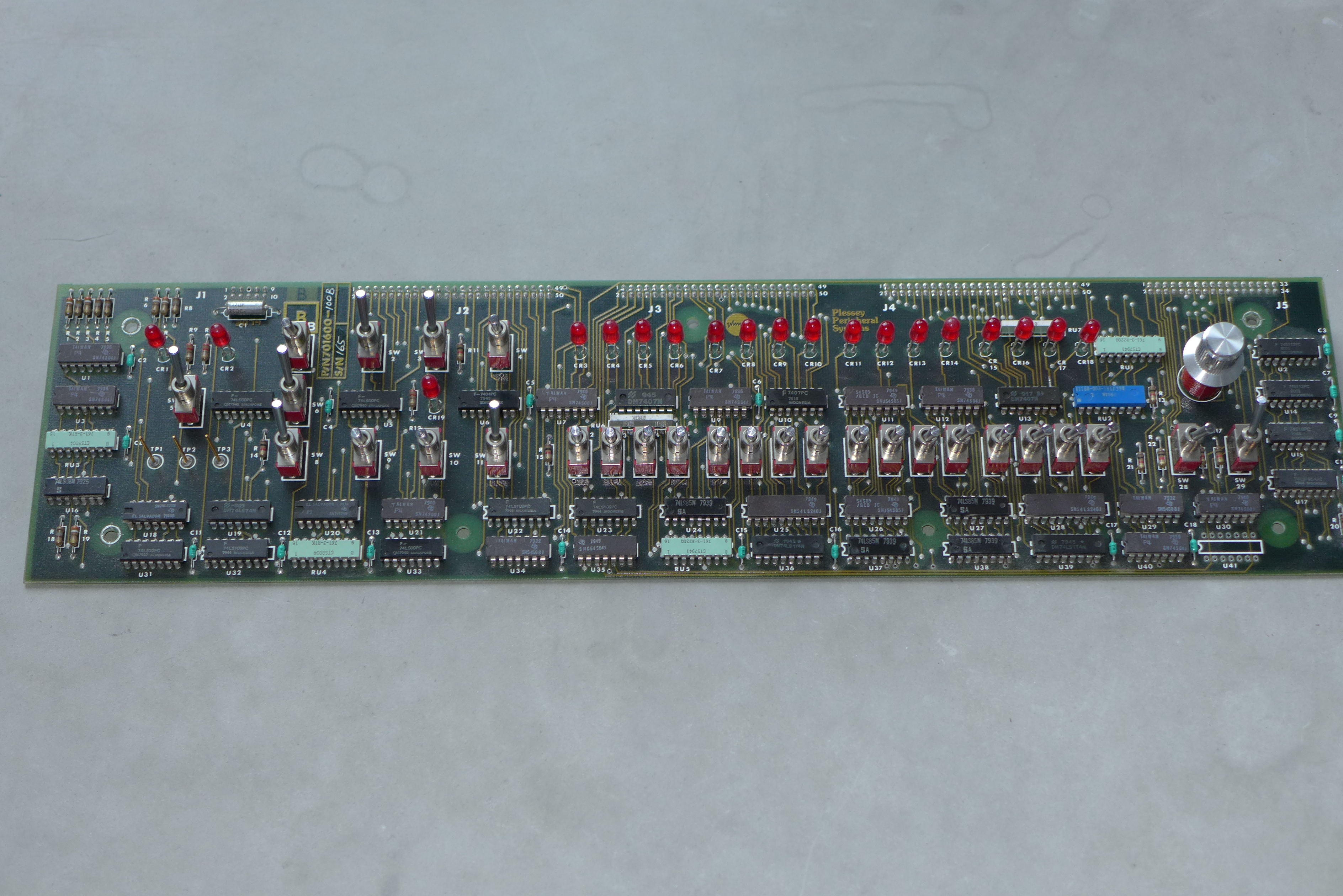
Just purchased a Solid State Music IO-8, apparently the manual is not available online, and isn't listed in Herb's documentation collection. Anyone have it? Looks like it's eight Intel 8251A serial ports.
Thanks,
Jonathan
A few people on the Sun help rescue list raised interest for AT&T 3B2
community projects. So I've created a mailing list to help segregate
traffic for detail oriented 3B2 related topics.
Seth Morabito has invested lots of effort into adding WE3K chip set and
machine emulation to SIMH. I'm interested in building some new CIO
boards for the machines. I would also like to eventually mirror all 3B2
related information to 3b2archive.org. And other contributors and
lurkers are signing up too. Please see details in the quoted message
below.
Thanks,
-Alan
On 2017-05-08 11:17, Alan Hightower wrote:
> I've created a mailman list 3b2info at retrotronics.org with an alias info at 3b2archive.org. The list info page is here:
>
> https://www.retrotronics.org/mailman/listinfo/3b2info [1]
>
> Maybe the first order of business is to enumerate interests and identify potential projects.
>
> -Alan
>
> On 2017-05-05 16:50, Seth Morabito wrote:
> * On Tue, May 02, 2017 at 02:45:51PM -0500, Jerry Kemp <sun.mail.list47 at oryx.us> wrote: [...]
> I have CC'ed Mr. Bill in this note, and I suppose ultimately, we will either
> have a new 3b2 home/mailing list, or we will need to find some other place
> to host it.
> Have we heard anything back yet? Perhaps I'm being over-eager, but I'd
> love to see things move forward.
>
> -Seth
Links:
------
[1] https://www.retrotronics.org/mailman/listinfo/3b2info
I have the following backplanes for sale. Some have boards in them, some
don't, but I might have the boards.
Please call me with any questions or offers. Shipping from 61853.
DD11-DK
DDV11-DK
MF11-U/UP
RH11
RK611
11/44
11/84
Thanks, Paul
A friend of mine was asking if anyone wanted an old CoCo 1 or 2, Apple IIc,
TI 99/4A and one or two other machines he was looking to rehome. I
realized I had several vintage machines that I'd like to rehome myself. We
were discussing the possibility of collaborating on a vintage swap sale of
some sort. Then he went ahead and created a facebook group to post
pictures, etc. where he has some of his equipment listed.
So I have a couple of questions...
Is there already a well known online swap meet for vintage computer gear?
(i.e. NOT eBay!) I'd rather not duplicate the effort and fragment the
market further.
If there isn't, I'll be putting up a few machines on my friend's facebook
group at https://www.facebook.com/groups/448700415476109/ . I have a few
TRS-80 Model 4's, a couple of Model I's, a couple of Model II's, a Cromemco
Z-2D (with OEM labels on the face) which used to be a weather graphics
computer), a couple of Columbia M64 Shoebox CP/M computers, and a few Coco
2's.
The bulk of the people on the facebook swap group (including myself) are
located in Central Indiana.
I'll share the available computer details here on the list after I've done
the writeups and taken pictures.
Thanks and have a great day!
Amardeep (a/k/a Marty, AC9MF)
Hey TRS-80 fanatics....
Anybody have any info on this controller? I have one but the controller chip is
missing. And, I don't really know if it would work if it had one. But, if I could
find out what the chip was and get one it seems this supported 8" drives as
well as the usual 5.25". A user manual would be helpful, too. :-)
bill
I picked up an e series ibm as 400 a while back. it boots/ipl's a working
licenced install of os/400. I have a single terminal and misc related
cables. everything needed is there.
I am open to offers on the machine. Just looking to break even, not make a
fortune.
--Devin
[cross posted]
I was able to find time to edit and post speaker videos from this year's
Vintage Computer Festival Southeast held last weekend in Atlanta.
Amazingly I did it within one week and not a year or more!
Here is the speaker summary and bios from the VCFed website:
http://vcfed.org/wp/festivals/otherevents/vintage-computer-festival-southea…
[1]
And you can find the videos on the AHCS Vimeo channel:
https://vimeo.com/user50868990 [2]
Don French discusses the genesis of the TRS-80 Model I at Tandy/Radio
Shack:
https://vimeo.com/216109117 [3]
Andy Hertzfeld from Apple talks Apple II and his journey to Cupertino:
https://vimeo.com/216104204 [4]
Zach Weddington hosts a special screening of his Viva Amiga documentary
film followed by a panel discussion moderated by Adam Spring:
https://vimeo.com/216081365 [5]
Chuck Peddle via Skype discusses the history of the personal computer
and his current projects:
https://vimeo.com/216072422 [6]
I've also continued to work on the 4.0 backlog. I've added David
Larsen's discussion on the Bug Book series and his computer museum here:
https://vimeo.com/216398748 [7]
And as-posted from last year, Bil Herd discusses his early Commodore
days:
https://vimeo.com/161861581 [8]
I still have Ray Holt, Jerry Mannock, Mary Hopper, and podcast videos
>from 4.0 in my work queue. 3.0, 2.0 and 1.0 to come (Jason Scott, Robert
Uiterwyk, Jonathan Zufi, Carl Helmers, Robert Tinney, Dick Huston, Dan
Kottke, and others). But no ETA on finishing as of yet, sorry.
There are some flaws in video (Andy's lectern mic - doh!) and audio
(damn kids!), but they turned out ok. They are all open to free
download. But please give proper attribution when sharing.
On behalf of the entire Atlanta Historical Computing Society who work
hard every year to make this happen, thanks and enjoy! We do this stuff
for you guys!
Alan Hightower - President
Links:
------
[1]
http://vcfed.org/wp/festivals/otherevents/vintage-computer-festival-southea…
[2] https://vimeo.com/user50868990
[3] https://vimeo.com/216109117
[4] https://vimeo.com/216104204
[5] https://vimeo.com/216081365
[6] https://vimeo.com/216072422
[7] https://vimeo.com/216398748
[8] https://vimeo.com/161861581
We have any people here with an interest in the UnixPC?
I have one left here that I probably need to part with. It's
a little dirty having spent 20-some years in an attic but I just
powered it up and it works other than the hard disk. It's
got 1Meg on the motherboard and no external cards. It
boots diagnostics from the floppy but won't boot from the
hard disk and when I run diagnostics it gets read errors.
I guess that means it might be good and just require a
re-initialization and reload of the software.
It's way to much for me to try to ship so it would need to
be someone either near Scranton, PA or who might be
travelling this way at some point this summer (but not the
end of May/beginning of June as I will be in Alaska then.)
It can be had for a couple cases of beer. :-)
I also think I have a set of both 2.0 and 3.? floppies which
would make reloading it easier.
bill
Hi All,
For all who missed the 1980's technical details of diskdrives or lost
the details in the mean time, I just put the "Training Manual
Introduction to Magnetic Disk Drives" online which Philips provided in
1987 as part of a Field Training. The rest of the documentation are
technical manuals of disk drives like the Shugart SA455/456, SA400L,
SA800/801 and CDC 9406. Assuming those are available, so I won't scan them
This manual covers floppy drives and hard disks, the latter with ST506
and SMD interfaces.
http://electrickery.xs4all.nl/comp/divcomp/doc/TM_AItMDD.pdfhttp://electrickery.hosting.philpem.me.uk/comp/divcomp/doc/TM_AItMDD.pdf
Enjoy & greetings,
Fred Jan
>And yet, if there were an RX02 somewhere on this VAX, I don't believe
you'd be able to read them at all... RX02 seeming more likely with a VAX.
Interestingly PUTR, does seem to accommodate this, and the kind of system I
have set up (i.e. 1.2 MB 5.25 inch in CMOS even though it's an 8 inch
drive). From the readme file...
"SET x: type
Sets the drive type for one of the four possible PC floppy
drives A:-D: (note that actual PCs rarely have more than one or
two floppy drives). The type must be RX01, RX02, RX03, RX50,
RX33, RX24, RX23, or RX26. The default value for each drive is
whatever was stored in CMOS memory by the ROM BIOS setup
utility.
This command may be useful when the drive types stored in CMOS
RAM are incorrect for some reason. It's also helpful when an 8"
drive, or a real DEC RX50 drive, has been attached to the PC
using a D Bit "FDADAP" adapter, or something equivalent. There
is no standard for representing these drive types in CMOS RAM.
Using real RX50 drives (or other 300 RPM quad-density drives
such as the Tandon TM100-3 and TM100-4) is different from RX33s
(which is what PUTR calls regular PC 1.2 MB drives) because the
motor speed is slower, so the FDC chip must be programmed for a
lower data rate to match."
I didn't spend too much time on PUTR as it seemed to be more for the older
DEC OSs rather than Vax VMS. VMS wasn't mentioned as an option in PUTR
which is why I spent more time experimenting with ODS2, which was VAX
specific. And...as I said, PUTR tries to figure out what DEC OS (if any)
is on the disk and failed to find one.
Maybe I should play around with the switches in PUTR more before I give up
though....
Terry
Nice work Liam!
great to see things displayed in a 'setting' rather than just
computers on shelves!
KUDOS! Ed#
In a message dated 5/3/2017 4:52:30 A.M. US Mountain Standard Time,
cctalk at classiccmp.org writes:
>From the Apple ][ up to PowerMac G4s. So, possibly a bit new for many
of you folk, but I enjoyed them and thought others might too.
http://podstawczynski.com/retro/beauty_shots.html
--
Liam Proven ? Profile: https://about.me/liamproven
Email: lproven at cix.co.uk ? Google Mail/Talk/Plus: lproven at gmail.com
Twitter/Facebook/Flickr: lproven ? Skype/LinkedIn/AIM/Yahoo: liamproven
UK: +44 7939-087884 ? ?R/WhatsApp/Telegram/Signal: +420 702 829 053
Please contact me off list with questions and offers. $10 S/H within
US. Ask about overseas
ABLE Quinverter
DILOG
DQ130
DQ686
Emulex
CS09
SC01
SC03
SC21
SC31/BX
TU11
TU121
TU131
UD33 hex
QD01
QD21
QD241
QT131
Thanks, Paul
I have the following Rainbow/ PRO parts for sale. I would like to sell the
the mother board and everything on it. If I don't get offers for them, I
might split them up. I might have more loose parts as I continue digging.
No complete units with cases at this time. I'm waiting for some to arrive I
bought over a year ago.
Please contact me off list with any questions and offers. Shipping is from
61853, and will be $15 per PC100 mother board, overseas please ask me for
rate. I plan to ship everything sold next week.
UNIT 1: PC100B motherboard
RX50 controller 54-15482
RD51 controller 54-16019
54-15688
8087 memory adapter 54-16535
UNIT 2 Same as unit 1
UNIT 3 PC100B motherboard
RX50 controller
54-15688
UNIT 4 PC100A motherboard
RX50 controller
54-15490 memory expansion, no sockets
UNIT 5 and 6 PC100A motherboard
RX50 interface
Misc- 2 H7842 power supplies
PRO items 3 PRO 380 motherboards
I hope everything is correct and there are no typo.
Hello,
since the messages in May about the MS Windows 1.0 version for DEC Rainbow,
I did some research to see if a version is effectively available.
It seems that copies of this software are really difficult to find, but
a complete copy
was available on the latrobe ftp DEC Rainbow archive... which
disappeared with all valuable data...
Anybody has a copy of the content before the deletion?
Anyway, I found a file-by-file copy of it, on this site:
https://winworldpc.com/download/62DF4D23-B974-11E4-AC5A-5404A6F17893
For preservation reasons, it would be really better to have an original
disk image.
Any news about dumping the disks or an ftp archive where they are present?
Thanks
Andrea
Finished building a prototype mezzanine board and testing with the IM6100 (PDP-8 on a chip) in the 560Z board today. Full writeup:
http://www.glitchwrks.com/2017/05/03/gw-osi-ram1-universal-ram
There are a couple of tweaks required, but I should be doing a first production run of boards before long. This board is:
* 128 KW, 12-bits
* Optional memory management/bank switching
* No hard-to-find/expensive ICs (8T26, et c.)
* All through hole
* Includes lamp register mezzanine header
* Largeish prototype area
The lamp register is on a mezzanine for a few reasons. First off, octal vs. hex grouping! It really throws me off to try and interpret one on the other. Second, it allows remote mounting on a ribbon cable, i.e. board can be mounted to a front panel. Third, I'll likely design a 7-segment version.
Thanks,
Jonathan
Hi all,
A colleague and I are trying to get a VT220 working again as it recently
died on us. We are hoping to set up a few items for the mid-80s
(including this terminal) to show the graduands what it would have been
like if they were doing their CompSci degree 30 years ago.
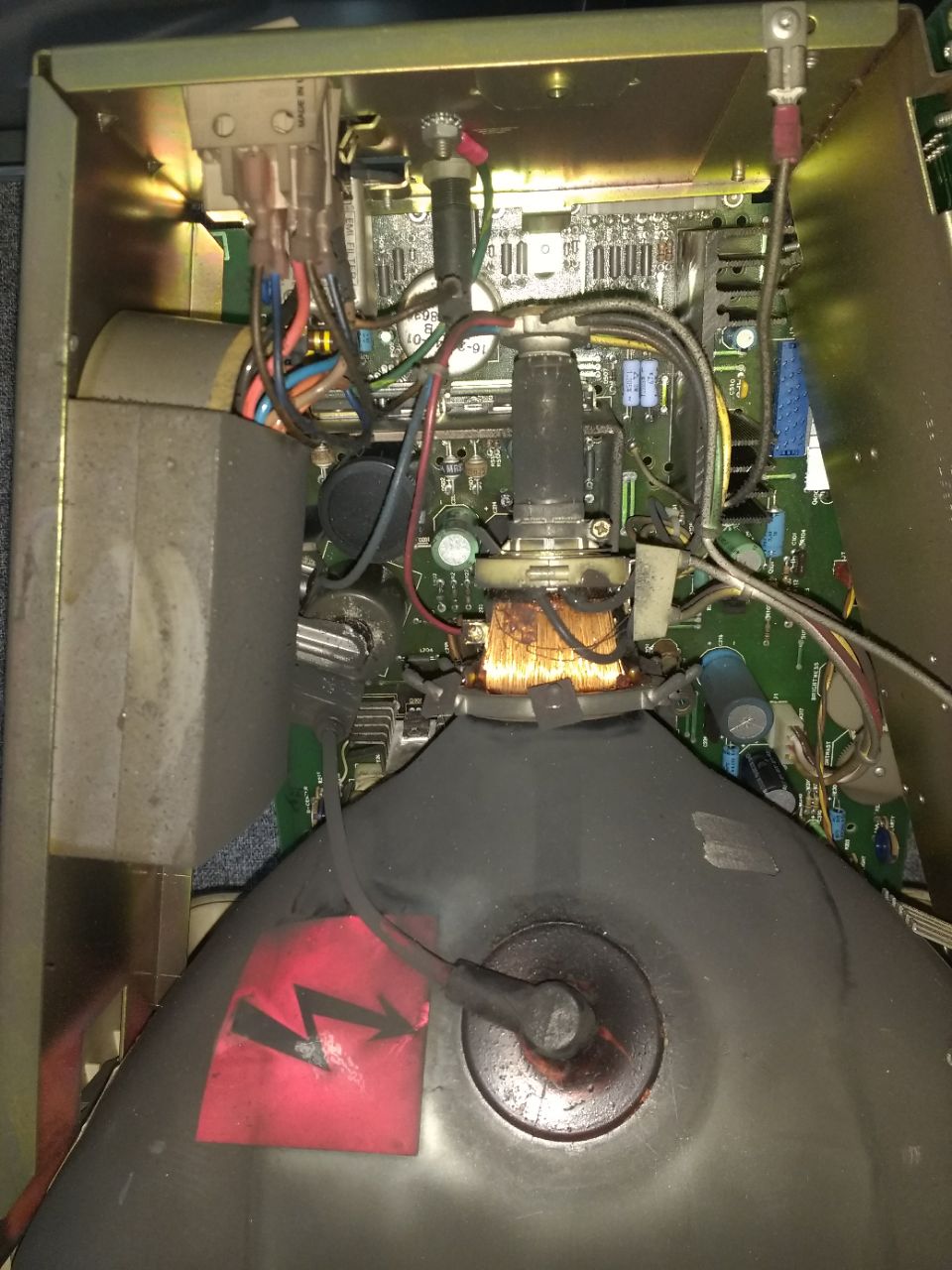
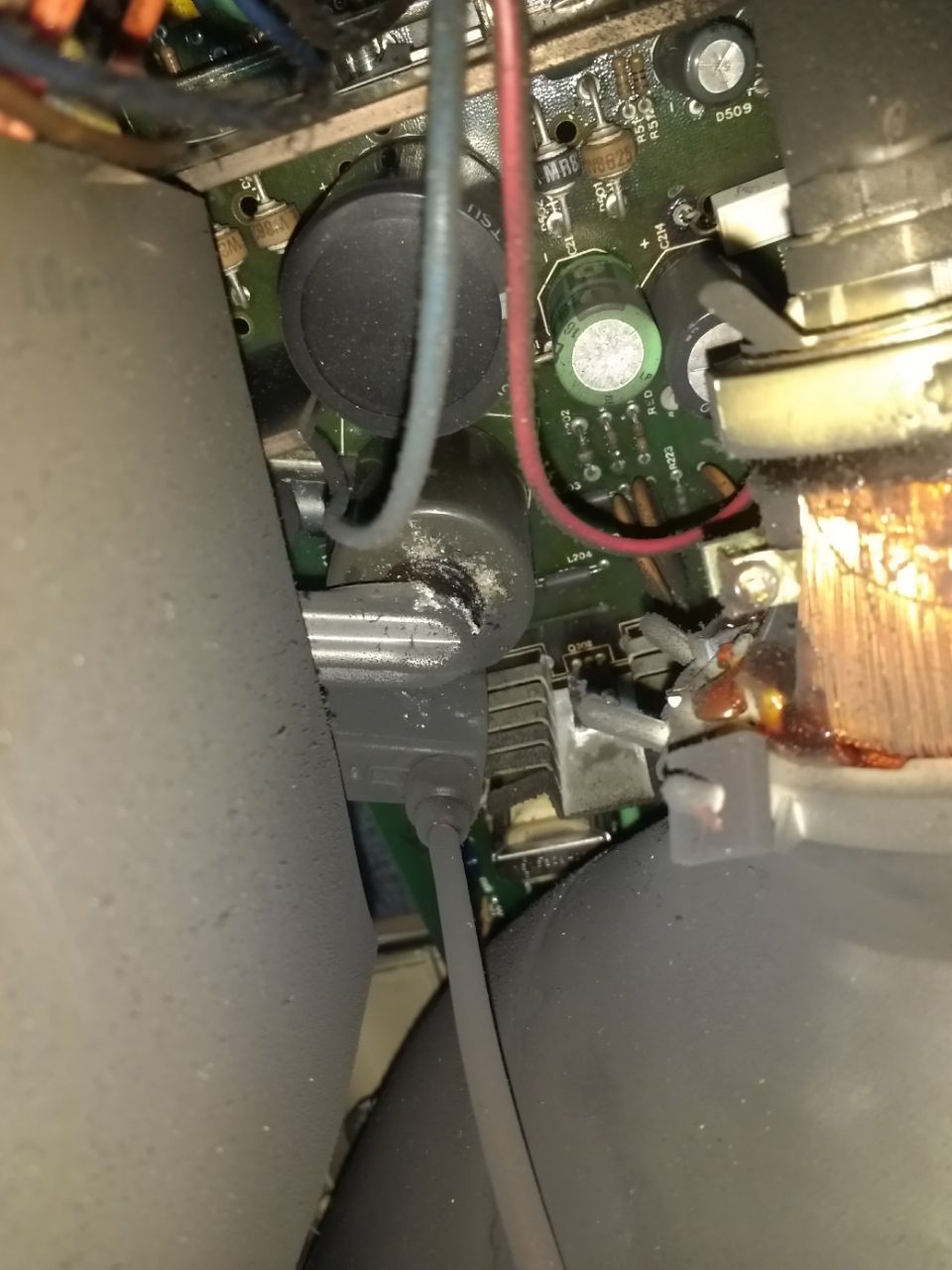
It looks to me like the flyback is dead. There is a lot of soot and
there looks like there is some damage to the top of the transformer,
better seen in the second image.
http://www.cs.nott.ac.uk/~psxasj/sparse/flyback1.jpghttp://www.cs.nott.ac.uk/~psxasj/sparse/flyback2.jpg
The terminal powers on and does the usual beeping but nothing is
displayed on the screen. Does anyone have any advice about what to do
here? Are there any sources of compatible flyback transformers?
We have a second VT220 which exhibits the same behaviour, hopefully for
a different reason so we can try and cobble two into one.
Any thoughts / advice would be greatly appreciated.
Thanks,
Aaron.
--
Aaron Jackson
PhD Student, Computer Vision Laboratory
http://cs.nott.ac.uk/~psxasj
> Date: Wed, 3 May 2017 08:03:19 -0400
> Subject: VCF SE Photos
>
> Here are my photos from the VCF South East April 30/May 1. Roswell, GA
> hosted by Mims' Computer History Museum of America
>
> http://vintagecomputer.net/browse_thread.cfm?id=677
>
>
Just to clarify something here about VCF South East... the Computer Museum
of America
(that's the official name) provides the venue for the event, but the
Atlanta Historical Computing
Society (AHCS) actually recruits and covers the expense for having the
speakers at the show
and also recruits and organizes all the exhibits of the VCF proper (aside
>from the two professionally
constructed and very informative exhibits that the Computer Museum
provides).
In the first year the Computer Museum of America did recruit the speakers,
but AHCS has
done it since. And the AHCS has always recruited and organized the
exhibits for the VCF proper.
Just want to make both of the partners in this endeavour get proper credit
here.
Earl
Just to let folks know that I finally moved the IBM 4331 Mainframe this past weekend
>from where it was currently stored to my shop. Pictures are here:
https://www.flickr.com/gp/150223282 at N04/NrX91K <https://www.flickr.com/gp/150223282 at N04/NrX91K>
As can be seen in the pictures, it filled a 26? box truck that I had rented for this purpose.
Right now I just have it placed somewhat in my shop. Some early tasks will be:
* I have to verify that I have everything. Even if I missed some items, they won?t be
scrapped. I just need to go over what is currently in my shop and verify that I didn?t
leave anything behind. I?m mostly worried about cables at this point.
* I have to figure out some way to produce enough ?clean? 3-phase power to run the
peripherals (the CPU is 220v single phase) as I only have 220v single phase coming
into my shop.
Starting to power it up will probably be a while yet. ;-)
TTFN - Guy
Much of what used to be power-hungry connectivity hardware for me has
gone low-power, so I'm scaling back my UPS setup some.
I've got an Elgar IPS1100, nominally rated at 1KVA sine-wave continuous
(9.2A 60 Hz 120VAC). It's a pretty good-sized UPS, with fan cooling.
It takes 48V in SLA cells (has an internal shelf for 8 6V 12AH ones),
but I've always run it from 4 garden-tractor batteries.
It's pretty good-sized; about 12"x13"x15" and heavy (big transformer).
Made in 1990, has 6 AC receptacles on the back along with an RS-232
connector for status notification.
Back in the day, this was a pretty high-end unit; manufacture date is 05/90.
Yours for shipping; batteries not included.
--Chuck
>From the Apple ][ up to PowerMac G4s. So, possibly a bit new for many
of you folk, but I enjoyed them and thought others might too.
http://podstawczynski.com/retro/beauty_shots.html
--
Liam Proven ? Profile: https://about.me/liamproven
Email: lproven at cix.co.uk ? Google Mail/Talk/Plus: lproven at gmail.com
Twitter/Facebook/Flickr: lproven ? Skype/LinkedIn/AIM/Yahoo: liamproven
UK: +44 7939-087884 ? ?R/WhatsApp/Telegram/Signal: +420 702 829 053
Hello,
Since there are a lot of experts here ( I guess, at least ), I would like for an opinion / ideas / knowledge.
I've been told that the temperature sensors on Fuels are subject to get defective.
Is the same valid for current sensors ?
The question is due to this... I just got a Fuel donated to me, very kindly, that didn't turn on once I tried to. (the old owner didn't turn it on in a while, I was told)
I've connected to the L1 diagnostic serial port on the mb and ...
The env system prevents it from turning on for 2 reasons
1) XIO V12 bias with a value of 5.81 , considered too low
2) Odyssey temp fix at 93c at box turned off
But I managed to run env while the 30 seconds timer announcing the power down were running and... it shows that 12V and 12V IO are perfect with the psu "running" so... any idea if the xio v12 bias sensor is connected with the odyssey temp sensor and thus could be simply faulty.
I could do a test turning off env monitoring, but I would prefer to do it only after hearing opinions . given I don't know what kind of damages could happen if v12 bias is right , instead, and the system is brought up
Environmental monitoring is enabled and running.
Description State Warning Limits Fault Limits Current
-------------- ---------- ----------------- ----------------- -------
12V Enabled 10% 10.80/ 13.20 20% 9.60/ 14.40 12.12
12V IO Enabled 10% 10.80/ 13.20 20% 9.60/ 14.40 12.19
5V Enabled 10% 4.50/ 5.50 20% 4.00/ 6.00 5.10
3.3V Enabled 10% 2.97/ 3.63 20% 2.64/ 3.96 3.35
2.5V Enabled 10% 2.25/ 2.75 20% 2.00/ 3.00 2.47
1.5V Enabled 10% 1.35/ 1.65 20% 1.20/ 1.80 1.47
5V aux Enabled 10% 4.50/ 5.50 20% 4.00/ 6.00 5.12
3.3V aux Enabled 10% 2.97/ 3.63 20% 2.64/ 3.96 3.29
PIMM0 12V bias Enabled 10% 10.80/ 13.20 20% 9.60/ 14.40 0.00
Asterix SRAM Enabled 10% 2.25/ 2.75 20% 2.00/ 3.00 2.52
Asterix CPU Enabled 10% 1.44/ 1.76 20% 1.28/ 1.92 1.61
PIMM0 1.5V Enabled 10% 1.35/ 1.65 20% 1.20/ 1.80 0.00
PIMM0 3.3V aux Enabled 10% 2.97/ 3.63 20% 2.64/ 3.96 3.30
PIMM0 5V aux Enabled 10% 4.50/ 5.50 20% 4.00/ 6.00 5.15
XIO 12V bias Fault 10% 10.80/ 13.20 20% 9.60/ 14.40 5.81
XIO 5V Enabled 10% 4.50/ 5.50 20% 4.00/ 6.00 2.42
XIO 2.5V Enabled 10% 2.25/ 2.75 20% 2.00/ 3.00 1.21
XIO 3.3V aux Enabled 10% 2.97/ 3.63 20% 2.64/ 3.96 1.60
Description State Warning RPM Current RPM
-------------- ---------- ----------- -----------
FAN 0 EXHAUST Enabled 920 1129
FAN 1 HD Enabled 1560 2229
FAN 2 PCI Enabled 1120 1476
FAN 3 XIO 1 Enabled 1600 3869
FAN 4 XIO 2 Enabled 1600 3699
FAN 5 PS Enabled 1600 1980
Advisory Critical Fault Current
Description State Temp Temp Temp Temp
-------------- ---------- -------- -------- -------- ---------
NODE 0 Enabled 60C/140F 65C/149F 70C/158F 20c/ 68F
NODE 1 Enabled 60C/140F 65C/149F 70C/158F 21c/ 69F
NODE 2 Enabled 60C/140F 65C/149F 70C/158F 20c/ 68F
PIMM Enabled 60C/140F 65C/149F 70C/158F 20c/ 68F
ODYSSEY Active 60C/140F 65C/149F 70C/158F 93c/199F
BEDROCK Enabled 60C/140F 65C/149F 70C/158F 20c/ 68F
Alessandro
Thanks for the pics!
Curious.. the Mark-8 in the museum.. that's a repro, right? ?I thought they got a few real ones from Bugbook.
Brad
Sent from my Samsung device
-------- Original message --------
From: william degnan via cctalk <cctalk at classiccmp.org>
Date: 2017-05-03 5:03 AM (GMT-08:00)
To: "General Discussion: On-Topic and Off-Topic Posts" <cctalk at classiccmp.org>
Subject: VCF SE Photos
Here are my photos from the VCF South East April 30/May 1.? Roswell, GA
hosted by Mims' Computer History Museum of America
http://vintagecomputer.net/browse_thread.cfm?id=677
https://youtu.be/8_33Yv5LsSs
Professor Steve Thurber -- co-inventor of the ARM processor, the BBC
Micro and much more -- donates his first ever computer, and arguably
the first prototype of the BBC Micro, to The Centre for Computing
History in this fascinating (& very cute) video.
https://youtu.be/8_33Yv5LsSs
Well worth 40min of your time.
--
Liam Proven ? Profile: https://about.me/liamproven
Email: lproven at cix.co.uk ? Google Mail/Talk/Plus: lproven at gmail.com
Twitter/Facebook/Flickr: lproven ? Skype/LinkedIn/AIM/Yahoo: liamproven
UK: +44 7939-087884 ? ?R/WhatsApp/Telegram/Signal: +420 702 829 053
is the 12 the thing that looks like a trs 80 mod 2 in size? if so i
have some
what is the history behind your unit!?!?!?!?!?!?
Yes--- I am in Phx! Ed#
In a message dated 4/23/2017 8:14:33 P.M. US Mountain Standard Time,
cctalk at classiccmp.org writes:
Just picked up a TRS-80 Model 12, and it boot to the "insert disk
prompt" ... Yay!
But, no card cage, and no KB (and no disks, but those might be easier to
find)
Found a seller of a model 12 with these items, but local pickup only.
I'd like to get this unit up to the Model 16 specs, with Xenix on it. I
see the cards are available, but without the cage, no joy.
Jim
--
Jim Brain
brain at jbrain.comwww.jbrain.com
> From: Jim Stephens
> I'm interested in whether this is a wound down or ongoing Dec material
> operation, or the operation of an e waste recycler.
> Vendor name on ebay is EFI. May have other aliases.
Oh, Efi! All hardened DEC collectors know about Efi (well, many of us do :-).
They are indeed an ewaste recycler. Good people. The company name is ComUsed
and/or TopLine. They used to be in Silver Spring (the place was the
personification of 'gomi' from "Neuromancer" :-), but it got too small, so
they moved. (Sniff. I miss the old place!)
They got started on DEC stuff when they bought some DEC collector's entire
collection after that person passed; most of that's long gone (it's been
_thoroughly_ picked over :-), but they occasionally get more DEC stuff.
Noel
> The 4361 is the real gem to get in this type of system. There is a
> builtin storage director as well as the 4 port comm controller.
The 4331 had an option for an integrated storage director, as well as a
feature that converted between CKD and FBA for use with 3340 drives. The
system Guy owns only needs the 3340 A2 and B2 drives cabled together and to
the integrated director.
Carl
Hi All,
I'm in the process of building and restoring a PDP-8/e, and now I've got a
second serial card I'd like to give OS/8 a try.
I'm pretty sure I've got the boot loader entered properly, and the address
+ baud rates set correctly on the PDP and PC.
When I start os8diskserver with "./os8disk -1 ../disks/diagpack2.rk05", it
gives the welcome message. When I start the 8/e, It says:
Booting...
Done sending block 0
^ and appears to freeze there. (the 8/e doesn't halt)
I've got a RS-232 tester (blinky light box) hooked up to the port, which
seems to indicate that nothing is being sent after Block 0 has been sent.
Does anyone know what's going on, or what I'm doing wrong?
Regards,
-Tom
Looking for recommendations for a bulk tape eraser for SDLT and DLT IV
tapes.
Mike Loewen mloewen at cpumagic.scol.pa.us
Old Technology http://q7.neurotica.com/Oldtech/
Hello,
all fine with Rigol or similar oscilloscopes, but there's a very important
technical specification that often is not considered, which really DOES the
difference between a cheap oscilloscope and a powerful one: waveforms per
second.
Suppose you are searching for a rare glitch, or that you are trying to
trace an edge of a signal with infinite persistence.
If the scope is a DSO, it just takes a sampling window, the memory is full
and requires data processing and display, in the meantime the signal is not
analyzed, and you can lose important events.
A DPO can capture the signal continuously, or at least with very short
death time, and the display is updated using a large number of triggered
sampling windows.
Of course this kind requires a far powerful acquisition circuit.
I really like DPO scopes in place of DSO, for example used Tek TDS540C or
D, they are quite cheap, no electrolytic caps, and can be optionally
expended to increase acquisition memory depth.
Display is small and grey, but you can use a VGA monitor.
My two cents.
Andrea
I found an Epson MX-80 in my pile of junque. I'd rather not ship but
Ottawa, Montreal or Toronto are all possible. Otherwise, out to
recycle.
--
- db at FreeBSD.org db at db.nethttp://www.db.net/~db
The RICM just received $1,000 to buy a new oscilloscope. I would like a
four channel. and color would also be nice. The bandwidth doesn't need to
be high because we usually work on ancient equipment.
What would you suggest?
--
Michael Thompson
The High Voltage capacitors 600 to 2,000 VDC have a finite life.
Unless you checked for leakage or ESR .... be suspect of values in range.
Since you are in the UK, Farnell/element14 may be the best parts distributor.
ASC Metalized Polyester Film, 6 kVolts
http://www.justradios.com/ASCcapacitors.html
Metalized Polypropylene Film, 1600 volts
http://www.justradios.com/MPMcapacitors.html
====
DEC VT-220 : AMP/Tyco Mate-N-Lok
http://avitech.com.au/?p=252
greg
Sent from iPad Air
Sent from iPad Air
Has anyone got a manual for an HP 1331A X-Y display? It's a storage-tube
device, and I'm curious to know if there's a way of triggering the erase
function remotely rather than having to physically prod the erase button on
the front.
The rear just has X-Y-Z inputs, and I *think* that X-Y are supposed to be
in the order of +/- 1V, while Z is the intensity with 0V being full and
around 1V being off. Maybe throwing a negative voltage at Z erases, or
something, though.
cheers
Jules
Hi, All,
I'm cleaning/refurbing a TRS-80 Model 4 I picked up at VCFe that was
in dirty-but-mostly-working shape. I've completely dismantled,
cleaned and reassembled the keyboard, I fixed the bad cable to the
floppy controller, I cleaned and lubed the TM-100-1 floppy drive, and
had it all nice and working, then I bumped the power strip it was
plugged into and the momentary surge took out the electronics on the
floppy drive. I swapped it out with another TM-100-1 unit (borrowed
>from a Model 1) and it's booting again, but when using this toasted
drive as :1, I get either an ERROR 3 or ERROR 4 from TRSDOS 1.3 (my
primary testing disk for the moment). The drive still seeks and spins
but it won't read disks that it used to read before the power hit.
I also have an original NEWDOS/80 disk and a copied MULTIDOS disk. I
have not yet fixed up a PC with a 40-track 5.25" drive for making
fresh disks, but it's on the list of solution paths.
I have the TM-100 service manual PDF (which includes schematics), so
it shouldn't be difficult to work through the functional subsystems of
the drive electronics. My question is are there any specific issues
with the parts on the TM-100 PCB to look for? There are a handful of
reasonably common ICs, and dozens of discrete components. Of course I
can trace through each section looking for where the results are
unexpected, but for such a common thing as a TM-100, perhaps there are
known pain points and perhaps someone here has repaired a few and
could highlight what parts might be "fragile".
Additionally, for a testing framework to poke signals through the
drive for debugging during the repair, what's a good platform? A PC
running MS-DOS? The TRS-80 Model 4 itself? Besides doing
directories, are there any good bits of software anyone can recommend
for exercising floppy drives on a sub-system-by-subsystem basis?
(move the heads, do a read, do a write...)
I expect like the last repair (shorted tantalum filter cap), this
repair is going to be a small number of components. Parts of the
drive are known to work - the motor turns on and off when it should,
and it does seek back to track zero when manually moved off of track
zero prior to doing a DIR :1 or when booting it as :0. At first
glance, something appears to be toasted in the read electronics.
It's not impossible to find another TM-100-1 or replace it with a
TM-100-2 (more common, owing to its appearance in the IBM 5150 PC),
but I'd like to just repair this one and get back to TRS-80 hacking.
Thanks for any tips or pointers.
-ethan
Was working on some Drives this week, and took some pictures of it disassembled.
http://bitsavers.trailing-edge.com/pdf/diablo/photos/Diablo_33F/
The prefilter was orange crumblefoam. I took a look at my NOS ones and they have
a greenish prefilter that still appears to be OK. The gasket going up to the plastic
basket that holds the pack is crublefoam as well. I'm going to try some 3/8" x 1/2"
Norprene foam strip as a replacement, with polyurethane glue over the seam.
The door latch and load lamp is driving me nuts. Dug out my extender card this morning
to try and figure out why the driver transistors aren't turning on. Tranistors, diodes
are fine, and the J9 board that drives it works in another drive.
(Waits for Jay's next email "This has been a test of the new auto banning system. Thank you.")
-------- Original message --------From: Alexandre Souza via cctalk <cctalk at classiccmp.org> Date: 4/27/17 1:58 PM (GMT-06:00) To: "General Discussion: On-Topic and Off-Topic Posts" <cctalk at classiccmp.org>, Jay West <jwest at classiccmp.org> Subject: Re: test, please ignore
This is a test, designed to provoke an emotional response
Enviado do meu Tele-Movel
On Apr 26, 2017 9:39 PM, "Jay West via cctalk" <cctalk at classiccmp.org>
wrote:
> Don't need a response, please ignore.
>
>
>
> J
>
>
____________________________________
IMMEDIATE RELEASE No. NR-145-17
April 26, 2017
____________________________________
Air Force Issues Challenge to ?Hack the Air Force?
The Air Force is inviting vetted computer security specialists from across
the U.S. and select partner nations to do their best to hack some of its
key public websites.
The initiative is part of the Cyber Secure campaign sponsored by the Air
Force?s Chief Information Office as a measure to further operationalize the
domain and leverage talent from both within and outside the Department of
Defense.
The event expands on the DoD ?Hack the Pentagon? bug bounty program by
broadening the participation pool from U.S. citizens to include ?white hat?
hackers from the United Kingdom, Canada, Australia and New Zealand.
?This outside approach--drawing on the talent and expertise of our
citizens and partner-nation citizens--in identifying our security vulnerabilities
will help bolster our cybersecurity. We already aggressively conduct
exercises and 'red team' our public facing and critical websites. But this next
step throws open the doors and brings additional talent onto our cyber team,?
said Air Force Chief of Staff Gen. David Goldfein.
White hat hacking and crowdsourced security concepts are industry
standards that are used by small businesses and large corporations alike to better
secure their networks against malicious attacks. Bug bounty programs offer
paid bounties for all legitimate vulnerabilities reported.
?This is the first time the AF has opened up our networks to such a broad
scrutiny,? said Air Force Chief Information Security Officer Peter Kim. ?
We have malicious hackers trying to get into our systems every day. It will
be nice to have friendly hackers taking a shot and, most importantly,
showing us how to improve our cybersecurity and defense posture. The additional
participation from our partner nations greatly widens the variety of
experience available to find additional unique vulnerabilities.?
Kim made the announcement at a kick-off event held at the headquarters of
HackerOne, the contracted security consulting firm running the contest.
"The whole idea of 'security through obscurity' is completely backwards.
We need to understand where our weaknesses are in order to fix them, and
there is no better way than to open it up to the global hacker community,"
said Chris Lynch of the Defense Digital Service (DDS), an organization
comprised of industry experts incorporating critical private sector experience
across numerous digital challenges.
The competition for technical talent in both the public and private
sectors is fiercer than it has ever been according to Kim. The Air Force must
compete with companies like Facebook and Google for the best and brightest,
particularly in the science, technology, engineering, and math fields.
Keen to leverage private sector talent, the Air Force partnered with DDS
to launch the Air Force Digital Service team in January 2017, affording a
creative solution that turns that competition for talent into a partnership.
In fact, Acting Secretary of the Air Force Lisa S. Disbrow and Gen.
Goldfein visited the Defense Digital Service and Air Force Digital Service in
early April to discuss a variety of initiatives the Air Force can benefit
from.
?We're mobilizing the best talent from across the nation and among partner
nations to help strengthen the Air Force's cyber defenses. It's an
exciting venture, one that will make us better, and one that focuses an
incredible pool of capabilities toward keeping our Air Force sites secure," said
Acting Secretary Disbrow.
The DoD?s ?Hack the Pentagon? initiative was launched by the Defense
Digital Service in April 2016 as the first bug bounty program employed by the
federal government. More than 1,400 hackers registered to participate in the
program. Nearly 200 reports were received within the first six hours of
the program?s launch, and $75,000 in total bounties was paid out to
participating hackers.
Registration for the ?Hack the Air Force? event opens on May 15th on the
_HackerOne_ (http://links.govdelivery.com/track?type=click&enid
=ZWFzPTEmbWFpbGluZ2lkPTIwMTcwNDI3LjcyNzk2MTYxJm1lc3NhZ2VpZD1NREItUFJELUJVTC0yMDE3MDQyNy43M
jc5NjE2MSZkYXRhYmFzZWlkPTEwMDEmc2VyaWFsPTE3NDEwNDE5JmVtYWlsaWQ9Y291cnlob3VzZ
UBhb2wuY29tJnVzZXJpZD1jb3VyeWhvdXNlQGFvbC5jb20mZmw9JmV4dHJhPU11bHRpdmFyaWF0Z
UlkPSYmJg==&&&101&&&https://www.hackerone.com/?source=GovDelivery)
website. The contest opens on May 30th and ends on June 23rd. Military members and
government civilians are not eligible for compensation, but can
participate on-duty with supervisor approval.
Updates from the U.S. Department of Defense
on a whim I bought
http://www.ebay.com/itm/142363021266
640x480x8 Multibus graphics board with 80286 and NEC 7220
apparently they were commonly used in process control, a fair number turn up at absurd prices
I'm sure most of you DEC hackers have replaced a broken DEC handle or put handles on a protoboard, and did what I've done in the past: use 4-40 screws and nuts, or pop rivets. Well, I finally came across the right tool for the job, an Indestro tubular rivet set! I cut the head off of a rivet on an old Sundstrand CNC control board that was getting scrapped anyway and discovered they're 1/8" hollow brass rivets, but that a M3 x 5mm is close enough. You can buy the M3 rivets online for cheap, I paid $6 USD for 200 rivets, shipped. Here's the writeup:
http://www.glitchwrks.com/2017/04/25/installing-dec-handles
Thanks,
Jonathan
OK here is a photo!
Can you get a shot of the back of it~!? or
a shot downwards at the keys?
could be a terminal... could be a computer...
with no further info .. a terminal would be my first guess...
Ed#
In a message dated 4/26/2017 12:37:55 P.M. US Mountain Standard Time,
cctalk at classiccmp.org writes:
Just wondering if anyone has any idea what this
is:
http://imgur.com/qqYlg1k
I am not sure if it is a terminal or a
computer as I don't recognize the logo.
(I apologize if this appears as
a duplicate post)
If we concentrate reeeeaalyyy hard ....
Nope.. not working...
Send us a link to photo!
In a message dated 4/26/2017 2:32:44 P.M. US Mountain Standard Time,
cctalk at classiccmp.org writes:
On Wed, 26 Apr 2017, Syd Bolton via cctalk wrote:
> Anybody recognize what kind of terminal this is? I am assuming it is
> a terminal rather than a personal computer.
Do you have a link, or a picture, or a description?
> Thoughts?
Without seeing it?
So I bought an abandoned storage unit in Paradise CA, and I think some of
you guys will want to stop by and check some the stuff out. I did post this
on VCFed (where I am a regular) but I figured I'd send it to this mailing
list for visibility.
Here is a large picture dump: http://imgur.com/a/g81WQ, and here is a list
to go with it (to help ID the stuff in the pictures):
https://airtable.com/shrkO3Xeu4WwYHsYK
There will also be a ton of part and what not on sale too, they are listed
here: https://airtable.com/shraX3xyq3qjiGRVr and here:
https://airtable.com/shrA7cS5ApaOun6gd and the original Imgur album is
here: http://imgur.com/a/0rEIv
There are a few very nice complete setups there, including some TRS-80
setups, an Amiga 1000 setup, a Leading Edge Setup and a Franklin ACE-100
setup.
There are also some thing not pictured, such as a bunch of Commodore
Vic-20s, Radio Shack accessories, Commodore software and accessories. The
list just sort of goes on and on.
Okay, so here are the deets for the sale:
*Where*: 7856 Skyway, Paradise CA
*When*: Saturday April 29th, 11a till 6pm and Sunday April 30, 10a till 2p.
*Cash only*, any reasonable offer will be considered!
Jarrod Coombes
Just wondering if anyone has any idea what this
is:
http://imgur.com/qqYlg1k
I am not sure if it is a terminal or a
computer as I don't recognize the logo.
(I apologize if this appears as
a duplicate post)
I know it's a little bit early for mothers day but I have a RA82 HDA available for the cost of shipping (sorry but prepay - I've been stiffed by someone on this group). It needs a good home or it goes to the dumpster next week.
Kirk
Wow, I thought I had seen every obscure third-party Q-bus and Unibus chassis and backplane through the 70's/80's/90's but I had never heard of "Ford Higgins Power Frame" until today.
It's a very stylized case obviously built around that disk drive but otherwise reminds me a lot of the DEC grey office-side boxes of the 80's. The only thing is that the ribs on the Ford-Higgins run up and down but the plastic ribs on the DEC stuff usually ran left to right so it's not obvious they were copying anything from DEC at the time, it seems likely the "Power Frame" predated the BA23/BA123/vaxstation styling.
A little corporate research shows that Ford/Higgins was a division of Century Data Systems. It must've been a last gasp, everything I've ever seen from Century Data was from the 70's.
Tim N3QE
I've got a few too many oldies. Ran across these guys last week
https://goo.gl/photos/xjiS5CuMUUF5rKtd9
About 15 SE/30s
*** But I don't have a lot of time to pack for shipping. ***
Anyone near Portland Oregon who has the time for trade ?
Suggestions/Ideas ?
Would like to keep just one w/Ethernet.
-pete
Hi
My PDP-8/A is up for restoration. More specifically and 8A100 according
to it's ID plate. It is in overall "ok" shape but oh so dusty.
I'd like to give it a good cleaning so I'm tearing it down. And I'm
looking for suggestion to cleaning the backplane and regulator board.
I'm considering putting the Omnibus part under warm water and perhaps a
bit of mild detergent. Should I get distilled water or will tap do? The
water here is not very "hard"
The regulator backplane has a relay and a button which will never dry
out if I soak it...
Thanks in advance,
Pontus.
In a message dated 4/25/2017 10:24:42 P.M. US Mountain Standard Time,
cctalk at classiccmp.org writes:
On 4/25/17, 7:28 PM, "cctalk on behalf of Jim Brain via cctalk"
<cctalk-bounces at classiccmp.org on behalf of cctalk at classiccmp.org> wrote:
>Been trying to Google things, but not having a lot of luck. I
>understand both are white case, both have slimline drives, 12 had no
>card cage, I think I read somewhere that the 16 came with 68K std (no
>Z80?), and 12 had KB conn on case, 16B had KB conn on KB. Beyond that,
>though, would love more information.
>
>Lots of info on 2 and 6000, but not so much on the intermediate machines.
>
>Jim
>
>
>
Some 12?s came with the card cage in it, it depended on luck mostly.
So what I never really looked at closely and warehoused could be 12 or
16...
I know not an model 2 as it was not silver like the trs-80 model 1 in
the collected here on display.
Ed#
I have scanned the manuals that came with my Ford-Higgins Powerframe
machine. It is a QBUS PDP-11/73 machine in what looks a whole lot
like a DEC BA23 enclosure. Not sure if it's a clone or a licensed
rebadge. The CPU board is DEC, the memory is a Clearpoint P/N
3325/300 (size unknown) and the disk controller is a Dilog DQ215 P/N
33214701 (SMD?). It has a combo fixed-disk/cart drive that their docs
call an RC40. That looks like a DEC part # but doesn't seem to be
anything they made.
There's very little out there about them (I found a 1992 Usenet post
>from someone asking "what is this thing??") so I wanted to fast-track
these docs online.
http://chiclassiccomp.org/docs/index.php?dir=%2Fcomputing/FordHiggins
And some photos: https://goo.gl/photos/DiXaiiMKXNorGqzVA
The machine has been given to a friend in search of a QBUS project, so
I don't have any more pics at the moment.
-j
Hi guys,
I recently impulse-bought a paper tape reader from eBay, a Remex
RRS6500BE1/660/DRB/U901
Link: http://www.ebay.com/itm/292050475397
Pictures: https://goo.gl/photos/Wa3W7mtTwwuTczUV7
It has several enormous capacitors in it and I want to do my due diligence
before powering it up. Does anyone have advice in this regard? I'm
competent in soldering and rework of all sorts but definitely more in
digital than analog.
Also the spindles squeak very slightly - are they oilable?
In general it looks to be in pristine condition; no dust and no magic-smoke
smell. The only repair item I can find is a sticking tape roller and gentle
bending oughta solve that.
I await your thoughts!
--
Anders Nelson
+1 (517) 775-6129
www.erogear.com
Ben asks:
> Just how big is the server?
> As a wish list, I've always wanted that as a offline set of DVD's for the common stuff.
The bitsavers archive is 267 Gbytes.
So at 4.7G per DVD, it comes out to almost 60 DVD's.
I remember a PDQ Bach radio quiz show where the prize was The Wagner Ring Cycle on convenient 45 RPM records.
Tim N3QE
Hi guys,
Ive been extracting data off a 3.5 inch windows XP-formatted floppy disk
with many bad sectors. The odd thing is it's always the same bad sectors
on every track. Such a 3, 8, 12 and 17. Once or twice it might be just 3,
8 and 17. Or occasionally 3, 8, 9 12, 17. This patten is the same for
every track. It's (more or less) always the same sectors that are bad.
Why? I can't believe natural degredation would be so consistent. Anyone
have any thoughts?
Terry (tez)
Hi,
I've imaged (with ImageDisk) some floppies I've got with my "new" 8560
system.
You can find them at
ftp://ftp.groessler.org/pub/chris/tektronix/8560/diskimages .
Among other things there are cross-assemblers for 68000, 6809, and 6800.
From the TNIX installation disk set one is missing (disk 5 of 5).
I'm looking for the Z8000 cross-assembler for TNIX.
Does anyone have it?
regards,
chris
Tony D. wrote:
> Are any DEC enthusiasts here jealous of this :
>https://www.flickr.com/photos/tony_duell/33427116663/in/dateposted-public/
Interesting coincidence. I was digging through some boxes of stuff yesterday, and I came across two sets of these in really nice condition. Haven't tested 'em yet (had /no/ idea that they could be used for diagnosis of an RX01 control board) but looks like they should be pretty simple to check out. I had didn't know of the existence of these before yesterday. I did a little searching and found that they are useful for debugging 11/35 and 11/40 systems, as well as RK05 drives...but didn't see anything about the RX01 drive electronics.
Speaking of RX01's, does anyone out there have a spare front bezel for the RX01 that they'd be willing to part with?
I have a working RX01 on my 8/e system (both drives good, amazingly) but the bezel was missing when I got it.
It'd be nice to have, as it looks rather dumpy in the rack with the rest of the system.
Best wishes to all,
-Rick
--
Rick Bensene
The Old Calculator Museum
http://oldcalculatormuseum.com
Beavercreek, Oregon USA
> From: Tony Duell
> Are any DEC enthusiasts here jealous of this
Actually, not me! I'm an old enough campaigner that I recall when real light
bulbs were standard, and they were a total PITA! So when LED's arrived, we
all though they were the greatest thing since sliced bread. So I'm now very
happy with my LED-equipped KM11 clones - I still have that anti-bulb bias! :-)
Noel
> On Apr 24, 2017, at 11:36 AM, Jim Brain <brain at jbrain.com> wrote:
>
> For now, since the KB is most needed and somewhat hard to find, and since I design HW for classic machines, I think a small uC and some wire might tide me over until I can find a reasonably priced KB. I did a quick check, but have not seen any writeup of the protocol and keyscan matrix. Does such a thing exist?
I haven't seen such although I know a few folks with ambitions of such project. I can put you in touch if they're not actively listening to this list and want to chime in.
> On Apr 24, 2017, at 11:49 AM, Jim Brain <brain at jbrain.com> wrote:
>
> I'll email off-list about disks, as I truly know so little about the unit, I'm not sure what to ask for.
Certainly.
>
> Are you considering going to Assembly? If so, I'd defer to your exhibit, as you know much more about these units.
Yes, I'm one of the founders. :)
>
> I'd like to at least try out the XENIX side, if I can. Linux on a 386 is nice, but it's just not the same.
>
Agree completely. There's nothing like running a true Unix descendent on legacy hardware.
> I suspect all of the drives will need attention, but I could be surprised.
More likely than not especially give the condition you mention. The TM-848s are not the most hearty of drives.
Cindy Croxton
I am interested in the stuff. Please contact me.
Gil
--
A. G. (Gil) Carrick, Director
Museum of Information Technology at Arlington
1012 Portofino Drive
Arlington, TX 76012
817-994-9213 (cell) - gil.carrick (Skype) http://MIT-A.com
very good radioengr give Jim a hand with it
It is going to take a pretty big box to ship it for Jim.. I am trying
to remember how big the think is I have not seen ours in eons.
We have some large boxes we have saved but will have to see what it would
take to get at them.
The one thing I would recommend is some sort of internal support against
crushing.. almost an inner reinforcing frame that would prevent collapse
of the box and thus shattering the plastic.
Used to run into stuff like this when shipping hp 2624 terminals etc.
Then the other way is one huge ass box and that injectable foam stuff
in 2 molded sections... with some wood stakes that keep top from
crushing.
Ed#
In a message dated 4/23/2017 11:25:43 P.M. US Mountain Standard Time,
cctalk at classiccmp.org writes:
I'm in the Phoenix area - Peoria specifically. Let me know if I an help.
On 4/23/2017 8:14 PM, Jim Brain via cctalk wrote:
> Found a seller of a model 12 with these items, but local pickup
> only.
Just picked up a TRS-80 Model 12, and it boot to the "insert disk
prompt" ... Yay!
But, no card cage, and no KB (and no disks, but those might be easier to
find)
Found a seller of a model 12 with these items, but local pickup only.
I'd like to get this unit up to the Model 16 specs, with Xenix on it. I
see the cards are available, but without the cage, no joy.
Jim
--
Jim Brain
brain at jbrain.comwww.jbrain.com
Hi there,
I was wondering if anyone knew of a repository that had SWTPC tape files
archived (as .WAV, .TAP, etc). The 6800 system I am presently using is
wired according to original SWTPC specs and does not have a DB25.. so I
cannot simply switch cables from CT1024 to PC terminal like I could with my
other unit. I'd really like to make use of the AC30 also for a more
authentic experience and was hoping someone had wavs archived somewhere so I
could play them into the AC30 with my phone or something and then record to
actual tape. For the last couple of evenings I have been manually entering
in the data for TSC BASIC from a txt file Bill Degnan was kind enough to
post.. just doing as much as I can stand to and then saving progress to
tape. Eventually when it's finished I'll make a wav archive and just use
tape to load it. Obviously I wouldn't want to do that for every program
though. Anyway, I know someone on vcfed at one point was talking of setting
up an archive and even had made copies of Tic Tac Toe and 680 BASIC. Hoping
someone out there knows where those and/or more might be found, or if
there's another way (say using two MP-C/S cards) to pull in S19 files and
then record via AC-30 to tape.
Thanks muchly!
B
Well ... they are packed away at present.. I do know there are several
systems and a printer.
Do not remember if there was software with them or not. stashed many
years ago...
I always had wished it was a model II and I suppose was holding this it
in reserve in case a 2 does not show.
In a message dated 4/23/2017 8:40:37 P.M. US Mountain Standard Time,
cctalk at classiccmp.org writes:
On Sun, 23 Apr 2017, Ed via cctalk wrote:
> is the 12 the thing that looks like a trs 80 mod 2 in size? if so
i
> have some
> what is the history behind your unit!?!?!?!?!?!?
> Yes--- I am in Phx! Ed#
Yes, the 2, the 12, and the 16 look similar.
There are Z80 and 68000 CPU boards.
Which of the variant versions of CP/M do you have for it?
I think this is probably a long shot, but does anyone have patches for
HP-UX 11.11 for PA-RISC? I can't exactly buy an HP support contract just to
download patches, which is apparently my only other option since google
doesn't turn up anything.
I'm specifically looking to get PHSS_24304 installed because that fixes a
linker issue that prevents building anything with GNU G++. I think I might
be able to get around the issue if I use GNU ld, but that has it's own
issues as I understand it.
I'm new to HP-UX, so if you need more info just ask.
Joe
>Just how big is the server?
>As a wish list, I've always wanted that as a offline set of DVD's
>for the common stuff.
>Ben.
But wouldn't a nice tape be a much more appropriate distribution
medium? I've got an LTO-3 drive here, and that's 400GB/tape. It'd only
take one tape to hold bitsavers. :)
Hi there,
I was wondering if anyone knew of a repository that had SWTPC tape files
archived (as .WAV, .TAP, etc). The 6800 system I am presently using is
wired according to original SWTPC specs and does not have a DB25.. so I
cannot simply switch cables from CT1024 to PC terminal like I could with my
other unit. I'd really like to make use of the AC30 also for a more
authentic experience and was hoping someone had wavs archived somewhere so I
could play them into the AC30 with my phone or something and then record to
actual tape. For the last couple of evenings I have been manually entering
in the data for TSC BASIC from a txt file Bill Degnan was kind enough to
post.. just doing as much as I can stand to and then saving progress to
tape. Eventually when it's finished I'll make a wav archive and just use
tape to load it. Obviously I wouldn't want to do that for every program
though. Anyway, I know someone on vcfed at one point was talking of setting
up an archive and even had made copies of Tic Tac Toe and 680 BASIC. Hoping
someone out there knows where those and/or more might be found, or if
there's another way (say using two MP-C/S cards) to pull in S19 files and
then record via AC-30 to tape.
Thanks muchly!
B
Lol that quote. I guess i can google it but was this from one of his books? "Never?underestimate the bandwidth of a station wagon full of tapes hurtling down the highway."?Andrew Tanenbaum, 1981
-------- Original message --------From: Fred Cisin via cctalk <cctalk at classiccmp.org> Date: 4/22/17 12:13 PM (GMT-06:00) To: "General Discussion: On-Topic and Off-Topic Posts" <cctalk at classiccmp.org> Subject: Re: Bitsavers size
https://what-if.xkcd.com/31/
internet V Fedex
Unfortunately, their 2040 number is based on an assumption that bandwidth
will continue to increase, but that media capacity won't.
I've seen suggestion that TU-58s are emulated in simh on
PDP-11s. However, I'm not seeing it in a show dev and my
google-fu is failing me to find any info on how to use it. Any
pointers on how to boot from a TU-58 image?
TIA,
BLS
Ladies and gentlemen, boys and girls, children of all ages - I present to
you LambdaDelta, my decidedly average LMI Lambda emulator.
See https://github.com/dseagrav/ld for the source repository and release
tarball. So far we have been able to run full-speed on a 2.3 GHz i7 and a
2.5 GHz i5, but the i5 was pushing it. The i7 gets a bit warm.
Bitsavers now has the LMI software, so there's no reason to hold off on a
release other than I would have liked to get fetch working properly at
least. I'm going to keep working at it in the meantime.
If you live in the DFW area, and have a truck and a strong back, there are
some VERY interesting items.
A DEC cabinet taller than I am, with a front panel of switches. I asked him
if the panel was rust or orange, but he said he thought it was dark, like
brown. The cabinet was backwards, and there was too much stuff in the way to
turn it around.
3 Sun cabinets full of stuff, and a SparcStation 20.
Several (at least 4) IBM server cabinets. Not the blue 6 foot kind; these
are abt waist high.
A cabinet about waist high the said Computer Control (I think) with switches
and LEDs. Too heavy to move into the light to take pics.
A complete Data Products B300 line printer.
If you are interested in these, send me an email, and I will give you the
contact info.
The warehouse is very dirty, and the aisles are very small. A large person
will not fit.
Cindy Croxton
Hi,
I'm going to Kfest for the first time this year, cannot wait!!!
Anyway: if you decide to visit here, then give me a few weeks' notice so
you can visit the VCF museum in New Jersey. We are in a small town about
60 minutes south of NYC and 90 minutes northeast of Philadelphia.
________________________________
Evan Koblentz, director
Vintage Computer Federation
a 501(c)(3) educational non-profit
evan at vcfed.org
(646) 546-9999
www.vcfed.orgfacebook.com/vcfederationtwitter.com/vcfederationinstagram.com/vcfederation
Most of you have heard of the Large Scale Systems Museum, a public
museum in the Pittsburgh area that is focused on minicomputers,
mainframes, and supercomputers. LSSM has been closed for renovations
and expansion for the past several months; we've added nearly a
thousand square feet of new exhibit space and many new exhibits.
On May 6th, there will be a large block party (actually, several
blocks) here in town, called "New Kensington Better Block", with
street vendors and other standard block party fare. LSSM will be
participating in that event with our post-renovation reopening; we
will be open to the public all day with docents on duty. Many of our
systems will be running and demonstrated throughout the day.
In even bigger news, LSSM is pleased to announce the opening of a
brand new wing, the Large Scale Integration Museum, or LSIM. As the
name suggests, the LSIM wing is dedicated to computer systems based on
Large Scale Integration CPUs, from the earliest four-bit 4004
processors through the desktop computer revolution of the 1970s and
1980s. Thanks to a partnership with Pennsylvania-based nonprofit
organization Tristate Technology Museum Consortium, and a generous
donation from the private collection of Corey Little and C/PMuseum,
LSIM will add more than one hundred new exhibits in four thousand
square feet of newly-renovated space located in the same building as
the recently-expanded Large Scale Systems Museum.
Everyone is welcome. LSSM is located at 924 4th Avenue, New
Kensington, PA 15068. For more information, directions, or hotel
recommendations, contact the LSSM via email at info at lssmuseum.org or
on Facebook (search for "Large Scale Systems Museum"). You can also
see some photos of our facilities on the Facebook page.
Please feel free to forward this message to anyone whom you think
might be interested.
Thanks,
-Dave McGuire
President/Curator, LSSM
--
Dave McGuire, AK4HZ
New Kensington, PA
On Fri, 4/21/17, Don North via cctalk <cctalk at classiccmp.org> wrote:
> On 4/21/2017 4:25 PM, Brian L. Stuart via cctalk wrote:
>> I've seen suggestion that TU-58s are emulated in simh on
>> PDP-11s.? However, I'm not seeing it in a show dev and my
>> google-fu is failing me to find any info on how to use it.? Any
>> pointers on how to boot from a TU-58 image?
>
> Using simh v4.0 from github, in the PDP11 simh ini file:
Thanks much. I was using v3.9 which is why I couldn't find
it. Not everything is working yet, but at least it's loading
and running the boot block.
BLS
A FAQ in my old emails show the founding of the Classiccmp mailing list as being 20 years and 1 month ago. March 13 1997 was when Bill Whitson first set up the classiccmp list at the University of Washington.
Tim N3QE
Sent from my VAX-11/780
> From: Bill Gunshannon
> Surely there were Mailing Lists prior to the existence of the Internet,
> yes?
Absolutely. They started on the ARPANet, fairly early on.
E.g. SF-Lovers (one of the first 'non-mission related' mailing lists) started
in September, 1979, and MsgGroup (an 'official-busines-related' one)
considerably earlier, in June 1975. Header-People started at about the same
time, but alas, we have lost the first two volumes of the archives, so I don't
know exactly when.
I maintain archives of these lists on my page:
http://mercury.lcs.mit.edu/~jnc/tech/archives.html
if anyone wants a look. The variety of header formats is kind of amusing.
> Do any Lists that started on UUCP still exist today?
Perhaps. Do you count newgroups? (Of course, UUCP considerably post-date
the ARPANet.)
Noel
"Shoppa, Tim"<tshoppa at wmata.com> wrote:
> The bitsavers archive is 267 Gbytes.
And growing. I just sent Al a CD with 450 MB of scans of
old obscure IBM manuals from the late 1960s and early 1970s.
One example:
225-3360-1 2030 Processing Unit Field Engineering Theory of Operation
(It describes all the internal operations of the S/360 Model 30.)
So far I have sent him 15 CDs of manual and print set scans,
many of which have not yet appeared online. This is probably
because he lacks time and resources to do the necessary post
processing of them.
If there is any interest, I can post (or send) a list of the
manuals.
The next batch will be from SEL, GE, Tymshare, and a few other
miscellaneous companies. After that, it will be all DEC.
If anyone else is scanning DEC manuals, please contact me so
we can coordinate our efforts and avoid duplication.
Alan Frisbie
jnc at mercury.lcs.mit.edu (Noel Chiappa) wrote:
> One DEC book I really crave, but _cannot_ find, is the "PDP-11 Systems
> Handbook" ("Featuring: MicroPDP-11/83 MicroPDP-11/73 MicroPDP-11/53
> PDP-11/84"). If anyone has an extra copy of this they're willing to part
> with, please let me know,
I have an extra copy I would be happy to send to you.
Just send me your mailing address.
Alan Frisbie
If this link works for you, this is to an auction someone has for a
bunch of IMS and other
S100 cards.
http://www.ebay.com/itm/IBS-Slavenet-P-N-710525-128B-Rev-D-1984-S-100-CPU-C…
I linked off something called IBS Slavenet, but it also has a number of
IMS boards
IMS-Z-80B-Master-Slave-Board-A1270-Rev-F-1984-S-100-CPU-Card-Board-66-/
http://www.ebay.com/itm/192142950358
I used to buy the IMS 16K static boards as they were golden back when I
ran S100, and had
one of their Z80 boards, but stuck with mostly Tarbell and 8080 for my
time with S100 and
never graduated to this sort of system.
Might interest those still doing S-100
thanks
Jim
Sent from my Verizon Wireless 4G LTE smartphone
Hi,I have a friend who has a Decmate II. ?Her family purchased it new for their business in the early 80s. ?Tested it with her last night and it is in perfect condition. ?Boots from the floppy and also from the hard drive. ?It is in a tower enclosure and has a working keyboard and terminal, all in perfect working and cosmetic condition. ?She has all of the manuals and software in their original boxes and they look brand new. ?She has a stack of brochures and promotional items several inches thick. ?She even has the original sales receipt. ?I have no way to know for sure but from what I can see, everything that came with this machine is there. ?She lives in pennsylvania. ?I'm planning to list it on eBay but wanted to reach out to the collector community first. ?Anyone interested can contact me at lovesw at verizon.net.
Thanks,Shawn
Sent from my Verizon Wireless 4G LTE smartphone
> On Apr 21, 2017, at 1:26 AM, Pontus Pihlgren wrote:
> It makes me wonder, what is the oldest still running mailinglist?
I don't have access to my _old_ email (i.e. from the 80's) to confirm this,
and I don't think they still have copies of the very oldest mail, but the
IETF list has got to be pretty old (first meeting was early '86, but they may
not have had a mailing list for a while, yet).
Risks started in the summer of '85, so that one's older.
Noel
Hi, all, continuing the process of getting rid of duplicate DEC documentation:
I have an extra copy of the the UNIBUS Interface Manual, Second Edition
(DEC-11-HIAB-D); I'm interested in trading it for any interesting PDP-11
documentation or stuff you'd like to part with which I don't have.
One DEC book I really crave, but _cannot_ find, is the "PDP-11 Systems
Handbook" ("Featuring: MicroPDP-11/83 MicroPDP-11/73 MicroPDP-11/53
PDP-11/84"). If anyone has an extra copy of this they're willing to part
with, please let me know, I have a lot of odds and ends I can trade (or
plain $$$ if that works).
Noel
Tape backup lto would do it easily, at this point probably incremental backups to an external drive would be a cheap alternative too.
On 4/20/2017 12:15 PM, Jay West wrote:
> Ben wrote...
> ----
> Just how big is the server?
> ----
> Bitsavers that is publicly visible is around 275gb?
How does one back up a system like that?
(That could be the shortage of of oiled paper tape).
Ben.
Hi,
for those who wonder why our mirror at
bitsavers.informatik.uni-stuttgart.de
is outdated:
The reason is that the main rsync server is down/unavailable since March,
11. I've already contacted Al several days ago but haven't got any
response yet.
Christian
Research info needed.In early days-(60's) there was an effort to develop
Blind/Deaf Blind Amateur Radio RTTY and computer output utilizing assistive
technology with braille output. There were also efforts for computer output
devices also.
Please respond OFFLIST so we do not clog the reflector.
We are seeking more information,materials, and stories (This is a history
project for SMECC Communications and Computation Museum)
Note I have checked google and other things ALREADY! - I
HAVE NOT checked some of the online but restricted access
database of publications that may bot be indexed in google so if
something looks really great drop it to us.
We are primarily looking for material and stories from
the 60's and 70s - But before ok! (If there was any?)
and after... yes if during the early development phases
We have the following questions:
- Aside from Ray Morrison, who else was working on this?
- Anyone here work with Ray on this or have photos of gear and paperwork?
- Although we have some of Ray Morrison's articles, we are looking for
other letters, documents hardware, memories of use etc.
- ` Are there any Blind / Deaf Blind RTTY or computer users here today
that participated in this effort?
- Are there any Blind/Deaf Blind CURRENT participants Amateur Radio
RTTY or other digital modes with assistive technology producing braille
output??
- Anyone use Lee Brody's Deaf Blind Communication terminal hand have a
recounting of it or still have an example of the hardware?
- Looking for Computer output devices and information, photos, stories
etc, by any developer or user from the 60's and 70s primarily but later
material will go into the archives on this subject as well. Nowadays there are
plenty of things, but way back then... not so much!
- Feel free to send me anything you think I should know related to the
above topics that I may not have hinted on, but you think I need.
Thanks in Advance -
Ed Sharpe archivist for SMECC _www.smecc.org_ (http://www.smecc.org/)
E-mail direct at couryhouse at aol.com also please cc info at smecc.org
Snail mail to:
COURYHOUSE/SMECC
Attn. Ed Sharpe - Archivist
5802 W. Palmaire Ave
Glendale AZ 85301 USA
I've read the 745 can use two keyboards. And looking for recommendations
One it the same keyboard that goes with the 9000/300, the 46021A/B/C
and the other is the "PC-101" C1429A/B (and I think C)
Anyone with a 745 ?
-pete
I should post to Nekochan but I'm going here 1st.
600Mhz R14K SGI Fuel, 1G of RAM. 16G HDD. I threw in a soundcard that
*should* work with IRIX but I'm not 100% sure. IRIX 6.5.30 seems to be
loaded. I tried to build/load some of the Nekoware stuff at one point
but ran out of time. Size and weight makes shipping prohibitive
(unless you're willing to pay.) I'm located in the UK now in OX10
(south of Oxford and north of Reading.)
--
-Jon
+44 7465 605833
Does anyone know how to configure the Intel IN-1611 64 k qbus memory board?
I seem to be unable to find documentation online.
https://imgur.com/a/KBIoJ
There a switch block an then also a number of jumper wires.
Hello,
I'm in the pretty same condition, I have a Rainbow 100B without memory
expansion.
Not sure however, about the correct board number, which would fit the 100B.
What should I search for?
Thanks
Andrea
Dear All,
I'm looking for ideas for passing on an old Sun Ultra 10, which I adopted
when my old work was going to bin it. I installed Debian, but have the
original OS media. Unfortunately, 3 moves and 2 kids later my time to
tinker is non-existent, and my partner has made clear this needs to go
before another imminent house move. I notice from my last attempt to boot
that it now has the NVRAM battery problem, which a quick search tells me
may be fixable. Ideally, I would like to hand it over to someone with more
time/motivation (for free) rather than sending to the tip, but I'm stuck
for ideas. I did get in touch with wildfire systems, who said it isn't
economically viable for them even at zero cost. The Ebay market for these
things seems more US-centric and registering for an account and dealing
with postage is more effort than I would like (I live in Sheffield, UK).
Any ideas gratefully received!
Thanks,
Pete
>Here's a writeup for those interested:
>http://www.classic-computers.org.nz/blog/2017-04-15-
adventures-with-an-8-inch-disk-drive-part1.htm
One thing in this project puzzled me. Initially when I was testing the
drive I tried to format it for 77-tracks. I used the command FORMAT B: /u
/T:77 /N:15 . It wouldn't let me. MS-DOS said "
"Formatting 1.15M
parameters not supported by the drive"
After trying a few other things (unsuccessfully) I just tried a straight
FORMAT B: /u
It then formatted it without complaint?
Listening to the head moving, I counted 77 tracks. The last three tracks
the clicking stopped. I'm assuming the head just wrote over that final
track 3 times. MS-DOS told me I'd formatted for 1.2MB.
I'm puzzled why I couldn't format the disk using the /t:77 and /n:15
switches. Did MS-DOS just go by what was in the CMOS. If that's the case,
why have those switches at all? Are they just legacy switches for
pre-CMOS machines?
Anyone know the answer to this?
Terry (Tez)
>
>
I was helping out someone here locally to dig thru a pile of electronics
that he had obtained in helping out a woman clean out her house.
Her husband passed away and she wanted the space back. Apparently the
husband "somehow" dealt in HW repair.
A good number of the items were known broken spares, Shugart 1004 drives
(about 36) and a couple tandem floppies.
Those he found a new home for.
There were a few items that I told him I'd help circulate info on since
they are a bit more specialized
(I'm just trying to help him liquidate the items, he is surprising the
woman who he got it from with a cash gift when this is done)
1) 2 NOS Kennedy 9000 series tape drives. I checked, they look pristine.
There was an invoice that says they're Kennedy 9000-3, 4s models.
2) 9 drive packs. marked ATHANA, which may be RK05 packs (I couldn't find
any markings on them to indicate what size, etc.)
3) Lastly he has two Visual 50 terminals.
This is all in the Atlanta area, so if you have any interest, let me know
and I can relay information to him.
Obviously the Kennedy drives would cost a bit to ship...
Thanks.
Earl
There are a lot of smart people here with wide ranging experiences, so
I like to ask questions from time to time that get more to philosophy.
So "If C is so evil why is it so successful" was one of those
questions.
The answer I see is that it is the path of least resistance to the
most successful outcome in the time horizon of the effort.
Or, it gets the job done.
Personally, I am stuck in the machine control world where things like
symbolic names and type checking are sometimes non-existant. And I
wonder why.
SIL-3 and PLe with stone knives and bearskins.
On Wed, Apr 12, 2017 at 1:48 PM, Chuck Guzis via cctalk
<cctalk at classiccmp.org> wrote:
> On 04/11/2017 07:03 PM, Charles Dickman via cctalk wrote:
>> The Balkanized nature of programming is interesting.
> You might find more fertile ground plowing the plctalk.net forum when
> your questions relate to the STL/SCL/FBD/LAD/CSF area.
I am familiar with STL (and some of the others). My question was not
for help. I was trying to present a contrast between the nit-picking
the list was doing about C and that fact that a huge amount of mission
critical programming is done in languages that are essentially machine
code.
It was a ham fisted attempt. Don't post after too many high ABV IPA's.
> FWIW, "STL" in Siemens-talk is an acronym for "Statement List". Why it
> isn't "SL" is anyone's guess.
Probably for the same reason that PZD is process data.
> --Chuck
-chuck
I got a request through my web site for a CP/M System Boot Disk for the
Morrow Disk Jockey DMA Controller Board. Anyone have an image I could make
to help this guy out?
Thanks
BIll
Just a heads-up that the 1979 edition of the "pdp11 bus handbook" has a very
serious editing error in it, in the description of UNIBUS arbitration.
On page 38, immediately after step 13 of the NPR Arbitration Sequence
("13. .... SACK must be negated before BBSY may be negated."), it says "A bus
master may issue an interrupt command to the interrupt fielding processor."
Despite its location in the text, this does __NOT__ apply to the "NPR
arbitration sequence" being discussed above. There is an editing error - this
text is (or _should be_) separate from the "NPR Arbitration Sequence" section
just before it; it belongs with "BR Interrupt Arbitration Sequence" - that
header (on pg. 39) was put in the wrong place.
The 1975 "peripherals handbook" has very similar text, but it _does_ have a
section header after the NPR details (line 13 is identical), and before the
start of the (very similar) BR text ("A bus master that has gained control
... through a BRn/BGn arbitration transaction may issue an interrupt command
to the processor.").
Noel
Anyone know which Lucent semiconductor device or devices were used in the
first Apple AirPort, the Lucent board was " Lucent WaveLAN Silver PC Card"
but I'd like to know the devices used.
Tom
Hi,
Just an update on this. I still haven't got those 8' floppies of unknown
origin to play with but I HAVE made a lot of progress with my own disks.
Thanks to everyone who gave me help with this.
Here's a writeup for those interested:
http://www.classic-computers.org.nz/blog/2017-04-15-adventures-with-an-8-in…
Terry (Tez)
________________________________________
From: cctech [cctech-bounces at classiccmp.org] on behalf of Tim Mann via cctech [cctech at classiccmp.org]
Sent: Sunday, April 16, 2017 8:13 PM
To: cctech at classiccmp.org
Subject: Re: cctech Digest, Vol 34, Issue 15
Brief comments on a couple of topics...
I hadn't heard of the MISE or M3SE before, so I googled. Remarkable
projects. It's pretty tempting to get an M3SE to play with on the Model 4P
that I bought as a reference platform when I was adding 4P support to xtrs.
(I don't have any other physical TRS-80s anymore.) Time continues to be a
big problem in the way of doing retrocomputing stuff, though.
_____________________________________________
Definitely worth it. It will boot directly from the M3SE making it a lot easier to do stuff.
And with the FTP capability I just had an old BASIC program I ran years ago that I wanted
to revive. Used FTP to move it back and forth between my Model 1 and a Unix system
in order to have a real editor for fixing all the mistakes. Then used FTP to move the
program to the 4P to test it out there as well. Never realized the speed difference in
the various models until I cold run stuff like this side by side.
bill
> On Apr 16, 2017, at 8:13 PM, Tim Mann via cctech <cctech at classiccmp.org> wrote:
>
> I hadn't heard of the MISE or M3SE before, so I googled. Remarkable
> projects. It's pretty tempting to get an M3SE to play with on the Model 4P
> that I bought as a reference platform when I was adding 4P support to xtrs.
> (I don't have any other physical TRS-80s anymore.) Time continues to be a
> big problem in the way of doing retrocomputing stuff, though.
>
Good to hear from you, Tim. Speaking as someone else with the lack of time issue these days, the M3SE makes using the TRS-80 so much simpler and easier that you get to actually spend time using it rather than spending your little spare time getting it working.
Hi Noel,
I don't think I need it it but I know someone on the list for about a year
that probably does. Let me know the status.
Can you call sometime this week?
Thanks, Paul
Did IBM publish a Program Logic Manual (PLM) for APL\360, APL.SV, or any
other APL language implementation, as they did for e.g. their FORTRAN(E)
and PL/I(F) compilers?
> From: Al Kossow
> Harry did an oral history at CHM
There are also a pair at the Smithsonian:
http://amhistory.si.edu/archives/AC0196_husk730419.pdfhttp://amhistory.si.edu/archives/AC0196_husk720309.pdf
and the CBI did one too, but alas it does not seem to be on-line (it's not in
their OH index, and although Google searches for other ones from there turned
them up, not this one):
Harry D. Huskey, OH-83
Interviewer: Christopher Evans
Date of interview: 1976
Anyone have a pointer to it?
Noel
> From: Alfred M. Szmidt
> No even the following program:
> int main (void) { return 0; }
> is guaranteed to work
I'm missing something: why not?
Noel
PS: There probably is something to the sports car analogy, but I'm not going
to take a position on that one! :-) Interesting side-question though: is
assembler more or less like a sports car than C? :-)
Hi all --
I recently got insanely lucky and scored a Straight-8 (S/N 14). It made it
in nearly one piece from Ohio, but during transit, all of the G603 Memory
Selector Matrix boards fell out. It looks like on early revisions, there
was no bar in place to hold the boards in (or someone removed the bar from
this one, but I see no indications that this was so). So while the rest of
the flip chips were secured, I overlooked these in guiding the seller in
prepping it for shipping.
Two of the boards sustained pretty major damage, about a half a dozen of
the little "gum drop" looking transformers (DEC refers to them as T-2052)
broke off and most of them fell out and will never be found again.
I realize it's a long shot, but does anyone have:
- Any spare G603s (working or no, as long as the transformers are there)
- Any spare T-2052s (or know of a source)
- Any idea what the T-2052 *was* so I can try to replace them. I haven't
found much detail as of yet.
(The G603 schematic is here:
http://svn.so-much-stuff.com/svn/trunk/Eagle/projects/DEC/Gxxx/G603/G603E.p…
)
Thanks, all!
- Josh
How long does it last?
I have two Silent 700 terminals that have not been used since the
mid-80's and a box of thermal paper. Is the thermal paper any good or
should I get some more before I try to play with the terminals.
Is paper that wide available new and not NOS? I bought some TTY paper
and it was NOS and so it is just about to disintegrate before I use
it.
-chuck
Two computer industry pioneers died in the past week.
Harry Huskey worked on ENIAC, the Pilot ACE, SWAC, and the Bendix G-15.
He was also known for helping overseas universities start their CS
programs. Harry was 101.
Bob Taylor was an ARPAnet pioneer and Xerox PARC executive. He was 85.
________________________________
Evan Koblentz, director
Vintage Computer Federation
a 501(c)3 educational non-profit
evan at vcfed.org
(646) 546-9999
www.vcfed.orgfacebook.com/vcfederationtwitter.com/vcfederation
As I may have mentioned a while back, I have dug out my
backup floppy disks from my National Semiconductor Genix
system. In 1984 or so, I built a clone of a Logical
Microcomputer 32016 system and copied the OS. I used it for
a while, but it was maddeningly slow. This system used a
Multibus backplane and a Konan Taisho disk controller, that
could handle MFM floppies and hard drives. This backup is
>from my copy of the system, and so has a few tidbits of
mildly interesting stuff. One thing is I was helping Steve
Ciarcia of Circuit Cellar magazine answer his mail, and as
this was my only system with 5" floppies, I used it for
that. So, this backup probably has some rather amusing
replies to the totally INSANE questions he got. One of my
favorites was "Steve, can you jot down on the back of an
envelope the schematic for an IBM PC so I can hand wire
it?" I also wrote a VERY BAD driver for a Versatec printer.
It worked, but was insanely inefficient in graphics mode,
and took a half hour per page to print. Worked fine in text
mode, though.
I don't remember what compilers we had on this, obviously C,
and maybe Pascal and FORTRAN.
Since it worked fine to read and write PC compatible
floppies, the floppy format should be easy to read. But, I
think this "backup" is a block by block dump of the file
system. Notes on the floppies show :
cp dc(0,0) on the first,
cp dc(0,800) on the second, etc.
So, if anyone wants to try to recover the files off this,
I'd be glad to donate the set. It appears to be 2 boxes of
floppies, 28 in total. I have some more floppies that seem
to be the last half of an earlier backup, with less info on
how it was written.
Thanks,
Jon
Well, now that I know there are TRS-80 afficianados here i wonder if there
are any MISE/M3SE experts? I have both running here now and really like
them. But, back in the "good ole days" I was priomarily a DOSPLUS user
with a little NEWDOS80 once in a while. I was wondering if it is possible
to get either or both of these DOSes working with the MISE & M3SE.
Any suggestions?
bill
At SMECC we have a very curious laptop with a little tape drive in it
that seems to take small dictation size tapes. The little laptop has a
rounded top to it. Mfr name on tip of tongue ... but ...
It live in one of the Glass chasses .. wonder how scarce they are?
only seen the one...
Ed#
In a message dated 4/14/2017 8:09:32 A.M. US Mountain Standard Time,
cctalk at classiccmp.org writes:
> On Apr 13, 2017, at 7:34 PM, Toby Thain via cctalk
<cctalk at classiccmp.org> wrote:
>
> On 2017-04-13 6:54 PM, Chuck Guzis via cctalk wrote:
>> ...
>> ...or that Iverson language, APL, present on the 5100 and what was
>> probably one of the the first microcomputers, the MCM/70.
>>
>> So, whence APL today?
>
> Still lives on -- Dyalog, J, K, etc. Recently discovered the #jsoftware
channel on Freenode for APL fans.
For that matter, APL itself also still exists, the OpenAPL open source
implementation for example. Works nicely.
paul
So, I just picked up an MISE from Bartlett Labs (cause I really liked
the M3SE I had) and decided to revive one of my TRS-80 MOdel I's.
In my box of "stuff" I found an interesting ribbon cable the function
of which I don't know. It is a 40 pin to 50 pin ribbon cable with a
black box connecting them that is labeled TANDY. I know of nothing
the Tandy made that used a 50 pin connector other than a hard disk.
Could that be what this is for? Anybody ever seen one? I no longer
have any Tandy External HD's but then, with things like MISE and FreHD
why would one still want one other than for nostalgia.
bill
All,
I'm on the virge of making a deal with vintagecomputermuseum on eBay over his BYT-8 he's had up for years. It's still overpriced but I can probably sell the boards out of it and make it a reasonable purchase. I already have a board set so really I just need the empty chassis.
Before I commit to buy from him (gag!) does anyone have a BYT-8 they want to sell me? The turnkey or full front panel versions are both acceptable. It can be totally empty, or if you want to sell the cards with it I can pay accordingly.
Thanks,
Jonathan
Terry Kennedy has recently put up some gorgeous pictures of PDP-11, especially J11, Russian clone chips and Russian clone CPU boards at
https://www.glaver.org/blog/?p=959
Great commentary, too!
Tim N3QE
> From: Rod Smallwood
> All computer computer languages are only as good or bad as the person
> using them.
True words. I'd rather work on a program written in assembly language,
done by a _really good_ programmer, than a program written in _anything_,
done by a bad one. (My classic example: that MOS OS done by Jim Mathis
in PDP-11 assembler.)
Noel
I like the MICRAL 808 computer... if you have never seen one folks
check out this link!
Ed#
http://history-computer.com/ModernComputer/Personal/Micral.html
In a message dated 4/12/2017 10:15:49 P.M. US Mountain Standard Time,
cctalk at classiccmp.org writes:
>From earlest days:
Here in France and saw a Micral?Now there?s a classic computer.
Originated in 1973; 8008 :) :)
Happy computing all!
Murray :)
I?m looking for expansion memory for my DEC Rainbow.
I currently have 128K RAM, and I?d like to have 256K RAM, so I can actually use the Lotus 1-2-3 that I recently purchased (without thinking).
Any suggestions?
Thanks,
smp
?
Stephen M. Pereira
Bedford, NH 03110
KB1SXE
Anyone with access to a distribution of SDT (Telelogik's SDL programming
system) for old era SunOS 4 ?
I have a SS10 which is a beggar for SDT (or KEE or Frame.)
> From: John Wilson
> It would have been nice if it had stolen FORTRAN-77's idea of declaring
> a variable in the size that you want (I'm talking about INTEGER*2 vs.
> INTEGER*4 etc.), instead of just "knowing" what the difference is
> between int and long
Back in the late 70's, trying to write network code, even before we actually
ported anything (but could see it coming in the distance), it became clear
that C's type system was pretty worthless.
We defined a whole new type system, using syntax of the form 'XXXY', where
'XXX' was the type (unsigned, bit field, etc) and 'Y' was a character giving
the length (1, 2, 4, bytes; the machine's native word length - 'w'; etc,
etc). So 'bitw' was a bit-field of the machine's native word length, 'unss'
was a 16-bit unsigned, etc, etc.
So then we had an #include file "pdefs.h" which, depending on the setting of
'cc' -Dxxx command flags (this was before they starting getting set
automatically to indicate the machine type) included '11defs.h' or '68defs.h'
or whatever the case might be), so there were no #ifdef's in the source files
at all.
We used this everywhere, and it worked very well indeed.
So well that, at one point, on a dare, I moved our real-time OS to a new
architecture (the 29K) overnight (really - started at around 5PM one day, and
had it running the next day sometime - forget exactly when). Well, I'd already
gotten the debugger (written in C in the same style, with a bit of assembler
for the low-level operations) running on the 29K, so I knew where all the
pot-holes were, but still...
Most of the code modules were supposed to be portable .. and they just were.
Didn't have to touch it, just compiled for the new machine (so the exact same
source compiled for both, no ugly #ifdef's, just compile and go).
> if it's not portable then it might as well be assembly and get the
> benefits that come with that.
Sorry, I don't agree. It _is_ possible to write portable code, but even
ignoring that, the benfits of writing in a higher-level language (good
control structures, complex expressions, etc, etc) are well worth it.
I had the pleasure of working with the best MACRO-11 code I'e ever seen (a
real-time OS called 'MOS'), where the guy who wrote it (Jim Mathis) had worked
out a sdet of macro definitions that allowed him to define structures (and the
PDP-11 had an addressing mode, with a pointer to the base of the structure in
a register, that allowed you to access elements) - but even so, it wasn't as
good a tool as C.
Like I said, control structures, complex expressions etc all make things so
much clearer in C - which means they are easier to understand (when in someone
else's code), easier to debug, easier to modify, yadda-yadda. Unless I were
writing code that I _simply could not do in C_, I would not use assembler.
Noel
Charles Dickman wrote:
> The puzzling (and frustrating) thing about these industrial control
> languages is how primitive they are. There is lots of talk about IIoT
> and Industry 4.0, but at the bottom much of it is essentially handed
> written machine code.
Well, I still get to program in ladder logic and deal with real relay control systems every single day at my day job. Ladder logic, most computer guys wouldn't even recognize that as a computer language. Still decades old.
At the other end "modern" is the LUA scripting language of the ESP8266. That's almost exactly like the first time I programmed a TRS-80 or Apple II except it has built-in WiFi and it's a lot easier to get at the GPIO pins and it only costs $5.
Tim N3QE
This is the 2nd or 3rd fundraising campaign for him in the last year.
Anonabox did one last year too.
On 4/11/2017 10:59 PM, Evan Koblentz via cctalk wrote:
> https://www.gofundme.com/crunch-medical-fund
>
> Help if you can.
>
> We all owe a debt to John Draper aka the Cap'n.
>
>
> ________________________________
> Evan Koblentz, director
> Vintage Computer Federation
> a 501(c)3 educational non-profit
>
> evan at vcfed.org
> (646) 546-9999
>
> www.vcfed.org
> facebook.com/vcfederation
> twitter.com/vcfederation
>
I have a Harris RTX-2000 based system control board for a long defunct system.? The board worked when removed more than 20 years ago in the mid 90's.? The RTX-2000 is a stack-based processor designed for running FORTH.? I think it was designed by Phil Koopman based on his graduate work.? The board is a 16-bit ISA board.? It was part of an MRI system that ran a version of MPE forth with a C-to-FORTH compiler (actually a C-like variant) that spits out a 16-bit FORTH variant with some embedded RTX-2000 code.
I also have another card with 3 channels of streaming 16-bit digital I/O, with special hardware to implement on-the-fly rotation matrices to the streaming output.
I have all the software and drivers as well. and I have written a c-based simulator that can run the FORTH/assembly emitted by the C-to-FORTH compiler (as well as the MRI libraries and hardware.)
If anyone wants to tinker with this hardware, or just pull the RTX-2000 chip, I would rather find a good home than toss the boards.
Dave
Alright, it was quite a while back that I picked up my ibm AS400 model 170.
I had asked some questions on the list, it was locked with a password and i
could not get into the machine. I finally got around to getting into the
machine and am at the main menu. Before i do anything, I want to back up
the machine. I have a couple of tapes.
I am not familiar with os/400 at all, the intention is to backup the
machine so in the event of a hardware failure I will be able to reinstall
and still have a licenced install.
I come from the sgi land, usually from the prom there is the HINV command
to give a nice hardware inventory of the machine, is there a similar
command in the ibm world? I want to find what options are installed, cpu
and memory details, etc.
Any advice on what to do from here is much appreciated. I just want to get
the thing backed up and rest assured that if the drives fail i can
reinstall the os and it have its license.
--Devin
Does anyone remember using xvscan? Does anyone know how to get a hold of
it anymore?
--
David Griffith
dave at 661.org
A: Because it fouls the order in which people normally read text.
Q: Why is top-posting such a bad thing?
A: Top-posting.
Q: What is the most annoying thing in e-mail?
> From: Sean Conner
> I really think it's for *this* reason (the handler() example) that C
> doesn't allow nested functions.
I wouldn't be sure of that; I would tend to think that nested functions were
left out simply because they add complexity, and didn't add enough value to
outweigh that complexity. (In ~40 years of programming in C, I have never
missed them.)
C seems (well, until the standards committees got ahold of it) to have added
things as a demonstrated need was felt for them (see DMR's evolution of C
paper), and maybe they just never found a need for nested function
definitions?
I suspect that Ken probably knows; he's not (AFAIK) on the Unix History list
(TUHS), but several of his early co-workers (including Stephen Johnson, who
did PCC) are, and could relay a question to him, if it were asked over there
(if we really want to know).
Noel
Eric writes:
The 432 architects went on to design a RISC processor that eliminated most
of the drawbacks of the 432, but still supported object-oriented
addressing, type safety, and memory safety, but using 33-bit word with one
bit being the tag to differentiate Access Descriptors from data. This
became the BiiN machine, which was unsuccessful.
And we come full circle. One of the BiiN designers, John VanZandt (may have been from Intel)
cut his teeth on the Burrough B6700 at UCSD (tags, descriptors, stack),
and was one of the original implementors of UCSD Pascal.
At school, he roomed with a FORTH/LISP/APL implementor (me).
Small world, sometimes :)
Stan
VCF East is done, VCF Southeast is next (April 29-30), VCF West is
August 5-6, and this summer we're announcing a NEW edition of the show
in an awesome place. :)
Southeast will feature former Apple Macintosh exec Andy Hertzfeld and
former Tandy exec Don French. I will be there too, but don't let that
stop you from going. ;)
http://vcfed.org/wp/festivals/otherevents/vintage-computer-festival-southea…
________________________________
Evan Koblentz, director
Vintage Computer Federation
a 501(c)3 educational non-profit
evan at vcfed.org
(646) 546-9999
www.vcfed.orgfacebook.com/vcfederationtwitter.com/vcfederation
http://www.ebay.com/itm/361940854169
One of them does not seems to be at bitsavers.
The shipping is way to high to have them shipped to Sweden and scanned.
Maybe someone in the US would care to buy and scan it?
/Mattis
Re:
> From: Tony Aiuto <tony.aiuto at gmail.com>
> Subject: RIP: Daniel Bobrow
>
> http://www.legacy.com/obituaries/nytimes/obituary.
> aspx?n=daniel-bobrow&pid=184794881
I worked with Danny for about a year, around 1974, sometime after UCSD put
its B6700 onto the ARPAnet (we were something like the 35th computer).
The AI community needed a BBNLISP with more addressing space than a DEC-10
could provide, so they came to the king of virtual addressing: the
Burroughs.
We got the contract to implement BBNLISP, and Danny came to oversee.
I remember him typing on a terminal, linking UCSD to about 10 other
computers
on the ARPANET, finally linked back to us ... sending a message to himself.
He was demonstrating the lag time each computer added :)
IIRC, sometime during the project, BBNLISP was renamed INTERLISP. I still
have the wonderful manual, with the great artwork on the cover. Warren
Teitelman (the author) doesn't have his name on the cover. But, the bottom
portion has a guy is operating a meat grinder, with the input being the
letters of "reference manual" in random order, and the output being
"reference manual". Danny explained that Warren Teitelman hadn't gotten
the joke :)
Danny was funny, quick witted, friendly ... RIP.
Oh, UCSD LISP? About a week before we released it, DEC (or BBN?) had a
breakthrough and increased the addressability of their virtual memory,
obviating the need for our version :(
Stan Sieler
>
>
Your chance to use real DEC wall plates!!!
While going through boxes of stuff in the basement, I found a few cases of
DEC wall plates and Adirondack Wire and Cable AWC8100-14-W cables, both
sealed in factory bags.
There is no H # on the wall plates,but I recall seeing them in DEC sales
catalog
The cables look like RJ11 and I'll try to open one and measure it tomorrow.
Contact me off list if you are interested in making an offer. Shipping from
61853, and as many as you want $10 S&H in US.
Jay Herde, a viewer of my YouTube channel, contacted me to say that he has the following available that he would like to get rid of:
IBM System/3 Disk Concepts and Planning Guide.
IBM System/3 RPG II Disk File Processing Programmer's Guide.
IBM System/3 Models 8 and 10 Disk System Control Programming Reference Manual.
IBM System/32 Operator Training Student Text.
IBM System/32 Displayed Messages Guide.
He should be cc'ed above but I am not sure if his email we will make it through. Contact me off list if you are interested and I'll put you in touch with him.
Marc
I suspected that I could somehow get some music out of the SimH PDP-8
simulator for a while now, if I could only make it run real time and toggle
a GPIO pin fast enough say, on a Raspberry Pi. That may still be doable in
the future, but I also had a suspicion that I could generate music not in
real time.
I finally got around to trying out my idea last night. A few lines were
added to pdp8_cpu.c to spit out the elapsed instruction cycles every time a
CAF instruction is executed, the default "noise" instruction in the MUSIC.PA
program.
That's all I did to the simulator. I then ran MUSIC with a given .MU file
and watched as many integers are spit out onto the screen. These were
copied and pasted into a new text file and saved.
The rest of it is in a single C program that I cobbled together. It reads
in this new text file and generates a series of pulses as an array of
floats. Each interval is about 1.93 microseconds, which I calculated to be
the average number of pulses for the music program to be "in tune" with
A=440 Hz, plus or minus. This value is subject to change, particularly as
the notes get higher in frequency, but only by perhaps 6% or so from my
experiments. One detail to note is that per the recommendation of the
MUSIC.PA manual, these pulses are extended to roughly 6 microseconds, or
three time intervals in my program.
This array of floats is then downsampled use libsamplerate to 44.1 kHz
(from 1/1.93 microseconds, or roughly 520 kHz) and output to a canonical
WAV file, 16-bit single channel.
What do you know, it worked! Here's a sample:
https://www.youtube.com/watch?v=_urDcyluX9c
My code can be found here, for those interested:
https://github.com/drovak/music
Presumably, this technique could be used to generate music from any given
computer simulator.
Thanks,
Kyle
> From: Mattis Lind
> One of them does not seems to be at bitsavers.
That's on my list of items to get.
I have a page-feed scanner, so will easily be able to scan this (although
I'll have to get some instruction on exactly what incantation to use to
Acrobat to turn the TIFF's into a PDF; apparently "PDF/A", supposedly for
archival purposes, is apparently not in fact desirable for that).
Noel
Many people have been asking for details on the Hp gear. Here are some
pictures of everything.
https://postimg.org/gallery/wdgbt8lm/
I have powered up the machine and it boots up to hp basic. I never fired up
any of the external drive enclosures or the printer. If someone wants to
tell me how to test the external drives, I am more than willing to do so to
verify that they are in working order.
I have gotten several inquiries on the HP gear. Not sure how to handle many
people wanting the same gear, now that i have some pictures up showing the
model numbers, ill see if people are still interested and what they are
willing to offer.
--Devin
I have written a PDP-14 simulator using the simh framework. Paired
with a PDP-8 simulator as a front end it passes all the DEC
diagnostics. A pointless effort, perhaps, because there isn't much
that can be done with it without connecting it to something to
control.
In the course of research, I saw that there was an option to replace
the braided core ROM that was standard, with a R/W core memory. It
used a 4k memory module from the PDP-11 (MM11-E) with a special
interface module in the PDP-14. I can find no documentation for the
interface other than the wire-wrap list for the slot in the PDP-14
that it went into. From the signals available I have not been able to
reverse engineer the instructions used to write the core or any detail
really on how it might have been used.
The option was MM14-A consisting of an interface (M7407), memory
(MM11-E), chassis, and power supply.
If anybody is still reading, I would be very interested in ANY
information about it.
-chuck
I've been trying to put together a list of file extensions (and a one liner about that file extension) used by TRS-80's (including
all the XZ-80 machines, CoCo's, the 8" machines, pocket computers, the 100's. MC-10's etc).
Google has been my friend but has only turned up a few answers.
I was wondering if anyone has seen something more comprehensive or even has something more comprehensive.
Thank you!!
Kevin Parker
P: 0418 815 527
> From: Dwight Kelvey
> I need on of those.
I think it belongs in a museum, actually. Provided they can make it work, of
course! :-) I wonder how many working delay line main memories are left in
the world?
Noel
PS: Sorry about the previous mostly-duplicate message; I hit the 'interrupt'
key and it did the wrong thing.
Hi,
I picked up an empty 4x8 Q-bus chassis at VCF-East this year. It's
labelled "USDC CSS-823 Processor System" on the outside. It's not a DEC
backplane, but the chassis is light aluminum, smaller and in some ways
nicer than my pile of BA23s. It includes a switching power supply,
LTC and q-bus termination, and I confirmed it's wired for Q22. I was
hoping to transplant an 11/83 into it, since it will fit more comfortably
in my work area. It has lit DCON/RUN/LTC/HALT buttons on the front pane.
The etching on the backplane says something like "MDB Systems, Inc.
East Orange, CA 92665"
Unfortunately, I discovered slots are all wired Q22/Q22, no top ABCD
(Q22/CD) PMI slots like a BA23. So, not good for an 11/83 CPU wired
for PMI on slots C-D.
So, I was hoping I could get my KDJ11-B (quad-wide 11/73) running in it.
Upon power up or reset I get "Testing in progress. Please wait" on
the serial console, and the LEDs get stuck on test 56. CTRL-C doesn't do
anything yet, and my only options seem to be to hit reset, or if I hit the
run/stop toggle, I can reset to the ODT prompt. This is with either just
the KDJ11-B in the top slot, or with the addition of a suitably configured
MSV11-QA in the next slot. If I turn off the LTC on the front panel,
I get the expected Error 61 M8190 clock error, PC and register values,
and options to re-run once or loop on test, so I know the LTC is working.
I confirmed the KDJ11-B works fine in a BA23, getting past test 56. I also
tried an 11/53 CPU here in the ABAB backplane and that gets past the self
tests into dialog mode, but I really would like to get the KDJ11-B working
in this chassis. I do see that a couple traces to the KDJ11-B C-D slots
besides the Grant Continuity connections. I assume since the KDJ11-B
has those Grant Continuity connections on slots C-D, it can run in a
qbus/qbus Q22/Q22 quad Q-bus slot.
I noticed the FP "RUN" lamp never comes on (and is not burned out), but maybe
that's normal -- monitoring something on the bus that doesn't happen during
power on self test.
Does anyone here have suggestions about next steps in diagnosing this?
https://archive.org/stream/bitsavers_decpdp1111aintNov86_5833755/EK-1184A-M…
-----------------------------------------------------------------------------
4.10.18 Exit Standalone Mode (Test 56)
In the 22-bit mode, the exit standalone mode is checked by using the
guaranteed timeout address of 17 760 000 to verify that the timeout
logic works without hanging up the CPU.
-----------------------------------------------------------------------------
--
Mark G. Thomas (Mark at Misty.com), KC3DRE
> From: Steven Malikoff
> I've scanned the full version of this manual that comprises the
> installation guide, description, system specifications, theory of
> operation, timing chart, full schematic and manifest.
Oh, wow! You get the Documentation Preservation Gold Star! A needed, and
useful, manual. Thanks very much for doing this.
Noel
Systems Glitch said
> Looking for any information and/or documentation on DATARAM DR-111 (assembly
> 61101) 16Kx16 core memory boards for the Unibus. I've got four in unknown
> condition, one with a clearly destroyed 8T37.
> I have a large format scanner with ADF and can digitize print sets if necessary.
> Thanks,
> Jonathan
For anyone else that may be interested, I've scanned the full version of this manual that
comprises the installation guide, description, system specifications, theory of operation,
timing chart, full schematic and manifest. I believe there is a DR-111 document floating
around that is the installation guide only, hence the reason for this new scan.
You can find it at
http://web.aanet.com.au/~malikoff/pdp11/DATARAM_DR-111_core_memory_board.pdf
It's about 6Mb.
I have a stack of other docs to be done from my road trip to recover the FOX 2/10
last year, including the PDP-11/15 print set.
Steve.
Hello Todd,
I am a volunteer at the Computer History Museum. I led the museum's
full restoration of an IBM 1620 several years ago
(http://s3data.computerhistory.org/core/core-2001-03.pdf).
I am currently leading a new effort, the /IBM 1620 Jr./, to create an
operational, hands-on exhibit using a real IBM 1620 front panel driven
by a Raspberry Pi. As part of that effort, I'm writing a new,
cycle-level simulator. The existing simulators, like SimH, are
instruction-level and cannot drive the front panel.
The simulator work could greatly benefit from the IBM 1620 & 1622
manuals and system diagrams that you have.
I'd be happy to pay for any shipping costs.
When this project is complete, the manuals will be donated to the museum
to add to their collection of IBM 1620 documents.
Thanks,
Dave Babcock
Looking to make some space so i can work on some of the bigger gear i have
sitting around here. All this stuff was stored in a climate controlled
environment. I pick up interesting things whenever i can, be it at the
scrapyard, flea markets, etc, that is where most of this came from. I
worked in a computer shop for a while, a lot came from customers too, You
would be supersized what people would drag in.Fix it up... interest fades,
and then it starts looking like a museum.
3-4 commodore 64's. many 1541 disk drives, documentation, software.
Datassete in tattered box.
trs 80 coco - bent corner, works
Vic20 1525 graphics plotter / printer.
apple IIc - works - keyboard sticks sometimes
commodore 64 1702 monitor
zenith portable / luggable, complete, second drive sticks/ jams. Boots to
dos.
Boxed copy of ms dos 6.22 upgrade
boxed borland C++
boxed masm
like new in box tandy 1400 FD computer. excellent shape. Will not power on
>from wall jack, tapped into the 6v battery lead and it works fine, some
kind of power jack issue. charging jack works intermittantly.
Atari portfolio
commmodore amiga 500 with keyboard. Never bothered with it. Has scsi
controller, no hard drive. Ordered a floppy to boot it to workbench, it did
so. God knows where that floppy is now though...
Hp 9000 desktop with related peripherals. boots to hp basic.
External enclosure, hard drive and floppy drive
External enclosure, dual floppy drive.
keyboard
Tiny inkjet printer
(all the above gear is uses HPIB connection. Plan was to get this all wired
into my logic analyzer and other bench instruments, never bothered)
This list may be updated in the next week or so as i find more, feel free
to ask questions or inquire on pricing. Not looking to strike it rich, but
not just giving it away either.
Im shifting my focus to mainly DEC and SGI gear. I love picking up the
microcomputer stuff, but i just do not need that many machines. I have a
nice commodore 64, that should be enough for now.
That all being said, if anyone has a vax 780 for sale in florida.....
--Devin
> From: Glen Slick
> the Q22/Q22 backplane is not good for an 11/83 CPU ... M8190 boards and
> both have PMI signals on the CD half of the CPU board.
So I seem to recall hearing tales of PMI cards emitting smoke when plugged
into a Q/Q/ backplane. That doesn't seem to have happened here:
>> I confirmed the KDJ11-B works fine in a BA23, getting past test 56.
So I wondered if his off-brand backplane didn't have +12V or -12V wired up -
whatever it is that causes the damage. So I compared a list of PMI pins with
a QBUS pinout, trying to see if it was the +12V or 12V that would be the
problem.
However, I don't see any PMI pins that conflict? (Well, some of them are
ground, or +5V, but will that harm bus driver TTL?) Here's my list of PMI
pins:
CB1 PSSEL
CD1 PUBMEM
CE1 PBCYC
CF1 PUBSYS
CH1 PHBPAR
CJ1 PSBFUL
CK1 PLBPAR
CM1 PRDSTB
CP1 PBLKM
CR1 PBSY
CV1 PUBTMO
DB1 PWTSTB
DC1 PBYT
DD1 PMAPE
Anyone have any idea which pin(s) is the issue, when plugging a PMI card into
a Q/Q slot?
Noel
If anyone would be willing to rescue and hold a small-ish (large desktop)
machine near there for later pickup by me this summer, it would be much
appreciated. I can pay you a small fee either in beer or American currency.
Please let me know if you're willing to help coordinate a rescue.
--
Ian Finder
(206) 395-MIPS
ian.finder at gmail.com
Spring cleaning has unearthed manuals I no longer need (not clear if I ever needed them ... ).
Here's the list:
Univac an/uyk-7 theory & diagrams
Univac federal systems Technical Bulletins (1973)
IBM 1620&1622 CE manuals & complete system diagrams (vol 1,2, & 3)
IBM 3031 theory of ops diagrams (vol 1-5)
IBM 129 card punch CE & ald diagrams
IBM 3275 ald diagrams (2 vols)
Burroughs Global Memory schematics & flow diagrams
Teletype 33 teletypewriter (ksr & asr) technical manuals and parts list
--- Todd
I'm making arrangements to have four (mini-)supercomputers from the
1980's shipped to me. In the mean time, I'm trying to find out what I
can about these systems, so this is a fishing expedition.
The systems are:
* Convex C1-XP
* Convex C1-XL
* Intel iPSC/860
* Ardent Titan
Pictures of these can be found on my website, at
http://www.vaxbarn.com/index.php/collection/27-odd/76-four-supercomputers
(click on the thumbnails to see a larger version)
I'd like to get in touch with anyone who knows anything about these
machines, as well as anyone who may have documentation, but I also
have two specific questions:
- Can anyone identify the tape drives shown in the pictures? I believe
the one in the Intel iPSC/860 is an Exabyte 8mm one, but the ones used
on the Convex and the Ardent are a mystery to me.
- Does anyone know what the SRM (System Resource Manager) for the
iPSC/860 physically looks like? Does it look like a PC, and does it
say Intel on the front?
Reason I'm asking is that I'm getting these out of an estate, and I
need to tell them what to look for.
Thanks,
Camiel.
Awesome David! now I know what to look for!
I like things with a story for our museum displays... the original one
always best but next to it is 'one like it'
example We do not have Tim Berners-Lee's NeXT cube... but we have one
like it!
Ed# _www.smecc.org_ (http://www.smecc.org)
In a message dated 4/3/2017 8:20:04 P.M. US Mountain Standard Time,
davidkcollins2 at gmail.com writes:
It's an HP9000 E55. The HP Computer Museum even has one in our collection!
David Collins
Curator
www.hpmusuem.net
David Collins
Client Engagement Manager
Dimension Data
Tel: +61 3 9626 0593
Mob: +61 424 785 131
e-mail: david.collins at dimensiondata.com
(Sent from out of office)
On 4 Apr 2017, at 9:23 am, Cameron Kaiser via cctalk
<cctalk at classiccmp.org> wrote:
>> interesting... hp-9000 in the news! -
>> russian-hackers-used-backdoor-two-decades
>
> I'm trying to identify the specific unit. It looks like an early PA-RISC,
> but even the enlargement doesn't show the model number clearly.
>
>> https://www.wired.com/2017/04/russian-hackers-used-backdoor-two-decades/
>
> --
> ------------------------------------ personal:
http://www.cameronkaiser.com/ --
> Cameron Kaiser * Floodgap Systems * www.floodgap.com *
ckaiser at floodgap.com
> -- Please dispose of this message in the usual manner. -- Mission:
Impossible -
Hello All:
I am not sure if this is "vintage" enough. However, Dr Kan Yabumoto
(1948-2017) passed away after a long illness on 03-31-17. He was involved in
the computer industry for many years after being a chemical engineer. He
designed and programmed "Mad Planets", one of the "1001 Video Games You Must
Play Before You Die". However, in this group though he may be better known
for his work at his company Pixelab. Pixelab produced DatMan, XXCopy, and
XXClone. I had the good fortune to become friends with Kan while seeking
support for XXCopy. He was an intelligent and caring man and he will be
missed.
-Ali
I'm down to the last few P112 boards for sale and am pondering another run
of them because demand is steady. One of the biggest challenges for the
last run was getting the QFP-packaged 100-pin chips[1] in a state such
that the pick-and-place robot wouldn't throw a fit about slight
differences in lead position. The stuffing house insisted that I send
them new chips. Pulls, though they looked perfectly okay to me, were not
acceptable. Does anyone here know anything about pick-and-place robots
using pulled 100-pin QFPs, particularly a stuffing house that can work
with such chips and not screw up?
[1] The now-obsolete super-io chips
--
David Griffith
dave at 661.org
A: Because it fouls the order in which people normally read text.
Q: Why is top-posting such a bad thing?
A: Top-posting.
Q: What is the most annoying thing in e-mail?
due to it's infamy....I think we need one like it for the museums's
collection!
Ed# _www.smecc.org_ (http://www.smecc.org)
In a message dated 4/3/2017 4:23:47 P.M. US Mountain Standard Time,
spectre at floodgap.com writes:
> interesting... hp-9000 in the news! -
> russian-hackers-used-backdoor-two-decades
I'm trying to identify the specific unit. It looks like an early PA-RISC,
but even the enlargement doesn't show the model number clearly.
> https://www.wired.com/2017/04/russian-hackers-used-backdoor-two-decades/
--
------------------------------------ personal:
http://www.cameronkaiser.com/ --
Cameron Kaiser * Floodgap Systems * www.floodgap.com * ckaiser at floodgap.com
-- Please dispose of this message in the usual manner. -- Mission:
Impossible -
> I'm guessing it was a blob of foam, which has deteriorated, but maybe it
> was a metal spring, or a piece of u-shaped plastic etc.
May depend on the model, but mine has a spring under the plastic reset button in the top of the case and one of those metal domed tactile switches on the PCB.
Richard Sheppard
This series of articles focuses mainly on physical design, of cases
and so on, but there are some technical details in the articles too.
Note that this is the landing page -- at the bottom of the page are
links to other articles in the Inexhibit series, such as the Holborn
9100 and Olivetti Programma 101.
https://www.inexhibit.com/specials/history-of-computer-design-the-most-inno…
--
Liam Proven ? Profile: https://about.me/liamproven
Email: lproven at cix.co.uk ? Google Mail/Talk/Plus: lproven at gmail.com
Twitter/Facebook/Flickr: lproven ? Skype/LinkedIn/AIM/Yahoo: liamproven
UK: +44 7939-087884 ? ?R/WhatsApp/Telegram/Signal: +420 702 829 053
> From: Klemens Krause
> We clean our RK05 disks in a very robust way: with cheap burning spirit
> and paper towels. ... We rubbed away thick black traces from occasional
> head crashes and we never removed the oxide coating with this torture.
I am about to get a large batch of RK05 packs, so I am interested in the
details of this.
First, what is 'burning spirit'? (I assume this is a straight translation
into English of some German term, but not knowing German... :-) After poking
around with Google for a while (hampered no little by the fact that it's the
name of a band, and also a term in World of Warcraft :-), it seems like it
might be acetone?
Noel
Hi folks!
I recently acquired a functional Sun 2/120.
The framebuffer I have is switchable between TTL and ECL, so I can use
either an Sun 2 or Sun 3 monitor, which I am looking for.
I am also looking for a keyboard and mouse.
If anyone on list has any of these items and would be willing to sell them
to me, please contact me. I plan to completely restore the system.
Thanks,
- Ian
--
Ian Finder
(206) 395-MIPS
ian.finder at gmail.com
Hi,
I just saw that mails from some people now arrive as desired (real
sender, reply-to list), but some (e.g. myself) are still mangled with
"xxx via cctalk" - did I miss a setting?
Confused...
Philipp
Can anyone who's been inside an Intellivision confirm that there's supposed
to be a little foam disc beneath the reset switch plate?
I picked a system with a box of cartridges up earlier, half expecting the
machine to be dead (I was figuring it was going to be a blob of
easily-dead-after-so-many-years custom logic inside, but it's more like a
"real computer" in nature). It *was* dead, but the [initial, at least]
issue seems to be that the reset switch consists of a metal plate which is
supposed to make contact with the PCB when pressed - and presumably is held
away from the PCB by something when at rest. Except that there's no
"something" in this machine - with the machine the right way up, the plate
is free to contact the PCB, holding it in permanent reset.
I'm guessing it was a blob of foam, which has deteriorated, but maybe it
was a metal spring, or a piece of u-shaped plastic etc.
cheers
Jules
This card is sitting in a IBM RT PC.
http://i.imgur.com/Adqnxr3.jpg?1
What kind of card is it? The WD1935 seems to be a SDLC chip. I cannot find
any reference to the numbers P/N 6247874 (bottom layer etch) or the number
on the sticker on the backside: 6247871G001
It is connected to an IBM marked dongle which has 4 BNC connectors.
Is it a 3278-3279 emulation board?
/Mattis
Good hear it stood the test of time! As an HP PC dealer in the 80s
into early 90s we ha a calculator contract with HP also and...
we sold the heck out of them!
Is it the only one of the 10 series calcs that stayed in production?
I have a set of the special demo versions that were mounted on a
descriptive plaque
that had been in the PHX HP Corp demo center... when they redid that they
knew I
Hoarded stuff and sent them over. For some of the 10 series that were
still being used
we had them on the display floor the others went into the the suites
next to the business
in the historical display.
Ed#
In a message dated 4/2/2017 8:50:16 P.M. US Mountain Standard Time,
cctalk at classiccmp.org writes:
On Sun, 2 Apr 2017, Ed via cctalk wrote:
> That is an undertaking indeed! I had not seen this.... Ed#
> Someone said the 12c was still being made?
The 12c never went out of production. It has been continuously updated.
A lot of bankers, insurance people, etc still rely on them.
--
David Griffith
dave at 661.org
A: Because it fouls the order in which people normally read text.
Q: Why is top-posting such a bad thing?
A: Top-posting.
Q: What is the most annoying thing in e-mail?
That is an undertaking indeed! I had not seen this.... Ed#
Someone said the 12c was still being made?
In a message dated 4/2/2017 9:00:53 A.M. US Mountain Standard Time,
cctalk at classiccmp.org writes:
A few months ago I had a prototype of this 42S clone in my hands.
It looked and felt very promising!
I?ll will buy one when it will be available.
For those of you who are interested, please follow the discussions on
hpmuseum.org <http://hpmuseum.org/> forum.
Jurgen
> Am 10.03.2017 um 16:34 schrieb David Griffith via cctalk
<cctalk at classiccmp.org>:
>
>
> There's a Swiss guy who's made a name for himself by producing working
replicas of classic HP calculators. See https://www.swissmicros.com/. I
recently discovered his post on Youtube a video showing off an enhanced
replica of my favorite HP calculator, the HP42s. This one is called the DM42.
Here's the video: https://www.youtube.com/watch?v=0LK7JotR728
>
> --
> David Griffith
> dave at 661.org
>
> A: Because it fouls the order in which people normally read text.
> Q: Why is top-posting such a bad thing?
> A: Top-posting.
> Q: What is the most annoying thing in e-mail?
There's a Swiss guy who's made a name for himself by producing working
replicas of classic HP calculators. See https://www.swissmicros.com/. I
recently discovered his post on Youtube a video showing off an enhanced
replica of my favorite HP calculator, the HP42s. This one is called the
DM42. Here's the video: https://www.youtube.com/watch?v=0LK7JotR728
--
David Griffith
dave at 661.org
A: Because it fouls the order in which people normally read text.
Q: Why is top-posting such a bad thing?
A: Top-posting.
Q: What is the most annoying thing in e-mail?
Friends,
I have an instrument that has an intel motherboard with 400 MHz FSB PCI (not PCI-e). It has a 100 mbps Ethernet card and it would be very useful to get faster networking. The chassis of this instrument is such that I cannot fit a traditional PCI 1GB Ethernet card (I've tried). So I will have to go wifi (which I can make fit because I can remotely locate the wifi antenna). I have 802.11ac both 2.4 and 5 GHz available. While it certainly won't get as good a throughput as a dedicate GB Ethernet card, this is my only option.
The question is, whether you think I would be better off using PCI wifi card or a USB-wifi adapter. I should mention the USB on this instrument is USB 2.0, the spec for which claims up to 480 Mbps. Anyone have an opinion which might get me better results? The wifi infrastructure is one constant in this scenario, just looking to see pci- or usb-based wifi card.
Since this is wildly off topic, please respond to me directly so as not to bother everyone else :)
W2hx at w2hx.com<mailto:W2hx at w2hx.com>
Thanks
Eugene
I thought the Vintage Computer festival west link might have recommended hotels but I couldn't find anything for you.
I did a similar trip but needed to be quite a few hours south for my actual destination. I didn't find a very cheap hotel either, and the under $100 one I did find near long Beach was quite underwhelming. The type my wife wouldn't have let us stay at.
What I did find more useful was a super small rental car for $98 that did give me much more freedom to get around a few sites (and Weird Stuff). ?It was highly recommended not to sleep in the car though so best luck.
I explored airbnb but it seems to mirror closely to hotel prices and a surprisingly large amount want a 2 day stay.
But CHM is definitely a fun trip. I have a quite large collection for home computing so I wasn't sure how long I'd stay occupied but between the demos and tours and just perusing I definitely could have enjoyed more than the afternoon I spent.
Best recommendations were ubering or rental car then get a hotel in your price range but don't worry as much about location. Or get one near the train.
-------- Original message --------From: Christian Corti via cctalk <cctalk at classiccmp.org> Date: 3/29/17 3:29 AM (GMT-06:00) To: Evan Koblentz <cctalk at snarc.net>
>On Tue, 28 Mar 2017, Evan Koblentz wrote:
>> "What do an Apple 1, Commodore 65, >>Enigma Machine, and the inventor of C++
>> all have in common?"
>They're just overestimated pieces of junk ;-)?>(and C++, not its inventor)
>[duck...]
Said to most of us about our hobby and collections?
We're supposed to be challenging that battle, mate. Not feeding it ;-)
Hello, all,
In mid-June, I am planning a trip to Mountain View for two days to visit the Computer History Museum.
I plan on flying out of Portland early AM on June 14, checking into hotel, then heading straight to the museum for the day.
I will go back to the hotel for the evening, and return to the museum on the 15th, and stay into early afternoon, and then check out of the hotel and head to the airport to return home.
I haven't been to CHM before, and am looking forward to spending an extended period of time there.
What I'm asking for is help/recommendations in terms of a good hotel to stay at that is relatively close to the museum. I don't want to be in a luxury hotel, nor do I want to be in a dive.
I'd also like to be in a place that has a restaurant relatively close by (preferably within walking distance) that I could get some decent meals (breakfast/dinner) while I'm there.
Unless this is a topic of general interest to the group, it'd probably be best to reply to me directly rather than post responses to the list.
Many thanks,
-Rick
--
Rick Bensene
The Old Calculator Museum
http://oldcalculatormuseum.com
I'm looking for two items:
A VR241 to use with my DEC 380 as a colour head (even better if you have the
cable and a spare LK201, since I'm down to my last working keyboard). The
VR201 isn't cutting it anymore and I don't think I can use my VR260 with this.
An HP 6000 670H hard disk (the big one for the 300 series). XP even better,
but I've done just fine with an H.
Please include what price you're asking.
Thanks!
--
------------------------------------ personal: http://www.cameronkaiser.com/ --
Cameron Kaiser * Floodgap Systems * www.floodgap.com * ckaiser at floodgap.com
-- Communism doesn't work because people like to own stuff. -- Frank Zappa ----
> From: Brent Hilpert
> I don't have a full enough picture of the circuit and circumstances to
> provide a definitive suggestion but, some principles:
> ...
> It's not clear C-coupling is what's going on here (the wave shape looks
> pretty sharp for what I understand of the circuit/layout).
Thanks for taking the time for that detailed message.
I suspect, however, that Jon Elson has nailed it (thanks Jon :-); if that's
what's happening, it explains why we couldn't understand what the devil was
going on!
> (You've mentioned both 470K and 270K for the R, could make a difference
> to the analysis).
Yeah, that was just a typo; going from memory.
Noel