This one has me scratching my head.
eBay Item 302562153660
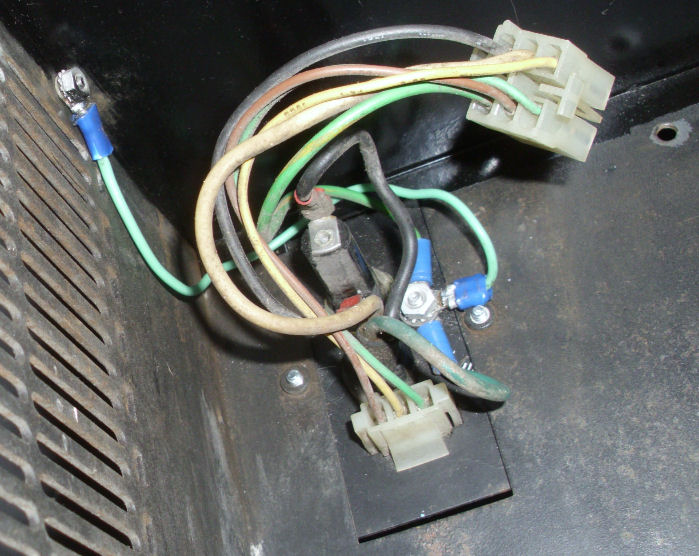
Sure, it's a Kennedy 9832 drive mounted in some sort of giant hard case.
Anyone know if this was a modified drive? What on earth would it be
used for?
--Chuck
> From: John Welch
> Anyway, 'a' comes over as 000141 and 'A' comes over as 000101.
Good, the console is working.
> CLR
> LAD
> DEP
OK, that loads a '0' (halt) in 0.
> CNTRL+INIT
> CNTRL+START -> reads 000002
OK, so it reads the HALT at 0 and stops.
> CNTRL+BOOT -> Run light is on, SR Disp light is on
> CNTRL+HLT reads 173150
Sounds like it may be looping in the high bank of ROM? That's not necessarily
wrong.
I finally figured out what the ROMs in the M9312 do; the ROMs at 765000 are
the first-level diagnostic, and the console. The bootstrap code for the
various devices is at 773000.
> 773024 LAD, 773000 DEP, BUS ERR light comes on.
That makes sense; you can't write to the ROM.
> Any suggestions?
i) Check the ROM contents; there are two kinds of M9312 console ROMs, one for
most CPUs, and one for the 11/60 and 11/70, see the tech manual for the
M9312.
So read out the first couple of words:
CLR
765000
LAD
EXAM
EXAM
etc
and let's see what they read.
ii) Try starting the console code directly:
CLR
765020
LAD
CNTRL+START
> I have other M9312s I could try.
Can't hurt.
Noel
All ?
??????????????? I can?t remember who contacted me originally about potential enhancements to the APE (Altair Peripheral Emulator) that I have mirrored at ape.classiccmp.net.
I heard from Frank Barberis and he mentioned that he?d be willing to make enhancements to the software if there was sufficient interest.
??????????????? So, if we can put together a list of desire enhancement/features I can try to get the ball rolling. Feel free to contact me off-list with ideas. Thanks!
Rich
--
Rich Cini
http://www.classiccmp.org/cinihttp://www.classiccmp.org/altair32
Hello!
I am about to start with the project to archive disks from the Incoterm
system.
This system makes use of the Memorex 651 drive which is somewhat odd. It
has 64 tracks,is hard sectored with 32 sectors and spins at 375 rpm.
But I do have the drive which hopefully still is working. However the
interface connector is nothing like I seen on a floppy drive before.
https://i.imgur.com/TklddLP.jpg
It is a AMP 202515-1 housing. The mating 202516-1 which I need is still in
production and available for purchase from Mouser. The small coaxial
connectors on the other hand has a minimum order of 1000 units and costs 10
euros each...
https://www.mouser.se/ProductDetail/TE-Connectivity/201146-2/?qs=DuOyNqEZh0…
Does anyone know of a source selling something like three coaxial
connectors like this at decent price?
Or maybe a suggestion for another connector that could be modified into fit
somehow? Potentially using glue to fixate it.
Of course the last resort is to just solder some wires directly onto the
drive PCB, but if there is a nice solution I try that first.
> From: John Welch
> Any thoughts?
Concur 100% with Henk's comments.
There is a manual online for the M9312:
http://bitsavers.org/pdf/dec/unibus/M9312_TechRef.pdf
which will tell you what the other start options are (Appendix C), but see
page 3-1, too. Note especially the bit about how the primary dianostics
are run before it starts the console emulator; I forget what it does if
the primary fails, possibly it halts?
Noel
Hello All,
I am looking for a copy of:
Troubleshooting LAN Manager 2 PDF by Michael
Publication date: 10/01/1993
ISBN:155851161X
ISBN13: 9781558511613
I've looked the usual areas and can't find a reasonably priced copy. There
was one on epay for $10 but the day I marked it to watch suddenly it was no
longer available. Interestingly enough the seller has an exact copy w/ the
same description/condition relisted for $67 now...
Alternatively if anyone has a copy of LAN Manager 2 OS (not just the
workstation 3 disk set) w/ manuals that they no longer want I would be happy
to take it off of your hands. Thanks
Thanks in advance
-Ali
Someone just dropped off a mac g3 at the scrapyard I work at and I picked it up.
It has a failing hard drive. Replaced the drive, downloaded and burned
a disk with mac os 8 on it, but it refuses to boot to it. How do I go
about installing the software on this machine?
Not sure if this is the place to ask, but figured it would be worth a
shot. Thanks.
I am reviving an 11/34. Cards are:
Back/Fans [M8266--------]? Front of machine where keypad is.
????????? [M8265--------]
????????? [M9312] [M7859]
????????? [M7762--------]
????????? [OPEN]? [M7860]
????????? [M7840--------]
????????? Bus grant in third from front slot
????????? [M9302] [M7856]
The 7856 is hooked to a cable/null modem (i think)/PC running
XP&Hyperterminal
When I first powered on the programmers console said '7' and I powered
off, then back on, and now it says '5'
Any suggestions as to what to try first?? I may have the bus grant in
backwards.? I have other boards I can try.
Sincerely,
John Welch
:qw
I hope this is vintage enough.
I've been playing around some more with my projects to create VMs /
bootable USB keys with PC DOS 7.1 and DR-DOS.
Right now I'm focusing on DR-DOS 7.1 and the DR OpenDOS Enhancement
Project, because that's FOSS and AFAICS it can be redistributed, which
I can't with DR-DOS 7.02/7.03/7.04/7.05 or DR-DOS 8/8.1, which were
commercially licensed.
I found a download of the last build released:
https://archiveos.org/drdos/
First, it's the wrong size. VirtualBox can't mount it. VMware can.
I truncated it to exactly 2880 sectors using the advice from ``jleg094'' here:
https://forums.virtualbox.org/viewtopic.php?f=4&t=39141
VBox mounts that. But it won't boot, nor in VMware -- it just
displays 2 dots and freezes.
Embarrassingly late in the troubleshooting process, I've found why.
I didn't think to check what was on the image! Foolish of me.
I mounted it on a pre-booted VM and looked, and it's blank! There's
nothing in the image at all.
So, I mounted the empty image file as a loop device, copied the boot
files in there and then the rest of the files in the distro archive.
And lo, it works! It boots my VM just fine, and it's now running 7.01-08.
All I need to do now is work out how to make the hard disk bootable,
and I'm in business.
The DR-DOS 7 SYS command won't do it, as the files aren't named
IBMBIOS.COM and IBMSYS.COM -- they're DRBIO.SYS and DRSYS.SYS.
I copied them to the expected names. SYS completes but the disk won't boot.
Next step will be to try with Norton Disk Doctor.
Anyway, if anyone wants a bootable diskette image with DR-DOS 7.01-08,
complete with FAT32 support -- apparently it can even boot from it --
let me know.
--
Liam Proven ? Profile: https://about.me/liamproven
Email: lproven at cix.co.uk ? Google Mail/Talk/Plus: lproven at gmail.com
Twitter/Facebook/Flickr: lproven ? Skype/LinkedIn/AIM/Yahoo: liamproven
UK: +44 7939-087884 ? ?R/WhatsApp/Telegram/Signal: +420 702 829 053
About 15 years ago I told my girlfriend I wanted an RX8E controller
board for Christmas. I was curious how far she might go to get it for
me. I ended up with two packages: one from her 8 year old daughter
with a bit of 1x8 pine plank (If he wants a board, I'll get him a
board!), the other package was an M8357 that she probably paid way to
much for... Now the girlfriend is my wife and the daughter is getting
married.
This Christmas I am asking for an RK8E. I doubt it can be found at a reseller.
So does anyone have or know of an OMNIBUS RK8E boardset they are
willing to part with? This is an M7104, M7105, and M7106 along with 4
over-the-top edge connector blocks. I have two RK05 drives for a
PDP-11, but my goal is to build an RK05 emulator based on Dave
Gesswein's ST506 disk emulator.
Merry Christmas,
-chuck
TI 99/4a It Lives! but extended basic? acts bizarre...
Great got the video cable 5 bucks from the UK - -SOLVED!
Works and fires up with out the extended basic plugged in
but when I pluged it in and selected the option for extended basic at
book up just hangs no
prompt on screen etc.
I have the screed that TI had that was more of an industrial display
rather than the
screen that was converted TV that may have been earlier.. Heavy little
monitor!
It has a strong mesh looking internal mask on the screen compared to
modern color CRTS/
We also have a Epson looking printer with TI logo to pair up
The goal of course is to set up as a display at SMECC Museum with
some of the other micros
where it can be demo'ed I have the speech module too but have no idea
what to do with that.
Have a disc with cable but need some sort of an expansion to plug it
in.
The adventure continues... as always drop any ideas hits etc to
us///
Learning as we go As I never used or sold any of these when in the biz
back then!
Ed Sharpe Archivist for SMECC _www.smecc.org_ (http://www.smecc.org)
Hi folks,
I?ve been contacted by someone looking for the user guide for this particular beast, an early 90s mono laptop with built-in printer. The usual searches turn up nothing other than pictures and she says she?s found a PDF but in German.
Any clues?
?
Adrian/Witchy
Binary Dinosaurs - Celebrating Computing History from 1972 onwards
> From: Ethan Dicks
> I look forward to taking a stab at this.
I suspect there are a number of people who'd be interested in MASSBUS storage
devices (e.g. me - suddenly all those RH11's I've got are no longer boat-
anchors :-). We should try and organize an group build, to share the load.
Anyone else interested?
Oh, one detail I didn't look at: what's the physical interface this uses?
Hopefully three of the Berg/DuPont connectors (i.e. what's on the RHxx
boards, with flat cables going to the adapter to the standard MASSBUS
connector, a device rejoicing in the name 'Receptacle Housing Assembly'); the
original MASSBUS cables (along with the 'Receptacle Housing Assembly' are now
rare as hen's teeth). And there's also the MASSBUS termination...
Noel
Got the last replacement components I needed for my LA30 restore today,
and finished it up! Here's a short video of the LA30 connected as
console to my restored PDP-11/45:
https://www.youtube.com/watch?v=gMIL2bvUYIs
> From: Aaron Jackson
>> My copy of of the V7 standalone stuff (which I got from the VTServer
>> directory) didn't include an RX driver. Where'd you manage to find one?
> I am using the version from here: https://github.com/sethm/vtserver/
After offline discussion with Aaron, we clarified that that site only has the
binary for the standalone tools. The copy on the TUHS archive:
http://www.tuhs.org/Archive/Tools/Tapes/Vtserver/v7_standalone.tar.gz
although it has the source, doesn't include the RX driver. Does anyone know
the whereabouts for the source for the (later) version of the standalone
stuff, which includes the RX driver? Thanks!
Noel
>
> From: Charles Dickman <chd at chdickman.com>
> Subject: PDP8 ALGOL
>
> I have been looking at the available software for the PDP8,
> particularly languages. I see there was an ALGOL. The source is
> archived on Bitsavers and dbit.
>
> There is some information here:
> http://www.softwarepreservation.org/projects/ALGOL/algol60impl/
>
> Has anyone played with this before? Is there any additional
> information on how to use it?
>
> -chuck
>
I have looked at the 4k ALGOL described here:
http://www.bitsavers.org/pdf/dec/decus/pdp8/8-213_4K_ALGOL.pdf
The paper tape images are here:
http://www.bitsavers.org/bits/DEC/pdp8/papertapeImages/set3/
The RICM also has an original set of the DECUS 8-213 ALGOL paper tapes, but
they are different from the ones on Bitsavers. I need to make images of
these tapes.
Students at the UMN are trying to get ALGOL to run on their PDP-12 so they
can run some benchmarking software.
We haven't been able to get DECUS 8-213 ALGOL working. Any help would be
appreciated.
--
Michael Thompson
> From: Henk Gooijen
> the M7859 is sort of a UNIBUS device. The (front panel) console only
> communicates with the M7859.
Not quite; it does _mostly_ 'do its thing' over the UNIBUS, but there are
also two special lines carried across the DD11-P backplane to the CPU, 'Halt
Request' and 'Halt Grant' (which is why it has to be in the same backplane as
the CPU); more here:
http://gunkies.org/wiki/KY11-LB_Programmer%27s_Console
> I cannot remember whether a demux for the displays is on the console
> PCB, or on the M7859.
I'm not sure exactly what you mean by 'demux', but... the interface between
the board and console is i) 3 bits of digit, and ii) 6 individual select
lines. Code in the micro on the M7859 sends one digit at a time down the 3
'digit' lines, along with the appropriate 'select' line.
> If you get 000000 on the dsipaly and when halted it shows 173066 I
> presume it is looping.
Well, I haven't looked at the M9312 ROM code, but if it's anything like the
M9301 code (which I have dumped and disassembled), looping in the ROM at
173066 is not necessarily bad.
There is a listing of some of the ROM code on BitSavers:
http://bitsavers.trailing-edge.com/pdf/dec/unibus/K-SP-M9312-0-5_Aug78.pdf
but it doesn't seem to cover the stuff at 173000 (which is where the CPU
starts running on power-on) - or maybe I just didn't study the listings
carefully enough.
> If it loops, it will repeatedly read from a device address which is
> most likely the CSR of the boot device.
Depends on the switch settings on the M9312. If it's set to boot, if the
device is there, yes; otherwise it would get a NXM fault. If it's set to go
into the console mode, it's probably trying to read characters (commands)
>from the console.
Noel
> Aaron Jackson
> if I try to dump using vtserver using a floppy which passed the
> diagnostics, it fails.
My copy of of the V7 standalone stuff (which I got from the VTServer
directory) didn't include an RX driver. Where'd you manage to find one?
(I need one for my own use, plus I want to look at the source, to help
with this.)
Noel
> From: Henk Gooijen
A few comments to you about Henk's points:
> Standing in front of the 11/34 processor box (looking at the console),
> slot number 1 is at the right side.
That's for the 10-1/2" box; the 5-1/4" is different. Which is this?
> Each slot has 6 positions. Position A is at the rear side, followed by
> B thru F. Position F is thus at the front side.
I prefer to say that connector A is at the right, when facing the component
side of a hex-wide card which has the handles at the top, and the contact
fingers at the bottom.
(Make doubly sure you never plug a card in backwards! It will almost
certainly kill the card. In theory they are keyed so you can't, but idiots
like me have been known to do it! :-)
> The 4 copper "jumper" traces should be facing the next higher-numbered
> slot.
I.e. on the so-called 'solder' side of the card, not the 'component' side.
(All the cards face the same way.)
> When you power up the system, the display should show 6 octal numbers.
> If only one digit shows a number (7 or 5 or whatever), there is an
> issue with the console itself, or the M7859.
The M7859's are, for some reason, particularly prone to failures. About half
the ones I've seen weren't working at first. There's no one chip that seems
to be the usual suspect, I've seen several different failure modes.
> From: Jerry Weiss
And the same for Jerry...
> It won't seat evenly if reversed. At least that is what my scraped
> knuckles remember.
Nope, they go in quite fine the wrong way around; I just checked.
Make sure they are in the right connector (D) and the right way around; I
haven't checked to see if damage is likely to result on an error - does
anyone know offhand?
> Check the cable orientation.
Note that one DEC manual (the KY11-LB Maintenance Manual) shows the wrong
orientation! See here:
http://gunkies.org/wiki/KY11-LB_Programmer%27s_Console
at "Cable Connection and Documentation Error" for more.
> I believe the cabling for the M7859 is a little different between the two
The /34 has two narrow 'maintainence' cables, the /04 only one. But you can
ignore these if you're not using the maintenance mode on the front console,
and only plug in the wide cable.
Noel
> From: John Welch
> Can you give me a refresher on how to tell which slots are cut? I
> remember having to turn the chassis over and looking for a particular
> wire
Yeah; you can use the G7273 as a 'crib', since it has the NPG jumper on it.
That jumper goes from CA1 to CB1: component side, third connector (counting
>from the A connector), first and second pins (again counting from the A
connector end). A lot of the slots will still have their jumpers in, which
is how you can confirm you're looking at the right pins; look for slots
without them.
> I also have an 11/04 that I went and drug out.
Yeah, the M7263 is the KD11-D CPU, the M7847's are MS11-E's (one of them will
be useful as a first-stage debug for the 11/34, once you've verified, in the
-11/04, that they work - the M7891 MS11-L is rare and valuable, I'd rather not
use that until everything up to that point in the -11/34 is known working -
you could try pulling the two M7847's from the -11/04 and try plugging in the
M7891, to verify that it's sort of OK).
> I am thinking I could put a M9203/M7856 into slot 9, and find a M9312
> for slot 3 and maybe this would fire up. Any suggestions?
As always, first pull all the boards and check the power supply (if it's been
a long time since it was last powered on, re-form the electrolytics in the
power supply first, before powering it on), then put in the _minimal_ set of
boards and get those working.
> I added an M9302 in Slot9-AB and then moved the M7856 from the 11/34 to
> Slot9-CDEF of the 11/04. I put a random M9312 in Slot3-AB I turned on
> the 11/04.
> I have six '0' digits. I push ctrl+hlt and the display shows 173066.
> Looks like things are moving.
Yup, that's working. Now you have a working machine, you can board-swap in
>from the -11/34 to check other boards out. Major, major help!!
The first thing I'd try would be the M7859, KY11-LB, from the -11/34 over
here. If it doesn't work in the -11/04 (with only that board changed), i)
you've isolated the problem, and ii) you can probably use the one from the
-11/04 to get the -11/34 working (unless there's something _else_ broken in
the -11/34 as well).
NOTE: Don't plug the good one from the -11/04 into the -11/34 - or do
anything else with the -11/34 - until you've checked the voltages in the
-11/34!!!
If the M7859, KY11-LB from the -11/34 _does_ work in the -11/04, time to keep
looking. The console itself is so dumb it's unlikely to be the problem, but
you never know; might we worth swapping. I'm having a hard time seeing what
problems in the /34 CPU, etc could cause the symptoms you're seeing - are
they still there with only the absolute minimal board set?
Noel
> From: John Welch
> Any suggestions as to what to try first?
I would _definitely_ start by pulling _all_ the cards you can, to get down to
the simplest possible configuration. Once that works, start adding things
back in, one at a time.
If that configuration doesn't work, first try the obvious things (clean and
re-seat, check voltages, etc). If that doesn't get it running, it's time for
a oscilloscope or logic analyzer. (We can help you through that.)
So I'd start with the CPU (M8266/M8265), front-terminator/bootstrap ROM
(M9312), the front console card (M7859), and rear-terminator (M9302) (which
you need for grant turnaround, see next paragraph). That's it.
IIRC, the /34 will complain if the bus grant chain is not complete (I really
need to look at the prints/ucode to understand why this is so - other -11's
will run basic functionality fine with an interrupted grant chain), so plug in
grant jumpers in every unused slot. Also, check the backplane, to see which
slots have had their NPG jumpers pulled, and either i) use a G7273 jumper (the
dual boards which contain an NPG jumper as well as the BR jumpers) in those
slots, or replace the jumpers.
I _think_ the machine will be OK without any memory, but I don't have a
running 11/34 to test that on. (Only my /04 is running at the moment.) I can
plug my /34 cards in and try it, if that will help. But maybe someone else
knows. So maybe you'd have to add a memory card, but that would _definitely_
be the biggest configuration I'd try until the basic machine is working.
You can examine the MMU registers in the CPU to check that the bus/console etc
are working - first read, then write. And IIRC the CPU general registers are
accessible from the bus too - I know they are in the -11/04 (which uses the
same front console).
Noel
I am trying to wire 3270 support into the DPS8/M emulator.
Multics supports 3270 via a bisync connection to the 3270 controller.
Multics sends commands to the Front End Network processor, which
(originally) passed the commands down the bisync line to the 3270.
I have a running Multics and running 3270 display emulators using tn3270
(3270 over telnet), so I need to write the code that maps the Multics
commands into 3270 controller commands (and vice versa) and manages the
telnet connections to the 3270 display emulators and maps the tn3270
traffic into 3270 controllers.
I don't need to actually implement the bisync communications; the
controller emulator will be running inside the FNP emulator, but I need to
express controller responses to Multics in the bisync format, as Multics is
expecting that the responses arrived over a bisync connection.
The problem is that I have no idea how the 3270 controllers worked; I've
looked through the bitsavers collection; those documents are largely
concerned with the displays and tend to treat the controllers as 'black
boxes' that just do the right thing.
So I am seeking pointers to documentation that will give me a better grasp
of the controller functionality and/or discussions with someone who knows
how they work.....
Thanks,
-- Charles
I've seen rust and dust, but there's an old vaxstation II at Goodwill
Computers in Austin right now (very cheap, anyone welcome to buy it and get
it off my mind) but as most things, I checked out the back and see some
circles of white corrosion on the back where the cards? are contacting the
case.
I don't really have room or time but I don't own anything that uses QBUS or
is almost related to some of the neat iron some of you all collect (I've
mostly collected way too many home computer history items).
Anyway, what is that type of white corrosion on metal? Would one probably
assume this means any bus would be corroded and this wouldn't be a computer
for the faint of heart hobbyist? I've only seen that maybe from batteries
but it's in an unusual place and pattern (I think).
Update:
This is the map of the machine:
........................?? AAA BBB CCC DDD EEE FFF ....................
(Rear/Fans/Power Supply) 1 [M8266----------------] (Front/Keypad/DC ON)
........................ 2 [M8265----------------] ....................
........................ 3 [M9312] [M7859--------] ....................
........................ 4 [M7891----------------] ....................
........................ 5 [M7762----------------] ....................
........................ 6???????? [M7860--------] ....................
........................ 7 [M7840----------------] ....................
........................ 8???????????? GNT ....................
........................ 9 [M9302] [M7856--------] ....................
........................?? AAA BBB CCC DDD EEE FFF ....................
Reseating the ribbon cable on the M7859 changed the display.? I have
replaced the M7840 with a G7273.
Now when I power on it says (dim)0, (bright)0, blank, (dim)0, blank, blank.
I have reseated the M7859, I don't think I have another one.
Maybe I should hit it with a vacuum.
I had forgotten about needing to cut a wire for DMA.? Can you give me a
refresher on how to tell which slots are cut?? I remember having to turn
the chassis over and looking for a particular wire but that was >15
years ago.
On 12/8/2017 3:17 PM, Henk Gooijen wrote:
>
>
>
>
>
> Van: John Welch via cctech
> Verzonden: vrijdag 8 december 2017 21:25
> Aan: cctech at classiccmp.org
> Onderwerp: Revive 11/34
>
>
>
> I am reviving an 11/34. Cards are:
>
> Back/Fans [M8266--------]? Front of machine where keypad is.
>
>??????????? [M8265--------]
>
>??????????? [M9312] [M7859]
>
>??????????? [M7762--------]
>
>??????????? [OPEN]? [M7860]
>
>??????????? [M7840--------]
>
>??????????? Bus grant in third from front slot
>
>??????????? [M9302] [M7856]
> The 7856 is hooked to a cable/null modem (i think)/PC running
> XP&Hyperterminal
>
> When I first powered on the programmers console said '7' and I powered
> off, then back on, and now it says '5'
>
> Any suggestions as to what to try first?? I may have the bus grant in
> backwards.? I have other boards I can try.
>
> Sincerely,
> John Welch
> :qw
>
>
>
>
>
> It is not completely clear (to me) how the modules are installed in the
>
> backplane. Standing in front of the 11/34 processor box (looking at the
>
> console), slot number 1 is at the right side. Each slot has 6 positions.
>
> Position A is at the rear side, followed by B thru F. Position F is
>
> thus at the front side.
>
> There is no confusion about the first 4 slots.
>
>
>
> Slot 1 and 2 hold the 11/34A processor boards, with M8266 in slot 1,
>
> and M8265 in slot 2.
>
> Slot 3, positions A and B has the M9312 bootstrap/terminator board,
>
> and slot3, positions C thru F has the M7859 KY11-LB programmer's console
>
> interface board.
>
> Slot 4 holds the RL11 interface. This module does "DMA", so the NPR
>
> jumper must be cut (open) on the backplane.
>
> Slot 5 has an SPC in positions C thru F. I had to look it up; it is the
>
> DR11-C.
>
>
>
> We are up to slot 6. Now things get "interesting" ... is that M7840 a
typo?
>
> The field guide says that this is a KE11-B Extended Arithmetic Element.
>
> I do not know that board, is it "hex" or "quad"?
>
> Not sure that board belongs there ... and if it is quad, I assume it has
>
> to be in positions C thru F. I would suggest to pull this module, and
>
> check the NPR wire presence on the backplane. You need a G727A or G7273
>
> in this slot when the M7840 is removed.
>
>
>
> If you are not skipping slots (see below), we are now at slot 7. There
>
> is probably a G727A grant continuity card (aka "knockle buster") in
>
> position D. That would be OK, but if the NPR jumper is cut on the
>
> backplane, you would need a G7273 continuity and NPR card in positions
>
> C - D. It is easy to have the G727 put in wrong. The 4 copper "jumper"
>
> traces should be facing the next higher-numbered slot.
>
>
>
> Then you say that the next slot has the M9202 (in position A - B) and
>
> the M7856 (SLU and RTC) in positions C thru F.
> The M9202 connects two system units (backplanes). So, what is the next
>
> backplane?? Or do you have the M9202 in slot 8 and slot 9, positions
>
> A - B?? I have never seen that ...
>
>
>
> I am missing one slot. The 11/34 backplane has 9 slots.
>
>
>
> When you power up the system, the display should show 6 octal numbers.
>
> If only one digit shows a number (7 or 5 or whatever), there is an
>
> issue with the console itself, or the M7859. The 6 digits of the display
>
> are multiplexed. Maybe the connection cable between the console and the
>
> M7859 - damaged/knicked? It is worth checking out the simpler things
first.
>
>
>
> Henk.
--
Sincerely,
John Welch
281-353-4706 Home
713-725-7017 Cell
:qw
> From: Aaron Jackson
> Most of the tests now look something like this:
> ...
> SECTOR ADDRESS ERROR
> EXPECTED SECTOR=18.
> TARGET SECTOR=17.
I wonder if there's a problem with the floppy you are using?
Remember, the RX0x drives can't hard reformat the floppies (as in, write the
sector headers), so if the floopy has a problem, you can't fix it with the
RX02.
Noel
Greetings from Brazil :)
Just got a Tandy 1000 SX. Nice shape, but it is missing the ESC and F10
keys. Would someone have a complete assembly (switch + caps) to sell,
shipping to Brazil incuided?
I'd also be interested in the monitor cable and one or two joysticks.
Thanks!
Alexandre
http://tabajara-labs.blogspot.com
I'm looking after a VAX 4000 for a friend, which has a SCSI Q-bus card
(M5976). If the card did not have the large metal face, would it work in
a Q-bus PDP-11? We are not going to potentially ruin a card by trying
this, but I am interested to know if this is the case.
Thanks,
Aaron.
I'm looking after a VAX 4000 for a friend, which has a SCSI Q-bus card
(M5976). If the card did not have the large metal face, would it work in
a Q-bus PDP-11? We are not going to potentially ruin a card by trying
this, but I am interested to know if this is the case.
Thanks,
Aaron.
I have a microvax set up with VMS 5, running MULTINET (and decnet
locally). The server has a FQDN and after a while being exposed to the
WWW someone out there started using the server as an SMTP relay. I can
disable and clear the queue, but I'd like to block entirely this from
happening in the first place. I'd like to learn more about how this
happens in VMS.
Anyone have had this same problem before? I realize back when VMS 5 was
current it was not so much of an issue, but today it is. I am working on a
solution. I can envision a few ways including blocking the smtp relay port
>from the firewall, but if possible I'd like to set up a VMS Multinet
solution as a learning exercise.
I am open to suggestions, and once I find the solution I'll post it.
I understand that this kind of thing is not cookie cutter, there are
different levels one could address something like this. I have a comcast
business router, and one of the 5 IPs I have is NAT assigned to the
internal 10.1.10 port of the microvax.
This is the same machine I wrote about previously as with then, thanks for
your help. I find the best way to learn is on the actual hardware warts
and all.
Bill
>Date: Sat, 25 Nov 2017 23:27:29 +0000
>From: Philip Pemberton <classiccmp at philpem.me.uk>
>
>Hi folks,
>
>I just picked up a Kodak Diconix 150 Plus portable inkjet printer. No
>power supply or documentation, but it works fine.
<snip>
>Which brings me onto my question... Does anyone have any information on
>this printer?
I have a Diconix 180si, with User Manual and Technical Reference manual.
>I'm mainly looking for a DIP switch table (annoyingly, it won't produce
>a config print - just a test page). I'd also love to find some details
>on the control codes, emulations and character sets it supports.
The 180si does not use DIP switches, so I can't help with that. The Tech Ref manual does have Command Code and Character Set info, however. The whole manual is a bit over 100 pages. I can scan it if you are interested.
>Also - does anyone know what the material on the printhead capping
>station is, or if they're still available?
>It looks like a cardboard or blotting paper pad with a plastic backing
>card. This one is soaked in ink and looks like it could do with being
>replaced. I assume it's to stop the cartridge from drying out?
The 180si uses one also. It "catches a spray of ink which the printer uses to clear the printhead cartridge before printing." A new pad is included in each printhead cartridge container.
>I've put a HP 51604A (expired 2012!) cartridge in there, and it seems
>happy enough.
>Thanks,
>--
>Phil.
>classiccmp at philpem.me.uk
>http://www.philpem.me.uk/
Bob
To everyone who ordered the amazing vintage computer calendars from
us recently - thank you! I trust everyone has received theirs by now
>from the first round.
We still have a few left for those interested! Go
the page below:
http://pcmuseum.ca/shop.asp
If you don't want to use
PayPal, we have alternative payment methods available.
Thanks for your
support--hope everyone has a great holiday season!
I have been working on a HP 2640B terminal. It was mostly about fixing the
"screen mold" problem and cleaning up the liquids that had been seeping out
>from the screen down into the bottom.
The small coaxial wire that connects the 4.9152 MHz clock signal form the
power supply (never seen a crystal controlled SMPSU before!) to the
backplane was broken off, but after fixing that the terminal worked fine.
Just needed some adjustment to the brightness.
With the correct terminfo installed it worked quite well as a serial
terminal to a Linux box.
Then I tried the short 8008 programs that Christian Corti pointed to
http://computermuseum.informatik.uni-stuttgart.de/dev_en/hp2644/diag.html
and
ftp://computermuseum.informatik.uni-stuttgart.de/hp/hp2644
I tried both a couple of times. The terminal enter the LOADER mode but just
hangs completely at the end. I tried different baudrates but no difference.
The selftest STATUS line tell me 40<802 which should indicate that there
are 4k memory in the terminal. However there should be 5k since there is
one 4k board and one combined control store and 1 k RAM board. Maybe there
is a fault in the 1k SRAM? The terminal doesn't complain though.
Regardless, the programs listed either starts at adress 30000 or 36000
which should then be within the available space.
The question is, should these program work for the HP2640B as well? It has
a 8008 but my guess is that the firmware is different from the 2644. What
is the joint experience regarding this? Has anyone ran these small programs
above on a HP2640B?
The HP 2640B firmware consists of four EA 4900 ROM chips which annoyingly
are not anything like normal EPROMs. So dumping will need special
considerations.
Has anyone dumped the HP 2640B firmware already? I didn't find it on
bitsavers.
/Mattis
On Sat, 2 Dec 2017, cctalk-request at classiccmp.org wrote:
> Message: 13
> Date: Fri, 1 Dec 2017 20:39:14 -0500
> From: william degnan <billdegnan at gmail.com>
> Thanks I think this is what I need, just disable smtp within MULTINET. As
> I said in my OP I prefer a VMS or MULTINET solution free of modern hardware
> if possible, now that I know what is possible. I was curious to learn
I also think, depending on the version of Multinet you are running it
should have the option to disable relaying. I know before I installed
PMDF (and used Multinet) I was able to do this. process.com (makers of
Multinet and PMDF) have really good documentation on their website that
you should be able to find the info you seek.
In lieu of that, if you're feeling adventerous ...
I think I remember you mentioning you were running VMS 5. Would PMDF run
on that? (when my Alpha is turned on, currently off as it needs a fan or
two) I run PMDF on my Alpha DS10 running OpenVMS 8.3 and I am able to
block relaying.
Fred
opps yepper large...
a pity not close..
Ed
In a message dated 12/3/2017 5:44:03 P.M. US Mountain Standard Time,
cctalk at classiccmp.org writes:
36".
It is NOT a flatbed.
On Sun, 3 Dec 2017, Ed Sharpe via cctalk wrote:
> how large is it? thx ed#
>
> Sent from AOL Mobile Mail
>
> On Sunday, December 3, 2017 Bob Rosenbloom via cctalk
<cctalk at classiccmp.org> wrote:
> I have a Vidar P-62 large format scanner available to anyone willing to
> come pick it up.
>
> It has a SCSI interface. Drivers for Windows XP are available on the
> web, don't know about newer Windows
> or other operating systems. Also, it's completely untested, I have
> nothing that's has a SCSI interface.
>
> Located in Santa Cruz, CA
>
> Some photos here: http://anifur.com/clist/
>
> Bob
>
> --
> Vintage computers and electronics
> www.dvq.com
> www.tekmuseum.com
> www.decmuseum.org
>
--
Fred Cisin cisin at xenosoft.com
XenoSoft http://www.xenosoft.com
PO Box 1236 (510) 234-3397
Berkeley, CA 94701-1236
I have a Vidar P-62 large format scanner available to anyone willing to
come pick it up.
It has a SCSI interface. Drivers for Windows XP are available on the
web, don't know about newer Windows
or other operating systems. Also, it's completely untested, I have
nothing that's has a SCSI interface.
Located in Santa Cruz, CA
Some photos here: http://anifur.com/clist/
Bob
--
Vintage computers and electronics
www.dvq.comwww.tekmuseum.comwww.decmuseum.org
On Sun, 3 Dec 2017, Mike Stein via cctalk wrote:
> That seems to describe perfectly the approach to our (Canada's) federal
> payroll system that's gone from a $5 million contract to $180m in two
> years, with lots of employees still not getting their correct pay or any
> pay at all
I think it should be called the Icarus Project rather than the Pheonix
Project since Icarus flew too close to the sun and fell to his death in
compoarison to the Pheonix who dies in flames and rises from his own
ashes. I don't see much hope of this Pheonix rising any time soon.
--
Richard Loken VE6BSV : "...underneath those tuques we wear,
Athabasca, Alberta Canada : our heads are naked!"
** rlloken at telus.net ** : - Arthur Black
>
>
> From: Michael Brutman <mbbrutman at brutman.com>
> To: "General Discussion: On-Topic and Off-Topic Posts"
> <cctalk at classiccmp.org>
> Subject: Slightly Meta: Travel tips for people traveling
> internationally with vintage equipment?
> Message-ID:
> <CA+bZ4SBvtz+msX7jjHP8A_2SynZGCQgr683FJ7_TKpghBB0bZQ@
> mail.gmail.com>
> Content-Type: text/plain; charset="UTF-8"
>
> I'm actively working on show planning for VCF PNW and I'm noticing that we
> have a few international travelers planning to attend and exhibit their
> machines/projects. I'd like to put together a FAQ for the logistics of
> traveling with vintage equipment across the US border. If you have ideas
> please let me know.
>
> For example: Should I plan on providing letters in advance stating that a
> person is a registered exhibitor at our show, including details like the
> show location, dates, times, and contact information in case there is a
> question about why somebody is carrying strange looking equipment into the
> US? Is there any sort of paperwork or customs form needed even if nothing
> is being sold or left in the US? Any other gotchas to look for?
>
>
> Thanks,
> Mike
>
I often travel internationally with strange looking electronics. If I am
questioned, I say that it is for my personal use during travel.
If you are bringing things that are very valuable, you can get a Carnet to
temporarily import items to the US and then export them without paying
duty. It is sometimes a painful process to find the right person at the
airport to stamp the Carnet on the way in and out, and often the customs
people have no idea what a Carnet is. The Carnet also costs more than $200
and requires a security deposit based on the value of the item.
https://www.export.gov/article?id=ATA-Carnethttp://www.uscib.org/ata-carnet-faqs-ud-1675/
--
Michael Thompson
There is a seller "potomacestore" that lists a number of items in various
condition.
A HP9866A. very nice if you have the HP9830A but no printer!
https://www.ebay.com/itm/401341724680
A weird Tektronix 8 inch drive thing. The drive resembles the Memorex 651
drives, but could something else. But what is it? The photos are not very
good.
https://www.ebay.com/itm/192119338523
A decent looking Tektronix 4112 terminal:
https://www.ebay.com/itm/401325451012
And some other HP, tektronix stuff.
I have a partial roll but it been outside inside an old hard copy unit for
about 5 years. I need reason you don't see them is they really do have
quite a bit if silver in them. Even in 1976 my employer at the time didn't
care and was doing pretty well of the scrap.
On Dec 2, 2017 6:08 PM, "Randy Dawson via cctalk" <cctalk at classiccmp.org>
wrote:
I considered the Tektronix 4051 hardcopy unit, but my search turned up
zilch for the paper (3M Dry Silver type)
Price is right, the printer looks great, but no source for the paper that I
can find.
randy
________________________________
From: cctalk <cctalk-bounces at classiccmp.org> on behalf of systems_glitch
via cctalk <cctalk at classiccmp.org>
Sent: Saturday, December 2, 2017 7:36 AM
To: Mattis Lind; General Discussion: On-Topic and Off-Topic Posts
Subject: Re: Ebay listings from potomacstore
I know a few of us have bought from them before, my experiences have been
positive. I think the last thing I bought was a Teletype Model 33 ASR that
fell on its face, seller made a pretty good deal as it was local pick-up
and essentially it was a parts bucket at that point.
Thanks,
Jonathan
On Fri, Dec 1, 2017 at 7:28 AM, Mattis Lind via cctalk <
cctalk at classiccmp.org> wrote:
> There is a seller "potomacestore" that lists a number of items in various
> condition.
>
> A HP9866A. very nice if you have the HP9830A but no printer!
>
> https://www.ebay.com/itm/401341724680
[http://i.ebayimg.com/images/i/401341724680-0-1/s-l1000.jpg]<
https://www.ebay.com/itm/401341724680>
VINTAGE HP 9866A Uppercase 5x7 Dot Matrix Printer for HP 9830A Calculator |
eBay<https://www.ebay.com/itm/401341724680>
www.ebay.com
Designed For use with HP 9830A Calculator. Uppercase 5x7 dot cell matrix.
Print speed of 250 lines per minute. Evaluated and Non-Functioning,
R2/Ready for Repair: The equipment must be evaluated prior to sale to
ensure that the resale value will exceed the cost of repairs, and that the
equipment is capable of being repaired. | eBay!
>
> A weird Tektronix 8 inch drive thing. The drive resembles the Memorex 651
> drives, but could something else. But what is it? The photos are not very
> good.
>
> https://www.ebay.com/itm/192119338523
[http://i.ebayimg.com/images/i/192119338523-0-1/s-l1000.jpg]<
https://www.ebay.com/itm/192119338523>
Vintage Tektronix Computer Dual 8 Inch Floppy Drive | eBay<
https://www.ebay.com/itm/192119338523>
www.ebay.com
Did not have test media or interface to conduct further tests. Key
functions tested Potomac eCycle is certified to the R2/RIOS standard which
was created specifically for the Electronics Recyling industry to promote
Environmental, Health and Safety. | eBay!
>
>
> A decent looking Tektronix 4112 terminal:
>
> https://www.ebay.com/itm/401325451012
[http://i.ebayimg.com/images/i/401325451012-0-1/s-l1000.jpg]<
https://www.ebay.com/itm/401325451012>
VINTAGE Tektronix 4112A 15 In. Computer Display Terminal w/RS-232C
Interface | eBay<https://www.ebay.com/itm/401325451012>
www.ebay.com
RS-232C Interface. Evaluated and Non-Functioning, R2/Ready for Repair: The
equipment must be evaluated prior to sale to ensure that the resale value
will exceed the cost of repairs, and that the equipment is capable of being
repaired. | eBay!
>
>
> And some other HP, tektronix stuff.
>
Today, I picked up my trusty HP16C that's been with me through thick and
thin and noticed a black splotch extending across about half the
display. This is with the power off.
Is the LCD display failing? Can it be repaired? This thing has been a
a sidekick of my for a very long time and I'd hate to see it go.
Anyone know?
--Chuck
I have been looking at the available software for the PDP8,
particularly languages. I see there was an ALGOL. The source is
archived on Bitsavers and dbit.
There is some information here:
http://www.softwarepreservation.org/projects/ALGOL/algol60impl/
Has anyone played with this before? Is there any additional
information on how to use it?
-chuck
If anyone is interested, I documented a fairly easy way to prevent third
party SMTP relaying with MULTINET 4.1 on a VMS 5 MicroVAX.
http://vintagecomputer.net/browse_thread.cfm?id=708
I did cheat a little...I set up an email alias on my modern mail server to
forward messages to a single email address on the VAX. This was necessary
because otherwise I'd have to have added the mail host ID of every mail
server permitted to send email to users on the VAX. Also, I will have to
create an alias on the modern mail server for every VAX user who wanted to
get mail.
I agree ultimately that MULTINET email is too limited, but for my purposes
I am satisfied. It's just for the learning experience.
Bill
https://www.ebay.com/itm/263005049078
EBay listing for a "Soviet Magnetic Ferrite Core Memory Board". It looks
like 20 something gigantic cores and a lot of diodes. I am guessing it is
some kind of ROM, but it doesn't look like a rope memory. And maybe the
cores are not cores at all, but some sort of inductor. I've not seen this
before.
Hope this isn't too far off topic, but noticed a SOL-20, Helios-II, and
several disks available in Louisville via Craigslist. Can't afford more
stuff this year myself but price doesn't seem too bad. i don't know the
person that has it, just found it as I was searching.
https://louisville.craigslist.org/sys/d/processor-technology-sol-20/6391107…
Regards, Brian.
I am trying to bring some of my old PDP-11's back to life. Does
anyone have or know of a source for PROM Images? I need the
images for the M8189 (11/23+) and would also love to get the
images for my DECTalk.
bill
On Nov 29, 2017 17:15, "Toby Thain via cctalk" <cctalk at classiccmp.org>
wrote:
> On 11/29/2017 1:47 PM, drlegendre . via cctalk
I didn't have as much luck with Windows Photo Viewer. While it does
support multipage TIF, it seemed to hang after a few pages.
Irfanview is a pretty solid viewer/manipulator under Windows. I've been
using it to burst those TIFs into individual pages before making PDFs out
of them. I'll post a link to them when they're ready.
J
All ?
??????????????? For those interested in APE (the Altair Peripheral Emulator by Frank Barberis), I have recovered the site (with his permission) and Jay has agreed to host it on Classiccmp (thank you Jay!). It can be accessed at http://ape.classiccmp.org.
??????????????? No development has been done on it since 2014 when the original Comcast site went dark.
Enjoy
Rich
--
Rich Cini
http://www.classiccmp.org/cinihttp://www.classiccmp.org/altair32
Hi folks,
After sorting out the Model 4P (thanks to all who provided hints!) and scrubbing it up so it almost looks new again I turned attention to my Model 1 Level II which had been dead for at least the same amount of time as the Model 4. There?s some excellent troubleshooting tips for these machines out there and I quickly discovered a bad RAM chip, swap that for a NOS one and we?d be back in business if the video RAM wasn?t failing.
One of the 4 2102A chips is failing (MEM SIZE becomes OEO SIZE) and I?d like to double check this before I stump up the ukp4 required for a pair of NOS ones, can anyone think of a machine from back then that also used 2102A or 2102LPFC or NTE2102 video RAM?
Cheers!
?
Adrian/Witchy
Binary Dinosaurs - Celebrating Computing History from 1972 onwards
If you have a paper tape reader and no punch, you can now make real working paper tapes using a normal home stencil-cutting machine.
I've written a small command line utility that can take a .PTAP (or any other binary or textfile) and generate output that these
machines will cut. that your reader will read.
It can easily make repair pieces for existing old broken tapes from any byte offset. In addition it can make banner tapes, 5-level
Baudot RTTY tape, your own custom n-level paper tape or cut tapes from other materials such as plastic.
Even if you don't need it to make or repair tapes, it can be used to visualise a paper tape through the console output it produces.
I'd never claim it's any sort of replacement for a real punch, and it's a whole lot slower. But, it does work :)
A simple example to make a tape of the characters ABCDEF with 1/2 inch of sprocket leader and 1/2 inch of trailer:
C:\> ptap2dxf --text="ABCDEF" --leader=5 --trailer=5 --output=ABCDEF.dxf
+---------+
| . |
| . |
| . |
| . |
| . |
| O . O|
| O . O |
| O . OO|
| O .O |
| O .O O|
| O .OO |
| . |
| . |
| . |
| . |
| . |
+---------+
Joiner 0000: data byte 00000000 absolute position 00000011
The resulting ABCDEF.dxf file can be viewed in a DXF viewer such as Inkscape and directly loaded into the paper/vinyl cutter for producing
the actual working tape.
Another example: say you need a repair piece for an absolute loader, starting at byte 57 for 12 bytes. (A repair piece has removeable side
tabs for handling as a self-adhesive vinyl joiner):
C:\> ptap2dxf DEC-11-L2PC-PO.ptap --range=57,12 --joiner --ascii --control
+---------+
| O .O O| JOINER %
| . O | JOINER <STX>
| . | JOINER <NUL>
| O . O| JOINER !
| . OO| JOINER <ETX>
|OOOO .OOO| JOINER
| O. O| JOINER <HT>
| O O.O | JOINER ,
| . | JOINER <NUL>
|O .O | JOINER
| OO . OO| JOINER c
| . O| JOINER <SOH>
+---------+
The output for machine cutting will be in DEC-11-L2PC-PO.dxf
For larger tapes, the output can be chunked into sections which can be cut individually. There are other options to invert, mirror, reposition
the sprocket feed and so on.
If you think you may find it useful, it's fully open source and available at https://github.com/1944GPW/ptap2dxf
It will run on Windows (pre-built exe provided) and Linux and Mac (follow building instructions).
The 26-page illustrated User Manual PDF is at https://github.com/1944GPW/ptap2dxf/blob/master/Documentation/PTAP2DXF_User…
Steve.
(posted this just as the list went down earlier, apologies if it appears twice)
If you have a paper tape reader and no punch, you can now make real working paper tapes using a normal home stencil-cutting machine.
I've written a small command line utility that can take a .PTAP (or any other binary or textfile) and generate output that these
machines will cut. that your reader will read.
It can easily make repair pieces for existing old broken tapes from any byte offset. In addition it can make banner tapes, 5-level
Baudot RTTY tape, your own custom n-level paper tape or cut tapes from other materials such as plastic.
Even if you don't need it to make or repair tapes, it can be used to visualise a paper tape through the console output it produces.
I'd never claim it's any sort of replacement for a real punch, and it's a whole lot slower. But, it does work :)
A simple example to make a tape of the characters ABCDEF with 1/2 inch of sprocket leader and 1/2 inch of trailer:
C:\> ptap2dxf --text="ABCDEF" --leader=5 --trailer=5 --output=ABCDEF.dxf
+---------+
| . |
| . |
| . |
| . |
| . |
| O . O|
| O . O |
| O . OO|
| O .O |
| O .O O|
| O .OO |
| . |
| . |
| . |
| . |
| . |
+---------+
Joiner 0000: data byte 00000000 absolute position 00000011
The resulting ABCDEF.dxf file can be viewed in a DXF viewer such as Inkscape and directly loaded into the paper/vinyl cutter for producing
the actual working tape.
Another example: say you need a repair piece for an absolute loader, starting at byte 57 for 12 bytes. (A repair piece has removeable side
tabs for handling as a self-adhesive vinyl joiner):
C:\> ptap2dxf DEC-11-L2PC-PO.ptap --range=57,12 --joiner --ascii --control
+---------+
| O .O O| JOINER %
| . O | JOINER <STX>
| . | JOINER <NUL>
| O . O| JOINER !
| . OO| JOINER <ETX>
|OOOO .OOO| JOINER
| O. O| JOINER <HT>
| O O.O | JOINER ,
| . | JOINER <NUL>
|O .O | JOINER
| OO . OO| JOINER c
| . O| JOINER <SOH>
+---------+
The output for machine cutting will be in DEC-11-L2PC-PO.dxf
For larger tapes, the output can be chunked into sections which can be cut individually. There are other options to invert, mirror, reposition
the sprocket feed and so on.
If you think you may find it useful, it's fully open source and available at https://github.com/1944GPW/ptap2dxf
It will run on Windows (pre-built exe provided) and Linux and Mac (follow building instructions).
The 26-page illustrated User Manual PDF is at https://github.com/1944GPW/ptap2dxf/blob/master/Documentation/PTAP2DXF_User…
Steve.
Is anyone perhaps interested in any of the following?
It's essentially the remainder of some of my earlier offerings.
I took the time to provide some details (that previously may
have been missing)
I intend to clear out the majority of it by mid-December
(around the 15th), after that it will likely be hauled off
to the recycler.
---- tape drives and media
(pictures: <http://bit.ly/2AjxQYu>, <http://bit.ly/2jxDPkB>,
<http://bit.ly/2AjFkeh>, <http://bit.ly/2zBrv9S>,
<http://bit.ly/2AGR9Ot>, <http://bit.ly/2AI3Dp6>)
-- Ultrium (Linear Tape Open)
- Hewlett-Packard StorageWorks?Ultrium 920 (LTO-3)?external
? half-height tape drive SCSI U320 LVD/SE with auto-termination
- Quantum LTO-3?internal half-height tape drive SCSI U320 LVD/SE
? with auto-termination
- Seagate Viper 200?LTO-1 external full-height tape drive SCSI
? U320 LVD/SE with auto-termination
- Hewlett-Packard, Quantum, Maxell, Fujifilm, Sony, etc.
? LTO-{1,2,3} data and cleaning tape catridges, many new and
? unused, many available?(see pictures)
-- Digital Data Storage
- Hewlett-Packard StorageWorks DAT72?(DDS-5) internal tape drive
? SCSI U320 LVD/SE (possibly with auto-termination; not fully
? sure, need to check)
- Sony SDT-D11000?DAT40?(DDS-4) external tape drive, SCSI
? (LVD?/)SE
- Hewlett-Packard?StorageWorks?DAT160?(DDS-6) data and cleaning
? tapes, several tapes, nearly all new and unused
- Hewlett-Packard?StorageWorks?DAT72?(DDS-5) data and cleaning
? tapes, several boxes, 2~3, largely new and unused
- Hewlett-Packard, Compaq, Maxell, Fujifilm, Sony, etc.
? DDS-{1,2,3,4} data and cleaning tape cartridges, various
? types, many available (see pictures)
---- computer components (multi-platform, cross-architecture)
- Hewlett-Packard-branded S2io/Exar/Neterion 10Gbit?(10GBASE-
? SR) PCI-X NICs, including 850nm transceivers, supported on
? many platforms (including Windows, IRIX and OpenVMS), around
? 5 available
- Hewlett-Packard, LSI, etc. PCI/-X adapters, e.g.: SCSI, FC,
? FC/SCSI duo (hybrid), etc. HBAs, NICs, IEEE-1394a (FireWire/
? i.Link)?adapters and more, various types and (re)brandings
---- software
-- operating system
- Hewlett-Packard?OpenVMS?(I64) Open Source Tools?(2010)
? CD-ROM, in original sleeve
- Hewlett-Packard?Tru64?UNIX V5.1B Documentation?(2010)
? CD-ROM, in original sleeve
- Hewlett-Packard?Tru64?UNIX NHD-7?(New Hardware Delivery)
? kit (2010), in original packaging (unopened), primarily
? intended for e.g. HP AlphaStation/AlphaServer?DS15/A
- Compaq?OpenVMS?Alpha V7.2?(1999) CD-ROM, disc 1 of 2,
? in sleeve
- Compaq?OpenVMS?Alpha V7.2 & V7.2-1 System Crash Mandatory
? Update?(1999) CD-ROM, in sleeve
- Microsoft?Windows?7 Home Premium, NL (Dutch), licenses
? included, 2 available
- Microsoft?Windows?XP Pro?SP2b, NL (Dutch), OEM, only
? media (no license)
-- applications
- Frame?(later Adobe) FrameMaker?for SunOS/Solaris,
? advanced typesetting software, boxed with documentation
? and installation media
- Sybase Database?for OpenVMS?(Alpha), in original jewel
? case
- Syntax TotalNET Advanced Server?for SunOS/Solaris(?),
? boxed
- VITec RasterFLEX?(v4.0) for SunOS/Solaris, boxed
? (pictures: <http://bit.ly/2AoHk4P>,
<http://bit.ly/2j4QsE8>, <http://bit.ly/2Auth07>)
- Sega DreamKey, internet web browser software(?) for
? Sega Dreamcast, in original jewel case
---- books(mostly English and some Dutch)
- various (see picture: <http://bit.ly/2BlLtWu>), on computing/
? computers, computer architectures (e.g. MC68000),the
? history of IBM, also computer graphics, covering software
? like Maya (v2.5), Houdini?(v6~8) and LightWave?3D (v5.5~5.6),
? etc.
---- computer input devices and other peripherals
- Wacom serial?(perhaps also ADB and USB, need to check)
? digitizer tablets, in various sizes
- Logitech PS/2 trackball, barely used
---- Cardbus adapters
- Sitecom USB 2.0, providing 2 ports
- SIIG IEEE-1394a FireWire
---- Apple Macintosh serial & ADB adapters
- Keyspan Mac Serial Adapter (to USB)
- Griffin iMate?ADB to USB adapters, 2 available, one
? includes the original packaging
---- serial cables and converters
- DeLock, generic, etc. DB9, DB25 and conversion cables,
? including straight-through and 'null-modem' varieties,
? fairly large amount available
---- SCSI, SAS/S-ATA and FC cabling
- multi-vendor internal SAS to S-ATA cables, several,
? including in unopened packages
- multi-vendor internal and external SCSI cables,
? several available
- multi-vendor internal and external SCSI terminators,
? mainly LVD/SE (incl. UW and U320) but also HVD, both
? active and passive, several available
- multi-vendor LC (LC to LC) fiber-optical cables
? (contact me about OM type), several available and in
? various lengths
---- PCs and components
- IBM-branded DDR2 RAM R-DIMMs (as kits), I believe 8GB
? in total (I need to check), removed from a working IBM
? x346 server at the time
- ASUS M8N-E, with AMD Athlon64?X2 CPU, 8GB DDR2 RAM and
? documents
- ASUS M2N-E SLI, with AMD Athlon64?X2 CPU, 4GB DDR2 RAM
? and documents
- Cooler Master?600W (AT) PSU
- Cooler Master(?) 460W (AT) PSU
---- SGI (MIPS-powered) IRIX systems and components
- SGI?Tezro &?O3x0?HDD?sled/tray (Intel type), with
? optional blanking/airflow plastic included, at least 1
? (maybe 2, need to check)
- SGI DMediaPro DM10-compatible IEEE-1394a FireWire
? (3.3V) PCI card with cables, SGI DMediaPro?DM10 manual,
? etc., boxed
- SGI IMPACT?(MGRAS)?4MB TRAM module, possibly defective
-- not really interested in selling, but in theory for
?? sale (depending on the offer, I might be persuaded)
- SGI Indigo??IMPACT/10000, with 195MHz MIPS R10000 CPU,
? 1GB RAM, High IMPACT?plus 4MB TRAM, IMPACT Video plus
? VBOB, Plextor CD-ROM?drive, intact bezel, lockbar
? included, etc.
- SGI O2, with 400MHz MIPS R12000 CPU, 1GB RAM, digital
? A/V (AV2) module, Toshiba DVD-ROM drive, intact bezel,
? etc.
---- general 19" rack equipment
- general 1U fan (low-noise ventilator) unit, with
? temperature monitoring & control
- general rack trays (vented), at least one (possibly
? more)
- general rack mounting bars, cable managers and other
? accessories
- general mounting fasteners (RM mounting blocks and
? screws)
---- video games and peripherals
- Nintendo Super Scope?for Super NES?(Nintendo
? Entertainment System), PAL/EUR region, including
? cartridge and documentation
---- graphics monitors, cables and accessories
- Dell UltraSharp?U2412M, 24" IPS LCD monitors, 1~2
? available
- ATEN USB & VGA (HD15) KVMs, with documentation, about
? 2~3 available
- SGI 13W3 (HD13W3 to HD13W3) cable, about 2?~3 meters
? in length
- generic short DVI-D cables (around ~0.5 meters /
? ~1.6 foot), ideal for SGI VBOB plus DM5 with DM2/DM3
- generic component monitor cables, one with RCA (tulip)
? and another with BNC cabling
- generic DVI-D splitters (not sure if I still have
? them, I need to check)
---- video equipment
- JVC DTV Component Multi DT-V20L1D, 22" LCD, full HD,
? 10-bit (Deep Color), professional multi-format
? broadcast monitor, with lots of built-in I/O (HD
? component, HD-SDI, HDCP-capable DVI, composite video,
? etc.), with a few dead pixels
- JVC DTV Component Multi DT-V1710CG, 17" CRT, full HD,
? 10-bit (Deep Color), professional multi-format
? broadcast monitor, with various input modules
? (including SD-, HD-SDI and HD component, also available
? individually, in original boxes)
- Gefen 1080p Scaler for HDMI, boxed, professional-grade
? digital video scaler (picture: <http://bit.ly/2AgQjqS>)
- Miranda ASD-271p, professional analog-to-digital A/V
? signal converter, including external PSU, ?as-is?
? (untested, or not recently tested)
- generic HDMI to 3G/HD-SDI (also SD-SDI capable) bridge
- generic ~20 meter / ~66 feet, HD/3G/+-SDI BNC cable
- DeLock ~10 meter / ~33 feet, HD/3G/+-SDI BNC cables,
? two available and one in the original packaging
- DeLock and generic ~0.5~1 meter / ~1.6 foot, HD/3G/+
? -SDI BNC cables, around 3~5 available
- generic and various other lengths of HD/3G/+-SDI BNC
? cables, several available, some in original packaging
- generic 75? BNC terminators for SDI, many available
---- photo-/cinematographic equipment
-- cameras
- Sony HDR-FX1000E, HD video camera (3-CMOS), with
? optional accessories, like large Sony carrying bag
? (pictures: <http://bit.ly/2BBvxAw>)
- Blackmagic (Design) Pocket Cinema Camera?(BMPCC), RAW
? & 10-bit ProRES, full HD video camera, in original box,
plus optional accessories
-- BMPCC accessories:
?- BMPCC batteries, multiple of Blackmagic Design and one
?? of?Nikon?(original)
- Kamerar QV-1 viewfinder magnifier (loupe)
- ...and more (contact me)
(pictures for all of the above and some of the below:
<http://bit.ly/2j43Icr>)
-- lenses and adapters
- Panasonic Lumix G?II 14mm ?/2.5?prime MFT (Micro Four
? Thirds) lens
- Panasonic?Lumix G X Vario 14-42mm ?/3.5-5.6?Power-
? O.I.S. pancake electronic zoom MFT lens
- Panasonic Lumix 45-200mm ?/4-5.6 Mega-O.I.S. zoom
? MFT lens
- Metabones Speed Booster?Nikon F/G to MFT (focal
? reduction) lens mount adapter
- other MFT lens mount adapters (including with focal
? reduction), see pictures
- Samyang 16mm T/2.2 VDSLR?Nikon F mount DX/APS-C lens
- Sigma EX DG 17-50mm ?/2.8 Nikon F mount DX/APS-C lens
- KMZ Jupiter-8?50mm ?/2 Leica M39 35mm full-frame lens
- Sigma Art DN 013 60mm ?/2.8 E-mount APS-C lens
- Manfrotto 700RC2?lightweight video monopod/tripod head
- Manfrotto 585-1 ModoSteady 3-in-1, compact stabilizer
? rig
---- audio equipment
- Music Group/Behringer?Ultra-Match?SRC-9624, 96KHz
? 24-bit audio?interface, barely used
There might be more, but this is it for now.
Not all is directly related to computers, but most of
it has been used together with them, or can be used
together with them or to document/conserve retro
systems.
Everything is located in the Netherlands.
?- MG
I am looking for a book I remember borrowing from the local library
about late 1980, early 1990
this what remember:
* BASIC programing (type-in listings)
* Advance Graphics
* Polygon graphics
* IBM
* "that's all folks" image on front/back cover
* BSAVE/BLOAD (I think)
* two or three flight sims ( wireframe, filled polygons, AI ), they
looked like Microsoft Flight Simulator 1.0 looking back
* wait press?
Is anyone perhaps interested in any of the following?
It's essentially the remainder of some of my earlier offerings.
I took the time to provide some details (that previously may
have been missing)
I intend to clear out the majority of it by mid-December
(around the 15th), after that it will likely be hauled off
to the recycler.
---- tape drives and media
(pictures: <http://bit.ly/2AjxQYu>, <http://bit.ly/2jxDPkB>,
<http://bit.ly/2AjFkeh>, <http://bit.ly/2zBrv9S>,
<http://bit.ly/2AGR9Ot>, <http://bit.ly/2AI3Dp6>)
-- Ultrium (Linear Tape Open)
- Hewlett-Packard StorageWorks?Ultrium 920 (LTO-3)?external
? half-height tape drive SCSI U320 LVD/SE with auto-termination
- Quantum LTO-3?internal half-height tape drive SCSI U320 LVD/SE
? with auto-termination
- Seagate Viper 200?LTO-1 external full-height tape drive SCSI
? U320 LVD/SE with auto-termination
- Hewlett-Packard, Quantum, Maxell, Fujifilm, Sony, etc.
? LTO-{1,2,3} data and cleaning tape catridges, many new and
? unused, many available?(see pictures)
-- Digital Data Storage
- Hewlett-Packard StorageWorks DAT72?(DDS-5) internal tape drive
? SCSI U320 LVD/SE (possibly with auto-termination; not fully
? sure, need to check)
- Sony SDT-D11000?DAT40?(DDS-4) external tape drive, SCSI
? (LVD?/)SE
- Hewlett-Packard?StorageWorks?DAT160?(DDS-6) data and cleaning
? tapes, several tapes, nearly all new and unused
- Hewlett-Packard?StorageWorks?DAT72?(DDS-5) data and cleaning
? tapes, several boxes, 2~3, largely new and unused
- Hewlett-Packard, Compaq, Maxell, Fujifilm, Sony, etc.
? DDS-{1,2,3,4} data and cleaning tape cartridges, various
? types, many available (see pictures)
---- computer components (multi-platform, cross-architecture)
- Hewlett-Packard-branded S2io/Exar/Neterion 10Gbit?(10GBASE-
? SR) PCI-X NICs, including 850nm transceivers, supported on
? many platforms (including Windows, IRIX and OpenVMS), around
? 5 available
- Hewlett-Packard, LSI, etc. PCI/-X adapters, e.g.: SCSI, FC,
? FC/SCSI duo (hybrid), etc. HBAs, NICs, IEEE-1394a (FireWire/
? i.Link)?adapters and more, various types and (re)brandings
---- software
-- operating system
- Hewlett-Packard?OpenVMS?(I64) Open Source Tools?(2010)
? CD-ROM, in original sleeve
- Hewlett-Packard?Tru64?UNIX V5.1B Documentation?(2010)
? CD-ROM, in original sleeve
- Hewlett-Packard?Tru64?UNIX NHD-7?(New Hardware Delivery)
? kit (2010), in original packaging (unopened), primarily
? intended for e.g. HP AlphaStation/AlphaServer?DS15/A
- Compaq?OpenVMS?Alpha V7.2?(1999) CD-ROM, disc 1 of 2,
? in sleeve
- Compaq?OpenVMS?Alpha V7.2 & V7.2-1 System Crash Mandatory
? Update?(1999) CD-ROM, in sleeve
- Microsoft?Windows?7 Home Premium, NL (Dutch), licenses
? included, 2 available
- Microsoft?Windows?XP Pro?SP2b, NL (Dutch), OEM, only
? media (no license)
-- applications
- Frame?(later Adobe) FrameMaker?for SunOS/Solaris,
? advanced typesetting software, boxed with documentation
? and installation media
- Sybase Database?for OpenVMS?(Alpha), in original jewel
? case
- Syntax TotalNET Advanced Server?for SunOS/Solaris(?),
? boxed
- VITec RasterFLEX?(v4.0) for SunOS/Solaris, boxed
? (pictures: <http://bit.ly/2AoHk4P>,
<http://bit.ly/2j4QsE8>, <http://bit.ly/2Auth07>)
- Sega DreamKey, internet web browser software(?) for
? Sega Dreamcast, in original jewel case
---- books(mostly English and some Dutch)
- various (see picture: <http://bit.ly/2BlLtWu>), on computing/
? computers, computer architectures (e.g. MC68000),the
? history of IBM, also computer graphics, covering software
? like Maya (v2.5), Houdini?(v6~8) and LightWave?3D (v5.5~5.6),
? etc.
---- computer input devices and other peripherals
- Wacom serial?(perhaps also ADB and USB, need to check)
? digitizer tablets, in various sizes
- Logitech PS/2 trackball, barely used
---- Cardbus adapters
- Sitecom USB 2.0, providing 2 ports
- SIIG IEEE-1394a FireWire
---- Apple Macintosh serial & ADB adapters
- Keyspan Mac Serial Adapter (to USB)
- Griffin iMate?ADB to USB adapters, 2 available, one
? includes the original packaging
---- serial cables and converters
- DeLock, generic, etc. DB9, DB25 and conversion cables,
? including straight-through and 'null-modem' varieties,
? fairly large amount available
---- SCSI, SAS/S-ATA and FC cabling
- multi-vendor internal SAS to S-ATA cables, several,
? including in unopened packages
- multi-vendor internal and external SCSI cables,
? several available
- multi-vendor internal and external SCSI terminators,
? mainly LVD/SE (incl. UW and U320) but also HVD, both
? active and passive, several available
- multi-vendor LC (LC to LC) fiber-optical cables
? (contact me about OM type), several available and in
? various lengths
---- PCs and components
- IBM-branded DDR2 RAM R-DIMMs (as kits), I believe 8GB
? in total (I need to check), removed from a working IBM
? x346 server at the time
- ASUS M8N-E, with AMD Athlon64?X2 CPU, 8GB DDR2 RAM and
? documents
- ASUS M2N-E SLI, with AMD Athlon64?X2 CPU, 4GB DDR2 RAM
? and documents
- Cooler Master?600W (AT) PSU
- Cooler Master(?) 460W (AT) PSU
---- SGI (MIPS-powered) IRIX systems and components
- SGI?Tezro &?O3x0?HDD?sled/tray (Intel type), with
? optional blanking/airflow plastic included, at least 1
? (maybe 2, need to check)
- SGI DMediaPro DM10-compatible IEEE-1394a FireWire
? (3.3V) PCI card with cables, SGI DMediaPro?DM10 manual,
? etc., boxed
- SGI IMPACT?(MGRAS)?4MB TRAM module, possibly defective
-- not really interested in selling, but in theory for
?? sale (depending on the offer, I might be persuaded)
- SGI Indigo??IMPACT/10000, with 195MHz MIPS R10000 CPU,
? 1GB RAM, High IMPACT?plus 4MB TRAM, IMPACT Video plus
? VBOB, Plextor CD-ROM?drive, intact bezel, lockbar
? included, etc.
- SGI O2, with 400MHz MIPS R12000 CPU, 1GB RAM, digital
? A/V (AV2) module, Toshiba DVD-ROM drive, intact bezel,
? etc.
---- general 19" rack equipment
- general 1U fan (low-noise ventilator) unit, with
? temperature monitoring & control
- general rack trays (vented), at least one (possibly
? more)
- general rack mounting bars, cable managers and other
? accessories
- general mounting fasteners (RM mounting blocks and
? screws)
---- video games and peripherals
- Nintendo Super Scope?for Super NES?(Nintendo
? Entertainment System), PAL/EUR region, including
? cartridge and documentation
---- graphics monitors, cables and accessories
- Dell UltraSharp?U2412M, 24" IPS LCD monitors, 1~2
? available
- ATEN USB & VGA (HD15) KVMs, with documentation, about
? 2~3 available
- SGI 13W3 (HD13W3 to HD13W3) cable, about 2?~3 meters
? in length
- generic short DVI-D cables (around ~0.5 meters /
? ~1.6 foot), ideal for SGI VBOB plus DM5 with DM2/DM3
- generic component monitor cables, one with RCA (tulip)
? and another with BNC cabling
- generic DVI-D splitters (not sure if I still have
? them, I need to check)
---- video equipment
- JVC DTV Component Multi DT-V20L1D, 22" LCD, full HD,
? 10-bit (Deep Color), professional multi-format
? broadcast monitor, with lots of built-in I/O (HD
? component, HD-SDI, HDCP-capable DVI, composite video,
? etc.), with a few dead pixels
- JVC DTV Component Multi DT-V1710CG, 17" CRT, full HD,
? 10-bit (Deep Color), professional multi-format
? broadcast monitor, with various input modules
? (including SD-, HD-SDI and HD component, also available
? individually, in original boxes)
- Gefen 1080p Scaler for HDMI, boxed, professional-grade
? digital video scaler (picture: <http://bit.ly/2AgQjqS>)
- Miranda ASD-271p, professional analog-to-digital A/V
? signal converter, including external PSU, ?as-is?
? (untested, or not recently tested)
- generic HDMI to 3G/HD-SDI (also SD-SDI capable) bridge
- generic ~20 meter / ~66 feet, HD/3G/+-SDI BNC cable
- DeLock ~10 meter / ~33 feet, HD/3G/+-SDI BNC cables,
? two available and one in the original packaging
- DeLock and generic ~0.5~1 meter / ~1.6 foot, HD/3G/+
? -SDI BNC cables, around 3~5 available
- generic and various other lengths of HD/3G/+-SDI BNC
? cables, several available, some in original packaging
- generic 75? BNC terminators for SDI, many available
---- photo-/cinematographic equipment
-- cameras
- Sony HDR-FX1000E, HD video camera (3-CMOS), with
? optional accessories, like large Sony carrying bag
? (pictures: <http://bit.ly/2BBvxAw>)
- Blackmagic (Design) Pocket Cinema Camera?(BMPCC), RAW
? & 10-bit ProRES, full HD video camera, in original box,
plus optional accessories
-- BMPCC accessories:
?- BMPCC batteries, multiple of Blackmagic Design and one
?? of?Nikon?(original)
- Kamerar QV-1 viewfinder magnifier (loupe)
- ...and more (contact me)
(pictures for all of the above and some of the below:
<http://bit.ly/2j43Icr>)
-- lenses and adapters
- Panasonic Lumix G?II 14mm ?/2.5?prime MFT (Micro Four
? Thirds) lens
- Panasonic?Lumix G X Vario 14-42mm ?/3.5-5.6?Power-
? O.I.S. pancake electronic zoom MFT lens
- Panasonic Lumix 45-200mm ?/4-5.6 Mega-O.I.S. zoom
? MFT lens
- Metabones Speed Booster?Nikon F/G to MFT (focal
? reduction) lens mount adapter
- other MFT lens mount adapters (including with focal
? reduction), see pictures
- Samyang 16mm T/2.2 VDSLR?Nikon F mount DX/APS-C lens
- Sigma EX DG 17-50mm ?/2.8 Nikon F mount DX/APS-C lens
- KMZ Jupiter-8?50mm ?/2 Leica M39 35mm full-frame lens
- Sigma Art DN 013 60mm ?/2.8 E-mount APS-C lens
- Manfrotto 700RC2?lightweight video monopod/tripod head
- Manfrotto 585-1 ModoSteady 3-in-1, compact stabilizer
? rig
---- audio equipment
- Music Group/Behringer?Ultra-Match?SRC-9624, 96KHz
? 24-bit audio?interface, barely used
There might be more, but this is it for now.
Not all is directly related to computers, but most of
it has been used together with them, or can be used
together with them or to document/conserve retro
systems.
Everything is located in the Netherlands.
?- MG
Is anyone perhaps interested in any of the following?
It's essentially the remainder of some of my earlier offerings.
I took the time to provide some details (that previously may
have been missing)
I intend to clear out the majority of it by mid-December
(around the 15th), after that it will likely be hauled off
to the recycler.
---- tape drives and media
(pictures: <http://bit.ly/2AjxQYu>, <http://bit.ly/2jxDPkB>,
<http://bit.ly/2AjFkeh>, <http://bit.ly/2zBrv9S>,
<http://bit.ly/2AGR9Ot>, <http://bit.ly/2AI3Dp6>)
-- Ultrium (Linear Tape Open)
- Hewlett-Packard StorageWorks?Ultrium 920 (LTO-3)?external
? half-height tape drive SCSI U320 LVD/SE with auto-termination
- Quantum LTO-3?internal half-height tape drive SCSI U320 LVD/SE
? with auto-termination
- Seagate Viper 200?LTO-1 external full-height tape drive SCSI
? U320 LVD/SE with auto-termination
- Hewlett-Packard, Quantum, Maxell, Fujifilm, Sony, etc.
? LTO-{1,2,3} data and cleaning tape catridges, many new and
? unused, many available?(see pictures)
-- Digital Data Storage
- Hewlett-Packard StorageWorks DAT72?(DDS-5) internal tape drive
? SCSI U320 LVD/SE (possibly with auto-termination; not fully
? sure, need to check)
- Sony SDT-D11000?DAT40?(DDS-4) external tape drive, SCSI
? (LVD?/)SE
- Hewlett-Packard?StorageWorks?DAT160?(DDS-6) data and cleaning
? tapes, several tapes, nearly all new and unused
- Hewlett-Packard?StorageWorks?DAT72?(DDS-5) data and cleaning
? tapes, several boxes, 2~3, largely new and unused
- Hewlett-Packard, Compaq, Maxell, Fujifilm, Sony, etc.
? DDS-{1,2,3,4} data and cleaning tape cartridges, various
? types, many available (see pictures)
---- computer components (multi-platform, cross-architecture)
- Hewlett-Packard-branded S2io/Exar/Neterion 10Gbit?(10GBASE-
? SR) PCI-X NICs, including 850nm transceivers, supported on
? many platforms (including Windows, IRIX and OpenVMS), around
? 5 available
- Hewlett-Packard, LSI, etc. PCI/-X adapters, e.g.: SCSI, FC,
? FC/SCSI duo (hybrid), etc. HBAs, NICs, IEEE-1394a (FireWire/
? i.Link)?adapters and more, various types and (re)brandings
---- software
-- operating system
- Hewlett-Packard?OpenVMS?(I64) Open Source Tools?(2010)
? CD-ROM, in original sleeve
- Hewlett-Packard?Tru64?UNIX V5.1B Documentation?(2010)
? CD-ROM, in original sleeve
- Hewlett-Packard?Tru64?UNIX NHD-7?(New Hardware Delivery)
? kit (2010), in original packaging (unopened), primarily
? intended for e.g. HP AlphaStation/AlphaServer?DS15/A
- Compaq?OpenVMS?Alpha V7.2?(1999) CD-ROM, disc 1 of 2,
? in sleeve
- Compaq?OpenVMS?Alpha V7.2 & V7.2-1 System Crash Mandatory
? Update?(1999) CD-ROM, in sleeve
- Microsoft?Windows?7 Home Premium, NL (Dutch), licenses
? included, 2 available
- Microsoft?Windows?XP Pro?SP2b, NL (Dutch), OEM, only
? media (no license)
-- applications
- Frame?(later Adobe) FrameMaker?for SunOS/Solaris,
? advanced typesetting software, boxed with documentation
? and installation media
- Sybase Database?for OpenVMS?(Alpha), in original jewel
? case
- Syntax TotalNET Advanced Server?for SunOS/Solaris(?),
? boxed
- VITec RasterFLEX?(v4.0) for SunOS/Solaris, boxed
? (pictures: <http://bit.ly/2AoHk4P>,
<http://bit.ly/2j4QsE8>, <http://bit.ly/2Auth07>)
- Sega DreamKey, internet web browser software(?) for
? Sega Dreamcast, in original jewel case
---- books(mostly English and some Dutch)
- various (see picture: <http://bit.ly/2BlLtWu>), on computing/
? computers, computer architectures (e.g. MC68000),the
? history of IBM, also computer graphics, covering software
? like Maya (v2.5), Houdini?(v6~8) and LightWave?3D (v5.5~5.6),
? etc.
---- computer input devices and other peripherals
- Wacom serial?(perhaps also ADB and USB, need to check)
? digitizer tablets, in various sizes
- Logitech PS/2 trackball, barely used
---- Cardbus adapters
- Sitecom USB 2.0, providing 2 ports
- SIIG IEEE-1394a FireWire
---- Apple Macintosh serial & ADB adapters
- Keyspan Mac Serial Adapter (to USB)
- Griffin iMate?ADB to USB adapters, 2 available, one
? includes the original packaging
---- serial cables and converters
- DeLock, generic, etc. DB9, DB25 and conversion cables,
? including straight-through and 'null-modem' varieties,
? fairly large amount available
---- SCSI, SAS/S-ATA and FC cabling
- multi-vendor internal SAS to S-ATA cables, several,
? including in unopened packages
- multi-vendor internal and external SCSI cables,
? several available
- multi-vendor internal and external SCSI terminators,
? mainly LVD/SE (incl. UW and U320) but also HVD, both
? active and passive, several available
- multi-vendor LC (LC to LC) fiber-optical cables
? (contact me about OM type), several available and in
? various lengths
---- PCs and components
- IBM-branded DDR2 RAM R-DIMMs (as kits), I believe 8GB
? in total (I need to check), removed from a working IBM
? x346 server at the time
- ASUS M8N-E, with AMD Athlon64?X2 CPU, 8GB DDR2 RAM and
? documents
- ASUS M2N-E SLI, with AMD Athlon64?X2 CPU, 4GB DDR2 RAM
? and documents
- Cooler Master?600W (AT) PSU
- Cooler Master(?) 460W (AT) PSU
---- SGI (MIPS-powered) IRIX systems and components
- SGI?Tezro &?O3x0?HDD?sled/tray (Intel type), with
? optional blanking/airflow plastic included, at least 1
? (maybe 2, need to check)
- SGI DMediaPro DM10-compatible IEEE-1394a FireWire
? (3.3V) PCI card with cables, SGI DMediaPro?DM10 manual,
? etc., boxed
- SGI IMPACT?(MGRAS)?4MB TRAM module, possibly defective
-- not really interested in selling, but in theory for
?? sale (depending on the offer, I might be persuaded)
- SGI Indigo??IMPACT/10000, with 195MHz MIPS R10000 CPU,
? 1GB RAM, High IMPACT?plus 4MB TRAM, IMPACT Video plus
? VBOB, Plextor CD-ROM?drive, intact bezel, lockbar
? included, etc.
- SGI O2, with 400MHz MIPS R12000 CPU, 1GB RAM, digital
? A/V (AV2) module, Toshiba DVD-ROM drive, intact bezel,
? etc.
---- general 19" rack equipment
- general 1U fan (low-noise ventilator) unit, with
? temperature monitoring & control
- general rack trays (vented), at least one (possibly
? more)
- general rack mounting bars, cable managers and other
? accessories
- general mounting fasteners (RM mounting blocks and
? screws)
---- video games and peripherals
- Nintendo Super Scope?for Super NES?(Nintendo
? Entertainment System), PAL/EUR region, including
? cartridge and documentation
---- graphics monitors, cables and accessories
- Dell UltraSharp?U2412M, 24" IPS LCD monitors, 1~2
? available
- ATEN USB & VGA (HD15) KVMs, with documentation, about
? 2~3 available
- SGI 13W3 (HD13W3 to HD13W3) cable, about 2?~3 meters
? in length
- generic short DVI-D cables (around ~0.5 meters /
? ~1.6 foot), ideal for SGI VBOB plus DM5 with DM2/DM3
- generic component monitor cables, one with RCA (tulip)
? and another with BNC cabling
- generic DVI-D splitters (not sure if I still have
? them, I need to check)
---- video equipment
- JVC DTV Component Multi DT-V20L1D, 22" LCD, full HD,
? 10-bit (Deep Color), professional multi-format
? broadcast monitor, with lots of built-in I/O (HD
? component, HD-SDI, HDCP-capable DVI, composite video,
? etc.), with a few dead pixels
- JVC DTV Component Multi DT-V1710CG, 17" CRT, full HD,
? 10-bit (Deep Color), professional multi-format
? broadcast monitor, with various input modules
? (including SD-, HD-SDI and HD component, also available
? individually, in original boxes)
- Gefen 1080p Scaler for HDMI, boxed, professional-grade
? digital video scaler (picture: <http://bit.ly/2AgQjqS>)
- Miranda ASD-271p, professional analog-to-digital A/V
? signal converter, including external PSU, ?as-is?
? (untested, or not recently tested)
- generic HDMI to 3G/HD-SDI (also SD-SDI capable) bridge
- generic ~20 meter / ~66 feet, HD/3G/+-SDI BNC cable
- DeLock ~10 meter / ~33 feet, HD/3G/+-SDI BNC cables,
? two available and one in the original packaging
- DeLock and generic ~0.5~1 meter / ~1.6 foot, HD/3G/+
? -SDI BNC cables, around 3~5 available
- generic and various other lengths of HD/3G/+-SDI BNC
? cables, several available, some in original packaging
- generic 75? BNC terminators for SDI, many available
---- photo-/cinematographic equipment
-- cameras
- Sony HDR-FX1000E, HD video camera (3-CMOS), with
? optional accessories, like large Sony carrying bag
? (pictures: <http://bit.ly/2BBvxAw>)
- Blackmagic (Design) Pocket Cinema Camera?(BMPCC), RAW
? & 10-bit ProRES, full HD video camera, in original box,
plus optional accessories
-- BMPCC accessories:
?- BMPCC batteries, multiple of Blackmagic Design and one
?? of?Nikon?(original)
- Kamerar QV-1 viewfinder magnifier (loupe)
- ...and more (contact me)
(pictures for all of the above and some of the below:
<http://bit.ly/2j43Icr>)
-- lenses and adapters
- Panasonic Lumix G?II 14mm ?/2.5?prime MFT (Micro Four
? Thirds) lens
- Panasonic?Lumix G X Vario 14-42mm ?/3.5-5.6?Power-
? O.I.S. pancake electronic zoom MFT lens
- Panasonic Lumix 45-200mm ?/4-5.6 Mega-O.I.S. zoom
? MFT lens
- Metabones Speed Booster?Nikon F/G to MFT (focal
? reduction) lens mount adapter
- other MFT lens mount adapters (including with focal
? reduction), see pictures
- Samyang 16mm T/2.2 VDSLR?Nikon F mount DX/APS-C lens
- Sigma EX DG 17-50mm ?/2.8 Nikon F mount DX/APS-C lens
- KMZ Jupiter-8?50mm ?/2 Leica M39 35mm full-frame lens
- Sigma Art DN 013 60mm ?/2.8 E-mount APS-C lens
- Manfrotto 700RC2?lightweight video monopod/tripod head
- Manfrotto 585-1 ModoSteady 3-in-1, compact stabilizer
? rig
---- audio equipment
- Music Group/Behringer?Ultra-Match?SRC-9624, 96KHz
? 24-bit audio?interface, barely used
There might be more, but this is it for now.
Not all is directly related to computers, but most of
it has been used together with them, or can be used
together with them or to document/conserve retro
systems.
Everything is located in the Netherlands.
?- MG
Hi folks,
I just picked up a Kodak Diconix 150 Plus portable inkjet printer. No
power supply or documentation, but it works fine. It appears to be a
variant of HP's Thinkjet (it certainly uses the same cartridges) tweaked
for portable use. Looking inside, it's full of Chinon ICs, and was
apparently made in Japan (from the baseplate).
This one needed some parts on the DC interface board resoldering, but
after that it worked fine.
Which brings me onto my question... Does anyone have any information on
this printer?
I'm mainly looking for a DIP switch table (annoyingly, it won't produce
a config print - just a test page). I'd also love to find some details
on the control codes, emulations and character sets it supports.
Also - does anyone know what the material on the printhead capping
station is, or if they're still available?
It looks like a cardboard or blotting paper pad with a plastic backing
card. This one is soaked in ink and looks like it could do with being
replaced. I assume it's to stop the cartridge from drying out?
I've put a HP 51604A (expired 2012!) cartridge in there, and it seems
happy enough.
Thanks,
--
Phil.
classiccmp at philpem.me.uk
http://www.philpem.me.uk/
On 11/28/17 13:27, emanuel stiebler via cctalk wrote:
> Dave has a KV10 already in verilog, so why not port it to the uengine?
Well, the uengine would have to be considerably modified before it could be
used for a PDP-10 (e.g. wider data-paths); this version is very specialized
to the SD application (e.g. hardware CRC support, etc).
Noel
does the 71 sate seem early?
In a message dated 11/26/2017 2:38:17 P.M. US Mountain Standard Time,
cctalk at classiccmp.org writes:
The NCR 260 (first part of the part number) was a KSR portable
thermal printing terminal.
Somewhat similar to the Silent 700.
But, the NCR 260 had an integrated modem with acoustic coupler
Hi folks,
A random facebook post made me dig out my model 4P which has never worked as long as I?ve owned it, it?s always just sat on a shelf looking cute.
Good old ASTEC PSU problem so I fixed that, reseated all the thankfully socketed chips and it burst into life. Sort of. I know it?s running because I can turn the brightness up to raster lines and see the pattern actually change when RESET is pressed. With contrast right up I can JUST see the boot logo appear while it reads the floppy.
None of the pots on the video board deal with contrast so I?ve got it out on the bench to remove and test the capacitors. What else can I look at at the same time? Someone else has already mentioned the transistors Q101, Q102 and Q103 (on the yoke board).
Screen pic: http://www.binarydinosaurs.co.uk/trs80Model4PScreen.jpg <http://www.binarydinosaurs.co.uk/trs80Model4PScreen.jpg> - you can JUST see the boot logo, I know it?s not screen burn because it does disappear on RESET and comes back again.
Video board schematic: http://www.binarydinosaurs.co.uk/trs80Model4PVideoBoardSchematic.png <http://www.binarydinosaurs.co.uk/trs80Model4PVideoBoardSchematic.png>
Cheers!
?
Adrian/Witchy
Binary Dinosaurs - Celebrating Computing History from 1972 onwards
So, as part of the work on getting our QSIC card to support SD cards for
storage, Dave and I have produced some tools that people might find useful.
Dave's original concept was to do SD support with a state machine. However,
the SD protocol turned out to be a little too complex for that, so we decided
to create a bespoke micro-engine (hereinafter 'uengine' - I use 'u' in place
of the lower-case 'mu' all the time) to handle it.
This turned out to be a good call; Dave cranked out a uengine in Verilog
(which was incredibly quick to produce), and I whipped up (literally - the
first version was done overnight) a uassembler. The latter has since been
much improved; the current version reads the entire definition of the uengine
>from a configuration file, and thus should be usable on any umachine.
So, if you need a uassembler for some project, here's one. (And if you need
something it can't do, let me know, and I can add stuff; e.g. it doesn't
currently support the '+' operator in literals, only '|', but it would be
fairly simple to add '+' if anyone had a use for it.)
The source is here:
http://ana-3.lcs.mit.edu/~jnc/tech/QSIC/tools/uas.c
(and no, I don't have the energy to learn how to use sourceforge or github to
distribute it, so don't bug me about it). I wrote it under Cygwin on Windows,
but Dave compiled and runs it on Linux as-is, so it's pretty portable.
The current output format is hex that Dave massages into 'ROM' contents on
the FPGA in some fashion I don't know the details of, but if anyone needs
something different, again, I'd be happy to add whatever's needed.
The source syntax supported is documented in comments at the start of the
uassembler source; it's pretty simple, here's a brief synopsis (see the file
for more detail). ucode is a collection of lines, one per micro-instruction.
The syntax for individual lines is:
{<label>:} <operator>{, <operator>}... {<literal>}
<operator> can be either: <value> (symbolic) or <field>=<fvalue> (where
fvalue can be symbolic or numeric); specific symbolic values are assigned by
the configuration file (where they are defined) to specific fields.
<literal> is <data>{|<data>}... where <data> is symbolic (a label, or a
value) or numeric. Forward references to labels are supported. Numeric items
(everywhere) are either octal, decimal or hex. Whitespace (either space(s) or
tab(s)) can be used in most places. Comments start with a ';' or '/', and the
rest of the line is ignored.
A sample umachine configuration file (for the QSIC uengine) is here:
http://ana-3.lcs.mit.edu/~jnc/tech/QSIC/tools/ueng
and the (simple) format of the config file is documented in the comments at
the start.
A sample source file for uas for that uengine is here:
http://ana-3.lcs.mit.edu/~jnc/tech/QSIC/sd.asm
if you want to see what source looks like.
Dave has a github site where all his stuff is available; the latest version
of the ucode is here:
https://github.com/dabridgham/QSIC/blob/master/verilog/sd.asm
and the whole thing is here:
https://github.com/dabridgham/QSIC
including the Verilog for the uengine. Dave reports that it should be easy to
adapt his uengine design to other uses, it should run in pretty much any
FPGA. So if you want to build a PDP-15 (or a Multics! :-) in an FPGA, there
you go. Dave indicates he'd be happy to help anyone who needs to tweak the
uengine design for their particular application.
Hopefully someone will find this useful!
Noel
Anyone on here have any old RS/6000 parts? I have an old C10 I'm trying to beef up a bit for a project. I'm after the following (pardon the lame table):
FC FRU Qty Desc
3033 74G8824 2 2.2GB SCSI-2 Fast/Wide Disk Drive
4012 9H5583 8 32MB SIMM Memory
4224 02G7431 1 Ethernet 10BaseT Transceiver
3107 31G4126 1 Serial Port Converter Cable D/T 7008,7009
51G7737 1 System Unit SCSI Terminator
Also interested in some MCA blanks, if anyone has some extras lying around.
Thanks!
I was given two boards that were "spares for a PDP-11/40." The
business that I got my PDP-11/40 from was cleaning out storage and
found these two boards and gave them to me.
It looks like board 2 is for a Sun 3/50 workstation. Board 1 is some
kind of micro-programmed processor based on AM29331 and AM29331. There
are also some Analog Devices DSPs.
AM29000 based processor with Analog Device DSPs
http://www.chdickman.com/board1.jpg
Sun 3/50 processor
http://www.chdickman.com/board2.jpg
Can anyone identify them?
-chuck
COURYHOUSE at aol.com wrote:
> what is this NCR modem? what did it go to?
>
> NEW Vintage 1971 NCR Acoustic Coupler Modem, NOS, Factory Boxed, C260-400
> / F01 132411929563 on the bay
It is a Bell 103A compatible modem (110 or 300 baud) used with the NCR 260
series of thermal printing terminals. The 260 came in several variants:
-1 (receive only), -2 (keyboard send/receive), -6 (Automatic (cassette tape)
send/receive). I worked with them at NCR in 1973 and 74. I still have
the manuals, and just a few days ago scanned them for Bitsavers. If you
need a copy I can send you the raw TIFF files (one per page).
Both the -400 and -500 were EIA I/O to the terminal. The C260-400 connected
to a Bell System DAA (Data Access Arrangement), while the C260-500 was an
acoustic coupler. The acoustic coupler had a solenoid that would would
automatically raise and lower the handset on the telephone!
Back in those days you could not connect anything directly to the telephone
lines -- you had to use the telco-supplied DAA (kaching!) or an acoustic
coupler. I don't know if this modem can be connected directly to a phone
line without a DAA.
I think the asking price is totally unrealistic unless you are a rabid
collector of NCR gear.
Alan Frisbie
OK! Shades of the crown answering machine we have in the museum with the
handset lifter!
Yea the price is defiantly a barrier on this except for Paul Allen I
suppose.
Ed# _www.smecc.org_ (http://www.smecc.org)
In a message dated 11/27/2017 12:16:16 P.M. US Mountain Standard Tim,
cctalk at classiccmp.org writes:
COURYHOUSE at aol.com wrote:
> what is this NCR modem? what did it go to?
>
> NEW Vintage 1971 NCR Acoustic Coupler Modem, NOS, Factory Boxed, C260-400
> / F01 132411929563 on the bay
It is a Bell 103A compatible modem (110 or 300 baud) used with the NCR 260
series of thermal printing terminals. The 260 came in several variants:
-1 (receive only), -2 (keyboard send/receive), -6 (Automatic (cassette
tape)
send/receive). I worked with them at NCR in 1973 and 74. I still have
the manuals, and just a few days ago scanned them for Bitsavers. If you
need a copy I can send you the raw TIFF files (one per page).
Both the -400 and -500 were EIA I/O to the terminal. The C260-400
connected
to a Bell System DAA (Data Access Arrangement), while the C260-500 was an
acoustic coupler. The acoustic coupler had a solenoid that would would
automatically raise and lower the handset on the telephone!
Back in those days you could not connect anything directly to the telephone
lines -- you had to use the telco-supplied DAA (kaching!) or an acoustic
coupler. I don't know if this modem can be connected directly to a phone
line without a DAA.
I think the asking price is totally unrealistic unless you are a rabid
collector of NCR gear.
Alan Frisbie
thanks for dates. yes that all makes sense. some how my mind slipped a
decade.
I a looking for a GE Diginet tdm-114 acoustic coupler.
2 reasons, GE computer related
but also my first acoustic coupler I had with an ASR-35 teletype
I am also looking for the top mental plate that covers an ASR-35 punch
also.
( drop me a line off list if you have either you want to sell/trade/?)
thanks ed# _www.smecc.org_ (http://www.smecc.org)
In a message dated 11/26/2017 3:38:36 P.M. US Mountain Standard Time,
cctalk at classiccmp.org writes:
On Sun, 26 Nov 2017, COURYHOUSE at aol.com wrote:
> does the 71 sate seem early?
No, a 1971 date does not seem too early.
The price seems steep, even for a "relatively" early modem.
Bell 103 (300bps) dates from 1962.
The Bell 101 (110 baud) was 1958.
SCROTUS "Carterfone" was 1968 (ruling permitting direct connect)
Bell 212A (1200bps) came out in 1976.
The Livermore Data Systems modems that I sold off were from about 1964?
1970-1972, when I was working at Goddard Space Flight Center (Bldg 26,
"National Space Sciences Data Center"), we used a time-sharing system for
APL. APL type ball on Selectric terminal.
Yes, 1971 is prior to most mass-marketed "personal computers"
(1978?: Apple, PET, TRS80).
But there were teminals.
Where: Living Computers: Museums+Labs (Seattle, WA, USA)
When: February 10th and 11th, 2018
Registration deadline: December 10th, 2017 (About 2 weeks left)
We have about 15 registered exhibitors now. We are looking for a few more
to fill things out and to ensure that if somebody drops out that the show
doesn't look too thin. The exhibits span a wide range so it won't be a
pure 8 bit gaming or a DEC heavy iron show.
If you are procrastinating about being an exhibitor then it is time to
register ... If I can answer questions to help you decide then email me.
This is our first time in Seattle; the bar is low so don't be too worried
about having the perfect exhibit.
We are still looking for speakers too; the floor is pretty open. If you
did something cool during your career or just want to share aspects of the
hobby with others, this is a great place to do it. (I especially enjoyed
Lyle's talk on repair and restoration at VCF West.)
Interested or know somebody who is? Check out at
http://vcfed.org/wp/festivals/vintage-computer-festival-pacific-northwest/
. Please email me directly if you have questions or need encouragement.
Regards,
Mike Brutman
michael at vcfed.org
what is this NCR modem? what did it go to?
NEW Vintage 1971 NCR Acoustic Coupler Modem, NOS, Factory Boxed, C260-400
/ F01 132411929563 on the bay
not mine etc etc etc
ed#
This one is already on Bitsavers but if you'd like a nice original
copy with the fold-out schematics and color cover, I'll send it to you
for the cost of shipping from 60070.
The manual is in fairly good shape, bent a bit near the spine and the
glue is starting to crack. Still an essential display accessory for
your 9-track.
-j
I just got my HP-85 working for the first time over the weekend (except for its tape drive, which is still a work in progress). I'd like to acquire some accessories for it:
1) HP 82903A 16k RAM module
2) HP 9122C dual 1.44M 3.2" floppy diskette drive
Do any of y'all have either of those items available for swap or sale? I'm located in southern California.
Those two items are at the top of my HP-85 want list, but I might also be interested in other related bits such as the 82940A GPIO Interface, other compatible HPIB mass storage, etc.
--
Mark J. Blair, NF6X <nf6x at nf6x.net>
http://www.nf6x.net/
Free for shipping from 95006, a stack of original IBM documents for the
S/360 including Field Engineering Manuals and Systems Reference Library
documents plus others - dumpster rescues from an engineer's estate.? All
have been hi res scanned.
Titles from the IBM Systems Reference Library as well as several Field
Engineer Manuals.? Everything except one doc is an original publication
(and the dup looks like it was done contemporary to the other
originals).? Dates on everything are late 60s or early 70s.
some titles:
Field Engineering Manual Vol 1 3277
Field Engineering Manual Vol 1 3271
Engineering Reference Manual Automatic Punches
System 360 Model 40 Functional characteristics
System 360 System Summary
System 360 Basic Operating System Specifications File utilities
IBM 46-47 Tape to Card Punch Manual of Operation
IBM Systems Reference Library 7 Oct 1968 Cumulative Index of Pubs and
Programs
No parsing out individual titles - this is all or nothing.? Box weight
is ~28lbs ( and it's all paper - there are no 3 ring binders adding to
the weight).
It can ship media rate - figure 29 lbs by the time I get packing matl
and tape included.
First requester gets it..
Steve Shumaker
Boulder Creek, CA
Hi folks,
I can't seem to find the "Networking Support Utilities" package for
the 3B2 anywhere online. Unfortunately, this package is required in
order to install TCP/IP (which I DO have)
(Note that this is NOT the "Basic Networking Utilities" package --
that's UUCP, and I do have that)
If anyone has diskette images squirreled away, please let me know!
-Seth
--
Seth Morabito
web at loomcom.com
> From: Liam Proven
> TCP/IP basically postdates the MS-DOS era, in PC terms, and it's Bloaty
> McBloatface.
This must be a uSloth TCP/IP you are speaking of. There's the one from FTP
software which was based on the one done at MIT which was freeware. That one
was definitely DOS-era - it ran on DOS 1 and DOS 2. I think I have the MIT
version somewhere if you have a use for it.
> But only someone who thinks that Emacs or Vi are usable editors could
> think this was an appealing virtualisation solution.
Epsilon! Even on Windows 95, it was a not-so-humungous 261KB. If Lugaru
can't cough up a DOS version, I'm pretty sure I still have my DOS Epsilon
distro disks somewhere. Of course, I would have to get a 5" floppy drive
working... :-)
Noel
Hi all,
I was given an MTI MXV21 controller which is apparently compatible with
the RX02 drive. The card has a 50 pin header, but the RX02 drive has a
40 pin ribbon cable. Does anyone know what am I missing here?
I don't see anything about this in the manual:
http://bitsavers.informatik.uni-stuttgart.de/pdf/microTechnology/MXV21_flop…
Thanks,
Aaron.
Jon,
Then why not use a dip compatible version of the DS chip? I mean yes this allows for switchable battery which is very nice but SMT soldering is not for everyone.
I wonder if there is a way to determine if there will be BIOS issues by switching the DS12887?
-------- Original message --------
From: Jon Elson <elson at pico-systems.com>
Date: 1/22/17 9:16 AM (GMT-08:00)
To: General at classiccmp.org, "Discussion at classiccmp.org:On-Topic and Off-Topic Posts" <cctalk at classiccmp.org>
Subject: Re: DS12887 pcb substitute with battery
On 01/22/2017 10:07 AM, Ali wrote:
> Al,
> I thought the problem with switching these chips was that part of the ROM code was embedded in them? I.e. it isn't just an issue of battery? Am I wrong? If I am then why not use one of the replacement chips that are available?
>
These don't have a lot of memory on them.? many early PCs
stored some config info there, but generally the BIOS can
reconstruct it if it isn't there.? I suppose there is a
possibility that random data in the CMOS memory could cause
the BIOS to try to use unavailable features and hang.? I
don't think anybody put actual executable code in there.
Jon
So Dave Bridgham and I are continuing to make (slow) progress with the QSIC
and indicator panel project; the latest step was to find some LEDs which look
much more like the original lights:
http://pdp10.froghouse.org/qsic/new-led.jpg
So now I'm trying to make up a prototype 'light shield' (the flat board with
all the holes drilled in it); the parts list in the drawings (RF11 engineering
drawings, pg. 187) just calls it a 'Benelex', which is the name for the
material it was made of (sort of like MDF), but 'light shield' is what I've
taken to calling it.
Anyway, the drawings there do not, alas, give any dimensions. Can one of the
people who has an original please measure it for me? Just WxLxD is all I need;
I have a good photo, and can get all the other measurements I need from that,
once I know the 'scale'. (Well, not the depth, which I can't see in the image,
which is why I need that to.)
Thanks!
Noel
Here is an interesting article from early 1988 (probably written in min
1987) that compares and contrasts GUIs of the day. Interesting that they
do not mention OS/2 by name, by this point it would have been available,
given I used it in Jan 1987 when I was working at IBM. Also the XEROX
interface was not yet dead as the author makes it seem. If anyone used
Page Maker on a 1987/88 Xerox machine and compared that with "Windows OS/2"
machine trying to run the Page Maker on a PS/2 80 you'd probably agree.
Basically I am unsure what planet the author was from, but you can decide
for yourself. Talks a little about HP's GUI product, Sun/AT&T, Apple
Finder, etc. Mentions NeXT is coming, Commodore is dead, ... opinionated.
http://vintagecomputer.net/cisc367/PC-Letter_19880118.pdf
Bill
Hi:
The following answer comes from a retired IBM tape technologist:
The color of the coatings on a tape are dominated by the magnetic pigment (or the carbon used in back coats..which is black)..the earliest iron oxide coatings were based on the conversion of alpha-iron oxide which is a pale yellow and some what needle shaped (longer than wide) but non-magnetic to gamma iron oxide which is magnetic. The very early particles were not very homogeneous and were very highly aggregated....poor conversion as the early particle were being produced by paint pigment manufactures as a specialty product in low volume. These were a yellow brown color..but by the 60's gamma iron oxide of 250-300 Oe was commonly used in the magnetic layer coatings. These were typically brown to chocolate brown (if they had some carbon black mixed in for surface conductivity (anti-static) which depending on the use as well as the manufacturer varied a lot i n surface finish (gloss) as well). This market was driven by audio primarily and dynamic range and analogue signal characteristics such wow & flutter were driving formulation and magnetic particle development.
In the late 60-s and 70's new particles began to enter the market..Cobalt doped and later cobalt 'modified" gamma iron oxide as well as chromium dioxide..and some very early explorations of iron metal particles and some exotic mixed metal crystals... The colors of the magnetic coatings based on more acicular gamma iron oxide made specifically for the recording market were now reddish brown , cobalt doped were a dark brown - to black, chromium dioxide is very black..remember during this period digital recording in both tapes and disks were now the growth areas driving new pigment development and drastically improved formulations driven by the need for improved durability, longevity and wear characteristics (drop outs (defects & debris), head wear and head/drive contamination being increasingly problematic)..in the 90's metal particle and BaFe pigments took over tape while disks moved to thin film magnetic layers.
As for reel materials and hub evolution..the initial reels were metal and expensive...plastic became normal in the 60's and beyond for the most part..but for master copies or sensitive archival reels..glass or metal were preferred... but changes in the materials were driven by the higher tape speeds,tensions and demands for improved reliability and durability. Hubs in some drives had to be conductive so had carbon black or metals added to them to improve the compressive strength and conductivity. A lot of very innovative but subtle design features moved into tape reels/hubs specifically designed for various transports and industry demands. In addition lubrication and binder changes were common as the needs for the various products in audio, video and digital recording advanced.
Hope this helps..but if the interest is primarily in getting a useful detailed knowledge of a particular tape..color is pretty much useless..you need SEM/EDAX and GC/MS and a database of tape analyses to compare to in order to really begin..and then to really know the tape you need DMA/DMTA mechanical analysis, and AFM/MFM surface profiles.....but to my knowledge only IBM had that data and I imagine it ..like so much of that knowledge learned from 1962-2008 is now gone.
Tom
-----Original Message-----
From: Chuck Guzis [mailto:cclist at sydex.com]
Sent: Monday, November 20, 2017 10:35 PM
To: CCtalk
Subject: Idle question: Color of tape coatings
While working on some old (again!) half-inch tapes, I note that some of the very old ones have an oxide coating about the color of milk
chocolate. Newer ones are anywhere from dark chocolate to black.
Reel construction is another aspect. The really old ones tend to be all clear plastic, including the hub area. Newer ones have either a black plastic reinforcement to the hub or employ an aluminum sleeve.
In most cases, the oldest of these is from around 1964, but probably older than that, as the only clues I have are dates placed by the tape librarian when a tape is put back into the pool or a label indicating when the tape was last recertified.
Was there a date after which *all* half-inch tape became the dark brown to nearly black in color?
--Chuck
I've always thought STD-Bus missed a real opportunity here. Small
enough to be cost effective (relative to the size of, say, S-100
(bonus, no stupid power supply issues)), sane, flexible enough bus
structure that I believe there are at least CPU cards using:
- 4004/4040 (pre-standard?)
- 8080/8085/Z-80 and the myriad of variants
- 8088/8086/80188/10186 through at least 80486, including variants and
second sources
- 8048/8051 and the vast numbers of variants
- 8096/8097 and variants
- 6800 and variants
- 68HC11 and variants
- 6809/6309
- 6502 and variants
- 68xxx and variants up to at least the 68040 and 68332
- TMS9900/9995
- RCA 1802
- Signetics 2650
- Novix Forth
More importantly, the vast number of compatible I/O cards that were
produced. Much alternative history to be pondered.
KJ
Looking into fabricating a few (functional-only) copies of the Tektronix diagnostis rom pack
Seems quite a few people have non-functional units...
Any interest out there ?
Jos
This looks to me like the power supply and backplane of a PDP 11/05, looks
to be in nice shape. Surprised no one grabbed this yet, esp someone with
an 11/05 that has issues with power supply. Someone might have the missing
parts.
"DEC PDP-11 Digital BA11-KE Mounting Box"
https://www.ebay.com/itm/DEC-PDP-11-Digital-BA11-KE-Mounting-Box/28265372079
granted "all you need are the cards and the front panel" reminds me of the
steve martin routine. "It's easy to be a millionaire, first get a million
dollars and then ...."
Compare with
http://vintagecomputer.net/browse_thread.cfm?id=622
b
The fascinating discussion Jim just started on buses got me thinking
again about a book I've been trying to track down for a while. While
it's not necessarily classic-computing-oriented, it's not really about
newfangled computers either; heck, I encountered it in 2003 or so, so
it'd be pretty dated by now.
Basically, I'm looking for a certain book (although really any book in
the same vein would satisfy), which was on computer system architecture,
organization, etc.; it talked about the usual boolean logic, assembly
programming in some fictitious instruction set, an overview of two
actual architectures (I think at that time they were 32-bit x86 and
64-bit POWER). The other thing I remember very specifically was there
was a place near the back (probably an appendix) that talked about
one or more specific buses (I think at least PCI was there), with timing
diagrams to tell you what was actually going back and forth between the
bus and CPU.
Like I said, I'm sort of keen on finding the exact book I had, but I
realize that's somewhat unrealistic, so I'm open to recommendations on
any book like that. And if it can cover the relavant concepts for both
classic and newish computers, that would be great.
Basically what I hope to learn is how you actually deal with
peripherals, add-in cards, etc., on the assembly language level, and
what that really translates into on a signaling level. I only really
know a little about how to do that in memory-mapped IO systems like the
Commodores (and to be honest I don't understand how the buses work
there, just how to poke and peek.)
Thanks!
--
Eric Christopherson
On Tue, Nov 21, 2017 at 1:51 AM, Mattis Lind <mattislind at gmail.com> wrote:
> I think this is a 3/60 processor. Not 3/50.
I said 3/50 because that is what the silkscreen says. I found some
picture online and the 3/50 was a different layout. It sure looks like
a 3/60
Looking at some online schematics it looks like the P3 96 pin DIN
connector may only be for power. Is it possible to power this thing
through that connector without a proper chassis?
I know nothing about Sun hardware.
-chuck
Hi folks,
I'm picking my way through an LA30 restoration right now. It was pretty
filthy, so I've needed to pretty thoroughly disassemble it for proper
cleaning.
I noticed that a few of the thin steel ribbon springs in the paper path
are missing or broken on my unit, and some of the rubber bushings have
hardened and deteriorated. Long shot ask, but wondering if anybody out
there has spares of:
74-08648 (Spring, paper drag)
12-10357-3 (Bushing, rubber mount)
12-10358-3 (Ring, rubber mount)
Also, the maintenance manual recommends Molykote B2KR for lubrication in
a few places, but I can't seem to find specs on what this was. Can
anybody recommend an equivalent modern alternative grease?
cheers,
--FritzM.
> From: Fritz Mueller
> Overall, I have been pretty amazed by the sheer number of machined
> parts, castings, high quality bearings, etc. within this beast. Lots of
> stainless steel throughout. Sure wouldn't find anything built this way
> these days! What a tank.
That's DEC for you - quality engineering (mostly :-). Reminds me of this
Porsche/Lotus story:
http://www.chiappa.net/~jnc/nontech/chapman.html
Alas, that kind of engineering turned into a liability when DEC tried to
compete in the 'new world' of personal computers... :-(
Noel
Hi,
do hardware manuals for the TWIN exist? And does any other TWIN system
exist? It seems it is a completely forgotten and lost development system.
Christian
> From: Charles Anthony
> a hybrid PDP-11 (16 bits) / PDP-15 (18 bits) on a shared bus (UNIBUS?)
That's a UNICHANNEL-15: it allowed devices on the -11 to do DMA directly into
the PDP-15's memory through the MX15-B Memory Multiplexer.
Odd factoid: this UNIBUS could run in 18-bit mode (!!), where the UNIBUS' two
parity lines were recycled into 2 extra data lines. Some DMA interfaces (e.g.
the RK11) could support this; in this particular case, it allowed the PDP-15
to use RK05 drives.
Noel
While working on some old (again!) half-inch tapes, I note that some of
the very old ones have an oxide coating about the color of milk
chocolate. Newer ones are anywhere from dark chocolate to black.
Reel construction is another aspect. The really old ones tend to be all
clear plastic, including the hub area. Newer ones have either a black
plastic reinforcement to the hub or employ an aluminum sleeve.
In most cases, the oldest of these is from around 1964, but probably
older than that, as the only clues I have are dates placed by the tape
librarian when a tape is put back into the pool or a label indicating
when the tape was last recertified.
Was there a date after which *all* half-inch tape became the dark brown
to nearly black in color?
--Chuck
I have a couple of vaxes that output 'unique' video, Alpha 3000 300,
Alpha 3000 400, Vax 4000 VLC, and Vax Station 3100 M76.
The Alpha and VLC each have a 3W3 type of connector and the 3100 has a
15 pin DEC designed connector.
What does it take to connect these to inexpensive, modern VGA light
weight monitors?
Doug
On Nov 20, 2017 7:41 AM, "Tapley, Mark via cctalk" <cctalk at classiccmp.org>
wrote:
Catching up late, sorry if this is an old question, but what did
the Digital Group computers use? My recollection is that they offered cards
with 6800, 6502, 8080, and Z-80 CPUs on the same bus, and that part of the
system seemed to work reasonably well.
The Digital Group had two separate buses, a memory bys and an I/O bus, as
well as two other slot types incompatible with either bus, for a CPU card
and a TVC (video and cassette) card. They didn't support interrupts or DMA
on any bus. If you wanted to use an interrupt, you had to wire it over the
top. Doc Suding said that he didn't put interrupts on the bus because
(paraphrasing) they are complicated and you don't need them.
As you say, they did support various CPUs, but not more than one in a
system. I wouldn't recommend that anyone consider The Digital Group as an
example of good bus design.
I recently acquired a TI Silent 700 model 787 terminal. This cc 1980
unit is an interesting member of the Silent 700 family as it is capable
of 120 chars/sec printing and has an internal 300/1200 baud direct connect
modem that does Bell 103, Bell 212A and Vadic modulation in both originate
and answer modes.
It's a got a DB25 on the back for directly connecting serial but I don't
have any documentation on how to choose the internal modem vs the DB25
for comms or any pinouts for this DB25 outside the usual expectations
of RS232 on a DB25.
Seeking any documentation that might be around. Happy to cover copying
costs or purchase a manual if it is excess to someone's needs.
Chris
--
Chris Elmquist
> From: Allison
>> I would seriously consider shared data/address lines, like on the QBUS.
> QBUS is wrapped around a subset of PDP11 and the unique processors made
> to fit it.
I did say "like ... the QBUS", not "the QBUS"! I was just trying to make the
point that the original sketch assumed separate address and data lines, and
that's an assumption worth looking at.
> The bottom line is for every bus you have to get on and off with
> devices to buffer ... The more you use the less card there is for other
> things
Yes, but that cuts both ways: multiplexed address and data also saves you a
lot of bus transceivers.
Noel
I'm currently working on a single board computer system, designing from
scratch partially as an education experience, and also as something that
might be of interest to others.
I've laid out the first version of the SBC, and I realize it would cost
nothing to add an edge connector on the PCB, allowing expansion
options.? As well, assuming the design has any merit, I can see creating
one of these SBcs for each family (8080/Z80, 65XX, 68XX, and maybe even
16 bit options like TMS9900, 68K, etc.)
However, as the design is not *for* any purpose, and I've never designed
a bus that could be shared among multiple CPUs, I am wondering what bus
layout would satisfy the following criteria:
* At least enough to support a traditional 8 bit CPU (A0-15,D0-7,
RESET, READ/WRITE,CLOCK,INTERRUPTS) with potentially a few more
address bits (A16-23)
* Minimal number of bus signals to support multi-processors and
peripheral cards, but not so few that usefulness is severely crippled
* Easy to implement (minimize need for logic that serves to solely
handle the bus)
* (If 16 bit data bus is part of the design): Easy for 8 and 16 bit
CPUs and peripherals to share the bus (Maybe this means 16 bit units
need to be constrained to 8 bit, not sure)
* Works out to a size that I can buy edge connectors cheaply (62 pin
.100" connectors are looking like my cheap option at present)
I looked at home computer busses (Atari, Apple, Commodore, Tandy, TI)
for a bit of inspiration, but they all seem overly simplistic (not
horrible, but hate to just punt on the idea).? I also looked at the ISA
bus and the S-100 bus, but they are a bit overwhelming to me (I can grok
all the signals, but ensuring they are all responsive seems like it will
drive more logic be on the PCB jsut to handle the bus, and I am trying
to keep costs very minimal).
Thus,
Is there a bus (or a fraction of a bus standard) that I should consider
to accommodate the above?? Anyone else interested in this idea and in a
collaborative mood?
Jim
--
Jim Brain
brain at jbrain.comwww.jbrain.com
This is a pretty far-fetched request, but here goes.
The quick-release levers on the HP 7970 tape drive are plastic.
They're starting to get brittle. I've got one that's showing cracks, so
I swapped it the the one on the takeup reel, as that one doesn't see as
much action as the one on the supply reel.
What I'd really like to find is the older twist-to-tighten mechanisms on
the 7970. I suppose I can get busy in my shop and make some, but I'm
wondering if there are any lurking in someone's hell box.
Thanks for reading!
Chuck
> From: Allison
> simple 16 data, 24 address likely 6 lines for basic control plus others
> your up to 50+ lines
I would seriously consider shared data/address lines, like on the QBUS. It
doesn't add _that_ much complexity to share the lines (I did a slave device
using only 74xxx parts, and it was dead simple - probably a goal of the
designers), and it will really drop the pin count. The speed impact is not
too bad - on reads, where the address and data naturally happen at different
times, it can be none.
Noel
> From: Sophie Haskins
> earlier editions of "Computer Systems: A Programmers Perspective" had a
> bunch of discussions of buses etc .. but the edition I have explicitly
> calls out that they felt like it wasn't important to have chapters on
> anymore :(
Well, that might not be the wrong call, _iff_ keeping them in would have
increase the cost of the text-book for (poor) student...
And for the rest of us, there's ABE for the earlier editions! :-) Which
edition do you have, may I ask? Thanks!
Noel
Thanks Chunk. I am going to see if Manchester University library has any
old documentation that might help.
Cheers
Peter
On 17 November 2017 at 18:00, <cctalk-request at classiccmp.org> wrote:
> Send cctalk mailing list submissions to
> cctalk at classiccmp.org
>
> To subscribe or unsubscribe via the World Wide Web, visit
> http://www.classiccmp.org/mailman/listinfo/cctalk
> or, via email, send a message with subject or body 'help' to
> cctalk-request at classiccmp.org
>
> You can reach the person managing the list at
> cctalk-owner at classiccmp.org
>
> When replying, please edit your Subject line so it is more specific
> than "Re: Contents of cctalk digest..."
>
>
> Today's Topics:
>
> 1. Re: Drive capacity names (Was: WTB: HP-85 16k RAM Module and
> HPIB Floppy Drive (Geoffrey Reed)
> 2. Re: Drive capacity names (Was: WTB: HP-85 16k RAM Module and
> HPIB Floppy Drive (Chuck Guzis)
> 3. Re: Drive capacity names (Was: WTB: HP-85 16k RAM Module and
> HPIB Floppy Drive (Liam Proven)
> 4. Re: Drive capacity names (Was: WTB: HP-85 16k RAM Module and
> HPIB Floppy Drive (Fred Cisin)
> 5. TI NaturalLink Disks and Docs (Jason T)
> 6. Re: HP 9836U processor mystery... (Josh Dersch)
> 7. Re: Playing with HP2640B (CuriousMarc)
> 8. Re: Cases (display) for beloved ISA cards? (CuriousMarc)
> 9. Re: Playing with HP2640B (Christian Corti)
> 10. Re: Playing with HP2640B (David Collins)
> 11. Re: Playing with HP2640B (David Collins)
> 12. Re: Playing with HP2640B (Mattis Lind)
> 13. RE: Playing with HP2640B (Rik Bos)
> 14. DR-DOS (Liam Proven)
> 15. Re: TI NaturalLink Disks and Docs (Jason T)
> 16. Re: DR-DOS (Liam Proven)
> 17. Re: DR-DOS (Liam Proven)
> 18. Re: DR-DOS (william degnan)
> 19. Re: Cases (display) for beloved ISA cards? (Anders Nelson)
> 20. Re: DR-DOS (geneb)
> 21. Re: DR-DOS (Liam Proven)
> 22. Re: DR-DOS (Liam Proven)
> 23. Re: DR-DOS (geneb)
> 24. Re: WTB: HP-85 16k RAM Module and HPIB Floppy Drive
> (Eric Schlaepfer)
> 25. Manchester University Joint System in the 1970s (Peter Allan)
> 26. Re: WTB: HP-85 16k RAM Module and HPIB Floppy Drive (Paul Berger)
> 27. Re: Playing with HP2640B (Christian Corti)
> 28. Re: Manchester University Joint System in the 1970s (Chuck Guzis)
>
>
> ----------------------------------------------------------------------
>
> Message: 1
> Date: Thu, 16 Nov 2017 12:30:08 -0800
> From: Geoffrey Reed <geoffr at zipcon.net>
> To: Fred Cisin <cisin at xenosoft.com>, "General Discussion: On-Topic and
> Off-Topic Posts" <cctalk at classiccmp.org>
> Subject: Re: Drive capacity names (Was: WTB: HP-85 16k RAM Module and
> HPIB Floppy Drive
> Message-ID: <D63332E6.5367F%geoffr at zipcon.net>
> Content-Type: text/plain; charset="ISO-8859-1"
>
>
>
> On 11/15/17, 9:44 AM, "cctalk on behalf of Fred Cisin via cctalk"
> <cctalk-bounces at classiccmp.org on behalf of cctalk at classiccmp.org> wrote:
> >
> >Can you name another 20 exceptions? (Chuck and Tony probably can)
> >
> >
> >--
> >Grumpy Ol' Fred cisin at xenosoft.com
>
>
> ?Floptical? disks 720 rpm 1.6 Mb/s transfer 1250 TPI and 25MB unformatted
> capacity
>
> LS-120 and LS-240 (which sadly I can?t remember the specs of :(
>
>
>
>
> ------------------------------
>
> Message: 2
> Date: Thu, 16 Nov 2017 12:51:19 -0800
> From: Chuck Guzis <cclist at sydex.com>
> To: Geoffrey Reed via cctalk <cctalk at classiccmp.org>
> Subject: Re: Drive capacity names (Was: WTB: HP-85 16k RAM Module and
> HPIB Floppy Drive
> Message-ID: <a5877e73-9b6c-f5fa-afdf-ef59f1f6caa1 at sydex.com>
> Content-Type: text/plain; charset=utf-8
>
> On 11/16/2017 12:30 PM, Geoffrey Reed via cctalk wrote:
>
> > ?Floptical? disks 720 rpm 1.6 Mb/s transfer 1250 TPI and 25MB
> unformatted
> > capacity
> >
> > LS-120 and LS-240 (which sadly I can?t remember the specs of :(
>
> How about the Caleb "it" drive (UHD144):
>
> http://www.obsoletemedia.org/caleb-uhd144/
>
> I've still got a stack of those drives and media.
>
> Or the DTC "TakeTen" drive (got the drive but no media), or the Qume
> Hyperflex drive or the Kodak/Drivetec floppy drives or the DTC TeamMate
> for Apple...
>
> The list is very long indeed.
>
> --Chuck
>
>
>
> ------------------------------
>
> Message: 3
> Date: Thu, 16 Nov 2017 23:28:19 +0100
> From: Liam Proven <lproven at gmail.com>
> To: Geoffrey Reed <geoffr at zipcon.net>, "General Discussion: On-Topic
> and Off-Topic Posts" <cctalk at classiccmp.org>
> Subject: Re: Drive capacity names (Was: WTB: HP-85 16k RAM Module and
> HPIB Floppy Drive
> Message-ID:
> <CAMTenCE8EoxJxw_W_wBz+53Hfp752Ji2+kw60X8LKxoecvon3A@
> mail.gmail.com>
> Content-Type: text/plain; charset="UTF-8"
>
> On 16 November 2017 at 21:30, Geoffrey Reed via cctalk
> <cctalk at classiccmp.org> wrote:
> >
> > ?Floptical? disks 720 rpm 1.6 Mb/s transfer 1250 TPI and 25MB
> unformatted
> > capacity
>
> Just FYI, your quote marks render on Linux as superscript 2s.
>
> Using an Apple device? You might want to turn off smart quotes...
>
> https://www.jordanmerrick.com/posts/ios-11-smart-punctuation/
>
> http://appleinsider.com/articles/17/09/26/tips-turn-
> off-ios-11-smart-punctuation-to-avoid-data-entry-problems
>
> --
> Liam Proven ? Profile: https://about.me/liamproven
> Email: lproven at cix.co.uk ? Google Mail/Talk/Plus: lproven at gmail.com
> Twitter/Facebook/Flickr: lproven ? Skype/LinkedIn/AIM/Yahoo: liamproven
> UK: +44 7939-087884 ? ?R/WhatsApp/Telegram/Signal: +420 702 829 053
>
>
> ------------------------------
>
> Message: 4
> Date: Thu, 16 Nov 2017 15:27:53 -0800 (PST)
> From: Fred Cisin <cisin at xenosoft.com>
> To: "General Discussion: On-Topic and Off-Topic Posts"
> <cctalk at classiccmp.org>
> Subject: Re: Drive capacity names (Was: WTB: HP-85 16k RAM Module and
> HPIB Floppy Drive
> Message-ID: <Pine.LNX.4.64.1711161437490.4440 at shell.lmi.net>
> Content-Type: TEXT/PLAIN; charset=ISO-8859-1; format=flowed
>
> >>> No, the 9122C has two high-density, two-sided 80 cylinder drives. A
> drive
> >>> has no capacity, this is the function of the on-disk format.
> >>> ;-)
> >>
> >> "high-density" is even more meaningless than referring to them by their
> >> capacity in a given format. It is a BOGUS marketing term!
>
> On Thu, 16 Nov 2017, Christian Corti via cctalk wrote:
> > Fred, you should know by now that you don't need to tell *me* the correct
> > definitions and terms.
>
> I know that, but I was addressing the entire group with my rant, and not
> everybody is as closely familiar with these details as you are.
>
> > And with "high-density", I didn't mean the media capacity but the analog
> > recording aspects like coercivity, write current, frequency and so on.
>
> Actually, when speaking about the MEDIA, it is much easier to create a
> name that is both accurate and unambiguous.
> For example, with 5.25" disks, we have "5.25 inch with 300 Oersted" and
> "5.25 inch with 600 Oersted".
> Of course, if somebody wants to be difficult, there are still variant
> forms, including both 10 and 16 sector hard-sectored, Amlyn 600 Oersted
> with special cutouts for the disk changer, Twiggy, no-notch disks for some
> minor tamper resistance in software distribution, etc.
>
> >> Unformatted capacity would be a more correct nomenclature, although ...
> > Unformatted capacity doesn't tell you much without reference to the
> recording
> > layout, i.e. no. of tracks, modulation, frequency and so on.
>
> True.
>
> >> Some specifications:
> >> 5.25" MFM "High Density" was 360 RPM at 500,000 bits per second. (about
> 1M
> >> unformatted per side)
> >
> > What about 5?" FM "High Density" at 360 RPM?
>
> By "Some specifications", I meant specifications of SOME examples of the
> most common form of each size. I was absolutely not intending it to be
> an exhaustive, comprehensive list of all possibilities.
>
>
> > The Amiga (more exactly, the "HD" Chinon FZ-357A drives used in Amigas)
> > switched to 150 RPM to keep the raw bit rate at 250kbits/s.
>
> THAT is exactly what I was including as examples in my later "exceptions"
> list. Although a different disk size, that is the same engineering kludge
> as the Weltec 5.25" 180RPM drive.
>
> >> 3.5" MFM "ED" (vertical recording?/barrium ferrite) were 300 RPM at
> >> 1,000,000 bits per second. (2M unformatted per side) NeXT referred to
> >> theirs by the unformatted capacity: 4M, further confusing their users.
> > What about FM?
>
> Again, just listing examples of most common, NOT intending it as a list of
> all possibilities that were theoretically possible. I have never seen an
> ED disk recorded FM, and do not believe that there was ever a commercial
> system that used that. If you know of one, please give us the details!
>
>
> >> Can you name another 20 exceptions? (Chuck and Tony probably can)
> >
> > Do you want me to start with things like 100tpi drives, GCR, M?FM,
> > hard-sectored and other crazy formats?
>
> It can be a very long list. I was trying to stick with ones that were
> very close to the main branch of our "current" evolutionary tree, but
> there isn't a clear boundary. I estimate that there were approximately
> 2500 different microcomputer floppy disk formats, with a large portion of
> those being variant forms, not just different choices of number and size
> of sectors, directory location and structure, etc.
> I implemented just over 400 formats in XenoCopy that were straight-forward
> to handle with IBM PC hardware. Those are not all that could have been
> implemented, nor does it deny the existence of many variants, or
> completely different ones that are not feasable with PC.
>
> > Just accept that I am not as dumb as you may think.
>
> I have NEVER thought that you were dumb. Everything that I have seen
> of your posts has been competent and well-informed. But, I don't think
> that you follow what I was attempting to convey.
>
> I wanted to:
> 1) rant about marketing creating terminology, including "double density"
> and "high density". And creating a new definition of Megabyte (1,024,000)
> for the "1.44M" format (1,474,560 bytes/1.40625Mebibytes)
>
> 2) state my opinion that using the specific one that comprises at least
> 75%? of the use of a given configuration as the name for that
> configuration creates a name that is admittedly inaccurate, and fraught
> with exceptions, nevertheless relatively unambiguous, at least to the
> extent that purchases will usually be usable.
>
> If I buy "360K diskette", it will usually be the 300 Oersted 5.25 inch,
> and be the closest of what is available to buy for 87.5K TRS80,
> Apple2, PET, Osborne, PC 160K/180K/320K/360K, DEC Rainbow, Canon AS100,
> Elcompco, Eagle, Otrona, etc.
> Yes, there were people who used 41 or 42 tracks of a 40 track drive, but I
> consider those to be "corner cases", to be considered as alterations, not
> as the main form.
> Admittedly, there were differences in testing between SSSD, DSSD, DSSD,
> DSDD, and 48tpi v 96tpi marketing of disks with the same chmical
> formulation. Purchasing diskettes now for something such as a DEC
> Rainbow, I would settle for the 360K testing.
>
> If I buy "720K 3.5 inch diskette", I expect to receive 600 Oersted 3.5"
>
> If I buy "1.44M Diskette", I expect to receive a "HD" 3.5 inch diskette,
> with about 720 to 780 Oersted.
>
>
> BUT, as you've pointed out, when we refer to the DRIVE, we can't really be
> certain that it won't be misinterpreted unless we list every spec that we
> expect it to conform to. Or order by manufacturers model number.
> Shugart/Matsushita 455/465/475
> Tandon TM100-2/TM100-4
> Teac 55B, 55F, 55G, 55FG, etc.
> (EXAMPLES. NOT TO BE CONSTRUED AS A "complete" LIST)
>
> BTW, Tandon made a 100tpi drive (TM100-4M) for Micropolis compatability,
> but many/most? of those are mislabelled "TM100-4" (missing that critical
> 'M' modifier!)
>
> --
> Grumpy Ol' Fred cisin at xenosoft.com
>
> ------------------------------
>
> Message: 5
> Date: Thu, 16 Nov 2017 21:16:08 -0600
> From: Jason T <silent700 at gmail.com>
> To: "General Discussion: On-Topic and Off-Topic Posts"
> <cctalk at classiccmp.org>
> Subject: TI NaturalLink Disks and Docs
> Message-ID:
> <CAEfH1SGBOxKUXW3rQmNGaLxsnVDZ3=D-Pe-+A9NTLRFtjJ+itg at mail.
> gmail.com>
> Content-Type: text/plain; charset="UTF-8"
>
> I have imaged disks and scanned docs for an old software authoring
> tool from Texas Instruments, "NaturalLink". It runs on early IBM PCs
> and was included with some docs I was given for the TI Professional
> Computer, an almost-PC clone. There are a number of ads and articles
> about NaturalLink in the various trade mags available via Google
> Books.
>
> The docs are here:
>
> http://chiclassiccomp.org/docs/index.php?dir=%2Fcomputing%2FTI/NaturalLink
>
> And the disk images are here:
>
> http://nocarrier.net/archive/floppy_images/PC/TI/NaturalLink/
>
> Regular 360k MS-DOS images. I haven't tried them in DOSBox yet but
> it'll probably run there.
>
> I have the original manuals, along with some other Professional
> Computer manuals that were already on Bitsavers, free for shipping if
> anyone wants them. They're not light. I can include the NaturalLink
> disks as well, otherwise those will stay in my library. Unfortunately
> I don't have any of the (special format) OS media for the
> Professional.
>
> Enjoy!
>
> -j
>
>
> ------------------------------
>
> Message: 6
> Date: Thu, 16 Nov 2017 20:11:57 -0800
> From: Josh Dersch <derschjo at gmail.com>
> Cc: "General Discussion: On-Topic and Off-Topic Posts"
> <cctalk at classiccmp.org>
> Subject: Re: HP 9836U processor mystery...
> Message-ID:
> <CADBZjLZ9AeUWiQhuo_-F+xZjPA=p9De=MDG3n+km0tRWWyTAfQ at mail.
> gmail.com>
> Content-Type: text/plain; charset="UTF-8"
>
> On Mon, Nov 6, 2017 at 8:59 PM, Tony Duell <ard.p850ug1 at gmail.com> wrote:
>
> > On Tue, Nov 7, 2017 at 4:52 AM, Josh Dersch via cctalk
> > <cctalk at classiccmp.org> wrote:
> >
> > > I'm curious if other people out there with 9836U's can confirm whether
> > their
> > > machine has a 68000 or a 68010 in it, I'd just like to settle the
> > internet
> > > discrepancy once and for all :).
> >
> > Mine identifies the CPU as a 68010 in the power-on diagnostic. But from
> > what
> > I remember the PGA socket could also take a 68012 (with extra address
> pins
> > brought out). I don't have such a chip, so no idea what it would identify
> > as.
> >
>
> I picked up a 68012 (cheap) and stuck in in the 9836U this evening. It
> works, and is identified as a 68012 during power-up diagnostics.
>
> So now we know. Now what am I gonna do with all that address space? :)
>
> - Josh
>
>
>
> >
> > -tony
> >
>
>
> ------------------------------
>
> Message: 7
> Date: Thu, 16 Nov 2017 23:12:54 -0800
> From: CuriousMarc <curiousmarc3 at gmail.com>
> To: Mattis Lind <mattislind at gmail.com>, "General Discussion: On-Topic
> and Off-Topic Posts" <cctalk at classiccmp.org>
> Subject: Re: Playing with HP2640B
> Message-ID: <C27C94AA-8CEB-4330-9D51-760B18A13CB1 at gmail.com>
> Content-Type: text/plain; charset=us-ascii
>
> What did you do for the screen mold? Hot wire method to separate CRT from
> implosion window? Put the CRT in a hot water bath? Chip at the glue?
> Marc
>
>
>
> On Nov 15, 2017, at 11:48 AM, Mattis Lind via cctalk <
> cctalk at classiccmp.org> wrote:
>
> I have been working on a HP 2640B terminal. It was mostly about fixing the
> "screen mold" problem and cleaning up the liquids that had been seeping out
> from the screen down into the bottom.
>
> The small coaxial wire that connects the 4.9152 MHz clock signal form the
> power supply (never seen a crystal controlled SMPSU before!) to the
> backplane was broken off, but after fixing that the terminal worked fine.
> Just needed some adjustment to the brightness.
>
> With the correct terminfo installed it worked quite well as a serial
> terminal to a Linux box.
>
> Then I tried the short 8008 programs that Christian Corti pointed to
>
> http://computermuseum.informatik.uni-stuttgart.de/dev_en/hp2644/diag.html
>
> and
>
> ftp://computermuseum.informatik.uni-stuttgart.de/hp/hp2644
>
> I tried both a couple of times. The terminal enter the LOADER mode but just
> hangs completely at the end. I tried different baudrates but no difference.
>
> The selftest STATUS line tell me 40<802 which should indicate that there
> are 4k memory in the terminal. However there should be 5k since there is
> one 4k board and one combined control store and 1 k RAM board. Maybe there
> is a fault in the 1k SRAM? The terminal doesn't complain though.
>
> Regardless, the programs listed either starts at adress 30000 or 36000
> which should then be within the available space.
>
> The question is, should these program work for the HP2640B as well? It has
> a 8008 but my guess is that the firmware is different from the 2644. What
> is the joint experience regarding this? Has anyone ran these small programs
> above on a HP2640B?
>
> The HP 2640B firmware consists of four EA 4900 ROM chips which annoyingly
> are not anything like normal EPROMs. So dumping will need special
> considerations.
>
> Has anyone dumped the HP 2640B firmware already? I didn't find it on
> bitsavers.
>
> /Mattis
>
>
> ------------------------------
>
> Message: 8
> Date: Thu, 16 Nov 2017 23:25:43 -0800
> From: CuriousMarc <curiousmarc3 at gmail.com>
> To: Ethan via cctalk <cctalk at classiccmp.org>
> Subject: Re: Cases (display) for beloved ISA cards?
> Message-ID: <DCE4C2E5-58CF-4CEF-87F0-B0B11833D622 at gmail.com>
> Content-Type: text/plain; charset=us-ascii
>
> I use shadow boxes from Michael's to display my boards. They have many
> kinds
> http://www.michaels.com/-black-shadowbox-studio-decor/
> M10322044.html?dwvar_M10322044_color=Black
> Marc
>
>
>
> On Nov 16, 2017, at 8:04 AM, Ethan via cctalk <cctalk at classiccmp.org>
> wrote:
>
> This message has no content.
>
> ------------------------------
>
> Message: 9
> Date: Fri, 17 Nov 2017 10:09:58 +0100 (CET)
> From: Christian Corti <cc at informatik.uni-stuttgart.de>
> To: "General Discussion: On-Topic and Off-Topic Posts"
> <cctalk at classiccmp.org>
> Subject: Re: Playing with HP2640B
> Message-ID: <alpine.DEB.2.20.1711170954380.25118 at linuxserv.home>
> Content-Type: text/plain; charset=US-ASCII; format=flowed
>
> On Thu, 16 Nov 2017, CuriousMarc wrote:
> > What did you do for the screen mold? Hot wire method to separate CRT
> > from implosion window? Put the CRT in a hot water bath? Chip at the
> > glue? Marc
>
> What we did on one of our 2645 terminals was the hot wire method. We then
> attached the "implosion" window to the inner of the case.
>
> BTW is it really an implosion protection? I don't think so because since
> the 60s, practically all CRTs have a so-called "integral implosion
> protection" (thick glass on the front and metal band around the edge). I
> think it is just an anti-glare filter glass. OTOH American CRTs may be
> completely different in this aspect compared to European ones.
>
> Christian
>
>
> ------------------------------
>
> Message: 10
> Date: Fri, 17 Nov 2017 20:10:25 +1100
> From: David Collins <davidkcollins2 at gmail.com>
> To: CuriousMarc <curiousmarc3 at gmail.com>, "General Discussion:
> On-Topic and Off-Topic Posts" <cctalk at classiccmp.org>
> Subject: Re: Playing with HP2640B
> Message-ID: <45A317C7-55D2-49BC-892D-460322C6EDB8 at gmail.com>
> Content-Type: text/plain; charset=utf-8
>
> Marc, in addition to Mattis? forthcoming reply, my recent experience with
> a moldy 2624A was that the hot wire method was very poor. Too hard to get
> the wire in, didn?t melt the ?glue? very well, smelly. Gave up when the
> wire broke.
>
> What worked best for me was a flat blade screwdriver that was small enough
> to sit sideways in the gap between the front glass and the tube. I sliced
> sections of the glue and picked them out with a hook. I also squirted in a
> combination of RP7 and household cleaner but not sure either did anything
> other than lubricate the surfaces - they may have helped lift the glue a
> bit.
>
> My ?glue? was like a layer of silicon rubber which hung on for as long as
> possible but I got it all off without any damage.
>
> I replaced the front glass and held it on with a bead of black silicon
> rubber used for shower glass. I spaced it from the tube with pieces of wire
> around the edges and pulled them out when the silicon dried.
>
> Worked well for me but keen to hear how Mattis went.
>
> I didn?t try the hot water soak but it would probably help.
>
> David Collins
>
>
> > On 17 Nov 2017, at 6:12 pm, CuriousMarc via cctalk <
> cctalk at classiccmp.org> wrote:
> >
> > What did you do for the screen mold? Hot wire method to separate CRT
> from implosion window? Put the CRT in a hot water bath? Chip at the glue?
> > Marc
> >
> >
> >
> > On Nov 15, 2017, at 11:48 AM, Mattis Lind via cctalk <
> cctalk at classiccmp.org> wrote:
> >
> > I have been working on a HP 2640B terminal. It was mostly about fixing
> the
> > "screen mold" problem and cleaning up the liquids that had been seeping
> out
> > from the screen down into the bottom.
> >
> > The small coaxial wire that connects the 4.9152 MHz clock signal form the
> > power supply (never seen a crystal controlled SMPSU before!) to the
> > backplane was broken off, but after fixing that the terminal worked fine.
> > Just needed some adjustment to the brightness.
> >
> > With the correct terminfo installed it worked quite well as a serial
> > terminal to a Linux box.
> >
> > Then I tried the short 8008 programs that Christian Corti pointed to
> >
> > http://computermuseum.informatik.uni-stuttgart.de/
> dev_en/hp2644/diag.html
> >
> > and
> >
> > ftp://computermuseum.informatik.uni-stuttgart.de/hp/hp2644
> >
> > I tried both a couple of times. The terminal enter the LOADER mode but
> just
> > hangs completely at the end. I tried different baudrates but no
> difference.
> >
> > The selftest STATUS line tell me 40<802 which should indicate that there
> > are 4k memory in the terminal. However there should be 5k since there is
> > one 4k board and one combined control store and 1 k RAM board. Maybe
> there
> > is a fault in the 1k SRAM? The terminal doesn't complain though.
> >
> > Regardless, the programs listed either starts at adress 30000 or 36000
> > which should then be within the available space.
> >
> > The question is, should these program work for the HP2640B as well? It
> has
> > a 8008 but my guess is that the firmware is different from the 2644. What
> > is the joint experience regarding this? Has anyone ran these small
> programs
> > above on a HP2640B?
> >
> > The HP 2640B firmware consists of four EA 4900 ROM chips which annoyingly
> > are not anything like normal EPROMs. So dumping will need special
> > considerations.
> >
> > Has anyone dumped the HP 2640B firmware already? I didn't find it on
> > bitsavers.
> >
> > /Mattis
>
>
> ------------------------------
>
> Message: 11
> Date: Fri, 17 Nov 2017 20:13:00 +1100
> From: David Collins <davidkcollins2 at gmail.com>
> To: Christian Corti <cc at informatik.uni-stuttgart.de>, "General
> Discussion: On-Topic and Off-Topic Posts" <cctalk at classiccmp.org>
> Subject: Re: Playing with HP2640B
> Message-ID: <555C99B3-D2B1-4D83-97E7-025672F96790 at gmail.com>
> Content-Type: text/plain; charset=us-ascii
>
> Christian do you know the gauge of the wire you used ? And the current?
>
> Maybe I should try that approach again!
>
> David Collins
>
>
> > On 17 Nov 2017, at 8:09 pm, Christian Corti via cctalk <
> cctalk at classiccmp.org> wrote:
> >
> >> On Thu, 16 Nov 2017, CuriousMarc wrote:
> >> What did you do for the screen mold? Hot wire method to separate CRT
> from implosion window? Put the CRT in a hot water bath? Chip at the glue?
> Marc
> >
> > What we did on one of our 2645 terminals was the hot wire method. We
> then attached the "implosion" window to the inner of the case.
> >
> > BTW is it really an implosion protection? I don't think so because since
> the 60s, practically all CRTs have a so-called "integral implosion
> protection" (thick glass on the front and metal band around the edge). I
> think it is just an anti-glare filter glass. OTOH American CRTs may be
> completely different in this aspect compared to European ones.
> >
> > Christian
>
>
> ------------------------------
>
> Message: 12
> Date: Fri, 17 Nov 2017 11:52:47 +0100
> From: Mattis Lind <mattislind at gmail.com>
> To: David Collins <davidkcollins2 at gmail.com>, "General Discussion:
> On-Topic and Off-Topic Posts" <cctalk at classiccmp.org>
> Subject: Re: Playing with HP2640B
> Message-ID:
> <CABr82SJ6oWNN7Ga6LJ=5LYfoZj3EYStYDrFatZGBXBhoSCp5Gw at mail.
> gmail.com>
> Content-Type: text/plain; charset="UTF-8"
>
> The screen on my HP2640 had degenerated quite far. It was only a spot in
> the middle, 2 by 4 inch, that still attached the glass to the CRT. I used a
> thin fish fillet knife to dig through the remaining glue.
>
> Before
>
> https://scontent-arn2-1.xx.fbcdn.net/v/t1.0-9/23622163_10155696765784985_
> 6518064439030378363_n.jpg?oh=44cbf7f7f00d6e25155c208124e20a38&oe=5AA7349D
>
> The result after:
>
> https://scontent-arn2-1.xx.fbcdn.net/v/t1.0-9/23621971_10155696757184985_
> 1959733265676657917_n.jpg?oh=36a20689c0fb5a16de7fc4df138a40e0&oe=5A9993B1
>
>
> Anyhow, I researched the glue a bit. The glue is, as far as I understand,
> PVAc (PolyVinylAcetate, sometimes also known as PVA). PVAc is not soluble
> in water. It takes quite high temperature to melt it. However PVAc is
> soluble in many esters. I bought some Butylacetate. It dissolves sample
> bits of glue from HP2640 quite well and rapidly. Butylacetate has quite
> high boiling temperature (about 120 degrees centigrade) and thus does not
> evaporate that quickly. So my idea is now to test on a 2645 screen or VR201
> screen by adding some butylacetate and seal with some thin plastic wrap
> foil and let it dissolve a bit. Then use the fish fillet knife again and
> repeat the process.
>
> /Mattis
>
>
> ------------------------------
>
> Message: 13
> Date: Fri, 17 Nov 2017 13:12:29 +0100
> From: "Rik Bos" <hp-fix at xs4all.nl>
> To: "'Mattis Lind'" <mattislind at gmail.com>, "'General Discussion:
> On-Topic and Off-Topic Posts'" <cctalk at classiccmp.org>
> Subject: RE: Playing with HP2640B
> Message-ID: <004401d35f9d$57dcf900$0796eb00$(a)xs4all.nl>
> Content-Type: text/plain; charset="utf-8"
>
> I did it by heating the crt to about 50-60 degrees celsius and used a
> putty-knife.
> https://www.flickr.com/photos/hp-fix/albums/72157689357633754
> The photos are from a Philips P2000M system but I did it the same way with
> my 264X terminals and 9845's systems.
> It takes about half an hour to heat and separate the screen from the crt .
>
> -Rik
>
> > The screen on my HP2640 had degenerated quite far. It was only a spot in
> the
> > middle, 2 by 4 inch, that still attached the glass to the CRT. I used a
> thin fish fillet
> > knife to dig through the remaining glue.
> >
> > Before
> >
> > https://scontent-arn2-1.xx.fbcdn.net/v/t1.0-
> > 9/23622163_10155696765784985_6518064439030378363_n.jpg?oh=44cbf7f7f
> > 00d6e25155c208124e20a38&oe=5AA7349D
> >
> > The result after:
> >
> > https://scontent-arn2-1.xx.fbcdn.net/v/t1.0-
> > 9/23621971_10155696757184985_1959733265676657917_n.jpg?oh=36a20689
> > c0fb5a16de7fc4df138a40e0&oe=5A9993B1
> >
> >
> > Anyhow, I researched the glue a bit. The glue is, as far as I
> understand, PVAc
> > (PolyVinylAcetate, sometimes also known as PVA). PVAc is not soluble in
> water.
> > It takes quite high temperature to melt it. However PVAc is soluble in
> many
> > esters. I bought some Butylacetate. It dissolves sample bits of glue
> from HP2640
> > quite well and rapidly. Butylacetate has quite high boiling temperature
> (about
> > 120 degrees centigrade) and thus does not evaporate that quickly. So my
> idea is
> > now to test on a 2645 screen or VR201 screen by adding some butylacetate
> and
> > seal with some thin plastic wrap foil and let it dissolve a bit. Then
> use the fish
> > fillet knife again and repeat the process.
> >
> > /Mattis
>
>
>
> ------------------------------
>
> Message: 14
> Date: Fri, 17 Nov 2017 14:30:20 +0100
> From: Liam Proven <lproven at gmail.com>
> To: "Discussion: On-Topic and Off-Topic Posts" <cctalk at classiccmp.org>
> Subject: DR-DOS
> Message-ID:
> <CAMTenCEZycvAXZbfE8Zcz-_CE6Z70D5OTdGLMkHuDpBGJvZutQ@
> mail.gmail.com>
> Content-Type: text/plain; charset="UTF-8"
>
> I hope this is vintage enough.
>
> I've been playing around some more with my projects to create VMs /
> bootable USB keys with PC DOS 7.1 and DR-DOS.
>
> Right now I'm focusing on DR-DOS 7.1 and the DR OpenDOS Enhancement
> Project, because that's FOSS and AFAICS it can be redistributed, which
> I can't with DR-DOS 7.02/7.03/7.04/7.05 or DR-DOS 8/8.1, which were
> commercially licensed.
>
> I found a download of the last build released:
>
> https://archiveos.org/drdos/
>
> First, it's the wrong size. VirtualBox can't mount it. VMware can.
>
> I truncated it to exactly 2880 sectors using the advice from ``jleg094''
> here:
>
> https://forums.virtualbox.org/viewtopic.php?f=4&t=39141
>
> VBox mounts that. But it won't boot, nor in VMware -- it just
> displays 2 dots and freezes.
>
> Embarrassingly late in the troubleshooting process, I've found why.
>
> I didn't think to check what was on the image! Foolish of me.
>
> I mounted it on a pre-booted VM and looked, and it's blank! There's
> nothing in the image at all.
>
> So, I mounted the empty image file as a loop device, copied the boot
> files in there and then the rest of the files in the distro archive.
>
> And lo, it works! It boots my VM just fine, and it's now running 7.01-08.
>
> All I need to do now is work out how to make the hard disk bootable,
> and I'm in business.
>
> The DR-DOS 7 SYS command won't do it, as the files aren't named
> IBMBIOS.COM and IBMSYS.COM -- they're DRBIO.SYS and DRSYS.SYS.
>
> I copied them to the expected names. SYS completes but the disk won't boot.
>
> Next step will be to try with Norton Disk Doctor.
>
> Anyway, if anyone wants a bootable diskette image with DR-DOS 7.01-08,
> complete with FAT32 support -- apparently it can even boot from it --
> let me know.
>
> --
> Liam Proven ? Profile: https://about.me/liamproven
> Email: lproven at cix.co.uk ? Google Mail/Talk/Plus: lproven at gmail.com
> Twitter/Facebook/Flickr: lproven ? Skype/LinkedIn/AIM/Yahoo: liamproven
> UK: +44 7939-087884 ? ?R/WhatsApp/Telegram/Signal: +420 702 829 053
>
>
> ------------------------------
>
> Message: 15
> Date: Fri, 17 Nov 2017 08:28:21 -0600
> From: Jason T <silent700 at gmail.com>
> To: "General Discussion: On-Topic and Off-Topic Posts"
> <cctalk at classiccmp.org>
> Subject: Re: TI NaturalLink Disks and Docs
> Message-ID:
> <CAEfH1SFfc8ne599yLNgS2NJ4pS3TF_mba0CxZpMXuFXbyx2fEg at mail.
> gmail.com>
> Content-Type: text/plain; charset="UTF-8"
>
> On Nov 16, 2017 21:16, "Jason T" <silent700 at gmail.com> wrote:
>
>
> I have the original manuals, along with some other Professional
> Computer manuals that were already on Bitsavers, free for shipping if
> anyone wants them. They're not light.
>
>
> Oops, forgot to mention location. I'm in the USA, near Chicago.
>
>
> ------------------------------
>
> Message: 16
> Date: Fri, 17 Nov 2017 16:10:21 +0100
> From: Liam Proven <lproven at gmail.com>
> To: "Discussion: On-Topic and Off-Topic Posts" <cctalk at classiccmp.org>
> Subject: Re: DR-DOS
> Message-ID:
> <CAMTenCFFB4RK7vJGqR=mupppQpwHPiMbuehL-BX_XYG5tJfOeg at mail.
> gmail.com>
> Content-Type: text/plain; charset="UTF-8"
>
> Might be more helpful to include downloads!
>
> I'm still working on VMs, but I know have bootable diskette images of
> both. To the best of my knowledge, this is the first time either has
> been made available.
>
> DR-DOS 7.08 is here:
>
> https://www.dropbox.com/s/cz8nrdv7h4sgr6o/drdep7018.zip?dl=0
>
> You'll need the rest of DR-DOS 7.01 to install a complete OS but
> that's widely available.
>
> A bootable PC DOS 7.1 diskette image is here:
>
> https://www.dropbox.com/s/zsujtvp0gs44qcx/PCDOS71.vfd?dl=0
>
> This is a VirtualBox disk image, containing the PC-DOS 7.1 files from
> the IBM ServerGuide Scripting Toolkit, as made available by IBM and
> described here:
>
> http://toogam.com/software/archive/opsys/dos/ibmpcdos/getpcd71.htm
>
> If you get that first, AIUI that gives you a licence to a personal-use
> copy. I have not modified these files in any way except to combine the
> separately-downloadable files and the boot disk image, and to remove
> any non-PC DOS files from the disk image.
>
> Again, the rest of the OS must be taken from a copy of PC DOS 7.01.
> That too is widely available.
>
> Feedback welcomed.
>
> --
> Liam Proven ? Profile: https://about.me/liamproven
> Email: lproven at cix.co.uk ? Google Mail/Talk/Plus: lproven at gmail.com
> Twitter/Facebook/Flickr: lproven ? Skype/LinkedIn/AIM/Yahoo: liamproven
> UK: +44 7939-087884 ? ?R/WhatsApp/Telegram/Signal: +420 702 829 053
>
>
> ------------------------------
>
> Message: 17
> Date: Fri, 17 Nov 2017 16:12:08 +0100
> From: Liam Proven <lproven at gmail.com>
> To: "Discussion: On-Topic and Off-Topic Posts" <cctalk at classiccmp.org>
> Subject: Re: DR-DOS
> Message-ID:
> <CAMTenCH-N2WVbDffCsAdHixyMrm+cw1WBB=OqVoiR3WL7F=yJw at mail.
> gmail.com>
> Content-Type: text/plain; charset="UTF-8"
>
> It is *not* my day. I don't know how a copy-and-paste of some plain
> text magically acquired attachments; that was not intentional. My
> apologies.
>
> --
> Liam Proven ? Profile: https://about.me/liamproven
> Email: lproven at cix.co.uk ? Google Mail/Talk/Plus: lproven at gmail.com
> Twitter/Facebook/Flickr: lproven ? Skype/LinkedIn/AIM/Yahoo: liamproven
> UK: +44 7939-087884 ? ?R/WhatsApp/Telegram/Signal: +420 702 829 053
>
>
> ------------------------------
>
> Message: 18
> Date: Fri, 17 Nov 2017 10:12:55 -0500
> From: william degnan <billdegnan at gmail.com>
> To: "General Discussion: On-Topic and Off-Topic Posts"
> <cctalk at classiccmp.org>, Liam Proven <lproven at gmail.com>
> Subject: Re: DR-DOS
> Message-ID:
> <CABGJBueQSQ2q_9P5qaX=iX_nuA0+8YCXfWY1hUc=qGwJzGs2Yg at mail.
> gmail.com>
> Content-Type: text/plain; charset="UTF-8"
>
> I have a few original Dr dos disks. Versions 5, 6, 7. Would these help if
> I am imaged and uploaded to my site?
>
> Bill Degnan
> twitter: billdeg
> vintagecomputer.net
> On Nov 17, 2017 10:10 AM, "Liam Proven via cctalk" <cctalk at classiccmp.org>
> wrote:
>
> > Might be more helpful to include downloads!
> >
> > I'm still working on VMs, but I know have bootable diskette images of
> > both. To the best of my knowledge, this is the first time either has
> > been made available.
> >
> > DR-DOS 7.08 is here:
> >
> > https://www.dropbox.com/s/cz8nrdv7h4sgr6o/drdep7018.zip?dl=0
> >
> > You'll need the rest of DR-DOS 7.01 to install a complete OS but
> > that's widely available.
> >
> > A bootable PC DOS 7.1 diskette image is here:
> >
> > https://www.dropbox.com/s/zsujtvp0gs44qcx/PCDOS71.vfd?dl=0
> >
> > This is a VirtualBox disk image, containing the PC-DOS 7.1 files from
> > the IBM ServerGuide Scripting Toolkit, as made available by IBM and
> > described here:
> >
> > http://toogam.com/software/archive/opsys/dos/ibmpcdos/getpcd71.htm
> >
> > If you get that first, AIUI that gives you a licence to a personal-use
> > copy. I have not modified these files in any way except to combine the
> > separately-downloadable files and the boot disk image, and to remove
> > any non-PC DOS files from the disk image.
> >
> > Again, the rest of the OS must be taken from a copy of PC DOS 7.01.
> > That too is widely available.
> >
> > Feedback welcomed.
> >
> > --
> > Liam Proven ? Profile: https://about.me/liamproven
> > Email: lproven at cix.co.uk ? Google Mail/Talk/Plus: lproven at gmail.com
> > Twitter/Facebook/Flickr: lproven ? Skype/LinkedIn/AIM/Yahoo: liamproven
> > UK: +44 7939-087884 ? ?R/WhatsApp/Telegram/Signal: +420 702 829 053
> >
>
>
> ------------------------------
>
> Message: 19
> Date: Fri, 17 Nov 2017 10:35:13 -0500
> From: Anders Nelson <anders.k.nelson at gmail.com>
> To: CuriousMarc <curiousmarc3 at gmail.com>, "General Discussion:
> On-Topic and Off-Topic Posts" <cctalk at classiccmp.org>
> Subject: Re: Cases (display) for beloved ISA cards?
> Message-ID:
> <CAJ2mpAg1Vwn1+cKZ2znQqu7U97k1kwViyc3L+Bj+
> KnTcEJa6pg at mail.gmail.com>
> Content-Type: text/plain; charset="UTF-8"
>
> I mounted a core memory plane in a shadowbox from Target and used a large
> paperclip cut into sections as the mount hardware. Folded over and
> hot-glued one end to the read of the shadowbox backing, placed the memory
> plane at the desired height and folded over the other end of the paperclip
> section. I also put a piece of heatshrink tubing on the paperclip end that
> contacted the memory plane soas not to scratch it.
>
> Pictures: https://photos.app.goo.gl/dzSX21lOC34MaJxm2
>
> =]
>
> --
> Anders Nelson
>
> +1 (517) 775-6129
>
> www.erogear.com
>
> On Fri, Nov 17, 2017 at 2:25 AM, CuriousMarc via cctalk <
> cctalk at classiccmp.org> wrote:
>
> > I use shadow boxes from Michael's to display my boards. They have many
> > kinds
> > http://www.michaels.com/-black-shadowbox-studio-decor/
> > M10322044.html?dwvar_M10322044_color=Black
> > Marc
> >
> >
> >
> > On Nov 16, 2017, at 8:04 AM, Ethan via cctalk <cctalk at classiccmp.org>
> > wrote:
> >
> > This message has no content.
>
>
> ------------------------------
>
> Message: 20
> Date: Fri, 17 Nov 2017 07:44:16 -0800 (PST)
> From: geneb <geneb at deltasoft.com>
> To: "General Discussion: On-Topic and Off-Topic Posts"
> <cctalk at classiccmp.org>
> Subject: Re: DR-DOS
> Message-ID: <alpine.LFD.2.03.1711170743080.30810 at deltasoft.com>
> Content-Type: TEXT/PLAIN; charset=US-ASCII; format=flowed
>
> On Fri, 17 Nov 2017, william degnan via cctalk wrote:
>
> > I have a few original Dr dos disks. Versions 5, 6, 7. Would these help
> if
> > I am imaged and uploaded to my site?
> >
>
> Liam, if you need me to I can build a full distro of OpenDOS 7 - I've got
> a machine that I can build the original sources on.
>
> g.
>
> --
> Proud owner of F-15C 80-0007
> http://www.f15sim.com - The only one of its kind.
> http://www.diy-cockpits.org/coll - Go Collimated or Go Home.
> Some people collect things for a hobby. Geeks collect hobbies.
>
> ScarletDME - The red hot Data Management Environment
> A Multi-Value database for the masses, not the classes.
> http://scarlet.deltasoft.com - Get it _today_!
>
>
> ------------------------------
>
> Message: 21
> Date: Fri, 17 Nov 2017 16:52:08 +0100
> From: Liam Proven <lproven at gmail.com>
> To: william degnan <billdegnan at gmail.com>
> Cc: "General Discussion: On-Topic and Off-Topic Posts"
> <cctalk at classiccmp.org>
> Subject: Re: DR-DOS
> Message-ID:
> <CAMTenCEnjvFRMv6899eBOZBVcmCSkYQA0K9gcF+Ae0BDLTNnMw at mail.
> gmail.com>
> Content-Type: text/plain; charset="UTF-8"
>
> On 17 November 2017 at 16:12, william degnan <billdegnan at gmail.com> wrote:
> > I have a few original Dr dos disks. Versions 5, 6, 7. Would these help
> if
> > I am imaged and uploaded to my site?
>
> What I'd suggest is checking what's there first. :-)
>
> I have DR-DOS 6, from VetusWare. There's a copy on WinWorld but it's
> some homemade disks, lacking an installer, IIRC.
>
> I have physical media from the early 1990s somewhere!
>
> I have DR-DOS 7.01/02/03/04/05/8.0/8.1 mostly from WinWorld .
>
> I own an original open source release of 7.01, including sources,
> direct from Caldera, on CD. This is from before they changed their
> mind and back-pedalled.
>
> I have a full boxed copy of PC DOS 7. It was distributed with
> Microsoft Virtual PC, which itself is a free download now. So the VM
> is out there and freely available.
>
> My VM is built from the free download version, with ViewMax taken from
> the download of DR DOS 6.
>
> I have a working VM of PC DOS 7.1 but I'm still working on that. I
> don't currently have a bootable USB of it -- making new bootable
> volumes is non-trivial. It's not as simple as SYS or FORMAT /S, alas.
> Neither works. I don't think it was meant to, TBH. Ditto the later OEM
> releases of DR DOS 7.04/05 -- these were only on Disk Manager and
> PartitionMagic boot disks, AFAIK. The whole OS was not updated.
>
> --
> Liam Proven ? Profile: https://about.me/liamproven
> Email: lproven at cix.co.uk ? Google Mail/Talk/Plus: lproven at gmail.com
> Twitter/Facebook/Flickr: lproven ? Skype/LinkedIn/AIM/Yahoo: liamproven
> UK: +44 7939-087884 ? ?R/WhatsApp/Telegram/Signal: +420 702 829 053
>
>
> ------------------------------
>
> Message: 22
> Date: Fri, 17 Nov 2017 17:03:25 +0100
> From: Liam Proven <lproven at gmail.com>
> To: geneb <geneb at deltasoft.com>, "General Discussion: On-Topic and
> Off-Topic Posts" <cctalk at classiccmp.org>
> Subject: Re: DR-DOS
> Message-ID:
> <CAMTenCFo9R+EHj9PxF-9xgFikXZQ1MdAyVaT37diA7GEmzT9M
> w at mail.gmail.com>
> Content-Type: text/plain; charset="UTF-8"
>
> On 17 November 2017 at 16:44, geneb via cctalk <cctalk at classiccmp.org>
> wrote:
> >
> > Liam, if you need me to I can build a full distro of OpenDOS 7 - I've
> got a
> > machine that I can build the original sources on.
>
> Thanks!
>
> For now, I'm trying to avoid building anything. I believe that the
> build process is horribly complex -- I can find the link to a
> description of the horrors somewhere. Something like 9 different
> compilers are apparently used.
>
> So I hope not to need that, but appreciate the offer!
>
> What I am planning to do is combine the released boot files for PC-DOS
> 7.1 and DR-DOS 7.01-8, both with FAT32 and LBA support, with the rest
> of the released OSes of both, to make something as complete as
> possible.
>
> My plan is then to add on top of that a graphical shell -- DOSSHELL
> for PC DOS, ViewMax for DR DOS.
>
> And then add some useful shareware/freeware utilities and apps, to
> make a complete useful working environment, for example able to boot
> off a USB stick for a distraction-free, non-Internet-capable, writing
> tool. There seems to be considerable interest in such things these
> days, and of course, the problem with apps that provide
> distraction-free clean-screen writing/editing environments is that you
> can always just switch apps to something else.
>
> I have DESQview and DESQview/X running in a VM, but not on bare metal.
> QEMM seems to have problems on 21st century PC hardware, which is
> perhaps unsurprising.
>
> On one of my own Lenovo notebooks, I have a bootable partition with PC
> DOS 7.01, MS Word 6, WordPerfect 6.2, Norton Utilities and some other
> tools. With power management, but not networking or anything. This
> works for me, but they can't be distributed; they're licensed tools.
>
> MS Word 5.5 is a free download, though. I was planning to add tools
> such as PC Write, PC Outline, As-Easy-As, WordPerfect Editor, a Norton
> Commander clone -- stuff that _is_ distributable.
>
> I also need to add a current DOS antivirus, unfortunately. I think
> there still are some.
>
> The theory is to produce something functionally rich that runs in a VM
> -- because then I know the hardware environment and can configure
> things for it. And something much less functionally-rich that can boot
> and run off a USB stick on almost any hardware.
>
> DR-DOS should be re-distributable. PC DOS, I fear not, at least not
> fully legitimately. But my download diskette image contains nothing
> that IBM itself currently does not offer for free unrestricted
> download. I'm hoping that the company will tolerate that, at least.
>
> --
> Liam Proven ? Profile: https://about.me/liamproven
> Email: lproven at cix.co.uk ? Google Mail/Talk/Plus: lproven at gmail.com
> Twitter/Facebook/Flickr: lproven ? Skype/LinkedIn/AIM/Yahoo: liamproven
> UK: +44 7939-087884 ? ?R/WhatsApp/Telegram/Signal: +420 702 829 053
>
>
> ------------------------------
>
> Message: 23
> Date: Fri, 17 Nov 2017 08:20:06 -0800 (PST)
> From: geneb <geneb at deltasoft.com>
> To: cctalk at classiccmp.org
> Subject: Re: DR-DOS
> Message-ID: <alpine.LFD.2.03.1711170817380.32638 at deltasoft.com>
> Content-Type: TEXT/PLAIN; charset=US-ASCII; format=flowed
>
> On Fri, 17 Nov 2017, Liam Proven wrote:
>
> > On 17 November 2017 at 16:44, geneb via cctalk <cctalk at classiccmp.org>
> wrote:
> >>
> >> Liam, if you need me to I can build a full distro of OpenDOS 7 - I've
> got a
> >> machine that I can build the original sources on.
> >
> > Thanks!
> >
> > For now, I'm trying to avoid building anything. I believe that the
> > build process is horribly complex -- I can find the link to a
> > description of the horrors somewhere. Something like 9 different
> > compilers are apparently used.
> >
> If you've got the same MRS disc that Roger sent me, you've got the whole
> build environment already. You can kick it off with a single command.
> The only caveat is that you need to boot into OpenDOS/DR-DOS in order to
> get enough free lower RAM to run the build process.
>
> g.
>
> --
> Proud owner of F-15C 80-0007
> http://www.f15sim.com - The only one of its kind.
> http://www.diy-cockpits.org/coll - Go Collimated or Go Home.
> Some people collect things for a hobby. Geeks collect hobbies.
>
> ScarletDME - The red hot Data Management Environment
> A Multi-Value database for the masses, not the classes.
> http://scarlet.deltasoft.com - Get it _today_!
>
>
> ------------------------------
>
> Message: 24
> Date: Fri, 17 Nov 2017 09:04:07 -0800
> From: Eric Schlaepfer <schlae at gmail.com>
> To: Eric Smith <spacewar at gmail.com>
> Cc: "General Discussion: On-Topic and Off-Topic Posts"
> <cctalk at classiccmp.org>
> Subject: Re: WTB: HP-85 16k RAM Module and HPIB Floppy Drive
> Message-ID:
> <CAJEzEZGKGL0Yh8LuLnAVEBQmXWbY_3MjwFN6hx42bEDGvQNc5Q at mail.
> gmail.com>
> Content-Type: text/plain; charset="UTF-8"
>
> Check your email. How can you tell if it uses a 600 RPM mechanism or not?
>
> On Thu, Nov 16, 2017 at 3:17 AM, Eric Smith <spacewar at gmail.com> wrote:
>
> > Hi Eric,
> >
> > It's not urgent, but when you have a chance, could you dump the 9122C
> > ROM(s) and take high resolution photos of the controller board?
> >
> > Since it does HD, I suspect it probably does not use a 600 RPM mechanism.
> >
> > Thanks!
> >
> > Best regards,
> > Eric
> >
> >
> > On Nov 15, 2017 17:45, "Eric Schlaepfer via cctalk" <
> cctalk at classiccmp.org>
> > wrote:
> >
> >> It'd be interesting to find out how well that PRM-85 works. I've laid
> out
> >> a
> >> board for a rough equivalent but I haven't fabbed it out. It may be
> >> cheaper
> >> for me to buy that instead.
> >>
> >> I've also got a 9122C but I don't have the mass storage ROM so I can't
> use
> >> it with my 85. Right now I'm using it with my 9000 series 300.
> >>
> >> On Tue, Nov 14, 2017 at 8:26 PM, Mark J. Blair via cctalk <
> >> cctalk at classiccmp.org> wrote:
> >>
> >> >
> >> >
> >> > > On Nov 14, 2017, at 20:11, Ed Sharpe via cctalk <
> >> cctalk at classiccmp.org>
> >> > wrote:
> >> > >
> >> > > wondervifcthec9122 drives,will work on 85?
> >> > >
> >> >
> >> > I think I can guess what you meant to say there... :)
> >> >
> >> > I?ve ordered a PRM-85 (a modern reprogrammable ROM drawer replacement)
> >> > which includes the HP-85B version of the Mass Storage ROM, and the
> >> Extended
> >> > Mass Storage ROM. Based on what I have read, I think that should let
> my
> >> A
> >> > model use the newer 9122C drive, and other drives using either the
> >> Amigo or
> >> > SS-80 protocols.
> >> >
> >> > I?d like to get the 9122C mostly because I have a much easier time
> >> finding
> >> > 1.44M media than the older double density media. eBay and I don?t
> talk,
> >> so
> >> > that limits my options a bit. If I had easy access to lots of 3.5? DD
> >> > media, then I would consider getting one of the more plentiful (?)
> other
> >> > 3.5? HPIB floppy drives.
> >> >
> >>
> >
>
>
> ------------------------------
>
> Message: 25
> Date: Fri, 17 Nov 2017 17:24:00 +0000
> From: Peter Allan <petermallan at gmail.com>
> To: cctalk at classiccmp.org
> Subject: Manchester University Joint System in the 1970s
> Message-ID:
> <CAJCrz550ajCzQuMz-t+zMF34Dk3YwtvwPCGU0Om9swUg-
> MkXhQ at mail.gmail.com>
> Content-Type: text/plain; charset="UTF-8"
>
> I was a student at Manchester University from 1974 to 1980. During that
> time I used the University of Manchester Regional Computer Centre (UMRCC)
> computer system. The so-called Joint System consisted of a CDC 7600 with an
> ICL 1906A front end. We used to submit card decks via a Systime (a PDP-11
> clone, I believe) that functioned as a remote job entry service.
>
> I am trying to find out information about the structure of those card decks
> (mine were used for shopping lists years ago), and in particular, what the
> first card in the deck was that routed the job to the correct computer.
>
> I have found information about JOB cards for both ICL computers running
> George 3 and for the CDC 7600 running SCOPE 2.1 (which is what the
> computers ran), but I believe that neither of these gives the full story
> about what we used on the Joint System.
>
> Does anyone who used this system, or similar ones in the UK, recall
> anything relevant?
>
> If you have suggestions about where else to post this query, I would be
> grateful for that too.
>
> Cheers
>
> Peter Allan
>
>
> ------------------------------
>
> Message: 26
> Date: Fri, 17 Nov 2017 13:26:05 -0400
> From: Paul Berger <phb.hfx at gmail.com>
> To: Eric Schlaepfer via cctalk <cctalk at classiccmp.org>
> Subject: Re: WTB: HP-85 16k RAM Module and HPIB Floppy Drive
> Message-ID: <71be6676-c829-33e3-4e48-b3ca4eedcefc at gmail.com>
> Content-Type: text/plain; charset=utf-8; format=flowed
>
> I just checked my 9122C I happen to have open and the interval between
> index pulses is 199.66mS? which would be 300 RPM, which is good news for
> me I can now proceed with adapting a more common 1.44 drive to replace
> my broken one.
>
> Paul.
>
>
> On 2017-11-17 1:04 PM, Eric Schlaepfer via cctalk wrote:
> > Check your email. How can you tell if it uses a 600 RPM mechanism or not?
> >
> > On Thu, Nov 16, 2017 at 3:17 AM, Eric Smith <spacewar at gmail.com> wrote:
> >
> >> Hi Eric,
> >>
> >> It's not urgent, but when you have a chance, could you dump the 9122C
> >> ROM(s) and take high resolution photos of the controller board?
> >>
> >> Since it does HD, I suspect it probably does not use a 600 RPM
> mechanism.
> >>
> >> Thanks!
> >>
> >> Best regards,
> >> Eric
> >>
> >>
> >> On Nov 15, 2017 17:45, "Eric Schlaepfer via cctalk" <
> cctalk at classiccmp.org>
> >> wrote:
> >>
> >>> It'd be interesting to find out how well that PRM-85 works. I've laid
> out
> >>> a
> >>> board for a rough equivalent but I haven't fabbed it out. It may be
> >>> cheaper
> >>> for me to buy that instead.
> >>>
> >>> I've also got a 9122C but I don't have the mass storage ROM so I can't
> use
> >>> it with my 85. Right now I'm using it with my 9000 series 300.
> >>>
> >>> On Tue, Nov 14, 2017 at 8:26 PM, Mark J. Blair via cctalk <
> >>> cctalk at classiccmp.org> wrote:
> >>>
> >>>>
> >>>>> On Nov 14, 2017, at 20:11, Ed Sharpe via cctalk <
> >>> cctalk at classiccmp.org>
> >>>> wrote:
> >>>>> wondervifcthec9122 drives,will work on 85?
> >>>>>
> >>>> I think I can guess what you meant to say there... :)
> >>>>
> >>>> I?ve ordered a PRM-85 (a modern reprogrammable ROM drawer replacement)
> >>>> which includes the HP-85B version of the Mass Storage ROM, and the
> >>> Extended
> >>>> Mass Storage ROM. Based on what I have read, I think that should let
> my
> >>> A
> >>>> model use the newer 9122C drive, and other drives using either the
> >>> Amigo or
> >>>> SS-80 protocols.
> >>>>
> >>>> I?d like to get the 9122C mostly because I have a much easier time
> >>> finding
> >>>> 1.44M media than the older double density media. eBay and I don?t
> talk,
> >>> so
> >>>> that limits my options a bit. If I had easy access to lots of 3.5? DD
> >>>> media, then I would consider getting one of the more plentiful (?)
> other
> >>>> 3.5? HPIB floppy drives.
> >>>>
>
>
>
> ------------------------------
>
> Message: 27
> Date: Fri, 17 Nov 2017 18:31:07 +0100 (CET)
> From: Christian Corti <cc at informatik.uni-stuttgart.de>
> To: "General Discussion: On-Topic and Off-Topic Posts"
> <cctalk at classiccmp.org>
> Subject: Re: Playing with HP2640B
> Message-ID: <alpine.DEB.2.20.1711171829260.29647 at linuxserv.home>
> Content-Type: text/plain; charset=US-ASCII; format=flowed
>
> On Fri, 17 Nov 2017, David Collins wrote:
> > Christian do you know the gauge of the wire you used ? And the current?
>
> It was a wire for cutting polystyrene blocks. The current was a fews
> amperes, I think, driven off a bench power supply.
>
> Christian
>
>
> ------------------------------
>
> Message: 28
> Date: Fri, 17 Nov 2017 09:57:36 -0800
> From: Chuck Guzis <cclist at sydex.com>
> To: cctalk at classiccmp.org
> Subject: Re: Manchester University Joint System in the 1970s
> Message-ID: <0ba9f9e5-3b8d-cbbb-5d91-e1a9b9f10e48 at sydex.com>
> Content-Type: text/plain; charset=utf-8
>
> On 11/17/2017 09:24 AM, Peter Allan via cctalk wrote:
> > I was a student at Manchester University from 1974 to 1980. During that
> > time I used the University of Manchester Regional Computer Centre (UMRCC)
> > computer system. The so-called Joint System consisted of a CDC 7600 with
> an
> > ICL 1906A front end. We used to submit card decks via a Systime (a PDP-11
> > clone, I believe) that functioned as a remote job entry service.
> >
> > I am trying to find out information about the structure of those card
> decks
> > (mine were used for shopping lists years ago), and in particular, what
> the
> > first card in the deck was that routed the job to the correct computer.
>
> I can't help you with your specific case, other than to mention that
> Purdue University for a time used a 6500 front-ended by a couple of IBM
> 7094s (IIRC, and it's been a long time--could have been 7090s), that
> might give you a clue. The VIM community wasn't large.
>
> >From my own experience with 6000s, the SCOPE 1BJ overlay was heavily
> modified by various sites. I imagine that the corresponding code in
> the SCOPE 2.x JS code was similarly tweaked.
>
> --Chuck
>
>
>
> End of cctalk Digest, Vol 38, Issue 16
> **************************************
>
I was a student at Manchester University from 1974 to 1980. During that
time I used the University of Manchester Regional Computer Centre (UMRCC)
computer system. The so-called Joint System consisted of a CDC 7600 with an
ICL 1906A front end. We used to submit card decks via a Systime (a PDP-11
clone, I believe) that functioned as a remote job entry service.
I am trying to find out information about the structure of those card decks
(mine were used for shopping lists years ago), and in particular, what the
first card in the deck was that routed the job to the correct computer.
I have found information about JOB cards for both ICL computers running
George 3 and for the CDC 7600 running SCOPE 2.1 (which is what the
computers ran), but I believe that neither of these gives the full story
about what we used on the Joint System.
Does anyone who used this system, or similar ones in the UK, recall
anything relevant?
If you have suggestions about where else to post this query, I would be
grateful for that too.
Cheers
Peter Allan
I have imaged disks and scanned docs for an old software authoring
tool from Texas Instruments, "NaturalLink". It runs on early IBM PCs
and was included with some docs I was given for the TI Professional
Computer, an almost-PC clone. There are a number of ads and articles
about NaturalLink in the various trade mags available via Google
Books.
The docs are here:
http://chiclassiccomp.org/docs/index.php?dir=%2Fcomputing%2FTI/NaturalLink
And the disk images are here:
http://nocarrier.net/archive/floppy_images/PC/TI/NaturalLink/
Regular 360k MS-DOS images. I haven't tried them in DOSBox yet but
it'll probably run there.
I have the original manuals, along with some other Professional
Computer manuals that were already on Bitsavers, free for shipping if
anyone wants them. They're not light. I can include the NaturalLink
disks as well, otherwise those will stay in my library. Unfortunately
I don't have any of the (special format) OS media for the
Professional.
Enjoy!
-j
Hi all --
I mentioned a few weeks back that I picked up an HP 9836CU workstation.?
The "U" variant differs from the normal 9836 in that it contains an
upgraded CPU board that allows it to run early versions of HP-UX.? (The
"C" indicates that this machine has a color display, which is also cool
but not what I want to talk about here today.)
Information on the Internet varies about what microprocessor the 9836U
actually contains -- some sources say it's a 12Mhz 68010, some say it's
a 12Mhz 68000.? I found some internal HP marketing text that
corroborates the straight-68000 story.? I'd link it here, but
hpmuseum.net appears to be having technical issues at the moment.
My 9836CU has the 12Mhz 68000 (HP internal part number 1820-3288) fitted
in a socket on an 09836-66511 board (with the expected 16K SRAM cache
and MMU logic) and the processor is identified at power-up as a 68000.
Just for fun, I swapped the processor with a PGA 68010 and it powers up
and runs just fine, and identifies the processor as a 68010.? (Still
won't boot the copy of HP-UX 5.0 on the hpmuseum site, though...)
I'm curious if other people out there with 9836U's can confirm whether
their machine has a 68000 or a 68010 in it, I'd just like to settle the
internet discrepancy once and for all :).
- Josh
is there a dif between 40 a and 40 b with the firmware/loader/etc?
Ed#
In a message dated 11/15/2017 12:48:24 P.M. US Mountain Standard Tim,
cctalk at classiccmp.org writes:
I have been working on a HP 2640B terminal. It was mostly about fixing the
"screen mold" problem and cleaning up the liquids that had been seeping out
>from the screen down into the bottom.
The small coaxial wire that connects the 4.9152 MHz clock signal form the
power supply (never seen a crystal controlled SMPSU before!) to the
backplane was broken off, but after fixing that the terminal worked fine.
Just needed some adjustment to the brightness.
With the correct terminfo installed it worked quite well as a serial
terminal to a Linux box.
Then I tried the short 8008 programs that Christian Corti pointed to
http://computermuseum.informatik.uni-stuttgart.de/dev_en/hp2644/diag.html
and
ftp://computermuseum.informatik.uni-stuttgart.de/hp/hp2644
I tried both a couple of times. The terminal enter the LOADER mode but
just
hangs completely at the end. I tried different baudrates but no difference.
The selftest STATUS line tell me 40<802 which should indicate that there
are 4k memory in the terminal. However there should be 5k since there is
one 4k board and one combined control store and 1 k RAM board. Maybe there
is a fault in the 1k SRAM? The terminal doesn't complain though.
Regardless, the programs listed either starts at adress 30000 or 36000
which should then be within the available space.
The question is, should these program work for the HP2640B as well? It has
a 8008 but my guess is that the firmware is different from the 2644. What
is the joint experience regarding this? Has anyone ran these small
programs
above on a HP2640B?
The HP 2640B firmware consists of four EA 4900 ROM chips which annoyingly
are not anything like normal EPROMs. So dumping will need special
considerations.
Has anyone dumped the HP 2640B firmware already? I didn't find it on
bitsavers.
/Mattis
On Wed, 11/15/17, Jon Elson via cctalk <cctalk at classiccmp.org> wrote:
> PDP-5 and LINC certainly fit that requirement.
Funny the LINC should come up tonight. Earlier this evening
I went to a talk given by Mary Allen Wilkes who was the
developer of the system software for the LINC. She had one
in her parents' house around the 1965 timeframe. Here's
a pic of her with that machine.
https://upload.wikimedia.org/wikipedia/commons/2/2c/Mary_Allen_Wilkes_-_LIN…
Hard not to call the LINC "personal" in that context.
BLS
Anyone have suggestions on a nice solid plastic case that could hold up to
13" ISA card? Something that isn't terribly larger than the card, but has
room for anti static foam cutout for the card, and is clear at least on
the top?
So far the closest thing I can find would be cases from the jewelery
world, but wonder if there is something better.
--
: Ethan O'Toole
PRM-85 ? cost?
If I end up getting fascinated with the *% I may want to get one
too..
First, I need to get it out and open and see what is all with it..
In a message dated 11/15/2017 5:45:42 P.M. US Mountain Standard Time,
cctalk at classiccmp.org writes:
It'd be interesting to find out how well that PRM-85 works. I've laid out a
board for a rough equivalent but I haven't fabbed it out. It may be cheaper
for me to buy that instead.
I've also got a 9122C but I don't have the mass storage ROM so I can't use
it with my 85. Right now I'm using it with my 9000 series 300.
On Tue, Nov 14, 2017 at 8:26 PM, Mark J. Blair via cctalk <
cctalk at classiccmp.org> wrote:
>
>
> > On Nov 14, 2017, at 20:11, Ed Sharpe via cctalk
<cctalk at classiccmp.org>
> wrote:
> >
> > wondervifcthec9122 drives,will work on 85?
> >
>
> I think I can guess what you meant to say there... :)
>
> I?ve ordered a PRM-85 (a modern reprogrammable ROM drawer replacement)
> which includes the HP-85B version of the Mass Storage ROM, and the
Extended
> Mass Storage ROM. Based on what I have read, I think that should let my A
> model use the newer 9122C drive, and other drives using either the Amigo
or
> SS-80 protocols.
>
> I?d like to get the 9122C mostly because I have a much easier time
finding
> 1.44M media than the older double density media. eBay and I don?t talk,
so
> that limits my options a bit. If I had easy access to lots of 3.5? DD
> media, then I would consider getting one of the more plentiful (?) other
> 3.5? HPIB floppy drives.
>
I have a couple of LK401 keyboards and they generate a 'keyboard error -
4' error on power up test when attached to a VT420.? The problem seems
to be one or more keys that are 'stuck on'.
When the keyboard is turned upside down and shaken I can get the self
test to pass.
Is it possible to open the keyboards and repair this type of problem?
I also have LK411 keyboards that have a PS/2 type of connector, is there
an adapter to let me use these keyboards instead of the LK401s?? Are the
signals the same, only the connectors being different?
Doug
I wrote:
>> While the definition of the term "personal computer" varies depending
>> on who is using the term, these machines, and others like them, were
>> designed to be used at a much more personal level than the
large-scale
>> mainframe machines housed in the glass-walled rooms where only
"special" people were allowed
>> anywhere near them.
^^^^^^^^^^^^^^^^^^^^^^^^^^^^^^^^^^
^^^^^^^^^^^^^^^^^^
To which, Rich A. replied:
>This, like "Multics never got out of the lab", is a bogo-meme.
(Thanks, Neil!)
> People did not *need* to get near the mainframes in order to do their
jobs, unlike the jobs for which the small systems
> (and you forgot the PDP-11 in your list) were created. Most
programming on mainframes was special purpose, batch oriented, data
>processing connected to accounting systems (GL/AP/AR/PR), and a lot of
the rest was high intensity engineering (where at this level >even
physics is engineering) which needed lots of data handling for short
runs.
Yeah...I can agree with that. But, part of the talk was about getting
"up close" with the computer, at a personal level - hands-on.
The glass-walled room machines weren't that way, and thus weren't
considered "personal computers", for just the reason you mentioned --
the work typically done on them was of a different class of work that
didn't require any kind of hands-on activity with the machine (except
for the operators, who loaded up the jobs, managed the tapes, and
gathered the printouts).
The discussion had gone from talk about the IBM 709/709X computers,
which were more "glass room" type machines, to discussion about personal
computers. I suffered some angst over the discussion of machines like
Apple IIs or even Altair 8800's as the first personal computers, when in
fact, the general term applied to computers that came long before these
machines.
Perhaps the glass-room meme isn't so much bogus, as it is a sign of the
cultural times. In those days, the big machines were very expensive,
and required a lot of support -- that meant special power, air
conditioning, raised floors, and highly-trained people. The
"management" of these big machine installations had a lot at stake...and
as such, they were very protective of their machines, which is most of
the reason they were encased in glass (they needed to be glass to be
able to show them off without letting people in...in the days, big
computer installations were class icons).
It wasn't really so much that the work that the consumers (I wouldn't
use the word "users" to describe them, because they were never really
"using" the machine) of the results of the machines didn't need to have
access to the machines...it was more because the management only wanted
those who had all the necessary training and knowledge operating the
machines to assure the maximum amount of productivity for their
multi-million dollar investments to gain the best return on that
investment, as well as safety for these "delicate" machines.
As for the PDP-11, it was indeed a significant omission. Honestly, I
ran out of time. I missed the PB 250, which certainly should have been
on the list, and the PDP-11...and I'm sure that there are quite a number
of other machines that were missed.
Compiling a full list of this class of machines, even during this
somewhat limited time period, would be a daunting process. There were
many companies that popped up in the 1960s, along with those from
established computer makers, that marketed small computers that were
generally intended to be used on a single-user basis, by individuals.
Examples off the top of my head are Computer Automation (PDC-808), Smith
Corona/Marchant SCM 7816, 3M (yes, the adhesive people) 2018, Control
Data 160/160-A, Digital Equipment PDP-1, HP 2100-series, Data
Acquisition Corp. DAC-512.....it could go on and on.
I was writing my message as I was getting ready to head off to work, and
had to stop before I ended up being late.
-Rick
---
Rick Bensene
The Old Calculator Museum
http://oldcalculatormuseum.com
The ebay seller of this IBM 360/40 front panel asked me if I could put a link on the list. So here it is:
https://www.ebay.com/itm/IBM-360-model-40-mainframe-CPU-Operator-panel/1527…
Disclaimer: I am not affiliated with the seller other than he has contacted me after seeing one of my own videos about a 360/50 front panel.
Marc
I'm not sure where one might normally expect to discuss research
operating systems from the 1980s and 90s, but since it ran on Sun-2
through Sun-4 and DECstations, I'll start here.
I have the Sprite disk image for the DECstation 5000/200 running under
GXemul (see https://github.com/OSPreservProject/sprite), but this is a
minimal ~80MB image. I'm wondering if anybody has already gone through
the exercise of figuring out how to create a new disk image large enough
to, for example, load the source tree and see how far it is from compiling.
My calendar is full until mid-December, so I won't be taking a swing at
this in the next few weeks. But I had a moment and thought I'd start
asking if anybody's been down this road in the past decade or two.
Thanks,
--S.
Please, everyone, I do actually know of BitSavers; you don't need to point me
at it.
When I said:
>> I could look at the engineering manuals, but I was hoping for something
>> in between them and Bashe et al.
I assumed everyone would understand that by "engineering manuals", I was
meaning the kind of things one finds in BitSavers.
Noel
> From: Ben Franchuk
> Multics never really made it out of the lab.
This 'bogo-meme' (to use a word I coined) is, well, totally flat wrong.
Multics was a reasonably successful product for Honeywell from the end of
1972 (when the H6180 was introduced) to around 1987 (when they stopped
selling the DPS8/M, which had been introduced at the end of 1982). At its
peak, in 1985, there were almost 100 Multics sites.
MIT ceased to be involved in Multics development in 1977.
Multics died not because it was a failure (indeed, many systems kept running
for years, because the users liked it so much - the last one only shut down
in 2000), but because of Honeywell's incompetence at the computer business.
(That incompetence eventually resulted in a decision - probably correct from
the _business_ point of view, given said incompetence - to get out of the
computer business.)
More here:
http://multicians.org/myths.html
and
http://multicians.org/hill-mgt.html
(which discusses the high-level corporate politics behind the decision to
can Multics).
Noel
> On Nov 15, 2017, at 1:00 PM, cctech-request at classiccmp.org wrote:
>
> ------------------------------
>
> Message: 4
> Date: Tue, 14 Nov 2017 15:56:31 -0800
> From: "Mark J. Blair" <nf6x at nf6x.net>
> To: "General Discussion: On-Topic and Off-Topic Posts"
> <cctalk at classiccmp.org>
> Subject: WTB: HP-85 16k RAM Module and HPIB Floppy Drive
> Message-ID: <0CB24DF8-6D74-4A25-9263-73B24EB19487 at nf6x.net>
> Content-Type: text/plain; charset=us-ascii
>
> I just got my HP-85 working for the first time over the weekend (except for its tape drive, which is still a work in progress). I'd like to acquire some accessories for it:
>
> 1) HP 82903A 16k RAM module
>
> 2) HP 9122C dual 1.44M 3.2" floppy diskette drive
>
> Do any of y'all have either of those items available for swap or sale? I'm located in southern California.
>
> Those two items are at the top of my HP-85 want list, but I might also be interested in other related bits such as the 82940A GPIO Interface, other compatible HPIB mass storage, etc.
>
> --
> Mark J. Blair, NF6X <nf6x at nf6x.net>
> http://www.nf6x.net/
>
>
>
> ------------------------------
>
Hi Mark,
I believe that I have both of those things available.
If you?re interested, please contact me at: stephen.m.pereira.sr AT gmail DOT com
smp
- - -
Stephen Pereira
Bedford, NH 03110
KB1SXE
Having picked up one of these little TI Compact Computer-40 (cc40) units
over the Summer, I thought I'd work on reverse engineering a RAM
cartridge for the unit.
As shown on this forum:
http://atariage.com/forums/topic/255728-the-compact-computer-40-cc40/?p=389…
The design *appears* to havea? "floating" ground when powered off
battery alone.? The cartrridge edge connector has 2 grounds.? I didn't
think anything about them at first, assuming they were connected to each
other.
Hwoever, someone with a RAM cart is helping me reverse engineer, and it
appears pin 1 ground is connected to the RAM GND pin, but is connected
via a 6K8 resistor to the 3V battery ground, which is connected to pin
27 ground line.
I *assume* this means that, once the cart is pulled, the battery voltage
sits somewhere in the middle of the 5V swing the RAM needs to see, but I
can;t figure out how one calculates the voltage divider value for the
inherent resistance of an SRAM, as the 3V is sent through a germanium
diode (bringing the effective Vcc of the SRAM to 2.7V), and then SRAM
ground is sent through the 6K8 to battery ground.
Obviously, reverse engineering being fraught with errors, we could be
wrong, but assuming not, what is going on in this circuit, and how does
one calculate the effective potential of the GND pin of the SRAM?
Pics:
http://www.go4retro.com/downloads/CC40RAM/
Jim
--
Jim Brain
brain at jbrain.comwww.jbrain.com
All,
I picked up a big lot of stuff this past weekend.? Amongst the pile of
quite desirable Apple items (Feb '84 Macintosh!!!) were versions of
"Canvas" graphics software for Windows.? Boxed versions of Canvas 3, 5
and 6.
Free if anyone wants it.? Comes with training material on VHS tapes!
I'm not inclined to waste the shelf space on these myself. Pickup in
Seattle or? I guess I'll ship it if you have a burning desire for it.
http://archives.smbfc.net/uploads/retrocomputing/tmp/re_20171114_193434.jpg
--Jason
> From: Brent Hilpert
> What about that little issue of writeable program storage?
Just to clarify my understanding of your position, is a system with a CPU
chip (say one of the 68K models) with only ROM not a 'stored program machine'?
Noel
PS: You really should look at the book ("ENIAC In Action"), and not rely on
the articles; it's later, more coherent (not being split across a handful of
papers), and much more detailed (e.g. it includes the instruction set for the
'programmed' version of the ENIAC).
Hi,
Available in the Netherlands a compleet IBM 2501 punch card reader with all
IBM documentation and spares from a scrapped unit.
Please contact me off-line if interrested.
h.j.stegeman at hccnet dot nl.
Regards
Ebay item 272914490265
This is a ModComp IIC I think. It's all broken up in parts and half
assembled.
I don't think new it was barely $18,000 though, but some day, maybe the
seller will give up and put up a realistic price. Who knows what's in it
exactly but generally it looks like a communications model with a 7 or 9
track tape unit. The point of ModComp was to build custom systems but if
the info on this system does not exist on BitSavers, let me know and I will
scan some docs. I have info on the part numbers from the photos.
The ModComp docs talk about IBM system emulation vs. DEC, so think along
those lines more so, this is *not* a DataGeneral / DEC me-too despite
looking a little like a PDP 8i
BIll
So, I was trying to find info about the early IBM 709/7090/7094 computers, but
when I went to what is supposedly the authoritative work on these computers
(among others):
Charles J. Bashe, Lyle R. Johnson, John H. Palmer, Emerson W. Pugh,
"IBM's Early Computers", MIT Press, Cambridge, 1986
I discovered there was very little technical detail about these machines
there.
Is there any other printed thing (yes, I know a few Web pages have some
content) that anyone knows of that covers them in more detail? (I have a
709/7090/7094 programming thing coming, but that won't cover the internal
engineering.)
Yes, I know, I could look at the engineering manuals, but I was hoping for
something in between them and Bashe et al.
Noel
On Fri, 11/10/17, Dave Wade via cctalk <cctalk at classiccmp.org> wrote:
> https://www.theguardian.com/global/2017/nov/08/geoff-tootill-obituary
This raises the question, is there anyone still alive from those
first-generation projects? I had guessed that at age 101, Harry
Husky was the last one still alive when he passed away earlier
this year. To put a finer point on the question, is anyone who
was involved with the original designs of the ENIAC, the Baby,
the EDSAC, the Pilot ACE, the Z1, or the Harvard Mark I still
with us?
BLS
I know that this an old thread, but I had another VT100 with broken power
switch and so I dug up what I used to buy.
This has quick connect tabs so it is needs no modifications to fit. It has
a metal handle and feels quite sturdy.
https://www.mouser.se/search/ProductDetail.aspx?R=0virtualkey0virtualkeyST2…
2017-08-29 22:25 GMT+02:00 E. Groenenberg via cctalk <cctalk at classiccmp.org>
:
>
> Thanks for the info.
> I'm in the Netherlands, so no Home Depot branch here, but now I have seen
> the picture of the replacement I can look locally or check with
> digikey/farnell to see what they have in their catalog of switches.
>
> Regards,
>
> Ed
> --
> Ik email, dus ik besta.
>
>
> On Tue, August 29, 2017 21:47, Santo Nucifora via cctalk wrote:
> > I've replied to this and helped someone else out before as it seems to be
> > a
> > frequent question.
> >
> > I've replaced two VT-100 switches with chrome "bat" handle switches from
> > Home Depot in Canada shown here:
> > https://www.homedepot.ca/en/home/p.t...000104171.html
> > <https://www.homedepot.ca/en/home/p.toggle-dpst-20a-125vac-
> of-1cd.1000104171.html>
> > The one at the USA Home Depot is here:
> > https://www.homedepot.com/p/Gardner-Bender-20-Amp-Double-
> Pole-Toggle-Switch-1-Pack-GSW-14/100149490
> >
> > I had to remove the screws and filed the terminals down a little because
> > the terminals were a little wider than the original connectors but it
> > works
> > like a charm and will not break. It is almost a direct replacement
> (except
> > for the terminals needing some filing).
> >
> > You can probably pick one up on the way home if you are in North America.
> >
> > Hope this helps.
> > Santo
> >
> > On Tue, Aug 29, 2017 at 3:38 PM, John Wilson via cctalk <
> > cctalk at classiccmp.org> wrote:
> >
> >> On Tue, Aug 29, 2017 at 09:04:11PM +0200, E. Groenenberg via cctalk
> >> wrote:
> >> >Does somebody maybe have a spare switch of a VT-100 (the one at the
> >> back)?
> >>
> >> If you get stuck, there's a switch that's made as a replacement part for
> >> Fender guitar amps which, apart from having a metal handle instead of
> >> plastic, is a very close match to the VT100 power switch. Really it's
> >> what DEC *should* have used ...
> >>
> >> John Wilson
> >> D Bit
> >>
> >
>
>
Can ya blame him? Back in his day 2s were *real* 2s.. bigger and tougher. You try and add 'em up, assuming they'd stay still long enough and stop wrastlin' with ya and who knows how big they'd be.
-------- Original message --------From: Evan Koblentz via cctalk <cctalk at classiccmp.org>
My own father does this and it drives me crazy. I'll say, "2+2=4" and
he'll say, "I believe it's 5" ... DAD IT DOESN'T MATTER WHAT YOU
FRIGGING BELIEVE, 2 PLUS 2 IS STILL 4!!!!!!
The link below is from the computer museum in Cambridge, UK, which seems to
have a copy of an HP 2640 terminal manual I am looking for. Is anyone from
that museum on the list? Does any of the UK members know them?
http://www.computinghistory.org.uk/det/14373/HP-2640-Series-Character-Set-Ge
neration/
Does anyone on the list have a copy of this manual?
Marc
There are a few people out there struggeling with their 4052's :
On ftp.dreesen.ch/FTP/TEK4052 they will find description, schematic, pictures and romdumps for the Diagnostic ROM pack, as used by the TEK engineers in the day.
Also listed are the the TEK-supplied CRC's for all ROMS in the 4052/54 systems.
No special components used, so nothing to stop you building your own Diagnostic pack. If anyone does so they can contact me if they need further info.
?Jos
Sorry for the spam - I'm trying some ideas to see if I can figure out why I
don't get cctalk/cctech messages anymore (for about a month now). -- Ian
--
Ian S. King, MSIS, MSCS, Ph.D. Candidate
The Information School <http://ischool.uw.edu>
Dissertation: "Why the Conversation Mattered: Constructing a Sociotechnical
Narrative Through a Design Lens
Principal Investigator, "Reflections on Early Computing and Social Change",
UW IRB #42619
Archivist, Voices From the Rwanda Tribunal <http://tribunalvoices.org>
Value Sensitive Design Research Lab <http://vsdesign.org>
University of Washington
There is an old Vulcan saying: "Only Nixon could go to China."
> From: Dave Wade
> ENIAC had been configured in stored program mode earlier in the year
> and had run a program stored in the function switches, e.g. ROM
> ...
> Despite the fact that when running stored programs ENIAC's parallel
> processing features were not available, it was exclusively in this mode
> from 1948 onwards.
This may have been mentioned here already, but if not, there's a good new
book out which covers this phase of ENIAC's existence in considerable detail:
Thomas Haigh, Mark Priestley, and Crispin Rope, "ENIAC In Action: Making and
Remaking the Modern Computer", MIT Press, Cambridge, 2016
It's a very interesting and well-done book; I highly recommend it.
> From: Brent Hilpert
> The best that can be said for your position is that you (and the
> ENIAC/Mauchlyite crowd) have a particular opinion and definition
> regarding 'stored-program computer'.
I'm harly a member of the "ENIAC/Mauchlyite crowd" (in fact, I used to not
have a good impression of them at all), but I thought Haigh et al made a
pretty good case.
Noel
In case you missed it we (the Vintage Computer Federation) is putting
together a Vintage Computer Festival (VCF PNW) at the Living Computer
Museum+Labs in Seattle. We are actively looking for exhibitors and
speakers for this new show.
The show will be held February 10th and 11th, 2018. We are not planning to
charge for admission to the show so visitors will be able to enjoy the
museum, the exhibits, speakers and the consignment area all for the normal
cost of museum admission.
We would like to get exhibitor registrations wrapped up by the end of
November so that we can move to the next stage of planning. If you have an
idea for an exhibit and would like to hang out at the museum for two days
talking vintage computers then consider signing up today. Have an
interesting topic for a presentation? We need those too ... Newbies need
not be scared; I'm new to this as well.
More information can be found at
http://vcfed.org/wp/festivals/vintage-computer-festival-pacific-northwest/
. Please email me directly if you have questions or need encouragement.
Regards,
Mike Brutman
michael at vcfed.org
I have successfully built a rl02 disk using pdpgui on a windows XP laptop,
the newer version works on window 10. All you need other than the software
is a serial card like a m7800. Pdpgui acts as a gui. Do you have a m9312
rom/terminator card with a terminal console rom?
Bill Degnan
twitter: billdeg
vintagecomputer.net
On Nov 11, 2017 7:04 AM, "Aaron Jackson via cctech" <cctech at classiccmp.org>
wrote:
> Well, some progress.
>
> It seems that a terminator is not required so long as the cable is VERY
> short. The controller RLV12 controller appears to have a few termination
> resistors on it anyway. There is no fault light appearing and the drives
> spin up fine. Mine cable is less than 20cm and the PDP is sitting just
> on top of the drive.
>
> I can see that the drive is communicating because the lsb of the csr
> changes flips between 0 and 1 when I load and unload the drive.
>
> I wanted to try and dump the disks using vtserver, but when I run the
> copy program I end up with the following
>
> ]] Enter name of input record/device: rl(0,0,0)
> ]]
> ]] Can't get rl(0,0,0) sts
> ]] rl(0,0,0) err cy=0, hd=0, sc=2, rlcs=142205, rlmp=0
> ]] rl(0,0,0) error reading labelsector
> ]] Enter name of input record/device:
>
> The same happened on both packs - they have both been cleaned and look
> as though they are in good condition. The heads have been cleaned too.
>
> Given that the drive appears to be communicating with the PDP-11, where
> might this problem come from?
>
> Thanks,
>
> Aaron.
>
> Aaron Jackson via cctech writes:
>
> > Hi everyone,
> >
> > I have managed to hook up an RL02 drive to my PDP-11 (thanks to Dave
> > Wade for the drives) . This took me longer than I thought it would - I
> > tried with a flat ribbon cable with a DIY terminator going straight into
> > board , but couldn't get it to work. Removed the terminator, and the
> > fault light turned off. So that's positive.
> >
> > I tried to load a cartridge, which I had cleaned, inspected and
> > generally appears to be in good condition. It started to spin up and I
> > could hear it getting faster, but after 30-40 seconds the fault light
> > returns. I made a short video demonstrating this:
> >
> > https://www.youtube.com/watch?v=japwBBodO8U
> >
> > According to the manual the fault light can appear for the following
> > reasons:
> >
> > - Drive select error... Surely this would come on at the start?
> > - Seek time out error... I'd have to hear the heads move first
> > - Write current in heads during sector time error... Same as above
> > - Loss of system clock... The fault light would be on from the start.
> > - Write protect error... I don't think it got that far
> > - Write data error... Same as above
> > - Spin error... Is this the only remaining fault?
> >
> > So could the only cause be a spin error? I am wondering if the belt is
> > slipping or something like that?
> >
> > Can anyone offer some advice?
> >
> > Thanks,
> >
> > Aaron.
>
>
> --
> Aaron Jackson
> PhD Student, Computer Vision Laboratory, Uni of Nottingham
> http://aaronsplace.co.uk
>
> From: Aaron Jackson
> The RL02 technical manual says to figure out why a drive error
> occurred, I can execute a get status command (?) and then perform an
> MPR read (?). So while I don't know how to do that,
RLV 12 User Guide, section 5.2.
Noel
Many Thanks for this.
A useful addition to our HP docs here.
Ed# _www.smecc.org_ (http://www.smecc.org)
In a message dated 11/9/2017 7:29:40 A.M. US Mountain Standard Time,
cctalk at classiccmp.org writes:
The manual has been scanned and is on our FTP server:
ftp://computermuseum.informatik.uni-stuttgart.de/hp/hp2648/13245-90001_2640S
eriesCharacterSetGeneration_Oct1975.pdf
Enjoy :-)
@Al: you may push it to bitsavers
Christian
I wonder if there is any better archive of the original DejaNews and
peoples personal archives than Google Groups.
When the Google Groups took over I know a lot of stuff I had
participated in was dropped for not reason from Googles take on the
import of data.
And the BBSs I used were generally participating in such discussions as
technical ones on hardware and the like, and went directly in some cases
to usenet discussions as that became available.
I'd be interested in hearing recollections.? I'd not recalled DejaNews
in a long time.
Main reason is this weeks Minix kerfuffle in the press.? I exchanged
emails and comments with Tanenbaum when he published the system in his
original book.? I don't have any info around at hand to look at what I
did beside run it, but one of my main interests in any platform at that
time was to be able to compile the system on itself.
thanks
Jim
My first FPGA-Elf (2009) used an FPGA board that is long-since obsolete,
and while I updated it last year, it used an FPGA board that was not
commercially available, and would have been frighteningly expensive if it
was. For the most recent RetroChallenge, I updated the FPGA-Elf to work on
a readily-available, inexpensive FPGA module, the Digilent CMOD-A7-35T,
which is available for $89. (It can also be made to work on the $75
CMOD-A7-15T, but I recommend the -35T as it can provide more RAM.) As part
of the RetroChallenge, I added emulation of the CDP1861 PIXIE graphics.
Various photos can be seen at:
https://www.flickr.com/photos/22368471 at N04/albums/72157687136287141
The project progress is described, in reverse chronological order, on my
blog:
http://whats.all.this.brouhaha.com/category/computing/retrocomputing/retroc…
I designed a base PCB into which the which the CMOD-A7 module plugs. The
base board provides for use of hexadecimal displays (either HP or TI) for
data and (optional) address, a connector for the switches, a serial port, a
composite video ports, and an optional MicroSD breakout board. A 5V 2A
regulated wall-wart provides power.
There are a few issues with the board design requiring a few traces cut and
jumpers and resistors added, and I haven't yet written any software to deal
with the MicroSD card. I plan to have a new revision of the main board
made to correct the known issues. The switch PCB and bezel PCB don't need
another revision.
I still need to write some documentation, but I've put the rev 0 main board
Eagle files, Gerber files, and PDF files of the schematic and layout at:
http://www.frobco.com/e1000/
I'm willing to make bare boards available for those who want to build their
own.
This version runs at 256x the speed of a normal Elf w/ PIXIE. It's clocked
at 56.34 MHz, but it executes all instructions in one-eighth the clock
cycles required by an 1802. My 1861 implementation uses a dual-port RAM to
allow the CPU to run fast while still producing normal NTSC-rate video. I
plan to make the processor speed configurable to 1x or 256x, with perhaps a
few intermediate choices.
I know around the 20th I wasn?t the only one having problems. Are there still issues?
Oddly enough, once I got access back to my Aracnet email address, and even though it has problems receiving email, it?s getting classiccmp just fine. Which a surprise, considering I didn?t think my Aracnet account existed for much of that time.
OTOH, I?ve not received any from classiccmp at this address since the 20th. I seem to be having problems logging into the website to check my preferences, and can?t even get it to send me a password.
It will be interesting to see if this makes it through.
Zane
I am looking at buying a pocket PC / PDA, so I can write idea/notes when
I am away from my computer
the [Psion 3](https://en.wikipedia.org/wiki/Psion_Series_3) and [Psion
5](https://en.wikipedia.org/wiki/Psion_Series_5) look like good options,
but i read about the hinge/screen issues
I am leaning more towards the Psion 5 because of the easy of getting
accessories,
but it has more things to break
but I am wounding about other options?
So if someone's building an earlier -8 from bits and pieces, here:
https://www.ebay.com/itm/192350321318
is something they might find useful - an empty chassis.
(I'm not associated with the seller, although I've bought stuff from them
before. They have some other PDP-8 stuff listed, too.)
Noel
Later in life when Bull owned R2E there was a z-80 with either just
floppy or floppy and hard drive... I have a catalog of an outfit surplussing a
group of them in USA called DEALIN'' ELECTRONICS in Palo Alto. Date?
Ed Sharpe archivist for SMECC
Hi everyone,
I have managed to hook up an RL02 drive to my PDP-11 (thanks to Dave
Wade for the drives) . This took me longer than I thought it would - I
tried with a flat ribbon cable with a DIY terminator going straight into
board , but couldn't get it to work. Removed the terminator, and the
fault light turned off. So that's positive.
I tried to load a cartridge, which I had cleaned, inspected and
generally appears to be in good condition. It started to spin up and I
could hear it getting faster, but after 30-40 seconds the fault light
returns. I made a short video demonstrating this:
https://www.youtube.com/watch?v=japwBBodO8U
According to the manual the fault light can appear for the following
reasons:
- Drive select error... Surely this would come on at the start?
- Seek time out error... I'd have to hear the heads move first
- Write current in heads during sector time error... Same as above
- Loss of system clock... The fault light would be on from the start.
- Write protect error... I don't think it got that far
- Write data error... Same as above
- Spin error... Is this the only remaining fault?
So could the only cause be a spin error? I am wondering if the belt is
slipping or something like that?
Can anyone offer some advice?
Thanks,
Aaron.
I have no idea if these are old enough to be useful. Not affiliated with
seller, etc.
WTS Sun MODULES, NEW, qty 300, CALL, New Surplus Sun Accessories and Modules
We have quantities of the following Sun part numbers. All stock is
new/surplus.
SUN 594-3394-01
SUN X4444A
SUN SG-XPCIE1FC-QF4
SUN QLE2460-SUN-X0
SUN X6920A
SUN X7282A-Z
SUN X4422A-2
SUN X4447A-Z
SUN X4445A
SUN 375-3418-01
SUN X4213A
SUN X5043A-Z
SUN 375-3382-01
Contact us at sales01 at assetlc.com for additional details.
Thank you.
Asset Life Cycle, LLC
Phone: (785) 861-3100
Fax: (785) 861-3193
sales01 at assetlc.com
Cindy Croxton
Electronics Plus
---
This email has been checked for viruses by Avast antivirus software.
https://www.avast.com/antivirus
I have moved on with the work on the H7826 PSU in the TURBOchannel Extender.
However I have found that there appears to be no signal at all on the output
windings of the transformer. I have posted all the details of what I have
been doing here
http://robs-old-computers.com/2017/11/05/repair-progress-on-the-h7826-power-
supply/, and I would welcome any suggestions as to what might cause this?
Thanks
Rob
> From: Peter Cetinski
>> I was left a home with all of its contents tons of electronics and
>> computers, call if you want me to send pics
> FWIW, I received some pics of these items.
So, what else was there (that you don't mind telling us about because you're
not grabbing them... :-)?
Noel
>From: Fred Cisin <cisin at xenosoft.com>
>Is there a reason to AVOID mentioning the Poqet?
Yes...
>The original MSRP at announcement was WAY too high, and priced it out
>of the market, but the actual/street price wasn't bad.
>Larger keyboard that the HP (which was otherwise a better deal for the
price)
True, but the HP keyborad is not that bad.
>AA batteries with long life.
Yep. HP LX is the same.
>two PCMCIA slots (before PCMCIA was officially named and standardized)
But they are pre-PCMCIA 1, so do not handle a full range of card types, such as CF.
>Bus connector, with a few unobtanium accessories, such as 3.5" drive.
If you want, I can send you a mask image that I made many years ago for a serial connector for the bus port that you can etch.
> Had LOTUS available as a ROM card!
The HP LX has Lotus 1-2-3 in ROM.
>MS-DOS 5.00 - I learned how to write TSRs on one.
Same for the HP LX.
The main reason, apart from the non-standard PC Card slots, not to get one (and I have three -- one working and two non-working) is that the video cable tends to break where it flexes at the case hinge and it is next to impossible to repair it.
Bob
YEA BUT THAT ASR 35 IS WORTH GOING AFTER IF YOU ARE CLOSE!
ED#
In a message dated 11/6/2017 10:43:32 A.M. US Mountain Standard Time,
cctalk at classiccmp.org writes:
> On Nov 5, 2017, at 1:46 AM, jim stephens via cctalk
<cctalk at classiccmp.org> wrote:
>
> I don't know anything but the ad copy the poster placed.
>
> I'd think there might be more to the story if someone is in Southern New
Hampshire and can contact and perhaps visit. Londonderry, north west from
Lawrence, Lowell, Ma.
>
> https://nh.craigslist.org/sop/d/teletype-printer/6369045622.html
>
> "Antique teletype for sale it has been indoors with other computers that
are 20plus yrs old , Also have a new Radio Shack TRS80 ,with all the
software and hardware ,printers,disc drives all like new , I was left a home
with all of its contents tons of electronics and computers, call if you want
me to send pics"
FWIW, I received some pics of these items. The TRS-80 is far from being
in new condition. It?s quite a bit beat up and worn.=
I don't know anything but the ad copy the poster placed.
I'd think there might be more to the story if someone is in Southern New
Hampshire and can contact and perhaps visit.? Londonderry, north west
>from Lawrence, Lowell, Ma.
https://nh.craigslist.org/sop/d/teletype-printer/6369045622.html
"Antique teletype for sale it has been indoors with other computers that
are 20plus yrs old , Also have a new Radio Shack TRS80 ,with all the
software and hardware ,printers,disc drives all like new , I was left a
home with all of its contents tons of electronics and computers, call if
you want me to send pics"
So if someone's building an earlier -8 from bits and pieces, here:
https://www.ebay.com/itm/192350321318
is something they might find useful - an empty chassis.
(I'm not associated with the seller, although I've bought stuff from them
before. They have some other PDP-8 stuff listed, too.)
Noel
For the upcoming VCFe in Zurich / Switzerland (18/19 Nov ) I repaired my TEK4052, which is now up and running ( no usable tapes yet...)
I took the opportunity to read all the programmable devices from the machine, you find these at ftp.dreesen.ch/ftp/TEK4052
They are release V5 for the ALU-(microcode), and release V5.1 for the MAS-(firmware) board.
They do not use patch-pla's, I believe them to be the latest revision for the 4052.
These are for the 4052, not the 4052A which is a different beast. (differnt IO and MAS board, different microcode and firmware )
As a reference, the romdump's at Al's site are for the 4052A, the romdumps at the Stuttgart museum site are the earlier release V4.x for the 4052
Take note : a 4052 does not boot without the tapedrive attached...
I also dumped the contents of both 2716's onboard the diagnostic rom pack. ( also containg a 6810 )
I have (untested) spare boards if anyone in the neighboorhood wants to try some boardswapping...
Jos
> I guess you'd also just dismiss Harlan Ellison, Woody Allen, Isaac Asimov and the dozens of other writers who prefer to use a typewriter over a modern computer as "old cranks"...
They used typewriters in the 1980s, maybe some into the 1990s, when
typewriters were still common. You're talking about the Model 100 which
is now a 34-year-old computer. Big difference.
I tried out the H7826 PSU that came with my TURBOchannel Extender after
cleaning up the board and replacing a number of the electrolytic capacitors.
Naturally, it doesn't work :(
Having traced the signals, I can see an alternating voltage going from the
inverter into the transformer on the primary side, but on the secondary side
I see no signal whatever on any of the output windings (I am not sure how
many there are, but I think at least two). Before I take out the
transformer, is there anything other than a failure of the transformer that
could cause such a problem?
Thanks
Rob
<From: tom sparks <tomasparks.ts at gmail.com>
<snip>
<I want something that has anti-procrastinate features (no internet, no
<videos, no mp3s, etc),
<long battery life (40+ hours),
<easy replaceable batteries
On all of your points, I would recommend the HP LX200. I have one and carry it with me every day.
Runs MS-DOS 5.0 on two AA batteries (alkaline or rechargeable) for months (literally).
VT100 emulation is built-in.
You can get them on the internet (they even have been used as a web server), but you will want to use the PCMCIA slot for a RAM card, rather than a network card.
Many users like the keyboard: it is easy to thumb type on it, and it has a full number pad -- it was designed as a portable Lotus 1-2-3 computer.
You can get versions with a double-speed crystal and internal RAM up to 64 MB.
There is still an active user community, repair services available in the US and Europe and thousands of programs available.
The main problem is that the plastic at the hinges has a tendency to crack, but that often can be repaired.
Bob
I will be visiting Sydney soon. I am interested to know if there are any
collections or museums that may be open to a visit? I am already aware of
ACMS and have sent them an email.
Thanks
Rob
Lol that's indeed the one. I had no idea it was same era though. I think i was looking at one years ago as an option to document my collection and serial numbers. I realized despite the cool factor, i would be putting my faith in that system with no back-up and less ability to export elsewhere so never followed through with it.
-------- Original message --------From: Fred Cisin via cctalk <cctalk at classiccmp.org> Date: 11/3/17 10:52 PM (GMT-06:00) To: "General Discussion: On-Topic and Off-Topic Posts" <cctalk at classiccmp.org> Subject: Re: looking at buying a pocket PC / PDA
On Fri, 3 Nov 2017, Sam O'nella via cctalk wrote:
> I could have sworn there was a newer black colored m100 type system that
> someone was selling a bunch of on ebay. Iirc they were calling it the
> tandy killer and i thougbt it was a "slate".
Convergent Technologies "Workslate".
sexy machine
Far from a killer.
Unless you are one who defines spreadsheet as "killing" word processor.
Take a look at the Epson Geneva PX-8.? CP/M.
IBM invented computer emulation and introduced it with System/360 in 1964.
They defined it as using special-purpose hardware and/or microcode on a
computer to simulate a different computer.
Anything you run on your x86 (or ARM, MIPS, SPARC, Alpha, etc) does not
meet that definition, and is a simulator, since those processors have only
general-purpose hardware and microcode.
Lots of people have other definitions of "emulator" which they've just
pulled out of their a**, but since the System/360 architects invented it, I
see no good reason to prefer anyone else's definition.
I could have sworn there was a newer black colored m100 type system that someone was selling a bunch of on ebay. Iirc they were calling it the tandy killer and i thougbt it was a "slate".
I did forget about the m100 pc expansion though (price is always higher than desirable). But best of both worlds. Super portable m100 and plug it in at desk ams have a monitor, memory expansion and dual disk drive. Always wanted to find one for the right price.
The poqet is also a great mention for compatability in a palmtop.? I think the bad part is all these great choices also have higher prices for their usability.? You sort of "need" the expansions on the poqet.??
Back to the hp 200lx standard (small plug) but sorta easy to make a serial cable and use as a termial also.
That's why we only find the lesser units and these all hover over 100.:-(
null
In days of old would use one with a 50 ft ribbon cable as a
'portable' console fro one of my hp 2000 systems I would just rag it around to
wherever I was in the Computer Room.
or into the front office west of the computer room as the back of the
2000 was against that wall. In those days seemed so amazing to do so!
Ed#
In a message dated 11/3/2017 10:57:23 A.M. US Mountain Standard Time,
cctalk at classiccmp.org writes:
Hey, TRS-80 M100 rocks! I've got several, and they all work perfectly to
this day. Built by Kyocera, who isn't known for making junk..
The 30+ hr. battery life alone is enough to earn them a high rating, and
they have a built-in terminal program. I've used them to control headless
Linux boxes several times via serial port. I believe they do 9600 or
possibly 19200.
no.... the other hp museum!
across the pond!
http://hpmuseum.net/
good people!
it may already be online they have done a good job scanning stuff.
ed#
In a message dated 11/3/2017 12:30:36 P.M. US Mountain Standard Time,
cctalk at classiccmp.org writes:
> > Well they say they would like to scan but no resource. Available to
> > view on three days notice
On Fri, 3 Nov 2017, Ed via cctalk wrote:
> what about the kind folks at the hp museum?
. . . and' don't they have some sort of archive in Santa Rosa?
what about the kind folks at the hp museum?
Ed#
In a message dated 11/3/2017 10:38:04 A.M. US Mountain Standard Time,
cctalk at classiccmp.org writes:
Well they say they would like to scan but no resource. Available to view
on
three days notice
Dave
On 3 Nov 2017 10:41, "Dave Wade" <dave.g4ugm at gmail.com> wrote:
> Marc,
> They seem to have a big collection of Manuals but no intention of
scanning
> them, or making them available other than on personal request. I am in
the
> UK but have never been. Let me e-mail and ask.
> Dave
>
> > -----Original Message-----
> > From: cctalk [mailto:cctalk-bounces at classiccmp.org] On Behalf Of
> > CuriousMarc via cctalk
> > Sent: 03 November 2017 07:10
> > To: 'General Discussion: On-Topic and Off-Topic Posts'
> > <cctalk at classiccmp.org>
> > Subject: HP 2640 character set generation manual in the UK
> >
> > The link below is from the computer museum in Cambridge, UK, which
> > seems to have a copy of an HP 2640 terminal manual I am looking for. Is
> > anyone from that museum on the list? Does any of the UK members know
> > them?
> > http://www.computinghistory.org.uk/det/14373/HP-2640-Series-Character-
> > Set-Ge
> > neration/
> >
> > Does anyone on the list have a copy of this manual?
> >
> > Marc
> >
> >
>
>
>
Hey folks;
The Personal Computer Museum (http://www.pcmuseum.ca) is
offering a beautiful 2018 vintage computer calendar as a fundraiser. The
calendars are in hand and the cost is $20 Canadian (no tax).
The
shipping rates (in CAD) are $3.50 within Canada, $5.00 to the U.S. and
$10.50 to the rest of the world.
We accept Paypal via our website at
http://www.pcmuseum.ca/shop.asp
If you don't like Paypal, e-mail me
directly for other options!
The order page includes a sample of what it
looks like.
The computers included this year are:
IBM PC (1981), Kaypro
II (1982), Pencil II (1984), Exidy Sorcerer (1978), Commodore PET 4032
(1980), Apple ][+ (1979), Apple PowerBook 150 (1994),
Commodore 64
(1982), NeXTcube (1980), Superbrain QD (1979), Atari 800 (1979), Unisys
ICON (1986)
If you are interested please reply here or to
info at pcmuseum.ca .... The quantities are limited.
Thanks for your
support!
I was not able to get access to any of my notes to more completely answer
Eric's question.
Short answer: NO. Otrona did not have two different obscure numbers of
tracks for their disk sides. On the limited number of Otronas that I
encountered. What I encountered was very straight-forward WD-like
ordinarty disk formats. IIRC, they were 10 sectors per track, with 512
bytes per sector.
There were 40 cylinder and 80 cylinder.
There was a CP/M, and an MS-DOS.
I don't remember what the distribution of those formats was, although I
specifically remember a 96tpi (800k) MS-DOS.
Ironically, the first one that I saw was a doctor at a hospital.
To flog the point about portability, Otrona did an early ad with a Chaplin
imitator trying to carry a card table with a PC on it down steps in front
of a building (capitol?) IBM claimed to own Chaplin (and did apparently
pay royalties to Chaplin estate), although Chaplin himself was not a big
fan of biug corporation.
I wasn't able to answer more fully, nor even now. I just spent a week in
the hospital. giant kidney stone and massive infection. First few days
were intolerable levels of pain. I am now on 2 weeks of 24/7 IV
antibiotic infusions. Bizarre little pump that I carry around, but, at
least I'm carrying it around at home, instead of the hospital.
THEN, in 2 weeks? they will operate to try to remove the stone. They are
hoping to do it with trans-urethral laser, with lithotripsy as a fall
back.
I had not prepared for being in the hospital, so only had a phone (Samsung
Galaxy S4), and it wasn't until the third day that I was able to wrangel
access to my pants (and pocket contents)
I think that I will recover.
THANK YOU to the folk who wrote to me with good wishes!
--
Grumpy Ol' Fred cisin at xenosoft.com
>From the Otrona Attache Technical Manual, July 1983:
"The diskettes Attache uses have fourty-six tracks on the top side and
fifty tracks on the bottom side, [...]"
Really???
> From: Rob Jarratt
> when I replaced it and powered on there was a big bang
What went 'bang'? (I assume if there was a loud noise, it mus have left
visible damage somewhere.)
Noel
> From: Aaron Jackson
> Picked up a few 555s and sockets and now it works!
Congratulations!
It's odd that a 555 failed, but sometimes there's no rhyme or reason to what
fails. E.g. I was fixing some broken M7859's (KY11-LB Programmer's Console),
and on one of them a 7493 (4-bit counter) had died. That's not one of the
'problem' 74xx chips, like ISTR the 7474 being?
Noel
My last email was unclear...I have a few RK06 Data Cartridges and an
Alignment Cart Available. Contact me privately if you have an RK06 drive
and you're looking for carts. They look like RL02's maybe a hair thinner.
I paid a small amt, and I am looking to be reimbursed for the cost.
I have no RK06 drive. RK06 cartridges are NOT compatible with RK07's
according to the manual. If you're in the Landenberg, PA area stop by,
At some point I will publish a list of other DEC items I have in clean
organized storage.
Bill
> From: Jon Elson
> I'm not sure the original DEC PDP-10 (KA-10) used microcode
No, it didn't; in part because it pre-dated fast, cheap ROMs (the development
of which was a considerable task in the /360 project - the wonderful "IBM's
360 and Early 370 Systems" covers this is some detail). The KA10 is built out
of FLIP CHIPs which carried individual transistors.
Another fun KA10 fact: it used 'hardware subroutines' - i.e. a clock pulse
would get to a certain point, and get conditionally diverted through some
other circuitry, later to come back and continue where it left off. Whee!
Noel
I have numerous BA350 and BA356 enclosures available along with the power
supplies, etc.
I will sell separately, or try to configure to your request. Please contact
me off list.
Shipping from 61820, Champaign, IL area
Thanks, Paul
Hi everyone,
I've been trying to figure out what is wrong with the 12V rail on my
H7861 (BA11-S) power supply. It's showing about 4.2V. The 5V rail is
spot on.
Page 39 of the following schematics is the main part board of the PSU.
http://bitsavers.org/pdf/dec/qbus/MP01233_BA11-S_schem_Mar81.pdf
Going into the collector of Q3 is about 80V coming straight from T2 (I
think I measured it at about 100Hz), but the emitter is putting out the
4.2V, which is the same as the base voltage and output voltage. I tried
replacing this transistor because the hFE was about 80 and a good one
was about 120. Unfortunately it didn't do anything.
None of the capacitors look swollen and I don't see any leakage. There
is a smaller board which I think goes into J4. The 12V side seems to
have a 555 timer and adjusting the pot doesn't change the voltage at
all.
My understanding of switchmode power supplies is very poor. Does anyone
have some pointers on what to check or what might be the possible cause?
Hopefully I can get my PDP up and running again... Only got about 20
minutes use out of it.
Thanks!
Aaron.
List:
This is the first time I've run across a bunch of double-sided 8"
double-density floppies in RX02 encoding. I'm assuming that this is
what's known as the RX03. The system is identified on disk as RT11A.
Does anyone know of a program to extract the files from images of this
sort (1,025,024 bytes: 26x256 sectors/track, 2 sides, 77 tracks)?
I've tried John Wilson's PUTR, but it hangs when it sees the image--I
can mount the image, but then anything after that just hangs the program.
I'd prefer a Linux program, but DOS/Windows would be fine. Otherwise,
I'll sharpen my pencil and get coding...
Thanks,
--Chuck
Hi DEC Enthusiast's,
If I were to have to decide on just one model DEC PDP system to run in a DEC
Emulator, which one would be the most useful, versatile and has the most
software available for it?
I have only ever used a real PDP-8/e system way back in high school so I'm
not up to par on any other model of DEC PDP system and I only know BASIC on
the PDP-8/e so not much there either.
I hear a lot about the PDP-11. I found out that there were 16 major PDP
models at one time so I'm not too sure which one to pick.
I built Oscar Vermeulen's PiDP-8/I which I'm waiting on 1 part for. Other
than that project which is in a holding pattern at the moment, I have no
other PDP anything running in any form.
Back in the day when Bill Gates and company 1st started out, I had always
wondered how they developed their very 1st software program - Altair Basic.
I was pleasantly surprised one day when I saw a B/W photo of a young Bill
Gates bending over the operator at what looked like a very small computer.
Maybe it was just a terminal. I don't remember. I understand they did
software development on a DEC PDP of some sort.
Finding this out regenerated my interest in the DEC PDP line of computers.
I have many projects in the works already so I decided to setup a software
emulation of just one of the DEC PDP models. I have heard a lot about the
PDP-11 which if the information I read is correct was 16-bits. My PiDP-8/I
is 12 bits. I understand the PDP 10 was 36-bits and the PDP-15 was 18-bit.
The PDP-11 is the model I hear the most about.
I also have some experience on some version of a VAX when I was in the Air
Force so I'm thinking of getting a VAX emulation going at some point too.
So if I'm going to do this, what suggestions, pointers, experiences,
etcetera do you guys have for me. I am very interested in the DEC PDP
equipment though next to no experience so I have no basis to make a
decision. This is a serious request so I would definitely like to hear what
you all have to say. If you have read this far, thank you. Take care my
friends.
Kip Koon
computerdoc at sc.rr.comhttp://www.cocopedia.com/wiki/index.php/User:Computerdoc
Hi folks,
As the subject says. It's been stored in a garage for many years but is in
pretty good condition. Free for pickup.
Cheers,
--
adrian/witchy
Owner of Binary Dinosaurs, the UK's biggest home computer collection?
www.binarydinosaurs.co.uk
On 10/30/2017 03:44 PM, Paul Koning wrote:
> The timing is carefully orchestrated, including of course provision
> for cable delays.
I'm reminded of a unit manager at CDC that I worked with for a time.
His first job at CDC as a fresh EE out of UofMinn was to measure all the
loops of cable on the backplane of the then-new 6600 to which Seymour
had attached tags that read "TUNE".
One marvels at the fiddling that must have been involved getting the
thing to run. Fun with taper pins...
Cray was certainly a character. Another associate regaled us with his
experience outside Seymour's lab in Chippewa Falls, sitting with a
couple of others in a car on a cold dark winter night exchanging code
and listings with Cray's daughter at the door. He was not about to let
them inside...
--Chuck
I have several Q-bus boxes available:
BA11-M 4x4
MA11-N 4x9
BA11-S
BA23- no cases right now, a few have rack mount kits, some I'll hang on to
till I find the
micro vax boards. Looking for offers.
MOST CAN BE SHIPPED! Probably under $100 in US.
All boxes can be configured within reason, but I am getting short of
memory, in more ways than o
one...
I might be leaving Illinois and going to Baltimore, maybe Virginia, then
north to the Boston area, back through NY, through Canada, Detroit, and
back to Illinois. I could be leaving as soon as next week.
There is another list member coming through here from the east coast and
going to Denver and back. Hopefully he'll junk in here...
Thanks, Paul
On Tue, Sep 12, 2017 at 2:02 AM, Paul Anderson <useddec at gmail.com> wrote:
> I'm still trying to sell some extra Q-bus boards before I list them on
> ebay, and I would rather they found a happy home here.
>
> Shipping is a flat $10 within the US for as many as you want. Please ask
> for overseas shipping. If you need any others, or have a "wishlist" please
> contact me off list.
>
> Thanks, Paul
>
> M3106 DZQ11 $40
> M3107 DHQ11 40
> M8043 DLV11-J 60
> M8186 11/23 CPU 60
> M8189 11/23+ CPU 60
>
I think there are some people that will state anything at this point at
Corp. to cover their ass's over this debacle... Ed#
In a message dated 10/31/2017 12:19:44 A.M. US Mountain Standard Tim,
cctalk at classiccmp.org writes:
This article has more details about the archive situation and, more
important, it has a comment from HP at the end.
https://spectrum.ieee.org/view-from-the-valley/tech-history/silicon-revoluti
on/loss-of-hewlettpackard-archive-a-wakeup-call-for-computer-historians
Here is yet another batch of items for sale. Full running list with
updates is here:
http://www.vcfed.org/forum/showthread.php?58709-New-Items-For-Sale-Check-th…
New items for October 31, 2017:
Boards
Problem Solver Systems, Inc. Model RAM16 16K Static RAM - for S100 systems,
with original instruction manual; uses TMS4045 1024 word x 4-bit static RAM
- $40
Vector 2201-1 S100 prototyping board - unused, has gold plated edge
connector with one pad per each pin, and a grid of holes - $15
Wameco EPM-2 - completely bare/unpopulated EPROM board for S100 bus - $10
Artec Electronics WW-100 [REV. 1] - completely bare/unpopulated S100 board
- $5
MediaVision Pro Audio (1993) - ISA 16-bit board, brand new, in originally
sealed anti-static bag - $5
Peripherals
Atari SX212 - modem only, no power supply - $10
Commodore VICMODEM - clean condition, minor scratches on face label - $13
shipped anywhere in USA
Tandy Enhanced Keyboard - 5-pin DIN connector; includes form-fitting
dust/spill-cover so keyboard is extremely clean - $25
TRS-80 Acoustic Coupler for TRS-80 Portable Computer Model 100 - excellent
condition, in original (very good condition) box - $20
Floppy Disk Services, Inc. 5SVA&T-2 dual 5.25" disk drive - has two
Matsushita JA-551-2 half-height drives and dual 34-pin female header socket
ribbon cable, for TRS-80(?); powers up, both drives spin briefly, unable to
test further - $40
Parts
Heathkit H19 keybaord - decent shape; missing 4 keycaps on numeric keypad
(6, 9, and the two next to 0) and two on the main keyboard (next to BACK
SPACE and REPEAT); marked 85-2223-1 and 111078, "COPR HEATH 1978"; unknown
functional condition - $10
Computers
JUKO Tiny Pro SF - small footprint (10" x 11.5", 3" high) PC - motherboard
has Harris CS80C286-16 CPU, Oak Technology OTIVGA, AMI 286 BIOS, floppy &
IDE controllers; integrated NEC FD1138H 3.5" floppy drive; requires 5-pin
DIN 5VDC/7A power supply (not included); unable to test - $40
Apple //e - standard 64K model, bare bones, no adaptors; works great all
around, very nice condition with some yellowing - $40
Software
Infocom Suspended on 8" floppy disk in original Infocom sleeve for CP/M
(single density disk), near new looking - $20
Altera MAX+plus II Programmable Logic Development System - complete
package, includes Getting Started, User Guide, and AHDL manuals, version
4.02 software (Quartet?) diskettes still in shrinkwrap sealed envelope,
Max+plus II Software Guard dongle - $40
The Clone Machine with Unguard - a Commodore 64 program for
copying/inspecting/editing disks (cracking tool); includes original disk,
user made working disk, original manual - $20 including shipping to
anywhere in USA
MacProject - project management software for original Macintosh and Lisa
computers (as indicated on original box); box is in decent condition with
several creases and kind of punched in on the back; includes two MacProject
program disks and one A Guided Tour disk, labels are foxing - $15
Accessories
Apple Macintosh 512K enhanced accessory kit - includes Macintosh 512K
enhanced user guide, Mac software catalog & sampler, product registration
card, packing list, A Guided Tour (audio cassette, shrinkwrapped); missing
system software diskettes ; box is pushed in from the top and creased in
the corners but otherwise in fine shape; I'll throw in The Easy Guide to
Your Macintosh (Sybex, 1984) - $25
Original manual (shrinkwrapped) and Warranty, registration card inserts for
Apple 3.5" Drive, plus drive number stickers - $6
More information and photographs for any item upon request, but please have
serious intent to purchase and not just being a looky-loo as I field a lot
of requests and it takes a lot of time
I'm happy to negotiate a bulk price for multiple items, combined shipping
is cheaper, and items are always packed efficiently with superior care and
materials. Shipping is from California. Local pick-up is highly encouraged
(you get to shop my inventory). International purchasers are always welcome.
As always, please send inquiries to me directly via e-mail (
sellam.ismail at gmail.com) for best results.
Thanks!
Sellam
they claim FIRST ACOUSTIC COUPLER IN 1970.... nah...
GE 1968
My customer has an Olivetti
terminal that he wants to use
on GE Time-Sharing Service.
How much does our acoustic
coupler cost and what is the
rental fee?
The TDM 114 acoustic coupler
rents for $25 a month (including
maintenance by service
shops) and sells for $395. The
TDM 115 acoustic coupler costs
$495.
Aug. 1968 GE service Note - time share etc
Multi-Tech says...
1970: Dr. Sharma founds and incorporates Multi-Tech Systems, renting new
office space in the basement of the Schneider's Drug building in
Minneapolis. He sells the world's first acoustic coupler to Professor Schmitt,
inventor of the Schmitt trigger, for $300.
worlds first? hmmm... Not.
Remember too the Deaf had acoustic couplers prior to 1970 also!
Ed# _www.smecc.org_ (http://www.smecc.org)
In a message dated 10/31/2017 12:02:56 A.M. US Mountain Standard Tim,
cctalk at classiccmp.org writes:
https://www.multitech.com/about-us/history
How accurate is this Multi-Tech history?
Ed#
In a message dated 10/30/2017 11:07:17 P.M. US Mountain Standard Tim,
cctalk at classiccmp.org writes:
That would be great. Next year as one of my teleprinter demonstrations I
want to have a
Teletype 33 or 35 and the FM300 and a Bell System 500 rotary dial desk
phone.
-pete
On Sun, Oct 29, 2017 at 8:20 PM, Chris Elmquist <chrise at pobox.com> wrote:
> Give me a day or two and I think I can help you out. I used to work at
> Multi-Tech when the FM300 was still a product. I have several along
with
> original schematics, which are "blue prints"...
>
> I have almost as many stories about Multi-Tech as I do ETA ;-)
>
> Chris
>
> On October 29, 2017 1:40:03 PM CDT, Pete Lancashire via cctalk <
> cctalk at classiccmp.org> wrote:
> >I've acquired a Multi-Tech FM300 acoustic modem and even though I could
> >figure out the pin-outs
> >and switch settings, it would be great if I could get a copy of the
> >original manual.
> >
> >Goal is to add it to a Teletype 33 or 35 and a Bell System 500 desk
> >set.
> >
> >-pete
>
> --
> Chris Elmquist
>
>
https://www.multitech.com/about-us/history
How accurate is this Multi-Tech history?
Ed#
In a message dated 10/30/2017 11:07:17 P.M. US Mountain Standard Tim,
cctalk at classiccmp.org writes:
That would be great. Next year as one of my teleprinter demonstrations I
want to have a
Teletype 33 or 35 and the FM300 and a Bell System 500 rotary dial desk
phone.
-pete
On Sun, Oct 29, 2017 at 8:20 PM, Chris Elmquist <chrise at pobox.com> wrote:
> Give me a day or two and I think I can help you out. I used to work at
> Multi-Tech when the FM300 was still a product. I have several along with
> original schematics, which are "blue prints"...
>
> I have almost as many stories about Multi-Tech as I do ETA ;-)
>
> Chris
>
> On October 29, 2017 1:40:03 PM CDT, Pete Lancashire via cctalk <
> cctalk at classiccmp.org> wrote:
> >I've acquired a Multi-Tech FM300 acoustic modem and even though I could
> >figure out the pin-outs
> >and switch settings, it would be great if I could get a copy of the
> >original manual.
> >
> >Goal is to add it to a Teletype 33 or 35 and a Bell System 500 desk
> >set.
> >
> >-pete
>
> --
> Chris Elmquist
>
>
The Tubbs fire consumed the collected archives of William Hewlett and
David Packard, the tech pioneers who in 1938 formed an electronics company in a
Palo Alto garage with $538 in cash.
More than 100 boxes of the two men?s writings, correspondence, speeches
and other items were contained in one of two modular buildings that burned to
the ground at the Fountaingrove headquarters of Keysight Technologies.
Keysight, the world?s largest electronics measurement company, traces its
roots to HP and acquired the archives in 2014 when its business was split from
Agilent Technologies ? itself an HP spinoff.
http://bit.ly/2yd6Z2G
(My added note) And.... this is why I continue to stress multiple
caches of copies/scans of historical material... and sad... as in this case
here is someone that could have footed the bill and not missed the money to
do it.
Ed# Archivist for SMECC