> For anyone that cares, my vintage computer sites have moved:
> My personal collection:
>http://q7.neurotica.com/Oldtech/
> The AN/FSQ-7 on TV and in the Movies:
>http://q7.neurotica.com/Q7/
> Please update your bookmarks.
--- Very cool websites, Mike. Many thanks.
Steve Lafferty
I have a Tektronix VT220 compatible keyboard as pictured here:
http://deskthority.net/resources/image/12676
Can anyone provide any information/links/technical specs? I suspect it
is off either a character terminal or an X-terminal. If I can't find
anything about the protocol the plan will be to replace the controller,
an Intel p8049ah with an Arduino to do the row/column scanning.
The keyboard was made by NMB and contains Hi-Tek 'space invader' key
switches.
The cable ends in a 6 pin mini-din connector.
The pins of the cable are labelled as follows:
1. Clock
2. Data
3. N.C.
4. IG GND
5. +5V
6. CHASSIS GND
I didn't think this would be PS/2 compatible, and it doesn't look like
it as the signals don't tie up with a 6 pin MINI-DIN PS/2 pin out.
Thanks!
Mark.
They also had a version of SystemV for them called MicroXelos System V.
UniPlus did their System III. Perhaps the SysV as well. They also had
idris available. They were standard Multibus chassis, IIRC,.b
I had a 16 port version in a tower called an XF200 running a news feed for
a while. There was a 16 port card...
I found an old post on them.
http://marc.info/?l=classiccmp&m=104957799225097&w=2
I had a crap pile of them at one time.
Dumped them all at Trenton Computer Festival's dumpster and my trash cans
in Lakewood since no one wanted them.
The MFM drives were fairly slow and their screen handling was lousy.
They did emulate a Perkin-Elmer 1251 terminal IIRC on their screen with
full blockmode.
Sorry about the top post... pulled these both out of gmail and attempted to
reformat and quote.
I think they were a Perkin-Elmer product that was merged into the
Interdata/Concurrent manufacturing. Perkin-Elmer eventually stopped paying
for Concurrent to build them.
One of the few computers made in New Jersey.
It was in dhrystone outputs back in the day,
* CCC 7350A 68000-8MHz UniSoft V.2 cc 821 875
Trident (3rd party maintenanve place) showed they had the XF200 power supply...
8-)
Bill
> Yes, these only have two serial ports on the back but they do have$
> blanks in the panel for two more. $
>
> Now I'm hoping the drives weren't wiped (but they probably were
considering $
> the defense contractor it came from.)$
> $
> Todd$
--
d|i|g|i|t|a|l had it THEN. Don't you wish you could still buy it now!
pechter-at-gmail.com
My hackerspace (ENTS; http://ents.ca/) recently got a large donation of
equipment and components from an automation company. Most of it was test
equipment but there was also a PDP-11/34 with two RL01 drives. An LP11
and a DZ11 are also installed. Several RL cartridges are included,
although some are RL02 cartridges, and one is a VMS 3.0 distribution
cartridge. There are also a few boxes of documentation that we haven't
gone through yet (although I'd be surprised if there were anything there
that's not on Bitsavers).
It draws a bit too much power for us to run it there, so we are looking
to sell it. I am not quite sure what is a reasonable price is, but I'm
thinking somewhere around $200-$300. However, we are open to offers. I
just don't want to see it scrapped. The buyer would have to either pick
it up or pay for shipping themselves.
Labels of included RL cartridges:
BC-M951G-BC (RSX-1M+ pregenned dist kit) (RL02)
BC-V981E-BC (RSX-11M+ 2.1 MPU21E dist kit; has note saying it has
errors) (RL02)
AX-D820B-BC (BSC-11/IAS-RSX V2 bin) (RL01)
AX-J624A-BC (KED/RSX 1.0 bin) (RL01)
VAX/VMS 3.0 required (RL02)
Northwest Digital Sales - CTOS - Version 4.0 RSX Demonstration Disk
(RL01) (not quite sure what this is)
"Scratch Disk" (RL01)
"Editors" (RL01)
one more disk may be in one of the drives since there is a spare cover,
but I'm not sure
Next time I go there I should really go through the documentation and
see if there are cartridges in either of the drives.
Does anyone have the source code for the PDP-8 disassembler "dcp16.bn"
or know where it can be found? One place where dcp16.bn can be found
is at http://www.dbit.com/pub/pdp8/nickel/utils/dcp/os8/. John's
"from" directory says that the files came from "DECTAPE/DT42" -- does
that mean anything to anyone?
Thanks,
Bov
5150 sys board
5160 64/256K old style sys board
5160 async com card
The IBM boards are sealed in static bags and boxed. The boxes had a
description but not an IBM number on them. These could be unused, possibly
refurbed. I probably picked up everything on this page from a 3ed party
maintenance company over 10 years ago as surplus inventory. Only a few
boxes were open and what I did look at looked like new. I'm not an IBM
person, but I can look for actual part numbers upon request although I
might have to open the sealed bags. I have quantity mostly on the 64/256
board.
I should have a qty of power supplies, PS2 and other parts here yet.
AST Megaplus MG-064-P new in box
AT&T Z3A Async Data unit new in box
Compac async card
boxes of nib Allen Bradley and Cutler Hammer parts
Feel free to contact me off list if you are interested. Shipping from 61853.
Thanks, Paul
On Thu, Jul 24, 2014 at 4:21 PM, Tony Duell <ard at p850ug1.demon.co.uk> wrote:
> [1] The VAX11/730 also loads the CPU microcode at power-up, but from what
> I rememebr, ther eare some hardware features that optimise it for the VAX
> instruction set. While it is possible to give it a differnet instruciton
> set, I think it wopuld be a lot less efficient.
All of the microcoded processors DEC designed, whether they had
loadable microcode or only ROM, had hardware that was substantially
oriented toward the normal DEC macroinstruction set(s), and would have
been very inefficient at implementing other instruction sets. The
VAX-11/7xx series hardware was designed for efficient execution of
both VAX and PDP-11 instruction sets, but the other machines were
designed for a single instruction set only. Even the machines that
officially supported user-written microcode (PDP-11/03, PDP-11/60,
some VAXen) were generally unsuited to implementing entirely different
instruction sets, and user-added instructions were expected to have
similar structure to standard instructions. The Western Digital chip
set used in the PDP-11/03 was used for at least two other instruction
sets, the WD16 used by Alpha Micro, which was very similar to the
PDP-11, and the Pascal Microengine, which executed UCSD p-System
p-code. The latter was not a very efficient use of the
microarchitecture, and consequently the Pascal Microengine was not
much faster than the UCSD p-System running on the fastest
general-purpose microprocessors available at its introduction. Since
general-purpose microprocessors were evolving quickly, soon it was too
slow to be taken seriously.
Early on, it was very expensive to use fast RAM chips for a microcode
store, so DEC used bipolar PROMs except on relatively high-priced
machines (e.g., KL10 and KS10), and if serious bugs were found, the
microcode PROMs had to be replaced.
For the KS10, it was considered that the RAM chips used in the control
store were unreliable, so they did parity checking on the control
store, and if there was an error, the CPU would halt and the console
processor would reload the control store. They patented that:
http://www.google.co.in/patents/US4231089
The VAX-11/780 introduced the concept of patchable control store,
where most of the control store was PROM but there was a small amount
of patch RAM. Costs of high speed RAM declined quickly enough that
most later non-microprocessor VAXen used entirely RAM control store.
With the advent of VAX microprocessors, the larger die area required
for RAM vs ROM shifted the economics shifted back to favor ROM with a
small RAM patch area.
Forwarding.
This is very nice hardware, I hope someone can rescue it.
--Toby
-------- Original Message --------
Subject: Free Sun 3/470 (sun3x) stuff
Date: Sat, 26 Jul 2014 09:17:00 -0700 (PDT)
From: Jeremy Cooper <jeremy at baymoo.org>
To: port-sun3 at netbsd.org, port-mvme68k at netbsd.org
I have the parts to a full 3/470 "Pegasus" machine ready to give away or
it will have to be recycled. I never got a chance to learn all the names
of these pieces, nor their exact part numbers. They include:
* A 12-slot desk-side 9U (three connector) VME chasis. It is not the
original Sun chasis, it's a clone.
* About five memory boards.
* 3/470 "3400" main CPU board
* A couple of SCSI boards
* A color framebuffer board.
There are a couple of interesting feature on this sun3x machine that never
made it into NetBSD: the block copy accelerator and the page-zeroing
accelerator. It would be great if some kind NetBSD developer could take
this machine and use it to incorporate support for these devices into
NetBSD/sun3x, but I will gladly give the machine, or parts, to anyone who
asks.
The machine is located in the Northern San Francisco Bay Area. I can drive
the chasis around the Bay Area (but no further). The boards, which are
perhaps more rare, still have their most recent shipping boxes and
packaging. These I will ship to anywhere in the US or Canada for free.
If you aren't interested in this hardware but know someone who might be,
please forward this message to them.
Thanks!
-Jeremy
Hello List,
I've been developing my own Z80 SBC kit computer (who hasn't?) and have
been debugging CP/M 3 on it. I seem to have come across an interesting
problem with the LDIR instruction which appears on some 10MHz Z80 CPU's
I bought from Farnell, but not on what are probably Chinese fakes which
are supposed to be 20MHz. I'm running the system at 6.75MHz.
The problem is when I execute the LDIR instruction, it writes an
additional zero to memory. Say if I transfer 16 bytes, it'll transfer
them correctly but overwrite the 17th address with a zero.
Does anyone know anything about this? I've looked for a list of
revisions or bug fixes from Zilog but haven't come up with anything.
The Z80's in question are marked:
zilog
Z84C0010PEG
Z80 CPU
1209
Thanks,
Alexis K.
On Thu, Jul 24, 2014 at 10:22 PM, Eric Smith
<spacewar at gmail.com> wrote:
>> >...
>> >The VAX-11/780 introduced the concept of patchable control store,
>> >where most of the control store was PROM but there was a small amount
>> >of patch RAM. Costs of high speed RAM declined quickly enough that
>> >most later non-microprocessor VAXen used entirely RAM control store.
>> >With the advent of VAX microprocessors, the larger die area required
>> >for RAM vs ROM shifted the economics shifted back to favor ROM with a
>> >small RAM patch area.
>> >
>
The 370/145 had entirely writable control store, loaded from
a floppy
every time the machine was powered on. I'm pretty sure the
370/15x
and 370/16x also had at least partially writable control
store that
could also be loaded from floppy, for diagnostic purposes,
and to
have firmware emulation of older machines.
Some models of the 360 family had alterable control store
in the
form of patterned cards. The 360/30 had mylar cards that could
actually be punched on a keypunch to create custom microcode.
These cards had one plate of a capacitor plus the dielectric
material,
and by punching out the plate, you made a zero at that location.
The 360/50 and 360/65 had a scheme where there was a word
line board and a bit line board with traces at right angles, and
a solid mylar sheet between them. The bit line board traces had
wide flags on either a 1 line or a zero line, depending on what
the bit at that position was to be. So, the board etch pattern
was changed to alter the firmware.
I think most modern, high performance CPUs do not use microcode,
as the two-stage instruction execution would be slower than
just doing the decode in pure logic. Also, modern CPUs are so
massively pipelined, and most microcode implementations
are pretty much uniprocessor-like, I don't know how you'd handle
all the pipelining with microcode. They may use some microcoded
functions to handle special cases, though.
My main point to respond to was that alterable microcode
predates
the VAX 11/780 by quite a bit. I'm pretty sure Burroughs also
had machines with writable control store earlier.
Jon
On Fri, Jul 25, 2014 at 7:38 PM, jwsmobile <jws at jwsss.com> wrote:
> Also, the NSA is likely to just sign a contract with Intel to get the
> patches and pay for them.
I think that's unlikely. They don't want their to be a paper trail
that people could find. They're more likely to steal the necessary
technical information and private key. There are a lot of ways that
they could do that, depending on how many Intel employees they're
willing to have "in the know" about it.
> I don't believe they could or would bother trying
> to crack the encryption.
It's 2048-bit RSA, which is probably beyond their ability to crack.
They'd steal it.
> The surprise is that people are shocked this is going on.
Agreed!
On Fri, Jul 25, 2014 at 11:24 AM, Rob Doyle <radioengr at gmail.com> wrote:
> It has been widely speculated (and supported by the Snowden documents) that
> the NSA can defeat the Intel random number generator - and therefore any
> crypto based on that RNG) with a microcode patch.
Based on what's been leaked so far, the NSA seems to prefer to modify
products after they leave the manufacturer's control, rather that have
the manufacturer complicit, presumably in order to reduce the number
of people who are aware of the alteration. It's certainly possible
that the NSA installs custom microcode updates in the BIOS of machines
they modify. In the case of x86 CPUs, they might have sufficient
motivation to get their modifications into the standard vendor
microcode update releases.
I would expect that if they do that at all, they put in modifications
far beyond just compromising the RNG. A huge percentage of x86 CPUs
are used to run a relatively limited number of NT, MacOS, or RHEL
kernels, so it seems possible that malicious microcode could recognize
certain kernel addresses or instruction sequences and introduce
exploitable bugs that can never be found in the kernel source code or
even by disassembly of the object code.
This might be a point in favor of RISC processors, which typically
don't have any microcode, let alone a microcode patch area. It's not
impossible that such a back door might be present in a RISC processor,
but it would have to be designed in from the outset, not installed
after manufacture.
I'm going to go put on my tin foil hat [*] now, and watch the new
Weird Al video "FOIL" again.
Eric
* I have it on good authority that only true tin foil is usable to
block the mind control rays, and that's why you can't buy actual tin
foil at the supermarket, only aluminum foil.
A similar ROM was used in Wang Laboratories' 700-series calculators (as well as later 500 and 600-series) as the microcode store. Also, quite a bit earlier, another electronic calculator, the Wanderer Werke Conti calculator (designed by Nixdorf) used a wire rope ROM as a microsequencer store.
Rick Bensene
The Old Calculator Museum
http://oldcalculatormuseum.com
-----Original Message-----
From: Eric Smith [spacewar at gmail.com]
Received: Friday, 25 Jul 2014, 10:45AM
To: General Discussion: On-Topic and Off-Topic Posts [cctalk at classiccmp.org]
Subject: Re: microcode store (was Re: Looking to get into a Mini Computer...)
On Fri, Jul 25, 2014 at 6:04 AM, Michael Thompson
<michael.99.thompson at gmail.com> wrote:
> The PDP-9 uses transformers to store it's microcode.
> You can change the microcode by changing the routing of the wires
> through the transformers.
DEC also made that available as one of the building blocks of the PDP-16 family.
The technology is commonly known as "core rope memory" or "wire braid
memory". It is also used for the control store of the Apollo Guidance
Computer (AGC) and one level of the control store of the HP-9100
desktop programmable calculator (the other level being an
inductively-coupled PC board memory). It can be viewed as a
smaller-scale, simplified version of IBM Transformer Read-Only Store
(TROS), as used in the System/360 Models 20 and 40 and the 2841 DASD
(disk) control unit. TROS was designed for better manufacturability.
>
> From: Paul Birkel <pbirkel at gmail.com>
>
> Intel started supporting a RAM patch area, I believe, after the Pentium bug
> so that they could field-update during the low-level boot process to
> (quietly!) overcome any similar problem in the future. Does anyone have
> more specifics on this feature, and does this capability currently exist in
> any of their more modern CPU architectures?
>
Intel still has the microcode patch functionality in (at least) their
mainline processors (Celeron, Pentium, Core, i-series and Xeon) and Atom.
The process is documented in section 9.11 of the Intel 64 and IA-32
Architectures Developer's Manual, Vol. 3A. Tl;dr: The patch can be loaded
at boot time by the BIOS, or later by the operating system, via writing the
updates virtual address to a privileged MSR called IA32_UCODE_WRITE.
BTW...as I recall (it's been a while), the big problem with the Pentium DIV
bug was that the error was in the hard-wired logic and couldn't be patched
by a microcode update.
KJ
> From: Eric Smith <spacewar at gmail.com>
> Date: Thu, 24 Jul 2014 20:22:30 -0600
> Subject: microcode store (was Re: Looking to get into a Mini Computer...)
>
> Early on, it was very expensive to use fast RAM chips for a microcode
> store, so DEC used bipolar PROMs except on relatively high-priced
> machines (e.g., KL10 and KS10), and if serious bugs were found, the
> microcode PROMs had to be replaced.
The PDP-9 uses transformers to store it's microcode.
You can change the microcode by changing the routing of the wires
through the transformers.
http://www.ricomputermuseum.org/Home/equipment/dec-pdp-9/pdp-9-restoration/…
--
Michael Thompson
I just got one of the ZoomFloppy USB converters with the HPIB interface included. I decided to get that one because of all the open source USB to HPIB converters, it was the cheapest. However so far I can't find any information that anyone has used one to talk to anything except Commodore GPIB devices.
Right now I'd like to see if it's possible to use the ZoomFloppy to read from my old HP 9133. After that it would be nice to see if I can use it to diagnose the 7958 where the fault light comes on. My ultimate goal is to be able to use the ZoomFloppy to emulate an HPIB disk drive, either with the HPDrive project or something else.
I don't have the time at the moment to try to write any software and I'm hoping someone else has tried it and can give me some pointers. If there's really nothing out there I will probably try to write my own software, but I don't know how soon I can get to it.
I actually have one of those Alpha Micros with the WD16. My dad bought it
new to run his accounting firm off of, then retired it several years later
when the hard drive died, and it turned out to be rather expensive to
replace. It's stored in an attic right now, and hasn't been fired up since
the 80s. Guess it's time to bring it down.
Jon
> Date: Thu, 24 Jul 2014 20:22:30 -0600
> From: Eric Smith <spacewar at gmail.com>
> To: "General Discussion: On-Topic and Off-Topic Posts"
> <cctalk at classiccmp.org>
> Subject: microcode store (was Re: Looking to get into a Mini
> Computer...)
> Message-ID:
> <
> CAFrGgTRxyPb6QG+c0WtQM2M5018WkOwK1Cq-0azN8Nert0J9WQ at mail.gmail.com>
> Content-Type: text/plain; charset=UTF-8
>
> On Thu, Jul 24, 2014 at 4:21 PM, Tony Duell <ard at p850ug1.demon.co.uk>
> wrote:
> > [1] The VAX11/730 also loads the CPU microcode at power-up, but from what
> > I rememebr, ther eare some hardware features that optimise it for the VAX
> > instruction set. While it is possible to give it a differnet instruciton
> > set, I think it wopuld be a lot less efficient.
>
> All of the microcoded processors DEC designed, whether they had
> loadable microcode or only ROM, had hardware that was substantially
> oriented toward the normal DEC macroinstruction set(s), and would have
> been very inefficient at implementing other instruction sets. The
> VAX-11/7xx series hardware was designed for efficient execution of
> both VAX and PDP-11 instruction sets, but the other machines were
> designed for a single instruction set only. Even the machines that
> officially supported user-written microcode (PDP-11/03, PDP-11/60,
> some VAXen) were generally unsuited to implementing entirely different
> instruction sets, and user-added instructions were expected to have
> similar structure to standard instructions. The Western Digital chip
> set used in the PDP-11/03 was used for at least two other instruction
> sets, the WD16 used by Alpha Micro, which was very similar to the
> PDP-11, and the Pascal Microengine, which executed UCSD p-System
> p-code. The latter was not a very efficient use of the
> microarchitecture, and consequently the Pascal Microengine was not
> much faster than the UCSD p-System running on the fastest
> general-purpose microprocessors available at its introduction. Since
> general-purpose microprocessors were evolving quickly, soon it was too
> slow to be taken seriously.
>
> Early on, it was very expensive to use fast RAM chips for a microcode
> store, so DEC used bipolar PROMs except on relatively high-priced
> machines (e.g., KL10 and KS10), and if serious bugs were found, the
> microcode PROMs had to be replaced.
>
> For the KS10, it was considered that the RAM chips used in the control
> store were unreliable, so they did parity checking on the control
> store, and if there was an error, the CPU would halt and the console
> processor would reload the control store. They patented that:
> http://www.google.co.in/patents/US4231089
>
> The VAX-11/780 introduced the concept of patchable control store,
> where most of the control store was PROM but there was a small amount
> of patch RAM. Costs of high speed RAM declined quickly enough that
> most later non-microprocessor VAXen used entirely RAM control store.
> With the advent of VAX microprocessors, the larger die area required
> for RAM vs ROM shifted the economics shifted back to favor ROM with a
> small RAM patch area.
>
>
>
Does anyone have a reference to how to release the slide rails on an RL01
drive that is in a DECSystem corporate cabinet? At the same time, I also
need to remove the PDP-11/34 from the rack as well.
I am trying to remove the entire drive from the rack. I can extend the
drive all of the way out to the maintenance position, but I just cannot
figure out what I need to do to release the slide so that I can remove the
drive entirely out of the rack. I need to move the system into my
basement, so I want to remove the drives to make the move manageable.
Thanks!
--barrym
Thanks to Jim, a world was opened for me. Using the original BIOS of my IBM
AT type1 motherboard that consists of 2 PROM each with 32KB I used BIOSUTIL
to add the geometry of my hard disk to position 15 (the 1st free position)
by recalculating the checksum with BIOSUTIL (this time understanding how it
works) . The difference between the original BIOS and the BIOS modified
compared with WinHex is as follows:
Offsets: hexadec.
E4F1:
00
68 0368h=872cylinders
E4F2:
00 03
E4F3:
00
10 Head=16
E4F6:
00 FF
E4F7:
00 FF
E4FD:
00
68 0368h=872landing zone
E4FE:
00 03
E4FF:
00
24 36 sector/track
FFFF:
AD A5
9 difference (s) found.
The table with the disk’s descriptions begins with disk 1 from E400
ending with the disc 47 to E6EF while from E4F1 to E4FF were inserted the
values ​​of the new Hard Disk. BIOSUTIL has taken steps to
change just only the byte FFFF from AD (1010 0101) to A5 (1010 1101) so that
the checksum of the file with the modified bios is identical (?) to
the contents of the original file of the PROM.
All to means: BIOSUTUL works fine with original IBM BIOS bun NOT with AMI
BIOS.
The problem seems to be solved for the table discs, but as with the original
BIOS to power had always the same datas: date, time, type drive A, 512KB
DRAM, now all these values ​​vary at each switch on (eg, the
base memory is to 0KB instead 512KB).
How can I insert data into the BIOS for to have the correct ones stable for
final configuration of the machine that I have?
Enrico
--
Z-Light e Z-Pro: servizi zimbra per caselle con dominio email.it, per tutti i dettagli
Clicca qui http://posta.email.it/caselle-di-posta-email-it/?utm_campaign=email_Zlight_…
Sponsor:
Idee regalo classiche o alternative? Trova l'offerta migliore in un click
Clicca qui: http://adv.email.it/cgi-bin/foclick.cgi?mid=13327&d=23-7
A few weeks ago I sent some photos of teletype parts units and a GE Terminet
1200 that I had available, so I could get an idea of interest/pricing.
I have added paypal links to parts, with better pictures so people can order
whatever they want. The pricing is based on offers I received privately.
First come first served. I will mark items as SOLD but leave them online.
http://vintagecomputer.net/itemsavailable/2014/
Directions on this site.
Bill
Date: Tue, 22 Jul 2014 06:36:32 -0700
From: Al Kossow <aek at bitsavers.org>
To: cctalk at classiccmp.org
Subject: Re: curious to know if anyone knows what computer this is
Message-ID: <53CE68E0.4020007 at bitsavers.org>
Content-Type: text/plain; charset=UTF-8; format=flowed
On 7/21/14 7:34 PM, Lori Emerson wrote:
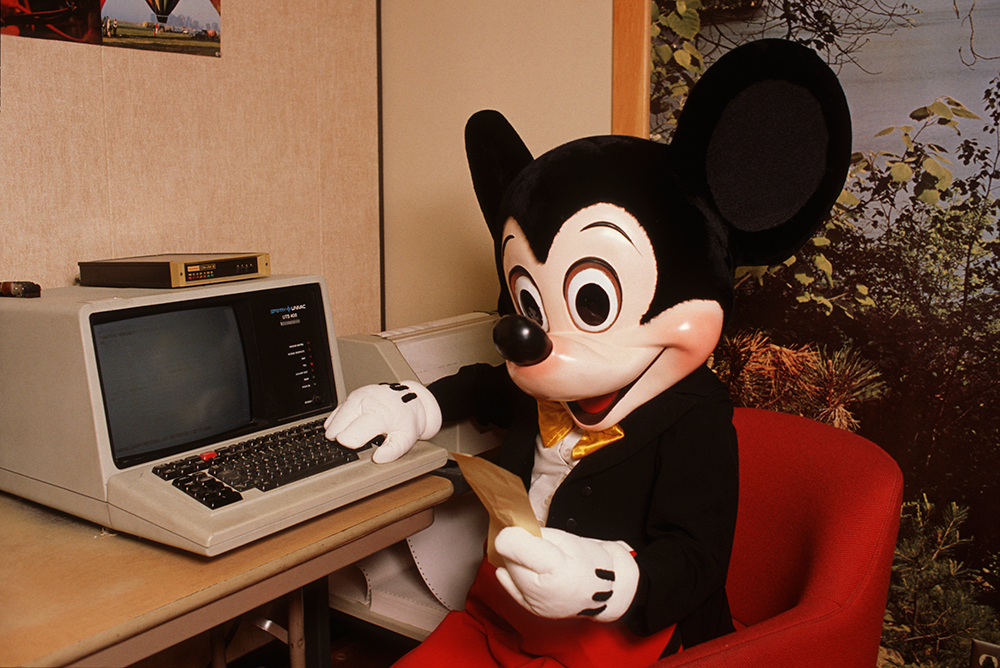
> Hi all, you might have seen this going around online today - but I can't
> for the life of me figure out what kind of computer Mickey is posing with.
> Anyone know?
>
> http://parksandresorts.wdpromedia.com/media/disneyparks/blog/wp-content/upl…
>
> Lori
>
Below is a link to an article from the 11/1/82 issue of ComputerWorld about "Epcot Computer Central" and Sperry Univac's sponsorship of the exhibit. The story indicates that they had four Univac V77 minicomputers there, in various configurations, as well as six VAXes. I imagine your photo relates to that.
http://books.google.com/books?id=OrmcqtZUTMoC&pg=PA19&dq=%22mickey+mouse%22…
You can also watch a video of the opening ceremony of Epcot Computer Central (10/18/82) here: https://www.youtube.com/watch?v=U3lZW39D1pQ - featuring what was known as "The Computer Song"
There is a photo looking into the processing center at Epcot here: http://www.solarius.com/dvp/wdw/communicore.htm - I think you can see some Sperry terminals on the right.
Yes I will have a MacroPlexus 16 Extension PBX there, itll also have a
google voice interconnect so you can call out as well. Ill also be
bringing a 1A2 Key System tied in with the MacroPlexus.
Time to play some Dial Up DOOM or some other dial up games :)
I just want something I can learn, I do love the blinkenlights and
switches, something about actually flipping a switch instead of a
keyboard I love. One of my dream machines is an Altair or an IMSAI
8080, but those are out of reach. I really dont know what I want to
do on it yet, looks like there is so much to learn. My son is 9 and
starting to learn unix and old nix. So something that could run an old
version of unix would be really cool :). Something perhaps I could
tie into our vintage telephone system as well.
Im a total noob at mini's, but the thrill of the regular stuff has kind
of waned, Ive put my amiga online, my c64, my IIGS, everythign I got
goes online and games. and thats all I do with it. Most of it has sat
in storage.
Thanks for all the input guys
I'm looking for a program that runs under DOS 3.1 and will tell me CHS for
all unreadable hard disk sectors. Anybody know where one is I can download?
I can't find search keywords that filters out the modern stuff. A read
write test would also be useful.
Hello all,
I remember quite well CP/M days. It is indeed good news to hear that
Gary Kildall has been given the recognition due. His contribution to
8-bit/16-bit world of computing was seminal.
Murray :)
We just found a MICE and about 10 or 12 MINC boards for it, and a RKV11-D,
no front panel yet.
Any interest, please contact me off list. Shipping from 61853.
Thanks, Paul
Hey Guys
Im bringing a Modem Demo this year, so for those of you who want to
bring out machines with modems and call eachother you can. I am going
to have a dial up linux box too so you can connect your machines to the
internet.
Lets make some modem noise.
>
> Date: Mon, 21 Jul 2014 21:13:28 -0600
> From: Lori Emerson <lori.emerson at gmail.com>
> Subject: Re: curious to know if anyone knows what computer this is
>
> thanks everyone!! much appreciated. you have much better eyes than I do.
> And, I gather, maybe model UTS 400.
>
> yrs, Lori
>
>
Ok, if nobody else is going to take it, I will...
Whatever type of terminal it is, it sure has a LARGE mouse :-)
Earl
Basically, my question is what are the major obstacles (besides the breadth
of the project) to implementing the VAX in an FPGA, as compared to any
other ISA?
Is anyone aware of the existance of a maintanance / service manual for
the old TI "portable" data terminal, model 725?
Note that is is one of the very early (and very large) thermal printing
terminals from TI,
http://terminals.classiccmp.org/wiki/index.php/File:Silent700_725ad.jpg
I have several here that I am trying to keep running but have never
had technical information that would include schematics or other
parts information.
Chris
--
Chris Elmquist
Am 19.07.2014 23:08, schrieb Enrico Lazzerini:
> I managed to find a bios for an IBM 5170 AT 286 Type1 Mainboard. It is
> here: 30aprile1989 (list here:
> http://ibm-pc.org/firmware/ibm/5170/5170.htm)
> In practice I have manually added the number of cylinders, heads, and sect
> / trk that allow the machine to recognise a disk IBM 250MB. At this point
> regularly boots DOS.
> But I wish to program these data permanently in the bios. Does anyone know
> what program to use and give me the procedure? I tried with BIOSUTL, but
> the new EPROM do not boot the machine.
> With BIOSUTL i made what follow: read actual BIOS, you can add new disk
> geometry parameters at free 47 position, then you have to recalculate bios
> checsum, then BIOSUTIL devides BIOS into EVEN and ODD file so i can finally
> program them into two 27256 150nS eprom.
> Thank you
> Enrico
>
>
Hi..
the biosutil maybe one way. The version I use told me:
Biosutil V1.1
InfoMatrix Bios utilities for the AT BIOS.
Brad Gibson Copyright (C) 1990 by Secret Software
and I believe there's no other version.
*----------------------------------------*
Other idea
It maybee better to add a enhanced bios to your PC.
There is the xtide bios at
https://code.google.com/p/xtideuniversalbios/
The xtide bios works on most xt/at.
You can easily ad an enhanced bios if you have an free rom place in a
network card like a ISA 3com etherlink.
As Im from germany and my english isn't as good as it should be here is
an explanation from
http://flint.cs.yale.edu/feng/research/BIOS/BIOS-report.pdf
The IBM BIOS gains much of its versatility by being an extendable BIOS.
That is, the full extent of the BIOS is not cast forever in the silicon
of the single PROM chip holding the firmware. The IBM BIOS can accept
additional code as its own into one integrated whole. Hence additional
PROM chips containing BIOS routines can be added to the PC.
The BIOS will incorporate these new routines.
The key for making BIOS extendable is a Firmware routine that enables
the BIOS to look for add-in code. During the boot up, BIOS code reads
through the address range that is set aside for firmware looking for
codes stored on add-in boards. If a valid section of code is found, the
instructions are added to the BIOS repertory. For instance a new
interrupt routine can be added or the functions of existing routines can
be changed.
During POST after interrupt vectors have been loaded into RAM, the
resident BIOS code instructs the computer to check its ROM memory for
the occurrence of the special preamble bytes, that mark the beginning
of add-in BIOS routines. The BIOS searches for these preamble bytes in
the absolute address range 0C8000 - 0F4000.
Here the XTIDE BIOS is found and added so you can use it.
Greetings
fritz
Anybody out there older than me whose memory works better than mine or
younger but smart enough to figure out what these were used in? More
digging...
Any interest?
Y048 Bell tape controller with cable
Y051 Bell Binary to ASCII converter
Y064 Card reader
Y185 Stare 3 ???
Y197 DMA interface
W742 Universal digital input
W743 Universal digital input
W950 Wire wrap module- unused
W968 Collage mounting board- unused
Thanks, Paul
At 12:00 AM 7/21/2014, Eric Smith wrote:
>On Sun, Jul 20, 2014 at 8:10 PM, Rick Murphy <rick at rickmurphy.net> wrote:
> > I don't know anyting about a PDP-14,
>
>The machine is question is a VT14, not a PDP-14. The VT14 is a
>specialized terminal used to develop ladder logic programs for a
>PDP-14.
>
> > but it it used a VT8-E,
>
>It didn't.
Full circle. There seem to be two sets of assertions here.
One that a VT14 used the VT8-E board set, and another that it used a
different set for video.
You're asserting that it's not a VT8-E, which means that many of my
assumptions were wrong. In one of it's modes, which would allow it to
be a good display device, the VT8-E uses DMA from main memory to drive
a bitmap display. That memory has to be on the Omnibus, and has to be
read/write to be of any value. That causes the following assumption:
> > it had to be an Omnibus machine with Omnibus memory,
>
>It was.
>
> > so it could easily be turned into a PDP-8/E
>
>That doesn't necessarily follow, any more than it would follow that
>because some sort of embedded device contains a Z80 CPU chip, it can
>easily be turned into a CP/M system.
You have a KK8-E cpu and the standard Omnibus which can accept a range
of peripherals. You can't usually plug extra hardware into an embedded
system.
> > with the right CPU card set.
>
>It had a KK8-E CPU card set. To get it to run general-purpose PDP-8
>software, you're going to have to replace the memory, as the MR8-F
>isn't too useful for that.
I see. Perhaps it's the case that the VT14 doesn't have Omnibus RAM,
and only has a MR8-F which the KK8-E CPU uses to run the code that
manages the display. This is the first I've heard of the MR8-F, which
apparently has onboard RAM to provide the read/write memory needed.
(The older Ombibus ROM devices shadowed core.)
>The power supply isn't suitable for core
>memory, but it might be for semiconductor. The keyboard and display
>are going to be useless. The backplane, CPU, power supply, and
>teletype interface are the only parts of the VT14 that you're going to
>end up using. I wouldn't call that "easy", nor would I call the
>result a "PDP-8/E".
Yes, and the power supply isn't useful unless you're using something
other than core. And how many slots does the backplane have? Yes, it's
possible, but given what I know now it's not easy. It's a source for a
donor CPU board set, and maybe a TTY interface (assuming it's KL8
compatible) and that's about it. Possibly workable with the recent
semiconductor memory boards. Oh, and of course, no front panel, making
it hard to do anything useful unless you reprogram the MR8-F.
-Rick
Hello Mark,
well I suppose it would be very useful for this kind of operations.
And as the whole read operation would be in the control of the PC,
you could retrieve the whole disk, or a part, or a single sector..
whatever you want.
The first step is to debug it and let it work with SIMH.
Then I will try it with my 8" double floppy unit.
At this time, adding support for any other drive would be a matter of
knowing the peripheral
control registers and producing a set of scripts from these informations.
I will keep you informed about it.
Thanks
Andrea
On 7/19/2014 2:08 PM, Enrico Lazzerini wrote:
> I managed to find a bios for an IBM 5170 AT 286 Type1 Mainboard. It is
> here: 30aprile1989 (list here:
> http://ibm-pc.org/firmware/ibm/5170/5170.htm)
> In practice I have manually added the number of cylinders, heads, and sect
> / trk that allow the machine to recognise a disk IBM 250MB. At this point
> regularly boots DOS.
> But I wish to program these data permanently in the bios. Does anyone know
> what program to use and give me the procedure? I tried with BIOSUTL, but
> the new EPROM do not boot the machine.
> With BIOSUTL i made what follow: read actual BIOS, you can add new disk
> geometry parameters at free 47 position, then you have to recalculate bios
> checsum, then BIOSUTIL devides BIOS into EVEN and ODD file so i can finally
> program them into two 27256 150nS eprom.
> Thank you
> Enrico
>
Enrico,
I suspect you do not have a good checksum on your image, unless you took
pains to change that as well as the table Once you have modified your
table, you have to bring the sum which will be visible in the bios space
at F000:0 thru F000:ffff back to 0.
A simple checksum of the data is all that the bios does. See below. I
have patched numerous bios images, but always have to add a fudge in
some byte somewhere to bring the simple sum below back to 0 overall.
Jim
I used a copy from bitsavers for the listing below. Had to clean up the
OCR a bit :-)
http://bitsavers.trailing-edge.com/pdf/ibm/pc/at/1502494_PC_AT_Technical_Re…
If you look at the PC At tech reference, bios listing you can see what
they do:
On page 5-36, during startup ROS_CHECKSUM is called to check the roms.
On page 5-67 (PDF file page 205 on bitsavers)
EXTRN ROM_ERR: NEAR
;----------------------------------------
; ROS CHECKSUM SUBROUTINE ;
;----------------------------------------
ASSUME CS;CODE, DS:ABSO
POST3:
ROS_CHECKSUM PROC NEAR ; NEXT ROS MODULE
SUB CX,CX ; NUMBER OF BYTES TO ADD IS 64K
ROS_CHECKSUM_CNT: ; ENTRY FOR OPTIONAL ROS TEST
XOR AL,AL
C26:
ADD AL,DS:[BX]
INC BX ;POINT TO NEXT BYTE
LOOP C6 ; ADD ALL BYTES IN ROS MODULE
OR AL,AL ; SUM = O?
RET
ROS_CHECKSUM ENDP
At 02:34 PM 7/20/2014, Eric Smith wrote:
>On Sun, Jul 20, 2014 at 5:46 AM, Jerome H. Fine
><jhfinedp3k at compsys.to> wrote:
> > My question was not intended to be limited to the VT14 AS SUPPLIED!
>
>Nor was my answer.
>
> > Rather, could the VT14 have been relatively easily modified (i.e.
> without
> > major changes AND without having to reverse the changes OTHER than
> > to removing them with ONLY a screwdriver or other similar tool within
> > about 30 minutes) to be able to run PDP-8 software.
The VT8-E was a set of modules that turned a PDP-8 into a terminal.
In one mode, it DMA'd a chunk of memory and displayed the contents.
Interesting to fire it off when running memory checks, but that's about
it. It also had a bitmap font generator.
You could run an OS with the VT8-E running, but you couldn't run
anything like OS/8 with the VT8-E as the console as it ate too much
memory and wasn't in any way KL8 compatible.
I don't know anyting about a PDP-14, but it it used a VT8-E, it had to
be an Omnibus machine with Omnibus memory, so it could easily be turned
into a PDP-8/E with the right CPU card set.
-Rick
This the smallest VAX you can own :-) I've got 6 or 7 I would like to
get adopted. Available free for local pickup (Sunnyvale, CA) or if
you're willing to pay packing and postage I can take them to the local
shipping shore and have them sent off to you.
--Chuck
i happen to have acquired a compaq c120 running windows ce 2.0. i got it with no accessories other then a few extra stylus and a 16mb pcmcia memory storage card. i am on a hunt to find programs for it and even any other accessories. i did find a site that had updates for it but when i tried to run them in windows ce it said they weren't windows ce compatible programs. maybe someone out there knows what i can do. maybe someone has accessories for this thing
On Sun, Jul 20, 2014 at 1:59 AM, Eric Smith <spacewar at gmail.com> wrote:
> The VT14 was specifically a terminal to program a PDP-14 using ladder
> logic, had ROM firmware that only did that,
It would be interesting to have a copy of that firmware.
-chuck
As previously threatened in the "Encoding of BASIC source code on punched tape" topic, I'm working on a Python utility for manipulating paper tape images. It will be a refactor of my previous silly paper tape renderer that I had written in C++, with added features for the manipulations I've recently found necessary since I've become interested in retrocomputing.
I haven't determined how I'll specify interactions with actual tape punch/reader hardware like my GNT 4604 yet, but here is the "--help" output to show how I anticipate the user will interact with the utility to perform useful manipulations of paper tape images. I'd appreciate some input about what features are missing to make it helpful with tape formats and systems that I'm not familiar with yet.
For example, I haven't yet included a feature to handle sequences like CR-XOFF-DEL-DEL, but I have a place-holder feature to pad each CR-LF with two DEL chars. I haven't decided the best way to cleanly handle various line-ending translations yet, to be generally useful without being too arcane or cumbersome.
This will be written in Python, will be open-source, and will include modules and classes to make it (hopefully) easy to re-use the code for special purposes that I didn't implement in the command-line utility.
While the main focus here would be on 8-bit ASCII tapes, I'm also including some support for 5-bit Baudot tape handling due to my interest in RTTY (radio teletype).
-------- 8< cut here 8< --------
...src/papertape% ./tapeutil.py --help
usage: tapeutil.py [-h] [--clear] [--load FILENAME] [--append FILENAME]
[--save FILENAME] [--hexdump] [--trim]
[--add_leader INCHES] [--add_trailer INCHES] [--strip_nul]
[--strip_del] [--set_msb] [--clear_msb] [--pad_crlf]
[--title TITLE] [--rot_title TITLE] [--ascii2baudot]
[--baudot2ascii] [--render_ascii WIDTH]
[--render_pbm WIDTH FILENAME]
Punched paper tape image utility version 2.0.0-ALPHA
Arguments are processed in the order encountered, with cumulative effects
upon the tape image buffer. The tape image buffer is discarded at program
exit, so the final argument should generally be one which outputs the
buffer to a file, the screen, or a tape punch. Arguments may be abbreviated.
optional arguments:
-h, --help show this help message and exit
--clear Clear the tape image buffer.
--load FILENAME Load tape image buffer from file, replacing previous
buffer contents.
--append FILENAME Load tape image buffer from file, appending to
previous buffer contents.
--save FILENAME Save tape image buffer to file.
--hexdump Print a hex dump to stdout. Most significant bit (bit
number ) will be ignored for the ASCII representation.
--trim Trim leader and trailer of NUL chars from buffer.
--add_leader INCHES Add NUL leader to buffer.
--add_trailer INCHES Add NUL trailer to buffer.
--strip_nul Remove all NUL chars from buffer.
--strip_del Remove all DEL chars from buffer.
--set_msb Set most significant bit (bit number 7) of all chars
in buffer.
--clear_msb Clear most significant bit (bit number 7) of all chars
in buffer.
--pad_crlf Add two DEL chars after each CR-LF sequence in buffer.
--title TITLE Add human-readable title to beginning of buffer, using
a font composed of 5x7 punched hole patterns.
--rot_title TITLE Add human-readable title to beginning of buffer, using
a font composed of 5x7 punched hole patterns. Rotate
the letters for use on a 5-bit tape.
--ascii2baudot Translate entire buffer from ASCII to Baudot coding.
--baudot2ascii Translate entire buffer from Baudot to ASCII coding.
--render_ascii WIDTH Create an ASCII art rendering of a punched tape, in a
style similar to the bcd(1) program. WIDTH specifies
the tape width in bits, and must be 5 or 8. Rendering
will be printed to stdout. Leading edge of tape will
be at top.
--render_pbm WIDTH FILENAME
Create a rendering of a punched tape in Portable
Bitmap (.pbm) format, with each pixel representing
0.01 inches. WIDTH specifies the tape width in bits,
and must be 5 or 8. Leading edge of tape will be at
top.
Example:
tapeutil.py --load myfile.txt --pad_crlf --set_msb \
--add_leader 2 --title "MY TAPE" \
--add_leader 5 --add_trailer 5 --save myfile.tap
--
Mark J. Blair, NF6X <nf6x at nf6x.net>
http://www.nf6x.net/
On Sat, 19 Jul 2014, Enrico Lazzerini wrote:
> I managed to find a bios for an IBM 5170 AT 286 Type1 Mainboard. It is
> . . .
> checsum, then BIOSUTIL devides BIOS into EVEN and ODD file so i can finally
> program them into two 27256 150nS eprom.
Does the 5170 accept 27256 150ns EPROMs?
Perhaps, burn an UNMODIFIED copy, and confirm that that works.
THEN modify and burn the modified copy.
>
> I managed to find a bios for an IBM 5170 AT 286 Type1 Mainboard. It is
> here: 30aprile1989 (list here:
> http://ibm-pc.org/firmware/ibm/5170/5170.htm)
> In practice I have manually added the number of cylinders, heads, and sect
> / trk that allow the machine to recognise a disk IBM 250MB. At this point
> regularly boots DOS.
> But I wish to program these data permanently in the bios. Does anyone know
> what program to use and give me the procedure? I tried with BIOSUTL, but
> the new EPROM do not boot the machine.
When I did this, I used a couple of 8Kbyte EPROMs and fitted them into
the spare sockets on the motehrboard. I then added a bit more logic (I
think just one IC) to disanble the top 8K words of the origian BIOS ROMs
and enable the extra EPROMs. This was relatively easy, since the enable
lines are o nthe DIP shunt at the rear edge of the motherboard.
There was no real reason to do this, it just meant I could use 2764s from
my junk box, whereas I would have had to order the 27256s.
I didn't bother with any program other than a hex editor. I simply
editied the values in the ROM image, recalculated the checksum (OK, I
think I wrote a program for that), then took the last 8K words of the new
image, split them into odd and even bytes, then programmed the ERPOMs. I
had no trouble at all.
-tony
Thanks Paul for your suggestions. I try to provide some answers.
The original IBM AT BIOS that I have on my TYPE 1 motherboard has two prom labelled: 6181028 and 6181029.
The present drive in my IBM PC AT is a 3.5" 720K and the boot is not made ??by it or rather I think the bios expects to have an A drive as 1.2 MB which I have not.
Therefore I downloaded from here: http://www.minuszerodegrees.net/bios/bios.htm an AMI BIOS SUITABLE FOR 5170 (Dated 30MAR89) which made available the only position 47 to add hard drives. Biosutil works well: I read the bios AMI, i save it in the file, allows you to change the position 47 with the geometry inserted for the new hard disk, recalculates the checksum of the file and save it to a even file and an odd file 32KB each .
The saved file is BIN type and not hex. I am not in a position to know whether the calculated CheckSum is correct with respect to the expected one.
With the AMI bios at boot i heard a beep and then it boot from the hard disk, but with the bios changed to make the geometry of the hard disk to a permanent position 47 nothing happens. no reply. I thought I had reversed the two EPROM, inverting them it does not change the result.
Not being able to load the dos disk with the biosutil from my 720kb drive and i not having to drive 1.2 mb I can not boot dos and biosuil with original firmware. But it could not be true that biosutil allows you to edit an existing position.
Dear Fritz,
I can not fully understand how to use an EPROM with a network card and XTide.
Why an unmodified AT bios at its boot if it can not boot from any drive, it should load the contents from an EPROM of the network card and run it?
And what should I save in the EPROM of the network adapter so that it allows to see my hard drive?
Enrico
Hello,
I have a Nova3 with dual 8" floppy, but unfortunately no diskette with OS.
To try to recreate a set of disks, I had the idea to try to create a
tool similar to VTSERVER for PDP11,
This piece of software runs on a PC, connected to the DG Nova on
terminal port.
At boot the software emulate a punch tape reader and can be used to copy
a small program in the memory
of the Nova and to execute it. This software should allow access to IO
peripherals and memory via the terminal port,
using a command / acknowledge operation, thus allowing the PC to read /
write disks, tapes, and so on.
This is a sort of bridge between Nova hardware and PC.
Of course this piece of software had to be developed and complied on PC,
and the controlling software for the PC as well.
With the help of Bruce Ray and some patience in reading many DG manuals
kindly provided,
I started the development of a tool using Python, that allows to perform
many tasks, using python IDLE console:
- load / save memory images with PL/APL/raw binary format
- load / save ASM listings
- assemble from loaded ASM listing to binary data
- disassemble from binary data to ASM listing
The development is almost done (only some stuff regarding labels
handling still has to be done).
Basically the tool handles one or more memory areas, and allows the user
to do listed tasks in a wanted sequence,
for example load a file containing an APL dump, disassembling it to
create a ASM listing, save it to text file.
I'm using this tool to assemble the bridge software, of course I had to
write the listing before...
The bridge will allow the PC to perform "remotely" any kind of IO
operation, executing single IO opcodes one-by-one.
All the parameters can be controlled from the PC, so access to any kind
of peripheral is virtually possible.
The bridge also allow to read / write on the Nova memory using variable
size data blocks; this allows handling operations
on peripherals that use DMA.
This tool has been developed to 99%, but it hasn't been debugged yet.
I would try to use SIMH with telnet on the terminal port, to emulate the
Nova, and to use Python to develop the controlling
software, scriptable so different peripheral support can be added at any
time easily.
I'm encountering problems with this task on SIMH3.9:
- emulation of program load operation (starting CPU from peripheral
defined via switch/levers position) is described in the manual,
but effectively it doesn't works
- the terminal emulation (TTI/TTO) seems to work only at 7bit, while we
need 8bit
I need to patch SIMH, anybody is in willing to help?
After bridge debug , the next step is to write down the controlling
software, and scripts to handle wanted peripherals.
Andrea
>Eric Smith wrote:
>>For the PDP-11 Qbus environment, DEC produced a
>>VT100 with a 4 x 4 Qbus backplane inside and named
>>it the VT103.
>>
>>
>[...]
>
>
>>The point of the above information is that DEC seems to
>>have used some of the popular (at the time) terminals to
>>be integrated as combination terminal and popular PDP
>>(Program Data Processor
>>
>The situation with the VT14 is *much* different than the VT103, though.
>The VT103 is intended for use running PDP-11 software.
>While the VT14 contains a PDP-8, it isn't intended for running PDP-8 software.
>
I am totally unfamiliar with the PDP-8, so my question
and observations could be entirely out of the ball park.
Although the VT14 was not intended to run PDP-8
software, was or would it have been possible? If
so, did that ever happen?
May computer systems were used for projects which
were totally unanticipated by the individuals or the
companies which produced the computer systems in
the first place. For example, my first contact with the
VT103 was as a diagnostic station which, although
the code was PDP-11 and there was a standard DEC
PDP-11 CPU, had the code on an EPROM and the
code was totally different from any other PDP-11
software that I have even seen. In addition, from
what I understand, all DEC variants of the VT103
arrived with an 18 bit backplane which, in my opinion,
resulted in a system that could be compared to a
human with an IQ of a shoe size. With only 256 KB
of memory available, there was almost never enough
memory for most anything that was significant. Since
upgrading the backplane to 22 bits was actually quite
simple, that made the primary difference when a J11
based CPU was installed.
Jerome Fine
Am 19.07.2014 23:08, schrieb Enrico Lazzerini:
> I managed to find a bios for an IBM 5170 AT 286 Type1 Mainboard. It is
> here: 30aprile1989 (list here:
> http://ibm-pc.org/firmware/ibm/5170/5170.htm)
> In practice I have manually added the number of cylinders, heads, and sect
> / trk that allow the machine to recognise a disk IBM 250MB. At this point
> regularly boots DOS.
> But I wish to program these data permanently in the bios. Does anyone know
> what program to use and give me the procedure? I tried with BIOSUTL, but
> the new EPROM do not boot the machine.
> With BIOSUTL i made what follow: read actual BIOS, you can add new disk
> geometry parameters at free 47 position, then you have to recalculate bios
> checsum, then BIOSUTIL devides BIOS into EVEN and ODD file so i can finally
> program them into two 27256 150nS eprom.
> Thank you
> Enrico
>
>
Hi..
the biosutil maybe one way. The version I use told me:
Biosutil V1.1
InfoMatrix Bios utilities for the AT BIOS.
Brad Gibson Copyright (C) 1990 by Secret Software
and I believe there's no other version.
here is an other way.
You can easily ad an enhanced bios if you have an free rom place in a
network card like a ISA 3com etherlink.
Look here for
https://code.google.com/p/xtideuniversalbios/
The xtide bios works on most xt/at.
Greetings
fritz
On 2014-07-19 6:08 PM, Enrico Lazzerini wrote:
> I managed to find a bios for an IBM 5170 AT 286 Type1 Mainboard. It is
> here: 30aprile1989 (list here:
> http://ibm-pc.org/firmware/ibm/5170/5170.htm)
> In practice I have manually added the number of cylinders, heads, and sect
> / trk that allow the machine to recognise a disk IBM 250MB. At this point
> regularly boots DOS.
> But I wish to program these data permanently in the bios. Does anyone know
> what program to use and give me the procedure? I tried with BIOSUTL, but
> the new EPROM do not boot the machine.
> With BIOSUTL i made what follow: read actual BIOS, you can add new disk
> geometry parameters at free 47 position, then you have to recalculate bios
> checsum, then BIOSUTIL devides BIOS into EVEN and ODD file so i can finally
> program them into two 27256 150nS eprom.
> Thank you
> Enrico
>
I have done this before manually, I did not use the position 47 but
rather altered one of the existing table entries, but that should not
make any difference as long as the parameters in the table are correct.
Did you check the output from this BIOSUTIL to make sure that the table
entry looks correct? Other than that the only other important thing is
to make sure the checksum is correct, I seem to recall that the
algorithm used to checksum the ROM expects the last byte (word?) to roll
the sum over to 0, but it is a long time since I did this and I may not
be remembering this correctly, nor do I remember if the AT does the sum
in bytes or words. What happens when you try to boot the new ROM? Do
you get any response from it? If you get nothing two things come to
mind, the BIOS image you downloaded is no good or you interchanged the
high and low byte ROMs. If the checksum is wrong it will post an error
message, if it seems to do its memory check ok but won't boot off the
disk that might suggest that you are not pointing at the correct drive
table entry or some parameter in the table is not correct. If it was me
I would not be downloading a ROM image off the web I would just dump my
existing BIOS and make whatever changes where necessary to it.
Paul.
Had a cool day in Illinois today and my crew brought down boxes of parts
including:
M7744 RX02 controller
M7745 RX02 R/W
H7110 LA120 ps
M7081 LA120 pwr/logic bd
LA36 and LA180 pwr and logic boards, encoder motors, heads, numeric
kybds, etc
add on logic and option boards for the LA36- these are getting hard to
find...
I have a few LA36s which have been upgraded to 120cps and plan on restoring
them to original configuration
There are boxes to go through yet.
They are close to 6 or so VAX 11/780 pwr supplies. if someone is interested
in them I can try to have them pulled tomorrow.
Found some VT 100 or 101 pwr supplies ,and more logic boards.
Feel free to contact me off list with offers. 61853, IL
Thanks, Paul
I managed to find a bios for an IBM 5170 AT 286 Type1 Mainboard. It is
here: 30aprile1989 (list here:
http://ibm-pc.org/firmware/ibm/5170/5170.htm)
In practice I have manually added the number of cylinders, heads, and sect
/ trk that allow the machine to recognise a disk IBM 250MB. At this point
regularly boots DOS.
But I wish to program these data permanently in the bios. Does anyone know
what program to use and give me the procedure? I tried with BIOSUTL, but
the new EPROM do not boot the machine.
With BIOSUTL i made what follow: read actual BIOS, you can add new disk
geometry parameters at free 47 position, then you have to recalculate bios
checsum, then BIOSUTIL devides BIOS into EVEN and ODD file so i can finally
program them into two 27256 150nS eprom.
Thank you
Enrico
I need an ISO if someone can spare a copy. Need to load up a system for
some testing.
Sparc 32 bit. media. I have a lot of intel, but low on Sparc stuff.
Also am going to give some Tadpoles a run with it, hopefully.
thanks
Jim
Dear Phillip,
I came across your correspondence regarding an interface card to the PDP8
Omnibus.
Did anything come of this and if so, are there any cards left?
Stephern Laurence, Preston, UK
(Owner of 4 non-working PDP8s but I hope to get them going!)
--
Using Opera's mail client: http://www.opera.com/mail/
On 18 Jul 2014, at 20:45 , Chuck McManis <chuck.mcmanis at gmail.com> wrote:
> So you could put one, two, or even a
> hundred DEL characters at the end of the line and it wouldn't matter
> semantically.. So those DEL characters became a way of providing a safe
> 'delay' that would allow a machine without any flow control to accurately
> read in the paper tape.
I'm pretty sure that some of the 8-bit microcomputer systems used NULs for this exact purpose, when loading data through the serial port; specifically, I think I heard about NUL padding for the UK-101 and KIM-1.
I'm looking for a technical manual for a GNT model 4604 paper tape punch/reader. I have a scanned brochure which includes helpful information such as DIP switch settings, but I'd also like to find more detailed documentation, particularly including its handling of control characters and escape sequences, so that I can write a utility that talks to it.
I can do basic I/O already, but I think it may have other features that I would like to use.
If anybody can help me find an original, photocopy or scan, I'd appreciate that.
For reference, I found the brochure here:
http://www.cryptomuseum.com/telex/santec/gnt4606/files/gnt4604_brochure.pdf
There are pictures of the very similar GNT 4606 here:
http://www.cryptomuseum.com/telex/santec/gnt4606/index.htm
I'll probably post about the machine on my web page eventually.
--
Mark J. Blair, NF6X <nf6x at nf6x.net>
http://www.nf6x.net/
I recently bought a few punched paper tapes from an eBay seller. They were said to have been from an IMSAI system, and I found BASIC source code on them.
Except for the leaders at both ends consisting of NULs, the rest of the bytes on each tape have the most significant bit set. As I understand it, Teletype model 33 ASR units are conventionally configured with MARK parity keyboards when used with PDP-8 systems, and I gather that it's conventional to encode PDP-8 source code tapes with MARK parity. I'm guessing that the same convention was used on the IMSAI, or at least was used by the original creator of these tapes.
I just received a GNT model 4604 tape punch/reader yesterday, and today I got it working after making a few repairs. Then, I set to work reading in these tapes and converting the raw binary images (which I saved separately) to plain ASCII text by clearing the MSBs, and dropping any NUL and DEL characters. One tape included a splice which the creator marked with red ink. Each line was terminated by the sequence CR-LF-DEL-DEL.
I presume that the two DELs after each line were there to give a 33 ASR (or similarly slow printer) time to return the carriage before the next line starts printing.
Here is my question: Is it conventional and/or important to include the two DELs after each line when creating a source tape which is to be read in to a BASIC interpreter, or is that just an artifact of how the tapes were created (i.e., by printing source code out to a 33 ASR printer)? I ask because I want to know if I should include the DELs if I ever create new tapes from the extracted text files.
The tapes were marked with 1976 dates, and were named:
STRTRK
DIET
BLUFF
I'll share their contents on my web site soon, and I'll also try running them in a BASIC interpreter sometime.
--
Mark J. Blair, NF6X <nf6x at nf6x.net>
http://www.nf6x.net/
> From: Kevin Keith <krfkeith at gmail.com>
> Date: Thu, 17 Jul 2014 13:51:56 -0600
> Subject: Re: Yet Another FPGA VAX Discussion
> Ha!
>
> "[Futurebus] intended to replace all local bus connections in a
> computer, including the CPU, memory, plug-in cards and even, to some
> extent, LAN links between machines."
>
> How accurate is that statement? There doesn't appear to be any citation.
>
> --
> Thanks,
> Kevin
At the time it was developed Futurebus+ was probably the most advanced
and highest performance bus. It had very advanced protocols that did a
great job of handling distributed cache coherency, and a very nice
distributed priority resolution circuitry. DEC could have build a
complete VAX or Alpha on Futurebus+ and made a very high performance
system. SCI (Scalable Coherent Interface) would be the best choice for
interconnecting Futurebus+ systems.
Unfortunately the NAVY's NGCR program, that was one of the big target
markets for Futurebus+, was defunded and support for Futurebus+
evaporated. High speed serial buses were also getting fast enough to
be competitive with parallel buses, and much easier to implement than
a 64/128/256 bit wide bus.
--
Michael Thompson
I received a call from a gentleman who'd like to get a listing of the
contents of a couple of System 34 floppy magazines. Seems he wrote some
business applications a years ago and would like to have a printed
record of the source.
If you are willing to tackle this (for money that you'd negotiate for,
of couse), drop me a line and I'll hook you up.
--Chuck
P.S. I do know that you can open the magazines and retrieve the
floppies one by one, but if you've got the IBM gear, it would be so much
simpler.
> From: Paul Koning <paulkoning at comcast.net>
> Date: Wed, 16 Jul 2014 17:33:02 -0400
> Subject: Re: Yet Another FPGA VAX Discussion
>
> Also Futurebus. Or did that never make it out the door? I remember a pile of work on that. Very strange bus, not well named. :-)
>
> paul
I worked on the original IEEE-896 Futurebus standard and the updated
Futurebus+ that DEC used. I think that it was used on the VAX 10000
and 7000. They made the DWLAA Futurebus+ bridge and the DEFAA-YA FDDI
board for Futurebus+.
I have the DEC tutorial book on Futurebus+.
--
Michael Thompson
Anyone here have an extra/parts machine ThinkPad 860 or 850 with a working 1.2GB hard drive in the caddy?
I'm having terrible luck finding one. So I'll throw out a bounty :)
I'll offer $100 for just the drive and caddy...
Thanks in advance!
-Ben
I've been helping in some restorations recently (both my own, and someone I
know's Sun 1...) and one of the questions
that have come up is valuation (say for insurance, etc, or acquiring
another system...)
Is there some sort of collected list of values of some of vintage machines
that have sold, either ebay, privately,
auction, etc.?
I know that something is worth only what someone will pay for it, but for
insurance purposes at least you'd need
some sort of benchmark to give to the insurance company... I know you don't
get a good valuation if you let them do it...
Thanks.
Earl
>
>I've been helping in some restorations recently (both my own, and someone I
>know's Sun 1...) and one of the questions
>that have come up is valuation (say for insurance, etc, or acquiring
>another system...)
>
>Is there some sort of collected list of values of some of vintage machines
>that have sold, either ebay, privately,
>auction, etc.?
>
>I know that something is worth only what someone will pay for it, but for
>insurance purposes at least you'd need
>some sort of benchmark to give to the insurance company... I know you don't
>get a good valuation if you let them do it...
>
When considering insurance, I think the questions to ask are if the system is a
total loss, would it be possible to replace it with an acceptable equivelant
and if so, how much would it cost to do this. However difficult this is to
calculate in a way acceptable to the insurance company now, bear in mind that
in the event of a claim, they are probably going to go over values with a fine
toothed comb and by then, costs and availablilty may well have changed.
If it isn't possible to replace it, then there is no point in insuring it.
Someone who regards classic computers as some sort of investment would probably
disagree but I don't think that's what we are about here. Museums would
probably disagree for different reasons.
Regards,
Peter Coghlan.
I've had my PDP-8/S up and running for some time - but have recently
experienced failures using some PDP-8 software.
My 8/S passes all the DEC diagnostics - and it runs FOCAL-69 and 71
perfectly.
So I decided to track down what was causing some programs to fail - and
I discovered that the problem is PDP-8/S incompatibilities.
PDP-8/S "Reality"
-----------------
The PDP-8/S User Manual lies! It makes the following claim
regarding Group 1 Operate Instructions:
"The only restriction on combining OPR 1 (Group 1) operations
within one instruction, other than logical conflicts, is that
a rotate operation (bits 8, 9 or 10) may not be combined with
the increment AC operation (bit 11) since they are executed
during the same bit times."
I decided to test that claim on my PDP-8/S and got the
following results (via single stepping through the test
program below.)
The "8/S" column is Link AC contents (L AAAA):
*200 Page 1
1 0200 *200
2 /AC 8/S NOTES
3 00200 7200 CLA /0 0 0000
4 00201 7201 CLA IAC /1 0 0001
5 00202 7326 CLA CLL CML RTL /2 0 0002
6 00203 7325 CLA CLL CML IAC RAL /3 1 0003 8/I AND UP
7 00204 7307 CLA CLL IAC RTL /4 1 0001 8/I AND UP
8 00205 7327 CLA CLL CML IAC RTL /6 1 0003 8/I AND UP
9 00206 7215 CLA IAC RAL RAR /10 1 0003 6120
10 00207 7203 CLA IAC BSW /100 1 0001 8/E AND UP
11 00210 7332 CLA CLL CML RTR /2000 0 2000
12 00211 7354 CLA CLL CMA RAR RAL /3776 1 7777 8/I OR 8/L
13 00212 7350 CLA CLL CMA RAR /3777 1 7777
14 00213 7330 CLA CLL CML RAR /4000 0 4000
15 00214 7352 CLA CLL CMA RTR /5777 1 7777
16 00215 7333 CLA CLL CML IAC RTR /6000 1 0003 8/I AND UP
17 00216 7346 CLA CLL CMA RTL /7775 1 7777
18 00217 7344 CLA CLL CMA RAL /7776 1 7777
19 00220 7240 CLA CMA /7777 ? 7777
20 00221 7402 HLT
21 $
No detected errors
No links generated
Note that all of the CMA shift instructions failed - even
though the test (from Programming Languages) thought they
should work in pre-8/I machines.
At first I thought my PDP-8/S was failing - until I found the
following from the PDP-8/S FAQ (What is a PDP-8/S?):
"Compatibility: The core of the PDP-8 instruction set is present,
but there are a sufficient number of incompatibilities that, as
with the PDP-5, many otherwise portable "Family of 8" programs
will not run on the PDP-8/S. Perhaps the worst incompatibility
is that the Group 1 OPR instruction CMA cannot be combined with
any of the rotate instructions; as with the PDP-8, IAC also cannot
be combined with rotate."
I decided to understand WHY this happens - and the answer
is in the PDP-8/S Maintenance Manual and the PDP-8/S
schematics. I've abreviated the sequence of execution
below. (The "Ax" references are bit timimg):
Group 1 Instruction Sequencing
------------------------------
Fetch
-----
A12 Set or Clear Link, Clear AC per instruction
Execute
-------
A00 For right rotation (A00-01), shift AC+L together
once or twice per instruction
A(00-11) IAC: Adds one to AC
CMA: Complements the AC
IAC*CMA: Complement and add one to AC
Left Rotate: AC+L shifted right 11 or 12 times
per instruction
A12 IAC: Complements L on overflow (CMA appears
in gating, but has no effect)
As can be seen, while the system clears the AC and clears
or sets the Link during Fetch - it rotates right BEFORE
complementing the AC! It also attempts to execute a complement
of the AC at the SAME TIME as a left rotate - which simply
does not work!
Finally, just to verify the correctness of the test program,
I single stepped it on my PDP-8/E and got the same results
as the SIMH trace below:
SIMH PDP8 Trace of the above:
-----------------------------
sim> sh cpu history
PC L AC MQ ea IR
00200 1 7777 0000 CLA
00201 1 0000 0000 CLA IAC
00202 1 0001 0000 CLA CLL CML RTL
00203 0 0002 0000 CLA CLL CML IAC RAL
00204 0 0003 0000 CLA CLL IAC RTL
00205 0 0004 0000 CLA CLL CML IAC RTL
00206 0 0006 0000 CLA IAC RAL RAR
00207 0 0001 0000 CLA IAC BSW
00210 0 0100 0000 CLA CLL CML RTR
00211 0 2000 0000 CLA CLL CMA RAL RAR
00212 0 7354 0000 CLA CLL CMA RAR
00213 1 3777 0000 CLA CLL CML RAR
00214 0 4000 0000 CLA CLL CMA RTR
00215 1 5777 0000 CLA CLL CML IAC RTR
00216 0 6000 0000 CLA CLL CMA RTL
00217 1 7775 0000 CLA CLL CMA RAL
00220 1 7776 0000 STA
00221 1 7777 0000 HLT
sim>
Cheers,
Lyle
--
Bickley Consulting West Inc.
http://bickleywest.com
"Black holes are where God is dividing by zero"
> Subject: Recent prices for Vintage computers ( yes I know this is a COW
(can of worms) )
> Is there some sort of collected list of values of some of vintage machines
that have sold, either ebay, privately, auction, etc.?
> I know that something is worth only what someone will pay for it, but for
insurance purposes at least you'd need some sort of benchmark to give to the
insurance company... I know you don't get a good valuation if you let them
do it...
For insurance prices you need the replacement cost. Has to be documented.
You need good photos of the item insured "before" and you need purchase
receipts and/or documentation of a similar item on Ebay. Using Ebay is good
because these tend to be retail prices.
For oddball collectibles, which is what the insurance business considers a
niche like vintage computers, you need a lot of documentation to back up
your claims, bottom line. Also be sure your items have been stored at least
6 inches above the floor.
I have a small policy with the expectation that I will not lose everything
at once, and that it will be hard to get 100% of what I paid for anything.
Forget about your labor.
There is an older book by M Nadeau called "Collectible Microcomputers". The
low prices are a reflection of the year the book was compiled, but the book
helps establish a valuation trend, a point of reference in time. It would
be nice if this were updated.
Bill
I'm trying to find some information on the Kontron PSI 9068 which I believe
was manufactured in 1983-ish.
Does anyone have pictures, docs, etc? Didn't see any in the usual places...
Earl
On Wed, Jul 16, 2014 at 4:12 PM, David Riley <fraveydank at gmail.com> wrote:
> - VAXBI (super-proprietary with little known documentation)
I think Al just posted something a couple days ago, and I may have
some design docs in the basement from when Software Results got a
VAXBI license (we made a prototype run of boards - they worked but the
market had moved on so we never sold out of that first run). I did
the firmware for that product and its driver for VMS from the ground
up. It was super-proprietary (and rigidly licensed). You essentially
had to work from DEC's PCB template files (they supported multiple
design packages IIRC) and add your circuit to the "BI Corner" which
they maintained with an iron fist. There's a double-row of VIAs, and
you just ran your signals to the right place and the bus area was
taken care of for you. There are no "unauthorized" peripherals for
the BI that I'm aware of. You *had* to buy BIICs (BI Interface Chips)
>from DEC. We got one or two when we got our license, then for the
prototype run, I was able to pick up used 2MB boards from the reseller
market for about $50 and pull the BIICs (they were socketed) instead
of buying new $350 chips. Between that and "refurbed" (used) RAM and
CPUs, I got the manufacturing price down $500 per board from the
initial numbers.
I have a couple VAXBI COMBOARDs in my 8300 in the basement (along with
a few of those 2MB (T1008) boards). Generically, they are built
around a 68010 CPU with a 16-bit-32-bit discrete bus adapter
(reading/writing 1/4 of the '010 address space triggers a bus read or
write including upper/lower word latching) with 2MB of local RAM, a
Z8530 serial rigged for sync operation (pins 15 and 17 for external
data clock) and 64KB of local ROM. The driver works with the firmware
to upload a payload application into RAM, but if one could fit all the
code into the ROMs, that functionality could be deprecated.
> - SBI (is that even separate from VAXBI?)
SBI is 11/78x and entirely separate.
-ethan
Hi,
I've lost my storage for the remainder of my vintage computer collection
and so I'm going to have to clear out much of what remains.
I've listed some of the more interesting items on ebay (
http://www.ebay.co.uk/sch/siliconjunkie/m.html?item=121385278641&hash=item1…
to see the list), including an 11/44, an 11/34 and a VT05
I also have some stuff going free to a good home including:
QBUS backplanes
Lots of DEC cables and manuals
Some Vax chassis
DEC Rainbows
RZ (and possibly RF) DEC Winchesters
Lots of misc detritus
Alas the clock is ticking though and anything left by end of the month will
most likely get skipped for lack of anywhere else to send it.
All the best,
Toby
Hi all,
I've implemented a DG NOVA in Verilog, at the current state it
implements all basic instructions, the only
thing the main CPU is lacking is interrupt support which I will add when
I have the time.
The main problem with the whole thing is the sheer lack of any OSes
aside from RDOS.
It would be nice if anyone had some smaller/more basic OSes or
bootstrappable standalone diagnostic software for me to test things with.
(RDOS when manually loaded into memory executes until it tries to load
something from disc, which I haven't yet implemented)
The Verilog is synthezisable, aside from the IO debugger, Disassembler
and device 077 which is currently hacked together.
You can find some documentation and download here;
http://janadelsbach.com/nova.html
- Jan
Has anyone dumped the firmware from these machines?
I'm working through uploading a set of 486/586 documentation
and I am about to dump the firmware from the 486 I have and
thought it would be nice to have the 586 as well.
I know Dave Dunfield had a bunch of 586s at one point, and imaged
their floppies, but I didn't see the firmware anywhere.
I've noticed a lot of commonalities, such as the volume header block
structure, between SysV Unix for the AT&T Unix PC 7300 and the Unisys
U6000 series of servers.
Was the Unix port for both (one 68010, the other x86) done by the same
outfit (Convergent?)?
Anyone know for sure?
--Chuck
I have a PS/2 keyboard for IBM PeeCees that bears the Digital Equipment
Corporation logo.
It's an PC 104, US QWERTY layout keyboard with "Windows" keys and a Menu
key.
I can mail pictures on request (two JPEGs, 3.9MiB each).
Does this count as genuine DEC equipment?
(PS. I haven't posted in this mailing list in a half-decade. Please don't
kill me.)
--
Kirn Gill II
Mobile: +1 417-763-8638
VoIP: +1 813-704-0420
BBM: 7B963E04
Email: segin2005 at gmail.com
LinkedIn: http://www.linkedin.com/pub/kirn-gill/32/49a/9a6
Tried posting this on the Yahoo group https://groups.yahoo.com/neo/groups/ctos/ , but nothing was posted.
There are some new CTOS manuals on bitsavers, including some early 90's documents
Also, we received one manual for CTIX, the driver writer manual. Would be nice to find more Mighty/MegaFrame docs.
> On Fri, 11 Jul 2014, Paul Berger wrote:
>
>> On 2014-07-11 6:07 AM, Derrick Meury wrote:
>>> i do know the model m also had a phone cable type connector. i
>>> happen to like anything made exclusively by ibm and not by any other
>>> company.
>>>
>> The model M keyboard was used on some terminal products as well on
>> that comes to mind is the 3151 ASCII terminal
>> and the keyboard connector on it was either RJ11 or RJ45.
>>
>> You will find that later model M keyboards where made by Lexmark
>> which was the spin off from IBM of the Lexington Ky plant. It is
>> perhaps fitting they made keyboards, when IBM was in the electric
>> typewriter business the Lexington plant built all the typewriters for
>> the US market, and the well loved IBM selectric keyboard became the
>> model for IBM keyboards including the keyboards used on PC up until
>> the model M.
>>
> That plant is still in operation, making the successor to the Model M.
> http://www.pckeyboard.com/
>
> g.
>
Thanks for posting that I had no idea that the model M was still in
production, after the PS/2 it seemed that IBM switched to keyboards of a
poorer design, and I had thought that the production of these keyboards
just went away. I see they are still even making APL keytops.
Actually as someone who has one, I'd say they're "reasonable facilimies"
Not real Model M's. Aren't quite made of the same materials, nor the same
feedback.
They're probably my #2 choice after a REAL Model M. Unicomp bought the
molds, etc.
>from Lexmark after they had bought them from IBM. Still made at the same
factory as
Lexmark.... I wish they'd make them "exactly" the same as IBM/Lexmark...
For all of the
machines in my rack via a KVM, I use one (since I sometimes "do" need some
of the extra
PC/Mac keys that weren't on the Model M...)
I will also point out a cctalk member (Maxx) does an EXCELLENT job
refurbishing
Model M's (and sells them as well). He's done 3 of mine recently, all A++
when
they came back (and I even "pimp'ed" one out with a RED backing plate... and
then went to Unicomp (the pckeyboard.com site) for red lettered key caps,
and
added swapped out the LEDs for red versions as well).
http://phosphorglow.net/
On the front page, you can see some of the colored plates... another way to
keep
them from rusting... Unicomp has some other colors as well (which you
could use
with Maxx's colored plates). A fun way to "refresh" the cosmetics of the
Model M.
There are also a few sites (Maxx's included) that have the Model M
connector cables
that go directly to USB (in both black and tan). I've gotten them from the
maker on ebay
as well. They actually are a significant improvement over adapters.
Earl (a VERY happy Model M user since at least '88)
I always wondered about this because I could swear that I saw at least one
XT Model M in the day...
Does anyone know if you can identify a switchable Model M from the keyboard
cable being terminated into a modular type jack on the keyboard side? Or
was going from the modular jack to a hard-wired PS/2 cord just a cost
reduction at some point in time after the keyboard was introduced?
Best,
Sean
I have a model M with the XT style connector. However, it's for either an
AT or
XT/286 (I have the later). The cable is all that is different (same
modular jack on the
keyboard side) I haven't tried it on a PC, but from what I know it
shouldn't work.
Earl
i have been thinking of running a good dos machine or finding one. i find that each machine is different from the hardware to the way it runs the software. some have the use of a hard drive and some don't i have thought of wanting a sorta high end dos machine one that has the use of a hard drive and can run any program that dos can run and not have issues. i remember with dos some programs would run to fast on some machines but with others they would run just fine or to slow. around in seattle its hard for me to find a good dos machine since most of the older machines that became unwanted got sent to a computer ecycler where it got stripped down and killed off for free or that the store sells the stuff for more then what its worth as a whole. maybe one of you might have something or know some stuff.
Does anyone have a copy of this? It doesn't appear to be on bitsavers, or
anywhere else for that matter. Information in general on VAXBI seems to be
difficult to come by, so any is welcomed.
Hello all,
As moderator of cctech, and also looking after cctalk, the amount of
spam I'm dealing with is becoming extreme. There are about four times
as many spam mails which I need to reject as there are proper postings.
So could I ask that you choose subject lines sensibly, or you may find
they never get through to the list. Subjects like "Look at this" or
"For sale" aren't a good idea.
That's all, keep up the good work!
--
Lawrence Wilkinson lawrence at ljw.me.uk
The IBM 360/30 page http://www.ljw.me.uk/ibm360
Hi,
I have two Netwinder 275s with Power Supplies. One lacks the
daughtercard that provided the serial port and second ethernet adaptor.
I think I have one of the original keyboards as well.
First in best dressed for one or both, free for the cost of
postage/shipping from Canberra, Australia.
Both were working last time I fired them up.
Cheers,
Hugh
I don't know how many of you fine people are familiar with the MUMPS
programming language, but MUMPS development accounts for about 50% of
my income. Considering that it has as storied of a background as UNIX
(having been first implemented in ~1966), and is old, I'm wondering if
any of you have any thoughts about it.
Also, I'm wondering if any private collections have any older MUMPS
implementations around, not necessarily so that I can try to get them,
but so that I can find out if they've been preserved. Since
InterSystems bought out Digital Standard MUMPS, as well as
contemporaries from Micronetics and DataTree, these old
implementations seem rare and hard to find. I've long wanted to get
ahold of a VAX-based MUMPS implementation, but the closest thing I've
ever found is an installed copy of DSM for Alpha on a cluster I picked
up, with no media.
Any thoughts or information?
jpw
----- Original Message -----
Date: Sat, 12 Jul 2014 15:07:47 +0100
From: Peter Corlett <abuse at cabal.org.uk>
To: "General Discussion: On-Topic and Off-Topic Posts"
>...So what you're saying is that you want to butt into a busy community to ask them for help, but aren't prepared to actually participate or give back? And you then wonder why they have their mailing lists configured to discourage this behaviour?
----- Reply -----
Gee, I thought what he was saying is that he thought that at least some members of this "busy community" would be generous enough with their time and knowledge to be willing to help a fellow hobbyist without demanding something in return (as many indeed are!)...
As Fred mentions elsewhere, it works both ways; on several occasions a
Google search has popped up a request on some list looking for a part or
documentation that I happen to have, but when I saw what I'd have to go
through just in order to reply I decided to pass...
Even if there were indeed flamewars 25 years ago, that doesn't mean that we can't be patient, civil and even friendly today, especially with fellow members of a rather unique community and list of which the main raison d'etre is to share and help each other...
m
On Sat, Jul 12, 2014 at 10:00 AM, <cctalk-request at classiccmp.org> wrote:
> Send cctalk mailing list submissions to
> cctalk at classiccmp.org
>
> Message: 8
> Date: Fri, 11 Jul 2014 20:04:06 -0600
> From: John Willis <chocolatejollis38 at gmail.com>
> To: "General Discussion: On-Topic Posts Only" <cctech at classiccmp.org>
> Subject: MUMPS compiler/interpreter preservation
> Message-ID:
> <CAOPi=7BNKTUE0mNr==1GpEXgDbG-N_1UJuWQR3=
> rT0ECuo4Xsg at mail.gmail.com>
> Content-Type: text/plain; charset=UTF-8
>
> I don't know how many of you fine people are familiar with the MUMPS
> programming language, but MUMPS development accounts for about 50% of
> my income. Considering that it has as storied of a background as UNIX
> (having been first implemented in ~1966), and is old, I'm wondering if
> any of you have any thoughts about it.
>
> Also, I'm wondering if any private collections have any older MUMPS
> implementations around, not necessarily so that I can try to get them,
> but so that I can find out if they've been preserved. Since
> InterSystems bought out Digital Standard MUMPS, as well as
> contemporaries from Micronetics and DataTree, these old
> implementations seem rare and hard to find. I've long wanted to get
> ahold of a VAX-based MUMPS implementation, but the closest thing I've
> ever found is an installed copy of DSM for Alpha on a cluster I picked
> up, with no media.
>
> Any thoughts or information?
>
> jpw
>
>
> When I was at Living Computer Museum, I found some RLs that contained DSM
for PDP-11. Also, Kevin Murrell at TNMOC and I discussed MUMPS but I'm not
sure what he/they might have.
Since LCM has a working PDP-7, I was always looking for a copy of the
original MUMPS. If this email thread surfaces such a find, please let Rich
at LCM know! -- Ian
--
Ian S. King, MSIS, MSCS
Ph.D. Candidate
The Information School
University of Washington
Madness takes its toll - please have exact change.
I've seen 16, 22, and 24 cited as the official number. The VAX architecture
manual seems to suggest 24. If the number is indeed more than 16, how are
they encoded? Seeing as how the manual says 4 bits are used for specifying
the specific mode, and 4 for the register selection, and seems to imply
that the operand specifier is always a byte long.
Sorry for the potentially dumb question.
They all have drives, they are all set for serial console operation (four
of them were a small 4 node cluster at one point) I believe they have 16MB
of memory but they may have 24MB (that was the max for those machines). Not
sure what postage to Portland would be, I'm shipping one to Eric Smith so
I'll have a good number on that. I shipped a VT340 to a guy in Colorado and
packed and shipped with that giant keyboard they came with came out to $72
so I'm guessing it will be about 1/2 that (given its volume). They are easy
to MOP boot (which makes netbsd on them pretty easy or a network install of
VMS) if you use a SCSI CDROM you of course need one that will read as 512
byte sectors. I'm also throwing in an AUI <-> 10BaseT adapter (they all had
one) since its a pain to find AUI ethernet hubs these days.
--Chuck
On Thu, Jul 10, 2014 at 5:51 PM, Benjamin Huntsman <
BHuntsman at mail2.cu-portland.edu> wrote:
> How much do you think shipping would be to 97601?
> I'd take at least one if you haven't sold them all off yet...
>
> Thanks!
>
> -Ben
>
> ________________________________________
> From: cctalk-bounces at classiccmp.org [cctalk-bounces at classiccmp.org] on
> behalf of Jason T [silent700 at gmail.com]
> Sent: Thursday, July 10, 2014 5:40 PM
> To: General Discussion: On-Topic Posts Only
> Subject: Re: I've got some VAXStation VLCs available
>
> On Thu, Jul 10, 2014 at 12:51 PM, Chuck McManis <chuck.mcmanis at gmail.com>
> wrote:
> > This the smallest VAX you can own :-) I've got 6 or 7 I would like to
> > get adopted. Available free for local pickup (Sunnyvale, CA) or if
> > you're willing to pay packing and postage I can take them to the local
> > shipping shore and have them sent off to you.
>
> AKA the 4000/30, IIRC. A nice little desktop.
>
> Are there drives, memory?
>
> -j
>
I wrote this a while back, but found it in the drafts bucket so I
apparently never sent it...
> A/UX has (had?) its warts...
Warts like a toad with skin cancer.
It was based on SVR2 (another quick-n-dirty port from Unisoft, the goto
guys for "I got an mc68k, I need to ship Unix next week and the budget is
tight"), which was already 4 years old when A/UX was released (SVR4 shipped
a couple of months after A/UX). Various bits of SVR3 and BSD were bolted
on with different degrees of frankensteinisms. Some apps were newish
versions, some were ancient R2 versions (like UUCP, important at the time),
so moving between Unixes was frustrating. The native dev tools were pretty
awful, networking was flaky (NFS was particularly fun in a dev environment)
and the filesystem seemed to be moderately unstable for most of it's run.
It didn't actually implement all of POSIX (or a bunch of other things) so
porting software was always an adventure. And whenever I tried to use some
neeto-keeno Apple-ism slapped on the top, I was always tripping over some
new-and-different showstopping bug. That's just what I remember 20+ years
down the road.
So, yeah...pretty warty.
The company I worked for at the time hacked our TCSEC B-level technology
into that mess so that Apple could extend the "see...we got POSIX" line to
"see, we got Orange Book evaluated" so they could sell to military &
intelligence customers. So lot's of crawling around in the kernel.
Not pretty. But enough sold to justify the contract.
> Not the best UNIX implementation compared to what we
> have nowadays but in light of its contemporaries it was
> probably no worse than average.
When A/UX came out in 1988, it went up against the likes of SunOS 3.5, Sony
NEWS-OS 3, SGI IRIX 3 and Ultrix 4. I would argue every one of them is a
much better Unix implementation than A/UX. So much better it's really not
even a contest. My daily-driver-at-the-time Sun 3/160 w/ SunOS 3.5 was so
much faster, functional and stable it was physically painful to think "time
to muck with A/UX". Even SVR3.2 was more consistent and stable, if not as
feature-filled (and I really thought layers+dmd5620 was wonderfully clever,
but that's a wild tangent).
To really get to contemporary levels of crappy, you've got to go down to
Xenix. And unlike A/UX, Xenix could run Microsoft Word well.
When A/UX was finally put out of it's misery in 1995, it still ran only on
mc68k, still based on SVR2.2, and was up against Solaris 2.4, OSF/1, Irix
6, UnixWare 2, AIX 4, Ultrix 4.5 and eminently usable versions of Linux and
*BSD, all running on platforms a order of magnitude or two faster than what
A/UX ran on.
> The Mac OS GUI was still single-threaded, cooperative-
> multitasking, no protected-memory System 7.0 with some
> application compatibility issues... so the benefits of UNIX
> weren't really extended throughout.
The much vaunted MacOS emulation layer didn't really show up till version
3, and didn't work particularly well if you didn't have the latest versions
of your applications from mainstream vendors. More than "some" application
issues (as in anything that wasn't written 32-bit clean was a coin toss you
usually lost).
> That all said, I don't see why A/UX would have been any less
> suitable a foundation for Apple's next-generation operating
> system than NeXTstep?
Mercifully no one at Apple even considered going down that road.
A/UX existed so Apple could sell hardware to the Federal sector. Even
though the A/UX team looked around for other markets, it was a checkbox
product and it never had any more mindshare with Apple senior management
than that. And it shows.
On 2014-07-09 02:22, cctech-request at classiccmp.org wrote:
> Date: Tue, 8 Jul 2014 14:22:40 -0700 (PDT)
> From: Fred Cisin <cisin at xenosoft.com>
> To: "General Discussion: On-Topic and Off-Topic Posts"
> <cctalk at classiccmp.org>
> Subject: Re: best dos machine
> Message-ID: <20140708142144.O37762 at shell.lmi.net>
> Content-Type: TEXT/PLAIN; charset=US-ASCII
> (IBM never called it "motherboard" due to use of the word "mother..." <snip> Fixed drive (IBM didn't called it a "hard" drive)
On Tue, 8 Jul 2014, A. P. Garcia wrote:
> and don't forget to use our favorite numbering system, hexidecimal, because ibm was too prudent to call it sexadecimal...
"FIXED" disk?? "FIXED" In a veterinary context??!?
No - "Fixed" as opposed to "Removable"
Remember big-boy machines had disk packs (Winchesters, etc) that you
swapped in and out.
In DEC speak: RK05s, RP0x and so forth.
And btw: the IBM XT originally came with 5.25" floppies the fixed hard
drive came later.
Dave.
I posted a couple more vintage computing videos to Youtube:
1. http://youtu.be/N12pQBiRd7A
Raw video of John Maniotes of Purdue-Calumet describing the IBM 1620
software library donated to the IBM 1620 Restoration Project at CHM.
2. http://youtu.be/ZQzDSOXHd70
Video of a XDS Sigma-9 and Sigma-6 mainframes with associated peripherals.
Enjoy!
--
Lee Courtney
From: John Wilson <wilson at dbit.com>
> It seems as if 32-bit API support for PAE kind of didn't happen -- wasn't
> AWE32 supposed to be a thing on Win32? I couldn't make it work in real
> life. And I couldn't find a Linux equivalent.
John...I probably don't understand your use case, but Linux has had pretty
robust PAE kernel support for a while. User space apps are of course still
limited to 4G-ish, but the kernel can see up to 64G. I've used it on
bigmem servers that had to run legacy apps that had heartburn with 64-bit
distros. There were a couple of things that were weird (I seem to recall
issues with vmalloc()...it's been a while), but generally worked as
expected.
KJ
Hi,
I realise not everyone on this list is into events like this but I must
admit to having fun exploring my OSI C4P as part of this competition. Some
classiccmp people have already helped me with this (e.g. Dave, Philip Lord)
and progress thus far has been good.
Anyway, I thought I'd post the link showing the sequence of events here for
those who might be interested (warning..it's long and will get longer).
http://www.classic-computers.org.nz/blog/2014-06-30-fixing-C4P-ram-expansio…
When I started this project, I had some difficulty figuring out those
jumpers on the 527 RAM board. By chance, I was flipping through "The first
book of the Ohio Scientific Computer" last night and lo and behold, there
was a few pages devoted to this. However, these pages were not mentioned
in the index, which is why I missed it! In fact, there is a whole section
missing from the index!
Had I known that section was there it would have saved me much
head-scratching.
Gotta love OSI's rough and ready documentation!
Terry (Tez)
I know some people don't take kindly to people posting advertisements about things they wish to sell.
Also sometimes they don't like postings that are not considered "on-topic"
So I created a sub-reddit on reddit for people to look and post items for computer collecting.?
http://www.reddit.com/r/computercollecting/
You will see events, sub reddits and lots of craigslist and other ads for machines that are for sale.
There are two other sub-reddits that may be of interest
The Vintage Computing Sub-Reddit
============================================
http://www.reddit.com/r/vintagecomputing/
The Retro Battle Stations Sub-Reddit
=============================================
https://www.reddit.com/r/retrobattlestations/
Please feel free to come and contribute.?
>
>P.S., and not for the OP: Flames about top-posting will be redirected
>to /dev/null. Take your flames to Google for making it the Gmail
>default and making cut-and-paste so unusable on Android.
>
My grandfather used to say "A bad workman blames his tools".
Regards,
Peter Coghlan.