I finally got around to reading that note. My principal reponse is that it got so
far down into details that I couldn't see the larger picture any more.
Going back to the original IBM 801 work, the RISC concept is very simple: to make
the overall system as fast as possible; it did this by making the CPU cycle time
as short as possible. This results in a CPU that is not as easy to work with;
therefore the compiler has to be 'smarter'. In other words, engineering complexity
is moved from the hardware to the software.
This is an an acceptable tradeoff; the complexity in the software is not a recurring
cost, whereas extra gates add cost to every machine produced. Moreover, while the
more complex compiler may be more time-consuming to run, that cost is only paid
once, whereas the efficiency of the binary is felt every time the program is run.
Focusing on what features a CPU does or does not have in some ways misses the
whole point of RISC: it's not about what specific features the CPU has, in
isolation; it's about looking at the system as a whole, all the way up through
the compilers, to maximize performance.
I recall Tom Knight laying out the implication for CPU design very simply, in a
seminar I took back when the idea had just come out: look at the CPU design, and
find the longest signal path; this will set the lower limit on the clock time.
Redesign to remove that path; since the capability that needed it will inevitably be
used only part of the time, the execution increase caused by losing it will be
outweighed by the speedup of all the other instructions.
The other thing one needs to remember, talking about RISC, is that it's now
been almost 40 years since the concept was devised (an eternity in the computing
field), and the technology environment has changed drastically since then. So
RISC has changed and adapted as that environment changed.
Nowadays, when people throw a billion transistors at each CPU, the picture is
somewhat different. Register widows were just the first instance of this sort of
thing; we have this unused area of the chip, what can we put there?
>> On 6/15/19 3:40 PM, ben via cctalk wrote:
>> CISC design is now needed to handle the 'extended features'. ... RISC came
>> along only because Compilers could only generate SIMPLE instructions, that
>> matched the RISC format.
No; compilers had been created that could use the more complex CISC instructions of,
say, a VAX. RISC post-dated a lot of those developments, and had an entirely
different point.
> From: Chuck Guzis
> For what it's worth, the number of instructions in the ISA does not define
> RISC, but rather that the instructions execute quickly. Some RISC
> implementations have large instruction sets.
Right; what's reduced is the complexity of the instructions, which leads to
the speedup which is the goal, not the number of them.
In fact, a RISC CPU may actually have more instructions, e.g. separate ones
for different cases, with the compiler being given the responsibility of
picking the right one, instead of the CPU figuring it out as it goes.
> RISC does carry a penalty in that you're executing more instructions to get
> something done, so your code space is larger; but, you hopefully have them scheduled
> such that the whole task runs faster.
This in another aspect, which I've mentioned before, behind the rise of RISC, which
is the changing size and speed of main memory, relative to the CPU. Simpler
instructions are faster, but a given task will need more of them. This is acceptable
if the memory can supply them fast enough. If the memory bandwidth is less, more
complex instructions make sense, to get more out of the limited bandwidth.
Also, if memory is of limited capacity, or expensive, then more complex instructions
make sense, since more can be done with a fixed amount of memory. (The PDP-11 still
scores very high in code density.) This too, however, has been overtaken by the
march of technology.
Still, the basic idea of RISC still applies; make the CPU clock rate as fast as
possible by making the instructions simple, and let software deal with the resulting
issues.
Noel
There is an elderly gent in Bedford, MA that was a DEC dealer back in the
day. The following inventory is what he has posted on a service I belong to.
He is very deaf, and he can't hear me over the phone. He is open 9-5 M-F.
Someone needs to go and dig. I don't think he knows where everything is
anymore, and I don't think he can reach high places or lift medium-heavy
things.
Not affiliated with seller, etc.
Charlie Burgess
119A Great Road
Bedford, MA 01730-2720
781-275-6800
qeiinc at verizon.net
0132727
03-211265-0
06-888E7620
06-98805420
06-98826020
06141
10-09397-01
10-13102-00
10028002
10028102
10058100
10104
101066
10183/10184
109831-00L
11-10364
11/23-AW
11/34A-HC
11/730
11/750-CA
11/84-AC
1110
11130-DC
11150-CH
11213
11214
11592-906-1
117838-A
12-04403-01
12-09403-01
12-10152-0
12-11196-02
12-11477
12-11519
12-11563
12-11580-01
12-11581-00
12-11583-00
12-11583-01
12-12157-00
12-12199-00
12-12904-00
12-13097-00
12-13185-00
12-13186-00
12-13369-00
12-13686-00
12-14333-JO
12-14360-00
12-14614-02
12-15050-00
12-15292-00
12-1529600A
12-15297-00
12-15336-00
12-15336-08
12-15336-11
12-15360-00
12-15394-00
12-15558-00
12-15633-00
12-15663-00
12-16166-00
12-16166-02
12-16308-00
12-16391
12-16552
12-16827-00
12-17431-00
12-17431-01
12-17474-00
12-17606
12-18320
12-18416-00
12-18633-00
12-19245
12-19245-00
12-19245-01
12-19266
12-20267-01
12-22196-01
12-22196-02
12-22271-01
12-22707-01
12-23196-01
12-23607-04
12-23609-04
12-23609-11
12-23609-15
12-23609-19
12-23609-21
12-24701-10
12-26339-01
12-27591-01
12-28258-01
12-28508-01
12-29258-01
12-29635-01
12-30552-01
12-32022-01
12-32728-01
12-33626-01
12-35173-01
12-35759-01
12-39921-02
12-45246-03
120119-01
123
1351922
13C27A-30
1412DA
16-12256-0
16-12398
16-12497-01
16-1389700B
16-14110-00
16-17186-01
16-19001-01
1616-010
1632TTL
1664ATTL
17-000-82-0
17-00004-00
17-00079-00
17-0008202D
17-00083-06
17-00083-10
17-00083-37
17-00083-49
17-00087-00
17-00100-00
17-00107-01
17-00193-00
17-00198-15
17-00233
17-00254-00
17-00254-01
17-00277-04
17-00280-00
17-00282-00
17-00282-01
17-00282-03
17-00284-00
17-00285-00
17-00285-02
17-00286
Cindy Croxton
Electronics Plus
1613 Water Street
Kerrville, TX 78028
830-370-3239 cell
sales at elecplus.com
---
This email has been checked for viruses by Avast antivirus software.
https://www.avast.com/antivirus
Hello fellow collectors,
I have this Fairy YL-23 IC tester / programmer with ISA bus.
http://matthieu.benoit.free.fr/Fairy_YL-23_Eprom_Programmer_resources_page.…
The problem: I have no documentation and no software for it.
Can anyone help me getting PC software for it?
Thanks in advance!Regards, Roland Huisman
The system consists of:
1) a 19" rack-mountable CPU chassis
2) a 19" rack-mountable floppy-disk drive (and bootable RT-11 floppy-disks)
3) Zenith Z-29-A RS232 terminal
The boards included are:
M8186 KDF11-A 11/23 CPU
????? 256KB parity RAM
????? DSD-440 floppy disk interface
????? bus grant continuity card
M8028 DLV11-F Async interface
M8012 BDV11 Bus terminator, bootstrap and diagnostic ROMs
M8016 KPV11 Power fail, realtime clock, (termination)
Also included are several 8" floppy disks with RT/11 and other system
software.
If interested, send me a message.
Thanks,
Scott
When I worked for Burroughs/Unisys, I was one of the last people working
on software for B1000. I think I was the sole user of the B1965 at their
Lake Forest (Orange County) California office in '88-89. I was
surrounded in my cubicle by all of the disk packs for that system. My
favorite systems while at Burroughs was the B1000s.
One of those type of disk packs is up on eBay right now and I am trying
to decide whether to buy it. It is $60 plus another $40 for shipping. Is
that too much? I almost never see Burroughs stuff, so, if I want
Burroughs stuff, I should just get it, right?
alan
> From: Alan Perry
> a chance to see and touch something that I haven't seen in decades
> that was once a big part of my life.
I know exactly what you mean. PDP-11's were a huge part of my professional
life:
-11/20: the first computer I actually used, in high school
-11/45: the computer on which I took my first programming course in
the CS Dept (amazingly, my group later traded the next computer
for that very computer, years later)
-11/40: the first computer that was 'mine', in the sense that I
controlled it
-11/70: the computer I did a lot of my early Unix learning/work on
-11/03: my first packet switch code ran on one of these
-11/23: the most widespread machine that my early packet switches ran
on
-11/73: the timesharing machine at the company that productized my
packet switch code
I'm very fortunate to now have a lot of PDP-11's in my collection.
(Including an /04 and a /34, machines I never used BITD.) I had no contact
with PDP-11's for many years, but only a few years ago someone here gave
me an -11/84 (if I drove to Wisconsin to get it :-); I stopped off at my
in-law's house to overnight on the way back with it, and they later told
my wife it was the happiest they'd ever seen me!
Noel
> From: Liam Proven
> Now, my tablet and iPhone and Android phones need *at least* 3 or 4
> apps updating every day. ... The OS needs to be replaced every month
> or two to fix all the flaws in it, and that's a gigabyte or so of
> storage.
> I am *furious* about this.
> ...
> I had a better *phone* and a better *PDA* 20 years ago.
Great rant.
I myself much prefer my Windows98 machines to my Windows 10 laptop, which
I had to buy because i) many Web sites won't work without the latest and
greatest browser (in many cases because of the nitwitted craze for not
just HTTPS, but the latest and greatest security option for it - but let
me not get derailed into that rant into lemming-like stupidity), and those
are only available for the latest and greated bloatware OS.
Noel
I am looking for documentation of the NUCEXT CMS macro/function in IBM's
VM/SP, VM/HPO, VM/XA or VM/ESA from the mid 1980s to the mid 1990s.
SC19-6209-0 "VM/SP CMS Command and Macro Reference" from September 1980
available on bitsavers.org does not contain any reference to NUCEXT,
apparantly because it had not been developed at that time. The next
version of this manual that I can find on bitsavers is SC19-6209-4
"VM/SP CMS Command Reference Release 5" from December 1986, however by
that time, the macros section had been moved into a different manual
("VM/SP CMS Macro Reference" I think, which I have not been able to locate
anywhere). Other manuals also reference "VM/SP Data Areas and Control Block
Logic, Volume 2" which I have not been able to find any versions of either.
I am aware of z/VM manuals available on the IBM website which contain some
information about NUCEXT but I would prefer to use the older manuals if at
all possible as internals tend to be documented in far more detail in the
older manuals and the newer manuals contain a lot of unwanted complexity
due to the need to document newer features that I don't have any interest
in, plus the replacement and obsolesence of features I am interested in.
Does anyone have a CMS command and Macro Reference, CMS Macro Reference or
Data Areas and Control Block Logic, Volume 2 manual from the mid to 1980s
to the mid 1990s who would be willing to scan information about NUCEXT for
me?
Regards,
Peter Coghlan.
I'm sorting out a bunch of SIMMS and would like to identify the type of
system they are from and the size. Does anyone know of any published lists
that could help me ID them?
So far I have found:
MS02
MS02-AA
54-19813-AX
Clearpoint D52/8MB
Clearpoint 32MB
Kingston KTV-5000/32
Kingston KTV GX/32 8Mx72
Micro Tech MB 360436M-7
Micro Tech MT18CD472F6-6X 20-47083D7
MT8D132G-6
54-24829-DA
54-20352-01
54-21139-CL
54-21225
54-20410-01
54-20116
Thanks, Paul
> From: Allison
>> "The console emulator Octal Debugging Technique (ODT)is a portion of
>> the processor microcode ... The console ODT implemented on the LSI-11/23,
>> PDP-11/23 and PDP-11/23-PLUS is identical."
> However LSI-11/23 whatever that is, typo?
No, that's exactly what's in the manual I cited; as you say, though:
> That always had me during my yeas at DEC going which one are you
> talking about, as every thing had at least three names (never
> minding numbers) and one was usually ambiguous or a nonspecific
> family name.
DEC's naming of systems always drove me wild. To me, the worst one is the
lack of a name for a system including a KDJ11-A; as someone here pointed
out, the name "-11/73" is properly only applied to systems with a KDJ11-B
and no PMI memory. As I understand it, DEC apparently didn't sell
KDJ11-A's in complete, new, systems (it was just an upgrade board), so no
number was ever allocated.
Noel
Hello,
maybe there's a short between RXD and TXD, or possibly the GND is
unconnected...
This could cause an echo on the cable, and while the console is echoing
too, this give an infinite repetition, only ended by the limited console
buffer size...
Andrea
I have been working on it for the past week, and I would say the I have my
system 95% functional as of now.
On Sun, Jun 9, 2019 at 9:05 AM Noel Chiappa <jnc at mercury.lcs.mit.edu> wrote:
> > unlike my M8017, it will actually respond to my inputs on my
> > terminal. I'm pretty sure I may just have the card configured
> > incorrectly, but I'm not going to worry about that for now.
>
> If the M8017 is actually broken, I would be more than happy to trade a
> working, tested DLV11-J (useful for TU58 emulation :-) for it, as I'd
> like to have a DLV11-E for my collection.
>
Taking a closer look at it, it appears that I did not have my connector
built correctly. It seems to work now.
I got the tu58em software running on my laptop, interfected to my system
via the DLV11-J I have. I was able to load XXDP and RT-11 more or less
without a hitch. Typing in the bootstrap code is a real pain to do every
time I want to boot the system, so I really need to get that MXV11-A
working. While RT-11 boots, I am seeing some oddities that don't show up
under a normal 11/03 emulated under SIMH.
- Upon startup, the DIR command will refuse to list the directory, and
just return a "?MON-F-Trap to 4 020142" error. This issue can be corrected
by running V2.1 BASIC or another application, which then after the DIR
command will work normally.
- Also upon startup, sometimes normal RT-11 commands such as DATE and D
will return ?KMON-F-File not found DK:*.SAV. This has like a 50% chance of
happening.
- Saving a file under K52 where the file length has been shortened will
also return a ?MON-F-Trap error, and refuse to save the file correctly.
This only happens sometimes.
I am betting (or hoping) that this is just an issue with the TU58 emulator
I am using, and not something wrong with the CPU. I have parts on the way
for a RX02 emulator, so hopefully that will fix some of the issues I have
having (and make it faster too).
On top of that, the RUN/HALT and LTC lights on the front panel still do not
function, even thought the switches clearly work and the computer responds
accordingly. I am betting this is an issue with on the board somewhere, but
as it does not impede functionality I am fine with it for now.
One last question, besides TU58 and RX02, are there any other good storage
options for a Q/Q 16 bit backplane PDP-11. I know there are SCSI hard drive
boards for the 18 and 22 bit backplanes, but it would be nice if there was
one that could work with my 16 bit H11A.
Well, this project has been a lot of fun. Thank you for all the help you
guys have gave me. Gavin.
One of the projects I've been working on recently is adding floating point accelerator emulation to the SIMH 3B2/400 emulator. I _think_ I've done reasonably well, in that the simulator passes all of the accelerator diagnostics that AT&T wrote for their own product, but frankly these tests are rather cursory and don't validate much.
I'd like to compile a set of IEEE-754 tests on the 3B2. Unfortunately, the only compiler I have ready access to on the 3B2 is AT&T's pre-ANSI C compiler, so not a lot of modern C is going to work.
Does anyone know of a period-appropriate set of IEEE-754 tests that could be compiled on SVR3?
-Seth
--
Seth Morabito
Poulsbo, WA
web at loomcom.com
Sure, I will list out the hardware I'm planning on using.
IMS A645 Z-80 Processor
IMS A631 serial/parallel I/O
IMS A930 Floppy controller
IMS A465 64K RAM
IMS 1100 Winchester Hard disk controller
IMS 862 User Processor (Z80)
IMS 1081 User Processor (186)
IMS 1120 Tape Controller
Earth Computers ARCnet board
--------------------------------------------
On Tue, 6/11/19, Bill Degnan <billdegnan at gmail.com> wrote:
Subject: Re: TurboDOS for S-100, IMS or L/F Technologies
To: "Jonathan Haddox" <new_castle_j at yahoo.com>, "General Discussion: On-Topic and Off-Topic Posts" <cctalk at classiccmp.org>
Date: Tuesday, June 11, 2019, 6:47 PM
On Tue, Jun 11,
2019, 12:55 PM Jonathan Haddox via cctalk <cctalk at classiccmp.org>
wrote:
I'm
restoring an IMS - L/F Technologies S-100 Bus computer.?
I've got all the pieces except for the Operating
System.? I'm hoping that someone here may have a disk
stashed away.? From the literature I have read, I would
need TurboDOS version 1.40a or 1.41c from IMS or L/F
Technologies.? I've seen TurboDOS 1.3 versions out in
the wild from IMS, but the 1.4 version was greatly enhanced
and offered better compatibility with my specific
hardware.? I'd be much obliged if anyone can help.
Thanks,
Jonathan
new_castle_j? at yahoo
Can you detail the associated
hardware (drive controller, drive model, CPU,
etc.)
I?m in the process of restoring a Sun 2/120 and realized that the unit I have doesn?t have the back plate and cables for monitor and keyboard/mouse.
I have spare parts to trade for 2/120 ( including a sun 2/120 keyboard cable I found today. ) or can do $$
Earl
Sent from my iPhone
If I read the archive properly, there is a copy of TurboDos 1.4x in Don
Maslins archives on Bitsaver. The files included are:
Name Format Description
143GEN ZIP TD 1.43 DO/GEN/PAR files for ADC
143KERN ZIP TD 1.43 Kernel files
143REL ZIP TD 1.43 REL files for ADC
143MAC ZIP TD 1.43 MAC files for ADC
143DOC ZIP TD 1.43 FILES - incl ADC
Hope this helps!
Marvin
> I'm restoring an IMS - L/F Technologies S-100 Bus computer. I've got all the pieces except for the Operating System. I'm hoping that someone here may have a disk stashed away. From the literature I have read, I would need TurboDOS version 1.40a or 1.41c from IMS or L/F Technologies. I've seen TurboDOS 1.3 versions out in the wild from IMS, but the 1.4 version was greatly enhanced and offered better compatibility with my specific hardware. I'd be much obliged if anyone can help.
>
> Thanks,
>
> Jonathan
> new_castle_j at yahoo
AIUI the owner is now in a nursing home.
Thanks to Justin Scott and a group of enthusiasts, rather than sending
all the stock to the scrappers, the store is occasionally re-opening
in an effort to sell as much as possible to collectors.
It's here:
https://www.computerresetdallas.com/contactus.htm
Address:
9525 Skillman St, Dallas, TX 75243
There's a FB group here -- an event will be posted whenever it's open:
https://www.facebook.com/groups/627459117730981/
(Last Saturday, next Saturday, for example.)
This is the GoFundMe for the owner:
https://www.gofundme.com/7uagmw-elderly-couple-in-need-of-help
There was a walkthrough on Youtube but it's gone. :-(
There's something for everyone. PDP, Vax, all manner of PCs including
PCJr, IBM portables, PS/2s, some complete and boxed, Amigas, NeXT,
TRS-80, terminals, all sorts.
The owner and his wife are now in sheltered accommodation and won't be
able to return. This is a last-ditch volunteer effort to stop all the
vast warehouse's contents being recycled and to make some money for
them to support them in their last years.
--
Liam Proven - Profile: https://about.me/liamproven
Email: lproven at cix.co.uk - Google Mail/Hangouts/Plus: lproven at gmail.com
Twitter/Facebook/Flickr: lproven - Skype/LinkedIn: liamproven
UK: +44 7939-087884 - ?R (+ WhatsApp/Telegram/Signal): +420 702 829 053
Folks;
I have a BA23 VAX of unknown provenance, which tonight I moved from the project backlog to the workbench. It comes up and passes selftest. But any key I press on the console terminal is repeated a couple dozen times (to the limit of the input line length?). This makes it impossible to interact with ODT.
Is this a normal sort of well-understood failure mode? In this session excerpt, the only thing I am sending is <BREAK> (giving me the normal chevron prompt), <ENTER> (giving me the repeated chevrons, sometimes with other characters in the pattern), ?, and h. I did not type any colons at the [XQA0] prompt, though I did try to backspace them. The behavior is the same if I remove all boards besides the KA655-B and 16 MB memory board.
KA655-B V5.3, VMB 2.7
Performing normal system tests.
40..39..38..37..36..35..34..33..32..31..30..29..28..27..26..25..
24..23..22..21..20..19..18..17..16..15..14..13..12..11..10..09..
08..07..06..05..04..03..
Tests completed.
Loading system software.
No default boot device has been specified.
Available devices.
-DUA0 (RA81)
-DUA1 (RA81)
-XQA0 (08-00-2B-19-A2-D7)
-XQB0 (08-00-2B-0D-83-C0)
Device? [XQA0]: : : : : : : : : : : : : : : : : : : : : : : : : : : : : : : : : : : : : : : : : \ \\
?26 VAL TOO LRG
Device? [XQA0]:
(BOOT/R5:0 XQA0)
2..
-XQA0
?4B CTRLERR, XQA0
?06 HLT INST
PC = 00000C1A
Failure.
>>>A0
?22 ILL CMD
>>>>>A>>>>A>>>>A>>>>A>>>>A>>>>A>>>>A>>>>A>>>>A>>>>A>>>>A>>>>A>>>>A>>>>A>>>>A>>>>A>>^C
>>>????????????????????????????????????????????????????????????????????????????????
?22 ILL CMD
>>>
>>>?2>>>?2>>>?2>>>?2>>>?2>>>?2>>>?2>>>?2>>>?2>>>?2>>>?2>>>?2>>>?2>>>?2>>>?2>>>?2>>>
?22 ILL CMD
>>>
>>>?2>>>?2>>>?2>>>?2>>>?2>>>?2>>>?2>>>?2>>>?2>>>?2>>>?2>>>?2>>>?2>>>?2>>>?2>>>?2>>>
?22 ILL CMD
>>>
>>>?2>>>?2>>>?2>>>?2>>>?2>>>?2>>>?2>>>?2>>>?2>>>?2>>>?2>>>?2>>>?2>>>?2>>>?2>>>?2>>>^C
>>>
>>>
>>>>>>>>>>>>>>>>>>>>>>>>>>>>>>>>>>>>>>>>>>>>>>>>>>>>>>>>>>>>>>>>>>>>>>>>>>>>>>>>>>>
?22 ILL CMD
>>>
>>>?2>>>?2>>>?2>>>?2>>>?2>>>?2>>>?2>>>?2>>>?2>>>?2>>>?2>>>?2>>>?2>>>?2>>>?2>>>?2>>>^C
>>>hhhhhhhhhhhhhhhhhhhhhhhhhhhhhhhhhhhhhhhhhhhhhhhhhhhhhhhhhhhhhhhhhhhhhhhhhhhhhhhh
?22 ILL CMD
>>>
>>>?2>>>?2>>>?2>>>?2>>>?2>>>?2>>>?2>>>?2>>>?2>>>?2>>>?2>>>?2>>>?2>>>?2>>>?2>>>?2>>>\>\\^C
>>>
>>>
>>>>>>>>>>>>>>>>>>>>>>>>>>>>>>>>>>>>>>>>>>>>>>>>>>>>>>>>>>>>>>>>>>>>>>>>>>>>>>>>>>>
?22 ILL CMD
>>>
ok
bear.
--
until further notice
> From: Liam Proven
> This is what makes a PDP-11/35 or PDP-11/40 tick. It turns out to be
> 441 ICs.
I wondered if it was fair to list the DEC 23B00A2, etc that hold the ucode
as separate parts; they might have been a bunch of 256x4 PROMs, and the
separate part numbers were just for the different programming. (Whether
differently programmed PROMs count as 'different' parts for the purposes
of this table I leave aside.)
Looking at my M7232 card, though, I think they may be masked ROMs; the
only part number on them looks like a manufacturer applied one with the
DEC number.
Interestingly, about a third are MMI parts, and the rest are NS. I wonder
if neither manufacturer had enough capacity alone, or if DEC just wanted
multiple sourcing. (The parts appear to be basically the same, in terms of
speed, format, etc so it appears either could have provided any of them,
modulo the programme.)
Noel
Hi, I'm looking for some older HP 1000 A class parts and wanted to see
if anyone had them... below is what I need... If you have them, let me
know.
12103L? 4MB Memory Board
12103-66002 4MB Memory Board
12103-69102 4MB Memory Board
12016A? SCSI Interface Board
12016-69102 SCSI Interface Board
Thanks
Jesse
Cypress Tech
jesse at cypress-tech.com
Found on Hackernews but by our very own Seth Morabito...
?
This is what makes a PDP-11/35 or PDP-11/40 tick. It turns out to be
441 ICs. Impressive!
?
https://loomcom.com/blog/0044_what_makes_a_pdp_11_35_tick.html
--
Liam Proven - Profile: https://about.me/liamproven
Email: lproven at cix.co.uk - Google Mail/Hangouts/Plus: lproven at gmail.com
Twitter/Facebook/Flickr: lproven - Skype/LinkedIn: liamproven
UK: +44 7939-087884 - ?R (+ WhatsApp/Telegram/Signal): +420 702 829 053
On Tue, 6/11/19, dwight via cctalk <cctalk at classiccmp.org> wrote:
> When I needed to create a PAL from a schematic, I first made
> a schematic of what the PAL was suppose to do, using the
> same basic model of logic that the PAL provided. Once I was
> done, I took the PAL map from the TI book and made red dots
> on each of the connections I needed. I'd then go back
I thought I was the only one! Back when I first used a PAL, I
also photocopied the page from the databook, marked up
the connections I wanted, and then asked my coworkers
how to get that programmed into the device. It was pretty
annoying to learn I had to convert it to equations first. It
seemed like a pointless extra step when the software was
just going to turn around and turn the equations back into
the matrix wiring I had just marked up.
BLS
Does anyone have any experience working with modems that didn't include
internal / auto dialers?
They came up in a conversation in a newsgroup and I realized that I know
of them, but know virtually nothing about them.
I think they were separate devices, which probably means that they
likely had separate serial ports to talk to each of them. Did they
support some sort of pass through? Or did they really require two
serial ports on the host?
--
Grant. . . .
unix || die
Get a load of this:
http://www.gopherprotocol.com
I pointed them to RFC 1436 in case they haven't been paying attention.
I eagerly await their next protocols, IPX and TCP/IP!
g.
--
Proud owner of F-15C 80-0007
http://www.f15sim.com - The only one of its kind.
http://www.diy-cockpits.org/coll - Go Collimated or Go Home.
Some people collect things for a hobby. Geeks collect hobbies.
ScarletDME - The red hot Data Management Environment
A Multi-Value database for the masses, not the classes.
http://scarlet.deltasoft.com - Get it _today_!
I have a large qty to donate to a vintage computer group. I do not want to
ship. Someone in Austin or San Antonio area want to come and get it?
I would like it gone before this Saturday.
Cindy Croxton
Electronics Plus
1613 Water Street
Kerrville, TX 78028
830-370-3239 cell
sales at elecplus.com
---
This email has been checked for viruses by Avast antivirus software.
https://www.avast.com/antivirus
> L series are combinatorial only. You (or someone who has a working one)
> should be able to figure out a logic map by either running through all
> the input permutation or putting it in a reader that will do the same
> (vs reading the fuse data).
>
> -Alan
>
> Good luck.
unfortunately I don't have a working PAL, that's why I'm looking for the jedec file
After long delay, we can finally share the location of this year's
show! Room registration is open and awaiting your reservation. We've
got a new venue this year and that means a new table layout, which
we're hard at work on and will be posted Real Soon Now. Then we can
start signing up exhibits and vendors. Look for another announcement
email when we're ready to begin.
Here are the vital accommodation infos:
WHERE: Waterford Banquets/Clarion Inn, 933 S. Riverside Drive, Elmhurst, IL
WHEN: September 14-15, 2019
HOW MUCH: We have a group rate of $109/night for single or double-bed rooms
RESERVATIONS: We have a direct link for our group code. Note that the
dates default to the entire block (Wed-Mon) and you will have to
adjust them to your needs.
LINK: https://www.choicehotels.com/reservations/groups/gw24z4
OTHER STUFF: Please make use of our group code if you're staying with
us. Every room (and room-night) counts toward reducing our venue costs
and increases the chances of being invited back next year! If you
book with AAA or another group plan, please let the hotel know that
you are attending VCF Midwest and they will credit your stay to our
block.
RESERVATIONS MUST BE MADE BY AUGUST 24, 2019! NO GROUP RATE WILL BE
HONORED AFTER THAT DATE!
Note: If the online form is not working or not giving you the group
rate, please call the hotel directly at 630-279-0700 before contacting
us!
Oh yes, we figured new location = new era = new website. Besides,
some found the old site a bit unfriendly and primitive, what with all
that green monospace nonsense, like it's some kind of old computer or
something. This new "interactive[1]" look is sure to impress.
Surely. nothing says "user-friendly" like... http://vcfmw.org
Thanks to all and we'll see you in September,
-j
[1] In that it's "not batch".
All HP fans in general and Tony in particular,
I have the exact same problem. HP98035 real time clock module
(http://hpmuseum.net/display_item.php?hw=168), plugged into a HP9825T
(http://hpmuseum.net/display_item.php?hw=171), accepts commands, reads back
all 8's. Battery is new, is charging and at the correct voltage.
Documentation says "never run the module without the battery or it would
damage the AC5954N clock chip". When I got the module it had not battery in
it, so this is what could have happened. Tony, did you eventually repair
your module or find some data on the clock chip?
Marc
List: classiccmp <https://marc.info/?l=classiccmp&r=1&w=2>
Subject: AC5954N clock chip (I think)
From: ard () p850ug1 ! demon ! co ! uk (Tony Duell)
<https://marc.info/?a=104957097300008&r=1&w=2>
Date: 2001-08-26 22:55:32
<https://marc.info/?l=classiccmp&r=1&w=2&b=200108>
[Download RAW message
<https://marc.info/?l=classiccmp&m=104961357310567&q=mbox> or body
<https://marc.info/?l=classiccmp&m=104961357310567&q=raw> ]
I've got a non-working HP98035 real time clock module (for HP9825, etc)
on the bench.
It accepts commands, it sends something back, so I think the bus
interface and microcontroller are all fine. The problems are :
The real time reads back as 88:88:88:88:88
There is no activity on the crystal connected to the AC5954N clock chip
(or at least I think it's a clock chip). Enabling the oscillator
testpoint doesn't do a darn thing (well, the control/setting latch U7
changes state so again the microcontroller is doing something). There is
no activity on any of the pins on the chip.
It is getting power (it's not a problem with the NiCd battery).
I suspect the chip. Has anyone come across it? It may be a common digital
clock/calendar chip, or at least related to one (if it is HP-custom).
It doesn't seem to be particularly designed for a microprocessor bus --
the output may be for direct driving 7-segment displays or maybe a
multiplexed BCD output to link to a display decoder/driver.
Thanks in advance for any help.
-tony
I have been scanning a few manuals and brochures related to the Alfaskop
series of IBM 3270 compatible and Uniscope 100 compatible terminals.
http://www.datormuseum.se/peripherals/terminals/alfaskop
Unfortunately very little seems to be saved regarding this series of quite
successful terminals. In total around 900.000 units were produced.
Starting with the dumb 3100 with delay line memory, to the 3500/ 3700 with
a TTL CPU and the the 4100 series with 6800 CPU and finally the 91xx series
with 68k CPU (I believe). There is a brief history on the wiki page (
https://en.wikipedia.org/wiki/Alfaskop)
One interesting thing with the 41xx series is that it has a general purpose
real time operating system described in this manual
http://storage.datormuseum.se/u/96935524/Datormusuem/Alfaskop/Alfaskop_Syst…
This manual refers to a SPL programming Language, and a SPL reference
manual, which I am lacking. The SPL language seems to have realtime
constructs like WAIT, DECLARE TASK, POST etc. Is there anyone that
recognize the language or is it an invention made by Datasaab back in the
days?
Another interesting feature is that the 41xx series made use of a star
coupled 300 kbit/s sort of network. Mainly to communicate with the likewise
networked floppy drive or communication controller. The terminal could be
configured to work stand alone with a floppy drive or using a communication
controller as it seems.
Depending on what it was configured for, the terminal could either run
various terminal emulations, the Alfaword wordprocessing package or even
the UCSD p-system.
It would really be very interesting to find any of this software. So if
anyone knows anything I am interested.
> From: Allison
> ODT for the two systems are very different. .. KDF-11 the ODT is part
> of the higher level code. The larger cards (11/23 and 23+) boot to
> resident (ep)rom.
Ah, no. (Well, the KDF11 CPU's can boot to EPROM, which in the -11/23+ can be
on the CPU card; the -11/23 is a dual card and has no functionality on the CPU
card except the CPU.)
The ODT in the KDF11's (and KDJ11's) is, just like in the LSI-11's,
microcode, not macro-code. From the 1982 'microcomputers and memories'
handbook, pg. 161 (in Chapter 7, "Octal Debugging Technique (Microcode
ODT)"):
"The console emulator Octal Debugging Technique (ODT)is a portion of
the processor microcode ... The console ODT implemented on the LSI-11/23,
PDP-11/23 and PDP-11/23-PLUS is identical."
and on pg. 154:
"Unlike the LSI-11 and LSI-11/2, the LSI-11/23 does not enter console
ODT upon occurrence of a double bus error"
>From which I think is quite clear that the KDF11's have microcode ODT.
Noel
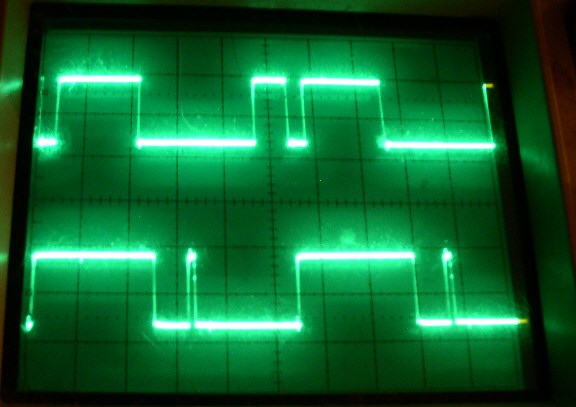
A follow-up to close out something:
> OK, now a picture of the bus with no console card:
> http://ana-3.lcs.mit.edu/~jnc/tech/pdp11/jpg/BSYN-BDAL_NoMem.jpg
[Note: image re-named, to correctly say what it's showing]
> It's a bit hard to interpret what's going on here .. The long assertion
> of BSYNC is undoubtly the CPU trying to get the console CSR to respond,
> and eventually timing out. Not sure what the short assertion following
> it is - without looking at the ucode for the ODT, there's no way to know
> what the CPU's doing.
> Even harder to understand is what the BDAL line is doing. It looks like
> it's un-asserted (0, i.e. +3V) on the falling (electrically - rising,
> logically) edge of BSYN (which would be incorrect - see above). And then
> it hops around while BSYNC is asserted, which makes no sense at all to
> me.
So this makes a little more sense now.
This is actually showing a NXM cycle to main memory (apparently to address 0),
hence the '0' on BDAL10. (The second assertion of BSYNC must be somehow
associated with the NXM.) Apparently it doesn't even try to talk to the
console card unless the memory is there OK; if it can't see the memory, it
must just reset and try again.
Here:
> http://ana-3.lcs.mit.edu/~jnc/tech/pdp11/jpg/BSYN-BDAL_NoCon.jpg
is a system with memory, but without a console. A very similar picture, but
here BDAL10 _is_ '1', as expected.
So the original picture did in fact indicate what the problem was - had I
known enough to know how to interpret it! Schaeffer's Law strikes again!
Although I still don't understand why the LSI-11 wants to see main memory on
the bus, in order for ODT to run. ODT doesn't use memory at all; ODT on the
KDF11 CPUs will run without any memory.
Noel
> From: Mister PDP
> Wow, I wasn't aware that the ODT console needed memory to run.
It was news to me too! (And apparently to most others here too?)
I was going to look at those confusing bus cycles, using an only slightly
mis-addressed console, and wanted to first check that that console worked when
properly configured; so I plugged in it and an LSI-11/2 CPU - nothing.
Switched to a different CPU (maybe the first one died), _still_ nothing? So I
tried an -11/23, ODT worked! So, the console worked; the chances of two CPUs
that were working a week ago suddenly both dying seemed slim... what else
could it be?
And the /23 works with no memory! Odd. Will definitely have to make a note
of that LSI-11 behaviour on the CHWiki.
> I plugged in my 32kw module with my M8017-AA, and it fired right up to
> ODT without a hassle.
Yee-hah!!! EXCELLENT!!!
Well, it took a while, but we finally got there! Do let us know how it goes
with your next steps - and if you have an issue, let us know! (Hopefully, next
time, we won'tbe so clueless! :-)
Noel
PS: Might be useful to check that the DLV11-J works; having a stock of known-good
boards you can swap in is such a tool for QBUS debugging.
I have a few of these that need to be tested. I am certain they have not
been plugged in for many years.
Is the anything special I need to do before I just plug them in and turn
them on?
Cindy Croxton
Electronics Plus
1613 Water Street
Kerrville, TX 78028
830-370-3239 cell
sales at elecplus.com
---
This email has been checked for viruses by Avast antivirus software.
https://www.avast.com/antivirus
Wow, I wasn't aware that the ODT console needed memory to run. Checking on
my board, it looks like the 4kw was disabled. I plugged in my 32kw module
with my M8017-AA, and it fired right up to ODT without a hassle. Seems that
was the issue all along.
On Fri, Jun 7, 2019, 3:08 PM Noel Chiappa <jnc at mercury.lcs.mit.edu> wrote:
> Hi, sorry I'm slow to do those tests; got distracted by the power
> card stuff.
>
> So I've just dicovered that in a system with _only_ an LSI-11/2,
> and a console, ODT doesn't start. I had to plug a memory card in
> as well for ODT to work. (Confused the dickens out of me!)
>
> Is the RAM on your CPU card configured off?
>
> Noel
>
Hi,
I think someone was looking for tape seals for 9 track tapes, a few weeks
ago.
If they can contact me offline, I have about 20 of varying sizes for
shipping cost or local pickup.
Stan
sieler at allegro.com
> From: Systems_Glitch
> I believe the big difference was in the current-supplying capability on
> the +15V rail -- 1A vs. 4A.
Ah, thanks for the tip.
I have an H742, so I was exable to examine it, and the 5409730 (difference
details on that below). The transformer may also be different (see below).
The other differences seem to be mechanical; a larger cooling fan on the 7420,
and the sheet-metal enclosure that holds the the power control board,
transformer and fan is in two parts, bolted together.
Interestingly, in light of your issue, the H7420's all have a fuse in the AC
supply line to the 5411086; it's mounted on the enclosure. Nothing in the
H742, though.
> I believe it was mentioned as an upgrade thing in one of the technical
> manuals I'd read some time ago.
If you happen to recall where that was, I'd be very interested to see it.
Upgrading from an H742 to an H7420 appears to be relatively simple; the pinout
on the Mate-N-Lok which carries the outputs from the power board (DEC's name
for it changes) is the same in both versions. (Have yet to look at the two
Mate-N-Lok's on either side of it; I guess those carry the ~30V AC to the
bricks.)
Upgrading an H742 _to_ an H7420 appears to be more problematic. To start with,
the power board is mounted vertically (on the inside face of the enclosure) in
the H7420, but horizontally (above the transformer) in the H742. Maybe they
changed the transformer too? Will have to check. It's also possible that was
caused by the switch to the larger fan. Anyway, the 5411086 might not fit
in the horizontal; plus the interface is different (see below).
> It would be easy to make up a new harness to swap one in place of the
> other, since the 5411086 goes to a Mate-n-Lok that plugs into the power
> distribution board.
Yes and no!
The 5409730 and the 5411086 are significantly different, mechanically. The
former doesn't have the edge connector (the one that burned out on you),
rather it has a short 12-wire pigtail to a female Mate-N-Lok which plugs into
a hole in the enclosure. That's for the _outputs_ - the AC input is in a
separate 4-pin Mate-n-Lok (physically exactly like the one on older disk
drives on PC's) which is mounted onto the board. (4 pins since there are two
differnet AC inputs - one pair is filtered through what seem to be hefty coils
in the input wiring.)
The harness used in the BA11-K is also significantly different from the one in
the H7420; the former has a male Mate-n-Lok, the latter is a female. The
pinout appears to be a subset on the BA11-K, only 9 of the 12 pins are wired;
assuming standard colour coding, the +8V DC is missing, as is the second
ACLO and DCLO.
Although, as you say, one could make a new harness. Speaking of which, do you
know of a source for the connector that goes onto the edge connector? (Some of
my BA11-K's are missing the harness.)
I'm slowly adding all this info to the CHWiki.
Noel
A friend at work picked up a nice MacPlus but no boot disk.? I have no
Mac compatible drive options here, so I am hoping someone might be able
to help.? I believe it can run OS6.0.8 on 800K floppies, but others
might know more.? Happy to pay for disk, work, and shipping.? Was going
to buy from BMOW, but they are out of stock.
Jim
--
Jim Brain
brain at jbrain.comwww.jbrain.com
> From: Paul Anderson
>> (I also should check to see if the H742 uses the same 15V board; it
>> uses the same 'bricks', so it may.)
> Didn't the H7420 , which replaced the H742, use that also? The H742 uses
> a different one .
Oooh, good catch! The H742 uses a 5409730, but the H7420 does use the 5411086,
the same as in the H765. I always wondered what the difference was between the
H742 and H7420.
I wonder if the two boards (and thus the the power harness) have an identical
pinout, or not.
Noel
> From: Systems Glitch
> I finally fixed the power supply in my PDP-11/10S ... For those who
> have original 5411086s that haven't failed yet, you might want to
> make up a little pigtail with an inline fuse holder.
Congratulations, and a great blog write-up.
The issue you point out (lack of fusing for some components on the +15V
board) will of course apply to not just -11/10S's, but any -11 which uses
the H765, either for the CPU box (e.g. /04, /34) or for an expansion box.
This is important enough that I think I'll add a writeup to the CHWiki
article for that:
http://gunkies.org/wiki/H765_Power_System
which restates the problem, and the proposed solution. (I also should check
to see if the H742 uses the same 15V board; it uses the same 'bricks', so
it may.)
Noel
Rick,
I have a Rockwell AIM-65 and back in the day did a lot of laboratory data acquisition and other things with them. I interfaced one to an atomic absorption graphite furnace to collect the readings and compute the parts per billion of various trace minerals in samples to translate 6 bit ticker tape code at 66.67 baud to 9600 baud ascii for a PDP-11/44. I did development on the AIM-65 and then transferred the code on EPROMs to Rockwell RM6500 single board cards usually. At home I made a ballistic chronometer with some aluminum foil and a resistor and my trusty AIM-65.
The most interesting project was an instrument I designed to measure how stable a vegetable oil was to oxidation. The AIM-65 would test 16 samples using a wire wrapped relay board to sequence through the signals, an Intersil 7109 12 bit A/D chip, a conductivity circuit, 32 Kbytes of RAM to hold data for plotting and a small 4 inch wide Radio Shack Pen Plotter. We built about five of them to use within our company, but had requests from customers for the instruments. Eventually, we out licensed the patents to an external company and I rewrote the software to run on a IBM PC. Later I rewrote the software in LabVIEW and it still runs in many labs where vegetable oils are refined or used. The analytical method for it is called the ?Oil Stability Index? and I wrote the official method (AOCS Cd12b-92) that defines it. If you search for ?Oil Stability Index? you?ll find it is widely used in the field. It is also sometimes called the Rancimat method after another automated instrument introduced later that works in the same way.
When I do get my AIM-65 out to play, it often is catatonic at first. I?ve found that (at least for mine) it is related to the inexpensive IC sockets Rockwell used in it. Usually some Deoxit or tuner cleaner on the sockets and reseating some ROM chips is all that is needed to get it going. That said you certainly could have more complicated issues as well.
Best,
Mark
full writeup here: http://www.glitchwrks.com/2019/06/05/pdp1110-psu-repair
I finally fixed the power supply in my PDP-11/10S, it turned out to be a
shorted bridge rectifier on the 5411086 board, which provides +15 VDC, LTC,
and AC LO/DC LO. Unfortunately, when it failed, the rectifier burned up the
edge connector traces for the AC input to the board. I ended up cutting the
edge connector traces away (what was left) and soldering on a pigtail to
connect to the Mate-n-Lok coming from the AC transformer. I added a 15A
inline fuse, in the repair.
For those who have original 5411086s that haven't failed yet, you might
want to make up a little pigtail with an inline fuse holder. It'd be easy
to make up such that it could plug into the existing harness without
permanent modification, and it'll save your edge connector traces if the
rectifier shorts. It can happen in the other regulator modules too, but
they use a Mate-n-Lok instead of an edge connector, so any damage would be
repairable.
Anyway, the PDP-11/10S is back up and running!
Thanks,
Jonathan
Hi, all,
I recently was given a Rockwell AIM-65 single-board computer in nice physical condition, with the original keyboard and keyboard connector cable.
I've downloaded all of the documentation that I can find, and have been trying to get it running.
After doing a thorough visual inspection looking for any sign of detritus, especially anything metallic, as well as making sure all of the ICs were seated in the pretty-lame single-wipe sockets, and checking for any obviously cooked or overheated components.
Everything looked really nice, and quite clean.
All of the required chips were in place, and looked good, including the 6532 RIOT, 6520 PIA for the display, and two 6522 VIAs. All of the LSI's, including the 6502, were Rockwell-made parts, with date codes all within a reasonable time of each other.
I checked across the +5V and GND power supply connection points, and found that it wasn't shorted, another decent sign.
The machine came with all five of the ROM sockets filled with original Rockwell ROMs, including the two-ROM BASIC interpreter, the Assembler ROM, as well as the two Monitor ROMs, all installed in the sockets they should be installed in. The machine had six 2114's (1024x4 static RAM) installed in the lower three banks of user RAM, with two of the sockets unoccupied. I got two known good 2114's from my stock of parts and installed them in the two empty sockets, so that the machine would be in the 4K of User RAM configuration.
I understand that the machine can be powered up with only the +5V supply, but the thermal printer will show as "down", as it requires the +24V supply. The +12/-12 supplies are also not required.
I made sure that the RESET switch worked properly, and tested the KB/TTY and RUN/STEP switches operated properly. I set the KB/TTY switch to KB, and the RUN/STEP switch to RUN.
I found a power supply that provides +5V at 5A, and tested it out on a dummy load to make sure it was healthy and had clean output, and it was fine. I connected it up to the +5 and +5 Return (GND) terminals on the power supply input barrier strip, and held my breath, and switched on the power strip that the power supply was plugged into.
The result. Absolutely nothing.
No sign of any activity on the display.
I didn't expect anything from the printer, because it didn't have its +24V power.
I left it powered for a little bit, checking for any chips that seemed unusually hot or anything else that seemed amiss, and nothing was obviously upset. The CPU chip warmed up slightly to the touch, but wasn't at all alarming in terms of its temperature. I pressed the RESET switch a number of times, and it made no difference. Oh well.
I powered it off, and pulled the ROM chips out, and decided I'd pop 'em in my ROM programmer and compare them to the ROM images I'd downloaded off the net.
The two monitor ROMs verified exactly. The Assembler ROM also verified correctly. One of the BASIC ROMs also verified properly, but the other failed the verification. Hmm...upon READing it into the programmer's RAM, I dumped it out, and low and behold, it read back as all 0xFF's. Oops.. I double checked that the ROM was properly seated in the programmer's ZIF socket, and it was. I tried READing it a number of times, and the result was always the same. This ROM must have expired somewhere along the way. I can blast a 2732 with the proper bits and build an adapter to make BASIC work once I get the thing running, and hope that maybe sometime I might find a good blank OTP 2532 ROM I can blast with the code, or find one already programmed somewhere.
That said, the BASIC ROMs aren't required to get the AIM-65 to "boot up" in the Monitor, nor is the assembler ROM. I decided to set the BASIC and Assembler ROMs aside, and just re-installed the known-good monitor ROMs in the proper sockets.
I double-checked that all of the RAM chips were properly inserted in their sockets by pulling and re-inserting them, as well as the 6502, 6532, and 6522's. The 6520 on the display board is soldered in, so no socket issues there.
I powered it up again, and verified that +5V was present on all of the chips on the board, and that was fine, with every chip showing +5 give or take +/- .02 Volts. All of the GND pins were at 0V, with only tiny (sub-millivolt) noise on GND.
I put a big dip-clip on the 6502, and got out my trusty Tektronix 2465 scope, and figured I check some of the basic stuff, like making sure that the clock generator was running, and that the 6502 properly would generate the Phase 1 and Phase 2 clocks that the rest of the system uses, as well as looking at the address bus and data bus to see if it was doing anything. The clock generator uses a 7474 dual flip flop, which I know have a tendency to go bad, so checking the clock was the logical first step.
I powered it up again after hooking everything up, and probing around showed that the clock generator was indeed running, and had the proper voltage levels, timing, and duty cycle. The thought that maybe it'd be a simple fix, with a bad 7474, went out the window. The 6502 was pumping out the proper Phase 1 and Phase 2 clock signals, and both were very clean and within specifications.
I looked at the address 0 line, and pressed the RESET button, and it'd wiggle for a short period of time, then go high. Hmm... I looked at the other address lines, and while not all of them wiggled, they all ended up at logic 1 after a short period of time, as if the CPU was stuck at address 0xFFFF. I did the same thing watching the data lines, and the symptoms were similar.
They'd wiggle around a bit, then settle at logic 1 and stay there.
I then watched the chip select signals for the ROMs to see if they were being addressed, and indeed, the low ROM was getting selected for a short period of time, then it'd get de-selected and stay that way. The other monitor ROM also got a short burst of select. So...it appears that the ROMs are being addressed, at least for a short time, and the processor is likely executing the code for a short time, but something causes it to lock up.
I checked to see if any of the RAMs were being selected, and at no time during the short period of activity after a RESET did any of the chip selects on the 2114 RAMs go active.
I then checked the PIA (6520) on the display board to see if it was being selected at all. Nope.
Then I looked at the RIOT chip to see if it was being selected, and indeed, it is being selected during the short period of activity, but then, it goes deselected and quiet once the CPU settles in at 0xFFFF on the address lines.
It appears that the address decoding circuitry is at least mostly functional, as the ROMs, PIA, and RIOT are being addressed. It's not exactly 100% sure that the address decoding stuff is working as it should, though.
I thought that perhaps there might be something up with the 6502.
I have a Commodore VIC-20 that works fine, and it has an original MOS 6502 in a socket, so I opened up the VIC-20, pulled the 6502 from its socket, and popped it in place of the Rockwell 6502 in the AIM-65.
The behavior was identical. So, I'm pretty sure that the Rockwell 6502 is good. I should have popped the Rockwell 6502 in the VIC-20 and tested it that way, but didn't want to fuss with hooking the VIC 20 up to an old TV.
I pulled all of the 2114 RAMs out, and popped them into an old calculator that I have that uses 2114 RAMs, and tested them out this way. The calculator ran just fine with the chips from the AIM-65 in place. I'd figure a bad RAM would likely cause the calculator to malfunction in some way. Not a thorough test, but enough of a test to validate that none of the RAMS were dragging the address or data busses down, and that they did properly do reads and writes.
So, with all that said (sorry, I am verbose), I'm kind of at a loss as to what to do next to try to figure out what is wrong with the machine. Does anyone out there have any suggestions? I have a couple of spare 6522 VIA chips, but these shouldn't really be accessed unless the printer is trying to be accessed (which it might be during initialization at least), and the other VIA is for external interface use...and is probably initialized by the ROM, but neither of them should really be actively accessed other than a short burst of initialization. I could swap in my spare 6522's to see if it makes any difference, but I doubt it would make any.
The unknown is the 6532 RIOT chip. I pulled up some data on the chip, and it appears to be a combination of a PIA (like 6520), 128 bytes of RAM (hmm...), and a programmable interval timer. I don't have any spares for this chip, so I can't just substitute in another chip and see if it makes a difference. The RIOT chip is used to scan the keyboard, and, after looking at the assembly source listing of the ROM Monitor, it appears the 128 bytes of RAM in the RIOT chip are used as the storage for the monitor. It appears that RIOT chips can be purchased, I found a place online in the US that has them for $9.95 each. Maybe I'll order one up.
Maybe the RAM in the RIOT chip is not working properly? If that were the case, since it appears that the stack is stored in that RAM, the first time a subroutine was called and a return executed, it'd cause possibly 0xFFFF to be read as the return address, and that's where things go awry.
I guess maybe I need to dig out my logic analyzer, and monitor the address and data busses, and trace out what is actually happening. But, I figured I query the list here to see if anyone might have some other things that I could do that might be easier to identify what's wrong with the thing.
One thing that I have no idea about is the display subsection. Since the display PIA is never selected, I suspect that any code that initializes it and tries to put something up on the display never gets a chance to execute. The "smart" starburst LED display modules are all properly in their sockets, and +5 is delivered to the proper pin on each module, and there's no sign of unusual heating or anything else that might indicate a problem with the display modules. The PIA also has a clean +5 and GND, and doesn't show any sign of overheating.
I have a small Motorola 6809 microprocessor development system with a couple of 6820 PIA's that I could probably write a quick routine to try to initialize the 6820 on the AIM-65 display board, and try to write a message out to the display to test it, but that seems like a lot of work. I'd rather just fix what's up with the AIM-65, and get it running.
Any thoughts from those out there as to what to do next would certainly be appreciated. I always value the collective knowledge of the members of this list.
Thanks,
-Rick
--
Rick Bensene
The Old Calculator Museum
http://oldcalculatormuseum.com
Is there a way to set the reply-to value in VMS 5 mail? I want to send
mail as SYSTEM but anyone who receives the message on the outside world who
wants to reply I'd like it go to to a different email address.
I am working to solve the problem myself, but if anyone knows already and
can help save me the time :-)
Thanks
Bill
How do you run TCBASX.DG (TC01 Basic Exerciser) and TCRANX.DG (TC01 Random
Exerciser)?
When I run TCBASX.DG it almost immediately halts. Pressing makes the TC08
controller lights grind but no tape motion. TCRANX.DG is basically the
same.
Is there any documentation for these two programs?
Thanks,
Marc Howard
There's a weird Sord M23P (I think) from the early 80's at this elderly persons house in Walnut Creek, CA - East of the bay.
She can't pack and ship it - it's too big and heavy. It was actually sent to her by mistake, it was supposed to be sent to my house, 500 miles away.
It's nothing rare or valuable - you can actually have it if you go and pick it up - I really just want it out of her house.
Let me know!
Steve
I've got a few old reels of milk-chocolate brown 7-track tape here and
was wondering if it's possible to date them accurately. The reels
themselves have the Audio Devices name molded into them; the rear white
flange is quite yellowed with age. The tapes have been used quite
heavily as they've been shortened to much less than 2400'.
I know that AD and EMI had a merger agreement with Capitol on their
vinyl business around 1967 and that the result was spun off as EMI.
That leaves the tape business. It seems that CDC acquired some or all
of AD in 1969, but I can find no details.
Does anyone remember these folks? They used to be *the* major tape
supplier in the USA.
--Chuck
Not that I expect anyone to have a need for it, but just for the heck of it :
here are a few datasheets for single cores ( From a Philips Databook 1973 )
ftp://ftp.dreesen.ch/Cores/CoreMemory_core_datasheet.pdf
Enjoy..
Jos
Besides link cleanups and custodial changes, there is now a model-specific
page for the Eagle 450, one of the earliest ColdFire systems extant, plus
performance statistics for many of the machines and several more newly uploaded
freeware games. Hosted on an Alpha Micro Eagle 300.
http://ampm.floodgap.com/
--
------------------------------------ personal: http://www.cameronkaiser.com/ --
Cameron Kaiser * Floodgap Systems * www.floodgap.com * ckaiser at floodgap.com
-- It's not an optical illusion. It just looks like one. -- Phil White --------
> From: Josh Dersch
> how is the backplane in the H11 currently configured? (i.e. what boards
> are in what slots?) Could the issue here be something as simple as a
> break in the qbus due to a misplaced board?
He did mention that he had the console card in the slot next to the CPU, which
I think is what you're referring to - but it shouldn't matter for ODT, which
doesn't use interrupts, only programmed I/O.
A QBUS system will work fine without continuity of grant (interrupt, DMA)
lines to boards which only respond to DATI/DATO (memory, non-interrupt I/O,
etc). Just for grins, I took my -11/03, and plugged the console card in a
bunch of slots down, leaving several empty slots between it and the CPU, and
it worked 'fine': ODT was fine, and it would run "BR ." programs fine, too.
So unless there's actually a break in one of the 'broadcast' bus lines (e.g.
BDALxx, etc) on that backplane, between the CPU slot, and the slot the console
card is in, or something like that...
I suppose it would be worth while checking BDALn, BSYNC and BDIN _on the
console card_ (I'm not sure where he was looking at them, before) just to
rule out the broken bus line possibility.
One thing that's bugging me, though; he said "BDAL3-13 .. are all active and
jump around in some manner". But for the ODT microcode loop trying to read the
console CSR, i.e. 0177560, BDAL7 (0200) and BDAL3 (010) should be 0, i.e.
un-asserted.
So why are they jumping around too? Is this somehow related to the odd behaviour
I was seeing on my machine with no console card, where the BDAL line was behaving
in a way I couldn't understand?
I'm going to look into that more, to try and understand what I'm seeing there,
but it won't be today, which is 'crane day'!
Noel
Apologies for cross-posting. I've added a few new bits and pieces to the
Dick Smith System 80 site. If anyone is interested, take a look at the
first three entries under this link.
https://www.classic-computers.org.nz/system-80/whats_new.htm
Incidentally, this month is somewhat of a milestone. It's 20 years since
the site went live!
Terry Stewart (Tez)
The M7264 CPU thread reminded me of the collection of LSI-11 CPU's that
I have and want to get up and running.? A very useful thread.
This may have been covered some time in the past, but, my question is
"What is the minimum load for the power supply in the BA11-M, -N and
BA23 boxes?"
Is it possible to create a load board, like the board you find in the
sbox BA213 VAX's that ensure a minimum load on the power supply?
Doug
Hi
???? Well we are moving forward.
The 160336 alternate RQDX3 address and vector have been confirmed as OK
by one of our Techno Mages.
So rather than an RX50 I'll give an RX33 whirl. A floppy disk way in
means I can enhance the baseline RT system.
Time to dig out all of the Q-bus controllers and see what else we can add.
I have a Viking SCSI controller. That might be interesting as an
alternative to the CQD.
I think I may have Q bus controllers for my RX01 and RX02. AKA as 'Clonk
City'
11/93 is no end of fun. Best thing since my brother fell in the slurry
pit 60 years ago.
Rod
--
If anybody is interested in building? Jorge Hoppe's Uniprobe, I have some PCB's available. I made a few extra to keep the price down. Price is $40 ea shipped in the CONUS. These have Silver fingers rather than Gold but should still hold up well. Build information is on Retrocomp.
Brian.
> From: Holm Tiffe
>> The "--list" command to 'dd' gives a whole bunch of stuff:
> aha:
> $ dd --list
> dd: unknown operand --list
I was talking about the program I had mentioned in the previous email, "dd
for Windows". The "--list" command to it produced that long list of devices
(the list you edited out of the reply), so it definitely works there.
> Nobody in a PDP11 is interested what Windows thinks about partitions.
Understood, but in my previous email I had given an example using a uSloth
partition:
>> dd-removable if=UnixRoot of=\\?\Device\Harddisk2\Partition0 count=4872 seek=131072
so when your reply mentioned "partitions" ("You have to have an already
existing parition structure on the disk") it was natural to assume you meant
those - especially since there was a plausible reading of your comment
involving them (i.e. 'does "dd for Windows" only work on a disk with an
existing uSloth partition structure on it').
> Most of the PDP11 SCSI Controllers could build two or more PDP11 disks
> out of one physical device. That is what I meant with partition in this
> case .. There is some logical information on the device, you simply
> don't get the entire raw device on the pdp as you possibly think.
That's a good point, and perhaps there's no existing way to write a SCSI disk
>from a Windoze box in a way that the PDP11 SCSI controllers can grok. I don't
know enough about how they work to answer that.
> Tapes have no such restrictions
Right, but one has to have a tape drive; the OP may not.
Noel
Hello,
I'm in the process of cleaning and hopefully restore to operation of a DEC
R80.
The unit has some minor sign of corrosion, however it's VERY dirty, even
inside the hood.
The filters are obviously to be removed and replaced, as they are
disintegrating.
Also foam parts between the boards must be replaced.
Aside from obvious parts, there's something that should be replaced /
cleaned inside the HDA (foams, filters or rubbers), which could damage the
disk permanently in case it's turned on after decades if not "cured" before?
Anybody has some good pictures of the HDA inside, after cover removal?
Thanks
Andrea
(Credit the Quotas thread for prompting this.)
Did anyone ever use process accounting? Did they actually bill
departments (funny money)?
I was always intrigued by process accounting, but never had a use for it
myself.
I guess I can thank process accounting for causing the discrepancy that
Cliff Stole tracked down that became The Cuckoo's Egg. :-)
--
Grant. . . .
unix || die
Hi
??? Well I now have a bootable SCSI drive on my 11/93. Its not RSTS/E
(yet) but it is RT 11 and reliable.
Its a bit baseline but it runs.
So next up was to see if we could get the RQDX3 to co-exist with the
SCSI controller.
I switched the base address to 160336 and it does not stop the SCSI
drive booting as DU0.
Had the RQDX3 been on the normal base address I think you would get the
HD as DU0 and the two halves of an RX50 as the next two drives.
But what happens to the RX50's when you move the RQDX3 to 160336 ?
Rod
--
Hi,
I fired up the 8/A tonight and the TU56's are failing diags. I want to
format a tape for scratch use but I can't find the MAINDEC that does this
(along with flipping up the backplane switch.
Can someone refresh me on the proceedure?
Thanks,
Marc Howard
>
> Date: Tue, 28 May 2019 21:21:43 -0700
> From: Marc Howard <cramcram at gmail.com>
> Subject: How to format Dectape (TC08 + TU56)
>
> Hi,
>
> I fired up the 8/A tonight and the TU56's are failing diags. I want to
> format a tape for scratch use but I can't find the MAINDEC that does this
> (along with flipping up the backplane switch.
>
> Can someone refresh me on the proceedure?
>
> Thanks,
>
> Marc Howard
MAINDEC-08-EUFB should work on both TC01 and TC08 controllers.
--
Michael Thompson
I have an old daisy wheel printer by Hewlett-Packard, their 2601A. We got
this from an estate cleanout and I would like to sell it. It has been
powered up and the power light comes on and the carriage moves to the
starting position. It is a large, very heavy machine. I have it on ebay for
$150 (https://www.ebay.com/itm/223533138720) but that was just a shot in
the dark. There is a better description and more pictures in the listing.
Any reasonable offer considered. I have no way to ship this item from here
but will drop it off at the ups store. The buyer will have to make their own
arrangements for packing and shipping with ups.
Mark
mark at meba.com
Andrea (Brent & Glen)
Nice work spotting the factory ..
Needless to say, it might not even be possible to do anything, but hopefully someone takes an interest!
Hi
???? Due to the help from Glen Slick. (The only guy to answer the
question as asked.)
???? What to do is interesting. How to do it will get you there.
I now have a SCSI drive on the 11/93 that thinks its an RD54 and is
trying to boot RSTS/E.
It fails gracefully during the boot? giving an error message.
So we have a working Hard Drive and Controller on the target system.
No to find out what it does not like.
The transfer rig is now working OK.
So I can try out more drives if needed
Rod
--
> From: Holm Tiffe
> You have to have an already existing parition structure on the disk and
> an OS that knows what todo with that.
The "--list" command to 'dd' gives a whole bunch of stuff:
Win32 Available Volume Information
\\.\Volume{cd4ae459-0daa-11e2-9625-806d6172696f}\
link to \\?\Device\HarddiskVolume1
fixed media
Mounted on \\.\d:
\\.\Volume{f3c65dd6-01af-11e1-a511-806d6172696f}\
link to \\?\Device\HarddiskVolume2
fixed media
Mounted on \\.\c:
\\.\Volume{f3c65dd7-01af-11e1-a511-806d6172696f}\
link to \\?\Device\CdRom0
CD-ROM
Mounted on \\.\m:
\\.\Volume{a531c21e-b869-11d9-9977-806d6172696f}\
link to \\?\Device\Floppy0
removeable media
Mounted on \\.\a:
\\.\Volume{89bdc974-217e-11e8-96f6-00038a000015}\
link to \\?\Device\Harddisk2\DP(1)0-0+7
removeable media
Mounted on \\.\e:
NT Block Device Objects
\\?\Device\CdRom0
size is 2147483647 bytes
\\?\Device\Floppy0
\\?\Device\Harddisk0\Partition0
link to \\?\Device\Harddisk0\DR0
Fixed hard disk media. Block size = 512
size is 20020396032 bytes
\\?\Device\Harddisk0\Partition1
link to \\?\Device\HarddiskVolume2
\\?\Device\Harddisk1\Partition0
link to \\?\Device\Harddisk1\DR1
Fixed hard disk media. Block size = 512
size is 10262568960 bytes
\\?\Device\Harddisk1\Partition1
link to \\?\Device\HarddiskVolume1
\\?\Device\Harddisk2\Partition0
link to \\?\Device\Harddisk2\DR6
Removable media other than floppy. Block size = 512
size is 15833497600 bytes
\\?\Device\Harddisk2\Partition1
link to \\?\Device\Harddisk2\DP(1)0-0+7
Removable media other than floppy. Block size = 512
size is 15829303296 bytes
some of which appear to be entire disks, not partitions.
Since I was trying to write into a specific area of an SD card connected via a
USB adapator, I took the path which seemed to be that of least resistance,
which was to use a partition which covered the blocks I wanted to write.
If I needed to write the boot block (which contains the partition table), I'd
have probably tried using some of the other devices in the list, but since I
didn't need to, I decided not to get diverted from my real goal by trying
other devices.
Maybe it won't work for what he needs to do. But it worked fine for me, doing
something very similar, so I thought I'd mention it.
Noel
Hey all,
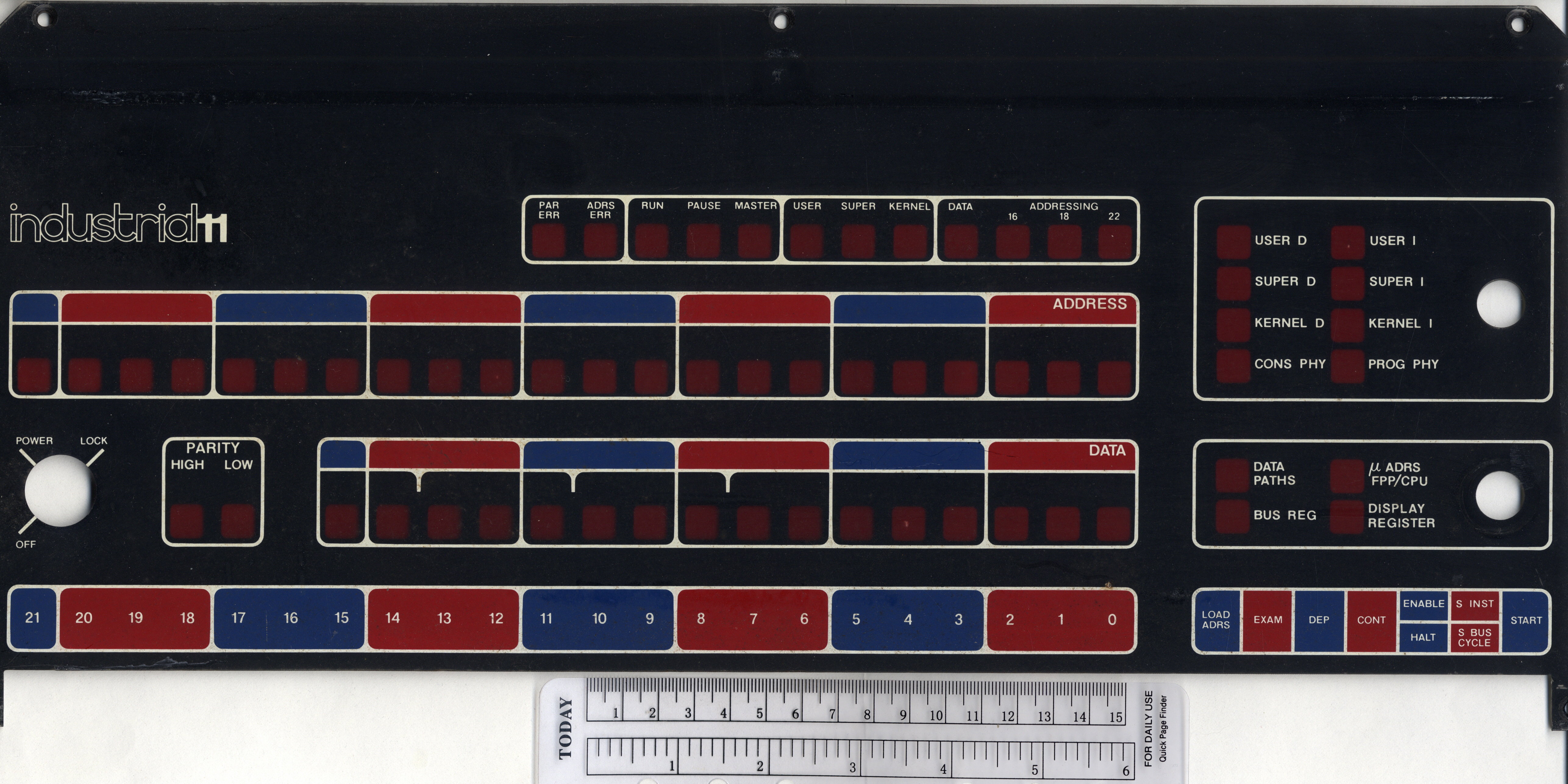
I bumped into someone who has some early (mid 1970 on some of the photos
I've seen) PDP-11 bits - front panel and a handful of boards (the
backplane, PSU, rack, peripherals etc. are long gone). The front panel's
branded as "Industrial 11" though, which isn't something I've seen or heard
of before.
Address bus is 16 bits wide, and aside from the branding, the style appears
to be the same as an 11/05 or 11/10. Were there any differences to the
system internally though, or in the standard set of boards fitted, or was
the "industrial" aspect purely a marketing exercise?
cheers
Jules
Hi, sorry about the delayed reply; been dealing with this:
http://ana-3.lcs.mit.edu/~jnc/jpg/backoak/WholeTreeS.jpg
The cranes arrive tomorrow...
> I took a look at all the lines you mentioned. BDAL3-13, BDIN, BSYNC, and
> BBS7 are all active and jump around in some manner.
Hmm. Well, that shoots down the simplest theory; that a CPU BDAL (or perhaps
BDIN) driver (technically, a transceiver) chip is bad; if you're seeing any
activity at all on a line, the driver must be working. So, either both console
cards have an issue, or something more complex is going on.
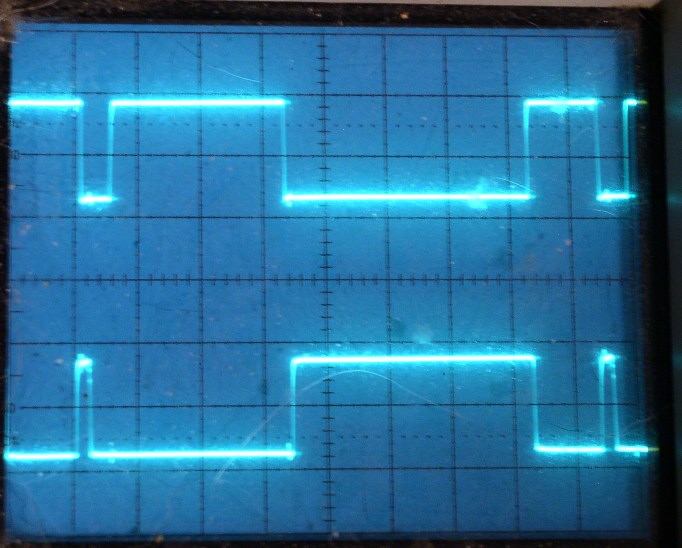
Here are some pictures to show you what you should be seeing, and what I'm
seeing with an LSI-11 with no console card. First, normal operation:
http://ana-3.lcs.mit.edu/~jnc/tech/pdp11/jpg/BSYN-BDAL_OK.jpg
The top trace is BSYNC, the bottom BDAL10 (which should be asserted for
0177560, the console CSR's address; it's the 02000 bit). The timebase on this
one is 1 usec per division. As you can see, it's in a tight loop reading that
register.
The QBUS spec shows that for a DATI cycle, the DAL lines are set up before
BSYNC is asserted (falling edge here, since the bus lines are inverted).
BDA10 is indeed asserted (low) when that happens; shortly after it goes back
to 0 (high) so that device can put its data out on those lines. It stays high,
so that bit in the CSR must be 0.
OK, now a picture of the bus with no console card:
http://ana-3.lcs.mit.edu/~jnc/tech/pdp11/jpg/BSYN-BDAL_NoCon.jpg
It's a bit hard to interpret what's going on here (note that the timebase is
much larger - 5 usec). The long assertion of BSYNC is undoubtly the CPU trying
to get the console CSR to respond, and eventually timing out. Not sure what
the short assertion following it is - without looking at the ucode for the
ODT, there's no way to know what the CPU's doing.
Even harder to understand is what the BDAL line is doing. It looks like it's
un-asserted (0, i.e. +3V) on the falling (electrically - rising, logically)
edge of BSYN (which would be incorrect - see above). And then it hops around
while BSYNC is asserted, which makes no sense at all to me.
At this point, my best guess at the most likely cause of your problem (given
the 'all the lines are doing stuff') is that both console cards have
issues. Tomorrow, when I'm not outside, I'll try and look at some other BDAL
lines and see if they are doing the same thing with no console card in.
Noel
trying to ID early core stacks from GE 200 series ( like for dartmouth basic machine) or or ERMA. any old times have close up docs or part numbers? I may have found the lost treasure...
we? have a? ?2 each 21 inch? or? ?so? wide? thing? ?with 2? monster ass? stacks? mounted in each one..
one is? intact? and? dirty? but? ? ?intact!
?the other? ?stacks? and? weird other things mounted to metal? frame? work are there? but? ? ?some? stiff is? just? hanging? off it
unit? ?2? might? be? subdivided? and shared .? ? I? have never seen? GE? core? that? was? this? large......
Metal? ?frame? has? log? ?GE? part? number? ? each? stack? has? ?one? ?too
the? game is? afoot!
if? not? solved? rather? ?quickly? they? return to the? warehouse.
thanks? ed sharpe? archivist? for smecc
This just came up on Fess Bouc. I did not know that it existed.
It's an LLVM-backed modern compiler for BLISS.
https://madisongh.github.io/blissc/
--
Liam Proven - Profile: https://about.me/liamproven
Email: lproven at cix.co.uk - Google Mail/Hangouts/Plus: lproven at gmail.com
Twitter/Facebook/Flickr: lproven - Skype/LinkedIn: liamproven
UK: +44 7939-087884 - ?R (+ WhatsApp/Telegram/Signal): +420 702 829 053
I took a look at all the lines you mentioned. BDAL3-13, BDIN, BSYNC, and
BBS7 are all active and jump around in some manner. BRPLY is still the only
line that does not have any activity on it. None of the BDAL lines seem
shorted to ground or to each other. My DLV11-J is configured to essentially
factory settings (J3 set as console, 8 bits no parity) except for the fact
that J3 is at 9.6k baud instead of 300, the address jumpers are exactly the
same as the one you provided.
On Sun, May 26, 2019 at 6:35 PM Noel Chiappa <jnc at mercury.lcs.mit.edu>
wrote:
> Hey, I owe you replies to about a zillion emails; been busy, I'll
> try and get to them tomorrow. A few quick things:
>
>
> > My M8043 (DLV11-J) just arrived today.
>
> Here are the jumpers on mine, which I just pulled from a working system,
> so you can compare and make sure you have them correct:
>
> A5 L
> A9 L
> A12 C
> A10 C
> A11 C
> A8 C
> C2 C
> C1 C
>
> Key: L = jumper from left post to right (component side up, gold pads
> at bottom)
> C = jumper from center post to right
>
> A6 I
> A7 R
>
> I = Insert, R = Remove
>
> B-X-H X-H
>
> I have left out the vectors jumpers, since ODT doesn't use interrupts, and
> the line config jumpers (their setting shouldn't have any effect on the
> ability of the board to respond to ODT).
>
>
> > I have a hard time imagining that both my M8017 and my M8043 are
> > bad, but it could still be possible.
>
> Well, I did mention that the CPU board could have a fault causing it to
> put out a bad address for the console; the other likely cause is that
> both consoles are bad. Not sure which is the most likely.
>
> The blunt hammer debugging technique is to look at the address being put
> out on the bus; you'll need to look at BDAL3-12 and BBS7 (sort of an AND
> of all the high address bits, so devices should work on Q16, Q18 and Q22;
> in fact, the manual says that device should look at BBS7, and hot BDA13
> and up). Best to use a 'scope so you can see what the waveforms look like.
> This is slow and painful, but will allow precise, definitive diagnosis.
>
> If the address is good, look also at BDIN. If that's toggling, it's the
> consoles. Otherwise, CPU issue,which we'll delve into once the data
> points definitively.
>
> Noel
>
Hi
????? Thanks to Glen Slick I now have a old windows xp system running SIMH
???? Its connected to my LAN so web and file access are OK
???? In addition to the normal IDE drive it has an additional SCSI
controller and drive
????? Using SIMH? I have created an image (RD54.dsk) containing a RSTS
system.
???? I am awaiting the final instructions as to how to copy the image
to the SCSI drive in such a way I can connect it to the SCSI controller
in the 11/93 and have it boot.
Rod Smallwood
--
I've been doing more work on my 9000/350 now that I have actual space to
do work on it in. Although the 10b2 is flaky, I can usually coax it to work.
However, the damn thing won't query DNS even though I have a populated
/etc/resolv.conf. It can ping the name server, and if the name server's
name is in /etc/hosts it will resolve it (and even telnet to it), but it
won't talk to it for anything else.
I'm not as adept at HP/UX before 10.20 (my first experience with the OS),
but I understand 8.0 "fails over" to /etc/hosts if it has some issues with
DNS. Fine, but how can I get it to switch *back*? There's no /etc/nsswitch.conf
and I don't think this version supports it anyway.
--
------------------------------------ personal: http://www.cameronkaiser.com/ --
Cameron Kaiser * Floodgap Systems * www.floodgap.com * ckaiser at floodgap.com
-- There is always one more imbecile than you counted on. ---------------------
The Acer PC I was using to write the image to the SCSI drive has gone kaput.
Clearly PSU (not plugtop? mains fuse).
Its a non standard PSU and no schematic available.
Fall back is to get one of the SLU's (other than the console) on the
KDJ11-E going and TU58 it.
Rod
--
Hi
??? Whilst I wait to hear from Glen Slick who has got me this far
(Thanks Glen) I'll restate the problem.
1. I now have an old XP system with SIMH on it (PDP11.exe)
2.? I have created RD54.dsk containing RSTS/E
3. Attached to the system is a 2.1Gb SCSI drive via an adaptec 2940
controller
4. I need a tried and tested list of step by step instructions to put
RD54.dsk on the SCSI drive.
5. The drive will then be moved to a CQD-220A/TM SCSI controller on my
KDJ11-E based 11/93 and must boot.
6. Its just an image copy from one drive to another on the same system.
7. Nobody has come up with a tried and tested list of step by step
instructions yet.
Rod Smallwood
--
> From: Rod Smallwood
> 4. I need a tried and tested list of step by step instructions to
> put RD54.dsk on the SCSI drive.
Well, this isn't a list of directions, but... I've had good luck doing
almost this exact same thing (on a Windows XP box, copy a filesystem in
Windoze file onto a device, in my case an SD card on a USB adapter) with
'dd for Windows', available here:
http://www.chrysocome.net/dd
The command line I've worked out to use is:
dd-removable if=UnixRoot of=\\?\Device\Harddisk2\Partition0 count=4872 seek=131072
I don't recall the exact procedure I used to generate that, but I'm pretty
sure it involved the use of the "--list" command to 'dd', to get a list of
the devices on the system. (The "4872" is the size of the RK pack,
obviously.)
I'm using dd-0.6beta3.zip but there may be a later version that works too.
Noel
Hi all --
Curious if anyone has a spare L0022 memory controller, this allows a
VAX-11/750 to address up to a whopping 14mb of memory (2x4mb, 6x 1mb
boards). I found a couple of the 4mb boards, now I just need to upgrade
the memory controller to be able to use them...
Thanks as always,
Josh
> From: Jon Elson
> Yes, this is most likely a bus timeout
The good news is that it looks like his CPU is 'mostly' working; and if
the NXM is due to a fault on the CPU (e.g. bad bus transceiver sending
the wrong address), that would be fixable (it uses 8641's).
If the fault is in the DLV11-E (and not just misconfiguration), depending on
where the fault is, he might be out of luck with that card; it uses DC005's
for transceivers, which of course are unobtainium now. Still, QBUS serial
interfaces are not rare.
And overall, progress is being made! :-)
Noel
Hi
??? I am working on getting my KDJ11-E based system up.
I have a CQD220A and a SCSI hard drive installed and formatted.
A serial connection to a Raspberry Pi soon brought up the console on the
PDP-11 using TU58FS.
Next will be a second serial line to allow TU58 emulation. SFSG
What is not clear is if I can get a bootable OS (RT, RSX or whatever)?
image onto the Hard Drive using TU58FS.
Any advice as to if and how this could be done would be greatly
appreciated .
Rod Smallwood
--
I took a better picture of the panel for this yesterday
http://bitsavers.org/pdf/dlcCompany/cowculator
Other than a couple of want-ads from the early 60's I've
not been able to turn up any more information on this.
I'm assuming you optimize by adjusting the parameters to
zero on the meter.
Other than what is on the panel, I've not found anything
on the DLC Company in Linthicum, Md.
The discussion on raised floors in data centers reminded me of an interesting past experience. My company had installed its first supervisory process control system in an enzyme plant. The plant had been around for quite some time and the process control system was part of a retrofit of the facility. Part of that retrofit was remodeling a room for the PDP-11/44 and the related racks of industrial controllers. There were hundreds of cables carrying various analog and digital signals and control signals under the raised floor that they installed.
The only bad thing about the location of the data center was that it was directly under some tanks that were installed on the roof. One tank was for concentrated sulfuric acid which was used to adjust pH in the fermenters. That acid tank was filled from tanker trucks that would come from time to time. One day a trucker who was filling the tank was not paying attention and over filled the roof tank and acid overflowed over onto the roof which should have held the overflow, but it was a flat roof designed to protect from rain not concentrated sulfuric acid. Down in the data center the operator noticed that liquid was flowing down the walls of the room and past the raised floor tiles into the space below. It was easy to confirm it was acid since it was attacking the paint on the wall. The acid pooled under the floor with the cables.
That was when they called the research chemists next door. We came in and determined that there were some drains under the floor (it had been a factory room before it was converted) and we suggested that they flush the space under the floor with water to dilute the acid to get as much of it out as possible. Then they used fans to try to dry out the room and the space under the floor.
After all this, miraculously everything seemed ok, but about once every 6 weeks or so that PDP-11/44 would develop some issue and the DEC field service guy (it was under contract) would come out and swap a board or two, marveling at how he had never seen boards that were so corroded. In retrospect I?m amazed that 11/44 survived as well as it did.
Mark
I have an old floppy disk drive by Hewlett-Packard, their 9895A Flexible
Disc Memory. We got this from an estate cleanout and I would like to sell
it. It has been powered up and one bay door works when the button is pressed
and the other doesn't. It is a large, very heavy machine. I have it on ebay
for $299 ( <https://www.ebay.com/itm/254242280384>
https://www.ebay.com/itm/254242280384) but that was just a shot in the dark.
Any reasonable offer considered.
Mark
mark at meba.com
I should have been more clear in my last response. The 2x2 grid of the floor tiles does not extend to the floor, but to an intermediate layer with wider spacing of the supports at the floor level.
The NCAR Wyoming Supercomputer Center has raised floors of about 20 feet. The auxilary cooling and PDUs are installed down there. Needless to say, you don't pull a floor tile there unless you are on the facility staff!
These four binders are in Toronto, Canada.
* VAX DATATRIEVE - User's Guide
* VAX DATATRIEVE - Handbook
* VAX DATATRIEVE - Reference Manual
* VAX DATATRIEVE - Guide to Writing Reports, Guide to Using Graphics,
Guide to Programming and Customizing
But I don't see on bitsavers -- Can anyone else confirm? I have the
ability to ADF scan before recycling. Or can ship to anyone prepared to
pay cost.
--Toby
> On May 22, 2019, at 11:00 AM, cctech-request at classiccmp.org wrote:
> From: Grant Taylor <cctalk at gtaylor.tnetconsulting.net>
>
> On 5/21/19 5:33 PM, Craig Ruff via cctech wrote:
>> The NCAR Wyoming Supercomputer Center has raised floors of about 20 feet.
>
> Did the support posts go all the way down? Or was there some sort of
> grid work that supported the raised floor above an open area that
> contained the PDUs?
It was moderately open below the floor, there are columns that support the grid. I looked, but I don't have a picture in the under floor area when I was up there years ago, and didn't see anything obvious on the NCAR or Wyoming web sites. There is a video at https://www.youtube.com/embed/u4H7U5Weopw <https://www.youtube.com/embed/u4H7U5Weopw> that shows some of the support equipment briefly, but not the underfloor area.
> On the LSI-11/2, with the machine stopped, 'run' was off, and the
> output on AF1/AH1 was always high (i.e. not asserted).
> I don't have any guesses as to what the behaviour of yours is about.
Hah! Eureka! I had a brainwave, and decided to look at my machine with
the serial console board pulled out!
I then get the exact same behaviour on SRUN as you're seeing - a very brief
spike every so often (about every 25 usec, here).
So I'd be looking pretty hard at your DLV11-E; start by making sure it is
configured correctly.
Past that, you'll need prints; Manx claims there aren't any online, but there
are a set in the jumbo assemblage, ET-LSI-11 (MP00706); the DLV11-E prints are
on pp. 31-37.
All you have to do to get a nice 'scope loop is to power the machine on; the
CPU will dutifully try and read the RCSR, in a fairly tight loop.
Probably worth picking up a spare DLV11 of some type for fault localization
via board-swapping/etc; DLV11-J's can be found on eBait for not a large sum.
Noel
anyone know where i could find manual or drawings on this im up in northern
manitoba canada picked it up at a rr auction to experiment with as a audio
interface not sure if the jacks on the side are the weird pins nasa had or
another standard i can find?
https://www.flickr.com/photos/1ajs/albums/72157705166193482
> From: Jos Dreesen
> And so the story continues....
> https://ibms360.co.uk/
Wow, what a great recover, and a great site documenting it!
Renting temporary local storage was a great idea; it would have been hard
to get all that out of there on schedule any other way. (Alas, I don't
know any hauliers who can help them get it all back to the UK!)
They should have tried to get the raised floor too (I guess it wasn't
included in the sale), since i) it'll be useful if they try and get the
machine up and running, and ii) it'll probably just get scrapped. Although
there may already be raised floor where they're planning to put it.
Noel
well the? good? thing? is? Marc? with? turn over in? industrial? facilities? and? updating? tech...? ? what? you? are? looking? for? ?should? come? available at a? reasonable? ?price....? ?yikes? I? am amazed? how? cheaply? ? some of the normal? biological? scopes? ?go? ?for? ?now... we have been offloading? some? of? ours? ?from the? collection as? for? instance? with? a ziess standard? we? have? 3? and? ?really? should? only? have? one as? an? example....? ?they are? ?a partial? price? of? what? ?they would? have? been? 10? years? ago. Let? me? know? how? you? ?do.? looking? ?for? Nomarsk? ?stuff. We? ?do? not? have? any? extra. We? may? have? something? extra in? Nikon? ?with? Francion Yamatto? ?somewhere though,
Ed#
I? have? not? been? to may? ?auctions at? any of? the industrial? facilities or? auctioneers? ?in? years? to? look? ?for? ?hi? power? ?semiconductor? ?scopes? ?but? that? is? where? they? used to? show? up.
In a message dated 5/20/2019 10:36:40 PM US Mountain Standard Time, curiousmarc3 at gmail.com writes:
Nomarski microscopy, Ed. Differential phase contrast microscopy. Makes very small height differences (partial wavelength) on mostly planar objects pop out, and creates amazing color effects as a biproduct. Pretty much a stalwart of any good cleanroom microscope. Every manufacturer offers it, usually a pretty expensive option as all your optics have to be stress-free. I dream to own one of these one day.
Marc
?
From: cctalk <cctalk-bounces at classiccmp.org> on behalf of "cctalk at classiccmp.org" <cctalk at classiccmp.org>
Reply-To: "COURYHOUSE at aol.com" <couryhouse at aol.com>, "cctalk at classiccmp.org" <cctalk at classiccmp.org>
Date: Monday, May 20, 2019 at 11:20 AM
To: "COURYHOUSE at aol.com" <couryhouse at aol.com>, <spacewar at gmail.com>, "cctalk at classiccmp.org" <cctalk at classiccmp.org>
Subject: Re: HP-01 calc watch go withs - brochures, t- shirts, booklets, ad copy who else collecting?
should? say
?Francion Yamamotto? ?not ?Yrancion Yamamotto
In a message dated 5/20/2019 10:07:04 AM US Mountain Standard Time, couryhouse at aol.com writes:
Since? we? have? nice? microscopes at? the museum? project? we? were? hired? to? photo? some IC? innards? years? back. This? ended? up? becoming? a minor obsession? for? a short? time? as? the? artwork under? various? illuminations? is? fantastic.?
One of the things? that? seemed? to show the mots? difference in? detail between layers and highs? etc... was? differential? interference contrast? (after? nomorski (sp?) ( this? was on our? Ziess Ultraphot? and? seems? to be? a Zeiss? only? ? offering.0? ?on? the? Japanese? side of? things? Nikon? had? ?Yrancion Yamamotto (sp?)? method? which? seems? ?nice? ? but? I? preferred? the? ?Nomeriski.
Using? these? ?methods? you? may be? able? to extract? more usable? detail? ?than? with traditional methods.? ?and? wow? the? color? photos? are? ?frame-able!
But? ?kinda? what? I? wanted to mention? to is? depending? on? what? era? ?the chips? were? the? over? coatings? ? seemed? to? worsen? the view? the newer the chip? or? so? I? thought at the? time.
Such? great? ?fun? to? photo? ?the? little? ic innards!? ?even? a? standard? ?illum.? ?scope? with the? vertical? episcopic? illumination? gives? ?some? ? fun? photos? too,? especially? on the? earlier? ?chips.
Don't? know? if? any? of? ?this? will help on the? HP-01? roms? but? sure? was? fun to talk about? again
ed sharpe archivist for? smecc
In a message dated 5/20/2019 9:00:09 AM US Mountain Standard Time, spacewar at gmail.com writes:
Only just within the last month I finally obtained a ROM dump from a production HP-01, for potential use in my Nonpareil simulator. Previously I only had the preproduction code listed in a US patent. I'm not sure when I'll have time to actually work on the simulation, though.
My original plan had been to crack open an HP-01 module and try to read the ROM bits optically, as Peter Monta did for the HP-35. However, that didn't work, probably due to a passivation coating on the ROM dies.
> From: Glen Slick
> According to the M7270 LSI-11/2 Microcomputer Module User's Guid[e],
> it uses BC1, BD1, BE1, BF1 for SCLK3 H, SWMIB18 H, SWMIB19 H, SWMIB20 H.
Oh, thanks! I wonder how I missed that, looking at the prints? (The
drawings have these nice dark arrowheads to indicate backplane
connections.) I just visually blew past it, I guess.
BH1 is also used there (for SWMIB21 H); and on the previous page, the STOP L
output is on AE1, and MTOE L (whatever that is) can be fed from AK1.
Not quite sure how a Q22 memory card causes the problem, electrically, since
those lines are inputs on the memory card, so it's an input<->input connection
(i.e. voltage sources in TTL), but obviously it does.
And I also don't see why Q18 cards are a problem; BDAL16 and 17 are
AC1 and AD1 respectively, which I don't see in the 'extra pins' list
for the LSI-11/2. Oh well, not too important to track it down.
Thanks again for catching my miss! Wow, it's been a loooong time since
I worked with an LSI-11 - about 40 years! :-)
Noel
> From: Mister PDP
Well, I verified that the LSI-11/2 should work in a Q22 backplane -
in the sense that the only pins it tries to talk to are standard
QBUS pins, and AF1/AH1 for SRUN. It doesn't drive BREF, which might
cause issues in later QBUS systems.
Although it's a different board from the LSI-11, it uses the same CPU
chip set, so it should give us some useful comparison data.
So after a certain amount of issues (see next), I got my LSI-11/2 working.
(It doesn't seem to work with Q18 memory, such as the MSV11-D. Attempts to
write 0 to memory from ODT wind up leaving the bits in the high byte set.
I have no idea why - anyone have any ideas? With Q22 memory, the symptoms
are even stranger; the system hangs with the 'run' light on - even with
the HALT switch on! Luckily I had an MMV11, and it worked OK with that.)
> I took a picture of the readouts for SRUN
Odd. On the LSI-11/2, with the machine stopped, 'run' was off, and the
output on AF1/AH1 was always high (i.e. not asserted).
I don't have any guesses as to what the behaviour of yours is about.
> Checking the BSYNC, it looks like there is life. It oscillates at
> 58.605 KHz, and has wider peaks than the SRUN signal.
The frequency is not as useful as plain timings - especially for signals
which don't have a 50/50 duty cycle. For example, on the -11/2, while in
the ODT console CSR read loop (below), BSYNC is asserted for 2.5 usec
(which sounds about right for a complete read cycle), then off for 1.0
usec.
Also, in the pictures, it's not clear which part of the cycle is asserted
(which, on the QBUS, is 0V - i.e. inverted) and which is idle (~3V). Is
this the actual bus signal we're seeing, with high being idle, zor on the
other side of an inverting receiver?
The image shows some timing numbers, but it's not clear that they mean.
E.g. above, it says "4.00 usec" - but is that per division, the whole
horizontal, what? Below, I see below "17.06 usec", and if that's the
rising edge -> next rising edge interval, that sounds like a bus timeout
is happening.
> This signal does not respond to the Run/Halt switch being toggled,
> but I would assume that to be normal
Right; while in ODT the CPU is trying to read the console CSR, and
so you should see BSYNC cycling.
At this point, you might want to look at BRPLY, which will tell us
if the console is responding to the read of the CSR.
Also, I don't know if your /73 system has a KDJ11-A (dual width card, no
onboard console) or a KDJ11-B (quad width card, onboard console); if the
former, it might be worth swapping the DLV11 card into that system to
see if _it_ is working.
Noel
I liked? raised? flooring....? ? ?you can? clean the room up? fast? by stashing? stuff in the non critical to airflow? areas!? ----see
we? were? lucky? when? comshare? of an arbor? ? division on? phx? ? moved out? ?where? they? designed? IBM channel interfaces? for? xerox sigma 9s
We? got their? space next to? us? ?and bought? their? their? flooring? rather? than them? shipping? back? to ann arbor Mich.? to put? our? HP? stuff on.
best? thing? ever? did? ?it? kept? things neat, clean and? provided? xtra storage.?
In a message dated 5/20/2019 9:11:04 AM US Mountain Standard Time, cctalk at classiccmp.org writes:
> I guess it would look right for the era, but I'd never build a data center
> with raised flooring after my experiences with them.? It's such a pain to
> work with compared to a sealed concrete floor and overhead cable trays.
But with a raised floor, you can whack the tile puller down in such a
way that it makes an enormously loud pop that startles everyone in the
datacenter!
I cannot imagine difficult it would be to run S/360 era cables in
overhead trays. Many are an inch or more in diameter.
--
Will
--
Will
-----Original Message-----
> From: cctalk <cctalk-bounces at classiccmp.org> On Behalf Of Chuck Guzis via
> cctalk
> Sent: 21 May 2019 22:33
> To: Grant Taylor via cctalk <cctalk at classiccmp.org>
> Subject: Re: Pleas ID this IBM system....
>
> On 5/21/19 1:17 PM, Grant Taylor via cctalk wrote:
>
> > I'm sure that was /a/ problem. But I'm not comfortable attributing
> > that problem to the raised floor.
> >
> > I expect that the same problem would be effected by an elevator that
> > doesn't stop perfectly level with the floor, or has too wide a gap
> > between the car and the floor, or even on tiled floor.
> >
> > That really seems to me like it's a sub-optimal design, pushed past
> > it's operating parameters by overloading it.
> >
> > I can't fault the raised floor for that problem.
>
> No, but it's just one of the anecdotes that go with the terrain, like leaving a
> box or two of cards or a stack of tapes or your dinner on top of a 1403N1
> when it ran out of forms..
>
> How well sealed were the raised floors? I ask this because i recall an episode
> or two where a disk drive would spring a leak and make a beautiful slippery
> pool on the floor, just waiting for the next operator to dash by. I always
> wondered how much of the stuff made it to the subfloor.
>
I think the joints were often tight. Otherwise you got drafts or a breeze.
Speaking of breezes, we found our plotter ( kept over-heating.)
Some one kept closing the floor vent.
We eventually found it was the plotter operator who was a young lady with a short skirt.
When loading the mag tape with the plots she had to stand over the vent which blew out cold air,
So she closed the vent.....
... it took some tact to get this info, and we then moved the tile with the vent and the plotter stayed cool...
At another place we had a disk drive drop through a tile. We had had the joiners make some temporary tiles while we were having an upgrade.
The ran out of plywood and joined two scraps, but not very well. The rocking of the drive broke the joint and the drive fell through.
We were surprised it kept working without a head crash....
> --Chuck
Dave
On 05/19/2019 09:46 AM, Jon Elson via cctalk wrote:
> There's a switch labeled "IRIG" which stands for Inter Range
> Instrumentation Group, and refers to a standard for
> telemetry encoding. There is a standard for time code, a
> standard for modulating analog signas onto a bunch of FM
> carriers, and a standard for multiplexing several analog
> signals onto one FM carrier.
In this case IRIG stands for Inertial Reference Integrating Gyroscope, one
of three inside the Intertial Measurement Unit of the spacecraft. This
adapter is used to test the PSA tray (Power Sub Assembly) which had modules
such as the Coarse Alignment Amplifiers that were used to drive and measure
the gryos (and the accelerometers).
It also drives the sextant optics for star sighting in the CM (thus you see
the knobs labeled Sxt Shaft and Sxt Trun) Those same circutis would be used
with the Rendezvous Radar for the PSA installed in a LM.
> Apollo documents are probably VERY hard to come by these days.
They are being rapidly and steadily digitized and made available. Many of
the PSA schematics are now accessible. The test point adapter itself is not
going to be easy to find, but you can find the wiring harness schematics
that would tell you what each of your 91 leads in the connector does.
Carl
I'm going to be in Australia and then New Zealand for most of June, and was
wondering if there was anything interesting classic computer wise to visit?
I'm planning on being in Sydney for the Australia half of the trip, and
haven't made many plans for New Zealand yet besides flying in/out of
Auckland.
Pat
I have an empty PDP-11 rack that must be gone by Thursday, 5/30. I am
asking $90 OBO. I also have a UNIBUS SMD disk controller (asking 150). I
will ship the controller, but not the rack.
I am located in Houston, TX.
Thomas Raguso
832 374-2803
Hi,
I got a stash of documentation yesterday. Found a book "WANG 370
calculating system, program library volume 1" which I don't have any use
for. Looks to be almost unread, it has become a bit yellow and it has a
small sticker on the front page. Printed in 1968.
Is there anybody that want's it (free pickup in south Sweden or for
postage fee)?
/Anders
OK ?Marc.. guess, ?patent ran out. this was eons ago I was involved initally... ?so thus my dated ?"who had and not ?list"... remember the leitz episcopic.. ? phase contrast? system... ighhh...!, ?have,an otholux set up like that... another fun one is the Wild m20 ?with episcopic... bright field AND darkfield.
Marc .. yes... as u said....Nomarski microscopy, is Differential phase contrast microscopy. Makes very small height differences (partial wavelength) on mostly planar objects pop out, and creates amazing color effect.... ?the francon yamotto method seems simular in images,and colors...
?
-----Original Message-----
From: Curious Marc <curiousmarc3 at gmail.com>
To: COURYHOUSE at aol.com <couryhouse at aol.com>; cctalk at classiccmp.org <cctalk at classiccmp.org>; spacewar <spacewar at gmail.com>
Sent: Mon, May 20, 2019 10:36 PM
Subject: Re: HP-01 calc watch go withs - brochures, t- shirts, booklets, ad copy who else collecting?
#yiv6703816687 #yiv6703816687 -- _filtered #yiv6703816687 {panose-1:2 4 5 3 5 4 6 3 2 4;} _filtered #yiv6703816687 {font-family:Calibri;panose-1:2 15 5 2 2 2 4 3 2 4;} #yiv6703816687 #yiv6703816687 p.yiv6703816687MsoNormal, #yiv6703816687 li.yiv6703816687MsoNormal, #yiv6703816687 div.yiv6703816687MsoNormal {margin:0in;margin-bottom:.0001pt;font-size:11.0pt;font-family:sans-serif;} #yiv6703816687 a:link, #yiv6703816687 span.yiv6703816687MsoHyperlink {color:blue;text-decoration:underline;} #yiv6703816687 a:visited, #yiv6703816687 span.yiv6703816687MsoHyperlinkFollowed {color:purple;text-decoration:underline;} #yiv6703816687 p.yiv6703816687msonormal0, #yiv6703816687 li.yiv6703816687msonormal0, #yiv6703816687 div.yiv6703816687msonormal0 {margin-right:0in;margin-left:0in;font-size:11.0pt;font-family:sans-serif;} #yiv6703816687 span.yiv6703816687EmailStyle18 {font-family:sans-serif;color:windowtext;} #yiv6703816687 .yiv6703816687MsoChpDefault {font-size:10.0pt;} _filtered #yiv6703816687 {margin:1.0in 1.0in 1.0in 1.0in;} #yiv6703816687 div.yiv6703816687WordSection1 {} #yiv6703816687
Nomarski microscopy, Ed. Differential phase contrast microscopy. Makes very small height differences (partial wavelength) on mostly planar objects pop out, and creates amazing color effects as a biproduct. Pretty much a stalwart of any good cleanroom microscope. Every manufacturer offers it, usually a pretty expensive option as all your optics have to be stress-free. I dream to own one of these one day.
Marc
?
From: cctalk <cctalk-bounces at classiccmp.org> on behalf of "cctalk at classiccmp.org" <cctalk at classiccmp.org>
Reply-To: "COURYHOUSE at aol.com" <couryhouse at aol.com>, "cctalk at classiccmp.org" <cctalk at classiccmp.org>
Date: Monday, May 20, 2019 at 11:20 AM
To: "COURYHOUSE at aol.com" <couryhouse at aol.com>, <spacewar at gmail.com>, "cctalk at classiccmp.org" <cctalk at classiccmp.org>
Subject: Re: HP-01 calc watch go withs - brochures, t- shirts, booklets, ad copy who else collecting?
?
should? say
?Francion Yamamotto? ?not ?Yrancion Yamamotto?
?
?
In a message dated 5/20/2019 10:07:04 AM US Mountain Standard Time, couryhouse at aol.com writes:
Since? we? have? nice? microscopes at? the museum? project? we? were? hired? to? photo? some IC? innards? years? back. This? ended? up? becoming? a minor obsession? for? a short? time? as? the? artwork under? various? illuminations? is? fantastic.??
?
?
One of the things? that? seemed? to show the mots? difference in? detail between layers and highs? etc... was? differential? interference contrast? (after? nomorski (sp?) ( this? was on our? Ziess Ultraphot? and? seems? to be? a Zeiss? only? ? offering.0? ?on? the? Japanese? side of? things? Nikon? had? ?Yrancion Yamamotto (sp?)? method? which? seems? ?nice? ? but? I? preferred? the? ?Nomeriski.
Using? these? ?methods? you? may be? able? to extract? more usable? detail? ?than? with traditional methods.? ?and? wow? the? color? photos? are? ?frame-able!
But? ?kinda? what? I? wanted to mention? to is? depending? on? what? era? ?the chips? were? the? over? coatings? ? seemed? to? worsen? the view? the newer the chip? or? so? I? thought at the? time.
?
?
?
Such? great? ?fun? to? photo? ?the? little? ic innards!? ?even? a? standard? ?illum.? ?scope? with the? vertical? episcopic? illumination? gives? ?some? ? fun? photos? too,? especially? on the? earlier? ?chips.
?
Don't? know? if? any? of? ?this? will help on the? HP-01? roms? but? sure? was? fun to talk about? again
ed sharpe archivist for? smecc
?
?
?
?
?
In a message dated 5/20/2019 9:00:09 AM US Mountain Standard Time, spacewar at gmail.com writes:
Only just within the last month I finally obtained a ROM dump from a production HP-01, for potential use in my Nonpareil simulator. Previously I only had the preproduction code listed in a US patent. I'm not sure when I'll have time to actually work on the simulation, though.
My original plan had been to crack open an HP-01 module and try to read the ROM bits optically, as Peter Monta did for the HP-35. However, that didn't work, probably due to a passivation coating on the ROM dies.
?
should? say
?Francion Yamamotto? ?not ?Yrancion Yamamotto?
In a message dated 5/20/2019 10:07:04 AM US Mountain Standard Time, couryhouse at aol.com writes:
Since? we? have? nice? microscopes at? the museum? project? we? were? hired? to? photo? some IC? innards? years? back. This? ended? up? becoming? a minor obsession? for? a short? time? as? the? artwork under? various? illuminations? is? fantastic.??
One of the things? that? seemed? to show the mots? difference in? detail between layers and highs? etc... was? differential? interference contrast? (after? nomorski (sp?) ( this? was on our? Ziess Ultraphot? and? seems? to be? a Zeiss? only? ? offering.0? ?on? the? Japanese? side of? things? Nikon? had? ?Yrancion Yamamotto (sp?)? method? which? seems? ?nice? ? but? I? preferred? the? ?Nomeriski.
Using? these? ?methods? you? may be? able? to extract? more usable? detail? ?than? with traditional methods.? ?and? wow? the? color? photos? are? ?frame-able!
But? ?kinda? what? I? wanted to mention? to is? depending? on? what? era? ?the chips? were? the? over? coatings? ? seemed? to? worsen? the view? the newer the chip? or? so? I? thought at the? time.
Such? great? ?fun? to? photo? ?the? little? ic innards!? ?even? a? standard? ?illum.? ?scope? with the? vertical? episcopic? illumination? gives? ?some? ? fun? photos? too,? especially? on the? earlier? ?chips.
Don't? know? if? any? of? ?this? will help on the? HP-01? roms? but? sure? was? fun to talk about? again
ed sharpe archivist for? smecc
In a message dated 5/20/2019 9:00:09 AM US Mountain Standard Time, spacewar at gmail.com writes:
Only just within the last month I finally obtained a ROM dump from a production HP-01, for potential use in my Nonpareil simulator. Previously I only had the preproduction code listed in a US patent. I'm not sure when I'll have time to actually work on the simulation, though.
My original plan had been to crack open an HP-01 module and try to read the ROM bits optically, as Peter Monta did for the HP-35. However, that didn't work, probably due to a passivation coating on the ROM dies.
I used to have an ADM-3A Dumb Terminal... fixed it up, and made my own
lower-case ROM from a 2716 EPROM and a lot of small wires.
Sold it around 2005 or so, but can't remember who bought it.
Anyway I'd like to buy it back if the current owner is out there and isn't
using it :)
Thanks
Charles
---
This email has been checked for viruses by Avast antivirus software.
https://www.avast.com/antivirus
> From: Mister PDP
> After a day of confusing and mixed up signals (I don't really use
> this type of equipment very often) .. I switched over to the
> oscilloscope
Don't feel bad, I too prefer to rely on an oscilloscope by default; not
only does it let you see what's really happening (intermediate voltages,
noise, etc) but it's simpler, and there are less ways to get incorrent
info.
> to confirm that the four clock signals on the MCP-1600 chipset were
> working properly .. and was able to see that the very basics of the
> CPU were working.
It's not necessarily good if the 4 clocks (I take it that's what the
latter refers to) are working, because if one or more of those were broken,
it's a relatively easy/simple fix, whereas if they are working, and
the CPU's still not running, it could be a failed CPU chip, and the only
fix there is to replace it.
> the SRUN signal coming off of the backplane.
Note that SRUN isn't crucial to the machine's operation, it's just user
info. If SRUN is somehow broken on it's own (i.e. failed component
somewhere between where the CPU generates it, and the display LED) finding
and fixing that issue won't help.
Far more useful, in terms of getting the thing running, would be to know
if BSYNC on the QBUS is hopping around (as ODT tries to talk to the
console - an easy thing to check into, too). If not, that's a show-stopper
that needs to be looked into.
> From: Glen Slick
> the SRUN L signal is driven on to the backplane bus line AF1.
The '78-'78 "microcomputer processors" says (pg. 3-15) that on the LSI-11
it's also on CH1; just to complete the complexity, it also says (pg. 3-32)
that on the LSI-11/2 it's also on AH1!
> From: Mister PDP
> I hooked the oscilloscope up to SRUN off of E68, and found that it
> oscillates low at 58.68KHz. .. Hitting the Run/Halt switch does not
> have any effect on the period or amplitude of the oscillation.
So maybe the CPU is actually running after all? Although turning
RUN/HALT to 'HALT' should stop it - the Run light would I think go
out when ODT is running. (It certainly does on the /23.)
Can you check that BHALT on the QBUS is actually asserted (i.e. 0V)
when the switch is in HALT?
Noel
Since? we? have? nice? microscopes at? the museum? project? we? were? hired? to? photo? some IC? innards? years? back. This? ended? up? becoming? a minor obsession? for? a short? time? as? the? artwork under? various? illuminations? is? fantastic.??
One of the things? that? seemed? to show the mots? difference in? detail between layers and highs? etc... was? differential? interference contrast? (after? nomorski (sp?) ( this? was on our? Ziess Ultraphot? and? seems? to be? a Zeiss? only? ? offering.0? ?on? the? Japanese? side of? things? Nikon? had? ?Yrancion Yamamotto (sp?)? method? which? seems? ?nice? ? but? I? preferred? the? ?Nomeriski.
Using? these? ?methods? you? may be? able? to extract? more usable? detail? ?than? with traditional methods.? ?and? wow? the? color? photos? are? ?frame-able!
But? ?kinda? what? I? wanted to mention? to is? depending? on? what? era? ?the chips? were? the? over? coatings? ? seemed? to? worsen? the view? the newer the chip? or? so? I? thought at the? time.
Such? great? ?fun? to? photo? ?the? little? ic innards!? ?even? a? standard? ?illum.? ?scope? with the? vertical? episcopic? illumination? gives? ?some? ? fun? photos? too,? especially? on the? earlier? ?chips.
Don't? know? if? any? of? ?this? will help on the? HP-01? roms? but? sure? was? fun to talk about? again
ed sharpe archivist for? smecc
In a message dated 5/20/2019 9:00:09 AM US Mountain Standard Time, spacewar at gmail.com writes:
Only just within the last month I finally obtained a ROM dump from a production HP-01, for potential use in my Nonpareil simulator. Previously I only had the preproduction code listed in a US patent. I'm not sure when I'll have time to actually work on the simulation, though.
My original plan had been to crack open an HP-01 module and try to read the ROM bits optically, as Peter Monta did for the HP-35. However, that didn't work, probably due to a passivation coating on the ROM dies.
This is a continuation of my post from about a week and a half ago. The
weekend I had some free time, so I returned, armed with a oscilloscope and
logic analyzer, to try and figure out what is wrong with my H11A. At first,
I tried to use the logic analyzer to confirm that the four clock signals on
the MCP-1600 chipset were working properly. After a day of confusing and
mixed up signals (I don't really use this type of equipment very often), I
realized that my logic analyzer was picking up the signals incorrectly. I
switched over to the oscilloscope and was able to see that the very basics
of the CPU were working. After that, I decided to try and find out why the
Run/Halt light was not coming on when I hit the switch. Looking at the H11
schematics, the light relies on the SRUN signal coming off of the
backplane. The problem I am currently facing is I cannot find where the CPU
board generates the SRUN signal. If anyone who is more experienced that me
knows how the M7264 generates the SRUN signal, that would be wonderful.
Thank You, Gavin
I have a DEC VT420 terminal which works pretty well. However, I am
concerned that sometimes the characters on the screen seem to get torn
sideways and jump around a little on a timescale of less than one second.
My guess is that there is some issue with the power supply, but that is
just a guess.
Does anyone have any experience of this and know what I should look at in
order to fix it. If it never gets worse, I can live with it, but I fear
that one day it will just die.
Cheers
Peter Allan
Just a reminder: "Tape seal" is a generic name (or defunct trademark?) for the wrap-around plastic tape hanger for half-inch magtape reels. There's a flexible white (soft plastic) or beige (hard plastic) belt with a clamp (sometimes black) and a hanger. They usually had a little place to put a label in them too. They usually came with a new reel of tape but you could also buy them by themselves.
20 years ago I had thousands of 9-tracks hanging from decaying tape seals. Every couple days I would find a couple of tapes dropped to the floor and their tape seal broken. At the time it was no problem to find surplus tapes with recent tape seals to rehang them, and tape seals were still available new. Most of mine came from Southern California where I think the ozone in the atmosphere severely limited useful life of the plastics.
Here in 2019 I only have a few dozen tapes and few remaining tape seals. I suspect any source I found of tape seals would be selling 20-year old tape seals.
Is there any outfit that sells "new tape seals"? Or a preferred better way to hang tapes in 2019? It wouldn't surprise me if an archivist told me hanging tapes was the wrong way to store them but I never have really noticed (temperature/humidity changes seem to be a way bigger problem than storage orientation).
P.S. Yes all these tapes were imaged decades ago. Not really sure why I still have them around unless say I need to boot a PDP-11 or VAX OS from 9-track which I guess hasn't happened in at least a decade for me.
Tim N3QE
at the? time,? the hp-01 was? discontinued? when i? became a? dealer.? for the? calc/ hppc? ?line.? ? one? is? well? worn? and? ?could? ?be? ?sold/traded? ? the other? ?i? got? as? new? condition? and just? ?wore? to? hp 3000? conferences? etc.? and? will remain? with the museum...
Yea? might? ?be? ?fun? to look? for? some of those other? ones? ?you? mention... but the HP? ?one is? ? our? main? ? thing? we? cluster? ad? materials and go withs? around.
We? ?do? have a? ?few? ?extra? go withs? and? adverts? etc. to off? at? some? point
and? yes,? ?have the? tee shirt? from the? Corvallis? pipnic? (no misspelling)
Ed#
In a message dated 5/19/2019 3:50:27 PM US Mountain Standard Time, cctalk at classiccmp.org writes:
I never had an HP-01.
But, I had several Casio CFX-40 and CFX-400 (wristwatch scientific
calculator with "programmer" features (hexadecimal, octal, etc.)
I replaced broken case on a few, including Bob Wallace's.? Probably still
have some.? underneath everything else.
A number of years ago (2002), Scott Mueller (author of "Reapair And
Upgrade PC") had some extras of those that he was selling.
I have an Epson RC-20 wrist computer (Z80-like, RAM, ROM, serial port,
touch screen)? Never imported into USA, so I had to learn to read
some katakana.
But, the book had example programs, with Z80 mnemonics.
NO, nobody has ported CP/M to it.
There was a Seiko "smart" watch, that had a "candy-bar" keyboard.
Gave that away.
I have a Fossil watch, which runs Palm Pilot OS.? It is here and handy.
It responded when I plugged in the charger!? I'll give it a day to see if
it charges.
I have numerous OQO (SNAZZY! 4x5x1 inch XP computer)
MOST of the big pile of lithium batteries that I have for them will
probably not charge.? They refuse to try if below low threshold, but
sometimes a little jump will get them started, and charge up.
BTDTHTSFP
Been There Done That Had T-Shit Form the Picnic
On Sun, 19 May 2019, ED SHATTNER via cctalk wrote:
> heh! none? ?for? ?you? ?fred
>
> In a message dated 5/18/2019 7:04:22 PM US Mountain Standard Time, cctalk at classiccmp.org writes:
> t-shits form those picnic events.
>
>
> On Sat, 18 May 2019, ED SHATTNER via cctalk wrote:
>> HP-01 calc watch go-withs - brochures, t- shirts, booklets, ad copy who
>> else collecting?
>> We have a? ?few? ?spare? ?items? ? has? anyone? put?
>> together? a? checklist? of? ?go-withs?
>> Apparently? there? was a? ?series? of? ?picnics and? t-shits?
>> that? came? form those? events.
>>
>> Drop? ? us? a? note? off list --?
>> ?Thanks? Ed#
>> (Fondly? remembering the? days? ?Jerry and? I? would? shake? our? HP-01s? at? each other at? ?3000? meetings...)
>
--
Fred Cisin? ? ? ? ? ? ? ? ? ? ? cisin at xenosoft.com
XenoSoft? ? ? ? ? ? ? ? ? ? ? ? http://www.xenosoft.com
PO Box 1236? ? ? ? ? ? ? ? ? ? (510) 234-3397
Berkeley, CA 94701-1236
Hi Guys
?????? Well the RD53 in my 11/93 finally clapped out.
?????? The CPU is a late model KDJ11-E with everything on the one board.
?????? So its a switch from MFM to SCSI Drives.
?????? A CQD220A will drive the hard disk and the RQDX3 will stay to
look after the RX50
?????? I've? put the Hard Drive on the primary CSR address (17772150)
and I will shift the RQDX3 to an alternate CSR
?????? Comments as to if this is the right way round and what CSR's to
use for the two controllers invited.
????? Rod
--
From: Paul Anderson
> They did make the RT100, RT340, etc. which were rugidized versions or
> the VTs.
We also ran into a VT52 (I think, although possibly it was a VT100) which
apparently had been TEMPEST secured; the inside of the casing had been
coated with a metallic film. (Or perhaps it was built to operate in
an environment with a high E-M radiation level, and kept stuff out, not
in.) I don't recall anything else about it now, alas - it's been almost
40 years!
Noel
Last Saturday I went out to the location where the collection mentioned by Kristina Kaur resides, to take photos, create an inventory to the best of my abilities, and help her solicit proposals for the various items.
I?m going to lead off with one of my last sentences in this email: PLEASE DO NOT WRITE KRISTINA, OR ME, DIRECTLY WITH YOUR OFFERS. Use the contact form in the Google Drive folder (see below) I?m pointing to and send your proposal to laura at rubinbernsteinlaw.com <mailto:laura at rubinbernsteinlaw.com> . I have no power over the disposition of any of this?I am just the chronicler?and Kristina wants to route all proposals for acquiring these things through the family's lawyer.
The basic background is this: all of this stuff belongs to a man who has run a bulk-mailing business for many years, and who wrote a bunch of his own software for PDP-11 machines to do that bulk mailing. He has continued to use the PDP-11s until, apparently, quite recently.
He also, unfortunately, has recently had a stroke, and although he is expected to recover, he is not going to be able to continue running the business, and particularly not from these machines. So his daughter, Kristina, has decided to make the collection available to people who will do right by it (preferably in a public museum), rather than just send it to the scrapper, which is awfully nice of her.
I want to express my gratitude to Kristina for allowing me to go out there and root through the collection, and to Ruthann, who provided good company during the digging and invaluable service during the search.
There are three locations for all these items. Computing equipment is either in a climate-controlled garage, and apparently has been running until quite recently, or it is in a warehouse, which I do not believe to be climate-controlled but is walled and roofed and kept dark, which are all good things in Tucson. All the manuals were on a bookshelf in the home office, and were kept climate-controlled and relatively dust-free. The manuals are in excellent shape considering their age, with no environmental damage, although some of them are clearly worn from use.
Let me get a couple things out of the way first: it was rumored there was an 11/40 here. I didn?t see one, but I saw a mystery PDP-11 in the garage that I believe to be an 11/70. As near as I can tell, there are two PDP-11 systems in the garage (the mystery 70 and an 11/45), which I believe to be in running or near-to-it shape.
There?s also a *lot* of stuff out in the warehouse, much of it apparently bought from the University of Arizona at auction over the years, largely shrinkwrapped (sometimes to pallets, sometimes not) or stored in plastic bags. My guess would be that the things in the garage were in general never used after their acquisition, although some may well have been migrated out there after their useful lifespan was over. This is a GUESS.
I have no idea of the condition of any of it, or what was cannibalized as spares for other things; I can say that, in general, it?s been stored out of the weather and doesn?t seem to be water damaged or (for Tucson anyway) very dusty.
I (and the Kaur family, and everyone) make NO GUARANTEE AT ALL of the condition of any of this. Everything here is sold WHERE IT IS and AS IT IS and it may or may not work or be restorable. It is YOUR responsibility to pick it up, and if it can?t reasonably be restored, tough luck. We don?t know, and the one man in the world who DID know is not in any condition at the moment to tell us.
As you might expect from a bulk-mailing business, this collection is super-heavy on printers and various paper-handling devices, as well as tape drives. These are things I know almost nothing about: I have mostly collected 8-bit micros and videogame systems, and only recently have started acquiring and restoring DEC equipment.
There may well be pictures of things Kristina doesn?t want to include as part of this lot?all the more modern printers and paper-handling stuff is destined for people in the printing-and-mailing world in Tucson. But there?s an awful lot of stuff here where ?uh, it looks like a lineprinter to me, and maybe you connect it to a PDP-11?? or ?that?s probably a disk drive?? or ?it?s a controller for _something_.?
So among the things I?m asking you to do is to please help identify what I took pictures of. I?ll call out the things I find particularly interesting and baffling.
I have already offered first pick of the manuals to Al Kossow and bitsavers.org <http://bitsavers.org/>, the Living Computer Museum and Labs, and Jason Scott at the Internet Archives, since that is likelier to get them scanned and preserved than if they just vanish into people?s private collections. The LCML has indicated interest, and I have not heard back yet from the other two. If there?s something from the manual collection you particularly want, and one of those three also wants it, you will probably have to work it out with them. Most of the manuals seem to be for fairly major software, which I suspect (but have not looked to check) that bitsavers already has a copy of.
Kristina asks that you please put together a proposal for what you would like from the collection BY MAY 31, and please use the form on ?Equipment Proposal v2.docx? (https://drive.google.com/open?id=1oJFVg8MsTie3e3fpdzmfoWmIuQo96aQP <https://drive.google.com/open?id=1oJFVg8MsTie3e3fpdzmfoWmIuQo96aQP>) to do that. She and her family?s lawyers will evaluate the various received proposals and she will decide on a division of items.
The pictures I took?and many of them are terrible. In many cases I don?t know what I was looking at, and in other cases, the items were not in convenient spots to photograph; sometimes both.
All are in the folder at https://drive.google.com/open?id=1kECm7hiYComNDTrLEwPPKIdIZ3MqKJ6y <https://drive.google.com/open?id=1kECm7hiYComNDTrLEwPPKIdIZ3MqKJ6y> .
My inventory of these things is in CSV form at https://drive.google.com/open?id=1Xv5aYu9tE3BUYZOicgJTTJhrDhy2ci89 <https://drive.google.com/open?id=1Xv5aYu9tE3BUYZOicgJTTJhrDhy2ci89> and in slightly-better-looking Numbers (a Mac spreadsheet) form at https://drive.google.com/open?id=15i1hEKjB108cq4g4B7c7gNpn-HDbgRIi <https://drive.google.com/open?id=15i1hEKjB108cq4g4B7c7gNpn-HDbgRIi> .
I make no representation as to its accuracy?it?s just the best I could do in the time I had available. For most of the items, there is both a line number (some numbers are missing: this is intentional. They correspond to which spreadsheet line it is, and there are some blank ones) and a reference to the picture of said item, which is the filename (i.e. ?IMG_2xxx.JPG?) in the folder. I didn?t bother to do image IDs for the manuals?they are mostly in order, and I figure everyone can read, so matching the title to the image is generally straightforward.
A few notes about the items. It looks to me?and I could be wrong?that there are two PDP-11 systems in the garage. One is obviously an 11/45, and judging from the structure of the panel, the other is some kind of 11/70, but I?ve never seen a front panel quite like this: https://drive.google.com/open?id=15i1hEKjB108cq4g4B7c7gNpn-HDbgRIi <https://drive.google.com/open?id=15i1hEKjB108cq4g4B7c7gNpn-HDbgRIi> . Based on the fact that there are two Datasystem 570s out in the warehouse, I suspect it?s a Datasystem with a Frankensteined front panel, but I don?t know. I think that basically it?s two two-cabinet systems, each with a CPU and a disk in one cabinet and a tape drive in the other cabinet, but again, I?m not sure.
I have no idea whether the pair of Datasystem 570s in the warehouse are intact or not. There are also three VAXes out there, one 11/750 and two 11/730s. One of the 11/730s clearly has an attached RL02, but I don?t know about the other two. Most of the stuff out there, generally, looks like it?s in good shape in the sense that it was put in the warehouse, often in shrink-wrap, and not exposed to light or weather for a long time. Sometimes a very long time.
I am quite curious about what the Sun Microsystems item (https://drive.google.com/open?id=1ZLpoP6ZoHfs3_dvdOFkv9uy68X29OSjV <https://drive.google.com/open?id=1ZLpoP6ZoHfs3_dvdOFkv9uy68X29OSjV>) is?I couldn?t really get to it, and it?s about the right size and shape for a 3/160, but it could also easily be something like a tape drive that Sun OEMed. It has a plate on it identifying it as part of an ?IRAF? system, and what I know about IRAF is that it?s astronomical software (I am helping design something that the LSST project hopes is a ubiquitous successor to it, sort of), and so I kinda suspect this came out of the astronomy department or Steward Observatory at UA.
There are no pictures of the 13-or-so Decwriters in the warehouse: they?re on a shelf about 10 feet up and you?re going to need either a forklift to get them down, or be extraordinarily brave. The ADM-3A (well, I think. It?s obviously an ADM terminal, and these match my mental image of 3As, but I could be wrong about the model) was obviously the terminal of choice here and there are a dozen or so. Sorry about that, VT-xxx fans.
Again: PLEASE DO NOT WRITE KRISTINA OR ME directly with your offers. Use the contact form and send your proposal to laura at rubinbernsteinlaw.com <mailto:laura at rubinbernsteinlaw.com> .
I hope this is useful to folks.
Adam
I've been working on archiving two Sniffers (ethernet and wan) and
was wondering if anyone had a spare manual set. I have access to a
set, but it is bound and would have to be scanned a page at a time
> From: Ed Cross
> I saw a mystery PDP-11 in the garage that I believe to be an 11/70.
Yeah, I think so; someone has transplanted a few red/purple toggles into it
(perhaps some of the original blues got broken), but it's a /70 front panel,
which won't (without major kludging/surgery) work on any other model.
Without pictures of the insides of the main pull-out bay, and any others
(there should be at least one, for the main memory) it's impossible to
say how complete a system it is; -11/70 CPU boards are easy to find, though.
> please help identify what I took pictures of.
A couple of things I hoticed quickly: 2349 shows a PR05 high-speed paper tape
reader (like the PC05, but reader-only), and 2325 a CR11 card reader (a
Documation unit re-badged by DEC).
My impression from looking at it all is that it's a huge pile of stuff, and
some is probably just junk that should go to the scrappers.
Their process, with the lawyer, is probably too top-heavy for a lot of the
smaller items (e.g. 2387 shows a partial PDP-11 front panel which might be of
some interest - e.g. I'd buy it if it showed up on eBait). Perhaps some
one/group who is local can take everything that's left, after the main items
(e.g. the VAX 750 - those are rare, I'm sure someone will scoop that up) are
picked out, as a cheap lot, and sort out the good bits and put them up on
eBait, and scrap the crap.
> I hope this is useful to folks.
Yes, very; thanks very much for putting in the effort.
Noel
Last Saturday I went out to the location where the collection mentioned by Kristina Kaur resides, to take photos, create an inventory to the best of my abilities, and help her solicit proposals for the various items.
I?m going to lead off with one of my last sentences in this email: PLEASE DO NOT WRITE KRISTINA, OR ME, DIRECTLY WITH YOUR OFFERS. Use the contact form in the Google Drive folder (see below) I?m pointing to and send your proposal to laura at rubinbernsteinlaw.com <mailto:laura at rubinbernsteinlaw.com> . I have no power over the disposition of any of this?I am just the chronicler?and Kristina wants to route all proposals for acquiring these things through the family's lawyer.
The basic background is this: all of this stuff belongs to a man who has run a bulk-mailing business for many years, and who wrote a bunch of his own software for PDP-11 machines to do that bulk mailing. He has continued to use the PDP-11s until, apparently, quite recently.
He also, unfortunately, has recently had a stroke, and although he is expected to recover, he is not going to be able to continue running the business, and particularly not from these machines. So his daughter, Kristina, has decided to make the collection available to people who will do right by it (preferably in a public museum), rather than just send it to the scrapper, which is awfully nice of her.
I want to express my gratitude to Kristina for allowing me to go out there and root through the collection, and to Ruthann, who provided good company during the digging and invaluable service during the search.
There are three locations for all these items. Computing equipment is either in a climate-controlled garage, and apparently has been running until quite recently, or it is in a warehouse, which I do not believe to be climate-controlled but is walled and roofed and kept dark, which are all good things in Tucson. All the manuals were on a bookshelf in the home office, and were kept climate-controlled and relatively dust-free. The manuals are in excellent shape considering their age, with no environmental damage, although some of them are clearly worn from use.
Let me get a couple things out of the way first: it was rumored there was an 11/40 here. I didn?t see one, but I saw a mystery PDP-11 in the garage that I believe to be an 11/70. As near as I can tell, there are two PDP-11 systems in the garage (the mystery 70 and an 11/45), which I believe to be in running or near-to-it shape.
There?s also a *lot* of stuff out in the warehouse, much of it apparently bought from the University of Arizona at auction over the years, largely shrinkwrapped (sometimes to pallets, sometimes not) or stored in plastic bags. My guess would be that the things in the garage were in general never used after their acquisition, although some may well have been migrated out there after their useful lifespan was over. This is a GUESS.
I have no idea of the condition of any of it, or what was cannibalized as spares for other things; I can say that, in general, it?s been stored out of the weather and doesn?t seem to be water damaged or (for Tucson anyway) very dusty.
I (and the Kaur family, and everyone) make NO GUARANTEE AT ALL of the condition of any of this. Everything here is sold WHERE IT IS and AS IT IS and it may or may not work or be restorable. It is YOUR responsibility to pick it up, and if it can?t reasonably be restored, tough luck. We don?t know, and the one man in the world who DID know is not in any condition at the moment to tell us.
As you might expect from a bulk-mailing business, this collection is super-heavy on printers and various paper-handling devices, as well as tape drives. These are things I know almost nothing about: I have mostly collected 8-bit micros and videogame systems, and only recently have started acquiring and restoring DEC equipment.
There may well be pictures of things Kristina doesn?t want to include as part of this lot?all the more modern printers and paper-handling stuff is destined for people in the printing-and-mailing world in Tucson. But there?s an awful lot of stuff here where ?uh, it looks like a lineprinter to me, and maybe you connect it to a PDP-11?? or ?that?s probably a disk drive?? or ?it?s a controller for _something_.?
So among the things I?m asking you to do is to please help identify what I took pictures of. I?ll call out the things I find particularly interesting and baffling.
I have already offered first pick of the manuals to Al Kossow and bitsavers.org <http://bitsavers.org/>, the Living Computer Museum and Labs, and Jason Scott at the Internet Archives, since that is likelier to get them scanned and preserved than if they just vanish into people?s private collections. The LCML has indicated interest, and I have not heard back yet from the other two. If there?s something from the manual collection you particularly want, and one of those three also wants it, you will probably have to work it out with them. Most of the manuals seem to be for fairly major software, which I suspect (but have not looked to check) that bitsavers already has a copy of.
Kristina asks that you please put together a proposal for what you would like from the collection BY MAY 31, and please use the form on ?Equipment Proposal v2.docx? (https://drive.google.com/open?id=1oJFVg8MsTie3e3fpdzmfoWmIuQo96aQP <https://drive.google.com/open?id=1oJFVg8MsTie3e3fpdzmfoWmIuQo96aQP>) to do that. She and her family?s lawyers will evaluate the various received proposals and she will decide on a division of items.
The pictures I took?and many of them are terrible. In many cases I don?t know what I was looking at, and in other cases, the items were not in convenient spots to photograph; sometimes both.
All are in the folder at https://drive.google.com/open?id=1kECm7hiYComNDTrLEwPPKIdIZ3MqKJ6y <https://drive.google.com/open?id=1kECm7hiYComNDTrLEwPPKIdIZ3MqKJ6y> .
My inventory of these things is in CSV form at https://drive.google.com/open?id=1Xv5aYu9tE3BUYZOicgJTTJhrDhy2ci89 <https://drive.google.com/open?id=1Xv5aYu9tE3BUYZOicgJTTJhrDhy2ci89> and in slightly-better-looking Numbers (a Mac spreadsheet) form at https://drive.google.com/open?id=15i1hEKjB108cq4g4B7c7gNpn-HDbgRIi <https://drive.google.com/open?id=15i1hEKjB108cq4g4B7c7gNpn-HDbgRIi> .
I make no representation as to its accuracy?it?s just the best I could do in the time I had available. For most of the items, there is both a line number (some numbers are missing: this is intentional. They correspond to which spreadsheet line it is, and there are some blank ones) and a reference to the picture of said item, which is the filename (i.e. ?IMG_2xxx.JPG?) in the folder. I didn?t bother to do image IDs for the manuals?they are mostly in order, and I figure everyone can read, so matching the title to the image is generally straightforward.
A few notes about the items. It looks to me?and I could be wrong?that there are two PDP-11 systems in the garage. One is obviously an 11/45, and judging from the structure of the panel, the other is some kind of 11/70, but I?ve never seen a front panel quite like this: https://drive.google.com/open?id=15i1hEKjB108cq4g4B7c7gNpn-HDbgRIi <https://drive.google.com/open?id=15i1hEKjB108cq4g4B7c7gNpn-HDbgRIi> . Based on the fact that there are two Datasystem 570s out in the warehouse, I suspect it?s a Datasystem with a Frankensteined front panel, but I don?t know. I think that basically it?s two two-cabinet systems, each with a CPU and a disk in one cabinet and a tape drive in the other cabinet, but again, I?m not sure.
I have no idea whether the pair of Datasystem 570s in the warehouse are intact or not. There are also three VAXes out there, one 11/750 and two 11/730s. One of the 11/730s clearly has an attached RL02, but I don?t know about the other two. Most of the stuff out there, generally, looks like it?s in good shape in the sense that it was put in the warehouse, often in shrink-wrap, and not exposed to light or weather for a long time. Sometimes a very long time.
I am quite curious about what the Sun Microsystems item (https://drive.google.com/open?id=1ZLpoP6ZoHfs3_dvdOFkv9uy68X29OSjV <https://drive.google.com/open?id=1ZLpoP6ZoHfs3_dvdOFkv9uy68X29OSjV>) is?I couldn?t really get to it, and it?s about the right size and shape for a 3/160, but it could also easily be something like a tape drive that Sun OEMed. It has a plate on it identifying it as part of an ?IRAF? system, and what I know about IRAF is that it?s astronomical software (I am helping design something that the LSST project hopes is a ubiquitous successor to it, sort of), and so I kinda suspect this came out of the astronomy department or Steward Observatory at UA.
There are no pictures of the 13-or-so Decwriters in the warehouse: they?re on a shelf about 10 feet up and you?re going to need either a forklift to get them down, or be extraordinarily brave. The ADM-3A (well, I think. It?s obviously an ADM terminal, and these match my mental image of 3As, but I could be wrong about the model) was obviously the terminal of choice here and there are a dozen or so. Sorry about that, VT-xxx fans.
Again: PLEASE DO NOT WRITE KRISTINA OR ME directly with your offers. Use the contact form and send your proposal to laura at rubinbernsteinlaw.com <mailto:laura at rubinbernsteinlaw.com> .
I hope this is useful to folks.
Adam
Last Saturday I went out to the location where the collection mentioned by Kristina Kaur resides, to take photos, create an inventory to the best of my abilities, and help her solicit proposals for the various items.
I?m going to lead off with one of my last sentences in this email: PLEASE DO NOT WRITE KRISTINA, OR ME, DIRECTLY WITH YOUR OFFERS. Use the contact form in the Google Drive folder (see below) I?m pointing to and send your proposal to laura at rubinbernsteinlaw.com <mailto:laura at rubinbernsteinlaw.com> . I have no power over the disposition of any of this?I am just the chronicler?and Kristina wants to route all proposals for acquiring these things through the family's lawyer.
The basic background is this: all of this stuff belongs to a man who has run a bulk-mailing business for many years, and who wrote a bunch of his own software for PDP-11 machines to do that bulk mailing. He has continued to use the PDP-11s until, apparently, quite recently.
He also, unfortunately, has recently had a stroke, and although he is expected to recover, he is not going to be able to continue running the business, and particularly not from these machines. So his daughter, Kristina, has decided to make the collection available to people who will do right by it (preferably in a public museum), rather than just send it to the scrapper, which is awfully nice of her.
I want to express my gratitude to Kristina for allowing me to go out there and root through the collection, and to Ruthann, who provided good company during the digging and invaluable service during the search.
There are three locations for all these items. Computing equipment is either in a climate-controlled garage, and apparently has been running until quite recently, or it is in a warehouse, which I do not believe to be climate-controlled but is walled and roofed and kept dark, which are all good things in Tucson. All the manuals were on a bookshelf in the home office, and were kept climate-controlled and relatively dust-free. The manuals are in excellent shape considering their age, with no environmental damage, although some of them are clearly worn from use.
Let me get a couple things out of the way first: it was rumored there was an 11/40 here. I didn?t see one, but I saw a mystery PDP-11 in the garage that I believe to be an 11/70. As near as I can tell, there are two PDP-11 systems in the garage (the mystery 70 and an 11/45), which I believe to be in running or near-to-it shape.
There?s also a *lot* of stuff out in the warehouse, much of it apparently bought from the University of Arizona at auction over the years, largely shrinkwrapped (sometimes to pallets, sometimes not) or stored in plastic bags. My guess would be that the things in the garage were in general never used after their acquisition, although some may well have been migrated out there after their useful lifespan was over. This is a GUESS.
I have no idea of the condition of any of it, or what was cannibalized as spares for other things; I can say that, in general, it?s been stored out of the weather and doesn?t seem to be water damaged or (for Tucson anyway) very dusty.
I (and the Kaur family, and everyone) make NO GUARANTEE AT ALL of the condition of any of this. Everything here is sold WHERE IT IS and AS IT IS and it may or may not work or be restorable. It is YOUR responsibility to pick it up, and if it can?t reasonably be restored, tough luck. We don?t know, and the one man in the world who DID know is not in any condition at the moment to tell us.
As you might expect from a bulk-mailing business, this collection is super-heavy on printers and various paper-handling devices, as well as tape drives. These are things I know almost nothing about: I have mostly collected 8-bit micros and videogame systems, and only recently have started acquiring and restoring DEC equipment.
There may well be pictures of things Kristina doesn?t want to include as part of this lot?all the more modern printers and paper-handling stuff is destined for people in the printing-and-mailing world in Tucson. But there?s an awful lot of stuff here where ?uh, it looks like a lineprinter to me, and maybe you connect it to a PDP-11?? or ?that?s probably a disk drive?? or ?it?s a controller for _something_.?
So among the things I?m asking you to do is to please help identify what I took pictures of. I?ll call out the things I find particularly interesting and baffling.
I have already offered first pick of the manuals to Al Kossow and bitsavers.org, the Living Computer Museum and Labs, and Jason Scott at the Internet Archives, since that is likelier to get them scanned and preserved than if they just vanish into people?s private collections. The LCML has indicated interest, and I have not heard back yet from the other two. If there?s something from the manual collection you particularly want, and one of those three also wants it, you will probably have to work it out with them. Most of the manuals seem to be for fairly major software, which I suspect (but have not looked to check) that bitsavers already has a copy of.
Kristina asks that you please put together a proposal for what you would like from the collection BY MAY 31, and please use the form on ?Equipment Proposal v2.docx? (https://drive.google.com/open?id=1oJFVg8MsTie3e3fpdzmfoWmIuQo96aQP <https://drive.google.com/open?id=1oJFVg8MsTie3e3fpdzmfoWmIuQo96aQP>) to do that. She and her family?s lawyers will evaluate the various received proposals and she will decide on a division of items.
The pictures I took?and many of them are terrible. In many cases I don?t know what I was looking at, and in other cases, the items were not in convenient spots to photograph; sometimes both.
All are in the folder at https://drive.google.com/open?id=1kECm7hiYComNDTrLEwPPKIdIZ3MqKJ6y <https://drive.google.com/open?id=1kECm7hiYComNDTrLEwPPKIdIZ3MqKJ6y> .
My inventory of these things is in CSV form at https://drive.google.com/open?id=1Xv5aYu9tE3BUYZOicgJTTJhrDhy2ci89 <https://drive.google.com/open?id=1Xv5aYu9tE3BUYZOicgJTTJhrDhy2ci89> and in slightly-better-looking Numbers (a Mac spreadsheet) form at https://drive.google.com/open?id=15i1hEKjB108cq4g4B7c7gNpn-HDbgRIi <https://drive.google.com/open?id=15i1hEKjB108cq4g4B7c7gNpn-HDbgRIi> .
I make no representation as to its accuracy?it?s just the best I could do in the time I had available. For most of the items, there is both a line number (some numbers are missing: this is intentional. They correspond to which spreadsheet line it is, and there are some blank ones) and a reference to the picture of said item, which is the filename (i.e. ?IMG_2xxx.JPG?) in the folder. I didn?t bother to do image IDs for the manuals?they are mostly in order, and I figure everyone can read, so matching the title to the image is generally straightforward.
A few notes about the items. It looks to me?and I could be wrong?that there are two PDP-11 systems in the garage. One is obviously an 11/45, and judging from the structure of the panel, the other is some kind of 11/70, but I?ve never seen a front panel quite like this: https://drive.google.com/open?id=15i1hEKjB108cq4g4B7c7gNpn-HDbgRIi <https://drive.google.com/open?id=15i1hEKjB108cq4g4B7c7gNpn-HDbgRIi> . Based on the fact that there are two Datasystem 570s out in the warehouse, I suspect it?s a Datasystem with a Frankensteined front panel, but I don?t know. I think that basically it?s two two-cabinet systems, each with a CPU and a disk in one cabinet and a tape drive in the other cabinet, but again, I?m not sure.
I have no idea whether the pair of Datasystem 570s in the warehouse are intact or not. There are also three VAXes out there, one 11/750 and two 11/730s. One of the 11/730s clearly has an attached RL02, but I don?t know about the other two. Most of the stuff out there, generally, looks like it?s in good shape in the sense that it was put in the warehouse, often in shrink-wrap, and not exposed to light or weather for a long time. Sometimes a very long time.
I am quite curious about what the Sun Microsystems item (https://drive.google.com/open?id=1ZLpoP6ZoHfs3_dvdOFkv9uy68X29OSjV <https://drive.google.com/open?id=1ZLpoP6ZoHfs3_dvdOFkv9uy68X29OSjV>) is?I couldn?t really get to it, and it?s about the right size and shape for a 3/160, but it could also easily be something like a tape drive that Sun OEMed. It has a plate on it identifying it as part of an ?IRAF? system, and what I know about IRAF is that it?s astronomical software (I am helping design something that the LSST project hopes is a ubiquitous successor to it, sort of), and so I kinda suspect this came out of the astronomy department or Steward Observatory at UA.
There are no pictures of the 13-or-so Decwriters in the warehouse: they?re on a shelf about 10 feet up and you?re going to need either a forklift to get them down, or be extraordinarily brave. The ADM-3A (well, I think. It?s obviously an ADM terminal, and these match my mental image of 3As, but I could be wrong about the model) was obviously the terminal of choice here and there are a dozen or so. Sorry about that, VT-xxx fans.
Again: PLEASE DO NOT WRITE KRISTINA OR ME directly with your offers. Use the contact form and send your proposal to laura at rubinbernsteinlaw.com <mailto:laura at rubinbernsteinlaw.com> .
I hope this is useful to folks.
Adam
Please find the ?Description? column of the items here below; the spreadsheet is available from the link above.
PDP-11/70?
CDC 9766 #1
CDC 9766 #2
Disks for same system?
System Industries 9400 Controller
PDP-11/45
Kennedy 9401 Tape Drive
Mystery printer
Lineprinter #1
Zoom Modem
Another System Industries 9400 Controller
Lineprinter #2
ADM/3A(?) #1
ADM/3A #2
ADM/3A #3
ADM/3A #4
Hitachi V-1050F Oscilloscope
PDP Datasystem 570 (11/70) #1
PDP Datasystem 570 (11/70) #2
Vax 11/730 w/RL02 disk
Pertech Tape drive #1
Pertec Tape Drive #2
Vax 11/750(?)
Dec Magtape TE16 9-channel
Vax 11/730
RM-80 DEC Disk Drive
Cipher Systems disk drive (?)
CDC disk drives (?)
Kennedy 9400 controller
ADM/3A #5
#6
#7
#8
#9
#10
#11
#12
#13
#14 (? +?)
Lineprinter
Prime 300 MB disk drive #1
PDP-11 panel piece
Tektronix 502 Dual-Beam Oscilloscope
Sun Microsystems ???
IBM 029 Punch
Lineprinter
Yet Another Lineprinter
Cabinet full of University Of Arizona Punchcards
Acoustic-coupled modem
Decwriter #1
Decwriter #2
Decwriter #3
Decwriter #4
Decwriter #5
Decwriter #6
Decwriter #7
Decwriter #8
Decwriter #9
Decwriter #10
Decwriter #11
Decwriter #12
Decwriter #13 (?+?)
ODT-11R Debugging Program, PIP File Utility Package, Link-11 Linker and Libr-11 Librarian
PDP-11 Filedump Utility Program
PDP-11 Disk Operating System Monitor Programmer's Handbook
MACRO-11 Manual
PDP-11 TECO User's Guide (binder)
BATCH-11 User's Guide
PDP-11 FORTRAN IV Compiler and Object Time System Programmer's Manual (binder)
PDP-11 Programming Fundamentals
VT-100 Technical Manual
VT-100 User Guide
WS200 Series Word Processing Computer System
CSS Products KMD11-C Multipline DDCMP Multiplexer
Digital Standard MUMPS DSM-11 Technical Summary
Something New Is Sweeping The World Of Educational Computing
PDP-11 TECO User's Guide
VAX-11/750 marketing slick
MA780 Multiport memory marketing
DEC Datasystem 500 Indent Guide
FMS-11 Forms Management System
Datatrieve-11
DIGITAL Software Product Description Jan 1986
MUX200/VAX
PDP-11 RSTS v7.0 Release Notes
RT-11 Programmer's Reference Manual
RT-11 Software Support Manual
FORTRAN IV Enhanced Character Graphics
Programmable Data Processor Yesterday and Today
BATCH-11/DOS-11
PDP-11 FORTRAN IV Compiler Technical Specification
PDP-11 Device Driver Package for Monitor Version v008A October 1972
Computer Engineering: A DEC view of Hardware Systems Design
PDP-11 RSTS/E v7.0 Release Notes for the RM05
RSTS/E v7.0 Documentation Directory
FORTRAN IV-Plus User's Guide
PDP-11 FORTRAN-IV Compiler and Object Time System Programmer's Manual
PDP-11 Disk Operating System Monitor User's Manual
DOS/BATCH FORTRAN Compiler and Object Time System
PDP-11 BATCH user's guide
Introducing the PDP-11/44
EDIT manual
RSTS/E Text Editor Manual
another PDP-11 FORTRAN-IV Compiler and Object Time System Programmer's Manual
RSTS-11 System Manager's Guide
DOS/BATCH Debugging Program (ODT-11R) Programmer's Manual
PDP-11 Software Price List March 1973
DEC Newsflash
BASIC-11 Language Reference Manual
RT-11 Manual
1975 Special Decus Issue Technical Documentation
PDP Systems and Options Catalog 1989 Jan-June
BATCH-11/DOS-11 Assembler (MACRO-11)
A General Purpose System for Interfacing a PDP-8 Computer to Pulse Counting Experiment (DECUSCOPE)
Introduction to RSX-11M
RSX-11D Guide to Writing a Device Handler Task
VAX Software Handbook
VAX11 Architecture Handbook
VAX11/780 Hardware Handbook
RSTS/E RUNOFF User's Guide
Wespercorp DEC TM11-Compatible Tape Controller Diagnostic Manual
Wespercorp Model TC-131 Tape Controller Hardware Manual
Wespercorp Model TC-131 Tape Controller Logic Manual
BATCH-11/DOS-11 Debugging Program (ODT-11R)
PDP-11 BASIC Programming Manual (Single User, Paper Tape Software)
PDP-11 PAL-11S Assembler and LINK-11S Linker Programmer's Manual
PDP-11 Edit-11 Text Editor Programmer's Manual
PDP-11 FORTRAN Language Reference Manual
PDP-11 FORTRAN Language Reference Manual (#2)
BATCH-11/DOS-11 Edit-11 Text Editor Programmer's Manual
DOS/BATCH Text Editor (EDIT-11) Programmer's Manual
RSTS/E Text Editor Manual
another RSTS/E RUNOFF User's Guide
RSTS-11 System User's Guide
RSTS-11 System User's Guide Addendum RSTS Version 4B RSTS/E Version 5C (February 1975)
Computer Programs For Automatic Countouring (McIntyre et al)
FORTRAN IV Computer Program For Fitting Conserved Count Data?.(Ondrick & Griffith)
FORTRAN IV CDC 6400 Computer Program to Analyze Subsurface Fold Geometry (Whitten)
I got some high resolution pictures posted of an early rev main board for
the system, plus the front/back of unpopulated memory expansion and
graphics boards for the system. Maybe someone else out there could find a
use for that PCB artwork :)
https://drive.google.com/open?id=1ILZ2UgwtfmoAtBMIYYIjaW4h5fKEPUYA
Pat
DEC Legacy 2019 is on!
The next DEC Legacy will take place Saturday 9th November 2019 - Sunday 10th
at the Marchesi Centre in Windermere, North West UK.
With a focus on Digital Equipment Corporation and their legacy of hardware,
software and ethos I'm also extending an open invitation to those who are
interested in SGI, HP, Sun, IBM and other high end hardware to come along
and share their passion with us. Several formal presentations will be mixed
with plenty of hands on time with hardware brought by enthusiasts.
Enthusiasts are encouraged to bring along hardware and software to exhibit.
The personal nature of the event brings a unique atmosphere within which
friendships are easily forged. Registration is now open.
Please visit http://wickensonline.co.uk/declegacy/ for more details.
Regards,
Mark Wickens, M0NOM
> From: Paul Anderson
>> although the /35 was _usually_ supplied in a BA11-D 10-1/2" box
> I'm pretty sure the 11/35 came in a F box too.
That would be why I said "usually"! :-)
Noel
Hello,
I have two DG One, they are however not identical.
One is the older version, the other is more recent and have a different
display.
I never heard of a keypad accessory, it would be a very nice piece indeed!
I should check for connectors on the back?
Thanks
Andrea
> From: Jules Richardson
> On 5/15/19 9:29 PM, Steve Malikoff via cctalk wrote:
>> Here's the Industrial 11 version of the 11/05
There's an Industrial 11 version of the -11/70, too:
http://ana-3.lcs.mit.edu/~jnc/tech/pdp11/consoles/1170IndustCenter.jpg
So the only one missing (of the early -11's) is the /45, but I wouldn't be
surprised if that existed too. I've no idea about the /20 (I don't think the
/20R counts), or the later machines without physical switch registers (/04,
/34, etc).
> and /5 or /10, or in fact what the difference is between the two
> anyway, I'm not sure
The paint on the front console inlay (I'm not joking :-).
Other than the /15-/20 (which do have slight hardware differences), none of
the OEM/End-User pairs have hardware differences in the circuitry that I know
of (although the /35 was _usually_ supplied in a BA11-D 10-1/2" box, and the
/40 in the BA11-F 21" - and there are rare counter-examples to this rule).
Noel
A kindly donor sent me an external numeric keypad from Data General. It
has the right keycaps and color for a DG One laptop. Model number
2568. Connection is via a 3-terminal plug; basically a miniature
stereo headphone plug.
I'll give this up to a One collector who can identify this for certain.
Otherwise, I'll probably repurpose it. FWIW, it appears to be
unsued--not even the rubber feet have dirt or wear.
--Chuck
I recently obtained a Mac 1K in a Mac 512K box. It does not power on, and it
smells a bit toasty. Does it require a keyboard to power on? I have a
M0110A.
Cindy Croxton
Electronics Plus
1613 Water Street
Kerrville, TX 78028
830-370-3239 cell
sales at elecplus.com
---
This email has been checked for viruses by Avast antivirus software.
https://www.avast.com/antivirus
Due to severe weather, the trip did not happen last week, and will not
happen this week. Tornadoes and floods are not fun, and much of the drive is
on very low roads. I will see if next week looks clear enough.
Cindy Croxton
Electronics Plus
1613 Water Street
Kerrville, TX 78028
830-370-3239 cell
sales at elecplus.com
---
This email has been checked for viruses by Avast antivirus software.
https://www.avast.com/antivirus
Hi,
On 5/3/19 3:22 PM, Pete Turnbull via cctalk wrote:
> Anyone know much about early MIPS workstations? I'm trying to get a
> MIPS RS2030 to boot, without much luck so far. It goes through the
> selftest but stops with the internal LED display at "5" accompanied by
> a continuous beep.
>
> Known problems:
>
> - The Dallas DS1287 battery is flat; I can hack a 3V lithium onto that.
> I assume it should still work to some extent
> even if the contents are lost?
I have the same problem with a cloned MIPS machine, a Sumitomo
Sumistation SP300. The biggest problem with my machine is that the
NVRAM holds the ethernet address. If it goes flat, there seems to be
no way to reprogram the NVRAM. If you find any solution for this,
please tell me.
Aside from the now broken ethernet, the machine works fine. It?s a
25MHz R3000 with 32MB RAM. The box runs SEIUX, something like
Risc/os 4 in SVR3 mode with extra japanese localization, but adapted
to the hardware.
Some people said that some of the old MIPS machines used a M48T02
NVRAM and that you could plug the NVRAM in a SPARCstation to restore
the ethernet address. So far, I have found no mentioning of the DS1287.
A special problem with my machine is that most parts are soldered,
including the NVRAM.
Dennis
While digging for a KY11-LB for a fellow list member, I came across a few
operators panels and programmer panels for 8-As. Sorry, I don't remember
the part numbers. I have extra M8315s, M8316s M8316s, and a bunch of other
8-A boards. Please contact me off list if you have any interest.
Thanks, Paul
On 5/13/19 11:58 AM, Grant Taylor wrote:
> On May 12, 2019, at 10:17 PM, Chuck Guzis via cctalk <cctalk at classiccmp.org> wrote:
>> Don't know a thing about gaming and never wanted to--wrong generation, I guess.
>
> Perhaps ?gaming adapter? is the wrong term for this audience.
>
> Let me describe it as a type of switch that you plug the wired computer into, go to a management webpage there on and give it the wireless network information.<snip>
I don't want to get into a long discussion; I merely wanted to point out
that you're unlikely to find the term "gaming adapter" in Linux tech
docs as they're not written for that audience. And it's very likely that
something with the Debian kernel will be used on an OPZ.
--Chuck
Hi
I was wondering if there were any people who were wanting to sell any HP 1000 computer peripherals. Preferably disk oriented Such as a disk controller or a 79xx drive
(I live in the UK so shipping may be an issue for larger things)
Thanks for the tips. The reason I?m not using Ethernet cable is because the
Vintage Computer Room (where this PC resides) is on the 2nd floor around a
couple of corners, and my DSL modem/router and unfiltered phone line are in
the 1st floor study. Would take a long run and some drilling, or duct taping
it to the banister and hoping the dog and cats don?t eat it ;)
However, after finally giving up on the wireless cards... I realized that I
had a simple Linksys LNE100TX Ethernet card in the PC junk pile. I installed
that (it was recognized by 98SE and the drivers worked first time too), then
brought my laptop upstairs and set it up as a bridge. That works, but is
clumsy and requires another computer.
My next idea was to find a wireless device to connect to the Ethernet card.
I found out about WLAN, bridging, and most importantly, that many models of
router can be reflashed with dd-wrt software, and act as the bridge I
needed! Also in the closet was a Linksys E1200 router, which is one of the
models supported by dd-wrt. So I flashed it and hooked it up.
After a bit of struggle (incomplete directions but I managed to fill in the
missing pieces) I now have wireless network and Internet access on the old
machine :)
Incidentally, PUTR now works perfectly since I?m running 98SE/DOS.
> From: John Foust
> I missed the start of this discussion... exactly why did you want to
> rely on a wireless connection and couldn't string a network cable?
The list archive:
http://www.classiccmp.org/pipermail/cctalk/
is your friend. (That's actually how I read it, so my emailbox won't
get buried in sludge.)
Noel
>You could have installed a gaming adapter, opened the web page,
>connected it to the wireless and been done.
Sure, but you assume I know anything about online gaming (I don't); it would
require purchasing one, *and* I already had the Linksys router and card,
just gathering dust for years!
I like to improvise with what's on hand rather than spending money on a
really ancient PC :)
So, I've been porting Frotz to TOPS-20.
https://github.com/athornton/tops20-frotz
It's been going fine, except that I have something going on with the linker
I don't have enough expertise to understand.
On Mark Crispin's panda distribution, "cc -o frotz *.c" does the trick.
But on TOPS-20 on the LCML's TOAD-2, I get a bunch of undefined global
symbols, which all seem to be from libc.
That suggests to me that KCC at LCML isn't configured to automatically
trigger the linker with the right library path (something like
unix:<root.usr.lib>) for the C standard libraries.
So the first question is: where's the KCC configuration stored, so we can
add the right library path, and the second one is, failing that, how do I
link all my .rel files against the C library to get a working executable
(an answer simplified from "read the linker manual" would be appreciated;
I've started that but it's a little daunting and I suspect it will take me
a while to chew through)?
Adam
JUST? ?DOWN THE? ?ROAD A? FEW? HOURS? FROM? US HERE!
ED#
In a message dated 5/11/2019 2:33:48 AM US Mountain Standard Time, cctalk at classiccmp.org writes:
Great! Good luck with the visit. The other day I wrote to Kristina to express interest.
> On 11 May 2019, at 04:38, Fritz Mueller via cctalk <cctalk at classiccmp.org> wrote:
>
>
>> On 5/10/19 6:42 PM, Adam Thornton via cctech wrote:
>> I have been invited out to the site tomorrow morning to take an inventory of what?s there (I live near the machines).
>> I imagine that I may well have a lot of photos that I bring to the list and say ?what is this??
>
> Standing by to help out!? Go get it, Adam -- (come on, you can _make_ room! :-))
> Message: 1
> Date: Sun, 12 May 2019 17:41:24 -0500
> From: "Charles" <charlesmorris800 at centurytel.net>
> To: "cctalk digest" <cctalk at classiccmp.org>
> Subject: Network cards and Win98SE
> Message-ID: <4F49BB9C660F44B8B67371D3BAB651AA at CharlesDellLap>
> Content-Type: text/plain; format=flowed; charset="iso-8859-1";
> reply-type=original
>
> I have tried for two days to get wireless networking running on my old PC
> under Win 98SE, so I can use PUTR without a separate partition or boot. XP
> is on an 8.4 GB drive. 98SE is on an older 540 MB drive.
>
> There are two network cards (a Netgear WPN311 with Atheros chipset, and
> an
> Encore ENWLI-G2 with Realtek 8185 chip) and neither will work with
> Win98SE.
> I have tried the manufacturer's drivers, Atheros drivers, Realtek
drivers...
> none of it works. The Realtek driver installs but gives a fault in
RUNDLL32.
>
> Netgear's website claims that the WPN311 can run under 98SE and later.
> Some
> sources for that driver package say it starts with XP. Although I would
tend
> to believe the manufacturer...
> The same Netgear card in the same motherboard was working correctly with
> the
> XP drive.
>
> I even did a fresh install of 98SE. Then installed the WPN311 software,
then
> the card. Windows says the card is installed and working properly.
> But the Netgear utility won't run (hangs, Task Manager showing wlancfg5
not
> responding). That's usually because it can't see the card.
>
> Searching the net including various forums from years ago hasn't helped.
> So I'm about to give up. Wasted enough hours on this. Back to XP with a
DOS
> partition for running PUTR.
> Unless someone has a better idea :)
>
> thanks
> Charles
Hi Charles,
About 5 years ago I spent way too much time trying to sort out a PC platform
that would meet my needs for disk imaging (ImageDisk), PUTR, network file
transfers and ISA-based EPROM programmers. I eventually settled on a
Pentium II bare motherboard, AHA-1522A SCSI card (for its floppy controller
which supports single-density disks), CF card as a hard drive, FDADAP
adapter (for 8" drives), a generic ISA network interface card, MSDOS 6.22,
Norton Commander and Michael Brutman's mTCP package.
With this setup I can run PUTR and ImageDisk without any Windows-related
issues. File transfers to other computers are a breeze: mTCP includes an FTP
server and I just run FileZilla on my Windows machines to connect to the
MSDOS machine. Alternatively I can power down the MSDOS machine, and plug
the CF card into a USB adapter and copy files that way instead.
I appreciate these suggestions won't help if you need to have Win98 on the
same machine for other reasons.
Malcolm.
I use? ? 3? com? stuff? I? think? ? the other brands? ?I? toss in a? box in the warehouse.
later? ?3? com? stuff auto? finds? etc? works? fine... lats a long? time!
( paint it? grey and It? will not? rust )
Ed#
In a message dated 5/13/2019 3:39:15 PM US Mountain Standard Time, cctalk at classiccmp.org writes:
On 5/13/19 3:56 PM, Charles via cctalk wrote:
> Thanks for the tips. The reason I?m not using Ethernet cable is because
> the Vintage Computer Room (where this PC resides) is on the 2nd floor
> around a couple of corners, and my DSL modem/router and unfiltered phone
> line are in the 1st floor study. Would take a long run and some
> drilling, or duct taping it to the banister and hoping the dog and cats
> don?t eat it ;)
>
> However, after finally giving up on the wireless cards... I realized
> that I had a simple Linksys LNE100TX Ethernet card in the PC junk pile.
> I installed that (it was recognized by 98SE and the drivers worked first
> time too), then brought my laptop upstairs and set it up as a bridge.
> That works, but is clumsy and requires another computer.
So you turned your laptop into a gaming adapter.
> My next idea was to find a wireless device to connect to the Ethernet
> card. I found out about WLAN, bridging, and most importantly, that many
> models of router can be reflashed with dd-wrt software, and act as the
> bridge I needed! Also in the closet was a Linksys E1200 router, which is
> one of the models supported by dd-wrt. So I flashed it and hooked it up.
You turned the Linksys into a gaming adapter.
> After a bit of struggle (incomplete directions but I managed to fill in
> the missing pieces) I now have wireless network and Internet access on
> the old machine :)
You could have installed a gaming adapter, opened the web page,
connected it to the wireless and been done.
> Incidentally, PUTR now works perfectly since I?m running 98SE/DOS.
Ya.
--
Grant. . . .
unix || die
I've been working on an MSCP controller implemented on top of Joerg Hoppe's
Unibone and that's been going fairly well, modulo a few oddities here and
there (if you have a Unibone and want to beta-test it, it's up at
https://github.com/livingcomputermuseum/UniBone).
It'd be nice to extend it to do TMSCP as well. Is there an equivalent to
the "MSCP Basic Disk Functions Manual" (AA-L619A-TK) for TMSCP? I can
probably glean most of the information I need from various *nix device
driver sources out there, but it'd be nice to have the definitive reference
on hand, and so far it's been eluding me. But maybe I'm just not looking
hard enough...
Thanks!
Josh
I'm building my own 8-bit CPU from TTL chips, and this caused me to think:
how were 32-bit minis built in the late 70s and early 80s? In particular,
how was the ALU built? I know about the 74181 4-bit ALU, and I know (from
reading A Soul of a New Machine) that PALs were also used.
Did companies get custom chips fabricated, or was it all off-the-shelf chips
with a few PALs sprinkled in?
Thanks, Warren
> From: Christian Corti
> 3710 Euro... someone with definitely too much money ... So no, we did
> not get the system, and it probably won't go into a museum.
Well, I did send you email offering to contribute, to help you all buy it.
Did my email not make it to you?
Noel
I have tried for two days to get wireless networking running on my old PC
under Win 98SE, so I can use PUTR without a separate partition or boot. XP
is on an 8.4 GB drive. 98SE is on an older 540 MB drive.
There are two network cards (a Netgear WPN311 with Atheros chipset, and an
Encore ENWLI-G2 with Realtek 8185 chip) and neither will work with Win98SE.
I have tried the manufacturer's drivers, Atheros drivers, Realtek drivers...
none of it works. The Realtek driver installs but gives a fault in RUNDLL32.
Netgear's website claims that the WPN311 can run under 98SE and later. Some
sources for that driver package say it starts with XP. Although I would tend
to believe the manufacturer...
The same Netgear card in the same motherboard was working correctly with the
XP drive.
I even did a fresh install of 98SE. Then installed the WPN311 software, then
the card. Windows says the card is installed and working properly.
But the Netgear utility won't run (hangs, Task Manager showing wlancfg5 not
responding). That's usually because it can't see the card.
Searching the net including various forums from years ago hasn't helped.
So I'm about to give up. Wasted enough hours on this. Back to XP with a DOS
partition for running PUTR.
Unless someone has a better idea :)
thanks
Charles
Just an update... I spent an entire long afternoon wrestling with that old
PC, trying to find some combination of HDD jumpers and BIOS settings that
would allow the XP hard drive to boot with another drive attached (either on
the slave connector or the secondary channel with the CD-ROM removed). No
dice.
So I had the bright idea to use Minitool's Partition Wizard, and shrink my
Windows partition so there'd be room for a newDOS partition.
But it won't even run (probably because I have only 64 MB RAM on that box).
Grrr. It's unbelievably slow anyhow, so more SDRAM on order, which is really
cheap these days.
I'd get a newer PC for the workbench, but need to keep the old motherboard
because there are a couple of devices (including a PB-10 PROM programmer)
which are ISA slots.
So, this has become a Windows/PC (ugh) project instead of just being able to
play with my PDP-11...
As a result of an inventory error on my part, I wound up with an extra copy
of "LSI-11, PDP-11/03 User's Manual" (EK-LSI11-TM-003).
I'd like to pass it along to someone, provided I'm reimbursed _most_ of
my eBait expenditure on it (it was not, alas, cheap). Anyone interested?
Noel
I have been invited out to the site tomorrow morning to take an inventory of what?s there (I live near the machines).
I imagine that I may well have a lot of photos that I bring to the list and say ?what is this??
The owner has assured me the machines will not be sent to the scrapper and that there are multiple interested parties, which is good, because I really don?t have a good place to put 8 cabinets of PDP-11. Not that having an 11/40 running Sixth Edition Unix wouldn?t be cool.
I?ll report back once I have an inventory.
Adam
Aficionados;
I'm interested in acquiring an HP1000 A900, in any form-factor.
(http://www.hpmuseum.net/display_item.php?hw=594)
Basic need would be a chassis/backplane/PS and minimal set of
CPU/memory/HPIB-controller/terminal-IO PCA, however I'd be interested in
simply acquiring a PCA-set and I'll work the chassis/backplane/PS
separately. Even single PCAs would give me a helpful push forwards.
And I need to stick to my hobby (beer") budget.
I'm located in Maryland, USA, and pretty sure that the cost of overseas
shipping would be ghastly for a chassis. But maybe not as bad for the tower
configuration as for the rack-mount.
If I understand correctly, the CPU consists of:
12201A A900 Sequencer Card
12202A A900 Data Path Card
12203A A900 Cache Controller
12204A A900 Memory Controller
12220A 768KB RAM (Or I presume 12103D 1MB, 12221A 3 MB, or 12221B 8 MB.)
I imagine that I'll need to synthesize my own OTT "frontplane" for the
memory.
12009A HP-IB Controller
12040D Asynchronous Multiplexer interface board
Thank you for your insights, and opportunities (I hope),
paul
(offlist at pbirkel at gmail.com)
John Wilson confirmed that his program was designed to work with one floppy
and an HDD. He says strange things happen if one tries to use two floppy
drives instead... just as I found ;)
I removed the second floppy drive, dug out an old 540 MB hard drive (with
Win 95 on it) and hooked it up to the PC. Started Win95, then "Restart the
computer in MS-DOS mode", copied PUTR to the C: drive and started it.
PUTR now works perfectly, transferring files in both directions to an the
emulated RX33 (3.5" floppy). The PDP-11 can read and write those disks on
its generic 3.5" floppy "RX33", too. :)
Now I just have to figure out the PC partitions/hard drives to make using
PUTR as simple as possible.
I'm having trouble copying files from my PDP-11 (RT-11 format) into an old
Windows box using the last version of PUTR.
It appears that WinXP does strange things with the hardware (3.5" 1.44 MB
drives aren't actually RX33's although my RQDX3 controller believes they
are).
So I made an MS-DOS boot disk and run PUTR directly on MS-DOS (instead of
the WinXP DOS window). Unfortunately MS-DOS 6.22 can't recognize my hard
drive since it's NTFS-formatted, so it all has to be done in floppies.
Both WinXP and MS-DOS know that A: and B: are two separate drives. Likewise
the BIOS settings. I can copy files in DOS and Windows back and forth
between the two drives.
And I can MOUNT B: as a logical device DU0: (or without a logical device
name, as B: /RX33 /RT11), and read its directory.
But when I try to copy a file from A: to DU0:, the B: drive light flashes
briefly, and then PUTR tries to write over the A: drive (blocked by the
write- protect tab once I wised up)!
So how on earth can the BIOS, MS-DOS and WinXP all know that A: and B: are
two separate drives, but PUTR tries to write to A: even though the command
is to write B: ??
I also tried switching the PUTR disk into B: and the RT-11 formatted disk to
drive A:. Same problem (tries to write over the source disk which is now B:
even though the output filespec is clearly A). I had a look at the code but
nothing's leaping out at me. Although it's been many years since I wrote any
8086 code...
Hello,
As part of my H11A project, I am trying to debug my M7264-CB LSI-11 CPU
module. When powered on, the CPU does not respond to the Run/Halt switch
either on the front panel or via the console. I found engineering
schematics for the M7264 online, but I was wondering if any in depth
troubleshooting material existed online (Logic probe points, debugging
steps, etc...).
Thank You, Gavin
> From: Mister PDP
> the 'Run' light does not come on when the switch is toggled
Yeah, it wouldn't come on full unless it somehow fell into a loop of some
kind - very unlikely. (Does that model LSI-11 have the on-board memory? I'm
too lazy to look it up! :-) And what do you have the CPU jumpered to do on
power-up? (ODT, 173000, etc.)
But I would expect to see a brief flash. (Note: I don't have an LSI-11
plugged in to check this, I'm going by memory - the -11/23 certainly does the
brief flash; if need be, I can pull out an -11/2 and plug it in, once I
figure out if they are safe in Q22 backplanes.)
I'd check the power voltages, and the clocks on the CPU board, and then look
at BSYNC, etc to see if there's any hint that the ODT ucode is trying to read
the console registers. No activity on BSYNC -> the ucode's not running.
'Small' QBUS systems - i.e. a single backplane - are OK to run with no
termination on the far end of the bus (the CPU board includes pullups for
that end), that shouldn't be an issue.
Noel
> From: Mister PDP
> I was wondering if any in depth troubleshooting material existed online
I am not aware of any; I would be glad to be corrected. Unlike the early
gneration of UNIBUS CPU's, these generally weren't intended for internal
fault analysis and repair - module swapping and replacement was the
intended approach.
The LSI-11 manual (EK-LSI11-TM-003) has a tiny bit of detail on how the
CPU board works (pp. 4-3 - 4-13), it's probably worth reading that before
diving into the CPU board internals.
Things I'd check to start with - all the power voltages, and then the clocks.
If those are all OK... BTW, for any serious fault analysis on these things,
you'll need a 'scope/logic analyzer.
> When powered on, the CPU does not respond to the Run/Halt switch either
> on the front panel or via the console.
When you say 'does not respond', what's the symptom? Is the console ODT not
running (which could have any number of causes)? The whole system has to be
more or less running for ODT to work. I'd start elsewhere - e.g. does your
mounting box have the 'run' light? (It's driven by an output of the CPU
card.) Does that display any activity?
Time to look at e.g. BSYNC, etc to see if the CPU is trying to read/write the
console registers.
Noel
I have no affiliation with the person who owns these items, I'm merely
relaying information. These machines were offered to the LCM+L but we've
met our 11/40 quota :). We figured someone here might be able to provide a
good home, and the seller asked us to pass the offer along. Contact
information is below:
Email:
kristina.kaur at mac.com
List of items offered:
DEC PDP 11/40 from approx 1973
Other associated equipment may include punch card machine (key punch), tape
drive(s), free standing dot matrix printer, terminals (approx. 12).
Condition of items:
Very good condition. Running or close to running. Most peripherals have
been offline and stored.
How have these items been used and/or stored?:
Running in filtered air. Desert, dry climate.
Extent or weight of these items:
The DEC PDP is 6-8 cabinets.
On 4/28/19 6:27 PM, Ray Jewhurst wrote:
> I already have a Hobbyist License.? I am just interested in
> experimenting with different OSes and different versions of OSes.
ACK
I don't know what VAX hardware VMS 1.5 supported, what VAX hardware that
Simh supports, or what the overlap is between the two.
There's a reasonable chance that someone will chime in with experience.
--
Grant. . . .
unix || die
On 06/05/2019 23:38, John Forecast via cctalk wrote:
> The release notes on bitsavers indicate that the RX33 was not supported
> until RT-11 V5.04.
>> On May 6, 2019, at 6:20 PM, Charles via cctalk <cctalk at classiccmp.org>
>> wrote:
>>
>> I have installed an RQDX3
>> But, when I boot the system (with RT-11SJ V5.01), it can't see the drive
>> at all.
Not only was the RX33 not supported until 5.04, there's a bug in the
MSCP DU driver that wasn't fixed until 5.03 (IIRC) or maybe 5.04, which
means nothing on an RQDX3 can be guaranteed to work properly before
that. It caused me a lot of grief, way back in 1994.
See the files at http://www.dunnington.info/public/RQDX/ and
particularly http://www.dunnington.info/public/RQDX/DUX.TXT if you're
interested.
--
Pete
Pete Turnbull
=========================================================================
thanks for the additional info. Will check out the links.
Meanwhile, I found an RK05 image of RT-11 "5.4" on bitsavers, made an RL02
bootable -SJ image on SIMH, then copied it over to the hardware with
VTserver.
(I didn't have to wait for the entire 10 MB since the contents were all on
the first 3 MB anyway and no bad blocks).
The system booted up to a 5.04 prompt and DU0: is fully usable with 2382
blocks on a 3.5" diskette :)
My TSX+ 6.50 copy also didn't have DU enabled in TSGEN.MAC so I had to
uncomment that DEVDEF line and reassemble/relink. It's SLOW on my 11/23+...
we're spoiled with GHz PC's and GB of RAM.
Now I can use the floppy under TSX+ too.
But the generic 3.5" drive in my WinXP box can't successfully emulate an
3.5" RX33 with PUTR, apparently. (Nor an RX23).
I only get read/write/directory errors after several seconds of head
activity even with /RX33 and /RT11 switches set.
Time for more reading and maybe drive swapping/tweaking...
Does anyone know if there is a comprehensive list of changes from version
to version for VMS? Wikipedia's list only shows the models that were
introduced and I am more interested in the evolution of features. If anyone
knows a website that shows this it would be much appreciated.
Thanks
Ray
On 05/07/2019 11:15 AM, Douglas Taylor via cctalk wrote:
> Very interesting , now that you got it to work, what can you use it for?
> Will it be an exchange media with PUTR?
>
> Doug
>
> On 5/6/2019 6:20 PM, Charles via cctalk wrote:
>> I have installed an RQDX3 and the M9058 distribution board in my
>> 11/23+. Since I don't have a 5.25" drive yet, I hooked up a 3.5" HD
>> (1.44 MB) drive from an old PC.
>> After a struggle (which I documented on VCFED's DEC forum), I managed
>> to get all the jumpers and cables set correctly, and now my XXDP
>> diagnostics (ZRQA?? ... ZRQF??) recognize the drive as an RX33 (DU0:,
>> logical drive 0 since no hard disks are attached). It passes all the
>> tests, and I can INIT, DIR, and copy files to it using the limited OS
>> with the XXDP suite. The LED on the RQDX3 blinks once when the drive
>> is accessed. So far so good.
>>
Did you actually test the drive by formatting, reading and writing?
>> But, when I boot the system (with RT-11SJ V5.01), it can't see the
>> drive at all. Attempts to access it result in the command hanging
>> indefinitely, the drive does not select, and the RQDX3 lamp flashes
>> rapidly. SHOW DEV:DU does say that the handler is installed for the
>> correct 172150, 154 location. However, SHOW DEV:DUn where n=[0..3]
>> displays two blank lines then back to the dot prompt.
>>
>> Is my version of RT-11 just too old to recognize an RX-33? If so,
>> what do I need to fix this? Presumably a later DU.SYS?
>> Thanks for any help. Most of my experience is with PDP-8's so this is
>> slow going...
>> -Charles
>>
>
RT11V5 works for me using RQDX3 and the distribution board in the BA23
box assembled as a MicroPDP-11 with RX33
and RD52 (Quantum 31mb). Never thought much about it other than to make
sure the RX33 was jumpers were correct
and making a dummy panel for the smaller than RX50 drive.
The 11/73 system has the RQDX3 and the signal distribution board (m8058)
out of BA123 to hook up
RD52, RX33, RX23 and never had issues due to addressing devices under RT11.
Is it possible you have a interrupt grant gap between the various boards
and the RQDX? That would cause a hang.
If you successful it makes using PUTR easier though RX50 works for that
too just smaller.
===============================================================================
Not a hardware or installation problem (once I got everything hooked up
right, that is)...
As another member helpfully pointed out, 5.04 is the first version of RT11
that supports RX33. I have 5.01 on my TSX+ RL02 pack.
Once I booted with an RT11XM 5.04 disk, I can format, read and write the
floppy :)
Now I have to figure out how to upgrade to RT11SJ 5.04 or later without
bombing the contents of the RL02. Remaking a pack with VTserver is a pain.
Yes, the plan is to use PUTR on an old Windows box that I use with my PDP's.
I'll probably use Front Panel Express to make a nice rack panel for a 3.5"
and a 5.25" drive, instead of having the bare drive sit on top of the RL02
in the corporate cabinet ;)
I was going through some items of my fathers-in-law and found a photocopy of a 1972 conference paper that
mentions the IBM 4506 Digital TV display unit being used by reporters and editors at the New York Times.
These and other terminals (2741 I/O selectric, 2265 VDU) were connected to a 360/40. Apparently they could
take a TV camera input as well as output from the Mod 40, and had a keyboard.
I found the article pdf online, it was 'System quality through structured programming' by FT Baker, 1972 at
https://www.computer.org/csdl/proceedings/afips/1972/5080/00/50800339.pdf
My google-fu hasn't found any picture of the IBM 4506 or even a reference outside this article, and I'm mildly
curious as to what they looked like. Anyone?
Steve.
I? ?remember? giving the database? some? w/? ?Orley? Larson? ?in Brighton UK? when I was there? giving? invited? paper on? FORUM/USA.... ---Ed Sharpe
In a message dated 5/7/2019 1:35:00 PM US Mountain Standard Time, cctalk at classiccmp.org writes:
Thanks for the awareness.
TurboImage Release History - get it while available!https://support.hpe.com/hpsc/doc/public/display?docId=emr_na-c020…
Keven Miller
----- Original Message ----- From: "Frank McConnell via cctech" <cctech at classiccmp.org>To: "General Discussion: On-Topic and Off-Topic Posts" <cctalk at classiccmp.org>Sent: Mon 06 May 2019 05:02 PMSubject: Re: VMS versions
On May 6, 2019, at 15:48, Antonio Carlini via cctalk wrote:>> On Mon, May 6, 2019, 5:17 PM Zane Healy <healyzh at avanthar.com> wrote:>>>> It would be nice to see this through 8.4-2L1 (I think that?s the latest>> version).>>>> Zane>>>> There used to be an article about OpenVMS release history, naturally it's > been wiped.
Likewise, there used to be an article about MPE release history.? Links I know for it are:
<http://community.hpe.com/t5/General/MPE-Release-History/td-p/4075425> (20 Aug 2014)<http://h30499.www3.hp.com/t5/General/MPE-Release-History/td-p/4075425> (28 Apr 2016)
Naturally it?s been wiped, and archive.org *doesn?t* have a copy, even though they have other pages under that t5/General directory in both cases.
-Frank McConnell
Last weekend I made an unannounced visit out to Roswell, GA to visit
our brothers-and-sisters-in-hoarding at the Vintage Computer Festival
Southeast. They were hosted by the new location of the Computer
Museum of America, not yet open to the public. The show was a solid
representation of the hobby, with a wide range of micros, minis and
workstations as well as a few calculators and computing ephemera. On
the museum side, I've never seen so many Crays in once place - and
they're not even done yet!
Here is my photo set: https://photos.app.goo.gl/aiKGadREX511xeUt5
(contains computers, computer collectors and one giant rabbit)
Big thanks to Earl and the gang for putting on another great VCF and
showing me that southern hospitality.
More VCF Midwest news coming soon!
-j
> From: R. Stricklin
> I saved a copy in 2012. ... Grab them while you still can.
The tendency of links to go bad is momumental; the probability of it
happening over long time periods seems to asymtotically approach 1.0.
So everyone ought to make a habit of down-loading a copy of anything they
have an interest in; the existence of multiple copies seems to be the best
safeguard that material will not be lost.
Noel
Firstly, does anyone have the printset (schematic) for the DEC LA50
printer? It's
not on Bitsavers and I can't find it anywhere else.
Secondly (and more interesting/less likely to be known) I have a thing here
called a 'Computest 3020'. It seems to be a luggable data logger. A case,
very deep from front to back, with a carrying handle. The front hinges down
and contains a keyboard, this reveals a monochrome monitor (about 9"
diagonal CRT) and a pair of half-height 5.25" Teac floppy drives.
Inside there's a logic board that slides in from the back. It contains a Z80A,
boot ROM, 64K DRAM, a pair of 8251 USARTs (oddly, only one is brought out
to a connector, there is a single DB25 on the back), Intel 8276 video chip,
Western Digital FDC (I think 2797, but don't quote me!) etc. It plugs in on
what seems to be separate sets of edge fingers for the floppy drives, keyboard,
monitor and a 50 wire link to the motherboard that is located above this
logic board. The motherboard has 8 edge connectors for '64 channel
switch' PCBs (look to be analogue multiplexers, full of 4052s), a 'measurement
PCB' (ADC, etc) and a 'control PCB' which I think is to control the thing you
are taking measurements from, it has 3 DE9 connectors).
Anyway, I can't find anything about it with Google. Manuals would be useful
the software disks (which I don't have) even more so.
-tony
I have installed an RQDX3 and the M9058 distribution board in my 11/23+.
Since I don't have a 5.25" drive yet, I hooked up a 3.5" HD (1.44 MB) drive
>from an old PC.
After a struggle (which I documented on VCFED's DEC forum), I managed to get
all the jumpers and cables set correctly, and now my XXDP diagnostics
(ZRQA?? ... ZRQF??) recognize the drive as an RX33 (DU0:, logical drive 0
since no hard disks are attached). It passes all the tests, and I can INIT,
DIR, and copy files to it using the limited OS with the XXDP suite. The LED
on the RQDX3 blinks once when the drive is accessed. So far so good.
But, when I boot the system (with RT-11SJ V5.01), it can't see the drive at
all. Attempts to access it result in the command hanging indefinitely, the
drive does not select, and the RQDX3 lamp flashes rapidly. SHOW DEV:DU does
say that the handler is installed for the correct 172150, 154 location.
However, SHOW DEV:DUn where n=[0..3] displays two blank lines then back to
the dot prompt.
Is my version of RT-11 just too old to recognize an RX-33? If so, what do I
need to fix this? Presumably a later DU.SYS?
Thanks for any help. Most of my experience is with PDP-8's so this is slow
going...
-Charles
I sent a mail to Al at aek at bitsavers.org on 4/11 regarding a bunch of IBM
manuals.
http://www.myimagecollection.com/manuals/
Never heard back so they went into the trash. These manuals are decades
older so I don't want to trash them.
If Al jumps in here, fine. He can get them. Otherwise, based on timing, Bob
gets them.
Donald