I think it acts like a TM11
with a Pertec tape interface.
--
correct. DU132's simulated TS11s
both are for pertec formatted interfaces.
I thought I had manuals for the 130 and 132, but they haven't
surfaced. Would be nice to get them scanned and archived on
bitsavers.
>From: "Fred Cisin" <cisin(a)xenosoft.com>
>
>> > One year, at the West Coast Computer Faire, we repaired
>> > 5 TRS80 ones for other exhibitors ('spose the flaky power
>> > at Brooks Hall might be responsible?).
>> > We opened them by flinging them down onto a carpeted concrete floor.
>
>On Thu, 9 Dec 2004, Tom Jennings wrote:
>> Shag, berber, or ...?
>
>It looked like cheap commercial grade indoor/outdoor. But you could
>probably get full specs from Greyhoud Exposition Services - just
>don't trust anything that they say - at the time, they also claimed
>that it was anti-static.
>
>Fortunately, all 5 were just blown fuse, the common failure of those
>warts.
>
Hi
I've seen two types of failure for non-fuse warts.
One is that the primary wire blows on the top of the
primary winding but there is other visual damage.
This is almost always fixed by simply jumpering a new
piece of magnet wire ( should be the same guage to
provide proper protection ). The other is that
there has been some obvious over heating of the
primary wire. These are always fatal.
Dwight
I thought they were somehow "ATA compliant". I
assume you're talking about the interface between the drive and the
controller, right?
--
The issue is what data bus width is assumed during DMA transfers.
16 bits is 'normal'. Apparently, it was possible to do 8 bit DMA
transfers on early drives. I've not looked at the interface for
CF. Guess it's possible 8 bits is supported there as well.
>From: "Hans Franke" <Hans.Franke(a)siemens.com>
>
>Am 9 Dec 2004 11:46 meinte Eric Smith:
>> Steve Thatcher wrote:
>> > considering that the ATA-1 spec included 8 bit transfers from the
>> > harddrive, I don't understand why no IDE drives that supported ATA-1 would
>> > not work on a PC/XT (unless the DMA speed was the problem).
>
>> I wasn't aware that 8-bit was included in ATA-1; I don't have a copy of
>> ATA-1 or ATA-2. Was the 8-bit support mandatory or optional? In any
>> case, it was certainly gone by ATA-3. I very much doubt that any ATA
>> drive manufactured in the last 15 years has 8-bit support.
>
>Well, original ATA was nothing more than a straight forward
>adaption of the MFM controler - and that one was still good
>for 8 Bit access. Also, there was never (at least in the beginning)
>a formal Standard, so as usual everything was possible ...
>just remember all the problems of Master/Slave combinations
>from different vendors.
>
>Gruss
>H.
Hi
As I recall, the commands were 8 bit compatable
but the data wasn't since this was not to the
controller but to the storage buffer. I believe
that the newer drives are not even 8 bit compatable
for the commands.
Dwight
"Eric Smith" wrote:
>Steve Thatcher wrote:
>> considering that the ATA-1 spec included 8 bit transfers from the
>> harddrive, I don't understand why no IDE drives that supported ATA-1 would
>> not work on a PC/XT (unless the DMA speed was the problem).
>
>I wasn't aware that 8-bit was included in ATA-1; I don't have a copy of
>ATA-1 or ATA-2. Was the 8-bit support mandatory or optional? In any
>case, it was certainly gone by ATA-3. I very much doubt that any ATA
>drive manufactured in the last 15 years has 8-bit support.
I'm out of my depth here, but I am curious - all of the CF drives I use
support 8 bit access. I thought they were somehow "ATA compliant". I
assume you're talking about the interface between the drive and the
controller, right?
sorry if I'm lost - it happens :-)
-brad
Folks,
We've got 3 of these things in for repair and we're a bit stuffed without
troubleshooting docs. The userguide is on the web but it's as useless as
this - *holds up useless thing* - and we need the means of interpreting
some of the hex codes they're chucking at us.
Anyone got any other docs?
TIA
--
adrian/witchy
Binary Dinosaurs creator/curator
www.binarydinosaurs.co.uk - the UKs biggest home computer collection?
Chap has the following going spare for pickup in south Croydon if anyone
wants:
________________________________________________________________________
* Canon TX 50 computer. 8088 or 8086 processor. Single 3.5 inch
floppy disk drive. No hard disk. 15 cm screen. Designed as a
point of sale terminal. Built in tally roll printer. LED on each
key which can be switched under program control. Comes with
MsDos 1.25 and a set of Bureau de Change software - even the
currencies are now nostalgic.
* Zenith 'Portable' computer - we called it a 'luggable'. ROM BIOS
dated 07/14/1987. 8088 or 8086 processor. 20 M byte hard disk.
In working order. Battery dead but mains adaptor OK. No modem or
network adaptor. Floppy disk drive missing but Laplink installed
and working.
* 3 x Apricot XEN-i 386/45 computers - at least one of them would
work if the hard disk drive was replaced.
* Apricot-specific monitor for the above - with a female connector
on its cable.
* Communicate C-FAX-SRI Fax-only modem card for IBM PC
He's got some other bits we're insterested in having for the museum, but
these ones above are surplus to requirements!
Shout if interested.
cheers
Jules
A new bounty. I'm looking for user manuals for pre-1996 versions of
Macvector and Omiga.
Has anyone ever heard of these products?
--
Sellam Ismail Vintage Computer Festival
------------------------------------------------------------------------------
International Man of Intrigue and Danger http://www.vintage.org
[ Old computing resources for business || Buy/Sell/Trade Vintage Computers ]
[ and academia at www.VintageTech.com || at http://marketplace.vintage.org ]
Spotted for free on a local group; forerunner of the golf ball machines
apparently, sounds to be around 30-40 years old.
Thought I'd mention it here on the offchance anyone wanted to come and
grab it before it gets skipped (it's not really the sort of thing
Bletchley want, but maybe someone on this list has a thing for such
items)
Give me a yell if you want me to put you in touch with the chap.
cheers
Jules
--
"We've had a lot of loonies around this place, but you're the first one
who thought the sunrise was made out of stale beer. Now are you going to
pick up your flute and leave, or shall I part your hair with this
crowbar?"
Hi cctech'ers,
I came across the following item which I have no need for, but it looks
absolutely ideal for anyone who's building a recreated old computer or a
new design from scratch, to use as status lights.
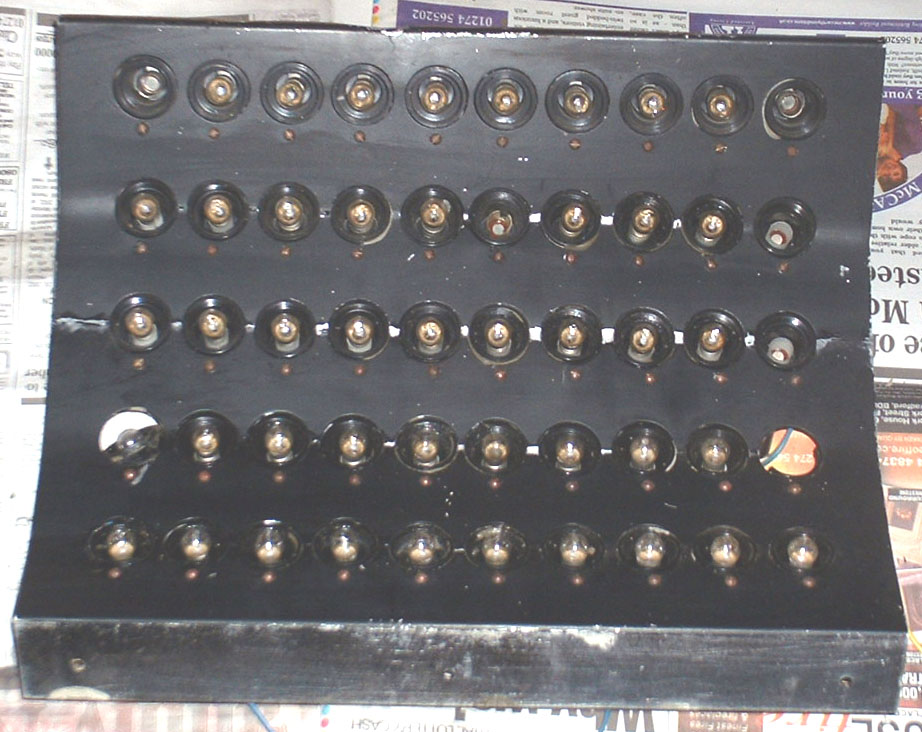
See http://shirker.mooli.org.uk/pics/blinkenlights.jpg
I think it's a panel from some experiment or other, way back when. The
lampholders are all wired together, and yes, those are filament lamps. All
of the lampholders are actually there - the couple which look like they
aren't have just been pushed through the panel by something, but are there
on the back.
There is some type of concrete-like substance on the panel (I've cleaned
most of it off the front, but it's still there on the back - cleans off OK
with a mild solvent and a brush) which would need to be cleaned off it.
Anyone who wants this, please contact me via private mail within 21 days
or I'll have to scrap it. Please feel free to offer cash as I could really
use it - however, if the best/only offer I get is "I'll pay
postage/collect" then that's fine :) If not, then, best offer takes it.
I also have a large number of books which came from the same place - I'll
list these on here within a few days so stay tuned!
Ed.
>From: "John Lawson" <jpl15(a)panix.com>
>
>
>
>On Wed, 8 Dec 2004, Vintage Computer Festival wrote:
>
>> On Wed, 8 Dec 2004, Shirker wrote:
>>
>>> I came across the following item which I have no need for, but it looks
>>> absolutely ideal for anyone who's building a recreated old computer or a
>>> new design from scratch, to use as status lights.
>>>
>>> See http://shirker.mooli.org.uk/pics/blinkenlights.jpg
>>
>> It looks like part of a photographic developer of some sort. I reckon
>> young Johnny Lawson could probably fill us in some more.
>
>
> Well, it's a curved metal panel with an assembly of pretty much
>bog-standard bayonet base miniature lamps on it.. one would have to go
>to a bit of trouble to make a 'status display' out of it - after dealing
>with the drivers, and (I am assuming) rewiring it for individual
>addressing of each lamp.
>
> But as to what it's intended function was/is - I've certainly No Clue.
>
> Cheerz
>
>John
Hi
It looks like it might be used as part of a light curing system.
You know, place the item on a rotating shaft and have 4 quadrants
of these light. I once had a photo copies that had a bank of lamps
like this but it was flat. An automatic machine might have a
curved bank like this.
Dwight
Fred N. van Kempen <waltje(a)pdp11.nl> wrote:
> I actually wrote a driver that did IP-over-DDMCP on the VAX end,
Such a driver has existed in standard BSD since 4.2, except that it's
for the DMC-11/DMR-11/DMV-11 (which do all DDCMP processing on board and
can't be made to talk any other protocol to my knowledge) rather than
for the DMF32 that this thread is presumably about.
The DMF32 sync port supports DDCMP too, but it leaves more work to
the host and supports HDLC as well.
> with a modified IOS running at the other end, on a Cisco 2501.
If you needed to connect the DMF32 sync port to a Cisco router, why didn't
you implement Cisco HDLC on the VAX side instead? (As I've done in 2000
in 4.3BSD-Quasijarus0b on a DSV11.) I'm sure you know the frame format:
<flag> <addr> 00 <Ethertype> packet <FCS-16> <flag>
addr is 0F for unicast or 8F for multicast/broadcast*.
It's the simplest and IMO the best framing format for IP over a sync line,
I've used it on T1s (well, fractional T1 since DSV11 is limited to 256 kbps),
and it comes from Cisco.
*The only thing that I never understood is what the hell did Cisco mean
by multicast or broadcast on a point-to-point link. I guess it dates from
the days before people realised that a point-to-point link is not a network
(no ARP, etc.) and does not need to burn up a net/subnet number, and people
would map a net number (hopefully a /30 subnet) to each point-to-point link.
Then .1 and .2 addrs would be assigned to the ends and I guess the 8F addr
byte was generated on packets addressed to .3... My driver always puts
0F in the address field of transmitted packets and treats 0F and 8F as
equivalent on reception; and I always configure the net interface as
unnumbered (for my end use the same address as assigned to one of my real
Ethernets, for the other end put in whatever addr the ISP gave me for
their router; my driver does not require them to be numerically related
as they would be with a /30 subnet).
The approach of using a /30 subnet for a point-to-point link now has to
be used only when you are forced to use an Ethernet as a point-to-point
link without PPPoE, which is stupid but unfortunately used by some DSL
providers.
> This is why I usually grab all the sync modems I can lay my hands on;
USR Courier V.Everything (external of course) supports sync mode on its
DB25 port. The problem is with the other end of the call... I'm using
such modem for my PPP connection, and while I would love to run sync PPP,
I doubt that the ISP's POP will support it.
MS
Hi all! I was just wondering if we happen to have any former
Philips/Magnavox VideoWriter users/owners/hackers in the house?
David M. Vohs
Digital Archaeologist & Computer Historian
Computer Collection:
"Triumph": Commodore 64, 1802, 1541, Indus GT, FDD-1, GeoRAM 512, MPS-801.
"Leela": Original Apple Macintosh, Imagewriter II.
"Delorean": TI-99/4A, TI Speech Synthesizer.
"Spectrum": Tandy Color Computer III.
"Monolith": Apple Macintosh Portable.
"Boombox": Sharp PC-7000.
"Butterfly": Tandy 200, PDD-2.
"Shapeshifter": Epson QX-10, Comrex HDD, Titan graphics/MS-DOS board.
"Scout": Otrona Attache.
(prospective) "Pioneer": Apple LISA II
(prospective) "Mercury": HP-85.
(prospective) "Evolver": Commodore Amiga 2000
"TMA-1": Atari Portfolio, Memory Expander +
Two pdp-11/44 questions:
Does anyone have a 'big list' of pdp-11 boot rom id's? (should probably
be in the same place as a repository - is that being set up?)
Also, has anyone tried to use vtserver on an 11/44? I don't think it
can be done because the console 8085 catches "^P" and pops back into the
console monitor.
I suppose the right thing is to plug in a serial cable use the tu-58
emulator. But I don't think I have tu-58 proms. My one and only boot
prom id's as 054021. And I have no idea what that is.
I suppose I could hack server to use a second serial port. Blech. I
guess I should just use the 9-track tape drive the way Ken Olsen
intended and stop fooling around :-)
-brad
On Dec 7 2004, 23:02, quapla(a)xs4all.nl wrote:
> This is a list from the M9312 manual, it is afaik the complete list.
The flat text file on my website is about twice that size :-) And
you've got some that aren't on that list, Ed, in your 11/70.
> I have all except the 753A9.
I have at least one of those.
--
Pete Peter Turnbull
Network Manager
University of York
Still, I have got one. At least if you are referring to the Philips
"VideoWriter", the Philips 'wordprocessor' with the smallish rectangular
CRT and a 3.5" floppy drive next to it.
I bought such a unit (with keyboard) for 50 Euro (approx. $65) to use
the CRT in my StarShip, so my intentions were not so good for it :-)
However, the vertical size of the CRT is a bit too high; its width is
perfect. So in the end I can not use the CRT in my StarShip and have
a VodeoWriter in the attick. Never considered selling it because the
weight would increase the costs with a factor 2 ...
If I ever intend to do something with it, I now know where to get
the electrical diagrams, Jos :-)
- Henk, PA8PDP.
> Am dinsdag, 07.12.04, um 11:37 Uhr (Europe/Zurich) schrieb David Vohs:
>
> > Hi all! I was just wondering if we happen to have any former
> > Philips/Magnavox VideoWriter users/owners/hackers in the house?
> > David M. Vohs
> > Digital Archaeologist & Computer Historian
>
> probably not, but I have schematics ( somewhere...)
>
>
> Jos
I've got one of them TI Silent 700 Model 703 portable data terminals. The
external power supply that comes with it is 20VAC. It's got three
conductors on the connector. I can't get any voltage out of it. Is it
dead?
Or is it that it needs to sense a loop or something across all pins before
it starts emitting juice? Not likely, I'm sure, but I thought I'd ask
before I start tearing this apart to see if it has an internal fuse.
Any ideas?
Thanks!
--
Sellam Ismail Vintage Computer Festival
------------------------------------------------------------------------------
International Man of Intrigue and Danger http://www.vintage.org
[ Old computing resources for business || Buy/Sell/Trade Vintage Computers ]
[ and academia at www.VintageTech.com || at http://marketplace.vintage.org ]
Well here's a fine mess I've gotten myself into...
I need to ship a MicroVAX 3800 (BA213 case, about 110 pounds, give or
take) to Pennsylvania. Granted, it's no 11/780, but it's certainly
bigger than I've ever shipped before. Does anyone have any suggestions
about the cheapest way to do this? (Hopefully one that will also ensure
that the beast gets there in one piece, of course!)
For reference, dimensions on a BA213 are approx. 14" by 20" by 26".
-Seth
In a message dated 12/7/2004 9:49:02 PM Eastern Standard Time,
sethm(a)loomcom.com writes:
Well here's a fine mess I've gotten myself into...
I need to ship a MicroVAX 3800 (BA213 case, about 110 pounds, give or
take) to Pennsylvania. Granted, it's no 11/780, but it's certainly
bigger than I've ever shipped before. Does anyone have any suggestions
about the cheapest way to do this? (Hopefully one that will also ensure
that the beast gets there in one piece, of course!)
For reference, dimensions on a BA213 are approx. 14" by 20" by 26".
-Seth
----------++
If you have access to the shipping department of where you work, that's a
big help. I do, and there's all kinds of pallets and packing options to choose
from. One idea is to find a smaller size pallet than the standard 40x48 and
use plastic or metal bands to secure it to the pallet and then plastic wrap and
send it. Old server boxes and crates are great for reuse here. All you'd
have to do then is carry to a DHL station or similar and do the paperwork. It's
easier that what most people think.
At long last I've decided I've gotten enough HP systems restored, so I'm
turning my attention to one of my other systems that's been rescued but not
restored - a PDP-11/45. Yes, I'm going over to the dark side ;)
I've scrounged the web looking for sites where a /45 has been restored for
tidbits, advice, etc. and found Guy's site to be a good intro on the
refurbish process and what to expect.
It would appear my /45 is extremely minimally configured, no I/O cards, and
only 4k or 8k of core. It's in pretty sorry shape I must say, but definitely
restorable at least from a cosmetic standpoint - we'll see about the
functioning side of things.
I wanted to ask if anyone would care to share any gotcha's that may not be
obvious, specifically with regards to initial cleanup, inspection, and
testing. I'd really like to convert the thing from core to semiconductor
memory, and hopefully get an RL02 up on it.
One thing specifically I wanted to ask applies to many systems not just my
/45. What have most of you found to be good for working with scratches or
gouges in painted metal? I'm thinking like the side panels of the H960
cabinet, etc. I'm not into painting really but was considering using an
airbrush to touch up lots of scratches and perhaps blending the new paint in
with the old areas. Perhaps this would come out worse? Exactly what kind of
paint should I get, can I have a paint dealer reliably scan existing
surfaces with their color cameras to generate the correct hue? Suggestions?
Jay West
---
[This E-mail scanned for viruses by Declude Virus]
On Dec 7 2004, 14:59, Brad Parker wrote:
>
> Does anyone have a 'big list' of pdp-11 boot rom id's? (should
probably
> be in the same place as a repository - is that being set up?)
I'm happy to keep PROM images beside the ROM images (mostly QBus) that
I already have; unfortunately my PROM programmer is being uncooperative
at the moment (or rather, I think the PC to which it's attached is
misbehaving). If anyone wishes to contribute, feel free to email me
:-)
The only two relevant files I have online at the moment are a list of
the PROMs I know about, and the pinouts of the common types:
http://www.dunnington.u-net.com/public/DECPROMs/
--
Pete Peter Turnbull
Network Manager
University of York
On Mon, 06 Dec 2004 John Foust <jfoust(a)threedee.com> commented:
> At 12:25 PM 12/6/2004, Roger Merchberger wrote:
>>> Goo Gone comes in a plastic bottle, Goof Off is more harsh
>>> and comes in a can. As did "lighter fluid", it's naptha cousin.
>>
>> Huh? AFAIK, lighter fluid *is* naptha --
>
> Yes, but Goof Off may be naptha plus something else.
>
> - John
For contents see <http://www.valspar.com/val/resident/msds.jsp> (for
the Valspar products you need a UPC code to get the corresponding data
sheet). In the US, all chemical product require a published Material
Safety Data Sheet (MSDS) which have all the active ingredients...
CRC
David Corbin wrote:
> Looking for suggestions on supplying the DC power to a TU-56.....
You need +5V at 0.8A and -15V at 0.8A, both regulated to +/- 10%.
(You can optionally use +10V at 0.8A instead of +5V, with suitable
wiring.)
It should be easy to find a surplus triple-output power supply with
+5 and +/-15V, and simply not use the -15V output. New, these cost
around $70-80.
It may be easier and/or less expensive to use separate 5V and 10V power
supplies. For instance, Digikey has wall-wart style switchers that are
suitable:
T920-P5P 5.0V 2.4A $14.03 each
T924-P5P 15.0V 1.0A $14.03 each
Since they are isolated (as all common AC-to-DC power supplies are),
you can use them as positive or negative supplies.
Eric
On Nov 29 2004, 0:18, Tony Duell wrote:
> Pete Turnbull wrote:
> > Sounds like mine. The one I have is a replacement, but almost
> > identical to the one my Dad bought in the mid-60s. It's about
115mm
> > wide x 55mm thick x 200mm long; it has three DIN sockets on the
>
> > panel. It takes five C-size cells. It originally came with a
slightly
>
> Yes. You could also feed in 7.5V through one of the sockets -- it was
a
> '240 degree' DIN socket used for external power, remote control, and
> monitoring earphone. One thing I must do is make a little adapter
with a
> power connector and a remote control socket wired to a suitable plug.
That's the one. I use that for power and remote from the Beeb.
> Ah, I was wondering if it would work with a Beeb... Mine alsoe needs
new
> drive belts, but otherwise is still operational. I have the schematic
> from the appropriate year of 'Radio and Television Servicing',
although
> sometimes oen was folded up inside the machine anyway.
I had to replace the drive belt in mine a few years back. I got a belt
>from CPC for a few pence.
--
Pete Peter Turnbull
Network Manager
University of York
Anyone else find that QFP-socketed chips in late 80's / early 90's
equipment are *really* prone to corroding and needing re-seating?
I've just had to re-seat several on this NCR Tower which were the cause
of all sorts of problems - yet I don't normally find that DIL chips need
any re-seating on equipment of this sort of age.
(I *think* QFP's the proper name - commonly used for 80186 / 80188 /
80286 chips, which have flat leads underneath the device)
Anyway, I now have a working NCR machine that chucks out more heat than
a small furnace and makes the lights go dim :-) (well, almost!)
cheers
Jules
>From: "Jules Richardson" <julesrichardsonuk(a)yahoo.co.uk>
>
>
>Anyone else find that QFP-socketed chips in late 80's / early 90's
>equipment are *really* prone to corroding and needing re-seating?
>
>I've just had to re-seat several on this NCR Tower which were the cause
>of all sorts of problems - yet I don't normally find that DIL chips need
>any re-seating on equipment of this sort of age.
>
>(I *think* QFP's the proper name - commonly used for 80186 / 80188 /
>80286 chips, which have flat leads underneath the device)
>
>Anyway, I now have a working NCR machine that chucks out more heat than
>a small furnace and makes the lights go dim :-) (well, almost!)
>
>cheers
>
>Jules
>
>
Hi
As usual, I will note here the virtues of using DC#4
silicon grease on the contacts to improve conductivity
and hold off corrosion.
Dwight
Hi Lawrence,
I know your post about the little electronic MECOS device you found in a box of junk is 2 years old, but do you still have it? A friend's father-in-law has such a thing that he's been wearing around his neck and swears it keeps him healthy. (We're not sure how.) It's wearing out and he wants a new one. If yours is still working, would you be willing to part with it?
Alison
A lot of class X1 supression caps seem to be self-destructing in vintage
equipment these days. I've got one in my NCR needing replacement, plus
we have an HP 3000, two Apple Lisas and an Apple /// all needing them
too... (they don't half smoke when they let go too :)
Looking around, it seems that everywhere these days sells class X2 caps,
and Y2(X1) caps. What's the modern-day replacement for a dead X1 cap?
X2, Y2(X1), or something else entirely?
I'm sure I've seen Y2 caps in old equipment as being a different thing
to X1, which is why I'm getting confused if they're now classed as the
same!
(Anyone have a source for 0.68uF X1 caps in the UK? Seems to be a very
uncommon value for supression caps - everyone does 0.47uF and then 1uF)
ta
Jules
I guess this confirms the rumor of Acclaim going belly up...
I just received an auction notification for Acclaim Entertainment in
Austin, Texas. I don't know if there will be any classiccmp related bits
for sale, but I thought at the very least folks here would want to know
about it. Inspection/Preview is Dec 13th, and the auction is on the 14th
and 15th. This looks like a huge auction compared to some of the large
foreclosure auctions I've been to in Texas.
See http://www.flsauction.com/ and http://www.shattuck.com/ for more info.
-Toth
I'm trying to do the same thing with some (downloaded) Teledisk images for an Altos 580 server which has a similar 96tpi floppy with no luck (a plea for help here).
My limited understanding is that these drives use double density media and that a standard 1.2 mb drives don't work too well with that (the manuals all say that writing out 360k AKA 40 track disks on a 1.2mb is a bad thing). Did you take the drive in the SB180 and put it in the Compaq, still calling it a 1.2, 360k or even a 720k 3.5? I tried that with a different (SA-465) 96tpi drive jumpered as drive 1 and it seemed to write disks with no reported problems on the Teledisk write. The Altos still didn't like the disk though but that might be a function of the original files (or something else I forgot to do).
Gary F.
------Oiginal below edited for brevity.-----
Message: 6
Date: Wed, 24 Nov 2004 19:48:18 -0500
From: "Richard A. Cini" <rcini(a)optonline.net>
Subject: RE: Making CP/M disk images
To: "'Dwight K. Elvey'" <dwight.elvey(a)amd.com>, "'General Discussion:
On-Topic and Off-Topic Posts'" <cctalk(a)classiccmp.org>
Message-ID: <000801c4d288$74daad50$6501a8c0@bbrk0oksry5qza>
Content-Type: text/plain; charset=us-ascii
Dwight:
Interestingly, Teledisk did skip every other track. These are DSDD disks
formatted on the SB180 machine using the "40 track" option. The drive in the
SB180 is a 96TPI drive (HD) and the disk on the PC side is a standard 1.2mb.
I'll have to see if Teledisk has any options that may address this. As I
recall, the number of configurable options was sparse, though.
This e-mail and any attachments may contain confidential and privileged information. If you are not the intended recipient, please notify the sender immediately by return e-mail, delete this e-mail and destroy any copies. Any dissemination or use of this information by a person other than the intended recipient is unauthorized and may be illegal. Unless otherwise stated, opinions expressed in this e-mail are those of the author and are not endorsed by the author's employer.
I'm finally getting around to trying to do something with my PDP-11/23
system and am having trouble creating bootable RT-11 V5 disks. I have
an RX02 drive and a set of RX01 distribution disks. I've tried booting
disk 1 of the RX01 distribution and that fails. Should I be able to
boot an RX01 on an RX02 drive? Also, I've tried copying disks using:
COPY/WAIT/OUTPUT:DY1: DY0:
and then
COPY/BOOT DY1:RT11FB.SYS DY1:
Unfortunately, that doesn't result in a bootable disk. In fact, when I
did it, it trashed the system disk in DY0 even though I removed it
before and replaced it with the source disk of the copy. Does this
sound like I've got a broken drive? I seem to be able to read either
RX01 disks or RX02 disks in DY1 without any problem. Also, the copy I
made in the first step above seems to be okay. It's just that I can't
boot the disk after the second COPY/BOOT step.
What dumb thing am I doing wrong?
Thanks,
David Betz
test, pse ignore
--
Fred N. van Kempen, DEC (Digital Equipment Corporation) Collector/Archivist
Visit the VAXlab Project at http://VAXlab.pdp11.nl/
Visit the Archives at http://www.pdp11.nl/
Email: waltje(a)pdp11.nl BUSSUM, THE NETHERLANDS / Mountain View, CA, USA
Heinz Wolter <h.wolter(a)sympatico.ca> wrote:
> I wonder if it is possible to load BSD (quasisaurus) on TU58, as I have
> no 9 track take or ethernet on the system.
One TU58 cassette holds 256 KB of data. The root filesystem is about
5 MB, /usr about 21 MB. You do the math. That's just the binaries, more
for source.
MS
You know, I should learn to spell check first...
I'm looking for replacement switches for the Altair front panel switches.
Does anyone have these readily handy??
Rich
Rich Cini
Collector of classic computers
Build Master for the Altair32 Emulation Project
Web site: http://highgate.comm.sfu.ca/~rcini/classiccmp/
/************************************************************/
Hello, all:
Does anyone have an equivalient replacement part number for the
Altair front panel switches? I was goung to grab my Digi-Key catalog but I
thought I'd ask here first in case someone has this data handy.
Thanks.
Rich
Rich Cini
Collector of classic computers
Build Master for the Altair32 Emulation Project
Web site: http://highgate.comm.sfu.ca/~rcini/classiccmp/
/************************************************************/
ard(a)p850ug1.demon.co.uk (Tony Duell) wrote:
> Presumably, therefore, running it from a single R80 disk is not really
> practical either (at least not if you want to have the sources, or at
> least enough to rebuilt the kernel, on the disk).
Actually it'll fit, and you will have room for the kernel source. In
fact you could even load the full userland source, but then you won't
have any room left for actual work, err play.
MS
Heinz Wolter <h.wolter(a)sympatico.ca> wrote:
> 20 tapes?
> not so bad if loading from a pc emulated tu56 ;)
Well, the problem is that there exists no installation procedure for
loading the main system (not even the miniroot, let alone full root or
/usr) from TU58s. The console TU58 is only used for the standalone boot
and copy programs.
To put it another way, 4.3BSD, including Quasijarus, is, has always been
and will always be totally open source, and as with all open source software,
you are free to do all kinds of things with it that are not officially
supported. BUT, you are entirely on your own in doing so.
> what are other options if there is no ethernet?
> slip/ppp? - once a basic system is loaded?
The sl module for SLIP is not compiled into the distributed GENERIC kernel,
so you can only use SLIP after you have successfully installed enough of
the system to compile your own custom kernel. The same will be the case
for PPP in the next release (no PPP support exists in the current QJ0c
release).
Also just as a clarification, Ethernet is not a supported option either
for bootstrapping your first VAX. The next release will allow you to
bootstrap your smaller MicroVAXen over Ethernet *from a larger VAX that
has itself been bootstrapped from magtape*. In any case the first VAX
at your site must always be bootstrapped from magtape. Also Ethernet
bootstrap can only work on MicroVAXen, you can't bootstrap a 730 over
Ethernet even if you had a larger 780 to boot from since 11/7xx and other
machines in the "large VAX" category have no Ethernet boot capabilities.
You really need to invest in a magtape drive. I'm sure you can buy a
magtape drive + UNIBUS controller from a professional DEC dealer like
Continental Computers or Keyways. If you want something smaller than a
reel-to-reel drive, there is TUK50, UNIBUS TK50 controller.
MS
I posted some vintage mice on ebay that I think might be of interest here.
Xerox Alto Ebay sale number 5145159299
Xerox star Ebay sale number 5145167668
Hawley X063X Ebay sale number 5145309516
Lilith Ebay sale number 5145162664
also
Amstrad CP/M Plus OS 3" disks Ebay sale number 7119143389
You can search under seller: Innfosale
If you have questions please contact me off list at innfosale(a)aol.com
Three plus days to go. Will ship worldwide.
Thanks
Paxton
Astoria, OR
Brad Parker <brad(a)heeltoe.com> wrote:
> I hacked the netbsd boot program so it will copy via nfs to tape or
> disk.
With 4.3BSD-Quasijarus1 you won't have to resort to using pieces from NetBSD
to do what you've done. It will have a standalone netcopy program that will
be like current copy (which copies the miniroot from magtape to disk as the
first step in full bootstrap) except that it will copy from a TFTP server
instead of magtape. As I wrote in my previous post, it will only be
officially supported for bootstrapping your little MicroVAXen from your
main big VAX which was itself bootstrapped from magtape, but if you want
to step into not-officially-supported land, you'll be able to put netcopy
on a TU58 and thus use it on your 730, and even use a lesser machine (even
a pee sea) instead of a larger VAX for the TFTP server. But to make this
work on a UNIBUS machine with DEUNA/DELUA, you'll have to write the
standalone de driver yourself, I won't write it because UNIBUS VAXen are
not officially netbootable. And you'll have to have access to some other
VAX running UNIX (at least a guest account) to recompile netcopy with your
de driver.
> I ended up booting the miniroot and then using "rcp" to copy the tar files
> which would normally be on the install tape into my disk (I have ra90,
> which are big).
You could have used rsh | tar.
MS
On Dec 6 2004, 10:31, Dwight K. Elvey wrote:
> >From: "Pete Turnbull" <pete(a)dunnington.u-net.com>
> ---snip---
> >
> >No, I have a spare, but I would like to fix the bust one. It turns
out
> >that the 2-button version, M-S34, widely used on Compaq PCs and
things,
> >has the same PCB (but missing one microswitch, of course), and I
think
> >I can acquire one of those.
> >
> Hi Pete
> I hope you carefully checked that there wasn't a broken
> wire in the cord. This is the most common cause of
> failure in these units.
Yes, almost the first thing I thought of. I swapped the cords with
another mouse, and the fault stayed with the mouse.
--
Pete Peter Turnbull
Network Manager
University of York
>From: "Pete Turnbull" <pete(a)dunnington.u-net.com>
---snip---
>
>No, I have a spare, but I would like to fix the bust one. It turns out
>that the 2-button version, M-S34, widely used on Compaq PCs and things,
>has the same PCB (but missing one microswitch, of course), and I think
>I can acquire one of those.
>
Hi Pete
I hope you carefully checked that there wasn't a broken
wire in the cord. This is the most common cause of
failure in these units.
Dwight
On Dec 6 2004, 9:00, Stan Barr wrote:
> Pete Turnbull said;
> > Barely within the 10-year rule... Does anybody have a Logitech
mouse
> > model M-S35, possibly damaged mechanically but with working
electronics
> > (specifically the IC that does the work)? This model is a
3-button
> > PS/2 Pilot mouse, OEMed by SGI, DEC, IBM, and probably others, and
mine
> > stopped working yesterday :-(
>
> Sorry, I'm using mine :-) Aren't 3-button meece getting hard to
find
> now...Maplin still have some cheap ones similar in design to the
Logitech
> but not as good - part no RY72P, about a couple of quid, if you need
one
> desperately.
No, I have a spare, but I would like to fix the bust one. It turns out
that the 2-button version, M-S34, widely used on Compaq PCs and things,
has the same PCB (but missing one microswitch, of course), and I think
I can acquire one of those.
--
Pete Peter Turnbull
Network Manager
University of York
>From: "John Lawson" <jpl15(a)panix.com>
>
---snip---
>PPS: Everyone on classiccmp who actually *has* any kind of milling machine
>available, let alone on your premises - raise yer hands....
>
Hi
I have a tinky lathe with mill attachment. It can't do
really wide stuff but I used it to mill the blocks I connected
to an old SA400 frame to make my hole punch for hard sectored
disk ( as seen at VCF ).
Dwight
Any one have an IBM Thinkpad 390?
I am building a DOS machine, and I need some of the drivers,
I went to DRIVERGUIDE.COM and did not find them there. I went
to IBM and found the names of the files, but they refused to
upload.
The files are supposedly at ftp.software.ibm.com but the directory
they are supposed to be in appears to be empty.
Files I need....
pctpbdos.exe and .txt PCMCIA drivers for DOS
uttpdos.exe and .txt Utility Disk for DOS
mdltbdos.exe and .txt Lucent winmodem drivers for DOS
I have googled the filenames, but they lead back to either IBM
or Driverguide.
My DOS is stuck in 640x480 mode on an 800x600 screen. This makes
an inch wide black border around the text-space. :^\
Anyone have an IBM 390 (mainframe style),
I am trying to build menus and screens that look mainframish,
I have already written a login program in turbo C that looks
sort of mainframe-ish.
are there any examples of mainframe screens on the internet?
??
I have the crimp tool and a few connectors left. I am in the US, so it
might be less expensive for some people to have me make them. I am
on vacation now, but I'll be back before Christmas.
Joe Heck
Barely within the 10-year rule... Does anybody have a Logitech mouse
model M-S35, possibly damaged mechanically but with working electronics
(specifically the IC that does the work)? This model is a 3-button
PS/2 Pilot mouse, OEMed by SGI, DEC, IBM, and probably others, and mine
stopped working yesterday :-(
--
Pete Peter Turnbull
Network Manager
University of York
On Dec 5 2004, 17:06, John Lawson wrote:
> PPS: Everyone on classiccmp who actually *has* any kind of milling
machine
> available, let alone on your premises - raise yer hands....
If a Unimat counts, or a Myford lathe with the extra slides, I do :-)
--
Pete Peter Turnbull
Network Manager
University of York
Brad Parker <brad(a)heeltoe.com> wrote:
> You can boot bsd43 in 2mb of ram on a 730.
Thanks for checking this, it's good to hear that this is still the case
with current 4.3BSD-Quasijarus.
MS
I recently picked up an interesting book, entitled "The Logic Desgign of
Computers: An Introduction", by M. Paul Chinitz. Mr. Chinitz was
Director of Training at Univac from 1953 to 1956, and it shows -- even
though this book was published in 1981. Seriously, the design style in
the book is straight out of the 50's and 60's. Although the book makes
numerous references to standard TTL logic components, he does just about
everything with simple gates and RS flip-flops, and devotes space to
such dated topics (for a book of its scope) as 1's complement
arithmetic, serial arithmetic, and delay lines. Proponents of a
straightforward fully-synchronous design style based on MSI, like
Winkel, Prosser, and Mano, would be horrified to see students taught to
gate clocks in 1981. The book uses a simple 8-bit 1-address
architecture as an example, using a multiphase clocking scheme and RS
flip-flops with preclear. All a wonderful throwback to the days when
every gate and transistor counted.
I picked up a copy at a swap meet, misplaced it, ordered another from an
internet used bookseller, and then found my original copy. I thus now
have an extra copy of this book. It is available for $5 plus shipping if
anyone is interested.
--Bill
On Mon, 6 Dec 2004, Philip Pemberton wrote:
> The only problem I found is that it's totally useless for dark-coloured
> panels (or really anything that isn't metallic or white), because the
> inks aren't particularly opaque. That and you can't print white lettering
> onto the transparency :-/
In this case, print your graphics in an outlined, bubble manner - so lines
become long, thin empty boxes. Paint in the gap in the center with Tipp-Ex
(whiteout). Turn it over: nice, neat white lines! :D
alex/melt
On Dec 6 2004, 0:59, Philip Pemberton wrote:
> In message <10412051910.ZM6157(a)mindy.dunnington.u-net.com>
> Pete Turnbull <pete(a)dunnington.u-net.com> wrote:
> > Spraymount. And the really strong stuff is called Hobbymount.
>
> Hm. I'll have to see if I can find that anywhere - all I managed to
find was
> the blue-can Spraymount and the red-can Photomount.
I think I got it either in Office World or from CPC.
--
Pete Peter Turnbull
Network Manager
University of York
On Dec 5 2004, 18:50, Philip Pemberton wrote:
> In message <41B34E1E.4B26208C(a)rain.org>
> Marvin Johnston <marvin(a)rain.org> wrote:
>
> > Something that I have started using to help give projects a more
> > "professional" look is clear adhesive label stock for the
case/cover.
>
> [ snippety snip ]
>
> I personally use inkjet transparencies. Print a mirrored version of
the
> layout onto the back (matted) side of the transparency. Spray the
> transparency (or the case if there's a square display cutout) with 3M
> PhotoMount adhesive, wait 15 seconds (IIRC), then stick the
transparency to
> the panel. Cut off any excess plastic and you're done.
Exactly what I did when I made spare unit plugs for an RL02, several
years ago (except I used laser transparencies).
> As far as drilling is concerned, use the non-permanent version of
Photomount
> (can't remember what it's called, though)
Spraymount. And the really strong stuff is called Hobbymount.
--
Pete Peter Turnbull
Network Manager
University of York
On Dec 5 2004, 17:48, Scott Stevens wrote:
> On Sun, 5 Dec 2004 13:01:29 -0500, Pat wrote:
>
> >On Sunday 05 December 2004 06:43, Pete Turnbull wrote:
> >> Better than hacking RJ45s would be to hack RJ11 (6P/6C) plugs.
> >> They're very common, about a quarter of the price of MMJs, and
there
> >> are low-cost crimp tools available.
> >
> >Agreed, the only difference between an RJ12/RJ11 and MMJ is the tab
> >location, which can be easily sliced off (though that usually makes
for
> >a loose fitting connector).
> >
> >> For anyone in the UK who needs *a few*, I believe I still have a
box
> >> of adapter cables for Emulex terminal servers. These are short
> >> (about 8-10 inches) flat cables with an MMJ on one end and an RJ45
on
> >> the other. You can have a few for the cost of postage.
> >
> >And if anyone in the US wants one, I can do up to, say, 25ft
MMJ->MMJ or
> >MMJ->RJ(12/45) cables for $5 + shipping. I had a few takers last
time
> >I did this, and they seemed to be happy with my handiwork. : )
> >
>
> If you made something like this, would the RJ-45 end plug into one of
> the serial adaptors that I got from the back of a rackmount US
> Robotics modem box? It's one of those plugs that adapts from RJ-45
> jack to a DB-25 male plug.
Pat can tell you how his cables are wired, but the easiest way,
especially with flat cable, is pin-to-opposite-pin (ie, bearing in mind
that an MMJ has 6 pins and an RJ45 has 8, it goes MMJ-1 to RJ45-7,
...., MMJ-6 to RJ45-2). This happens to be the way DEC made most of
their MMJ cables. DEC also used a standard signal arrangement, with
the two centre pins being ground, the two next to those being Rx and
Tx, and the outermost two being the handshakes. That meant a
null-modem was just a question of plugging in the cable between console
port and terminal.
The reason I mention this is that *some* RJ45-DE9/DB25 adapters and
*some* serial-on-RJ45 ports use a similar convention; Suns and Cisco
kit tend to do so, and some terminal servers, but not all. Take a look
at the YOST page: http://yost.com/Computers/RJ45-serial/ and also at
Celeste Stokely's serial port pages:
http://www.stokely.com/unix.serial.port.resources/A-B-Ycablepinout.html
There is one other quite common method, though; we use it at York, and
I've seen it in several other places. Based on the assumption that we
only need Rx and Tx, no handshaking, we wire Tx to RJ45-1, Rx to
RJ45-3, and ground to RJ45-2 and RJ45-6. Why? Because 1+2 and 3+6 are
twisted pairs in Cat5 and they are the pins used by Ethernet cables, so
it means we can use standard Ethernet Cat5 cables for straight-through
connections, and standard Ethernet crossover cables as, well,
crossovers (I couldn't really call them null-modem as they don't carry
handshake signals).
--
Pete Peter Turnbull
Network Manager
University of York
On Dec 5 2004, 11:16, Gordon JC Pearce wrote:
> Scott Stevens wrote:
> > 4. What is the console on this hardware? It has the three serial
> > ports on RJ-type connectors, and from what I gather this is a
TTY-only
> > machine, no framebuffer, etc.
>
> I made a connector for my DECStation 3100 by grinding bits off an
RJ45
> connector until it fitted. Brutal but effective. Prepare to lose a
few
> RJ45s in the process - you'd be better with your own crimping tool
and a
> bag of plugs.
>
> Better still would be the proper DEC connector, but I couldn't find
any
> of those.
You can still get them from Farnell in the UK (and presumably in the
States etc) and CPC in the UK. Since I'm sitting here with the Farnell
cat open for Ethan, I looked them up.
Stewart P/No 937-SP-3066R-OST for stranded round cable is Farnell
429-788
Stewart P/No 937-SP-3066-OST for stranded flat/oval cable is Farnell
429-790
Stewart P/No 940-SP-3066R-OST for solid round cable is Farnell 429-843
Stewart P/No 940-SP-3066-OST for solid flat/oval cable is Farnell
429-855
The catalogue numbers are for packs of ten, and they cost UKP4 or so
per pack (quite expensive nowadays).
Of course, the real problem is getting the crimp tool. MMJ tools tend
to be expensive, although if you have one of those multipurpose
crimping pliers with interchangeable dies for blue/red/yellow insulated
connectors, BNCs, RJ45, RJ11, etc you can get MMJ dies for about UKP12.
Better than hacking RJ45s would be to hack RJ11 (6P/6C) plugs. They're
very common, about a quarter of the price of MMJs, and there are
low-cost crimp tools available.
For anyone in the UK who needs *a few*, I believe I still have a box of
adapter cables for Emulex terminal servers. These are short (about
8-10 inches) flat cables with an MMJ on one end and an RJ45 on the
other. You can have a few for the cost of postage.
--
Pete Peter Turnbull
Network Manager
University of York
On Sun, 5 Dec 2004 Ethan Dicks <ethan.dicks(a)gmail.com> noted:
> On Sun, 5 Dec 2004 11:26:47 GMT, Pete Turnbull
> <pete(a)dunnington.u-net.com> wrote:
>> So does the genuine Veroboard cutter. It's just a stub drill mounted
>> in a blue plastic handle, and its only advantage is that it's easier
>> to
>> hold. There's quite a good picture at
>> http://www.zen22142.zen.co.uk/Prac/vero_circ/vero.htm
>
> Ah... I was under the impression that the cutting edge had a
> substantially different angle fro a drill (like describing a 180
> degree arc between the cutting surfaces rather than, say, 150
> degrees).
>
> I guess this picture...
>
> http://www.zen22142.zen.co.uk/Prac/vero_circ/8.jpg
>
> .... really shows the divot one gets from the real tool.
>
> I might just have to just use the drill press for this task (taking
> advantage of the stop to keep from drilling _though_ the resin board
> ;-)
>
> The tool looks handy for more than a few cuts, though. I wouldn't
> want to try just holding a bit bare-handed - lots of hand cramps and
> slips probably.
>
>
[...]
> Thanks for the website tip... nice pix.
>
> -ethan
In the past I used a vector pad cutter (a great tool for doing
breadballs) to cut the traces on Vero/Vector boards. The cutter has a
guide pin to guide an annular cutter. Generally used to isolate a pad
on a blank PC board, but works great for cutting the traces on
protoboard. Since it is a mill-like cutter, it does not generate a
divit like a drill bit.
A while back after being deprived of access to this tool (read
downsized...), I decided to pick one up for myself. The part is listed
in Digi-key under the Vector Board section. However, the sticker shock
was extreme. As an alternate, I found that they make mills of similar
design for cutting various sizes of o-ring grooves and are priced
within reach.
As a cheap alternate, a simple end mill of the right diameter in a
drill press should do the job admirably.
CRC
Does anyone know where I can locate a genuine tool for severing the
traces on veroboard? I know I can make do with a drill bit, but that
puts a tapered hole in the resin board underneath.
One thing that's cheaper in NZ is, strangely enough, veroboard. The
few pieces I found in the States were priced much higher than
protoboards used to be at Rat Shack (when you could find them). I
occasionally run into a project from a UK experimenter, and have
wanted to do their designs without doing 100% point-to-point. I'll
probably bring home a couple of panels so I have a chance to do that
(for my own stuff, I'll probably always do point-to-point).
-ethan
On Dec 5 2004, 16:11, Joe R. wrote:
> > The thing about the Veroboard tools is that they have a central
locating
> >pin that fits into the hole,
Ones I've seen don't, but...
> Good for Veroboard. If that's what you want THEN GO BUY IT! But
Ethan
> asked for a substitute and they do not make counterbores with guide
pins
> small enough to fit into a wire hole on a circuit board.
...Yes, they do, I've got some.
--
Pete Peter Turnbull
Network Manager
University of York
>Anyone know where those stacks went?
Probably the same place my stack went... the dumpster after I was
unsuccessful for months in giving them away. I probably tossed 50+ drives
in the range of 40-500 MB.
All mine would have been pulled from old Macs. I would suggest you look
for those to get the drives. You should be able to find 68k macs for free
or darn near it.
Another place to look is the LowEndMac Swap list. You can probably put
out a request for small drives and get more than you would want for
little money (lowendmac.com check the email lists)
-chris
<http://www.mythtech.net>
I grabbed a few pics of some of the multibus boards in our masscomp
earlier:
http://www.moosenet.demon.co.uk/temp/comps/masscomp
CPU, FPP, disk controller, and one of the two memory boards (along with
Witchy's arm :)
Interesting that the CPU board has both 68000 and 68010 chips on it.
Having done some head-scratching, each memory board *I think* is 1MB
plus parity (so 2MB in total in the system)
Disk interface is ST506; turns out there's a pair of Micropolis drives
in it (and I've forgotten the model numbers, but Witchy might remember).
Also floppy and tape interface on the same board.
FPP board main IC is an AM29L516, plus there are 11 AM2901CPC 40-pin
chips...
Still no sign of keyboard and mouse for it though...
cheers
Jules
I received the following list of equipment looking for a new home.
It's located in Queens, New York. If you have an interest in any of
this and can pick it up in person (no shipping), send me an e-mail
off list and I'll put you in contact with the owner.
> * A Packard Bell Force 50-CD computer with 50 MHz Intel Microprocessor,
> 340 MB hard drive, 4 MB RAM, and Windows 3.1 operating system. Works great.
>
>* A Tandy 1000 PC with dual 5 1/4 floppy disk drive, and all the
>peripherals, including keyboard, Tandy RGB Color Monitor CM-4, manuals,
>software, cables, and Radio Shack TRS-80 dot matrix printer (also with
>manual). All work great, despite their age.
>
>* Hayes Smartmodem 2400.
>
>* An Okidata Microline 192 dot matrix printer.
>
>* A Canon BJC-250 printer.
>
>* Software on 5 1/4 floppy disks:
>-- Wordstar (and manual)
>-- DOS 5.0 (and manual)
>-- WordPerfect 5.1
>-- PerfectWriter
>-- PrintShop
>-- Tetris
>-- Wheel of Fortune
>-- Zork
>-- Jeopardy.
Cheers,
Dan
Something that I have started using to help give projects a more
"professional" look is clear adhesive label stock for the case/cover. It
is trivial these days to do a layout on a computer, so just take that
layout and print it on the adhesive label stock. It is a lot less
expensive that silkscreening! If the layout needs protection, just add
another layer of clear adhesive label stock over it. I've had some
trouble finding the label stock locally, but the local Kinko's (a
copying service store in the US) does carry it. I use a sharp X-Acto
knife to cut out the holes after the label has been put into place.
http://www.frontpanelexpress.com/ provides the software to do somewhat
inexpensive front panels including holes, slots, and engraving. The
front panels can be ordered online from their software. I've also used
their software to do the layouts for the label stock printing out using
"wiremode".
> Ethan Dicks wrote:
>
> > Ah... I was under the impression that the cutting edge had a
> > substantially different angle fro a drill (like describing a 180
> > degree arc between the cutting surfaces rather than, say, 150
> > degrees).
>
> My tip:
>
> - using a sharp knife, cut two cuts in the trace
> - use the soldering iron to heat and remove the small fraction of copper
> between the two cuts
>
> Advantage #1: you don't need to buy anything
> Advantage #2: it hardly damages the ressin
> Advantage #3: you can even remove the connection between two pads
> Advantage #4: You can make arbitrarly large areas blank; could be
> usefull for isolation areas
>
> Believe me, this works. Even on epoxy, but just as well on pertinax.
>
> Bert
On Dec 5 2004, 6:55, Ethan Dicks wrote:
> I guess this picture...
>
> http://www.zen22142.zen.co.uk/Prac/vero_circ/8.jpg
>
> ... really shows the divot one gets from the real tool.
Yup, that's typical.
> The tool looks handy for more than a few cuts, though. I wouldn't
> want to try just holding a bit bare-handed - lots of hand cramps and
> slips probably.
Exactly. Given the cost of the genuine tool, I use a pin vice (of
which I have several) to hold the drill bit.
However, if I want it to look neater (I meant to mention this in my
previous message) -- though goodness knows who would care -- I have
been known to use a scalpel or craft knife to cut the copper either
side of a hole and then lift off the small redundant piece. I've also
done that between holes, when I wanted to use two adjacent holes but
isolated from each other.
--
Pete Peter Turnbull
Network Manager
University of York
How small is "small"? I have a dozen or so 100 MB IBM SCSI HDs that were
pulled for an upgrade ... many years ago :).
> I fool around with a lot of systems that want small (by today's
> standards) 50-pin SCSI drives. A few years ago you couldn't walk
> around the streets of Palo Alto without tripping over big stacks of
> 500MB drives. These days, though, the stacks are made out of 9GB SCA
> drives -- far too large for my needs, and often far too large to be
> recognized by the computers I fool around with. But drives smaller
> than that are suddenly "rare" and "expensive", $30 or $40 for any
> SCSI drive under 9GB at a lot of resellers I've visited lately.
>
> Anyone know where those stacks went? Are small drives just impossible
> to come by for less than $30 now?
>
> -Seth
Can anyone give me the pinout and details of the power
supply used on the Dragon32 (have a machine with no
supply) - It has a 9-pin 'D' connector on the back of
the machine for the power input!
Searched and found some hardware info, but not the power
information...
Regards,
Dave
--
dave04a (at) Dave Dunfield
dunfield (dot) Firmware development services & tools: www.dunfield.com
com Vintage computing equipment collector.
http://www.parse.com/~ddunfield/museum/index.html
Why not just make a paddle card with one of the USB
parallel bit wigglers, and have the thing totally virtual
on a laptop? You could even line a bunch of them up on
the screen if you want to probe more than one device at
a time, or rearrage the bits so they make more sense
logically?
Bound to happen! A few odd charges showed up on my business
credit card. I caught it quickly, then went into gumshoe mode.
The largest charge was to Staples.com. Someone knew all my info:
name, address, credit card number, three-digit code from the back,
so Staples processed the order. They had the new iPod sent to a
fellow in Los Angeles.
Said fellow was surprised to hear my card had been used:
Why, he'd recently bought an iPod on eBay at a great price.
The seller wanted to be paid via eGold.com, and had sent detailed
instructions as how to send money to an exchange company that
would convert dollars to eGold, which could be used to pay him.
I tracked down several other eBay buyers who had the same
experience with the seller. In three of four cases, the buyers
somehow screwed up the payment process, yet had received their
goods (directly from Staples or BestBuy) in the same fashion.
Meanwhile the seller has disappeared: Yahoo email unanswered,
fake phones and addresses.
This may never happen with classic goods, of course, but you
can see how the scam will work with new goods. It also makes
me wonder if some of the "how to get stuff for free" packages
on eBay aren't promoting this sort of scam. You can see how
thieves could make a lot of money, converting credit card
info to cash.
- John
On Dec 5 2004, 13:31, Bert Thomas wrote:
> > However, if I want it to look neater (I meant to mention this in my
> > previous message) -- though goodness knows who would care -- I have
> > been known to use a scalpel or craft knife to cut the copper either
> > side of a hole and then lift off the small redundant piece. I've
also
> > done that between holes, when I wanted to use two adjacent holes
but
> > isolated from each other.
>
> Aaarggghhh, <undo><undo><undo><undo><undo>... ;-)
Why "undo"? Great minds obviously think alike, and two posts just
reinforce the value of the advice :-)
--
Pete Peter Turnbull
Network Manager
University of York
On Dec 5 2004, 7:19, Ethan Dicks wrote:
> On Mon, 6 Dec 2004 01:00:30 +1300, Dave Brown <tractorb(a)ihug.co.nz>
wrote:
> > Ethan
> > RS (RadioSpares) Stock No. 543-535- $NZ19.50. I've been meaning to
get
> > another one myself although I've tended to use 'blob' board more
often
> > these days.
>
> RS? I've heard it referenced on the list... is that the name of a
> particular brand of shop?
Used to stand for Radio Spares, later Radiospares, RS Components. A
phone/mail-order trade supplier, originally specialising in parts for
radios and TVs, but now selling everything from resistors to car park
furniture. They had a separate sell-to-the-public offshoot called
Electromail for a while, but now RS will take almost anyone's money (I
think you might need to open an account, though). Lots of electronics
shops will order RS parts for you. Their paper catalogue is 1cm wider
than Farnell's (16cm as opposed to 15cm). http://rswww.com
--
Pete Peter Turnbull
Network Manager
University of York
Hi:
A gentleman in Arizona contacted me about divesting himself of his
S100 stuff, including most of my missing BYTE magazines (and 2 copies of
Issue #1), the entire run of Micro Cornucopia (which I haven't received
yet), a few Kilobauds and Interface Ages. He has also sent me a SSM VB1B
video board, a Computer Systems Inc. Clock/Calendar board, an IMS PIC-8 Rev
3 interface board and a Cromemco Dazzler board set. Supposedly there's lots
more, including tons of software on 8" disks and two complete S100 systems.
Back to the Micro Cornucopia. I've heard of the name, but what was
the focus of it?
Regarding my BYTE collection, with these additional issues, I have
nearly a complete set from 9/75 through 1/88. So far, my "interesting
article" database has about 700 entries. At some point, I will make this
available on my Web site and if someone needs an article reprint, I can do
that.
I thought I'd mention the issues of BYTE I'm still missing in case
anyone has dupes: most of 1976 (except 1, 3, 4), 7/77, 6/80, 2/82, 1/86, and
3/86.
Rich
Rich Cini
Collector of classic computers
Build Master for the Altair32 Emulation Project
Web site: http://highgate.comm.sfu.ca/~rcini/classiccmp/
/************************************************************/
On Dec 5 2004, 5:57, Ethan Dicks wrote:
> Does anyone know where I can locate a genuine tool for severing the
> traces on veroboard? I know I can make do with a drill bit, but that
> puts a tapered hole in the resin board underneath.
So does the genuine Veroboard cutter. It's just a stub drill mounted
in a blue plastic handle, and its only advantage is that it's easier to
hold. There's quite a good picture at
http://www.zen22142.zen.co.uk/Prac/vero_circ/vero.htm
You can probably get one from Farnell in NZ. The part number from the
(UK, Farnell-In-One) catalogue is 329-538. It looks similar but not
identical in my catalogue to the one in the CPC catalogue, which is
interesting because Farnell and CPC are part of the same group and
share stock. Same price, though, UKP 6.60 (and the NZ price is
NZ$25.94).
http://nz.farnell.com/jsp/endecaSearch/searchPage2.jsp?Ntt=spot+face+cutter…
Vero Electronics is now a subsidiary of APW:
http://www.apw.com/aboutAPW/familiarBrands/vero.jsp
--
Pete Peter Turnbull
Network Manager
University of York
Does anyone know anything about the protocol that the IBM 3270 terminals
uses on the BNC ports labelled I/O? Is there any possibility of hooking
this up to anything modern?
--
Tore S Bekkedal <toresbe(a)ifi.uio.no>
I was going through various miscellaney and found a box labeled
"MISC PC BOARDS". On opening it up, I found a number of boards which
may of interest to the list. With one possible exception, they are all
up for grabs, on the same conditions as my last pile of stuff: cover
shipping and it's yours (including free if you pick it up in Montreal).
Except where noted, this is all "no obvious physical damage, but
completely untested and has been sitting idle for some unknown number
of years, probably at least ten".
First, the board I suspect I want to keep - I have some questions about
it, if anyone can answer them.
It's apparently from an outfit called MICRO WORKS, and is a "2708 EPROM
BURNER". It has onboard a 6821, two 7474s, a 7406, a 555, a 7805, a
7904, a 7812, a 3904 transistor, various two-terminal devices (caps,
resistors, diodes, a LED), and a switch (apparently SPDT used as SPST)
marked "HV OFF" and "HV ON". Oh, and a rather nice 24-pin ZIF DIP
socket. It has a card-edge connector that makes it look as though it
goes with the SwTPc stuff listed below - its only 30-pin, but has the
same pin pitch and blocked pin.
Basically, what I want to know is, how much hackery would it take to
turn this into something I could attach to, say, a parallel port, and
use to burn EPROMs?
Next, the stuff that's definitely up for grabs.
Of these, to start, four Wang boards:
A board in the shape of a rectangle about 20"x13" with a rectangle of
about 12"x5" cut out of one corner - or, equivalently, a rectangle of
20"x8" overlapped with a rectangle of 8"x13" (where in all four cases
the dimensions are in the same order). On the 12" edge there is a
connector that looks physically like a 3U VME connector to my (not very
used to VME) eye. On the 8" edge there is a DB25F, what I might call
(quite possibly improperly) a DIN-4, and a 36-pin Centronics. At the
end of the 20" edge farthest from the 8" edge, there are two 34-pin
(17x2) 0.1"-pitch connectors of the sort I learned to call Bergs.
According to the solder side, this is an "8221-R2" and bears the Wang
name; on the component side, I also see the Wang logo and the markings
"8221- -R2M2", where the number 14, or perhaps the letter A, has been
hand-written into the gap, and the last 2 is in a different font from
the rest. Following that is a box into which has been handwritten
J05796. Silkscreened - not part of the foil pattern - I see
"CPU/SYSTEM BOARD" and "8221-R1 SILK SCREEN". There is one empty
socket, a 40-pin DIP; the other seven sockets are filled. Based on the
datecodes I see on the soldered-in chips, this dates from mid-'82.
A board which I speculate is a backplane to go with the previous board.
It bears no active components, only connectors and resistors. It has a
connector physically compatible with the VME-like connector on the
above board, five 86-conductor card-edge connectors (43 pins on each
side, with approximately S-100 pin spacing), and three connectors that
look like power connectors: one each of five, three, and two pins. In
the foil patterns on the compoent side, this is marked
COMP. SIDE 8241- -R?M
and the Wang logo (where ? may actually be intended to be a 0). In the
foil on the solder side I see the Wang logo and
8241-R? MADE IN USA CIRCUIT SIDE
This baord is about 6"x7".
Another Wang board. This one is about 8"x12" and has two card-edge
connectors, one physically compatible with the 86-pin connectors on the
previous board and one 20-pin one with much narrower spacing on the
other edge. It has what appears to be a back-panel connector with a
metal shield on the 8" edge (which is not included in the 12" dimension
- it adds maybe 5/8") bearing a DA15F connector. This baord is marked
"8223- -R?M" on the component side and "8223-R?" on the foil side, and
has numerous patches applied in the form of etch run cuts and
soldered-on wires. Almost everything is soldered in, but there is one
socket, bearing a crystal oscillator marked "19.200 MHZ".
Another board which looks very much like 8241 board above which I
speculated was a backplane, except that instead of the VMEish connector
it has a sixth 86-pin card-edge connector. It is marked as 8229
instead of 8241, but otherwise looks basically identical to the 8241
described above.
Three boards which I expect are from an SwTPc. Each bears the SwTPc
logo somewhere in the component-side etch.
One I feel sure is a CPU board. It bears many DIPs, all socketed (and
all sockets populated), a 7805 and four discrete transistors or similar
devices soldered in, and miscellanous two-terminal devices (resistors,
caps, a crystal, maybe some others I don't recognize). The "big chip"
is an MC6800P; I also see an HM46810P, an MC14411P, and a chip labeled
with the motorola logo and the text "SWTBUG 1.0" and a "7748" which I
imagine is a datecode. Everything else is in the 8- to 20-pin range.
On the card edge is a 50-pin single-row connector with slightly over
2.5 pins to the centimetre, with one pin space filled with plastic.
A board with 39 empty DIP sockets (mostly 16-pin, at least one 14-pin),
no filled sockets, and two 7805s apparently connected in parallel.
Next to the SwTPc logo is the text "MP-M". I suspect the 7805s are
intended to have heatsinks which the board has been robbed of, probably
at the same time as the socketed chips were removed. This has a
card-edge connector apparently identical to that on the CPU board (just
above).
A board which I feel sure is memory. It's marked "MP-8M2" and has a
SPDT switch with the positions marked "WRT. PROTECT" and "NORMAL"; next
to one row of 8 DIPs is "UPPER 4K" and next to another is "LOWER 4K".
It also has two 7805s, each driving power to some of the chips - their
outputs aren't wired together. There is also a DIP bank of four
switches.
Finally, two miscellaneous boards.
One I suspect of being an S-100 prototyping board. It has a 7805 and
numerous power decoupling caps, a lot of uncomitted solder pads, and a
100-pin card-edge connector that looks like S-100 to my inexperienced
eye. It is silk-screen labeled "CROMEMCO WRAP BOARD" on the component
side and "CROMEMCO WWB-2" on the solder side.
The other is a mystery to me. It looks like a module from a very early
modular computer of some sort. It dates from the very early IC days, I
would say - the days when an IC package would contain maybe five to ten
transistors and not much else. It bears a logo that consists of the
letters A and M, stacked with the A over the M, inside an octagon whose
vertices are at (cos(k*pi/4),sin(k*pi/4)) - ie, turned 22.5? relative
to stop-sign orientation. It has been robbed of one component, a
transistor to go by the labeling ("Q5" on the component side), but I
think everything else is present.
/~\ The ASCII der Mouse
\ / Ribbon Campaign
X Against HTML mouse(a)rodents.montreal.qc.ca
/ \ Email! 7D C8 61 52 5D E7 2D 39 4E F1 31 3E E8 B3 27 4B
Today at auction I acquired a MicroVAX 3100 system. It's my first VAX
hardware.
I don't know a lot about it and thought I would ask here for help.
I put up a picture of the system on some personal webspace. The page
is: http://sasteven.multics.org/MicroVAX/MicroVAX3100.html
The system is a low-profile box, with one opening in the front face
with a 5-1/4" form factor tape drive presently installed. There are
free connectors and space inside for a single narrow SCSI drive. The
system has two mezzazine-mounted memory cards inside and appears to
have 16 megs of RAM on the cards.
The model plate on back (one of the pictures on the page I put up)
reads:
Model- DV031DTA-A - A01
S/N- KA324TJ182
Some questions:
1. I notice on the Web that there is quite a bit of info about
MicroVAX 3100 systems. I also see that there are a variety of models.
Is there an easy way to figure out which one I have?
2. Would it be possible and/or work to replace the tape drive with a
SCSI CD-ROM reader? I don't have a source for tapes.
3. Is it worth putting VMS on this box? It looks like it could run
NetBSD as well. I also have McKusik's BSD archive CD set that he
sells. Is there a flavor of vintage UNIX that I could put on the
system?
4. What is the console on this hardware? It has the three serial
ports on RJ-type connectors, and from what I gather this is a TTY-only
machine, no framebuffer, etc.
5. Is there a thorough hardware reference for this machine out there
on the net that I should get? I looked on the HP/Compaq site, and it
appears that they pay a small amount of homage to the system, but
without much substancial info. A hardware reference manual in PDF
would be great.
Any and all info would be appreciated. If there's a good site that I
should be pointed to (there seems to be tons and tons of info out
there, which results in Google pulling up a huge mass of stuff to weed
through) instead of answering these specific questions, a pointer to
it would be appreciated.
Thanks,
Scott.
Found a classic book at a used book shop - "Logic & Memory Experiments
using TTL ICs, Book 2", Howard W. Sams & Co, 1979. The style is
familiar - I'm sure I have other books in the series at home. I'm
curious if anyone has "Book 1" and what's in it - book 2 is LED
decoders, flip-flops, one-shots, and 1/4K - 16K SRAMs and EPROMs
(2101s, 2708s, larger devices in similar families, etc.)
Fun stuff to reminisce about - I remember reading books like these as
a kid to take my fun beyond built computers like the PET.
-ethan
Hello all,
Recently I got a VAX 11/725, a small model VAX that was produced around 1983.
I intend to try to boot this machine again after many years.
- Does anyone have a 11/725?
- Does anyone have 11/725 related documentation?
- How do you check in a few steps with this computer whether it is still functioning properly?
Thanks,
Jeroen
--
Wired is running an article that might be of interest to SGI enthusiasts.
http://www.wired.com/news/technology/0,1282,65834,00.html
They even had a couple links in there that I'm pretty I've never seen before.
Zane
--
--
| Zane H. Healy | UNIX Systems Administrator |
| healyzh(a)aracnet.com (primary) | OpenVMS Enthusiast |
| | Classic Computer Collector |
+----------------------------------+----------------------------+
| Empire of the Petal Throne and Traveller Role Playing, |
| PDP-10 Emulation and Zane's Computer Museum. |
| http://www.aracnet.com/~healyzh/ |
Perhaps even cooler than a CADR emulator, a PDP-1 emulator which runs
the original PDP-1 spacewar code:
http://lcs.www.media.mit.edu/groups/el/projects/spacewar/
Very cool. Apparently the java code is an PDP-1 emulator. They wrote a
PDP-1 assembler in perl. You have to smile.
I think the screen should be round, however :-)
-brad
Dear Sir,
Hello, i recently saw an online post of an email list you signed up
for, and was wondering if you could send me scans of the book, "How to
build a working digital computer", images are fine, but a pdf file
would be awesome! i really would like to reconstruct my very own
paperclip computer, so i hope you will help,
Thank you,
Daniel Collotte
In a box of keyboards I bought today there was a Televideo terminal
keyboard. There are no model markings on it, it has a phone-cord
sized RJ-style connector. I don't know what model of terminal it came
from. First person to reply who will pay shipping can have it. I can
'crack it open' to see if there are model # markings on the circuit
board if need be. Shipping will be from central Indiana.
Scott
Not that I have any spare ones, but look at this site for a description
of a IDE to Profile/widget translator.
http://john.ccac.rwth-aachen.de:8000/patrick/idefile.htm
The website does not (yet) give full details.
Please note that the project is not mine, we are just looking how much
interest there is, therefore raise hands if interested in a PCB.
Jos Dreesen
Brad Parker <brad(a)heeltoe.com> wrote:
> Wow. Did I just go through some sort of time warp?
>
> In my mail box are about 15 messages which are old. They start out on
> 12/3 but then there are about 15 'repeats' and then 12/3 again.
I had this happen to me (as the sender) when I restored a system from
backup. The machine had a single disk drive which failed, so when the
new disk drive arrived, I restored everything from a two month old
backup. It was a piece of cake and the system was back to normal.
Or so I thought! ... After a couple of days I started receiving
messages like Brad's asking whether I had gone senile and started
emailing people about deadlines that had already past etc.
What happened was that when the backup was made, there were a bunch of
emails in the mail queue and they were backed up along with everything
else. Two months later when the backup was restored, sendmail found
them in the mail queue and sent them along (again).
**vp
Natalia <nataliac(a)uvigo.es> wrote:
> I have a Dual Disk Drive HP 9121 that is cabled to an HP 9816 whith
> operative system HP Basic 2.0. When I copy or save file or program put
> the message "error 88: read data error". Can you help me? What is the
> Problem?
You can get the manual for the 9121 at
http://www.series80.org/Manuals/index.html#HP9121
But I suspect that the problem is a dirty R/W head on the drive.
You do not mention whether you have the 2 drive model (9121D) and
whether you have the same error message when you try accessing the
second drive. If you only have the prob with the first drive, then
its almost certainly a dirty R/W head inside the drive.
Have you tried cleaning the heads? The easiest way is to try to
find a cleaning diskette (usu available for PCs). Such diskettes
usually have an extra hole across from the WRITE-PROTECT tab.
You have to cover this (extra) hole with some tape (black
electrician's tape will do) and then the cleaning diskette will
be usable with the 9121.
Best Regards
**vp
On Dec 4 2004, 13:57, Seth Morabito wrote:
> I've just re-joined the lists after a... uh, something like a four
> year absense, I guess! It's good to be back, even if it is a little
> more verbose than I remember.
Welcome back :-)
> I looked through the recent archives and didn't see this covered
> already, forgive me if I missed it -- I've been unable to contact
> www.trailing-edge.com or simh.trailing-edge.com for the last week
> or so.
Tim posted a note on alt.folklore.computers about a week ago, to say:
The web-accessible archives at trailing-edge.com, namely
simh.trailing-edge.compdp-10.trailing-edge.compdp-11.trailing-edge.com
etc. are down due to windstorm activity yesterday. With a little
luck things may be back up early next week (week of Nov 29 - Dec 3).
Realistically there are a lot of trees and wires down and hooking
back up to the interweb may take a while.
The SIMH and pdp-11 stuff as of July 2004 is mirrored at
http://bitsavers.org/simh.trailing-edge.com/http://bitsavers.org/pdp-11.trailing-edge.com/
Unfortunately bitsavers is also down, but Jay has a mirror at
classiccmp:
http://www.classiccmp.org/bitsavers/simh.trailing-edge.com/http://www.classiccmp.org/bitsavers/pdp-11.trailing-edge.com/
I'm not surprised you couldn't find anything, it's just taken me 15
minutes, and I knew what I was looking for!
--
Pete Peter Turnbull
Network Manager
University of York
Are there any cards which should never be used as the target for the basic
I/O pretest (P=2) of the Diagnostic Configurator?
I seem to recall there was one... but I'm finding several different cards
which give trap cell halts but otherwise seem to work fine (passing
diagnostics).
Would this indicate a problem with the priority chain?
Thanks in advance!
Jay
Scott Stevens <chenmel(a)earthlink.net> wrote:
> 1. I notice on the Web that there is quite a bit of info about
> MicroVAX 3100 systems. I also see that there are a variety of models.
> Is there an easy way to figure out which one I have?
Power it up with a terminal connected to the console port, write down what
it scribbles on the console on power-up, and post it to the list. One of
the lines (the one starting with KA) identifies the system board.
> 2. Would it be possible and/or work to replace the tape drive with a
> SCSI CD-ROM reader? I don't have a source for tapes.
Look for one that can be set to 512 byte block mode.
> 3. Is it worth putting VMS on this box?
That's only for you to decide for yourself. What OS do you want to run?
Do you want VMS or UNIX?
> Is there a flavor of vintage UNIX that I could put on the system?
I'm pretty close to getting 4.3BSD-Quasijarus to run on it. Just need to
write the SCSI code.
> 4. What is the console on this hardware? It has the three serial
> ports on RJ-type connectors, and from what I gather this is a TTY-only
> machine, no framebuffer, etc.
You are correct, except that the connectors are not RJ but DEC423 MMJ. In
normal operation port 1 is the console. There is also an "alternative
diagnostic console" mode enabled by a switch on the back that moves the
console to port 3 and makes the CPU halt on line break.
> 5. Is there a thorough hardware reference for this machine out there
> on the net that I should get? I looked on the HP/Compaq site, and it
> appears that they pay a small amount of homage to the system, but
> without much substancial info. A hardware reference manual in PDF
> would be great.
Unfortunately it's a completely undocumented machine. DEC never published
a real technical manual for it, only screwing/unscrewing guides for failed
servoids.
MS
I've been trying to recall, with no success, how subroutine
calls were implemented in the 8x300. I used to write code for
this weird thing (realtime video processing) and the assembler
I used (some horror that ran under TSO) hid it from me so I
don't have a clear recollection of the method.
It's a really weird CPU, "subroutines" were essentially jumps,
as in a lot of machines, but the "return" was through some
strange jump table or something.
Once upon a time there was a website with CPU instruction cards
(man I had a huge pile of these things, pitched loooong ago...)
but I can't find it. Nothing on bitsavers I can find.
(There's also some really bad info out there on the origins
of "Harvard" architecture, attributed to some stupid hardvard
vs. princeton microprocessor design thing. Please -- about 40
years earlier: that asshole Aiken. No one liked him anyways.)