der Mouse writes:
> >> What I want to know is when the US and Canada will get with the
> >> program and start using ISO paper sizes like everyone else :-)
> > As soon as they start using screws with metric threads ;-)
>
> Um, we do - well, Canada does, at least. English screw sizes and
> threads are more common, at least in the hardware stores I frequent,
> but metric screws are by no means unknown - and a source of much
> irritation when, say, you think you have a 6-32 screw and you find it
> doesn't fit your 6-32 nut....
Metric hardware on cars - even North American built - has been very
nearly universal in North America for the past 15 years. There
are a couple exceptions still, like lugnuts. (Though by no coincidence
the most common lug nut hex sizes on small cars are 3/4" and 19mm,
and it's nearly impossible to tell whether it's metric or not by
the hex size!)
Strangely enough, spark plug threads in North America have been
metric since the beginning of time, but the heads are still fractional-inch.
Tim.
hello,
I'm trying to find a reasonable IBM 8525 all-in-one system. I've seen
the ones on ebay ($200! before shipping, for a computer from the late
1980s that were in high abundance) if anybody knows where I could get
one reasonably (preferrably close to illinois) please let me know,
thanks! picture: http://www.recycledgoods.com/images/s_p_20127_1.jpg
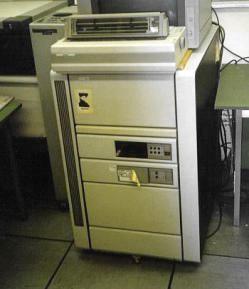
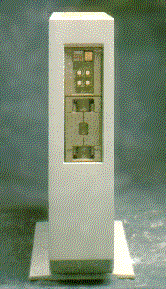
Here's a DEC computer I'm tossing out. Don't know anything about it.
Can't find any model numbers on it.
You can have it free, just pay for shipping plus a buck or two for
packing stuff.
It's small so I would expect it to cost too much. What you see is
what you get. Computer only.
USA only please.
Rob
ps. Some pics
http://homepage.mac.com/irisworld/ebay/dec_box1.jpghttp://homepage.mac.com/irisworld/ebay/dec_box2.jpg
pss. Nope. Didn't bother putting it on ebay. Not worth my time to
test and such.
For small pulleys, check out a hobby shop that deals in radio controlled model airplanes and cars. For small gears, try www.nwsl.com. They also have small drills, bolts, and metal rods (e.g., 1.5mm x 6"). In England, try http://www.ultrascale.co.uk/ for small gears.
Bob
See the following forwarded message. If you're interested then contact me
and I'll pass on the e-mail address. I don't want to expose it to the
world which is why I'm expunging it in this posting.
---------- Forwarded message ----------
Date: Thu, 27 Nov 2008 14:25:06 -0500
From: Budman <budman(a)*****.ca>
To: sellam at vintage.org
Subject: amiga 1000 computer
Hi: My name is Joan Curtis. I live in Huntsville, Ont. Canada. I have
an Amiga 1000 computer in original box with a compatible printer (Star
NX-10) in original box. Plus I have Books -User Guides -(Binder) Book -
Amiga Enhancer Software Featuring Amiga Dos Version 1.2 Kickstart 1.2
Extras 1.2 Includes Revised Amiga Basic and PC Utilities. Also the book -
Amiga Dos Inside and Out. Also a book - An in-depth guide to Amiga Dos
and the CLI. I also have Magazines - Creative Computing 1985 - Commodore
Business and Amiga User 1986 - Amiga World 1987 - Amiga World 1988 - Amiga
Users Guide 1989 - Amiga +Plus 1990. I also have 7 games - Sky Fox - Rogue
- Hardball - Borrowed Time - Mind Shadow - The Faery Tale Adventure - and
Dejavu. There are also 43 discs with case to hold them. I saw an article
in the Toronto Star in Feb. 16, 2003. Would like to sell this collection,
but do not know how to go about it.
---
--
Sellam Ismail Vintage Computer Festival
------------------------------------------------------------------------------
International Man of Intrigue and Danger http://www.vintage.org
[ Old computing resources for business || Buy/Sell/Trade Vintage Computers ]
[ and academia at www.VintageTech.com || at http://marketplace.vintage.org ]
I have 3 3.5" floppy drives with configuration jumpers (and 5 times
as many without :-) ).
Ons is a Chinon FZ-357, and has jumpers for: MD, RDY, MM, DC, and
TTL/C-MOS.
Another is a TEAC FD-235HF and has jumpers for: H HO, OP, LHI, HHI,
and a position (but no header pins) for FG.
The last is a Sony MPF520-1 which has 2 rows of 3 pins... and I have
no idea what they are for.
I understand some abbreviations... RDY (ready), DC (disk change),
but not MD, MM, TTL/C-MOS (assuming this is for interface logic
levels?), and the TEAC ones I don't know at all.
The Sony one is a mystery, and a google search hasn't turned
anything up... don't know if the headers are for selecting D0-D3
only... or more than that.
Can someone fill me in/point me to web pages on these 'magic' jumpers
for these drives ?
Thanks,
-- Curt
One again, I'm getting the grumbles over Ebay's policies: its impenetrable
policies on how much much I pay for what, lack of protection against
insane buyers, a constantly changing look and feel, and so on. I tried
out chasethechuckwagon.com for selling a couple video game carts and I
like it. Their whole fee structure is generous and easily explained in
one paragraph. The only problem is that I don't sell that much in the way
of video games. I don't know what a good alternative for classic computer
stuff would be. Right now I'm looking closely at ebid. I think this week
I'll run a few things there and see what happens.
--
David Griffith
dgriffi at cs.csubak.edu
A: Because it fouls the order in which people normally read text.
Q: Why is top-posting such a bad thing?
A: Top-posting.
Q: What is the most annoying thing in e-mail?
Since we've broached the topic of bridges, does anyone have a Pertec-
to-SCSI bridge that they'd like to sell? I understand that these
could be found in some old Overland drives...
Cheers,
Chuck
>
>Subject: Re: IDE <-> MFM
> From: ard at p850ug1.demon.co.uk (Tony Duell)
> Date: Thu, 27 Nov 2008 19:35:41 +0000 (GMT)
> To: cctalk at classiccmp.org
>
>>
>> On Wed, 26 Nov 2008, Jules Richardson wrote:
>> > Fred Cisin wrote:
>> >> IIRC, my Compaq "Portable 286" (NOT the "Portable 2")
>> >> had a pre-standardization ISA IDE "controller" that cabled to a bridge
>> >> board on an MFM drive
>> >
>> > Isn't that the other way around, though: IDE controller -> bridge -> MFM
>> > drive? The previous poster's saying* they're doing this the other way
>>
>> That doesn't make sense. IDE stands for Integrated Drive Electronics,
>> which means that the controller is located on the drive. Therefore IDE
>> controller cards don't exist, and you can't bride IDE to an ST-412
>
>OK, but IDE bus interface cards do exist. Meaning cards that link ISA
>(or whatever) bus to an IDE drive. For ISA, it's little more than an
>address decoder and buffers (I happen to be using one in this PC).
>
>> interface type drive.
>
>Sure you can. Make a PCB containing a WD1003-like disk controller. On one
>side, have ST412 connectors to conencto to that sort of drive. On the
>other, have an IDE interface -- data lines, 3 address lines, etc. In
>other words the original PC/AT disk controller board minus the floppy
>controller and minus most of the address decoder. Linked to the IDE bus
>interface I mentioned just now, you have a complete ST412 hard disk
>controller system. And the seond part of it could reasonably be called an
>IDE (host interface) to ST412 (drive interface) bridge board.
>
>-tony
If I needed to go from IDE to MFM I'd go to my junk box and pull out a
WD1003 (or one of the smaller versions) and fake the interface of
IDE to ISA16. The two are so close its only the matter of the
IO address lines to resolve them down to CS1 and CS2. Command wise
the 1003 was the prototype for IDE command set.
Allison
During cleanup I found 3 unused RK06 heads, Dec partno 74-14130-12.
They are still in their original box.
Next to that I have a few more RK06 heads, new, but not in a box,
as well as 3 or 4 RK06 servo track heads (these have an extra
cable + connector). Maybe this is Dec partno 74-14130-13 ?
Make me an offer.
Ed
I've been trying (unsucessfully) to get various flat screen
monitors to display the output from a sun monochrome frame
buffer. This is proving tricky.
The monochrome fb outputs 1152x900 if I recall correctly and
its proving difficult to get any monitor to sync to this. Note
the output is analogue not the older ECL (?) type display.
Old CRT multi-sync monitors that sync on green handle this
OK.
Can anyone recommend a modern flat screen that will work with
this kind of framebuffer?
I do have various video processing units that can scale and
process the output, but I'd rather not use these as they
are already in use for other tasks.
Ian.
The felt pad that presses the floppy disk into the r/w head fell off my
RX01 (or whatever dual floppy drive is actually inside a DECmate model
III (a late edition of 6120-based PDP-8).
Has anyone tried to do that repair? What did you use for replacement,
self-adhesive felt material?
cctalk-request at classiccmp.org wrote:
> Send cctalk mailing list submissions to
> cctalk at classiccmp.org
>
> To subscribe or unsubscribe via the World Wide Web, visit
> http://www.classiccmp.org/mailman/listinfo/cctalk
> or, via email, send a message with subject or body 'help' to
> cctalk-request at classiccmp.org
>
> You can reach the person managing the list at
> cctalk-owner at classiccmp.org
>
> When replying, please edit your Subject line so it is more specific
> than "Re: Contents of cctalk digest..."
>
>
> Today's Topics:
>
> 1. Re: 5" floppy?. (Jules Richardson)
> 2. Re: 5" floppy?. (Sridhar Ayengar)
> 3. Re: 5" floppy?. (Sridhar Ayengar)
> 4. HP3000 (Mike Loewen)
> 5. Re: HP3000 (William Donzelli)
> 6. Re: HP3000 (Mark Davidson)
> 7. Re: HP3000 (William Donzelli)
> 8. Re: Help with Shugart SA801 8" floppy with 230v 50 cycle
> (feldman.r at comcast.net)
> 9. Re: 5" floppy?. (David Griffith)
> 10. Re: 5" floppy?. (William Donzelli)
> 11. Screwheads; was 5 floppy?. (Chuck Guzis)
> 12. RE: Help with Shugart SA801 8" floppy with 230v 50 cycle
> (dwight elvey)
> 13. Re: 5" floppy?. (Dave McGuire)
> 14. RE: Help with Shugart SA801 8" floppy with 230v 50 cycle
> (Chuck Guzis)
> 15. RE: 5" floppy?. (dwight elvey)
> 16. Re:Screwheads, was: 5" floppy?. (Chuck Guzis)
> 17. Re: AT&T 7300/3B1's (was: Re: Who is vintagecomputermuseum?)
> (micheladam at theedge.ca)
> 18. Re: AT&T 7300/3B1's (was: Re: Who is vintagecomputermuseum?)
> (Gordon JC Pearce MM3YEQ)
> 19. Re: AT&T 7300/3B1's (was: Re: Who is vintagecomputermuseum?)
> (Lance Lyon)
> 20. IDE <-> MFM, was > Re: AT&T 7300/3B1's (was: Re: Who is
> vintagecomputermuseum?) (emu at e-bbes.com)
> 21. Re: The Day the Infant Internet Uttered its First Words
> (Steve Maddison)
> 22. RE: Help with Shugart SA801 8" floppy with 230v 50 cycle
> motor... (ROBO5.8)
> 23. Re: AT&T 7300/3B1's (was: Re: Who is vintagecomputermuseum?)
> (Jules Richardson)
> 24. Re: Help with Shugart SA801 8" floppy with 230v 50 cycle
> motor... (Jules Richardson)
> 25. Mystery paper tape reader (Tobias Russell)
> 26. MITS Disk Boot Loader manual (Richard A. Cini)
>
>
> ----------------------------------------------------------------------
>
> Message: 1
> Date: Tue, 25 Nov 2008 17:25:48 -0600
> From: Jules Richardson <jules.richardson99 at gmail.com>
> Subject: Re: 5" floppy?.
> To: General Discussion: On-Topic and Off-Topic Posts
> <cctalk at classiccmp.org>
> Message-ID: <492C897C.1080407 at gmail.com>
> Content-Type: text/plain; charset=ISO-8859-15; format=flowed
>
> Fred Cisin wrote:
>
>> It sure is easy to slip into off-topic mechanical griping.
>>
>
> Yeah, funny how there's a lot of interest overlap between vintage computing,
> old cars, and engineering (and that it says in the "to" field of this message
> that the list is for "General Discussion: On-Topic and Off-Topic Posts") - but
> let's not go there, huh? ;-)
>
>
> J.
>
>
> ------------------------------
>
> Message: 2
> Date: Tue, 25 Nov 2008 19:04:06 -0500
> From: Sridhar Ayengar <ploopster at gmail.com>
> Subject: Re: 5" floppy?.
> To: General Discussion: On-Topic and Off-Topic Posts
> <cctalk at classiccmp.org>
> Message-ID: <492C9276.8000809 at gmail.com>
> Content-Type: text/plain; charset=ISO-8859-1; format=flowed
>
> Tony Duell wrote:
>
>>> Even computer companies - people that should know better, make
>>> mistakes when talking about floppy disks. Last week I was in a Staples
>>> store (American office supply store chain), and saw a Memorex 3 1/2" USB
>>> floppy drive, the package stating clearly that it supported "1.44mb
>>> double sided and 720k single sided diskettes". >
>>>
>> Well, calling it mb (millibyte) is clearly wrong. And the value of
>> 1.44Mbytes assumes you take 1Mbyte as 1000*1024 bytes, which is downright
>> crazy.
>>
>
> Actually, doesn't mb imply "millibit", and mB is "millibyte", with Mb as
> "megabit" and MB as "megabyte"?
>
> Peace... Sridhar
>
>
> ------------------------------
>
> Message: 3
> Date: Tue, 25 Nov 2008 19:06:26 -0500
> From: Sridhar Ayengar <ploopster at gmail.com>
> Subject: Re: 5" floppy?.
> To: General Discussion: On-Topic and Off-Topic Posts
> <cctalk at classiccmp.org>
> Message-ID: <492C9302.40404 at gmail.com>
> Content-Type: text/plain; charset=ISO-8859-1; format=flowed
>
> Gordon JC Pearce MM3YEQ wrote:
>
>> (once again, sorry Jay)
>>
>>
>>> My favourite has to be Torx. I have never had any problems with those.
>>>
>> Oh I have... <grumble>Bloody Volkswagens with their stupid 5-lobed
>> Torx-like brake caliper bolts, that you can't even get drivers for from
>> VW without ordering them from Germany...
>>
>
> My Audi uses triple-square for that kind of stuff.
>
> Peace... Sridhar
>
>
> ------------------------------
>
> Message: 4
> Date: Tue, 25 Nov 2008 20:01:42 -0500 (EST)
> From: Mike Loewen <mloewen at cpumagic.scol.pa.us>
> Subject: HP3000
> To: "General Discussion: On-Topic and Off-Topic Posts"
> <cctalk at classiccmp.org>
> Message-ID: <Pine.LNX.4.64.0811251950490.22596 at cpumagic.scol.pa.us>
> Content-Type: TEXT/PLAIN; charset=US-ASCII; format=flowed
>
>
> Where have all the HP3000 systems gone?
>
> Between 1986 and 1988, I worked on a whole slew of HP3000s, from the
> Series III to the Series 70. They were popular in the business
> environment, especially in COBOL shops. Where did they end up? You can
> find loads of DEC equipment on Ebay, even IBM System 34, 36 and AS/400s,
> the occasional HP1000, but the only HP3000 I recall seeing in recent years
> was a single Model 37.
>
>
> Mike Loewen mloewen at cpumagic.scol.pa.us
> Old Technology http://sturgeon.css.psu.edu/~mloewen/Oldtech/
>
>
> ------------------------------
>
> Message: 5
> Date: Tue, 25 Nov 2008 20:16:45 -0500
> From: "William Donzelli" <wdonzelli at gmail.com>
> Subject: Re: HP3000
> To: "General Discussion: On-Topic and Off-Topic Posts"
> <cctalk at classiccmp.org>
> Message-ID:
> <e1d20d630811251716q468c96f4s9ab6b8a98cecdd43 at mail.gmail.com>
> Content-Type: text/plain; charset=ISO-8859-1
>
>
>> Between 1986 and 1988, I worked on a whole slew of HP3000s, from the
>> Series III to the Series 70. They were popular in the business environment,
>> especially in COBOL shops. Where did they end up? You can find loads of
>> DEC equipment on Ebay, even IBM System 34, 36 and AS/400s, the occasional
>> HP1000, but the only HP3000 I recall seeing in recent years was a single
>> Model 37.
>>
>
> You answered your own question.
>
> DEC made loads of minis (PDP and VAX).
> IBM made loads of minis (S/34 and S/36).
> IBM made extra sized loads of AS/400 minis (more than any other minicomputer).
> HP did not make loads of 3000s.
>
> I think it is a simple population thing.
>
> --
> Will
>
>
> ------------------------------
>
> Message: 6
> Date: Tue, 25 Nov 2008 17:27:42 -0800
> From: "Mark Davidson" <mdavidson1963 at gmail.com>
> Subject: Re: HP3000
> To: "General Discussion: On-Topic and Off-Topic Posts"
> <cctalk at classiccmp.org>
> Message-ID:
> <d17c35610811251727u5ec8860ayd6474c43da58e5f3 at mail.gmail.com>
> Content-Type: text/plain; charset=ISO-8859-1
>
> On Tue, Nov 25, 2008 at 5:16 PM, William Donzelli <wdonzelli at gmail.com> wrote:
>
>>> Between 1986 and 1988, I worked on a whole slew of HP3000s, from the
>>> Series III to the Series 70. They were popular in the business environment,
>>> especially in COBOL shops. Where did they end up? You can find loads of
>>> DEC equipment on Ebay, even IBM System 34, 36 and AS/400s, the occasional
>>> HP1000, but the only HP3000 I recall seeing in recent years was a single
>>> Model 37.
>>>
>> You answered your own question.
>>
>> DEC made loads of minis (PDP and VAX).
>> IBM made loads of minis (S/34 and S/36).
>> IBM made extra sized loads of AS/400 minis (more than any other minicomputer).
>> HP did not make loads of 3000s.
>>
>> I think it is a simple population thing.
>>
>> --
>> Will
>>
>
> I subscribe to the 3000 mailing list, and there seems to be one other
> complaint... licensing the OS. I am no expert on the matter, but I've
> gotten the impression that HP can be a real bear to deal with when it
> comes to licensing the OS for users. It simply can get too expensive
> for a hobbyist to run MPE...
>
> Trust me, I'd love to have a small 3000 at home and if one ever shows
> up, I'll snap it up if I can. They just seem to be pretty rare on the
> used market.
>
> Mark
>
>
> ------------------------------
>
> Message: 7
> Date: Tue, 25 Nov 2008 20:52:06 -0500
> From: "William Donzelli" <wdonzelli at gmail.com>
> Subject: Re: HP3000
> To: "General Discussion: On-Topic and Off-Topic Posts"
> <cctalk at classiccmp.org>
> Message-ID:
> <e1d20d630811251752r7c21a151ge4ceec709310254c at mail.gmail.com>
> Content-Type: text/plain; charset=ISO-8859-1
>
>
>> I subscribe to the 3000 mailing list, and there seems to be one other
>> complaint... licensing the OS. I am no expert on the matter, but I've
>> gotten the impression that HP can be a real bear to deal with when it
>> comes to licensing the OS for users. It simply can get too expensive
>> for a hobbyist to run MPE...
>>
>
> A complaint, yes, but really has nothing to do with why 3000s are so
> scarce. Really, it is hard to beat the IBM AS/400 group for being
> disagreeable when it comes to licenses.
>
> I think DEC spoiled us.
>
> --
> Will
>
>
> ------------------------------
>
> Message: 8
> Date: Wed, 26 Nov 2008 02:41:19 +0000
> From: feldman.r at comcast.net
> Subject: Re: Help with Shugart SA801 8" floppy with 230v 50 cycle
> To: cctalk at classiccmp.org
> Message-ID:
> <112620080241.25527.492CB74F00042AA6000063B722007621949DD2020E030B040A00 at comcast.net>
>
> Content-Type: text/plain
>
> For small pulleys, check out a hobby shop that deals in radio controlled model airplanes and cars. For small gears, try www.nwsl.com. They also have small drills, bolts, and metal rods (e.g., 1.5mm x 6"). In England, try http://www.ultrascale.co.uk/ for small gears.
>
> Bob
>
> ------------------------------
>
> Message: 9
> Date: Tue, 25 Nov 2008 18:45:30 -0800 (PST)
> From: David Griffith <dgriffi at cs.csubak.edu>
> Subject: Re: 5" floppy?.
> To: "General Discussion: On-Topic and Off-Topic Posts"
> <cctalk at classiccmp.org>
> Message-ID: <Pine.GSO.4.55.0811251843380.22711 at helios.cs.csubak.edu>
> Content-Type: TEXT/PLAIN; charset=US-ASCII
>
> On Tue, 25 Nov 2008, Chuck Guzis wrote:
>
>
>> I once read an interview with the son of inventor Henry Phillips (an
>> Oregon native) and he maintained that it wasn't the original design
>> (US Patent 2046343) that was at fault, it was primarily the fault of
>> ASC for cheapening the manufacturing process by relaxing
>> specifications--and the propagation of inferior tools. Indeed, the
>> screwdrivers I have that are labeled "Genuine Phillips" do seem to be
>> quite a bit better than the generic variety. One aspect of the
>> Phillips head not shared by Torx or Robertson/square is that it will
>> automatically center the driving bit.
>>
>
> I don't follow on the automatic centering. Yes, a slotted screwdriver can
> slide out, but torx or robertsons?
>
>
>> The "slipping out", I believe is referred to as "camming out".
>>
>> While rebuilding a deck this summer, I found that even square-drive
>> screws are easy to strip when power is used to drive them.
>>
>
> That's why you're supposed to use a drill with a slipper clutch.
>
>
>> Fortunately, deck screws are being manufactured with the Torx head
>> (mine were T25s) and allow for much better driving performance.
>>
>
>
>
>
>From: Tim McNerney <mc at media.mit.edu>
>Subject: RX01 missing felt pad, repair advice
>
>The felt pad that presses the floppy disk into the r/w head fell off my
>RX01 (or whatever dual floppy drive is actually inside a DECmate model
>III (a late edition of 6120-based PDP-8).
>Has anyone tried to do that repair? What did you use for replacement,
>self-adhesive felt material?
>
*I've not worked on a RX-01 before, but I've been keeping my eye out for
suitable felt button replacements. The only thing I've seen so far as
these felt pellets used in pellet guns... they come in .177 - .22 inch
sizes. If you've lost the carrier as well, you've got a slightly
more difficult problem.
JS
*
>Date: Sun, 23 Nov 2008 20:41:26 -0000
>From: "Jim Beacon" <jim at g1jbg.co.uk>
>
>From: <js at cimmeri.com>
>
>>> Are DEC Letterprinter 100's in nice, working, non-noticeably-yellowed
>>> condition worth anything at present? Or are they pretty much recycling
>>> fodder?
>>
>>
>Don't know if they are worth anything, I've never had to pay for one - they
>just keep arriving here!
>
>They are useful though, as they correctly emulate a Teletype and allow
>overprinting, which most modern printers don't, but I suppose that's only
>useful if you have an interest in ASCII art!
>
>Jim.
>
Interesting. Well, my use is just for general programming printouts on
a PDP 11/23+. Is the LA75 a viable replacement for the Letterprinter
100? The 75 isn't period to the 11/23, but my concern about the 100
is ribbons. Ribbons for the LA75 are plentiful and cheap.
Thanks Jim, Tony, Allison for your replies.
JS
I give up - what's a LK207-EE?
http://www.sparetimegizmos.com/Downloads/LK207-EE.JPG
It's clearly a cousin to the LK201; it has the same keys as a LK201 but with
a different physical arrangement. The paper labels stuck on the keycaps
would make me think that it was used in some kind of stock broker
application, but I've never seen or heard of anything like it before.
Bob
As a tangent to the "first" computer on the internet, I reference this
interesting link, showing the IMP log, along with the date and time of
the "birth" of said [I][i]nternet.
See:
http://www.lk.cs.ucla.edu/first_words.html
-eric
-- Jules Richardson <jules.richardson99 at gmail.com> wrote:
>Gordon JC Pearce MM3YEQ wrote:
>> micheladam at theedge.ca wrote:
>>> Does anyone know of a 'bridge' converter that would allow a scsi >disk
>>> to interface to an MFM controller?
>>>
>>> Michel Adam
>>
>> I'm not sure how that would work. Do you mean replacing an >existing MFM
>> disk with a SCSI disk?
>
>It's been talked about at various times on the list here...
>
>It needs high-speed sampling of the MFM data at the track level into >buffer
>memory, and some smarts to translate the buffer memory into blocks on >the drive.
>
>It *could* be done, but nobody's made it work yet AFAIK.
>
>cheers
>
>Jules
Commercial products exist, for example at:
www.mbiusa.com/mbi_000010.htm
But I imagine they're *FRIGHTFULLY* expensive . . . .
____________________________________________________________
Enjoy the type-anywhere ease of a wireless keyboard. Click now!
http://thirdpartyoffers.juno.com/TGL2141/fc/PnY6rw1aNvZao9Vy0jrsWZZZiMWt9Xz…
I just put up a large collection of documentation on the 1900
hardware over the past couple of days under
http://bitsavers.org/pdf/ict_icl/1900
Has anyone heard anything from Brian Spoor lateley? I'm concerned
since his last post on AFC seems to be from about a year ago.
All:
I?m working on adding support in the Altair32 Emulator for directly
reading WAV file samples of audio cassettes. Initially, I?m working with the
88-ACR but it should be a snap to modify that code to support the KCS.
A WAV sample sent to me by the person who asked me to look into adding
this capability is a cassette from 1977 called the MITS Disk Boot Loader.
I?ve known this to be usually distributed on PROM, but I guess if you didn?t
have a PROM board, the cassette makes sense. I actually have the source and
ROM binary already because I use it for the floppy disk support in the
Altair32.
Anyway, me and a buddy of mine are starting to parse the WAV samples and
it would help greatly if we could get a copy of the manual for the DBL. The
owner of the tape doesn?t have it. What I?m really looking for is the toggle
loader or whatever was used to bring the DBL in from cassette.
If anyone has it and would be willing to scan it for me, I?d appreciate
it. Thanks!
Rich
--
Rich Cini
Collector of Classic Computers
Build Master and lead engineer, Altair32 Emulator
http://www.altair32.comhttp://www.classiccmp.org/cini
Hi,
I was digging through my collection at the weekend and came across this
paper tape reader(?). Can anyone help me identfy it?
I've put some pictures up on my blog here:
http://www.pdp8.co.uk/2008/11/26/mystery-paper-tape-reader/
It is labelled on the front as a ?Paper Tape Comparator?. It has an
optical array for scanning the tape and an adjustable width feeder to
support 3 different sizes. I can't find any indication of its make which
makes me wonder if its scratch built with bits from another device.
On the back is a female 25 pin D socket which I assume to be an RS232
outlet. There is also a 3 pin power socket in a format I don?t
recognise.
Any information would be greatly appreciated.
Thanks,
Toby
--
This message has been scanned for viruses and
dangerous content by MailScanner, and is
believed to be clean.
A fascinating topic.
Here's a fun patent to read:
http://www.google.com/patents?id=lBJtAAAAEBAJ
Patent number: 2614169
Filing date: Jul 24, 1950
Issue date: Oct 1952
Inventor: A. A. COHEN
Assignee: Engineering Research Asso
Some mention is made of how they made it in 1950.
Coombs original patent:
http://www.google.com/patents?id=gSBXAAAAEBAJ&dq=patent:3119110
Patent number: 3119110
Filing date: May 2, 1949
Issue date: Jan 21, 1964
Inventor: J. M. COOMBS
Assignee: Sperry Rand Corporation
They appear to use spray paint --- not deposition.
Its time to clean up things a bit...mostly stuff I've not had the time
or desire to play with :)
If I'm too high (or too low) make an offer!
I'm not going to ship the complete NeXT boxes or the box of tapes,
but I can be persuaded with everything else: buyer pays shipping
I'm located in Bloomington, IN 47408
Things I'm looking for:
* Playstation 2
* Amiga Stuff: A1200, A600
* CoCo stuff: Coco3 + disk controller
* Commodore stuff: C128, 1571, 1581, C65 (hahaha)
Get this stuff out of my house!
Brian
For Sale
==========
NeXTstation (Mono) $50
32M RAM
no HD
Mono Monitor
Mouse
Keyboard
Floppy Drive
NeXTcube $75
64M RAM
NeXT Dimension Card
Color Monitor (needs 13w3 cable)
Mono Monitor
Mouse
Keyboard
Floppy Drive
no HD
3x NeXT Mono Video Cable $2 each
NeXT Keyboard+Mouse $5
DECserver 200/MC $5
Sun DDS2 DAT Drive in 611 Enclosure $10
599-2072-01
OkiData 184 Turbo $20
New in box
20x 10baseT external tranceivers with cable. $1 each
Box of TK50s (86 tapes) $20
Distribution tapes circa 1989-1992.
Ingres, RDB, Fortran, VMS 5.4, VMS 6.0, etc
Freebies
========
DEC Multia AXP 166MHz
Unknown condition.
32M RAM
No HD
2x HP 715/64
Unknown condition
One has 64M(?) and a disk. One has neither.
Both show "Memory error" (leds -76-43--)
SS20 Chassis
No disks or ram. Didn't see a processor in there either.
VAX C Manual
Toshiba Satellite 400CS/810
P75 / 700M Disk / 16M RAM
Battery seems to work, but no promises.
External DAT, Centronics connectors. Unknown capacity
2x Ext SCSI enclosure w/centronics connectors. sun 411 enclosure size
Model M Keyboard (original PC connector)
Hi,
I don't suppose anyone in the UK has any H960 DEC racks looking for a
good home? I'm in the process of moving all of my collection from my
storage unit to my office server room and I'm short of racks to put it
all in. Would be nice to put it all in correct period racks.
Condition not important as I am a dab hand at cleaning and de-rusting.
Thanks,
Toby
--
This message has been scanned for viruses and
dangerous content by MailScanner, and is
believed to be clean.
> That claim of some drums operating at 75,000rpm has to be a typo...
> I can believe 7500 - but 75,000? Ouch!
Eckert once made the claim that, ?laboratory models have been operated in excess of 75,000 rpm.? That's probably where they got that.
Hi all,
I've come to the conclusion that it's time my PDP11/73 went to a new
home. Not a terribly easy decision to make, but I just don't have space
to even get to it to switch it on just now and I'd rather see someone
else get some use out of it.
Anyway, here's the spec:
PDP11/73 in a large Baydel cabinet with a 40M-ish MFM drive
RX02 floppies
2 x RL02 plus a spare RL02
2 x CIT101 terminals
VT520 terminal
VT220 terminal
LA36, spare ribbons and paper
spare boards including 11/03 bits, a couple of opto-isolated I/O boards
and some ADC boards
DEQNA
about a dozen RL02 packs
large box of RX02 disks
RT-11 V5.2 manuals
Pick up in Glasgow. You'll need a van, although not a very big one, to
shift it. A large estate car would be too small unless you broke the
rack down into panels - a PITA, I've done it before though.
Mail me on- or off-list if you're interested.
Gordon
Sun Nov 23 Eric Smith wrote:
> Nickel plating would definitely not work. Some of the earliest drums
> used cunife (copper/nickel/iron alloy) wire tightly wound around an
> aluminum cylinder, then turned on a lathe to get a flat surface. ...
Hmmm . . . that technique might work for my 2N2/256 BSCP project!
It also occurs to me that the machining could be done with the drive
mechanics, provided it's rigid enough and you take very light cuts.
You would fabricate a cutter head that bolts in the same way as a R/W
head. To take a cut, you just tweak the adjustment screw(s) and turn
an additional "feed" screw to cut the track the right width.
Heck, you wouldn't even need the feed screw. Make the head so it can
slide laterally a millimetre or two, then you could move the cutter
head back and forth by hand, the same way the Fonly lathe works.
It also might be possible to just lap the R/W heads in with a tiny
amount of jewer's rouge, then carefully clean all the grit out and
readjust the heads to give the right gap.
-Bobby
On 24 Nov 2008 13:15:50 -0800, Chuck Guzis" <cclist at sydex.com> wrote:
> On 24 Nov 2008 at 14:39, John C. Ellingboe wrote:
>
>> I just got off of the phone with Small Parts "AGAIN" and was informed
>> that after messing around and dragging their feet for 6 months they
>> finally decided to refund my money and were not going to be
>> handling the
>> items I ordered. You may not want to trust them with your money, I
>> know
>> that I can't...
>
> That's too bad; they used to be a pretty decent outfit.
>
> So where does one go for small engineering findings nowadays? I've
> used McMaster-Carr for some things, but that's not their specialty.
Over the years I've been using WM Berg <http://www.wmberg.com/>.
CRC
Sellam, et. al.
As others have contributed, Proteon was an independent network vendor
in the 1980s. I'm a little unclear what became their corporate fate, (I forgot about
DEC buying source code) but they did eventually come apart due to market forces.
They were an early token ring manufacturer, with their own product. When IBM
pushed their technology into the IEEE 802.4 standard, they adapted with the market.
They also made multi-protocol routers, and since they weren't Cisco, Digital did do some
work with them. I had a 4100+ and a 4200 in my development lab. Unfortunately for
you I don't think I took any of that stuff home.
I was the technical lead/architect for a DECnet Token Ring Data Link specification.
As part of that program, I also specified how to interface DECnet-DOS/Pathworks on to
PC token ring devices. We worked with Proteon to put DECnet routing support into
their routers, and I think they are whom we got to OEM an 802.4 Qbus NIC card for us.
(with DECnet VMS support!) This was all to deal with the pressure IBM was putting on
the PC and networking business at the time.
(my memory is fuzzy on that now.) God I'd love to see what happened to the customers that
swore that token ring was so superior to Ethernet that it was going to rule their networks going forward.
IBM put some interesting crocks into their LAN chips wrt multicast addressing that really messed things up.
I'm glad to see that chapter of history closed.
I may be able to make some personal contacts to see if they have anything around.
I woundn't be suprised if there is a Proteon old users/collectors group out there somewhere.
Dave.
----
On Nov 24, 2008, cctech-request at classiccmp.org wrote:
Date: Wed, 19 Nov 2008 19:08:26 -0800 (PST)
From: Sellam Ismail <sellam at vintagetech.com>
Subject: Seeking Proteon P4100+ router manuals
To: Classic Computers Mailing List <cctalk at classiccmp.org>, Bay Area
Classic Computing List <baccl at lists.baccl.net>
Message-ID: <Pine.LNX.4.61.0811191900180.22337 at vintagetech.com>
Content-Type: TEXT/PLAIN; charset=US-ASCII
I'm looking for a set of manuals for the Proteon P4100/P4100+/P4200
routers, circa 1989 or earlier. I'm guessing Proteon was an independent
company until DEC bought them at some point? Just guessing. Anyway, if
you've got a set of manuals I'd be interested in purchasing them from you.
Please contact me directly if you have some.
Thanks!
--
Sellam Ismail Vintage Computer Festival
------------------------------------------------------------------------------
International Man of Intrigue and Danger http://www.vintage.org
[ Old computing resources for business || Buy/Sell/Trade Vintage Computers ]
[ and academia at www.VintageTech.com || at http://marketplace.vintage.org ]
>
>Subject: Re: DEC Letterprinter 100 -- what are they selling for?
> From: ard at p850ug1.demon.co.uk (Tony Duell)
> Date: Sun, 23 Nov 2008 21:27:30 +0000 (GMT)
> To: cctalk at classiccmp.org
>
>>
>>
>> From: <js at cimmeri.com>
>>
>> >
>> > Are DEC Letterprinter 100's in nice, working, non-noticeably-yellowed
>> > condition worth anything at present? Or are they pretty much recycling
>> > fodder?
>>
>> Don't know if they are worth anything, I've never had to pay for one - they
>> just keep arriving here!
>
>I have no idea what they're worth either. I was given a couple with my
>11/730 system... IIRC the Letterprinter is the RO (no keyboard) model,
>the Letterwriter is the KSR (with keyboard) one.
>
>> They are useful though, as they correctly emulate a Teletype and allow
>> overprinting, which most modern printers don't, but I suppose that's only
>> useful if you have an interest in ASCII art!
>
>It's a 9 pin dot-matrix head which is tilted mechanically (a pair of
>solenoids shuttling a shaped core to and fro inside the carriage) to give
>18 pin resolution in 2 passes. I find them interesting because of that
>curious mechanism.
>
>-tony
I have two LA100ro as they proved in the field to be rugged and I got to
see that from the point of view of DEC printers engineering. The curious
approach to "18pin" printing was twofold. One was to allow fast draft
quality printing and the other was rugged high quality printing that could
still punch multipart forms with a known reliable head. At that time there
were a few 18 pin heads but they didn't have the long term life at sustained
high print rates. Note, this is a 1984-5 design so understand that many
printers at that time were of smaller or less rugged style or really
imposing printers.
The LA100RO is most valuable to businesses that still used wide pinfed (assuming
you have the forms tractor) multipart forms.
In the high quality mode it does print decently and the graphics printing is
not as slow as some dot matrix were.
Allison
More stuff uncovered.
I have several (~5, actually) Interlan NT10 transceivers to dispose of. These clamp on to coaxial backbone ethernet cables and pierce the jacket (vampire tap) to make a connection. They have an AUI port to connect your equipment to.
If you are interested in them, make me an offer for my time to box them up and take them to a shipper. If there is no interest, they will get recycled.
I am still in Madison Wi. 53714
Jon
Jon Auringer
auringer at tds.net
On Wed Nov 19 21:08:26 CST 2008, Sellam Ismail sellam said:
> I'm looking for a set of manuals for the Proteon P4100/P4100+/P4200
> routers, circa 1989 or earlier. I'm guessing Proteon was an independent
> company until DEC bought them at some point? Just guessing. Anyway, if
> you've got a set of manuals I'd be interested in purchasing them from
you.
I can't help you with manuals, but I will confirm that Proteon was indeed an
independent firm in the 80's. During the early and mid-80's I was a member
of Novell's technical staff during and had a good working relationships
with several Proteon engineers. Novell, of course, had PC networking
software and was working with just about any and all PC networking
hardware vendors to make sure that there was a NetWare driver for
their gear. At that time, Proteon had their own flavor of token-ring
over twisted pair style hardware call Pro-Net. I don't remember
the details or the transfer rates, but it was not particularly successful
and later Proteon ended up joining the shift of the industry to Ethernet.
Somewhere along the way, in the very early 90's, I think, they combined
with 3Com. If I remember right, Proteon was located in Waltham, MA
during the 80's.
- Jared
----------Original Message:
Date: Thu, 20 Nov 2008 01:45:19 -0600
From: "joe lobocki" <jlobocki at gmail.com>
Subject: anybody have any IBM 8525's?
hello,
Im trying to find one of those all-in-one PS/2 computers that IBM had
in the late 80s, some were under the "EDUQUEST" badging, but most were
the all-in-one 8525, and for some reason those who are selling on ebay
think they have one of the rarest machines in the world and charge as
so, and it really makes me regret not grabbing one from the salvage
pile when they dumped all the ones in 99 when i was in middle school.
anyway, does anyone have one they are willing to part with, or know of
a cheap source of them? thanks
-Joe
-----------Reply:
You might have more luck if you ask on the Vintage Computer Forum
(vintage-computer.com)
Several hundred EDUQUESTs around, but don't know which model.
---------- Forwarded message ----------
From: Ethan Dicks <ethan.dicks at gmail.com>
Date: Nov 24, 2008 12:54 AM
Subject: Can you make a cctalk posting for me?
Hi, Will,
I'm in NZ now, and I managed to easily disconnect my USAP
subscription, but my request to add from gmail hasn't gone through yet.
So could you do me a favor and mention on the list that I'm in
Christchurch for a few weeks and would enjoy the opportunity to meet
with anyone on the list who's in town to talk about computers, etc.
Just have them contact me at this address. I check it frequently.
Thanks,
-ethan
Hello,
in an ongoing effort to thin out my collection, I've decided to sell
or exchange some old HP bits that I'm sure are more useful to other
members of this list. They should probably go to the same person,
though the latter might be useful to some HP41 owner, too :-)
HP-75D, with power supply, 8k ram pack, about 16 magnetic strips and
one abrasive cleaning strip, and I/O Rom. I only have the manual for
the I/O ROM, and the June 1983 issue of the HP Journal; that is the
only "manual" I have for the 75D.
I don't have the battery pack, I did at some point, but can't find it
anymore. Some cells were dead, anyways - I think I kept the plastic
parts, but it may be lost. It's fully functional (on AC power), but
looks used (of course). Two of the feet pads are missing.
I also have the 82164A HP-IL/RS-232C Interface, with power supply and
manual, but I never had any HP-IL cables, so I could never test it :-(
This one looks as if it came just out of the shipping box.
I'd be happy to trade for a more modern HP calc (HP48SX or better) or
interesting MIDI gear - otherwise I'm open to offers.
Pic at http://www.ece.mcgill.ca/~jthiem/IMG_1916.jpg
Oh, I also have an HP Omnibook 600C (working except the left mouse
button) that I'm trying to let go.
I'm in Montreal, Canada.
Joe.
---
Joachim Thiemann :: http://www.tsp.ece.mcgill.ca/~jthiem
Are DEC Letterprinter 100's in nice, working, non-noticeably-yellowed
condition worth anything at present? Or are they pretty much recycling
fodder?
Thanks,
JS
Hi all,
While cleaning, I have come across the following field maintenance print sets. I am inclined to dump them in the recycle bin, unless someone _really_ wants them. The total weight is about 22lbs from Madison, WI.
All are "B" size (11x17") -
UNIT ASSEMBLY 11780 (3" worth)
KU780
(2) 11780 MEMORY ASSY
TAPE DRIVE TU78
TEE16 SYSTEM
MAGNETIC TAPE DRIVE TE16
H9206-M EXPANDER CAB
If interested, reply soon.
Jon
Jon Auringer
auringer at tds.net
Looks like the lot has 4 brand new 029s and two used machines, at least
one of which is an 026. Somebody go get these! Or, do what I did in
2001 when a lot came up, and get a group together to buy them and divvy
them up. These don't come along that often.
Looks like there is some interesting old radar display gear in there
too, which some military buffs would probably want. Are those
scope hoods made of Bakelite?
http://cgi.govliquidation.com/auction/view?id=2037010&categoryId=c7149
There's a whole bunch of other stuff in the lot, but you can call the
DRMO staff and see if they can either keep and relist the remainder, or
give it to a surplus dealer. There are usually surplus dealers hanging
around happy to haul off whatever doesn't sell or what gets abandoned.
It's the logistics of shipping and dispersing the stuff that's painful.
Looks like the four new 029s are crated, the 026(s) are sitting on
pallets, and they'll have to be padded and strapped.
In the 2001, I used freightquote.com and scheduled a pickup & had the
units sent to the people in the group. FYI I just looked at the bills
of lading, we listed the factory-crated 029's as 520 lbs each, and the
029s on pallets as 310 lbs each. At today's rates, you should be able
to ship a palletized unit from Ohio to, say, California, with a
liftgate delivery, for about $250, and a crated unit for about $350.
I'd be interested to know on or off list what happens with these,
punched card stuff is one of my areas of interest.
Brian
With all this talk on PDP 8's thought I'd throw my
hat in the ring :)
If anyone has a working PDP 8 system for sale, either
in the UK/Europe or USA (West Coast) let me know.
Preferably this would have a disk unit of some kind,
and must be known working with terminal access.
Good price paid and will collect.
Thanks
Ian.
Hi,
A couple of years ago I bought an Interdata Model 74 CPU and I'm
pondering what to do with it. I'm leaning towards rebuilding it to
working condition next year and I was wondering if there are any other
Interdata owners out there?
The machine is in generally good condition, although I have has no power
supply with it so will need to find or build something suitable.
Unfortunately I have no documentation and so if anyone has any
engineering documentation for these machines it would be a great help.
Bitsavers has some details on the Model 70. Does anyone know how similar
the Model 74 is to the 70?
Thanks,
Toby
--
This message has been scanned for viruses and
dangerous content by MailScanner, and is
believed to be clean.
I found a business card in a package of Pascal / MT+ for CP/M-86:
MTPUG
Pascal/MT Users Group
Quarterly Newsletter with fixes, hints, programs, reviews.
User contributed program disks in 5" and 8" formats.
Below that are two addresses. One for a Guenter Musstopf in Ahrensburg in
West Germany and for Henry Lucas in Westmont, IL in the USA. Does anyone
know anything interesting about this newsletter?
--
David Griffith
dgriffi at cs.csubak.edu
A: Because it fouls the order in which people normally read text.
Q: Why is top-posting such a bad thing?
A: Top-posting.
Q: What is the most annoying thing in e-mail?
old IBM terminals. Instead of me being very specific, just tell me what you
have. I don't come by that many, neither do you probably.
2 (at least) full height IBM floppy drives.
Atari ST equipment. Non working considered.
interested in a nice IBM 5151 monochrome monitor. Have one, but it has
considerable screen burn.
Thanks.
Joe,
I was just looking up the TIL306 part and found your question. I know it is
old but thought I would respond. I actually have 9 in original condition.
They have never been installed in anything. If you need them let me know.
Sincerely,
Mike Fontes
mfontes at charter.net
> From: "Brian Knittel" <brian at quarterbyte.com>
>
> Looks like the lot has 4 brand new 029s and two used machines, at
> least
> one of which is an 026. Somebody go get these! Or, do what I did in
> 2001 when a lot came up, and get a group together to buy them and
> divvy
> them up. These don't come along that often.
>
> Looks like there is some interesting old radar display gear in there
> too, which some military buffs would probably want. Are those
> scope hoods made of Bakelite?
>
> http://cgi.govliquidation.com/auction/view?id=2037010&categoryId=c7149
>
> There's a whole bunch of other stuff in the lot, but you can call the
> DRMO staff and see if they can either keep and relist the remainder,
> or
> give it to a surplus dealer. There are usually surplus dealers hanging
> around happy to haul off whatever doesn't sell or what gets abandoned.
>
> It's the logistics of shipping and dispersing the stuff that's
> painful.
> Looks like the four new 029s are crated, the 026(s) are sitting on
> pallets, and they'll have to be padded and strapped.
>
> In the 2001, I used freightquote.com and scheduled a pickup & had the
> units sent to the people in the group. FYI I just looked at the bills
> of lading, we listed the factory-crated 029's as 520 lbs each, and the
> 029s on pallets as 310 lbs each. At today's rates, you should be able
> to ship a palletized unit from Ohio to, say, California, with a
> liftgate delivery, for about $250, and a crated unit for about $350.
>
> I'd be interested to know on or off list what happens with these,
> punched card stuff is one of my areas of interest.
>
> Brian
If by chance you get a group together who want to do a group purchase
with a scrap dealer, I would be very interested. I'm not likely to
ever find another .029 in as new condition, presumably with the
program drum which I've been outbid at silly money on eBay. Ohio to
California is quite a long way, so maybe 2 or three times as much for
shipping across the Atlantic, would be worthwhile for an AS NEW one,
but not for spares. As long as it can work on 50Hz mains frequency,
voltage no problem. I would also be very interested in an old control
drum if there's one in the .026 and it gets scrapped. The printing
mechanism too maybe if its not too difficult to remove.
My alternatives are to restore my IBM 836 keypunch (like an 026 but
with more bells and whistles) or to resurrect a spare online punch and
interface it to my Mac. This will take many hours of effort, though it
would also get me a fairly slow card reader. The mechanism is an IBM
design made under licence by British Tabulating Machine Co (BTM) and
its successor company, International Computers and Tabulators (ICT),
the main mechanism of which seems identical to the one on the IBM 1401
restoration web site. Old keypunches just don't seem to come up any
more in the UK.
The person who previously claimed the UniPlus UNIX manual set can't be
reached. Next person who emails me on this gets it for postage.
--
David Griffith
dgriffi at cs.csubak.edu
A: Because it fouls the order in which people normally read text.
Q: Why is top-posting such a bad thing?
A: Top-posting.
Q: What is the most annoying thing in e-mail?
I have a 4010 that is missing the keys '1', '3' and 'ESC'. The '1' key
has a chipped mounting post for the keycap as well.
I'm looking for replacement keycaps and/or a replacement keyboard.
I also have a 4051 that is missing a single key off the numeric keypad on
the right. It is labelled 'ENTER EXP'.
--
"The Direct3D Graphics Pipeline" -- DirectX 9 draft available for download
<http://www.xmission.com/~legalize/book/download/index.html>
Legalize Adulthood! <http://blogs.xmission.com/legalize/>
I've taken my newly-acquired PDP-8/E apart to clean out the dust and
disintegrated foam, but I've not powered it up yet. (In fact it's still
in pieces while I sort out the foam). I'll be checking the capacitors
before I go much further.
Part of the reason for not powering it up is that it's a 110V version,
and here in the UK my mains is 240V. Looking at the engineering
drawings (on David Gesswein's site, and Highgate) for the H724 (110V)
and H724A (240V) supplies, I see transformer taps shown for both
voltages, and on the face of it, it should be very easy to convert.
Just a matter of moving the connections from tags 6 and 9 of the relay
(or "realy" as the schematic calls it :-)) Has anyone ever done this?
Another question: There are four 1N4721 rectifier diodes used for the
+8V and +15V supplies (two pairs for two full-wave rectified supplies).
Someone before me has disconnected one end of one of them. Usually
that's because it's gone short, but my meter says this one is OK. Any
ideas why?
I'm also lacking any serial interface for this machine. I do have some
other spare boards; is anyone (especially in the UK) interested in a trade?
--
Pete Peter Turnbull
Network Manager
University of York
From: Richard <legalize at xmission.com>
> Subject: Re: keypunch equip on govliquidation
> To: "General Discussion: On-Topic and Off-Topic Posts"
>
> In article <112020081326.28067.49256593000ACD3500006DA322218865869B0A02D29B9B0EBF9D0A050E039A089C at att.net
> >,
> shumaker at att.net writes:
>
>> large govliquidation lot auction opened today has two types of
>> keypunch consoles
> , one of which seems to be unused IBM equip. Photo shows it even
> has some docum
> entation.
>>
>> http://cgi.govliquidation.com/auction/view?
>> id=2037010&categoryId=c7149
>>
>
> That looks like the kind of keypunch we had at the University of
> Delaware
> around 1979/1980. I remember using them to duplicate punched cards
> just
> for the purpose of making confetti :).
The earlier pictures are .029 keypunches which look to be in great
conditions. The next to last picture looks like a .026 keypunch but
seems to have suffered a bit, but still good for spares. If only they
weren't the wrong side of the Atlantic or cost a bit less to ship. Are
they really saying the keypunches only cost them 100 dollars each new
(400 for 4 and 200 for 2)?
> >> I'm guessing Proteon was an independent company until
> DEC bought >> them at some point?
> >
> >Did DEC ever buy Proteon? I was with DEC's network group
> (NAC) >when we bought the rights to the Proteon code base
> (or at least >some of it).
>
> That's how I remember it too. I was involved in that
> handoff at the time.
>
> I may have left before it came to fruition, but I don't
> remember that anything ever came of this. In other words,
> DEC paid Proteon $1M or so, got a pile of source code, and
> nothing was done with it.
At some point Proteon became part of Ascend.
I'm looking for a set of manuals for the Proteon P4100/P4100+/P4200
routers, circa 1989 or earlier. I'm guessing Proteon was an independent
company until DEC bought them at some point? Just guessing. Anyway, if
you've got a set of manuals I'd be interested in purchasing them from you.
Please contact me directly if you have some.
Thanks!
--
Sellam Ismail Vintage Computer Festival
------------------------------------------------------------------------------
International Man of Intrigue and Danger http://www.vintage.org
[ Old computing resources for business || Buy/Sell/Trade Vintage Computers ]
[ and academia at www.VintageTech.com || at http://marketplace.vintage.org ]
Mr. Joe R.,
I am a manager for a calibration company and ran across your web
page stating that you have several old Nicolet manuals. When I clicked on
your link for them it told me that this was an invalid link. I am curious
if you have a manual for a Nicolet Integra 20 Oscilloscope. I am looking
for calibration information and having a hard time finding it online due to
the age of this equipment. Can you help me out?
My Regards,
Chris Henley
Lab Manager
Precision Metrology, Inc.
Phone: (414) 351-7420
Fax: (414) 351-7429
chrish at precisionmetrology.com
What was the first machine to have some sort of graphical display (most
likely oscilloscope style) driven by a computer?
SAGE is the first one I can think of; I don't recall the predecessors at
MIT having any sort of graphical display.
Then, after the first machine, besides SAGE, what systems were utilizing
graphic displays in the 1950s? Did the IBM commercial derivative of SAGE
use any graphic displays?
--
"The Direct3D Graphics Pipeline" -- DirectX 9 draft available for download
<http://www.xmission.com/~legalize/book/download/index.html>
Legalize Adulthood! <http://blogs.xmission.com/legalize/>
hello,
Im trying to find one of those all-in-one PS/2 computers that IBM had
in the late 80s, some were under the "EDUQUEST" badging, but most were
the all-in-one 8525, and for some reason those who are selling on ebay
think they have one of the rarest machines in the world and charge as
so, and it really makes me regret not grabbing one from the salvage
pile when they dumped all the ones in 99 when i was in middle school.
anyway, does anyone have one they are willing to part with, or know of
a cheap source of them? thanks
-Joe
I came across something strange that I need some help with. Pictures
are here:
http://www.brutman.com/2008_1117_140718_RS232_conv_back.jpghttp://www.brutman.com/2008_1117_140718_RS232_conv_top.jpg
It looks like a converter box that takes TTL level serial signals and
converts to RS232 levels, kind of like the MAXIM single chip solution
except that it is using 1488 and 1489 chips.
The problem is that it came with a PCjr, but it doesn't physically plug
into a PCjr. The onboard serial port is only 16 pins, while the
rectangular connector here is 20 pins. It physically doesn't work.
Does anybody know another machine or card that might have used the 20
pin header for a serial port? I'm almost thinking that I'm missing
another piece (a card internal to the machine) that the header goes to.
Regards,
Mike
> I'm looking for a set of manuals for the Proteon
> P4100/P4100+/P4200 routers, circa 1989 or earlier. I'm
> guessing Proteon was an independent company until DEC
> bought them at some point? Just guessing. Anyway, if
> you've got a set of manuals I'd be interested in
> purchasing them from you.
>
> Please contact me directly if you have some.
Wow, there's a flashback. I was working for Proteon when
these were developed. I helped prototype some of the boards.
I used to work extensively with these post-Proteon and now
remember almost nothing about them.
On 18 Nov 2008, Curtis H. Wilbar Jr. said:
> While cleaning, I dug up some ULTRIX CDs I didn't know I had.
>
> Curious as to find out exactly what I have and if it is complete...
>
> [...]
>
> Does this mean I have Ultrix 4.2 for VAX and RISC,
> Ultrix 3.1 for FAX and RISC, Ultrix 3.1 Update ?
> What is Ultrix WS 2.0 (windowing system?) ?
>
> Trying to figure out what I have here and how complete/
> incomplete it is.
I'm no expert, but I've done a little ULTRIX sleuthing myself over
the last couple of years, learning more about ULTRIX and how to
use it on my c. 1990 DECSystem 5400, which is RISC-based.
From my experience, primarily with with ULTRIX 4.5, 4.3, and
4.2, I'd say that the 4.2 discs, one each for VAX and RISC,
would be considered a 'complete set' for each architecture.
The online documentation disc is probably a companion for
either or both of these 4.2 install discs.
I'm not acquainted with the earlier releases (though I'd like to
be), but it would appear that the ULTRIX-32 V3.1 with UWS V2.2
should be considered complete (for both VAX and RISC) since you
have both the ULTRIX OS + UWS on the one disc, which also looks
to supersede the ULTRIX-32 V3.1-UWS V2.1 UPDATE disc.
As for the V2.0, I have no idea if you have a complete ULTRIX +
UWS package, or if it is just the UWS.
- Jared
"Advanced Micro Computers Inc Microprocessor
Development System 29/05"
It is a multibus CP/M system for development of 2900
microcode. There were cards available for downloading
of microcode to a target system, and a microassembler.
docs under
http://bitsavers.org/pdf/amd/amsys29
I have a bunch of docs scanned for this system, and the
software.
You're the first person I've heard about coming across one
of these in a long time.
There are apparently some ex-Sikorsky Gould Concept superminis as a
recycler in the Northeast available. The total weight of the few
(three?) systems could be a ton and a half. Is there any interest?
RCS/RI is going to pull the VAX 11/785 out of the pile.
--
Will
It's the end of my fall clean-up, and I've decided to discontinue "collecting" Creative Labs Sound Blaster Cards any more; though the proper term might be "accumulate"... Roughly 1991-1997, ISA. [I have a bunch of PCI cards if you need them...]
Been doing this for the last 10 years or so. I have a list of models and part numbers, please email me off-list request a copy. Anybody else 'collecting' Sound cards? I don't have a price, is there a market?
I also have a list of VGA Video Cards/ISA/PCI/AGP...Bill KA3AIS
____________________________________________________________
Planning for retirement? Click for free information on 401(k) plans.
http://thirdpartyoffers.juno.com/TGL2131/fc/PnY6rbt6R8Bo4vP30oTPJzrI7KVFmcj…
At 20:05 -0500 8/17/08, Dave wrote:
> I have to agree there. And $500 for a 7300 is a tad on the high
>side. I had three of them (two 3B1s and a 7300) and reluctantly
>parted with one. I became much less reluctant when the guy offered
>me $300. The first machine is one I will keep even if the prices go
>sky high, as it was given to me years ago by a classiccmp member (hi
>Mark!), although for the life of me I have no clue where the mouse went.
>
> Does anyone have disk images of the 7300/3B1 OS distribution?
Hi Dave, but IIRC, I just put you in contact with Robert, who gave
you one of his. Though he got some of his from me, so it may have
been indirectly one of my machines...
If it were mine, and I'd given it to you, I'd have no objection to
your selling it for as much as you can possibly get for it. My theory
is, the more value it acquires (by somebody paying for it) the less
likely it will be to get scrapped, hence the more likely it'll be to
be preserved. On the other hand, I *know* you are a knowledgeable
collector and know which end of the soldering iron gets hot without
having to grab it, so I'm happy it's in your hands.
One reason for me to take this philosophy is that I don't have time
to do myself the things I'd really like to do with my collection -
like imaging floppies! I have 'em, but not imaged. They are in
climate-controlled storage - that's the best I can say for myself.
I'll hunt for mice. I don't think I kept a spare, but if I did, I'll
let you know.
--
- Mark 210-379-4635
-----------------------------------------------------------------------
Large Asteroids headed toward planets
inhabited by beings that don't have
technology adequate to stop them:
Think of it as Evolution in Fast-Forward.
Hi,
I wonder if a ST506 drive can be used without problems on a SA1000
interface controller. The signals seems to be the same, but ST506 is
working on a slightly higher transfer rate. Would it work with a 50 -> 34
pin adapter cable?
Did even someone has experience in it? Seems hard to find SA1000 disk
drives nowadays...
--
Oliver Lehmann
http://www.pofo.de/http://wishlist.ans-netz.de/
Now I have more space in my computer room my elder brother offered me
two systems he picked up some years ago.
I don't know much about either, but bitsavers has references to one,
which is a Texas Instruments 990 with twin 8 inch floppies and a
terminal. I have not tried powering it up yet and I dont have any boot
disks but it looks interesting. It has a 12 or 13 slot chassis with
most of the standard cards present except no printer card. Is this
rare, can I get boot disks, would anyone want to buy it, what can I do
with it?
Much the same questions for the second system but also, what is it. It
too has two 8 inch floppy drives, two volumes of manuals for Xenix but
no floppies. It is marked "Advanced Micro Computers Inc Microprocessor
Development System 29/05". There is a sticker saying Memec Systems
Ltd. The front panel is divided into two, one says "Support processor"
and the other "Microprogrammed system". Could this really be a proper
microprogrammable system or is it just system using a microprocessor.
Either way, which programming/microprogramming architecture is it? Any
relation to the AMD 2900 bit slice chips? For a couple of months I
wrote microcode back in about 1974 but not on this system.
Would anyone here be interested in rallying for a ruggedised Type 7
keyboard? I'm thinking of something built like a Model M.
--
David Griffith
dgriffi at cs.csubak.edu
A: Because it fouls the order in which people normally read text.
Q: Why is top-posting such a bad thing?
A: Top-posting.
Q: What is the most annoying thing in e-mail?
js at cimmeri.com wrote:
> *You've got a bare BA23 that you're looking to trade for the BA23's pedestal enclosure?
> *
No.
I have a BA123 that I'm looking to trade for 'skins'? for a BA23.
I have basically an 11/83 as removed from a 'small' rack such as
this:
http://hampage.hu/dr/kepek/H96XX.jpg
And want to have it be like:
http://hampage.hu/dr/kepek/ba23mvII.gif
I'd imagine the BA23 as removed from the rack is what is at the
core of the deskside/desktop BA23....
So, I'm looking to trade the BA123 for skins, or an empty
desktop/deskside BA23.
-- Curt
> *
> Is your 11/83 in a BA23 also?
>
> *Date: Tue, 18 Nov 2008 01:03:29 -0500
> From: "Curtis H. Wilbar Jr." <rescue at hawkmountain.net>
> Subject: Microvax II chassis for trade
> To: General Discussion: On-Topic and Off-Topic Posts
> <cctalk at classiccmp.org>
> Message-ID: <49225AB1.6060007 at hawkmountain.net>
> Content-Type: text/plain; charset=ISO-8859-1; format=flowed
>
>
> I have a Microvax II chassis (no qbus boards installed) that I've
> decided I am not going to use.
>
> Would like to trade it for the plastic? deskside enclosure for
> my PDP-11/83 (which came out of a rack).
>
> Anyone local to Sharon, MA (or Cambridge, MA) interested in
> trading ?
>
> -- Curt
bfranchuk at jetnet.ab.ca wrote:
> > And what was NASA doing for the last 30 years ???.
Hubble. Galileo. Cassini. Chandra. Deep Impact.
Swift. MRO. Spirit. Opportunity. Pheonix. Viking.
Messenger. Lunar Prospector. NEAR. Spitzer. ISS.
Ulysses. Voyager. Terra.
> > It seems once MAN landed on the moon, NASA has been a complete
> > flop
Obviously.
KJ
Norpak was a logic device that used only 'NOR' gates. It preceded the PLC concept. The gates were hardwired. Since any logic function can be created using negative Boolean operators (NOR or NAND) they were usable for solid state control systems in place of relays. We used a Norpak system at the San Francisco International Airport on a plane fueling system in the middle 1960s. They had 10 NOR gates per module, and we wired modules using something like #20 AWG wires with some kind of termination on the end that could be inserted into the Norpak units.
One had to be very careful using the units because after the various functions and their arrangement had been designed there were often redundant gates in series that could be eliminated, but this caused transparency of design to be lost.
I was working for the Standard Oil Company of California in those days down on 225 Bush Street.
Reid C. Allen, P.E.
Roberts & Schaefer
10150 South Centennial Parkway #400
Sandy, Utah 84070
Reid.Allen at eni.com
Tel: 801.984.0900 Ext. 210
Fax: 801.984.0909
Cell: 801.634.5640
NOTICE: This e-mail message and all attachments transmitted with it are intended solely for the use of the addressee and may contain legally privileged and confidential information.
If the reader of this message is not the intended recipient, or an employee or agent responsible for delivering this message to the intended recipient, you are hereby notified that any dissemination, distribution, copying, or other use of this message or its attachments is strictly prohibited. If you have received this message in error, please notify the sender immediately by replying to this message and please delete it from your computer.
I have a Microvax II chassis (no qbus boards installed) that I've
decided I am not going to use.
Would like to trade it for the plastic? deskside enclosure for
my PDP-11/83 (which came out of a rack).
Anyone local to Sharon, MA (or Cambridge, MA) interested in
trading ?
-- Curt
While cleaning, I dug up some ULTRIX CDs I didn't know I had.
Curious as to find out exactly what I have and if it is complete...
ULTRIX WS V2.0 (VAX) SUPPORTED/UNSUPPORTED
February 1989
AG-ND76A-RE
U-32 V3.1/UWS V2.2 (VAX/RISC)
Supported/Unsupported Disc 1 of 1
January 1990
AG-PB5SA-RE
ULTRIX-32 V3.1-UWS V2.1 (VX-RSC) UPD
June 1989
AG-NJ50A-RE
ULTRIX Online Documentation Library
Diskc 1 of 1
December 1991
AG-PEZBH-RE
ULTRIX and UWS V4.2
SUPP/UNSUPP (VAX)
Includes Mandatory UPG
Disc 1 of 1
June 1991
AG-ND76D-RE
ULTRIX and UWS V4.2
SUPP/UNSUPP (RISC)
Includes Mandatory UPG
Disc 1 of 1
May 1991
AG-MM16F-RE
Does this mean I have Ultrix 4.2 for VAX and RISC,
Ultrix 3.1 for FAX and RISC, Ultrix 3.1 Update ?
What is Ultrix WS 2.0 (windowing system?) ?
Trying to figure out what I have here and how complete/
incomplete it is.
Thanks,
-- Curt
Has anyone else noticed this? For all the items in Utah being
auctioned, the minimum bid is now $150. That moves most of the stuff
out of the bargain category, IMO. $150 for a 20 year old oscilloscope
in unknown condition with no probes or manuals? I can do better on
ebay.
--
"The Direct3D Graphics Pipeline" -- DirectX 9 draft available for download
<http://www.xmission.com/~legalize/book/download/index.html>
Legalize Adulthood! <http://blogs.xmission.com/legalize/>
I pulled my pc7300 out of the garage and am attempting to get it to a
working state. So far, so good. Except that the keyboard appears to be
broken. Several keys don't respond. Some that do respond seem to have
broken springs. Does someone here have a spare keyboard for a PC7300 /
3b1?
--
David Griffith
dgriffi at cs.csubak.edu
A: Because it fouls the order in which people normally read text.
Q: Why is top-posting such a bad thing?
A: Top-posting.
Q: What is the most annoying thing in e-mail?
The following items are free if you are local, or $5 + actual
ship if you are not local. This stuff will be going in the dumpster
by Monday AM if unclaimed.
LN03 font cartridges
LN03 Programmers Reference Manual
LN03X-A0 Maintenance Kits
LN03X-TA Toner Kits
Digital AlphaPC64 Mainboard new in box with manual
Digital PMAG-A Turbochannel monochrome video card
Sun SLC mainboards
Sun ELC mainboards
HP 92285A Toner carts (LaserJet (inc. Plus and 500), Apple LaserWriter)
Tektronix PhaserShare Ethernet Card for Phaser 350
-- Curt
Is there someone out there who can make me a diagnostics diskette for an
AT&T 3b1 (marked PC7300)? I have one that needs to go to a new home, but
it seems like I can't get the heads to park.
--
David Griffith
dgriffi at cs.csubak.edu
A: Because it fouls the order in which people normally read text.
Q: Why is top-posting such a bad thing?
A: Top-posting.
Q: What is the most annoying thing in e-mail?
I have graphics boardset for my R4K Indigo 2 (non impact)
(FHV1/VB2/RU1/GU1) which includes the Galileo video board
(FHV1).
I can get a breakout box... but I can't locate a cable ?
Does anyone here have a cable, or a cable + breakout box ?
If so, what do you want for it ?
-- Curt
I've finally gotten around to photographing a poster I've had for a
number of years. Hoping it triggers some memories for at least one
person here. I'd love to know who made it, when and most of all
*why*:
http://flickr.com/photos/chiclassiccomp/3037313448/in/photostream/
It's fairly large, maybe 3'x5'. It's actually textured - all the
white areas are printed with some sort of coarse sand or grit. Right
above the lower brown bar is written in pencil "A New Language" and
signed, as far as I can tell "D. Meeny." Googling this info has
turned up nothing for me.
This was some serious work. I'm not one to question an artist's muse
- but someone, somewhere, at some time, sure loved them some COBOL.
Anybody know where you can purchase the white plastic grommets used with
the push pins to hold the VT100 case together or a suitable replacement?
Enough are broken my case doesn't want to stay together. DEC parts # was
90-09966-02 or 90-09966-00
It's the end of my fall clean-up, and I've decided to discontinue "collecting" VGA video cards any more; though the proper term might be "accumulate"... I did find it fascinating to note these were state-of-the-art in their (brief) day, we spent upwards of $300-400 on some of these and they are now boards I pull to scrap... Roughly 1990-1999, ISA, PCI and AGP.
Been doing this for the last 10 years or so. I have a list of brands and models, please email me off-list request a copy. Anybody else 'collecting' VGA cards? I don't have a price, is there a market?
I also have a list of Creative Labs Sound Blaster cards...Bill KA3AIS
____________________________________________________________
Planning for retirement? Click for free information on 401(k) plans.
http://thirdpartyoffers.juno.com/TGL2131/fc/PnY6rbt6R7yhcSssH7h1Jn3S5ZjTzdj…
Hi,
does someone know which tape drive model was used in a Zilog System 8000?
Bade on the Hardware Ref. Manual some characteristics:
Storage Capacity (Unformatted) 17.2 Mbytes max.
Read/Write speed 30 inches per second
Rewrind/Search speed 90 inches per second
Tracks 4
Recording density 6400 BPI
Data Transfer Rate 192,00 Bits/sec
Error Rates <1 Error in 10^8 Bits
>From the Connector point of views it looks like there are 25 different
signals (no idea how much pins):
SLD, RDY, WND, FLG, LPS, FUP, BSY, EWS, RWD, REV, FWD, HSP, WEN, SL1,
SL2, SL4, SLG, RNZ, RDS, DAD, WDE, WNZ, TR2, WDS, TR1
Does this sound familiar to someone?
--
Oliver Lehmann
http://www.pofo.de/http://wishlist.ans-netz.de/
Hi All,
Attached is a link to some photos of the N8VEM ECB bus monitor I just built.
http://groups.google.com/group/n8vem/msg/2fe8df76d05be1d5?hl=en
The design is pretty general as a Z80 bus monitor and the original C'T
Projekt article mentions you can build an adapter to convert the ECB
interface directly into a Z80 40 pin DIP socket. Although I haven't made
the adapter socket myself, it makes perfect sense to me since the ECB bus is
essentially just buffered Z80 bus signals and the bus monitor should not
notice the difference.
If you have any questions, just let me know. I have several of the PCBs
left if you'd like to build your own ECB bus monitor. The parts are fairly
inexpensive items and the PCB is only $20 plus shipping.
Clive and Rolf posted a bunch of videos of the ECB bus monitor in action so
you can see those to if you'd like. They are on the N8VEM website and on
Rolf's ECB pages.
Thanks and have a nice day!
Andrew Lynch
Another NASA recovery story:
http://news.cnet.com/8301-13772_3-10097025-52.html?part=rss
1,500 Lunary Orbiter tapes, converting analog to digital, and
"the time frame to complete the project is very short as there
is only one person on Earth who has the expertise to work with
the playback heads needed to process the original tapes.
And at 68 years old, he wants to retire in just 14 months."
- John
Steve:
Cool; so now I know someone besides myself that has one of these
beasties. So, what was the model of that Dell monitor you're
using?
Jeff
-- Steven M Jones <classiccmp at crash.com> wrote:
Steven M Jones wrote:
> I just received what I believe is an HP 9000/380 (thanks Stan!), details
> below.
I've since powered up the machine and it appears to be working just
fine. I believe I skipped over that in responding to a thread about LCD
monitors and output from late 80's and early 90's workstation
framebuffers, but the 380 displays just fine on a 20" Dell LCD monitor
using a HD15 to 3-BNC cable off of eBay.
The current color framebuffer offers 6 bit planes. I'm assuming that
were I to load NetBSD on it, X would immediately fall over. My
experience a few years ago was that dependencies on greater than 8-bit
color had crept into much of the standard distributions...
I haven't secured a disk for it yet, but expect to use a bog standard
SCSI drive. I'd love to find a matching enclosure, but no clue as to
availability. Something that looks similar to the following would do
nicely: http://60.43.170.188/~handf/picture/hp/hp3801.jpg
Here's the boot screen, just for kicks:
Copyright 1990,
Hewlett-Packard Company.
All Rights Reserved.
BOOTROM Rev. 2.0 29 NOV 90
Bit Mapped Video
MC68040 Processor
Configuration EEPROM
HP-HIL.Keyboard
HP-IB
DMA-C0
RAM 8388292 Bytes
HP98644 (RS-232) at 9
HP98265 (SCSI S 32) at 16
HP98643 (LAN) at 21, AUI, 08:00:09:14:7A:8A
HP PARALLEL at 23
System Search Mode
RESET To Restart
____________________________________________________________
Click to find local singles for dating, romance and fun
http://thirdpartyoffers.juno.com/TGL2141/fc/PnY6rw23XmTUF9ObWdHACZNKsNEpDiF…
> From: Oliver Lehmann <lehmann at ans-netz.de>
>
>> Before doing this I would like to put these into modern machine
>> readable form so they can be published on the web.
>
> Maybe the person(s) behind http://www.ict1301.co.uk/ have some
> interest
> in this too?
That is the web site of my project and describes the computer I have
kept. Two of us work on the project, Rod Brown being the other person,
and he does the web design, but he has not enough web space for
anywhere near the amount of data which needs to be published.
It had both core and rope
http://en.wikipedia.org/wiki/Core_rope_memory
Rod
-----Original Message-----
From: cctech-bounces at classiccmp.org
[mailto:cctech-bounces at classiccmp.org] On Behalf Of Chuck Guzis
Sent: 11 November 2008 07:40
To: General Discussion: On-Topic and Off-Topic Posts
Subject: RE: Who wants to help read a Saturn V core stack?
On 10 Nov 2008 at 22:37, dwight elvey wrote:
> Reading shouldn't be too difficult. Outputs could be recorded by a
> digital scope. The rise times of the address and inhibit lines are
> mostly to be slow enough that it doesn't cause the sense amplifier to
> trip on the coupling in the selected address line.
> Other addresses are protected by the matching signal on the inhibit
> line. Any reasonably slow ramp would work since one is using a scope
> to record and not a sense amp.
Putting to bed the idea of the "core rope" program store, the 1964
document on the launch computer is pretty clear that this is ordinary
read-write core storing the program:
http://ntrs.nasa.gov/archive/nasa/casi.ntrs.nasa.gov/19730063841_19730
63841.pdf
In particular, item 2-37 begins "Reading a ferrite-core memory destroys
the information in the memory." It then goes on to describe the restore
part of a read operation. No mention of "core rope" is made. The
document, all 200-some pages contains a great deal of detail on the
computer, including memory operation and organization.
Cheers,
Chuck
I just received what I believe is an HP 9000/380 (thanks Stan!), details
below. I'd like to get hold of the following:
- Any 98229 RAM (4, 8, or 16MB)
(or Kingston KTH400t/16, Dataram DRH9400 or 69310/69311)
- A 3-button HP-HIL mouse
- A 98550A framebuffer (or something compatible that'll
do 1280x1024 with at least 8 bit color - SRX would be grand)
- matching SCSI disk enclosure
What I've got is:
98574Y enclosure - classic 9000/3xx look
98574-66511 rev C system board (25MHz 68040, 1818-5062 ROM)
w/ 2 98229C 4MB memory cards (98229-66521)
98549A Catseye framebuffer (1024x768, 6 bits)
98626A RS-232 Serial Port (DIO-I ?) card
46021A HP-HIL keyboard (courtesy Weirdstuff Warehouse)
Can try for trades, but a lot of my stuff is inaccessible these days so
cash-equivalents may be easier.
Thanks,
--Steve.
-- Steven M Jones <classiccmp at crash.com> wrote:
>I've been using a Dell 2001FP so far.
>
>I'd better make clear that without a disk, I've only been bringing >it up
>in the PROM monitor. The story might be radically different if I >could
>actually fire up a windowing environment.
>
>Hope that omission hasn't caused any problems.
Oh, no, I was just curious, because finding a monitor that will
do sync-on-green seems to be something of a hit-and-miss proposition.
____________________________________________________________
Access from anywhere - Satellite Internet. Click here
http://thirdpartyoffers.juno.com/TGL2141/fc/PnY6rw2XGao1VzpB65liFC56puaWgvg…
> > I have one that is maxed out. It has everything you
> > could want in a SS20, incl. VSIMM. I have never booted
> > it, but I got it directly from when it was retired.
>
> Sounds nice. What processor cards are installed? Can you
> tell me anything about the VSIMM capacity?
I haven't touched the box in a long time. What I remember is
that it had two processors, and they were the fastest
available for that model. It had the largest VSIMM available
(8Mb?). It had 2 disks. As I recall, it had the maximum
possible memory compliment. Everything I remember about the
box says that as SS20's go, it couldn't get any better.
> > I'd mostly be interested in trades.
>
> What sort of stuff are you looking to acquire?
My interests are wide and varied: Old computers (pretty well
set with Sun and DEC), radio (ham radio and tube receivers
like All American 5's), photography (film/digital) and
interesting old tidbits of technology. The one thing I have
yet to find is anything from Data General. I have family
that wrote AOS/VS for DG and finding and example would be
really nice. One need I have is for a microscope capable of
200x or 400x for working with my barnyard animals (I'll
spare you the details of what I need to look for at the
microscopic level).
Hi! I just noticed this excellent photo set on Flickr (Thanks Twylo!) and
thought some of the people on CCTALK might be interested.
http://flickr.com/photos/twylo/sets/72157608408069347/
Thanks! Have a nice day!
Andrew Lynch
> From: dwight elvey <dkelvey at hotmail.com>
>
>> From: ard at p850ug1.demon.co.uk
>>
>>>
>>> Those of you with experience reading cores, we need your help in
>>> reading out a LVDC core stack.
>>
>> Ouch!. I don't have much experience of reading core, but I've
>> worked on
>> core memory systems (I guess many others here have too).
>>
>> Rememebr that reading core is destructive. Basically, the read
>> operation
>> is to write a 0 to each core and see if there was a change in
>> magnetic
>> flux in that core. If there was, it _was_ a 1. If not, it was (and
>> still
>> is) a 0. Normally you then write the 1 back if appropriate.
>>
>
> Hi
> Reading shouldn't be too difficult. Outputs could be recorded by
> a digital scope.
Shouldn't that be one digital scope channel for every bit in the word?
> The rise times of the address and inhibit lines
Do we know this core memory has "inhibit lines"? My only core
experience is with 2D planes and I've not heard of inhibit lines,
maybe they are the magic that allowed 3D stacks to be made. On my
core, half the current required is supplied on two separate wires, if
you don't know the current required and you send the critical amount
down one wire you will clear the entire memory in one go.
>
> are mostly to be slow enough that it doesn't cause the sense
> amplifier to trip on the coupling in the selected address line.
> Other addresses are protected by the matching signal on the inhibit
> line. Any reasonably slow ramp would work since one is using a
> scope to record and not a sense amp.
> The levels needed can be determined experimentally since the amplitude
> of the read signal is indepedent of the address signal size
> ( assumming
> that there is sufficient signal to cause the core to switch ).
> There is little leakage of flux outside of the cores. Any method
> to read an exterenal flux would be difficult to detect. I doubt
> a hall efect would be sensitive enough. Maybe a SQUID could be used.
> There are ones that are used to detect small shorts inside of
> IC packages.
> Still, I think the easiest method is as I described, using an
> electrical
> method and tries using small increments in the current.
> Dwight
Hi, I came across your post while looking for information for a VC4404
that came to us.
If you are still looking for one, drop me an e-mail.
Regards,
Jim
Yes, I have one with a pair of SM52Xs somewhere, for quad SuperSparc
at 50 MHz with 1 MB cache each. A couple of years ago I put NetBSD 2.0
on it. Compiling Apache, it was just a little bit faster than dual
SM71. Of course, SMP was brand new in NetBSD 2.0
The bummer is that with the 50 MHz CPUs, you have to run 40 MHz bus,
since the bus must always be lower frequency than the CPU.
What I always wondered is, if Sun could run the SM41 at 40.3 MHz and
use the 40 MHz bus, why did the SM51 not run at 50.5 and allow 50 MHz
bus? I assume the obvious reason was "they tried and it didn't work."
John
der Mouse wrote:
>> I think the 20 can actually do quad-CPU; while it has only two Mbus
>> slots, I seem to recall that someone made Mbus modules with two CPUs in
>> a single Mbus form factor.
Curt wrote:
>It can do quad... Sun had the SM52X (2 SM51s on a almost
>double wide cpu card... you could the put two of them in.
>Downside was you lost 2 sbus slots. The Sun sold Hypersparc
>module HS12 was a dual 100mhz cpu (I believe it was normal
>width... so you didn't lose sbus slots to go quad).
>If you went with Ross Hypersparc modules there were various
>dual cpu on one module configurations.... I know there was
>2 variants of dual 125mhz modules (256K, 512K, or 1M of cache).
>I know there was a dual 142mhz 1M cache module (which I
>believe was extra wide). Those are ones I have or have had.
>There are many more.
Thanks for your thoughts, yes I think that could work, though a bit
slow for 90,000 cards.
As some of the cards are printed, might need to scan them twice, once
with a black background and once with white.
I might use that method for the 160 column cards.
For the 80 column cards, I expect to soon have a working card reader.
Now I can get to the logic properly it should not take long to find
out why the 'zone' is being decoded incorrectly. The 'numeric' is
working fine already so I can read cards with columns of just '0' to
'9' on them. One day I should even be able to read pure binary cards
through the check reading brushes of the online card punch, though for
protection I might remove part of the punching mechanism to stop it
making more holes by mistake.
I have even been toying with the idea of re-building my spare punch
mechanism, putting some TTL logic in it and connecting it directly to
my Mac laptop through a serial to USB converter. Might be easier than
getting my IBM keypunch working without any diagrams for the relay
logic.
However, the question I was asking was how to encode these special
characters. I currently know of two alternatives.
One is to put them in pure text files with a two character sequence
for the special characters. ACONIT in France have used a character
starting Hex F as a marker. The lower nibble holds four of the bits
>from the top 4 rows and the second character holds the bottom eight
row bits. This means even fully laced cards can be represented.
The other is to put them in UTF8 form which has characters with rings
around the numbers 10 to 15. I think they probably have the fraction
characters, pound sign etc as well.
On 14 Nov, 2008, at 15:01, cctalk-request at classiccmp.org wrote:
>
> Message: 4
> Date: Thu, 13 Nov 2008 12:30:28 -0800 (PST)
> From: Mr Ian Primus <ian_primus at yahoo.com>
> Subject: Re: Saving 1962(year) mainframe data
> To: "General Discussion: On-Topic and Off-Topic Posts"
> <cctalk at classiccmp.org>
> Message-ID: <529044.39317.qm at web52705.mail.re2.yahoo.com>
> Content-Type: text/plain; charset=us-ascii
>
> --- On Thu, 11/13/08, Roger Holmes <roger.holmes at microspot.co.uk>
> wrote:
>
>> The punched cards include columns representing all the
>> number 0 to 15 plus 1/4, 1/2, 3/4. I even have some 160
>> column cards, same as 80 column cards but with two round
>> hole positions in each normal rectangular hole position. I
>> can read the 80 column cards but not the 160 column ones.
>
> I had actually been thinking about this very problem the other day -
> how to read in old punch cards without a functional punch card
> reader. I was thinking that a modern automatic sheet feeding scanner
> could be pressed into service here. Replace the white backing in the
> scanner with black material to provide good contrast. Scan the
> cards, preserving order, into a good machine readable format,
> something easy to decode. Then, with some not-too-complicated
> software, one could "read" the scanned image of the cards, producing
> binary data.
>
> It would be a worthwile (pronounced "fun") hack, and while it
> probably wouldn't be able to take the place of a good, high quality
> card reader, it should substitute for an unusual or unavailable
> reader.
>
> -Ian
>