From: dwight <dkelvey at hotmail.com>
> If we'd thought about it we could count to 1023 on our fingers.
I used to play string bass in a symphony, and there were many times that
there would be long periods of rest, where it was important to count the
bars (measures) going by so as to come back in at the right time. To this
day (that was 40+ years ago) I can still count quite rapidly up to 31 on one
hand (either one). Higher numbers slow me down a bit...
Old bass joke: During the last movement of Beethoven's 9th symphony, there
is a very long tacit (rest) for the basses. So the bass section all went
over to the bar across the street for a drink or three. To keep the
conductor from passing by their entry, they put a rubber band around his
music. So the situation was... Bottom of the ninth, basses loaded, score
tied. (sorry...)
~~
Mark Moulding
Greetings
I recently purchased a QCS external hard disk on ebay. This was one of the
companies that was selling DEC Rainbow hard drives. I had hoped it was an
old Rainbow drive with interesting to me bits... Turns out it is an Epson
QX-10 hard drive, full of interesting to bits for the QX-10 CP/M
enthusiast. I've had trouble finding a suitable community to note this in
should there be people around that care... so I thought I'd ask here is
people know of good CP/M groups and/or QX-10/16 groups, mailing lists, irc
channels, discord servers, etc I could find.
Warner
> From: Chuck Guzis <cclist at sydex.com>
> Numbering of bits in a word is also interesting. Is the high order bit
> in a 64 bit word, bit 0 or bit 63? Both conventions have been employed.
This one has always boggled me, because it's the one aspect of the
Endian Wars where there's a simple, straightforward answer grounded in
basic mathematics - base ^ digit-number only gives the correct
place-value when the lowest-order bit is numbered zero. It's beyond my
ken how anybody thought the reverse was *valid,* let alone a good
idea.
Australian HP museum site... yes kudos to them!? What wonderful work they have done and some of the friendliest? peple around!
Even though I pull a copy down from there. If it is,for something we have in the collection? I also try to get original manuals too..
On Sunday, January 31, 2021 Tony Duell <ard.p850ug1 at gmail.com> wrote:
On Sun, Jan 31, 2021 at 6:25 AM Frank McConnell via cctalk
<cctalk at classiccmp.org> wrote:
>
> On Jan 30, 2021, at 10:09, ED SHARPE via cctalk <cctalk at classiccmp.org> wrote:
> > Hi Doug! No, we do not have a copy of this HP JOURNAL.? We do not have manuals? either.? We,are lucky to have the unit wonder if you can still order ink for the printer. I do have an unopened ink cartrige.
You can get scans of the manuals from the Australian HP museum site
Do you have any expansion boards in it? Extra memory is very useful
(and you can turn any of the boards into a 1MByte one by adding the
chips and changing links). As is an RS232 interface (something that
IMHO should have been built-in)
Do NOT leave the ink cartridge in the machine. The ink is somewhat
corrosive and if it leaks onto the flexiprint that connects the
cartridge to the logic PCB it will damage it. Due to the layout of the
machine the flexiprint is longer than the one in a normal Thinkjet so
you can't just raid one of those for spares. Yes there is a way to
kludge it with ribbon cable and connectors but it's best not to have
the problem in the first place.
>
> HP 51604A.? I was surprised a few months ago to find that Staples claims to be able to sell new HP cartridges.? Looking earlier today, HP can too!
>
> Seriously, we?re talking about ink cartridges including replacement print heads for printers manufactured in 1983.
I was equally surprised to find that ink ribbons for the Epson HX20
laptop (M160 printer mechanism) along with the ones for the narrower
M150 mechanism are still being made.
But as I've said before, I'd rather find parts for a machine made 30
years ago than one made 5 years ago.
-tony
> From: Tom Uban
> The part numbers are:
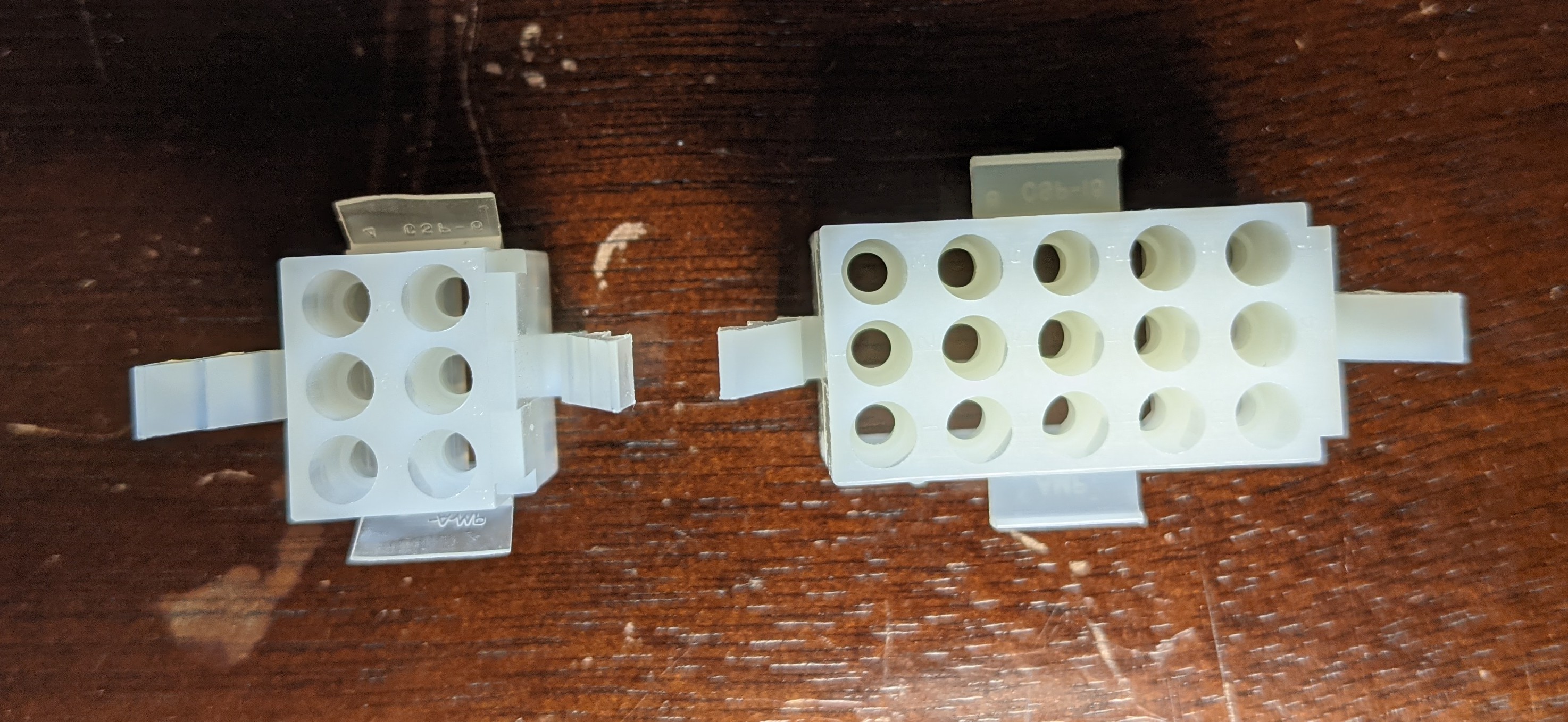
. A106239-ND, TE Connectivity AMP Connectors 1-171196-0, CONN PLUG 6POS MATE-N-LOK NATRL
> A1427-ND, TE Connectivity AMP Connectors 1-480323-0, CONN PLUG 15 POS MATE-N-LOK
> See attached picture
That didn't come through for people on the list; I have posted it here:
http://ana-3.lcs.mit.edu/~jnc/tech/pdp11/jpg/tmp/dec_connectors.jpg
so everyone can see his connectors.
> Looking at the TE.com catalog, the picture for 1-480273-0 does not match
> my DD11-DF connector
Actually, the 1-480273-0 is _exactly_ the unit DEC used; I looked at the power
distribution panel from a BA11-K, and that's what it uses. (I'm too burned out
to look at the engineering drawings and get the part number to confirm; I'll
do that 'soon'.)
I took a picture of the male shells, and added it to the CHWiki page (I'll add
the females tomorrow). The detail of the 6-pin one didn't show up too well, so
I took another closeup of just it, here:
https://gunkies.org/wiki/File:DECPwrConnMaleSml.jpg
Your 15-pin is the same as mine (the part number matches). Your 6-pin has
'wings' on the side (these prevent it pulling through when placed in a hole in
sheet metal); the 6-pin DEC used has little right-angle arms, just like the
ones on the 15-pin, to brace it in place.
They are compatible, though, I think; a female shell that will take one
probably will take the other.
Noel
On Sat, Jan 30, 2021 at 9:01 AM ED SHARPE via cctalk <cctalk at classiccmp.org> wrote:
> Just curious how many Hewlett-Packard Integral? computers were sold.??
>
> We have one here at the SMECC Museum that we are building a display around it for.??
>
> Of course we are looking for any advertising material, posters or anyting visually related to this computer to make the display "more than just a computer on the table"?
>
> Please let us know if you have any material that would fit this need!??
>
> Thank you very much in advance
> Ed Sharpe - Archivist?? for SMECC
As to the number sold, you should be able to get a sense of it by collecting serial numbers from those who have them - once you get enough of them (maybe 20 or so) you should get a sense of about where the numbering started and where it ended. I have two units and if you're interested I can pull the numbers and send them along.
At 06:01 PM 1/30/2021, you wrote:
>>>Which Henry was that?? Henry Spencer perhaps?
>>Yes, Henry Spencer (formerly of zoo.toronto.edu).
>>N.
>
>Another blast from the past. I haven't seen anything of or spoken with him in nearly 30 years.
A legend, indeed, and one that only makes me upset about Google's Usenet archive.
https://en.wikipedia.org/wiki/Henry_Spencerhttps://en.wikipedia.org/wiki/Google_Groups
Couldn't Google just give someone else a copy of what Spencer
(and everyone else) gave them?
- John
Wayne.. yes please send the 2? serial numbers and others are invited to participate also.
Probably good idea to send offlist? to kerp from clogging lister.? Thanks Ed#
On Sunday, January 31, 2021 Smith, Wayne via cctalk <Wayne.Smith at warnerbros.com; cctalk at classiccmp.org> wrote:
On Sat, Jan 30, 2021 at 9:01 AM ED SHARPE via cctalk <cctalk at classiccmp.org> wrote:
> Just curious how many Hewlett-Packard Integral? computers were sold.??
>
> We have one here at the SMECC Museum that we are building a display around it for.??
>
> Of course we are looking for any advertising material, posters or anyting visually related to this computer to make the display "more than just a computer on the table"?
>
> Please let us know if you have any material that would fit this need!??
>
> Thank you very much in advance
> Ed Sharpe - Archivist?? for SMECC
As to the number sold, you should be able to get a sense of it by collecting serial numbers from those who have them - once you get enough of them (maybe 20 or so) you should get a sense of about where the numbering started and where it ended.? I have two units and if you're interested I can pull the numbers and send them along.
I'm trying to repair an LSI-11/93 that has a bus timeout problem.?
Unfortunately the BA23 box it normally sits in lives in a cupboard with
printers stowed on top of it and due to my domestic situation (small
condo) I can't get it out to scope or get a scope anywhere near it to
scope the bus.
I'm thinking that the solution would be to get a small QBUS backplane
that I can put on my desk in the middle of my test equipment.
Like a 4-slot ABAB oir even ABCD would do.
Does anybody have one they don't want?? Power supply not needed.
cheers,
Nigel
--
Nigel Johnson, MSc., MIEEE, MCSE VE3ID/G4AJQ/VA3MCU
Amateur Radio, the origin of the open-source concept!
Skype: TILBURY2591 nw.johnson at ieee.org
> From: Glen Slick
> The KDJ11-E 11/93 has PMI signals on the CD connectors, so you need a
> Q/CD backplane
I have this bit set that plugging a PMI card into a Q/Q slot will damage it?
(I think the issue is that some PMI pins are 12V on normal QBUS; too tired
to check tonight, I'll get to it tomorrow.)
Noel
Thanks? folks for the part number for ink jet cartridges. .. we have differnt interface standards version of Thinkjet? plusevthe one in the integral so we can play still!
Big thanks for the corisive? ink warning. .. I had no idea!
Hopefully we can turn up some poster art and other things? to add? to the display too!? -Ed#
On Sunday, January 31, 2021 Tony Duell <ard.p850ug1 at gmail.com> wrote:
On Sun, Jan 31, 2021 at 6:25 AM Frank McConnell via cctalk
<cctalk at classiccmp.org> wrote:
>
> On Jan 30, 2021, at 10:09, ED SHARPE via cctalk <cctalk at classiccmp.org> wrote:
> > Hi Doug! No, we do not have a copy of this HP JOURNAL.? We do not have manuals? either.? We,are lucky to have the unit wonder if you can still order ink for the printer. I do have an unopened ink cartrige.
You can get scans of the manuals from the Australian HP museum site
Do you have any expansion boards in it? Extra memory is very useful
(and you can turn any of the boards into a 1MByte one by adding the
chips and changing links). As is an RS232 interface (something that
IMHO should have been built-in)
Do NOT leave the ink cartridge in the machine. The ink is somewhat
corrosive and if it leaks onto the flexiprint that connects the
cartridge to the logic PCB it will damage it. Due to the layout of the
machine the flexiprint is longer than the one in a normal Thinkjet so
you can't just raid one of those for spares. Yes there is a way to
kludge it with ribbon cable and connectors but it's best not to have
the problem in the first place.
>
> HP 51604A.? I was surprised a few months ago to find that Staples claims to be able to sell new HP cartridges.? Looking earlier today, HP can too!
>
> Seriously, we?re talking about ink cartridges including replacement print heads for printers manufactured in 1983.
I was equally surprised to find that ink ribbons for the Epson HX20
laptop (M160 printer mechanism) along with the ones for the narrower
M150 mechanism are still being made.
But as I've said before, I'd rather find parts for a machine made 30
years ago than one made 5 years ago.
-tony
Hi Doug! No, we do not have a copy of this HP JOURNAL.? We do not have manuals? either.? We,are lucky to have the unit wonder if you can still order ink for the printer. I do have an unopened ink cartrige.
I will have to get a copy of this journal meanwhile I will read this one you sent the link to!
Back when we were selling? the HP PC? computers? this was a current product but outside our contract? with HP.? I was working with HP 150 abd the display potables HP offered and used 1000 2000 and 3000 systems? but always looked at how neat? this was.
Ed#
On Saturday, January 30, 2021 Doug Salot <doug at blinkenlights.com> wrote:
I assume you already have a copy of the Oct 1985 HP Journal?http://hparchive.com/Journals/HPJ-1985-10.pdf
On Sat, Jan 30, 2021 at 9:01 AM ED SHARPE via cctalk <cctalk at classiccmp.org> wrote:
Just curious how many Hewlett-Packard Integral? computers were sold.??
We have one here at the SMECC Museum that we are building a display around it for.??
Of course we are looking for any advertising material, posters or anyting visually related to this computer to make the display "more than just a computer on the table"?
Please let us know if you have any material that would fit this need!??
Thank you very much in advance
Ed Sharpe - Archivist?? for SMECC
On 1/29/21 12:58 PM, Fred Cisin via cctalk wrote:
>> I like indentation, and demanded it from my students.
>
> That's fine, but when you have a language that makes indentation part of
> the language (i.e. no braces, brackets or keywords denoting boundaries
> of the block) , there be monsters.
>
> And yes, there are such languages.
Uh - Python comes to mind...
~~
Mark Moulding
Just curious how many Hewlett-Packard Integral? computers were sold.??
We have one here at the SMECC Museum that we are building a display around it for.??
Of course we are looking for any advertising material, posters or anyting visually related to this computer to make the display "more than just a computer on the table"?
Please let us know if you have any material that would fit this need!??
Thank you very much in advance
Ed Sharpe - Archivist?? for SMECC
> Whenever I start a new job the first thing I do today is enable
> -Werror; all warnings are errors. And I?ll fix every one. Even
> when everyone claims that ?These are not a problem?. Before
> that existed, I?d do the same with lint, and FlexeLint when I
> could get it.
On Fri, 29 Jan 2021, wrcooke at wrcooke.net wrote:
> That's exactly what I did and was then told I was likely to get fired for
> it. I left that job soon after.
> "A person who never made a mistake never tried anything new." -- Albert
> Einstein
Similarly, "You don't have time to write comments as you go along. You
can go back and add them in AFTER the program is working." Of course, as
soon as it "seems to be working", "We're not paying you to mess with stuff
that's already DONE. We have ANOTHER project that you have to get on
immediately."
It's not good to be in a job where they won't let you be thorough in error
checking nor let you write comments.
And, of course, "Don't waste space with more than two decimal digits for
year. NOTHING that we are doing now will still be in use 30 years from
now."
One of the tasks that I was assigned (working for a contractor at GSFC)
was to work on converting a wall of punch-card subroutines for plotting on
Calcomp plotters that needed to be changed to work on Stromberg-Carlson
(later Stromberg Datagraphics). It was budgeted for a LONG project to
rewrite all of them. I realized that all of the subroutines for Calcomp
called lower and lower level routines, on down to a small number of
primitives. It was easy to write primitives for those lowest level ones,
that worked on the SC/SD. I got some help with the JCL to link my
primitives to the routines for the Calcomps. All of the routines for
Calcomp worked fine calling their lower level routines, and ultimately
calling MY primitives. The company got a small bonus for getting it all
done way sooner than planned, and I got a private major reprimand for
getting it all done way sooner than it was budgeted for. Many others
earned bonuses for the company. The company distributed the bonuses as
BIG bonuses to upper executives (I think that the top guy got a car), and
gave each of us a gift certificate/coupon for a turkey.
I?ve acquired the display and keyboard portion of a CPT Phoenix Jr but the seller didn?t have the system unit. (I suspect someone along the chain of custody thought it was a generic PC and recycled it.)
Does anyone have one that needs a home?
? Chris
? who has an affinity for portrait displays
Sent from my iPhone
In case you need a half-height SCSI enclosure to add to your VAX etc, I
put one up on EBay.
Item ID: 224332273248
https://www.ebay.com/itm/224332273248
Van Snyder
> I have a feeling there are two shell designs for the 6 pin.
Like I said, I have a vague memory of another keying design (I think it used a
ridge running parallel to the direction of insertion), but I don't think it's
>from any DEC gear. There is definitely yet _another_ keying design, with
triangular sawteeth, but again, I don't think any DEC gear used that.
> The one on my DD11-DF that I want to mate has detents in the corners
> while the catalog picture for the 6 pin on your part number shows a
> square in the center of the side.
Yes, the ones on the DD11-[C,D] (female shell, male pins) have 2 filled-in
corners, and the ones on the harness into which they plug (male shell, female
pins) have both the cutout corners (to match the filled-in corners on the
female shells), _and_ "a square in the center of the side".
As I said, I had verified that my female shells plugged into the male shells
on an -11/40 harness; I just went and checked, those males have the exact
identical shape to the ones I got (with the listed part number), including
both cutout corners and the square in the center of the side. (Oddly enough,
the 15-pin male shells used in that generation of DEC power connectors do not
have the square in the center of the side, just the cutout corners.)
Noel
I do not know this guy, this came through my site, but if you do have info
that you think he might find useful and would like to share please contact
CECIL the Specific.
VintageComputer.net Inquiry Contact Information Name: CECIL CRAIN
Email: ccrain at rgoldlegal-got-com Phone: 4157869527
------------------------- Comments:
I'm looking for any information about Bakelite insulating
materials and phenolic resins used in Univac DCT products manufactured
in the Salt Lake City facility from 1970 to 1978.
VintageComputer.net
---------------------------------------------------------------
Bill
> Are the power connectors on the DEC PDP-11 backplanes (e.g. DD11-DF
> 15pin and 6pin) Molex or other?
> Are they still commonly available?
https://gunkies.org/wiki/DEC_power_distribution_connectors#Connectors
I'm not sure why I bothered to write all this stuff up; it was clearly a waste
of time.
Noel
> I may have gotten the wrong 6pin shell.
I have this very vague memory of some similar connector shell, but I have no
memory of what the difference is.
I just checked the shells I have here, and they definitely fit onto the power
harness on an -11/40; and the numbers on the Web page are correct.
If yours arrives, and it works, please send me the number and I'll add it to
the page. Actually, if it _doesn't_ work, send me the number, and I'll add a
'no not use xxx, it doesn't work' note.
Noel
I have an HP 9817 and 9133D disk drive that I am trying to get going. The 9817 has a 98204B composite video card. I can mess with the settings of a composite monitor enough to barely read the text on the screen, which indicates that the machine is trying to boot from device A. I tried to make an image of the hard drive in the 9133D using Dave's MFM emulator, but the drive is pretty much toast and I wasn't able to recover much from it. If I connect the drive to the computer, it fails to boot and goes into BASIC.
I do not have a compatible HP monitor or HIL keyboard to use with the machine. I was planning on building a PS2 to HIL converter, but having an actual keyboard would be far easier. Likewise, having a monitor would be easier than abusing a normal composite display into working.
It looks like there were a bunch of compatible monitors back in the day. The 35721 and 35731B are mentioned on the HP Museum website.
In playing with DECnet I built a DDCMP implementation which deals with a byte stream, normally from a UART. So that works nicely with async link DDCMP as found in RSX and several other operating systems. But the speed is limited.
The other option would be synchronous links, which would enable connections to DMC11 or the like at speeds up to 1 Mb/s. But synchronous comm devices that connect to modern computers aren't so easy to find, though I have seen a few.
After playing with Arduino for LK201 keyboard emulation I started to wonder if one could be made to be a synchronous comm link with a USB back end, with low level things like byte framing and maybe DDCMP packet format handling in there, but the protocol state machine in the host behind the USB interface. For moderate speeds that seems entirely practical. For 1 Mb/s, probably not, though perhaps one of the fast ARM based units with its built-in SPI could be warped into that.
The alternative would be something like a BeagleBone Black (or Green) such as David Gesswein used as the engine for his MFM hard disk emulator. That clearly could do the job without any strain.
So I'm wondering: would there be interest in such a thing? If yes, should it be a modem-connected one (RS232 signaling, bit clock supplied externally by a modem or modem-eliminator)? Or should it be the "integral modem" short distance type, the ones that used a pair of coax with 4-pin AMP connectors like this https://www.digikey.com/en/products/detail/te-connectivity-amp-connectors/2… ?
paul
So, DEC part numbers (xx-yyyyy-zz) have a system where the 'xx' says what
_kind_ of part it is; e.g. bootstrap PROMs are all 23-xxxxx-yy. I seem to
recall reading at some point something which listed all the xx- codes, and
what they meant - but now I can't find it. A Web search didn't turn it up, and
it's not in the 1974 'engineering handbook'?
Does anyone recall seeing it, and if so, where?
Obviously, I could look through a bunch of print sets, and reconstruct it
(e.g. 90- seems to mean mounting hardware - nuts and bolts, etc) but I'd
rather not put the time and energy into reconstructing the wheel, unless
there's no other way.
Noel
Looking for HP marketing posters, in English and other world laguages large systems like HP-3000 as well as HP-150 and other pc and workstations...?? urgent need for monarch butterfly HP-150 poster!!!? Will be part of smecc museum hp display. -? Thanks Ed#
Does anyone still have one of these with the 50 pin drive splitter card and could take some pictures?
I picked one up a while ago and just noticed a 20 pin part is missing at U91, probably a PAL :-(
Ok, with the RX02 running I see that 50 of these disks from Solarex were
formatted with the FD: driver which is probably the MXV21 controller.
Since I don't have a 5.4 version of this driver and to be honest will
not be putting the MXV11 controller online anytime soon I'm offering
these disks for free.
So if you need 50 disks with various versions of RT11 and god knows what
data on them or 50 frisbees let me know and they're yours for the cost
of shipping. I need to either pitch these things or give them away.
Thanks!
Chris
Needed? HP 918lx computer? trim bezel!?a nice? one? appreciated? bit? one needing painting? or?? better? than none!Please? advise !?Ed Sharpe Archivist? for SMECC?
So I found an RXV21 board in the pile of stuff here and popped it into
my 83. Crashes the system. It's an M8029 D board, and I see from this
site that you have to add a few traces and cut a few others to make it
work on an 11/73 or better.
http://www.chdickman.com/rx02/
I'll pop in an 11/23+ CPU just to test it, but is it really just putting
in two wires on the top of the board and cutting a total of three
traces? Looks simple enough...
C
On Sun, 3 Jan 2021 at 03:53, Boris Gimbarzevsky <boris at summitclinic.com> wrote:
>
> Ran into 68000 processor for
> first time in 1986 when my father bought a 512 K
> Mac and couldn't believe performance of this CPU
It is odd. I had read of it, of course, but for me the revelation was
getting an Acorn Archimedes in 1989, with an 8MHz ARM2, and seeing it
blast past benchmarks of ~8MHz 68K machines such as the Amiga 500 or
Atari 512 ST. It was about 4x faster, I believe.
For me -- being a bit too young for the early days of the 68K family
-- it was not a performance chip, but more about its ability to have
lots of flat memory, unlike the crippled Intel chips that IBM used.
> Weird that Rod Coleman had 68000
> instruction set associated with IBM 370 whereas
> to me it was very PDP-11 like
I've heard that before, yes,. and never the IBM comparison.
I suppose it is a matter of what you're more familiar with.
> Thanks for the link as didn't realize 68000 was
> used for home systems before I ran into Mac.
Sinclair's QL used a 68008 and was launched some weeks before the Mac.
Of course Apple's own Lisa was before the Mac, too.
Very soon after came the Amiga and ST -- the "Jackintosh", "power
without the price."
--
Liam Proven ? Profile: https://about.me/liamproven
Email: lproven at cix.co.uk ? gMail/gTalk/gHangouts: lproven at gmail.com
Twitter/Facebook/LinkedIn/Flickr: lproven ? Skype: liamproven
UK: +44 7939-087884 ? ?R (+ WhatsApp/Telegram/Signal): +420 702 829 053
The question was asked (I misplaced the note) if the OS images that are on the Xhomer website work with David Gesswein's MFM emulator on real hardware.
You can turn these into emulator data files, provided you have the latest ext2emu tool that's part of David's software (as of 1/19/2021). The format needed is "Elektronika_85" which is the Pro format, called that because it was first added to the emulator as the format found on the Russian bootleg copy of the Pro of that name.
Results, on my Pro 380:
1. P/OS 3.2: works.
2. Venix: panic at boot, "Bad access number". That doesn't mean anything to me. I wonder if the issue is that Venix doesn't support the 380.
3. RT-11 5.3: works.
For grins I tried a smaller interleave factor than the default 5:1, since it seems reasonable that this should make things go faster on the Pro 380, given that its CPU is about 4x the speed of the one in the Pro 350. Somewhat to my surprise this isn't the case; the performance indicates that at 4:1 or smaller interleave the software misses the next sector and has to wait for another revolution.
paul
As some people here are aware, I have spent probably too much time this summer
hacking on J. David Bryan's excellent Classic HP 3000 simulator and trying to
build up the ultimate classic 1980s HP 3000 system (virtually speaking).
I started with the MPE V/R KIT that's widely available and expanded that into a
5x120MB HP 7925 disc system and configured things like the system directory
size and all the system tables to make a fully functional multi-user server.
I then set about collecting as much old MPE software as I could find, which
included Keven Miller's collection of the old Contributed Software Library tapes
which were conveniently available in SIMH format. This is a huge trove of cool
stuff including most of the classic mini/mainframe games (Dungeon, Warp,
Advent, etc., etc.) and even a little game called DRAGONS that was written in
1980 by a guy named Bruce Nesmith when he was in college and he used it
to get a job at TSR and went on to write parts of many classic D&D products
and eventually landed at Bethesda where among other things he was the
lead designer for another little game called The Elder Scrolls V: Skyrim. I was
able to track Bruce down and give him a copy of the system with his 40 year
old game running on it. The CSL tapes also include other amazing goodies
that people developed and gave away over the years, including a FORTH and
LISP, as well as most of the system and utility programs that people used to
run their 3000 shops. It's quite fun to explore.
I was curious how far we could push the 3000 simulator, so I hacked all
the memory bank registers to be six bits instead of four bits, and we
now have a simulated HP 3000 Series III that supports 8MB of memory, 4x
more than any physical system ever did. I started trying to do the same thing
for giant disc drives, but MPE turned out to have too much knowledge of
what the supported disc models look like to make it practical. Bummer.
Since I met my first HP 3000 in 1980 (40 years ago this month), people would
talk about what was probably the most rare and exotic HP software subsystem
ever produced, APL\3000. APL on the 3000 was a project started at HP Labs
in Palo Alto in the early 1970s. They were likely motivated by the success IBM
was having with mainframe APL timesharing services. This would be the first
full APL implementation on a "small" (non-mainframe) computer. It would be the
first APL with a compiler (and a byte-code virtual machine to execute the
compiled code), it would include an additional new language APLGOL (APL
with ALGOL like structured control statements), and it managed to support
APL workspaces of unlimited size through a clever set of system CPU
microcode extensions that provided a flat 32-bit addressing capability (on
a 16-bit machine where every other language was limited to a 64KB data
segment).
Because APL required these extra special CPU instructions that you got as
a set of ROM chips when you bought the $15,000 APL\3000, and because
APL ultimately failed as a product (another story in itself) and thus HP never
implemented these instructions on their later HP 3000 models, I never saw
it run on a real HP 3000, but over the years we talked about wouldn't it be
cool to find a way to get APL running again.
With assistance and moral support from Stan Sieler and Frank McConnell
and others, I was ultimately able to reverse-engineer the behavior of the
undocumented ten magic APL CPU instructions needed to get it to run and
implement them as part of the MPE unimplemented instruction trap and now
APL\3000 runs again for the first time in ~35 years. Somewhat ironically, this
implementation method could have been used back in 1980 as I didn't
actually end up changing the hardware simulation code at all, and it should
also run (if a bit slowly) on any physical classic architecture 3000.
So that was cool and all, but what is APL without all the weird overstruck
characters and whatnot? APL\3000 supports the use of plain ASCII terminals
through blecherous trigraphs like "QD for the APL quad character, but this
is hardly satisfying. So the quest was on to find a solution. Back in 1976 when
APL\3000 was released, there was a companion HP terminal in the 264x line,
the HP 2641A APL Display Station, which was basically an HP 2645A with
special firmware and APL character set ROMs that supported all the APL
special characters as well as overstrikes (the terminal would take X<backspace>Y
and lookup to see if it had a character to represent Y overstriking X and if
so it would show that on the display, and if that got transmitted to the host it
would convert it back into the original three character overstriking sequence).
I briefly looked into the idea of hacking QCTerm or Putty or something, but
then I found out from Curious Chris that an HP 2645A emulator already existed
in the MAME emulator system! Since the '41 is basically just a '45 with modified
firmware, and Bitsavers had both the character set ROMs as well as the
firmware ROMs from a '41, this sounded like it might be easy! There was a snag
however in that the firmware ROM images that were allegedly from a '41 turned
out to actually be from an ordinary '45. But we did have the character sets and
one of the ROMs from the second CTL PCA. I put out a call on the Vintage HP
list to see if anyone might possibly have a lead on an actual HP 2641A, and
Kyle Owen responded that not only did he have one he could also dump the
ROMs for us. So a few days and a few hacks to F. Ulivi's MAME hp2645 driver
later we now have a functioning MAME HP 2641A terminal emulation, so you
can experience APL\3000 in all its original glory. I bundled up a somewhat
stripped down MAME along with my turnkey 3000 setup so both emulated HP
terminals are just a couple clicks away.
So that's how I spent my summer vacation (who am I kidding, it's pretty much all
vacation these days). It has been a lot of fun revisiting all this old
3000 stuff as
well as the numerous people I talked to along the way including some of those
who were around at APL\3000's birth (before my time). It was rather a lot of
work so I'd like to feel it might be useful to someone in the future
who is digging
into this part of history. Because of all the usual reasons, I don't
plan on hosting
it permanently until and unless we maybe someday get the licensing worked out
(the 50th anniversary of the HP 3000 will be in a couple years so maybe people
will get interested again then) but I will offer it up here to my
fellow computer
history nuts if you want to help ensure that it doesn't vanish if I
get run over by a
bus or something :)
This is a simulated HP 3000 Series III (circa 1980) running MPE V/R (circa 1986)
with 8MB of memory, all the language subsystems (APL, BASIC, BASICOMP, RPG,
FORTRAN (66), SPL, PASCAL, COBOL (68), COBOL II (74)), 20 years of users group
contributed software, many classic historical computer games, etc. Software
archaeologists can get lost in here for years. Oh, and thanks to Dave
Elward, the
HP 2000 Timesharing BASIC contributed library is even included (kinda sorta
converted to MPE BASIC) for good measure. This is a streamlined turnkey edition
that's ready to run out of the box with no assembly required (all
batteries are included).
Currently, I only provide executables for Windows (sorry) but am in
the process of
getting the 3000 simulator changes (for large memory support) and the new MAME
hp2641 driver back upstream. Instructions and further details can be
found in the
README.txt hint book for this adventure. 94MB Google Drive link:
https://drive.google.com/file/d/1bmXvHkBLbUeLAid73EJ4H1yQ2uwXQuRu
Gavin
P.S. I'm giving a talk on the history of APL\3000 and its resurrection
to the ACM APLBUG
group in a couple weeks. If anyone is interested I can provide more
details when I have
them.
Well, with Dave's help we got the DSM-11 disk to boot on SIMH. Oddly
enough SIMH seems to read a raw RQDX1/2 disk pretty well.
sim> attach rq0 dsm.dsk
sim> set cpu 11/73,1m
Disabling RK
Disabling HK
Disabling TM
sim> boot rq0
Booting DSM-11...
DSM-11 Version 3.0A
Now running the baseline system.
<DKHER>:1 G ^STU
Exit
DSM-11 Version 3.0A Device #1 UCI:
Exit
DSM-11 Version 3.0A Device #1 UCI: ?
<NOUCI>:0
Exit
The problem is I don't remember how to use it anymore. Is there a PDF of
the DSM-11 manual anywhere? I think this was a clean install, but I'd
like to check it for data before putting it into archives.
Also which archive would be best for it?
CZ
I recently ran into an archive of various Pro 300 items, mostly from DECUS I believe. That includes a full P/OS 3.2 distribution including (!) DECnet/Pro if I saw that right.
It's at ftp://ftp.update.uu.se/pub/professional/
What makes things somewhat painful is that it's LHA compressed Teledisk images, which is an ancient DOS based floppy imaging tool. The instructions say to run Teledisk on a DOS system with a 5.25 inch floppy drive to write the images to RX50 floppies, which can then be used.
If you don't have DOS handy, or would rather get floppy image files for use with Xhomer, this can work but it's a bit painful.
I found there's a simpler way.
1. Decompress the LHA files. On a Mac, the unarchiver (I think that comes with the OS?) handles that format. On other operating systems, I assume it's equally straightforward to find a tool that handles this. You now have a pile of *.TD0 files, which are the TeleDisk format files.
2. From http://www.seasip.info/Unix/LibDsk/ install LibDsk 1.5 (not 1.4).
3. Use the dsktrans tool you got from step 2 to convert each *.TD0 file to a raw image, like this:
dsktrans -otype raw PRO177/177-21.TD0 proinstallv32.dsk
"raw" format means a straight sector dump in physical order; this is the format expected by xHomer.
If for any reason you want a logical order image, for example to give to the SIMH "rq" device that emulates an RQDXn controller, you'll need a tool that reorders things. I have one in my RSTS file system tool "flx" (V3 in Python, not the earlier 2.6 in C), "rx50.py". I can supply more details if needed.
paul
I have a few of these A990 boxes. They are complete with memory,
internal disk & DAT, & any 1000 interface you could possibly need. They
are the smaller 14-slot Micro boxes so a small footprint. I'm doing a
few of them for $1,300.00 each.. If anyone wants one, let me know. The
ebay link is below and feel free to ask me any questions about them.
www.ebay.com/itm/383752338096
<www.ebay.com/itm/383752338096>
Thanks
Jesse
Cypress Tech
People,
I'm trying to wrap my head around cc:Mail version numbers.
Various products such as Mobile and Gateways have their own separate
series of numbers, but the main products seem to be as follows.
Release Database Appeared in
1? ? ?
2? 6? ?
3? 6? ?
4? 6 ?
5 6 1995
6 8 1996
7? 8 ?
8 8 1997
I saw someplace that I cannot find now that DB6 is from 1989.
Can anybody fill in the missing numbers?
So for example, there is a package on Ebay right now
https://www.ebay.com/itm/LOTUS-ccMAIL-in-original-box-diskettes-manuals-Win…
that seems to say `Release 2.01' and 1993. How does that compute?
/Tomas
On 2021-01-20 19:00, "Ali" <cctalk at ibm51xx.net> wrote:
> Message: 14
> Date: Wed, 20 Jan 2021 00:38:21 -0800
> From: "Ali" <cctalk at ibm51xx.net>
> To: "'General Discussion: On-Topic and Off-Topic Posts'"
> <cctalk at classiccmp.org>
> Subject: RE: Looking for old Compaq software - COMPAQ System Manager
> Facility
> Message-ID: <00d501d6ef07$9cd2ab70$d6780250$@net>
> Content-Type: text/plain; charset="us-ascii"
>
>> For a workaround:
>>
>> This way You get a fixed brightness and somewhat working computer.
>> Now You can wait for a replacement pot and play with the computer.
> So turns out the pot itself is good after further testing. Of course now the
> question is why won't the brightness adjust on the machine?
>
> -Ali
Something supposed to be connected to the pot is not connected anymore?
I am guessing
a) the connection to the wiper is broken somewhere, or the circuitry
connected to it is broken, or
b) the ground end of the pot has a broken connection to ground
/Jonas
I just completed a set of tests of David's MFM emulator on my Pro 380.
Summary: everything works right. Very impressive device. My compliments to David for an amazing piece of engineering.
Details:
1. I built and tested it (rev C board) per the instructions and all that worked nicely. A few minor points in the instructions, quickly clarified by David and already updated on the web page. I used an old 2 MB BeagleBone Black (the kind that was shipped some years ago with the abandoned Angstrom distribution), that fits just fine.
2. I read the three drives I have, one RD51, two RD52 (Quantum). All worked fine. They were identified by the analysis tool as "Elektronika_85" which makes sense since that's a Pro clone.
3. On the RD52, the last cylinder cannot be read. The reason is that the DEC standard formatting tool does not format the last cylinder except on the RD50. I'm not sure why; the comments say it is "reserved for the FCT" but I don't know what that is. In any case, ignore those errors; the OS does not use that cylinder so nothing bad happens.
4. In spite of what the XHomer documentation says, Pro disks have 16 sectors per track, not 17. It may well be that the drive is physically capable of holding 17 sectors per track if you have an RQDXn controller, but the Pro format is definitely 16 sectors. And 4:1 interleaved to account for the performance issues of programmed I/O rather than DMA.
5. I set up auto-start of emulation mode using one of the files created by the disk reader. That works fine, the OS boots, identifies the drive type correctly, and runs happily.
6. I also tested creating a new empty RD52 image (i.e., 512 cylinders, 8 heads), and running a P/OS 3.0 install to that emulated disk. That works also; as Chris Zach suggested, the installer includes a low level formatter tool and invokes that automatically when it detects it is needed.
7. Poweroff data saving works nicely. I can watch the BBB keep running after I turn Pro power off, then after 5-10 seconds the BBB power light also goes off.
8. I looked at the extracted data files created by step 2: they are good block level data images of the disks.
A note on testing and drive copying: at first I tried to do this using a spare Pro power supply. That does not work because that supply requires a substantial minimum current. Even with a real drive plugged in alongside the emulator, the current draw is too small and the supply shuts down almost immediately. Instead, I temporarily connected an old small PC-type power supply I had lying around (rated at 50 watts according to the label); that was plenty for the emulator and also good enough to power it along with the drive to be read.
paul
For a workaround:
1. Solder any same size pot with suitable long wires to the location (if possible)
2. Adjust the brightness to Your liking
3. Remove the pot
4. Measure the resistance
5. Solder a measured value resistor where the pot was.
This way You get a fixed brightness and somewhat working computer.
Now You can wait for a replacement pot and play with the computer.
BR Matti
Hello All,
I am looking for an old piece of Compaq SW. It is used to communicate with a
Server Manager/R (or sometimes also known as System Manager) board. This was
Compaq's first attempt at a lights-out management (LOM) board. If anyone has
a copy and can share I would appreciate it! Thank you.
-Ali
Hello All,
I am looking for an EOL/no longer manufactured pot. It is a Clarostat
CM46895-3 and used to adjust the back light/brightness on a Compaq Portable
486c (pictures are here:
http://www.vcfed.org/forum/showthread.php?78057-Compa-Portable-486c-can-not-
adjust-screen-brightness). Because of the fit and finish issues it needs to
be this particular pot. If someone has one in their parts bin please drop me
a line.
TIA!
-Ali
Hi all,
I?m reassembling an H765 supply after cleaning and repairs. It has the "newer" style 15V and power monitoring board (the one with the edge finger connector, same as used in H7420 supplies.)
The board slides into a slot in a sub-chassis that also houses the power control circuitry, which small chassis later slides into, and is secured to, the larger H7420 chassis.
I cannot for the life of me figure out what, if anything, secures the power monitor board to the small chassis! There don?t appear to be any conveniently placed fixtures to which to screw down the board, and I haven?t been able to inform myself by pondering the various engineering diagrams, IPB?s, nor the pile of remaining fastening hardware...
When I test-fit everything in the larger chassis, the unsecured board is held captive only by the grace of the surrounding wiring harness and by some small clearance issues with the large cap on the board. This doesn't seem satisfactory; as part of something like an 11/34 on tilt slides, it would seem to bang around a bit in there if left loose like that.
Am I missing something? Puzzled...
--FritzM.
Found more stuff. 4 Perq boards, the HP1000, a Perq mouse and "pad", a
Sun4 keyboard with 15 pin plug, and another Perq2 keyboard. Also found a
weird one, a MFM drive with an adapter board on the bottom. Is the below
a MFM to Shugart interface?
Pics are up on the Discord server right now along with the HP1000.
C
I seem to recall that in "how to shoot yourself in the foot in various
programming languages," APL is something like "There's a bang. Your foot
is missing. You don't remember enough linear algebra to know how it got
that way."
Working to restore a series 30 , looking for any spare boards ,cpu ,bic boards from a series 30/33Just putting it out there ,long shot i knowCheers,Grant?Sent from my Galaxy
I'm wondering how to do hard drive formatting, which is likely to be needed when working with emulated disks in David Gesswein's MFM emulator.
As far as I can tell, RT-11 can do this. At least I have a source code printout for such a formatter. But while I can find a hard drive image of RT V5 for Pro, I haven't found any floppy-bootable images. And I think it's a bit tricky to create one. I knew, long ago for V2...
Any suggestions? Any alternative sources for a formatter? I guess I really should consider typing in the core of that formatter and adding it to RSTS.
paul
I have a nice ICL PERQ 2 T2 that I am going to start working with now.
First thing was to try to image the hard drive. It is a Micropolis 1303. It
spins up but when it reaches what I think the correct speed it immediately
spins down. Usually I think there would be a click and then the heads would
recalibrate. But there is no click and no head movement.
I really would like to make an image of the drive. What are your thoughts?
Are the heads sticking?
Some kind of solenoid that is not releasing the heads? Not properly up to
speed? (but it sounds like the speed is right)
/Mattis
Hi all,
Does anybody know if the old Compuserve discussion forums are
available anywhere now?
I'm specifically interested in the ones about HP Palmtops and cc:Mail.
/Tomas
Models SS-16, TEC-9900-SS, TR-9000-SS aka Technico/Rosse TR-9000-SS
"Super Star", or any other.
I think a couple of list members have indicated here or elsewhere in
the past that they had SS-16's at least.
Thanks for any help,
jbdigriz
This is probably the wrong list to ask, but maybe somebody could
forward it to a more appropriate list.
I have several of my father's books on electrical engineering. If
anybody wants any of them, let me know.
Van Snyder
van.snyder at sbcglobal.net
---------------------------------------------------------------------
----
Reference Data for Radio Engineers
Federal Telephone and Radio Corporation, 1946
Matrix Analysis of Electric Networks, Le Corbulier, 1946
Radiotron Designers Handbook, Smith, 1941
Digital Computer and Control Engineering, Robert S. Ledley, 1960
Control System Synthesis, John G. Truxal, 1955
Communication Engineering, Everitt, 1937
Dyadic Circuit Analysis, Sah, 1939
Electrical Engineers' Handbook, Third Edition, Communications
Electronics,
Pender & McIlwain, 1936
Electrical Engineers' Handbook, Third Edition, Electric Power,
Pender & Del Mar, 1936
Theory and Application of Microwaves, Bronwell & Beam, 1947
Electrical Catechism, C. S. Dearborn (signed) 1902
Electric Circuits, E.E. Staff, MIT, 1942
Transients in Linear Systems, Vol. 1, Lumped Constant Systems
Gardner & Barnes, 1942
Tensor Analysis of Networks, Gabriel Kron, 1939
Analog Methods, Karplus & Soroka, 1959
Electrical Engineering Leaflets, Houston and Kennelley, 1898
Silent Sentinels: Protective Relays for AC & DC Systems
Westinghouse Electic, undated, paperback
Hello everybody,
Does anybody have any early versions of cc:Mail that they can share?
I have v. 6 (1996) and 8 (1997).
Am looking for versions from 1994/5.
/Tomas
Hi folks,
I?m working on an 11/34 at the moment, with the programmer?s console, and it is missing its front panel power control knob. I think it is the same one used on the 11/04? Anybody have a spare in their parts stock that they?d be willing to part with?
(I?m also missing the plastic half-panel for the front, but I do see those go by on eBay from time to time.)
cheers,
?FritzM.
ftp://ftp.intersystems.com/pub/msm/docs/msm43/users.pdf
is another source for a manual.? It's the version which Micronetics sold, of which I heard "Micronetics shamelessly? copied DSM-11?practically line for line to the PC."??So the manual is probably close enough to work.
HTH,Dick
Hi all,
I'm using a HP 200LX to connect to a cc:Mail installation, with a null
modem cable. It has worked better before, but now I don't seem to be
able to connect at all. This is the output from the router, when
trying to connect from the 200LX:
| C:\CCMAIL\Router>C:\CCMAIL\Router\NTROUTER.EXE C:\CCDATA MODEM/PBX COM1 DIAGNOSTICS/F LOG/C:\CCMAIL\Router\ROUTER.LOG
| cc:Mail NT ROUTER Version 6.10.00.4
| Copyright (c) 1986, 1997 by cc:Mail, Inc. [...]
| Press Esc to terminate cc:Mail ROUTER program.
| Waiting to receive messages...
| 23/12/20 13:53:33 Answering call... 2 8 3a 74 68 8 2a 55 22 52 23
| 7d 18 80 from ~????`???f???????? ?`. Data connection not requested.
| 23/12/20 13:53:49 Ending connection.
| Waiting to receive messages...
| 23/12/20 13:53:55 Answering call... 2 8 3a 74 68 8 2a 55 22 52 23
| 7d 18 Data connection lost.
| 23/12/20 13:54:36 Ending connection.
| Waiting to receive messages...
The log files are empty. There are no other error messages anywhere
that I can see.
Anybody recognises anything? Any ideas about things I can try?
Here is the modem file:
| [attributes]
| MODELS=Null
| NULL MODEM=1
| [commands]
And another thing is that I only seem to be able to get a response at
1200 baud (the router default) by not specifying a speed when starting
the router. If I add the speed to the command line (the first line
above), any speed, (and the corresponding setting on the Palmtop) then
there is no connection at all.
It has worked better earlier. I managed to connect at 9600, but that
was a different PC. I am not aware of having changed anything relevant
on either PC or Palmtop.
Any help appreciated.
/Tomas
This may be old news -- it was new to me, though.
https://suddendisruption.blogspot.com/search/label/Booting%20Sage%20Computer
I'm not really familiar with SAGE machines. They were not as
well-known in the UK, I think, being upmarket from the Apple ][ and
IBM PC, both of which were eye-wateringly expensive by UK standards of
the time.
Also, they were terminal-based things and even back then I was
interested in boxes with graphics. :-)
--
Liam Proven ? Profile: https://about.me/liamproven
Email: lproven at cix.co.uk ? gMail/gTalk/gHangouts: lproven at gmail.com
Twitter/Facebook/LinkedIn/Flickr: lproven ? Skype: liamproven
UK: +44 7939-087884 ? ?R (+ WhatsApp/Telegram/Signal): +420 702 829 053
I'd like to get a Dilog SQ703 I have to work on my microvax, does
anybody know where I can get a copy of the manual?
cheers,
Nigel
--
Nigel Johnson, MSc., MIEEE, MCSE VE3ID/G4AJQ/VA3MCU
Amateur Radio, the origin of the open-source concept!
Skype: TILBURY2591 nw.johnson at ieee.org
> From: Steven Malikoff
> Would that be part of this system at a Japanese computer museum? ...
> the 11/05 has 'Unichannel15' on it
Yes, the 3 bays in the center are a PDP-15. (The indicator panel at the top
of the center bay is the one for the PDP-15 CPU; you can see it here:
http://ana-3.lcs.mit.edu/~jnc/tech/DECIndicatorPanels.html
at the top of the 'PDP-15' section.) The Unichannel 15:
https://gunkies.org/wiki/UNICHANNEL_15_System
is undoubtly there to drive the RK05; I don't think there's a native PDP-15
controller for that.
> There is an 11/15
??? Is that a typo for 'PDP-15'? The -11/15 looks just like an -11/20
https://www.ricomputermuseum.org/collections-gallery/equipment/dec-pdp-1115
except it only has 16 address switches, not 18 as on the /20. (The front panel
shown there has an OEM-specific re-paint; I couldn't quickly turn up an image
of a DEC /15 front panel.)
Noel
If anybody of you has been looking for a Bendix System or a CDC 160 console and has deep pockets: That's your opportunity ;)
ebay numbers 203239156838 and 203239181341
Not affiliated with the seller. Just saw the listings - can't believe that such cool systems are still stored in some warehouses in the U.S. for business purposes ...
Cheers,
Pierre
-----------------------------------------------------------------------------
http://www.digitalheritage.de
> From: Ethan Dicks
> what are these found in?
The "Spare Module Handbook" lists:
RH11-AB
TM11, TMA11
MX11-B
Does _anyone_ actually have an MX11? Any documentation would also be welcome;
all I've been able to find out about it is a listing for the addresses of
control registers.
Noel
Anyone need/want a couple of these? Someone has a group of 5 for sale on eBait
(#184317666245), and I want a couple, but not _5_. The seller didn't respond
to a request to split up the lot, so I'd like to go in with a couple of other
people on the. Any takers?
Noel
Hello,
to fellow readers in Germany and surrounding areas:
HUGE 9406-F2, 300?, pickup in Heidelberg, Germany. Might be a Multiprocessor-Machine.
https://cgi.ebay.de/174577267021
I?m not related to the seller. Have seen this by chance.
I requested more photos to see what machine it is. Would be very sad if it will be scrapped. I can forward the additional photos as email on request.
:wq! PoC
Can someone check to see if a RQDX2 used the Western Digital chips to
interface to MFM drives? Reason I'm asking is the MFM emulator can
identify an RQDX3, and also a Pro/350 controller but this particular
RD52 I have (which was verified by me to run Digital Mumps) is reading as:
root at beaglebone:~/mfm# ./mfm_read -a
Board revision C detected
Found drive at select 3
Returning to track 0
Drive RPM 3525.4
Matches count 36 for controller WD_1006
Header CRC: Polynomial 0x1021 length 16 initial value 0xffff
Sector length 512
Data CRC: Polynomial 0x1021 length 16 initial value 0xffff
Interleave mismatch previous entry 0, 9 was 1 now 0
Selected head 8 found 0, last good head found 7
Read errors trying to determine sector numbering, results may be in error
Number of heads 8 number of sectors 18 first sector 0
Unable to determine interleave. Interleave value is not required
Drive supports buffered seeks (ST412)
Disk has recalibrated to track 0
Stopping end of disk search due to recalibration
Number of cylinders 512, 37.7 MB
Thanks!
CZ
An update on keyboard storage, which I asked about here last month.
I ordered some USPS Large Flat Rate Priority Mail "board game" boxes.
This is a size not usually available at the post office and come 25 in a
pack. They are a good size for mailing (and I am glad that I ordered
them so I can use them for that), but I don't think they work for
keyboard storage. They are so much larger than the keyboards that I am
storing that lots of packing material is needed so they don't move
around. Also, they are designed to be sealed and shipped, so there isn't
a convenient way to open them once they have been closed.
Next, I ordered the Uline keyboard boxes. I had to get 25 of them and
they are not free ($2.70 per box plus tax and shipping). They can be
open and closed. They are a much closer to the size of a keyboard
(surprise, surprise!) so not much packing material needed, but they are
slightly smaller than a Sun Type 5c (as well as Axil) keyboard and
needed to modified for those two. No modification needed to store a Sun
Type 4 or CompuAdd Sun-compatible keyboard in one. I haven't tried a Sun
Type 6 yet.
To anyone in the Seattle area that need keyboard boxes, I will probably
have 10-15 of them once I get all of my keyboards packed. If you would
like any, let me know.
alan
Anyone know who did/does the Altair peripheral emulator (not to be confused with the other APE, for Atari)?
Originator give me a ring on email or via discord please ?
J
Hi!
I'm trying to read possible Perq2 data off a 40mb Vertex V150 drive.
Unfortunately the switches were scrambled and I can't seem to figure out
which settings work. Does anyone have one that can check their switch
settings?
This doesn't seem to work:
https://stason.org/TULARC/pc/hard-drives-hdd/vertex/V150-43MB-5-25-FH-MFM-S…
On 1/3/21 8:40 AM, Peter Coghlan wrote:
> Grant,
Hi Peter,
> Do you think it is likely that an email address like
> check212014 at gmail.com is used by an actual real person for their
> personal email?
I absolutely do.
> Multiply the odds of the above by the odds that some spammer
> or other individual of malicious intent has had the capability,
> the persistence, tenacity and sheer ill will in them that it would
> take to carry out a vendetta against poor old check212014 at gmail.com
> for five long years, not to mention that when they only succeeed in
> causing check212014 at gmail.com any actual difficulty is on the rare
> occasions that their trawl of mail servers of the internet manages
> to turn up an actual open mail relay?
I know multiple people that have signed victims up to mailing lists --
many of which were questionable content -- as an attack on said victims.
Pretending to send email from said victims to cause bounces and ire to
be (mis)directed at them seems quite the same to me.
Five years? Sure. Many people will create filters and simply ignore
the messages. As such, it's effectively internet background radiation /
wasted bits.
> Whack-a-Mole works when everyone whacks their moles. When one major
> property owner decides they aren't going to whack the moles in their
> garden when all the neighbours keep theirs under control, they are
> going to end up with all the moles in their lawn. (We don't have
> real live moles in the part of the world were I am so please forgive
> me if my analogy is not accurate due to my lack of familiarity with
> the species.)
>
> I am not a lawyer but it appears to me that check212014 at gmail.com is
> doing nothing that violates Google's terms of service for using Gmail,
So ... by your own words, there is nothing that Google should be doing
per their terms of service.
> which indicates to me that the terms of service are flawed because
> they allow someone to use Google's infrastructure to scan for open
> relays to exploit as spam delivery platforms. As far as I know,
> no other email provider allows this.
I've not seen anything in any provider's terms of service that say
anything about what type of email they receive, save for exceedingly few
categories; child porn and illegal activity among the short list.
I have yet to see anybody state that sending an email to an invalid
email address and (potentially) receiving a bounce is illegal.
So, again, no grounds for Google to do anything.
Feel free to try to get Google to change their terms of service.
> I don't see how this relates to Google allowing their services to
> be used to test my mail server (and likely thousands of others too)
> numerous times over multiple years for being an open relay that could
> be exploited to distribute spam.
Are the messages /originating/ from Google / Gmail?
Or are the messages /originating/ from somewhere else and causing the
bounces to go to Google / Gmail?
The former is something Google cares about. The latter quite likely is not.
> If you burn a junk (snail) mail, could there be a security lapse in
> your furnace that would cause it to be replicated into a thousand
> copies of itself, run up your chimney and distribute itself into
> thousands of your neighbours letterboxes? If not, I think you can
> rest easy in the knowledge that you are not causing the problem.
The /recipient/ of the messages is *not* the problem. The /source/ of
the messages *is* the problem.
What is done with what is received is independent of the source of the
problem.
> Nothing. The problem is with the terms of service. This is where
> the evil is.
See above regarding terms of service.
> I feel obliged to try suggestions made in good faith, if nothing
> else just to prove they don't work. I made one general report
> regarding the issues with check212014 at gmail.com over the last
> five years using the form Mike suggested. Since then, there have
> been two further attempts to relay mail through my mail server to
> check212014 at gmail.com. I have made two specific reports using the
> form Mike suggested, providing all the details I have available to me.
Good for you. Thank you for trying to maintain the high road.
> Interestingly, both attempts were made from 37.46.150.239.
Full stop.
37.46.150.239 is *NOT* Google IP address space.
According to WhoIs, that address space belongs to Serverion BV.
So, chances are quite good that your reports to Google are going to be
silently dismissed because the source of the abuse does not originate
>from Google resources. If anything, Google's user is also a victim.
> The abuse contact email address for 37.46.150.239 listed in
> whois.ripe.net is abuse at serverion.com. I have had reason to send 13
> reports of abuse of my systems by various Serverion BV ip addresses to
> abuse at serverion.com during December alone. I have had zero response
> from them and the abuse from their ip address range continues daily.
Sadly, many companies leave a LOT to be desired when it comes to abuse
handling, especially when the abuse originates from their organization.
If you routinely have problems with Serverion, then I suggest you
consider blocking them.
> Guess who handles the mail service for abuse at serverion.com?
> Who enables Serverion BV to drop abuse reports in the bitbucket
> more likely. That's right, Google mail services. Why is this not
> a surprise to me?
Who handles Serverion's incoming email has exceedingly little to with
who's responsible for traffic originating from Serverion's network.
> Regards,
Likewise.
--
Grant. . . .
unix || die
This was a long day. Went over to the house and started working on
getting the Perqs out of the basement. I've been moving smaller stuff to
make room and it was time.
First up was a Perq1 chassis that just had the big disk drive in it,
side and rear panels. I figured it was lightest and after taking off the
sides and top was able to lift it and carry it up steps. Still heavy and
bulky, but it made room and a path to get to the second one.
The second one was a mess but a lot heavier: It still had the card cage
in it and I was not going to be able to lift. So I figured out how to
take the sides, top, front, back, and bottom (pounds are made of ounces)
and then spottted the screws that hold the card cage and power supply in
the box. Bless the people at perq, those two screws out and you can lift
the cage out the side of the box.
The card cage without cards (took them out to lighten) was heavy but I
got it up the steps. Then with a herculean amount of effort I managed to
carry the rest of the box up, followed by the sides, top, front, back,
and bottom plates.
There are still two more Perqs down there. They have heavier front
plates (I was able to take them off) with real shielding. They were
different designs, so they were not Perq1s and they are not the same as
each other.
Question: Are there any pictures of other types of Perqs?
Unfortunately they are still buried under old Sun gear and a Vaxserver
of some sort. So I'll have to think about those, but they will need to
come apart as well.
Question: Do the card cages and stuff come off the later Perqs as well?
Also got two different types of keyboards that say Perq, and a monitor
that looks like a big fat white Vetrex and says Three Rivers.
Question: What does a Perq mouse look like?
At least this stuff will not be junked. I'll take pictures and such
tomorrow and throw a tarp over everything tonight because I'm too tired
to get it out of the truck.
I swore off high-mass hobbies for a reason....
Probably read about this machine in Byte back
then but was programming PDP-11's. Was very
disappointed in IBM PC as IMO was far inferior to
PDP-11 which was was easier to interface to data
acquisition hardware and had a much nicer
instruction set. Ran into 68000 processor for
first time in 1986 when my father bought a 512 K
Mac and couldn't believe performance of this CPU
compared to PDP-11 - 24 bit addressing! and
inferior memory access to what Sage had. Also,
found 68000 instruction set very similar to
PDP-11 and had no trouble writing assembly code
for it a few years later and also really liked
Apple's debug switch which was best
implementation of a debugging system I've thus
far run into. Weird that Rod Coleman had 68000
instruction set associated with IBM 370 whereas
to me it was very PDP-11 like and 24 bit
addressing was a very nice feature (that was one similarity to IBM 360)
Other interesting aspect to SAGE history was the
influence of September 1966 issue of Scientific
American computer issue on Rod Coleman and lots
of other people I've talked to. Was so glad that
had this issue to read in 1966 and spent most of
my time in boring school classes designing logic
circuits and then building them at home using
discrete DTL logic with parts salvaged from surplus IBM boards.
Thanks for the link as didn't realize 68000 was
used for home systems before I ran into Mac.
>This may be old news -- it was new to me, though.
>
>https://suddendisruption.blogspot.com/search/label/Booting%20Sage%20Computer
>
>I'm not really familiar with SAGE machines. They were not as
>well-known in the UK, I think, being upmarket from the Apple ][ and
>IBM PC, both of which were eye-wateringly expensive by UK standards of
>the time.
>
>Also, they were terminal-based things and even back then I was
>interested in boxes with graphics. :-)
>
>--
>Liam Proven ? Profile: https://about.me/liamproven
>Email: lproven at cix.co.uk ? gMail/gTalk/gHangouts: lproven at gmail.com
>Twitter/Facebook/LinkedIn/Flickr: lproven ? Skype: liamproven
>UK: +44 7939-087884 ? ??R (+ WhatsApp/Telegram/Signal): +420 7002 829 053
I know this is a long shot, but I'm asking anyhow.
I'm looking for the Ops Manual for a Winsystems single-board system.
Model: SAT-V40
P/N: 400-0186-000
The SAT-V41 model is essentially the same board, so I'd settle for
docs for that. There are references (from 2012) to SAT-V41.PDF, so I
know it at least *did* exist in digital form.
If anyone in the US has the paper manual I would happily scan it, and
pay postage both ways.
Thanks!
Doc
Come join us on Zoom tonight at 9pm EST for our annual end of year show as we engage in a TRS-80 community retrospective of 2020 and talk about where we want to see the community go in 2021.
Email for Zoom details: trs80trashtalk at gmail.com <mailto:trs80trashtalk at gmail.com>
Or you can watch on our YouTube channel: https://www.youtube.com/channel/UCXkGugvdCkpkMDylVQb9gfg <https://www.youtube.com/channel/UCXkGugvdCkpkMDylVQb9gfg>
But, it?s much more fun interacting on Zoom, so join us!
You don?t have to be a TRS-80 enthusiast to join.
Later,
Pete
Hi,
In cleaning up my lab and stores, I have discovered that I have a tube of 10
of these chips.
I'm not quite sure what they are for or were used in (or even where I got
them). Anyway,
if they are, in fact, for managing 3270 mainframe terminal traffic, they're
probably not of
much use to me. I've also noticed that I'm getting very low in vintage 4000
series CMOS
chips. Anybody want to trade?
Bill S.
--
This email has been checked for viruses by Avast antivirus software.
https://www.avast.com/antivirus
I finally got around to completing the processing of the scanned images of the
pages of the MM11-F manual and engineering drawings. A PDF is available here:
http://ana-3.lcs.mit.edu/~jnc/tech/pdp11/dload/DEC-11-HMFA-D_MM11-F_Manual.…http://ana-3.lcs.mit.edu/~jnc/tech/pdp11/dload/DEC-11-HMFA-D_MM11-F_Drawing…
For those who object to PDF/A, here:
http://ana-3.lcs.mit.edu/~jnc/tech/pdp11/dload/MM11-F_Manual.tarhttp://ana-3.lcs.mit.edu/~jnc/tech/pdp11/dload/MM11-F_Drawings.tar
are TARs of the original TIFFs.
The images aren't that great, I see; the original paper copies aren't too hot,
IIRC. If anyone actually has a use for these (does anyone out there _actually
have_ an MM11-F?), and there's a problem, let me know, and once I get my
scanner running again, I can try and get better ones.
I thought we were missing the MM11-E manual, so since the two are so similar
(most of the boards are the same) I thought the MM11-F's would mostly fill the
gap, but it appears it's there, prepended to the MM11-E prints.
One thing this set has which might be useful is the backplane wirelist (the
MM11-E's seems to be missing); given the commonality of most of the boards
>from the MM11-E to the MM11-F, they're probably very similar.
Noel
The terminals wiki (https://terminals-wiki.org) seems to have been down for several months.? I hope the maintainer is OK.
Does anyone know if this site is gone for good??? Is there a mirror anywhere?? The wayback machine has a few pages, but mostly serves to capture the look&feel.
Dave
All;
I seek a copy (hard or electronic) of the "TMS32010 Assembly Language
Programmer's Guide" (1983).
Paperback : 194 pages
ISBN-10 : 0904047423
ISBN-13 : 978-0904047424
Publisher : Texas Instruments (December 1, 1983)
Item Weight : 1.11 pounds
Language: : English
The "TMS32010 User's Guide" (1985) is readily available. Not so the (more
important!) Programmer's Guide :-{.
I recently obtained a TMS 32010 Evaluation Module (EVM). So I'm motivated
to "learn something" about the details of programming the TMS 32010. My
first hands-on foray into the (early) world of DSP :-}.
I've searched all of the nooks-n-crannies of the web to no avail.
All help in locating/obtaining a copy of this document will be greatly
appreciated.
I do have a copy of "Digital Signal Processing Using TMS32010" (Douglas L.
Jones) on order as a stop-gap measure.
Thank you,
paul
Hey all --
Discovered a broken wirewrap wire on the 11/70 I'm slowly working on, it's
on the last slot (44), and runs from BD2 to ??. White wire, part of a
white/black twisted pair. I've been looking but haven't found a wire list
for the backplane -- anyone have any leads, or, alternately, does anyone
have ready access to an 11/70 backplane to trace where the wire from BD2 on
slot 44 goes to? (Fortunately it looks like there's just the one wire on
that pin, though there might be one "below" it on the pin that I can't
quite see, rather cramped in there.)
Thanks as always,
Josh
Hi,
I have noticed the same email addresses' messages routinely end up in the
spam folder of gmail. It's no big deal for me to check my spam folder but
it's an extra step and messages can be lost.
For those of you who run your own mail servers please consider updating
your DNS / authentication to match gmail standards.
It's not about making a filter or marking messages as "not spam". It's
about how the sending mail server communicates with gmail and the "newer"
mail server gateway protocols, etc. so that it's not necessary to make a
filter in the first place.'
There are a lot of how-to's on the web, each mail server is different and
there is no simple fix that applies to all.
Bill
> From: Antonio Carlini
> It was (iirc) described in DEC STD 012 (the part numbering standard) ...
> I do have (or did have) a DEC STDs CD at one point, but my copy of that
> seems to be missing DEC STD 012. ... I've no idea why this one might be
> missing.
It looks like you already uploaded it to Manx:
https://manx-docs.org/collections/antonio/dec/standards/el-00012-00-0000.pdf
Looking though that led me to DEC STD 012-2 "Unified Numbering Code for Part
Identifier Class Codes":
https://manx-docs.org/collections/antonio/dec/standards/el-00012-02-0000.pdf
which was exactly what I wanted. It's not the thing I remembered, but as DEC's
official list, in some ways it's better (although it's so detailed it's kind
of overkill :-)!
> From: Vincent Slyngstad
> the "Spare Parts List" links on this page are relevant:
Volume II had a brief but early 'class code' list; I made good use of it.
Thanks everone! Much appreciated!
Noel
Hi,
I modified vtserver to work on pdp11/34 and similar - the older machines
that have the
000000 000000 000000 000000
@
odt prompt.
I'm afraid I didn't do a very thorough job (hack night and just wanted to
get it working) and in retrospect I wish I would've made a conditional
argument to put it in this mode. Perhaps we should collaborate on adding
this properly and adding other desirable features like compression for
incoming "all zero" blocks when pulling images in from real hardware, etc.
It's here if you'd like to use it:
https://github.com/jritorto/vtserver
You can run it with ./a.out -odt to facilitate its talking to the pdp at
power-on and loading its initial boot sequence via odt in octal. You have
to run the primary bootstrap with L 140000 and S <return> because I botched
the parsing a bit in my rush to get things going.
thx
jake
Well, after waiting almost a month for the USPS to deliver a "Priority
Mail 1 day" package from Dave I now have the MFM reader card. So I
started working on these disks I rescued. First up was a ST506 (labelled
"RD50" by DEC) and a pair of ST412's.
Bad news: No drives spun up
Good news: You can take the controller board off the drives and spin the
spindles by hand.
Better news: The spindles spun (clockwise, viewed from bottom)
Best news: spinning while powering on got all three to spin up.
So far I imaged the RD50 (possibly a Rainbow or a Pro/350) and one of
the ST412's. It came up as a PERQ_T2 format and I have two dumps of the
disk with only one bad sector reported.
Anyone know what to do with this kind of image? I've powered down the
drives and will store them till I can figure out how to make them run
more quietly....
C
Hey all --
A straight TI 980 (not one of the later 980A or 980B variants) appeared on
my doorstep this afternoon. While well-shipped, the person I got it from
decided to ship the boards and power supply separately from the chassis --
and unfortunately didn't document where anything goes.
There is precious little information out there about the original 980 --
anyone sitting on any documentation? Anyone know someone who has one?
(Anyone have any spare parts? The core memory boards & chassis are labeled
well enough for me to see that I'm missing one of the "DA" boards...)
Thanks,
Josh
Anyone recognize this card:
https://www.ebay.com/itm/313323417718
I looked, and it doesn't seem to be any of those for a PDP-11. However, I
see the DRAM array is 12x4 chips, which makes me think it might be for a
PDP-8?
Noel
Hi all,
Does anybody here know what "8041 Error: did not respond to 0AAH
command" might mean?
(p. 70 in the HP OmniBook 300, 425, 430, 530 Service Manual)
/Tomas
Chris,
I could use one. I have an h-11 system that has issues with the h-27 system.
Please contact me off list.
Gary
Gary at realtimecomp.com
-------- Original message --------
From: Chris Zach via cctalk <cctalk at classiccmp.org>
Date: 12/27/20 4:42 PM (GMT-05:00)
To: CCTalk mailing list <cctalk at classiccmp.org>
Subject: Does anyone have an H11 and need a H27 card?
I have one, and if someone needs to to complete their collection I'd
rather it goes there. If you just want to put it on Ebay pls don't
bother as I can do that but if you really need one let me know.
CZ
Did you need my address Chris?? Thanks Ed#
On Sunday, December 27, 2020 ED SHARPE <couryhouse at aol.com> wrote:
We have a heath h11 that could u se one at smecc museum.project...Chris.? Thanks ed drop ne a lune offlist... thanks....Ed#
On Sunday, December 27, 2020 Gary L. Messick via cctalk <Gary at realtimecomp.com; cctalk at classiccmp.org> wrote:
Chris,
I could use one.? I have an h-11 system that has issues with the h-27 system.
Please contact me off list.
Gary
Gary at realtimecomp.com
-------- Original message --------
From: Chris Zach via cctalk <cctalk at classiccmp.org>
Date: 12/27/20 4:42 PM (GMT-05:00)
To: CCTalk mailing list <cctalk at classiccmp.org>
Subject: Does anyone have an H11 and need a H27 card?
I have one, and if someone needs to to complete their collection I'd
rather it goes there. If you just want to put it on Ebay pls don't
bother as I can do that but if you really need one let me know.
CZ
All H- computers. Are welcome!
Well.. we want to show the entire product line. We have a hero robot too.
.
All we need is the h89 and stuff to finish out the h89 drive subsystem? for h11 and make it work... this board is a game changer..
It would be nice?? to gave heath analog? computer also .... anyone recomend? any other adds we may have overlooked ?? Thanks Ed#
On Monday, December 28, 2020 Bill Gunshannon via cctalk <bill.gunshannon at hotmail.com; cctalk at classiccmp.org> wrote:
On 12/28/20 7:45 PM, ED SHARPE via cctalk wrote:
>
> I am trying to have cplete. H8 h11 and h89 tjus the need for the pardon I requested
>
While I have always wanted the H-11 and the H-8 I can honestly say
I was never impressed or interested in the H-89.
bill
I am trying to have cplete. H8 h11 and h89 tjus the need for the pardon I requested
Ed Sharpe? archiving for smecc museum.project
On Monday, December 28, 2020 Bill Gunshannon via cctalk <bill.gunshannon at hotmail.com; cctalk at classiccmp.org> wrote:
On 12/28/20 6:37 PM, ben via cctalk wrote:
> On 12/28/2020 4:23 PM, Kevin Lee via cctalk wrote:
>> Remember.
>>
>> Wherever you go......
>>
>> There you are .......
>>
> What about the Invisible Man?
> Ben.
>
>
All joking aside, I sure wish I had a complete H-11.? I have
PDP-11's but the H-11 was unique.
You know, it would be even cooler sitting next to an H-8.
Too bad so few seem to have survived.
bill
I am starting to clean out stuff, and one of the things I don't need are
these new PrismIQ IR keyboards. Apparently they were originally used
with some multimedia stuff in the early 2000s. Because I am just trying
to get rid of this stuff, I am only offering them in cases (boxes) of 10
keyboards. These use IR to connect to the device and have no other
connectors.
The keyboards are membrane type with the main chip inside being a
Winbond W78le812-24. Power is supplied by four AA batteries.
The cases (10 keyboards) are 20 pounds with a size of 18"x18"x10", and I
am in Santa Barbara, CA. Unfortunately, I am unlikely to run out since I
have some 40+ cases of them. I generally ship USPS Priority but can ship
UPS if necessary. And again, they are free for the cost of shipping.
The subject says all =) I'm specially interested in images (or the cards)
of the 11807E opt 100 and the A.02.04 firmware
Thanks!
Alexandre, PU2SEX
---8<---Corte aqui---8<---
http://www.tabajara-labs.blogspot.comhttp://www.tabalabs.com.br
---8<---Corte aqui---8<---
There's a whole bunch of Toshiba "1-chip" QFPs I've run across. Does anyone
know of datasheets, or what components (mask ROM, LCD, RAM, I/O, ...) they
have? These are usually in cheapie toy systems, particularly VTech. Some
allegedly have Z80-compatible cores in them.
T7951 (I found this paired with a 2764 ROM)
T7812
T7813
T7826
They all appear to be part of the same family.
--
------------------------------------ personal: http://www.cameronkaiser.com/ --
Cameron Kaiser * Floodgap Systems * www.floodgap.com * ckaiser at floodgap.com
-- Denial: it's not just a river in Egypt anymore, is it? -- "True Lies" ------
We have a heath h11 that could u se one at smecc museum.project...Chris.? Thanks ed drop ne a lune offlist... thanks....Ed#
On Sunday, December 27, 2020 Gary L. Messick via cctalk <Gary at realtimecomp.com; cctalk at classiccmp.org> wrote:
Chris,
I could use one.? I have an h-11 system that has issues with the h-27 system.
Please contact me off list.
Gary
Gary at realtimecomp.com
-------- Original message --------
From: Chris Zach via cctalk <cctalk at classiccmp.org>
Date: 12/27/20 4:42 PM (GMT-05:00)
To: CCTalk mailing list <cctalk at classiccmp.org>
Subject: Does anyone have an H11 and need a H27 card?
I have one, and if someone needs to to complete their collection I'd
rather it goes there. If you just want to put it on Ebay pls don't
bother as I can do that but if you really need one let me know.
CZ
I have one, and if someone needs to to complete their collection I'd
rather it goes there. If you just want to put it on Ebay pls don't
bother as I can do that but if you really need one let me know.
CZ
Hello Folks,
I?m having fun time to erase used DDS tapes for reuse. I?ve been collecting those over years. Recently, I discovered that with DEC brand tapes, the drive reports the cartridges to be write protected, eventhough the slider is closed which means, they?re supposed to be writable. I suspect there is a software write protect flag on them.
Any thoughs, hints, advices how to unlock these tapes for overwrite?
:wq! PoC
I have a bunch of Sun keyboards that I need to store more efficiently
and don't want to risk damaging by stacking on top of each other. They
are Type 4s, 5s, and 6s (without the wrist rest), maybe 10 in total.
Anyone here know of a box or boxes that would work well for this?
alan
Hi Alan,
I go to my local shopping center.
The fish shop there, has the fish delivered in white foam boxes.
Some are long with lids.
I go dumpster diving and collect them.
They are suitable for keyboards,
depends on the length of the keyboard,
and the length of the fish.
Regards
Ray
> On Mon, 2020-12-21 at 22:17 -0800, Alan Perry via cctalk wrote:
>> I have a bunch of Sun keyboards that I need to store more
>> efficiently
>> and don't want to risk damaging by stacking on top of each other.
>> They
>> are Type 4s, 5s, and 6s (without the wrist rest), maybe 10 in total.
>> Anyone here know of a box or boxes that would work well for this?
>>
>> alan
So I'm working on compiling some programs on my Pro/380. 2.0 OS,
Fortran77 compiler, Empire is the sample game. I got it to compile
properly but when I try to link it the linker/tkb/pab fails with a bunch
of undeclared references.
Some of them are in the F77FCS.OLB library files on my pdp11/83 (M+ 4.6)
like $CLOS, ISF$, $OSF, and $OPEN, but others like $EOLST, IOAB$, IOAI$,
TT$EFN, and others are missing as well.
Did DEC really jerk people around so badly by selling the FCS or RMS
libraries as a separate installed product? I see some reference to
RMSLIB.OLB but it's not on this system.
Weird.
CZ
Hi all,
I?m just starting in on a PDP-11/34 for a friend (happy holidays!) I currently have the H765 power supply torn down for cleaning, inspection, and testing as a first step.
While I have the transformer out on the bench, I?m wondering about the line interference supression caps on the ?CAP MOV? board attached to the transformer. These are CDE 220 VAC .1 MFD, across the line, in parallel with some metal oxide varistors.
Drawing on collective experience here: would I be well advised to go ahead and swap these out for some modern X2 safety caps while I have the supply apart? Or are these in the ?oh those are rock solid; I wouldn?t touch em unless they were faulted? category?
cheers!
?FritzM.
On 12/22/20 18:00, cctech-request at classiccmp.org wrote:
> Send cctech mailing list submissions to
> cctech at classiccmp.org
>
> To subscribe or unsubscribe via the World Wide Web, visit
> http://www.classiccmp.org/mailman/listinfo/cctech
> or, via email, send a message with subject or body 'help' to
> cctech-request at classiccmp.org
>
> You can reach the person managing the list at
> cctech-owner at classiccmp.org
>
> When replying, please edit your Subject line so it is more specific
> than "Re: Contents of cctech digest..."
>
>
> Today's Topics:
>
> 1. RL02 Tracking (Aaron Jackson)
> 2. Re: RL02 Tracking (Aaron Jackson)
> 3. Re: RL02 Tracking (Jon Elson)
> 4. Re: RL02 Tracking (Josh Dersch)
> 5. Re: RL02 Tracking (Aaron Jackson)
> 6. Re: tty and video displays (Jules Richardson)
> 7. Re: Keyboard storage (Guy Sotomayor)
> 8. Wordperfect 6.0 for DOS (Van Snyder)
> 9. Re: RL02 Tracking (Noel Chiappa)
> 10. Keyboard storage (Alan Perry)
> 11. Re: Keyboard storage (Warner Losh)
> 12. RE: Keyboard storage (Ali)
> 13. Re: Keyboard storage (Alan Perry)
> 14. RE: Keyboard storage (Ali)
> 15. Re: Keyboard storage (Alan Perry)
> 16. Re: Keyboard storage (Guy Sotomayor)
> 17. RE: Keyboard storage (ED SHARPE)
> 18. Re: RL02 Tracking (Christian Corti)
> 19. Re: Keyboard storage (Patrik Schindler)
> 20. Re: RL02 Tracking (Aaron Jackson)
> 21. Re: RL02 Tracking (Aaron Jackson)
> 22. Re: Keyboard storage (Alan Perry)
> 23. Re: Keyboard storage (Bill Degnan)
> 24. Re: Ouch, but 2 Perqs out. (Why 42? The lists account.)
> 25. Re: Ouch, but 2 Perqs out. (Why 42? The lists account.)
> 26. Re: Ouch, but 2 Perqs out. (Tony Duell)
> 27. Re: Ouch, but 2 Perqs out. (Tony Duell)
> 28. Re: Ouch, but 2 Perqs out. (Chris Zach)
> 29. RE: Keyboard storage (Fred Cisin)
> 30. RE: Keyboard storage (ED SHARPE)
>
>
> ----------------------------------------------------------------------
>
> Message: 1
> Date: Mon, 21 Dec 2020 19:08:14 +0000
> From: Aaron Jackson<Aaron.Jackson at nottingham.ac.uk>
> To: "cctalk at classiccmp.org"<cctalk at classiccmp.org>
> Subject: RL02 Tracking
> Message-ID:<91bim8vyo2q.fsf at mimas.cs.nott.ac.uk>
> Content-Type: text/plain; charset="iso-8859-1"
>
> Hi everyone
>
> I've posted a few times over the years about RL02 drives and my
> difficulty getting them working (no luck so far!). I've spent the past
> few days working on one of them and have made some progress.
>
> The status currently is that the heads will load, and the ready lamp
> flashes as the heads wobble back and forth very slightly, trying to lock
> onto the outer servo guard band. Probing TP2 of the read/write module, I
> can see the S1 servo burst flash (roughly in time with the ready
> lamp). If I disconnect power to the servo motor, I can manually move the
> head onto the outer guard band (less than a mm away) and monitoring the
> position signal (TP15 on the drive logic module) shows this to be close
> to 0. So, I'm very confused.
>
> I've worked through chapter 3 multiple times...
>
> - voltage checks - all good
> - sector transducer output check - all good
> - sector pulse timing check - all good
> - read signal amplitude check and adjustment - all good
> - positioner radial alignment - required some tweeking but is good now
> - head alignment - looks good to me
> - spindle runout check - a little noisy but within spec
> - position signal gain check - looked ok
> - tachometer ac noise pickup check - this one didnt look so good
>
> Supposedly if the main drive motor is bad it will emit noise and cause
> the tachometer (just a coil of wire on the head carriage) to produce
> spikes. Mine does look quite noisy but I'm not sure what's causing it. I
> would expect that if it was picking up noise, I'd be able to detect this
> with my oscilloscope probe by putting it close to the motor, but I
> can't. Any ideas?
>
> Also, thanks to pjustice on irc who suggested checking the spindle
> grounding button. Mine is very worn out but I've been able to apply some
> pressure to it from the under side which reduces the resistance of the
> spindle to ground, from 400 ohm to 0 ohm. This didn't make the situation
> any better though.
>
> Still, the situation over all is much better now than it was last time I
> looked at the drive (over two years ago now I think). Previously the
> heads would attempt to load and then the fault lamp would come on
> immediately. At least now it's trying to lock onto a track. I have the
> same results with two cartridges (which is all I have!).
>
> If anyone has any ideas I'd love to hear them!
>
> Aaron
Aaron,
One thing I would check is the motor bearings. What happens on electro
mechanical assemblies left in store for years is that ball bearing
grease lube dries out and hardens, resulting in lumpy rotation and
increased friction that can be detected by rotating the spindle by
hand. RLxx series drives were very reliable typically, but the head
movement assy is pretty cheap and cheerful. Converting spindle to
linear movement, minimum parts count, dc brush brush motor, means that
all the bits need to be smooth in operation, with no stiction anywhere
in it's travel.
I would take the motor out and if it can't be stripped to clean the
bearings, use a dab of light clock oil to relube. Also, check the
brushes and clean / polish the commutator. Any other ball bearings
in the path, same process. DC brush motors can be a nightmare for
that sort of precision positioning application...
Chris
> The ready lamp flashes not when the servo burst is >visible, but when the
heads are just before it.
> Why? Well, I probably set the gain too high on the read/write module.
Hello,
I'm sure you read the manual, however I add some explanation to be sure.
The best head position is not where a servo track is at maximum amplitude
(head is exactly centered to a servo track), but where you read two servo
tracks with the same amplitude (so head is exactly between two servo
tracks, in middle position).
Comparative measurement of two servo tracks allow the servo control to
understand the position of the head in respect to data track.
If the best position for data track is not where servo have same amplitude
probably the head is misaligned or the spring support of the head bent /
deformed.
To analyze head circuits you need a good oscilloscope, you should be able
to see burst of servo tracks and data tracks too, with two channels you can
understand if analog to digital threshold / pulses signal conversions do
work as expected.
Time ago I fixed an RL02 having a malfunctioning head amplifier circuit.
The gain was too low. When I increased it rotating variable resistor, the
circuit begun to ring (barely auto-oscillate), so was nearly unstable. Data
and servo signals were corrupted, but this was visible only zooming on
oscilloscope after careful trigger alignment.
I don't remember exactly what I did, but some capacitors needed
replacement, then I tuned head gain while loading a platter to the best
position for operation, maybe slightly lower than manual recommendations.
Then it worked perfectly.
Andrea
Hopefully someone will have some....
The blasted one is on the left? side of the keyboard.
Having a spare for the right side? probably not a bad idea too...
We were missing keyboards? and got this like new one? gifted to us.? It was heartbreaking to see it damaged in shipping.
We have a couple early 5150 umits with? expansion chassis.? Although only one of the? monster interconnect cables between the? pc and expansion chassis.
Looking for posters lapel pins? and other display art to fill in? open areas...
Any other ideas wekcome!
Ed#
On Tuesday, December 22, 2020 Fred Cisin via cctalk <cisin at xenosoft.com; cctalk at classiccmp.org> wrote:
Ed, that was excellent!? We appreciate the extra effort.
Alas, you are 15 years too late for my extra 5150 keyboard parts.? They
didn't make it through the third move (Ben Franklin commented how that was
as disruptive as a fire)
--
Grumpy Ol' Fred? ? ??? ??? cisin at xenosoft.com
On Tue, 22 Dec 2020, ED SHARPE via cctalk wrote:
>
> Let's try this...
>
> Had a ibm orig pc key board shipped in large flat rate Game size box.?
>
> Alas it was dropped on the corner and torn somewhat.
>
> I had to remount keyboard pc inside the case that had moved? and hardest part was getting ground wire back
>
> Worse part was one of the corner edge flip up things that keeps key at an angle bad snapped off.???? Museum needs parts to fix this? as it is nice to display keyboard at an angle
>
> Alas? that particular Clicky keyboard is extremely heavy ... this is the one for first ever ibm pc.?? Corner drop shock is a killer.
>
> ? Beware? pack these early keyboards really well...
>
> OK does anyone have parts for the little mechanism on the end that keeps keyboard tilted at an angle?
>
>
> .Ed Sharpe archivist for SMECC museum project
> On Tuesday, December 22, 2020 Fred Cisin via cctalk <cisin at xenosoft.com; cctalk at classiccmp.org> wrote:
> On Tue, 22 Dec 2020, ED SHARPE via cctalk wrote:
>> Had a ibm orig pc key board shipped in large flat rate. Game size box.? Alas was,dropped on. Ornery and torn some on box... I had to remount keyboard pc inside that had moved lo and neef nd one of the corner edge til tje kry bad snapped off...??? that particular Clicky keyb I ad is extremely heavy for first ever ibm pc.??? Be ware? pack really well......
>> Help anyone got parts for the tilter
>> ...thing? for these keyboards????
>> ...ed sharpe
>
> May we suggest that you switch temporarily to a working keyboard (or
> "keyb" if you prefer) until you can repair the shipping damage.
> What is "lo and neef nd"?
> "til tje kry bad"?
> It must be hard on you to have to proofread and fix all of the errors that
> it creates.
Let's try this...
Had a ibm orig pc key board shipped in large flat rate Game size box.?
Alas it was dropped on the corner and torn somewhat.
I had to remount keyboard pc inside the case that had moved? and hardest part was getting ground wire back
Worse part was one of the corner edge flip up things that keeps key at an angle bad snapped off.???? Museum needs parts to fix this? as it is nice to display keyboard at an angle
Alas? that particular Clicky keyboard is extremely heavy ... this is the one for first ever ibm pc.?? Corner drop shock is a killer.
? Beware? pack these early keyboards really well...
OK does anyone have parts for the little mechanism on the end that keeps keyboard tilted at an angle?
.Ed Sharpe archivist for SMECC museum project
On Tuesday, December 22, 2020 Fred Cisin via cctalk <cisin at xenosoft.com; cctalk at classiccmp.org> wrote:
On Tue, 22 Dec 2020, ED SHARPE via cctalk wrote:
> Had a ibm orig pc key board shipped in large flat rate. Game size box.? Alas was,dropped on. Ornery and torn some on box... I had to remount keyboard pc inside that had moved lo and neef nd one of the corner edge til tje kry bad snapped off...??? that particular Clicky keyb I ad is extremely heavy for first ever ibm pc.??? Be ware? pack really well......
> Help anyone got parts for the tilter
> ...thing? for these keyboards????
> ...ed sharpe
May we suggest that you switch temporarily to a working keyboard (or
"keyb" if you prefer) until you can repair the shipping damage.
What is "lo and neef nd"?
"til tje kry bad"?
It must be hard on you to have to proofread and fix all of the errors that
it creates.
Had a ibm orig pc key board shipped in large flat rate. Game size box.? Alas was,dropped on. Ornery and torn some on box... I had to remount keyboard pc inside that had moved lo and neef nd one of the corner edge til tje kry bad snapped off...??? that particular Clicky keyb I ad is extremely heavy for first ever ibm pc.??? Be ware? pack really well......
Help anyone got parts for the tilter
...thing? for these keyboards????
...ed sharpe
On Monday, December 21, 2020 Ali via cctalk <cctalk at ibm51xx.net; cctalk at classiccmp.org> wrote:
> Is this the USPS large flat rate box size that isn't the rectangular
> one
> that post offices usually have. I just noticed the size mentioned on
> the
> Click-N-Ship site.
>
> alan
Yes. It is not usually stocked at the PO. You have to "order" them from the USPS website. They have the measurements there so you can verify your KBs will fit. However, I have shipped IBM 122 key terminal KBs in them without issues. Only thing that may not fit would be some of the older IBM KBs (like the ones on the Displaywriter).
-Ali
Hi everyone
I've posted a few times over the years about RL02 drives and my
difficulty getting them working (no luck so far!). I've spent the past
few days working on one of them and have made some progress.
The status currently is that the heads will load, and the ready lamp
flashes as the heads wobble back and forth very slightly, trying to lock
onto the outer servo guard band. Probing TP2 of the read/write module, I
can see the S1 servo burst flash (roughly in time with the ready
lamp). If I disconnect power to the servo motor, I can manually move the
head onto the outer guard band (less than a mm away) and monitoring the
position signal (TP15 on the drive logic module) shows this to be close
to 0. So, I'm very confused.
I've worked through chapter 3 multiple times...
- voltage checks - all good
- sector transducer output check - all good
- sector pulse timing check - all good
- read signal amplitude check and adjustment - all good
- positioner radial alignment - required some tweeking but is good now
- head alignment - looks good to me
- spindle runout check - a little noisy but within spec
- position signal gain check - looked ok
- tachometer ac noise pickup check - this one didnt look so good
Supposedly if the main drive motor is bad it will emit noise and cause
the tachometer (just a coil of wire on the head carriage) to produce
spikes. Mine does look quite noisy but I'm not sure what's causing it. I
would expect that if it was picking up noise, I'd be able to detect this
with my oscilloscope probe by putting it close to the motor, but I
can't. Any ideas?
Also, thanks to pjustice on irc who suggested checking the spindle
grounding button. Mine is very worn out but I've been able to apply some
pressure to it from the under side which reduces the resistance of the
spindle to ground, from 400 ohm to 0 ohm. This didn't make the situation
any better though.
Still, the situation over all is much better now than it was last time I
looked at the drive (over two years ago now I think). Previously the
heads would attempt to load and then the fault lamp would come on
immediately. At least now it's trying to lock onto a track. I have the
same results with two cartridges (which is all I have!).
If anyone has any ideas I'd love to hear them!
Aaron
(Sorry, as usual, about the footer appended by my university.)
This message and any attachment are intended solely for the addressee
and may contain confidential information. If you have received this
message in error, please contact the sender and delete the email and
attachment.
Any views or opinions expressed by the author of this email do not
necessarily reflect the views of the University of Nottingham. Email
communications with the University of Nottingham may be monitored
where permitted by law.
> From: Josh Dersch
> RL02 packs that have been degaussed.
Might as well hammer nails through them. "To keep the heads properly aligned
on the tracks, it used a servo system driven by servo data written on the pack
(along with sector headers) at the factory. Packs cannnot be low-level
re-formatted in the field".
Noel
Often for data input one could use over strike characters for input. Not
EQ might be = BS | Did any video display terminals
repeat the same effect?
Ben.
Hi all,
I'm hoping to get an answer here.
The 8625 barcode printer has a prompting mode, switched on by activating
the bottom switch in a bank of switches. The printer is then supposed to
write a prompt, so you can start programming the label formats.
I seem to remember that the printer expects a CTRL+H sequence to be
reset/restarted, but nothing happens.
Can any of you remember the settings for the terminal (I do know about
9600,7,1,even) ? I'm not sure on which terminal the printer expects to
write to. VT100 ? ANSI? ? And how about flow control?
Any help would be appreciated
Regards
Nico
PS The printer is to be used for museum purposes, and as usual, the
museum has no money to spend :-(
And one more thing,
Am wondering about the possibility of setting up an interface between
modern Unix email and the embedded client for cc:Mail on the HP 200LX.
Various versions of cc:Mail are available from archive.org and
vetusware.com, but the missing link seems to be the "client" type
connection from the cc:Mail post office to the internet, i.e. for the
PO machine to connect periodically and collect mail, rather than just
acting as a server.
Have not been able to find much technical information about cc:Mail. I
did see a Lotus development kit for sale somwhere but seems to have
lost the link.
Does anybody here know anything about this? Are there any books or
technical documents on cc:Mail available anywhere?
/Tomas
I ran across a reference to this on FB.? It appears to be from 2008, so
may be well known or obsolete material.
The other interesting info at the end of the article is the contact name
and info about someone who restores or works on tape heads.
Might be interesting to at least contact and ask if he's still around
http://www.wendycarlos.com/bake%20a%20tape/baketape.html
Contact John French, at JRF Magnetic Sciences (973-579-5773) for further
details on magnetic tape head restoration and storage, and other related
services and products.
FB page with the info.
https://www.facebook.com/ReelToReelTapeRecorders/photos/a.532104240183459/3…
The fellow who does a lot of tape recorder (reel to reel) repair has a
FB group worth dropping in on.? This is the link to a photo with a
pretty bad Ampex head.
thanks
Jim
>
> On 12/16/2020 05:40 PM, robinson--- via cctalk wrote:
>> Hi all,
>>
>> I am setting up an IBM 2803 and 2804 INTEFACE test panel.
>> I need some lamps and lamp holders for it,
>> lamp voltage not important,
>> lamp color not important.
>>
>> Does anyone have any for sale
>> or know where I can get some please.
>>
>>
> These are going to be VERY hard to find. Some people have
> saved 360 front panels, but are not likely to part with the
> bulbs. What you might need to do, if function is not
> required, is to get a single lamp from somebody, and 3D
> print some pieces to assemble into a facsimile.
Last time I was at the Living Computer Museum, I talked to the guy restoring their 370 panel, who was using LEDs, because the original bulbs are all but unobtainable and do not lave a long service life. This is likely to be something you end up needing to approximate with modern components.
Adam
I'm listing this stuff just in case someone is desperate for
any of it.
All items are as-is and free. Pickup only here in London, ON.
I'm too old and too tired to run around shipping things.
I'll hold on to this stuff for a couple of weeks; after that it's
the recycling bin.
Softech microsystems UCSD p-System 8" floppy disks:
CPM40D CPMDISK (BOOTER)
UG84AT.C UPGRADE IV.03 Jun 16 1982
N8P4AT 8080 NATIVE CODE GENERATOR Jun 16 1982
LXP4BT UCSD Pascal Compiler Jan 1983
LXP4AT.B UCSD Pascal Compiler Jun 16 1982
UGC4AT.A UPGRADE Jun 16 1982
OII40D ADAP ORIENTER Jan 5 1983
IZP4BT.B Interpreter Jan 26 1983
CZP4BT.B CPM ADAPTABLE Jan 26 1983
SAP4BT.A SYSTEM Jan 26 1983
CPM4BD CPM READABLE Jan 26 1983
N8P4BT 8086 Native Code Genator (sic) Jan 26 1983
Hayes V-series Smartmodem 9600 (in box)
XT parallel port card
Apple mouse A2M4015
2 x Tandem binders
1 x GA binder
General Automation GA-16/220/330 microconsole and system console reference card
Raytheon PTS-100 reference card
Interdata model 70 and 80 programmer's guide reference card (1971)
Databooks:
M6800 Microcomputer Family - a 79 page Motorola pamphlet containing specs etc.
AMD Am29800 Family High Performance Bus Interface 1981
AMD MOS/LSI Data Book 1976
Synertek 1979 Data Catalog
Microprocessor Data Package - International Electronics Unlimited booklet
on IMP MM5750, MM5751 CPU set
Data Sheets:
CR-112 4K MOS RAMs from Texas Instruments - reliability report for TMS 4030, 4050, 4060
IMS2620 High Performance 16Kx4 Dynanic RAM - inmos #110 May 1983
IMS2630 High Performance 8Kx4 Dynanic RAM - inmos #111 November 1983
IMS2600 High Performance 64Kx1 Dynanic RAM - inmos #101 November 1983
GTE 8104/8114 Static RAMs 1024x8 N-MOS April 1980
Texas Instruments MOS/LSI Memory and Microprocessor Products June 1976
Books:
The SNOBOL4 Programming Language - Griswold et al
Manuals:
Courier 270 Information Display System Operator's Manual pub # 30-0002-00-00 Jun 1975
ICC 40+ Data Display System Installation and Operation
GA 16/220 prints - this is a very complete set:
CUP NO. I, CPU NO. II, SYS. CNSL. INTF. W/IPL, 8K RAM, MEMORY SERVICE MODULE, TTY/with PS,
RS-232/TTY, COMPACT MIB, COMPACT PS
Has anyone got a couple of the white plastic rivets which are used to
hold the Jupiter Ace case together?
They consist of a 4-point clawed rivet of about 5mm long, and a pin
which pushes down the centre to open it out.
I need five of them ideally - but even two or three would get the case
buttoned up, if not perfectly.
I've checked the local plastic supplier catalogues and haven't found
anything which quite matches up.
Cheers,
--
Phil.
philpem at philpem.me.uk
https://www.philpem.me.uk/
Hi,
Some years back, I was asking if anyone had information about the speech
synthesizer
developed for the Altair 8080 by Wirt Atmar of AICS (in New Mexico).
No "hits".
Most places on the web claimed the Computalker was first, given the date as
1976 or 1977.
(Earlier speech synthesizes existed, but they were external boxes that one
interfaced to,
or were standalone (often with a large/weird keyboard).)
Today, I stumbled over a fairly bad OCR of Byte magazine from August, 1976
at
https://archive.org/stream/byte-magazine-1976-08/1976_08_BYTE_00-12_Speech_…
It has two articles about speech synthesizers for S-100 bus systems.
The first is by the Computalker people, who say:
At the time this article
goes to press, a synthesizer
module incorporating several
detail refinements and im-
provements over the circuits
of this article is being de-
veloped by the author and
associates.
and
A detailed user's
guide will be supplied with the
Computalker module
Note the future tense!
The second is by Wirt Atmar, whose product *was already shipping*.
Near the end of his Byte article, Wirt lists currently available products:
At the present time, two speech synthesizers
are both commercially available and affordable by
the hobbyist.
One is the Votrax produced by:
Vocal Interface Division
Federal Screw Works
500 Stephenson Dr
Troy Ml 48084
Price, approximately $2,000
Interfacing: Parallel or Serial (RS-232)
The second is the Model 1000 manufactured by:
Ai Cybernetic Systems
PO Box 4691
University Park NM 88003
Price, $425
Wirt had told me (twenty years ago or so) that he thought his was the first
for microcomputers (e.g., a user installed card, not an external box).
Now, I'm sure ... but it was realllly close!
Wirt demonstrated his product at the earlier MITS World Altair Computer
Conven-
tion, where it won first prize.
He advertised it poorly/infrequently, since it was mostly a side business.
And, that shows, since history doesn't remember it.
Stan
> I can't pick up in ON, unfortunately, but if someone who is in the area
> could please pick up this "Microprocessor Data Package" and ship it to
> me, I'd be willing to pay anything reasonable, or maybe slightly
> unreasonable.
You probably know this already, but if you're willing to pay, there are 'pack
and ship' services who will show up at a location, take the stuff to be
shipped, go pack it up, and ship it. I have used PakMail:
http://www.pakmailcanada.com/
several times to retrieve things in this way (they shipped my PDP-11/45 from
Ontario, although the seller did a lot of the packaging in that particular
case), and have generally been happy with them. I don't see a London location,
but maybe one of their other Ontario locations:
http://www.pakmailcanada.com/pakmail-canada-locations
is close enough to be useable?
Noel
Were you the winner of the eBay auction? It went for a very reasonable price. It was very difficult for me to not bid on it - those are great boards for use with early S100 systems :)
Mike
Hi,
I'd like to apologize for referring to the OCR of the Byte article as a
"fairly bad OCR".
I was thinking of the garbled sections that may be the result of trying to
OCR graphics.
The vast majority of the text comes across clearly, and I don't want to
insult whoever volunteered their time to do the OCR'ing ... I know how
tedious it can be!
I've been spoiled by OCR programs that produce their output as pdfs with
searchable text,
and should have remembered the results I get when I look at just their text!
Stan
Paul writes:
> General overstrike requires a bitmap display, or some sort of persistent
display.
Although he carefully specified 'general overstrike', I'll still mention
how the HP 2641A (an APL terminal) did it. When about to enter a newly
received character into memory, the terminal checked if a non-blank was
already in that spot ... if yes, it looked up the pair in an internal ROM
table and replaced the existing character code with a new character code
designed for APL\3000 (a code that, when received, would display as the
appropriate overstrike).
That meant that we couldn't use the terminal at Burroughs, because our APL
had a few overstrikes that weren't in the table.
Stan
I came across this among some junk I had.
Don
.TY NEMON.DOC
LEVEL 5 MACRO-10 MNEMONICS
=============================
COINCIDENT WITH THE RELEASE OF THE LEVEL 5 MONITOR SERIES, THE
MNEMONICS FOR THE HARDWARE INSTRUCTIONS USED IN THE MACRO-10
ASSEMBLER HAVE BEEN UPDATED TO REFLECT CHANGES TO THE MONITOR, AND
NEW OPERATING PROCEDURES. ALTHOUGH THEY HAVE NOT ALL BEEN IMPLEMENTED
AS YET, A PARTIAL LISTING FOLLOWS:
TRCE TRANSLATE REDUNDANT CODE TO ETHIOPIAN
ROTC REQUEST OPERATOR TAKE OFF CLOTHES
TDCE TRY TO DUMP CORE EVERYWHERE
HRR HASH RELOCATION REGISTERS
XCT EXTEND CYCLE TIME
ANDCMB ALLOW NO DIRECT CURRENT IN MEMORY BANKS
AOSE ALERT ONE SYSTEMS ENGINEER
SETNM START EJECTING TRANSISTORS AT NEAREST MACHINE
SETCM STOP EVERYTHING TO CRASH MONITOR
SETAM START EATING TAPE ON ALTERNATE MONDAYS
TLCN THROW LIFEPRESERVER INTO CHANNEL FOR NON-SWIMMER
MULM MONITOR UPDATE FROM LUNAR MODULE
MOVMS MAINTAIN ONLY VARIABLE MAGTAPE SPEED
FSBRI FIVE SONIC BOOMS OVER REMOTE INTERFACE
HRRES HIJACK REMOTE READER TO ENGINEERING SCIENCE
HRREM HALT AND REVERSE ROTATION ON EVERY MAGTAPE
JUMPE JUMBLE USERS' MEMORY ON PARITY ERROR
IDPB IMMEDIATELY DROP PARITY BIT
SETCAI SUDDENLY ELECTRIFY TERMINAL ON CRUDELY ARTICULATED INPUT
JFFO JAIL AND FINGERPRINT FLIPPANT OPERATOR
ORCMB OPERATOR REQUEST TO CHANGE MAIN BATTERIES
SKIP SEARCH FOR KNOT IN INPUT STRING
SKIPL SKIP ON KNOT IN POWER LINE
ORCBI ORDER REDUNDANT CHANNELS TO THE BACK OF THE I/O BUS
SUBI START UNLOADING BAGGAGE FROM THE I/O BUS
PUSH PUNCH USING SEMI-CIRCULAR HOLES
JUMPL JUMP AND UNRAVEL MAIN POWER LINE
SOSL SMEAR OUTPUT ON SLOW LINE PRINTERS
TRON TRY TO REWIND OPERATORS' NECKTIE
SOSN SEND OUTPUT TO SUPERVISORS' NECKTIE
AOBJN ADD ONE BIT TO JOB NUMBER
IMULM INSIST THAT MALICIOUS USERS BE LOCKED IN MEMORY
FMPR FORGET MEMORY PROTECTION AND RELOCATION
FMPRB FAKE MONITOR PROBLEMS AND RESET BRIEFLY
CAIE CHANGE ADDRESSING TO INEFFECTIVE FROM EFFECTIVE
TRN TRANSLATE TO ROMAN NUMERALS
DPB DETACH PROCESSOR BRIEFLY
DIVB DECODE INTEGERS TO VERIFIED BRAILLE
SETCAI SNICKER ON ERRONEOUS TYPEIN FOR CAI
DIVMB DESTROY INDIVIDUAL MEMORY BANK
ORCB OUTPUT A RECORD CODED IN BRAILLE
TRCE TRANSFER ON ROMAN CATHOLIC ENGINEER
TLNE TRANSFER ON LUTHERAN ENGINEER
TROA TRANSFER ON ATHEIST
SOS SERVICE ONLY STUDENTS
SOJG SERVICE ONLY JEWISH GRAD STUDENTS
TDC TAKE DISK TO CHIROPRACTER
TSCA TURN SYSTEM CLOCK AHEAD
FADRB FILTER AIR ON DETECTING ROPE BURNING
FADM FILTER AIR ON DETECTING MOUNTIE
PUSHJ PROCESS USER'S SHORTHAND JOB
TDCA TYPE DOCUMENTATION, CENSORING ANECDOTES
MOVEM MONITOR OUTPUTS A VULGAR ERROR MESSAGE
ADDM ALLEVIATE DELAYS IN DECTAPE MOUNTING
AOSL AWAKEN OPERATOR IF SNORING LOUDLY
CAIE CENSOR ALL INPUT FROM ENGINEERING
DPB DISPLAY PASSWORDS FROM BATCH
FSBM FAST SPLICE OF BROKEN MAGTAPE
BLT BEGIN LOSING TIME
S0JG STACK OPERATOR (JUST GIRLS)
TSON TIME SLICE OF ONE NANOSECOND
JRST JOG 'ROUND SEVEN TRACK TAPE
TSC TRANSFER SWAPPING TO CARDS
I'm listing this stuff just in case someone is desperate for
any of it.
All items are as-is and free. Pickup only here in London, ON.
I'm too old and too tired to run around shipping things.
I'll hold on to this stuff for a couple of weeks; after that it's
the recycling bin.
Hardware:
12 x M594
2 x M971
M970
R002
BC08R-01
H8611
VT-52 coils (flyback, etc)
VT-100 current loop interface card
VAX PASCAL manuals:
AA-D030A-TE VAX/VMS Primer (VMS V01)
SPD 25.11.4 VAX-11 PASCAL 1.1
AA-H484A-TE VAX-11 PASCAL Language Reference Manual
AA-H485A-TE VAX-11 PASCAL User's Guide
AA-J181A-TE VAX-11 PASCAL Installation GUide/Release Notes
AA-J180A-TE VAX-11 PASCAL Primer
3" DEC binder for the PASCAL manuals
single package of prints:
PC11 M7810-C-1 "11/25/74"
Asynchronous Line Interface M7800-0-1 "75"
DL11-0-2 Installation Procedure "4-75"
LP11 Interface M7930-0-1
RK05-0-2 "72"
RK11-D-1 "73"
individual prints:
DUV11-DA-1 Field Maintenance Print Set "12-13-76"
PC11-0 engineering drawings "70"
H720-E
Fiche:
2 x DECUS PDP-11 Catalog 1977
DECUS PDP-11 Catalog 1978
Logic Handbook 1970
Logic Handbook 1973-74
Control handbook 1969
Manuals:
VT100 User Guide EK-VT100-UG-002
VT52 DECscope Maintenance Manual EK-VT52-MM-001 (1976)
RTM Register Transfer Modules (1973)
Media:
EC-N4783-48 ManageWORKS Workgroup Administrator & SDK March 1995 (trial software)
DECdirect CD Catalog Winter 1995
ONYX Electronic Systems and Options Catalog V1.0 (floppies)
Listings:
MAINDEC-11-DEFPB-A-D Feb 21, 1976 PDP11-45/55/70 FP11C part 2
MAINDEC-11-DEFPA-A-D Feb 21, 1976 PDP11-45/55/70 FP11C part 1
MAINDEC-11-DCKBA to DCKBE-C-D March 21, 1975 PDP11/45-11/40 BASIC CP TESTS
Hi,
First, apologies if I asked this years ago (I've searched my archives, no
hits :)
When was the concept of memory "above" the screen invented for terminals?
I.e., previously displayed data that had scrolled up and off the screen ...
but could be retrieved (usually by scrolling down).
(Sometimes called "scrollback", or "offscreen memory".)
(BTW, I'm talking about terminal-local memory, not a scrollback implemented
by the computer to which the terminal is connected.)
The HP 2640A, 1974, had (IIRC) several pages of memory available ... the
user could scroll
backwards and see what had been on the screen before it scrolled off (as
long
as it hadn't been lost by having too much subsequent output).
I suspect the DEV VT100, 1978, had it, but I can't find definitive proof
online (sure, I can find VT102 emulators that have scrollback, but reading
an old VT102 manual doesn't make it clear that it has it.)
thanks,
Stan
As the excavation of Bob's junkpile continues I have finally hit the MFM
layer. Specifically about 10 5.25 hard disks that look to be old style
MFM drives.
Vertex V150
Miniscribe 6085
ST 4038M Seagate Franklin telecom AT-40
Miniscribe 3650 HH
Seagate ST4096
Priam ID45-H
Rodime RO203E
RD54
Real ST506
Pair of ST412's.
Anyone recognize what kinds of systems may have used these? The RD54 is
of course DEC, and I'm guessing the ST506 and 412's were from either a
Rainbow or a Professional/350. But the rest are weird. Maybe Convergent
miniframes? Probably not PC's as Bob had a lot of weird stuff.
Thoughts? I'll see if I can get a mfm reader and suck data into files I
can post for others to read/try/giggle at. But as there isn't much
labelling I have no idea what is on them.
Also did find Wordperfect and speller for what I think is Rainbow on
5.25 floppies. Let me know if you need a copy, or if a copy exists in
archives (also two DEC disks for Learning the Rainbow or something like
that)
Chris
1 Perq 1, one chassis without motherboards of another Perq1, sides,
lids, 1.5 sets of ends, pair of Perq2 endpanels, two keyboards (1 and 2
style) and a portrait monitor.
Pictures of all the stuff at https://www.crystel.com/bob/perq4
Not many pictures of this stuff from all angles, so feel free to copy
and put on real sites.
Anyone need more of these Sun3/4 VME boards? Need to make more space.
CZ
Does anyone know anything much about this early desktop computer and its OS?
Example: https://www.ebay.com/itm/Perkin-Elmer-3600-PETOS-Like-Microsoft-BASIC-Compu…
Although it predated the PC, MS supplied the BASIC and apparently the
CLI resembles early DOS.
I ask because there is someone in the Free Pascal Compiler fora
looking for help getting data off one -- they're still using it for
data monitoring!
https://forum.lazarus.freepascal.org/index.php/topic,52458.0.html
--
Liam Proven ? Profile: https://about.me/liamproven
Email: lproven at cix.co.uk ? gMail/gTalk/gHangouts: lproven at gmail.com
Twitter/Facebook/LinkedIn/Flickr: lproven ? Skype: liamproven
UK: +44 7939-087884 ? ?R (+ WhatsApp/Telegram/Signal): +420 702 829 053
If anyone goes to the Gateway sale, please, please tell Doug that Adam
Thornton is doing fine in Tucson but misses him and the store greatly.
Thanks,
Adam
Thought you folks might be interested in a quick update on my folly here.
At the beginning of November I drove down to the bay area to pick up the
two fire-damaged PDP-11 systems -- a PDP-11/70 and a PDP-11/45. (I also
made a few other stops and got a few other items, but that's not what I'm
here to talk about...)
Over the past few weeks I've gone over the two systems and my assessment is
that the 11/70, while completely filthy, is completely restorable. The
fire/heat damaged the front panel enough to discolor the plexi and start
melting a few switches (http://yahozna.dyndns.org/scratch/1170/1170.jpg)
but that's the extent of the damage. My only fear is that the fingers on
the backplanes might possibly have some corrosion here and there, but I've
started going through and cleaning the boards and the backplane slots and
so far I haven't run into anything that looks troubling.
The 11/45 is considerably further gone. It took a serious amount of heat,
enough for the pig iron frame for the front panel to start melting (
http://yahozna.dyndns.org/scratch/1170/1145.jpg). The front panel is
completely destroyed, as is the wiring harness for the power distribution.
But... the metal of the chassis and the power supplies seems to have
protected the boards and the backplane. There are no melted or even
discolored wire-wrap wires on the backplane, and the boards look fine. As
an experiment I took the non-11/45-specific boards out of the backplane (a
Plessey memory board, an RL11 controller, and an M9301 bootstrap terminator
-- this one was right up front where things were the hottest and the
handles had started to melt) and tested them in my PDP-11/40. They all
work fine. So I think that, maybe, with a LOT of effort, the 11/45 could
live again.
I'm tackling the 11/70 first (Al kindly sold me a new front panel for a
very reasonable price so it already looks 100% better) and once I'm done
with that I hope to move on to the 11/45. In the meantime I'm hoping to
keep my eyes peeled for parts for the /45. I found a seller on eBay with
"restored" H7420a power supplies for $68, with free shipping so I grabbed a
pair. I realize this is unlikely, but I was curious if anyone has 1) any
parts of the 11/45 power wiring harness, or 2) (really unlikely) an 11/45
front panel in any condition. Well, any condition better than "melted into
slag," I suppose. I can build my own wiring harness, but if I can save
myself the trouble, that'd be nice.
- Josh
Hi everyone,
The Nostalgic Computing Center <http://www.nostalgiccomputing.org/> has a
virtual PDP-8 running TSS/8
<http://www.nostalgiccomputing.org:8080/aterm.html?m=pdp8&t=PDP-8&r=24&c=80>
in its collection. We use the SIMH PDP-8e emulator to support the machine,
and we recently updated the machine to run the TSS/8 distribution created
by LCM+L, found here on GitHub
<https://github.com/livingcomputermuseum/cpus-pdp8>. The LCM+L distribution
is slightly different from other TSS/8 distributions available on the web
in that it provides some additional goodies such as ALGOL and LISP.
The NCC demonstrates how various classic computers worked by providing
automated scripts that interact with the machines in the collection.
For example, to demonstrate each of the programming languages supported by
a machine, scripts are provided to create, compile, and run a simple
Fibonacci sequence generator. We've done this for the TSS/8 system, but the
scripts aren't working for FORTRAN or ALGOL, and we're wondering if anyone
on this list might know why.
Specifically, in the case of FORTRAN, the compiler exits with an error code
6204. This occurs even when trying to compile trivial "hello world"
programs, and it appears to occur in all other TSS/8 distributions we've
tried as well (i.e., this particular problem is not unique to the LCM+L
distribution). We haven't found error code 6204 specifically documented in
the TSS/8 user/admin manuals, but the manuals do document other error codes
in the 62xx range. Documented error codes in the 62xx range appear to
reflect file I/O errors, so we're wondering if perhaps one of the files
supporting the FORTRAN compiler is corrupt in all of these distributions.
For example, here is a transcription of a simple session demonstrating the
problem:
.R EDIT
INPUT:
OUTPUT:FTEST
A
WRITE(1,10)
10 FORMAT(5HHELLO,/)
END
E
^BS
.R FORT
INPUT:FTEST
OUTPUT:
6204^BS
.
We tried enabling the floating point processor to see if lack of FPP might
cause FORT to abort, but enabling the FPP did not solve the problem. The
SIMH configuration file for the machine currently looks like:
set throttle 800K
set df disabled
set rf disabled
set rk enabled
set dt enabled
att rk0 tss8_rk_lcm.dsk
set cpu 32k
attach ttix 4000
load boot.bin
run 200
Note that BASIC, FOCAL, and LISP all seem to run very nicely on the machine.
The problem we're experiencing with ALGOL appears to be a glaring compiler
bug, but the compiler was distributed widely through DECUS, and it is
difficult to imagine that it would have been released with an obvious bug,
so we are wondering if perhaps we're not interpreting the user manual
<http://svn.so-much-stuff.com/svn/trunk/pdp8/src/decus/8-213/decus-8-213.pdf>
correctly. Here is a transcription of a session that exhibits the problem:
.R EDIT
INPUT:
OUTPUT:ATEST
A
'BEGIN'
'INTEGER' I;
I := 1;
WRITE(1, I); SKIP
'END'
$
E
^BS
.R ALGOL
INPUT:ATEST
OUTPUT:
*TOO MANY UNDEFINED [UEXPRESSION*
^BS
.
The compiler seems to be complaining that the simple assignment statement
on line 3 of the program is somehow incorrect. If we change the statement
to "I := 1 + 0;", the error message goes away, and the program runs, but
it prints "0" instead of the expected "1". Also, if we change the program
to:
'BEGIN'
'INTEGER' I;
'FOR' I := 1 'STEP' 1 'UNTIL' 10 'DO'
'BEGIN'
WRITE(1, I); SKIP
'END'
'END'
$
it compiles successfully and it prints what is expected, the numbers 1
through 10.
Does anyone have experience with the ALGOL/8 compiler? If so, does this
behavior make sense, and can you let us know what we're doing wrong?
Note that the same ALGOL60 program compiles and runs as expected on the CDC
mainframes and the TOPS-20 system at the NCC.
thanks!
Kevin
I found a box of 45 Atari ST diskettes in my basement, from my 1980's
520 ST (or maybe my brother's 1040 ST).
I don't have a floppy drive, so I can't tell whether they're readable.
Some are originals, for example for 1St Word, the word processor, and
Regent Base, a relational database program.
Others are copies.
If you send a PDF of a USPS media rate shipping label, 4"x5"x6", 3lb,
they're yours. Coordinate with me so you don't send a label after
somebody else has already sent one.
Van Snyder
At 12:41 AM 12/5/2020, Josh Dersch via cctalk wrote:
>Thought you folks might be interested in a quick update on my folly here.
>
>At the beginning of November I drove down to the bay area to pick up the
>two fire-damaged PDP-11 systems -- a PDP-11/70 and a PDP-11/45. (I also
>made a few other stops and got a few other items, but that's not what I'm
>here to talk about...)
Darn, I thought you'd tell some other tales of what Dale had in
his warehouse.
- John
Phil -
Search for Push-In Rivets (plastic, nylon, etc.).
Two of the largest mfg. of plastic Push Rivets are just east (Richco, River Forest, IL) and north (Fastex, Des Plaines, IL) of me. Both have been acquired by larger conglomerates.
?
Richco (River Forest) was bought by Essentra Components (UK) in December 2011.
https://www.essentracomponents.com/en-us/s/push-in-rivets
Global HQ for Essentra is in your neighborhood (Ask for Samples).
Langford Locks
Kidlington,
Oxon, OX5 1HX
United Kingdom
Tel: +44 (0) 1865 844572
Fax: +44 (0) 1865 844488
orders at essentracomponents.co.uk
www.essentracomponents.com/en-gb
====
ITW/Fastex : Push Rivets (Des Plaines, IL) acquired by Illinois Tool Works (ITW).
https://www.itw-fastex.com/rivets.html
==
greg, Chicago
===
Date: Fri, 4 Dec 2020 02:20:55 +0000
From: Philip Pemberton <classiccmp at philpem.me.uk>
To: cctalk at classiccmp.org
Subject: WTD - Jupiter Ace plastic rivets
Has anyone got a couple of the white plastic rivets which are used to
hold the Jupiter Ace case together?
They consist of a 4-point clawed rivet of about 5mm long, and a pin
which pushes down the centre to open it out.
I need five of them ideally - but even two or three would get the case
buttoned up, if not perfectly.
I've checked the local plastic supplier catalogues and haven't found
anything which quite matches up.
Cheers,
--
Phil.
philpem at philpem.me.uk
https://www.philpem.me.uk/
Sent from iPad Pro
So I'm getting into the "I can see the box" layers in the excavation
project, and I have a question: I've got a box that may be a Perq, and a
printer that may be a Perq printer. The printer looks like an old
Laserjet I, and the box is metal, 3ish feet tall, and has what looks
like a 10 inch hard disk inside.
Problem is I won't be able to get it up the steps. (Where have I heard
that before). So how much can one take a Perq box apart to make it as
light as possible? Is it simple to get the drive out? Power supply in
there somewhere? How about the card cage?
Pics at:
https://i.imgur.com/ohuohvC.jpghttps://i.imgur.com/81him0F.jpg
Hello,
I just picked up a Hazeltine 2000c? terminal without the keyboard.? If anybody might happen to have (or know of) a spare Hazeltine 2000 keyboard, I would be very interested.? I realize it's a long shot.
The keyboard is a standard ASCII keyboard, with several extra function keys and lights, so I'm pretty sure I can whip up a replacement, but the whole point is to recapture the original look and feel.? Back in the '70s, Memphis State (Now U of M) had a few of these terminals, and a great many Hazeltine 1500 terminals.? I've been hunting for a Hazeltine 2000 for ages.? It would be awesome to have one up and running.
Dave
If anyone knows of an available unit (at considerably less than the $500
one on eBay), please let me know. I actually have one SC-01-A and would
even take a unit missing the Votrax chip - I understand some units were
scavenged for the chip for several video arcade machines which used them.
Does anyone know the size/threading of these? I've been searching high and
low and haven't been able to find any approximate or otherwise specs (they
use captive clips, so close is OK) - i've found the PSU mounting screw
sizes and sourced those though.
--
Gary G. Sparkes Jr.
KB3HAG
The boot roms for the MXV11-B multifunction board can be used in the
MRV11-D general purpose ROM q-bus board.? Neat if you want to put
together a small system.
I have a MRV11-C board and it differs from the MRV11-D board primarily
in the ROM sockets, 24 pin on the MRV11-C and 28 pin on the MRV11-D so I
can't use the MXV11-B ROM's directly.
Can the MXV11-B ROM set be adapted for the MRV11-C board?? If not, what
can you use as a bootstrap ROM set on the MRV11-C?
Doug
I had occasion to look at the service manual for the Radio Shack 26-4150
8MB hard disk which was used with the Model II (and potentially could be
used on 12, 16, 16B or 6000). Note that this drive is not compatible with
the Model I, 3, or 4, and the cable wiring between the computer and the
controller (inside the drive box) is entirely different than what was used
on the later 5, 12, 15, 35, and 70 MB drives. The Model II host adapter
for the 8MB drive thus is only useful with the 8MB drive, and vice versa.
There were later Model II host adapters that could be used with the 12, 15,
35, and 70 MB drives, which were also useful on the Model I, 3, and 4.
Anyhow, I discovered that according to the documentation, the 8 bit data
bus between the host interface and controller uses 8T26 bidirectional
buffers at each end, which are rated to sink up to 24 mA, but the
schematics show that Radio Shack put 220/330 ohm terminators on the data
bus lines at BOTH ends of the cable! That requires the 8T26 to sink as much
as 55 mA, which means that its logic zero output voltage is likely to
exceed its normal rating. At the very least, this will result in reduced
noise immunity.
I don't have an 8MB host interface or drive in hand to confirm, but the
photos I've found online do show the resistor networks on both ends.
The controller (inside the drive box) is a modified version of a WD1000,
configured for use with the 8-inch SA1004 drive, which operates at 4.34
Mbps, NOT 5.00 Mbps like 5 1/4" drives. Aside from that, it has a different
host pinout than a normal WD1000 (or than the later Tandy controllers), and
has extra circuitry for dealing with write protection. Electrically, the
host interface is otherwise the same as the WD1000. Normally the data bus
for the WD1000 would only be single-terminated at the controller end. That
is in fact what Radio Shack did on all of the later host adapters.
https://www.ebay.de/itm/254795423667
?1
?
LISP MACHINE INC 1/2" Reel Tapes
Anyone who opens this auction will know what this is - and how unique
these tapes are.
The lot is consisting of 13 tapes, which are labeled as follows:
LMI FORTRAN 77 #1352-0000 LMI Release 2.0 two tapes
LMI Boot / SDU 3.14 #3143-0000 Rev A
LMI REL 3.1 Patch Tape 1600BPI 30. SEP 1987
LMI CS Tape Experimental 6. AUG 1987
LMI UCODE 1599 11 FEB 1987
LMI RELEASE 2.0 Diagnostics #1022-0000
LMI LISP SOURCE
LMI Release 3.0 LISP System 3.205 Microcode 1593
plus four unlabeled tapes
plus two loose tape label, not assignable to the tapes unlabled
The tapes were not tested for readability by me and will be sold as is.
Shipment world wide, please ask for shipment costs - additional
insurance cost might be apply.
?
--
Liam Proven ? Profile: https://about.me/liamproven
Email: lproven at cix.co.uk ? gMail/gTalk/gHangouts: lproven at gmail.com
Twitter/Facebook/LinkedIn/Flickr: lproven ? Skype: liamproven
UK: +44 7939-087884 ? ?R (+ WhatsApp/Telegram/Signal): +420 702 829 053
I have a bankers box worth of dec ultrix 32 reference manuals in grey dec
binders. Im looking to sell the box of books for a few $ plus the cost of
shipping.
Hoping to find these books a good home.
--Devin D.
Thanks!?? No clue which of us were first but if the museum is
interested, I will pass.
Steve Shumaker
On 11/30/2020 12:42 PM, Tom Uban via cctech wrote:
> Valparaiso, IN.
> On 11/29/20 4:21 PM, s shumaker via cctalk wrote:
>> where are you?
>>
>> Steve
>>
>>
>> On 11/29/2020 9:37 AM, Tom Uban via cctalk wrote:
>>> I'm sorting through my stuff and have Heathkit H89A computer. Last time I messed (20 years ago) it
>>> showed signs of life, but was not fully functional. I do have a manual for it.
>>> Pics upon request.
>>> Any interest?
>>>
>>> --tom
>>>
>>>
On 11/14/20, 1:49 AM, "cctech on behalf of Adam Thornton via cctech" <cctech-bounces at classiccmp.org on behalf of cctech at classiccmp.org> wrote:
> I mean obviously the NEXT thing to do is start bugging VSI for ARM support?given that the OS runs on VAX, Alpha, Itanic, and x86_64, how much really crucial and hard-to-port assembly can be left in it??and given the way datacenters are trending, it might not even be a commercially stupid move. I want to run VMS on my phone (or my next Mac). Doesn?t everyone?
Hi Adam,
Possible architectures beyond x86 we're keeping an eye on are ARM and RISC-V, but they'll need to start doing a lot better in the datacenter before it'll be worth our while. So far, ARM in the datacenter hasn't taken off the way many predicted it would.
One thing I'm better at than crystal ball gazing though, is I can give you an idea of how much hard-to-port assembly is left, since I wrote most of the x86 assembly code in it :-)
With the port to x86, we made a conscious effort to minimize the amount of code written in assembly; so at this point, it's pretty much limited to code where (a) we can't use the stack, or we need to manipulate the stack pointer in a non-standard way; (b) we need to use a special instruction that we don't have a compiler builtin for (these are mostly cases where an instruction is only used in one place); and (c) code that needs to mix calling standards - i.e. the code shims necessary to interact with the UEFI firmeware.
Category (a) is obviously the more interesting one, and that includes things like code that is responsible for switching between VMS' four modes (kernel, executive, supervisor, and user mode), and context switching for the schedulers (OS scheduler, kernel process scheduler, and POSIX threads scheduler). The OS scheduler is a good example of our effort to eliminate assembly code. On VAX, Alpha, and Itanium, the scheduler loop and the idle loop (which performs maintenance tasks such as dirty page zeroing) were written in assembly, and re-written with each port. For x86, I rewrote these in C, using small assembly helper routines only in the critical parts where it couldn't be avoided.
In total, there are 30 modules that were written in x86-64 assembly. I'd classify 10 of those are trivial, 16 as average, and 4 as complicated and difficult. The complicated and difficult category contains code responsible for dispatching system services, handling interrupts and exceptions, delivering ASTs.
As much design and work was involved in those assembly modules though, a whole lot of x86-specific work was done for the MACRO-32 compiler. MACRO-32 originated as the VAX assembler, and while it is a compiler on other architectures, it is still much like an assembler, and specific translations from the VAX instruction set to the target architecture need to be made. The MACRO-32 compiler talks to the LLVM code generator backend at a lower, more instruction-centric level than the compilers for higher languages, and this work is very x86-64 specific. Given that about 1/3 of the OS is written in MACRO-32, we won't get rid of MACRO-32 code in the OS any time soon. (The other 2/3rds are written in BLISS and C)
Also, in the C, Bliss, and MACRO-32 code, lots of conditionalizations are made on architecture. Certain things are done differently on Alpha than they are on Itanium, and on x86 we sometimes do things the way we did them on Alpha, sometimes the way we did them on Itanium, and sometimes we need to come up with an x86-specific way.
So, the port to x86 has made a future port to ARM or RISC-V easier; particularly by moving to the LLVM code generator backend, and by figuring out how to run a four-mode OS on a two-mode architecture without sacrificing the benefits of running in four modes; but it has by no means made it trivial.
Camiel
Tom Uban fully built "Spare Time Gizmos" SBC6120 based computer complete
with front-panel and IO board is on its way to me. :-)
I am still looking to buy one of the following PDP-8 models:
PDP-8/F
PDP-8/E
PDP-8/L
PDP-8/I
PDP-8/M
Dave, Chris, Paul and Robert I am looking forward to getting more details
>from you.
I am happy to pay a reasonable price for the right PDP-8, so a seller won't
be disappointed.
Thanks and best regards
Tom Hunter
Hi Liam,
As stated in my OP, I was using Windows 10 and USB adapters. I used
Rufus, Active Disk Image, and Macrium Reflect programs to copy it an
image file and then back to the CF. They are supposed to create exact
images of the drives but I think they do not. Of course it could be
something with my CF to USB adapter.
As far as errors, as stated in my OP, "Since the voicemail card is
running headless, I can't see the error messages." The only way I know
of a successful boot, is one LED turns green and then I can call in to
the VoiceMail card.
I am going to try a Linux machine and DD next.
> ------------------------------
>
> Message: 5
> Date: Fri, 27 Nov 2020 16:12:39 +0100
> From: Liam Proven <lproven at gmail.com>
> To: "General Discussion: On-Topic and Off-Topic Posts"
> <cctalk at classiccmp.org>
> Subject: Re: NEC NEAX IVS2 PBX with NEAXMAIL AD-8 - hard drive clone
> issues
> Message-ID:
> <CAMTenCFACtaGvYBp3cowxhWjestSyBmeyUx=8RXjJ8er3O__-w at mail.gmail.com>
> Content-Type: text/plain; charset="UTF-8"
>
> On Fri, 27 Nov 2020 at 01:32, keith--- via cctalk <cctalk at classiccmp.org> wrote:
>
>> I have tried to copy it to an industrial CF
>> card but no luck. I have used Rufus, Active Disk Image, and Macrium
>> Reflect.
>
> First question: how did you try to copy it?
>
> You've not given us anywhere near enough info to try to troubleshoot the issue.
>
> ? What did you connect it to?
> ? How did you connect it?
> ? What did you try to copy it onto?
> ? Partitioned how?
> ? Formatted with what FS, using what tool?
> ? What OSes did you try?
> ? What errors did you get?
CHM doesn't seem to have much early DSP stuff in the collection
Does anyone have any of the TMS32010/20/30 or C1x/2x/3x hw/sw kicking around?
Other than the docs I've scanned there doesn't seem to be much on the web either.
Hi Chris,
I will give Linux and DD a try. I do have an USB to 2.5 inch IDE
adapter.
thanks
Keith
On 2020-11-28 13:00, cctech-request at classiccmp.org wrote:
> The way I would do that is to use a Linux / unix machine and one of the
> cheap ebay usb to ide adapters, then use dd to image the whole drive
> to a file. That should copy block, including the boot block and
> partition table. Use the reverse process to image the file back to
> another drive...
>
> Chris
The way I would do that is to use a Linux / unix machine and one of the
cheap ebay usb to ide adapters, then use dd to image the whole drive
to a file. That should copy block, including the boot block and
partition table. Use the reverse process to image the file back to
another drive...
Chris
Over the years I have requested help on a Zues 4 I have here but only ran into a dead end street.It would error on boot. Today I booted it up and is came up? for some odd reason..?
OSM Computer Corp.? Multi-User System.? 4.01/4.00? 01-19-1983? Muse 04.50 running
I still can't find much on The OS. looks a little like MPM? Dir lists what looks like CPM/MPM type files.
I do see PIP listed but would like to get a Back UP if possible.? Not sure how log the Drive will Keep working.
Any manuals or the like out there on the OS? "muse" Or the computer
Here is a Picture of one? http://computersheds.uk/fixed_pages/osm_zeus_4.html
Thanks,? Jerry
Hi Everyone,
Not a classic computer but has a 386 embedded in it for the voice mail.
I rescued it from work. We had it rung for 20 years straight. The
voice mail (AD-8) is basically a 386 running MS-DOS 6.22. So my concern
is the hard drive. It is the original 2.5 inch IDE IBM Travelstar 6 GB
drive. It has bee running for 20 years except for a handful of extended
power outages. Hence while it is working now, I don't have too much
hope for the future. The PBX had its on battery backup and also was
always connected to a UPS. I have tried to copy it to an industrial CF
card but no luck. I have used Rufus, Active Disk Image, and Macrium
Reflect.
I don't have my older PCs up and running at the moment, hence I have
been trying with a Window's 10 machine and USB adapters to no avail.
Since the voicemail card is running headless, I can't see the error
messages. There is a serial port but but I have figured out the
settings yet.
Any suggestions? Do I need to get a DOS machine running to do this?
And yes, I really don't need the voicemail working, nor do I need a
PBX in my house but why not?
Grant Taylor wrote in
<9c1595cc-54a1-8af9-0c2d-083cb04dd97c at spamtrap.tnetconsulting.net>:
|Hi,
|
|As I find myself starting yet another project that that wants to use
|ANSI control sequences for colorization of text, I find myself -- yet
|again -- wondering if there is a better way to generate the output from
|the code in a way that respects TERMinal capabilites.
|
|Is there a better / different control sequence that I can ~> should use
|for colorizing / stylizing output that will account for the differences
|in capabilities between a VT100 and XTerm?
|
|Can I wrap things that I output so that I don't send color control
|sequences to a TERMinal that doesn't support them?
color_init() {
[ -n "${NOCOLOUR}" ] && return
[ -n "${MAILX_CC_TEST_NO_COLOUR}" ] && return
# We do not want color for "make test > .LOG"!
if (command -v stty && command -v tput) >/dev/null 2>&1 &&
(<&1 >/dev/null stty -a) 2>/dev/null; then
{ sgr0=`tput sgr0`; } 2>/dev/null
[ $? -eq 0 ] || return
{ saf1=`tput setaf 1`; } 2>/dev/null
[ $? -eq 0 ] || return
{ saf2=`tput setaf 2`; } 2>/dev/null
[ $? -eq 0 ] || return
{ saf3=`tput setaf 3`; } 2>/dev/null
[ $? -eq 0 ] || return
{ b=`tput bold`; } 2>/dev/null
[ $? -eq 0 ] || return
COLOR_ERR_ON=${saf1}${b} COLOR_ERR_OFF=${sgr0}
COLOR_WARN_ON=${saf3}${b} COLOR_WARN_OFF=${sgr0}
COLOR_OK_ON=${saf2} COLOR_OK_OFF=${sgr0}
unset saf1 saf2 saf3 b
fi
}
Is what i use for a make system.
--steffen
|
|Der Kragenbaer, The moon bear,
|der holt sich munter he cheerfully and one by one
|einen nach dem anderen runter wa.ks himself off
|(By Robert Gernhardt)
man 1 tput
is what I use.
On Wed, Nov 25, 2020 at 10:14:55AM -0700, Grant Taylor via TUHS wrote:
> Hi,
>
> As I find myself starting yet another project that that wants to use ANSI
> control sequences for colorization of text, I find myself -- yet again --
> wondering if there is a better way to generate the output from the code in a
> way that respects TERMinal capabilites.
>
> Is there a better / different control sequence that I can ~> should use for
> colorizing / stylizing output that will account for the differences in
> capabilities between a VT100 and XTerm?
>
> Can I wrap things that I output so that I don't send color control sequences
> to a TERMinal that doesn't support them?
>
>
>
> --
> Grant. . . .
> unix || die
>
--
---
Larry McVoy lm at mcvoy.comhttp://www.mcvoy.com/lm
I know it is the year 2020 but nevertheless what are my chances of finding
a complete and repairable DEC PDP-8/E or as a second choice a PDP-8/I ?
Is there any hope or should I be just content with my SIMH based PiDP-8/I?
Thanks
Tom Hunter
Hi folks - be grateful for a little advice please.
Some time I rescued an Apple Power Mac G4 (it's a beautiful machine, not
that I'm a big Mac person, and I can't believe someone was going to toss it)
- powers up OK but looks like it just needs a new battery as its not holding
date and time.
Anyway the other day I was cleaning up in my collection facility and dropped
the monitor - I wasn't quick enough to save it from hitting a metal object
just under the bench and as chance would have it of course this happened
screen side. Its put a gouge in the surface of the screen - link to photos
below.
http://koken.advancedimaging.com.au/index.php?/albums/apple-screen/
Now I believe it is possibly repairable but the are many kits and methods
out the all claiming some success. I figure I'm only going to get one shot
at this so would appreciate any advice from anyone who may have effected
such a repair before.
Thank you.
Kevin Parker
<https://t.sidekickopen76.com/s1t/o/5/f18dQhb0S7n28cFFdQW752kH81jkhdLW1_k-L-
1qZM43W3s0v_y2M0f8BF4c2NfHml5Hf6Bq4h603?si=8000000004908274&pi=2139d449-dcd9
-4daf-91a4-c2defc817fd5>
Hello all,
I have probably developed cancer. I can't get in for treatment. I
have enough lumps in my body that it probably wouldn't make a
difference. So more than likely I am dying. I am asking for everyone's
help. I am selling off all of my processions and simplifying my life
before I die. I don't want to see this stuff end up in the landfill.
Please help out a dying old man?
I have a Tektronix 465B Scope with four probes for sale. A HP
16700A LA with 5 16555D LA cards and all of the cables. There is a
16701B Expansion box and the interconnect cable. There is an external
SCSI drive box with a CD rom and a ST318417N drive in it. There are a
bunch of micro probes for the LA. A monitor, keyboard, mouse, manuals,
and CDs. I also have a very large collection of electronic components in
over 40 storage cabinets. There are also a lot of books on electronics.
I am asking $250 plus the shipping on the scope. This shipping
won't be cheap. $500 plus shipping for the LA. Again shipping will be
very expensive. It will take five boxes to ship the LA. I will deliver
the scope and/or LA to any where in the lower 48 for the cost of
shipping. $500 for the components, cabinets, and books. Shipping is not
possible. So it it have to be local pick up. Bring a truck and trailer.
PP F&F, Cashiers Check, or Postal Money Order. Please contact me
off list.
GOD Bless and Thanks,
rich!
Happy Thanksgiving!
Go for a 8m or f? same omnibus and easer to lift as only onevnibuss panel!? -
On Friday, November 20, 2020 John H. Reinhardt via cctalk <johnhreinhardt at thereinhardts.org; cctalk at classiccmp.org> wrote:
On 11/20/2020 8:01 AM, Tom Hunter via cctalk wrote:
> I know it is the year 2020 but nevertheless what are my chances of finding
> a complete and repairable DEC PDP-8/E or as a second choice a PDP-8/I ?
>
> Is there any hope or should I be just content with my SIMH based PiDP-8/I?
>
> Thanks
> Tom Hunter
Funny you should mention...
There is a guy in Endicott, NY with a PDP-8/E possibly looking for a new home.? Posted a couple days ago on the VCF DEC Forum
<http://www.vcfed.org/forum/showthread.php?77602-DEC-de-accession-value-esti…>
> Circumstances require selling off some or all the DECs [ will still have some DGs to play with ].
> One can often get a general idea of value based on prior open market (like eBay) sales but not
> enough comparables out there, so would like to get a ball-park idea.
>
> Prefer to see them stay within VCF but because of the amount previously invested I'm not able to "give it away"
> at hobby prices as I would like in an ideal world. Everything is good shape and complete, but not booted up since dry long term storage. May sell some or all of it but will try here before eBay. Here's a quick overview, informed and straightforward feedback much appreciated.
>
> > Complete PDP-8/E, 8k core, full flip chip/board set (have list), good condition, long dry storage.
> > Complete PDP-11/05, 8k core, full flip chip/board set (have list) good condition, long dry storage.
> > DECScope VT-52, good condition nothing missing or damaged from long term storage.
> > RX-01 dual floppy drive, good condition nothing missing or damaged, from long storage.
>
> thanks for your help.
> Roger in NY
Be aware people are telling him his system is probably worth about $1000.? I have seen other 8's go for more on Ebay but I don't recall which model.
--
John H. Reinhardt
On Nov 22, 2020, at 04:01 PM, Chris Hanson via cctalk <cctalk at classiccmp.org> wrote:
>
>Does anyone know of anyone building them for sale? I dont need a real
>PDP-8 in my life with all my other hardware (more Q-bus PDP-11, on the
>other hand) but Id love having *a* PDP-8, especially one that doesnt
>require enormous amounts of power.
Hi Chris,
There's a few options in this regard, in increasing degrees of
"realness" (and cost!) depending on how you define it.
1) The PiDP-8 by Oscar Vermeulen - Raspberry Pi based 8/i replica
running SIMH in a miniaturised case.
https://obsolescence.wixsite.com/obsolescence/pidp-8
2) The SBC6120 - Originally by Spare Time Gizmos, but now re-released by
the RetroBrew Computers community. This is a 6120 based PDP-8/e replica,
with optional front panel. (the panel doesn't appear to be made
"officially" anymore, as the design files are missing, but a Russian
company appears to have copied it. (I have the Russian version but have
yet to assemble it.)
https://www.retrobrewcomputers.org/doku.php?id=boards:sbc:sbc6120-rbc-editi…http://www.sparetimegizmos.com/Hardware/SBC6120-2.htmhttps://chipkin.ru/product/pechatnye-platy-dec-pdp-8-e/
3) The LD12 / LD20 by Franklin Prosser and David E. Winkel -
This is a TTL based clone of a PDP-8/i, originally devised as part of an
exercise in the book "The Art of Digital Design An Introduction to Top
Down Design" in the early 80s. A few people on vcfed.org have built
their own based on these designs, and daver2 has made a run of PCBs
(wirewrapped!)
http://www.vcfed.org/forum/showthread.php?74125
4) Vince Slyngstad of so-much-stuff.com has scanned many PDP-8 boards
and re-created them in Eagle CAD software. I know he's been working on
re-creating the 8/e CPU recently but AFAIK it's not finished yet.
There are however many OMNIBUS peripheral cards, and a board that
combines 32KW of battery backed RAM with a boot ROM.
Roland Huisman has also re-created the RX8E floppy controller, and has
made an RX02 emulator to go with it, so if you lack an RX01/2 drive you
can still have something to boot off. Kyle Owen has also created a neat
bit of software that allows you to use a spare serial port and a *NIX
system to simulate an RK05.
So with all this, it should in theory be possible to build your own 8/e
class system soon enough if you can find all the parts for it.
http://so-much-stuff.com/pdp8/cad/boards.phphttps://github.com/Roland-Huismanhttps://github.com/drovak/os8diskserver
Regards,
-Tom
mosst at sdf.org
SDF Public Access UNIX System - https://sdf.org
Hello all,
I forgot to put in that I live in Reedsburg, WI 53959 which is near
the WI Dells. Sorry about that!
GOD Bless and Thanks,
rich!
On 11/21/2020 4:29 AM, Richard R. Pope wrote:
> Hello all,
> I have probably developed cancer. I can't get in for treatment. I
> have enough lumps in my body that it probably wouldn't make a
> difference. So more than likely I am dying. I am asking for everyone's
> help. I am selling off all of my processions and simplifying my life
> before I die. I don't want to see this stuff end up in the landfill.
> Please help out a dying old man?
> I have a Tektronix 465B Scope with four probes for sale. A HP
> 16700A LA with 5 16555D LA cards and all of the cables. There is a
> 16701B Expansion box and the interconnect cable. There is an external
> SCSI drive box with a CD rom and a ST318417N drive in it. There are a
> bunch of micro probes for the LA. A monitor, keyboard, mouse, manuals,
> and CDs. I also have a very large collection of electronic components
> in over 40 storage cabinets. There are also a lot of books on
> electronics.
> I am asking $250 plus the shipping on the scope. This shipping
> won't be cheap. $500 plus shipping for the LA. Again shipping will be
> very expensive. It will take five boxes to ship the LA. I will deliver
> the scope and/or LA to any where in the lower 48 for the cost of
> shipping. $500 for the components, cabinets, and books. Shipping is
> not possible. So it it have to be local pick up. Bring a truck and
> trailer.
> PP F&F, Cashiers Check, or Postal Money Order. Please contact me
> off list.
> GOD Bless and Thanks,
> rich!
> Happy Thanksgiving!
>
>
> -=-=-=-=-=-=-=-=-=-=-=-
> Groups.io Links: You receive all messages sent to this group.
> You automatically follow any topics you start or reply to.
> View/Reply Online (#173490): https://groups.io/g/TekScopes/message/173490
> Unfollow This Topic: https://groups.io/unft/78408890/89555
> Group Owner: TekScopes+owner at groups.io
> Unsubscribe:
> https://groups.io/g/TekScopes/leave/1125693/1414938750/xyzzy
> [mechanic_2 at charter.net]
> -=-=-=-=-=-=-=-=-=-=-=-
>
>
>
I have managed to completely disassemble the bad Osborne 1 keyboard -
remove all key mechanisms (body, plunger, main spring and actuator spring),
remove the 3 layer membrane from the aluminium backing board and separate
all three membrane layers (bottom, spacer and top) - all without damaging
or losing any bits.
I then carefully cleaned off all adhesive and other sticky gunk from all
layers using various solvents including water, isopropyl alcohol and white
spirit.
The silver tracks remained undamaged as confirmed with a multimeter.
I then carefully reassembled the 3 layers, inserted and super-glued the
keyboard mechanisms in batches, testing after each batch.
I did not use any glue to reattach the 3 membrane layers so they are held
together only by the keyboard mechanisms with their prongs protruding
through the layers into the aluminium backing plate to which the prongs are
super-glued.
I sealed the edges around the membrane using Kapton tape to provide
protection from dust etc. The tape also attaches the membrane edges to the
aluminium backing plate.
All keys except the "Alpha Lock" key work perfectly. It appears that I have
damaged the address line 7 on the bottom membrane. I can live without
"Alpha Lock" so I did not pull everything apart again to fix this
un-important key.
The conclusion is that membrane keyboards can be fixed if your life depends
on it. It is absolutely uneconomic though. I worked about 30 - 40 hours on
the keyboard alone. Working Osborne 1s sell for between US$100 and US$300
on Ebay.
Regards
Tom Hunter
Hey all --
Got a nice 8KW omnibus core memory board here, designated the "E1" from
Keronix, that almost works except that bit 1 is off in the weeds
somewhere. Not a lot of information out there on Keronix hardware, anyone
have any docs? The board came with a sheet describing the addressing
configuration, but that's it.
Thanks as always,
Josh
All the 8 m and f I had when in comp. Biz in the 80s had the full front panel...?? guess I lucked out...
Now,8a. Could cone either way into my shop though....
On Friday, November 20, 2020 Pete Turnbull via cctalk <pete at dunnington.plus.com; cctalk at classiccmp.org> wrote:
On 20/11/2020 16:55, ED SHARPE via cctalk wrote:
>
> Go for a 8m or f? same omnibus and easer to lift as only onevnibuss panel!? -
Also a switchmode PSU which is much lighter than the -8/E linear supply.
But the -8/M normally has the minimal panel with the power key and
minimal toggle switches.
--
Pete
Pete Turnbull
If you have an older pre-C99 system, I've backported a TLS 1.2 library to gcc
versions as early as 2.5 as long as it has 64-bit ints (long long, usually)
and stdarg.h.
https://github.com/classilla/cryanc
As a test, with a suitably agreeable (or confusable) browser, here are
various period browsers visiting modern HTTPS sites through carl, the
included demonstration application which can also act as a TLS proxy. The
proxy is running on the same machine, no tricks! OmniWeb, at least two
flavours of NCSA Mosaic and MacLynx are all demonstrated.
https://oldvcr.blogspot.com/2020/11/fun-with-crypto-ancienne-tls-for.html
--
------------------------------------ personal: http://www.cameronkaiser.com/ --
Cameron Kaiser * Floodgap Systems * www.floodgap.com * ckaiser at floodgap.com
-- Good software lets me sleep. -- Michael W. Lucas ---------------------------
Hello, I have pulled together a website with links to resources and
information on SEL, or Systems Engineering Laboratories.
http://mnembler.com
SEL was a computer manufacturer in the 60s and 70s which later was acquired
by Gould and then Encore. They made many major innovations and were
instrumental in the success of the Apollo program.
The website is still a work in progress, but I did want to share it with
yall.
-Eric
If it's a windoze system, modified a bare-bones keylogger about 10
years ago which records all keystrokes (can get time of key_press,
key_release) and also monitors all mouse clicks as well as title of
window clicked on. Can also record every mouse event which takes up
a LOT of disk space. Just hooks keyboard and mouse events and works
even on hospital systems which are fairly locked down. Written in
VB6 and also wrote a program to either look at keyboard/mouse events
over time or to dump text typed in. Has saved lots of work for me as
windoze has a bad habit of crashing when I'm 20 minutes into writing
a note and can get all keystrokes that were saved to disk during this
time. Initially written to find out how much time I spent
IFOK. Also has a stealth mode where keylogger window hidden and can
be brought up with a key sequence and then need a password to stop
it. Not very stealthy as can be easily terminated through ProcessExplorer.
Could always use Wireshark to capture all packets exchanged while
they're on computer.
>I have kids that after corona are in lockdown, so they are on
>computers all the time.
>Supposed to be doing schoolwork, but no, feedback from the school is negative.
>
>Can I trap some traffic from these PC's and what software would you recommend?
>
>Randy
I have kids that after corona are in lockdown, so they are on computers all the time.
Supposed to be doing schoolwork, but no, feedback from the school is negative.
Can I trap some traffic from these PC's and what software would you recommend?
Randy
Hi,
On 11/19/20 11:25 AM, Richard Milward wrote:
> Yes, my latest message did show up today, I just saw it.
> But I don't understand your "-cctalk / +direct" comment.
I removed cctalk the mailing list that I received the email from. I
then added you as a direct recipient.
> I don't subscribe to the list, I get enough emails as it is!
Did you send an email to the cctalk mailing list?
If you sent to it and you aren't subscribed, perhaps your messages have
been held for moderation. That would account for delay.
> Thanks.
You're welcome.
--
Grant. . . .
unix || die
Hello,
I have the NCDbridge v. 4.0 software, and could send you a copy. I am still
looking for XpressWare, unable to find. I use for host a Raspberry Pi with
TFTP (can not get NSF to connect..), the Tektronix kernel (os.350) and
other stuff is in /opt/tekxp/boot on the host.
Best regards,
Francis Massen
https.//computarium.lcd.lu
I've sent a few things to this address, but they haven't shown up in the
regular digests I get. How do I get something into the digest so other
folks can see it? (Or does it have to be about DEC machines? Ha-ha!)
Thanks!
--
**Richard
Hi,
Does anyone have any AUI cables for 10Base5 that they would be willing
to sell?
I'm looking for a couple of them 1-2 meters long. I will eventually*
need them for my 10Base5 / Thicknet / Hosepipe network segment.
In ham radio net style, chat on list, and conduct business directly /
off list.
*I still haven't found sufficient Round-to-Its to get off my posterior.
--
Grant. . . .
unix || die
Looking for an Amiga 8375 Agnus IC (Amiga 600, Amiga 500 Plus.) NTSC is
what I have now but the PAL version might work.
Also interested in an Amiga 600 motherboard, can deal with it if bad caps
and cap damage.
Thanks
--
: Ethan O'Toole
I picked up a couple of 9GB Seagate Elite SCSI disks the other day (model
410800N, 1995-vintage but 5.25" FH units).
Both drives spin up, both pass r/w tests successfully. On one unit, the
spindle motor sound is constant. On the other, however, it makes a sound
that I can best describe as "reverse surging", where every 5 seconds or
thereabouts there's a very brief lowering in tone before the "normal" sound
resumes.
Anyone familiar with the Elite range know if "some of them just do that",
or if it's likely to be some form of fault (which may only get worse)? I've
never encountered a disk which does this before; my ear's not detecting any
kind of speed increase prior to the decrease (and I don't know if that's
what's really going on or not), but that's what my brain wants to think is
happening. However, if the speed really was fluctuating to the point that I
could hear it then I'm surprised that I'm not getting read/write problems.
cheers
Jules
I dumped almost 50 TU58 tapes. They were given to me by an ex DEC FS
engineer.
Most of them are various 11/750 diagnostics. The tapes or not the official
DEC TU58 tapes but home brewed tapes used in FS so there might not be an
exact match to existing lists of official tapes. But they might be useful
anyhow.
I have seen diags for CI 750, DW750, RH750, DT07, Various Ethernet, UDA50,
TK50, DZ32, DMF32, DH11 and some more standard 11/750 MIC, DPM tests and
instruction tests.
Then there were some 11/730 tapes. Console and two diag tapes.
I collected everything in a google-drive-folder
https://drive.google.com/drive/folders/1CkcXVJS9aJDwD4ihdj27QYcgkm7gEdrQ?us…
This folder also contains some older dumps I have done. Both DECtape and
DECtape II. All dumps are aggregated into a document trying to give a hint
on what the dump contains. Beware that some dumps failed to read correctly
and are just partial. But it should hopefully be clear from the file size.
https://docs.google.com/document/d/1vD8erJM-HitSd4kRXt6_Rzl403HDoprr08EY69u…
/Mattis
I?ve got some adhesive backed industrial felt that I punch with a leather punch. I?ve replaced many of those pads on 8? and 5.25? drives and the felt pad works well. Shoot me an email and I can send you a few pads if you need.
Mike
I recently acquired a HP 9000 E45.
Unfortunately, it came without the console MUX panel and cable. I was lucky
to find an ADP II (5062-3054) in my "pile of useful stuff", but sadly, the
78pin to DB9 cable is missing.
The part number of the cable is 5060-3074 though there might be others that
work (5062-3074 is mentioned a few times in the HP forums, but not in the
manual so I'm not 100% certain it's the right cable).
Does anyone have a spare cable or an ADP or DDP with the cable they would
let go for a reasonable price? Or have one and could tell me which 9 out of
those 78 pins go where on the DB9 connector?
thanks
Rico
Hi all,
I searching for a scan or copy of the ROS listing of a IBM 3705 or
Amdahl 4705 REMOTE.
I all ready have the local single- and multi-channel attached versions,
but still missing the remote one.
Anyone who can? help me ?
Thanks
Regards Henk
www.ibmsystem3.nl
I for one was thrilled to see that there will be x86_64 hobbyist licenses for VMS. I have an emulated VAX on a Raspberry Pi (I don?t know if my 11/730 works, but I doubt it?it?s nowhere near a 220V power supply and it?s not been much of a priority, and I have a VAXStation 3100 that doesn?t pass POST even with a freshly-burned ROM) running OpenVMS 7.3, and a real AlphaServer 800 running 8.4.
I mean obviously the NEXT thing to do is start bugging VSI for ARM support?given that the OS runs on VAX, Alpha, Itanic, and x86_64, how much really crucial and hard-to-port assembly can be left in it??and given the way datacenters are trending, it might not even be a commercially stupid move. I want to run VMS on my phone (or my next Mac). Doesn?t everyone?
Adam
> From: Jay Jaeger
>> 2--M7134 KT24 Memory map
> M7891 UNIBUS Memory (256K, I think, presumably addressed for 0).
If that's all the memory you have, the KT24 isn't really doing anything
(well, monitoring power; holding boot PROM's; etc). Is your MS11-L configured
to be EUB memory, then? If no KT24 is plugged in, the CPU detects that there
isn't one there, and permanently, statically maps the UNIBUS straight across
to the bottom 256KB of EUB space. (Presumably a low-cost option for the /24.)
Although the 'straight across' mapping only applies to UNIBUS->EUB cycles,
not EUB->UNIBUS cycles, such as those from the CPU; but the TM says [pg 2-31
in the 003 version] that if E124-S6 is OFF, "the lower 18 bits of every
address go to the UNIBUS", which implies that when OFF, UNIBUS memory appears
at 0 in the CPU's address space. So it should work as UNIBUS memory, with
E124-S6 OFF; it would be interesting to verify that. The TM also says (pg.
2-40) "systems with UNIBUS memory ... require changes to be made to the
mapping jumpers [on the KT24]".
> Let me know if you want me to go thru the process of
> ..
> 2) Pull the boards and document
What kind of box is your -11/24 in, a BA11-A, or BA11-L?
If the latter, I'd be really grateful for some closeups of the interior, so I
can put mine back together, and do some of these experiments. (Yes, yes, I
know I should have taken pictures before I took it apart; I was just
starting, and was going by how we used to do things, back before there were
digital cameras.) I could probably work it out by staring hard, and thinking
harder, along with the prints, but photos would be a lot easier! :-)
If it's a BA11-A, I'm still trying to get an image of the special power
adapter used to turn the bus bar of the BA11-A into the 6/15 pin Mate-N-Lok
connectors used by the -11/24 backplane.
Noel