I will comment... make anything talk to a tty.
The designer is wonderful. Keep him encouraged.
I like to see people actually doing something !
We are implementing thee boards in some of our in house displays at the
SMECC museum
and several offsite journalism displays incorporating teletype
machines..
Eric implemented several features we suggested that we needed for our
mission.
Glad to see the designer getting some credit.
ed# _www.smecc.org_ (http://www.smecc.org)
In a message dated 5/29/2016 5:32:57 P.M. US Mountain Standard Time,
cisin at xenosoft.com writes:
On Sun, 29 May 2016, wulfman wrote:
> I figured some of you might have had an interest. Excuse me if i was
wrong.
WITH a sentence or so of commentary.
An email with NO content other than a URL and an impersonal signature,
but no personal description, and with a subject line of the URL looks
more like a malware offer than a mention of interesting content.
We need SOMETHING to indicate that it is from YOU, rather than from
crypto-locker. (and not just "Click on this!")
Do you trust Thunderbird to reliably block those kinds of emails?
Hey folks,
I recently picked up an AT&T 5620 terminal, the WE32K version of the
Blit, and I've been tracking down software to run on my 3B2.
It looks like there are two separate packages which provide the
'layers' windowing system:
1. A package named "AT&T Windowing Utilities", on one floppy disk.
2. A package named "DMD Core Utilities 2.0", on a set of three floppy
disks.
The DMD Core Utilities set comes with a lot of demos and source code.
It installs 'layers' as /usr/dmd/bin/layers.
The one-disk AT&T Windowing Utilities has no demos, and installs
'layers' as /usr/bin/layers.
Can anyone elaborate on the difference between these two? Are
they both appropriate to use with the 5620, and should I favor
the DMD Core Utilities over the AT&T Windowing Utilities? Or
are they both needed?
Confused and lacking documentation,
-Seth
--
Seth Morabito
seth at loomcom.com
I have been fiddling with a TU58-EX device, dual TU58 drives in a small box.
The capstans is replaced. I used silicone tubing which I glued on and then
sanded down a bit. PVC tubing in a size that would fit seems to be
unavailable in Sweden.
The two capstans were a little bit different in diameter at first. Drive
one closer to 17 mm but drive zero around 16.5mm. Drive zero read 5 of 8
tapes (two more tapes had belt breakage). One tape gave "Invalid Directory"
in RT11 the two other gave "Error reading directory". On drive one just one
tape was readable.
So the decision was to get closer to the nominal 5/8" (which I read was the
OD in a post by Tony Duell). With both drives at 16mm drive zero still read
the same amount of tapes and drive one read the same tapes plus one more
which was not readable on drive zero.
Highly annoying. So I decided to read more on the TU58. The spec says that
the bit time is 41.2 us. When I measure I get reading of between 42 and 44
us. (Yes I should have measured before trimming the capstans). So now the
tape is too slow. Although the OD is slightly above the nominal.
Is silicone tubing too soft?
Having been working on a project to recover a tape from a Zilog S8000
machine together with AJ (http://mightyframe.blogspot.se/) I just thought
that it might be possible to read the TU58 and HP DC100 tapes with some
other hardware doing post processing in a regular Linux box.
Would it be possible to use a Floppy Tape (QIC-117) tape drive to read
them? It appears that the tapes are not identical in size. A DC1000 is 0.25
" while the DC100 is 0.15". The capstan position would also differ. Are
there other physical differences that I am not aware off?
Since the TU58 drive is not able to format a tape it could be useful to
also write a new tape with TU58 format. But I guess that there are
difference in coercivity between different tapes.
I have read that Rik Bos successfully converted HP85 drives to take DC1000
tapes by modifying the capstan and changing the write current.
Before I go ahead buying some old Colorado T1000 drive dirt cheap I just
like to ask if this project is doomed because of whatever reason.
/Mattis
Just wondering if anyone can help us to identify a rather large IBM
processor assembly. It weighs around 60 pounds.
The frame has a P/N of 34F5089. The frame houses 9 modules, 6 of which are
installed. The module we removed for inspection has a P/N of 34F0615.
Photos available here -> http://avitech.com.au/?p=561
Thanks,
Malcolm.
At 10:30 AM 5/29/2016, Dwight wrote:
>Power to a load tester is not the same as power in a system.
That is why I never use a load tester. I built a system with a set of adaptors that lets me measure voltage and current, and check for ripple and noise with an oscilloscope, for each output of a power supply while it is supplying the target system.
Dale H. Cook, Roanoke/Lynchburg, VA
Osborne 1 / Kaypro 4-84 / Kaypro 1 / Amstrad PPC-640
http://plymouthcolony.net/starcity/radios/index.html
All ?
I pulled my old PC/AT off the shelf to see if I could get Windows 1 running on it (since I just located the Windows 1.04 SDK which I have running in Bochs). It worked when shelved years ago, but it unfortunately suffered some case damage from a leaky battery. No damage to the mobo or cards thankfully. I replaced the battery with a 4-AA pack.
Basically, the PC won?t come out of reset. I tested the power supply with a load tester specifically for PC power supplies and it reports power_good and all voltages look good on a meter. So far, so good. I dug out my ISA POST diagnostics card which also has a PG tester in it. This reports no_PG but I do see the reset pulse on the bus. Not sure why one would report OK and one not.
I have a spare generic power supply (which also tests good using the same tester) and produces the same result. I have no cards installed but I tried it with floppy/hard drives both connected or not connected.
I traced the PG signal from the power supply through the 82284 clock driver/ready interface chip and the PG is definitely there (transitioning L->H on power-on) and RESET is transitioning H->L.
Any recommendations on where to go from here? Does anyone have an extra PC/AT motherboard they would be willing to part with?
As an aside, would this have been a typical development machine? AT was introduced in August 1984 and Windows 1.04 was released in 1987 so I?m guessing probably.
Thanks!
Rich
--
Rich Cini
http://www.classiccmp.org/cinihttp://www.classiccmp.org/altair32
Since I'm an igmo about most machines before the mid-eighties (and still
fuzzy even on most of those), I'm curious about all these older machines
with front panel buttons and switches. What all did they do? You could
actually program them using the front panel right? Some of them
bootstrapped this way, too? What kind of "language" was used for that
(ie.. what were the basic mechanics)? Did the buttons ever change color?
Were you considered a badass if you had switch flipping all memorized down
to an art? Were they mainly multi-position toggle switches or on/off
buttons?
They just seem to be a lot more important on older mainframes and minis.
Also, what was the main reason for the blinkenlights? Was it to show
system load or specific system states?
Just curious. I'm learning a ton from reading these threads on older
machines, but there is so much I don't know.
-Swift
> From: drlegendre
> Gawd, what a lovely piece of work that man hath wrought!
I love the term he invented for it: "dis-integrated circuit"! :-)
Good FAQ page here:
http://www.monster6502.com/
My favourite entry:
"Q: Are you nuts?
A: Probably."
Clearly a person after our own hearts! :-)
Noel
I do not have the pen for the Stylistic. Its 386, I have booted a BSD / Xwindow environment on it, works.
The Toshiba is a thru hole board with a prototyping area. Includes c compiler, assembler and the CMX RTOS on 3 1/4 floppies, power supplies, cables, from Softaid.
Randy
That is incredibly awesome. ?Since childhood I've always wanted to either be a computer processor or see data flow. ?Closest i came was a visual memory editor i wrote using circles and vga (0-255) to represent the bytes. ?At least i could watch the computer keep track of time and found the keyboard buffer in dos.?
Back on topic, what a great and educational creation by Eric.
<div>-------- Original message --------</div><div>From: Al Kossow <aek at bitsavers.org> </div><div>Date:05/27/2016 10:15 PM (GMT-06:00) </div><div>To: "General Discussion: On-Topic and Off-Topic Posts" <cctalk at classiccmp.org> </div><div>Subject: Monster 6502 </div><div>
</div>Here is a video of it running at Maker Faire
http://makezine.com/2016/05/27/this-functioning-monster-6502-is-a-larger-th…
Where Windows generally fails in my experience is in the idot proofing / automation mechanisms. I can really only comment on Windows 7 as it's what we use in production on our client boxes.
Granted this is a different environment where all machines have access to the internet and thus Windows updates / aplication updates.
Group Policy is something I struggle with regularly. Automatically feeding Group Policy updates to clients is not always straightforward, especially when you need to push application updates to fix important security or functionality bugs. Yes, you can gpupdate /force, but that's only seems to work about 50% of the time and requires user intervention on an admin account.
I've seen issues with the Print Spooler randomly crashing from a partially install printer through group policy. Some kind of event happens similar to a power outage at some point and the printer only partially installed. According to Windows and the group policy management utilities the printers were successfully installed, but all of the driver utilities didn't quite make it causing the Spooler to freak out. When something like this happens event log is almost useless because it just tells you the prinint spooler crashed from an uknown error.
Windows update seems to regularly stop working when a malformed update package is downloaded. You would think it could just checksum it and delete the package rather than failing to install it a few hundred times before a user complains that their workstation won't stop installing upates. I even had a case where a failed update created new registry keys every time it tried to install and after a few months of not being able to do so the machine slowed to be unusable.?
Roaming profiles is an absolute mess, and folder redirection Works decently as long as you disable offline files on all of the clients. Otherwise windows will just randomly decide that it can't connect to the server and only show the users their offline files.
?Windows deployment services on the other hand Works absolutely great and is perfect to put fresh installs on the machines that died from various other issues with windows and / or malware.
This is starting to somewhat turn into a rant, and in all honesty for most things Windows does a pretty good job. Pretty much all the issues I outlined would only affect people using Windows as a workstation OS. Embedded applications generally don't have updates or network connectivity, and thus are probably fine.
That being said my *nix machines have never given me an issue that wasn't easily fixed since they were put in place. I almost forget about them sometimes.
Sent from my T-Mobile 4G LTE Device
-------- Original message --------
From: Rod Smallwood <rodsmallwood52 at btinternet.com>
Date: 5/27/2016 5:37 PM (GMT-05:00)
To: "General Discussion: On-Topic and Off-Topic Posts" <cctalk at classiccmp.org>
Subject: Re: Windows use in medical spaces (Re: vintage computers in active
use)
On 27/05/2016 22:04, Ali wrote:
>??
>> It makes me wonder how many patients have had to wait on care or didn't
>> get proper care because of an IT screwup related to Windows. I have to
>> say just _seeing_ Windows on machines in the ER made me livid. I found
>> it breathtaking they were that caviler about getting people checked in,
>> keeping records straight, etc... I guess I shouldn't have visited the
>> sausage factory, so to speak...
>>
>> Then again, folks in hospitals probably should be more concerned with
>> patients than with their IT tools. Ugh. Still. Windows? I'd have felt
>> better about paper forms. At least they don't blue screen.
>
> I would say very few. You have to remember critical systems are not running
> a general windows system i.e. people are not surfing the web on them and
> installing the latest games recommended by friends from facebook. Windows on
> its own is very stable. I.E. if you take a clean install of windows SW on
> recommended HW and just use the built in apps and never go on the internet
> it will run without any issues. Medical HW makers are basically using
> recommended HW, building one application on top of the OS, and test the hell
> out of it. Since they limit the HW, SW, and modality of use it runs stable.
>
> Almost all (maybe 80%) of your medical HW is probably running some flavor of
> windows.
>
> Pyxis/Omnicell: Windows CE
> Sonosite: Windows 2K or XP
> EMRs: Windows XP or 7 (usually virtualized through Citrix).
>
> Heck DOS is still around too!
>
> The more specialized equipment (fluoro machines, MRI/CT, etc.) usually have
> their own OS although I am seeing C-Arms w/ windows back bones now a days as
> well. As the focus is going toward cost saving more and more generalized
> HW/SW is being used. After all why re-invent everything for each device when
> you can use windows to run the HW, network, input, etc. and just have the
> medical device (e.g. ultrasound probe) act like a peripheral with its own
> drivers.
>
> Where windows causes an issue for the hospital is in the general business
> areas (HR, accounting, administration, etc.).
>
> -Ali
>
Please can we have some specific instances of? Windows causing problems.
Not unqualified people at home or students but real production
environments with qualified support on hand.
I used every version of windows from 1 to 10.? yes XP and millennium too
I wrote time and mission critical food distribution related software for
the ten years before I retired in vb and then vb.net (oo)? I would have
seen just about every possible bug in windows and in developing
applications under it.
Lets hear what others experienced.
Rod
I learned BASIC around that age. I used the Usborne book, which has been
made available as a PDF file by the publisher:
https://drive.google.com/file/d/0Bxv0SsvibDMTUXdYTnRaTy1LLVE/view
Op 27 mei 2016 8:12 p.m. schreef "Electronics Plus" <sales at elecplus.com>:
http://www.amazon.com/Basic-Handbook-Encyclopedia-Computer-Language/dp/09327
60333/ for the basics of BASIC
http://www.amazon.com/BASIC-Computer-Games-Microcomputer-David/dp/0894800523
/ for games he can program in BASIC
>from there go to
http://www.amazon.com/Creating-Adventure-Games-Your-Computer/dp/0345318838/
and http://www.amazon.com/More-Basic-Computer-Games-David/dp/0894801376/
One designed for elementary school kids that does not use BASIC is
https://www.amazon.com/Coding-Kids-Dummies-Camille-McCue-ebook/dp/B00MFPZASK
which works on a Mac or PC.
There is nothing like making your first program work to make a youngster
feel like a god!
Cindy
-----Original Message-----
From: cctalk [mailto:cctalk-bounces at classiccmp.org] On Behalf Of Ali
Sent: Friday, May 27, 2016 12:29 PM
To: 'General Discussion: On-Topic and Off-Topic Posts'
Subject: Need Rec: Book to teach about computers and BASIC at an eight year
old level
So somewhat OT - I've setup an 8 year old w/ an IBM PC XT w/ CGA. To say he
is less than impressed is understating things :). However, I am determined
that he will learn basic computer terminology, architecture, history (i.e.
how we got here) and at least get his feet wet with programming by learning
BASIC this summer.
Apparently teaching is not my strong suite - while I can talk about a larger
number of the above topics, especially at his level, organizing them in a
way to make sense is the problem. I was wondering if anyone could recommend
a good book that gets the basic stuff out of the way (what is the CPU,
memory, storage, etc. what are different the parts called, etc.) and maybe
another one that teaches an intro to BASIC written for a very young reader?
It would be nice if the book is in the PD or at least available as a PDF
that way he can read it on his Kindle. However, I am not averse to buying a
physical new (or used book) either.
Thanks.
-Ali
Hello,
the EPROMs are labeled 07595-18045 and 07595-18046.
Can anyone do a dump for me? It's really urgent. Our local hackerspace
wants to get rid of it, if there is no chance to get the Firmware again.
greetings,
Martin
> From: Ethan O'Toole
> Might not be a bad idea to make a wiki page somewhere and ... source
> generic replacements. This way vendor/part# of modern replacements can
> be had for old belt drive floppys and computer tape drives?
> I think the audio cassette deck enthusiasts do something like this
Excellent idea. The data can be put on the Computer History wiki; I've been
putting a lot of PDP-11 info up there. Let me know if you have data to post,
and can't get access.
> From: Paul Koning
> It clearly is not all that accurate. In a discussion of "old" systems,
> it mentions a system with "reported age 52 years" but it "runs on
> windows server 2008 and is programmed in Java". ... A number of other
> examples are similar. For example, a "56 year old" IRS system that
> actually runs on an IBM z series machine from 2010.
Perhaps this is just sloppy writing, and they really 'the application is 52
years old, but it has been translated into Java'? And the latter one could
easily be System/360 code from 56 years ago, running on a z series.
Noel
I don't know if anyone else has been working this, but at least I have been
following up occasionally with the Omen Technologies owner. Current status
(as of yesterday), she is selling the domain name and looking for "big
bucks", which I suspect "omen.com" will probably fetch. She wants that done
first, to make sure that the domain passes hands completely unencumbered
with regards to any other Omen Tech stuff (IP, licenses, etc.). Once that
happens, then she'll look to work on the machine holding the docs/software
that were public facing (it also houses personal/private info that needs to
remain so).
That machine has hardware issues and many passwords are not known. However,
it won't be touched until the domain sells. After that. work will begin.
Just thought some folks might want to know status..
Best,
J
I always get emails from people wanting to know where to get rid of old
vintage computers. I don't think I've ever gotten an email from someone
wanting to buy one. But.
Just got an email from someone that wants to buy a VAX 8650, 8600, or 6340.
Given that the email address is from "Northrop Grumman" I'm guessing it
could be a commercial purchase.
If someone has a good condition working VAX that is one of those three
models and wants to part with it, email me off-list and I'll pass along the
contact info and you can work a deal with them.
Best,
J
> Of course, rather than expose him to 8088 assembler, I?d recommend
> you run right out and grab a used TRS-80 Color Computer - cheap,
> and 6809 assembly is very very nice - no segment registers.
> The downside of *that* is that if he ever decides to use the ?Sign Extend?
> instruction, you?ll have to have a talk with him about the birds, the bees,
> and where little subroutines come from :-).
I suspect you'll need some 'support' when you come to unconditional
relative branches too :-)
-tony
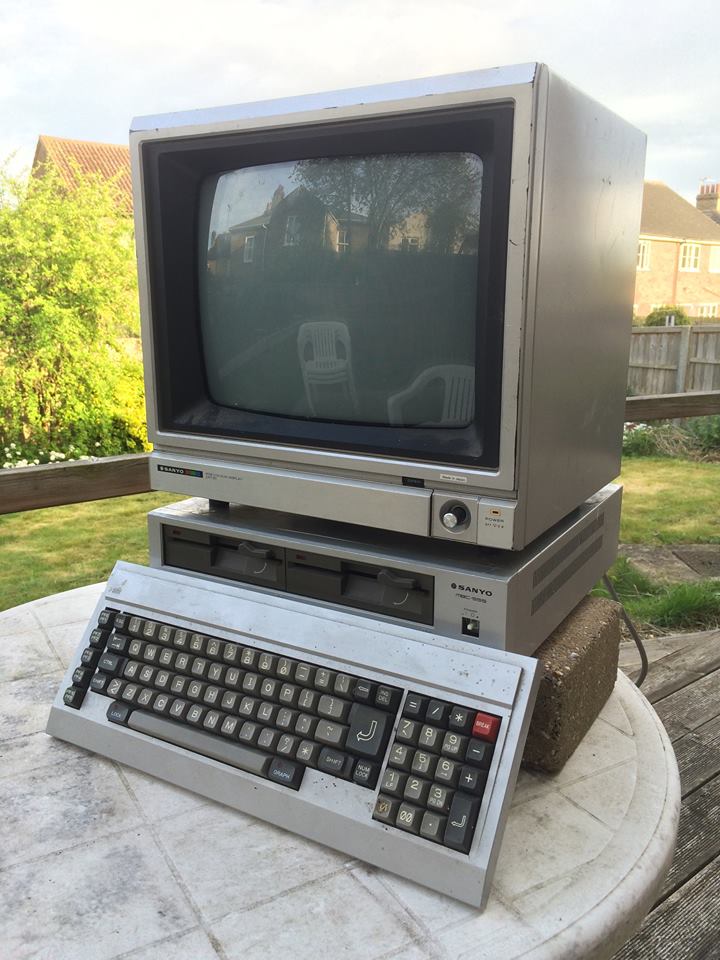
Folks,
I've been contacted by someone wanting to recreate these monitors and is
wanting to buy mine but I can't sell it since it's the only one I've got and
apropos of nothing shipping a glass tube across the pond without expensive
packing/dismantling isn't really an option. He claims mine is the only one
he's seen in 5 years of searching, are they really that rare?
This is mine, matching its MBC-555 PC nicely:
http://www.binarydinosaurs.co.uk/Sanyo_MBC555.jpg
Speaking to him tonight he really only wants to borrow one for taking a
casting of the front bezel so has anyone over there got one to lend/rent to
him? I think he's in CA but will check if necessary.
Cheers!
--
Adrian/Witchy
Binary Dinosaurs creator/curator
Www.binarydinosaurs.co.uk - the UK's biggest private home computer
collection?
> From: Guy Sotomayor Jr
> There was a political fight within IBM and the Unix center of
> competency moved .. All of the Series/1 Unix materials were destroyed
> at that point
I wonder if any of the engineers who worked on it kept a copy at home (as
engineers will often do)?
Noel
Hi
Our order for front panel blanks has now arrived. We have enough
to make ten of each of
PDP-8/e (A)
PDP-8/e(B)
PDP-8/f
PDP-8/i *
PDP-8/L *
PDP-8/m
* New - uses a 465mm x 150 mm panel
I'm expecting production of PDP-8/e (A) and PDP-8/e(B) to start on
Tuesday 31-MAY-2016 at one layer per day (allowing for drying time) plus
set up and packing. The first panels should start coming off the line on
or about 8-JUN-2016.
PDP-8/f and PDP-8/m should start about the 13-JUN-2016 finishing about
22-JUN-2016
Followed by PDP-8/i
Followed by PDP-8/L
Followed by PDP-II/XX
Price remains unchanged at USD150.00 per panel plus USD20 shipping.
Payment to PayPal rodsmallwood52 at btinternet.com
There's only ten of each type so one of each type per customer please
Back orders ship first then in order received sequence.
_*Just a quick note about production techniques. *_
The printing is done by hand on a printing table. Its a big heavy cast
iron tray about a foot deep and five feet square. It stands about three
feet high There are hundreds of small holes in the bottom to allow a
vacuum to hold down whats being printed. On top of the table is an
arrangement of bars and slides to allow one or more silk screen frames
to brought down on a work piece held down by the vacuum.
Next to the table is the drying rack. It looks like half a giant
rolodex. You put your wet work between the pages.They are made of open
mesh panels to allow air to circulate.
You start by marking the position of the blank panel on the bottom of
the table. Then the first screen is positioned over the work and
horizontal movement locked. You can still move the frame vertically.
Position your work between the marked guides on the bottom of the table.
Bring down the frame and drag the ink across the screen. Put the wet
printed blank in the drying frame and repeat for each panel in the batch.
Wait 24 hours and setup your next fame for the next layer(color) Take
first panel out of drying rack print and replace.
Repeat for each board in the batch until done. Cycle time per batch
about eight days elapsed.
Rod (Panelman) Smallwood
> As far as I can tell, if I suddenly need a specific SLT module, the
> odds of finding that specific module at any given time on eBay is
> essentially zero.
Stuff with standard SLT shows up on Ebay quite often. Not every day,
but one could build up a decent pile of SLT cards in time to harvest
from.
> Some SLT modules are far more common than others. I don't know how
> many different SLT modules are used in the 360/30, nor what percentage
> of the SLT modules in that machine are common ones.
For the standard (slower) families of SLT, their are only a few types
of modules - I might guess only 15 or 20 types in something like model
30. They would likely all be 361xxx parts.
Anyway, if one confines an S/360 restoration project to sources
limited to Ebay and Digikey, one will have a bad time. Look around.
IBM made a huge amount of this stuff, and a reasonable amount still
survives.
--
Will
On 7 May 2010, at 08:25, cctalk-request at classiccmp.org wrote:
>
> Message: 2
> Date: Thu, 06 May 2010 16:06:37 -0700
> From: Al Kossow <aek at bitsavers.org>
> Subject: Re: Servant .953
> To: cctalk at classiccmp.org
> Message-ID: <4BE34B7D.6060902 at bitsavers.org>
> Content-Type: text/plain; charset=ISO-8859-1; format=flowed
>
> On 5/6/10 2:23 PM, Fred Cisin wrote:
>>> Al Kossow wrote:
>>>> I am interviewing Andy Hertzfeld tomorrow, and had hoped to talk about
>>>> Servant, but I can't find a copy of it around anywhere tonight.
>
> A huge thank you to Nigel Williams who forwarded a working copy of .951 five
> minutes before Bill and Andy arrived. We spent an hour talking about MacPaint
> and Quickdraw (Apple has finally given CHM approval to make the sources available)
> then another hour on Alice, Dali Clock, Servant, Hypercard, and Magic Cap.
Could you please clarify, the QuickDraw source is available for what purpose? Could developers modify it any include it in heir commercial 64 bit Intel applications for instance?
Is the source Pascal, Assembler, C or something else?
Roger Holmes,
Director of Microspot who has a Carbon application which compiles with over 10,000 warnings about deprecated QuickDraw calls.
Here's my top 3 weirdest devices I've ever sent email through, just for fun:
1. The AlphaSmart "Dana" which was a strange laptop-like device which ran
PalmOS. The email client was Eudora for PalmOS.
2. Sony eVilla BeIA appliance using some kind of (crappy) built-in mail
application.
3. Sharp Wizard handheld organizer over a serial TTY connected to a 386/SX
with optional math co-processor installed so it could run ... Xenix.
Logged in via simple built-in vt100 terminal app on the wizard at 2400
BPS to the Unix box. Used 'elm' to send the mail.
That Sharp Wizard was a helluva organizer for it's time. The main feature
was that it takes AAA batteries and thus I was actually able to afford to
run the thing in college by getting rechargables. It had a nice keyboard
and the display was readable in the sunlight, too. No backlight, though.
-Swift
Self explanatory- asking other computer collectors here to see if anyone
has experience.
Will there be any trouble bringing them across?
They look weird and big, but they have no real commercial value and are
just going to my personal computer collection.
Anything I need? I think both were manufactured in the US.
Thanks-
- Ian
--
Ian Finder
(206) 395-MIPS
ian.finder at gmail.com
> From: Jon Elson
>> I interned at IBM Bermuda, and they had a 360/20 as their main service
>> bureau machine; it had (IIRC) ... a 4301 printer.
> I'm guessing, maybe, that would be a 1403 printer?
Ah, right you are! The old grey cells are, well, old! ;-)
Those printers had an amazingly long life! They were first introduced in 1959
with the 1401 computer, and, like I said, the brand spanking new System 3
they got in ca. 1976 came with one! I wonder when IBM stopped producing
them?
Noel
> From: Swift Griggs
> I'm curious about all these older machines with front panel buttons and
> switches. What all did they do?
In addition to reading/writing memory locations, and basic machine control
(boot, start, stop, continue, single-step, etc), some machines had additional
functionality, but what it was (if any) varied widely from machine to machine.
E.g. the KA10, the first model of the PDP-10, had a front panel which also
allowed you to (among other things):
- execute the contents of the data switches as an instruction
- either stop the CPU, or execute an interrupt (switch selected),
when the address in the address switches was used for (switch
selected):
-- instruction fetch
-- data fetch
-- data write
- repeat the previous key-press indefinitely (at a selectable speed)
The latter one could be used for all sorts of things. I once watched someone
halt the machine, put it in single-step mode, hit 'continue', and then
'repeat': by turning the 'repeat speed' knob up and down it was possible to
cause the CPU to run at varying speeds, down to 1 instruction/second! I
imagine that key could have also been used to clear memory by putting 0 in
the address and data switches, hitting 'deposit' and then 'deposit next', and
then 'repeat' (with the repetition rate turned to the max).
You'd have to read the processor manual for each machine to know exactly what
it could do from the front panel. E.g. some of the PDP-11's (/04, /34, /45 and
/70, IIRC) had a mode where you could single-step the microcode. I recall
using this on our /45 to debug it when the RETURN instruction broke... :-)
Noel
This one is a little sketchy; location is Mont Vernon, NH. Situation is a
lady's husband passed away and shes going through all his DEC stuff. She
would like to sell it, but has no idea what it is all worth. I do not have a
list that is really useful, so someone would need to contact her, go onsite,
and see what all is there and make an offer.
Below are just tidbits from several emails we exchanged. If you're
interested and local to that area and willing to take on a "project
recovery", drop me a line off-list. Please do not respond if you just want
to cherry pick one or two items unless you're fully prepared to at least
help her find a home for the parts you don't want.
Best,
J
I have a pdp 11 in the basement and lots of old mouldy
documentation......and who knows what else? I'm trying to clean it all out.
also have an LA36, and who knows what else. My husband died in January and
I've a whole house to readjust to.
I can get you the model, etc. soon. I live in Mont Vernon, NH.
Thanks for answerig...nice to know someone cares about the old stuff.
I scoped out the basement for the pdp-11 and here's what I've come up with
so far:
26 tape cylinders
12 RL02
1 Decscope
1 rx01
1 decdatasystem box
1 unknown grey metal box
1 Decwriter II
5 RT-11 oranger binders
several LS11 System Service Manuals
other binders, etc.
I would like to sell this, but have no idea as to value, and would also like
to find someone who wants them...so what do you think someone would pay for
this?
Also found a copy of a RSTS auto license plate with a note to (XXXX -
husbands name) from Simon Szeto "for someone who also loves RSTS"
ahhh...the good old days. Were you a part of them?
I've found more documentation, old badges, bumper stickers, etc.
> From: William Degnan
> Here is the layout starting from slot 9/11 of the expansion cabinet
Just slot numbers by themselves aren't much use, because if there are any
non-UNIBUS backplanes (e.g. custom backplanes for core memory, for an RH11 -
which has its own custom backplane, you can't use a regular SPC/MUD 'UNIBUS'
backplane to hold it), we need to know what those are, and where.
Note that many boards can only go in a specific slot in a custom backplane,
and vice verse - some slots in such backplanes will only hold a specific kind
of card.
Taking the RH11-AB as an example: it comes with a 9-slot custom backplane. Hex
RH11 boards M7294 and M7295 go in slots 3 and 2, respectively (and nowhere
else, and nothing else can go in those slots). UNIBUS A in is in slot 1,
connectors A/B; UNIBUS A out is in slot 9, connectors A/B. UNIBUS B in is in
slot 8, connectors A/B; UNIBUS A out is in slot 7, connectors A/B.
The RH11 backplane has some slots which are not needed/used by the RH11; those
are wired as SPC slots; slots 7, 8 and 9, connectors C-F (the A-B connectors
in these slots are UNIBUS, per above), are SPC slots. That means that they
need _at least_ a G727 single-width card (the little square grant continuity
cards which jumper BG4-7) in them if there is no other device plugged in. If
the NPG wire-wrap jumper on the backplane for that slot has been removed,
you'd have to use a G7273 dual-width jumper card, to jumper NPG also.
So, looking at your list; first, a comment about naming:
9/11: M9202 (1-2)
11: M7297 (3-4)
11: 7296 (5-6)
This looks like slot 1 of an RH11 backplane. Standard practise it to use
letters for the vertical, and numbers for the horizontal, for positive
identification. So standard nomenclature would be to say that the M9202 is in
connectors A/B, the M7297 in C/D, and the M7296 in E/F.
(Individual pins are named xYZn, where 'x' is the slot, 1-N [where N is
typically 4 or 9]; 'Y' is the connector, A-F; 'Y' is the pin, A-V using the
'DEC alphabet'; and 'n' is the side, 1-2. The NPG jumper is CA1-CB1 in all
SPC/MUD slots, i.e. 1CA1-1CB1 in slot 1.)
The stuff starting in slot '21' looks like a DB11 UNIBUS repeater, but I have
no idea how large a backplane that is, and what the various slots/connectors
in it are used for. It's almost certainly custom wired.
It looks like slot 31 starts another backplane. Given the cards that are
plugged in (LP11, DL11, etc), it's probably a 'UNIBUS' backplane (i.e. SPC or
MUD slots).
Noel
> From: Bill Degnan
> I have an M9300 bus terminator which I read is the same as a M930 with
> the NPR logic (so you don't also need an NPR terminator in slot 3/4).
Err, the M9300 would go in the same place as a M930, i.e. the UNIBUS in/out
dual connector group, usually at the top (A/B connectors) of a slot in a
backplane, in either the first or last slot _of the entire UNIBUS_.
> I am thinking I can replace the M930 and G7273 in the last slot of my
> backplane with a W2-open M9300.
As a UNIBUS in/out dual-width device, the M9300 does not have separate 'grant
in' and 'grant out' pins - just _one_ pin for the grant; the pin will
function as 'in' _or_ 'out', depending on whether the card in question (of
whatever type) is placed in the first or last slot of the UNIBUS.
The dual-width G7273 goes in the middle connectors (C/D) of an SPC/MUD slot,
to jumper both bus grants (BG4-BG7) and also NPG, all of which have both an
'in' and an 'out' pin in SPC/MUD slots (look at the G7273, you'll see 5 pairs
of pins jumpered together - 1 set on one side, NPG; 4 sets on the other,
BR4-BR7). So an M9300 cannot replace a G7273: it's intended for use in an
entirely different kind of connector group.
You might want to read the UNIBUS description in one of the earlier versions
of the "PDP-11 Peripherals Handbook", which explains how the grants work:
basically, they are daisy-chained through every device, so if a UNIBUS
SPC/MUD backplane (which can hold a UNIBUS device in every slot) has a slot
which does not contain a device, you have to put something with grant jumpers
in instead.
Whether the jumper need to be BG4-BG7 _only_ (the little small grant jumper
cards), or a G7273 (which _also_ jumpers NPG) depends on whether _that
particular slot_ has had its NPG jumper (wirewrap on the backplane) pulled,
or not - most backplanes come with jumpers on NPG on all slots, and you have
to remove the jumper if a device uses DMA. (In the early days, most did not,
which is why that was the default.)
> There are jumpers on this card. W1, W2, W. I did not find any specific
> examples online of scenarios for the jumpers
> ...
> I think I get why one would remove the W2 jumper but if W1 is removed
> (open) instead can someone give me an example scenario for when you'd
> want to use this card "for beginning of non processor bus termination".
> Can someone give me an example of when you'd do this?
The device the M9300 was invented for was probably the RH11-AB, which is
where one most often finds them. The RH11 is an UNIBUS device which is a
MASSBUS controller; the RH11-AB has connectors for _two_ UNIBI (so one
RH11-AB can be 'in' two PDP-11's at the same time; i.e. all the devices
connected to that controller can be accessed from either machine).
If it's only connected to a single CPU, though, what does one do with the
second UNIBUS? That's where the M9300 comes in. It simulated the NPG-granting
section of a CPU, and when jumpered to do that, it goes at the _start_ of a
UNIBUS - e.g. the second UNIBUS in the RH11-AB. (Leave all the jumpers in,
and it functions like an M930, and can go at either end).
You can find a description of its use in the RH11-AB, as well as a
description of how the M9300 works, in the "RH11-AB Option Description"
document (available online), starting on page 4-32.
I can't conceive of any use for one in most PDP-11's, though (outside an
RH11-AB, of course).
Noel
I just revisited the Wikipedia page for the BBC Micro Tube [1].
Apparently with a 32bit NS320 processor it was possible to run some
variant of UNIX? Does anyone know anything about this? I'd be very
interested in experimenting with it, if it is true.
Thanks,
Aaron
[1] https://en.wikipedia.org/wiki/Tube_(BBC_Micro)
Hi
My main system a VAX 4000 Model 500 with a KA680 CPU has just
started halting at test 51 on power up.
Does any body know where I can lay my hands on a spare KA680?
Rod
> From: Jon Elson
> the /20 was intended for very specific uses in 360 shops, and maybe as
> an entry-level "foot in the door" to move totally tab card shops into
> the 360 family. The only /20s I ever saw were used as offline spool
> printers and card readers in large 360 shops.
I interned at IBM Bermuda, and they had a 360/20 as their main service bureau
machine; it had (IIRC) a card reader/punch, 4 tape drives, and a 4301
printer. When I got there, they had just gotten in a System 3 (two
single-platter hard drives, a 4301 printer, and I'm not sure what else) to
replace it.
Noel
paths.
>
> Do you mean the 360/20? On the topic, were the 20 and 40 the only members
> of System 360 to use TROS?
>
> I remember picking up the programming manual for a Model 20 and realizing
> that I'd essentially have to re-learn programming. 16 bit registers, stripped-
> down instruction set, no I/O channels, "substitute"
> instructions for regular 360 fare.
>
> A really strange thing was that the 1130 came out *after* the 360/20.
>
I am not sure why IBM produced an in-compatible machine so soon after 360 was announced, but it was sold in a completely different way to a new and emerging market.
It was billed as the cheapest computer IBM had ever offered. The announcement letter here:-
https://www-03.ibm.com/ibm/history/exhibits/1130/1130_initial.html
is dated almost exactly one month before DEC announced the PDP-8 and I am sure targets the same markets DEC did. You just wonder if IBM had spies in DEC, or more likely they both spotted a marketing opportunity. It is also interesting to note a "typical" configuration was priced at almost twice that of the PDP-8.. (assuming Wikipedia is right)
https://en.wikipedia.org/wiki/PDP-8
I don't have any links but I know in the UK IBM1130's were used on ships by the Institute of Oceanographic Sciences but I can't find any reference to that on-line. I was told that they had great trouble getting the IBM engineers who worked on it that a suite was not suitable dress for a small research vessel.
Dave
G4UGM
> --Chuck
>
>
Dave
G4UGM
I have an M9300 bus terminator which I read is the same as a M930 with the
NPR logic (so you don't also need an NPR terminator in slot 3/4). I don't
want to blow anything up, but I am thinking I can replace the M930 and
G7273 in the last slot of my backplane with a W2-open M9300.
I have discovered past threads in CCTECH about this card, comes up every so
often. There are jumpers on this card. W1, W2, W. I did not find any
specific examples online of scenarios for the jumpers so I have a question
of confirmation to my understanding:
I think I get why one would remove the W2 jumper but if W1 is removed
(open) instead can someone give me an example scenario for when you'd want
to use this card "for beginning of non processor bus termination". Can
someone give me an example of when you'd do this? Something to do with
expansion cabinets?
b
--
A fellow has made up a nice adapter to read and write Commodore disks on
a PC via USB using a 1541 drive.
The thing that jumped out at me is that this is a 5 1/4" drive that
reads and writes via USB. Anyone want to comment on whether the
floppies it accesses would be useful other than on the C64?
Could one do say 360K floppies via this hardware for other than the
Commodore? At least part of the work is done to do more than just
archival like Catweasel, et. al. do, in that it can also write.
XU1541-interface-connect-your-C-drive-to-PC-enclosed-version-NEW/
http://www.ebay.com/itm/322092922596
Thanks
Jim
Hi all --
I'm working on restoring a VAX-11/730 at the museum and things have been going pretty well thus far. I've been bootstrapping the console and diagnostics from simulated TU58 (images from: https://github.com/NF6X/VAX-11-730-Console-v57). All of the TU58-based diagnostics are passing.
I'm attempting to bring up an Emulex UC17 SCSI controller for mass storage and I'm having trouble with it. I thought I'd check with you guys to see if any of you have seen this issue or have any idea where I might be obviously going wrong before I start digging deeper into this.
The current issue is that I can't get the UC17's built in diagnostic/utility (referred to as the 'FRD' in the manual) to run. I am following all of the steps to the letter (see the manual here http://www.mirrorservice.org/sites/www.bitsavers.org/pdf/emulex/UC1751001-C…, pages 71-79 (section 4.5.7)) and I'm getting the right values back when examining the SA register during the process, but executing "S 80" halts after a second or so with:
?08 PC=00000298
Which is an odd way for it to halt, 08 means "No user WCS" according to the 11/730 user's guide.
Here's the full conversation, just in case:
>>> I
>>> D/L/P F26800 80000000
>>> D/L/P F26804 80000001
>>> D/W/P FFF46A 3003
>>> E/W/P FFF46A
P 00FFF46A 0100
>>> D/W/P FFF46A 4401
>>> E/W/P FFF46A
P 00FFF46A 0400
>>> S 80
?08 PC=00000298
I've confirmed that the issue isn't with the card, I can run the FRD without issue on it, in an 11/44 we have here.
I've done my best to ensure that everything is sane on the UNIBUS; my understanding from the 11/730 manuals is that by default none of the SPC slots have the NPG wire-wrap fitted and that any empty SPC slots need to have an NPG grant card installed. (This makes sense given how difficult the backplane is to access, it requires pulling the power supply out first.) Just to make sure, I have double-checked that the NPG wirewrap jumper is not present on Slot 10, where the UC17 is installed. At the moment the grant chain should be unbroken as far as I can tell, here is the current configuration:
TOP
Slot 1 - Empty (normally RB730 option)
Slot 2- Empty (normally FPA option)
Slot 3- M8390 (DAP)
Slot 4- M8391 (MCT)
Slot 5- M8394 (WCS)
Slot 6- M8750 (1mb memory)
Slot 7- M8750 (1mb memory)
Slot 8- M8750 (1mb memory)
Slot 9- M8750 (1mb memory)
Slot 10- Emulex UC17
Slot 11- DMF32-AA
Slot 12- M9302 terminator | G7273 grant
BOTTOM
Thanks as always for the help.
- Josh
On 24 May 2016 4:45 pm, "Ethan Dicks" <ethan.dicks at gmail.com> wrote:
>
> On Tue, May 24, 2016 at 11:36 AM, william degnan <billdegnan at gmail.com>
wrote:
> > On Tue, May 24, 2016 at 11:17 AM, js at cimmeri.com <js at cimmeri.com> wrote:
> >> B, what was the issue with the core, that you fixed it so fast?
> >
> > I guessed that the G114 was bad based on a hunch.
> >
> > I had a spare.
>
> Q. How do you know the guy on the side of the highway with a flat tire
> is a DEC Field Service Engineer?
>
> A. He's swapping out all the tires to see which one is flat.
>
> (or from net.jokes in 1981...
> https://groups.google.com/forum/#!topic/net.jokes/GQ2B6HZIY_4 )
>
> The way I heard it was:
> How do you tell if a man with a flat tire is a DEC Field Service Rep?
> Look in the trunk; if he's from DEC F.S. he'll have three spares with
little
> red tags on them and no jack.
My favourite at the time was:
Q: How does DEC Field Circus deal with a flat tyre?
A: Swap the wheels one by one until the issue is resolved.
Q: How does DEC Field Circus deal with a flat battery?
A: Swap the wheels one by one until the issue is resolved.
:)
> >
> > Hey, this is useful.
> > Thanks for doing it!
>
> Yep!
> Already investigating. IMD gave me some trouble, had to resort to
> dosbox. Source for PED (Programmer's Editor) version G? I've never
> seen source. I have version F as a :PROG file. I'm guessing that Planc
> version C may compile it.. this will stretch my emulator. Haven't yet
> figured out how to handle that PED2.DMK file, so I don't know what it
> contains - executable?
>
>
>
PED2.DMK and DISK8.IMD is the same disk, but different ways of reading it
off the disk. I used both the standard PC-floppy and then also the
catweasel card. I tried the catweasel for some floppies that I had reading
trouble with.
I am really interested in hearing more about your emulator!
/Mattis
On Tue, May 24, 2016 at 11:36 AM, william degnan <billdegnan at gmail.com> wrote:
> On Tue, May 24, 2016 at 11:17 AM, js at cimmeri.com <js at cimmeri.com> wrote:
>> B, what was the issue with the core, that you fixed it so fast?
>
> I guessed that the G114 was bad based on a hunch.
>
> I had a spare.
Q. How do you know the guy on the side of the highway with a flat tire
is a DEC Field Service Engineer?
A. He's swapping out all the tires to see which one is flat.
(or from net.jokes in 1981...
https://groups.google.com/forum/#!topic/net.jokes/GQ2B6HZIY_4 )
The way I heard it was:
How do you tell if a man with a flat tire is a DEC Field Service Rep?
Look in the trunk; if he's from DEC F.S. he'll have three spares with little
red tags on them and no jack.
-ethan
> From: Bill Degnan
> I removed the core backplanes and returned the DD11-C to the orig
> config next to the CPU. I re-inserted cards as-was. I am not getting
> comms from the M7856.
Ugh. Not good. Does it respond on the UNIBUS? (I.e. if you try to read
the registers from the front panel?)
> I may have shorted the card.
If you somehow plugged it into one of the core backplanes, good chance, alas.
They have either -15V or +20V (I think the latter, for the MM11-U) running
around on various pins.
(Oh, BTW, you probably already know this, but just in case not: those
backplanes take specific boards in specific slots; check the manuals/prints
for the correct slots.)
Do you have a spare M7856 you can swap in to make sure the machine is
otherwise functional? If not, let me know, I have a bunch of spare M7800's,
I can send you one (known, tested good).
Noel
> Why have cool looking replica systems. Edible ones would be so much
> better.
> http://phys.org/news/2016-05-d-candy-maker-billed-world-york.html
This is a bit off-topic, but I can't resist a correction to provide some
credit where due. Although billed as such, this is far from being the
"first 3D printer for candy". One (of many) counter-examples can be found
at http://candyfab.org (from 2006).
~~
Mark Moulding
> From: Bill Degnan
> Card slot 2 of the backplane was "de-jumpered" and requires a NPR card.
> The RL02 needs to be in a slot that would otherwise need an NPR card, as I
> understand things.
Correct. (Although technically it's an RL11 controller card, the RL02 is the
drive; but there are other controller cards for the RL02 for other buses,
e.g. the RLV11 for the QBUS.)
>> those would be MM11-U backplanes, right?
> Here is a closeup.
I'm away from my machine at the moment, so I don't know if that's what an
MM11-U says; I'll check tomorrow.
> System came to me as thus, after the CPU, the 3011-cf backplane had the
> following:
This below all looks OK.
> UNIBUS 10 A-B (LEFT SIDE OF UNIBUS)
Yeah, that's 'UNIBUS in'.
> M7856 10 F-C (RS232 WITH 19.2 OPTION?)
And the console board in the bottom part of that slot, good.
> G7273 11 C-D
An NPG/BG jumper card (but that doesn't mean the NPG jumper is removed
>from that slot, mind - you have to check the wiring to be positive).
You could put the RL11 card in this slot (with the jumper removed).
> 7891 12 A-F (64k MEMORY)
Yup, sounds good.
> M9312 13 A-B (ROM CARD)
> 672A 13 D (GRANT CONT.)
Yeah, nothing in the SPC part of that slot, and the 9312 in the 'UNIBUS
out' part, so it must be acting as a terminator.
> I am going to switch to another backplane and start over.
To be honest, I'd stick with that one, actually! You have some data to
indicate that it is OK (the machine worked as you got it).
> From: Mattis Lind
> Isn't it just a a DD11-C backplane with power-wring entering from the
> back, rather than through small circuit boards?
I think the one with the power coming in through paddle-boards is the DD11-A.
The DD11-C has 2 MUD slots in the center, not the SPC slots of earlier
backplanes. (Not sure what the DD11-B is.)
> But all this still doesn't now explain the problem that you cannot
> access (or send characters to) the serial port.
I got the impression from what he said (that the boot ROM seemed to run OK)
that the registers on the console serial board are accessible from the bus OK.
If they aren't, the potential causes are quite different from those which
would cause the different symptoms of 'card responds, but no characters come
out', so we need to nail down which it is before further debugging.
Oh, another idea for debugging this: if it's 'registers OK, no characters',
try an EIA debugging unit (one of those things with a DB25 male and female,
and a bunch of LEDs, that would probably help a lot).
> If I were you I would try to get back to the state where it worked,
> shortening the Unibus to just include the 4-slot back plane and the CPU
> backplane and also remove the RL11 for now. Then install the RL11 in
> slot 11 when everything is working.
Exactly what I would do! :-)
Noel
If anyone has any Force manuals squirreled away, I'd like to figure out
how to configure one of their 8meg memory boards. Started playing with
some VME boards that I had collected over the years, including a huge
pile of stuff from Integrated Solutions. Depressing that I had forgotten
how much of this stuff I have.
> From: Bill Degnan
> So I decided to insert two 32K core memory backplanes
32KW, those would be MM11-U backplanes, right?
> My plan is to replace the solid-state RAM card with core, and this will
> free up a slot on the 4-slot backplane for a terminator.
Terminators all only go in the last slot of the last backplane anyway (either
that, or a UNIBUS 'out' cable), so adding extra backplanes shouldn't give you
"a slot .. for a terminator".
Also, Paul's point is a good one: the hex memory cards need so-called 'MUD
slots' (hex), not SPC slots (quad), and only (IIRC) the DD11-C/D have MUD
slots. (Those came in with the 11/04-34, IIRC).
> the serial card seems to have stopped working. It appears that the
> console program is being loaded and runs from the M9312 but nothing is
> appearing on the terminal. I cannot send an "A" to the terminal, the
> most basic test I can think of.
Hmm. You can read/write the console registers from the console, though, it
sounds like? My guess would be that if your serial port is EIA, somehow
you're missing -15V or something on the DD11 in its new location. Study the
-11/35-40 system manual to learn about which 'bricks' supply which voltages
to which system units.
And while you're at it, check that you have the right 'bricks' for the MM11-U.
The -11/35-40 system manual has lots of text on how to support the MM11-U.
> Can you only use the core backplanes for core memory (assume yes), or
> are they capable of holding other types of cards temporarily?
AFAICR, the MM11-U backplane does _not_ have an SPC slot in it. IIRC, the
16KW MM11-U board set is a quad controller board, and 3 hex boards (core, X-Y
and something else). So two sets (the backplane holds two) would be 8, so one
empty slot - which IIRC is blank. Check the MM11-U manual, it's available.
> I have one slot that needs the npg, it's in place.
??? _Every_ SPC/MUD slot which does not have a DMA device in it _must_ have
the jumper on the backplane (or the _double_ width UNIBUS grant card, whose
number escapes my memory, which contains a NPG jumper). Not sure if that
was the import of what you wrote there.
Noel
On May 22, 2016 1:22 PM, "Mark Darvill" <mark.darvill at mac.com> wrote:
>
> The core memory/CPU backplane is a special case and doesn?t need grant
cards.
>
> If you have linked up to the expansion Unibus then you need to check you
have the NPG jumper in row C, Pins A1 and B1 in each slot. If these do not
have wire wrap then you will either need to wire wrap them or insert a G727
into the backplane slot. Without these the units will hang on attempting to
use a card that requires DMA access.
>
> Hope this helps.
>
> Mark
>
Thanks Mark..yes I have one slot that needs the npg, it's in place.
I have not had a chance to test with grant cards removed hope that does the
trick
Still unpacking after a house move 18 months ago... I have found just over
a dozen volumes of Inside Macintosh.
Since programing is not my thing, and I am not into the Macintosh, I don't
really need them. Does anyone want them? Tbey are free, but would have to
be collected from me in SE London (near Bromley, easy to get to from the M25).
I can make a list of titles if there is any interest.
-tony
Sorry, I didn?t ask on this one. It looked like a well used/loved machine with some wear and customizations to the front panel
Jerry
> On May 22, 2016, at 9:51 AM, Bill Sudbrink <wh.sudbrink at verizon.net> wrote:
>
> Jerry Weiss wrote:
>> I saw one Altair 8800
>
> I haven't seen an Altair at a hamfest in this century.
> Out of curiosity, what was the seller asking?
>
> Bill S.
>
>
Background - I have a PDP 11/40 that came to me with a CPU backplane and a
general purpose 4 slot peripheral backplane. The CPU backplane came to me
connected to the 4 slot via a std 11/40 M981. In the 4-slot I have I have
a working 64K solid-state RAM card, M7856 serial card, M9312
bootstrap/console card, and an RL02 drive controller. I can access RAM
>from the console, run the console program (monitor program) off the M9312
through the serial card. I can't boot yet off the RL02 and I am thinking
this is due to a termination issue, not sure yet. I decided I need more
backplane to go any farther.
So I decided to insert two 32K core memory backplanes in between the
original two backplanes that came with the system. My plan is to replace
the solid-state RAM card with core, and this will free up a slot on the
4-slot backplane for a terminator. Am I correct in my logic?
I have connected the "new" backplanes using M920's. Imagine the original
system with a core backplane wedged in the middle. Power seems fine, DC LO
AC LO fine.
Right now there is nothing in the core backplanes, First I want to verify
that I have them arrayed correctly and that I can still communicate with
the (now) 4th backplane in the back. I can run "chase the lights" from the
console but the serial card seems to have stopped working. It appears that
the console program is being loaded and runs from the M9312 but nothing is
appearing on the terminal. I cannot send an "A" to the terminal, the most
basic test I can think of.
Could be the the M7856 card decided to die on me just now, or something
else is wrong. Does anyone have a PDP 11 /05/10/35/40 and have
experimented about what you can and can't do with backplanes?
I know that there are a lot of variables here, so I'd like to start with
the basics
Basic Question #1
Do I need grant cards in *every* empty slot of the core backplane,
including the end slots with the M920's?
Basic Question #2
Can you only use the core backplanes for core memory (assume yes), or are
they capable of holding other types of cards temporarily? (yes/no/maybe)
I am researching the system config on my own, but I thought if anyone had
any advice I'd love to hear it, make troubleshooting a little easier.
I have read up on the subject:
http://retrocmp.com/how-tos/setup-a-pdp-11-unibus-backplanehttps://trmm.net/PDP-11
I see this is not a simple little thing. Working to find more GC cards now.
Thanks
b
--
@ BillDeg:
Web: vintagecomputer.net
Twitter: @billdeg <https://twitter.com/billdeg>
Youtube: @billdeg <https://www.youtube.com/user/billdeg>
Unauthorized Bio <http://www.vintagecomputer.net/readme.cfm>
I am hoping to install Windows NT 3.1 on my Jensen. Unfortunately I am
getting an error code relating to VGA. The tech docs I have make no mention
of this code, anyone know what it means:
VGA ?? 06 0020
Regards
Rob
Anyone spot anything list related at hamvention? I'm around trying to find anything cool. Particularly sun and ibm stuff.
Sent from my T-Mobile 4G LTE Device
I picked up one of those power systems, the other was gone before I got to it. The only things I can add are an amiga and tons of cisco network gear.
Not a whole lot this year I suppose.
Sent from my T-Mobile 4G LTE Device
-------- Original message --------
From: Brian Marstella <brian at marstella.net>
Date: 5/22/2016 12:09 AM (GMT-05:00)
To: "General Discussion: On-Topic and Off-Topic Posts" <cctalk at classiccmp.org>
Subject: Re: Hamvention
After Alex mentioned it, I'd thought about driving up if anyone saw
anything of interest, but sounds like there isn't a great deal to pick from
for older computers. I really can't justify the drive anyway, this year...
Brian KI4GTD
On Sat, May 21, 2016 at 11:48 PM, Jerry Weiss <jsw at ieee.org> wrote:
> I saw one Altair 8800 and one TRS-80 III out in the swap fest.? Some more
> recent power (5?) series, but that?s about it.
>
> Jerry WB9MRI
>
>
> > On May 20, 2016, at 1:18 PM, Alex McWhirter <alexmcwhirter at triadic.us>
> wrote:
> >
> >
> >
> >
> > Anyone spot anything list related at hamvention? I'm around trying to
> find anything cool. Particularly sun and ibm stuff.
> >
> > Sent from my T-Mobile 4G LTE Device
>
>
I need to make some paper tapes of the diagnostics for my PDP-8/e. I
built an RS232/current loop interface and have it working I think
Did anyone else notice that the standard cable to connect the M8655
to a tty uses shielded twisted pair cable, but doesn't have the signal
pairs in the twisted pairs? This same cable is used with the DL11 too.
-chuck
Congratulations, Pete. I'd like to put some day my hands in one of these
but work and distance (Spain) make it complicated. Perhaps in some years
>from now.
Kind Regards
Sergio
Thanks Kip!
I did manage to get it going. Turned out the switches for baud rate are not labelled accurately. It has a monitor called Weebug.. no idea how to operate it. :) ?Hoping it's similar to SWTBUG, MIKBUG etc.
Brad
Sent from my Samsung device
-------- Original message --------
From: Kip Koon <computerdoc at sc.rr.com>
Date: 2016-05-21 4:29 AM (GMT-08:00)
To: "'General Discussion: On-Topic and Off-Topic Posts'" <cctalk at classiccmp.org>
Subject: RE: MSI 6800
Hi Brad,
I found these two links.? I hope they help.
< http://www.old-computers.com/museum/computer.asp?st=1&c=732>
< http://www.hinkles.us/chuckbo/MSI-6800/index.htm>
Take care my friend.
Kip Koon
computerdoc at sc.rr.comhttp://www.cocopedia.com/wiki/index.php/Kip_Koon
> -----Original Message-----
> From: cctalk [mailto:cctalk-bounces at classiccmp.org] On Behalf Of Brad H
> Sent: Friday, May 20, 2016 10:31 AM
> To: General Discussion: On-Topic and Off-Topic Posts
> Subject: MSI 6800
>
>
>
> Hi there,
> I have acquired an MSI 6800 (SS50) computer and am trying to figure out how to get it going.? I am reaching out everywhere hoping to
> find someone with knowledge of these as I have searched around extensively and cannot find a manual.
> With a null modem cable connected to a PC I can get a response from the computer by typing things or resetting it, but the output is
> garbled.? I know the baud rate but at present have no way to determine the other settings like bit, parity, etc.
> Any help/advice would be appreciated!
> Brad
> Sent from my Samsung device
> I would hope whoever gets it is prepared to exchange information. There is no
> software with my machine, of course.
Pete,
Congrats! Once you pick up the system feel free to contact me about getting copies of the limited software I have for the MINC at this time. They are great systems to experiment with.
Mark Matlock
>
> In case anyone is worried I am keeping 2 MINCs myself. One is an RL01-based
> one that I have pulled the CPU, RAM and Bootstrap cards from and hung it off
> a DW11-B (Unibus-Qbus interface) on a PDP11/45 (yes, that does work!). I've not
> got the 11/45 running after the house move, but it is all there and sorting it out
> is just a matter of time The other MINC is a MINC-23 (PDP11/23 CPU board),
> with an RX02. I am also keeping at least one of every MINC module I have
> ever owned, including MNCAG (analogue preamplifier) and MNCTP
> (thermocouple interface).
Tony,
Using a DW11-B to connect the MINC to a PDP-11/45 sounds fantastic! What a neat idea! I have all the MINC modules except the MNCTP thermocouple interface and the MNCAM analog mux. With the modified BDV11 I've been able to boot 11/03, 11/23 and 11/73 CPUs. I run either RT-11 and RSX11M by changing MicroSD cards on the UC07 / SCSI2SD drives (configured as 4 150 MB drives). I understand some MINC-23s ran RSX and would love to find any drivers for RSX and the MINC modules.
Mark Matlock
I tried the Dell on my Rainbow, but unfortunately it did not work. Looks like I would need the scan doubler that was mentioned.
Regards
Rob
> -----Original Message-----
> From: cctalk [mailto:cctalk-bounces at classiccmp.org] On Behalf Of Rob Jarratt
> Sent: 17 May 2016 07:31
> To: Ian Finder <ian.finder at gmail.com>; General Discussion: On-Topic and
> Off-Topic Posts <cctalk at classiccmp.org>
> Subject: RE: Best LCDs for retrocomputing - Was: Re: New *square* 1:1
> 26.5"LCD monitor 1920x1920
>
> I?ll let you know in a few days when I get back home.
>
> Regards
>
> Rob
>
> Sent from my Windows 10 phone
>
> From: Ian Finder
> Sent: 16 May 2016 23:48
> To: Jarratt RMA; General Discussion: On-Topic and Off-Topic Posts
> Subject: Re: Best LCDs for retrocomputing - Was: Re: New *square* 1:1
> 26.5"LCD monitor 1920x1920
>
> Addendum-
>
> This thread (http://www.vogons.org/viewtopic.php?f=46&t=44692) seems
> to indicate the 2007FP CAN do 15hkz on the VGA / RGB input... so maybe
> you're all good. Anyone here want to test?
>
> On Mon, May 16, 2016 at 3:46 PM, Ian Finder <ian.finder at gmail.com> wrote:
> This post: http://www.vcfed.org/forum/archive/index.php/t-16744.html
> Seems to indicate that the Rainbow is a 15khz sync signal, more akin to
> normal interlaced video- which I called out in my other post as being the
> one type of signal that doesn't always work for these displays.
>
> You may find success using a GBS-8220 scan-doubler, (ebay, c. $28
> USD), perhaps with a sync-strainer circuit to feed the SoG signal to the Scan
> Doubler as composite sync, if it doesn't work directly with the 2007FP.
>
> Curious to hear what you figure out.
>
>
>
> On Mon, May 16, 2016 at 3:25 PM, Jarratt RMA
> <robert.jarratt at ntlworld.com> wrote:
>
> >
> > On 16 May 2016 at 22:52 Adrian Graham
> ><witchy at binarydinosaurs.co.uk>
> > wrote:
> >
> >
> > On 16/05/2016 20:13, "Ian Finder" <ian.finder at gmail.com> wrote:
> >
> > > I dunno if it's relevant or not, but my go-to LCD for retro
> >stuff is the
> > > Dell 2007FP-
> > > There was a panel lottery, some are TN, some IPS. Both are solid.
> > >
> > > They are 4:3, 1600x1200 native.
> > >
> > > They have DVI, VGA, Composite and S-Video inputs, and very
> >stellar
> > > scalers.
> >
> > In fact there was one available for ukp35 so it's now mine. I
> >remember these
> > monitors from a few years ago at a customer that specialised in
> >video for
> > aeroplanes, I used one not quite daily but remember being irked at
> >the time
> > that it was several button presses needed to get from VGA to DVI
> >input,
> > hahaha.
> >
>
>
> He had another one at that price (the last one apparently), so I have bagged
> that one. I tried my Viewsonic, which does SoG, on my Rainbow at the
> weekend, but that didn't work, perhaps this will. Even if it doesn't it will still
> be a good second monitor for my everyday PC.
>
> Regards
>
> Rob
>
>
>
> --
> Ian Finder
> (206) 395-MIPS
> ian.finder at gmail.com
>
>
>
> --
> Ian Finder
> (206) 395-MIPS
> ian.finder at gmail.com
Hi there,
I have acquired an MSI 6800 (SS50) computer and am trying to figure out how to get it going. ?I am reaching out everywhere hoping to find someone with knowledge of these as I have searched around extensively and cannot find a manual.
With a null modem cable connected to a PC I can get a response from the computer by typing things or resetting it, but the output is garbled. ?I know the baud rate but at present have no way to determine the other settings like bit, parity, etc.
Any help/advice would be appreciated!
Brad
Sent from my Samsung device
Well, the Subject: line gives the result of by decision. I have decided (after
much thought, it was not easy!) to give the surplus MINC to Pete. I wish I had
more spare MINCs so I could give each of you one.
Perhaps the only consolation is that there may well be other machines up for
grabs as I continue to sort out.
Pete, we need to agree a time for collection.
Thanks to everyone who responded.
-tony
I dunno if it's relevant or not, but my go-to LCD for retro stuff is the
Dell 2007FP-
There was a panel lottery, some are TN, some IPS. Both are solid.
They are 4:3, 1600x1200 native.
They have DVI, VGA, Composite and S-Video inputs, and very stellar scalers.
They sync to SoG, and have no trouble with oddball resolutions like
1152x8-whatever.
My SGI stuff can drive it at native resolution. As an added bonus, you can
disable scaling if you want black bars and native resolution.
These are readily available for ~$35, and I have at least 6.
- Ian
On Mon, May 16, 2016 at 12:07 PM, Chuck Guzis <cclist at sydex.com> wrote:
> On 05/16/2016 11:49 AM, Ethan Dicks wrote:
>
> > I have been keeping my eye out for older panels. I have some 12"
> > 4:3 and a few 17" 4:3 and I think one 19" 4:3. Never run across
> > anything larger. I don't think there were too many 4:3 LCD
> > televisions sold larger than 19"... some, perhaps, but not many. The
> > world switched to 16:9 about the time prices started falling on > 19"
> > panels.
> >
> > I have a couple of arcade cabinets I'd love to switch to LCD. No
> > luck yet except with a 16:9 that would fill the cabinet space but
> > give me a black bars and a smaller playfield size than the CRT.
>
>
> I use a NEC 21.3" 4:3 monitor--they can be had for cheap.
>
> NEC sells a few refurb very inexpensive 4:3 19" monitors that accept SOG:
>
> http://www.necdisplay.com/category/desktop-monitors?Refurbished=1
>
> --Chuck
>
--
Ian Finder
(206) 395-MIPS
ian.finder at gmail.com
Sorry about being late: Raymond Tomlinson, email inventor, sadly
passed on to the 'cyberworld' in March of this year. In this Age of
the Internet, we're communicating with his invention and sharing our
hobby throughoutthe world. Imagine 100 yrs. ago how we would have done
this!
Happy computing.
Murray :)
.
Swift's thread on the "ones that got away" got me thinking about another
source of guilt/regret common to the classic computer collector:
Systems we've neglected or failed to boot recently.
I've had a re-jig of my storage, and whilst it was great to uncover gems
that I'd forgotten I even had, it also brought some regrets for the systems
I've neglected - lots of them not booted in 10 years or more.
Because they were easily accessible I pulled out my Colour Classic and G4
Cube (is the latter on-topic through the "10 year rule" or are we sticking
to pre-millenials?):
https://www.dropbox.com/s/2c70f4flucjo3f6/IMG_7576.jpg?dl=0
Quick check-over and they both booted just fine!
The systems I'm feeling really guilty over neglecting are:
SGI Crimson VGX (skins perfect but needs some TLC before power-on)
Micro PDP 11/83 (same)
Maxed-out Acorn A3000 (my home-brew external SCSI Podule needs finishing)
And I have a vast box of Sinclair Specturm games on tape that would
probably take the rest of the year to load if I fired up my +2 and played
them sequentially!
-Austin.
Hi
I'd like to load RSTS/e on my 11/83. I have TK50's available so I
guess the question is how do I get or create an install
TK50 tape with RSTS/e on it
Rod
I got out my Tektronix DAS 9129 logic analyzer mainframe, which uses a
red/green/yellow beam penetration CRT. It uses raster scan, whereas
my other device with a beam penetration CRT, the HP 1338A (also
red/green/yellow) is a vector (X-Y) display.
I'm pleased to find that the 9129 passes self-test and the display
works. Unfortunately I do not have any logic analyzer acquisition or
pattern generator modules for it, so other than admiring the pretty
display, it's only useful as a boat anchor.
Does anyone have information about (or a copy of) the Pascal
Development Co. Pascal/8002 Universal Program Development Package,
that ran on the Tektronix 8002 development system? The only thing I've
found is a blurb in Computerworld 1979-08-13 p. 56.
Alternatively, I'm very interested in any other compiler that ran on
the 8002 and produced p-code or bytecode, or any such compiler running
on ANY machine which Tektronix may have used for product development.
They might well have done cross-development from a mini or mainframe,
but I'm guessing that they probably used their own 8002 system.
Context: the Tektronix DAS 9100 logic analyzer is Z80 based, and
contains many ROMs, mostly 8KB MK36000 series masked ROMs and MCM68764
EPROMs, but only one ROM appears to contain much actual Z80 code. That
8K ROM is labeled "INTERP" and contains a bytecode interpreter.
Apparently all the other ROMs are full of bytecode. The bytecode does
not match the UCSD p-code nor the ETHZ P4 p-code. I've started
disassembling it, but haven't yet learned too much.
Hi there,
I recently acquired a Midwest Scientific Instruments 6800 computer. Been
meaning to set it up but was working on restoring a couple of SWTPC
terminals first.
It has a SI-1 serial board in it and what looks like a second serial board
absent manufacturer markings. The SI-1 has configurable baud rate, but I do
not know what the other settings should be (ie. 7 or 8 bit, how many stop
bits, etc.). I'm working with a PC terminal for now, and the MSI does react
to keys being pressed, but it just produces jibberish. I have the baud rate
at 1200 and have tried 7 bits, 1 stop bit, Even parity, odd parity, 2 stop
bits, 8 bits, etc.. but no avail.
Wondering if there's a manual extant out there or anyone with really good
memory on how to get these things communicating.
Thanks!!
Brad
I've stack-ranked all the classic items that I, to my everlasting shame,
let go of at some point and now I feel like it was a mistake:
1. Amiga 2500. I ditched it thinking I'd pick up a 3000 then never did.
Ugh. It was free. They were using at some radio station where I helped
them fix their PCs but then decided I wanted their Amiga (stashed in a
closet) to subsidize my fee.
2. SGI Indigo R4400 with pristine KB + mouse, Maxxed RAM, and Elan. Ugh.
/me bangs head against wall
3. Mac IIci with 060' accelerator. I put the accelerator in and paid $$$
for it. Darn it. That was a cool system.
4. Sun Voyager. These go for a fortune now on Ebay. I *gave* mine away.
Not this one: https://en.wikipedia.org/wiki/The_Sun_Voyager
This one: http://tinyurl.com/lhzjfks
5. NeXTStation Color Turbo. I got tired of the proprietary-everything and
the space it was taking to keep it working and pristine. Still. I wish I
hadn't sold it.
6. Mac Quadra 660AV. This was a pizzabox M68k classic mac with a video
frame capture (a crappy one but still...) capability. I notice you can't
really even buy classic macs on ebay anymore. There used to be scads of
them. Damn... does that mean I'm old now?
7. SGI Origin 200 dual R12k 270Mhz. It's the top model Origin 200 and it
had good skins etc... If I had it today it'd be running in my garage with
the rest of the zoo. I had to ditch some gear to move way back when, and
this box was a casualty.
8. Sharp Wizard OZ-8000 organizer. This thing rocked. I'd probably be
tempted to *use* it. I got a lot of mileage out of it "back in the day". It
ran on a Z80 and took AAA batteries (yes!). Plus I had (and maybe I still
do) a DB9 serial interface for it. You could use it as a vt220 terminal,
IIRC.
9. Atari Lynx. I had all the cool games. Like a fool I sold mine for some
quick money in college to help fund a silly trip with some chick who is
long gone long ago. Ugh. I'd rather have the Lynx back...
10. TRS-80 model 100. I didn't really like it that much, but nowadays it'd
look cool in my collection and I have more nostalgic love for the
trasheighty. Plus it takes AA batteries (I love that!).
-Swift
At 04:57 PM 5/19/2016, Austin Pass wrote:
>Systems we've neglected or failed to boot recently.
My Amstrad PPC-640 gets booted a couple-few times a year when I need a native MS-DOS machine with a real serial port for work on some vintage broadcast hardware.
I need to dig out the three CP/M machines (Osborne 1, Kaypro 4-84, Kaypro 1) and see if they will play, as they have not been booted in about a decade.
Dale H. Cook, Roanoke/Lynchburg, VA
Osborne 1 / Kaypro 4-84 / Kaypro 1 / Amstrad PPC-640
http://plymouthcolony.net/starcity/radios/index.html
Hi folks,
I picked up a rather nasty Tek 4051 and gave it a good cleaning.
It has an issue with the power supply. Before I dive in properly myself, I
thought I'd just ask:
Has anyone seen a behavior where-
1) With the main logic board attached, the power supply makes a loud buzz /
hum.
the +12 rail reads approx. 9v and the 15v rail is 13.5 or so. All
lights turn on as the cpu is obviously not running.
2) With the main logic board detached from the power supply (no load at all
on those rails?) I get a healthier 14.8 on the 15v rail and approx. 12 on
12. No hum / buzz.
I believe the supply is linear.
I suspect bad caps and a bad diode, but wanted to check here.
also in testing 2), one of the weird resistor network film packages on the
deflection board got really hot and made a smell. I hope it still works-
will certainly not be testing with the main board unplugged again.
Flood gun seems to be working.
- Ian
--
Ian Finder
(206) 395-MIPS
ian.finder at gmail.com
> From: Ed Groenenberg
> After hooking up the PMK05 to the unibus, the machine was powered up
> with the memory card, and the 'NPG' led was on.
Oh, that's truly wierd. Most memory cards don't even connect to any of the
bus request/grant lines - they often have short loopbacks from each 'grant
in' pin to 'grant out' - not sure about NPG because canonically, that is
jumpered through on the backplane.
A couple of things to check: First, does that memory even have traces
connected to the NPR/NPG-in/NPG-out pins? Second, does a different, known
working card, provoke any problems in that slot? (E.g. your serial interface
card?) I'm wondering if the problem is the slot, not the card.
Noel
Has anyone ever found a way to beat HP at their game of putting
ridiculously low-quality proprietary batteries on their RAID controllers?
I had no end to trouble with HSZ batteries dying back in the day. Nowadays
I still have an old MSA1000 with similar looking batteries. The part
numbers are 401026-001 (right) & 401027-001 (left).
Has anyone ever seen some kind of caddy or carrier that can replace these
? They are very oddball in shape. They clip onto the boards with plastic
friction shields. However, there is greater clearance on the MSA1000
controller board than is needed for these batteries. Since it's 4.8v I'd
love to replace this with qty=4 1.2v NIMH AA or AAA batteries. They'd
probably last longer anyway.
There is nothing magical or special about these battery packs, correct? If
I find something mechanically workable and with matching voltage can I not
use that as a replacement? I really don't care if I have to solder it on.
The folks who sell replacements for these online tend to not say if they
are new, used, tested, etc... I don't trust them enough to send them
$40-$120 for the replacement.
-Swift
Tony,
Too bad your MINC is so far from me. I would love to have the spare parts and RL01s to assist in my MINC restoration.
I would like to collaborate with who ever gets your MINC. Some other kind souls on this list have helped me with copies
of the Lab Subroutine Package software and Scientific Subroutine Package software for MINC.
I have my MINC-23 running with a 11/23 CPU and an Emulex UC07 / SCSI2SD so I can transfer RT-11 software from various
internet web sites to a microSD card and run from it. I had to upgrade my BDV-11 with new EPROMs to boot a DU device
(Thanks to Malcom McLeod for the EPROM images!)
I have used both RSX11M (not plus as it is an 18 bit system) and RT-11 on different SD cards and it runs both fine.
I currently have the A/D, Digital Output, and Digital Input modules all working with Macro-11 code I wrote but am having trouble getting the MINC clock to work as it appears to have a different CSR format than the LPS-11 or KWV-11C. A user's guide for it would be greatly appreciated. The MINC-11 engineering drawings have been scanned and are certainly helpful.
Also, anyone trying to connect to the DB9 terminal blocks for the DLV-11J should be aware that the pin out is NOT the common DB9
RS232 pin out. It takes a special DB9 to DB25 cable DEC provided or some wiring experimentation with an RS232 breakout box. The engineering drawings do document the connections however.
Best regards,
Mark Matlock
> From: tony duell <ard at p850ug1.demon.co.uk>
> To: "cctalk at classiccmp.org" <cctalk at classiccmp.org>
> Subject: Surplus DEC MINC
> Message-ID:
> <A8192EF71C5C4946A240D25EDC8F9448027F4B3F at EXMBX15.thus.corp>
> Content-Type: text/plain; charset="us-ascii"
>
> I have a DEC MINC that I don't _really_ need and wonder if anyone is
> interested.
>
> It's the hard disk model. A half-height rack containing a pair of RL01s
> and a power controller with the MINC CPU box bolted on top. It
> contains the normal cards :
> PDP11/03 CPU
> M8044 memory (30kW IIRC)
> DLV11-J (4 RS232 ports)
> IBV11 (IEEE-488 interface)
> RLV11
> Some parallel printer interface (LPV11?)
> BDV11 (Bootstrap/terminator)
>
> And 7 MINC modules :
> MNCAA (ADC)
> MNCAD (DAC)
> 2 off MNCDI (16 bit digital input)
> 2 off MNCDO (16 bit digital output)
> MNCKW (clock generator)
>
> Bad points :
>
> It is untested, assume it needs repair (but the boards, etc are intact)
> I would recomend doing electrical safety tests before applying mains!
>
> No connector blocks for the MINC modules
>
> No disk packs (but I might be able to find some)
>
> No terminal or cable (but not hard to sort something out)
>
> It could do wth cleaning (if you spin up the drives they will almost
> certainly headcrash). But no smoking near it ever.
>
> It MUST BE COLLECTED from me (SE London, near Bromley, not too far
> from M25). There is no way I can ship it. I will help dismantle it into
> units and load it into your car/van (I think it will all go in an estate
> car).
>
> Good point
>
> It's free. I do not want any money for it.
>
> I want it to go to somebody who will make use of it (either restore it, put it
> on display, or use it for spare parts for PDP11s), not somebody who wants
> to raid the gold from the edge connectors.
>
> -tony
Hi,
I was given an Altos 486 Series 1000, and albeit its name sounds
promising, it's not the classic Z80 based Altos 486, but a modern UNIX
machine with i486 processor (non-PC architecture) from around 1992.
Problem: no tapes, no hard disk (was removed as it contained sensitive
data). Has someone by any chance have images of the OS (don't know whether
they are on QIC tapes or on 5.25" floppies) ? OS should be some AT&T UNIX
called Altos System V.
Christian
Hi all,
Bought a VT420 off eBay last night which should be arriving sometime
this week. Unfortunately it doesn't come with a keyboard. Is there
anyone near Nottingham (UK) willing to sell an DEC LK401 keyboard for a
fair price?
Thanks,
Aaron
I have a DEC MINC that I don't _really_ need and wonder if anyone is
interested.
It's the hard disk model. A half-height rack containing a pair of RL01s
and a power controller with the MINC CPU box bolted on top. It
contains the normal cards :
PDP11/03 CPU
M8044 memory (30kW IIRC)
DLV11-J (4 RS232 ports)
IBV11 (IEEE-488 interface)
RLV11
Some parallel printer interface (LPV11?)
BDV11 (Bootstrap/terminator)
And 7 MINC modules :
MNCAA (ADC)
MNCAD (DAC)
2 off MNCDI (16 bit digital input)
2 off MNCDO (16 bit digital output)
MNCKW (clock generator)
Bad points :
It is untested, assume it needs repair (but the boards, etc are intact)
I would recomend doing electrical safety tests before applying mains!
No connector blocks for the MINC modules
No disk packs (but I might be able to find some)
No terminal or cable (but not hard to sort something out)
It could do wth cleaning (if you spin up the drives they will almost
certainly headcrash). But no smoking near it ever.
It MUST BE COLLECTED from me (SE London, near Bromley, not too far
>from M25). There is no way I can ship it. I will help dismantle it into
units and load it into your car/van (I think it will all go in an estate
car).
Good point
It's free. I do not want any money for it.
I want it to go to somebody who will make use of it (either restore it, put it
on display, or use it for spare parts for PDP11s), not somebody who wants
to raid the gold from the edge connectors.
-tony
Does anyone have a EIZO FlexScan EV2730QFX-BK monitor? I currently own an
NEC MultiSync 17" LCD that does sync-on-green and works with my SGIs and
other older systems. However, I'd love something bigger. The problem is
that when I use widescreen monitors on systems which cannot display
widescreen resolutions, everything is pretty distorted.
My guess is that, since this is a newer monitor, it's not going to support
sync-on-green. I'd still be tempted to get one, simply because I've grown
to dislike widescreen for productivity uses (they are great for
entertainment). However, at over $1k, it'd definitely have to support my
retro gear to make it worth it. Now that I look, it says it only supports
displayport and dual-link DVI. That means I'd need a scan converter to use
it with older gear. Ugh. Well, anyone go down this road already?
-Swift
Some links to this beastie:
http://www.eizo.com/products/flexscan/ev2730q/http://www.amazon.com/FlexScan-EV2730QFX-Monitor-1920x1920-EV2730QFX-BK/dp/…http://www.colorhq.com/Eizo-FlexScan-EV2730Q-26-5-LCD-Monitor-p/ev2730qfx-b…
>
>
> I would love to see a specialized vintage bazaar where you can find what
> you
> want at a reasonable price from trusted sources but the reality is that
> will
> never happen in e-commerce. For better and worse eBay has spoiled us and
> created certain expectation. The only way we could ever have a decent
> vintage exchange would be to have a swap meet which is of course its own
> logical nightmare (not to mention the massive over head costs).
>
>
>
I would probably be interested. since I am going on 70 I have come to
realize that I need to part with some of my collection.
However in the above paragraph I think there is a great suggestion.
Host a virtual swap meet.
Interested people could have a table to fill. Set a time limit, like a week
for the sale. I think a weekend is too short for virtual people. Let the
vendors do the pricing and selling. Collect a fee for the table to cover
the overhead. Social media could spread the URL of the sale. People could
check in at their leisure.
Like any other swap meet we would soon know who sells high, who sells
bargains (and you have to get there earlier in the week), who is not
reliable, etc.. Some sort of moderated feedback system would be a good
idea.
I think a time limit like a swap meet a good idea. It allows for
transactions to be completed and not overwhelm the seller. Everyone will
have to calculate their own shipping, just like we do now. Shipping weight
with the description would be handy. And the vendor should set clear
shipping rules for his table
This method would keep the host out of the transaction and eliminate the
need for a shopping cart. The Host could hold one every 3 months to cover
expenses. We would soon know if it is a viable idea. And this route
shouldn't cost as much.
Vendors could sell one collectable to those of us that used to provide
parts and would have multiple tables full. I think there should be a limit
to how much fits on a table (or in a table space) just for control of
bandwidth and give a way for the host to cover expenses.
Just brainstorming here... I used to love selling at Ham and Computer swap
meets.
The internet allows for virtual communities. Why can't it allow for a
virtual swap meet.
Paxton
--
Paxton Hoag
Astoria, OR
USA
Once in the day I thought Inmos and their transputer family was quite
interesting. I had an idea of doing som sort of project. But of course
there were no real time to be found to do anything (not sure if this has
changed today).
While browsing for something else I found someone at Ebay in Germany
selling T400 in 68 pin PLCC.
http://www.ebay.de/itm/131355196522
Are there tools (Occam etc) around to do anything with these today?
/Mattis
Mark,
corrosion problems are very common on the HP-41. To discuss the HP-41
calculator, repairs, accessories most of the community knowledge may be
found in the discussion forums at
http://www.hpmuseum.org/forum/thread-6266.html
and more documentation also at
http://www.hp41.org/Intro.cfm
Have fun and many happy BEEPs
Martin
> Message: 14
> Date: Sat, 14 May 2016 22:34:48 -0700
> From: "Mark J. Blair" <nf6x at nf6x.net>
> To: "General Discussion: On-Topic and Off-Topic Posts"
> <cctalk at classiccmp.org>
> Subject: HP41C Peripherals and Accessories?
> Message-ID: <BED43321-97E6-4589-A172-48BEF22199D5 at nf6x.net>
> Content-Type: text/plain; charset=us-ascii
>
> I just became the happy new owner of a nice old HP 41C calculator with a
> matching barcode wand. I haven't powered it up yet, as there's lots of
battery
> compartment corrosion. I'm looking into getting one of the replacement
flex
> circuit assemblies that have been made for it. I was quite curious about
the 41C
> when I saw them in magazines, but I had never touched one before. My first
HP
> calculator was a 28S, and I finally upgraded to a 48GX a couple of years
ago. I
> think this 41C will be a fun addition to my collection once I get the
battery
> compartment fixed up and get it running.
>
> If anybody has any interesting HP 41C peripherals or accessories available
for
> trade, let's talk! eBay and I don't talk any more, so I need to find my
new toys
> the old fashioned way.
>
> --
> Mark J. Blair, NF6X <nf6x at nf6x.net>
> http://www.nf6x.net/
I am clearing out stuff that I will probably never get around to restoring.
All complete and in good cosmetic condition except as noted.
Assume that they all need repairs.
HP 9810A with options 001, 003, 004 and Mathematics and Printer Alpha ROMs - small chunk broken off corner of front top cover
HP 9820A with option 001 and Mathematics ROM
Another HP 9820A with option 001 - very small chip broken off corner of front top cover
I also have a spare card cage with backplane and four boards.
Open to offers.. Local pickup only, from Brisbane Australia.
Chris
Hi Cory,
For the past several months, from abebooks I have been collecting every analog computer book I could find. I have:
Basics of Analog Computers, T. D. Truit and A. E. Rogers
High Speed Analog Computers, Rajkio Tomovic and Walter Karplus
Electronic Analog Computer Primer, James E Stice and Bernet S. Swanson
Introduction to Analog Computer Programming, Dale I. Rummer
Analog Computation, Albert S. Jackson
Electronic Analog Computers, Granino A. Korn, Theresa M. Korn
Analog and digital Computer Methods in Engineering Analysis, James Smith, M. L. James, J. C. Wolford
>From scouring the web, I picked up several PDFs:
Heathkit EC-1 operation manual
Basic Analog Computer techniques, Stewart and Atkinson
Construction article Practical Electronics 1978
The History of Analog Computing, Kent Lundberg
I am planning to build a machine. I have purchase 20 or so Analog Devices multipliers, and have the rest of the stuff already here and coming together. I will probably do this in the form of an analog synth, Eurorack style modules, but welcome your ideas. I have all the schematic capture and PCB tools to apply to this effort also.
I welcome some collaboration on this, and I have free for shipping High Speed Analog computers and Analog Electronic Computer Primer for the first volunteer, as in my haste I bought duplicates of these two books.
Randy Dawson
KF7CJW
________________________________________
From: COURYHOUSE--- via Sbms <sbms at lists.altadena.net>
Sent: Monday, May 16, 2016 10:37 PM
To: glenn.d at ca.rr.com; sbms at ham-radio.com
Cc: 50mhzandup at lists.altadena.net; sccc at contesting.com
Subject: Re: [Sbms] MW stuff for Sale
noticed the syston donner gear... I am looking for a syston donner analog
computer and parts and books...
drop me a line off list if anyone has one.
thanks Ed Sharpe archivist for SMECC _www.smecc.org_
(http://www.smecc.org)
In a message dated 5/16/2016 6:37:11 P.M. Mountain Standard Time,
glenn.d at ca.rr.com writes:
Everything is in good working order I just have not had time to use this
test gear with work and family commitments.
HP 8620A Sweep Oscillator 2 to 16ghz. I used it mostly as a frequency
source
for tuning 5 and 10 ghz filters.
It does not have all the plastic inserts for the frequency display. I used
a
counter as the slide rule type display was not that good.
$250
I have a second HP 8620 with all the display inserts and an extra module
for
below 2 GHz $350
Systron Donner Model 751 Spectrum Analyzer $300 useable to 10GHz
PCom 24GHz dish, about 24 inches, This is one the "LandMine Module" snapped
onto the back. $50.
I will be on 10 and 24 for the summer contests.
Dave N6TEB DM03ww (Downey)
N6teb at arrl.net
_______________________________________________
Sbms mailing list
Sbms at lists.altadena.nethttps://lists.altadena.net/mailman/listinfo/sbms
_______________________________________________
Sbms mailing list
Sbms at lists.altadena.nethttps://lists.altadena.net/mailman/listinfo/sbms
Does anyone on here do much with old Apple gear?
Anyone have a PowerBook Duo 280 or 280c?
I'm looking for a Disk Tools disk image for System 7.1.1 for my 280c. Seems the Disk Tools disks were pretty heavily customized to squeeze everything required onto a single 1.44MB floppy. There are few images of Disk Tools disks for several different Mac families floating around the web, but I can't seem to find one for the Duo 280c. Any help is much appreciated!!
Thanks in advance!
-Ben
I don't normally look at 5150's on eBay, but this one popped up in one of the ad tiles, and it caught my eye because I've never seen one that wasn't the standard beige.
http://www.ebay.com/itm/Vintage-IBM-5150-Personal-Computer-WORKING-plus-acc…
At first glance, it doesn't appear to be hand painted. Anyone on here know about such things? Were other colors available?
Thanks!
-Ben
Hi all --
A year or so ago I picked up a VAXStation 3520 (a dual-processor machine),
which I eventually upgraded to a 3540 (quad processor). Then I heard rumor
it was possible to get it up to 6 processors, a configuration that was
never produced or supported by DEC. I can confirm that 6 processors do
work properly. As do 8 processors, for that matter...
I believe that if I remove the graphics option, I can get it up to 10
processors, at which point I'm out of MBUS slots, thus hitting the maximum
possible. I just kinda want to see it work. I'm still looking for
something "useful" to do with 10 processors on VMS; it's a shame there was
never a distributed.net client for VAX VMS :).
I'm having trouble tracking down one more L2001 processor board. Anyone
have one lying around they'd like to donate to a very stupid cause?
Thanks,
Josh
(here's the output from the VAX 3580's startup with 8 processors:
KA60 V1.2
F..E..D..C..B..A..9..8..7..6..5..4..3..2..1..0
5 01010004 L2003 4 ? V1.3
1 SSC 00000001
2 DZ 00031200 ?
3 NI 19210770 ?
4 SCSI 00000901
5 SYS 00000001
Tests completed.
00-E1,P1
03-E1,P1
08-E1,P1
0B-E1,P1
0C-E1,P1
0F-E1,P1
10-E1,P1
13-E1,P1
00
CPU00 >>>
Hi all --
Got me an early MIPS workstation, an RC2030. I'm trying to track down a
keyboard and mouse for it. The keyboard connector uses an 8-pin DIN
connector. Anyone have any leads? (Or know what the pinouts and
protocol might be?)
Thanks,
Josh
> From Ed Groenenberg
> - insert both CPU cards, KY11-LB card & bootstrap card, 5 full grant
> cards, DL11-W and bus terminator card.
> ...
> - cntrl + boot shows register dump at printer.
> ...
> All looks ok
I'm surprised the bootstrap ran OK with no memory at all in the machine. I
vaguely STR that I had a machine that would not work like that, but maybe I'm
wrong. (DEC bootstaps tend to do things like set the NXM vector, in low
memory, so they can size memory; and when it gets the NXM (since there is no
memory) from trying to touch the NXM vector, and tries to push the old PS and
PC to service _that_, and gets _another_ NXM, that 'double bus fault' often
causes many -11 processors to do a cheap suit)
> power down machine, add memory (M7981, 128KW)
What's an M7981? Did you mean an M7891 MS11-L?
> - power up machine -> run light is on, does not get cleared by
> cntrl + halt.
This is where a UA11 would really help. I had similar issues with an -11/04,
and the UA11 was a huge help in figuring out what's going on. One glance and
you can see if a bus line is wedged, or something.
> - power down & replace memory with grand card -> run light is off.
Well, that's good sign - the memory card didn't fry anything, at least...
> - tried a 2nd memory card (M8722, 128KW)
Ooops. The MS11-M needs +/-12V, which is _not_ standard in most
machines/backplanes). The EUB in the 11/24 and 11/44 (which this card is
intended for) does have it. The really bad part is that those same pins
usually carry +/-15V in most MUD backplanes. So hopefully you didn't fry it.
It does have standard UNIBUS as well as EUB, but there's a jumper, IIRC.
> So what could be the problem here? The bus works without the memory
Two possibilities off the top of my head. i) The first memory card is bad (or
configured incorrectly), or.. ii) The M7891 uses +/-15V as well as +5V? So
maybe one of the other voltages is not so good? But you said the console
worked, and I think that uses other voltages (at least, in EIA mode - not
sure about 20mA, I never touch the stuff).
Noel
I know this is a long shot, but these have been on my list for a while.
I am located in Seattle but am not opposed to arranging freight or local
pick-up.
Would like to purchase but would also consider trades.
Thanks,
- Ian
--
Ian Finder
(206) 395-MIPS
ian.finder at gmail.com
I got tired of it being a royal pain in the ass to get fancy text
(defined as anything other than the Eagle CAD built-in vector font) on
the silkscreen of my boards. I wrote a Python 3 program (requiring
cairocffi) to generate an Eagle CAD library file containing "devices"
and "packages" of rasterized text, for use on silkscreen (or any other
layer you choose).
https://github.com/brouhaha/eagletext
Requires Python 3, cairocffi
Only tested on Fedora 23 x86_64 with Python 3.4.3, cairocffi 0.6, cffi
1.4.2, cairo 1.14.2
It will probably work on other reasonably recent Linux distributions.
I haven't the slightest idea how to get it working on Windows or
MacOS, though if cairocffi is available it may work.
I also can't tell you, even on Linux, what arguments you can use with
the "--font" option, other than that it has to be something the cairo
library understands.
Hi
I have some time scheduled to work on the PDP-12 at Update. It's
uncertain if the machine works at the moment, it has had some
intermittent problems, but if it does or we can get it working I would
like to get Space Wars running on the thing.
I have found source for a few versions for PDP-8 with LAB-8/e and for PDP-12:
http://www.chdickman.com/pdp8/spacewar/http://www.rcsri.org/collection/pdp-12/
I'm not sure if any of the PDP-8 versions will run without porting and
I'm not even sure which assembler to use for the PDP-12 versions.
So, I'm hoping someone reading this has somewhat fresh memory of what is
needed to build and run space wars on a PDP-12.
Perhaps someone even has an assembled version.
We have LAP6-DIAL and means to transfer files to the PDP-12 over the
serial interface.
/P
I am considering getting a multi-vendor marketplace setup. Right now I am
looking for interested people who want to sell a few (or a lot) of vintage
computer items and peripherals, like keyboards. The focus would be on
vintage, although if you have some current things, those would be allowed
too. I want to enable people from all over the world to list their items and
collect payment without all the hassles of setting up an ecommerce site, and
without the huge fees of eBay. Each seller would set their own shipping
rates and countries they will ship to. Payments would go to the seller. The
startup cost for this is about $1600, which I can pay, but in return for
setting everything up and arranging the hosting, etc,. I would ask a small
percentage (maybe 5%) to help defray the costs.
This is the package I am looking at
<http://www.ixxocart.com/ixxo-multi-vendor>
http://www.ixxocart.com/ixxo-multi-vendor.
Please let me know your thoughts.
The objective is to have one central place where people all over the world
can offer others their surplus gear. This is NOT designed to be a
marketplace for current items.
Cindy Croxton
Electronics Plus
500 Pershing Ave.
Kerrville, TX 78028
830-370-3239 cell
sales at elecplus.com
AOL IM elcpls
AEK recently uploaded this to Bitsavers (thanks Al!):
http://bitsavers.trailing-edge.com/bits/Softech/Macintosh_UCSD_Pascal.zip
It was a surprise to re-learn of the port of UCSD p-System done for
compact Macintosh. The diskettes were labelled:
Softech Microsystems
MacAdvantage UCSD Pascal
UCSD Pascal 1 : V010.1B <-- diskette 1
UCSD Pascal 2 : V009.1B <-- diskette 2
It is not quite like the usual ports where the p-System ran
stand-alone with its unique look-and-feel; this Macintosh port uses
the System/Finder to host Applications that appear to mirror the
functionality of the integrated programs from the p-System, so the
editor is Editor, Pascal compiler is Compiler and so on. however, the
Editor has Bill Duvall from Consulair Corporation in the About box.
Bill/Consulair would later release the Lightspeed Pascal / C compilers
(that were eventually sold to Symantec).
This port dates from late 1984, and is running with System 1.1 and Finder 1.1g
The p-System interpreter is sitting in the Pascal Folder along with a
"Pascal Runtime", I guess similar to the usual p-System BIOS.
Some screenshots here running via the vMac emulator:
https://goo.gl/photos/UFPSru2aeTohQiLQ6
There are several posts on usenet about these early p-Systems ports,
and some commentary about the Duvall Editor:
https://groups.google.com/d/msg/fa.info-mac/JYqRwMNV1Y8/iMYwCb_I3XYJhttps://groups.google.com/d/msg/fa.info-mac/lMjtNcbIkBw/oUwObvvddIwJhttps://groups.google.com/d/msg/fa.info-mac/meJU-ITiDa0/U2dqBWKUK7wJ
Does anyone here know if the front panel key for an E-series 21MX
machine (2109E/2113E) will fit a 2117F machine?
Mike Loewen mloewen at cpumagic.scol.pa.us
Old Technology http://q7.neurotica.com/Oldtech/
Hello All,
I've seen references to a CP/M port for the IBM Displaywriter in magazines of the era. Has anyone ever seen this beast in real life? Better yet anyone have a copy of it?
> From: Don North
> If the bootstrap card is an M9312 with the standard console PROM, it
> does NOT require any memory to be present/accessible to get to the ODT
> prompt that prints out the registers and waits for a command.
Ah, right you are; I'm not familiar with the M9312 codes (you seem to have
that all well in hand :-), I've only studied the M873 and M9301 codes.
But the M9301 'console without testing' code does in fact look like it would
run without any memory in the machine. (Which explains some odd features in
the code - I'd always wondered about the 'unusual' subroutine caling
sequence, but now I see it allows it to work without any memory.)
> From: Ed Groenenberg
> ISTR that there is a jumper which selects for +12 or +15 volt.
Not that I am aware of - see the power circuitry in the drawings, MP-00742,
pg. 25. Maybe you're thinking of the M7891 (MS11-L), which does have such
a jumper?
>> The M7891 uses +/-15V as well as +5V?
> Yes, both +5 and +15 is used and measure ok on the backplane.
Actually, having looked at the prints, it also uses either -5V or -12V/-15V
(there's a jumper). So you might want to figure out i) which your system has
(in a BA11-K box, if you have an H745 'brick' you will have -15V, if an H754
-5V; if a BA11-L box, different versions of the H777 provide different
voltages, but I'm too lazy to check :-), and ii) check to make sure the -
voltage is good too.
Although I doubt the - voltage is causing this problem; I'm pretty sure only
the memory chips use it, so it's it's not right, probably the memory would
return bad data, is all.
Noel
I just became the happy new owner of a nice old HP 41C calculator with a matching barcode wand. I haven't powered it up yet, as there's lots of battery compartment corrosion. I'm looking into getting one of the replacement flex circuit assemblies that have been made for it. I was quite curious about the 41C when I saw them in magazines, but I had never touched one before. My first HP calculator was a 28S, and I finally upgraded to a 48GX a couple of years ago. I think this 41C will be a fun addition to my collection once I get the battery compartment fixed up and get it running.
If anybody has any interesting HP 41C peripherals or accessories available for trade, let's talk! eBay and I don't talk any more, so I need to find my new toys the old fashioned way.
--
Mark J. Blair, NF6X <nf6x at nf6x.net>
http://www.nf6x.net/
I bought a few cases of those not all that long ago... Let me see if I can
dig up the source.
Mike
On May 15, 2016 2:38 PM, "Mark J. Blair" <nf6x at nf6x.net> wrote:
I think I already know the answer to this ("no"), but is there any
remaining source of usable, or at least restorable, ribbons for the DEC
Correspondent printing terminal? The re-inking roller in the single ribbon
that came with my printer is hard as a rock. Maybe I'll be able to restore
the roller or fabricate a new one, but I wouldn't mind having more ribbons
on hand in any case.
--
Mark J. Blair, NF6X <nf6x at nf6x.net>
http://www.nf6x.net/
I am glad to see this effort of Jon's remain Independent. I believe he
would have wanted it that way.
Ed Sharpe archivist for SMECC
In a message dated 5/11/2016 11:50:30 P.M. US Mountain Standard Time,
curiousmarc3 at gmail.com writes:
This is great news despite the sorrow. Thank you for that, the museum is
such an awesome resource for HP collectors. I saw your video on the 2116
restoration were both Jon and you appear. We have at least one more at the
CHM, just as a static display for now. I hope I can visit you in Melbourne one
day.
Marc
Sent from my iPad
> On May 10, 2016, at 2:25 PM, Paul Berger <phb.hfx at gmail.com> wrote:
>
> The following was posted on hpmuseum.org this morning:
>
> *RE: Jon Johnston Passes *
> As an update to the sad news of Jon Johnston's death, I can advise that
the HP museum and the hpmuseum.net website he built will be continued and
maintained for the foreseeable future.
>
> Over the last 8 months I have worked with Jon in restoring items from
his collection of equipment and, among a range of items, recently restored an
HP2116A computer to working order - one of only two Jon was aware of in
the world and the only one that's operational.
>
> At this stage we have not been able to access the website and put any
notices or updates but that should be addressed shortly.
>
> Jon's wife has asked me to look after the museum and website for the
foreseeable future and as much as possible, continue to develop the museum in
line with Jon's vision and objectives.
>
> As a short background, I joined HP Australia in 1982 as a Customer
Engineer maintaining HP3000s, HP250s, all peripherals, terminals etc. I stayed
with HP for over 26 years (including 5 years in Palo Alto) in a range of
Services roles and have many fond memories of the company and the people I
worked with.
>
> While my ability to invest time into the museum is more limited than
Jon's, I hope to honour both his memory and the legacy of the 'old HP' by
keeping the museum going as best I can, hopefully with help from the HP
interest groups across the world.
>
> David Collins
>
I think I already know the answer to this ("no"), but is there any remaining source of usable, or at least restorable, ribbons for the DEC Correspondent printing terminal? The re-inking roller in the single ribbon that came with my printer is hard as a rock. Maybe I'll be able to restore the roller or fabricate a new one, but I wouldn't mind having more ribbons on hand in any case.
--
Mark J. Blair, NF6X <nf6x at nf6x.net>
http://www.nf6x.net/
I just got the new boards:
https://www.flickr.com/photos/22368471 at N04/albums/72157668325096875
Differences of new version:
* bezel is black with white legends
* legend font is a bit larger and heavier
* legends are above switches
* switch PCB wiring errors fixed
* right angle header
* plastic caps installed on all toggles
I assembled the new one with C&K switches that are more readily
available (e.g., from Digi-Key and Mouser), but I don't like them as
much. Originally I used switches with a V-bracket which makes
alignment and assembly easier, and they have a uniform threaded
bushing height. The more common toggle switches have a longer threaded
bushing. This can be seen by comparing the edge-on views; for the more
common switches without the V-bracket, the red switch body is seen.
I'm soliciting input as to whether the switch legends should be
changed from the vector font to a "real" font, and if so, what font
and size is desired.
> From: Rob Doyle
> the 'objcopy' utility in the Binutils package can translate between
> binary, tekhex, srec, ihex, etc.
Right, but the problem is that I had dumps which were what the PDP-11 CPU
saw, but due to hardware oddities on the M9301 board, the _ROM contents_ were
diferent: bits 1-8 (_not_ 0-7, which would have been simpler :-) have to be
inverted. I'm not sure any existing tool could manage that!
Speaking of hardware oddities in the M9301, it seems the Tech Manual
(EK-M9301-TM-001) has an error: it seems to indicate that the first (low)
words in the PROM should contain the first words at 173000 ("address
locations 773000 .. are located in the lower 256 words of the PROM", pg. 2-7).
However, looking at the prints, the signal "765XXX L" is fed into the high
address bit of the PROMs, and looking at how it is generated (Fig. 2-8, pg.
2-8) it should be low when the low addresses (765xxx) are being read, so the
low addresses in the PROM should correspond to 765xxx?
Also, looking at Mattis' read-out of the actual PROMs, they have the code
that's at 773000 at 0x100 in the PROM.
So it does seem as if the PROMs aren't organized the way the Tech Manual
claims...
Noel
> From: Glen Slick
>> No, but I do have a un-annotated dump in octal. Can you point me at
^^^^^
>> a description of Intel HEX format
> Or you could just use the SRecord tool package to convert between
> binary / Intel hex / Motorala hex
I had a look through the doc, but I couldn't find 'octal' anywhere... :-)
And anyway, my format is not identical to either Intel or Motorola, so I'd
have to write a converter _anyway_, to get from my format to something a tool
would understand. (Converting my dumper to emit Intel instead of my format
would still mean a lot of work, because I have all these boards dumped in my
format - I'd have to swap them all into the machine to get Intel-format dumps.)
Plus to which the M9301 ROM format is kind of wierd; the high addresses on
the bus (173000 and up) go in the low locations in the ROM, and the low
locations (165000 and up) go in the high, _and_ the low bits (0377) of each
word (i.e. the two ROMs which hold the low bits) have to be inverted because
of a kludge on the M9301 having to do with the way it writes the contents of
the switch to the bus when the machine is starting. So all in all, it's just
easier to...
>> I already have a program to read my octal dump things, so I'll just
>> have to tweak that a bit.
Which turned out to be pretty easy - probably easier (for me, at least) than
understanding the documentation on the SRecord tool page well enough to
understand how to make it do what was needed... :-)
> From: Pete Turnbull
>> Can you point me at a description of Intel HEX format
> Take a look at http://www.dunnington.info/public/IntelHEX
> There's a description and also some code you could adapt.
Thanks for that; alas, by the time I saw it, my brain had turned on and I
remembered this wonderful thing called 'Google', which had led me to info
about the format! :-)
Noel
> From: Dave Wade
>> In theory, the M8044-EE should be an "MSV11-DE" (not "MSV11-EE", that
>> would be an M8045-EE), but none of my documentation, including the
>> M8044 prints, covers such a variant.
> The back of the board says M8045 5013128DP1 32K 18bit MOS memory
All M8044's I've ever seen say M8045 in the etch. The M8044 is the non-parity
version ("MSV11-Dx"), and the M8045 is the parity version ("MSV11-Ex"), and
for the M8044's, they just left one row of chips out.
>> something like a BDV11 or something
> These all seem to have vanished from E-Bay at present.
Paul A has (or used to have) a bunch of them.
Noel
> From: Chuck Guzis
> Styles change.
And like women's hem-lines, they eventually work their way back to a previous
generations' (now semi-forgotten) style.
I remember being amused when black became the 'new' 'cool colour' for PC's;
back to the era of KA10's and early PDP-11's!!
Noel
> From: Dave Wade
> Cards are
> M7264
11/03 processor with 4-Kword MOS RAM
> M7940
> M9400ye
DLV11 Serial Line Unit (system cosole)
REV11-E (240-ohm terminators for Q18)
QBUS termination is a complex subject; when you have multiple backplane
sections, connected by cables, each section has 'termination'. That's what
this REV11-E card is; it's also the QBUS 'out' to the card in the 780 CPU
which the console -11 uses to control the /780 CPU. Why it's in the middle
slot, I'm not sure (unless things have been moved around)?
> M8044ee
> m7946
MSV11-?? (My list doesn't contain an '-EE', but it's some sort of
small MOS memory, Q18)
RXV11 (RX01 8" floppy disk controller)
In theory, the M8044-EE should be an "MSV11-DE" (not "MSV11-EE", that would
be an M8045-EE), but none of my documentation, including the M8044 prints,
covers such a variant. Maybe I need to look in the /780 prints, it may be
a special variant for use in the /780 console machines.
> M8192
LSI-11/73 CPU; a nice machine, if you can eventually get it running. You'll
want a bunch more memory (note that the M8044/8045 cards are Q18, and so you
can only have up to 256KB with them - they _WILL NOT WORK_ in a system with
more than 256KB in it).
> Also have loose grant card....
You mean an M9047?
I would start with just the 11/03 CPU and the console card; hook it up to
something, and see if you can get it to talk to the console. (Configure
the CPU to halt, and fall into Console ODT, on power-on.)
It's probably worth getting one of the various LSI-11 CPU handbooks:
Microcomputer Handbook (1976-77)
Microcomputer Processors (1978-79)
Microcomputer Processor Handbook (1979-80)
Microcomputers and Memories Handbook (1981)
Microcomputers and Memories Handbook (1982)
they all cover the quad-width 11/03 CPU. Although they're probably available
online, it's very handy to have a hard-copy one; those are available on eBay
and such.
That backplane is probably a so-called 'serpentine' backplane, i.e. ones in
which the (dual) slots are numbered:
1 2
4 3
5 6
8 7
so the console would need to go in '3' if it's the only card other than the
CPU (at least, if you want it to be able to do interrupts).
Once you get it working in that configuration, you can configure and add the
memory card (if you can figure out what the devil it is ;-). And then the
RX01 controller.
The REV-11 isn't needed in this configuration. The boot PROM for this machine
was actually on the card in the /780 CPU, so eventually you'll need a
replacement - something like a BDV11 or something (they are available, and
not too expensive).
> From: Robert Jarratt
> The seller said it was indeed out of a 780.
Yeah, that's what it looks like.
> I got the impression the 11/23 card was just a spare he had that he put
> in the enclosure, not really part of the original system.
Actually, an 11/73, but yes, definitely not part of the original system. I
don't know if it will work in that backplane without the backplane being
upgraded from Q18; it might, but that would need some investigation.
Noel
I have two failed Corcom filters in two DEC Rainbows. I see some spares
available in the US, but shipping to the UK is likely to be prohibitive and I
would like if possible to find a modern equivalent. It is this one:
http://meci.com/corcom-12-20129-01-emi-line-filter-model-f2987a.html.
I am told it isn't enough to know the current rating (2A at 240V) and that it
you need to know the source impedance (and the impedance of the load?). Does
anyone know the spec for this filter so that I can get a suitable one?
Incidentally, when I fix these PSUs, I may be wanting to pass on one of the
Rainbows. In this case it would not be free because I had to pay for it (and
drive a fair distance to get it too). The one I may pass on is in a vertical
pedestal. I may also have a third one to pass on which has a fault on the system
board, I don't have a logic analyser capable of helping me to find the fault
though.
Thanks
Rob
Does anyone here know how to order this device? It seems to still
possibly be offered, but I am not sure how to order it.
I'm not sure if the person is on the list, if so you can reply off
list. Looked for faq or shopping or buy pointer, didn't find one.
thanks
JIm
http://retropcdesign.com/forums/showthread.php?threadid=6
Pete Turnbull wrote:
> On 12/05/2016 22:17, Noel Chiappa wrote:
> > > From: Mattis Lind
>
> > > You don't have a dump of the PROMs in Intel HEX?
> >
> > No, but I do have a un-annotated dump in octal. Can you point me at a
> > description of Intel HEX format, so I can whip up a converter program? (Which
> > will also take an array of PDP-11 words, and split it up into the 4 different
> > ROM chips, since each word is spread across all 4 chips.) I already have a
> > program to read my octal dump things, so I'll just have to tweak that a bit.
>
> Take a look at http://www.dunnington.info/public/IntelHEX
> There's a description and also some code you could adapt.
>
Does anyone recognise this hex file format from anywhere?
#00002110F01140007D6C62B70608&2F
#000CED52300119&4A
#00113FCB1287ED6A87ED6A10F076&E4
$
As far as I can tell, the first four hex digits is a 16 bit address,
followed by up to 48 hex digit pairs of data and the hex digit pair
after & is a checksum. The $ appears to be an end of file marker.
It came from a Z80 cross assembler which ran on VAX/VMS. Searching
for information about it has turned up very little except for a
reference on the DECUS website to:
V00250 UCAMS: Universal Cross-Assembler for Microprocessors
Version: February 1987
however, I don't think this is it.
Does anyone have a better description of the file format or
anything that might have produced it?
Regards,
Peter Coghlan
Re: PDP11 M9301-Yx ROM dumps
> From: Mattis Lind
> I checked the contents in the machine versus your listing.
And now that I think of it, I wonder if the ROM in the board I dumped had any
errors? I have two, I should dump the other one and compare - but I forget
which one I dumped, and I fried one of them! :-(
The board did 'work', but I only used the console emulator, and the serial
line loader, so there might be an error elsewhere (e.g. in one of the disk
bootstraps).
> Two locations have the high bit set for some reason, 165020 read 100501
> and 165032 reads 106303.
Well, the second is definitely wrong; not sure about the first, I'd have to
figure out what it's doing with that data word.
> Trying to run halts the machine with 165102 in the front panel.
That's odd, that doesn't make any sense.
> Single stepping it it will step to 165106 but become non-responsive
> with the lights at 165106.
Hmm, does that mean that it actually froze at 165102, or at 165106? (I.e. is
the display the address of the current instruction, or the next one?)
> I think this is because it had a bus fault.
That shouldn't freeze the machine - unless you had a double bus fault (i.e.
trying to push and old PS/PC, and the SP is gubbish). Try loading the SP with
the address of some working memory before you start the test, and see what
happens. You might also deposit 6/0/12/0 in locations 4-12, so that if it
does see an illegal instruction or NXM, it will just halt.
> So for now, it is not necessary with more disassembly. Unless you have
> som spare time of course.
Well, I'll keep working on it anyway.
> You don't have a dump of the PROMs in Intel HEX?
No, but I do have a un-annotated dump in octal. Can you point me at a
description of Intel HEX format, so I can whip up a converter program? (Which
will also take an array of PDP-11 words, and split it up into the 4 different
ROM chips, since each word is spread across all 4 chips.) I already have a
program to read my octal dump things, so I'll just have to tweak that a bit.
I'm going to need to start blowing ROMs soon (including some sets of 9301-YF
PROMs, for the one I zorched), once I get my 29B hooked up, so I might as
well start with this...
Noel
>
> Date: Wed, 11 May 2016 14:27:49 -0700
> From: Josh Dersch <derschjo at gmail.com>
> Subject: Re: PDP-11
>
> > The 8{3|5}50s our biggest customer used had Pro380 VAX CONSOLES, I
> remember
> > our main menu system looked odd on them since they had a bitmapped
> display.
> > I've still got one of them I think, can't remember the last time I
> powered
> > it up but I'm pretty sure it was running TSX-11.
> >
>
> While we're on that subject --
>
> I have a friend locally with an 8550 that's missing the console Pro-380
> system; if anyone happens to have one (with the appropriate VAX interface
> hardware) drop me a line...
>
> - Josh
>
Josh, I donated a Pro-380 VAX console to the RCS/RI crew about 15 years
ago. They probably still have it.
--
Michael Thompson
> From: Mattis Lind
> I also have a YF card. ... I could access the contents but it didn't
> run very well. So either the CPU is still bad or the PROM contents are
> bad. Could you please direct me to your YF dumps so I could compare?
They are on my "Miscellaneous Digital Equipment Corporation PDP-11
Information" page:
http://ana-3.lcs.mit.edu/~jnc/tech/pdp11/PDP-11_Stuff.html
in the "ROM Dumps" section.
> If you also have done a disassembly that would be very interesting.
I haven't completely disassembled the -YF version, but the -YA is almost all
done, so it should help.
Let me know if you need to have the -YF fully disassmbled & commented, and
I'll hop to it.
Noel
OK, so we already had a dump of the M9301-YA ROMs, but were (apparently)
missing the others?
So I fnally got one of my UNIBUS 11's running, and whipped up a small program
to dump the ROM contents, and now have the -YB, -YF and -YH ROMs dumped. I'm
in the process of disassembling them now.
(If anyone needs the contents in binary format, to blow new ROMs, let me know,
and I can probably produce them if you give me the details on the format you
need the data in.)
Does anyone have any of the others - YC, YD, YE and YJ?
If you're not up to dumping them, I can send you my small program (currently
in .LDA format, but I can convert it to a script - it is not very long at all
- for the console emulator in the M9301 series), which will do it - it
produces packed octal output, 8 words/line, so a very small output.
Noel
> From: Dave Wade
> I have recently a PDP-11 which apparently came from a VAX console.
If that's really where it came from, it's a QBUS 11/03. (And IIRC only the
780 had a PDP-11 console, although I'm not a VAX expert.)
> It looks to me like there are two CPU's in there
Well, as Bill said, send us the 'M-numbers' (on the board handles), and we'll
tell you what you've got - but multi-CPU PDP11's basically don't exist (with
some rare exceptions), and certainly not in a VAX console. So I'm not sure
what you have there.
> and Bus Terminator
Actually, that's the 'QBUS out' connector card; the way the PDP-11 runs the
VAX is that there's a card in the 780 CPU which is on the QBUS (there are
cables that run from the QBUS out to that card), and it allows the -11 to
totally control the 780 CPU.
> I have done lots of searching and there doesn't seem to be a simple
> list of what can run on it
Well, nothing that needs memory management - at least, as it sits. You could
swap out the CPU card for an 11/23 or 11/73, then you could run an OS that
needs memory management (Unix, or one of the DEC OS's that needs it - I know
nothing of the DEC OS's for the -11, someone else here will, though). And
your backplane is probably so-called Q18, limited to 256KB of memory, but
that's easy to upgrade.
Noel
From: ben
Sent: Wednesday, May 11, 2016 5:42 PM
> On 5/11/2016 5:54 PM, Toby Thain wrote:
>> On 2016-05-11 7:43 PM, Liam Proven wrote:
>>> If we'd had 4 decades of effort aimed at fast Lisp Machines, I think
>>> we'd have them.
>> Compiled Lisp, even on generic hardware, is fast. Fast enough, in fact,
>> that it obviated Symbolics. (More in Richard P. Gabriel's history of
>> Lucid.) See also: The newly open sourced Chez Scheme.
> But List still sequential processing as far as I can see? How do you
> speed that up?
This is another of the long-standing myths perpetuated by people who
know nothing about the language.
It has literally been decades since lists were the only data structure
available in Lisp. If you need non-sequential access to process data,
arrays are the ticket, or hashes. Choose the best data structure for
to problem at hand.
(Similarly, data types other than atoms have been around since the very
earliest LISP. They just weren't sexy, and didn't get a lot of press
since they weren't novel and difficult to understand. Math code from
the MACLISP compiler was better than that generated by the F40 FORTRAN
compiler.)
>> The myths around garbage collection are also thick, but gc doesn't
>> impede efficiency except under conditions of insufficient headroom (long
>> documented by research old and new).
> Well GC is every Tuesday here. :)
You joke, but in one of the visionary papers on GC from the early 70s, a
tongue-in-cheek scenario was proposed in which GC was done by a portable
system which had sufficient memory would visit large facilities to do
background GC for them on, say, a monthly basis.
Rich
Rich Alderson
Vintage Computing Sr. Systems Engineer
Living Computer Museum
2245 1st Avenue S
Seattle, WA 98134
mailto:RichA at LivingComputerMuseum.orghttp://www.LivingComputerMuseum.org/
>
> My father is a civil engineer. When I was a little
> kid, he was in the US Air Force. We would frequently
> go to the runway snack bar, get ice cream and watch
> the B-52s do "touch-and-go" landing practice. The
> plane's wings would "flap". It raised the hair on
> the back of my neck. My dad explained that, if they
> didn't flex, the wings would break off. After a
> while, I understood, intellectually. It still "gave
> me the willies". Later I had a similar experience
> when I was with him in a tall building and realized
> that it was "waving in the wind". Same thing, if it
> didn't flex, it would fall.
That reminds me of the following joke :
There is an airline passenger. During some particularly
turbulent conditions he looks out the window and sees
the plane's wings flexing. He looks very worried.
The flight attendant comes over to him and tries to
comfort him by saying
'Our pilots are fully trained to fly in conditions like
this. It's only turbulence, it's quite normal'
He replies
'You don't undertand. I work for Boeing. I am one
of the men who designed this aircraft. The wings
are not supposed to flex like that.'
> > The other is that, as I said before, any ground
> > connection has impedance (it's the inductance that
> > is troublesome normally) so that points (say IC pins)
> > that are shown as grounded may actually have a
> > voltage difference between them.
>
> If I think about it too much, this gives me the
> willies, the same way.
It's a very real problem, it's the main reason for
decoupling capacitors which provide a local
source of power with a low impedance connection
(as they are so close to the IC).
That's why I said that most times the interconnections
are the hard part of a digital circuit.
-tony
> From: Dave Wade
> Small card, looks like it fits deep in bus.
If it is a QBUS grant continuity card, it will have two looped-back pin pairs
(the QBUS has two grant lines - DMA and interrupt) on the back-side, with a
blank pin between them. (AM2-AN2 and AR2-AS2, to be exact.)
> Any clues on where I can find pin-outs for making a cable.
All the DEC 40-pin serial line headers have the same pintout, AFAIK. So you
can use any of the manuals for the DL11, e.g. EK-DL11-OP-001, available
widely, e.g.:
http://vaxhaven.com/images/4/42/EK-DL11-OP-001.pdf
which uses that same pinout, and has it in great detail, for making a cable.
Those directions produce at DTE cable - if you want to produce a DCE
(suitable for plugging into another computer), you need to reverse RD and TD,
etc.
Noel
I've been looking for a 128K MOS memory board for my PDP-8/A for a while. I finally got one, but it turned out to be an M8418.
The docs I've seen (bitsavers EK-MS8CD-TM-001, 1980 + printsets) talk about an M8417 with 4k DRAM chips (MS8-C) and an M8417 with 16k DRAM chips (MS8-D), but apparently at some point the 16k versions became known as the M8418. The card I received has 96 Fujitsu MB8116E 16k DRAMs, arranged in two 8 x 12 chip arrays. The actual circuit board says PDP MOS MEMORY - M8417 - 50 12701B on the back but the metal card ejector edge is stamped M8418 JC. Chip dates on the board put it at 1980 production.
None of my literature has the M8418 p/n but most of it may be too old. The M8418 part number (with JC suffix to indicate Fujitsu RAM) does show up in the 1988 Options Module List.
I know several list members have similar boards. How are they marked? Can anyone point to more info on the M8418?
Thanks,
Jack
Hi guys,
I scored a cheap Interact Model One (original with chiclet keys). It's an
interesting piece - much larger than photos suggest. It appears to be
somewhat functional (comes up to the press L to load tape screen), however I
lack any tapes to load with it. I've not found any archives of tapes for
this thing anywhere (I guess being an oddball computer like it is, not much
demand). Wondered if anyone out there had one of these and if software was
out there?
Brad
Now that I've cleaned a stack of RK05 DECpacks, I want to keep them clean.
Ideally, I'd like to find Ziploc-style poly bags like the DEC originals with the warning about dirt on the heads (the famous hair/head picture). I haven't been able to find a match for the original (roughly 16.5" square) but I have a sample of U-Line S-14411, a 6 mil reclosable bag that measures 16 x18. It's just slightly snugger than the original but seems to do the job. Does anyone have any other suggestions?
Thanks,
Jack
> Date: Wed, 11 May 2016 07:05:52 -0400
> From: Corey Cohen <applecorey at optonline.net>
> To: cctalk at classiccmp.org
> Subject: Is there a C compiler for CP/M-80?
> Message-ID: <F0EEB6C4-53FA-4E58-94FF-9AC3246415CF at optonline.net>
> Content-Type: text/plain; charset=utf-8
>
> I think the title explains it all. Looking for a C compiler I can run on
my Sol-20
> with CP/M 1.4
>
> Thanks,
> Corey
My goto C for CP/M was always BDS C which is I believe still available along
with source which is now in the public domain.
Comart used to develop system stuff with it in the UK for their S-100 stuff
before moving to DeSmet C for 8088/86.
There is also Aztec C and HiTech C but I don't have any personal knowledge
of them or their current availability.
James
A friend has a large set of paper tape which seems to be from a DG User
group (not sure about that, but label on box sort of implies that).
The tape pile is fanfold about 10" across in a DG box specially made for
such use.
We hope to have a reader to digitize it soon, but wonder if anyone knows
of such a program? We just have the labels which say that is what the
tape has to go on.
More photos and the like later. I know that more info would be helpful,
but figured I'd ask first.
thanks
Jim
Folks,
I have recently a PDP-11 which apparently came from a VAX console. It looks
to me like there are two CPU's in there, a console card, RX02 Controller,
Memory and Bus Terminator. I have done lots of searching and there doesn't
seem to be a simple list of what can run on it, assuming I can find some
RX02 floppy disks to go with it.. Any pointers to documentation? Clues on
how to arrange the cards in the box.
Dave Wade
If anyone knows the dip switch settings, I'd be grateful to learn them please or even better a manual. It doesn't match any of the units currently on bitsavers. Compared to the more common Remex units this one is quite compact.
I tried some test tapes and it produces a regular pattern differing only in a couple of bits, I think it is indicating parity errors, I'm guessing one of the dip-switch settings controls parity.
Hi folks,
Picked up a couple of nice condition VT's today, a VT101 and VT131 though
only one DEC keyboard. 2 other keyboards were included which look identical
to DEC ones but have different keytops and obvious non-DEC cables though
they have the 6mm jack plug on the end. Need to dig into those.
Anyhoo, the VT101's screen is showing the stretch-at-top-compress-at-bottom
issue, is that adjustable using the troubleshooting guide in the technical
reference or am I looking at replacing some caps?
I also get character set glitches and it either doesn't register key presses
or registers too many, I know it's not the keyboard itself since I've tried
my 'DECbox' VT102 keyboard and it does the same. Not looked at the 5V rail
yet, that's a job for tomorrow...
cheers,
--
Adrian/Witchy
Binary Dinosaurs creator/curator
Www.binarydinosaurs.co.uk - the UK's biggest private home computer
collection?
Since I now have a couple of these and google is coming up blank-ish has
anyone come across a VT keyboard, possibly from a Plessey PT100 style
terminal, that is 99% VT100 in shape, colour and key layout? Even the 6mm
jack plug though I know Apple used that too on the Lisa.
I found a message thread from here in 2002 about the VT131 and what sounds
like an identical keyboard but aside from 'don't knows' and a mention of
Plessey nothing else was found and it descended into chat about scanning
Microfiche. I toyed briefly with the thought that I'd ended up with the VT
and keyboard of those messages but the OP of that was in Champagne IL.
Earlier tonight I dismantled one of them in the hope of seeing a
manufacturer or any sort of branding but nada. There's a 2716 EPROM marked
'PKB00' which I dumped but there's nothing of note in there either.
Maybe the pic will help, maybe not since you'll think 'that's a VT keyboard'
:)
--
Adrian/Witchy
Binary Dinosaurs creator/curator
Www.binarydinosaurs.co.uk - the UK's biggest private home computer
collection?
I can?t remember if I already asked, but I need to find a working example and ask it?s owner to run some tests on it for me to help me diagnose a fault on mine. Ideally the machine would be running VMS.
Thanks
Rob
Sent from my Windows 10 phone
On 05/10/2016 02:33 PM, Bill Sudbrink wrote:
>> The other is that, as I said before, any ground
>> connection has impedance (it's the inductance that
>> is troublesome normally) so that points (say IC pins)
>> that are shown as grounded may actually have a
>> voltage difference between them.
> If I think about it too much, this gives me the
> willies, the same way.
>
>
I have a 3500 Lb Sheldon lathe. During rebuilding of it, I
got a very sensitive electronic level, to aid in making sure
the bed was reground straight. I found that when I walked
>from one end of the lathe to the other, it tilted about one
arc second. That was my weight deflecting the concrete
floor of my basement, causing the lathe to tilt slightly.
All structures, including the earth, deflect under load.
Jon
I figure I'm good for about eighty hours or so of reading and fooling
around with electronics before I'll want to move onto a different hobby
for a while (I rotate through a whole bunch). That's my normal MO. So, I'm
wondering what kind of skills I could build with that time, once I get
started. I'd love to hear if anyone has suggestions for how to use my time
wisely to learn skills that would be most useful for working on older
machines (mid 80's to late 90's is my focus as far as a hardware
bandpass).
Here's what I (think) I know now:
- Basics about electricity. Ie.. Ohms law, power vs frequency, etc..
- I understand basic physics ("A" in 100-level college course and two
years of high school physics, too). I actually had an excellent teacher,
too!
- I used to do math to about a 300-400 level, but now I'm at a 100-200
level (I can still do most algebra II, some trig, and a few other bits).
- I understand what most analog components do (resistors, capacitors,
diodes, etc..). I can run a volt-meter, and super-basic operations with
an analog scope (checking test points and that kind of simple crap) . I
also have a rudimentary rig for soldering etc...
- Since I'm a coder, I understand boolean logic (which I hope would help
with ICs).
- I took a digital electronics course in college. However, it was pathetic
and it's all gone now anyway.
I've spent most of my technical energy learning coding and sysadmin
skills, not hardware. I'm still interested in it, though. I'm most
comfortable with self-teaching via projects. Any that you folks would
recommend (even if they are for kids, I don't mind, I'm not proud) I'd
love to hear about them. Books, project kits, etc.. My goal would be able
to understand 40% of what is happening on an Amiga 500 or that level of
machine. If I could do that.... wow. fun. cool. Plus I bet I could repair
many more items/problems than I can today.
-Swift
Hi there,
I have a Memodyne M-80 Digital Cassette 'Computer' which, in talking to
people more experienced than me, seems to be just a digital cassette
recorder. Googling around there seems to be very little info out there,
although one paper written about their use with scientific equipment
detailed some of the bits triggered to make the recorder operate. Mine has
several cards including a Z80 CPU card and serial input/output.
I was wondering if anyone out there was familiar with these and/or had a
manual? I read these were even used sometimes with SWTPC
terminals/computers, so I'd be interested to see if I can get it running.
Thanks!!
Brad
> From: Diane Bruce
> PL/M wasn't bad either.
I forgot about PL/M...
> Telephone companies preferred deterministic behaviour from their code
> and operating systems.
Not just telco's. Many (most?) people doing stand-alone applications want
this, or something close to it.
> There are many warts in C I would remove if I had the power to. ;)
Eh, don't we all.
My favourite peeve: in cloning BCPL, they left out 'valof/resultis'. That
made certain kinds of macros really, really ugly...
> C is a high level PDP-11 assembler to this day. (auto increment and
> decrement)
This myth persists, but it's wrong. B (the typeless predecessor to C) on the
PDP-7 had them, before the PDP-11 existed, as DMR attests:
People often guess that they were created to use the auto-increment and
auto-decrement address modes provided by the DEC PDP-11 on which C and Unix
first became popular. This is historically impossible, since there was no
PDP-11 when B was developed.
The document that's excerted from:
http://www.bell-labs.com/usr/dmr/www/chist.html
might be of interest here, since it contains a section ("Whence Success?")
containing his take on why C was a success (e.g. "it evidently satisfied a
need for a system implementation language efficient enough to displace
assembly language, yet sufficiently abstract and fluent to describe
algorithms and interactions in a wide variety of environments").
Noel
Oh, another factor that led to success for C, I suspect: I/O is not in the
language, it's handled by optional subroutine libraries. This made it very
easy for compilers/etc to produce language for stand-alone systems. Compare
PL/I, which needed a large subroutine library to run on bare hardware.
> From: Paul Koning
> Algol 68 has both pointers and structures.
Yeah, but Algol-68 never did much (although it had a certain amount of
influence). Why, I'm not certain - I suspect the fact that it was fairly
complex had something to do with it, but I expect its biggest problem was
that a number of _very_ respectd people from its committee denounced it
roundly (whether their reasons were good or bad, I can't say).
Tony Hoare's Turing lecture, "The Emperor's Old Clothes", recounts a lot of
that. (That's the source of the famous quote about "there are two ways of
constructing a software design: One way is to make it so simple that there
are obviously no deficiencies and the other way is to make it so complicated
that there are no obvious deficiencies." He was talking about Algol-68,
there.)
> So does Pascal.
Which didn't have a lot of the capabilities needed to be system language at
_that point in time_ (remember, this is about 'why did C succeed, back then');
it was, after all, originally designed as a pedagogical language.
> And Modula.
That was late 70's - C was already off and running by then.
> The main thing C has that most other languages don't is *unsafe* data
> typing - the ability to subvert the type system at the drop of a cast,
> and the programming tradition to do this a lot.
{Sighs.} You really seem to have it out for C. You'll never be able to
understand why it was so successful if you start out with the mindset that
it's total crap (even if that's not the way you thought you meant that
comment). That _is_ the implication of that "the main thing that C has"
comment - compared to things available _at the time_, like BCPL, etc, it _did_
have significant advantages.
Does it have issues? Sure. But the main reason it was so successful is that
compared to the other alternatives available _at the time_, it was, overall,
a better mouse-trap. (It wasn't just that it went with Unix - as DMR pointed
out, below, it succeeded in a lot of places that Unix didn't.)
> But it was cheap, available, and good enough to do useful work.
There's a lot of truth to that. Dennis Ritchie's HOPL presentation, "Five
Little Languages and How They Grew":
http://www.bell-labs.com/usr/dmr/www/hopl.html
has a section at the end about "how C succeeded in becoming so widely used",
and it's close to that. Some may consider your description a put-down; DMR I
expect would embrace it.
> I think the answer is simpler: Unix was adopted by a number of academic
> groups because it was available on easy terms
That certainly didn't hurt, but I don't think it was the biggest factor, by a
long way.
I think one of the biggest things is that early Unix (I'm thinking V6, V7)
was a system with an incredibly high bang/buck ratio - for the size, one got
a heck of a lot of functionality. This was important not just for _use_, for
for pedagogical reasons - to give students an example of a well-done system.
The fact that the hardware it ran on (PDP-11's) was modestly priced (for the
day) also helped a lot.
> and it was adopted by a very successful company (Sun)
Unix had taken off big-time before Sun even appeared.
Noel
On 10 May 2016 at 03:12, Eric Christopherson <echristopherson at gmail.com> wrote:
> Gmail always tells me COURYHOUSE's messages would have been treated as
> spam, if I hadn't specifically exempted the messages of this list from ever
> being blocked. I wonder if Google has a prejudice against aol.com
> addresses? :)
No, it's a problem caused by the mailing list, yahoo (and presumably
aol as well) use an authentication system to let recipients validate
that the email is legit. That doesn't work properly with many standard
mailing lists. Google 'dmarc yahoo mailing list', for example.
nope it is working
In a message dated 4/27/2016 10:48:48 P.M. Mountain Standard Time,
dkelvey at hotmail.com writes:
Has the list gone down or just dropped me again?
Hi guys,
I have a Memodyne M80 'Cassette Computer'. From what I've gathered, it's
basically just a digital tape drive (it has about 5 boards in it, including
a Z80 board with an emprom marked '1200 baud', although from one sales doc
it looks like it could have been built out to be a 'general purpose' Z80
computer. I've read these were used for a variety of purposes including
SWTPC terminals like mine.
What I cannot find though is any actual instruction manuals, etc that
explain how to use it. I did find one PDF online as part of a university
paper that described another Memodyne's system a little bit.
Wondering if anyone has any info out there. It's a neat little box to look
at, anyway.
Many thanks, esp. to those like Chuck who were able to offer some useful
advice thus far on it! :)
Brad
Hi guys,
I have a Memodyne M80 'Cassette Computer'. From what I've gathered, it's
basically just a digital tape drive (it has about 5 boards in it, including
a Z80 board with an emprom marked '1200 baud', although from one sales doc
it looks like it could have been built out to be a 'general purpose' Z80
computer. I've read these were used for a variety of purposes including
SWTPC terminals like mine.
What I cannot find though is any actual instruction manuals, etc that
explain how to use it. I did find one PDF online as part of a university
paper that described another Memodyne's system a little bit.
Wondering if anyone has any info out there. It's a neat little box to look
at, anyway.
Many thanks, esp. to those like Chuck who were able to offer some useful
advice thus far on it! :)
Brad
Hi,
I have an InterSystems DPS-1 chassis in pretty good condition
coming my way and I'd like to put an IA-2000 CPU in it. Anybody
have one they might consider selling?
Thanks,
Bill S.
Hi, all. It's been a while since I've discussed anything here. We've made
a lot of progress re-constructing a couple of Point 4 machines (as much as
one can without the actual hardware), yet still need some help from a few
knowledgeable folks in this 35+ year old OS. It was built on the DG Nova
foundation, but made by Educational Data Systems, which became Point 4, for
their Point 4 machines. So, it doesn't exactly "just run" on SimH Nova.
We've been in regular contact with Bruce Ray, who is a true expert in all
Data General and related systems. He has already helped us TREMENDOUSLY.
http://NovasAreForever.org
But other than Bruce Ray, are there any other folks here on this forum who
may have had any IRIS programming, either on the Point 4, or another system
of similarity in the late '70s to early '80s?
I've hunted down a handful of people so far on LinkedIn and scouring the
internet, and only a few of those have responded. But I just thought I'd
make a shout out here. A small handful have kindly responded, with either
limited recollection or availability, or both.
In addition to Bruce, those who have contributed so far include David
Takle, and one of the original Point 4 IRIS designers, Dan Paymar.
We've added a LOT of new content and progress to our
restoration/re-creation of what is turning out to be TWO distinct Point 4
IRIS systems.
Stop by our site if you like, and especially review the directory page
"Understranding IRIS":
http://microtechm1.blogspot.com/p/understanding-iris.html
Does anyone here have anything to add, or IRIS/Point 4 documentation that
could be helpful here (other than what we have at
http://microtechm1.blogspot.com/p/manuals.html ).
Thanks all, I always appreciate the fantastic feedback here.
-AJ
http://MightyFrame.comhttp://MicrotechM1.blogspot.com
I don't suppose anyone has a copy of the CDC 9429 floppy drive
maintenance manual they'd be willing to scan for me?
I have reason to believe that the CDC 9428 and 9429 are identical
except that the 9429 is jumpered for 80 tracks and the 9428 is
jumpered for 40 tracks... but I'm not 100% sure. I do have a copy of
the 9428 maintenance manual, thanks to Bitsavers, but having the 9429
manual would put my mind at ease lest I follow the alignment
procedures from the 9428 manual and screw something up.
-Seth
--
Seth Morabito
seth at loomcom.com
Just picked up a Decmate 2 and have managed to get a monitor, keyboard and
boot disk (I think) setup for it, but when I attempt to boot it, I'm
getting alternating error codes 17 and 19(on different boot attempts).
I've searched and found some of the startup error codes but not these
particular ones. Anyone know where I could find such a list?
Thanks,
Tom
Has anyone ever worked up a PC parallel port to Facit 4070 paper tape
punch interface?
I found one on a Swedish website. The punch parallel input looks like
it is TTL compatible, but I can't find anything in the documentation
that describes the input voltage specifications.
Chuck
If you care, you might want to check out:
ftp://ftp.hp.com:/pub/alphaserver/firmware
I'm always updating firmware on older alphas and I've noticed this site
has undergone some changes lately. I've also noticed that HP's web sites
have been absolutely trashed for a couple of years now. However, now many
alpha related searches return 0 results on most of their portals. When you
do find something, it's often a dead link. Many of the Tru64 pages are all
a broken link, broken CSS, shambles.
Anyhow, my trust in HP is at an all-time-low (more than I even knew was
possible after I got my whopping $26 dollar settlement for them ripping
folks off on ink cartridges and getting class-action-sued for it).
Unsurprisingly, they can't even run a website anymore, and even the FTP
site seems to be feeling the shake up (directories moving around, things
obviously undergoing some major changes). So, you might want to grab
whatever you need off the post-Fiorina walking corpse of HP before they go
full zombie and eat their own brains and lose everything. There are
patches, firmware etc... many things their management would probably
remove if they were literate enough to know they still had them online in
an undamaged form (folks so often forget about FTP).
-Swift
> From: Mattis Lind
> I'll check all PROM chips on both board sets tomorrow.
Check out the Computer History wiki Web page first; I looked at a couple of
boards, and added all the chip types I could find. DEC used a vast variety,
it seems!
Noel
> From: Mattis Lind
> What about compatibility between different revisions? I.e. Is it
> possible to mix DataParh board and Control board from different
> revisions with different microcode?
Well, I don't recall seeing any mention of compatability in the manuals, but
that is not definitive either way. I had a look at the two versions of the
data path board, and it seems to me that they are basically identical in their
interface and function, so that either version would work with any control
board version.
I looked at the interconnects with i) the other CPU board (on the C-F
connectors), and ii) the front console (through the Berg connector), and as
far as I can see, both boards use the same interconnects. I didn't track down
every last pin, and check them all, but I checked many, many pins, and all
the ones I checked were the same.
The two versions don't seem that different, internally. The PROMs are the
same on the two versions of the data path board, for what that's worth -
which is probably not that much. (The PROMs on the data path board don't
contain any microcode at all; that's all on the control board.)
One major difference is that the register file chips on the older board
(which have tri-state outputs, and use that to do a mux) have been replaced
by different register file chips, and real mux chips; however, the two
versions should work identically. There are differences in the area of the
serial line clock, but those should be immaterial.
There are some other minor differences, but again, it seems like they should
also work identically. So, that's the source of my conclusion that the two
versions of the data path card are functionally identical, and can be
interchanged.
Noel
> From: Steven Malikoff
> I was lucky to find an original 11/05 print set dated 1973. For what
> it's worth, the microcode listing in my doc is Revision B
Do note that a lot of the PROMs on those boards aren't actually 'microcode',
and aren't covered in that listing. For instance, on the M7261 (control)
board, there are 7 which aren't 'microcode' (list drawn from the 11/05
article on the Computer History wiki):
A01A2 = E12 = Bus Request -> Grant processing
A02A2 = E30 = Internal address decode (first stage)
A07A1 = E68 = Internal address decode (second stage)
A09A1 = E69 = Internal address decode (second stage)
A09A2 = E101 = Branch utest service
A13A1 = E90 = Internal interrupt acknowledge
A14A1* = E100 = Console switch control
and 10 which are:
A04A2 = E92 = Next instruction (high bits)
A05A2 = E93 = Processor Status Word control
A07A2* = E95 = Bus control
A10A2 = E103 = Next instruction (low bits)
A11A2 = E104 = ALU operation select
A12A2 = E105 = Branch utest
A13A2 = E106 = Multiplexor control
A14A2 = E107 = Bus control
A15A2 = E94 = ALU control
A16A2 = E96 = Miscellaneous
And I haven't included the 11 PROM chips on the M7260 (Data paths) board,
none of which are 'microcode'. So those 'microcode' listings only cover about
1/3 of the PROM chips in the CPU; so one can't use just the microcode
revision level to tell you what's what.
E.g there are two chips different between the C and E etch levels of the
M7261: A07A2 and A14A1 (marked with a '*' above); one is 'microcode', one
isn't.
BTW, when you say that the microcode listings in your 1973 print set are
"Revision B", are you referring to the "Microprogram Flow", "Microprogram
Symbolic Listing", or "Microprogram Binary Listing", because they can be at
different revision levels (given in the box in the extreme lower right
corner)?
E.g. the ones in the KD11-B prints in the GT40 print set (dated February
1973) are 'B', 'C' and 'C', respectively; the hard-copy set I have (not dated
explicitly, but apparently mid-1972, given the modification date on the
'Index' sheet) has 'B', 'B' and 'B'.
> it is *exactly* the same printout as in the the Bitsavers doc Revision
> C
You mean the July 1976 set, the ones with microcode revision levels (as
above) of 'C', 'E', and 'E', right?
That is M7261 etch revision 'F', which uses quite a few different PROM chips
>from the earlier ones, so I'd be fairly surprised if the microcode was
actually identical. I think you'd have to look at every bit to be sure; the
data on which chips changed, here:
http://gunkies.org/wiki/PDP-11/05#Control_PROMs
would allow anyone who wanted to actually do that to focus in on specific
columns of the microprogram to look for differences.
(In fact, the 'F' etch rev has one less PROM chip than the 'E' etch rev, but
I suspect - i.e. I haven't checked the exact function of each chip on those
etch levels - that it's not a micro-program chip, though: there's one less
32x8 PROM chip, and those are generally used for control functions, the
microprogram chips are all 256x4.)
Noel
Has anyone used any modern hardware to interface with HP-HIL gear? (HIL is Human Interface Link, not to be confused with HP-IL.) I?d like to interface an HP 46085A Control Dial Box <http://www.hpmuseum.net/display_item.php?hw=684> with my Mac via USB.
But before I go any further in this?I?ve already put a bunch of effort into trying to get it to work?I realized I should probably ask here to see if anyone else has done it. Has anyone?
HP-HIL uses what *should* be a pretty basic serial protocol with available docs. (Thanks, Bitsavers!) The only odd things about it are (1) a data rate of 100Kbps (rather than say 115Kbps) and (2) the use of 12/O/1 framing (rather than say two 8/E/1 frames per packet and (3) a 12V supply line for what?s otherwise a TTL-compatible bus.
Getting the actual host interface IC is just about impossible without removing it from existing equipment, and the client interface IC doesn?t really seem like it would act as a host. The weird framing means virtually no common UART will work, and the data rate means something like an Arduino only has 160 cycles/bit to work with.
It looks like I might be looking at either using either an Arduino or a CPLD to implement a 12/O/1 UART to talk to the control dial box, and using a second Arduino to communicate with that (via a parallel interface) to actually implement the USB HID via the builtin HID stack functionality on some models of Arduino.
-- Chris
Dear Experts,
during discussing the Rolms I came accross the following question:
What was the first (Minicomputer) architecture which offered
memory- and IO protection? I'd define the minimum requirements as:
- Existence of a superuser mode (Rolm calls this Executive mode)
- Existence of a user mode (With at least two users, Rolm offers 4)
- In superuser mode, IO and memory protection for each user can be
set up individually.
- Any access violation is trapped and handeled by superuser code.
- Of course commands for mode switching and setting up the
memory and IO ranges must exist.
I have got a real machine (Rolm 1602) having this implemented
and dating from 1975. A document on this "Access Protection Module" as
Rolm calls it also is dated 1975. It consists of a microcode module
which realizes an extension of the 16 bit Nova instruction set and an
additinoal CPU module, taking care of the new modes and supervising
the IO- and memory accesses.
My question is not regarding virtual memory memory, but regarding
protection (IO and memory) to ensure capsulation of indivitual
processes - not necessarily for multi user environments but e.g.
for safety critical applications...
Probably OS/2 in 1987 was one of the first home computer OSes to
support memory protection (how about IO protection?), BSD on some
Digital PDP-* was earlier (1977?) but still after the 1602.
Any hints out there on other "Mini" architectures of that era
having someting similar?
Erik.
> From: Mattis Lind
> Now I am convinced that if I program a new A04A2 PROM the machine
> should behave much better.
Indeed! I have annotated the PROM tables on the Computer History wiki page
with the function of each, and that PROM is the high part of the 'next
microinstruction' field, so if it's bad, the computer will be acting very
strangely indeed! :-)
> The failing chip was yet another NS chip in plastic
Can you see the type? I'd like to add to the page lists of all the alternate
chip types DEC used in place of the Intersil chips specified in the drawings.
>> the 'F' etch rev has one less PROM chip than the 'E' etch rev, but I
>> suspect .. that it's not a micro-program chip, though
My guess was correct; the missing chip is the one I called "Internal
interrupt acknowledge"; it was replaced with a 74154 4->16 demux.
Noel
This one has a failed BCACHE, but I am told it will still boot and run VMS,
albeit slowly. I have not tried this myself, but I have verified that it
boots to the console. It is in a BA42B enclosure (i.e. desktop not
rackmount).
Is there any interest or should I just take out the bits I want from it and
then throw it away?
It is in Manchester, UK. I do occasionally travel to the East Midlands and
to the Reading area though. Not keen on shipping it, but will do so if it
means not throwing it away. The machine is free, any shipping would have to
be paid for of course.
Regards
Rob
I want to read the DROM chip with my programmer, but I can't ID the chip. Does anyone know what kind it is? It is in a PLCC32 package and the label on it is:
369E7
AYOMA
49/95
I am sure at least some of that is DEC stuff, unrelated to the type of chip. However, none of those parts of the label seem to correspond to any EPROM I can find. My programmer's software has an auto detect feature, but that also failed to ID the chip. I don't really want to remove the label if I can avoid it.
The underside is marked
76394-23
Singapore
C4
522 (might be 322)
512X
None of these appear to match anything either.
Any ideas what it might be?
Thanks
Rob
> From: Mattis Lind
> Has anyone dumped the microcode of the PDP-11/05?
> ...
> When tracing the microprogram flow it looks very suspicious. Comparing
> the same sequence with a better working pair reveal a few differences.
> All these can be narrowed down to one single PROM chip.
Josh had an 11/05 that had a uROM fail, and he had to blow a new one (IIRC he
sent in a report, it's in the list archive). I'm not sure if it's the same one
as the one you need, but if his post doesn't give the chip ID, no doubt he can
let us know.
> There are microcode listings in the manual but they need to be treated
> to get into a dump.
Which is exactly what Josh did.
Speaking of which, is there any chance we can get those machine-readable
listings online? I can host them with my other DEC material, and I can also
put them in the Computer History wiki.
Noel
Request for information about a Facit 4070.
Yes, it can be hooked up to a parallel port interface. It takes a single 74LS00 chip to generate the proper signals, and the ACK signals. I did it in a simple jumper wire block (it has a male and female connector along with a jumper field.
At the moment I have lost my documentation, but I have a working unit ready to be dissected to produce the proper diagram (it may take a while). I have connected it to a "real" and a USB parallel port and used direct writes to the parallel port device under Linux with no modification.
Also if you are interested, I have a program that sends out block letters to be punched on the tape (along with leader). The letters are 5x7 and the 8th is the descender for lower case letters.
The various docs for the 4070 are on Bitsavers, and you want to be sure that the "option" board just has jumpers on it (as it comes from the factory).
Al mentioned the 940 so I thought I would fill in the details:
Lichtenberger and Pirtle extended the hardware to include a page map: 14
bits of VA was divided into 3 bits of page # and 11 bits of offset. The 8
pages were held in 2 x 24 bit words divided into a 8 x 6 bit page numbers.
The high order bit of the mapped page number served as the Read Only bit.
This meant that "subsystems" (a.k.a. applications) could be shared between
users.
Additionally, the instruction set was protected against users with specific
prohibition against using the I/O instructions.
This was described in FJCC 1965 with modifications done in 1964.
> From: William Degnan
>> I would need a dump of .. at least A04A2 / E102 on the Control board.
> Can you clarify? Is this a typo?
No, there are two different major versions of the M7261 Control board; see
http://gunkies.org/wiki/PDP-11/05#CPU_board_versions
A04A2 is inded E102 on the later major version of the board; on the earlier
version (prints for that version are in the GT40 prints online, pg. 162 and
on) A04A2 is E92.
Speaking of the two major versions, though, I wonder if the ucode in the two
versions is identical? The uROM chip numbers should give it, (if they are the
same on both versions, albeit in different locations on the board), but I have
yet to check. Does anyone happen to know?
Noel
Before there were books of kids doing thins with computers there was:
The Radio Boys and Girls: Radio,
Telegraph, Telephone and Wireless
Adventures for Juvenile Readers,
1890-1945 - A View Though Literature
By Mike Adams
A Review By Ed Sharpe Director and Lead Archivist for Southwest Museum
of Engineering Communications and Computation
Glendale Daily Planet / KKAT-IPTV
Read At
http://glendaledailyplanet.com/the-radio-boys-and-girls-radio-telegraph-tele
phone-and-wireless-adventu-p570-154.htm
Has anyone dumped the microcode of the PDP-11/05?
I am looking into a CPU board pair that are not behaving that well. The
only switch that does anything is the START switch. The rest is doing
nothing. The CPU clock is stopped.
When tracing the microprogram flow it looks very suspicious. Comparing the
same sequence with a better working pair reveal a few differences. All
these can be narrowed down to one single PROM chip.
It doesn't look like it is something else that is wire-ored onto the micor
address bus since the enable signals for all those are inactive. And one
signal is already low so wire-ORing would not change it.
I would need a dump of the chips or at least A04A2 / E102 on the Control
board. There are microcode listings in the manual but they need to be
treated to get into a dump. So if someone already have a dump that would be
highly appreciated.
/Mattis
fido news when he became editor and they are lamenting the Internet
taking away from fido net....
https://gopherproxy.meulie.net/gopher.meulie.net/0/fidonews/2002/fido1902.nw
s
In a message dated 4/30/2016 7:43:59 P.M. Mountain Standard Time,
geneb at deltasoft.com writes:
On Sun, 1 May 2016, Tomasz Rola wrote:
> On Wed, Apr 27, 2016 at 10:07:34AM -0700, geneb wrote:
>> On Wed, 27 Apr 2016, Sean Conner wrote:
>>
> [...]
>>> Just look into the political machinations of what was known as FidoNet
to
>>> see how this could end up.
>>>
>> What IS known as FidoNet (1:138/142 here. :) ) and it's still a
>> political shit-show, mostly due to people from Zone 2. *sigh*
>
> Pardon my ignorant question but is there a place on the net where I
> could read some more about it? Or maybe it is short enough to explain
> here?
>
Books could be written about it unfortunately, One of the more annoying
aspects is Bjorn Felten, the current editor of FidoNews - he's refused
repeated requests to pass on his editor duties for various reasons and
he's refused - for at least the last 10 years. Find a telnetable BBS
that's a member of FidoNet and start reading the FidoNews echo for a taste
of the insanity. The Fido Sysop (FNSYSOP) is also a pretty deranged
place.
g.
--
Proud owner of F-15C 80-0007
http://www.f15sim.com - The only one of its kind.
http://www.diy-cockpits.org/coll - Go Collimated or Go Home.
Some people collect things for a hobby. Geeks collect hobbies.
ScarletDME - The red hot Data Management Environment
A Multi-Value database for the masses, not the classes.
http://scarlet.deltasoft.com - Get it _today_!
Are there any archived issues of _Processor_ from the 80's or early 90's, online anywhere?
I seem to recall it went through at least one major printing format change (from newsprint to cheap bound magazine or the other way around).
It sometimes had articles but was mostly ads from second-hand minicomputer vendors. Most of what I remember was DEC-aftermarket of course, but there was also overlap with DG, IBM aftermarket, various office machines, and later PC-clones and Sun stuff.
I just received from S&H a PDF copy of the TSX 6.50 Release Notes - and
Jay has posted it to the http://tsxplus.classiccmp.org website.
Lots of interesting/helpful information for all you TSX-Plus buffs...
Cheers,
Lyle
--
73 AF6WS
Bickley Consulting West Inc.
http://bickleywest.com
"Black holes are where God is dividing by zero"
> From: Erik Baigar
> very interesting reading
If you want to see a great example of why it was important, check out the
so-called 'Berlin Tunnel':
https://en.wikipedia.org/wiki/Operation_Goldhttp://www.fas.org/irp/cia/product/tunnel-200702.pdf
Some of the traffic that was intercepted was teletype traffic - which had
been encrypted. However, the equipment that connected the gear to the line
allowed a tiny electronic whisper of the original plain-text onto the line,
along with the encrypted form, and it was possible to read the plaintext off
the line with suitable gear.
Noel
> From: Erik Baigar
>> as was coming up with something that could be both EMP-survivable and
>> TEMPEST-worthy.
> TEMPEST?
A set of standards for allowed levels of emissions (in particular,
electro-magnetic radiation) from communication/computing gear, intended to
prevent listening to the activity of that gear:
https://en.wikipedia.org/wiki/Tempest_(codename)
Noel
At 11:24 PM 5/4/2016, Andy Holt wrote:
>Could someone with access to the OED please check up the first use of the term "minicomputer"
I am not the OED, but when I first saw the TX-0 and the PDP-1 at MIT in late 1964 or early 1965 I believe that I heard the term minicomputer applied to them. Certainly when I next saw them in the summer of 1967 both were being called minicomputers by the staff there.
Dale H. Cook, Roanoke/Lynchburg, VA
Osborne 1 / Kaypro 4-84 / Kaypro 1 / Amstrad PPC-640
http://plymouthcolony.net/starcity/radios/index.html
> From: Erik Baigar
> I wanted to have a computer using core memory and so I bought a black
> box from the Tornado aircraft which contained core. This started a 10
> year yourney of analyzing it, decyphering the command set and building
> tools to program it. ... I have a project page on this:
> http://www.baigar.de/TornadoComputerUnit/index.html
I am absolutely, completely, blown away. This has got to be one of the most
amazing projects I have ever come across. I'm utterly awed by the work you
did to reverse engineer this thing.
Everyone should check out this site - especially the detailed time-line
Noel
On Tue, May 3, 2016 at 10:14 AM, Mike Stein <mhs.stein at gmail.com> wrote:
> What's the best commonly available solvent for cleaning the rubber goo that used to be pressure
> rollers, belts, feet etc.?
On a similar note, does any have a solution to firm up rubber that is
just starting to gooify?
I have some joystick feet that are just starting to get sticky.
--
--
tim lindner
"Proper User Policy apparently means Simon Says."
I was skimming the Wikipedia article for tsx-plus, some of it seemed off to
me. Anyone know the facts for sure?
1) They suggest tsxplus generally didn't support more than 8 users
well. At my high school, we had 16 users on it constantly and it seemed to
perform very well. Anyone have experience along those lines?
2) They say LEX-11 (wordprocessing) was included. I don't believe so.
3) They say a spreadsheet program from Saturn Software was included. I
don't think so. Saturn had a wordprocessor, but it was a chargeable product
and I don't think S&H distributed it.
4) They say the latest version of TSX-Plus has TCP/IP support. That's
not true, at least not built in. There was a TCP/IP stack done by a 3rd
party (actually, think it was a person that ported one and put it in a
public contributed library) but that wasn't "included" by S&H.
Do I have those things wrong?
J
Reminds me of a challenge I had in the early 80's The place I worked
made IC test and evaluation systems, starting price in 1980 was around
$300K and many where close to $1.5 million. This one was for IBM. They
were designing a 288K bit ram and one thing they wanted was to be able
to 'see' failed bits as parameters such as supply voltage were
changed. If you looked at the die it was 9 'squares' of i think 128 x
256 ( i think that was the size) cell or bits. The 9 th was for
parity. The memory was read by the system and a 0 or 1 was stored in a
buffer in the system. The system was run by a PDP11/44 the display was
a Tektronix GMA125 with option 42/43. The GMA 125 was the OEM display
used in the 4116, a 25" DVST terminal. Option 42/43 was feed from a
DR11. The 42/43 could be driven in Tek 401x format (that's the same
you still see today when you put your X11 display into Tek mode) which
had a point plotting set of commands.
So one had to read in a loop this external memory which came back in
some long forgotten 16 bits per something mode, calculate the position
of the 'bit' which was in memory block x and position x and y in each
block and either display a dot or plus or something at the respective
location on the CRT. Doing it all in some time IBM wanted it done in
.. loops within loops within loops and finally a test for 1 or 0 and
out the DR11W.
The only way I could get the code to meet IBM speed requirement was to
do the unthinkable. Upon start the inner most work that was test for
'display if zero' or display if one' was modified to be branch of true
or branch if false.
Sometimes you just have to violate all the rules. Other fun things
were using shifting bits and using indexing for some of the coordinate
translations.
oh well when every instruction time made a difference.
it was challenging but fun
-pete
On Wed, May 4, 2016 at 9:56 AM, Bill Sudbrink <wh.sudbrink at verizon.net> wrote:
> I took a peek at the access logs for the Cromemco Dazzler
> files that I recently put up on my web server. I'm
> gratified to see that a lot of people are taking advantage
> of the availability of these documents, that have not
> recently (if ever) been easily available on the web. I
> also see that a lot of people took the Dazzlemation HEX
> file and the Magenta Martini paper tape image, presumably
> to run on Udo Monk's great Windows Cromemco Z1 simulator.
>
> Also, thanks to everyone that generated pdf files for me!
>
> One thing I noticed is that not many people looked at the
> disassembly of Dazzlemation. If you are an 8080 or Z80
> programmer (or any 8-bitter for that matter) I really
> recommend that you take a look, it's a real treat. I'm
> reliably informed that Mr. Dompier hand wrote that program
> LITERALLY (hand, pencil, paper), no editor, no assembler.
> He then toggled it in (or maybe raw keyed it in with a
> primitive ROM monitor) and went through a few iterations of:
>
> 1) store to paper tape
> 2) modify in memory
> 3) test
> 4) go to 1
>
> It's neat to see some of the "tricks" he used and also the
> level of sophistication of the code. It does a lot of
> stuff in not a lot of bytes. Also, here and there, in
> "dead" areas, you can also see the debris of ideas that he
> started and then abandoned.
>
> Bill S.
>
>
>
I took a peek at the access logs for the Cromemco Dazzler
files that I recently put up on my web server. I'm
gratified to see that a lot of people are taking advantage
of the availability of these documents, that have not
recently (if ever) been easily available on the web. I
also see that a lot of people took the Dazzlemation HEX
file and the Magenta Martini paper tape image, presumably
to run on Udo Monk's great Windows Cromemco Z1 simulator.
Also, thanks to everyone that generated pdf files for me!
One thing I noticed is that not many people looked at the
disassembly of Dazzlemation. If you are an 8080 or Z80
programmer (or any 8-bitter for that matter) I really
recommend that you take a look, it's a real treat. I'm
reliably informed that Mr. Dompier hand wrote that program
LITERALLY (hand, pencil, paper), no editor, no assembler.
He then toggled it in (or maybe raw keyed it in with a
primitive ROM monitor) and went through a few iterations of:
1) store to paper tape
2) modify in memory
3) test
4) go to 1
It's neat to see some of the "tricks" he used and also the
level of sophistication of the code. It does a lot of
stuff in not a lot of bytes. Also, here and there, in
"dead" areas, you can also see the debris of ideas that he
started and then abandoned.
Bill S.
Back in the early 90's I remember that many times I'd see a print
advertisement for a Video Toaster or a new genlock card, they'd say things
like "features you'd have to pay thousands for in a professional paintbox
or titler!" I always wondered what they were talking about, since I'd
never seen how broadcast was done back then (and still don't know). So,
I'm really talking about the tech of the 80's (since that's what the
marketing folks were referring to, I assume).
Here's what I could find that I'm speculating were the "competition" of
the time:
The Quantel Paintbox:
https://en.wikipedia.org/wiki/Quantel_Paintbox
Superpaint running on a DG Nova 800
https://en.wikipedia.org/wiki/Superpaint
The Bosch FGS 4000
https://www.youtube.com/watch?v=9oyGaEu7D7s
These are about the only ones I could find. Does anyone know of any
others?
Also, here are my favorite paint and 2D animation programs of yore. If you
guys have others that you loved and remember, what were they?
DOS
1. Deluxe Paint II Enhanced
2. PC Paintbrush
3. Autodesk Animator
4. Paul Mace's GRASP
5. Deluxe Paint Animation
Amiga
1. Photogenics
2. Photon Paint
3. TVPaint
4. Brilliance
5. Disney Animation Studio
Sorry, I didn't use the Mac enough to form any favorites, though I did
love Fractal Design Painter (now Corel Painter).
-Swift
> I have a Visual Basic 4 application that I need to run on modern 64-bit
> hardware I can do this in a VM, but I really need this VM to be wicked
> small, like under a gig. The smallest XP VM I?ve seen is 600MB (which
> might
> be good) but XP is becoming very hard to source these days.
VB4 was a bridge between 16-bit Windows 3.1 applications and 32-bit
everything later (such as the DOS-based Win-95, -98, and -ME, and all of the
NT-based operating systems, which is everything else through Win-10 64-bit).
As such, the package included both a 16-bit an 32-bit compiler. If your
application was compiled using the 16-bit version, you're pretty much stuck
with XP-32 or earlier (in a VM, if necessary), as it will automatically
spawn a 16-bit virtual environment (ntvdm.exe) to run the 16-bit
applications. Win7 and beyond, and all 64-bit versions, do not support this
feature (I supported a VB3 application for 20 years; Win7 was what finally
broke it for good.)
If it was compiled to 32-bit, then you should be pretty much good to go; you
may run into a few insurmountable problems with some now unsupported OCX's.
Other than those, all of the 32-bit code should run fine on anything
current.
If you have the source, you're also in pretty good shape. VB4 is very easy
to port to VB6; there were almost no backward-incompatible features of the
later Visual Basic classic languages. Find an old copy of VB6 SP6,
re-compile it (perhaps replacing some of the failed OCXs with others that
will work - a common one was DBGrid, which is quite easy to replace with
FlexGrid), and you're golden. I currently support just such an application,
and although the development environment requires a couple of tricks to get
working smoothly, the compiled application works just fine on Win10-64.
Drop me a note off-line if you'd like any additional or more specific help
with this; I have a reasonable amount of experience with just this problem.
Of course, there are always older versions of Wine...
~~
Mark Moulding
Anyone here do any transformer specification or design and would be
interested in some consulting dollars to help me source/create a weird
transformer option?
What I need is a 12V primary, 12V:12V center tapped secondary that can
support 12VA of power. Higher voltages are OK, but not needed. I am
struggling on the Xformer details, but I know it needs to be center
tapped, 1:1:1 @12VA
Jim
--
Jim Brain
brain at jbrain.comwww.jbrain.com
Yet another nice color brochure.
https://dl.dropboxusercontent.com/u/96935524/Datormusuem/lab11.pdf
Has anyone seen a VR20 in real? Rather interesting to be able to do a red
and green X/Y screen based on different energy levels. Someone care to
explain how that works?
If I read the fine print on the back correctly (and comparing with the
others) I would guess that this brochure is from 1971.
For those of you running DECnet/E on simulators...
paul
> Begin forwarded message:
>
> From: Paul Koning <paulkoning at comcast.net>
> Subject: Re: RSTS and slow DECnet operation in SIMH
> Date: May 2, 2016 at 1:37:45 PM EDT
> To: SIMH <simh at trailing-edge.com>
>
>>
>> On Apr 19, 2016, at 2:46 PM, Paul Koning <paulkoning at comcast.net> wrote:
>>
>> With help from Mark Pizzolato, I've been looking at why RSTS (DECnet/E) operates so slowly when it's dealing with one way transfers. This is independent of protocol and datalink type; it shows up very clearly in NFT (any kind of file transfer or directory listing) and also in NET (Set Host). The symptom is that data comes across in fairly short bursts, separated by about a second of pause.
>>
>> This turns out to be an interaction between the DECnet/E queueing rules and the very fast operation of SIMH on modern hosts. DECnet/E will queue up to some small number of NSP segments for any given connection, set by the executor parameter "data transmit queue max". The default value is 4 or 5, but it can be set higher, and that helps some.
>>
>> The trouble is this: if you have a one way data flow, for example NFT or FAL doing a copy, the sending program simply fires off a sequence of send-packet operations until it gets a "queue full" reject from the kernel. At that point it delays, but the delay is one second since sleep operations have one second granularity. The other end acks all that data quite promptly, but since the emulation runs so fast, the whole transmit queue can fill up before the ack from the other end arrives, so the queue full condition occurs, then a one second delay, then the process starts over.
>>
>> This sort of thing doesn't happen on request/response exchanges; for example the NCP command LOOP NODE runs at top speed because traffic is going both ways.
>>
>> I tried fiddling with the data queue limit to see if increasing it would help. It seems to, but it's not sufficient. What does work is a larger queue limit (32 looks good) combined with CPU throttling to slow things down a bit. I used "set throttle 2000/1" (which produces a 1 ms delay every 2000 instructions, i.e., roughly 2 MIPS processing speed which is at the high end of what real PDP-11s can do). Those two changes combined make file transfer run smoothly and fast.
>>
>> Ideally DECnet/E should cancel the program sleep when the queue transitions from full to not-full, but that's not part of the existing logic (at least not unless the program explicitly asks for "link status notifications"). I could probably add that; the question is how large a change it is -- does it exceed what's feasible for a patch. I may still do that, but at least for now the above should be helpful.
>
> Followup: I created a patch that implements the "wake up when the queue goes not-full". Or more precisely, it wakes up the process whenever an ack is received; that covers the probem case and probably doesn't create many other wakeups since the program is unlikely to be sleeping otherwise.
>
> The attached patch script does the job. This is for RSTS V10.1. I will take a look at RSTS 9.6; the patch is unlikely to apply there (offsets probably don't match) but the concept will apply there too. I don't have other DECnet/E versions, let alone source listings which is what's needed to create the patch.
>
> With this patch, you can run at full emulation speed, with the default queue limit (5). In fact, I would recommend setting that limit; if you make the queue limit significantly larger, the patch doesn't help and things are still slow. I suspect that comes from overrunning the queue limits at the receiving end. (Note that DECnet/E leaves the flow control choice to the application, and most use "no" flow control, i.e., on/off only which isn't effective if the sender can overrun the buffer pool of the receiver.)
>
> To apply the patch, give it to ONLPAT and select the monitor SIL (just <CR> will give you the installed one). Or you can do it with the PATCH option at boot time, in that case enter the information manually. The manual will spell this out some more, I expect.
>
> I have no idea if this issue can appear on real PDP-11 systems. Possibly, if you have a fast CPU, a fast network (Ethernet) and enough latency to make the issue visible (more than a few milliseconds but way under a second). In any case, it's unlikely to hurt, and it clearly helps a great deal in emulated systems.
>
> paul
>
On Thu, 4/28/16, Liam Proven <lproven at gmail.com> wrote:
>>> The efforts to fix and improve Unix -- Plan 9, Inferno -- forgotten.
>
> It is, true, but it's a sideline now. And the steps made by Inferno
> seem to have had even less impact. I'd like to see the 2 merged back
> into 1.
Actually, it's best not to think of Inferno as a successor to Plan 9, but
as an offshoot. The real story has more to do with Lucent internal
dynamics than to do with attempting to develop a better research
platform. Plan 9 has always been a good platform for research, and
the fact that it's the most pleasant development environment I've
ever used is a nice plus. However, Inferno was created to be a
platform for products. The Inferno kernel was basically forked from
the 2nd Edition Plan9 kernel, and naturally there are some places
that differ from the current 4th Edition Plan 9 kernel. However, a
number of the differences have been resolved over the years, and
the same guy does most of the maintenance of the compiler suite that's
used for native Inferno builds and for Plan 9. Although you usually
can't just drop driver code from one kernel into the other, the differences
are not so great as to make the port difficult. So both still exist and
both still get some development as people who care decide to make
changes, but they've never really been in a position to merge.
And BTW, if you like the objectives of the Limbo language in Inferno,
you'll find a lot of the ideas and lessons learned from it in Go. After
all, Rob Pike and Ken Thompson were two of the main people behind
Go and, of course, they had been at the labs, primarily working on
Plan 9, before moving to Google.
BLS
>Date: Mon, 2 May 2016 12:37:43 +0200
>From: Mattis Lind <mattislind at gmail.com>
>To: "General Discussion: On-Topic and Off-Topic Posts"
> <cctalk at classiccmp.org>
>Subject: Re: PDP8 MAINDEC ?
> Selling, trading, giving away. What ever works. Rather than the garbage
> bin. I have no need for multiple copies. Just checking if someone like to
> play with the real paper tapes.
> When it comes to digital copies the plan is to check what is already online
> and then scan / read those that aren't. But it is a long time plan since it
> takes quite a while. Unless you feel like helping out... A page feed
scanner and a couple of thousands of pages.
>
> /Mattis
I can take good care of (some part of) it, a bit depending on which tapes
and documents you have.
/Anders
> From: Pontus Pihlgren
> I wonder what the three leftmost cabinets contains. I don't recall what
> peripherals have the blinkenlights at the top. RK05 and TU10
> controllers perhaps?
I have a half-done page with images of all the 5-1/4 inch indicator panels
(PDP-8, -11, -15); so I can identify the indicator panel on the right (above
to the two DECTape drives), which is a TC08 DECTape controller (I have a large
picture of one of those, for the page, and that's definitely it), which makes
sense, given it's in the same cabinet as the DECTape drives.
The other one, I have no idea - anyone?
I'm pretty sure it's not an RK08. The RK08, like the RK11-C, was wired for an
indicator panel, but like the TM08, it only used two rows of lights. (I've
never seen an image of one: this is deduced from reading the engineering
drawings.)
The partial page is here:
http://ana-3.lcs.mit.edu/~jnc/tech/DECIndicatorPanels.html
if anyone is interested. Good images of the missing 5-1/4" indicator panels
(which also include the RF11 and FP15, as well as the mythical RK11, which may
not exist) gratefully accepted!
Noel
We have quite a lot of PDP-8 MAINDEC which are duplicates even when taking
different versions into account. This include the paper listing and the
actual paper tape.
Is there an interest in such tapes / documentation?
Just to let folks know that I just received the prototype boards for the MEM11A (FedEx just left).
The boards look great! The parts from Digikey arrived late last week, so once I get my soldering
station set up (new microscope and new Metcal soldering iron) I?ll start to build a couple of boards
to test out. Once I have a couple working *and* I get firm orders for at least 25 boards (hint, hint)
I?ll do a production run.
TTFN - Guy
> From: Guy Sotomayor
> The reality is that an SPC board will be more expensive because of the
> gold edge fingers.
Oh, right, forgot about that. Yeah, six of one...
> I was originally thinking that if I do have to split the board up, that
> I'd make them completely independent. But that has the issue of
> requiring 2x the number of UNIBUS transceiver parts (which are all but
> unobtainium as of now).
Actually, 8641's (at least) are still around for not much. See below.
> some of the signals I'm running are pretty fast between the FPGA and
> some of the other components ... I wouldn't want to run those signals
> very far and certainly not across any sort of cabling.
For sure. We've been having issues (although we think we have it licked now)
with signals running across a flat cable between the prototype QSIC's
mother-card (a QBUS wire-wrap card) and its daughter-card (an bought-in FPGA
devel card), and that's for much slower signals (the only thing on the
mother-card are QBUS transceivers and level converters). Of course, the fact
that the interface doesn't put a ground wire between each pair signals wires
doesn't help! :-)
> From: Ethan Dicks
> I'm starting to get sorry I sold off my surplus NS8641s from Software
> Results 20 years ago. To be fair, I did get over $4 each for them, so at the
> time, it was a good deal for me (ISTR retail was $7.50 even then, so I
> got a good spread on the price).
> I do have some left, but handfuls, not armloads.
NS8641's are still available. I got a bunch from a guy in Hong Kong for
US$1.50 each - considering the source, I built a test card to make sure they
met specs, and they do, so I'm pretty sure they aren't counterfeits. :-)
When I was worried he couldn't find enough, I checked with a supplier (4 Star
Electronics, I think) and they had like 50K available, and quoted me a price
in about the same region, so I don't think UNIBUS transceivers actually are a
problem, at least, not at the moment.
Noel
Sounds like some of the SMR stuff Seagate is working on. Not sure if HAMR needs fs changes or not, but I know SMR does for certain.
Sent from my T-Mobile 4G LTE Device
-------- Original message --------
From: Eric Christopherson <echristopherson at gmail.com>
Date: 5/1/2016 1:44 AM (GMT-05:00)
To: "General Discussion: On-Topic and Off-Topic Posts" <cctalk at classiccmp.org>
Subject: Re: File systems expert for a news article (urgent)
On Fri, Apr 29, 2016, Evan Koblentz wrote:
> >>Anyone here on cctalk consider themselves a file systems expert and have
> >>the credentials or job title to vouch for it? If so, then I need to
> >>interview you ASAP today (in the next hour-ish) for a TechRepublic.com
> >>article. Contact me offline: news at snarc.net.
> >>
> >>Not going to discuss the story itself here in public.
> >>
> >
> >Can you be a little more specific?? File systems is quite broad
> >
>
> One of the hard disk standards bodies is working on a new feature (which I'm
> not going to post here) that would require changes to file systems,
> otherwise the new feature is academic and useless in the real world. So I am
> looking for someone with FS chops to comment on whether the changes can
> reasonably happen. Cannot say more except in private.
Hopefully not something that would require said filesystem
implementators to pay licensing fees or sign NDAs or take affirmative
action to limit users' use of data, or onerous things like that.
--
??????? Eric Christopherson
hilpert at cs.ubc.ca
that is a valid idea....
or a replacement also for TSS-8 using pdp8s but would timeshare
Ed Sharpe Archivist for SMECC
In a message dated 5/1/2016 2:20:53 P.M. US Mountain Standard Time,
hilpert at cs.ubc.ca writes:
On 2016-May-01, at 1:55 PM, Paul Koning wrote:
>> On May 1, 2016, at 4:37 PM, Warner Losh <imp at bsdimp.com> wrote:
>>
>> Cool brochure. When was this price list in force?
>
> Judging by what it advertises, probably 1972, maybe 1973. Unlikely to
be later than that.
I wonder if this MINI-RSTS/BASIC-PLUS was a marketing response to HP's
timeshared BASIC system for the 2100s.