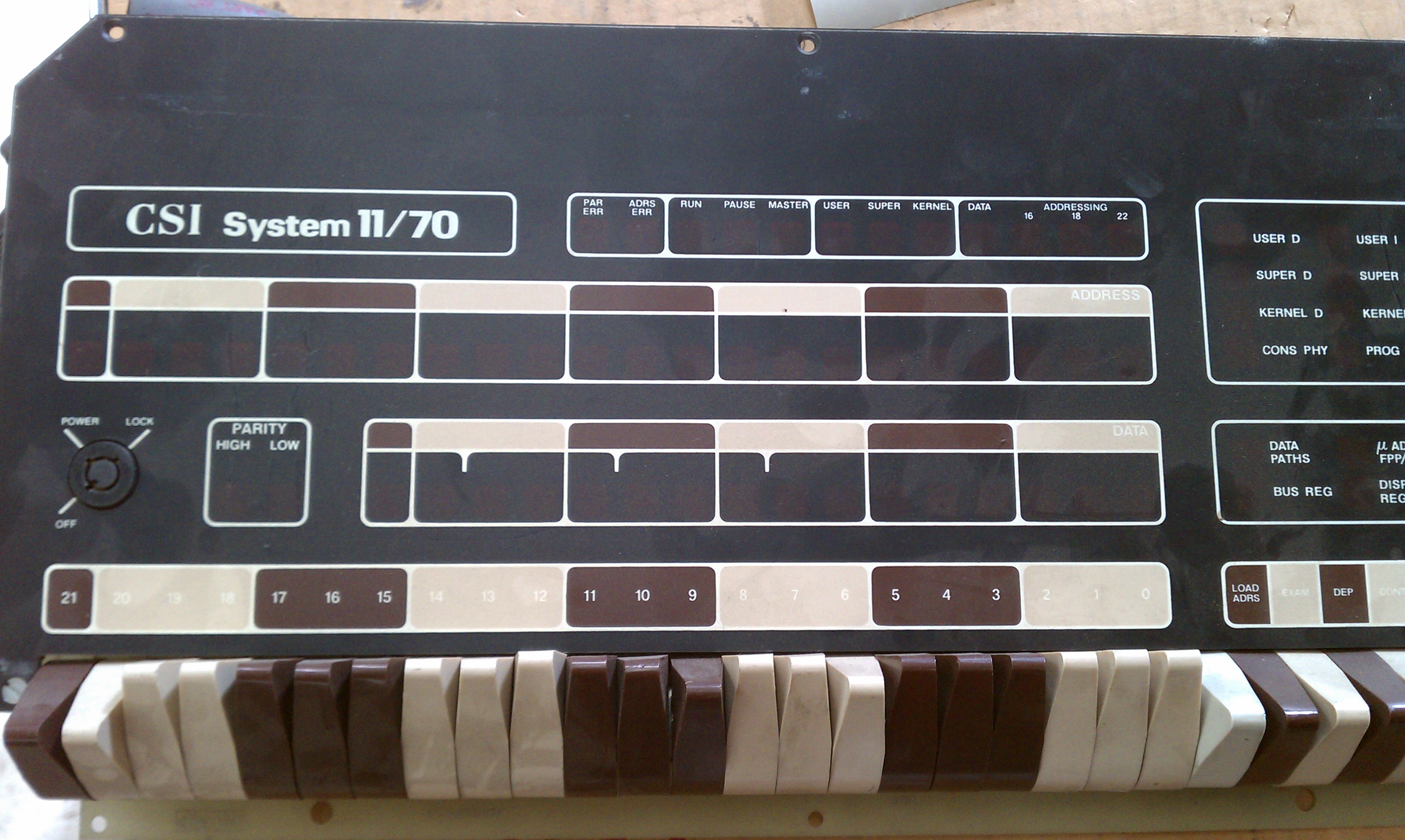
Here's a variation of the pdp 11/70 with a chocolate-brown and white color
scheme: http://661.org/images/csis1170.jpg
--
David Griffith
dgriffi at cs.csubak.edu
A: Because it fouls the order in which people normally read text.
Q: Why is top-posting such a bad thing?
A: Top-posting.
Q: What is the most annoying thing in e-mail?
On Thu, 03 Nov 2011 19:01:41 -0700, leaknoil <leaknoil at gmail.com> wrote:
> I hate thinking anything in the defense department is running on a
> vaxstation 4000 still but, it's the government after all.
On Thu, 03 Nov 2011 22:13:53 -0400, Dave McGuire <mcguire at neurotica.com> wrote:
> Besides, remember how procedure-oriented the US Gov't is. It's the
> world's best refuge for people who are incapable of independent thought,
> because there are rule books and procedure books for EVERYTHING. If
> said book says "thou shall run this on a VAX4000-96", even if a good old
> 3100-M38 would do the job just fine at about $20.00, you'll sign the P.O.
There are a lot of reasons that old equipment is (re)purchased by the Government, especially the Department of Defense. Most of the equipment in question is not sitting on someone's desk running a spread sheet, but is generally part of production equipment - especially test equipment. A production line is shut down and the contractor is allowed to close down and disperse the line. A then an action or foreign customer comes along and the contractor is called upon to reopen the line, generally on a short leash.
At that point the contractor can purchase new equipment (cheap), re-engineer and program the line (not so cheap and generally not quick), and re-certify the new line (not cheap and definitely not timely). This of course requires re-engineering and building the certification stations. Or the contractor can scrounge around and rebuild the line as originally constituted. The equipment isn't inexpensive for what it is, but the line is reconstituted by a bunch of techs in a fairly short time. The engineering and software is done and the unit stands certified as built.
A good number of years ago Hughes Aircrash shut down the TOW missile line and after storing the production equipment for a number of years was allowed to auction off the obsolete equipment. One of the many messes that we seem to be continually caught up in used up a goodly number to the missiles that were laying around and Hughes was asked to make more. They had a team of people running around buying up the old equipment wherever they could. An acquaintance got several times the new price for a HP 2115 that he had stored.
I chatted with an engineer and questioned the wisdom of buying and using old equipment. They had a bonus riding on getting production going in a fairly short period and the cost of going that route was a very, very small fraction of re-engineer the line.
The moral here is that paying $3k for an old VAX might in fact be saving $300k...
-> CRC
Well I bought a HP 9845B from a German seller, the m**** putted the whole
thing in a box with some airbags.
And of cause (TONY DON'T READ THIS) the monitor came loose of the case and
destroyed the monitor posts ;-)
Sh** why can't they pack classic computers in a decent way.
I'm getting very disappointed in epray, every time I find a nice bargain the
destroy it by shipping it the wrong way.
-Rik
On Thu, 03 Nov 2011 10:53:47 -0500, you wrote:
>> http://www.update.uu.se/~pontus/slask/front_paneler/
>
>Hey, there's one of mine on there!
>
>I didn't own the UCC 8/L when that photo was taken, but I have owned it for
>a few years now. Last time I checked, it worked, at least most of the time :-).
Not only is that Vince's PDP-8/L, it is the very same one I sold
to him (and it did "work when last turned on") :)
... and that is my picture (which I took with my Sony Mavica
digital camera back in 2003!) You can see my Tek 190A signal
generator and other odds and ends, sitting on the workbench my dad
built for me in 1977. You're welcome to use the pic, of course :)
-Charles
You all know what I meant by the vacuum 'leaking out' of a CRT, right
:-). Perhaps this analogy will help to explain why I said it.
We all know that the mobile charge carriers in most materials are
electrons with a -ve charge.
Now, suppose I take a metal sphere and charge it positively (as is done in
electrostatic experiments). In time it will discharge, it's common to say
'the charge -- the positive charge -- leaked away'.
But what actually happens, of course is that when I charged the object I
removed some of the electrons from it, leaving it with a net positive
charge, And the leackage that allowed it to discharge actually allowed
electrons to flow onto the metal sphere. So in this case, the 'charging'
means I removed some electrons from it, the 'leakage' allows them to return.
When a CRT is evacuated, the gas molecules are removed from the inside,
leaving a vacuum. When it leaks, air goes back in, returnign it to the
natural state. By analogy with the electorstatic experiment, it doesn't
seem so crazy to say the 'vacuum leaked out'.
-tony
On 2 Nov 2011, at 18:00, cctalk-request at classiccmp.org wrote:
I am summing up some answers here. I hope you are comfortable with this.
> I'm pleased to see the project opening up (release of library source,
> etc). I was a bit uncomfortable with what I perceived to be a proprietary
> approach earlier on.
We always promised and we keep our promises.
> What would really be the clincher for me is the ability to take a sector
> image of the various machines, e.g. an Apple ProDOS or DOS 3.3 "*.po"
> image and write it to a diskette. I get the impression that it currently
> has the ability to read flux transitions and extract such sector images,
> but nothing mentions the capability of re-creating a track image and
> writing them out to media.
There are several image files for some platforms, we usually support one major as there usually are other tools to convert between these.
Speaking of MFM: It's used by so many platforms that we do one generic MFM dump, which can then be further processed, e.g. by adding a header for some emulator.
> I have an interest in archiving, but I'm also an avid tinkerer with old
> hardware and often need to generate "real" diskettes from a sector image.
>
> Some of the machines I would need to do this for:
>
> Northstar hard-sector
> Amiga 5.25 and 3.5
> C64 (GCR)
> Apple 2 and 3 (GCR)
> Intel MDS system (M2FM)
> ...
>
> etc.
>
> I have technical means for all of the above now, but they are inconvenient
> and/or require dragging out and setting up something particular to that
> one operation. "One stop" shopping would be great.
>
> If the unit is capable of doing this, please advise?
I think this and the quotes below originate all from the very same misunderstanding. KryoFlux _CAN_ be used to read data that can be transformed into IPFs. It's a feature, but you aren't locked to it. Like you can use your scanner to scan something, then load it in Acrobat and do a PDF. You can chose to use whatever imaging application you like, you are not forced to convert to PDF. In this case you could as well chose to convert the image file to PDF with a third party product. It's the same here. We made our STREAM format fully documented and open as well, so you can convert to whatever format you like. Take a look into the development section on our forums, there are third party apps that process and convert data.
Looking at the formats above... DTC supports, among many others, Amiga, C64 and Apple out of the box for reading.
Writing is _at the moment_ limited to IPF because we wanted to to the most challenging part first. We will be adding more sector formats to the write engine in the near future. It's fully expandable and it was made to be easily expandable.
> Thanks for pointing that out. They are welcome to use whatever
> business/IP model they wish, but this one bothers me enough that I would
> avoid the device.
Again, I think this refers to IPF. You are not locked into this format, but I don't think it's grossly unfair to ask those that want to use it on a professional basis to pay for it. To be honest, I haven't seen anything that compares to it, and I feel there won't be anything like it soon, if at all. It's not that I don't wish there should not be, I just don't think there are many engineers out there that can design such thing. I did not invent or program it, so I think I am allowed to say this. I would also like to point out that there aren't many willing to dedicate their time to developing tools for floppy disks as the niche is very small.
> And what prevents them from "archiving" anything you send them?
This question is SPS (Software Preservation Society) related. The project's scope is about preserving computer art, which usually means games. SPS shares these files with contributors that send in the same dump (e.g. you sent a damaged dump, lateron an undamaged one comes in... you would be given access). SPS also share games preserved with archives, libraries and museums. These assets were released into the commercial marketplace. It therefore makes sense to share between institutions, because you don't have to re-analyze something if you have a good preservation asset (unless it's a different version of course). A global collaboration makes sense and was the idea of the project.
You could of course submit data as part of an assignment where SPS would be working specifically for you. This only answers your question if you would be willing to trust a contractor.
> My feelings exactly. I can't imagine any professional archive taking this group seriously, and it is
> completely opposite of CHM's policy of preserving and making available any information on underlying
> media formats that we find.
We do share information, about formats and things. Just look at our site or simply feel free to ask if it's missing. The Emulator II format we reversed was not only put into KryoFlux, but it was also put into HxC for emulation. Afaik it always was free, is free, so the decoder is right there available as open source.
I posted the link to the WIRED article, and I would invite you to e.g. speak to the British Library and find out and get first hand information about our work for them. I can name you some other archives if you like, but would prefer to do this via regular email as I can't just post client information here.
> I sent them mail saying "I would want documentatino on how to talk to
> the hardware, because your GUI will not be suitable for me" (any UI
> that's suitable to most of pretty much any market has an excellent
> chance of being somewhere between unpleasant and unsable for me).
I replied to this mail, twice. At least I tried. The first came back because you blacklisted our ISPs mailserver. I have no control over it, I don't know who and if someone uses it to spam. Anyway. I switched to my private email on my own machine and server. It was blocked again because your system tries to retrieve a whois record from the denic. As it seems, they either don't provide it there or not at all (they are the registry for Germany, so what can I do about it?) - so again my reply was blocked. I got tired and put it to rest.
My reply, in short, was that the board has all standard components. There is no firmware flashed to the board, it's uploaded from the host software. If you ever used a 1541 with custom software... it's a bit like that. So all you need is take the ATMEL SDK and write your own code. There is nothing stopping you from using your own software with the board. I could say "why not use our firmware", but that would be a binary again and you said you don't run precompiled software.
The complete schematics are supplied with the software download and you can do with them whatever you like as long as you don't sell it (schematics or boards). I think this is a fair limitation.
One last, personal thing: There were some replies with "them" or "they". It feels a bit odd, like talking about someone in third-person when he's in the room. I follow the digest, so you can address me. I am not asking anyone to share my opinion or to spare me, so keep it coming. Thanks.
On the subject of hardware, I'd like to pass along a link that
details my efforts to clone three PALs--the AT&T 6300 video display
card HAL10L8; the Soundblaster 2.0 upgrade PAL16L8 and the Trantor
T130B SCSI controller ROM address PAL16L8.
http://www.vintage-computer.com/vcforum/entry.php?314-Cloning-a-PAL-
HAL-%28Part-1%29
I don't know if I'd stick with SSI TTL for the "brute forcer", but it
worked well enough. I'd probably just use a cheap microcontroller if
I were starting afresh.
This appears to be a valid approach for pure combinatorial PALs and
HALs. Registered devices are a different matter entirely.
--Chuck
Thanks, I'll look at those.
------Original Message------
From: Dan Gahlinger
Sender: cctalk-bounces at classiccmp.org
To: cctalk at classiccmp.org
ReplyTo: General Discussion: On-Topic and Off-Topic Posts
Subject: RE: Recommend an IRC server
Sent: 3 Nov 2011 12:40
Unreal is crap. :)
check out InspIRCd
though I used to use UltimateIRC
> Date: Thu, 3 Nov 2011 10:57:48 +0000
> From: vintagecoder at aol.com
> To: cctalk at classiccmp.org
> Subject: Re: Recommend an IRC server
>
> From: Daniel Seagraves <dseagrav at lunar-tokyo.net>
>
> > I run an Unreal ircd for a friend, it doesn't suck up too much. If you
> > don't need services it should be pretty straightforward.
>
> I prefer to avoid GPL-anything but it's not always possible. I'll look into
> this one a bit.
>
> Thank you.
>
>
>
>
>
Can anyone recommend an open source IRC server, preferably BSD or MIT-style licensed, that doesn't have dependencies on scripting languages or much else? I'd like a pure C, C++ etc. solution if possible.
I'm looking for something to test socket applications against. It doesn't have to be a super duper server or have zillions of features. Something basic would be good enough, but I will want to build and run it on several platforms.
Thanks.
On Tue, 1 Nov 2011 20:53:59 +0000 (GMT), ard at p850ug1.demon.co.uk (Tony
Duell) wrote:
> You all know what I meant by the vacuum 'leaking out' of a CRT, right
> :-). Perhaps this analogy will help to explain why I said it.
>
Of course, it was perfectly obvious, although rather a nice way of
putting it I thought.
The analogy that immediately came to my mind was that of holes in a
semiconductor constituting a current of positive charges.
I suppose one could also say that debt leaks into my bank account and
is removed when my salary gets paid. All the while leaving a negative,
reducing charge of debt in the account.
/Jonas
I've been trying to contact Paul Anderson <useddec at gmail.com> for a couple
weeks but haven't gotten a reply. Does anyone know what's up? Paul, if
you're reading this, would you please contact me by private email?
--
David Griffith
dgriffi at cs.csubak.edu
A: Because it fouls the order in which people normally read text.
Q: Why is top-posting such a bad thing?
A: Top-posting.
Q: What is the most annoying thing in e-mail?
Has anyone sat down and worked out interchangeability of memory parts on
16-bit core based systems. I'm thinking in terms of things like PDP-11s
HP 21xx and DG Novas. I'm curious if anyone has compiled such a thing,
aside from direct part number comparison -- or has guidance of non-like
core stack replacement. I'm not planning on attempting to do anything of
the kind just now, but it might be useful to know what's possible as
supplies dwindle.
--Colin
----- Original Message -----
From: <cctalk-request at classiccmp.org>
To: <cctalk at classiccmp.org>
Sent: Wednesday, October 26, 2011 6:00 PM
Subject: cctalk Digest, Vol 98, Issue 78
<snip>
>You have to consider the wife factor as well. A friend of mine gave
>me an Apple //+ a while back, and she threatened to insert it in him
>rectally. I have loads of my future 8-bit computer museum hidden in
>my loft for after the divorce... (;
<snip>
(Raises hand) - so would this be an embedded processor?
Graham
> Does the diellectric strength increase back to its original value on
> cooling again? If so, then this is not really a problem if you happen to
> heat a CRT part (pin, bit of the envelope) with a soldering iron while
> working on the device.
That would seem likely since the glass was once melted in order to make
the CRT. Whether continuous arcing damages the glass permanently or not
is another question. I would guess that the heat in itself does nothing
irreversible, but arcing does.
I found this in a text about types of glass and manufacturing procedures
for CRTs. It did not mention whether the damage was reversible or not.
Your observation about connecting a glass rod across the mains and
heating it certainly supports their warnings about reduced dielectric
strength.
On the other hand, I would suppose that severe localised heating could
cause the glass to crack due to local expansion creating excessive
stresses, so I would still be very careful with the soldering iron.
/Jonas
Al Kossow wrote:
> And what prevents them from "archiving" anything you send them?
I'm not really sure what you mean by that. People send us stuff to
archive. Sure, there is not much point sending SPS stuff if it's not
in scope for the project because that project is only concerned with
preservation of unmodified and undamaged commercial software. Our
commercial venture KryoFlux does provide a service to help people
generate IPFs. That is something else entirely and completely
independent from SPS (other than the same people are involved, and it
uses technology developed for SPS). That is a professional service as
you would expect, any data generated is destroyed as per an agreed
contract.
Nothing stops anyone "archiving" other people's data. Most people
don't do it because it is unethical - I am not sure why you might
think it would be different for us?
> My feelings exactly. I can't imagine any professional archive taking this group seriously, and it is
> completely opposite of CHM's policy of preserving and making available any information on underlying
> media formats that we find.
I'd be interested to understand why you think this. What are we doing
wrong? Is it wrong to want to fund our preservation work by starting a
commercial venture? What are we not making available? We've released
the IPF library source, including an extremely accurate, cycle exact
FDC emulator. We also have tons and tons of information on the SPS
website about how things work (WIPs). IPF files contain the
information about each disk formats, and now that is open, I am not
really sure what else we can do? I am genuinely interested, because we
do want to do the right thing (even if it might take us a while).
Thanks,
Kieron
Steven Hirsch wrote:
>> From their FAQ.
>
> (snip)
>
> Thanks for pointing that out. They are welcome to use whatever
> business/IP model they wish, but this one bothers me enough that I would
> avoid the device.
That section of the FAQ is not actually completely relevant in this
case. It refers to producing IPFs. If you want to write sector images,
then there is of course no real need to create IPFs anyway in this
case I guess.
Our IPF creation software is a commercial product, and helps fund our
preservation activity. Now that the IPF library has been open source,
there isn't anything stopping somebody creating something similar of
course, so that FAQ is out of date too.
Kieron
Steven Hirsch wrote:
> I'm pleased to see the project opening up (release of library source,
> etc). I was a bit uncomfortable with what I perceived to be a proprietary
> approach earlier on.
We got there eventually at least. :)
> What would really be the clincher for me is the ability to take a sector
> image of the various machines, e.g. an Apple ProDOS or DOS 3.3 "*.po"
> image and write it to a diskette. I get the impression that it currently
> has the ability to read flux transitions and extract such sector images,
> but nothing mentions the capability of re-creating a track image and
> writing them out to media.
That is not currently supported, no. We decided to do the hardest part
first, writing IPF files, and doing it really well. As stated on our
forums, other files, such as sector images, will come later. We are
doing some C64-related work at the moment, but the plan is to support
sector images for writing next.
It almost goes without saying that, if it's sector images somebody
needs for writing, then wait for that before getting a device.
> I have an interest in archiving, but I'm also an avid tinkerer with old
> hardware and often need to generate "real" diskettes from a sector image.
Yes, absolutely. This is definitely a missing piece right now.
I hope that helps clarify things.
Kieron
On Tue, 1 Nov 2011 09:06:45 -0400, David Riley <fraveydank at gmail.com> wrote:
> For example, most cheap clock radios have one 4-pin DIP running the whole show (and it's pretty much been the same chip since the '80s). It uses the 60/50 Hz zero crossing on the AC line to keep time, which gives it very precise time (Laurent Hammond, inventor of the AC synchronized motor which ran both home clocks and the Hammond organ, took advantage of this and now the power companies must make sure that the power cycles average 60/50 Hz over the day to a few ppm, if anecdotes inform correctly) and also gives it a handy time base for multiplexing half the LED segments. Normally, as mentioned earlier, a 60 Hz refresh frequency might cause a headache, but I imagine there are holdup caps on the LEDs so they're not quite so obnoxious.
>
> - Dave
The ability to depend on time error correction on the US power grid might be going away. There was supposed to be a test starting this last summer whereby the grid was not going to be corrected. However, at the moment, it's back in committee.
See: <http://radiomagonline.com/infrastructure/power/60hz-stability-going-away-06…> for a story written prior to the scheduled test and
<http://www.nerc.com/page.php?cid=6|386> the North American Electric Reliability Corporation (the folks who set the standards) blurb on the proposed test.
Perhaps it time to start looking for some of the early GPS network time servers that started showing up in the '80s (i.e. classic) to attach to those PDP's to ensure that one is not late for lunch...
-> CRC
Does anyone here know anything helpful regarding opening an hp32sii
calculator to fix mushyness?
--
David Griffith
dgriffi at cs.csubak.edu
A: Because it fouls the order in which people normally read text.
Q: Why is top-posting such a bad thing?
A: Top-posting.
Q: What is the most annoying thing in e-mail?
Has anyone ever heard of or even seen a Zenith CruisePad?
I never even heard of it until an attorney contacted me looking for one.
If anyone has one, or just the manual would be good, please contact me.
Thanks!
--
Sellam Ismail Vintage Computer Festival
------------------------------------------------------------------------------
International Man of Intrigue and Danger http://www.vintage.org
[ Old computing resources for business || Buy/Sell/Trade Vintage Computers ]
[ and academia at www.VintageTech.com || at http://marketplace.vintage.org ]
All,
I very much need to sell off my workstation collection. There has been
essentially zero interest in my posting from last week on the subject.
I'm trying to figure out why. Is it:
- My geographical location (Burlington, VT)?
- No interest in these specific items?
- Something else?
It cannot be price, since I didn't post any and am quite flexible in terms
of negotation. Would even consider trades if the incoming item(s) take
up considerable less cubic volume :-).
If it's the location, I'm starting to explore what would be required to
properly pack and ship, e.g. a 45 lb. Sun Ultra 60 with some assurance it
will arrive in one piece. It doesn't look like anyone in the area is
setup for injected foam packing anymore, and I just don't trust the usual
foam + peanuts anymore - too many broken units over the past few years. I
think UPS and FedEx hired the chimps from the old luggage commercials to
throw packages around during loading.
If I go to the trouble and expense of buying proper boxes and InstaPak
cushioning, it's going to average about $35-40 per unit for packing -
never mind freight costs.
But, would appreciate hearing from the community with alternate ideas.
It is going to kill me if I have to drag this stuff to electronic
recycling.
Steve
--
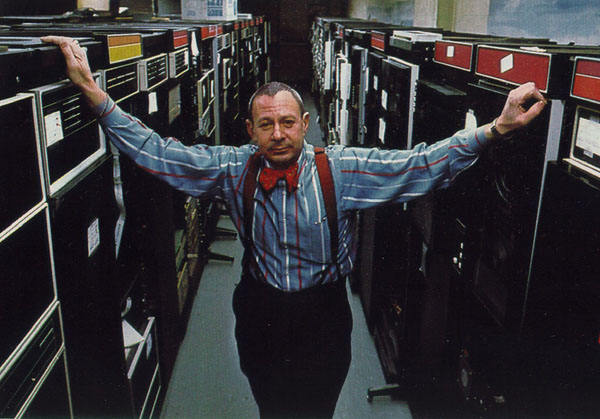
One of the coolest computer pictures ever is from the October 1982 National Geographic.
They have a picture of the proprietor of Boston's American Used Computer (one of the first well known used DEC dealers) in between parallel lineup of H960's filled with good DEC stuff.
I got to visit that place and ELI back in the 80's on a few occasions. It is a true joy to see the picture.
http://www.nixiebunny.com/sonny.jpg
Also they had a stunning picture of the Apple II assembly line circa must have been 1981 or 1982. Various brands of TV's at each workstation, floppy drives, HP frequency counters on most benches.
I think this is the whole article on the web: http://blog.modernmechanix.com/2007/04/02/the-chip/?Qwd=./NationalGeographi…
I received an email from a National Geographic documentary series and they're looking for people who have large, amazing collections.
If you or someone you know has an impressive collection of old computers, or
anything else, please contact contact:
"Julie Haire" <julie_haire at beyond.com.au>
Decimal math (hardware supported) is used heavily in financial processing with IBM COBOL. No loss of precision because the type is base 10. BCD is very similar to what IBM calls "packed decimal".
------Original Message------
From: Fred Cisin
Sender: cctalk-bounces at classiccmp.org
To: General Discussion: On-Topic and Off-Topic Posts
ReplyTo: General Discussion: On-Topic and Off-Topic Posts
Subject: Re: Fixed point financial data versus floating point - Re: Spreadsheets (was Microsoft flamage)
Sent: 24 Oct 2011 16:07
On Sun, 23 Oct 2011, Chuck Guzis wrote:
> I don't care if the radix is 2, 10 or 13. What is normally termed
> "floating point" is a slight misnomer.
Agreed.
What SHOULD we call it? (Something short and [over]simpler than "IEEE
32 bit floating point representation standard")
> It's interesting that while some vendors seem to be intent on
> dropping decimal support on CPUs, there are others proposing decimal
> co-processors-- and the POWER6 and 7 CPUs have always had decimal
> floating point capabilities.
I will admit to sometimes using some of the BCD instructions in the 80x86
family, such as AAM, DAA, etc. 'course, other than my sales tax program,
I usually use them for stuff other than BCD.
--
Grumpy Ol' Fred cisin at xenosoft.com
At 17:19 -0500 10/31/11, Fred (who else?) wrote:
>I have NEVER received a damaged package packed with used toilet paoper
>cores!
Fred, you are one of the things that make this list worth reading. Thank you!
--
- Mark 210-379-4635
-----------------------------------------------------------------------
Large Asteroids headed toward planets
inhabited by beings that don't have
technology adequate to stop them:
Think of it as Evolution in Fast-Forward.
it would appear as if the earliest versions may not have had SCSI as Allison stated. I photographed the add from a BYTE magazine, can forward it to interested parties.
It states in the add that the BIOS and utilities source code was available. Does anyone have thems? Does anyone have an early (pre-80186/V40) model surplus to their needs?
We should have some discussion on sbc's and the like.
>>
>> >> the box, and even pay some extra $$ for it? That way all the
>> people
>> >> along its shipping path will just pay more attention to it,
>> instead
>> >> just throwing it in the back of the truck.
>> >>
>> >
>> > You _are_ kidding, right?
>>
>>
>> Not at all.
>> Is it that far fetched that there would be service levels?
>
> Mybe not, but practical experience has taught me that no matter how
> much
> you pay, the package is likely to be dropped at some point. You still
> need to pack it properly, to withstand this.
>
> However careful they claim to be, things can go wrong. Personally,
> I'd
> rather spend more time in packing a rare device properly than have it
> wrecked.
>
> And to return to the ASR33, I'd not want to move one myself, say on
> the
> back seat of a car, without either tying down or reemoving the typing
> unit.
>
>> When I pay for support at an enterprise level, do I not get better
>> support, from more experienced techs?
>
> Well, I've never paied for support on anything, but however
> experienced
> the techs are, there will surely be soemthing they don't know. So
> however
> mcuh you pay, there wil lbe problems they can't solve quickly. Same
> with
> shipping old hardware. You may pay for a better service, but the
> parcel
> could still slip from soembody's hands.
>
Some years ago I was out of work and was temporarily employed in a
warehouse, packing fragile items e.g. DVD boxes, jewel cases for CDs etc
on pallets and in cartons, and driving a forklift.
Sooner or later, **everybody** who drove the forklift would either drop
a pallet from a few metres up, or cause a stack of pallets to fall over.
It was also not very difficult to have a pallet fall off the back of the
lorry when you were loading or unloading it. That doesn't mean we were
careless, just that there are a lot of things that can make accidents
like that happen: sloping loading docks, bumps in the floor, unstable
loads, a slip of the foot or your hand on the levers or pedals, someone
disturbing you at a sensitive moment, etc etc. On one occasion a lorry
driver had I think it was 6 pallets fall off his lorry all at once.
However well-meaning and careful the freighter or lorry driver or
forklift operator, inevitably someone will have a bad day, or just be
unlucky.
In other words, any number of "Fragile" labels will make absolutely no
difference at all, you will simply have to pack your item to stand
falling off the back of a lorry if you want it to arrive undamaged.
/Jonas
Hi all
I am a retro fan doing both EE and CE.
I started with ZX81/Lambda/New Brain/Commodore.
I am also the proud owner of a Mattel Battelstar Galatica anno 1979 week 14.
The chip used in this vintage handheld game is labeled B6001EA and I guess it's a Rockwell International PPS-4/1 micro controller (a PPS-4 cpu with clock, ram and rom) from sources I found on the net.
I have found very good documentation on the PPS-4 CPU chip (note the missing "/1" postfix) here:
http://www.bitsavers.org/pdf/rockwell/PPS-4_Data_Sheet_1974.pdf
And I found the owners manual for the game here:
http://www.handheldmuseum.com/Manuals/Mattel-BattlestarGalacticaManual.pdf
But I haven't been able to find any documentation on the PPS-4/1 chip that I believe is used in the game.
I found that later revisions of the PPS-4 CPU was labeled PPS-4/2 and the 'newest' one PPS-4/1 (one would guess that /1 was older than /2).
I do believe (again from internet sources) that the PPS-4/2 means that a minimal system could be made of two chips, a PPS-4/2 and a combined RAM/ROM.
So since there is only one chip in my handheld game, I guess it's a PPS-4/1 where I again take a wild guess that the above two chip minimal combination is in one chip just like most micro controllers today.
I am also guessing that since the chip ends with EA it could have a "electrically alterable" rom instead of a maskable rom.
So I would like to hear all you guys if anyone of you could provide me more information on the specific chip and if all my guesses are right or wrong.
Also if there is some way to dump the rom (without decapping the chip).
The end goal for me is to create an PPS-1 emulator (and possible running the game)
Regards
Benjamin
> Why are the LED drivers so difficult to make, is it because of the 'high' (a few mA) current ?
Most of the handheld devices of the 70's used multiplexed displays (well, still true today) and while the average LED current might be a few mA per segment, the peak current in the drivers could be ten times higher.
Some of the intended-to-be-driven-by-PMOS-driver-chips of the 70's are still around today and put to other good uses. e.g. ULN2002.
Received from a former DEC service rep.:
If anyone wants scans of a specific piece, I will probably arrange it.
This accounts for only the miniscule portion I've managed
to sort and catalog in the past 3 hours (about 1/8 of the total
number of documentation pieces I received):
Communications Options Minireference Manual, vols. 1-7
LSI-11 Systems Service Manual, Vols. 1-3
VAX 8600/8650 System Diagnostics User's Guide
Communications Options Minireference Manual
VAX/VMS Internals and Data Structures
Cartridge Tape Service Documentation
TK50 Tape Drive Subsystem Owner's Manual
TK50 Tape Drive Subsystem User's Guide
TK70 Streaming Tape Drive Owner's Manual
TK70 Streaming Tape Drive Subsystem Service Manual (MicroVAX II sys.)
ThinWire Ethernet COAXIAL CABLE CONNECTOR INSTALLATION CARD
H4000 DIGITAL Ethernet Transceiver Installation Manual
Fiber Optic Attenuator Installation/Configuration Reference Card
LA120 Series Pocket Service Guide
LA10X-EJ/EL Tractor Option Installation Guide
DECWRITER III LA120 Operator Reference Card
LCG01 Color Printer System Pocket Service Guide
MicroVAX 3600/VAXserver 3600/3602 Operation
KA650 CPU System Maintenance
MicroVAX 3600/VAXserver 3600/3602 Technical Information
ULTRIX-32 Guide to the Error Logger System
LJ250/LJ252 Companion Color Printer Pocket Service Guide
LN03 Pocket Service Guide
RF-LN03 Pocket Service Guide
VAX 6200 Options and Maintenance
VAX 6200/6300, VAXserver 6200/6230 Owner's Manual
VAXstation 2000 Workstations and MicroVAX 2000 Network Guide
ULTRIX-32 Basic Installation Guide for the VAXserver 2000
DECstation 2100/3100 Maintenance Guide
MicroVAX 2000 Installation
MicroVAX 2000 Operation Addendum: VAXserver 2000
MicroVAX 2000 Operation
MicroVAX 2000 Troubleshooting
MicroVAX 2000 Technical Information
MicroVAX 2000 Customer Services
VAXstation 2000 and MicroVAX 2000 Maintenance Guide
VAXstation 3100 Maintenance Information
VAXstation 3100 Illustrated Parts Breakdown
VAXstation 2000 Hardware Information
VAXstation 2000 System Guide
VAXstation 2000 Network Guide
VAX 6000-400 Options and Maintenance
VT100 Series Pocket Service Guide
VT180 Series Pocket Service Guide
VT320 Pocket Service Guide
VT330 Pocket Service Guide
VT340 Pocket Service Guide
VAXcluster Service Reference Manual
VAXcluster Service Reference Set
VAX 8530/8550/8700/8800/8820/8830/8840 System Maint. Guide
8800 8700 8550 8500 Console User's Guide
B213F Expander Installation
R215F Expander Maintenance
KA655 CPU System Maintenance
VAX Architecture Reference Manual
CI750 User's Guide
BA11-A Mounting Box and Power System Tech. Manual
VAX-11/750 Diag. System Overview Manual
VAX-11/750 Level 1 Student Workbook (Digital Internal Use Only)
VAX-11/750 UNIBUS Interface Technical Description
VAX-11/751 User's Guide
DELUA User's Guide
MicroVAX 2000 Hardware Information
MicroVAX
VAX 8200/50, 8500/50
The Digital Dictionary, Second Edition
VAX Maintenance Handbook (VAX Systems)
VAX Maintenance Handbook (VAX-11/780)
VAX Maintenance Handbook (VAX-11/750)
VAX-11/750 Mini Diag. Ref. Guide
RM05 Disk Subsystem Service Manual
RM05 Disk Subsystem Student Guide (Digital Internal Use Only)
RM03 Disk Drive Maint. Print Set
RP04/05/06 Field Maint. Print Set
Symptom Directed Diagnosis Tool Kit Installation Guide
VAXsimPLUS Field Service Manual
Getting Started with VAXsimPLUS
VAXsimPLUS User Guide
Model 733 DEC Disk Storage Drive Parts Catalog, Jan. 1976
RP04-TC Part II
RP04, RP05, RP06 Field Svc. Handbook
HSC50 Service Manual
HSC Installation Manual
VAX 86XX System Maint. Guide
RP05/RP06 Field Handbook -Company Confidential-
RP05/06 677-01/51 Disc Drive Illustrated Parts Catalog
Model 677-01/51 RP05/06 DEC DISC MAINTENANCE Guide (Educ. Svcs.)
Digital Education and Training: UNIX Utils & Cmds. Student Guide
So I got this article from someone and the part about Xerox PARC caught my eye..
Personally I think he is missing some pieces to his story, but I figured I would post here and get a discussion going.
http://www.cultofmac.com/126863/in-defense-of-steve-jobs/
> From: wh.sudbrink at verizon.net
> To: cctalk at classiccmp.org
> Subject: RE: Seeking advice on shipping an ASR33 Teletype
> Date: Fri, 28 Oct 2011 10:17:09 -0400
>
> Nick Jarmany wrote:
> >
> > All recommendations gratefully received!
> >
>
> The typing unit _MUST_BE_ screwed to the base via
> the shipping screws. Otherwise, it will bounce
> around and break the plastic cover and possibly
> itself as well. You will really need someone on
> site that knows a little about the unit.
>
Hi
I also recommend removing the motor as well. It unbalances
the unit and makes it shift in any loose packing.
Dwight
I have some drives I?m trying to find the manuals for, I have 2 Chinon, a
FZ-502 and a FZ-506 and a toshiba 360K drive that I?d like to find manuals
for. Chinon has long since stopped making drives and I was unable to find
any information on their site for disk drives and no luck on the toshiba
site. These were tested good about 10 years ago, but I no longer remember
what they were tested in and do not know the jumper settings I need on them
for sure (and some of the jumpers are not labelled :(
Hi folks,
I've recently acquired a DEC LN03 laser printer with spare toner and
font cartridges. I'm informed it was working a few years ago when last used.
Something about it makes me think I better find out more before I turn
it on again for the first time. There is a little information on the
internet about toner replacement - I was wondering if I could call on
collective wisdom to find out what the best course of action is to
ensure success when I first hit the power switch.
For example, the words toner collection bottle and ozone filter make me
think I should know a little more first!
Thanks for the help, Mark.
--- On Fri, 10/28/11, Eric Smith <eric at brouhaha.com> wrote:
> From: Eric Smith <eric at brouhaha.com>
> Nope, they do it themselves.? The ground service was
> created when they acquired RPS.
I believe this is true of their commercial ground delivery service,
but was told at one time that the FedEx Home Delivery drivers are
actually independent contractors.
I've mostly had good luck with FedEx Ground shipments, and would
even say that I've usually seen less externally-visible indication
of rough handling compared to UPS.? There was one egregious incident,
however, when a FedEx delivery driver dropped off a TU-56 on my
doorstep while I was out of town.? I had specifically asked the
shipper to require a direct signature release to preclude such a
delivery.? When I checked the tracking paperwork online, my name
was signed on the paperwork, undoubtedly forged by the driver.
--Bill
Most of us on this list are computer professionals, and our most important
asset is probably our good name and a reputation for integrity and
confidentiality; as such we also often have access to or even first dibs on
equipment that's being upgraded or scrapped but is often still quite
serviceable and useful once it's been cleaned up, confidential data erased,
disks reformatted, etc.
Being 'in the business' and having somehow collected 20 or 30 still quite
serviceable P4+ systems but having run out of relatives, friends and friends
of friends to give them to, I decided to explore and join the local
Freecycle group a few weeks ago. After finding a happy new home for some
items and also picking up a few items to repair and pass on or keep for
myself, the list traffic suddenly stopped; when I inquired I was rudely told
that I had been (unjustly) accused off-list of 'stealing' from someone's
porch a broken laptop that I had inquired about but that had been promised
to someone else, and without any notice or opportunity to respond I had been
summarily banned and was even threatened with police involvement.
I think as trusted industry professionals we should all ask ourselves
whether the risk to our reputation that this sort of thing can have is worth
it or if we should just let these items go to Asia or into landfill, and if
we do in fact deal with people outside our community we should probably make
sure that we maintain a separate identity from our professional one.
Has anybody else had any experiences like this, and regretted trying to find
new homes for slightly outdated equipment? Comments?
mike
This isn't old computers but still old tech and as I have talked to people on
this list about these before I thought I would check here first before dumping
them.
I have a collection of about 300 CED (old video format similar to an old record)
and a couple of players that I want to move out. If anyone here is interested
contact me off list. I prefer local pickup as these are VERY HEAVY but if you
really want to pay to have them shipped then I might consider it for a few
dollars more. I don't have a current list of the movies and am not interested
in parting it out, just want to move them on out.
Thanks.
-----
David Williams
http://www.trailingedge.com
Looking over all the stuff on the HP 35s, I shrugged and bought a used
32sII. Does anyone here know what it would take to get someone at HP to
seriously listen to the bug and misfeature complaints and come out with,
say, a 35sII that fixes these problems?
--
David Griffith
dgriffi at cs.csubak.edu
A: Because it fouls the order in which people normally read text.
Q: Why is top-posting such a bad thing?
A: Top-posting.
Q: What is the most annoying thing in e-mail?
This forum was recommended to me as a place to find people who appreciate
vintage computing technology, so it seems like an appropriate place to
advertise this:
A PDP 11/70 Front Panel -
http://cgi.ebay.com/ws/eBayISAPI.dll?ViewItem&item=280758702820&
Reference material:
http://www.hampage.hu/pdp-11/1170.htmlhttp://en.wikipedia.org/wiki/PDP-11http://www.village.org/pdp11/faq.pages/pricing.html
The PDP-11/x was perhaps the best selling, most powerful series of
supercomputers in the world, going through over ten major revisions in it's
lifecycle. A PDP-11 setup would cost tens, if not hundreds of thousands of
dollars. It often required a whole team of people dedicated to overseeing
it's operation and managing it's moment-to-moment usage. They were used in
everything from business, science and academic research applications to
real-time control applications (PBX, traffic, industrial).
This is the front control-panel and user interface to the PDP-11/70. It's
been in storage for some time and the condition is unknown, but with minimal
signs of wear and tear it looks able to be restored to functional condition.
Get a legendary piece of computer history right here. You'll have a hard
time finding many like it.
I have just managed to purchase a Teletype on Ebay - something I have been yearning to obtain for a long time!
However, the item in question is located in Ohio, US and I would like to ship it to Italy.
Clearly it will need properly crating up by someone and freighting (I assume by sea?) across the pond to me.
The vendor no doubt does not want to get involved in much of this.
So, my question to all of you out there is - do any of you know of a shipping company that can package up an item like this suitably and arrange transportation? The ASR33 is (thankfully) complete with all accessories such as stand, paper holder etc. I can probably persuade the vendor to remove these accessories from the main unit, but probably not much more.
I am hoping some of you will have faced similar issues and might be able to provide good advice.
All recommendations gratefully received!
Footnote:
Given the nature of this forum I am sure I don't have to explain why I would be purchasing such an item. But as a bit of background I was fortunate to go to a school in SE London (Alleyn's) in the early 70s that had an ASR33 and an acoustic modem link to Queen Mary College (QMC) - a dual ICL 1904S system running QMC Maximop as I remember. I hate to think what the phone bill was like, as the ASR was in use continuously all day every day. This resource created a number of very talented young programmers at the school. One guy wrote a complete Monopoly program in Basic. I learnt a language that fascinated me by its quirkiness - Snobol4 (and Spitbol). I did an 'O' level project that was a line editor program written in Snobol4.
In about 1975 the school obtained an IBM card punch machine that was used to prepare batch jobs that were taken by hand to be run on an IBM 360 (I can't remember where). I still remember marvelling at the tall vertical deck of cards being swallowed at a rapid rate by the reader, with forced air being used to separate the cards. Great stuff!
We were also donated an Elliot machine (I think it was a 903 from photos I have found on the web) that had a high speed optical paper tape reader and punch sitting on the top. The main machine itself looked like a very large, double width washing machine. Removing the front panels revealed the magnetic core store. The system was booted by entering the initial instructions via toggle switches on the control panel, after which further programs could be loaded by tape. The process of creating and running a program was very tedious, as compiling, linking etc each required the individual program to be loaded and an output tape created that was used as the input to the next stage. This all required continuous use of the desk mounted paper tape winding machine that was hand operated and geared up to enable rapid winding. However, accidents (and broken tape) were a constant danger of using this device. We were always having to make duplicate tapes of Fortran compilers etc.
The last arrival at the school was a CDC VDU terminal that had a high speed (I guess a few kbps) synchronous connection to a commercial computer bureau in London that had a major CDC Cyber mainframe, not sure which model? As I remember the company was called "SIA" or something similar. I once visited the control room and marvelled at the control console, which looked like something out of a space ship! Time on this computer was very expensive, so the school had a strict limit on CPU time.
Unfortunately all this history came to a sorry end when a fire in the building that housed the computer room destroyed all the equipment - very sad.
That's might bit of computing history, and is why I was attracted into the fantastic industry.
Nick
______________________________________________________________________
This email has been scanned by the MessageLabs Email Security System.
For more information please visit http://www.messagelabs.com/email
______________________________________________________________________
I had an ASR33 shipped to me from the US. I had the vendor ship the machine
in 3 different boxes. The case, base&typing unit, and stand were in
separate boxes with plenty of packing.
The cost of shipping was high, but the machine arrived in tact. Shipping
the machine from Seattle to Calgary was about US$350.00.
I would recommend having a piece in a box within a box with plenty of
padding between the item and between the inner/outer box should allow the
item to survive. The heavier the box, the more likely it will suffer
rougher handling.
--barrym
On Fri, Oct 28, 2011 at 8:17 AM, Bill Sudbrink <wh.sudbrink at verizon.net>wrote:
> Nick Jarmany wrote:
> >
> > All recommendations gratefully received!
> >
>
> The typing unit _MUST_BE_ screwed to the base via
> the shipping screws. Otherwise, it will bounce
> around and break the plastic cover and possibly
> itself as well. You will really need someone on
> site that knows a little about the unit.
>
>
Hi all -
Just picked up a complete (but rough) IMSAI VDP-80 with what appears to
be a complete set of manuals (and a few unlabeled 8" disks which I'll
attempt to make images of). Anyone know if these manuals have been
digitally archived anywhere? A cursory search doesn't reveal anything
promising; This site
(http://www.retrotechnology.com/herbs_stuff/d_imsai.html) has them
listed (for a price) but that's about the only reference I can find.
I don't have any means to scan these in, but I'd love to see them
preserved...
Thanks,
Josh
On Tue, 25 Oct 2011 20:47:13 +0100 (BST), ard at p850ug1.demon.co.uk (Tony
Duell) wrote:
>> Given that there are devices for easily breaking glass that are
>> > essentially sharp points, would a jab from a soldering iron be able to
>> > implode a CRT? I've done this by accident several times. Before anyone
> Possibly. The soldering iron is hot which could set up thermal stresses i
> nthe glass too. I do know that soldering to a socket contact while the
> socket is plugged onto a CRT or valve can damage the glass-to-metal seal
> around the pin, for esample, and is thus a bad idea. Thist doesn't
> normally cause an implosion, but...
Heat is seriously ungood for CRT glass. It reduces the dielectric
strength of the glass which can lead to arcing through the glass.
Prolonged arcing will hole the glass, thus venting the vacuum and
destroying the tube. Magnetic deflection yokes need to be designed not
to run too hot, the glass needs to stay well below 100 degrees C. Above
120 deg C the glass has not much dielectric strength left.
/Jonas
Chuck Guzis wrote:
> Microchip is a very strange outfit when it comes to the PIC32. Like
> the R4000, programming on the PIC32 is present as JTAG. However
> Microchip incorporated a rather convoluted version of their SPI
> protocol that's translated into JTAG on the chip. I'm sure it sells
> a lot of PICKIT programmers, but otherwise, it's been a mystery to me
> why this was done. Could it be that JTAG is more or less industry
> standard for this sort of thing?
JTAG is a serial protocol that communicates to one or more chips on a JTAG
bus. It is commonly used as the debugging vehicle for some CPU families.
It communicates between a host computer and the debug subsystem within a
target CPU to allow:
1. Run-time debug and breakpoint operations.
2. Boundary-scan that lets you emulate the CPU for the outside circuit.
3. Flash programming since it can be used to generate memory bus cycles.
Vendors often use proprietary serial mechanisms for their pods and JTAG
functionality. I would presume this is to make sure you buy their tools.
Amardeep
> http://www.ebay.com/itm/Steve-Jobs-Pixar-Image-Computer-Museum-Quality-Arti…
Just trying to connect old mid-80's articles I hadn't thought of in decades, to reality... is this what's described in https://design.osu.edu/carlson/history/PDFs/pixar-image-processor.pdf
They describe a $125K price in 1986 dollars for a complete system (e.g. not just the pedestal.)
I did some work with ECL based backprojectors in the era immediately before and the VME based stuff with gate arrays and a Sun front end, and then a little later Tahoe front end, was coming in like gangbusters at the time for many of the industrial/medical applications.
>
> I've never worked with the ColdFire, but because of my interest in Alpha
> Micros I've always been curious (near the end of the 68K Alpha Micro phase
> there were ColdFire-based servers produced -- I presume with some sort of
> emulation layer for those instructions not supported on ColdFire that were
> on, say, the '040). How was it to work with compared to a "stock" 68020 or
> '030?
>
They're very nice to work with. I wish I'd had the chance to do more than
three or four projects with them. As Dave mentioned, the ARM has just
overtaken them in price/performance in most areas and since (at least the
models I used) didn't have a memory manager they could not run a full
Linux. The single process uCLinux was fine, however.
But they were just fantastic with MQX, eCos, and ThreadX. For eCos it was
the cygwin-based GNU toolchain, an old familiar friend and I appreciated
that. For ThreadX it was WindRiver's Diab under Workbench. Decent enough
but the Eclipse framework it's based on was a bit piggish at the time.
Today's computers should have no problem with it though.
The MQX project was done under CodeWarrior which was nice. That was just a
board bring-up and Ethernet demo deliverable. Didn't do too much beyond the
startup code, RAM Test, and a couple of threads to blink an LED and respond
to an echo server. The customer just wanted a ready to go platform to
develop their app.
Incidentally, there is a relatively cheap way to get into CodeFire
development:
http://www.dilnetpc.com/dnp0052.htm
The nice thing about this kit is the entire CPU module is on a small board
with dual-inline pin arrangement that can be mounted on a hobbyist prototype
board. They don't have the price listed there but I think it was $130 ~ 160
or so. It came with a working eCos build and tool set so it was quite a
value.
If you're going to design a custom board you'll also need a BDM JTAG probe
which costs $250. It's the only way to program the chip's flash with a boot
loader the first time.
Amardeep