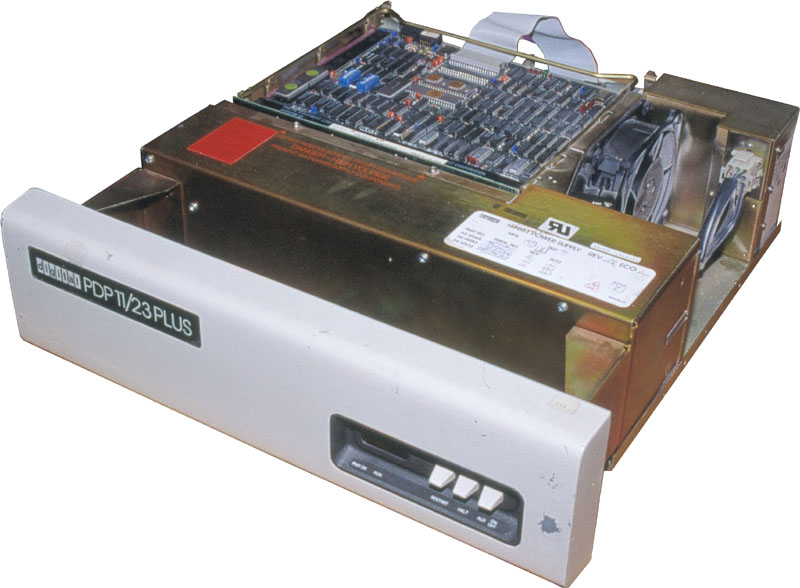
From: Steven Wilson <stevew at ka6s.com>
> >What are the Burroughs L-series computers? I started working for
> >Burroughs just before the Sperry merger and I guess I missed the
> >L-series.
>
> >I collect B1000 stuff (or, I would collect it if I could find
> >anything) and acquired a bunch of B20 systems a couple of years ago,
> >so I collect them now.
>
> >Other than a museum that asked me if I ever found a B1000, I haven't
> >found any other collectors of Burroughs stuff.
>
> >alan
>
> That's funny - I use to design them ;-) I was a CPU design engineer on
> the last two iterations of the B1000 (B1955/B1965). (Hans P should
> probably saw something next ;-) Curious what you've got in your
> collection?
Note my line about "if I could find anything". All I have is printed stuff.
The one thing that comes to mind is the "Inside Your Living MCP" material
that Art Sorkin wrote.
I was tempted to contact some of the old customers and see if they knew the
disposition of their B1000s, but most of them were in England and it has now
been around 20 years since they were using them. (As I have mentioned here, I
did bug fixes on B1000 GEMCOS from 1986 to 1989.)
> I'd buy a B1965 if one ever were available! ( I should be able to help
> with B1955 too if anyone has one..) I should be able to help get one
> running again if required.
Same here. Well, as far as buying a B1965 goes. I did most of my work on a
B1965. The closest that I have gotten to finding a B1000 is a B1855 (I think
that was it) that was at Fort Lewis (WA) and taken out of service in 1997. I
was only three years late getting to it.
alan
Date: Tue, 03 Jan 2006 13:10:54 -0800
From: "Chuck Guzis" <cclist at sydex.com>
Subject: Re: Speaking of 6502s, was Re: 70's micros still available -
was 1802 problems
>how many lanugages were implemented on the 6502, as contrasted
>with the x80? Was there ever a 6502 COBOL, FORTRAN or PL/I? (I honestly
>don't know, but I suspect that FORTRAN may have existed). The picture
>might have been quite different, given the 6800 architecture.
>Cheers,
>Chuck
--------------------------------------
AIM65 (again ;) had PL/I, (called PL/65) - also on Rich's site.
Most languages were ported to the PET (although some were for the 6809
in the dual-processor SPET):
Ada, APL, Assembler, BASIC (interpreted and compiled), C, Cobol, Comal, Forth,
Fortran, Lisp, Logo, Mumps, Pascal & Pilot, to name a few.
mike
Thanks to comments from Tony, Julian and Henk, I think I now understand
how this thing works.
I'm not _quite_ ready to power up the CPU so I haven't confirmed the AUX
ON/OFF front panel switches functionality, but based on the responses,
it seems clear what I should expect.
I have, however, confirmed the functionality of the Local On and Remote
On settings on the 874 itself, and can confirm that the 3-conductor link
between the two 874's is doing it's job properly.
In response to Julian's interest, here's the configuration of this
11/23+ system:
- KDF11-BA processor
-- 512MB (MSV11-PL)
-- x2 4-line serial muxes (DZV11)
-- a single line (DLV11)
-- Controllers for the drives (RLV12 & RXV21)
- x3 RL02 w/ a handfull of diskpacks
- RX02 dual-drive
- x2 VT100
- x2 VT102
- LA120
As I mentioned in the original post, this is all housed in a dual-wide
40" roll-away cabinet (frankly, I have no idea what it's model
designation is) with two side-panels/uprights and a connecting 'panel'
in between.
And, I've got an ASR33 on hand that I might hook up later, for grins.
I've got RT11 on the disks right now, and though my eventual goal is to
get RSTS running (thanks, Julian, for the offered assistance!), I'm
actually going to spend some time with the RT11 first, getting familiar
with that, also for grins.
Again, thanks to all for the heads up on how this power gear works.
J.
I have what I believe to be most of a VAXstation 8000. It is about the size
of a MV-II, but it is about 10" longer. The front 8" hinges open so you can
get to the back of disk drives. It holds a bunch of 5 1/2" disks. The sides
open like a clam shell. The the VAXBI card cage is in one side. There is
room for a second card cage. I belive that this is where the ES graphics
card cage goes.
At 12:28 AM 1/4/2006, you wrote:
>On 1/4/06, 9000 VAX <vax9000 at gmail.com> wrote:
> > On 1/3/06, Ethan Dicks <ethan.dicks at gmail.com> wrote:
> > >-
> > > I don't have one, but I remember running into them at DECUS
> > > conventions...
>
> > and with a VAXBI bus and a slow CPU (maybe same as VAX8250/8350)
>
>I don't recall them being VAXBI-based. My recollection was that they
>were Qbus-based - essentially a VAXstation-II/GPX, but with *much*
>more powerful graphics cards.
>
>Anyone with actual experience (mine was limited to pushing the mouse
>around and twisting the dialbox knobs) can feel free to chime in with
>corrections/details.
>
>-ethan
Michael Thompson
E-Mail: M_Thompson at IDS.net
On Jan 4 2006, 8:22, Gooijen, Henk wrote:
> Hi Richard,
> I have one 11/03, but AFAIK (I'm at work now) there is no switch
> on the front panel of the 03 to control on/off.
There should be, on all BA11-M, BA11-M, and BA11-S boxes (except some
expansion boxes that have no LED/switch panel at all) though depending
on the box, it may be labelled LTC or AUX.
See, for example, http://hampage.hu/pdp-11/1103.html It's the
rightmost of the three switches on the panel. Also
http://www.abc80.net/pics/PDP11-23_cpu_2_big.jpg
--
Pete Peter Turnbull
Network Manager
University of York
Hi Mark
I am looking for the following items can you help?
018-0495-001 Cable
018-0496-001 Cable
013-1203-001 I/F
012-1204-001 I/F
Alun
Computer Support Services Specialising in Image Graphics and Unix Systems.
Alun Jones Director
Systemextra Limited, Woodyard House, Daux Road, Billingshurst, West Sussex,
UK RH14 9SJ.
Tel: +44 (0)1403 784754 Fax: +44 (0)1403 783921
email: systemextra at systemextra.ltd.uk
http://www.systemextra.ltd.uk <http://www.systemextra.ltd.uk/>
*
"This E-mail is only for the use of the intended recipient and may contain
confidential information. If you have received this E-mail in error, please
notify the sender immediately, delete the E-mail and do not use or
disseminate its contents."
On Jan 4 2006, 8:13, Pete Turnbull wrote:
> There should be, on all BA11-M, BA11-M, and BA11-S boxes
^
The second item was meant to be BA11-N, of course :-)
--
Pete Peter Turnbull
Network Manager
University of York
So, what I said ("there is no switch on the front panel of the 03
to control on/off") is still true :-) , but I had not thought of
using LTC (or AUX) for that!
Using that switch to turn on/off power to the 11/03 via the 861
is a nice idea. But checking the LTC/AUX wiring before 'mis'using
the switch for on/off control is indeed even more clever :-)
thanks!
- Henk.
> -----Original Message-----
> From: cctalk-bounces at classiccmp.org
> [mailto:cctalk-bounces at classiccmp.org] On Behalf Of Pete Turnbull
> Sent: woensdag 4 januari 2006 9:13
> To: General Discussion: On-Topic and Off-Topic Posts
> Subject: Re: DEC 874-A Power Conditioner
>
> On Jan 4 2006, 8:22, Gooijen, Henk wrote:
> > Hi Richard,
> > I have one 11/03, but AFAIK (I'm at work now) there is no switch on
> > the front panel of the 03 to control on/off.
>
> There should be, on all BA11-M, BA11-M, and BA11-S boxes
> (except some expansion boxes that have no LED/switch panel at
> all) though depending on the box, it may be labelled LTC or AUX.
>
> See, for example, http://hampage.hu/pdp-11/1103.html It's
> the rightmost of the three switches on the panel. Also
> http://www.abc80.net/pics/PDP11-23_cpu_2_big.jpg
>
> --
> Pete Peter Turnbull
> Network Manager
> University of York
This message and attachment(s) are intended solely for the use of the addressee and may contain information that is privileged, confidential or otherwise exempt from disclosure under applicable law.
If you are not the intended recipient or agent thereof responsible for delivering this message to the intended recipient, you are hereby notified that any dissemination, distribution, or copying of this communication is strictly prohibited.
If you have received this communication in error, please notify the sender immediately by telephone and with a "reply" message.
Thank you for your cooperation.
On Jan 3 2006, 20:40, Julian Wolfe wrote:
> AFAIK, there's only one panel for all 11/03, /23, and /23+ models,
they just
> come with different badges. You need a DEC power bus cable. Run it
from
> the connector on the CPU box to the power controller, set it to
"remote on",
> and flip the far right switch. Viola, power from the front panel.
Yes, but... on some QBus systems the switch is jumpered to control the
LTC (Line Time Clock signal) by grounding the BEVENT bus line. You
ought to check the jumpers on the little electronics board before you
wire an unknown system to the power bus. I've accidentally done it
with the wrong jumper settings and it's done no harm, but YMMV.
BTW, the connectors for the power bus are standard 3-pin AMP Commercial
Mate-N-Lock conectors, which are fairly easy to get.
--
Pete Peter Turnbull
Network Manager
University of York
> My guess is that it is not transitioning into 8088 mode correctly.
Figured it out - There is one fundamental difference between 16-bit mode of
the CPU 8085/88 and the CPU 8086/8087.
It needs RAM at FFFF0 in order to start correctly.
With the 8086/8087 the Disk-1A puts it ROM at FFC00-FFFFF which boots
the system. Since the 8086 has it's vectors at 00000, it never needs "high
RAM" again. With the 8085/8088 the system starts in 8085 mode with the
boot ROM at 00000. The loader (from disk) tries to write a JMP to FFFF0
before starting the 8088 - this was failing because I didn't have RAM there.
Putting my 64k board at Fxxxxx cured the problem and now it boots CP/M-86
reliably.
--
dave04a (at) Dave Dunfield
dunfield (dot) Firmware development services & tools: www.dunfield.com
com Collector of vintage computing equipment:
http://www.parse.com/~ddunfield/museum/index.html
Hi Richard,
I have one 11/03, but AFAIK (I'm at work now) there is no switch
on the front panel of the 03 to control on/off. However, if your
11/03 is mounted in a (small) rack you can add a simple plate
with an on/off switch. Any small switch will be fine, because
you switch approx. 20 VDC, not 230 VAC (or 115 VAC).
All the power bus connectors have 3 pins, and they are all wired
in parallel. IIRC, the middle pin is the return-GND, and when
looking at the plug-in side of the socket on the power controller,
the left one is power-on.
A simple test will confirm this. Just set the small switch to
"remote" and the short-circuit the 2 left-most pins.
If the main relay "bangs" in you got the correct 2 pins :-)
Wire the 2 pins to the small switch at the front side and you
have made the remote turn-of/off option :-)
- Henk.
> Hey! This is sounding familiar! My 11/03 has an 861 power
> controller on it and I have the three-position toggle switch
> as well. Thanks for explaining what those settings are! I
> had no idea what this meant when I first got the machine, but
> I had the switch set to "local on"
> and then the unit would power up.
>
> However, this idea that there's a way to powerup from the
> front panel on an 11/03 intrigues me! Unfortunately I see no
> obvious button that powers up the machine. Is this possible
> with an 861 and if there is not existing switch, what would
> you add to enable this feature?
> --
> "The Direct3D Graphics Pipeline"-- code samples, sample chapter, FAQ:
> <http://www.xmission.com/~legalize/book/>
> Pilgrimage: Utah's annual demoparty
> <http://pilgrimage.scene.org>
This message and attachment(s) are intended solely for the use of the addressee and may contain information that is privileged, confidential or otherwise exempt from disclosure under applicable law.
If you are not the intended recipient or agent thereof responsible for delivering this message to the intended recipient, you are hereby notified that any dissemination, distribution, or copying of this communication is strictly prohibited.
If you have received this communication in error, please notify the sender immediately by telephone and with a "reply" message.
Thank you for your cooperation.
The Tektronix 4052 and 4054 series table top graphics computers were
also 2901 based.
Bob
Message: 14 Date: Fri, 30 Dec 2005 18:20:30 -0700 From: Richard
<legalize at xmission.com> Subject: AMD bit-slice machines To:
cctalk at classiccmp.org Message-ID:
<E1EsVQ6-0004lt-00 at xmission.xmission.com> Besides the Lilith Modula-2
workstation, what other computers were made from the AMD 29xx bit-slice
architecture?
--
Re: my PDP-11 (KDF11-BA QBus CPU) with RL02 and RLV12 controller:
Although I can read from my RL02 fine, and run the various XXDP
diagnostics, any attempt to *write* to the disk instantly causes
the heads to retract, the LOAD light to go out, and the FAULT lamp
to stay on. The write protect lamp works with the button and was
not on.
Running the diagnostics VRLB?? (Diskless Controller Test) & ZRLG??
(Controller Test 1) pass with no errors.
However, ZRLH?? (Controller Test 2, the first test that writes to
the disk) fails as follows:
CZRLH DVC FTL ERR 00300 ON UNIT 00 TST 002 SUB 000 PC:015044
RLCS HAD FOLLOWING ERR(S):
COMP DRV
WRT OP-INTR MODE
BEFORE COMMAND CS: 000313 BA: 003426 DA: 000000 MP: 000000
TIME OF ERROR: CS: 140312 BA: 004026 DA: 000001 MP: 000667 003400
174000
followed immediately by another fatal error "COMP OPI RD HDR
OPR'TN-FLAG MODE".
While the RL02 was still in Fault mode, I also entered the
"Toggle-In Program" from the RL02 Disk Subsystem User's Guide,
Appendix C and it returned 102210 which is WGE (Write Gate Error)
i.e. either Write Protect was set, or a sector pulse occurred
during the write operation.
I think I should be looking inside the RL02 on the logic board but
can someone with more diagnostic-pack experience tell me if this
is actually a controller problem?
thanks
Charles
Hi Philip,
thanks for your comments!
> > Can the code be modified (e.g. is it possible to implement
> > an other CPU?)?
> The Inverse Assembler toolkit was on Agilent's FTP site a few
> years ago. I'm not sure where you could get a copy now, though.
> The assembler works fine on pretty much any machine, but IALDOWN
> is very fussy.
I did some search and was not able to get hands on a
copy of the "Inverse Assembler toolkit". :-( But still I
think, that the source code of IALDOWN might be interesting
fo lot of people using 1600 analyzers. Since you used the NI
library it should be easy to port it to other libraries:
the NI library is somthing like standard for GPIB. Maybe
I will be able to locate the "Inverse Assembler toolkit" in
the future and than I'd be interested, too!
Maybe the linux-gpib-project's people are interested as
well (search for "hp1630 logic analyzer sourceforge" within
google groups).
Last but not least I consider the HP1600 analyzers very
well suited for debugging and maintaining classic comps
and I am happy to have one ;-)
Best regards,
Erik.
> Why isn't there a hint on bitsavers - like a cgi which calls "du
> -h"....?
The issue hasn't come up before. Generally people have asked before
mirroring the site. It is around 43gb right now.
Also, I'd prefer that people use ftp rather than things like Wget
for mirror maintenance.
Wget's of the whole tree sets off a bunch of red flags which
normally results in your IP being blocked at the firewall
(This happened twice today..)
Does anyone have one?
They apparently were crappy designs and tended to die fairly readily,
making them hard to find. They were manufactured in Salt Lake, but I
haven't seen one since I used them in Delaware around 1980!
--
"The Direct3D Graphics Pipeline"-- code samples, sample chapter, FAQ:
<http://www.xmission.com/~legalize/book/>
Pilgrimage: Utah's annual demoparty
<http://pilgrimage.scene.org>
From: "Roy J. Tellason" <rtellason at blazenet.net>
Subject: Re: Speaking of 6502s, was Re: 70's micros still available -
was 1802 problems
<snip>
>Big question for either of these, though, is source available?
<snip>
KIM and AIM65 data sheets, schematics & monitor source listings
can be found on R. Cini's excellent site:
http://highgate.comm.sfu.ca/~rcini/classiccmp/
m
"Zane H. Healy" <healyzh at aracnet.com> wrote:
I'm leaning more and more towards DIY, and have been threatening to
buy a book or two on the subject (I've been thinking about the books
by Morgan Jones, "Valve Amplifiers, 3rd Ed." and "Building Valve
Amplifiers"). Part of it is the potential cost savings, and the
other part is simply the challenge of building my own setup. I
should have pretty much all the equipment I need, I just need parts.
Zane
There is a Dutch magazine with some valve projects that is worth your time
to look at. Their projects are well documented. And they offer
manufactured PCBs for everything they publish. I consider the magazine the
best in the world for the electronics hobbiest. Magazine is "Elektor". It
has an English edition, expensive, but worth it. Check their web site out.
Seems like they had a few valve projects last year that may give you a lot
of hints and ideas. And give you some sources of quality valves.
Billy
Hi Guys,
Been working on my Compupro system over the holidays - got the
8086/8087 system booting CP/M-86 reliably finally (yeah!).
Also have an 8085/8088 CPU that I am trying to get running. All other
parts of the system are exactly the same config except that the boot
ROM selection is (0) 8080 standard boot instead of (4) 8086 standard
boot.
The system starts in 8085 mode, and always boots CP/M 2.2 (8080)
reliably.
I have a couple of different 8/16 boot disks which have an 8085 first
stage boot, which then switches to the 8088 and loads CP/M-86.
So far I have managed to make the system boot CP/M-86 three times
(and only three times) from two different disks in this configuration. In
all three cases, once it booted, CP/M-86 ran reliably as well (I even tried
tapping on the cards to detect physical problems, and it runs perfectly).
On every other boot attempt (and there have been quite a few), I can
observe the system load the first block (head load/unload), and then
load another block (head load/unload) after which it goes silent. If I
put in an 8086 boot disk (which would be "invalid boot code" to the
8085, the system dies after reading the first block - which suggests
that it always gets at least part way into the boot cycle.
My guess is that it is not transitioning into 8088 mode correctly.
I've double checked the switch settings, and all matches the Compupro
suggested configuration.
Looking at the schematic, there is not a whole lot of circitry involved in
switching from one to the other - I have removed, cleaned (chip and
socket) everything even remotely related to switching the CPU to no
effect.
Next step is to begin tracing it with the scope, and trying to figure out
exactly how far it is getting - I'm guessing it won't be an obvious "it
stopped here"... This could be a little tricky to figure out.
Just thought I would check here and see if anyone has experience with
this system and can offer any ideas of likely things to check.
Regards,
Dave
--
dave04a (at) Dave Dunfield
dunfield (dot) Firmware development services & tools: www.dunfield.com
com Collector of vintage computing equipment:
http://www.parse.com/~ddunfield/museum/index.html
Does anyone really know the RCA 1802 processor hardware?
I am still debugging the microwriter, and have not got very far. I have
an RCA user manual on the processor which seems quite comprehensive, I am
asusming it's accurate.
Now, according to that manual, the processor can be in one of 4 states
(fetch, execute, interrupt responze, DMA), and which state it's in is
output on 2 lines called SC0 and SC1.
The INT/ line is high, both DMA IN/ and DMA OUT/ are also high. I can
detect no gltiches on any of these signals. The clock is running, the bus
looks active, etc.
The problem is that I am getting active-high pulses on SC1. This,
according to the data sheet means it's doing a DMA or interrupt response
cycle. But why the heck should it?
I thought it was a defective 1802 chip, but another one pulled from an
old board shows identical behaviour (right down to locking up after
typing 8 characters on the microwriter keyboard). I can't believe 2 have
failed in exactly the same way. Unless of course this is a well-known
problem.
Any thoughts?
-tony
Any decent hardware store (and some not-so-decent stores) will have long-shank T15 screwdrivers. I have even seen some longer interchangeable bits that might work. The upper screws are into plastic, the lower screws are into the metal frame near the logic board. All the ones I've taken apart have yielded to slaps on the side and shaking about 1" above a padded surface, but for a while some of the cheaper "Mac cracking" kits looked like they came with a "stationary clip" (the ones with the semicircular spring around sheet-metal jaws).
Al,
with regard to bitsavers :
is there a standard mechanism or approach to contribute material ?
--
Depending on the size, either emailing it as an enclosure works, or
if it's too big I can forward an ftp adr to use.
400dpi or higher B&W TIFFs using Group 4 FAX compression is the
preferred
format (or a PDF of same) though normally I convert everything that
comes
in to the tumbnail per page format that all of the other pdfs have for
consistency.
All:
Just a quickie.what would be a suitable replacement for the opaque
labels that one would stick over EPROM windows? I was going to use
electrical tape but it's so sticky and white mailing lables leave glue
residue.
Rich
Rich Cini
Collector of classic computers
Build Master for the Altair32 Emulation Project
Web site: http://highgate.comm.sfu.ca/~rcini/classiccmp/
/************************************************************/
Forwarded on, at his request, from an acquaintance of mine on the CIX
online service:
<<
Fwd: cix:obsolete/general:6745 tykepenguin(421) 29/12/2005 17:54
---- Forwarded Message ----
DECstation free to good home
Digital "Personal" DECstation 5000/25
25MHz MIPS processor 24MB Memory.
3 disks, one internal (and small). I can't remember the exact capacities,
but I think the two externals are RZ56s
No keyboard, mouse or screen.
Runs Linux/NetBSD/Ultrix - will include Ultrix CD and licence.
Collect from NW Leeds only.
Patrick
>>
If you can't decode the header, the email address is tykepenguin at cix.co.uk.
--
Liam Proven ? http://livejournal.com/userinfo.bml?user=lproven
AOL/AIM/iChat: liamproven at aol.com ? MSN/Messenger: lproven at hotmail.com
Yahoo: liamproven at yahoo.co.uk ? Skype: liamproven ? ICQ: 73187508
Gmail/Google Talk/Orkut: lproven at gmail.com
Thanks for sharing your work, Charles.
I have a somewhat similar problem, but have not found time to
investigate during the last holidays ... :-(
I have 3 RL drive in one chain, and two come up "normal".
The 3rd has the READY lamp on continuous, right from power-up.
If I try to boot (from one of the other two), the READY lamp
of that drive flashes once. Then the RUN lamp (on the 11/34)
goes off. Checking memory shows that the first word at address
000000 contains 000240 (which is correct, AFAIK), but all next
words are *written* 000000. Of those zeroes I am sure, because
I filled the memory with 000005 before I tried to boot.
So, from your story, checking the cable might be a good idea.
And that is done in just a few minutes.
BTW, somebody told me (long ago) that you better run XXDP with
the WRITE-PROT button pressed (lamp lit) ...!
Anyway, congrats on booting your machine!
- Henk, PA8PDP.
This message and attachment(s) are intended solely for the use of the addressee and may contain information that is privileged, confidential or otherwise exempt from disclosure under applicable law.
If you are not the intended recipient or agent thereof responsible for delivering this message to the intended recipient, you are hereby notified that any dissemination, distribution, or copying of this communication is strictly prohibited.
If you have received this communication in error, please notify the sender immediately by telephone and with a "reply" message.
Thank you for your cooperation.
Date: Mon, 2 Jan 2006 20:22:28 -0500
From: "Roy J. Tellason" <rtellason at blazenet.net>
Subject: Speaking of 6502s, was Re: 70's micros still available - was
1802 problems
>Speaking of 6502s, I happen to have a whole bunch of those,
<snip>
>Anybody know of some simple monitor-type software that's out there?
<snip>
--------------------------
AIM65? RS-232 interface, Assembler & ROMable BASIC available,
lots of documentation, straightforward hardware if you leave out the
on-board display, printer & cassette I/F: 6502, 6522, ROM/RAM & some TTL.
>And, any suggestions for getting familiar with this stuff when most of my
>8-bit thinking is the 8080/8085/z80 type parts? The idea of rom on top of
>address space and that whole zero-page bit and only a 256-byte stack still
>strike me as pretty strange...
ROM on top of address space??? Thinking of a C64?
Data sheets, lotsa books around...
mike
>
>Incidentally, do you know if the PX4, PX8, PF10 and HX20 all use the same
>adapter?
>
>
Both HX-20 and PX-8 came with some variation of the HOOAA? Adapter
(HOOAAG for 220V, HOOAAU-A for 240V, ...)
Not sure about the PX-4, which has smaller cells, but charges ok with
the adapter mentioned above.
You can replace the old C-type NiCd cells with modern NiMh penlights.
The capacity is similar and so is charging (using the primitive way
Epson implemented it). And these are considerable cheaper.
I did make a small page containing the information I have on the PF-10:
http://www.xs4all.nl/~fjkraan/comp/px8/pf10/.
Important to know is that the unit is not designed to be used from the
mains adapter. This is only for charging. Charging and operation should
not be done at the same time.
>-tony
>
>
>
Fred Jan
Hey folks!
I have set up a mirror of bitsavers.org at
http://bitsavers.hachti.de
It is up to date (today) and I will try to keep it available and up to
date as long as my server's hdd space is not needed and the isp doesn't
decapitate me.....
The server is connected with great bandwidth so use it.....
Best regards,
Philipp :-)
Why isn't there a hint on bitsavers - like a cgi which calls "du
-h"....? I didn't know that the archive is around 40GB when I started
mirroring it......
This post will serve 2 purposes:
(a) Let anyone who keeps track note that my e-mail address has changed.
(b) My progress in calculating high precision numbers:
Background: I want to calculate li(x) for Prime Numbers for
2 <= x <= 10 ** n accurate to at least 20 decimal places to
the right of the decimal point. This will require numbers using
REAL * 128 = Unsigned INTEGER * 64 / FRACTION * 64
in order to calculate the natural logarithm, log(10 ** n),
accurate to about 120 decimal places or 400 bits when n = 100,
although initially I will limit the calculation to n = 38.
If anyone is interested, I have finally produced 2 FORTRAN 77
(and many MACRO-11 support) subroutines which calculate:
(i) The reciprocal of an Unsigned INTEGER * 2 to 128, 256 and 512
bits of accuracy
(ii) The natural logarithm of log(p+1)-log(p) where p is an
Unsigned INTEGER * 2 also to 128, 256 and 512 bits of accuracy
I have also calculated log(2), log(10) and log(log(10)) to
128, 256 and 512 bits of accuracy (well the 512 is probably
only 500 bits) so that the values for li(x) can now be done
for 10 <= x <= 10 ** n when n is an INTEGER from 1 to 100.
At the moment, year end housekeeping tasks will occupy my
time for about a month, but I hope to complete li(x) up
to 10 ** 100 by around June.
The final step with be to calculate the value of log(x) for
any INTEGER value of x which also requires the reciprocal
of 1 <= x <= 3 (which should be only a bit more difficult
than 1/3) followed by modifications to the code to increase
the speed of the calculation. I might also be able to write
some NEW instructions for the PDP-11 which will execute under
E11. Probably the most useful would be an Unsigned INTEGER
multiply instruction, especially if it could handle 32 or
perhaps 64 or even 128 bit operands. E11 allows this to be
done in C and X86 assembler. One possible method might be
to use the floating point registers of 64 bits * 64 bits to
produce the 128 bit product. That might increase multiplication
speed by a factor of 10 (reduce multiplications by a factor of 16).
While the subroutines execute under RT-11, there is NO actual
RT-11 dependent code and the code can easily execute under RSX-11
and RSTS/E. If there is any general interest, I can provide
additional details. While there has been a bit of actual
testing using a PDP-11/73, most of the work has been done under
E11 on a 750 MHz Pentium III under Windows 98 SE. This provides
speeds about 15 times a PDP-11/93 (or about 25 times the speed
of the PDP-11/73 for both CPU and disk I/O). I hope to switch
to a Pentium 4 sometime this year.
Any questions?
Sincerely yours,
Jerome Fine
--
If you attempted to send a reply and the original e-mail
address has been discontinued due a high volume of junk
e-mail, then the semi-permanent e-mail address can be
obtained by replacing the four characters preceding the
'at' with the four digits of the current year.
On Jan 2 2006, 14:15, Charles wrote:
> So I flipped the restart switch on the CPU, answered "Y" to
> "Start?" and got a message "Please boot from system disk". I have
> one other disk pack that is known to have come from a PDP-11, so I
> put it in the drive - lo and behold, "Booting up XXDP-XM Extended
> Monitor" followed by ... "V2.4, Rev. E1, booted from DL0, 124Kw
> memory, Non-Unibus system, restart address 152000, type H for
> help".
>
> Looks like I now have a working PDP-11 :)
>
> The pack has 727 files on it whose names are meaningless (to me
> anyway). XXDPXM.SYS etc. is obvious but there are hundreds of
> files from A to Z with names like "VKMHA0.BIN", "ZAFAC0.BIC" and
> some .LIB and .OBJ files too.
>
> What on earth do I have here? Is it something that anyone would be
> interested in copying?
You have the diagnostics. Several places have listings of individual
programs, Henk's site being a good example, and you'll find a set of
documents explaining XXDP on my site, at
http://www.dunnington.u-net.com/public/PDP-11/XXDP.pdfhttp://www.dunnington.u-net.com/public/PDP-11/XXDP.ps is the same
document in its original PostScript form.
--
Pete Peter Turnbull
Network Manager
University of York
Does anyone know of a good on-line reference to VMS internals.
I'm not looking for anything too in-depth. At the moment, I'm
mostly looking for something along the lines of "here are the
major components and how they fit together." I've got most
of an orange wall and a copy of the old software handbook,
but I'm not finding anything like that there. I know about
the VMS Internals and Data Structures book and if I have to
I'll find a copy, but I'm not really looking for something
that detailed anyway.
Thanks in advance,
Brian L. Stuart
>From: "William Maddox" <wmaddox at pacbell.net>
>
>Dwight Elvey wrote:
>
>> Hi
>> Some types of foam don't last long. I wonder if one
>> could make some with closed cell foam instead. It
>> last much longer but is a little stiffer than the
>> foam that they seem to be using.
>> If it is a capacitive you should be able to make
>> new capacitors with some aluminum foil and clear
>> tape.
>
>Aluminized mylar is easy to come by in the form of mylar punched-tape
>stock. It is quite expensive these days, but a single roll would go a
>long way. Also, aluminized mylar is widely used in balloons and novelty
>items, which could be harvested for material. I have no idea if the
>thickness is critical, but this sort of material would likely be much
>more conformant than aluminum foil.
>
>--Bill
Hi Bill
Using the mylar from the balloons seems like the best of ideas.
It is very thin and would most likely work the best.
One could get a hole punch from an auto parts store ( used
for making gaskets ) and make new pads. I have closed cell
foam that is over 20 years old and still fine, unlike the
normal foam used elsewhere that ozone and time have turned
to a gooey mess.
I would say that this makes the keyboards repairable for
someone that want to take the time.
Dwight
--------------Original Message-------------
>Date: Sun, 1 Jan 2006 18:09:45 -0800
>From: Alan Perry <alanp at snowmoose.com>
>Subject: Re: Burroughs L-series
>
>> From: M H Stein <dm561 at torfree.net>
>>
>> A couple of years ago I met a couple of people on here that had
>> Burroughs L-series computers, but lost track of them in the meantime.
>> (I think there's an L5000 at Bletchley, but they probably don't need
>> or want anything).
>>
>> I'm about to toss out the last remnants of my L stuff (programming
>> manuals, memory cards, tape drive, TD-700 display, etc.)
>>
>> If there's anyone out there still interested, send me an email off-list
>> before they go into landfill.
>>
>
>What are the Burroughs L-series computers? I started working for
>Burroughs just before the Sperry merger and I guess I missed the
>L-series.
>
>I collect B1000 stuff (or, I would collect it if I could find anything)
>and acquired a bunch of B20 systems a couple of years ago, so I collect
>them now.
>
>Other than a museum that asked me if I ever found a B1000, I haven't
>found any other collectors of Burroughs stuff.
>
>alan
-------------Reply-------------
Ah, another ex-BBM/Unisys type; hi!
Frank McConnell very kindly directed me to: news:comp.sys.unisys
Don't know how many people on there are collectors, but they're certainly
interested in Burroughs & Unisys stuff.
What are L's? Glad you asked:
The L series was a type of computer that's largely ignored by the
historical community, often written off as _just_ an accounting machine.
First there was the F series which, along with Monroe and NCR
equivalents, could be found in pretty well every small bank back in
the 50s & 60s. Completely electro-mechanical, they were basically
multi-total adding machines with a wide carriage for ledger cards
and journal paper rolls. If you think a Selectric is a complicated
system of levers & springs, you've never seen the insides of one of
these babies; they were "programmed" with different length metal
pins inserted in specific locations in a program panel running the
width of the machine. Printing was done with type bars for the
numeric data and a type box for alpha (if an alpha model).
They were superseded by the E series, which replaced the levers
and springs with discrete transistor logic and core memory (and
an interesting device called a "magnetic core counter"). They also
added the capability to read data off a magnetic stripe on the back
of the ledger cards which stored constant data (client name etc.)
and running totals, and PPT I/O.
The replacement L series started out (L 2000 to L5000) with mechanical
keyboards and a Selectric ball printer, a small fixed hard disk for RAM,
and IC logic. The L6000 replaced the keyboard with an electronic version,
the L8000 replaced the memory with IC's (2102?), and the L9000 replaced
the Selectric ball with a dot matrix printhead. They were programmed
in assembler, Cobol or a Report Generator (usually cross-compiled
on a larger system, although there was an on-board assembler available).
They all had an integrated PPT reader (mechanical or electronic) for
loading firmware, and also programs if there was no cassette or
mag stripe reader. The IC RAM models also had a battery-powered
DC300 tape drive for saving & restoring memory in case of a power
failure.
Optional peripherals included PPT I/O (Tape and cards), up to four digital
cassette drives, a separate batch mag stripe reader and datacomm
(TC series). One interesting feature was the two independent form
tractors on the printer, essentially giving you two (three, if you count
the ledger cards) separate printers, side by side, with only one printhead.
Not all models used ledger cards and, especially with four tape drives,
they made a pretty good all-purpose computer; one of my installations
generated BOMs for an aluminum window manufacturer, for example.
The last models of this type (AFAIK) were the B80 & B90, which added
8" floppy disks, 14" 5MB hard disk cartridges and a video display
(either a Panaplex or a CRT). Aside from the one thing all these
models had in common, the integrated keyboard and wide carriage
console, they had essentially become "normal" mainstream micros
and were superseded by B20s etc.
mike
Anybody have, or know where I can get, a datasheet for these chips I have
some of that are marked "74S409" and "DP8409"? I haven't had much luck
finding one so far...
--
Member of the toughest, meanest, deadliest, most unrelenting -- and
ablest -- form of life in this section of space, a critter that can
be killed but can't be tamed. --Robert A. Heinlein, "The Puppet Masters"
-
Information is more dangerous than cannon to a society ruled by lies. --James
M Dakin
I had hoped to use the holiday to think this over, however I continue to
receive private email badgering me about the ImageDisk source code.
I received one this evening from a list member who states that I have caused
harm by my development of the program, and apparently I am also being
held responsible for at least one pile of "hard to find" disks that will not be
preserved because of my efforts.
I've had enough, and I don't need this crap.
Effective immediately, I have cancled the ImageDisk project. My offer to
make the source code available by request is hereby withdrawn. I have
removed the images section from my site. If you have copies of any of this
material, I would respectfully ask you to please delete them, or at least not
make my material available. I want this program to have never existed.
--
dave04a (at) Dave Dunfield
dunfield (dot) Firmware development services & tools: www.dunfield.com
com Collector of vintage computing equipment:
http://www.parse.com/~ddunfield/museum/index.html
Hi
Silcon rubber would work but you'd need to press it
to get the lumps out and have a smooth surface.
Dwight
>From: "J.C. Wren" <jcwren at jcwren.com>
>
> I wonder if one could take a thin stiff plastic (perhaps for
>overhead transparencies?), glue it to the foam, and glue that to the
>mylar, then start punching discs. I don't know about the gasket cutter,
>but I have a tool from years ago that was part of a grommetting kit.
>It's a sharp edged steel tool for cutting holes in canvas or rubber, and
>is smacked with a hammer to do the cutting.
>
> You'd need an adhesive that wasn't thick and wouldn't eat the foam.
>Perhaps something like "artists adhesive". I think it's used for
>mounting photos and such, and comes in a spray can. I do remember it's
>fairly thin. I don't know if it would remain sticky enough over time.
>
> --jc
>
>Dwight Elvey wrote:
>
>>
>>Hi Bill
>> Using the mylar from the balloons seems like the best of ideas.
>>It is very thin and would most likely work the best.
>>One could get a hole punch from an auto parts store ( used
>>for making gaskets ) and make new pads. I have closed cell
>>foam that is over 20 years old and still fine, unlike the
>>normal foam used elsewhere that ozone and time have turned
>>to a gooey mess.
>> I would say that this makes the keyboards repairable for
>>someone that want to take the time.
>>Dwight
>>
> - lo and behold, "Booting up XXDP-XM Extended
>Monitor" followed by ... "V2.4, Rev. E1, booted from DL0, 124Kw
>memory, Non-Unibus system, restart address 152000, type H for
>help".
>
>Looks like I now have a working PDP-11 :)
>
>The pack has 727 files on it whose names are meaningless (to me
>anyway). XXDPXM.SYS etc. is obvious but there are hundreds of
>files from A to Z with names like "VKMHA0.BIN", "ZAFAC0.BIC" and
>some .LIB and .OBJ files too.
>
>What on earth do I have here? Is it something that anyone would be
>interested in copying?
>
>-Charles
>
Charles, congratulations on getting the PDP-11 booting! What you
have there is an XXDP diagnostics pack. All those "meaningless"
files are various diagnostics that can perform tests such as memory
checks, CPU tests, and tests of various peripherals. There are several
places online that describe what the various diagnostics are. One
site that I can think of is Henk's site at http://www.pdp-11.nl
Ashley
More "operator error". Sometimes I think I have mild dyslexia.
The RL02 Fault and Ready lights stayed on which is usually a sign
of bad cabling (lost clock). Although I had carefully aligned the
IDC connectors while making my substitute RL02 ribbon cable, I
thought I'd save some effort by using a 40 pin header as a
male-male connector directly to the Berg connector (that mates
with the drive bulkhead connector inside).
However - after considerable schematic, DVM and scope work I
belatedly discovered that this connects the headers in a mirror
image and although left/right can be swapped by turning over the
ribbon cable, the two rows are now swapped as well! The four
corner pins are 3 grounds and the BPOK H signal. Wrong cabling
doesn't hurt anything on the RL8E since the power-ok circuit has a
100 ohm resistor in the collector of the driver transistor. But on
the RLV12 there is no protective current limiting and the PNP
transistor (MPS-A55) is turned on hard between +5 and the (short
to) ground! Fortunately it just got hot but didn't fry, although
it might if it'd taken me much longer to figure out the trouble :)
Anyhow this time when I powered up there were no lamps lit on the
RL02 (normal) and after the requisite 15 sec. powerup the Load
light came on. I crossed my fingers and pushed the Load button and
the drive spun up and the Ready lamp lit. So far so good.
So I flipped the restart switch on the CPU, answered "Y" to
"Start?" and got a message "Please boot from system disk". I have
one other disk pack that is known to have come from a PDP-11, so I
put it in the drive - lo and behold, "Booting up XXDP-XM Extended
Monitor" followed by ... "V2.4, Rev. E1, booted from DL0, 124Kw
memory, Non-Unibus system, restart address 152000, type H for
help".
Looks like I now have a working PDP-11 :)
The pack has 727 files on it whose names are meaningless (to me
anyway). XXDPXM.SYS etc. is obvious but there are hundreds of
files from A to Z with names like "VKMHA0.BIN", "ZAFAC0.BIC" and
some .LIB and .OBJ files too.
What on earth do I have here? Is it something that anyone would be
interested in copying?
-Charles
On Mon, 02 Jan 2006 12:00:55 -0600 (CST), you wrote:
>Is the terminator installed on the drive? IIRC, without the
>terminator the fault light will come on.
I have heard this before, but omitting the terminator does not
cause a fault on either my 8/A or 11, at least while idling. It
probably will cause trouble on reads or writes depending on how
fast the data transitions are and how much "ringing" there is.
-Charles
For SCO, the release numbers were different (at least at the end), Release 2.3.2 was 286, 2.3.4 was 386. Earlier (2.2 series) I'm not as sure of, my disks specify "SCO XENIX 386" on the 386 specific bits, and they just say "SCO XENIX" on the utility & games volumes (likely common). Minix 1.1+ can be had from www.minix3.org/previous-versions/index.html, and Coherent is available online if you poke around, too, but I think it might be the 386+ only V4.10.
Regarding the ImageDisk project:
I was surprised at how much positive and supporting email I received
in the past two weeks regarding ImageDisk, and I have been even more
surprised at the number of people who asked me to continue the project
- I did not think that many people were using (or at least interested
in using) the program.
In the light of this feedback, I am willing try and not allow the bad
vibes from a few to bring down what so many indicate they still consider
to be a good thing. To that end, I have reconnected the images archive
on my web site, and I will continue to make the latest versions of
ImageDisk available there. As this is a privately developed/funded
project, you can choose to use it or ignore it as suits your particular
mindset.
I do not wish to re-open the can of worms that has aleady played out
here, so please consider the following my "final say" on the subjects.
If you disagree with my decisions, I invite you to excercise your option
of creating your own software package more suitable to your requirements.
Binary / Image Format
---------------------
Some people have expressed concern about the future of the program
as well as it's current legal status, especially given that I was ready
to withdraw it from circulation. To address this, I have released a new
version (1.09) of the program which contains an explicit license, which
essentially states:
- You may use the program for as long as you like.
- You may distribute copies of the program as long as you do not alter
or omit the original content. (You may make additions as long as they
are clearly marked as such).
- You may create/manipulate .IMD image files with no restriction (at
least not from me) - I have included a statement explicitly placing
the .IMD image file format specification into the public domain.
- I guarantee nothing / I take no responsibility for what you do with
any of this material.
FYI: 1.09 also correctly supports the secondary controller, and should
support 4 drives/controller - although I am unable to test the latter.
It also has a new command in the Align/Test function that lets you
write out a .IMD file containing a single track (read by 'D'), which
can be useful for recovering marginal/bad sectors. (It was to me!)
Source Code
-----------
As noted in one of my earlier postings, I have no plans to release
the ImageDisk source code under GPL - I don't agree with GPL. If
your position is an inflexible "GPL or the highway", then please
locate the nearest on-ramp and be on your way with no further ado.
It is interesting to note that although I offered to make the source
code available under a Non-Distribution-Agreement to anyone who had
need of it, only one person asked for it, and this person was not one
of those involved in the "discussion" (in fact this person does not
subscribe to the mailing list and heard about the source code offer by
another channel). I also gave the code to a second person (from the
list) who was trying to get ImageDisk running under DOSEMU and I saw
that he would benefit from seeing exactly what it was doing with the
hardware (although he never actually asked for it).
I'm not sure exacty what the above means, but it would suggest that
the negative statements made in the mailing list and in private email
were motivated more by "religion" than by any pressing need for the
source code.
At this time, for reasons I have already stated, I am not ready to
make the ImageDisk source code generally available for modification.
To address concerns that my source code policy is preventing people
>from developing similar programs (I can't see why), and for those who
stated that they simply can't use the program without looking at it's
source code (and for whatever reasons are unwilling to simply ask for
it), I have made the concession of allowing the ImageDisk source files
to be anonymously accessed on a "view only" basis. You can download
IMDSRC.ZIP from my web site, which contains a viewer which will let
you browse the source code files.
I have no doubt that there are plenty of people here with the technical
skills to break the viewer and extract the source code files, however I
I ask that you please not do so. Please refer to the README.TXT file in
the archive for my reasons. If you have a legitimate need to use the
source files, please contact me and I am sure we can work out an
arrangment. It is my wish to fully support anyone who is developing an
ImageDisk compatible program for other environments.
Regarding concerns that not using GPL will prevent anyone from using
"ideas" from my source code - please note:
I hold copyright on this code which protects this particular
implementation/representation of the ideas and algorithms used within
it, however I have neither applied for, nor received patents on any
portion of the program. This means the ideas and algorithms themselves
are NOT restricted. In other words you can use any of the techniques
which I have employed in your own programs. To clairify this point, I
have made an explicit statement to this effect in the terms and
conditions which accompany the code viewer (although such a statement
is not strictly necessary).
--
dave04a (at) Dave Dunfield
dunfield (dot) Firmware development services & tools: www.dunfield.com
com Collector of vintage computing equipment:
http://www.parse.com/~ddunfield/museum/index.html
On Jan 2 2006, 10:13, Tim Shoppa wrote:
> Pete Turnbull <pete at dunnington.plus.com> wrote:
> > It was used because there was a rad-hard silicon-on-sapphire
version,
> > and then some people used the standard versions so they could use
the
> > same code and tools.
>
> Up until just a few years ago (2002?), Harris/Intersil web pages
listed the
> SOS 1802 as a current product, along with more conventional CMOS
1802's
> and support chips.
I'm not so sure they were really available, though. Take a look at
http://www.amsat.org/amsat/articles/g3ruh/124.html
> If I have the chronology right, Harris bought much of RCA's line in
> the 90's and Intersil bought them out a few years later.
>
> But they've been dropping a lot of classic parts (including the
CA3046,
> which I never believed would go out of style! There are newer
> surface-mount differential pairs of course but not quite the same
> as the good old CA3046 in a can...) Many of the hobbyist-oriented
> retailers still have plenty of old stock though.
>
> What 70's era micros are still in production? Z80, I'm sure. 8088,
probably
> (although probably not in an Intel fab.) Anything else?
I was going to say I thought the Z80 was no longer in production,
although some of the descendants are. However, Zilog still show
several 40-pin DIL and 44-pin PLCC versions as active.
Intel still list a couple of members of the MCS-48 family and sell
modern versions of the 8051 for automotive applicatons. I think MCS-51
is mid-1980s though.
--
Pete Peter Turnbull
Network Manager
University of York
Since you guys are bringing up some unusual stuff with modems, I thought of
something else I have in storage...
Got a pair of units that are designed to be used on a 4-wire (!) leased line,
or something. There's no "smarts" in the modem portion of it at all, though
there is a separate board in there (with a separate serial connector) that
has a z80 on it to do some sort of diagnostics. They're 9600 baud, but
since they're set up for a 4-wire connection I don't forsee me having any
possible use for them.
Was thinking about scrapping them out, as they're in cases that are quite
nice, but I'll entertain offers to the contrary. :-)
--
Member of the toughest, meanest, deadliest, most unrelenting -- and
ablest -- form of life in this section of space, a critter that can
be killed but can't be tamed. --Robert A. Heinlein, "The Puppet Masters"
-
Information is more dangerous than cannon to a society ruled by lies. --James
M Dakin
>What are the Burroughs L-series computers? I started working for
>Burroughs just before the Sperry merger and I guess I missed the
>L-series.
I> collect B1000 stuff (or, I would collect it if I could find
anything)
>and acquired a bunch of B20 systems a couple of years ago, so I
collect
>them now.
>Other than a museum that asked me if I ever found a B1000, I haven't
>found any other collectors of Burroughs stuff.
>alan
That's funny - I use to design them ;-) I was a CPU design engineer on
the last two iterations of the B1000 (B1955/B1965). (Hans P should
probably saw something next ;-) Curious what you've got in your
collection?
I'd buy a B1965 if one ever were available! ( I should be able to help
with B1955 too if anyone has one..) I should be able to help get one
running again if required.
Steve Wilson
Hi there,
I came across the webpage where you mentioned you have a copy of the intel sdk manual.
I would not mind getting a copy of it too. I'll need to study it for my school projects. I am a student in Nigeria. I would be really grateful if you can let me have a copy.
Thanks a lot.
Maleeq
Nigeria
__________________________________________________
Do You Yahoo!?
Tired of spam? Yahoo! Mail has the best spam protection around
http://mail.yahoo.com
On Jan 2 2006, 15:19, Gooijen, Henk wrote:
> Yes, and I seem to remember that an other reason to use the 1802
> was because RCA exactly specified what the CPU would do on *any*
> "opcode", even for the codes that were not actually instruction
codes?
That's right -- I'd forgotten that. There was also some work done to
see what effect ionising radiation would have on them. Another factor
was that the 1801 and 1802 were the first available low-power CMOS
microprocessors.
--
Pete Peter Turnbull
Network Manager
University of York
>From: ard at p850ug1.demon.co.uk
>
>Certainly the double-density controller in my MDS800 is 3000-based. But
>the microcode is not given in the manual.
>
>-tony
Hi
When I worked for Intel ( years ago ) I knew the fellow
that wrote the micro code for the double density controller.
The sequencer for the 3000 series was not the easiest to
work with. Unlike the 2900 stuff, it didn't just sequence
to the next address ( like most uP ). Each instruction
had an indiction as to what the next address was. The micro
code is organized as rows and columns. One could jump
conditionally or not to another location in a row or
column. There were special jumps to the first row or column.
Filling the micro code ROMs was something like learning
to play a good game of chess. If one wasn't careful, one
would work themselves into a corner that you couldn't get
to the empty space you wanted to use ( other than an
additional clock cycle ).
Dwight
On Dec 31 2005, 0:56, Roger Pugh wrote:
> could this be a ram problem. wasnt the rca 1802 used a lot on
> satellites due to its reliability
It was used because there was a rad-hard silicon-on-sapphire version,
and then some people used the standard versions so they could use the
same code and tools.
--
Pete Peter Turnbull
Network Manager
University of York
Yes, and I seem to remember that an other reason to use the 1802
was because RCA exactly specified what the CPU would do on *any*
"opcode", even for the codes that were not actually instruction codes?
- Henk, PA8PDP.
> -----Original Message-----
> From: cctalk-bounces at classiccmp.org
> [mailto:cctalk-bounces at classiccmp.org] On Behalf Of Pete Turnbull
> Sent: maandag 2 januari 2006 14:51
> To: General Discussion: On-Topic and Off-Topic Posts
> Subject: Re: 1802 problems
>
> On Dec 31 2005, 0:56, Roger Pugh wrote:
> > could this be a ram problem. wasnt the rca 1802 used a lot on
> > satellites due to its reliability
>
> It was used because there was a rad-hard silicon-on-sapphire
> version, and then some people used the standard versions so
> they could use the same code and tools.
>
> --
> Pete Peter Turnbull
> Network Manager
> University of York
This message and attachment(s) are intended solely for the use of the addressee and may contain information that is privileged, confidential or otherwise exempt from disclosure under applicable law.
If you are not the intended recipient or agent thereof responsible for delivering this message to the intended recipient, you are hereby notified that any dissemination, distribution, or copying of this communication is strictly prohibited.
If you have received this communication in error, please notify the sender immediately by telephone and with a "reply" message.
Thank you for your cooperation.
Hi.
Just found this in my spares box. I was going to salvage the display but its not big enough for what I wanted it for.
It seems to work fine, so if anyone wants to add it to their collection make me an offer.
-A
Does anyone have a user manual for a Microwriter MW4 chording keyboard-thing?
If so, is there a procedure given to do a hard reset if the batteries
have gone totally flat and you've recharged them? I have one of these
devices which I am currently running off my bench supply (4.8V) in place
of the NiCd. It seems to power up OK, and you can type exactly 8
characters befroe it locks up.
Before I start testing the processor (1802), RAM (6116s), etc, I wondered
if it was simply not initialised correctly and I needed to do some kind
of hard reset.
-tony
I hear everyone talking about storing their collections and whatnot.
But what about HOW they're stored?
Or, if not collections, how you keep your equipment...
I've been doing housekeeping with my equipment all week, and I've finally
got it sorted thus far -- http://www.tehproxy.com/room/
How's everyone else keep their stuff? Hopefully a little better then I.. :)
> From: M H Stein <dm561 at torfree.net>
>
> A couple of years ago I met a couple of people on here that had
> Burroughs L-series computers, but lost track of them in the meantime.
> (I think there's an L5000 at Bletchley, but they probably don't need
> or want anything).
>
> I'm about to toss out the last remnants of my L stuff (programming
> manuals, memory cards, tape drive, TD-700 display, etc.)
>
> If there's anyone out there still interested, send me an email off-list
> before they go into landfill.
>
What are the Burroughs L-series computers? I started working for
Burroughs just before the Sperry merger and I guess I missed the
L-series.
I collect B1000 stuff (or, I would collect it if I could find anything)
and acquired a bunch of B20 systems a couple of years ago, so I collect
them now.
Other than a museum that asked me if I ever found a B1000, I haven't
found any other collectors of Burroughs stuff.
alan
Chuck Wrote:
>I've got the full set of SCO Xenix System V disks for the Wyse PCs, but
>I've installed it on other systems. The documentation makes references
to
>both the 286 and 386 versions of Xenix, however--and I don't know if
this
>was a "both in one set" package or some other deal. Short of pulling
out
>an 286 AT and trying an installation, is there any way to tell? The
install diskettes were all 96 tpi 5.25", but I've since transferred them
to
>3.5" DS2D. I should probably archive them to CD-ROM.
>Cheers,
>Chuck
Chuck - I'm curious. There was an independent, i.e. not SCO, version of
Unix that Wyse shipped in the late 80's/early 90's for their 7000/9000
systems. It IS labeled as SCO Xenix then?
For that matter - does anyone have any info or actually OWN a Wyse 9000
(an up to 8 processor tower machine with SCSI I/O based on the Sequent
bus.)????
Steve Wilson
Since we are proposing alternatives...
There is a port of Venix (SVR2-ish Unix variant targeted for RT use) for the
8086 and 80286 PC-type machines. I reeeeally vaugly recall the 8086 version
ran in 512KB of memory. It was a pretty decent system for the time; Xenix
makes me itch.
Where you would find Venix/86 or Venix/286 these days, I have no idea.
Someone has Venix for the DEC Pro on-line, so anything is possible.
If you aren't tied to Unix-like systems, earlier versions of OS/2 did very
useful things on i286 machines.
Ken
While not directly germane to vintage computers, I can see that this might
have some real interest for those restoring old displays.
I've got an old (1990) 120w-per-channel receiver in which I've just
replaced the hybrid power amp module--I think I can expect another 15 years
or so of life out of it. What bothers me is that some of the incandescent
12vdc back-of-panel lamps are starting to go.
They're soldered onto small PCBs and are the small 25 ma variety. They
illuminate the back of small LCD displays that have an orange filter on
them, so the color is basically that of an NE2 neon.
I was thinking of replacing the lamps with high brightness LEDs and current
limiting resistors--since the bulbs are paired up, I'd put the 2 LEDs in
series with a single resistor.
Now for the questions:
1. Has anyone tried to do this?
2. Will LED's have sufficient brightness and dispersion to substitute for
incandescents in this application?
3. What would the best LED to use?
Cheers,
Chuck
Hello Jos,
well, the holidays are over, gotto go to work tomorrow.
Why I am writing this? Sorry to post to the list, but I only
seem to have your e-mail address at work.
Anyway, I have an RL02 terminator, and a cable, but, and
that brings me to the first line, I can not test the cable.
I hoped to find time to work on the not-working RL drives
of my 11/34, but ...
Happen to be in the neighborhood? The cable is a bit
heavy to ship to Switzerland. If you are not in a hurry,
I keep them for you.
- Henk, PA8PDP.
________________________________
Van: cctalk-bounces at classiccmp.org namens Jos Dreesen
Verzonden: zo 01-01-2006 19:23
Aan: cctalk at classiccmp.org
Onderwerp: Looking for some PDP11 bits...(Europe)
To be precise, i'd like to acquire :
- a pdp11/23 frontbezel (BA23).
- a rl02 terminator
- one rl02 cable
- a bit of qbus memory.
- boot proms for pdp11/34 rl02 combo.
I also have a RX02 outer shell to give away. ( Turns a rackmounted
RX02 into a deskmounted RX02 )
Also an empty BA23 with powersupply is avaliable.
Location : Switzerland / Holland / Belgium.
Jos Dreesen
This message and attachment(s) are intended solely for the use of the addressee and may contain information that is privileged, confidential or otherwise exempt from disclosure under applicable law.
If you are not the intended recipient or agent thereof responsible for delivering this message to the intended recipient, you are hereby notified that any dissemination, distribution, or copying of this communication is strictly prohibited.
If you have received this communication in error, please notify the sender immediately by telephone and with a "reply" message.
Thank you for your cooperation.
Since I haven't updated my site in a while, I
decided to get out my digital camera yesterday
and take some pictures. I've added quite a
few pictures of DEC PDP-11 systems and
peripherals I've acquired in the past year.
When I get time, I'll add more technical info,
but for now there are pictures and a small
blurb of mostly non-tech info about each item.
Take a look. Leave a message on my
message board if you are so inclined.
The new stuff is under the "PDP-11 Collection"
link on the left hand nav on my site at:
http://www.woffordwitch.com
Happy New Year and Happy Classic Computing!
Ashley
I'm looking for about 20-40 units of serial terminal, with 20 being
the bare minimum that I need for the project. Realistically, spares
will be needed, so more than 20 units are preferred.
A more modern vintage preferred. Something reliable. All units
should be the same color (amber/green) phosphor and have the same size
CRT. In this particular situation I'm looking for something cheap,
cheap, cheap, not something collectible.
They will be repurposed as functioning components in a large rack-mount
project I'm working on.
Originally I was going to do this with a bunch of old PCs, but only
recently it occurred to me that using a bunch of say Wyse 50 terminals
would be a better solution.
I'm thinking someplace like a bank or whatnot that replaces all of its
serial terminals with PCs in an upgrade and dumps them all at once.
I see *tons* of palettes of VGA monitors these days, but rarely do I
see palettes of terminals and the onesy-twosy places are still
catering to a replacement market so they charge an arm and a leg.
Any ideas on how to find something like this? Or do I have to keep
waiting until noone is using terminals at all, not even in the 3rd
party market?
--
"The Direct3D Graphics Pipeline"-- code samples, sample chapter, FAQ:
<http://www.xmission.com/~legalize/book/>
Pilgrimage: Utah's annual demoparty
<http://pilgrimage.scene.org>
To be precise, i'd like to acquire :
- a pdp11/23 frontbezel (BA23).
- a rl02 terminator
- one rl02 cable
- a bit of qbus memory.
- boot proms for pdp11/34 rl02 combo.
I also have a RX02 outer shell to give away. ( Turns a rackmounted
RX02 into a deskmounted RX02 )
Also an empty BA23 with powersupply is avaliable.
Location : Switzerland / Holland / Belgium.
Jos Dreesen
I found the problem with my non-booting PDP-11. I feel incredibly
stupid so I thought I would share my findings and hope some of you
have done something equally dumb ;)
This morning I traced the BHALT L line to the KDF11-BA's edge
finger (AP1) and confirmed that it was indeed low all the time,
as I had earlier posted. Measured at the front panel it was still
low. So I flipped the HALT switch to the other (up) position and
sure enough the line went high. I toggled RESTART and the RUN
light came on. I heard a "bump" (nonprinting character) on the
teletype console but nothing else printed and then ODT came up at
173546.
Another look at the switch settings and turned off the turnkey
mode in favor of console dialog mode. Still just a nonprint
character at first, but after waiting a few more seconds, sure
enough "TESTING MEMORY" printed out. It took several minutes to
test the big Clearpoint board (I had miscounted the chips, it's
the maximum 4 MBytes/2 MWord) and then printed the correct "2044.
KW" followed by "START?" which is exactly what a KDF11-BA is
supposed to do!
:) :)
So the defective clock oscillator which seems to be working fine
with a 30 MHz replacement was problem 1. Incorrect switch settings
on two different versions of KDF11B manuals was #2. But the most
recent session of hair-pulling and teeth-gnashing was completely
my fault. (In case you haven't figured it out yet, I had been
setting the HALT switch in the halted position!!!) RTFM I guess :P
Now to fix the FAULT in the RL02 or RLV12 so I can boot from it! A
few seconds after entering "Y" to the "START?" prompt, ODT enters
at 173526 which is most likely because the controller is not
responding properly. Of course I don't know what's on the pack and
it may not be bootable... one step at a time.
-Charles
Has anyone tried the new NetBSD 3.0 on VAX yet? the 2.x series had a broken install (among other things), and took a bit to get running on my setup (3176), just wondering if v3/VAX had any big bugs
On Dec 31 2005, 19:32, Charles wrote:
> As I posted previously, the 26.667 MHz master clock oscillator had
> failed on the KDF11-BA cpu (probably from rough handling). For now
> I have a 30.000 MHz module from the junkbox. Looks like I spoke
> too soon (I had the J17-18 always-ODT jumper installed so seeing
> the ODT prompt was not a surprise). I don't know if this minimal
> overclocking is causing my current problems though:
10% is not minimal. It might be enough to make a difference.
> I have found two substantially different tables showing how to set
> the CPU DIPswitches. KDF11-B Maintenance Manual (MM), and KDF11-BA
> Users Manual (UM). The UM says I should have switches 1-8 set to:
>
> 1-On: CPU diagnostic
> 2-On: Memory diagnostic
> 3-Off: No DECNet boot
> 4-Off: Turn-key boot (sel. sw 5-8)
> 5-Off:
> 6-Off:
> 7-On: RL01/02 boot
> 8-Off:
>
> I don't have the MM handy, it was .TIFF pages, but for the same
> functions only switches 5 and 7 were On.
The switches are just mapped to a register that the boot ROMs -- or
indeed any other code -- can read. It's the Configuration and Display
Register (CDR) at 777524. It's nothing to do with microcode, nor is it
anything that directly affects the hardware.
The effect of the switches depends entirely on how they're interpreted
by the bootstrap code, and the description you list above is correct
for the original BDV11 bootstrap and for the early PDP-11/23plus
bootstrap (which was almost the same). It's not correct for the
microPDP-11/23 bootstraps.
The early microPDP-11/23 (KDF11-BE) bootstrap used switch 1-8 ON to set
up for ANSI VDU console terminal, and 1-7 ON to enable the quick memory
diagnostic. Usually 1-1 to 1-4 would also be on and 1-5 and 1-6 off,
to select the MSCP aiutoboot. All off would inhibit autoboot. All six
on would loop the self-test. There were 25 defined boot settings, and
37 reserved or unused.
If you tell us what ROMs you have on the board we can tell what
firmware version you have.
> with the RUN light off, state LED's=1111. Manual says 17 octal
> means the CPU is not in power-up mode 2, but J18-19 is correctly
> installed. I don't get any memory test messages or identifying
> text either, just the ODT prompt.
>
> According to the UM page 2-5, it looks like the internal boot
> address of 173000 is being generated correctly, but if BHALT L is
> being (incorrectly) asserted, the result is entry to ODT and a
> halt. Which matches what I see happening.
>
> If I set the front panel HALT switch and flip RESTART, the CPU
> immediately halts with state LED's=0001 which is correct. So it
> doesn't look like the HALT line is shorted to ground.
>
> Also, I can examine memory using ODT at the boot EPROM address of
> 773000 and read the following:
>
> 112737
> 000016
> 177524
> 000005
> 012700
> 000340
> 106400
> 012706
> 177524...
>
> I don't have a PDP-11 disassembler handy but that looks like some
> kind of executable code, hopefully the bootstrap.
Looks like bootstrap setup code. The first few words are
> 112737 MOVB #16, @#0177524 ; set low 4 bits of display reg
> 000016 ; this turns the LEDS off
> 177524
> 000005 RESET ; resets the bus and the MMU
> 012700 MOV #340, R0 ; set bits 5-7, which are interrupt
> 000340 ; priority in the PSW
> 106400 MTPS R0 ; set Processor Status Word
> 012706 MOV #177524, R6 ; prob. to read the config register
> 177524
Looks like an 11/23plus bootstrap, rather than, say, a microPDP-11/23
boot.
> When I examine memory at 173000 it's all 1's (177777) but I can
> deposit and read data correctly into locations there. Shouldn't
> the bootstrap program be copying its code there?
No copying involved. When you're using ODT, you use 18-bit addressing
(at least on this CPU), and 173000 then is simply the 8th bank of
memory (bank 7, counting from zero). 773000 is the I/O page, where the
bootstrap lives, and apparewntly you realised both those facts, but
perhaps didn't realise that when the CPU is running, any reference to
bank 7 (160000-177777) asserts the BBS7 (Bus Bank Select 7) signal so
when a program accesses 173000, it actually gets the boot ROM.
That's hardwired, in fact; it doesn't even use the MMU. In effect,
accessing the highest-addressable bank always gets the I/O page (this
is a slight oversimplification, because it depends on devices
recognising the BBS7 signal, but it will do for this discussion).
> Again, if the
> HALT line is being set for some reason, then the copy operation
> can't take place... is that where I should be looking or am I
> following a false trail?
False trail.
Start by double-checking all the jumpers, especially J16/17/18/19 (you
probably want J18-19 and nothing on 16 or 17). Check even the things
that should never have changed, eg that the test jumpers are all in the
correct places (J6-7, J8-9, J20-21, J34-35 not 33, J26-27 not 25).
Check there's nothing on J15, that J22/23/24 are set for whatever type
of ROM/EPROM you have, etc.
--
Pete Peter Turnbull
Network Manager
University of York
These all used standard cables. They have two separate 34-pin connectors
for two standard floppy cables (with the twist), two drives on each of the
two separate cables.
However, 3 of the 5 boards that I had are gone, sold to readers of this
list. I do still have two left. One 4-floppy only (8-bit ISA), one
4-floppy plus IDE (requires a 16-bit ISA slot).
*************
> If anyone wants one, I'll sell them for $12 each plus $6
> shipping.
Important for me would be a cable to go with these.
My understanding was the twisted cable worked only
for two-drive chains and for more than 2, you needed
to either strap the drives individually or make a very
specific cable.
John A.
Hi,
via eBay I got a small computer which I analyzed and
reverse engineered in the last months. I got quite far
and last week I came across an old thread in this group
initiated by William Maddox in nov 2003 where he mentioned
the unit:
"RAF Tornado Computer with Core Store Memory
... eBay-link cut out ...
A small airborne computer. From what look like
date codes on the components, it looks like it was
made in the early 80's, which seems a bit late for
this technology."
The seller had several of these units for sale. My
question is wether anyone reading this group has
probably acquired one of the units and is willing to
share parts and/or information?
Up to date I bulit a setup around the box consisting
of a logic analyzer connected to many vital signals.
A modified transputer board connected to a Sun Sparc
20 allows to read and write the core memory of the
small computer. The box is a 12-bit machine with
8K words of memory. It has a 13-bit program counter
and a 12bit accumulator register. Memory organisation
is similar to PDP8. The cycle time is 1.2us and
the complete memory of the box I have is functional.
In reverse engineerineering the command set I dis-
covered JUMP and a ADD command - So I am already able
to write very simple programs for the box.
But now lot of commands cause the CPU to freeze (even
a reset cannot restart it - one has to power off and
on again) and I cannot believe that such commands exist
in a computer of this type. Maybe there is a defect
located in the function-decode-board which contains
the microcode in several small PROMs. It would be
V E R Y helpful if one out there could at least
borrow me his boards for a crosscheck (I do only need
SK7 and above, not the core memory boards).
Regarding William Maddox's comment about the date
of the box: Regarding the architecture the box is
very similar to PDP8 but mine has been built after
6/82 with the power supply been changed after 1982.
This type of box was indeed developed for the
tornado but - as far as I was able to find out -
was not used. It might have been some kind of
prototype device. Serialnumber is <50. The boards
for core memory seem to be somewhat universal
and even older in design - maybe they have been
used in other devices, too...
Any hints are welcome,
best regards,
Erik, erik at baigar.de.
P.S. For pictures see
http://www.baigar.de/TornadoComputerUnit/
As I posted previously, the 26.667 MHz master clock oscillator had
failed on the KDF11-BA cpu (probably from rough handling). For now
I have a 30.000 MHz module from the junkbox. Looks like I spoke
too soon (I had the J17-18 always-ODT jumper installed so seeing
the ODT prompt was not a surprise). I don't know if this minimal
overclocking is causing my current problems though:
I have found two substantially different tables showing how to set
the CPU DIPswitches. KDF11-B Maintenance Manual (MM), and KDF11-BA
Users Manual (UM). The UM says I should have switches 1-8 set to:
1-On: CPU diagnostic
2-On: Memory diagnostic
3-Off: No DECNet boot
4-Off: Turn-key boot (sel. sw 5-8)
5-Off:
6-Off:
7-On: RL01/02 boot
8-Off:
I don't have the MM handy, it was .TIFF pages, but for the same
functions only switches 5 and 7 were On.
Anyway, using either table, the RUN light comes on briefly, then
ODT prints
173000
@
with the RUN light off, state LED's=1111. Manual says 17 octal
means the CPU is not in power-up mode 2, but J18-19 is correctly
installed. I don't get any memory test messages or identifying
text either, just the ODT prompt.
According to the UM page 2-5, it looks like the internal boot
address of 173000 is being generated correctly, but if BHALT L is
being (incorrectly) asserted, the result is entry to ODT and a
halt. Which matches what I see happening.
If I set the front panel HALT switch and flip RESTART, the CPU
immediately halts with state LED's=0001 which is correct. So it
doesn't look like the HALT line is shorted to ground.
Also, I can examine memory using ODT at the boot EPROM address of
773000 and read the following:
112737
000016
177524
000005
012700
000340
106400
012706
177524...
I don't have a PDP-11 disassembler handy but that looks like some
kind of executable code, hopefully the bootstrap.
When I examine memory at 173000 it's all 1's (177777) but I can
deposit and read data correctly into locations there. Shouldn't
the bootstrap program be copying its code there? Again, if the
HALT line is being set for some reason, then the copy operation
can't take place... is that where I should be looking or am I
following a false trail?
Any help greatly appreciated.
thanks
Charles
It's sitting in a Garage in Eastern Pennsylvania (Phoenixville Area),
all you have to do is arrange to take it away. (by contacting me... with
several different times/days that would work for you).
System includes:
15 or 16" monitor (1024x768?) (Sony Trinitron)
1 Gig HD, with Sunos 4.1 on it
and 20MB RAM (if I remember right).
It has not been booted in several years... the Mobo battery is dead, so
the system does not remember it's saved boot params...
boot sd (0,2,0) (if memory serves me right),
Will get it up (assuming hard disk still spins up)... otherwise its a
parts machine...
First come, first served... otherwise... to the recycling center it will
go...
Lincoln
Date: Sat, 31 Dec 2005 14:25:45 -0600
From: "Jim Isbell, W5JAI" <jim.isbell at gmail.com>
Subject: Re: Real Old School Programming (was: Re: Where to buy a
Selectric?)
>Well, using a key punch was a sissy add on that came later. In the
>beginning we moved wire jumpers from here to there and then later in
>the NEW age, we flipped 20 switches up or down then pressed a
>"deposit" button. Key punches were for sissy's.
--------------
Burroughs had a better idea on some of their systems: they had illuminated
multicoloured push buttons that displayed the various registers; to change
a bit you just pushed the corresponding button.
Still have one of their panels somewhere; also a much less interesting
operator console from a B2700 IIRC.
m
SGI IRIS graphics have a handfull of either 2901 or 2903s in them (not as the geometry processor, but in some sort of control function)
Main processor is the 68020 or 010, though.
I've just uploaded some updated versions of my parts pages:
http://yourpage.blazenet.net/rtellason/parts.html
Perhaps some of you folks might find this information useful.
--
Member of the toughest, meanest, deadliest, most unrelenting -- and
ablest -- form of life in this section of space, a critter that can
be killed but can't be tamed. --Robert A. Heinlein, "The Puppet Masters"
-
Information is more dangerous than cannon to a society ruled by lies. --James
M Dakin
>A common trick to change the frequence of a crystal, is to put a capacitor
>in parallel with it
You can "pull" a 27 MHz crystal (a few tens of KHz at most), but
that won't work with these integrated oscillators. They only have
three functional pins: +5, Gnd, Out...
Anyhow, while searching the junkbox for something completely
unrelated, I found a 30.000 MHz oscillator can. From the previous
discussion I figured it'd be worth a try... I tacked it in place
and voila - the RUN light lit briefly, and ODT promptly came up to
the "@" prompt! :)
I can examine and change locations so at least the CPU and console
port are working. If anyone's got a short RAM test program I can
key in via ODT I'd appreciate it. The RAM is a Clearpoint card
that appears to be 2 Mbytes/1 Mword. (I don't know PDP-11 assembly
language, or machine code, so it's time to get out the manuals!)
Also the Fault light on the RL02 is still on, don't know if the
problem is in the drive or the RLV12 card yet. Guess I can swap
the other RL02 (working on the 8/A) and see what happens...
-Charles
Nice acquisition. Vesta also designed the 80188 based
robot brain from Radio Electronics circa 1987. I was
successful in obtaining the FORTH and BASIC/BIOS rom
images (theyre still around). It took 2 tries. It pays
to be persistent. I dont imagine your kit came with
the circuit board artwork? And is there a floppy
interface (if so, which chip?).
--- cctech-bounces at classiccmp.org
<chenmel at earthlink.net> wrote:
> I competed in the horserace called eBay last week
and acquired what to me is a wonderful piece of
hardware- A commercially produced 8088 single board
computer that uses ALL TTL logic except for the 8088
processor itself. It has a compliment of 8 bit input
and output ports made with 20-pin TTL chips, and the
docs include full schematics. I can now adapt the
design to other 8088 SBC computer ideas I have. It
has a BASIC interpreter in ROM and the console is over
a serial port. It apparently can burn EPROMs on-board
and has about five open sockets for adding code. It's
all on about a 5"x7" card and hails from the year
1992. It has, uh, all the power of a
current-generation PIC from Microchip, but in a much
neater package.
>
> It's a Vesta Technology, Inc. SBC88A.
__________________________________________
Yahoo! DSL ? Something to write home about.
Just $16.99/mo. or less.
dsl.yahoo.com
Tony,
It's been 20+ years since I built an interface to my ELFII bus for two 4K SWTech memory boards (32x1(?) dynamic rams in white ceramic DIPs).
I can't tell you specifically why SC1 is sending high signals, but back then dynamic RAMs were very common. I seem to remember that SC1 could be used for dynamic RAM refresh. I'll have to dig a bit to come up with more info - if I find it, I'll post again.
-John M.
Item: 8744955990 on ebay
These look like RL01 packs, but RL01s are 5 MB ea. and these are
reportedly 2.5 MB ea.
What drive are they for?
--
"The Direct3D Graphics Pipeline"-- code samples, sample chapter, FAQ:
<http://www.xmission.com/~legalize/book/>
Pilgrimage: Utah's annual demoparty
<http://pilgrimage.scene.org>
>Date: Fri, 30 Dec 2005 15:41:47 -0500 (EST)
>From: bpope at wordstock.com (Bryan Pope)
>Subject: Real Old School Programming (was: Re: Where to buy a
Selectric?)
>> 3. Code up your task using a no. 2 pencil on a pile of coding forms.
>What do these coding forms look like?
>Cheers,
>Bryan
---------------
Want some? RPG, Cobol (your choice of green or blue) or (_really_ obscure)
Burroughs SL5 Assembler? I use the backs for scratch pads...
Ah yes, the detritus from my past...
How about some line printer layout forms, complete with carriage control tape
layout down the left side?
Flow-chart forms & templates?
Edge-punched cards? (Like 80 col punched cards but smaller and
fan-folded, to be read & punched with PPT equipment).
96-"column" cards? (About 1/3 the size of an 80 col card, with binary
punches similar to PPT).
Mag cards (same size as 80 col card, but made of same stuff as floppy
disks)? Also 2 readers for same?
Digital cassettes (with the flip-over write protect tabs & BOT/EOT holes) and
a drive for same?
Some mag stripe ledger cards (_DUAL_ stripe, at that! - fond memories of
loading programs with ledger cards...)? A SLAFAC (Striped-Ledger-
Automatic-Form-Aligning-Carriage) to go with them?
BTW, anybody else out there have any experience working with mag-stripe
ledger systems? They actually had some advantages over disk-based
systems, especially the ability to look up data off-line (assuming of course
that you have an auto-reader and tape or disk storage as well).
A friend of mine works in an office that actually still uses a manual ledger
system. I thought it would be a neat project to emulate a mag-stripe system:
print bar codes on the cards, install a little scanner on the printer to look up
the corresponding data on disk as the card feeds in and away you go.
Unfortunately, I can't talk her management into it... :)
mike
Hi List,
I am the proud owner of what appears by the papers glued to the
CPU rack cabinet to be a Data General Eclipse MV-7800/U Mini. It's in
twin rack units, the CPU on one side, the Cipher Data 800/1600 tape
drive and twin Century Data M315-1 fixed disk units on the other.
Problem is, I've found very little information online. There's
one Italian site that contains quite a few goodies relating to Novas
and Eclipses in general, and one German description of a similar
machine. But nothing really in-depth...
I've also got an interesting quandary:
The CPU rack unit is from a DG Nova 4 (Turquoise stickers and
all), yet the primary CPU board seems to match an Italian site picture
of an MV7800's. The whole assembly was packaged by World Computer
Corporation (Serial Number 303), the DG faceplates removed, and
everything but the tape drive covered in smoked plexiglass front
panels.
This brings me to my primary point to the e-mail: Is there
anyone here familiar with these computers still? I'm currently
working on inventorying the machine physically, taking snapshots and
marking cables, cleaning everything, along with trying to find any
information online before I run the power cables (~55 amps seem to be
required) and begin trying to revive it.
I can post the contents of most of the external paperwork I've
found on the unit, along with some pictures, if it's needed -- I'm
trying to keep very thorough notes as I go along. This is an
interesting challenge for me, especially since I've primarily been
refurbishing older microcomputers (1976 to 1990-era machines). I'd
like to get in touch with people who know the machine and its
peripherals, and might offer helpful advice as I go about the
literally back-breaking tasks.
Josef
--
"I laugh because I dare not cry. This is a crazy world
and the only way to enjoy it is to treat it as a joke."
-- Hilda "Sharpie" Burroughs,
"The Number of the Beast" by Robert A. Heinlein
-----------------Original Message----------------
Date: Fri, 30 Dec 2005 17:26:17 -0500
From: "Roy J. Tellason" <rtellason at blazenet.net>
Subject: weird modems
>Since you guys are bringing up some unusual stuff with modems, I thought of
>something else I have in storage...
>Got a pair of units that are designed to be used on a 4-wire (!) leased line,
>or something. <snip>
---------------------Reply-----------------
Speaking of...
I've got a few of those as well (even the grey rotary data phone to go with
them), although I suspect they're < 9600 bd; also some line drivers and
"Steamer" mux/demux's; just the thing for you guys with the separate
buildings - lets you run a single 4-wire cable between your terminal(s) and
the hardware collection in the "museum" out back.
Also a couple of Centronics-type parallel printer extenders (up to
50' or so of phone cable between computer & printer ports) so you
can keep the printer in your living room.
Any interest, email off-list.
mike (in Toronto)
A couple of years ago I met a couple of people on here that had
Burroughs L-series computers, but lost track of them in the meantime.
(I think there's an L5000 at Bletchley, but they probably don't need
or want anything).
I'm about to toss out the last remnants of my L stuff (programming
manuals, memory cards, tape drive, TD-700 display, etc.)
If there's anyone out there still interested, send me an email off-list
before they go into landfill.
m
-------------Original message-------------
Date: Fri, 30 Dec 2005 21:30:02 +0000 (UTC)
From: Alexey Toptygin <alexeyt at freeshell.org>
Subject: hobby cellular (was: Re: The future of our hobby (was Re:
ImageDisk project is canceled))
On Fri, 30 Dec 2005, Scott Stevens wrote:
<snippage>
>Speaking of homebrewed cellphones, the hardest part will be getting the
>specs. Even with GSM, where the 3GPP has thankfully published everything
>for free, reading and understanding all of that is a mamoth undertaking.
><cough>9.02</cough>
>Then again, you'll need at least a base station, MSC and protocol analyzer
>just to test the damned thing... <sigh> the barrier to entry into voice
>telecom is still astronomic, and not likely to lower much if the current
>players have any say in the process.
> Alexey
----------------Reply---------------
Unless, like Tony, you want to build it out of discrete transistors, it looks
pretty trivial. The detailed description of how they converted a rotary desk
phone into a cell phone (complete with the original ringer!) makes fascinating
reading (nice pictures, too).
http://www.sparkfun.com/commerce/categories.php
Too bad it's too late for Xmas; for only $399 you could have asked your SO
to put one under the tree.
BTW, they also have a $10 USB<>RS-232 converter which might interest
someone.
mike
--------------Original Message--------------
Date: Fri, 30 Dec 2005 16:53:05 -0500
From: "Roy J. Tellason" <rtellason at blazenet.net>
Subject: Re: Beehive terminals
>On Thursday 29 December 2005 09:28 pm, Richard wrote:
>> Does anyone have one?
>>
>> They apparently were crappy designs and tended to die fairly readily,
>> making them hard to find. They were manufactured in Salt Lake, but I
>> haven't seen one since I used them in Delaware around 1980!
>I vaguely remember something about the Cromemco-badged one that came with my
>System Three being made by them. Only problem I remember with it is that the
>fan is getting kinda noisy...
---------------Reply---------------
I believe you're right and the Cromemco 3101/3102s were custom-programmed
Beehives.
BTW, I'm scrapping a Beehive DM-1S on the off chance that someone needs
any parts (no kbd, case or ROMS).
mike
Just out of curiosity, Tim. Where is "Sellam's Warehouse"? ;-)
That place looks like a collector's wet dream :-).
--
"The Direct3D Graphics Pipeline"-- code samples, sample chapter, FAQ:
<http://www.xmission.com/~legalize/book/>
Pilgrimage: Utah's annual demoparty
<http://pilgrimage.scene.org>
All:
I just upgraded systems to a Windows XP box and I now have an issue with
Basilisk (Mac emulator) complaining about not finding the ASPI layer
software. I made sure I had the latest files from Adaptec and installed them
as administrator. The rub is that without this, the CDROM will not work.
This is a feature that worked when I had it installed on my Win2k box.
Not much software is involved (two files) and the Adaptec
utility reports that everything is A-OK. Has anyone experienced this problem
and if so, how did you solve it?
Rich
Rich Cini
Collector of classic computers
Build Master for the Altair32 Emulation Project
Web site: <http://highgate.comm.sfu.ca/~rcini/classiccmp/>
http://highgate.comm.sfu.ca/~rcini/classiccmp/
/************************************************************/
To cut to the end, does anyone have the software disk for the Subject: line?
An explanation...
About 20 years ago, there was a Fischertechnik robotics kit. This
contains the usual blocks, gears, etc, 2 small motors, 3 lamps, an
electromagnet, 8 switches and 2 pots. And no other electonic parts.
There were various interfaces sold for this, at the time they were very
expensive and not suitable for the machines I had. So I did the obvious
thing and boilt my own...
But I have now bought the one for the BBC Micro (Part numbrer 30 564) (it
turned up on E-bay with a reasonable B-I-N). It arrived exactly as
described (brand new, still in the shrinkwrap). In the box was the
interface module, the user manual, and a supplement to that. No software
disk, although the manual makes reference to one. Fortunately, the most
important program, the low-level driver that talks to the interface via
the Beeb's user port is listed in the manual, so it is possible to use
the thing.
But I'd still like to have the demo programs for the models described
in the robotics kit manual.
As regards the interface itself, I've not seriously looked at it yet.
It's mostly 4000-series CMOS, with a 4014 shift register for the switch
inputs, a 4094 shift register driving motor control ICs for the outputs,
and a 556 timer for the pot inputs (the driver program seems to use one
of the timers in the VIA that controls the user port). Looks very hackable.
-tony
>From: Roger Merchberger <zmerch at 30below.com>
>Subject: Re: The future of our hobby (was Re: ImageDisk project
>is canceled)
>Rumor has it that Jos Dreesen may have mentioned these words:
>[snippage]
>>There will never be a hacker-friendly mobile phone for instance.
>"Build your own" isn't hacker-friendly??? ;-)
>http://www.sparkfun.com/commerce/categories.php
>Laterz,
>Roger "Merch" Merchberger
------------------------
Neat stuff; _Love_ the rotary dial cell phone...
mike
I have one of the above that is giving a 102 error, meaning the system
board is toast. Any suggestions on what to do?
I do have a couple of Portable III's so could possible use some of the
parts, but see no way to reasonable revive the beast.
Next project is to revive a Wang portable(sans power supply), or maybe a
DEC Rainbow (sans monitor and keyboard).
Would a Decmate keyboard and monitor work with a Rainbow?
Anyone have either of these in their collection?
The former seemed fairly rare even in its day, while the latter was
mass produced yet I seem to never see it listed on anyone's collection
web page.
I think I have an Epson FX-80 printer somewhere in a cabinet with a
busted tractor feed mechanism on one side.
--
"The Direct3D Graphics Pipeline"-- code samples, sample chapter, FAQ:
<http://www.xmission.com/~legalize/book/>
Pilgrimage: Utah's annual demoparty
<http://pilgrimage.scene.org>
Look at thrift/corporate surplus stores, and get a Correcting Selectric II - quite possibly the finest typewriter made. While you're at the surplus store, get a box of the ribbons (both typing and correction). Niether my dad nor myself have had to replace a belt yet, and he has a CSII from his office that dates to 1978. Excellent feel to the keyboard, good action response (typewriters are like pianos in this respect, some are good, some bad).
Hi all,
A few months ago I found an advertisment for a second-hand logic
analyzer in a paper for used lab equipment. It was advertised as a
stand-alone device for EUR 375 or something in that range. I decided to
take the risk and ordered it.
Some weeks later I got an email from the company that wanted to sell it
stating that the device was defect and could not be repaired. I replied
asking whether or not I could buy it for a small amount, say 25 euro.
They replied I got and so I did. However, shipping was 85 euro but I
still aggreed.
It is a logic analyser by the German company "Kontron Messtechnik". It
came with lots of probes and even special probes including software and
manuals for particular processors such as 8085, 8088 and 8051. It also
came with a box full of disks, some saying "CP/M", so it might run on CP/M.
Does anybody has any info on this piece of equipment? Schematics would
be very cool obviously.
On the other hand, if someone could use it, I'd be glad to sell it for
the same price as I got it for. I have a pretty nice logic analyzer that
connects to a PC, so no real need for this machine other then its
historic value. It _is_ old: at least 20 years as the software and
documents have dates like 29.1.85. All documentation is in German by the
way.
Regards,
Bert
> After a little searching, I found that Windows doesn't install the
> ANSI.SYS driver when it is installed, and without this, DOS cannot
> interpret the ESC codes.
Just FYI:
This will work on Win9x but not on Windows 2000 or XP (or Vista).
On the NT product line, ANSI.SYS works in the MS-DOS emulation
subsystem only, and doesn't work for 32-bit console applications.
So, if you install simh on Windows 2000 or XP, you'll need to use
a telnet application.
Brian
Hi All,
I've been trying to install NetBSD 2.0 on the SimH VAX emulator, but the
install text shows up as control codes, rather than correctly spaced and
formatted.
What have I done wrong?
Thanks
Jim.
Please see our website the " Vintage Communication Pages" at WWW.G1JBG.CO.UK
ISTR somebody recently mentioned soldering battery leads to two legs
of a Dallas CMOS clock chip. Does that ring any bells?
I'm fiddling with a Compaq SLT/286 whose Dallas module is very dead.
I'd like to fix it.
Doc
Some news related to this current thread on "housing collections" -- I'm
currently preparing the 2006 edition of the Computer Collector Newsletter's
Guide to Computer Museums. The 2005 edition sold out back in the fall.
The guide should be ready within a month or so from now. It will be more
substantial than last year's edition, but will still cost just a few dollars
(to cover my time invested and the actual publishing.)
Please contact me OFF LIST if you're aware of any small local museums that
haven't been previously publicized (even ones that are just under
construction or in the planning stages.)
Thanks,
- Evan
-----------------------------------------
Evan Koblentz's personal homepage: http://www.snarc.net
Computer Collector Newsletter:
>> http://news.computercollector.com
Mid-Atlantic Retro Computing Hobbyists & Museum:
>> http://www.marchclub.org
>> http://groups.yahoo.com/group/midatlanticretro/
The SOL-20 has powered up, but the keyboard is sorta FUBARed. The
LEDs work, but none of the keys do. I pulled the keyboard, and shorted
a couple row & column drivers, and the keystrobe strobed. I ended up
removing the PCB from the key assembly, and determined that pads inside
the keys are shot to hell.
They look like they should be mylar coated or silvered Kapton discs
with a foam backing. The foam is mostly decayed, and there's virtually
no silvering left on any of the discs. They few that do have only the
slightest fragments. I assume this is supposed to be conductive,
because pressing a disc against the PCB pads doesn't trigger a key,
while touching the PCB with my finger does.
Can these be rebuilt, or are replacement switches available?
--jc
I have four printers that were used on the Commodore 64 and will
probably work fine on other machines. They are dot matrix printers.
They are rather old and I am unable to test them but have been told
that they worked the last time they were used.
They are FREE for the taking but they must be picked up in Spring
Hill Florida. I will not ship them
Commodore MPS-801 Printer
Commodore MPS-802 Printer (have two of these)
Juki 6100 printer
Hello,
I've been contacted by a gentleman who has three (3) IBM System 34s
along with documentation, line printers, and terminals in Lexington,
Kentucky. My personal interest tends toward Hewlett-Packard equipment,
so if anyone is able to make the trip to Kentucky to rescue these, send
me an e-mail off list and I'll put you in touch with him.
The equipment is free, but I don't think he's interested in shipping anything.
Cheers,
Dan
www.decodesystems.com/wanted.html
There was a thread on this on COMP.OS.CPM. Also, there is a lot of
information on this on Jim Battle's web site.
The last known source of replacement foam pads for Keytronics keyboards ...
they may still be available ... was:
Mike Stephens
Mil-Key Corp.
10406 E 6th Ave
Spokane, WA 99206
509-891-6425
m-corp at qwest.net
There was a discussion on comp.os.cpm from a guy who successfully made his
own replacement keypads, he even prepared a PDF showing how it was done
(complete with photos). It's possible, but it's a LOT of work.
I asked about this last year but no one recognized it...
This "mystery board" came in a batch of Omnibus boards I bought
for my 8/A. I think it's some kind of video display card?
http://tinypic.com/jax62r.jpghttp://tinypic.com/jax6w4.jpg
-Charles