> There were a whole bunch of classic computers shown including a
> Commodore PET.
The sitcom 'IT Crowd' on Channel 4 in the UK features quite a lot of
classic computing equipment as scenery, including a Commodore PET.
http://www.channel4.com/entertainment/tv/microsites/I/itcrowd/
Lee.
I just returned from two days at the Orlando Hamfest. The hamfest was
HUGE this year but I really didn't find much of interest. I think that's
largely becuase I've gotten so good at scrounging up stuff that I already
have better stuff than they have for sale at the hamfest. There was very
little PC stuff there and only saw three classic MOL computers. A guy there
had three Amigos with the video toasters that he was trying desperately to
sell. I think he finally gave up and just left them there when he left. I
tried to call a couple of CC Listers that I though might be interested in
them but never got an answer and I didn't want them so I left them behind.
I did pick up up an HP-42S, HP-49G with manuals, an operator's manual
for the Xerox 820 and a couple of options (A68 and A09) for the HP 1611
Logic Analyzer. The options are pretty neat. They are complete packages and
appear to have never been used. One option (A68) is for the 6800 and
related CPUs and the other (A09) is for the 6809 and related CPUs. Each
includes the Operators and Service manual plus two boards that install in
the 1611, a pod that plugs into the CPU socket of the target system and a
panel that mounts on the front of the 1611 to the right of the CRT*. These
allow the 1611 to monitor and control all of the control and data lines for
that CPU as well as decode the data back into the mneunonics for that CPU.
I also got a GOOD deal on a New Hermes Engravograph (pantograph) with
several sets of brass type patterns.
* You can see what the panel for a 6809 looks like on this picture of a
HP-1611 for sale on E-bay. Item number: 3820281013
Joe
Our local club, MARCH, was recently contacted by some commercial producers
on behalf of the Bank of New York. They rented a vintage computer from us
for a commercial that should air next month.
I won't disclose what they rented (and to the rest of your MARCHians out
there, please keep the secret!)...
We'll see if anyone out there in cctalk-ville can figure out what it is!
-----------------------------------------
Evan Koblentz's personal homepage: http://www.snarc.net
Computer Collector Newsletter:
>> http://news.computercollector.com
Mid-Atlantic Retro Computing Hobbyists & Museum:
>> http://www.marchclub.org
>> http://groups.yahoo.com/group/midatlanticretro/
Was watching Stanley Kubrick's movie "Dr. Strangelove or: How I Learned to
Stop Worrying and Love the Bomb" (circa 1964) on the tube last night, and
noticed Peter Sellers sitting in front of a console of some mainframe computer.
It was a beautiful looking console, lots of switches, lights, mag tape
units in the background. A state-of-the-art-unit for the era, I'm sure.
Anyone who has seen it know what computer it was?
-Eric
>
> I have started making images of the Tandy 3.2 Xenix install
> disks. Right now
> the first two disks are in "catweasel" .dmk format on
> http://www.catcorner.org/Xenix
>
> If anyone needs them, download them and give them a try. Let
> me know which
> works. The second image of the second disk is a single sided
> image, which
> should be all you really need.
>
> Kelly
>
FWIW the complete OS install set is now uploaded. How long before M$ jumps
on me for this...
Remember when a base Xenix install took less than 6 meg!!!
Kelly
I have an old VCP200 voice recognition chip -- think I bought it at
Rat Shack a long time ago. It's been sitting in its original
antistatic foam in a pile of dust atop my monitor for several years.
I never tried using it and have no idea if it's good. The chip has
the Motorola logo and then says VCPI (c) 1988 VCP200 A61A8902. Anyone
want it? First person to send me their snail-mail address gets it.
-- Adam
Bob Shannon
<mailto:cctalk%40classiccmp.org?Subject=Hello%20classic%20computer%20fans...
&In-Reply-To=> bshannon at tiac.net
Hello!
Hope this email adress works!
I have two LMI CADR machines and I booted one as late as ten years ago 1995!
I saw this post:
http://classiccmp.org/pipermail/cctalk/2001-May/172026.html
and you said you had spare parts? I may need some as I am going to try to
get the machine to run again. I would be happy to try to create a boot disk
image for you if mine are still good so you can boot yours too.
do you have any tape drive interface for the CADR that could be used to get
the data off it?
Best regards,
/Peter
----------------------------------------------------------------------------
--
Peter A. Braroe
VD, NewsMachine
Blekingegatan 44
S-116 62 Stockholm
Office: +46-(0)8-442 03 31
Mobile: +46-(0)708-750 991
I finally got a chance to try the Silicon Valley Computer ADP50L (an
8-bit ISA IDE controller) in my IBM 5160 and I have to say, I love the
thing and want to put it to full active use. My problem is, how do I
properly mount a "modern" (3.5" half-height) hard drive into the case?
Looking at the existing ST-225 that's currently in there, it has much
larger dimensions so that it not only reaches the screw holes on the
side of the case, but for additional stability has the front faceplate
directly screwed onto it as well. It's in there pretty tight. I can
remove it, but how do I put my 340MB smaller drive in it's place?
I know I could just lay it down gingerly and try not to move the case,
but I've got kids and wouldn't want an accident to damage the drive (or
worse, damage the innards if the drive goes flying into the center of
the machine).
Any ideas? Is there a safe, non-flammable, non-disintegrating material
I can use to wedge it in perhaps? (ick)
--
Jim Leonard (trixter at oldskool.org) http://www.oldskool.org/
Help our electronic games project: http://www.mobygames.com/
Or check out some trippy MindCandy at http://www.mindcandydvd.com/
A child borne of the home computer wars: http://trixter.wordpress.com/
Hi,
Just ran across you email from 4 years ago about your 'Latest S-100 Haul'.
Do you still have the DataStar manual? I worked at MicroPro in 1980-82 as the primary developer on DataStar after Diane Hajicek moved on to InfoStar.
I have a copy of DataStar release 1.1 that I can still run on my PC (W2K or XP) using a Z80 and CP/M emulator. But I can't find out where the patch area is for the terminal installation strings.
The DataStar manual should have an appendix that lists the terminal strings and patch areas.
Also, I found a site (http://www.triousa.com/) run by Gordon Jackson (formerly of MicroPro). His company can still do file conversions and things. Don't know if he can handle 8" disks but he might.
Thanks for any info or leads you can provide.
Rick
I have started making images of the Tandy 3.2 Xenix install disks. Right now
the first two disks are in "catweasel" .dmk format on
http://www.catcorner.org/Xenix
If anyone needs them, download them and give them a try. Let me know which
works. The second image of the second disk is a single sided image, which
should be all you really need.
Kelly
On Thursday 02 February 2006 08:48 am, Richard wrote:
> ebay item #8760295547, prototyping board
>
> Card edge connector with 44 contacts, 22 per side, 0.156" spacing
>
> Is this STD bus? I'm not planning on buying it, I was just
> curious :)
Oh, yes, the 44 pin cards. There were quite a few connectors that used the
.156
spacing for contacts (before everyone went to .1 centers). They still are
around
in lots of places. The "numbering" of the contacts was USUALLY one side with
numbers, and the other side with letters (missing G, I, O, Q). This means that
the 44 pin connector had letters from A to Z!
I designed a 6800 system using these cards (the prototyping cards were
available
where I worked at VERY low cost!), and it worked quite well. 8 data lines,
16 address lines, and 7 controls. I used 21 & Y for +5 volts and 22 & Z for
ground. Look, it was 1975, and only 1MHz!. It actually worked out quite
well, and I get a company going for around 4 years (it died of bad
management!).
Yes, there were LOTS of prototyping boards around for this from factor, and
I was thankful for that. One of the goodies that I did was a Centronics
interface using only a single 6821 (PIA) on the board. It worked quite
well (a slot select line was wired into the board which made it pretty
simple!).
Those were the days. Simple interfaces and all the source you could
see.
(*SIGH*)
Yes, STD bus is 56 pins at .150 spacing, but same form factor!
__________________________________________________
Do You Yahoo!?
Tired of spam? Yahoo! Mail has the best spam protection around
http://mail.yahoo.com
We confirmed a keynote by Steve Lukasik this morning. Steve was director of
ARPA in the first half of the 1970s when ARPAnet was happening. He also
actually trained at Camp Evans in the 1950s. (Camp Evans was the Army's
name for what is now InfoAge, which is our venue.)
Also trying to get someone from Lucent (Bell Labs), someone from IBM, maybe
someone from Penn (because of ENIAC etc.)
-----------------------------------------
Evan Koblentz's personal homepage: http://www.snarc.net
Computer Collector Newsletter:
>> http://news.computercollector.com
Mid-Atlantic Retro Computing Hobbyists & Museum:
>> http://www.marchclub.org
>> http://groups.yahoo.com/group/midatlanticretro/
Case anyone here is interested - CNET will be publishing an
artical on the ENIAC on news.com monday morning. I'm told it
will contain 15 minutes of video on the ENIAC and it's creators,
as well as a gallery of historic computers.
--
dave04a (at) Dave Dunfield
dunfield (dot) Firmware development services & tools: www.dunfield.com
com Collector of vintage computing equipment:
http://www.parse.com/~ddunfield/museum/index.html
> Case anyone here is interested - CNET will be publishing an
> artical on the ENIAC on news.com monday morning. I'm told it
> will contain 15 minutes of video on the ENIAC and it's creators,
> as well as a gallery of historic computers.
Please post the URL after they post that. Otherwise, I will likely forget.
Thanks,
Bill
__________________________________________________
Do You Yahoo!?
Tired of spam? Yahoo! Mail has the best spam protection around
http://mail.yahoo.com
CIS stands for Commercial Instruction Set.
The chip adds new "instruction opcodes" to the processor.
AFAIK it is of little use, unless you have COBOL programs,
or do a lot of string manipulations, and then of course it
is only used if the program recognizes it.
That's about what I know. I have the chip here too, but never
thought of installing it, because it will draw power, generate
some extra heat, and that's about it.
But I keep the chip, it's a bit rare, and because of its looks :-)
- Henk, PA8PDP.
________________________________
Van: cctalk-bounces at classiccmp.org namens Julian Wolfe
Verzonden: vr 10-02-2006 19:09
Aan: 'General Discussion: On-Topic and Off-Topic Posts'
Onderwerp: What's CIS for? (was RE: Original 11/74 front panel)
Speaking of CIS, can anyone point me to a good document as to what the
benefits of CIS are? I've often wondered what this is about, as it's a
plug-in chip on my 11/23+
This message and attachment(s) are intended solely for the use of the addressee and may contain information that is privileged, confidential or otherwise exempt from disclosure under applicable law.
If you are not the intended recipient or agent thereof responsible for delivering this message to the intended recipient, you are hereby notified that any dissemination, distribution, or copying of this communication is strictly prohibited.
If you have received this communication in error, please notify the sender immediately by telephone and with a "reply" message.
Thank you for your cooperation.
Does anyone on the list have an IBM RS/6000 machine? They had some
pretty spiffy graphics options in the early 90s. I had a coworker who
did some cool fractal demo hacks for them while he worked for the
local IBM office.
--
"The Direct3D Graphics Pipeline"-- code samples, sample chapter, FAQ:
<http://www.xmission.com/~legalize/book/>
Pilgrimage: Utah's annual demoparty
<http://pilgrimage.scene.org>
Hmmmm...I never thought that I'd see classic computers on modern TV shows or
movies anymore, but in the third-to-last episode of "Arrested Development"
(sitcom) last night on FOX, a Kaypro 10 held the secret to a pivotal
plot element.
There were a whole bunch of classic computers shown including a Commodore
PET.
Yes, I read that 11/74 is in the newest release of E11, and that
you have put in a lot of good work together with John.
But I have never looked into the possibility to connect switches
and lights to work with E11. (I did built the 16 LEDs connected to
the parallel printer port, but that is not a "complete" panel).
In SIMH, I can hack around to connect what I want :-)
E11, from V4, provides hooks, but as said, I did not dive into that.
- Henk.
________________________________
Van: cctalk-bounces at classiccmp.org namens Johnny Billquist
Verzonden: za 11-02-2006 00:52
Aan: cctalk at classiccmp.org
Onderwerp: Re: What's CIS for? (was RE: Original 11/74 front panel)
And e11 V5 actually have the 11/74 implemented, along with the other
stuff needed for multiprocessor PDP-11s. And it works, even if it is a
bit tricky to set up, and not really documented any good.
Johnny
--
Johnny Billquist || "I'm on a bus
|| on a psychedelic trip
email: bqt at update.uu.se || Reading murder books
pdp is alive! || tryin' to stay hip" - B. Idol
This message and attachment(s) are intended solely for the use of the addressee and may contain information that is privileged, confidential or otherwise exempt from disclosure under applicable law.
If you are not the intended recipient or agent thereof responsible for delivering this message to the intended recipient, you are hereby notified that any dissemination, distribution, or copying of this communication is strictly prohibited.
If you have received this communication in error, please notify the sender immediately by telephone and with a "reply" message.
Thank you for your cooperation.
Yes, I stand corrected. I should have written EIS, Extended Instruction Set.
And as Billy points out, FIS is *not* FP11-x or FPP-x.
I might have taken a bit more time to write it down correct the first time.
OTOH, this is a thread worthy of CC, which is not always the case :-)
have a nice weekend,
- Henk.
________________________________
Van: cctalk-bounces at classiccmp.org namens Tom Uban
Verzonden: vr 10-02-2006 20:58
Aan: General Discussion: On-Topic and Off-Topic Posts
Onderwerp: RE: What's CIS for? (was RE: Original 11/74 front panel)
At 08:44 PM 2/10/2006 +0100, you wrote:
>now you got me thinking, Zane.
>I have FIS in my 11/44, and I am not sure I have CIS either installed
>in the /44, or the module is somewhere, or I passed on it for the same
>reason I did not install the CIS chip in the QBUS-based 11.
>My 11/35 OTOH does have FIS and CIS (and MMU plus SLR), but
Do you mean EIS (M7238) instead of CIS here?
--tom
>that's just to have a complete CPU with *all* options :-)
>
>- Henk.
>
>________________________________
>
>Van: cctalk-bounces at classiccmp.org namens Zane H. Healy
>Verzonden: vr 10-02-2006 20:27
>Aan: cctalk at classiccmp.org
>Onderwerp: Re: What's CIS for? (was RE: Original 11/74 front panel)
>
>
>
> >
> > Speaking of CIS, can anyone point me to a good document as to what the
> > benefits of CIS are? I've often wondered what this is about, as it's a
> > plug-in chip on my 11/23+
> >
>
>As I recall, it's for *business* computing, rather than *scientific*
>computing. I think it speeds up Cobol, and maybe some other stuff.
>
>Out of *all* of my PDP-11's, the only system I have with the CIS option is a
>/23+. I rather wish I had it for my /44, though I don't actually need it
>:^)
>
> Zane
>
>
This message and attachment(s) are intended solely for the use of the addressee and may contain information that is privileged, confidential or otherwise exempt from disclosure under applicable law.
If you are not the intended recipient or agent thereof responsible for delivering this message to the intended recipient, you are hereby notified that any dissemination, distribution, or copying of this communication is strictly prohibited.
If you have received this communication in error, please notify the sender immediately by telephone and with a "reply" message.
Thank you for your cooperation.
when I said my attempts failed, its due to the way
those disks were stored (i.e theyre just bad). I
probably have ALL the docs for the machine though, a
stack of slipcovered binders 2-3ft tall.
--- cctech-bounces at classiccmp.org <doc at mdrconsult.com>
wrote:
> Chris M wrote:
> > I have 2 systems in particular for which I'd like
to
> > create images of the hard drives (well it would be
> > nice anyway). The first is an AT & T 7300 "UNIX
PC"
> > (68010 based). The other is a Televideo "Personal
> > Mini" PM/4T or something (80186 based). What's the
> > best way to go about it? It's not unlikely I'd
find an
> > archive of 7300 software out there on the net (I
have
> > MANY of the original disks, and my attempts at
imaging
> > them have failed)
>
> Chris, the UnixPC will dupe those disks itself.
It's slow going to
> be sure, but it works.
>
> I've got an idea that Dave Dunfield's ImageDisk
might handle those
> install floppies, but my UnixPC is in storage and
*way* down on the
> project list.
>
>
> Doc
__________________________________________________
Do You Yahoo!?
Tired of spam? Yahoo! Mail has the best spam protection around
http://mail.yahoo.com
What this sounds like is that he wants something to build up a (say) 128 MB SIMM from 4 32 MB SIMMS, and have it be the same width. This sounds suspiciously like you're trying to build a device to create a composite SIMM, which does require some external logic (often implemented as a PAL). When composite SIMMS were made, they were the cause of some "profanity sculpture", as they tended to not have consistant timing, if I recall. The 8-bit to 32-bit adaptors were/are fairly common, but with 4-16 MB 32/(36)bit SIMMS free to very cheap, not really worth pursuing.
Does anyone have, or know of a source of, data on the STK7551?
This is a hybrid circuit, designed to mount onto a heatsink. It's got 16
(or so) connectons on oen edge, which are soldered to the PCB.
What I know :
It's a voltage regulator. It says so on the package. It's used in the
Epson TF20 disk drive power supply, where it outputs +5V and +12V. It's
clearly a dual regulator, and I uspect it's a switcher.
What I would like is at least a pinout, and preferably even more data
(Please don't send anything but plain text to me here, if you've got
images, or pdfs, or something, contact me, and I'll give you an address
to sned them to. Thanks!)
-tony
now you got me thinking, Zane.
I have FIS in my 11/44, and I am not sure I have CIS either installed
in the /44, or the module is somewhere, or I passed on it for the same
reason I did not install the CIS chip in the QBUS-based 11.
My 11/35 OTOH does have FIS and CIS (and MMU plus SLR), but
that's just to have a complete CPU with *all* options :-)
- Henk.
________________________________
Van: cctalk-bounces at classiccmp.org namens Zane H. Healy
Verzonden: vr 10-02-2006 20:27
Aan: cctalk at classiccmp.org
Onderwerp: Re: What's CIS for? (was RE: Original 11/74 front panel)
>
> Speaking of CIS, can anyone point me to a good document as to what the
> benefits of CIS are? I've often wondered what this is about, as it's a
> plug-in chip on my 11/23+
>
As I recall, it's for *business* computing, rather than *scientific*
computing. I think it speeds up Cobol, and maybe some other stuff.
Out of *all* of my PDP-11's, the only system I have with the CIS option is a
/23+. I rather wish I had it for my /44, though I don't actually need it
:^)
Zane
This message and attachment(s) are intended solely for the use of the addressee and may contain information that is privileged, confidential or otherwise exempt from disclosure under applicable law.
If you are not the intended recipient or agent thereof responsible for delivering this message to the intended recipient, you are hereby notified that any dissemination, distribution, or copying of this communication is strictly prohibited.
If you have received this communication in error, please notify the sender immediately by telephone and with a "reply" message.
Thank you for your cooperation.
Hello list,
A couple of questions on the HP150-II...
1) Just how rare are these machines? www.hpmuseum.net rates the HP150-II
with a "rarity factor" of 2/10 (where 10 is extremely rare). Is this
about correct? I know the original HP150 was quite widely used in HP
shops, but I've seen only 2 HP150-II's here in South Africa. I've got
one, and the other was used as a console on an HP3000 series 70.
2) I've already had most of the software available that hpmuseum.net
offers for the HP150; however, anyone got Windows (was it v 1.03?) for
this box?
Cheers
Glen.
"Julian Wolfe" <fireflyst at earthlink.net> wrote:
> Speaking of CIS, can anyone point me to a good document as to what the
> benefits of CIS are? I've often wondered what this is about, as it's a
> plug-in chip on my 11/23+
As others have said, CIS stands for Commercial Instruction Set. It's an
add-on to the PDP-11 for string manipulation.
It's entirely described in a number of versions of the PDP-11 processor
handbook. Probably any version dealing with the 11/44, 11/23 or 11/24,
since those were the only CPUs to have CIS (if we ignore the 11/74).
Further comments on this thread:
An 11/44 cannot have FIS. (Jeez, don't you know anything? :-) )
The FIS was an early floating point implementation which only exists for
the 11/35, 11/40 and 11/03.
All others use some variant of the FPP-11.
Different opcodes, different data formats, different just about everything.
RSTS/E in late versions use MOVC if it exists, to move data around in
the kernel. RSX never use CIS in the kernel.
Neither FORTRAN IV, FORTRAN 77, PDP-11, nor BASIC+2 uses CIS. They will
all use FPP however, if it exists. FORTRAN IV can also use FIS, if I
remember right.
I don't think DIBOL uses CIS, but I'm not entirely sure. COBOL uses CIS
if it exists, however.
Of course an assembler programmer can use CIS if he wants to. :-)
EAE is another beast, and one which any Unibus cpu probably can use,
since it's not really an addition to the CPU, but actually a peripherial.
Not much point in it, however, atleast not if you have EIS. Since that
does more, better and faster than EAE.
It was mostly something used in the 11/20 and 11/15.
And e11 V5 actually have the 11/74 implemented, along with the other
stuff needed for multiprocessor PDP-11s. And it works, even if it is a
bit tricky to set up, and not really documented any good.
Johnny
--
Johnny Billquist || "I'm on a bus
|| on a psychedelic trip
email: bqt at update.uu.se || Reading murder books
pdp is alive! || tryin' to stay hip" - B. Idol
Don North <ak6dn at mindspring.com> wrote:
Johnny Billquist wrote:
>>> "Julian Wolfe (FireflyST)" <fireflyst at earthlink.net> wrote:
>>>
>>
>>>>> Okay, what I immediately noticed is that these machines say "MP" and
>>>>> Don's panel doesn't.
>>
>>> More differences: Don's panel have the location for the key moved to
>>> the other side of the parity lamps. Which is rather weird.
>>> Also, the screenprint of 11/74 looks shadowed, which is weird. And the
>>> right hand side have a different color than the left hand side.
>>> And of course, the 11/74s from Tim don't have any CIS stuff on the
>>> front panel.
>
> Besides moving the keyswitch, the dial selector knobs on the righthand
> side were moved around as well to make space to label all the extra
> switch positions.
>
> As I mentioned in another reply, the artifacts are due to scanning the
> panel on a 14" flatbed scanner in two pieces, and merging the scans.
> When I get around to it I'll take a high quality single-view photograph.
Yes, I saw that.
Well, that explains those artifacts. It would definitely by nice if you
could take a good photo of it at some time.
>>> (I'm still thinking that Don's panel have never had a matching piece
>>> of real hardware, since I don't think that CPU was ever built.)
>
> I can only say that I worked on real 11/74 hardware in 1978-9 writing
> microcode for the 11/74 CIS (commercial instruction set) accelerator
> (packed decimal, string instructions, etc). See
http://www.bitsavers.org/pdf/dec/pdp11/1174/Prelim_KB11-E_Diffs_Aug78.pdf
> for a memo written by Ray Boucher, one of the hardware designers (Al,
> how did you ever come across a memo such as this???). The other hardware
> designed was Mike Brown. The other microcoders were Dave Sager and Lewis
> Costas. The project manager was Dave Barry. How much more do you need to
> know?
Ok. I'm conviced. :-)
Thanks, by the way for clearing that up.
> Not a lot of 11/74 CIS systems were built, probably no more than a dozen
> or so maximum. The 11/74 folded in the 11/70MP changes which had been
> done about a year earlier, so an 11/74 was really an 11/70MP base plus
> the CIS option. Later when the 11/74 CIS was killed as a product, the
> 11/74 name lived on, but it was strictly a renamed version of the
11/70MP.
Wonderful that some were really built. Were they every used for
anything, or were they just built to prove it worked, and then
cancelled? What happened to those machines?
Hmm, you raised a new question in my mind. I have always been under the
impression that the 11/74 designation was for the MP system, but here
you seem to imply that the 11/74 was really the 11/70 with CIS, and the
moniker was actually only taken over by the MP system after the 11/70
CIS was cancelled. Is that correctly understood? If so, that's interesting.
Do you know why they cancelled it? (Well, I could guess that the CIS
really didn't turn out to be something customers asked for, especially
not after the VAX started rolling, but anyway...)
>>>>> Were there non-multiprocessor 11/74s? If so, what would have been
>>>>> the benefits over 11/70s?
>>
>>>
>>> Yes there were. And the benifits were none. Actually, they were
>>> slightly worse than normal 11/70s, but the difference were minimal.
>>> After DEC decided to not make the 11/74 into a commercial product,
>>> they used 11/74 parts for 11/70 machines. Atleast inhouse. Not sure if
>>> any of those parts found their way into customers machines.
>>>
>>> Used as such, the differences were basically related to cache: The MMU
>>> have the cache bypass bit. The ASRB instruction always bypass the
>>> cache, and you can also order the machine to explicitly bypass the
>>> cache (unless my memory fails me).
>>>
>>> But nothing of this was used by any OS normally, so the only thing
>>> noticeable would be the slower ASRB instruction.
>>>
>
> All true statements. ASRB to memory was modified to act as the semaphore
> instruction and thus always bypassed the cache AND did an atomic
> read/modify/write cycle to the memory. The valid semaphore memory values
> were 0 and 1; ASRB would then always set the memory value to 0 and
> return the old value in the C-bit from the right shift carry out.
Just to clarify things here. The ASRB didn't always write a 0 back, it's
just for the spinlock semaphores that only held the value 0 or 1 that
ASRB in effect always wrote a 0 (right?).
I seem to remember some other paper about this that also pointed out
that one optimization done was that if the data read by the ASRB was
already 0, it didn't do a write at all, which improved efficiency a lot.
Thanks for providing some insight here. If you have more gems stored in
your head, perhaps we could talk a bit offline. There are things I'd
like to know. :-)
Johnny
--
Johnny Billquist || "I'm on a bus
|| on a psychedelic trip
email: bqt at update.uu.se || Reading murder books
pdp is alive! || tryin' to stay hip" - B. Idol
Henk,
I sent you a message last weekend, which I think may have fallen into your
spam filter.
Regards
Jim
Please see our website the " Vintage Communication Pages" at WWW.G1JBG.CO.UK
Hmm, I was wondering ... (as if I don't have enough projects at hand),
the 11/70MP or 11/74 are of course real unobtainium gold-pressed latinum
(perhaps even literally!). So, I think it makes sense to get SIMH running
on a PC/104 board (trivial), add the Blinkenlight Core and I/O Board and
build an 11/74 console. You could make a replica of the console, or perhaps
re-use an 11/70 console panel and make a new plastic front. If the key switch
or the rotary knobs are in the wrong position, you could re-arrange that.
What matters are the switches and the LEDs for a "real" replica.
Of course, I am *not* saying that you should rip a console of a real 11/70 !
We know a source, just be prepared to put down some money ...
I bought a real 11/70 console, and started on the metal workz to build a
nice (smallish) box behind the panel. Guess what's going inside that :-)
But this gets close to the new thread "mounting new hardware in vintage
hardware".
- Henk, PA8PDP.
________________________________
Van: cctalk-bounces at classiccmp.org namens Tim Shoppa
Verzonden: wo 08-02-2006 19:24
Aan: cctalk at classiccmp.org
Onderwerp: Re: Original 11/74 front panel
Don North wrote
> So how many of these panels exist is hard to say. I know only of one.
Two more can be seen at
http://www.trailing-edge.com/~shoppa/1174Xopen.jpg <http://www.trailing-edge.com/~shoppa/1174Xopen.jpg>
So that makes three :-).
Tim.
This message and attachment(s) are intended solely for the use of the addressee and may contain information that is privileged, confidential or otherwise exempt from disclosure under applicable law.
If you are not the intended recipient or agent thereof responsible for delivering this message to the intended recipient, you are hereby notified that any dissemination, distribution, or copying of this communication is strictly prohibited.
If you have received this communication in error, please notify the sender immediately by telephone and with a "reply" message.
Thank you for your cooperation.
> Don't the Unix-based OS's have a similar capability with the 'dd'
function, BTW?
dd will fail on the first bad block on the device.
It also wouldn't work if the SCSI device is using a sector size
different from
what the raw device driver is expecting.
Getting disc images of these discs may be more difficult than you
might initially
think, because they aren't likely to be either SCSI or IDE. If they
are ST506, you
have to have a disc interface that matches the sector encoding. It is
unlikely
you are going to be able to find one that will match using commodity
ISA controllers.
If the computers are working, you'll probably have to write some code
to send the
data out through some interface on the computer, like a serial port,
dealing with
the possiblity of bad sectors. The 7300 was common enough that I
would think a
program exists somewhere to to that.
At 08:44 PM 2/10/2006 +0100, you wrote:
>now you got me thinking, Zane.
>I have FIS in my 11/44, and I am not sure I have CIS either installed
>in the /44, or the module is somewhere, or I passed on it for the same
>reason I did not install the CIS chip in the QBUS-based 11.
>My 11/35 OTOH does have FIS and CIS (and MMU plus SLR), but
Do you mean EIS (M7238) instead of CIS here?
--tom
>that's just to have a complete CPU with *all* options :-)
>
>- Henk.
>
>________________________________
>
>Van: cctalk-bounces at classiccmp.org namens Zane H. Healy
>Verzonden: vr 10-02-2006 20:27
>Aan: cctalk at classiccmp.org
>Onderwerp: Re: What's CIS for? (was RE: Original 11/74 front panel)
>
>
>
> >
> > Speaking of CIS, can anyone point me to a good document as to what the
> > benefits of CIS are? I've often wondered what this is about, as it's a
> > plug-in chip on my 11/23+
> >
>
>As I recall, it's for *business* computing, rather than *scientific*
>computing. I think it speeds up Cobol, and maybe some other stuff.
>
>Out of *all* of my PDP-11's, the only system I have with the CIS option is a
>/23+. I rather wish I had it for my /44, though I don't actually need it
>:^)
>
> Zane
>
>
>
>
>
>
>This message and attachment(s) are intended solely for the use of the
>addressee and may contain information that is privileged, confidential or
>otherwise exempt from disclosure under applicable law.
>If you are not the intended recipient or agent thereof responsible for
>delivering this message to the intended recipient, you are hereby notified
>that any dissemination, distribution, or copying of this communication is
>strictly prohibited.
>If you have received this communication in error, please notify the sender
>immediately by telephone and with a "reply" message.
>Thank you for your cooperation.
Some of you guys may have noticed I often refer to the computing
center at udel.edu "back in the day". Here are some B&W photos of
their machine room at the time. You may find them interesting.
Systems shown:
PDP-11/70
DEC-10
Burroughs B7700
Control Data Corporation Cyber-173(?)
Xerox 1200 laser printer
<http://www.eecis.udel.edu/~mader/delta/erniepics.html>
--
"The Direct3D Graphics Pipeline"-- code samples, sample chapter, FAQ:
<http://www.xmission.com/~legalize/book/>
Pilgrimage: Utah's annual demoparty
<http://pilgrimage.scene.org>
On Wed, 8 Feb 2006, Doug Salot wrote:
> A lawyer asked me if I had any devices made before 1997 that used RGB
> LEDs. I know that RGB LEDs have been around since at least 1991, but
I
> don't have anything to offer them. If you have a device that uses a
mux
> and PWM with the LEDs, that would apparently please them very much.
>
> I'm sure there will be a bounty involved, but I haven't been given
> specifics.
Just as a backgrounder, there's a company called Color Kinetics that
owns the
patent for mixing R, G, and B light from LED's. I was briefly targeted
by the
company in the 90's for suggesting on Usenet that the same could be done
without
paying them royalties. I know that most legal action is heavy-handed,
but these
guys are big hitters and will come down hard on anyone who suggests that
mixing these colors can be done without paying them royalties.
Tim.
Our club, MARCH (Mid-Atlantic Retro Computing Hobbyists), is now announcing
the prices and times for VCF East 3.0:
General public admission:
Adults -- $10
13 and under -- $7
Hours:
Sat. 9:30AM-6:00PM
-------------------
Consignment area:
- $1 to be included / First-come, first-served (limited space)
- 20% of sale goes to MARCH / 80% goes to seller
- Anything unclaimed becomes a MARCH donation
-------------------
Exhibitor fees:
Standard booth (approx. 6x8 ft.):
MARCH members -- $20
Non-members -- $25
Extra-large booth (limited availability) MARCH members - $30 Non-members --
$35
Included for all exhibitor booths: basic 110V power, one t-shirt, a 2x6-ft.
table, and dinner (pizza etc.)
Friday set-up -- 3PM - 8PM / Saturday set-up -- 7AM-9AM
Exhibitor / VIP dinner -- Sat. 7PM
------------------
Lectures will run all day long.
Questions / Special requests: please email me at evank at marchclub.org (NOT at
my newsletter address)
-----------------------------------------
Evan Koblentz's personal homepage: http://www.snarc.net
Computer Collector Newsletter:
>> http://news.computercollector.com
Mid-Atlantic Retro Computing Hobbyists & Museum:
>> http://www.marchclub.org
>> http://groups.yahoo.com/group/midatlanticretro/
I have 2 systems in particular for which I'd like to
create images of the hard drives (well it would be
nice anyway). The first is an AT & T 7300 "UNIX PC"
(68010 based). The other is a Televideo "Personal
Mini" PM/4T or something (80186 based). What's the
best way to go about it? It's not unlikely I'd find an
archive of 7300 software out there on the net (I have
MANY of the original disks, and my attempts at imaging
them have failed), but the Televid uses Infoshare,
which I believe is OEM Netware 1.0 or something. So
what would be the best way to go about it? This is
assuming the Televideo's hard drive works at all (it
spins). I have it's original disks also, but they're
flakey.
I'll get more info on the type of drives used in the
coming days. It would be nice if I could plug them
into a peecee, but this is assuming the file systems
are compatible - somewhat of a long shot. Grassyass.
__________________________________________________
Do You Yahoo!?
Tired of spam? Yahoo! Mail has the best spam protection around
http://mail.yahoo.com
At 06:53 AM 2/10/2006 -0600, you wrote:
>I am wondering how you get it to Europe without going overseas ;-)
By driving thru the tunnel, or taking the train UNDER the English Channel...
Regards, Terry King ...On The Mediterranean in Carthage, Tunisia
terry at terryking.us
Hello,
Not sure if this link was already mentioned in the LED thread:
http://ledmuseum.home.att.net/1990.htm
Lots of other led information on the site about new and old leds. And I take it
you've already contacted the manufacturers of RGB leds? They could have know
where there products were used or developed a product demo display.
greetings,
Michiel
Do not contact me (Steven), please contact:
Addison Phillips <addison at addisonphillips.com> wrote:
I have a may 1987 byte magazine, vol 12 no 5 here that
I want to get rid of
.
I also have quite a few issues of incider, and nibble,
not to mention tons of appleII programming books.
In Tampa Florida.
__________________________________________________
Do You Yahoo!?
Tired of spam? Yahoo! Mail has the best spam protection around
http://mail.yahoo.com
Wrong. Blue (and White) LEDs are a relatively recent invention. I'm not
sure when they first came into existence, but it was WAY after 1991; it was
closer to or even after 2000, although it might have been in the very late
1990's. White LEDs were even later. There were 3 color LEDs in 1991, but
not RGB.
>
>A lawyer asked me if I had any devices made before 1997 that used RGB
>LEDs. I know that RGB LEDs have been around since at least 1991
>
"Chuck Guzis" <cclist at sydex.com> wrote:
> On 2/9/2006 at 8:11 AM Arno Kletzander wrote:
>
> >Note on dumpsters on private property:
> >Over here in Europe you often only have to ring the bell and ask and
> >you get invited to help yourself to whatever you want from there -
> >that's how it usually works for me.
>
> Many of the larger firms (read: the ones with really good stuff
> to throw out) employ a hydraulic compactor to reduce the volume of
> trash.
They're already throwing out *organic* computers?! ;-)
(I've never seen such a device used over here for trash containing
anything harder than maybe plastic in big chunks. Mainly just for
paper, cardboard packing boxes and styrofoam.)
Come to think of it, I don't remember ever seeing one "in the wild"
anywhere. They only have them at the communal recycling centers.
Therefore, my above comment was only targeting plain old metal
dumpsters without any "life of their own", and I thought clearly so.
> I cannot imagine for one second any facilities person allowing you
> near such a device.
That's damn sure, and not such a bad idea in itself, unless one
believes in Darwin's Law above all else. Then again, what's in
there is not very likely to be of use any more.
> Most of the really good equipment that I've seen people get was
> done by arrangement with the facilities staff to have the
> aforementioned goodie mysteriously disappear off the loading dock
> before hitting the dumpster. A little cash can sometimes result
> in great favors.
That may be the better way (saving some damage to the equipment),
but how often does stuff get hauled out before the dumpster arrives?
Not very often in the places I frequent.
Cheers,
Chuck
--
Arno Kletzander
Stud. Hilfskraft Informatik Sammlung Erlangen
www.iser.uni-erlangen.de
Telefonieren Sie schon oder sparen Sie noch?
NEU: GMX Phone_Flat http://www.gmx.net/de/go/telefonie
The big cleanup continues, and these damn grey boxes are in the way. The
grey boxes in question are a bunch of rackmount Western Electric 102B (or
is it 201B?) modems, ex Goddard Space Flight Center. Apparently these
handled encrypted voice and data, and perhaps some AUTODIN traffic. These
are mostly 1967 builds, maybe a few from 1966. Getting 2400 baud thru a
phone line back then required a foot tall section of rack space (21
inch!) full of cards stuffed with transistors.
I have tried to sell these things, but they apparently belong in the lead
balloon department. Being Western Electric from the good ole' days, these
are dripping with gold, so I really need to get $50 a piece. So this is
the last call. If you are interested, let me know, else they get scrapped.
William Donzelli
aw288 at osfn.org
Jim Leonard wrote:
> I finally got a chance to try the Silicon Valley Computer ADP50L (an
> 8-bit ISA IDE controller) in my IBM 5160 and I have to say, I love the
> thing and want to put it to full active use. My problem is, how do I
> properly mount a "modern" (3.5" half-height) hard drive into the case?
> ...
> Any ideas? Is there a safe, non-flammable, non-disintegrating material
> I can use to wedge it in perhaps? (ick)
There are mounting brackets available to allow one to mount a 3-1/2" devide in a 5-1/4" wide bay for modern PCs. Seems that this trick should also work with your 5160. The brackets add 'width' to the smaller drive and provide mounting holes on the outer dimension where they would normally be expected for a real 5-1/4" device.
You can buy these kits, but you might actually be able to pick some up free from a local recycler.
J
I saw a calculator listing just now that said
"turned it on, it glowed a minute, now it only glows green on the screen"
"I'm not going to try to fix it"...
THANK YOU.
I'm not listing numbers so I don't get sued, but it isn't hard to find.
Jim
Random woman emailed me that she has this thing and I don't know what to
tell her. She uses the wording "monitor" but I can't tell if it really
is a monitor or a laptop.
She wrote: "The Monitor looks like a laptop with a handle on it. Sort
of like a 60's 70's first battery operated radio. Very, very heavy. It
is flat and opens like a laptop and has a screen and keyboard. I can
send a pic to you if you like. The telephone don't go with it I figured
out. LOL someone must have just stuck it in the big case for some
reason. The booklet says it is an AT&T Color Monitor CRT 345i and it
has Safari written on the top of it."
What is this thing?
--
Jim Leonard (trixter at oldskool.org) http://www.oldskool.org/
Help our electronic games project: http://www.mobygames.com/
Or check out some trippy MindCandy at http://www.mindcandydvd.com/
A child borne of the home computer wars: http://trixter.wordpress.com/
Does anyone know if Xenix / Unix were ever available on the NS 16032 second
processor for the BBC micro? I remember reading that it was intended to be
made available in the user's guide years ago.
Pete
>From: "Jules Richardson" <julesrichardsonuk at yahoo.co.uk>
>
>Paxton Hoag wrote:
>> http://cgi.ebay.com/ws/eBayISAPI.dll?ViewItem&item=8761090577
>
>(for once someone posting a URL that isn't a billion characters long - well
>done :-)
>
>> Looks like no eproms.
>
>Agreed. If it's anything like this '286 board in the system I've been looking
>at then it should at least ship with a monitor ROM. Doubtless someone out
>there has a board like this and can supply one, though.
>
>> there is no IDE, those are iSBX headers)
>
>Is there such thing as a Multibus IDE adapter? I've only ever seen
>SCSI/ST412/SMD before.
Hi
I've seen iSBX IDE adapters someplace. I'm sure a search on
the web will find one someplace. If the board takes iSBX it
is a done deal.
Dwight
>
>cheers
>
>Jules
>
Rumor has it that Simon Fryer may have mentioned these words:
>On 2/2/06, Richard <legalize at xmission.com> wrote:
>
> > I'm thinking things like oh... if you put your wallet on top of device
> > X, then all your credit cards will be demagnetized. Stuff like that.
>
>You need something with a bit of a bigger bang and/or a higher level of
>danger.
Like, say, for example, ads that advertised ruggedized computers by saying
they could survive a drop from the empire state building...
Were there any? ;-) That would be a good show...
Laterz,
Roger "Merch" Merchberger
--
Roger "Merch" Merchberger -- SysAdmin, Iceberg Computers
zmerch at 30below.com
What do you do when Life gives you lemons,
and you don't *like* lemonade?????????????
Part 2: (in case you missed part 1, it's below)
-- I forgot to mention in Part 1 that all exhibitors also get one free guest
pass
-- We have hotel rate of $109 at the Holiday Inn (wifi, decent food) --
(732) 544-9300
-- We could use some volunteer staffers, if anyone's willing just ping me...
---------------
Part 1:
Our club, MARCH (Mid-Atlantic Retro Computing Hobbyists), is now announcing
the prices and times for VCF East 3.0:
General public admission:
Adults -- $10
13 and under -- $7
Hours:
Sat. 9:30AM-6:00PM
-------------------
Consignment area:
- $1 to be included / First-come, first-served (limited space)
- 20% of sale goes to MARCH / 80% goes to seller
- Anything unclaimed becomes a MARCH donation
-------------------
Exhibitor fees:
Standard booth (approx. 6x8 ft.):
MARCH members -- $20
Non-members -- $25
Extra-large booth (limited availability) MARCH members - $30 Non-members --
$35
Included for all exhibitor booths: basic 110V power, one t-shirt, a 2x6-ft.
table, and dinner (pizza etc.)
Friday set-up -- 3PM - 8PM / Saturday set-up -- 7AM-9AM
Exhibitor / VIP dinner -- Sat. 7PM
------------------
Lectures will run all day long.
Questions / Special requests: please email me at evank at marchclub.org (NOT at
my newsletter address)
-----------------------------------------
Evan Koblentz's personal homepage: http://www.snarc.net
Computer Collector Newsletter:
>> http://news.computercollector.com
Mid-Atlantic Retro Computing Hobbyists & Museum:
>> http://www.marchclub.org
>> http://groups.yahoo.com/group/midatlanticretro/
"Julian Wolfe (FireflyST)" <fireflyst at earthlink.net> wrote:
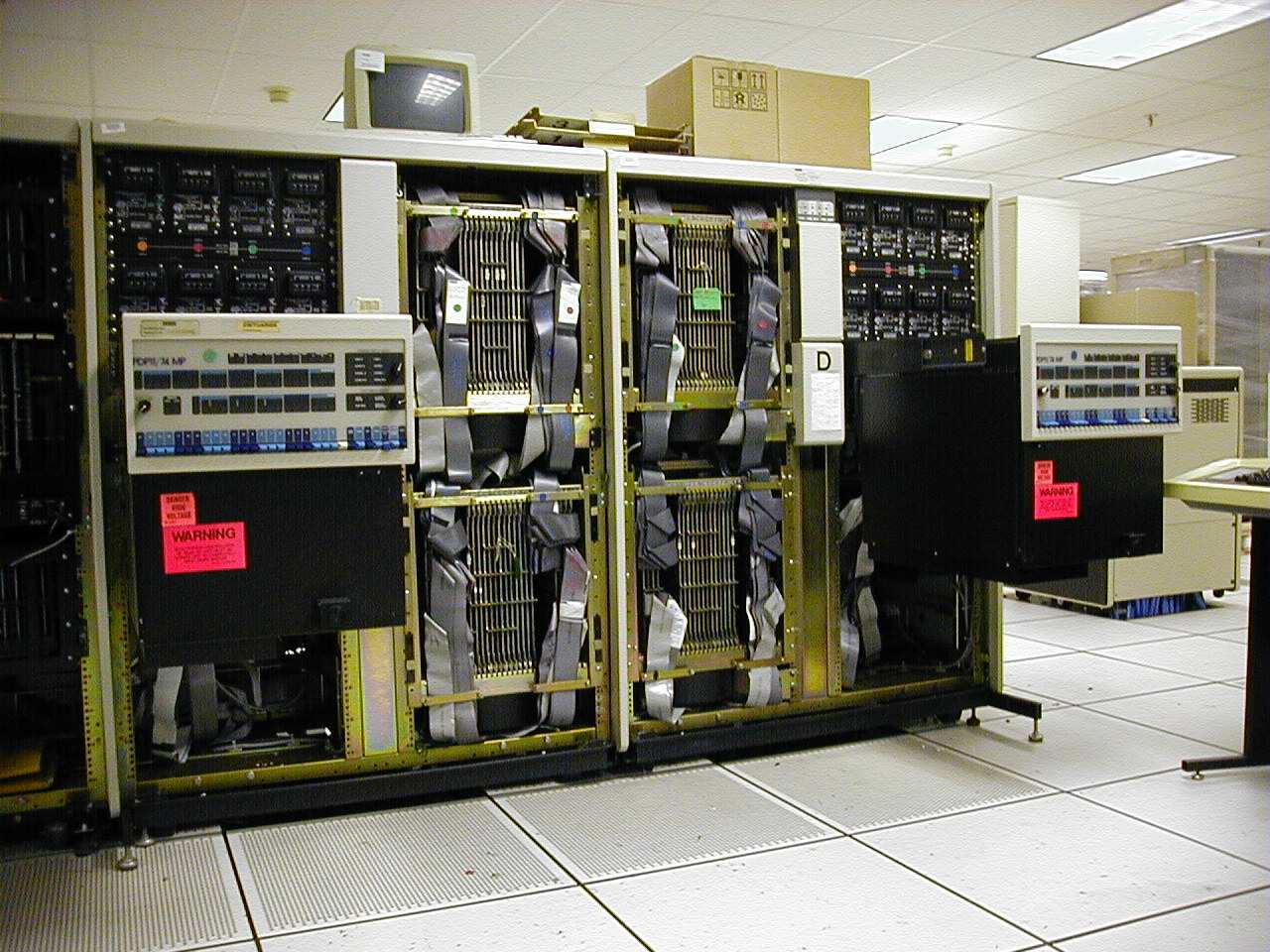
> Okay, what I immediately noticed is that these machines say "MP" and Don's panel doesn't.
More differences: Don's panel have the location for the key moved to the
other side of the parity lamps. Which is rather weird.
Also, the screenprint of 11/74 looks shadowed, which is weird. And the
right hand side have a different color than the left hand side.
And of course, the 11/74s from Tim don't have any CIS stuff on the front
panel.
(I'm still thinking that Don's panel have never had a matching piece of
real hardware, since I don't think that CPU was ever built.)
Tim's picture however are of a real machine. Don't know which one,
though. If it's just a two CPU machine, it might have been POLLUX::,
since CASTOR:: was four CPUs. However, other machine have existed in the
past.
> Were there non-multiprocessor 11/74s? If so, what would have been the benefits over 11/70s?
Yes there were. And the benifits were none. Actually, they were slightly
worse than normal 11/70s, but the difference were minimal.
After DEC decided to not make the 11/74 into a commercial product, they
used 11/74 parts for 11/70 machines. Atleast inhouse. Not sure if any of
those parts found their way into customers machines.
Used as such, the differences were basically related to cache: The MMU
have the cache bypass bit. The ASRB instruction always bypass the cache,
and you can also order the machine to explicitly bypass the cache
(unless my memory fails me).
But nothing of this was used by any OS normally, so the only thing
noticeable would be the slower ASRB instruction.
Johnny
> -----Original Message-----
>
>>From: Tim Shoppa <tshoppa at wmata.com>
>>Sent: Feb 8, 2006 12:24 PM
>>To: cctalk at classiccmp.org
>>Subject: Re: Original 11/74 front panel
>>
>>Don North wrote
>>
>>>So how many of these panels exist is hard to say. I know only of one.
>>
>>Two more can be seen at
>>
>> http://www.trailing-edge.com/~shoppa/1174Xopen.jpg
>>
>>So that makes three :-).
>>
>>Tim.
--
Johnny Billquist || "I'm on a bus
|| on a psychedelic trip
email: bqt at update.uu.se || Reading murder books
pdp is alive! || tryin' to stay hip" - B. Idol
a.carlini wrote:
> They musty have been trying it on. There's surely no way they
> can do anything to stop you discussing how to avoid their patent.
> Nothing to stop them trying to scare you off though.
I was actually doing more than just discussing it, I had been
doing it in my basement for a couple of years and even was selling
my product. My mistake was discussing it on Usenet.
"It" in this case is PWM modulation of R, G, and B LED's which
are then mixed together. And that is exactly what their
patent covers, even though it was blatantly obvious long
before they ever existed.
Tim.
I would imagine the only way to get one is to find
another whole system. In the rare event theres any
technical docs out there, those could definately be
useful. I opened the thing up and apparently it uses
an 8042 in a supervisory capacity (like an IBM PC/AT I
guess). It has a second one for I dont know what. The
BYTE article referred to them as auxiliary
coprocessors or some crap. What the vintage computer
community needs is a reconfigurable keyboard thingamabob.
__________________________________________________
Do You Yahoo!?
Tired of spam? Yahoo! Mail has the best spam protection around
http://mail.yahoo.com
> Is anyone near Waitsfield, Vermont? I note that Small Dog
> Electronics ( http://www.smalldog.com ) has a website that
> harps on their environmental responsibility, and offers a
> computer recycling service. Not affiliated except as a
> customer, and curious (if you already know them) whether they
> are good folks. If they are, they might be willing to filter
> out interesting stuff from their recycle stream.
> --
Smalldog is near me (1 hour away).
These guys are awesome. Friends and I have done business with them
(friends were by weborder/mailorder). They do recycle, and they use
Wincycle as a recycling partner (www.wincycle.org). And yes, Wincycle
gets rescue-worthy systems frequently, I just don't get out there often
enough. Wincycle will recondition / resell what's useable, mostly to
schools, non profits and low income families.
Smalldog is very active in Apple's refurb program.
Smalldog also lets me bring my small dogs with me to visit (the dog
theme is based in a real life dog story).
Is anyone near Waitsfield, Vermont? I note that Small Dog Electronics
( http://www.smalldog.com ) has a website that harps on their
environmental responsibility, and offers a computer recycling
service. Not affiliated except as a customer, and curious (if you
already know them) whether they are good folks. If they are, they
might be willing to filter out interesting stuff from their recycle
stream.
--
- Mark
NOTE: MOBILE CONTACT NOW 2-WAY PAGER AT: 888-733-0967
office is still: 210-522-6025
> I'm not listing numbers so I don't get sued, but it isn't hard to find.
5863827105
.. and it would have been easier to find if your quotes had not been
paraphrased.
Lee.
ard at p850ug1.demon.co.uk (Tony Duell) wrote:
> When I was at university (both undergrad and grad student), I had
> permission to 'skip dive' (same thing as dumpster diving, I guess).
Over here we still have. If only there was a bit of an announcement
before...would sometimes save dangerous stunts. I once dug back to
the bottom of a nearly half-filled container to rescue a Sun Ultra 1
*and* had it snatched away minutes later while I was getting a cart
to haul away my stuff. Bummer.
> Among the things I recovered were :
>
> An HP2100A minicomputer with 7900 disk (that was in poor condtiion
> as it landed on the front panel) and paper tape reader
Broken trim and bad harddisks are alas common consequences of people
treating as trash what they consider trash. Nearly made me jump down
>from a 2nd floor window when I heard the racket and saw somebody
hurtling a Sun IPX into that same skip so hard it broke open!
I also missed several boxes of VMEbus cards that day.
My best and biggest dumpster pick up to now was a Sun SPARCserver 1000.
It was piled atop a fully loaded skip so I had to stand on the maybe 4"
wide side rail clinging to the rim and carefully balance it on the wall
so I could jump down and get it.
Note on dumpsters on private property:
Over here in Europe you often only have to ring the bell and ask and
you get invited to help yourself to whatever you want from there -
that's how it usually works for me.
Cheers,
--
Arno Kletzander
Stud. Hilfskraft Informatik Sammlung Erlangen
www.iser.uni-erlangen.de
DSL-Aktion wegen gro?er Nachfrage bis 28.2.2006 verl?ngert:
GMX DSL-Flatrate 1 Jahr kostenlos* http://www.gmx.net/de/go/dsl
> A lawyer asked me if I had any devices made before 1997 that used RGB
> LEDs. I know that RGB LEDs have been around since at least
> 1991, but I
> don't have anything to offer them. If you have a device
> that uses a mux
> and PWM with the LEDs, that would apparently please them very much.
Could this be about the law suit Ford Motor Company settled with a
Brazilian patent holder? It concerned the new "MyColor" color selectable
instrument cluster lighting in the 2005/2006 Mustangs.
On metal cased (7030 and later 7012s) RS6ks the yellow button is push-on to a switch that screws into the front panel. These are easy, just push the button off with two prodding devices (straightened paper clips, old dental picks, small cocktail umbrellas, etc.) As this is completely useless to you, I naturally put it in first.
Older RS6ks are the same setup it appears, but you need to contrive a small hook (again, I commend old dental picks to your attention) that will hook under the rim about 1/2" below the surface of the button. Use two for a balanced pull. Have fun, and long live the classic 6K!
P.S. - does anyone here have an idea why I.B.M. used Medeco locks on the system unit, when plenty of mischief can be made anyway? Fortunately, both mine came with keys.
There is a picture of one on page 46 of the RSTS Professional
v4n4 (Aug 82) taken before an internal DECUS meeting.
I'm pretty sure there is a plex at CHM as well. They have a
collection of several dozen unusual DEC front panel plastics,
including one for a 32 bit machine that looks like it would
be for a 360 architecture.
No one has ever been able to identify what THAT was for.
http://cgi.ebay.com/ws/eBayISAPI.dll?ViewItem&item=8761090577
Not my sale but I thought of interest to those Multibus one
collectoors / users out there. One of the last Multibus one
boards.made.
It is a 386 with the 387 Math coprocessor and 8 megs of ram. Looks
like no eproms. The seller doesn't know what he has (there is no IDE,
those are iSBX headers) and the current buyer is a multibus dealer.
--
Paxton Hoag
Astoria, OR
USA
Okay, what I immediately noticed is that these machines say "MP" and Don's panel doesn't.
Were there non-multiprocessor 11/74s? If so, what would have been the benefits over 11/70s?
-----Original Message-----
>From: Tim Shoppa <tshoppa at wmata.com>
>Sent: Feb 8, 2006 12:24 PM
>To: cctalk at classiccmp.org
>Subject: Re: Original 11/74 front panel
>
>Don North wrote
>> So how many of these panels exist is hard to say. I know only of one.
>
>Two more can be seen at
>
> http://www.trailing-edge.com/~shoppa/1174Xopen.jpg
>
>So that makes three :-).
>
>Tim.
Does anyone know where one can find DX10 documentation in addition to
what's available on BitSavers? I'm new to the DX10 world but thanks to
David Pitts' sim990 simulator I've been checking out DX10. I'd especially
like to have docs on DX10 COBOL, TIFORMS, and/or TPL, as those packages
appear to be available for sim990 from Dave's web site.
Kevin
http://www.RawFedDogs.nethttp://www.WacoAgilityGroup.org
Bruceville, TX
On 2/8/2006 at 8:31 AM vrs wrote:
>> I'm just wondering about what happens when the current candidate for
>> substitution also becomes unavailable...
>
>I do think I could make a Q-bus receiver from a linear IC, like an
>"ultra-fast" comparator, pretty easily.
Not being part of this discussion, I wondered why that approach hadn't been
considered, given the flexibility it affords. How fast do you need the
part to be? 20-25 nsec isn't considered to be "ultra fast" nowadays.
Cheers,
Chuck
Turns out the RX02 emulator needs an M105 and M7821 single height UNIBUS
card to work.
Anyone have an extra M105 and M7821?
I've never seen one of these, but that doesn't mean much. Are they common?
Also, does any one have Schematics for the M105 and M7821? I looked on
bitsavers and did not find anything.
-brad
Hey guys,
I'm trying to build one nice 7012-370 with the help of a 320H, since the
case of the 370 has several cracks in it.
How do the yellow reset switches come apart from the front panel? I
want to be able to thoroughly clean/scrub the panel, but really want to
remove that switch first!
I don't have the lock out yet, but I think once I get a decent set of
snap ring pliers I'll be all set, with that.
Thanks!
Chad Fernandez
Michigan, USA
Are you still looking for DEC Part Number 21-17311-01???
Mark Dunning
__________________________________________________
Do You Yahoo!?
Tired of spam? Yahoo! Mail has the best spam protection around
http://mail.yahoo.com
I just ordered a set of manuals from this firm the other day. $25 per manual
per week (from the date of receipt) for manuals that they have only one of.
I don't know what the cost to purchase one is.
Very professionally run operation in my opinion. Quality of the manuals
seems to vary from originals to copies (that in my case were missing pages).
I got one original and one copy to work with.
If you have nowhere to turn for a rare equipment manual, this place is a
good option.
I have no connection to them other than being a satisfied customer.
Rich
-----Original Message-----
From: cctalk-bounces at classiccmp.org [mailto:cctalk-bounces at classiccmp.org]
On Behalf Of Richard
Sent: Sunday, January 22, 2006 11:40 AM
To: cctalk at classiccmp.org
Subject: source of manuals for terminals, test equipment
Stumbled across this today, maybe it will come in handy for someone:
<http://www.yourmanualsource.com/>
--
"The Direct3D Graphics Pipeline"-- code samples, sample chapter, FAQ:
<http://www.xmission.com/~legalize/book/>
Pilgrimage: Utah's annual demoparty
<http://pilgrimage.scene.org>
from:
http://en.wikipedia.org/wiki/RSTS/E
"Mentec would later publicly grant a no-cost license to anyone for
non-commercial
hobby purpose use of the operating system software developed for the
PDP-11,
and as the result of the release (for non-commercial use) of a PDP-11
emulator
for the IBM-PC, as well as image copies of disk drives of RSTS which
exist on
the Internet, it is possible for a hobbyist to run RSTS/E on a
personal computer
in software emulation as fast or faster than it originally ran on the
real hardware."
It's on the web, so it must be true!
I've been hanging around the dumpster again....
I salvaged some DEC pro-350 parts. I don't have a 350,
so they are available to anyone for the shipping cost.
I'm not sure if the numbers are the actual part numbers,
They are whatever I could find on the boards.
5415134 winchester disk controller
5415057 rx-50 controller
5415084 memory boards 128kb (quan. 2) ( not the c-bus boards)
5015487 pc350 memory 256kb (c-bus board)
5015137 ct100 video generator
5015145 ct100 color bit map
joe lang
Anybody out there familiar with the Bigboard II? I have one, and rather like
some features of the thing. One of the features in the rom code is that
it'll look at the second rom socket and try some sort of weird CRC algorithm
on it and if that checks out transfer control to the chip. Problem is, I
don't understand the code.
Also, somewhere I have this 286-based Zenith "laptop", non-functional the
last time I tried it. Anybody know if there's any service info out there on
this thing? I used to be a ZDS service center way back when, but we stopped
doing that when they moved all of the training to Chicago and required
several trips a year plus _paying_ for the training to continue with it (more
than we made working on their stuff), and so I never saw any service data on
that sort of thing, though I do have some on their earlier stuff, and
monitors, if anybody needs some. I do remember seeing one of those in
operation one time, and it had a real pretty blue-lit screen. :-)
--
Member of the toughest, meanest, deadliest, most unrelenting -- and
ablest -- form of life in this section of space, a critter that can
be killed but can't be tamed. --Robert A. Heinlein, "The Puppet Masters"
-
Information is more dangerous than cannon to a society ruled by lies. --James
M Dakin
Damn, that's a cool find, even if it's in a box you already have!
What do you think, Don, hHow many exist of this panel?
- Henk, PA8PDP.
> -----Original Message-----
> From: cctalk-bounces at classiccmp.org
> [mailto:cctalk-bounces at classiccmp.org] On Behalf Of Don North
> Sent: dinsdag 7 februari 2006 6:51
> To: On-Topic and Off-Topic Posts
> Subject: Original 11/74 front panel
>
> Found when I was going thru a box of DEC memorabilia ... an original
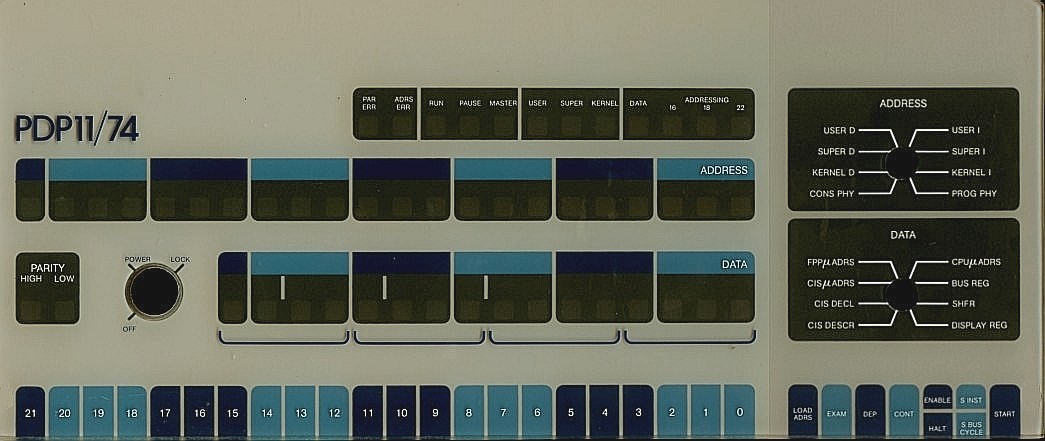
> 11/74 front panel (plexiglass only). You can tell it is from a 'true'
> 11/74 as it has front panel positions for the commercial
> instruction set microengine (CIS uADRS, CIS DECIMAL datapath,
> and CIS DESCRIPTOR datapath).
>
> Here's a pix: http://www.ak6dn.com/stuff/1174.jpg (not the best
> quality, done on a scanner, not by camera). I need to figure
> out a way to get the LED positions to light up. Maybe I'll
> build a LED board and hook it up to my 11/34...
>
> No, it is not for sale.
>
>
>
>
This message and attachment(s) are intended solely for the use of the addressee and may contain information that is privileged, confidential or otherwise exempt from disclosure under applicable law.
If you are not the intended recipient or agent thereof responsible for delivering this message to the intended recipient, you are hereby notified that any dissemination, distribution, or copying of this communication is strictly prohibited.
If you have received this communication in error, please notify the sender immediately by telephone and with a "reply" message.
Thank you for your cooperation.
Hi,
I *finally* managed to get a board assembled and tested. All of the
documentation has been written and is available as a PDF on my website.
I still have to get the documentation to the printer but they should be
back this week.
The KM11 replica is now available for order. Please consult my website
(www.shiresoft.com) for ordering instructions.
As I had stated previously when I did the prototype that the design was
based upon Tony Duell's design. Here's a link to the original post to
classiccmp
(http://archive.netbsd.se/index.php?ml=cctech&a=2004-11&t=481814).
--
TTFN - Guy
I just got some new ribbons for my Teletype 43 and the print was
(at first) nice and dark. But it soon started to fade. I watched
the ribbon while printing and it didn't move!
(There are two rollers on the left side of the typing unit which
allow rotation only in one direction, and the ribbon is a
continuous loop reinked as it passes through its cartridge,
mounted at the right side). So obviously when *something* moves
the ribbon, the ratchet action on the rollers prevents it from
reversing direction, so there is net motion of the loop in one
direction. It looks like the ribbon is intended to move during
each carriage return.
But what actually moves it? I don't see any source of friction
other than where the ribbon passes over the printhead which is
quite smooth. There is also very little tension on the ribbon
(there is a spring mechanism that holds the rollers to the left).
I don't have a service manual, just the basic operator's manual,
and can't find one online.
thanks for any assistance.
-Charles
Hi List,
I have here a uVAX II in a ba23 box, most likely not powered up for 2 or 3
years.
The innards are clean, no nasty smells, no other trace of prior problems.
Even so, to minimise the risk of damage I'm going to disconnect all the 5v &
12v leads, then attach some suitable dummy load(s), switch on and wait for
smoke.
Does this seem an appropriate plan? Can anyone point me to pinouts for the
various supply leads from an H7864?
Does anyone have any other recommendations/experience of going though this
process, and is there anything I've missed that I should have included
above?
Cheers,
Pete
--
Pete Edwards
"Prediction is very difficult, especially if it's about the future" - Niels
Bohr
Hi,
Just found your board and thought you might be able to help me. I'm
currently trying to reverse engineer the code in my Ford EEC-V Engine
control unit. This unit is based around the Intel 8065 Chip set and I was
hoping someone on the board may be able to help me reverse engineer the
software in this unit, so that I can play around with the various fuel and
ignition maps and other variables in the code. If I'm really able to get to
grips with the code I'd like to rewrite it to:
Use a single coil per cylinder rather the wasted spark method.
Use a wide band O2 sensor
Gary Messick has posted on this subject on this board 4 years ago but I
don't know if he is still active. Ideally I'm looking for someone who had
exposure to the Ford / Intel 8061 / 8065 chip set as part of their work
Here's hoping one of you is able to help me or can point me at a current
email address for Gary Messick.
Regards
Phil
The contents of this email and any attachments are sent for the personal attention
of the addressee(s) only and may be confidential. If you are not the intended
addressee, any use, disclosure or copying of this email and any attachments is
unauthorised - please notify the sender by return and delete the message. Any
representations or commitments expressed in this email are subject to contract.
ntl Group Limited
Hi
Although, it would be nice to find someone with
an ICE for the V25, many in our group would be able to
help you with as little as an oscilloscope and a simple
disassembled listing from the EPROM. Using a digital
oscilloscope or a logic analyzer could speed things along.
There are a few members of our group in Germany that
would be able to help you out. The 186 is a relatively
well known processor.
Dwight
>From: "werner busch" <wernerbusch at t-online.de>
>
>Dear Sirs,
>
>we need Your help for analyzing a the software of a control unit.
>We are a German Company and the unit is not longer supported by developer.
>( company is down).
>
>Target is to analyze some parts of the software and make some little changes.
>( change 2 parameters dirct in software).
>
>The cpu on control unit is a NEC V25 / V25+ (80186 derivate, 84-pin PLCC ),
software is on eeprom 512 KByte.
>
>We want to trace the running program, analyze some parts, see registers etc.
>
>Is this possible with one of your systems ?
>
>Please tell us what we need to reach our target and what are the price for the
system we need.
>
>
>Kind Regards
>
>Busch-Automation
>Werner Busch
>
Don North <ak6dn at mindspring.com> wrote:
> Found when I was going thru a box of DEC memorabilia ... an original
> 11/74 front panel (plexiglass only). You can tell it is from a 'true'
> 11/74 as it has front panel positions for the commercial instruction set
> microengine (CIS uADRS, CIS DECIMAL datapath, and CIS DESCRIPTOR datapath).
>
> Here's a pix: http://www.ak6dn.com/stuff/1174.jpg (not the best
> quality, done on a scanner, not by camera). I need to figure out a way
> to get the LED positions to light up. Maybe I'll build a LED board and
> hook it up to my 11/34...
Very nice!
However, a few things I've wondered about for a long time.
This is obviously a panel for a corporate cabinet. I've also seen a
picture of an alleged 11/74 that was in a corporate cabinet.
However, the one picture I've seen in real life (as opposed to on the
internet) of an 11/74, it was in full height 19" cabinets with the
traditional maroon/red color scheme.
Also, I am under the impression that a CIS was never completed. That
would have required the KB11-E. The only 11/74 CPU I know was done was
the KB11-Cm, which is a modified KB11-C (aka 11/70). This won't allow
you to add a CIS option. No place nor wiring for it.
Does anyone know *for sure* that the KB11-E was made, or might this
front have been a prototype for a possible KB11-E, but in reality used
just with a KB11-Cm?
(Oh, and for those of you who care... login to mim.update.uu.se as
guest/guest, and run RMD...)
Johnny
--
Johnny Billquist || "I'm on a bus
|| on a psychedelic trip
email: bqt at update.uu.se || Reading murder books
pdp is alive! || tryin' to stay hip" - B. Idol
Unfortunately, not. But there is an alternative which I havent tried.
If you are willing to pay $900 or so, you can pick up the cfront sources
>from AT&T. Also, SUN has a GNU C++ to GNU C translator on their website
which might help as well...
Ram
> -----Original Message-----
> From: cctalk-bounces at classiccmp.org
> [mailto:cctalk-bounces at classiccmp.org] On Behalf Of Ian Finlay
> Sent: Sunday, February 05, 2006 6:35 PM
> To: cctech at classiccmp.org
> Subject: Glockenspiel C++ or CFRONT sources
>
>
> Dear Ram,
>
>
>
> I saw your post:
>
http://classiccmp.org/pipermail/cctech/2005-July/047615.html
I also need a Cfront Translator from C++ to C (preferably for MS-DOS or
Windows).
Company previously used a, now deceased Apollo workstation with Domain
2.1.0. But its not working any more, so have managed to move all but
the
C++ to C translation onto the Microsoft development platform.
If you get any feedback I would appreciate it.
Sincerely
Ian Finlay
Wormald Technology
Today I received a NeXTstation TurboColor, with full
doc, original boxes, NeXTstep 3.0-3.3, 17" Color
Monitor, Laser Printer, Modem, set of NextWorld
magazines, various books and doc and tons of software.
It was shipped down from Canada and arrived in my
office where a co-worker looked at it a moment, then
looked at me and asked, "so when was that state of the
art?" :)
Now to catalog, setup and add to my site.
David Williams
http://www.trailingedge.com
On 2/3/06, Richard <legalize at xmission.com> wrote:
> In article <f4eb766f0602030407o3dac064amaac33e0f6fb09e0 at mail.gmail.com>,
> Ethan Dicks <ethan.dicks at gmail.com> writes:
> > Two years ago, I built a COSMAC Elf right out of the pages of the
> > 1977-1978 Popular Electronics articles, on perfboard...
>
> Is the Popular Electronis article scanned online? This sounds kinda
> cool! And a nice way to get a little experience without damaging
> anything hard to find.
http://www.incolor.com/bill_r/elf/html/elf-1-33.htm
I even used real HP displays (electrically identical to TIL-311s, but
in a different package) and 1822 (5101) 256x4 SRAMs. If you are
shooting for software compatibility without a slavish devotion to the
1976 appearance, you can use a modern 32Kx8 SRAM and even add a latch
to access memory over 256 bytes (but toggling in that much data is
kinda tedious).
You will find it hard to locate a genuine 1861, but Spare Time Gizmos
has a modern 1861 pin-compatible emulator (a shift register, a
counter, and two 22V10 GALs) that fits in the socket for a real 1861.
If you don't care about video, you can get a newer 1802 processor and
run the entire thing at 5MHz.
For those that don't know, there's a reasonably active 1802 group on Yahoo...
http://groups.yahoo.com/group/cosmacelf/
... I'd recommend it if you want to play with the 1802.
-ethan
Hi,
I tried replying to your E-mail, and it was returned to me. I'm in Illinois,
and have lots of DEC items. Feel free to send me a wish list.
Thanks, Paul
> > Does anything bad happen to electronics that are stored in very dry
> > conditions for long periods of time? Cities like this would be anything
> > in Utah, Arizona, Nevada and Idaho (Salt Lake City, Las Vegas, Phoenix,
> > Boise, Reno, etc.).
Other than ESD which has already been mentioned, if the device relies on any rubber components
(like capstan rollers) the dry heat might cause them to dry rot. Same for grommets. However, the
USAF seals up its old planes and stores the in "the boneyard" at Davis-Montahn AFB in Tucson, AZ,
so it can't be all bad.
Bill
__________________________________________________
Do You Yahoo!?
Tired of spam? Yahoo! Mail has the best spam protection around
http://mail.yahoo.com
Found another box of TK50 tapes, so figured I'd ask again if anyone is
interested, contact me.
Also have a couple of external SCSI tk50 drives I could part with, and a
VaxStation2000, with a 19" vax monitor (monitor is probably
prohibitively expensive to ship, but anyone near CT who wants both, and
keyboard/mouse, etc, I'd give preference to parting with both together).
Also tons of 90M DAT tapes, if anyone is interested.
Also for anyone near CT, I have a compaq 1600, dual 600mhz cpu's, all 5
drive trays (one 4gig drive dead, but I think I have one to replace it
with), and I'll toss in a 3200-raid controller. Free to anyone who
wants to pick it up, or meet someplace. I'd consider shipping it if
someone wants to cover the shipping costs.
And a pair of Mac IIsi's, and three MacSE/30's, all with NIC's (at least
one of the SE/30's has NetBSD on it). Free, just looking to clean
house (keeping my quadra 650).
And anyone who might be looking for TEK service manuals, the old job was
tossing several xerox-paper boxes of them out, I'll try to make a list,
but if you're looking feel free to ask.
Also have some plugins for the 7000 series O-scopes, probably take a few
bucks for those, but I can certainly come up with a list.
-- Pete
All:
I'm looking for recommendations for a good version of BASIC for
my restored IMSAI. It's a Z80-based machine with 48k and a serial console.
Ideally I'd like it to be ROMable.
I have copies of the original TinyBASIC, Lawrence Livermore
BASIC, Minol TinyBASIC, Denver BASIC, and a BASIC from Dave Dunfield. I
haven't slogged through the source for each yet but I'm hoping someone can
point me in the right direction.
Thanks.
Rich
Rich Cini
Collector of classic computers
Build Master for the Altair32 Emulation Project
Web site: <http://highgate.comm.sfu.ca/~rcini/classiccmp/>
http://highgate.comm.sfu.ca/~rcini/classiccmp/
/************************************************************/
Hi
I think the corrosion is from sulfur in the foam.
If so, I'd suspect it to be an acidic corrosion.
After cleaning with something like vinegar, following
with some baking soda might be a good idea before
the final washing. This should help neutralize any
remaining acid.
Dwight
>From: "Pete Turnbull" <pete at dunnington.plus.com>
>
>On Feb 6 2006, 12:33, <dogas at bellsouth.net> wrote:
>
>> There were a few incredible chips in pile that the foam really
>screwed up... check out:
>>
>> http://bellsouthpwp.net/d/o/dogas/chips1.jpg
>>
>> There was a ceramic C8080A with the pins completly eaten away , a
>Ceramic MOS 6532 that faired only a little better, a ceramic/traced AMI
>6810, and a early plastic 6502 and 6530 among the more conventional
>stuff. Any recommendations on neutralizing/cleaning the gunk of the
>ceramics?
>
>The green icky stuff looks like verdigris. I'd just scrub it off with
>a toothbrush and warm water. If that doesn't shift it, dilute acid
>such as vinegar or lemon juice will, but rinse the ICs thoroughly
>afterwards if you do that.
>
>--
>Pete Peter Turnbull
> Network Manager
> University of York
If W.Smith is still on this list, I'd appreciate it
if he contacted me.
> On Tue, 7 Jan 2003, John Clarke wrote:
>
> > Anyway, is there some way to find out what the
value of my
> Compaq is?
>
> Sure, I'll tell you: $5.
>
> :)
>
> Sellam Ismail
Vintage
> Computer Festival
Nadeau's book gives a range of $20 - $75, but I
wouldn't give $20 for
the hardware alone. Original documentation and
software, on the other
hand, is likely much harder to find and would be worth
some extra $$$s.
It's hard to quantify value if you have all the
extras, which are often
almost impossible to accumulate. I think most
collectors know that
documentation is far more difficult to find than
machines. I have an
IBM 5100, which is somewhat rare, but what is really
rare is the full
set of documentation I have, including the original
sales invoice and
factory build sheet.
For example, I have a Texas Instruments Portable
Professional Computer
(actually I have three of them) which in terms of
hardware, is not worth
much ($15 to $40 according to Nadeau). But, I also
have virtually every
piece of software and documentation that ever went
with it (all in those
hideous orange TI boxes), as well as a big box full of
development
boards of every variety that I got from a retired TI
guy that worked on
the project in the early 80s. I also have stacks of
preliminary
production documentation and schematics from the same
sorce. Now that's
history -- and as they say in the Master Card
commercials --
"priceless."
By the way, one of my three TIPPCs has an upgraded
286-10 Soyo MB and is
IBM compatible (and therefore won't run the bulk of
the specialize TI
software). Anyone ever see one of these before?
-W
__________________________________________________
Do You Yahoo!?
Tired of spam? Yahoo! Mail has the best spam protection around
http://mail.yahoo.com
Pete asked:
> I have here a uVAX II in a ba23 box, most likely not powered up for 2 or 3
> years.
>
> The innards are clean, no nasty smells, no other trace of prior problems.
> Even so, to minimise the risk of damage I'm going to disconnect all the 5v &
> 12v leads, then attach some suitable dummy load(s), switch on and wait for
> smoke.
>
> Does this seem an appropriate plan? Can anyone point me to pinouts for the
> various supply leads from an H7864?
> Does anyone have any other recommendations/experience of going though this
> process, and is there anything I've missed that I should have included
> above?
Just plug it in and turn it on.
Unless the economics have drastically changed in the past 5 or 10 years,
a uVax II in a BA23 has a street value of $50 tops. If there's any irreplacable
components/assemblies/drives you may indeed want to remove them during
initial testing (in any event as you reconfigure the system you certainly want to
start with the simplest "has to work" configuration and then add on all the
unknowns.)
Ignore anyone who tells you to bring this up on a Variac. You will be increasing
the chances of damage by doing so. Variac's are great for linear supplies in
reforming electrolytic caps, but they only make life worse in a switching
power supply because you're gonna cause all sorts of out-of-usual
conditions. See, a switching power supply has negative impedance as seen
>from the "in" connector: if you decrease input voltage,
it will increase its current draw to keep power out constant. Outside of a
reasonable range (say +/- 30%) of input voltage the flyback pulse widths etc. will
be seriously out of whack too, also probably triggering a shutdown.
My personal preference with linear supplies is to just plug it in and let any
bad electrolytics blow up :-).
The BA23's power supply (like most switching supplies) has more than adequate
shutdown-on-overvoltage-out circuitry.
The one thing to check: look at the 0.156" spacing harness from the PS
to the backplane. Wiggle it on and off, look for charring and overheating. Some
signs of past heat are likely, but if any of the contacts are burnt up you
might want to look for or fabricate a different jumper. Worst case will be that
you burn up the jumper, and you won't be the first to have it happen!
After you get it up and going, you will probably find that the NiCads that
hold the CPU configuration and run the TOY clock don't hold a
charge. It's just 3 AAA's in series. It's not really necessary if you don't
mind setting the clock and selecting the boot device manually
at every startup. NiMH's are more available today and
probably a better technical choice for replacement if you decide you need to
TOY clock and config RAM.
Tim.
> How many of you have done a road trip to get equipment?
> - travelled 50 miles?
San Antonio/Kerrville, Columbia/DC
> - travelled 100 miles?
San Antonio/Austin, a couple times for various
> - travelled 250 miles each way?
San Antonio/Houston, a couple times for Alphas, VAX VLC's, NeXTs, etc.
> - travelled 500+ miles each way?
> - travelled 750 miles?
> - travelled 1,200+ miles each way?
--
- Mark
NOTE: MOBILE CONTACT NOW 2-WAY PAGER AT: 888-733-0967
office is still: 210-522-6025
On Feb 6 2006, 12:33, <dogas at bellsouth.net> wrote:
> There were a few incredible chips in pile that the foam really
screwed up... check out:
>
> http://bellsouthpwp.net/d/o/dogas/chips1.jpg
>
> There was a ceramic C8080A with the pins completly eaten away , a
Ceramic MOS 6532 that faired only a little better, a ceramic/traced AMI
6810, and a early plastic 6502 and 6530 among the more conventional
stuff. Any recommendations on neutralizing/cleaning the gunk of the
ceramics?
The green icky stuff looks like verdigris. I'd just scrub it off with
a toothbrush and warm water. If that doesn't shift it, dilute acid
such as vinegar or lemon juice will, but rinse the ICs thoroughly
afterwards if you do that.
--
Pete Peter Turnbull
Network Manager
University of York
Mike I don't suppose you atill have the AppleColor RGB Monitor. If you should or could point me in any direction it would be greatly appreciated. Thanks Much!! Neil
Anyone ever seen one of these? The auction listing says:
Telemechanics Inc.,
American Tleephone and Telegraph Co.
Part #40K101CAD
--
"The Direct3D Graphics Pipeline"-- code samples, sample chapter, FAQ:
<http://www.xmission.com/~legalize/book/>
Pilgrimage: Utah's annual demoparty
<http://pilgrimage.scene.org>
Anyone know anything about these? It's a Multibus system, with an 80286 CPU
board inside, Ethernet board, ST506/412 disk controller, floppy, and 40MB hard
disk. Date seems to be 1990, which seems a little late for a '286 system.
Two serial ports on the back, Ethernet, Centronics, and another DB25 (serial
console?). Options on the back for another 19 DB25 ports, 3 larger ports
(poss. external disks?), and a DA15 (another Ethernet card I assume)
No apparent model number for the whole box, but a label on the front just says:
Node name: DCU-NODE
... and a network address.
On the underside there's what seems to be a board/part listing:
PSYP310-90C
iSBC286/12
SCX110
SBX344A
SBC552A
SBC214
40Mb HH Winchester
360Kb HH floppy
****ESYP310BYATLP****
The CPU board has an extra 1MB memory board fitted, a daughterboard which goes
to the possible-console connector, and a battery-backed clock card (luckily
there's minimum damage from battery corrosion)
Google seems spectacularly unhelpful. Anyone know if "DCU" is meaningful, or
if there was any particular target market for these systems? (we need to do
PSU checks etc. and find out if that is a serial console before seeing if
it'll fire up)
Given the port options on the back it was obviously designed to cater for
several users - but if it was just an off the shelf UNIX/other server it seems
strange that the case wasn't given any badge, overall model label etc.
cheers
Jules
I bought a few items from the govliquidation web site
that I'm looking for information on.
The first is a Univac data buffer. It was designed for
shipboard use and is in a very heavy
case. Photos can be seen at:
http://www.dvq.com
select "old computers" then "misc. computer stuff"
it's toward the bottom.
Any idea what it was used for?
The other item is a Singer magnetic disk unit. Three
large photos are here:
http://www.dvq.com/oldcomp/photos/singer1.JPGhttp://www.dvq.com/oldcomp/photos/singer2.JPGhttp://www.dvq.com/oldcomp/photos/singer3.JPG
Does anyone know what systems/computers these were
used with? I have four of them.
Thanks,
Bob