>
>Subject: Re: WTB: LIM/EMS/XMS 16-bit ISA memory expansion board
> From: woodelf <bfranchuk at jetnet.ab.ca>
> Date: Sat, 03 Nov 2007 17:53:05 -0600
> To: General Discussion: On-Topic and Off-Topic Posts <cctalk at classiccmp.org>
>
>Sridhar Ayengar wrote:
>> Chuck Guzis wrote:
>>> Make isn't important, as long as it'll hold at least a couple of MB
>>> and will work with a "plane Jane" 286.
>>
>> <AOL>Me too!</AOL>
>>
>> Seriously, I'm looking too.
>>
>> Peace... Sridhar
>I am looking for anything that *DOES* not end in 86.
>> .
Sounds like someone looking for an ASk 6Pak Pro.
Allison
> I think the ROMs from the cartridges
> should be dumped, too.
I've dumped the ones that I have, would be a good thing to have copies from
another source.
> We've got a Tektronix 4051 with the optional Data Comms Interface and tons
> of tape cartridges. As the belts in the Scotch/3M DC300 tapes are worn out
> or torn I need to copy the contents 1:1 to other media. But how?
I have a box of tapes from Jim Willing that I need to deal with as well. There
was a GPIB version of the drive used in the 405x that I have. The service manual
goes into more detail than the service manual for the main unit. I also have a
couple of the bare drives and had intended to hook them up to the same sort of
interface that I've been using to deal with other cassette media.
Date: Fri, 09 Nov 2007 10:22:41 +0100
From: Jos Dreesen / Marian Capel <jos.mar at bluewin.ch>
Subject: Re: Commodore PET
<snip>
>To think I left a chicklet keyboard pet in a dumpster, just a few years
>ago. "Too much stuff, it's just a PET, I can always get another.."
>Jos
------------
I probably put it there ;-)
Just one of many things I dumpstered before I saw the light; the North
Star and CDC terminal I tossed because I only wanted the desks, the
Cromemco Z-2 because I only wanted the PS, the calcs I wanted the
Nixies and core out of, the Selectric and Diablo printers, Burroughs L,
F and E stuff because I figured no one would ever 'collect' one, etc. etc.
Regrets, I've had a few...
Fortunately I kept my original PET 'cause I was (and still am) using it
occasionally.
m
Date: Fri, 9 Nov 2007 20:24:38 +1300
From: Ethan Dicks <ethan.dicks at usap.gov>
<snip>
If someone tried to hack DRAMs in place on a static board, I'll bet that's
a mess. I have a 2001-16N board with factory perforations on the high 16K
RAM pads that I'd like to eventually reburbish to a full 32K.
If you really are interested in finding someone who is willing/able to
make that one live once again, I am entirely willing to give it a go. I
don't have a shell here, but I already have a 3032 board on the way here
>from Sweden, so I was planning on trying to build a keyboard adapter of
some kind and an XOR-based composite-out adapter with a closed-circuit
TV monitor to get it all working. Doing the same for an old PET wouldn't
be that much of a stretch (I was planning on using a C2N232 adapter for
mass storage, eliminating the need to send down a real floppy drive).
-ethan
--------Reply:
I was going to do the same thing, sort of a PET in an AppleII-type case, but
it'll never happen so you're welcome to it. I've also got a keyboard for it (the
later version) and video's a no-brainer.
I also have a case (no monitor) but I think I'll keep that in case I _do_ decide
to do this one day with another less needy mobo.
Mind you, the plug-in chips are missing, so by the time you've hacked in
a 32K RAM chip and EPROM there wouldn't be much left of the original
PET...
We'll talk off-list.
m
Date: Thu, 8 Nov 2007 22:36:27 -0800 (PST)
From: Cameron Kaiser <spectre at floodgap.com>
Subject: Re: Commodore PET
>>> The last PET 2001 with the chiclet keyboard I bought cost me $35.
>>> Clearly, there are bargains to be had. $150 is a fair price though.
>
>> Shhhh!
>> I wanna find another Cameron that'll give me $900!
>In all seriousness, I think it was worth it and I'm happy to have it.
>Wouldn't drop that kind of coin on just anything.
More power to ya, I say. The value of this kind of thing is purely subjective,
depending solely on what it (and $900) are worth to *you*, and I too feel that
there's something very special about that model and the community that
grew up around it (especially here in Toronto, Commodore's birthplace
and home of Jim Butterfield, TPUG, The Transactor, Batteries Included etc),
as opposed to AppleIIs & R-S M1s. Remarkable that TPUG (Toronto PET
Users' Group) is still around, and even with some of the original members
(although scaled down somewhat from its glory days).
Of course it was my 'first' and I have many warm memories and pictures of
me and family playing with it, not to mention all the doodads & mods I made
for it, so I'm somewhat biased.
Then again, from the point of view of the 'collectors' on this list, it should
be worth $0...
m
One line of systems I see very little about on the web or in vintage computing
circles are the Alpha Microsystems units (not! DEC! Alpha!~). Now that I have
my own Alpha Micro Eagle 300, I've compiled together most of my notes on
various models, a primer to AMOS, some software and a link library and put
the E300 into the server rack so that a real AMOS/AlphaTCP system can serve
it itself.
Hopefully this will be useful to other people who have been curious about
Alpha Micro boxes.
http://ampm.floodgap.com/
--
------------------------------------ personal: http://www.cameronkaiser.com/ --
Cameron Kaiser * Floodgap Systems * www.floodgap.com * ckaiser at floodgap.com
-- I'd rather be a lightning rod than a seismograph. -- Ken Kesey -------------
The following items are outside of my sphere of interest, but I bet some on
this list would be interested, so here goes...
I have available for trade a complete set of the first few years of the HP
Key Notes magazine:
HP Key Notes 1977 Vol 1; numbers 1,2 (featuring the HP-01), and 3
HP Key Notes 1978 Vol 2; numbers 1,2,3,4
HP Key Notes 1979 Vol 3; numbers 1,2,3
Plus
HP Key Notes 1981 Vol 5; numbers 1, 3
and
"The Hewlett-Packard Personal Calculator Digest" magazine Volume Three
1977. Cover HP-19C
and
HP 67/97 User's Library Catalog of contributed programs (not the programs
themselves)
with program submittal worksheets
If interested, contact me via billdeg at aol dot com or my web site,
vintagecomputer.net. I would consider almost any reasonable trade
> My PET 2001-32N (badged as a 3032 in Europe) was $1195 with a C2N and no
> disk...
>
> I got a lot of miles out of that PET. I still have it and it still
> fires up (but I think I have an IEEE problem that may turn out to be
> cruddy 40-pin sockets on the VLSI I/O chips).
>
Way back when, the company bought a 2032 for stock control and invoicing,
used for 5 years or so.
After about a year it continually needed opening up and the chips reseating,
got so frustrated with this that we replaced ALL the Ic sockets with "turned
pin" types and never had anymore problems with that machine ever again.
Mike
> From: "Chuck Guzis" <cclist at sydex.com>
> Subject: Re: Televideo Terminals TS-800A (UK)
> To: "General Discussion: On-Topic and Off-Topic Posts"
> <cctalk at classiccmp.org>
> Message-ID: <47323EAB.24181.81E5663 at cclist.sydex.com>
> Content-Type: text/plain; charset=US-ASCII
>
> On 7 Nov 2007 at 21:25, Roger Ivie wrote:
>
> > I've not encountered a TS-800, but I was under the impression
> that they were
> > diskless workstations for use with something like a TS-806 MMMOST
> > server.
>
> According to the Russian televideo.ru site, the TS-800 is a sump
> pump:
>
> http://www.televideo.ru/product.asp?idDepartament=216&idProduct=11357&
> cas=9
>
> My recollection of the TS-800A was a diskless Z80 workstation,
> interfaced via RS-422 (IIRC).
>
> Cheers, :)
> Chuck
Hehe - nice pump lol. I have asked for confirmation of the exact model
number so we can be sure. Apologies for any confusion. Herewith a link to an
image which may help to identify same.
http://www.attfield.co.uk/gallery/tv.jpg
Jim
I have an Intel MDS that needs special care. As you may have heard, I was
in a car accident at the beginning of last month. The main casualty,
except for the car, was an Intel MDS. I offered it to the Computer
History Museum and was turned down because they don't have anyone who
understands the MDS well enough to attempt to restore it. Please take a
look at photos of the machine[1]. I can't really let this go for free
because I promised its owner that I would sell it, so please offer
something decent. Except for the lid of one chip getting knocked off, the
boards all appear to be intact. The CRT is not cracked and there's no
apparent evidence of it being breached. If the floppy drive is bad, I
have some replacements. The chassis however, is in sorry condition. It's
made of a foamy sort of polymer similar to the stuff used in older Sun
workstations. The impact of the crash cleaved the chassis into two
pieces: the top containing the CRT and floppy drive and the bottom holding
the backplane and cards. No keyboard was present to begin with.
This owner is the same one who had the Nova 4 I offered
here in September.
[1] http://frotz.homeunix.org/mds-damage.jpg
--
David Griffith
dgriffi at cs.csubak.edu
A: Because it fouls the order in which people normally read text.
Q: Why is top-posting such a bad thing?
A: Top-posting.
Q: What is the most annoying thing in e-mail?
> I offered it to the Computer
> History Museum and was turned down because they don't have anyone who
> understands the MDS well enough to attempt to restore it.
I was one of the people who evaluated the offer, and restoration was NEVER
discussed.
Anyone who has seen a picture of what you had offered would understand why.
I've seen gear in dumpsters that look better than that MDS.
Date: Fri, 9 Nov 2007 17:45:36 +1300
From: Ethan Dicks <ethan.dicks at usap.gov>
Subject: Re: Commodore PET
<snip>
>I wouldn't mind getting a chicklet-keyboard PET (I sold that $100 one
>I had a few years back for slightly more than I paid),
<snip>
Hey, where's my cut? Seems to me I sold you a like-new chiclet keyboard
for that baby for a song...
;-)
<snip>
>I'd probably seriously consider a broken PET with a shell in good shape,
>since I'm confident of my abilities to diagnose bad RAMs, bad sockets, etc.
<snip>
If you find a shell and need a board I've got a nice challenge for ya:
a 2001 mobo that someone started to convert to 64K dynamic RAMS...
mike
> There's a reason I described the 68000 as a 16/32 processor earlier
> today... internally it *is* 32 bits. The bus interface is just reduced
> to save on the pin count, etc.
> Look at the size of the ALU and the accumulator(s)/data registers, then
> come back to me.
The MC68000 only has a 16 bit ALU and longword operations are done in
low/high word sequence. This is why some longword operations take two
more cycles than their equivalent word forms.
Lee.
At VCFX I was able to get the last major component for my TRS80 setup
(already have the monitor, drives, and expansion interface). I got the
keyboard unit for $20.
Looks like all I'm missing is a real tandy power supply for the Model 1
(yes, I know I can rig something up, but I'm looking for the real mccoy),
and the buffered cable between keyboard and expansion interface.
Anyone have one of those two items and is willing to trade?
Jay West
Someone please help my friend Peter. He's outside of Detroit and needs
to move some files from a Mac IIsi, onto CD, to use inside a (presumably
modern) version of Windows. Email him directly.
- Evan
<mailto:Spetereckstein at comcast.net> petereckstein at comcast.net
I am having a very hard time translating Mac files that I have on a CD
into a Windows format. I have found a Mac IIsi computer that works well,
but it only receives input from floppies. This may solve much of my
problem, since a lot of my old work was preserved on floppies, but I
still could use an external drive device that would let me import data
>from my CD to my IIsi. If you have any associates in MI who might be
able to sell--or even to lend--me an old external CD drive, I would
appreciate learning a name or two. I am in Ann Arbor, broadly speaking
in the Detroit area.
Has anyone bought disks from http://www.athana.com ?
I'm pretty sure I sent a price quote request in before, but don't
remember hearing anything back. I just sent in another.
What kinds of prices do these guys have?
Anywhere else that has new 32 hard sectored 8" disks for sale?
Grant
On Nov 8, 2007, at 9:42 AM, cctalk-request at classiccmp.org wrote:
> Yup. I realized after posting that message that 'SIMM' can simply be
> viewed a general form-factor. However, more commonly it's applied to
> the
> 30pin or 72pin PeeCee variety.
>
> I've seen SIMM adapters that allow you to stack multiple 30pin modules
> on
> a a 72pin socket. Did anyone ever make a converter for any
> workstations
> that would support using garden variety memory in, e.g. an older Iris?
>
> Steve
Nope, the IP12 SIMMS have an ASIC on board to handle (something
semi-undocumented). Looks like the SIMMS are 16-bits wide, too (2 rows
of 9 chips, with 2 of the chips a different capacity). Anyone tooling
up to make an adaptor might as well go ahead and make the SIMMS and
spare the physical install hassles (an adaptor probably wouldn't work
in an Indigo). I have some 2MB IP12 SIMMS that I've been mulling over
the possibility of putting higher capacity chips on, but I don't know
if I have chips to deal with the different-sized ECC/Parity (probably,
making a guess here though) components.
>
>Subject: Tarbell is making me insane
> From: Grant Stockly <grant at stockly.com>
> Date: Tue, 06 Nov 2007 23:07:13 -0900
> To: cctalk at classiccmp.org
>
>I'm about to go insane.
>
>Here is what I have:
>-Fake Altair (rock solid in everything but tarbell)
>-Tarbel 1011D
>-Tarbell 1011A, which SEEMS to be better than the 1011D.
>-4xMITS 16MCS 16k memory cards
>-5xSEALS 8k SRAM
>-2SIO
>-MITS Rev0 CPU
>
>Anyway...it doesn't work at all if I have a 16k memory card and an 8k
>memory card. The 1011A works best (gets the furtherest in all
>tests). If I'm lucky it asks me how many disks I have!
>
>It also doesn't work with 3 seals 8k cards.
>
>When I put in a CompuPro active terminator on the end of the bus, the
>computer goes crazy and doesn't do anything. Installing an
>"Industrial Micro Systems" terminator from 1980 it changes
>operational characteristics, but still doesn't quite do it.
>
>I had been trying to make the stupid thing work for months, on and off...
>
>Well, I decided to stop trying to limit the number of cards on the
>bus. I put in 5 8k seals cards and the stupid thing boots and runs
>commands. Before while loading BDOS it would most of the time report
>corrupted or missing sectors. Or just print trash. Now I can run
>DISKDMP and programs like that.
>
>After working flawlessly for a few minutes its back to crazy. I can
>single step through the tarbel boot program and see it going crazy... : (
>
>I'd like the thing to be rock solid with minimal memory cards.
>
>Can anyone think of WHY the tarbel card is so much trouble? I burn
>EPROMs all day long with this Altair. It takes 3 minutes to burn a
>1702 and I've never had one fail! I can also leave it playing music
>for all night long with no problems!!!
>
Welcome to S100.
First ANY CARD that uses wait (many disk controllers stall the cpu
waiting for data) will tend to corrupt Dram depening on the DRAM
card and timing. I found 884MCDs problematic until I converted them
to a pin compatable static rams. The S4Ks sorta worked but not with DMA.
I don't have info on tarbel 1011 seris FDC. The schematic on hand I
could comment more. However 8" DD with 2mhz 8080 is very difficult
to do as single density is already pushing the 8080 through some very
tight software loops.
Of all the cards the SEALs 8k and the PT 8Ks were about the best.
Also sounds like oneshot problems. Check cpu timing. Even small timing
errors tend to magnify bus noise issues and incompability problems.
Some cards were timing incompatable due to how they decoded status
signals and tended to be either sensitive to bus noise or cause
bus noise.
Also HEAT. That thing despite a very heafty noisy fan and cover mods
didn't like heat. FYI: the timing of the oneshots drifts with heating!
In general It sounds like the usual problems I had with the Altair
prior to retirement. It was always conditionally stable, make a change
start over again. It Improved when I replace the CPU one shot clock
with an 8224, better still with a WAMCO "quiet mother" backplane and
improved more when I went to a Z80 card (NS* ZPB). near the end the only
thing stock was the front pannel (even the connecting leads were
shortend and extra grounds added).
The 8800BT has none of these problems, It has both tarbell and MITS floppy
controllers.
Allison
>
>I need help!!! : (
>
>Grant
> > http://oldcomputermuseum.com/logix_kosmos.html
>
> That was the first one I had - the overlays inside were, IIRC, printed
> tissue paper.
Me too. I still remember how I would forget that they were not
symmetric, so if you put them in backwards the separators between
the output values and the plastic separators between the lights
don't line up.
> > Mine died of corrosion on the contacts, and was (regrettably)
> > trashed, I'm pretty sure.
>
> I remember the contacts weren't great on the best of days. I think my
> step-mother threw mine out when she decided my room was too messy.
> :-(
Yeah. The contacts were my biggest source of frustration. I probably
would have done a lot more with it, if I hadn't had to wiggle wires
and adjust the contacts for every "program" on it.
Believe it or not, I still have mine. I even have it upstairs where
I can find it. Not that I've used it any time recently.
> My only real complaint with it as a teaching tool was that even though
> I did all the projects, there was no abstraction of the underlying
> concepts presented.
I agree. They also didn't do a good job of clarifying that the
device only implemented combinatorial logic. As I recall, I got
it before the idea of a stored program really clicked with me.
Unless I missed it, they didn't have a discussion in the manual
that said, this "computer" does this, but real computers also
have memory that stores not only data, but instructions too.
BLS
I have just been told about the availability FOC of the following:
3-off Televideo TS-800A terminals with keyboards (believed RS-232 and
believed serviceable)
2-off IBM Monitors 5153 (condition unknown but I had one a while back and it
was serviceable)
2-off IBICO printer calculators 1050 and 1060 (condition unknown)
These are headed for the dump unless a home is found fairly quickly. I don't
have a need but will gladly put any takers in touch with the owners or in a
pinch will collect and store for a short time pending final collection.
Sorry, no shipping possible or arrangements outside the UK.
Current location is Coventry (UK) but equipment can be relocated to Redditch
(UK) or Stourbridge, West Midlands (UK). I don't imagine the current owners
will be keen on protracted or complex arrangements as they just want rid so
preference is likely to be given to someone willing to take the lot. A chit
will need to be signed affirming the kit has been removed so that the owners
can substantiate that it has not just been dumped for audit purposes.
Any interested parties should email me off-list at
james/at/attfield/dot/co/dot/uk. Please be quick - I'm pretty sure it won't
be kept for long.
Jim
This outbound email was scanned by Norton AntiVirus 2007 when transmitted
and all reasonable precautions have been taken to ensure that this email was
free of current known viruses and other malware when sent. Please be aware
that between here and you are an indeterminate number of email relays so you
should not rely wholly on this and ensure that you have adequate up-to-date
protection against viruses, worms, spyware and trojans etc. The sender can
not be held responsible for any undesirable elements or malware in a
received email sent by him. Please note that if your reply originates from
GOOGLE, HOTMAIL, MSN or YAHOO it may never reach me as these domains are
blocked.
ISTR a web page I saw the otehr day, where a guy showed how to modify a
Commodore 64 to do stereo output, made the case smaller, etc. Does this
ring a bell with anyone here?
--
--- Dave Woyciesjes
--- ICQ# 905818
--- AIM - woyciesjes
"From there to here,
From here to there,
Funny things
are everywhere."
--- Dr. Seuss
Hi All
Picked up a good lot of pdp stuff at the auction yesterday a Netcom
11/23, and a H960 rack which I've been looking for to put my 11/04 in.
As a bonus, the rack came with a TS03 which I've read is a re badged
Kennedy 9700, a 9-track tape drive w/ 7" reels. The rack had the expansion
Unibus box with the TMB11 interface, Doesn't the TS03 have a pertec
interface and if it does, wouldn't a third party emulex or diloq unibus
card work? Any advice or gotchas on this tape drive would be appreciated!!
Cheers
Tom Ponsford
>
>Subject: Re: Kaypro 4/84 questions
> From: Brian Wheeler <bdwheele at indiana.edu>
> Date: Wed, 07 Nov 2007 11:26:54 -0500
> To: "General Discussion: On-Topic and Off-Topic Posts" <cctalk at classiccmp.org>
>
>On Mon, 2007-11-05 at 17:54 -0400, Roy J. Tellason wrote:
>> On Monday 05 November 2007 13:13, Brian Wheeler wrote:
>> > * I'd like to replace the 2nd drive with a 3.5" floppy. I've found a
>> > Sony HD drive along with a power and plug converter. Knowing that PCs
>> > use a twisted cable scheme, what things should I be aware of when
>> > cabling in this new drive?
>>
>> The twist in the cable was to not have to worry about jumper settings which
>> you had to deal with prior to that point. Those drive select jumpers are
>> marked, depending on the brand, either 0-3 or 1-4 on the drive electronics,
>> with the first two choices being the ones commonly used (0 and 1, or 1 and
>> 2). The cable with the twist setup has both drives set to the second choice,
>> so you probably won't need to worry about messing with anything there,
>> selecting the drive should be apparent as Kaypros tend to leave the light on
>> all the time.
>>
>> > Will it be supported in some manner by the software?
>>
>> Hm, kinda doubtful, though I couldn't say for sure as it's been a long time
>> since I dove into those particular interface specs.
>>
>> > Its not a big deal if it turns out to be a 360K 3.5" floppy, as long as its
>> > readable by my linux box.
>>
>> That might just be what you end up with. Do tell us when you find out, I'd
>> be curious to know...
>>
>
>I've got the 3.5" drive installed and cabled and it seems to be working
>rather well. I ended up using vice grips to get the screws loose in the
>drive cage since the heads kept wanting to strip. As I suspected, it
>really thinks its just a DSDD 5.25" drive. I formatted a disk using
>mfdisk as an IBM 9 sector DS disk and could read it (as 360K) without
>problems on my linux box.
>
>The drive I ended up using was a chinon FZ-357 which has a jumper for
>RDY as well as drive select jumpers. It also had the interface pins on
>the same side as the original disk so I could use the original cable.
>All of my other 3.5" drives had it on the other side, but the cable
>wasn't long enough to shift sideways enough.
>
>Its weird when it does a format since it counts tracks from 0 to 79 but
>its really counting cylinder 1 as tracks 0 and 1, etc.
>
>However, trying to read a kaypro formatted disk isn't working. It reads
>4K and then fails. Anybody used setfdprm on linux to set up reading
>kaypro iv/10 disks? They look like they're 10 sector (numbered 0x0a -
>0x13), rate=2 disks.
You may have to notify the software of what format is being used.
>I'll probably mount the 5.25" DSDD drive in my linux box as well, but
>it'd be nice to know how to read disks without hassle :)
>
>Now for some more questions:
>
>* is it possible to run CP/M 3.x on it, or am I limited to 2.2G?
Yes, but without any banked memory.
>* what's the J9 header for? It looks like it has 8 data bits and 8
>address bits wired to it (at least according to the schematics I've
>found). Seems like it'd be possible to hang a home-made IDE interface
>onto it (if I ever get time/inclination)
Its host interface for WD1001HDO HDC, Sorta like IDE save for the
board was bigger than the drive, it wasn't integrated, it was 8bit
and the registers were slightly differnt. To do IDE with that
should be easy as its basiccally the process or bus for IO. There
will not be software support (BIOS) unless you do it.
Allison
>
>Thanks to all of the suggestions and advice!
>
>Brian
>
On Nov 7, 2007, at 2:00 PM, Chuck wrote:
> On 7 Nov 2007 at 10:58, Richard wrote:
>
>> Umm... IIRC, Xenix was a unix implementation that didn't even require
>> virtual memory, ran on x86 architectures (386?) and required very
>> little memory; certainly much less than Win96 since Xenix was
>> available in 1986.
>
> Early Xenix ran on a 286. I don't think it ever ran on anything
> less. I have an early Microsoft MSDOS 2.0 OEM announcement that
> talks about eventually unifying Xenix and MSDOS. I guess that goes
> in the same category as Microsoft OS/2 2.0...
There were versions for Lisa and (not used but seen pictures of) an
8086 version - perhaps on one of the early Altoses.
Later versions of Xenix were 286 and up, and later (with XENIX System V
386) 386 and up.
>
>Subject: Re: Tarbell is making me insane
> From: Grant Stockly <grant at stockly.com>
> Date: Wed, 07 Nov 2007 23:35:01 -0900
> To: "General Discussion: On-Topic Posts Only" <cctech at classiccmp.org>
>
>
>>Changing the crystal would half the data rates making it right for
>>5.25" floppy.
>>
>>One of the modes all the contrllers that use hang mode (wait), is
>>sector never found. Wrong clock rate will insure that.
>
>I was also considering that at 2MHz instead of 4 the FDC controller
>will be operating close to its limits and may need the wait
>state. What was happening was probably a missed wait state.
More like the data rate for the board was halved 250kbits/sec
and the data was never being read. That will hang the system as
the FDC is waiting for the data and at the wrong rate it will
never arrive. The Clock crystal is used to derive the data rate
for reading and writing.
>>Both work. The logic however uses the 8T97 and tristates it when
>>not needed (board not addressed) which is a "legal" way to do it
>>though it seems like more effort.
>>
>>Of course using high is active and mixing than with low is active was
>>a dumb thing too. Even Tristate asserts a better low than a high.
>
>The front panel buffer is hard wired on, so the Tarbell was shorting
>out the panels XRDY.
That too. On front pannelless systems thats not an issue.
>
>I reviewed the 1k memory card and it does tristate it like you
>said. My problem with the 1k card way back then was that the MITS
>documentation puts both on the PRDY line. In my two systems this was
>no good. The transients would corrupt the bus cycle. This was found
>when working with an altair laying on a wooden table. It wasn't in a
>metal case. I never tried putting both on the PRDY line when it was
>in an enclosure. I imagine it would have worked better in the case
>since I've never read any errata on it, but I wanted to play it safe.
It would ahve worked btter is the rams used wer 600ns rather than 1uS
and the wate states never needed.
>If you want to talk about media abuse...1.4MB disk with the HD hole
>covered, formatted to 71k : )
That works.
>
>One of my problems MIGHT have to do with the 16v and 8v supplies not
>turning on at the same time. I will have to investigate that more...
Why do they not turn on at the same time? All the altairs I know of
the switch was on the AC side and it all came up soon as AC was applied.
Allison
I recall seeing that someone was going to show off their software
emulation of the IBM 5100 computer at the VCF that just happened. Did
it make an appearance? I just checked the VCF exhibitor list and didn't
see it there anymore. Was it retracted? Does anybody know who
developed it? I'm quite curious to learn more about it; writing such an
emulator was on my long term TODO list, but I'm glad somebody beat me to
it, as there are many other projects on that same list.
Thanks.
I have an Axel Platine terminal that seems to fit all the requirements -
except maybe that the terminal emulation for older computers might be a bit
lacking.
Size of a 'Letter/A4' piece of paper, an inch thick, uses standard PC
keyboard/monitor/LCD and uses 8W of power. They can be bought cheaply of
EBay (in the UK anyway)
Just a thought
Mark
>
>Subject: Re: Tarbell is making me insane
> From: Grant Stockly <grant at stockly.com>
> Date: Wed, 07 Nov 2007 12:07:22 -0900
> To: "General Discussion: On-Topic Posts Only" <cctech at classiccmp.org>,
> Pete <petechapman at frontiernet.net>
>
>
>>Welcome to S100.
>>
>>I don't have info on tarbel 1011 seris FDC. The schematic on hand I
>>could comment more. However 8" DD with 2mhz 8080 is very difficult
>>to do as single density is already pushing the 8080 through some very
>>tight software loops.
>
>I think the crystal on the tarbell has been changed from 4MHz to
>2MHz. I do know that one of the failure modes is for the Tarbell to
>"crash" within a wait state.
Changing the crystal would half the data rates making it right for
5.25" floppy.
One of the modes all the contrllers that use hang mode (wait), is
sector never found. Wrong clock rate will insure that.
>I read the manual and when it started talking about not using
>"Active" wait state generation I was given a hint.
>
>The tarbell as I received it was using XRDY for wait states. My
>front panel uses XRDY.
>
>When I was developing the Altair kit I found that the 1k memory card
>would NOT deposit or examine because the PRDY was being driven by the
>front panel. The 1k memory card would have to basically over power
>the front panel buffer. This would cause some nice transients too.
>
>So this morning I changed the tarbell from XRDY to PRDY and it
>worked. It has worked fine every time I have tried it since, so
>maybe I found the 'BUG'.
It's always Prdy. The 1K card uses it becuse the rams installed were
Sllooowwww and wait states were needed. I'd not use that card ever.
When using A FDC that asserts wait for syncronization you really
don't want memory that insert wait states as the CPU is alreay slow
enough and slow memory is a bad thing.
>So, WHY do all these old cards use 8T97 type drivers to force the
>wait line? I guess its only the MITS display board and 1k memory
>board that drive the wait line regardless of if they are addressed or
>not. Whats wrong with these guys using open collector parts with a pullup???
Both work. The logic however uses the 8T97 and tristates it when
not needed (board not addressed) which is a "legal" way to do it
though it seems like more effort.
Of course using high is active and mixing than with low is active was
a dumb thing too. Even Tristate asserts a better low than a high.
>I'll report on how robust it is later on. I've had several false
>starts with this setup...
>
>>Also sounds like oneshot problems. Check cpu timing. Even small timing
>>errors tend to magnify bus noise issues and incompability problems.
>
>I checked that.
Good, keep checking it as those oneshots are not reliable in my book.
Allison
>Grant
On Nov 7, 2007, at 8:19 AM, cctalk-request at classiccmp.org wrote:
> Memory for Indigo 2 (IP22) needs to be FPM with ECC. But I couldn't
> find anywhere if these SIMMs may be "registered", aka "buffered".
> I see quite a few cheap FPM ECC SIMMs for sale, but most of them have
> some strange additional chips on them, I guess that means there are
> of the buffered kind. Will these modules work in I2?
>
FPM 36-bit (often called parity). I have seen on the Internet reports
that the IP22 gangs them together similar to the way DEC does with some
21164 machines to get ECC, but skimming the documentation for the MC1
and DMUX1 doesn't make reference to this, merely "parity". There are
other 72-pin SIMMS (such as the IBM RS/6000 ones) that are ECC, so make
sure that you're not trying to use one of these (ECC uses a different
pinout).
They don't need to be buffered (only 3 banks).
Regarding the Indigo: Indigo R3k uses SGI-proprietary IP12 SIMMS
(shared with the 4D/30 and /35). Indigo R4k has the same memory
controller as IP22 Indigo2, and uses 36-bit 72-pin SIMMs.
>
>Subject: Re: modern serial terminal
> From: woodelf <bfranchuk at jetnet.ab.ca>
> Date: Wed, 07 Nov 2007 19:43:05 -0700
> To: General Discussion: On-Topic and Off-Topic Posts <cctalk at classiccmp.org>
>
>Jim Leonard wrote:
>> So what's your thoughts on the 8088? 16-bit registers, 8-bit data path
>> (but with 16-bit addressing). Is it a 16-bit CPU or an 8-bit CPU?
>8 bit CPU with 16 bit instructions. :(
Both 8088 and 8086 are 16bit cpus, also 80188 and 80186 they differ only in
external bus width. That bus width has no programatic effect in that binaries
are the same for both. Internal register sizes are same for both flavors.
The 68K also had the 68008 a 32bitter that had a narrow data bus.
DEC T-11 (PDP-11) also had the option at reset time to configure the bus
as 8bit wide or 16bit. The Z280 also had this option. However the T-11
is without question 16bits and the Z280 is 8bit.
The 386SLC and 486slc were both 32bit but had a 16bit wide bus for interface
convenience.
The point is bus width only determins bus bandwidth and performance
and is not the say all for "xx width" cpu.
Allison
I recently acquired a Kaypro 4/84 and I'm in the process of cleaning it
up and getting it happy.
There are a couple of problems with it that maybe someone can shed some
light on:
* one of the keyboard latches is broken. Anyone know a good substitute
and/or workaround? I don't care so much about it, but it'd be nice to
be able to lug it into the kitchen and carry something else at the same
time :)
* They keyboard cable is missing, but I substituted a keyboard cable
>from a DEC terminal keyboard and it seems to work. The tech manual I
found online says that using a phone cord causes dropped characters due
to the smaller wire gauge, so I'm hoping that this cable will be sturdy
enough.
* There is a screw in the 2nd floppy drive opening. I've tried removing
the drive sled (via the screws on the bottom), but alas it seems like
the drives have to come out of the front individually. The screws are
pretty solidly inserted and I cannot get them loose without stripping
them. I'm not able to get to the inner ones easily without removing the
motherboard and the monitor. Is it possible to take the bezel off of
the drive and then slide the cage backward and then out? The drives are
the shugart ones.
* I'd like to replace the 2nd drive with a 3.5" floppy. I've found a
Sony HD drive along with a power and plug converter. Knowing that PCs
use a twisted cable scheme, what things should I be aware of when
cabling in this new drive? Will it be supported in some manner by the
software? Its not a big deal if it turns out to be a 360K 3.5" floppy,
as long as its readable by my linux box.
To follow up, it seems as if the code at offset 058Dh in the Version
3 PC AT BIOS is the speed-tester. Curiously, it seems not simply to
test for an overfast CPU clock, but a slow one also. The timebase
for the check is the "refresh" bit (bit 4 of port 61h). Values lying
outside of the acceptable range result in doing a 0101h beep.
A workable patch would seem to be to insert an unconditional jump at
5BC to 5CB, which would bypass both tests. When I get a chance, I'll
burn some ROMs and try it, after recomputing the ROM checksum.
Cheers,
Chuck
Sorry, I just had to share this with someone, and I thought some of you
guys might appreciate it...
I've been working on a Three Rivers PERQ emulator since last year in my
spare time, though I've had basically no time the past eight months or
so. Last I left the code, it managed to boot POS about halfway before
the boot process would hang. Well, I managed to fix (or at least, work
around) the bug causing the hang, which brought me to this:
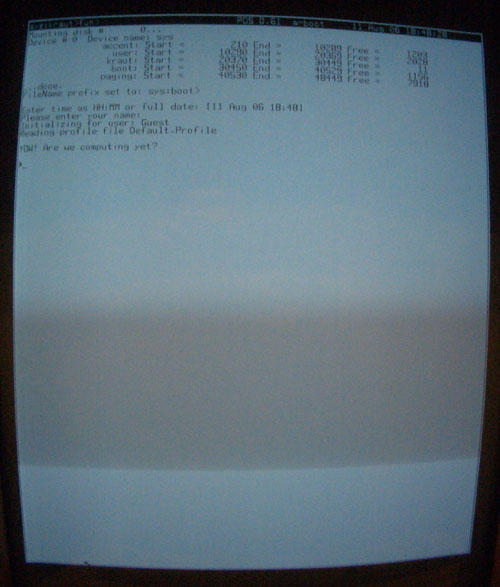
http://yahozna.dyndns.org/projects/PERQemu/PERQ-3.png
Ok, it doesn't look like _much_, but compare it with the photo here:
http://yahozna.dyndns.org/computers/perq/photos/pos-boot.jpg
(Hint: They're the same thing, only one's really scrambled up :P)
The boot process is still erroring out, but it's about 99% there (at DDS
951). Of course, I obviously still have a ways to go. As evidenced by
the completely garbled text, I have yet to get the PERQ's unique (and
extremely complicated) RasterOp hardware emulated to any significant
degree. And after that I have a ton of hardware details to work out.
But this is a major milestone, and I'm so excited that I just had to
share my excitement with someone... I never thought I'd get anywhere
near this far with the emulation, given how complicated the PERQ is.
And if I've seen so far, it's because I've been standing on the
shoulders of giants. Or one giant, at least -- our own Tony Duell who's
been ever-so-patient with my questioning and who probably knows more
about the PERQ hardware than the original designers did...
Thanks for taking a look, and sorry for tooting my own horn...
Josh
Hi,
Does anyone have any experience with using a TOP2049 as a TTL 74xxx chip
tester?
How did it work for you? Do you recommend it as a worthwhile piece of test
equipment?
Thanks!
Andrew Lynch
Are the three drive expansion boxes for the TRS-80 Model 2 rare or
anything? I have one in pretty rough shape that I plan to part out,
but I will hold off if the things are seriously in demand. Let me know
in a few hours, as I am loading up to go to the junkyard tomorrow.
I also have the TRS-80 Mod 2 computer that I need to test. I do not
want it. I would like to sell it or trade it, but I really do not want
to pack it.
--
Will, in 10512
reminder.... discussions of environmental issues are not freaking on topic!!
Do I really have to say that? I'm simply amazed. And then I see quotes from
Dr. Who. Un Freaking Believable.
J
Hi,
>....On Saturday I watched Terminator 3....
My utmost condolences.
That's a couple of hours of your life which you'll never get back....
TTFN - Pete.
Greetings all;
I'm reading up on the Onyx (rackmount, original Onyx) and the manual says
that units with three power supplies (OLS') are configured for three
phase, and units with two OLS' are configured for two phase.
While my machine does have the optional lower VME card cage and also the
second SCSI box (thus necessitating the 3 OLS'), I won't be likely to use
either of them. 220v I can do (handy-dandy nearby 40A circuit for a stove)
- 3 phase would require wiring changes in the building.
Is anyone aware if there was an established procedure to go from 3 phase
back to 3 phase on these units? Could I be lucky enough to have someone
here who has done it?
Thanks!
JP Hindin
Unless someone takes it off me, a basket case Friden Flexowriter will
hit the big smelter in the sky.
It is a later model 2309.
Location : Zurich Switzerland. Shipping is a no-no.
I bought it on ebay for 10$, but it turned out to be more effort to
repair than I am willing to invest.
BTW the seller compensated me with a nice, functional ASR-33 AND an
SWTPC CT1024...
Jos
>
>Subject: Re: WTB: LIM/EMS/XMS 16-bit ISA memory expansion board
> From: "Chuck Guzis" <cclist at sydex.com>
> Date: Wed, 07 Nov 2007 10:03:21 -0800
> To: "General Discussion: On-Topic and Off-Topic Posts" <cctalk at classiccmp.org>
>
>On 3 Nov 2007 at 20:25, Allison wrote:
>
>> Sounds like someone looking for an ASk 6Pak Pro.
>
>Do you mean "AST"?
Yep. Finally retired the nasty keyboard.
> No, not really--I don't need all the other glarf;
;) Well I was hoping..
>just the memory. There was a plethora of makers of memory expansion
>boards for the 286. I like the Intel Aboveboards, myself and avoid
>the Everex versions, for example.
Aboveboard was a good one. I have one paired with with my Intel Inboard386.
Allison
>Cheers,
>Chuck
>
>Subject: Kaypro 4/84 questions
> From: Brian Wheeler <bdwheele at indiana.edu>
> Date: Mon, 05 Nov 2007 13:13:40 -0500
> To: "General Discussion: On-Topic and Off-Topic Posts" <cctalk at classiccmp.org>
>
>I recently acquired a Kaypro 4/84 and I'm in the process of cleaning it
>up and getting it happy.
>
>There are a couple of problems with it that maybe someone can shed some
>light on:
>* one of the keyboard latches is broken. Anyone know a good substitute
>and/or workaround? I don't care so much about it, but it'd be nice to
>be able to lug it into the kitchen and carry something else at the same
>time :)
>
>* They keyboard cable is missing, but I substituted a keyboard cable
>from a DEC terminal keyboard and it seems to work. The tech manual I
>found online says that using a phone cord causes dropped characters due
>to the smaller wire gauge, so I'm hoping that this cable will be sturdy
>enough.
The DEC cable is about the best choice available.
>* There is a screw in the 2nd floppy drive opening. I've tried removing
>the drive sled (via the screws on the bottom), but alas it seems like
>the drives have to come out of the front individually. The screws are
>pretty solidly inserted and I cannot get them loose without stripping
>them. I'm not able to get to the inner ones easily without removing the
>motherboard and the monitor. Is it possible to take the bezel off of
>the drive and then slide the cage backward and then out? The drives are
>the shugart ones.
Mine had screws top and bottom. They tended to vary things.
>* I'd like to replace the 2nd drive with a 3.5" floppy. I've found a
>Sony HD drive along with a power and plug converter. Knowing that PCs
>use a twisted cable scheme, what things should I be aware of when
>cabling in this new drive? Will it be supported in some manner by the
>software? Its not a big deal if it turns out to be a 360K 3.5" floppy,
>as long as its readable by my linux box.
I've done this using a 3.5" to 5.25" adaptor. The software will not utilize
the full 80 tracks of the 3.5" floppy and possibly both sides if the roms
are not updated.
The Advent turborom with disk personality card and likely others support this.
The drives I used had the 1-4 jumper like 5.25" floppies so it was a matter
of pin to card edge adaptor, power adaptor and drive select jumper. For later
drives you make have no choice but to make a "funny cable" to do drive select.
the reason for that is those drives are locked to cable select.
Allison
I can boot my 10 MHz AT clone with the IBM Version 1 (01/10/84) ROM
just fine, but the Version 3 (11/15/85) beeps out a system board
error (long-short). I seem to recall that the Version 3 BIOS checked
for an 8MHz CPU clock and complained if it was anythng else. I know
that the Ver. 2 BIOS checked for a 6MHz clock.
Is my memory correct--and does anyone know of a patch? I could do a
little digging into the POST code, but I'd rather not duplicate
someone else's effort.
Cheers,
Chuck
Sridhar Ayengar wrote:
> David Griffith wrote:
>>> I think it goes like this, someone please correct me if I'm wrong:
>>>
>>> 1984 IRIS (terminal/workstation)
>>> 1988? Personal Iris
>>> 1990 Indigo
>>> 1992 Indigo^2
>>> 1993 Indy
>>> 1996 O2
>>> 1999 Octane
>>> 2000 Octane2
>>> 2002 Fuel
>>> 2003 Tezro
>>
>> I seem to recall the O2 coming out in 1999, roughly at the same time as
>> the Octane.
>
> Didn't the O2, O20 (Octane), O200 and O2000 come out at roughly the same
> time?
More or less. Besides that, the Indigo2 and Indy represent a split in the low-end line, both being offspring of the Indigo, with O2 being Indy's successor and Octane being Indigo2's successor. The O200 was the offspring of the Challenge S (and M) low-end server offering. The Fuel and Tezro are also pretty much complementary machines.
Also, since Octane sported the Cube logo, I seriously doubt that 1999 introduction date. The logo was changed in 1997/1998 and debuted on the Octane2/O2+ in the IRIS workstation line.
Here's the family tree, then:
/-> Indigo2 -> Octane -> Octane2 -> Tezro
Personal Iris -> Indigo -<
\-> Indy -> O2 -> O2+ -> Fuel
,xtG
tsooJ
Hi gang,
> > > Can I use a PC mouse/keyboard with that?
> >
> > You cannot. You need to use a SGI keyboard and mouse.
>
I have plugged a PC kybd/mouse into a SGI Crimson and an Octane
and they seemed to work OK.
> > > Are the monitor frequencies suitable for a modern PC monitor?
> >
> > They aren't. It's sync-on-green, so you either need a good monitor and
> > you definitively need an adaptor.
>
Needed a special cable
so I used a Sun cable on the SGI monitor.
Worked OK.
Have not tried any other monitors.
Regards
Ray vk2ilv
>
>Subject: Re: 8" disk drive project - maybe 3.5" project too???
> From: Grant Stockly <grant at stockly.com>
> Date: Tue, 06 Nov 2007 11:32:34 -0900
> To: "General Discussion: On-Topic Posts Only" <cctech at classiccmp.org>
>
>
>>Write trim erase is a signal to the head assembly (driver) that turns on
>>the erase segment of the head for erasing the area either side of the head.
>>It's also called tunnel erase. This gives some tolerence to off track reading
>>as the intertrack gaps are "clean". Tunnel erase is still part of all
>>floppy drives but is activated by Write-enable and you never "hear" of it.
>>
>>In 1976 all this was new and magical until Sugart came out with the much
>>simplified 5.25 SA400.
>
> From reading the information on the Internet I have pretty much
>guessed that much, that it was done automatically on new drives.
>
>> >Any comments or ideas on the idea? Is it worth trying? I've got a
>> >very weird tarbell card that formats and uses 3.5" disks as a 70k
>> >mini floppy. I guess anything is possible. : )
>>
>>Myself I'd persue something using a 5.25 or 3.5" drive with a current
>>softsector interface to the drive and enough CPU smarts to fake looking
>>like the Altair interface which was dumb as a rock and depended on the
>>8080 to do most everything.
>
>That is what I was thinking about too. I was thinking about a
>controller that hot wired into the existing drive card set. Drive 1
>would activate the fake 3.5" disk or flash memory and drive 0 would
>activate the 8" drive for example. That would allow for easy
>migration from 8" to a different format.
If you can that works.
>It would also be nice to have a media readable on a PC. A 3.5" disk
>with the fake hard sector formatting wouldn't be possible...
Thats impostant as most users will find the availble on media offerings
a bit thin is you go with hard sector (faked or real).
>What do you think about drive RPM? Should I be able to fake the 32
>hard sectors at any rate I want as long as its as fast or slower than
>the 8" drive?
I won't touch that. It's one of many warrens and burrows to dive into.
>The 3.5" disk should be writing the bits at whatever
>bit rate is requested, right? The only reason I want to do the 3.5"
>disk interface with faking 32 hard sectors is because it would be a
>fast way to get going. Hardly any hardware development required.
Drive rpm is always a problem. Even for soft sector the data sep has
to deal with that. Faked hard sector is just causing additional pain.
Take it from someone that uses a NS* hard sector system where the media
and the controller are far more common and pretty reliable and it's a
major pain. Media is hard to get and hard sector always was a closed
gate to transfering software. I felt the nonportable media was always
a major pain and handicap. I still maintain a "stock NS* Horizon"
as an artifact but due to media availability and portability my
second Horizon that I do use a lot has a softsector controller and
hard disk as primary storage.
I'd suggest two things:
Do complete Altair disk and drives and 1 floppy with it and make
additional media the users problem like in 1976, 1980, 1985 and
more so now.
Or a completely new controller (non replica) that acts like the Altair
part (runs unaltered altair basic and all) but is normal softsector
using easier to get 5.25 or 3.5 media with portability (and PC as a
disk generator) in mind. This would make the system more easily shown
and used. Also the user can than have CP/M as well as it was also
historically important to any Altair user of the time.
Like the 8800BT I have the few that had the Altair contoller usually added
a Tarbell or other later on to gain access to the larger software market.
Those that started with the base Altair and were slower to go to floppy
often didn't even bother with the altair disk and use NS*, Tarbel or one
of a handful of others with NS*dos or CP/M as the OS platform. It would
be interesting to see how many Altairs (all versions of the 8800) wer sold
and then how many disk controllers. I suspect based on my experince of
the time it will be something like 20:1 likely greater. The reason was
at that time by 1977 the cost differential was fairly great to have
Altair floppy disk over brand-x and CP/M was seen a cleary the up and
comming OS. It also was a factor that long shipping delays by MITS
at times and problems experinced by some tended to push some more toward
the after market add ons. My experience, I built and tested the first
Altair FDC sold on LI for a company.
Just my opinion.
Allison
>Thanks!
>
>Grant
Haha! I can't wait to show Hans. He was so embarassingly drunk that
night it's not even funny. This happened after I left, and it got much
worse.
I'm hope no one got on video what I did.
--
Sellam Ismail Vintage Computer Festival
------------------------------------------------------------------------------
International Man of Intrigue and Danger http://www.vintage.org
[ Old computing resources for business || Buy/Sell/Trade Vintage Computers ]
[ and academia at www.VintageTech.com || at http://marketplace.vintage.org ]
I'm about to go insane.
Here is what I have:
-Fake Altair (rock solid in everything but tarbell)
-Tarbel 1011D
-Tarbell 1011A, which SEEMS to be better than the 1011D.
-4xMITS 16MCS 16k memory cards
-5xSEALS 8k SRAM
-2SIO
-MITS Rev0 CPU
Anyway...it doesn't work at all if I have a 16k memory card and an 8k
memory card. The 1011A works best (gets the furtherest in all
tests). If I'm lucky it asks me how many disks I have!
It also doesn't work with 3 seals 8k cards.
When I put in a CompuPro active terminator on the end of the bus, the
computer goes crazy and doesn't do anything. Installing an
"Industrial Micro Systems" terminator from 1980 it changes
operational characteristics, but still doesn't quite do it.
I had been trying to make the stupid thing work for months, on and off...
Well, I decided to stop trying to limit the number of cards on the
bus. I put in 5 8k seals cards and the stupid thing boots and runs
commands. Before while loading BDOS it would most of the time report
corrupted or missing sectors. Or just print trash. Now I can run
DISKDMP and programs like that.
After working flawlessly for a few minutes its back to crazy. I can
single step through the tarbel boot program and see it going crazy... : (
I'd like the thing to be rock solid with minimal memory cards.
Can anyone think of WHY the tarbel card is so much trouble? I burn
EPROMs all day long with this Altair. It takes 3 minutes to burn a
1702 and I've never had one fail! I can also leave it playing music
for all night long with no problems!!!
I need help!!! : (
Grant
Hi,
>> That's a couple of hours of your life which you'll never get
>>back....
> Then I probably should not say that I actually like the movie, have
>watched it more then once and that I also own it... :)
Sorry, there should've been a smiley on the end of that (I got distracted by
a knock at the door). ;-)
TTFN - Pete.
I'm thinking of a device about the size of a couple CD jewel cases that
has two serial ports, a ps/2 or usb port, VGA port, power jack, and
perhaps a JTAG header concealed within. This device is a regular RS232
serial terminal. Plug in a monitor, keyboard, and something talking rs232
and you're ready to go. Inside there would be a microprocessor, some ram,
some flash, and an FPGA to take care of glue logic and talking to the VGA
port. The FPGA would be loaded with the digital schematics of a
particular terminal and its firmware, for instance, a Wyse 85 or 99GT (my
favorites). That would get you most of the usual emulations.
How hard would it be to create something like this? How much would it
cost?
--
David Griffith
dgriffi at cs.csubak.edu
A: Because it fouls the order in which people normally read text.
Q: Why is top-posting such a bad thing?
A: Top-posting.
Q: What is the most annoying thing in e-mail?
>
> Jay, other HP fans,
>
> I finally got a chance to re-examine the article on the wall down here.
>
> Someone hung up excerpts from "The Antarctic Journal", December 1976,
> page 286 (and parts of some presumably nearby pages). The article describes
> the "first" computer system at the Pole, which might possibly be true.
> During
> the 1974/1975 Austral Summer, UC Davis sent down a pair of HP 2100S machines
> to Pole. They were both equipped with 32K of memory, and sported paper tape,
> at least one line printer, and a pair of 45 ips, 800 bpi magtapes. Other
> I/O equipment mentioned in the article include an HP 12930A "universal
> interface", at least one HP 2570A "coupler controller", and at least one
> HP 12770A serial interface.
>
> If I run across the original journal, I can see about making scans. Right
> now, there is a hodgepodge of xeroxed page fragments taped to the wall.
>
> Before anyone starts drooling, this gear was all long-gone 20 years after
> it was installed. Even the microVAX that was here 10 years ago was packed
> up and removed years ago. Closest thing I've seen to a "classic" computer
> I've seen in use here lately was a Dell 386SX/16 as the head-end for the PBX
> we tore out in 2004, and the Compaq 386N we used for RTTY (last fired up in
> 2004 as well).
>
> It's all modern, boring stuff here now. :-(
>
> (except for the classic goodies I pack in my luggage ;-)
>
> -ethan
>
Wow... Something I know about!
I was there for the installation for those computers. They were 2100A's (not
2100s). Both of the boxes had two 9 track drives with the 500cps paper tape
readers, and the Facit 75 cps punches. I dont' remember much about the line
printer, but there must have been one, probably one of those mini Dataproducts
goodies (80 columns). They were configured to use RTE-C, the core image
version of RTE used at the time. Thankfully they had 32k of memory, since the
RTE stuff took up quite a bit of room, and the machines didn't have disk
drives.
I ended up writing a memory resident version of the papertape system (I forget
what it was called) that would allow assignments of input and output devices to
tape files and the like. I heard that it was useful since they had to develop
the programs used in RTE-C that way.
The application for the machines was for weather observation at the station.
The UC Davis people had some nifty humidity sensors (heated, etc.) they were
trying out.
The other thing we installed was a transmitting weather station (to a satellite
that orbited about once every 2 hours). Of course we didn't know when it
passed by so the logic (no microprocessors then) spit out the data about once
every couple of minutes. The Satellite was in polar orbit so it came by every
time. It waqs run from a couple of power sources, an RTG (big huge thing) and
a propane thermoelectric generator. I have fond memories of attempting to
start the propane thing and not getting the gas to vaporize. I had to use TWO
propane torches (one to heat the other) to get it working.
Yes, this is classic stuff. It dates to 1975, long before I saw a 6800.
__________________________________________________
Do You Yahoo!?
Tired of spam? Yahoo! Mail has the best spam protection around
http://mail.yahoo.com
This was brought to my attention at the VCF X.
http://www.youtube.com/watch?v=mYP-F7XxrDA
For those who don't know him, Han is in the blue shirt and black pants
... his standard uniform.
Jay, other HP fans,
I finally got a chance to re-examine the article on the wall down here.
Someone hung up excerpts from "The Antarctic Journal", December 1976,
page 286 (and parts of some presumably nearby pages). The article describes
the "first" computer system at the Pole, which might possibly be true. During
the 1974/1975 Austral Summer, UC Davis sent down a pair of HP 2100S machines
to Pole. They were both equipped with 32K of memory, and sported paper tape,
at least one line printer, and a pair of 45 ips, 800 bpi magtapes. Other
I/O equipment mentioned in the article include an HP 12930A "universal
interface", at least one HP 2570A "coupler controller", and at least one
HP 12770A serial interface.
If I run across the original journal, I can see about making scans. Right
now, there is a hodgepodge of xeroxed page fragments taped to the wall.
Before anyone starts drooling, this gear was all long-gone 20 years after
it was installed. Even the microVAX that was here 10 years ago was packed
up and removed years ago. Closest thing I've seen to a "classic" computer
I've seen in use here lately was a Dell 386SX/16 as the head-end for the PBX
we tore out in 2004, and the Compaq 386N we used for RTTY (last fired up in
2004 as well).
It's all modern, boring stuff here now. :-(
(except for the classic goodies I pack in my luggage ;-)
-ethan
--
Ethan Dicks, A-333-S Current South Pole Weather at 6-Nov-2007 at 09:30 Z
South Pole Station
PSC 468 Box 400 Temp -24.5 F (-31.4 C) Windchill -53.8 F (-47.6 C)
APO AP 96598 Wind 16.8 kts Grid 10 Barometer 684.4 mb (10463 ft)
Ethan.Dicks at usap.govhttp://penguincentral.com/penguincentral.html
Does anyone have docs for this beastie? it's an apple-II on a card that
goes into an XT... or does anyone have any interest in it? it's been
sitting on my shelf for ~ 12 years now...
>
>Subject: Re: 8" disk drive project - maybe 3.5" project too???
> From: Grant Stockly <grant at stockly.com>
> Date: Mon, 05 Nov 2007 22:50:45 -0900
> To: "General Discussion: On-Topic and Off-Topic Posts" <cctalk at classiccmp.org>
>
>I'm going to add some to my own topic. The questions below still
>stand, but I've got more info! : )
>
>>I want to use a QUME 842 or SA800 in an altair disk subsystem.
>>
>>Both seem to have the same interface.
>>
>>The FD400-5x0-5x1 manual seems to show the drives being quite similar.
>>
>>The first thing I see is that there are extra signals.
>>
>>"Trim Erase", "Write Enable", and "Write Data" where the Shugart
>>interface only has "Write Data" and "Write Gate". I assume that
>>gate and enable are the same thing. The FD Pertec drives also have
>>"IN", "OUT", and "STEP" instead of "STEP" and "DIRECTION", but that
>>is not a big deal. That can be generated in software.
>>
>>What I don't see is any input to perform the function of head
>>current. How does the shugart interface handle this?
>>
>>Can I ignore the trim erase feature? How do I generate a write busy
>>signal? I'm willing to make some circuits to fake these signals if required.
>
>More info:
>
>The pinout of an Altair disk drive...of the wires connected. Omitted
>pins are either not connected, power, or ground. All lettered
>connections are ground.
>
>6 - Output - Door Open (IDOP
>7 - Head Current Switch (IHCS)
>8 - External Trim Erase (Option) (IEEN)
>9 - Input - Write Enable (IWEN)
>10 - Input - Write Data Input (IWDA)
>11 - Input - Step In (ISTI)
>15 - Input - Step Out (ISTO)
>16 - Input - Head Load (IHLD)
>17 - Output - Index (IINXP)
>18 - Input - Drive Motor On (IDEN)
>19 - Track 0 (ITRK0)
>20 - Output - Read Data Output (IRDA)
>
>One thing that interests me slightly more is the possibility of a
>regular 3.5" disk connected to the Altair. I don't care about the
>encoding or format being compatible with a standard controller.
>
>It is very similar, but is also a soft sector disk/drive. How close
>is close? Can I just use a microcontroller with a timer to time from
>one index to the next and divide it up into 32 sectors? Will this be
>close enough for the Altair? Anyone know what kinds of errors I
>would get? A microcontroller running at 16MHz would be able to count
>between pulses with 16MHz/1 accuracy. With the SA800 I would have a
>sector hole sensor giving me the correct timing.
>
>There still is the issue of the write trim erase feature, whatever that is...
Write trim erase is a signal to the head assembly (driver) that turns on
the erase segment of the head for erasing the area either side of the head.
It's also called tunnel erase. This gives some tolerence to off track reading
as the intertrack gaps are "clean". Tunnel erase is still part of all
floppy drives but is activated by Write-enable and you never "hear" of it.
In 1976 all this was new and magical until Sugart came out with the much
simplified 5.25 SA400.
>Any comments or ideas on the idea? Is it worth trying? I've got a
>very weird tarbell card that formats and uses 3.5" disks as a 70k
>mini floppy. I guess anything is possible. : )
Sounds like a wither the DD or SD tarbel card that could interface
to most any drive using soft sector.
Myself I'd persue something using a 5.25 or 3.5" drive with a current
softsector interface to the drive and enough CPU smarts to fake looking
like the Altair interface which was dumb as a rock and depended on the
8080 to do most everything.
Allison
>
>2 - Density Select (/REDWC)
>8 - Index (/INDEX)
>10 - Motor Enable Drive 0 (/MOTEA)
>12 - Drive Select 1 (/DRVSA)
>14 - Drive Select 0 (/DRVSB)
>16 - Motor Enable Drive 1 (/MOTEB)
>18 - Direction Select (/DIR)
>20 - Head Step (/STEP)
>22 - Write Data (/WDATE)
>24 - Floppy Write Enable (/WGATE)
>26 - Track 00 (/TRK0)
>28 - Write Protect (/WPT)
>30 - Read Data (/RDATA)
>32 - Head Select (/SIDE1)
>34 - Disk Change/Ready (/DISKCHG)
>
>I'm not going to sleep a wink tonight. I hate having ideas at 10PM... : (
>
>Grant
I want to use a QUME 842 or SA800 in an altair disk subsystem.
Both seem to have the same interface.
The FD400-5x0-5x1 manual seems to show the drives being quite similar.
The first thing I see is that there are extra signals.
"Trim Erase", "Write Enable", and "Write Data" where the Shugart
interface only has "Write Data" and "Write Gate". I assume that gate
and enable are the same thing. The FD Pertec drives also have "IN",
"OUT", and "STEP" instead of "STEP" and "DIRECTION", but that is not
a big deal. That can be generated in software.
What I don't see is any input to perform the function of head
current. How does the shugart interface handle this?
Can I ignore the trim erase feature? How do I generate a write busy
signal? I'm willing to make some circuits to fake these signals if required.
Thanks,
Grant
>
>Subject: 8" disk drive project
> From: Grant Stockly <grant at stockly.com>
> Date: Mon, 05 Nov 2007 22:04:47 -0900
> To: cctalk at classiccmp.org
>
>I want to use a QUME 842 or SA800 in an altair disk subsystem.
>
>Both seem to have the same interface.
>
>The FD400-5x0-5x1 manual seems to show the drives being quite similar.
>
>The first thing I see is that there are extra signals.
>
>"Trim Erase", "Write Enable", and "Write Data" where the Shugart
>interface only has "Write Data" and "Write Gate". I assume that gate
>and enable are the same thing. The FD Pertec drives also have "IN",
>"OUT", and "STEP" instead of "STEP" and "DIRECTION", but that is not
>a big deal. That can be generated in software.
Trimerase is usually jumpered to Write-enable.
>What I don't see is any input to perform the function of head
>current. How does the shugart interface handle this?
Not all drives required or used it.
>Can I ignore the trim erase feature?
No.
>How do I generate a write busy
>signal? I'm willing to make some circuits to fake these signals if required.
Write busy is easy set a oneshot on write enable and use the output as
a response. If you think about it why sould you need write busy if
your busy writing? However some used that as a Door lock signal
to prevent opening a door during write.
The 8" interface world is generally complicated by difference names,
pinouts and signals for the same or very similar signals. That and
just as many signals and options that go unsued or just not required.
Allison
>Thanks,
>Grant
>
>Subject: Re: modern serial terminal
> From: Cameron Kaiser <spectre at floodgap.com>
> Date: Mon, 05 Nov 2007 15:17:38 -0800 (PST)
> To: cctalk at classiccmp.org
>
>> > You're going to have to 'splain that one to me, Lucy. There were
>> > plenty of bitmapped graphics machines for the home market.
>>
>> Name is not lucy. The LISA and MAC I consider BITMAPPED.
>> C64's and others had sprite graphics. Amiga and Atari(sp)
>> were maketed as games machines. The APPLE II split screen
>> I liked for text on the bottom (FAST) , graphics on the top
>> slow. Only the development of fast 2D graphics cards even
>> make modern software usable.
>
>You have an odd taxonomy here. The Amigas and Atari (STs and otherwise)
>computers were not marketed strictly as game machines (or else you should
>include the C64 in that category). And they are most definitely bitmapped.
>
>The C64 has sprite graphics, but it definitely has a bitmapped graphics
>mode. It's somewhat more inconvenient to work in because of its cell-
>oriented arrangement, but it's bitmapped.
>
>So, I'm not sure where you're drawing the line here, but all of the machines
>you mention have bitmapped graphics and were home computers, except perhaps
>the Lisa, but only due to cost.
Comentary:
The problem as initially launched was small inexpensive terminal "box"
of insignificant size that used PC display and keyboard. Paraphrased
more or less.
One, most applications that use "terminals" are non graphic or if they do
it's low res and minimal. If that were not true my Vt125 and VT340 would
see more action as they are both graphic and support color.
With that most terminals are text, 80x24 or 80x25 and some can do 132x20.
The "terminal" is expected to comply with ANSI escapes, VT52 or ADM1/3
typically to be most useful. This is often important to editors and
many other applications that do screen handling.
With that anything with more than an 8051, character cell display is
likely over kill and under utilization. The simplest home brewed
terminal I'd seen was a computime SBC880 (z80,1k ram, 2k rom, 1 serial
IO and a parallel IO) and a PT VDM1 (yes it's 64x16lines) though a 80x24
card could be used. The whole mess was wrapped in a minibox with PS
measureing 12x7x4 inches making it smaller than the monitor and
serial keyboard used. It did a fair (limited to 64x16) VT52 emulation
with soft scroll and no flashing and could support 19.2kbaud serial
rates. The guy that bilt it spent $200 for the boards, 2 S100 connectors
and power supply, aluminum box and even a 9" B&W monitor back in 1982.
I'd think with current parts [one of the 8051 clones or eZ80 and a CPLD]
a 80x25 terminal could be put on a 4x5" card with minimal effort. The
output should drive a standard PC tube/LCD with one selectable color
and use a PC keyboard power would come from a wall wart.
Personally a VT320 with a mono LCD rather than a CRT would be ideal
and much more compact at 2 peices total (display and keyboard).
Allison
>--
>------------------------------------ personal: http://www.cameronkaiser.com/ --
> Cameron Kaiser * Floodgap Systems * www.floodgap.com * ckaiser at floodgap.com
>-- BOND THEME NOW PLAYING: "All-Time High" from "Octopussy" -------------------
I have found your following post by Google when I was
trying to solve the same problem.
--------------------------------------------------
Hi
I have the system unit for a Victor V286C PC
manufactured in
1991. Its in really nice condition.
Keyboard and mouse are no problem. However the display
is a different
matter. It has a nine pin
display connector which would make it a CGA ,MGA or
Hercules output.
Anybody any ideas as to where I might find a matching
monitor?
Rod Smallwood
----------------------------------------------------
I could not find any solutions on the Internet, and
then start experiment. I have found ISA video card
with standard vga-connector, put it to the top ISA
slot... and have no effect. Then I switched a jumper
near ISA slot to DISABLE position and miracle happend.
:) By the way, DIP switch on the back panel of system
unit was in the following position: 1-on, 2-on,
3-off, 4-on, 5-off, 6-off.
__________________________________________________
Do You Yahoo!?
Tired of spam? Yahoo! Mail has the best spam protection around
http://mail.yahoo.com
It isn't necessarily the motor either; I've seen a couple units that
require some kind of "disc present" feedback from the laser diode before
they spin....lots of adjustments possible here. I'd start checking power
supplies, and putting a scope on the motor drive, might tell you if you're
barking up the right tree.
As for motors though, I've found slow speed computer CDROM drives can have
compatible motors -- if you find one that will mount properly. I got sick
of trying to find compatible parts; and so, I've been working on converting
a 101-disc cd audio changer for use with data cds and dvds.
T.H.x.
Devon
(I hope this doesn't upset Jay. I think it's on-topic according to the
semi-bogus the ten-year rule, and it's certainly on-topic in the
non-mainstream sense - what I'm trying to do is well outside the norm.
Except, possibly, for populations like the one on this list. :)
I have a Technics SL-PD8 five-disc CD changer. It's been working fine
for a long time; in recent months, it's had trouble ejecting the tray
(but not, interestingly, retracting it).
Then a day or two ago it stopped playing discs at all. I can't even
hear the disk spinning up.
So I opened it up, and I have been completely unable to make the disc
drive motor spin, with or without a CD in place. I've pulled it apart
far enough to have the CD transport mechanism out in the open, and it
still won't spin. (In the process, I found the stretched belt that was
responsible for the weak eject; I dug through my rubber band collection
and replaced it, and now the tray eject works fine.)
Now, I'm not Tony; I'm not about to rewind the motor or some such. But
I was wondering if anyone knows how similar the mechanism is likely to
be to a cheap computer CD reader - basically, I'm wondering if I can
raid one of my extra CD drives (of which I have several) for parts to
resurrect the Technics. I can just open things up and have a look, but
if anyone has experience, it could save me some headaches.
Any thoughts?
/~\ The ASCII der Mouse
\ / Ribbon Campaign
X Against HTML mouse at rodents.montreal.qc.ca
/ \ Email! 7D C8 61 52 5D E7 2D 39 4E F1 31 3E E8 B3 27 4B
respond offlist please?
__________________________________________________
Do You Yahoo!?
Tired of spam? Yahoo! Mail has the best spam protection around
http://mail.yahoo.com
At 01:42 PM 10/19/2007, you wrote:
>Grant Stockly wrote:
>>What do you guys think? The thing has a peripheral expansion header.
>>We could hook a modern floppy chip to that, connectors for
>>different drives, and off we go...
>
>What's the cost like? Is the board made up of separate components
>(CPU, ROM, RAM, USB chip, buffers for I/O, Ethernet chip etc.)?
>
>I'd find Ethernet more useful than USB, and in an ideal world I'd
>prefer a board where the functional areas are segregated (rather
>than some complex and expensive single chip, where if disaster
>strikes the thing basically needs throwing out and replacing as a
>complete unit)
The base eZ80SBC from howard is $250. Add $100 for the disk board...
-----REPLY-----
Hi,
By the time you add in all the costs of the CPU board with IO, case, power
supply, cables, documentation, plus the specialized disk controller, AND
write most if not all of the software this project is quickly going to
become uneconomical for all but the most patient and financially well off.
You could use a throw away old 486 or Pentium II computer with ISA and/or
PCI slots to provide any interface you'd like (ethernet, SCSI, ST506, USB,
whatever) for a whole lot less time and effort. A double sided 48tpi floppy
drive will read practically any format given the right controller. The same
can be done for whatever sort of drive you'd like to test.
I have made and am using a few bench stations for testing floppy drives,
ST506/ST412 hard drives, SCSI, etc for a small fraction of what the cost you
are proposing. I am sure many others here are doing the same thing as well.
In addition, reusing old PCs effectively removes them from the waste stream
which is not only economical it is environmentally friendly as well. Get a
small enough PC and they are portable assuming you choose standard interface
for peripherals like VGA, PS/2 keyboards & mice, etc.
On top of the above, as an added bonus much of the software is already
written. You can use ImageDisk for soft sector floppy disks, SpinRite II
for ST506/ST412 hard disks, etc.
Respectfully, it seems like the proposals being discussed are reinventing
the wheel by developing and/or repurposing a new CPU and IO board rather
than reusing proven and cost effective solutions which already exist.
It is just my $0.02. Best of luck with your project. Thanks!
Andrew Lynch
>
>Subject: Re: Kaypro 4/84 questions
> From: Fred Cisin <cisin at xenosoft.com>
> Date: Mon, 05 Nov 2007 15:27:29 -0800 (PST)
> To: "General Discussion: On-Topic and Off-Topic Posts" <cctalk at classiccmp.org>
>
>On Mon, 5 Nov 2007, Roy J. Tellason wrote:
>> selecting the drive should be apparent as Kaypros tend to leave the light on
>> all the time.
>> > Will it be supported in some manner by the software?
>> Hm, kinda doubtful, though I couldn't say for sure as it's been a long time
>> since I dove into those particular interface specs.
>
>There WERE patches available for using 720K (3.5" or 5.25") drives on
>Kaypros.
>
>"Advent"?
Advent supports both 720k and 781K formats on DSDD 96tpi 5.25 or 3.5"
Advent Turborom with the Advent disk personality board. I have both in mine
One floppy is the 48tpi two sided half height, the other is 3.5" in a PC 5.25"
adaptor and inside I have a third 3.5" as a default boot drive. Lots of storage.
Allison
>MicroCornucopia?
>Chuck might know.
>
>
I saw this from Bill Whitson dated 1997 on the web,
Bill,
I saw your list of classic computers. Now over 10 years old but - Great!!
I am looking for more info on this computer >>
Control Data Corp.------------------------------------------------
Model 110 6809 64K ?? MICRO 83
I would appreciate anything - more specs or a photo(s)?
I do have the CDC announcement of the product in the NYTimes and it was
September 14, 1981.
http://query.nytimes.com <http://query.nytimes.com/>
It was "priced at $4,995" with "business and educational applications cost
between $625 and $4000"
I am not sure when (or if) the product actually was available for shipment.
Thanks,
Larry G. DeVries
Eden Prairie, Minn.
952-949-9604
Hello folks,
I picked up a couple of Intertec Superbrains last week, and have
finally got around to cracking the cases. One has memory problems, the
other has keyboard problems.
I'm fairly sure the one with memory problems is down to a faulty 4116,
but I can't work out how to find out which one it is. I'm guessing it's
in the lower part of memory, because although the system boots it hasn't
got enough marbles to run DDT.COM - if I could get that working I could
prod around in memory until I found the stuck bit.
The keyboard problem on the other one is a bit odd - not all the keys
work (haven't worked out the pattern but it *seems* like the outer three
on the ends of each row work, the middle ones being dead), and the key
repeat starts instantly. I'm a tad concerned that this is a sign of a
dying keyboard controller chip - I doubt I'll ever find another,
although if it was a problem I'd just program up a PIC to do its job.
Any thoughts? Is there a way to trick CP/M into loading DDT into higher
memory?
Gordon
Rumor has it that Curt @ Atari Museum may have mentioned these words:
>New thing these days, thieves are stealing the krypton headlights out of
>cars...
Is this so when they get caught by Superman they have a chance of getting
away???
Sorry, just had to. Grabbing coat, calling taxi... ;-)
Laterz,
Roger "Merch" Merchberger
--
Roger "Merch" Merchberger -- SysAdmin, Iceberg Computers
zmerch at 30below.com
What do you do when Life gives you lemons,
and you don't *like* lemonade?????????????
This isn't even close to on-topic, but maybe it's of general interest.
Paypal is offering a SecureID fob, the "Paypal Security Key", for
authentication to your Paypal account. I haven't seen it mentioned on
the Paypal descriptions, but the coworker who showed me his tells me
that it works with eBay too. Worth mention, I suppose, is that it's *in
addition to* your email/password login info, not instead of.
Also, it's $5 USD shipped. :)
Doc
..Sellam really outdid himself this year. VCF X rocked. I'm looking forward to seeing all the pictures, because there sure were a bazillion people taking 'em.
I've got a BASF 6185 ST412-interface drive which is spinning up, zeroing the
heads, and then giving three short pulses on the LED followed by one long one.
Anyone have a reference handy to tell me what that particular error code
means? I suspect it's the same on various BASF ST412 drives, so a manual from
one of their other models might give the answer too. I'm kicking myself as I
found these once a few years ago online and now they seem to have vanished.
I had the drive working - briefly - this morning, although it was throwing up
too many data errors to actually boot the OS [1] that was on it. Now it's just
giving the LED fault code above and not returning anything though, so I
suspect something terminal has happened. (And the exact meaning of the fault
is probably academic)
[1] It's the only copy of Torch UNIX for BBC micros (using a Torch 68000
co-processor) that I'm aware of, and a viable set of install media doesn't
seem to exist, unfortunately.
cheers
Jules
Hey folks. Does anyone know of any used raised flooring
available, either free or really cheap, preferably in the
southeastern US? I'm only looking for about 800 sq. ft. or so.
-Dave
--
Dave McGuire
Port Charlotte, FL
Farewell Ophelia, 9/22/1991 - 7/25/2007
> Anyone? Please speak up now if you are interested.
Real 5251s and their keyboards are just annoying uncommon enough that
a number of IBM collectors on this list will probably kill you for
every modification you make.
Use another keyboard, please.
--
Will
-----REPLY-----
Well, I suspected as much when I did some quick google searches and only
found them in either computer museums or at parts resellers charging some
fairly steep prices. I had a hunch this part deserved a better fate than
what I had in store for it. I can do without the death threats though, I
did at least *ask* before gutting it. :-)
I have nothing against IBM mainframes or their collectors and I can
sympathize with their plight as to finding those rare parts. However, I
still need a rather mundane parallel ASCII keyboard and am going to either
build or buy one.
If any of the IBM collectors out there want this keyboard, I will gladly
trade it for a like valued item. No, that does not mean those ridiculus
prices the IBM parts resellers are asking, just something I need or want
like a parallel ASCII keyboard, a 100tpi 5.25" floppy disk drive, or some
other S-100 related doodad.
Me keeping this keyboard in my basement is not much better than throwing it
away. I have zero interest in IBM system 34's or 5251 terminals or whatever
these things are really used for. Someone please make a reasonable offer.
Thank you.
Andrew Lynch
>>I can get one of those for $0-10. It's called a DSL modem and even
>>comes with wireless networking in addition to USB, serial, and
>>10/100BaseT interfaces.
>
>But no VGA interface for the monitor. : (
Watch for NS Geode thin clients (like Neoware EON). I picked up five of them yesterday for $10 ea
mostly to use as firewalls.
http://cgi.ebay.com/ws/eBayISAPI.dll?ViewItem&item=320157041439
for example.
Hi,
I recently purchased an old keyboard looking to reuse
the parts for another project. I did a little
research into exactly what I bought since no one
seemed to know. It turns out it is a keyboard for an
old IBM 5251 terminal from approximately 1977. Here
are some photos:
http://www.eldocountry.com/Computer/5251.jpghttp://content.techrepublic.com.com/2346-10878_11-3370-4.html
Now, I don't really care too much about IBM mainframe
terminals or whatever this thing is but as I *do* care
about vintage computers. I know how hard it can be to
get parts sometimes so before I tear this keyboard up
and recycle it into something else, is anyone looking
for one of these keyboards? Are they common? Are
they rare? It is IBM part 7361073.
All I want it for is the case, the mechanical switch
keyboard, and the cabling. I was planning on tossing
the small controller inside into the trash but I
thought I would ask the CCTALK list to see if anyone
cares before I rip this keyboard up for my latest
project.
Anyone? Please speak up now if you are interested.
Thanks!
Andrew Lynch
Date: Sun, 4 Nov 2007 17:40:25 -0500
From: Dave McGuire <mcguire at neurotica.com>
Subject: Re: modern serial terminal
On Nov 4, 2007, at 4:59 PM, Tony Duell wrote:
>>> I don't understand why someone would want to spend 10x more
>>> tima and money on a one-purpose device, when they can get
>>> everything they want and more off a cheap PC.
>
>> Probably for the saem reason that some of us run classic computers in
>> preference to PCs...
> For me, the reason is simple. Terminal emulators are too damn
>much trouble...emulation problems, key mapping, etc. I've used
>pretty much all of them over the years, I think...the best one I've
>used was SmarTerm 240, and even that is far from perfect. Sometimes
>what one really needs is an APPLIANCE...not an emulation of said
>appliance built upon an unstable and problematic platform.
----
Well, since this thread is (was) about building your own terminal box,
that's not really relevant; if the emulation isn't true that'd be your
responsibility. If you're going to program that box correctly you
could program the emulator just as well, probably much more
easily, and then you could share it with the rest of us who wouldn't
have your custom box but do have a "computer."
I've certainly written emulators, and it looks like I'm
about to write another, for an obscure terminal. What's the
difference between programming an EEPROM for your box
and a Flash card or USB stick for a box that says IBM or Dell
on it?
In case you hadn't noticed, computers have been APPLIANCEs
for a few years now; to keep thinking of them as 'computers' tends
to restrict your vision. To me, the laptop that connects my Cromemco
to the Internet, the one that logs phone calls and voice-announces the
Caller-Id and the one that monitors the furnace and sends RS-232
data to my desktop are just protocol converters; fun of building aside,
none of those applications justified my building dedicated hardware -
I just wanted something to do the job quickly and reliably without
getting sidetracked with yet another "project."
===
> Further...A VT320 terminal pulls less than half an ampere at 120V,
>and is available for use within about fifteen seconds of
>powerup...can anyone say either of those things for a PC running
>terminal emulation software?
-----
Yes.
But to each his (or her) own...
m
Date: Sun, 4 Nov 2007 21:59:11 +0000 (GMT)
From: ard at p850ug1.demon.co.uk (Tony Duell)
Subject: Re: modern serial terminal
>
>> Dave McGuire wrote:
>> >
>> > I really cannot fathom why people keep suggesting a computer when
>> > the OP wanted a *terminal*.
>> 4. Ease of Repair. If the hardware dies, worst case you just need
>> another run to the local thrift store. With a specialized solution,
>> you need to spend several hours repairing it, wait for several
>> days for repair parts to be shipped to you, ...
>However, if you built it yourself, you presumably know how it works, and
>you managed to get all the bits once, so you have a good chance of
>gettign them again.
>I know which _I'd_ rather repair..
-----------
So do we all ;-)
Thanks, Tony; I knew that was coming and I wouldn't have been able to
sleep tonight without it.
And to return the favour with some grist for _your_ mill, I'd just *replace* it!
<ducks>
;-)
m
not very expensive at the moment, and has a few
problems, but at least well worth it at the current
bid (sorry, forgot to copy the item #):
http://cgi.ebay.com/ZENITH-data-systems-computor_
W0QQitemZ110186173215QQihZ001QQcategoryZ1247QQss
PageNameZWDVWQQrdZ1QQcmdZViewItem
__________________________________________________
Do You Yahoo!?
Tired of spam? Yahoo! Mail has the best spam protection around
http://mail.yahoo.com
Date: Sun, 4 Nov 2007 12:55:10 -0500
From: Dave McGuire <mcguire at neurotica.com>
Subject: Re: modern serial terminal
On Nov 4, 2007, at 12:39 PM, woodelf wrote:
>>> I really cannot fathom why people keep suggesting a computer when
>>> the OP wanted a *terminal*.
>> A 6809 terminal sounds easy. :)
> And fun!
-----------------
A moot distinction; what's the difference? If you must have a terminal box
instead of just running your vintage hardware from the computer on your
desk, just take an old laptop, remove the (perhaps broken) display, stick a
USB or Flash disk in it to boot and run emulation S/W from, plug in your
keyboard, display and RS-232 cable and how's that different in any real
sense from a fancy terminal? CPU, EEPROM, RAM and I/O; sounds the
same to me, and probably free...
Except of course for the added features of programmability, extra memory,
up/download and text capture capability, network access, RS-232<>Internet
bridge capability, printer & USB ports, alternate keyboard, modem, etc.
I've got a dozen terminals here gathering dust; my small 486 Compaq laptop
is portable and way more convenient. The only terminal I have kept on my desk
is a Cromemco C-5 to run one particular HD diagnostic program because AFAIK
there isn't an emulator for Cromemco 3101-style terminals, but a couple of
us are working on it so I hope to be able to retire that one as well soon.
I have to admit that using an XT doesn't make much sense to me either though;
why would anyone... (oh, oh, starting to sound like Tony...)
If you insist, I have a couple of 6502-based Linger 65/9028VT terminal
boards (abt 6"x4", Heath/Televideo/Hazeltine/ANSI etc.) and also a bunch of
8631/8563-based Crestline CT-128 colour terminals in enclosures
(abt 8"x5"x2", Intecolor, VGA/composite); the only catch is that there's no
source available for the EPROMs AFAIK (although there _might_ be).
mike
Hey folks...I don't know if there are any Atari hackers around
here; I may be alone...but I wanted to let any interested parties
know that I've located a source for the proprietary connectors that
Atari used for their "SIO" bus, which is used to connect nearly all
of their peripherals in a daisy-chain configuration.
http://www.connectworld.net/cgi-bin/iec/fullpic?AZndUfrS;AT13F;6
I've purchased a connector from the page referenced above, and it
is indeed the right thing.
-Dave
--
Dave McGuire
Port Charlotte, FL
Farewell Ophelia, 9/22/1991 - 7/25/2007
I used to work on similar Mullard core stores.
They where part of the memory units in 4100 mainframes.
The ones I knew where definatly 4K (4096).
They were mounted in the centre of a card rack with read/ write boards
on either.
OC81 and OC71 transistors in great profusion.
Some had to be gain matched. You started with a box of 500 OC81's, a
pile of paper cups
and a transistor tester set to measure hfe.
Rod Smallwood
-----Original Message-----
From: cctech-bounces at classiccmp.org
[mailto:cctech-bounces at classiccmp.org] On Behalf Of Roger Holmes
Sent: 01 November 2007 00:38
To: cctalk at classiccmp.org
Subject: Re: Info about a Mullard Core
Hi,
> From: "Gavin Melville" <gavin.melville at acclipse.co.nz>
> Subject: Info about a Mullard Core
> Hi,
>
> I have had for many years a large core, and while I don't really want
> to part with it, I also see what little pieces of core sell for on
> ebay....
>
> I was told when given this about 15 years ago that it was from a
> Burroughs mainframe which was installed at the Cadburys head office in
> New Zealand and that they had paid GBP 20,000 for it in 1960.
20,000 for the core or for the mainframe?
How sure are you about it being Burroughs? Wouldn't they be using U.S.
components rather than British?
I know Cadburys bought an ICT 1300 series machine around 1963/4, and its
now in a museum in NZ. It was a 48 bit machine, but I think it had a
much smaller store of 1200 or 2000 words and would have cost around
100,000 GBP. I have read there was an option to replace all the 'barn
door' core stores with a single store of 4,000 words of 48 bits, though
I've never seen one, nor the logic diagrams. I have always wondered
whether it used a full binary decode (using 16384 words to provide 4000
words of usable memory) of the 14 bits rather than a BCD decode. The
1300s use lots of Mullard components.
Just a small piece of a jigsaw puzzle, maybe not even the right puzzle!
Roger Holmes.
Owner of the last working ICT 1301.
> I have
> been unable to find out if this was correct however. Does anyone on
> the list know anything about it ?
>
> pictures at http://www.flickr.com/photos/8788341 at N05/?saved=1
>
> There are 921600 cores in the array, which is made up of 48x48 cores,
> 4 to a layer and 100 layers.
>
> _________________________________
>
> Regards,
> Gavin Melville
> Senior Engineer
> Acclipse Electronic Ltd
>
Hi list,
I have here a card bearing no ID except the stickers on the EPROMs,
which say "(C) 1991 DataCare International Co.".
It's EISA, and has two IDE connectors (marked "TO FIRST IDE DRIVE" and
"TO SECOND IDE DRIVE", a floppy connector, and 4 30-pin SIMM sockets
(all are populated). I don't know anything more than this about it.
If anyone would like this, pay shipping from Yorkshire, UK for it and
it's yours.
Ed.
Hello,
Since this has mostly been gathering dust lately, I have the following
Clipper system for trade/sale/???:
Intergraph 2000 system with 64MB RAM (maximum)
extra 3x 16MB RAM (new)
20" monitor (with metal housing :) )
keyboard and mouse
Clix installation media (floppies + cd's) and a set of documentation
Last time I tried this system was working great, but it has been at
least two years since I last tried it. There was a CAD package
installed, IIRC microstation. All reasonable offers considered, located
in The Netherlands. Shipping would be possible, but probably without the
20" monitor.
greetings,
Michiel
Hi,
>> Memotech
>>
>> Originally a maker of add-ons for the ZX-81, RAM packs etc.
>>Great machines IMHO.
>
> I was given one recently. The mechancial design in beautiful....
One of the best designed home micros IMHO (mechanically).
> Is the manaul for these machines on the web anywhere?
Dunno about on the web, but I probably still have my copy lying around
somewhere....I don't recall seeing any PAL equations in it though.
TTFN - Pete.
This talk about an FPGS style terminal sounds neat, but...
How about a set of EPROMS that will fit into an XT, or AT motherboard that in
combination with standard I/O cards (serial port, CGA video) and will emulate a
standard terminal on power on. Obviously this would require input from the
keyboard and proper coding of the video display memory. I suspect that very
little ram memory would be needed (alternate pages or scrolling memory). Given
that smallish older XT motherboards exist with other "surplus" parts, this
could be an interesting exercise.
For extra credit, add a network interface to make a telnet terminal.
While this may not exactly fit the bill, it could possibly fall into the
"classic" category, expecially if one uses an old XT motherboard and say 256k
bytes of memory (8/9 256k x 1 chips, it was before SIMMs).
Just a thought....
__________________________________________________
Do You Yahoo!?
Tired of spam? Yahoo! Mail has the best spam protection around
http://mail.yahoo.com
Jason T wrote:
> Not sure if any computer ever used them, but I remember having an old
> Akai sampler that used a bizarre "Quickdisk" format. The sampler is
> long gone, but somewhere I have one or two of the disks, which will be
> handy should I ever try to create a magnetic media display of some
> sort. I think they measured...2.75" (?) and held...not much at all.
They were used on some MSX home computers, although I have only ever read about them (and seen pictures). I don't think they were commonplace outside of Japan and Korea. They were sort of a cross between tape and disk media; data was written sequentially in a spiral pattern on the disk.
,xtG
tsooJ
---------Original Message(s):
----------
From: Jim Attfield[SMTP:james at attfield.co.uk]
Sent: Friday, November 02, 2007 5:11 AM
To: M H Stein; cctalk at classiccmp.org
Subject: RE: IMI drives (was WTB/WTT S-100 Chassis (UK/Europe only))
> From: M H Stein [mailto:dm561 at torfree.net]
> Sent: 01 November 2007 07:33
> To: 'cctalk at classiccmp.org'
> Cc: 'james at attfield.co.uk'
> Subject: IMI drives (was WTB/WTT S-100 Chassis (UK/Europe only))
>
>
> Re: Looking for IMI drives for a Cromemco:
>
> Another solution would be to find an STDC HD controller; then you could
> use most ST406/512 drives, and they'd also be quite a bit faster (and it
> would be a lot cheaper to ship ;-). I'm running two 150MB Maxtors and
> two 20MB IMIs on the same system BTW.
>
> I don't believe there are any CDOS drivers for it though, so you'd have
> to run any CDOS or CP/M programs in Cromix.
>
> As an aside, there's also an ESDI/SCSI controller; they're pretty scarce
> and your card set wouldn't support one AFAIK, but there is at least one
> person out there putting a 1.2GB disk into his Cromemco (you know who
> you are); not sure if it's working yet though, looks like the
> drive may be bad.
An STDC would be nice and I agree, in some ways perhaps more desirable than
the WDI-II but I haven't seen one come available for a looooong time (YMMV).
I also prefer not to lose CDOS or the possibility of CP/M (although I always
preferred MP/M-II even for single user use).
Jim
--------------Reply:
Well, yes, My M does V... ;-)
But you wouldn't "lose" CDOS or CP/M, just direct HD access from CDOS;
I haven't seen any CP/M drivers for a WDI-II and IMI HD - have you?
If Cromix couldn't run your software for some reason or you want the CP/M
"look and feel" you could always still run off a couple of 1MB floppies and
then use Cromix to archive your files on the HD.
Anyway, just thought I'd mention it in case you happen to run across
an STDC before you find an IMI HD.
mike
Does anyone have experience with these programmable bipolar ROMs
failing after a long period of time? I have an old piece of test
equipment that has 8X300 running the display reading its program from
the aforementioned ROMs and the text info is missing pixels -
apparently in the same place in the same letters.
I am pleased to announce that Hewlett Packard and The Computer History Museum have as
of today entered into an agreement allowing CHM to preserve and redistribute all of the
software (objects and sources) along with documentation for the 21xx/1000 family of
computers for non-commercial use.
The software has been explicitly licensed for use both on simulators and real hardware.
HP has also donated a large collection of manuals and software distributions, primarily
>from the late 80s and forward, which complements what CHM already had from earlier software
releases.
CHM will continue to be actively involved in trying to find all of the earlier software
releases which weren't in the HP archives.