I believe what you're looking for
(at least for the KDF11-B serial connectors)
is this module:
http://scandocs.trailing-edge.com/micropdp11/volume1_system_cpus/EK-245AA-M…
While there are probably 3rd-party modules out there,
it is easier to find the real DEC bulkheads.
Most of the DEC modules come with their own style of bulkheads.
The DZV11 has it's own bulkhead, as does the DLV11-J
The DHV11 bulkhead will also work on the DHQ11
You *could* build a custom ribbon cable to interface
the DZV11 / DHV11 / DHQ11 bulkheads to work with
the DEC standard 10-pin connectors, but it's easier
just to find the proper bulkheads.
Alternately, you could use just the mounting plate
>from the various bulkheads, and install your own
DB25 connectors, and 10-pin cables.
T
> I also have a 733 without cassette drives (is that a different model #)?
The model with the two cassette drives is the 733 ASR (Automatic Send/Receive)
and the model without is the 733 KSR (Keyboard Send/Receive)
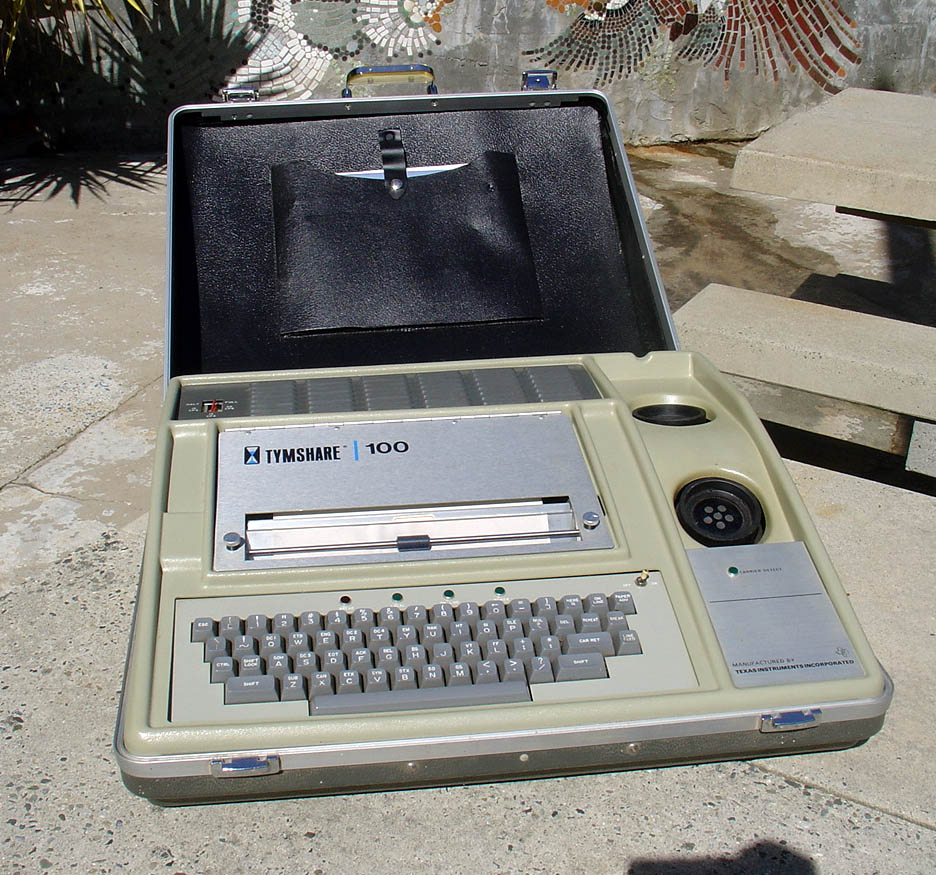
> http://www.digibarn.com/collections/systems/ti-tymshare-100/DSC02096.JPG
Is this really a 733? It does not look like one. According to the
picture in my "Operating Instructions", the KSR looks identical to the
ASR, except for the cassette driver, and it is not designed to be
portable. But perhaps it's a 733 in a Tymshare carrying case.
Does yours look virtually identical to the one on the picture?
/Lars
--- On Thu, 6/4/09, Rick Bensene <rickb at bensene.com> wrote:
> I've got a batch of 30 brand new 8" Floppies that I can't
> figure out. They are hard-sectored disks.
> The weird part is that the index hole placement is strange
> on these disks.?
They are probably double-sided disks. The index hole sensor
was offset on the double-sided drives to prevent the use of
disks intended for singled-sided use only.
--Bill
On Thu, Jun 4, 2009 at 11:42 AM, John Floren <slawmaster at gmail.com> wrote:
> Interesting, I didn't know a /23 could run V7--all I know for sure is
> that it works on /45s and /70s. Do you know any other machines it runs
> on? I'd like to try installing on my 11/73 (KDJ11-A) if possible.
I think it would come down to disk drivers. If the kernel will run on
an 11/70, there's no difference I can think of off the top of my head
why it wouldn't run on a KDJ-11, unless there's something about the
22-bit Unibus mapping on the 11/70 vs no mapping on the Qbus.
Disks, though... a 11/73 is likely to have an MSCP disk controller,
but the 11/70 has quite a number of supported disk controllers.
I'd look at the 7th Ed. sources and the install process to see what
7th Ed. is expecting to load onto.
It's all part of the joy of vintage gear - you used to have to know
exactly what you had and exactly what the software was looking for to
have a successful install experience. More than once, I had to
install on machine A, then either move the disk or the data on the
disk to machine B because I couldn't install directly on machine B
(most often due to tape drive/boot ROM issues).
You might be able to scope this out with simh prior to gathering
genuine hardware, but if you have the hardware lying around, you might
as well try it.
-ethan
> From: Rich Alderson <RichA at vulcan.com>
> Subject: RE: anyone read dealers of lightning?
> > If you enjoy reading [_Dealers of Lightning_], also
> read Soul of a new
> > Machine, its about the creation of Data General and I
> think that was an
> > even better read.
>
> De gustibus non disputandum.? However, _Soul_ is very
> much NOT about "the
> creation of Data General", which was incorporated in
> 1968.? It is rather
> about DG's effort, c. 1976, to get to market with a
> so-called supermini, in
> order to compete with DEC's VAX (which was under
> development at the same
> time).
>
> I first read _Soul_ as a serial in _Computerworld_ in the
> summer of 1977, and
> enjoyed it enough that I put it on my Christmas list (hey,
> I was still in
> grad school and had no money for extra books). Even so...
I also read _Soul_ about the same time, and bought many copies (in paperback) to give to friends who would ask me "what is it that you techies do? and why?". I particularly thought his exposition of "signing up" for a project was the most valuable part of the book.
Kidder either used to live here in San Diego, or still does. Anyway, I had never met him (odd, since I am a major collector of books as well as of all sorts of computers) until last year when he was giving a talk at the Central Library about _Mountains Beyond Mountains_ (a very affecting book in itself). I pulled out my last remaining copy of _Soul_ (paperback, someone walked off with the hardback) and took it down to have him sign it.
He barely recalled the book that won him the National Book Award and the Pulitzer (OK, it HAS been 30 odd years) and told me that he had changed his approach to research and writing. But he kindly inscribed the book to me and went on to give a great talk about Dr. Paul Farmer (the subject of _Mountains_).
It was a Very pleasant evening.
Vern Wright
Sorry about that -- I forgot that the BA11 doesn't have those
bulkhead openings on the back door.
Let me guess -- the back door is just a solid piece of metal,
with a small adjustable slot towards the bottom, to allow
cables to pass through. . .
If that is the case, then what you would do is to obtain
one of the metal bulkhead frames that they use for
expansion on the q-bus & unibus boxes.
It's basically a rack-mountable metal piece,
with a bunch of bulkhead openings on it.
I don't know the DEC part number for that,
but someone with a DEC Systems & Options catalog
>from say. . . 1986 . . . would be able to help you.
On Thursday 04 June 2009 15:05:10 cctalk-request at classiccmp.org wrote:
This list is a HOBBY .. watching you guys go back and forth on this is
annoying and NOT a Hobby.
The point is made.
One side finds humor in bad times (Good Trait)
One side finds such humor offensive (Another Good Trait)
You are both within your rights. But what any of this had to do with classic
computers is beyond me.
Now if this was the bruised egos mailing list ..
> Good lord. ?Find a hobby, eh?
>
> ? ? ? ? ? ?-Dave
--
Kindest Regards,
Fran Smith
CEO
"No Problems Only Solutions"
L.B. Network Consultants LLC.
Baltimore, Maryland
Hi, Bob
> "Model 732/733 ASR/KSR Maintenance Manual
Sound like what I am looking for.
> I'll try and get it over to Al to be scanned if he has the time.
Excellent! I look forward to that.
I will contact you off-list.
/Lars
This is not dealing with tragedy, this is just tasteless.
I can understand humor (I am a big fan of lowbrow humor myself) to try and deal with a tragedy, but this is not the example.
There is also a time and a place for everything, the time is to close and this is not the forum.
What was said was tasteless and the only thing it did was reflect poorly on those who wrote it.
--- On Thu, 6/4/09, Sridhar Ayengar <ploopster at gmail.com> wrote:
>
> Humor is one way of dealing with tragedy and it always has
> been.
>
> Peace...? Sridhar
>
On Thu, 04 Jun 2009 04:57:20 -0500, cctech-request at classiccmp.org wrote:
> Has anyone read Dealers of Lightning: Xerox PARC and the Dawn of the
> Computer Age ?
...
> Anyone have any back stories or have read the book? I've got it on
> order, but I've read some scathing reviews about how the author got it
> wrong. I know some of the scathing reviews might be by people who
> weren't described in a favorable light in the book --- but I've seen
> plenty of technical stories get screwed up.
I remember reading and enjoying Dealers of Lightning several years ago
when it came out. I worked with some of the PARC folks at their next
gig (DEC Systems Research Center, run by Bob Taylor), and I don't
remember people there having major complaints about the book getting
things wrong. Of course a book like this never gets everything right --
certainly not to everyone's satisfaction, since different people who
experienced the same events don't see them the same way.
--
Tim Mann tim at tim-mann.orghttp://tim-mann.org/
--- On Thu, 6/4/09, rescue at hawkmountain.net <rescue at hawkmountain.net> wrote:
> So, what specs are this ? What does it run (OS
> ?, Apps ?),
> and what can be done with it (he was originally going to
> use
> it as an end table !!! until he found it actually booted).
I had an IBM AS/400 9404 for a while. It did not boot - the hard drives were missing. The specs of mine were:
heavy.
beige.
I used it as an end table.
-Ian
On Tue, June 2, 2009 4:45 am, Johnny Billquist wrote:
>> USB only guarantees to supply 100 milliamps. Up to 500 mA can be
>> negotiated with the controller, depending. Might your older device
>> depend on more amps than the USB adapter can supply?
>
> Huh? The RS-232-port isn't supposed to deliver any power at all. Some
> devices admittedly abused the RS-232 by using something like DTR to
> actually supply the power needed to drive the thing, but that is abuse.
>
> But I'd be surprised if a circa-70s modem was ever designed to use the
> power from the RS-232 port to drive the modem itself. I'd expect it to
> have an external power supply.
He's not talking about powering the device, he's talking about driving
the signal lines. Their input impedance isn't infinite, you know!
-Dave
--
Dave McGuire
Port Charlotte, FL
--- On Tue, 6/2/09, Steve Maddison <steve at cosam.org> wrote:
> I recently dug out a TK50 I was tinkering with before and
> am having
> some trouble diagnosing what's up with it. It arrived with
> a tape
> stuck in it, but I've since managed to persuade that out
> and a good
> clean up had it loading and ejecting properly. Now any read
> or write
> just results in a bit of shoeshining, whereafter it goes
> into its
> light-show routine. Yes, I should probably just admit
> defeat and keep
> it for parts, but it seems so close to working I thought
> I'd take
> another stab.
Did you clean the heads AND the leader strip? I had one with so much fuzz on it that it would have surely gunked up the heads straight away. You can clean the leader with alcohol, just like the heads. Sometimes these things need multiple cleanings...
I assume you've got this connected to a PDP-11 or Vax that you're using to write to it, and that this isn't the SCSI flavored TK50Z. I ran into a similar problem with a TK50Z on a linux box - constant shoeshining. Turns out that I had to set the buffer in mt. After that, it worked just fine.
-Ian
I was chatting with a DEC broker recently regarding SCSI controllers for
DEC gear - when he mentioned that he had a quantity of Emulex UC07's
available.
UC07's are QBUS cards which have a single SCSI port and support either MSCP
or TMSCP (in RT land, that would be either DU or MU devices). The manual
states that the UC07 is compatible with RT, RSX, RSTS/E and Ultrix
versions which support MSCP or TMSCP.
The dealers initial price was high (as expected). However, he then
added - "I'd be willing to do better for hobbyists - as long as they
commit that the boards will only be used for hobby purposes - and not for
commercial use".
So here's the "deal": $235 per UC07 plus shipping from Mountain View, CA
(FedEx Ground).
I've paid MUCH more for SCSI interfaces for my DEC QBUS and UNIBUS
systems - so IMHO, this is a great deal.
The broker said he did not want to deal "individually with a bunch of
hobbyists" - so he asked if I would be willing to consolodate a single
order of UC07's to him. I reluctantly said "yes", as this is not my
business and I'm not interested in making money on this deal - only
covering costs.
To get a sense of interest, please reply to me privately if you'd like one
or more if these "critters".
The manual for the UC07 is available on bitsavers. A link to a bitsavers
mirror is below:
http://bitsavers.vt100.net/pdf/emulex/UC0751001-F_UC07_Feb90.pdf
Regards,
Lyle
--
Lyle Bickley
Bickley Consulting West Inc.
http://bickleywest.com
"Black holes are where God is dividing by zero"
Josh writes:
? I'm thinking of seeing if I can squeeze an
? older version of Apache on it if I ever find the time...
Pre-Apache, it was the "NCSA HTTPd", and I think a very stripped down
version may fit. It may be vaguely possible to include the CGI stuff although
I think that would be a lot of effort for very little reward.
But... if you just want a web server, all you have to do is parse the HTTP
request string and serve up the file.
The DECUS C (K&R C, not ANSI C) web server at http://shop-pdp.kent.edu/
runs very nicely and would probably be way easier to port than starting
with anything in ANSI C. But I think the simplest thing is just to start from scratch!
Tim.
Mitsubishi MP 286L, needs power cord.
Free to good home.
Local Pick-Up Only or You pay shipping costs.
Soon to be recycled.
Thanks,
Denny Brown, P.E.
Environmental Engineer
TVA-Power Control Systems
1101 Market Street, SP4H-C
Chattanooga, TN 37402
office: 423-751-2807
mobile: 423-605-8614
Richard <legalize at xmission.com> wrote:
>In article <347d9b1b0906030131o2c2460d6qef0369629e5b40ef at mail.gmail.com>, Alexander Voropay <alec at sensi.org> writes:
>> > P.S. I have the original TETRIS.SAV binary for the Elektronika-60 (a
>> > Soviet LSI-11 clone)
>> > for the RT-11. It works under SIMH. Unfortunately, I have NO good
>> > opensource VT-52 emulator
>> > to play. Original Tetris requires 0177 character to be BLOCK to draw.
>
> Interesting! Most stuff is OK with VT100 instead of VT52. Is it
> because the VT100 emulation is lacking in its VT52 support, or is it
> because the real VT100 is lacking in its VT52 compatability?
That was a weird comment.
I'd say no stuff is OK with a VT100 if they expect a VT52. As soon as we
go outside the plain "output running text", they are different.
That said, a real VT100 can be switched into VT52-emulation, which is
pretty good, although not exactly identical.
In this case, the poster even was nice enough to tell what the problem
was. A VT52 will display a block character when you send a DEL to it. A
VT100 will not, not even in VT52-mode. And I don't think any other
VT52-emulation I've seen does it either.
In fact, I don't even know if a real VT52 do that. It might be a
"feature" of some russian VT52-clone for all I know.
I haven't had a working VT52 near me in 15 years now, so I can't check.
Johnny
--
Johnny Billquist || "I'm on a bus
|| on a psychedelic trip
email: bqt at softjar.se || Reading murder books
pdp is alive! || tryin' to stay hip" - B. Idol
Dear Cctech Members,
> On Tue, 2 Jun 2009, Andrew Burton wrote:
> > Technically it was lost over the Atlantic Ocean and reports
> > of some sort
> > of computer failure 30 minutes before they vanished.
> Windows BSOD??
> > It's a shame they were using Amiga's, they'd have made it to France 1
> > hour earlier than expected!
> "Guru meditation number"?
These posts are the most insensitive & complete off-topic remarks I have
ever seen on CCTech. The authors should be ashamed of themselves.
For all you or I know, CCTech members could have had friends or loved
ones on the aircraft, but in any case the passengers and staff who
(as is almost certain) lost their lives in such a tragic and terrifying
manner should be treated with far more respect than has been shown here.
Hi,
I saw a load of boards for sale here at 40 euro each:
http://www.mjs-electronics.se/
then navigate to 'Test Instrument' on top menu, then 'Data & Telecom' on left menu.
Some look like they belong in test equipment, but could some be for HP minis?
I have no idea whether these are a good price for untested boards, but they certainly have a lot of different ones to browse.
Regards,
John
_________________________________________________________________
Get the best of MSN on your mobile
http://clk.atdmt.com/UKM/go/147991039/direct/01/
We had the rare thunderstorm here and my Elgar 1100 UPS turned into a
large brick. I've got the schematics for the 1600, but not the 1100--
and I'd like to have it in hand before I go digging into the rat's
nest of heavy wire. I've only had to work on it once before to
replace a 50W zener, but this looks a little more involved.
Can anyone help? If not, I think I can use the 1600 material to
guess what's going on. it's close but not quite a match.
Thanks,
Chuck
Tonight I had one of those I-gotta-tinker moments at midnight. I had the
Atari 2600 laid open, ready to accept the AV mod board I finished up a
couple days ago. I plugged in the soldering iron and poured a capful of
water from a bottle into the sponge. After about ten minutes, I picked up
the iron and poked it at the sponge. No sizzle. Dink around with the
cord and shank. No heat. Ah. This is the iron that I lent to someone
who put melty marks in the cord. I guess it's dead. There went another
disposable soldering iron.
One reason I never graduated to /real/ soldering stations is that I kept
wondering "what do I do when it goes bad?". What do you guys recommend?
--
David Griffith
dgriffi at cs.csubak.edu
A: Because it fouls the order in which people normally read text.
Q: Why is top-posting such a bad thing?
A: Top-posting.
Q: What is the most annoying thing in e-mail?
--- On Wed, 6/3/09, Chuck Guzis <cclist at sydex.com> wrote:
> The old name for the DC6150 was DC600XL - XL for "Extended
> Length".?
> I've used 600A, 6150/600XL and 6250 in my 150MB Tandberg
> and Caliper
> QIC-02 drives without any problem.
OK, that makes sense. So the media itself is compatible, that's good.
Further examination of the tape I have reveals a possible explanation for my inability to read it - it appears that the tape itself is damaged very near the beginning, most likely from having been left loaded in a drive for the last ten years or so. Digging through things here, I did find one other tape. It works in the drive, so at least the drive is working properly.
So, that brings me to my next question - anyone have some extra QIC 600/6150 tapes laying around? I need some to make boot media.
-Ian
I want to purchase in a few days from now one BA11-SB enclosure (tabletop
type) to swap all the boards of my PDP-11/23 PLUS (my actual enclosure don't
have a box cover). But there is a problem: The box is prepared to put a
couple of mini back-panels, I suppose with the intention of put a couple of
rs-232 ports, or another kind of connectors (network, etc)... but there are
no panels.
I believe that I saw something similar for one PDP-11 24 some months ago but
I'm not sure.
Trying to avoid homebrew solutions... someone knows about a product from
Digital or 3rd party for this purpose ?
Kind Regards
Sergio
At 10:33 -0500 6/3/09, Cameron wrote:
> > This morning I received an email from someone apparently associated with
>> HP Asia. At first I thought it was spam, but it seems to be legitimate.
>> Here is the full text of the message. Perhaps others on this list
>> have received the email too. Anyway, the link seems to check out as real.
>
>I got this one also. The contest is only open to Asia-Pacific countries, so
>I discarded it.
Cameron, thanks! I was undecided about whether to enter my Rainbow,
knowing you guys would toast me totally anyhow. But, the geographical
restriction decides me.
--
- Mark 210-379-4635
-----------------------------------------------------------------------
Large Asteroids headed toward planets
inhabited by beings that don't have
technology adequate to stop them:
Think of it as Evolution in Fast-Forward.
At 0:02 -0500 6/3/09, John Foust wrote:
>I think there has been other threads here regardng the hit-or-miss
>nature of these USB-to-serial adapters. I know when I needed one
>to sync a Palm, I couldn't find one that did it right. I think
>I hit my head against three $30 adapters to no avail, but this
>was four-five years ago.
I have no experience with these, but have a strong recommendation
>from Tim Lindner, who helped develop a serial file-server for Tandy
Color Computers:
At 8:46 -0700 4/12/09, tim lindner wrote:
>Be on the lookout for a device that contains an FTDI chipset. Boisy and
>I agree they are the best USB <-> RS232 devices.
For whatever it's worth. My question was how I could get my Mac
Powerbook G4 to serve files to my Color Computer 3; I have not
ordered Drivewire yet, but I probably should do that soon.
--
- Mark 210-379-4635
-----------------------------------------------------------------------
Large Asteroids headed toward planets
inhabited by beings that don't have
technology adequate to stop them:
Think of it as Evolution in Fast-Forward.
"Dave McGuire" <mcguire at neurotica.com> wrote:
> On Tue, June 2, 2009 4:45 am, Johnny Billquist wrote:
>>> >> USB only guarantees to supply 100 milliamps. Up to 500 mA can be
>>> >> negotiated with the controller, depending. Might your older device
>>> >> depend on more amps than the USB adapter can supply?
>> >
>> > Huh? The RS-232-port isn't supposed to deliver any power at all. Some
>> > devices admittedly abused the RS-232 by using something like DTR to
>> > actually supply the power needed to drive the thing, but that is abuse.
>> >
>> > But I'd be surprised if a circa-70s modem was ever designed to use the
>> > power from the RS-232 port to drive the modem itself. I'd expect it to
>> > have an external power supply.
>
> He's not talking about powering the device, he's talking about driving
> the signal lines. Their input impedance isn't infinite, you know!
No, but close enough to not make much difference. If the modem would
draw anywhere near 100mA over RS-232 just to get the levels, something
is seriously wrong.
Johnny
--
Johnny Billquist || "I'm on a bus
|| on a psychedelic trip
email: bqt at softjar.se || Reading murder books
pdp is alive! || tryin' to stay hip" - B. Idol
>From Wikipedia
The MONIAC (Monetary National Income Analogue Computer) also known as the Phillips Hydraulic Computer and the Financephalograph, was created in 1949 by the New Zealand economist Bill Phillips to model the national economic processes of the United Kingdom, while Phillips was a student at the London School of Economics (LSE), The MONIAC was an analogue computer which used fluidic logic to model the workings of an economy. The MONIAC name may have been suggested by an association of money and ENIAC, an early electronic digital computer.
Here is the NYTimes article
http://judson.blogs.nytimes.com/2009/06/02/guest-column-like-water-for-mone…
Here is the Wiki entry for the Moniac
http://en.wikipedia.org/wiki/MONIAC_Computer
This morning I received an email from someone apparently associated with
HP Asia. At first I thought it was spam, but it seems to be legitimate.
Here is the full text of the message. Perhaps others on this list
have received the email too. Anyway, the link seems to check out as real.
Su Yuen Chin wrote:
Hi Jim Battle!
This is Su Yuen from Waggener Edstrom and we represent HP. We were
browsing the Internet for communities of old gadget collectors and came
across a website with your details listed. We can see from the site that
you are an avid collector of old gadgets, which we share a passion for
as well.
HP is currently working to build a ?Virtual Tech Museum? filled with
pictures and stories of old technological gadgets from people around the
world to marvel and share. To encourage more contributions, HP is
currently hosting a regional competition to give away some of its latest
tech offerings. The museum has just been launched and there are already
a few submissions from the community. Being a collector yourself, it
would be great if you could share some of your prized collections with
the community and maybe the story of why you collect them. Oh, even
though HP is funding the contest, the contributions do not have to be HP
gadgets ? they can be from any company.
Do visit the museum at http://www.hp.com/apac/virtualtechmuseum and
let us know what you think. It would also be great if you could rope in
like-minded friends and interest groups to let them know of this! Who
knows, you might even find old gadgets you?ve been looking for to trade
and add to your collection!
Warmest regards,
Su Yuen
I have a large box of RX50 disks that I would like to archive onto
modern media to ensure they are preserved. I've built up a machine with
a 5.25" floppy drive and install DOS and PUTR.
Is the best method to archive them to:
MOUNT B: /FOREIGN /RX50
followed by:
COPY/DEV/FILE B: [filename]
for each of the disks I insert?
I was pondering whether I should use the /BINARY flag on the copy, but
I've not seen this mentioned on other webpages I have read.
Just want to make sure I don't spend the next few hours creating
hundreds of useless images!
Once I have finished I will put anything useful looking online so others
can make use of any treasure.
Thanks,
Toby
--
This message has been scanned for viruses and
dangerous content by MailScanner, and is
believed to be clean.
Technically it was lost over the Atlantic Ocean and reports of some sort of computer failure 30 minutes before they vanished.
It's a shame they were using Amiga's, they'd have made it to France 1 hour earlier than expected!
Regards,
Andrew B
aliensrcooluk at yahoo.co.uk
--- On Mon, 1/6/09, Alexandre Souza <alexandre-listas at e-secure.com.br> wrote:
From: Alexandre Souza <alexandre-listas at e-secure.com.br>
Subject: Re: Fwd: Mystery object...
To: "General Discussion: On-Topic Posts Only" <cctech at classiccmp.org>
Date: Monday, 1 June, 2009, 9:56 PM
> Now, you feel fortunate to be crammed into a sardine can on a late
> flight and not handcuffed and strip-searched at the terminal.
???And pray not to die...Did you know about the air france plane who got lost in Brazil today? :o(
It seemed to me that Radio Shack stopped selling plain perfboard a year or
two ago. Yet a couple days ago, I found lots of it at the one a few
blocks from my house. Anyone else know anything about this?
Solder-ringed perfboard is good for stuff, but I find plain perfboard nice
for building up stuff that's not necessarily a circuit.
--
David Griffith
dgriffi at cs.csubak.edu
A: Because it fouls the order in which people normally read text.
Q: Why is top-posting such a bad thing?
A: Top-posting.
Q: What is the most annoying thing in e-mail?
Hi,
An acquaintance in (maybe) India, has dozens of HP 700/32
keyboards he'd like to continue using ... but by attaching them to
modern equipment. He's done some initial work trying to figure
out the signals/protocol, but hasn't solved it yet.
I pointed him to CC here, but he seems reluctant to join.
He writes:
> We have about 75 HP 700/32 terminal keyboards which we want use as input
> devices for our quality control points. I have already constructed a PIC
> board to do the job but I just can not read the keyboard. What I see from
> the osciloscope is, the keyboard requires 5V power, a 77 kHz 1:3 duty rate
> clock, and outputs two pulses on two different lines, time between which is
> dependent on the key pressed. For example, for the left-shift key, there is
> always 22 clock cycles between these two pulses.
If anyone is interested in corresponding with him, please email me offline
and I'll try to put you in contact with him.
thanks,
Stan
--
Stan Sieler
sieler at allegro.comwww.allegro.com/sieler/wanted/index.html
Re:
> I have non working 3000/37s with possibly good drives and a 3000 micro GX
> that works but has a bad drive. I have tried to boot the micro GX from the
> 3000-37 drives and get this far.
...
> Following Volumes not found
> MH7957U1
...
> Seems to freeze after that. It does this on 2 different drives.
> Is this even possible to do ???
I don't recall successfully booting off a different model's boot drive
on a Classic 3000, but I'm not sure.
> Does anyone have a OS tape for one of these ??? and which manuals
> cover the boot menu and/or startup.
...
> Stan Sieler, are you still around. Seems like every search I do comes up with
> your name and advice.
Here sporadically :)
I'm emailing you offline.
Stan
--
Stan Sieler
sieler at allegro.comwww.allegro.com/sieler/wanted/index.html
Sorry, that was supposed to say
"It's a shame they *weren't* using Amiga's", lol.
Regards,
Andrew B
aliensrcooluk at yahoo.co.uk
--- On Tue, 2/6/09, Andrew Burton <aliensrcooluk at yahoo.co.uk> wrote:
From: Andrew Burton <aliensrcooluk at yahoo.co.uk>
Subject: Re: Fwd: Mystery object...
To: "General Discussion: On-Topic and Off-Topic Posts" <cctalk at classiccmp.org>
Date: Tuesday, 2 June, 2009, 6:38 PM
Technically it was lost over the Atlantic Ocean and reports of some sort of computer failure 30 minutes before they vanished.
It's a shame they were using Amiga's, they'd have made it to France 1 hour earlier than expected!
Regards,
Andrew B
aliensrcooluk at yahoo.co.uk
--- On Mon, 1/6/09, Alexandre Souza <alexandre-listas at e-secure.com.br> wrote:
From: Alexandre Souza <alexandre-listas at e-secure.com.br>
Subject: Re: Fwd: Mystery object...
To: "General Discussion: On-Topic Posts Only" <cctech at classiccmp.org>
Date: Monday, 1 June, 2009, 9:56 PM
> Now, you feel fortunate to be crammed into a sardine can on a late
> flight and not handcuffed and strip-searched at the terminal.
And pray not to die...Did you know about the air france plane who got lost in Brazil today? :o(
After a long wait, and paying unexpectedly high fees to the freight
clearance company I finally have my hands on my 029 keypunch. To my
surprise it has an extra wide punching station which apparently is an
extra read head which allows it to be fed with ready-punched cards and
the text to be printed at the top of the card. An interesting bonus.
It uses the same wire relays which have been discussed here recently,
and fortunately I have a 303 ammunition box full of spares including
many of these from a verifier I broke up some years ago which I kept
for my 836 punch.
The rating plate shows .4kVA which is more than my Flexowriter
transformer can handle so I have ordered a modern yellow industrial
110v socket so I can try it on a 3kVA transformer I have for an angle
grinder. I have searched though eBay for normal US wall sockets and to
my surprise cannot find them. I've tried all sorts of search terms but
obviously have not hit the right combination, unless there is some law
which prohibits them being sold retail or something like that.
Probably me being stupid.
Looking through the parts list there is something I'd like the list's
opinion on. The diagram shows a transformer but the list says
"REGULATOR ASM, FERRORESONANT-60CPS 120VA" and a similar option for
50Hz which of course I don't have. What are these for? Might they work
at the wrong frequency? Will they be damaged or just not work? This is
part of a 48v DC supply. Should I build a simple 48V supply myself or
even see what I can find in my verifier spares?
There are several articles on the 'Web describing how to replace the
battery in a DS1287 and similar Dallas/Maxim chips; it's really not
very difficult (even I have done a few), doesn't require getting a (possibly
also about to die) replacement, and makes future replacement of the
battery a snap. Also avoids problems with added height due to a socket.
See:
http://www.mcamafia.de/mcapage0/dsrework.htm
for an example.
It won't fix Y2K though ;-)
See:
http://www.maxim-ic.com/appnotes.cfm/an_pk/503
Worst case, if you do destroy it you can still do the socketed replacement
thing.
m
*********************************************************************************
Date: Mon, 1 Jun 2009 17:00:04 -0400
From: Ethan Dicks <ethan.dicks at gmail.com>
Subject: Re: Compaq SLT/286
On Mon, Jun 1, 2009 at 3:49 PM, Arthur Evans <aceevans_95 at hotmail.com> wrote:
> Please can you tell me where the bios battery is situated as I cannot find it, also its voltage.
The BIOS battery in a Compaq SLT/286 is embedded inside the Dallas
DS1287 clock module. The battery itself is +3V, but you replace the
entire module, chip _and_ battery in one go. This is entirely unlike
"modern" PCs where you have a Lithium coin cell (CR2032, typically)
accessible and easy to replace.
It's easy to find discussions of this particular machine. Here's one...
<http://www.vintage-computer.com/vcforum/showthread.php?p=91535>
Physically, the DS1287 is located in the middle of the board, under
the battery tray, but you have to dismantle the entire machine to get
to it. Also, it's soldered in place. To make it harder, there's not
enough vertical clearance to install a socket. I installed a
low-profile socket in mine, but had to nibble a hole in the battery
tray to make room for the replacement Dallas clock.
It is not a trivial procedure to replace the DS1287 in a Compaq
SLT/286, certainly not compared to popping a coin cell out and in.
-ethan
We've got a chap looking for an ID on the following - anyone got any ideas?
http://www.classiccmp.org/acornia/tmp/mystery.jpg
Photo dated May 27th 1947, apparently (so speculation so far is some form of
relay-based controller rather than a computer, but that's merely a guess)
cheers
Jules
Hi! Does anyone know where to get those rows of individual machine pins for
wire wrapping?
I have searched for them but no luck so far. I know they come in bags of
rows of 50 pins or so as I've seen them but can't find who sells them.
Alternatively, break away wire wrap machine pin SIP sockets would also work.
Thanks and have a nice day!
Andrew Lynch
On Mon, Jun 1, 2009 at 3:23 AM, Josh Dersch <derschjo at mail.msu.edu> wrote:
> Here's a question: The M9300 Ian lent me has three jumpers, labeled as
> follows:
>
> W1 : "Remove jumper for beginning of non processor bus termination"
> W2 : "Remove jumper for end of bus termination"
> W3 : "Remove jumper for end of processor bus termination"
>
> Currently, W1 is installed, W2 and W3 are removed. Is this correct?
Don't know for sure. Look in a manual? :-)
> I'm curious what is meant by "processor bus" vs. just "bus" in this
context
> -- can someone fill me in?
Some CPUs (can't remember about the 11/40 anymore) use an M930 (or
M9300) at the beginning of the CPU as well as at the end of the Unibus.
The 11/70 for example.
Johnny
--
Johnny Billquist || "I'm on a bus
|| on a psychedelic trip
email: bqt at softjar.se || Reading murder books
pdp is alive! || tryin' to stay hip" - B. Idol
Hi all --
Still having trouble with my 11/40, though it's getting closer.
Currently the issue is:
Without a unibus terminator installed, the machine seems to function in
that I can use the front panel, toggle in and run short programs, etc.
With a unibus terminator installed, the front panel is _almost_
unresponsive -- I cannot examine or deposit memory or load addresses.
Toggling "Run" causes a brief flicker of activity (the "Run," "Proc,"
and "Bus" lights come on, the data lights flicker, and then they turn
off, and the "Console" light comes back on.).
Ian lent me his M9300 terminator, which caused no changes in behavior.
So at least I can (probably) rule out a faulty terminator.
I've verified that grant continuity cards (the tiny annoying ones) are
installed in slot D of all empty Unibus slots, and that the NPG jumper
is installed in all slots (since I currently have no DMA devices installed).
Question: Should the NPG jumper _also_ be installed in the one SPC
Unibus slot on the processor backplane? (I have a console SLU installed
there currently.) This does not currently appear to be present.
Before I break out the logic analyzer this evening and start debugging
Unibus termination signals, I just wanted to make sure my current
configuration seems sane.
The boards are installed as follows:
Rear:
Slot 4 : Empty M9300
Slot 3 : Empty
Slot 2 : M7891
Slot 1 : Empty | M981
---
Slot 9 : M7856 | M981
Slots 1-8: <Basic 11/40 CPU set + MMU>
Front:
(As mentioned before, all "empty" unibus slots have a unibus grant card
+ NPG jumper installed, Slot 3 has the NPG jumper installed.)
Thanks once again,
Josh
OI why does hacking on a peanut deserve a one way ticket to Hell, and not rather just purgatory??? I'm not Catholic and don't believe that, but that's besides the point.
Answer me this, just how much damage will you do to the unit? If you're just going to relocate the stantions to screw the new mobo into, that hardly amounts to an egregious offense IMHO, There's only one drive bay, and lt hard drives are so cheap, so the actual destruction should be minimal I guess. Just as long as you're not looking to run a server from it...
You're not going to Hell. I'm just not allowing you to spend any quality time w/any of my JR's...
DearSir
Please can you tell me where the bios battery is situated as I cannot find it, also its voltage.
Thankyou for any help.
Yours faithfully.
Arthur Evans.
_________________________________________________________________
Share your photos with Windows Live Photos ? Free.
http://clk.atdmt.com/UKM/go/134665338/direct/01/
>
> Date: Mon, 1 Jun 2009 06:50:55 -0700
> From: dwight elvey <dkelvey at hotmail.com>
> Does anyone have a nice pointer to a diagram
> of how the 68K bus is to be connected to RAM?
> I not that familiar with all the various signals.
> I've spent some time searching but maybe don't
> have the right search string.
> Dwight
Do you want to interface with SRAM or DRAM? DRAM typically has
multiplexed addresses (address sent in two sequential chunks on same
wires) and so you're going to need some kind of memory controller to
handle that plus refresh for the DRAM.
If you're trying to interface with SRAM that typically just takes a
straight address and does not require refresh, so it's much easier. I've
only done it on the 68HC11 so your app may be different, but it is usually
discussed in the part's User's Guide, so you should download that from
Motorola if you have not already. Oh, and check for any relevant white
papers on the topic as well (AKA Application Notes).
Jeff Walther
On Jun 1, 2009, at 2:53 AM, David Griffith wrote:
> It seemed to me that Radio Shack stopped selling plain perfboard a
> year or two ago. Yet a couple days ago, I found lots of it at the one
> a few blocks from my house. Anyone else know anything about this?
> Solder-ringed perfboard is good for stuff, but I find plain perfboard
> nice for building up stuff that's not necessarily a circuit.
A couple years ago I gave up on perfboard for prototyping and now largely do prototyping "dead bug" on unetched printed circuit board.
Or, sometimes courtesy of a big knife, unetched PCB with busses cut into it.
Google "dead bug" prototyping for some good examples. It is in every way superior to using perfboard. Even what I once thought were problem cases are not actually problems: dual-row headers work great with dead bug, as long as most or all the pins on one side are at ground (long the convention among any rational uses.)
Tim.
>
>
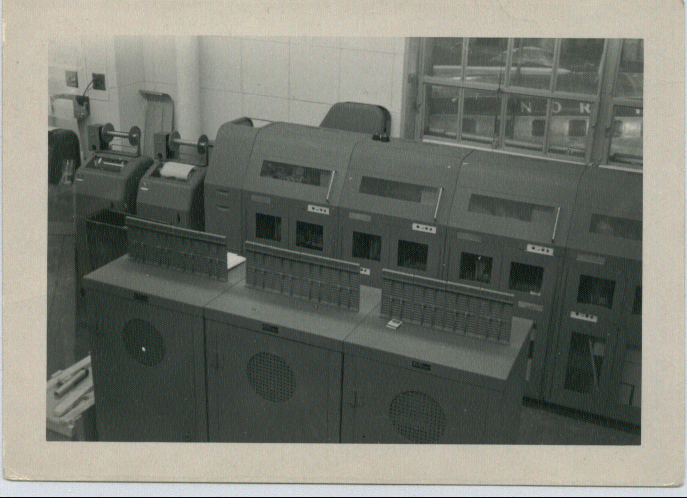
> From: "Rod Smallwood" <rodsmallwood at btconnect.com>
>
>
> It looks like a 1940's tele-printer or fax station. Could what
> appears to be
> a train actually be a DC3 of Northwest Airlines? If it's a train
> then it's
> not a UK one. Wrong sort of windows and no signs that big on any UK
> train.
Yes, and the bulging thing behind it, which looks a bit like a car, is
the tip of the right wing. The left wing appears to be either under
this room or has not been fitted, assuming the picture was taken at an
aircraft factory.
Or a NOR gate :-)
Roger Holmes.
>
> Message: 2
> Date: Mon, 25 May 2009 12:18:39 +0100
> From: Roger Holmes <roger.holmes at microspot.co.uk>
> Subject: IBM 029 Keypunch has arrived
Congratulations on your purchase of your new IBM 026 keypunch ;-))
Our IBM 1401 restoration operation has 4 IBM 026 keypunches restored to full operation
Several notes:
a) None of ours have a ferroresonant regulator.
They are all as wired in
http://www.ed-thelen.org/1401Project/026-KeypunchSchematic.pdf
general area
http://www.ed-thelen.org/1401Project/1401RestorationPage.html#Unit-Record-E…
b) One or more of the electrolytic capacitors may need re-forming
A symptom of the need is the immediate blowing of fuses when powering up.
My favorite method is to place a 4 watt 115 volt tungsten bulb in series
with the charging circuit to the capacitor. This reduces current and
local heating in the capacitor to acceptable values while the
electro-chemistry is taking place.
http://ed-thelen.org/1401Project/Sched2005Jan.html
see Wednesday January 19th
c) Fortunately, 25L6 tubes are available on e-bay ;-))
d) Two of the keypunches had an open hold coil in one of the relays.
We couldn't find:
- a replacement
- a volunteer to rewind to solenoid
so did a work-around including a 7 watt lamp as a current limiter.
http://ed-thelen.org/1401Project/Sched2006December.html#13
e) Strong suggestion: Unless you absolutely have to,
don't mess with the print section.
Getting it lined up again will drive you nutz.
One of ours had run out of lubrication and
the print wires would not move correctly -
Bob Erickson, who fixes analog watches for fun, had a long
"interesting" battle !!
f) We "re-ink" our own ribbons - by re-oiling them, as there still
seems to be enough "black" in 'em.
g) We have two people who have done most of the restoration on the
four keypunches -
Bob Erickson
http://ed-thelen.org/1401Project/TeamBios.html#Erickson
Joe Preston
http://ed-thelen.org/1401Project/TeamBios.html#Preston
They fixed 'em when they were working for IBM,
Oh so many years ago :-))
Please regard us a resourse of knowledge if you need help.
...
>
> Looking through the parts list there is something I'd like the list's
> opinion on. The diagram shows a transformer but the list says
> "REGULATOR ASM, FERRORESONANT-60CPS 120VA" and a similar option for
> 50Hz which of course I don't have. What are these for? Might they work
> at the wrong frequency? Will they be damaged or just not work? This is
> part of a 48v DC supply. Should I build a simple 48V supply myself or
> even see what I can find in my verifier spares?
The ferroresonant question has been correctly answered in another e-mail,
Our IBM 1401s are "full of 'em" ;-))
I did some experiments on one,
they are surprisingly "stiff", ie good.
Ours are rated at 133 volts nominal output
Into a light load, the output stayed within 5%
with inputs ranging from 85 volts to 220 volts :-))
According to "Solar" documentation -
the output voltage will vary 1% for each 1% deviation of input frequency.
Good Fortune
Ed Thelen
Here you go:
http://www.youtube.com/watch?v=CBtXLZcY_bM
Makes a change from pdp... :-)
William Donzelli: ping! Please email me at mike at corestore dot org - I may just have something for you...
Mike
http://www.corestore.org
> From: cctech-request at classiccmp.org
> Subject: cctech Digest, Vol 69, Issue 48
> To: cctech at classiccmp.org
> Date: Fri, 29 May 2009 12:00:01 -0500
>
> Send cctech mailing list submissions to
> cctech at classiccmp.org
>
> To subscribe or unsubscribe via the World Wide Web, visit
> http://www.classiccmp.org/mailman/listinfo/cctech
> or, via email, send a message with subject or body 'help' to
> cctech-request at classiccmp.org
>
> You can reach the person managing the list at
> cctech-owner at classiccmp.org
>
> When replying, please edit your Subject line so it is more specific
> than "Re: Contents of cctech digest..."
>
>
> Today's Topics:
>
> 1. Re: 1964 Antique MODEM Live Demo (Chuck Guzis)
> 2. Re: VT-6 kit (was Re: Making vintage computers) (John Honniball)
> 3. EPROM for Linger 6502 Terminal (M H Stein)
> 4. Re: 1964 Antique MODEM Live Demo (David Griffith)
> 5. Re: VT-6 kit (was Re: Making vintage computers) (Alexandre Souza)
> 6. Re: VT-6 kit (was Re: Making vintage computers) (Alexandre Souza)
> 7. Re: VT-6 kit (was Re: Making vintage computers) (Gene Buckle)
> 8. Re: VT-6 kit (was Re: Making vintage computers) (Alexandre Souza)
> 9. Re: VT-6 kit (was Re: Making vintage computers) (Bob Bradlee)
> 10. Re: receptacles (was IBM 029 Keypunch has arrived) (Pete Turnbull)
> 11. Re: 1964 Antique MODEM Live Demo (Brent Hilpert)
> 12. Re: 1964 Antique MODEM Live Demo (Dave McGuire)
> 13. Re: 1964 Antique MODEM Live Demo (Chuck Guzis)
> 14. Re: 1964 Antique MODEM Live Demo (Chuck Guzis)
> 15. Re: 1964 Antique MODEM Live Demo (John Foust)
> 16. Re: 1964 Antique MODEM Live Demo (Dave McGuire)
> 17. Re: 1964 Antique MODEM Live Demo (William Donzelli)
> 18. Re: 1964 Antique MODEM Live Demo (Dave McGuire)
> 19. Re: 1964 Antique MODEM Live Demo (Chuck Guzis)
> 20. Re: VT-6 kit (was Re: Making vintage computers) (Gene Buckle)
> 21. RE: An ebay bargain (I hope!) (N0body H0me)
> 22. Re: 1964 Antique MODEM Live Demo (Warren Wolfe)
> 23. Re: VT-6 kit (Ethan Dicks)
>
>
> ----------------------------------------------------------------------
>
> Message: 1
> Date: Thu, 28 May 2009 13:38:43 -0700
> From: "Chuck Guzis" <cclist at sydex.com>
> Subject: Re: 1964 Antique MODEM Live Demo
> To: "General Discussion: On-Topic and Off-Topic Posts"
> <cctalk at classiccmp.org>
> Message-ID: <4A1E93E3.24953.348876B3 at cclist.sydex.com>
> Content-Type: text/plain; charset=US-ASCII
>
> On 28 May 2009 at 15:56, Golan Klinger wrote:
>
> > Disclaimer: I wouldn't normally post this sort of thing but I'm
> > confident it will be of interest to more than a few on this list.
> >
> > "1964 Antique MODEM Live Demo"
> > <http://www.youtube.com/watch?v=X9dpXHnJXaE>
>
> This brought up the question of "whatever happened to all of the gray
> Bell Dataphones? (e.g. 401E). They used to be as common as
> cockroaches.
>
> I haven't seen one in many years.
>
> --Chuck
>
>
>
> ------------------------------
>
> Message: 2
> Date: Thu, 28 May 2009 21:55:07 +0100
> From: John Honniball <coredump at gifford.co.uk>
> Subject: Re: VT-6 kit (was Re: Making vintage computers)
> To: General Discussion: On-Topic Posts Only <cctech at classiccmp.org>
> Message-ID: <4A1EFA2B.3000606 at gifford.co.uk>
> Content-Type: text/plain; charset=us-ascii; format=flowed
>
> Gene Buckle wrote:
> > I'd love to find a 7" color VGA display. Even a 7" LCD panel with a 4:3
> > aspect ratio would work.
>
> I have an Olivetti VGA colour monitor with a 9-inch screen.
> If you want to find one like it, the model number is:
>
> CD.9.A./2709
>
> Hope that helps!
>
> --
> John Honniball
> coredump at gifford.co.uk
>
>
> ------------------------------
>
> Message: 3
> Date: Thu, 28 May 2009 14:47:23 -0400
> From: M H Stein <dm561 at torfree.net>
> Subject: EPROM for Linger 6502 Terminal
> To: "'cctalk at classiccmp.org'" <cctalk at classiccmp.org>
> Message-ID: <01C9DFA3.4D5A5A00 at MSE_D03>
> Content-Type: text/plain; charset="us-ascii"
>
> Speaking of terminal kits, by any chance does anyone out there have a
> Linger 6502 terminal kit? I'm looking for an image of the the AT keyboard
> version of the EPROM...
>
> mike
> ****************************
> ---------------Original Message(s)
> Date: Wed, 27 May 2009 22:00:57 -0400
> From: Ethan Dicks <ethan.dicks at gmail.com>
> Subject: VT-6 kit (was Re: Making vintage computers)
>
> On Wed, May 27, 2009 at 9:53 PM, bfranchuk at jetnet.ab.ca
> <bfranchuk at jetnet.ab.ca> wrote:
> > Now back to putting together my SPARE TIME GIZMOS dumb terminal once I print
> > out the online PDF manual.
>
> I just got my VT-6 partial kit today - time for me to start assembling it!
>
> -ethan
>
>
>
> ------------------------------
>
> Message: 4
> Date: Thu, 28 May 2009 14:18:19 -0700 (PDT)
> From: David Griffith <dgriffi at cs.csubak.edu>
> Subject: Re: 1964 Antique MODEM Live Demo
> To: "General Discussion: On-Topic and Off-Topic Posts"
> <cctalk at classiccmp.org>
> Message-ID:
> <alpine.DEB.1.10.0905281414150.11441 at sleipnir.cs.csubak.edu>
> Content-Type: TEXT/PLAIN; charset=US-ASCII; format=flowed
>
> On Thu, 28 May 2009, Golan Klinger wrote:
>
> > Disclaimer: I wouldn't normally post this sort of thing but I'm
> > confident it will be of interest to more than a few on this list.
> >
> > "1964 Antique MODEM Live Demo"
> > <http://www.youtube.com/watch?v=X9dpXHnJXaE>
>
> It certainly is of interest. I'd like to get one of those for myself. It
> shouldn't be too terribly hard to homebrew one of these things into a
> shoeshine box, right?
>
> --
> David Griffith
> dgriffi at cs.csubak.edu
>
> A: Because it fouls the order in which people normally read text.
> Q: Why is top-posting such a bad thing?
> A: Top-posting.
> Q: What is the most annoying thing in e-mail?
>
>
> ------------------------------
>
> Message: 5
> Date: Thu, 28 May 2009 18:24:35 -0300
> From: "Alexandre Souza" <alexandre-listas at e-secure.com.br>
> Subject: Re: VT-6 kit (was Re: Making vintage computers)
> To: "General Discussion: On-Topic Posts Only" <cctech at classiccmp.org>
> Message-ID: <0cd101c9dfda$eaec2960$35c219bb at desktaba>
> Content-Type: text/plain; format=flowed; charset="iso-8859-1";
> reply-type=original
>
> >One problem is that the video circuit for compact Macs is bizarre.
> >The display circuit was optimized for square pixels at 72 dpi on the
> >tube. Here's the stats of the Mac video circuit I was able to dredge
> >up...
>
> Do what I did. Subistitute the entire analog board for a small (9") vga
> mono monitor :o)
>
> All (or most) picture tubes are compatible. I have an old mac 128 who
> came to me without the analog board. When it happened, it was hard (and
> expensive) as hell to put my hands on an analog board. Since I wanted that
> mac to play, I gutted an old 9" mono vga monitor I had and installed
> everything but the picture tube on the mac. It is my "secondary PC monitor"
> up to today, running windows and like :D
>
> If you want a colour monitor, install everything - incluiding the
> picture tube.
>
> >As for the keyboard, the original Mac keyboard (128K and 512K) lacks
> >arrow keys, a control key, function keys and a keypad. The Mac Plus
>
> Why would I use the (arrrrggghhhh) original mac keyboard? The newer mac
> keyboards are nice, and you can always build an ADB -> PS/2 adapter. Or mod
> the source of the VT-5 to use an ADB keyboard :) I took a (very) fast look
> on the schematics, seems that the keyboard decoder is very simple.
>
> Or, do like me, use a PC keyboard :o)
>
> >EDT user. I don't know anything about Mac keyboard protocols or
> >signaling method, but with the modular-jack keyboards (pre-ADB), it's
> >probably similar enough to what everyone else did (power, ground,
> >either data+clock or bi-directional data over the 4 wires) that it
> >shouldn't be too hard to reverse-engineer.
>
> ADB is not hard, it is well documented in apple's site!
>
> >If you could find an old 9" mono VGA monitor, that might be easy to
> >physically adapt to an old Mac case, but I don't remember those being
> >too common, even back when they were making them (since they were
> >really only popular with hardcore DOS users).
>
> you can use a 12" monitor circuit with a 9" tube. Did I made it easier
> for you? :o)
>
> I have some photos of mine, I can send to you, my site is offline
>
>
>
>
> ------------------------------
>
> Message: 6
> Date: Thu, 28 May 2009 18:25:52 -0300
> From: "Alexandre Souza" <alexandre-listas at e-secure.com.br>
> Subject: Re: VT-6 kit (was Re: Making vintage computers)
> To: "General Discussion: On-Topic Posts Only" <cctech at classiccmp.org>
> Message-ID: <0d1d01c9dfdb$39656cf0$35c219bb at desktaba>
> Content-Type: text/plain; format=flowed; charset="iso-8859-1";
> reply-type=original
>
> > The problem, of course, is finding terminal emulation software that'll
> > emulate weird terminal types (non VT100/ANSI emulation). That's what I
>
> - Telix?
> - Terminate? (EXCELLENT!!!!!!)
> - Telemate?
> - Procomm Plus?
>
>
>
> ------------------------------
>
> Message: 7
> Date: Thu, 28 May 2009 14:48:27 -0700 (PDT)
> From: Gene Buckle <geneb at deltasoft.com>
> Subject: Re: VT-6 kit (was Re: Making vintage computers)
> To: "General Discussion: On-Topic and Off-Topic Posts"
> <cctalk at classiccmp.org>
> Message-ID: <alpine.LFD.1.10.0905281446390.8841 at grumble.deltasoft.com>
> Content-Type: TEXT/PLAIN; charset=US-ASCII; format=flowed
>
> On Thu, 28 May 2009, John Honniball wrote:
>
> > Gene Buckle wrote:
> >> I'd love to find a 7" color VGA display. Even a 7" LCD panel with a 4:3
> >> aspect ratio would work.
> >
> > I have an Olivetti VGA colour monitor with a 9-inch screen.
> > If you want to find one like it, the model number is:
> >
> John, thanks for the tip. Unfortunately, a 7" diagonal monitor is the
> largest I can use. It's a replacement for the 1:1 aspect ratio screen
> that was originally installed in the MPCD of the F-15C I'm rebuilding into
> a simulator. I've got a 7" monochrome display shoe-horned into the
> chassis now, but it really should be a color display.
>
> g.
>
>
> --
> Proud owner of F-15C 80-0007
> http://www.f15sim.com - The only one of its kind.
>
> ScarletDME - The red hot Data Management Environment
> A Multi-Value database for the masses, not the classes.
> http://www.scarletdme.org - Get it _today_!
>
>
> ------------------------------
>
> Message: 8
> Date: Thu, 28 May 2009 18:59:17 -0300
> From: "Alexandre Souza" <alexandre-listas at e-secure.com.br>
> Subject: Re: VT-6 kit (was Re: Making vintage computers)
> To: "General Discussion: On-Topic Posts Only" <cctech at classiccmp.org>
> Message-ID: <0d8601c9dfdf$9af81360$35c219bb at desktaba>
> Content-Type: text/plain; format=flowed; charset="iso-8859-1";
> reply-type=original
>
> > you can use a 12" monitor circuit with a 9" tube. Did I made it easier for
> > you? :o)
> >I can understand how that can be so, but I didn't assume it was true.
> >I certainly have never tried it (though now I might).
>
> Most of mono monitors are the same. Never had a different tube that I
> couldn't exchange between boards (but you have to use the same yoke coil
> from the board - you just swap the glass tube). I used tubes from 5" to 12"
> in the same board. All of then worked the same, with retouches on the pots
> (width, height, bright, so on)
>
>
>
> ------------------------------
>
> Message: 9
> Date: Thu, 28 May 2009 18:12:33 -0400
> From: "Bob Bradlee" <caveguy at sbcglobal.net>
> Subject: Re: VT-6 kit (was Re: Making vintage computers)
> To: "General Discussion: On-Topic and Off-Topic Posts"
> <cctalk at classiccmp.org>
> Message-ID: <200905282212.n4SMCMco081219 at keith.ezwind.net>
> Content-Type: text/plain; charset="us-ascii"
>
> On Thu, 28 May 2009 14:48:27 -0700 (PDT), Gene Buckle wrote:
>
> >On Thu, 28 May 2009, John Honniball wrote:
>
> >> Gene Buckle wrote:
> >>> I'd love to find a 7" color VGA display. Even a 7" LCD panel with a 4:3
> >>> aspect ratio would work.
> >>
> >> I have an Olivetti VGA colour monitor with a 9-inch screen.
> >> If you want to find one like it, the model number is:
> >>
> >John, thanks for the tip. Unfortunately, a 7" diagonal monitor is the
> >largest I can use. It's a replacement for the 1:1 aspect ratio screen
> >that was originally installed in the MPCD of the F-15C I'm rebuilding into
> >a simulator. I've got a 7" monochrome display shoe-horned into the
> >chassis now, but it really should be a color display.
>
> >g.
>
> Google 7 inch color display and you will find a bunch of choices.
> assuming LCT is close enough.
> 7
color CRT are a bit harder to find but theye are around.
>
> an ebay search of 7 color tv came up with a few choices.
>
> Auto Vackup camera with 7
display
> http://www.i4u.com/article6741.html
>
> Door camera with 7
color display
> http://www.alibaba.com/product-gs/211479480/Color_Video_Door_Phone_7_inch.h…
>
>
> http://www.diytrade.com/china/4/products/4802363/7inch_in_VGA_LCD_PC_AV.html
>
> ASUS Eee PC 4G (7-Inch Display
> http://www.amazon.com/7-Inch-Display-Mobile-Processor-Preloaded/dp/B000YEMK…
>
> Bob
>
>
>
>
>
> ------------------------------
>
> Message: 10
> Date: Thu, 28 May 2009 22:59:01 +0100
> From: Pete Turnbull <pete at dunnington.plus.com>
> Subject: Re: receptacles (was IBM 029 Keypunch has arrived)
> To: General Discussion: On-Topic and Off-Topic Posts
> <cctalk at classiccmp.org>
> Message-ID: <4A1F0925.9020505 at dunnington.plus.com>
> Content-Type: text/plain; charset=ISO-8859-1; format=flowed
>
> On 28/05/2009 19:45, Tony Duell wrote:
>
> > Indeed. I have a cable with a suitable plug on one end to fit the
> > transformer (It's normally called a 'BS4343 plug' over here after the
> > British Standard that refers to it , there is a CEN number, but I can't
> > rememebr it :-))
>
> IEC 309, or more correctly (and up to date) IEC 60309 or EN 60309.
> Often called "Commando" plugs though that's a trademark of a particular
> manufacturer. That range covers 240V as well as 110V and covers
> three-phase versions as well.
>
> --
> Pete Peter Turnbull
> Network Manager
> University of York
>
>
> ------------------------------
>
> Message: 11
> Date: Thu, 28 May 2009 16:03:47 -0700
> From: Brent Hilpert <hilpert at cs.ubc.ca>
> Subject: Re: 1964 Antique MODEM Live Demo
> To: General at invalid.domain, "Discussion at invalid.domain":On-Topic and
> Off-Topic Posts <cctalk at classiccmp.org>
> Message-ID: <4A1F1852.355206C9 at cs.ubc.ca>
> Content-Type: text/plain; charset=us-ascii
>
> David Griffith wrote:
> >
> > On Thu, 28 May 2009, Golan Klinger wrote:
> >
> > > Disclaimer: I wouldn't normally post this sort of thing but I'm
> > > confident it will be of interest to more than a few on this list.
> > >
> > > "1964 Antique MODEM Live Demo"
> > > <http://www.youtube.com/watch?v=X9dpXHnJXaE>
> >
> > It certainly is of interest. I'd like to get one of those for myself. It
> > shouldn't be too terribly hard to homebrew one of these things into a
> > shoeshine box, right?
>
> I have one of the same model as shown in the video (Livermore Data Systems
> model A). Component date codes in mine are 1969/70, the 1964 suggestion may be
> a little early, but I guess it depends on how long they were producing them
> for. Very elaborate woodwork for the task (solid teak or walnut with dovetail
> joints) but I suppose the wood case had some acoustic advantages. 13 transistors.
>
> (pedantic: His technical description was a little off, it's FSK, not an
> 'interrupted' tone.)
>
> Does anyone know if the frequencies for the 110 and 300 baud modem standards
> were the same or different?
>
>
> ------------------------------
>
> Message: 12
> Date: Thu, 28 May 2009 19:10:56 -0400
> From: Dave McGuire <mcguire at neurotica.com>
> Subject: Re: 1964 Antique MODEM Live Demo
> To: "General Discussion: On-Topic and Off-Topic Posts"
> <cctalk at classiccmp.org>
> Message-ID: <49D46435-DFCF-45CE-8D53-6ED0F8960961 at neurotica.com>
> Content-Type: text/plain; charset=US-ASCII; delsp=yes; format=flowed
>
> On May 28, 2009, at 7:04 PM, Eric Smith wrote:
> >> It certainly is of interest. I'd like to get one of those for
> >> myself. It shouldn't be too terribly hard to homebrew one of
> >> these things into a shoeshine box, right?
> > "Pennywhistle", Popular Electronics, March 1976.
> >
> > If you don't really need a design that old, you might be able to
> > find a TMS99532 or Am7910 FSK modem chip.
>
> An eBay seller has a number of TMS99532s available at $2.75/ea,
> item # 110376664450.
>
> -Dave
>
> --
> Dave McGuire
> Port Charlotte, FL
>
>
>
> ------------------------------
>
> Message: 13
> Date: Thu, 28 May 2009 16:56:03 -0700
> From: "Chuck Guzis" <cclist at sydex.com>
> Subject: Re: 1964 Antique MODEM Live Demo
> To: "General Discussion: On-Topic and Off-Topic Posts"
> <cctalk at classiccmp.org>
> Message-ID: <4A1EC223.26567.353D6FFC at cclist.sydex.com>
> Content-Type: text/plain; charset=US-ASCII
>
> On 28 May 2009 at 16:29, Fred Cisin wrote:
>
> > We saw him dial, and put the handset into the cradle, but he did NOT
> > shut the lid. The notch is there for a reason. If you don't close
> > the lid, ambient noise, such as a nearby printer or 026, can be a
> > problem.
>
> Yeah Fred, but a modern laptop isn't nearly as noisy as an ASR33! I
> don't recall Silent 700 terminals having any such lid on the acoustic
> coupler.
>
> --Chuck
>
>
>
> ------------------------------
>
> Message: 14
> Date: Thu, 28 May 2009 18:00:18 -0700
> From: "Chuck Guzis" <cclist at sydex.com>
> Subject: Re: 1964 Antique MODEM Live Demo
> To: "General Discussion: On-Topic and Off-Topic Posts"
> <cctalk at classiccmp.org>
> Message-ID: <4A1ED132.7480.35780B86 at cclist.sydex.com>
> Content-Type: text/plain; charset=US-ASCII
>
> On 28 May 2009 at 19:10, Dave McGuire wrote:
>
> > > If you don't really need a design that old, you might be able to
> > > find a TMS99532 or Am7910 FSK modem chip.
> >
> > An eBay seller has a number of TMS99532s available at $2.75/ea,
> > item # 110376664450.
>
> I don't recall what the Pennywhistle used. Was it NE567s or am I
> thinking of another hobbyist modem design?
>
> --Chuck
>
>
>
>
> ------------------------------
>
> Message: 15
> Date: Thu, 28 May 2009 19:51:35 -0500
> From: John Foust <jfoust at threedee.com>
> Subject: Re: 1964 Antique MODEM Live Demo
> To: <cctalk at classiccmp.org>
> Message-ID: <6.2.3.4.2.20090528194927.08c868f0 at mail.threedee.com>
> Content-Type: text/plain; charset="us-ascii"
>
> At 03:38 PM 5/28/2009, Chuck Guzis wrote:
> >On 28 May 2009 at 15:56, Golan Klinger wrote:
> >> "1964 Antique MODEM Live Demo"
> >> <http://www.youtube.com/watch?v=X9dpXHnJXaE>
> >
> >This brought up the question of "whatever happened to all of the gray
> >Bell Dataphones? (e.g. 401E). They used to be as common as
> >cockroaches. I haven't seen one in many years.
>
> A while back I mentioned my Anderson Jacobson ADC 300:
>
> http://www.classiccmp.org/pipermail/cctalk/2000-October/159208.html
>
> It looks like:
>
> http://www.computerhistory.org/collections/accession/102635865
>
> - John
>
>
>
> ------------------------------
>
> Message: 16
> Date: Thu, 28 May 2009 21:15:00 -0400
> From: Dave McGuire <mcguire at neurotica.com>
> Subject: Re: 1964 Antique MODEM Live Demo
> To: "General Discussion: On-Topic and Off-Topic Posts"
> <cctalk at classiccmp.org>
> Message-ID: <FCABA958-F8CF-4CFC-959D-01EF6FC92ADE at neurotica.com>
> Content-Type: text/plain; charset=US-ASCII; delsp=yes; format=flowed
>
> On May 28, 2009, at 9:00 PM, Chuck Guzis wrote:
> >>> If you don't really need a design that old, you might be able to
> >>> find a TMS99532 or Am7910 FSK modem chip.
> >>
> >> An eBay seller has a number of TMS99532s available at $2.75/ea,
> >> item # 110376664450.
> >
> > I don't recall what the Pennywhistle used. Was it NE567s or am I
> > thinking of another hobbyist modem design?
>
> I honestly don't recall, but I seem to recall their having been
> more components than a TMS99532-based design would require.
>
> -Dave
>
> --
> Dave McGuire
> Port Charlotte, FL
>
>
>
> ------------------------------
>
> Message: 17
> Date: Thu, 28 May 2009 21:26:39 -0400
> From: William Donzelli <wdonzelli at gmail.com>
> Subject: Re: 1964 Antique MODEM Live Demo
> To: "General Discussion: On-Topic and Off-Topic Posts"
> <cctalk at classiccmp.org>
> Message-ID:
> <e1d20d630905281826i19858efj140d9ce4e39a11cb at mail.gmail.com>
> Content-Type: text/plain; charset=ISO-8859-1
>
> > ?I honestly don't recall, but I seem to recall their having been more
> > components than a TMS99532-based design would require.
>
> It was a Motorola CMOS part - 14412?
>
> --
> Will
>
>
> ------------------------------
>
> Message: 18
> Date: Thu, 28 May 2009 21:33:23 -0400
> From: Dave McGuire <mcguire at neurotica.com>
> Subject: Re: 1964 Antique MODEM Live Demo
> To: "General Discussion: On-Topic and Off-Topic Posts"
> <cctalk at classiccmp.org>
> Message-ID: <64959316-DD3D-402B-8B8E-2248580C07E4 at neurotica.com>
> Content-Type: text/plain; charset=US-ASCII; format=flowed
>
> On May 28, 2009, at 9:26 PM, William Donzelli wrote:
> >> I honestly don't recall, but I seem to recall their having been more
> >> components than a TMS99532-based design would require.
> >
> > It was a Motorola CMOS part - 14412?
>
> Wasn't that a baud rate generator? Or is that the 14411?
>
> -Dave
>
> --
> Dave McGuire
> Port Charlotte, FL
>
>
>
> ------------------------------
>
> Message: 19
> Date: Thu, 28 May 2009 18:47:22 -0700
> From: "Chuck Guzis" <cclist at sydex.com>
> Subject: Re: 1964 Antique MODEM Live Demo
> To: "General Discussion: On-Topic and Off-Topic Posts"
> <cctalk at classiccmp.org>
> Message-ID: <4A1EDC3A.11304.35A35271 at cclist.sydex.com>
> Content-Type: text/plain; charset=US-ASCII
>
> On 28 May 2009 at 21:33, Dave McGuire wrote:
>
> > On May 28, 2009, at 9:26 PM, William Donzelli wrote:
> > >> I honestly don't recall, but I seem to recall their having been
> > >> more
> > >> components than a TMS99532-based design would require.
> > >
> > > It was a Motorola CMOS part - 14412?
> >
> > Wasn't that a baud rate generator? Or is that the 14411?
>
> I do recall that a friend built the PW and reported to me that he
> thought it was the worst modem he'd ever used. I was happily using
> my scavenged-from-a-TI-terminal modem. I mounted it with a small
> power supply in one of those hammertone Bud aluminum utility boxes--
> and used a 4-conductor "Jones plug" for the signal lines.
>
> --Chuck
>
>
>
>
> ------------------------------
>
> Message: 20
> Date: Thu, 28 May 2009 19:08:32 -0700 (PDT)
> From: Gene Buckle <geneb at deltasoft.com>
> Subject: Re: VT-6 kit (was Re: Making vintage computers)
> To: "General Discussion: On-Topic and Off-Topic Posts"
> <cctalk at classiccmp.org>
> Message-ID:
> <alpine.LFD.1.10.0905281859530.10323 at grumble.deltasoft.com>
> Content-Type: TEXT/PLAIN; charset=US-ASCII; format=flowed
>
> On Thu, 28 May 2009, Bob Bradlee wrote:
>
> >
> > Google 7 inch color display and you will find a bunch of choices.
> > assuming LCT is close enough.
> > 7
color CRT are a bit harder to find but theye are around.
> >
> I've NEVER seen a 7" color VGA display. I'd hoped I was just looking in
> the wrong places.
>
> > an ebay search of 7 color tv came up with a few choices.
> >
> Actually, no choices. LCDs are by and large formatted for a 16:9 aspect
> ratio. This means that a display that's the correct width will be too
> narrow to properly fill the vertical space in the MPCD bezel. The
> original tube is still available, but the supplier wants $5000.00 for it.
> It's a 1:1 aspect ratio tube with a resolution of 512x512.
>
> g.
>
> --
> Proud owner of F-15C 80-0007
> http://www.f15sim.com - The only one of its kind.
>
> ScarletDME - The red hot Data Management Environment
> A Multi-Value database for the masses, not the classes.
> http://www.scarletdme.org - Get it _today_!
>
>
> ------------------------------
>
> Message: 21
> Date: Thu, 28 May 2009 21:51:00 -0800
> From: N0body H0me <n0body.h0me at inbox.com>
> Subject: RE: An ebay bargain (I hope!)
> To: "General Discussion: On-Topic and Off-Topic Posts"
> <cctalk at classiccmp.org>
> Message-ID: <DF58630CEA8.000001BEn0body.h0me at inbox.com>
> Content-Type: text/plain; charset=US-ASCII
>
>
> IN my experience, the 9010's logic probe is a kinda
> critical item. When 9010's and related paraphernalia
> are surplussed out, the logic probes have this nasty
> tendency to vanish.
>
> You can do alot of good testing with a 9010 and a pod for
> your target system, but you really won't be able to fix
> anything that's broke (besides memory faults) w/o the
> probe.
>
> They can get kinda pricey . . . .
>
> > -----Original Message-----
> > From: hp-fix at xs4all.nl
> > Sent: Thu, 28 May 2009 19:06:19 +0200
> > To: cctalk at classiccmp.org
> > Subject: RE: An ebay bargain (I hope!)
> >
> > Sorry my fault, I was confused I own a Fluke 9100A and a 9105A where the
> > 9100 has the harddisk and the 9105A not.
> > For those machines I got the pods, docs and the firm- and software files.
> > I do have somewhere a 9010 logicprobe.
>
>
> ------------------------------
>
> Message: 22
> Date: Thu, 28 May 2009 20:40:40 -1000
> From: Warren Wolfe <lists at databasics.us>
> Subject: Re: 1964 Antique MODEM Live Demo
> To: General Discussion: On-Topic and Off-Topic Posts
> <cctalk at classiccmp.org>
> Message-ID: <4A1F8368.1010107 at databasics.us>
> Content-Type: text/plain; charset=ISO-8859-1; format=flowed
>
> Chuck Guzis wrote:
> > On 28 May 2009 at 16:29, Fred Cisin wrote:
> >
> >
> >> We saw him dial, and put the handset into the cradle, but he did NOT
> >> shut the lid. The notch is there for a reason. If you don't close
> >> the lid, ambient noise, such as a nearby printer or 026, can be a
> >> problem.
> >>
> >
> > Yeah Fred, but a modern laptop isn't nearly as noisy as an ASR33! I
> > don't recall Silent 700 terminals having any such lid on the acoustic
> > coupler.
>
> The ASR I used in high school, and the one I bought, both had acoustic
> couplers that had rubber seals around both sides, and fit a Western
> Electric simple phone precisely. As a matter of fact, when you would
> remove the phone, it would make a sucking kind of 'pop' noise when the
> phone came out of the cradle. There was no lid involved. A picture of
> one of these beasts prior to restoration is available at:
>
> http://www.pdp8.net/asr33/pics/old_front.shtml?large
>
> The rubber cups are missing, though...
>
>
> Warren
>
>
> ------------------------------
>
> Message: 23
> Date: Fri, 29 May 2009 08:23:04 -0400
> From: Ethan Dicks <ethan.dicks at gmail.com>
> Subject: Re: VT-6 kit
> To: "General Discussion: On-Topic and Off-Topic Posts"
> <cctalk at classiccmp.org>
> Message-ID:
> <f4eb766f0905290523x746cf9w30ab79e7119eae84 at mail.gmail.com>
> Content-Type: text/plain; charset=ISO-8859-1
>
> On Fri, May 29, 2009 at 2:36 AM, bfranchuk at jetnet.ab.ca
> <bfranchuk at jetnet.ab.ca> wrote:
> > PS. Still wondering ... did a VT220 work with a PDP8 running OS/8?
>
> Yes. I did it in the 1980s (in large part because the VT220 had 20mA
> built-in). I don't remember the terminal settings, though.
>
> What did not work was the VTEDIT TECO macro. There's something
> inexact about the VT52 emulation in a VT220. The cheapest solution at
> the time was to get a real VT52 (about $50 to buy and $30 to ship).
> That's what I did.
>
> If you are just doing rather ordinary things with OS/8, a VT220 should
> work just fine.
>
> -ethan
>
>
> End of cctech Digest, Vol 69, Issue 48
> **************************************
_________________________________________________________________
Windows Live?: Keep your life in sync.
http://windowslive.com/explore?ocid=TXT_TAGLM_BR_life_in_synch_052009
DEC Manuals wanted:
EK-HS572-TM HSC50/70 Software Technical Manual (or newer issues)
and
any System Communications Architecture (SCA) / System Communications
Services (SCS) Specifications
Who can help?
Regards,
Ulli
Chuck Guzis wrote:
I'm calling the D825 as being earlier as it was a vacuum-tube box,
while the B5500 was solid-state. In any case, the design was
probably much earlier than the B5500.
The Fact Sheet for the BUIC claims:
"Data exchange occurs simultaneously between any memory and any
computer or input/output module."
That could imply that although SAGE used them as backup, they
weren't necessarily limited in that way.
Anyone know for certain? Could both CPUs be running at once?
--ChuckMy understanding was that they could and did and the results were compared real time.But I do have an off list friend who spent 6 years on SAGE sites. If no answer pops up, I'll write to him and let you know.By the way, Al recently gave him the tour of the Museum and he gave us a couple of hours on the SAGE activity around the Bay area. Fascinating.BillyBy the way, during your CDC years, did you ever work on the 160-G? It's memory/external buffer modules had nine way access and could work with up to nine CPUs. Since each memory was indepenent, that meant that all nine processors could be running out of the same memory or nine different memories at the same time. Made for some marvelous and hairy troubleshooting problems when memory conflicts occured.
For those of you who are near Euclid OH,
http://www.hgrindustrialsurplus.com/sub/product_detail.aspx?id=09-143-885
Tektronix 465B o'scope in a rackmount housing for $30
Too far away for me; and my Tekky is more luggable anyway. ;-)
Laterz,
"Merch"
--
Roger "Merch" Merchberger | A new truth in advertising slogan
SysAdmin, Iceberg Computers | for MicroSoft: "We're not the oxy...
zmerch at 30below.com | ...in oxymoron!"
Just got a new mini-ITX motherboard and need a case. So I have begun
looking about the house and found a PC Jr in the closet. I think this might
be the one with the memory problem. I do have another. So how big of sin
would it be to gut it and install a mini-ITX motherboard? I do hate to
damage vintage hardware, but is it really all that rare?
Max
I have a friend that lives in southern New Jersey (in Sicklerville, off
the Atlantic City expressway) that has a computer he'd like to get rid of.
He got it as surplus from a former employer. What he remembers is that
it's a LSI-11 system with the CPU box and an expansion box, along with
a dual-floppy drive. There's no model on the drive, but it's definitely
a DEC RX01 or RX02 drive based on the latch handles.
I've no idea what CPU or other cards are installed, but since there's
an expansion box there's a chance there's a fair amount of goodies.
There's at least CPU, memory, RX controller.
It was known working at one point, but the VT has been tossed so he
doesn't know if it's still working.
All mounted in a short (5 foot tall) rack, with back and sides intact.
Best of all, it's available for what he paid for it: nothing.
If you're interested and able to pick up, let me know and I'll hook you up.
-Rick
Patrick Finnegan <pat at computer-refuge.org> wrote:
>> > My 11/44 uses a barrel key (which now that you mention it ISTR is
>> > plastic), but this is a flat key.
>
> I'd suggest trying a CH751 (the same flat key that DEC used on a lot of
> things, from an 11/780's doors, to large tape libraries).
No, it's not the same key. The StorageWorks key is slightly smaller, and
have a squarish head.
Johnny
--
Johnny Billquist || "I'm on a bus
|| on a psychedelic trip
email: bqt at softjar.se || Reading murder books
pdp is alive! || tryin' to stay hip" - B. Idol
I seem to remember that someone on this list was a specialist collector of terminals. If he is still here, I have a nice little portable terminal he can have for what I paid for it ($5.00) plus shipping costs. I bought it for the parts, but it seems a shame to destroy it.
It is a Superprint by Ultratec. 8.5 by 13 by 3.5 inches. Has a keyboard - the part I bought it for, a small printer - 3" wide, 20 character display (14 segments) and an acoustic coupler. The PCB is fairly recent, uses an 8049 derivative.
Please contact me off line if you are the terminal collector and want it. Otherwise, it's slice and dice time.
Billy Pettit
Hello everyone,
I figured this list is big enough to ask and get your opinions.
My big question is, would you buy remanufactured vintage computers ? I have
all sorts of details regarding the line of systems I'd manufacture (most of
them from the x86 world). I spent time on the internet looking at what is
the best video card for ISA, for PCI, for AGP 2x, for AGP 4x or 8x (you
know, for the different voltages), what would be the best processor for what
system, who would buy it aside from some vintage enthusiasts, etc.
There is a follow up question, of course. If you agree with remanufacturing
the Harris 286 at 25 MHz in a system with 16 CPUs and 16 MB of RAM per CPU,
all connected in a cluster acting as a multi-CPU computer, would you be able
to find some kind of investor who's willing to finance this ?
I'm not a spammer, just asking. I don't know the "other" architectures so
well (except the famous 68000 CPUs that powered Amigas and maybe PowerPC
powering Macs until recently) so I would only make computers with old x86
and pre-x86 processors. Ok, I forgot one: the Zilog Z80. 32 of those in an
8-bit system with the S-100 bus. The "new" Altair 8800, if you will. Maybe a
new Commodore PET 2001 as well (still with a gazillion CPUs and other such
stuff).
The other computers would be (warning, boring list ahead):
one with 16 386 CPUs, a lot of RAM (as far as I know, the 386 DX
actually CAN address 4 GB of RAM)
one with 16 of the best Socket 3 486 CPUs...which are the Pentium Overdrive
83 MHz :)
one with 16 of the best Socket 8 CPUs (Pentium II Overdrive 333 MHz, 66 MHz
FSB, etc.)
one with 8 Super Socket 7 K6-III+ CPUs at 600 MHz or more (depends on the
overclocking abilities)
one with 8 FC-PGA2 Pentium III-S at 1400 MHz and 4 GB RDRAM
one with 6 Pentium IV for Socket 478, at 3400 MHz
one with 6 Pentium IV for LGA775, at 3730 MHz
I'm not over deciding on dual cores and quad cores and tri cores yet. Have
to wait and see if Intel comes up with an even better Core 2 Duo Extreme
Edition, or AMD with a better Athlon 64 X2 Black Edition. The dual cores
would have a maximum of 4 CPUs, tri-cores and quad cores would get two.
The computers would be completely "integrated." Onboard everything, except
the optical drive, hard drive, ram modules, power supply and mouse. Some
modules would be optional, like the Bluetooth, Wi-Fi or infrared module.
All of them would get optional 3dfx hardware (up to the K6-III+, the
computers would only get Voodoo II accelerators, after that it's Voodoo 5
6000 and then Rampage). The idea is to buy the rights to remanufacture all
the needed chips (and ask for modifications before that, in most cases) from
the original copyright owners.
Sound nice to you ? Oh, and if you can see cracks in the idea, please share
them but remember, I'm stress-testing the idea, I don't want to start flame
wars.
Thank you very much
--
Alex Lovin - www.erasereality.3x.ro
Patrick Finnegan <pat at computer-refuge.org> wrote:
> On Thursday 28 May 2009, Sridhar Ayengar wrote:
>> Doug Jackson wrote:
>>> I would personally consider purchasing a re manufactured Vintage
>>> computer -
>>>
>>> Something running, say, a 6502, 8080, 8085, or Z80. Definitely
>>> not interested in anything post 8085.
>>>
>>> Not sure what I would do with an ISA bus. Not enough pins on my
>>> processor to drive all of the address bits.
>>> Multi CPU systems are probably to far out of the intent of the
>>> Vintage realm for me to consider.
>> There ARE multi-CPU vintage systems. Some of the CPUs in question
>> were many, many boards full of chips.
>
> The first (SMP) one that comes to mind is a VAX 8800 (I only have 1/2,
> aka an 8700), or my VAXstation 3520/3540.
>
> Of course, there were other non-SMP systems (like the Dual VAX
> (11/780)), and systems that had multiple CPUs but weren't really
> dual-processor (DEC Rainbow).
What about PDP-10 systems? Those could be SMP systems. I know of one
person who ran a 3xKI10 system with TOPS-10. True SMP...
And then we have the PDP-11/74 (up to 4 CPUs), but they are probably
even harder to find than KI10 systems.
DEC were doing SMP long before they even started spelling "VAX". :-)
Johnny
--
Johnny Billquist || "I'm on a bus
|| on a psychedelic trip
email: bqt at softjar.se || Reading murder books
pdp is alive! || tryin' to stay hip" - B. Idol
Ethan Dicks <ethan.dicks at gmail.com> wrote:
> On Fri, May 29, 2009 at 2:36 AM, bfranchuk at jetnet.ab.ca
> <bfranchuk at jetnet.ab.ca> wrote:
>> > PS. Still wondering ... did a VT220 work with a PDP8 running OS/8?
>
> Yes. I did it in the 1980s (in large part because the VT220 had 20mA
> built-in). I don't remember the terminal settings, though.
>
> What did not work was the VTEDIT TECO macro. There's something
> inexact about the VT52 emulation in a VT220. The cheapest solution at
> the time was to get a real VT52 (about $50 to buy and $30 to ship).
> That's what I did.
Hmm, I'm pretty sure I've used a VT220 with VTEDIT. I could try again
tonight... (Well, okay, I don't have any VT220 anymore, but I have
VT320, VT420, VT510, VT520 and VT525 to test with.)
> If you are just doing rather ordinary things with OS/8, a VT220 should
> work just fine.
I never saw any problems at all with anything, using a VT100 or more
modern, with OS/8. Most programs expected it to be in VT52-mode, though.
Johnny
--
Johnny Billquist || "I'm on a bus
|| on a psychedelic trip
email: bqt at softjar.se || Reading murder books
pdp is alive! || tryin' to stay hip" - B. Idol
the S/370 was built onto a single chip. I hope I'm not drawing a blank and actually denoting the wrong architecture (I think I got it right though). There's only a prototype though. And I know the dude that owns it (he designed it ;). Nah nah nah nah nah.
--- On Fri, 5/29/09, Sridhar Ayengar <ploopster at gmail.com> wrote:
> I was actually referring to the second. I don't
> consider the first one to be multi-CPU at all. I was
> mostly referring to S/370 systems with which I have personal
> experience, although I understand they weren't, by any
> means, the first.
>
> Peace... Sridhar
>
On Fri May 29 20:04:14 CDT 2009, Mike Ross wrote:
> Here you go:
> http://www.youtube.com/watch?v=CBtXLZcY_bM
> Makes a change from pdp... :-)
That would have been a really nice video clip of a DECSystem,
if he would have moved that peksy piece of IBM hardware out of the way.
It kept blocking the view of the "real" machine. ;-)
*Scamper*
T
Ian King <IanK at vulcan.com> wrote:
>
>> -----Original Message-----
>> From: cctalk-bounces at classiccmp.org [mailto:cctalk-
>> bounces at classiccmp.org] On Behalf Of Dave McGuire
>> Sent: Thursday, May 28, 2009 1:38 PM
>> To: General Discussion: On-Topic and Off-Topic Posts
>> Subject: Re: StorageWorks key
>>
>> On May 28, 2009, at 3:32 PM, Ian King wrote:
>>> I picked up a neat StorageWorks tower on ePay a while back, and
>>> decided to hook it up to my VAX-4000/300 through a HSD05. I went
>>> to install the HSD05 and realized that the front (and rear) bezel
>>> locks to the body of the tower, precluding removal of the drives.
>>> <sigh> I don't have that key....
>>>
>>> Is this another one of those keys like the XX2247 that fits every
>>> PDP-11 front panel lock? If so, is there anyone who can (a)
>>> suggest a source or (b) perhaps offer up such a thing?
>> If it takes the plastic keys used on many VAXen and some PDP-11s
>> (11/24 and 11/44), if you can find out for sure, I can likely send
>> you one of those.
>>
>
>
> My 11/44 uses a barrel key (which now that you mention it ISTR is plastic), but this is a flat key.
I have one, but unfortunately only one...
There is no manufacturer name on it, and the only text of any kind is a
number "134". I don't know if that is of any help...
Johnny
--
Johnny Billquist || "I'm on a bus
|| on a psychedelic trip
email: bqt at softjar.se || Reading murder books
pdp is alive! || tryin' to stay hip" - B. Idol
"bfranchuk at jetnet.ab.ca" <bfranchuk at jetnet.ab.ca> wrote:
> Johnny Billquist wrote:
>> > "Bob Armstrong" <bob at jfcl.com> wrote:
>
>> > Wanna try it on some special cases that I know most emulators fail? :-)
>
> Well I do ... but not tonight.
It still takes several days for my posts to actually show up, it seems.
Anyone else have the same problem?
Anyway, I sent a list of things for Bob to test.
>> > Johnny
> PS. Still wondering ... did a VT220 work with a PDP8 running OS/8?
Certainly.
> I have a problem with bit #8 being set from the PDP.
That's called 7 bits, mark parity. :-)
Johnny
--
Johnny Billquist || "I'm on a bus
|| on a psychedelic trip
email: bqt at softjar.se || Reading murder books
pdp is alive! || tryin' to stay hip" - B. Idol
Hi all,
I know it is a long shot, but anybody out here has the original 167Bug
EPROMS for the MVME167 Boards ?
(not twenty years old yet, but getting there ;-))
Thanks
Two things spring to mind:
1) Did he ever stab himself with the screwdriver while running?
2) Did he think of getting a portable gas cooker/handheld? gas torch? Or weren't they available back then? (Sorry, I don't know when 'then' was)
Regards,
Andrew B
aliensrcooluk at yahoo.co.uk
--- On Fri, 29/5/09, Dave McGuire <mcguire at neurotica.com> wrote:
From: Dave McGuire <mcguire at neurotica.com>
Subject: Re: when soldering irons go bad
To: "General Discussion: On-Topic and Off-Topic Posts" <cctalk at classiccmp.org>
Date: Friday, 29 May, 2009, 2:13 AM
? I once knew a guy who soldered kits together by running back and forth between his kitchen stove and the table with a flat-blade screwdriver.? I don't know if he ever actually completed anything.
? ? ? ? ???-Dave
--Dave McGuire
Port Charlotte, FL
While reading :
http://en.wikipedia.org/wiki/Boustrophedon
I found "Sometimes computer printers with a typewriter-like
moving type head print boustrophedon if set up wrongly."
Which old printers might've done that?
- John
Hey, all,
I picked up a neat StorageWorks tower on ePay a while back, and decided to hook it up to my VAX-4000/300 through a HSD05. I went to install the HSD05 and realized that the front (and rear) bezel locks to the body of the tower, precluding removal of the drives. <sigh> I don't have that key....
Is this another one of those keys like the XX2247 that fits every PDP-11 front panel lock? If so, is there anyone who can (a) suggest a source or (b) perhaps offer up such a thing? Thanks - Ian
PS: this is for a system in my personal collection.
UNIX is user friendly. It's just selective about who its friends are.
Ian S. King, Sr. Vintage Systems Engineer
Vulcan, Inc.
http://www.pdpplanet.com<http://www.pdpplanet.org>
On Fri, May 29, 2009 at 2:39 PM, Seth Morabito <sethm at loomcom.com> wrote:
> On Fri, May 29, 2009 at 5:23 AM, Ethan Dicks <ethan.dicks at gmail.com> wrote:
>> The cheapest solution at
>> the time was to get a real VT52 (about $50 to buy and $30 to ship).
>> That's what I did.
>
> Oh if only I could find a $50 VT52 in this day and age! :^)
This was nearly 25 years ago, FWIW (and, yes, I still have it)... the
VT220 was out, and those that bought new, bought that. Those that
didn't, bought VT100s or some functional clone (CiTOH 101, Wyse-50,
etc). It was the nadir of the VT52. Nobody wanted them, nobody
wanted to support them (software or hardware).
It was a function of exactly how old they were - old enough, but not too old.
> Actually, I've never seen one for sale in all the time I've been
> interested in old computers (starting in 1993). ?How common are they
> these days? ?On a scale from "Hen's teeth" to ?"unobtanium"?
Dunno. I got one in a rescue a few years back, but I haven't tried to
buy one since about 1985 or so. I don't need lots of them, but the
one I got looks really nice on my Datasystems Desk (the model on the
cover of the 1978/1979 Small Computer Handbook).
-ethan
"Bob Armstrong" <bob at jfcl.com> wrote:
>> >bfranchuk at jetnet.ab.ca wrote:
>> >...
>>> >> Just curious... What is the VT-6 kit ?
>> > ... low cost dumb terminal ....
>
> Dumb !!??!?! Who are you calling dumb ??? :-)
>
> Not so dumb, really - the software team did a great job and the current
> firmware does pretty much everything a real VT220 can do.
Wanna try it on some special cases that I know most emulators fail? :-)
Johnny
--
Johnny Billquist || "I'm on a bus
|| on a psychedelic trip
email: bqt at softjar.se || Reading murder books
pdp is alive! || tryin' to stay hip" - B. Idol
Hello Charles
I was google searching for Tally 420 information, and saw a post you did on the 420 you were working with.
Do you still have this 420 puncher?
Thanks for any reply.
Walter Silva
> I'm calling the D825 as being earlier as it was a vacuum-tube box,
> while the B5500 was solid-state. ?In any case, the design was
> probably much earlier than the B5500.
Maybe - hard to say, being a government-to-civilian
(apples-to-oranges) comparison.
> That could imply that although SAGE used them as backup, ?they
> weren't necessarily limited in that way.
I think that actual usage would count in my argument. Otherwise, you
could start including lots of machines earlier to either of the two
Burroughs boxes we are talking about - SMP 709s?
> Anyone know for certain? ?Could both CPUs be running at once?
I would actually like to see some more detailed docs on BUIC - there
seems to be very little available. Hell, I do not even know what BUIC
modules and equipment looks like, and have probably passed some of it
up, or worse, scrapped it.
--
Will
Chuck Guzis wrote:
On the other hand, I suppose one could print English and Arabic in an
interlinear fashion, but changing typewheels would drive you nuts. :)
--Chuck
Surely you remember the CDC 512? It had English-Hebrew and English-Arabic print trains. There was a small hardware option to print right to left. If I remember right, It just decremented the buffer memory. I know it only took a couple of hours to install and test.
On the other hand, the few times I worked on them, I had a nightmare understanding if it was printing correctly or not since I couldn't read either language.
I used to have a couple of slugs from the trains - wonder if they are still in the garage?
As far as printing right to left, a lot of the dot matrix printers did this as standard features. At Fujitsu, we did an analysis and found it did not save any time. In fact it was slower! This was because the print head return was a fast function, and because most printing doesn't use a full line (136 characters).
The printers had to have this ability for the Japanese and Chinese marketplace where a lot of word processing programs still did right to left. So the feature was always there but we insisted it be disabled for US sales. There was a disable switch on all the Fujitsu printers I worked on in the 1980-90's.
Billy
After negotiations with the finance committee (aka wife),
I bid on and to my surprise won this lot: 390053617609.
It's a Fluke 9010A for those that don't want to bother
to surf it and I got it for $66.56. That's right, 66
bucks and change. Pictures show it boots. So, now I
have to get pods of interest (anybody have a spare 6502,
8080 or Z80?) and read the manuals. Is there anything
interesting you can do with one without pods?
Thanks,
Bill Sudbrink
On Wed, May 27, 2009 at 9:53 PM, bfranchuk at jetnet.ab.ca
<bfranchuk at jetnet.ab.ca> wrote:
> Now back to putting together my SPARE TIME GIZMOS dumb terminal once I print
> out the online PDF manual.
I just got my VT-6 partial kit today - time for me to start assembling it!
-ethan
Hello everyone,
I figured this list is big enough to ask and get your opinions.
My big question is, would you buy remanufactured vintage computers ? I have
[snip]
Sound nice to you ? Oh, and if you can see cracks in the idea, please share
them but remember, I'm stress-testing the idea, I don't want to start flame
wars.
Thank you very much
--
Alex Lovin - www.erasereality.3x.ro
-----REPLY-----
Hi Alex! Your plans seem extremely ambitious. I have been designing my own
home brew computer for the N8VEM home brew computing project and I know it
is a lot of work. There are many details to consider when producing your
own computer -- too many to even begin to list here. Have you considered
just making a "simple" vintage computer like a plain Z80 S-100 board? Maybe
a S-100 SRAM board or IO board?
There are many of possibilities. Maybe a "big board" work alike or an ISA
backplane based system using an i8086? A small SBC based on the 68008?
I know there was some recent interest in an S-100 68K processor on CCTALK.
Maybe that would be a fun project and work your way up to something as
sophisticated as a multiprocessor design. Building a system from theory to
reality is a complex undertaking so I recommend a gradual approach. Start
small, make something real, and build from there to what you are describing.
I don't think you'll make it in a single leap.
Whatever you decide, I recommend building a working prototype *before*
proceding into any sort of manufacturing. Believe me, getting a working
prototype will give you large insight into how complex this really is. I
build working prototypes of all my N8VEM designs and find it has a great
effect of separating the fantasy from the practical reality. Its why I tend
to favor simple working designs over high risk complicated systems.
Thanks and have a nice day!
Andrew Lynch
It's only part of what happened. The name was sold --non exclusively-- to a
firm in the US for the production of certain household security products.
It creates an odd situation, because at this point there are totally
unrelated entities using (or at least able to use) various forms of the
names "Heath", "Heath Company", "Heathkit", "Heath/Zenith", etc. ... for
different, unrelated product lines.
-Barry Watzman
From: ard at p850ug1.demon.co.uk (Tony Duell)
Subject: Doorbell switch with an interesting brand name...
The reason I mention it is that the brand name on said [doorbell] switch is
'Heath/Zenith', and the way they're written is very similar (I'd say
identical) to the old Heath/Zenith brand used on classic computers
On the pack (amongst other things) are the statements 'Should you require
it, Heath Zenith offer a range of other accessories and bell wire' (in that
one , the 'Heath Zenith' is in a normal font. And 'DESA UK LTD
www.desaeurope.com ... A division of Desa International Inc. The world's
largest doorchime company'
So is that what happened to the Heath and Zenith brand names :-(
-tony
listen to me. Build one as a hobby, a labor of love. Then float it around the net. Don't ask for investors. The 386 is still available and is somewhat of an "advanced" processor. Incidentally the '186 is still available, if that floats your boat. Build your "dream". Then worry about financing the thousands you're unlikely to sell. Be realistic.
--- On Wed, 5/27/09, Alexandru Lovin <thypope at gmail.com> wrote:
> From: Alexandru Lovin <thypope at gmail.com>
> Subject: Making vintage computers
> To: "General Discussion: On-Topic and Off-Topic Posts" <cctalk at classiccmp.org>
> Date: Wednesday, May 27, 2009, 5:24 PM
> Hello everyone,
>
> I figured this list is big enough to ask and get your
> opinions.
>
> My big question is, would you buy remanufactured vintage
> computers ? I have
> all sorts of details regarding the line of systems I'd
> manufacture (most of
> them from the x86 world). I spent time on the internet
> looking at what is
> the best video card for ISA, for PCI, for AGP 2x, for AGP
> 4x or 8x (you
> know, for the different voltages), what would be the best
> processor for what
> system, who would buy it aside from some vintage
> enthusiasts, etc.
> There is a follow up question, of course. If you agree with
> remanufacturing
> the Harris 286 at 25 MHz in a system with 16 CPUs and 16 MB
> of RAM per CPU,
> all connected in a cluster acting as a multi-CPU computer,
> would you be able
> to find some kind of investor who's willing to finance this
> ?
>
> I'm not a spammer, just asking. I don't know the "other"
> architectures so
> well (except the famous 68000 CPUs that powered Amigas and
> maybe PowerPC
> powering Macs until recently) so I would only make
> computers with old x86
> and pre-x86 processors. Ok, I forgot one: the Zilog Z80. 32
> of those in an
> 8-bit system with the S-100 bus. The "new" Altair 8800, if
> you will. Maybe a
> new Commodore PET 2001 as well (still with a gazillion CPUs
> and other such
> stuff).
>
> The other computers would be (warning, boring list ahead):
>
> one with 16 386 CPUs, a lot of RAM (as far as I know, the
> 386 DX
> actually CAN address 4 GB of RAM)
> one with 16 of the best Socket 3 486 CPUs...which are the
> Pentium Overdrive
> 83 MHz :)
> one with 16 of the best Socket 8 CPUs (Pentium II Overdrive
> 333 MHz, 66 MHz
> FSB, etc.)
> one with 8 Super Socket 7 K6-III+ CPUs at 600 MHz or more
> (depends on the
> overclocking abilities)
> one with 8 FC-PGA2 Pentium III-S at 1400 MHz and 4 GB
> RDRAM
> one with 6 Pentium IV for Socket 478, at 3400 MHz
> one with 6 Pentium IV for LGA775, at 3730 MHz
> I'm not over deciding on dual cores and quad cores and tri
> cores yet. Have
> to wait and see if Intel comes up with an even better Core
> 2 Duo Extreme
> Edition, or AMD with a better Athlon 64 X2 Black Edition.
> The dual cores
> would have a maximum of 4 CPUs, tri-cores and quad cores
> would get two.
>
> The computers would be completely "integrated." Onboard
> everything, except
> the optical drive, hard drive, ram modules, power supply
> and mouse. Some
> modules would be optional, like the Bluetooth, Wi-Fi or
> infrared module.
>
> All of them would get optional 3dfx hardware (up to the
> K6-III+, the
> computers would only get Voodoo II accelerators, after that
> it's Voodoo 5
> 6000 and then Rampage). The idea is to buy the rights to
> remanufacture all
> the needed chips (and ask for modifications before that, in
> most cases) from
> the original copyright owners.
>
> Sound nice to you ? Oh, and if you can see cracks in the
> idea, please share
> them but remember, I'm stress-testing the idea, I don't
> want to start flame
> wars.
>
> Thank you very much
> --
> Alex Lovin - www.erasereality.3x.ro
>
--- On Thu, 5/28/09, Tim Shoppa <shoppa at trailing-edge.com> wrote:
> I've collected a couple WTCPT's over the years with a
> broken plastic
> plug or jack, and fixed them by simply soldering the wiring
> straight
> through without a jack.
So, how exactly did you solder that connection to repair the faulty soldering station again?
*ducks*
-Ian
Speaking of terminal kits, by any chance does anyone out there have a
Linger 6502 terminal kit? I'm looking for an image of the the AT keyboard
version of the EPROM...
mike
****************************
---------------Original Message(s)
Date: Wed, 27 May 2009 22:00:57 -0400
From: Ethan Dicks <ethan.dicks at gmail.com>
Subject: VT-6 kit (was Re: Making vintage computers)
On Wed, May 27, 2009 at 9:53 PM, bfranchuk at jetnet.ab.ca
<bfranchuk at jetnet.ab.ca> wrote:
> Now back to putting together my SPARE TIME GIZMOS dumb terminal once I print
> out the online PDF manual.
I just got my VT-6 partial kit today - time for me to start assembling it!
-ethan
Lovely late-1980s vintage CP/M machine. A neighbour of mine has just
found a forgotten PCW 8256 and she wants rid of it.
It's in south London.
--
Liam Proven ? Profile: http://www.linkedin.com/in/liamproven
Email: lproven at cix.co.uk ? GMail/GoogleTalk/Orkut: lproven at gmail.com
Tel: +44 20-8685-0498 ? Cell: +44 7939-087884 ? Fax: + 44 870-9151419
AOL/AIM/iChat/Yahoo/Skype: liamproven ? LiveJournal/Twitter: lproven
MSN: lproven at hotmail.com ? ICQ: 73187508
I'm not sure what the differences, if any, there are between the Dell Latitude CP and Latitude C is but I do like my Latitude C610.
The battery originally lasted 40 minutes when I got it 2 years (and 3 months) ago. Now it lasts about 3 minutes! Just enough for Windows 2K SP4 to boot and show me the low power icon :)
I did get a replacement battery, but it looks very dodgy - unofficial label, no manufacturer markings etc. and the power ratings are slightly different to the official battery.
Mine has 2 PCMCIA connectors, but I don't have anything to use them with :(
Anyway, the real reason I replied is that the PS/2 connection that I use my mouse with is dodgy. Sometimes if I tuck on the mouse cord (sometimes when I just move the mouse!) a little too much Windows stops moving the mouse pointer (I have disabled the touchpad as I hate it, plus I had mouse drift). My current fix is to simply reboot my laptop, which can be a pain.
Is there a quick fix, or do I have to replace the whole PS/2 connector?
I do have a compressed file of a sort of technical manual... which isn't all that technical. When I increased my memory (from 256MB to 768MB) a while back the "technical manual" didn't even specify the type of memory required!
Regards,
Andrew B
aliensrcooluk at yahoo.co.uk
--- On Thu, 28/5/09, Ethan Dicks <ethan.dicks at gmail.com> wrote:
These days, something like a Dell Latitude CP-series machine is free
or nearly so (but the battery packs are probably dead), and with
64MB-256MB, a built-in serial port, PCMCIA slots, etc., etc., it would
make a fine inexpensive dedicated terminal device.? Just watch out for
broken lids (the hinges are stronger than the plastic the case is made
out of).
With "that much" power, you aren't limited to DOS... I still have one
of these running RedHat9 and it does great.? The only real limitation
is how much physical memory you can (or can't) stuff in there.
-ethan
>
> Date: Thu, 28 May 2009 11:23:53 -0400
> From: Ethan Dicks <ethan.dicks at gmail.com>
>
> I don't know anything about Mac keyboard protocols or
> signaling method, but with the modular-jack keyboards (pre-ADB), it's
> probably similar enough to what everyone else did (power, ground,
> either data+clock or bi-directional data over the 4 wires) that it
> shouldn't be too hard to reverse-engineer.
Yes, that's about it. I used a Motorola 68705 single chip micro as a
dongle in the lead between the Mac and the keyboard. It just passed on
packets from the keyboard to the Mac. The Mac never talked to the
keyboard. My Application talked to the dongle and made sure it had the
correct algorithm in it before allowing the user to continue.
If anyone wants the protocol its probably in the source code which I
have somewhere I think, though maybe on Lisa floppy disks (not Twiggy,
I transferred all my data to more modern 360k 3.5 inch diskettes).
Roger
"Fran C. Smith" <fsmith at ladylinux.com> wrote:
>
> NOOO Actually ..
>
> The real holy war is
>
> VI vs EMACS :-)
Pfft. Both are for clueless newbies. The only editor is TECO. Anything
else can be implemented in TECO, if I really need it.
With a half :-)
Johnny
--
Johnny Billquist || "I'm on a bus
|| on a psychedelic trip
email: bqt at softjar.se || Reading murder books
pdp is alive! || tryin' to stay hip" - B. Idol
David Griffith asks:
> One reason I never graduated to /real/ soldering stations is
> that I kept wondering "what do I do when it goes bad?". What
> do you guys recommend?
I really really like the Weller WTCPT line of soldering stations.
There is very little "smarts" in the soldering station. Temperature
control is supplied via a purely magnetic-electro-mechanical feedback
loop - when the tip reaches a certain temperature, a special alloy in
the base of the tip becomes non-magnetic (Curie point) and the
heating circuit opens. When it cools down below the Curie point,
the heating circuit closes. Different tips are available with different
temperatures.
I like these soldering stations purely out of inertia - I've been
using them for decades. I don't think they're nearly as good
for, say, extensive surface mount rework as a Metcal station that
costs 10 to 20 times as much. But they do just wonderful for my
uses, working on everything from vacuum-tube electronics to DIP
circuit boards to some surface mount stuff. Different tips are
available; I love the big fat tips for working with vacuum tube
electronics because with them the WTCPT is the equivalent of a 100
watt soldering gun, even those big fat joints heat up real fast. For
finer detail stuff I sometimes switch to finer tipped points on the
WTCPT but very often I find myself using the big fat tips just because
I'm so used to them.
I am one of those rare guys who do not use super skinny solder with
super skinny tips to do real-fine pitch soldering. In some rare
circumstances - 0.25mm pitch SMD - I will switch to the finer tip.
But more often than not I'll just stick to the humongous fat tips and
big old fat 0.063" thick solder. One of the reasons I stick with the
big fat tip, is that with 0.25mm
pitch SMD stuff I find that the big fat tip will simultaneously heat
up all the pins on one side of a chip :-).
Why do I not recommend them for extensive surface mount stuff? Because
the magnetic tip has this annoying tendency to suck up any 0603 or 0402
or 0201 SMD parts which have any steel component in them. For extensive
surface mount stuff a non-magnetic tip would probably be nicer.
The WTCPT's are dead-bone stupid - no digital display to mess up; no
knob to twist for different temperature; no thermistor; cord is
unmeltable. All of mine are between 10 and 30 years old - I bought
myself a brand new one once, the others I got with a decade or two
of use already on them.
The WTCPT's one weak point is the connection from the iron to the
soldering iron station base (which has little more than a transformer
in it.) This is a plastic plug/jack that can break under extreme abuse.
I've collected a couple WTCPT's over the years with a broken plastic
plug or jack, and fixed them by simply soldering the wiring straight
through without a jack.
Tim.
> Date: Wed, 27 May 2009 16:44:17 -0400
> From: William Donzelli <wdonzelli at gmail.com>
>
>> I found
>> someone who could supply them for 100 dollars but he wanted a
>> cheque from a
>> US clearing bank which of course I can't do, and things went quiet
>> when I
>> asked about alternatives.
>
> If you get desperate for relays, and need to buy these "golden" ones,
> I am sure someone on this list in the USA can act as an agent for you.
> Contact me offlist if you get to this point. Same with getting US
> electrical supplies.
>
> Sorry, I have no spare relays. I need every one I can get my hands on.
> I probably have about 800 sockets in my collection, and they are not
> all filled.
Thank you for your kind offer, though I must point out that the 100
dollars was not for relays, it was for circuit diagrams for the IBM
836, the top of the range version of the 026 keypunch. I have some
spare relays from a card verifier.
In case anyone here is too young to know what I'm talking about, most
data to be input on cards to a mainframe was punched back in those
sexist days by one of the girls in the data preparation department on
a key punch machine which has a keyboard and punches holes into pieces
of card. The cards were then given to a different girl who fed them
through a machine called a VERIFIER. She would also type the data on a
keyboard and the machine would compare what she typed to what was on
the card. If there was a miss-match, a red light would come on and a
notch cut in the top of the card. The data would then be checked
against the original, maybe by a supervisor, though I was never
familiar with the internal workings of any commercial DP department,
and the either the faulty card corrected or the mistake of the
verifier operator ignored.
Today of course no checking of input data is done, mistakes just go
through until either a customer complains 15 times via a call centre
in India and eventually gets through to a manager who will listen and
correct it, or the customer runs off with a million dollars which has
been paid into his account in error, not to be heard of until he's
spent it all and then goes bankrupt. Not that I'm complaining,
verifying cards all day must have been a soul destroying job I would
not wish on my worst enemy. I always got the impression the DP girls
were just filling in the time until they could become housewives and
mothers, which I imagine is much more rewarding than DP, and useful to
humankind than sitting at a verifier and turning off the brain.
Before any lady list members comment, that was then, this is now, I
was brought up in the 50s, am a dinosaur and likely to remain a
bachelor dinosaur, my only regret is not being able to personally
extend my family tree, which I have left to my brothers and my sister,
who have made me an uncle, great uncle and recently a great great
uncle, and I'm only 56 so maybe time to add another 'great' before I
die.
Wandering off topic I'm afraid.
Thanks to everyone's help and advice with the 110v sockets, and yes I
did mean sockets when I meant plugs in one particular e-mail. I am
currently (no pun intended) looking into prices of small static
inverters (and UPSs, some of which seems be also able to do frequency
conversion, think battery charger and inverter) so I can keep the
keypunch standard if possible. I think a good quality power strip
screwed to the wall is probably the easiest solution to the socket
problem, as I don't want wandering sockets for visitors to trip over
and I can't be bothered learning about how US 'receptacles' attach to
the back of their boxes instead of being screwed to the front as is
normal in the UK. Life's too short and I've got to write a program to
read data from old paper tapes into my Mac so I can recover some data
for the ICT/ICL 1900 preservation group.
Roger Holmes
Technical Director, Microspot Ltd
Half of the ICT 1301 restoration group of the Computer Conservation
Society.
Author of MacPlot, MacPalette, 3DWorld, Microspot Interiors and also
responsible for maintaining MacDraft and all other Microspot products.
Oh, and I have 7 classic cars to look after/restore/enjoy too, and
hold a classic car/computer show at my home once a year, 12th July
based on the theme of a TV show which was filmed on the 35 acre farm,
which launched the career of Catherine Zeta Jones, called 'The Darling
Budss of May'.
Oh and I have a disabled 86 year old mother to look after now my
father has died a couple of weeks after their 67th wedding anniversary.
Like I said, life is too short.
Steve... (and list)
I may be the one who has a working paper tape punch.
It still works, and I can create just about anything you desire. Just let me know what you want (an ASCII file would do) and I'll punch it out. With an address to ship to, one of those flat rate postal things would probably do the trick.
The punch I have is a Facit 4070, with a custom interface adapter for a printer port. It works quite well. We can discuss prices (Look I'm reasonable!) off list.
...Tom Watson
Date: Wed, 27 May 2009 16:44:17 -0400
From: William Donzelli <wdonzelli at gmail.com>
Subject: Re: BM 029 Keypunch has arrived
>Sorry, I have no spare relays. I need every one I can get my hands on.
>I probably have about 800 sockets in my collection, and they are not
>all filled.
--
>Will
----------------
I should still have a few of those somewhere; ya want 'em if I can find 'em?
m
-------------Original Message:
Date: Wed, 27 May 2009 14:28:41 -0400
From: "Teo Zenios" <teoz at neo.rr.com>
Subject: 486 case LED display jumpers
>Anybody happen to have the jumper diagram to set a LED 2 digit case speed setting? The PCB has ST-8A on it if that helps.
--------------Reply:
I do, but it's such poor quality that a scan would be illegible.
Oriented with the four pin connector at top right:
The four pins are: +5, Gnd, Turbo LED, NC
The three pins are the turbo switch: Low, common, High.
The bottom row of 28 is the tens digit, and the one above it the units.
Optionally there may be another four for a hundreds "1" digit which you
apparently don't have.
Segments are a-g left to right, and each segment is controlled by four
pins arranged in a 'T', alternately upside-down and right-side-up.
a b c
x xxx x
xxx x xxx etc. (spread apart for clarity)
The junction of the three "bars" goes to the segment, and the three end
points are the power source:
Looking at each "T" in its proper orientation:
Jumper down the leg = always on.
Jumper on the left bar = on with turbo
Jumper on right bar = on with normal
Segments are named the usual way, a-f clockwise with a on top, g in the centre.
Clear as mud?
Hope it helps; almost as much fun as figuring it out yourself...
mike
Yesterday I installed some CP/M stuff available for the AltairZ80 simulator
of SIMH. I am checking the use of the last version of the simulator from one
DEC VT220 plugged in the serial port of my laptop. And I checking in essence
the PDP-11 (with Unix) and Z80 (with CP/M, MP/M and Oasis) simulators
In one of the virtual disks of CP/M exists a copy of the Eliza basic
program. I tried it using the MBASIC interpreter. Very funny but interesting
as an historical piece of software and as what the program do by itself.
But the most funny thing was to check what happened when I show the program
to my daughter and son (both under eleven years old). Half and hour later I
need to obligate them to close the program. Absolutely addictive. And even
more when I expleained them (in simply words) some aspects related with the
program.
Later, I encountered myself thinking about the evolution of the games, the
programs, the artificial intelligence and the computing in general during
>from the epoch of Eliza (or before) ot our days. And what can do a good
piece of code against some excess of our days in the computing field.
Kind Regards
Sergio
Help!
Several months back I posted a request to the list seeking assistance in
creating some examples of paper tape media for use by a law enforcement
officer wishing to use them in a class he teaches. The course is about
computer forensics but for perspective, he does a segment on various
types of media with examples. At the time, a list member responded and
offered to assist but apparently wasn't able to help... not sure what
happened but the officer contacted me again to see if I could ask a
second time.
Is there a list member with a functioning paper tape unit that would be
willing to run some examples for this gentleman?
At the time I suggested as classroom examples two each of the following:
short roll of blank tape
punched tape containing a relatively short program
hardcopy printout of the program listing (keeping it period consistent,
greenbar would be nice)
Any volunteers? - here's a chance to help out. He's located in GA and
willing to reimburse any costs involved.
Steve Shumaker