On 11/16/09, John A. Dundas III <dundas at caltech.edu> wrote:
> At 10:13 AM -0500 11/16/09, Ethan Dicks wrote:
>>I am unfamiliar with the ACT name, but that's my opinion based on the
>>board shape and chips present.
>
> ACT = Able Computer Technology, Able's formal name.
Ah... well then... It's a very good chance it's this...
http://www.able.com/qniverter.html
-ethan
I did not tell you video card info. H freq = 63.35khZ and V = 60Hz fixed frequency.
Thank you
Chungduck Ko
--- On Mon, 11/16/09, ck <tanderberg_99 at yahoo.com> wrote:
> From: ck <tanderberg_99 at yahoo.com>
> Subject: RGB-to-VGA adapter & docs was: Re: HP "Field Guide" ?
> To:
> Date: Monday, November 16, 2009, 12:03 PM
> Hello Eric:
>
> I have been looking for RGB (BNC) to VGA converter.? I
> also found Magenta Research is selling one at $695. I have
> an old IBM RS6000 computer which used a fixed frequency
> monitor with BNC RGB input. I would like to connect a modern
> PC monitor.
>
> Would you think your circuit works for my case? If so,
> could you send me the circuit?
> Thank you
> Chungduck Ko
>
>
>
> ? ? ?
>
Hi! Does anyone have the schematics for the Motorola EXORset? If so, would
you please either make a scan or look something up for me?
I would like to know how the MC6840 PTM interfaces with the MC6809 CPU.
Thanks and have a nice day!
Andrew Lynch
I have available a number of what looks like industrial PDP-11 stuff.
These board do have a grey handle and are marked 'BH-xxx' instead
of 'Mxxxx'.
Several boards, single, dual, quad & hex ones. And also a backplane.
If interested, let me know off list.
Ed
--
Certified : VCP 3.x, SCSI 3.x SCSA S10, SCNA S10
Anyone within driving distance of Windsor, VT might want to get in touch
with Brad Thompson at WinCycle:
wincycle at wincycle.org
They are nominally a computer recycler who handle the usual castoffs, dead
notebooks, off-lease PCs, etc, etc. Recently, a local landlord gave them
the entire parts inventory of a local manufacturing company who went
bankrupt and abandoned it.
They made the entire thing available to local hams and hobbyists for free
(or a small donation if you really felt guilty). We went down with a
couple of storage tubs and filled them to the brim with tubes of unused
74-series and CD-series logic, machine-pin sockets and more resistors and
caps than you could even imagine. All of this is pre-surface-mount
through-hole componentry.
An entire afternoon's picking didn't really make a visible dent - there's
that much stuff. I would estimate many hundreds of tubes of chips and
sockets and tens of thousands of caps, resistors and other small parts.
I would suspect we were looking at > $100,000 worth of components at
original cost.
When we left, he mentioned that they might do this again next Saturday.
At some point, I'm sure they will sell whatever remains to an industrial
auctioneer or serious flea-marketer. So if interested, I would suggest
moving quickly.
Steve
--
I'm not reading here much at present, not until I eventually get all my
collection moved, but I did just get offered a Tek 545A which is languishing
in a garage down in Texas, so figured I'd ask about shipping it safely.
Weight seems to be 65lbs according to the manual, but I've not poked any
shipping companies yet to see how much it'll cost to get it up here to MN -
perhaps it'll end up being just too costly on those grounds.
Current owner's happy to pack it for me and drop it off to a shipping company
(and apparently they have a Craters and Freighters about 5 miles away from
them). Obviously styrofoam "poodle poop" is not a good idea - presumably a
higher-density material of some kind would be good, and something that's not
going to shift around too much. I wondered about some slabs of that styrofoam
stuff they use as house insulation, cut to fit, but maybe that's *too* solid
and won't absorb any impacts. Oh, and obviously something softer would be
needed on an inner layer to protect all the controls at the front of the 'scope...
Do people recommend pulling the tubes/valves and packing and shipping
separately, or will they likely be OK in-situ? I'd be doing a strip-down of it
anyway (it's not run in a couple of decades) - but with over 100 of them it's
a lot of work for the current owner, plus I hate getting stuff
already-dismantled and prefer making notes as I disassemble it myself.
cheers
Jules
Thanks to everyone who responded.
I will be preparing a list of the responses received (in the
order received) and forward them to the respective people with
the systems, and they will take it from there.
Sorry if my "contact me for more info" turned out to be misleading,
I was hoping to have obtained permission to give out their contact
info, however neither has responded yet, and apparently people from
the list are getting impatient. At this point the best way for me
to handle is to forward the messages I've received to the parties
and let them handle it, as I have no further information to give
out yet.
Please stop sending emails asking if I've received your previous
messages, if the systems are still available, or other questions
- I know only what I posted.
Thanks,
Dave
--
dave09 (at) Dave Dunfield
dunfield (dot) Firmware development services & tools: www.dunfield.com
com Collector of vintage computing equipment:
http://www.classiccmp.org/dunfield/index.html
way somewhere.
>
> You, sir, are blessed with being in the right part of the country to get
> interesting gear cheap. The best I can hope for around here is old VCRs and
> last year's Pentiums. And yes, I DO know how to find st
Sent via BlackBerry by AT&T
-----Original Message-----
From: cctalk-request at classiccmp.org
Date: Fri, 13 Nov 2009 12:00:02
To: <cctalk at classiccmp.org>
Subject: cctalk Digest, Vol 75, Issue 17
Send cctalk mailing list submissions to
cctalk at classiccmp.org
To subscribe or unsubscribe via the World Wide Web, visit
http://www.classiccmp.org/mailman/listinfo/cctalk
or, via email, send a message with subject or body 'help' to
cctalk-request at classiccmp.org
You can reach the person managing the list at
cctalk-owner at classiccmp.org
When replying, please edit your Subject line so it is more specific
than "Re: Contents of cctalk digest..."
Today's Topics:
1. Re: Shipping a Tek 'scope (Peter C. Wallace)
2. Re: Shipping a Tek 'scope (William Donzelli)
3. Re: GRI (William Donzelli)
4. Re: Shipping a Tek 'scope (CRC)
5. Re: Shipping a Tek 'scope (Chuck Guzis)
6. Re: Shipping a Tek 'scope (Dave McGuire)
7. Re: GRI (Curt @ Atari Museum)
8. Re: apple documentary and huge apple collection (Brian Lanning)
9. Re: GRI (Chuck Guzis)
10. Re: GRI (Al Kossow)
11. Re: GRI (Al Kossow)
12. Re: GRI (William Donzelli)
13. Re: GRI (Curt @ Atari Museum)
14. Re: apple documentary and huge apple collection (Teo Zenios)
15. Re: Walkthrough of a small datacenter 1992 (jim s)
16. Compupro 8/16 system avail. in San Francisco Bay area
(Dave Dunfield)
17. PET, Sinclair, Unitron (AppleII clone), TI-99/4As avail near
Toronto. (Dave Dunfield)
18. Re: PET, Sinclair, Unitron (AppleII clone), TI-99/4As avail
near Toronto. (Alexandre Souza)
19. Osborn 1 systems available in OR (shumaker at att.net)
----------------------------------------------------------------------
Message: 1
Date: Thu, 12 Nov 2009 15:57:44 -0800 (PST)
From: "Peter C. Wallace" <pcw at mesanet.com>
Subject: Re: Shipping a Tek 'scope
To: "General Discussion: On-Topic and Off-Topic Posts"
<cctalk at classiccmp.org>
Message-ID: <Pine.NEB.4.64.0911121548130.15267 at freeby.mesanet.com>
Content-Type: TEXT/PLAIN; charset=US-ASCII; format=flowed
On Thu, 12 Nov 2009, Dave McGuire wrote:
> Date: Thu, 12 Nov 2009 18:46:34 -0500
> From: Dave McGuire <mcguire at neurotica.com>
> Reply-To: "General Discussion: On-Topic and Off-Topic Posts"
> <cctalk at classiccmp.org>
> To: "General Discussion: On-Topic and Off-Topic Posts" <cctalk at classiccmp.org>
> Subject: Re: Shipping a Tek 'scope
>
> On Nov 12, 2009, at 6:13 PM, William Donzelli wrote:
>>> Umm the world is round. I suspect all the big cleaning of old stuff
>>> was done about 10 to 15 years ago, with the advent of digital scopes.
>>
>> In the past six months, I have come across (in mostly different
>> locations!) EIGHT different tube type Tek scopes. I will likely only
>> keep the 565 machine, as all good 70s mainframe shops had a Tek on a
>> cart tucked away somewhere.
>
> You, sir, are blessed with being in the right part of the country to get
> interesting gear cheap. The best I can hope for around here is old VCRs and
> last year's Pentiums. And yes, I DO know how to find stuff...there's just
> not any here.
>
>> Just a few days ago I came into a 535A and a 567. The 567 is a little
>> bit of an oddball, as it has the built in Nixie tube frequency
>> counter. I may end up parting these out, unless someone wants to give
>> me scrap/parts/shipping value (from 10512). It is a bit rough, so it
>> is a bit of a project.
>
> 567, I don't think I've even heard of that model. Built-in frequency
> counter, neat! I might be interested in picking that up from you if you
> don't get any other takers.
>
> -Dave
>
> --
> Dave McGuire
> Port Charlotte, FL
Dont think its frequency counter but a voltmeter/comparator widget that can
measure amplitude/risetime etc when used with sampling plugins. Has go/nogo
outputs, probably intended as part of a automated test system.
Peter Wallace
------------------------------
Message: 2
Date: Thu, 12 Nov 2009 19:04:28 -0500
From: William Donzelli <wdonzelli at gmail.com>
Subject: Re: Shipping a Tek 'scope
To: "General Discussion: On-Topic and Off-Topic Posts"
<cctalk at classiccmp.org>
Message-ID:
<e1d20d630911121604t6b5871c5i6bfcdffcf2d4ddf7 at mail.gmail.com>
Content-Type: text/plain; charset=ISO-8859-1
> Dont think its frequency counter but a voltmeter/comparator widget that can
> measure amplitude/risetime etc when used with sampling plugins. Has go/nogo
> outputs, probably intended as part of a automated test system.
I think you might be right there. I will take a look at it tomorrow.
--
Will
------------------------------
Message: 3
Date: Thu, 12 Nov 2009 19:10:50 -0500
From: William Donzelli <wdonzelli at gmail.com>
Subject: Re: GRI
To: "General Discussion: On-Topic and Off-Topic Posts"
<cctalk at classiccmp.org>
Message-ID: <e1d20d630911121610yc5d84y3649b6185709cdb3 at mail.gmail.com>
Content-Type: text/plain; charset=ISO-8859-1
> GRI--Newton, Mass--I thought, was a firm not affiliated with anyone.
The advert in an old Datamation has the fine print "part of GR Industries".
GenRad at the time was an almost sunken ship (there is such a thing as
being too conservative in the test equipment market!), and I have to
think it was a mad attempt to bail out the water.
--
Will
------------------------------
Message: 4
Date: Thu, 12 Nov 2009 17:35:04 -0700
From: CRC <technobug at comcast.net>
Subject: Re: Shipping a Tek 'scope
To: cctalk at classiccmp.org
Message-ID: <211232ED-E34B-4679-913D-BEE87A8EDA70 at comcast.net>
Content-Type: text/plain; charset=US-ASCII; format=flowed; delsp=yes
On Thu, 12 Nov 2009 15:35:03 -0800, Chuck Guzis wrote:
> [...]
> You can say that again. While I don't miss fussing with the old
> storage-tube scopes, a good analog scope is still a very valuable
> tool (mine is an old Tek 465). I wouldn't mind owning a 7000 series
> unit with a nice palette of plugins, but I suspect those are still in
> high demand and command real money.
>
> --Chuck
On Thu, 12 Nov 2009 18:51:34 -0500, Dave McGuire wrote:
> 770x scopes are relatively cheap, but a 790x in good shape will
> set you back may hundreds of dollars. The good thing is that they're
> practically indestructible.
> [...]
I've seen quite a few 770x and 79xx scopes come through my local
scraper in the last few years and haven't sold. Right now, the gold
value in these beasts are worth more than what people are willing to
pay and almost all are hitting the scrap bin. As a house warmer I keep
a 7944 around - a two beam unit that will display 8 inputs, but use a
Tek 2465B when I need the speed.
CRC
------------------------------
Message: 5
Date: Thu, 12 Nov 2009 17:00:56 -0800
From: "Chuck Guzis" <cclist at sydex.com>
Subject: Re: Shipping a Tek 'scope
To: "General Discussion: On-Topic and Off-Topic Posts"
<cctalk at classiccmp.org>
Message-ID: <4AFC3F48.24450.21FCBAB at cclist.sydex.com>
Content-Type: text/plain; charset=US-ASCII
On 12 Nov 2009 at 17:35, CRC wrote:
> I've seen quite a few 770x and 79xx scopes come through my local
> scraper in the last few years and haven't sold. Right now, the gold
> value in these beasts are worth more than what people are willing to
> pay and almost all are hitting the scrap bin. As a house warmer I keep
> a 7944 around - a two beam unit that will display 8 inputs, but use a
> Tek 2465B when I need the speed.
A shame--I remember putting in a lot of hours with the logic analyzer
plugin--it was amazingly useful, even when compared to the dedicated
HP analyzers of the 70s.
--Chuck
------------------------------
Message: 6
Date: Thu, 12 Nov 2009 20:24:08 -0500
From: Dave McGuire <mcguire at neurotica.com>
Subject: Re: Shipping a Tek 'scope
To: "General Discussion: On-Topic and Off-Topic Posts"
<cctalk at classiccmp.org>
Message-ID: <8704A9C2-14D8-42C3-96E8-20EC283E2294 at neurotica.com>
Content-Type: text/plain; charset=US-ASCII; delsp=yes; format=flowed
On Nov 12, 2009, at 7:35 PM, CRC wrote:
>> [...]
>> You can say that again. While I don't miss fussing with the old
>> storage-tube scopes, a good analog scope is still a very valuable
>> tool (mine is an old Tek 465). I wouldn't mind owning a 7000 series
>> unit with a nice palette of plugins, but I suspect those are still in
>> high demand and command real money.
>>
>> --Chuck
>
> On Thu, 12 Nov 2009 18:51:34 -0500, Dave McGuire wrote:
>
>> 770x scopes are relatively cheap, but a 790x in good shape will
>> set you back may hundreds of dollars. The good thing is that they're
>> practically indestructible.
>> [...]
>
> I've seen quite a few 770x and 79xx scopes come through my local
> scraper in the last few years and haven't sold. Right now, the gold
> value in these beasts are worth more than what people are willing
> to pay and almost all are hitting the scrap bin. As a house warmer
> I keep a 7944 around - a two beam unit that will display 8 inputs,
> but use a Tek 2465B when I need the speed.
They still fetch big bucks on eBay and through brokers. Anyone
scrapping them is a fool.
-Dave
--
Dave McGuire
Port Charlotte, FL
------------------------------
Message: 7
Date: Thu, 12 Nov 2009 20:27:31 -0500
From: "Curt @ Atari Museum" <curt at atarimuseum.com>
Subject: Re: GRI
To: General Discussion: On-Topic and Off-Topic Posts
<cctalk at classiccmp.org>
Message-ID: <4AFCB603.5060204 at atarimuseum.com>
Content-Type: text/plain; charset=ISO-8859-1; format=flowed
Anybody have a Genrad 6500 development system they'd like to trade or sell ?
Curt
Dave McGuire wrote:
>
> GenRad made LOTS of very high-end automated board testers as well,
> most of which were built around embedded Qbus PDP-11s. Many of them
> are still in service; I have a friend who runs a tidy business
> maintaining them.
>
> -Dave
>
> On Nov 12, 2009, at 6:32 PM, Dave Caroline wrote:
>> Around that time ish they were also making a digital tester, Bug hound
>> GR2220, I wonder if that was born to fix their computer etc
>>
>> Dave Caroline
>>
>> On Thu, Nov 12, 2009 at 11:18 PM, William Donzelli
>> <wdonzelli at gmail.com> wrote:
>>> Speaking of classic test equipment...
>>>
>>> The circa-1970 GRI-99 minicomputer from GRI. What a bomb. I have to
>>> wonder how many sold, and if any are left.
>>>
>>> Was GRI an attempt by General Radio to get into the minicomputer fray?
>>>
>>> --
>>> Will
>>>
>
>
------------------------------
Message: 8
Date: Thu, 12 Nov 2009 19:49:07 -0600
From: Brian Lanning <brianlanning at gmail.com>
Subject: Re: apple documentary and huge apple collection
To: "General Discussion: On-Topic and Off-Topic Posts"
<cctalk at classiccmp.org>
Message-ID:
<6dbe3c380911121749k46bd11c9s661f9ecffc77e8c9 at mail.gmail.com>
Content-Type: text/plain; charset=ISO-8859-1
On Thu, Nov 12, 2009 at 5:26 PM, Alexandre Souza <pu1bzz.listas at gmail.com>wrote:
> It remembers me how HARD is to find a IIGS here in Brazil. Even a
> motherboard would help.
>
> BTW, anyone with a spare Ramworks II or Ramworks III? :o)
>
Or how about a 2e/2gs scsi controller?
There are great many machines that aren't here either. I'd like to have a
Sharp X68000. But that's unlikely to happen here. If one came up on ebay,
I'm sure it would have a ridiculous price. :-)
I just picked up a spare 2gs from ebay for the princely sum of $8. lol
Some of them go for quite a bit though if they include all the accessories.
brian
------------------------------
Message: 9
Date: Thu, 12 Nov 2009 18:17:02 -0800
From: "Chuck Guzis" <cclist at sydex.com>
Subject: Re: GRI
To: "General Discussion: On-Topic and Off-Topic Posts"
<cctalk at classiccmp.org>
Message-ID: <4AFC511E.14431.2657941 at cclist.sydex.com>
Content-Type: text/plain; charset=US-ASCII
On 12 Nov 2009 at 19:10, William Donzelli wrote:
> > GRI--Newton, Mass--I thought, was a firm not affiliated with anyone.
>
> The advert in an old Datamation has the fine print "part of GR
> Industries".
>
> GenRad at the time was an almost sunken ship (there is such a thing as
> being too conservative in the test equipment market!), and I have to
> think it was a mad attempt to bail out the water.
Will, I think it's the wrong "GR", but an interesting story. From
http://www.cs.uiowa.edu/~jones/arch/risc/
"Sidenote: Saul Dinman explained in 2003 that GRI was originally
General Research Corporation, a private Massachussetts company; when
it went public, it had name conflicts with a pre-existing General
Research, and then with General Radio as it hunted for a non-
conflicting name. Under the name GRI, the company was eventually
acquired by venture capitalists in North Carolina, and then by a
display manufacturer that wanted to buy their OEM supplier, and
finally by Analog Devices. The GRI processor architecture was one of
the first bus-oriented architectures built using a printed-circuit
backplane. Thousands of GRI-909 systems were sold on an OEM basis,
mostly in the industrial control sector. Had marketing and
capitalization worked out differently, the GRI-909 might have been an
effective competitor for the Data General Nova, another DEC spinoff."
So I guess that any remnants of GRI might be in AD's archives...
Cheers,
Chuck
------------------------------
Message: 10
Date: Thu, 12 Nov 2009 19:06:14 -0800
From: Al Kossow <aek at bitsavers.org>
Subject: Re: GRI
To: General Discussion: On-Topic and Off-Topic Posts
<cctalk at classiccmp.org>
Message-ID: <4AFCCD26.4090402 at bitsavers.org>
Content-Type: text/plain; charset=ISO-8859-1; format=flowed
William Donzelli wrote:
> Was GRI an attempt by General Radio to get into the minicomputer fray?
>
No, it was a company started by Saul Denman after he left DEC. Saul
came up with the PDP-8/S
Did some GRI stuff turn up?
------------------------------
Message: 11
Date: Thu, 12 Nov 2009 19:16:44 -0800
From: Al Kossow <aek at bitsavers.org>
Subject: Re: GRI
To: General Discussion: On-Topic and Off-Topic Posts
<cctalk at classiccmp.org>
Message-ID: <4AFCCF9C.3000400 at bitsavers.org>
Content-Type: text/plain; charset=ISO-8859-1; format=flowed
Curt @ Atari Museum wrote:
> Anybody have a Genrad 6500 development system they'd like to trade or
> sell ?
>
The 6500 development system was designed by a company called Datakit. Home-grown
OS, and hard sectored floppies, as I recall.
------------------------------
Message: 12
Date: Thu, 12 Nov 2009 22:21:36 -0500
From: William Donzelli <wdonzelli at gmail.com>
Subject: Re: GRI
To: "General Discussion: On-Topic and Off-Topic Posts"
<cctalk at classiccmp.org>
Message-ID:
<e1d20d630911121921l28c361d9ta93659e61e0113c1 at mail.gmail.com>
Content-Type: text/plain; charset=ISO-8859-1
> No, it was a company started by Saul Denman after he left DEC. Saul
> came up with the PDP-8/S
>
> Did some GRI stuff turn up?
Nope, just some old Datamations with the advert.
I find it interesting that the ad does not make it clear at all that
the company is or is not associated with GenRad.
--
Will
------------------------------
Message: 13
Date: Thu, 12 Nov 2009 22:30:14 -0500
From: "Curt @ Atari Museum" <curt at atarimuseum.com>
Subject: Re: GRI
To: General Discussion: On-Topic and Off-Topic Posts
<cctalk at classiccmp.org>
Message-ID: <4AFCD2C6.2050904 at atarimuseum.com>
Content-Type: text/plain; charset=ISO-8859-1; format=flowed
Hi Al,
Thanks for the heads up and info....
Curt
Al Kossow wrote:
> Curt @ Atari Museum wrote:
>> Anybody have a Genrad 6500 development system they'd like to trade or
>> sell ?
>>
>
> The 6500 development system was designed by a company called Datakit.
> Home-grown
> OS, and hard sectored floppies, as I recall.
>
>
------------------------------
Message: 14
Date: Thu, 12 Nov 2009 23:04:41 -0500
From: "Teo Zenios" <teoz at neo.rr.com>
Subject: Re: apple documentary and huge apple collection
To: "General Discussion: On-Topic and Off-Topic Posts"
<cctalk at classiccmp.org>
Message-ID: <E51349B2B4A64A878BA06BC75AB5C6F2 at dell8300>
Content-Type: text/plain; format=flowed; charset="iso-8859-1";
reply-type=original
----- Original Message -----
From: "Brian Lanning" <brianlanning at gmail.com>
To: "General Discussion: On-Topic and Off-Topic Posts"
<cctalk at classiccmp.org>
Sent: Thursday, November 12, 2009 8:49 PM
Subject: Re: apple documentary and huge apple collection
> On Thu, Nov 12, 2009 at 5:26 PM, Alexandre Souza
> <pu1bzz.listas at gmail.com>wrote:
>
>> It remembers me how HARD is to find a IIGS here in Brazil. Even a
>> motherboard would help.
>>
>> BTW, anyone with a spare Ramworks II or Ramworks III? :o)
>>
>
> Or how about a 2e/2gs scsi controller?
> I just picked up a spare 2gs from ebay for the princely sum of $8. lol
> Some of them go for quite a bit though if they include all the
> accessories.
>
> brian
Depends what you do on the IIgs. If you just want to play games or a few old
apps you can get by with a simple system, monitor, keyboard, dual 3.5" and
dual 5.25".
I have a Transwarp IIgs, 8mb RAM card, rev C SCSI card, and I mostly just
boot from floppy and play games. All the extras are nice if you use GS/OS
and want to transfer images and files around (and read HFS partitions or
network with a Mac), but if you have an old Mac you can make usable disks
there.
You can still find systems on freecycle if you post a wanted, they will most
likely be basic setups (teachers seem to snag them for their kids and then
get rid of them when the kids get older).
------------------------------
Message: 15
Date: Thu, 12 Nov 2009 11:00:38 -0800
From: jim s <jws at jwsss.com>
Subject: Re: Walkthrough of a small datacenter 1992
To: General Discussion: On-Topic and Off-Topic Posts
<cctalk at classiccmp.org>
Message-ID: <4AFC5B56.9050309 at jwsss.com>
Content-Type: text/plain; charset=UTF-8; format=flowed
rmg at ranma.com wrote:
> Just ran across this list. I thought I'd share this with all of you.
>
> http://www.youtube.com/watch?v=am60T-p7f1E
>
> This was when I was working at NASA Ames -- NASA Science Internet (NSIPO), Building N-233. I had a Sony Hi8 I just had bought and was testing out. I'm surprised I kept this footage.
>
> Enjoy!
>
> Rob Gutierrez
>
Very interesting footage to have. I have a friend who may have one of
the Micom boxes. We used one in our office for terminal access.
Also interesting is that one seemed to have to waste paper to keep the
systems running. I suppose most dec systems had printing consoles and
had to be running, from the stories that are out there about systems
where the consoles quit.
I noticed the disk drives as well, still have some fujitsu drives, as
well as the CDC SMD drives that appeared to be in the racks.
thanks for posting it.
------------------------------
Message: 16
Date: Fri, 13 Nov 2009 09:03:56 -0500
From: "Dave Dunfield" <dave09 at dunfield.com>
Subject: Compupro 8/16 system avail. in San Francisco Bay area
To: cctalk at classiccmp.org
Message-ID: <14E4FC3534B2 at dunfield.com>
Content-Type: text/plain; charset=US-ASCII
Apparently headed for recycling if no takers are found (so act soon).
Contact me off-list for more info.
Dave
--
dave09 (at) Dave Dunfield
dunfield (dot) Firmware development services & tools: www.dunfield.com
com Collector of vintage computing equipment:
http://www.classiccmp.org/dunfield/index.html
------------------------------
Message: 17
Date: Fri, 13 Nov 2009 09:03:56 -0500
From: "Dave Dunfield" <dave09 at dunfield.com>
Subject: PET, Sinclair, Unitron (AppleII clone), TI-99/4As avail near
Toronto.
To: cctalk at classiccmp.org
Message-ID: <14E4FBE73756 at dunfield.com>
Content-Type: text/plain; charset=US-ASCII
1 Commodore 8032 computer
1 Commodore 8250M dual floppy drive
1 timex/sinclair M330 computer
1 Unitron Apple clone with single floppy drive,Applesoft tutorial
& Apple lle owners manual
2 Texas Instr. TI-94/4A computers with two power supplies, one
synthesizer unit with software & manuals.
Located in Richmond Hill, north of Toronto (Ontario, Canada).
Apparently headed for recycling if no takers are found (so act soon).
Contact me off-list for more information.
Dave
--
dave09 (at) Dave Dunfield
dunfield (dot) Firmware development services & tools: www.dunfield.com
com Collector of vintage computing equipment:
http://www.classiccmp.org/dunfield/index.html
------------------------------
Message: 18
Date: Fri, 13 Nov 2009 11:22:04 -0200
From: Alexandre Souza <pu1bzz.listas at gmail.com>
Subject: Re: PET, Sinclair, Unitron (AppleII clone), TI-99/4As avail
near Toronto.
To: "General Discussion: On-Topic and Off-Topic Posts"
<cctalk at classiccmp.org>
Message-ID:
<4a15f9590911130522h74bc0405t348103331436853b at mail.gmail.com>
Content-Type: text/plain; charset=ISO-8859-1
Wow, Unitron AP II :oD This is the best brazilian apple clone :oD
On Fri, Nov 13, 2009 at 12:03 PM, Dave Dunfield <dave09 at dunfield.com> wrote:
> 1 Commodore 8032 computer
> 1 Commodore 8250M dual floppy drive
> 1 timex/sinclair M330 computer
> 1 Unitron Apple clone with single floppy drive,Applesoft tutorial
> & Apple lle owners manual
> 2 Texas Instr. TI-94/4A computers with two power supplies, one
> synthesizer unit with software & manuals.
>
>
------------------------------
Message: 19
Date: Fri, 13 Nov 2009 15:55:57 +0000
From: shumaker at att.net
Subject: Osborn 1 systems available in OR
To: cctalk at classiccmp.org
Message-ID:
<111320091555.5993.4AFD818C000E88970000176922230706129B0A02D29B9B0EBF9D0A050E039A089C at att.net>
2 Osborn 1 systems available in the Corvallis (actually Albany) OR area.. One gets a screen prompt, one does not (NFI)
seller wants $20 each but suspect he's flexible. Needs them gone so he can move. there is apparently SOME software/docs to go with.
anyone interested, contact me off list for info
steve
End of cctalk Digest, Vol 75, Issue 17
**************************************
2 Osborn 1 systems available in the Corvallis (actually Albany) OR area.. One gets a screen prompt, one does not (NFI)
seller wants $20 each but suspect he's flexible. Needs them gone so he can move. there is apparently SOME software/docs to go with.
anyone interested, contact me off list for info
steve
Apparently headed for recycling if no takers are found (so act soon).
Contact me off-list for more info.
Dave
--
dave09 (at) Dave Dunfield
dunfield (dot) Firmware development services & tools: www.dunfield.com
com Collector of vintage computing equipment:
http://www.classiccmp.org/dunfield/index.html
1 Commodore 8032 computer
1 Commodore 8250M dual floppy drive
1 timex/sinclair M330 computer
1 Unitron Apple clone with single floppy drive,Applesoft tutorial
& Apple lle owners manual
2 Texas Instr. TI-94/4A computers with two power supplies, one
synthesizer unit with software & manuals.
Located in Richmond Hill, north of Toronto (Ontario, Canada).
Apparently headed for recycling if no takers are found (so act soon).
Contact me off-list for more information.
Dave
--
dave09 (at) Dave Dunfield
dunfield (dot) Firmware development services & tools: www.dunfield.com
com Collector of vintage computing equipment:
http://www.classiccmp.org/dunfield/index.html
We've been watching netflix through the xbox 360 lately. They have a
documentary about apple that started out good, but sort of went down hill I
think. (it seemed a few years old, so you may have already seen it) But
toward the end, they showed a guy with a huge apple collection. He makes
all of us look like amateurs. He doesn't have a storage facility. He has a
6000sqft building. It looks like a small office building. He also had
machines in his basement, attic, and in a storage shed that looks more like
a 2-car detached garage. In the video I saw maybe 40 or 50 apple 2es. I
like stuff like this. It give me something to point my wife at and say,
"see, at least i'm not like that guy!" lol
http://www.netflix.com/Movie/Welcome_to_Macintosh/70112046?strackid=7c44782…
brian
Speaking of classic test equipment...
The circa-1970 GRI-99 minicomputer from GRI. What a bomb. I have to
wonder how many sold, and if any are left.
Was GRI an attempt by General Radio to get into the minicomputer fray?
--
Will
On Thu, 12 Nov 2009 15:35:03 -0800, Chuck Guzis wrote:
> [...]
> You can say that again. While I don't miss fussing with the old
> storage-tube scopes, a good analog scope is still a very valuable
> tool (mine is an old Tek 465). I wouldn't mind owning a 7000 series
> unit with a nice palette of plugins, but I suspect those are still in
> high demand and command real money.
>
> --Chuck
On Thu, 12 Nov 2009 18:51:34 -0500, Dave McGuire wrote:
> 770x scopes are relatively cheap, but a 790x in good shape will
> set you back may hundreds of dollars. The good thing is that they're
> practically indestructible.
> [...]
I've seen quite a few 770x and 79xx scopes come through my local
scraper in the last few years and haven't sold. Right now, the gold
value in these beasts are worth more than what people are willing to
pay and almost all are hitting the scrap bin. As a house warmer I keep
a 7944 around - a two beam unit that will display 8 inputs, but use a
Tek 2465B when I need the speed.
CRC
for the listers that lust after core memory, there is one up on the
Ventura CraigsList that appears to be a complete intact subsystem with
all support circuitry in original housing.
Described as a Litton Mass Core Memory Unit with an Ampex Core Assembly
inside, poster put up several nice photos
wants $450 for it
steve
Tony Duell wrote:
> The 555 even has regulated heater supplies. The heater
> transformer is fed
> through a saturable reactor. The current in the control
> winding of that
> comes from a pentode valve in the PSU unit, the grid
> voltage of that is
> controlled by a bright-emitter diode running off one of the
> heater lines.
> So the thing actually gets the RMS value of the heater
> supplies correct
> (which is what you want, of course).
That's fascinating. I'd seen "passive" ballast tubes
for heater regulation, but not an "active" solution like
this. I found a good write-up at:
http://www.radiomuseum.org/forum/2as15_how_it_works.html
Especially interesting to me is the mechanical link in the
diode that shorts it out when the filament burns out, pulling
down the regulated voltage. I wonder if they learned the
necessity of that the hard way.
John Finigan
Just ran across this list. I thought I'd share this with all of you.
http://www.youtube.com/watch?v=am60T-p7f1E
This was when I was working at NASA Ames -- NASA Science Internet (NSIPO), Building N-233. I had a Sony Hi8 I just had bought and was testing out. I'm surprised I kept this footage.
Enjoy!
Rob Gutierrez
For those who want it (cost of postage + $20 for the 'bribe') :
I have about 20 boards from 2 HSC-70's cluster controllers
and several floppies which came with them.
All the boards together is about 12Kg in weight.
Ed
--
Certified : VCP 3.x, SCSI 3.x SCSA S10, SCNA S10
On Nov 6, 2009, at 2:41 PM, Dave Woyciesjes wrote:
> >
> >
Date: Fri, 6 Nov 2009 14:48:33 -0500
From: Dave McGuire <mcguire at neurotica.com>
Gezundheit.
-Dave
Thank you...
(BTW, switched to digest for now...)
Yeah, I had to go back and look to make sure I really sent a blank
message like that. Must've been when I was tinkering with the new (to
me) iPhone 3G.. Well, it's just an iPod Touch now, since it's not
getting any cel signal; and I have no justification for paying out the
nose for the data plan....
Now to figure out how to get the iPhone Mail to have different sigs for
different accounts...
--
--- Dave Woyciesjes
--- ICQ# 905818
--- AIM - woyciesjes
--- CompTIA A+ Certified IT Tech - http://certification.comptia.org/
--- HDI Certified Support Center Analyst - http://www.ThinkHDI.com/
"From there to here,
From here to there,
Funny things
are everywhere."
--- Dr. Seuss
Please feel free to repost on other forums, I'm trying to catch as many
people as possible:
As many of you are probably aware, I acquired a license to sell JiffyDOS
earlier this year and am now ramping up sales.
To that end, I am trying to reconstruct the exact product offerings that
CMD offered. This means verifying images, and determining what original
ROM images CMD supplied with each overlay.
Thus, if anyone can use a DOS ROM reading utility (or EPROM reader) and
can send me a copy of the both halves of the JDOS ROM, I'm still
struggling with the following systems.
1571: I have three versions here, but cannot determine which is correct.
The MD5s are: 41c6cc528e9515ffd0ed9b180f8467c0,
6b4d46b28b7414d5a82cea4972894600, and d649fa6b0108c20ce213f5496d5980a5.
What is the version number on the ROM sticker?)
1571D: I have a 1571D JiffyDOS ROM here, but it looks to be a 1571DCR
(the cost reduced version). Notes indicate a non-CR 1571D used a normal
1571 JD ROM overlay, but I'd like to verify that.
MSD SD1/SD2: I am trying to determine the version of MSD code in the
lower half of the U5 JiffyDOS for SD2. The MD5 is
1a2efac3b96decf83fba27bc17c5a8a7. I checked against my SD2-2.3 version
here, but they are different. Also, is the SD1 JiffyDOS the same as SD2
version?
Indus GT: I do not have an original JDOS for this, so I need a dump to
compare.
1541C: Again, I do not own an original JDOS for this machine.
I understand there is a Swedish version of JiffyDOS for the C128 and
C128D (and possibly for the C64) [Update: I have been sent copies of
the Swedish JiffyDOS ROMs, but I'd still be interested in what version
of KERNAL was included as the "original" KERNAL for these units.]
German/Finnish JiffyDOS variants?
Any help folks can provide would be much appreciated. In fact, if you
have an original JDOS, no matter the type and can dump it for me (both
the original and the JD portions), that'd be great. Anything you can
tell me about the setup - sticker legend (version number, etc.), machine
variant (128, 128D, 128DCR, etc.), video standard (PAL/NTSC), and
whether it had a switch on the ROM - is good information to share.
To clarify, I know there are bootleg archives available, but I can't
consider them authoritative. In addition, the archives would not tell
me what CMD placed in the non-JD half of the EPROM on units with
switches. I would prefer to check against genuine copies of the
overlays if at all possible.
Jim
--
Jim Brain, Brain Innovations (X)
brain at jbrain.com
Dabbling in WWW, Embedded Systems, Old CBM computers, and Good Times!
Home: http://www.jbrain.com
Having the day off, I finally uploaded some new pr0n to the Alpha Micro Phun
Machine, including pictures of the AM-1000 and AM-1001 I got recently, and
the AM-1041 S-100-based system that I'm hoping to restore and get operational
in the not-so-distant future (hi Bob!). I also included a download for the
fingerproxy, which I'm using to give arbitrary TCP socket access to older
AlphaTCP installations. Maybe I'll work on Lynx for the Alpha Micro next ;-)
Anyway, http://ampm.floodgap.com/
Running on a real Alpha Micro Eagle 300 since 2007!
--
------------------------------------ personal: http://www.cameronkaiser.com/ --
Cameron Kaiser * Floodgap Systems * www.floodgap.com * ckaiser at floodgap.com
-- "My inner geek can beat up your inner geek." -------------------------------
Jules Richardson wrote:
> I'm not reading here much at present, not until I
> eventually get all my
> collection moved, but I did just get offered a Tek 545A
> which is languishing
> in a garage down in Texas, so figured I'd ask about
> shipping it safely.
Cool! I had a similar one, a 543 IIRC, that was the only
major piece of tech-junk I lost to hurricane Katrina.
I still grin thinking of my complete panic when I looked
at one side panel and saw a big orange glow in the tubes
next to the power transformer. Got the side off and
realized it was a neon filled voltage reference tube,
not a glowing plate.
Anyway, the things are a treasure trove of interesting
tubes. I like the tiny soldered-in (baseless) HV
rectifiers, tube regulated B+ system, and the
electromechanical time delay "tube" that lets the
thing warm up before applying HV. It's interesting to
see tube design in "cost not much of an object" mode.
I used to have Stan Griffiths' book "Oscilloscopes:
Selecting and Restoring a Classic".
I don't remember it being particularly technical, but
it has tons of info on the Tek tube-era product line,
and was fun to thumb through, if you're into that
kind of thing.
John Finigan
I was considering parting out these boards for the chips and caps but realized that was really dumb. My ttl hobby is based on using parts in my junk boxes or parts paid for by other things in the collection. To that end I am offering these 5 boards and one manual. Three of the five boards have had the bus connector removed, some have a few chips removed. Please look here:
http://picasaweb.google.com/jjgessling/ComputerStuff#
Please let me know what you think, I can certainly ship.
Regards, Jim
I am finally testing out the pile of DEC VT420s I recently came into.
Here is the deal:
These are in decent, but sometimes a little grungy condition. I will
test them out, and make sure the video is good, the comm port is good,
and the keyboard is good. I will let them sit powered on for 15
minutes as a simple burnin. I will not clean them. They will be packed
very nicely.
$25.00 plus S&H from 10512. These weigh roughly 20 pounds unpacked.
Please reply off list.
--
Will
Date: Tue, 10 Nov 2009 19:04:59 -0600
From: Daniel Seagraves <dseagrav at lunar-tokyo.net>
On Nov 10, 2009, at 6:58 PM, Dave Woyciesjes wrote:
> > Yeah, I had to go back and look to make sure I really sent a
> > blank
> > message like that. Must've been when I was tinkering with the new
> > (to
> > me) iPhone 3G.. Well, it's just an iPod Touch now, since it's not
> > getting any cel signal; and I have no justification for paying out
> > the
> > nose for the data plan....
>
> And that's what you get for buying Apple. Next time buy a real
> computer.
> You seem educated - You should have known better.
Hey... Oh, wait, should've seen that coming. I neglected to mention
that I didn't actually buy it.
A co-worker here on the help desk had gotten a replacement, because
this one wasn't getting phone signal anymore. I started using it so I
could be familiar with it; for when users call in to get help with thiers.
I would think Ubuntu Linux counts as a (fairly) real computer. Yeah, I
know it's not a VAX or Cray... but it is kinda close. And free.
And thanks for the edumication compliment... :)
--
--- Dave Woyciesjes
--- ICQ# 905818
--- AIM - woyciesjes
--- CompTIA A+ Certified IT Tech - http://certification.comptia.org/
--- HDI Certified Support Center Analyst - http://www.ThinkHDI.com/
"From there to here,
From here to there,
Funny things
are everywhere."
--- Dr. Seuss
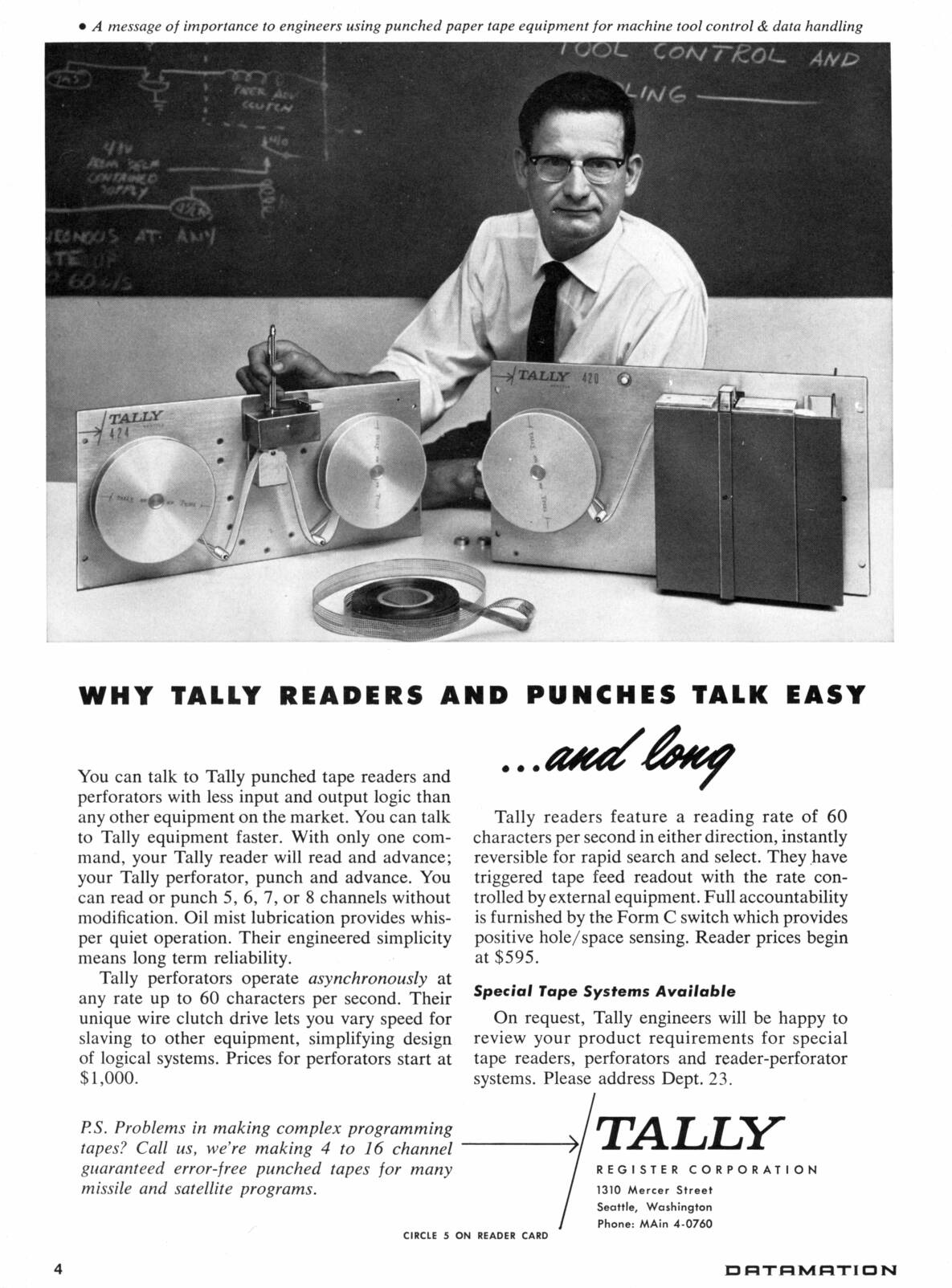
Looking for a Tally 420 tape puncher and a Tally 424 tape reader, we need these for a restoration project for a Telemetry console that was used in the Titan rocket program. The Tally units that were in the operators console are missing, and we really would like to replace them for proper display.
Here is a link to a photo of both units http://www.dvq.com/ads/tally_dm_11_60.jpg
Many thanks.
Walter Silva
Hi,
I'm kinda out of my head... I bought a pile of Omnibus boards from
someone on eBay. Lots of boards for even more money.
I got some Dataram core memory modules for pdp8/a. One 8K and three 16K
modules. I expected them to be quad wide. I explicitly told the seller
that I'd be interested only if they're quad wide. He sent me a
photograph of a quad wide Dataram module. And what I got is hex wide.
I'm going crazy... I spent all my money on that deal. In the hope to get
enough core to fill my pdp8/e and /m. I'm really frustrated.
Does anybody have quad wide core memory for Omnibus and wants to trade
for pdp8/a memory?
Examples:
For one "single board" 16K module (not made by DEC) I'll give one 8K and
one 16K DataRAM module.
For two single board 8K modules (not made by dEC) I'll give one 16K
DataRAM module and one H219 8K module.
For three DEC 8K module sets, I'll give one 16K DataRAM module and 2 8K
H219 modules.
For four DEC 4K module sets, I'll give one 8K H219 and one 16K DataRAM
module.
If there are some larger amounts of 8K modules out there, I'd could
throw in a set of pdp8/e CPU boards.
Generally, I try to trade 3:2=8a:8e.
If someone has something to trade, PLEASE contact me. I'm quite
desperate because I spent all my money for the stuff.
Best wishes,
Philipp
P.S.: I could use a single DEC 4K core board as well...
Looking for a Tally 420 tape puncher and a Tally 424 tape reader, we need these for a restoration project for a Telemetry console that was used in the Titan rocket program. The Tally units that were in the operators console are missing, and we really would like to replace them for proper display.
Many thanks.
Walter Silva
Located in the Milwaukee, WI area. Looking for offers, trades,
whatever, otherwise it's going to recycling -
An x-term server by Tektronix, called TekXpress model XP26.
Network Computing Devince Inc. x-term, Display Station Model #NCD88K
(includes mouse and keyboard).
Sparcstation 1 (includes mouse and keyboard).
Email me if interested.
Marty
Ok, I have this IBM console and I'm looking for the key and possibly
some replacement bulb's. The bulbs are some sort of little tubes
made of clear plastic, and they contain an even smaller glass bulb.
I might be able to open them up and replace them with white or yellow
led with a small series resitor, but it looks like it's not that easy to do.
See the pic at http://tinyurl.com/yjnt9cn
Any other suggestions I could do with it?
Ed
--
Certified : VCP 3.x, SCSI 3.x SCSA S10, SCNA S10
I've decided to play with some of my older Sun hardware this weekend, it
seems :). I have a 4/110 (Sun's first desktop/side Sparc machine) and
two P4 video cards -- a CG4 (501-1248) and an MG3 (501-1247). I can't
get the 4/110 to see either of them. Running boot diagnostics shows it
probing for a card in the P4 slot but not finding anything.
I've hooked the CG4 up to a monitor and the monitor syncs with it and
displays a blank screen, so it's getting power and doing something, but
for some reason the machine won't see it.
Any ideas?
Thanks as always...
Josh
This is the way we burn the roms (now to find some MCM6810 or compatible
rams and upgrade the ram in my old 1050 non double density) and make a US
doubler compatible 1050. Copied the rom from my other USDblr 1050, and need
to make the piggyback ram. ?course my DD 1050 needs new ram, it?s damaged
too :(
Hi! My good friend John and I are working on a joint www.S100Computers.com &
N8VEM <http://groups.google.com/group/n8vem> S-100 IDE project. It is based
on the following design by Peter Faasse.
http://www.pjrc.com/tech/8051/ide/wesley.html
John built a working prototype and some software and I am making a PCB. The
PCB is in trace route optimizing phase now. I can't say exactly when a PCB
will be available but if you think you might be interested please let me
know. PCBs will probably cost *about* $22 give or take some plus shipping.
If you do want a PCB it is important you tell me beforehand so I can include
it in the manufacturing order.
The board will connect to regular IDE devices and includes mounting areas
and interfaces for laptop (2.5" with the high density 44 pin connector) and
CF adapters. John has his prototype working with a CF adapter mounted on the
PCB and it seems to work fine.
Thanks and have a nice day!
Andrew Lynch
Hi folks,
I've heard of something called "DEC X8", a modular pdp8 exerciser. Does
someone have this? I don't have it and I've been further told that it
can be used to run acceptance tests on pdp8 without the need for all
that little maindecs...
Best wishes,
Philipp
Joe,
Saw your message in the archives. I have the Sweet-P documentation, full manual, assembly, programming examples and schematic. Contact me if you still have the Sweet-P.
Regards, Ron Carlson
Hello
I am trying to identify this rack printer from the time period of 1966. The printer circled in this photo http://www.flickr.com/photos/19997518 at N02/4085043282/
is the unit in question, it was made by "Franklin" , and you can imagine the search results I get when searching for "Franklin printer" EVERYTHING is about Benjamin Franklin.
The equipment in the photo is a Delco missile guidance telemetry monitor, I have seen photos of the same printer used in Nasa tracking station equipment from the 1960's, and I know that a aircraft version of the printer was used in military planes of the same time.
We are trying to restore a Delco Telemetry console from the 1960's that is missing the Franklin printer, and we would like to try to find one to replace the original.
If anyone can provide information about the company that made these printers (I assume they went by the Franklin name) or can ID this actual printer model, it would be off immense help for us, we assume they were a USA company, but that is all I know.
I did get to talk with the gentleman that was in charge of the Delco telemetry dept in 1967, and the only information he could recall is that the printer was a impact printer, made by Franklin, and was a high end unit for its day.
Thanks to all, and silly prize to anyone who can solve this !
Walter wlsilva at sbcglobal.net
Reply to http://classiccmp.org/pipermail/cctalk/2009-November/278452.html
Hi! John has some CBIOS software for CP/M 3.0 based on his system. I do
not know what the maximum drive size is but on the N8VEM DiskIO board CBIOS
for CP/M 2.2 the maximum size is 8MB. I believe the 8MB limit also applies
to the S-100 IDE board. At least in theory you could implement your own
CBIOS extensions for partitions and the like. We are doing something akin
to that on the N8VEM project for the SBC DiskIO CBIOS. However that is a
completely separate project from this board.
Anyone who gets one of these S-100 IDE boards would have to integrate it
into their CP/M system using the PCB, the schematics, and the example code.
No further support is offered. As John wisely says on comp.os.cpm "Please
note these would be bare cards, a schematic and that's it. Building the
board and implementing CPM etc., you are on your own. This is not a project
for first timers." There you have it -- Caveat Emptor.
Thanks and have a nice day!
Andrew Lynch
How are you getting around the 8meg max drive size common with CPM ?
Are you splitting it into many small drives in hardware on in the driver
like Morows dod for the M26 ?
I have an old MPM system that had an M26 on it I would like to bring back to
life.
The other Bob
On Fri, 6 Nov 2009 16:42:28 -0500, Andrew Lynch wrote:
>Hi! My good friend John and I are working on a joint www.S100Computers.com
&
>N8VEM <http://groups.google.com/group/n8vem> S-100 IDE project. It is
based
>on the following design by Peter Faasse.
>http://www.pjrc.com/tech/8051/ide/wesley.html
>John built a working prototype and some software and I am making a PCB. The
>PCB is in trace route optimizing phase now. I can't say exactly when a PCB
>will be available but if you think you might be interested please let me
>know. PCBs will probably cost *about* $22 give or take some plus shipping.
>If you do want a PCB it is important you tell me beforehand so I can
include
>it in the manufacturing order.
>The board will connect to regular IDE devices and includes mounting areas
>and interfaces for laptop (2.5" with the high density 44 pin connector) and
>CF adapters. John has his prototype working with a CF adapter mounted on
the
>PCB and it seems to work fine.
>Thanks and have a nice day!
>Andrew Lynch
I've put a few photos of mostly classic computer stuff on flickr. From
memory, there are some floppy drives coming apart, the boards from the
HP9820 calculator, repairing the printer and card reader for that
machine, upgrading the memory in an HP integral and an HP42S, and a few more.
Do a search for tony_duell to find them.. Don;t try to make sense of the
'photostream', the sets, howerver, are in a sane order.
Enjoy
-tony
Hi! I've been doing some PCB design work for various classic computer
projects and would like to discuss and hear some advice from experienced PCB
designers regarding design rules.
What design rules do you normally use for vintage and/or classic PCB
projects?
Clearly the design rules depend on the application and technology involved.
Normally, my projects are in the style typically from the late 1970's and
early 1980's style technologies such as PC/XT ISA bus, ECB, S-100, etc. The
components are typically 74LSxxx TTL DIP parts meant for easy and reliable
construction. There are no SMT components or very high frequency signals.
My typical starting design rules are 17 mil traces for signal, 51 mil traces
for power (VCC and GND), air gap (min clearance) of 11 mils. Grid size
varies depending but usually is 25 mils although I prefer 50 mils.
Component pads are typically 55 mils diameter with a 32 mil hole. Connector
pads are 60 mils diameter with a 40 mil hole. These parameters allow for a
single trace to be routed through the pins of a typical device.
Vias are 45 mils in diameter with a 25 mil hole. There are no blind or
micro vias allowed since all of my projects are use 2 layer PCBs.
Normally the signals for my projects are in the range of 1-8 MHz.
Occasionally there is signal as much as 16 MHz clock but those are few. The
harmonic content would contain higher frequencies since this is almost
entirely digital circuitry and square waves are prevalent. I aggressively
review and optimize the PCB layout and trace routing to minimize vias and
overall trace length. This phase can be very time consuming but I think it
is worth it.
Of primary concern to me is trace length due to legacy busses, board
density, size, and mainly using 74LSxxx technology. I've found longer
traces can result in greater impedance for both signal and power which can
interfere with proper operation. As a result I am using the 17 mil signal
traces and 51 mil power traces to minimize impedance and the resulting
voltage drops. Long traces can also have other effects which can raise
havoc on digital circuits.
Solid power supply rails is important so when I think a design is going may
use a lot of power I specify 2 oz copper weights although for most PCBs it
is only 1 oz. The wide signal and power traces are where I think my designs
might be overly conservative. The really old PCBs I have seen are as much
as 20 mil signal traces but most recent PCBs are less and around 10 mils and
sometimes smaller.
Minimizing switching transients is important so I normally place a 0.1 uF
bypass monolithic ceramic capacitor per IC. Normally there is a larger 22
uF electrolytic or tantalum bypass capacitor placed across the main VCC to
GND supply rails at the entry point to the PCB.
So far the PCBs have turned out to be fairly reliable and easy to build.
There have been a couple of errors but those are cases of where signal or
power traces were either connected wrong or left off entirely due to EDA
library problems. Things seem to be working fine although I am curious as
to what other designers are using and why. I would like to improve my
projects to make them the best possible and if there are ways to reduce
trace length and minimize the number of vias.
There are some sources of information on the internet regarding PCB design
but much of the recent material is focused on SMT, low power, and/or very
high frequency components. Often times I see trace widths less than 8 mils
which to me seem quite hazardous. Here is a good link for some discussion
on how to design a PCB for reliable manufacturing. It is about the right
age for the projects I like to work on and the design rules are fairly
consistent with mine but not exactly. I tend to be a bit more conservative
with regard to larger trace width than the author.
http://www.pic101.com/using_tango.htm
Thanks in advance for any advice and/or insight on proper PCB design. I
appreciate your thoughts and comments. Please no flames, this is intended
to be a serious and on topic question. If you are going to change the topic
please make a new subject.
Thanks and have a nice day!
Andrew Lynch
Hi all,
whilst cleaning out, I found an HP monitor with accompanying keyboard.
A label on the keyboard reads C1400A (?) and on the monitor is a label
that says 700/92 and 1001G. They are in working order, the screen lights
up green, characters are sharp, so the CRT is fine.
I guess that it will be local pick up only in Helmond, The Netherlands.
Shipping in The Netherlands will probably cost just 6.75 euro, but outside
the country will get too expensive. I am willing to ship it though, just
hate
to trash it, but that's going to happen in a week, if nobody wants it.
- Henk.
Got the fun parts of a Sun 2/120 workstation (a backplane and 2 sets of
CPU, Memory, FPA and SCSI boards -- anyone have a spare Sun 2 chassis?
:)) in a trade with another generous list member, and I've kind of got
it running on my bench here... I'd like to get it connected to the
Internet at some point. I'm looking for a 3Com 3c400 multibus ethernet
interface... anyone have one spare to sell/trade?
Thanks as always,
Josh
I have a couple of HP 9000/300 series computers with HP 7953 drives
and Intel processor cards in the computers. These have both HPUX
and Windows on the same drive. It looks like the Windows
file system shares the HPUX file system on these ?? What I want to do
is backup the drives. Just want to make sure I get it all. If I do a "ls" under
HPUX it shows both the HPUX and Windows files and directories.
Along the same lines,does anyone have early HPUX tapes. I would like
to come up with 9.x and earlier. I have backups of drives but no way to
get the backup on to a drive that has failed.
Thanks, Jerry
Hi! Jeff Jonas here
I'm selling some vintage parts on ebay.
This url lists all my current auctions:
http://shop.ebay.com/mejeep_demeep_ferret/m.htmlhttp://cgi.ebay.com/ws/eBayISAPI.dll?ViewItem&item=320444928233
Item number:320444928233
Intel 8080A CPU in IMASI S100 CPU card: MPU-A rev-4
Here's a ceramic Intel C8080A 2975A 2 MHz CPU
socketed in an IMSAI CPU CARD, S-100 bus: 1975 IMS ASSOC MPU-A REV 4
http://cgi.ebay.com/ws/eBayISAPI.dll?ViewItem&item=320444923473
Item number:320444923473
NOS large Beckman neon panaplex display 8 digit nixie
This is a new unused Panaplex-style neon display panel
Beckman Kr85 PP450 019
8 digits, each with 7 segments, decimal point and comma.
The flying leads are firmly attached to the edge.
NO SPECIAL SOCKET OR CONNECTORS NEEDED!
Digits are .7 inch tall, the 8 digits are 5 inches wide!
http://cgi.ebay.com/ws/eBayISAPI.dll?ViewItem&item=320443614849
Item number:320443614849
new unused ISE DG8F eightron single digit VFD
Here's a new unused ISE DG8F eightron VFD (vacuum fluorescent display)
with flying leads, originally sold as Radio Shack #276-065.
It's called the "eightron" for the teeny little segment
to the right so the '4' crosses nicer than a 7 segment display.
http://cgi.ebay.com/ws/eBayISAPI.dll?ViewItem&item=320443610650
Item number:320443610650
FNA 30 Archer 276-060 9 digit 7 segment LED module
So old, it's now retro! Here's a new, unused FNA 30 Archer Radio Shack
#276-060 teeny 9 digit 7 segment LED display module
like those used in the early handheld calculators.
Yes, those are magnifiers built into the top of the display!
No, I'm not giving up on vintage tech.
Quite the opposite, I'm focusing on interesting and fun projects
and selling things I don't foresee using.
Thank you.
Message: 2
Date: Wed, 4 Nov 2009 20:10:34 +0000 (GMT)
From: ard at p850ug1.demon.co.uk (Tony Duell)
Subject: Re: A few classic computer photos
To: cctalk at classiccmp.org
Message-ID: <m1N5mBh-000J3lC at p850ug1>
Content-Type: text/plain
>
>
> >
> > I haev quite a collection of sub-miniature Minoltas already :-). And I
> > have one Minox, which is a beautiful piece of engineering. Alas a ?
> > Tessina
> > is way out of my price range...
>
> Pentax 110's and Exakta's are my favorites.
I wouldnm't call the former a 'favourite', although I have 3 or 4 of them
with an assortment of lenses, flash, motordrive, etc. It's certainly an
interesting camera, although too much electronics (and no manual
override) for my taste.
But Exaktas I love. I generally describe them as the 'Citroen DS of 35mm
cameras' (if I ever learn to drive, a DS is top of my list of desirable
vehicles...). The Exakta is totally unconentional. Every control is where
you don't expect it. But then it has shutter speeds from 1/500 (or 1/1000
on later models) to 12 _seconds_. A film cutting knife (and you can run
cassette-to-cassette) so you can cut off an process part of the film.
Interchangeable viewfinders (I must repair the metering prism I have for
mine -- alas the meter coil itself is open-circuit). And so on.
Among the 35mm Exactas around me at the moment is a VP exacta taking 127
roll film (6*4,5 cm frame). Yes, I like them...
-tony
------------------------------
Tony,
You might like looking at? http://captjack.exaktaphile.com/ ?.
My second camera was an Exakta VXIIa, and I have owned and used several Exaktas. I now have a very early Olympus OM1 (made shortly after Leitz forced Olympus to change the name from M1 to OM1).
-----------------------------
Message: 4
Date: Wed, 4 Nov 2009 20:32:05 +0000 (GMT)
From: ard at p850ug1.demon.co.uk (Tony Duell)
Subject: Re: A few classic computer photos
To: cctalk at classiccmp.org
Message-ID: <m1N5mWW-000J3rC at p850ug1>
Content-Type: text/plain
<snip>
> >> Too true. There are a lot of Olympus OM4s that are starting to suffer
> >> from ciruitry failure (read: metering and shutter times go badly out of
> >
> > I seem to remeebr you should stick to odd-numbered OM's ?as they're
> > mechanical.
>
> So that'll be the OM-1 series then, but they weren't pure-mechanical.The
OM1 and OM3 IIRC.
> aperture priority metering still needs 2x SR44 coin cells to run.
> Also, the motor drive (if you have one) needs 4x AAs.
True. But those functions aren't _essential_ to take photographs (unlike
shutter timing).
>
> Full-mechanical? A Minox maybe? Or probably a Stereo Realist (which has
> been mentioned elsethread).
<snip>
well not include any active devices).
-tony
-----------------------------
?As I wrote to Zane off-list, the OM1 takes one?PX625. You can't get these now, but you can use a Zinc-Air 675. You just need to put a fat o-ring around it to get the correct diameter to fit the battery compartment.
Bob
All,
Catching up on my old magazine stack yesterday, I came across
what looked like a good article in Physics Today (Nov. 1998, Vol. 51
No. 11) entitled "The World Wide Web and High-Energy Physics". It
described the steps leading to the evolution of HTTP, HTML, and the
adoption of those protocols at CERN and elsewhere. Nice photos of Tim
Berners-Lee sitting in front of a NeXTStep screen, and *the* Cube
that ran the original server.
The article appears to be on-line at:
http://www.physicstoday.org/archive.html
(click on 1998, select the Nov. issue with the icebreaker on
the cover, look in "articles". I have to admit though, my Safari
4.0.3 and Firefox 3.5.1, both on Mac OS 10.4.11, fail to display the
article .pdf they think they are serving.
Did anyone else note this article, and can comment on its accuracy?
Does anyone want/need more info?
--
- Mark 210-379-4635
-----------------------------------------------------------------------
Large Asteroids headed toward planets
inhabited by beings that don't have
technology adequate to stop them:
Think of it as Evolution in Fast-Forward.
I saw some Cray debris in my latest electronics junkyard - the three
section power supply seat for an X-MP/24. Yes, X-MP. They came in with
a load from Canada, and the odd thing was they clearly had been junked
recently, as the conductive schmutz on the busbars was still sticky,
yet not full of an accumulation of crap from being exposed for year.
I am sicking the owner on the rest of the machine, but it is very
likely to have been cut up by now.
Still, any Cray owners need a few spare power units?
--
Will
Just found an amber VT420 in my storage. Powers up fine, excellent
condition, MMJ cable. Needs a home. Metro west Boston, happy to hold
for a while.
-Jim, jtp at chinalake.com
Hello,
due to my playing around with the LED display from a busted HP34C
(see my projects page, from my .sig) I got contacted by someone with a
HP33E that needed a new LED display - his was faulty, so I agreed to
send him my display - in fact I sent him the entire HP34C, given that
there might be more bits useful to his restoration efforts.
Long story short, due to my naivet?, the calculator got lost in the
mail, so it appears. I _never_ lost anything in the mail, it wasn't a
get-there-or-else kind of package, so I figured I save a few bucks and
send it as regular small parcel - no tracking number. Well, live and
learn, as they say. I guess with international shipments, bad things
can still happen.
So, is there anyone on the list who has a display for that type of
HP calculator (I think they got used in several of the 3x series)? It
should look like this:
http://www.ece.mcgill.ca/~jthiem/project-files/HPLED/HP%20LED%20display%20u…
I'm hoping _someone_ has one hidden away somewhere that wont power up
due to failure other than the display...
Joe.
--
Joachim Thiemann :: http://www.tsp.ece.mcgill.ca/~jthiem
At 18:04 -0600 11/3/09, Keith M wrote:
>
>How about here?
>
>http://www.slac.stanford.edu/pubs/slacpubs/7750/slac-pub-7815.pdf
>
>This looks to be the same one.
>
>Forget the $23.
>
>Keith
>
That is essentially the same article. Minor editorial/wording
changes and the final page was split off into a "box" in the
magazine, but same content and same illustrations.
Yeah, for $23, Physics Today can keep the editorial
modifications :-). Thanks, Kevin! Now that I know everyone has access
to it, I can recycle my paper copy.
At 18:04 -0600 11/3/09, Rich Alderson wrote:
>So not the origins of the Internet, most likely, but rather of the World
>Wide Waste^H^H^H^Heb?
Rich is right, I misphrased the subject line.
--
- Mark 210-379-4635
-----------------------------------------------------------------------
Large Asteroids headed toward planets
inhabited by beings that don't have
technology adequate to stop them:
Think of it as Evolution in Fast-Forward.
Hi, All,
Today's threads about maxing out VAX4000s reminds me that I've been
meaning to ask if anyone has fully stuffed a 512KB MSV11-PK and turned
it into a 1MB MSV11-PL? I have the requisite handbooks and know how
to strap the cards and such, but having in the past upgraded DEC
memory cards, I remember the "joy" of sucking out hundreds of holes
and looking for cold joints when the card didn't work the first time I
tried it (eventually, I did get it to work). I just haven't done it
with a card that's more than a dumb block of RAM (the MSV11-P series
has a CSR for querying parity status, among other things).
Abstractly, I expect it's a matter of cleaning the solder out of the
pins, installing a lot of 4164s (the card supports 4116s or 4164s),
then changing a strap or two for the extra fields. I'm just wondering
if anyone has done this and found and surprises.
I'd love to just have a pile of 4MB Qbus memory lying around so I
didn't have to fuss with things (for those that don't know DEC
equipment, 4MB fills the memory space on a 22-bit Qbus (no PMI)
machine), but I think I have exactly one card that large and it lives
in a MicroVAX I.
Thanks for any tips or warnings,
-ethan
P.S. - someday, I may try the same with an M8417 to turn an MSC8AA
(16K) into an MSC8DJ (128K) by removing the 4K DRAMs and
fully-populating the card with 4116s. The sheer number of solder
joints to get right has held me back on that one.
Greetings all;
I picked up a VAX4000 last week and have been trying to get talking with
it. I found a general VAX4000 series guide which says the terminal
settings should be 8N1 and I've got the speed right between the dial on
the front of the VAX module and the VT240 I'm using.
I get partial data, with ?s scattered all over the place. Frequently it
loses carriage returns and things get stuck scrolling off the side of the
screen.
What am I missing here? Is it not 8N1? I've tried flipping it around to
7N1, 7E1, etc, but usually that just results in absolute gibberish, the
8N1 provides the best signal-to-noise ratio.
I'd appreciate any thoughts given.
Elsewise, I'm pretty pumped. I have another 4000/300, but it has a bad
PSU. I figured I'd put the two together to get the nicest working machine,
store the spare PCBs and dump the chassis (anyone want an empty
4000/300?). The unit is complaining about some memory errors (came with
four memory boards), but with all the crap coming up on the screen, I'm
not entirely positive what it's complaining about since I can only read a
partial output...
Thanks again;
- JP
I just purchased one of these on ebay, but am unable to find even a shred
of documentation on the web.
It's equipped with a "PC" style 4-pin Molex connector for power, unlike
the more usual 6-pin square connector used by all my other 8" drives.
What I'd like to confirm is whether this unit can actually run on 12VDC.
It does not seem to work correctly with 12V applied, which could suggest
either that it requires 24V or is defective.
Before I let the magic smoke out of it, does anyone know the proper
voltages for this drive?
Steve
--
I have a chance to buy an IBM 5160 (pc-xt) with I believe an original CGA
(iirc) monitor. The interesting thing is that he seller claims it has a
386-16 upgrade board. What do we know about these? How much would that
upgrade board be worth? I'm trying to figure out if his price is fair.
brian
Thanks to help from the list admin, I have figured out why I stopped
seeing my own posts to the list!
Seems that gmail, in the their infinite wisdom, decided that it would be
best for me if my own messages were shunted directly to 'archive' and
never appear in the incoming folder. There is no control or option that I
can find to turn this "feature" off. Subsequently, I've had to change my
list subscription to use my ISP's mail service and all is well again.
Talk about obnoxious! I'm starting to wonder if gmail isn't more trouble
than it's worth. On the good side: It's free and their spam filtering is
very effective. On the bad side: They silently drop most binary
attachments, both coming and going, with no consistent policy involved
that I've been able to determine. And now, this.
Steve
--
Any one have copies of the WD controller specifications for the PC/AT?? It
would be a WD1003 model probably the ?WAH version but any version would be
appreciated. The following is a list of some known versions
WD1002A-WX1: Half-slot PC XT, PC AT compatible Winchester controller (MFM).
WD1002-27X: RLL 2,7 half-slot PC XT, PC AT compatible Winchester controller.
WD1002A-27X: Half-slot PC XT compatible Winchester controller. RLL, SMT, no
jumper selection required.
WD1003-WAH: Winchester controller with PC AT compatible interface.
RLL 2,7 version available (-RAH).
WD1003S-WAH: Surface mount technology version of WD1003-WAH.
RLL 2,7 version available (-RAH).
WD1003-WA2: Winchester and floppy controller board with PC AT interface.
RLL 2,7 version available (-RA2).
WD1003A-WA2: PC XT form factor version of WD1003-WA2.
RLL 2,7 version available (-RA2).
The corresponding WD AT interface chips are probably the WD11C00C-22 and the
WD12C00A-22 -? copies of their specs would also be appreciated.? I happen to
have the WD11C00C-17 spec, which is the XT version.
Tom
On Mon, 02 Nov 2009 at 16:18:22 Chuck Guzis wrote:
> From: "Chuck Guzis" <cclist at sydex.com>
> Subject: Re: Early WD Controller and/or chip specs
> To: "General Discussion: On-Topic and Off-Topic Posts"
> <cctalk at classiccmp.org>
> Message-ID: <4AEF064E.17548.1A2E6A5 at cclist.sydex.com>
> Content-Type: text/plain; charset=ISO-8859-1
>
> On 2 Nov 2009 at 14:48, Tom Gardner wrote:
>
> > Any one have copies of the WD controller specifications for the
> > PC/AT?? It would be a WD1003 model probably the -WAH version but any
> > version would be appreciated. The following is a list of some known
> > versions
>
> Tom, I'm not certain what you're looking for, but I've got the 25-30
> page booklets for both the WD1003V-SR1/SR2 and the WD1003V-SM1/SM2,
> if that's what you're looking for. The chip lineup is:
>
> WD42C22
> WD1017
> WD10C22
> WD37C65 (for the floppy versions)
>
> Also have the databooks for the WD1007 ESDI and a few other
> controllers. I have product description sheets for more.
>
> --Chuck
Hi Chuck:
I would very much like to get copies of both the SR and SM booklets. If u
are willing, can we work out details off line? My email address:
t.gardner-AT-computer.org
FWIW, the WD1003V is the 1986 version of this line. I'm not sure exactly
which model shipped in the first PC/AT other than I am pretty sure it was of
the WD1003 family.
Tom
Rich Alderson <RichA at vulcan.com> wrote:
>> From: Johnny Billquist
>> Sent: Wednesday, October 28, 2009 12:00 PM
>
>> Pontus Pihlgren <pontus at Update.UU.SE> wrote:
>
>>> Ps.
>
>>> Checking the archives, both you and Peter posted the link :D
>
>>> http://www.classiccmp.org/mailman/htdig/cctalk/2003-July/025598.html
>>> http://www.classiccmp.org/mailman/htdig/cctalk/2009-January/267600.html
>
>> Ah. That first link was really good. There people can see what Peter
>> have in storage. Most of it very much possible to get running. So he
>> have actually four KI10 systems, as well as two KA10, and a bunch of KL
>> and KS. It was more than I thought.
>
>> Looks like a pretty good collection of all 36-bit machines with PDP-10
>> like architecture. Missing is a PDP-6, as well as a few clones.
>
> No one has a PDP-6. No one. :-(((
Afraid you might be right on that one, Rich. :-(
>> The SC30 is actually online on HECnet. :-)
>
>> .ncp tell sol sho exec
>
>> Node summary as of 28-OCT-09 19:53:09
>
>> Executor node = 59.10 (SOL)
>
>> Identification = Systems Concepts SF CA USA - SC30M - DN-20 4.0
>> State = On, Active links = 0
>
>> I think his TOAD-1 is also running, but it don't seem to be online on
>> HECnet right now.
>
> If I understand it correctly, HECNET is a DECnet network, right?
Correct.
> In that case, unless Peter or someone else has done the work to make the
> Toad-1 speak DECnet, no one's Toad-1, Peter's or any other, will ever be
> on HECNET. The management at XKL absolutely forbade the software people
> to work on DECnet, for reasons obvious to anyone knowing the company history.
Hmm. What would prevent it? After all DECnet already exists for TOPS-20.
Did XKL make such big, incompatible changes to T20 after they got it
>from DEC?
I would definitely not hold it above Peter to fix it if it didn't work
for some reason. He has done things like that in the past.
The Toad-1 do have a node number allocated on HECnet anyway.
.ncp sho nod toad1
Node summary as of 30-OCT-09 18:29:13
Remote Active Next
Node State Links Delay Circuit Node
59.30 (TOAD1) 0 30 60.664 (PDXVAX)
Johnny
I sort of missed most of the discussion on the Kiel PDP10 but in going thru
some of the dialog I came across this quote from one postings:
> The Kiel museum/collectors society who were tracking the University's
> computing department's "output" for many years saved a complete system
> consisting of two KI10 (not sure, but older than KL10) processors,
> memory, drum memory, peripheral controllers, and some peripherals. About
> 25 racks. And a row of RP02/03 disk drives. And tons of cables and
> documentation. That roughly describes what has been kept in basements
> over the last years.
> ...
> They are in touch with the guy who maintained the machine (the guy with
> the lamps). He selected about five cabinets and one RP02 disk drive for
> the exhibition. The exact minimum of stuff that can be called "pdp10
> system, complete". The rest has been given away to collectors. I
> personally saved some stuff (RP drives, RS04 drives, CR10 card reader),
> the biggest part went to collectors who have in mind to get the stuff
> working again.
I worked on the Memorex 660-1 which is the RP02.
The RP02 (Memorex) and RP03 (ISS) are really significant early hard disk
drives and I would hope the Computer History Museum would be interested in
samples of both.
Can someone give me some status - where have they gone and are any still
available for collecting? If any are available, I can then work with the
museum to arrange for collecting them. If they are not available, it would
still be great to know where they are for reference and possible future
collection.
Tom Gardner
Los Altos CA USA
Hello,
Did you sell all of the LDB 4401 cassettes? If not then please respond with available quanity and price.
Ron Becker
United States
Wichita, KS 67216
On Ebay there is a DEC Digital Equipment PDP-11/R20...I may have missed a
thread about this, but any info on this? I assume it's just a custom
11/20?
Bill
Rob Jarratt [robert.jarratt at ntlworld.com] wrote:
> I am basing this on a reply I once got on a newsgroup. See
> the replies from Ian Miller here:
>
>http://groups.google.com/group/comp.os.vms/browse_thread/thread/3a8893f
7f6c6
>4aab/adb777d3f37ebed?q=jarratt+tk50+tf
That's certainly news to me - I've never heard that before. Doesn't mean
it's
Not got a grain of truth behind it though.
The reason given (internally to DEC, by the group responsible for these
drives)
for not being able to proceed past an inadvertent write (or physical
damage)
is that the drive is kept constantly synchronised by the stream of data
that
it reads. Once it loses that synch it no longer knows where it is and
cannot
recover. The stream of data is then just so much noise. The only
recovery
possible is at the beginning of a new data stream.
Assuming that all of that was true (and, indeed, correctly remembered
...)
then once you hit physical damage, the way the drive works will not let
you recover data past that point. It's a feature. There may or may not
be
special firmware, but I've never heard of any.
So I'd be willing to believe that a TF drive might handle some issues
better
than a TZ drive (although I'd prefer to see some corroborating evidence
before
repeating this meme myself), if you've got a damaged tape I'd be very
surprised
if either drive makes any difference at all.
That's not a reason to avoid a TF85 or TZ85: you never know when you'll
need
one for some other tape you do want to read. Just don't sped too much!
Antonio
Rob Jarratt [robert.jarratt at ntlworld.com] wrote:
>
> If there is anyone near Manchester in the UK with a TF drive
> then let me know. The TF drive itself is not that expensive
> so I may just get it anyway on the off-chance that a cheaper
> FKQSA or DSSI machine turns up.
Is it not the case that the TZ85 (SCSI) and TF85 (DSSI) are the same
drive, jus twith a different interface? So a TZ85 may be as useful to
you in solving your problem.
As for solving your problem, a perennial complaint within DEC was
"I've somehow started scribbling half-way along a DLT tape but I
stopped quickly and I need to get to the half of the data beyond the
scribbling". I never saw anyone admit to having one of these problems
solved: even when there was a paying customer at the end of a
cheque book. The existence of special recovery firmware was firmly
denied - and I never saw even a hint that it might exist.
So I don't have any reason for believing that a TZ85/TF85 might be
any better or worse at reading your data than anything else that
can handle your DLT.
BTW iirc the TZ86 and TZ87 are (iirc) can read tapes from a TZ85. The
TZ87N lost some of the backwards compatibility (to lower costs).
Antonio
On Fri, Oct 30, 2009 at 4:38 PM, Rob Jarratt
<robert.jarratt at ntlworld.com> wrote:
> I was led to believe that a TF series drive might be able to read past a
> problematic part of a tape I have, and a TF85 has come up on eBay. The
> problem is that I do not have any DSSI-capable machine and I am not familiar
> with DSSI. I have a MicroVAX II and it seems I could use a KFQSA, but they
> seem quite expensive. I also have some VAXstation 3100s and MicroVAX 3100s,
> which are SCSI. Do I have any other options for installing the TF85?
>
A KFQSA M7769 isn't very expensive, at least in the US, if you find
one at the right time. For example this one went for $25 with
bulkhead and terminators:
http://cgi.ebay.com/ws/eBayISAPI.dll?ViewItem&item=350264750147
No idea though if that's the best path to start going down in your
ultimate goal of reading a problematic tape.
After a very long time[1], I have gotten very close to having a functioning power supply.
I'm still not quite there by the looks of it. With a dummy load of two automobile
headlamps (four filaments wired in parallel) for each of the 2.5V and 5V supplies, I now
have pretty decent voltages:
2.54v (2.5V supply main output)
5.21v (5V supply main output)
15.31v
-15.18v
5.08v (+5VB)
-4.98v (-5VB)
12.09v (+12VB)
As far as I can tell, after going through the "H7104 Power System Tech Desc" doc,
these voltages are good. Even the slightly high 5V line is within the spec'd range of +/-
5% or 4.75v - 5.25v.
Still, I don't see a green POWER OK indication on either the power controller or the
cabinet's front panel. What I do see on the front panel is a red FAULT and a green
(slightly dimmer) RUN indication, but this is probably because no boards are yet in the
backplane. There are no lit fault indicators on the power controller itself, which
suggests that the voltages are okay.
Another list member who saw similar symptoms on his 11/750 apparently found that it
was loose contact in the Power Control ribbon cable, but that doesn't seem to be the
case here.
To test this further, I toggled the 5V supply's test switch to LO and saw the voltage drop
to 4.97V, but the POWER OK lamp still didn't light up, so I don't think the problem has to
do with the 5V output being too high.
I should put my 'scope on it to see if the output is stable. I'll do that, but I'm guessing that
it's going to be good, and I don't know if the power controller is sensitive to that
anyway. I haven't checked the POWER OK lamps themselves, and I'm guessing that
since there are two lamps, one in the power controller and one in the cabinet front
panel (and that they are not simply wired in parallel or serially) it's something else.
Maybe the bulbs are ganged together, I'd better check the FMPS again.
Before I dig into that aspect further, I wanted to check in with the group and see if
anything stands out that I've overlooked, or if you guys think I should check something
else before the bulbs.
Just want to make sure the PS is in order before loading the boards into the backplane.
Many thanks.
- Jared
[1] Rescued this unit two years ago this month. Turned out to have an empty card
cage, and a fault in the PS. I finally traced the PS trouble to two of the four power
output diodes in the 5V supply (shorted out, replaced all four), and a poorly contacting
connector in the 2.5V supply. Over time I have scrounged up a complete boardset so I
should have a functioning system Real Soon Now.
I was led to believe that a TF series drive might be able to read past a
problematic part of a tape I have, and a TF85 has come up on eBay. The
problem is that I do not have any DSSI-capable machine and I am not familiar
with DSSI. I have a MicroVAX II and it seems I could use a KFQSA, but they
seem quite expensive. I also have some VAXstation 3100s and MicroVAX 3100s,
which are SCSI. Do I have any other options for installing the TF85?
Thanks
Rob
Pontus Pihlgren <pontus at Update.UU.SE> wrote:
>> > Stacken have had to get rid of most of their stuff, I think, but
>> > Peter still has his, and maybe more.
>
> Did that stuff get thrown out or did it end up with other stacken
> members? (Expect for the stuff that went to uppsala this year)
I'm afraid most of Stackens stuff is lost forever. :-( There was a
little stuff saved in a warehouse somewhere still, if you remember...
But we did manage to save a KS-10, and they kept one at KTH. Both should
be functional. That's always something.
>> > I think I've written about this before, but it seems that either is
>> > noone seeing my mails, or noone remembers them, or possible noone
>> > wants to believe them.
>> > Don't know which...
>
> Posting a link to his gallery makes it more believable, but I'm sure
> that the link has been posted before:
>
> http://www.stupi.se/Bilder/pdp-10/index.html
True.
> Ps.
>
> Checking the archives, both you and Peter posted the link :D
>
> http://www.classiccmp.org/mailman/htdig/cctalk/2003-July/025598.html
> http://www.classiccmp.org/mailman/htdig/cctalk/2009-January/267600.html
Ah. That first link was really good. There people can see what Peter
have in storage. Most of it very much possible to get running. So he
have actually four KI10 systems, as well as two KA10, and a bunch of KL
and KS. It was more than I thought.
Looks like a pretty good collection of all 36-bit machines with PDP-10
like architecture. Missing is a PDP-6, as well as a few clones.
The SC30 is actually online on HECnet. :-)
.ncp tell sol sho exec
Node summary as of 28-OCT-09 19:53:09
Executor node = 59.10 (SOL)
Identification = Systems Concepts SF CA USA - SC30M - DN-20 4.0
State = On, Active links = 0
I think his TOAD-1 is also running, but it don't seem to be online on
HECnet right now.
Johnny
--
Johnny Billquist || "I'm on a bus
|| on a psychedelic trip
email: bqt at softjar.se || Reading murder books
pdp is alive! || tryin' to stay hip" - B. Idol
Hi all, enough lurking and time to ask a question....
The software company I work for is planning an internal classic computer
show as a little light relief near Christmas. We expect a turnout of
around 100 people and so far have the following planned:
1) Show as many vinatage systems as possible, ideally working. "vintage"
in this context means anything pre-90 as best I can tell but modern rare
machine may be shown too. Think ZX81, C64, etc - mostly home machines.
I'm personally plannig to show my Transputer collection, though I expect
very limited interest :)
2) Have a collection of classic software & games running on emulators
"3) retro" music
4) beer and snacks (not vintage)
5) Competitions for high score on classic games and best retro dress!
6) Possibly invite a well known talker or two, depending on how much
interest we expect to generate and/or finance.
Has anyone helped organise something like this before? is there anything
that worked particularly well/failed miserably? This is a small scale
fun event and not on the scale of VCF!
Many thanks for any advice
James
Dwight asks:
> Is there more? I don't see why that would have put them off doing DECnet.
Decnet has some support in some 80's and early 90's era Cisco products...
but it was comparatively poor and incomplete compared to what the
competition (especially 3Com) was doing. In my opinion (entirely
subjective, no real proof), Cisco support for DECNET and related DEC
protocols (e.g. LAT) was purposefully made incomplete or done poorly, so that
you'd struggle against it a lot with the glimmer of hope that you might
figure it out, but you always feel defeated and sore in the end.
3Com's LAT and DECNET terminal servers were really kick-ass, way better
than the overpriced DEC equivalent. LAT really is a pretty spiffy protocol
for terminal servers.
In the end DECNET Phase V (OSI compatibility) was what killed DECNET. Man, what a mess.
I feel sorry for the DEC programmers who labored for what must've been man-millenia
putting in every possible OSI bell and whistle when in the end nobody ever
wanted any of those bells and whistles!
Tim.
Does anyone know how to get this working? Much googling has produced a
reference to a utility called psadmin that's needed to set the initial ip
address for a jetlan card. Vista can't see the printer while snooping the
network. Any ideas?
brian
> Aquired an Onyx w/RE2 for the *** already, and have the guts
> of an Origin-2000 coming, for me.
>
> I was offered the stripped cardcage of the graphics part of
> a rack Onyx2 - IR I guess? I don't want it. Would you like it?
> It's free anyways.
Any interest? I can forward stuff to the owner.
Located in Providence.
--
Will
Hi All,
Just something I noticed the other day. A school that I help with radio
stuff (yeah I'm a ham) just got a set of the new lego mindstorm bits and
pieces. And I noticed their little serial leads seem to use the same almost
RJ-12 style connector with the offset clip.
I haven't double checked but it seems that someone else is using the
connector that I have a battered version.
Take Care and 7 3
~Ivy
--
VK3IVY
http://radio.carnagevisors.net
> Just something I noticed the other day. A school that I help with radio
> stuff (yeah I'm a ham) just got a set of the new lego mindstorm bits and
> pieces. And I noticed their little serial leads seem to use the same almost
> RJ-12 style connector with the offset clip.
> I haven't double checked but it seems that someone else is using the
> connector that I have a battered version.
I think that the Lego plug has the clip offset to the opposite side
compared to the DEC MMJ. So similar...yet even more incompatible!
Tim.
Is anyone else chronically failing to see their own messages show up on
the list? For several months now, I've only been seeing other folks'
responses to my messages and never the messages themselves.
Sent several notes to Jay West, but never saw a response. If this is
expected behavior, can someone advise?
Steve
--
For those who are playing with it, Classilla 9.0.4 (a Mozilla-based browser
for classic Mac OS systems) is now available. Marginally on topic.
www.classilla.org
--
------------------------------------ personal: http://www.cameronkaiser.com/ --
Cameron Kaiser * Floodgap Systems * www.floodgap.com * ckaiser at floodgap.com
-- FORTUNE: The moon is in Venus' house. This will make no difference. --------
> I also found this: http://www.pdp8.net/tu56/tu56.shtml
> in which Dave G. describes a successful use of the CM2182 (14V,
> 80ma) bulb in this application.
>
I just replaced one of them again last week so I had taken a picture of
the indicator disassembled.
It is now up at
http://www.pdp8online.com/tu56/pics/p1000839.shtml?small
If your TU56 -15V input is high you may run this bulb above its rated
voltage shortening its life.
Hello Al,
hello everybody!
I assume that physical storage capacity limitations are a well known
problem to lots of people on this list.
I further assume that many of you know situations where they "take
everything", "find everything", "buy everything", "rescue everything",
or alike. It starts with some information about <anything interesting>
sitting <somewhere> at the cost of <price>. The variables differ
greatly. In many cases you will cry out "Cool! Don't throw anything
away! I'll take all of it!". Of course, all available bits and pieces
are at least worth a look. But...
This posting is about the "unwanted documentation" you often get with
stuff you acquire. I would like to start a discussion on this as I don't
always know what to do with it. A clean concept could probably help me
and others to maximize preservation of valuable historic information
with respect to use of individual storage capacities.
The following are three example cases from my "collection career":
1. Honeywell H316
I bought the H316 from someone in Switzerland, on eBay. It came quite
complete, with all docs. And some vague oral information about the
former application. And a lot of binders documenting the original system
the machine was used in. Everything specially made for the application
(controlling flight monitor displays in an airport). Everything in
Italian. And no actual piece of it left. Still have them.
2. pdp8/l rescue, a few years ago
I found my three pdp8/l computers rusting in a garage, not far from
here. They were part of an "Olympia Multiplex-80" system used in a bank
(someone added one of my pictures of one of the machines to the
wikipedia article about pdp8). There were two Ampex 7 track tape drives.
And some interfaces to the rest of the Multiplex-80 system. And
documentation for much of it. The tape drives were gone too far, so I
threw them away (no, there was no realistic chance to restore them: It
would have been a complete rebuild! They consisted of rust, rust, and
rust). The controllers were also gone very far. So I kept only some
pieces of those. Documentation for the tape drive and the whole system
is still there.
3. Some Honeywell
This last example is not finished yet. And it is the reason for writing
this posting.
Yesterday I drove up to Denmark. There I met a guy who had sitting
around some Honeywell and associated gear that he did not want anymore.
What I got were two Level 6 computers and an Ampex Megastore solid state
disk for the H316. One megabyte of core memory... That alone was enough
to take the trip.
And there are two large boxes with paper. I looked throug them, most of
them seems to be Accuray (the guy and stuff came from there)
documentation for some kind of industrial control system (paper mill,
I've been told). Tons of Accuray X16 software listings. Some original
Honeywell stuff. Accuray documentation for Accuray software.
And docs for a hard disk (fixed head?) disk drive that doesn't exist
anymore. All in all, the paper directly related to the stuff that
dropped in is less than 25% of the lot.
I currently have all of it. Some sitting here upstairs, some in the car,
and some in the staircase (the house door is open, it's getting cold).
Documentation belonging to collected hardware or software will always be
kept. This doesn't need to be discussed.
But the rest.... I call it the "other papers".
What the hell should one do with this kind of stuff?
The "other papers" fall into one of at least three categories:
a) Documents generated in equipment's lifetime, closely related to the
actual object they come with. Like Service logs, communication with the
manufacturer (offers, invoices etc.), personal notes, memory dumps of
something that has been used with the system.
b) Documentation for stuff and devices (i.e. products) I don't have
(anymore/not yet)
c) Documentation for individual applications like a paper mill or the
airport information system that don't exist anymore.
d) Category a stuff that belongs to stuff that did not came with it and
which can safely be assumed to have been scrapped long time ago
My current practice is to keep category a documents for historic value.
They usually don't take much space and are fun to read. Sometimes useful
as well.
Category b documents are kept if they belong to something I want to have
or where I can imagine that I could get it in the future (examples:
pdp8/i, straight-8, Honeywell DDP-516).
I don't see a reason to keep category c and d documents. I already threw
away some of those when they were simply photocopies of (assumed to be)
available or completely boring manuals. And I already feel bad about
that... So I am drowning in stuff that I don't really want to keep but
something holds me from just discarding it. At one point I thought about
bulk-scanning those before discarding. That would save the information -
and my space. But I currently cannot afford a scanner that can do the
job in hours/days instead of months.
Al Kossow is doing a great job with bitsavers. I appreciate the approach
to share vintage documentation and software in the way he does. I also
added a few bits and docs I rescued and scanned.
Most stuff on bitsavers is copyrighted in some way. For much of it, the
copyright owner can be assumed as not being interested in enforcing the
copyright because the information has lost its market value long time
ago - or the company simply doesn't exist anymore.
But what about stuff marked as confidential? I've got some Honeywell
Level 6 manuals (some of them seem to be on bitsavers already), most of
them are marked as confidential. Some of them have written
"confidential" on every single page... Is it ok to simply publish that
stuff?
And what about category c documents? Shouldn't they be silently
discarded? That would be the "correct" handling as one cannot be sure if
parts of the described system are still somewhere in production use. The
circumstances under which those docs go their way to collectors' hands
are usually of a more or less obscure and inofficial nature...
I like to read your opinions on that. Or proposals. I'd very much
appreciate a vital discussion.
Best wishes,
Philipp
Has anyone here tried to disguise a 19-inch rack as some sort of
unobtrusive piece of furniture? I'm pondering making a bench or
sideboard-like thing to compactly conceal computer equipment.
--
David Griffith
dgriffi at cs.csubak.edu
I'm struggling trying to create an accurate telnet client with ANSI
emulation. The basic codes are easy enough and well documented, but
there are a lot of obscure codes to do things like 'set terminal mode'
to 'vertical editing mode' which I can't find good descriptions for.
I can't even figure out if a pure ANSI terminal supports wrapping to the
next line when you hit the edge of the screen, or if that is controlled
by an escape sequence. To further confuse things, a lot of people lump
the DEC terminals in with discussions of ANSI terminals, and although
they are close they are not the same. DEC extended a lot of things.
I've been googling, reading source code, and experimenting. It's slow
and painful.
Does anybody have a good reference they would recommend?
Thanks,
Mike
Another topic....
I got that Ampex "Megastore 316". It's a ramdisk for the Honeywell H316.
Connects via IO but and optionally DMC (kind of data break). Is from the
early 80s and contains to times half a megabyte of core memory. Quite a
mass...
I have some schematics, but not all I would need. Currently it's working
a bit - reading only every second word - but that looks good so far. I
had to make my own cables. Perhaps I did something wrong...?
Played a bit with the controller's microcode. Found no reason why it
skis addresses. There must be something wrong with the bus. I have two
controllers and two core modules - swapping doesn't change anything..
Does anyone on the list have experience, docs or other information to share?
Kind Regards,
Philipp :-)
Jochen Kunz <jkunz at unixag-kl.fh-kl.de> wrote:
>
> On Tue, 27 Oct 2009 06:55:30 -0000
> "Rod Smallwood" <rodsmallwood at btconnect.com> wrote:
>
>
>> > Are there any DEC 10's running elsewhere?
>>
> At least a vew years ago the Lule? Academic Computer Society (Computer
> Society at Lule? University of Technology) used to have a runable
> DECsystem 2065. There was a nice galery featuring many interresting
> machines (VAX 8850, Norsk Data, ...). But the website has been WiKified
> (puke) and now the galery is gone.
>
Hmm. As far as I know, LUDD only have/had a DEC-2020. No -2065 around there.
But the largest collection of PDP-10 machines in the world for a long
time used to be at Stacken, at the Royal Institute of Technology (KTH)
in Sweden. That, in combination with Peter Lothbergs collection.
Stacken have had to get rid of most of their stuff, I think, but Peter
still has his, and maybe more.
Lots of machines from the US were "exported" to Stacken...
I know that Peter still have atleast one KI-10 SMP machine (with alteast
two cpus) in storage. And that one is runnable. He have KLs as well, and
other stuff.
Stacken used to have a KA-10 running, and several KL and KS machines as
well.
I think I've written about this before, but it seems that either is
noone seeing my mails, or noone remembers them, or possible noone wants
to believe them.
Don't know which...
Anyway, not that I think you could get Peter to work on restoring a
KI-10 unless you have lots of money, but I bet he'd be able to to it in
close to no time, without much help. Heck, I know he modified his KI-10
machines to have some extra instruction needed for his modified version
of TOPS-10 back in the 80s.
If there is anyone in the world who knows PDP-10 machines, it is Peter.
It's just that if you haven't been around for a long time, you probably
might not know about him.
Johnny
Does anyone here have any spare Model M keys? I'm looking for the
right-hand shift key.
--
David Griffith
dgriffi at cs.csubak.edu
A: Because it fouls the order in which people normally read text.
Q: Why is top-posting such a bad thing?
A: Top-posting.
Q: What is the most annoying thing in e-mail?
Hi, All,
I'm trying to help a friend out with a role-playing game prop, and I
have a memory of some tool from a number of years back that can accept
a set of scripted menu items and responses and build an MS-DOS BAT
script that will "implement" the menu structure.
For example - you'd start off with a top level menu with, say, 4
items. Typing 1-4 would take you to one of four sub-menus, etc.,
until the end "nodes" are reached. The end-nodes could be a launching
point for a DOS program (optional), or just a page of informational
text.
Does this sort of menu generator script ring any bells with anyone?
I've googled for three days and have found all sorts of tutorials for
how to craft scripted menus (for DOS and UNIX), and I could easily
write my own set of menus from scratch in any number of system script
languages; the end user in this particular case is not a programmer,
so I'm trying to find something that will let him write the
informational text for the end-nodes and the menu items to lead to
them, but have a tool auto-generate the structure around it.
Thanks for any pointers, suggestions or keywords to help my search.
-ethan
This might be of interest to some folk?
Don't mail me, contact the originator directly... I think he's
expecting for the stuff to be collected, too...
- LP
---------- Forwarded message ----------
From: doug at dougneale.co.uk <doug at dougneale.co.uk>
Date: Tue, Oct 27, 2009 at 10:25 AM
Subject: [merton freegle] Offered: various old XT dev kits sm4
To: mertonfreegle at yahoogroups.com
Definitely an item for the computer whizz/hacker/museum
These PC cards fit into the old XT slots, not the newer PCI ones.
They are all cards for experimenting with non-pc chips:
TMS 34010
TMS 320C30
Novix 4000
ARM chip
68302 (OS9 for windows kit)
Inmos 4008 Transputer
Inmos Quadputer (with software)
Some manuals, but no other software.
Regards,
Doug Neale
------------------------------------
Yahoo! Groups Links
<*> To visit your group on the web, go to:
? ?http://groups.yahoo.com/group/mertonfreegle/
<*> Your email settings:
? ?Individual Email | Traditional
<*> To change settings online go to:
? ?http://groups.yahoo.com/group/mertonfreegle/join
? ?(Yahoo! ID required)
<*> To change settings via email:
? ?mailto:mertonfreegle-digest at yahoogroups.com
? ?mailto:mertonfreegle-fullfeatured at yahoogroups.com
<*> To unsubscribe from this group, send an email to:
? ?mertonfreegle-unsubscribe at yahoogroups.com
<*> Your use of Yahoo! Groups is subject to:
? ?http://docs.yahoo.com/info/terms/
--
Liam Proven ? Profile: http://www.linkedin.com/in/liamproven
Email: lproven at cix.co.uk ? GMail/GoogleTalk/Orkut: lproven at gmail.com
Tel: +44 20-8685-0498 ? Cell: +44 7939-087884 ? Fax: + 44 870-9151419
AOL/AIM/iChat/Yahoo/Skype: liamproven ? LiveJournal/Twitter: lproven
MSN: lproven at hotmail.com ? ICQ: 73187508
Hi folks,
I'm currently checking out some TU56 DECTape drives. Stuck motors, burnt
electronics, dirt, and other issues usually come my way.
And broken indicator lights. Does anybody have experience replacing
those bulbs? Originally there are those white plastic blocks that should
be replaced as one piece. Nice idea - I have ONE complete replacement
and at least 6 to repair. Those blocks are easily opened, fiddling a new
lamp inside is easy and no problem. So what I ask you is only for ideas
about the right lamps to use. It should look similar to the original
lamps (or could be a bit brighter).
Some blasphemy to add:
If I don't find a quick solution, I'll fit one of the TU56s with crazy
colored LEDs. That might be considered a sacrilege by some people, but
it's quite reversible and non-destructive. I have LEDs in two RK05
drives, too (They're soldered to their series resistors and plugged in
like the original lamps, so everything can be reverted instantly). The
read and write indicators are quite more interesting that way (with
incandescent lamps you don't even see many accesses!).
But at the moment the question is for incandescent lamps. So please
share your ideas/experience with me!
Best wishes,
Philipp :-)
>> Has anyone here tried to disguise a 19-inch rack as some sort of
>> unobtrusive piece of furniture? I'm pondering making a bench or
>> sideboard-like thing to compactly conceal computer equipment.
>>
>
> The high-end home theater crowd do things like this. You might want
to look
> there. Otherwise, I'd just build a piece of furniture around it.
Sofa's are a great place to mount things that move. That is not the
drive shaking, it is the FORCE from the latest Star Wars movie.
> brian
>
The Dark side of course. :)
I had a bid on a laser 128 computer, working complete with power supply. It
had been listed in the past for too high a price. This time, the pirce was
reasonable though so I bid. There was a second one with a matching external
floppy also. I was hoping to make an offer on all of it at the end of the
auction. Yesterday, the items disappeared. I guess the seller pulled the
items. I wish there were a more sane place to trade this stuff. I guess I
have just have to wait for somoene to give up another storage facility.
lol thanks for putting up with my venting.
Hi,
I acquired a 2nd-hand Canon BJC-250 printer back in January. It seemed to work fine, as the test page printed* and Windows 2K SP4 auto-detected the printer when it was switched on (which is good because I got a "data error (cyclic redundancy check)" when trying to copy the drivers from floppy disk to my laptop).
On closer inspection though, all doesn't appear to be fine. I thought I had a black only cartridge installed (which came with the printer), but it turns out to be a colour one. Now the problem occurs when I print a page with black text. The text is printed with alternating black and green lines, instead of just black.
Now I never saw this problem at work when we used the same printer model, but that may have been a black only cartridge. Is this problem a side effect of having a colour cartridge, bubble jet printers, or indicative of a problem with the read head / cartridge?
I have very little experience with printers and would appreciate any pointers anyone can offer. I hope it fits withing the 10 year rule... not sure how old the printer model is.
*The test page requires no input from the computer, so I ruled out a possible driver issue.
Regards,
Andrew B
aliensrcooluk at yahoo.co.uk
Dan writes:
> In the end, having it in a universally available format (PDF for example)
> and available on the web would be best.
> Can someone explain why "hording" documentation and keeping it private on
> a "degradable" media like paper is a better idea?
I certainly agree that the extreme of hoarding everything in one place is the
worst possible scenario. I don't even think that hoard is necessarily the word
most would use; think of Don Maslin's careful archive of every CP/M boot floppy
ever, that was by no means a hoard because he shared it, one piece at a time with
whoever needed it, but because it was all concentrated in one place it's now gone. Don and
I had talked about hosting disk images etc. but we never got it done in general.
But I don't think anyone so far has said that they would hoard it that way. Everyone
agrees that PDF's for electronic distribution are a real win.
Those who are seriously into it also know:
1. Scanning books without lopping off the spine can make for some pretty crappy scans.
2. After you're done, you gotta do something with the remaining paper.
3. In many (most!) cases the paper is already decaying.
4. There's just such a huge quantity of books, and manuals, and printsets, and they've already decayed some, and they're all gonna decay more.
Tim.