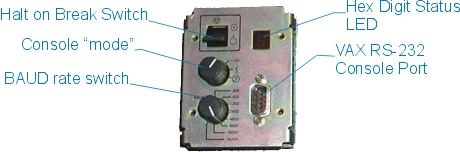
Greetings,
I have updated the SerialDisk documentation tonight. I created a fairly
descriptive how-to guide on how to set up a new SerialDisk system. For the
inexperienced with OS/8, it provides some information on running programs
like EDIT, PAL8, and BUILD. For the OS/8 gurus, it shows some basic syntax
of the SerialDisk server and related utilities. There should be a little
something for everyone in there.
If someone has an Omnibus machine and an aux TTY card and wants to try it
out, I'd be curious to see how accurate my documentation really is.
A big thanks to David Gesswein for trying out my early attempts at the
server, Vince Slyngstad for creating a handler that will work well for the
earlier -8s, and Philipp Hachtmann for making some needed modifications to
my coding style. :) The changes will be getting pushed in as soon as I have
time to patch them in and test them.
Eventually, I'll have simh working with the server by means of telnet, but
this is to come as I have more time.
https://github.com/drovak/os8diskserver
Kyle
P.S. I forgot if I mentioned: I found out that it wasn't my server that was
acting up with BASIC halting at 10206; it was the disk image I was using.
It works fine on the current release using diagpack2.rk05. I've not had a
single bug with the handler/server that can't be explained by user error
since the latest changes. :)
At 04:46 PM 2/13/2014, Marc Howard wrote:
>However (going from memory here) if I try:
>
>.RUN SYS BUILD
>$IN TC08
>
>I get a message like (I think)
>
>FILE NOT FOUND
>
>I've tried all kinds of variations on this and I can't seem to install the
>TC08 handler.
>
>Could you tell me what I'm missing/doing wrong? The diagpack2.rk05 image
>has TC08.SY and TC08.HN; isn't that what I need?
The convention on that pack is that a .SY file is a system handler and
a .HN file is a nonsystem handler.
You should be able to use
$ IN TC08.HN
Before you do this, use SET SYS NO INIT before you run BUILD since the
init command causes build to be overwritten in memory!
-rICK
>Didn't we do this a couple of weeks ago? :-)
I think we did Tony but my memory is so bad it drifted off into
nowhere-land. I should really start writing these things down. :@)
Anyways, right, so I forgot it's Mark parity and not even parity. That and
an unlelated problem with a rogue decoupling cap was making me scratch my
head for the last week. Hayes Smartmodem could send and receive on every
other terminal I owned. Why the heck would it only receive on the teletype??
:\
-John
> An acquaintance of mine is looking to hook up his Heath/Zenith LSI-11 system to his H/Z-29 terminal.
> The system has the Sigma Information Systems 400200 interface card.
> I found him a copy of the manual but before attempting to build his own cable he was wondering
> if an existing cable might be found for RS-232 operation with this card.
> Any ideas on a source for something like that?
If they are 10-pin headers, then they should be pin-compatible
with any of the DEC serial headers and cables.
A real DEC DLV11-J uses the CK-DLV11-J cabinet kit,
which should work adequately if you can find one.
You could also use the (CPU) cabinet kit for a MicroVAX or PDP-11.
The MicroVAX version looks like this -
http://www.mcmanis.com/chuck/computers/vaxen/images/ba23.gif
These days, it would probably be more cost-effective to roll your own cable,
particularly if you're only going to be connecting one device to the system.
T
>From: IN%"cctalk at classiccmp.org" 10-FEB-2014 12:01:59.95
>To: IN%"cctalk at classiccmp.org"
>CC:
>Subj: cctalk Digest, Vol 126, Issue 18
>From: Kurt K <kurtk7 at visi.com>
>To: "General Discussion: On-Topic Posts Only" <cctech at classiccmp.org>
>Subject: Re: contemporary XT software?
>Who is downloading currently? Have you tested access by trying to download?
>It sounded like everyone here was cut off. Somewhere saved is no good unless
>that location is eventually discovered. Does anyone know of other mirrors?
I believe I have the whole thing (or at least the VetusWare directory).
It's rather large. Think more than 1GB+
Options? Torrent? I have an (what I think is) unlimited hosting account but
I'm not sure how they'd take to getting crushed or racking up 500GB of
transfer.
Fred
Hi,
as my first post here I would like to ask a question about a DEC
correspondent terminal with a broken power supply.
due to a shorted capacitor in the output stage, a whole train of parts
has failed, including some diodes, a coil and the main switching
transistor in TO-3 case. that is the part with a strange partnumber:
A8250
151278200
I suspect that the 8250 is a manufacturing date and the long number a
internal DEC number, but what sould be put in its place. i was thinking
about just using a irf840 mosfet, but i have no idea as if this would work.
any thoughts (or maybe some schematic?)
--
Met vriendelijke Groet,
Simon Claessen
drukknop.nl
On Wed, Feb 12, 2014 at 11:51:10AM -0600, Jon Elson wrote:
[...]
>> I don't think VMware will run Win95 or Win98. If that is wrong, I'd sure like
>> to know, as I could pack up an ancient system I still keep around for
>> archival reasons.
> Works for me:
>
> http://abuse.mooli.org.uk/win95.png
>
> The installer goes like a rocket on a SSD and 2.4GHz CPU!
>
Very, interesting. What version of VMware are you using? I
tried
this some time ago, and it said "Windows 95 is not a
supported OS".
Jon
I've got about 2.5GB uncompressed of various drivers & software
I've collected. Bits for Multia, AXPpci-33, Alpine Alpha motherboard,
DEC3000-400, Win2K for Alpha, EB64+, Diskkeeper, VAX 3100-M38, V62X(?).
Who can/wants to have a copy of this?
I've attached a directory output for your curiosity.
--
--- Dave Woyciesjes
--- ICQ# 905818
--- CompTIA A+ Certified IT Tech - http://certification.comptia.org/
--- HDI Certified Support Center Analyst - http://www.ThinkHDI.com/
Registered Linux user number 464583
"Computers have lots of memory but no imagination."
"The problem with troubleshooting is that trouble shoots back."
- from some guy on the internet.
Simon,
Die checked the filter elco's.
You should check the leakage current and ESR values. If the mosfet is running hot you should check the board for shortcuts.
Tantalum caps have a habit of getting shortened when they get aged. Also a not working driver can cause a large current, this can be checked with a scope. Check the signals at the base of the drive transistors. I suppose you checked the voltages for ripple and noise.
-Rik
-----Oorspronkelijk bericht-----
Van: "Simon Claessen" <simski at dds.nl>
Verzonden: ?13-?2-?2014 10:00
Aan: "On-Topic and Off-Topic Posts" <cctalk at classiccmp.org>
Onderwerp: Re: LA12 correspondent
On 12-02-14 23:18, Tony Duell wrote:
> In whuich case it's almost certainl the right sort of part. My
> experience suggests that SMPSUs fail for may more trivial reasons than
> having a MOSFET fitted in palce ofr a bipolar transistor.
>
>
The mosfet runs hot, even with the original cooling, and the paper is
not advancing, so there must be something wrong somewere else in the
machine. I actually would love to find out what type of transistor was
there originally relabeled as digital part # 151278200
--
Met vriendelijke Groet,
Simon Claessen
drukknop.nl
hello all. i happen to have a dell optiplex gx50 and i got 98 on it and
when i started installing stuff to it i got so far then the os stopped
booting at all and black screened. i wish i could find a good windows 98
computer or setup. if anyone could help out let me know
>Date: Wed, 12 Feb 2014 08:43:43 -0500
> From: allison <ajp166 at verizon.net>
> To: cctech at classiccmp.org
> Subject: Re: [u-u] Someone's looking for old software
> Message-ID: <52FB7A8F.4080306 at verizon.net>
> Content-Type: text/plain; charset=ISO-8859-1
>
>
> >> Will VAXELN even run on a 3100 or a 4000? I
> thought it was limited to Q-Bus
> >> systems, but won't be surprised if I'm wrong.
> >>
> >
>
> It runs on any VAX. However its not a OS. Its
> closer to a IO subsystem
> and scheduling
> package (RTOS). Like many RTOS packages the basic
> system is fairly
> useless and not
> a user environment. Its used to make real time
> systems. Examples that
> used it were
> LPS40(qbus), LPS20(not Q), LPS32(not Q) and the terminal
> software for
> the VS2000
> (very not Q). If the bus/IO structure is not Qbus or
> other DEC standard
> bus then IO
> is up to the developer.
>
> Allison
VAXELN is/was a host/target setup for developing distributed
realtime VAX applications (ELN = Executive for Local Networks).
Hosted on any sensible VAX/VMS system, with targets being a
subset of VAX, MicroVAX, VAXstation systems. And a few oddities
too (e.g. RTVAX300 VAX-in-a-module, KAV30 RTVAX300-on-VMEbus,
rtVAX1000 (KA630-variant in a MicroVAX2 chassis), etc.
Obscure targets without publically available VAXELN support (?)
include the aforementioned LPS32 and LPS40 VAX-powered printers.
The SPD seems to be hard to find online, as does the VAXELN
Technical Summary, so what follows is from memory. The usual
suspects do seem to have some of the VAXELN docs online in
decw$book format.
The host and target might be separately licenced.
Early VAXELN applications could be written in a multi-threaded
variant of PASCAL called EPASCAL. Later, other standard VAX
languages were supported too: Ada, C, maybe Fortran, the usual
Pascal. Or VAX Macro.
The runtime environment was a dedicated RTOS environment, not VMS
(e.g. no demand paging) although some VMS-compatible facilities
(DECnet, RMS) and routines (some LIB$)were offered.
You compiled your application in the usual way, and linked it with
VAXELN-specific libraries using the usual linker.
The VAXELN system builder was then used to build a bootable system
image. A system image would include the hardware-specific kernel and
any required VAXELN device drivers. Any optional facilities
(VAXELN distributed name service, networking using DECnet and/or TCP,
CLI, Xserver, debug) would be combined with any required user
applications to make a bootable system image file
Booting was supported over the LAN (MOP, maybe bootp), from disk, and
in an odd few cases, from ROM.
A VAXELN source kit was sold at one stage, though it was far from
essential. Pretty much the whole target end was written in PASCAL.
In the early days VAXELN had its own threads-aware debugger (hosted on
VMS and networked to the target).
Once VMS DEBUG got that capability (which came initially with DEC
Ada? sometime around VMS V4?) VAXELN targets could be debugged remotely
using the standard VMS debugger. Deep joy.
Iirc, VAXELN V4.3 or thereabouts used to be on CD in the 1990s (1993?).
There were a couple more versions after that, but no huge changes I can
remember.
When Alpha came along, VAXELN was left behind. DEC worked with Wind River
to get a version of VxWorks for Alpha (VxWorks was an "industry standard"
RTOS, somewhat different in concept to VAXELN). Both claimed to have POSIX
compatibility for the RT stuff. A thin VAXELN veneer was added on top of
VxWorks for those who might be interested.
The product became part of DEC's Embedded+Realtime Group, which was
sold off to SMART Modular Technologies, in the late 1990s (?), and the
product subsequently vanished. I haven't recently been able to establish
the product's current status, though I didn't try real hard.
It was a great RTOS if you wanted to think more about the application
design and less about the intricacies of device drivers and networking and
other such traditional RTOS trivia. I'm told its concepts mapped nicely onto
the "channels and pools" from "Communicating Sequential Processes".
Be interesting to know what lies behind the original enquiry from LinkedIn.
I may be able to offer more info if necessary. It might not be quick, and
the formatting may be messed up again (sorry).
Hope this helps,
regards
John
>
>Will VAXELN even run on a 3100 or a 4000? I thought it was limited to Q-Bus
>systems, but won't be surprised if I'm wrong.
>
I have come across a VAXELN image for a VAXStation 2000 which I think
implemented some sort of X Terminal on it.
(While not Q-Bus based, at least some of the VAX 4000 range do have facilities
attach Q-Bus periperals.)
Regards,
Peter Coghlan.
Does anyone have the setup and documentation for this MF-300 CCA? I would
like to install it in my HP9836C and run the Infotek BC204 Basic Compiler ,
but I do not have any info on how to set the DIP switches.( there are 9
switches.
--
e-?
>
>I have a box of them, used, along with the monitor boards and almost all
>vt1xx logic boards. I have some of the boards handy, but the rest I won't
>be able to dig out for a while due to more pressing personal priorities. I
>will post when I find them.
>
Hi Paul,
I have been looking for a flyback transformer for a VT220, part number
16-26299-01 (or possibly 16-21181-01 which appears to be the same thing with
a different mounting arrangement).
I would appreciate if you could keep a lookout for one of these when you are
searching.
Regards,
Peter Coghlan.
Greetings,
I've been hard at work on an OS/8 system handler that negotiates block
transfers between a PC running a special disk server. The two are currently
working great! I was able to use the BUILD utility to make my own OS/8 V3D
disk and boot from it. I then thought that it may be possible to take an
existing RK05 image and replace the bootloader and system handler with my
own. Sure enough, it works!
Check it out: https://www.youtube.com/watch?v=YkqVJ6ShV5A
I'll be releasing the source code for all of this within the next few weeks
as I make minor changes (and mostly tidy it up).
A few details: the handler resides in one page and talks to the server to
negotiate the transferring of pages. To keep the handler small, I'm
offloading as much stuff onto the PC as possible. There's no error
detecting (although this hasn't been an issue for the millions of bits I've
sent thus far) and the features of the handler are pretty basic. The disk
server is written entirely in C and has been successfully compiled on Mac
OS X and Windows under Cygwin.
The handler sends serial data to an M8650YA (currently addressed at 40/41,
the aux TTY addresses) operating at 19200 baud. This is pretty slow still,
as you can see from the video. But it's usable! And it's bound to get
better with a few more improvements.
To bootstrap the system, the RIM loader is toggled in as the primary
bootloader, and a secondary bootloader is sent in RIM format. Start the
system at 0020 after that, and it'll boot right up.
In summary, anyone with a spare M8650, M8655, or other serial card can now
boot OS/8, even if you don't have an RK05, DECtape, RX01/02, etc.! If you
have a parallel I/O card, another handler could be made for even faster
transfers, I imagine. This would require some extra hardware, though.
Let me know if you have any questions. Again, I'll see about distributing
the source in a couple of weeks, or as I have time.
Kyle
Vintage Computer Festival Southeast 2.0
May 3,4 2014
The Atlanta Historical Computer Society and the Computer Museum of
America are pleased to announce the second annual Vintage Computer
Festival Southeast. We have selected the 3rd and 4th of
May to make it easy for people to attend both VCF East and VCF
Southeast this year.
The venue will be the same former CompUSA store in Roswell GA as last
year. This year's exhibit space will be greatly enlarged over last
year, occupying the whole retail space of the store. About 2/3 of the
space will be the exhibition LINK ? Personal Computing from Switches
to Pockets. The exhibit is a journey from the present back to the
Kenbak-1. The remaining 1/3 of the retail space will contain hobbyist
vintage computing exhibits. For those who missed last year or who
would like to see it again, the Apple Pop-Up museum from last year's
festival will again be available.
The popular retro-gaming area and introduction to soldering activity
will be available again. This year, we are also working to bring in a
number of vendors, assemble a stellar slate of speakers, and offer
workshop experiences. Of course, the kids' scavenger hunt will be
back this year too.
More details as they become available. Hope to see you all there.
The RICM needs to repair a S603 triple pulse amplifier flip-chip. The
failed diode is listed as a DEC D-664. The DEC enthusiast cross-reference
lists show it as a 1N3606. These diodes are nearly impossible to find. Can
someone recommend a substitution for the 1N3606 diode?
The 1N3606 is a Silicon diode (that's lucky, Germanium diodes
are probably hard to find, now). 75 V reverse, 50 uA reverse
leakage, 100 mA forward current.
Unfortunately, my old book doesn't have much more
info than that. But, I doubt you could go wrong with a
1N914 or 1N4148 signal diode. Any silicon switching diode
will almost certainly work fine.
Jon
On 11/02/14 10:13 AM, arocker at Vex.Net wrote:
>
>>From LinkedIn's "Vintage Computers" group, the relevant bits:
>
> "I?m looking for some old software and license's for a VAX 3100 and VAX 4000
>
> I?m looking for the Operating System called ?VAXELN?
>
> License part number is QL-375AB-AA OR QL-375A*.** either will work
>
> The software is QT-375AA-**"
>
> If somebody on the list has a dusty specimen of "VAXLN", whatever that is,
> I'll forward the link.
These are two mailing lists that can certainly help, so I'll forward
this message to both.
--Toby
>
> _______________________________________________
> u-u mailing list
> u-u at unixunanimous.org
> https://unixunanimous.org/mailman/listinfo/u-u
>
Hi,
I've finally got my TC08/TU56 passing the maindec diags now. I've also
tried to copy some TC08 bootable tape images to my drives. I can write
them, read them back and do a diff with no errors using resttc08/dumptc08.
However when I try to boot using one of these tapes several blocks are read
in and then the system crashes and burns with no console output.
As an experiment I'd like to see if I could format/read/write files from
OS/8 running on my RK05 but it seems like all the images I've looked at are
configured for a TD8E and don't have the TC08 driver on disk.
I'm not an OS/8 expert but I tried a build and when I typed (I'm going from
memory here):
IN TC08,DTA0
...I got a message like "HANDLER NOT FOUND" (or something to that effect).
Looking at the disk didn't reveal any TC08 drivers. The PRINT command did
show that it had been configured previously for TD8E support.
So how can I get the TC08 handler onto my RK05? Could I PIP this from the
serial connection somehow? Also, what is the correct way to do a build
with TC08 support?
Any thoughts/insight appreciated.
Thanks,
Marc
Hello all,
I'm looking for DEC vt101 schematics and maintenance manual.
I've a vt101. The power supply and logic board is ok. All power levels and video signals are supplied to the video board properly, but there is no dispay on the crt and I'm suspecting that the video board is defective.
Andreas
The RICM needs to repair a S603 triple pulse amplifier flip-chip. The
failed diode is listed as a DEC D-664. The DEC enthusiast cross-reference
lists show it as a 1N3606. These diodes are nearly impossible to find. Can
someone recommend a substitution for the 1N3606 diode?
--
Michael Thompson
I just picked up two original Macintosh 128k systems. I don't yet have the
capability of making these disks, so if anyone here does I'd give you a few
bucks for your time. I'd like to get the OS disk and the utilities like
paint and whatnot.
I'm in the US by the way.
Thanks
--
Sent from my time machine
Greetings,
Does anyone have any tips on connecting an application like my disk server
(which ordinarily talks to a serial port) to an auxiliary teletype on simh?
I'd love to be able to easily debug my handler and such with breakpoints,
memory inspection, etc.
Or, if someone wants to tackle this with the provided code, that'd be
awesome.
https://github.com/drovak/os8diskserver
I'm trying to figure out why running most any BASIC program in OS/8 results
in a halt at 10206. In other news, I successfully FOTP'ed an entire RK05
side to another disk all with the disk server. Seemed to finish with no
errors. Unfortunately, at 19200 baud, it took many minutes to complete.
Thanks,
Kyle
> I measured the resistance of the flyback transformer as of four
> Ohms. From my point of view this is a proper value.
>
> Andreas
Just curious for the reason you think a resistance measurement will show
up a shorted turn(s) in the flyback?
Marvin
Thanks Mike. ?I've tried a few searches for the keypunch keys but no luck. ?I don't have the actual article for the keyboard.. just the TV Typewriter, which features the same keyboard on the cover but not the greatrst quality. ?I am relying on Matt Holley's little archive. ?Here is a link to a black and white of it. ?Keys are light grey.
http://www.swtpc.com/mholley/RadioElectronics/Feb1973/RE_Feb_1973_pg55.jpg
Sent from Samsung Mobile
<div>-------- Original message --------</div><div>From: MikeS <dm561 at torfree.net> </div><div>Date:02/10/2014 12:00 PM (GMT-08:00) </div><div>To: cctalk at classiccmp.org </div><div>Subject: Re: Vintage keycaps </div><div>
</div>----- Original Message -----
> Date: Sun, 09 Feb 2014 10:50:57 -0800
> From: Brad Hodge <brad at bettercomputing.net>
> One other question.. for my TV Typewriter project I am hoping to ape
> either of the two keyboard designs featured in the magazine.. either the
> blue/red keypunch/teletype style keys of the prototype or the custom keys
> with keycaps featured in the Feb 1973 issue. Wondering if anyone knows of
> possible sources for these. ?I think part of my problem is when searching
> ebay i may not have exactly the right words or phrase.. ie. Not sure if
> 'keypunch' is the right term for the keys used in the prototype. I'm
> hoping to make this as close to one of the two featured designs as
> possible so it's important to get the keys right.
>
> Thanks muchly,
>
> Brad
I can't make out the 'normal' keyboard and my issue of September 1973 RE is
mysteriously missing, but I believe the black, red and blue keyboard is from
an MDS key-to-tape unit.
I bought a bunch of those surplus back in the day because the switches were
MicroSwitch magnet/reed switches, ideal for the harsh oil-filled environment
of an industrial data-collection terminal I was building and selling at the
time. I thought I still had one or two but if I do I can't find them in
Chaos Cellar; will let you know if I do find anything.
If you send me a close-up of the other keyboard I might have something that
would be equivalent; I still have boxes of different keytops from the
above-mentioned project.
m
Hi Michael
At 07:49 AM 2/11/2014, you wrote:
>The RICM needs to repair a S603 triple pulse amplifier flip-chip. The
>failed diode is listed as a DEC D-664. The DEC enthusiast cross-reference
>lists show it as a 1N3606. These diodes are nearly impossible to find. Can
>someone recommend a substitution for the 1N3606 diode?
>Michael Thompson
--- The DEC schematic for the S603 does indeed list 1N3606 as equivalent to the D664. I found complete info on the 1N3606 in the GE 1964 Transistor Manual pp.439-446, pp.564-565, p.587. It does have some special processing, including gold doping and controlled forward characteristics. A couple parameters which stood out are:
- Reverse recovery time: 2ns (nanoseconds--some sources show microseconds, woof)
- Forward voltage 0.55Vmax at 0.1mA, 0.67Vmax at 1mA.
Note that some of the online data listed for this part is misleading or wrong.
Though lesser diodes would probably work, no doubt you would prefer to replace it with one at least as good, for the sake of preserving the integrity of the restoration.
Anyway, I found that the 1N3606 is claimed to be available:
Qty-61 shown here. Price is $1.54ea:
http://www.ralphselectronics.com/SearchResults.aspx?criteria=1N3606
This source shows Qty-173 in Irvine, CA:
http://partsearch.area51esg.com/icswdl2.aspx?user=area51&user=area51&part=1…
New Jersey Semiconductor claims Qty-1424:
http://njsemi.com/product-request/
There were other sources, if those don't pan out.
Steve L.
So far not going well. Didn't seem to have any video from the video
board so pulled that which gives me a serial console. Trying to boot from
my emulator gives 4C DEVINACT. If I'm on the correct drive select I get
the error quicker so its seeing the emulator. TK50 is just blinking red
so I can't boot the diag tape. Online seems to say a good cleaning may
fix this.
Next tried to find the diagnostic floppies. Found these (uvax2diag1)
which may be what I want.
http://www.headcrashers.org/comp/rx50/index.html
Get same 4C DEVINACT trying to boot them. Page didn't give PUTR command
used to create images. I tried both with and without /binary.
Does anyone know of known good diagnostic floppy images hopefully with
information on how to write them back to a floppy? I assume the full
diagnostic hasn't shown up so all that is available is the stripped down
customer one.
Also what is the name you give to boot for the hard drive, floppy, and tape?
Manuals seem skimpy on details and this machine doesn't have the show command.
Also I was assuming the bottom drive is the boot drive based on the manuals
I have. Was this normal?
I haven't tried putting the real drive back in and seeing if its bootable.
Since I don't know the password I'll either have to hard shut it down if
it boots or try one of the procedures for resetting the password. Looks
like it is VMS.
Greetings,
I am attempting to cobble together a system and non-system device driver
for OS/8 to allow me to use my new OS/8 DiskServer utility with my -8/M and
its Xebec floppy drives.
I have quite a bit of documentation on these drives (that will eventually
get pushed to bitsavers, if I find more time) but unfortunately, I'm
lacking in software.
Lack of handlers is okay. The instruction manual gives some programming
examples, which is enough to get me started. But it also cites a test
program which is supposed to be run to initialize any new disk.
>From the book:
Test 1: Format Sectors
Function: To format a new disk or prepare a disk for a series of diagnostic
tests. There is no prerequisite for Test 1 which is normally the first test
to be run int he diagnostic sequence.
Test Procedure:
Greetings,
I spent much of the weekend improving my disk server and OS/8 handlers. I
now have some great new features, and it's working well enough for me to
submit to the world. I know there are still issues at present, but I'm
hoping some OS/8 gurus can help debug some of them.
https://github.com/drovak/os8diskserver
I encourage other developers to help each other out (and myself) by
submitting changes to the code base. I'd like to make this as good as
possible for everyone. I'm pretty new to git and GitHub, so please let me
know if I've screwed something up there.
Here's some more notes:
- I'll be releasing an actual how-to guide within the next few days. For
now, the adventurous ones can help beta test it.
- The server has been compiled successfully under Cygwin, Debian on
Raspberry Pi, and OS X Snow Leopard.
- The OS/8 system handlers use some PDP-8/E and later instructions. If
someone wants to help go back through and track these down, we can see if a
more compliant version will still fit in the allotted space.
- The server now uses dumprest/simh .rk05 images exclusively.
- There is a utility to install a new system handler and bootloader on an
.rk05 image. It seems to work fine.
- There is a utility to convert Bernhard Baehr's simulator's format to the
dumprest/simh format. It also seems to work fine.
- The server supports mounting two disk images at once. This requires the
use of the non-system handler which has four entry points. The first two
point to the two that the system handler uses. The non-system handler can
eventually be expanded to support several more disks as well.
- There's definitely an issue present. Running BASIC with a simple test
program halts the computer after 10206. I've not had a chance to further
investigate why.
- PIP and RESORC will likely need to be updated to reflect that the handler
device type supports the same number of blocks as an RK05. This is
described in Appendix B of the OS/8 Software Support Manual.
- The server does its best to check that a disk write will not go outside
the boundaries of the disk.
- The server does its best to verify that a disk read will not overwrite
the system handler
Also, if an OS/8 guru can help me out, I'd appreciate it. Will a read/write
>from SYS: on an RK05 past block 3248 (decimal) succeed? That is, can a read
or write carry over from one side of the platter to the other? After
looking at the RK8E system handler, I would say this is a yes. It looks
like a call to SYS: with a block number of 6260 (octal) is the same as a
jump to the second entry point. However, is this behavior desirable or
needed? I would have expected the two sides to be logically separated in
the handler. My server attempts to do just that by essentially chopping the
.rk05 image in half. If a transfer goes past the end of either half, an
error occurs. However, if this is not what should happen, I can change that.
As always, feel free to email me if you have any questions or comments. If
you have any ideas for how to make my program better in any way, I'd love
to hear them.
Thank you all for your support,
Kyle
----- Original Message -----
> Date: Sun, 09 Feb 2014 10:50:57 -0800
> From: Brad Hodge <brad at bettercomputing.net>
> One other question.. for my TV Typewriter project I am hoping to ape
> either of the two keyboard designs featured in the magazine.. either the
> blue/red keypunch/teletype style keys of the prototype or the custom keys
> with keycaps featured in the Feb 1973 issue. Wondering if anyone knows of
> possible sources for these. ?I think part of my problem is when searching
> ebay i may not have exactly the right words or phrase.. ie. Not sure if
> 'keypunch' is the right term for the keys used in the prototype. I'm
> hoping to make this as close to one of the two featured designs as
> possible so it's important to get the keys right.
>
> Thanks muchly,
>
> Brad
I can't make out the 'normal' keyboard and my issue of September 1973 RE is
mysteriously missing, but I believe the black, red and blue keyboard is from
an MDS key-to-tape unit.
I bought a bunch of those surplus back in the day because the switches were
MicroSwitch magnet/reed switches, ideal for the harsh oil-filled environment
of an industrial data-collection terminal I was building and selling at the
time. I thought I still had one or two but if I do I can't find them in
Chaos Cellar; will let you know if I do find anything.
If you send me a close-up of the other keyboard I might have something that
would be equivalent; I still have boxes of different keytops from the
above-mentioned project.
m
One other question.. for my TV Typewriter project I am hoping to ape either of the two keyboard designs featured in the magazine.. either the blue/red keypunch/teletype style keys of the prototype or the custom keys with keycaps featured in the Feb 1973 issue. Wondering if anyone knows of possible sources for these. ?I think part of my problem is when searching ebay i may not have exactly the right words or phrase.. ie. Not sure if 'keypunch' is the right term for the keys used in the prototype. I'm hoping to make this as close to one of the two featured designs as possible so it's important to get the keys right.
Thanks muchly,
Brad
Sent from Samsung Mobile
>Message: 5
>Date: Sat, 08 Feb 2014 13:17:12 -0500
>From: allison < ajp166 at verizon.net >
>To: General Discussion: On-Topic Posts Only < cctech at classiccmp.org >
>Subject: Re: Re-done HD video on the Osborne 1
>
<snip>
?
>>> readable screen at 80 chars (VS osborne 50 char).
>> OB_nit: 51?? and scrolling to give the effect of reading a newspaper
>> through a little hole in a piece of cardboard
>50 or scroll it was tiny!
52 columns.
<snip>
>> Did they ever release that battery pack?
>> I remember an EARLY interview where Lee was asked about the size and
>> weight for a battery pack.? Lee responded, "How big is your CAR?? The 12V
>> input is not for use while carrying."
>> (Lee had a gold colored Honda Accord at the time; it did not have any
>> non-stock power ports)
>Never did.? Measured it and it was pretty painful at 12V CRT and video board
>ate 40W alone the rest of the system was about 100W.? That meant your portable
>battery was a 18ah gell cell for about maybe an hour or two.? If all the supplies
>were of switch mode it was maybe possible to get it down some but the CRT
>was killer.
This was discussed earlier. I know that Evan K. says that Lee says it was never released, but I have one that I bought in Chicago at a regular computer store -- still have the receipt. It came with a glossy-printed Osborne (blue/grey) manual, so if it was not officially released, they got very close to that. I have pictures and have scanned the manual, which I can send to anyone interested.
The Computer History Museum has?what they call an?"Osborne car adapter" (Cat #102646068) that is also part of the "Powr-Pak".
Bob
?
?
----- Original Message ----- >
> Date: Sun, 09 Feb 2014 08:59:51 -0800
> From: Chuck Guzis <cclist at sydex.com>
>> Does your 7720 have a semi transparent cover? Couldn't tell from pictures
>> online.
>
> I remember that thing--we evaluated one in the 70s. It had an
> interesting intolerance of being out of level--if you raised the end
> farthest from the spinning disk, the servo mech would have fits. We
> stuck with the Shugart SA4000 until ST506-style 5.25" MFM hard drives
> became available. I think we started with the 7MB Rodime model.
>
> Eventually, IMI merged with Onyx--I recall their building on North First
> Street in San Jose bearing the logo "Onyx+IMI"--a singularly
> unimaginative name, I thought.
>
> --Chuck
Nice pictures of the three-platter 7740:
http://www.flickr.com/photos/elliotli/7229124666/in/photostream/
Thanks for the tip, Chuck; if/when I get the 7710 spinning I'll be sure to
check that it's level.
m
Anfang der weitergeleiteten E?Mail:
> Von: B?hse Onkelz <boehse at onkelz.de>
> Datum: 4. Februar 2014 07:29:33 MEZ
> An: aswood at t-online.de
> Betreff: Der Weg zu Deinen Onkelz-Tickets
> Antwort an: boehse at onkelz.de
>
>
>
>
> Der Weg zu Deinen Onkelz-Tickets
> Hallo,
>
> hier sind sie: Der exklusive Link zum Ticketvorverkauf und ein pers?nliches individuelles Passwort.
>
> Dein Passwort f?r den Onkelz-Vorverkauf lautet: 5W8WTPA8
>
> Mit Deinem Passwort kannst Du ab dem 07.02.2014 (12:00 Uhr) maximal 4 Tickets f?r die B?hsen Onkelz bestellen, nat?rlich nur solange der Vorrat reicht.
>
> Bitte beachte, dass ein Zugriff auf die Tickets vor dem oben genannten Zeitpunkt nicht m?glich ist, und insbesondere, dass Dein Passwort nur einmal verwendbar ist: Wenn Du Tickets damit angefordert hast und den Bestellvorgang abbrichst, verf?llt das Passwort!
>
> Termin:
> 20.06.2014 Hockenheim ? Hockenheimring
>
> Um der Abzocke mit den Tickets Einhalt zu gebieten, wird der gewerbliche Wiederverkauf ausgeschlossen!
>
> Besten Gru?
> Dein Onkelz-Team
>
>
>
> E.I.N.S. GmbH
> Parkstra?e 44, 89312 G?nzburg
> info at einsgmbh.de
>
> Amtsgericht Memmingen, HRB 15709
> Gesch?ftsf?hrer: Matthias R?hr, Peter Schorowsky
> ? 2014 B?hse Onkelz
----- Original Message -----
Message: 1
Date: Sun, 9 Feb 2014 10:43:57 -0500
From: David Gesswein <djg at pdp8online.com>
> I had seen some pictures like the one in this brochure that showed it had
> a clear cover so you could see the mechanism and also have a big head
> actuator coil etc that made it look more interesting than later drives.
bitsavers.trailing-edge.com/pdf/imi/brochures/IMI_77xx_Brochure.pdf
> Though the marketing material may have shown it better than the actual
> drive. Unsure if its age but its not that transparent in this picture
http://resetvector.com/wp-content/gallery/DataStorage/Winchester30-30/DSCN1…
I think it might just be glare; all the ones I've seen had smoked plastic
covers that let you clearly see the inside of the HDA, and if you look
closely you can make out the platter and the voice coil in that picture..
And yes, it has a fairly large linear voice coil head actuator; fun to watch
and you definitely knew when it was seeking.
I've still got one (7710) here complete with its hefty power supply and was
actually planning to test it this weekend, but no time, alas...
m
Hello,
I'm searching for SunOS 4.0.3e or SunOS 4.1e installation tapes images.
These are the only SunOS 4.x releases which will run on 4MB Sun1E VME board.
Regards,
Plamen
>> On Wed, 5 Feb 2014, Chuck Guzis wrote:
>>
>> NAPALM gives a link to ftp://176.107.241.42/public/VetusWare/
What is "NAPALM" in this instance? Is it a search engine of sorts for
old software?
Thanks,
Bob
If you can file this away somewhere and consider it from time to time,
I'd appreciate it.
If someone finds a battered PC or XT or something that can function as a
PC/XT, I'd love hearing about it. All I am seeing on eBay are
collector-grade machines (with prices to match), and I'm just looking to
have a permanent machine here to test XT keymappings and such with. An
XT SBC would be ideal, if such a thing were ever made.
I have a machine here at present (have not forgotten about you dabone),
but at some point, I need to secure my own system for testing.
Jim
--
Jim Brain
brain at jbrain.comwww.jbrain.com
Now that I seem to finally have a working XT clone, does anyone have
suggestions for interesting (and available!) contemporary software to run
on it? It'd be nice to load it up with a few games and productivity apps
of the era.
It's only got 512K of RAM (although I may have an expansion board
somewhere), but it does have a 10MHz 8088 (well, if I can work out how to
kick it into high-speed mode) and I've got a VGA card in there right now.
I'm not sure if anyone is maintaining a software repository for early x86
PCs (and maybe what is out there will target '286 and above anyway)?
cheers
Jules
Very interesting !!
David, would you elaborate on >> The IMI 77xx are neat looking drives. >>
( English is not my native language, and I am not sure I fully understand the implied meaning of this statement )
This is anyway a very interesting post as I am building David's interface right now
( last parts to arrive in a few days ... ) and my plans are to use it with an IMI 7720 drive !!
Knowing the interface is a bit non standard and that I will have to modify "things".
But, ** FIRST **, I will, I hope, make it works with a "standard" ST412 drive.
---
Ce courrier ?lectronique ne contient aucun virus ou logiciel malveillant parce que la protection avast! Antivirus est active.
http://www.avast.com
Hey guys,
I am slowly acquiring parts for a retro build of Don Lancaster's TV Typewriter. I've scored quite a few chips, many surprisingly with early 1970s date codes. ?One I'm having trouble with though is the Signetics 8288 divide by 12.. cant seem to locate it. ?Anyone have a line on a supplier that might have these?
Thanks!
Sent from Samsung Mobile
Summary: From punched cards to electromechanical machines - a look
inside the IBM museum charting the rise of the company and computing.
By Nick Heath | February 6, 2014 -- 15:29 GMT
http://www.zdnet.com/photos-100-years-of-computing-from-punched-cards-to-fl…
--
Liam Proven * Profile: http://lproven.livejournal.com/profile
Email: lproven at cix.co.uk * GMail/G+/Twitter/Flickr/Facebook: lproven
MSN: lproven at hotmail.com * Skype/AIM/Yahoo/LinkedIn: liamproven
Tel: +44 20-8685-0498 * Cell: +44 7939-087884
>
> From: Pontus Pihlgren <pontus at Update.UU.SE>
> Date: Sat, 8 Feb 2014 08:46:33 +0100
> On Fri, Feb 07, 2014 at 02:55:41PM -0800, Zane Healy wrote:
> > What kind of PDP-11's did VAX 8000's use as Consoles, and what
> > did their console software consist of.
> >
>
> That depends, models 8600 and 8650 used an 11/03 with RX
> floppies (ours has an RL drive too). I'm not sure about the OS,
> I bet it is RT11.
>
> The other models didn't have a front end AFAIK.
>
> /P
>
>
The 8650 at the RICM has a T-11 PDP-11 chip on the L0201 CSL board. The
BA11 chassis holds the Q-Bus for the CSL board and includes a M8061 RVL12
RL02 Disk Control for the RT11 boot disk.
The 8600 Console Specifications Manual is here:
http://manx.classiccmp.org/mirror/vt100.net/dec/ey-4818e-dx-0001.pdf
--
Michael Thompson
1978 satellite returns to Earth orbit, still live - but NASA no longer
has transmitting/receiving equipment old enough to communicate with
it.
http://www.planetary.org/blogs/emily-lakdawalla/2014/02070836-isee-3.html
There might be potential for a CCmper to save the day on this one! :?)
--
Liam Proven * Profile: http://lproven.livejournal.com/profile
Email: lproven at cix.co.uk * GMail/G+/Twitter/Flickr/Facebook: lproven
MSN: lproven at hotmail.com * Skype/AIM/Yahoo/LinkedIn: liamproven
Tel: +44 20-8685-0498 * Cell: +44 7939-087884
On 2014-02-08 10:00, allison<ajp166 at verizon.net> wrote:
>
> On 02/08/2014 03:06 AM, Zane Healy wrote:
>> >On Feb 7, 2014, at 11:46 PM, Pontus Pihlgren<pontus at Update.UU.SE> wrote:
>> >
>>> >>On Fri, Feb 07, 2014 at 02:55:41PM -0800, Zane Healy wrote:
>>>> >>>What kind of PDP-11's did VAX 8000's use as Consoles, and what
>>>> >>>did their console software consist of.
>>>> >>>
>>> >>That depends, models 8600 and 8650 used an 11/03 with RX
>>> >>floppies (ours has an RL drive too). I'm not sure about the OS,
>>> >>I bet it is RT11.
>>> >>
>>> >>The other models didn't have a front end AFAIK.
Pontus misremembers. Our 8650s (two of them), just like all 86x0
machines have an RL02 drive for the FE.
> I don't think that was right. By time the 8600 arrived the 11/03 was
> in retirement. IF memory serves it had a dedicated T-11 for console.
>
> The T-11 was a single chip version of the PDP-11 and the board
> used would likely have been Falcon (T-11 Qbus SBC).
Correct in that it is a T-11. Wrong in that it don't use a Falcon. The
FE in the 86x0 is a dedicated board inside the 86x0 cabinet. And then
two cables goes out to a Qbus backplane from there. The FE on the 86x0
machines are indeed running just a plain RT-11. And the Qbus only have
an RLV12 controller and nothing else.
As others have noted, other machines in the 8000-family used other
consoles. There was PRO-380 based ones, and uVAX II based ones. But even
newer have no FE at all.
The VAX-11/780 was the machine with an 11/03 and RX02 floppies (or was
it RX01?) for the FE. It ran a more dedicated system on the FE, but it
might have been based on some RT-11 was well, not sure.
Johnny
Wikipedia cites someone as saying..."Looks like a cross between a World War
II field radio and a shrunken instrument panel of a DC-3"? Yes, but who
says you need to be pretty to be a classic computer.
For those who might be interested. Contains a shot of it running an
external monitor at the end.
http://youtu.be/m_FufKMd-lU
Hi all,
I have a working IBM 5120 (BASIC version / type-model 5110-3) along with
its 5103 printer.
I want to part with it and am wondering where would be the best place to
put it up for sale, auction, ... or just find someone who would take care
of it. What is it still worth? I once saw someone trying to sell one on
Ebay for $3000 but that was way too high... but I read somewhere else that
someone was willing to pay $800 for it...
As it is a heavy machine ("desktop" but about 50kg) it is not easily
shipped and I am living in Belgium...So the main issue would be how to find
someone local (even in the neighbouring European countries) who would be
willing to pick it up. Or could it be shipped internationally?
I thought it was a quite rare but is this correct?
Any ideas? Thank you,
Dani
At 05:16 AM 2/7/2014, Bob Vines wrote:
>Can OS/8 run on pre-OMNIBUS machines, i.e., anything other than the
>PDP-8/E, /M, /F, or /A? The DECmates use OS/278 (and WPS 8/278 &
>COS-310) instead, but what about the pre-8/E machines?
OS/8 will run on any 8 family machine with at least 8K of memory.
You'll need 12K for some devices (those with 2 page system handlers).
Some device handler writers didn't think about pre-8/E machines, and
use instructions like BSW that aren't in pre-omnibus 8s. Those devices
won't work.
The VT-278 uses serial port hardware that doesn't behave like a real
KL8E so needs OS/278 to work properly. Other than that, there's really
not a huge difference between OS/8 and OS/278.
-Rick
Slower than planned but I have now released the MFM emulator code
and updated the MFM reading code. Needs more testing but it
seems to work.
http://www.pdp8online.com/mfm/mfm.shtml
Next to test with will be my VAXStation II assuming I can figure out how to
run it.
I'm also staring on the PCB design to replace my wirewrap board. A couple
of questions for people interested. Two people have said they are
building wirewrap/protoboards themselves.
1) Gold edge fingers increase the board cost. Would people prefer a cheaper
board with .1 headers like my wirewrap board that will need non standard
cables or proper edge connectors for the drive emulation?
2) It might be possible to make the board emulate two drives. The
system would have to be setup to use daisy-chained control cable since the
board will only have one control connector and two data connectors. The second
data cable would have to be .1 header. Is this enough interest to people
to be worth trying to do?
> Date: Thu, 6 Feb 2014 11:32:13 -0600
> From: Kyle Owen <kylevowen at gmail.com>
> To: "General Discussion: On-Topic and Off-Topic Posts"
> <cctalk at classiccmp.org>
> Subject: Re: Booting OS/8 on a PDP-8/E from a PC
[snip]
> I've got a few spare locations in the handler. I'll look into the DP278 and
> see what I can do.
I hope one of my DECmates has the DP278!
[snip]
> Also, I had considered a handler version that operates on address 03/04 by
> using some clever escape sequences, much like AT modem commands. You'd need
> to use it with a special terminal program, or modify the server to output
> non-handler messages to a pseudo-TTY that another terminal emulator is
> connected to. This way, *anyone* with a PDP-8 that has just one
> asynchronous serial card can boot OS/8!
Can OS/8 run on pre-OMNIBUS machines, i.e., anything other than the
PDP-8/E, /M, /F, or /A? The DECmates use OS/278 (and WPS 8/278 &
COS-310) instead, but what about the pre-8/E machines?
I'm looking forward to trying your sofware with my -8/E or /A!
Bob
On Fri, 7 Feb 2014, David Gesswein wrote:
> I did a little searching and some IMI units use a non ST506 interface so
> without changes my unit can't deal with them. The IMI 77xx are neat
> looking drives.
Indeed; 8" platters, a 'real' voice coil and a transparent cover to let you
watch the action. As a matter of fact this weekend I'm planning to see if I
can revive a 7710.
---
On Fri, 7 Feb 2014, Steven Hirsh wrote:
> Corvus used the IMI 5006, 5012 and 5021H depending on the storage
> capacity. From everything I can see, these are (or should be) plain
> vanilla MFM drives.
That's interesting; are you sure that 5021Hs are ST-412 drives? The 5021H
drives that I have all have the IMI interface and almost definitely came
>from the factory that way.
Some of the 5 1/4" IMI drives were available in both versions for a while,
with the IMI interface or the ST412 version (as well as a custom 'raw'
version) and conversion kits were even available, but I always assumed that
the original model numbers would be different.
FWIW AFAIK their first 5 1/4" drive was the 5007, unusual in that it was in
a plastic chassis and used an external optical index sensor; many fond
memories of having to clean out dust and realign without losing client
data...
I also have an IMI interface 5018H but don't recall what its specs are.
> The more I think about this, the more I think they've taken some pains to
> ensure it will only work with IMI drives - maybe some sort of special
> operational mode?
I'd be surprised but it's certainly possible; Corvus and IMI were closely
connected ever since Corvus began with an 8" 77xx-based hard drive cabinet
for the Apple ][, and in fact they ultimately merged.
Hi,
I've just got (another!) AT&T UNIX PC keyboard to replace the one with
missing keycaps and -- woe and behold -- this one has a few dead keys!
For bonus points, it doesn't use the same switches as the other
keyboards: it uses ITW "Magnetic Valve" keyswitches instead --
Details here:
http://deskthority.net/wiki/ITW_magnetic_valve
Photos here:
http://deskthority.net/keyboards-f2/reverse-rubber-dome-switch-t449.htmlhttp://park8.wakwak.com/~kaineko2/keyboard/album20110107.html
These switches were apparently used in Decision Data, Aydin and Devlin
keyboards, and consist of two metal pins and a tiny ferrite in the top
of the black keyswitch base, and a pink plastic key which houses a large
chunk of ferrite. A small chunk of rubber inside the keycap forms the
spring which returns the key to the "not activated" position.
The problem I have is that the ferrites on several of the keys have
broken in transit... with these being delightfully obscure and
apparently obsolete, my chances of repairing this thing (without parts
at least) are slim.
Does anyone have any of these keyswitches kicking around in a spares
box, or a scrap keyboard which uses these keyswitches?
Thanks,
--
Phil.
classiccmp at philpem.me.uk
http://www.philpem.me.uk/
Hi!
We are about to do another run of our popular S-100 Bus Z80 CPU V2 board.
This board can run in systems (with bus termination etc.) at up to 10MHz.
Apart from all the then common features found on many older S100 Z80 boards
(and being completely S-100 IEEE-696 compliant), it had an extremely clever
and powerful ability to allow the Z80 to address up to 1 MG of RAM in 16K
"windows" within the Z80's address space. This is described here:-
http://www.s100computers.com/My%20System%20Pages/Z80%20Board/Z80%20CPU%20Boa
rd.htm
Its primary importance is that it can be used to address greater than 64K of
RAM for CPM3 and that it can be used to load/examine 8086 code at the top of
the 1MG address space.
The new "V2" version of the board now has the ability to (under software
control) dynamically switch between two 4K blocks of code in its onboard
28C64 EEPROM (or EPROM) yet still only occupy 4K in the Z80's 64K memory
space. This in effect almost doubles the size of a possible Z80 monitor.
The extra code (currently being written) will include things like directly
downloading binary files from a PC into the Z80's 64K (or 8086's 1M) address
space.
In addition, the S-100 Z80 CPU V2 has the ability to use an external CPU
clock from an external source (S-100 bus pin 66 aka NDEF3). This is
essential for CPU to video synchronization for MSX compatibility
particularly in games. There will be a corresponding ability to export a
CPU clock signal on the next version of the S-100 VDP board although this
could come from any S-100 board.
Current owners of the V1 board can just switch the IC's to this new bare
board.
The S-100 Z80 CPU V2 PCBs will be $20 each as per the usual arrangement.
Shipping in the US is $3 for a single PCB and $2 for each additional PCB.
Shipping internationally is $12.75 for a single PCB and $3 for each
additional PCB. This is for the bare basics USPS first class postage with
no tracking or insurance. The builder assumes all risk of delivery as per
usual arrangement.
My preference is to sell these PCBs to vintage computer/home brew
computer/classic computer hobbyists first but if there are any remaining
boards I will put them on eBay.
Please send a PayPal to LYNCHAJ at YAHOO.COM with the subject "S-100 Z80 CPU V2
board" and I will reserve your board(s). I need about 20 pre-orders to
warrant a manufacturing run. I will post more information as it becomes
available.
Thanks and have a nice day!
Andrew Lynch
On Sat, 11 Jan 2014 16:14:31 -0800, "Mark J. Blair" <nf6x at nf6x.net> wrote:
[snip]
>
> * I'm having trouble finding 1" wide paper tape for my machine. It came with a small bit of black paper tape, and I see a single expensive roll of dark-colored 1" tape on eBay. I'd like to get a few rolls of plain old oiled paper tape in 1" width with a 2" core. There are several listings for narrower tape on eBay, but I'm not seeing the 1" width that I need. I'm looking forward to filling that chad box...
>
> * Last, but not least, I will naturally need a suitable computer such as a PDP-8 to go with it! :)
>
[snip]
>
> --
> Mark J. Blair, NF6X <nf6x at nf6x.net>
> http://www.nf6x.net/
Mark,
Try westnc.com at http://www.westnc.com/paper-tape-rolls.html#tty for
papertape. They have both oiled & unoiled 1-inch paper tape, but
recommend the oiled tape for ASR 33s. A 1/4 case of oiled papertape
(7 each 1000-foot rolls) may be affordable to you at $92 plus
shipping. (And they have rolls of paper for the Teletype's printer
too at $112 for a case of 12 rolls, plus shipping.)
Good luck on finding a PDP-8 to go with it though. :)
Bob
anyone herd of it never been able to find any info on it anywhere
its on 1inch paper tape
http://www.flickr.com/photos/85758861 at N00/6109885397/in/photolist-aiUL4F-dWX6HA-9fBJJ8
> 1) Gold edge fingers increase the board cost. Would people prefer a cheaper
> board with .1 headers like my wirewrap board that will need non standard
> cables or proper edge connectors for the drive emulation?
Well worth the extra expense, in my opinion,
as long as it will hold up to repeated insertion/ejections,
as already mentioned in other posts.
Would it be extremely difficult to put in a set of .100 holes
onto the board, a little bit behind the card-edge connectors,
so that folks could add their own header, if desired?
> 2) It might be possible to make the board emulate two drives. The
> system would have to be setup to use daisy-chained control cable since the
> board will only have one control connector and two data connectors. The second
> data cable would have to be .1 header. Is this enough interest to people
> to be worth trying to do?
TWO drives are always better than one. ;-)
Would each drive be forced to the same geometry / drive types?
T
An acquaintance of mine is looking to hook up his Heath/Zenith LSI-11 system to his H/Z-29 terminal. The system has the Sigma Information Systems 400200 interface card. I found him a copy of the manual but before attempting to build his own cable he was wondering if an existing cable might be found for RS-232 operation with this card. Any ideas on a source for something like that?
- Glenn
>
>I have a working VAX 4000-200 and bought a spare CPU board for it. I plugged
>in the spare board and it seems to hang when starting the OS boot process.
>I've included the log below. I looked through the KA660 technical reference
>and couldn't find what might be hanging at this point in the boot process.
>I'm assuming that I can simply boot from the same OS image as the original
>CPU.
>
Assuming you are using VMS, no changes are required to the system disk. In
fact you should be able to use the same system disk to boot any of the
various different VAX processors supported by the version of VMS installed,
not just a 4000.
>
>I compared the few jumpers on both boards and they are the same. I even
>validated the EPROM contents to be the same. Is the spare CPU board bad or
>is there something else I should be trying/aware of?
>
I guess DIA5 is the correct disk to boot from as you appear to be typing
it manually at the >>> prompt rather than relying on whatever is stored in
NVRAM on the replacement board which is probably incorrect.
>
>You can see from the
>log here that it does in fact pass all it's tests. Any help would be
>appreciated before I attempt to return this otherwise great looking board!
>
>KA660-A V3.7, VMB 2.12
>Performing normal system tests.
[successful tests snipped]
>Tests completed.
>>>>boot dia5
>(BOOT/R5:0 DIA5)
>
>2..
>-CAP05$DIA5
>
>
>Normally at this point you get a "1..0.." and then it boots into the OS. But
>with the spare board, it just hangs after the last line shown above. The
>EPROMs on both boards are identical as is the board revision and all part
>numbers.
>
I have a VAX 4000/100A but I use a SCSI disk to boot it as both my DSSI disks
have died. The disk I use fails to spin up sometimes after it has been left
idle for a while. When this happens, my 4000 hangs at the same point as you
are seeing. There are several short buzzing noises when the disk attempts to
spin and if I lift it up and give it a sharp twist at the time that it tries,
it usually starts spinning and all is well.
I don't know if this is also a possibility with DSSI disks but it seems
plausable. Is the problem still there if you put the original board back in?
Regards,
Peter Coghlan.
On 4 February 2014 14:47, Chuck Guzis <cclist at sydex.com> wrote:
> Okay, how about this proposal for bottom-posting?
>
> 1. No HTML posts. Everything is plaintext ASCII.
> 2. Edit the post to which you're responding to the minimum relevant part
> (as above). Quoted text to be signified by ">" in the first line position.
>
Yes, that works excellently. Though, the beginning line of ">" does
help visually distinguish quote text. Which is important for those
with low vision who don't rely on screen readers. It's all a balancing
act between "good for the screen reader" and "good for the magnifier."
A single level of quotes (which I tend to trim messages down to,
occasionally leaving a second level for context), works well, all
though the stream of "LESS THAN" can be a bit distracting.
> I can sympathize with your frustration with screen readers; the last time I
> tried to use one, I thought I'd go crazy.
>
Personally, I barely use screen readers; I work well with magnifiers,
and at home I have a monitor roughly the size of Spain. I've also a
~40" LCD TV beside my desk, cavled up to my desktop; occasionally I
put stuff on there. (Normally, I just use it for YouTube videos
instead of watch the roughly 100 channels of commericals that is
called cablet television.)
I once put a terminal emulator on that screen, with irssi in a screen
session... I think my conversations were visible from space. :P
Hmm... I need to see what RSX-11/M+'s RMD looks like on a 40 inch screen...
Onwards to other things. One of the major things that keeps me from
jumping ship from the Wonderful World of Windows to free software
(FreeBSD or Debian, I like both), is that from my experiences of the
free software world, accessibility and ease of use features seem to
have been implemented by a lobotomized rhesus monkey. The "proper"
screen reading and screen magnification software, that which is sold
commercially and used/vetted by organizations, tends to be stuck as
Windows software only, with some companies finally going to Mac OSX.
Trying to run software like ZoomText or Kurzweil on a Linux or BSD
system is damn well near impossible, at least the last time I tried.
The free software is buggy, like the one magnifier/reader which by
defaults starts up as a reader only, no magnification; after
configuring it, it promptly goes "LOLNOPE" to keeping its new config
after exiting the config screen.
To bring this slightly back on topic, what kind of accessibility
accomodations and software was around in classic hardware? Being a DEC
fanboy myself, with some interest in IBM mainframe systems, I'm
wondering specifically about those two "worlds", the System/360 and
System/370 kind of system, and the PDP-11.
Cheers,
Christian
--
Christian M. Gauger-Cosgrove
STCKON08DS0
Contact information available upon request.
>In summary, anyone with a spare M8650, M8655, or other serial card can now
>boot OS/8, even if you don't have an RK05, DECtape, RX01/02, etc.!
--- Congratulations Kyle!!!!
Having a PC emulate a disk drive via a serial port could be a huge help in getting PDP-8s going. For those of us who do have RK05s, etc., it's a great backup tool for when there are issues with the drive. Could also serve as a second drive with which to make backups and such. I really look forward to trying this out.
Steve L.
On 4 February 2014 20:14, Jerry Kemp - other <other at oryx.cc> wrote:
> I don't know if everything from vetusware got captured on the mirror site,
> but I hope so, it would be a shame to have a lot of that stuff lost to time.
>From what I can tell it's only a relatively small subset there.
Nothing CP/M, for example.
-Tor
The ninth ?annualish? Vintage Computer Festival East will be held April
4-6, 2014, at the InfoAge Science Center, in Wall, New Jersey.
VCF East is a celebration of computer history from the 1940s-1980s. The
schedule includes a hands-on exhibit hall, technical workshops,
lectures, a marketplace, tours of the InfoAge museum complex, a
dollar-per-pound book sale, prizes, more.
This year's show will be bigger than ever. New attractions include
Friday's ?VCF East University? which is a full day of technical classes.
Friday attendees can win an oscilloscope courtesy of Tektronix!
The main show on Saturday-Sunday will have lectures/workshops and dozens
of exhibits.
Keynotes include former IBM archivist Paul Lasewicz and IEEE 802 LAN/MAN
committee founder Maris Graube. Other lectures topics include software
preservation, the history of Franklin Computer Corp., and many more, all
scheduled for the morning. In the workshops you can learn hands-on
vintage computer repair skills or even build a working replica of
something exotic.
This year there will be two exhibit halls instead of one. Exhibits open
in the afternoon ? imagine an antique car show, but instead of ?no
touching? signs, everyone has to take you for a ride! Registered
exhibits so far cover everything from a real Apple 1 to the M.I.T.S.
Altair to DEC minicomputers. In addition, the event's main sponsor MARCH
(Mid-Atlantic Retro Computing Hobbyists) will debut its UNIVAC 1219-B
military mainframe computer, circa 1965.
Tickets for VCF East University are just $20 and include a pizza lunch.
Tickets for the main show are $15/day and $25/both days. Saturday/Sunday
tickets are free for ages 17 and younger. A three-day adult admission is
$40.
Proceeds benefit MARCH. Official sponsors include the InfoAge Science
Center, VintageTech, Tektronix, the Trenton Computer Festival, Eli's
Software Encyclopedia, and Vintage-computer.com. Archive.org, IBM, and
the IEEE History Center are providing informal assistance.
? Steve Wozniak, co-founder of Apple: "Seeing the early equipment at VCF
is an amazing experience. For many of us, it's better than a museum. It
touches on all the hopes and dreams of the time and the many efforts to
achieve what others thought would never happen. It brings back memories
of a revolution in the making. ... The people you meet at the VCF are
amazing."
? Lee Felsenstein, moderator of the legendary Homebrew Computer Club and
creator of the Osborne 1 portable computer: "In 35 years the personal
computer grew from nothing into the most important device shaping
everyday life. It should be part of everyone's education to see how it
grew and to learn from the people who grew it in ways they wanted to see
it grow. VCF is the place to be where not only the equipment can be seen
and tried out but, perhaps more importantly, where the people who rose
to the challenge offered by these machines can be met and heard from."
? Gordon Bell, top DEC engineer and co-founder of the Computer History
Museum: "As a speaker at the first September 1998 VCF, I have been
delighted to see it grow and flourish. The Vintage Computer Festival is
an important institution for computing history simply by getting
everyone together for collecting, sharing, and trading all form of bits.
Having a forum, gathering, and market for old stuff a.k.a. vintage
computers and the software that made them live is an essential way to
preserve and expand the history of computing -- for some of us, the
greatest invention."
? Dave Ahl, founder/editor, Creative Computing magazine: "Vintage
Computer Festival East celebrates the hard work and vision of all the
volunteers who have made the InfoAge Science Center ?- now a National
Historic Landmark -- a place where one can learn from the past to live
for the future. Oh, and it's great fun too!"
Full details are online at http://www.vintage.org/2014/east/ and
http://www.facebook.com/vcfeast. Contact: Evan Koblentz (President,
MARCH; VCF East Producer): evan at snarc.net / (646) 546.9999 .... thank
you and happy computing!
Hi there!
Many Multia owners out there? Anyone ever come across a copy of the "Multia for System Administrators CD-ROM"? I think the final version for Alpha was 3.0.
Thanks!
-Ben
I'm a collector/maintainer of all things SNOBOL (www.snobol4.org), and
was wondering if the original SNOBOL3 for the 7090 (submitted to
SHARE) existed anywhere out there. I didn't find that; there is a
collection of SHARE tapes (from YALE), but no information on what
they contain....
BUT.... A pleasant surprise was finding a kit for booting CTSS (one of
the mothers of all time sharing)!
http://www.cozx.com/~dpitts/ibm7090.htmlftp://www.cozx.com/pub/ibm709x/ctss-1.0.7.kit.tar.gz
"WARNING: I've got limited bandwidth and large downloads during business hours, 8:00am to 5:00pm Mountain time, are likely to be terminated... "
Hi
I am having a rather unpleasant experience with this buyer. He bought an
item from me, but did not pay for two weeks, five days after I opened an
unpaid item report. Looking at his feedback, this is apparently common for
him. In addition, the person is asking me for special shipping
considerations after he paid. Since ebay's feedback system is so heavily
weighted toward the buyer, this will not end well.
Just so you know...
Joe
Is there any sort of terminal software available for Mac OS X that speaks DECnet or LAT?
I've spent the last couple days reviving my OpenVMS 8.3 and VAX/VMS 5.5-2 systems, and would like to be able to access the VAX without having the Alpha online.
Next up, is my PDP-11/73, though cabling it is likely to be a bit of a challenge.
If I had room in my office, I'd think about bringing a terminal in here.
Zane
--
healyzh at aracnet.comhttp://www.zanesphotography.comhttp://www.flickr.com/photos/zanes-photography/https://www.facebook.com/ZanesPhotography
Tucker 'teoutlet' did the same to me..
Won two HP2100 manuals and asked for a combined shipment, said I got them so cheap he wouldn't combine so they cancelled the buy.
-Rik
-----Oorspronkelijk bericht-----
Van: "Al Kossow" <aek at bitsavers.org>
Verzonden: ?2-?2-?2014 19:58
Aan: "On-Topic and Off-Topic Posts" <cctalk at classiccmp.org>
Onderwerp: beware of "andananautions"
wow
won some manuals cheap, then sent a message to see if they would combine shipping.
the seller canceled all of the auctions, and apparently there is no recourse from the buyer.
read his reply for yourself.
this is the first time in 5000+ ebay deals that someone backed out after asking for combined shipping.
beware..
his 'justification'
Dear al_kossow,
1. You won several items yesterday.
2. I sent you an invoice for the total amount.
3. You emailed your disagreement over the terms of your purchase.
4. Therefore, we do not agree over the terms of the transaction.
4. So I filed the appropriate request to cancel the transaction with ebay.
Now, you have suddenly changed your mind and claim that your purchase was a "Binding Contract"?
Sounds like you want your cake and eat it, too.
First, you engage in feedback extortion to try coerce me to lower the purchase price.
Then, when you did not get your way, you attempt to compel me to go through with the transaction.
Unfortunately, when you expressed your disagreement over the terms of the sale, it was obvious that there was no meeting of the minds in this transaction. As such, there is no contract. We both agreed
to cancel the transaction and that is ok. I am sorry you were disappointed in the terms. I have refunded your paypal payment. You are whole.
I am just curious as to where else you can buy something and then negotiate the terms of the transaction.
After you have filled up your gas tank, do you then ask the gas station for a discount?
I have a VMS 4.0 microfiche listing, with 4.1, 4.2 and 4.3
updates, a total of 696 fiche sheets, about 3" thick.
Anybody want this? How about $25 plus postage?
Jon
I have "reverified" these before posting... Alas, I discovered several of
my favorite sites have disappeared along the way.
Couple sites to try...
http://www.myabandonware.com/
Not much here, for DOS. but a lot for old systems
http://www.retroarchive.org/
Dan
FidoNetDan
Sysop of FogLine - FidoNet node 1:14/627
> Date: Mon, 03 Feb 2014 08:54:05 -0600
> From: Jules Richardson <jules.richardson99 at gmail.com>
> To: cctalk at classiccmp.org
> Subject: contemporary XT software?
>
> Now that I seem to finally have a working XT clone, does anyone have
> suggestions for interesting (and available!) contemporary software to run
> on it? It'd be nice to load it up with a few games and productivity apps
> of the era.
>
> It's only got 512K of RAM (although I may have an expansion board
> somewhere), but it does have a 10MHz 8088 (well, if I can work out how to
> kick it into high-speed mode) and I've got a VGA card in there right now.
>
> I'm not sure if anyone is maintaining a software repository for early x86
> PCs (and maybe what is out there will target '286 and above anyway)?
>
> cheers
>
> Jules
Old PC games seem to be available at http://www.myabandonware.com/ or
you can search around on the
http://www.ifarchive.org/indexes/if-archiveXgamesXsource.html site.
Bob
As you may be aware I am trying to build an emulator for MFM disks (mainly
DEC RD5x disks) using an FPGA. Things have been going moderately well in
that I have managed to get the MicroVAX 2000 formatter (TEST 70) to
recognise the appropriate RD5x disk by counting cylinders.
However, now I am at the stage when I want the controller in the 2000 to
write something. I am trying to use the formatter to write data to the disk.
However, the WRITE GATE signal never gets asserted.
I cannot see what is stopping the 2000 from asserting WRITE GATE. I have
implemented the Index signal which looks right on the oscilloscope, and of
course all the signals for track selection. I am sending dummy data on READ
DATA (all logical 0s as far as I can be sure). I am as sure as I can be that
I have the right pin on the connector (32 according to the 2000's tech
manual).
This is the output from the 2000:
>>> test 70
KA410-A RDRXfmt
VSfmt_QUE_unitno (0-2) ? 0
VSfmt_STS_Siz .......... RD31
VSfmt_QUE_SerNbr (0-999999999) ? 0
VSfmt_QUE_RUsure (DUA0 1/0) ? 1
VSfmt_STS_RdMbb ..........?
VSfmt_STS_FMTing .??
VSfmt_RES_ERR #3
84 FAIL
>>>
Any ideas?
Thanks
Rob
Well, this person has sold just about $175K over the past year, so (s)he
is no beginner.
> John Robertson wrote:
>
>> Curious - I find no ebay listings at all for "andananautions" either
>> open or closed. Typo?
>
> Yes, he typo'd "andamanauctions".
>
> Bill S.
These messages reminded me....
On my way home from Vermont (to Connecticut) I was passed by a black
higher-end vehicle with CT license plate of DEC-NET. DEC fan, or just a
coincidence?
--
--- Dave Woyciesjes
--- ICQ# 905818
--- CompTIA A+ Certified IT Tech - http://certification.comptia.org/
--- HDI Certified Support Center Analyst - http://www.ThinkHDI.com/
Registered Linux user number 464583
"Computers have lots of memory but no imagination."
"The problem with troubleshooting is that trouble shoots back."
- from some guy on the internet.
I am using vtserver to transfer an image of an RL02 disk (9.5 MB) to a
physical pack on my PDP-11.
There appear to be a few files that are corrupted in the middle of the
disk. Vtserver echoes some kind of symbol to the PC console, then an
"r" each time the data is actually sent to the PDP-11.
In the middle of the transfer, I see on the PC display a section of
100K blocks, always from"6600K sent" to "6800K sent" that looks very
strange and not like all the other sections from the beginning through
9500K with a fairly regular pattern. Vtserver starts echoing long
strings of "heart" characters to the PC console, often terminated with
"e" which appears to be their code for an error, and takes an
extremely long time between writes to the RL02. Then the normal
display and speed resumes.
I usually run the serial port at 19200 but decided to try at 9600
since there is no flow control. Same result. The pack does not have
bad blocks and the drive has never been a problem when running the
PDP-11.
I am not conversant enough in C (and definitely not with Windows file
handling) to fully understand what's happening there after studying
the source code... can anyone help? Thanks.
So, I've got a "Laser XT" clone which I hauled out of a dumpster a few days
ago, and which has a Seagate ST-11R controller and ST225R drive inside.
Upon booting, the controller (BIOS v1.7) detects that there's a drive
present, then displays:
"Drive 1 is not initialized. Run BIOS install routine for the drive (y/n)?"
Pressing 'y' results in 'yes' appearing on the screen, but then nothing at
all happening - no drive noises, no drive LED activity, no progress updates
on screen. Although I might expect it to take quite a while to format, I'd
expect some signs of life (and in fact I'm surprised it doesn't prompt for
a defect table before doing anything else)
Pressing 'n' does nothing at all, despite my expecting it to print 'no' on
the screen and then immediately attempt a floppy boot.
Does anyone know how to get around the initialization prompt, so that I can
try booting from floppy and kicking the LL formatter off via debug? I
suspect that the drive is fubar, but I'd like to try the debug approach if
possible. The drive bears a 'PR' sticker, so I think as originally shipped
it would have been matched to the controller and had a small partition
containing the LL formatter - but I think the formatter is still present
within the ST-11's BIOS too, and should be accessible via debug.
cheers
Jules
wow
won some manuals cheap, then sent a message to see if they would combine shipping.
the seller canceled all of the auctions, and apparently there is no recourse from the buyer.
read his reply for yourself.
this is the first time in 5000+ ebay deals that someone backed out after asking for combined shipping.
beware..
his 'justification'
Dear al_kossow,
1. You won several items yesterday.
2. I sent you an invoice for the total amount.
3. You emailed your disagreement over the terms of your purchase.
4. Therefore, we do not agree over the terms of the transaction.
4. So I filed the appropriate request to cancel the transaction with ebay.
Now, you have suddenly changed your mind and claim that your purchase was a "Binding Contract"?
Sounds like you want your cake and eat it, too.
First, you engage in feedback extortion to try coerce me to lower the purchase price.
Then, when you did not get your way, you attempt to compel me to go through with the transaction.
Unfortunately, when you expressed your disagreement over the terms of the sale, it was obvious that there was no meeting of the minds in this transaction. As such, there is no contract. We both agreed
to cancel the transaction and that is ok. I am sorry you were disappointed in the terms. I have refunded your paypal payment. You are whole.
I am just curious as to where else you can buy something and then negotiate the terms of the transaction.
After you have filled up your gas tank, do you then ask the gas station for a discount?
> > I am looking for video/audio on Victor poor and/or Datapoint 2200 for a class
> assignment
>
>
>
>
> ---
> tom_a_sparks "It's a nerdy thing I like to do"
> Child of the Internet born 1983
> PGP ID: A7EF6006
> Please use ISO approved file formats excluding Office Open XML -
> http://www.gnu.org/philosophy/no-word-attachments.html
> Ubuntu wiki page https://wiki.ubuntu.com/tomsparks
>
Hello all,
I recently picked up an NEC PowerMate SX Plus from eBay. Have been
looking
for one for years, so I jumped at the opportunity. The machine has no
hard
drive at all, and 5.25" (1.2MB) and 3.5" (1.44MB) floppy drives,
configured
as drives A and B, respectively, connected to an ISA FDC that also
includes
an IDE controller. Bought an IDE-to-SD board and a 256MB SD card to use
as a
hard drive.
The difficulty is that this is one of those wonky beasts from the very
late
1980s that requires a DOS-based utility in order to access the BIOS
settings,
which I must do in order to configure the cylinders/heads/sectors for
the SD
card. I have downloaded all of the PowerMate utilities from NEC's FTP
site,
per this thread:
http://www.vintage-computer.com/vcforum/showthread.php?26016-NEC-Powermate-…,
but this machine can only boot from the 5.25" drive. I have plenty of
DSHD
5.25" media (brand new) upon which to write an MS-DOS boot floppy, but
the only other
machine I have whose BIOS claims to support 5.25" drives will neither
read
nor write 5.25" media in any of the three drives I've tried, claiming
that
track 0 is bad, or giving me a general failure error. Swapping the
5.25" and
3.5" drives in the NEC is out, since I would again need to get to the
BIOS
settings in order to make it all work.
Not having the budget at the moment in order to buy more machines, I'm
wondering if any of the people on this list have any suggestions, or
would
perhaps be willing to write such a boot floppy for me, if compensated
for
shipping and cost of media.
Thanks in advance,
JPW
Does anyone know what the default BREAK/Interrupt key combination is on
the AT&T 3B1 / 7300 UNIX PC?
I was expecting Ctrl-C, but that doesn't seem to do anything.
(I'm trying to kill off a long-running task which I've lost patience in
ever completing!)
Thanks,
--
Phil.
classiccmp at philpem.me.uk
http://www.philpem.me.uk/
Unfortunate that the seller would jump to a cancellation so quickly, but
sellers are only obligated to abide by the terms of their ad, and of
course, ebay's policies.
They are not obligated to do combined shipment. You can ask for
combined if a combined policy is not stated in the ad, but be willing to
accept a "no." I've had many sellers never answer my own requests for
combined, so after waiting a few days for a reply, I just went ahead and
paid "as purchased."
The seller in question is just on of those overly anal a-holes one
encounters on ebay every so often... but it is within his rights to
insist upon "pay as invoiced."
- jWs
On 2/2/14 6:47 PM, cctalk-request at classiccmp.org wrote:
> Subject:
> beware of "andananautions"
> From:
> Al Kossow <aek at bitsavers.org>
> Date:
> 2/2/14 1:40 PM
>
> To:
> General Discussion: On-Topic and Off-Topic Posts <cctalk at classiccmp.org>
>
>
> wow
>
> won some manuals cheap, then sent a message to see if they would
> combine shipping.
>
> the seller canceled all of the auctions, and apparently there is no
> recourse from the buyer.
>
> read his reply for yourself.
>
> this is the first time in 5000+ ebay deals that someone backed out
> after asking for combined shipping.
>
> beware..
>
> his 'justification'
>
> Dear al_kossow,
>
> 1. You won several items yesterday.
> 2. I sent you an invoice for the total amount.
> 3. You emailed your disagreement over the terms of your purchase.
> 4. Therefore, we do not agree over the terms of the transaction.
> 4. So I filed the appropriate request to cancel the transaction with
> ebay.
>
> Now, you have suddenly changed your mind and claim that your purchase
> was a "Binding Contract"?
> Sounds like you want your cake and eat it, too.
> First, you engage in feedback extortion to try coerce me to lower the
> purchase price.
> Then, when you did not get your way, you attempt to compel me to go
> through with the transaction.
>
> Unfortunately, when you expressed your disagreement over the terms of
> the sale, it was obvious that there was no meeting of the minds in
> this transaction. As such, there is no contract. We both agreed to
> cancel the transaction and that is ok. I am sorry you were
> disappointed in the terms. I have refunded your paypal payment. You
> are whole.
>
> I am just curious as to where else you can buy something and then
> negotiate the terms of the transaction.
> After you have filled up your gas tank, do you then ask the gas
> station for a discount?
>
>
To complete the Datapoint 2200 i received today I would love to have the cassette unit.
( my system has 4 x 8" SS floppies, but no cassette unit )
I know, chances are low, but if you don't try...
I'll start however, by tackling the extreme screen rot.
I'm looking for ANY and ALL clean & clear scanned Jason Ranheim
Cartridge documents and code/software etc..
I've found documents for the PCC-4 and PCC-8 carts but the scan is
crappy and hard to read, mostly in the
example code sections.
Any help would be great.
---
WWW: http://www.commodoredungeon.com
QUOTE : "A Clean bench is a sign of a weak mind."
Wonderfully obsessive, but also looks in some detail at the real and
fake tech used in the great film. But the author cannot identify the
numeral in some screenshots. I wonder if any CCtalkers can?
http://typesetinthefuture.com/2001-a-space-odyssey/
--
Liam Proven * Profile: http://lproven.livejournal.com/profile
Email: lproven at cix.co.uk * GMail/G+/Twitter/Flickr/Facebook: lproven
MSN: lproven at hotmail.com * Skype/AIM/Yahoo/LinkedIn: liamproven
Tel: +44 20-8685-0498 * Cell: +44 7939-087884
Hi Michael,
At 05:37 PM 2/1/2014, you wrote:
>The PDP-9 at the RICM uses a bunch of B602 Pulse Amplifiers...The transistors are
>listed in the Schematic as DEC-6A and DEC-6B. The parts are marked
>DEC-2894-3A and DEC-2894-2B.
>
>Can I substitute 2N2894 parts for these transistors?
--- The datasheet I found for the 2N2894 shows breakdown voltage at 12V. The B602 operates on supplies of +10V and -15V. While I didn't immediately find a schematic of the B602, I did find the B360, which seems similar except that a delay line is included. It isn't obvious to me, whether or not the PNP devices see more than the 15V that a simple inverter circuit would. If it were just 15V, the chances are good that the 2N2894 would work, because actual breakdown would be much higher than the 12V minimum spec.
You can easily test the breakdown voltage of a sample (non-destructively) by applying it through a (say) 1K resistor to the collector and emitter, with the base open, while monitoring the voltage across the resistor. Raising the voltage, the point at which you see perhaps 1V or so could be considered the breakdown (BVceo). [The datasheet uses a much higher current but I would be more conservative.] If you see almost nil at 25-30V, the device should work okay. If it's 15-20V, it depends on the circuit as mentioned above.
DEC part substitutions at http://so-much-stuff.com/pdp8/repair/subst.php showed a large number of entries but DEC-6 was given as "NONE".
Looking at the turn-on, turn-off times for the 2N2894, I see max figures of 60, 90ns. From the 10MHz ratings of the B-series modules and the mention of a typical 40ns input pulse, those figures don't give me a warm feeling. On the other hand, speed is very dependent on drive, so actual performance could be much faster. Also, looking at a more detailed datasheet, showing curves of actual timings, I see that operating around 10mA, switching is in the 20-30ns region.
You could setup a working module with a 40ns drive pulse, while observing input and output on a 2-channel scope. Measure the delays of both initial and trailing edges. Then observe the module with the substituted devices and see if there is a significant difference.
Casting about at Central Semiconductor for alternatives, I found these:
(2N2894 - 12V, 60/90ns for comparison)
- 2N3829 - 20V, 35/65ns
- 2N3073 - 60V, 40/100ns
- 2N3209 - 20V, 60/90ns
- 2N3250A - 60V, 35/50ns
- 2N3251A - 60V, 35/50ns high beta
--- So it looks like there are better bets out there. Of course, locating them in distribution may be an issue. I have found Octopart is a good place to start: http://octopart.com/
I found 2N3250A at American Microsemi for $7.59: http://www.americanmicrosemi.com/products/search/index.php
Steve L.
For me, the best way to interface with my DEC hardware
was with a (hardware) TCP <> LAT converter.
Xyplex made one many years ago (The MaxServer 1710)
supposedly supported 24 concurrent sessions.
I have one, but I've never used it, due to lack of
documentation on the product.
Instead, I rolled my own version using
Micom's Marathon series of Integration Multiplexors.
Using either a Marathon 2K, 5K, 5KT Pro, 10K, or 20K unit,
combined with their "Remote Terminal Server" option module,
you can create a TELNET <> LAT server, which will allow in excess
of 32 simultaneous sessions.
I can't provide any throughput statistics, however it should
handle anything that a (real) PDP-11 could throw at it.
The base units can be had off of e-bay for $25 - 50, and are readily available.
The Remote Terminal Server module is a bit harder to find;
I've seen them for $45 - $125 over the years.
You can still get them NEW for about $250 from the Marathon Store,
though this price is several years out of date.
At any rate, you can't get much more universal than TELNET. ;-)
My equipment is currently in mothballs right now,
but if anyone is interested in the configuration settings
required to make the Marathon equipment work,
let me know, and I'll dig up the info.
T