Sign me up!
Josh
-----Original Message-----
From: "Steve Lafferty" <steve at tronola.com>
Sent: ?3/?4/?2014 8:56 AM
To: "General Discussion: On-Topic Posts Only" <cctech at classiccmp.org>
Subject: Interest in a PDP-8/e/a/f/m 32K RAM kit?
I've heard from a fellow, Vince S., who has created a PCB layout for the PDP-8/e 32K RAM design presented in my article on Tronola.com. He's considering a Kickstarter launch to offer a $95 kit of parts and PCB but is wondering if there is sufficient interest. If so, please let it be known.
Features include:
- Battery backup with estimated 10-year data retention.
- Inhibit on power fail to prevent memory corruption.
- Most of the full size Omnibus board offers a prototyping layout.
- Cooperation with any mix of core memory boards. Switches disable 4K fields.
- Compatibility with Omnibus specs.
- All through-hole parts, for easy assembly.
I'm not associated with the project, other than having published the article and encouraging his efforts. Vince has published lots of PDP-8-related and other layouts on his website and will make this one available as well:
http://so-much-stuff.com/pdp8/cad/cad.php
The article is at:
http://www.tronola.com/html/ram_for_pdp-8e.html
Thanks,
Steve Lafferty
http://www.tronola.com/
Does anyone have a copy of FLEXTRAN for the PDP-11? I have an
instrument (containing an LSI-11/2) that was designed to work with
FLEXTRAN.
It came on two or more diskettes - one containing the
compiler/interpreter and the other(s) contained libraries and/or
applications.
Cheers,
Lyle
--
Bickley Consulting West Inc.
http://bickleywest.com
"Black holes are where God is dividing by zero"
Im installing 2.11bsd on a pdp11/83 with a 2 gigabyte Scsi hard drive connected to a CMD CQD220TM.
Does anyone happen to know the maximum disk, partition, and file system sizes for 2.11?
Thanks.
Given that the last 2 DEC Storage Units I've sold have gone quite
quickly, and that every time I comment that I've not got much for
small SCSI disks, I get a flurry of emails from listmembers going
"noooooo, I missed it!", well, I'm a bit surprised there's no apparent
interest in the current listing - an RZ56 in a clean neat SEU.
http://www.ebay.co.uk/itm/271411499867
I also have a 6GB narrow SCSI Quantum, tested, working and
freshly-formatted, going for 1p. I realise that 6 gig isn't small by
retro standards, but I thought it might be of use to someone:
http://www.ebay.co.uk/itm/271412312175
--
Liam Proven * Profile: http://lproven.livejournal.com/profile
Email: lproven at cix.co.uk * GMail/G+/Twitter/Flickr/Facebook: lproven
MSN: lproven at hotmail.com * Skype/AIM/Yahoo/LinkedIn: liamproven
Tel: +44 20-8685-0498 * Cell: +44 7939-087884
Hello, everyone,
I am happy to report, at least so far, my RK8E/RK05 are working well
after applying the hardware patch to the RK8E that was suggested by
David Humphries, who had a similar issue some time back, and engineered
this fix.
I have successfully formatted a known good pack, ZEROed the directory
structure on RKA0: and RKB0:, and was able to do a DIRect on both
filesystems and they came back with no errors. I was then able to
successfully copy RXA0: (my boot RX01 floppy) to both RKA0: and RKB0:
with no problems. I then deleted everything on RKB0: and did a SQUISH
on it, and it was all good. I am able to create new files, I ran a PAL
assembly of the DHRKAE (Diskless RK8E Controller Diagnostic), with the
source, binary, and listing directed to RKB0:, and everything sailed
through with no problems. I have the oscilloscope hooked up to the CLK,
LOAD, and LSB of the Current Address Counter, and the transient that was
on the CLK line is GONE. Right now the system is running the RK8E
Confidence Test (which takes quite a while). So far, so good.
Before I document the hardware patch, a word of warning -- there are
quite a few different versions of the RK8E, as well as a lot of
different ECO's (Engineering Change Orders) that were made to the board
set over time. Some of the ECOs were related to trying to fix this
known timing issue in some PDP 8/e/f/m systems. The fix may not work in
all cases. Be aware of the revision level of your RK8E -- you may have
to adapt the fix if your RK8E is showing this issue. I strongly advise
scoping the Current Address Counter CLK and LOAD lines to verify that
your system is having the spike on the CLK line before trying the fix.
Also, I take no responsibility for anything that happens to you, your
RK8E, your PDP 8, or your RK05 drive, nor do I take any responsibility
for this fix working in your system. You are on your own.
My RK8E appears to be at revision level B for the board set, and it has
a number of ECO wiring on both the M7104 and M7105 boards. The M7106
board is virgin, with no ECO wiring.
The issue is caused by a timing relationship between the IOT decoder
that generates a strobe when the DLCA (Load Current Address Counter)
instruction is decoded, and the system TP3 timing signal generated by
the CPU. Depending on the timing of these two signals, a transient can
be generated on a clock line for the string of three 74161 synchronous
binary counters that make up the Current Address Counter. This
transient can cause the Current Address Counter to erroneously increment
after it is loaded with an address, resulting in a drive system that
flat doesn't work. Every disk transfer is "off by one" in terms of
where the data from the drive is transferred into or out of memory via
single-cycle data break (DMA) cycles.
The fix that David suggested is quite simple. It involves piggybacking
on a 7474 TTL Dual D Edge-Triggered flip flop to the M7105 board of the
RK8E, adding three patch wires, and cutting one trace.
I modified the patch a little to make the wiring easier for me. My
hands are kind of shaky, and it takes some real patience to do this kind
of stuff.
You will need to refer to the RK8E printset for your version of RK8E to
identify where the chips are and how this patch fits into the logic.
- First, you need to find a good TTL 7474 chip. Don't use LS or S, or
other types, just a plain 7474.
- Bend all of the leads EXCEPT pin 7 and pin 14 (GND and VCC) so that
they are 90 degrees away (outward) from the package.
- Piggy back the 7474 chip on top of the chip at E40. David's patch
involved doing this on E41 rather than E40, but I find the wiring easier
to do with the 7474 piggyback on E40.
- Solder pins 7(GND) and 14(VCC) so they connect to the pins on the E40
package. This provides power to the 7474 chip.
- Using appropriate wire, connect the D(pin 2) and CLR(pin 1) inputs of
the 7474 to E41 pin 10.
- Connect the CK(pin 3) input of the 7474 to E41 pin 9.
- Cut the trace that connects E41 pin 10 to E28 pin 12
- Connect the Q output(pin 5) of the 7474 to E28 pin 12.
Triple check all your work before trying it out in your system.
That's it. With this patch in place, the TP3 pulse is latched by the
7474, which prevents it from going low (thereby generating the false
clock signal) before the DLCA instruction is completed.
My sincere thanks to all that wrote to me or posted here regarding my
adventure in RK8E land, and special thanks to David Humphries for
noticing my original posting sounding familiar, and writing to me about
his adventure. This mailing list never ceases to amaze me with the
talents that are out there.
Best wishes to everyone,
Rick Bensene
Hi folks...
I have for auction on Ebay, a dual 8" floppy drive for a Xerox Model 820
desktop. The auction number is 111291934342. I don't have means of
testing this machine but it turns on and the drive motors spin. From
what I understand, this drive will only work with the 820? I do not have
the rest of the machine, sorry... Local pickups can also be arranged.
Thanks!
-Kurt
Here's a fun announcement ... on the second day of VCF East (Saturday,
April 5), VARx (www.varx.com) is giving 50% off all DEC items.
As if you didn't already have enough of a reason to attend the show. :)
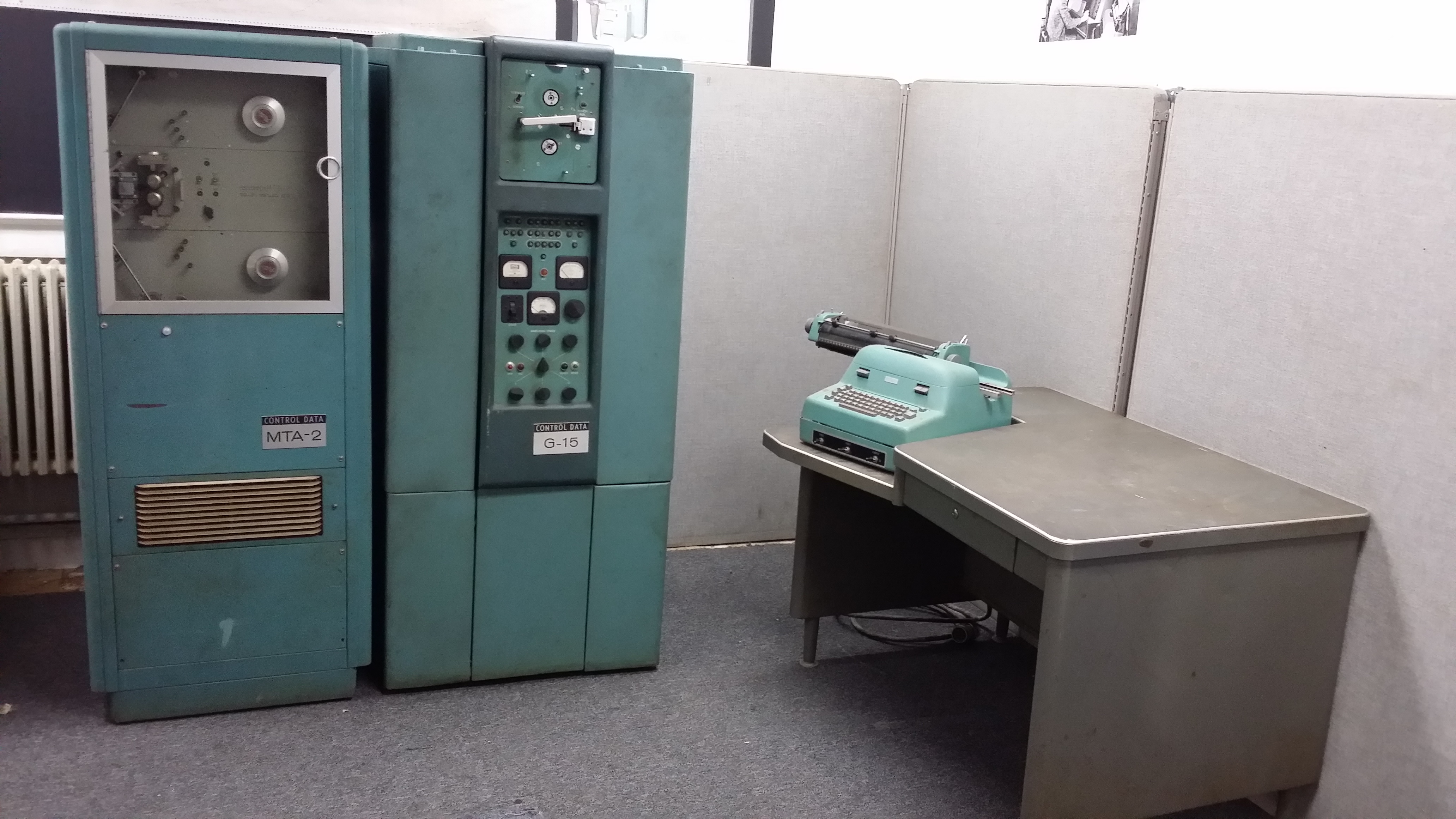
MARCH now has a Bendix G-15, branded as a Control Data system (they
bought Bendix toward the end of the G-15's production run in the early
1960s, although as I understand it the computer was essentially
unchanged since its 1956 debut).
We began setting up an exhibit in our museum last night. It includes the
computer itself, tape drive, IBM teletypewriter, desk of the same period
and style as the Bendix original, and (not yet on display) a matching
Bendix desktop plotter.
Get some tissues ready so you don't drool on your screens. :)
http://www.snarc.net/bendix.jpg
Come see it at VCF East!
I'm hoping that someone here has some experience with PDP 8/e with the
RK8E disk controller for RK05 disk drives.
The 8/e passes all of the CPU diagnostics with flying colors. Memory
also checks out good. There are two fields of 4K core, and 4 fields of
solid state memory.
The core fields are field 0 & 1. Memory testing on both of the core
memory fields shows no faults. The system runs very cleanly...I've got
OS8 V3D on floppy and it can run for hours on end with no problems.
I have a known good RK05 drive and a number of 16-sector packs for it
that are good. RK8E and drive were tested in another 8/e system
recently, and worked fine.
Cable between RK8E and drive has been ohmed out, and it's good. Signals
going across the cable look good and clean on the scope.
The RK8E does not pass the Diskless Controller test in my system.
This is the test that uses the maintenance mode features of the RK8E to
test the controller without actually touching the RK05 drive (drive is
powered on, but in LOAD (offline) state). It goes though most of the
test, but fails in the data break tests. In these tests, the data break
is only active for one cycle, where one word is transferred to/from the
controller and main memory. All of the tests of the RK8E data buffer
test out fine. So, it appears that something is amiss in the
single-cycle data break handing...either in the RK8E, or the CPU's
handing of data break requests.
All data transfers between the RK8E and the PDP 8 are done via single
cycle data break (DMA) operations.
If I use RKLFMT to format a pack, it goes completely through the "write"
portion of the formatting without a hitch, and gets through a lot of
reads, but fails partway through the verification pass. The formatter
writes the block number of each sector as the first two words of each
sector, and fills the rest of the words with zeroes. The verification
pass just checks these two words to make sure they match. If fails when
the first word (high order disk address) changes from "0000" to "0001".
Through all of the tests, there are NO CRC errors. Seeking cylinders
and sectors work fine. It's just the "data" part of disk blocks that
gets messed up.
Using the FUTIL utility, I can successfully read and write blocks all
over the disk. I can use the "SCAN" function of FUTIL to scan the entire
disk, and it completes successfully. Thus, every sector on the disk can
be "found" by the controller without problem.
The problem symptom is that the first word of every block is duplicated
across all of the blocks. All of the rest of the words in the blocks
behave properly.
Using FUTIL, I can read in a block, change any but the first word in the
block, and write it out, then read it back, and it's fine. I can do
this with words 1 through 255 of any of the blocks on the disk.
However, if I read in a block, change the first word (word 0) of the
block, and write it out, then read it back, the first word is as I set
it to be -- but, if I read any other block, the first word is always the
same as what I wrote out.
For example, if I read in block 7, and change word 0 of the block to be
"4567", then write it out, then read any other disk block, word zero
will ALWAYS be "4567". If I then read in block 275, and modify word 0
to be "1234", and write it out, and then read back ANY (including block
7) disk block, the first word will always be "1234". I've tried this
with all different bit patterns for in word zero, and it's always
consistent.
To verify that this isn't an issue with FUTIL, I wrote some little
routines to read and write disk blocks, and the behavior is the same.
The other disk test that uses the drive goes through all of the seek
tests and writes out its test patterns, but fails on the read-back
tests.
I'm very stumped. The RK8E uses single-cycle data break (DMA) to take
data to/from the disk and transfer it directly to/from main memory
without processor intervention (other than initiating the conditions for
the DMA cycle). The RK8E signals the processor that it needs to do a
data transfer, the processor relinquishes control of the memory system,
and lets the RK8E place address and data on the memory address bus and
memory data bus to read/write the data from/to main memory. Each word
of the transfer of a 256 word disk block is done as a separate DMA
request.
One might thing that there is a problem with the RK8E, but that is not
likely, as this RK8E was recently tested in another system and worked
fine, passing all of the diags.
It's more likely that there is something amiss in the data break logic
in the CPU, however, it seems odd that it would affect only the first
word of a DMA transfer, as the CPU doesn't really know whether a DMA
transfer is the first word or the last word. It just responds to DMA
requests asserted by the peripheral.
Does anyone out there have any ideas what I could do to track this down
further? The RK8E is the only data break device I have in the system,
everything else uses programmed data transfers, so I can't try with
another data break device and see if the behavior is consistent.
Thanks in advance for any ideas as to what to do/try next,
Rick Bensene
> Paul Anderson wrote:
> It probably doesn't matter that much, but I meant take it to the bare
> minimum- no EAE, no timeshare, 4K only, etc. Sorry it didn't help.
No worries -- I appreciate the input!
I did think that you meant stripping it down to the bare minimum, but
having OS8 running makes loading the diags and testing much easier and
faster -- and all that needs 8K, Mem Ext/Timeshare, and the RX8E.
I don't want to remove the EAE..I just am scared of messing with the CPU
stack.
At least I was able to eliminate the high speed paper tape interface,
the MOS RAM, and the second serial port, and get it all down to one
Omnibus, which is a step in the right direction.
I could strip it down to the bare, but then I'd be fussing with loading
RIM, and then BIN, then pushing papertape images of the diags to the
machine over serial -- it's just tedious and slow. I may give this a
try later, but in light of the information below, I will probably try
something else before I strip it bare.
I just now put the machine back to the original configuration, and
nothing changed -- the problematic behavior with the RK8E still exists.
David Humphries had mentioned in a posting here that he had observed a
transient on a signal related to loading the current address register in
his RK8E that exhibited similar symptoms to mine.
While I didn't know the specific signals that David was scoping, I
guessed, from looking at the schematics, that perhaps he was monitoring
the LOAD and CLK signals that drive the three 74161 counter ICs on the
M7105 board that make up the Current Address Register.
So, while putting the system back to its original configuration, I
tacked in wire extensions to the LOAD and CLK pins of one of the 74161s
to bring them out so I could scope them. Since the M7105 board is the
middle board of the three-board RK8E sandwich, the only way to get
access to the signals is use wire extensions.
Once I got the system put back together, I toggled in a small program to
repeatedly load the current address register
in the RK8E with zero, e.g.,:
0200 7200 CLA CLL
0201 6744 DLCA
0202 5200 JMP 0200
I started this program running and watched the scope.
There is a definite spike showing up on the CLK line.
This spike could indeed cause the counter to increment after the initial
address is loaded into the counter using the 6744 IOT (Load Current
Address Register).
The photo of the scope traces I observed is posted here:
http://pail.bensene.com/RK8ESpike.jpg
The top trace is the LOAD signal, and the bottom trace is the CLK
signal. The negative-going spike on the CLK line is clearly obvious.
The traces look quite similar to the scope image that David posted.
I am hoping that David will read this and find his notes on what he did
to fix the issue (installing a 7474 flip flop somewhere to eliminate the
spike) and post it so I can make a similar modification and see if it
fixes my problem. It isn't intuitively obvious to me where a flip
flop/latch tacked into the logic would get rid of the spike.
It's my hope that this is what is going on, and that David's fix will
fix my RK8E/RK05 problems.
Rick Bensene
John has had problems getting on the list and so has asked me to
forward this on. Please reply directly to him at john at jfloren.net .
Jim
---------- Forwarded message ----------
From: John Floren <john at jfloren.net>
Date: Tue, Feb 25, 2014 at 2:48 AM
Subject: [rescue] RT-11 manuals, VAX manuals, AUI for pickup
To: The Rescue List <rescue at sunhelp.org>
I'm cleaning out the closets and I've found a bunch of stuff that I
never look at, so anyone in the Bay Area can come get:
* 4 big binders of RT-11 documentation (operation manual, utilities,
programming, application files)
* About a dozen Sony QD-600A tapes
* A whole load of VAX, VMS, and PDP-11 books from DEC
* A bunch of AUI-twisted pair boxes, one AUI-thinnet box, and some AUI cables.
Please please PLEASE come take all of it at once! The whole load will
fit in a single car trip. I'm in Livermore.
john
Morning all...
I'm in need of a 5.25" 40-track double-sided floppy drive (i.e. the
venerable "360K" in PC parlance), preferably one with direct drive to the
spindle so I don't have to worry about worn drive belts. Bezel color,
height etc. unimportant, I just want a 40t unit to hang permanently off my
desktop PC, as hauling one out of my vintage machines every time I want to
write to a disk from there gets old fast.
I could also use ten or so *HD* 5.25" floppies so I can get my Compaq 286
and the pair of Compaq luggables at the local science museum up and running
- I've exhausted all of the local sources that I can think of. I don't
necessarily need new-in-box or anything, but of course error-free would be
good :-)
Anyone got anything they'd be willing to part with? (I'm in the northern US)
[Also, I don't see many wanted ads on the list, although as far as I know
they're not frowned upon - apologies if they are!]
cheers,
Jules
Does anyone have the documentation, particularly the listing (or
source), for the DEC-08-NFPEA-A-PB (1972-05-26) 27-Bit Floating Point
Package?
Thanks,
Bob
>apears a vtr machean has come up with tapes on programes ur altair anyone
>interested in it noticed it on my local buy and sell site
>http://www.kijiji.ca/v-electronics/winnipeg/panasonic-vtr-nv-3020-with-15-r
eels/539056526?enableSearchNavigationFlag=true
For $40 I would totally digitize those tapes and upload them somewhere.
Shoot, I would buy it so I have the recorder to go with my Panasonic camera.
Unfortunately I'm about 3000km west of the listing....
-John
Battle of Bletchley Park: TNMOC chief calls for review of museums'
Mexican standoff
- Iraq dossier MI6 chief's 'Disneyland' plans blasted
http://www.theregister.co.uk/2014/02/24/national_museum_of_computing_calls_…
--
--- Dave Woyciesjes
--- ICQ# 905818
--- CompTIA A+ Certified IT Tech - http://certification.comptia.org/
--- HDI Certified Support Center Analyst - http://www.ThinkHDI.com/
Registered Linux user number 464583
"Computers have lots of memory but no imagination."
"The problem with troubleshooting is that trouble shoots back."
- from some guy on the internet.
On 02/12/2014 12:00 PM, cctalk-request at classiccmp.org wrote:
>> On 2/11/2014 9:45 PM, Jim Stephens wrote:
>>> I have a vmware image. I'll see if i can find an installer ISO
>>>
>>>
I don't think VMware will run Win95 or Win98. If that is wrong,
I'd sure like to know, as I could pack up an ancient system I
still keep around for archival reasons.
Jon
I realize that no one else may be using the Symbolic Debugger
(SD: - specifically SDHX.SYS) in RT-11, but there is an
enhancement that should be helpful and I could use some
advice.
This question will probably receive opposite answers since
this group is so diverse. BUT here goes:
The questions is (as described below): "Should all 6 possible
SET commands be available or is that too confusing to the
user and only the first 4 SET commands should be available?"
In RT-11, a user program can issue an EMT request so that
RT-11 allows the user program to handle TRAPs to locations
4 and 10 so that special expected error conditions can be
handled correctly.
However, in the RT-11 Symbolic Debugger, these TRAPs
are again over-ridden unless the user again forces them back
to the user program with the commands:
_T4;V let the user program handle TRAPs to 4
_T10;V let the user program handle TRAPs to 10
For turning off either selection (if either was selected), the
command is:
;V turns off both TRAPs to 4 and 10
Unfortunately, the DEC version Y01.16 of SD: always
required the user to first activate the Symbolic Debugger in
order to execute one or both of those commands. However,
by adding two additional SET commands to the SD: code, the
user can use these SET commands (even in a command file to
automatically initialize everything) before the SD: code is
even LOADED and activated, as for example:
SET SD: T4 - equivalent to _T4;V
SET SD: T10 - equivalent to _T10;V
Turning off the selections uses the commands (the commands
are only almost equivalent to ;V):
SET SD: NO T4 - ONLY turns off _T4;V
SET SD: NO T10 - ONLY turns off _T10;V
Of course, it is also possible to have two more SET
commands which:
SET SD: TRAPS - equivalent to both _T4;V and _T10;V
SET SD: NO TRAPS - equivalent to ;V
The questions is: "Should all 6 possible SET commands
be available or is that too confusing to the user and only
the first 4 SET commands should be available?"
By the way, although it is not very useful to re-implement the
current SET commands so that the change is applied after
the LOAD SD: command has been executed, it is possible
to add code to the "SET SD: T4" option which changes
both the SY:SDX.SYS file and any copy which is in memory.
This allows the user to execute "SHOW CONFIGURATION"
without having to first "SET SD: BREAK". In addition, the
"SET SD: T4" command can then be done either before or
after the "LOAD SD:" command.
Another other comments or suggestions would also be helpful.
Jerome Fine
> Message: 15
> Date: Sun, 23 Feb 2014 12:07:38 -0000
> From: "David Humphries" <david at hheng.plus.com>
> To: "General Discussion: On-Topic Posts Only" <cctech at classiccmp.org>
> Subject: Re: Anyone Have a Copy of the LAB-8/E 8K BASIC Binary?
>
[snip]
>>>> I have DEC-8E-ABASA-A LAB-8E BASIC R/T binary on punched tape,
>>>> any help ?
>>>>
>>> I wasn't able to find any conclusive information on that tape. Do you
>>> know
>>> if this is BASIC/RT that the 8/E/M handbook 1973 referred to for the
>>> LAB-8/E
>>> (pg 2-36)? Anyone seen documentation for it? I would be interested in
>>
>> It seems likley as I have some of the other packages mensioned in that
>> section in the same tray.
Dave,
Does this mean you have other tapes in the tray? If so, could you
image them too?
[snip]
>> I will do a bit more investigating before a post the file, including
>> looking to see if I can find any documentation " in the store"
>
>
> Found the problem , it loads into field 1 with the bin loader also in 1. Now
> loads and auto starts, I think its in fact a multi part as it starts
> before the end of the file and as im loading from my terminal emulator we
> loos the last bit, its maybe an optional overlay, the file maybee needs
> split.
> I found the user manual , thats how I found out about the loading.
> Link to the bin and a pdf of the user manaul here
>
> https://www.dropbox.com/sh/dmi0r7s0v5jsp0c/-14bOM0wD4
>
> I guess its not in Bitsavers, could someone let Al know ? , unless hes
> allready seen this that is .
>
> Dave H
I can OCR and email it to Al to save him time. Do you have any other
of these documents that can be scanned? David G. may want to put all
of your images/PDFs on his site too.
Thanks,
Bob
Hello,
I have some questions about Televideo 955 terminal.
The manual lists a serie of options, among others the ability of emulate
tek 40xx graphic terminals.
I'm interested in this feature, but it's not clear to me if a particular
version of the terminal, or a particular board is needed.
Furthermore, the manual pictures two different motherboards, normal and
extended, but what it's the difference?
Finally, there's a way to identify the hardware / software options of the
terminal with some key combination, our some special command?
Thanks
Andrea
Firstly, if you've seen my message about this on VCForums, then I apologise for the redundancy.
I've spent the best part of 4 years getting my Ohio Scientific C24P working. The biggest problem being the MPI drive unit of which I've replaced and fixed many parts. I think I now have everything working, but don't have any bootable media to test it with. I was wondering if there was anyone here who would be willing to make me some copies of OS65D on 5.25" media?
Much thanks.
Phil
Hi everyone!
Thought I'd share my site with you. I restore/recondition M's despite
their condition. It's a labor of love for these fantastic mechanical
keyboards.
The site is at http://www.phosphorglow.net/
If you are in need of a lovingly reconditioned M or need yours restored,
please mosey over to my corner of the interwebs.
I also have a small army of classic computers in my personal collection
that will be making their appearance when I get the time to play with them.
Kind regards,
-Maxx
(I hope this doesn't double post - I accidentally sent it from my
address that isn't subscribed to the list. Sorry in advance if that
happens!)
Toshiba XM-4101BME internal SCSI 2X CD-ROM drive
http://www.ebay.co.uk/itm/271409731209
Digital Equipment Corporation (DEC) Storage Expansion Unit RZ5X-F3 with RZ56 HD
http://www.ebay.co.uk/itm/271411499867
Quantum Fireball ST64S narrow SCSI 3.5" 6.4GB hard drive
http://www.ebay.co.uk/itm/271412312175
There's a wireless Apple keyboard - the original, pleasant to use
version - and mouse and a PC joystick and other things too, but I
thought the above might be of interest to CCmpers.
The DEC SEU has a 5.25" FH 660MB SCSI drive in it.
--
Liam Proven * Profile: http://lproven.livejournal.com/profile
Email: lproven at cix.co.uk * GMail/G+/Twitter/Flickr/Facebook: lproven
MSN: lproven at hotmail.com * Skype/AIM/Yahoo/LinkedIn: liamproven
Tel: +44 20-8685-0498 * Cell: +44 7939-087884
Dear Sirs,
We have a CNC controlled DEC (motherboard M 8189 picture -0).
Please submit an offer for the replacement of the emulator with DECtape-II (Fig. 1.2, 3) for loading the data from the memory card, USB stick, or propose another solution which allows us to make technical backup data cartridges (DECtape-II photo 1).
If you need more information or photos please write.
We appreciate the timely development of our inquiry.
Witam,
Posiadamy Frezark? CNC ze sterowaniem DEC ( p?yta g??wna M 8189 zdj?cie -0 ).
Prosimy o przedstawienie oferty na zamiennik emulatora z DECtape-II (zdj?cie 1,2, 3) do wczytuj?cy dane z karty pami?ci, usb stick lub zaproponowanie innego rozwi?zanie technicznego umo?liwiaj?cego nam zrobienie kopii kaset z danymi (DECtape-II zdj?cie 1).
Je?li potrzebuj? Pa?stwo wi?cej danych lub zdj?? prosimy napisa?.
Prosimy o pomoc ? w rozwi?zaniu naszego problemu
--
Pozdrawiam,
Piotr Karmazyn
tel.: 58 3041450
fax: 58 6831803
KOM : 660432720
TECH-SERWIS Mechanika Maszyn i Pojazd?w
Mariusz Wodzy?ski
ul. Rzemie?lnicza 9
83-000 Pruszcz Gda?ski
NIP: 584-09-52-627
REGON 002849343
List:
I've got a 2400' reel of 9-track tape here from 1971--so far, no issues.
But the brand is "Wabash"--I'm well acquainted with the execrable
quality of the brand when it comes to floppies, but have no experience
with pre-floppy-era tapes.
I'll bake the thing (130F for a day or so) before reading it, but does
anyone have any experience with this brand and age? I'd used mostly 3M,
CDC and IBM branded tape back in the day.
--Chuck
From: Chuck Guzis <cclist at sydex.com>
>
>I've long thought that the strangling of the bus done on the TI 99/4
>home PC was quite possibly motivated by TI's not wanting to compete with
>its own 990 series of computers. The cost of a TI 990/4 was
>considerably higher than a 99/4, even though both use the same MPU.
>
I have heard & read this enough times to think there's something to it.
Wouldn't be the first time this sort of thing has been done.
>I find the I2L versions of the 9900 far more interesting as far as chips
>go. They were used quite often in military gear, not as devices offered
>to the general unwashed. In a similar way, one did not see the
>Fairchild 9940 in much general audience gear.
Yes. You can debate how good a general purpose processor the 9900 is, but
it was proven to be a very good embedded controller. The memory mapped
registers and workspace swapping made real time context switching a breeze
compared to more conventional designs.
From: John Many Jars <john at yoyodyne-propulsion.net>
>Basically, my dad bought the wrong thing. It cost about 1/2 what an
>Apple //+ would have cost, and was about 1/8 as useful.
Ha! That is *exactly* how I ended up with my own 99/4.
KJ
Dear sirs,
I'm looking for the schematics of the F-051MD chinon drive. This is the
auto-eject "Super 5" slim drive for apple computers. Any helpers?
Thanks
Alexandre
Many of us know about the classic prank Signetic played back in the
1970s, with the WOM (write only memory) - but today I found out that
the chips actually exist. The son of an acquaintance uploaded some
pictures (on a different list) of the original sales kit Signetics
mailed out, and included is an actual IC, I think a 24 pin DIP, marked
S7324 2512D NFG.
Interesting other stuff, too - including a fortune cookie (I think),
bumper sticker, and funny nose & glasses.
--
Will
----- Original Message -----
Message: 6
Date: Sun, 23 Feb 2014 14:05:46 +1300
From: Terry Stewart <terry at webweavers.co.nz>
Subject: Re: TI-99/4A acquisition
> ...I definitely need some more carts though.
...and a wider desk...
Any suggestions on repairing a dead spacebar key? All the online
discussion I find pertains to an earlier model with individual keyswitches
soldered into a PCB backplane. This keyboard is held together with melted
over plastic posts and is obviously using a printed membrane.
Before I launch in blindly I'd love to hear from anyone who's been through
the process.
Steve
--
Does anyone have the binary for the LAB-8/E version of 8K BASIC? Of
course, the original source code would be better if that's available
too.
Thanks,
Bob
Cctalkers,
March 1 is the deadline to register VCF East exhibits.
Anyone attempting to register after that will have to grovel to me and explain why "But I was busy!" applies to them and not to the 32 other people who found time...
Full details about the show, agenda, schedule, etc. are at http://www.vintage.org/2014/east and you'll also find updates at http://www.facebook.com/vcfeast.
Remember -- this is the first THREE-DAY show and anyone who goes Friday can win an oscilloscope.
Another mystery board in my junk box... this one should definitely be
for a PDP-8 because it has no signals on the F connector fingers.
I've googled all the numbers on it and can't figure out what it's for.
It has a Z80 CPU, some RAM and ROM, and a lot of bus drivers. There's
an empty 40-pin socket at U1, don't know if it had another Z80 or
what.
http://s1181.photobucket.com/user/DrCharlesMorris/media/PDP-8/P02-21-14_205…
The output(?) connectors are unique at least to me:
http://s1181.photobucket.com/user/DrCharlesMorris/media/PDP-8/P02-21-14_205…
Looks like four pin plugs would seat in those sockets (they aren't
coaxial).
Any clues?
thanks
Charles
On Thu, 20 Feb 2014 Jonathan Katz wrote:
> YES. This may be important stuff. This may be console software for a
> CS6400! Like the E10K they used an SSP aka OWS to run them, and
> connected via standard HIPPI(?) to the control boards.
Sorry to disappoint you, but these will be for some model of Cray, either a later
Y-MP, EL or T3 system, as we never had any Sun servers of that style at NCAR.
I'll be working on extracting the tape contents into a file system this weekend to
better determine what they contain.
> Date: Thu, 20 Feb 2014 19:17:50 -0000
> From: "David Humphries" <david at hheng.plus.com>
> To: "General Discussion: On-Topic Posts Only" <cctech at classiccmp.org>
> Subject: Re: Anyone Have a Copy of the LAB-8/E 8K BASIC Binary?
>
> I have DEC-8E-ABASA-A LAB-8E BASIC R/T
> binary on punched tape, any help ?
>
> DaveH
>
Yes, I think so! Is it available in an "emailable" form? If not,
perhaps someone with a running system can create an image and put it
online.
Thanks,
Bob
> ----- Original Message -----
> From: "Bob Vines" <bobvines00 at gmail.com>
> To: "cctech" <cctech at classiccmp.org>
> Sent: Wednesday, February 19, 2014 8:04 PM
> Subject: Anyone Have a Copy of the LAB-8/E 8K BASIC Binary?
>
>
>> Does anyone have the binary for the LAB-8/E version of 8K BASIC? Of
>> course, the original source code would be better if that's available
>> too.
>>
>>
>> Thanks,
>>
>> Bob
FEBRUARY 21, 2014 --- KansasFest 2014, the Apple II convention, is
scheduled for July 22 --27 in Kansas City, Missouri.Margot Comstock,
co-founder and editor of the much-loved /Softalk /magazine, will join us
with a keynote presentation.
Comstock and Al Tommervik founded /Softalk /in 1980 to share the
hardware, software, and people behind the Apple II.At its peak,
/Softalk/ had 250,000 readers and uniquely offered broad and deep
coverage of everything Apple II related, including programming, game
playing, business use, and home use.Later, Softalk Publishing produced
magazines for the emerging Macintosh and IBM markets,/ST.Mac/ and
/Softalk for the IBM Personal Computer/./Softline/, a game magazine
begun by Ken William's OnLine Systems and later renamed to /ST.Game/,
was Softalk Publishing's second longest-lived magazine.Softalk Books
published several books by the magazine's columnists and a Mac book by
Doug Clapp.
The Apple II magazine ran for four years before industry changes and
expenses led management to cease publication.In that time, /Softalk/
earned many loyal fans, and a group of volunteers is working to archive
and share issues.The Smithsonian Institution recognizes Comstock and
Tommervik as pioneers of the microcomputer revolution and /Softalk/ as a
chronicle of that revolution.
KansasFest is an annual convention offering Apple II users and
retrocomputing enthusiasts the opportunity to engage in beginner and
technical sessions, programming contests, exhibition halls, and
camaraderie. KansasFest was originally hosted by Resource Central and
has been brought to you by the KFest committee since 1995. Any and all
Apple II users, fans, and friends are invited to attend this year's
event. Registration details will be announced on the KansasFest Web site
in early 2014. For photos, videos, and presentations from past
KansasFests, please visit the event's official Web site at
http://www.kansasfest.org/.
CONTACT:
KansasFest 2014
http://www.kansasfest.org/http://twitter.com/kansasfest/
I have a ADDS Viewpoint 3A Plus terminal that is in working condition. It
looks very clean, powered up and operated in the local mode. I just took it
out of the box and haven't tested the RS-232 serial link yet. It includes
the operator's manual and service manual. (I will put the manuals on
bitsavers.) I reducing my collection and am looking for a new home for this
terminal. I am located in the Seattle area and am not interested in shipping
it. (30 plus pounds.)
Michael Holley
Among some old DAT tapes I am looking at, I have what appears to be some
ufsdump format backup tapes from two Cray Operator Workstation (OWS)
servers of year 2000 vintage, possibly from two Y-MP EL systems? These
OWS servers ran Solaris.
The tape for ows9607 contains 524MB of backups of the following file systems:
/, /usr, /var, /opt, /opt/CYRIdump and /usr/openwin. The second tape contains
828MB of backup of ows9630 and may not contain the contents of /opt/CYRIdump.
Does anyone know of a copy of ufsrestore that runs on Linux? If not, I'll have
to see if the netbsd restore under stands it or grab the OpenIndiana (OpenSolaris
fork) distribution.
Anyone interested in the contents of these tapes?
To my great surprise and considerable pleasure, I've just sold an NEC
Multispin 3X CD for ?8.50 on eBay.
I was less delighted to find a similar unit that I'd misplaced in the garage.
So, if anyone wanted one and missed out...
Toshiba LI-3300 external SCSI CD-ROM drive in original case (item #
271406165551)
http://www.ebay.co.uk/itm/271406165551
--
Liam Proven * Profile: http://lproven.livejournal.com/profile
Email: lproven at cix.co.uk * GMail/G+/Twitter/Flickr/Facebook: lproven
MSN: lproven at hotmail.com * Skype/AIM/Yahoo/LinkedIn: liamproven
Tel: +44 20-8685-0498 * Cell: +44 7939-087884
Easy to build up any size system by mounting multiple 2GB partitions across various points in the file system - the partition size shouldn't be a constraint on running A/UX
________________________________
This e-mail message, including any attachments, is for the sole use of the person to whom it has been sent, and may contain information that is confidential or legally protected. If you are not the intended recipient or have received this message in error, you are not authorized to copy, distribute, or otherwise use this message or its attachments. Please notify the sender immediately by return e-mail and permanently delete this message and any attachments. Gartner makes no warranty that this e-mail is error or virus free.
Taken by some clueless noob, though, as many of the pics only show the
screen and keyboard and not the actual computer at all. This is one of
those pillocks who thinks that the computer is the "disk drive", I
suspect.
http://www.zdnet.com/photos-from-the-first-pcs-to-the-thinkpad-classic-ibm-…
--
Liam Proven * Profile: http://lproven.livejournal.com/profile
Email: lproven at cix.co.uk * GMail/G+/Twitter/Flickr/Facebook: lproven
MSN: lproven at hotmail.com * Skype/AIM/Yahoo/LinkedIn: liamproven
Tel: +44 20-8685-0498 * Cell: +44 7939-087884
From: Chuck Guzis <cclist at sydex.com>
>On 02/18/2014 03:46 PM, Jonathan Katz wrote:
>
>> Someone once told me "never underestimate the bandwidth contained
>> within a station wagon crammed full of DLT tapes."
>
>That oft-repeated chestnut is attributed to Andy Tannenbaum and
>pre-dates DLT, I think.
In 1985 (when I first heard it), the station wagon was full of 9-tracks.
Each generation adapts the wisdom, I suppose.
KJ
Just curious as to what the expert opinion is on this - I've got a
ST412-type drive here (it's a Miniscribe with 615/4/17 ~20MB geometry)
which refuses to read from cylinders 128-255 or cylinders 384-511 - giving
address mark not found errors - although cylinders outside those two ranges
are fine.
The way the faults lie exactly within a couple of specific bit patterns
(01xxxxxxx and 11xxxxxxx) for the cylinder number makes it seem more like a
controller problem to me - but I don't know how much logic there is on a
ST412-type drive, what with the buffered seek ability.
Controller passes internal/RAM diagnostics OK (but how exhaustive those
are, I don't know). Issuing a drive recalibration and/or controller reset
prior to attempting access to the problem areas makes no difference.
Maybe the drive was simply never formatted on those cylinder groups for
some reason - but that seems rather unlikely (and the filesystem on the
drive is definitely unwell, suggesting that it's trying to access data
that's no longer there, although I've not gone to the extent of picking the
FAT apart to verify this)
I think all the errors I've seen before on these kinds of drives have been
totally dead, seemingly random, or confined to all/parts of a surface - not
in cylinders.
cheers
Jules
I was looking through a set of DAT tapes I had received and found one with some
Convex Exemplar support software. The tape appears to contain a single 367 MB
tar file, and is labelled:
P.N. B5661-60000
2000 Series Test Station SW
Exemplar SPP-UX 5.2
Wed Jun 4 17:36:34 CDT 1997
Is this interesting for someone?
I've heard printers referred to as musical before, but never so
literally...
http://vimeo.com/58200103
g.
--
Proud owner of F-15C 80-0007
http://www.f15sim.com - The only one of its kind.
http://www.diy-cockpits.org/coll - Go Collimated or Go Home.
Some people collect things for a hobby. Geeks collect hobbies.
ScarletDME - The red hot Data Management Environment
A Multi-Value database for the masses, not the classes.
http://scarlet.deltasoft.com - Get it _today_!
First come, first served J
4M x 9 FPM, 60ns, 4MB, qty 1, $5 plus shipping
4M x 9 FPM, 70ns, 4MB, qty 1, $5 plus shipping
1M x 9 FPM, 70ns, 1MB, qty 5, $3 each plus shipping (4 are 3 chips, 1 is 9
chips)
1M x 8 FPM, 100ns, 1MB, qty 1, $3 plus shipping
256K x 9 FPM, 80ns, 256KB, qty 2, $2 each plus shipping
All tested on SimCheck II
Cindy Croxton
Electronics Plus
1613 Water Street
Kerrville, TX 78028
830-792-3400 phone
830-792-3404 fax
sales at elecplus.com
AOL IM elcpls
From: Liam Proven <lproven at gmail.com>
On 13 February 2014 19:15, David Riley <fraveydank at gmail.com> wrote:
>> As far as I know, the Win9x "make a boot floppy" is essentially just
>> a "format /s".
>No, it isn't.
Yes it is.
>A Win9x boot floppy contains a menu-driven CONFIG.SYS and AUTOEXEC.BAT
>files, allowing loading with CD drivers, creates a RAM disk and
>unpacks a CAB file full of useful commands for emergency system
>recovery to that RAM disk and more.
None of which is required to create a boot disk. I say this as someone who
routinely does it, not as someone who Googled up a MS knowledgebase article
and didn't understand that it was about creating a startup disk, not a
simple boot disk.
During my big garage clearout, I found a couple of 16MB SIMMs in my
spares pile, so now my venerable Quadra 650 has 68MB of RAM, up from
the 52MB I'd got it to with 2 old 8MB EDO SIMMs I found last year.
I also found a ColorSync 20" monitor - & it works!
It has a 2GB internal SCSI disk, too.
The next question is - do I try to get A/UX working on it? The disk is
more than big enough - almost too big, in fact; I believe A/UX can
only fsck a max of 2GB of root.
So, *if* I can find a way to repartition it, does anyone know where
A/UX can be found these days? I've not really looked yet...
--
Liam Proven * Profile: http://lproven.livejournal.com/profile
Email: lproven at cix.co.uk * GMail/G+/Twitter/Flickr/Facebook: lproven
MSN: lproven at hotmail.com * Skype/AIM/Yahoo/LinkedIn: liamproven
Tel: +44 20-8685-0498 * Cell: +44 7939-087884
> I'm looking at the memory dumps and comparing them to the original file. It
> appears for every 128 byte block, the order is backwards. I.e. if I look
> at five 128 byte blocks on my PC they appear in the Z80's memory to be
> as 5, 4, 3, 2 and 1. Not the 'correct' way.
I don't know if this is relevant, but records in CPM3.SYS are stored in
reverse order; the first record after the header is loaded at the highest
address, the next one 128 bytes below it, and so on.
--
John Elliott
We're all reasonably aware of the tendency for vintage hardware to get a
little flaky if it's too hot - but what about the other side? I expect that
the electronics aren't particularly troubled by the cold, but what about
tape units, floppy drives, hard drives, magnetic media? When is it too cold
for them to work reliably?
cheers
Jules
The music may not be the choice of most but they use a Commodore Pet,
Hazletine 1500 (only time you will see one with color on the screen - done
in editing , not real), Osborne, Apple II and more as part of the video.
They put their own images on the screens and erase any logos.
http://youtu.be/7TMoy6DNTO4
--
Paxton Hoag
Astoria, OR
USA
Does anyone have a binary dump of the 512-byte COSMAC VIP operating
system for the CDP18S711?
I have the manual and could type it in by hand if necessary as it is
only 512 bytes, but I figure someone has to have this somewhere on the
net that I haven't found yet and that would same time typing and
double checking for errors.
It is listed here in Appendix B - Operating System:
http://www.bitsavers.org/pdf/rca/cosmac/COSMAC_VIP_Instruction_Manual_1978.…
I have a VIP that isn't working at the moment. I'm getting video sync
but just a blank screen. I didn't get what I expected when I tried to
read the ROM externally although I'm not sure if the method I used was
valid. If I had a binary dump of what the ROM is supposed to be I'd
throw a replacement EPROM in there as a quick check to see if that
makes any difference.
Hello list,
I'm attempting to bring up CP/M Plus on one of my Z80 computers by
running CPMLDR.COM from CP/M 2.2. It crashes immediately after
CPMLDR.COM jumps to CPM3.SYS (I'm sure this isn't surprising). I'm
looking at the memory dumps and comparing them to the original file. It
appears for every 128 byte block, the order is backwards. I.e. if I look
at five 128 byte blocks on my PC they appear in the Z80's memory to be
as 5, 4, 3, 2 and 1. Not the 'correct' way.
Is this normal or have I somehow botched the de-blocking algorithm on
CP/M 2.2? Or, are there any known pitfalls or incompatibilities between
the default de-blocking algorithm on CP/M 2.2 and the built in functions
in CP/M Plus?
I have written my BIOS from scratch, based on the vanilla files
distributed with CP/M Plus. I haven't used the CPM3ON2 distribution.
Thanks,
Alexis K.
Hi all,
What's your favorite Zilog Z8 disassembler? I'm working on reverse
engineering an old piece of equipment and would like to investigate what's
on the ROMs.
Thanks,
Kyle
The 86x0 used a custom T11 card running. RT11 (a custom version).
Pro 350 and 380s were on newer machines. ?RLs were the disks on the?
86x0s.
Sent from my Verizon Wireless 4G LTE Smartphone
Anybody ever heard of or used www.newrelic.com?
Cindy Croxton
Electronics Plus
1613 Water Street
Kerrville, TX 78028
830-792-3400 phone
830-792-3404 fax
sales at elecplus.com
AOL IM elcpls
>
> On 17 February 2014 02:53, Rick Murphy <rick at rickmurphy.net> wrote:
> > And, how do you get Kermit onto the machine in the first place?
>
If you have an RX01 floppy on your machine, you can use the "restrx01"
utility to copy an RX01 disk image that contains Kermit onto the
machine. RX01 image files that have OS/8 and Kermit on them are readily
found on various PDP8 related websites.
The biggest problem is that most of the Kermit binaries on these images
are configured to use device codes 30/31 for the second serial port,
when the commonly-accepted configuration for the second serial port card
in a PDP8 (at least the /E, /F, /M) is 40/41. You can re-strap the
serial card in the PDP8 to use 30/31, or there is a patch PAL source
that you can assemble and overlay on top of the loaded Kermit core image
to patch the serial port locations.
Kermit can also be loaded on a machine through use of the BIN loader
(which can be loaded by the RIM loader, which is pretty easy to toggle
in), using a paper tape image (again, which can be found on the various
PDP8 sites), and sending the BIN image over the console serial port at
rates up to 9600 through a terminal program. You need a terminal
program that can send the tape image in raw form (TeraTerm works for
me), and your serial port on your computer acting as a console needs to
be configured as 8N1. Once Kermit is resident in memory, you can then
save the core image out to whatever kind of mass storage (DECTape,
Floppy, etc.) exists on the machine.
Rick Bensene
The Old Calculator Museum
http://oldcalculatormuseum.com
I've accumulated way too much cool junk lately, and I need to thin out the pile. I have a Wyse 350 color dumb terminal with manual. I've only tested it in local mode, and it "seems to work". Some of the keys seemed to bounce, so the keyboard may need some work.
The terminal is free for local pickup either in Riverside (my home, on weekends) or in Irvine (at work, on weekdays). Please only pick it up to use it, not to resell it.
--
Mark J. Blair, NF6X <nf6x at nf6x.net>
http://www.nf6x.net/
At 11:26 AM 2/14/2014, Kyle Owen wrote:
>On Fri, Feb 14, 2014 at 5:29 AM, Rick Murphy <rick at rickmurphy.net> wrote:
> >
> > For that pack, I re-compiled BUILD from source in order to get it
> to work
> > when building a RL02 image.
>
>
>Did you use BUILD.PA available from here?
>http://www.ibiblio.org/pub/academic/computer-science/history/pdp-8/os8/os8.…
>
>I tried using palbart to assemble it and got numerous errors. Haven't
>tried
>it with PAL8 yet.
Yes, that's the original source of the BUILD.PA that I used.
Compiled fine on OS/8.
>On a related note, what's the easiest way to transfer a large swath of
>text, like BUILD.PA, to OS/8 through the console TTY?
Smaller files:
.R PIP
FILE.PA<TTY:/A
Then just feed it. PIP appears to give up at some point, so I split and
rejoin. Painful.
Or, use the Kermit-12 utilities to pack and unpack.
For SIMH, I use putr.com to copy files to a disk image, with putr
running in dosbox on a Linux system.
-Rick
These have been claimed now.
Cindy Croxton
Electronics Plus
1613 Water Street
Kerrville, TX 78028
830-792-3400 phone
830-792-3404 fax
sales at elecplus.com
AOL IM elcpls
I have a few plastic bags full of brand new keycaps for this old beastie.
Free for shipping.
Each bag contains multiples of the SAME keycap.
Not a very big selection, but maybe you can use them for something?
http://www.columbia.edu/cu/computinghistory/029.html
Link to history of the Model 029.
Cindy Croxton
Electronics Plus
1613 Water Street
Kerrville, TX 78028
830-792-3400 phone
830-792-3404 fax
sales at elecplus.com
AOL IM elcpls
> There's a partial CE Service Handbook, here:
> http://www.hpmuseum.net/exhibit.php?hwdoc=555
Hi Mike, thanks for the steer.
That manual is interesting but does not seem to contain any of the basic operating procedure.
e.g. I guess that it is OK to power the drive down with a cartridge in situ but will the drive attempt to spin up and load the heads if I power it up?
>I'll check what is in the backlog. I have hundreds of HP manuals scanned but not post-processed.
Hi Al, many thanks.
It would be great to have a set of schematics and/or user's guide before I start working on the drive
Hi Christian
Many thanks for the steer - I had hoped that it might be something like this. Was surprised that the failed component did not heat up / smoke.
> On Fri, 14 Feb 2014, Peter Brown wrote:
> > I have just pulled my HP 7907A out of storage and tried to power it up.
> > No joy, it emitted a couple of squeaks from the power supply and that
> > was it.
>
> If the power supply squeaks most probably there is a short on one of the
> outputs; perhaps a shorted tantalum or electrolytic?
>
> Christian
Maybe someone has a spare IIe motherboard revision b around? Even broken?
Got a local IIE (s/n below 10000 with white lettering) but it doesnt have
dhgr, so i want it to be usable everyday and not another hangar queen.
Of course, a duodisk unit and some useful cards (any ramworks even without
memory, transwarp, grappler+, microsoft softcard, appli-card, ramfactor...)
would be welcome :) an original joystick and koala pad too :) i just love
apple!
Thanks :)
Alexandre
>On Sun, Feb 16, 2014 at 4:14 PM, Charles
><charlesmorris800 at centurytel.net> wrote:
>> I have a hex-height (Omnibus) board in my junk box... M8549 "Universal
>> Substitute Board". It has a few 10101 (ECL??) IC's. Here is a picture
>> of both sides.
>>
>> http://s1181.photobucket.com/user/DrCharlesMorris/library/PDP-8
>>
>> Anyone know what this is for, and any schematic info? I can't find it
>> on any module list.
>
>ECL makes me think "PDP-10". The fact that it has signals on the "F"
>finger tells me that it's not an OMNIBUS board - those use A-D for the
>OMNIBUS itself, and memory cards/memory controllers can use the "E"
>finger for the extra address lines. Nothing in a PDP-8 uses "F".
>
>I don't have an exhaustive card list handy, but see what else shares
>the M85xx range. Related boards often have sequential or
>nearly-sequential handle numbers.
>
>-ethan
I eventually found a huge (150+ MB)exhaustive DEC module list online
which had the M8549 board. You are right, it's part of a KL10 system,
about which I have been reading on various websites.
Presumably someone mistakenly thought, as I did, that it was an
Omnibus board! Glad I didn't plug it in my 8/A.
So, since I don't have room (or power) for a PDP-10, would anyone like
this board for cheap, before it goes to that auction site? Make me an
offer ;)
-Charles
My PDP-8/A with two 16K core boards has developed a flaky bit on one
of the boards. The failure is always in the LSB (11), but there is no
pattern to the addresses that I can discern.
The +20 volt supply appears to be ok (as is +/- 15 and +/- 5)... it
was 19.86v, but adjusting it to 20.00 didn't help.
DHKMAD.DG runs beautifully with only the lower 16k installed. But
while testing the upper 16k, eventually (30 sec. to several minutes) a
random word will fail with its LSB (Bit 11) in the wrong state.
Usually 1 when it should be 0 but *not* always!
Often this bombs the diagnostic program itself (I suppose if it's
self-relocated to the upper field). So far the failures have all been
in field 6 or 7.
Any tips for checking currents/timing? Or should I just replace the
G650, the H219B core stack, or both as a pair? They aren't easy to
find these days and my small chassis only has room for two core boards
that occupy two hex slots each - so they both have to be 16K boards,
as ADVENT requires 32K even though OS/8 runs in 12K :(
-Charles
I have one of the above systems. ?I acquired it about a decade ago sans power cord. ?The power cord isn't the standard one we are used to?today.. and uses differebt polarities.. I simply didn't know enough at the time to purchase one. ?Recently though I did.. and have gotten it to power up and operate, although at times it seems to not want to do anything at all and sometimes requires a few power cycles to get going.?
My question to the community is.. does anyone else put there have one of these? ?And do any of you have a manual? ?I've googled all over but its useless. ?I'm also hoping to one day find the expansion board for it that allowed it to run BASIC. ?If anyone has a line on these. ?I'd be most interested.
Thanks!
Sent from Samsung Mobile
Hi, guys.? I have some very old programs that require Win 95 to run, and I've been trying to use Virtual Box to do that.? I installed Virtual Box on my new Windows 8.1 computer, but when I tried to install Win 95 it refused to recognize my perfectly good Win 95 installation disk (with a valid licensing code) as a real O.S..? Then it turned out that the new computer has a hardware problem, and I've lost access to it for at least a week while it's in the shop being repaired (no, the hardware problem was not at fault; the Win 8.1 computer was just having trouble charging, but it was fully charged when I was trying to install Win 95).
So now I'm back to my old Windows 7 laptop.? I downloaded the latest version of Virtual Box, which says it's for both 32-bit and 64-bit versions of Windows, but when I tried to install itWindows said it wasn't a valid 32-bit program.? Does anyone know which version I need?? And does anyone know how to make it recognize my old Win 95 installation disk as a valid OS?
Thanks for recommending this program; I found out about it here.? And thanks in advance for your help with this problem.
Margret
I have a hex-height (Omnibus) board in my junk box... M8549 "Universal
Substitute Board". It has a few 10101 (ECL??) IC's. Here is a picture
of both sides.
http://s1181.photobucket.com/user/DrCharlesMorris/library/PDP-8
Anyone know what this is for, and any schematic info? I can't find it
on any module list.
thanks
Charles
>On Sun, Feb 16, 2014 at 4:14 PM, Charles
><charlesmorris800 at centurytel.net> wrote:
>> I have a hex-height (Omnibus) board in my junk box... M8549 "Universal
>> Substitute Board". It has a few 10101 (ECL??) IC's. Here is a picture
>> of both sides.
>>
>> http://s1181.photobucket.com/user/DrCharlesMorris/library/PDP-8
>>
>> Anyone know what this is for, and any schematic info? I can't find it
>> on any module list.
--- I found the M8549 used in two places on the document found here:
https://archive.org/details/bitsavers_decpdp10KL_1264444
The classification hierarchy lists the system it's used in under:
DEC::PDP10::KL10::MF20
The MF20 document is titled, "MOS Memory." Note that the M8549 instances are shown with suffixes: YA, YB, YD.
Steve L.
On 02/16/2014 12:00 PM, cctalk-request at classiccmp.org wrote:
> Subject: PDP-8 core memory troubles
> Message-ID:<bsovf9l51pr6bp1098bii2o7nkgmkoiq94 at 4ax.com>
> Content-Type: text/plain; charset=us-ascii
>
>
> Any tips for checking currents/timing? Or should I just replace the
> G650, the H219B core stack, or both as a pair? They aren't easy to
> find these days and my small chassis only has room for two core boards
> that occupy two hex slots each - so they both have to be 16K boards,
> as ADVENT requires 32K even though OS/8 runs in 12K:(
>
>
Are there any adjustments on the boards? There could be
timing adjustments
or XY drive and inhibit current adjustments. Most of the
old DEC
core systems had a thermistor on the core plane to adjust
select current,
you might compare the two thermistors to see if one has gone
bad.
You could also swap the core planes or other boards to see
if you
could isolate the problem. From the symptoms, though, it sounds
like the problem has to be in either an inhibit driver or a
sense amp
for bit 11, as the XY select is common to all bit planes.
If it was always
the same word, that could be a marginal XY drive current or
a defective
ferrite core, but that is not the symptom you give.
Jon
For those interested...
An HD revamped review of the Dick Smith System 80. My first computer and
hence nostalgic favourite! Find it at http://youtu.be/rtMFhbl4mAU
Sorry to those who may have commented on the earlier Low-res version.
Youtube doesn't allow authors to refresh videos, just replace them hence
the old comments are gone. Feel free to comment again!
Terry (Tez)
Hey all, anyone recall if I need to be doing anything special in my code
(running under MSDOS) when writing to one floppy, changing the disk, and
then writing to another?
I'm closing open files before the disk change, but I seem to consistently
get data errors when attempting to write following the change (even if it's
the same floppy that's put back in), as though the OS is noticing the disk
change and is deliberately refusing to write to the new media.
That behavior seems quite sensible - and vital if DOS is caching any of the
FAT structure - but I've not found any documentation covering it, or what
the correct process should be (e.g. disk reset via DOS function 0Dh, or
drive reset via BIOS 13h/00h, or something else entirely...?)
cheers
Jules
Amstrad 464 Plus, the last of the CPC range:
http://www.ebay.co.uk/itm/271402903043
3dfx Voodoo 5500, their last card before the nVidia takeover:
http://www.ebay.co.uk/itm/271402852610
I also have some SCSI CD-ROMs and things; see my other items.
Apols for the spam.
--
Liam Proven * Profile: http://lproven.livejournal.com/profile
Email: lproven at cix.co.uk * GMail/G+/Twitter/Flickr/Facebook: lproven
MSN: lproven at hotmail.com * Skype/AIM/Yahoo/LinkedIn: liamproven
Tel: +44 20-8685-0498 * Cell: +44 7939-087884
> Message: 2
> Date: Fri, 14 Feb 2014 09:03:34 -0800
> From: Christian Kennedy<chris at mainecoon.com>
> To: "General Discussion: On-Topic Posts Only"<cctech at classiccmp.org>
> Subject: Re: DG Nova 1210
> Message-ID:<F2CB477E-C307-495B-B159-9F9A3AFF8B52 at mainecoon.com>
> Content-Type: text/plain; charset=windows-1252
>
>
> On Feb 13, 2014, at 1:35 PM, David Williams<dave at willomail.co.uk> wrote:
>
>> Just managed to score a DG Nova 1210 and need a little advise & help. The system is pretty basic having only the CPU board, 8k core memory and another I/O board (Graphic Systems 8400) It does not have any front panel, TTY or top cover. System is coming from the US to the UK.
>>
>> Does anybody have a spare front panel or TTY board?
> You're looking for a 4010 "basic I/O board". They tend to turn up fairly regularly on ePay in the US; if you can't find one I'm pretty sure Bruce or I can find a spare.
Thanks. Might take you up on that offer.
> Are there any schematics availiable for this system?
> Yes. I don't have a 1200 in my collection and thus haven't bothered to find prints for the 1200, but I'm pretty sure Bruce has a copy.
Yup, Bruce has already been in touch :)
>> Can the PSU be converted to 240v from 110 or would I need a converter?
> Good question. In a 1200, 800, 830 or 840 I'd know the answer to be "yes", but the 820, 1210 and 1220 use an integral power supply that I've never seen in my life. The How To Use and Abuse manual specifies input as 115 or 230 VAC, 47 to 63 Hz, but it's certainly not auto sensing -- you'll have to move jumpers.
>
Yup, did come across some documentation on the 800 which describes
moving some jumpers on the primary transformer for 220/240v operation.
>> I'm new to DG hardware and machines of this vintage so is there anything else that I need to be aware of?
> The common traps are failing to understand how the interrupt and data channel priority and acknowledge lines (intp, inta, dchp, dacha) need to be jumpered around empty slots and the need in larger chassis to keep a board in the topmost slot if there's not an external terminator on the I/O bus ) -- otherwise the bus rings like a bell and the machine will exhibit seriously unwanted behavior.
>
> The 1210 is a baby chassis. CPU goes in slot one, slot two would*typically* get the basic I/O board (unless you have the 8107 hardware multiply/divide option which needs to be in slot two) with slots three and four available for memory or I/O. On the 1210 (when viewed from the back) there's a large edge connector on the backplane that is the external I/O bus; you may or may not find a terminator sitting on it. Next out from that (if present) would be a card with three edge connectors; the top most would be the connector for the factory paper tape reader option, the middle the EIA option and the bottom the paper tape punch option. The teletype would be a push-on connector on the backplane, although from the sounds of it you won't have this present on your machine and you'll need to wire wrap one into place.
>
Thanks for the info. Clears up a few things about how it all fits together
> If you're looking for a discrete paper tape reader (as opposed to
> using the reader on an ASR TTY) you'll need the paper tape reader
> option on the basic I/O board, option 4011 (or you'll have to add it
> yourself -- it's not hard). You should look for a copy of "How To Use
> The Nova Computers". I have a preference for the 1972 (brown-covered
> with a photo of a stack of 1200s) version over the 1970 version (white
> cover with a photo of a stack consisting of a nova 800, a supernova
> and a unicorn, aka supernova SC). It's a good one-stop shop for a lot
> of stuff (although you'll still need the prints)
Downloaded a copy and will be reading it over the next couple of weeks
whie I wait for the machine to arrive.
>
> Welcome to the brotherhood of Edson de Castro
Thanks! :)
> On 2/13/14 10:09 PM, Bruce Ray wrote:
>> G'day Dave -
>>
>> I will contact you off-group with information...
>>
>> Bruce
>>
>>
>> Bruce Ray
>> Wild Hare Computer Systems, Inc.
>>
>>
>> On 2/13/2014 2:35 PM, David Williams wrote:
>>> Hi Folks!
>>>
>>> Just managed to score a DG Nova 1210 and need a little advise & help.
> Just so other know, Bruce is THE guy to talk to WRT DG.
Thanks for the replies. I've emailed Bruce with regard to documentation.
Cheers,
Dave
I have just pulled my HP 7907A out of storage and tried to power it up. No joy, it emitted a couple of squeaks from the power supply and that was it.
I have taken a look on bitsavers and HP museum but can only find general service information for this unit. Does anyone out there have more detailed service information for this box?
The PSU itself is a switcher, manufactured by SSI (Switching Systems International) - model SQV250 - 1421 manufactured 6/89. Perhaps someone has the schematic for a similar PSU?
Does anyone have a copy of the user manual for the 7907A? The unit has been powered down with a cartridge installed - will the heads have been fully retracted? Is there a way that I can power the unit up that ensures the heads will remain retracted so that I can remove and check the media?
Peter Brown
So, anyone here able to offer some Beige G3 tech guidance or advice?
I've just given my Beige G3 minitower away to a friend. That meant my
other Beige came out of the garage to be fixed up & sold. It's a
desktop with about 192MB of RAM (I think). No hard disk. Came off the
local Freecycle group.
It boots, bongs happily, and then will start to load MacOS 9 from CD
or MacOS 8.6 from a SCSI HD I have to hand. I get a Happy Mac, then it
just stops. Never gets past that point.
So it's not the disk -- both HD & CD worked fine in the minitower.
It's not the EIDE bus or cabling, as it affects a SCSI drive too. I've
zapped PRAM - no difference.
What could be wrong? I am mystified. :?(
--
Liam Proven * Profile: http://lproven.livejournal.com/profile
Email: lproven at cix.co.uk * GMail/G+/Twitter/Flickr/Facebook: lproven
MSN: lproven at hotmail.com * Skype/AIM/Yahoo/LinkedIn: liamproven
Tel: +44 20-8685-0498 * Cell: +44 7939-087884
I'm working on a pre-OSX application, bringing it to modern machines
while attempting to maintain compatibility with older ones. I've
just discovered that Codewarrior Pro 5 doesn't support C++ method
pointers (member function pointers, if you prefer). I'm not quite
ready to migrate over to MPW yet, though that's in the cards; I do
know MPW's MrCpp supports them, so this may force the issue.
Does anyone know what version of Codewarrior started supporting
method pointers? I know CW Pro 9 did, but that won't build 68K
code (I understand CW Pro 7 can, with some manual transplantation
of the 68K code generation plugins). It'll drive my decision on
whether or not to move to MPW right now; perhaps I should just rip
that band-aid off now, since I'm headed there eventually.
If no one here knows, I can ask the MPW-dev list (which is still
alive, thanks to a last-minute stay of execution at Apple), but it
does seem like a somewhat untoward question to ask there.
- Dave
I have a vmware image. I'll see if i can find an installer ISO
The comment about being off topic is not true. I don't like Fords, but
let people collect them. Also if you need to get a Ford going to do
something useful and the topic were relevent to a list about old fords,
it should be on topic overall to such a list
If you started delving too far into topics about things not related to
classic hardware you'd be better to take them to a windows forum. But
asking how to get classic hardware running with older devices / hardware
and specific topics to that is on target.
Reason being.
The hardware for the x86 PC progressed from an 8088 thru a 286, 386,
486, and Pentium.
The Dos and windows platforms operated in ways that were unique, in this
way.
Original 8088 in pure 8088 real mode. 286 introduced protected mode but
still had to deal with return to real mode and booted and ran as a real
mode OS going into protected mode and back. I believe Windows 3.1 used
a mode that was somewhat different than win95, but the essential thing
for dos, Win3.1 and win95 were all real mode that ran another mode, but
basically were real mode OS's.
Windows 98 booted almost directly into protected mode and created a dos
box to run such software as had required real mode.
From there on, the transition was to Windows NT and that is a whole
different can of worms.
A lot of hardware out there deals only with the various windows
platforms, and it is not acceptable to at least be considerate of
questions which relate to the topic of windows related to the older
custom hardware.
Just as an example a lot of the affordable high performance scanners
that have created Bitsavers require older windows and then still barely
run, and getting help to support such should not be banned.
Jim
4
On Thu, 13 Feb 2014 12:19:35 +0000, Peter Corlett <abuse at cabal.org.uk>
wrote:
> Do remember that the amount of memory supported in a system depends on the size
> of the physical and virtual address spaces. The virtual address space
> corresponds to the size of a pointer, and the physical address space
> corresponds to the number of pins actually coming out of the CPU package.
> Paging hardware allows the physical address space to be larger than virtual.
Virtual memory and paging was originally invented to allow the *virtual*
address space to be larger than the physical address space.
It does work both ways of course, but the original idea was in some old
machines of the 1950s to allow extending the address space by using disk
storage. The Atlas, for example.
I've been reading about the ETA-10 systems, and I have some questions that
I hope the folks can clear up for me:
The wikipedia page:
http://en.wikipedia.org/wiki/ETA10
claims that the designers were expecting a theoretical 4x speedup from
cooling the CMOS from room temperature (~300K) to ~90K, but only attained
a 2x speedup in practice. None of the sources I can find mention the
expected 4x speedup; many mention that a 2x speedup was obtained; some
also mention that the originally advertised cycle time was 5ns, and that
only 7ns was ever achieved.
Is there any basis for the wikipedia claim that a 4x speedup was expected?
If so, what's the physics behind that expectation?
Why would the theoretical performance not be attainable in practice?
The most interesting references I've found so far are:
http://www.museumwaalsdorp.nl/computer/en/eta10p.htmlhttp://www.ed-thelen.org/comp-hist/super-users-view.htmlhttp://yarchive.net/comp/eta_peglar.html
There's also an article at ieee that I don't have access to:
http://ieeexplore.ieee.org/xpl/articleDetails.jsp?arnumber=30952
One last question: are folks aware of any other high performance computing
systems that shipped (to customers, plural :-) to with cryogenic cooling?
Alexey
Hi Folks!
Just managed to score a DG Nova 1210 and need a little advise & help.
The system is pretty basic having only the CPU board, 8k core memory and
another I/O board (Graphic Systems 8400) It does not have any front
panel, TTY or top cover. System is coming from the US to the UK.
Does anybody have a spare front panel or TTY board?
Are the 800/1200/1210/Nova 2 front panels compatible with each other?
Are there any schematics availiable for this system?
Can the PSU be converted to 240v from 110 or would I need a converter?
I'm new to DG hardware and machines of this vintage so is there anything
else that I need to be aware of?
I'm not after much from this setup. Would just like to toggle in simple
programs and add a paper tape reader & terminal / teletype. 8k is enough
and not interested in disk storage :)
Cheers,
Dave
Hi,
I've been bringing up a PDP-8a system over the past few months. It has 2 x
TU56 (TC08 controller), 3 x RK05J and a 3rd party RX01 dual floppy. The
processor itself is an 8e board set w/EAE and 32K core.
As for media I have 7 RK05 packs, one floppy and about 60-75 dectapes.
My first attempt at booting was with the RK05. It took a ton of cleaning
(and capacitor replacement/reforming) to bring up the 8, followed by
cleaning one of the RK05 drives. (BTW, this stuff apparently was in the
equvalent of a barn for at least 20 years by what I could see).
Anyway I cleaned 2 of the RK05 packs that seemed most likely to be bootable
media but no joy. The drive just seeks to cylinder 0 and sits there,
although I think a data transfer *might* have occured. I suspect that all
of the RK05 packs were for individual user backup. Apparently from the
documentation I have this system at one time had a RL01 attached.
Next I worked on the better looking of the two TU56's. I've got one drive
shuttling okay; the other half has no torque in one direction; I suspect I
need to replace yet another AC motor run capacitor.
The TC08 checked out okay and I replaced all of the das blinken lights with
new bulbs, it looks really cool.
Then the big test. I picked out a tape that had a listing with it
indicating that it was a system tape of some sort (Focal, editor, etc.)
I toggled in the TC08 boot code (since my M8317 has the wrong boot roms for
it) and hit run. The tape wound back to the beginning, reversed, seemed to
transfer many blocks of data and then just spins in a loop.
So the next step would obviously be to run some TC08/TU56 diagnostics but I
don't have any way of loading them.
If I had an RK05 pack with OS8 + diags on it that would work but I don't
see that happening. Perhaps another alternative would be to get the
equivalent on RX01 floppies from someone, but I don't even know if the
floppy system works yet.
So for now I think figuring out how to make a combo terminal emulator/raw
data file thingy might be the best way to go. I'm thinking of putting a
beagleboard to use for this unless anyone out there has a simpler/quicker
solution.
Suggestions anyone?
Thanks,
Marc
At 08:57 PM 2/9/2014, Kyle Owen wrote:
>- The OS/8 system handlers use some PDP-8/E and later instructions. If
>someone wants to help go back through and track these down, we can see
>if a
>more compliant version will still fit in the allotted space.
I had a quick look at the code and it's not going to be particularly
hard to get rid of the BSW instructions.
I got distracted trying to remember where the three-instruction BSW
subroutine is found. In TSS/8 somewhere IIRC.
>- There's definitely an issue present. Running BASIC with a simple test
>program halts the computer after 10206. I've not had a chance to further
>investigate why.
That's not good. How about Fortran? That's another good test as it runs
with interrupts enabled.
>- The server does its best to check that a disk write will not go outside
>the boundaries of the disk.
>- The server does its best to verify that a disk read will not overwrite
>the system handler
OS/8 handlers generally haven't bothered with this. Some of them are
pretty horrid.
>Also, if an OS/8 guru can help me out, I'd appreciate it. Will a
>read/write
>from SYS: on an RK05 past block 3248 (decimal) succeed? That is, can a
>read
>or write carry over from one side of the platter to the other? After
>looking at the RK8E system handler, I would say this is a yes. It looks
>like a call to SYS: with a block number of 6260 (octal) is the same as a
>jump to the second entry point. However, is this behavior desirable or
>needed? I would have expected the two sides to be logically separated in
>the handler. My server attempts to do just that by essentially
>chopping the
>.rk05 image in half. If a transfer goes past the end of either half, an
>error occurs. However, if this is not what should happen, I can change
>that.
Yes, if you give the handler a block greater than the size of the disk,
it'll overflow into the other half. As above, the OS/8 handlers assume
that you know what you're doing.
I wouldn't much bother about reproducing that behavior, however. It's
remotely possible that something somewhere takes advantage of it, but
I'd be really surprised if that was the case.
It's not "sides" actually - the blocks alternate sides. You read all 16
sectors on the top, flip to the bottom, read all those, then flip back
to the top. There's a CJL (Charles J. Lasner) rant about the fact that
the OS/8 system handler does it wrong, causing a full rotation when the
side is switched so a full-disk read on OS/8 is far slower than it
needs to be.
-Rick
I've accumulated way too much cool junk lately, and I need to thin out the pile. I have a Tandy DWP230 daisy wheel printer. It needs a ribbon cartridge; the one that came with it is crusty and doesn't turn properly. I haven't fully tested the printer since I don't have a good ribbon for it. When I turn it on, it homes the carriage and daisy wheel. It's a wide-carriage printer, without a sheet feeder or tractor feed.
The printer is free for local pickup either in Riverside (my home, on weekends) or in Irvine (at work, on weekdays). Please only pick it up to use it, not to resell it.
--
Mark J. Blair, NF6X <nf6x at nf6x.net>
http://www.nf6x.net/
>
>>> I for one am glad that the 98 topic came up whether it is on or off
>>> topic.
>>
>> I for one am NOT glad the 98 topic came up. It is off topic for
>> this list, and is generating far too much off topic activity.
>>
>>
>> Mike Loewen mloewen at cpumagic.scol.pa.us
>> Old Technology http://sturgeon.css.psu.edu/~mloewen/Oldtech/
>>
>Seems like a lot of people are interested.
>
It doesn't seem that way to me. I have seen very little support expressed
for making the subject of windows and commodity PCs on-topic.
>
>I just delete stuff I am not interested in from my email box.
>
That doesn't work for me. It seems to me that it doesn't work for most
people but it can take a while before some come to this conclusion.
The method I use is to sign up to mailing lists that discuss topics I am
interested in and not to try to change them to discuss something the
existing subscribers didn't previously discuss.
Regards,
Peter Coghlan.
I just bought a PDP-8e that has been sitting in a warehouse for a long time.
It came with a SYKES Datatronics diskette subsystem, but without the
Omnibus interface board.
The I/O board in the SYKES card cage says "8-bit interface".
The diskette drives are made by Orbis.
Does anyone have information about this SYKES diskette subsystem or the
Orbis diskette drives?
Some pictures here:
http://www.ricomputermuseum.org/Home/equipment/dec-pdp-8e
--
Michael Thompson