I received a qbus board with a small pdp11/23 system recently, and I can't find any info about it with my best googling.
It's made by data systems design, copyright 1980, appears to be model 804120-01. Dual-width qbus board, with a 34-pin ribbon cable connector on the top board edge, maybe floppy controller?
The only real non-ttl non-rom chip is a AM2901BPC. This seems to be a four-bit bit slice micro...
Anyone ever seen this beastie?
Thanks.
With a nice HP85 computer I just got there were two HP 92286K MATH TMS font
cartridges included. I have no idea why.
Myself I have no compatible printer.
Does anyone want the font cartridges? Free for cost of shipping from
Sweden. I save them for a couple of months then I toss them if there is no
interest.
> Does anyone know if an ECO exists to convert a REV11 board (M9400) to
> 22-bit
BTW, it appears that that board (in some configurations) is also known as a
TEV11.
> in the same way that an ECO exists to convert BDV11's to 22-bit? (On
> the BDV11, there's a resistor pack with 4 unused pull-up/down pairs
So I located a set of prints for the TEV11 (which I must scan and get to Al,
they don't appear to be available online), and on the M9400 there are four
spare pull-up/down pairs, although not all in one package. They are:
E6-1
E17-1
E17-12
E27-15
I have verified that these are free (looked at a board, no traces to those
pins). (And yes, the 1 pin is usable - it's used in E27.) Not all in the same
package, so the ECO will be a bit messy, but it can be done.
Guess I should read out the ROMs, too (assuming they haven't already suffered
bit rot).
Noel
> From: Al Kossow <aek at bitsavers.org>
> People traded safety for speed, and thanks to the net and cowboy
> programming, that has turned out to be a bad decision.
Pshaw. C is only as unsafe as you make it. It's not the language that
has caused, for example, Internet security issues - it's programmers
who refuse to learn well-known lessons like "always, always, *always*
bounds-check network-facing buffers *no matter what*" that give us
things like Heartbleed and any number of other overrun/underrun/etc.
vulnerabilities.
Blaming the language for the badness of bad programmers is like
blaming the chainsaw for the actions of some nitwit who decapitated
himself playing with one.
DEC sold WPS-8 which ran on PDP-8's, which was kinda WYSIWYG (rulers etc), but I don't know of anything quite up the WYSIWYG alley for the -11's.
Most common on an -11 was a basic text editor plus DECUS runoff (which most often just formatted for a line or dot matrix printer).
DECUS runoff for the PDP-11 (at least in late 70's was under the DECUS text processing SIG) is obviously a reimplementation of most common features of PDP-10-ish DSR . I don't know if DEC ever officially had DSR for the PDP-11. DSR = "Digital Standard Runoff".
DECUS runoff has a lot in common with DSR and the other "classic" runoffs but I've never done an actual entymology to see what is unique and what is common between them for a lineage.
I myself have re-implemented runoff in Perl a couple of times. It is completely trivial in Perl.
Tim.
I'm Roy Hirst, a hobbyist new to the list - today is my day 1 - and I
currently work for XKL LLC. I'd like to contribute where I can to this
and other conversations on cctalk.
XKL makes a line of optical networking systems, think 10x10GE in 1RU. A
system has two planes, a (1) traffic plane where client equipment (e.g.
"server") traffic gets aggregated to DWDM channels on a single optical
fiber, and (2) a management plane that, er, manages remote config,
real-time failover, OS field upgrades, etc. The planes are independent
and you can reboot the OS after an upgrade without affecting packet
traffic. The emphasis is on reliability, resilience, configurability,.
We have had DWDM systems running 5 years without incident using these
backplanes.
The TOAD-2 is looked back on here with affection, some of the original
architects and engineers are still around, and memory systems and
interfaces have been under continuous development and extension since
TOAD-2 days. I am not sure if you used to work here you would recognize
it now. Is still 36-bit,? Yes.
Roy
--
*Roy Hirst* | 425-556-5773 | 425-324-0941 cell
XKL LLC | 12020 113th Ave NE, Suite 100 | Kirkland, WA 98034 | USA
The information contained in this e-mail message may be privileged, confidential and protected from disclosure.
If you are not the intended recipient, any dissemination, distribution or copying is strictly prohibited.
If you think that you have received this e-mail message in error, please e-mail the sender at the above e-mail address.
-----Original Message-----
>From: Eric Smith <spacewar at gmail.com>
>Sent: Dec 4, 2014 3:43 PM
>To: "General Discussion: On-Topic and Off-Topic Posts" <cctalk at classiccmp.org>
>Subject: Re: No such thing as "the PDP" [was RE: Typesafety versus Worse is Better - was Re: Fwd: is there any word processing software for the pdp11?]
>
>On Thu, Dec 4, 2014 at 2:44 PM, Lyle Bickley <lbickley at bickleywest.com> wrote:
>> "Dale H. Cook" <radiotest at juno.com> wrote:
>>> Speaking of that pioneering machine, does anyone know if there are
>>> any plans by the CHM to try to make the MIT engineering prototype
>>> operable? I last saw it in use at MIT about 45 years ago, when it was
>>> housed adjacent to the TX-0 and the two were being used for speech
>>> synthesis experiments. From what I understand the operable machine on
>>> display at the CHM is a later C production version.
>
>> There are no current plans to restore another PDP-1 at the CHM...
>
>Nor is it likely that restoration of the prototype will ever be done.
>Restoring something that is mostly documented was a big challenge.
>Restoring something that is mostly undocumented is close enough to
>impossible that I doubt that those of us who were on the PDP-1
>restoration team would ever seriously consider it, nor would anyone
>else sensible.
>
>CHM has a second production PDP-1 that would be a much better
>restoration candidate if the world needed a second operational PDP-1,
>which it doesn't.
I used that PDP-1 at MIT in 1972 or so for the 6.273 programming course.
Still have my class notebook, with all my programs printed out on the Flexowriter terminals.
That PDP-1 was not a 'virgin' PDP-1 any more even then, it had features added by eager grad students.
As indicated above the second / backup that CHM has would be a better choice to restore.
I just collected a nice little "haul" of DEC gear yesterday and have some
questions:
One of the things I got was an RA60 drive. But it doesn't have any packs.
Does anyone in the UK have any RA60 packs they would be willing to part
with?
I also got a VT320, but it looks to be a 100-120V model. Is it possible to
convert these easily to 220-240V?
I discovered that there is a little MMJ to RJ45 adapter called a H8584. I
know I can make cables that would remove the need for these, but they look
quite handy. Anyone in the UK have any of these spare?
I got a DECserver 900TM (see earlier thread about WWEN2.SYS). Manx has an
installation manual on it, but not a detailed operations manual. I don't
have the Flash RAM card which I guess is needed to persist the boot image
without having to boot off the network. Does anyone know what kind of card
it needs? I am told it is a CF card, but it looks like it needs some kind of
holder to hold the card, and I don't know how the image would get onto the
CF card, unless it does that itself after loading from the network.
Regards
Rob
In days of old when knights were bold and computers barely invented...
In the PDP-8 PAL assembler what is the purpose of the following character
sequence accomplish?
*.+1%2^2
If you know the answer good for you! You get a gold star. Please don't
blurt out the answer. Let people think about it a bit. I'll post the
answer in a couple of days. I came up with this sequence this morning for
use in an emulator I am working on.
Doug Ingraham
From: Mark Wickens
Sent: Thursday, December 04, 2014 12:47 AM
> Has anyone considered whether it would be possible to port lua to the
> PDP?
You know, there never was (or only for a very short time) such a thing
as "the PDP". DEC produced systems with 5 different architectures (or
4.5, if you lump the two 18-bit architectures together; I usually do)
under the rubric "PDP-<small integer>": The PDP-1, the PDP-4/7/9/15,
the PDP-5/8 family, the PDP-6/10 family, and the PDP-11 family. I would
argue that only the original PDP-1 could rightly be called "the PDP",
but even then, DEC had designed the 24-bit PDP-2 and the 36-bit PDP-3
which they did not build themselves, for a total of 7 architectures
designated "PDP".
Back when I was doing sales support for XKL, a lovely lady who did
consulting in the oil industry advised me that we should be selling the
Toad-1 in that market "because there are PDPs *everywhere* in the fields!"
(Steps off soap box, walks away from Hyde Park.)
(Hi, Mark! ;-)
Rich
Rich Alderson
Vintage Computing Sr. Systems Engineer
Living Computer Museum
2245 1st Avenue S
Seattle, WA 98134
mailto:RichA at LivingComputerMuseum.orghttp://www.LivingComputerMuseum.org/
Another one that's been on the back-burner for a long time. I have the
main CPU unit, complete, but no monitor, keyboard or storage devices.
Anyone out there have any of these lying around? Alternately, anyone
looking for the main CPU unit to complete their system?
Drop me a line...
- Josh
Classic Computer Enthusiasts,
I should have an IBM 9406-270 arriving today or tomorrow. I think I've
gathered everything I need to attempt an OS install except a console. I do
have a second NIC that I've been told could be used for console access. But
I suspect special console software would be required to do so, and all my
PCs at home run Linux which would probably complicate things. I've also
been told that when using a NIC for console access there are several gotchas
to watch out for, such as a specific slot requirement for the NIC, etc.
This being my first attempt at installing an OS on a 9406 anything that can
be done to simplify the process and avoid having to worry about gotchas is
probably a good thing. Plus, I like twinax terminals, especially the
keyboards. So, does anyone have a suitable terminal in need of a good home?
There are a few available from eBay, but I hate to pay more for a terminal
than I did for the 270. I'll probably also need the multi-port twinax
connector block that connects to the twinax card in the 270 if anyone has
one to spare. There wasn't one listed in the eBay list for the 270, but I
might get lucky and have it arrive with one included.
--
Kevin
http://www.RawFedDogs.nethttp://www.Lassie.xyzhttp://www.WacoAgilityGroup.org
Bruceville, TX
What's the definition of a legacy system? One that works!
Errare humanum est, ignoscere caninum.
> From: Johnny Billquist
>> a copy of the "PDP-11 MACRO-11 Assembler Program Manual"
>> (DEC-11-OMACA-A-D).
> What do that manual contain? The PDP-11 MACRO-11 Language Reference
> Manual is certainly online. (AA-KX10A-TC)
That and a host of predecessors, going back to the "MACRO-11 Language
Reference Manual", AA-5075A-TC, 1977-08:
http://manx.classiccmp.org/details.php/1,5565
This one is fairly older; the date on it is April, 1972.
Compared to the one above, this one is missing that one's Chapter 1
("MACRO-11 Features"), this one has a different Chapter 1, "Fundamentals of
Programming the PDP-11", covering topics like "Modular Programming",
"Commenting PDP-11 Assembler Programs", "Localized Register Usage",
"Conditional Assemblies", etc, etc.
Past that, they seem to be pretty much the same, until you get to Chapter 8,
"Operating Procedures", which is missing in the later one. This one has an
Appendix D, "Listing of SYSMAC.SML" which is missing in the later one, which
has an Appendix E, "Sample Coding Standard", which this one lacks.
So not too many differences. Whether this is worth having online also, given
that there are numerous later versions ... dunno. Opinions?
Noel
Hey gents,
I tried the greenkeys list, but to no avail. So let's see who knows what
around here...
I recently acquired a pair of these RS-232 -to- CL converters. They are
branded "ED&M" or possibly "EDeM" - but they seem to have been made by an
outfit called Camiacs. They are marked Model V or Model 5. The circuit
boards are marked "CAM 25-116A" in one corner.
Photos can be seen here:
https://nerp.net/~legendre/greenkeys/rs232_cl_converter_01.jpghttps://nerp.net/~legendre/greenkeys/rs232_cl_converter_02.jpg
Does anyone have documents for these units? They have several sets of
internal jumpers, to configure various RS-232 parameters as well as passive
/ active states for the current loop side - Rx+ / Rx- Tx+ / Tx- etc.
Any ideas? Any documents?
Thanks in advance!
> From: Rich Alderson
> The first non-PDP-10 port was written in MACLISP for Multics--a 36-bit
> architecture!--by Bernie Greenberg
Depends on what you define as 'EMACS'... :-) The PDP-11 TECO with real-time
display mode which I was talking about earlier had, when in real-time mode, a
command on every single control character, most of them the same as EMACS.
(E.g. typing ^U^K would kill 4 lines, from the point onward.) And you could
write custom code for it. (In TECO, no less!) But it didn't have the rich
command set of EMACS (although as of that date, EMACS was still in a bit of
flux - many people still had their own private macros/command sets - MOON's
was famously different).
According to:
http://www.multicians.org/mepap.html
(which is a very nice, complete, history of Multics Emacs, BTW), Multics Emacs
didn't run until March, 1978; the PDP-11 real-time display TECO was running
well before that. (We all used ITS some, for ARPANET email, etc, so we wanted
the same kind of powerful editing tool.)
Not that it really matters any more - just trying to be historically accurate!
> From: Jerome H. Fine
> Since the "Subject" specified "word processing software", I assumed
> that would exclude TECO which I regard as a "text editor"
Two words: 'topic drift'! :-) Hey, just responding to other messages (e.g.
above).
> From: Chuck Guzis
> DIBOL. :)
Hey, if you're running one of the later 11's, the ones with CIS, reputedly
DIBOL runs _really fast_ on them! (Well, fast for an -11... :-)
Noel
Thanks to the efforts of several members, my Osborne Vixen is up & running
with a working display. But now the dang thing is begging me for a disc
that I don't have.. =/
Could someone possibly send me some boot-media for this machine? As things
sit, I don't even have a PC with a 5-1/4" drive installed, if (and that's
+if+) it were capable of writing discs for the Osborne format.
I've tried feeding it media for Epson & Kaypro CP/M machines, but no dice -
it rejects them without a second seek. Anyone know how to handle this?
Given the certain overlap of interests some of you might have seen this,
please bare over with me.
On the talk of copyright status on TOPS-10/20 on the hecnet maillist, it
was hinted at tops-20 where used embedded for routers from XKL, running on
reimplemnted pdp10 hardware.
<qoute>
Unfortunately I do not have much details. I was at the Living Computer
Museum and talked with RIch Alderson, who used to work at XKL. And he
showed me a
newer generation router from XKL, opened up, at LCM. And they use a PDP-10
on a chip, and it was actually running TOPS-20, and I could play around at
the
EXEC level in there.
</quote>
Findes it somewhat hard to imagine anyone would take 36bit architectur and
build a router around it.
But it does seem posible they really do, I visisted
ftp://xkl.com/pub/download/
tar xvf DarkStar_v3.0.0.tgz
and looking in upgrade-example.txt
I sees things as
System Processor (XKL-2)
2. XMH-1 (256MW), Testing: SDdAa, on line at LPN o0
Reading 0704 pages
0704000 words read in 36 bit mode
..
Its alive! who would have though that
--
Jacob Dahl Pind | telefisk.org | fidonet 2:230/38.8
So it turns out that I have a copy of the "PDP-11 MACRO-11 Assembler Program
Manual" (DEC-11-OMACA-A-D). I see that Manx says no copies of this are online:
http://manx.classiccmp.org/details.php/1,4416
Alas, I don't have a page-feeder scanner, and it looks to be well over 100
pages; a bit much to feed by hand. Anyone out there with such a scanner
willing to scan it for us? (I want to hang onto the hardcopy, which is why I
don't simply send it to Al.)
Noel
On Tue, Dec 2, 2014 at 1:22 PM, Holm Tiffe <holm at freibergnet.de> wrote:
>
>
> Tell us what you see when you use the C-preprocessor only on that file:
>
> gcc -E rain.c |less
>
> and then search in the output for setbuf:
>
>
> float cols, lines;
>
> setbuf(__stdoutp,malloc(1024));
> if (!(term=getenv("TERM"))) {
>
ok, Holm, on OpenSolaris, gcc -E rain.c |less gives:
float cols, cur_term-> _c3;
setbuf((&__iob[1]),malloc(1024));
if (!(term=getenv("TERM"))) {
I think that means it worked, right?
--jake
I have a Commodore 1950 monitor that came along with an Amiga 3000, and I think it has defeated me. Its failure mode is that there's no vertical scan; just a single, horizontal line. Vertical drive is still working, because I can shift the line up and down a bit using the vertical centering control, but whatever circuitry generates the vertical scan doesn't appear to be doing it.
Trying to debug it has been challenging, even though I found a service manual online. The monitor appears to have been designed to be slapped together without much consideration of service accessibility, and the service manual does't describe the circuitry in much detail. It includes a block diagram, with no indication of which actual circuitry corresponds to which blocks. The schematic diagrams show connectivity between the parts, but don't identify the functionality of most of the ICs.
I think I've narrowed down to one IC that's a likely candidate for the failed component, but it's still just an educated guess that it's even the IC responsible for generating the vertical scan. And it's a no-name IC with the monitor manufacturer's internal part number (IC401, with part number 56A326-1), so I don't think I'm likely to find a replacement for it unless I find another model 1950 with a different failure.
I have an LCD monitor that I can use with the A3000, but the A3000 just doesn't look right with a flat panel on top of it. Now I wish I hadn't gotten rid of my old Viewsonic 17" CRT monitor all those years ago! I was sure happy to see it go at the time, but I failed to predict that I'd get interested in retrocomputing a decade later.
So, I guess I'll just keep my eyes open for a suitable CRT monitor that I like for the A3000. Maybe some older Viewsonic monitor in the 13"-17" range? If anybody near southern California might be able to use my failed 1950 for parts, or has a 1950 with a different failure that they'd like to dump on me, please let me know! Even though I don't anticipate being able to fix it, I don't want to throw it away, in case parts appear or some other collector can make use of it. So, I'll stash its carcass away for the time being.
--
Mark J. Blair, NF6X <nf6x at nf6x.net>
http://www.nf6x.net/
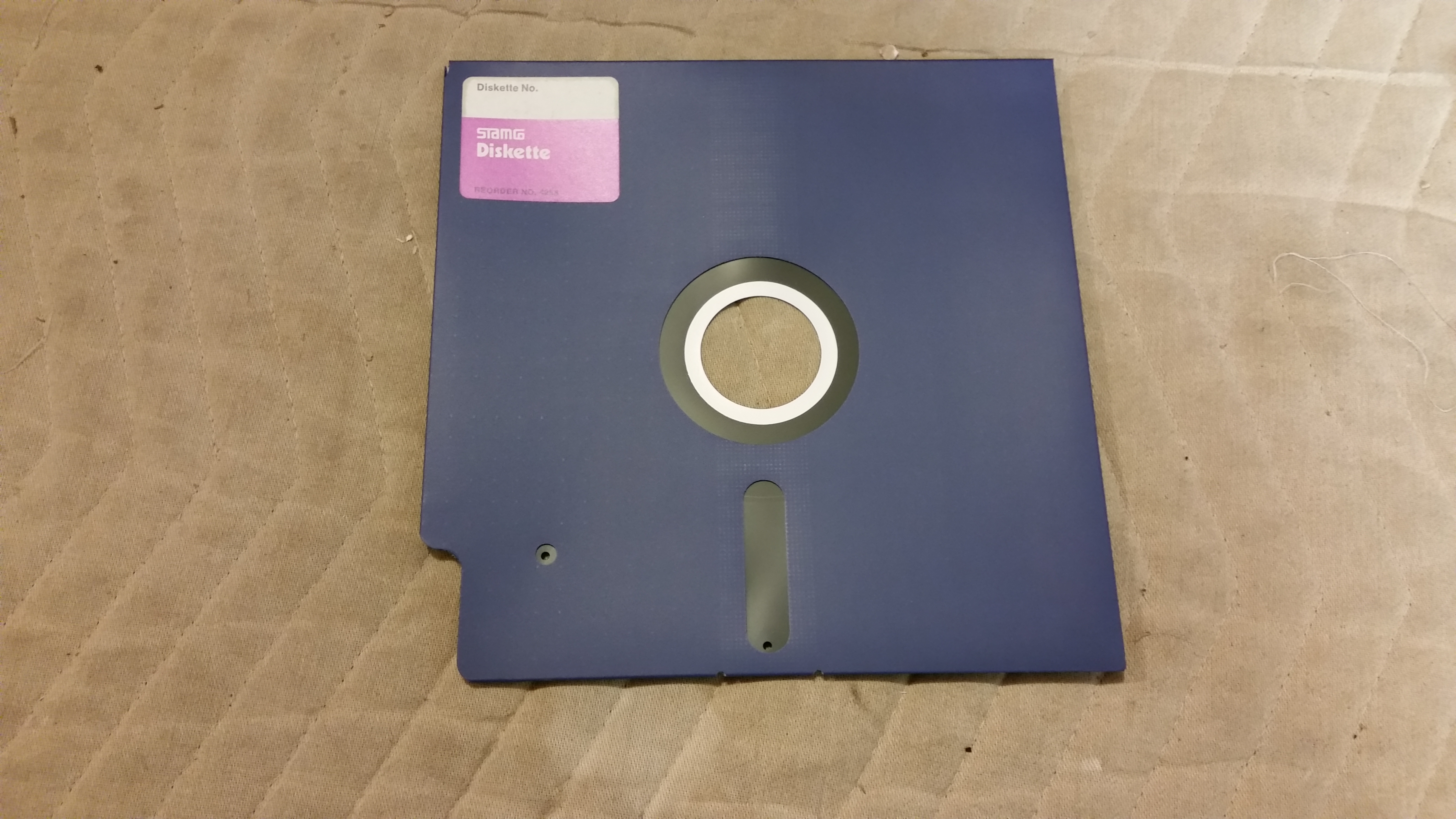
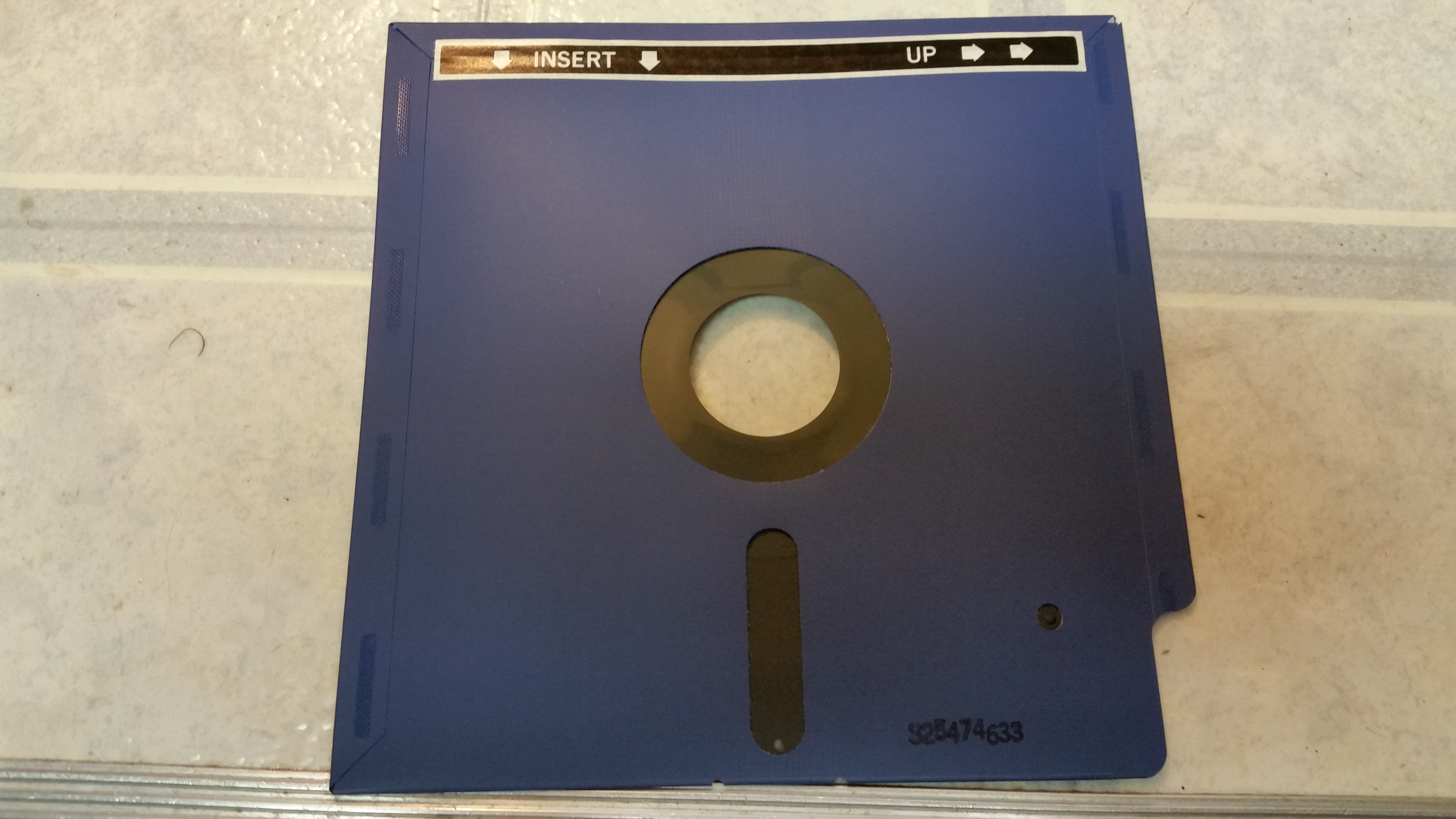
I found a ten-pack of 8-inch floppy disks that have me confused. They're
>from STAM@, a name I've never heard of before. It's clear that they're
hard-sectored, but the index and sector holes are along the outer edge.
There's also a notch cut into the corner. Both of these appear to be done
in an attempt to restrict users to a single vendor of floppies.
Here are some pics:
http://661.org/images/weird-floppy-front.jpghttp://661.org/images/weird-floppy-back.jpg
--
David Griffith
dgriffi at cs.csubak.edu
A: Because it fouls the order in which people normally read text.
Q: Why is top-posting such a bad thing?
A: Top-posting.
Q: What is the most annoying thing in e-mail?
Hi!
I just got the "Owner Operator Guide" manual for a MG-1 from a friend. I
did some searches and found a picture on wikipedia in the article about
Whitechapel Computer Works. (
https://en.wikipedia.org/wiki/Whitechapel_Computer_Works )
I also found an evaluation of the MG-1 and several contemporary
workstations...
http://www.chilton-computing.org.uk/acd/sus/perq_papers/perq_external/p003.…
... but then I drew a blank. It seems like these are really rare systems.
Does anyone have a system? Anyone need the manual?
The system could still be around so I'm going to dig around at the
university a while to see if I can locate it.
If Al wants a copy for bitsavers I'll scan it before letting it go.
G?ran
Picked this up for nearly nothing at a local recycler, it was too cute
to pass up. It's a 3M "WhisperPrinter" (model 1904AA), and it's a small
(40 column, 4.5" wide) thermal printer with a serial interface. It
appears to work (runs a self-test if you hold the line feed button while
powering on) but I don't know what the pinout for the interface on the
rear is (it's a 20-pin header).
This looks to be a rebadged Trendcom 100 (which I can also find very
little technical info about) used on a number of early home computers
(Atari, TRS-80, PET). Anyone happen to have a manual for this?
Thanks,
Josh
I was seeking the "best" pdp11 prose text editing experience for typing
in manuscripts, composing, letter writing, etc. (not programming language -
that was just a side effect of some editors actually being programming
languages in and of themselves).
Since this is such a highly relative subject, I expected a slew of
answers and got them (thanks, all!).
While not part of the originally-intended scope, the conversation has
inspired me to at least try composing in TeX, which I've sort of meant to
do for years, but never got a round tuit. Sounds like it'll stay out of my
way and allow me to just flow ideas and not even address layout until the
end, which is, in essence, what I'm after. That said, I think the most
convincing answer to my original question so far, not having actually
reviewed them yet, is some kind of emacs, most likely Jove since it's
already there in 2.xBSD and keeps me from having to mess with/re-learn
other operating systems (oh, shoot!). As a side note, I used teco and edt
back when pdp11s running DEC operating systems were still being phased out
and found them to be unsatisfying; however, I do admit that I was an
amateur at them.
My other point here was to get the Diablo 630 going and have it type
nice, letter-quality copy for me. Since my kid had a report due this
morning, I caved and temporarily connected it to an old Sun machine and
just threw lpd at it. Pretty straightforward:
lpadmin -p diablo -v /dev/cua/b -o stty=300 -o banner=never
enable diablo
accept diablo
So the thing's up and accepting jobs. Prints like a war zone :) !!!
Once one of the '11s is up, on the net and stabilized, I'd like to have it
take over this role as well.
thx again for all the discussion around this & feel welcome to continue the
thread!
jake
> From: Peter Coghlan
> 2) All cctech subscribers are experiencing it and very few find it a
> problem.
> or
> 2) All cctech subscribers are experiencing it and there are very few
> people subscribed to cctech!
I rather suspect it's 2B... :-)
> So, I subscribed to cctalk (with the same address I use for cctech
> which on reflection may not have been a good idea)
I think you've hit the nail on the head...
> However, I have not started getting three copies of anything.
> Everything is very much as before, one copy from from cctalk and
> usually another some time later from cctech
Possibly what's going on is that Mailman has noticed that it's trying to send
that email address _two_ 'CCTalk' copies: one for your actual CCTalk
subscription, and one for your pseudo-subscription (via CCTech). It thereupon
automagically suppresses the second copy.
> So what next? I get the feeling that if I unsubscribe from cctech, I
> will stop receiving anything at all
Nope, my guess is you'd wind up with one copy (from your 'real' CCTalk
subscription).
Go ahead and try it: you can make sure you don't miss anything by looking in
the archive (which is how I read the list: I don't actually get _any_
copies... :-)
Noel
Does anybody know if it is normal for a TM-848E to spin up for a few seconds
after getting power and then stop spinning. The only other 8" drives I have
experience with seem to start spinning when power is applied and keep
spinning regardless of if the door is latched or if there is a disk in
there. Thanks.
> From: Steven M Jones
> only to be pummeled by the emerging RISC designs...
My (dim) recollection of the NS32K architecture (I recall someone came to MIT
and gave a presentation on it, and I have an early architecture document - so
old that it's called the NS16K!) was that it was very elegant, but my sense
now, looking back, was that it was one of that wave of machines (the VAX being
the other notable one) that went down the CISC road just before RISC arrived,
and showed that CISC was not really the way to go; those systems were all
dinosaurs.
Which, in the NS16K/NS32K's case was unfortunate, because the architecture in
other ways, i.e. at a high level (i.e. ignoring the instructions), was the
best of the whole lot. Notably, it attempted to provide real segmentation
support, perhaps the only chip of that group to do so.
Although of course once Unix took over the world, that was irrelevant.
(Much as I dearly love(d) V6 for how it got an incredible amount of power out
of a very small machine, it's pretty clear that the basic approach of Unix
was inferior to that of the single level store systems [e.g. Multics]; Unix
really was - and in many ways remains - a toy operating system, considered
>from a larger viewpoint.)
Noel
setbuf((&__iob[1]),malloc(1024));
if (!(term=getenv("TERM"))) {
On Tue, Dec 2, 2014 at 1:22 PM, Holm Tiffe <holm at freibergnet.de> wrote:
> Jacob Ritorto wrote:
>
> > Given the gloomy weather and speaking of porting, I just got bored and
> > tried to compile /usr/src/games/rain.c from 2.11bsd on opensolaris using
> > gcc3.44. It errored out with rain.c:61: error: parse error before '->'
> > token. What's that all about? There's not even a pointer on that line:
> > 61 float cols, lines;
> >
> > rain.c source here:
> http://www.retro11.de/ouxr/211bsd/usr/src/games/rain.c
> >
>
> Tell us what you see when you use the C-preprocessor only on that file:
>
> gcc -E rain.c |less
>
> and then search in the output for setbuf:
>
>
> float cols, lines;
>
> setbuf(__stdoutp,malloc(1024));
> if (!(term=getenv("TERM"))) {
>
>
> ..like this.
>
> This is FreeBSD here and you can see that setbuf handles a pointer..
>
> Regards,
>
> Holm
> --
> Technik Service u. Handel Tiffe, www.tsht.de, Holm Tiffe,
> Freiberger Stra?e 42, 09600 Obersch?na, USt-Id: DE253710583
> www.tsht.de, info at tsht.de, Fax +49 3731 74200, Mobil: 0172 8790 741
>
>
I'm looking at clearing out my basement a little as my old computer interests and space requirements change and am considering getting rid of part or all of my Series/1 system. It has never been operational while I have had it, and was originally wired up for 240v operation - although the CPU and small tape drive were re-configurable to 120v by a jumper, and I did power them up together shortly after obtaining the system, but didn't have any OS or software to run on it.
I have one IBM rack, which I am willing to part with if the whole system is going, otherwise all my network gear and newer servers are going into it(it's only 6' tall so it fits well in my basement. I have a 4967-K00 CPU, a 4968 tape drive, an unknown model Cipher tape drive(very large), one or two 4959 expansion units, maybe a broken 8" floppy drive if I still have it. I also have two terminals and a lot of cabling for them in unknown but presumably poor condition, currently coiled up in the back of the basement on the floor. I should also still have a decent pile of expansion cards, most of them communications, some of them disk controllers. And hopefully enough interconnect cabling to be useful.
Now for the really ugly part - I do indeed have some binders with information on some of the units, and probably some stuff that isn't there, but we had a water leak a while back and some of it was water damaged. I put them aside but never had time to attempt anything with them.
I do have a picture of part of the system and the rack... The Cipher is sitting under the 1U server at the bottom of the pic. And one of the terminals with keyboard is visible sitting on top of the PDP-11/84. They've both been buried in the basement behind storage boxes for a while.
http://www.kd7bcy.com/images/comp/oldracks.jpg
On a side note, the PDP-11/84 may also be available soon. It's pretty bare bones and will likely need at a minimum a disk drive and controller. I used to have a list of the cards that were installed but I can't find it right now. I have a disk drive of some kind in the garage currently, I think it's an 8" floppy drive but I haven't looked at it closely, and it is in poor shape. The CPU rack in the basement is decent, just a broken spot weld on the door hinge which makes it hang loosely. Similar story to the Series/1 - never got it operational, but it was powered on long ago when I obtained them during initial investigations and testing. Other than the drive that I picked up at a local surplus store I have nothing that goes with this, maybe an old DEC paperback book of some kind if I can find it. I'm tempted to put it on eBay after seeing the price the last one sold for, but would be happy to entertain offers from this group first(interesting trades are always welcome). I should have some random DEC boards of some kind laying around as well. I know I've posted about both of these systems in the past on this list, over a decade ago. I was hoping to get this one up and running in a meaningful way but just never had the time or money to put into it.
The IBM is pretty much free to anyone who wants it, picked up at my house in Portland, Oregon, USA. Time frame is pretty loose, it's not like I need these out immediately, and it will probably take a couple of weeks to round everything up on weekends and get the cobwebs cleaned up, but I won't be sitting on these a terribly long time either. I imagine I will probably start dumping unwanted stuff by other means by late February.
Parts are spread all over the place, so it may take a weekend or two to get everything together and moved up to the garage for pickup. I kinda like the rack, so if you don't need it I can keep it, or if you have a spare rack 38U or shorter to swap that would be great. If no one wants it, I will likely keep the CPU and tape drive in the rack and scrap the rest of it. The Cipher looked pretty generic, it may be able to hook up to other systems. If no interest in the whole package or it is unwanted I will make it available separately.
If there is interest in one or more systems I will begin moving things to the garage and making a more accurate catalog of what is actually present and a better idea of the current condition of individual pieces.
A bit of a wall of randomly wandering text, but there it is. Cleaning out the basement can be such a tedious job! tl;dr - PDP-11/84 and IBM Series/1 available in Portland, Oregon, local pickup required.
------------
John Rollins | KD7BCY | http://www.kd7bcy.com
Ham-Mac mailing list http://mailman.qth.net
------------
An update on the SMD replacement options...
Contacted someone at MBI (mbiusa.com) and they quoted $395 for drive...
(I had asked them about a "modern replacement" for the Fujitsu drive in my
Sun 1 drive assembly...
what they quoted me back was an actual replacement Fujitsu drive... not
sure if it's NOS or refurbished OS)
Then I clarified my question and said "what's the price for the SMD
emulator they had on their site...
what I got back was : "The cost of the SMD emulator starts at approx $8500
per spindle, depending on the system spec and controller"
(the other ones that I got a link to from a few folks on ebay start at
$1500)
So, that's a dead end. I can't believe someone hasn't built some sort of
adapter from <Modern-Something>-to-SMD that isn't ridiculously priced...
Earl the Squirrel
Hi,
Not going to bid on it myself, but if someone reading this should
happen to win it, I have a fully functional Percom LFD-400 disk
setup on my SWTPc. I would be happy to provide pointers, tips and
measurements from my working system. Also, I would really like to
get copies of the diskettes and documentation included in the lot.
Thanks,
Bill S.
> From: Phil Budne
> I think MIT-MC was a "1080" and only had RH10s.
That sounds right.
> I think they used a DL10 for PDP11 interfacing (including chaosnet and
> some disks)
I don't recall anymore, but I think there was only one -11 attached to the
DL10 (couldn't they support up to 4?)? And yes, the Tridents (along with,
IIRC, some serial lines, and the CHAOSNET) were attached to that -11.
> and ran KLDCP (pre RSX20) on the console front end....
Yup. Although it had been hacked locally. After briefly glancing at the
sources (see the KLDCP; directory, and IOELEV > in SYSTEM;), it was a real
kludge; the IOELEV program ran in _both_ the DL10 -11, and the console -11.
(In the latter case, along with KLDCP!!) There was some stuff attached to the
console -11 too, apparently; a bunch of serial lines on DH11's.
> ISTR a disk farm labeled "Moon's Laundromat"
Yes, but I don't think that was on MC. I vaguely recall that it was on a
bunch of drives which were mounted in vertical pairs, which must have been
CalChomps, which I think must have been the original AI? (IIRC, both ML and
DM had DEC RP drives.)
Noel
> From: John Rollins
> I'm tempted to put it on eBay after seeing the price the last one sold
> for
If you're talking about the one that sold a couple of weeks back for $1K,
note that that included a TM80 tape drive (the bulk of the value), and two
11/84s. By the time you deduct the value of the TM80, and the value of the
boards which one could easily pull and sell separately (e.g. the CPU and
memory, along with the TM80 controller), and the power supplies, the value of
the rest works out to... -$0.
Noel
I want to do something like this to 2.11bsd's window(1) utility; possibly
vi(1) too.. Window(1) dies with "Out of memory" if you increase the
terminal geometry even a little bit. Anyone know how to go about
embiggening this program? Would be great to connect a nice, big 132x66
xterm to 2.11bsd and split it all up!
On Mon, Dec 1, 2014 at 9:51 PM, Jerome H. Fine <jhfinedp3k at compsys.to>
wrote:
> >Noel Chiappa wrote:
>
> [Snip]
>>
>> > There was also a TECO version available for the PDP-11's running
>> RSTS/E
>> > (and likely others)
>> There was a 'visual TECO' running on the V6 Unix at MIT; that's what we
>> used
>> before the EMACS came along. I don't know the background of it, if it
>> shares
>> any history with the one you mentioned.
>>
>> From the (slim) manual I have for it, it seems to have had both TECO mode
>>>
>> (the usual TECO command interface, the stuff that looks like line noise),
>> and
>> a visual mode, just like primitive EMACS. (Probably only supported VT52's,
>> though.) The latter mode had some built-in command keys, and there were
>> also
>> macro packages to extend it (again, just like primitive EMACS, although
>> those
>> for the PDP-11 Unix TECO were not as sophisticated).
>>
>> That's all almost certainly on the tape too, if anyone cares! :-)
>>
>> Since the "Subject" specified "word processing software", I assumed that
> would exclude TECO which I regard as a "text editor" (although Johnny
> strongly disagrees since his concept is a "line editor" - if I remember
> correctly).
>
> In any case, since TECO has been mentioned, I believe that KED (a
> screen editor - KEYBOARD EDITOR) which was produced by DEC
> for the VT100 and other similar VDTs qualifies. KED has been distributed
> with all versions of RT-11 at least since V04.00 in 1980.
>
> KED runs under both RT-11 and RSTS/E and will at least qualify as much
> as TECO. The DEC variants are limited to 24 lines by 80 columns along
> with 24 lines by 132 columns if a VT100 is being used with the AVO
> hardware. MACROs are supported, so some extensive editing can be
> accomplished. Auxiliary input and output files are also supported. But,
> note that KED is a screen editor without the sort of things that a word
> processor is likely to have. What you see is what you get.
>
> Ersatz-11, the PDP-11 emulator by John Wilson of Dbit, now supports
> screens up to 255 lines by 255 columns, although in practice, no Windows
> system can properly support those values. On my Windows XP system,
> the video card and monitor support up to about 50 lines by 200 columns.
>
> As a enhancement to KED, I added code which runs under RT-11 and
> RSTS/E which also supports up to 255 lines by 255 columns - BUT not
> at the same time since the screen buffer MUST be large enough to hold
> all of the characters on the screen. Since the actual maximum useful
> screen
> sizes are about 50 lines by 120 columns and 50 lines by 198 columns (for
> a maximum screen buffer of 9900 characters), I use KED under RT-11
> running under Ersatz-11. With my current video card and monitor, I have
> chosen to use FULL SCREEN mode which is supported at 50 lines by
> 80 columns and 44 lines by 132 columns. The extra 20 lines available when
> I inspect a MACRO-11 output listing are extremely helpful.
>
> Jerome Fine
>
> From: Kyle Owen
> The block diagram in the Logic Handbook shows a few select jumpers, but
> does not give a detailed list of the 32 jumpers, if I counted correctly.
Yeah, I noticed that; there were no jumpers shown for the device code. I can
only assume that they are similar to the device code jumpers for the M1703.
If so, that would be 24 jumpers right there. (It's '24' because the M1705
includes two completely separate devices, which can apparently be given device
codes independently.) If so, that would be all of them - the block diagram
shows 8; 24 for device codes; total 32.
Odd the way they use separate jumpers for 1 and 0; why not one jumper with a
pull-up/down?
Noel
On Nov 30, 2014, at 5:43 PM, Toby Thain <toby at telegraphics.com.au> wrote:
> On 30/11/14 8:16 PM, Jacob Ritorto wrote:
>> or, if not, anyone feel like helping me port a contemporary line printer
>> daemon to 2.11bsd?
>> Best I can find is LEX-11, on TSX-Plus.
>> Surprised Wordstar wasn't ported. :)> > --Toby
I am both shocked and appalled that no one mentioned VTEDIT,
which comes standard with RSTS/E . . . .
So to continue the discussion, how much would these be worth as scrap in the
USA?
http://www.ebay.com/itm/151491089302
The asking price of $5k seems a tad high to me, so I can see it going to the
crusher.
Dave Wade
G4UGM
> From: Kyle Owen
> I've got a couple M1705 dual 12-bit output cards for the Omnibus. Does
> anyone have schematics or programming information available? I checked
> bitsavers, but I didn't see anything in the obvious places
They're in the DEC Logic Handbook; in the 1976-77 edition, they are on pp.
227-231. If you can't find it online, Topline has one for sale cheap:
http://www.ebay.com/itm/321490489267
If you really need it right away, I suppose I could crunch the book into my
scanner and scan those pages.
Noel
Chuck Guzis wrote:
"It didn't start with the 170, did it Billy? I remember a nice thick mat
of twisted-pair wires on the backplanes of 6000s, as well as in a lot of
attached controllers. Taper pin technology."
You're right - the 170 was the first use of main frame wire wrap at CDC. I've never seen any other machine that used twisted pair wire wrap. When I left the project, they were trying to defelop a machine to automate the wiring. It was not going well.
The earlier 6000, 7000 machines used twited pair with taper pins. Their wire mats were huge, more than 10 inches thick in some places. That was one of the problems they were trying to solve.
Billy
> From: Jacob Ritorto
> I just got my Diablo 630 running and would like to couple it to one of
> my pdp11s and an appropriate terminal to do more "inspired" writing and
> correspondence. .. I sometimes get bored typing on these relatively
> snazzy computers we have these days and wish to go back to the way
> things were.
Ah, got it. I don't know if (on the Unix path) nroff is any good for you; with
a good macro package (pretty much essential; raw roff/troff is kind of like
raw TEX), it's pretty easy to use.
The thing is that 'back in the day', the whole 'WYSIWYG' editing model didn't
exist until Bravo on the Alto. (At least, not that I know of - if anyone does
know of such, I would love to hear of it.) Except for plain ASCII files, of
course... So I'm not sure that if you're looking for 'text mode WYSIWYG',
you'll be able to find much.
> From: Warner Losh
> There was also a TECO version available for the PDP-11's running RSTS/E
> (and likely others)
There was a 'visual TECO' running on the V6 Unix at MIT; that's what we used
before the EMACS came along. I don't know the background of it, if it shares
any history with the one you mentioned.
>From the (slim) manual I have for it, it seems to have had both TECO mode
(the usual TECO command interface, the stuff that looks like line noise), and
a visual mode, just like primitive EMACS. (Probably only supported VT52's,
though.) The latter mode had some built-in command keys, and there were also
macro packages to extend it (again, just like primitive EMACS, although those
for the PDP-11 Unix TECO were not as sophisticated).
That's all almost certainly on the tape too, if anyone cares! :-)
Noel
I've got a couple M1705 dual 12-bit output cards for the Omnibus. Does
anyone have schematics or programming information available? I checked
bitsavers, but I didn't see anything in the obvious places, and without an
option number (like DR8-E for the dual 12-bit I/O card, M863), it makes
searching a bit more difficult. I'm hoping to have this controlling my
Christmas tree lights this year if I can get something working. It has
quite a number of jumpers, and although I can deduce a few must be
addressing, I don't know what the others might be for.
Any help would be appreciated!
Kyle
W4GNU
I've just scanned the 1000-odd page software source book for VAX/VMS, 6th
Edition from October 1990, available from my scans page:
http://wickensonline.co.uk/app/index.html#/scans
This is a mammoth book (beware the 643MB download size!) but is a fantastic
example of just how pervasive VAX and VMS were. It contains a comprehensive
listing of software available for the platform both from DEC and
independent software houses. Interesting personally is the indication of
programming language used.
I've also uploaded Programming in VAX Fortran (Sept 84): I wasn't aware of
an online copy of this manual. It's a very handy guide to programming in
Fortran that covers everything you'd need to get up and running with the
language under VAX/VMS, including the use of EDIT, compiling, linking and
debugging, as well as reference material on the language and supporting
libraries.
Enjoy,
Mark.
> I know this was discussed before but....
>
> What are recommended methods for storing a variety of ICs where they
> are easily accessible as needed, keeps them safe and for the long term?
>
Tubes are good if you can find them in any quantity now though they aren't
so handy if like most folk you have a largish mix with only small numbers of
each. I have a cabinet with antistatic plastic drawers for my MOS ICs and
some of the bipolar with the rest of the bipolar in an ordinary styrene
drawer cabinet. In my earlier days in the MOS industry before more
specialised antistatic stuff became available we used to push them into a
sheet of polystyrene wrapped with foil.
> From: Mattis Lind
> I checked all three M7270 modules I have here. ... I have, Rev. E, Rev.
> H and Rev. K
> ... All has date codes in the range 77-80. I expect your boards to be
> later revisions.
No (I think); mine are both K, too. One says "130 K" (that's the one with the
slightly earlier chips); the other says "140 K". Anyone know what the numbers
mean?
Noel
> Eric Smith spacewar at gmail.com
> Perhaps I'm mistaken, but I was pretty sure that the first UTek machine
> was the 4404 "Artificial Intelligence Workstation", introduced in 1974.
> The 4404 was MC68010 based
There's also the TI Explorer:
http://en.wikipedia.org/wiki/TI_Explorer
a LISP machine (custom CPU); not sure of the exact date, but it was around then.
Noel
> From: William Donzelli
> Building a complete ENIAC replica would indeed be hard. If only exact
> proper NOS parts were used, I might just say impossible.
One other component I didn't see listed: rotary switches. ENIAC used tons of
them, originally for inputting static data (think ROM :-), and later to hold
tables used when they converted it to a sorta-stored-program machine (think
uROM :-).
And what about the special plug wires (and the male and female connectors used
thereon) which were used to 'program' the machine for a given problem - are
those still available?
Noel
>> Jacob Ritorto wrote:
>> Yeah, but troff is too hard.
I'm going to pass over the obvious question ('why would anybody be doing word
processing on a PDP-11 in this day and age' :-), and ask if nroff is also too
hard? Since it's only intended for character devices (line printers, etc)
it's not quite as complex as troff.a
I'm not sure if Bell had anything simpler; I'll have to look at my V6 Unix
manual set.
> From: Ian S. King
> But ... Emacs (originally EMACS, "eight megabytes and continuously
> swapping") .. is ever going to run on a PDP-11.
If you restrict yourself to GNU Emacs, yes. But there are more implementations
of EMACS in the world than that bloated monstrosity!
We ran an EMACS on V6 Unix at MIT, I forget who wrote it, I think it was
someone at BBN; it was quite a nice one. It was quite customizable (but that
have only been key bindings and settings, not sure if it included code), and
it had all the usual features: multiple buffers and windows, etc. (In fact,
it was so painful to use on a VT52, with its small screen, that I migrated to
a Ann Arbor Ambassador terminal, with its much large screen, as soon as it
became available.)
I have several sets of backup tapes from one of the V6 machines at MIT; I
sent one off to Chuck Guzis, and he's gotten almost all the bits off of it (a
few records had unrecoverable read errors, but the vast majority were OK -
like roughly 15 read errors in around 1500 records).
I hope to annouce a vast trove of stuff soon from my tapes (once I figure out
how to interpret the bits - they are written by a sui generis application
called 'saveRVD', and the _only_ documentation of how it did it is... on that
tape! :-) That includes a lot of code written at MIT, as well as stuff from
elsewhere.
Coming soon, in addition to that EMACS, should be BCPL, Algol, LISP and some
other languages; MACRO-11 and the DEC linker (which I guess are also
available from UNSW tapes), but _also_ programs to convert back and forth
>from .REL to a.out format, and to .LDA format; and a whole ton of other
applications (I have no idea what all is there - if anyone is interested, I
can make a pass through my manuals and try and make a list).
Noel