be aware there was a DEC terminal plant here in phx az late 70s early
80s
Ed Sharpe archivist for SMECC _www.smecc.org_ (http://www.smecc.org)
In a message dated 5/19/2015 9:53:59 P.M. US Mountain Standard Time,
ddsnyder at zoominternet.net writes:
The serial number can be broken into 3 areas...
The first two digits indicate the country of Manufacture
AY = Ayr, Scotland
BK = Germany
GA = Galway, Ireland
IQ = Somewhere else
NI = Salem, New Hampshire, USA
PC = Irvine, Scotland
KA = Kanata, Ontario, Canada
CX = Colorado Springs, CO, USA
WF = Westfield, MA, USA
AB = Albuquerque, NM, USA
The 3rd Digit indicates the year
7 = 1997 8 = 1998 9 = 1999 etc.
The 4th & 5th digits indicate the week of manufacture from
January.
01 = 1st week in January
12 = 12th week after January 1st (End of March)
20 = Mid April
For a rough calculate take 4 weeks to the month
The remaining digits indicate the run number.
00005 = The 5th one made at this plant
00100 = The 100th one made at this plant
>From the fog in my head...
Dan Snyder, Butler, PA
----- Original Message -----
From: "Jack Rubin" <j at ckrubin.us>
To: <cctalk at classiccmp.org>
Sent: Friday, May 01, 2015 5:25 PM
Subject: Place of manufacture for DEC equipment?
Is there a way to identify which DEC plant manufactured a specific piece
of
equipment? I'm certainly aware of the Maynard, Massachusetts label on my
equipment and I'm pretty sure I've seen DEC Kanata, Canada on flipchip
handles. Maybe even PR serial numbers on computers built in Puerto Rico.
Can anyone supply any more extensive and/or detailed information?
Thanks,
Jack
CASTOR:: was the M+ group?s 11/74 housed in it?s own machine room in ZK. Since the machine hardware could be relatively easily reconfigured, POLLUX:: was reserved for when the system was running as 2 independent nodes (3+1 or 2+2 CPUs). The DECnet group had a dual processor system with node name ELROND::.
I used CASTOR:: standalone a couple of times while debugging the MP changes to the DECnet kernel code until ELROND:: became stable. Eventually, ELROND:: became the timesharing system for the DECnet-RSX group.
The lack of cache-coherency and the limited work-arounds (cache-bypass or cache flushing) meant that all the DECnet kernel code, both drivers and protocol stack, ran with cache-bypass enabled on its data PDRs. So the networking code on an MP system had lower peak performance than on a normal 11/70 although you would never notice the difference in regular operation.
John.
Is there a way to identify which DEC plant manufactured a specific piece of equipment? I'm certainly aware of the Maynard, Massachusetts label on my equipment and I'm pretty sure I've seen DEC Kanata, Canada on flipchip handles. Maybe even PR serial numbers on computers built in Puerto Rico.
Can anyone supply any more extensive and/or detailed information?
Thanks,
Jack
http://blog.startupitalia.eu/p101-make-in-italy-de-sandre-olivetti-intervis…
There is a museum in Ivrea with the Programma 101 on display. I think
some of the photos from modern times were from there.
This article is related to a maker fair in Trieste. Please visit the
page for pictures and to give them page clicks, since I am archiving the
info here for the list.
Thanks
Jim
Google translated from article:
The engineer of the legendary P101: "Here are the secrets of the first
Pc of history"
The Mini Maker Faire Trieste meeting with the engineer De Sandre, one of
the creators of the program 101 Olivetti: the first personal computer
will be among the stars of the show to Make In italy Expo (from May 18).
Last October, in the Maker Faire Rome , was presented the exhibition "50
years of Italian innovations: from P101 to the first espresso machine
space". An exhibition, organized by the Foundation Make in Italy , which
now arrives in Milan Expo 2015. From today, in fact, can be seen, in an
expanded version of the original, in two locations in which it was
divided: Telecom Italian pavilion within the exhibition center in Rho
and the National Museum of Science and Technology of the Lombard capital.
The prototype of the P101 ( Program 101 ), recognized as the first
desktop computers in history, made ??his international debut at the
World Exhibition in Paris in 1965. The team, led by Pier Giorgio
Perotto, devised an instrument that had some features that still they
form the basis of any personal computer: CPU with discrete components,
RAM (magnetostrictive delay line), mass storage (magnetic card) and
serial printer to impact.
Within the team of Perotto was a young engineer, Giovanni De Sandre.
Matthew Tro?a met him at the second edition of the Mini Maker Faire
Trieste to talk with him about the success of the P101 (and many other
things).
The interview
How did your story with Olivetti?
I entered into Olivetti April 1, 1960, after the previous talks that had
established my eligibility in that company. I even received the head of
the laboratory at the time, the engineer Mario Tchu , who was the son of
a Chinese ambassador to Vatican. Tchu had specialized in the United
States, and this greatly pleased to Adriano Olivetti , who cast him in
his team. That time I had just graduated, fresh from Politecnico di
Milano, and you think, now my degree is equivalent to a degree in
electrical engineering, but at the time did not exist in this
formulation, so I got a degree in electrical engineering with a
"certificate studies of electronics. "
So she was received by engineer Tchu, who then assumed?
The engineer Tchu was a very friendly, helpful and friendly. He
explained all the activities of the laboratories, mostrandomeli one by
one and explaining with great patience and care that what took place in
those places. In the end I remember that I said, "then engineer, she is
interested in what more? One thing in production or in the project? "And
I said a little 'afraid' to me honestly like to work on projects ...".
Tchu then he asked again, "but she would like to work on the evolution
and improvement of our existing products or instead of entirely new
products?" And then I said that without wishing to presumptuous, I would
have loved work on projects entirely new.
The engineer Tchu picked up the phone, called the engineer Perotto and
said "dear engineer, I have here a person that suits her." That phrase
always decided for my professional future. I went well in the working
group of engineer Perotto, who was my direct responsibility even though
he was only a few years older than me. Perotto was a nice person, of
great culture and technical ability. He had a spontaneous orientation
toward the concrete. I was very lucky because I was thrust into an
almost idyllic. In the Olivetti corporate hierarchy was not seen as an
imposition, not weighed. The leaders were, but they respected because it
was natural respect. People were so influential that respect for them
was spontaneous. I found an atmosphere of great freedom, but also of
great involvement. If I had a problem it was enough to ask for help and
I was listening. My problems and my gaps I filled asking. I learned a
lot while I worked.
What he is initially occupied?
The first thing I worked were checks magnetic, which still bear the
bottom two spaces wider than three a little 'closer. The location of
these areas determines the reading code. The machine that read these
codes had designed Perotto and I was in charge of setting up, checking
its operation, and connecting it to an existing machine Olivetti. Within
six months I had accomplished something.
And then the P101 ...
Work began on the P101 with a deep study of the feasibility of the
product, initially purely theoretical. We wanted to create a car that
was not limited only to make four simple steps that already did with the
mechanical machines. Then produce mechanical machines cost 39,000 lire,
but then were sold to 390 thousand pounds. For Olivetti invest in this
product would not bring the expected revenue. We had to do something to
level a little 'higher. So we started working on the prototype of the P101.
We did not know that the machine had to create, in the sense that there
was still nothing like it on the market. However for me the bonds were
crystal clear: it had to be easy to use, accessible to a
non-professional user. Accessibility was to be the characteristic trait.
In the second place it had to be reduced in size. Finally it would cost
as little as possible. Led by engineer Perotto, then, we started working
on this electronic project. So the first thing to do was to decide the
type of memory to be installed in the machine. Of course we had the
opportunity to go to the store and choose from dozens of memories at our
disposal. In those years there were very few memories. In particular
there was the core memory , but was not good for the small size of our
future machine. The engineer Perotto I knew immediately, I'm a bit
'after. (Laughs) After a study of the type of memory to choose from we
focused on a type of memory of the past generation, which had been
abandoned by now (working memory was a magnetostrictive delay line ).
The technology of the time gave us memories that were not going to
respect the constraints that we had set, so we used the components of
the past, to make the "car of the future".
The revolutionary products as was the P101, they appreciate when they
are ready. Behind their implementation but there is always a big job.
How much have you been working on this project?
We got to work with his head down, day and night, often without
realizing that had arrived the weekend. In some periods there was no
agreement on Sunday as a day of rest. There were no arrears with whom to
spend the afternoon. All this does not remember it as a burden, but as
the most exciting period of my life. We had to finish first. I think
that needs to come first in some things, that does not mean overdoing
it, but engage and expend maximum to achieve their goals. Running behind
is far worse than through the air.
He never felt the weight of fatigue in what he did?
There was no concept of fatigue for us. It was completely overcome by
the interest that was for what we were doing. We felt a bit 'pioneers in
a world where we often designed parts of electronic circuits, but never
a car full. We proceeded by trial and error, but they hand it proceeded
increased experience.
Chapter Innovation
What about her?
Innovation has to have some unmet need. To return to my story, I believe
that the fact of working at P101, was not immediately something
innovative. For me initially was mainly a strong need. If I think back
to when the University did the calculations with the ruler with which
often was wrong, the idea that you could create a machine that would
help me with extreme speed and precision to make those calculations, for
me was the solution to my real need . Need to be put together with some
technical expertise required to carry out in practice his idea.
Innovation means want to go into the unexplored wilderness, hoping to
find an oasis, a solution but we were not ready, but we have done us.
Italy is a country still able to accept the technology?
When there is something really innovative, I do not know if Italy is the
best country in which to tell this innovation. From this point of view,
perhaps the United States is a country more ready mentally, more
pragmatic and more accustomed to understand the news. But this happens
only in the initial phase. Olivetti also initially was little more than
an island than the rest of the country. A lot of people did not even
know that there was this company.
But I believe that the issue on which we must reason is as follows.
Today the world has certainly changed and we are used to accept anything
new very easily. The challenge is to understand what, in this chaos of
new, really creates innovation, understood as making something useful
for our lives. What really affects our lives? That is, if what we invent
or we make an impact in a way that is not obvious, trivial, obvious,
then maybe other countries are more receptive, but Italy certainly not
least, because of quality products makes many as he wants. The important
thing, as I said, you know what, among the many new features, it's
really helpful to improve their lives.
He would redo everything you did?
Yes absolutely. Though I speak with hindsight. One can not always
project her life and does not know what may happen in the future.
Certainly more than the experience in Olivetti itself, I would like to
relive the spirit of those years, that basically was a spirit extremely
positive, optimistic, enthusiastic. From my experience I have learned
that critical is the commitment and self-criticism, that a little
'lacking nowadays. Innovation also means being confident, determined and
feed their inner spring. It helps a lot to be introduced in the
technology world, especially now that has become pervasive. Everything
comes from a right balance between a strong driving force and a large
capacity that criticism must regulate itself within us.
What did you learn from your experience?
That we must never stand still. But think of Steve Jobs! What has to do
what he did? It's not that he invented something. What made the
difference, however, was its continuity, his desire to fight, his steely
character, which allowed him to transform a company that was going to
fail in company we know today. What did Jobs? In fact did what many
others did, but of course with an attention to detail and some aspects
that have allowed him to make a difference. Today, companies ride the
wave for a couple of years and when they feel it is necessary to
reinvent itself give up and sit down. Steve Jobs? More than sitting!
That one had the pins under the seat which put him constantly on the
move. He never lies and never gave up, and certainly helped him a lot of
his character. Today we have to stay on the move, never sit down,
because innovation is moving.
16/05/2015
Matthew Tro?a & Alessandro Frau
RE: Token Ring
As said below, you can probably not worry too much about the
wiring impedance (etc.) for a small ring.
But you will still need a MAU or something like it.
The token ring adapters have a physical layer protocol for ring
insertion and token monitoring.
The power-up state for a station wire is a physical loopback and it
will try to successfully loop itself before inserting.
A copy of the newsgroup comp.dcom.lans.token-ring FAQ still lives at
http://www.networkuptime.com/faqs/token-ring/index.shtml
Connector pinouts and other info is in there. Stuff on Wikipedia too.
I had to dust off a few neurons to remember this stuff.
Dave.
I'm not reading this list consistently anymore... any direct
questions should be CCed to me.
On 5/18/2015 01:00 PM, cctech-request at classiccmp.org wrote:
>Date: Sun, 17 May 2015 12:58:20 -0400
>From: Sean Caron <scaron at umich.edu>
>To: "General Discussion: On-Topic and Off-Topic Posts"
> <cctalk at classiccmp.org>
>Cc: Sean Caron <scaron at umich.edu>
>Subject: Re: Weird stuff has a TI 810 (also if anyone has token ring
> wiring)
>Message-ID:
> <CAA43vkUJ7US+72OiYhEtrvOgM76u0tUv55wqAP65R21otLkbEg at mail.gmail.com>
>Content-Type: text/plain; charset=UTF-8
>
>I can tell you from firsthand experience that if you're just doing short
>little runs within a vintage computer room in your home or something like
>that, you can directly pin the 9-pin D-sub over to 8P8C and make short runs
>with common unshielded Cat V cable and it should work fine. I did this all
>the time when I was in high school to connect old MCA PS/2 machines with
>the IBM token ring adapters (9 pin D-sub) to various old 8P8C MAUs that I
>had acquired. I can't speak to dealing with those funky IBM connectors;
>never worked with those.
>
>Best,
>
>Sean
>
>
>On Sun, May 17, 2015 at 12:50 PM, Dave G4UGM <dave.g4ugm at gmail.com> wrote:
>
> >
> >
> > > -----Original Message-----
> > > From: cctalk [mailto:cctalk-bounces at classiccmp.org] On Behalf Of
> > jwsmobile
> > > Sent: 17 May 2015 16:30
> > > To: General at classiccmp.org; Discussion at classiccmp.org:On-Topic and Off-
> > > Topic Posts
> > > Subject: Weird stuff has a TI 810 (also if anyone has token ring wiring)
> > >
> > > There is a white cased TI 810 at Weird Stuff in the AS IS room. Probably
> > > cheap. Of course unknown condition.
> > >
> > > Got some very nice Token ring equipment from an IBM facility of some
> > sort.
> > > will be using for Hercules setups.
> > >
> > > I'll need some balun's for the RJ45 (ibm version) to the DB9 if anyone
> > has an
> > > idea of the hookup. I'd like to figure out if I can wire this w/o using
> > the token
> > > ring cables, since I have what appears to be a bridge unit. I'll have to
> > research
> > > that though.
> > >
> > > Thanks
> > > Jim
> >
> > Jim,
> > Is there a part number on the "bridge" unit? Typically the IBM units just
> > switch the stations it and out of the ring.
> > Dave
> >
> >
---
This email has been checked for viruses by Avast antivirus software.
http://www.avast.com
I've finished up things for a new release of Frotz, an extremely portable
Z-machine emulator (plays Infocom games). The Unix port is tested and
ready to go, but I don't have real DOS hardware in working order. Could I
get some people to try it out and let me know how it fares? It's compiled
with Turbo C++ 3.0 for 16-bit DOS. The zipfile is at
http://661.org/if/frotz244.zip. Source is at
https://github.com/DavidGriffith/frotz. Games are available at
http://ifarchive.org/ or https://661.org/if/ (some of my games).
--
David Griffith
dave at 661.org
A: Because it fouls the order in which people normally read text.
Q: Why is top-posting such a bad thing?
A: Top-posting.
Q: What is the most annoying thing in e-mail?
Hello!
The EPROMs are labeled 07595-18045 and 07595-18046. We suspect some
bits have toggled.
Can anyone do a dump for me? It's for the 7596A of our local
hackerspace.
Greets,
Martin
--
Martin Peters
martin.peters at news.uni-stuttgart.de
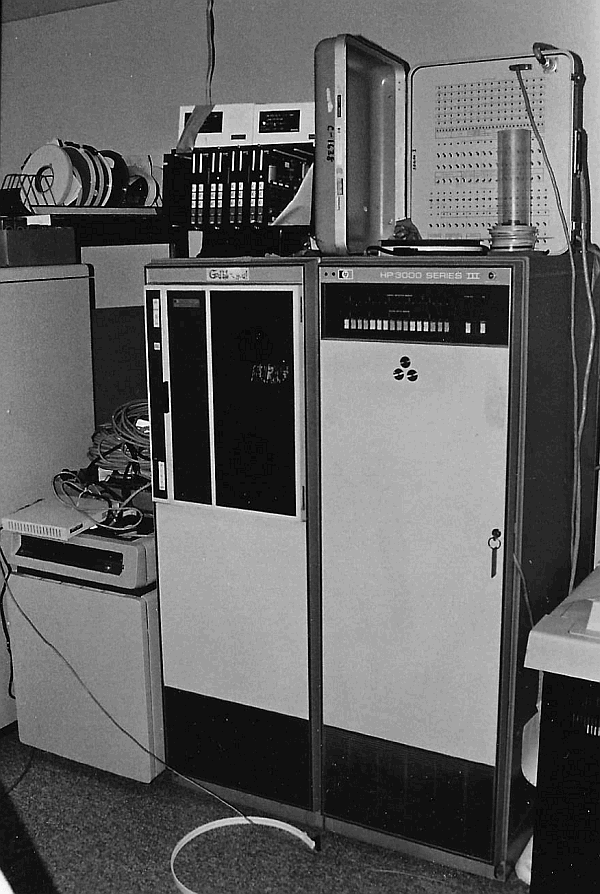
Johannes Thelen - and others... HP-3000 Series II? series II?? We
would pay handsomely for one.
We found our backup archive set of HP-3000 software - heh heh all
kinds of software including FORUM/3000 which was a multi user 100
seperate boards bulletin board, electronic mail, electronic poll and voting
system, multi user chat rooms...
( this was all pre Internet so it was way cool back then!
just gotta read the tapes.... amazed... this grouping of tapes
was an off site storage I had forgotten about and re found in the
back closet at the house... had not seen it in over 23 years..
I am really hot on getting e series II or II back to have one at
the SMECC museum here in Arizona as it was one of my favorite machines but
also we have the giant plug in front panel for it that shows all
registers that the customer engineer would bring out in a suit case to
really get down and dirty....
We have the series II and III interface board as well as the HP-3000 CX
series interface board which is a separate item.. see
http://www.smecc.org/hp/hewlet16_series_3_with_maint_panel.gif to see it hooked to
HP 3000 WACC-B from U Wisconsin
Used by Marlys Nelson - HP-3000 Programmer Extraordinaire! this photo
was shot after we even had retired the system was using a series 48
with 303 meg drives I kept in next to my desk and would test boards in
it.... When the panel was active on the III with users on it it was
fun to throw it into single step BEWRAHHAHHAHH!!!AA!!!
Ed Sharpe Archvisit for SMECC
In a message dated 5/18/2015 2:30:24 P.M. US Mountain Standard Time,
aek at bitsavers.org writes:
On 5/18/15 1:13 PM, Johannes Thelen wrote:
> the big one of this donate is HP3000 Series III! :D
>
Finding software for the Series II and III has been extremely difficult
so please try to find any that was associated with the machine.
Hello friends!
I just got another donate to my collection... It contains several items, but the big one of this donate is HP3000 Series III! :D
Do anyone know what it weights? This one have CPU with Option 200 rack (my best guess, like some expanded IO?). And is there wheels below racks?
Ps. IBM 1800 project is going further bit by bit, all gate doors and flat cabling is assembled back where they were. More coming about this later!
- Johannes ThelenFinland
Before microcomputers blog (Finnish) http://ennenmikrotietokoneita.blogspot.fi/
I'm looking for a tool to do a bunch of 3.5 floppy imaging using a linux
or a windows box.... Media is all early PC stuff. Any thoughts,
comments, tools of choice?
Is IMD the format of choice for these as well or is there something else
for the newer formats?
Steve
Hi
I'm about to go on a small road trip to pick up some computer gear. I'm
curious about what I'm actually getting :)
http://www.update.uu.se/~pontus/slask/L%C3%B6fberg-haul/
I know what the Siemens and IBM things are, but:
What system would the the Ampex Series 800B have been used with?
The Alfaskop terminals, are they 3270 compatible?
Regarding the huge stack of tapes, what should I look for in order to
identify what might be on them, is the "9270" label any clue?
I will leave the Esselte Scribona FD 20 behind, but I'm curious what it
is? I think it may have served use on an airport, printing boarding
passes or similar.
Regards,
Pontus.
There is a white cased TI 810 at Weird Stuff in the AS IS room. Probably
cheap. Of course unknown condition.
Got some very nice Token ring equipment from an IBM facility of some
sort. will be using for Hercules setups.
I'll need some balun's for the RJ45 (ibm version) to the DB9 if anyone
has an idea of the hookup. I'd like to figure out if I can wire this
w/o using the token ring cables, since I have what appears to be a
bridge unit. I'll have to research that though.
Thanks
Jim
> From: John Wilson
> Even if E11's mP feature is officially unsupported, it was a *crazy*
> amount of work
What made it so much work? (Just curious about the technical aspects...)
Noel
Thanks another million.
- Marc
>> Is the "HP 1000 M/E/F-Series Computers I/O Interfacing Guide"
>> (02109-90006 September 1980) available online somewhere?
>I thought I had sent it to Al some years ago, but it's not listed. In any
>case, I've posted it here:
> http://home.earthlink.net/~jdbryan/dropbox/02109-90006_Sep-1980.7z
> See chapter 5, pages 5-5 and 5-6.
> -- Dave
The only reason I guess is that they're bootable disks. Otherwise a simple filecopy is more than enough :)
-------- Messaggio originale --------
Da: Fred Cisin <cisin at xenosoft.com>
Data:17/05/2015 16:40 (GMT+01:00)
A: "General Discussion: On-Topic and Off-Topic Posts" <cctalk at classiccmp.org>
Oggetto: Re: 3.5 floppy imaging
> If they are just plain old dos format (DD or HD) dd under linux will do
IF they are just plain old DOS format (DD or HD), then COPY will do.
IF they are just plain old DOS format (DD or HD), then there is no reason
to "image"!
IF they are just plain old DOS format (DD or HD), then the files are all
that matters.
IF they are NOT just plain old DOS format (DD or HD), THEN there might be
reason to image, such as if they are some unknown and not understood
format, and the files can not be extracted, or there is reason to believe
that there is some form of information in the structure and format of the
disk that should be preserved, such as system tracks on CP/M disks, etc.
Or, if they are copy-protected, and stuff other than the files needs to be
preserved to be able to use the files.? 'Course then, your "imaging"
methods are not likely to work, anyway.
But, IF they are just plain old DOS format (DD or HD),
then there is NO information other than the file content on the disks.
If you format a 3.5" disk in a DOS/Windoze machine, and copy some file
onto it, . . .
Could you please explain to me WHY you would want an "image" of that disk?
Dan (the donor) brought more manuals, diags on paper tape, and his very
nice color oscilloscope. Dan's 'scope displays RMS, PTP, Average, and other
voltage values on the side of the trace window, so it makes power
measurements very easy.
After reading the manual and getting instructions from Warren, we found
that some of the misbehaving front panel was due to operator (me) error. The
Mode switch to change between LINC and 8 operation only has an effect after
you press the I/O Preset switch, so that is working correctly.
When you press I/O Preset the INST FIELD is set to 1 and the DATA FIELD is
set to 3. I though that this was wrong for an 8k machine. If you look at
the front panel you will see three bits and an additional 2 bits for the
INST FIELD and DATA FIELD. So part of this is for the 8 and all of it is
for the LINC, and it is working correctly.
We recabled the VR14 and TU56. The Local Forward and Reverse switches on
the TU56 do not get the correct behavior from the motors. The Line fuse on
the VR14 blew when we turned it on.
We will replace the fuse and try a slow power up with a Variac.
We received lots of comments on reforming the capacitors in the power
supply and strong recommendations from experts to just replace them. Since
new caps are a different physical size, and would cost about $250 we
decided to continue with reforming the originals. We measured the voltage
ripple on the backplanes near the power connectors.
- +5.0V = 5.01V, 200 mV PTP ripple
- +10.0V = 5.9V, 200 mV PTP ripple
- -15.0V = -14.2V, 800 mV PTP ripple
- -30.0V = -31.2V, 800 mV PTP ripple
The 800mV of ripple on the -30 is a sign that the caps in the power supply
were not working well, and is probably too noisy for the core to work. We
tried to measure the capacitance of the power supply capacitors using an
ancient, but very nice, GenRad capacitor meter, but unfortunately the caps
were too big to measure.
We thought that more power on time for the caps might improve their
behavior, so we started debugging the processor. We found that bits 4 and
11 in the Program Counter were always on.
We looked at the flip-flops on the M221 modules in the processor that make
up the PC register and they the contents matched what was loaded from the
console switches. We need to determine why the indicator lights on the
front panel do not exactly reflect the internal state of the registers in
the processor so we can continue debugging.
After running the system for about four hours the ripple on the -30V was
down to 180mV, so the capacitors are getting better. More run time will
hopefully reduce the ripple to an acceptable level. If not, we will have to
replace them.
--
Michael Thompson
one here but not cheap.
I was happy I got a diablo KSR
I can not even tell you how bad I used to lust after one of those in
1979......
http://www.omnidatasys.net/catalog/printers/texas-Instruments-ti-820-ksr
In a message dated 5/17/2015 12:19:45 P.M. US Mountain Standard Time,
jwest at classiccmp.org writes:
I am looking for a TI 820 or 825 KSR, if anyone has one in good shape with
all keys that they are willing to part with - sale or trade...
J
The 8041 has the same pinout as the Intel 8741 programmable. A Pro-Log M980
PROM Programmer with a PM 9054 personality module can read out the programs
inside.
I did a lot of Intel 8741 Development back in the day and even reverse
engineered the PIO in an Intel MDS-225. I have a MDS-225 now I'm getting
going from pieces.
Richard Main
+1 510-229-9711
Newark, CA USA
This just popped up today:
http://www.ebay.com/itm/LOT-OF-54-USED-VINTAGE-DEC-DIGITAL-COMPACTAPE-TK50-D
ATA-TAPE-CARTRIDGES-SOFTWARE-/221774909736?
It is a bit expensive in my view and shipping to the UK is too much, but I
thought there *might* be some old versions of DEC software on some of those
tapes. I thought of asking about the DEC software myself, but as I know I
wouldn't bid it wouldn't be right for me to ask. Anyone in the USA
interested enough to find out what historical DEC software there might be
and recover the tapes (if possible)?
Regards
Rob
I decided to put the 11/44 on Ebay for $1, no reserve. (currently at
$40.39).
New photos (what is on ebay plus what I took today after opening the
cabinet to see what is in there)
http://vintagecomputer.net/digital/PDP11-44_2nd/
Ebay listing
http://www.ebay.com/itm/Digital-PDP-11-44-/271869650084
Item is pickup only BUT If you can't pick it up but want to make
arrangements to have a shipping company come to pick it up, pack and ship,
I am happy to help but it's on you to make all of the arrangements. I am
available during the work day.
Location - Landenberg, PA which is about 40 minutes South/west of
Philadelphia, about 60 minutes North/east Baltimore, 10 miles or so from
I95 at the MD/Delaware border.
vintagecomputer.net/contact.cfm
Bill
The scrappers are here, clearing out the warehouse.
I saved a box of old DEC and HP boards.
First $100 plus about $35 UPS ground shipping takes them home (in CONUS).
I have no idea if any of them still work, but I pulled them from large
working cabinets I was required to destroy about 18 years ago.
Part numbers are:
M8061
97871 401-33692 Quad Cache qty 3
85-3438-02 Cache memory
M8059FH
M8048 qty 3
M8059FB
M8186 qty 3
Peritek Corporation DMA-Q
97871 MUX qty 5
5020477-01-DC1 Diceon 6A
M8016YB
HP boards:
C-2440-40 2443-9572
5181-5649 Rev A
98257-66524 98257A
33445-60002 A-2745-39
D2237-60001 (no CPU chips)
A1470-66521 16MB memory qty 2
Cindy Croxton
Electronics Plus
1613 Water Street
Kerrville, TX 78028
830-792-3400 phone
sales at elecplus.com
AOL IM elcpls
A correspondent just pointed me to a nice collection of photos of a (the?) 11/74 MP system:
http://oboguev.livejournal.com/2696291.html
I assume this is the one at DEC used by the RSX-11M+ group for their multiprocessor support work. As far as I know these didn?t become a product. I remember the name of the machine as ?Cerberus?, not sure what that label ?daemon? refers to. Maybe a DECnet node name?
paul
Hi
I received a DECpc 433 Workstation today with SCSI expansion box. It's a
small system which reminds me of the VAX VLC, but not quite.
I've not been able to find any manuals online, does anyone have anything?
Regards,
Pontus.
John wrote....
----
I'm still looking for Oregon Software Pascal as well...
----
I said I would look, I did, and it was fruitful.
I have in my hands an original distribution fedex shipping box from Oregon software to my high school (Saint Louis University High) containing:
Oregon Software Pascal-2 Software Development System version 2.1F for RT-11 release package checklist (RN-121, august 1988):
Installation & Release notes
Oregon Language Letter, Summer 1988, announcing two new compilers (Oregon Modula-2 and Oregon C++)
8 SS/SD RX01 format disks containing P-2 RT-11 v2.1F (original, Oregon software labels, including my high schools site/license number)
Oregon Software Field Report form (4 carbon copy)
Misc Notes of my own from a skim of the above:
The compiler version here runs under RT-11 v5 or later
The compiler can run under XM or SJ monitors
Programs compiled with the compiler can run under FB, BL, SJ, or XM
Minimum requirements: EIS. P-2 uses FPP hardware or simulated floating point software (FIS). Also need 3500 blocks to install, and during compilation about 500 blocks are used for temporary storage. Computers with only flexible disk systems do not have enough storage.
I have no idea if these diskettes are still readable. I know my high school was fastidious about making a copy and then locking the masters away so these disks likely only saw one read. I do know that they used this software extensively, and there may well be other copies of these floppies around here.
I'd love to post images of these diskettes, but I don't know the status of Oregon Software and the IP situation.
So in the interest of completeness, anyone have other RT-11 versions of other Oregon Software's compilers?
I also found original S&H distribution copies of TSX+ v5, v6, and v6.2 (again, stamped with my high schools license number).
Best,
J
Dave - - actually there should be a scan out it out there already...
it is of the same vintage as the hp minicomputer handbook with the old
hp-2115 on the front....
Here I found a link to the early version! just enter any word in the
human checker thing and you can download the pdf! there are other hp
2000 things there too at that main url
http://www.hpmuseum.net/capcha/freecap_wrap.php?r=1124
posting the cc also to rest of list for those that would like
this also...
Yea our old one if we opened it to flat bed scan it it would be a
sheaf of lose pages I fear... but this pdf should be good for
info.
We love HP 2000 stuff here it was part of my work in the old days
fixing and selling therm and selling time on them. We still have our
first 2000 system we bought but we NEED THE 2883 disk drive and the hp
version of the GE terminet 300 to put with it.
Ed Sharpe archivist for SMECC _www.smecc.org_ (http://www.smecc.org)
In a message dated 5/16/2015 11:27:44 P.M. US Mountain Standard Time,
jdbryan at acm.org writes:
Hi Ed,
On Saturday, May 16, 2015 at 21:35, COURYHOUSE at aol.com wrote:
> Many Thanks for the HP 1000 interface board manual...
You're welcome.
> We have the old one here at the museum with the 2115, 2116 etc
> but it has gotten brittle on the back binding and if we do not
> have to open it.......
Maybe open it one more time to scan it?
-- Dave
I received this email - contact Alex below if interested:
===================================================================
I'm a reporter for the New York Times and I'm working on a story about vintage tech/computer equipment, particularly when used as items to be displayed, or as home-decor.
Do you know have any collectors of vintage tech who have used it in any creative way as objects around the house?
If you have any thoughts on the topic, I'm all ears. Thanks!
--
Alex Williams
Reporter
The New York Times
212 556 1158
===================================================================
Chuck Guzis wrote:
One more category springs to mind--5xx would be printers (e.g. 501 and
512). Maybe I;m trying to forget about what it was like having a
machine gun on one side (501 drum printer) and a screaming banshee (512
train printer) on the other side.
8xx also includes drum storage.
------------------------------------------------------------------------
To add a little more: 1XX was test equipment; 3XX was paper tape equipment; 7XX was interconnect gear.
Later the numbers were changed to an elaborate code that used 2 Alphanumerics a dash, 3 more alpha numerics. This was later modified to include another dash and alphanumeric. For example, a disk drive might be: BJ-3A4-C.
There is a model decoder somewhere on bitsavers.
And there was a whole family of unique specially designed peripherals called SPAM boxes = Special Purpose Alogrithm Machines. These were usually all electronic. Most were used in the oil industry; for example strip recorders/readers for seismic data.
One I worked on a lot when in Houston, would add up all the one bits in a large field of data. For some applications, the petrol companies loved it.
Inital telecommunication products started here then evolved into their own families.
Chuck, I'll swap you for the time I was at CERN working on 627 (one inch) tape drives and some idiot rewound 24 of them at the same time. It was a gag they pulled on new operators. It could take an hour before you could hear people talk again.
Billy Pettit
Sean Caron <scaron at umich.edu> wrote:
> I remember long ago there used to be a really neat site about the
> VAXstation 3520/3540 machines but it's long gone ...
Any chance you have the URL noted? If so, the WayBackMachine might still
have it.
Noel
Many Thanks for the HP 1000 interface board manual... We have the old
one here at the museum with the 2115, 2116 etc but it has gotten
brittle on the back binding and if we do not have to open it.......
At one time when we would building voice boards to the 2000/1000
series back then we had scored a batch of blank IO proto boards with the
buss tag traces on them.. be interesting to see if I saved any...
Thanks ! Ed# _www.smecc.org_ (http://www.smecc.org)
In a message dated 5/16/2015 3:42:18 P.M. US Mountain Standard Time,
pbirkel at gmail.com writes:
That is a *really* nice document, in so many ways. Thanks for sharing,
and
for the answers to earlier questions :->.
On Thu, May 14, 2015 at 11:31 AM, J. David Bryan <jdbryan at acm.org> wrote:
> On Thursday, May 14, 2015 at 1:46, Paul Birkel wrote:
>
> > What do they recommend on the receiver-end?
>
> LSTTL with a 4.7K pulldown to -2V on the input.
>
>
> > Is the "HP 1000 M/E/F-Series Computers I/O Interfacing Guide"
> > (02109-90006 September 1980) available online somewhere?
>
> I thought I had sent it to Al some years ago, but it's not listed. In
any
> case, I've posted it here:
>
> http://home.earthlink.net/~jdbryan/dropbox/02109-90006_Sep-1980.7z
>
> See chapter 5, pages 5-5 and 5-6.
>
> -- Dave
>
>
All ?
I thought I would pass the attached on to the group. Please let me know if
the attachment (Word doc) doesn?t come through and I?ll send it separately
to those interested. I received the attached email, unsolicited. Looks like
two complete Altair systems for sale for $7,000, with offers considered. No
location is given in the listing but the area code points to Washington
State (Olympia??).
Rich
--
Rich Cini
Collector of Classic Computers
Build Master and lead engineer, Altair32 Emulator
http://www.classiccmp.org/cinihttp://www.classiccmp.org/altair32
From: Richard Cini <rcini at msn.com>
Date: Saturday, May 16, 2015 at 10:54 AM
To: Richard A Cini <rich.cini at verizon.net>
Subject: FW: Altair 8800 Electrical Engineer Estate "lot"
From: ecyclenw at msn.com
To: ecyclenw at msn.com
Subject: Altair 8800 Electrical Engineer Estate "lot"
Date: Fri, 15 May 2015 01:32:57 +0000
Hi,
You are receiving this e-mail due to interest expressed as a collector, on
theantiquecomputer.com.
Please find attached a word document with the information and details of
this Altair 8800 Estate Lot. More photos available.
Also, please pass this information to anyone who may be interested.
Thank You
Dan
Dan Tharp
EcycleNW
dan at ecyclenw.com
ecyclenw at msn.com
Sent from Windows Mail
Am I too late? Still available for sale?
Richard
I really need some cash and some space, so it's time for my Intel Intellec
MDS gear to find a new home. I inherited this kit some years ago, and know
almost nothing about it - in fact, I'm even confused as to the correct
model number; 'experts disagree', it's either an MDS-225 or MDS-800.
It's a large white cube, about 20" on a side, with a CRT, one 8" floppy and
a number of plug-in boards. There is also a blue Intel dual 8" drive, one
seriously heavy-duty keyboard, a few cables and a bevy of 8" floppy discs.
I also have an ICE pod for it, somewhere..
It has never been powered-up once since I've had it, though it was
apparently 'working fine' when retired sometime in the early-mid 1990s.
Cosmetics are very good, it's no ugly duckling by any stretch.
Photos will appear as I'm able to move it to a location with sufficient
light.
*Richard Brewster Main, Esq.*
*Of Counsel*Main Cafe
invention & patent development
Newark, CA 94560
+1 408 409 6246
http://www.maincafe.us/
CONFIDENTIALITY NOTICE: E-mail may contain *attorney-client confidential
information* that is legally privileged. Do not read this e-mail if you are
not the intended recipient. This e-mail transmission, and any documents,
files or previous e-mail messages attached to it may contain confidential
information that is legally privileged. If you are not the intended
recipient, or a person responsible for delivering it to the intended
recipient, you are hereby notified that any disclosure, copying,
distribution or use of any of the information contained in or attached to
this transmission is STRICTLY PROHIBITED. If you have received this
transmission in error, delete it, please immediately notify us by reply
e-mail to mainpatents at gmail.com or contacting us by telephone at
408-409-6246
F.Ulivi,
I have an MDS-225 on a breadboard for easy access. I bought it in
pieces and now getting it going. I believe I may be able to dump all
the EPROMS in my Pro-Log M980 and het hexfiles over USB-232 to my
WINDOWS laptop to email to you.
I just got the Intel 2708 personality module for the Pro-Log and not
sure its working.
On the built in CRT, Intel used the Ball Brothers TV120 with an early
VGA interface. It is TTL with /VERT, HORIZ, and VIDEO. You can wire up
a modern DB25 VGA monitor to the IOC and hook each of R G B through
270 ohm resistors to IOC VIDEO. maybe need to invert the vertical
sync.
Richard
I'm looking for the images of ROMs installed on the IOC (I/O controller)
board of Intel MDS-2 development systems. In particular I'm looking for
the content of the character generator ROM (A19-2708) and of firmware
ROMs (A50 to A53-4x2716). So far I had no success in googling them.
My goal would be to contribute a good emulation of MDS systems to MESS,
especially for what regards the look of the video terminal. Well, this
is the plan, when "real-life" is not inteferring too much...
*Richard Brewster Main, Esq.*
*Of Counsel*Main Cafe
invention & patent development
Newark, CA 94560
+1 408 409 6246
http://www.maincafe.us/
CONFIDENTIALITY NOTICE: E-mail may contain *attorney-client confidential
information* that is legally privileged. Do not read this e-mail if you are
not the intended recipient. This e-mail transmission, and any documents,
files or previous e-mail messages attached to it may contain confidential
information that is legally privileged. If you are not the intended
recipient, or a person responsible for delivering it to the intended
recipient, you are hereby notified that any disclosure, copying,
distribution or use of any of the information contained in or attached to
this transmission is STRICTLY PROHIBITED. If you have received this
transmission in error, delete it, please immediately notify us by reply
e-mail to mainpatents at gmail.com or contacting us by telephone at
408-409-6246
Hi Eric,
I reverse engineered the Intel IOC in my MDS-225 back in 1980 and
designed/programmed the Zendex equivalent. Your project sounds interesting.
I just got a MDS-225 in pieces that I'm getting fired up with DD dual 8"
floppies and ISIS-II.
Got any parts or need any parts?
Richard Main
Newark, CA USA
+1 510-229-9711
I picked up an Olivetti M24 the other day. When I opened it up I found a
"Fox Research LAN Interface" dated 1984. I have not been able to find any
information on this card. It has a make DE-9 connector with only 3 pins
(technically does that make it a DE-3?). Can anyone give me any details of
this interface?
The machine does not have the expansion board, and it is missing one of the
floppy disk drives. It also does not have a hard disk controller. If anyone
has any of these bits going spare I would love to hear from you.
Thanks
Rob
Hi *Dave Mabry,*
*I have an Intel MDS-225 that I'm getting up and running. I have quite a
bit of experience with these from back in 1980's when I developed a lot of
Intel SBC boards and wrote ASM-80 assembler on the MDS. I have a complete
double density dual drive Intel disk for it and will be up and running
ISIS-II on this soon.*
*What parts, software are you looking for? What do you have to sell?*
*Richard Main 510-229-9711*
>> it looks like the backplane blocks .. are cast around them
> From: Brent Hilpert
> all have secured the pin in the housing via some deformation of the metal
> pin, post-insertion; as opposed to moulding the housing around the pin.
> From: Ethan Dicks
> these are cast blocks of plastic with embedded pins.
> From: Jon Elson
> On some of the connectors, the pins are pressed in from the card side.
There appears to be some question as to whether thyy are cast in place,
or inserted.
Actually, I started to wonder about my assertion shortly after I posted it,
and took another look at the backplane. The thing is that the hollows that
the finger contact pins are in are fairly complicated (since they allow the
contact pins to move back and forth, but hold them from going too far), and
I'm really wondering if it would be possible to cast that shape, and then
remove the mold, and also have the pin in there. So I'm wondering if in fact
they weren't inserted post-casting.
> From: Brent Hilpert
> The problem in your situation of course, is getting the remainder of
> the pin out from between the edge connector housing and the backplane
> PCB without having to unsolder the entire connector.
Well, I'm kind of assuming they are inserted from the edge-connector side,
and not the wira-wrap pin side (what with the contact pins being bent, etc on
the edge-connector side), If they _were_ inserted from the wire-wrap pin
side, I'm totally @&@^$#%@&^, there's no way to get that PCB off now.
So in theory, at least, I'd have to de-solder them from the PCB and then try
and push the remaining part back through (after identifying and defeating
whatever the capture mechanism is - which I might not be able to reach with
the PCB in the way). And then I'd have to find replacement pins and put them
in. Both of those sound non-trivial.
(All assuming, of course, that they are inserted post-casting, and not
cast into place... still not sure about that.)
This has assumed a little extra urgency as on closer examination, some of the
pins in the UNIBUS in-out area are clearly very weak - I imagine there's only
a tiny bit of metal holding the contact pin in place, and it could break off
any time. And I won't be so lucky as to have them all be ground pins..
So if one breaks off, the backplane is toast (unless it's the the last thing
on the UNIBUS, it could be kludged - i.e. attach the termination/ pull-up
directly to the wire-wrap pin).
Which I guess is not the end of the world - DD11's aren't _that_ rare...
Noel
Do we know where theses drives are ( located ) ??
---
L'absence de virus dans ce courrier ?lectronique a ?t? v?rifi?e par le logiciel antivirus Avast.
http://www.avast.com
Forgive the interruption...
I am trying to get a hold of Wayne Smith. I sent him an e-mail a couple
days ago but he has not responded. Is he lurking here? If so, please
contact me.
Thank you!
--
Sellam ibn Abraham VintageTech
------------------------------------------------------------------------------
International Man of Intrigue and Danger http://www.vintagetech.com
Whatsoever a man soweth, that shall he also reap. The truth is always simple.
* * * NOTICE * * *
Due to the insecure nature of the medium over which this message has
been transmitted, no statement made in this writing may be considered
reliable for any purpose either express or implied. The contents of
this message are appropriate for entertainment and/or informational
purposes only. The right of the people to be secure in their papers
against unreasonable searches and seizures shall not be violated.
I got a private email (I suspect many of you did too) regarding a sizeable
altair setup (and other accoutrements) being offered up out of an estate
sale.
>From a quick scan, I don't see that this made it to the list. Just in case,
I'm reposting brief info here and a link for more info.
Email:
Hi,
You are receiving this e-mail due to interest expressed as a collector, on
theantiquecomputer.com.
Please find attached a word document with the information and details of
this Altair 8800 Estate Lot. More photos available.
Also, please pass this information to anyone who may be interested.
Thank You
Dan
Dan Tharp
EcycleNW
dan at ecyclenw.com
ecyclenw at msn.com
Also - the attached file (which I cant send to the list, I don't allow
attachments) has been placed at http://www.ezwind.net/altair
It is a word document, but it has embedded pictures and such.
Best,
J
Dave,
Thanks a million! I did not know that. As for the receivers, it can go into
straight TTL apparently, I read that somewhere in an HP manual.
Marc
>From: "J. David Bryan" <jdbryan at acm.org>
>> ...where to get the older CTuL logic IC bus drivers (the 9956 in
>> particular) besides from old boards?
>With the inclusion of a pulldown resistor to -2V, the TI SN75121 is a
recommended replacement, per page 5-6 of the
>"HP 1000 M/E/F-Series Computers I/O Interfacing Guide" (02109-90006
September 1980). It's an active part:
> http://www.ti.com/product/sn75121
> -- Dave
Boy, if you don't know, then who is... But this brings up another good
point, where to get the older CTuL logic IC bus drivers (the 9956 in
particular) besides from old boards? I'll probably need a few to make my own
I/O boards, else I'll have make my own level converters out of SMD
components...
Marc
>From: "Jay West" <jwest at classiccmp.org>
>Subject: HP board id?
>It seems over the years I acquired more than a just a few of these (two
>types of) boards for the HP1000. I'm pretty certain they all came from a
>batch of about twenty HP 1000 series systems I got that were decommissioned
>from military use. They do not seem to be HP in origin, and I don't have
>any
>clue what they are for. Mostly they seem to be stuffed with large numbers
>of
>op amps and some line drivers. Perhaps just flight line testing or ATP?
> If no one thinks these are of any use. they will be scavenged for bus
> driver chips. But I'd hate to do that if they might be historical or
> "interesting".
>A few pictures of each board are at www.ezwind.net/hp-unk
>Educated guesses?
This grew out of off-list correspondence about the
card punch I'd mentioned on here recently; I
thought it might amuse some folks or just possibly
even be interesting:
----- Original Message -----
> On Tue, May 5, 2015 at 10:11 PM, Mike Stein
> <mhs.stein at gmail.com> wrote:
>
> I've got a crazy idea; are you handy
> mechanically and electronically?
>
> I've got a couple of mag card readers; I think
> it would be a most awesome kludge to turn one
> into a punched card reader ;-)
>
> On the other hand, one of my PPT readers also
> reads EPCs (Edge Punched cards)...
>
> m
----------
> From: Kyle Owen
> To: Mike Stein
> Sent: Wednesday, May 06, 2015 11:23 AM
> Subject: Re: Fw: Wright card punch
>
> Hey Mike,
>
> I'm certainly more handy when it comes to
> electronics than mechanics, though I've dabbled
> in a bit of everything it feels like.
>
> What kind of mag card readers do you have? And I
> assume PPT is punched paper tape? I guess I
> haven't seen too many EPCs in my time. What were
> they used for?
>
> Kyle
-----------------
Hi Kyle,
I wasn't entirely serious about the mag card
readers, but it's not a totally ridiculous idea
either.
They're sort of like a linear floppy disk: Imagine
a credit card reader like the one at your local
ATM that sucks in the card and spits it out, but
the card is the size and shape of an 80 column
punched card but made from more or less the same
material as a floppy disk.
The tracks are straight and lengthwise instead of
concentric and they're read the same way as your
credit card, with a stepper mechanism to select a
specific track across the width (height?) of the
card either under computer control or manually
(note the < and > buttons on the front).
Remove the track-select stepper mechanism, add a
light source and an array of 12 photo sensors (or
a mechanical contact of some sort) and you've got
a one-at-a-time card reader; it's even already got
a couple of photo sensors ;-)
As usual with the old stuff (and most of the
'real' punched card readers) the feed rollers look
a little rough, although it looks like you could
probably make new ones out of wood or plastic and
just put a rubber band around them.
Pity I'm getting rid of the punch or I might
actually try it myself for a lark.
EPCs are really just punched cards of various
sizes but instead of using the whole area of the
card the data is punched along the bottom edge
just like paper tape; they're usually read by
normal PPT readers that have a special guide for
the card.
Pictures of the mag card reader here:
http://s1056.photobucket.com/user/dm561/library/?view=recent&page=1
> From: Bill Degnan
> Accepting best offer for a PDP 11/44 located in Landenberg, PA.
Before Bill's mailbox explodes, he has listed this on eBay, and it will sell
there. (Note, he has it listed local pickup only.)
Noel
I have a VAXStation 3520 I'd like to upgrade a bit (because why not) -- if
anyone has any spares they'd be willing to sell/trade for, let me know.
I'm looking for additional memory (I have only 8mb) or an extra dual
processor board (so I can have a quad-processor VAX, which sounds fun).
Thanks as always,
Josh
I have a very strong suspicion that the answer to this is going to be 'no',
but I figured I'd do due diligence and ask...
I have a backplane (one of the rodent barn group) which has a couple of finger
contacts in the backplane missing. (Two came out while I was cleaning it - and
I wasn't being hard on them, they must have been eaten away by the same kind
of chemical action that lifted traces off the boards.)
Is there any way to replace broken/missing finger contacts? I would _guess_
'no', since it looks like the backplane blocks (the things cast out of dark
green plastic, which looks like Bakelite - anyone know exactly what it is,
BTW?) are cast around them (since there's a wire-wrap pin on one side, and a
finger contact on the other).
If the answer _is_ 'no', no biggie - all except one are on one SPC slot, and
it's a 9-slot backplane, so we'd lose one SPC slot - not the end of the world.
The other pin is in the UNIBUS in/out area (1/9AB), _but_ the antique hardware
gods are smiling on us, it's a ground pin (of which the UNIBUS connector
pinout has multiple, so we can probably withstand the loss of one).
Thanks in advance for any help!
Noel
A new AT&T video out today showing their (at the time, the Bell
System's) internal CAD and messaging system, TOPES:
https://www.youtube.com/watch?v=VKbFM770dus
Not a lot of info out there about it but it appears to have run on
DEC-10 machines. There are a none of those to be seen in the video
but there are a few AT&T/Teletype Dataspeed and Tektronix terminals.
Interesting early collaboration system that probably never left Bell -
did anyone here work with it?
-j
Accepting best offer for a PDP 11/44 located in Landenberg, PA. Pickup or
your arrangements to have shipped ONLY. I am not going to ship this thing.
I have not powered it on - first I would need to remove the deteriorated
foam behind the front grill and get a 220 adapter (i.e. clothes dryer
plug).
http://vintagecomputer.net/digital/PDP11-44_2nd/
The cabinet has a little rust on the outside but the computer backplane
itself is in pretty nice shape and the module set appears complete. The
inside bottom of the cabinet is dirty but by and large it's pretty nice.
The cabinet has two tape drive bays in the front and a tape drive inside
that I assume to be inoperable, the capstan roller appears to be
deteriorated.
Happy to answer questions here but I prefer private contact/bids/questions
to - http://vintagecomputer.net/contact.cfm
thanks
Bill
Here's the list of equipment.
I also have the keyboards, mice, cables, media, manuals, etc.
Hardware Model
Number Serial Number Comments
AXP 3000 Model 500S D5-PE500-AB
AB2420476G very heavy (~55 lbs?)
(internal boards were static bagged separately from system
when moved from original location at work)
MicroVAX 3100 DV-31ATB-B-A01
KA037D0073 - no other details -
DEC Concentrator (FDDI) DEFCN-BC
AS24103079 1 - 4 Port card and cables
DEC FDDI Controller (PCI) DEFPA-UA
TA52900037 never used, w/ driver disk
DEC FDDI Controller (PCI) DEFPA-UA
TA55000002 never used, w/ driver disk
VT320 Amber monitor TA927Y4967 (?)
59333248 - in VERY GOOD condition -
VRT19 Color monitor VRT19-HA Rev B01
IS336820281 very heavy (~78 lbs?)
.
I cannot ship anything, if you can't pick it up at my house, you'll have to
pay shipping.
Let me know.
Hi all,
I've got a VAX4000/300 lately to save it from the dumpster.
I've cleaned the machine an powered up. It taked several tries
to get the PSU working stable, it shut off itself the first ~10 tries
but works stable now.
(Yes I know all about forming electrolytic caps but have my own point of
view regarding supplying under voltage to switching psu's)
The machine is doing the Post until the final displayed letter "3" in
the LED Display.
The machine is equipped with 64MB RAM, an KA670, and on the QBUS with the
KZQSA DSSI and the TK70 Controllers and additional am CMD CQD200.
Disks are 2x RF31 one RF71 and a TK70.
I currently have no console device connected to the machine, must crimp a
MMJ cable first..
The Problem ist, that one of the RF31 Disks doesnt go to ready and the
Fault LED lights up.
What can I do to further investigate the Drive fault?
Are DSSI disks starting up themselves after applying Power and ACLO or
has the controller to supply a spindle start command?
re those disks known to have sticking heads sometimes?
I would do some test on the drive w/o the machine since I don't have any
test equipment in the room where the machine now is..
Any hints?
If anyone has a spare RF31 or RF71 (or similar) to sell or additional MS670
memory for an hobbyist price, please mail me. I'm in germany, europe.
Regards,
Holm
--
Technik Service u. Handel Tiffe, www.tsht.de, Holm Tiffe,
Freiberger Stra?e 42, 09600 Obersch?na, USt-Id: DE253710583
www.tsht.de, info at tsht.de, Fax +49 3731 74200, Mobil: 0172 8790 741
I'd like to thank everyone who responded to my recent post about my computer board collection. The amount of interest is much greater than I had expected, so it has been taking me a little bit of time to sift through emails and contact everyone.
If you have not heard from me by now, I've made an error and overlooked you. Please accept my apologies and send me another query.
Let me reiterate--I have no asking price for these assets--I have no idea what they're worth and I'm happy that they're going into the hands of people who will appreciate them.
If you are interested in specific cards, please make an offer. There is more interest than there are cards, so the only fair way I can distribute them is on the basis of the offers.
Regards and 73,
Pete
AC7ZL
What a beauty! Congrats folks!Ed#
Sent from my Verizon Wireless 4G LTE smartphone
-------- Original message --------
From: Michael Thompson <michael.99.thompson at gmail.com>
Date: 05/12/2015 4:30 PM (GMT-07:00)
To: cctech <cctech at classiccmp.org>
Subject: Re: PDP-12 Restoration at the RICM
>
> Date: Mon, 11 May 2015 10:17:41 -0700
> From: "Kirk B Davis" <kirkbdavis at hush.com>
> Subject: Re: PDP-12 Restoration at the RICM
>
> Pictures?? :-)
>
http://www.ricomputermuseum.org/Home/equipment/dec-pdp-12
--
Michael Thompson
It seems over the years I acquired more than a just a few of these (two
types of) boards for the HP1000. I'm pretty certain they all came from a
batch of about twenty HP 1000 series systems I got that were decommissioned
>from military use. They do not seem to be HP in origin, and I don't have any
clue what they are for. Mostly they seem to be stuffed with large numbers of
op amps and some line drivers. Perhaps just flight line testing or ATP?
If no one thinks these are of any use. they will be scavenged for bus driver
chips. But I'd hate to do that if they might be historical or "interesting".
A few pictures of each board are at www.ezwind.net/hp-unk
I tossed in the "-" because hpunk just looked wrong ;)
Educated guesses?
J
>
> Date: Mon, 11 May 2015 17:57:44 +0200
> From: Pontus Pihlgren <pontus at Update.UU.SE>
> Subject: Re: PDP-12 Restoration at the RICM
> On Mon, May 11, 2015 at 09:36:17AM -0600, Doug Ingraham wrote:
> > I have read that there was a device that allowed an 8/I to be interfaced
> to
> > Omnibus memory and some machines were sold this way but I have never seen
> > one.
> >
>
> I've sen one :) which is why I wondered. I've also heard of a
> straight-8 with omnibus memory.
>
> /P
>
Its called a BM812. Prints on Bitsavers at:
/pdf/dec/pdp8/omnibus/BM812-I_EngrDrws_Jun75.pdf
--
Michael Thompson
I recall back in the late 70s using an IBM 029 Card Punch to punch cards for
the DECSYSTEM-20.
As I understand it, the 029 was an EBCDIC machine, but of course the
DECSYSTEM-20 was ASCII.
Does that mean there was an ASCII version of the 029, or that there was
something in the card reader software on TOPS-20 that converted EBCDIC to
ASCII?
Regards
Rob
>Message: 6
>Date: Mon, 11 May 2015 17:41:16 +0000
>From: tony duell <ard at p850ug1.demon.co.uk>
>Subject: RE: VCF Ban, Vector Graphic cards, Wright card punch, MDS
>Keyboard
<snip>
>My biggest worry is that my will will not be found and/or my next of kin will not
>get contacted. He isn't a relative of mine, just a very close friend. He is the
>beneficiary of my will and the exector, but if this is not realised he might not
>get what he should. I am wondering if there is some way of ensuring he gets told
>if anything should happen to me (not that I am planning anything like that, but...)
>
>-tony
Probably the best thing you can do is let the next of kin know that you have a will and either give them a copy or tell them what your wishes are. Then put a copy of the will where it can easily be found (such as in your desk drawer). My wife and I are redoing our will and are letting our sons and my brothers know what we are planning. They all will know where to look for the official copy of the will.
Bob
Folks,
I started working on an AT&T 3B2 emulator using the SIMH platform late
last year. As these things often do, it got side-tracked by life. We
moved to Washington state in January, and I've been consumed with
other matters since then.
I'd like to finally get back to the 3B2 emulator. Having physical
access to a real 3B2 would make this process much, much easier,
especially one I could put custom homebrew ROMs into.
If you have any 3B2s you'd be willing to let me borrow or buy, please
drop me a line. I'm located about an hour from Seattle, WA in Kitsap
County.
Or, if you're interested in a trade, I have some PDP-11 Qbus gear I'd
be willing to part with, too.
-Seth
Hello,
I've managed to image some of the SC-40 drives (currently just for
personal backup use due to any legal issues/possible customer data).
I've found in the documentation references to a file named COUGH.DRP which
seems to be the CompuServe equivalent of the TOPS-10 Monitor Calls Guide.
Does anyone have a copy of the CompuServe COUGH DROPS file scurried away
somewhere? It would be very useful in discerning the patches to TOPS-10
and some SC-40 extensions.
--
Cory Smelosky
http://gewt.net Personal stuff
http://gimme-sympathy.org Projects
Holm Tiffe wrote:
> Yes guys, it's true.
> I've successfully "repaired" the drive with an careful hit from a
> rubber-hammer!
I am pretty blown away! Hard to believe that a disk can be fixed with that
kind of treatment!
But I shouldn't be. Remember that scene in one of the early Stars Wars movies
where they go to make the jump to hyperspace (or something like that), and
nothing happens, and Hans gets up and whacks the bulkhead in a very
particular spot, and then it works?
I first saw that movie with a couple of people from the MIT computer lab, and
we were all convulsed with laughter at that scene. One of our mainframes had
a sticky power relay, and when you hit the 'power off' on the front console,
nothing would happen. So you'd walk around to the back of the machine, open a
door, and give a particular box a good whack in a particular way with your
fist, and it would power off.
Some things just never change!
Noel
Hi have a boxed CDC 721 Plato terminal, making room so need to
sell/trade it. Its VERY heavy and would prefer someone pick it up.
Please contact me off list - curtv2015 at gmail.com
Thanks,
Curt
Some time back I acquired a Zilog Z8-02 MPD. This is the bond-out
version of the Z8 microcontroller. The normal Z8 contained 2K of
internal masked ROM and was packaged in a 40-pin DIP. The Z8-02 had no
masked ROM (or possibly the masked ROM was disabled), and the address
and data buses for the internal ROM, along with a few clock and
control signals, were brought out to the extra 24 pins of a 64-contact
ceramic leadless quad-in-line package (QUIP). Typically for emulation
it would be used with a 2716 EPROM, or 2KB of RAM with address and
data multiplexers for a fancy emulator.
The ceramic leadless QUIP package was used for bondouts from Intel and
Zilog, and later, for the Intel iAPX 432 components. Later it was
replaced with the square JEDEC ceramic leadless package. Note that the
ceramic leadless QUIP is unrelated to the more common leaded QUIP
packages used by NEC, Rockwell, and Motorola.
Unlike many modern leadless packages (DFN, QFN, BGA), the ceramic
leadless QUIP is intended for use only in a socket, which was made by
3M. Today the sockets are even harder to find than the chips that
require them.
I designed a simple QUIP adapter for use with solderless breadboards,
and wired up a Z8-02 MPD along with a 28C16 EEPROM for the program
memory, a 62256 static RAM, address latch, and decoder. I programmed a
copy of the Z8671 Basic/Debug interpreter into the EEPROM. To my
amazement, it worked the first time.
Photos:
https://www.flickr.com/photos/22368471 at N04/sets/72157652653732622
The last "photo" is a screen shot of Kermit talking to it. I've
entered an inefficient program to search for primes, and the screen
shot shows it being LISTed, RUN, and then stopped after a few primes
have been found.
Not shown, I printed the value of some of the interpreter's globals,
to verify that the static RAM was recognized properly. (The
interpreter can actually provide minimal functionality with no
external memory!)
While Zilog only claimed it to be a subset of Dartmouth BASIC, the
interpreter does not include the FOR statement, so IMNSHO it barely
even qualifies to be considered a "tiny BASIC".
The competing National Semiconductor INS8073 had 2.5K of ROM, and
Intel 8052AH-BASIC had 8K, so they supported more features of BASIC.
Perfect timing! My new old HP 1000 is coming in a few days and it's missing
some of the cards you have. I'll take your HP 1000 cards if we can agree on
price. I will contact you off-line.
Marc
>From: HP Friedrichs <hpfparts at yahoo.com>
>Subject: HP-1000 and PDP computer parts available
>I have a sizable collection of HP-1000 circuit cards, as well as a couple
>of PDP cards.
>They take up a lot of space in my workshop, so I'd like to find a home for
>them.
>Please see my web site here for a complete list of parts:
>The H.P. Friedrichs (AC7ZL) Homepage
>Thanks and 73,PeteAC7ZL
> View on www.hpfriedrichs.com
FREE Commodore Amiga 1084S Monitor. You just pay shipping. Needs some
soldering on the video connector and the power switch. Otherwise it
works fine
Located in Farwell Michigan.
You can pick it up or pay shipping
Steve
I really couldn't think how best to word the subject. I pulled the CRT out
of the HP 1331 X-Y display that I got the other day, then took all the old
tape off, cleaned it up, and reassembled with new tape. It's no longer
arcing around the CRT face, which is good.
However, there's a flexible plastic strip running between the CRT face and
the chassis which carries three lines (it's a storage tube rather than a
conventional CRT) and I'm still getting periodic arcing across these lines
which of course upsets the display's operation. As far as I can tell,
there's no 'sandwich' (and hence glue) involved - it's just a single
plastic strip with conductive traces drawn onto it.
Does anyone have experience of these kinds of strips in an HV environment,
and what (if anything) can be done for them when they start to fail?
Possibilities seem to be:
1) Try some more cleaning,
2) Reworking with conductive paint (I wondered if one or more of the traces
have gone high resistance in certain spots and this is encouraging the HV
to arc between them 'upstream' of such areas),
3) Plastic itself has broken down in some way, requiring replacement; has
anyone managed to make a replacement strip from scratch?
Although I've not tried the actual X/Y/Z inputs yet, basic
write/store/erase functionality and beam movement via the front X/Y
controls seems to be working so long as the arcing isn't occurring, and
it'd be a fun little gadget to get working.
cheers
Jules
> From: Jules Richardson
> ... "splice tape" is rated for close to 22kV.
> Of course that's *through the tape* though, so although it would
> insulate the conductors from the outside world, it's not clear how
> effective it would be at insulating the two conductors that are only a
> couple of mm apart; the tape doesn't really play a part in that
> scenario, only the glue.
Maybe I'm misunderstanding something, but why not apply a layer of tape
immediately on top of the conductors - since a thickness of .X of a mm
(through) will insulate 22KV, Y mm (across - where Y is the distance between
the conductors) definitely ought to do it.
Although there is the glue that holds it down - I wasn't sure if that was the
glue you were referring to, or if you meant some other glue - that might not
be as insulating (or maybe it is, just don't know).
But, anyway, if the glue might be an issue, you'd have to apply the tape
non-glue side down (and stick something like regular electrical tape to it,
glue-glue, to nullify its glue on the now-up-facing side - unless you want to
use that to join the two layers of the original together). As to how to get it
to adhere: if you can figure out what the insulating glue was that they used
originally, or some modern facsimile thereof, you could use that.
Noel
Bought this for TimmyNet but its too big for what we need
Its an IBM 42U Rack, Needs cage nuts
Comes with 8 2 U Rackmount cases for a whole $100
Come get it out of my basement
Located in Farwell Michigan
> Value is always in the eye of the beholder, and price is always
> and only set between buyer and seller.
>
> If you're hoarding stuff that has no value - then you're just a hoarder.
Those 2 statements partially contradict each other IMHO. Something may
not have much financial value, it does not mean that my heir does not
want to inherit it.
> If you're concerned that valuable stuff might be tossed after your
> death, and sad that no one will inherit the valuable stuff, then
> today you should be able to document and mark its value.
Provided my next-of-kin gets to hear about it in time there is no problem,
in that he will know what is worth saving. So my problem is to ensure that
he is notified in the event of my death, and I am wondering how to do this.
-tony
>
> Perhaps a method we can all avoid Leicas in the Dumpster is to put a
> price tag on everything before you go. Even the simplest Dumpster-tossing
> cleanup person / relative understands a dollar sign.
I think that means we all need to own Leicas to start with. How many would make
me greedy?
My biggest worry is that my will will not be found and/or my next of kin will not
get contacted. He isn't a relative of mine, just a very close friend. He is the
beneficiary of my will and the exector, but if this is not realised he might not
get what he should. I am wondering if there is some way of ensuring he gets told
if anything should happen to me (not that I am planning anything like that, but...)
-tony
Great!
-------- Messaggio originale --------
Da: Christian Corti <cc at informatik.uni-stuttgart.de>
Data:15/04/2015 10:44 (GMT+01:00)
A: "General Discussion: On-Topic and Off-Topic Posts" <cctalk at classiccmp.org>
Oggetto: Re: IBM 5120 Operator Training Manual - GA34-0132-1
On Wed, 15 Apr 2015, supervinx wrote:
> Do you know if somehone has scanned this manual?
> A search gave no result...
You're lucky! I've found this manual. I'll scan it.
Christian
I HAVE A 6026 TAPE FOR THE NOVA 312 SYSTEM IF YOU ARE INTERESTED..
We are located in the Minneapolis area. 952-715-1366
> At 04:06 AM 8/8/2014, Tommie Mademark wrote:
>>Data General Nova 3/12 and 6026 Tape Drive in Tucson, AZ on Craigslist
>> https://tucson.craigslist.org/sys/4591315871.html
>
> Looks like it's still available?
>
> http://tucson.craigslist.org/sys/5017009683.html
>
> - John
>
>
Hi guys,
I have to make a console cable for the VAX4000/300 and an VT420 Terminal.
How are the pins to be connected? One to One or with an rollover
(1-6,2-5,4-3)?
Regards,
Holm
--
Technik Service u. Handel Tiffe, www.tsht.de, Holm Tiffe,
Freiberger Stra?e 42, 09600 Obersch?na, USt-Id: DE253710583
www.tsht.de, info at tsht.de, Fax +49 3731 74200, Mobil: 0172 8790 741
Rescued a keyboard from the dump earlier which is about the same style/size
as an IBM model F, only a darker grey color (and not a buckling spring mech).
Layout-wise, there are no F-keys at all, but keys on the numeric keypad are
labeled things such as 'pan', 'curs', 'local', 'dejag', 'vern', and then
there are eight status LEDs above the keyboard area (on-line, local,
interp, busy, pan, cursor, dejag, 2nd).
Does this critter sound familiar to anyone? I didn't see anything at the
dump that it obviously belonged with, but I may return tomorrow and
double-check, and knowing what I was looking for might be helpful. Of
course it's possible that whatever it hooked up to is long-gone, or even
had already been hauled off from the drop-off area for processing.
cheers
Jules
> From: HP Friedrichs
> I have .. a couple of PDP cards.
> Please see my web site here for a complete list of parts:
Here's the URL:
http://www.hpfriedrichs.com/hpfparts/hpfparts.htm
About the DEC cards: the M8043 is a DLV11-J (a four-port serial card), and
the M8059 is an MSV11-L (up to 256KB memory card - but I'm trying to get that
one).
Noel
>
> I have to make a console cable for the VAX4000/300 and an VT420 Terminal.
> How are the pins to be connected? One to One or with an rollover
> (1-6,2-5,4-3)?
>
As far as I understand it, pretty much all MMJ sockets are wired the same
and the crossover between transmit and receive normally happens in the cable
so you need the rollover.
Even if this is not true in 100% of cases, it does appear to be true at least
in the case of connecting terminals to hosts.
Regards,
Peter Coghlan.
I have a sizable collection of HP-1000 circuit cards, as well as a couple of PDP cards.
They take up a lot of space in my workshop, so I'd like to find a home for them.
Please see my web site here for a complete list of parts:
The H.P. Friedrichs (AC7ZL) Homepage
Thanks and 73,PeteAC7ZL
| ? |
| ? | | ? | ? | ? | ? | ? |
| The H.P. Friedrichs (AC7ZL) HomepageThe Homepage of H. P. Friedrichs |
| |
| View on www.hpfriedrichs.com | Preview by Yahoo |
| |
| ? |
Re: RT11 / RSTS-E games
I obviously have done something wrong when moving files about etc. Hence
depending on which way you get there, they may not link.
For now all the games I have are available here:
http://www.saracom.com/pdp11/pdp11.htm
thanks
Max
------------------------------ Message: 35 Date: Thu, 7 May 2015
19:42:52 -0400 From: Ethan Dicks <ethan.dicks at gmail.com> To: "General
Discussion: On-Topic and Off-Topic Posts" <cctalk at classiccmp.org>
Subject: Re: RT11 / RSTS-E games Message-ID:
<CAALmim=yauqgpg7hc_4vN=1d41WtEA=MPS0P8=4wjNav-4c3TA at mail.gmail.com>
Content-Type: text/plain; charset=UTF-8 On Thu, May 7, 2015 at 5:34 PM,
Peter Coghlan <cctalk at beyondthepale.ie> wrote:
> Lyle Bickley wrote: Ethan Dicks <ethan.dicks at gmail.com> wrote: This one? Appears to be a bad link :(
Try http://pdp11.saracom.com/games/spcinv.zip [1] instead.
Nice catch.
Thanks!
-ethan
Links:
------
[1] http://pdp11.saracom.com/games/spcinv.zip
I have a Xerox 820-II with CP/M 2.2, monitor, dual disk drive, keyboard, daisy wheel printer, manuals, and cables. Wondering if anyone is interested in saving it from the dump, OBO. Bad news, I powered it up recently and the screen flickered and jumped for about 5 minutes before the wisp of smoke. The visible damage is a film capacitor on what looks like a power supply board in the monitor. Five years ago it powered up and was working as far as I could tell. Baltimore, Maryland area (USA). Not a list subscriber, will check list daily for a while, then weekly...
Dave
Anyone have any literature on the Vermont Research 5017?
It was a cartridge drive shipped from 1975 until 1985 probably rebadged and
sold under some system manufacturer's label. Most likely the first HDD to
use embedded servo in a production drive.
Tom
I just posted the winners for the Type ?n Run contest for April on RetroBattlestations. Lots of very interesting programs that people submitted. Entries came in for a variety of computers like the IBM PC, the BBC Micro, the TRS-80 CoCo, and even one for the Texas Instruments CC-40!
Check out all the entries, and maybe submit a program of your own! The Type ?n Run contest is an ongoing challenge with winners selected every month.
http://redd.it/35ht9w
--
Follow me on twitter: @FozzTexx
Check out my blog: http://insentricity.com
naw.... the card reader read punches and the reader driver made it
readable on your machine! !
there were some for hp-2000 also and ho 3000 we would love to find
one for the smecc museum here in az if anyone has an HP setup!
Ed Sharpe archivist for SMECC
In a message dated 5/10/2015 1:56:51 A.M. US Mountain Standard Time,
robert.jarratt at ntlworld.com writes:
I recall back in the late 70s using an IBM 029 Card Punch to punch cards
for
the DECSYSTEM-20.
As I understand it, the 029 was an EBCDIC machine, but of course the
DECSYSTEM-20 was ASCII.
Does that mean there was an ASCII version of the 029, or that there was
something in the card reader software on TOPS-20 that converted EBCDIC to
ASCII?
Regards
Rob
Just another video showing one of my units for anyone who might be
interested.
I was lucky to get this one in such a clean undamaged condition. It did
require some work to get it into shape for this video though. Bad solder
joints on the analogue board...it's almost a standard feature of these
machines, just like leaky caps in the later models!
Anyway...
https://youtu.be/v_m2sfcDDvg
Terry (Tez)
Chuck Guzis wrote:
Really great (7 track) drives; substantially over-engineered as compared
to, say, a 65x drive. The 604 wasn't quite as fast as the look=alike
607, but nothing to sneeze at. If you've got 160A, 3000-series or
6000-series machine (and associated controller), it'd be a really great
drive to have.
--Chuck
____________________________________________________________
These were great tape drives. The 604 was 75ips versus 150ips for the 607. Both drives were 200/556/800 bpi 7 track units.
The weight was a killer. But they were extremely reliable, easy to work on and easy to interface. Al has manuals on them (I know because I loaned them to him) and I have a lot spare parts if someone wanted to try to get them working.
These would be a good choice for recovering old 7 track tapes. They used vacuum tensioning columns and vacuum capstans. So very little contact with the magnetic slurry side of the tape.
Billy Pettit
Chuck Guzis wrote:
Really great (7 track) drives; substantially over-engineered as compared
to, say, a 65x drive. The 604 wasn't quite as fast as the look=alike
607, but nothing to sneeze at. If you've got 160A, 3000-series or
6000-series machine (and associated controller), it'd be a really great
drive to have.
--Chuck
____________________________________________________________
These were great tape drives. The 604 was 75ips versus 150ips for the 607. Both drives were 200/556/800 bpi 7 track units.
The weight was a killer. But they were extremely reliable, easy to work on and easy to interface. Al has manuals on them (I know because I loaned them to him) and I have a lot spare parts if someone wanted to try to get them working.
These would be a good choice for recovering old 7 track tapes. They used vacuum tensioning columns and vacuum capstans. So very little contact with the magnetic slurry side of the tape.
Billy Pettit
> From: William Donzelli
> We, the big iron collectors, do not share this information on any sort
> of registry. We are a secretive bunch.
Why is that, can I ask? I mean, it's not like a thief's going to come in and
steal the thing (which is indeed the reason why collectors in other areas are
often secretive) - it would take a truck and a crane, for most models!
> From: Liam Proven
> Have you read Lawrence Wilkison's account of rescuing an S360/20 in NZ
> when he was a student?
Cool story; thanks for the link - but the page says it was a 360/30. (The
smallest 'real' 360 - the 360/20 was a lobotomized 'sorta' 360/.)
Noel
CHM was able to obtain volumes 18-20 of the IBM 2050 drawings, which are
the microcode charts and ROS dump. I got them scanned and uploaded yesterday
to http://bitsavers.org/pdf/ibm/360/fe/2050
This was one of the things that I had been trying to locate for a while now.
PDP11GUI is at v1.46 now.
Among others I fixed an annoying bug, which prevented proper terminal
output when running certain diagnostic paper tapes:
Filling <NUL> chars were sometimes interpreted as backspace!
Load from http://retrocmp.com/tools/pdp11gui
As ever, any feedback is welcome,
Joerg
> From: tony duell
>> I have a Plessey PM-D11/SPC-1 backplane here
> How many slots? I assume it's hex height. What (if anything) are the
> power input connectors?
9; yes; it has the standard 9-pin connector as used on the 11/05-10, and the
early /40s and /45s. (FWLIW, the documentation for the PM-F11 says that _it_
comes with either the same 9-pin connector power harness, or the harness with
the newer 15-/6-pin connector pair, and gives part numbers for each.)
The harness of this one is subtly different, though - instead of all fast-on
tabs at the backplane end, there is a DuPont header on the backplane (looks
like 10 pin), and a bunch of the pins on the large 9-pin connector are
connected to that (not just ACLO and DCLO, but e.g. there are a pair which
are connected to +5V, and another pair to ground (the latter two also go to
fast-on tabs).
> Is there any reason to assume it's not a clone of a standard DEC
> backplane ... the 'SPC' part of the name suggests a Unibus peripheral
> backplane
Oh, I'm sure it's _some_ form of SPC backplane - it has the NPG jumpers from
CA1 to CB1 on all 9 slots, for instance. And it has a bunch of wires running
>from 1A/B down to the CDEF part, and then back from CDEF to 9A/B. And the NPG
is routed from 1A down to CA1/CA2, and then back up to 9A.
But I'm trying to figure out exactly what sort of SPC backplane it is. E.g.
it looks like slots 2-8 _might_ be MUD (the signals from 1A/B are bussed
across all those slots on A/B, over to 9A/B). But without documentation, or
a lot of ohm-meter work...
Noel
Hi, all, I have a Plessey PM-D11/SPC-1 backplane here, and I'm interested in
finding some documentation for it. I looked online, but couldn't find
anything?
This site:
http://www.compsy.de/gebr-vax/repman_verl.htm
seems to list one, and does apparently 'rent' documentation, but I'm not sure
they're ready to rent something to someone on another continent. (If someone
in Europe can assist in dealing with them, I'd be extremely grateful.)
I do have a manual for the vaguely similar PM-F11/SPC backplane (which I would
be happy to scan promptly if anyone has a need for it; otherwise, it will get
scanned when I obtain a round tuit), and that, plus an ohmmeter, would
probably allow me to eventually figure out the PM-D11, but I figured I'd look
and see if I could save all that work, and put it into something else... :-)
Noel
On Fri, May 8, 2015 at 5:43 AM, Johnny Billquist <bqt at update.uu.se> wrote:
>> The Z-machine for RT-11 that Infocom released only handled v3 images.
>
> I only knew of the V1 version, for the original Zork I. I never knew that
> Infocom released anything past Zork I for RT-11.
I can't seem to find the definitive catalog, but I know there were
folio packaging of several of the titles available for sale. I saw
Starcross hanging on the wall at the Digital Store in Columbus, OH
(back when there _was_ a brick-and-mortar store), and I am reasonable
certain there were others, definitely more than just the V1 Zork.
>> You can run a v3 game comfortably in 48K bytes...
>> As for the PDP-11, one _could_ write a split-I&D interpreter for
>> larger games...
>
> Um? Where have you been? ZEMU have been around for about 15 years now. It
> runs all V1 to V8 games, and runs under both RT-11 and RSX.
I think I forgot ZEMU has support past V5. My apologies.
> On MIM:: (once more)
> .zem/li/sy
> -- System games --
> Game Release Serial Inform Z-Machine
> ADVENT 5 961209 6.05 5
> ZDUNGEON 13 040826 6.14 5
:-)
> ZTREK 1 000229 6.21 5
Ooh... that's right... there's an implentation of Star Trek on the
Z-machine. I'll have to go grab that to see which version it's based
on. Personally, I'm used to the one that was in Dave Ahl's "101
Computer Games", the one that has the short range scan that represents
each item with up to three chars and empty locations with all spaces
(as opposed to a simple grid with 1 char per filled spot and, ISTR, a
'.' for empty locations).
When I get the opportunity (later this weekend I think) I will check
my backups for the RSTS/E mod I was mentioning. If the RT-11 ZEMU
doesn't compile on RSTS/E as is, it should be a 1-line mod.
-ethan
Anyone got any RT11/RSTS-E games? I'm back on with my project to recreate
the PDP-11 that I goofed around with when I was a kid. (Its accessible via
the bbs... bbs.cortex-media.info 4223)
I have 2.52 version of Dungeon, and a version of Star Trek. Anyone got
anything else?
I'm still looking for Oregon Software Pascal as well...
Thanks!
Mark
> From: Jon Elson
> Well, first, rotary converters draw a LOT of imaginary power (in other
> words, they have an awful power factor) and so the line current can
> become MUCH higher than you would expect.
> ...
> We tried to rig up a phase converter scheme to run the motor-generator
> set on a 370/145 in a guy's house, and it did NOT go well. he only had
> a 60 A 240 V service, and the imaginary current was over 60 A!
Had to Google 'imaginary power'... Not a lot of experience with high-power AC
stuff! :-) ('Imaginary power' is probably not the best term to use, because
there are actual currents involved; I like the 'reactive power' name better.)
The article I read said that in reactive load which is high in inductance
(which is, I assume, the source of the high reactive load in rotary
convertors - or am I confused - a common happening, I concede :-), judicious
application of capacitance can reduce the reactive load. Why isn't this used
with rotary convertors to reduce their reactive load?
Any idea what the active and reactive powers/currents were in that attempted
installation?
Noel
Hi,
is there someone who can send me the executable/floppy image of BASIC-80
for ISIS-II operating system, please? I've a few old BASIC programs that
I'd like to try on the MESS-based MDS-2 emulator.
Thanks a lot!
-- F.Ulivi
Hi,
I'm trying to setup Apple CP/M on a Corvus Constellation II network drive.
This requires a support diskette labeled 'A2CPM.1' that I'm unable to find
anywhere. It is most likely in Apple Pascal format and contains a file
named 'A2.DRVR.CPM.221' (along with several others). I'm reasonably sure
that the Pascal volume name will be 'A2CPM.1:', or perhaps just 'A2CPM:'.
(It is also possible that there are additional A2CPM.2 or .3 diskettes)
NOTE:
There are (2) Corvus diskette images floating around the web under various
names that are NOT the correct ones (they're for an older version of the
Constellation software):
1. Apple Pascal format, volume name 'CSCPM:'
2. Apple CP/M format with BIOS source and a few utilities
Again, neither of these is the correct one.
I can handle any type of Apple image file format. Would greatly
appreciate it if someone has these elusive items.
Steve
--
I have three old control data 604 drives is there interest in them, I hate to just throw them away
Let me know
Peder Lauridsen
----------------------------------------------------------------------
Recycling is a good thing. Please recycle any printed emails.
Anyone happen to have a service manual for an HP 1331A X-Y display?
I've got a complete wreck of one here rescued from a scrap pile which is
arcing somewhere between the tube and the shielding - I expect that nothing
can be done for it, but if I can work out how to pull the tube (short of a
complete disassembly, but HP of that era were usually smarter than that)
then I can clean it up and better assess things.
cheers
Jules
Don from Denver writes, contact him for more info:==================================================
Anyone know of a way for me to donate a working Victor 9000 before I take it to an electronics recycler?
Don,
huberdon at aol.com ???
==================================================
Hi Guys,
I obtained a Sun SparcStation 4 at the CoCoFEST for which I need some
information on the proper hook up of the cables. The SCSI cables I can
guess, but the PS/2 cables I'm not so sure of. There is one PS/2 connector
on the back of the Monitor labeled A/B and on the SparcStstion itself is a
DB25 pin connector labeled Serial A/B. Do these connect together? One PS/2
connector exists on the Sparcstation so how does both the PS/2 connector on
the Keyboard and the mouse connect to the SparcStation?
Also I understand that it is password protected so I need the "Super-secret"
procedure to remove the password. I was told this is possible.
Documentation in any form is quite necessary as well. Any leads as to where
to obtain these as well? I haven't looked at sun.com yet, but I most
certainly will. Your help is most appreciated. Thank you in advance for
any help you can give. Take care my friends.
Kip Koon
<mailto:computerdoc at sc.rr.com> computerdoc at sc.rr.com
<http://www.cocopedia.com/wiki/index.php/Kip_Koon>
http://www.cocopedia.com/wiki/index.php/Kip_Koon
Comments on where the 360s went...
When I was in the used computer business in the early
80s when gold and silver did the big climb there arose a large
group of people aside from the usual scrappers, that were going
about the nation specifically targeting old 360s and earlier for scrap.
Even the scrappers that did not break the entire computers down and
process them would
sell countess containers of early computers to the Taiwanese metal
brokers that
would come over here to purchase material. yes..... shiploads of
containers...
The younger people here and those that were not in the biz back then
do not realize how many truck load after truck load were scrapped.
Knowing some of the scrappers was a good deal for me as a Computer dealer
though as a small PDP-8 or the likes did not have enough tonnage to
interest them and sometimes they would just let me have them gratis.
Hate to say how may HP 2116, 2114, and 2115 hit the process especially
in the late 80s to early 90s where there was not much market for them.
Even today, you can go down to one of the local Evil Ironworks and see
a wonderful old device on the scrap pile... there are still things coming
out of warehouses but.... in no ways like the early 80s...
Ed Sharpe Archivist for SMECC ( CEO of Computer Exchange Inc. <<long
since retired>>
In a message dated 5/7/2015 10:33:33 A.M. US Mountain Standard Time,
tmfdmike at gmail.com writes:
1. IBM would very often lease rather than sell, and take back machines
when
customers upgraded; it was obviously in their interests to control or
eliminate where possible the market in used machines.
2. Gold. A lot of gold in old IBM kit. I knew a scrap dealer in Chelmsford
UK that did nothing but break old IBM mainframes (only ever big boring grey
boxes when I was there in mid to late 1990s though!)
Mike
On 7 May 2015 13:16, "Jon Elson" <elson at pico-systems.com> wrote:
> On 03/13/2015 01:32 PM, Al Kossow wrote:
>
>> CHM was able to obtain volumes 18-20 of the IBM 2050 drawings, which are
>> the microcode charts and ROS dump. I got them scanned and uploaded
>> yesterday
>> to http://bitsavers.org/pdf/ibm/360/fe/2050
>>
>> This was one of the things that I had been trying to locate for a while
>> now.
>>
>>
>> Just a curious thing I've noticed. Given the historic significance,
and
> the large number of machines produced, I'm kind of amazed at the
incredibly
> small number of 360's that apparently exist.
>
> Yes, I know, any would-be collector could drag home a PDP-8 and put it in
> his garage, even a whole rack mount system with an RK02 (or 3), dectape
and
> paper tape reader, and still get his car in the garage. And, the system
> could be run off normal mains power.
>
> You can't do that with a real 360 (some 360/20's were pretty small), even
> a 360/30 was a pretty big box. And, you can't run a 360 off normal
> residential power, either. Many of the peripherals used 3-phase motors,
> and hacking the converter/inverter to run off single phase would not be a
> task for any but the most experienced EE.
>
> But, it sure is a shame that there appear to be a tiny number of machines
> in existence. One list shows 15 or 16 machines, excluding the model 20.
> Probably there are a couple more hidden somewhere, like the B1900 that
came
> to light so recently.
>
> As fas as I can tell, NONE of these systems is complete enough to ever
> run, with the possible exception of the 360/30 at the CHM, which does
seem
> to have a complement of peripherals, and maybe control units, too.
>
> Given the number of DEC 10's that are actually up and running, this seems
> a bit of a surprise. there might be some emotional attachments that are
> behind this disparity.
> Anybody have some comments?
>
> Jon
>
The PROM battery appears to have died in my Sun U1 (Ethernet address and
host ID all ff's etc.).
I can hack a new battery into it at some point - but can anyone confirm
whether the openboot environment should be responsive even while the
battery is hosed? Via a serial console, I can send a break and get an OK
prompt back, but then it appears to go unresponsive and won't accept
commands (no key presses aren't echoed back to the screen).
Using the same terminal emulator / cabling is fine with my other Sun (a
U2), so I'm reasonably confident that the environment is OK, and that the
problem is local to the U1 machine.
cheers
Jules
Hi computer fans,
I have been asked to dispose of the VMS version 5 documentation set in my
office. This consists of 40 grey binders and all their contents.
They are located in Alberta Canada.
This is a large and heavy load with or without the binders. But who knows,
maybe somebody out there wants such an artifact?
I also have some spare boards and other parts for a VAX 4000 Model 500 if
anybody has an interest in such things. They are smaller and lighter than
the doc set.
--
Richard Loken VE6BSV, Unix System Administrator : "Anybody can be a father
Athabasca University : but you have to earn
Athabasca, Alberta Canada : the title of 'daddy'"
** richardlo at admin.athabascau.ca ** : - Lynn Johnston
Hi,
Due to a change in circumstances, I need to downsize my collection.
Most of this stuff has been given to me free by other members of this
group. It is first come first served, but if you gave it to me and want it
back, obviously you have first shot.
It is located in Piccadilly in London, and for the bigger stuff will need
to be picked up before 11am any day inc. weekends. I also need to move it
within 3 weeks.
I have a busted hip at the moment so I can't help lift anything and they
are located on the 2nd Floor.
Now thats dealt with here's what I have :
aMicrovax 3400
2x Vax 4000-200 (One has a broken PSU)
Hp zx6000 (No drives)
SGI GDM17e11 CRT
2x DECserver 300
5x DECsystem 3100 (Think they are all dead, have never managed to get them
to go past diagnostics)
5x Gould os 3500 Oscilloscopes - All working but not been calibrated for
years.
Sgi Indy
Massive box of DEC Cables, mostly DSSI
Intel MDS - Non working, powers up but nothing happens
2x Alphaserver ES45 - These are HEAVY
Let me know if you want it..
Dan
In this (swedish) forum thread there is bidding going on for two core
memory boards for what I think is a HP2100A/S.
The current bid is 200 SEK. But it has to be fetched in Karlskoga.
http://elektronikforumet.com/forum/viewtopic.php?f=11&t=77378
/Mattis
While we're on the subject of London & giveaways
:)
---------- Forwarded message ----------
From: Jasper Wallace <jasper at pointless.net>
Date: 5 May 2015 at 18:10
Subject: [rescue] 2 x Sun Netra T1's for free, London, UK
To: The Rescue List <rescue at sunhelp.org>
Hi,
I'm hopeing to find a new home for 2 Sun Netra T1's, they are in London
Hackspace on Hackney road near cambridge heath station, specs:
1st:
Netra t1 (UltraSPARC-IIi 440MHz)
512 MB
2nd:
Netra T1 200 (UltraSPARC-IIe 500MHz)
1Gb ram
There are 4 x 17Gb drives and 2 x 36Gb drives with them, the 36Gb drives
might be dodgey, but they where happy when i dd'd /dev/zero over them...
Please contact me off list if you want to arrange pickup.
--
[http://pointless.net/] [0x2ECA0975]
_______________________________________________
rescue list - http://www.sunhelp.org/mailman/listinfo/rescue
So, I got a couple of RS/6000 systems (7043-140's) from another listmember
a while back, which I've finally got around to looking at. Both appear to
be working (one had a bad cache RAM connection, now fixed), although I only
have one drive between the two, which has AIX 4.3.2 installed.
I don't have install media, and I don't know the root password; question
is, can anyone tell me if Linux can mount AIX's filesystem, so that I can
reset it? I'm seeing a whole bunch of conflicting reports about that, in
particular that Linux' idea of JFS is based on that in OS/2, which is a
different animal to that which existed in AIX. (reason for asking rather
than just trying is that I don't actually have a PC-based SCSI board here
with me; I'd have to put the AIX drive in one of my Sun or SGI systems,
snarf raw data into a file via dd and FTP it across to mount it via a
loopback device under Linux - then do the reverse to get the modified image
back onto the disk)
If it comes to it, I can try scanning the raw disk blocks for root's entry
in the passwd file, removing the password (which I assume will just be a
single-character indicator to use a shadow file anyway) and making up the
slack in the comment field - which will hopefully work. But it would be far
easier to just access the file directly.
cheers
Jules
> From: Ian McLaughlin
> It would be neat to find open/close dates, pictures, etc for each
> location.
I recently acquired a mildly interesting book, "Images of America: Digital
Equipment Corporation", by Alan R. Earls, which gives the opening year for a
lot of DEC facilities (and pictures of quite a few). I'm not sure where
his data is from, but that might be a start.
Noel
I'm wondering if anyone on the list has much experience recovering data from
old cassette tapes?
The tape to be read is a single cold-start tape that was found sitting the
B1900 system picked up by Noel Chiappa just recently.
Given the tape's importance, I'd rather not fry it or blow limited
opportunities by attempting it myself!
- Evan
Well, things came to a point I have NO 360K drive I can attest it is
working properly and aligned.
I have some AAD alignement diskettes, but I need something to exercise
the drive. Google seems not to know what a "floppy drive exerciser" is. Do
people have some tips of schematics, programs, or will I have to roll my
own? :)
Thanks!
---
Enviado do meu Apple IIGS (pq eu sou chique)
Meu site: http://www.tabalabs.com.br
Meu blog: http://tabajara-labs.blogspot.com
Hi,
I?m looking for a program (or preferably an online conversion site, as I use Macintosh) that can convert a long stream of Hex, to 3 digit Octal.
I have found one site that works ok (http://www.kjetil-hartveit.com/blog/10/hex-binary-decimal-octal-and-ascii-c… <http://www.kjetil-hartveit.com/blog/10/hex-binary-decimal-octal-and-ascii-c…>), but the octal it outputs is not always 3 digits long. Unfortunately I then need to manually add the missing ?0?s, which can be a huge pain for long listings, and open to human error.
For example the above site does?.
Entering this:
0E 09 11 1B 01 CD 05 00
Outputs this:
16 11 21 33 1 315 5 0
But I want this:
016 011 021 033 001 315 005 000
Does anyone know of a good site (or some good software)?
Much thanks
Phil
> From: Seth Morabito
> Well now I have egg on my face...
Don't worry, you're not the only one... :-)
> No, actually it DOES work.
Wow. Live and learn.
Or maybe actually DMA indeed _doesn't_ work with the CPU stopped, and what
happened was that the DMA request was waiting in the card, and as soon as the
processor started, it did the DMA? But how did the first instruction fetch
produce a valid instruction? Unless the first DMA cycle (to 01000) happened
before the processor fetched the first instruction?
I'll have to try throwing a 'scope on a QBUS and manually (via ODT) starting
a DMA transfer, with the CPU halted... see what (if anything) happens.
Noel
I have a few 5.25 floppies, about 4, that I would really like to have
imaged. I *think* that they are OS-9 (Microware not Apple) format. I
don't have a way to do it my self. Is there anyone out there who could
help out?
> However, with the Atari 400 and 800 and the Exidy sorceror, the BASIC ROM
> module was, IIRC, included with the
> machine in the standard configuration (i.e. if you bought an off-the-shelf
> boxed version of one of those, you
> got a BASIC module). Is that really any different from having the ROMs
fitted
> to the main PCB?
>
My Sorcerer came with the BASIC cartridge supplied as standard as did the
one a colleague got. I also recall that this was the standard offering.
James
>I just received my first IBM mainframe. It's an IBM Multiprise 3000
>model 7060-H30. It's a a P/390 class machine. It has 6 18GB drives and
>3 9 GB drives. I'll be posting some pictures on my website soon.
*drool*
I was watching that also on ebay. Almost went for it. Almost. :) I am glad
it went to a good home.
Fred
(Still in SBC mode..)
I'm feeling a need for one of the Heathkit ETA-3400 memory & I/O expansion
units for my ET-3400.. or at least a set of documentation such as could be
used to build one of my own.
Anybody have an ETA-3400 they'd be willing to part with..? A set of docs in
PDF?
As it sits, all I've got here is a copy of the ET-3400 'Modification
Manual' which details the changes which must be made to the ET so it will
connect to the ETA module.
Thanks for any assistance..
Sorry for the munged URL and thanks to Vince for providing the full address. If you missed it first time, here it is again:
http://www.vintage-computer.com/vcforum/showthread.php?47402-Place-of-manuf…
I take the list in digest form to minimize the potential for ADD distractions; it also means that there is a lot of latency in my response time.
Jack
Thanks to everyone who responded to my original query. This link is to the location list in DEC's 1993 internal directory - obviously more than just manufacturing - https://www.dropbox.com/s/szitkbpfwk...ctory.pdf?dl=0 . They had a _lot_ of locations!
Jack
Hello everybody,
related to the recent posts on the GE TermiNet 300, I uploaded my scanned TermiNet documents to the bitsavers ftp-server maintained by Al. Hoewever, while going through the docs, I realized that these are for the later line printer models 310, 320, 330, 340, and not for model 300, apologies for potentially created hopes and confusions. But in any way, adding these to the documents list cannot harm :)
Kind regards,
Pierre
-------------------------------------------------------------------------------
Pierre's collection of classic computers moved to: http://www.digitalheritage.de
Hi folks,
I was recently given a load of QBUS stuff, and among the cards is a TD
Systems TDL-11. I can't find a scrap of information about it anywhere.
I have reason to believe it's a SCSI controller that emulates RL01
drives, based on its similarity to the TDL-12, which is documented
online here:
https://sites.google.com/site/glensvintagecomputerinfo/td-systems/tdl-12
Since I can't find a manual for it, I have absolutely no idea how to
set its jumpers or activate its diagnostic monitor (if there even is
one). Just to see if it would work, I tried following the instructions
to get into the TDL-12's monitor, but they don't work on the TDL-11.
Has anyone seen this card in the wild, or can anyone point me at
a manual for it?
A poor photo of my card is here, for reference (200K):
http://www.loomcom.com/junk/tdl11.jpg
Best Wishes,
-Seth
> From: Seth Morabito
> 1. Halt the CPU and enter ODT
I'm too lazy to check to confirm this, but I strongly suspect DMA requests
don't get serviced while the machine is halted. If so, you could use the
following code fragment to avoid that:
0400 12737 MOV #400, @#174400
400
174400
777 BR .
Start at 0400, let it run for a couple of seconds, then halt the machine
and look at 01000 and up.
Noel
I'm reverse-engineering the firmware of the IOC board of an Intel MDS
Series II (with the iMDX 511 IOC firmware enhancement kit, so it's the
same as early MDS Series III firmware, but possibly not 100% identical
to firmware of the later MDS Series III using the IOC-III).
The IOC uses an 8257 DMA controller, which was the predecessor of the
8237 as used in PCs. While it is mostly pin-compatible, the 8257
register map is a subset of nor compatible with the 8237. Not a
problem since the 8257 datasheet is readily available.
Except...
The 8257 mode register (output) and status register (input) are
register number 0x8 of 16. The data sheet says that A3 should be 1 and
A2..A0 should be zero to access those registers, as expected, and does
not document what (if anything) registers 0x9 through 0xf do. It's
possible that they simply mirror register 0x8.
In the MDS, the 8257 is I/O ports 0xf0 through 0xff, so mode and
status should be at 0xf8, and indeed sometimes the firmware references
those. However, the firmware also inputs from 0xfd, and writes to
registers 0xfb, 0xfc, and 0xff. The values read and written don't
seem to me to completely make sense if I make the assumption that they
are mirrors of 0xf8, and I can't imagine why the firmware author would
have used 0xf8 in some places and other port addresses in other places
if in fact they are functionally the same.
Intel published the source code of the ROMs for the MDS main processor
(8080 or 8085), but I've never seen source code for the IOC firmware.
Update as I was writing this up:
I just spotted a comment in the MESS driver by fulivi stating that
port 0xfd reads as 0xff and is used to detect whether the chip is an
8237 or 8257. If so, perhaps the 8257 either ignores input requests
>from 0xf9 through 0xff, leaving the bus tri-state, or possibly it
actually drives 0xff, and perhaps it ignores writes to 0xf9 through
0xff. I'll have to go back through the disassembly and study what that
would do; it didn't seem like just the writes to 0xf8 made sense, but
the other writes may have confused me.
Has anyone actually seen a Series II or Series III with an 8237 on the
IOC board? Perhaps the IOC-III uses the 8237?
Eric
Hi,
I have a single CP/M 1.4 boot floppy that came with my IMSAI 8080 system.
It?s been a bit of an effort, but the system is now fully functional from a hardware point of view.
I?m now looking for SYSGEN and FORMAT programs (or any programs at all) for the Versafloppy 1 controller card.
I?m hoping these will allow me to get a backup of the floppy before it dies.
It?s already marginal, and boots only once in every 3 attempts, so whatever I do, I?m going to have to be very careful.
For more info, you can see my post of VCF about it here:
http://www.vintage-computer.com/vcforum/showthread.php?47424-Is-FORMAT-COM-…
Cheers & thanks.
Phil
In my recent Qbus haul, I found two non-DEC memory cards:
1. NSC NS23D
2. Dataram 40903 Rev G
Both are fully populatd with 2MB (1MW) of 256Kb x 1 chips, and both
are configured for address 0.
I'd love to use both together in one of my systems, but I can't find
a scrap of documentation anywhere, so I have no idea how to configure
the base address of either card. Disappointing!
Does anyone have docs for either of these beasts?
Best Wishes,
-Seth
So here's something interesting (but not in my line):
PDP8/E Interface Manual - 1970
http://www.ebay.com/itm/271858083977
The same seller has some other PDP-8 documentation (set of prints of some
sort, etc, etc).
Noel
Picked up a TI CC-40 and it?s much smaller than I expected. I thought it was going to be the same size as a TRS-80 Model 100. I mostly got it because I wanted to try out the BASIC on it so I could update the list of computers with BASIC in ROM that I started on Wikipedia.
http://en.wikipedia.org/wiki/User:FozzTexx/List_of_Computers_With_BASIC_in_…
As soon as I got it I popped in some batteries and turned it on, and I was able to enter a one line BASIC program and run it. Then I pushed the OFF key and since then it won?t boot up at all, it just gives me half a screen of black squares. Thinking maybe I had put partially dead batteries in it, I replaced them with fresh ones and same thing. I also pulled the batteries and tried powering it up from the DC input jack, still no go. When it?s stuck like this the OFF key doesn?t do anything and neither does the little reset button next to the spacebar.
I?ve looked around for a service manual and haven?t turned up anything. Did my RAM chips go bad? Did the ROM go bad?
Here?s a pic of the CC-40 and an M100 next to it for scale:
http://imgur.com/a/Irsev
--
Follow me on twitter: @FozzTexx
Check out my blog: http://insentricity.com
The TI-74 BasiCalc, successor to the CC-40
--
But if any provide not for his own, and specially for those of his own house, he hath denied the faith, and is worse than an infidel
I Timothy 5:8
So I'm not sure what we've got, here. The machine seems to have only one
memory board in it, so, just for grins, I decided to look at the online docs
on the 1900, and see if it needed memory boards in pairs.
The doc described the model 1905 and the model 1955 - both of which have a
"diagnostic/maintainence control panel", with lights and switches, which this
machine doesn't have. Although that may not mean that much - people started
getting rid of them because they cost too much, so maybe this is a later
model, without them.
They also have a cutout in the top panel for a large keyboard (see pictures
online of these model) which again this machine doesn't have (the cutout,
that is)... It does seem to have one less CPU card than one of the models
(forget which one) in the online manuals (CPU cards only go from A-H on this
unit, not A-J), and no, there isn't a missing CPU card, i) the slots are
numbered, and ii) there's no empty slot.
I looked all over it for a model/serial number placard, which would give the
model, but NSFL, couldn't find one. :-( It does have a large red placard
panel on the front which says 1900, so I'm pretty sure it's _some_ flavour of
Burroughs 1900, but... Anyone have any idea what this thing might be, exactly?
Noel
out exploring the rements of a paper mill 20 yrs in the making... mess i
stumbled upone this sad iritating site
one crushed smashed up pdp8i in the yard of burnt trashed industrial junk
wasteland
https://www.flickr.com/photos/1ajs/sets/72157651577592077/
> From: Todd Goodman
> There aren't many deals to be found on eBay anymore (IMNSHO anyway) for
> vintage computer gear. Test equipment is a different story.
Well, it still does happen occasionally. Someone (no idea who) recently got a
really nice BA11-S for only $80 (admittedly, in part because I was confused
about the closing time, and missed that auction :-). Although I guess
"occasionally" is pretty much the same as "not many", so I guess you're right.
If people are willing to buy lots (i.e. N things in a group), you can also
get good deals. E.g. I know of recent lot that included 4 11/73 CPU cards; it
turned out that although only one worked straight off, the J11 chips on the
other three were all good - and the whole lot (including a bunch of other
boards, all working) was only like $250.
Noel
I have a software driver for an old scientific instrument that is
described in a brief manual this way:
"The acquisition driver is a tool that allows developers to write their
own Windows based programs that
can acquire data from any Michelson series spectrometer. The programs
can be developed with any
programming environment that supports calling standard Windows 16bit
DLLs. Examples of such
environments are Visual Basic and Visual C++ from Microsoft ( up to
version 1.5 ), Delphi and C++
>from Borland, Labview from National instruments. This document assumes
that the reader is familiar
with all the concepts surrounding DLLs and Windows programming. It is a
reference guide that explains
the parameters of the functions that make up the Bomem acquisition
driver and how they are used to
acquire data."
I recently purchased Visual Basic 4.0 Standard Edition, but the first
pages of the reference indicate that it is a 32 bit only version.
Which version of Visual Basic will allow me to call this driver?
Hi
I?m trying to find a multibus extender card. I?ve seen a few for sale new,
but they are a bit too pricey for me.
Anyone know a good source or have an old extender for sale?
Thanks.
> On 4/14/15 2:07 AM, Nigel Williams wrote:
>> I hope someone is able to rescue this system
For those who were interested in this thing's fate, I just picked it up, and
it's sitting safely in my garage, waiting for the new owner to arrange
shipping.
It's in really good shape inside (unlike my rodent 11/34's :-), and the cards
look like they are all there. (If anyone's particularly interested in this
machine, email me - _not the list_! - and I'll send you a copy of my detailed
report to the new owner on its condition.)
> From: Al Kossow
> There are a couple of obvious things missing, like the cold-start
> cassette
Actually, there _is_ one of those there, still in the casette drive. Not sure
how good a shape it's in after this long (or the casette drive, for that
matter), but...
> and any disk drives.
Oddly enough, the seller did have two Burroughs packs (4 platter, I think).
Not sure if they are from this machine, or what's on them - or how one would
ever find a drive to read them on!
> dumps of the tapes would be a good thing
Alas, the tapes appear to be un-connected to the machine.
Noel
Hi!
I feel a bit stupid, since I tore apart a lot of machines so I should be
able to remove the card cage... but...
I removed back covers and the two screws which hold the cage in place.
I pulled gently the card, and I encountered a fair amount of resistance.
Looking into the chassis (there's a hole under the cathodic tube) I
noticed that the yellow flat cable (coming from the power section)
blocked the cage on the left.
Freed the cage I couldn't extract it completely, since the cage fan
cable and a semitransparent flat cable (both disappearing internally,
can't say where by now) are very short. I was barely able to remove the
cage metal top cover.
The semitransparent flat cable starts from the I/O Cable Driver card in
the "A" position...
Am I missing something?
The manual has images of the card cage fully extracted still connected
to the cables, but I wasn't able to do this.
Thanks!
--
Vincenzo (aka Supervinx)
--==ooOoo==--
My computer collection:
http://www.supervinx.com/OnlineMuseum
--==ooOoo==--
You can reach me at:
www.supervinx.comwww.facebook.com/supervinxhttp://www.youtube.com/user/supervinxhttp://www.myspace.com/supervinx
> From: Nigel Williams
> Do any of the tape labels suggest original distribution media? if so
> would you be willing to share some of the descriptions please.
None of the tapes have descriptive labels; all have only large labels with
4-digit numbers. In other words, they look like somsone's data tapes.
One has a label from the Durham Insurance Company; a letter (which I found in
the base of one of the cardboard boxes which held the tapes) is from the
North Carolina Department of Public Instruction, and says that they received
a "gift of a large number of used magnetic tapes" from that company, which
they are handing out for free.
Like I said, the tapes are useless.
Noel
Just clearing out stuff this spring.
P133 Machine
16MB RAM
2GB HD
5.25 inch FDD- 360KB
3.5in FDD 1.44mb
Has Windows 95 installed on it and a Voodoo 2 Card in it.
Used to be my DOS Gaming machine, but ive since replaced it with
another machine.
Was given to me, So its Free for the cost of shipping to anyone who
wants it, Or wants to come pick it up in Farwell Michigan
Steve
> From: Jorg Hoppe
>> Much of the M9312 ... was quite different [from the M9301]
> ... here is the commented source code of all M9312 bootloaders.
> ...
> Very likely the actual PDP-11 code is identical to M9301
Err.... :-)
Noel
> From: Jorg Hoppe
>> Here's what I have so far:
>> http://ana-3.lcs.mit.edu/~jnc/tech/pdp11/M9301-YA.mac
> Thanks for that effort!
Eh, de nada. Interesting and educational.
> The M9312 code should be similar, at least it may expose some ideas
Some parts of it (e.g. the CPU diagnostic) are mostly identical (and the
comments there, particularly on the single-op register instructions, are
useful to total understanding of that code in the M9301); but alas, I had
already done that part of the M9301 (at least, at a surface level)!
Much of the M9312 (including the functionality of most of what I had yet to
read in the M9301) was quite different. I did manage to get the 'print
number' code out of it, but that was pretty much it.
So I've done a lot of the remaining M9301-YA code (new version uploaded to
location above); not the per-device code, I'll probably blow that off, but
other than that, only a few tiny sections remain to be understood.
Can someone with a M9301-YA please verify for me that location 165450
contains 0770? I think that perhaps that is wrong, because the code makes no
sense if that's correct - maybe a bit has been dropped, or something?
And if anyone has a good M9301-YB, I would appreciate a dump. (I do have one,
but don't - yet - have a running UNIBUS -11 to plug it into.)
> From: Don North
> I've had two DL11-W in my 11/34A BA11-K box for years and have never
> had an LTC issue. I suppose if you had a a larger number (say four or
> more) you might possibly see an LTC issue
Hey, all I know is what's in the manual (which Josh posted). :-)
I'd forgotten there was a jumper you could pull - I tend not to like to do
things like that as it makes the cards non-pull-and-plug interchangeable. Hence
my suggestion to 'just use an M7800'.
Noel
I have an old terminal available in Houston. It is a red terminal with
Bendix and Logicport 2 printed on the front next to the side of the screen
and an acoustic coupler on the top. It comes in a big red carrying case.
Need to move this out if anyone is interested contact me off list otherwise
I guess I'll have to take it to the recycle center. Would rather see it go
to someone who could use or enjoy it.
David Williams
www.trailingedge.com
Second time of sending. A response, please.
While turning out my attic I unearthed obsolete *discs for a 1980s
Amstrad computer *which has long been disposed of. One disc is, as far
as I know, in mint condition but a further twelve contain programmes.
Another six discs contain long forgotten person data which I can't
access. I am intrigued to know what they contain. Also in my searches
I have found a *Microsoft Works manual* complete with system discs, and
an *Amstrad user's manual*. Also about a*dozen 5" discs* containing
stock records of warehouse long demolished. Again, I am curious to see
what I recorded 30 years ago.
I am reluctant to consign these items to the dustbin if a) the discs can
be deciphered, and b) they are are of use to someone else. Your
organisation has been suggested as a possible home for at least some of
these items. Are they of interest? If not, do you know any
organisation that might be?
R.J. Rickard.
Edinburgh.
Rick wrote...
----
The computer center (as it was called then) was very much off limits to
just about anyone but the operator, ...
----
Maybe it is/was common knowledge, but I had forgotten about this tidbit
until finding a 1 sentence note almost hidden in a manual...
To keep people from entering commands at the console who were not
authorized, TSB monitors bit 0 of the S register on the main cpu. If that
bit is set, no console commands will run and it just echos back the
characters that you type. On the older machines where the front panel key
switch actually could lock the panel, for security if people had access to
the machine room you could set Sreg bit 0 and turn the key to lock and take
it with you. Console disabled.
I was curious if this would work with the newer cpu's where the key switch
was just a door latch and the "lock/operate" switch was behind the front
panel. Alas, sr0 bit 0 works as expected to lock the console, but setting
the lock/operate switch behind the front panel does not disable the switch
register. So on those model cpus... I guess it's "security through
obscurity" :)
J
I don't think I ever asked this here, I apologize if this is a repost from
long ago. I don't remember the answer in any case!
In high school we had an HP 2000/Access system, and in one of the racks was
a non-HP modem or leased line unit that supported multiple lines (maybe
16-ish ISTR). I remember there was a row of silver rocker switches (one for
each channel). I think there was a rotary thumbdial on the right with
numbers on it to select the line, and maybe an LED above each rocker switch
to show which lines were in use. Maybe (not sure) there were some status
LEDS on the right that showed status for whatever line was selected with the
thumbwheel.
I have a picture of the system racks at
https://www.flickr.com/photos/131070638 at N02/17325691225/
In the dual bay HP on the right, it is the left rack, 2nd from the top. It's
just under the 2748B paper tape reader and just above the 7900A disc drive.
I was curious if anyone recognized definitively what brand/model that device
was?
Most unfortunately, that picture includes me holding a trophy for a
programming contest and it shows I once was thin, once had hair, and always
had acne LOL Kinda wish I had cropped it before uploading :\ I apologize for
the fuzziness, it's a picture of a picture and the best I could get. The
time period is roughly 1978-1982, and I think the system was a few years old
already at the beginning of that period (was probably used and put together
>from parts at other schools).
Anyone know for sure on the comm device?
J
I have Debian/Gnome installed on it, 1.2gb RAM and 56gb HD. I never
configured the drivers for the wifi but a network cable works, shouldn't
be hard to get the wifi working, I had it working with a different
distro but swapped it out. Anyway, have a soft case for it and selling
for just $80 plus shipping.
I recently acquired a GE Terminet 300 in the guise of an HP 2762A
terminal, KSR. I am attaching what I have so far in my blog.
I've found little on the technical side for this terminal. If anyone
has a manual I'd appreciate a copy.
It is referenced in one listing of HP manuals, 02762-90001 the service
manual. I'm not sure what to make of the one hit I get on that P/N that
isn't bitsavers mirrors. I figured I'd ask here first. I'll also ask
on the hp equipment group, I am on there too.
hpmuseum.net is welcome to my photos, or contact me offline, and I'll
make some better quality shots for your web site.
I plan to get this going to use for the Multics Simulator at some
point. The TN300 was a common console, and was an early symptom of the
featureless, non-blink'n lites type shop that came to be. I know the
Honeywell 6180 that ran Multics had an 8 panel service panel with
wonderful sets of lights, but it was hidden in a cabinet, and typically
not accessed by the operator.
thanks
Jim
http://jimsoldtoys.blogspot.com/2015/04/2762a-terminal-printer-ge-terminet-…
Hello,
thanks for the Info.
I will post images of all the boards in next days.
The ACT boards are indeed from Able Computer.
From brochure pictures I identified these models:
- DUAL I/O compatible dual DR11-C
- BUSLINK for machine-machine bus link applications.
Unfortunately there are no info about any of these board.
Anybody has some documentations around on the shelf?
Thanks
Andrea
Hey all --
Last summer I picked up a Ridge 32/330 that became available locally.
This is a fairly obscure early RISC machine intended to be a competitor
to the VAX, it uses a 32-bit CPU at 12.5Mhz built from discrete
components (spanning three large PCBs). Mine's outfitted with 8mb of
ECC memory, Pertec, SMD and SCSI QIC controllers, and Ethernet.
You can see some pictures of this beast at:
https://plus.google.com/117997069161125071032/posts/JtsR3BokUxp?pid=6063976…
I got it running late last year after rebuilding the QIC tape drive and
dealing with some intermittent failures due to a couple of low-quality
DIP sockets. I now have a set of dedicated 20A circuits installed in my
basement so I can run it for longer periods of time without worrying
about burning my house down, so I'll be running it for the next couple
of weeks just for fun to keep the basement warm and run up my electrical
bill :).
It's currently running RX/V 1.1 (Ridge's UNIX variant) and it's on the
Internet (indirectly, since exposing a 25-year old UNIX directly to the
'net seems like a bad idea). I thought maybe some people here might be
interested in checking it out since it's pretty obscure, if you want an
account to play around, drop me a line and I can hook you up. I don't
know of any other Ridge machines out there (running or not) -- if you
have one let me know, there's very little information out there on these
things.
I'll add that I'm looking for an external SMD cabinet and cabling so
that I can image the original SMD disk that was in the Ridge when I got
it; it looks like it contains a valid partition table, but it will not
boot. I didn't want to wipe it so the Ridge is currently running off of
a spare drive -- I'd like to hook it up externally to dump an image from
the running RX/V system. If anyone has one to loan (preferably within
driving distance of Seattle) let me know.
Once that's done, it's time to figure out how to get the Eagle that came
with it running again...
And a huge thanks to Al Kossow for archiving the OS media that's on
Bitsavers, without which this machine would be a very large boat anchor
taking up many cubic feet in my basement. (If anyone has any media or
docs for this that aren't on Bitsavers, let me know -- I'm in particular
looking for an ROS distribution on QIC media...)
- Josh
Question for all in general and Al Kossow in particular... There is a
scanned version of the Qualstar 1260 Service Manual on bitsavers, but it
cuts off right where it gets interesting, just before the schematics in
Appendix C... Does anybody have the full version somewhere with the
schematics at the end? (BTW, the 1052 manual version has the schematics).
The Qualstar tape drive in question hooked up to my Mac SE/30 (of all
things!):
https://www.youtube.com/watch?v=YqIrMXxPGUA
But it misbehaves now (squeaks while motor reverses and fails reads test,
hopefully mechanical?). And my second unit caught another virus and now
refuses to load tape or get the motors going. Both used to work fine. Time
to open them up I guess.
- Marc
There is a PDP11/70 for sale on ebay, item number 331537471267
Sure is nice looking and expensive...
It seems to have a lot of boards and such, but no disk drive, what gives?
Disclaimer: I am not the seller, nor do I have connection. Just a gawker.
Hi,
I just completed the design of my PiDP-8, a kit replica of the venerable PDP-8/I, after exhibiting the prototypes at the VCFeX.
Now, I'm gearing up to produce a batch of kits, and I'd like to collect expressions of interest in the coming two weeks.In other words, see how much interest there is, so I can determine parts volume and exact cost.
-> Kit will cost no more than $135, hopefully a bit less (depends on volume!)-> Shipping will be $30 worldwide, as registered parcel with tracking
-> Expected shipping date is mid-July, payment required only when kits are done-> Expression of interest means you're not committing to buy now, just indicate you're very likely to buy in early July.
For details, here is a short Youtube demonstration:https://www.youtube.com/watch?v=5hyUActgT2E
If you are (seriously) planning to buy the kit, please add your name to the mailing list via the box on this page and I'll update you on progress:http://obsolescence.wix.com/obsolescence#!pidp-8-get-one/ctny
If you already got an email from me today (or you registered your interest just today), then you're already on the list - in which case please ignore this message.
Regards,
Oscar.
> From: Josh Dersch
> it never occurred to me to just try flipping it around since usually
> that's a pretty good way to let the magic smoke out of things.
Exactly. Except for cases where I _know_ the connector was designed to be
able to withstand being plugged in backwards (e.g. IDE), I would _never_ try
reversing a cable 'on spec'. The chances are just too big one will kill
something.
(Amusing factoid: QBUS cards have the same thing, they are designed so that
you can plug them in backwards, and not kill things. I am somewhat ashamed to
admit that one one occasion, I actually did this! Luckily the engineer who
did the QBUS saved my behind.)
> From: Johnny Billquist
> On 2015-04-27 00:50, Mike Ross wrote:
>> One does not casually reverse the installation of cables just to see
>> if maybe it will work!
> Actually.... I often have done so, just because of this.
And how many times have you melted something down, doing that? :-)
Noel
Here:
www.ebay.com/itm/181726343378
Alas, it's 'Local pick-up only', in Portland, Oregon, but there may be
someone here out there who's up for it.
Noel
I have a friend preparing to bring one of these up in a small system (2
wide) backplane with an M7676 standalone pdp 11 card.
Anyone have any experience with configuring these? Looks like the
monitor is going to be a 9" Ball brothers monitor, not sure what else.
Documentation is plentiful, but options are also complex, so someone who
has one working, or any experience would be welcome to comment.
thanks
Jim
> From: Jorg Hoppe
> I also have a spare DL11-W to offer
Josh, if you want a second serial line, it's best to use a regular DL11
(M7800), not a DL11-W. (M7800s are available on eBay, for pretty modest
amounts.) The reason is that each DL11-W presents a load on the line clock
signal (from the power supply), even if the line clock on the second board is
disabled; several Dl11-W's, and the line clock signal may get overloaded.
> From: Josh Dersch
> I need to scare up a second SLU so I can get an emulated TU-58 hooked
> up to try booting XXDP
I'm not sure any M9301 variant supports the TU-58? Some are set up to boot
over the console serial line, though. (I haven't yet checked the code, so I
don't know whether you need to feed it the absolute loader first, or if it
will just take .LDA files directly.)
And I just realized you're working with a -YB, and I've been dis-assembling
the -YA! Fat lot of use that would have been! Oh well, I assume the code is
fairly similar, I'll do the -YB next. (Anyone have a dump, to start me off?)
> comparing the diagnostic/console PROM listings to what I have
Where were those from? Thanks in advance...
> From: Henk Gooijen
> I could be wrong, but ISTR that in the first few words of a ROM are the
> two capitals of the boot device that the PROM supports.
Not in the M9301-YA, in either bank.
Noel
Hello,
just received some Unibus boards, some are from ACT, one from CMI.
I would identify these boards.
The first is a big hex board, marked ACT 10046: on front side has two
50pin connectors,
plus two female edge connectors on the left side (some sort of narrow
bus extender?).
There are some resistive terminators onboard near one of the 50pin
connectors.
Very strange board...
The second is a quad board marked ACT 10039: it has four 40pin connectors,
two on front and two on a side.
The last is for sure a RAM board, as it includes an array of 16x9 HM4716
ICs, with a total of 128KW.
It's from CMI ON 207-010-300 and it has a lot of wire-wrap jumpers for
configuration.
Anybody has some knowledge over these boards?
Thanks
Andrea
> From: Douglas Taylor
> Sure is nice looking and expensive...
I can't figure out if that price ($5K) is reasonable or not. I have
previously dealt with that seller on another item, a dead/banged-up 11/05
that another list member wound up buying; the seller's asking price on that
was a little high (based on the average of sales since then for that class of
machine), but not an integral factor high, as often seen on eBay (or an order
of magnitude high, also to be seen on eBay).
My guess, given how rare they are now, the fact that it's complete (including
all cables - often cut/removed), etc, etc is that this is once again in the
ballpark, if on the high end. Am I confused?
Noel
> From: Evan Koblentz
> Hackaday sponsored our Friday "VCF East University" classes and they
> wrote many articles about us before, during, and after the show:
Apparently Christopher Parish's RL02<->USB adapter went viral, e.g.:
http://www.techspot.com/news/60442-world-largest-usb-thumb-drive-has-10mb-s…
Noel
> from what I've seen so far, the code tends to loop on error, not halt.
So I lied: it turns out that some of the later tests (in the extended tests -
JSR, memory) do in fact halt on error.
I realize it's not needed immediately now (Josh having solved his problem),
but I've got the low part (diagnostics and TA11 boot) done, working on the
top part now. Here's what I have so far:
http://ana-3.lcs.mit.edu/~jnc/tech/pdp11/M9301-YA.mac
I haven't densely commented the CPU tests as they seemed, at first glance,
pretty non-complicated. The memory diagnostics are pretty inscrutable, I
don't really understand them yet (may not bother).
The top part (console and othr boots) - hoo boy, talk about 'sphagetti
code'!! I think there's a picture of this in the dictionary when you look
that term up. Very, very ugly code. That part may take a while...
Noel
> From: Charles Dickman
> You can find a dump and partial disassembly
So I decided, just for grins (this may be duplicative of what's on a fiche
somewhere) to complete the disassembly, and there was something that was
puzzling me.
There a bunch of entry points (for auto-booting from different devices) which
all are of the form:
BR foo
where foo is the same location. The code doesn't save anything before the
branch, it just does it right off. So how does it know, when it gets there,
which entry point was used?
Well, it turns out that the answer, I am pretty sure, is that with the M9312,
location 773024 is even more magic than it first appears.
(Slight digression, for those who didn't get the reference: the way the M9312
forces the 11/04 or /34 CPU into the ROM, on power-fail or manual restart, is
that when the CPU tries to fetch the PC/PS pair from location 024 - the
power-fail/restart vector - the card jams the high UNIBUS address lines to
773000 for two bus cycles, directing the fetch of the new PC/PS to locations
773024-6. Next, when the CPU fetches the contents of location 773024, the
basic contents of that location, in the ROM - 173000 - are or'd with switch
S1-3 (bit 8, 4xx) through S1-10 (bit 1, 2). So that's how the code jumps to
different entry points, based on the contents of S1.)
However, from reading the code (yet to verify this on prints, but it _has_ to
work this way, the code doesn't make any sense otherwise), it appears that
_any_ reference to location 773024, at _any time_, produces the contents of
ROM location 773024 or'd with the contents of switch S1!!
In other words, location 773024 is effectively a hacky register that allows
S1 to be read. (And the M9312 Maint Manual does _not_ make this clear. It
talks about how the contents are modified during the power-on PC/PS fetch
cycle, but _not_ about the later references part.)
Very clever, though!
Noel
PS: Josh, from what I've seen so far, the code tends to loop on error, not
halt. So if your machine's halting...
While turning out my attic I unearthed obsolete *discs for a 1980s
Amstrad computer *which has long been disposed of. One disc is, as far
as I know, in mint condition but a further twelve contain programmes.
Another six discs contain long forgotten person data which I can't
access. I am intrigued to know what they contain. Also in my searches
I have found a *Microsoft Works manual* complete with system discs, and
an *Amstrad user's manual*. Also about a*dozen 5" discs* containing
stock records of warehouse long demolished. Again, I am curious to see
what I recorded 30 years ago.
I am reluctant to consign these items to the dustbin if a) the discs can
be deciphered, and b) they are are of use to someone else. Your
organisation has been suggested as a possible home for at least some of
these items. Are they of interest? If not, do you know any
organisation that might be?
R.J. Rickard.
Edinburgh.
For those that might be interested
http://www.classic-computers.org.nz/blog/2015-04-28-recap-se30.htm
I guess a lot more classic computer enthusiasts will be doing SMD work for
repair in the future as "vintage computing" starts to encompasses machines
>from the 1990s.
Terry (Tez)
The 11/34 seems to be pretty healthy, I've punched in some code to do
some basic testing and the CPU seems to be capable of running simple
programs and the RAM seems capable of holding data. So that's good.
I've also verified that the console SLU is at the right address and
vector (it wasn't initially, due to a pair of bad DIP switch blocks),
and I can read/write characters from/to it. Huzzah.
The bootstrap ROM doesn't seem to be executing properly, however. After
power-on or a BOOT/CTRL It'll run for a fraction of a second and then
halt, leaving me at address 0 with 161721 displayed. ROM Data appears
at the expected addresses (773000-773777, 765000-765777) but I don't
know if it's at all correct.
I need to scare up a second SLU so I can get an emulated TU-58 hooked up
to try booting XXDP, but in the meantime I thought I'd see if I could
verify the ROM contents manually (it's only 512 bytes long). I can't
find a listing, however -- the operator / maintenance manual doesn't
contain it and I haven't found it anywhere else. I've found a reference
to a microfiche, "EP-M9301-RL-A" that supposedly contains these
listings, but it doesn't appear to be archived anywhere. Anyone have
this, or have dumps of the M9301-YB PROMs?
Thanks,
Josh
I have not seen an IMSAI except for photos, so I'm guessing here - I suspect the finish it has is a spatter or blobby texture?
If that is the case why not ask on a Board where people know all about such things. A bit of googling found this one which has
amongst others a 'Specialty Coatings' and a 'Commercial and Industrial Painting' forum:
http://www.painttalk.com
I'm sure they could figure it out if a close-up photo was posted.
Steve.
---------------------------- Original Message ----------------------------
Subject: RE: IMSAI chassis color/texture...
From: "Bill Sudbrink" <wh.sudbrink at verizon.net>
Date: Sat, April 25, 2015 12:50 am
To: "'General Discussion: On-Topic Posts'" <cctech at classiccmp.org>
--------------------------------------------------------------------------
> Al Kossow wrote
>> On 4/24/15 1:22 AM, Philip Lord wrote:
>> > https://365pantone.wordpress.com/2013/12/02/pantone-7690/
>> >
>>
>> It's not the color so much as correctly duplicating the texture.
>
> Exactly. I'm talking with a couple of local (to me) paint shops.
> They all have high tech color scanning and can scan my good chassis
> for the color. The debate over whether the texture was accomplished
> by some kind of powder coating or air brushing is the big thing. The
> original documentation talks about "IBM Blue" which is also a pantone
> color. Neither look "right" to me... on my computer screen anyway.
> I have not seen an actual paint chip.
>
> Bill S.
>
>
>
>
I am converting a 68008 HMI emulator back to a 68000 emulator. there are
2 headers that must be changed from 68008 to 68000
j1 and j2 i need a person that owns this emulator to pop off the
plastic covers and record the jumpers soldered on the headers
i can provide pictures to bitsavers of the 68008 conversion as well as
pictures of the 68302 hmi emulators and a diagram of the 68008 headers.
--
The contents of this e-mail and any attachments are intended solely for the use of the named
addressee(s) and may contain confidential and/or privileged information. Any unauthorized use,
copying, disclosure, or distribution of the contents of this e-mail is strictly prohibited by
the sender and may be unlawful. If you are not the intended recipient, please notify the sender
immediately and delete this e-mail.
I've a request for a friend of mine.
He's experiencing vertical bars on the display, characters repetitions
and video shifting.
For example,
AABBCCDDEEFF
or
LOAD0 LOAD0
xxxx xxxx
The 5120 completes its post.
We suspect the video card shift reg or similar.
He told me he cleaned all contacts and cheched all the cards.
We need the SY34-0193 or SY31-0552 manuals.
Can someone help?
Thanks!
--
Vincenzo (aka Supervinx)
--==ooOoo==--
My computer collection:
http://www.supervinx.com/OnlineMuseum
--==ooOoo==--
You can reach me at:
www.supervinx.comwww.facebook.com/supervinxhttp://www.youtube.com/user/supervinxhttp://www.myspace.com/supervinx
While I was waiting for the Ridge's disk to dump over a 9600bps serial
port, I finally got a chance to work on my 11/34. Picked it up last
summer and it was in good shape but the power supply was completely
dead. I've rebuilt the supply and last night I worked out the last few
kinks.
So at this point all voltages are spot-on, the AC LO and DC LO signals
are high (these are active low, right?) but I can't get the machine to
respond at all -- the "DC ON" and "RUN" lights are lit up brightly, and
the "SR DISP," "BUS ERR," and "MAINT" lights are glowing dimly. The
status register display is dark. The system does not respond to any
keypresses on the panel.
I'm getting better with UNIBUS stuff but I wanted to run this past you
guys before I whip out the debugging tools and start tracing things.
I've taken it down to a pretty minimal configuration, sans any memory or
other stuff. Here's what I have in the main backplane (all others are
disconnected for the time being) from right to left:
Slot 1: M7266 (CPU)
Slot 2: M7265 (CPU)
Slot 3: (AB) M9301 (bootstrap terminator) / (CDEF) M7859 (front panel board)
Slot 4: empty
Slot 5: empty
Slot 6: empty
Slot 7: empty
Slot 8: empty
Slot 9: (AB) M9302 (terminator)
The "empty" slots have Grant Continuity boards installed and the NPG
jumpers on CB1-CB2 are all present on the backplane. I've confirmed
that all the right voltages are making it to the backplane (and I've
cleaned up those damned Molex connectors as well, just to be sure). Is
there anything I'm missing? Anything I should try? Does this failure
mode sound familiar at all?
Thanks as always,
Josh
I'm with Microfilm Services, Inc in Wichita, Ks. We've been in business nearly 50 years, and have
to do some serious house cleaning. We are a microfilm service bureau and laser printing shop.
These industries have long relied on what is now old equipment. Our cameras were fed by PDP11/34's
with data coming in on 9T tape. Our laser printers were fed by 9T tape and Bus & Tag online interface.
At this time, we have the following equipment for sale. You good folks get the first crack at it.
Anything unsold as of Friday, May 1, 2015 will go on ebay. Anything unsold after that will go to
the recyclers. Make offer on any/all, buyer arranges freight for large items, pay shipping on
smaller items, from Wichita, Ks.
Laser Magnetic tape drives, 6250bpi, one available.
StorageTek 2920 tape drives, 6250bpi, two available.
3480 cartridge drive.
All of these are Pertec interface (2x50 pin).
Exabyte 8000 external DAT tape drive, SCSI interface.
Tandberg 1.2GB QIC tape drives, internal, SCSI interface, several available.
** HARD DISKS ***
Micropolis 1355 (ESDI, 151MB, 5.25", full height) - Several on hand
Imprimis 94155-67 Wren-II (ST506/412, 56MB, 5.25" full height) - At least 4 on hand, possibly more
Other assorted ESDI hard disks.
Bus & Tag cables - multiple pairs available
Bus & Tag terminators - lots.
Barr Systems Bus & Tag ISA interface for PC, with D-sub to Bus & Tag cable. I have several of these
cards, and two different host computers. One ran Windows NT Server 4.0, the other ran MSDOS. No
idea if either host computer still functions.
EPROM's - 27c128, 16k x 8, 12.75v programming voltage. I have 9 of these sitting next to me, and
should have at least another 20-30.
DEC DCJ11-AE 11/70-on-a-chip - I have several of these chips available, all believed to be
functional. They came from Xerox 4090 printer controllers, which use a customized backplane. I
have an entire 4090 controller available, working, as well as assorted cards.
DEC h771-a power supply. I think these are for an RX01 drive? Two available. Never seen them in my
time here, so assume the worst re: function.
DEC h7834 (LA-34) power supply. One available.
Astec power supply - 4 rails, 5v @ 3A, 12v @ 3A, 12v @ 20A, 5v @ 150A (not a typo). 220v input.
These fed the modified Massbus card cages in the 4050 and 4090 print controllers. Four available.
Link Technologies MC5 terminals, rebadged by Xerox, 220v. These appear to be locked into ADM3A
emulation for use on Xerox printer controllers.
Sun Microsystems power controllers, with line cables, have 3. (E-M Solutions Model 10, 250VAC)
Sun Microsystems rack, one available.
System Industries rack, one available.
Bell & Howell CM-3700 COM recorder
Comstor COM recorders, 2 available
Canon Canofile 16mm microfilm cameras, with heads.
Minolta DAR automatic 16mm microfilm camera
Complete Xerox 4090 laser printer with online (bus & tag) interface, 9T tape drive.
Complete, operational Xerox 4635 with Sun x86 controller.
Misc solid state relays, mechanical relays, contactors, motors (12vdc, 20vdc, 24vdc), power supplies.
I'm open to offers on any/all, we just need it gone. Photos available. Equipment is available for
inspection by appointment. We can accept paypal (including credit cards via paypal), company check,
money order, cash (in person only). Local sales and pickups are subject to sales tax.
Thank you for any interest!
--Shaun
Microfilm Services, Inc.
316.269.2203
Hello, this is my first time posting to this ML.
I'm trying to restore my old VAXstation 3100 / Model 76, to a more
stable working order.
One of the biggest problems, seems to be finding RAM modules for it.
I've been looking for them in various places for many years now, but
nothing has really come up.
I seriously considered making them myself, as I have pretty decent
skills in lay-outing PCBs, and electronics.
I also need those rubber grommets, that hard drive used to be attached
with to the chassis. The rubber seems to break down after twenty five
years or so, and they start to become goo, kinda like warm licorice.
Pretty much any periphery for the 3100/M76, like periphery, etc. I'm
interested in that.
Anything except the monitor, probably. I do have the GFX card in the
machine, but the monitors fetch huge prices, and a big heavy thing
like that, would cost a fortune to ship to Germany.
Oh right, I'm in Germany. I'd pay for shipping and all that, of course.
Cheers,
--polemon
Hi Bill,
Screens, and the like (projectors etc), use a different color theory from pigments such as paint. One is additive color theory, the other is subtractive. You will be hard pressed to find a match between the two.
I?ll forward you and Al a photo showing the 7690 pantone chip places on my IMSAI case as a side by side comparison. Color-wise, it?s almost a perfect match.
Phil
> On Apr 25, 2015, at 2:50 AM, Bill Sudbrink <wh.sudbrink at verizon.net> wrote:
>
> Al Kossow wrote
>> On 4/24/15 1:22 AM, Philip Lord wrote:
>>> https://365pantone.wordpress.com/2013/12/02/pantone-7690/
>>>
>>
>> It's not the color so much as correctly duplicating the texture.
>
> Exactly. I'm talking with a couple of local (to me) paint shops.
> They all have high tech color scanning and can scan my good chassis
> for the color. The debate over whether the texture was accomplished
> by some kind of powder coating or air brushing is the big thing. The
> original documentation talks about "IBM Blue" which is also a pantone
> color. Neither look "right" to me... on my computer screen anyway.
> I have not seen an actual paint chip.
>
> Bill S.
>
>
>
I saw a few listings on eBay of the DIGITAL Remote Services Console.
I have one in excellent condition, and it would be nice to put it in use.
But so far, I have not been able to find *any* documentation.
Info on the four 25-pin sub-D connectors would be a great start.
They are labeled A1, A2, B1, and B2. For pictures in the auctions, I'm
guessing that A1 connects to a VT-style terminal and A2 connects
to the system console port. That implies that the B connectors are
intended to connect to modems.
But I do not want to connect anything until I've seen documentation!
Does anybody have info on this nice box?
thanks,
- Henk
> From: Josh Dersch
> the power supply was completely dead. I've rebuilt the supply
Just out of curiousity, what was the failure mode? (Also, trying to figure
out of the failure could have killed things...)
BTW, is it in a BA11-K box, or a BA11-L?
> the AC LO and DC LO signals are high (these are active low, right?)
Yes. All UNIBUS signals are active low _except_ for grants, if memory
serves...
> The status register display is dark.
Hmmm.
> The system does not respond to any keypresses on the panel.
Sounds like you've got the variant with the real ("Programmer's") front panel
- that's a plus. Although it's too bad that variant doesn't have a
"HALT/CONTINUE" switch - it would have been good to power it on with the HALT
on, which would have prevented it from trying to do any bus cycles.
No response to HALT/CRTL, though? Although I'm not sure if it would respond
to that if it was in a double-bus fault loop (NXM on trying to respond to a
NXM).
> I've taken it down to a pretty minimal configuration, sans any memory
> or other stuff.
Always wise... :-)
> Slot 3: (AB) M9301 (bootstrap terminator) / (CDEF) M7859 (front panel board)
Most 11/34's run those cards in slot 4, not 3 (probably to leave room for the
FPP/Cache in slot 3), but slots 3 and 3 are (AFAIK) identical, so it should
be OK to run them there.
> the NPG jumpers on CB1-CB2 are all present on the backplane.
Err, I hope that's a typo for "CA1-CB1" - tying CB1 to CB2 (+15V) would not
be good (although if you did do it, it should be harmless in this
configuration).
I don't really have much to add to Don's message, about the next things to
try. There doesn't seem to be a way to configure the M9301 to have the
machine halt on power up, which would to my mind be the ideal. It might be
worth throwing a 'scope probe on MSYN, to see if it's trying to do bus cycles.
Noel
I spent the last week trying to document some of my analyzers and ICEs. There
are tons of photos, firmware dumps and some new manuals on bitsavers under
appliedMicrosystems, biomation, hmi, futuredata, hp/te hp/64000 and hp/64700.
The HMI-200-68000 manual that arrived today had the 68K DOS software in the
binder, zipped and up now under bits/HuntsvilleMicrosystems
Has anyone ever noticed a pattern to the numbering on the underside of MMI PALs?
It would be nice not to have to lift the labels off them. The ones I indentified
were
B7304 14L4
B7320 16L8
B7321 16R4
B7830 20S10
B7840 20L8
Most are protected. Every once and a while I found one that wasn't.
I'd be interested in other AMC ICE firmware dumps to add to the archive. I've made
some progress identifying the buses and what the various chunks of firmware are for.
Next thing to do is trace the pinouts and see if the house-marked 6809 memory mapper
is a MC6829.
From looking at the manual, the HMI-200 is kind of interesting in that it can run
without a target. The Applied Microsystems units require a 'null target' board.
> From: shadoooo
> I'm scanning at 600dpi grayscale, lossless compression.
I've been scanning a few things too, and I found that 600dpi grayscale
produced absolutely enormous files (many, many MB's per page, for prints), no
matter what I tried to do, compression-wise.
600dpi black and white, followed by saving as TIFF's with CCITT Group 4
compression, produced immensely smaller files (small 100's of KB's for the
same pages), and they are quite readable (even the fine letter seems to be
readable - b/6 is quite distinguishable, etc).
Al, I hope that's acceptable for BitSavers - I have a number of things that
are missing, and I was planning on scanning them in, and sending them along.
Noel
> From: Brent Hilpert
> Core rope ROM has one magnetic core per the word-width of the memory.
> That is, a memory of (say) 1024 16-bit words would have 16 cores.
Not always (although your basic point, that in core ROM, a single core is
often/usually used for more than one bit, is a very key point to note); the
Apollo rope ROM had one core per 192 bits, or 12 words of 16 bits each,
"thousands of ... cores" per memory rope. See:
http://web.mit.edu/digitalapollo/Digital%20Apollo%20Annotated.doc
and there's a picture of one here:
http://klabs.org/mapld04/presentations/session_g/g1007_hall_s.ppt
(see slide #15).
Those notes do contain an interesting aside: "rearrange the program's
fixed-memory allocations to avoid cases where such sets of 12 words contained
too many ones to fit in their cores", which implies that the cores were
fairly small, physically (since a one involved running the wire _through_ the
core, not around it).
I don't know why they didn't make the cores larger, and have fewer of them;
my suspicion is that in manufacturing terms, it was easier to have more of
them, with less wires through each one. (I can't think of an _electrical_
reason to do so; unlike with RAM cores, where smaller cores are faster to
switch, and take less power to do so.)
Noel
I picked up a (known-faulty) 5160 a few weeks back, just because it had a
keyboard with an intact decal, and the one on my otherwise-perfect system
is missing.
The machine came with a CGA card, which I've tested as working in my other
5160.
Symptoms of the fault are one long beep and two short beeps at power-on,
with 1024 characters of garbage displayed on-screen (typically either a
solid block or a space, but with a handful of other random chars) - i.e. 12
rows of 80 and then a row of 64.
Following this on screen, at location 13,64, the memory count occurs, and
then it'll drop to ROM BASIC (no hard disk, and for the purposes of testing
I've not bothered with a boot floppy), with the BASIC startup text starting
at row 14 and all offset by 64 characters from the left margin. However,
the function key reference on the bottom line of the display is OK,
starting at position 25,1.
I can issue BASIC commands, and each new line is offset by 64 characters,
until I hit the bottom of the screen, at which point text appears at
position 1 (but still offset from the top of the screen by 13 lines).
Issuing a 'cls' doesn't remove the garbage from the display, and typing
then resumes from location 13,64. Throughout all of this the cursor seems
to appear where I'd expect it on the screen, however - I'm assuming it's
done via hardware entirely within the CGA card.
I've tried pulling all other cards, leaving just the CGA board, and the
problem persists. One long and two short beeps seems to be 'video failure',
but as mentioned I've verified that the card works in my other 5160.
Does anyone have any ideas what might be going on? It doesn't quite seem
like a memory fault - possibly some sort of address decoding error? It's
almost like the video board is pulling display data from the wrong part of
memory, but I'm not sure that makes sense given that the board has its own
local RAM rather than relying on RAM on the system board.
cheers
Jules
Hello Al Kossow,
I'm scanning a bunch of documents. Many of them aren't not listed on
Manx, and shouldn't be already loaded on bitsavers.
I'm scanning at 600dpi grayscale, lossless compression.
I could upload the documents somewhere in original RAW format, or
already deskewed, converted to TIFF BW bitmap.
I would contribute to Bitsavers, please contact me offlist for details
of upload.
Unfortunately I don't have a server, and the raw documents are heavy.
Thanks
Andrea
Hiya,
I have posted this in the past but I hate selling things but really that
is selfish on my part and some of my interests have shifted.
I need to move some items from the "Dust" and into the light from my
collection. Its all stored in my climate controlled clean basement.
I have mostly Dec gear although there are sprinkles of other stuff such
as Kaypro's , Osbournes etc ...
No blinken lights machines but some PDP's such as the 11/23 etc along
with some Vaxstations and Alphas.
The prices will be cheap and geared towards putting this into hands that
can use them over people wanting a quick flip.
I will not ship although anyone who wants to work with someone to pick
up a pile and ship it is more than welcome.
I am in the mid atlantic area and can be contacted via my gmail address
ladylinux4u at gmail dot com.
Thanks!!
Fran
---
This email has been checked for viruses by Avast antivirus software.
http://www.avast.com
I'm working over at the Living Computer Museum in Seattle and we're attempting to revive a PDP-11/44 for use in a project. At some point, someone stripped the power distribution panel from the 44's H7140 power supply (this is a small PCB that connects to the power supply terminals and provides molex power connectors for standard UNIBUS backplanes (or other backplanes).
Anyone happen to have one of these distribution panels (or failing that, a complete supply) going spare?
Thanks!
Josh
Sr. Vintage Software Engineer
Living Computer Museum
www.livingcomputermuseum.org<http://www.livingcomputermuseum.org>
(206) 342-2537<tel:%28206%29%20342-2537>
Once I get home, I could probably cross reference with a pantone color for you.
> On Apr 23, 2015, at 2:38 PM, Bill Sudbrink <wh.sudbrink at verizon.net> wrote:
>
> I remember a conversation about this subject from many
> years ago that never came to any conclusion. Has anyone
> discovered any "paint codes" or other definitive descriptions
> for the finish on the upper case of an IMSAI? I'm thinking
> of having my worst case (multiple scrapes and scratches,
> several permanent stains) refinished.
>
> Bill S.
>
>