Hi, everyone:
In addition to the classic computers I play with, I also have a
collection of 1930 vintage radio equipment catalogs and magazines
collecting dust on my bookshelf.
Is there a similar mailing list for vintage radio guys? These books I
have need a new home ....
Cheers,
Brian
--
Brian McIntosh
Columbia Valley Maker Space Communications Guy
info at cvmakerspace.ca
250 270 0689
At 09:03 PM 20/12/2018 +0100, Carlo Pisani wrote:
>ok, I give up.
>a forum with a bazaar should be more appropriate
>frankly this mail list looks like spam, and it's going irritating
>since it's difficult to follow and to handle
True. I don't have time to read all messages either. Haven't yet looked into the archive, and if it's searchable.
>but I am really tired to repeat myself about the
>http://www.downthebunker.xyz/ project
>
>probably in 2019 we will definitively close it to new members, and that's all.
This site looks interesting. But after looking for basic expected things like 'make new account', login, etc
and not finding them, I tried "New Red Pill?" and discover it's about making an account. And it's closed.
Are you complaining about lack of participation in the site? While not accepting new members?
Where have you announced it?
I'll post about it on eevblog forum (46000 members worldwide) if you will open membership first.
Also I'd suggest not being so obscure with titles and headings. Sure they are cute, but it doesn't
help newcomers understand how the site works. Especially if English is not their first language.
I too want a web forum venue for hunting, acquiring and dispersing vintage computing gear, with
a restoration/collector slant, ie not about the money, ie I'm poor, ha ha.
A mailing list is NOT an appropriate context. It has no categories, is ephemeral, chews local storage,
has no hot-linking, and demands more real-time attention than I can spare.
eevblog gets close, but misses the mark:
http://www.eevblog.com/forum/buysellwanted/ Not focussed on vintage computing, no subcategories.
http://www.eevblog.com/forum/vintage-computing/ Not focussed on buy/sell/swap/give.
Guy
>Il giorno gio 20 dic 2018 alle ore 20:05 Electronics Plus via cctalk
><cctalk at classiccmp.org> ha scritto:
>>
>> Interesting thought!
>> I don't send newsletters, or bother people in any way. I hate getting spam.
>> I encourage people to use the RSS feeds https://elecshopper.com/rss/
>> If you like, you can change the spreadsheet to say "Items Wanted" instead of "HP Items Wanted" and change the column headers accordingly.
>> Whatever you guys are looking for, I am willing to try and hunt.
>> I belong to 2 subscription broadcast services for dealers, and I regularly email almost 500 recyclers for stuff.
>> Just let me know.
>>
>> Cindy
>>
>> -----Original Message-----
>> From: cctalk [mailto:cctalk-bounces at classiccmp.org] On Behalf Of Grant Taylor via cctalk
>> Sent: Thursday, December 20, 2018 12:48 PM
>> To: cctalk at classiccmp.org
>> Subject: Re: Want/Available list (was Re: Old HP stuff)
>>
>> On 12/20/2018 10:25 AM, Electronics Plus via cctalk wrote:
>> > Fill it out as you think of stuff, and I will share it with the dealers.
>>
>> I may be odd, but I'd be interested in Cindy / Electronics Plus
>> leveraging their existing mailing list.
>>
>> Assuming that it's Mailman (I don't remember) I'd be curious to see
>> categories that are brand names, and possibly sub-categories that are
>> model lines.
>>
>> That way people could subscribe to the list and pick the categories they
>> are interested in receiving announcements to.
>>
>> I think it would also give Cindy / Electronics Plus some indication of
>> what brand / model like people are interested in.
>>
>> Just a thought. ??\_(???)_/??
>>
>>
>>
>> --
>> Grant. . . .
>> unix || die
>>
>>
>> ---
>> This email has been checked for viruses by Avast antivirus software.
>> https://www.avast.com/antivirus
>>
>
I'd definitely be interested to hear if the DECheads on this list know
the specifics, but I'd gathered that it came about once other models
were introduced and the need arose to differentiate between, say, a
PDP-8/e and a "straight" (i.e. vanilla) PDP-8. The car connection
probably made the particular phrasing happen (of course, they
originally photographed it in a Volkswagen, but they couldn't very
well have started calling it a "flat-4!")
Does anyone know where the 'Straight 8' name for the first PDP-8 model came
from? Obviously, it's probably a play on the car engine configuration name,
but how did the connection get made? Thanks - I hope!
Noel
> From: Bill Degnan
> It's pretty well researched at this point to be true to state that the
> first two PDP 11 models were the 11/10 and 11/20. It just takes a while
> for this to work its way through academia.
Some places got the message a while ago:
http://gunkies.org/w/index.php?title=PDP-11&diff=11528&oldid=11525
Note the date.
I was reading the 1970 "pdp11 handbook" (note the title - all the pictures
show machines labelled "pdp11") and read about it there.
> From: Paul Koning
> I'm curious about that 1 kW read-only memory. What technology is that
> memory? At that size and that date I suspect core rope, but that would
> be pretty expensive (due to the labor involved).
I think that's what it must be. It's the MR11-A, about which I can find very
little - it's in the 1970 "pdp11 handbook", p. 46, but I can't find anything
else.
It says there "2-piece core with wire braid, 256 wires, 64 cores". Reading
between the lines, it sounds like the customer could 'configure' the contents
(perhaps using the "2-piece core), DEC didn't do it.
If anyone knows anything about this memory, that would be really good.
Noel
On 12/21/18 2:51 PM, Jim Carpenter via cctalk wrote:
> The PDP8-LOVERS mailing list predates alt.sys.pdp8 by a couple years. I
> just checked the archives and the earliest usage of 'straight-8' is from
> Charles Lasner in an e-mail introducing himself to the still new mailing
> list on August 10th, 1990. . .
>
> A quick check shows that it was common for cjl to use the term 'straight-8'. . .
Well, in the original edition of Ted Nelson's _Computer Lib_ (copyright 1974),
on p. 47 (under the heading "Those Adorable Infuriating R.E.S.I.S.T.O.R.S."),
there's a photo with the caption: "Steve at the old straight 8."
>> people recently picked that to disambiguate them from all the other
>> -8's.
So my assumption (that it was recent) seems to be incorrect; I heard that it
was in use in the 60's to differentiate it (e.g. for knowing what spares to
take). Alas, with the origin that far back in time, we'll probably never find
out what the connection was.
> From: Bill Degnan
> The original PDP 11 was sold in two model options, although the numbers
> did not appear on the faceplace, very clearly the model options were
> called PDP 11/10 and PDP 11/20. ... The fact that the name does not
> appear on the front panel has caused every DEC historian to miss this
> factoid.
Yeah, it tripped me to. Although after I sent that email, I went back and
looked, and it's called '-11/20' on all the documents I can find, including
the prints.
I'll check in the DEC archives (available on BitSavers), but I suspect the
"PDP-11" on the front panel was the result of something getting dropped in the
process of doing the panel, not the reasult of a name change by DEC.
Noel
> through (I think) the PDP-7; at least, this PDP-7 internals image
> .. seems to show System Modules at the top, and FLIP CHIPs at the
> bottom.
After groveling through the 'PDP-7 Maintainence Manual' (F-77A), this seems to
be accurate. In "Module Identification" (pg. 6-5), it refers to both types; the
example on the next page uses a 4303, a 4000-Series System Module.
What's interesting is the physical layout; all System Modules at the top of
that image, and FLIP CHIPs at the bottom. No doubt this is partially for
mechanical reasons (the two used different backplanes), but I wonder about the
division into sub-systems; were the two types interspersed among each other in
individual sub-systems (rewquiring running wires from the top to the bottom),
or were sub-systems exclusively one or the other (so that the top of the bay
is one sub-system, and the bottom another)?
No doubt I could answer this by studying the prints, but time is short; perhaps
someone who worked on the one at the LCM and already knows the answer can
enlighten us!
Noel
Maybe of interest, maybe too new?
WTS SUN ULTRA 25 / 45 SATA H, REF, qty 15, CALL, Sun Ultra 25 / 45 Sata HDD
WTS The following Sun Ulta 25 / 45 Sata HDD :
390-0303 - 80GB Sata HDD - Qty 15
390-0351 - 160GB Sata HDD - Qty 15
Let me know qty you interested, and we send you prices include shipping
Thanks
Ronen Gispan
ronen at tom-c.co.il
Not affiliated with seller, etc.
Cindy Croxton
Electronics Plus
1613 Water Street
Kerrville, TX 78028
830-370-3239 cell
sales at elecplus.com
---
This email has been checked for viruses by Avast antivirus software.
https://www.avast.com/antivirus
At 04:49 AM 12/21/2018, Mattis Lind via cctalk wrote:
>There is an auction for some kind of early DEC module. It appears to be a
>bit slice of MB, AR and MQ. There is also a signature by Gordon Bell on the
>board.
Back in 2006 I asked Gordon Bell to confirm the provenance
of a similar board that I bought on eBay in 2001. See below.
- John
From: "Gordon Bell" <gbell at microsoft.com>
To: "John Foust" <jfoust at threedee.com>
Yes.
I signed the PDP-6, 4 register, bit slice board in the photo.
It came from the Computer Museum in Boston where it was sold in their store
Let me be clear The Computer Museum (TCM) was NEVER called the Boston Computer Museum...
Boston was a temporary home when computing passed through New England, but the city itself gave nothing to it.
I don't believe the origin can be traced to any machine, since there were no serial numbers, and the modification level would also be too hard to correlate with any time or place.
The Museum got a large number of spares and scraps of all kinds from Digital and it was undoubtedly one of those.
To my knowledge, the museum has never engaged in gutting machines for components, although I would happily agree that this is a good idea when we have duplicates and crippled or partial artifacts.
As a former collector, founder, and board member of the Digital Computer Museum > The Computer Museum >> current Computer History Museum (a name I deplore and that exists only because of the way the Museum left Boston) I have always been a strong advocate of getting as many artifacts into as many hands as possible, and this includes selling museum artifacts when appropriate. In essence a whole industry of museums and collectors is essential.
Incidentally, at one point there was a flame in pre-blog days about the tragedy of the museum selling boards, etc. in which I never engaged.
As someone who has contributed about $10 million as well as time, etc. to this endeavor, I can only shake my head... and wonder where those folks were when the museum needed their financial and time support.
The lovely ending is that the museum finally has a wonderful home and caring environment with lots of people that support it with love, time, and money.
Hope you have or intend to visit it in Mountain View.
I trust I have your own financial support and trust you are a member there, too.
See <http://www.computerhistory.org/>www.computerhistory.org
g
-----Original Message-----
From: John Foust [mailto:jfoust at threedee.com]
Sent: Saturday, February 11, 2006 1:31 AM
To: Gordon Bell
Subject: PDP-6 board from BCM?
Can I confirm the provenance of an item I purchased?
It's an S6205D board, signed by "Gordon Bell". Below is a Usenet
post that may describe the event at the Boston Computer Museum
where it was first sold.
Did you sign this board, and do you remember the circumstances?
- John
Article 1624 of alt.sys.pdp10:
Path: shellx.best.com!news1.best.com!sgigate.sgi.com!enews.sgi.com!decwrl!pa.dec.com!nntpd.lkg.dec.com!lead.zk3.dec.com!zk2nws.zko.dec.com!denton.zko.dec.com!amartin
From: amartin at denton.zko.dec.com (Alan H. Martin)
Newsgroups: alt.sys.pdp10
Subject: Re: Working for PDP-10 En
Date: 21 Feb 1996 13:12:21 GMT
Organization: DEC
Lines: 27
Message-ID: <4gf5nl$kun at zk2nws.zko.dec.com>
References: <DMJ1IM.MuJ at network.com> <1996Feb14.164932.1 at eisner.decus.org> <aldersonDMsnx7.5vM at netcom.com>
NNTP-Posting-Host: denton.zko.dec.com
In article <aldersonDMsnx7.5vM at netcom.com> alderson at netcom.com writes:
>In article <1996Feb14.164932.1 at eisner.decus.org> stevens_j at eisner.decus.org
>(Jack H. Stevens) writes:
...
>>How about trying The Computer Museum, in Boston? (also at http://www.tcm.org)
>
>Bad idea. The Computer Museum has buried any interesting (read "36-bit")
>hardware. They were given, for example, the Stanford Artificial Intelligence
>Laboratory PDP-6 in 1984, after it was shown at the Fall DECUS Symposia (for
>the 20th Anniversary of 36-Bit Computing).
>
>It has never been made available for public view; as far as anyone can tell,
>it has disappeared from the face of the earth.
I'm hazy on dates, but if the 6 in question was donated before the museum's
move from MR2 to Boston, you ain't likely to see it in one piece ever again.
They had a garage sale of unwanted items in the MR1 cafeteria one Saturday
before the move, and were selling a PDP-6 module-by-module. An S6205K
"Arithmetic Registers" module (1-bit slice of AR/MQ/MB/<light buffer>) went
for $7, autographed by Gordon Bell.
I asked him whether read-in mode was implemented as a diode array encoding
instructions. He said no, and kindly recommended the 6205 as a particularly
central module to have, instead.
/AHM
--
Alan Howard Martin AMartin at TLE.ENet.DEC.Com
On Tue, 18 Dec 2018, Tapley, Mark via cctalk wrote:
> Not to start a flame war, but I?m well aware VMS supports clustering
> pretty well, so I?m puzzled - does anyone know why the Product Description
> called out Tru64 rather than VMS or both? Was Compaq de-emphasizing VMS
> when that was written?
DEC, Compaq, and HP always had separate part numbers and product
descriptions for Tru64, VMS, and Windows systems. I know from repeated
experiance that you can run either OS on these systems and I also know
that all the ES45 hardware is supported by VMS including the video cards.
I also know that the DS20 mother boards had hardware on them such as USB
controllers and maybe SCSI controllers that were not supported by either
OS.
--
Richard Loken VE6BSV : "...underneath those tuques we wear,
Athabasca, Alberta Canada : our heads are naked!"
** rlloken at telus.net ** : - Arthur Black
My reply is at the bottom.
Please put your reply there too.
On Tue, 4 Dec 2018, ben via cctalk wrote:
> On 12/4/2018 1:17 PM, Tony Nicholson via cctalk wrote:
>> Hello David
>>
>> I saw your posting on the cctalk mailing list regarding RSX180.
>>
>> It is Hector Peraza that's been tinkering with this. He intends making the
>> full source-code available via SourceForge or GitHub but is still working
>> on preliminary web pages and documenting etc. No doubt he will provide you
>> with more details.
>>
>> I've been tinkering with a Z280 system designed by Bill Shen (the Z280RC on
>> the RetroBrew web site at
>> https://www.retrobrewcomputers.org/doku.php?id=builderpages:plasmo:z280rc )
>> and have contacted Hector about porting it to the Z280.
>
> That is the easy part, where is the 99 cent dumb terminal to go with it?
> Ben.
That's got me thinking... Suppose I redesign the P112 board to take a Z280
CPU. Would you guys go for it? I'd like to come up with a way to use a
socketed CPU or put a surface-mounted chip on a carrier board to allow
greater versatility with playing with different Zilog chips.
--
David Griffith
dave at 661.org
A: Because it fouls the order in which people normally read text.
Q: Why is top-posting such a bad thing?
A: Top-posting.
Q: What is the most annoying thing in e-mail?
> From: Chris Hanson
> Do you mean you would prefer to visit a web page to read the latest
> posts on cctalk rather than have them delivered to you via email?
Hey, that's how I read CCTalk:
http://www.classiccmp.org/pipermail/cctalk/
I don't want all this cruft clogging up my inbox.
Noel
On 12/15/18 11:36 PM, Rod G8DGR via cctalk wrote:
> However I began to think would it be possible to create a close copy of an ?8/e out of ?modern parts.
Redoing the CPU in obtanium TTL would be desirable.
At 10:50 PM 20/12/2018 +0100, you wrote:
>> How about you not join a nearly 20 year old mailing list and start
>> insulting people, most of which have probably been in the computer
>> industry longer than you've been alive?
>
>insulting? I posted a link to a project just to share the fun and I
>got suggested to drop it, which is extremely rude and irritating.
>Besides, I suggest and offered free space when here you are all
>claiming that it's difficult to follow posts about things and parts,
>and yet again I got a figurative finger
>
>so don't try to drag me down on your cliche'
You should relax. Take it easy. Your http://www.downthebunker.xyz/ site has
a lot of promise, but starting any such project is hard. Plus retrocomputing
definitely has a relatively small interest group, so don't expect a huge wave
of users.
But two things are not helping.
One is your site's idiosyncratic nomenclature. From the domain name, title logo,
'create account', much seems chosen to be more clever than informative.
I'd suggest being more boring but helpful.
You. I've only read 2 or 3 posts by you, and already get the impression you
are too sensitive and ready to get your back up. You're here in a forum of
mostly tetchy old greybeards. (I'm one.) To quote your own site's user agreement:
R E S P E C T !
No one here intends to insult you. But few are going to ignore a hostile
and argumentative attitude. Chill. The text you replied to above is NOT a
'figurative finger', it's wise advice, just phrased in a direct manner.
You are creating conflict where there was none. You should know the rule
with online discussion: there's no emotive feedback, and written text
often doesn't come out exactly as intended. So allow a much wider margin
of acceptance than in a f2f conversation.
tl;dr: Chill.
Guy
Hi, all.
Would anyone here happen to have access to the original early 80s binary
files to to run TSC Assembler?
http://bit.ly/2rLsORe
I'm looking for the vintage software that this document refers to: TSC
Floating Point Package by Technical Systems Consultants.
I know there's a fair number of more modern assemblers that will accomplish
essentially the same thing (LWASM, A09, etc), but I was curious to see, and
play with, the old-school version of this on one of my vintage machines...
Thanks, everyone!
AJ
--
Thanks,
AJ Palmgren
Always wanted to have one, but they never come with a keyboard :(
Anybody ever made a converter to PS/2 for it? So it could be used, until
I find a REAL keyboard? Or will the keyboards never show up?
Then a PS/2 converter is probably a smart thing anyway?
Cheers & thanks!
>No, the CCIV initially had a plain-jane Intel rev 0 82077AA in a 68 pin
>PLCC. After Intel "improved" the chip to the 82077AA-1, FM ceased to
>work. Fortunately, as I mentioned NSC 8477 is a plug-in replacement,
>with the exception of not needing an extra external cap (the pin is NC
>on the National chip).
Chuck,
I read through the thread at VCF and see that the 8473 is not drop-in swappable with the 8477. One more question on the 8477 do you know if there is a significant difference between the 8477AV and the 8477BV revision? Thanks.
-Ali
Fred wrote...
In addition, how hard would it be to 3D print some parts to turn it into a
PLOTTER?
-------
I have not seen or done the below myself. But I have heard that there are
plenty of conversion kits out there for 3d printers to do:
As fred asked... https://tinyurl.com/y9d7sbwt
Also... PCB creation. Some are doing pcb's by adding a small laser module to
the hotend and exposing photoresist plates and then washing off all but the
traces and pads. Others are mounting a conductive ink pen to the hot end and
drawing the traces. Some are building thin channels for the traces, and
filling them with conductive paint.
Some are laser engraving or even cutting with a small (8000 mW continuous)
CO2 laser, again, on the hot end.
Some are casting metal parts by 3d printing molds.
There are new filament materials coming out all the time. My new favorite is
a wood filament. It's just wood particles in another medium, sure... but it
can be sanded and will take stain. That's close enough for me!
There's a reason getting a 3d printer took me away from vintage computers
for a while ;)
J
Fred wrote....
>> If you are seriously considering getting one, consider:
>> https://www.woot.com/category/computers?ref=w_gh_cp_5
>> That offer is for 24 hours!
I've had dual time-sinks the past year, a 3d printer and a high end drone :)
The 3d printer I got was the creality ender 3 that is mentioned above. First, you will not find a bad review for it, all the reviews are glowing. Most reviews also say it's print quality and print-features are on-par with $1000+ printers. That is correct, and I paid $175 for mine. I love it. That being said, the ender 3 has some design deficiencies. If you buy one, plan on spending maybe $50 to $100 on upgraded options right off the bat. Once you do that - it is a better printer than many of the big names people will likely recommend.
If you are wanting to get a printer and start producing production quality parts right out of the box, the ender 3 is not for you. If you are willing to tinker and upgrade just a tiny bit... you'll be really happy.
J
Hey All --
Picked up a nice AT&T 630 MTG terminal, sans keyboard as so many terminals
are these days. Curious if anyone out there might have one available. You
can see a picture of one here:
http://bitsavers.org/pdf/att/630_mtg/630_MTG_Brochure_1987.pdf. I believe
the part number to be 33401 or 33538). It's a fairly distinctive keyboard
in that the arrow keys are arranged in a "plus" pattern.
Thanks in advance!
Josh
Does anyone here have any pull or contacts with the owner or moderator at the Vintage Computer Federation forums?? I've been a member there since January 2014.? In the past, I've lurked a lot, made a post here and there but have been pretty inactive. As such, my account is still moderated and post must be approved. In October I got more active, culminating with a thread asking about using a SCSI2SD card with a MicroVAX and OpenVMS V7.3 <http://www.vcfed.org/forum/showthread.php?66437-More-SCSI2D(-V6)-and-OpenVM…>. After a few waits to get post approved, I figured at some point I would get un-moderated, but no such luck.? So I wrote the Site Admin Erik <http://www.vcfed.org/forum/member.php?4-Erik> a PM and asked to be un-moderated.? He wrote back that it was done but unfortunately my next post and any others since then are still being held for approval.? That was October 27th.? They still have not been approved (nor rejected, they are in limbo as far as I know).? I
PMed Erik back but according to his profile he hasn't logged in since October 26th.? After a while I sent a message to the moderators as outlined in this sticky <http://www.vcfed.org/forum/announcement.php?f=23&a=2>. No response.
So I am asking here because I figure there must be some overlap and maybe someone know someone that can help
Thanks.
--
John H. Reinhardt
> From: Paul Koning <paulkoning at comcast.net>
>>> core memory details such as destructive read weren't visible to the
>>> CPU
> DATAIP/DATAO on the Unibus doesn't depend on the destructive read
> property.
Yes, the CPU can't tell what the memory is doing.
> The reason it existed is that it allows core memory to optimize the
> timing
In other words, it's only there to allow the CPU to act in a way that works
well with core memory. Whether that means that the way core operates is
"visible" to the CPU is a debate about definitions.
Put it another way - do any modern CPU's do 'read-modify-write' cycles (other
than for interlocks in a multi-CPU system)?
Noel
Ladies and gentlemen,
I have immediate access to four Alphaservers, an RA8000 raid server,
and the associated fibre switches in need of a new home.
There three servers that were running Tru64 Unix 5 when shut down a week
ago, they are a DS15, and two ES45s. There is also a third ES45 which
has not run in a decade and was kept around as a cold spare.
None of the RA8000 disk will be available because the present owner is
protecting his data (of course) but all of the unused spare disks are
available and they will fit the internal slots in the DS15 and ES45s
which may or may not have disks depending on the whim of the present owner.
Lots of paper docs and Tru64 OS installation kits but no licenses.
They can be had for free but shipping will most assuridly not be free.
--
Richard Loken VE6BSV : "...underneath those tuques we wear,
Athabasca, Alberta Canada : our heads are naked!"
** rlloken at telus.net ** : - Arthur Black
Found a couple in MA. The company is an old Data General dealership for over
20 years.
Bob Smolinsky
Sr. Purchasing Mgr / Sales
<mailto:bsmolinsky at congruity.com> bsmolinsky at congruity.com
Ph: 781-826-9080 Mobile: 617-435-4884
56 Pembroke Woods Drive, Pembroke, MA. 02359
Tell him I sent you.
Cindy Croxton
Electronics Plus
1613 Water Street
Kerrville, TX 78028
830-370-3239 cell
sales at elecplus.com
---
This email has been checked for viruses by Avast antivirus software.
https://www.avast.com/antivirus
https://www.elecshopper.com/vintage-computers.html I really would rather
these go to someone who needs them to complete a system than to the
destroyers of keyboards.
I am trying to get more of the vintage stuff listed. If you want to see
items as they are listed online, please turn on your RSS feeds.
https://www.elecshopper.com/rss/
Cindy Croxton
Electronics Plus
1613 Water Street
Kerrville, TX 78028
830-370-3239 cell
sales at elecplus.com
---
This email has been checked for viruses by Avast antivirus software.
https://www.avast.com/antivirus
Carl talks about the restoration he is doing with the computer and some video cuts.
Carl has several complete videos on this web page as well.
https://youtu.be/3rz7gAOWVsI?t=3188
Dwight
On Mon, 17 Dec 2018, Tapley, Mark via cctalk wrote:
> Wikipedia reports there is some variability in ES45 models, including
> number of CPU and amount of memory. Any idea what model/spec these are?
If I recall correctly the ES45s each have 2 CPUs. The three ES45s
are not intentical, the one that was purchased first had a CPU upgrade
after a couple years but I do not recall either part number. I have no
idea what the other two have for CPUs. Two of them have 32Gbyte of RAM,
the cold spare is unknown.
> Also: ?...The AlphaServer SC was a supercomputer constructed from a set of
These were single computers that happen to be in the same rack. Two of
them have the special HP cluster card whose name and number I forget so they
were formed into a TruCluster once upon a time.
> I hope hard enough that this cluster gets saved that if no-one else comes
> forward, I?d like to be notified?.I?m not certain what I could arrange,
> but the thought of running my own personal Alpha supercomputer ? wow. Not
> sure how to solve the license issue though. I assume OpenVMS doesn?t
> support that level of parallelization?
I assume that VMS does support that level of parallelization. Anything
Tru64 Unix does VMS does better. Anything Linux does Tru64 Unix does
better.
Have I made my bigotry clear?
You will seriously raise your electric bill and somewhat lower your
heating bill. All of this hardware is 120V single phase but it would
like a couple circuit breakers all to itself.
--
Richard Loken VE6BSV : "...underneath those tuques we wear,
Athabasca, Alberta Canada : our heads are naked!"
** rlloken at telus.net ** : - Arthur Black
On Mon, 17 Dec 2018, Jacob Ritorto wrote:
> There are contractors who have the hardware to correctly and contractually
> perform mil spec data wipe in situations like this.
> More thorough than leaving sitting on some shelf and crossing fingers that
> one will find time to burn them or whatever.
I seriously don't care what happens to their data or their disks.
--
Richard Loken VE6BSV : "...underneath those tuques we wear,
Athabasca, Alberta Canada : our heads are naked!"
** rlloken at telus.net ** : - Arthur Black
On Mon, 17 Dec 2018, Kevin McQuiggin wrote:
> I have a couple of compatible drives that I use on my Microvaxes, if you
> could spare say 6 then that?d be great. I live in Vancouver and of course
> would pay shipping!
Good! Six down, 114 to go! I will get six for you.
--
Richard Loken VE6BSV : "...underneath those tuques we wear,
Athabasca, Alberta Canada : our heads are naked!"
** rlloken at telus.net ** : - Arthur Black
I have access to a trove of maybe 10 dozen unused CompacTape IV cartridges.
These can be had free for the cost of shipping. I may be able to talk
them out of a few DLT4000 and DLT tape drives as well, I don't know about
that part.
Anybody besides me still backing up his data on DLTs? I have a lifetime
of spare cartridges already.
--
Richard Loken VE6BSV : "...underneath those tuques we wear,
Athabasca, Alberta Canada : our heads are naked!"
** rlloken at telus.net ** : - Arthur Black
On Mon, 17 Dec 2018, Grant Taylor via cctalk wrote:
> On 12/17/2018 04:02 PM, Richard Loken via cctalk wrote:
>> I have immediate access to four Alphaservers, an RA8000 raid server, and
>> the associated fibre switches in need of a new home.
>
> Where are the servers located? Are they in Athabasca, Alberta Canada near
> you?
Yes, they are within 1/2 mile of me... In Athabasca, Alberta Canada
> Is the owner keeping the raw disks or are they disks staying in sleds /
> enclosures? Read: Are the enclosures sans-disks available?
I can get the sleds if they are of use to you. These machines all use the
narrow HP Storage Works carriers not the wide blue or green ones.
>> They can be had for free but shipping will most assuridly not be free.
>
> Does it need to move as a single lot? Or is someone (you?) willing to passel
> things out (assuming everything moves relatively quickly)?
All the dispersal, packing, and shipping will be done by me. The owner
wants no part of it. I am willing to send small quantities of things
hither and yon. Shipping a DS15 will be hard work but possible, shipping
an ES45 will be seriously hard. I am unwilling to box and ship the
RA8000/HSG80 but I am willing to part it out.
Anybody who wants to come visit Athabasca with a 1/2 ton truck can have the
whole lot including the 7 foot rack or a subset of the whole. I would be
thrilled not to have to pack and ship stuff.
--
Richard Loken VE6BSV : "...underneath those tuques we wear,
Athabasca, Alberta Canada : our heads are naked!"
** rlloken at telus.net ** : - Arthur Black
FRAM or MRAM. I make extensive use of them in my projects.
Everspin has a few (all SMT and 3.3v). As I recall they run ~$20/ea for 4Mb (512K x 8 or 256K x 16).
TTFN - Guy
> On Dec 15, 2018, at 1:22 AM, Rod G8DGR via cctalk <cctalk at classiccmp.org> wrote:
>
> I have an idea to produce an MM-8 clone using RAM that acts like core when turned off.
> Can anybody suggest a chip that will do this?
>
> Rod Smallwood
>
>
> Sent from Mail for Windows 10
>
> From: Paul Koning
> For that matter, core memory details such as destructive read weren't
> visible to the CPU
Umm, not quite. If you'd said 'core memory details such as destructive read
weren't visible to the _program_', you'd have been 100% correct.
But as I suspect you know, just overlooked, most (all?) of the -11 CPU's do
use 'read-modify-write' cycles on the bus (DATIP in UNIBUS terms, DATIO in
QBUS) where possible precisely for the benefit of core memory with its
destructive readout. (And there's some hair for interlocking the multiple
CPU's on the -11/74 which I don't recall off the top of my head.)
And I have a vague memory of something similar on other early DEC machines;
probably some -8 models.
Noel
> On Dec 16, 2018, at 10:49 PM, Rod G8DGR via cctech <cctech at classiccmp.org> wrote:
>
>
> I?m trying to make a look and feel reproduction PDP-8/e.
> So the memory characteristics need to be as close as possible.
>
> An original ( and I do have one) and the copy when placed side by side should run in sync.
> When executing he same code ? What code I couldn?t care.
>
> Rod
All you need for that to be true is to use the same bus timing as the original. What happens behind the scenes is unimportant.
At LCM while restoring their CDC 6500 they built replacement memory modules, which actually mimic not just core memory cycle timing but also core memory waveforms -- which took some fiddling with pulse transformers. But behind the interface logic there's simple modern memory, probably SRAM, I forgot.
paul
On Sat, Dec 15, 2018 at 6:15 PM Rod G8DGR via cctalk <cctalk at classiccmp.org>
wrote:
> All very interesting.. 1201 alarm while I deal will all of the information
> Rod
>
>
1202 coming up...
I don't know specifically about the various memory types being bandied
about, but I do know that the destructive read behavior of core memory my
be required for some architectures; "load and clear" type instructions rely
on the suppressing the write-after-read cycle to make the instruction
atomic, allowing the implementation of data locking instructions. For some
architectures, it may be that any replacement memory would have to support
the suppression signal to work correctly.
-- Charles
Hi Rod,
take some microcontroller and some serial flash memory.
With best regards
Gerhard
-----Urspr?ngliche Nachricht-----
Von: cctalk [mailto:cctalk-bounces at classiccmp.org] Im Auftrag von
cctalk-request at classiccmp.org
Gesendet: Samstag, 15. Dezember 2018 19:00
An: cctalk at classiccmp.org
Betreff: cctalk Digest, Vol 51, Issue 15
Send cctalk mailing list submissions to
cctalk at classiccmp.org
To subscribe or unsubscribe via the World Wide Web, visit
http://www.classiccmp.org/mailman/listinfo/cctalk
or, via email, send a message with subject or body 'help' to
cctalk-request at classiccmp.org
You can reach the person managing the list at
cctalk-owner at classiccmp.org
When replying, please edit your Subject line so it is more specific than
"Re: Contents of cctalk digest..."
MATERIAL
INGEST ADAMS ASSOCIATES COMPUTER CHARACTERISTICS QUARTERLY 1963
HAVE ONE A LITTLE CUTE LOOKS AS NEW POCKET GUIDE I SEE ONE IN
?GOOGLE SCANNED FROM 67 SO DO NOT KNOW THIS NEEDS TO BE OR?
?ALSO A EAI POCKET CALENDAR APPOINTMENT REMINDER BUT AS NEW NO
?FASCINATING NOTES ALAS..
?ALSO A 67 EAI STOCK HOLDERS AGENDA SHEET. PURPLE DITTO REPRODUCED.
On 12/15/2018 11:19 PM, Rod G8DGR via cctech wrote:
>
>
> However I began to think would it be possible to create a close copy of an 8/e out of modern parts.
>
>
> Finally the big one ? Omnibus and the connectors its made from. A 3D printing candidate?
> I?m going to autopsy a busted connector and see how they are constructed inside.
Yup, this will be a problem. A couple decades ago, there
was a very common technology, press-fit backplanes. You
made a PC board with all the interconnect on it (power +
signals) and pressed-in contact fingers. Then, connector
housings were pressed onto the contacts. I don't know if
anybody still makes these contacts. It would be hugely
expensive to have custom ones made, but if they are still
being made they might not be too bad. I'm not sure
3D-printed housings would be strong enough for this, but
maybe if ABS they would. Of course, there might actually
still be somebody making clones of the DEC connectors. They
used basically the same design for PDP-8, PDP-11, KL10, VAX,
etc. Certainly, there were people cloning them back in the
1980's. Winchester made the official ones for DEC.
> Objectives
> The basic board set as original. M8300, M8310, M8320 etc.
> Same form factor
> Plug compatible ? but board contents can differ from original
Well, this could all be done with one FPGA, but if you want
to do each PC board separately, a modest CPLD or small FPGA
would certainly do each board's functionality.
Jon
>-----Original Message-----
>-From: cctalk [mailto:cctalk-bounces at classiccmp.org] On Behalf Of Rod G8DGR via cctalk
>-Sent: Sunday, December 16, 2018 2:36 AM
>-To: General Discussion: On-Topic and Off-Topic Posts
>-Subject: 8-Update
>
>Sheesh!!
>Well what a response.
>This stems from my (so far) successful major over haul of my PDP-8/e.
>I found one failed 7474 and one failed 8881 ? replaced and now working.
>I think I have the rim loader toggled in and will attempt to send a paper tape image from Hyperterm
>Strangely I do have at least three genuine complete 4k memory sets.
>
>The eightstoration will continue.
>
>However I began to think would it be possible to create a close copy of an 8/e out of modern parts.
>As you all know I make front panels so that?s not a problem.
>I did manage to copy my (distorted) bezel in resin.
>A friend has been able to 3D print toggle switch leavers that fit and work.
>...
Could you (or your fried) tell us more about "A friend has been able to 3D print toggle switch leavers that fit and work"?
I have need to do the same :-<. And I don't have a 3D printer, either.
paul
Sheesh!!
Well what a response.
This stems from my (so far) successful major over haul of my PDP-8/e.
I found one failed 7474 and one failed 8881 ? replaced and now working.
I think I have the rim loader toggled in and will attempt to send a paper tape image from Hyperterm
Strangely I do have at least three genuine complete 4k memory sets.
The eightstoration will continue.
However I began to think would it be possible to create a close copy of an ?8/e out of ?modern parts.
As you all know I make front panels so that?s not a problem.
I did manage to copy my (distorted) bezel in resin.
A friend has been able to 3D print toggle switch leavers that fit and work.
Vince Sylngstat has done a console board PCB ?layout.
Power supply clearly not a problem.
So what?s left? Case? ?
Well I have one of those and I suspect a sheet metal shop would not have a problem
Finally the big one ? Omnibus and the connectors its made from. A 3D printing candidate?
I?m going to autopsy a busted connector and see how they are constructed inside.
Objectives
The basic board set as original. M8300, M8310, M8320 etc.
Same form factor
Plug compatible ? but board contents can differ from original
The idea is replace one item at time until you no longer have any DEC parts.
Yup a FAKE-8
I may even need a label ?No part in this PDP-8/e computer was manufactured by digital equipment corporation?
Rod Smallwood
digital equipment corporation 1975-1985
Sent from Mail for Windows 10
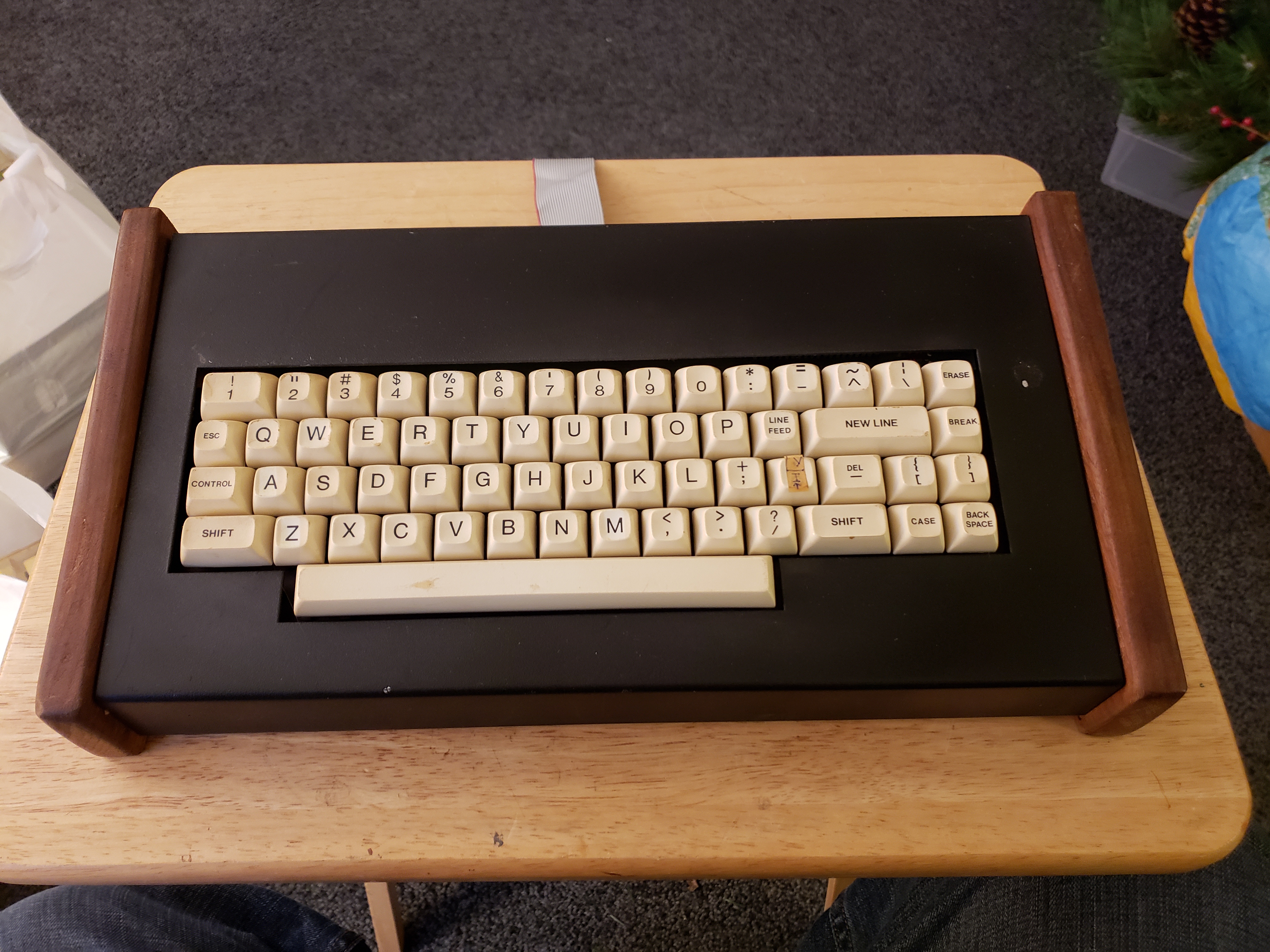
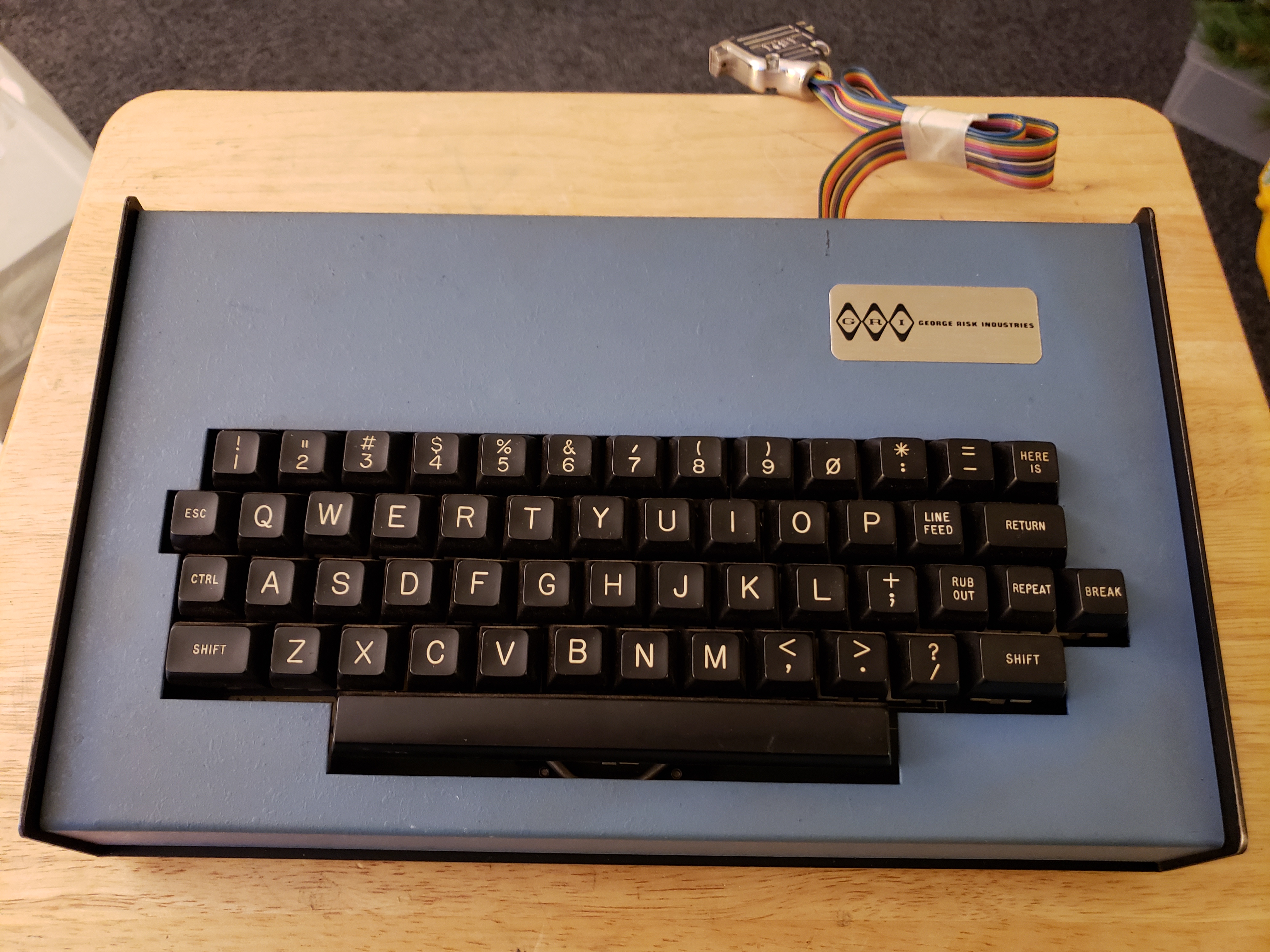
In the form of an estate sale. The first in a long while where I found anything interesting. In addition to buying a large box of 7400 and 4000 series chips, all with 1970's date codes, I got two vintage keyboards:
http://wsudbrink.dyndns.org:8080/images/kb_pics/20181215_162104.jpghttp://wsudbrink.dyndns.org:8080/images/kb_pics/20181215_162139.jpg
The estate sale employees have no idea where the associated systems (if any) are. They did not see them during the sale preparation and have not sold them. I also got a manual and set of 8 inch floppies for "Unicorn Systems Software Tools For CP/M". Twenty floppies, all with factory labels, various libraries, utilities and documentation files. I have not made a careful study of them yet (I just got home with them an hour ago).
Bill S.
---
This email has been checked for viruses by Avast antivirus software.
https://www.avast.com/antivirus
Thank you all for all of the interest. The first person who wrote me isn't
far away at all and will give it a good home, so I'm going to go with him.
While I'm fetching those, I'm going to make a list of other older hardware
for which I'd like to find homes, so I'll post about that, and possibly
about other magazines, in a week or so.
Thanks!
John
For view or download: http://bit.ly/2RZK28Q
I came across this, and noticed that this early of a DEI model was not yet
archived at
http://bitsavers.org/pdf/dei
I'm not sure that it is scanned to the requirements of bitsavers, but I
don't have access to the original, so I offer this if it is usable or of
interest to anyone here.
I'll probably also post it on one of my sites, at http://QICreader.com
I also just acquired this DEI 301034-2 QIC Tape Drive, and have begun to
reverse-engineer it.
https://ebay.to/2EjyxFn
Best always,
--
Thanks,
AJ
Hi, all,
I have a collection of most of BYTE Magazine from the beginning through
about 1985. Instead of selling it on eBay, I'd rather find a home for it
where people can enjoy it. I also have a small collection of other
computer magazines from the late 1970s and early 1980s which I'd like to
include.
Does anyone know of any person or organization within a reasonable
distance from southern California who might take these magazines and
preserve them, instead of just selling them on eBay?
Thanks!
John
--
I don't know which scares me more - that people adhere to the idea of an
omnipotent being powerful enough to create the universe, but whose
supposedly most cherished creation is a race modeled after himself which
can't stop hurting and killing each other, or the idea that those same
people cannot or will not consider the possibility that the universe is
random and unfeeling, and it's up to us to create order and beauty out of
chaos and entropy.
On 12/15/2018 03:22 AM, Rod G8DGR via cctalk wrote:
> I have an idea to produce an MM-8 clone using RAM that acts like core when turned off.
> Can anybody suggest a chip that will do this?
>
>
Any CMOS SRAM chips can do this, with a backup battery. I
used a IS62WV6416DBLL in a project a while ago. I did not
use in in battery-backed mode, but it could do that. You do
have to make sure that any outputs from the memory are
driven to the high-impedance state during power-off to
prevent draining the battery.
Jon
On 12/15/2018 1:22 AM, Rod G8DGR via cctalk wrote:
> I have an idea to produce an MM-8 clone using RAM that acts like core when turned off.
> Can anybody suggest a chip that will do this?
>
> Rod Smallwood
>
>
> Sent from Mail for Windows 10
>
>
I used Everspin MRAM chips for my PDP-8e memory cards. It's just like
SRAM, fast at 35 ns, and unlimited read/write endurance.
Only drawback is it's 3.3 volts only. I just used level converters. It's
a magnetoresistive memory, feels just like core.
$12 for a 64K x 16 chip at Digikey.
Bob
--
Vintage computers and electronics
www.dvq.comwww.tekmuseum.comwww.decmuseum.org
Perhaps Cypress FM1808 (32Kx8). Obsolete, but available on eBay. SOP for a bit of extra challenge!
-----Original Message-----
From: cctech [mailto:cctech-bounces at classiccmp.org] On Behalf Of Rod G8DGR via cctech
Sent: Saturday, December 15, 2018 4:22 AM
To: General Discussion: On-Topic and Off-Topic Posts
Subject: Core memory emulator using non volatile ram.
I have an idea to produce an MM-8 clone using RAM that acts like core when turned off.
Can anybody suggest a chip that will do this?
Rod Smallwood
Sent from Mail for Windows 10
I have an idea to produce an MM-8 clone using RAM that acts like core when turned off.
Can anybody suggest a chip that will do this?
Rod Smallwood
Sent from Mail for Windows 10
About six months ago I struck a deal with a place down in California for
four Documation M1000's that I've been able to tell so far they all work but
I really don't have space for more than one. I've been trying to sell them
at a loss for months now over on the Vintage Computer Forums and Nekochan
(if you got here you'll find pictures) but no bites. I swear there were
people out there that were looking. Where did you folks go? Might anyone
here be interested? I absolutely refuse to put them on the curb.
-John
Merry Christmas and Happy Hanukkah, folks! And holiday greetings to the
rest of us celebrating Festivus!
It's time to treat yourself or your favorite nerd for the holidays, so as
my gift to you I'm offering 10% off anything with a listing date prior to
2018. Check the "Date Added" column in the warehouse item
listings--anything listed in 2016-2017 is 10% off!. If you're a previous
buyer (I know who you are) the 10% off applies to anything!
Here is the latest batch of listings:
Xerox 6085 "Daybreak" CPU
Xerox 6085 IOP Input-Output Processor (C4) board
Xerox ViewPoint 2.0 Software Installation
Xerox ViewPoint 2.0 Documentation Set (Volumes 1-6)
Xerox Desktop Publishing Series: Ventura Publisher Edition manuals
Xerox Telecopier 7032/7033 Facsimile Terminal User Handbook
Connect Computer Z183-2 WonUnder II
Western Digital VGA Plus C
Future Domain Corp TMC-830
Iomega PC2B SCSI Controller
Iomega PC2B50F SCSI Controller
Orchid ProDesigner VGA
Silicon Graphics O2 Workstation
IBM Type 7208-001 External 2.3GB 8mm Tape Drive
BM BM-401 486 CPU Breakout Adaptor
Compaq DeskPro DSM Monitor
HP 2641A/2645A/2645S Display Station Reference Manual
HP 2647A Graphics Terminal Manual Set
HP 13290A/2649A Data Terminal Reference Manual
Advanced Gravis Ultra Sound (boxed)
Universal Data Systems 212 LP Modem (boxed)
You can get to the Virtual Warehouse of Computing Wonders main index to
find links to these and many others items here:
https://docs.google.com/spreadsheets/d/1I53wxarLHlNmlPVf_HJ5oMKuab4zrApI_hi…
As always, please contact me directly by e-mail via <sellam.ismail at gmail.com>
to make an order or an offer.
Thanks!
Sellam
Fellow geeks of more mature vintage,
Do any of you guys know whether it is possible to find out to whom any IBM
equipment was sold back in the day? (Still chasing IBM 2321 Data Cell - I
never learn!)
Many thanks,
peter
|| | | | | | | | |
Peter Van Peborgh
62 St Mary's Rise
Writhlington Radstock
Somerset BA3 3PD
UK
01761 439 234
|| | | | | | | | |
Previously: Manual for Documation TM200 punched card reader
Restoration of the mechanics of my TM200 punch card reader progresses.
There's a writeup here: http://everist.org/NobLog/20180922_data_in_holes.htm#tm200
Currently I'm machining a mold to cast new pinch rollers - and there's the rub (ok kill me.)
The old rubber rollers were decayed to gunk, so there's no chance of measuring their original dimensions.
>From the mechanics, if they were just touching the steel capstan rollers they'd have been 27.1 mm Dia.
The mechanics has no adjustment or spring tension on the pinch roller positions. Their shafts are in fixed
position, so all the spring is in the rubber of the rollers.
Someone who recalls seeing one of these working, says the rubber rollers turned while the capstans turned,
so they must have been actually pressing on them.
But how much squish?
Experimenting with a similar diameter silicone roller (from a photocopier) it semes like 0.2mm of 'squish'
without a card, seems to give a good grip on a card. The cards are 0.1mm thick.
That gives a resting roller diameter of 27.5 mm.
Obviously too much 'squish' is undesirable since the roller would get permanently deformed when left idle in one position.
The 2-part silicone I'll be using for first try at casting rollers has a cured Shore A durometer rating of 60.
I'm hoping someone might have some knowledge of how much punch card reader pinch rollers should press against capstans.
Does 0.2mm squish seem right, or am I way off?
I can try multiple iterations, boring the mold out a little more to make the rollers bigger.
But it would be nice to get it right first time.
I don't yet have a TM200 manual, but the M200 manuals seem to cover pretty much identical mechanics. They give
no dimensions for the rubber rollers, no mention of the contact pressure, or even diagnosing if the rollers are worn.
There are significant differences in the electronics between the M200 and the TM200. I'm really going to need a manual
with schematics once I get to debugging and interfacing the electronics.
Bitsavers only has M200 manuals, and Al Kossow doesn't seem to have had any luck with
> I'm pretty sure I just saw a paper copy of the TM200 manual
> which is different from the M200. I'll have to dig around to
> try to find it again.
If anyone can suggest a source. I'd like to buy a paper copy. Which I'll scan and post at bitsavers etc.
Guy
Do any of you more venerable IBM types know of a way to open one of these to
extract the tape contained inside? It looks a bit fiddly but there might be
a trick to it. (Apart from having the mass storage system itself.)
Many thanks to you for your information and also to Mr Kossow who kindly let
me have some of these.
Peter vp
|| | | | | | | | |
Peter Van Peborgh
62 St Mary's Rise
Writhlington Radstock
Somerset BA3 3PD
UK
01761 439 234
|| | | | | | | | |
Hi all,
I've got an Advantech Labtool48 parallel Port Programmer lately
for fifty bucks. I've got it w/o any Software, cable or documentation
and now I have a few questions.
1. Is the parallel Cable a straight one to one Cable? The Labtool48
has an male connector on the back so a standard cable wouldn't fit..
(ok, think I can reverse engeneer or at least try that if needed..)
2. This isn't a Labtool48UXP, the UXP Version seems to have an USB
connector additionally, doesn anyone know if the Software that Advantech
provides (http://www.aec.com.tw/software_files/LT48UXP_83203.exe) will
work with the Labrtool48?
3. I want to programm Altera PLD's EPM7160LC84. On many sites on the web
can be read that Advantech is providing an PDF with the required "pin
swapping Table" so the user can build adapters himselves..this seems to
be history, the link http://www.aec.com.tw/products/adapters.pdf is dead
and the wayback machine shows that it is dead for many years.
Doens someone has possibly a copy of this pdf?
TIA,
Holm
--
Technik Service u. Handel Tiffe, www.tsht.de, Holm Tiffe,
Freiberger Stra?e 42, 09600 Obersch?na, USt-Id: DE253710583
info at tsht.de Fax +49 3731 74200 Tel +49 3731 74222 Mobil: 0172 8790 741
At 01:14 PM 12/12/2018 -0800, you wrote:
>Well, as I am sure many of you know, ManualsPlus was "acquired" by the Internet Archive.
>This story captures the effort:
>https://www.theatlantic.com/technology/archive/2015/09/introducing-the-arch…
Read it more carefully. Also no, it wasn't. Maybe 1/10 the manuals were 'saved', but that
means stacked in moving boxes in storage. Definitely not accessible, not for sale, indexing
almost certainly lost. Also, it's about time to check what ultimately happened to them.
And don't give me that 'they will get scanned' line. No they won't, and anyway I don't consider
digital copies to be valid historical preservation for posterity. No matter what the scan
quality (which is almost invariably inadequate anyway.)
>Jim Tucker is still selling things on ebay.
>When we'll see the manuals from the archive, who knows?
What's the bet 'never'? Also, by 'see' I'd prefer 'see, holding an original in my hands.'
With the demise of manuals wharehouse/sellers like ManualsPlus that's become MUCH more unlikely.
Incidentally, if anyone happens to be near Finksberg, MD, it would be great to get an update on
what happened with the building. Is it now some other business? Or demolished/redeveloped?
Or just sitting there abandoned? (I'm an urbex enthusiast, I always like to follow the history
of old buildings, especially if they become abandonments.)
Relevant to claims that the ManualsPlus lease was $10K/month. Really curious to know if that was true.
Photos please?
Apologies for the following wall-o-text dump. Just for the record.
-------------------------------------------------------
On the loss of ManualsPlus. Closed Aug 2015.
Manuals Plus.
2002 Bethel Rd, Suite 105 Finksberg, MD.
Phone 410-871-1555. Fax 410-871-1255
em: sales at manualsplus.com
web: www.manualsplus.com
Google maps: https://www.google.com/maps/place/2002+Bethel+Rd+%23105,+Finksburg,+MD+2104…
This:
F:\__Equip_info\!_GKD_Lists\ManualsPlus_demise
See also:
Z \__Libraries_destroyed\20150816_ManualsPlus (the saved flickr pics are there.)
----------------
20141221
http://www.eevblog.com/forum/testgear/manualsplus-going-out-of-business/
20150815
http://ascii.textfiles.com/archives/4683 Original 'ASCII by Jason Scott' (low bandwidth cap)
Same, at archive.org:
https://web.archive.org/web/20150815114528/http://ascii.textfiles.com/archi… (with pics)
Manuals Plus Loadout - A visit to the Manuals Plus Warehouse, and an Army of Volunteers Clearing it Out. 155 photos. By: Jason Scott (2 pages. Painful saving pics)
https://www.flickr.com/photos/textfiles/sets/72157657277241785
See pics on 2nd page - how much was left behind. Tragic.
20150816
An update from Jason. (From Aug 2015 onwards he has many updates.)
http://ascii.textfiles.com/archives/4695
20150816
http://www.eevblog.com/forum/testgear/help-needed-to-archive-te-manuals/ (stub)
20150816
http://www.eevblog.com/forum/chat/rescue-mission-25-000-manuals-baltimore/?…
20150818
https://twitter.com/textfiles/with_replies
In Realtime: We are barely halfway done
http://ascii.textfiles.com/archives/4711
20181213 via cctalk
ManualsPlus was "acquired" by the Internet Archive. This story captures the effort:
20150901
https://www.theatlantic.com/technology/archive/2015/09/introducing-the-arch…
(The few pics are from the flickr page above. Also the article is typical MSM spin.)
My posts in eevblog - rescue-mission-25-000-manuals
---------------------------------------------
http://www.eevblog.com/forum/chat/rescue-mission-25-000-manuals-baltimore/m…
TerraHertz
Posts: 3403
Country: au
Why shouldn't we question everything?
Re: Rescue mission - 25,000 manuals, Baltimore
? Reply #2 on: August 16, 2015, 11:16:05 am ?
Dammit. This would be Manuals Plus.
2002 Bethel Rd, Suite 105 Finksberg, MD.
Phone 410-871-1555. Fax 410-871-1255
em: sales at manualsplus.com
web: www.manualsplus.com
Google maps: https://www.google.com/maps/place/2002+Bethel+Rd+%23105,+Finksburg,+MD+2104…
They sent a flyer to customers (including me) last year announcing their impending going out of business. But then they were still listing on ebay long after the end date, so I'd assumed they'd changed their mind. Now suddenly it's "manuals being dumped in the trash"
It's a tragedy, and should be criminal that they are dumpstering their manuals. Apparently with no attempt to advertise a giveaway. That counts as deliberate, premeditated destruction of cultural and technological treasures. Along the lines of destruction of libraries. (Btw, google that. It's happening a lot lately in a deliberate program by a certain group.)
Hopefully it's not Becky doing the dumping. She is a very nice lady, and appreciates the worth of the manuals. I can't believe she'd do it, even if her boss told her to. That there was no flyer about the actual closure suggests Becky is no longer employed there. I don't know who the business owner is, but I'd certainly like some time 'alone with him.'
I'm in Australia, or I'd be there with a semi and filling up shipping containers. WHHHY can't they donate them to an organization able to store them and give them away?
I really do think that destroying these old and in some cases unique and irreplaceable manuals should be a crime.
People should go there and recover the already dumpstered manuals. And shout abuse at the people doing the dumping. Maybe something involving iron bars and two by fours wouldn't be amiss either. The guy that decided to shut the business down without organizing for the manuals to be saved, deserves a very unpleasant fate. No, the crappy quality scans available online of *some* of these manuals do not count as 'preservation for posterity.' The idea that there are already adequate electronic copies of all these physical manuals is delusional.
A similar thing happened in Australia with a manuals company called High Country Service Data, about 20 years ago. They had a warehouse of service manuals, including many from early Australian electronics companies like BWD. Recently I discovered they had 'gone digital' - had all their manuals scanned (with the very crap scanning technology of the time) then destroyed their entire physical archive. I literally wept. No, I don't want to buy your pathetic digital low quality copies, thanks very much. A*hole.
Notice on google maps that the building is situated in a semi-rural area. Also ManualsPlus is just one unit of that old factory complex. How much can the storage costs be? Combined with the absence of any giveaway attempt makes me suspect the decision to destroy the manuals may be motivated more by an actual desire to destroy them, than by commercial reasons. So far as I know Becky was the only employee, and she always seemed to be worked off her feet with manuals sales.
I can't type words expressing my feelings about this, since this is an all-ages forum. But a lot of them begin with F and C.
Edit to add: Darnit. I wanted to save the article pics from http://ascii.textfiles.com/archives/4683 as a record of this cultural crime.
But now the site is "Bandwidth limit exceeded".
Sigh. It will probably stay that way a while. So I have to go grubbing in caches.
--------------------
http://www.eevblog.com/forum/chat/rescue-mission-25-000-manuals-baltimore/m…
Re: Rescue mission - 25,000 manuals, Baltimore
? Reply #5 on: August 16, 2015, 11:47:41 am ?
Quote from: nctnico on August 16, 2015, 11:22:15 am
@TerraHertz: Did it occur to you that they are going out of business because nobody wants the manuals?
Your argument is invalid, and merely demonstrates that *you* don't want them. How many people buy ebay'd old gear? Did you actually look at ManualsPlus prices?
Quote
I'm sure there will be couple of manuals in the collection which are sought after by people trying to maintain old gear but they really don't want to spend $75 for a manual for a piece of equipment they got for $10.
You are strawman arguing, and should know better. Not 'a couple', but many thousands of manuals. $75 is way too high, and $10 is 1 to 3 orders of magnitude too low for typical worthwhile bits of old gear. Also, speak to any historian about whether current commercial value is a true measure of historic value.
Quote
The golden days for service manuals are over because service manuals don't exist anymore.
Ha ha, fine example of circular logic there. But the last phrase is precisely correct. Service manuals don't exist anymore. Are you saying that is a good thing?
One of the ways in which these manuals are precious, is as a physical demonstration of what good technical documentation should be. To hold up against and shame present day outrageous lack of anything similar.
And such examples are not useful if there's just ONE copy in some library somewhere. They need to be held in many copies across a population to have any effect. Every kid learning electronics should personally experience manuals like these, to make them question why present day manufacturers don't produce such things. To show them the benefits of having tech companies run by honest engineers working for the good of society, rather than by a bunch of soulless marketing droids and lawyers.
----------------------
http://www.eevblog.com/forum/chat/rescue-mission-25-000-manuals-baltimore/m…
Re: Rescue mission - 25,000 manuals, Baltimore
? Reply #10 on: August 16, 2015, 12:23:33 pm ?
Quote from: tautech on August 16, 2015, 12:11:24 pm
Quote from: Deathwish on August 16, 2015, 12:07:23 pm
I refuse to pay for manuals, why should I scan mine and give them free as I have always done for some ingrate to then sell it on ebay.
That's what the FREE manual respository websites are for, upload your obscure manual to make it available to the masses for free.
Pretty sure he was just trolling.
FWIW, here's the flyer from ManualsPlus in Dec 2014. I bought a few manuals as a result, but was/am too poor to go on a real splurge. Even given cheap shipping via shipito, and that ManualsPlus prices were always reasonable and Becky was being extra generous during the sale.
Also I'm pretty sure I mentioned their impending closure here, but didn't save a link to the thread.
Where are all the rich philanthropists, who could easily afford to organize a warehouse and one or two staff for this? Considering some of the stupid things people donate millions to, inability to get this done seems really sad.
Btw, did anyone save the pics from the original article?
------------------------
http://www.eevblog.com/forum/chat/rescue-mission-25-000-manuals-baltimore/m…
Re: Rescue mission - 25,000 manuals, Baltimore
? Reply #13 on: August 16, 2015, 12:55:03 pm ?
Quote from: Deathwish on August 16, 2015, 12:27:56 pm
I was not trolling anyone thank you. I have always scanned what manuals I have and given them freely, I have even seen one or two then being sold against my wishes on ebay, it rankles and annoys me that people who will offer help to save a collection will then suddenly decide hey why shouldn't you pay for what I got free in the understanding i got them for nothing to save them for others to have freely.
Sorry then. Sometimes with your sense of humor it's hard to tell. (But I do enjoy your shenanigans.)
The original article at http://ascii.textfiles.com/archives/4683 is now 'bandwidth exceeded'.
But it was saved today and available at archive.org:
https://web.archive.org/web/20150815114528/http://ascii.textfiles.com/archi… (with pics)
There's also "full photos from today?s shoot" here: https://www.flickr.com/photos/textfiles/sets/72157657277241785
Incidentally, that info about 'lease expired, can't justify cost of relocating' is a teeny bit suspect. That's not what I recall Becky saying in email to me early this year. I'll see if I can find that.
---------------------------
http://www.eevblog.com/forum/chat/rescue-mission-25-000-manuals-baltimore/m…
Re: Rescue mission - 25,000 manuals, Baltimore
? Reply #16 on: August 16, 2015, 01:29:03 pm ?
Quote from: eas on August 16, 2015, 01:01:47 pm
Sounds like the Jason Scott already has some connection with Archive.org. The short term issue is sorting, hauling everything off and storing it until they can come up with a plan for archiving it.
What sorting? It's already neatly sorted and indexed. The hard part would be preserving that during a move.
Anyone in the US able to think of a way someone could put a legal hold on the destruction?
Quote
As for burning libraries, I think someone else started doing that about, oh 2000 years ago?
Oh yes, there's a long tradition of barbarism regarding libraries, much further back even than 2000 years. It's just lately there seems to be a new style. No flames and swords, same end result. I can't mention by whom and why here. But you can probably find out what I mean via google. Incidentally it's a practice I've seen with my own eyes, being done by the specific group (who we can't mention.)
The whole "who needs physical books, digital copies are all we need" bullshit meme seems to go hand in hand with the stealth barbarism. But there's a very sound reason why paper copies are superior in a critical way, that overrides all other considerations - You can't expunge/corrupt/rewrite them.
Either by accident ( see http://everist.org/NobLog/20131122_an_actual_knob.htm#jbig2 re JBIG2 faulty compression ), or deliberately - say hypothetically some group were intent on obliterating the technological heritage of Western Civilization.
Quote
I really hope they are checking printings/dates/revisions when eliminating "duplicates."
I would bet money that isn't happening. (Ha ha, if I had any. But then, I'm certain I'd win the bet, so...)
------------------------
http://www.eevblog.com/forum/chat/rescue-mission-25-000-manuals-baltimore/m…
Re: Rescue mission - 25,000 manuals, Baltimore
? Reply #24 on: August 17, 2015, 12:18:50 am ?
Quote from: nctnico on August 16, 2015, 05:51:30 pm
Yes. I think I bought a couple of manuals from them in the past. You can argue all you want but running a business requires paying customers. Paying customers requires offering a service which customers would pay money for. Going out of business means there are not enough paying customers which in turn means the service provided is no longer wanted.
You keep assuming they are 'going out of business due to lack of sales'. That's not the case at all. The article states it's due to loss of the lease, and not being able to justify the cost of relocating. I know from conversations with Becky (the sole staff) that she was always working non-stop.
And I'm not sure about that lease stuff. So far I can't find the emails, but I'm pretty sure she said it was just the owner deciding to shut down. A decision made in Dec 2014 or earlier. Then the failure to advertise over the last 8 months to see if they could get any takers for the entire collection, so now they would dumptser them, that's barely believable.
Quote
I also agree with the other person about not being able to browse through their collection. That made Manualsplus invisible to Google. If they addressed that earlier they could probably have survived an extra couple of years.
Yes, I agree the website was bad. More incompetence from the owner. But again, it wasn't 'lack of business' according to them. It was loss of the lease.
Quote from: timb on August 16, 2015, 10:42:15 pm
I'm only a couple of hours from Maryland. I've got access to a 42' flatbed and copious amounts of climate controlled storage. I'd be glad to take all the manuals off their hands (and scan them as a long term project).
Well, here are their contact details again.
Manuals Plus.
2002 Bethel Rd, Suite 105 Finksberg, MD.
Phone 410-871-1555. Fax 410-871-1255
em: sales at manualsplus.com
web: www.manualsplus.com
Google maps: https://www.google.com/maps/place/2002+Bethel+Rd+%23105,+Finksburg,+MD+2104…
Please phone them. Now. Also contact Jason Scott and work out some cooperation with him. Main thing would be to stop them dumping manuals off the shelves till you have time to work out how to move them while maintaining sort order. Also they will have an index and ordering system on computer - you'll need that too.
See if you can find out who the building owner is, and talk to them. Are they _really_ terminating the lease? Maybe that story is true, maybe it isn't. Would be good to know for sure.
As opposed to, say Tektronix or Agilent/Siglint or whatever they call themselves now, passing someone a few thousand bucks to eliminate a library of manuals, thinking they might sell a few more new instruments if manuals for older gear are unavailable. Just a thought.
-----------------------------
http://www.eevblog.com/forum/chat/rescue-mission-25-000-manuals-baltimore/m…
Re: Rescue mission - 25,000 manuals, Baltimore
? Reply #27 on: August 17, 2015, 12:15:55 pm ?
Quote from: woodchips on August 17, 2015, 04:21:30 am
I know nothing about the ins and outs of why they are closing. I have been an occasional customer over the years but postage to the UK isn't cheap. I heard about the closure and hopefully in the next week or so will arrive boxes 5 and 6 of the sale manuals. I think I might now have spent more on postage than manuals with the discount on these last boxes. Thanks Becky.
I've been a long term customer too. Also bought what I could afford after hearing of the shutdown. But it wasn't anything like what I wanted to buy. I'm poor atm, though that won't last forever.
Quote
Look at the various threads, buy a Rigol and stuff anything more than 5 years old? My manuals were mostly boring, Tek 7000 stuff and similar, but ManualsPlus had originals, and I an tired of rubbish copies and it was worth the cost to buy and ship them across the pond.
My view is that at least some people should keep test gear that is repairable, as opposed to contemporary gear which isn't. As a 'just in case' precaution, for potential economic and therefore technological regression scenarios.
Also as a collector of old gear partly for the historical interest, it seems stupid to have the gear, but not the original manual, which is part of the aesthetic. And in addition, I find electronic copies pathetic and nearly unusable in a practical sense, even if the quality is good. Which it so frequently isn't. Nothing beats having the stack of paper large foldout schematics.
Quote
This is a very common occurance now in my experience, no one is interested in older things, generally, it is all apparently on the internet.
Yes, and do you know the history of fads and manias? Who can be sure the Internet is going to last forever in its current form? It's only been around what, 20 years so far. This is not sufficient basis to predict eternal availability.
Are you aware of moves by the fascists in the US government, to legislate 'sharing of technical information on the net' into a 'terrorist crime'? Seriously... Unbelievable, but it fits with those arseholes' mentalities.
Quote
I had a nice collection of electromechanical computers, mostly navigation equipment from aircraft, inertial gyros, air data computers, ground position indicators and similar. When I had to downsize it went for auction, would have got more at a scrap yard.
Tragic. Did you offer it via places like this and the vintage computing forums? Or was that before you knew of them?
Quote
Similarly old books, 3rd edition Britannica, a Pantologia, runs of the AJS and similar, these are now valued just for the plates they contain, maps are best, the plate of yet another bridge is used to light the fire. It has taken me years to to actually accept that the things I spent so much time and money on acquiring are now worthless.
You're making a big mistake. The same made by many people, which results in relics being so very rare after a few decades. You're allowing yourself to be conditioned by the prevailing view that monetary value of the moment, is equivalent to moral worth. This is a falsehood. You should decide what value is, within your own moral code. F*ck opinions of others to the contrary.
Quote
I have ST412 working disc drives, no interest, scrapped, similarly with much other computer stuff. No one now has the space to store this stuff, and museums don't seem interested either.
Sob. More tragedy. I'd have taken all that stuff. Incidentally, this 'no one has the space' is not just by accident, it's the result of deliberate social manipulation, intended to disempower the majority of the population. A deliberate side effect of the way the economic system is structured at the moment.
Quote
I am pleased that I bought the manuals I did from MP, and they will be used and appreciated. But they will also go for recycling when I die.
How soon will that be do you think? Any chance you could put me down in your will, to take whatever techno-relics you still have? I'm totally serious, please PM me if you'll consider it. I'm 60 now, will be around a while yet. See http://everist.org/NobLog/ I have a lot of Tek 7000 series stuff, but mostly not yet recommissioned due to the sequencing of getting my workshop set up.
Quote
what is a 7T11? In the end I had a choice, pay MP for the manuals and postage, or keep that money in my savings account. All the others who complain about the manuals being dumped perhaps should have put some money where their mouth is, and bought a couple of thousand $ worth when they could. I did.
So did I, but it wasn't anywhere near that much. The timing is what bugs me. In the next year or so, I'll likely be forced to sell my current large property due to a zoning change. (http://everist.org/no-rezone/ hmmm... needs an update.) I expect to end up with more than enough to rebuild in the country somewhere, including a *much bigger* workshop, and live comfortably. One of the items on my 'new workspace' requirements list, is a _large_ library space. Medium scale library. I wish MP had waited to shut down till that was set up.
---------------------------------
http://www.eevblog.com/forum/chat/rescue-mission-25-000-manuals-baltimore/m…
Re: Rescue mission - 25,000 manuals, Baltimore
? Reply #36 on: August 18, 2015, 05:37:05 pm ?
Quote from: Tothwolf on August 18, 2015, 11:14:25 am
Quote from: TerraHertz on August 16, 2015, 01:29:03 pm
Quote
I really hope they are checking printings/dates/revisions when eliminating "duplicates."
I would bet money that isn't happening. (Ha ha, if I had any. But then, I'm certain I'd win the bet, so...)
You guys need to watch what you say. Becky is aware of this thread and had been following it.
As for duplicate sorting, according to Becky, Jason and others have been hard at work.
Hi Becky! (Guy D from Sydney here.)
I still bet 'duplicate culling' (not sorting, they are ALREADY sorted) isn't happening in any adequate sense. Revision and serial number comparison is *hard* and there's no way it could be done for that archive in the time available. Especially not while also maintaining overall sort order and catalog to shelf grid references.
Also even if it was, it's still a tragedy, since the purpose of the the 'save & move' would ideally be to keep the manuals in this collection available for future purchasers. Which I don't expect will be possible, and that makes me feel ill. Both on principle and because it makes my future equipment life harder. It's like watching a priceless library burn, and nothing I can do about it. Feel like I want to kill someone. Not Becky or the volunteers! Three cheers for their effort. The owner, maybe, depending on what the actual situation is. How come this got left to the last minute? Or perhaps the building owner. Or maybe a bunch of bankers, for creating a debt-riddled system in which a business like ManualsPlus can't own its own premises clear of debt, and have no overheads beyond water, power and maybe land rates.
There seems to be a lot of 'save only one copy of each for scanning' attitude going on here. You can guess what I think of that. Current scanning and encoding file formats are NOT ADEQUATE! There'll be better schemes in future, but till then save all the physical copies, in as many hands as possible to prevent this kind of mass loss.
But, since I can't help or influence in any way, who cares what I think.
Quote
towards their USD $10,000 a month building lease.
I still wish it was possible to do some checking of background details to this. Is "$10K/month" for that not particularly big space in an old subdivided factory in semi-rural area sensible? I don't know, but it does seem a bit hard to believe. Did the lease actually 'get lost'? How & why, given there's not exactly a huge swell in demand for industrial real estate in the USA these days.
Who owns the building, and what's their story?
I know I'll never see answers to these questions, which makes me feel even more ill about the whole thing,
-------------------------------
20150902
http://www.eevblog.com/forum/chat/whats-your-work-benchlab-look-like-post-s…
My comments re destruction of ManualsPlus
Re: Whats your Work-Bench/lab look like? Post some pictures of your Lab.
Quote from: Rupunzell on September 02, 2015, 03:54:47 pm
That file cabinet of service manuals and the other over stuffed book shelf of data books are going no where. These are valuable archives of not only devices from years gone by, they are part of the history of science and technology. There are data books going back to the early 1970's and to the time when semi companies mostly stopped publishing them. Each year at work, there would be a boxes of new data books that would appear. Some would stay at work, some followed me home. Service manuals would appear at the swap and lease where, they would not sell for much at all and often service manuals would appear by the box full and the seller insisted on the buyer taking the entire box, not just one.
There are a number of independent cal labs in and near SV that have very extensive libraries of service manuals. They offer paper copies upon request with a modest fee.
Photocopies, you mean. Which may be 'usable', but are worthless in the historical sense. Nothing beats having an original.
Quote
Many of the more popular instruments from that era can be found on the web, but not any where near all that was available from that time. Much the same applies to semiconductor and numerous other electronics devices. This is why I have kept these vintage data books and catalogs as more often than not, this information can be so very valuable.
Tell me about it. From my own experiences of acquiring old gear then trying to find adequate manuals, I know very well how spotty the online archives are. (And much of what there is, are appallingly bad quality.)
Also electronics data books - this is one area in which the 'it's all online, so just dumpster your physical books' delusion is particularly active. Maybe half my library of data books are from people I knew who decided to toss theirs. I'll NEVER dump mine. They're easier to read than PDFs, you get reminded of other chips, the books are complete with lots of related stuff, and many other reasons why they are superior.
Quote
There is SO much that can be learned from those hewlett packard, Tektronix, Systron Donner, Gigatronics, Fluke and many other's service manuals that is not often appreciated. Some of the very best circuit and systems designers I know spent years of their youth studying what was in these service manuals and learning what made these instruments work and why. Two of well known individuals who spent a LOT of time studying these service manuals and tinkering with test gear from this era are Jim Williams & Bob Dobkin. Stories of other with a similar history can be found on the Analog footsteps blog page:
http://analogfootsteps.blogspot.com/search/label/Bob%20Dobkin
This is the prime reason why there are often post form me about saving and repairing instrumentation from this golden era.
There is a LOT more than just the math to fully understanding how a circuit and it's environment behaves as a unit system. Spending time with these instruments can be an excellent teaching and learning experience.
Yes indeed, I see you are a man after my own heart.
I also have the view that these works are not just a history, but a critical resource should there be any kind of civilization glitch. Most people believe such ideas are silly, but that is just a bad case of normalcy bias. I know from my study of human history (and academic studies like Tainter's 'The collapse of complex societies') that such collapses are the norm in the human story, not the exception. Good luck using 'online pdfs' after a decade or two (or 20, or 100) of no power, fuel or technical education system.
A great deal of the technical foundation of our society has zero adequately preserved 'seed bank of knowledge.' Those service manuals from the 60s through early 90s (before the lawyers and bean counters put a stop to that) are a unique treasure, in the way they detail everything about how the instruments worked. And on paper, that can last hundreds of years if simply kept dry and safe from the elements. Which doesn't require high tech efforts, unlike say maintaining a bank of hard disks and their regular replacement.
Also, and this is very important - ink on paper can't be edited and deliberately corrupted or expunged. If it's there, it's original and true. Something that can't be relied on with digital copies. If you think deliberate 'historical revision' doesn't happen with digital media, you are not paying attention. It happens all the time with film and music for instance.
For those who were wondering why I was spitting mad about ManualsPlus being trashed, this is why. I consider that event a kind of vandalism against the foundations of civilization itself. And no, 'saving one copy of each in rented storage', while slightly better than nothing, isn't good enough. I really do think some people should be shot for the destruction of that library. Not the victims, like Becky, or the people who tried hard and did what they could with inadequate resources. But definitely the business owner, for either incompetence or deliberate acts resulting in the destruction.
Ah well. Centralization of anything is bad, since it exposes the thing to infiltration of control by those who would destroy it.
In a hundred years, it's going to be printed collections of knowledge kept safe privately by people like Rupunzell that will have made a difference.
Too bad there are so few who see the value. But I suppose that is the usual way by which things once relatively common become extremely rare (or completely lost) over time.
------------------------
At 08:34 AM 11/12/2018 -0800, Marc wrote:
>That's a beautiful old scope setup. I have a friend who collects this
>stuff but he is very low budget and on the opposite side of the country
>like me.
Heh. How about 'no budget, and opposite side of the world'? Do I win?
bought this on eBay suspecting it was LSI-11 based because of the floppies labeled DY:
https://www.ebay.com/itm//192437124163
It's kinda neat, has a very late (1989) AED WINC-05 disk controller in it, 11/73
and a bunch of custom daq boards.
It also has a Dilog Qbus to Unibus converter (didn't even know they made one)
and it appears all the custom boards are on the Unibus.
I doubt I'll ever find docs for it though.
More of a computer list I know, but I need to clean out and this needs to
go soon. Big ol tektronix scope on a cart. Was part of a community
workshop, i cleared out all their equipment and have not had the time to
repair it. I was planning to go over it and put it to work at my desk, but
i decided to get a bigger desk and don't have the space for it. i picked
up a hp logic analyzer that fits on the desk, and is more than capable for
working on my pdp 11 and other minicomputer stuff.
open to offers, come pick it up and its yours.
https://i.postimg.cc/NFPC5cDG/scope-555.jpg
located in Melbourne FL
--Devin D.
Yes. Sunos 5.4, Solaris 2.4. I got and installed Solaris 2.6 to
replace that, iirc. I also ran Netbsd and OpenBsd on that machine,
preferring OpenBSD, iirc the video drivers worked best on the
frambuffer I had which was the base model color board. This all
happened in the year 2000 or thereabouts.
Jeff
Gentlepeople,
Once in a while people ask about GCC. It has long had pdp11 support, but it hasn't received much attention. Recently I've done some cleanup on it, and some more is in the pipeline.
One notable new feature is that it can now produce proper DEC Macro-11 syntax output. It has long had a -mdec-asm switch, but that used to produce GNU output. Now it produces DEC output (and -mgnu-asm is how you get output for "gas".)
The optimizer is better, and a bunch of compiler failures are fixed. Undoubtedly there are more bugs to be worked on.
Oh yes, for grins I told GCC to build not just a C compiler but a C++ and Fortran compiler as well. That seems to work (but I get an error building the libstdc++ library). I now have C++ translations of the RSTS standard header files common.mac and kernel.mac, and the DECnet definitions in netdef.sml. :-)
If anyone wants to give this a try, the best way is to get the current code via Subversion (see gcc.gnu.org for details). Alternatively, get a weekly snapshot; the DEC support is in the current latest, though some optimizer work will appear in the next one.
paul
A quick update.
Thanks to those who sent pics of intact rollers.
Derived from those the correct pinch roller diameter is 27.20 mm.
Notes here: http://everist.org/NobLog/20180922_data_in_holes.htm#rub
It seems there's a few people who need new M200 rollers.
Once/if I perfect a successful method of making replacements I'll
offer them for postage and a few dollars. But I'm in Australia.
Or, there's this guy in the USA: http://www.terrysrubberrollers.com/
Now the correct OD is known he's an alternative, with real rubber.
(Maybe my end result will be rubber too. That remains to be seen.)
I still haven't found a service manual for the TM200 (with schematics.)
Guy
I have finally begun working with the card reader I picked up at a VCF
some years back. Mechanically, it's sound, and the rollers are
adequate for short term use (on the top, one is firm and in good
shape, the other is starting the slide to goo but is working well
enough for short-term testing). Mine came with a Cardamation-badged
microprocessor board inside that's a serial converter and so far, I'm
not getting any bits out of it.
I am fairly certain that the product I have was sold as a Cardamation
CF-600 based on pictures and speed. I found this on the Wayback
Machine:
https://web.archive.org/web/20111003183529/http://www.cardamation.com/cardr…
The board in question has a 6802 processor, two 6821 PIA chips for the
parallel interface, an EPROM, 1K of 2114 SRAM, an 8250 UART, and some
misc parts for an RS-232 level shifter. Looking at the DB25F, there
are no bits coming out of pin 2 or pin 3. I have yet to sit down and
trace signals all the way back, but it may come to that.
To assist my probings, while I can reverse-engineer the schematic,
locating any docs would speed up this process greatly. On the board,
there are markings that indicate it's a "Cardamation Feature 92 Rev 4
Assy No 023.0096-9". The EPROM has a paper label indicating that
it's programmed with "V793NE76" whatever that means (likely the
variations are largely centered around what EBCDIC-to-ASCII mapping
was required).
I will be dumping the EPROM to ensure it has sensible contents.
Additionally, I'm always suspicious of 2114 SRAMs. They fail while
sitting on the shelf. Fortunately everything is socketed, so even if
it's an EIA line driver or a PIA or UART or even the CPU, replacement
is trivial. There are no unobtanium parts on this outside of the
programming of the EPROM. Absolutely worse case, I remove this serial
interface and build my own with a modern MCU (I believe Kyle Owen has
recently done this).
If this was 10 years ago, I'd probably start with Cardamation to ask
if they still had any docs on this stuff. I'm reading they closed up
shop in 2011 so that's not an option.
Digging around for old Cardamation articles in trade rags, I see one
of their 300 card-per-minute units spewing the data at 19.2Kbps (I did
try that speed, along with 38.4Kbps). I think the minimum speed is
going to be 9600 bps, but as I'm not seeing any bits on an
oscilliscope, I'm sure it's not the settings on the receive side
(yet).
-ethan
Went to toggle in the RIM loader ? huh !
Memory address 04 stuck low.
So either try another 4k core (after changing the jumpers)
or...
Trace the signal path.
What do we think?
Rod
Sent from Mail for Windows 10
Many many years ago in a distant galaxy (called Strathclyde University Computer Science) we ran a game on the
PDPs. It was great at testing out terminal line speed handing and debugging curses (well that is what we told the
bosses).
I remember the game as being called ?search?. But since we had the source code it could have been anything.
It was played on 24 x 80 dumb terminals. It was multi user. In the game you moved around the universe in your
craft - the display was a kind of 3-D picture (you got closer to a plant and the planet got bigger - try drawing increasing
circles on a 24x80!).
You could travel through the universe shooting other craft (friend of foe). The only craft name I think I remember is
?shankers? - becuase we had source a lot of the craft names turned into locally relevant names.
You could team up with other players and (1 line) communication with a group or with that player.
I have searched (on and off) for the game.
I cant find anything like it.
I would like it to test out the DZ cards on my PDP! - OK that is my excuse ;-)
Is anybody aware of what I am talking about? Does anyone have any old code anywhere?
Aye, it was not as good as the old GT40 - but it was a different era.
Hi all --
Finally got all the parts together (and my act together) to actually get an
RK05 lashed up to my PDP-8/e -- only took a decade or so :). I fixed a few
problems with the RK05 and it appears to be behaving very nicely.
The RK8E controller is mostly working properly but fails interestingly when
running the formatter, and during the exerciser -- on cylinder 128 and 192
and very infrequently on cylinder 64 it will get a cylinder mismatch when
doing the seek. When running the formatter during the verification pass,
on cyls 64 and 128 if I retry the read it'll continue without issues, but
it's never successful on a retry on cylinder 192. I tried hooking it to
the RK05 in my 11/40 and it exhibits the same behavior, so I'm guessing the
drive isn't at fault. And the error is consistent across packs (of which I
have only two).
Apart from that fault the drive and controller seem to work fine -- I wrote
out an OS/8 pack with Adventure on it (or at least the first 191 cylinders
of it) and it works without issue.
Reading the RK8E service docs and schematics, the cylinder address compare
is done by reusing the CRC buffer, so I suspect the issue is in or around
there -- the big problem is that debugging it is rather painful since that
logic is in the middle board of a three board set, with jumper blocks on
top -- so bringing it out on an extender isn't an option. I'm curious if
anyone's seen this issue or is so very familiar with the logic that the
fault is obvious.
I suspected the 7496 shift register at E14 which takes in the cylinder
address to be compared w/the header on disk, and I went ahead and replaced
it in the hopes that I'd get lucky, but no go.
Anyone have any advice?
Thanks,
Josh
Checking out a SUN SPARC station ELC tonight. It powers up, passes self test.
Boot fails because the CMOS RAM battery is dead, so it's lost boot config.
That's no problem, it's an ST MK48T02B-25 'TIMEKEEPER RAM' 2K x 8, which
is still available. Or I'll probably just cut open the tophat and connect a new battery.
Then RTFM to find how to tell it to boot from external SCSI device 3.
By extreme good fortune this machine came with a complete set of manuals.
The main problem is the video monitor worked for a few minutes, then dropped to
about half brightness - and since then is randomly varying in brightness.
Before I open it up and start connector wiggling and hunting bad caps, dry joints
and so one, does anyone know if schematics for the monitor exist online?
Guy
> From>: Christian Corti
> I thought that the DEC packs would be similar but no, DEC had to invent
> something different...
Huh? I thought RL0x drives use an IBM 5440 type pack (as used on the IBM
System/3 - I used one of those at my first computer job, they'd just gotten
it in); DEC may have used their own format (and servo track stuff), I don't
know much about the 5440.
Noel
> From: Jay Jaeger
> I have finished the 3rd phase of my IBM 1410 SMS computer
> reverse-engineering project. ... The ALDs comprise 752 pages from 9 of
> the 11 total volumes of system schematics/engineering drawings ... It
> took me roughly 375 hours of time (probably more like 450 - not all time
> was captured) to capture the data into a database
Wow. I am super impressed. My hat is off... Fantastic job!
Noel
I have used Access Port on Win. Lot easier than TeraTerm and also supports 110 Baud.
http://www.sudt.com/en/index.html
[http://www.sudt.com/images/sn_en_230x160.gif1zB]<http://www.sudt.com/en/index.html>
SUDT.com<http://www.sudt.com/en/index.html>
SUDT SerialNull 1.7: SerialNull is a professional Serial Port Simulator, which purpose is to emulate RS232 serial ports connected via virtual null-modem cable using SerialNull.. Virtual Serial Ports are absolutely the same copies of real ones; Real serial ports are not occupied
www.sudt.com
- Johannes Thelen
Finland
Before microcomputers blog (Finnish) http://ennenmikrotietokoneita.blogspot.fi/
________________________________
From: cctalk <cctalk-bounces at classiccmp.org> on behalf of Rod G8DGR via cctalk <cctalk at classiccmp.org>
Sent: Friday, December 7, 2018 11:59 AM
To: General Discussion: On-Topic and Off-Topic Posts
Subject: PDP-8/e
Hi All
Seasons Greetings..
My PDP-8/e was long due for a major overhaul.
1. So everything out
2. Big Hoover job on the Omnibus
3. Bring up on Variac ? No smoke
4. Check PSU volts. ? All OK
5. Power off
6. Install minimal System ? Front Panel, Three CPU cards, RFI shield, 4k Core and Bus term.
7. Yup all looks in right order
8. Power on
9. Toggle in standard AC count up program
10. Clear + Cont
11. And they are racing at Rockingham!!
12. Yup counts up just like it should.
13. Let it run for a while.
14. All stop.
15. PSU off
16. Inset Async Card (Its 110 baud only)
17. Fire up VT100. Beep - yup its alive.
18. Toggle in keyboard echo test.
19. Clear + Cont ? Program runs
20. And .. yes keyboard gets echoed back.
OK now I need a little help.
Does anybody know of a terminal emulation program that will simulate the reader on an ASR33?
I know about RIM and BIN loaders but how and what to feed them I have long forgotten
My PDP-8 course completion certificate is dated November 1975.
Rod Smallwood
Sent from Mail for Windows 10
On 07/12/2018 09:59, Rod G8DGR via cctalk wrote:
> OK now I need a little help.
> Does anybody know of a terminal emulation program that will simulate the reader on an ASR33?
> I know about RIM and BIN loaders but how and what to feed them I have long forgotten
For a Unix or Linux machine, there's send and rsend, and several other
utilities, that you can find at Kevin McQuiggin's web page:
http://highgate.comm.sfu.ca/pdp8/
and on mine:
http://www.dunnington.info/public/PDP-8/
--
Pete
Pete Turnbull
I have finished the 3rd phase of my IBM 1410 SMS computer
reverse-engineering project. The first phase was writing a software
machine-cycle simulator - almost 20 years ago, in part to verify I had
usable software. The 2nd phase was writing code and setting up a
database to do the 3rd phase - capturing data from IBM Automated Logic
Diagrams (ALDs).
The ALDs comprise 752 pages from 9 of the 11 total volumes of system
schematics/engineering drawings, volumes II-X. (Volume I is the power
supply and volume XI is additional memory).
It took me roughly 375 hours of time (probably more like 450 - not all
time was captured) to capture the data into a database that contains
10,565 ALD logic blocks, 1281 "DOT functions" where outputs of gates
joined as a "Wired OR", with 4222 distinct signal names appearing as
12,398 entries on the 752 pages, and over 32,700 individual connections.
The sheets (as reprints from scanned originals) stacked up are 2" high.
The second photo is one of them (with marks I made during data capture)
is pictured here. The third photo is a screenshot of that page in the
application I developed. (The numbers at the bottom, which do not appear
on the original sheet, are a gate number on a given SMS card, the number
of inputs to that block, and the number of outputs from the block. The
little "A" characters appearing between columns represent "DOT functions."
I ran a regression in Excel to estimate the time for capturing a given
sheet, which ended up as:
Time (in minutes per page) = -7.1 +
1.00 * # ALD blocks on the page (the rectangles) +
0.50 * distinct signals coming from / going to other sheet(s) +
2.24 * # "DOT Functions" on the page +
0.15 * # of connections to/from ALD blocks on the page +
0.39 * # of edge connection locations (at the bottom)
Most of the residuals - the difference between the actual value recorded
and what the equation would calculate - were under 25%.
The "DOT Function" coefficient is probably correlated to the overall
complexity of the page - "DOT Functions" themselves were easy to enter.
The next step is to clean up some things in the application and tune the
database to perform better, at which point I expect to make the
application available via some online GIT repository so it can be used
for other SMS machines (IBM 1620, IBM 1401, IBM 7000 series and the like).
Then it will be on to synthesis of sections of the machine (CPU, memory,
console) for which I have drawings and some kind of stand-in for parts I
don't have drawings for (1414 I/O Synchronizers, tape drives, etc.).
The photos referenced can be found at the public facebook post at:
https://www.facebook.com/jay.jaeger.3/posts/2100428726685075
On Sat, Dec 8, 2018 at 1:55 AM Rod G8DGR <rodsmallwood52 at btinternet.com>
wrote:
> Nice try Josh - close ? you have to change the crystal first and you
> can?t get them.
>
https://www.mouser.com/ProductDetail/ABRACON/AB-196608MHZ-B2?qs=sGAEpiMZZMu…
>
>
> Rod Smallwood - Digital Equipment Corporation 1975 ? 1985
>
>
>
>
>
> Sent from Mail <https://go.microsoft.com/fwlink/?LinkId=550986> for
> Windows 10
>
>
>
> *From: *Josh Dersch via cctalk <cctalk at classiccmp.org>
> *Sent: *08 December 2018 06:36
> *To: *General Discussion: On-Topic and Off-Topic Posts
> <cctalk at classiccmp.org>
> *Subject: *Re: PDP-8/e
>
>
>
> On Fri, Dec 7, 2018 at 10:29 PM Rod G8DGR via cctalk <
> cctalk at classiccmp.org>
>
> wrote:
>
>
>
> > It can only do 110 baud !!
>
> >
>
>
>
> Unless you have an oddball SLU, this is not true -- what do you have
>
> installed? The earlier M8650 and the later M8655 can both be jumpered for
>
> higher baud rates.
>
>
>
> - Josh
>
>
>
>
>
>
>
> >
>
> > Sent from Mail for Windows 10
>
> >
>
> > From: Pete Turnbull via cctalk
>
> > Sent: 08 December 2018 03:15
>
> > To: cctalk at classiccmp.org
>
> > Subject: Re: PDP-8/e
>
> >
>
> > On 07/12/2018 17:46, Jon Elson via cctalk wrote:
>
> > > On 12/07/2018 11:38 AM, Rod G8DGR via cctalk wrote:
>
> > >> Oh good how do you set them to 110 baud?
>
> > >>
>
> > > Oh, WOW! Good catch, it only goes down to 300 baud! major screwup,
>
> > > ought to be reported to the developers.
>
> >
>
> > But wouldn't it be better to set the serial card in the PDP-8/E to
>
> > something faster anyway? Although on one of the serial cards, that
>
> > requires a crystal change, so though commonly done, may not be practical
>
> > for Rod.
>
> >
>
> > --
>
> > Pete
>
> > Pete Turnbull
>
> >
>
> >
>
>
>
> From: Jay Jaeger
> That code would not run in Windows of course, but it wouldn't be all
> that difficult for someone with a C programming background to move it
> to Windows under gnucc, or even Microsoft C++ or C#.
I highly recommend CygWin (which comes with 'gnucc) for doing C stuff under
Windoze:
https://www.cygwin.com/
Most Unix/Linux code just compiles and runs under it; modulo stuff that uses
things that are so Unix/Linux specific that there's no Windows equivalent,
but that's not much - fork() is even there. If you already know Unix/Linux,
it makes for a very low-learning-curve transition.
Noel
I did that sort of thing for my PDP-8/L, where the reader run drove the
RS-232 "CTS" control signal and wrote a "C" program to do simple TTY
emulation in DeSmet C back in the day.
That code would not run in Windows of course, but it wouldn't be all
that difficult for someone with a C programming background to move it to
Windows under gnucc, or even Microsoft C++ or C#.
On 12/8/2018 1:10 AM, Rod G8DGR via cctalk wrote:
> I?m sure that would work but I only have an 8650 110 baud only card
> Rod
>
>
> Sent from Mail for Windows 110 baud
>
> From: Bob Rosenbloom via cctalk
> Sent: 08 December 2018 03:41
> To: cctalk at classiccmp.org
> Subject: Re: PDP-8/e
>
> On 12/7/2018 7:01 PM, Pete Turnbull via cctalk wrote:
>> On 07/12/2018 17:44, Jon Elson via cctalk wrote:
>>> On 12/07/2018 11:22 AM, systems_glitch via cctalk wrote:
>>>> Indeed, unless you need character pacing.
>>>>
>>>>
>>> Actually, with the correct settings of the serial port (xon/xoff or
>>> CTS pin) the serial port driver should do this, too, so cat would work.
>>
>> A PDP-8/E doesn't have a CTS pin and the loaders don't support
>> XON/XOFF, though.
>>
> The PDP-8 needs to control the serial CTS function. This was called
> reader-run when using a Teletype machine. FOCAL won't load without it.
> You can modify the serial card (mine was an M8655) to support the
> function. Here's what I did:
>
> Cleaned up from Aaron Nabil's and Lyle Bickley's write up.
>
> ?Hack the M8655 to support reader-run by mapping it to RS-232 hardware
> flow control.
>
> 1. Cut the trace leading from Pin 1 of E54 (a 7400).? This is the input
> that clears the Reader Run FF when a new character starts to come in.
>
> 2. Jumper from Pin 1/E54 to Pin 3/E38, a spare gate on a 7400 that we
> are going to use an inverter.
>
> 3. Tie Pin 1 and Pin 2 of E38 together, and run them to Pin 20 of E19,
> the UART.
> ??? This supplies the signal to the reader-run FF that tells it that
> it's got an incoming character and to de-assert the reader-run line.
> ??? Normally this is tied to the current loop receiver, we've just
> moved it to the UART so any received data will clear the FF.
>
> 4. Cut a ground traces on 4 of E50, a 1488 RS-232 transmitter. This is
> what would normally supply the continuously asserted RTS (and DTR) signal.
>
> 5. Jumper from pin 7 of E39, a 7474 flip-flop to pins 4 of E50. E39 is
> the "reader-run flip-flop".? Now RTS follows the reader run signal.
>
> Bob
>
The Sparcstation 4/330 I reworked the NVRAM chip on....
I got it as-is from Computer Parts Barn in Asheville, NC. It was just
round the corner from my home in Oakley..
The machine wouldn't start due to NVRAM, which I fixed. It then
actually booted from the original drives, had an OS and data on it. My
curiosity was piqued. This is what I did:
I hung the drive on my PC running Linux (suse, iirc), and ran John the
Ripper on it. I didn't get the root, but I got a user password.
I hung the drive back on the Sparcstation and logged in as that user.
The machine was being used to model the exhaust from various
configurations of rocket nozzles. The previous owner turned out to be
NASA at the Marshal Space Flight Center.
I wanted root.
I set out to abuse the OS, did quite a bit, had a hunch based on the
experience while sussing the NVRAM problem. I set the date to 1970,
booted, and logged in as the valid user I'd got from good old John.
The machine bombed to a single user prompt with a kernel panic
'irrational date'. Passwd worked to change the root pw to something I
knew. I went back into the monitor cli, changed the date to the real
date, booted and logged in as root.
The version of Sunos was 2.4?
Just thought this might be helpful to someone.
Jeff
Well I got there in the end.
HyperTerm on an old DEC Celebris running W95
Thanks for all the input
Now to move some diags. over and see if we can load them
Rod
Sent from Mail for Windows 10
On 08/12/2018 09:55, Rod G8DGR via cctalk wrote:
> Nice try Josh - close ? you have to change the crystal first and you can?t get them.
Both Farnell and Mouser UK have suitable crystals. They don't have to
be the same physical size. I've changed several.
--
Pete
Pete Turnbull
On 12/8/18 1:55 AM, Rod G8DGR via cctalk wrote:
> Nice try Josh - close ? you have to change the crystal first and you can?t get them.
Dead bug a programmable epson ttl oscillator module, available from digikey
On Fri, Dec 7, 2018 at 10:29 PM Rod G8DGR via cctalk <cctalk at classiccmp.org>
wrote:
> It can only do 110 baud !!
>
Unless you have an oddball SLU, this is not true -- what do you have
installed? The earlier M8650 and the later M8655 can both be jumpered for
higher baud rates.
- Josh
>
> Sent from Mail for Windows 10
>
> From: Pete Turnbull via cctalk
> Sent: 08 December 2018 03:15
> To: cctalk at classiccmp.org
> Subject: Re: PDP-8/e
>
> On 07/12/2018 17:46, Jon Elson via cctalk wrote:
> > On 12/07/2018 11:38 AM, Rod G8DGR via cctalk wrote:
> >> Oh good how do you set them to 110 baud?
> >>
> > Oh, WOW! Good catch, it only goes down to 300 baud! major screwup,
> > ought to be reported to the developers.
>
> But wouldn't it be better to set the serial card in the PDP-8/E to
> something faster anyway? Although on one of the serial cards, that
> requires a crystal change, so though commonly done, may not be practical
> for Rod.
>
> --
> Pete
> Pete Turnbull
>
>
On Fri, Dec 7, 2018 at 11:10 PM Rod G8DGR via cctalk <cctalk at classiccmp.org>
wrote:
> I?m sure that would work but I only have an 8650 110 baud only card
> Rod
>
The M8650 does a wide variety of baud rates. See here:
https://homepage.divms.uiowa.edu/~jones/pdp8/hard8e/kl8e.html
- Josh
>
>
> Sent from Mail for Windows 110 baud
>
> From: Bob Rosenbloom via cctalk
> Sent: 08 December 2018 03:41
> To: cctalk at classiccmp.org
> Subject: Re: PDP-8/e
>
> On 12/7/2018 7:01 PM, Pete Turnbull via cctalk wrote:
> > On 07/12/2018 17:44, Jon Elson via cctalk wrote:
> >> On 12/07/2018 11:22 AM, systems_glitch via cctalk wrote:
> >>> Indeed, unless you need character pacing.
> >>>
> >>>
> >> Actually, with the correct settings of the serial port (xon/xoff or
> >> CTS pin) the serial port driver should do this, too, so cat would work.
> >
> > A PDP-8/E doesn't have a CTS pin and the loaders don't support
> > XON/XOFF, though.
> >
> The PDP-8 needs to control the serial CTS function. This was called
> reader-run when using a Teletype machine. FOCAL won't load without it.
> You can modify the serial card (mine was an M8655) to support the
> function. Here's what I did:
>
> Cleaned up from Aaron Nabil's and Lyle Bickley's write up.
>
> Hack the M8655 to support reader-run by mapping it to RS-232 hardware
> flow control.
>
> 1. Cut the trace leading from Pin 1 of E54 (a 7400). This is the input
> that clears the Reader Run FF when a new character starts to come in.
>
> 2. Jumper from Pin 1/E54 to Pin 3/E38, a spare gate on a 7400 that we
> are going to use an inverter.
>
> 3. Tie Pin 1 and Pin 2 of E38 together, and run them to Pin 20 of E19,
> the UART.
> This supplies the signal to the reader-run FF that tells it that
> it's got an incoming character and to de-assert the reader-run line.
> Normally this is tied to the current loop receiver, we've just
> moved it to the UART so any received data will clear the FF.
>
> 4. Cut a ground traces on 4 of E50, a 1488 RS-232 transmitter. This is
> what would normally supply the continuously asserted RTS (and DTR) signal.
>
> 5. Jumper from pin 7 of E39, a 7474 flip-flop to pins 4 of E50. E39 is
> the "reader-run flip-flop". Now RTS follows the reader run signal.
>
> Bob
>
> --
> Vintage computers and electronics
> www.dvq.com
> www.tekmuseum.com
> www.decmuseum.org
>
>
>
On 12/07/2018 11:38 AM, Rod G8DGR via cctalk wrote:
> Oh good how do you set them to 110 baud?
>
Oh, WOW! Good catch, it only goes down to 300 baud! major
screwup, ought to be reported to the developers.
Jon
Will be having some extra brochures for plated memory from Memory systems Inc.? in El Segundo Calif. Available soon.? appears? to? be? from month? 4? of? 1973? and? 3? different? ?sheets? both? sides.
?
I? know? about? core memory? but this is? something? I never? used..
?
these may be out there already? somewhere? ? ??
?
Ed#
?
?
Hi All,
I have a PDP-8/e that's missing the knob on the front panel.
Does anyone have a spare for sale, or know of a compatible part?
Looking up the DEC parts numbers has turned up nothing but the
engineering drawings...
I've never seen another one in person so I can't tell if the knob is meant
to attach to a shaft on the rotary switch, or if the knob itself is meant
to have a shaft. Either way, I'm lacking both, so have been making do with
a screw wrapped in tape.
Regards,
-Tom
mosst at sdf.lonestar.org
SDF Public Access UNIX System - http://sdf.lonestar.org
Teraterm on Windows definitely goes to 110 baud. I use it all the time...
Rob.
On 12/7/2018 10:38 AM, Rod G8DGR via cctalk wrote:
> Oh good how do you set them to 110 baud?
> Rod
>
>
> Sent from Mail for Windows 10
Listed these on eBay a few times. No takers.
Being offered here for the price of USPS Media Mail cost. Total of 52 lbs of
books in 2 boxes. I estimate shipping at $137.
Price will be actual shipping cost payable by PayPal.
See books at http://www.myimagecollection.com/ITBooks/
Slides pause for 5 seconds each or you can click the Pause button.
No pressure but they hit the trashcan 12/14/2018. J
> From: Paul Birkel
>> I thought RL0x drives use an IBM 5440 type pack (as used on the IBM
>> System/3 .... DEC may have used their own format (and servo track
>> stuff), I don't know much about the 5440.
> Sounds to me like it was different, but in a good way?
I took a look, and found a manual for a 5440:
http://bitsavers.org/pdf/ibm/system3/GA33-3002-0_5444_5440_ComponentsDescr_…
and the details (format, etc) are indeed different. The packs are physically
compatible, but that's as far as it goes.
Noel
The MAME folks have the 68K versions of the terminals mostly working in simulation
now, and are wondering if anyone could dump the firmware from the 88K model, which
has a similar hardware design.
tip is the standard BSD program for calling other unix systems. It's a fine
terminal program. 'tip -110 com1' is all you'd need to do in this case :).
Warner
On Fri, Dec 7, 2018 at 10:39 AM Rod G8DGR <rodsmallwood52 at btinternet.com>
wrote:
> Er whats tip?
>
>
>
>
>
> Sent from Mail <https://go.microsoft.com/fwlink/?LinkId=550986> for
> Windows 10
>
>
>
> *From: *Warner Losh via cctalk <cctalk at classiccmp.org>
> *Sent: *07 December 2018 17:36
> *To: *systems_glitch <systems.glitch at gmail.com>; General Discussion:
> On-Topic and Off-Topic Posts <cctalk at classiccmp.org>
> *Subject: *Re: PDP-8/e
>
>
>
> These days I just use tip.
>
>
>
> Warner
>
>
>
> On Fri, Dec 7, 2018, 10:25 AM systems_glitch via cctalk <
>
> cctalk at classiccmp.org wrote:
>
>
>
> > Indeed, unless you need character pacing.
>
> >
>
> > Thanks,
>
> > Jonathan
>
> >
>
> > On Fri, Dec 7, 2018 at 12:13 PM Guy Sotomayor Jr via cctalk <
>
> > cctalk at classiccmp.org> wrote:
>
> >
>
> > > I just use ?cat?. Seems to work fine. ;-)
>
> > >
>
> > > TTFN - Guy
>
> > >
>
> > > > On Dec 7, 2018, at 4:57 AM, Pete Turnbull via cctalk <
>
> > > cctalk at classiccmp.org> wrote:
>
> > > >
>
> > > > On 07/12/2018 09:59, Rod G8DGR via cctalk wrote:
>
> > > >
>
> > > >> OK now I need a little help.
>
> > > >> Does anybody know of a terminal emulation program that will simulate
>
> > > the reader on an ASR33?
>
> > > >> I know about RIM and BIN loaders but how and what to feed them I
>
> > have
>
> > > long forgotten
>
> > > >
>
> > > > For a Unix or Linux machine, there's send and rsend, and several
> other
>
> > > utilities, that you can find at Kevin McQuiggin's web page:
>
> > > > http://highgate.comm.sfu.ca/pdp8/
>
> > > > and on mine:
>
> > > > http://www.dunnington.info/public/PDP-8/
>
> > > >
>
> > > > --
>
> > > > Pete
>
> > > > Pete Turnbull
>
> > >
>
> > >
>
> >
>
>
>
>
> On Thu, Dec 6, 2018 at 4:39 AM Liam Proven via cctalk <
> cctalk at classiccmp.org>
> wrote:
>
> > On Thu, 6 Dec 2018 at 12:44, Tony Duell <ard.p850ug1 at gmail.com> wrote:
> > >
> > > I don't think anyone is questioning that it's a workstation, and that
> it
> > was made by Sun.
> > >
> > > I think the problem is over 'first' and that a Sun-2 is not going to be
> > the 'first' model.
> >
> > Ah! Excellent point. I have to admit, I was totally unfamiliar with
> > the very early Sun products. I was happy with my little ZX Spectrum
> > back then, and being about 14, wasn't paying much attention to the
> > world of academic Unix usage. :-)
> >
> > Looking up the SUN-1, I see that it lacked a graphics adapter, and was
> > a text-only machine. I didn't know that. That alone means that it's
> > not really what I think of when I think of a Sun workstation: no
> > windowing system means that for me it's not really a workstation.
>
> The Sun-1 absolutely had a framebuffer and a display and was not a
> text-only machine, it did 1024x800 at 1bpp, had a mouse, the whole deal.
>
> See the picture in this article, for example:
> https://www.britannica.com/topic/Sun-Microsystems-Inc
I can 100% confirm this. I have a Sun 1/100 that runs just fine...and it
fires up Suntools with mouse and windows... Windowing pretty much the same
as any other
Sun running circa Sun OS 3.2 It came standard with B/W framebuffer. I
also have the color framebuffer option (not currently installed... don't
have a monitor that
works with that) The base system has a monitor that does what looks like
the standard Sun 1152x900 resolution (I've not confirmed that but sure
looks the same as my other early Suns...)
Earl
I thought folk might enjoy this short-ish (~12min) Youtube video
showing startup of arguably the first ever Sun workstation, from a
contemporaneous SunOS... I did.
Permission obtained before x-posting, naturally.
--
Liam Proven - Profile: https://about.me/liamproven
Email: lproven at cix.co.uk - Google Mail/Hangouts/Plus: lproven at gmail.com
Twitter/Facebook/Flickr: lproven - Skype/LinkedIn: liamproven
UK: +44 7939-087884 - ?R (+ WhatsApp/Telegram/Signal): +420 702 829 053
---------- Forwarded message ---------
From: Walter Belgers <walter+rescue at belgers.com>
Date: Sat, 1 Dec 2018 at 12:34
Subject: Re: [rescue] Sun2/120 SunOS 3.2 suntools movie (was: advise
on Sun2 disk install)
To: The Rescue List <rescue at sunhelp.org>
Hi,
Another update in case you are interested:
I rescued a keyboard and mouse to go with the Sun2. I also installed SunOS 3.2
on disk. I took a different route: I installed FreeBSD, installed tme on top
of that and using the information at
https://people.csail.mit.edu/fredette/tme/
<https://people.csail.mit.edu/fredette/tme/>,
http://www.heeltoe.com/index.php?n=Retro.Sun2
<http://www.heeltoe.com/index.php?n=Retro.Sun2> and
http://typewritten.org/Projects/Sun/8-4841.html
<http://typewritten.org/Projects/Sun/8-4841.html> I installed SunOS 3.2 from
virtual tapes onto a virtual harddrive. I then copied the virtual drive to a
real drive and hooked it up. I could then boot SunOS 3.2!
I then took the one TTL monitor I have (for the 2/50) and hooked it up to a
bwtwo. At first it did not work, apparently it must be in a specific slot. I
added 1MB as well, so the cage is fully populated. That extra MB is used by
the btwo. The monitor still worked and I was able to run the graphical
windowing system.
I had the system on the internet for a couple of hours yesterday, some people
logged in remotely and it still felt surprisingly fast. Only when you start
hammering the disk it is slow (SCSI-1 is slower than ESDI drives I read).
I made a movie of the box, it can be viewed here: https://youtu.be/CoAYs0Uc7As
<https://youtu.be/CoAYs0Uc7As>
Cheers,
Walter.
_______________________________________________
rescue list - http://www.sunhelp.org/mailman/listinfo/rescue
What are people doing for early Sun monitor replacements? I've got a Sun
3/60 that I'd like to hook up to a modern monitor, but am unaware of any
means of doing so.
Thanks!
Kyle
On 12/07/2018 03:59 AM, Rod G8DGR via cctalk wrote:
>
> Does anybody know of a terminal emulation program that will simulate the reader on an ASR33?
> I know about RIM and BIN loaders but how and what to feed them I have long forgotten
> My PDP-8 course completion certificate is dated November 1975.
>
> Rod Smallwood
>
>
>
> Sent from Mail for Windows 10
>
>
I use minicom on Linux, but don't know if a Windows version
is available. It has allowed me to connect to a bunch of
older devices and send data back and forth.
Jon
Several years ago when I restored my 8/M, I whipped up
a quick and dirty program that uses TCL/Tk to make a
little graphical interface for selecting, reading, and punching
paper tape images. When running, it looks something
like this:
https://www.cs.drexel.edu/~bls96/museum/asrscreen.jpg
You need the P9P (Plan9 from user space) libraries installed
to build it, but I could whip up a binary for you if you'd like
to try it out. I typically run it in a shell script that looks like:
#!/bin/sh
xterm -vb -sb -geom +180+10 -fg '#D0D0FF' -bg black -e asr33 $*
BLS
--------------------------------------------
On Fri, 12/7/18, Rod G8DGR via cctalk <cctalk at classiccmp.org> wrote:
Subject: PDP-8/e
To: "General Discussion: On-Topic and Off-Topic Posts" <cctalk at classiccmp.org>
Date: Friday, December 7, 2018, 4:59 AM
Hi All
? Seasons Greetings..
My PDP-8/e was long due for a major
overhaul.
1. So everything out
2. Big Hoover job on the Omnibus
3. Bring up on Variac ? No smoke
4. Check? PSU volts. ? All OK
5. Power off
6. Install minimal System ? Front
Panel, Three CPU cards, RFI shield,? 4k Core and Bus
term.
7. Yup all looks in right order
8. Power on
9. Toggle in standard AC count up
program
10. Clear + Cont
11. And they are racing at
Rockingham!!
12. Yup counts up just like it should.
13. Let it run for a while.
14. All stop.
15. PSU off
16. Inset Async Card (Its 110 baud
only)
17. Fire up VT100. Beep - yup its
alive.
18. Toggle in keyboard echo test.
19. Clear + Cont ? Program runs
20. And .. yes keyboard gets echoed
back.
OK now I need a little help.
Does anybody know of a terminal
emulation program that will simulate the reader on an
ASR33?
I know about? RIM and BIN loaders
but how and what to feed them I have long forgotten
My PDP-8 course completion certificate
is dated November 1975.
Rod Smallwood
Sent from Mail for Windows 10
Congrats!!
On Fri, Dec 7, 2018 at 3:59 AM Rod G8DGR via cctalk <cctalk at classiccmp.org>
wrote:
>
> Hi All
> Seasons Greetings..
>
> My PDP-8/e was long due for a major overhaul.
> 1. So everything out
> 2. Big Hoover job on the Omnibus
> 3. Bring up on Variac ? No smoke
> 4. Check PSU volts. ? All OK
> 5. Power off
> 6. Install minimal System ? Front Panel, Three CPU cards, RFI shield, 4k
> Core and Bus term.
> 7. Yup all looks in right order
> 8. Power on
> 9. Toggle in standard AC count up program
> 10. Clear + Cont
> 11. And they are racing at Rockingham!!
> 12. Yup counts up just like it should.
> 13. Let it run for a while.
> 14. All stop.
> 15. PSU off
> 16. Inset Async Card (Its 110 baud only)
> 17. Fire up VT100. Beep - yup its alive.
> 18. Toggle in keyboard echo test.
> 19. Clear + Cont ? Program runs
> 20. And .. yes keyboard gets echoed back.
>
> OK now I need a little help.
> Does anybody know of a terminal emulation program that will simulate the
> reader on an ASR33?
> I know about RIM and BIN loaders but how and what to feed them I have
> long forgotten
> My PDP-8 course completion certificate is dated November 1975.
>
> Rod Smallwood
>
>
>
> Sent from Mail for Windows 10
>
>
Hi All
Seasons Greetings..
My PDP-8/e was long due for a major overhaul.
1. So everything out
2. Big Hoover job on the Omnibus
3. Bring up on Variac ? No smoke
4. Check PSU volts. ? All OK
5. Power off
6. Install minimal System ? Front Panel, Three CPU cards, RFI shield, 4k Core and Bus term.
7. Yup all looks in right order
8. Power on
9. Toggle in standard AC count up program
10. Clear + Cont
11. And they are racing at Rockingham!!
12. Yup counts up just like it should.
13. Let it run for a while.
14. All stop.
15. PSU off
16. Inset Async Card (Its 110 baud only)
17. Fire up VT100. Beep - yup its alive.
18. Toggle in keyboard echo test.
19. Clear + Cont ? Program runs
20. And .. yes keyboard gets echoed back.
OK now I need a little help.
Does anybody know of a terminal emulation program that will simulate the reader on an ASR33?
I know about RIM and BIN loaders but how and what to feed them I have long forgotten
My PDP-8 course completion certificate is dated November 1975.
Rod Smallwood
Sent from Mail for Windows 10
I bought this and a line clock module on eBay and it turns out the person I got it for
only needed the clock, so it's available for $50 plus shipping
You need this if you're going to try to run Unix on an 11/35 or 40 and they are pretty
tough to find.
Hello David
I saw your posting on the cctalk mailing list regarding RSX180.
It is Hector Peraza that's been tinkering with this. He intends making the
full source-code available via SourceForge or GitHub but is still working
on preliminary web pages and documenting etc. No doubt he will provide you
with more details.
I've been tinkering with a Z280 system designed by Bill Shen (the Z280RC on
the RetroBrew web site at
https://www.retrobrewcomputers.org/doku.php?id=builderpages:plasmo:z280rc )
and have contacted Hector about porting it to the Z280.
A Z180 system is also on my hobbyist "to-do" list. Should you decide to
produce another run I'd be interested in one. Most likely I'd use a
CompactFlash on IDE interface and an GoTek style floppy emulator with it.
--
Tony Nicholson <tony.nicholson at computer.org>
I don't know who did it, but here's a video of a P112 running RSX:
https://www.youtube.com/watch?v=5s6IOCCk3Uw
If the creator of this thing is reading, I'd very much like to get my
hands on RSX-180 and put it up on the P112 page at Sourceforge, Gitlab,
et al.
--
David Griffith
dave at 661.org
A: Because it fouls the order in which people normally read text.
Q: Why is top-posting such a bad thing?
A: Top-posting.
Q: What is the most annoying thing in e-mail?
The re-work of that Dallas nvram chip is just beautiful. It makes me
ashamed of myself. (I just chopped into the epoxy with a pocket knife,
soldered two leads, and velcroed the new batteries somewhere inside the
machine I installed it in.)
I salute you sir.
Jeff
At 12:24 PM 4/12/2018 -0800, you wrote:
>On Mon, Dec 3, 2018 at 5:09 AM Christian Corti via cctalk <
>cctalk at classiccmp.org> wrote:
>
>> Hi,
>> how does one open a RL02 disk pack? A couple of packs need cleaning but I
>> can't figure out how to open them...
>>
>>
>I was curious to see if there would be any replies to this. I have just shy
>of 40 RL02 packs, and a few of them had bad scratches rendering them
>useless. Therefore, I attempted to open them in a non-destructive way, just
>to see if it was possible. So far, I haven't had much luck. Also, I noted
>that while all the packs I attempted were DEC (not clones), they did have
>slightly different construction and mechanics, probably based on production
>date.
>
>- Earl
Ha, this made me realize I don't know either. Despite that I now have some RLO3K-DC
packs, and one RLO2 drive.
Dug one out. After a few moments of being stumped, found the trick. Here's how:
On the blue handle, top center, look on the section that has the pivot pins.
There is a flat plastic 'button' on which one end is slightly concave.
With the handle DOWN (flat), put finger on that concave end of the button, and
push sideways, till the button reaches the end of travel.
With it still at end of travel, lift the handle up to vertical. At about 45 degrees
(half way) you'll feel a resistance, then hear a thump.
Once the handle is vertical, lift the pack up by the handle. The lower cover is
separated and the disk is exposed.
But it still is mostly covered, only a slot for the heads is open.
You could lever open the several latches that hold the bottom inner cover on if you wanted.
Guy
Since RS6K systems have been mentioned recently, I thought I should ask
for advice.? I have a Powerserver 320H with 32MB of RAM, an 8-port async
EIA-232 adapter, a SCSI adapter and a 400MB HD.?? No framebuffer or
keyboard; no LAN card.? Because of the last issue, I haven't tried to do
much with it.? I tried getting it to talk on the serial console (Serial
1 connector in the back), following all the advice I found on the net:?
The pinout of the MODU serial connector, the null modem cable with full
handshake (also driving the DCD line in the 320H).? I turn it on in
service mode, and it spits a lot of LED codes, finds the HD, spins it up
and it apparently loads something (I suppose AIX) from it.? But nothing
is? ever sent out on the serial 1 port, or any other serial port.? I
believe that during the POST it fails to initialize the serial 1 and 2
ports, because the 320H's DTR and RTS lines are never asserted (the
ports in the async RS232 card do assert these on power up, but they are
equally silent). I made sure that the CTS, DSR and DCD inputs of the
320H are being driven by the external terminal.
I made a video of the LED codes during POST and found some problems;
here are the codes and their meaning:
120 BIST starting a CRC check on the 8752 EPROM.
122 BIST started a CRC check on the first 32K bytes of the OCS EPROM.
124 BIST started a CRC check on the OCS area of NVRAM.
130 BIST presence test started.
101 BIST started following reset.
153 BIST started ACLST test code.
154 BIST started AST test code.
100 BIST completed successfully; control was passed to IPL ROS.
211 IPL ROM CRC comparison error (irrecoverable). !!!!!!!
214 Power status register failed (irrecoverable).?????????? !!!!!!!
218 RAM POST is looking for good memory.
219 RAM POST bit map is being generated.
290 IOCC POST error (irrecoverable).???????????????????????? !!!!!!!
291 Standard I/O POST running.
252 Attempting a Service mode IPL from 7012 DBA disk-attached
???????? devices specified in IPL ROM Default Device List.
253 Attempting a Service mode IPL from SCSI-attached devices
???????? specified in the IPL ROM Default Device List.
299 IPL ROM passed control to the loaded program code.
814 NVRAM being identified or configured.
538 The configuration manager is going to invoke a configuration
???????? method.
813 Battery for time-of-day, NVRAM, and so on being identified or
???????? configured, or system I/O control logic being identified or
???????? configured.
538 The configuration manager is going to invoke a configuration
???????? method.
520 Bus configuration running.
538 The configuration manager is going to invoke a configuration
???????? method.
869 SCSI adapter being identified or configured.
538 The configuration manager is going to invoke a configuration
???????? method.
954 400MB SCSI disk drive being identified or configured.
538 The configuration manager is going to invoke a configuration
???????? method.
539 The configuration method has terminated, and control has
???????? returned to the configuration manager.
551 IPL varyon is running.
553 IPL phase 1 is complete.
The code 290 above is particularly worrysome, I think.? The NVRAM
battery reads 2.85 volts even after all these years. I reseated all of
the chips that are on bases, all of the cards, and connectors; there was
no change.? Any ideas on how to proceed?
carlos.
Hi all --
I picked up a ZAX ICD-178 in-circuit debugger in the hopes of using it
to help debug / reverse-engineer a couple of 68k-based machines I have.?
This unit can work with 68000, 68010, and 68008-based machines, however
a different emulation CPU module is used for the 68008 vs. the
68000/68010.? Unfortunately, mine came with only the 68008 CPU module.
Since this is a fairly uncommon device, I figure it's unlikely, but just
in case someone's sitting on a pile of parts somewhere, if you have the
68000/68010 Emulation CPU module ("CPU S-813") please drop me a line.
Thanks as always,
Josh
>
> Date: Sun, 2 Dec 2018 16:49:37 -0800
> From: Alan Perry <aperry at snowmoose.com>
> Subject: Re: sun model 47. code 4/40 does it have the nvram with
> battery?
>
> The RDI Britelite (laptop) is a SPARCstation IPX system board in a
> laptop chassis.
>
I have IPC, IPX, and LX versions of the RDI Britelite.
--
Michael Thompson
I'm trying to id this system I just rescued last month.? It is an Eclipse of some type.
Chip date codes are 1976-1977? The front panel is white with blue paddle switches.The rear panel ID plate says? it's a 8461, SN 4802-142-157. it has Options? 4192, 4010, 4042.? it's a 16 slot back plane and was part of a EMI? Cat scan system.
There are 16 boards in this, 9 are DG and the rest my are EMI scanner boards.
Not sure what sales model it is?? ie? C330 or C130 or ???
The front panel is trashed, so what are the differences? between the front panels fromother models.
Are there any manuals for this out there ??
The back plane has 2 damaged chips.? one has a? 74S133 which i understand the other has 20a.?if I read it right.? looks to be a hex inverter of some type ??
Any help would be appreciated
Thanks, Jerry
Ouch, what was I thinking? Mentioning a project I fundamentally can't talk in detail about yet; not very smart.
Thus spawning a thread guaranteed to go chaotic. Sorrrry!
Also I've changed the title, since it's disrespectful to drag a deceased person's name along with this.
I've been busy a couple of days, didn't have time to follow the thread. Still busy, but briefly with extracts:
@ Keelan Lightfoot
> Our problem isn't ASCII or Unicode, our problem is how we use computers.
> Markup languages are a kludge, relying on plain text to describe higher level concepts.
[snip lots]
Nice post, and I agree with all of it. This is the type of thinking needed, and in general much like my approach. Except I'm a software and hardware designer, synthesist, and pursue practical results. Or at least _try_ to.
Funny you mention keyboards, as that's one of the project's bootstrapping steps. First a simulated keyboard (html & js initially) to allow free experimentation, later an open hardware design suitable for makers, 3D printing, etc. The crappyness of commercial keyboards is a bugbear of mine. Keyboards should be MUCH better than they are. And last forever.
@ Grant Taylor & Toby Thain
>> ???? bold
>> ???? italic
>> ???? overline
>> ???? strike through
>> ???? underline
>> ???? superscript exclusive or subscript
>> ???? uppercase exclusive or lowercase
>> ???? opposing case
>> ???? normal (none of the above)
>This covers only a small fraction of the Latin-centric typographic
>palette - much of which has existed for 500 years in print (non-Latin
>much older). Computerisation has only impoverished that palette, and
>this is how it happens: Checklists instead of research.
>Work with typographers when trying to represent typography in a
>computer. The late Hermann Zapf was Knuth's close friend. That's the
>kind of expertise you need on your team.
More generally, an encoding standard needs to allow for ANY kind of present and future characters, fonts and modifiers.
But even more critically, it has to allow for such things without reference to 'central standards groups'. Enforced centralism is poison. For instance Unicode, and that vast table of symbols - that still doesn't include decent arrows (and many other needs.) What's required is a way for any bunch of people to be able to define their own character sets, fonts, adornments, etc, create definition files for them, and use those among themselves. Either embedded in documents or used as referenced defaults - both must be possible. It is easy enough to define a base encoding that allows this. And in which legacy coding (ASCII, Unicode, etc) is one of the available defaults.
The point with embedding such capabilities in the base coding scheme, and then building the superstructure of computing language and OS on top of that, is to achieve a scheme in which human language and typesetting freedom is available through the entire structure.
@ Cameron Kaiser
>> Surely a Chinese or Japanese based programming language could be
>> developed.
>The Tomy Pyuuta has a very limited BASIC variant called G-BASIC which has
>Japanese keywords and is programmed with katakana characters (such as "kake" ...
Exactly, except it should be possible for any group (eg who speak whatever language) to modify existing computer language to their own human dialect. With compilers and assemblers this is not trivial, but with dictionary-based interpreters it's much easier. The keywords and operators are all just looked up in tables to achieve effects, and what characters or ideograms serve as the keywords are entirely flexible.
Then imagine one interpretted scripting language, that serves multiple functions: document layout, user apps and OS scripting. And that scripting language can be phrased in any human language, AND includes full typsetting of itself.
@ Liam Proven
> There are a wider panoply of options to consider.
...
> Try to collapse all these into one and you're doomed.
Lots of great references, thanks! As for doomed... well we'll see. I think the trick is to merely provide a mechanism for including extensible classes of 'stuff' in the base coding. Because being rigid about the mechanics of the higher level capabilities really is fatal. Fortunately, 'flexible extensibility' isn't so hard to do. Especially when you have a bunch of disused legacy control codes to work with.
At 02:34 PM 28/11/2018 -0700, Jim Manley wrote:
>Some computing economics history:
>
>I'm an engineer and scientist by both education and experience,
[snip]
>A theoretically "superior" encoding may
>not see practical use by a significant number of people because of legacy
>inertia that often makes no sense, but is rooted in cultural, sociological,
>emotional, and other factors, including economics.
Yep. I'm intensely aware of the economics and inertia factors. Points:
1. The ASCII-replacement coding is just a part of a wider project.
2. It's all a private project, for fun.
3. And yet there's a convergence of developments suggesting an opportunity in near future.
MS/Intel are bastardizing, backdooring and box-closing the Wintel platform into something so evil even non-technical people are getting sick of it. This will continue, due to political agenda of MS/Intel.
Simultaneously the competing Linux world is fragmenting into churn-chaos. (Complex but irreversible reasons.)
Apple is... Apple. Becoming a platformm based mostly on virtue signalling, and increasingly as bad as Wintel.
4. If it ever is released, it will be freeware, open hardware and copylefted. DRM specifically banned from the platform. With many quite appealing wow-factors, several of which will be totally killer. It is not politically possible for MS/Intel/Apple to follow this path.
[snip]
>Logic and reasoning are
>simply nowhere near enough to create the conditions necessary for
>widespread adoption - sometimes it's just good luck in timing (or, bad
>luck, as the case may be).
Absolutely. It's mostly about politics and meme-crafting. Ref: Marx, L Ron Hubbard,
Mao, various religions, etc. Odd isn't it - so few instances of memetic weavers who
used their skills for the benefit of humankind. As opposed to those guys above, who
were all arseholes with pretty twisted objectives. Did you know L Ron Hubbard created
Scientology to win a drunken bet in a bar? Someone said "I bet you can't create a
religion!" And L Ron said "I bet I can!"
>ASCII was developed in an age when Teletypes ...
Yep.
>You can't blame the ASCII developers for lack of foresight when no one in
>their right mind back then would have ever predicted we could have upwards
>of a trillion bytes of memory in our pockets ...
Absolutely. ASCII was a godsend at the time and I take pains to make this clear in the proposal docs. This is a _hindsight_ refactoring.
>Someone thinking that they're going to make oodles of money from some
>supposedly new-and-improved proprietary encoding "standard" that discards
>five-plus decades of legacy intellectual and economic investment, is
>pursuing a fool's errand.
Ha ha, I don't intend to even try to make any money from this. Other objectives.
Though, I'd probably set up a donations channel. Just in case people like it.
> Even companies with resources at the level of
>Apple, Google, Microsoft, etc., aren't that arrogant, and they've
>demonstrated some pretty heavy-duty chutzpah over time. BTW, you won't be
>able to patent what apparently amounts to a lookup table, and even if you
>copyright it,
Patents and copyright are poisons that are crippling intellectual and technological progress. The original concepts were OK, but got over-extended by greed (and still getting worse.) Patents in particular have become a tool for big corporate suppression of any potential competition, while copyright is used to destroy free expression. The entire DRM/copyright legal framework should be nullified.
This project will be intentionally copyright and patent excluding. Freeware, published, open source, open hardware, etc. Just a conformance symbol, which certifies (among other things) that _nothing_ in the systems & software is under any kind of DRM restriction. People buy or build such a system, they own it entirely.
This is why I can't mention details or coined terminology now.
>True standards are open nowadays - the days of proprietary "standards" are
Except that by 'open' they usually mean you can pay a lot of money for a copy of the standard doc.
That's not what I call 'open.'
>a couple of decades behind us - even Microsoft has been publishing the
>binary structure of their Office document file formats. The specification
>for Word, that includes everything going back to v 1.0, is humongous, and
>even they were having fits trying to maintain the total spec, which is
>reportedly why they went with XML to create the .docx, .xlsx, .pptx, etc.,
>formats. That also happened to make it possible to placate governments
>(not to mention customers) that are looking for any hint of
>anti-competitive behavior, and thus also made it easier for projects such
>as OpenOffice and LibreOffice to flourish.
>
>Typographical bigots, who are more interested in style than content, were
>safely fenced off in the back rooms of publishing houses and printing
>plants until Apple released the hounds on an unsuspecting public. I'm
>actually surprised that the style purists haven't forced Smell-o-Vision
>technology on The Rest of Us to ensure that the musty smell of old books is
>part of every reading "experience" (I can't stand the current common use of
>that word). At least I have the software chops to transform the visual
>trash that passes for "style" these days into something pleasing to _my_
>eyes (see what I did there with "severely-flawed" ASCII? Here's how you
>can do /italics/ and !bold! BTW.).
Oh yes, tell me about it. 'Do it this way' bigots of all kinds. Pick any possible thing that can be done more than one way, and there will be camps of fanatics insisting their one way is the true way and all others are crazy.
Finding such artificial dichotomies (or n-way splits) has been a very rich source of inspiration for holistic rethinking.
Btw, again I'll emphasize that when I say ASCII is severely flawed, I mean this in the context of what we know now about information coding requirements, and creating extensible systems. It was't 'severely flawed' back when it was created.
>Nothing frosts me more than reading text that can't be resized and
>auto-reflowed, especially on mobile devices with extremely limited display
>real estate. I'm fully able-bodied and I'm perturbed by such bad design,
>so, I'm pretty sure that pages that prevent pinch-zooming, and that don't
>allow for direct on-display text resizing/auto-reflow, violate the spirit
>completely, if not virtually all of the letters, of the Americans with
>Disabilities Act (and similar legislation outside the U.S., I imagine).
Well, there's more than that one requirement. If one wanted to capture a historical document, the absolute image of the page(s) is a core aspect, and can't be 'reflowed'. But otoh, the text content should be accessible as a searchable and reflowing character stream. A decent coding scheme will support both objectives simultaneously.
Btw I'm constantly amazed by how badly tech docs are being 'digitized' even now. Service manuals with fold out schematics, screened tonal multi-colour illustrations etc... just endless awful digital copy fails. Meanwhile the original paper copies get rarer and rarer, because idiots think 'those are all online now, paper copies are obsolete', and throw them out.
@ Keelan Lightfoot
>from a usability standpoint, control codes are
problematic. Either the user needs to memorize them, or software needs
to inject them at the appropriate times.
You're thinking of 'control codes' as something you type by holding down CTRL and some other key. Yes, these are a pain and I personally hate UI's that depend on memorising lots of them.
But strictly speaking 'control codes' are the byte codes 0x00 to 0x1F, in the ASCII table. Most of which are now little used apart from in hardware protocols. How those would be brought into use in an ASCII-replacement and new UI, is another topic. Sadly, part of the area I won't talk about. Just bear in mind that this system includes new keyboard designs, and 'things that have to be memorised' are fine for some people but not for others (including me.)
Ha ha, even ctrl-C and ctrl-V for cut and paste are a pain, not because they must be memorised, but because the ergonomics of distorting the fingers to type them, is horrible for such a common action. Stuff like this...
Oh, and if you are wondering if I'm imagining some huge keyboard with even more keys, no. Personally I use a short ('10-keyless') keyboard, and don't want to ever have to go back to stupidly big keyboards.
>In addition to crusty old computers, I also enjoy the company of three
crusty old Linotypes. In fact, that's what got me thinking about this
stuff in the first place.
Ah, I am intensely jealous! I wish I could find an old but working linotype. And someone to teach me how to use it. Hot lead, yeah! (I used to cast things in lead as a child, have done bronze casting and intend to do more.)
I have some exposure to typesetting & printing; enough to know how much I don't know. Some articles on related topics are in-progress, but not yet posted.
Anyway, back on topic (classic computing.) Here's an ascii chart with some control codes highlighted.
http://everist.org/ASCII/ascii_reuse_legend.png
I'm collecting all I can find on past (and present) uses of the control codes. Especially the ones highlighed in orange. Not having a lot of success in finding detailed explanations, beyond very brief summaries in old textbooks.
Note that I'm mostly interested in code interpretations in communications protocols. Their use in local file encodings not so much, since those are the domain of legacy application software and wouldn't clash with redefinition of what the codes do, in future applications.
And now, back to machining a lock pick for a PDP-8/S front panel cylinder lock.
http://everist.org/NobLog/20181104_PDP-8S.htm#locks
Guy
Hi folks,
In my long ongoing quest to image and otherwise copy the hard sectored floppies with my Exidy Sorcerer I?m trying to find other floppy drives I can use with it since I don?t like relying on just one set of drives. I have a Cumana dual drive set that came with my TRS80 Model1 that I thought might be jumperable to 300rpm, indeed I can see drive activity if I try and boot.
Does anyone know where I might find the/a manual for the drives? They?re marked as Intertec 5002040 so I?ve been all over Superbrain docs and PDFs on bitsavers but haven?t found anything so far.
Cheers!
--
adrian/witchy
Owner of Binary Dinosaurs, the UK's biggest private home computer collection?
t: @binarydinosaurs f: facebook.com/binarydinosaurs
w: www.binarydinosaurs.co.uk
Firstly, my goal: to run MazeWar on something other than a NeXT.
I thought this would be fairly straightforward, starting with getting SunOS
4.1.3 booting with QEMU. Turns out, I've not had much luck. I get different
error messages depending on what machine type I'm emulating. I can start
booting from the .iso running this command:
$ qemu-system-sparc -bios ss5.bin -M SS-5 -m 64M -drive
file=sunos413.img,if=scsi,bus=0,unit=3,media=disk -drive
file=SunOS_4.1.3_sparc.iso,format=raw,if=scsi,bus=0,unit=6,media=cdrom,readonly=on
-boot d
and get a near immediate panic:
machine type 0x80 in NVRAM
panic: No known machine types configured in!
Data Access Exception
ok
Okay, how about trying the default BIOS and SS-20? It definitely gets
further, but no dice...
Boot: vmunix
Size: 843776+2315672+64016 bytes
SuperSPARC/SuperCache: PAC ENABLED
SunOS Release 4.1.3 (MUNIX) #3: Mon Jul 27 16:47:33 PDT 1992
Copyright (c) 1983-1992, Sun Microsystems, Inc.
cpu = SUNW,SPARCstation-20
mod0 = TI,TMS390Z55 (mid = 8)
mem = 49020K (0x2fdf000)
avail mem = 44707840
Ethernet address = 52:54:0:12:34:56
espdma0 at SBus slot f 0x400000
esp0 at SBus slot f 0x800000 pri 4 (onboard)
sd2: non-CCS device found at target 2 lun 0 on esp0
sd2 at esp0 target 2 lun 0
sd2: <QEMU 0 blocks>
sd2: Vendor 'QEMU', product 'QEMU', (unknown capacity)
sd3: non-CCS device found at target 0 lun 0 on esp0
sd3 at esp0 target 0 lun 0
sd3: corrupt label - wrong magic number
sd3: Vendor 'QEMU', product 'QEMU', (unknown capacity)
ledma0 at SBus slot f 0x400010
le0 at SBus slot f 0xc00000 pri 6 (onboard)
zs0 at obio 0x100000 pri 12 (onboard)
zs1 at obio 0x0 pri 12 (onboard)
SUNW,fdtwo0 at obio 0x700000 pri 11 (onboard)
BAD TRAP: cpu=0 type=29 rp=f00daba4 addr=0 mmu_fsr=0 rw=0
MMU sfsr=0: No Error
regs at f00daba4:
psr=40400cc7 pc=f00a0968 npc=f00a096c
y: 20000 g1: f00c1e78 g2: 40900ce6 g3: fb005ff0
g4: 2c g5: f00db000 g6: 0 g7: 30000000
o0: 1 o1: 8 o2: f00dac00 o3: f0076e50
o4: 0 o5: 0 sp: f00dabf0 ra: f1000000
(unknown): bad trap = 41
rp=0xf00daba4, pc=0xf00a0968, sp=0xf00dabf0, psr=0x40400cc7, context=0x0
g1-g7: f00c1e78, 40900ce6, fb005ff0, 2c, f00db000, 0, 30000000
Begin traceback... sp = f00dabf0
Called from f00c1eb8, fp=f00dac58, args=ff009000 f00dacbc 0 f0314a70 1000
1000
Called from f00a7d34, fp=f00dacc0, args=ff009000 0 ff009000 fb002098
f0314a70 ff009000
Called from f00a7708, fp=f00dad20, args=1080000 d f0102d50 f0102db3 0 2
Called from f00a74e0, fp=f00dad80, args=f0305bd4 f0102d50 fb001000 fb001050
0 0
Called from f00a5028, fp=f00dade0, args=f00fc000 fefe0014 0 0 f0102d50
f0305bd4
Called from f00ac084, fp=f00dae40, args=72 1000 1 1 86 800000
Called from f0015f7c, fp=f00daef8, args=800000 100000 fb000000 2fdd 2000 2
Called from f000539c, fp=f00daf58, args=f00dafb4 f00076c0 10801522 821020ff
200 f00ce600
Called from 403f0c, fp=0, args=4000 3ffd60 1 235598 4000 0
End traceback...
panic: trap
rebooting...
Then I thought, why not use The Machine Emulator to emulate a Sun 3 and
play with something even older? I can't get that to build using clang under
OS X 10.9. I've changed a few lines of source already to get it further
along in the compilation process, but now I'm stuck:
In file included from module.c:48:0:
module.c: In function 'tme_module_init':
module.c:93:3: error: 'lt_preloaded_symbols' undeclared (first use in this
function); did you mean 'lt_dlloader_remove'?
LTDL_SET_PRELOADED_SYMBOLS();
^
Okay, now I'm tired of trying to emulate it (actually, I still would like
to play with QEMU or TME...), so I pulled a SS-20 off the shelf and threw a
SCSI2SD card in it. I didn't have a means of burning a CD, so I used the
SCSI2SD to also emulate a CDROM drive at device 6, and unplugged the
existing CDROM drive. I can boot off of it just fine, and I get now even
further along the process of installation, and am able to format the hard
drive. Right when I think things are going well, I get this:
esp0: Target 6.0 reverting to async. mode
sr0: SCSI transport failed: reason 'data_ovr': giving up
m partition number 3
fastread: can't read label on /dev/rsr0:I/O error
ERROR while loading miniroot disk: /dev/rsd0b
#
Any ideas?
Thanks,
Kyle
I'm not sure how many of you who are on this list are on the vcfed.org
forum, but just for those who aren't, with the help of Dave and Monty from
there, I have recently restored a 4051 I bought a couple years ago to
working condition. Last night with their guidance I connected it to a
Tektronix development system called the Board Bucket, also a 6800 driven
machine that Tek engineers/employees could buy from Tek (I think in parts)
that I purchased previously.
With the 4051 in terminal mode, we were able to demonstrate that the BASIC
in ROM in the Board Bucket can drive graphics on the Tek terminal. This was
pretty much clear after I dumped the ROMs and Dave had a close look at them,
but it was still very cool to see the two working together nonetheless. I
feel very privileged to have both one of the products of Tek's computer
development efforts and the development machine used to help create it
(and/or others) in my possession.
Anyway for those interested, I posted a 4 min video here:
https://www.youtube.com/watch?v=SSkHRzx5Bno
Brad
At 09:49 PM 26/11/2018 -0700, Grant wrote:
>On 11/26/18 7:21 AM, Guy Dunphy wrote:
>> Oh yes, tell me about the html 'there is no such thing
>> as hard formatting and you can't have any even when
>> you want it' concept. Thank you Tim Berners Lee.
>
>I've not delved too deeply into the lack of hard formatting in HTML.
It was a core of the underlying philosophy, that html would NOT allow
any kind of fixed formatting. The reasoning was that it could be displayed
on any kind of system, so had to be free-format and quite abstract.
Which is great, until you actually want to represent a real printed page,
or book. Like Postscript can. Thus html was doomed to be inadequate for
capture of printed works. That was a disaster. There wasn't any real reason
it could not be both. Just an academic's insistense on enforcing his ideology.
Then of course, over time html has morphed to include SOME forms of absolute
layout, because there was a real demand for that. But the result is a hodge-podge.
>
>I've also always considered HTML to be what you want displayed, with
>minimal information about how you want it displayed. IMHO CSS helps
>significantly with the latter part.
Yes, it should be capable of that. But not enforce 'only that way'.
By 'html' I mean the kludge of html-css-js. The three-cat herd. (Ignoring all the _other_ web cats.)
Now it's way too late to fix it properly with patches.
>> Except that 'non-breaking space' is mostly about inhibiting line wrap at
>> that word gap.
>
>I wouldn't have thought "mostly" or "inhibiting line wrap". I view the
>non-breaking space as a way to glue two parts of text together and treat
>them as one unit, particularly for display and partially for selection.
>Granted, much of the breaking is done when the text can not continue (in
>it's natural direction), frequently needing to start anew on the next line.
And that's why in html that character is written " "
You just rephrased my 1.2 lines as 5 lines.
>> But anyway, there's little point trying to psychoanalyze the writers of
>> that software. Probably involved pointy-headed bosses.
>
>I like to understand why things have been done the way they were.
>Hopefully I can learn from the reasons.
We already established that they thought it a good idea to insert fancy 'no-break'
coding if the user typed two spaces. They thought they were adding a useful feature.
I meant there's no point trying to determine why they were so deluded, and failed to
recognise that maybe some users (Ed) would want to just type two spaces.
>
>> Of course not. It was for American English only. This is one of the
>> major points of failure in the history of information processing.
>
>Looking backwards, (I think) I can understand why you say that. But
>based on my (possibly limited) understanding of the time, I think that
>ASCII was one of the primordial building blocks that was necessary.
YES! I'm not arguing ASCII was _bad_. It was a great advance. There was
no way they could have included the experience of 50 more years if comp-sci.
And now 'we' (the world) are stuck with it for legacy compatibility reasons.
Any extensions have to be retro-compatible.
[snip]
>> Containing extended Unicode character sets via UTF-8, doesn't make it a
>> non-hard-formatted medium. In ASCII a space is a space, and multi-spaces
>> DON'T collapse. White space collapse is a feature of html, and whether
>> an email is html or not is determined by the sending utility.
>
>Having read the rest of your email and now replying, I feel that we may
>be talking about two different things. One being ASCII's standard
>definition of how to represent different letters / glyphs in a
>consistent binary pattern.
That's what you are talking about.
> The other being how information is stored in an (un)structured sequence
> of ASCII characters.
What I'm talking about is not that. It's about how to create a coding scheme
that serves ALL the needs we are now aware of. (Just one of which is for old
ASCII files to still make sense.) This involves both re-definition of some
of the ASCII control codes, AND defining sequential structure standards.
For eg UTF-8 is a sequential structure. So are all the html and css codings,
all programming languages, etc. There's a continuum of encoding...structure...syntax.
The ASCII standard didn't really consider that continuum.
[snip] ACK - ACK.
>> ----------
[snip]
>> Human development of computing science (including information coding
>> schemes) has been effectively a 'first time effort', since we kept on
>> developing new stuff built on top of earlier work. We almost never went
>> back to the roots and rebuilt everything, applying insights gained from
>> the many mistakes made.
>
>With few notable (partial) exceptions, I largely agree.
Which exceptions would those be? (That weren't built on top of ASCII!)
[big snip]
>> This is a scan from the 'Recommended USA Standard Code for Information
>> Interchange (USASCII) X3.4 - 1967' The Hex A-F on rows 10-15, added
>> here. Hexadecimal notation was not commonly in use in the 1960s. Fig. ___
>> The original ASCII definition table.
>>
>> ASCII's limitations were so severe that even the text (ie ASCII) program
>> code source files used by programmers to develop literally everything
>> else in computing science, had major shortcomings and inconveniences.
>
>I don't think I'm willing to accept that at face value.
I assume you're thinking that ASCII serves just fine for program source code?
This is a bandwagon/normalcy bias effect. "Everyone does it that way and always has,
so it must be good."
Sigh. Well, I can't go into that without revealing more than I wish to atm.
>> A few specific examples of ASCII's flaws:
>>
>> ?? Missing concept of control vs data channel separation. And so we
>> needed the "< >" syntax of html, etc.
>
>I don't buy that, at all.
>
>ASCII has control codes to that I think could be (but isn't) used for
>some of this. Start of Text (STX) & End of Text (ETX), or Shift Out
>(SO) & Shift In (SI), or Device Control 1 - 4 (DC1 - DC4), or File /
>Group / Record / Unit Separators (FS / GS / RS / US) all come to mind.
You're making my point for me. Of course there are many ways to interpret
existing codes to achieve this effect. Some use control codes, others
overload functionality on printable characters. eg html with < and >.
My point is the base coding scheme doesn't allocate a SPECIFIC mechanism
for doing this. The result is a briar-patch of competing ad-hoc methods.
Hence the 'babel' I'm referring to, in every matter where ASCII didn't
define needed functionality.
>Either you're going to need two parallel byte streams, one for data and
>another for control (I'm ignoring timing between them), -or- you're
>going to need a way to indicate the need to switch between byte
>(sub)streams in the overall byte (super)streams. Much of what I've seen
>is the latter.
By definition, in a single baseband data stream it's ALWAYS the case that
time-interleaving is the only way to achieve command/data separation.
>It just happens that different languages have decided to use different
>(sequences of) characters / bytes to do this. HTML (possibly all XML)
>use "<" and ">". ASP uses "<%" and "%>". PHP uses "<?(php)" and ">?".
>Apache HTTPD SSI uses "<!--#" and "-->". I can't readily think of
>others, but I know there are a plethora. These are all signals to
>indicate the switch between data and control stream.
Exactly. Because ASCII does not provide a specific coding. It didn't
occur to those drtafting the standard. Same as with all the other...
>
>> ?? Inability to embed meta-data about the text in standard programatically
>> accessible form.
>
>I'll agree that there's no distinction of data, meta, or otherwise, in a
>string of ASCII bytes. But I don't expect there to be.
And so every different devel project that needed it, added some kludge on top.
This is what I'm saying: ASCII has no facility for this, but we need a basic
coding scheme that does (and is still ASCII-compatible.)
>Is there any distinction in the Roman alphabet (or any other alphabet in
>this thread) to differentiate the sequence of bytes that makes up the
>quote verses the metadata that is the name of the person that said the
>quote? Or what about the date that it was originally said?
Doesn't matter. The English alphabet (or any other human language) naturally
do not have protocols to concisely represent data types. That's no reason to
not build such things into the character coding scheme used in computational
machinery. In a way we can read.
Like, for instance written decimal numbers, sci-notation, units, etc.
The written form is much more compact than the spoken forms.
>This is about the time that I really started to feel that you were
>talking about a file format (for lack of a better description) than how
>the bytes were actually encoded, ASCII or EBCDIC or otherwise.
The project consists of several parts. One is to define an extension of ASCII
(with a different name, that I'm not going to mention for fear of pre-emptive
copyright bullshit.) Other parts relate to other areas in comp-sci, in the same
manner of 'see what happens if one starts from scratch.'
It's a fun hobby project. That text I quoted is a small part of one chapter of the docs.
Atm the whole thing is undergoing _another_ major refactoring, due to seeing a better way
to do some parts of it.
>> ?? Absense of anything related to text adornments, ie italics, underline
>> and bold. The most basic essentials of expressive text, completely
>> ignored.
>
>Again, alphabets don't have italics or underline or bold or other. They
>have to depend on people reading them, and inferring the metadata, and
>using tonal inflection to convey that metadata.
And yet written texts do have adornments (which can be of different forms
in different languages.) So, you're saying a text encoding scheme should not have
any way to represent such things? Why not?
The ASCII printable character set does not have adornments, BECAUSE it is purely a
representation of the alphabet and other symbols. That's one of its failings, since
all 'extras' have to be implemented by ad-hoc improvisations.
>> ?? Absense of any provision for creative typography. No awareness of
>> fonts, type sizes, kerning, etc.
>
>I don't believe that's anywhere close to ASCII's responsibility.
I'm pretty sure you've missed the whole point. The ASCII definition 'avoided responsibility'
thus making itself inadequate. Html, postscript, and other typographic conventions layer
that stuff on top, messily and often in proprietary ways.
>
>> ?? Lack of logical 'new line', 'new paragraph' and 'new page' codes.
>
>I personally have issues with the concept of what a line is, or when to
>start a new one. (Aside: I'm a HUGE fan of format=flowed text.)
Then you never tried to represent a series of printed pages in html.
Can be sort-of done but is a pain.
ASCII doesn't understand 'lines' either. It understands physical head printers.
Hence 'carriage return' and 'line feed'. Resulting in the CR/CR-LF/LF wars for
text files where a 'new line' was needed.
Even in format-flowed text there is a typographic need for 'new line'.
It means 'no matter where the current line ends, drop down one line and start
at the left.'
Like I'm typing here.
A paragraph otoh is like that, but with extra vertical space separating from above.
Because ASCII does not have these _absolutely_fundamental_ codes, is why html
has to have <br> and <p>. Not to get into the whole </p> argument.
Note that including facility for real newline and paragraph symbols in the basic
coding scheme, doesn't _force_ the text to be hard formatted. That's a display mode
option.
>
>We do have conventions for indicating a new paragraph, specifically two
>new lines.
Sigh. Like two spaces in succession being interpretted to do something special?
You know in type layout there are typically special things that happen for
paragraphs but not for newlines? You don't see any problem with overloading
a pair of codes of one type, to mean something else?
>Is there an opportunity to streamline that? Probably.
Factors to consider:
- Ergonomics of typing. It _should_ be possible to directly type reasonably typographically
formatted text, with minimal keystrokes. One can type html, but it's far from optimal.
There are many other conventions. None arising from ASCII, because it lacks _everything_ necessary.
- Efficiency of the file/stream encoding. Allowing for infinitely extensible character sets,
embedded specifications of glyph appearances (fonts), layout, and dynamic elements.
- Efficiaency and complexity of code to deal with constructing, processing and displaying texts.
>
>I also have unresolved issues of what a page is. (Think reactive web
>pages that gracefully adjust themselves as you dynamically resize the
>window.)
Sure. Now you think of trying to construct a digital representation of a
printed work with historical significance. So it NUST NOT dynamically reformat.
Otoh it might be a total simulation of a physical object/book, page turn physics and all.
[snip]
>> ?? Inadequate support of basic formatting elements such as tabular
>> columns, text blocks, etc.
>
>ASCII has a very well defined tab character. Both for horizontal and
>vertical. (Though I can't remember ever seeing vertical tab being used.)
Ha ha... consider how does the Tab function work in typewriters? What does
pressing a Tab key actually do?
ASCII has a Tab code, yes. It does NOT have other things required for actual use
of tabular columns. So, the Tab functionality is completely broken in ASCII.
That was actually a really bad error on their part. They didn't need foresight,
they just goofed. Typewriters had working Tabs function since 1897.
>I think there is some use for File / Group / Record / Unit Separators
>(FS / GS / RS / US) for some of these uses, particularly for columns and
>text blocks.
Not the same thing.
>> ?? Even the extremely fundamental and essential concept of 'tab
>> columns' is impropperly implemented in ASCII, hence almost completely
>> dysfunctional.
>
>Why do you say it's improperly implemented?
Specifically, ASCII does not provide any explicit means to set and clear an array of
tabular positions (whether absolute or proportional.)
Hence html has to implement tables, grid systems, etc. But it SHOULD be possible to
type columnar text (with tabs) exactly and as ergonomically as one would on a typwriter.
>It sounds as if you are commenting about what programs do when
>confronting a tab, not the actual binary pattern that represents the tab
>character.
Why would I be talking of the binary code of the tab character?
>What would you like to see done differently?
Sigh. You'll have to wait.
>> ?? No concept of general extensible-typed functional blocks within text,
>> with the necessary opening and closing delimiters.
>
>Now I think you're asking too much of a character encoding scheme.
ASCII is not solely a 'character encoding scheme', since it also has the control codes.
But those implement far less functionality than we need.
>I do think that you can ask that of file formats.
Now tell me why you think the fundamental coding standard, should not be the same as
used in file formats. You're used to those being different things (since ASCII is missing so much),
but it doesn't have to be so.
>> ?? Missing symmetry of quote characters. (A consequence of the absense
>> of typed functional blocks.)
>
>I think that ASCII accurately represents what the general American
>populous was taught in elementary school. Specifically that there is
>functionally a single quote and a double quote. Sure, there are opening
>and closing quotes, both single and double, but that is effectively
>styling and doesn't change the semantic meaning of the text.
There you go again, assuming 'styling' has no place in the base coding scheme.
>> ?? No provision for code commenting. Hence the gaggle of comment
>> delimiting styles in every coding language since. (Another consequence
>> of the absense of typed functional blocks.)
>
>How is that the responsibility of the standard used to encode characters
>in a binary pattern?
You keep assuming that a basic coding scheme should contain nothing but the
common printable characters. Despite ASCII already containing more than that.
Also tell me why there should not be a printable character specifically meaning
"Start of comment" (and variants, line or block comments, terminators, etc.)
You are just used to doing it a traditional way, and not wondering if there
might be better ways.
>That REALLY sounds like it's the responsibility of the thing that uses
>the underlying standard characters.
You think that, because all your life you've been typing /* comment */ or whatever.
In truth, the ASCII committee just forgot.
>> ?? No awareness of programatic operations such as Inclusion, Variable
>> substitution, Macros, Indirection, Introspection, Linking, Selection, etc.
>
>I see zero way that is the binary encoding format's responsibility.
Oh well.
>I see every way that is the responsibility of the higher layer that is
>using the underlying binary encoding.
>
>> ?? No facility for embedding of multi-byte character and binary code
>> sequences.
>
>I can see how ASCII doesn't (can't?) encode multi-byte characters. Some
>can argue that ASCII can't even encode a full 8 bit byte character.
a) ASCII is 7 bits.
b) UTF-8
This is getting a bit pointless.
>But from the standpoint of storing / sending / retrieving (multiples of
>8-bit) bytes, how is this ASCII's problem?
>
>IMHO this really jumps the shark (as if we hadn't already) from an
>encoding scheme to a file format.
>
>> ?? Missing an informational equivalent to the pure 'zero' symbol of
>> number systems. A specific "There is no information here" symbol. (The
>> NUL symbol has other meanings.) This lack has very profound implications.
>
>You're going to need to work to convince me of that.
You're going to need to wait a few years, till you see the end product.
That bit of text I quoted is a very, very brief points list. Detailed discussion
of all this stuff is elsewhere, and I _can't_ post it now, since that would
seriously damage the project's practical potential. (Economic reasons.)
>Mathematics has zero, 0, for a really long time. (Yes, there was a time
>before we had 0.) But there is no numerical difference between 0 and 00
>and 0000. So, why do we need the latter two?
Column multiplier significance. That's a different thing from the nature of '0'
as a symbol. At present there is no symbol meaning 'this is not information.'
Nevermind, it's difficult to grasp without a discussion of the implications for
very large mass storage device structure. And I'm not going there now.
>> ?? No facility to embed multiple data object types within text streams.
>
>How is this ASCII's problem?
It wasn't then, but the lack of it is our problem now.
>How do you represent other data object types if you aren't using ASCII?
>Sure, there's raw binary, but that just means that you're using your own
>encoding scheme which is even less of a common / well known standard
>than ASCII.
UTF-8 is multi-byte binary, of a specific type. Just ONE type. No extensibility.
>We have all sorts of ways to encode other data objects in ASCII and then
>include it in streams of bytes.
??? Are you deliberately being obtuse? The point is to attempt to formulate
a new standard that allows all this, in one well defined, extensible way that
permits all future potential cases. We do know how to do this now.
>Again, encoding verses file format.
>
>> ?? No facility to correlate coded text elements to associated visual
>> typographical elements within digital images, AV files, and other
>> representational constructs. This has crippled efforts to digitize the
>> cultural heritage of humankind.
>
>Now I think you're lamenting the lack of computer friendly bytes
>representing the text that is in the picture of a sign. Functionally
>what the ALT attribute of HTML's <IMG> tag is.
No. People who do scan captures of documents will understand that. They face the
choice: keep the document as page images (can't text search), or OCR'd text
(losing the page's visual soul.) But it should be possible to do BOTH, in
one file structure - if there was a defined way to link elements in the symbolic
text to words and characters in the images.
You'll say 'this is file format territory.' True at the moment, but only because
the basic coding scheme lacks any such capability.
>IMHO this is so far beyond a standard meant to make sure that people
>represent A the same way on multiple computers.
You realise ASCII doesn't do that?
>> ?? Non-configurable geometry of text flow, when representing the text
>> in 2D planes. (Or 3D space for that matter.)
>
>What is a page ^W 2D plane? ;-)
Something got lost there. "^W' ??
Surely you understand that point. English: left to right, secondary flow: downwards.
Many other cultural variants exist.
>I don't think oral text has the geometry of text flow or a page either.
>Again, IMHO, not ASCII's fault, or even it's wheelhouse.
Huh? This is pretty random.
It's a common response syndrome when someone discusses deviating from the common paradigm.
If I'm being silly enough to try discussing this in fragmentary form, I expect a lot of it.
>> ?? Many of the 32 'control codes' (characters 0x00 to 0x1F) were allocated
>> to hardware-specific uses that have since become obsolete and fallen
>> into disuse. Leaving those codes as a wasted resource.
>
>Fair point.
>
>I sometimes lament that they control codes aren't used more.
>
>> ?? ASCII defined only a 7-bit (128 codes) space, rather than the full
>> 8-bit (256 codes) space available with byte sized architectures. This
>> left the 'upper' 128 code page open to multiple chaotic, conflicting
>> usage interpretations. For example the IBM PC code page symbol sets
>> (multiple languages and graphics symbols, in pre-Unicode days) and the
>> UTF-8 character bit-size extensions.
>
>I wonder what character sets looked like for other computers with
>different word lengths. How many more, or fewer, characters were encoded?
There are many old codings.
>Did it really make a difference?
Not after ASCII became a standard - unless you were using a language that needed more
or different characters. ie most of the world's population.
>Would it make any real difference if words were 32-bits long?
Hah. In fact, the ability to represent unlimited-length numeric objects,
is one of the essentials of an adequate coding scheme. ASCII doesn't.
The whole 'x-bits long words' is one of the hangups of computing architectures too.
But that's another story.
>What if we moved to dictionary words represented by encoding schemes
>instead of individual characters?
You're describing Chinese language programming. Though you didn't realise.
And yes... :) A capable encoding scheme, and computing architecture built
on it, would allow such a thing.
>Or maybe we should move to encoding concepts instead of words. That way
>we might have some loose translation of the words for mother / father /
>son / daughter between languages. Maybe. I'm sure there would still be
>issues. Gender and tense not withstanding.
Point? Not practical.
The coding scheme has to be compatible with the existing cultural schemes
and existing literature. (All of them.)
[snip]
>> ?? Inability to create files which encapsulate the entirety of the visual
>> appearance of the physical object or text which the file represents,
>> without dependence on any external information. Even plain ASCII text
>> files depend on the external definition of the character glyphs that the
>> character codes represent. This can be a problem if files are intended
>> to serve as long term historical records, potentially for geological
>> timescales. This problem became much worse with the advent of the vast
>> Unicode glyph set, and typset formats such as PDF.
>
>Now even more than ever, it sounds like you're talking about a file
>format and not ASCII as a scheme meant to consistently encode characters.
Hmmm... well this is what happens when I post a short snippet from a larger text.
Short because I have to carefully read anything I cut-n-past post to be sure I didn't
include stuff I don't want to expose yet. Anyway, here's a bit more, that may
make things clearer.
----------------
Starting Over
What began as my general interest in the evolution of information encoding schemes, gained focus as more and more instances of early mistakes became apparent. Eventually it spawned a deliberate project to evaluate 'starting over.' What would be the result of trying?
Like this:
* Revisit the development history of computing science, identifying points at which, in hindsight, major conceptual shortcomings became cemented into foundations upon which today's practices rest.
* Evaluate how those conceptual pitfalls could have been avoided, given understandings arrived at later in computing science.
* Integrate all those improvements holistically, creating a virtual 'alternate timeline' of computing evolution, as if Computing Science had evolved with prescience of future conceptual advances and practical needs. Aiming to arrive at an information processing and computing architecture, that is what we'd already have now if we knew what we were doing from the start.
The resulting computing environment's major components are the ****** coding scheme, the ***** operating system and hardware platform, the ***** scripting language, and the ***** file system.
----------------
>> The PDF 'archival' format (in which all referenced fonts must be defined
>> in the file) is a step in the right direction ??? except that format
>> standard is still proprietary and not available for free.
>
>Don't get me started on PDF. IMHO PDF is where information goes to die.
Hey, we totally agree on something! I *HATE* PDF, and the Adobe DRM-flyblown horse it rode in on.
When I scan tech documents, for lack of anything more acceptable I structure the
page images in html and wrap as a RAR-book.
Unfortunately few know of this method.
>Once data is in a PDF, the only reliable way to get the data back out to
>be consumed by something else is through something like human eyes.
>(Sure it may be possible to deconstruct the PDF, but it's fraught with
>so many problems.)
There *was* at one point a freeware utility for deconstructing PDF files and analysing their structure.
I forget the name just now. It apparently was Borged by the forces of evil, and no longer can be found.
Anyone have a copy?
Photoshop is able to extract original images from PDFs, but it's a nightmare process.
>> ----------
>>
>> Sorry to be a tease.
>
>Teas is not how I'd describe it. I feel like it was more of a bait
>(talking about shortcomings with ASCII's) and switch (talking about
>shortcomings with file formats).
No, they are not intrinsically different things. It just seems that way from the viewpoint of convention
because ASCII lacks so many structural features that file (and stream) formats have to implement on their own.
(And so everyone does them differently.)
>That being said, I do think you made some extremely salient points about
>file formats.
Ha, wait till (eventually - if ever) you see the real thing.
I'm having lots of fun with it. Result is like 'alien tech.'
>> Soon I'd like to have a discussion about the functional evolution of
>> the various ASCII control codes, and how they are used (or disused) now.
>> But am a bit too busy atm to give it adequate attention.
>
>I think that would be an interesting discussion.
Soon. Few weeks. Got to get some stuff out of the way first. I have way too many projects.
Guy
> On a whim, I tried searching for '"pdp-11" "pdp-11"' (i.e. just
> repeated the keyword), and this time it _did_ turn it up! Very odd.
> I wonder why that made a difference?
So I have a new theory about this. Searching for 'pdp-11' causes eBay to
automagically limit the search to the 'Vintage Computing' category. They
must have a keyword->category database.
Anyway, if I manually then select 'All' categories, I get the same results
for searches for both 'pdp-11' and 'pdp-11 pdp-11'. So my theory is that
'pdp-11 pdp-11' _doesn't_ hit their database, and so it goes to 'All' -
thereby producing different results.
So I just have to hit 'All' every time I do a search...
Noel
For some actual content about classic computers (instead of flaming about
various ideas for improving existing systems), I think I've worked out
why the BA11-C and BA11-E mounting boxes have out of sequence variant codes.
It's obvious the variants were not assigned in creation order (the /44 and /24
use the -A variant box), but the -C and -E (the earliest variants, it seems)
apparently come from the fact that the first is used to hold the CPU and
console (for the /20), and the latter is an Expansion box.
And speaking of the -C/-E, somewhat to my surprise, I've discovered that their
H720 Power Supply is actually a switching supply. Ironically, its manual gives
a _far_ better explanation of the EI conversion concept than the later H742
one (which we discussed here at some length, after it confused me no end).
Speak of BA11 variants, I've seen mention a BA11-B on Web sites, but only a
single ref in a DEC manual (the DH11 Maint Man); does anyone have a pointer
to a location where it's dicussed at more length? If so, thanks!
Noel
Card Edge Connectors are PC Board to Wire Connectors. The 34-pin version was popular for control board on 5-1/4? floppy drives in 1980s.
https://en.m.wikipedia.org/wiki/Edge_connector
I have not seen commercial PC board widgets used as an interconnect.
gb
==
Date: Tue, 27 Nov 2018 14:56:18 -0500
From: "William Sudbrink" <wh.sudbrink at verizon.net>
To: cctalk
Subject: 34 pin card edge male to male biscuit (wafer? adapter?)
Hi,
Before I go to the bother of making up a gerber, and putting in a cheap Chinese PCB order, does anyone know of any place that has them for sale?
Hello,
I have added a Unibus CH11 Chaosnet interface to SIMH. I have tested it
with 4.1BSD running on the vax780 simulator, and MINITS running on the
pdp11 simulator.
Hi Bob,
On 11/28/2018 11:30 AM, Robert Feldman wrote:
> FYI, your symbols do not make it through to the list digest -- they just
> come through as question marks, the same as Ed Sharp's extra spaces.
Thank you for letting me know.
Here's a screen shot from the copy I received from the mailing list:
Link - grant-symbols
- https://dotfiles.tnetconsulting.net/images/grant-symbols.png
I know that they did come through the normal non-digest messages from
the mailing list.
Would you mind forwarding me a copy (directly) of the raw digest? I'm
curious what happened to them and I don't currently subscribe to the
digested feed. Depending on what I see, I may bring the issue up on the
Mailman mailing list.
--
Grant. . . .
unix || die
When I bought that Sparcstation 4/330 at Computer Parts Barn, the 48T02
was one of the problems with it. The chip looks like a piggieback rom
encapsulated in epoxy.
I was not reinventing the wheel at the time, I think, because it was
the year 2000 or so, but I looked for a replacement and found them hard
to come by. So, knowing the battery was most likely the fault, I went
about fixing that bit.
The battery accounts for the high profile. You do not have to cut the
entire doggone batter off, the terminals are at one side, iirc, the
right-hand side if the notch is to your left. It is high on the epoxy,
so all you need do is cut down an eighth of an inch in that region,
just shave that top edge until you expose the battery terminals. I
forget how I determined the polarity of them, perhaps I plugged it into
the board after and tested the terminals for power, but all you do once
you've exposed the terminals is solder a power and a ground wire to
them and attach a 3volt battery. I used a pack with two AA's, in a
case so they are user-replaceable. They are probably STILL keeping
time in that machine, wherever DHS took it and my MEGA ST4 and DG
MV4000/dc... That's another story.
So refurbishing these chips is a cakewalk, takes 15 minutes (the second
time 'round), and will work til' doomsday.
Best regards,
Jeff
I thought cctalk was supposed to be a complete superset of cctech, but
looking at the cctech archives, I see a lot of posts that didn't make it
to cctalk. Does one need to do both to see everything?
Noel
Hello group:
Has anyone used a FixMeStick to fix computer issues like virus problems and key tracking hacking? Does it really fix such problems or create new ones?
Thanx for any comments that are posted.
Ed
Hi,
Before I go to the bother of making up a gerber, and
putting in a cheap Chinese PCB order, does anyone
know of any place that has them for sale?
I bought a stack of them for about a buck a piece, a
number of years ago, but I can't seem to find them
for sale anymore.
They are very useful when you want to preserve the
original cables on machines where the CPU and drive
chassis are "permanently" joined but you want the
ease of being able to separate them. Ohio Scientific
machines are a good example of this.
They are also useful to provide test points in the CPU
to drive signals.
Over the years, I've lost a few and given a few away
and now I need some more.
Thanks,
Bill S.
---
This email has been checked for viruses by Avast antivirus software.
https://www.avast.com/antivirus
At 10:52 PM 25/11/2018 -0700, you wrote:
>> Then adds a plain ASCII space 0x20 just to be sure.
>
>I don't think it's adding a plain ASCII space 0x20 just to be sure.
>Looking at the source of the message, I see =C2=A0, which is the UTF-8
>representation followed by the space. My MUA that understands UTF-8
>shows that "=C2=A0 " translates to " ". Further, "=C2=A0 =C2=A0"
>translates to " ".
I was speaking poetically. Perhaps "the mail software he uses was
written by morons" is clearer.
>Some of the reading that I did indicates that many things, HTML
>included, use white space compaction (by default), which means that
>multiple white space characters are reduced to a single white space
>character.
Oh yes, tell me about the html 'there is no such thing as hard formatting
and you can't have any even when you want it' concept. Thank you Tim Berners Lee.
http://everist.org/NobLog/20130904_Retarded_ideas_in_comp_sci.htmhttp://everist.org/NobLog/20140427_p-term_is_retarded.htm
> So, when Ed wants multiple white spaces, his MUA has to do
>something to state that two consecutive spaces can't be compacted.
>Hence the non-breaking space.
Except that 'non-breaking space' is mostly about inhibiting line wrap at
that word gap. But anyway, there's little point trying to psychoanalyze
the writers of that software. Probably involved pointy-headed bosses.
>As stated in another reply, I don't think ASCII was ever trying to be
>the Babel fish. (Thank you Douglas Adams.)
Of course not. It was for American English only. This is one of the major
points of failure in the history of information processing.
>> Takeaway: Ed, one space is enough. I don't know how you got the idea
>> people might miss seeing a single space, and so you need to type two or
>> more.
>
>I wondered if it wasn't a typo or keyboard sensitivity issue. I
>remember I had to really slow down the double click speed for my grandpa
>(R.I.P.) so that he could use the mouse. Maybe some users actuate keys
>slowly enough that the computer thinks that it's repeated keys. ??\_(???)_/??
Well now he's flaunting it in his latest posts. Never mind. :)
>> And since plain ASCII is hard-formatted, extra spaces are NOT ignored
>> and make for wider spacing between words.
>
>It seems as if you made an assumption. Just because the underlying
>character set is ASCII (per RFC 821 & 822, et al) does not mean that the
>data that they are carrying is also ASCII. As is evident by the
>Content-Type: header stating the character set of UTF-8.
Containing extended Unicode character sets via UTF-8, doesn't make it a
non-hard-formatted medium. In ASCII a space is a space, and multi-spaces
DON'T collapse. White space collapse is a feature of html, and whether an
email is html or not is determined by the sending utility.
>Especially when textual white space compression does exactly that,
>ignore extra white spaces.
>
>> Which looks very odd, even if your mail utility didn't try to
>> do something 'special' with your unusual user input.
As you see, this IS NOT HTML, since those extra spaces and your diagram below would
have collapsed if it was html. Also saving it as text and opening in a plain text ed
or hex editor absolutely reveals what it is.
>I frequently use multiple spaces with ASCII diagrams.
>
>+------+
>| This |
>| is |
>| a |
>| box |
>+------+
>> Btw, I changed the subject line, because this is a wider topic. I've been
>> meaning to start a conversation about the original evolution of ASCII,
>> and various extensions. Related to a side project of mine.
>
>I'm curious to know more about your side project.
Hmm... the problem is it's intended to be serious, but is still far from exposure-ready.
So if I talk about it now, I risk having specific terms I've coined in the doco (including
the project name) getting meme-jammed or trademarked by others. The plan is to release it
all in one go, eventually. Definitely will be years before that happens, if ever.
However, here's a cut-n-paste (in plain text) of a section of the Introduction (html with diags.)
----------
Almost always, a first attempt at some unfamiliar, complex task produces a less than optimal result. Only with the knowledge gained from actually doing a new thing, can one look back and see the mistakes made. It usually takes at least one more cycle of doing it over from scratch to produce something that is optimal for the needs of the situation. Sometimes, especially where deep and subtle conceptual innovations are involved, it takes many iterations.
Human development of computing science (including information coding schemes) has been effectively a 'first time effort', since we kept on developing new stuff built on top of earlier work. We almost never went back to the roots and rebuilt everything, applying insights gained from the many mistakes made.
In reviewing the evolution of information coding schemes since very early stages such as the Morse code, telegraph signal recording, typewriters, etc, through early computing systems, mass data storage and file systems, computer languages from Assembler through Compilers and Interpreters, and so on, several points can be identified at which early (inadequate) concepts became embedded then used as foundations for further developments. This made the original concepts seem like fundamentals, difficult to question (because they are underlying principles for much more complex later work), and virtually impossible to alter (due to the vast amounts of code dependent on them.)
And yet, when viewed in hindsight many of the early concepts are seriously flawed. They effectively hobbled all later work dependent on them.
Examples of these pivotal conceptual errors:
Defects in the ASCII code table. This was a great improvement at the time, but fails to implement several utterly essential concepts. The lack of these concepts in the character coding scheme underlying virtually all information processing since the 1960s, was unfortunate. Just one (of many) bad consequences has been the proliferation of 'patch-up' text coding schemes such as proprietry document formats (MS Word for eg), postscript, pdf, html (and its even more nutty academia-gone-mad variants like XML), UTF-8, unicode and so on.
[pic]
This is a scan from the 'Recommended USA Standard Code for Information Interchange (USASCII) X3.4 - 1967'
The Hex A-F on rows 10-15, added here. Hexadecimal notation was not commonly in use in the 1960s.
Fig. ___ The original ASCII definition table.
ASCII's limitations were so severe that even the text (ie ASCII) program code source files used by programmers to develop literally everything else in computing science, had major shortcomings and inconveniences.
A few specific examples of ASCII's flaws:
Missing concept of control vs data channel separation. And so we needed the "< >" syntax of html, etc.
Inability to embed meta-data about the text in standard programatically accessible form.
Absense of anything related to text adornments, ie italics, underline and bold. The most basic essentials of expressive text, completely ignored.
Absense of any provision for creative typography. No awareness of fonts, type sizes, kerning, etc.
Lack of logical 'new line', 'new paragraph' and 'new page' codes.
Inadequate support of basic formatting elements such as tabular columns, text blocks, etc.
Even the extremely fundamental and essential concept of 'tab columns' is impropperly implemented in ASCII, hence almost completely dysfunctional.
No concept of general extensible-typed functional blocks within text, with the necessary opening and closing delimiters.
Missing symmetry of quote characters. (A consequence of the absense of typed functional blocks.)
No provision for code commenting. Hence the gaggle of comment delimiting styles in every coding language since. (Another consequence of the absense of typed functional blocks.)
No awareness of programatic operations such as Inclusion, Variable substitution, Macros, Indirection, Introspection, Linking, Selection, etc.
No facility for embedding of multi-byte character and binary code sequences.
Missing an informational equivalent to the pure 'zero' symbol of number systems. A specific "There is no information here" symbol. (The NUL symbol has other meanings.) This lack has very profound implications.
No facility to embed multiple data object types within text streams.
No facility to correlate coded text elements to associated visual typographical elements within digital images, AV files, and other representational constructs. This has crippled efforts to digitize the cultural heritage of humankind.
Non-configurable geometry of text flow, when representing the text in 2D planes. (Or 3D space for that matter.)
Many of the 32 'control codes' (characters 0x00 to 0x1F) were allocated to hardware-specific uses that have since become obsolete and fallen into disuse. Leaving those codes as a wasted resource.
ASCII defined only a 7-bit (128 codes) space, rather than the full 8-bit (256 codes) space available with byte sized architectures. This left the 'upper' 128 code page open to multiple chaotic, conflicting usage interpretations. For example the IBM PC code page symbol sets (multiple languages and graphics symbols, in pre-Unicode days) and the UTF-8 character bit-size extensions.
Inability to create files which encapsulate the entirety of the visual appearance of the physical object or text which the file represents, without dependence on any external information. Even plain ASCII text files depend on the external definition of the character glyphs that the character codes represent. This can be a problem if files are intended to serve as long term historical records, potentially for geological timescales. This problem became much worse with the advent of the vast Unicode glyph set, and typset formats such as PDF. The PDF 'archival' format (in which all referenced fonts must be defined in the file) is a step in the right direction ? except that format standard is still proprietary and not available for free.
----------
Sorry to be a tease.
Soon I'd like to have a discussion about the functional evolution of
the various ASCII control codes, and how they are used (or disused) now.
But am a bit too busy atm to give it adequate attention.
Guy
Now that my mousepad problem has been solved, and I have a fully working Ardent Titan with some interesting software on it ? the bundled version of MATLAB, and BIOGRAF, a molecular modeling application ? I decided to make a short video about this system in which I show the hardware and demonstrate some of the software: https://youtu.be/tMSnnt3iFz0
For those who haven?t heard of the system; the 1987 Ardent Titan (later renamed the Stardent 1500) was the first system that combined vector processors (as in a Cray-like architecture) and a graphics engine on the same backplane, and was the highest-performing graphics supercomputer for a short while. In the end, however, a longer than planned time to market and a forced merger with Stellar Computer caused the premature demise of the company.
Cleve Moler, the inventor of MATLAB, worked at Ardent for three years, which is one of the reasons the Titan was the only computer ever to come with MATLAB as part of its bundled software. As I found out later ? after creating this video ? the version of MATLAB on the Titan was unique, because it included a ?render? command, which would plot a 3D surface using the Dor? graphics library. On other platforms, MATLAB could only render mesh plots. It wasn?t until 1992 that the mainstream version of MATLAB gained 3D surface rendering.
Cleve wrote a number of articles on his blog about the Titan, one of which (https://blogs.mathworks.com/cleve/2013/12/09/the-ardent-titan-part-2/) describes how the Titan was used to create a video of a vibrating L-shaped membrane. With a little help from Cleve, I?m trying to recreate this video. A first effort ? which isn?t quite right yet ? can be seen here: https://youtu.be/-XeabDqRAG8
I hope some of you enjoy these!
Camiel
It's been quite a hiatus, but I'm finally back with more!
Radio Shack TRS-80 Color Computer
Advantech I.Q. Unlimited Computer
Heath ZKB-2 keyboard
EMP MM-102 Manual Mini Modem
Lexicon LEX-12 Direct/Acoustically Coupled Modem
Univsersal Data Systems 103 LP Modem (boxed)
Univsersal Data Systems 103 LP Modem
Morrow Designs Micro Decision
HP 9111A Graphics Tablet
SyQuest SQ3270S Cartirdge Disk Drive
IBM Type 3363 Optical WORM Drive
Macintosh SE FDHD
Macintosh PowerBook Duo 2300c
Apple M1242 Adjustable Keyboard
Electomechanical keyboard
Pertec Computer Corp. Univac Keypunch Keyboard
HP Thermal Printer Paper pack
HP 9816
HP 110 Portable w/9114A, 2225B and original HP carry case
Anderson Jacobsen AJ 1233 Acoustically Coupled Modem
Ven-Tel MD212 Plus Modem
Mass Micro Systems Dual 45MB SCSI Removable Hard Drive
Novation Cat acoustically coupled modem
DEC DF02 Modem
IBM 5140 PC Convertible
Iomega The Bernoulli Box II PC2/50 Adapter Kit
Zenith SuperSport Lap Top Computer
Zenith SuperSport 286 Portable Computer
Compaq Armada 1500 series laptop prototype
Compaq LTE 5000 series laptop prototype
The New Arrivals Niche is your guide to the goodies:
https://docs.google.com/spreadsheets...72371&range=A1
<https://docs.google.com/spreadsheets/d/1I53wxarLHlNmlPVf_HJ5oMKuab4zrApI_hi…>
Please contact me directly by e-mail if you want to inquire about something:
sellam.ismail at gmail.com
I apologize for my absence, I got tied up with life issues. To those who
are waiting on me to send them something, I did not forget about you and
will be sending you an update via e-mail. If I owe you something and you
have not heard from me then by all means please contact me ASAP so I may
rectify that.
Thanks!
Sellam
Just in case anyone isn't aware, and who gets duplicate characters input because they have some un-steadiness, and are using a Windows/10 PC (I think 7 as well) there are some options in
in the "Ease of Access" settings "Filter Keys" settings => "bounce keys" that may help with your typing. These set a configurable delay that will ignore repeated keypresses for a very short period of time.
The default is 0.5 of second but its configurable. You need to enable "Filter Keys" to see the "Bounce Keys" option. There is also a "slow keys" option.
I hope this helps, and I am sorry if you knew this already and it doesn't ....
Dave
G4UGM
> -----Original Message-----
> From: cctalk <cctalk-bounces at classiccmp.org> On Behalf Of ED SHARPE via
> cctalk
> Sent: 26 November 2018 18:30
> To: lproven at gmail.com; cctalk at classiccmp.org
> Subject: Re: George Keremedjiev
>
> i use email i use and suggest you use a delete key. no loss no gain...
>
>
> In a message dated 11/26/2018 11:16:07 AM US Mountain Standard Time,
> lproven at gmail.com writes:
>
>
> On Mon, 26 Nov 2018 at 17:54, ED SHARPE < couryhouse at aol.com> wrote:
> >
> > pay attention it us,probaby my hand which adds,Xtra spaces as stated
> > before, please feel free to use the delete key
>
> Are you saying that you have motor control problems, such as Parkinson's
> Disease or something? If so, I am really sorry -- but you have never said that
> before, to my recollection.
>
> But you have never commented to anyone who has asked why you don't
> switch to a proper local email client, which would fix the quoting and so on.
> Do you not have access to your own computer, or something? If so I am sure
> someone could give you a machine, if that would help...
>
> --
> Liam Proven - Profile: https://about.me/liamproven
> Email: lproven at cix.co.uk - Google Mail/Hangouts/Plus: lproven at gmail.com
> Twitter/Facebook/Flickr: lproven - Skype/LinkedIn: liamproven
> UK: +44 7939-087884 - ?R (+ WhatsApp/Telegram/Signal): +420 702 829 053
i use email i? use and suggest? ?you? ?use a delete key.? no? loss no? gain...
In a message dated 11/26/2018 11:16:07 AM US Mountain Standard Time, lproven at gmail.com writes:
?
On Mon, 26 Nov 2018 at 17:54, ED SHARPE <
couryhouse at aol.com> wrote:
>
> pay attention it us,probaby my hand which adds,Xtra spaces as stated before,
> please feel free to use the delete key
Are you saying that you have motor control problems, such as
Parkinson's Disease or something? If so, I am really sorry -- but you
have never said that before, to my recollection.
But you have never commented to anyone who has asked why you don't
switch to a proper local email client, which would fix the quoting and
so on. Do you not have access to your own computer, or something? If
so I am sure someone could give you a machine, if that would help...
--
Liam Proven - Profile: https://about.me/liamproven
Email: lproven at cix.co.uk - Google Mail/Hangouts/Plus: lproven at gmail.com
Twitter/Facebook/Flickr: lproven - Skype/LinkedIn: liamproven
UK: +44 7939-087884 - ?R (+ WhatsApp/Telegram/Signal): +420 702 829 053
Folks,
I have a VAXStation 4000/VLC which I would like to try to use as a
workstation. I have a keyboard and mouse, but can't find any connector for
the video port in the UK, and the only thing I can find in the USA is this:-
https://www.ebay.com/itm/232664832774
which comes in at around $100 by the time I and import charges, VAT etc and
its rather more than I wanted to pay.
Dave Wade
G4UGM & EA7KAE
<p.s. Another keyboard would be useful, the one I have is from a VT
terminal. Would also like a TK70 to fill the hole in the VAX/4000 300.>
> From: Camiel Vanderhoeven
> I have a fully working Ardent Titan with some interesting software on
> it - the bundled version of MATLAB, and BIOGRAF, a molecular modeling
> application
Neat! Excellent! Do you have the source for any/all of the software on it?
Noel
"drrt1968 at gmail.com" posted on AFC this morning that Bill died in the Camp fire in Northern California on Thursday.
Has anyone else heard about this?
Hello,
this is what I found:
These ROMS can
be read on an EPROM programmer as an MC68766 part,
as long as the programer strobes CS or OE when reading
each consecutive address. Most will do that.
They can be directly replaced with pin-compatible EPROM
MC68766 or MCM68766C35 but these are obsolete though
easily available as surplus parts for about 10 dollars
each. The SCM90448C might also be a direct replacement.
Modern EPROM 27HC641 aka M27HC641 can be used and is pin
compatible, as long as you cook the data before burning,
because A10 and A12 (if I remember correctly) are swapped.
Hope this helps.
Andrea
Folks,
While sorting through my pile of 3270 terminals I came across a little
plastic box with 2 x 9-pin rs232, 1x25pin printer port and one VGA port. On
taking the lid off it seems it's a terminal for NYCE made by TCL but I can
find no info on the net.
I put a few pics of it here:-
https://1drv.ms/f/s!Ag4BJfE5B3onkY8FlfveCwr73J5HIw
I can't seem to get into ant set-up menus, and I am sure it used to show
these, Does any one have any documents on these?
Searching on google is hampered by the fact there is a TCL language.
Dave Wade
G4UGM & EA7KAE
I recently picked up a Rainbow 100. The PVA between the safety glass and the CRT on VR201 that came with it has broken down and failed badly.
I have seen videos and read about removing the safety glass, cleaning out the PVA, and reattaching and resealing the safety glass.
All that I have seen basically sticks the safety glass on at its edges and leaves a void where the PVA had been. It seems to me that the PVA was providing some implosion protection. Would it work to replace the PVA and attach the safety glass to the tube with an optically clear adhesive sheet? I have seen that this exists, but have never used it before.
Also, I have never worked on a CRT before. I am trying to find a local person who can observe me and stop me from doing something stupid. If I can?t find someone, what am I more likely to do wrong? How can I be sure I discharged it before touching it?
Finally, a VR201 specific question. I booted the Rainbow over the weekend and, looking through broken-down PVA, I could see the Rainbow has booted and I could enter DOS commands. I could also see white retrace lines. What is the likely cause of that on a 35-year-old CRT?
alan
I had a Sparcstation 4/330 with optical mouse, without the pad. Of
course I wanted one, and eventually found one, but in the interim, I
did what an old hack suggested and printed myself a grid on paper.
Works peachy. The spacing of the grid will determine the tracking
speed of the mouse. Graph paper works if you get a fine grid. Try
.5cm.
Just to get you on the road til' your pad gets to you. My old hack
told me they had a problem with the pads disappearing and had a file on
their network for folks to just print themselves one for the day.
Jeff
Guys,
I'm about to finish another project:
"UniBone" - a Linux-to-UNIBUS bridge, based on the BeagleBone Black.
It is supposed to be a development platform for device emulation.
At the moment it can emulate memory, emulate an RL11 controller with 4
RL drives attached, and act as UNIBUS hardware test adapter.
There are some web pages at http://retrocmp.com/projects/unibone
And I'll show it on VCFE.CH in Zurich on Nov 24/25,? plugged into a
PDP-11/05.
Enjoy,
Joerg
I have some ROMs from two DEC Pro 350s I want to image. My programmer fails
to identify them automatically. From the technical manual it would seem that
they are two 8K ROMS in a DIP24 package. I have tried to pick some other
model of ROM and read them, but I am not convinced I am reading them
correctly as a result (top 4K all 1s).
Here are the markings. On one pair the ROMs are Motorola and one of them is
marked
LM8450
254E4
SCM
90448C
ID8402
On the other pair one of them is marked:
/B8250
MM51264KXL/N
23-115E4-00
TP-03
And the other is marked:
Mostek 8252
MK36C25N-5
23-116E4-00
TP01
I know that in all cases the last line is just an ID for the actual contents
and the last two have a DEC part number in the penultimate line.
I have found that using Motorola MCM68766 seems to read the ROMs from one of
the machines and I don't get verification errors when I try to read them
back again a few times, although the contents don't seem to have any
recognisable strings. Using Motorola MCM2716 gave me fewer bytes (of
course), but there seemed to be recognisable strings too.
The other pair of ROM chips from the second machine always give verification
errors. I don't know if they are bad, or if it is just timing problems given
that I am not using the right parameters for the ROM chip in the first
place.
Can anyone point me at a datasheet that might describe these ROMs, or at
least what they might be equivalent to so I can set my programmer
accordingly?
Regards
Rob
Hello everyone,
A week ago, I took possession of a second Ardent Titan graphics supercomputer, and unlike the other Titan, this one is almost complete. There is one tiny bit missing, and that is a mouse pad. The mouse used with this systems is a Mouse Systems M4 variant (M4Q), and it does not appear to be a normal serial mouse. So, if anyone has one of those reflective mousepads with a grid of fine blue and grey lines that they don?t need, I?d be very happy to have it.
I have tried to print my own mousepad, but the mouse only works in the y direction on it.
For those who want to know, the Titan is outfitted as follows:
2 x Titan P3 vector processors (using a MIPS R3000 for scalar operations)
2 x 64 MB main memory
Extended G2 Graphics
3 Maxtor 760 MB disks
QIC-120 tapedrive
19? trinitron monitor with stereo bezel and 3d glasses
Keyboard, mouse, knob box
Titan OS 4.2 installed (plus version 3.0, 4.1, and 4.2 installation tapes)
Dore, AVS, and PHIGS+ graphics environments
Vectorizing FORTRAN compiler with LINPACK, EISPACK, and FFT libraries
Matlab-Pro 3.5 (the Titan was the only computer ever that had Matlab as part of its bundled programs)
Biodesign Biograf 3.0 molecular modeling application
All bits and pieces, and all software appears to work.
Camiel
At 07:49 PM 11/24/2018, Bill Degnan via cctalk wrote:
>I suggested a shallow box does not have to be so tall.
>
>On Sat, Nov 24, 2018, 7:56 PM Steve Malikoff via cctalk <
>cctalk at classiccmp.org wrote:
>
>>
>> > I wonder if anyone made a 3d printer file for a 33 chad box?
>> > Dwight
>>
>> ...working on it :)
I believe John Toebes was talking about 3D printing a chad box
on the Greenkeys list a month or so ago.
- John
I've finished my work on designing and debugging a PCB to go with my
AVR-based bluebox program. Read about it and
buy one at https://661.org/proj/bluebox/.
This project implements a bluebox in C on AVR microcontrollers. This
project is roughly a reimplementation of Don Froulas's PIC-based bluebox,
which was written in PIC assembly. The resulting compiled program is
intended to be loaded into one of the following circuit boards.
Currently the code implements a bluebox, silver box (DTMF dialer with 4th
column), redbox, greenbox, and 2600hz pulse dialer. There are 12 memory
locations of 41 keystrokes each.
--
David Griffith
dave at 661.org
A: Because it fouls the order in which people normally read text.
Q: Why is top-posting such a bad thing?
A: Top-posting.
Q: What is the most annoying thing in e-mail?
Resend, just in case that screen-cap image attachment fails. It is also here:
http://everist.org/6F2a/cctalk_rcvd.png
>Will require
>some way to compare mailboxes in search of pattern in missing
>emails... Which may or may not be obvious... which will lead to more
>puzzles... oy maybe I should have stayed muted and let others do the
>job...
Here's one check. See attached screen-cap of cctalk emails. Usually many per
day, but only one per day on the 15th & 16th Nov, none at all on the 17th.
Did the list actually go silent then? It's possible by random ebb and flow,
or maybe everyone was in shock over the awful Paradise fire death toll.
Which may be over 1000, unless a lot of people listed as missing do turn up.
Guy
>Message: 10
>Date: Wed, 21 Nov 2018 16:17:27 -0500
>From: ED SHARPE <couryhouse at aol.com>
>To: jfoust at threedee.com, cctalk at classiccmp.org, cctalk at classiccmp.org
>Subject: Re: George Keremedjiev
>Message-ID: <16738228ce4-1ebf-222a at webjas-vad240.srv.aolmail.net>
>Content-Type: text/plain; charset=utf-8
>
>who? knows?? ?what? mail program? are? you using that? ?does that?
>
>
>In a message dated 11/21/2018 1:25:08 PM US Mountain Standard Time, cctalk at classiccmp.org writes:
>
>?
>At 02:03 PM 11/21/2018, ED SHARPE via cctalk wrote:
>
>>I? sold? him my? extra classic 8? with the plexi covers on it... sn 200? series....? we? kept? sn #18
>
>Side question: What process is turning non-blanking spaces into ISO-8859-1
>circumflex-A for you?
>
>I see '?' all throughout your emails.
>
>- John
I get CCTalk in digest form and see the "?" in Ed's posts. Almost all (but strangely not all) of his posts are like that. I might occasionally see a strange extra character in someone else's post, but only rarely and then they usually are some non-English diacritical mark.
BTW, we went through this about 6 months ago. Someone pointed out the strange characters in Ed's posts. No change resulted from that, however, and I doubt this thread will cause any change.
Bob
I'm trying to use the Compaq/HP Extended Math Library? (CXML) on a DEC
Alpha under AXP Openvms 8.4 - Hobbyist License.
Fortran 8.2 and CXML were part of the Hobbyist distribution I downloaded.
CXML complains that FORRTL is not present or the version is too low, (it
is not present - $Product show product - )
What am I missing?
Doug
I've been helping the MAME guys simulate a TS-2624, which is a block mode HP emulating terminal.
I had bought this a while ago, and never dumped the firmware. Unfortunately there is a large
NiCd battery right in the middle of the board that leaked all over. I've taken some pictures
which are up under falco on bitsavers.
If anyone has one of these, you want to do battery mitigation ASAP. I'm in the middle of replacing
every socket on the board since they were all within range of the leakage corrosion.
Also, I suspect the first generation of terminals all have similar hardware with different
firmware, so if someone has any of the other models (TS-1, etc.) we could get them simulated
pretty easily once the firmware is dumped.
Hello. Encountered a couple odd parts in the pile today, not sure if they
are anything special. Hp branded dip packages with gold leads. They appear
to be leds in 4 grid patterns on the face. Im curious what they are out of,
most likely an old hp computer or calculator.
Part number on the back is hp5033592-101
i could not find any information online about them. If they are of use to
someone with a hp conputer let me know. If not im trying to find a
datasheet and use them in a project.
Pictures :
https://i.postimg.cc/dtJTGZfm/2018-11-21-10-48-34.jpghttps://i.postimg.cc/pL6hNGLq/2018-11-21-10-49-19.jpghttps://i.postimg.cc/C1Nw054S/2018-11-21-10-50-37.jpg
Hi Guys,
I have the following manuals looking for a home, free except for postage/delivery. (Based in UK).
1.
11/44 Field Maintenance Print Set (includes memory inverter, MS11-M, TU58)
2.
RWP04 moving head disk subsystem maintenance manual
3.
RM05 Disk Subsystem User guide + RM05 Fault Isolation Guide + RM05 IPB + RM05 Disk Subsystem Service Manual
4.
DEC Station 220 Installation and Operations Guide
5.
RA80 Maintenance Guide + RA81 Disk Drive Maintenance Guide + RA60 Maintenance Guide
6.
MDM Microvax Diagnostic Monitor User's guide + Wartips (Warrington Support) - SID Registers, Boot lists, DCL Bits 7 Bobs.
Will happily give further details if required, otherwise these go into recycling
Regards Mike Norris
I have completed a scan of the December 1972 issue of "Communications
News" and posted it to archive.org:
https://archive.org/details/CommunicationsNewsV9N12/page/n0
Lots of great info and (mostly tiny) pics in here for fans of
terminals, modems, early online networks and the growing data
communications and computer telephony industries. And a big color ad
for a Silent700 ASR!
Google Books holds a lot of the other industry journals (the "______
World" types) but as far as I can tell, there are no other issues of
this publication online.
-j
Vintage geeks,
Third attempt - hope springs eternal!
Do any of you know where I could get hold of IBM 2321 "Data Cell" media?
1960s-1970s.
See:
https://en.wikipedia.org/wiki/IBM_2321_Data_Cell
If you do, I would like to get hold of one.
Many thanks,
Peter
PS Apologies if I am boring you.
|| | | | | | | | |
Peter Van Peborgh
62 St Mary's Rise
Writhlington Radstock
Somerset BA3 3PD
UK
01761 439 234
|| | | | | | | | |
>
> Date: Mon, 19 Nov 2018 10:41:36 -0800
> From: Alan Perry <aperry at snowmoose.com>
> Subject: Removing PVA from a CRT
>
> I recently picked up a Rainbow 100. The PVA between the safety glass and
> the CRT on VR201 that came with it has broken down and failed badly.
>
> I have seen videos and read about removing the safety glass, cleaning out
> the PVA, and reattaching and resealing the safety glass.
>
> All that I have seen basically sticks the safety glass on at its edges and
> leaves a void where the PVA had been. It seems to me that the PVA was
> providing some implosion protection. Would it work to replace the PVA and
> attach the safety glass to the tube with an optically clear adhesive sheet?
> I have seen that this exists, but have never used it before.
>
> alan
>
When we fixed the VR14 at the RICM, we were concerned about the safety
aspects of removing the PVA and just using double-sided tape to hold the
outer glass in place. We bought a thin sheet of Lexan at Home Depot, put
the outer glass on a cookie sheet with the outside surface down, put the
sheet of Lexan on top, and put it in an oven. When the temperature hit 420F
(if I remember correctly) the Lexan softened and conformed to the inside of
the glass. We trimmed the Lexan to size, reassembled the Lexan and glass to
the front of the CRT, and glued the steel mounting band in place. It looks
great, and is probably a lot safer than just leaving the PVA out.
--
Michael Thompson
I'm trying to throw a party, but like any good host I'm worried about
the food and entertainment and if anybody will show up. We already
know there is no food at the museum so I need really, really good
entertainment ... Right now we have seven exhibitors who have
formally registered. We really need a total of 20 to 25 to make this
work. We are still a few months away so I'm not in full scale panic
mode yet, but I can feel it coming. ;-0
If you are interested in joining the party again, please register. An
overview of what it means to be an exhibitor and the link to the
registration form can be found here:
http://vcfed.org/wp/vcf-pnw-exhibitor-registration/ .
If you participated last year and don't want to do it again, I can
understand that. To keep things interesting I'm trying to minimize
the number of repeat exhibits. However, you can still help in a few
ways:
- Know somebody who should join the party? Talk to them about
exhibiting at 2019. A little nudging and mentoring from a friend can
make it easier to bring new people in.
- Have an interesting topic you want to talk about? We're looking for
speakers too ...
- Can you volunteer a few hours? Many hands makes light work, and
also gets you into the museum for the weekend for free.
Have any leads on people I should talk to or ideas for making the show
better? Send them along ... I'd be happy to discuss.
One final note: Contrary to any previously sent communication, we are
not "selling" spots ... I'm actively trying to get rid of the
exhibitor fee entirely, and will guarantee that it will be no more
than $20 this year if it is charged at all.
Thanks,
Mike
VCF PNW President, CEO, and Executive Floppy Disk Shuffler
I have a question. I use the USB port for serial. In my program, I use a fixed com port. When going to the control panel, I find that I see (in use) tags on some of the com ports. I'm the only one currently using the com ports but recently another (in use) showed up, requiring me to modify my program to use another com port. How does one unuse a com port? how do I find out what is using it so I can stop it? I'm using windows 7 professional. Has anyone else had this problem?
Dwight
I?ve come into an HP-Apollo 9000/425t which uses memory boards with 72-pin headers rather than using SIMMs.
Based on what I can see in pictures online, the boards themselves don?t appear to be anything special (they just carry TMS444000 etc. DRAM) and the connections aren?t anything special either, so I figure it shouldn?t be hard to design a SIMM adapter.
Does anyone have or know where I could find the pinout and timings?
-- Chris
I'm wondering if anyone knows where to find a copy of some software to
make an IBM 3270 Emulation Adapter (the short ISA one) useful. I hear
that IBM's PCOMM/3270 2.0 - 4.0 or so will work (on DOS) with the
card.
Pat
I'm trying to use a simulated RX02 disk (under simh) with RT-11
and can't seem to get the DY driver to install.
Here's the relevant log:
sim> set ry enabled
sim> att ry0 ry0.dsk
RY: creating new file
RY: buffering file in memory
sim> c
.install dy
?KMON-F-Invalid device installation DL0:DY.SYS
.dir dy.sys
DY .SYS 4P 20-Dec-85
1 Files, 4 Blocks
14841 Free blocks
I've tried with 2 different software "kits", the one from the simh site
and the one from bitsavers.
Any ideas?
Thanks, Don
I'm interested in looking at any published drafts prior to the C 1989
standard. I found X3J11-88-090 here:
https://yurichev.com/ref/Draft%20ANSI%20C%20Standard%20(ANSI%20X3J11-88-090…
That makes mention of the previous draft being X3J11-88-001. Does anyone
still have a copy of that draft, or other pre-89 drafts?
I'm not looking for any of the published standards (I've purchased them),
nor any drafts after the 1989 standard.
Eric
> From: Paul Koning
>> The DEC font uses a zero with a slash
> For that, a capital O with a slash would probably serve.
Actually, it turns out that only earlier panels (e.g. KA10, TC08, etc) use the
slashed zero; later ones (KI10, RP11, etc) use the ordinary ones. Since our
panel is intended for use with the RPV11-D, the unslashed is OK.
Thanks to all for all the help with the font; did anyone have any comments
on the _layout_ of the inlay (here:
http://www.classiccmp.org/pipermail/cctalk/2018-November/043285.html
for those who missed it among all the other messages).
Noel
I have a dual density 88780B. Is it possible to upgrade to quad density by
acquiring/swapping boards?
Or does someone have an 800bpi 9-track on SCSI Incan borrow or buy?
I have a pair of 1984 pdp11/70 UNIX SysV (R0, R1?) tapes that need to be
archived.
Regards,
Kevin
Hello.
I have a VAX730 with both TU58 drives destroyed (capstan melted, need
replacements).
I also have a bunch of cassettes, but unfortunately all seem to have
problems with the bend and/or bad spots on the tape.
Possibly I would try to replace the broken bands (if I find a source)
and/or replace the magnetic tape when damaged (I was thinking to try
with audio cassette tape, don' t know if metal oxide high density tape
could be good for it).
Anybody has some information about the coercivity of original DEC TU58 tape?
One problem indeed is the need of reformatting the tape, but: if I can
emulate the TU58 drive using a serial, would it be possible to send
raw commands to the drive using the serial and a PC?
Andrea
PS-If possible, some good-condition cassette would be very useful to
me too. I'm located in Italy.
The VCF museum took delivery of a VAX 9440 today.
It arrived in two 28-foot trailers. Here's our forklift driver beginning
to unload the first truck:
https://drive.google.com/file/d/1E-Q5xrsYXyjrZEZh92xIBhlStvvNUcRV/view?usp=…
Here's a teaser picture of the main cabinet:
https://drive.google.com/file/d/1bEpSMzBEeOvuDnzPQ9Npc7iYmDhjZq8c/view?usp=…
The full system is 30-40 feet long when it's all set up! It is in
pristine condition and was in service at a defense contractor until a
couple of months ago.
Rumor has it that we arranged for another one to land in Dave McGuire's
Large Scale Systems Museum collection, and a third to be with Bob
Roswell's System Source collection. :) Perhaps they'll post updates too!
Fred Cisin wrote:
> Opened to public at 10:00 AM, by which time, the vendors had been buying
> each others stuff for quite a while. "It's worth getting a vendor table,
> just for the early admission!"
That's true for just about any hamfest/swap meet, isn't it? Buy stuff right
out
of the back of the truck as it is unloaded.
Bill S.
---
This email has been checked for viruses by Avast antivirus software.
https://www.avast.com/antivirus
So, anyone happen to know the font used in DEC's indicator panels:
http://ana-3.lcs.mit.edu/~jnc/tech/DECIndicatorPanels.html
or, at least, a very close match?
For mockups we're doing, Dave B is using 'DejaVu Sans', but that's not a
really close match: the vertical bars are wider than in the DEC font, where
the verticals and horizontals are the same width.
It would be nice to have a closer match when we go to turn out replicas.
(We're just about settled on the format for the QSIC RKV11-F/RPV11-D panels.)
Noel
A BILL GODBOUT TALE? C-? Ed Sharpe? Archivist? for SMECC
BEWARE THIS NARTIVE WANDERS>?
A very old friend Bill Godbout of the s100 computer days and my first real commercial buyer of any large quantity of surplus electronics material from me when I went into the early part of my computer store and surplus electronics business was burned in the fire in Paradise I have been informed. Very sad - He was a great guy - I met him at a computer fair in as I remember San Jose California ? I believe it was at the fairgrounds ? (Fair was run by a pleasant guy (was his name Craig or? Can someone clarify?) with the neatest 59 El Camino Chevy Truck (Prior to this I had never seen a ?59 before (I would love one!) Steve Beleauh (sp?) in High School had a ?64 ) were I had taken mainly a bunch of odds and ends but also some 8 inch floppy disc power supplies that Intel had scrapped at Empire metals ( Gary and Ray no doubt had something to do with those ending up there ? Hi guys!) and a box of AC power cords and some parts and stuff now what would be considered scrap too....Bill Godbout had set up to sell. (of course, he had all kids of computer stuff his company produced and other things he was a vendor for... He was a big guy in the BIZ in those days, We of course had some power cords and Bill and I when talking got on the topic of power cords for computers ... the new style...like all out pcs use now. ( the prior version on one end the normal 3 prog plug in the wall plug and the other had oval ends and round pins... and were available all over but not so the "NEW" style ( like we use now) I ended up with many many palate loads ITT Courier Terminal Company in Tempe Arizona ( They made IBM clone cluster terminal system -? but unlike? the? IBM? terminals? had? non-clicking? keyboards)) was surplussing ... and had calculated the quantity and cost carefully and beat the Finkelstein Brothers -> Mhz Electronics and Semiconductor Surplus... Richard at MHz still alive Steve at Semi Passed away)... ALAS!! The brothers miscalculated or used that as a reason for not getting the lot in later conversations, but It set us up with more damn cords that I ever imagined I could even sell.
?
ANYWAY... First deal I did with him.... Telling Bill Godbout of all these cords he says ... well... "TRUST ME" ... "ship them to me and on receipt I will send you a check!" and then he jokes about I shouldn?t trust anyone in this business saying TRUST ME! But I did and true to his word his check arrived which set me up with enough cash to make many other great buys of Minicomputers, parts and terminals as I started out. Actually I think that is were the money came from to buy my first PDP-8 from Richard at MHz Electronics he had laying about. It was a 8M or 8F like an 8E with omnibus but short case so only accepting one Buss backplane and it used LEDS in the front panel vs the light bulbs the 8E used. (I was later able to sell this for a large sum thus? increasing the ?Computer Exchange? working capital.
Thanks Bill. You will always be in our book as one of the original good guys.... and thanks for being someone I could trust in dealings. God in Heaven... Take good care of old Bill for me...
Today I picked up a Rainbow 100. The seller bought it new for a specific
need and he says that it had been sitting in his barn since '84. It
looks like it was a dry barn because things look pretty clean for the
most part aside from a thick layer of dust on everything.
What I got was the system unit, a VR201 monitor, a keyboard, a vertical
deskside stand for the system unit, and a LQP02 daisy wheel printer. I
also got the MS-DOS and CP/M doc and software slip cover boxes. The CP/M
disk box is still sealed and the CP/M docs are still in shrink wrap. The
specific need that the seller bought it for involved MS-DOS, not CP/M.
I last saw a Rainbow 100 in college around the time that the seller
stopped using this system, so I am getting familiar with it now. I
haven't powered anything on yet.
Problems so far -
1. The VR201 monitor is leaking a brown fluid. Doing a little searching,
I found some stuff posted here a couple years ago about it being common
for them to leak PVA compound, so I am presuming what is what I am
seeing. Right now I am looking for something that describes how to open
the case up to clean the stuff up. If someone can give me some pointers
to some docs/write-ups and save me some time, that would be great.
2. The belt that moves the print head is dried out and looks like, if
the motor put any load on the belt, it will fail. Is any kind of
replacement available?
Thanks for any help that can be provided.
alan
I saw a brief positive post on Facebook, but nothing else.
Any chance someone could write it up?
Also, were there any announcements re. licensing etc?
Steve
---
Stephen Merrony
I hadn't started this DEC Alpha 3000-300 since last summer, and booted
it up so I could load the new PAK's the other day.
The result was that it completes almost the entire OpenVMS startup, but
then crashes with the following:
%SET-I-INTSET, login interactive limit = 64, current interactive value = 0
**** OpenVMS Alpha Operating System V8.4???? - BUGCHECK ****
** Bugcheck code = 000001CC: INVEXCEPTN, Exception while above ASTDEL
** Crash CPU: 00000000??? Primary CPU: 00000000??? Node Name: A300
** Highest CPU number:??? 00000000
** Active CPUs:?????????? 00000000.00000001
** Current Process:?????? DECW$STARTUP
** Current PSB ID:??????? 00000001
** Image Name: A300$DKA0:[SYS0.SYSCOMMON.][SYSEXE]DECW$CONFIG.EXE;1
**** Starting selective memory dump at? 8-NOV-2018 21:57...
The disk is a SCSI2SD board with an 8 GB SD card.? It had been running
just fine, until now.
Does this crash point to a hardware or software problem?