Hi folks,
I've been chatting to someone who has a TRS80 Model 4 that's giving him a
horizontal sync issue, is there anyone around the Fremont area who could
give him a hand with it?
Cheers
--
adrian/witchy
Owner of Binary Dinosaurs, the UK's biggest private home computer
collection?
t: @binarydinosaurs f: facebook.com/binarydinosaurs
w: www.binarydinosaurs.co.uk
The 2 sheds will be sorted next Saturday morning, early, in Katy, TX. If you
want the address, pls email me.
If you are in the Austin, TX area, there might be room in a carpool.
Same for the Minneapolis and Michigan areas.
If you are coming, please wear sturdy boots, gloves, bring bottled water,
and dress in layers, as it might be either 35F or 75F that day. Bring your
own food. Bring cash, no checks or cc. Not sure about restroom facilities.
Cindy Croxton
Electronics Plus
1613 Water Street
Kerrville, TX 78028
830-370-3239 cell
sales at elecplus.com
---
This email has been checked for viruses by Avast antivirus software.
https://www.avast.com/antivirus
On Thu, 24 Jan 2019, Jim Manley wrote:
> I've got everything lined up to do a full pickup, except the timing. It
> will have to be next Saturday, 2/2, or preferably 2/9, but I appreciate
> that the owner has waited this long. The only potential bugaboo could be
> the weather, but the cycle seems to be favorable at the moment. However, I
> just heard that the dreaded Polar Vortex may bust out of The Great White
> North and cause Al Gore to switch from air conditioning to heating in his
> oversized 50,000-foot environment-unto-itself mansion in Tennessee.
February 2 would be the best date. I am away the weekend of February 8
and would have to get somebody else meet you and help you load.
--
Richard Loken VE6BSV : "...underneath those tuques we wear,
Athabasca, Alberta Canada : our heads are naked!"
** rlloken at telus.net ** : - Arthur Black
If anyone has and they want to sell or trade, I'm in need of...
25567-60003?? LAN card EISA board - for HP 9000 7xx series workstations
A2263-66536?? LAN / RS232 board - for the 9000 712 series workstations
Thanks
Jesse
Cypress Technology Inc
This hurts my heart:
HP Gold vintage 1970's high yeld recovery plated ic chips leads w palladium caps
https://www.ebay.com/itm/382505855460
Who cares what something could do, there might be pennies worth of gold to be had!
-- Chris
I just got off the phone with Jesse at Cypress. He said he did not post the
gold and tantalum items on ebay. It is someone else, trying to cast a bad
name on him.
I explained to him that the list would really like to work with him, and
that old HP stuff is wanted. He explained that each item is put into a
system, fully tested, and has warranty and follow up support if needed, so
prices are not low. I explained to him that many list members can do board
level repairs.
I suggested a "garage sale" type scenario, where he offers as-is equip, to
save the costs of paying a tech to test everything. He is open to that idea.
He has pallets of old terminals and keyboards that he does not work on
anymore, so no warranty. I told him that if he would test the monitor to
make sure it turns on, and include a complete matching keyboard, members
would prob pay about $85 plus shipping for a set. He does have a 150, and a
lot of 1970s and 80s terminals and keyboards. He said he will gather them
together and do a basic test and offer some out, on an as-is basis.
Please understand that he is a business (for the past 30 years), and he does
have to cover costs of storage, technicians, etc. No, he won't sell stuff
for $5. It costs him more than that to pay someone to find the stuff and
pack it. Please bear his needs in mind too.
Cindy Croxton
Electronics Plus
1613 Water Street
Kerrville, TX 78028
830-370-3239 cell
sales at elecplus.com
---
This email has been checked for viruses by Avast antivirus software.
https://www.avast.com/antivirus
If anyone has and they want to sell or trade, I'm in need of...
25567-60003?? LAN card EISA board - for HP 700 series workstations
A2263-66536?? LAN / RS232 board - for the 712 series workstations
Thanks
Jesse
Cypress Technology Inc
I learn something? new? then... when? ?was? palladium?used?? ?was it? around in? the? 2100? hp? days or? was this? ?used? later?? ?and? I had not heard of? it?
Ed#In a message dated 1/23/2019 6:47:02 PM US Mountain Standard Time, paulkoning at comcast.net writes:
palladium
In response to a request a couple of years back from Cindy, I've been slowly
working on a page to help scrappers identify PDP-11's, and give them an idea
what to look for. I have it _mostly_ done:
http://ana-3.lcs.mit.edu/~jnc/tech/pdp11/PDP-11_Models.html
Comments/error-checking etc welcome. Also, I still need images of a few
things: -11/60 and -11/94 front consoles, the original LSI-11 card, the
KDJ11-E, and most of the DEC QBUS boxes. (Yeah, I could try looking for free
images, I've been busy!)
Any help gratefully received!
Noel
Does anyone know what the difference is between the M8290 and M8291 versions
of the CR11? The only version of the CR11 manual online only seems to cover
the M8290?
Noel
On Tue, 22 Jan 2019 cctalk-request at classiccmp.org wrote:
> Date: Mon, 21 Jan 2019 19:08:46 -0500
> From: Jesse Dougherty <jesse at cypress-tech.com>
> Subject: Hewlett-Packard 3000, 9000, Itanium (HP-UX & MPE/iX) Servers,
> Storage Arrays, Replacement Parts, Maintenance, & Disaster back-ups
> HP 3000 MPE/iX PA-RISC servers (aka e3000)
I've always wanted a 3000 system to play with after using one (as a user
only) many years and many jobs ago.
Epay prices seem a little high. $current_job had one years ago and sold
it on eBay for $250 (I found the sold listing in a folder ...). I cried
a little. It wasn't a fill the floor model - but it had to have had a
little "oomph" as it supported 30-40 interactive users all day.
I agree with the other posters and the list-boss - if you provide hobbyist
pricing I'd be game. You're not going to get far with commercial or
"high price just because it's rare but not in demand" pricing.
Otherwise, I offer fifty bucks ... :)
Fred
I have a need for an A990 system. If anyone has one that they want to
part with, let me know.
Thanks
Jesse
Cypress Technology Inc
Jesse at Cypress-Tech.com
Man you guys are tough... We sell this old HP stuff, thats what we do.
There is no commercial or retail price in 20+ year old items. Its comes
down to what we have into it, what others are selling them for, and what
the demand is. Jay, I dont recall quoting you a 12920, I went back 3
years on my sent emails and I cant find it. I dont remember what the
price or circumstances were. If I had that info, I could understand and
explain the price that I quoted you .. but I'm glad you found what you
needed... sorry if you were offended.
As for me posting an intro on this site.. I have a boat load of older HP
stuff and I'm always trying to find homes for. If my info or parts helps
someone get the part or system they need, then its a win for everyone.
I'm not some spam bot that just sends crap email out, we are a very
small company thats been around for 25 years and we have a lot of
knowledge with this older 1000, 3000, 9000, & Itanium hardware.
Resellers get flack from everyone but small HP vendors like us help keep
the wheels of this older HP machine rolling. Try to buy a 25 year old
system from HP, they will try to sell you a x86.. :-)
Again, it was an intro and if it offended anyone, please accept my
apologies*
*
I almost NEVER do this, but please be VERY cautious if dealing with CU
Digital in Sadorus, IL. He does have a few model Ms and maybe some Fs, but I
STRONGLY suggest you pick them up in person and have a laptop and an adapter
to test them before buying.
Cindy Croxton
Electronics Plus
---
This email has been checked for viruses by Avast antivirus software.
https://www.avast.com/antivirus
> Even better, it claims to be able to control whether the memory uses odd
> or even parity! (How, for UNIBUS memory, I don't know - there's no way to do
> this over the UNIBUS.
So this really confused me, as the UNIBUS spec says parity is wholly within
the slave device, and only an _error_ signal is transferred over the
bus. E.g. from the 'pdp11 peripherals handbook', 1975 edition (pg. 5-8): "PA
and PB are generated by a slave ... [it] negates PA and asserts PB to indicate
a parity error ... both negated indicates no parity error. [other
combinations] are conditions reserved for future use."
The answer is that originally the UNIBUS parity operation was _different_, and
that sometime around the introduction of the PDP-11/45, they _changed_ it, which
is apparently why Appendix E, about parity in the /45, says what it does!
I found the first clue in the MM11-F Core Memory Manual (DEC-11-HMFA-D - which
is not online, in fact no MM11-F stuff is online, I'll have to scan it all and
send it to Al); I was looking in that to see if the parity version had a CSR
or not (to reply to Paul Koning), and on the subject of parity it said this:
"The data bits on the bus are called BUS DPB0 and BUS DPB1." And there is
nothing else on how the two parity bits are _used_ - the clear implication is
that the memory just _stores_ them, and hands them to someone else (the
master) over the bus, for actual use.
Looking further, I found proof in the "unibus interface manual" - and
moreover, the details differ between the first (DEC-11-HIAA-D) and second
(DEC-11-HIAB-D) editions (both of which differ from the above)!
In the first, Table 2-1 has these entries for PA and PB: "Parity Available -
PA ... Indicates paritied data" and "Parity Bit - PB ... Transmits parity
bit"; at the bottom of page 2-4 we find "PA indicates that the data being
transferred is to use parity, and PB transmits the parity bit. Neither line
is used by the KA11 processor."
(Which explains why, when, after reading about parity in the MM11-F manual,
I went looking for parity stuff in the KA11 which would use it, I couldn't
find it!)
In the second, Table 2-1 has these entries for PA and PB: "Parity Bit Low - PA
... Transmits parity bit, low byte" and "Parity Bit High - PB ... Transmits
parity bit, high byte"; at the top of page 2-5 we find wholly different text
>from the above, including "These lines are used by the MP11 Parity Option in
conjunction with parity memories such as the MM11-FP."
I looked online for more about the MP11, but could find nothing. I wonder if
any were made?
This later version seems to agree with that Appendix E. I tried to find an
early -11/45 system manual, to see if it originally shipped with MM11-F's,
but couldn't locate one - does anyone have one? The ones online (e.g.
EK-1145-OP-001) are much later.
It's also interesting to speculate about _why_ these changes were made; I can
think of several! :-)
Noel
I have these two in unused condition (the paper inside is a little yellowed
but apart from that looks new) including cassettes.
Cat no: 26-3839 & 26-3823
Ten pound including postage as paypal gift - not asking a lot as I'd rather
someone had them and saved them from the tip.
Regards, Mark.
Looking to track down an old HP 1000 series A900, A700, A600, A400
board. Its a 12042B Serial Interface board aka 5061-4941 or 5061-4919.
If anyone has one that they want to part with, feel free to contact me.
Thanks
Jesse Dougherty
Cypress Technology, Inc.
Re-Sellers of HP hardware
jesse (at) Cypress-tech.com
Bummer time.... I turned on my VXT2000+ today and after about
5 minutes there was a "pop" and a small puff of smoke from
the power supply. No smell like you get from a selenium diode
or other semiconductor. Now, the fan tries to run but only
twitches and the led blinks slowly. No obvious blown part
visible. Does anyone have a service manual for the H7109-B
Power Supply? I would really like to fix this but I can't
see paying $150-$250 for a replacement. (Actually, if I had
that kind of money I would, but I don't!)
bill
> I'm trying to find a way to get my DEC Rainbow's monochrome output onto a
> newer monitor than my aging VR201 (especially since I zapped something in
> it and my diagnostic efforts to date haven't fixed it).
I can't remember the video output on the Rainbow, but I wanted to do
something similar to have one setup for the S-100 machines. After
looking on eBay (before I banned them from my use), I found a device
that basically had RCA audio/video inputs with a VGA output. It also had
the advantage of having an analog TV tuner built in so I could also use
things like the old video games that had the Channel 3/4 output.
The device is buried somewhere so I can't tell you the brand.
> From: Fritz Mueller
> The most efficient way I think would be to work up a simple LDA loader
> that would fit in a boot sector, and load a diagnostic from contiguous
> disk starting at the second sector. It would then be easy to blast down
> just the boot sector and a single desired diagnostic
Yup, an .LDA loader wouldn't be hard.
> The good news is that my enhanced diagnostics now detect failures in
> the same physical banks and with the same bits
Excellent! I imagine you're busy with a soldering iron at this moment? :-)
Once those are fixed, it will be interesting to see if the problems you saw
with the OS's go away.
It'd be easy to hack V6 to turn on parity error detection, if you'd like to.
> Will have to see after I make the next round of repairs if there are
> still additional problems that the MAINDEC flags that my simplistic diag
> isn't shaking out.
It will be interesting to hear those results...
> I've also been somewhat surprised by the level of repair needed on this
> memory board. So far, I've seen 6 failed 4116 out of an array of 144
> total, so about a 4% failure rate. Is this typical for vintage 4116
I don't know about 4116's, but I've seen a fairly high failure rate on _some_
cards with 256K DRAM's - on one board, a couple of chips totally dead, some
others with just _some_ bad bits. Other cards were totally fine. I suspect it
depends on the chip manufacturer.
> Might be just a fastbus thing?
Could be - I'm not too familiar with the Fastbu.
> It's also hinted in paragraph 7.7.7 of the older KB11-A maintenance
> manual .. This particular text is removed from the later KB11-A,D
> maintenance manual, and the description there seems to imply all reported
> parity conditions trap directly to 114.
Ah... Looking at the "pdp-11/45 processsor handbook", 1972 and 1973 editions,
there's an "Appendix E: Memory Parity" (of which I was previously unaware!),
referred to in "2.5.6 Memory Parity". (I haven't checked to see if later ones
have it.) It claims there are "16 memory status registers ... each one
associated with an 8K section of memory". (It doesn't say whether UNIBUS
memory, Fastbus, or both!)
One bit in each register claims to be 'Halt Enable': "[when] set, the machine
will execute a halt if a parity error occurs"; when clear, it traps to 4!
Even better, it claims to be able to control whether the memory uses odd or
even parity! (How, for UNIBUS memory, I don't know - there's no way to do
this over the UNIBUS. And the MM11-L and MM11-U manuals indicate they both
use odd parity, although there's a CSR bit to allow wriring 'wrong' - i.e.
even - parity.)
Very odd. Maybe this was deleted in the hardware (or they decided not to do
it), and someone forgot to follow through in the manual? I recently found
another reference to a /45 CPU feature I'd never heard of - forget what it
was, alas!
> surprisingly, neither one of my M8106 has either a jumper or the
> indicated pull-up at that location! .... The fact that W1 exists on the
> M8119 is interesting; maybe the situation is that the prints are for
> later revisions, and my actual M8106 are earlier?
Could be. I wonder if there's any way to get ahold of the ECO list for that
card?
Noel
Anyone in the UK want a handful of Sun SCSI cables. Six cables of various
lengths with various combinations of narrow, wide and ultrawide connectors
including the tiny SCSI connectors. 5 quid as a paypal friend will cover
postage.
Regards, Mark.
All,
I'm looking for hardcopy of:
* Intel MCS-80 System Design Kit User's Guide
* Intel MCS-8 Manual (8008)
* Intel PROMPT-48 Microcomputer User's Manual
I've got PDFs of these, but I like original dead tree format when I can
find it.
Thanks,
Jonathan
> From: Paul Koning
> It checks if the bits 007750 are active in the parity CSR, if so it
> takes that to be an address/ECC parity CSR.
That's odd; those are the 'error address' bits. Maybe there's an assumption
that the sweep of memory to size it will have caused a parity error from
garbage in DRAM at startup? (If so, I wonder if it would work on a machine
with all core? :-)
> It figures out the CSR to memory association by going through memory in
> 1 kW increments ... This should set bad parity, and it scans all the
> CSRs to see which one reports an error ... If no CSR has that set, it
> concludes the particular block is no-parity memory.
Oooh, pretty clever - good workaround for rhe undefined relationship between
CSR's and memory.
If I added parity support to V6, I'd be tempted to do it with a
hand-configured table - devices are all manually configured anyway in V6, so
I'd be continuing a theme... :-)
Noel
2nd seller indicates he is the first seller. Just selling on UK eBay. Don?t think you need different IDs to do that but what the hey. Whatever floats your boat.
Hi All --
Thought you folks might be interested -- I've been working on a Xerox
Star emulator at LCM+L on and off over the past year and I've finally
unleashed it upon the world.? It's called Darkstar, it's open source and
it runs all the Star software I'm aware of.? The Ethernet interface is
still mostly untested, however.
You can grab the emulator and its source code on our GitHub site
here:https://github.com/livingcomputermuseum/Darkstar.? Disk images are
available on Bitsavers as always.? Thanks to Al for providing a lot of
assistance on this project.
Please let me know if you have any questions or suggestions.
Thanks!
Josh
This is not quite last call, but it is getting close ...
We have 16 exhibits so far and we need a few more to make the show work.
(20 would be nice, 25 would be ideal.) The event is March 23-24th in
Seattle. Soon I'm going to start working on the exhibit floor plan, set
the event schedule, and start to do the prep work that makes the show
possible. But I need to know who is participating before I get too deep
into that.
If you know you are definitely going to participate then please help me out
and formally register. If you have questions or are on the fence then let
me know and I'll try to help you decide. Maybe this is not the right year
for you, and that's fine ... but if there is something I can help you with
let me know.
I'm not fussy but if you can exhibit Commodore 8 bitters or Amiga equipment
then I really want to talk to you. :-) (We seem to have a gap in the show
there. Amazingly, nobody is doing an IBM PC related exhibit either.)
A description of the event can be found at http://vcfed.org/vcf-pnw .
General information for exhibitors including pictures from last year, a
link to the registration form, and a FAQ can be found at
http://vcfed.org/wp/vcf-pnw-exhibitor-registration/ .
Thanks,
Mike
mbbrutman at brutman.com or michael at vcfed.org
> From: Fritz Mueller
> Worked up some simple standalone diagnostics to map and test all the
> memory on my 256K MS11-P. Sure enough, I'm seeing some stuck bits at
> various addresses in physical address range 700000-757777.
Excellent news. (Sorry I've gone quiet - I got distracted from the analysis
effort by trying to finish up the -11/34 ucode transcription effort.)
Is it really an MS11-P? Those are EUB memories; I don't recall offhand if
they (like the MS11-M) have a jumper to configure them to operate on the
UNIBUS.
Noel
I am about to get our IBM1627 (rebranded Calcomp 565) going but the pens in
the case is quite dry. What is the best method to refurbish those? What is
the best solvent to get the old ink out? What ink to refill with?
https://drive.google.com/open?id=0B-rp4vyPPYu1ZjVRbnlyczV4czQ
[Cross-posted from the 3B2 mailing list]
Hi folks,
I'm in search of source code for AT&T's System V Release 3.2.1, 3.2.2,
and/or 3.2.3 for the 3B2. Does this exist? Has anyone ever seen it?
Note that I'm not looking for the System V Release 3.2 Source Code
Provision for the 3B2 /310 and /400 -- I already have that. It was
absolutely invaluable when I was writing my 3B2/400 emulator.
The reason I'm so keen on getting access is that I have ROM images from
a 3B2/1000, and I'd like to add support for it to my 3B2 emulator. The
system board memory map seems a bit different than the /300, /310, and
/400. These max out at SVR 3.2.
I can't imagine trying to add 3B2/1000 support without the 3.2.x source
code.
I imagine there's some tape image somewhere that's a delta of files that
take you from 3.2 to 3.2.1, 3.2.2 or 3.2.3?
-Seth
--
Seth Morabito
Poulsbo, WA, USA
web at loomcom.com
Hi - I am making some room. I have a two SGI Indigos. One of them is a R4K.
The second may be a r3k, but may be a r4k as well (I wont get a chance to
check til the evening).
Both will have ram/cpu/graphics/sled. If youre local, come and get them.
If no takers locally, I will ship for cost of shipping (but I wont get a
real chance to do this for a week or 2, if not longer).
Ping me if youre interested, thanks.
I have used Jorgs kit to get my 11/70 front panel running.
There is NO NEED to split the cables - for manual circuit, nor is there in the new
?cap? adaptor board.
I *THINK* Jorg has many cables and many panels and the split is a throwback
to some earlier work that I saw photos of.
My (wire wrapped, no using the new ?cape?) is at http://www.scotnet.co.uk/iain/DEC/1170/ <http://www.scotnet.co.uk/iain/DEC/1170/>
Flat 40 pins - no split.
I have not had time to document the process of the old or new board. All I can say is
that the kit turned a messy job into a fairly quick and easy one.
I can strongly recommend the kit to anyone.
It took me two nights with the circuit list and a wire-wrap tool to set up the board in the
link above.
Then an elasped day footering with the test software and scope checking signals etc.
With the newer 11/70 add on board I would think it would be a painless evening of work.
>
> Message: 2
> Date: Thu, 17 Jan 2019 13:45:19 -0500 (EST)
> From: jnc at mercury.lcs.mit.edu (Noel Chiappa)
> To: cctalk at classiccmp.org
> Cc: jnc at mercury.lcs.mit.edu
> Subject: Re: "Plug and Play" adapter for PDP-11/70 panel - BlinkenBone
> update
> Message-ID: <20190117184519.32C6918C0BE at mercury.lcs.mit.edu>
>
>> From: Jorg Hoppe
>
>> Now you can painlessly plug a physical 11/70 panel
>
> So I'm curious about the flat cables to the -11/70 console, which have been
> taken apart into individual conductors. I am wondering why?
>
> This doesn't seem to have been done because you needed to re-order them (they
> turn back into flat cables before they go into the connectors - although
> perhaps you cross-connected a pair of wires)? Easier access to individual
> signals for debugging?
>
> Needless to say, if people who want to build one of these also have to do
> this, I wouldn't exactly call it 'painless'! :-)
>
> Noel
Greetings CCtalk,
? Does anyone in the Boston area know of a working 80-column
punched-card reader?
? I'm working with a researcher at Harvard who's come across some very
interesting election polling data from the 1960 Kennedy-Nixon race,
punched onto about 10,000 cards (five boxes).? That's too many for
manual transcription, but too few for an industrial-strength solution.
? The cards are in a professionally-managed university archive, so it's
not as easy as just throwing them in a shipping box and sending them off
to who-knows-where to be read.
? Some of the cards are in binary format, so I'm fine with some ad-hoc
Pythonic data massaging, if I can just get the bits read.
? If anyone in the Boston area has a machine they might be able to make
available, could you get in touch?
? That's fedorkow at mit.edu
? Thanks!
/guy fedorkow
Hi there,
Those who complained about diminishing stash of 4:3 monitors, soon you
will have them all emulated, together with your favourite pdps and
standing in vr recreation of your bedroom of the era:
[
EmuVR Lets You Play '80s/'90s Videogames--in '80s/'90s Virtual Reality
Settings
https://www.core77.com//posts/82315/EmuVR-Lets-You-Play-80s90s-Videogames-i…
]
"You can even choose to play them on crappy '80s TV sets"
Monolith in a bedroom, anybody?
--
Regards,
Tomasz Rola
--
** A C programmer asked whether computer had Buddha's nature. **
** As the answer, master did "rm -rif" on the programmer's home **
** directory. And then the C programmer became enlightened... **
** **
** Tomasz Rola mailto:tomasz_rola at bigfoot.com **
> From: Jorg Hoppe
> Now you can painlessly plug a physical 11/70 panel
So I'm curious about the flat cables to the -11/70 console, which have been
taken apart into individual conductors. I am wondering why?
This doesn't seem to have been done because you needed to re-order them (they
turn back into flat cables before they go into the connectors - although
perhaps you cross-connected a pair of wires)? Easier access to individual
signals for debugging?
Needless to say, if people who want to build one of these also have to do
this, I wouldn't exactly call it 'painless'! :-)
Noel
> From: Al Kossow
> I found the brochure for the board
Ah, thanks very much! I had some details (from my old driver), but this
discovery of yours answers my open questions (e.g. board format).
Noel
Does anyone have an Interlan NI2010 (the QBUS version of their Ethernet interface)
manual?
Bitsavers has the NI1010 (UNIBUS), and I have a driver for the 2010, and between
them I can probably figure out the 2010, but the 'real thing' would be superior.
Noel
I have one of these and would like to get it working correctly, but
can't find any info on it from the internet.
It has a date code of 1989 and was built in Yokahama Japan, by who I
don't know.
Does anyone know who DEC had build there CRT monitors back then? Are
schematics available?
Doug
Does anyone here have copies of EDU Magazine by Digital Equipment
Corporation? I was unable to find any on Bitsavers. I am specifically
looking for No. 12, Summer 1974.
-Devin Monnens
Hello, ive been reading on the list here for a while. I'm usually in the
background not seen much, I figured i would give a status update on my pdp
11/34 system. I have been moving quite often for work over the past couple
years, and still have not gotten my machine running since picking it up
over 3 years ago. Thankfully I have all of the equipment and peripherals in
one place now, and am hoping to get this thing finally running soon.
I had picked up an entire truckload of a pdp 11/34 system. Its an 11/34
with a tape drive in a separate rack, 2 rl02 drives and an rl01. Lots of
disk packs and terminals. I fought with some power supply troubles at
first, but after some part swapping i got the machine to power back up. As
of right now, i have a minimal machine that i can key in programs on the
front panel. I was able to enter programs through the front panel that
would display on the vt100 connected via current loop.
Thats pretty much the state of things right now. The system is in a minimal
state,most of the cards are removed for troubleshooting. i wanted to test
the hardware and see if i can boot to a disk packs. My disk packs appear to
be loaded with RSX.
I was trying to switch from current loop to rs232, so i can connect the
machine to a modern computer with a serial port, and dump diagnostics over
the line to test the machine. I have tried wiring up the cable, but am
getting intermittent garbage on the terminal. Thats pretty much the hangup
at the moment. I hope to over the weekend troubleshoot it further and get
this project moving again.
There is a lot of local activity here with all the hacker spaces and
amateur radio folks, i really want to get it running in some kind of public
manner that others can interact with, perhaps some kind of telnet gateway
or over ax.25 packet, but thats later down the line once its running.
There is also another 11 I am picking up in Georgia in the following week,
so i have that drive ahead of me. Not even sure i will get started checking
the other system out till the 34 is running.
Well, thats about it for the state of things and my progress. Once i get
things cleaned up a little better ill post back with some pictures of the
current setup.
--Devin D.
About a week ago, "drlegendre" posted looking for some 386 and 486 boards.
I said i had some, but was quickly overwhelmed with work and have not had
time to post back till now.
Should anyone else be interested, I'm putting a link to some pictures of
what 386 and 486 boards i have. Some have corrosion from battery leaking, i
usually clip those off, and use an external battery. If you have a board of
interest in the pictures , let me know and i will clean it up and make sure
it posts / checks out.
I have other boards as well, for pentium, pentium pro, amd k6, 5.25
floppys, drives, etc. Plans are to get a website going with a listing of
everything, but for now, if you are looking for an older system , just let
me know, and ill get back to you with what i have on hand.
https://postimg.cc/gallery/ebkjait6/
--Devin D.
https://www.zazzle.co.uk/ikf4084i_c_t_shirt-235922162936523884
In the 1970s I got a catalog from a T-shirt company named "Outer products" and this one was in it. I had to look it up in the OS/360 "Messages and Codes" manual. It's a real code, and it fits. I never did try to reproduce it, though.
paul
Is there anyone on list in or near Orem UT willing to pick up a couple
smallish boxes (Looks like "book cartons" or similar) that the seller is
unwilling to ship?
Reply off list if interested/willing
Steve Shumaker
Boulder Creek, CA
Does anyone have any SGI Onyx parts? Any parts. I am trying to resurrect a
deskside r10k onyx, and will need parts - right now I am more focused on
power and VCAM parts, but again, I am interested in all parts.
And if you have a system, I would be interested as well.
This is the original onyx, not the onyx2. I have an issue that is power or
vcam related.
thanks.
> the swappable per-process kernel data does in fact include pre-computed
> contents for all the memory management registers, so we'll be able to
> see (from the process core dump) where the code and data segments were.
Uh, no. The copies there are 'prototypes', later modified for actual use by
adding in the actual address in main memory. Still trying to understand how
that works - the code (in sureg() in main.c) is kind of obscure.
Noel
Wayne: Yes this is a great reference!
? The yellow manual is the one I had mentioned before along with others is available in the bitsavers link at the bottom of your article link. In addition there is the Bell System Technical Journal article announcing release of the microprocessor listed at the end of your article also.? -Ed#
Sent from AOL Mobile Mail
On Sunday, January 13, 2019 Wayne S <wayne.sudol at hotmail.com> wrote:
There this link to "Ferretronix" that seems to have relevant info.
http://ferretronix.com/march/sbc/mactutor/
Wayne
> On Jan 13, 2019, at 8:35 PM, ED SHARPE via cctalk <cctalk at classiccmp.org> wrote:
>
>
> there should be a yellow covered 8x11 manual out there if not.. let me know...
>
> Sent from AOL Mobile Mail
> On Sunday, January 13, 2019 Jason T via cctalk <silent700 at gmail.com; cctalk at classiccmp.org> wrote:
> On Sun, Jan 13, 2019 at 7:47 PM ED SHARPE via cctalk
> <cctalk at classiccmp.org> wrote:
>>
>> If any the? group? gets the? bell mac? we would love? a scan? or? hi? res? photo of that multi? colored? sheet. It? would? look? nice? printed in the? back? of? a? display? of? ? one of these units? here.We? have? 3 of these units as? I remember...? and? actually? when I? get my hands around them one? will be? up? for? grabs. Please? advise? ------Ed# SMECC
>
> Seconded - I have one of these boards (without the fancy case) but I
> have zero docs for it, save for what little is online.? The auction
> seemed to have a few booklets, as well as the poster.
>
> j
If any the? group? gets the? bell mac? we would love? a scan? or? hi? res? photo of that multi? colored? sheet. It? would? look? nice? printed in the? back? of? a? display? of? ? one of these units? here.We? have? ?3 of these units as? I remember...? and? actually? ?when I? get my hands around them one? will be? up? for? grabs. Please? advise? ?------Ed# SMECC?
also if you have an IEEE library access I get a number of hits of other articles mentioning mac 8. thanks .. ed#
Sent from AOL Mobile Mail
On Sunday, January 13, 2019 Glen Slick via cctalk <glen.slick at gmail.com; cctalk at classiccmp.org> wrote:
Sold to someone out there for $358
Is there an archive of The Western Electric Engineer journal online
anywhere? In the July 1977, Volume 21, Number 3 issue there is a 7
page article "MAC-8: A Microprocessor for Telecommunication
Applications", by Herbert H. Winfield".? which provides a good
architectural overview of the MAC-8 for those that are interested.
Several years ago I found that the University of Minnesota Libraries
had that issue in their collection and they were able to provide a
photocopy on request for a minimal charge to cover processing and
copyright expenses. From a quick glance at their website now it's not
obvious if they still provide that service, and still have that
journal in their collection.
is there anything in bstj? if so they are at archive.org.?? ed#
Sent from AOL Mobile Mail
On Sunday, January 13, 2019 Glen Slick via cctalk <glen.slick at gmail.com; cctalk at classiccmp.org> wrote:
Sold to someone out there for $358
Is there an archive of The Western Electric Engineer journal online
anywhere? In the July 1977, Volume 21, Number 3 issue there is a 7
page article "MAC-8: A Microprocessor for Telecommunication
Applications", by Herbert H. Winfield".? which provides a good
architectural overview of the MAC-8 for those that are interested.
Several years ago I found that the University of Minnesota Libraries
had that issue in their collection and they were able to provide a
photocopy on request for a minimal charge to cover processing and
copyright expenses. From a quick glance at their website now it's not
obvious if they still provide that service, and still have that
journal in their collection.
>ELTRAN THE COMPILER
>ANY DOCS? ANY ONE? USED IT?
>(NOT THE SEMICONDUCTOR STUFF!))
>
>ED#
Hey ed, you might want to check your Caps Lock key there, bud. ;)
sometimea it starts out locked and when it is hard to type. I just finish it in uppers .? -ed#
Sent from AOL Mobile Mail
On Sunday, January 13, 2019 geneb via cctalk <geneb at deltasoft.com; cctalk at classiccmp.org> wrote:
On Sun, 13 Jan 2019, Peter Cetinski via cctalk wrote:
>
>> On Jan 13, 2019, at 1:32 PM, John Ball via cctalk <cctalk at classiccmp.org> wrote:
>>
>>> ELTRAN THE COMPILER
>>> ANY DOCS? ANY ONE? USED IT?
>>> (NOT THE SEMICONDUCTOR STUFF!))
>>>
>>> ED#
>>
>> Hey ed, you might want to check your Caps Lock key there, bud. ;)
>
> Maybe he?s using a TRS-80 without the lowercase enhancement? :)
...running WordSalad 1.01(beta).
g.
--
Proud owner of F-15C 80-0007
http://www.f15sim.com - The only one of its kind.
http://www.diy-cockpits.org/coll - Go Collimated or Go Home.
Some people collect things for a hobby.? Geeks collect hobbies.
ScarletDME - The red hot Data Management Environment
A Multi-Value database for the masses, not the classes.
http://scarlet.deltasoft.com - Get it _today_!
Yes, Fred there is,a lot of differnt facts to cc history...? an odd one was when CBS wanted the own? system not compliant with line 21... that attempt touched off demonstrations in the street and more... we have some great pic of the event.? ed#
Sent from AOL Mobile Mail
On Sunday, January 13, 2019 Fred Cisin <cisin at xenosoft.com> wrote:
You could also do small sub-exhibits:
on how closed captioning works (2 ASCII characters in line 21 of vertical
retrace)
history of federal actions
difference between subtitles, CC, SDH:
"He is in a meeting"
"He can see you now"
"Oh, I'm sorry, he seems to have stepped out"
V
Mozart horn concerto in E flat
"He is in a meeting"
[toilet flushes]
"He can see you now"
[gunshot]
[door slams]
[tires squeal]
"Oh, I'm sorry, he seems to have stepped out"
content of .SRT file
Sub-ripper
how to add an .SRT file to an MP4 (Handbrake, VLC output, etc.)
On Sat, 12 Jan 2019, ED SHARPE via cctalk wrote:
> wanted any and all XSCRIBE closed caption related and steno typer key board? related ... docs... parts.. units building up an? working analog CC? demo chain for display in our Deaf and Hard of Hearing assisting tech area.? will consider othe brand gear to if even just for static display too....
> Interested in ad materials photos, war stories. etc etc?
> ? thanks. Ed Sharpe
Hi Everyone,
The DiscFerret found a new home.
I did get some questions on its usefulness, which I would address here.
Indeed the software developed for it is limited to a driver and some
analytical tools. But it uses the same format for flux-intervals as the
CatWeasel, at different (higher) clock rates. So any open source
CatWeasel program is easy to adapt to the DiscFerret. Using the provided
MagPie dump program I managed to adapted Tim Mann's cw2dmk program for
the CatWeasel to dfi-files
(https://fjkraan.home.xs4all.nl/comp/divcomp/discferret/). Of course
this only does FM, MFM and variants (DEC and Intel), but demonstrate its
usefulness for archiving.
It is too bad production stopped and the writing image software never
materialized.
BTW, reading floppy disk rate flux-changes can reliably be read with
modern ~100 MHz micro-controller. Several are commercial available.
AFAIK not open source.
Greetings,
Fred Jan
wanted any and all XSCRIBE closed caption related and steno typer key board? related ... docs... parts.. units building up an? working analog CC? demo chain for display in our Deaf and Hard of Hearing assisting tech area.? will consider othe brand gear to if even just for static display too....
Interested in ad materials photos, war stories. etc etc?
? thanks. Ed Sharpe
One of this list's members gave me a URL for handling these emails.
Through that URL was found the following, to which those emails can be
forwarded.
https://isc.sans.edu/contact.html
Thanks,
Kurt
() ascii ribbon campaign - against html e-mail
/\ www.asciiribbon.org - against proprietary attachments
> From: Allison Parent
> Most Probable cause is interrupt grant is broken.
The only -11 that complains if the grant chain is broken that I know of is
the /34 (maybe the /04 too). I certainly have a QBUS chassis right next to my
workstation here that i) has a bunch of empty slots, and ii) works fine, as
long as there are no empty slots between the CPU and the devices.
Also, IIRC he said it works with 3 cards plugged in, but not 4; how can
plugging a card _in_ cause grant problems?
> For most microspheres backplanes the first three slots are different
> than remaining.
That might be worth checking into. I'm not familiar with the second box
he's using, so can't help there.
Noel
THANKS? DAVID? WILL? USE? YOUR? DIRECT NAME? EMAIL BOX.SHOUTING?? NO...? ?THE FONT IS IN
CLASSIC HP 2752A AND HP? 2754B
?TELEPRINTER?EMULATION.?(GRIN!)
THANKS ED SHARPE ARCHIVIST?FOR SMECC
In a message dated 1/12/2019 4:26:52 PM US Mountain Standard Time, davidkcollins2 at gmail.com writes:
Hi Ed...? I?m actually in London right now but going back to Melbourne on Monday morning.
Internet connection very bad where I am staying so haven?t had a chance to check on what I have but if it?s on the list and you have it scanned please send and I?ll put it up on the site.
Thanks (and I can hear you without shouting :-))
David Collins
+61 424 785 131
> On 12 Jan 2019, at 10:22 pm, ED SHARPE via cctalk <cctalk at classiccmp.org> wrote:
>
> HP CURATOR - -HOWDY? HAVE? SOME? MANUALS? WE ARE SCANNING? PRE-7900 DISC? SYSTEM!? ? U NEED? AS? U? SAY? DO NOT? HAVE
>
> YOUR MOST HELPFUL 150 INFO CAME? TROUGH? ? FROM A? PUBLIC? REQUEST? HERE(THANK? YOU THANK? YOU!!!!!)? BUT SUSPECTED? THE? AOL BOX? NOT? GOOD? GOING TO? YOU? DIRECT ..? HELP?? ? ? ED SHARPE
HP CURATOR - -HOWDY? HAVE? ?SOME? MANUALS? ?WE ARE SCANNING? ?PRE-7900 DISC? SYSTEM!? ? U NEED? AS? ?U? SAY? DO NOT? HAVE?
YOUR MOST HELPFUL 150 INFO CAME? TROUGH? ? FROM A? PUBLIC? REQUEST? HERE(THANK? YOU THANK? YOU!!!!!)? BUT SUSPECTED? THE? ?AOL BOX? NOT? GOOD? GOING TO? YOU? DIRECT ..? HELP?? ? ? ED SHARPE
hello world!
(? LARGE? PRIOR? BROADCAST? BUT? ONLY? WAY TO GET IT? TO? OZ )
In a message dated 1/12/2019 3:25:26 PM US Mountain Standard Time, tdk.knight at gmail.com writes:
but u didnt say hello world
Well, I have decided to stop playing with my hardware for a while and
get back to playing with software. :-)
In order to do this I am building three (maybe four)
PDP-11's. I have an 11/93, an 11/73 and an 11/23+
(and maybe another 11/23 or 11/73). BUt, I have run
into a small problem. Memory. (both the systems and
me!)
My 11/93 has 2 meg internal and I would like to bring
it up to 4 meg. The others I would like to see with
4 meg if possible. (except the last one which I may
deliberately keep at 128KW.)
I have a number of different memory modules. Mostly
DEC but a couple third party. Here's the problem.
None of them are reflected in any of the documentation
I have been able to find so I can't configure them away
>from their defaults!
Here's a list of numbers:
M7551-AC - All the docs I can find seem to refer to
AA or AB and jumpers and switches are not
in the same locations.
M8067-LB
M8067-LF
M8067-LJ - Same problem. I can find no documentation
for any -L boards and these don't even resemble
the pictures I find.
And then I have two non-DEC module that are unlikely to
have any documentation still floating around for.
Camintonn CMV-1000 -- As funny as it sounds, this one
looks more like a DEC MSV11-QA
then the DEC ones do, but not exactly.
And one who's maker is only identified by a logo that
looks like 2 interlaced stylized S's. Model Number
is: 980110014-201 Rev E.
Anybody got any pointers to help me configure some of this stuff?
bill
(OK I TRY THIS AGAIN!)
THIS BELL MAC? ?YOU? SHOW? IS VERY? SCARCE ACTUALLY!
IT IS REALLY GREAT?THAT??IT? HAS A MANUAL AND? LIGHTS? UP!
In a message dated 1/11/2019 8:48:22 PM US Mountain Standard Time, cctalk at classiccmp.org writes:
VERY? SCARE ACTUALLY. AND? GREAT IT? HAS A MANUAL AND? LIGHTS? UP
In a message dated 1/11/2019 8:12:53 PM US Mountain Standard Time, cctalk at classiccmp.org writes:I stumbled on this on ebay:https://www.ebay.com/itm/Bell-Laboratories-MAC-8-Processor-Tutor-1977-… someone here might be interested.? I have no affiliation.Will"He may look dumb but that's just a disguise."? -- Charlie Daniels
"The names of global variables should start with? ? // "? --?https://isocpp.org
VERY? SCARE ACTUALLY. AND? GREAT IT? HAS A MANUAL AND? LIGHTS? UP
In a message dated 1/11/2019 8:12:53 PM US Mountain Standard Time, cctalk at classiccmp.org writes:
I stumbled on this on ebay:https://www.ebay.com/itm/Bell-Laboratories-MAC-8-Processor-Tutor-1977-… someone here might be interested.? I have no affiliation.Will
"He may look dumb but that's just a disguise."? -- Charlie Daniels
"The names of global variables should start with? ? // "? --?https://isocpp.org
I stumbled on this on ebay:
https://www.ebay.com/itm/Bell-Laboratories-MAC-8-Processor-Tutor-1977-vinta…
Thought someone here might be interested. I have no affiliation.
Will
"He may look dumb but that's just a disguise."? -- Charlie Daniels
"The names of global variables should start with? ? // "? --?https://isocpp.org
2 storage sheds were bought at auction. Includes mainframes, terminals, dot
matrix printers, monitors, PS/2 and PS/2 machines, etc.
Cindy Croxton
Electronics Plus
1613 Water Street
Kerrville, TX 78028
830-370-3239 cell
sales at elecplus.com
---
This email has been checked for viruses by Avast antivirus software.
https://www.avast.com/antivirus
So, one of the things I have along with my 11/45 is an RK05 alignment
cartridge. Unfortunately, its seems warped -- rides up an down a few
millimeters in each direction as you turn it in an RK05 drive. :-(
Is there any hope for bending one of these platters back more into true
(maybe using a rig like they do with bicycle rims, etc?). Or is it just
basically junk at this point?
I wouldn't really care, but it's an alignment cartridge and there can't
still be too many of these still around out there... So it sort of sux
to just write it off. I'm assuming that if I had to release the media
>from the hub in order to true it, its value as an alignment cartridge
would be lost anyway.
--FritzM.
> From: Bill Gunshannon
> I have a number of different memory modules. Mostly DEC but a couple
> zthird party. Here's the problem. None of them are reflected in any of
> the documentation I have been able to find so I can't configure them
> away from their defaults! ...
> Anybody got any pointers to help me configure some of this stuff?
> M7551-AC - All the docs I can find seem to refer to
> AA or AB and jumpers and switches are not
> in the same locations.
You've looked in EK-MSV1Q-UG-002, right? That seems to cover a couple of
different revisions.
> M8067-LB
> M8067-LF
> M8067-LJ - Same problem. I can find no documentation for any -L
> boards and these don't even resemble the pictures I find.
The M8067-L variants are all MSV11-PL (512-Kbyte QBUS MOS memory). The
last letter usually indicates the vendor of the MOS chips used.
> And then I have two non-DEC module that are unlikely to
> have any documentation still floating around for.
> Camintonn CMV-1000
I too couldn't find any documentatin for this; there is the 'SMS 1000
Microcomputer System OEM Manual', which says how to configure one for a base
configuration. I started to work out what the configuration switches do, by
experiment, but I got distracted before I finished. I have found my notes
>from this exercise, and can send them to you if they are of any use.
Noel
> From: Fritz Mueller
> They'd nicely compliment or house those new QSIC indicator panels
> you've been working up, huh? :-)
Complement. I already have a large stack of empty bezels, acquired to hold
the indicator panels... :-)
Although Dave Bridgham has been playing with the CNC mill at his local
makespace (he's already turned out a bunch of light shields for me), and he
now has a prototype of a thing which combines the bezel and light shield. So
maybe the empty bezels will instead get paired with blank sheets to make a
stack of 1/2-width blank panels. Someone still makes that 'pebbled' sheet
like what DEC used in blank panels, but we haven't acquired any yet to see
just how close a match it is. (Anyone happen to know?)
Noel
> From: Fritz Mueller
> I think I see an H960 with a couple DEC half panels stuck on it peeking
> out of the very back there...
Two H960's, actually - it looks like there's another one in front of that
one.
If the half panels are for sale, I'll take them! :-)
Noel
Hi Everyone,
Is there any interest in a DiscFerret in good working order?
If so contact me off-list. I don't have a plan yet for the case interest
is >1.
Fred Jan
Wondering if anyone has any EPROM dumps of Netronics' BASIC for the
Explorer/85. I'd like to set up my own EX/85 for that but also have this
little Atlantis 8085 board that I was hoping to experiment with. I've
looked all over the interwebs and have had no luck finding a dump, although
I have found reference to people dumping them for backup purposes.
Many thanks!
Brad
> From: Fritz Mueller fritzm at fritzm.org
> I'm assuming that if I had to release the media from the hub in order
> to true it, its value as an alignment cartridge would be lost anyway.
Yes and no.... The RK05 alignment pack is mostly to make sure that the fine
lateral track adjustment is correct (i.e. that when the head thinks it's over
track 0, it's _really_ over track 0).
However, there's also rotational alignment (i.e. start of sector), which is
done with the slits in the ring on the pack (so yes, releasing the media from
the hub in an ordinary pack will make that pack unreadable - at least until
it's reformatted). There is an index/sector timing adjustment procedure, and
it uses the alignment pack too, but this rarely needs to be done.
Still, if the platter is on wrong, the whole thing's useless anyway. So as
long as the platter goes back exactly concentric (and I'm unsure of how the
mechanical alignment works, there may be something to assure there's no
runout), it should still be usable for the head alignment. (To use it for
sector alignment, you'd have to ensure that the drive is aligned for this
before-hand, then use it to align the pack.)
But check the RK05 Maintenance Manual (EK-RK5JF-MM-001), and see if there's
anything I missed. There's also an 'RK05 Subsystem Maintence Course' document
(EY-D2055-WB-001) which might contain some useful info.
Off to look at the V6 MMU setup code! ;-)
Noel
-----Original Message-----
From: cctalk [mailto:cctalk-bounces at classiccmp.org] On Behalf Of John Foust
via cctalk
Sent: Wednesday, January 09, 2019 6:33 AM
To: cctalk at classiccmp.org
Subject: Re: Bogus "account hacked" message
At 08:56 PM 1/8/2019, Jon Elson via cctalk wrote:
>I currently have 9000-some blocked IPs in hosts.deny, I wonder how much
that slows down my store. Ugh, the stuff we are forced to go through.
Now you've increased your chances by 9000x that someday someone will
complain that they can't reach your site. You said "botnet" right?
- John
Anyone here, owning a Xebec Owl and/or its documentation?
The Owl is a SASI-disk-drive from 1984. One could say that it's mostly a
Xebec S1410A mounted on a drive, thus eliminating the ST-506-interface.
The one I had my hands on seems to be a late version, called the Owl II
(20MB instead of 10MB). It shiped with a PC-SASI-controller for the
8-bit-ISA-bus (TTL) and 4KB Boot-ROM (in a 2764-EPROM).
The firmware of the Owl II itself seems to be more advanced and bigger
than that of the well-known Xebec-bridge-boards: The Owl has 16KB
(27128) of firmware, compared to the 4/8KB (2732/64) of a S1410/10A/20.
A lot of its commands are explained in the documentation of the S1420
controller, but it seems there are some commands missing, e.g. the
command 0x0C.
The drive is not compatible with later SCSI equippment. The owner
reported, he did not manage to run it with a "modern" PC-SCSI-Controller
and I'm not surprised about this: Some commands and codes are
incompatible to SCSI/CCS, so the SENSE codes. There is also a command
collision with the INQUIRY command, uhhhh :(
Does someone own the/some/any documentation for the Owl?
It doesn't seem there's much more out there than this brochure:
http://www.bitsavers.org/pdf/xebec/brochures/Xebec_Owl_Datasheet_198410xx.p…
--map
FWIW, I use a password manager (Keepass/Keepass2, tho there are other
good ones). It's another step or two in my workflow, but let's me
have a unique, very strong password for everything I log into.
Greatly reduces the impact of password dump attacks.
IBM's APL/PC v1.0 crashes if you try to run it on a PC with more than 512 KB RAM.
I learned today that there was a patch published to make it work on systems with 640 KB. Of course, I can't seem to find any trace of it.
Anyone save a copy or know where it might be found today?
ok
bear.
--
until further notice
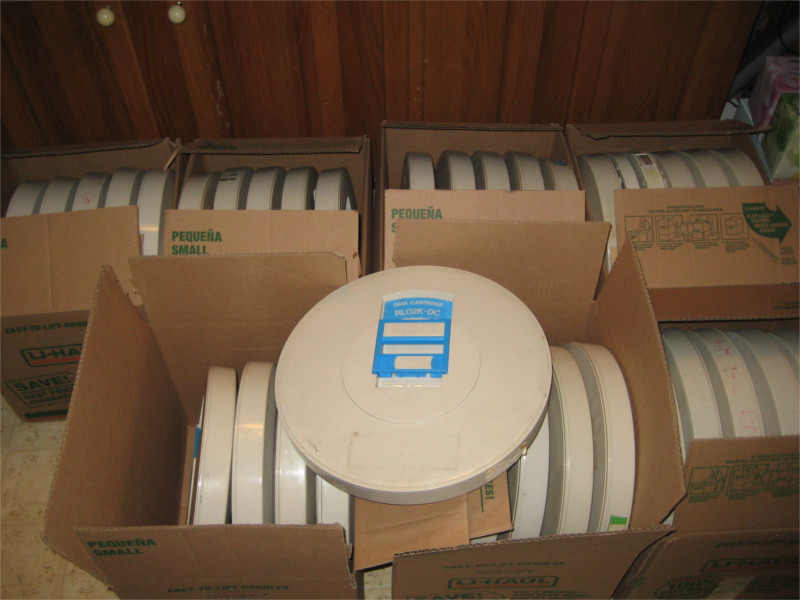
So I'm consolidating my storage and finding I have a lot of surplus stuff.
For starters, I have a few too many RL02K-DCs (also a few RL01K-DCs and a
couple of 12-sector RK05 packs):
http://www.dbit.com/wilson/RL02K-DC.jpg
Believed to be good/usable but of course I guarantee nothing. YMMV.
YHMC. Located in Monson, MA, 01057, USA. I'll drive anywhere in southern
New England to deliver some / a few / all of them, for free. Anything more
complicated is OK, at your expense.
John Wilson
D Bit
On Sat, 2019-01-05 at 12:00 -0600, cctalk-request at classiccmp.org wrote:
> Re: Microcode, which is a no-go for modern designs
I was a tech in the 90's when the original Pentium FDIV bug was
storming. The issue was confined to the integrated floating point
portion of the processor and was therefore rarely an issue as the vast
majority of software did not use the mathco portion of the chip. Only
a handful of applications and relative handful of users were affected.
This became Intel's position on the matter and they hoped the issue
would just die down to those handful whom they would provide new chips.
The issue did not die down and the bad press forced the decision to
replace ALL pentiums affected. Only a relative few were actually
replaced in the home and small business arena. A software patch was a
common solution to the problem. It masssaged input to the FDIV
instruction to produce a corrected result and worked pretty well as I
recall.
At the time of the storm, the Pentium was still pretty new and very
expensive. Most folks were getting along with AMD k5 and k6
processors. I WAS. I went from k6 to Celeron.
Best
Jeff
Thanks for all the replies! Based on the responses I got, this is the
specific request list that I just emailed him:
anything HP 1000 related is interesting. HP 2100, HP 21MX 2113 2117,
A-Series A400 A600 A700 A900 A990, etc.
are all 21MX/2100-series:
HP 12908A Writable Control Store Interface Kit (PCA 12908-60002) HP 12908B
Writable Control Store Interface Kit (PCA 12908-60006) HP 12908-60003 Jumper
Board Assembly HP 12908-60005 Backplane Jumper Assembly HP 12908-60008
Jumper Board Assembly
HP 12978A Writable Control Store (PCA 12978-60006) HP 12978-60006 Jumper
Cable Assembly
HP 02100-60018 Cable Assembly (need two!) HP 02100-60052 Connector Assembly
an HP HIL mouse (so not PS/2), preferably 3-button
HP apollo 735/125 power supply part # 0950-2081 (Astec). It comes from a
workstation, A2608A or A2841A
HP 9000, whether it's the /200, /300, /400, /700, or /800 series
The prices I see for this equipment online are stiff! May I assume (and yes,
I know what that spells) that you guys are looking for machines in the sub
$200 class, not $2000 like some sites have posted? Equipment from the
recycler is so much cheaper, but strictly as-is.
Cindy Croxton
Electronics Plus
1613 Water Street
Kerrville, TX 78028
830-370-3239 cell
sales at elecplus.com
---
This email has been checked for viruses by Avast antivirus software.
https://www.avast.com/antivirus
On Wed, 9 Jan 2019 cctalk-request at classiccmp.org wrote:
> Message: 7
> Date: Tue, 08 Jan 2019 20:03:24 +0000 (WET)
> From: Peter Coghlan <cctalk at beyondthepale.ie>
> Subject: Bogus "account hacked" message
>
> About two hours ago, I received an email to the address I only use for
> cctech/cctalk.
>
> It claimed my email account had been hacked and threatened all sorts of
> dire consequences if I didn't deposit $1000 in bitcoins in some place within
> 48 hours.
[chop]
I enjoyed reading the discussion regarding these bogus emails.
I get a one or two per week. Some with no password, and some with a
password only used for one particular site with an email address only
created for that site. (and the site is no longer around more than
likely due to being hacked ... essentially the account I had there was a
throwaway).
Some of the phishers are getting "smarter" and dropping the "-suffix" I
used for the email (which also ends up getting to me ...)
Obviously the system(s) they send it to don't have a camera, don't have
any web browsing software installed, are text based (Linux and OpenVMS)
and I just laugh.
However, I do enjoy totally confusing the scammers. I have the extra
password configured for the SYSTEM account on my main VMS box. The script
kiddies have no idea what to do with a second password prompt (since you
don't get a User Authorization Failure until you enter both passwords,
good, bad, or indifferent).
34630 failures since last successful login
No intrusion records either, as they try once and move on. Long
passwords are looooong so I challenge them to guess. If they get in,
login DCL does checks and if you don't have the secret sauce ... *plonk*
I probably don't have to have extra password set, but I'm paranoid and do
it anyway.
I've also noticed folks at $work are starting to get these "give me
bitcoins because I saw your pr0n" messages as well. Those were some fun
discussions.
Fred
Apropos of nothing, I've been confuse for some time regarding maximum
clock rates for local bus.
My admittedly old information, which comes from the 3rd ed. of "High
Performance Computer Architecture", a course I audited, indicates a
maximum speed on the order of 1ghz for very very short trace lengths.
Late model computers boast multi-hundred to multi gigahertz fsb's. Am
I wrong in thinking this is an aggregate of several serial lines
running at 1 to 200mhz? No straight answer has presented on searches
online.
So here's the question. Is maximum fsb on standard, non-optical bus
still limited to a maximum of a couple of hundred megahertz, or did
something happen in the last decade or two that changed things
dramatically? I understand, at least think I do, that these
ridiculously high frequency claims would not survive capacitance issues
and RFI issues. When my brother claimed a 3.2ghz bus speed for his
machine I just told him that was wrong, impossible for practical
purposes, that it had to be an aggregate figure, a 'Pentium rating'
sort of number rather than the actual clock speed. I envision
switching bus tech akin to present networking, paralleled to sidestep
the limit while keeping pin and trace counts low.....? Something like
the PCIe 'lane' scheme in present use? This is surmise based on my own
experience.
When I was current, the way out of this limitation was fiber-optics for
the bus. This was used in supercomputing and allowed interconnects of
longer length at ridiculous speeds.
Thanks for allowing me to entertain this question. Though it is not
specifically a classic computer question, it does relate to development
and history.
Best,
Technoid Mutant (Jeff Worley)
> From: Bill Degnan
> I attempted to port the same version of unix to an rl02 disk pack and
> to run on an actual 11/40. I was able to get ir to boot up to the #
> prompt but my system does not have a working EIS card to proceed any
> further.
I"m incredibly surprised that you got to the prompt! First, the V6 RL
bootstrap uses ASH, part of EIS. And then the C compiler makes extensive use
of EIS instructions, so anything in C (the OS, 'init', 'sh', etc) may have EIS
instructions in it.
Noel
Guys,
Do any of you know where I could get hold of DG document(s) describing the
microcode of their Eclipse family. It was wide yellow manual with brown
plastic ring binding. It brings back happy but foggy memories.
"The Soul of the New Machine"(book) tells me that the instruction set was
built from the microcode by some genius overnight. Probably an urban myth!
Who knows.
Many thanks,
peter
> Few people (but most are right here) can recite PI to enough digits to
> reach the level of inaccuracy. And those who believe that PI is exactly
> 22/7 are unaffected by FDIV. (YES, some schools do still teach that!)
Why remember the digits, when a small program can provide them?
+0un qn"E20Un' 0Uh 0uv HK
Qn<j 0uq Qn*10/3Ui
Qi<\+2*10+(Qq*qi)Ua 0LK Qi*2-1Uj Qa/QjUq Qa-(Qq*Qj)-2\10I$ Qi-1ui>
Qq/10Ut Qh+Qt+48Uw Qw-58"E48Uw %v' Qv"N:Qv,1^T' QwUv Qq-(Qt*10)Uh>
:Qv,1^T
!Can you figure out what this macro does before running it? It was
written by Stan Rabinowitz with modifications by Mark Bramhall and
appeared as the Macro of the Month in the Nov. 1977 issue of the TECO
SIG newsletter, the "Moby Munger". For information on the TECO Special
Interest Group, write to Stan at P.O. Box 76, Maynard, Mass. 01754!
--Johnny
> I don't recall off the top of my head whether the location of that
> shared block of memory is in the per-process swappable kernel data
> (which is included in the process core dump).
So I checked, and the swappable per-process kernel data does in fact include
pre-computed contents for all the memory management registers, so we'll be
able to see (from the process core dump) where the code and data segments
were.
On another front, that error message ("Memory error") is produced when a
process gets a 'memory management trap' (trap to 0250). This could be caused
by any number of things (it's a pity we don't know the contents of SR0 when
the trap happened, that would tell us exactly what the cause was).
With working hardware+OS, it's usually the result of a bad pointer in the
program. In a tested program like 'ls', I don't think that's the case. It's
most likely caused by faulty memory, but it's also faintly possible that the
MMU has an issue.
I'll look at the process dump a little later today, and see if I see anything
of significance.
Noel
About two hours ago, I received an email to the address I only use for
cctech/cctalk.
It claimed my email account had been hacked and threatened all sorts of
dire consequences if I didn't deposit $1000 in bitcoins in some place within
48 hours.
I am 100% certain that the claims in the message are completely bogus and
none of the threats will be carried out.
It is likely that email addresses belonging to other list members are also
to be found wherever my email address was scraped from so I just wanted to
warn other list members about this scam in case they receive similar emails.
(I received the scam email directly, not via the cctech listserver).
Regards,
Peter Coghlan.
> From: Fritz Mueller
PPS:
> I could work to extract the core file
I just checked, and the binary for the 'ls' command is what's called 'pure
code'; i.e. the instructions are in a separate (potentially shared) block of
memory from the process' data (un-shared).
I don't recall off the top of my head whether the location of that shared
block of memory is in the per-process swappable kernel data (which is included
in the process core dump). I'll check tomorrow, when I'm not sick as a dog
(pretty miserable right at the moment).
It would be east to mod the OS to print all that info when that illegal
instruction trap happens - but that will change the size of the OS, so will
probably change the location the process is at; so that might cause the
symptoms to change. Ditto for recompilling 'ls' to make it a unified blob.
> Assuming that doesn't create another core file... :-)
:-) Don't worry, we'll nail it!
Noel
At 11:05 PM 8/01/2019 +0000, you wrote:
>While tidying up I've found a few Irman infrared to serial dongles
>
>https://web.archive.org/web/20060314052558/http://www.evation.com/irman/ind…
>
>they connect via a 9 pin serial plug and then convert any consumer
>remote IR signals they receive into serial.
>
>No additional power required, good wide angle reception, open source
>driver still available
>
>https://sourceforge.net/projects/libirman/
>
>Could make an interesting project for anyone who wants to control
>their VAX / S-100 / homebrew retro board with a serial port via a
>remote :)
>
>The company making them went away about a decade ago, so I'm counting
>that as in retro territory.
>
>I have four for the price of shipping if anyone is interested, based
>in London/UK.
>
>(Around 2000 we had an office music system based around a DNARD/Shark
>running mserv & irman where everyone had a random remote at their desk
>and could use it to rate/skip/queue something they liked, and the
>system generally trid to pick from music which most of the people
>currently connected liked... ahh, fun days :)
>
>David
I'll definitely take one. Or preferably two, if that doesn't clash with anyone
else wanting one.
I'll send my address via private email.
Can you accept Paypal for the postage?
Guy
Chuck we would like a couple..? ed at smecc
Sent from AOL Mobile Mail
On Tuesday, January 8, 2019 Chuck Guzis via cctalk <cclist at sydex.com; cctalk at classiccmp.org> wrote:
On 1/8/19 3:05 PM, David Brownlee via cctalk wrote:
> While tidying up I've found a few Irman infrared to serial dongles
>
> https://web.archive.org/web/20060314052558/http://www.evation.com/irman/ind…
>
> they connect via a 9 pin serial plug and then convert any consumer
> remote IR signals they receive into serial.
I just posted on github a little project that takes a cheap surplus (my
last ones cost $5 NOS) IBM iPoint IR keyboard and converts it to PS/2
keyboard protocol using a cheap STM32F103 "Blue Pill" and a 3-terminal
38KHz IR receiver.? I'm currently writing the USB version which will
support the "nipple mouse" as well.
The keyboards aren't bad--they're made by Silitek ca. 1992 and have a
decent feel for a rubber dome keyboard.
The point is that with modern MCUs, any IR stuff is easy-peasy.? My
little Chinese LCR tester even reads and displays IR codes.
--Chuck
While tidying up I've found a few Irman infrared to serial dongles
https://web.archive.org/web/20060314052558/http://www.evation.com/irman/ind…
they connect via a 9 pin serial plug and then convert any consumer
remote IR signals they receive into serial.
No additional power required, good wide angle reception, open source
driver still available
https://sourceforge.net/projects/libirman/
Could make an interesting project for anyone who wants to control
their VAX / S-100 / homebrew retro board with a serial port via a
remote :)
The company making them went away about a decade ago, so I'm counting
that as in retro territory.
I have four for the price of shipping if anyone is interested, based
in London/UK.
(Around 2000 we had an office music system based around a DNARD/Shark
running mserv & irman where everyone had a random remote at their desk
and could use it to rate/skip/queue something they liked, and the
system generally trid to pick from music which most of the people
currently connected liked... ahh, fun days :)
David
> From: Fritz Mueller
PS:
> I could work to extract the core file
Can PDP11GUI save output from the -11's console? If so, just say 'od core',
and send me the output.
Noel
> From: Fritz Mueller
>> the last microinstruction for RTI/RTT has been moved from 002 -> 744.
> So what's at 002 now? Maybe something new was required there by micro
> branch/fork logic, so the original contents had to be moved?
Well, it turns out I've been transcribing the ucode flow diagrams from the 34,
as part of a deeper look at the 34. (Dave B and I need a PDP-11 in the FPGA on
the QSIC, to run the USB protocol on; rather than using a microcontroller, we
decided the hack value of putting an -11 in there was too much to resist. It's
also practical, though - we're already very familiar with it, have a good
toolchain for it, etc. One option for that - we know about the existing FPGA
-11's - was cloning the /34.)
So according to that table:
http://gunkies.org/wiki/KD11-E/EA_microcode
there is no uinst at 002 now! So I have no idea why they moved it. (The place
they moved it to, 0744, seems like it was the first empty location.)
There is a dump of the 34A microcode here:
http://www.bitsavers.org/pdf/dec/pdp11/1134/m8266_ucode.out.txt
and for 002 it gives
Called by......... = IR or BUT only
NEXT MPC.......... = 015
but 015 doesn't seem like a useful place to branch to? Maybe location 002 was
just abandoned (I have no idea why), and that's some leftover trash?
BTW, the engineering drawings contain three errors (fixed in the table above;
see the notes there), so I suspect they were drawn up by looking at a set of
the listings. I wonder if the actual source has survived? Probably not,
alas...
Noel
> From: Fritz Mueller
> Kernel boots on my actual hardware, but an "ls" in single-user mode
> generates a "Memory error -- core dumped".
Oh, yeah, your hardware definitely has issues, then.
> So evidence is mounting that I really do have some sort of issue with
> my MS11-L.
If so, I'm rather suprised that the DEC diagnostics didn't pick it up.
> Tried a multi-user boot for kicks
You're stu^H^H^Hbrave!
> I'm actually able to "ls" under that.
Yeah, probably your process wound up at a different place in physical memory
(although there are a zillion other ways one could get that effect, depending
on exactly what the issue is - e.g. maybe a bad bit in the memory word where
the process table happened to wind up).
> I could work to extract the core file
The 'ls' one, please (shorter/simpler); I can poke around in that, and see if
I can find any clues as to the cause.
> probably the best application of effort would be to do develop/run more
> diagnostics on the MS11-L
OK.
I also have a little memory diag that I wrote myself that you could try. Let
me know if you'd like it; it's currently for the /23+/73 (and it would
probably work on the /70, I'd have to check) so I'd have to tweak a few
things to get it to run on a /45. Best way to get it to you would be to send
you the Unix assembler source, if you can get that onto the disk, then you
could:
as memptst.s
mv a.out /memptst
and just boot it.
Noel
> From: Fritz Mueller
> I should go read up on QSIC.
There's not much on the Web, alas. We have two working prototypes (a wirewrap
QBUS mother-board with bus transceivers, level converters, etc, connected to
an FPGA prototyp ung card by flat cables), and working FPGA code to emulate an
RK11, using a uSD card for actual storage. It's good enough that the /23 can
boot and run V6. We also have working indicator panels:
http://ana-3.lcs.mit.edu/~jnc/tech/DECIndicatorPanels.html
but the inlay we've done:
http://pdp10.froghouse.org/qsic/indicator-panel-printed.jpg
is not a straight copy of an existing panel (those all have lots of lights
that only make sense with a real drive, and leave out others that would
be really useful, e.g. the address). Here:
http://pdp10.froghouse.org/qsic/manual.pdf
is the firat crack at the manual for the production version (the RP11 is not
done yet).
> I could really use a "USIC"... :-)
That's next, after the QSIC is out. It will include Able ENABLE:
http://gunkies.org/wiki/Able_ENABLE
functionality, so UNIBUS machines can have more than 256KB of main memory.
> Probably the best thing would be to pop a ROM out of a working /34 and
> read it out? Is that how you've gotten your authoritative version?
I didn't get it, I found it on BitSavers - I assume that was what whoever
provided it did. But it's actually stored in 12 4-bit wide PROMs, U95-U118
(roughly).
Noel
> From: Fritz Mueller
>> http://www.tuhs.org/Archive/PDP-11/Distributions/research/Ken_Wellsch_v6/
> Hmm, this link didn't work for me
Arggh, sorry. I simply copied the link from my page:
http://www.chiappa.net/~jnc/tech/V6Unix.html
and didn't check it. :-( I'm a bit suprised that Warren broke everyone's deep
links by re-organizing...
> I found I think equivalent mirrored at:
> https://www.tuhs.org/Archive/Distributions/Research/Ken_Wellsch_v6/
> ...which directory contains several file system images and one tape
> image, "v6.tape".
Argh. I thought there _used_ to be disk images there - maybe they got removed?
Anyway, the one you want is now here:
http://ana-3.lcs.mit.edu/~jnc/tech/unix/V6Root
Just decant all the bits onto a RK pack, starting at block 0, and you should
be able to boot that pack.
(I'll fix my page a little later, burned out after the microcode
transcription!)
> Is that tape image maybe not compatible with SIMH's tape format?
It's just a plain copy of the contents of a V6 distribution tape. IIRC, SIMH
wants 'tape' files with meta-data such as the length of each tape record, file
marks, etc.
Noel
> From: Fritz Mueller
> Oh, one last thing: if anybody else out there has a real working '11/45
> + RK05 and wants to try this RSTS image, let me know, and I'll send you
> a copy (all 2.5MB of it, hah). It'd be interesting to see if this a
> really just limited to my machine?
Good idea. Two more along the same lines:
Try running your RSTS image on Ersatz-11, see if it's a simulator issue.
And try bringing up Unix V6 on your machine; if it's a hardware issue with
your machine, it might show with that, too. (I can help with fault analysis
on V6, if _anything_ doesn't work properly.) It will need a single RK pack,
I can help with providing the image, if needed.
Noel
Off topic, but looking for help and/or wisdom.
If you visit https://www.scotnet.co.uk/iain/saratov <https://www.scotnet.co.uk/iain/saratov>/ <https://www.scotnet.co.uk/iain/> you will see some photos and wire-lists of work that I have started on the front panel of a Capatob 2.
I plan to get the switches and lights running on a blinkenbone board with a PDP8 emulation behind it. (I already have an PDP11/70 front-panel running on the same infrastructure)
I have been struggling for over a year to get much info about this saratov computer (circuit diagrams etc). So I have started the reverse engineering on the panel.
Does anybody know anything about this computer? online or offline it would be much appreciated.
Iain
> From: Fritz Mueller
> I've thought about that; Unix V6 is actually next on my list of OS's to
> try. I think I have seen a fairly detailed set of instructions on
> building an image from this from the commonly available distribution
> tape.
Yeah, one comes with the V6 distribution:
http://gunkies.org/wiki/Setting_up_UNIX_-_Sixth_Edition
(That's just a 'do this and then do that' list - if you want to know what
it's actually _doing_, this:
http://gunkies.org/wiki/Installing_UNIX_Sixth_Edition
gives the technical details.)
Alas, the instructions don't have a lot of detail on how to create the /45
version (it's quite simple - basically one just includes m45.s instead of
m40.s in the linker command line :-); I guess I'll do up a cheat sheet.
> But if you have an RK05 image already ready to go, go ahead and send it
> over and I'll give it a try!
Well, there are single-RK05 images up already:
http://www.tuhs.org/Archive/PDP-11/Distributions/research/Ken_Wellsch_v6/
but they only include binary for /40's (which will run on a /45 of course;
they distributed only the lowest-common-denominator binary, to make their
life simple; people have to build their own binary - system and commands - if
they want to upgrade).
But if you'd like me to make up an RK05 image with a /45 system on it too
(one gets to specify what one wants to load at boot time); let me know, and I
can whip it up - but really, it's drop-dead simple to build a /45 version if
you have the /40 version running.
Note: the pack images on the distribution tape _do not_ include the bootstrap
in block 0; use the one I linked to above.
> It wasn't clear to me last time I looked that I could build V6 to run
> off a single pack without having a second RK05 drive and pack available
> for swap?
No, the image above is for a single RK drive machine; it will run that way,
albeit things are a bit cramped.
What it does is put a file system in blocks 1-4000, and it uses blocks 4000
and up as the swap area (I forget which one block 4000 itself goes with :-).
> Day gig starts back up today after winter break, so less bandwidth for
> PDP-11 hacking now unfortunately!
:-(
Well, at least you have something to go back to; the spousal unit works for
NASA, and they're all getting an enforced extended break (much to her
annoyance).
Noel
> From: Grant Taylor
> Is "byte" the correct term for 6-bits? I thought a "byte" had always
> been 8-bits.
I don't claim wide familiary with architectural jargon from the early days,
but the PDP-10 at least (I don't know about other prominent 36-bit machines
such as the IBM 7094/etc, and the GE 635/645) supported 'bytes' of any size,
with 'byte pointers' used in a couple of instructions which could extract and
deposit 'bytes' from a word; the pointers specified the starting bit, and the
width of the 'byte'. These were used for both SIXBIT (an early character
encoding), and ASCII (7-bit bytes, 5 per word, with one bit left over).
> I would have blindly substituted "word" in place of "byte" except for
> the fact that you subsequently say "12-bit words". I don't know if
> "words" is parallel on purpose, as in representing a quantity of two
> 6-bit word.
I think 'word' was usually used to describe the instruction size (although
some machines also supported 'half-word' instructions), and also the
machine's 'ordinary' length - e.g. for the accumulator(s), the quantum of
data transfer to/from memory, etc. Not necessarily memory addresses, mind -
on the PDP-10, those were 18 bits (i.e. half-word) - although the smallest
thing _named_ by a memory addresses was usually a word.
Noel
> From: Fritz Mueller
> Thanks, Noel -- I'll give that a try!
Sure - always glad to help with anything V6 related - that's my chief
technical amusement, now that I'm retired! :-) Any questions/issues, let me
know, and I'll try and get right back.
When booting UNIX, remember make sure the switches on your /45 are set to
0173030, so it comes up single-user!
(Might we worth checking to see if all the bits in the SR are working, but
you've probably already done that as part of bringing the machine up? I
wonder if a failure there could cause the RSTS issue? It's so cool that you
have a working /45! I have yet to start on mine...)
And do icheck/dcheck every time you bring it up, and make sure to 'sync'
before halting... These old systems are not as robust in terms of the file
system!
And when it gets to putting together a /45 version of the OS, that new
page I just did should help.
Noel
no only hp scan jets no other brands and only the first few models.? thanks though.
Sent from AOL Mobile Mail
On Monday, January 7, 2019 Fred Cisin via cctalk <cisin at xenosoft.com; cctalk at classiccmp.org> wrote:
On Mon, 7 Jan 2019, ED SHARPE via cctalk wrote:
> my foggy? brain? remembers them? as? I retied? ?the biz? end of
> things? before? ? win 95? ?came out.
About 1992.
After Windoze 3.00 (I got "beta" Windoze 3.10 in August 1991, public
release soon after?), and about the time of 3.11
I have a couple of parallel/SCSI scanners new? in box to get rid of.? I
don't know if their drivers were TWAIN.
my foggy? brain? remembers them? as? I retied? ?the biz? end of things? before? ? win 95? ?came out.
and? I? seem to remember? twain? as a term? used? with hp scanjets? before retirement.\
when i? ?left? ?scanjet? ?2c? was? current? color? product.]anyone? coming thou? az? ?with a? scanjet iic? in the? car...? it? would? be? welcome here..we? have? an orig? ?hpscanjet? b/w? ?but? can use another one? for an offsite? display also.
ed sharpe archivist for smecc
In a message dated 1/7/2019 2:11:37 PM US Mountain Standard Time, cctalk at classiccmp.org writes:
> On Thu, 20 Dec 2018 at 02:39, Ali via cctalk <cctalk at classiccmp.org> wrote:>>? I wonder if there were ever any TWAIN drivers for Win 3.x.....
Yes, but I think that you needed WIN32S installed.
On Mon, 7 Jan 2019, Liam Proven via cctalk wrote:> This is stretching my powers of recollection -- and in my world, back> then, if you could afford (and wanted) a scanner, you used a Mac --> but I think so, yes.
1) some could not afford Mac? (rarely any in the skip)2) some did not have control over employer's purchasing decisions3) depending on what was being scanned, other factors influenced platform
> We are all aware of what that acronym means, yes?
But few pay any attention to any technology without an interesting name.And of those who do and the rest, never the twain shall meet.
--Grumpy Ol' Fred? ? ??? ??? cisin at xenosoft.com
> From: Fritz Mueller
> All the CPU, FPU, KT11, KW11, and RK11 MAINDECS are passing just fine.
Don't forget Vonada Maxim #12:
"Diagnostics are highly efficient in finding solved problems."
:-)
Noel
On Sun, 2019-01-06 at 12:00 -0600, cctalk-request at classiccmp.org wrote:
> Re: off topic - capatob - saratov2 computer Russsian pdp8
Nothing has changed as regards the number of bits in a byte, a nybble
is 4 bits, 8 to the byte, and x to the word - this last varies widely
depending on architecture.
Still, in Spirit, on an octal processor a whole number is a six bit
'byte', so the term is appropriate, especially to avoid confusion with
the word size of two six bit 'bytes'.
Fun.
Jeff
> From: Dave Wade
> The only machine I know where a "byte" is not eight bits is the
> Honeywell L6000 and its siblings
I'm not sure why I bother to post to this list, since apparently people don't
bother to read my messages.
>From the "pdp10 reference handbook", 1970, section 2.3, "Byte Manipulation",
page 2-15:
"This set of five instructions allows the programmer to pack or unpack bytes
of any length from anywhere within a word. ... The byte manipulation
instructions have the standard memory reference format, but the effective
address E is used to retrieve a pointer, which is used in turn to locate
the byte ... The pointer has the format
0 5 6 11 12 13 14 17 18 35
P S I X Y
where S is the size of the byte as a number of bits, and P as its position
as the number of bits remaining at the right of the byte in the word ... To
facilitate processing a series of bytes, several of the byte instructions
increment the pointer, ie modify it so that it points to the next byte
position in a set of memory locations. Bytes are processed from left to
right in a word, so incrementing merely replaces the current value of P
by P-S, unless there is insufficient space in the present location [i.e.
'word' - JNC] for another byte of the specified size (P-S < 0). In this
case Y is increased by one to point at the next consecutive location, and
P is set to 36 - S to point to the first byte at the left in the new
location."
Now imagine implementing all that in FLIP CHIPs which held transistors
(this is before ICs)!
Anyway, like I said, at least ITS (of the PDP-10 OS's) used this to store
ASCII in words which contain five 7-bit _bytes_. I don't know if TENEX did.
> I also feel the use of the term Octet was more marketing to distance
> ones machines from IBM.....
Huh? Which machine used the term 'octet'?
Like I said, we adapted and used the term 'octet' in TCP/IP documentation
(and that's definite - go check out historical documents, e.g. RFC-675 from
1974) because 'byte' was at the time ambiguous - the majority of machines on
the ARPANET at that point were PDP-10's (see above).
Interestingly, I see it's not defined in that document (or in the earlier
RFC-635), so it must have already been in use for an 8-bit quantity?
Doing a little research, there is a claim that Bob Bemer independently
invented the term in 1965/66. Perhaps someone subconciously remembered his
proposal, and that's the ultimate source? The term is also long used in
chemistry and music, of course, so perhaps that's where it came from.
Noel
I'm interested in finding a 386 or slow 486 machine or moboj ust for
playing DOS games. Does anyone have such a thing sitting around, looking
for a home?
Thanks in advance.
> From: William Donzelli
>> in 1980, there were more PDP-11's, world-wide, than any other kind of
>> computer.
> I bet the guys at Zilog might have something to talk to you about.
I was quoting my memory of a DEC ad in the WSJ, which now that I go check,
says the -11 was "the best-selling computer in the world" (the ad was in
1980). There are a number of possible explanations as to why it makes this
claim:
- some marketing person made it up
- they were only counting things that were general-purpose (i.e. came with
mass storage and compilers)
- they didn't consider micros as "computers" (many were used in things like
printers, etc, and were not usable as general-purpose computers)
Etc, etc.
Noel
I am preparing to scan this manual on the IDOL/VS database system, which
was initially a product of "Systems Specialties" but was later purchased by
MAI for their Basic Four systems.
I can't find any documentation on this product on Bitsavers or anywhere
else. If anyone is aware of this manual online, please let me know.
And if anyone wants the original once it's scanned, I'll be happy to send
it for the cost of postage from 60070.
J
Any Uni-bus or PDP8 items? I have plenty of boxes or I would jump on it,
but if some one picks them up I have most of the boards.
Thanks, Paul
On Sun, Jan 6, 2019 at 2:06 PM keith--- via cctech <cctech at classiccmp.org>
wrote:
> Miscellaneous Equipment for free (Mostly DEC) in Lexington KY. Local
> Pick highly preferred.
>
> I need to empty my storage unit. I have various pieces available for
> free, local pickup.
>
> One thing to note, it has not been stored properly. It has been stored
> in a rental storage unit with no heat or cooling. I do not know if any
> of the units are still functional and there is no power at the storage
> unit to verify the equipment.
>
> 1) BA23 Chassis. Was a PDP11/23 at some point but there are no cards
> or drives. It is in the tower configuration but the front cover is
> missing.
>
> 2) DecStation 3100. Appears complete and in decent condition.
>
> 3) VT220 terminal. Very yellowed
>
> 4) A few LK201 keyboards. Not pretty
>
> 5) VRM17-HA Monitor. 17" monochrome monitor for a Vaxstation. It did
> work at one time but see above. Yellowed.
>
> 6) IBM CRT VGA Monochrome monitor
>
> 7) Macintosh SE. With Ethernet! Very Yellowed.
>
> 8) BA213 Chassis. Some corrosion and possible water damage. Back-plane
> looks very good. Insulation is deteriorating. This was a Microvax 3500
> at one time until the mice got in.
>
> Picture are available here:
>
> https://www.flickr.com/photos/stupido/albums/72157702145168162
>
> I may add more equipment to the list as I sort things out. I want to
> empty the storage unit by the end of this month. Anything that I can't
> or don't want to keep then will go to recycle.
>
> thanks
>
> Max
>
> From: Guy Sotomayor Jr
> I think it's also telling that the IETF uses the term octet in all of
> the specifications to refer to 8-bit sized data.
Yes; at the time the TCP/IP specs were done, PDP-10's were still probably the
most numerous machines on the 'net, so we were careful to use 'octet'.
Although the writing was clearly on the wall, which is why it's all in octets,
with no support for other-length words (unlike the ARPANET, which sort of
supported word lengths which were not a multiple of 8 or 16 - which was
actually use to transfer binary data between 36-bit machines).
> It *may* have been the IBM 360 that started the trend of Byte =
> 8-bits
Yup.
And then the PDP-11 put the nail in that coffin (and in 1980, there were more
PDP-11's, world-wide, than any other kind of computer).
Noel
What defines a 'modern processor'. The term is pretty slippery.
The Crusoe used microcode to emulate x86 and could therefore emulate
any processor architecture Transmeta wanted.
Crusoe was a pioneer in the low power market, the processor dynamically
clocked itself in very small steps depending on need. This is a
familiar feature now but was pretty revolutionary for the time.
Interestingly, Linux Torvalds was in on the design and was on the board
of Transmeta. A fair number were sold to Sony for their VIAO series of
notebooks.
Does Crusoe qualify as a 'modern' processor? In my book yes, but I
have a very old book.. :0
best,
Jeff
On Sun, 2019-01-06 at 12:00 -0600, cctalk-request at classiccmp.org wrote:
> Send cctalk mailing list submissions to
> cctalk at classiccmp.org
>
> To subscribe or unsubscribe via the World Wide Web, visit
> http://www.classiccmp.org/mailman/listinfo/cctalk
> or, via email, send a message with subject or body 'help' to
> cctalk-request at classiccmp.org
>
> You can reach the person managing the list at
> cctalk-owner at classiccmp.org
>
> When replying, please edit your Subject line so it is more specific
> than "Re: Contents of cctalk digest..."
>
>
> Today's Topics:
>
> 1. Re: ELTRAN THE COMPILER ANY DOCS? (NOT THE SEMICONDUCTOR
> STUFF!))) (Chuck Guzis)
> 2. Re: ELTRAN THE COMPILER ANY DOCS? (NOT THE SEMICONDUCTOR
> STUFF!))) (Chuck Guzis)
> 3. Re: ELTRAN THE COMPILER ANY DOCS? (NOT THE SEMICONDUCTOR
> STUFF!))) (ED SHARPE)
> 4. off topic - capatob - saratov2 computer Russsian pdp8? HELP
> (Dr Iain Maoileoin)
> 5. Re: ELTRAN THE COMPILER ANY DOCS? (NOT THE SEMICONDUCTOR
> STUFF!))) (ED SHARPE)
> 6. Re: PDP-11/45 RSTS/E boot problem (Fritz Mueller)
> 7. uc04 + scsi2sd ? (Jacob Ritorto)
> 8. Re: uc04 + scsi2sd ? (Richard Cini)
> 9. KD11-E/EA microcode flow diagrams (Noel Chiappa)
> 10. Re: KD11-E/EA microcode flow diagrams (Fritz Mueller)
> 11. Re: PDP-11/45 RSTS/E boot problem (Jerry Weiss)
> 12. Re: uc04 + scsi2sd ? (Jerry Weiss)
> 13. Re: PDP-11/45 RSTS/E boot problem (Fritz Mueller)
> 14. ISO - 386 or 486 system or cplt mobo (drlegendre)
> 15. Re: ISO - 386 or 486 system or cplt mobo (wrcooke at wrcooke.net)
> 16. SMECC on the hunt for Monarch hp 150 poster do U have one?
> or a hi res clean scan? (ED SHARPE)
> 17. Re: uc04 + scsi2sd ? (Al Kossow)
> 18. Re: uc04 + scsi2sd ? (Josh Dersch)
> 19. Re: PDP-11/45 RSTS/E boot problem (Tony Duell)
> 20. Re: PDP-11/45 RSTS/E boot problem (Jerry Weiss)
> 21. Re: OT? Upper limits of FSB (Curious Marc)
> 22. Re: PDP-11/45 RSTS/E boot problem (Fritz Mueller)
> 23. Re: PDP-11/45 RSTS/E boot problem (Tony Duell)
> 24. Re: PDP-11/45 RSTS/E boot problem (Fritz Mueller)
> 25. Re: ISO - 386 or 486 system or cplt mobo (devin davison)
> 26. Re: off topic - capatob - saratov2 computer Russsian pdp8?
> HELP (Bob Smith)
> 27. Re: off topic - capatob - saratov2 computer Russsian pdp8?
> HELP (Grant Taylor)
>
>
> -------------------------------------------------------------------
> ---
>
> Message: 1
> Date: Sat, 5 Jan 2019 10:10:04 -0800
> From: Chuck Guzis <cclist at sydex.com>
> To: Fred Cisin via cctalk <cctalk at classiccmp.org>
> Subject: Re: ELTRAN THE COMPILER ANY DOCS? (NOT THE SEMICONDUCTOR
> STUFF!)))
> Message-ID: <1651425f-f406-205d-5284-1e6fd1d7c00a at sydex.com>
> Content-Type: text/plain; charset=utf-8
>
> Okay, I think I found the reference to it.
>
> It turns out that it was a high-school student's project entered in
> the
> "Fourth Annual Computer Programming Contest for Grades 7 to 12'. To
> quote:
>
> "The 1966 winner was William J. Elliott, a 12th grade student at West
> High School in Minneapolis. His project, ELTRAN, is an algorithmic
> language compiler system for the UNIVAC 422 computer. Until the
> development of ELTRAN, no compiler existed for the computer."
>
> See PDF page 10 here:
>
> http://www.bitsavers.org/pdf/computersAndAutomation/196701.pdf
>
> --Chuck
>
> P.S. One of these days, I'm going to host a course on "how to use
> Google".
>
>
> ------------------------------
>
> Message: 2
> Date: Sat, 5 Jan 2019 10:17:52 -0800
> From: Chuck Guzis <cclist at sydex.com>
> To: Chuck Guzis via cctalk <cctalk at classiccmp.org>
> Subject: Re: ELTRAN THE COMPILER ANY DOCS? (NOT THE SEMICONDUCTOR
> STUFF!)))
> Message-ID: <6e237124-1ac7-700d-b9be-beda8f3a0e16 at sydex.com>
> Content-Type: text/plain; charset=utf-8
>
> Since it was a 53-year old high-school project, I doubt that you're
> going to find much on it. However, see the post by Steve Schweda
> here:
>
> https://community.hpe.com/t5/Operating-System-OpenVMS/Left-shift-by-more-th…
>
> He may actually have some familiarity with ELTRAN and know where some
> documentation exists.
>
> --Chuck
>
>
>
>
> On 1/5/19 10:10 AM, Chuck Guzis via cctalk wrote:
> > Okay, I think I found the reference to it.
> >
> > It turns out that it was a high-school student's project entered in
> > the
> > "Fourth Annual Computer Programming Contest for Grades 7 to
> > 12'. To quote:
>
> ------------------------------
>
> Message: 3
> Date: Sat, 5 Jan 2019 18:21:53 +0000 (UTC)
> From: ED SHARPE <couryhouse at aol.com>
> To: cctalk at classiccmp.org
> Subject: Re: ELTRAN THE COMPILER ANY DOCS? (NOT THE SEMICONDUCTOR
> STUFF!)))
> Message-ID: <1152753582.13550260.1546712513898 at mail.yahoo.com>
> Content-Type: text/plain; charset=UTF-8
>
> (COME ON SOCRATES ...? DO YOUR? THING!)
>
> In a message dated 1/5/2019 1:49:38 AM US Mountain Standard Time,
> cctalk at classiccmp.org writes:
>
> no is compiler a small one only 2 do loops allowed...ed#
> Sent from AOL Mobile MailOn Friday, January 4, 2019 Chuck Guzis via
> cctalk <cclist at sydex.com; cctalk at classiccmp.org> wrote:On 1/4/19 8:42
> PM, Fred Cisin via cctalk wrote:> Would be? interesting when you find
> it.> Not necessarily "tiny"> Remember WATFOR??? (very impressive!)
> I guesss not too many numerical methods types hwere, but ELTRAN is
> asubroutine in the EISPACK linear programming set.? Yes, it's all
> FORTRAN:
> > From the subroutine:
> cc? ? this subroutine is a translation of the algol procedure
> elmtrans,c? ? num. math. 16, 181-204(1970) by peters and wilkinson.c?
> ? handbook for auto. comp., vol.ii-linear algebra, 372-395(1971).cc?
> ? this subroutine accumulates the stabilized elementaryc? ?
> similarity transformations used in the reduction of ac? ? real
> general matrix to upper hessenberg form by? elmhes.
> --Chuck
>
> ------------------------------
>
> Message: 4
> Date: Sat, 5 Jan 2019 18:36:56 +0000
> From: Dr Iain Maoileoin <iain at csp-partnership.co.uk>
> To: cctalk at classiccmp.org
> Subject: off topic - capatob - saratov2 computer Russsian pdp8? HELP
> Message-ID:
> <4BDE03FE-1A04-4060-B245-6EFDDC503B42 at csp-partnership.co.uk>
> Content-Type: text/plain; charset=us-ascii
>
> Off topic, but looking for help and/or wisdom.
>
> If you visit https://www.scotnet.co.uk/iain/saratov <
> https://www.scotnet.co.uk/iain/saratov>/ <
> https://www.scotnet.co.uk/iain/> you will see some photos and wire-
> lists of work that I have started on the front panel of a Capatob 2.
>
> I plan to get the switches and lights running on a blinkenbone board
> with a PDP8 emulation behind it. (I already have an PDP11/70 front-
> panel running on the same infrastructure)
>
> I have been struggling for over a year to get much info about this
> saratov computer (circuit diagrams etc). So I have started the
> reverse engineering on the panel.
>
> Does anybody know anything about this computer? online or offline it
> would be much appreciated.
>
> Iain
>
> ------------------------------
>
> Message: 5
> Date: Sat, 5 Jan 2019 19:17:56 +0000 (UTC)
> From: ED SHARPE <couryhouse at aol.com>
> To: cctalk at classiccmp.org, cclist at sydex.com, COURYHOUSE at aol.com
> Subject: Re: ELTRAN THE COMPILER ANY DOCS? (NOT THE SEMICONDUCTOR
> STUFF!)))
> Message-ID: <860959218.13562972.1546715876710 at mail.yahoo.com>
> Content-Type: text/plain; charset=UTF-8
>
> Chuck! Many thanks!
> Update on? 422 UNIVAC? docs . .? some kind? ?people have mailed in?
> docs and? ?things? they have? found related to this? 422 UNIVAC ...?
> things are? shaping up! Many? thanks? ?to? all? these? folks-
>
> I? fear ever putting power to this? thing... so? may? parts to go?
> POP... I have a nice large? Variac.....? ?suggestions?
> Ed
>
> In a message dated 1/5/2019 11:18:00 AM US Mountain Standard Time,
> cctalk at classiccmp.org writes:
> Since it was a 53-year old high-school project, I doubt that you're
> going to find much on it.? However, see the post by Steve Schweda
> here:
>
> https://community.hpe.com/t5/Operating-System-OpenVMS/Left-shift-by-more-th…
>
> He may actually have some familiarity with ELTRAN and know where some
> documentation exists.
>
> --Chuck
>
>
>
>
> On 1/5/19 10:10 AM, Chuck Guzis via cctalk wrote:
> > Okay, I think I found the reference to it.
> >
> > It turns out that it was a high-school student's project entered in
> > the
> > "Fourth Annual Computer Programming Contest for Grades 7 to 12'.?
> > To quote:
>
> ------------------------------
>
> Message: 6
> Date: Sat, 5 Jan 2019 12:58:44 -0800
> From: Fritz Mueller <fritzm at fritzm.org>
> To: "General Discussion: On-Topic and Off-Topic Posts"
> <cctalk at classiccmp.org>
> Subject: Re: PDP-11/45 RSTS/E boot problem
> Message-ID: <06515329-3961-4FF4-87FE-C11C3FDEF2AD at fritzm.org>
> Content-Type: text/plain; charset=utf-8
>
>
> > On Jan 5, 2019, at 8:07 AM, Noel Chiappa via cctalk <
> > cctalk at classiccmp.org> wrote:
> >
> > > From: Fritz Mueller
> > > All the CPU, FPU, KT11, KW11, and RK11 MAINDECS are passing just
> > > fine.
> >
> > Don't forget Vonada Maxim #12:
> > "Diagnostics are highly efficient in finding solved problems.?
>
> Well, there?s wisdom there, for sure! :-)
>
> Last night I also managed to put a new RSTS image, sysgen?d with the
> non-overlapped DK driver, on a different physical pack. It behaved
> exactly the same way on the real hardware (looping, counting up
> errors) on boot.
>
> So I think now overlapped vs. non-overlapped DK driver is not the
> issue, and media and image transfer fidelity are not the issue. A
> memory or MMU problem would be consistent with what has been seen so
> far, so I may bark up that tree a little more today.
>
> Paul, any additional suggestions for things to look at in ODT to try
> and wring out more information on the specifics of the fault?
>
> I did get some MACRO CRC-16 sub-routines coded up last night while
> waiting for various transfers, so I think I?ll go ahead and finish up
> the standalone CRC dumper utility today.
>
> Lastly, a 5V-tolerant USB FIFO breakout board is supposed to show up
> in the mails today. If that works out as simply as I hope to
> interface with a DR11-C, I should have a much better way to blast
> bits on and off the machine soon.
>
> cheers,
> --FritzM.
>
>
>
> ------------------------------
>
> Message: 7
> Date: Sat, 5 Jan 2019 17:46:33 -0500
> From: Jacob Ritorto <jacob.ritorto at gmail.com>
> To: "General Discussion: On-Topic and Off-Topic Posts"
> <cctalk at classiccmp.org>
> Subject: uc04 + scsi2sd ?
> Message-ID:
> <
> CAHYQbfABUeqYRHVCDGFJW=AWwEmP85aCn5GUNeeVvbxKVNw=Ow at mail.gmail.com>
> Content-Type: text/plain; charset="UTF-8"
>
> Hey all,
> Anyone know whether the Emulex UC04 works with the sd2scsi? I just
> bought a uc04 and it won't talk to any of my old scsi disks, seems to
> think
> there's supposed to be a "controller" in between :\ yuck.
>
> thx
> jake
>
> P.S. While I'm at it, anyone know how to get UC04 to talk to directly
> to
> plain scsi disks and tapes instead of these lunatic ESDI controller
> bridge
> things?
>
>
> ------------------------------
>
> Message: 8
> Date: Sat, 5 Jan 2019 22:51:54 +0000 (UTC)
> From: Richard Cini <rich.cini at verizon.net>
> To: Jacob Ritorto <jacob.ritorto at gmail.com>, "General Discussion:
> On-Topic and Off-Topic Posts" <cctalk at classiccmp.org>
> Subject: Re: uc04 + scsi2sd ?
> Message-ID:
> <
> C8CACE9E45EB766D.E58C2E33-FDBF-42C3-836D-A38B62C941C3 at mail.outlook.com
> >
>
> Content-Type: text/plain; charset=us-ascii
>
>
>
>
>
>
> I use it with a UC07. Not sure what the difference in the
> controllers is thought.
>
>
>
> Get Outlook for iOS
>
>
>
>
>
>
> On Sat, Jan 5, 2019 at 5:46 PM -0500, "Jacob Ritorto via cctalk" <
> cctalk at classiccmp.org> wrote:
>
>
>
>
>
>
>
>
>
>
> Hey all,
> Anyone know whether the Emulex UC04 works with the sd2scsi? I just
> bought a uc04 and it won't talk to any of my old scsi disks, seems to
> think
> there's supposed to be a "controller" in between :\ yuck.
>
> thx
> jake
>
> P.S. While I'm at it, anyone know how to get UC04 to talk to directly
> to
> plain scsi disks and tapes instead of these lunatic ESDI controller
> bridge
> things?
>
>
>
>
>
>
>
> ------------------------------
>
> Message: 9
> Date: Sat, 5 Jan 2019 18:35:38 -0500 (EST)
> From: jnc at mercury.lcs.mit.edu (Noel Chiappa)
> To: cctalk at classiccmp.org
> Cc: jnc at mercury.lcs.mit.edu
> Subject: KD11-E/EA microcode flow diagrams
> Message-ID: <20190105233538.972AD18C0BE at mercury.lcs.mit.edu>
>
> The copy of the KD11-EA engineering drawings (in the 11/34A Field
> Maintenance
> Print Set, MP-00190) on Bitsavers is missing most of the pages that
> hold the
> microcode flow diagrams. I have a set of the KD11-EA FMPS (MP-00192),
> which
> does have all the missing pages, which I can eventually scan.
> However, in the
> interim, the 11/34 Field Maintenance Print Set Vol. 2 (MP-00082) on
> Bitsavers
> has a complete set of microcode flow diagrams for the KD11-E (pp. 15-
> 40 of the
> PDF), and they are almost identical to the KD11-EA diagrams.
>
> The only difference I can see (I compared page by page, to see if
> each page
> had the same microinstructions on it) is that on sheet 17; the last
> microinstruction for RTI/RTT has been moved from 002 -> 744. (The
> actual
> microinstruction contents seem to be the same.)
>
> I don't know whyo the changed address; I originally thought that
> perhaps they
> had to re-do the IR Decode ROMs when they added floating point, and
> they
> needed the original location to handle the start of the floating
> point
> microcode, but that doesn't seem to be the case.
>
> Noel
>
>
> ------------------------------
>
> Message: 10
> Date: Sat, 5 Jan 2019 16:04:29 -0800
> From: Fritz Mueller <fritzm at fritzm.org>
> To: "General Discussion: On-Topic and Off-Topic Posts"
> <cctalk at classiccmp.org>
> Subject: Re: KD11-E/EA microcode flow diagrams
> Message-ID: <B740924C-3A2A-467D-BD20-71373D26569D at fritzm.org>
> Content-Type: text/plain; charset=utf-8
>
>
> > On Jan 5, 2019, at 3:35 PM, Noel Chiappa via cctalk <
> > cctalk at classiccmp.org> wrote:
> >
> > The only difference I can see (I compared page by page, to see if
> > each page
> > had the same microinstructions on it) is that on sheet 17; the last
> > microinstruction for RTI/RTT has been moved from 002 -> 744. (The
> > actual
> > microinstruction contents seem to be the same.)
>
> That?s interesting... So what?s at 002 now? Maybe something new was
> required there by micro branch/fork logic, so the original contents
> had to be moved?
>
>
>
>
> ------------------------------
>
> Message: 11
> Date: Sat, 5 Jan 2019 18:06:48 -0600
> From: Jerry Weiss <jsw at ieee.org>
> To: Fritz Mueller <fritzm at fritzm.org>, "General Discussion: On-Topic
> and Off-Topic Posts" <cctalk at classiccmp.org>
> Subject: Re: PDP-11/45 RSTS/E boot problem
> Message-ID: <c8bf1cf0-1cdc-f63b-278a-d0ccd75a86b1 at ieee.org>
> Content-Type: text/plain; charset=utf-8; format=flowed
>
> On 1/5/19 2:58 PM, Fritz Mueller via cctalk wrote:
> > > On Jan 5, 2019, at 8:07 AM, Noel Chiappa via cctalk <
> > > cctalk at classiccmp.org> wrote:
> > >
> > > > From: Fritz Mueller
> > > > All the CPU, FPU, KT11, KW11, and RK11 MAINDECS are passing
> > > > just fine.
> > > Don't forget Vonada Maxim #12:
> > > "Diagnostics are highly efficient in finding solved problems.?
> > Well, there?s wisdom there, for sure! :-)
> >
> > Last night I also managed to put a new RSTS image, sysgen?d with
> > the non-overlapped DK driver, on a different physical pack. It
> > behaved exactly the same way on the real hardware (looping,
> > counting up errors) on boot.
> >
> > So I think now overlapped vs. non-overlapped DK driver is not the
> > issue, and media and image transfer fidelity are not the issue. A
> > memory or MMU problem would be consistent with what has been seen
> > so far, so I may bark up that tree a little more today.
> >
> > Paul, any additional suggestions for things to look at in ODT to
> > try and wring out more information on the specifics of the fault?
> >
> > I did get some MACRO CRC-16 sub-routines coded up last night while
> > waiting for various transfers, so I think I?ll go ahead and finish
> > up the standalone CRC dumper utility today.
> >
> > Lastly, a 5V-tolerant USB FIFO breakout board is supposed to show
> > up in the mails today. If that works out as simply as I hope to
> > interface with a DR11-C, I should have a much better way to blast
> > bits on and off the machine soon.
> >
> > cheers,
> > --FritzM.
> >
> Along those lines if you have a spare disk pack, try putting
> RT11(FB,XM)
> on the machine and give it a workout.?? This would exercise the
> machine
> a bit more than MAINDECS, though not as much as RSTS.
>
> A few suggestions from my ancient history running RK11-C and a mix
> of
> DEC and Diablo Drives.? I regularly disassembled, moved cross
> country
> and reassembled PDP 11/34 and LSI 11/73 systems. I ran them in small
> rooms which housed saltwater tanks containing sea creatures.
>
> * Given the age of this equipment, double check all the ground
> connections between the cabinets, PDU's, drives, outlets and CPU.
> * Carefully check for breaks or problems with drive cables and
> terminators.
> * I believe you need a terminator in the RK11-C if the second disk
> bus
> is unused.
> * Try using the drive on the other bus if RSTS can be booted of
> from DK4.
> * Make sure you only have one LTC active if a DL11-W and a KW11 are
> both in use.
> * If you are not using a common PDU for the CPU, Drive and RK11-C
> power supplies, make sure they all powered from outlets on the
> same
> phase.
> * Don't leave the disk packs or drives near the tanks.? The squid
> have
> good aim and their ink isn't kind to electrical devices.
>
> ??? Jerry
>
>
>
> ------------------------------
>
> Message: 12
> Date: Sat, 5 Jan 2019 18:27:15 -0600
> From: Jerry Weiss <jsw at ieee.org>
> To: Jacob Ritorto <jacob.ritorto at gmail.com>, "General Discussion:
> On-Topic and Off-Topic Posts" <cctalk at classiccmp.org>
> Subject: Re: uc04 + scsi2sd ?
> Message-ID: <8f48055c-6ca2-d342-25d2-4c2baaedb0d3 at ieee.org>
> Content-Type: text/plain; charset=utf-8; format=flowed
>
> Hi Jake,
>
> I don't have a UC04, but its manual states its? Peripheral Interface
> is
> SCSI single ended.? The pinout is just like the UC07, except for
> terminator power.
>
> ??? Jerry
>
> On 1/5/19 4:46 PM, Jacob Ritorto via cctalk wrote:
> > Hey all,
> > Anyone know whether the Emulex UC04 works with the sd2scsi? I
> > just
> > bought a uc04 and it won't talk to any of my old scsi disks, seems
> > to think
> > there's supposed to be a "controller" in between :\ yuck.
> >
> > thx
> > jake
> >
> > P.S. While I'm at it, anyone know how to get UC04 to talk to
> > directly to
> > plain scsi disks and tapes instead of these lunatic ESDI controller
> > bridge
> > things?
>
>
> ------------------------------
>
> Message: 13
> Date: Sat, 5 Jan 2019 16:44:51 -0800
> From: Fritz Mueller <fritzm at fritzm.org>
> To: "General Discussion: On-Topic and Off-Topic Posts"
> <cctalk at classiccmp.org>
> Subject: Re: PDP-11/45 RSTS/E boot problem
> Message-ID: <2CA1BCC4-8E94-4A21-9A3F-10F3AFFDBA03 at fritzm.org>
> Content-Type: text/plain; charset=utf-8
>
> Hi Jerry,
>
> > On Jan 5, 2019, at 4:06 PM, Jerry Weiss <jsw at ieee.org> wrote:
> >
> > Along those lines if you have a spare disk pack, try putting
> > RT11(FB,XM) on the machine and give it a workout. This would
> > exercise the machine a bit more than MAINDECS, though not as much
> > as RSTS.
>
> Yup, I have previously had RT-11 running on this machine without
> incident.
>
> > ? I believe you need a terminator in the RK11-C if the second
> > disk bus is unused.
>
> Yep, got that in there.
>
> > ? Try using the drive on the other bus if RSTS can be booted of
> > from DK4.
>
> Easy enough experiment to try; would need to re-jumper the G740 disk
> selection flip chip in the RK11-C too, I guess?
>
> > ? Make sure you only have one LTC active if a DL11-W and a KW11
> > are both in use.
>
> Only a DL11-W in this system.
>
> > ? Don't leave the disk packs or drives near the tanks. The
> > squid have good aim and their ink isn't kind to electrical devices.
>
> Ah, haven?t checked that one yet. I will carefully check my basement
> for squid!
>
> --FritzM.
>
>
>
>
> ------------------------------
>
> Message: 14
> Date: Sat, 5 Jan 2019 19:42:10 -0600
> From: drlegendre <drlegendre at gmail.com>
> To: "General Discussion: On-Topic and Off-Topic Posts"
> <cctalk at classiccmp.org>
> Subject: ISO - 386 or 486 system or cplt mobo
> Message-ID:
> <
> CAFjrmd4Y27od8rxFBHcszAV4=KANscJyuVq31mn6ckE7AQ+wjg at mail.gmail.com>
> Content-Type: text/plain; charset="UTF-8"
>
> I'm interested in finding a 386 or slow 486 machine or moboj ust for
> playing DOS games. Does anyone have such a thing sitting around,
> looking
> for a home?
>
> Thanks in advance.
>
>
> ------------------------------
>
> Message: 15
> Date: Sat, 5 Jan 2019 22:02:21 -0500 (EST)
> From: wrcooke at wrcooke.net
> To: drlegendre <drlegendre at gmail.com>, "General Discussion: On-Topic
> and Off-Topic Posts" <cctalk at classiccmp.org>
> Subject: Re: ISO - 386 or 486 system or cplt mobo
> Message-ID: <2039907214.341781.1546743741252 at email.ionos.com>
> Content-Type: text/plain; charset=UTF-8
>
>
> > On January 5, 2019 at 8:42 PM drlegendre via cctalk <
> > cctalk at classiccmp.org> wrote:
> >
> >
> > I'm interested in finding a 386 or slow 486 machine or moboj ust
> > for
> > playing DOS games. Does anyone have such a thing sitting around,
> > looking
> > for a home?
> >
> > Thanks in advance.
>
> I have a couple of 386sx motherboards with I think 1MB ram. I
> thought I had a full 386 board with 8MB ram but I can't seem to find
> it. Would one of those work for you?
>
> Will
>
>
> "He may look dumb but that's just a disguise."? -- Charlie Daniels
>
>
> "The names of global variables should start with? ? // "? --?
> https://isocpp.org
>
>
> ------------------------------
>
> Message: 16
> Date: Sun, 6 Jan 2019 03:03:29 +0000 (UTC)
> From: ED SHARPE <couryhouse at aol.com>
> To: cctalk at classiccmp.org
> Subject: SMECC on the hunt for Monarch hp 150 poster do U
> have one?
> or a hi res clean scan?
> Message-ID: <2056564350.13640687.1546743809848 at mail.yahoo.com>
> Content-Type: text/plain; charset=UTF-8
>
> Howdy? from the? ?desert? lands in Arizona!Early in the? HP DOS? PC?
> campaign? there was the? monarch? butterfly poster used to advertise?
> HP? 150 ... seeking to recreate? a duplicate? in a? corner of? the?
> room our? little? hp 150? computer exchange inc? ?demo desk? area?
> .... the? poster ( or a? print of it... )? ?is? needed!
> What? great? fun we are? having...? got a? 2886a? (need paper feeder?
> and receiver? little? flap? things that hung off? printer though)and
> the? stake of? all the? '150' blue? box? ?software'? to have there
> too? and other things? ? for the era...any other early poster
> material? good? too... the monarch? one is? what? sticks in my?
> brain...
> OK? also the? HP Portable 110? came? along too... interested in Ad?
> material for? it... have most of the hardware? to? look? ?interesting
> I? think.
> THANKS IN ADVANCE? ED SHARPE? ARCHIVIST FOR SMECC
>
>
> ------------------------------
>
> Message: 17
> Date: Sat, 5 Jan 2019 19:55:49 -0800
> From: Al Kossow <aek at bitsavers.org>
> To: cctalk at classiccmp.org
> Subject: Re: uc04 + scsi2sd ?
> Message-ID: <9fc4ea8d-2b99-5682-4bef-a25799b4cfd1 at bitsavers.org>
> Content-Type: text/plain; charset=utf-8
>
>
>
> On 1/5/19 2:46 PM, Jacob Ritorto via cctalk wrote:
> > Hey all,
> > Anyone know whether the Emulex UC04 works with the sd2scsi?
>
> Nope. This card expects pre common command set disks with non-
> embedded
> scsi adapters.
>
> In a bad old days, you had to configure the scsi drive adapters
> with disk geometry before you could use them, and the UC04
> does that for adapters like the Adaptec 4000.
>
>
>
> ------------------------------
>
> Message: 18
> Date: Sat, 5 Jan 2019 20:41:21 -0800
> From: Josh Dersch <derschjo at gmail.com>
> To: cctalk at classiccmp.org
> Subject: Re: uc04 + scsi2sd ?
> Message-ID: <97bc8c2b-9143-3d42-4c22-ec58452b17a3 at gmail.com>
> Content-Type: text/plain; charset=utf-8; format=flowed
>
>
> On 1/5/2019 7:55 PM, Al Kossow via cctalk wrote:
> > On 1/5/19 2:46 PM, Jacob Ritorto via cctalk wrote:
> > > Hey all,
> > > Anyone know whether the Emulex UC04 works with the sd2scsi?
> > Nope. This card expects pre common command set disks with non-
> > embedded
> > scsi adapters.
> >
> > In a bad old days, you had to configure the scsi drive adapters
> > with disk geometry before you could use them, and the UC04
> > does that for adapters like the Adaptec 4000.
> >
> Al's right; I'll add two things:
>
> 1) I've used a SCSI2SD in other systems that formerly used an
> Adaptec
> 4000/5000 controller with some success, but I was only ever able to
> get
> a single drive to work at a time; you may have similar luck with the
> SCSI2SD if you configure it just right.
>
> 2) The SCSI2SD does currently have support for emulating some of
> these
> early controllers/bridges, but the Adaptecs aren't on the list yet
> --
> however the SCSI2SD's creator has been open to feature requests in
> the
> past, and might be able to add support, and documentation for the
> Adaptect boards is readily available.? (And the SCSI2SD firmware's
> open
> as well, so you can hack it in yourself if you have the time, etc.)
>
> - Josh
>
>
>
> ------------------------------
>
> Message: 19
> Date: Sun, 6 Jan 2019 05:17:50 +0000
> From: Tony Duell <ard.p850ug1 at gmail.com>
> To: Fritz Mueller <fritzm at fritzm.org>, "General Discussion: On-Topic
> and Off-Topic Posts" <cctalk at classiccmp.org>
> Subject: Re: PDP-11/45 RSTS/E boot problem
> Message-ID:
> <
> CAHkUCCzgCmUGP4fD9aKTtNGVfqWahVRxWgHAVSAiu3FHU2J-8g at mail.gmail.com>
> Content-Type: text/plain; charset="UTF-8"
>
> On Sun, Jan 6, 2019 at 12:45 AM Fritz Mueller via cctalk
> <cctalk at classiccmp.org> wrote:
>
> > > ? Try using the drive on the other bus if RSTS can be
> > > booted of from DK4.
> >
> > Easy enough experiment to try; would need to re-jumper the G740
> > disk selection flip chip in the RK11-C too, I guess?
>
> No. One difference between the RK11-C and RK11-D is how it does drive
> selects.
> The RK11-C has 4 select lines on each cable, one is asserted at a
> time. The RK11-D
> has a 3 bit binary selection. There's a decoder in the RK05 (on the
> G740 I think) that
> is enabled when the drive is connected to an RK11-D. The RK03 is 1-
> of-4 select
> only which is why it works on an RK11-C and not on an RK11-D.
>
> So on the first drive connector of the RK11-C you get selects 0..3.
> On
> the second
> cable you get 4..7. The drive is always jumpered for 0,1,2,3. If it's
> jumpered as drive
> 0 and you connect it to the first connector it's DK0. If it's
> jumpered
> as drive 0 and
> you connect it to the second connector it's DK4.
>
> -tony
>
>
> ------------------------------
>
> Message: 20
> Date: Sat, 5 Jan 2019 23:37:19 -0600
> From: Jerry Weiss <jsw at ieee.org>
> To: Tony Duell <ard.p850ug1 at gmail.com>, "General Discussion: On-Topic
> and Off-Topic Posts" <cctalk at classiccmp.org>, Fritz Mueller
> <fritzm at fritzm.org>
> Subject: Re: PDP-11/45 RSTS/E boot problem
> Message-ID: <0381aa1f-bb09-17c7-490f-ed8247779015 at ieee.org>
> Content-Type: text/plain; charset=utf-8; format=flowed
>
> On 1/5/19 11:17 PM, Tony Duell via cctalk wrote:
> > On Sun, Jan 6, 2019 at 12:45 AM Fritz Mueller via cctalk
> > <cctalk at classiccmp.org> wrote:
> >
> > > > ? Try using the drive on the other bus if RSTS can be
> > > > booted of from DK4.
> > > Easy enough experiment to try; would need to re-jumper the G740
> > > disk selection flip chip in the RK11-C too, I guess?
> > No. One difference between the RK11-C and RK11-D is how it does
> > drive selects.
> > The RK11-C has 4 select lines on each cable, one is asserted at a
> > time. The RK11-D
> > has a 3 bit binary selection. There's a decoder in the RK05 (on the
> > G740 I think) that
> > is enabled when the drive is connected to an RK11-D. The RK03 is 1-
> > of-4 select
> > only which is why it works on an RK11-C and not on an RK11-D.
> >
> > So on the first drive connector of the RK11-C you get selects 0..3.
> > On
> > the second
> > cable you get 4..7. The drive is always jumpered for 0,1,2,3. If
> > it's
> > jumpered as drive
> > 0 and you connect it to the first connector it's DK0. If it's
> > jumpered
> > as drive 0 and
> > you connect it to the second connector it's DK4.
> >
> > -tony
>
> I have used a Diablo drive with 1 of 4 selection on a third party
> RKV11
> controller which was 3 bit binary.
> It only worked as DK1, DK2 or DK4 for obvious reasons.
>
>
> ------------------------------
>
> Message: 21
> Date: Sat, 5 Jan 2019 21:40:10 -0800
> From: Curious Marc <curiousmarc3 at gmail.com>
> To: "Jeffrey S. Worley" <technoid6502 at gmail.com>, "General
> Discussion:
> On-Topic and Off-Topic Posts" <cctalk at classiccmp.org>
> Subject: Re: OT? Upper limits of FSB
> Message-ID: <1B9BC890-8E94-4184-A6F8-6AAD35F5F924 at gmail.com>
> Content-Type: text/plain; charset=utf-8
>
> Interconnects at 28Gb/s/lane have been out for a while now, supported
> by quite a few chips. 56Gb/s PAM4 is around the corner, and we run
> 100Gb/s in the lab right now. Just sayin? ;-). That said, we throw in
> about every equalization trick we know of, PCB materials are getting
> quite exotic and connectors are pretty interesting. We have to hand
> hold our customers to design their interconnect traces and connector
> breakouts. And you can?t go too far, with increasing reliance on
> micro-twinax or on-board optics for longer distances and backplanes.
> Marc
>
> > On Jan 4, 2019, at 11:02 PM, Jeffrey S. Worley via cctalk <
> > cctalk at classiccmp.org> wrote:
> >
> > Apropos of nothing, I've been confuse for some time regarding
> > maximum
> > clock rates for local bus.
> >
> > My admittedly old information, which comes from the 3rd ed. of
> > "High
> > Performance Computer Architecture", a course I audited, indicates a
> > maximum speed on the order of 1ghz for very very short trace
> > lengths.
> >
> > Late model computers boast multi-hundred to multi gigahertz
> > fsb's. Am
> > I wrong in thinking this is an aggregate of several serial lines
> > running at 1 to 200mhz? No straight answer has presented on
> > searches
> > online.
> >
> > So here's the question. Is maximum fsb on standard, non-optical
> > bus
> > still limited to a maximum of a couple of hundred megahertz, or did
> > something happen in the last decade or two that changed things
> > dramatically? I understand, at least think I do, that these
> > ridiculously high frequency claims would not survive capacitance
> > issues
> > and RFI issues. When my brother claimed a 3.2ghz bus speed for his
> > machine I just told him that was wrong, impossible for practical
> > purposes, that it had to be an aggregate figure, a 'Pentium rating'
> > sort of number rather than the actual clock speed. I envision
> > switching bus tech akin to present networking, paralleled to
> > sidestep
> > the limit while keeping pin and trace counts low.....? Something
> > like
> > the PCIe 'lane' scheme in present use? This is surmise based on my
> > own
> > experience.
> >
> > When I was current, the way out of this limitation was fiber-optics
> > for
> > the bus. This was used in supercomputing and allowed interconnects
> > of
> > longer length at ridiculous speeds.
> >
> > Thanks for allowing me to entertain this question. Though it is
> > not
> > specifically a classic computer question, it does relate to
> > development
> > and history.
> >
> >
> >
> > Best,
> >
> > Technoid Mutant (Jeff Worley)
> >
> >
> >
> >
> >
>
> ------------------------------
>
> Message: 22
> Date: Sat, 5 Jan 2019 21:45:39 -0800
> From: Fritz Mueller <fritzm at fritzm.org>
> To: "General Discussion: On-Topic and Off-Topic Posts"
> <cctalk at classiccmp.org>
> Subject: Re: PDP-11/45 RSTS/E boot problem
> Message-ID: <52B95127-1712-4E7E-AF23-879C42FD7F1D at fritzm.org>
> Content-Type: text/plain; charset=utf-8
>
>
>
> > On Jan 5, 2019, at 9:17 PM, Tony Duell <ard.p850ug1 at gmail.com>
> > wrote:
> >
> > On Sun, Jan 6, 2019 at 12:45 AM Fritz Mueller via cctalk
> >
> > > Easy enough experiment to try; would need to re-jumper the G740
> > > disk selection flip chip in the RK11-C too, I guess?
> >
> > No. One difference between the RK11-C and RK11-D is how it does
> > drive selects.
> > ... The drive is always jumpered for 0,1,2,3.
>
> Hi Tony,
>
> I?m speaking of the G740 at C13 on the RK11-C backplane, appearing on
> sheet RK11-C-06 in the engineering drawings and described in the last
> paragraph of section 3.2.5 in the RK11-C manual?
>
> On my RK11-C, this is jumpered to enable only drives 0 and 1; all
> other jumpers are unpopulated.
>
> --FritzM.
>
>
>
>
> ------------------------------
>
> Message: 23
> Date: Sun, 6 Jan 2019 05:51:18 +0000
> From: Tony Duell <ard.p850ug1 at gmail.com>
> To: Fritz Mueller <fritzm at fritzm.org>, "General Discussion: On-Topic
> and Off-Topic Posts" <cctalk at classiccmp.org>
> Subject: Re: PDP-11/45 RSTS/E boot problem
> Message-ID:
> <
> CAHkUCCwiheajcd31QFD6YMEQVVDk8qM98arTz9RTqy5pPMCmDA at mail.gmail.com>
> Content-Type: text/plain; charset="UTF-8"
>
> On Sun, Jan 6, 2019 at 5:45 AM Fritz Mueller via cctalk
> <cctalk at classiccmp.org> wrote:
>
> > I?m speaking of the G740 at C13 on the RK11-C backplane, appearing
> > on sheet RK11-C-06 in the engineering drawings and described in the
> > last paragraph of section 3.2.5 in the RK11-C manual?
> >
> > On my RK11-C, this is jumpered to enable only drives 0 and 1; all
> > other jumpers are unpopulated.
>
> Ooops...
>
> Yes, you do have to fit the jumper there. Actually, is there a good
> reason not to fit all
> jumpers on that board?
>
> -tony
>
>
> ------------------------------
>
> Message: 24
> Date: Sat, 5 Jan 2019 21:58:48 -0800
> From: Fritz Mueller <fritzm at fritzm.org>
> To: "General Discussion: On-Topic and Off-Topic Posts"
> <cctalk at classiccmp.org>
> Subject: Re: PDP-11/45 RSTS/E boot problem
> Message-ID: <AE581820-081C-44E4-A543-406FC31FB533 at fritzm.org>
> Content-Type: text/plain; charset=us-ascii
>
>
> > On Jan 5, 2019, at 9:51 PM, Tony Duell <ard.p850ug1 at gmail.com>
> > wrote:
> >
> > Actually, is there a good reason not to fit all jumpers on that
> > board?
>
> Looking at it, I was just wondering the same thing!
>
>
> ------------------------------
>
> Message: 25
> Date: Sun, 6 Jan 2019 01:53:34 -0500
> From: devin davison <lyokoboy0 at gmail.com>
> To: wrcooke at wrcooke.net, "General Discussion: On-Topic and Off-Topic
> Posts" <cctalk at classiccmp.org>
> Subject: Re: ISO - 386 or 486 system or cplt mobo
> Message-ID:
> <
> CAOpB=UM9O-iJHzRjfgo805+qJ52OzjPPGmH1O=cyH9yq380PmQ at mail.gmail.com>
> Content-Type: text/plain; charset="UTF-8"
>
> I have a stockpile of them. Will get you pictures tomorrow.
>
> On Sat, Jan 5, 2019, 11:59 PM Will Cooke via cctalk <
> cctalk at classiccmp.org>
> wrote:
>
> > > On January 5, 2019 at 8:42 PM drlegendre via cctalk <
> > cctalk at classiccmp.org> wrote:
> > >
> > > I'm interested in finding a 386 or slow 486 machine or moboj ust
> > > for
> > > playing DOS games. Does anyone have such a thing sitting around,
> > > looking
> > > for a home?
> > >
> > > Thanks in advance.
> >
> > I have a couple of 386sx motherboards with I think 1MB ram. I
> > thought I
> > had a full 386 board with 8MB ram but I can't seem to find
> > it. Would one
> > of those work for you?
> >
> > Will
> >
> >
> > "He may look dumb but that's just a disguise." -- Charlie Daniels
> >
> >
> > "The names of global variables should start with // " --
> > https://isocpp.org
> >
>
> ------------------------------
>
> Message: 26
> Date: Sun, 6 Jan 2019 09:08:03 -0500
> From: Bob Smith <bobsmithofd at gmail.com>
> To: Dr Iain Maoileoin <iain at csp-partnership.co.uk>, "General
> Discussion: On-Topic and Off-Topic Posts" <
> cctalk at classiccmp.org>
> Subject: Re: off topic - capatob - saratov2 computer Russsian pdp8?
> HELP
> Message-ID:
> <
> CAHtNYbW0GBXV+UPRCwGMZzCnvMNpLCiF5LkG6wez_65w3YxMSQ at mail.gmail.com>
> Content-Type: text/plain; charset="UTF-8"
>
> https://hapoc2015.sciencesconf.org/file/176702
>
> gives a Little more history on Soviet copies of computers.
> The timing of the production of the Capatob 2 seems to make it a
> PDP8/L clone, not an M. What is called the 8 is really based on the
> 5,
> used 6-bit bytes, 12 bit words, and was Octal based - memory was the
> most expensive part of the system at least through the early 70s, and
> thus 12 bit words for double precision, 24bits, was a reasonable
> approach for a scientific computer.
> bb
>
> On Sat, Jan 5, 2019 at 1:37 PM Dr Iain Maoileoin via cctalk
> <cctalk at classiccmp.org> wrote:
> > Off topic, but looking for help and/or wisdom.
> >
> > If you visit https://www.scotnet.co.uk/iain/saratov <
> > https://www.scotnet.co.uk/iain/saratov>/ <
> > https://www.scotnet.co.uk/iain/> you will see some photos and wire-
> > lists of work that I have started on the front panel of a Capatob
> > 2.
> >
> > I plan to get the switches and lights running on a blinkenbone
> > board with a PDP8 emulation behind it. (I already have an PDP11/70
> > front-panel running on the same infrastructure)
> >
> > I have been struggling for over a year to get much info about this
> > saratov computer (circuit diagrams etc). So I have started the
> > reverse engineering on the panel.
> >
> > Does anybody know anything about this computer? online or offline
> > it would be much appreciated.
> >
> > Iain
>
> ------------------------------
>
> Message: 27
> Date: Sun, 6 Jan 2019 10:42:15 -0700
> From: Grant Taylor <cctalk at gtaylor.tnetconsulting.net>
> To: cctalk at classiccmp.org
> Subject: Re: off topic - capatob - saratov2 computer Russsian pdp8?
> HELP
> Message-ID:
> <
> aec7d8ba-4356-8f6f-9bfe-16ac4932cbc0 at spamtrap.tnetconsulting.net>
> Content-Type: text/plain; charset=utf-8; format=flowed
>
> On 1/6/19 7:08 AM, Bob Smith via cctalk wrote:
> > What is called the 8 is really based on the 5, used 6-bit bytes, 12
> > bit
> > words, and was Octal based
>
> Is "byte" the correct term for 6-bits? I thought a "byte" had
> always
> been 8-bits. But I started paying attention in the '90s, so I missed
> a lot.
>
> I would have blindly substituted "word" in place of "byte" except
> for
> the fact that you subsequently say "12-bit words". I don't know if
> "words" is parallel on purpose, as in representing a quantity of two
> 6-bit word.
>
> Will someone please explain what I'm missing that transpired before
> I
> started paying attention in the '90s?
>
>
>
have no idea but do have a feeling it might have been like a 'tiny fortran'
Sent from AOL Mobile Mail
On Friday, January 4, 2019 Fred Cisin <cisin at xenosoft.com> wrote:
On Sat, 5 Jan 2019, ED SHARPE via cctalk wrote:
> ELTRAN THE COMPILER
> ANY DOCS? ANY ONE? USED IT?
> (NOT THE SEMICONDUCTOR STUFF!))
Was? it? one? of the? ones based? on Valtrep?
http://www.classiccmp.org/pipermail/cctalk/2017-March/033410.html
--
Grumpy Ol' Fred? ? ??? ??? cisin at xenosoft.com
Hey all,
Anyone know whether the Emulex UC04 works with the sd2scsi? I just
bought a uc04 and it won't talk to any of my old scsi disks, seems to think
there's supposed to be a "controller" in between :\ yuck.
thx
jake
P.S. While I'm at it, anyone know how to get UC04 to talk to directly to
plain scsi disks and tapes instead of these lunatic ESDI controller bridge
things?
Howdy? from the? ?desert? lands in Arizona!Early in the? HP DOS? PC? campaign? there was the? monarch? butterfly poster used to advertise? HP? 150 ... seeking to recreate? a duplicate? in a? corner of? the? room our? little? hp 150? computer exchange inc? ?demo desk? area? .... the? poster ( or a? print of it... )? ?is? needed!
What? great? fun we are? having...? got a? 2886a? (need paper feeder? and receiver? little? flap? things that hung off? printer though)and the? stake of? all the? '150' blue? box? ?software'? to have there too? and other things? ? for the era...any other early poster material? good? too... the monarch? one is? what? sticks in my? brain...
OK? also the? HP Portable 110? came? along too... interested in Ad? material for? it... have most of the hardware? to? look? ?interesting I? think.
THANKS IN ADVANCE? ED SHARPE? ARCHIVIST FOR SMECC
The copy of the KD11-EA engineering drawings (in the 11/34A Field Maintenance
Print Set, MP-00190) on Bitsavers is missing most of the pages that hold the
microcode flow diagrams. I have a set of the KD11-EA FMPS (MP-00192), which
does have all the missing pages, which I can eventually scan. However, in the
interim, the 11/34 Field Maintenance Print Set Vol. 2 (MP-00082) on Bitsavers
has a complete set of microcode flow diagrams for the KD11-E (pp. 15-40 of the
PDF), and they are almost identical to the KD11-EA diagrams.
The only difference I can see (I compared page by page, to see if each page
had the same microinstructions on it) is that on sheet 17; the last
microinstruction for RTI/RTT has been moved from 002 -> 744. (The actual
microinstruction contents seem to be the same.)
I don't know whyo the changed address; I originally thought that perhaps they
had to re-do the IR Decode ROMs when they added floating point, and they
needed the original location to handle the start of the floating point
microcode, but that doesn't seem to be the case.
Noel
Chuck! Many thanks!
Update on? 422 UNIVAC? docs . .? some kind? ?people have mailed in? docs and? ?things? they have? found related to this? 422 UNIVAC ...? things are? shaping up! Many? thanks? ?to? all? these? folks-
I? fear ever putting power to this? thing... so? may? parts to go? POP... I have a nice large? Variac.....? ?suggestions?
Ed
In a message dated 1/5/2019 11:18:00 AM US Mountain Standard Time, cctalk at classiccmp.org writes:
Since it was a 53-year old high-school project, I doubt that you're
going to find much on it.? However, see the post by Steve Schweda here:
https://community.hpe.com/t5/Operating-System-OpenVMS/Left-shift-by-more-th…
He may actually have some familiarity with ELTRAN and know where some
documentation exists.
--Chuck
On 1/5/19 10:10 AM, Chuck Guzis via cctalk wrote:
> Okay, I think I found the reference to it.
>
> It turns out that it was a high-school student's project entered in the
> "Fourth Annual Computer Programming Contest for Grades 7 to 12'.? To quote:
(COME ON SOCRATES ...? DO YOUR? THING!)
In a message dated 1/5/2019 1:49:38 AM US Mountain Standard Time, cctalk at classiccmp.org writes:
no is compiler a small one only 2 do loops allowed...ed#
Sent from AOL Mobile MailOn Friday, January 4, 2019 Chuck Guzis via cctalk <cclist at sydex.com; cctalk at classiccmp.org> wrote:On 1/4/19 8:42 PM, Fred Cisin via cctalk wrote:> Would be? interesting when you find it.> Not necessarily "tiny"> Remember WATFOR??? (very impressive!)
I guesss not too many numerical methods types hwere, but ELTRAN is asubroutine in the EISPACK linear programming set.? Yes, it's all FORTRAN:
>From the subroutine:
cc? ? this subroutine is a translation of the algol procedure elmtrans,c? ? num. math. 16, 181-204(1970) by peters and wilkinson.c? ? handbook for auto. comp., vol.ii-linear algebra, 372-395(1971).cc? ? this subroutine accumulates the stabilized elementaryc? ? similarity transformations used in the reduction of ac? ? real general matrix to upper hessenberg form by? elmhes.
--Chuck
no is compiler a small one only 2 do loops allowed...ed#
Sent from AOL Mobile Mail
On Friday, January 4, 2019 Chuck Guzis via cctalk <cclist at sydex.com; cctalk at classiccmp.org> wrote:
On 1/4/19 8:42 PM, Fred Cisin via cctalk wrote:
> Would be? interesting when you find it.
> Not necessarily "tiny"
> Remember WATFOR??? (very impressive!)
I guesss not too many numerical methods types hwere, but ELTRAN is a
subroutine in the EISPACK linear programming set.? Yes, it's all FORTRAN:
>From the subroutine:
c
c? ? this subroutine is a translation of the algol procedure elmtrans,
c? ? num. math. 16, 181-204(1970) by peters and wilkinson.
c? ? handbook for auto. comp., vol.ii-linear algebra, 372-395(1971).
c
c? ? this subroutine accumulates the stabilized elementary
c? ? similarity transformations used in the reduction of a
c? ? real general matrix to upper hessenberg form by? elmhes.
--Chuck
> From: Paul Koning
>> On Dec 31, 2018, at 6:32 PM, Henk Gooijen via cctalk <cctalk at classiccmp.org> wrote:
>> ...
>> There are one or two bits in a register of the RK11 that have a
>> different meaning/function, depending on the controller being a -C or
>> -D.
> If someone can point me to the description of the differences I should
> be able to say what RSTS will do with them.
AFAIK, the only difference (in programming terms) between the -C and -D is
that the -D has dropped the maintainance register.
Although I cheerfully admit I haven't sat down with -C and -D manuals and
done a bit-by-bit compare. I just did that (I used the "RK11-C Moving Head
Disk Drive Controller Manual", DEC-11-HRKA-D, and the 1976 "Peripherals
Handbook"), and found in the following:
In the RKDS: bit 7 has changed the definition slightly ("Drive Ready" to
"R/W/S Ready"), but seems to be basically the same. In the RKCS, bit 9 is
"Read/Write All" in the -C, and unused in the -D; bit 12 is "Maint" in the
-C, unused in the -D.
In other words, a -D driver should work just fine with a -C, IMO.
Noel
>-----Original Message-----
>From: cctalk [mailto:cctalk-bounces at classiccmp.org] On Behalf Of Carlo Pisani via cctalk
>Sent: Tuesday, January 01, 2019 5:35 PM
>To: ben; General Discussion: On-Topic and Off-Topic Posts
>Subject: Re: Motorola M88K books & user manuals (looking for)
>
>> I was never a fan of RISC architecture as does not fit the standard high
>> level language model. Everybody wants a 1 pass compiler, thus the RISC
>> model. If you are doing your own RISC model, you might consider a model
>> that supports Effective addressing better since we have got the point
>> where fetching the data is taking longer than processing it.
>
>yup. I am a 68k programmer so I know what you mean.
>the 68k is more comfortable to be programmed in assembly, and even the
>EA modes (especially in the 68020 and CPU32) help a lot.
>
>unfortunately, the 68K is very complex to be designed, and the first
>68020 used microcode, which is a no-go for modern designs.
>
>...
I'm curious as to why you make this claim that microcode is no-go in "modern" designs. Could you please elaborate on this point? I don't see why the alternative random control logic would be a better proposition.
Thanks,
paul
So after some intensive transcribing work I finally got all files into
source files ready for assembling using PAL11-S.
Assembling under PAL11-S rooted out a bunch of errors and then when side by
side comparing the output listing with the PDF I found a bunch of more
errors.
The next step involved linking and during the first run a number of errors
surfaced again.
On the last run I only had two undefined: $ICO and $ICI. It makes sense
since these two are part of the FPMP-11 package and used for number
conversion. However adding the FPMP-11 object as an extra input in the link
does not resolve these two undefined symbols.
Does anyone have a clue on how to get a proper link with FPMP-11 for these
two symbols?
Here is the repo with PDF files, source PAL files, LST files and OBJ files
as generated by PAL11-S:
https://github.com/MattisLind/SPACEWAR
/Mattis
> From: Mattis Lind
> I cannot figure out which early machine it comes from.
They're called 'System Modules':
http://gunkies.org/wiki/System_Module
and they were used from the PDP-1 through (I think) the PDP-7; at least, this
PDP-7 internals image:
https://www.soemtron.org/images/jpgs/decimages/sn113robertjohnson85680004.j…
seems to show System Modules at the top, and FLIP CHIPs at the bottom. (I'm
pretty sure even the first PDP-8 - the 'straight 8' - uses only early FLIP
CHIPs - transistorized ones.)
The DEC brochure for it (P5141) is a little puzzling; it says (p. 2) that
"INTEGRATED CIRCUITS are basic elements of the low cost, newly designed
silicon FLIP CHIP modules used throughout PDP-7", but AFAIK, the first FLIP
CHIPs (R-series, B-series, etc) were all transistors; the later M-series were
the first ones to have ICs. Maybe this is some old meaning of "integrated
circuits"?
Noel
wanted back issues IEEE ANNALS OF THE HISTORY OF COMPUTING? bound or unbound... dtop us a line off list please.... ed#? SMECC
Sent from AOL Mobile Mail
A friend and I went in on an Amiga 4000T haul last weekend, and with it
were some nice hard binder and box Microware OS-9 68x00 books. I want to
say there are two sets of two, and then some binders with photocopied
style paperwork for BASIC.
Is there any Microware fans that might want these? We were planning to
put most of the Amiga software up on eBay to cut down the cost of the
aquisition since it's mostly boring accounting/word processing stuff.
There are no disks with these manuals, just looking to find them a new
home.
Can get more details if anyone is interested.
--
: Ethan O'Toole
Finally got around to imaging the +/- 80 floppies that came with my ACI-90 Pascal Microengine system.
Disks of general interest can be downloaded on ftp://ftp.dreesen.ch/WD9000/MicroEngine.zip
These are mostly variants of the OS and a set of system selftests.
Image SYSTEM/OS_F0_SingleDensity.IMD might be of particular interest as that is a single-density OS-disk, might be needed for those with very early systems. All others images are for double-density systems.
Sorry for the lack of documentation, I don have anymore than this, and have yet to check the contents...
As a sidenote, all BASF disks were unproblematic, unlike the ControlData and noname parts that were also in the mix.
Jos
On another forum, a JW Early did a lot of magazine scans. ?I'll look to see if I saved any of his descriptions. ?My memory, ?he scanned twice, once for line and text, and again for images.
-------- Original message --------
From: Guy Dunphy via cctalk <cctalk at classiccmp.org>
Date: 01/01/2019 01:29 (GMT-08:00)
To: "General Discussion: On-Topic and Off-Topic Posts" <cctalk at classiccmp.org>
Subject: On Scanning
This may be a good place to mention a text I began writing some while ago:
On Scanning.
? http://everist.org/temp/__On_scanning.htm
Meant to be a 'how to' about scanning and post-processing techniques, written as I
explored that myself. It's not finished because I was working on a solution to the
'screened images with overlaid sharp text' post-processing problem, when sidetracked.
As often happens with me. Also that project diverged into the whole text encoding
thing. Which I can't discuss, but I *can* discuss scanning issues.
Anyway, any comments, corrections and suggestions for extra material are welcome.
Oh, and those with an interest in Apple history may find this amusing:
? http://everist.org/NobLog/20181001_missing_wave.htm
Guy
Y
> From: Paul Koning
>> I haven't sat down with -C and -D manuals and done a bit-by-bit
>> compare. I just did that (I used the "RK11-C Moving Head Disk Drive
>> Controller Manual", DEC-11-HRKA-D, and the 1976 "Peripherals Handbook"),
>> and found in the following:
>> In the RKDS: bit 7 has changed the definition slightly ("Drive Ready"
>> to "R/W/S Ready"), but seems to be basically the same.
> You mean bit 6? Bit 7 is "drive ready" in both.
@*#$@*$%@&*!!!!! My silverfishionado nature screwed me! I didn't have an
RK11-D manual in paper, so I relied on the "Peripherals Handbook" - and it's
got an error!
In both the 1975 and 1976 edition, the _diagram_ for the RKDS shows bit 7 as
"R/W/S Ready", and bit 6 as "Access ready", but the _table_ shows bit 7 as
"Drive Ready", and bit 6 as "R/W/S Ready"! OK, so let me ditch that, since
it's self-contradictory, and thefore necessarily erroneous.
I'll switch to the RK11-D User's Manual, EK-RK11D-OP-001. It gives bit 7 as
"Drive Ready", and bit 6 as "R/W/S Ready". (The RK11-C manual gave bit 7 as
"Drive Ready", and bit 6 as "Access Ready".)
> Bit 6 has a different name in the two descriptions but the meaning
> appears to be the same.
Yup.
Thanks for catching that for me!
Noel
Very nice book scanner!There is? probably?a? second? career?? ?out there? for? you if? you? chose to? make them!Ed#
In a message dated 1/1/2019 11:01:31 AM US Mountain Standard Time, cctalk at classiccmp.org writes:
On Tue, 1 Jan 2019, Guy Dunphy via cctalk wrote:
> This may be a good place to mention a text I began writing some while ago:
>
> On Scanning.
>? http://everist.org/temp/__On_scanning.htm
>
> Meant to be a 'how to' about scanning and post-processing techniques, written as I
> explored that myself. It's not finished because I was working on a solution to the
> 'screened images with overlaid sharp text' post-processing problem, when sidetracked.
> As often happens with me. Also that project diverged into the whole text encoding
> thing. Which I can't discuss, but I *can* discuss scanning issues.
>
> Anyway, any comments, corrections and suggestions for extra material are welcome.
>
Here's a video on a diy book scanner I built in order to scan all the
Crescent Software documentation I got.? Seems relevant to this. :)
https://www.youtube.com/watch?v=niwLAbgRpDE
(Crescent Software archive is here:
http://annex.retroarchive.org/crescent)
g.
--
Proud owner of F-15C 80-0007
http://www.f15sim.com - The only one of its kind.
http://www.diy-cockpits.org/coll - Go Collimated or Go Home.
Some people collect things for a hobby.? Geeks collect hobbies.
ScarletDME - The red hot Data Management Environment
A Multi-Value database for the masses, not the classes.
http://scarlet.deltasoft.com - Get it _today_!
> From: Al Kossow
> I do not archive any paper myself.
There are quite a few silver-dish lovers; you might be able to raise some
funds by listing stuff on eBait (although I can easily see that maybe it
would be more hassle than it's worth).
> Currently, I am being asked to reduce my backlog inside of Shustek and
> am making some hard choices.
Can you say anything about this (it sounds troubling)? Can we help in any
way? (And the "inside of Shustek" is puzzling - I thought Shustek was a
person?)
Noel
Hi all,
Some here may know I?ve been working on an 11/45 restoration off and on for some time now. My ?45 currently has floating point, KT11-C mem mgmt, 124 kword MS11-L, and an RK11-C with one restored RK05 drive.
Last week I decided to see if I could bring up RSTS/E on the machine. I managed to sysgen a minimal V06C system that can run off a single RK05 pack under simh, but when I transfer that image to the real hardware using pdp11gui it does not seem to completely/successfully boot.
The ?Option:? boot loader comes up and sub-commands there seem to be working (in particular, the ?HARDWARE? sub command shows correctly detected hardware and options). When booting RSTS/E, after supplying date and time, the idle pattern starts on the front panel (but just the bottom part, on the data lights). When console is in display register mode, it shows an increasing count. Console input is echo?d, but the INIT banner and subsequent prompts are never printed and the read light on the RK05 flickers continuously as if the system is trying to read the same sector over and over.
Figured I?d ping here in case this is a known failure mode to folks more familiar with RSTS/E? Also posted over on the vcfed DEC forum. FWIW, the machine is passing all MAINDEC CPU, MMU, FP, KW11, and RK11 diagnostics.
Cheers,
?-FritzM.
I used the libtiff-tools (Debian 8.x - 32 Bit) to extract all 61 .TIF's
>from the
Multipage .tif file. While the .tif's look descent, and RasterVect shows
the
.tif properties to be Group 4 Fax (1bpp) with 5100 x 6600 pixels - 300 DPI,
I can't get tesseract 3.x, TextBridge Classic 2.0, or Irfanview with KADMOS
Plugin to OCR any of the .tif files, with descent results. I'd expect an
OCR
of 85 to 90 % correct conversion to ASCII text.
Typically, one of the three above Software packages will do a descent job
of OCRing .tif's of such scans. (Most PDF's end up at 72 x 72 DPI, and
converting them to 300 DPI, allows them to be properly OCR'd.)
If anyone else has had better luck, I'd like to know what your process is.
Thanks.
Larry
Being the 50th anniversary of the flight of Apollo 8, I was watching a newly-uploaded informational film of the mission on Youtube:
https://youtu.be/83cGclY9OZk?t=1092
At 18:02 and 18:13 there are what appeasr to be small blue/green tabletop printers on trolleys positioned next to the consoles.
They don't have an I/O Selectric form factor but are more like a teletype, or something else entirely, in a sound-deadening box.
There's no platen knob visible and it doesn't look to be fanfold paper (I think) so I'm just curious as to any idea what they are?
Steve.
Resolution? of? photos seems? low? however.?? Was? this? a? set? made at an? earlier? time?
A? useful? reference? though as? most? ?would? never? be able? to collect up? a set? of these.
We? are? thankful? ?for? what? we? have .Ed# SMECC
In a message dated 12/31/2018 10:12:47 AM US Mountain Standard Time, cctalk at classiccmp.org writes:
On 12/31/18 5:20 AM, ED SHARPE via cctalk wrote:
> Are these currently online?
They are on bitsavers under afips for now
The intent/agreement when I gave IEEE my scans was they were to be hosted by CHM,
but that hasn't happened yet.
They are also the entire volume, IEEE distributes them by paper and left off the
front matter.
At 03:10 AM 31/12/2018 -0600, you wrote:
>I know of one outside of Chicago that is as is. I might be ab;e to move it
>a state or two or help out with the arrangements. I know nothing about
>it, but I can text or email 2 pics.
>
>Paul
User manual: https://www.manualslib.com/download/647954/Kip-2050.html
I know of one outside of Chicago that is as is. I might be ab;e to move it
a state or two or help out with the arrangements. I know nothing about
it, but I can text or email 2 pics.
Paul
Does anyone know the OFFICIAL status of RSTS/E source? I am aware of the
Mentec license, but it appears to only grant a license to the binary
distribution.
I believe I have source tapes to RSTS/E version 5 & 6 that I would like to
release copies, but I cannot until I can get official permission. I
acquired the tapes from a person who did some development on early PDP-11's.
I am checking my binary versions of the RSTS tapes and if they are ok, I
can release RSTS/E V5B and RSTS/E V6B.
--barrym
-----Original Message-----
>From: Liam Proven via cctalk <cctalk at classiccmp.org>
>Sent: Dec 19, 2018 5:57 AM
>To: "General Discussion: On-Topic and Off-Topic Posts" <cctalk at classiccmp.org>
>Subject: Re: More old stuff incoming
>
>On Tue, 18 Dec 2018 at 22:42, Grant Taylor via cctalk
><cctalk at classiccmp.org> wrote:
>>
>> I think PS/2s range from 286 - (very few) Pentium. I don't /think/
>> there were any 8086 / 8088 PS/2s, but I could be mistaken.
>
>As "system_glitch" said, there were.
>
>The original model 30 was an 8086, and not even a great one -- it
>didn't have true VGA, for instance.
>
>http://ps-2.kev009.com/pcpartnerinfo/ctstips/7492.htm
>
>It was also available in a small-form-factor all-in-one case as the Model 25:
>
>http://www.ibmfiles.com/pages/ps2model25.htm
>
>http://www.old-computers.com/museum/computer.asp?st=1&c=1183
>
>Easily mistaken for a PS/1. That got me a lot of abuse on Twitter recently.
>
>Then there was the Model 30-286, a sort of mucked-about PC-AT.
>
>http://www.computinghistory.org.uk/det/2585/IBM-PS-2-Model-30-286/
>
>And from our own Tezza:
>
>https://www.classic-computers.org.nz/collection/ps2-286-30.htm
>
>They're sort of not "real" PS/2s because they have the AT bus, not
>MicroChannel. I think the 30-286 could run OS/2 though.
>
>The same case (or very nearly) was reused for the Model 55SX. I
>actually have one of these.
>
>https://ancientelectronics.wordpress.com/2015/08/06/ibm-ps2-model-55sx/
>
>It's a "true" PS/2 with MCA. I hope to get an old version of OS/2 2 or
>3 going on mine some time.
>
>--
>Liam Proven - Profile: https://about.me/liamproven
>Email: lproven at cix.co.uk - Google Mail/Hangouts/Plus: lproven at gmail.com
>Twitter/Facebook/Flickr: lproven - Skype/LinkedIn: liamproven
>UK: +44 7939-087884 - ?R (+ WhatsApp/Telegram/Signal): +420 702 829 053
Tho ive seldom posted but have always read this list i cannot resist - somewhere stored away in my piles of stuff I have an IBM Model 30 I believe that has an 8 bit isa bus and an 80186 cpu.
- thanks - billp
Chuck,
I?ve found the Living Computers Museum in Seattle is interested in building their collection of paper copies of journals, and will pay for shipping. The form to offer items for donation is here: https://livingcomputers.org/Discover/Contribute-Historical-Artifacts.aspx . The more carefully you list the specific issues you have, the more likely they are to accept your offer (assuming they don?t already have the same issues). I?ve donated ACM publications and also various early PC magazines to them, plus a bunch of old MSDN CD-ROMs.
Paul
> From: Chuck Guzis <cclist at sydex.com <mailto:cclist at sydex.com>>
>
> I wish I would have known. I joined IEEE Annals at the beginning. I
> eventually dropped my subscription because I found that the inaccuracies
> would just make me mad.
>
> I threw out a bunch of ACM SIGPLAN notices (the local library didn't
> want them) from the 1978s. Still need to get rid of a pile of old CACM
> rags as well as IEEE Computer. I'm staring at a pile of IEEE Micro and
> a bunch of PC-related magazines from the 80s-90s (e.g. "DOS Developer's
> Journal", which became "Windows/DOS Developer's Journal", which became
> "Windows Developer's Journal", which was then thankfully put out of its
> misery by merging into Doctor Dobbs').
>
> I still have a bunch of "PC Tech Journal" and other various periodicals.
>
> If anyone's looking for something special, let me know. They'll all be
> gone to the recycler by the end of January.
>
We? have? a? few? dupes here? but? reserving those? for? someone that might? ?help us? out.
Another? great? reference are the old? joint computer? conference? ?east and? west? ?books.? ?were or? became? AFIPS WOW THEY HAVE ALL? ? THE INSERTING? EARLY STUFF!
We? have the? stuff? from start to? the? 80s? ?as? I? remember... nothing newer..? ?a? fine? gift? ?from? Honeywell / Bull? HN and? ?some? from? side sources...? some of the later? hard? bound? ones? we? have? some? duplicates? of... need? to make a? list..? The? early? ones? ?we? may be? missing? an? issue ?? ?will? have to make a? current? list.
These AFIPS? ?publications are? ?another? group that? ?are not? in full open? access on the? internet? as? far as? I know..? But? ?should? be!
Some? I? like? looking at? ?for? something different? ?are the UK? data processing? Mags? form the? 50's and? 60s? as there are? computer and companies in there? I? know nothing about at all.
Ed#? ? SMECC
In a message dated 12/30/2018 1:43:42 PM US Mountain Standard Time, cctalk at classiccmp.org writes:
Chuck,
I?ve found the Living Computers Museum in Seattle is interested in building their collection of paper copies of journals, and will pay for shipping. The form to offer items for donation is here: https://livingcomputers.org/Discover/Contribute-Historical-Artifacts.aspx . The more carefully you list the specific issues you have, the more likely they are to accept your offer (assuming they don?t already have the same issues). I?ve donated ACM publications and also various early PC magazines to them, plus a bunch of old MSDN CD-ROMs.
Paul
> From: Chuck Guzis <cclist at sydex.com <mailto:cclist at sydex.com>>> > I wish I would have known.? I joined IEEE Annals at the beginning.? I> eventually dropped my subscription because I found that the inaccuracies> would just make me mad.> > I threw out a bunch of ACM SIGPLAN notices (the local library didn't> want them) from the 1978s.? Still need to get rid of a pile of old CACM> rags as well as IEEE Computer.? I'm staring at a pile of IEEE Micro and> a bunch of PC-related magazines from the 80s-90s (e.g. "DOS Developer's> Journal", which became "Windows/DOS Developer's Journal", which became> "Windows Developer's Journal", which was then thankfully put out of its> misery by merging into Doctor Dobbs').> > I still have a bunch of "PC Tech Journal" and other various periodicals.> > If anyone's looking for something special, let me know.? They'll all be> gone to the recycler by the end of January.>
Am just posting this as I am hoping someone out there knows someone who was
involved with Osborne back in the day to find out more this Osborne 1
motherboard I found in a low serial O1 I picked up for $100.
I reached out to Lee Felsenstein on it and he suggested it was related to
the boards produced for the 10 prototypes Osborne built, or a derivative of
them. He couldn't say for sure how it ended up in mine. But I was hoping
if anyone knows any Osborne experts that might help me on this - it is not
currently working and I'm hoping to find schematics, etc to get it going
again. Obviously with the radical differences in layout, the schematics for
the production motherboard isn't terribly helpful.
I've posted a blog about it here with a picture of the board for those
curious: http://bradhodge.ca/blog/?p=1186
Brad
RIGHT ON!
In a message dated 12/29/2018 5:35:20 PM US Mountain Standard Time, cctalk at classiccmp.org writes:
The prime benefit of silverfish infested bulky piles of old paper, distributed widely among individuals who
value history, is that no central entity can just suddenly decide to destroy them all, for whatever reason.
Or 'mass edit' the digital files, like some corporations have been culling schematics from their archives of
digitized old manuals.
yep IEEE? lets none of thier? stuff into the open? that? is? sought? after...
Worse? yet... Lucent? gave them Bell System? Tech? Journals? which? Lucent? had? ? up? for? free... then? then? IEEE? slapped them? behind a? paywall.
Ed#
In a message dated 12/29/2018 1:00:29 PM US Mountain Standard Time, cctalk at classiccmp.org writes:
On 12/29/18 11:49 AM, Bill Degnan via cctalk wrote:
> I just passed along three boxes of these to the VCFed collection.
> Eventually I assume there will be a library to make these available onsite,
> not sure.
Stupid question, but doesn't IEEE CS already have these archived?? (Yes,
I know for access, you need to cross their palm with silver, but it
might point to copyright issues).
--Chuck
Zane wrote:
> I didn?t realize they were 48-bit, though I seem to remember them being 24-bit.
> The system I used was more ?logistics? and general purpose ADP. I spent a *LOT*
> of time using the MUSE word processor.
>
> Zane
>> On Dec 28, 2018, at 1:19 PM, Bob Smith <bobsmithofd at gmail.com> wrote:
>>
>> I almost remembered, had to look it up to confirm 81, the 48bit system
>> they carried on when they bought the original company that had made
>> them and the Vulcan OS. Not a bad scientific and instrumentation
>> machine. What was the original company Datacraft or something?
>> bob
>>
Zane, you are right that the Harris computers were 24-bit processors.
The primary word was 24 bits, with double integer at 48 bits and full floating
point at 96 bits.
Someday, when I have time, maybe I will think about an emulator. But not
right now.
I too spent many hours on Harris systems from 1977 to about 1983 or 1984,
in college and then in working with the U.S. Army Corps of Engineers during
summers and break weeks in graduate school. Most of my work was with
FORTRAN, plus some assembly and COBOL.
Kevin Anderson
Pdp 8 tapes...
I have a bid i for these. Was planning to duplicate - not for profit - and stick em up on a we-site for others to view/download.... Is there a repository for such tapes?? Bitsaver??
Sent from my HUAWEI P10 on Three
Peter, the second one in your list is an example of a 6X00 cordwood package.
--
Dave Mausner. +1-312-925-3694. +1-708-848-2775.
Rem tene; verba sequentur -- Cato
On Sat, Dec 29, 2018 at 3:01 PM <
controlfreaks-request at lists.controlfreaks.org> wrote:
> Send Controlfreaks mailing list submissions to
> controlfreaks at lists.controlfreaks.org
>
> To subscribe or unsubscribe via the World Wide Web, visit
>
> http://lists.controlfreaks.org/listinfo.cgi/controlfreaks-controlfreaks.org
>
> or, via email, send a message with subject or body 'help' to
> controlfreaks-request at lists.controlfreaks.org
>
> You can reach the person managing the list at
> controlfreaks-owner at lists.controlfreaks.org
>
> When replying, please edit your Subject line so it is more specific
> than "Re: Contents of Controlfreaks digest..."
> Today's Topics:
>
> 1. Fwd: CDC transistor boards (Paul Koning)
>
>
>
> ---------- Forwarded message ----------
> From: Paul Koning <paulkoning at comcast.net>
> To: controlfreaks <controlfreaks at controlfreaks.org>
> Cc:
> Bcc:
> Date: Fri, 28 Dec 2018 16:47:16 -0500
> Subject: Fwd: CDC transistor boards
> Seen on another list, I identified the second but not the other two.
>
> paul
>
> Begin forwarded message:
>
> *From: *Peter Van Peborgh via cctech <cctech at classiccmp.org>
> *Subject: **CDC transistor boards*
> *Date: *December 28, 2018 at 3:42:44 PM EST
> *To: *<cctech at classiccmp.org>
> *Reply-To: *Peter Van Peborgh <peter at vanpeborgh.eu>, "General Discussion:
> On-Topic Posts" <cctech at classiccmp.org>
>
> Gentlemen of advanced years who can remember CDC, cradle of Cray.
>
> Can you tell me which CDC computer type these three boards belonged to? It
> is for labeling purposes in my personal museum.
>
> https://postimg.cc/crJHv3Lt
> https://postimg.cc/Z0HnYH4h
> https://postimg.cc/6TtTNgs0
>
> I am sure this will be easy for the right person. Many thanks!
>
> peter
>
>
>
>
>
Gentlemen of advanced years who can remember CDC, cradle of Cray.
Can you tell me which CDC computer type these three boards belonged to? It
is for labeling purposes in my personal museum.
https://postimg.cc/crJHv3Lthttps://postimg.cc/Z0HnYH4hhttps://postimg.cc/6TtTNgs0
I am sure this will be easy for the right person. Many thanks!
peter
Finally I got hold of the sources for the PDP-11 SPACE WAR that was
submitted to DECUS by Bill Seiler.
The format is scans of the PAL-11S listing output. It is easy to crop the
image to only contain actual source. Then running OCR on it. Tried a few
online versions and tesseract.
The problem is that the paper that the listing is printed on has lines.
Very black lines. It makes the OCR go completely crazy. Source lines
without black lines OCR ok. The others do not. The files need massive
amount of manual intervention.
Does anyone have an idea how to process files like this?
A good way to remove the black lines?
There are only 19 source files with three or four pages each so I don't
think it makes sense to try to train tesseract to do it (training tesseract
seems to be a huge undertaking).
https://i.imgur.com/dvY973s.png
/Mattis
Hi friends,
I've been building up a nice little PDP-11/23+ with cabinets, RL02's etc. To really round things off, I'm looking for a open reel-to-reel style 9-track tape drive to add to the system (don't ask why, punishment must be somewhere in my nature). Not interested in the autoloading/drawer type drives.
There are some fujitsu drives on ebay at the moment, but shipping from CA to NY is both costly and risky.
Does anyone have a (preferably working) 9-track drive that can be used with a PDP-11 (like a pertec interface) for sale? Willing to drive anywhere from Philly to Boston for one.
Hopefully one in good shape.
Thanks
73 Eugene W2HX
> From: Allison
> IC as in digital logic were in production in the early 60s
Yes, but if you look at the picture/manual (I found a "Module location for
I/O" chart on pg. 335 of the PDP-7 Maint Manual - alas, not the whole
machine, just the FLIP CHIP part), the PDP-7 is all B-series and R-series
FLIP CHIPs, which are all discrete transistors.
AFAIK, the first ICs (in the modern sense) on FLIP CHIPS were on M-series.
Noel
does it have rca number and plate on back paul?
Sent from AOL Mobile Mail
On Friday, December 28, 2018 Paul Anderson via cctalk <useddec at gmail.com; cctalk at classiccmp.org> wrote:
A few weeks ago Devon had a 555, which I've had years ago.? I have never
seen a 512 before, so I picked it up. Anyone here need one, or links to TEK
lists? Feel free to repost. AS is, where is, zip 61853.
Thanks, Paul
A few weeks ago Devon had a 555, which I've had years ago. I have never
seen a 512 before, so I picked it up. Anyone here need one, or links to TEK
lists? Feel free to repost. AS is, where is, zip 61853.
Thanks, Paul
Hi,
I do remember that when installing HP-UX 9 and earlier, you could not
mix and match SCSI and HP-IB. If you boot from HP-IB you can install
on HP-IB, if you boot from SCSI, you can install on a SCSI disk. That may
be a limitation in the installer. Once you have everything installed, you
can use any device. I am very sure that this was the case with the 800s.
I am not quite sure about the 300 series.
I once owned a 380 and it worked well with SCSI disks and the onboard
SCSI port.
regards,
Dennis
Hello Folks!
Here is another batch of goodies from the Warehouse:
Micropolis MicroDisk Maintenance Manual
Catalog of Public Domain Software for CP/M Book 1 & 2
Wabash 8" Floppy Disk 10-pack (shrinkwrapped)
Sony MD-2D 5.25" Floppy Diskette 10-pack (shrinkwrapped)
Kraft 3-button Mouse
PDP-11 BASIC-PLUS Language Manual
RL01/RL02 User Guide & Technical Manual
RL01/RL02 User Guide
RLV12 Disk Controller Configuration Sheet
RX02 Floppy Disk System User's Guide
DEC Microcomputer Products Group u[micro]note Reprints
PDP-11 Diagnostic Engineering Source Code Prints
DEC RoamAbout PCMCIA Network Adaptor
External 5.25" Drive
VisiCalc
Tektronix 119-1592-01 Terminal Keyboard
Bondwell B310SX laptop
TI Home Computer Applications Software Bundle (18 boxed titles)
Convergent Technologies WP-100 Microprinter
Convergent Technologies WC-100 Comm Port
Convergent Technologies Workslate Leader's Guide
Convergent Technologies Workslate Marketing Collateral
Convergent Technologies Accessory Bundle
Convergent Technologies Thermal Paper Roll
Accton EN2212-1 Ethernet PCMCIA Card
New Media Corp. PCMCIA Game Port Joystick Adapter
Rolodex REX Docking Station
Sharp CE-IR2 Wireless Interface
Apricorn external hard disk pack
ASP SX100 SNAP Parallel Transmitter
LeeMah Data Security Corp. InfoKey
HP Jornada Docking Station
HP F1869-60001 Pocket Camera for HP Jornada Pocket PC
HP C4103A FIR 4Mbps IrDA module
Sony CDW-900E Compact Disc Recording Unit
Sony WebTV INT-W200 Internet Terminal
Sony SM0-E301F 128MB Magneto Optical Disk Drive
SGI Iris Indigo XS
Radio Shack TRS-80 Printer Interface Cable
Tandy Printer Interface Selector 2
CTK Adam Acoustically Coupled Modem
Microsoft Mouse & Microsoft Paintbrush (boxed)
IDT Series 1050/1750 Operations and Maintenance Instructions
IDT Series 1050/1750 TDF 4050 Tape Formatter Operations Manual
Data Broadcasting Corp. Signal Cable Receiver Plus
Olympus Deltis 230MB Magneto Optical Disk Subsystem
Compaq Contura Aero 4/25
I've still got a sale going until the end of 2018: Take 10% off anything
with a listing date prior to 2018 (check the "Date Added" column in the
warehouse item listings--anything listed in 2016-2017 is 10% off!)
If you're a previous buyer (I know who you are) the 10% off applies to any
listed item!
For you DEC enthusiasts, I'd like to clear out the documentation, so from
now until the end of the year I'm giving 10% off any DEC documentation
(this would be in [B]addition[/B] to the 10% off special for you previous
buyers!)
The main index for newly listed items is here:
https://docs.google.com/spreadsheets/d/1I53wxarLHlNmlPVf_HJ5oMKuab4zrApI_hi…
As always, please contact me directly by e-mail via <sellam.ismail at gmail.com>
to make an order or an offer.
Happy Holidays!
Sellam
I have one of these, but the system has HP-IB disk and tape. I'd like
to use a SCSI tape to install on it. On the CPU card, there is what
looks like a 50-pin connector. Does that need active electronics to
work like the second HP-IB bulkhead that currently occupies the slot?
Also does anyone have digital manuals for this particular model?
Regards,
Kevin
Hi,
Merry Xmas and Happy New Year (or Happy Holidays if that is your flavour),
Just to note to those interested in the Exidy Sorcerer. I've added 18 more
programs to the Sorcerer archive at
https://www.classic-computers.org.nz/blog/2017-01-23-software-for-real-sorc…
. To see what they are, check out the updates section at the bottom of the
page.
Most of the originals were provided by Al Kossow. Paul van der Spek
provided Military Encounter, Munch! and Sorcerer Invaders (thanks guys!)
Enjoy
Tez
Anyone have any HIPPI stuff, preferably for sale? The machine I have
uses the big parallel cables 100-pin but I guess there is a converter
to serial fiber.
Regards,
Kevin
Do any fellow cctalk / cctech subscribers have any experience with NFS,
particularly in combination with Kerberos authentication?
I'm messing with something that is making me think that Kerberos
authentication (sec=krb5{,i,p}) usurps no_root_squash.
Meaning that root can't access files owned by other users with go-rwx.
Almost as if no_root_squash wasn't configured on the export.
Does anyone have a spare bone that they would be willing to throw my way?
--
Grant. . . .
unix || die
--
Grant. . . .
unix || die
On 12/26/18 11:41 AM, Craig Ruff wrote:
> I used Kerberos with NFS successfully at my last job. Any process/user
> id accessing NFS mounts using Kerberos authentication must have a valid
> Kerberos ticket, root included.
Okay. Thank you for confirming what I suspected but was still doubting.
I believe that root should have access as the system's keytab has
host/$FQDN and nfs/$FQDN principals. Root also has a ticket granting
ticket, krbtgt/$REALM. At least I think that means that root has vlaid
Kerberos tickets.
> The no_root_squash option is no longer relevant when Kerberos
> authentication is used, as you surmise.
ACK
> You can address this by getting a machine ticket that root can use.
That's my current working understanding. But, apparently I'm not
getting something correct. :-(
Thank you for the reply Craig.
--
Grant. . . .
unix || die
Folks, Merry Christmas and Happy New Year, thanks for all interesting
reading matter and let there be plenty of interesting stuff to read
about in a future, too.
:-)
--
Regards,
Tomasz Rola
--
** A C programmer asked whether computer had Buddha's nature. **
** As the answer, master did "rm -rif" on the programmer's home **
** directory. And then the C programmer became enlightened... **
** **
** Tomasz Rola mailto:tomasz_rola at bigfoot.com **
If you're into retro computing at all, and want to see how to hook old
computers up to new HDMI monitors, then check out @craig1black's new
video on doing exactly that.
Link - How to convert CGA video to HDMI for around $65
- https://www.youtube.com/watch?v=HpfrelhokKQ
I find this quite impressive and will likely have to look into this further.
--
Grant. . . .
unix || die
Ok - not so much of a newbie - fed punch tape into a reader for a PDP8
when I attended tech school back when the earth was cooling ....
I have my hands on a PDP8a and a Remex reader. They both seem to
function OK with basic tests.
I would like to try to read a Mylar punch tape to see if there is
anything interesting on it - as well as a couple of paper tapes.
My end run would be to show something useful running on the PDP8a - and
loaded with the punch tape.
The Mylar reel would have been the programming for a CNC machine. I
suspect the first part of the reel may be some boot loader or init
routine.
So, my thought is this - connect the Remex unit to a Pi or Arduino to
capture the data and have a look at it or, load the tape directly into
the PDP8 and see what happens? Then, examine the PDP8 memory locations.
So, the issue is that I have not researched the proper way to get the
tape and PDP8 initialized and reading into the PDP8. I am not 100% sure
the Remex unit is working, other than it spins the reels.
Any suggestions??
Love the forum by the way - I wish I had a machine that would slow the
clock on the wall down to give me more time to play. I guess they call
that retirement .....
Cheers,
Brian
--
Brian McIntosh
Columbia Valley Maker Space Communications Guy
info at cvmakerspace.ca
250 270 0689
Does anybody here recognize the manufacturer of this gear,
presumably some kind of punched paper tape equipment?
Second to the last image at:
http://www.tapeheads.net/showthread.php?t=15284&highlight=movies&page=10
I recently had the chance to play with a Blu-Ray transfer of the old
gothic sci-fi TV show _The Outer Limits_ (the original 1963-64 series),
and some of the 50s magnetic tape equipment used as recurring props
can be identified -- e.g., an Ampex FR200 data recorder, Magnecord and Roberts
audio tape recorders, and even a pair of old Univac Uniservo I tape drives
in one episode.
But that twin paper-tape device (if that's what it is), which occurs
in the background of a number of first-season episodes, remains a
mystery. The lower reels (if there are any) seem to be out of sight
in the lower part of the cabinet in all shots of the device, and
there seems to be a continuous loop of paper tape threaded around
the tape guides and back up to the upper reel (which is actually
spinning in at least one episode).
Anybody know what this might be?
Hi,
the Epson HX-20 handheld computer offered an interesting way to connect
it with peripheral devices. The serial port at the back of the computer
can talk to external hardware using an Epson-specific protocol for data
exchange. As this protocol is quite well documented, I wrote a little
program called "flashx20" (for FLoppy And Screen for the HX-20), which
allows to connect a normal Windows PC or notebook computer to the HX-20,
where the PC interprets the Epson serial protocol and simulates an
external display controller and four external floppy disk drives (like
e.g. the Epson TF-20).
With that, you get a big screen (the PC monitor) and disk space for
programs and data on the PC's hard disk, which can then also be used for
data and program exchange.
You can read more about it and download the program from my website at
http://members.aon.at/nkehrer/
Norbert
wanted any and all XSCRIBE closed caption related and steno typer key board related ... docs... parts.. units building up an working analog CC demo chain for display in our Deaf and Hard of Hearing assisting tech area. will consider othe brand gear to if even just for static display too....
Interested in ad materials photos, war stories. etc etc
thanks. Ed Sharpe
Sent from AOL Mobile Mail
> From: Al Kossow
> "Straight-8" seems to be a fairly modern name coming from collectors
My _guess_ is that that probably happened because there is no formal 'model'
for that first one (unlike the first -11, which got re-named the -11/20
BITD), and people recently picked that to disambiguate them from all the
other -8's.
But what I _don't_ know is _why_ that particular name? I was hoping some
-8 collector knew...
Noel