Was Seth the person looking for this stuff? I finally found it! I sent him
an email, but it might not be a current address.
Seth, if you still want this stuff, please let me know!
Cindy Croxton
Electronics Plus
1613 Water Street
Kerrville, TX 78028
830-370-3239 cell
sales at elecplus.com
AOL IM elcpls
---
This email has been checked for viruses by Avast antivirus software.
https://www.avast.com/antivirus
Hi,
The PAL vrs NTSC TV standard complicated things when collecting home
computers from other countries.
In New Zealand we are on PAL. PAL Atari 800s are rarer in the world that
NTSC ones. That being the case I recently settled on an NTSC one for my
collection. Hooking it up to a couple of my PAL TVs (via composite video)
I was surprised to see a reasonable colour image. I then dropped in a UAV
video enhancement board and was surprised to see a very good colour image!
I'm assuming it's because composite input into "relatively" modern can
handle NTSC and PAL? Is this a reasonable thought? The UAV is not an NTSC
converter, and even the inventor was surprised this worked.
Those interested can read about the adventure here:
https://www.classic-computers.org.nz/blog/2018-03-06-Converting%20-NTSC-Ata…
Terry (Tez)
> From: Cindy Croxton
> I finally found it!
Oh, that is so awesome! Thank you for keeping an eye out!
(I'm sure somehow it will get saved - Seth, let us know if you do, otherwise
we can organize something.)
Noel
So I have an M837 (KM8-E Memory Extension and Time-Share option for the
PDP-8/E, -8/F & -8/M) available; got it with a group of other cards, and I
have no use for it.
Anyone want it, and have (or can acquire :-) anything PDP-11ish (boards,
mounting hardware, manuals, prints, I'm not picky - although it has to be
something I need/want, I'm already knee-deep in DL11's :-) to trade for it?
Noel
Hey, all, a quick update on recent progress.
I now have a working prototype to match Dave's (although he's still doing all
the real work), and we've made a minor improvement in them (re-wired things so
we can use shorter cables to the FPGA daughter-card).
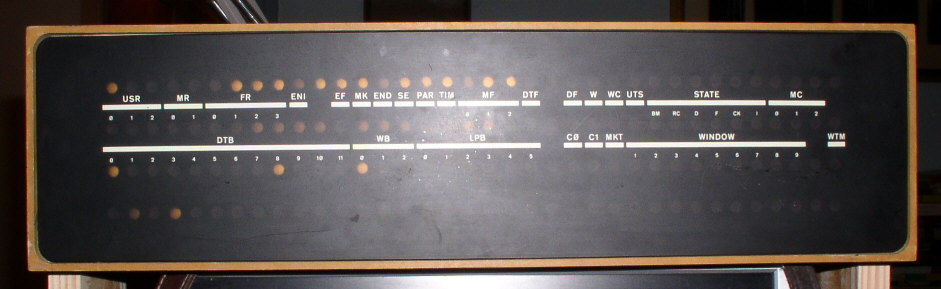
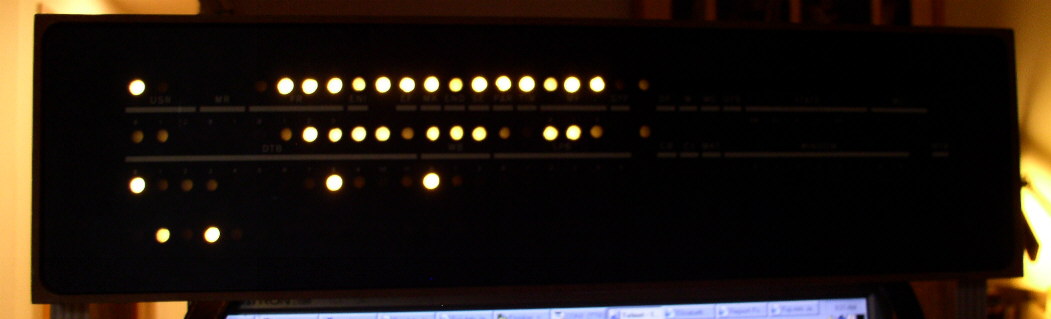
I got my indicator panel working, it looks quite nice:
http://ana-3.lcs.mit.edu/~jnc/tech/QSIC/jpg/DasBlinken2F.jpghttp://ana-3.lcs.mit.edu/~jnc/tech/QSIC/jpg/DasBlinken2NF.jpg
The inlay is an original from a TS08 that I happened to have lying around; Rod
S has made us a large batch of new blanks, but silk-screening of the captions
on the front of those is yet to happen. The bezel is also an original. (I have
a large stock of those, so it'll be a while before we need to work out how to
make new ones - probably resin casting, although 3D printing will be an option
too.) However, the guts are all new, and as you can see, the result looks just
like the real originals.
Dave has also worked out how to connect up the RKV12 (our name for the 22-bit
RK controller, by analogy with the RLV11/RLV12) to the internal 'block' RAM in
the FPGA, and then did the stuff to connect it to both the uSD card and the
internal RAM at the same time, with one drive connected to the RAM, so things
like swapping, etc don't 'waste' uSD writes.
Both of these are working quite reliably; the exciser/tester runs until we get
tired of the noise, and turn the machines off! :-)
His current project is to work out how to talk to the larger external RAM on
the FPGA daughter-board (the internal RAM isn't large enough for even a single
complete RK pack). I'm so looking forward to putting swapping, /tmp, pipes,
etc all on different platters, so as the system (Unix V6, natch :-) runs I can
watch the lights and see _exactly_ what's going on!
After that: turning the RK into an 'RPV12' (which should be pretty easy, the
RK11 and RP11 are very similar), and adding a mux so that the two controllers
can share the storage devices, etc. Those should both be done soon after the
external RAM (and maybe before, if Dave needs a break from that :-).
We also intend to do an 'extended RP11' (name not yet chosen, although I like
'RPV-12D - DEC's last was the RP11-C), which extends all the disk address
fields in the register to use the unused bits, giving us pretty massive
storage capability. With 16 bits of cylinder (up 7), 8 bits of surface (up 3),
4 bits of sector, that gives 28 bits of block number per drive; and with 8
drives per extended RP11, that's a total of 31 bits of block number per
controller. Convert the blocks to bytes, that's 9 bits more, so 2^40 bytes per
extended RP11, or 1TB!
Very shortly now we'll need to turn to starting on the design of the
'production' hardware.
Noel
In doing some research on the operating system for MU5, MUSS, I have been
told that a UK company called Membrain may have acquired it at some point in
the late 70's. Membrain were based in the South of England and made
Automatic Test Equipment.
Does anyone have any information on Membrain? Any software artefacts? Source
code even? I have had a look on BitSavers and Membrain does not feature at
all.
Thanks
Rob
Someone had ?asked me ?about ?they were looking ?for Claude Shannon Bell ?Labs ? ?publications ?for a ?display? Please email me ?off?list
Thanks ?Ed Sharpe archivist? for SMECC
> From: William Donzelli
> Germany often gets the short end of the stick when it come to radar
> tech in World War 2
For those who are interested in German radar, there's a good book:
David Pritchard, "The Radar War: Germany's Pioneering Achievement
1904-45", 1989
which covers their systems in some detail. There's also:
Martin Streetly, "Confound and Destroy: 100 Group and the Bomber
Support Campaign", 1978
which contains a very interesting chapter about an exercise called "Post
Mortem", run immediately after the close of hostilities, from 25 June to 7
July, 1945, in which the Allies observed (from inside) the workings of the
German air warning network, including things like how well it coped with
various kind of jamming (window, as well as active).
Noel
> From: Chuck Guzis
> the magnetron was made out to be a super-secret device, yet there's a
> clear explanation of it in my 1942 "Radio Handbook".
Ordinary magnetrons had indeed been around for a while; they were invented in
1920. The British invention was the _cavity magnetron_, a quite different
beast; it was kind of a cross between a magnetron and a klystron, with the
best features of each.
Buderi (which is indeed an excellent history, perhaps the best in the radar
section of my library) has a good explanation of how it works.
Noel
I recently found a Heathkit card cage ( 85-2001 121476 on backplane ) with
a DEC M7270, M8044, M7946, and M8043. I still have a few Heathkit boards
buried here sonewhere.
Please contact me off list if you have any questions or wish to make an
offer.
Thanks, Paul
> From: Fritz Mueller
> Spring cleaning, Noel? :-)
Yeah, sort of! These came with a bunch of PDP-11 boards I bought on eBay,
and they're just clutter. More stuff coming soon!
Noel
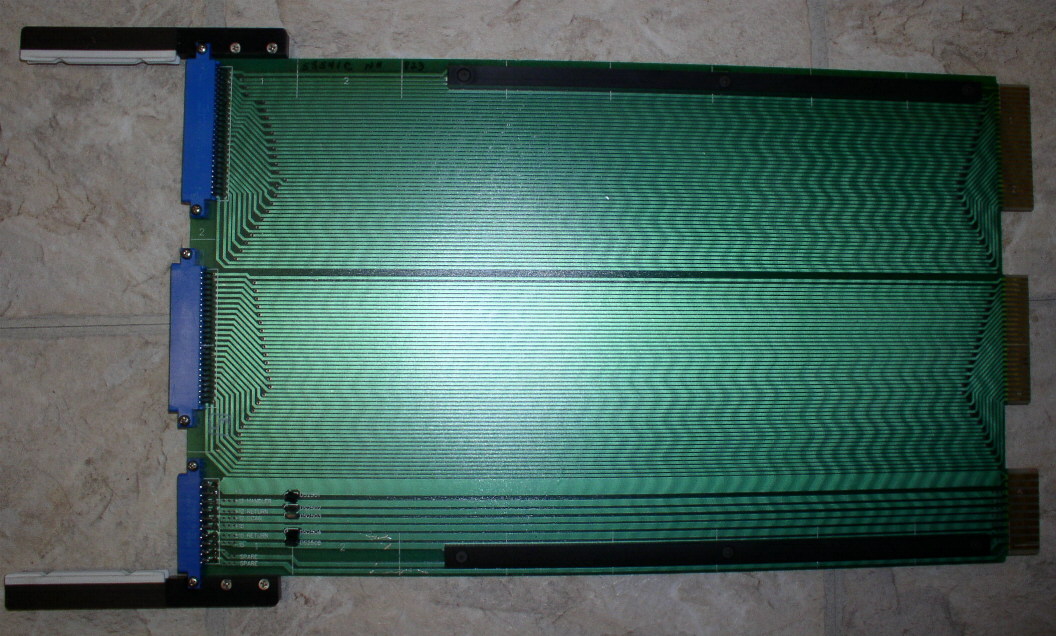
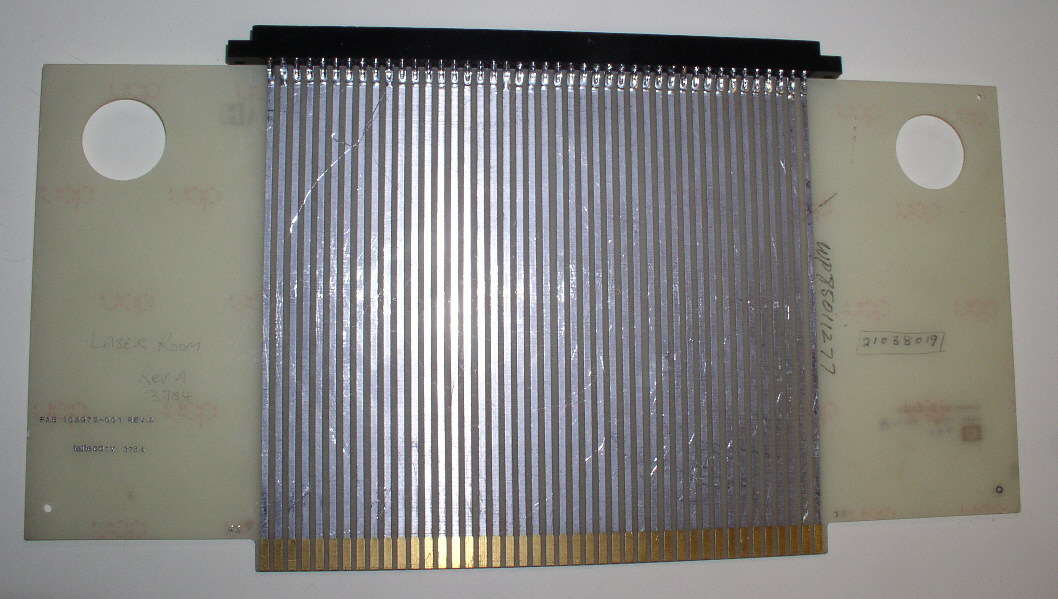
OK, another pair of unknown extender cards:
http://ana-3.lcs.mit.edu/~jnc/tech/jpg/tmp/LargeExtender.jpg
If anyone has a use for one or both, FTGH.
They are 17"x10", and the support arms (nice touch) are about 3" long.
No identifying marks that I can perceive, alas. The power leads are titled
"+5", "+12 Handler", +12 Return", "+12 Scan", "+15", "+- 15 Return", "-15".
Noel
> From: Brian Marstella
> I have a CPU board with similar format that I bought thinking I'd
> eventually figure it out.
A couple of people have replied privately telling me it's for a Motorola
EXORbus/EXORciser.
Noel
Hi all, I have an extra "RX8/RX11 floopy disk system user's manual" I'd like
to trade off for something I'd find useful (anything PDP-11 which I don't
already have, preferably). Anyone?
Noel
> From: Jon Elson
> if they did air raids over France or Germany, that eventually a plane
> with one would get shot down and a magnetron would be obtained in
> relatively good shape. So, likely by 1942 it was considered to no
> longer be a secret.
One was lost near Rotterdam in a raid on Cologne on February 2, 1943 (only
the second raid of the war using centimetric H2S radar which used the cavity
magnetron), and the remains were discovered in relatively good shape by
German technicians. The Germans worked out what it did pretty quickly, and by
the fall of 1943 they had started to deploy microwave detector systems.
Noel
GoMemorable got back to me. They'll still scan for me to QT ProRes on
hard drive for 20 cents a foot for 8mm/Super 8 and 30 cents a foot for 16mm.
- John
While cleaning just now I found one of the metal and black plastic side
bezels for an 8813. If anyone needs one, let me know and I can send it to
you!
--
Ben Sinclair
ben at bensinclair.com
Does anyone have an archive of classiccmp that goes back to the 90's? If
so, could I ask you to "hunt down" an old message of mine? I once wrote a
"reminiscence" of connecting to the ARPANET when I was a kid that I was
rather pleased with. Unfortunately, I seem to have lost it in a disk crash
(actually a couple of disks, primaries and backups).
Thanks,
Bill Sudbrink
---
This email has been checked for viruses by Avast antivirus software.
https://www.avast.com/antivirus
Folks,
I know someone in North Carolina (not on this list) who just found a small pile of IBM System/36 manuals in three ring binders. These are all already on Bitsavers, and these manuals are in pretty rough shape, but if anyone really really wants them, let me know and I'll pass on your contact information
5360 Vol A1 MIMS "Maintenance Information Manual - General Safety Guide (etc.)"
5360 Vol A2 MIMS "Maintenance Information Manual - CPU & Channel (etc.)"
5360 Vol A3 MIMS "Maintenance Information Manual - Work: Station (etc.)"
5360 Vol B2 MAPS "Maintenance Analysis Procedures"
5360 Vol C1 FLDS "Field Logic Diagram"
-Seth
--
Seth Morabito
web at loomcom.com
> From: Jerry Weiss
> Typically execution of the RESET instruction in a user program is
> treated as a NOP
Yeah, that's not documented in most PDP-11 CPU manuals, either. It's one of
the things that makes the PDP-11 impossible to virtualize; only HALT and SPL
trap, IIRC. M[TF]P[ID] doesn't, I think, and neither does WAIT or RT[IT],
IIRC.
Noel
From: Paul Koning
Sent: Monday, February 26, 2018 12:19 PM
>> On Feb 26, 2018, at 12:06 PM, Doug Ingraham via cctalk
>> <cctalk at classiccmp.org>> wrote:
>> The purpose of an emulator is to accurately pretend to be the original
>> hardware. It doesn't matter that the original OS runs on a particular
>> emulator. If a program can be written that runs on the original hardware
>> but fails on the emulator then there is a flaw in that emulator.
> That's true. But it is unfortunately also true that creating a bug for bug
> accurate model of an existing machine is extremely hard.
This is true even in real hardware (or "real" hardware, if you prefer), whether
bug-for-bug or simply correct results for corner cases.
The XKL Toad-1 System was designed to be a superset clone of the KL-10 based
DECSYSTEM-2065 from Digital Equipment Corporation. It implements the full
30-bit extended addressing introduced with TOPS-20 v4, of which the KL-10
provided a 23-bit subset, and provides native support for 10Mbit Ethernet and
FASTWIDE differential SCSI2 (both state of the art in 1991 when the design was
frozen).
As a better DEC-20, the Toad-1 was a success. (We will leave aside the issue
of its market failure, which is irrelevant to the story.)
Fast forward 20 years, to Living Computer Museum, where a KI-10 based DEC-1070
was undergoing restoration. Diagnostics were needed, so the resident TOPS-20
programmer laid hands on the MAINDEC sources for the KI-10 and proceeded to
compile them all and generate paper tapes of the results. All went smashingly
well until the multiplication test.
The diagnostic source for this test uses a macro to build a set of test values
for X**2 where X is a power of 2. Internally, Macro-20 uses the IMULM
instruction to build the results. In the KA-10 manual, IMULx of 2**35 * 2**35
is supposed to store the high order part of the result into the 36 bit word
addressed by the instruction, and set the overflow bit.
On the Toad-1 (and on the Toad-2 prior to our discovery of this bug), a zero is
stored instead. Since we compiled the KI-10 diagnostics on the Toad-1, this
incorrect result was placed on the diagnostic paper tape, and the KI-10 seemed
to fail the diagnostic. Imagine our chagrin when days of trying to correct the
problem led to the conclusion that the diagnostic was incorrect.
Rich
Rich Alderson
Vintage Computing Sr. Systems Engineer
Living Computers: Museum + Labs
2245 1st Avenue S
Seattle, WA 98134
mailto:RichA at LivingComputers.orghttp://www.LivingComputers.org/
> From: Paul Koning
> RTI/RTT are used in the debugger, so they need to work in user mode.
> They refuse to raise your privilege level, though.
I understand that it has uses, but by specifying the 'failure' mode in User
mode (when the contents of the current or previous modes is not User) to be
'ignore', rather than 'trap', that's one more thing that makes the PDP-11
non-virtualizable. (This choice, to ignore, instead of trap, has the same
issue in other places where it's done that way, e.g. RESET.)
Noel
> From: Charles Dickman
> So if the I/O page is completely (all processor modes) unmapped is
> there any way to recover besides a power cycle? Does the RESET
> instruction disable the MMU?
Interesting questions!
The CPU manuals don't say, about the RE$ET; I just tried it on the /23 I
happen to have next to my desktop, and yes, the RESET instruction does clear
bit 0 of SSR0.
Noel
There will be three awesome keynotes for VCF East this spring.
- Friday: our own Bill Dromgoole who'll talk about restoring the VCFed
UNIVAC mainframe.
- Saturday: Don Eyles (NASA contractor who hacked the Apollo Guidance
Computer to save the Apollo 14 mission)
- Sunday: Dave Walden, who programmed the IMP at BBN for the ARPANET
Is there a document that describes the bank 7 memory page and what
addresses are reserved for what?? I think I've seen this before but
can't seem to put my hands on it.
Another question, bootstrap is reserved for 173000, how many words are
allowed there for this?? How do the more complicated bootstraps, e.g.
microPDP11-53, accommodate this limitation?
Doug
Hello Folks.
Forgive me for the intrusion. I know a good soul in Brisbane area in
Queensland, Australia who is looking for some sort of apprenticeship in
electronics or communications/networking. I thought I would ask here in
case this message reaches some of you blokes down there that might be able
to point him in a useful direction. He's in his 30s, very sharp and
capable, gainfully employed in an entirely unrelated field and looking for
a change in his life.
Offline responses welcomed.
Thanks!
Sellam
>From Dennis Boone
> Jonathan Engdahl's homepage shows his email
> address. His changes are explained at the page you linked.
Yes indeed - as I (meant to have) said, no reply to his email listed there.
> The 32MB limit arises due to the use of 16 bit block number fields in
> the protocol.
I understand the issue but alas I'm a mere hardware guy with minimal
software skills so I was looking for a giant to carry me ;).
> if it's useful, you can find it here:
> http://yagi.h-net.msu.edu/vtserver.drb.tar
Perfect - minor mod for my raspberry pi and it works just fine thanks.
Bob
> From: Douglas Taylor
> Is there a document that describes the bank 7 memory page and what
> addresses are reserved for what?
Here's one I collated from a large number of DEC manuals:
http://ana-3.lcs.mit.edu/~jnc/tech/pdp11/UNIBUS_Registers.txt
(Ignore the name, it applies to QBUS machines too.)
> bootstrap is reserved for 173000, how many words are allowed there for
> this?
Well, the space from 773000-773776 (UNIBUS and Q18 - add '17' to the front
for Q22) is used for ROMs, and is the most common; 173000 is of course the
location QBUS processors can be configured to jump to on power on. 765000-776
in also used for some (e.g. M9301's).
> How do the more complicated bootstraps, e.g. microPDP11-53, accommodate
> this limitation?
Bank switching; e.g. the BDV11, KDF11-B have a 'page control register' at
777520 which says which block of ROM is mapped into the 773000 block.
Interestingly, the DEC standard ROMs for the BDV11 and KDF11-B _don't_ copy
all the contents down to real memory, and run from there - the code is
divided into 'pages', only one of which is mapped in at a time, and it's
executed from the ROM.
Noel
> On many of the PDP-11s that page is signified by asserting BBS7
QBUS machines only; the UNIBUS has no equivalent signal.
> FYI the microPDP-11/53 is the 11/23+ cpu card
Err, no; according to the "MicroPDP11/53 System Supplement Manual"
(AZ-GPTAA-MC), pg. 3-1, the CPU card in the /53 is the KDJ11-D. The
/23+ uses the KDF11-B CPU card.
Noel
At 01:09 PM 2/24/2018, Pete Lancashire via cctalk wrote:
>I have a small, 5-20 stack of 16 mm's of movies dealing with computers
>The one in front of me is
>"Once Upon a Punched Card"
>I am looking for a place in the USA with a reasonable price to have them
>digitized and I will place them on both my Google drive and a Youtube
>So far I have only been able to find places I can not afford.
I use https://gomemorable.com/ . I've used them for both 8mm and 16mm.
They have sales now and then that'll drop 40% off the price. They're
running one now until March 3.
They scan digitally with LED illumination, frame by frame. It'll
brighten your old film in ways you can't imagine. They'll scan
to HD (1920x1080) resolution.
I send them a hard drive and they return the files as Quicktime ProRes
movie files. These days, send 'em a bare SATA SSD to save on shipping.
If you didn't want to edit yourself, they can send you a DVD or far better
yet a Blu-ray.
As I look at their web site now, I don't see a link that gets
me to these services I describe, that I've used as recently as a
month or two ago. I'll write them a note to see where the straight-forward
per-foot pricing and hard drive options went.
For 8mm, many old cameras would actually expose more of the width of
the film than you'd ever see on your projector, so I have them scan
the full frame.
Here's an example of a color home movie from the 1940s that I had
converted to VHS in the early 90s via telecine, compared to a modern
digital scan:
https://www.youtube.com/watch?v=f08K0Co3l5s
- John
I've been using vtserver to transfer an OS to a minimal pdp11 (only a HD and console port so far). Works fine but it has a well-documented 32MB file limit. This website http://home.windstream.net/engdahl/vtserver.htm mentions some hacks but I've been unable to contact the author. Anyone have details of either the code or author?
Thanks
Bob
Sent from my iPad
Hello all,
. . . . For those of you who having not been following my trials and tribulations with a 16700A in another topic here is a partial update. I received this LA from a benefactor who has stepped forward. A real big thanks to him. I have run into that incompatibility problem with External CD-ROM Drives.
. . . . I am disabled and partially housebound. I am living on SSD so money is very tight for me. I am looking for a CD-ROM Drive for little or nothing that is compatible with the 16700A I have an NEC 3x Drive that uses the CD Carriers. Remember those. I have installed this and a Maxtor 245MB SCSI drive in an External SCSI box. The Termination on the CD-ROM Drive is turned off and I removed the Termination resistors on the HDD. I have a Terminator installed on the end of the SCSI bus on the External Case. Could someone please help me out? Any and all help is greatly appreciated.
GOD Bless and Thanks,
rich!
---
This email has been checked for viruses by Avast antivirus software.
https://www.avast.com/antivirus
Hi, all,
I'm going through a box of random ICs and one particular item is not
showing up on my searches outside of a couple eBay auctions for chip
collectors.
The IC is a 20-pin ceramic body with side brazed legs, gold pins, chromed
lid, with NEC D2168D on it with "-2" painted on the ceramic and date codes
>from 1984. It's almost certainly a RAM chip of some kind, but I'm not
finding any pinouts or data sheets.
Anyone recognize this? Anyone know a system that uses them? I have more
than 10, and since I haven't run across them before, I probably don't have
a machine that needs them.
Thanks for any tips.
-ethan
The following extract comes from a History of Programming Languages (HOPL)
retrospective on the development of the Ada programming language written by
the individual who was the government lead at DARPA for much of the time of
its development (Colonel William A. Whitaker). I found it humorous.
Perhaps you will too.
-----
The ARPANET connection was inaugurated during a visit to RSRE by Her Royal
Highness Queen Elizabeth II. Her Majesty sent a message of greetings to the
members of the HOLWG from her net account, EIIR, by pressing a red velvet
Royal carriage return. Because the address list was long, it took about 45
seconds for the confirmation to come back, 45 seconds of dead air. Prince
Philip remarked, joking respectfully, that it looked like she broke it.
-----
I suspect that we've "all been there" at one time or another!
paul
What is vintage computing?
I think it's the IBM PC. Anything else is not vintage computing.
b
On Thu, Feb 22, 2018 at 3:36 PM, Evan Koblentz via cctalk <
cctalk at classiccmp.org> wrote:
> It's gone meta: people threadjacking a thread about threadjacking. Now
> it's some posters trying to show others who is smartest about arcane
> details of obsolete email software.
>
From: Paul Koning
Sent: Wednesday, February 21, 2018 6:41 AM
> And while there is roughly-accurate simulation of DECtape in SIMH (presumably
> for TOPS-10 overlapped seek to work?)
It's not for Tops-10. SimH only provides the KS-10 processor[1], so DECtape is
not a possible peripheral.
Rich
[1] Although there is a KA-10 in the works.
> From: Grant Taylor
> I'm on a list where it seems as if a frequent contributer uses an MUA
> that does not send In-Reply-To or References headers at all. It doesn't
> even send a User-Agent header. *sigh*
That's me, I expect.
I used to use a TOPS-20 email reader called MM, and when I moved my email to a
Unix machine, there was a version of MM I used there, then something happened
(I forget what) and I couldn't use that any more.
I do have access to a more modern email reader (Eudora), but don't like it; I
just stick with old, simple stuff I know how to use. I don't have the spare
brain cells / energy to switch.
After going through I've-forgotten-how-many editors (starting with TECO, then
'ed'), text formatting systems, operating systems, email readers, etc, etc I
have a _very_ simple rule about switching software: is the old stuff I'm using
utterly, irretrievably unusable? If not, ignore the new stuff. Eventually
it'll be obsolete too. And in the meantime, I'll have saved countless cycles
by not going through the hassle of switching to it. Life's too short.
Noel
Well, I bought that DEC Pro 350 on ebay. It initially booted up and I got
the error screen. The error code I found on the Internet was related to
the hard disk controller. So, I thought I just needed someone to sell/give
me some systems disks for the unit and I could try to setup the drive again
if it still functioned.
Then, it after a couple of restarts (I re-seated the boards and cleaned the
connectors) it stopped showing the error screen (with picture of the
computer). All the diagnostic lights are red on the back and nothing ever
shows on the screen. The power comes on and then nothing.
If anyone has any thoughts, I would appreciate it. I knew the history of
this type of computer and figured it was a long shot. I am just
disappointed to have gotten really nowhere with it.
Thanks!
Kurt
> From: Kurt Hamm
> If anyone has any thoughts, I would appreciate it.
You probably already know this, but... My sense is that a collector of
classic computers has to be able to diagnose and repair at the component
level - get in there with an oscilloscope and a set of prints (creating the
latter, if need be), and find the busted chip/transistor.
It's like collecting old cars - if you collect old cars, you have to be able
to work on them (or like Jay Leno, be rich and hire someone else who can -
although given that Jay worked at an auto dealer 'back in the day', he
apparently does know a fair amount).
Which isn't going to help much with this particular problem, maybe some of
the other replies will help.
Noel
Hi folks,
I recently discovered a complete Honeywell DDP-516 console on Ebay. It
is a charity auction, ending tomorrow.
I am the high bidder (hachti, 600-some points) and BEG YOU ALL NOT TO
BID on it!
I already entered a crazy high bid anyway bid so please don't bid on it.
I am one of the very very very few people who have an actual DDP-516
machine and can really use this as a spare for a real machine.
Again, PLEASE refrain from bidding up this item!
If you are the owner of a "headless" machine who is in need for the
front panel: please contact me, so we can avoid an explosion on Ebay.
Thank you very much.
Kind regards
Philipp