Tony Duell <ard.p850ug1 at gmail.com> wrote:
> > until the 8085 CFE loaded the microcode.
>
> Loaded from a TU58 cartridge, which is the main reason my 11/730 is not
> running at the moment. The hardware is fine, I've rebuilt the drive rollers,
> but as yet don't have a readable tape (not even blank, to write the
> microcode onto).
I'm pretty sure that I have a complete set of 11/730 TU58 tapes in
my storage unit. I might even have some brand new tapes. If I
can find them, I would be happy to send them to you. They have
been sitting in storage for probably 20 years, so there are no
guarantee that they are readable.
I'm cleaning out the storage unit right now, in preparation for
moving, so I'll keep an eye out for them.
Alan "Pack rat" Frisbie
This has probably been asked before, but does anyone have the software
package that came with the HP-IB/RS232 HP10342 bus pre-processor for the
HP1650 series Logic Analyzer (actually I have a 1670G)? It should have a
config file and an inverse assembler file. I'm interested in the HP-IB
files. Can't find it anywhere.
- Marc
hi
I am playing with an old Motorola board and I have a problem
As you well know, the 68020 is a 32-bit microprocessor from Motorola,
released in 1984. Motorola also manufactured MC68EC020 - embedded
version of the MC68020 CPU, housed in different packages than the
Motorola 68020 microprocessor, but even in the case of PGA package of
114-pin PGA, MC68020/PGA is not pin-to-pin compatible with
M68EC020/PGA
They both use 114-pin PGA package, but some pins are different, (Vcc
and gnd are placed differenly in the pinout), and you need an adapter!
My board's socket is designed for M68EC020, but I need to use a M68020
chip because only the goldcap version, i.e. MC68020RC33 114-pin
ceramic PGA, is available at 33Mhz.
Code: Select allCPU: MC68020 114-pin PGA ----[adapter] ---> socket:
MC68EC020 114-pin PGA
Do you happen to know *where* I can find an adaptor M68020-PGA to M68EC020 PGA?
Do you happen to have for sale?
here I am
Thanks!
I'm looking for manual scans, software, really any documentation of any
kind for the Fairchild F9440 or 9445 (aka the MicroFlame) microprocessors.
Yes, bitsavers and a few other places have datasheets for the chips, but
that's really about all the documentation I've found. And yes, I know that
they're Nova clones and can run DG software, but Fairchild had their own
development tools too that seem to have disappeared completely.
In particular, Fairchild had a single board computer for the 9445 called
(I think) the PEP-45. It had a built in EPROM monitor called PEPBUG-45.
I'd love to find manuals and schematics for that gizmo. Actually I'd be
interested in documentation for any systems that used either of the 944x
chips.
Bob
http://downthebunker.chickenkiller.com
DownTheBunker is open!
features:
- bazaar distiller doesn't require to register an account, it sums up
Market place's items for sale or wanted in a nutshell
- person-to-person trading in the Bazaar, you have to register an
account in order to contact people
- mini message-wall; doesn't log the IP and doesn't require you to
register, can be used as a message in the bottle, or a mini chat
- message-board. doesn't request to register but it logs the IP. It's
more advanced and it can be used as mini Wiki
- Chunks (of users/stuff) offers FTP-like with manuals and links to
other sites bookmarks
Durcheinander is an advanced area with the possibility for the (local,
only from the local intranet) user to upload and execute JavaScripts,
JavaAplette, Node.Js code, and Java bytecode. It's not yet safe enough
to be open to the public Internet, and it stills needs to be hardened
in its profile. Due to what happened in December 2017, cyber attacks
destroying the whole website, it's a reserved chunk of priv? stealth
rooms for the team, whose access from the Internet is reserved and
features are reduced e.g. it checks the socket.connect.ip, and if it
comes from outside the intranet it blocks the whole scripting-engine
allowing just a plain text browsing.
My participation to SGI is merely focused on my needs, as I'd like to
port an HDL simulator to Irix.
But I sold my Octane 1 year ago, and I am willing to sell my dual
Tezro rack-mountable racks cause I lost enthusiasm.
Anyway, does anyone happen to have a copy of an Ada95 compiler for
Irix? Or a working copy of GNAT? Needed for IRIX >= 6.5.27
I will for sure sell the Tezro, Maybe I will reconsider the purchase
of a tiny Octane.
I am more focused on Linux/HPPA and Linux/PPC32, which are used for job tasks.
At the moment. I am developing a fast FiberChannel ram-disk for the
radio telescope.
cheers
I agree this is very specific, but I thought perhaps someone could help.
As I look at the '09 datasheets, I can't tell when the data lines become
valid on a write cycle.
I ask because I have created a few projects that place themselves
between the CPU and the CPU socket (CPLD based).
To play nice with a potentially shared address and databus, my code
honors the BA and TSC lines on the IC.? If either line is high, as noted
in the datasheet, I tristate the address and data lines.
Otherwise, the address lines are valid during the entire E cycle.
As for data, it depends on the state of the R/W line.
If R/W is high, the external databus is connected to the CPU databus
during the entire cycle if TSC and BA are both low.
If R/W is low, I initially set the external data bus according to this
assign statement:
assign data_ext = (!r_w & e& !(tsc | ba) ? data_09 : 8'bz);
The '09 boots, but certain devices fail to operate.? If I change the
assign to:
assign data_ext = (!r_w & (e | q) & !(tsc | ba) ? data_09 : 8'bz);
or
assign data_ext = (!r_w& !(tsc | ba) ? data_09 : 8'bz);
The devices begin working.
Either of the modified equations works, but I don't know if can safely
place data on the external databus during the entire cycle, like the
address lines, or if I need to be off the bus for some small portion of
the cycle.? I was hoping the datasheets could help, but I am missing the
key portion of the timing diagrams.
I hope someone can enlighten me.? I have the system working, I just want
to make it as good as possible.
Jim
--
Jim Brain
brain at jbrain.comwww.jbrain.com
If they are still around, this guy had a lot of old DEC stuff.
Not affiliated with seller, etc.
Mitch Miller
| Phone (937) 847-2300 / Fax (937) 847-2350 (Old area code was 513)
|
| Keyways, Inc.
| 204 S. Third St.
| Miamisburg, Ohio 45342 USA
|
| E-mail: miller at keyways.com
| Web: http://www.keyways.com
| Stock List: http://www.keyways.com/stock.html
Cindy Croxton
---
This email has been checked for viruses by Avast antivirus software.
https://www.avast.com/antivirus
Can anyone point me to a technical manual for the DataMedia Elite 2500A
terminal? I'm especially interested in documentation on the escape
sequences and the special character sets. This was a fairly high end smart
terminal from the late 70s or early 80s.
Bitsavers has a short manual for the 1500 which I'm guessing to be
similar, but the 2500 has some extra features (e.g. insert line/character,
delete line/character, etc) that aren't present there.
Thanks,
Bob Armstrong
> From: Dominique Carlier
> I just regret this incredible rise in prices for collector machines
> that, not so long ago, were languishing in wet sheds
Hey, look at the bright side: as a result, they are much less likely to be
simply recycled as scrap.
I took great pleasure in telling one seller who'd pulled a board-set,
and recycled the rest, that the part he'd recycled was worth a lot more
than the part he'd saved. Hopefully that kind of news gets around.
Noel
I received an email from plebourgeois at me.com who said he's in
Mandeville, Lousiana and has an Osborne available with
accessories/manauls to a good home for the cost of shipping. He said
he'll throw it away if he does not find a home for it soon.
That's all I know, do not reply to me or this list, send the guy an
email directly.
________________________________
Evan Koblentz, director
Vintage Computer Federation
a 501(c)3 educational non-profit
evan at vcfed.org
(646) 546-9999
www.vcfed.orgfacebook.com/vcfederationtwitter.com/vcfederation
> From: Henk Gooijen
> My findings so far :
> www.pdp-11.nl/pdp11-35/repair/repair35page.html
> Comments are very welcome!
I got a:
You don't have permission to access to this document on this server.
Apache Server at pdp-11.nl
error message?
> I vaguely remember that there was a difference in the front console For
> the BA11-K and the BA11-F configuration. ... the two ribbon cables from
> the front panel are at the right side for a BA11-K box, and on the left
> side for the BA11-F box. Given the location of the CPU boards in both
> boxes, that makes sense.
They didn't do two different console PCBs, did they? It must be just cabling
routing? I couldn't find any manual/drawings for the BA11-K version, so I
can't tell for sure..
> From: Jon Elson
> I'd get an FPGA development board and download Xilinx's webpack
> software. It would not take real long to design the basic microcode
> engine, and then you could develop some application microcode in
> parallel with the hardware
That approach worked really well for Dave B and I on the QSIC. IIRC, we
bounced around the uengine design concepts for a couple of days, and then
once we decided to go, he had the hardware working in a day or so. It's in
Verilog, so perfect for an FPGA devel board; I think it's in his Github
repository:
https://github.com/dabridgham/QSIC
If you go this route, I have that config-file driven uassembler written in
portable C (compiles on 3 different systems that I know of) which uses only
standard I/O library which you can use for the ucode; it should handle most
any uengine design, unless it has something really wierd.
Noel
> From: Kyle Owen
> I do have an 11/45, though... so with this modification, I suppose one
> could have some fun:
That's for the -11/40 - very different machine, one couldn't use the same
technique on the /45; the /40 is prepared to accept additional ucode on
additional CPU boards, that's how the EIA works:
http://gunkies.org/wiki/KE11-E_Extended_Instruction_Set
And it's custom boards, the design for which is no longer extant (pity, as
I'd love to play with one myself).
Finally, I have this vague memory that they had to put a few minor mods on
some of the existing CPU boards (details also lost), although my memory may
be misleading me on that.
Noel
> From: Kyle Owen
> So the same technique would work on the 11/35, then?
Yes, the /35 and /40 are completely identical, except for the number
painted on the inlay on the front console.
(Well, the /35 was often sold in a BA11-K box, and the /40 in a BA11-F, but
that's just physical configuration, and is just a 'usually' - there are
/35's in BA11-F's [for sure], and probably /40's in BA11-K's.)
Noel
I?m looking for a circa 1974 copy of RSX-11D distribution and the COBOL compiler that was shipped as an add-on product.
I?ve looked through trailing-edge but maybe I am missing the obvious, anyone have any ideas or has a copy?
thanks
Not affiliated with seller, etc.
Intel 386 CPU. Remember when we bought them and thought they were so fast!
Well..maybe someone has that obscure application that needs them.
500pcs
QU80386EX25
NEW UNUSED IN TRAYS
Regards,
Ron Sanders
RBD Electronics, Inc.
63 Flansburg Ave
Dalton, MA 01226
1-413-442-1111
ron at rbdelectronics.com
Cindy Croxton
Electronics Plus
1613 Water Street
Kerrville, TX 78028
830-370-3239 cell
sales at elecplus.com
AOL IM elcpls
---
This email has been checked for viruses by Avast antivirus software.
https://www.avast.com/antivirus
Hello folks,
This weekend I picked up a VT52 DECscope terminal from a fellow collector. It's in fantastic shape, apart from being a little dirty and missing the number "6" keycap from the number pad.
This is a real long shot, but if you have a permanently broken VT52 terminal you're keeping for parts, could you please let me know? I'd like to buy a "6" key and make this one complete.
-Seth
--
Seth Morabito
web at loomcom.com
So I have discovered that the manual and prints for the MM11-F core memory are
not online; it turns out I have a manual/prints set, and at some point will
get them scanned and over to Al.
My question is: is there anyone who has an immediate need for these things?
If so, I will make the scan higher priority, otherwise it'll be a round tuit
number.
Noel
[apologies for lack of context, been away from cctalk a long time and insufficient recall of how this cctalk thing works... yet somehow still remember IAS on an 11/70 from the 1980s]
Pick an RSX layered product and lots of fundamental stuff would probably be compatible between 11M, 11D, and IAS (and/or 11M+). Find the RSX version and see if IAS is mentioned as supported in the SPD or other documentation. It often was, and even if it wasn't, lots of non-priv stuff would just work.
More IAS background from someone (not me) who was there in the IAS development team in DEC Reading:
https://www.john-a-harper.com/ias.html
"This page is dedicated to the best of the many PDP-11 operating systems - IAS
I couldn't find anything else on the Web about IAS? but it deserves better than to fall completely into obscurity.
DEC's approach to operating systems for the PDP-11 was anything but disciplined. New ones got invented every time some engineer or marketing person blinked. In the early days, there was a real-time kernel called RSX-11A, designed for memory-resident applications in what we now call embedded processors. Features got added to this rapidly - code bloat is nothing new. By the time it got to RSX-11D it had a complete disk-based file system, a program development environment, and support for every peripheral in the Small Computer Handbook (and there were plenty of them - peripherals on the PDP-11 obeyed the same strategic imperatives as operating systems - see above). At this time, a bright young engineer called Dave Cutler decided that enough was enough, and set out to create a small system that would do the same, which he called RSX-11M. We all know what happened to him - and he no longer even has the excuse of youthful excess.
(continues...)"
Hth.
For the last five years I've been working with Qualcomm and others to
allow the Computer History Museum to release the source code of what
was, in my opinion, the finest email client ever written: Eudora.
It's finally done!
http://www.computerhistory.org/atchm/the-eudora-email-client-source-code/
Is Linux "classic" enough? If you think not, please ignore this email
I started with Linux kernel version 0.12 (not a typo), which I believe
was the first version that was self-hosting. I subscribed to Linux
Journal from its beginning.
Is there any collector value or interest in old issues of Linux Journal?
I have a continuous run for "several" years, beginning with the very
first issue.
Anyone interested? As many as you want could be yours for the cost of
shipping (USPS Media Mail).
Hey all,
I have an IBM 5140 portable with a printer but I'd really like to use it as
a terminal among other things. Any chance there's documentation available
for that Centronics connector or another internal header with RS232 or
whatever?
=]
--
--
Anders Nelson
+1 (517) 775-6129
www.erogear.com
> From: Eric Smith
> The NS455 has firmware in masked ROM ... The NS405 has the masked ROM
> disabled
Ah, thanks muchly! Do you know of _any_ documentation extant for the 455? I
couldn't find anything..
> I've been searching for the NS405 manual (not the datasheet) for a very
> long time.
The data sheet seems pretty complete - are you sure there ever was a manual?
Noel
This time not so 'classic'
My last job was maintaining IBM p7's and eventually p8's.
One thing I started was putting together a home setup. But like all the
other
projects the gear has become redundant to me.
The 'stack' consists of 2 each IBM p720's, a CR6 HMC, and a KVM drawer.
The p720 do NOT have any hard drives or carriers, but both are available via
Ebay. The carrier was used in more than one model, and in the past I've
bought carriers with small disks for < $20 each, then found larger disks of
various brands.
And the rails are missing from the p720's.
Google "ibm p720"
I can't remember how much RAM, number of CPUs etc but one p720 was
'loaded'.
If interested let me know and
If anyone knows a good AIX list please let me know
I'll try to get a few photo's this weekend.
The 'stack' is located in Portland, Oregon.
NO PACKING OR SHIPPING, must be local pickup.
-pete
> From: Jon Elson
> Steve Ciarcia ... made a board using the NS405 called the Term-Mite.
I decided I'd do an article about the Term-Mite for the CHWiki; I found
Ciarcia's long article about the Term-Mite (in his book, which Google books
has); it talks throughout the article about the NS455 - but it also says
"[t]he Term-Mite actually uses a NS405 chip which is a specialized version of
the generic NS455".
So I went to look up the 405 and 455, to see what the difference was between
the 405 and the 455. I found a data sheet for a 405, but not one for the 455.
Does anyone know where I can find info about the 455 (or, better, yet, know
what the difference is between the two - that would save me some leg-work).
Thanks (I hope :-)!
Noel
I have some Amiga documentation gifted to me a long time ago by an Amiga
enthusiast. Now that I'm moving and downsizing, it has to go.
Free for shipping, USPS media mail.
AmigaDOS User's Manual - paperback book
---------------------------------------
"This manual describes the various AmigaDOS, [sic] and its commands."
Errata to the AmigaDOS User's Manual - photocopy
------------------------------------------------
Amiga Hardware Manual - photocopy
---------------------------------
"... provides information about the Amiga graphics and audio
hardware ... tutorial on writing assembly language programes to directly
control the Amiga's graphics and hardware."
INTERFACING TO THE 68K BUS CONNECTOR ON THE AMIGA
Designing Hardware for the Amiga Expansion Architecture
Drawings of the Expansion Boards for the Amiga
----------------------------------------------
A packet of photocopy documents and schematics.
I didn't see it being mentioned here on cctalk :(
http://archive.is/dJgyQ
but I'm hearing some refugees saying that the chances of the site going back online are not looking good
>
> Date: Mon, 21 May 2018 21:01:59 -0400
> From: Michael Thompson <michael.99.thompson at gmail.com>
> Subject: Re: I ran across this strange modernistic? Data General
> ...odd? computer?
> The RICM has one, but it is not on the WWW site.
>
> Michael Thompson
>
>
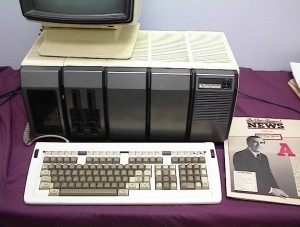
I put a picture of the one at RICM here:
http://www.ricomputermuseum.org/Home/equipment/data-general-desktop-generat…
Going from left to right: QIC tape drive, dual floppies, disk drive, card
expansion, CPU, and power supply. We have the monitor, keyboard, and
printer for it too.
Next time I am in the warehouse I will take pictures of the serial/model
number tags of everything.
--
Michael Thompson
Randy,
Although there are people interested in collecting historic software (especially source code), I don?t know of a central place to discuss it. I?ve collected the original IBM 704 Fortran/Fortran II compiler, the original IBM 709x Lisp II interpreter, and various other things (see http://www.softwarepreservation.org/projects). As you build up your collection of CAD-related source code, I would encourage you to offer copies to the Computer History Museum (http://www.computerhistory.org/artifactdonation/) for long-term preservation.
Paul McJones
http://www.mcjones.org/dustydecks/
On May 21, 2018, Randy Dawson <rdawson16 at hotmail.com> wrote:
> For a while I have collected bits of legacy CAD, most recently Martin Hepperle sent me what I believe is the last version of Hank Christianson's MOVIE.BYU, a FORTRAN based 3D modeling and animation system.
> I also have experimented with the original Berkley SPICE, also written in FORTRAN.
> ...
> My question is, did any of the source code for these systems, Applicon, Auto-Trol, Calma, ComputerVision, thousands of lines of primarily FORTRAN ever make it out, where we could read and study this original body of mathematical geometry done on computers?
>
> I know we are primarily a hardware group here, but where is the interest in the software discussed?
>
> Randy
Also, the computer history museum has a listing, so someone might be interested in getting the original code running on an emulator:
http://www.computerhistory.org/collections/catalog/102726903
> On May 26, 2018, at 10:00 AM, steven at malikoff.com wrote:
>
> I don't know if any source is still available, but for a long time I've been fascinated by Ivan Sutherland's Sketchpad running on the TX-2:
> https://www.youtube.com/watch?v=USyoT_Ha_bA
>
> Since Sutherland's technical report is also on the web (https://www.cl.cam.ac.uk/techreports/UCAM-CL-TR-574.html) I reckon it would make for a great 3rd-year Computer Science graphics assignment, to replicate Sketchpad using a high level language. A look through the report shows the use of rings, linked lists, recursion, storage considerations, maths, graphics and so on (only needing to replace the light pen with the mouse of course) which could be a fascinating exercise for a student. Yes there are already Sketchpad-named apps and Sketchpad-like programs, but I'm not sure if there is a near-100% faithful recreation of that original program as demoed in the film out there.
>
> Steve.
Hi guys - wonder if any OCR aficionado can help me out please.
I'm trying to clean up some old computer docs.
One of things I'm doing is running OCR over them, in particular Adobe's ClearScan which I really like for document clarity and small
file sizes.
A few of them are producing the error:
Acrobat could not perform recognition (ocr) on this page because:
ENU
Most OCR errors relate to renderable text but I can't find an explanation for "ENU"
Has anyone encountered this OCR error and can tell me what it means please.
Thank you.
Kevin Parker
Cross-post for the DEC Lovers here.
-----Original Message-----
Sent: Thursday, May 24, 2018 9:52 PM
Subject: [GreenKeys] How to get rid of a DECwriter II?
I'd sure like to get this thing out to make room for more Teletypes.
Located in NW Arkansas.
Jim Haynes <jhhaynes at earthlink.net>
-----
ftp://ftp.irix.cc/pub/nekoware/
-----Urspr?ngliche Nachricht-----
Von: cctalk [mailto:cctalk-bounces at classiccmp.org] Im Auftrag von
cctalk-request at classiccmp.org
Gesendet: Freitag, 25. Mai 2018 19:00
An: cctalk at classiccmp.org
Betreff: cctalk Digest, Vol 44, Issue 24
Send cctalk mailing list submissions to
cctalk at classiccmp.org
To subscribe or unsubscribe via the World Wide Web, visit
http://www.classiccmp.org/mailman/listinfo/cctalk
or, via email, send a message with subject or body 'help' to
cctalk-request at classiccmp.org
You can reach the person managing the list at
cctalk-owner at classiccmp.org
When replying, please edit your Subject line so it is more specific than
"Re: Contents of cctalk digest..."
Ahoy HP Aficionados!
I have for sale here one nice set of documentation for the HP 2116C.
There are a total of three original HP binders, each with a multitude of
individual documents, as follows:
Binder No. 4
HP BASIC (April 1970)
HP FORTRAN (April 1970)
Small Programs Manual
- SIO Teleprinter Driver (LP Compatible) (April 1970)
HP ALGOL (April 1970)
Symbolic Editor (April 1970)
Binder No. 5
12597A-002 Tape Reader Interface Kit Operating and Service Manual (November
1970)
2748A Tape Reader Operating and Service Manual (October 1970)
12531C Buffered Teleprinter Interface Kit Operating and Service Manual
(July 1971)
Manual of Diagnostics
- Alter-Skip Instruction Test (June 1970)
- Memory Reference Instruction Test (June 1970)
- Shift-Rotate Instruction Test (June 1970)
- HP 2116B Low Memory Address Test and HP 2116B High Memory Address Test
(January 1971)
- Tape Reader Test (January 1971)
- Computer Interrupt Diagnostic (June 1970)
- HP 2116C Low Memory Pattern Test and HP 2116C High Memory PatternTest
(September 1970)
- Power Fail Interrupt (February 1970)
- General Purpose Register Diagnostic (May 1971)
- HP 2116 TTY Test (April 1971)
12566A Microcircuit Interface Computer Interface Kit (December 1968)
Binder No. 6
2752A Teleprinter Operating and Service Manual (November 1970)
Teletype Corporation Bulletin 310B Vol 1: Technical Manual, 33
Teletypewriter Sets: Receive-Only (RO), Keyboard Send-Receive (KSR),
Automatic Send-Receive (ASR)
Teletype Corporation Bulletin 310B Vol 2: Technical Manual, 33
Teletypewriter Sets: Keyboard Send-Receive (KSR), Receive-Only (RO),
Automatic Send-Receive (ASR)
Teletype Corporation Bulletin 1184B: 33 Page Printer Set (ASR, KSR AND RO)
Parts
I am asking $250 or best offer. As always, please respond directly via
e-mail if interested.
Thanks!
Sellam
>
>For the last five years I've been working with Qualcomm and others to
>allow the Computer History Museum to release the source code of what
>was, in my opinion, the finest email client ever written: Eudora.
>It's finally done!
Yay! Now someone can fix the bugs :-) (6.2 here. Massive archive of
emails. The search function is superb).
W
My latest score is an HP 9836CU (so, color with a 68010 CPU and HP-UX
support) with a 98625A disk interface. I got the matching monitor, but
I didn't get the video cable.
Googling turns up that it's a very proprietary interface, but I could
find nothing about the cable. It's a 15 pin D-sub at each end and I'm
hoping that it's just straight through, but have been unable to verify
that.
Does anybody know? Or Is there anybody that has a 9836C or CU and
would be willing to examine the video cable, please?
Thanks
Robert
For a while I have collected bits of legacy CAD, most recently Martin Hepperle sent me what I believe is the last version of Hank Christianson's MOVIE.BYU, a FORTRAN based 3D modeling and animation system.
I also have experimented with the original Berkley SPICE, also written in FORTRAN.
This weekend, I am reading "the Engineering Design Revolution", a 650 page history of the CAD industry by David Weisberg, who was there and worked for many of the companies in the beginning of the industry, I highly recommend this for anyone interested in CAD:
www.cadhistory.net<http://www.cadhistory.net>
The Engineering Design Revolution<http://www.cadhistory.net/>
www.cadhistory.net
The Engineering Design Revolution. The People, Companies and Computer Systems That Changed Forever the Practice of Engineering. By. David E. Weisberg
My question is, did any of the source code for these systems, Applicon, Auto-Trol, Calma, ComputerVision, thousands of lines of primarily FORTRAN ever make it out, where we could read and study this original body of mathematical geometry done on computers?
I know we are primarily a hardware group here, but where is the interest in the software discussed?
Randy
Hi,
after my Micro PDP11/83 boots up, I like to connect a Digital VT420
to the console port. This worked approx. 10 years ago. Now when I
poweron the VT420 I get no message on the screen. The f3 key doesn't
give me the configuration menu.
Is it broken? Does it have some invalid configuration in NVRAM and
can be resetted?
I tried changing brightness and contrast, no change.
Is it normal that the right LED is always on? See the picture.
https://debug.openadk.org/pdp11/vt420.jpg
I tried with and without serial connection to another system.
Thanks for any advice,
Waldemar
>
> Date: Sun, 20 May 2018 18:04:00 -0400
> From: Ed Sharpe <couryhouse at aol.com>
> To: cctalk at classiccmp.org
> Subject: I ran across this strange modernistic? Data General ...odd?
> computer?
>
> While? in the warehouse I ran across this strange modernistic? Data
> General ...odd? computer?
> I do not remember buying it!? ?Ed#
> ?
> ?
> "https://www.smythretail.com/wp-content/uploads/2012/05/DG10_1-300x227.jpg
> "
>
>
The RICM has one, but it is not on the WWW site.
Michael Thompson
Sent SMECC Museum PROJECT needs to buy or trade for or beg for the HP hand Held (700 series? help?) that was phone and a computer.... the early ones and also the later Win CE ones.... also need ad materials promo videos... anything related to spice display up... please drop note off list to us. thanks Ed#
AOL Mobile Mail
G'day Zane -
Like every other computer system created, the Desktop Generation has its
own set of quirks and wonders. It was an interesting evolutionary
repackage of the microEclipse processor, but I never saw a customer or
user site actually using the Model 10's MS-DOS "compatibility feature".
The hardware consisted of modular metal frame chassis with snap-on
plastic covers. While great for manufacturing and cost control, the
delicate plastic cover retaining tabs were always breaking and the
covers would pull away from the chassis or just fall off. Only an
annoying cosmetic problem until you find that a "dead man's switch"
interlock was maintained by the power supply chassis front cover. Yes,
the power supply would always be cut off whenever the plastic cover
shifted, vibrated or fell off the chassis. Which happened often. (The
cheapest solution was the unintended, creative use of a ball point pen
combined with nerd engineering.)
Many OEMS delivered DG/RDOS- or AOS-based applications written in ICOBOL
or Business BASIC (i.e. NAPA). These were good systems for OEMs who had
previously developed software for DG - providing their application was
not disk-bound. DG eventually was forced to design and sell a parallel
I/O bus option to help improve disk performance... to the confusion of
customers previously told of the benefits of a serial I/O bus design.
The system was followed by the DG/500, which had a similar hardware
functional microEclipse-based design but enclosed in a then-familiar IBM
PC AT (desktop) form factor. This was the final unsuccessful attempt to
defend the low-end 16-bit Eclipse line from the PC onslaught.
-----
Bruce Ray
Wild Hare Computer Systems, Inc.
Boulder, Colorado USA
bkr at WildHareComputers.com
...preserving the Data General legacy: www.NovasAreForever.org
Message: 20
Date: Wed, 16 May 2018 20:40:04 -0700 (PDT)
From: Fred Cisin <cisin at xenosoft.com>
<snip>
>I remember an interview with Lee Felsenstein, in which he was asked how
>much a battery power unit for the upcoming Osborne would weigh. He
>reponded that the external DC connection was currently for use with a car.
>(Lee was driving a Honda Accord).
Sorry for the late reply, but I was travelling and needed to dig out the unit.
The lead-acid battery for the Osborne Powr-Pak(tm) I own weighs 3.59 kg.
Bob
>From: Al Kossow
> NASTRAN is available
That's a finite element modeling code, isn't it? (I guess it all depends on
what the OP meant by 'CAD'...)
Noel
> From: Randy Dawson
> For a while I have collected bits of legacy CAD
> ...
> My question is, did any of the source code for these systems
> .. ever make it out
Well, not quite what you're asking about, I think (it sounds like you're
interested in MechE CAD, not EE, even though SPICE was mentioned), but the
original Stanford SUDS is still available, I think.
> I know we are primarily a hardware group here, but where is the
> interest in the software discussed?
Is that a plaint ('how come we don't do software'), or a query ('where is
software discussed')? If the latter, it tends to be system specific, from
what I've seen - e.g. there's 'TUHS' for Unix, "its-hackers" for ITS, etc.
Noel
> From: Bob Smith
> 8110 for MOS memory, and 8120 for bipolar memory is what field guyde
> list says.
Well, the early bipolar MS11-C (1K boards) used the M8110 during early
production (see e.g. DEC-11-HMSAA-D-D, pg. 1-1), and apparently then switched
over to the M8120. I've only seen the later MS11-A bipolar (4K boards - dunno
why it's in reverse alpha order) associated with the M8120.
> I think the there was some change from special select parts and a move
> to schottky 74S series around the time of the 45/50 days.
I wondered that, but the MS11-C and MS11-A are the same speed (300 nsec);
although maybe the M8110 was a bit marginal, and component changes in the
M8120 made it more robust?
I guess I'll have to do it the hard way, and compare the ICs... :-(
> 11/40 was faster than 11/35, but if you changed a wire, they were the
> same.
I've heard of other manufacturers doing that, but I thought the /35 and /40
were identical, except for the number on the console inlay, and the sales
channel?
Noel