Sign me up!
Josh
-----Original Message-----
From: "Steve Lafferty" <steve at tronola.com>
Sent: ?3/?4/?2014 8:56 AM
To: "General Discussion: On-Topic Posts Only" <cctech at classiccmp.org>
Subject: Interest in a PDP-8/e/a/f/m 32K RAM kit?
I've heard from a fellow, Vince S., who has created a PCB layout for the PDP-8/e 32K RAM design presented in my article on Tronola.com. He's considering a Kickstarter launch to offer a $95 kit of parts and PCB but is wondering if there is sufficient interest. If so, please let it be known.
Features include:
- Battery backup with estimated 10-year data retention.
- Inhibit on power fail to prevent memory corruption.
- Most of the full size Omnibus board offers a prototyping layout.
- Cooperation with any mix of core memory boards. Switches disable 4K fields.
- Compatibility with Omnibus specs.
- All through-hole parts, for easy assembly.
I'm not associated with the project, other than having published the article and encouraging his efforts. Vince has published lots of PDP-8-related and other layouts on his website and will make this one available as well:
http://so-much-stuff.com/pdp8/cad/cad.php
The article is at:
http://www.tronola.com/html/ram_for_pdp-8e.html
Thanks,
Steve Lafferty
http://www.tronola.com/
Does anyone have a copy of FLEXTRAN for the PDP-11? I have an
instrument (containing an LSI-11/2) that was designed to work with
FLEXTRAN.
It came on two or more diskettes - one containing the
compiler/interpreter and the other(s) contained libraries and/or
applications.
Cheers,
Lyle
--
Bickley Consulting West Inc.
http://bickleywest.com
"Black holes are where God is dividing by zero"
Im installing 2.11bsd on a pdp11/83 with a 2 gigabyte Scsi hard drive connected to a CMD CQD220TM.
Does anyone happen to know the maximum disk, partition, and file system sizes for 2.11?
Thanks.
Given that the last 2 DEC Storage Units I've sold have gone quite
quickly, and that every time I comment that I've not got much for
small SCSI disks, I get a flurry of emails from listmembers going
"noooooo, I missed it!", well, I'm a bit surprised there's no apparent
interest in the current listing - an RZ56 in a clean neat SEU.
http://www.ebay.co.uk/itm/271411499867
I also have a 6GB narrow SCSI Quantum, tested, working and
freshly-formatted, going for 1p. I realise that 6 gig isn't small by
retro standards, but I thought it might be of use to someone:
http://www.ebay.co.uk/itm/271412312175
--
Liam Proven * Profile: http://lproven.livejournal.com/profile
Email: lproven at cix.co.uk * GMail/G+/Twitter/Flickr/Facebook: lproven
MSN: lproven at hotmail.com * Skype/AIM/Yahoo/LinkedIn: liamproven
Tel: +44 20-8685-0498 * Cell: +44 7939-087884
Hello, everyone,
I am happy to report, at least so far, my RK8E/RK05 are working well
after applying the hardware patch to the RK8E that was suggested by
David Humphries, who had a similar issue some time back, and engineered
this fix.
I have successfully formatted a known good pack, ZEROed the directory
structure on RKA0: and RKB0:, and was able to do a DIRect on both
filesystems and they came back with no errors. I was then able to
successfully copy RXA0: (my boot RX01 floppy) to both RKA0: and RKB0:
with no problems. I then deleted everything on RKB0: and did a SQUISH
on it, and it was all good. I am able to create new files, I ran a PAL
assembly of the DHRKAE (Diskless RK8E Controller Diagnostic), with the
source, binary, and listing directed to RKB0:, and everything sailed
through with no problems. I have the oscilloscope hooked up to the CLK,
LOAD, and LSB of the Current Address Counter, and the transient that was
on the CLK line is GONE. Right now the system is running the RK8E
Confidence Test (which takes quite a while). So far, so good.
Before I document the hardware patch, a word of warning -- there are
quite a few different versions of the RK8E, as well as a lot of
different ECO's (Engineering Change Orders) that were made to the board
set over time. Some of the ECOs were related to trying to fix this
known timing issue in some PDP 8/e/f/m systems. The fix may not work in
all cases. Be aware of the revision level of your RK8E -- you may have
to adapt the fix if your RK8E is showing this issue. I strongly advise
scoping the Current Address Counter CLK and LOAD lines to verify that
your system is having the spike on the CLK line before trying the fix.
Also, I take no responsibility for anything that happens to you, your
RK8E, your PDP 8, or your RK05 drive, nor do I take any responsibility
for this fix working in your system. You are on your own.
My RK8E appears to be at revision level B for the board set, and it has
a number of ECO wiring on both the M7104 and M7105 boards. The M7106
board is virgin, with no ECO wiring.
The issue is caused by a timing relationship between the IOT decoder
that generates a strobe when the DLCA (Load Current Address Counter)
instruction is decoded, and the system TP3 timing signal generated by
the CPU. Depending on the timing of these two signals, a transient can
be generated on a clock line for the string of three 74161 synchronous
binary counters that make up the Current Address Counter. This
transient can cause the Current Address Counter to erroneously increment
after it is loaded with an address, resulting in a drive system that
flat doesn't work. Every disk transfer is "off by one" in terms of
where the data from the drive is transferred into or out of memory via
single-cycle data break (DMA) cycles.
The fix that David suggested is quite simple. It involves piggybacking
on a 7474 TTL Dual D Edge-Triggered flip flop to the M7105 board of the
RK8E, adding three patch wires, and cutting one trace.
I modified the patch a little to make the wiring easier for me. My
hands are kind of shaky, and it takes some real patience to do this kind
of stuff.
You will need to refer to the RK8E printset for your version of RK8E to
identify where the chips are and how this patch fits into the logic.
- First, you need to find a good TTL 7474 chip. Don't use LS or S, or
other types, just a plain 7474.
- Bend all of the leads EXCEPT pin 7 and pin 14 (GND and VCC) so that
they are 90 degrees away (outward) from the package.
- Piggy back the 7474 chip on top of the chip at E40. David's patch
involved doing this on E41 rather than E40, but I find the wiring easier
to do with the 7474 piggyback on E40.
- Solder pins 7(GND) and 14(VCC) so they connect to the pins on the E40
package. This provides power to the 7474 chip.
- Using appropriate wire, connect the D(pin 2) and CLR(pin 1) inputs of
the 7474 to E41 pin 10.
- Connect the CK(pin 3) input of the 7474 to E41 pin 9.
- Cut the trace that connects E41 pin 10 to E28 pin 12
- Connect the Q output(pin 5) of the 7474 to E28 pin 12.
Triple check all your work before trying it out in your system.
That's it. With this patch in place, the TP3 pulse is latched by the
7474, which prevents it from going low (thereby generating the false
clock signal) before the DLCA instruction is completed.
My sincere thanks to all that wrote to me or posted here regarding my
adventure in RK8E land, and special thanks to David Humphries for
noticing my original posting sounding familiar, and writing to me about
his adventure. This mailing list never ceases to amaze me with the
talents that are out there.
Best wishes to everyone,
Rick Bensene
Hi folks...
I have for auction on Ebay, a dual 8" floppy drive for a Xerox Model 820
desktop. The auction number is 111291934342. I don't have means of
testing this machine but it turns on and the drive motors spin. From
what I understand, this drive will only work with the 820? I do not have
the rest of the machine, sorry... Local pickups can also be arranged.
Thanks!
-Kurt
Here's a fun announcement ... on the second day of VCF East (Saturday,
April 5), VARx (www.varx.com) is giving 50% off all DEC items.
As if you didn't already have enough of a reason to attend the show. :)
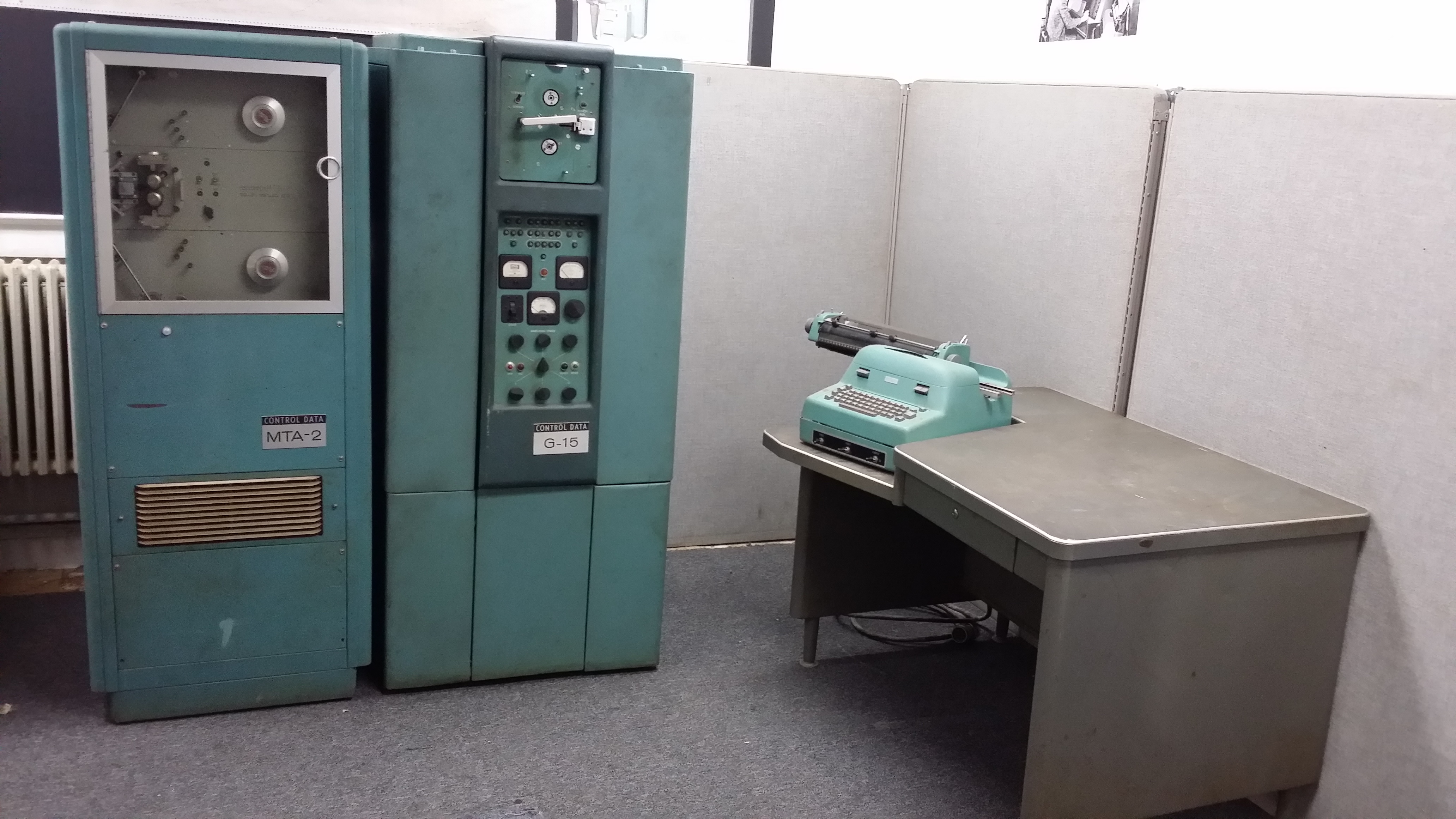
MARCH now has a Bendix G-15, branded as a Control Data system (they
bought Bendix toward the end of the G-15's production run in the early
1960s, although as I understand it the computer was essentially
unchanged since its 1956 debut).
We began setting up an exhibit in our museum last night. It includes the
computer itself, tape drive, IBM teletypewriter, desk of the same period
and style as the Bendix original, and (not yet on display) a matching
Bendix desktop plotter.
Get some tissues ready so you don't drool on your screens. :)
http://www.snarc.net/bendix.jpg
Come see it at VCF East!
I'm hoping that someone here has some experience with PDP 8/e with the
RK8E disk controller for RK05 disk drives.
The 8/e passes all of the CPU diagnostics with flying colors. Memory
also checks out good. There are two fields of 4K core, and 4 fields of
solid state memory.
The core fields are field 0 & 1. Memory testing on both of the core
memory fields shows no faults. The system runs very cleanly...I've got
OS8 V3D on floppy and it can run for hours on end with no problems.
I have a known good RK05 drive and a number of 16-sector packs for it
that are good. RK8E and drive were tested in another 8/e system
recently, and worked fine.
Cable between RK8E and drive has been ohmed out, and it's good. Signals
going across the cable look good and clean on the scope.
The RK8E does not pass the Diskless Controller test in my system.
This is the test that uses the maintenance mode features of the RK8E to
test the controller without actually touching the RK05 drive (drive is
powered on, but in LOAD (offline) state). It goes though most of the
test, but fails in the data break tests. In these tests, the data break
is only active for one cycle, where one word is transferred to/from the
controller and main memory. All of the tests of the RK8E data buffer
test out fine. So, it appears that something is amiss in the
single-cycle data break handing...either in the RK8E, or the CPU's
handing of data break requests.
All data transfers between the RK8E and the PDP 8 are done via single
cycle data break (DMA) operations.
If I use RKLFMT to format a pack, it goes completely through the "write"
portion of the formatting without a hitch, and gets through a lot of
reads, but fails partway through the verification pass. The formatter
writes the block number of each sector as the first two words of each
sector, and fills the rest of the words with zeroes. The verification
pass just checks these two words to make sure they match. If fails when
the first word (high order disk address) changes from "0000" to "0001".
Through all of the tests, there are NO CRC errors. Seeking cylinders
and sectors work fine. It's just the "data" part of disk blocks that
gets messed up.
Using the FUTIL utility, I can successfully read and write blocks all
over the disk. I can use the "SCAN" function of FUTIL to scan the entire
disk, and it completes successfully. Thus, every sector on the disk can
be "found" by the controller without problem.
The problem symptom is that the first word of every block is duplicated
across all of the blocks. All of the rest of the words in the blocks
behave properly.
Using FUTIL, I can read in a block, change any but the first word in the
block, and write it out, then read it back, and it's fine. I can do
this with words 1 through 255 of any of the blocks on the disk.
However, if I read in a block, change the first word (word 0) of the
block, and write it out, then read it back, the first word is as I set
it to be -- but, if I read any other block, the first word is always the
same as what I wrote out.
For example, if I read in block 7, and change word 0 of the block to be
"4567", then write it out, then read any other disk block, word zero
will ALWAYS be "4567". If I then read in block 275, and modify word 0
to be "1234", and write it out, and then read back ANY (including block
7) disk block, the first word will always be "1234". I've tried this
with all different bit patterns for in word zero, and it's always
consistent.
To verify that this isn't an issue with FUTIL, I wrote some little
routines to read and write disk blocks, and the behavior is the same.
The other disk test that uses the drive goes through all of the seek
tests and writes out its test patterns, but fails on the read-back
tests.
I'm very stumped. The RK8E uses single-cycle data break (DMA) to take
data to/from the disk and transfer it directly to/from main memory
without processor intervention (other than initiating the conditions for
the DMA cycle). The RK8E signals the processor that it needs to do a
data transfer, the processor relinquishes control of the memory system,
and lets the RK8E place address and data on the memory address bus and
memory data bus to read/write the data from/to main memory. Each word
of the transfer of a 256 word disk block is done as a separate DMA
request.
One might thing that there is a problem with the RK8E, but that is not
likely, as this RK8E was recently tested in another system and worked
fine, passing all of the diags.
It's more likely that there is something amiss in the data break logic
in the CPU, however, it seems odd that it would affect only the first
word of a DMA transfer, as the CPU doesn't really know whether a DMA
transfer is the first word or the last word. It just responds to DMA
requests asserted by the peripheral.
Does anyone out there have any ideas what I could do to track this down
further? The RK8E is the only data break device I have in the system,
everything else uses programmed data transfers, so I can't try with
another data break device and see if the behavior is consistent.
Thanks in advance for any ideas as to what to do/try next,
Rick Bensene
> Paul Anderson wrote:
> It probably doesn't matter that much, but I meant take it to the bare
> minimum- no EAE, no timeshare, 4K only, etc. Sorry it didn't help.
No worries -- I appreciate the input!
I did think that you meant stripping it down to the bare minimum, but
having OS8 running makes loading the diags and testing much easier and
faster -- and all that needs 8K, Mem Ext/Timeshare, and the RX8E.
I don't want to remove the EAE..I just am scared of messing with the CPU
stack.
At least I was able to eliminate the high speed paper tape interface,
the MOS RAM, and the second serial port, and get it all down to one
Omnibus, which is a step in the right direction.
I could strip it down to the bare, but then I'd be fussing with loading
RIM, and then BIN, then pushing papertape images of the diags to the
machine over serial -- it's just tedious and slow. I may give this a
try later, but in light of the information below, I will probably try
something else before I strip it bare.
I just now put the machine back to the original configuration, and
nothing changed -- the problematic behavior with the RK8E still exists.
David Humphries had mentioned in a posting here that he had observed a
transient on a signal related to loading the current address register in
his RK8E that exhibited similar symptoms to mine.
While I didn't know the specific signals that David was scoping, I
guessed, from looking at the schematics, that perhaps he was monitoring
the LOAD and CLK signals that drive the three 74161 counter ICs on the
M7105 board that make up the Current Address Register.
So, while putting the system back to its original configuration, I
tacked in wire extensions to the LOAD and CLK pins of one of the 74161s
to bring them out so I could scope them. Since the M7105 board is the
middle board of the three-board RK8E sandwich, the only way to get
access to the signals is use wire extensions.
Once I got the system put back together, I toggled in a small program to
repeatedly load the current address register
in the RK8E with zero, e.g.,:
0200 7200 CLA CLL
0201 6744 DLCA
0202 5200 JMP 0200
I started this program running and watched the scope.
There is a definite spike showing up on the CLK line.
This spike could indeed cause the counter to increment after the initial
address is loaded into the counter using the 6744 IOT (Load Current
Address Register).
The photo of the scope traces I observed is posted here:
http://pail.bensene.com/RK8ESpike.jpg
The top trace is the LOAD signal, and the bottom trace is the CLK
signal. The negative-going spike on the CLK line is clearly obvious.
The traces look quite similar to the scope image that David posted.
I am hoping that David will read this and find his notes on what he did
to fix the issue (installing a 7474 flip flop somewhere to eliminate the
spike) and post it so I can make a similar modification and see if it
fixes my problem. It isn't intuitively obvious to me where a flip
flop/latch tacked into the logic would get rid of the spike.
It's my hope that this is what is going on, and that David's fix will
fix my RK8E/RK05 problems.
Rick Bensene
John has had problems getting on the list and so has asked me to
forward this on. Please reply directly to him at john at jfloren.net .
Jim
---------- Forwarded message ----------
From: John Floren <john at jfloren.net>
Date: Tue, Feb 25, 2014 at 2:48 AM
Subject: [rescue] RT-11 manuals, VAX manuals, AUI for pickup
To: The Rescue List <rescue at sunhelp.org>
I'm cleaning out the closets and I've found a bunch of stuff that I
never look at, so anyone in the Bay Area can come get:
* 4 big binders of RT-11 documentation (operation manual, utilities,
programming, application files)
* About a dozen Sony QD-600A tapes
* A whole load of VAX, VMS, and PDP-11 books from DEC
* A bunch of AUI-twisted pair boxes, one AUI-thinnet box, and some AUI cables.
Please please PLEASE come take all of it at once! The whole load will
fit in a single car trip. I'm in Livermore.
john
Morning all...
I'm in need of a 5.25" 40-track double-sided floppy drive (i.e. the
venerable "360K" in PC parlance), preferably one with direct drive to the
spindle so I don't have to worry about worn drive belts. Bezel color,
height etc. unimportant, I just want a 40t unit to hang permanently off my
desktop PC, as hauling one out of my vintage machines every time I want to
write to a disk from there gets old fast.
I could also use ten or so *HD* 5.25" floppies so I can get my Compaq 286
and the pair of Compaq luggables at the local science museum up and running
- I've exhausted all of the local sources that I can think of. I don't
necessarily need new-in-box or anything, but of course error-free would be
good :-)
Anyone got anything they'd be willing to part with? (I'm in the northern US)
[Also, I don't see many wanted ads on the list, although as far as I know
they're not frowned upon - apologies if they are!]
cheers,
Jules
Does anyone have the documentation, particularly the listing (or
source), for the DEC-08-NFPEA-A-PB (1972-05-26) 27-Bit Floating Point
Package?
Thanks,
Bob
>apears a vtr machean has come up with tapes on programes ur altair anyone
>interested in it noticed it on my local buy and sell site
>http://www.kijiji.ca/v-electronics/winnipeg/panasonic-vtr-nv-3020-with-15-r
eels/539056526?enableSearchNavigationFlag=true
For $40 I would totally digitize those tapes and upload them somewhere.
Shoot, I would buy it so I have the recorder to go with my Panasonic camera.
Unfortunately I'm about 3000km west of the listing....
-John
Battle of Bletchley Park: TNMOC chief calls for review of museums'
Mexican standoff
- Iraq dossier MI6 chief's 'Disneyland' plans blasted
http://www.theregister.co.uk/2014/02/24/national_museum_of_computing_calls_…
--
--- Dave Woyciesjes
--- ICQ# 905818
--- CompTIA A+ Certified IT Tech - http://certification.comptia.org/
--- HDI Certified Support Center Analyst - http://www.ThinkHDI.com/
Registered Linux user number 464583
"Computers have lots of memory but no imagination."
"The problem with troubleshooting is that trouble shoots back."
- from some guy on the internet.
On 02/12/2014 12:00 PM, cctalk-request at classiccmp.org wrote:
>> On 2/11/2014 9:45 PM, Jim Stephens wrote:
>>> I have a vmware image. I'll see if i can find an installer ISO
>>>
>>>
I don't think VMware will run Win95 or Win98. If that is wrong,
I'd sure like to know, as I could pack up an ancient system I
still keep around for archival reasons.
Jon
I realize that no one else may be using the Symbolic Debugger
(SD: - specifically SDHX.SYS) in RT-11, but there is an
enhancement that should be helpful and I could use some
advice.
This question will probably receive opposite answers since
this group is so diverse. BUT here goes:
The questions is (as described below): "Should all 6 possible
SET commands be available or is that too confusing to the
user and only the first 4 SET commands should be available?"
In RT-11, a user program can issue an EMT request so that
RT-11 allows the user program to handle TRAPs to locations
4 and 10 so that special expected error conditions can be
handled correctly.
However, in the RT-11 Symbolic Debugger, these TRAPs
are again over-ridden unless the user again forces them back
to the user program with the commands:
_T4;V let the user program handle TRAPs to 4
_T10;V let the user program handle TRAPs to 10
For turning off either selection (if either was selected), the
command is:
;V turns off both TRAPs to 4 and 10
Unfortunately, the DEC version Y01.16 of SD: always
required the user to first activate the Symbolic Debugger in
order to execute one or both of those commands. However,
by adding two additional SET commands to the SD: code, the
user can use these SET commands (even in a command file to
automatically initialize everything) before the SD: code is
even LOADED and activated, as for example:
SET SD: T4 - equivalent to _T4;V
SET SD: T10 - equivalent to _T10;V
Turning off the selections uses the commands (the commands
are only almost equivalent to ;V):
SET SD: NO T4 - ONLY turns off _T4;V
SET SD: NO T10 - ONLY turns off _T10;V
Of course, it is also possible to have two more SET
commands which:
SET SD: TRAPS - equivalent to both _T4;V and _T10;V
SET SD: NO TRAPS - equivalent to ;V
The questions is: "Should all 6 possible SET commands
be available or is that too confusing to the user and only
the first 4 SET commands should be available?"
By the way, although it is not very useful to re-implement the
current SET commands so that the change is applied after
the LOAD SD: command has been executed, it is possible
to add code to the "SET SD: T4" option which changes
both the SY:SDX.SYS file and any copy which is in memory.
This allows the user to execute "SHOW CONFIGURATION"
without having to first "SET SD: BREAK". In addition, the
"SET SD: T4" command can then be done either before or
after the "LOAD SD:" command.
Another other comments or suggestions would also be helpful.
Jerome Fine
> Message: 15
> Date: Sun, 23 Feb 2014 12:07:38 -0000
> From: "David Humphries" <david at hheng.plus.com>
> To: "General Discussion: On-Topic Posts Only" <cctech at classiccmp.org>
> Subject: Re: Anyone Have a Copy of the LAB-8/E 8K BASIC Binary?
>
[snip]
>>>> I have DEC-8E-ABASA-A LAB-8E BASIC R/T binary on punched tape,
>>>> any help ?
>>>>
>>> I wasn't able to find any conclusive information on that tape. Do you
>>> know
>>> if this is BASIC/RT that the 8/E/M handbook 1973 referred to for the
>>> LAB-8/E
>>> (pg 2-36)? Anyone seen documentation for it? I would be interested in
>>
>> It seems likley as I have some of the other packages mensioned in that
>> section in the same tray.
Dave,
Does this mean you have other tapes in the tray? If so, could you
image them too?
[snip]
>> I will do a bit more investigating before a post the file, including
>> looking to see if I can find any documentation " in the store"
>
>
> Found the problem , it loads into field 1 with the bin loader also in 1. Now
> loads and auto starts, I think its in fact a multi part as it starts
> before the end of the file and as im loading from my terminal emulator we
> loos the last bit, its maybe an optional overlay, the file maybee needs
> split.
> I found the user manual , thats how I found out about the loading.
> Link to the bin and a pdf of the user manaul here
>
> https://www.dropbox.com/sh/dmi0r7s0v5jsp0c/-14bOM0wD4
>
> I guess its not in Bitsavers, could someone let Al know ? , unless hes
> allready seen this that is .
>
> Dave H
I can OCR and email it to Al to save him time. Do you have any other
of these documents that can be scanned? David G. may want to put all
of your images/PDFs on his site too.
Thanks,
Bob
Hello,
I have some questions about Televideo 955 terminal.
The manual lists a serie of options, among others the ability of emulate
tek 40xx graphic terminals.
I'm interested in this feature, but it's not clear to me if a particular
version of the terminal, or a particular board is needed.
Furthermore, the manual pictures two different motherboards, normal and
extended, but what it's the difference?
Finally, there's a way to identify the hardware / software options of the
terminal with some key combination, our some special command?
Thanks
Andrea
Firstly, if you've seen my message about this on VCForums, then I apologise for the redundancy.
I've spent the best part of 4 years getting my Ohio Scientific C24P working. The biggest problem being the MPI drive unit of which I've replaced and fixed many parts. I think I now have everything working, but don't have any bootable media to test it with. I was wondering if there was anyone here who would be willing to make me some copies of OS65D on 5.25" media?
Much thanks.
Phil
Hi everyone!
Thought I'd share my site with you. I restore/recondition M's despite
their condition. It's a labor of love for these fantastic mechanical
keyboards.
The site is at http://www.phosphorglow.net/
If you are in need of a lovingly reconditioned M or need yours restored,
please mosey over to my corner of the interwebs.
I also have a small army of classic computers in my personal collection
that will be making their appearance when I get the time to play with them.
Kind regards,
-Maxx
(I hope this doesn't double post - I accidentally sent it from my
address that isn't subscribed to the list. Sorry in advance if that
happens!)
Toshiba XM-4101BME internal SCSI 2X CD-ROM drive
http://www.ebay.co.uk/itm/271409731209
Digital Equipment Corporation (DEC) Storage Expansion Unit RZ5X-F3 with RZ56 HD
http://www.ebay.co.uk/itm/271411499867
Quantum Fireball ST64S narrow SCSI 3.5" 6.4GB hard drive
http://www.ebay.co.uk/itm/271412312175
There's a wireless Apple keyboard - the original, pleasant to use
version - and mouse and a PC joystick and other things too, but I
thought the above might be of interest to CCmpers.
The DEC SEU has a 5.25" FH 660MB SCSI drive in it.
--
Liam Proven * Profile: http://lproven.livejournal.com/profile
Email: lproven at cix.co.uk * GMail/G+/Twitter/Flickr/Facebook: lproven
MSN: lproven at hotmail.com * Skype/AIM/Yahoo/LinkedIn: liamproven
Tel: +44 20-8685-0498 * Cell: +44 7939-087884
Dear Sirs,
We have a CNC controlled DEC (motherboard M 8189 picture -0).
Please submit an offer for the replacement of the emulator with DECtape-II (Fig. 1.2, 3) for loading the data from the memory card, USB stick, or propose another solution which allows us to make technical backup data cartridges (DECtape-II photo 1).
If you need more information or photos please write.
We appreciate the timely development of our inquiry.
Witam,
Posiadamy Frezark? CNC ze sterowaniem DEC ( p?yta g??wna M 8189 zdj?cie -0 ).
Prosimy o przedstawienie oferty na zamiennik emulatora z DECtape-II (zdj?cie 1,2, 3) do wczytuj?cy dane z karty pami?ci, usb stick lub zaproponowanie innego rozwi?zanie technicznego umo?liwiaj?cego nam zrobienie kopii kaset z danymi (DECtape-II zdj?cie 1).
Je?li potrzebuj? Pa?stwo wi?cej danych lub zdj?? prosimy napisa?.
Prosimy o pomoc ? w rozwi?zaniu naszego problemu
--
Pozdrawiam,
Piotr Karmazyn
tel.: 58 3041450
fax: 58 6831803
KOM : 660432720
TECH-SERWIS Mechanika Maszyn i Pojazd?w
Mariusz Wodzy?ski
ul. Rzemie?lnicza 9
83-000 Pruszcz Gda?ski
NIP: 584-09-52-627
REGON 002849343
List:
I've got a 2400' reel of 9-track tape here from 1971--so far, no issues.
But the brand is "Wabash"--I'm well acquainted with the execrable
quality of the brand when it comes to floppies, but have no experience
with pre-floppy-era tapes.
I'll bake the thing (130F for a day or so) before reading it, but does
anyone have any experience with this brand and age? I'd used mostly 3M,
CDC and IBM branded tape back in the day.
--Chuck
From: Chuck Guzis <cclist at sydex.com>
>
>I've long thought that the strangling of the bus done on the TI 99/4
>home PC was quite possibly motivated by TI's not wanting to compete with
>its own 990 series of computers. The cost of a TI 990/4 was
>considerably higher than a 99/4, even though both use the same MPU.
>
I have heard & read this enough times to think there's something to it.
Wouldn't be the first time this sort of thing has been done.
>I find the I2L versions of the 9900 far more interesting as far as chips
>go. They were used quite often in military gear, not as devices offered
>to the general unwashed. In a similar way, one did not see the
>Fairchild 9940 in much general audience gear.
Yes. You can debate how good a general purpose processor the 9900 is, but
it was proven to be a very good embedded controller. The memory mapped
registers and workspace swapping made real time context switching a breeze
compared to more conventional designs.
From: John Many Jars <john at yoyodyne-propulsion.net>
>Basically, my dad bought the wrong thing. It cost about 1/2 what an
>Apple //+ would have cost, and was about 1/8 as useful.
Ha! That is *exactly* how I ended up with my own 99/4.
KJ
Dear sirs,
I'm looking for the schematics of the F-051MD chinon drive. This is the
auto-eject "Super 5" slim drive for apple computers. Any helpers?
Thanks
Alexandre
Many of us know about the classic prank Signetic played back in the
1970s, with the WOM (write only memory) - but today I found out that
the chips actually exist. The son of an acquaintance uploaded some
pictures (on a different list) of the original sales kit Signetics
mailed out, and included is an actual IC, I think a 24 pin DIP, marked
S7324 2512D NFG.
Interesting other stuff, too - including a fortune cookie (I think),
bumper sticker, and funny nose & glasses.
--
Will
----- Original Message -----
Message: 6
Date: Sun, 23 Feb 2014 14:05:46 +1300
From: Terry Stewart <terry at webweavers.co.nz>
Subject: Re: TI-99/4A acquisition
> ...I definitely need some more carts though.
...and a wider desk...
Any suggestions on repairing a dead spacebar key? All the online
discussion I find pertains to an earlier model with individual keyswitches
soldered into a PCB backplane. This keyboard is held together with melted
over plastic posts and is obviously using a printed membrane.
Before I launch in blindly I'd love to hear from anyone who's been through
the process.
Steve
--
Does anyone have the binary for the LAB-8/E version of 8K BASIC? Of
course, the original source code would be better if that's available
too.
Thanks,
Bob
Cctalkers,
March 1 is the deadline to register VCF East exhibits.
Anyone attempting to register after that will have to grovel to me and explain why "But I was busy!" applies to them and not to the 32 other people who found time...
Full details about the show, agenda, schedule, etc. are at http://www.vintage.org/2014/east and you'll also find updates at http://www.facebook.com/vcfeast.
Remember -- this is the first THREE-DAY show and anyone who goes Friday can win an oscilloscope.
Another mystery board in my junk box... this one should definitely be
for a PDP-8 because it has no signals on the F connector fingers.
I've googled all the numbers on it and can't figure out what it's for.
It has a Z80 CPU, some RAM and ROM, and a lot of bus drivers. There's
an empty 40-pin socket at U1, don't know if it had another Z80 or
what.
http://s1181.photobucket.com/user/DrCharlesMorris/media/PDP-8/P02-21-14_205…
The output(?) connectors are unique at least to me:
http://s1181.photobucket.com/user/DrCharlesMorris/media/PDP-8/P02-21-14_205…
Looks like four pin plugs would seat in those sockets (they aren't
coaxial).
Any clues?
thanks
Charles
On Thu, 20 Feb 2014 Jonathan Katz wrote:
> YES. This may be important stuff. This may be console software for a
> CS6400! Like the E10K they used an SSP aka OWS to run them, and
> connected via standard HIPPI(?) to the control boards.
Sorry to disappoint you, but these will be for some model of Cray, either a later
Y-MP, EL or T3 system, as we never had any Sun servers of that style at NCAR.
I'll be working on extracting the tape contents into a file system this weekend to
better determine what they contain.
> Date: Thu, 20 Feb 2014 19:17:50 -0000
> From: "David Humphries" <david at hheng.plus.com>
> To: "General Discussion: On-Topic Posts Only" <cctech at classiccmp.org>
> Subject: Re: Anyone Have a Copy of the LAB-8/E 8K BASIC Binary?
>
> I have DEC-8E-ABASA-A LAB-8E BASIC R/T
> binary on punched tape, any help ?
>
> DaveH
>
Yes, I think so! Is it available in an "emailable" form? If not,
perhaps someone with a running system can create an image and put it
online.
Thanks,
Bob
> ----- Original Message -----
> From: "Bob Vines" <bobvines00 at gmail.com>
> To: "cctech" <cctech at classiccmp.org>
> Sent: Wednesday, February 19, 2014 8:04 PM
> Subject: Anyone Have a Copy of the LAB-8/E 8K BASIC Binary?
>
>
>> Does anyone have the binary for the LAB-8/E version of 8K BASIC? Of
>> course, the original source code would be better if that's available
>> too.
>>
>>
>> Thanks,
>>
>> Bob
FEBRUARY 21, 2014 --- KansasFest 2014, the Apple II convention, is
scheduled for July 22 --27 in Kansas City, Missouri.Margot Comstock,
co-founder and editor of the much-loved /Softalk /magazine, will join us
with a keynote presentation.
Comstock and Al Tommervik founded /Softalk /in 1980 to share the
hardware, software, and people behind the Apple II.At its peak,
/Softalk/ had 250,000 readers and uniquely offered broad and deep
coverage of everything Apple II related, including programming, game
playing, business use, and home use.Later, Softalk Publishing produced
magazines for the emerging Macintosh and IBM markets,/ST.Mac/ and
/Softalk for the IBM Personal Computer/./Softline/, a game magazine
begun by Ken William's OnLine Systems and later renamed to /ST.Game/,
was Softalk Publishing's second longest-lived magazine.Softalk Books
published several books by the magazine's columnists and a Mac book by
Doug Clapp.
The Apple II magazine ran for four years before industry changes and
expenses led management to cease publication.In that time, /Softalk/
earned many loyal fans, and a group of volunteers is working to archive
and share issues.The Smithsonian Institution recognizes Comstock and
Tommervik as pioneers of the microcomputer revolution and /Softalk/ as a
chronicle of that revolution.
KansasFest is an annual convention offering Apple II users and
retrocomputing enthusiasts the opportunity to engage in beginner and
technical sessions, programming contests, exhibition halls, and
camaraderie. KansasFest was originally hosted by Resource Central and
has been brought to you by the KFest committee since 1995. Any and all
Apple II users, fans, and friends are invited to attend this year's
event. Registration details will be announced on the KansasFest Web site
in early 2014. For photos, videos, and presentations from past
KansasFests, please visit the event's official Web site at
http://www.kansasfest.org/.
CONTACT:
KansasFest 2014
http://www.kansasfest.org/http://twitter.com/kansasfest/
I have a ADDS Viewpoint 3A Plus terminal that is in working condition. It
looks very clean, powered up and operated in the local mode. I just took it
out of the box and haven't tested the RS-232 serial link yet. It includes
the operator's manual and service manual. (I will put the manuals on
bitsavers.) I reducing my collection and am looking for a new home for this
terminal. I am located in the Seattle area and am not interested in shipping
it. (30 plus pounds.)
Michael Holley
Among some old DAT tapes I am looking at, I have what appears to be some
ufsdump format backup tapes from two Cray Operator Workstation (OWS)
servers of year 2000 vintage, possibly from two Y-MP EL systems? These
OWS servers ran Solaris.
The tape for ows9607 contains 524MB of backups of the following file systems:
/, /usr, /var, /opt, /opt/CYRIdump and /usr/openwin. The second tape contains
828MB of backup of ows9630 and may not contain the contents of /opt/CYRIdump.
Does anyone know of a copy of ufsrestore that runs on Linux? If not, I'll have
to see if the netbsd restore under stands it or grab the OpenIndiana (OpenSolaris
fork) distribution.
Anyone interested in the contents of these tapes?
To my great surprise and considerable pleasure, I've just sold an NEC
Multispin 3X CD for ?8.50 on eBay.
I was less delighted to find a similar unit that I'd misplaced in the garage.
So, if anyone wanted one and missed out...
Toshiba LI-3300 external SCSI CD-ROM drive in original case (item #
271406165551)
http://www.ebay.co.uk/itm/271406165551
--
Liam Proven * Profile: http://lproven.livejournal.com/profile
Email: lproven at cix.co.uk * GMail/G+/Twitter/Flickr/Facebook: lproven
MSN: lproven at hotmail.com * Skype/AIM/Yahoo/LinkedIn: liamproven
Tel: +44 20-8685-0498 * Cell: +44 7939-087884
Easy to build up any size system by mounting multiple 2GB partitions across various points in the file system - the partition size shouldn't be a constraint on running A/UX
________________________________
This e-mail message, including any attachments, is for the sole use of the person to whom it has been sent, and may contain information that is confidential or legally protected. If you are not the intended recipient or have received this message in error, you are not authorized to copy, distribute, or otherwise use this message or its attachments. Please notify the sender immediately by return e-mail and permanently delete this message and any attachments. Gartner makes no warranty that this e-mail is error or virus free.
Taken by some clueless noob, though, as many of the pics only show the
screen and keyboard and not the actual computer at all. This is one of
those pillocks who thinks that the computer is the "disk drive", I
suspect.
http://www.zdnet.com/photos-from-the-first-pcs-to-the-thinkpad-classic-ibm-…
--
Liam Proven * Profile: http://lproven.livejournal.com/profile
Email: lproven at cix.co.uk * GMail/G+/Twitter/Flickr/Facebook: lproven
MSN: lproven at hotmail.com * Skype/AIM/Yahoo/LinkedIn: liamproven
Tel: +44 20-8685-0498 * Cell: +44 7939-087884
From: Chuck Guzis <cclist at sydex.com>
>On 02/18/2014 03:46 PM, Jonathan Katz wrote:
>
>> Someone once told me "never underestimate the bandwidth contained
>> within a station wagon crammed full of DLT tapes."
>
>That oft-repeated chestnut is attributed to Andy Tannenbaum and
>pre-dates DLT, I think.
In 1985 (when I first heard it), the station wagon was full of 9-tracks.
Each generation adapts the wisdom, I suppose.
KJ
Just curious as to what the expert opinion is on this - I've got a
ST412-type drive here (it's a Miniscribe with 615/4/17 ~20MB geometry)
which refuses to read from cylinders 128-255 or cylinders 384-511 - giving
address mark not found errors - although cylinders outside those two ranges
are fine.
The way the faults lie exactly within a couple of specific bit patterns
(01xxxxxxx and 11xxxxxxx) for the cylinder number makes it seem more like a
controller problem to me - but I don't know how much logic there is on a
ST412-type drive, what with the buffered seek ability.
Controller passes internal/RAM diagnostics OK (but how exhaustive those
are, I don't know). Issuing a drive recalibration and/or controller reset
prior to attempting access to the problem areas makes no difference.
Maybe the drive was simply never formatted on those cylinder groups for
some reason - but that seems rather unlikely (and the filesystem on the
drive is definitely unwell, suggesting that it's trying to access data
that's no longer there, although I've not gone to the extent of picking the
FAT apart to verify this)
I think all the errors I've seen before on these kinds of drives have been
totally dead, seemingly random, or confined to all/parts of a surface - not
in cylinders.
cheers
Jules