Hi folks,
I'm looking to build an X.25 packet data network for semi-active use
at the Connections Museum in Seattle. Please contact me off-list
(<astrid at xrtc.net>) if you have any X.25-capable networking gear
(routers, PADs, cable, etc) that wants a new home.
Why? Some of our newer equipment has serial management consoles.
Plumbing those into a proper-vintage data network would be a lot
spiffier than running around with usb-serial devices. I'm not looking
for serial-to-telnet IP converters.
I'm also interested in setting up a public federated X.25-over-TCP
network, much like https://ckts.info/ but for circuit switched data.
Cisco IOS 12 has support for DNS-based routing of XOT connections,
which I've been learning how to configure.
Thanks,
--
?strid smith (she/her)
=<[ c y b e r ]>=
antique telephone collectors association member #4870
> From: Barry M
> H960 120 lbs (not sure if this includes the side panels)
The H960 has a whole constellation of appurtenances which can add to the
weight: sides, back door, back mounting frame, top fan(s), floor screen,
stabilizer feet, etc, etc.
I happen to have an empty H960 (well, it does have the two top fans, which I
was too lazy to take out - they are only a couple of pounds each) out in my
garage, so I stuck it on a bathroom floor scale, and it seems to be about
100 pounds.
If you want the weight on any of the other bits (above), let me know, it
would be easy to weigh them.
Noel
> On May 23, 2021, at 9:14 PM, Marc Howard via cctech <cctech at classiccmp.org> wrote:
> In my case I'm looking for the weight of an RK05 and full height 19" DEC
> rack.
I have not see these published, but can attest that it is somewhere between 1 25-yr-old-can-load-in-station-wagon and 1 53-yr-old-can-load-in-station-wagon...
Marc,
I am not aware of a single document that lists the weights of various
sub-systems. I did find the weights or the RK05 and H960 rack:
RK05 110 lbs
See: DEC-00-RK05-DA RK05 DISK DRIVE MAINTENANCE MANUAL Page 1-2
H960 120 lbs (not sure if this includes the side panels)
See: DEC-11H45SM-E-D PDP-11/45 System Maintenance Manual Page C-5
--barrym
On Sun, May 23, 2021 at 10:15 PM Marc Howard via cctech <
cctech at classiccmp.org> wrote:
> Hi,
>
> Is there a doc anywhere that breaks out the individual weights of various
> PDP gear?
>
> In my case I'm looking for the weight of an RK05 and full height 19" DEC
> rack.
>
> Thanks,
>
> Marc
>
> On May 23, 2021, at 5:18 PM, Wayne S <wayne.sudol at hotmail.com> wrote:
>
> ISTR That the 2 main issues hindering wide spread adoption of TR was cost and and not knowing where TR development was headed.
> The Type 1 cabling needed to each port on the hub was expensive vs thick/thin Ethernet with taps (as were the hubs). Also, there was no second source for TR chips so everyone who wanted to make TR hardware was at the mercy of the IBM chip pricing so there weren?t too many TR cards being manufactured by anyone other than IBM. I recall the Madge TR cards for IBM ps/2 machines being about $400 ea circa 1992.
> So you had a lot of cost standing in the way if you were thinking about going/staying with TR and had hundreds of workstations.
There was also the bogus addressing and strange bridging.
> As for development, there was an ethernet roadmap ( don?t remember the group that put it together) stating that 100 mbit was next running over shielded twisted pair then unshielded tp. And 1000 mbit was possible.
> For TR, No one knew if IBM would up the speed past 16 mb and allow TR chips to be made cheaply.
>
> Also the fact that token passing is inherently slower than CSMA/CD did not help to sell TR.
> The analogy was that if you had a long street with many stop lights, using TR would be like having every light be red and having to stop at each light, where using Ethernet some of the lights would be green and no stop required.
>
> IBM tried to use that to their advantage and use to say since the amount of time it takes to token pass could be measured precisely that the network response as a whole could be determined and capacity planning was more deterministic using TR than Ethernet.
While at DEC in the network architecture group I contributed to a DEC marketing document that was a detailed point by point reply to an IBM document. IBM tried to claim TR was superior, we demolished that in detail. The deterministic argument was in there; unfortunately for IBM it is true that the network is deterministic -- has an upper bound on transmit latency -- but that upper bound is so crazy large that the property has no practical value whatsoever. BTW, this is where FDDI is vastly better, since it uses 802.4 timed token protocol rather than 802.5 token passing.
paul
> Is there a controller to attach an RS64 disk to a PDP-8? The only
> controller for the RS64 I can find is the UNIBUS RC11. Thanks.
I never saw any reply, so I gather the answer is 'no'. I looked through the
stuff on BitSavers for a bunch of other machines (IIRC, PDP-9 and PDP-12
and maybe one more), didn't see anything.
The odd thing is that based on the RS64 manual cover/format, it dates to the
same time period as the early -11's; and that manual is very careful to
separate the drive info from the controller. Very strange that it wasn't
interfaced to something else (like an -8 or -9). Maybe there was at one point
a plan to do so, but plans changed?
I note that there is an RS32 - I onder if they are any relation?
Noel
Is anyone familiar with the 4000/90 diagnostics? It looks like it will fail the test of the LCSPX graphics board, if it?s not plugged into a monitor, or is missing a loopback device. Is that correct?
T 2 fails, but the manual makes it sound like I need a loopback
T 100 succeeds when testing the LCSPX graphics board.
The system had been a boat anchor until a short time ago, as the battery in the Dallas DS1287A RTC was dead. Amazon just delivered two DS12887?s. Once I replaced it, it came right up. I was surprised to see I had a 4GB and a 2GB drive in it.
Now to dig out the mouse, and wait for the parts to hook it up to a monitor. :-)
Zane
Does anyone have experience using a SCSI2SD board to replace a Hard Drive on a VAXstation or an AlphaStation? I?m thinking about using them on some of my systems to reduce the amount of noise. I?ve gotten used to a quiet office. :-)
Zane
On 5/23/21 10:35 AM, Warner Losh wrote:
> I'm out in Brighton:)
Has it been wet there for you too for the last ~36 hours?
Are you suggesting splitzies on Rich's collection? Or is that a veiled
threat / invitation to share a beverage and chat? ;-)
--
Grant. . . .
unix || die
> <healyzh at avanthar.com> wrote:
In this the weakest link would appear to be the SD Card. As such it seems to me that the best solution would be to have 2 or more SCSI2SD?s in the device. I?m not sure what benefit would be achieved by using a single board to present multiple devices. Unless of course you had a drive size limitation, or you?re trying to emulate something like 2GB or 4GB drives. As an example, that would be handy for VAXen with a 1GB Boot Drive limitation.
-Zane
Zane,
I am using SCSI2SD cards in a VAXstation 4000/90a, and in a MV3100-80 as well as
an Alpha DS10.
In the two VAXes, I use two SCSI2SD cards, configured identically with a system drive and a
user drive on class 10 16GB microSD cards. So each microSD card has both the system drive
and the user drive.
Thus I can use VMS backup from one microSD card to another so that if one microSD card fails I can
easily recover from it. So far I have not had hardware failures, but being able to recover from a
bad software installation which has been VERY helpful.
Mark
Hello,
Is there anyone with a VT100 (or any VT1xx, if so please specify which)
that can make a photo displaying text in reverse video? I'm making a
detailed simulation of the VT100 hardware, and I'd like to see what, if
any, effect dot streching has. I searched the "VT100 Technical Manual",
but as far as I can see it doesn't say.
A good sample text would be:
ESC [ 7 m b d h x CR LF
ESC [ 0 m b d h x CR LF
I am looking for the manual for the following Omnibus board:
M8652 KL8F Double-buffered asynch terminal control
Is there a scanned copy of the manual and/or schematic or any other
information for this board somewhere?
Thanks and best regards
Tom Hunter
I've just finished processing a bunch of RX01 and RX02 RT11A disks.
The files on the RX01 floppies are of type .DPA and those on the RX02
ones, DPY. No files of any other type in the whole collection.
I have no other information, but I suspect that these are plotter files.
Both types seem to start with the same prefix bytes, for example:
06 00 f0 00 40 00 00 01 00 1e ff ff 00 00 00 00
Does anyone have a guide to how these files are structured?
Thanks,
Chuck
Is there any recommended method for cleaning up melted ?rubber? feet on a plastic case?
I?m trying to determine if I can revive the VAXstation 4000/90 I received from a list member, back around 1998 (it?s never worked). When I pulled it out, I discovered that its feet have melted, and I?m assuming probably made a mess on the disk enclosure for my VAXstation 3100 that it was on top of.
Zane
Hi All,
I lent my Sun 3/80 out to someone and it came back pretty damaged. Does
anyone by chance have an old 3/80 carcass laying around that has a good
rear plastic bezel P/N 600-2209-02? If not, does anyone have any plastic
repair suggestions? Also one of the rear feet (narrower rear one) opposite
the PSU was missing...
-Kurt
THanks Lee!! Much appreciated - confirmed my decaying memory, and
pointed out the the almost mythical DECNA!!
bb
On Wed, May 19, 2021 at 1:38 PM <cctalk-request at classiccmp.org> wrote:
>
> Send cctalk mailing list submissions to
> cctalk at classiccmp.org
>
> To subscribe or unsubscribe via the World Wide Web, visit
> http://www.classiccmp.org/mailman/listinfo/cctalk
> or, via email, send a message with subject or body 'help' to
> cctalk-request at classiccmp.org
>
> You can reach the person managing the list at
> cctalk-owner at classiccmp.org
>
> When replying, please edit your Subject line so it is more specific
> than "Re: Contents of cctalk digest..."
>
>
> Today's Topics:
>
> 1. DECNet for Pro 300 series boxes (Lee Gleason)
>
>
> ----------------------------------------------------------------------
>
> Message: 1
> Date: Tue, 18 May 2021 12:20:34 -0500
> From: Lee Gleason <lee.gleason at comcast.net>
> To: cctalk at classiccmp.org
> Subject: DECNet for Pro 300 series boxes
> Message-ID: <db66b12f-e0a4-94b4-d9e9-efa88a84851e at comcast.net>
> Content-Type: text/plain; charset=utf-8; format=flowed
>
>
> ? DECnet for Pro350/380 was donated to DECUS, available as? DECUS
> package PRO175. A quick Goog found the floppy disk images for it at
> http://www.os2site.com/sw/DEC/pro/pro175/index.html. If that site
> doesn't work out, or you don't like them in LHARC format, let me know -
> I have them as normal dsk files. DECnet on the PRO's was end node only,
> you could run it DDCMP on an asynch line, or on the rare, elusive, DECNA
> ethernet card - but not both at once.
>
> --
> Lee K. Gleason N5ZMR
> Control-G Consultants
> lee.gleason at comcast.net
>
>
> End of cctalk Digest, Vol 80, Issue 17
> **************************************
? DECnet for Pro350/380 was donated to DECUS, available as? DECUS
package PRO175. A quick Goog found the floppy disk images for it at
http://www.os2site.com/sw/DEC/pro/pro175/index.html. If that site
doesn't work out, or you don't like them in LHARC format, let me know -
I have them as normal dsk files. DECnet on the PRO's was end node only,
you could run it DDCMP on an asynch line, or on the rare, elusive, DECNA
ethernet card - but not both at once.
--
Lee K. Gleason N5ZMR
Control-G Consultants
lee.gleason at comcast.net
(I had accidentally sent my reply below only to Antonio. I'm resending
it to the list.)
> On 10/05/2021 10:05, Malte Dehling wrote:
> > Thanks a lot, Antonio, these are very valuable to have!
> I've only checked a couple of them under SIMH, so it would be helpful to
> know if I need to check my workflow or not.
> > I think uploading them to archive.org would be a good long-term
> > solution. I can take care of it if you don't have an account.
>
> Please do. Thanks.
Will do. I'll let you know.
> In other news, I polished the MAR-1989 CONOLD, which looked very bad, to
> start with. Amazingly it buffed up quite nicely and then read surprisingly
> well:
>
> [
>
> $ ddrescue -r5 -v /dev/sr1 CDROM-AG-NC67A-RE-1989-03-VMS-CONOLD.iso
> CDROM-AG-NC67A-RE-1989-03-VMS-CONOLD.map
> GNU ddrescue 1.23
> About to copy 205199 kBytes from '/dev/sr1' to
> 'CDROM-AG-NC67A-RE-1989-03-VMS-CONOLD.iso'
> ??? Starting positions: infile = 0 B,? outfile = 0 B
> ??? Copy block size: 128 sectors?????? Initial skip size: 128 sectors
> Sector size: 512 Bytes
>
> Press Ctrl-C to interrupt
> ???? ipos:? 205198 kB, non-trimmed:??????? 0 B,? current rate:?????? 0 B/s
> ???? opos:? 205198 kB, non-scraped:??????? 0 B,? average rate: 637 kB/s
> non-tried:??????? 0 B,? bad-sector:???? 2048 B,??? error rate: 170 B/s
> ? rescued:? 205197 kB,?? bad areas:??????? 1,??????? run time:????? 5m 22s
> pct rescued:?? 99.99%, read errors:?????? 25,? remaining time:???????? n/a
> ????????????????????????????? time since last successful read:????? 2m? 1s
> Finished
> ]
>
>
> So I went ahead and tried the CONDIST from MAY-1989. That too now can be
> read, although it is proving a somewhat tougher nut to crack:
>
> [
>
> $ ddrescue -r5 -v /dev/sr1 CDROM-AG-MN36D-RE-1989-05-VMS-CONDIST.iso
> CDROM-AG-MN36D-RE-1989-05-VMS-CONDIST.map
> GNU ddrescue 1.23
> About to copy 623247 kBytes from '/dev/sr1' to
> 'CDROM-AG-MN36D-RE-1989-05-VMS-CONDIST.iso'
> ??? Starting positions: infile = 0 B,? outfile = 0 B
> ??? Copy block size: 128 sectors?????? Initial skip size: 128 sectors
> Sector size: 512 Bytes
>
> Press Ctrl-C to interrupt
> ???? ipos:??? 5919 kB, non-trimmed:??????? 0 B,? current rate:?????? 0 B/s
> ???? opos:??? 5919 kB, non-scraped:?? 11127 kB,? average rate: 14694 B/s
> non-tried:??????? 0 B,? bad-sector:??? 2843 kB,??? error rate:????? 85 B/s
> ? rescued:? 609276 kB,?? bad areas:????? 445,??????? run time: 11h 31m? 2s
> pct rescued:?? 97.75%, read errors:???? 5884,? remaining time:? 5d 23h 43m
> ????????????????????????????? time since last successful read:????? 2m 45s
> Scraping failed blocks... (forwards)??? ]
>
>
> On the plus side, that's 97.75% more data than I had before :-) but the
> "remaining time" looks like it could be the rest of the week (it varies
> quite a bit).
>
>
> I think, from reading the manual, that I can use CTRL-C and restart this
> again later and it will pick up where it left off using the map file. Is
> this right?
Very nice, this worked much better than I had expected! And you're
right, you can simply CTRL-C and restart ddrescue with the same command
(i.e., with the iso and map file; different options should work.) I would
make a copy of the files before restarting, just in case.
> Are there any other options I should consider trying?
Can you try with "-b 2048 -d" for direct disc access and maybe once more
with "-R" for reverse?
> Another thought is that perhaps a shade more polishing might help. If I
> polish the CDROM a little more and then resume the ddrescue, I think I won't
> be any worse off than I am now, i.e. all existing data will still be there
> and all I'll be risking is data that maybe would have eventually read before
> but now may not read at all. Is that right? Successful reads are now ~20m
> apart, so I suspect that the remaining data will be quite difficult to
> recover.
After trying the various options on the disk in its current state, I see
no harm in trying this approach. With the map file, ddrescue should
never overwrite already-read data. Again, I would make a copy to be
safe.
Cheers,
Malte
--
Malte Dehling
<mdehling at gmail.com>
Dear list,
through Antonio's efforts, we have now archived ISOs for a number of
early CONDIST CDs. Unfortunately, this did not help me find a version
of the VAXSET Software Engineering Tools for VMS 4.x that I was looking
for:
- CONDIST 1989-07 contains VAXSET v8.0, which requires VMS 5.0/5.1.
- CONDIST 1989-05 does not contain any VAXSET components.
So my hope now is that someone may still have old TK50 or 9-Track
distribution tapes stored away for VAXSET v7.0 or earlier, or for some
of its components:
- LSE Language Sensitive Editor v2.2 or earlier
- SCA Source Code Analyzer v1.2 or earlier
- PCA Performance Coverage Analyzer v2.0 or earlier
- DTM DEC/Test Manager v2.3 or earlier
(I already have CMS and MMS.)
Cheers,
Malte
--
Malte Dehling
<mdehling at gmail.com>
My recollection of Decnet for Pro boxes is that the available SW was
for an end node and not a routing or other capability for the
380/350/325 boxes.
While that memory might be incorrect, are there any DecNet packages
for the Pro family available anywhere?
a few hours of searching did not turn up any thing but PDFs about the software.
thanks in advance for any replies.
bob
Classic Computer Collectors,
My name is Eric and I live in Baton Rouge, LA. A customer of mine recently
asked me to find a good home for his early 1980's Intertec Superbrain. He
told me that it worked the last time he used it in 198? after which time it
sat in his attic with the dust cover on it. He provided me with a number of
5.25" floppy disks, which he said contained the complete operating system.
The chassis appears to be 100% intact, and includes the dust cover. I can
provide a few photos if you'd like.
I have not yet been able to make contact with any other classic PC
collectors, or museums that have expressed interest. Before I send it out
to my local recycler, I thought I'd reach out and see if anyone might be
interested.
Thank you for your time & God bless,
Eric Evans
225homebuyers.com
225.242.9858 gVoice
316.461.8587 cell
---------- Forwarded message ---------
From: Dave Dunfield <dds.dunfield at gmail.com>
Date: Tue, May 11, 2021 at 11:09 PM
Subject: Re: DDS Intertec SuperBrain attic find w/ OS and dust cover
To: Eric Evans <4eric.evans at gmail.com>
Hi Eric,
Sorry but no - I'm moving to smaller digs and have had to let much of my
collection go and simply can't take on more right now. You might try the
Classic computer collectors mailing list:
http://www.classiccmp.org
Dave
Btw: In asking stuff like this it might be a good idea to state your (or
friends) location.
On Mon, May 10, 2021 at 5:22 PM Eric Evans <4eric.evans at gmail.com> wrote:
> Dave,
>
> A customer of mine recently asked me to find a good home for his early
> 1980's Intertec Superbrain. He told me that it worked the last time he used
> it in 198? after which time it sat in his attic with the dust cover on it.
> He provided me with a number of 5.25" floppy disks, which he said contained
> the complete operating system.
>
> The chassis appears to be 100% intact, and includes the dust cover. I can
> provide a few photos if you'd like.
>
> I have not yet been able to make contact with any other classic PC
> collectors, or museums that have expressed interest. Before I send it out
> to my local recycler, I thought I'd reach out and see if you had any
> interest, or knew of anyone who might.
>
> Thank you for your time & God bless,
>
> Eric Evans
> 225homebuyers.com
> 225.242.9858 gVoice
> 316.461.8587 cell
>
--
----------------------------------------------------------------------------------
Search "Dave's Old Computers" see "my personal" at bottom!
I have gone back to trying to fix my DEC Professional 350. I have a printset
for the machine now. I think the CPU is being constantly reset.
Is there any documentation anywhere on the F11 chipset? Bitsavers only seems
to have the later J11.
Thanks
Rob
What is the best type of lubricant for Omnibus backplanes?
It can be a struggle to insert and remove PDP-8/e boards into the Omnibus.
There is a risk of damage to the brittle bakelite connector housings on the
Omnibus PCB.
Traditional contact sprays should work but have two problems:
1) they remain wet and over time will attract and retain dust
2) the solvent and lubricant *may* weaken or attack the bakelite
There are some PTFE (Teflon) based lubricant sprays which create a dry
film. Would this type of spray work?
Any suggestions on what I could use that reduces the strain on the Omnibus
and the PCBs during insertion/removal without creating new problems?
Thanks and best regards
Tom Hunter
Dear all,
I am looking for a version of the VAXSET Software Engineering Tools to
run on (Micro)VMS 4.7. The oldest version I have found so far is
VAXSET010 which requires VMS 5.3 to run (this was on CSD 1991/05.)
VAXSET is a bundle of the following components (and more in newer
versions):
- CMS (Code Management System)
- LSE (Language Sensitive Editor)
- SCA (Source Code Analyzer)
- MMS (Module Management System)
- PCA (Performance Coverage Analyzer)
- DTM (DEC/Test Manager)
I have found versions of CMS and MMS seperately that run on VMS 4.x. If
anyone has old versions of the other components and is willing to share,
that would be much appreciated :-)
Cheers,
Malte
--
Malte Dehling
<mdehling at gmail.com>
Dear colleagues in vintage computing ;-)
In the last years there has been substantial interest in the Apollo
Guidance Computer (AGC). So maybe someone might be interested what
happened outside of the United States in the 1960ties: Over the last few
years I restored a 920M computer which was (among others) used as the
guidance computer in the Europa rocket. This was the ancestor of the
European Ariane sapce launcher:
https://en.wikipedia.org/wiki/European_Launcher_Development_Organisation
Although not well known, this machine is a contemporary of the AGC, it
also uses integrated, SMD mounted circuits and is realized in DTL
techology (Diode Transistor Technology). Its word width is 18bit,
8k of core store where standard within a show-box sized chassis. 2us
and later down to 1us instruction time where stadnard. In contrast
to the AGC, this machine was a member of a whole series of airborne
computers - some of which are still in use TODAY (2021).
After core and the DTL chips became obsolete, this architecture even was
re-implemented by BAE systems using the AMD29XX chipset in the same
chassis as drop-in replacement.
The 920M never had core rope memory, and for rocket guidance 8k have
been enough although adding a 2nd box extending the core was possible.
Tte architecture is able to support up to 256k words of 18 bit.
Of course, the instruction set is very archaic - no carry flag, no stack
but it served its purpose with 18 bit choosen as the perfect word length
to give reasonable resolution without need for double-word calculation in
most applications; http://www.programmer-electronic-control.de/Elliott920FactsCard.pdf
If this triggered some interest, you may watch my recently released video
on the 920M (covers applications, internals and some software is shown
running)...
https://www.youtube.com/watch?v=v-gF5g0nnoE
...or visit my project page regarding the work of restoring three
different members of this computer family to working condition:
http://www.programmer-electronic-control.de/index.html
Happy computing to all of you,
best wishes,
Erik.
P.S. Just wanted to point out, that also in Europe there have been relevant
developments regarding spaceborne computing in parallel to the Apollo
programme! In no ways I want to diminish the achievemets of the
Apollo development team...
''~``
( o o )
+------------------------.oooO--(_)--Oooo.--------------------------+
| Dr. Erik Baigar Inertial Navigation & |
| erik at baigar.de .oooO Vintage Computer |
| www.baigar.de ( ) Oooo. Hobbyist |
+---------------------------\ (----( )----------------------------+
\_) ) /
(_/
Dr. Erik Baigar
Scientific Lead Spectroscopy Systems
Technologie Team Spectroscopy
THORLABS GmbH
M?nchner Weg 1
85232 Bergkirchen
Germany
Tel.: +49 (0) 8131 5956-40147
Fax.: ?+49 (0) 8131 5956-99
Mail: ?EBaigar at thorlabs.com
Web: ?www.thorlabs.com
General Manager: Dr. Bruno Gross
HRB No: 85345, M?nchen
Which is closer to being vintage, the sounds made, or the floppy disk drives
themselves?
Moppy + Star Wars Theme = Floppy Vader's Theme
https://youtu.be/LdgzsF_O7oI
Donald R. Resor Jr. T. W. & T. C. Svc. Co.
http://hammondorganservice.com
Hammond USA warranty service
"Most people don't have a sense of humor. They think they do, but they
don't." --Jonathan Winters
Last year I created an LK201 keyboard emulator that uses a USB keyboard.
More recently I extended that work to create a second one that uses a PS-2 keyboard instead. Partly because I had one and figured it would be fun to try.
You can find both designs on Github at https://github.com/pkoning2/lk201emu . The "doc" directory describes both; in particular, file doc/kicad.md talks about the hardware design, with pointers to an OSHPark layout, a parts BOM, and assembly instructions.
The new one is slightly larger than the old (2 by 2 inches, rather than 2 by 1.5). I like the audio implementation a bit better; perhaps I'll revise the USB version to use that same technique.
Enjoy. Comments and feedback will be much appreciated, either by email or on this list or as "issues" on Github.
paul
Today I finally got the SPACEWAR version for PDP-11/10 running again on my
PDP-11/05 with AR11 board. I played a couple of rounds together with my
daughter. She was better than me. Quite hard game IMHO.
https://youtu.be/fTiHRAKjyho
Bill Seiler and Larry Bryant wrote this version in 1974 and submitted it to
DECUS. It was believed to have been lost to history. But Bill had saved the
printouts from the PAL11 assembler. He sent me scans of these printouts as
pdf files. I then transcribed it into source files and iterated several
times in SimH to get a clean build and link. I got some help from people
here doing OCR on some files. But the lines mostly confused the OCR process
so a lot of errors was introduced. It turned out that it was easier to just
transcribe the whole lot by hand than finding and correcting errors.
The AR11 is somewhat different to the AD01 and AA11 that Bill and Larry
used. AA11 has a 12 bit 2?s complement D/A while the AR11 is only 10 bits
and not 2?s complement. I did some patches and eventually got everything
right.
I also connected a couple of analogue joysticks. The fire button is just
short ciruiting the viper of the potentiometer to the 5V supply lead. The
screen is a HP1332A vector screen.
All the transcribed code, AR11 patches and build instructions are available
on github. https://github.com/MattisLind/SPACEWAR
It should be possible to adapt it to orher types of A/D and D/A hardware if
anyone wishes to do so. However the gameplay might be harder when running
on a faster PDP-11?
Have fun!
/Mattis
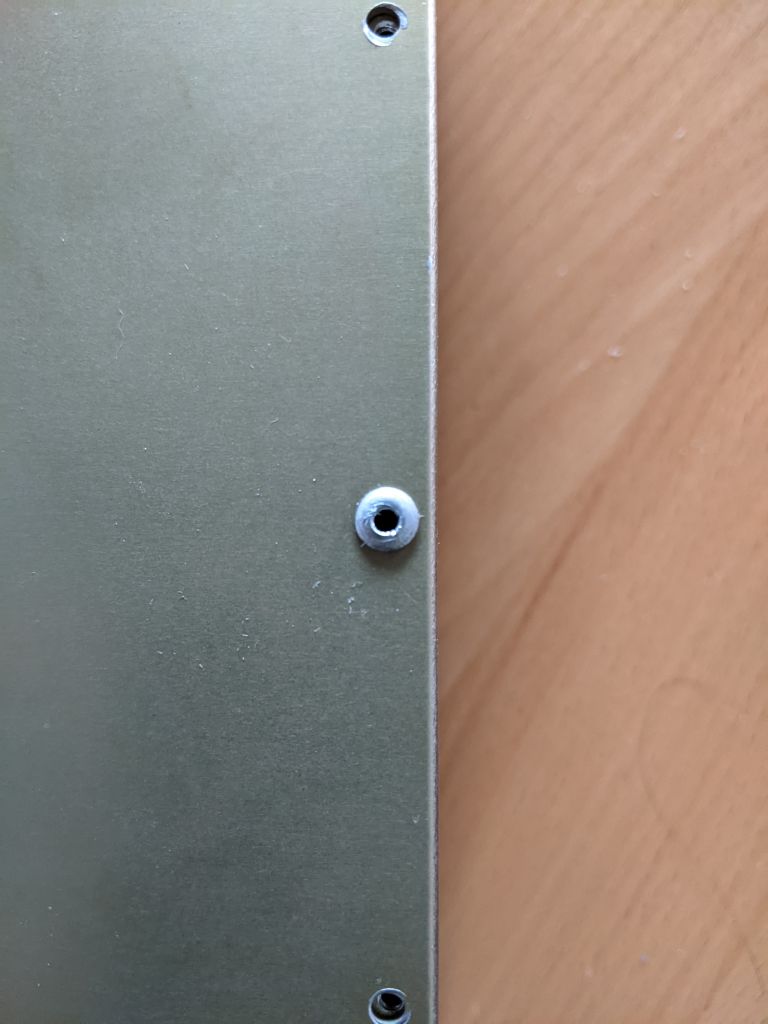
Anyone have any idea on how to open this particular Apple II PSU? It is
a Astec AA 11040B and has like a rivet on each side in the middle. All
the other supplies I've messed with just had screws along the bottom.
Trying to remove the bottom of the casing so I can work on the supply
itself. Link to a pic of it.
Thanks for any help.
http://www.trailingedge.com/images/A2PSU.jpg
David Williams
www.trailingedge.com
Does anyone have a DMC11 integral modem line card schematics set? I'm looking specifically for the part right next to the connector, i.e., the coax driver and coax receiver parts. I don't see it on Bitsavers.
That does have a line unit maintenance manual which has a schematic of the digital parts (in other words, everything up to the point I actually need the most) but it omits the analog part, saying to find it on "print D16".
The DMR11 print set does show a circuit for this, but it's very different from what the DMC manual describes and it has some aspects that don't make much sense, like a "sine generator" in the output stage.
paul
Jim,
I sent you an email to your jwsmail at jwsss.com mail account and haven't heard
back from you, so thought I'd better try to reach you on cctalk!
It's about potential restoration work needed in the LA area. Please get back
to me privately.
Sorry for the interruption of posting this to the cctalk list...
Best, Lyle
--
73 NM6Y
Bickley Consulting West
https://bickleywest.com
"Black holes are where God is dividing by zero"
Strange question, does anyone happen to have the keyboard overlays for the VAX/VMS version of Word Perfect that they can photograph, or better yet scan? I have the manuals, and the green, red, and blue stickers on the VT keyboard, but no overlays. I *might* have the overlays, but I can?t find the the VT keyboard I?m thinking of (though after digging, I know I have more than I thought).
I?m looking for the VT200/300 version (which should work for my LK401).
Zane
Date: Mon, 10 May 2021 10:15:34 -0700
> From: Vincent Slyngstad <vincent.slyngstad at gmail.com>
> To: cctalk at classiccmp.org
> Subject: Re: QBUS/UNIBUS card handles
> Message-ID: <826ef016-3060-e690-de81-8209479712e9 at gmail.com>
> Content-Type: text/plain; charset=utf-8; format=flowed
>
> On 5/10/2021 9:25 AM, Fritz Mueller via cctalk wrote:
>>
>>> On May 10, 2021, at 7:14 AM, Joshua Rice via cctalk <cctalk at classiccmp.org> wrote:
>>> I would assume it would be trivial to do an injection-moulded run of these handles...
>>
>> They might also be ideal for silicone mold / resin cast, for smaller/home production runs?
>
> Resin casting will work, but it's messy, etc. I haven't had any trouble
> with the toughness of 3D printed handles. Honestly, I often attach them
> with a pair of small zip-ties instead of rivets, and they are still
> plenty strong. The usual caveats about 3D printing apply -- just don't
> print it so that the layers will be torn apart when you pull on it!
>
> Maybe you PDP-11 guys are more used to hex cards, or something? I did
> have some PCB made where the card fingers tended to bind, but that's
> best addressed with some careful filing and a tweak of the CAD files for
> the next run :-). (The CAD files on so-much-stuff have long been
> tweaked for a good fit to the connector blocks.)
>
> Vince
Vince,
I recently had Shapeways 3D print some of your card handles in Nylon 12.
They call Nylon 12 ?versatile plastic? on their web site and they use a laser sintering
process for fabrication. I used the card handles on my QBone and UniBone boards
which makes them MUCH easier to insert and pull. The Nylon 12 seems to be
quite tough and I used 3mm x 6mm long screws to fasten them. Shapeways
charged $5.00 each plus shipping to make them.
Thanks for the great 3D design!
Best Regards,
Mark
Re:
Today I finally got the SPACEWAR version for PDP-11/10 running again
on my PDP-11/05 with AR11 board.
...
Bill Seiler and Larry Bryant wrote this version in 1974
Congratulations!
Odd coincidence, sort of, in names ... "Seiler" wrote SPACEWAR in 1974 for
the PDP-11, "Sieler" (me) wrote it for the Digital Scientific Meta 4 (an
IBM 1130 super clone) in 1971. I suspect he gets his name mispronounced as
much as I do :)
Stan Sieler (long "e")
Okay, now that my 11/45 is up and running well, I could really make good use of one of those rack caddies for RK05 packs to hold my most commonly used system packs for different operating systems. Anybody have one they'd be willing to sell/trade, or at least the DEC part number so I could try to track down some drawings?
Looking at pictures on the web, there seem to have been at least two styles: one with plated rod wings, and one with sheet metal wings? I'm supposing I'll end up needing to fab something myself unless these are less rare out there than I think they are (I've yet to see one go by on ePay, for example.)
cheers,
--FritzM.
On Sat, 2021-05-08 at 12:00 -0500, cctalk-request at classiccmp.org wrote:
> I seem to recall that the Tadpole AlphaBook performance is roughly on
> par with the DEC Multia, which is to say, not very good.? Though I
> don?t think I ever got OpenVMS running on my Multia.
>
> Zane
I did get it running on mine for a while. I remember it wasn't fast and
was kind of annoying - the VMS-capable SRM had a peculiar bug where if
the NVRAM battery died you had to failsafe-load the official Multia
firmware then load the VMS-capable one otherwise the framebuffer would
never initialize, not even after the battery was replaced. Finally got
a DEC 3000 and passed the Multia off.
Wish that some of the DEC gear that was showing up was nearby... ah
well.
Thanks Mattis - watching an AR11 making that
oscilloscope display brings back a lot of
memories from my PDP-11 programming days. Had
heard of spacewar in 1980, but was more
interested in playing around displaying data on
screen of a scope. One of my jobs was to clean
up electrophysiology data for publication and
that meant removing noise in signal so had a
joystick system which could move and click on
point on screen I wanted deleted. 11/34 was fast
enough that we had an EE summer student create a
dot matrix character set so we could put captions
on our oscilloscope images. Of course, only way
of getting hard copies of those was with an oscilloscope Polaroid camera.
Looking at the printouts that you're dealing
with, I had a hard time making out some of the
characters. Can see individual dots in a number
of the characters and haven't found any OCR in
past that works well on them. Had my MSc thesis
printed on and IBM lineprinter and looks good
>from afar but couldn't get any OCR program to
digitize it properly. At least the spacewar code is relatively short!
Boris Gimbarzevsky
>Today I finally got the SPACEWAR version for PDP-11/10 running again on my
>PDP-11/05 with AR11 board. I played a couple of rounds together with my
>daughter. She was better than me. Quite hard game IMHO.
>
>https://youtu.be/fTiHRAKjyho
>
>Bill Seiler and Larry Bryant wrote this version in 1974 and submitted it to
>DECUS. It was believed to have been lost to history. But Bill had saved the
>printouts from the PAL11 assembler. He sent me scans of these printouts as
>pdf files. I then transcribed it into source files and iterated several
>times in SimH to get a clean build and link. I got some help from people
>here doing OCR on some files. But the lines mostly confused the OCR process
>so a lot of errors was introduced. It turned out that it was easier to just
>transcribe the whole lot by hand than finding and correcting errors.
>
>The AR11 is somewhat different to the AD01 and AA11 that Bill and Larry
>used. AA11 has a 12 bit 2???s complement D/A while the AR11 is only 10 bits
>and not 2???s complement. I did some patches and eventually got everything
>right.
>
>I also connected a couple of analogue joysticks. The fire button is just
>short ciruiting the viper of the potentiometer to the 5V supply lead. The
>screen is a HP1332A vector screen.
>
>All the transcribed code, AR11 patches and build instructions are available
>on github. https://github.com/MattisLind/SPACEWAR
>
>It should be possible to adapt it to orher types of A/D and D/A hardware if
>anyone wishes to do so. However the gameplay might be harder when running
>on a faster PDP-11?
>
>Have fun!
>
>/Mattis
I managed to bring another one of my supercomputers back to life: an Intel iPSC/860. This one has 16 compute nodes, 8 i860?s and8 i386?s with Weitek co-processors, as well as 4 I/O nodes.
Detailed writeup here: http://www.vaxbarn.com/index.php/42-repair/756-ipsc-860-repair
Downloads (documentation, tape and floppy images available in the downloads section on my website.
Camiel
This e-mail (including any attachments) may contain privileged, confidential, proprietary, private, copyrighted, or other legally protected information. The information is intended to be for the use of the individual or entity designated above. If you are not the intended recipient (even if the e-mail address above is yours), please notify us by return e-mail immediately, and delete the message and any attachments. Any disclosure, reproduction, distribution or other use of this message or any attachments by an individual or entity other than the intended recipient is prohibited.
Does anyone have a mirror of the terminals wiki at https://terminals-wiki.org?? It seems to have gone dark over a year ago, and it would be a shame to lose the resource.?
If there is no mirror, does anyone know of a way to contact the owner/maintainer?? I'd like to see if there's anything I can do to help get it back online.
Thanks,
Dave
Working on restoring my very first computer, an Apple II+. Got it mostly
working with just a couple of issues identified at the moment. Some of
the keys on the keyboard don't register but I can work on that. The real
question I have is about the video, it constantly rolls and no amount of
playing with the vertical hold on any monitor I try will completely stop
it. I can get it close but it will slowly roll one way or the other at
best. Tried several different monitors and it is the same on each. Also
tried my old Apple IIe and it seems fine on all the monitors so trying
to decide what might be the issue with the II+. Any ideas or areas to
look?
Thanks.
David Williams
www.trailingedge.com
Folks,
Does anyone have a design for printing card handles for QBUS / UNIBUS
cards? It seems a natural application.
Some grepping of the list logs, a brief plonk through the gadawful
thingiverse search, and various googling have produced no existing
designs.
Thanks,
De
Hi All,
I have two Maxtor XT-4380E drives, one is a Series Code 3 and the other is
4. Is it OK to swap the boards between the two or is this a bad idea? They
physically appear to look the same.
Also a general question about PCB cleanup. Is there a method or solvent of
some sort to clean boards? I've always used 99% alcohol in the past.
-Kurt
> From: Paul Koning <paulkoning at comcast.net>
> Message-ID: <9D8BADA7-B597-42E1-99C8-4CC751F838C5 at comcast.net>
> Another part of the puzzle was figuring out how to feed 100 watts of power to a chip,?> and get rid of that amount of heat, neither of which were anywhere close to what was
> done at the time.? I still have some of the tech reports that describe that piece (and I?>contributed a wild idea -- which unfortunately DEC didn't get around to patenting?>before the project was shut down).
Back in the mid-90s, there was an outfit in Britain which made some laptops using Alpha processors.? There was a rumor inside DECin the same time-frame about DEC engineers prototyping an Alpha-based laptop (which never made it to market).
The rumor included the internal code-name... "BURNS".
Dick
On Friday, May 7, 2021, 11:07 CDT,?Zane Healy <healyzh at avanthar.com> wrote:
> These if I needed OpenVMS on a laptop, I'd simply run it via emulator or virtualization?> (not an option for Itanium).? I gather that at least some development on OpenVMS 9.2
> is being done on VM's running on the developers laptops.
Well, the latest version shipping from Bolton is V9.0-H, which has the long-awaited support for VMware, and IIRC some non-zero number of compilers available.? It's still pretty well set in the "bleeding-edge" field of software though.? It's labelled as V90EAK, with the last three letters indicating "Early Adopters' Kit", and made available to a rather small number of VMS customers who are interested in making their own products run on X64-86 platforms (as well as work properly on Itanics running v9.x)
I don't know whether VSI has any particular policy about making the field test kits available to hobbyists/end-users quite yet.? Bear in mind that there's a LOT of VMS components which aren't really ready to use yet.? If memory serves, the V9.1 kit will also be labelled as 'field test', but will be made available to a larger number of customers/test sites, and is expected to include working versions of the components currently 'in progress'.
Regards,Dick
On 5/8/21 12:00 PM, cctalk-request at classiccmp.org wrote:
> Message: 8 Date: Fri, 7 May 2021 21:59:08 +0000 From: W2HX
> <w2hx at w2hx.com> To: Andrew Back <andrew at carrierdetect.com>, "General
> Discussion: On-Topic and Off-Topic Posts" <cctalk at classiccmp.org>
> Subject: RE: 400 Hz Message-ID:
> <de37431b96cf4c82ba5ddb2b9daf1873 at EXBE015SV3.NA02.MSEXCHANGEOUTLOOK.COM>
> Content-Type: text/plain; charset="utf-8" I will add that aircraft are
> one of the main users of 400 Hz. This is because weight is always an
> critical design consideration. So with smaller transformers, smaller
> capacitors, etc, you can save a LOT of weight on electronic devices in
> an aircraft. 73 Eugene W2HX -----Original Message----- From: cctalk
> <cctalk-bounces at classiccmp.org> On Behalf Of Andrew Back via cctalk
> Sent: Wednesday, May 5, 2021 11:26 AM To: cctalk at classiccmp.org
> Subject: Re: 400 Hz On 05/05/2021 16:07, Grant Taylor via cctalk wrote:
>> Were the higher frequencies used because it directly effected the
>> amount of time / duration in (fractions of) seconds between peaks of
>> rectified (but not yet smoothed) power?
> Haven't read the rest of the thread and so at the risk of being profoundly wrong... Benefit of 400Hz mains is that transformers can be much smaller. Think of switching power supplies that rectify to DC and then switch up into kHz, which are then able to use far smaller transformer cores than an old linear PSU. At least this is a key motivation with 115V/400Hz 3-phase aviation power AFAIK.
>
> By coincidence we've just built a big 28VDC power supply, so that we can run a vintage 400Hz aircraft rotary inverter, which will then be used to power up old mil surplus kit that wants this. A classic adventure in yak shaving. Anyway, here's the 28VDC bit.
>
> https://www.rs-online.com/designspark/constructing-a-high-current-28v-dc-po…
That's a very neat repackaging of the Lambda power supplies! Do they
have the surge capability to start that rotary inverter (which may
require a LOT more than 44 amps until the armature gets moving)... I
hope you tested them first ;)
I bought a 1 KVA 115V 400 Hz supply, a PP-7482/G from Fair Radio back
when they still had them ("Reparable") a few years ago. The H-bridge
TO-3 transistors were all blown, some with holes melted through their
lids. I replaced them with BUX48A parts and it works again. It really
sings that A-flat though ;)
But I don't have anything to run with it! When I was young, 400 Hz
surplus gear was a dime a dozen because no one had 400 Hz power. Now I
do and all that gear has disappeared...
-Charles
WB3JOK/0 since '76 :)
I have found the Motor Generator thread to be fascinating and
enlightening. But it has made many a reference to the 400 Hz or other
frequency much higher than mains line frequency. Despite the comments
about the frequency, I'm still confused as to why the higher than mains
frequency was used.
Were the higher frequencies used because it directly effected the amount
of time / duration in (fractions of) seconds between peaks of rectified
(but not yet smoothed) power?
I ask because it seems to me like the percentage of time / duty cycle of
raw rectified but not yet smoothed) power would be the same at any and
all frequencies. Is this assumption / understanding correct or
completely off the mark?
A few different people made references to the amount of capacitance
needed at 400 Hz et al. vs 50/60 Hz mains frequency. Someone even spoke
about high power DC being produced by polyphase converters and the
possibility to tweak tweak winding voltages in order to possibly do away
with the need for capacitors.
Am I starting to understand the motivation behind the 400 Hz or is there
something else behind it? Is this really playing to the (dis)charge
time of capacitors in between peaks of rectified (but not smoothed) sources?
Aside: I started a new thread for this very specific minutia to not
mire the other Motor Generator thread down.
Thank you for all the comments and those who respond to help me learn
something new today. :-)
--
Grant. . . .
unix || die
First, thank you to everyone who replied and gave me things to think
about and learn from.
On 5/5/21 9:26 AM, wrcooke at wrcooke.net wrote:
> Hope this helps.
Yes, indeed, very much. Thankfully, your description happened to mesh
with the weird way that my brain processes things and your message just
clicked confirming what I was learning but still processing what other
people had written.
Thank you Will.
--
Grant. . . .
unix || die
From: Liam Proven <lproven at gmail.com>
> To: "Discussion: On-Topic and Off-Topic Posts" <cctalk at classiccmp.org>
> Subject: Re: Motor generator
>
> I think because for lesser minds, such as mine, [APL is] line noise.
>
> A friend of mine, a Perl guru, studied A-Plus for a while. (Morgan
> Stanley's in-house APL dialect.) He said to me that "when I came back
> to Perl, I found it irritatingly verbose..." and then was immediately
> deeply shocked at the thought.
>
> I seriously think this is why Lisp didn't go mainstream. For a certain
> type of human mind, it's wonderful and clear and expressive, but for
> most of us, it's just a step too far.
>
> Ditto Forth, ditto Postscript, etc.
>
> Plain old algebraic infix notation has thrived for half a millennium
> because it's easily assimilated and comprehended, and many arguably
> better notations just are not.
>
> The importance of being easy, as opposed to being clear, or
> unambiguous, or expressive, etc., is widely underestimated.
>
>
Yes, that. C is a great assembly language preprocessor for a PDP-11. The
PDP-11 is a beautiful, intelligible architecture, where things happen one
at a time in sequence. This is easy to think about. Unfortunately it's
got very little to do with the way that modern high-performance silicon
gets stuff done.
(Aside: it's also weird that the one-thing-at-a-time sequencing is the
thing that feels logical and intuitive to us since it is absolutely not how
our brains work.)
I would argue that Forth and Postscript are hard to understand for a
different reason than APL: APL is inherently vectorized, and requires, more
or less, that you treat matrices as single entities. Not many people's
brains work that way. It's hard enough to learn to treat complex numbers
as single entities. Forth and Postscript require you to keep a really deep
stack in your brain to understand the code, and people aren't really very
good at doing that for more than three or four items (much fewer than 7 +/-
2). Both of these are much more difficult for most people to work with and
reason about than something imperative and infix-based.
The fundamental problem is the impedance mismatch between the way most
people think (which would at the very least take a radical reframing of
curricula to change, and might not work anyway: look at the failure of the
New Math, which was indeed very elegant, taught mathematics from first
principles as set theory, and was not at all geared to the way young
children _actually learn things_) and where we can continue to squeeze
performance out of silicon. This is really not tractable. I think our
best hope is to make the silicon really good at generating and figuring out
graphs so it can dispatch lots of pieces of what feels like a sequential
problem in parallel and come out with the same answer as you would have
gotten doing it the naive one-step-at-a-time way. But we've already done
that, and, yeah, it mostly works, but the abstraction is leaky and then you
get Meltdown and Spectre.
I don't have any answers other than "move to Montana, drop off the grid,
and raise dental floss."
Adam
Many thanks for all the info. I just wanted to make sure my recesses were
right.
I asked about MG because, in an audio forum, I see folks paying crazy money
for AC cords and power line conditioners. I thought a good MG would solve
many of the 'problems' they are trying to fix.
In the deep recesses of my mind I seem to remember something about S/360
machines using a motor generator.
If I am right was this to create a stable power source at a certain
frequency or voltage?
Hi all,
you're invited to the Update computer club[0] public lecture series
"Updateringar"[1]! Update is a Swedish computer club founded in 1983
whose members tinker with all kinds of computers, from Raspberry Pi to
PDP-12. The club has a big collection of historic computers. In this
lecture series we'll talk about everything related to computers:
Historic and modern computers, operating systems, programming, hardware
projects, creating art with computers, building a computer museum, and
more.
When: 2021-05-08, 19:00 CEST
Where: https://bbb.cryptoparty.se/b/upd-0mo-m2u-aq8
Forth: from the minicomputer to the microcontroller
Forth is an almost esoteric programming language in the eyes of most
modern programmers, but still worth learning if only to expand your
horizon. On modern microcontrollers the strengths that made Forth stand
out in on 1970s minicomputers are relevant once again: fast enough
execution, low worst case latency, full control over the system,
powerful metaprogramming, and interactive development. This presentation
will show how to overcome the initially near vertical learning curve and
get the Mecrisp Stellaris Forth system running on a STM32
microcontroller without breaking the bank. Prior exposure to
microcontrollers or assembler is helpful, but not required. Once the
Forth system is running we will use it to explore either the hardware
it's running on or its implementation and available implementation
tradeoffs.
Jan Bramkamp (CCCHB)
The lecture is free and open to everyone.
Upcoming: 2021-06-12, 19:00: How to start and run a computer museum.
Thiemo Eddiks (Oldenburger Computer-Museum)
Hope to see you there,
Anke
P.S.: I hope this is not too offtopic, but I assume there are people
interested in Forth here.
[0] http://www.update.uu.se/index_eng.html
[1] https://www.update.uu.se/wiki/doku.php/projekt:updateringar
Message: 18
> Date: Thu, 6 May 2021 15:18:04 +0200
> From: Liam Proven <lproven at gmail.com>
> To: Jay Jaeger <cube1 at charter.net>, "General Discussion: On-Topic and
> Off-Topic Posts" <cctalk at classiccmp.org>
> Subject: Re: That VAXStation4000vlc 3W3 video connector
> Message-ID:
> <
> CAMTenCGKYnC++cT2gfpCvvntTjv-FrvivhuoXLcjWDesf2WC9w at mail.gmail.com>
> Content-Type: text/plain; charset="UTF-8"
>
> On Wed, 5 May 2021 at 17:59, Jay Jaeger via cctalk
> <cctalk at classiccmp.org> wrote:
>
> > I, for one, did find this helpful - one could make one of these up to
> > test before possibly forking over the funds to build one properly.
>
> If anyone were up to making a small batch of these, I'd be happy to
> pay for a few, plus shipping etc. I have 3 ? 4000VLCs and only 1
> monitor for 'em, and I hope to get them running again sometime...
>
>
>
I'd buy at least one, seeing as how it was my original question, and
whatever I end up stitching together will be really gross.
If whoever is doing it would ALSO do the much simpler DEC 15-pin to VGA
adapter, I'd probably buy some of those too.
Adam
> On 4 May 2021, at 19:00, cctalk-request at classiccmp.org wrote:
>
> Message: 17
> Date: Mon, 3 May 2021 16:22:45 -0700
> From: Adam Thornton <athornton at gmail.com>
> To: "General Discussion: On-Topic Posts" <cctech at classiccmp.org>
> Subject: That VAXStation4000vlc 3W3 video connector
> Message-ID:
> <CAP2nic2zsyqsLo1dFTTPh4WFV6utS1Tt_4RMsROjsmw78+8zKQ at mail.gmail.com>
> Content-Type: text/plain; charset="UTF-8"
>
> I assume it would be way too much to hope that HD BNC would fit it? Does
> anyone have a pointer to the actual physical dimensions of the itty-bitty
> BNC-ish connector in the video port of the VAXStation4000vlc? If I can get
> red, green, and blue out (assuming since there are only 3 connectors it's
> sync-on-green) I can put together a sync splitter and turn it into VGA. I
> have at least one decent multisync VGA monitor still, although none with
> the RGB BNC inputs.
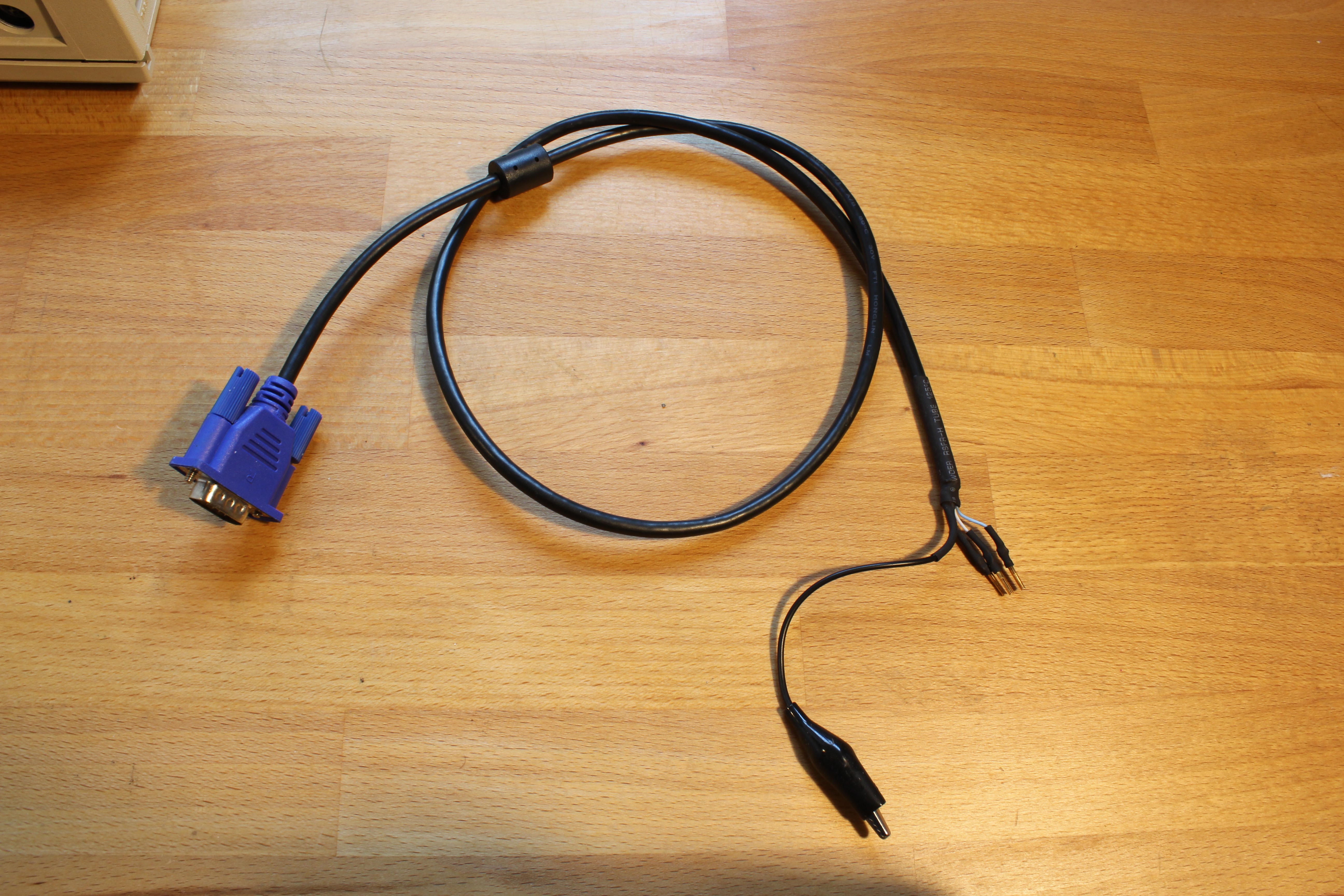
Firstly, apologies if my response doesn't show up nicely in this thread --- I only receive the daily digests so I'm not sure how best to reply to a specific post...
But on the subject of sourcing / making video cables with 3W3 connectors on one end, I also balked at the cost of the coaxial insets and decided to make an only marginally dodgy (if I do say so myself) cable out of half of an old VGA cable, three of the 'sleeves' / female connectors contained, in abundance, in every female D-sub connector, and a few bits of heat-shrink (see https://media.decarchive.org/DEC/VAX/VAXstation%204000-VLC/IMG_3941.jpg for a photo of this cable from an albeit sub-optimal angle). The resulting connections were surprisingly stable, however, were I to make another one, I'd replace the grounding alligator clip with a lug that can be screwed onto one of retaining nuts next to the VLC's 3W3 connector, and use longer bits of heat-shrink to fully insulate the outside of the RGB connectors...
And just FYI, even as shown, the video quality was more than adequate (considering the resolution of the VLC's LCG framebuffer), however, I suppose one could always attach a shielded DA15 shell to provide a bit of extra noise suppression (as well as mechanical protection).
Hope this helps,
Peter
>
> Date: Wed, 5 May 2021 00:03:05 -0700
> From: Josh Dersch <derschjo at gmail.com>
> Subject: PDP-8/I Negative-bus termination
>
> Hey all --
>
> Until this point I've never had any peripherals for my negibus systems
> (apart from teletypes), and it occurs to me that I have no idea if the bus
> needs to be terminated (and if so, with what). There are 6 slots in the
> RF08 backplane (D01-D06) for daisy-chaining to the next device, which is
> where I assume they'd go; the RF08 manual does not make it clear what this
> looks like or if it's actually required, and I've gone through the
> available PDP-8/I docs and I'm still at a loss.
>
> Can anyone with negibus experience point me in the right direction?
>
> Thanks,
> Josh
>
The DEC Field Service Technical Manual has some notes on bus termination.
It says:
Termination is required on I/O cables longer than 20 ft., and may be
desirable on shorter cables. For negative bus, use 220 Ohm shunt resistors
to ground on IOP 1, IOP 2, IOP 4, BTS 1, BTS 3 and Initialize. No special
termination module exists for the negative bus.
--
Michael Thompson
>
> Date: Wed, 5 May 2021 13:20:59 +0100
> From: <dave.g4ugm at gmail.com>
> Subject: RE: Motor generator
>
> We had a Motor/Generator for our Honeywell L66. Not sure it was because it
> wanted US voltages or just for a clean supply
> Dave
>
I also worked on a Honeywell L66 that had two motor-generators. We used one
at a time, and swapped the operational one each month. They cleaned up the
noise in the incoming 208VAC 3-phase power, and the really heavy flywheel
provided a little ride through for short term power drop outs.
--
Michael Thompson
..not to forget, that the 400Hz equipment was readily available
from powering aircraft on the ground before the engines take
over. So although not cheap, they where cheaper than a custom
design at an arbitrary new frequency
> Incidentally, a way to get three phase power at a frequency of your
> choice is to use a "variable frequency drive".
Please be careful with this! Have quite some experience in building
three phase inverters from such small boxes for my various avionics
projects.
(1) The normal ones rectify the mains voltage (in EU this gives
around 320V DC) and from this make PWM outputs on three lines.
Yes, you can enter voltage and frequency (sometimes even more than
400Hz) digitally, but the outputs are ALWAYS PWM switching between
0V and 320V in the EU.
Consequence: If you rectify these outputs you will get back your 320V,
completely independent of your settings!
You need to use a device called Sinus-Filter, i.e. a low pass using
caps and Ls to smooth out and get rid of the PWM - only than you
get the correct three phase.
(2) The small boxes are only for motors (inductive loads). Connecting
someting else (does not matter whether three phase or not) which e.g.
has got EMC filters at the input containing caps, the relatively high
frequency (e.g. 16kHz, often selectable) will easily toast them leading
to a short.
(3) The PWM-boxes do not isolate from mains, so you will have pretty high
voltages at the PWM outputs with high frequencies which can be a challenge
for isolations - so even if you set the inveter to 110V only, but power it
>from 240Vmains, the isolation of your device needs to handle the full
320V!
My biggest inverter based on such a small PWM motor drive inverter is
described in my blog (including schematics)...
http://www.baigar.de/TornadoComputerUnit/TimeLine.html#inverter1500
(4) DO NOT use these three phase boxes connecting one output and one
input pin to your device thinking that this is a single phase output.
Creating a "neutral" line at the output of such an inverter can be
done, but it requires additional components and than you can use
it as single phase device: Here I used a special transfomer after
the Sinus filter with input in triangle and output in star configurations.
So I get neutral PLUS insulation to mains...
Good luck!
..not to forget, that the 400Hz equipment was readily available
from powering aircraft on the ground before the engines take
over. So although not cheap, they where cheaper than a custom
design at an arbitrary new frequency
Hey all --
I cabled up the RF08 to my 8/I this evening and it's showing some very
faint signs of life -- a DIML instruction appears to do the right thing.
That's about it.
Until this point I've never had any peripherals for my negibus systems
(apart from teletypes), and it occurs to me that I have no idea if the bus
needs to be terminated (and if so, with what). There are 6 slots in the
RF08 backplane (D01-D06) for daisy-chaining to the next device, which is
where I assume they'd go; the RF08 manual does not make it clear what this
looks like or if it's actually required, and I've gone through the
available PDP-8/I docs and I'm still at a loss.
Can anyone with negibus experience point me in the right direction?
Thanks,
Josh
I'm currently reverse-engineering an AMPEX keyboard that uses capacitive key
switches. The basic design employs a GI encoder coupled to an 8039 MCU
supplemented by a 2K EPROM and 74LS373 (used to latch the ROM address set
>from Port A while Port A is then used to read data back from the ROM). The
8039 MCU drives a bit-banged serial interface. The PCB identifies itself as
AMPEX on the coper foil, although the key switch mounting-plate actually has
a "General Instruments Quality Accepted" sticker. The EPROM is labeled
"3512663-03 Copyright 1983 AMPEX CORP".
The GI encoder is a DIP-40 labeled as "321239007 M2406-054-02 GI 8233 CBU
TAIWAN". I seek technical documentation for this IC.
It evidently is not a relabeled simple variant of the documented AY-3-4592
as it does not multiplex the input side of the matrix (sense lines), there
are fewer output data lines, and the power pins are non-standard (Vcc = pin
37; GND = pin 16).
Reverse engineering identifies this M2406-054-02 as supporting an 8 column
by 16 row (3 unused in my case) matrix plus 8 output data lines. I can
identify analogs of several pins on the AY-3-4592. My interpretation of the
pin uses is that the necessary key-scanning behavior is generated using the
8039 ALE line (pin 11) as the encoder clock input.
Proper documentation for this IC would be nice to come by! Pointers and
suggestions appreciated.
Thank you,
paul
I assume it would be way too much to hope that HD BNC would fit it? Does
anyone have a pointer to the actual physical dimensions of the itty-bitty
BNC-ish connector in the video port of the VAXStation4000vlc? If I can get
red, green, and blue out (assuming since there are only 3 connectors it's
sync-on-green) I can put together a sync splitter and turn it into VGA. I
have at least one decent multisync VGA monitor still, although none with
the RGB BNC inputs.
Adam
>
> Date: Sun, 2 May 2021 15:38:33 -0500
> From: Jay Jaeger <cube1 at charter.net>
> Subject: IBM 1410 FPGA Implementation Update - new github repository
> Message-ID: <68c06711-e563-f1bf-8abc-090793bed752 at charter.net>
>
> The last 12 months I have been pretty busy working on my 1410 in FPGA
> project, and there is now more to share, though I have not done much
> actual work since February - been too busy playing with other "toys". 8D
>
> JRJ
>
The RICM has a 1401 control panel. It would be pretty cool to mount your
FPGA to the back of it and get it to blink the lights the right way.
https://www.ricomputermuseum.org/Home/interesting_computer_items/ibm-contro…
--
Michael Thompson
Hi Jos!
> in the UK around 1960 the Argus 200 was developed to control the Bristol
> Bloodhound anti-aircraft rocket. This computer was one of the very first
> transistor-based control computers.
Absolutely - in these days Ferranti and Elliott where competitors on
the European market for defecne computing! Very funny, that they later
merged and today the legacy of both is distributed in the BAe and
Leonardo businesses ;-)
There are quite interesting stories, on occasions when the two had to
cooperate before merging and in the ELDO project mentioned in my video,
the computer was from Elliotts whereas the inertial sensor was from
Ferranti (https://youtu.be/v-gF5g0nnoE?t=363).
> In Switzerland the Bloodhound was on duty?? until 1999 ! One of the sites,
> once top secret,?? is now a museum, and well worth a visit.
> Check out https://www.museums.ch/org/de/Bloodhound-Lenkwaffenstellung
Definitively worth a visit! I am also into the Ferranti navigation systems
>from the 1970ties (https://www.youtube.com/watch?v=-EQqfxiGgd8) and since
years I am trying to find out, what architecture its 32 bit computer is.
Here I booked an extensive special tour and the team on mount Gubel organized
some experts to join the tour - although I learned that the INS computer
is not related to the Argus series, the visit was AMAZING!
Also great there to see the technology of the almost Mach3 missile from
the 1950ties.
Erik.
I have a recalcitrant Cipher C995 9track drive. Does anyone have
manuals for this thing? It seems to be enough different from the M990
to matter.
Thanks,
De
Unfortunately once again I am having trouble with Sprague 2X.1-1000 filter
capacitors. The two filter caps on a Lab-8/e rack's 854-B power control
assembly appear to occasionally leak to ground more than the 30 mA
tolerated by my RCD. Mostly it trips the RCD when I power off the system,
but sometimes it even trips the RCD with the system powered off. One of the
two filter caps is permanently connected across mains power and earth
coming from the cable (i.e. it is before the power switch).
The exact same filter caps were also used inside the LAB-8/e computer?s
power supply. Early on I replaced these with a small PCB with a bunch of
male spade connectors and two Y class safety caps. The PCB was designed to
replace two of the Sprague filter caps in the side-by-side configuration
used inside the LAB-8/e?s power supply where it is also hidden from view.
The PCB was designed by Malcolm Macleod in Melbourne/Australia who hit the
same problem. I got the PCB manufactured in China from his design.
The 854-B power control assembly has the two Sprague filter caps sitting on
either end of the assembly ? far from each other. Also the can of the
capacitors is exposed at the back and clearly visible so even a newly
designed PCB with a single set of safety caps wouldn?t look great and also
wouldn?t be stable because there are only two mounting holes.
I cannot think of a neat solution to resolve this.
I could try to find an electrician willing to wire me a non-RCD protected
socket into my study, but I can?t quite warm to that idea. The RCD is an
important safety feature. By law now all houses are required to have their
AC wiring protected by 30 mA RCD circuit breakers so I likely would have to
do this myself.
The other option would be to make or buy two terminal blocks with male
spade connectors and connect the female spade connectors to those rather
than the Sprague connectors. I could then also wire in the 2 Y class safety
caps or even forego the filtering. It would mean drilling new holes into
the power control assembly.
Chuck(G) in the vcfed DEC forum suggested pulling apart the old "bathtub"
capacitors and replacing their guts with modern safety caps. The caps
contain toxic and carcinogenic PCBs so I am less than enthusiastic about
that idea. The capacitor's metal can is soldered together so trying to
desolder it would heat the mineral oil containing the PCBs which would make
them even more harmful.
There is no point in trying to hunt for ?new? Sprague 2X.1-1000 because
they would all be ancient and have the same leakage problem.
Any thoughts, ideas or suggestions?
Best regards
Tom Hunter
The last 12 months I have been pretty busy working on my 1410 in FPGA
project, and there is now more to share, though I have not done much
actual work since February - been too busy playing with other "toys". 8D
First, I finished working through all of the IBM 1410 and IBM 1415
Automated Logic Diagrams - generating VHDL and testing the results with
test benches. [Note that this includes the built-in 1401 compatibility
mode, activated at the flip of a switch.] That took most of 2020.
So, the CPU generation in VHDL is now more or less complete, and I added
a hand coded memory module for memory, as core is kind of hard to find
on an FPGA development board. ;) I am currently using a Digilent Nexys
4, but I think it might have even fit on a Nexys 2 - there is plenty of
room to spare, and there isn't anything in the VHDL aside from, maybe,
the memory implementation (though even that is pretty generic VHDL).
With this the CPU runs, at the very least, Unconditional branch (Jump),
Halt, NOP and Set Word Mark instructions seemingly correctly - I haven't
tried any others. Somewhat surprisingly, aside from issues with the
hand coded VHDL in triggers and the need to communicate pins tied to
logic one or zero, the auto-generated VHDL works untouched.
I have updated the github repository for the C# database application
that generates the VHDL from time to time (and which includes the
complete database) at http://github.com/cube1us/IBM1410SMS
There is now a *new* repository, http://github.com/cube1us/IBM1410FPGA
which holds the generated VHDL, some hand coded VHDL modules for certain
SMS cards (typically for triggers, for example), the console and test
benches I used along the way, and VHDL "Integration Tests" which are
designed to be loaded onto the board - the current one being
IntegrationTest3.
There will be, eventually, a third repository which will contain the C#
code that "hosts" the IBM 1410 console and peripherals, communicating
with the FPGA over a high speed serial over USB connection. I figured
out that this should allow me to emulate peripherals without having to
resort to sending data over Ethernet, SPI, I2C or the like. I have just
started that, so it really isn't at a point that there is much to share.
Once I have a console working (which will require a re-do of the console
VHDL implementation, which right now communicates in ASCII, but should
probably be using BCD), I should be able to pre-load into memory some of
the CPU diagnostics, by loading a diagnostic routine into either my 1410
simulator (http://github.com/cube1us/1410), or Richard Cornwell's
emulator in SimH and then taking a snapshot of "core" to pre-load into
the FPGA. At that point I expect I will be able to test the CPU pretty
thoroughly. I hope and expect that will happen this year sometime.
Unfortunately, I do not have the ALDs (Automated Logic Diagrams) for the
IBM 1414 I/O Synchronizers, but I do have the Instruction Logic Diagrams
which should allow me to code VHDL to emulate card, tape and maybe
eventually even disk functions, so those might take a while.
If anyone cares.... ;)
JRJ
Hi Josh,
Among the pictures linked from your message about the H742a parts, there is one picture of you backplane. I have been looking for some time for information about the following 11/45 ECO:
> KB11-00001 CODE: D May-72 [ECO]
>
> Problem: Etch carrying +5V current from Mate-n-Lock pins to backpanel pins is not heavy enough to carry required current. Correction: Run 24AWG wire in parallel with etch on panels which already have Mat-n-Lock assembly installed. Increase thickness of conductor with solder bead if Mate-n-Lock assembly not installed. PDP-11/45 system serial number 101 and later.
The wiring arrangements at the top of your backplane look to be a bit different from mine, and I believe you may have this ECO implemented. While you have your backplane out, could I ask that you take some closeups around the Mate-n-Locks along the top? I'd be very interested to see the board traces and the details of the red bus wiring there.
Pictures of the toasted 11/45 suggest that the original machine had the older power wiring scheme (distribution panel mounted vertically on back of cabinet instead of horizontally at top of cabinet, etc.) although your KB11A serial number badge is >2000, which is curious...
I sent Josh pictures of the complete RF08/RS08 that John Wilson donated to
the RICM. I will send detailed pictures of the RS08<->RF08 cables next week.
--
Michael Thompson
Hi folks,
Did anyone else get an email about excessive bounces today? I?ve not changed anything hosting wise forever so this is a bit weird.
Cheers,
--
Adrian Graham
Owner of Binary Dinosaurs, the UK's biggest private home computer collection?
t: @binarydinosaurs f: facebook.com/binarydinosaurs
w: www.binarydinosaurs.co.uk
Hi all --
In addition to the 11/45 project I'm also working on restoring an RF08/RS08
fixed head disk/controller (in the vain hopes of one day running TSS/8 on
my PDP-8/I). I have the power supply repaired and running and I'm getting
ready to power the logic up (the disc itself will be a project all its own,
once it arrives).
I'd like to double-check that all the flip chips are in their right places;
I have no cause to think they've been shuffled around but I want to be
sure. The engineering docs have detailed schematics but no placement chart
for the modules themselves. Given enough time with the schematics I could
derive this chart but I'm saving that as a last resort. So, two
possibilities here:
1) Does anyone know of a document I've overlooked that includes module
placement?
2) Can someone with an RF08 and/or RS08 take a few detailed pictures of the
logic (from the handle side, of course) so I can compare? (Note: the
available RF08/RS08 pictures on the 'net are of the unit currently in my
possession, so are not useful in this regard!)
Thanks!
- Josh
Spring cleaning. Will be recycled otherwise. While most are probably
not of interest to this group it's possible someone may want the SCSI
related items like the ES-1000C flatbed scanner manual or Yamaha
CRW8424SX manual or the Adaptec stuff.
I'm in downtown Toronto, Canada. On Freenode IRC my nick is genii
imgur gallery of the stuff https://imgur.com/a/USejVEv
--
"..we are dwarfs astride the shoulders of giants. We master their
wisdom and move beyond it. Due to their wisdom we grow wise and are
able to say all that we say, but not because we are greater than
they." Isaiah di Trani
> From: Eric Smith
> The KB11-B (original 11/70) and KB11-C (later 11/70) have essentially
> the same changes as from the KB11-A to KB11-D
Speaking of which, two of the boards that are different in the KB11-D, from
the -A, are _identical_ to boards in the KB11-C - the M8123 ROM & ROM control
and the M8132 instruction register decode! (The M8123 is also different from
the M8133 board in the KB11-B.) Pretty wierd that the -11/45 and -11/70 CPUs
share two boards, but true! (The FP11 boards are the same in both, too.)
> It sure would be nice to get backplane wirelists for all four (KB11-A,
> -B, -C, and -D).
ISTR a previous, un-fulfilled request for the -11/70 wirelist, so it's been
missing for a while.
We _might_ have the -11/45 wirelist:
http://www.bitsavers.org/pdf/dec/pdp11/1145/1145_System_Engineering_Drawing…
but it's short (pp. 128-132), so maybe it's not complete)? Two other
print sets seem to have the same list:
http://www.bitsavers.org/pdf/dec/pdp11/1145/1145_System_Engineering_Drawing…http://www.bitsavers.org/pdf/dec/pdp11/1155/MP00039_1155vol1_Mar76.pdf
(pp. 45-49 and pp 131-135 respectively).
> Also, I'm looking for a Field Maintenance Print Set for the RH70.
Heh. I didn't see it online; the manual:
http://www.bitsavers.org/pdf/dec/unibus/CSS-MO-F-5.2-27_RH70_Option_Descrip…
is a CSS document, which makes no sense, because the CPU backplane is laid
out to have room for four, so it's an integral part of the /70 CPU - so why
is it a CSS product? Anyway, the print set listed there seems like it might
be a CSS thing, too.
I see that the CHM seems to have a set:
https://www.computerhistory.org/collections/catalog/102749003
so maybe Al will take pity on us and scan it!
I looked in my /70 print set, and although it contains all sorts of odds and
ends (including MJ11 prints - which kind of half makes sense, since that was
the only main memory option on early /70's), it doesn't have the RH70. (I
didn't see the MJ11 prints on BitSavers, so I was thinking I was going to
have to scan them, but on further looking I found them on deramp.com.)
Noel
> From: Henk Gooijen
> I have the M8120 and 4 M8121 boards (32kW bipolar RAM). It is a bit
> weird, but in the 11/55 are also two G114 boards (4kW MOS RAM), IIRC.
G114s? Those are the sense/inhibit module from the MM11-U/MJ11. Did you
mean G401s?
If so, one guess as to what happened there is that the machine used to have
two banks of MS11 Fastbus memory, one bipolar, and one MOS, and some of the
boards from the MOS bank (the memory control, and maybe some of the matrix
boards) got removed?
A KB11-[AD] can have two banks of MS11; the only type mixing allowed is that
one can be all bipolar, and one all MOS; within each bank they all have to be
the same. More here:
https://gunkies.org/wiki/MS11_Semiconductor_Memory_System
Interesting factoid: the M8110 and M8120 use the same etch. I'm not sure
quite what the difference is (the MS11-A MM doesn't say, I couldn't find, and
I don't think we have the M8120 engineering drawings, just the M8110);
the M8120 has a bunch of ECO wires on it, and maybe there are component changes
too. (I don't have an M8110 to compare them directly.)
Noel
Sort of an odd request, but I have some LK201-AA keyboards that have (of
course) not got their little black riser feet any more. I don't think
they've ever had them while in my possession, in fact.
If anyone has one, and has the time and interest, could you do me a big
favor and take measurements of them for me? I would like to 3D print
some replacements, so getting the outer dimension is the most critical
part (though I can always measure the inner dimension of the hole they
fit into, too), along with the protrusion of the two clips that fit into
the key of the hole on the bottom of the LK201 keyboard.
I have good pictures of them, just not dimensions, so I think once I
know the size of the critical bits, designing and printing them
shouldn't be too difficult.
Thanks,
-Seth
--
Seth Morabito
Poulsbo, WA, USA
web at loomcom.com
>
>
> On 4/24/21 10:28 PM, Noel Chiappa via cctalk wrote:
> > Noel
> >
> > PS: I wonder how many people here have -11/45's? ISTR one other, but
> they aren't
> > common.
The Rhode Island Computer Museum has two. The pair were the interface
between fire pull boxes and the 911 dispatch system in Brooklyn, NY. Both
have DV11 & DH11 serial controllers. These are capable of the very low baud
rates needed to talk to the fire pull boxes.
https://www.ricomputermuseum.org/collections-gallery/equipment/dec-pdp-11-45
--
Michael Thompson
Some one appears to have three AT&T 3B2/300 manuals, cables diskettes, sadly
in Brazil and has posted some pictures in a Facebook group
https://www.facebook.com/groups/vintagecomputerswapmeet/permalink/3954289997
980016/
You can open the link in an incognito, sandboxed, VPNd session and still see
the post..
Dave
G4UGM
https://www.ebay.com/itm/164815576309
$9570 for a keyboard.
As much as I'd like to find a keyboard for my Lambda's second head, I
somehow doubt that's going to happen. And now I think I need to go find a
really, really (really) safe place to keep the keyboard I *do* have...
- Josh
>//>/Digital DEC 3000 />//>/I have an old DEC 3000 unit that I no longer have time or space for, and />/was wondering what to do with it. />//>/The rear plate shows PE42A-B9, CPU KN17, DEC 3000 600S and the ROM has a />/sticker showing Dec 1989. />//>/I have a video cable but not a suitable monitor so can't fully test it />/but I think it is booting up OK as the diagnostic LED's on the rear show />/11011101 or DD in hex which I think means it has booted OK to console. />//>/It has been running in the past and my last efforts were probably 10+ />/years ago when I installed VMS version 7 with a guest licence. />//>/I also have a few peripherals including a SZ12 disk unit, LK201 />/keyboard, circular mouse and various SCSI and video cables. />//>/It has been stored in my garage which is not totally sealed so it has />/suffered a little corrosion to the rear connectors but it looks
recoverable. />//>/All thoughts and opinions welcome. />//>//
Hi Rob,
I have three DEC 3000 600 machines which don't work with various issues
including multiple cache failures, shorted decoupling capacitors and
power supply issues. They seem to accumulate more issues each time I
get around to looking at them again :-(
If you are willing to part out, I would be interested in your system board
and I/O board to help me get some of my machines sorted out. I guess you
also have a graphics card? I would be interested in that too.
You don't say where you are. I am located in Ireland.
Regards,
Peter Coghlan.
I hadn't considered splitting the components but I can see that would be an option and a lot more manageable boxing up smaller parts for the post office.
I would really prefer to see the unit go in one piece but will keep it in mind as an option.
I am in Cardiff.
I am new to the list so please excuse me for leaving out a few essential
elements of my message.
-----------------
I am in Cardiff in the UK and would prefer collection of the Digital DEC
3000 unit as it is large and heavy and would not be easy to arrange
postage.
I am happy to wait for a few weeks/months until covid restrictions are
fully lifted and would really like the item to go to someone who
appreciates its heritage.
-----------------
I have an old DEC 3000 unit that I no longer have time or space for, and
was wondering what to do with it.
The rear plate shows PE42A-B9, CPU KN17, DEC 3000 600S and the ROM has a
sticker showing Dec 1989.
I have a video cable but not a suitable monitor so can't fully test it
but I think it is booting up OK as the diagnostic LED's on the rear show
11011101 or DD in hex which I think means it has booted OK to console.
It has been running in the past and my last efforts were probably 10+
years ago when I installed VMS version 7 with a guest licence.
I also have a few peripherals including a SZ12 disk unit, LK201
keyboard, circular mouse and various SCSI and video cables.
It has been stored in my garage which is not totally sealed so it has
suffered a little corrosion to the rear connectors but it looks recoverable.
All thoughts and opinions welcome.
Digital DEC 3000
I have an old DEC 3000 unit that I no longer have time or space for, and
was wondering what to do with it.
The rear plate shows PE42A-B9, CPU KN17, DEC 3000 600S and the ROM has a
sticker showing Dec 1989.
I have a video cable but not a suitable monitor so can't fully test it
but I think it is booting up OK as the diagnostic LED's on the rear show
11011101 or DD in hex which I think means it has booted OK to console.
It has been running in the past and my last efforts were probably 10+
years ago when I installed VMS version 7 with a guest licence.
I also have a few peripherals including a SZ12 disk unit, LK201
keyboard, circular mouse and various SCSI and video cables.
It has been stored in my garage which is not totally sealed so it has
suffered a little corrosion to the rear connectors but it looks recoverable.
All thoughts and opinions welcome.
I'm trying to track down a keyboard to complete a system which is proving
quite difficult!
Here is the specific unit: https://i.imgur.com/FsG24G3.jpg
if anyone happened to have one of these spare or know someone who does
please let me know!
> From: Fritz Mueller
> could I ask that you take some closeups around the Mate-n-Locks along
> the top? I'd be very interested to see the board traces and the details
> of the red bus wiring there.
I had a look at my /45 (a later KB11-D - although I think the backplanes for
the -A and -D are identical), and it seems to have heavy red wires attached
to the upper row of Mate-n-Lok's that look just like those on Josh's. I'd
really want to take pictures of mine (I don't want to take the backplane out
- too much work - but I can get decent images with it in, I think) so I
can compare them directly, though, not depend on visual memory.
Noel
PS: I wonder how many people here have -11/45's? ISTR one other, but they aren't
common.
> I had a look at my /45 ... and it seems to ... look just like those on
> Josh's. I'd really want to take pictures of mine .. so I can compare
> them directly, though, not depend on visual memory.
Yeah, mine (a late /55, actually) has the _exact_ same wires at Josh's.
So that's probably the final ECO level. Image here:
http://ana-3.lcs.mit.edu/~jnc/tech/pdp11/jpg/1145CPUBackPlane.jpg
if you're interested. (Not a great image, but OK; I can try for a better one
if there's a need.)
> From: Henk Gooijen
> Most of the CPU boards in the 11/55 are the same as the ones in the
> 11/45
The -11/45, /50 and /55 are all the same CPU (KB11-A or -D), so the same
backplane/everything, but differ only if they were sold pre-configured with
the MS11 Fastbus memory.
And of course some /45's (especially those sold before the introduction of the
/50 and /55 as sales options - I have a /45 price list from Sep, 1972 which
lists the /45 and /50 but not the /55; and one from Jan, '73 which only lists
the /45 :-) were upgraded (possibly after sale, after the /50 and /55
appeared) with MS11 - or possibly some /50's and /55's had the MS11 removed at
some point. So the number doesn't mean anything; one has to look at the
boards.
Noel
Hey all --
I've started stripping down the "fire-sale" PDP-11/45 I picked up in
November, in preparation for sanding and repainting the rack and processor
chassis. There were two H742a supplies in the rack that I believe are too
far gone to be reasonably restored (in particular the heat definitely did a
number on at least one of the transformers) and I have a pair of H7420a's
ready to take their place. I hate to see things go to waste, though, and
even though it's probably pointless -- before I send these off to the
scrapyard, I wanted to check to see if anyone here needed any parts.
Shipping the whole unit(s) would be pretty expensive, local pickup is an
option if you want the whole thing(s). The transformers are a bit toasty
but the power supply boards look like they might be usable after a good
cleaning and testing. Fans are dead (either melted away entirely or rusted
out). I suppose there's not really much else that'd be useful to anyone
but I have a compulsion to make sure...
Here's a couple of pictures:
https://1drv.ms/u/s!Aqb36sqnCIfMpL89R2GtJFrrRqZ1vQ?e=Re3KZr
And for fun, here's a bunch of pictures of the unit just prior to the
teardown: https://1drv.ms/u/s!Aqb36sqnCIfMpL8-mTCp-NndzDTpbw?e=8aWCl4
(I do think there's a good chance this will run again, the major casualties
were the front panel, power supplies, and wiring harness. I have
replacements for the first two, and the third is just a matter of taking
the time to build a new one. The boards cleaned up nicely and there's no
real damage to the processor backplane, amazingly.)
- Josh
Earlier I'd found a box with a speaker, what looked like a volume
control and maybe a headphone jack with a ribbon cable going to a DB-25
connector. Thought it might be for playing sounds from the system.
Appears to be partly right. While digging through various Exidy doc on
Bitsavers I came across a manual for a Cognivox Speech Recongnition and
Voice Response Peripheral by a company called Voicetek. The images in
the manual match the box itself. What I thought was a headphone jack is
for a mic and it appears to plug into the parallel port in the expansion
unit.
I haven't found any of the software that the manual says ships with it
though I'm still finding parts of this system packed away in various
boxes so might find it yet. I know it is probably a huge long shot but
if anyone else has software or anything else about this peripheral,
please drop me a line.
David Williams
www.trailingedge.com
Hi,
I'm trying to find out if the BASIC dialect that was available for the
MINCAL computers (aboutn 1971) was something derived from another "system"
or whether it was an own dialect.
Some characteristic instructions that I can't find somewhere else are:
- Formatted output with PRINT FOR(<FORTRAN like description>)
Example: PRINT FOR(F5.0)500.1
- Computed GOTO with GOTO <expression> OF n1,n2,...
Example: GOTO A+B+1 OF 100,20,50
- Presence of "DEF FN", lack of RESTORE for DATA/READ constructs.
This BASIC must have been around 1970-1972.
Christian
On 4/23/21 10:33 AM, Rik Bos wrote:
> That would not work the capstans of the 9144/45 have much larger
> diameter. Those drives use DC600HC tapes not a QIC tape.
How do you figure that? I've got a DC600HC cart here and it's the same
dimensions as a standard DC600A cartridge--it is Iotamat preformatted,
without the usual optical sense stuff. It was used on a number of QIC
(yes, it's quarter-inch) drives, such as the Kennedy 9455 and the ADIC
32-track drives.
As far as the capstan being too large, I suspect you may underestimate
the "stretchiness" of silicone hose. Somewhere, I posted a photo if an
Archive 2060S drive with a red hose replacement capstan.
The hose comes in larger sizes, regardless. I still need to refurb the
capstan on my 3M DCD-01 drive, but it's been too long since I've run
into any 2-track DC300 tapes, so it's not a priority.
In any case, the suggestion is offered for whatever value one can gain
>from it.
--Chuck
Hi folks,
I just got pipped on an auction for one of these last night, clearly someone needed it more than me and I hope it was for a real usage reason and not just to add to their collection of MDS-related machines.
I?ve been looking for an 8085 ICE for ages now to help troubleshoot my STC Executel phone systems so this seemed like an ideal opportunity to get my hands on one but hey, that?s how auctions work. This one also has an external 37 pin floppy interface so I was hoping I could hook up an 8? drive to be able to read the Executel source floppy disks I have.
Does anyone have one in the UK they don?t need/taking up too much space etc?
This weekend I?ll be investigating getting a Greaseweazle running with an 8? drive now that I have all the components to power my Shugart 860.
(I now await comments along the lines of ?what do you need an ICE for when you have a DMM, scope and LA - easy answer: the whole environment was designed on an MDS80 so it would be fun)
Cheers,
--
Adrian Graham
Owner of Binary Dinosaurs, the UK's biggest private home computer collection?
t: @binarydinosaurs f: facebook.com/binarydinosaurs
w: www.binarydinosaurs.co.uk
Hello all again,
With a heavy heart I need to find a new home for the following beautiful
hardware:
- AlphaServer DS15 server
- Sun SPARC Enterprise T5140 1U rack server
- Sun Blade 10 mini tower
- HP Proliant DL380 G7 2U rack server
- DEC VT220 with screen, keyboard, and various adapter cables
Please note that the Sun T5140 and HP DL380 are deep (700mm for purposes
of installation in a rack).
I'm starting a new job next week and intend to focus on that and my
family. I've stopped working on various projects and I am vacating my
studio workshop, so I have a lot of things to give away or sell.
The above items are all FREE FOR COLLECTION ONLY (a car will be fine to
transport the above items).
I am located in London, UK. Post code is N15 4QL (Seven Sisters and
Tottenham Hale) in Haringey, London.
Kind regards,
Andrew
There's a nice, working PDP 11/23 with 20 meg hdd and 1meg (!!) of ram,
with terminal screens indicating full operation. The asking price is
$900.00, but I imagine the fellow might negotiate. Shipping is gonna
be a fair penny.
best,
Jeff
Moved recently and finally have space to set up the collection and play
with it. I've set up my Apple IIgs and a Macintosh Plus and in testing
they are still working but while doing so I've noticed an issue with the
3.5" drives. I have an Apple Superdrive and 4 Apple 3.5 Drives on the
IIgs and where they all work as far as reading and writing, only the
Superdrive can actually eject the disks. The Mac Plus has the internal
drive and an external Apple 800K drive, both of which work except not
being able to eject disks either. So out of 7 drives, I have one that
doesn't need a paperclip to eject the disk. Haven't opened them up to
look at them yet, wanted to see if this is common and suggestions on
possible causes to check.
Thanks.
David Williams
www.trailingedge.com