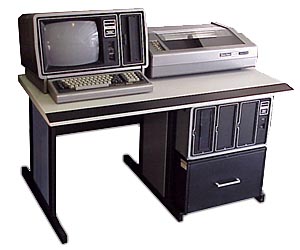
I have inherited a HP3000 918LX. Surpisingly enough it is OT being from
1999 or thereabouts; hopefully MPE/IX is venerable enough to fit in here.
I didn't like the machine much when it was in production use as a billing
system, but now that its mine I appreciate it a bit more.
However, the thing came out of the box in 1999 with MPE 5.5 with 64MB of
RAM and was intolerably slow. It was since been migrated (by HP
consulting thank goodness) to 7.00 which did not speed it up any.
Running a few simple commands and GLANCE begins to gripe about memory and
CPU usage. I once exported an ASCII file from LOGTOOL and tried to 'grep'
the resulting file in MPE POSIX mode and it took over 2 hours to complete.
FTPing to a 90mhz (!) linux box and the grepping took three minutes.
This was one of the machine were HP inserted NOP's in the firmware so you
didn't get more speed than you paid for, but I would not mind adding some
RAM.
I have some A2580-60001 60ns RAM from a HP9000 D200 which looks to be
compatible with a 918LX. I found other RAM part numbers which claimed to
work with both D200's and 918LX's had trouble finding info on this one
specifically.
Anyone know for sure? I'd rather not release magic smoke.
Paul
> From: "Evan Koblentz" <evan at snarc.net>
>
> I found some interesting things to buy, but then saw the prices... not only
> are they ASTRONOMICAL but the seller lists almost every item, even ordinary
> keyboards, as "Very Rare"... I wanted a Canon X-07 and a Toshiba T100 but he
> posted them at $299 and $399 respectively. What the hell!?!?!?
I ran into those items yesterday while checking out pricing for classic computer
stuff. My first comment is ... I'M RICH :). Second (and more seriously), I read
a while ago that the average selling time for older books is five years. My
guess in both cases is that they are priced for someone that *needs* them.
I found another closed auction today for a BUNCH (approx. 25) of Northstar
Advantage computers/boards/etc. with a starting bid of $500.00 with no reserve.
Good thing I didn't see that when the auction was open :)!!!
All:
I'm doing research for another potential emulation project. Does
anyone have a pointer to an electronic copy of the Tandy Model 2000
Programmer's Reference Manual (260-5403) and the Hardware Reference Manual
(260-5404)? Alternatively, if someone has hard copies that I can make a copy
of, that'd work.
Thanks a lot.
Rich
Rich Cini
Collector of classic computers
Lead engineer, Altair32 Emulator
Web site: <http://highgate.comm.sfu.ca/~rcini/classiccmp/>
http://highgate.comm.sfu.ca/~rcini/classiccmp/
Web site: http://www.altair32.com/
/***************************************************/
Received a post from a fellow in New York with a machine to give away.
> I have access to an Apollo Domain series 3000 machine, actually was
> told to throw it out, and googled the make and model, just for fun.
If you are interested email me and I'll forward the replies.
Tony and others -
The head load pad looks visually fine. The head load spring tension
appears pretty normal , and the solenoid pulls in nicely.
The drive consistently reads the first 10 or so tracks, then tosses
various number of errors as it goes further out.
I've cleaned the head, and cleaned/lubed the spindle. The track 0
sensor appears fine.
It is indeed possible that the alignment is off - that would probably
explain the poor performance as it steps out.
I guess a worn out head would have the same symptoms.
I the 70's I had a neat Dysan digital alignment disk that I used to
realign a few SA901 and SA801 drives.
Unfortunately I no longer have it. I suppose I could mark the position
of the stepper and slightly rotate it in each direction to see if it
improves things.
If someone can point me to an actual alignment procedure I'm game - I
have reasonable scopes etc here.
I'm not anxious to replace the entire drive, but I would love to get
this up and running!
Any help/suggestions greatly appreciated.
- Gary
Other faults that I've had were a mis-aligned track 0 sensor (causing it
to step out beyond the outermost formatted track on the disk), and a
low-tension head load pad spring. In the latter case, taking the thing a
aper and bending the torsion spring by hand got it going again. The only
problem was reassembling it, I found it necessary to make a dummy pin to
hold the spring inside the load arm that was then pushed out when the
real pin was inserted through the head mouting.
In any case, before replacing something as large as a drive unit, I'd
want to know which of the various parts was the problem. Do you know, for
example, that the head load solenoid works and pulls in correctly? That
you can get a signal from the track 0 sensor? That the spindle is
turning? and so on...
-tony
Hi - I have an opportunity to pick up a large collection of vintage
computers located in Oregon. I have been told that one would need a truck
to get it all in one shot. If there is anyone who lives in or near the
"541" area code and is interested in helping, contact me directly and I can
give you the details.
Thanks.
Bill Degnan
Hi,
I've decided after many years of accumulating PDP-11s that the time has
come to restore a few of them to operational condition. I've decided to
start with some QBUS machines as they give me the best chance of a warm
fuzzy feeling of success.
The first thing I've decided to do was to retrieve all of my RD series
harddisks and establish which ones are still operational. I've initially
started with 4 RD53s and 4 RD54s which I've connected upto an 11/73 and
used XXDP to format.
All RD54s have formatted perfectly, confirming their reputation for
reliability. However none of the RD53s would format, which I guess also
backs up their reputation. I had hoped at least a few of the RD53s would
have still been usable (I have about 6 more I've not tested yet).
Does anyone have a RD53 still in working condition? Is there any point in
keeping the duff drives or should I consign them to the skip?
Toby
--
This message has been scanned for viruses and
dangerous content by MailScanner, and is
believed to be clean.
I was wondering if there's anyone else out there interested in someday
building a Magic-1 and/or D16 homebrewed CPU computers. If so, I'd like
to organize a group buy for some of the harder to source parts.
Specifically, the 74F382 and probably 74F381. My favorite chip broker has
a $50 minimum order.
--
David Griffith
dgriffi at cs.csubak.edu
A: Because it fouls the order in which people normally read text.
Q: Why is top-posting such a bad thing?
A: Top-posting.
Q: What is the most annoying thing in e-mail?
I received this request recently by email:
-------------------------------------------------------------------------------------------------
I have and I'm tired of storing an old S-100 box, probably home-made in a
formed and machined aluminum enclosure. The whole thing is a tank of
impressive proportions and weight. I saved it from the trash years ago, as
S-100 systems were common when I first started using computers (Osborne 1
era).
Originally, it had 2 8" floppy drives. One of the drives is missing,
although I have the door for it.
Inside, there's a CPU/IO card, a 64 K DRAM card, an analog data acquisition
card, and I don't remember what else. One of the cards says MicroByte. The
front panel had a key switch, which is still there, but pulled back from the
panel.
I have no idea if this works, but at least the major parts appear to be on
hand.
Are you interested in this beast? Do you want pictures? I don't want any
money other than the cost of getting it into better hands. I'm in Eugene,
Oregon, by the way.
-----------------------------------------------------------------------------------------------
Too far/heavy/big for me to get it shipped here, however if there is someone
on the list who would like to give it a home, please contact me and I'll connect
the two of you.
Regards.
Dave
--
dave06a (at) Dave Dunfield
dunfield (dot) Firmware development services & tools: www.dunfield.com
com Collector of vintage computing equipment:
http://www.classiccmp.org/dunfield/index.html
moochiss grassyass amigos
__________________________________________________
Do You Yahoo!?
Tired of spam? Yahoo! Mail has the best spam protection around
http://mail.yahoo.com
I have an RD54 with a working RSTS system (V10.?) on it.
The RD54 was installed in the microPDP-11/93 that I had.
I have a microPDP-11/53 with RQDX3 and got a few days ago
an Emulex UC07 QBUS SCSI interface with a 1 Gb SCSI disk.
Before I mess up the RSTS (because I don't know anything
about RSTS yet), I would like to make a copy (dump?) of
the complete RD54 to the SCSI disk, so I can restore the
whole RD54 to an other RD54 if this one dies ... or is
messed up completely by me :-)
I think the following steps are a starter (?):
1) install the UC07 and connect the SCSI disk
2) connect the RD54 to the RQDX3
3) start the system till the RSTS "Option" prompt
Then what?
First, I need to know the device names. Is there some
command like RT-11 ".SH DEV" available in RSTS?
Then I probably need to initialise the SCSI disk?
Then I need some sort of command to get *everything*
>from the RD54 to the SCSI disk ...
Any help is appreciated!
TIA,
- Henk, PA8PDP
This message and attachment(s) are intended solely for the use of the addressee and may contain information that is privileged, confidential or otherwise exempt from disclosure under applicable law.
If you are not the intended recipient or agent thereof responsible for delivering this message to the intended recipient, you are hereby notified that any dissemination, distribution, or copying of this communication is strictly prohibited.
If you have received this communication in error, please notify the sender immediately by telephone and with a "reply" message.
Thank you for your cooperation.
I'm posting this for my friend Shane who isn't subscribed to this list.
He'd like to find a good home for his Sun-3/60. The machine is available
for pick-up (unless you pay shipping) in Calgary, Alberta, Canada.
As far as I know, this 3/60 has 12MB RAM and a CG4 color framebuffer. It
includes a color monitor, keyboard, optical mouse and the metal mousepad
as well as an external 1GB SCSI disk (not the shoebox) loaded with SunOS
4.1. All cables included. In short, a very complete 3/60!
The owner can be contacted directly at <navalpiranha at yahoo.com>.
Per
Hi - I am attempting to install a CGA card onto a AT&T 6300 Personal
Computer. It currently has only a 25-pin CRT port for a terminal dumb
terminal (w/o keyboard). I need the dip switch map so I can set for the
CGA monitor. The 6300 has a 8086 processor, and it's an OEM system from
Olivetti. I assume that the user's guide for the Olivetti 8086 PC would
due equally as well.
Thanks.
Bill D
>
>Chris M wrote:
> > I don't see any reason why that 25 pin connection
> > couldn't be adapted to work with say an early
> > Multisync.
>
>...except that, in my experience, finding old Multisyncs are just as
>difficult as finding the original AT&T PC 6300 monitors that go with the
>machine. Both have similar frequency on ebay, anyway :)
Fortunately there was PC 6300 monitor for sale at our club (marchclub.org)
swap meet (with three 6300's) this weekend...Problem solved!...it pays to
advertise.
On 9 Date: Sat, 7 Oct 2006 18:00:13 -0400 "Bill Pechter"
<pechter at gmail.com> wrote:
> I believe the 11/68 was known as the Bluefin and was cancelled fairly
> early on before it was out of prototype. I think Ontario Hydro was the
> place that got the 11/74's. I never heard of AT&T having them. My wife
> was in AT&T, Bell Labs and Bellcore and she never heard of one of them
> there.
This is urban myth appearantly. No 11/74 systems were left at customers
at the end of the field tests.
The most common myth is that Ontario Hydro whould have kept one, but
sources there have denied it. Another myth about Ontario that I've read
were about when DEC tried to convince them to change their 11/70 systems
(or if it was disks) because the money they would save from lower power
consuption of another system, which were replied to with a "maybe you
didn't hear where I come from...". I think that actually may have been a
DECUS Q&A session... And that one might be true. I don't know...
Anyhow, back to the 11/74 systems... No, I remember (and probably still
have the mail somewhere) that persons within Ontario denied that they
kept any 11/74 systems. Also, people within DEC have firmly stated that
all 11/74 systems *were* returned.
> The last of the 11/74 KB11-CM cpus were used internal at DEC when they
> had to ship a ton of refurb 11/70's to AT&T. (they were out of
> production and wouldn't meet the FCC regs... so DEC called in a bunch
> of their 11/70 systems from Software Development and Field Service and
> shipped the newer cpu's from the 11/74 project to them as a
> replacement.
Well, it is true that DEC shipped KB11-CM cards to customers to use in
11/70 systems, but that wasn't the last of it. DEC still had/have
working 11/74 systems in house, and in the early 90s they did a
corporate wide search for 11/74 components, I believe, to keep their
systems running. (Memory a bit hazy now...)
When DEC disbanded the PDP-11 OS groups, the RSX team's 11/74 (CASTOR::)
were moved to Colorado Springs. The DECnet group's 11/74 (just 2 cpus,
POLLUX::) were also there, and FS took over the system. Well, actually
Mentec took over the system, and kept it running for another number of
years. As far as I know, the system they have still exist, but last I
heard they had some hardware problem with the machine, so it wasn't
functional. This was maybe four years ago.
Also, RSX development have finally moved off the 11/74 onto something
faster. But until recent emulators on really fast hardware, the 11/74
was still the best workhorse for the development system. Which is why
RSX have a very nice and functional MP implementation. :)
However, appearantly the physical machine stayed inside DEC, then
Compaq, and I would expect currently HP. And it sounds like there is
little chance of the machine ever leaving the premises. If it is
disbanded, it's destined for the scrap heap. Or atleast that's what I've
been told. If someone ever manage to get it out of there, I would love
to help it back to running order.
> We got one at DEC Princeton around 83 or so... Just different enough
> to require separate not-too-available spares. They were used for a
> short time with RSTS/E until the internal stuff moved to VAX/VMS.
I would think that most components would be the same as the 11/70.
Looking at the module list, only a few modules differ.
Analysing it, the changes would be in the memory bus interface (that
means both cache modules and memory box bus interface). Second, the MMU
and ASRB microcode is changed. But I believe that's it.
> There also was a system called Unicorn (which I think was another
> extended 11 prototype which was the development of the VAX SBI bus and
> MA780 memory -- later used in the VAX but built before that.
That would be interesting to learn anything more about.
Of course I assume you know that the PDP-11/70 and VAX-11/750 use the
same memory bus, and same memory cards (with a few restrictions).
Johnny
> In the past, I've run my LX [...]
Speaking of LXen....
I've got two LXen. The LX has a cgsix on the motherboard, and if you
"cd" to it and do "words" you'll see - or at least I do for each of
mine - that it has resolution-changing words supporting, among others,
1280x1024.
But when I setenv output-device to /sbus/cgsix at 3,0:r1280x1024x67 (or
whatever it is), the console appears to start fine but wedges as soon
as it tries to scroll.
However, my two machines wedge in different ways. (One just hangs,
still displaying the pre-scroll display; on the other, the video
glitches as if it were changing scan frequencies and hangs displaying
either black screen or no video, I'm not sure which.) Given this, I
rather wonder if I just have two differently busted framebuffers or if
this is just how LXes work (or more accurately, fail).
So, if anyone has an LX, a monitor capable of 1280x1024, and some way
to recover (unplug the keyboard and use serial console, or an OS if you
have it set to auto-boot, to change output-device back), I wonder if
you could try it and see if yours weird out when they try to scroll at
1280x1024?
/~\ The ASCII der Mouse
\ / Ribbon Campaign
X Against HTML mouse at rodents.montreal.qc.ca
/ \ Email! 7D C8 61 52 5D E7 2D 39 4E F1 31 3E E8 B3 27 4B
Hi,
I have a GRiD Compass 1101, but haven't been able to determine how fast the
system actually runs.
Many sites say 16MHz, but I don't think the Intel 8086 ran that fast in 1982
- overclocked?
The Motherboard only has an 8MHz crystal, so...
If anyone has a manual, it may say.
Thanks-
Steve.
Due to an urgent need for more space, I'd like to know if anyone
would be interested in taking ALL of the following off my hands.
Doesn't have to be one person - feel free to club together with
whoever you feel like if you can arrange it fairly quickly. I just
don't want to ship individual bits of this or that to the four corners
of the globe - I don't have time :(
Here goes:
HP 85 - 5 machines (one or two may be missing a few keys). I posted
about these (and the 86Bs) on this list a while ago.
HP 86B - 3 machines. All work, for varying degrees of "work". One
seems totally OK, one seems to work but various characters of the
screen are stuck as "M" right from switch on, so I'm guessing video
RAM trouble. One has an unresponsive keyboard - a couple of the keys
work but that's it. This one also has keys missing, so is probably
best used as spares for the other two.
There are RAM cartridges and ROM drawers on offer with these as well,
also 5 off 9121 dual single-sided 3.5" HPIB drive and 1 off 9122 dual
double-sided 3.5" HPIB drive, also 3 brand new rolls of paper and 6
tape cartridges
Sun Ultra 2 300(ish)MHz - 384(ish)MB RAM
Sun Ultra 1 140MHz, not sure how much memory is in it
Sun SPARCstation 4, 110MHz, 96MB RAM, 1GB (I think) disk
Sun SPARCstation 5, 90MHz, there's some memory in it but not sure how much
Sun SPARCstation 2, 2 off, there's memory and disks in both
Sun SPARCstation IPX, 2 off, both have memory and disks I think
Sun SPARCclassic, faulty
Sun SPARCstation SLC, has memory
Sun SPARCstation ELC, has memory
Sun SPARCstation ELC (faulty) - not sure if this one has memory
Box of the system board and socket board combos from
died-of-video-problems SPARCstation ELCs. There are about 8 or so of
these, all have memory IIRC.
Sun EXP-2 disk pack (the 386i style one) - 4 (one is for spares only).
All have disks and/or tape drives in
Sun type 411 disk enclosure, DAT tape drive fitted
Sun type 411 disk enclosure, 4.3GB IBM harddisk fitted
Sun type 611 UniPack disk enclosure, 7 off, all closed-face type.
Most, if not all, have various low-ish size harddisks fitted
Sun type 711 MultiPack disk enclosure, takes 12 SCA harddisks in SPUD
brackets, complete with keys
Sun "SBUS Expansion" with card and cable
Sun GDM-17E10 17" monitor. Last known working, can't guarantee it still is
Sun CPD-1790 17" monitor, works
Sun GDM-20D10 20" monitor, 2 off. Both have different faults. One
works fine once it's warmed up, but while it does the size of the
screen "bounces" alarmingly all over the place. One has (as is written
on the casing in biro) "LINE JITTER PROBLEM". These are stunning
looking monitors - one even has its IR remote control. Make one good
one out of the pair
SGI 14" monitor. Yes, I didn't realise that any 13w3 monitors were
ever made this small, but here it is. Don't know the model number
offhand, sorry
Huge box full of SBUS and UPA cards. Along with loads of CG3 and
501-2015s and stuff, there are some rarities in here (Vigra VGA cards,
4 off; others as well)
Box full of Sun accessories - audio output breakouts, serial adaptors,
drive mounting sleds, all kinds of stuff
Huge box* full of SCSI cables of all varieties, from Sun DD50 right up to VHDCI
Huge box* full of serial cables and RS232/MMJ-related adaptors
Huge box* full of IEC 320 power leads
Boxes of mice (Sun SDB, PS2 and serial)
About 10 PC keyboards
About 10 Sun Type 4 keyboards
One or two Sun Type 5 keyboards
One Sun Type 6 USB keyboard
DEC MicroVAX 3100-30 - not sure if these have memory, they don't have disks
DEC LA38 teletype
DEC VT510 dumb terminal - 2 off
DEC BA356 disk array - full of 4.3GB and 9.1GB drives. Has a
personality module fitted, but I couldn't tell you what kind it is
Other dumb terminals - there are about 20 of various kinds, including
a Lear-Siegler ADM-11 which is retro-tastic
Box of old SCSI and IDE harddisks
19" rack mount 10baseT network hub - 24 ports I think
Drawer full of motherboards, 486 to Pentium era
Various old media (including some hard-sectored 8" floppes which I
think belong to something Tektronix)
3.5" floppy disk boxes - 3 of the "square" style (2 disks wide) and
one of the "narrow" style (1 disk wide)
Mac Plus 1Mb. Also an Apple 20SC harddisk to go with this - don't have
the cable, though.
Few miscellaneous external SCSI disk enclosures of various sizes
Some x86 machines - few 486s, couple of Pentia (~120MHz) and two more
interesting machines:
- One DEC which has the CPU on a removable daughterboard (I have 3 of
said boards - two are a single 486 and one is two Socket 5 Pentia. I
can even give you the matched pair of P133 CPUs I bought to put in
this). This machine has onboard Adaptec Wide SCSI.
One Full Tower AT - will take (IIRC) 5 3.5" drives in a nifty
swing-out cage, and 5 half-height drives (CDROMs etc). Currently
fitted with a P200 with 64MB RAM and an Adaptec 2940W SCSI card.
APC UPS system (don't know the model number offhand, but a smallish
one) - batteries are duff, but I bought a slightly bigger battery
(which has to go outside the case) and all the necessary big wires and
connectors to be able to wire it in for use
Entire shelf full of CDROM drives, including 4 Nakamichi 5-disc
changers (two SCSI and two IDE)
7 off 3.5" HD floppy drives
Several large bags full of various cables and x86 accessories (floppy, IDE, ...)
Few boxes of various ISA/VLB/PCI cards - mainly graphics and network
Probably a bit more stuff that I haven't listed, as well
The catch: you must take it ALL. Currently, it's filling a room (and
overspilling a bit from that) and I want it gone. I'd say this is
going to fill at least 2 estate cars, so you'd probably want a van. I
can help you pack and carry it out.
How much? Make me an offer. The offer can be from "free but I can have
it gone REAL SOON" upwards. I really wouldn't say no to some cash ;)
This stuff is teetering ever closer to getting landfilled; I'd hate to
see it be lost to the community but I honestly can't keep it any
longer. I hope someone/some group out there can give it a good
home(s).
Ed.
* where these are concerned, you can take the *contents* of the box
but not the boxes themselves - they were quite expensive. I have many
flat-pack cardboard boxes and can make some up for you to take stuff
away in.
Hey,
If you view his other auctions, he has a string drive, and 25 carts with
no bids. Closes 10/14/06
> -----Original Message-----
> From: cctalk-bounces at classiccmp.org
[mailto:cctalk-bounces at classiccmp.org]
> On Behalf Of Chris M
> Sent: Saturday, October 07, 2006 12:15 PM
> To: Gary
> Subject: Re: WANG micro? found
>
> there were a couple of big Wangs back in the day. Is
> anyone out there knowledgeable of the different early
> Wangs machines. Details of such have eluded me to
> date. There is something on Ebay right now (closing
> fast), but this isn't as old as anything here that's
> being talked about, but still of interest.
>
> http://cgi.ebay.com/Wang-Office-Assistant-WOA-40-Computer_
> W0QQitemZ290034430165QQihZ019QQcategoryZ4193QQssPageNameZWD
> VWQQrdZ1QQcmdZViewItem
>
> __________________________________________________
> Do You Yahoo!?
> Tired of spam? Yahoo! Mail has the best spam protection around
> http://mail.yahoo.com
>
>
Frederic --
The little 'x' basically says 'bad input'. The console won't take any
further input until you hit the reset key. It doesn't not like the data
you're giving it either because the data is corrupt, or because it's
inappropriate. Sorry if this amounts to telling you how to suck eggs. Data
corruption can result from using the wrong type of keyboard -- when you say
you have three keyboards, what keyboard are we talking about. Most 3197
terminals used an AT style keyboard connector. I'm not sure whether they
are really compatible with all AT style keyboards, and I'm pretty sure they
don't support PS/2 style with the adapter. I'm sure someone on this list
can confirm or deny that. But you best bet is the 122 key 5250 style
keyboard. Again, sorry if this is telling you how to suck eggs. Of course
you could also have a faulty cable or the workstation controller may have a
bad port. Anything's possible on a system this age. I have a tester
somewhere in transit. If it comes down to it, I may be able to arrange the
loan of that. I'd like to be more help, but my 5363 along with the rest of
the S/36 gear is sitting on the quay-side in Thamesport (I've been moving
house).
I'm definitely stuck when it comes to helping you with the media. I have
the 8" variety, but that wouldn't be compatible even if I could find a way
of transferring it to 5.25". If you find a source of th 5.25", I have
would certainly be interested in procuring a copy, too. I've wanted to
rebuild both my 5363 and 5364 for sometime, but lacked the media to get on
with the job.
Good luck,
Colin Eby -- ceby2 at csc.com
CSC - EMEA Northern Region - C&SI -Technology Architect
---------------------------
**This is a PRIVATE message. If you are not the intended recipient, please
delete without copying and kindly advise us by e-mail of the mistake in
delivery. NOTE: Regardless of content, this e-mail shall not operate to
bind CSC to any order or other contract unless pursuant to explicit written
agreement or government initiative expressly permitting the use of e-mail
for such purpose.**
---------------------------
Surplus dealer saved an odd looking box for me. It's a WANG, slightly larger
than a typical PC with monitor and keyboard. Comes with a case of floppy
disks, most of which are original WANG labels. I couldn't make out much from
them other than some of it was some productivity type software. The front
dimensions were square (Width = Height) and the depth was unusually deep
(maybe 2.5 to 3 feet). In the front was a power switch, 5.25 floppy drive,
and visibly the front of some small hard drive (looked like the old IBM PC
drives).
The thing that piqued my interest is that it supposedly had 10 terminals
hanging off the back of it before it was brought in. I'm going back tomorrow
to pull it out and get more info about it.
Jay
Hi all,
last week I had 2 visitors from HP Storage Systems in my museum.
They both started with DIGITAL back in 1981, and love the old
systems. They have visited me before :-)
While in my little museum they saw the H960 rack with the console
of the PDP-11/60 on a 10.5" filler panel, and said something about
a 'nice mock-up'.
Ahh, I said, that is *not* a mock-up, but a real operational 11/60,
but I did not have the space for the low-boy corporate cabinet, so
I built the complete 11/60 in this H960 rack.
To prove it, I switched on the system :-) You can read the story
of the 11/60 on my website (PDP-11/60 folder, "11/60 in H960 rack").
Anyway, one tech told me that there was also a PDP-11/68 (no typo)!
The 11/68 was just like the famous 11/74, he told.
DIGITAL delivered four 11/74 to customers, but called those
machines back. 3 Customers obeyed, but one (AT&T) said "forget it",
and never returned the 11/74 to DIGITAL.
The tech also told that the 11/68 was cancelled because it would
out-perform the other new introduced machine (VAX-11/780, et al).
I found a very small bit of information in the PDP-11 FAQ, in the
section "The Never 11's" ...
Don North added the following *first hand* information:
<quote>
My recollection of the 11/68 was that it was a follow on to the 11/60,
intended to remedy the shortcomings (18b vs 22b mode) and increase
performance to beyond 11/70 level (ie, be an 11/70 replacement). It
was staffed by mostly the key designers from the 11/60 project. IIRC
technology was to be the same gatearrays (400 cell TI ISTL?) that were
ultimately used in the VAX Comet aka 11/750.
At this time I had moved from 11/60 diagnostics to 11/74 CISP
microcode. Most of the 11/68 (then known as 11/6X) development
was in the next aisle over in the facility in Tewksbury MA.
Anyway, I don't think the 11/68 project was all the widely known.
It never got past the paper design stage before it was canceled.
Most of the design team ended up leaving DEC shortly after to join
Three Rivers (aka PERQ) in establishing a design center in Massachusetts
(Three Rivers was located in Pittsburgh near CMU and they had trouble
attracting people to come there). I even went there for an interview
but declined the job offer. Good thing; the Mass design center lasted
about 9mos or so before folding. Seems the CTO/Founder of Three Rivers
just could not 'let go' of the desire/need to make EVERY technical
decision for the company. Having a remote design center of course was
then impossible. All the ex-DEC/PERQ guys then went on to form a startup
(Mosaic Technologies) which built a graphical workstation using the
newly announced National NS32032 VAX-like CPU. They had a booth at
SIGGRAPH 80 or 81 IIRC but then shortly ran out of money, and later
folded.
</quote>
Perhaps, this is info to be added to "The Never 11's" section ?
- Henk, PA8PDP.
This message and attachment(s) are intended solely for the use of the addressee and may contain information that is privileged, confidential or otherwise exempt from disclosure under applicable law.
If you are not the intended recipient or agent thereof responsible for delivering this message to the intended recipient, you are hereby notified that any dissemination, distribution, or copying of this communication is strictly prohibited.
If you have received this communication in error, please notify the sender immediately by telephone and with a "reply" message.
Thank you for your cooperation.
--------------Original Message:
Date: Sun, 01 Oct 2006 09:57:50 -0400
From: Curt - Atari Museum <curt at atarimuseum.com>
Subject: Re: WANG micro? found
Why is it that Wang equipment is not seen available very often? I
just find it interesting that you rarely see many people on the list
discussing Wang mini's or Wang workstations. I had the opportunity
back in 1991 to install a Novell NACS (Async Comm Server) to a Wang mini
so that the company that had it could replace the Wang terminals with
PC's running the remote connectivity client and still continue
connecting to the Wang mini.
Curt
---------------Reply:
Why indeed...
Reading from an early '80's VS brochure:
"From individual specialized systems design (1951-1964), to the first desktop
programmable calculators (1964-1972), to the Company's state-of-the-art
family of data processing and word processing office systems, Wang has been
a pioneer in the high technology electronics industries."
and
"As the leading supplier of CRT-based word processing systems, and the
number two supplier of small business computing systems, Wang Laboratories
carries its reputation proudly into the 1980's"
Maybe the name causes problems with porn filters...
mike
I've always had incredibly good success using naval jelly on spot rust. I
haven't used it in quite a few years though. Anyone else use this a lot and
have a good (cheap) source lined up that they'd care to share the contact
info for? Maybe if enough folks are interested we could split a case or
something.
Jay West
Hi guys !
Who could help me with that machine?
Here is my problem : I've been given an IBM 5363 with an IBM 3197
terminal (twinax). The machine boots well (or seems to do so !), and
after few minutes, I can obtain on my display the IPL configuration
screen, asking me for my user ID and password.
The problem is that whatever I type on the keyboard, NOTHING APPEARS ON
THE SCREEN !!!!!! I can only ear the disk drive of the 5363 that is
running. As I own three keyboards, I tried to change them, but the
problem is always the same...
I didn't know what to do , so I simply entered the "E" function on the
front pannel of the computer, that made him stop. And I switched it off.
Could anyone tell me why the characters don't appear on the screen ?
When I strike a key, I just obtain a little blinking cross "X" , that is
written on the last line, located at the bottom-left side of the CRT.
I'm also looking for images of the IPL and diagnostic disks.
Hoping to read from you soon,
Fred BOSSU
Hi all... We're having fun down here in Delaware but we could really use more of a crowd. All kinds of good stuff for sale and swap. PLEASE come check it out to support the club. Tell all your techie friends to come too. For details see www.marchclub.org
- Evan Koblentz
I wanted to make this with Lumlines (incandencent lamps that are 1 inch
diameter and 1 foot long). The problem is that while you can (you need to look
REAL HARD) get the light bulbs, the sockets aren't made any more. The cost
would be a bit steep as well, since the light bulbs are over $10/ea, and just
for 2 digits it would cost $140. A full digital clock (assuming a 24hour
display) would cost over $280 just for the tubes. It would be impressive (a
nice large display) for the "war room" clock display. The incandecent lights
would be easier to control and be a nice to control.
The nice thing about Lumlines is that the connectors for the lights are VERY
compact and close to the tube. It would make a cool clock. Now if I can get
Leviton (http://www.levitonproducts.com) to make the sockets again, I'd be set!
Lobbying welcome, but I suspect I'll need to wait. (*SIGH*)
--
Tom Watson
tsw at johana.com
__________________________________________________
Do You Yahoo!?
Tired of spam? Yahoo! Mail has the best spam protection around
http://mail.yahoo.com
There is a slightly mislabeled auction for an HP 9000 800/I70. The
seller sent me a picture of the back that shows HP part # A2362A. It
seems to be complete and well configured. Since it is fairly close to me
I was thinking about bidding on it, but I really don't have time to do
anything with it, so I decided to pass. If you live near Iowa, take a look.
Auction: 110040472514
Jon
At 19:30 -0500 9/17/06, Jochen Kunz wrote:
>Sometimes it helps this old hardware to be "kreidlered". I.e.
>disassemble the whole machine, reaseat all PCBs and connectors and try
>again. (Sometimes connectors get a litle bit of corrosion etc. that is
>cleand out by un- and repluging the connector.)
Thirded (1). I have a Mac Plus with Brainstorm accelerator
(16 MHz 68000, plus SCSI chip upgrade). It has been giving me fits
with intermittent operation for years. Tuning the 5V setting on the
analog board *right up* against (but not over) the crowbar seemed to
help, but it'd still reset periodically. Best diagnostic I have is
(unfortunately) still a Radio Shack Archerkit analog VOM, which does
not show momentary Voltage transients.
Finally, this month, I was doing battle with it again, got
the 5V setting tweaked up and the machine running face down, but then
it failed when I set it back up on its feet. At long last, during the
post-failure examination, I took loose and re-seated the power cable
>from the analog to digital board at the *analog board* end. I'd done
this dozens of times at the *digital board* end - that's a lot less
likely to take out the end of the CRT when my hand slips - but not at
the analog board end.
Machine has been running without problems since then. Wife is
re-addicted to Dark Castle (and I have to put in a good word for
Delta Tao on that score, they just sold me, at a discount, the
original software! (2) ), kids getting addicted to Concertware +
MIDI. Next project may be to find a MIDI interface for the thing and
start learning more about digital music.
(1) I'm curious about the etymology - where does the expression
"kreidlered" come from?
(2) Not affiliated, but if I had to choose one company in the field
to hold up as wonderful, Delta Tao would be it.
--
Mark Tapley, Dwarf Engineer
(I haven't cleared my neighborhood)
210-379-4635
Hi,
In the past, I've run my LX on a 10Base5 network using a
transceiver on the MII connector.
Today, I opted to move it to a 10BaseT hub -- using the
"internal" TP connector (adjacent to the ISDN ports).
Long story short: it doesn't work. :>
Observations:
- hub light does not illuminate when cable to LX is plugged in
- hub light illuminates when plugged into *second* I/F on the LX
(a narrow SCSI + ethernet SBUS card)
- able to ping other hosts if I bring this second I/F up
i.e. cable and hub port are good
- attempts to ping other hosts when using the "first" I/F (prior
to configuring the second I/F) result in the "other" host's
ARP cache catching the MAC of the LX (i.e. the Tx pair from
the LX appears to be intact) -- thogh no replies received
Is this some configuration quirk that I have overlooked?
(note that the hub light should? illuminate even with NO
software running) Perhaps related to the autoselect
characteristics of the built-in I/F??
Or, is something broken in the LX (connector pins seem intact)?
If the latter, are there any bits I can salvage from the Classic
that is sitting in my recycle pile? (or, should I simply add
the LX to that same pile? :< )
[note the option of using the second I/F is not viable as
that SBUS card will be removed, soon]
Thanks!
--don
This is an obsolete National part..., once ubiquitous, now difficult to
obtain..., unless you want 100 of them. I only need two. Anyone happen to
have a couple about? Hit me off-list if so. I've tried the usual catalog
sources, no luck.
TIA
John
I got to wondering how to make a large numeric display (a few inches high) for
a potential project. I've only seen 7-segment displays up to about an inch in
height, plus I quite fancy something with more rounded numerals anyway (all of
this came about from thinking about Nixies :)
Building something from individual LEDs looks to be cost-prohibitive, not to
mention power-hungry; I think I figured on over about 125 LEDs per digit.
I came up with something based on 23 segments which I think will look nice.
Basically a 14-segment grid like the following:
_ _
| |
|_ _|
| |
|_ _|
... then with each square part containing a circle split into four segments.
Finally a central segment runs top to bottom to give a '1' digit centered
horizontally. (I'm not going to try and draw arcs in ASCII ;)
I need to do some tests to see how well light from an LED will travel through
perspex (plexiglass, or whatever the preferred term is) if I mount the LED at
one end of a strip, box off three sides with metal foil, and (maybe) polish
the exposed side. In theory I can easily shape that to give the arcs that I
need, too.
Of course all of this is just a precursor to see if anyone else has built big
displays like this as part of a project, and what they found worked well (or
otherwise)
It may be that I can get away with having the curved sections live 'inside'
the boxes (i.e. it won't be noticeable from a distance anyway), so that there
are no points of overlap; time will tell there.
Heck of a lot easier driving 23 LEDs per display rather than five times that
amount, anyway! If it's technically possible, the issue will be how long it
actually takes to make each digit and get it right, though. Ideas are welcome...
cheers
Jules
--
A. Because it destroys the natural flow of conversation.
Q. What's wrong with top posting ?
Hi Simon,
On 9/20/06, Simon Fryer <fryers at gmail.com> wrote:
> I'll find out of the computer museum at Bletchley Park would like any
> of the items.
Jules Richardson, who works at the Bletchley museum, has already
posted in this thread with what they'd like :)
Jules Richardson wrote:
> [snip] it's perhaps worth rescuing the Tek
> hard-sectored disks for the museum; that's assuming that nobody has a more
> pressing need for them (and their contents!), of course - I just wouldn't want
> to see them go to landfill.
> Small hard disks (particularly SCSI rather than IDE) are also worth rescuing
> if nobody else wants them.
> Oh, I believe we're short a few Sun type 4 keyboards for all of our Sun kit
> (assuming the ten that were listed don't belong with the machines that were
> also listed :-)
> The UPS would be darn handy for the couple of new servers that have been put
> into action recently...
Austin, who's stated that he wants all the Sun kit (though it seems to
be in high demand ;) has let me know that he's happy for all but a
couple of the keyboards to go to Bletchley. I've had no requests so
far for the UPS, box of small harddisks, or the Tek 8" floppies other
than Jules's one (though several people have pointed out that said
floppies should be saved - don't worry, I'm not going to landfill
those even if some of the hardware does go. They will go to somewhere
where they'll be preserved), so I'm guessing that lot goes to
Bletchley (if it can find transport there) unless anyone else wants?
There are most likely enough Sun keyboards that some go to Bletchley,
anyone who wants just one machine can take one, and then some can go
with Austin. I want to be as fair as possible about this :) I'll do a
proper count of them over the next few days and post back here.
John Shadbolt wrote:
> Thanks Ed for offering this grand collection.
No probs. Having been on this list for years, it was my first port of
call for sure :)
> I am particularly interested in the HP-85s and 86Bs,
If you're not thinking of keeping all of these machines, would you be
able to keep in touch with Vassilis, and this list, to find good homes
for the others? I did have some interest when I initially advertised
them shortly after I rescued them, but being unable to get onto
testing them I wasn't able to do anything further about it.
I would like any ROMs that Vassilis doesn't already have archived in
the www.series80.org collection to go to him first for the use of the
community. Actually, it's not going to take particularly long to pull
the ROM drawers and inventory what I have here - I'll get onto that
within a few days and post back here.
> but could take other stuff too if it helps (eg Sun).
I think some of this Sun kit has found homes several times over by now
;) There's a stack of MicroVAXen you're quite welcome to take on,
though!
Ed.
Anyone know where I can get a copy of the Heathkit ET-1000 Circuit Design
Trainer manual? I need to put one back together. A copy of the page showing
the wiring would be great also if no one has the complete manual. Thanks
John K.
>
>Subject: Re: Making large numeric displays
> From: "Ethan Dicks" <ethan.dicks at gmail.com>
> Date: Thu, 05 Oct 2006 12:43:36 +1300
> To: "General Discussion: On-Topic and Off-Topic Posts" <cctalk at classiccmp.org>
>
>On 10/5/06, Jules Richardson <julesrichardsonuk at yahoo.co.uk> wrote:
>> I hit on the idea of a big wall-mount Sudoku game, either controlled purely by
>> TTL logic, or by some 'period' single-board machine....
>>
>> Yep - given the application, I expect each digit probably needs to be 3-4"
>> tall to give a game grid height of somewhere around 3ft.
>
>I like the idea of the 9-layer plexiglass sandwich displays (you don't
>need '0' for your application), but I _have_ seen 3"-4"-tall 7-segment
>displays. We have a "mission control" type clock here (not GPS
>controlled, but does have an NTP client onboard). I haven't measured
>the LEDs personally, but the clock is over 3' long.
>
>A quick google search on '4" 7-segment display' gives this as the second hit...
>
>http://www.elexp.com/opt_0165.htm
>
>$8 each (q. 10) doesn't sound bad, but 81 of them is a fair quantity.
>Perhaps you could negotiate a slighty lower q. 100 price?
>
>This sounds like a fun project. Good luck with it.
>
>-ethan
A bunch of years ago I needed some larger LED displays, 2.5 inches
(~76mm) and the solution was very cheap. I used stycast a black resin
potting compound and lexan. A block of wood to hold the lexan peices,
a rubber mold made with silastic (RTV) was most of it. Three red leds
to a segment and a little work finishing the face flat and ta daa,
big segments that only needed ~6V at 25ma each. Very cheap to make.
Edge lit lexan is very good looking and decent brightness. With the
new high output leds both color and greater brightness would be easy.
The trick is the lit end is clear by polish or solvent and the display
side is matt finish (polish to 400 grit).
Allison
The wife and I hit about 7 thrifts on Sunday and I came away with a few
gems. A working Vectrex for $7 (no games), a mix of various game cartridges
with one valued at $45 (by Video Collector mag) for $2.32 at the thrift, a
CrossPad Portable Digital Notepad for $2, Atari Flashback in the box
complete for $3.33, and many more items. I have not finished cataloging
everything yet.
Build Your Own Vintage Computer Replica!
Briel Computers Replica 1 SE Workshop
at the Vintage Computer Festival
November 4, 2006, 10:00pm
http://www.vintage.org/2006/main/workshop.php
The VCF is proud to present yet another Build-It-Yourself experience
at VCF 9.0 this November 4. The Build-It-Yourself workshops are a
great introduction for those interested in learning the art of
computers, programming and electronics, giving them first-hand
experience building and programming their own hardware under the
direction of leading engineers.
Workshop Description
In this workshop participants will build the Briel Computers replica 1
SE. The replica 1 is a functional clone of the famous Apple 1, the
computer designed by Steve Wozniak (Woz) and upon which Apple Computer
was founded. It was featured in Wired Magazine's Cult of Mac section
and in the book "Apple 1 Replica Creation" by Tom Owad. The replica 1
SE contains many of the original components of the Apple 1 including
the 6502 CPU and the 6821 PIA.
This workshop will cover the complete assembly of this fun to build
8-bit computer. Some soldering experience is expected but a special,
nearly assembled version will be available upon prior request for
participants with no soldering experience. This workshop is limited
to ten participants, so personal assistance from the instructor will
be available throughout the session.
BONUS: Get your board signed by Woz himself, who will be participating
in the Apple 30th year anniversary celebration at the VCF on Saturday,
November 4!
Instructor
This workshop will be conducted by Vince Briel, a computer engineer
>from Ohio. Vince is the designer of the Replica 1 and has over 20
years of hardware design experience. Vince manages large computer
networks and spends most of his spare time designing new hardware
projects.
Pre-Requisites and Tools
The completed replica 1 kit requires only a power supply, PS/2 type
keyboard and a monitor or television with composite video inputs. A
monitor will be available in the workshop lab for testing built kits
once they've been assembled. Participants should bring a soldering
iron and solder, wire cutters, and needle-nose pliers.
Participants with previous soldering experience will find this kit
relatively simply to complete. For those with little or no soldering
experience, a mostly assembled version is available at no extra charge
upon request when registering.
The entire workshop will run for approximately two hours.
Registration
The fee for this workshop is $149.00 (a savings of $10 off the normal
kit price), which includes the replica 1 SE kit. To reserve a spot,
go to the weblink provided below and follow the payment instructions
(via PayPal). Fees should be paid in advance of the course, although
walk-in participants on the day of the workshop will be welcomed.
http://www.vintage.org/2006/main/workshop.php?action=select&id=VCF90BCR1SEW
Inquiries regarding this workshop should be directed by e-mail to
<workshop at vintage.org>.
--
Sellam Ismail Vintage Computer Festival
------------------------------------------------------------------------------
International Man of Intrigue and Danger http://www.vintage.org
[ Old computing resources for business || Buy/Sell/Trade Vintage Computers ]
[ and academia at www.VintageTech.com || at http://marketplace.vintage.org ]
just curious if anyone here knows much about slotted imac g3's hardware
probably doesn't pass the apocryphal "10 year rule" but it just might.
(that's a joke. no flames about the existance or non-existance of the any
rule, real or imagined)
Anyway, I've found a few "slotted" g3 imacs with dead power supplies. There
are some web sites which talk about case conversions but they all refer to
the older, earlier imacs. One talks about the slotted g3's but its in french
and doesnt' speak to my issue (it's a nice site, however - merci!)
I pulled the logic board out of the case and I want to power it. It
looks like the PAV (the big power supply for the crt) provides 24VAC to
the main board and there is a switcher glued on to the logic board which
makes the +5,3.3, etc.. It's just that the wires which seem to feed the
24VAC seen very small. They do lead (across the entire pcb) to the
switcher connector and those seem to lead to a transformer, so I think
I'm on the right track.
So, I'm looking for confirmation - is the logic board on a slotted imac
g3 powered by 24VAC to a local switcher and are those 4 wimpy little
wires supplying the ac? the French site labels them "24VAC phase 1" and
"24VAC phase 2".
No sense replacing the switcher if it works.
I thought I'd find a clear box for the motherboard and my kids would
enjoy it.
oh, and if anyone has a "marathon irack dv" box they don't want contact
me via email.
-brad
by any chance does anyone use this method, and would
be willing to small *even* number of sheets? The one
place I know of that sells it has a $50 minimum order
(Halted). Or maybe someone knows of a place with fewer restrictions.
__________________________________________________
Do You Yahoo!?
Tired of spam? Yahoo! Mail has the best spam protection around
http://mail.yahoo.com
In a message dated 10/3/2006 11:48:50 AM Eastern Daylight Time,
spectre at floodgap.com writes:
> > In another group, some have suggested electrolysis methods. I've not tried
> > it but they talk about hanging the piece in a stainless tub and applying
> > current to it. I don't recall what they suggested for elecrolyte but I
> > suspect it isn't critical. Most anything that doesn't plate out of
> > solution should work.
> The old tool collectors typically use a solution of washing soda (sodium
> carbonate) or lye (sodium hydroxide). I've done it myself--just use a
> battery charger and a steel bucket, immerse the cruddy item in the hot
> solution and turn on the current. For those old rust-encrusted items, it
> works really well right down to the otherwise unreachable crevices.
Stupid question -- what would be the anode and cathode in that case? I'm
sure this is an obvious thing but I don't have a lot of experience with this.
--
--------------------------------- personal: http://www.armory.com/~spectre/
---
Cameron Kaiser
I've used this electrolysis method myself and works great. I've got an
article about it on my website. You don't want to use a metal container. A plastic
trash can or storage tub works great. I use a scrap of stainless steel for the
anode. The bigger the anode, the faster the reaction is. It's totally safe on
the part you are derusting. It removes all paint too. I use crystal drain
cleaner to make the solution. Use scrap wire to connect the battery charger to the
anode/part because they will corrode quickly. Make sure to have good
circulation too. Hydrogen gas is produced. When you take the part ouf, it will have a
black residue on it. Be sure to scrub it ALL off otherwise if you paint the
part, it may rust again. Better yet, use a pressure washer if possible. There
should not be any black residue in the pores of the metal object.
>
>Subject: Re: VCF Build-It-Yourself Workshops
> From: David Betz <dbetz at xlisper.com>
> Date: Mon, 02 Oct 2006 21:25:55 -0400
> To: "General Discussion: On-Topic and Off-Topic Posts" <cctalk at classiccmp.org>
>
>> On 10/2/2006 at 2:43 PM David Betz wrote:
>>
>>> I would *love* to assemble an FPGA kit that allowed me to experiment
>>> with various classic architectures (and maybe some modern ones!).
>>> Sign me up if you decide to have one!
>>
>> Golly, folks have been doing this for quite awhile. The XESS kits
>> seem to
>> be very popular. There was/is even a fellow who was offering a
>> pin-compatible Z80 replacement implemented in FPGA.
>
>Yes, I know people have been doing it for a while. I was thinking
>that you were suggesting a built-it-yourself session where
>participants would learn how to do it themselves. I'm a software guy
>and could easily write a software emulator but have less experience
>with doing hardware design. I'd love some pointers on how to
>implement a CPU in an FPGA.
FPGA and hardware are not exactly the same thing. FPGA you implement
logic using software tools to compile and test not unlike writing software.
Where working with random logic (gates and flops) you have to deal with
all of the physical characteristics such as fanout, propagation delays,
signal distortion and power distribution.
There re a number of sites on the net for FPGA experimentors. Start with
http://www.fpga4fun.com/.
PISC is pitiful Instruction Set Computer, instructional.
http://www.zetetics.com/bj/papers/piscedu2.htm
This page and links (web ring) from it are loaded with both random logic
implementations and FPGA designs for homebrewed CPUs both unique and classic.
http://www.homebrewcpu.com/
Allison
> >Odd, for many years I used Naval Jelly to clean rust off cans in my beer
> >can collection. I never once saw it take any paint off, and I used it on
> some
> >pretty fragile old cans. It worked wonderfully without messing up the
> >paint.
>
> I'm sure it did. But Naval Jelly is a very old product and not very safe.
> There are better, safer, preparations.
Safe is totally in the hands of the user. Cyanide is used in gold plating and is
quite safe assuming stupidity is not part of the equation (i.e. let's see what
it tastes like.) Navel Jelly does a great job of disolving the rust, and that is
what it was intended for. Before using though, I wire brush off the heavy rust
deposits and use navel jelly sparingly as the next to final step ... the final
step is cleaning :).
Yup, the one someone pointed out on ebay is exactly the one that I got
recently (except mine has dual floppies and a hard drive).
Note that the auction on ebay does not include the monitor (and the Wang
monitor is proprietary). So if anyone here does win that auction, I know
where a monitor and cable can be obtained pretty cheap, but only for a short
while. The local surplus guy tends to pitch things that don't sell after a
while.
Jay West
>
>Subject: Re: VCF Build-It-Yourself Workshops
> From: "Chuck Guzis" <cclist at sydex.com>
> Date: Mon, 02 Oct 2006 15:31:28 -0700
> To: cctalk at classiccmp.org
>
>On 10/2/2006 at 2:43 PM David Betz wrote:
>
>>I would *love* to assemble an FPGA kit that allowed me to experiment
>>with various classic architectures (and maybe some modern ones!).
>>Sign me up if you decide to have one!
>
>Golly, folks have been doing this for quite awhile. The XESS kits seem to
>be very popular. There was/is even a fellow who was offering a
>pin-compatible Z80 replacement implemented in FPGA.
>
>Here's one of the lists I've found:
>
>http://members.optusnet.com.au/jekent/FPGA.htm
>
>What's not really clear to me is what the practical difference is between
>implementing a classic CPU in FPGA and writing an emulator for on to run on
>a PeeCee.
That depends on many things. An emulator for a PC might be a microprogrammed
archetecture for a PDP-5 which is a sequential logic machine. With real logic
you have to deal with mudane and annoying things like two registers accessing
a single bus. From my point of view doing a classic in FLGA is convenient
as your not tied ot a PC but it's still more of a software exercise than real
random logic.
>As someone on the list has mentioned, it's really the old peripherals that
>are the interesting bit.
That because you have to interact with the physical world. Often that requires
much more than a bit of logic to fly.
Allison
>
> Are there disk images for earlier versions of Model 16 Xenix
> available
> on the 'net? My Model 16 came with 2.3A, and it's not
I'll see if I have any complete earlier versions.
Just a quick note to let everyone know of the workshops we've added to the
VCF this year.
These workshops feature vintage computing kits that you build yourself,
guided by the people who designed the kits.
So far we've announced workshops for the XGameStation Pico Edition run by
its designer Andre' LaMothe, and a COSMAC Elf 2000 (as featured on the
cover of Nuts & Volts last month) run by its designer Bob Armstrong.
Very soon I'll be announcing a third workshop run by Vince Briel to build
his new Replica-1.
These workshops are an excellent way for people who have always been
interested in hardware but never had a practical environment for
experimenting to pick up some new skills from top notch engineers, and
some nice new toys (that you build yourself!) in the process.
To read about the workshops, go here:
http://www.vintage.org/2006/main/workshop.php
There is a registration button for each workshop on its respective page.
Payment is via PayPal (from your account funds or credit card). The
workshops are scheduled at different times so the really adventurous can
go to all of them ;)
Vince's Replica-1 workshop will be going up very soon.
A full VCF update will be coming out this week, with the current speaker
schedule and more information on the first Vintage Computer Film Festival.
Remember, Woz will be there, along with a bevy of other early Apple
employees and founders for our 30th anniversary celebration of the birth
of Apple.
I'd also like to see some more exhibits get registered :)
E-mail me with any questions you might have.
--
Sellam Ismail Vintage Computer Festival
------------------------------------------------------------------------------
International Man of Intrigue and Danger http://www.vintage.org
[ Old computing resources for business || Buy/Sell/Trade Vintage Computers ]
[ and academia at www.VintageTech.com || at http://marketplace.vintage.org ]
I saw some mention in here about old HDs and such -- if anybody's in need of
the ribbon cables to hook those up with, either pin-type or edge-connectors
I have a pile of them.
I also saw mention of a "Spinwriter". If somebody's looking for one of these,
I have one sitting in a storage unit, though I will need some money to
change hands for the owner of said unit to allow for its removal...
--
Member of the toughest, meanest, deadliest, most unrelenting -- and
ablest -- form of life in this section of space, a critter that can
be killed but can't be tamed. --Robert A. Heinlein, "The Puppet Masters"
-
Information is more dangerous than cannon to a society ruled by lies. --James
M Dakin
> Josh Dersch
> Sent: Sunday, October 01, 2006 7:50 PM
<SNIP>
>
> - Is this drive actually compatible with a Model 16? The
> limited info
> I've found seems to hint that this was for a Tandy 2000 or
> 1000 system.
>
Not normally, but it could be used as a secondary drive if you have a 16b HD.
> - If it is compatible, what kind of drive goes in the enclosure, and
> where can I find the proper cable to connect it to the Model 16? (The
> enclosure has a 20 pin "Data" and a 34-pin "Control" connector on it,
> looks like a standard ST-506 configuration, while the Model 16 has a
> single 50-pin connector.)
That enclosure is made for a simple ST-506 drive. It is not meatn to be used as a primary boot drive for a model 16.
> - If the drive isn't compatible, anyone have a compatible one for
> sale/trade? :)
>
They're pretty rare, especailly in working condition. I have a couple of the big 50 pin units, but they're all in non-working order. You can replace the hard drive in them with just about any ST-506 drive with a few modifications. They are alsmost identical in interface with a WD1000-HDO card.
> I'd like to try to get Xenix running, I have the installation
> floppies
> -- just need something to install it to. I actually work
> with a guy who
> ported the Xenix kernel to the Model 16 back in the day, I
> thought he'd
> get a kick out of seeing a running system again...
You also need to verify that it has the latest PAL upgrade to run Xenix 3.1 or higher. See the short reference at: http://www.catcorner.org/xenix
Kelly
Dug out of the cruft in my desk - a CM-100 calculator in excellent condition. It's excess to my needs, so I've listed it on that great online dumping ground. eBay auction # 140036817700, no reserve.
I just acquired a TRS-80 Model 16. It came with an external hard drive;
model 25-1025, labeled as a "Tandy 10 Meg Disk System". It's a
considerably smaller unit than the usual TRS-80 hard drives I've seen --
it looks like it would normally hold a half-height 5.25" MFM drive.
Unfortunately, the drive enclosure is empty.
I'm not well-versed in the area of TRS-80 drives, so I have a few questions:
- Is this drive actually compatible with a Model 16? The limited info
I've found seems to hint that this was for a Tandy 2000 or 1000 system.
- If it is compatible, what kind of drive goes in the enclosure, and
where can I find the proper cable to connect it to the Model 16? (The
enclosure has a 20 pin "Data" and a 34-pin "Control" connector on it,
looks like a standard ST-506 configuration, while the Model 16 has a
single 50-pin connector.)
- If the drive isn't compatible, anyone have a compatible one for
sale/trade? :)
I'd like to try to get Xenix running, I have the installation floppies
-- just need something to install it to. I actually work with a guy who
ported the Xenix kernel to the Model 16 back in the day, I thought he'd
get a kick out of seeing a running system again...
Thanks,
Josh
Someone promised me copies of these years and years ago, and now now longer
returns my emails. I suspect they may have orig come from someone in the
Seattle area that had a bunch of 88780's a while back.
On the chance this person follows classiccmp, I'm looking for a copy.
Ethan Dicks wrote:
> I'm prototyping an LED display thingie and was trying to find a
> representation of how folks used to do letters on a 7-segment display.
> The two historical examples I came up with were the KIM-1 and a Byte
> magazine article between about 1977 and 1981.
> what I need is the definitive source for the patterns.
For the KIM-1, the only definitive source is the ROM,
and that only has patterns for hexadecimal:
* HEX-TO-LED SEGMENT CONVERSION TABLE
* SAME AS $1FE7 IN THE KIM ROM.
DB $BF,$86,$DB,$CF ;0 1 2 3
DB $E6,$ED,$FD,$87 ;4 5 6 7
DB $FF,$EF,$F7,$FC ;8 9 A b
DB $B9,$DE,$F9,$F1 ;C d E F
As Mr. Veit has written, the First Book of KIM has
more letters. Another source is issue 1 of the
KIM-6502 User Notes, which has a slightly different
alphabet:
DB $BD,$F6,$86,$9E ;G H I J
DB $B8,$BF,$F3,$ED ;L O P S
DB $BE,$EE,$FC,$D8 ;U Y b c
DB $DE,$F1,$EF,$F4 ;d f g h
DB $84,$9E,$86,$D4 ;i j l n
DB $DC,$F3,$D0,$F8 ;o p r t
DB $9C,$EE,$C0 ;u y minus
DB $F0,$B7,$D4,$E7 ;k m n q
DB $BE,$EA,$9C,$94 ;q v w x
DB $C9,$D3,$80 ;z ? space
You can find the KIM-6502 User Notes at
www.6502.org in the publications section.
--
Paul R. Santa-Maria
Temperance, Michigan USA
--- steven stengel <tosteve at gmail.com> wrote:
> Folks,
> Please take this/these away:
>
> Working, TRS-80 model II system, with desk, printe
r,
> external 8-inch floppy
> drive system. Looks like this:
> http://oldcomputers.net/pics/TRS-80-II_table.JPG
> MUST PICK-UP at zip:92656 (OC)
>
> Heathkit H29 video terminal.
>
> Atari Jaguar video game system with some carts.
> Atari Lynx handheld voideo game system with some
> carts.
>
Tried to look at the TRS-80 pic, but got a
"permission not granted to view this" message!
If no-one else wants them, I'll take the Atari
Jaguar & Lynx, but I live in the UK so they'll
need posting (I'll happily pay for P&P costs).
Regards,
Andrew B
aliensrcooluk at yahoo.co.uk
Hi all,
Just had a box come today. Inside are around
32 discs from CU Amiga and Amiga Format. I
plan to catalogue them along with my other
Amiga CD32 stuff during this week (I have the
week off).
Also in the box is a 56K (Data/Fax/Voice)
modem, manufacturer is unknown. It simply
states on the front end...
"56K V.90/K56 flex"
... with more data on the bottom of the kit:
"FCC No.: H52PT-3020
Data: K56 Flex/ITU-T V.90 & ITU-T V.34 MNP
4/5 & V.42/ V.42 bis
Fax: G3 14.4K/14.4K Send/Recieve
Voice: Simultaneous Audio/Voice & Data; Full-duplex
speakerphone mode
Power: AC 9V/1A
Made in Taiwan"
On the front it has two sockets for a mic.
and a speaker to be plugged in along with 9
lights for:
RD
TD
CD
OH
AA
HS
DTR
MR
PW
I think I know what most of them mean.
On the back it has an on/off switch, a power
socket, a parallel port style socket (I have
necessary cable), line socket and phone socket.
I assume the line socket plugs into the phone
connection socket, but what's the phone
connection for? To plug the phone/fax line in??
I also have Active: Netconnect CD's V2 & V3,
so having software to go online shouldn't be a
hassle - I just want to upload and download
stuff from Aminet (site for storing various
Amiga files, utilities, games, patches and more)
Regards,
Andrew B
aliensrcooluk at yahoo.co.uk
Folks,
Please take this/these away:
Working, TRS-80 model II system, with desk, printer, external 8-inch floppy
drive system. Looks like this:
http://oldcomputers.net/pics/TRS-80-II_table.JPG
MUST PICK-UP at zip:92656 (OC)
Heathkit H29 video terminal.
Atari Jaguar video game system with some carts.
Atari Lynx handheld voideo game system with some carts.
> he happened to drop that he had a A/UX tape that he could not read as his tape
> drive had "gone goo" It turns out to be A/UX 1.1 (!)
I really hope he didn't discover this by attempting to read the tape. If so,
he now has goo on the tape, and it will be extremely difficult to recover.
FWIW, I have an image of A/UX 1.0, made in the days when the only way to get
a copy was to go over to Bubb Road with a disc and have the original A/UX
group clone it for you.
Folks,
I'm posting this for a friend. Check out the pictures at
www.parse.com/~museum/misc/index.html
The last two items, the DEC WT78 (with a PDP-8 chip inside!), the RX02 floppy
drives, spinwriter, and the terminal, are all free to a good home as per
the website.
Cheers,
-RK
--
Robert Krten, PARSE Software Devices
Realtime Systems Architecture, Consulting, Books and Training at www.parse.com
Looking for Digital Equipment Corp. PDP-1 through PDP-15 minicomputers!
I'm looking for an 800 bpi readable tape drive,
with either HPIB or SCSI connection.
(Or option 800 for the HP7980/88780 tape drive,
HP part# 07980-60791 NRZI media kit)
Any leads would be appreciated.
Thanks,
Keven Miller
Did anyone happen to download "Zebra_Design.pdf" "An Outline of the
Functional Design of the Stantec Zebra Computer" which was made available
on this list in 2002 by Hans Pufal ?
Does anyone have other Zebra documentation?
Tony.
Hi everyone,
I have been looking for Sipke de Wal's SC/MP emulator and of course found
the note about his death in 2004
(http://www.classiccmp.org/pipermail/cctalk/2004-May/041480.html).
Looking at the fragments of his website still available in the internet
archive and on Google, I see he had a lot of interesting pages and
downloads many relating to old computers and processors. There are still
many sites on the internet that link to his website that hasn't existed for
2 years now.
It seems a pity that all that work has now disappeared when the storage
requirements and bandwidth, to maintain such a site, are quite modest. I
would be happy to host a copy of his site if it could be
reconstructed. I've reconstructed his SC/MP webpage (but still don't have
a copy of his emulator).
So a number of questions:
- Did anyone here download anything from his site that they've still got
(webpages or files) ?
- Does anyone have contact with his familiy ?
- Did anyone know Sipke well enough to know whether he would approve of the
resurection of his website?
Any help appreciated.
Tony.
----- Original Message ----
From: Jay West <jwest at classiccmp.org>
To: General Discussion: On-Topic and Off-Topic Posts <cctalk at classiccmp.org>
Sent: Saturday, September 30, 2006 3:40:31 PM
Subject: Re: WANG micro? found
I took more pictures of the unit after removing the chassis. They can be
found at:
http://www.ezwind.net/jwest/wang
The cpu main board is definitely the large L-shaped one that Roy Tellason
mentioned. Just eyeballing it, but what kind of backplane connectors are
those? They look larger than ISA connectors and appear to be 86 pin.
It seems to be quite clean inside and out. Not that I've had much time for
classic computers lately, but this one may be interesting for a while :)
Jay
Hello all. I am new to this list, and while I've posted comments before,
that was without formal introduction, so here goes.
I am a 16 year old high school student who works with computer daily. I
perfer to work with older systems (386s are fun!) because they are just
so damned reliable. Mainly, I do software development, but when I have
time, I uhh... can't remember.
Ahh, what the hell...
You can just call me segin.
--
The real problem with C++ for kernel modules is: the language just sucks.
-- Linus Torvalds
I got a BA-356 with 6 drives ad it came with a dual channel
personality module.
I want to use it as a single channel tray, and according to
the user guide it needs a jumper connector.
Anybody have one left over by any chance??
Thanks,
Ed
A friend of mine (in the UK) has some OS/utility CD-ROMs that he has no
use for, and I don't either. AFAIK he'll give them away for the cost of
postage, etc.
Here's a list :
> >> IRIX 5.3 for indy
> >> IRIX C++ 4.0
> >> IRIX F77 4.0.2
> >> IRIX 5.3 for R4400
> >> IRIS development 5.3
> >> IRIS exec env 4.0
> >> SunOS 4.1.1
> >> Solaris 2.3
Please contact :
alanb at chiark.greenend.org.uk
if you're interested.
-tony
I'm prototyping an LED display thingie and was trying to find a
representation of how folks used to do letters on a 7-segment display.
The two historical examples I came up with were the KIM-1 and a Byte
magazine article between about 1977 and 1981. I know there are
several modern Windows fonts out there, but as they differ somewhat, I
was hoping to be compatible with what was commonly done in the late
1970s.
To that end, does anyone have some representation of the KIM's
7-segment renderings or does anyone have a pointer to that old Byte
article about displaying ASCII on 7-segment displays?
Thanks,
-ethan
Looking for datasheets, user guides, dev tools, etc.
for the SMJ68689
and TMS9996 processors.
All the 68689's were supposedly bought up by Uncle Sam
some years ago
when they went out of production, as a critical spare
for missiles or
whatever, but some do turn up on the remarket from
time to time, and
there seems to be a (very relative) glut of them right
now.
The 9996 seems to have been a part TI used strictly
internally and never
marketed, to my knowledge. It would appear to be
basically a 9995 with
an non-multiplexed data bus, ie. full 16 bit data
path, but I haven't
been able to confirm this yet. It's not where I can
get at it easily at
the moment, but I have an XDS emulator system
(non-working at the
moment) for the TMS320C30 DSP that uses a 9996 for the
host processor.
IIRC, it's a 64-pin DIP like the 9900.
Any help greatly appreciated.
jbdigriz
__________________________________________________
Do You Yahoo!?
Tired of spam? Yahoo! Mail has the best spam protection around
http://mail.yahoo.com
>
>Subject: RE: FW: Third round of Diskette Experiments completed (results)
> From: Fred Cisin <cisin at xenosoft.com>
> Date: Fri, 29 Sep 2006 18:23:34 -0700 (PDT)
> To: "General Discussion: On-Topic and Off-Topic Posts" <cctalk at classiccmp.org>
>
>On Fri, 29 Sep 2006, Chuck Guzis wrote:
>> There were some really terrible 5.25" DSDD (360K) disks marketed. One type
>> was sold by Control Data (StorageMaster). If I see one of those in a
>> . . .
>> "Elephant" brand 360Ks can be problematical in the same way, as can the
>> "Precision" brand.
>
>Just about every brand produced some bad batches.
>The Verbatims right before "Datalife" were pretty bad. Was the trademark
>"Datalife" created just to try to reassure us that they were no longer
>going to jopardize the life of our data?
>
>The worst 360Ks that I encountered was Roytype (Royal Typewriter).
>Within a few minutes after writing and verifying, they would be blank
>again. Hmmmm. could also get something like that from the wrong
>coercivity, ...
>
It all started back when with the 3M Blackwatch audotape.. Great stuff until
it was around afew years then it shed binder like mad.
It takes a bit of majik to get the oxide coating to stick to the mylar
base.
the other factor was that of all the brands I think the base material
only came from three or five makers like 3M, BASF, Nashua, Dupont maybe
others. The key is if a maker lost the receipe that could show up
as their brand and five others or maybe only the others!
Allison
>
>Subject: Re: FW: Third round of Diskette Experiments completed (results)
> From: ard at p850ug1.demon.co.uk (Tony Duell)
> Date: Thu, 28 Sep 2006 23:39:28 +0100 (BST)
> To: cctalk at classiccmp.org
>
>[...]
>
>
>> The Diskette Experiments, Phase III
>> ----------------------------------
>>
>> The Test Disks
>> --------------
>
>[...]
>
>> Drunk Disk
>> ----------
>
>[...]
>
>
>> Conclusion: The disk is unreadable due to a
>> physical (non-bit) failure of the disk jacket
>> and internal disk mylar heavily sticking to the
>> jacket itself.
>
>My first reaction would the to open up one side of the jacket, slide out
>the disk (and keep it the right way up!), clean the surface of said disk
>and then either 'mount a naked floppy' or use a spare jacket.
>
>It would be interesting to know if the data could be recovered if you did
>that (in all 3 cases).
I've had media both soaked and dried after soaking with various sticky
beverages. I've found they cleaned up fine and read with out dificulty.
I've mounted them with out the jacket and using an old one with cleaned
and dried media.
Generally floppies do not like any abrasive damage, holes, some solvents
and of course magnetic fields. Other than that it's amazing what
will survive.
Allison
AMBRA was made by IBM if my memory isn't faulty. It's very likely that much of the firmware is similar to IBM BIOSes.
Unfortunately, I don't have any experience with IBM PC systems of the 1991 era.
Hi,
Paul posted this a day or so after the other
post and it seems the Hot & Cold Affair disk
did work again after leaving it overnight (see
below).
Regards,
Andrew B
aliensrcooluk at yahoo.co.uk
--- Paul Panks <lumberjacks76 at lycos.com> wrote:
There is an addendum added to yesterday's
posting of Phase III of the Diskette Experiments.
Here is the addendum:
A new conclusion has been reached regarding
the second disk experiment. Additionally, the
final Phase III conclusion has been modified
somewhat to showcase this change:
"The Hot and Cold Affair
-----------------------
This test called for putting ice cubes on the
front side of the disk, while simultaneously
holding the back side of the disk over a
stovetop range at Medium heat (held
approximately 3/4th of a foot from the
surface of the stovetop due to overwhelming
heat and potential hand burn considerations).
The disk was held over the surface for a
period of ten (10) minutes, while carefully
juggling the ice cubes on the 1st surface
simultaneously.
The disk was allowed to cool for a period of
20 minutes, then read. The result was a disk
that did not read, as the internal mylar floppy
could barely be moved by force from side to
side by this person.
Conclusion: The disk was unreadable due to a
physical (non-bit) failure of the disk jacket
and internal disk mylar semi-sticking to the
jacket itself. However, after waiting overnight
and trying the disk again, it read without
error. Performing a simple read/write on the
disk -- writing (then reading back) a 2 block
sequential file -- worked flawlessly. Although
heating the disk and placing icecubes atop it
is not recommended, the disk nonetheless did
recover once it was allowed to cool overnight."
The conclusion has also been modified
somewhat. Here is the change:
"Experiment Phase III Conclusions
--------------------------------
Two of the disks were a total loss, as the
experiment never progressed beyond the first
question asked ("Could a disk still be read by
the disk drive?"). The disk in the "Hot/Cold
Affair" experiment failed at first, but then
worked upon waiting 24 hours for the internal
disk mylar to cool overnight.
Disks are not impervious to permanent and
irreversible physical damage from oatmeal,
milk, water, heat ( >= 250 degrees F ), ice
cubes, shoes and golf spikes. Heating a disk
and placing ice cubes atop it will cause it to
temporarily become unreadable, although the
disk should return to working order within 24
hours. It is nonetheless strongly recommended
by this person that end users strictly avoid
such implements (as described above) when at,
near or around a floppy disk or drive."
The entirety of the Diskette Experiments can
be viewed online here:
http://www.geocities.com/dunric/diskfun.txt
Paul
>
>Subject: Re: FW: Third round of Diskette Experiments completed (results)
> From: Jules Richardson <julesrichardsonuk at yahoo.co.uk>
> Date: Fri, 29 Sep 2006 15:54:51 +0000
> To: General Discussion: On-Topic and Off-Topic Posts <cctalk at classiccmp.org>
>
>Allison wrote:
>> Generally floppies do not like any abrasive damage, holes, some solvents
>> and of course magnetic fields. Other than that it's amazing what
>> will survive.
>
>.... unless it's a 3.5" floppy made in the last 6 or so years, then you just
>need to *look* at them funny and they fail :)
Actually I was talkkking about 8 and 5,25 media I was trying to recover
data from.
>Actually, typically I find the failure rate to be about 2/3 - I don't think I
>can think of a single other product that reaches the consumer with such a high
>rating.
Jules,
The last time I'd seens that failure rate I started checking the drives.
It seeems the drives had so much dust (at work) they were scraping the
media to failure. Cleaned the drives and the problem would go away
for a few months. The media was a the cheapest 3.5 available. What
would happen is once the heads built up a mixute of media and dust
it would routinely destroy disks after one use after that. Outside
of that and outright bad drives I found 3.5" to be very reliable and
somewhat more immune to some of the things that kill soft jacket disks.
In fact when AOL was sending their virus out on 3.5" floppies (pre bloat)
I'd use them and still have a few that see regular use. I figure they are
as cheap as they come!
Allison
Hi folks,
I recently got a Data General Nova 2 CPU. It is a very late built OEM
machine (Boards say ?1973 Data General but IC timestamps tell a
different story from the time around 1977/1978).
The machine came with 80kw (!!!!!) of core memory which is two an a half
time of 32kw wich is the Nova's address space. The memory is banked by
very simple MMU which bank-switches the lower 16k. If I power the unit
up I can simply use 32kw of core. That seems to work. Have not yet
worked out how the mmu is switched. Will worry about that later...
After replacing the front panel lights I can manually read and write
memory locations. And I *think* that the CPU works. At least basically.
The machine is full of made in Germany boards made by some strange
unknown OEM company.
There is a Diablo disk drive with a diablo controller. The only function
I can see at the moment is a red led on the controller which says
"ready" in sync with the ready light on the disk drive. Drive looks
good. If I try to boot the system via the built-in dma loading routine
it simply hangs in an endless loop and nothing happens.
At the moment I would be glad to hook up some kind of "standard tty" to
the machine.
Does the Nova 2 have a standard tty port built directly into the one-PCB
cpu? That would be wonderful!
If anybody can help me with tips, tricks, software, hardware, experience
or any other interesting stuff and information - please let me know!
I don't know what to do with the machine at the moment.
I think I also could need some "standard peripherals" for the machine.
Thanks a lot!
Best wishes from Bavaria (!),
Philipp :-)
Well, I have a bunch of open expansion space in my RK07 cabinet, and I
was thinking of somehow mounting the ESDI disks inside it. What sort of
products exist for mounting these disks externally, probably in a
seperate cabinet from the controller?
I think that F/W SCSI-II (FAST-10) predated Ultra (FAST-20) by a few years, anyway: F/W SCSI was available on the
SGI Onyx (in either diff or SE) which was introduced in 1993.
I'm a big fan of SCA drives + adaptors for old systems since the 50-pin drives are noticeably ancient now (most
at around 1998 or before). A SCA drive + 50-pin adaptor is much newer (and 50-pin drives of any capacity (9GB+)
have a substantial premium over SCA and 68-pin models. Some machines (Sun lunchboxes in particular) don't have
space for a SCA drive + adaptor board, though.
The latest SCSI standard (SCSI-IV I think) no longer requires drives to support 8-bit transfers and asynchronous
mode. Some of the drives I've seen still do, but be warned...
I ran across a Japanese site that seems to specialize in selling NEC PC
9801-family items. I don't know how many 9801's ever made it to the USA,
but the architecture's fairly common in the CNC machine tools world.
http://www.pc98factory.com/
Cheers,
Chuck
Tony Duell wrote:
>>The other major loss is the diagrams on his TI59
calculator page
>>(http://xgistor-echo.ath.cx/ti59.htm), again this
appears to be unique
>>material not available anywhere else. The files
there were called
>>TI59-Diag+psu-in-eps.zip, TI59-PSU.zip,
TI59annotation-8.zip,
>>Ti59Diagram0401.zip, ti59-Emu-v11.exe,
ti59blokdiagram.jpg,
>>ti59corechips.jpg, ti59diagram.jpg,
ti59scandiagram.jpg,
>>ti59clocktiming.jpg, ti59psu.jpg, ti59cmplx.jpg
>
>
>It's not the same thing, but, being
graphically-challenged on this PC, I
>made notes of the pinouts of the ICs, etc, from said
files by hand in a
>notebook. I still have that, and could type in said
pinouts (which would
>be a great help to anyone trying to recreate the
files by
>reverse-engineering a TI59 or whatever).
>
>If the originals don't turn up anywhere, let me know
and I'll get typing.
>
>-tony
>
I have the following files (the jpg's in the html
page):
ti59blokdiagram.jpg
ti59corechips.jpg
ti59diagram.jpg
ti59scandiagram.jpg
ti59clocktiming.jpg
ti59psu.jpg
ti59cmplx.jpg
I sent Tony a private msg, waiting to hear back from
him where to upload them.
So I can save you that much typing, anyway :-)
jbdigriz
ps. Tony Wills, I do not have the files in the ftp
download area, including the emulater, however.
__________________________________________________
Do You Yahoo!?
Tired of spam? Yahoo! Mail has the best spam protection around
http://mail.yahoo.com
Hi,
I thought some of you might be interested in
Pauls experiments. Has anyone here conducted
similar experiments?
Regards,
Andrew B
aliensrcooluk at yahoo.co.uk
--- Paul Panks <lumberjacks76 at lycos.com> wrote:
The third phase of the now infamous '5.25"
Diskette Experiments' have been completed.
These experiments began back in 2003 and are
in their third (and thankfully final) installment.
I did the tests this evening and came to some
(not surprising) conclusions.
Here were the three tests:
The Diskette Experiments, Phase III
----------------------------------
The Test Disks
--------------
I used three separate test disks, one for each
of the three tests.
On Track 17-0 through 15-5 was placed a 61
block file (15,419 bytes), Cleve Blakemore's
Dark Fortress (typed in from the January 1987
issue of Ahoy! magazine). On Track 19-0
through 22-1 was placed a 61 block file, the
same aforementioned Cleve Blakemore game.
The desire was to have two reasonably sized
programs as the first two programs on disk,
occupying an aggregate total of 122 disk blocks.
The tests would determine three things about
each disk:
1) Could a disk still be read by the disk drive?
2) If so, could the original data (both programs)
be read and verified without a single bit error?
3) Thirdly, could the disk then be formatted
and a simple read/write performed to it?
The results of the tests are as follows, with
some surprises:
Drunk Disk
----------
The original test was going to be beer (1/2
cup) and water (1/2 cup) for thirty minutes.
This test was later modified from using beer
to oatmeal (1 package), non-fat dry milk (1/2
cup) and water (three 8 oz. cups), mixed in a
bowl, which I then let stand for thirty minutes.
The disk was then removed and allowed to
quickly dry via a paper towel, wiped gently
against both sides. The result was a disk that
did not read, as the internal mylar floppy
could very barely be moved by force from
side to side by this person (more than any of
the experiments, the oatmeal, water and dry
milk mixture really stuck the disk to the jacket
quite solidly).
Conclusion: The disk is unreadable due to a
physical (non-bit) failure of the disk jacket
and internal disk mylar heavily sticking to the
jacket itself.
The Hot and Cold Affair
-----------------------
This test called for putting ice cubes on the
front side of the disk, while simultaneously
holding the back side of the disk over a
stovetop range at Medium heat (held
approximately 3/4th of a foot from the
surface of the stovetop due to overwhelming
heat and potential hand burn considerations).
The disk was held over the surface for a
period of ten (10) minutes, while carefully
juggling the ice cubes on the 1st surface
simultaneously.
The disk was allowed to cool for a period of
20 minutes, then read. The result was a disk
that did not read, as the internal mylar floppy
could barely be moved by force from side to
side by this person.
Conclusion: The disk is unreadable due to a
physical (non-bit) failure of the disk jacket
and internal disk mylar semi-sticking to the
jacket itself.
The Walk About
--------------
This round of testing required walking on a
disk using three separate shoes, using
moderate pressure, for a period of 1 minute
each. The shoes were: two business
dress-style shoes, with small platform-like
heels, and golf shoes (non-metal spikes used).
The disk was walked on using moderate
pressure and substituting each shoe for 20
seconds each, for a total of 1 minute
aggregate time.
The disk was then immediately read by the
disk drive. The result was a disk that did not
read, as the internal mylar floppy could barely
be moved (though easier than the first
experiment) by force from side to side by this
person.
Conclusion: The disk is unreadable due to a
physical (non-bit) failure of the disk jacket
and internal disk mylar semi-sticking to the
jacket itself.
Experiment Phase III Conclusions
--------------------------------
The disks were a total loss, as the experiment
never progressed beyond the first question
asked ("Could a disk still be read by the disk drive
?").
Disks are not impervious to permanent and
irreversible physical damage from oatmeal,
milk, water, heat ( >= 250 degrees F ), ice
cubes, shoes and golf spikes. It is strongly
recommended by this person that end users
strictly avoid such implements (as described
above) when at, near or around a floppy disk
or drive.
Paul
I have two complete Systems with Manuals, Printers, and quite a bit
of software. Don't use them anymore and need to give them a new home.
Mike in Ottawa, Ontario suggested I contact you. If you can help me
sell these, I would highly appreciate it.
I can be contacted at; alandmaedeb at yahoo,com
Not sure how long I'll have access to the Mac Mail.
Al DeBord, Chillicothe, OH, 45601, USA
>
>Subject: Re: Sipke de Wal, xgistor, SC/MP, TI59
> From: "Ethan Dicks" <ethan.dicks at gmail.com>
> Date: Fri, 29 Sep 2006 07:44:44 +1200
> To: "General Discussion: On-Topic and Off-Topic Posts" <cctalk at classiccmp.org>
>
>On 9/28/06, Tony Wills <ajwills at paradise.net.nz> wrote:
>>
>> Re Sipke's xgistor.ath.cx website and his National Semiconductor SC/MP
>> (Scamp) CPU emulator, thanks for the replies I've had so far. I've
>> collected up many of the files formerly from his site and created an "echo"
>> of his site...
>> The SC/MP page is now complete (http://xgistor-echo.ath.cx/scmp.htm), but
>> I've seen no sign of his SC/MP emulator and would dearly love to see a
>> copy. The emulator was in a file called Scmp09.zip 1.3MB
>
>Thanks for doing this. I did have a look and did not happen to snag a copy
>of the emulator in years past, but I probably should have, given that I have
>multiple INS8073 systems.
The 8073 is extended over the Sc/mpII. The flavor I have is the
the isp500 (pmos) and The 8073 which has Nibble BASIC.
>Since folks are digging around for SC/MP stuff, does anyone have a
>disassembler? I'm trying to dig into some INS8073 firmware and would
>rather not a) do it by hand with an instruction set listing, or b) write a
>disassembler from scratch. I'd prefer a UNIX-compatible disassembler,
>but could use a DOS one if that's all there is out there.
Never seen one. The only assembler I'd ran under ISIS.
I'd love to get an assembler and a few tools for the 8073 to play with
it more outside of basic.
Allison
I've just been sent this e-mail about a VAX4000 in Luton:
> From Jez Higgins <jez at jezuk.co.uk> via accu-general list.
>
> Just received this from a friend of mine. If anyone's interest,
> please contact me offlist.
>
> -------- Original Message --------
> Subject: 'ere, fancy this?
> Date: Thu, 28 Sep 2006 09:32:47 +0100 (BST)
>
> Need an answer asap - any interest in a gratis VAX4000 with three
> external optical drives? Deadline - I need to know by Sunday night as
> disposal is Monday morning.
>
> -----------------------------------
>
> I don't have any further information at the moment. The machine
> itself is probably in the Luton area. I'm trying to find out if
> it works :)
>
> Jez
I have no more info about this thing than the above. Probably best
to reply directly to Jez Higgins, at the e-mail shown.
--
John Honniball
coredump at gifford.co.uk
All,
night before last, I dreamed someone was showing me a piece
of circa 1950 or so radio gear, which was so constructed as to
*accept* power via a standard 120V wall socket built into its back.
The problem with that arrangement is that it implied the existence of
a "power adapter cord" with a normal 120V wall plug (with two exposed
blades) on either end.
As soon as this piece of gear was shown to my dream
incarnation, I started yelling "No! NO! That shouldn't exist!" and
trying to take a big pair of shears to it to eliminate the safety
hazard.
I remember the museum curator, or whoever was showing me
this, looking displeased just before I woke up, and my wife, looking
displeased just after I (and she) woke up.
--
Mark Tapley, Dwarf Engineer
(I haven't cleared my neighborhood)
210-379-4635
Anyone on the list intimately familier with the Data I/O 29A
and/or 29B device programmers?
Went for a "last hurrah" today at a surplus shop which is
closing it's doors - what started as a simple inquiry about a
logicpak module I saw on the shelf ended in me taking
home a boatload of modules, adapters and other 29x "bits".
Which has spawned a few Q's...
Dave
--
dave06a (at) Dave Dunfield
dunfield (dot) Firmware development services & tools: www.dunfield.com
com Collector of vintage computing equipment:
http://www.classiccmp.org/dunfield/index.html