I grew up using these things, and have been trying to find one, for nostalgia reasons.
does anyone on the list have one they'd be willing to part with?
Yes, I've tried every other avenue I can think of
PS - sorry if this is "off-topic"
Dan.
_________________________________________________________________
Exercise your brain! Try Flexicon!
http://puzzles.sympatico.msn.ca/chicktionary/index.html?icid=htmlsig
>
>Subject: Re: Hazeltine 1200
> From: Mr Ian Primus <ian_primus at yahoo.com>
> Date: Wed, 05 Dec 2007 11:43:14 -0800 (PST)
> To: "General Discussion: On-Topic and Off-Topic Posts" <cctalk at classiccmp.org>
>
>
>--- Sridhar Ayengar <ploopster at gmail.com> wrote:
>
>>
>> My father just rescued a Hazeltine 1200 from a
>> scrapheap for me. I know
>> nothing about these. Could someone give me some
>> pointers to
>> information? Thanks.
>>
>> Peace... Sridhar
>>
>
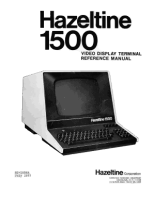
>Nice! I don't know anything about the 1200, but I have
>a 1500 and a 1421. They are both just simple
>terminals, with some fairly basic control functions
>What does it look like? Is the keyboard integral or
>detatched? Does it look like the 1500/1400 series? -
The 14xx and 15xx are late 70s (after 1976) as 1500 used
8080 and the 1400 used 8048 cpus.
>http://vt100.net/manx/covers/14/hi-1056a.png.
>
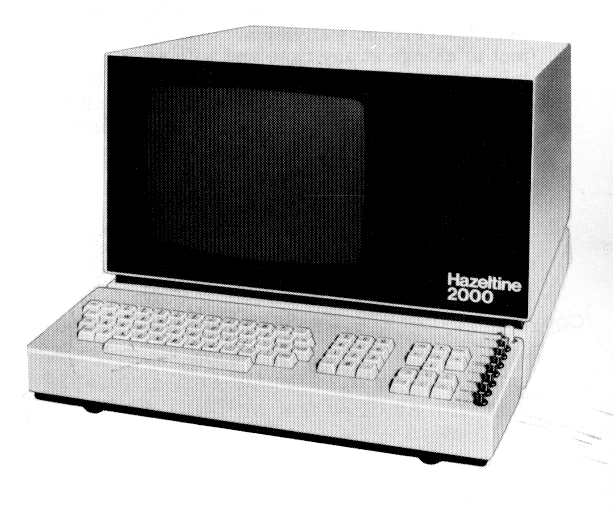
>Now, if it looks like the 2000, you've got a great
>score. Those are some interesting beasts. I've never
>seen one, but they look like this.
>http://www.columbia.edu/acis/history/h2000s.gif
>
>The Hazeltine 2000 was a very early video terminal
>(circa 1972).
The 1200 was a basically glass tty, all uppercase
(may have had a back pannel option for all upper
tty mode or mixed) it was capable of slow baud rates
(I think to 1200 or 4800) and both RS232 or current
loop. I used on on the DEC PDP10 so that means it
was in house there by spring 1972. It was all logic
no cpu used and I belive it used serial PMOS shift
registers for storage.
Allison
>-Ian
My first computer came with a Hazeltine 1000, this was older than the
1200. It had 80 characters wide, but I think it only was 12 lines tall,
I cant remember that part for sure. What I remeber for sure was that it
was upper case only. There was a place of the PCB for a second
character generator rom for lower case which was not loaded. There was
also a switch on the front which enabled lower case for the keyboard.
That was very confusing because sometimes I was typing in lower case,
then when I did a search or search / replace in ed it couldn't find what
I was searching for because it was upper case. I didn't figure that out
until later when I got an intertube terminal to replace the Hazeltine 1000.
Les
Thanks to all that inquired (good grief, we must have a lot of calculator
collectors).
--
------------------------------------ personal: http://www.cameronkaiser.com/ --
Cameron Kaiser * Floodgap Systems * www.floodgap.com * ckaiser at floodgap.com
-- I like work. I could watch people doing work for hours. --------------------
I have received an Amiga 2K with a Toaster board and
Toaster 4 software. I got everything working but find the 4 software
much different from the #2 I have been using. Does anyone know where
I can get a scan of the instructions for the switcher ?
Thanks
Charlie Fox
Charles E. Fox Video Productions
793 Argyle Rd. Windsor, Ontario
519-254-4991 N8Y 3J8
www.chasfoxvideo.com
So the boy (9yr. old) was asking last night about how computers work... any
recommendations for good books for learning the basics from? I think I started
out with a Sinclair Spectrum and its BASIC manual, but I really don't recall
now where I found out about the fundamental building blocks of [typical]
computers and how a CPU worked. There must be a good 'classic' "how computers
work" type of book which avoids going on about PCs and Xboxen...
I figure I should find him one of those kids electronics projects kits too (I
think that was where I got my first exposure to logic gates from at about the
same age) and also some old 8-bit machine to play with.
I can get a Spectrum / BBC micro shipped over in a few months, but something
US-built might be better; any thoughts? I did wonder about a C64, but maybe
it'd be better to start with something a bit more simple? i.e. probably
something Z80 or 6502-based (just because there's more resources devoted to
them), generic cassette data storage, basic video abilities etc.
(You know, I don't recall seeing a 'how to introduce kids to vintage
computing' thread on here before :-)
cheers
Jules
170174269537 is the auction number on Ebay for a Popular Electronics magazine
that has an article on the TRADIC computer. Anyone know what this thing is?
I'm trying to get rid of some stuff I don't collect or want, and among
them is a US*8 that's a little battered and takes a few seconds to "warm
up" when you turn it on, but otherwise seems to work. The badge is missing
but the model number is clearly identified on the backplate.
$9 shipping to Lower 48 if you're interested. There might be some other
stuff, I'm still clearing out boxes.
--
------------------------------------ personal: http://www.cameronkaiser.com/ --
Cameron Kaiser * Floodgap Systems * www.floodgap.com * ckaiser at floodgap.com
-- The best things in life are sold out. --------------------------------------
dear sir
I am interested in getting some parts for the Argus 700GZ computer.
MOhanned
---------------------------------
Never miss a thing. Make Yahoo your homepage.
-------------- Original message from jim s <jwstephens at msm.umr.edu>: --------------
> g-wright at att.net wrote:
> >
> >
> > Well I have a 1000 here and not sure which CPU it has but it is a CPM/ MPM
> > mutliuser system. It has no slots. The serial IO board is on top of the
> Mother board
> > making it hard to find the CPU.
> >
> > I also have a Micro V, Microstar system that uses a 8085 CPU not sure if there
> > related. They certenly have a close name. Just 2 8" floppies.
> >
> > - Jerry
> >
> > Jerry Wright
> > g-wright at att.net
> >
> Micro V and Micro 5 were all the same. They started with an 8086 with 2
> users capability and expanded to a better basic and hardware and the
> 8085 when it came out.
>
> They could have run CPM but they had their own O/S that they sold for
> business purposes.
>
> For what it's worth they were financed by Ken Allen among others, who
> also was a founding backer of Microdata in 1968 or 69. I don't recall
> exactly when they were founded but it was in the 80 to 85 time frame.
> I'll ask some of the culprits at a reunion coming up and try to post
> more accurate info.
>
> There was a special agreement between Microdata and Micro V not to sue
> over the "Micro" in the name, due to the close relation. There was no
> other connection other than the founders that I know of of a business
> nature. Soon after the founding of Micro V, Microdata was acquired by
> McDonnell Douglass and began to change to other identities (MDCSS and
> Novadyne eventually) away from Microdata.
>
> One of the original engineers is John Pitcher, who originally was from
> Microdata. The first President was Cliff Myers. Both were key players
> at Microdata and there is a strong geographic relation to Microdata as
> well as the people being from there.
>
> I believe that John Pitcher has a system he saved which has all the
> software on 3 1/2" floppies, and should probably try to get it to save
> away, since he had most of the software on that format which is much
> easier to handle than the original 8" systems.
>
> Jim
Thanks Jim, for the info. this is the first I have seen so far.
It would be nice to come up with any info or OS for these. I dug out my 1000
and it boots StarDos. I have looked for years for info on either machine and/or
the OS. Not much is out there.
- Jerry
Jerry Wright
JLC inc
g-wright at att.net
I just received an old-ish (1990) Toshiba T1000LE laptop and it wouldn't
boot, so I took a look at the hard drive and there seems to be some type
of goo oozing out of it. It's a Conner hard drive, nothing too abnormal.
I didn't think a hard drive contained anything that could ooze out. Any
idea what it could be and does that mean the drive is pretty much
toast? Let the magic goo out?
>
>Subject: Re: these RTL or what?
> From: "Roy J. Tellason" <rtellason at verizon.net>
> Date: Thu, 04 Oct 2007 01:38:08 -0400
> To: "General Discussion: On-Topic and Off-Topic Posts" <cctalk at classiccmp.org>
>
>On Tuesday 02 October 2007 09:56, Allison wrote:
>> >Subject: these RTL or what?
>> > From: "Roy J. Tellason" <rtellason at verizon.net>
>> > Date: Tue, 02 Oct 2007 02:01:29 -0400
>> > To: "General Discussion: On-Topic and Off-Topic Posts"
>> > <cctalk at classiccmp.org>
>> >
>> >I ran across some data in the pile of what I've been collecting, and
>> > there's some stuff there apparently by Signetics (?) referring to what
>> > they're calling "Utilogic II" -- is this stuff RTL or what? It doesn't
>> > say. Dates are in the late 1960s, and it looks like it, but I figured
>> > I'd ask in here...
>>
>> There are many early families of saturated logic RTL is the oldest,
>
>Which explains why I was seeing it first, and hobby-type projects based on it
>back when.
The big thing of DTL was to add diodes to the input of the basic RTL structure
for increased (noise immunity) input thresholds for better noise immunity.
Both families were easily wired OR and systems built around it usually
exploited that feature.
>> DTL and it's kin "utilogic" where the intermediate sorta TTL like
>> and later TTL( H,LS,S,F,AS,C,HC,HCT flavors).
>
>My first TTL book (which I still have) was a TI book that covered the
>standard, H, and L varieties. LS and S I can understand, F and AS still
>confuse me a bit, I'm not quite sure where they fit in. Then there are all
>those CMOS variants. C parts are pretty uncommon these days, and I'm not
>real clear on the distinction between HC and AC (I know about the ones with T
>in there, just shifted thresholds on the inputs and I have a pile of 'em.)
>
>> In the middle of all that was ECL (also about three or four generations) a
>> fast non saturating logic.
>
>I've read some ECL data, but have never done a darn thing with it, nor even
>seen much of anything that used it. From what I understand it had some weird
>packaging sometimes, very tight board layout requirements (I was mostly
>thinking of wire-wrapping stuff), and was very power-hungry. I guess if I
>ever want a prescaler for a counter to get *way* up there or maybe one or two
>other apps I can think of I might eventually have to go there, depending on
>what parts I can find. But I'm in no hurry. :-)
VAX9000 built of ECL100K, fastest of the fast. The second most common
use of TTL was in very high speed instrumentation and specifically frequency
counters and UHF PLLs.
>> What amazing is when people say "60s" you must do so with care as
>> 1960 was basically germainium transistors but by 1964 silicon
>> transistors are about and ICs were already appearing. Most
>> integrated circuit logic was post '65 and even then from that
>> point speeds went from about 3mhz to 30mhz and RTL was replaced
>> by TTL by 1970.
>
>I did say "late 1960s" up there. :-)
Even then.. ;)
It's hard to imagine the rate of change. An example, Apollo Guidance Computer.
The AGC was designed too be built of RTL, by time it actually flew to the moon
is was actually a generation behind as TTL existed by then. Of course that
really was becase of development time being so long and space systems having
to be man rated (reliability assured). It was a case then of if it was out
the door likely a whole new generation and technology was already in design.
Where commercial computers went from transistors (1965ish PDP-5) to DTL
and early TTL (1967ish PDP-8) in that same time window. Computer design
and packaging underwent significant change and not all of it was grossly
obvious.
>> The evoloutionary scale was very steep from the mid 50s to the mid 70s.
>> That 20 years window we went from computers with tubes to microprocessors,
>> delays lines or other serial storage to semiconductor RAM.
>
>I remember seeing some of the boards from the tube stuff for sale in various
>electronic junk places around. I may have even got one or two for parts,
>though there was nothing to be done with those backplane connectors. I
>remember one set of 9-pin sockets for which it was apparent to me that they
>were using something like a 12AU7, because of the center-tapped heater
>connections. :-)
Yep, back then those were good sources of parts for building radios. Most
however were noncomputer pulled from things like old instruments and the like.
Allison
On Thu, 29 Nov 2007 12:02:05 -0700, J Blaser
<oldcpu2 at rogerwilco.org>wrote:
> In fact, a
> couple of the PS PCBs went through the dishwasher to clean up the
> remains to 'rodent residue'. On the whole, it seems that I got them
> back together properly! ;)
If there are any potentiometers on the boards that you washed, you
might want to ensure that the wipers are making contact. Generally,
pots are installed after a board wash unless they are sealed. An open
wiper will cause many of the symptoms you are describing.
An easy method is to measure the resistance across the pot and then
the resistance from each leg to the wiper. The sum of the wiper to
legs should equal the resistance across the pot.
If the wiper appears to be disconnected, mark its position and then
rotate the wiper through its travel and then back to the mark. If
this fails to restore contact or the wiper contact is intermittent,
replace the pot - it's not worth the effort trying to save a failing
potentiometer.
CRC
> To some, I daresay, using a modern display on a classic machine borders
> on heresy, like using a converter and a modern disk instead of an RP03,
At some point, however, it starts to make sense. For these old 14"
beasts, new/nice packs and heads are starting to get hard to find -
some very hard. I have been looking for several types of IBM packs in
new/nice condition for years now, with no luck. Same with the heads.
And there are probably a dozen people waiting for a 18/36 bit
RP06/RM03 emulator in a box, using a cheap modern disk. Prod, prod.
(Looking for packs 1316, 3336, 3348, and heads for 2311, 3330. And the
Univac equivalent to the 1316.)
--
Will
Anyone out there have a ROM image for the NEC PC-8300? This is NEC's
variant of the Kyocera KC 85, of which the TRS-80 Model 100 was another.
I picked up two of these a long time ago, they had been used as some
sort of data-logging system and had custom ROMs in them which are
useless without special hardware I don't have :). Now that I have a
functional EPROM burner I can get this running in its native state, if
only I can find the right ROM for it. Can't seem to find this on the 'net.
Thanks for any pointers...
Josh
-------Original Message:
Date: Tue, 4 Dec 2007 07:03:32 -0800
From: dwight elvey <dkelvey at hotmail.com>
Subject: RE: VT100 Character ROM image
>> From: derschjo at msu.edu> > >> > > I tried to dump the ROM over the weekend and had no luck whatsoever, > regardless of what I tried to read it as. I suppose it wouldn't be out > of the question to recreate the contents manually based on the patterns > from the tech manual; there's not a ton of data in there, it's just > tedious :).>
Hi
I've rarely seen ROMs that have 100% match between pin of
a 2716. Most have at least one enable pin that is inverted.
Also, to prevent damage, I recommend disconnection the program
voltage wire with a socket adapter. This wire would be either
tied high or low at the ROM depending on selects chosen for
that ROM.
On a 2Kx8 ROM, there are usually 3 enables that need to have
the correct levels on. When I've read ROMs in the past, I've
usually put SPDT switches on these wires. One can then play
with the combinations to get the correct one that reads the
data in the ROM.
Dwight
---------Reply:
Dwight's quite correct; many ROMs included partial address decoding.
Aren't there schematics in any of the bitsavers files (or elsewhere)?
Enable pinouts & levels should be obvious if you have a schematic;
a lot less work than creating a ROM from the dot patterns...
m
Greetings all,
I had heard thst someone was organising a group buy for 2.5" IDE to SCSI adapters (eg for Mac Powerbooks). I couldn't seem to find any reference in the archives.
Can someone point me in the right direction?
Thanks,
Justin.
--
___________________________________________________________________________
Justin M. Dunlop
NB: New email account details....
email: justdun at bigpond.net.au
____________________________________________________________________________
Date: Tue, 04 Dec 2007 10:18:49 +0100
From: "Arno Kletzander" <Arno_1983 at gmx.de>
Subject: Re: Mechanical calculators
<snip>
>Uhh, what have I done to deserve this treatment? You make me long
>for those big ugly heavy boat-anchors even more than before.
>Must...go...chastise myself (before my parents do when I bring home
>the next one :-))
----
Sorrrrryy...
They're not "junk," they're "rare and valuable antiques," just a little
larger than that old teapot belonging to your great-grandmother that your
mother keeps in the buffet...
----
<snip>
>My grandfather detested those, as they used 120V DC to pick the magnets
>and there were lots of unencapsulated contacts within the mechanism...
---
Ouch! Been there, done that...
mike
----------Original Message:
Date: Tue, 04 Dec 2007 01:11:05 +0000
From: Pete Turnbull <pete at dunnington.plus.com>
Subject: Re: Graphics for S-100 machines (MicroAngelo S-100 Graphics
Board by SCION)
On 03/12/2007 23:35, Richard wrote:
> In the 79-81 time frame I remember poring over the ads for machines in
> BYTE on a regular basis. (I really wanted my own computer but couldn't
> afford one.) I recall that Cromemco and SWTPC both had some sort of
> graphics options, although the SWTPC one might have been from a 3rd
> party. Cromemco had the "dazzler" card IIRC.
I have two Dazzlers, I think, and three Matrox cards for my Cromemco.
They're not particularly common, but my Cromemco came from someone who
supported various systems that needed graphics.
--
Pete
-----------Reply:
S-100 Graphics are what got Cromemco started; the founders, Harry Garland
and Roger Melen started out building RAM-chip cameras in their dorm room
at CROthers MEMorial hall (CROMEMco) at Stanford and their Dazzler
graphics card was quite a sensation in its day, stopping traffic and gathering
a crowd when a New York computer shop set up a demo in its store window.
Ironically, after years of selling high-end text-only S-100 systems to governments,
institutions and business, in the end it was also graphics that kept them going
(at least for a little while):
A company called Dynatech (also makers of the famous Fuzz-Buster) was using
Cromemco systems for one of their products, the Colorgraphics Weather System
used by TV stations to display weather maps, and when Cromemco fell on hard
times they "merged with" (were bought by) Dynatech to assure continued support
for their systems.
See:
http://infolab.stanford.edu/pub/voy/museum/pictures/display/3-5-CROMEMCO.ht…
mike
No one was more surprised than me at the selling price - and I'm the one who
sold it! I was expecting maybe $20 - $30. I think I even have another one,
but I haven't found it yet. Anyway, it was a nice surprise and will mean
some extra money for Xmas.
Bob Stek
Saver of Lost Sols
Anyone out there have a dump of the VT100 character ROM? (This is the
ROM located at E4 on the VT100 PCB, labeled as 23-018E2-00)
Over the upcoming holiday break I'm planning to work on my VT100
emulator (that is, an emulation of the VT100 hardware) when I'm not
spending time with the folks; I have all the other ROM images but I'm
missing this one.
Thanks!
Josh
-------------- Original message from "Chuck Guzis" <cclist at sydex.com>: --------------
> One other thing--there's a squib in the "New Products" section of
> January 1984 Microsystems about their System 1000 "multiuser
> expansion".
>
> But I wonder if an early 1984 box would be an 80286 unit.
>
> Cheers,
> Chuck
>
>
Well I have a 1000 here and not sure which CPU it has but it is a CPM/ MPM
mutliuser system. It has no slots. The serial IO board is on top of the Mother board
making it hard to find the CPU.
I also have a Micro V, Microstar system that uses a 8085 CPU not sure if there
related. They certenly have a close name. Just 2 8" floppies.
- Jerry
Jerry Wright
g-wright at att.net
>
>Subject: Re: Graphics for S-100 machines (MicroAngelo S-100 Graphics BoardbySCION)
> From: Richard <legalize at xmission.com>
> Date: Mon, 03 Dec 2007 17:33:08 -0700
> To: "General Discussion: On-Topic and Off-Topic Posts" <cctalk at classiccmp.org>
>
>
>In article <475499E1.9030304 at pacbell.net>,
> Jim Battle <frustum at pacbell.net> writes:
>
>> There were other graphics cards on S-100 too. I've seen (recently) an
>> S-100 card that had one of the TI bitmap & sprite generator ICs on it.
>
>Maybe it would be a fun "extend my S-100 machine" project to add a
>simple graphics frame buffer? You could put a frame buffer on the
>card, expose a window of the frame buffer via memory mapped I/O on teh
>bus and a simple VGA output controller in an FPGA. I don't know what
>you'd do with it after that, since it would be so non-standard that
>there isn't any "off the shelf" software you could use with it, but it
>might be a nice retro-fit!
A good fit is the NEC7220, used in the Rainbow. It was one of the first
graphics controllers to bridge the CRTC and the graphics world as
known now. If you can find one that is a good candidate for S100 for
a 3 or 4plane color system.
Allison
>--
>"The Direct3D Graphics Pipeline" -- DirectX 9 draft available for download
> <http://www.xmission.com/~legalize/book/download/index.html>
>
> Legalize Adulthood! <http://blogs.xmission.com/legalize/>
M H Stein <dm561 at torfree.net> wrote:
> From: "Arno Kletzander" <Arno_1983 at gmx.de>
>
> >My contribution however was not targeted at the IBM equipment thread,
> >btw.
> ------
> MHS:
>
> I realized that, which is why I left the original subject line. (...)
> the second part of my reply dealt with the type you're talking about.
Sorry for the misunderstand, thanks for clearing up.
> >Yes, exactly that is the class of machines I meant. There were similar
> >ones which printed on a platten carriage mounted behind the adding
> >machine body (...)
> ------
> MHS:
>
> And those were the "posting" or "accounting" machines I was talking
> about; in the Burroughs line that I worked with, the electro-mechanical
> ones equivalent to the IBM punch card equipment we've been discussing
> were the "Sensimatic" F series, programmed by a removable program panel
> with two sets of "pins," (...)
> I had three of these at one time, but scrapped them all long ago.
>
> The later electronic versions were the "E" series; a good brochure with
> pictures of a type of computer largely ignored in the various histories
> (although there's a brief mention in The Encyclopedia of Microcomputers),
> with core memory and magnetic stripe & PPT/EPC I/O (...)
>
> Incidentally, Sensimatic referred to the way the program pins
> were "sensed;" the pins were different lengths which determined the
> operation to be performed (add/subtract/print/etc.) and different pin
> locations determined the register number or the accumulator (sound
> familiar?). A set of sensing pins would rise up to measure the length of
> the program pins, and the keyboard also had "function keys" (called
> OCKs - Operator Control Keys) for different options (normal entry, error
> correction, etc.)
>
> A program would consist of steps like "Load A (from keyboard) (INP 01),
> "LD R1, 2 and 3 from A," "SUB A from R5&6," "Punch A (OUT 2)," "IF OCK3
> then SKIP (JMP) to Step12," etc., all done mechanically with gears,
> levers and springs of course. Programming was done with a nibbling tool,
> a tray of numbered different length pins and a screwdriver.
>
> Wouldn't you love to have 20 registers today, and the ability to
> load/store more than one simultaneously? Mind you, that was also the
> entire memory until electronic versions came along...
Uhh, what have I done to deserve this treatment? You make me long for those big ugly heavy boat-anchors even more than before.
Must...go...chastise myself (before my parents do when I bring home the next one :-))
All joking aside, my collection in the field of accounting machinery is pretty fragmentary yet: All I have is a Triumph Duplex wide carriage accounting typewriter (Wahl actuator principle, supposedly pre-WWII) with motorised carriage return and just two registers (one on the carriage for vertical sums, one on the machine body for horizontal sums, and an empty shell that activates the horizontal register but doesn't accumulate in itself - there sure must have been more), and a Triumph-Adler "TA 20 compact" electronic facturing typewriter which pretty much looks like a Selectric with a numeric keypad, a few extra lamps and all dressed in white.
The older one was a dumpster find and is unrestored as of yet - there's a load of rust, dirt und grease gunk inside and I'm not so sure if I'm going to get it reassembled if I take it to pieces far enough to clean it out.
The electronic machine was a present from my grandfather who was a office machinery serviceman, it was my practice machine for the touch-typing course I took in grammar school and it's working to this day. There is a keyswitch to select either typewriter or facturing machine mode, the customer-specific facturing program (for which I was lucky enough to also get some documentation; obviously the machine was used in a carpetry store) is hard coded in an EPROM and even contains the postal adresses of some regular customers.
Writing a new program involved some precoding on forms. Then, a cassette-based "programming accessory" was attached to the machine, the program entered and saved to tape. The programmer (and the customer?) could test it for correctness; if it was accepted, the tape was sent to the factory, the program burned to EPROMs and these sent back to the serviceman for installation. Unfortunately, I do not have that accessory, and working out the interface for building a replacement is somewhere quite low on my priority list.
Oh, I forgot that "GROSS U.K." restaurant cash register with key-locks for eight waiters and dual printer for receipt and journal. This one is also working, but the case has a few dents in it.
But something I'd really consider a find is one of those desk-sized facturing machines, say a Rheinmetall FME series - this has a motorized mechanical four-species calculator in the desk drawer which is electrically linked to the typewriter on top: magnets for input, contacts for readout. My grandfather detested those, as they used 120V DC to pick the magnets and there were lots of unencapsulated contacts within the mechanism...
Greetings,
--
Arno Kletzander
Der GMX SmartSurfer hilft bis zu 70% Ihrer Onlinekosten zu sparen!
Ideal f?r Modem und ISDN: http://www.gmx.net/de/go/smartsurfer
I ran across a "Micro Five" motherboard this morning. The gent who
owns it (just the system board, not a whole system) tells me that it was
an 80286-based system built to run Netware. It has 2MB of RAM onboard,
and several slots for 8MB memory cards, and Ed says that the disk
subsystem lived in an external unit. The thing is huge - roughly 20" by
28".
I found only one google hit on it, and that was a post asking for info.
I'm not even sure why I'm interested - he's not going to give it up -
but I am curious about it. I'm especially curious about the memory. If
his recollection of the memory options is right, this thing supports
34MB or so. How is that possible on a 286?
Doc
I found a site that has a lot of chip logos:
http://www.elnec.com/support/ic-logos/?method=logo
Looks like the 55S073 is an Intersil chip, and not Intel. But I still haven't
been able to find out any information on this chip.
/rant on
Will, I am *VERY* critical of Ebay and generally view them as operationally
inept or challenged, and I would much rather see VCM succeed as an alternative.
I don't like dealing with organizations I view as unethical.
/rant off
I didn't have time to put up a picture of the chip, so I just uploaded one to:
http://www.west.net/~marvin/55s073-1.jpg
In looking at it again, this doesn't look like an Intel logo, so I am curious
who did make this chip. I thought it might be intersil, but so far, I haven't
seen any Intersil logos that look like this one.
> > I am starting to list some chips and "stuff" on Ebay (hanging my head), but the
> > mortgage company would really like me to continue paying them, and Ebay
> > unfortunately is the best venue for some of this stuff :(.
>
> There is no shame in this.
>
> --
> Will
One of these just sold on ebay item # 290186096576
I was looking at it because its graphics (I have no S-100 machines),
but even had I remembered to bid on it I would have been priced out
:-).
Are graphics boards for S-100 machines common at all? It seems not.
--
"The Direct3D Graphics Pipeline" -- DirectX 9 draft available for download
<http://www.xmission.com/~legalize/book/download/index.html>
Legalize Adulthood! <http://blogs.xmission.com/legalize/>
I am starting to list some chips and "stuff" on Ebay (hanging my head), but the
mortgage company would really like me to continue paying them, and Ebay
unfortunately is the best venue for some of this stuff :(. I ran across this
chip in my collection and only found one Google reference. It appears to be an
early (code date 7238S) Intel 256 Byte RAM chip. Is this actually one of those
*RARE* type chips?
>
>Subject: Graphics for S-100 machines (MicroAngelo S-100 Graphics Board bySCION)
> From: Richard <legalize at xmission.com>
> Date: Mon, 03 Dec 2007 16:14:57 -0700
> To: cctalk at classiccmp.org
>
>One of these just sold on ebay item # 290186096576
>
>I was looking at it because its graphics (I have no S-100 machines),
>but even had I remembered to bid on it I would have been priced out
>:-).
>
>Are graphics boards for S-100 machines common at all? It seems not.
Generally no. They existed and were available but the requirement
was not there (killer app that used it). That however changed near
end of life for S100 as there were CPUs 8088/86, 286 and concurrent
CP/M and even MS-DOS sop grpahics support and use was desireable.
However MicroAngelo, Comemco dazzler and others were out there in
the wild. Generally though when I've seen them they were in embedded
S100 systems being used for process controls (dairy, and other
production factilities). Seems that market liked graphics and used
it.
Allison
-------Original Message:
Date: Sun, 02 Dec 2007 23:06:02 -0800
From: "Chuck Guzis" <cclist at sydex.com>
Subject: Re: Mechanical calculators (was: Re: *updating* 8088's)
On 3 Dec 2007 at 1:46, M H Stein wrote:
>> (Chuck: change the colour, remove the cabinet on the left and put it on tubular legs
>> and you've got the picture you're looking for - remove the alpha keyboard for one
>> of the older numeric-only models ;-)
>How about the National Class 3000 from 1929? One can be seen on the
>page numbered 140 in this very interesting document from Portugal:
>http://www3.dsi.uminho.pt/memtsi/docs/guia_exposicao_ilustrado.pdf
>Cheers,
>Chuck
-----
Well, the Burroughs F styling was a _little_ more modern and the Sensimatic
program panels were a Burroughs trademark, but yes, that's the idea (even the
flip-up table for the ledger tray on the left). The one in the eBay ad that Arno
mentioned is a fairly late model F with the beige and blue colour scheme; the
older ones were dark brown.
Some nice pictures on that Portuguese site; even the 517 interpreter that got
that other thread going.
Incidentally, Sensimatic referred to the way the program pins were "sensed;"
the pins were different lengths which determined the operation to be performed
(add/subtract/print/etc.) and different pin locations determined the register
number or the accumulator (sound familiar?). A set of sensing pins would rise
up to measure the length of the program pins, and the keyboard also had
"function keys" (called OCKs - Operator Control Keys) for different options
(normal entry, error correction, etc.)
A program would consist of steps like "Load A (from keyboard) (INP 01),
"LD R1, 2 and 3 from A," "SUB A from R5&6," "Punch A (OUT 2)," "IF OCK3
then SKIP (JMP) to Step12," etc., all done mechanically with gears, levers
and springs of course. Programming was done with a nibbling tool, a tray
of numbered different length pins and a screwdriver.
Wouldn't you love to have 20 registers today, and the ability to load/store
more than one simultaneously? Mind you, that was also the entire memory
until electronic versions came along...
And of course they usually had colour printers ;-) (Red & black ribbons).
BTW, AFAIK some Teletypes used the same type "box" as the typing Sensimatic
that Arno is talking about. Think I still have one of those somewhere as well.
m
Added a search facility on http://www.soemtron.org/partsavailable/index.html
and updated Mikes sample page with more representative list of parts.
Updated home page with expanded description an aims. Since release last
Friday have had one live enquiry.
Mike.
"Chuck Guzis" <cclist at sydex.com> wrote:
> On 2 Dec 2007 at 19:18, Arno Kletzander wrote:
>
> > Yes, exactly that is the class of machines I meant. There were similar
> > ones which printed on a platten carriage mounted behind the adding
> > machine body, and some of the latest electromechanical models had a
> > "type box" as a means of commenting the ledgers, invoices - whatever.
>
> Could you perhaps point me at a web photo of such a machine?
Heh...you just sent me on a journey through some of my hellboxen since I didn't remember the name of that particular machine and I had to dig out the book where it's in (Buchungsmaschinen, GMD Report No. 162, by Werner Lange). It has lots of pictures and drawings about both adding machines and bookkeeping/facturing typewriters (Wahl actuator, Burroughs-Moon-Hopkins,...) However it looks like I mixed up some stuff:
The typebox printing element depicted in the book is described as belonging to a Burroughs Typing Sensimatic - an advertisement can be seen under ebay auction number 260181621699, but this shows a typewriter keyboard in front of the adding machine part.
The keyboard with dual legends depicted in the book however (which I wrongly associated with the typebox) belongs to a German Zeiss-Ikon adder from 1958, no further classification given. The printing mechanism of this machine is described to consist of three disks or typewheels able to print a set of 42 characters.
Greetings,
--
Arno Kletzander
Ist Ihr Browser Vista-kompatibel? Jetzt die neuesten
Browser-Versionen downloaden: http://www.gmx.net/de/go/browser
>
>Subject: Re: Bought a 4GB USB stick today, and guess what...
> From: ard at p850ug1.demon.co.uk (Tony Duell)
> Date: Sat, 01 Dec 2007 21:58:19 +0000 (GMT)
> To: cctalk at classiccmp.org
>
>> >And of course a 4040 from Intel is a 4-bit microprocessor, from RCA it's
>> >a 12 bit CMOS counter. I can never rememebr what the 4004 is in the
>> >4000-eries CMOS, it's sufficiently rare that none of the data books I
>> >have to hand list it.
>>
>>
>> ur kiddin. Just prefix 74{c, hc, hct} and the 4xxx number and you
>> get it's function and pinout.
>
>None of my data books list a 74HC4004 either. Does it even exist?
I have data but in 1973 it was already replaced by 4024 a 7 stage
binary counter.
>
>The 74HC4040 exists, and as expected it's a 12 bit ripple counter.
That and the 4060 (14stge counter) are still widely used.
>> However for us who kept those old and valuable manuals like Signetics
>> 8xxx series and the RCA databook series (my 1973 set was some 8 books)
>> I do have data for RCA 4xxx and a lot of other oddities.
>
>I haev never thrown out a databook. Darn it, I've got an Ericson databook
>for Dekatrons and Trochotroncs, etc. And a valve databook from the 1940s
>that has printed on almost every page 'Supply of this device cannot be
>guaranteed due to the current situatio' (that is, of course, WW2).
;) That and my RCA powe tube manuals from the 50s, 60s and even
a 1970 copy.
Whats scary is that I have old databooks to support the old parts
I HAVE and use.
Allison
>-tony
Date: Sun, 02 Dec 2007 19:18:11 +0100
From: "Arno Kletzander" <Arno_1983 at gmx.de>
Subject: Mechanical calculators (was: Re: *updating* 8088's)
M H Stein <dm561 at torfree.net> wrote:
>> The IBM unit record or Tabulating machines that we've been discussing
>> had their roots in the same principles as these calculators, adding
>> machines and cash registers (...)
>Thanks for that interesting piece of history! Nice insight into the workings of
>unit record equipment, a quite fascinating category of data processing in itself.
>My contribution however was not targeted at the IBM equipment thread, btw.
-------
MHS:
I realized that, which is why I left the original subject line. I just thought it was
a relevant and interesting link to the other thread about IBM punch card equipment
which was very similar in function but replaced manual entry with punched cards;
the second part of my reply dealt with the type you're talking about.
------
"Chuck Guzis" <cclist at sydex.com> wrote:
> "Roy J. Tellason" <rtellason at verizon.net> wrote:
> > This stirs a vague recollection of an old mechanical adding machine I
> > once had, the kind that had a big rectangular array of buttons instead
> > of just a "10-key" set of numbers. I have *no* idea how it stored a
> > number in there, though.
>
> (...)
>
> When you mention the big array of keys, I think of a comptometer.
> There's a nice discussion on the web:
>
> http://www2.cruzio.com/~vagabond/ComptHome.html
>
> But the item I'm thinking of was alphanumeric, more like a Teletype.
>
> Cheers,
> Chuck
Yes, exactly that is the class of machines I meant. There were similar ones which printed on a platten carriage mounted behind the adding machine body, and some of the latest electromechanical models had a "type box" as a means of commenting the ledgers, invoices - whatever. The letters were assigned as secondary functions to some of the keys and the machine would print those instead of accepting numeric input when it was in a column definded for comments (which was done by sticking pegs into a programming board moving together with the carriage).
--
Arno Kletzander
------
MHS:
And those were the "posting" or "accounting" machines I was talking
about; in the Burroughs line that I worked with, the electro-mechanical
ones equivalent to the IBM punch card equipment we've been discussing
were the "Sensimatic" F series, programmed by a removable program panel
with two sets of "pins," one that determined the actual operation to be performed
and sort of equivalent to the IBM patchboards, and another to control
carriage movement (sort of equivalent to the forms control tapes of an IBM
40x). The panels had a selector knob which rotated the tab stops to four different
sets of positions and shifted 4 sets of program pins sideways slightly, so that one
panel served for four "programs" and of course you could have as many panels
as you needed. Incidentally, Fs could optionally also punch PPT & cards.
I had three of these at one time, but scrapped them all long ago.
The later electronic versions were the "E" series; a good brochure with
pictures of a type of computer largely ignored in the various histories
(although there's a brief mention in The Encyclopedia of Microcomputers),
with core memory and magnetic stripe & PPT/EPC I/O, can be found here:
http://archive.computerhistory.org/resources/text/Burroughs/Burroughs.E1400…
(Chuck: change the colour, remove the cabinet on the left and put it on tubular legs
and you've got the picture you're looking for - remove the alpha keyboard for one
of the older numeric-only models ;-)
This is a fairly small one with the electronics in the desk itself (although you
can see the thick cable connecting the console to the processor), and it is still
programmed with the same type of program panel; the cabinet on the right is
a 4003 auto-reader for magnetic stripe cards, usually master file records whose
data was usually merged/combined with the data on the mag stripes of the
transaction cards feeding through the carriage. Larger models (E2000 etc.)
had a separate electronics cabinet the size of a large freezer.
Come to think of it, I still have the desk from an E1200 I scrapped long ago which
is presently supporting a Cromemco System 3, and also still have one of the tape
perforators you can see on the right side of the E1200 in that brochure, as well as
a few other odd parts...
The "E" series was later replaced by the "L" series which finally abandoned
the full keyboard and used "normal" machine language programs loaded from
PPT or ledger cards (and, later, cassettes). That was the machine, incidentally,
which got me out of being an "employee" and took me into self-employed
programming, consulting and support, which is what I've been doing for the
last thirty-odd years, so I have fond memories of it...
The last Burroughs machines of this class were the B80 & B90 which used
disks and represented the transition to more conventional computers, with
optional displays and terminals, datacomm etc.
m
> From: ard at p850ug1.demon.co.uk
>>
> You might be confusing this issue with another one. That is, the power
> supply control circuitry needs to be powered. Once the supply is
> running, it; can be powered from one of the outputs of said supply, but
> at swich-on, the power supply outputs are all 0, to the power control
> circuitry is not powered, so the supply can't do anything, so the outputs
> remain at 0.
>
Hi Tony
No, I'm not confused. If the feedback circuit isn't running, there is
no feedback. The feedback is such that it is positive at the interface
between the low and high side. This way a failure in the feedback
would bring the supply output to zero.
To Make this work, there needs to be some way of getting things
started. There is a oneshot on the high side that gives the supply
a single kick on powering on. This also gets enough voltage to
start the overall feedback that is negative from the output to the high
side. It is just enough to blink some LEDs.
A clever circuit but hard to trouble shoot. The first kick is
so short, it is hard to catch on a meter and distinguish between
lack of feedback and the over voltage protection( which also kills the
feedback at the interface ).
I spent time analyzing the overvoltage parts before realizing
that it was a complete lack of feedback that was the problem
and not the over voltage protection. The problem traced to
an open ( poor solder ) inside the pulse transformer that
connected the low side to the high side and provided the
pulse width modulation for the supply.
I'd call it a tricky circuit because as you seem to consider,
it goes against common sense in that no feedback is no
output. No feedback just means no pulse modulation and
hence no output.
As I also stated, the DEC supply most likely used a second
powersource for the regulation feedback.
Dwight
_________________________________________________________________
You keep typing, we keep giving. Download Messenger and join the i?m Initiative now.
http://im.live.com/messenger/im/home/?source=TAGLM
A fellow in Sweden is offering some very nice PDP8 gear,
including a loaded PDP-8/E chassis, an RK05, and some
additional peripherals. For you folks on the other side
of the pond, here's your chance. He's eBay savvy,
however, so expect to have to make a serious offer.
You can find more info at his website:
http://www.neab.net/pdp-8e/
Of particular interest is an extremely rare MR873a
Microprocessor ROM Programmer, which appears to
interface to the PDP8.
I have no connection with the seller other than as the
buyer for a few of his eBay auctions.
--Bill
M H Stein <dm561 at torfree.net> wrote:
> The IBM unit record or Tabulating machines that we've been discussing
> had their roots in the same principles as these calculators, adding
> machines and cash registers (...)
Thanks for that interesting piece of history! Nice insight into the workings of unit record equipment, a quite fascinating category of data processing in itself.
My contribution however was not targeted at the IBM equipment thread, btw.
"Chuck Guzis" <cclist at sydex.com> wrote:
> "Roy J. Tellason" <rtellason at verizon.net> wrote:
> > This stirs a vague recollection of an old mechanical adding machine I
> > once had, the kind that had a big rectangular array of buttons instead
> > of just a "10-key" set of numbers. I have *no* idea how it stored a
> > number in there, though.
>
> (...)
>
> When you mention the big array of keys, I think of a comptometer.
> There's a nice discussion on the web:
>
> http://www2.cruzio.com/~vagabond/ComptHome.html
>
> But the item I'm thinking of was alphanumeric, more like a Teletype.
>
> Cheers,
> Chuck
Yes, exactly that is the class of machines I meant. There were similar ones which printed on a platten carriage mounted behind the adding machine body, and some of the latest electromechanical models had a "type box" as a means of commenting the ledgers, invoices - whatever. The letters were assigned as secondary functions to some of the keys and the machine would print those instead of accepting numeric input when it was in a column definded for comments (which was done by sticking pegs into a programming board moving together with the carriage).
--
Arno Kletzander
GMX FreeMail: 1 GB Postfach, 5 E-Mail-Adressen, 10 Free SMS.
Alle Infos und kostenlose Anmeldung: http://www.gmx.net/de/go/freemail
Quoting Clint:
> I have a "spare" 11/750 supply that I can loan you. Since it is out of a
> machine, I'd need to get it back eventually. If you can troubleshoot it
> down to a single board I can loan that as well (to save on shipping)
> I'd also suggest you measure the resistance between +/-15V and ground on
> the backplane without any cards plugged in. A bad capacitor or shorted
> pin could make the supply current limit trip as well.
Let me do some further testing, maybe under Tony's guidance, and we'll see what
happens. This could be a good fallback if needed. Thanks for the offer. Let's
leave this on the table for now.
- Jared
I'm trying to get a few RM02 drives going, which I picked up about a
month ago. I can't get the RH11 I've got to talk to the MBA (Massbus
adapter) in the drive (it reports a 'timeout'), and I think I've traced
down the fault to a problem with the massbus transceiver, but wouldn't
mind someone else taking a look at this...
On page 2 of the M5922 schematics, signal AA2 DEMAND A H is generated
>from a 75108. It looks like the signals "IF5 PORT A ON H" and the
global enable from the switch on the board are both high and "MASS FAIL
H" is low (and thus "AA2 MASS FAIL A L" is high). When the controller
toggles the DEM(and) line on the massbus, I see "MASS DEM A H"
and "MASS DEM A L" at pins BV2 and BV1, respectively, change state, but
the output "AA2 DEMAND A H" stays low.
Any ideas? I guess that either the 7417 at E3 could be defective, or
the 75108 at E17 could be to blame. Or, is there something else that
I'm missing?
BTW, after staring at the MASS FAIL logic for a while, I looked up a
datasheet for a 7417, and realized that it's just a buffer, and not an
inverter (as it's drawn in the print set).
Pat
--
Purdue University ITAP/RCAC --- http://www.rcac.purdue.edu/
The Computer Refuge --- http://computer-refuge.org
.. the ( single) flash chip in it is a "HY27UV08"
Either someone at Hynix has a sense of humour, or they have run right
out of IC codes and have come full circle to 2708 again.
Jos
does anyone operate one of these? That is does anyone
favor this machine over any of the later models?
Commercially ISTR it being a flop, so that might seem
like a strange question, but there is no lack of
strange birds on this list. If you know what I mean
LOL LOL! Hey maybe I'm stranger then the rest of you
birds LOL LOL LOL!
anyhow interested in the thoughts that find this unit
particularly enjoyable.
____________________________________________________________________________________
Be a better sports nut! Let your teams follow you
with Yahoo Mobile. Try it now. http://mobile.yahoo.com/sports;_ylt=At9_qDKvtAbMuh1G1SQtBI7ntAcJ
It's time to clear some space and say goodbye to an unfinished
project. my SGI Iris 4D/310VGX. She's a double-wide deskside cabinet,
I believe with an R3000 33mhz CPU. The power supply is dead, having
traded her good PSU to revive a somewhat more alluring SGI Crimson.
There are no hard drives or hard drive sleds. There is a CPU card,
RAM card and video card. The external plastics are in pretty good
shape; some scratches here and there. The clasp on the front door
might be cracked, but the hinges are good and it stays closed with
tape. A fine project for revival or as a parts machine for another
SGI.
I really don't want to part it out myself; I'd like the whole machine
gone. So that probably means local pick-up only, since it's a
back-breaker. I'm in Palatine, IL, northwest of Chicago.
I'd like to trade for.....well pretty much anything smaller than the
Iris. Any token cool item is fine. If no one has anything for trade,
I'm sure I'll end up giving it away.
-j
--
silent700.blogspot.com
Retrocomputing and collecting in the Chicago area:
http://chiclassiccomp.org
My dad is 82, a retired College Professor, he owns a Amstrad PCW 8256
and his printer is broken. The printer head doesn't seem to go
anywhere so it can't print. Is there someone in the USA that you know
of that can help me, we are in California. If you do not know of
anyone in the USA is there a way you can direct me to someone I can
buy parts from that speaks english or at least can communicate
through email in english.
thank you,
Steve Martin
I'm having a bad day here ..
I mistook an IBM Industrial CGA display for a monochrome display, and
plugged it into a monochrome display adapter port. There was no smoke
or funny noises, but it definitely did not work.
I've heard stories about the IBM monochrome displays being fragile
when mishandled like this. Were the IBM CGA displays also this fragile?
(I won't be able to test it until I dig out a CGA card. And now of
course I'm just paranoid and hoping that I didn't hurt it.)
Mike
Hi,
> Correct. There are certainly 525-line PAL standards. And
>it wouldn't suprise me if there wasn't a 625-line colour
>system using NTSC-lke encoding.
As an aside, isn't (wasn't?) France's SECAM system broadcast with something
like 800 lines?
TTFN - Pete.
>
>Subject: Re: Bought a 4GB USB stick today, and guess what...
> From: ard at p850ug1.demon.co.uk (Tony Duell)
> Date: Sat, 01 Dec 2007 00:38:05 +0000 (GMT)
> To: cctalk at classiccmp.org
>
>> > Either someone at Hynix has a sense of humour, or they have run right
>> > out of IC codes and have come full circle to 2708 again.
>>
>> Several years ago, Motorola/IBM used the part number "7400" for some of their
>> PowerPC chips.
>
>And of course a 4040 from Intel is a 4-bit microprocessor, from RCA it's
>a 12 bit CMOS counter. I can never rememebr what the 4004 is in the
>4000-eries CMOS, it's sufficiently rare that none of the data books I
>have to hand list it.
ur kiddin. Just prefix 74{c, hc, hct} and the 4xxx number and you
get it's function and pinout.
However for us who kept those old and valuable manuals like Signetics
8xxx series and the RCA databook series (my 1973 set was some 8 books)
I do have data for RCA 4xxx and a lot of other oddities.
Allison
>-tony
Item # 320190208819
They look too small to be Qbus and the module numbers are all 3
digits, whereas all the Qbus and UNIBUS module board numbers I've seen
had 4 digits.
This looks like a good deal for someone looking for spare flip-chip
modules or maybe someone who wants to reverse engineer this pile of
flip-chip modules and wire-wrapped backplane to figure out what it
used to do :-)
--
"The Direct3D Graphics Pipeline" -- DirectX 9 draft available for download
<http://www.xmission.com/~legalize/book/download/index.html>
Legalize Adulthood! <http://blogs.xmission.com/legalize/>
http://www.dovebid.com/assets/display.asp?ItemID=swp1466
DEC MODEL PDP11/04 COMPUTER 4 EACH
Ends Thursday 11/29/07 10:36 AM PST
Phoenix, AZ
Opening Bid: US$ 1,700.00
BIN: $ 2,700.00
More than I would want to pay, but someone might want these....
Hi Dave, I am looking for a set up/diagnostic diskette for my compaq 386/20e and yours seems to fit the bill. Since I am in the UK I can send
?s, euros or buy some dollars to send if you will let me know the cost of item and shipping/handling. Regards Brian.
> Message: 4
> From: Philip Pemberton <classiccmp at philpem.me.uk>
> Actually, I've been working on a similar thing...
> The software is called ISIS, http://isistest.philpem.me.uk/.
Ok a lot further advanced than I had envisaged. I had seen it for vintage
computers and components but since posting the website and seen a few
replies about the individual cataloging what they had, it seemed the
initial catalog work was the p.i.t.a.
My intention was to post pages of who had what with a search facility, and
let them contact each other.
> Message: 16
> From: Jules Richardson <julesrichardsonuk at yahoo.co.uk>
> Actually, how well would a freecycle-type list for classiccmp.org work?
> For some reason the casual offered/wanted model tends to suit me a lot
> better than itemising everything I have and deciding which bits I
> definitely know I don't need now and won't ever need (somehow, I'm a lot
> better at getting rid of stuff when I know in advance I have a taker for
> it)
It was getting rid of some household bits that gave me the idea and its
possible this would be better served by a listing in Freecycle. My problem
with that is that Freecycle seems to be a fast turnover system with "I
have this" or "I want that". In the vintage computer / component area I
though this challenge response system might be too restrictive (possibly).
Although some work to set up initially, I thought a central repository of
parts where you could search for bits when needed and then email the owner
might work better.
Those individual "Fred" & "Mike" pages could be set up for Fred to upload
his own data as a text file used to generate the "Fred" page with a bit of
coding, that way each member of the system could change it as and when
they had time.
More comments / suggestions ?.
I'd recently come across a few Ic's that I have spare and rather than
bin them would prefer to pass them on. Next idea was what about a
central point for members/people to look and see who has what. So I
came up with this ->
www.soemtron.org/partsavailable/index.html
<- its an idea, would it be usefull ?, or not. There are possibly better
ways.
Comments please, I'd be happy to run it, but am also prepared to be shot
down in flames if it already exists or is not wanted.
The emails on those pages are live.
Many thanks, Mike
I bought a Mercedes ML500 today, and going thru the paperwork, I see the original owner was Dr. Steven Chen.
Wow, is this THE Steven Chen, designer of the CRAY X-MP???!!!
I dont know, but being a big supercomputer fan and onetime user (CDC 6600 at NASA JSC, and later my own Stardent/Ardent's, and a few silly -g's too) I kind of hope so.
If not, the perhaps its just Steven Chen, the founder of U-Tube.
Either way, my first ride today was enhanced thinking who had this wonderful machine before me.
Randy
_________________________________________________________________
Your smile counts. The more smiles you share, the more we donate.? Join in.
www.windowslive.com/smile?ocid=TXT_TAGLM_Wave2_oprsmilewlhmtagline
Hi, all,
I am starting a new project and was disappointed to find that the default
EagleCAD libraries don't have the TIL-311 hex display already entered (or
at least not that I can find). If anyone happens to have that part in a
library already, it would save me entering it in.
Also... if you've read this far, does anyone know off the top of their
head what the TIL part number is for the *decimal* version of the TIL-311
as well as any version with an embedded counter (TIL-307? TIL-309?) I
remember these parts were discussed on the list sometime back, but the
specific part numbers escape me at the moment.
I know I can get TIL-311s new for about $15 each, and NOS and pulls for
$2-$3 each. I'm curious about the other versions in the hopes that with
lower demand comes lower prices on the used market. I have enough TIL-311s
on hand to do what I want, but that doesn't leave me many spares.
Thanks,
-ethan
--
Ethan Dicks, A-333-S Current South Pole Weather at 25-Nov-2007 at 03:00 Z
South Pole Station
PSC 468 Box 400 Temp -32.6 F (-35.9 C) Windchill -32.6 F (-35.9 C)
APO AP 96598 Wind 0.0 kts Grid 171 Barometer 678.8 mb (10674 ft)
Ethan.Dicks at usap.govhttp://penguincentral.com/penguincentral.html
I once bought a car whose previous owner was "Morgan Freeman" ... not the actor but a short, young, white girl. But I can't think of any way this reply is on-topic. Sorry, Jay!
-----Original Message-----
From: "Chuck Guzis" <cclist at sydex.com>
Subj: Re: My Mercedes CRAY connection
Date: Fri Nov 30, 2007 10:04 pm
Size: 320 bytes
To: "General Discussion: On-Topic and Off-Topic Posts" <cctalk at classiccmp.org>
On 30 Nov 2007 at 20:06, Randy Dawson wrote:
> Wow, is this THE Steven Chen, designer of the CRAY X-MP???!!!
Why does this bring to mind a certain Seinfeld episode having to do
with Jon Voigt?
I know two Steven Chens and neither has anything to do with Cray,
although one is a retired programmer.
Cheers,
Chuck
Hi,
>....relative times of the Beeb and the 6809-based System
>CPU board? I would have thoguht the Beeb could have been
>designed to use the 6809.
I must admit I was disappointed at the time that they didn't choose the 6809
for the Beeb, though not entirely surprised given their past history.
Surprising too that Acorn never produced a 6809 second processor. Did any
third parties like Torch ever make one?
TTFN - Pete.
Hi,
> There was a Cobol for Z80-basied systems, mostly CP/M, but it
>wouldn't suprise me if it was ported to the TRS-80 too....
It was certainly available for the Model III.
>....but there's a Z80 version of BBC Basic (Sinclair Z88, I think,
>and certainly the Tetung Einstein)....
I'm pretty sure it was also available for the Torch Z80 CP/N
processor....put it this way, I had the manual for it but not the disc....
:-(
TTFN - Pete.
Hi
I'm sure that I heard that some Commodore systems could do TV out
and were in fact used to produce CGI stuff for 'Babylon Five"
Does anybody know which ones and could they do PAL or just NTSC?
Rod Smallwood
Vince Briel's Micro-KIM workshop at VCFX is now open for registration:
http://www.vintage.org/2007/main/workshop.php
$99 which includes the kit and personal instruction from the man, the
myth, the legend himself!
Space is limited and Vince's workshops sell out fast, so get in while you
can.
--
Sellam Ismail Vintage Computer Festival
------------------------------------------------------------------------------
International Man of Intrigue and Danger http://www.vintage.org
[ Old computing resources for business || Buy/Sell/Trade Vintage Computers ]
[ and academia at www.VintageTech.com || at http://marketplace.vintage.org ]
-------------Original Message:
Date: Fri, 30 Nov 2007 09:52:16 +0100
From: "Arno Kletzander" <Arno_1983 at gmx.de>
Subject: Mechanical calculators (was: Re: *updating* 8088's)
"Roy J. Tellason" <rtellason at verizon.net> wrote:
> On Friday 23 November 2007 22:23, Chuck Guzis wrote:
> > There are many kinds of mechanical memory. In particular, I recall
> > an early TTY device that used a large rotating drum with cams
> > embedded in the surface. One could flip a cam one way or the other
> > and then read them out. I'm trying to remember what sort of machine
> > this was used on and its application, but my memory sadly fails me.
>
> This stirs a vague recollection of an old mechanical adding machine I
> once had, the kind that had a big rectangular array of buttons instead
> of just a "10-key" set of numbers. I have *no* idea how it stored a
> number in there, though.
Hmm, like, say, an old cash register? This design is called "Volltastaturmaschine" in German (would translate to "complete keyboard machine"). They have a latching mechanism that holds in one button per column of keys (0-9, representing one digit of a number). When a calculation is initiated, the protruding shaft of the latched key acts as a stop for a toothed rack or similar device which is used to advance the wheels of the accumulator register by as many teeth as the corresponding digit says. There are also designs which involve an arrangement of levers positioning an intermediate gear along the axis of a stepped drum, for example the Badenia VA-17/VARE-17.
The big advantage is that zeros need not be entered (to enter 100.00, you just press the "1" button in the fifth column from the right) and that operators could learn to "touch-type" on these keyboards, effectively entering all digits of a number in parallel and greatly reducing cycle times.
<snip>
--
Arno Kletzander
www.iser.uni-erlangen.de
-----------Reply:
The IBM unit record or Tabulating machines that we've been discussing
had their roots in the same principles as these calculators, adding machines
and cash registers, but instead of a depressed key stopping a moving rack in
a certain position (a certain point of time in the machine's "cycle"), a set of
wire brushes (later replaced by photocells) would make contact through
the holes in the card as it moved vertically through the different digit positions,
and pick a relay, latch a rotating selector (and lock a synchronized moving
typebar if it was a printer) to represent that digit electrically. Like the manual
full keyboards, all 80 digits/characters were processed simultaneously.
Timing diagrams looked similar to the modern square waves we're all
familiar with (although they were sometimes arranged in a set of concentric
circles to represent a complete cycle), but instead of a continuous linear
time line they had a definite beginning and end and were divided into
equal-length "digit" times.
When electronics started to replace more and more of the mechanical gears
and relays there was a paradigm shift and everything switched to reading and
processing cards "serially" ("parallel" from our modern perspective ;-), i.e.
lengthwise by character, instead of all characters in "parallel" by digit.
The "Accounting" or "Posting" machines _also_ known as EAMs (Electr(on)ic
Accounting Machines) made by Burroughs, NCR etc. and used in almost every
bank also used the same basic principle. Because a good operator could enter
an entire multi-digit amount in one "keystroke" and data entry speed was more
important than processing, they retained full keyboards for quite a while even after
the gears and cams had been replaced with electronic equivalents. The moving
racks and cams were simply replaced by a set of rotating 10-position selector
"switches" and connected to the electronic "adjunct" with thick multi-conductor
cables. The processors in turn operated on "words" consisting of 15 or more
10-"bit" "bytes;" guess you could call it parallel processing...
m
I'm looking for a copy of the BIOS of the IBM PC3270 Model 5271. Does
anyone here have one of these machines that is working?
If so, the bios can be dumped using MSDOS DEBUG, see
http://mess.toseciso.org/dumping:dump_bios_using_debug
Bios should be in range E000-FFFF.
Jonathan Gevaryahu AKA Lord Nightmare
jgevaryahu(@t)hotmail(d0t)com
jzg22(@t)drexel(d0t)edu
--- Michael Lee <mikelee at tdh.com> wrote:
> I just received an old-ish (1990) Toshiba T1000LE
> laptop and it wouldn't
> boot, so I took a look at the hard drive and there
> seems to be some type
> of goo oozing out of it. It's a Conner hard drive,
> nothing too abnormal.
>
> I didn't think a hard drive contained anything that
> could ooze out. Any
> idea what it could be and does that mean the drive
> is pretty much
> toast? Let the magic goo out?
-------------
I also have this problem with a Mac Portable also from about 1990.
Can't offhand remember the drive model but it's the gasket.
I mop it up from time to time. It's still working.
Doug
------------Original Message:
Date: Thu, 29 Nov 2007 18:51:17 -0800 (PST)
From: Fred Cisin <cisin at xenosoft.com>
Subject: Re: IBM mechnical devices
To: "General Discussion: On-Topic and Off-Topic Posts"
<cctalk at classiccmp.org>
Message-ID: <20071129184544.W60333 at shell.lmi.net>
Content-Type: TEXT/PLAIN; charset=US-ASCII
On Thu, 29 Nov 2007, M H Stein wrote:
> LOL!
> There were several different models - see:
> http://en.wikipedia.org/wiki/List_of_IBM_products
> They were used mainly for utility bills, etc. which were often printed on
> punched cards to be returned with your payment for processing. We
> didn't do that sort of work very often, and when the cards had to be easily
> human-readable (such as your COBOL cards) they'd be punched on a
> printing keypunch (026) in the first place.
Unfortunately, the card output punches of most of the computers, and the
stand-alone duplicator didn't print when it punched.
<snip>
------------Reply:
Afraid I don't get your point; after all, that was the purpose of interpreters like
the 557, to print the data that the computer or EAM had punched (and not
printed). The 500 series output & reproducing punches couldn't punch *and*
print because AFAIR the print mechanism essentially replaced the punch
mechanism (except for the 519 which had a small numeric printer added,
mainly for serial-numbering the cards).
The keypunch equivalents could, but were much too slow for serious output
operations. Not only were they slower to begin with, but they punched 80
columns lengthwise while pretty well all the electro-mechanical EAMs worked
on the principle of a 12-phase synchronized cycle across the card, corresponding
to the 12 zones of the cards.
Your COBOL source cards on the other hand would have been punched
on a keypunch and could have been printed as they were punched, no?
mike
Date: Fri, 30 Nov 2007 09:19:15 -0800
From: "Chuck Guzis" <cclist at sydex.com>
Subject: Re: IBM mechnical devices
On 30 Nov 2007 at 5:46, M H Stein wrote:
>> The keypunch equivalents could, but were much too slow for serious output
>> operations. Not only were they slower to begin with, but they punched 80
>> columns lengthwise while pretty well all the electro-mechanical EAMs worked
>> on the principle of a 12-phase synchronized cycle across the card, corresponding
>> to the 12 zones of the cards.
>...and if you were one of the poor unfortunates to get saddled with
>the 024 keypunch in a room of 026s, you needed the 557--the 024
>didn't print on the card--you flew "blind" or you just read the punch
>holes visually.
When they did it full-time, keypunchers and EAM operators got pretty
good at sight-reading cards...
>Fortunately, there was a standard IBM card form that numbered the
>interpreter print columns on the two top rows as 1-60 and 61-80, so
>you could figure out what printed character corresponded to what
>punched column. Unless of course, some practical joker decided to
>swap a couple of wires on the 557 plugboard...
Heh, heh... yes, there was lots of opportunity for practical jokes...
>Later, some keypunches could be used as light-duty card punches for
>systems. I recall a CDC 1700 mini being hooked to a Univac keypunch.
>Tab offered a keypunch that had an RS-232C interface on it and
>probably were not the only ones. Both of those, IIRC, had "buffered"
>keyboard interfaces--you typed in the card, then the punch punched
>the whole thing.
So did the later "normal" keypunches from IBM et al.
>I preferred the 029 "press a key, get a kerchunk".
>Later, I had the same issue with the daisywheel typewriters that
>seemed to print asynchronously with one's typing.
Cheers,
Chuck
Yes, they definitely had audible and tactile feedback; in fact you could feel
it in your feet ;-)
And then there were "light" keypunches. I've got one here by Wright that
works like the old Dymo label makers: you dial up your character, press
the punch bar and it moves to the next column (and prints BTW).
mike
> HeliOS was just an operating system, not a language, no?
Not according to the readme ..
"HeliOS is an innovative, fast and efficient Amiga programming
language which has been developed over many years. It is fully
compatible with ALL Amigas running any operating system newer
than AmigaDOS 1.1, including AGA and 68060 based machines."
.. though I've not used it.
Lee.
I've known about NNC for quite a while and have at least one of them around
here
along with documentaion. It is a box with two vertical 8" drives and about
the
width of a regular S-100 box. I just took a look in the 1983 DATAPRO Small
Computers notebook, and didn't see anything about them. That makes me think
they
had disappeard by then.
BTW, I've found the DATAPRO marketing information to be a *great* souce of
information on a lot of the companies. I think Sellam might have a more
complete
set of them.
> From: jim s <jwstephens at msm.umr.edu
<http://www.classiccmp.org/mailman/listinfo/cctalk> >
> > <snip> It has a VG 1 case repainted and
> > relabeled as a "No Name Computer" with all VG 5 components inside.
> > Seriously, it is called NNC and that is not a joke. It is a very
strange
> > name.
> >
> There was a company called NNC located in Huntington Beach Ca in the
> late 70's or early 80's that made basic S-100 hardware. I'll ask a
> friend to get the names and history, but you may have an actual NNC box
> and not a vector graphics system.
>
> I don't recall VG's history but I think that a flood of their hardware
> appeared on the junk market and someone may have built up a box from
> parts using an NNC mainframe.
>
> The NNC company built chassis with a backplane and power supply
> initially and tried to do the entire system before collapsing. The
> manufacturer was actually a guy who built components from sheet metal,
> and found that building computer boxes was more profitable. I don't
> know if there was a connection to VG but that would not be impossible.
>
> Jim
>
-----REPLY-----
Hi Marvin!
Wow! You have a NNC machine? Would you mind popping the cover off on it and
taking a couple of photos? I am very interested to see what is inside and
it may clear up some of the mystery surrounding this machine I am restoring.
If the documents mention anything about VG parts, surely that would be
interesting as well.
Looking at my NNC chassis, if you put two 8" floppy drives in there it would
use up nearly all the room inside. I can't see how there would be any left
for an S-100 motherboard so maybe it is an external drive enclosure? I am
using an old IBM PC chassis as a homebuilt drive enclosure for the floppy
drive on the NNC machine here.
I had assumed that since the NNC was full of exclusively VG parts and the
case is essentially a repainted VG 1 case that NNC was some sort of VG VAR
or shell company maybe from the post VG bankruptcy era. If it were a
homebuilt machine, I would think there would be a more diverse selection of
parts, however, it is just a guess.
Thanks!
Andrew Lynch
PS, is the DATAPRO Small Computers notebook available online anywhere? I
can't seem to find it.
I've known about NNC for quite a while and have at least one of them around here
along with documentaion. It is a box with two vertical 8" drives and about the
width of a regular S-100 box. I just took a look in the 1983 DATAPRO Small
Computers notebook, and didn't see anything about them. That makes me think they
had disappeard by then.
BTW, I've found the DATAPRO marketing information to be a *great* souce of
information on a lot of the companies. I think Sellam might have a more complete
set of them.
> From: jim s <jwstephens at msm.umr.edu>
> > <snip> It has a VG 1 case repainted and
> > relabeled as a "No Name Computer" with all VG 5 components inside.
> > Seriously, it is called NNC and that is not a joke. It is a very strange
> > name.
> >
> There was a company called NNC located in Huntington Beach Ca in the
> late 70's or early 80's that made basic S-100 hardware. I'll ask a
> friend to get the names and history, but you may have an actual NNC box
> and not a vector graphics system.
>
> I don't recall VG's history but I think that a flood of their hardware
> appeared on the junk market and someone may have built up a box from
> parts using an NNC mainframe.
>
> The NNC company built chassis with a backplane and power supply
> initially and tried to do the entire system before collapsing. The
> manufacturer was actually a guy who built components from sheet metal,
> and found that building computer boxes was more profitable. I don't
> know if there was a connection to VG but that would not be impossible.
>
> Jim
>
> Date: Thu, 29 Nov 2007 15:36:23 -0500
> From: M H Stein <dm561 at torfree.net>
> --- Michael Lee <mikelee at tdh.com> wrote:
>
>> so I took a look at the hard drive and there
>> seems to be some type
>> of goo oozing out of it. It's a Conner hard drive,
>> nothing too abnormal.
> -------------
> I've had that problem with a Conner drive in an Ogivar laptop; it was
> the gasket between the housing and cover decomposing the same
> way as drive rollers etc. My drive was still working though and, after
> removing the goo and wrapping a layer of tape around the perimeter,
> still is (at least so far).
I have had the same experience. I collect Conner 60 MB and 80 MB drives
(CP2064, CP2084, CP2088)for my old Outbound Model 125 Laptops (ca. 1990).
A few of them have goo issues and on those drives the gasket between the
metal case halves is missing.
Talk about a dust/impurities hazard. I was thinking about putting a
silicon seal around there. For some reason I never though of the simple
solution of tape. <bangs self in head with hand> I think I've spent too
long with aquariums. Every problem can be solved wtih silicon sealant.
Jeff Walther
Andrew Lynch wrote:
> Hi,
>
> <snip> It has a VG 1 case repainted and
> relabeled as a "No Name Computer" with all VG 5 components inside.
> Seriously, it is called NNC and that is not a joke. It is a very strange
> name.
>
There was a company called NNC located in Huntington Beach Ca in the
late 70's or early 80's that made basic S-100 hardware. I'll ask a
friend to get the names and history, but you may have an actual NNC box
and not a vector graphics system.
I don't recall VG's history but I think that a flood of their hardware
appeared on the junk market and someone may have built up a box from
parts using an NNC mainframe.
The NNC company built chassis with a backplane and power supply
initially and tried to do the entire system before collapsing. The
manufacturer was actually a guy who built components from sheet metal,
and found that building computer boxes was more profitable. I don't
know if there was a connection to VG but that would not be impossible.
Jim
-----REPLY-----
Hi Jim,
Wow, that is interesting. I thought with a name like NNC it had to be a
joke. Apparently someone had a sense of humor "back in the day"!
If you look at this set of photos of a Vector 1+ on Dave Dunfield's page:
http://classiccmp.org/dunfield/s100/index.htm#v1p
The case is almost exactly like the Vector 1 case with very minor exceptions
and a beige paint job.
It could be that NNC resold an S-100 box full of VG parts. I have heard
that VG did sell their boards as a set for VARs.
Maybe it is a custom job too, I don't know. It could go either way but I
think of the machine as a Vector Graphic. Technically you are correct and I
agree with you. It is not a real VG machine like an MZ but it has definite
VG heritage.
Thanks for finding out any information you can on NNC. I am certainly
interested in whatever history there is.
Here is some information on NNC from earlier CCTALK posts. Whatever they
have is definitely not related to my VG machine.
http://classiccmp.org/pipermail/cctalk/2001-May/171711.html
I suspect NNC made S-100 chassis and motherboard. Then people populated
them with whatever they wanted. Of course, I don't know. It is just a
hunch. Maybe they were the OEM for the VG 1 cases?
Thanks!
Andrew Lynch
All,
As I try and rationalise some of my collection, I have a SGI that I
can see that I will never really have a use for and would like to give
to a good home.
I have the keyboard, screen and mouse to go with it. The machine is
complete and worked last time I powered it up - about 12 months ago or
there abouts. It is currently running some version of Irix. I don't
know how much memory or the size of the HDD, but I seem to remember
the HDD was somewhere between 200MB and 1GB - so not exactly huge.
>From the part numbers, it has an old 8 bit frame buffer and the CPU
is, "R4600PC -100mhz Primary Cache only".
Ideally, I would like it to be collected from Cheltenham UK. However I
work in Witney and I am up in the Milton Keynes area on weekends and
can deliver to these areas, or on my way to / from Cheltenham.
Bristol, Swindon and London are also deliverable when I am next in
those areas.
Thanks.
Simon
--
------------------------------------------------------------------------
"Well, an engineer is not concerned with the truth; that is left to
philosophers and theologians: the prime concern of an engineer is
the utility of the final product."
Lectures on the Electrical Properties of Materials, L.Solymar, D.Walsh
Hello,
a few interesting items in the U.K. have recently popped up here - and the VCFe (which usually attracts some visitors from North of the Channel) is getting closer, so I figured I might try organizing a transport once again.
I'm still in the process of contacting the current owners as I wanted to inform myself beforehand whether I can arrange transportation. Items may be coming from:
-Glasgow
-East London
-Dorset (this one is fairly critical, would have to be collected before Christmas)
and would have to be transported to southern Germany (Nuremberg area) for some compensation (meal, fuel money, etc).
Offers and suggestions welcome.
Thanks in advance, yours sincerely,
Arno Kletzander
--
Psssst! Schon vom neuen GMX MultiMessenger geh?rt?
Der kann`s mit allen: http://www.gmx.net/de/go/multimessenger
"Roy J. Tellason" <rtellason at verizon.net> wrote:
> On Friday 23 November 2007 22:23, Chuck Guzis wrote:
> > There are many kinds of mechanical memory. In particular, I recall
> > an early TTY device that used a large rotating drum with cams
> > embedded in the surface. One could flip a cam one way or the other
> > and then read them out. I'm trying to remember what sort of machine
> > this was used on and its application, but my memory sadly fails me.
>
> This stirs a vague recollection of an old mechanical adding machine I
> once had, the kind that had a big rectangular array of buttons instead
> of just a "10-key" set of numbers. I have *no* idea how it stored a
> number in there, though.
Hmm, like, say, an old cash register? This design is called "Volltastaturmaschine" in German (would translate to "complete keyboard machine"). They have a latching mechanism that holds in one button per column of keys (0-9, representing one digit of a number). When a calculation is initiated, the protruding shaft of the latched key acts as a stop for a toothed rack or similar device which is used to advance the wheels of the accumulator register by as many teeth as the corresponding digit says. There are also designs which involve an arrangement of levers positioning an intermediate gear along the axis of a stepped drum, for example the Badenia VA-17/VARE-17.
The big advantage is that zeros need not be entered (to enter 100.00, you just press the "1" button in the fifth column from the right) and that operators could learn to "touch-type" on these keyboards, effectively entering all digits of a number in parallel and greatly reducing cycle times. Also, correction of mistypes is very fast and easy because you just have to latch the correct key in the respective column. I have a Diehl EVM series machine of that type, unfortunately the mechanism is about completely gummed up from old grease.
Most mechanical and electromechanical ten-key adders contain a "pin carriage", which essentially is such a keyboard in miniature. A set of push rods connected to the ten keys is suspended above this construction; upon entry of a digit, the corresponding pin (sticking out through the top of the carriage after a clear) is pushed through (now sticking out at the bottom) and the carriage is advanced one position by an escapement mechanism.
> Going back even earlier, I had the occasional chance to play with some
> mechanical calculators. These were about the size of an old typewriter,
> and there were a couple of different sets of readouts that consisted of
> digits that showed through small windows on the front of the machine.
> It had a "carriage" of sorts that would shift back and forth at times,
> though my fuzzy recollection isn't clear on when it did that. And when
> you told it to multiply, it'd really take off! :-)
Ah...I suppose these were Odhner / Facit electromechanical pinwheel calculators, or at least a similar construction. I got one of those not very long ago and I'm very fond of it! A wealth of information about them is to be found on James Redin's Facit Page, http://www.xnumber.com/xnumber/cmisc_facit_page.htm
The input register on those is a bank (or "drum") of pinwheel mechanisms which are actuated by the input keys - gears with an adjustable number of teeth, so to say. The "pins" are extended or retracted by rotating two parts of the gear against each other. For the calculation cycle, the adjustment is locked and the whole drum turns once, advancing the adjacent intermediate wheels (and thus the accumulator wheels) by the number of pins set.
Machines with keyboard entry had to use a "split pinwheel" design in order to reduce the key travel needed, involving four pins and a sector with five more. 1 - 4 steps UP from the zero position extended 1 - 4 pins; 1 - 5 steps DOWN extended the sector AND 0 - 4 pins. Mechanical Bi-Quinary.
Once a digit is set, the drum is advanced one step to the left and the next unset wheel is positioned in front of the setting mechanism.
So long,
--
Arno Kletzander
www.iser.uni-erlangen.de
Ist Ihr Browser Vista-kompatibel? Jetzt die neuesten
Browser-Versionen downloaden: http://www.gmx.net/de/go/browser
Hi, all,
In the past, I've run real Amigas (from my 1986 A1000 to my 1997 A4000), and
I've run plenty of Amiga emulation ("Amiga Forever", etc.). Can anyone
recommend a good URL for running Amiga apps under my present platform of
MacOS 10.4?
I have apps, I have ROMs, etc. I just need a good Intel-Mac-based Amiga engine.
Thanks,
-ethan
--
Ethan Dicks, A-333-S Current South Pole Weather at 29-Nov-2007 at 10:50 Z
South Pole Station
PSC 468 Box 400 Temp -29.0 F (-33.9 C) Windchill -44.3 F (-42.4 C)
APO AP 96598 Wind 4.2 kts Grid 112 Barometer 682.8 mb (10523 ft)
Ethan.Dicks at usap.govhttp://penguincentral.com/penguincentral.html
-------------Original Messages:
Date: Thu, 29 Nov 2007 15:30:51 -0800 (PST)
From: Fred Cisin <cisin at xenosoft.com>
Subject: Re: Teaching kids about computers...
> > Here's a question - what
> > 8-bitters (or defunct 16-bitters, Atari, Amiga, you
> > know, the common stuff) had COBOL available?
> > What was SNOBOL? What about COBAL? I think I > have COBAL for the TI PC.
For a while, I had a binder on one of my office bookshelves labelled
"COBAL", due only to having a temporary worker who couldn't spell COBOL.
What is the model number for the EAM card interpreter?
At the college, I had a plugboard from one of them specifically set up for
putting the relevant fields of COBOL source files in handy locations on
the card (the interpreter did 60 columns of text, so it did not line up
with the columns on cards). That particular plugboard was clearly
labelled "COBOL Interpreter". So, yes, there was a COBOL interpreter :-)
--
Grumpy Ol' Fred cisin at xenosoft.com
-----------Reply:
LOL!
There were several different models - see:
http://en.wikipedia.org/wiki/List_of_IBM_products
We did have one, but I don't recall which one (probably a 557 or 548);
machines that printed card contents on the card were indeed called
"interpreters."
They were used mainly for utility bills, etc. which were often printed on
punched cards to be returned with your payment for processing. We
didn't do that sort of work very often, and when the cards had to be easily
human-readable (such as your COBOL cards) they'd be punched on a
printing keypunch (026) in the first place.
BTW we also had a somewhat rare 047, which was a printing keypunch
that could also read (and convert) paper tape.
m
> I know you can program on the Amiga using the following languages:
> Assembler
> Amiga BASIC
> AMOS BASIC
> Blitz BASIC
> Rexx
> Arexx
> C
> Machine Code
> I don't think I missed any.
Ada, Smalltalk, Forth, Fortran, Pascal, Lua, Lisp, BCPL, Prolog,
Comal, C++, HeliOS, Intercal, J, Java, Visual Pascal, Brainfuck,
Logo, Malbolge, Cobol, Perl, Pilot, Scheme, Python, Perl, SML, Y
and many variations of same. And those are just the free ones.
For more go look here ..
http://aminet.net/search?f=2&path=dev/lang
Lee.
.
Hello,
I exhibited some of my Sage and Stride computers, manuals, datasheets, newsletters and software at the Vintage Computer Festival 10.0. It was an exciting and rewarding event and I'm looking forward to the next one. I took some pictures and video. I've uploaded the pictures, the video will follow soon.
VCF 10.0 pictures:
http://entertainment.webshots.com/album/561582429RvEsQG?vhost=entertainment
One of the Sage Computer Technology founders, Rod Coleman, gave a talk about the early days of Sage Computer Technology and some of the Stride Micro story. Sellam let me add one of his computers to my exhibit, a Stride 440 (http://www.sageandstride.org/html/stride_440.html). During the show a really interesting guy came to visit my exhibit and he told me about his experiences with Sage and Stride computers. He still has the original systems he used for development in the 80's. More on that interesting story later ...
He has a couple Sage IV's (in beautiful condition) and a Stride 460 tower!! (http://www.sageandstride.org/html/stride_460.html) I've been looking for a Stride tower for quite a while. Recently, he let me get my grubby hands on the Stride 460 tower and I've been restoring it. It was not in the best condition when I picked up the pieces. I've documented the process with tons of pictures that I've uploaded for others to enjoy. I'm not finished with the project. I'm hoping to get the system fully operational and then retrieve the data from the hard drive. I've pulled the hard drive from the system and substituted another MFM drive until I've figured out the safest method for retrieving the old data. I'll be asking for advice on that topic soon. I think the original drive has Idris installed.
Here are links to the pictures of the Stride 460 system:
Disassembly:
http://entertainment.webshots.com/album/561576298tAcFSb?vhost=entertainment
Cleaning:
http://entertainment.webshots.com/album/561577961QEgBvM?vhost=entertainment
Reassembly:
http://entertainment.webshots.com/album/561575340kcreuM?vhost=entertainment
Booting:
http://entertainment.webshots.com/album/561575350zNSULy?vhost=entertainment
Stride 460 datasheet:
http://www.sageandstride.org/html/stride_460.html
Any suggestions on how to carefully check if an old MFM drive is still operational, without damaging it, are appreciated. The drive has some oxidation on the exterior and it appears to have been stored in an occasionally damp location.
Regards,
david.
- - - - - - - - - - - - - - - - - -
David W. Erhart
daviderhart at hotmail.com
daviderhart at oldzonian.comhttp://www.sageandstride.org
Hi,
I am working to restore an old Vector Graphic machine. I think it is a VG 5
series machine but sort of an odd hybrid. It has a VG 1 case repainted and
relabeled as a "No Name Computer" with all VG 5 components inside.
Seriously, it is called NNC and that is not a joke. It is a very strange
name.
It contains a ZCB (Z80 CPU board), 64K RAM, Flashwriter II (video and
parallel ASCII keyboard interface), and integrated FD/HD controller (aka
VEDMCS).
After working on this machine for weeks, I finally got it to boot CP/M 2.2
with a 56K TPA! YAHOO!
I am very happy and thought I would share the good news with the folks on
the VG and CCTALK mailing lists.
If anyone needs or wants a VG 5 series CP/M boot disk to restore their
machine, please send me an email and I will make you one. If you are
interested in discussing Vector Graphic, feel free to join us on the VG
mailing list.
Thanks!
Andrew Lynch
PS, Here is all the info on the mailing list:
http://h-net.msu.edu/cgi-bin/wa?A0=VECTOR-GRAPHIC
To post (send a message to all subscribers), address your e-mail to
vector-graphic at h-net.msu.edu. To unsubscribe, send the command
"unsub vector-graphic", without the quotes, in the BODY of the message, to
listserv at h-net.msu.edu. For other help, e-mail Dennis Boone <drb at msu.edu>.
I've finally acquired enough of the missing boards to try for a console
prompt. But I want to do this carefully. I don't want to fry any of these
modules if my power supplies are not on spec.
I'm still waiting for a power key that's in transit (graciously copied by
another classiccmp'er), but I figured I could just set the power controller to
local and crank it up.
So, after cleaning and reforming the removable capacitors[1], I figured
that I wanted to apply power to the system with all the loads removed, and
confirm proper voltages on the outputs.
I left the backplane completely empty of boards, and I disconnected the
power cable to the TU58 controller, just to be safe. I get a good AC
indication on the controller when I plug into the main AC supply circuit.
Switching the breaker on and the control switch from OFF to LOCAL gives
good air from the (loud!) blower, but...
What I see on the power controller indicators is the '+2.5 FAIL' and 'REG
FAIL' LEDs both light up, then several seconds elapse and the 'OVER
VOLTAGE' LED will flick on and the REG FAIL flicks off for about 1/2
second, then the whole sequence repeats. Each cycle takes about 8
seconds. A couple of photos of this can be found at:
http://www.rogerwilco.org/VAX11-750/psfault
I admit that I've never dealt with such a complex power system before,
and I've just spent the last hour or so reading through the 'VAX 11/750
H7104 Power System Technical Description' document that I found on
vt100.net. Trying to get my brain around what's going on, I came across
the fault isolation section and it seems that what I'm seeing on the Power
Controller LEDs maybe indicates a "Fault in the CPU backplane".
Of course, there is no CPU installed yet. Could this indication be normal
when no boards are installed?
I'm hesitant to install any of my precious boards until I'm convinced that
the power supplies are good, but maybe I have to install one (or more)
boards to actually close the loop on something.
Further reading tells me that there is a +2.5V-at-the-backplane monitoring
function in the +2.5V power supply. I haven't yet looked at this particular
issue up close, but maybe the monitor circuit is not complete without the
proper board in the backplane. Is this a sensible explanation? I just want
to be sure that putting one or more boards into the backplane is a safe
next step.
Thanks!
- Jared
[1] System hasn't been powered since 1994. I went through the motions,
but I don't think the caps needed any help; the readings during the
reforming process seemed to show them in good shape from the start.
Hi,
I've got a pair of AlphaServer 1000A systems available for free to whoever
wants them. I need the space.
These were previously rack-mounted, include memory and disk, and
were working last time I powered them on.
I'm near Plymouth Meeting, PA, USA, about five minutes from the PA
turnpike exit.
Please email me if interested.
Mark
--
Mark G. Thomas (Mark at Misty.com)
http://mail-cleaner.com/
Regular drill bits will work fine as long as you go slow and easy -
especially when you are about to "break" through the other side. Dull
bits work better. The bit the salesman was trying to get you to buy was
actually a bit designed to scrape the plastic instead of cutting it.
The angles are different on the bits.
Also, when using screws to join your pieces together be sure to drill
your holes slightly larger than your screws. This allows for some
movement of the plastic and prevents breakage at the stress point.
--- Michael Lee <mikelee at tdh.com> wrote:
> I just received an old-ish (1990) Toshiba T1000LE
> laptop and it wouldn't
> boot, so I took a look at the hard drive and there
> seems to be some type
> of goo oozing out of it. It's a Conner hard drive,
> nothing too abnormal.
>
> I didn't think a hard drive contained anything that
> could ooze out. Any
> idea what it could be and does that mean the drive
> is pretty much
> toast? Let the magic goo out?
-------------
I've had that problem with a Conner drive in an Ogivar laptop; it was
the gasket between the housing and cover decomposing the same
way as drive rollers etc. My drive was still working though and, after
removing the goo and wrapping a layer of tape around the perimeter,
still is (at least so far).
m
> is it likely that I'll
> be able to read it on the programmer like a standard PROM/EEPROM?
Most likely. You will need to verify on the schematic that they didn't
use the extra lines to control programming as chip selects, though.
From: Richard <legalize at xmission.com>
In article <474E0308.2010901 at atarimuseum.com>,
"Curt @ Atari Museum" <curt at atarimuseum.com> writes:
> There was an urban myth back in the late 80's and early 90's that there
> was a virus going around that could alter the scan rate of a video
> adapter so that it would blow out the monitor. Never saw any such
> damage to a monitor in person, so I don't know if it was just a myth or
> actually existed.
Its not an urban legend. The issue was that there was a sync register
(horizontal sync, I think) for which you could poke in a zero value.
Wasn't the issue with a MONO monitor rather than CGA? ISTR that the horizontal
frequency would get altered overheating the flyback with the resultant loss of
the magic smoke.
Hi Tony and all
>Why do you suspect that the CRT has failed? Have yoy actually tested it
>(e.g is the heater open-circuit?)
K, here's the story. The machine is about a thousand km from here. It was
sent to the Motorola agents (1600 km from here :) where the technician
diagnosed a faulty CRT. He also swapped his test CRT in, proving that the
problem is with the CRT, but he's not prepared to part with the CRT he has.
> >
> > I don't even know if it's vector or raster, I'd suspect vector?
>
>There is no such thing as a 'vactor CRT'. Any CRT can be used in either
>mod. Although it's common for raster displayes to use
>magnetically-deflected CRTs and vector displays to use
>electrostatically-deflected CRTs
That's pretty much what I meant, yes. A vector display would imply an
oscilloscope type CRT while a raster display would imply deflection coils
and the like. And yes, there are exceptions I'm sure :-)
>Is it more like TV CRT ot a 'socpe one?
That's what I meant :)
OK, so I have
>CRT is marked with the following numbers :
>
>P/N95-P09122T001
>P/N96/80396A98
>AEG396512
>D/14/390GH it could also be D/14/390GHB
>
>(None of these pop up on google).
>
>The size of the CRT is as follows;
>L: 360mm
>W: 100mm
>H: 125mm
A length of 360 yells "oscilloscope" to me... no?
I'm trying to get a picture of this animal, but since they can't fix it,
maybe I should suggest they ship it to my side of the world, then I can
count the pins on the base etc.
I'm thinking that if it's a 'scope tube almost anything will work?
Thanks
W
I'm unsure how many readers are local to
Elizabeth (central) NJ but I'm being forced to
"downsize" my holdings
so I'm offering things for free if picked up:
- hundreds of new and slightly used floppy disks, both 3.5" and 5.25"
- floppy drives: 3.5" and 5.25"
- salvaged PC power supplies: about 9 PC-AT and 2: PC-ATX
- EISA motherboards and cards (SCSI, network)
- token ring cards, hub
- crates of CD plastic "jewel cases"
If you /absolutely positively/ require something
and cannot pick it up, we'll see about shipping.
-- Jeff Jonas jeffj-at-panix-dot-com
"Jerome H. Fine" <jhfinedp3k at compsys.to> skrev:
>> Johnny Billquist wrote:
>
>>>>> Jerome Fine replies:
>>>>> Obviously, a SYSTEM request avoids all of the problems at a
>>>>> heavy cost in overhead estimated at between 50 and 500 times
>>>>> the above two examples.
>>>>>
>>>>> That was sort of what I was thinking about when I asked if
>>>>> there was an "fast method (only a few instructions)" to
>>>>> access an IOPAGE register.
>>>
>>> Well, in RSX, you have a rather high overhead to set up the
>>> mappping to the I/O page, unless it's already mapped in when the
>>> task starts. But from there on, there is no overhead at all. It's
>>> located somewhere in your 16-bit address space. (Note that you
>>> really don't have to map the I/O page at APR7 in RSX. You can get
>>> it mapped anywhere if you use the CRAW$/MAP$ or TKB options.)
>>>
>
> That is helpful information. There might be times when APR7 should
> not be used.
Might be, but I can't figure out when. But I guess if you wanted to map
something else into memory as well (such as a shared library), which
wasn't position independent, and which expected to be at APR7...
I just mentioned it since it's technically no difference between any of
the APRs for a user program.
Anyway, the overhead of mapping in the I/O page is a one time cost.
>> However, with normal privileged programs, the I/O page is always
>> present at APR7 even if you don't do anything.
> Also VERY helpful. However, if so, then would there be any reason
> why APR7 could not be mapped to user memory in the normal manner so
> that the user program has a full 65536 bytes of address space, but
> then the PREVIOUS DATA space is mapped to KERNEL providing the user
> with complete access to the IOPAGE registers via that 2 instruction
> example that I gave at the beginning? I can't see that there would
> be any greater loss of security since being able to change the IOPAGE
> registers either directly or indirectly is just as damaging!
>
> Please comment?
You can have a privileged program that isn't mapped to the I/O page. The
problem is that the kernel sets the PSW at various times for you, so you
cannot expect to be able to keep control of the previous mode field of
the PSW from your program. RSX is multitasking. Things can change
between one instruction and the next in your task. One typical mistake
people might do is to manipulate the APR registers themself, just
because they are accessible, and the program is privileged. This won't
work, since a contect switch can occur at any time, and the APR
registers are not preserved between context switches. Instead, they are
recreated from scratch, based on your mapping context every time the
task is selected to run.
So in that case, it fails not because of security considerations, but
because of system design. You need to have the I/O page mapped in properly.
Put another way: RSX makes sure the previous mode field is set to user
at every occasion the system have executed in kernel mode and goes back
to user mode. That is a security design. To make this different for
privileged programs would incur extra costs everywhere, whithout any
real gain. Privileged programs can get around this "problem" anyway, but
not by running in user mode and expecting the previous mode field to be
set to kernel.
>>>>>>>>> RSX had a bit more flexibility (opportunity) in this
>>>>>>>>> regard. I believe you can set up a CRAW$ (create
>>>>>>>>> address window) directive in either Macro or Fortran
>>>>>>>>> to achieve the desired result.
>>>>>>>
>>>>>>> Yes with reservation. CRAW$ (create address window) is as
>>>>>>> a part of doing dynamic remapping of your address space.
>>>>>>> However, CRAW$ always required a named memory partition.
>>>>>>> You cannot create an address window to an arbitrary
>>>>>>> memory address. Also, the memory partitions have
>>>>>>> protections and ownership associated with them.
>>>>>>>
>>>>>>> On most systems, CRAW$ cannot get you access to the I/O
>>>>>>> page, simply because normally you don't have an address
>>>>>>> space and a partition associated with the I/O page.
>>>>>>>
>>>>>>> But if such a partition is created, then CRAW$, in
>>>>>>> combination with MAP$ would allow you to access the I/O
>>>>>>> page.
>>>>>>>
>>>>>>> The same thing can also be achieved even without
>>>>>>> CRAW$/MAP$, since you can specify mapping that your task
>>>>>>> should have already at task build time, with the COMMON
>>>>>>> and RESCOM options to TKB.
>>>>>>>
>>>>>>>
>>>>>>>
>>>>>
>>>>> This seems to be the answer if it is allowed. Obviously it
>>>>> does require giving up that 8192 bytes the have APR7 mapped
>>>>> to user space.
>>>
>>> Correct.
>
> But unnecessary if privileged jobs already have access to the IOPAGE.
>
>
> Please comment?
True, but that already implies that one APR is used.
>>>>> There is also another option with E11 that I will make use of
>>>>> when I have finished with the HD(X).SYS device driver for
>>>>> RT-11. It turns out that if the memory is being accessed
>>>>> sequentially, the average time to reference a single 16 bit
>>>>> value in the file under: MOUNT HD: FOOBAR.DSK is actually
>>>>> less than the time to get/store a single value under EMEM.DLL
>>>>> when as few as 8 blocks (2048 words at a time) are being
>>>>> referenced. Consequently, setting up a small 4096 byte buffer
>>>>> and the associated code to handle to calls to the HD: device
>>>>> driver (all standard calls to .ReadF and .WritF in RT-11) is
>>>>> actually more efficient since after the values are in the
>>>>> buffer inside the program, the values can be referenced and
>>>>> modified at "emulated PDP-11" memory speeds.
>>>
>>> You mean that using a device driver, and a device that can access
>>> the "normal" memory instead is better. Well, I'm not surprised.
>>> What this essentially turns into, is that you're emulating DMA.
>
> Actually, under E11, it is almost identical in principle to the VM:
> device driver which accesses "emulated normal PDP-11 extended
> memory". The E11 command: MOUNT HD: RAM:/SIZE:number-of-blocks
> makes HD: into a Virtual Memory device which directly uses PC memory.
"Ram disk" is probably the word I'd use.
> However, the average transfer rate per word for even a few blocks
> (or a few thousand words) from/into emulated user memory is a small
> fraction of > a normal memory access time.
True.
> In addition, if an operating system caches the blocks in a file, the
> same speed is achieved.
Not really. By using a ram disk, you don't need to run through the
various layers of the operating system to deal with the system call and
the device handling, even if that ends up just accessing a disk cache.
>>>>> Of course, the above solution for sequential references does
>>>>> not work when the references are random or when references
>>>>> are at regular but very large intervals (thousands and even
>>>>> millions of successive values). For this latter situation,
>>>>> it may be possible to modify EMEM.DLL so that a single
>>>>> reference to the IOPAGE register modifies all of the
>>>>> specified values (over a range of up to many billions of
>>>>> values).
>>>
>>> Can't comment much, since I don't know exactly what you're trying
>>> to do. But speedwise, if you really want something to act like
>>> fast disk, writing something that behaves like proper DMA is the
>>> best. You give the device a memory address, a length, and a
>>> destination address on the device, and let it process the data as
>>> fast as it can, without involving the PDP-11 after that point.
>
> It is just a bit more complicated since the memory address can be
> anywhere in the 4 MB of emulated PDP-11 memory. So 22 bit address is
> required > - which can be determined during initialization. The even
> better aspect is that the code (only about a dozen instructions which
> set up the 6 IOPAGE registers) can be in user space which avoids the
> overhead of a system call.
Why limit yourself to 4 MB?
If you have a device that gives you the storage, you can basically let
if be of any size you want to.
Johnny
Broadcast PAL as defined by the IBA (Independent Broadcasing Authority)
'Specification of Television Standards for 625-line System I
Transmissions'
(September 1972)
The IBA were the governing body for TV in the UK at the time.
-----Original Message-----
From: cctech-bounces at classiccmp.org
[mailto:cctech-bounces at classiccmp.org] On Behalf Of Jim Leonard
Sent: 28 November 2007 18:29
To: General at icky.berkhirt.com; On-Topic and Off-Topic Posts
Subject: Re: Amiga TV Out
Rod Smallwood wrote:
> My requirement is much less demanding.
> I only need to show test cards,static pictures and the like.
> Whats most important is that the output is as close to the full PAL
> standard as possible.
> So to widen the scope the question becomes:
> 'Where can I get an old system that will do broadcast standard PAL TV
> out.'
I'm not sure that question can be answered, since I have never ever seen
a system that does "broadcast" PAL output. You have to define what you
mean by "broadcast":
- If you mean "broadcast as circa 1990 and before", then composite video
qualifies, but I have never seen a system with a composite output
without an unacceptable level of noise.
- If you mean "broadcast as circa 1991 and later", you'd need a system
with a bare minimum of Y/C ("s-video") output and I don't know of any,
unless you stick a later-model genlock onto an Amiga.
--
Jim Leonard (trixter at oldskool.org) http://www.oldskool.org/
Help our electronic games project: http://www.mobygames.com/
Or check out some trippy MindCandy at http://www.mindcandydvd.com/
A child borne of the home computer wars: http://trixter.wordpress.com/
------------Original Messages:
Date: Tue, 27 Nov 2007 22:22:09 +0000 (GMT)
From: ard at p850ug1.demon.co.uk (Tony Duell)
Subject: Re: IBM 5271 (PC3270) host interface options
<snip>
> What was special about slot 8?
In a true-blue IBM PC/XT (5160) or PortablePC (5155), and AFAIK very few, if
any clones, the data bus on slot 8 is wired to the opposite side of a bus
buffer to the data bus to the other 7 sltos. For that reason, the card in
slot 8 has to assert (pull low) one pin on the conenctor on read cycles
to that board (I forget the exact pin, I can look it up if you need it).
The IBM Async card (RS232 card) was one card that could do this (jumper
selected). I have heard that one reason such a card was included with
every PC/XT was that it was bout the only thing that could go in slot 8,
and by putting it there at the factory it avoided too many calls from
customers 'Why doesn't the XYZ card work properly in my new XT?'
<snip>
-tony
------------Reply:
Wasn't it used (and intended) for the expansion chassis card?
m
Esteemed listmembers;
I am restoring a ca. 1985 IBM 5271---the so-called 3270 PC. I
received it intact, with a full complement of cards, cables, etc. It
looks very much like it was shut down, removed from its original
office installation, and then apparently left somewhere the squirrels
could get to it (thus, "restoring"). I've vacuumed about forty pounds
of sunflower seed hulls out of it. Blessedly, I haven't found any
other signs of animal inhabitation.
Anyway, my irrational fear of contracting hantavirus aside, I am
wondering if somebody could tell me about what I suspect is the host
interface adapter. All card slots are occupied:
1 - Async Adapter
2 - 5271 Graphics Adapter APA option
3 - 5271 Graphics Adapter
4 - 64-256KB Memory expansion card
5 - 5160 ST412 controller
6 - 5160 floppy controller
7 - the card I need help identifying
8 - 5271 Keyboard Adapter
As there is no 3270 coax card and no open slot to have once held one,
I suspect that the 3270 host interface is the unknown card in slot 7.
I own IBM SDLC and Bisync adapter cards, and this one doesn't look
like either.
Physical characteristics:
* 8-bit, short card.
* One DB25F on the bulkhead.
* 9x Oki M37S64-20; apparently 64Kx1 memories.
* 34 pin .100" header, vertically, at back end of card (J2)
* one 4-pos DIP switch at top right.
* Pretty much everything else on the card is 74LS-series TTL or passive.
It's built like IBM made it, but I can't find any obvious IBM-style
part number on it, unless it's 2683541. Google is silent on this
number. (update: I just noticed 6320999 in the etch, but that hasn't
gotten me any closer to an answer).
Anybody have any guesses? What other host attachment options were
available for the 5271, besides 3270 coax?
Thanks!
ok
bear