No affiliation with this person, but I'd much prefer to see a VAX given
a new and caring home.
I know nothing about this beyond what you can see below.
/~\ The ASCII Mouse
\ / Ribbon Campaign
X Against HTML mouse at rodents-montreal.org
/ \ Email! 7D C8 61 52 5D E7 2D 39 4E F1 31 3E E8 B3 27 4B
> From: "Robert Schaefer" <rschaefe at gcfn.org>
> To: <port-vax at NetBSD.org>
> Subject: VAX 6320 w/ TU81+
> Date: Thu, 24 May 2012 19:25:31 -0400
> Message-ID: <2C54A3A6C8C84748AAEF5BDB3FF18BF6 at ratioHP>
> Anybody near to Columbus, Ohio interested? I can't bring myself to scrap
> her, but she's been sitting idle for nearly a decade now. Converted to 240V
> single phase, booted several times into VMS 5.? before I had to park her.
>
> If anyone wants to forward this to classiccmp, I'd be obliged.
>
> --
> Bob
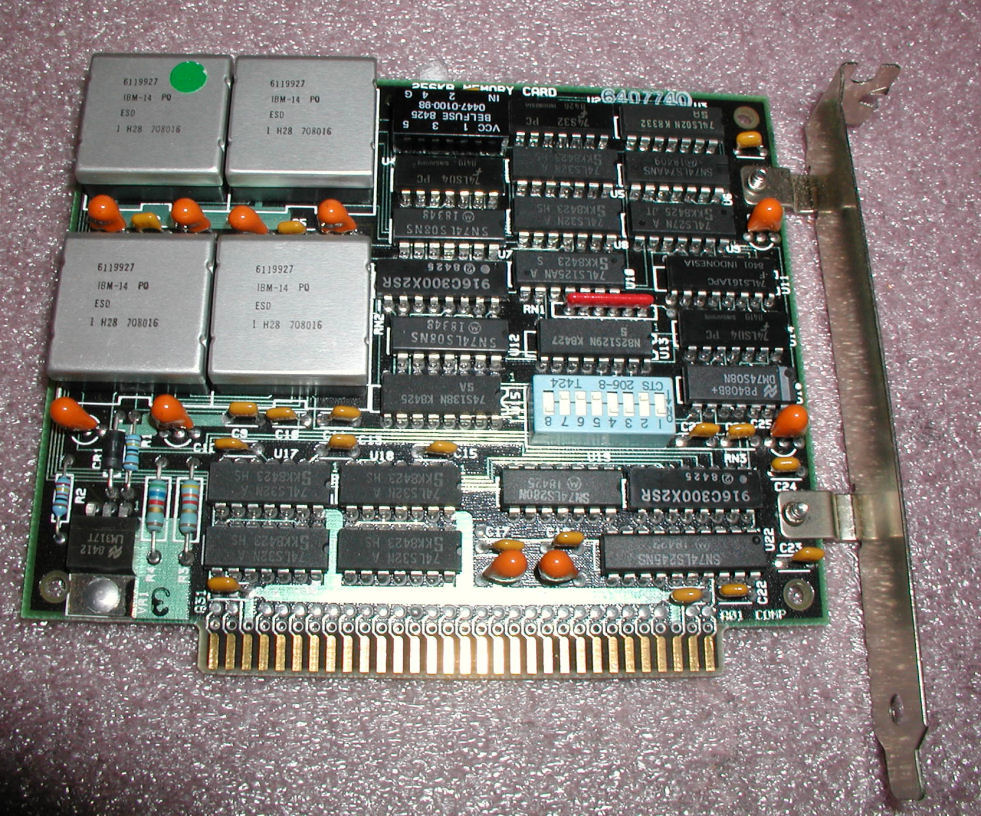
Anyone here interested in a PCI-based IBM P/390 board (Not E)? I've actually got two that I'm not using, and a PARCA
bus-and-tag board, and think that some other hobbyists should have a chance to acquire this stuff...
I'd also consider trades...
Thanks!
I was wondering if there are any VAX coders on the list who are
willing (and brave/strange enough) to poke into gcc internals?
I have a (relatively speedy) little VAXstation 4000/90 happily
running NetBSD-6, which is built using gcc-4.1.
All of the other NetBSD ports have switched across to gcc-4.5, but
some changes in 4.5 have caused codegen issues in the VAX backend.
Essentially you can cross compile a vax system with gcc-4.5, but
the resultant system exhibits certain, shall we say, glitches (most
annoyingly in the boot program), and the generated compiler is
unable to reliably compile anything.
Additionally the gcc DWARF2 stack unwinding for VAX appears to be
incomplete, causing issues for C++ exceptions, and potentially
making libffi unbuildable on VAX.
( http://gnats.netbsd.org/cgi-bin/query-pr-single.pl?number=44155 )
The latter point is quite annoying as it blocks building glib2,
and any app that depends upon it.
I know the VAX is pretty much the poster child for legacy platform
nowdays, but from a certain perspective a VAX has similar
characteristics to an unusual embedded system, (just built using
steam pipes & valves), so should be able to run the same basic
apps, tools, and even graphical apps.
Besides, to quote Dylan Thomas I feel the VAX should not go gentle
into that good night, but rage, rage against the dying of the light
:)
On 24/05/2012 06:49, William Maddox wrote:
> Our favorite eBay fraudster is at it again:
>
> http://www.ebay.com/itm/Digital-Equipment-Corp-DEC-TU56-w-TC11-RK05-LA36-/2…
>
> This exact same photo first appeared on eBay when Ashley Carder legitimately sold the gear that is shown. Fraudulent relistings, stating that the bidder must contact the "seller" directly at a specific email address, have reappeared about half a dozen times over the last year or two.
>
> --Bill
The ironic thing is that the fraudsters go after key "high value high popularity" items, done solely by a text search.
Thus they wanted to put up fraudulent listings for Plasma Display Panels (PDP's) but end up using PDP-11's.
I would bet they have absolutely ZERO idea what their fraudulent auction is actually for. Time for cow-tipping?
Tim.
Our favorite eBay fraudster is at it again:
http://www.ebay.com/itm/Digital-Equipment-Corp-DEC-TU56-w-TC11-RK05-LA36-/2…
This exact same photo first appeared on eBay when Ashley Carder legitimately sold the gear that is shown. Fraudulent relistings, stating that the bidder must contact the "seller" directly at a specific email address, have reappeared about half a dozen times over the last year or two.
--Bill
Hey folks,
Apart from the PDP-11/35 I'm restoring, I haven't got any other PDP
stuff right now. Over the years I've had a lot, but I gave it all away
to other collectors during the "Moving Houses Every Three Years" phase
of my life. Now that things are a lot more settled, I'd love to play
with some again.
So, I figured I'd throw together a little wish list of PDP stuff I'm
looking for. You never know, maybe someone has some of this they'd be
willing to sell. I'm perfectly willing to pay fair market price, of
course.
Most Wanted
-----------
- PDP-11/23+ (BA23 rackmount) or MicroPDP-11/23+ (BA23 pedistal).
Maybe a strange thing to be "most wanted", but it's a college
nostalgia thing. I'm sure you understand.
- Any QBus PDP-11 capable of running 2.11BSD - so an 11/73 or 11/83
with 1MB or more.
- PDP-11/40 Processor Options (KE11-E & KE11-F, KJ11, KT11, KW11), to
extend my 11/35's minimal configuration.
- G727A or G7273 grant continuity cards. My 11/35 is severely lacking
in these :(
I'm located in the San Francisco Bay Area, and I'm willing to travel
anywhere in the western US to pick these guys up. There's nothing like
a computer rescue road trip!
Thanks,
-Seth
Some people were curious what the drive spindle and disk enclosure
looked like, but weren't members of the vintage computer forum, so could
not view the images that I put there. Sorry about that. Didn't know
one had to be a member to view the photos.
Here are links to the photos that anyone should be able to use -
Drive spindle:
http://www.wildwestrally.net/alanp/IMG_0342.JPGhttp://www.wildwestrally.net/alanp/IMG_0343.JPG
Disk enclosure:
http://www.wildwestrally.net/alanp/IMG_0344.JPGhttp://www.wildwestrally.net/alanp/IMG_0345.JPG
If anyone is curious about what the rest of this stuff looks like, let
me know and I'll shoot and post photos for you. Respond directly to me
since I am subscribed to the digest and won't see your note until much
later if you send it to the list.
alan
Original Messages:
Date: Sat, 19 May 2012 11:43:10 -0700 (PDT)
From: Cameron Kaiser <spectre at floodgap.com>
>>> I liked the AIM-65, personally, but I don't have one.
>> Time you got one then ;-)
>If you have a spare one, bug me off-list :)) (seriously)
Cameron Kaiser * Floodgap Systems
---- And: ----
From: Philip Pemberton <classiccmp at philpem.me.uk>
> And me too, please! (Also serious!)
Phil.
-------------------------------------------------
I do indeed have several spare ones but most of them are untested, in
pieces, and not necessarily complete; if/when I get one of those round tuits
and check them out I'll keep you in mind.
Meanwhile, three just sold on eBay, two with enclosures and one probably a
relatively rare 40kB version, for $150 to $339, so they're out there..
m
Original Message:
Date: Wed, 23 May 2012 23:12:47 +0200
From: Torfinn Ingolfsen <tingox at gmail.com>
Hello,
>Also, his reader has one slight "defect" in my humble opinion; no automated
>feeder.
> So, if one was going to build a reader, were would one find the essential
> parts?
> - the photo diode array
> - the sprocket wheel with the correct dimensions for reading eight-channel
> tape.
----------------
If you're serious about building a motorized one I've probably still got
some odd parts from readers and perfs I've scrapped over the years,
including sprocket wheels; the electronics shouldn't be hard to find.
m
Original Message:
Date: Thu, 24 May 2012 08:11:11 -0700
From: "Chuck Guzis" <cclist at sydex.com>
On 23 May 2012 at 23:12, Torfinn Ingolfsen wrote:
>> So, if one was going to build a reader, were would one find the
>> essential parts? - the photo diode array - the sprocket wheel with the
>> correct dimensions for reading eight-channel tape.
>When I posted, the seller still had an active item on eBay, so if
> he's gone, it's not been but for a couple of days.
> Also, see the commentary here:
http://techcrunch.com/2011/10/21/forget-usb-3-0-add-a-tape-reader-to-your-p…
--------------
I've seen that unit a few times in the past; nice, but for $180 I'd sell one
of my motorized ones...
m
On 5/23/12 11:08 PM, cctech-request at classiccmp.org wrote:
> A bad design, apparently, with a bearing that is just too wimpy.
>
> Does anyone here have an RA81 that works? In somewhat regular use?
I was given the impression that the two that I have were in more-or-less
daily use (aside from maintenance and other normal outages) from when
they were acquired new (I think '82) until the system was retired in the
late 90s (I got it in '98).
I spent the weekend moving drives (1 RA81, 1 RA81 chassis & 3 RA82s)
around. What I was going to do next was power them up and try to run
diagnostics. Any helpful hints on prepping drives that have been
sitting for years for powering up would be appreciated.
alan
On 5/23/12 11:08 PM, Ian wrote:
> Heh. The RA81 HDA was an often-failed component. I had a deal to buy two racks of RA81's several years ago from a surplus computer dealer - and when I went to go take a look at them, it was painfully obvious that every one of them was missing the HDA. Just the motor and the boards/PSU were in the boxes, the entire HDA was missing. Apparently they must have sold off the HDA's a long time ago.
Wait! I could get money for a RA81 HDA? Hmmm. Maybe have to rethink
my offer to give Dave my complete RA81.
Just kidding, Dave. The drive is yours as soon as you figure out how to
get it from here to there.
alan
BTW, in case people haven't figured out, I am subscribed to the digest
version of the list, so I don't see messages as they are posted to the
list and can't reply in real time.
The RA81's were notoriously failure prone.? Rumors abounded for the reasons, things like the glue flaking off (from something) and coating the platters to (my favorite) that the fire control system in the Colorado plant somehow went nuts and pumped the contents of the pond into the basement of the factory and got everything contaminated.? This was especially delicious since the pond was prominently featured in their brochure as a decorative item and backup water supply.?? This would be around 1984 or so.? The Fugitsu Eagles were just appearing with great performance and reliability.? Since I was working for DEC's biggest customer at the time (BP) we got a special visit at our monthly meeting from a reliability specialist explaining whey the Eagles with their higher part count and less integration would have worse reliability.? This despite a graph presented by our Dallas manager showing the incredible failure rates of the RA81's.? They were
replacing a few every week.? (they had dozens of them to hold all that seismic data).? Those Eagles made a lot of money for Systems Industries who were integrating them into VAX systems.? After a visit to their offices in Millpitas, California we bought a bunch of them for our San Francisco data center.? Good times, that.
So I finally got my VT220 put back together! I have one I saved from the dumpster from a plant floor,
but it was incredibly filthy. I disassembled it, cleaned it thoroughly, and put it back together (over a
duration of 6+ months), and amazingly it still works! So, I had to hook it up to my MacBook Air, just
for fun. Works like a charm, but characters on the left seem slightly fuzzier then others. Maybe that's
just because I've been staring at the razor-sharp screens on my MacBook and iPhone too long, and
the fact that this thing's 26 years old, but is there a way to sharpen them up a bit?
Even if not, it's still darn funny to have a physical terminal on my MacBook!
Thanks!
-Ben
I used the only address I'm aware of, but the mail and attachment bounced:
----- The following addresses had permanent fatal errors -----
<contrib at bitsavers.org>
553 5.3.0 <contrib at bitsavers.org>... You are blacklisted by the
receiving mailserver.
Is there a secret handshake required?
Steve
--
I have a working Pet 2001-8 that has one annoying issue. When I power up the unit I typically don't see any characters displayed unless I apply a slight amount of pressure on the back of the brightness control in the back of the monitor. I suspected bad solder joints but couldn't see anything wrong. Turning the control brightens the screen but somehow this control is causing the character display to turn on/off. Any ideas what might be going on here?
Thanks,
--Jim
Greetings;
I've got a bunch of stuff - not even computers - in New Zealand (my
original home) that I'd like to ship back to the US and every time I try
and get it straightened out I get lost between local freighting and
international customs brokers and all sorts of nonsense like that.
I was hoping there might be someone out there who has done this and has a
pretty good idea of what I should be expecting.
Replies off-list, I would think.
Thank you!
- JP
Greetings;
I received a new (to me) MicroPDP11/23 that I was fiddling about with over
the weekend. After testing out the supply voltages, and then putting the
system together enough to get serial out of it, there was a pop, a whoosh
and a rather exciting ejected plume of smoke from one of the upper fans.
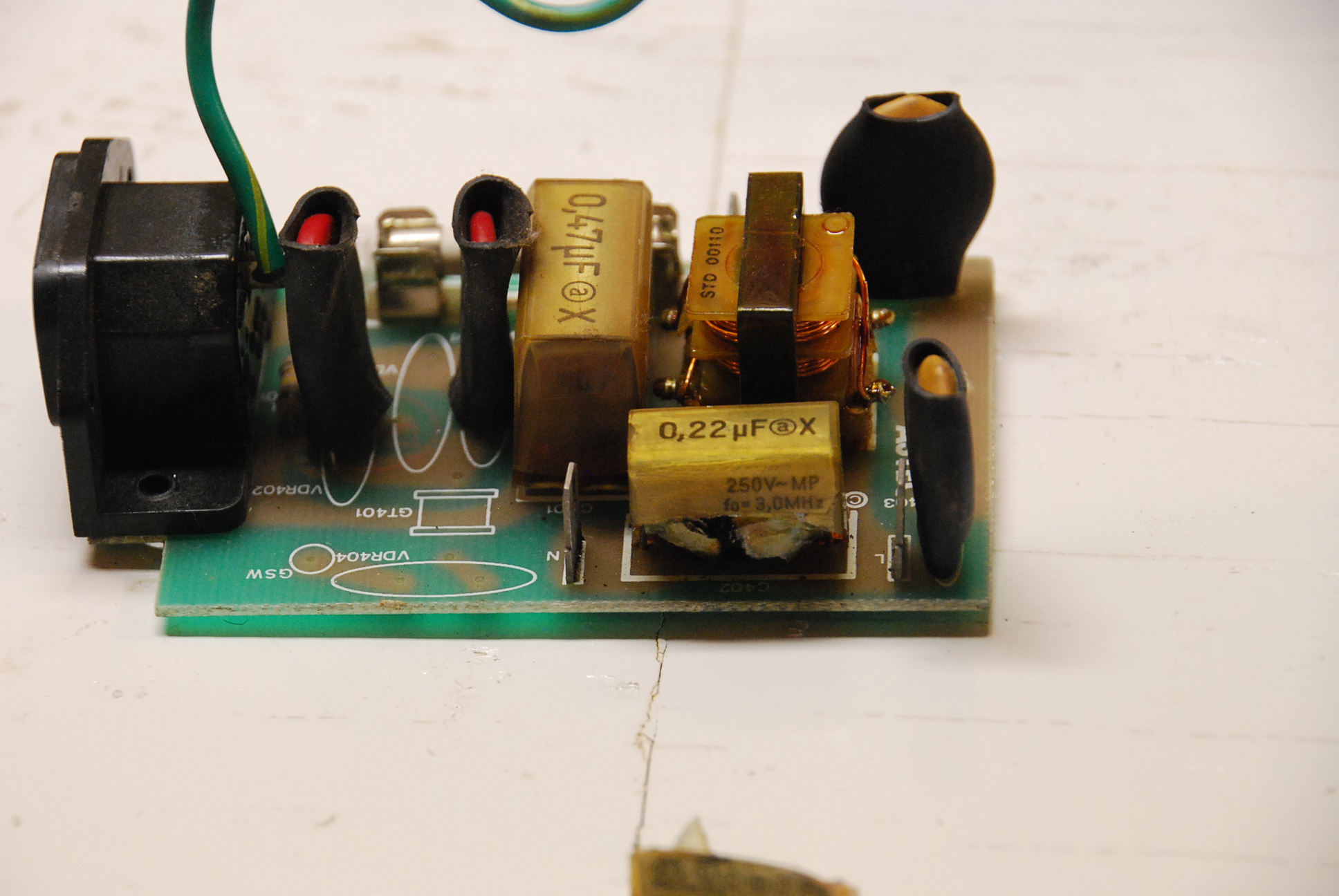
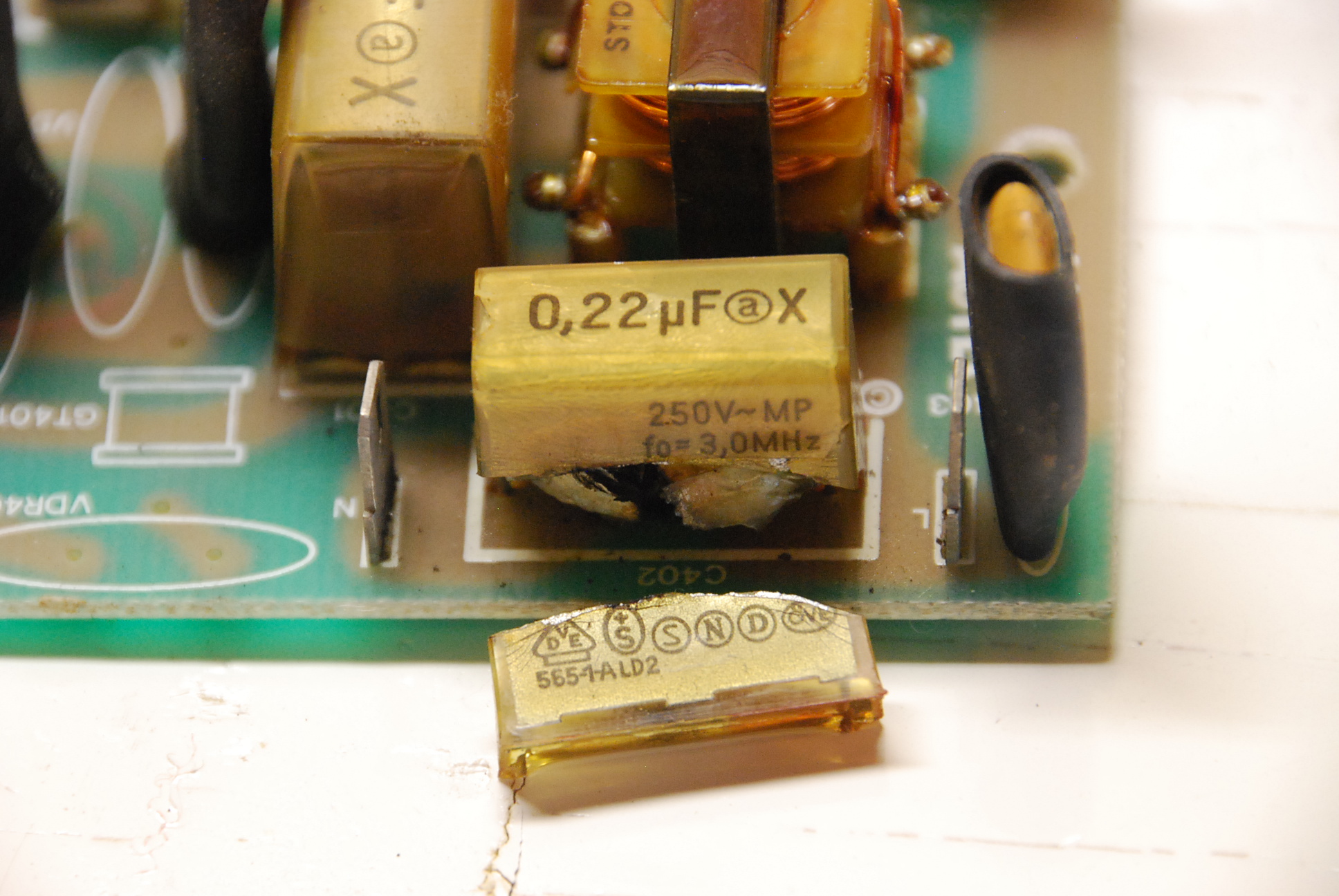
http://www.kiwigeek.com/misc/PDP1123_Cap1.jpghttp://www.kiwigeek.com/misc/PDP1123_Cap2.jpg
The capacitor is mounted on the sub-board in the PSU that the IEC
receptacle is on.
The markings on the back show this is a PME271M622, but I'm having trouble
sourcing a replacement. Most of the places I usually look about are
showing no stock or ridiculous minimum orders. On eBay (shudder) there's a
similar model, but it's marked as an "X2", and I'm not sure if that's an
acceptable replacement.
Could someone who is more famaliar with these things give me a suggestion
as to where I should be looking?
(Full markings:
0,22uF at X
250V ~ MP
fo=3,0MHz
RIFA
GPC 40/085/56
PME271M622)
Thanks to all;
- JP
I have a couple of HPIB cables available at $15 the pair, shipped.
They are:
1 HP10833A ~42"
1 HP92220R ~12"
The 92220R has a right-angle connector at one end and the usual
straight connector at the other. (I wonder if the 'R' indicates
a right hand connector?)
First come, first served.
- don
My father built these things in the 70's in NJ..I this is for slide
projectors and big presentation's..I think his e-mail is
Merrittavs at comcast.net. Haha blast from the past for me I remember running
through the huge building when they closed.. Take care Jay from Jersey
Some weeks ago my MicroVAX I disk controller died together with the disk.
I guess they got used to each other so much that they passed away collectively ...
I used a Webster SRQD11-B/02 MFM controller and an ST-251 formatted as an RD52 (the SRQD-11 allows to mimic almost arbitrary disk types).
I have no replacement SRQD11, but an RDQX2 and an RQDX3.
The RQDX2 works well with my RX50 floppy drive, but I have no compatible RD51/RD52 disk.
The RQDX3 refuses to cooperate with the MicroVAX I (don't know who's fault it is).
Trying to boot the MicroVAX I diagnostics or VMS Standalone Backup from RX50s fails / hangs.
DEC said in Micronote #43:
"There are no diagnostics that are available for the RQDX3 on a MicroVAX I that is the only reason that the RQDX3 is not supportted on a MicroVAX I."
Maybe that is not true for a MicroVAX I with an older Microcode revision?
My MicroVAX I has Microcode Rev. 5 / Hardware Rev. 1
Anyone out there still running a MicroVAX I for fun or remembering troubles of that kind?
Any hints / help welcome! (Especially donations of RD51 or RD52 disks ;-))
I'd really like to have my MicroVAX I running (rather: slow pacing) again!
Regards
Ulli
>Back in the old days when I still used an actual email client
>application, IIRC, many had options for hard-wrapping outgoing text.
>Gmail doesn't, AFAIK, but sticks 'em in on its own at somewhere under
>80col, AFAICS. The convenience of Gmail is worth putting up with its
>lack of customisability, but then, this is not something that I
>personally particularly care about. If it were an option, I'd turn it
>off, but AFAIK, it isn't, and I don't hugely care.
>
>But Richard was asking people to do it /by hand/ which indicates to me
>that he is using some very badly broken reader, which is a problem for
>him but not for anyone else and it is, I would say, unacceptable for
>him to ask others to take special measures to accommodate his broken
>software. Secondly, I feel that this is not something that people
>should be doing in text files, unless it is needed for some special
>purpose, such as ASCII art or the like.
>
Is the web interface for reading postings to this list a very badly broken
reader? It seems to me to be something which copes very nicely with mails
which are formated according to email standards, like the vast majority of
mails sent to the list, including I think, all of those in this thread. It
copes with the few format=flowed mails by presenting each paragraph all
on one line, which makes them difficult to read unless you have a left and
right scrolling wheel on your mouse and like using it a lot.
Anyway, why wouldn't many people who enjoy discussing classic computers prefer
to be able to read mails from the list using classic equipment and software
without having it described as badly broken? Perhaps many of us come here
because we don't want to be on the bleeding edge of constantly evolving
standards?
To get back to the subject in hand, does anyone have a spare flyback transformer
for a VT220 so that I can get mine working again to check it's focus and read
my mail? The one I want is pcb mounted (16-26299-01) but there is a another
type connected to the pcb by flying leads (16-21181-01) and I suspect (hope)
they are electrically the same so with any luck, either would do. Even
format=flowed replies would be welcome and only slightly frowned on.
Good luck to the original poster getting his focus problem sorted and I
apologise for my part in hijacking his thread even if I did attempt to drag
it back in the direction of the VT220 and components responsible for focus.
Regards,
Peter Coghlan.
Does anyone here have anything to show off or point to regarding
enclosures for the two prominent viable disk imaging boards (kryoflux and
discferret).
--
David Griffith
dgriffi at cs.csubak.edu
A: Because it fouls the order in which people normally read text.
Q: Why is top-posting such a bad thing?
A: Top-posting.
Q: What is the most annoying thing in e-mail?
Due to popular demand with a lister or two on this board, I've decided to
put up some pdp 11's for sale on ebay in the next few months. No buy it now
and a conservative starting price. If you are the winning bidder from this
list, I'll throw in some more freebies. I also have a TS03 magtape and
controller up for bid. If the winner is from this board, I'll throw in a
Qverter for you qbus pdp. Bid early and often!!
sorry for the spam :-)
Cheers
tom P.
At 08:03 PM 5/21/2012, you wrote:
>On 22 May 2012 01:44, Dave McGuire <mcguire at neurotica.com> wrote:
> > On 05/21/2012 08:03 PM, Liam Proven wrote:
> >>>>> [nit: please consider hitting RETURN every 75 chars or so]
> >>>>
> >>>> Please don't. Hard line-wrap has been a
> PITA since the 1960s and still is.
> >>>
> >>> How, exactly, is it a PITA?
> >>
> >> Because hard-wrapped text won't reflow, so if you resize your email
> >> window - or use a wider terminal if you're that way inclined - it
> >> stays stuck in a narrow strip down the left hand edge of your screen.
> >>
> >> By the same token, use a narrower window, or simply increase the font
> >> size, and it breaks into pieces, making it particularly unfair and
> >> unfriendly for people with low vision or other eyesight problems.
> >
> > Yow! This is not the world-wide web. The formatting of text is up to
> > the person doing the typing. There are accepted conventions for how
> > this works, and they work for everyone (except apparently you).
> >
> > I am NOT trying to start an argument here, but it is my opinion that
> > you're trying to treat email as something that it isn't.
>
>I'm not trying to treat email like anything.
>
>Hard line-wrapped text is broken and cannot be reflowed.
Darn right. I've gotten so used to wasting half
the width of my mail client that I'd actually
only use the leftmost 48% of my display, if it
wasn't for the fact that I have icons and macros
with icons attached to them that take up more
like 90% of the width. I dislike multiple rows of icons.
For me, the first line of the paragraph above
soft-breaks at the I in "fact that I".
In other words, many email programs are broken
w/r/t line breaks and I get lines with hard
breaks from most people, wasting half my display.
>This is a fact; it is not open to debate. It is the case, it always
>has been the case.
>
>Doing that deliberately is just *rude*, and any email client that
>can't line-wrap text is so very very broken that it is pathetic. That
>would have been intolerable when I started out with email in 1985; I
>cannot believe *any* modern MUA is that defective.
>
>--
>Liam Proven ? Profile: http://lproven.livejournal.com/profile
>Email: lproven at cix.co.uk ? GMail/G+/Twitter/Flickr/Facebook: lproven
>MSN: lproven at hotmail.com ? Skype/AIM/Yahoo/LinkedIn: liamproven
>Tel: +44 20-8685-0498 ? Cell: +44 7939-087884
573 . [Love] Love is like linen - often changed,
the sweeter. --Phineas Fletcher (1584-1650) Sicelides III.v
NEW: a50mhzham at gmail.com ? N9QQB (amateur radio)
"HEY YOU" (loud shouting) ? Second Tops (Set Dancing) ? FIND ME ON FACEBOOK
43? 7' 17.2" N by 88? 6' 28.9" W ? Elevation 815' ? Grid Square EN53wc
LAN/Telecom Analyst ? Open-source Dude ? Musician
? Registered Linux User 385531
cctalk-request at classiccmp.org wrote:
> Message: 1
> Date: Mon, 21 May 2012 09:31:04 +0200
> From: Pontus Pihlgren <pontus at Update.UU.SE>
> To: cctech at classiccmp.org
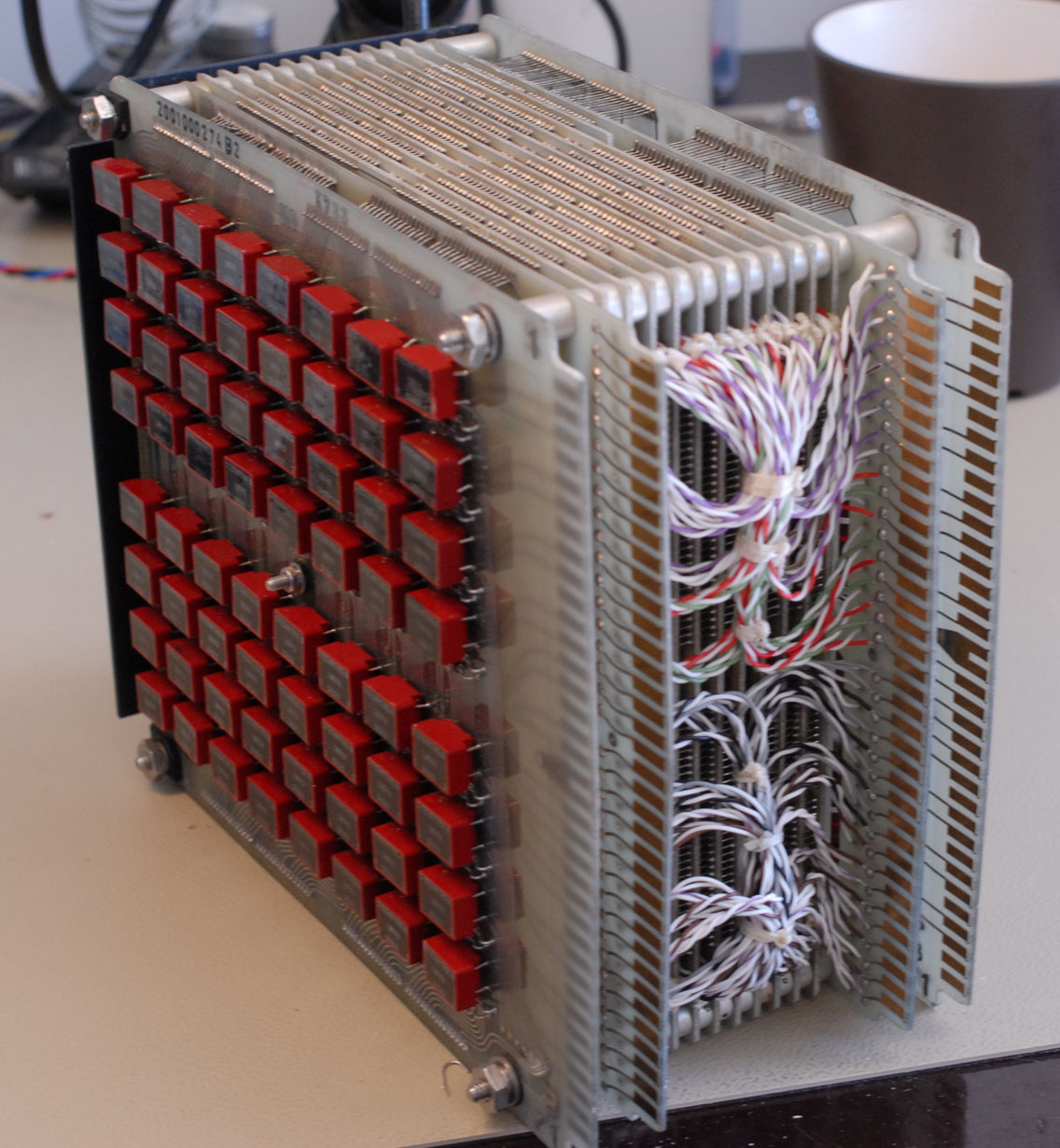
> Subject: Identify Lockheed core memory
> Message-ID: <20120521073103.GA6751 at Update.UU.SE>
> Content-Type: text/plain; charset=us-ascii
>
> Hi.
>
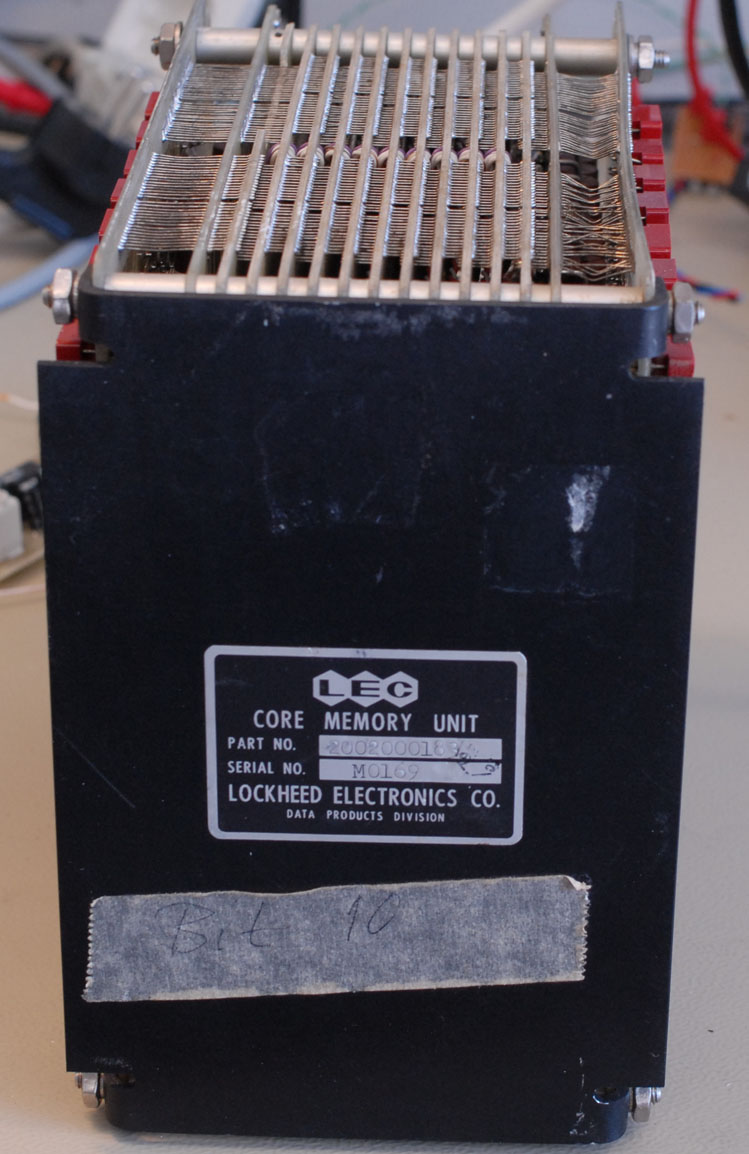
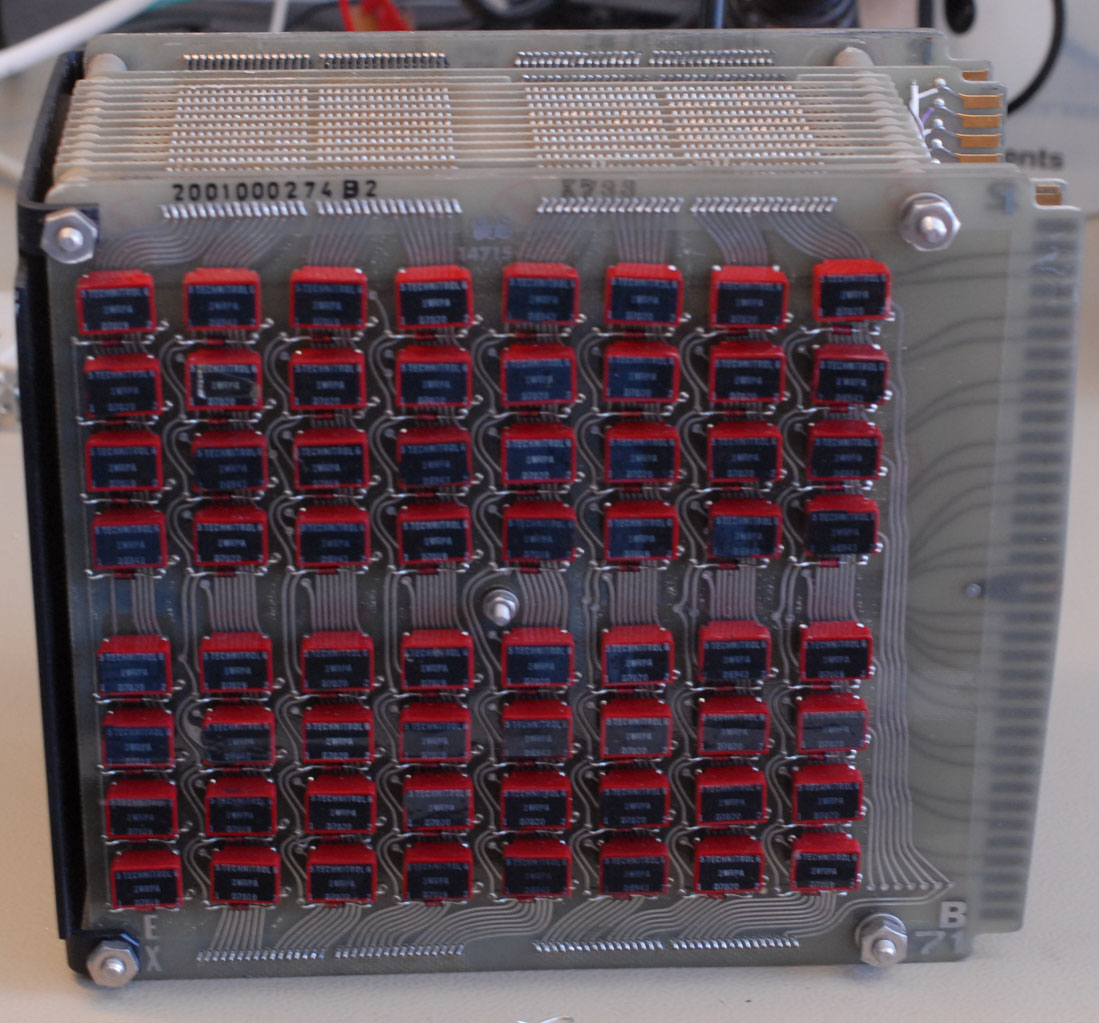
> A friend of mine picked up a rather massive stack of core. Now we are
> very curious to know what machine it comes out of. And of course any
> other facts about it.
>
> Pictures here:
>
> http://www.abc80.net/zz/pdp8/DSC_0973.JPG
> http://www.abc80.net/zz/pdp8/DSC_0974.JPG
> http://www.abc80.net/zz/pdp8/DSC_0975.JPG
>
There are likely to be date codes on the red pulse transformers, that
might be
of some use. I don't think Lockheed made computers for general purpose
use, so I might think this was for some aerospace application. The card
edge
connectors sort of go against that, however, they tended to use a minimum
of connectors like that due to vibration. I have a Honeywell airborne
computer that has no connectors except at the bulkhead, all boards are
attached
by flex cables to the motherboard.
Jon
----- Original Message -----
From: <cctalk-request at classiccmp.org>
To: <cctalk at classiccmp.org>
Sent: Monday, May 21, 2012 5:08 PM
Subject: cctalk Digest, Vol 105, Issue 48
> Send cctalk mailing list submissions to
> cctalk at classiccmp.org
>
> To subscribe or unsubscribe via the World Wide Web, visit
> http://www.classiccmp.org/mailman/listinfo/cctalk
> or, via email, send a message with subject or body 'help' to
> cctalk-request at classiccmp.org
>
> You can reach the person managing the list at
> cctalk-owner at classiccmp.org
>
> When replying, please edit your Subject line so it is more specific
> than "Re: Contents of cctalk digest..."
>
>
> Today's Topics:
>
> 1. Re: Software for OCR'ing paper tape? (was: Question about
> Military terminal) (Adrian Stoness)
> 2. Re: Free (for the price of shipping) RA-81 chassis (Alan Perry)
> 3. Re: VT220 focus (Liam Proven)
> 4. RE: BA23 PDP11/23 Power Supply that couldn't; Trying to
> locate a replacement cap (Shoppa, Tim)
> 5. RE: BA23 PDP11/23 Power Supply that couldn't; Trying to
> locate a replacement cap (Chuck Guzis)
> 6. Re: Software for OCR'ing paper tape? (was: Question about
> Military terminal) (John Foust)
> 7. Re: Software for OCR'ing paper tape? (was: Question about
> Military terminal) (David Griffith)
> 8. Re: Software for OCR'ing paper tape? (Dave McGuire)
> 9. Re: VT220 focus (Dave McGuire)
> 10. Re: Software for OCR'ing paper tape? (Adrian Stoness)
> 11. Re: Software for OCR'ing paper tape? (was: Question about
> Military terminal) (Ethan Dicks)
> 12. Re: VT220 focus (David Riley)
> 13. Re: Software for OCR'ing paper tape? (Dave Wade)
> 14. Re: VT220 focus (Cameron Kaiser)
> 15. Re: VT220 focus (Dave McGuire)
> 16. kryoflux or discferret enclosures (David Griffith)
> 17. Re: Software for OCR'ing paper tape? (was: Question about
> Military terminal) (Chuck Guzis)
> 18. Re: BA23 PDP11/23 Power Supply that couldn't; Trying to
> locate a (Tony Duell)
> 19. Re: BA23 PDP11/23 Power Supply that couldn't; (Tony Duell)
> 20. Re: BA23 PDP11/23 Power Supply that couldn't; Trying to
> locate a (Tony Duell)
> 21. Re: Baudot? (Was: Question about Military terminal (Tony Duell)
> 22. Re: Baudot? (Was: Question about Military terminal (Tony Duell)
> 23. Re: VT220 focus (Tony Duell)
> 24. Re: How to contribute to bitsavers? (Richard)
> 25. Re: Software for OCR'ing paper tape? (was: Question about
> Military terminal) (Richard)
> 26. Re: AVL ROAD RUNNER...My father built it (Richard)
> 27. Re: CRT degaussing coil (was Re: PDP-11/35 power supply woes)
> (John Honniball)
> 28. Re: VT220 focus (ben)
> 29. RE: Software for OCR'ing paper tape? (dwight elvey)
>
>
> ----------------------------------------------------------------------
>
> Message: 1
> Date: Mon, 21 May 2012 12:06:01 -0500
> From: Adrian Stoness <tdk.knight at gmail.com>
> To: "General Discussion: On-Topic and Off-Topic Posts"
> <cctalk at classiccmp.org>
> Subject: Re: Software for OCR'ing paper tape? (was: Question about
> Military terminal)
> Message-ID:
> <CAA3rs23pg2_n5=nxiRohgTWe-zKgWY-zsmR2gcUT3_ZhUY5wVA at mail.gmail.com>
> Content-Type: text/plain; charset=ISO-8859-1
>
> what if one was to use a digital camera and just photograph them and then
> have a batch processor of some sort?
>
> On Mon, May 21, 2012 at 11:28 AM, Ethan Dicks <ethan.dicks at gmail.com> wrote:
>
>> On Mon, May 21, 2012 at 11:54 AM, Richard <legalize at xmission.com> wrote:
>> > Is there something similar for punched cards as well?
>>
>> I started to write one years ago (beginning with scanning the punch
>> cards with a colored background to make the holes stand out) and did
>> get edge and orientation detection working, but the per-card handling
>> time on the scanner lead me to drop work on the project. If you were
>> scanning a short stack of cards, it wasn't so bad, but a 3 foot deck?
>> You'd spend a lot of time just getting the cards in and out of the
>> scanner.
>>
>> My code wasn't anything magical - it used Tom Boutell's GD library to
>> imported a monochrome GIF of a scan of the *back* of the card (to
>> eliminate "noise" from the printing on most cards) then did a fairly
>> uninspired search for the outer boundaries, then did an estimation of
>> where the holes ought to be (based on the discovered dimensions of the
>> edges) and did a simple (3x3) kernel sum of the targeted coordinate
>> and if it was mostly "white", it was a zero, mostly black, a one. You
>> couldn't skew the cards 45 degrees and expect it to work, but it was
>> resilient enough to work with a little skew.
>>
>> -ethan
>>
>
>
> ------------------------------
>
> Message: 2
> Date: Mon, 21 May 2012 10:15:09 -0700
> From: Alan Perry <alanp at snowmoose.com>
> To: cctech at classiccmp.org
> Subject: Re: Free (for the price of shipping) RA-81 chassis
> Message-ID: <4FBA781D.4000800 at snowmoose.com>
> Content-Type: text/plain; charset=ISO-8859-1; format=flowed
>
> Oops. Sorry. It is at 98110. Bainbridge Island, WA, across the water from
> downtown Seattle. I am willing to deliver it on the other side of the
> water.
>
> alan
>
> On 5/21/12 10:00 AM, cctech-request at classiccmp.org wrote:
>> Not that I am likely to be able to house this, but it might help others to
>> know the location of the item.
>>
>> Regards
>>
>> Rob
>>
>>> > -----Original Message-----
>>> > From:cctalk-bounces at classiccmp.org [mailto:cctalk-
>>> > bounces at classiccmp.org] On Behalf Of Alan Perry
>>> > Sent: 20 May 2012 18:22
>>> > To:cctech at classiccmp.org
>>> > Subject: Free (for the price of shipping) RA-81 chassis
>>> >
>>> >
>>> > I have a RA-81 that I am getting rid of. It is complete except for the
>>> > disks
>>> > and the housing that they spin in. It has the motor, so it is still
>>> > heavy.
>>> > Probably a local pickup, but I will consider shipping.
>>> >
>>> > If there are no takers, maybe it will just appear on the Living Computer
>>> > Museum's doorsteps. Wait, Ian and Rich subscribe to this list ...
>>> >
>>> > alan
>
>
>
> ------------------------------
>
> Message: 3
> Date: Mon, 21 May 2012 18:14:36 +0100
> From: Liam Proven <lproven at gmail.com>
> To: "General Discussion: On-Topic and Off-Topic Posts"
> <cctalk at classiccmp.org>
> Subject: Re: VT220 focus
> Message-ID:
> <CAMTenCHLe5MQq9sTNUCi0M+v89hnu39WxCZiFFEVRbCZqy9TGg at mail.gmail.com>
> Content-Type: text/plain; charset=windows-1252
>
> On 21 May 2012 16:58, Richard <legalize at xmission.com> wrote:
>>
>> [nit: please consider hitting RETURN every 75 chars or so]
>
> Please don't. Hard line-wrap has been a PITA since the 1960s and still is.
>
>
> --
> Liam Proven ? Profile: http://lproven.livejournal.com/profile
> Email: lproven at cix.co.uk ? GMail/G+/Twitter/Flickr/Facebook: lproven
> MSN: lproven at hotmail.com ? Skype/AIM/Yahoo/LinkedIn: liamproven
> Tel: +44 20-8685-0498 ? Cell: +44 7939-087884
>
>
>
> ------------------------------
>
> Message: 4
> Date: Mon, 21 May 2012 17:18:40 +0000
> From: "Shoppa, Tim" <tshoppa at wmata.com>
> To: "cctalk at classiccmp.org" <cctalk at classiccmp.org>
> Subject: RE: BA23 PDP11/23 Power Supply that couldn't; Trying to
> locate a replacement cap
> Message-ID:
> <303A17BD5F8FA34DA45EEC245271AC0B016ED6 at JGEX2K10MBX2.wmata.local>
> Content-Type: text/plain; charset="us-ascii"
>
>> I am curious, now, as to why they used this glass-encased "metallised
>> paper" capacitor instead of, say, an electrolytic. There are many
>> electrolytics inside the PSU, so it clearly wasn't a lack of availability.
>> Presumably there was a specific reason they chose this type of cap over
>> another. I'd hate to be wrong and do worse damage.
>
> It's an X (across-the-line) capacitor, almost certainly being used as a
> snubber.
>
> For across-the-line and snubber networks metalized film/paper or foil+paper
> are still the cat's meow. They have well understood failure modes. Ceramics
> are also rated as X safety capacitors in some circumstances.
>
>>From the X, it's probably rated at least at 250VAC and is non-polarized.
>
> This is not the job for an electrolytic or an unpolarized electrolytic.
>
> It is the job for a safety rated capacitor.
>
> Tim.
>
>
>
> ------------------------------
>
> Message: 5
> Date: Mon, 21 May 2012 10:19:15 -0700
> From: "Chuck Guzis" <cclist at sydex.com>
> To: "General Discussion: On-Topic and Off-Topic Posts"
> <cctalk at classiccmp.org>
> Subject: RE: BA23 PDP11/23 Power Supply that couldn't; Trying to
> locate a replacement cap
> Message-ID: <4FBA16A3.20801.8FDE42 at cclist.sydex.com>
> Content-Type: text/plain; charset=US-ASCII
>
> On 21 May 2012 at 11:55, JP Hindin wrote:
>
>> I am curious, now, as to why they used this glass-encased "metallised
>> paper" capacitor instead of, say, an electrolytic. There are many
>> electrolytics inside the PSU, so it clearly wasn't a lack of
>> availability. Presumably there was a specific reason they chose this
>> type of cap over another. I'd hate to be wrong and do worse damage.
>
> Are you talking about the infamous Rifa caps?
>
> That's not glass--I think it might be polystyrene. At any rate,
> they're "safety" capacitors in that their failure mode is limited to
> a set of known conditions, none of which can lead to electrical shock
> hazard. Generally, these are X- and Y- rated capacitors, with
> several numbered subcategories.
>
> X-capacitors are designed for "across the line" applications, i.e.,
> from one side of the line supply to the other. Y-capacitors are
> designed for "line to ground" applications.
>
> Here's a brief FAQ on that subject:
>
> http://www.okaya.com/FAQ1.html
>
> Rifa caps are still with us, though there are X- and Y- rated
> polypropylene and polyester caps as well.
>
> Do not use an electrolytic, non-polar or otherwise. They're not
> designed for the application.
>
> --Chuck
>
>
>
> ------------------------------
>
> Message: 6
> Date: Mon, 21 May 2012 13:04:55 -0500
> From: John Foust <jfoust at threedee.com>
> To: <cctalk at classiccmp.org>
> Subject: Re: Software for OCR'ing paper tape? (was: Question about
> Military terminal)
> Message-ID: <201205211805.q4LI594D004524 at billy.ezwind.net>
> Content-Type: text/plain; charset="us-ascii"
>
> At 11:28 AM 5/21/2012, Ethan Dicks wrote:
>>If you were
>>scanning a short stack of cards, it wasn't so bad, but a 3 foot deck?
>>You'd spend a lot of time just getting the cards in and out of the
>>scanner.
>
> Well, there are many scanners that can auto-feed a half-inch-tall pile.
>
> As for paper tape, what about the super-duper overkill of recognizing
> a video stream from a web cam? All you'd need is a jig to slowly
> pull the tape past the fixed camera.
>
> - John
>
>
>
> ------------------------------
>
> Message: 7
> Date: Mon, 21 May 2012 11:14:06 -0700 (PDT)
> From: David Griffith <dgriffi at cs.csubak.edu>
> To: "General Discussion: On-Topic and Off-Topic Posts"
> <cctalk at classiccmp.org>
> Subject: Re: Software for OCR'ing paper tape? (was: Question about
> Military terminal)
> Message-ID:
> <alpine.DEB.2.00.1205211113350.31082 at sleipnir.cs.csubak.edu>
> Content-Type: TEXT/PLAIN; charset=US-ASCII; format=flowed
>
> On Mon, 21 May 2012, John Foust wrote:
>
>> At 11:28 AM 5/21/2012, Ethan Dicks wrote:
>>> If you were
>>> scanning a short stack of cards, it wasn't so bad, but a 3 foot deck?
>>> You'd spend a lot of time just getting the cards in and out of the
>>> scanner.
>>
>> Well, there are many scanners that can auto-feed a half-inch-tall pile.
>>
>> As for paper tape, what about the super-duper overkill of recognizing
>> a video stream from a web cam? All you'd need is a jig to slowly
>> pull the tape past the fixed camera.
>
> Why not simply build a paper tape reader? It's not that hard to do.
>
> --
> David Griffith
> dgriffi at cs.csubak.edu
>
> A: Because it fouls the order in which people normally read text.
> Q: Why is top-posting such a bad thing?
> A: Top-posting.
> Q: What is the most annoying thing in e-mail?
>
>
> ------------------------------
>
> Message: 8
> Date: Mon, 21 May 2012 14:21:06 -0400
> From: Dave McGuire <mcguire at neurotica.com>
> To: General Discussion: On-Topic and Off-Topic Posts
> <cctalk at classiccmp.org>
> Subject: Re: Software for OCR'ing paper tape?
> Message-ID: <4FBA8792.4070205 at neurotica.com>
> Content-Type: text/plain; charset=ISO-8859-1
>
> On 05/21/2012 02:04 PM, John Foust wrote:
>>> If you were
>>> scanning a short stack of cards, it wasn't so bad, but a 3 foot deck?
>>> You'd spend a lot of time just getting the cards in and out of the
>>> scanner.
>>
>> Well, there are many scanners that can auto-feed a half-inch-tall pile.
>>
>> As for paper tape, what about the super-duper overkill of recognizing
>> a video stream from a web cam? All you'd need is a jig to slowly
>> pull the tape past the fixed camera.
>
> This is all interesting, but seems like a solution in search of a
> problem. Is it really the case that nobody can find a good optical
> (i.e., low tape wear) tape reader? Or card reader?
>
> -Dave
>
> --
> Dave McGuire, AK4HZ
> New Kensington, PA
>
>
> ------------------------------
>
> Message: 9
> Date: Mon, 21 May 2012 14:26:35 -0400
> From: Dave McGuire <mcguire at neurotica.com>
> To: General Discussion: On-Topic and Off-Topic Posts
> <cctalk at classiccmp.org>
> Subject: Re: VT220 focus
> Message-ID: <4FBA88DB.6010307 at neurotica.com>
> Content-Type: text/plain; charset=windows-1252
>
> On 05/21/2012 01:14 PM, Liam Proven wrote:
>>> [nit: please consider hitting RETURN every 75 chars or so]
>>
>> Please don't. Hard line-wrap has been a PITA since the 1960s and still is.
>
> How, exactly, is it a PITA?
>
> -Dave
>
> --
> Dave McGuire, AK4HZ
> New Kensington, PA
>
>
> ------------------------------
>
> Message: 10
> Date: Mon, 21 May 2012 13:27:58 -0500
> From: Adrian Stoness <tdk.knight at gmail.com>
> To: "General Discussion: On-Topic and Off-Topic Posts"
> <cctalk at classiccmp.org>
> Subject: Re: Software for OCR'ing paper tape?
> Message-ID:
> <CAA3rs22=oN421qKmE=KKrbhS2PkRnVS1X=TMGoWwHnGUVqsQFQ at mail.gmail.com>
> Content-Type: text/plain; charset=ISO-8859-1
>
> get a tripod and a camera and take photos then right some program that
> process's through them all and blam u got a way to archive ur tapes
>
> On Mon, May 21, 2012 at 1:21 PM, Dave McGuire <mcguire at neurotica.com> wrote:
>
>> On 05/21/2012 02:04 PM, John Foust wrote:
>> >> If you were
>> >> scanning a short stack of cards, it wasn't so bad, but a 3 foot deck?
>> >> You'd spend a lot of time just getting the cards in and out of the
>> >> scanner.
>> >
>> > Well, there are many scanners that can auto-feed a half-inch-tall pile.
>> >
>> > As for paper tape, what about the super-duper overkill of recognizing
>> > a video stream from a web cam? All you'd need is a jig to slowly
>> > pull the tape past the fixed camera.
>>
>> This is all interesting, but seems like a solution in search of a
>> problem. Is it really the case that nobody can find a good optical
>> (i.e., low tape wear) tape reader? Or card reader?
>>
>> -Dave
>>
>> --
>> Dave McGuire, AK4HZ
>> New Kensington, PA
>>
>
>
> ------------------------------
>
> Message: 11
> Date: Mon, 21 May 2012 14:44:00 -0400
> From: Ethan Dicks <ethan.dicks at gmail.com>
> To: "General Discussion: On-Topic and Off-Topic Posts"
> <cctalk at classiccmp.org>
> Subject: Re: Software for OCR'ing paper tape? (was: Question about
> Military terminal)
> Message-ID:
> <CAALmimnFt=k6F=GWr6qkXw7d0gx+Xufo2LuuZCHKCNRQ01HWhA at mail.gmail.com>
> Content-Type: text/plain; charset=ISO-8859-1
>
> On Mon, May 21, 2012 at 2:04 PM, John Foust <jfoust at threedee.com> wrote:
>> At 11:28 AM 5/21/2012, Ethan Dicks wrote:
>>>If you were
>>>scanning a short stack of cards, it wasn't so bad, but a 3 foot deck?
>>>You'd spend a lot of time just getting the cards in and out of the
>>>scanner.
>>
>> Well, there are many scanners that can auto-feed a half-inch-tall pile.
>
> I was using an auto-feed scanner... Brother brand. To get the
> contrasty background (to get the holes to show up), I loaded the punch
> card into the provided envelope for scanning receipts and small items.
> Without modifying my scanner, I could not get the background to be
> anything but white for a naked punch card. I did not wish to hack on
> the hardware, and with all the fiddling around, it took too long per
> card to get scans.
>
> Yes, it's possible to hack up some hardware that gets used just for
> scanning cards. No, I didn't care to do that.
>
>> As for paper tape, what about the super-duper overkill of recognizing
>> a video stream from a web cam? ?All you'd need is a jig to slowly
>> pull the tape past the fixed camera.
>
> If I wanted to read a bunch of paper tape, I'd probably build my own
> scanner from 9 photodiodes from the article in Byte magazine.
>
> http://www.classiccmp.org/cini/pdf/byte/manual_ptp.pdf
>
>
> -ethan
>
>
>
> ------------------------------
>
> Message: 12
> Date: Mon, 21 May 2012 14:55:20 -0400
> From: David Riley <fraveydank at gmail.com>
> To: "General Discussion: On-Topic and Off-Topic Posts"
> <cctalk at classiccmp.org>
> Subject: Re: VT220 focus
> Message-ID: <EB90FE6E-B369-49AD-AE96-5D6594FEBD0F at gmail.com>
> Content-Type: text/plain; charset=windows-1252
>
> On May 21, 2012, at 2:26 PM, Dave McGuire wrote:
>
>> On 05/21/2012 01:14 PM, Liam Proven wrote:
>>>> [nit: please consider hitting RETURN every 75 chars or so]
>>>
>>> Please don't. Hard line-wrap has been a PITA since the 1960s and still is.
>>
>> How, exactly, is it a PITA?
>
> Presumably, it's a pocket-like flatbread made with whole wheat flour.
> Capitalized.
>
>
> - Dave
>
>
>
> ------------------------------
>
> Message: 13
> Date: Mon, 21 May 2012 19:55:35 +0100
> From: Dave Wade <dave.g4ugm at gmail.com>
> To: General Discussion: On-Topic and Off-Topic Posts
> <cctalk at classiccmp.org>
> Subject: Re: Software for OCR'ing paper tape?
> Message-ID: <4FBA8FA7.6070906 at gmail.com>
> Content-Type: text/plain; charset=ISO-8859-1; format=flowed
>
> On 21/05/2012 19:21, Dave McGuire wrote:
>> On 05/21/2012 02:04 PM, John Foust wrote:
>>>> If you were
>>>> scanning a short stack of cards, it wasn't so bad, but a 3 foot deck?
>>>> You'd spend a lot of time just getting the cards in and out of the
>>>> scanner.
>>> Well, there are many scanners that can auto-feed a half-inch-tall pile.
>>>
>>> As for paper tape, what about the super-duper overkill of recognizing
>>> a video stream from a web cam? All you'd need is a jig to slowly
>>> pull the tape past the fixed camera.
>> This is all interesting, but seems like a solution in search of a
>> problem. Is it really the case that nobody can find a good optical
>> (i.e., low tape wear) tape reader? Or card reader?
>>
>> -Dave
>>
> I am in the UK but I have two optical tape readers, and will happily
> read tape in reasonable quantities from any one in the UK. I can also
> copy if required.
> But the question was scanned images which might be available after the
> tape has degraded and can't be read.
>
> Dave
>
>
> ------------------------------
>
> Message: 14
> Date: Mon, 21 May 2012 11:59:54 -0700 (PDT)
> From: Cameron Kaiser <spectre at floodgap.com>
> To: cctalk at classiccmp.org
> Subject: Re: VT220 focus
> Message-ID: <201205211859.q4LIxsbh12189732 at floodgap.com>
> Content-Type: text/plain; charset=US-ASCII
>
>> > > > [nit: please consider hitting RETURN every 75 chars or so]
>> > >
>> > > Please don't. Hard line-wrap has been a PITA since the 1960s and still
>> > > is.
>> >
>> > How, exactly, is it a PITA?
>>
>> Presumably, it's a pocket-like flatbread made with whole wheat flour.
>> Capitalized.
>
> I love those. I put them in rows of 75 columns each so that I have plenty
> and they are easy to rearrange. Then I have them with hummus.
>
> --
> ------------------------------------ personal:
> http://www.cameronkaiser.com/ --
> Cameron Kaiser * Floodgap Systems * www.floodgap.com * ckaiser at floodgap.com
> -- Laughter is the closest distance between two people. -- Victor
> Borge -------
>
>
> ------------------------------
>
> Message: 15
> Date: Mon, 21 May 2012 15:10:25 -0400
> From: Dave McGuire <mcguire at neurotica.com>
> To: General Discussion: On-Topic and Off-Topic Posts
> <cctalk at classiccmp.org>
> Subject: Re: VT220 focus
> Message-ID: <4FBA9321.8050708 at neurotica.com>
> Content-Type: text/plain; charset=windows-1252
>
> On 05/21/2012 02:55 PM, David Riley wrote:
>>>>> [nit: please consider hitting RETURN every 75 chars or so]
>>>>
>>>> Please don't. Hard line-wrap has been a PITA since the 1960s and still is.
>>>
>>> How, exactly, is it a PITA?
>>
>> Presumably, it's a pocket-like flatbread made with whole wheat flour.
>> Capitalized.
>
> Always capitalize on the pita.
>
> -Dave
>
> --
> Dave McGuire, AK4HZ
> New Kensington, PA
>
>
> ------------------------------
>
> Message: 16
> Date: Mon, 21 May 2012 12:38:22 -0700 (PDT)
> From: David Griffith <dgriffi at cs.csubak.edu>
> To: cctalk at classiccmp.org
> Subject: kryoflux or discferret enclosures
> Message-ID:
> <alpine.DEB.2.00.1205211235100.13002 at sleipnir.cs.csubak.edu>
> Content-Type: TEXT/PLAIN; format=flowed; charset=US-ASCII
>
>
> Does anyone here have anything to show off or point to regarding
> enclosures for the two prominent viable disk imaging boards (kryoflux and
> discferret).
>
> --
> David Griffith
> dgriffi at cs.csubak.edu
>
> A: Because it fouls the order in which people normally read text.
> Q: Why is top-posting such a bad thing?
> A: Top-posting.
> Q: What is the most annoying thing in e-mail?
>
>
> ------------------------------
>
> Message: 17
> Date: Mon, 21 May 2012 12:41:12 -0700
> From: "Chuck Guzis" <cclist at sydex.com>
> To: "General Discussion: On-Topic and Off-Topic Posts"
> <cctalk at classiccmp.org>
> Subject: Re: Software for OCR'ing paper tape? (was: Question about
> Military terminal)
> Message-ID: <4FBA37E8.19297.111D0BD at cclist.sydex.com>
> Content-Type: text/plain; charset=US-ASCII
>
> On 21 May 2012 at 11:14, David Griffith wrote:
>
>> Why not simply build a paper tape reader? It's not that hard to do.
>
> My gosh yes. If people can build piano-roll readers, a paper tape
> reader would be child's play.
>
> --Chuck
>
>
>
> ------------------------------
>
> Message: 18
> Date: Mon, 21 May 2012 20:51:16 +0100 (BST)
> From: ard at p850ug1.demon.co.uk (Tony Duell)
> To: cctalk at classiccmp.org
> Subject: Re: BA23 PDP11/23 Power Supply that couldn't; Trying to
> locate a
> Message-ID: <m1SWYdW-000J4dC at p850ug1>
> Content-Type: text/plain
>
>>
>>
>> Greetings;
>>
>> I received a new (to me) MicroPDP11/23 that I was fiddling about with over
>> the weekend. After testing out the supply voltages, and then putting the
>> system together enough to get serial out of it, there was a pop, a whoosh
>> and a rather exciting ejected plume of smoke from one of the upper fans.
>>
>> http://www.kiwigeek.com/misc/PDP1123_Cap1.jpg
>> http://www.kiwigeek.com/misc/PDP1123_Cap2.jpg
>
> Yes, they do this from time to time. It's aprt of the mains filter
> sircuit, and they often fail for no really good reason.
>
>>
>> The capacitor is mounted on the sub-board in the PSU that the IEC
>> receptacle is on.
>>
>> The markings on the back show this is a PME271M622, but I'm having trouble
>> sourcing a replacement. Most of the places I usually look about are
>> showing no stock or ridiculous minimum orders. On eBay (shudder) there's a
>> similar model, but it's marked as an "X2", and I'm not sure if that's an
>> acceptable replacement.
>
> Should be fine. From the fact that it;s 0.22uF (220nF), it's going to be
> across the mains, not from either side of the maisn to protective ground.
> In which case there are no special safety requirements 9Like it must not
> be ablto fial short-circuit). OF ocurse the capacitor ahs to be able to
> stant 250V AC continously.
>
> An XT one would be fine.
>
> -tony
>
>
>
> ------------------------------
>
> Message: 19
> Date: Mon, 21 May 2012 20:54:54 +0100 (BST)
> From: ard at p850ug1.demon.co.uk (Tony Duell)
> To: cctalk at classiccmp.org
> Subject: Re: BA23 PDP11/23 Power Supply that couldn't;
> Message-ID: <m1SWYh2-000J4eC at p850ug1>
> Content-Type: text/plain
>
>> These seem to blow/burst often. I believe the cap is there only to limit RFI
>> emissions, so you can leave it out safely. The power supply should run fine
>
> Correct, althought it's good practice to replace it.
>
>> without it. If you do need to replace it, I wouldn't replace it with the
>> exact same type, but with a later cap less prone to blow. Any 250V 220nF cap
>
> Hmmm. I am not convinced that modern capacitors are always more reliable
> than older ones ;-)
>
>> should do just fine.
>
> Be very careful here. It has to withstand full mains voltage, which could
> be up to 250V _RMS_. In other words about 350V peak. I would not use a
> cpaacitor rated at less than 630V DC, actually.
>
> But it's easy to find capacitors rated for use in mains filters, and
> that's what I would fit.
>
> -tony
>
>
> ------------------------------
>
> Message: 20
> Date: Mon, 21 May 2012 20:59:10 +0100 (BST)
> From: ard at p850ug1.demon.co.uk (Tony Duell)
> To: cctalk at classiccmp.org
> Subject: Re: BA23 PDP11/23 Power Supply that couldn't; Trying to
> locate a
> Message-ID: <m1SWYlA-000J4fC at p850ug1>
> Content-Type: text/plain
>
>> I am curious, now, as to why they used this glass-encased "metallised
>> paper" capacitor instead of, say, an electrolytic. There are many
>
> It has the AC mains across it (it's almost certianly conencted between
> live and neutral of the mains input, possibly after filter inductors). So
> it cou;dn't be an electrolytic, which are polarised and designed to have
> DC across them.
>
> As to why use a mrallised paper capacitro, I suspect it was the cheapest
> type that could stnad the voltage and be reliable (OK, it's failed now,
> buit it;'s been around fro proably 30 years or so). There would be no
> particualr tolerance requiremnts here.
>
> Wht you need to get is a capacitor of the same value that is rated to
> withstand the full mains AC votlage. Most good components suppliers list
> capcitors for mains filter applications. Since they're designed for what
> you want to use them for, theres no good reason not to use one.
>
> -tony
>
>
> ------------------------------
>
> Message: 21
> Date: Mon, 21 May 2012 20:33:19 +0100 (BST)
> From: ard at p850ug1.demon.co.uk (Tony Duell)
> To: cctalk at classiccmp.org
> Subject: Re: Baudot? (Was: Question about Military terminal
> Message-ID: <m1SWYM9-000J4WC at p850ug1>
> Content-Type: text/plain
>
>>
>> >>> It's about as hopeless as telling someone that a 2400 bps 201B
>> >>> modem does not run at 2400 "baud".
>> >> Actually, it _does_ - on the host serial port. (Unless I'm _still_
>> >> confused about exactly what a baud is....)
>> > Does one count start and stop bits? In that case, 2400 bps would be
>> > 3000 Baud on the host serial port.
>>
>> Hm? I always thought serial-port "baud" rates measured raw bits per
>> second. Since I pretty much invariably use one start, 8 data, and one
>
> They measure possible signal line changes per second, as you'd expect.
> And yes, start and stop bits are counted.
>
> In other words, a serial port baud rate of 2400 means that each bit time
> is 1/2400 s. A start bit takes that long, so does each data bit, so does
> the stop bit(s).
>
>> stop bits, that means, eg, 2400 baud <-> 240 characters per second. (I
>
> Yes.
>
>> also thought baud rates measured the raw symbol rate, drawing no
>> distinction between data and framing symbols....)
>
> AFAI Kthat is also correct. Hence the use of 'baud rate' is correct of a
> normal serial port, it measures the time taken for each bit (be it a fata
> bit or a framing control bit) to be sent.
>
> -tony
>
>
> ------------------------------
>
> Message: 22
> Date: Mon, 21 May 2012 20:36:14 +0100 (BST)
> From: ard at p850ug1.demon.co.uk (Tony Duell)
> To: cctalk at classiccmp.org
> Subject: Re: Baudot? (Was: Question about Military terminal
> Message-ID: <m1SWYOx-000J4YC at p850ug1>
> Content-Type: text/plain
>
>> > Actually, it _does_ - on the host serial port. (Unless I'm _still_
>> > confused about exactly what a baud is....)
>>
>> Well, then you get into the mess of what interface the modem has with
>> the host. If it's an 8-bit parallel interface, the argument could
>> be made that the baud rate was 300.
>
> Hmm.. Give ntaht there are now 8 signallying lines, with a possible 300
> transitions per second on each, the total number of signal line
> transitions per second remains at 2400. I think that could be classed as
> 2400 baud still.
>
> -tony
>
>
> ------------------------------
>
> Message: 23
> Date: Mon, 21 May 2012 20:44:19 +0100 (BST)
> From: ard at p850ug1.demon.co.uk (Tony Duell)
> To: cctalk at classiccmp.org
> Subject: Re: VT220 focus
> Message-ID: <m1SWYWm-000J4cC at p850ug1>
> Content-Type: text/plain
>
>>
>> So I finally got my VT220 put back together! I have one I saved from the
>> dumpster from a plant floor,
>> but it was incredibly filthy. I disassembled it, cleaned it thoroughly, and
>> put it back together (over a
>> duration of 6+ months), and amazingly it still works! So, I had to hook it
>> up to my MacBook Air, just
>> for fun. Works like a charm, but characters on the left seem slightly
>> fuzzier then others. Maybe that's
>> just because I've been staring at the razor-sharp screens on my MacBook and
>> iPhone too long, and
>> the fact that this thing's 26 years old, but is there a way to sharpen them
>> up a bit?
>> Even if not, it's still darn funny to have a physical terminal on my MacBook!
>
> I thought htere wsa focus preset on the video.monitor PCB, the presets
> are all labelled on the paper overleay.
>
> However, AFAIK this affexcts the focus over the enitre screen. There is
> no way to focus one wide rather than the other. Now, the focus anode
> voltage is derriced from the flyback transforer, as are most of hte other
> CRT votlages (some of which could also affect the focus). So if the focus
> is much better at one side htan the otehr, it suggests one of those
> votlages has horizontal-freqeuncy ripple on it. Which to me suggests a
> defecive capacitor in one of the rectifier cirucits hung off the flyback.
>
> -tony
>
>
> ------------------------------
>
> Message: 24
> Date: Mon, 21 May 2012 14:34:58 -0600
> From: Richard <legalize at xmission.com>
> To: cctalk <cctalk at classiccmp.org>
> Subject: Re: How to contribute to bitsavers?
> Message-ID: <E1SWZJi-0001WU-OJ at shell.xmission.com>
>
>
> In article <alpine.DEB.2.02.1205211035530.19688 at linuxserv.home>,
> Christian Corti <cc at informatik.uni-stuttgart.de> writes:
>
>> But right now I just put everything on our local FTP
>> server.
>
> ....and then you can email the FTP url to Al and he can transfer to
> bitsavers if he wishes.
>
> That's how I do it and it works just fine.
> --
> "The Direct3D Graphics Pipeline" free book <http://tinyurl.com/d3d-pipeline>
> The Computer Graphics Museum <http://computergraphicsmuseum.org>
> The Terminals Wiki <http://terminals.classiccmp.org>
> Legalize Adulthood! (my blog) <http://legalizeadulthood.wordpress.com>
>
>
> ------------------------------
>
> Message: 25
> Date: Mon, 21 May 2012 14:36:09 -0600
> From: Richard <legalize at xmission.com>
> To: cctalk <cctalk at classiccmp.org>
> Subject: Re: Software for OCR'ing paper tape? (was: Question about
> Military terminal)
> Message-ID: <E1SWZKr-0001dp-6i at shell.xmission.com>
>
>
> In article <4FBA37E8.19297.111D0BD at cclist.sydex.com>,
> "Chuck Guzis" <cclist at sydex.com> writes:
>
>> On 21 May 2012 at 11:14, David Griffith wrote:
>>
>> > Why not simply build a paper tape reader? It's not that hard to do.
>>
>> My gosh yes. If people can build piano-roll readers, a paper tape
>> reader would be child's play.
>
> The number of people with software/mashup skills is much, much larger
> than the number of people with hardware skills.
>
> You may decry such a situation, but nonetheless it is the situation.
> --
> "The Direct3D Graphics Pipeline" free book <http://tinyurl.com/d3d-pipeline>
> The Computer Graphics Museum <http://computergraphicsmuseum.org>
> The Terminals Wiki <http://terminals.classiccmp.org>
> Legalize Adulthood! (my blog) <http://legalizeadulthood.wordpress.com>
>
>
> ------------------------------
>
> Message: 26
> Date: Mon, 21 May 2012 14:36:34 -0600
> From: Richard <legalize at xmission.com>
> To: cctalk <cctalk at classiccmp.org>
> Subject: Re: AVL ROAD RUNNER...My father built it
> Message-ID: <E1SWZLG-0001eP-Cu at shell.xmission.com>
>
>
> In article
> <CAA3rs20ypc3mWNGn_JmjCpEtXVjPFQQdb9mkXrkRwmMgHs6zYQ at mail.gmail.com>,
> Adrian Stoness <tdk.knight at gmail.com> writes:
>
>> ?
>
> !
> --
> "The Direct3D Graphics Pipeline" free book <http://tinyurl.com/d3d-pipeline>
> The Computer Graphics Museum <http://computergraphicsmuseum.org>
> The Terminals Wiki <http://terminals.classiccmp.org>
> Legalize Adulthood! (my blog) <http://legalizeadulthood.wordpress.com>
>
>
> ------------------------------
>
> Message: 27
> Date: Mon, 21 May 2012 21:49:57 +0100
> From: John Honniball <coredump at gifford.co.uk>
> To: General Discussion: On-Topic Posts Only <cctech at classiccmp.org>
> Subject: Re: CRT degaussing coil (was Re: PDP-11/35 power supply woes)
> Message-ID: <4FBAAA75.4010809 at gifford.co.uk>
> Content-Type: text/plain; charset=us-ascii; format=flowed
>
> Tony Duell wrote:
>> Yes, some monitors degauss with quite a lound 'clang' (I assume it's the
>> shaddowmask. flexing. I've never heard a TV that does that.
>
> I think it's the thin steel internal screening can of a computer
> monitor that makes the "clang". And the screening is something
> that I don't think I've ever seen in a TV. Although, my Sony
> widescreen CRT TV (FreeCycle) makes a slight twang sometimes
> on power-up.
>
> Tony, do you remember that Tomorrow's World programme when
> Raymond Baxter showed us how to distort a TV picture with
> a magnet? And the warnings on the next week's episode
> where they said "don't try this on a colour TV!". I think
> they said that the producer had tried it on a colour set,
> and it was OK, so they broadcast it -- without realising
> that he'd been lucky, and a stronger magnet would do
> bad things.
>
> --
> John Honniball
> coredump at gifford.co.uk
>
>
> ------------------------------
>
> Message: 28
> Date: Mon, 21 May 2012 15:04:33 -0600
> From: ben <bfranchuk at jetnet.ab.ca>
> To: cctalk at classiccmp.org
> Subject: Re: VT220 focus
> Message-ID: <4FBAADE1.3010504 at jetnet.ab.ca>
> Content-Type: text/plain; charset=windows-1252; format=flowed
>
> On 5/21/2012 12:26 PM, Dave McGuire wrote:
>> On 05/21/2012 01:14 PM, Liam Proven wrote:
>>>> [nit: please consider hitting RETURN every 75 chars or so]
>>>
>>> Please don't. Hard line-wrap has been a PITA since the 1960s and still is.
>>
>> How, exactly, is it a PITA?
>
> TTY's are 72 chars wide. -:)
>
>> -Dave
>>
>
>
>
> ------------------------------
>
> Message: 29
> Date: Mon, 21 May 2012 14:08:18 -0700
> From: dwight elvey <dkelvey at hotmail.com>
> To: "General Discussion: On-Topic and Off-Topic Posts"
> <cctalk at classiccmp.org>
> Subject: RE: Software for OCR'ing paper tape?
> Message-ID: <SNT129-W2541E8D64060126342A5ACA31D0 at phx.gbl>
> Content-Type: text/plain; charset="iso-8859-1"
>
>
>
>> From: dave.g4ugm at gmail.com
>>
>> On 21/05/2012 19:21, Dave McGuire wrote:
>> >
>> I am in the UK but I have two optical tape readers, and will happily
>> read tape in reasonable quantities from any one in the UK. I can also
>> copy if required.
>> But the question was scanned images which might be available after the
>> tape has degraded and can't be read.
>>
>> Dave
> Hi I have a high speed reader to but I've had troubleswith rubber bands. They
> leave gunk on the tapes andlayers stick together. On a high speed reader,
> itrips the tape before one has a chance to stop it. Mine is a parallel one and
> I just connected it to theprinter port ( guess that dates my laptop ). A
> simpleprogram reads the data and puts it into files. On making a reader, the
> ideas of using a pile ofphotodiodes to read a punch card doesn't makemuch
> sense. It might be better to have a LED lightat each hole position of a column
> and a single photodiode.One could then just sequntially drive the lightsand
> detect it with just one photodiode.One might need to aim each light at the
> diode.As with Dave, if someone has fan fold paper tape toarchive, I could do
> an reasonable amount. I'min San Jose, Ca, USA.I'm not setup to handle spooled
> tape safely.Dwight
>
> End of cctalk Digest, Vol 105, Issue 48
> ***************************************
>
I have a 2001 that was doing the same thing and blasted it a few times with contact cleaner and it works fine now.
Win
Subject: RE: Commodore Pet 2001-8 w/flaky brightness adjustment
Message-ID: <COL106-W26E407007EFFA5DAFE444E91D0 at phx.gbl>
Content-Type: text/plain; charset="iso-8859-1"
> On May 21, 2012, at 5:20 PM, Jim McCusker wrote:
>
>>
>> I have a working Pet 2001-8 that has one annoying issue. When I power up the unit I typically don't see any characters displayed unless I apply a slight amount of pressure on the back of the brightness control in the back of the monitor. I suspected bad solder joints but couldn't see anything wrong. Turning the control brightens the screen but somehow this control is causing the character display to turn on/off. Any ideas what might be going on here?
>
> Could easily be dirty contacts on the wipe for the pot. Try isopropyl
> alcohol, or any number of commercially-available contact cleaners for
> stereos, etc.
>
> Or, given your description, the slight flex you're applying might be
> wiggling other bad solder joints elsewhere on the board to the point
> where they connect. I've had that happen (it was a nasty bugger to
> find, too).
Thanks Dave, I'll give the isopropyl idea a try, followed by closer inspection of the circuit board while the back is off. I have the circuit schematics but not enough experience with monitors to feel confident touching very much inside while the circuit is energized. I'll take some photo's if it's still not working and see if anyone familiar with the circuit sees anything. Once I get this working I'll be working on a few bad chicklet keys and then I'll have a complete working system.
--Jim
My uncle served in the Navy in the Philippine Islands in a Signal Corps
unit doing communications of some sort. One of the interesting
souvenirs he made and brought back was a 5 level punched tape, which
his oldest daughter had in her collection.
I heard about it and had her copy a bit of it and send the image. After
I figured out the code, I had her send scans of the entire tape 14" at a
time, and have deciphered the entire thing.
I wonder what I could get from the assembled group here to help try to
figure out what terminal might have been used? Unfortunately I don't
have any data showing what he did, other than some bits of stories.
Most of his photos are interesting, but don't give a hint as to what he
was doing.
I have some ideas, but thought I'd ask here before guessing. I'm hoping
to make a guess as to a terminal and then find a photograph for the
scrapbook with the deciphered tape. I also found some naval dispatches
online which I suspect he might have had to do with (form, not specific
dispatches) if he was handling a tty of some sort for transmission.
Anyway if you have info you want to share, feel free to send off the
list, or on if it won't go to far afield.
BTW, for those who want to read a lot of interesting info, here is the
site with the dispatches, and a lot of other fun reading about WW2 affairs.
http://www.uboatarchive.net/index.html
I know the main topic is about german subs, but there are some nice
dispatches which I suspect are similar in form to what they would have
used with mechanical transmission equipment. I'd also take any
descriptions about procedures, and other equipment if it is on this topic.
I have a group of WW2 aviators I'm going to send this to for response as
well, but this group will probably know about the coding and technical info.
thanks
Jim
> I am curious, now, as to why they used this glass-encased "metallised
> paper" capacitor instead of, say, an electrolytic. There are many
> electrolytics inside the PSU, so it clearly wasn't a lack of availability.
> Presumably there was a specific reason they chose this type of cap over
> another. I'd hate to be wrong and do worse damage.
It's an X (across-the-line) capacitor, almost certainly being used as a snubber.
For across-the-line and snubber networks metalized film/paper or foil+paper are still the cat's meow. They have well understood failure modes. Ceramics are also rated as X safety capacitors in some circumstances.
>From the X, it's probably rated at least at 250VAC and is non-polarized.
This is not the job for an electrolytic or an unpolarized electrolytic.
It is the job for a safety rated capacitor.
Tim.
Oops. Sorry. It is at 98110. Bainbridge Island, WA, across the water from
downtown Seattle. I am willing to deliver it on the other side of the
water.
alan
On 5/21/12 10:00 AM, cctech-request at classiccmp.org wrote:
> Not that I am likely to be able to house this, but it might help others to
> know the location of the item.
>
> Regards
>
> Rob
>
>> > -----Original Message-----
>> > From:cctalk-bounces at classiccmp.org [mailto:cctalk-
>> > bounces at classiccmp.org] On Behalf Of Alan Perry
>> > Sent: 20 May 2012 18:22
>> > To:cctech at classiccmp.org
>> > Subject: Free (for the price of shipping) RA-81 chassis
>> >
>> >
>> > I have a RA-81 that I am getting rid of. It is complete except for the disks
>> > and the housing that they spin in. It has the motor, so it is still heavy.
>> > Probably a local pickup, but I will consider shipping.
>> >
>> > If there are no takers, maybe it will just appear on the Living Computer
>> > Museum's doorsteps. Wait, Ian and Rich subscribe to this list ...
>> >
>> > alan
>
>Currently, I get nothing out of it whatsoever. I discovered that one of
>the surface-mounted fuses had blown so I've replaced that and I'm still
>getting nothing, though I am now at least getting a low voltage (about
>.5V) at components on the board when it's powered on.
>
>This unit has a rechargable ni-cad battery in it (that I'm pretty sure
>no longer holds a charge) and I'm curious whether a functioning battery
>is required for normal operation.
>
Less likely with a battery but indiviual ni-cad cells can die short circuit
due to some sort of conductive whiskers growing internally between the poles.
Perhaps the battery is shorted and this is dragging down the power supply
resulting in the fuse blowing?
If that is not the problem, look for something that is getting hotter than
it should due to drawing too much current from the power supply.
Regards,
Peter Coghlan.
I have a RA-81 that I am getting rid of. It is complete except for the
disks and the housing that they spin in. It has the motor, so it is
still heavy. Probably a local pickup, but I will consider shipping.
If there are no takers, maybe it will just appear on the Living Computer
Museum's doorsteps. Wait, Ian and Rich subscribe to this list ...
alan
Success! I thought I had done the whole reseating of the chips
in the socket thing, but messing more with the VRAMs as per your
suggestion, seems to have soveld the problem. I tried swapping them and
that just made things worse, so I swapped them back and it worked great.
Looks like some oxidation in the sockets/pics. So I removed the PETvet
and replaced the 6502 and for now, it is running well. Now to test the
rest of the machine. Thanks for the help.
http://imgur.com/qclhF
Win
Date: Sat, 19 May 2012 21:35:17 -0400
From: Ethan Dicks <ethan.dicks at gmail.com>
To: "General Discussion: On-Topic and Off-Topic Posts"
<cctalk at classiccmp.org>
Subject: Re: Commodore PET 2001 Video Problem
Message-ID:
<CAALmim=SKRsX+YVADoEVrn3BNQ_VJd2MSuT==jK6GAbotaJfqg at mail.gmail.com>
Content-Type: text/plain; charset=ISO-8859-1
On Sat, May 19, 2012 at 9:23 PM, Win Heagy <wheagy at gmail.com> wrote:
> I've made a bit of progress on this since the last post and wanted to get
> some additional help if possible. ?I picked up a PETvet board from
> bitfixer.org and installed it. ?The 2001 boots now (usually) and I get a
> screen like this....
> http://imgur.com/fQxH3
You are quite close now.
> The machine works like this, but obviously the vertical lines are a bit
> annoying. ?The PETvet replaces the RAM and ROM, but does anyone know if
> that includes replacing the video ROM? ?Any next steps are appreciated.
Your video (character generator) ROM is likely just fine. It's more
probable that you have a either a bad video SRAM or perhaps a stuck
bit on the shift register that takes the byte from the ROM.
What does the screen look like if you remove the ROM? Do you still
see the lines? What if you swap the RAM chips. Does the vertical
line move?
Since you pulled your RAM for the PETvet, you should have spares to
try in the video RAM spot. I've seen up to 25% bad SRAMs in old PETs,
so it's a place to focus your efforts. If you can borrow or have a
spare character generator ROM, it's worth swapping that out, too.
I think you've got it narrowed down to one of 4 chips... ROM, RAM, or
shift register. The most likely candidate is RAM, in my experience.
-ethan
From: jim s <jws at jwsss.com>
To: General Discussion: On-Topic and Off-Topic Posts
<cctalk at classiccmp.org>
Subject: Question about Military terminal
Message-ID: <4FB8ACE0.8070401 at jwsss.com>
Content-Type: text/plain; charset=ISO-8859-1; format=flowed
My uncle served in the Navy in the Philippine Islands in a Signal Corps
unit doing communications of some sort. One of the interesting
souvenirs he made and brought back was a 5 level punched tape, which
his oldest daughter had in her collection.
This would be Baudot code, used on a bunch of Teletype and Kleinschmidt
units from the 1940's through the 1970's, at least. The code is well-known
and documented. The Teletype models were such things as the Model 15 and
19, which looked like something like Smith Corona typewriters.
There were a variety of sub-models in these families, such as manual-only
units (keyboard and typewriter) and ASR (with tape reader and punch).
There were also standalone tape readers and punches, and chadless
punches, which left a loose flap of the tape where a hole was needed.
This same code was still alive in 1991, I found the French-speaking
islands like Martinique, Barbados, Guadaloupe, etc. They used a computer
to pack the Baudot into blocks and sent it via radio in a synchronous format, but
the basic code was still Baudot.
Teletypes and Kleinshcmidt machines were used fairly widely during
WW-II and even more widely in later wars for transmitting
printed orders to the field. Later they were used for transmitting
everything like supplies orders and all sorts of routine messages.
There were ciphering units for secure messages. If you look at pictures
>from the Minuteman silos, you will see a Kleinschmidt printer connected
to an AN/UYK-7 computer used to partially decrypt launch orders to the
missile crews. Those partially decrypted messages would instruct the crews to
each open specified envelopes, and codes in those envelopes could be
combined with codes decrypted from data stored in the AN/UYK-7 to
create a launch code for the missile.
As far as I know, radio hams still use teletypes or software simulations
of them to communicate. Packet radio has replaced much of that, however.
Jon
Original Message:
Date: Sat, 19 May 2012 21:23:38 -0400
From: Win Heagy <wheagy at gmail.com>
> I've made a bit of progress on this since the last post and wanted to get
> some additional help if possible. I picked up a PETvet board from
> bitfixer.org and installed it. The 2001 boots now (usually) and I get a
> screen like this....
http://imgur.com/fQxH3
> The machine works like this, but obviously the vertical lines are a bit
> annoying. The PETvet replaces the RAM and ROM, but does anyone know if
> that includes replacing the video ROM? Any next steps are appreciated.
> Thanks,
> Win
------------------
No, the PETvet does not replace the chracter generator or the video RAM.
This one's easy:
Your problem is a bad CG or shift register; you don't say which model this
is, so, assuming one of the models using a 6540 ROM:
- Check that pin 24 of the IC at A2 is not broken or bent.
- If it's OK then either carefully bend out pin 24 or, preferably, remove or
bend out pin 24 of an IC socket and sandwich it between the chip and its
socket.
- The screen will probably look the same.
- Using a pin and a jumper, ground pin 24 of the socket (not the bent out IC
pin); if the screen stays the same it's the SR, if the lines disappear it's
the ROM.
- If it's an old model using 2316s then it's pin 11 instead of 24.
- If it's a dynamic RAM model using a 2316 then it's pin 11 of IC F10.
If you need a replacement for the ROM, ask on the Vintage Computer Forum;
someone will be able to fix you up.
mike
Recently resurrected my //e from storage (used an ATX PSU as the Apple one let
the magic smoke out), and it's got broken keys 0 and . (and missing keycaps)
on the numeric keypad. Anyone know a good place to get some replacements in
the UK?
thanks
greg
I was doing my usual rummaging around Weirdstuff (WS), when a car drove up and dropped off six (6) Wang 80 MB Disk Cartridges. The P/N on the Cartridges is 725-0183. One of the packs contains the operating system "Task Monitor, TM-VS-C, Release 2.20". The other packs contain system backups.
The WS folks alerted me fast enough that I was able run outside and talk to the guy who dropped off the cartridges. Unfortunately, the Wang system they came from was long ago scrapped - including the disk drives for the cartridges.
If anyone has a drive which can read the packs and can preserve the OS, etc., please let me know and I'll work with WS to make the packs available to you.
Cheers,
Lyle
--
Lyle Bickley, AF6WS
Bickley Consulting West Inc.
http://bickleywest.com
"Black holes are where God is dividing by zero"
I've made a bit of progress on this since the last post and wanted to get
some additional help if possible. I picked up a PETvet board from
bitfixer.org and installed it. The 2001 boots now (usually) and I get a
screen like this....
http://imgur.com/fQxH3
The machine works like this, but obviously the vertical lines are a bit
annoying. The PETvet replaces the RAM and ROM, but does anyone know if
that includes replacing the video ROM? Any next steps are appreciated.
Thanks,
Win
On Mon, Apr 16, 2012 at 2:07 PM, MikeS <dm561 at torfree.net> wrote:
> ----- Original Message:
> Date: Mon, 16 Apr 2012 09:55:12 -0400
> From: Ethan Dicks <ethan.dicks at gmail.com>
>
>
>> Try powering up with the video RAMs removed (they are in the back and
look
>> like they have dots on them). ?With no RAM, the PET should power up to a
>> blank screen
>
> Tsk, tsk, Ethan, you know better than that ;-)
Yeah... thinking about it - that's what you get with the Character ROM
removed... sorry.
The thing I was trying to communicate was that the video should
certainly be uniform with the RAM removed. I just misremembered what
"empty" does.
> A PET with a working video section and video RAM removed will show the
> classic checkerboard pattern or under certain circumstances a pattern of
> small black squares.
Right... the character for 0xFF is the 50% checkerboard - it would
look largely the same in inverse video (unless you count from the edge
which "phase" it is).
> No doubt there's considerable PET knowledge on this list, but as Terry
> suggested previously the VCF forum or one of the PET/CBM-specific lists
> might be a better place to find help with a sick PET...
Perhaps. I'm not a big forum denizen (too many disconnected places to
keep up with) so I rarely see help requests posted to them.
-ethan
Hi All,
I was wondering about the attendance at the recent VCF. Does anyone
have some idea how many people showed up that weren't already active
in classic computing? Do you think that we pulled any new people into
the hobby?
-Jon
----------Original message:
Date: Fri, 18 May 2012 12:04:03 -0700 (PDT)
From: Cameron Kaiser <spectre at floodgap.com>
> ...But the KIM-1 is much more capable than it appears (this is not saying
> much, mind you, but there were numerous reasonably practical applications
> for it in the era). If you hooked it up to a terminal, it became much more
> useful.
Even more so in the case of the AIM 65: with an 80x24 terminal connected to
its RS-232 (or current loop) interface and the optional 40kB RAM and BASIC,
Forth, PL/65 and Pascal in ROM, it was more powerful (and also better
supported) than a lot of its better-known contemporaries, not to mention its
on-board printer, 20 (or 40) column display and full keyboard for standalone
use.
> I liked the AIM-65, personally, but I don't have one.
Time you got one then ;-)
m
Back in 1985, while I was still in graduate school working on my doctorate degree, I purchased my first computer, a brand-new Zenith Z150 PC clone. that I actively used into the early 1990s. I still have that computer, although it doesn't run any longer, along with a Zenith-branded composite monochrome monitor that was sold at the time, both in their original boxes.
Potentially more important is that I still have all the various levels of software I had bought, including updates, with manuals and original diskettes. I haven't done a complete inventory, but there should be several versions of MS-DOS up to I believe version 5, Microsoft DOS-based Word (from I believe version 1 up to 4), Microsoft FORTRAN (probably two versions), and maybe some miscellaneous stuff like Turbo Pascal. I would also have a complete set of Bitstream fonts. Again, all of this should have matching manuals and original 5-1/4-inch diskettes. Most of this is branded as Zenith, but isn't necessarily limited to just the Z150 computer.
Is there anyone interested in the lot somewhere close to Dubuque, Iowa? If so, please get in touch with me and we can talk about a price. I am getting ready to sell the house and would really rather not throw this lot into the rubbish bin or give the computer to the local scrapper. It's got to be more useful to someone else. Let me know.
Kevin Anderson
Dubuque, Iowa
Years ago my older son was given two Apple IIc computers, a small Apple monochrome monitor, an Apple color monitor, and an Apple ImageWriter II printer, all original to that era. There are also some miscellaneous diskettes. As far as I know this all works. I am getting the house ready to sale and a move, and don't need to store these anymore.
Any interest from someone close to Dubuque, Iowa? If so, name a price for the lot and we talk.
Kevin Anderson
Dubuque, Iowa
Hi,
This is a belated response to a post you made here:
http://www.classiccmp.org/pipermail/cctech/2003-February/010641.html I
happened upon it while doing a 'for fun' search on the net for anything
doing with good ol' Century Data, my employer when I was young. Couldn't
resist responding to the post, even if it was half a year late!
The exerciser that you have is/was for the Trident series of hard disk
drives (predecessor to the Marksman). I was the main (in fact, pretty much
the ONLY) technician at Century Data/Calcomp, for these exercisers back from
the late 1970's to the mid 1980's, when they were phased out. I retired in
1985.
Have fun! (BTW, where'd you find one of these dinosaurs??)
Take care,
Nasim
Hello All,
I wonder if anyone here want to try create tiny PDP-11 compatible computer using KM1801VM1B CPU. This chip still available in small quantities. The system could use an microcontroller such as ATmega1284 and/or big CPLD to emulate all required peripherals. There were many systems using this chip, but unfortunately most of them contains enough gold to became firstclass target for gold scrap hunters.
Here is related link:
http://en.wikipedia.org/wiki/1801_series_CPU
Thanks,
Andrey
From: Liam Proven
Sent: Friday, May 18, 2012 7:30 AM
Quoting
> http://www.reghardware.com/2012/05/17/commodore_mos_kim_1_up_for_grabs_on_e…
> Readers, you now have 12 hours or so to bid for a slice of computing
> history: a Kim-1 single-board computer, released some 36 years ago by
> the company that would become a key part of Commodore.
Well.
I remember the KIM-1 from the pages of _Popular Electronics_, and even
handled one in a class on computational linguistics (not yet called that)
with Victor Yngve at UChicago. Victor was the creator of a programming
language called COMIT, which he was still teaching in the 1970s long after
SNOBOL and even Icon had come along, but a heck of a nice guy.
I had no idea that they had anything to do with Commodore.
Rich Alderson
Vintage Computing Sr. Systems Engineer
Vulcan, Inc.
505 5th Avenue S, Suite 900
Seattle, WA 98104
mailto:RichA at vulcan.com
mailto:RichA at LivingComputerMuseum.orghttp://www.LivingComputerMuseum.org/
>Wow, that system looks practically spotless! And is that a LaserBus
>machine to the left of it, in the first picture? Looks like a VAX 7000
>or AlphaServer 8400 chassis from the rear.
Yes it is the VAX case but I don't recall the model. ?This photo was
taken a few years back when the PDP11 was part of an exhibition at a
museum here in Auckland. ?None of the gear was operational and I am
not really sure how complete it was.
>
>And maybe the very corner of a VT52 at the far right?
>
It is indead a VT52. ?It didn't come with the PDP11 but I am trying to
locate it. It would be a nice companion.
The first rehabilitation step begins this weekend with the power
supply being removed and tested.
Regards
Andrew
http://www.reghardware.com/2012/05/17/commodore_mos_kim_1_up_for_grabs_on_e…
Pre-Pet Commodore micro up for grabs on eBay
Kim-1 could be yours
By Tony Smith ? Get more from this author
17th May 2012 14:48 GMT
Readers, you now have 12 hours or so to bid for a slice of computing
history: a Kim-1 single-board computer, released some 36 years ago by
the company that would become a key part of Commodore.
--
Liam Proven ? Profile: http://lproven.livejournal.com/profile
Email: lproven at cix.co.uk ? GMail/G+/Twitter/Flickr/Facebook: lproven
MSN: lproven at hotmail.com ? Skype/AIM/Yahoo/LinkedIn: liamproven
Tel: +44 20-8685-0498 ? Cell: +44 7939-087884
Date: Wed, 16 May 2012 14:09:45 -0400
From: "Armin Auerswald" <ve3auw at mnsi.net>
Good Morning, Gentlemen:
...My interest kind-of centers on Kaypro and I had hoped, to find some
participants with whom I could chew the rag on that topic. - Perhaps I will.
...(I'm) in Ontario, 30 miles East of Detroit, MI.
Friendly Greetings, Armin.
----------------------------------------------------------
Welcome! You might also check the Vintage Computer Forum, some Kaypro folks
hang out there.
And if you're ever in Toronto and want another one, look me up.
mike
VE3IPK
Mouse said:
> Interesting question.
>
> I'm not sure how I'd go about computing that number. "Lots", I'm sure
> of that much, but just how many strikes me as difficult to work out.
http://en.wikipedia.org/wiki/Mathematics_of_Sudoku#Enumerating_Sudoku_solut…
> The number of ways of filling in a blank Sudoku grid was shown in May
> 2005 to be 6,670,903,752,021,072,936,960 (~6.67?10^21 )
--
This message has been scanned for viruses and
dangerous content by MailScanner, and is
believed to be clean.
Vintage Computer Buds,
I dug out some cables and hooked up my Challenger 1P to my TV. Instead
of hooking the video directly to the TV like I did before, I hooked it
through a Magnavox Modulator that rebroadcasted the video signal on
channel three. This worked for some reason. Well, kind of. The URL is
to a photo of what displayed on the TV. It wasn't too easy to read,
but it is clearly some kind of ASCII character dump. No clue what's
going on. Do I need to invest in a proper old-style modulator like
they used on the Atari 2600 that will "split" the A/V signal from a
single RCA cable and then put it on channel 3? Per the website, [
http://www.old-computers.com/museum/computer.asp?st=1&c=813 ] that
looks to be the case...
Here's the output I do have. What the heck is my machine doing?
http://imgur.com/UWcZ8
--
-Jon
Jonathan Katz, Indianapolis, IN.
Hi there!
Sorry for the extra noise, but I don't know too many places to ask...
I've Always been a fan of DEC machines, and have owned severel VAX and
Alpha systems, but I've never owned a PDP. Might be fun. Anyone happen to
have or know of a MicroPDP-11/93 in BA23 pedestal with the KDJ11-EB board,
in fairly decent shape that they'd be willing to sell for good (but not outrageous)
compensation?
I've been warned that those might still be used in production, but gotta try
anyway... :)
Many thanks in advance!!
Hi,
someone wrote on this list, that the Disk distribution Paneel that is
mounted on the Back of the Backplane from some 11's are faulty and
will destroy data from the disks if two are connected.
I cn't find the posting now...
What kind of (wiring-) fault is this? Are there Fixes known?
Regards,
Holm
--
Technik Service u. Handel Tiffe, www.tsht.de, Holm Tiffe,
Freiberger Stra?e 42, 09600 Obersch?na, USt-Id: DE253710583
www.tsht.de, info at tsht.de, Fax +49 3731 74200, Mobil: 0172 8790 741
Hi,
does someone has a newer firmware Version for the UC07 as G143R?
I have a double UC07 in my 11/83 and have problems to get Disks
with 4Gbytes working. (DCAS-34330 50 pin). I have an Conner CFP2107S
wich has 2 Gigabytes, I can split the drive and successfully format
the resulting drives with XXDP or RT11. When I connect the 4GB Disks, even
when I fake the geometry to 2Gbytes, the controller successfully formts and
thest the drives, but an init du0: from updat in xxdp doesn't come back.
same with mdup.mu from an RT11 tape. It simply hangs.
Disk space isn't the concern why I'm trying to use the IBM drives, those
disk are quiet comparing to the conner 2107s, that is what I want.
Any Ideas?
Regards,
Holm
--
Technik Service u. Handel Tiffe, www.tsht.de, Holm Tiffe,
Freiberger Stra?e 42, 09600 Obersch?na, USt-Id: DE253710583
www.tsht.de, info at tsht.de, Fax +49 3731 74200, Mobil: 0172 8790 741
Howdy folks,
Trying to strike a deal in buying an Otrona Attache and a Dynalogic
Hyperion (or two) from different sellers.
The buyers didn't provide any asking price and are looking for offers
instead.
I realize there's few of these machines around, but they're not TOO rare
either.
Can someone give me a good idea what would be a good, fair offer on each of
these?
They all appear to be in mint working condition.
Thanks,
Anthony
Spotted on the Oregon coast Craigslist...It is the other side of the
state for me
http://oregoncoast.craigslist.org/sys/3010480790.html
>From the post...
I have one S/34 with 5211 line printer with manuals.
I have two S/36 - mini version with manuals.
Need to be picked up on Friday, May 18 or Saturday, May 19. Or they
will be junked.
MAKE OFFER
520 six zero three 8107
Location: BANDON
The S/34 is fairly large I think. The 5211 printer is a large band printer.
Paxton
--
Paxton Hoag
Astoria, OR
USA
> > will come to wonder how you ever got along without one, even if it's a
> > 2-channel analog scope with relatively low bandwidth. They're so
> > useful for so many things; I promise you won't regret it (as long as
> > you don't go bargain- hunting and find one that you also have to fix).
>
> Indeed, I bought a Hameg HM605, it was working OK, although not fully
> calibrated. But it has now developed a fault, with the probe not connected
to
> anything, move the y-POS off the zero line and you get a 100Hz square
> wave. Might need another scope to fix this one....
>
> >
> > My scope is a 100 MHz analog scope with 4 channels that I got on eBay
> > for about $200. Everything worked great in it except for a fan, which
> > was easy enough to replace. You should be able to find plenty of good
> > ones in OK condition for around that price, assuming the UK
> > second-hand market is in any way similar to ours.
> >
What makes would you suggest, beyond Tektronix and Hameg, are there any
other makes that are generally good and won't cost the earth second hand?
HP, Gould?
Regards
Rob
On Wed, May 16, 2012 at 4:23 PM, Holm Tiffe <holm at freibergnet.de> wrote:
> Ethan Dicks wrote:
>> I don't have anything faster/newer than an 11/53, but for what I do,
>> it's enough. ?Mostly, I run RT-11 and a little 2BSD.
>>
>> -ethan
>
> Waht do you du on 2BSD?
>
> Regards,
>
> Holm(Unix guy and PDP11 Fan)
Not a lot lately. Mostly, I noodle around and see what text
games/apps I can port from the modern era back to a true 16-bit
machine (with limited process memory space).
Decades ago, before it was inexpensive to run UNIX at home, I set up
an 11/24 with dual RL01s. ISTR spending $300 on the 11/24 and at
least that much for more memory and a KT24 (I did not own the tape
drive - I did the initial setup on work hardware then took my own
packs home to run them). I went with Unibus because 22-bit Qbus
peripherals were still quite current with current prices, and the
11/24 was, compared to other options (11/44, etc), inexpensive for a
machine with enough disk and memory to run UNIX. At the time (mid
1980s), one could set up an ample RT-11 box for well under $1000.
UNIX on DEC hardware took a lot more resources than $1000 could buy
you in that era.
Simultaneous with these experiments, I was running UNIX on VAXen at
work - Ultrix 1.1 on an 11/730, Ultrix 2.mumble on a MicroVAX II, and
before either of those, 4BSD and System V on an 11/750. My first
experiences were on hardware that my employer paid well over $100K
for. I was happy to have something to run on my own that was around
1% of that.
-ethan
>It'sd less common, but it's not 'wrong'.
>
>THe 11/04 and 11/34 could be found either in the BA11-L or BA11-K boxes.
>The 11/04 was normally foudn i nthe smalelr box and the 11/34 in the
>larger, but that is by no means always the case.
Thanks Tony.
I guess there was a fair degree of customization possible at time of
ordering and the case decision depended a lot on the individual
customer requirement.
This machine has a controller for RK05 drives which takes 4 unibus
slots. It may have been the driver for the case choice.
http://www.quicktrip.co.nz/jaqblog/images/Blog_PDP11_1.JPGhttp://www.quicktrip.co.nz/jaqblog/images/Blog_PDP11_2.JPGhttp://www.quicktrip.co.nz/jaqblog/images/Blog_PDP11_3.JPG
Regards
Andrew
----- Original Message -----
From: "Jim Beacon" <jim at g1jbg.co.uk>
To: "Classic computer list" <cctalk at classiccmp.org>
Sent: Wednesday, May 16, 2012 7:51 PM
Subject: PDP11 system for sale
>I have decided to part with my PDP11/84 system, consisting of an 11/84 with
>4MB Ram, two RL02 drives, and SCSI interface connected to 3 x Sony
>Magneto-optical drives. There is also an Emulex terminal multiplexor, all
>in a DEC cabinet, standing around 5' high.
>
> The system is located in the South of England, and was working when
> removed, some 5 years ago, but I haven't tried it since.
>
> I would prefer the buyer to collect, and I can probably find a terminal or
> two to go with it.
>
> Email me for more details.
>
> Jim.
I have decided to part with my PDP11/84 system, consisting of an 11/84 with
4MB Ram, two RL02 drives, and SCSI interface connected to 3 x Sony
Magneto-optical drives. There is also an Emulex terminal multiplexor, all in
a DEC cabinet, standing around 5' high.
The system is located in the South of England, and was working when removed,
some 5 years ago, but I haven't tried it since.
I would prefer the buyer to collect, and I can probably find a terminal or
two to go with it.
Email me for more details.
Jim.
In his two-part BYTE Magazine article entitled "Ease Into 16-bit
Computing", Steve Ciarcia stated:
"Intel is publishing an application note describing a small (seven
integrated circuits) multi-user Tiny BASIC system that uses the 8088."
Does anyone know of this app note, or have an electronic copy?
-Dave
--
Dave McGuire, AK4HZ
New Kensington, PA
I found an H720F power supply. Anybody knows where it is used for?
I't a self containing unit, it's not using the bricks and it does
not ring a bell for me.
Ed
--
Dit is een HTML vrije email / This is an HTML free email.
Zeg NEE tegen de 'slimme' meter.
>
>Hi,
>someone wrote on this list, that the Disk distribution Paneel that is
>mounted on the Back of the Backplane from some 11's are faulty and
>will destroy data from the disks if two are connected.
>I cn't find the posting now...
>
>What kind of (wiring-) fault is this? Are there Fixes known?
>
There was a thread "RQDX3 DEVOFFLINE Problems" in August / September 2011
where loss of low level format as result of two drives having the same drive
select jumper (or possibly different drive select jumpers when the controller
expected them to be the same) was discussed. Perhaps that was it?
Regards,
Peter Coghlan.
On Tue, 15 May 2012 21:54:51 -0700, "Chuck Guzis" <cclist at sydex.com> wrote:
> By far, the worst malevolent urniation issues with a cat I've ever
> had was with a spayed calico female. I had to install an automatic
> door closer on my music room because she couldn't resist peeing on
> the tubas...
>
> Cat urine tarnishes silverplate something awful.
>
> --Chuck
Sounds like a music critic to me...
->CRC
Every so often, a discussion of Tiny BASIC appears around here. I was curious about one of the very first versions of Tiny BASIC, the 8080 implementation done by Whipple and Arnold, as documented in the Vol. 1 No. 1 (Jan 1976) issue of Dr. Dobb's Journal (of Tiny BASIC Calisthenics and Orthodontia)
This issue contains an octal listing of a Tiny BASIC interpreter for the 8080, and I couldn't find this version available for download anywhere. So... I typed it in, and it works!
I documented my work, which is available at
http://oss.readytalk.com/tb/tinybasic.tar.gz
(Note - this location is temporary - I need a home for this if anyone is interested)
Included are the text file for the octal listing, a binary which can be loaded into memory, an attempt to extract the IL from the binary, and some instructions on bringing up Tiny BASIC. I was able to run some simple programs with a Z80 simulator that I've been running, and it appears to work correctly.
I found the PDF of the listing in the ACM digital library:
http://doi.acm.org/10.1145/987491.987494
Typing in octal listings is error-prone enough, and typing them in from bad PDF scans of bad photocopies is even trickier. I have corrected many errors, but I'm sure there are more. If any kind soul would be willing to proofread / correct the listing, it would be **GREATLY** appreciated.
I hope this is of interest to people. I'm very interested in other versions of Tiny BASIC out there, if someone has ever typed this listing before, etc. I'm familiar with Tom Pittman's work, but other resources would be greatly appreciated.
-Eric
____________________________________________________________________________________
Don't pick lemons.
See all the new 2007 cars at Yahoo! Autos.
http://autos.yahoo.com/new_cars.html
Re: Nature's Miracle
I did end up using several enzymatic cleaners over the course of a few
months. I don't recall if Nature's Miracle was one of them or not. I
also used Anti-Icky-Poo ( http://www.mistermax.com/ ) which, rather than
being a bottle of enzymes, is a solution that actually contains the
bacteria that *make* the enzymes. After a liberal dosing of that stuff,
as long as you keep the area moist and there is (non-crystalline) urine
or other waste products for the little buggers to munch on, they
*should* keep working.
I was able to get the stink down to the point where it was no longer
offensive to be in the garage (where I was storing the cabinet) but not
to the point where I'd bring it into the house.
and on the idea of replacing the power supply with a switcher:
I was actually going to suggest that if nobody else did in last night's
digest. You can probably find a switcher that's more efficient than the
original linear supply and fits in the same volume as the original
supply. PLUS: nothing says that once you've got the switcher installed
and the PDP-11 powering on that you couldn't continue working on trying
to rehab or rebuild the original supply. Once you got the linear rebuilt
and working, you could swap it back in... and I'm sure you'd be able to
find a different use for the switcher. Or, if nothing else, you ought to
be able to resell it.
--
This message has been scanned for viruses and
dangerous content by MailScanner, and is
believed to be clean.
Would someone here be interested in a bunch of 8-inch floppy disk mailers?
I think there's something like 20 in the box.
--
David Griffith
dgriffi at cs.csubak.edu
A: Because it fouls the order in which people normally read text.
Q: Why is top-posting such a bad thing?
A: Top-posting.
Q: What is the most annoying thing in e-mail?
I have been given a PDP 11/04 (at least that is what the front panel says
and it does have an M7263 CPU board) to look after for a few years while
the owner is away working and am quite keen to try getting it operational.
I have no idea when it was last run so will be going through the full
capacitor reforming process/etc.
I am not a DEC expert (they are not really common down here in New Zealand)
so am relying on a lot of the info on the net. Everything I have read
suggests that 11/04's are in a BA11-L chassis with an H777 power supply (
http://www.brouhaha.com/~eric/retrocomputing/dec/pdp11/chassis.html). This
unit is in a BA11-K chassis with an H765 supply. Is this normal or is it
possible that the machine has been repackaged at some point in it's life?
Regards
Andrew
Eric Smith wrote:
> What leads people to believe that the original PDP-11/35 power supply
(H742 or H7420) or the PDP-11/44 power supply (H7140) aren't switching
supplies?
Personally, I was assuming that the people who posted before I did knew what they were talking about when they said the power supply was linear instead of switching.
--
This message has been scanned for viruses and
dangerous content by MailScanner, and is
believed to be clean.
Look on the bright side - there's no plywood or MDF.
I once picked up an arcade cabinet from a guy without realizing that a mischief of mice had made it their home while it was in long-term storage. As gross as I'm sure that power supply was when you first opened it up....
You may think you can clean years of mouse urine out of MDF.... and I'm willing to grant the possibility that it may actually be theoretically possible. but I eventually had to give up and put the cabinet at the curb.
------------------------------
Message: 28
Date: Mon, 14 May 2012 00:01:34 -0700
From: Seth Morabito<lists at loomcom.com>
To: "General Discussion: On-Topic and Off-Topic Posts"
<cctalk at classiccmp.org>
Subject: PDP-11/35 power supply woes
Message-ID:<9B95838A-9A34-4296-A18D-5107E43D9A99 at loomcom.com>
Content-Type: text/plain; charset=us-ascii
Ugh. It was a fairly disappointing day on the PDP-11/35 restoration front. I've updated my restoration journal (http://www.loomcom.com/projects/pdp11-35/index.html ), but in summary, my H750 power supply is one big gross mess.
Take a look at the condition it was in:
http://www.loomcom.com/projects/pdp11-35/bc05t_rust.jpghttp://www.loomcom.com/projects/pdp11-35/h750_out.jpghttp://www.loomcom.com/projects/pdp11-35/h744_messy.jpghttp://www.loomcom.com/projects/pdp11-35/h744_corrosion.jpghttp://www.loomcom.com/projects/pdp11-35/xformer_mice.jpghttp://www.loomcom.com/projects/pdp11-35/rusted_parts.jpg
All that pink stuff is fiberglass insulation. Mice got into the power supply, and made it a nest and toilet. Everything is soiled, and lots of exposed metal is corroded.
I'm feeling kind of low about this. I do believe this is restorable, but the amount of time it's going to take is bumming me out. I'll have to disassemble everything, right down to the last screw, and clean anything that's cleanable, strip rust off of anything strippable, and test all the parts individually. The fan will probably need to be replaced.
Plus, it's just yucky, y'know?
At least I've cleaned out the mouse nests. That's a start, I guess.
-Seth
--
This message has been scanned for viruses and
dangerous content by MailScanner, and is
believed to be clean.
>From: Dave McGuire <mcguire at neurotica.com>
>Subject: Re: passing of Chuck Moore
>
?>?Ugh. ?I'm sorry to hear it Paul. :-(
>
>?? ? ? ? ? ? -Dave
>
>--
>Dave McGuire, AK4HZ
>New Kensington, PA
>
>
>On May 12, 2012, at 2:39 PM, Paul Anderson <useddec at gmail.com> wrote:
>> Sorry for your loss. Most of my health problems are more quality of
>> life rather than life threatening. But I do have someone very dear to
>> me that has been on a paticulal clinical trial longer than anyone in
>> the US. They think she might have reached the point of toxicity and
>> might give her one more treatment. We are running out of options. You
>> just never know.
>>
>> Take Care, Paul
>>
>> On Fri, May 11, 2012 at 12:11 PM, Dave McGuire <mcguire at neurotica.com> wrote:
>>> On 05/11/2012 11:35 AM, Adrian Stoness wrote:
>>>> sometimes people have no idea they have it feel sick go see a doc and days
>>>> later their dead lost a few family friends this way and nieghbors :'(
>>>
>>> ?Ironically, I lost a relative two days ago due to exactly this
>>> problem. ?She was undergoing physical therapy due to a broken hip, and
>>> had a lot of pain...they thought it was just from the hip, so no tests
>>> were done. ?It wasn't just from the hip. ?Less than a week later she was
>>> gone.
>>>
>>> ? ? ? ? ? ? -Dave
>>>
>>> --
>>> Dave McGuire, AK4HZ
>>> New Kensington, PA
>
Sometimes comics can provide some real insight:
http://xkcd.com/931/
Th e fiance' of Randall Munroe, the creator of XKCD, developed breast cancer and they have been going through treatment together.
At 12:00 -0500 5/13/12, David wrote:
>I recently acquired a PowerMac 9600/233 with a bunch of DigiDesign
>DSP Farm cards in it. I have no intention of using this machine
>for Pro Tools, but I can think of a few fun things to do with some
>PCI cards full of DSP56k chips.
Oh my!
http://www.distributed.net/Main_Page
As far as I know, there is no DSP56k client, but there are CUDA and
STREAM clients so in principle it should be possible. I hope to one
day have time and expertise to update the NeXT client to use the NeXT
DSP56k, just because it's about the last practical compute effort my
NeXT can contribute to and the DSP56k would probably about double its
keyrate. Your PowerMac would be way more powerful.
--
- Mark 210-379-4635
-----------------------------------------------------------------------
Large Asteroids headed toward planets
inhabited by beings that don't have
technology adequate to stop them:
Think of it as Evolution in Fast-Forward.
All,
disposing of 3 dead Apple AC adaptors. Would love to fix
them, but have higher priority repairs to make and have already
ordered replacements (FastMac TruePower 65W for Powerbook G3, per a
recommendation on LowEndMac; will post results if anyone is curious).
I suspect these are e-waste, but in case anyone with more
time or sense of history than me needs them, thought I'd make them
available here first. Shipping from Texas, USA, area code 78254; I'll
include the (IEC C13?) cord that goes from the wart to the wall only
if you request it, since I can use those and you may want to save on
shipping.
1) Powerbook Duo AC adaptor, model AA19200, Apple family number
M2693. Output 24V, 1.5A, plug fits our Powerbook 3400's and
presumably other powerbooks as well. Our 3400's now refuse to run or
charge from it.
2) Macintosh Powerbook 45W Power Adaptor, Model Number 3037. Output
24V, 1.87 A. This one looks a lot like the power adaptors that came
with the 3400's, but the connector on its cable is a much narrower
barrel with no central pin. It is possible this one works.
2a) "VST Charger 500 for Apple Powerbook 5300 & 190 Series batteries;
Requires Apple or VST AC or AC/DC adaptor. DC in 24V 2.0 A."
Connector matches 2) above (the narrow barrel) so it would be a good
idea to take these together; accepts two battery packs for PB
190/5300/3400 on top. This one emitted magic smoke simultaneous with
ceasing to work, so it will definitely need parts replaced.
3) "Macintosh Powerbook 45W AC Adapter" Output 24V, 1.88A. This one
has the larger connector that fits the 3400s. I tried to open it, so
the label is a bit torn up. Our 3400's refuse to run or charge from
this one.
Please send email to me (best) or the list, or contact me at
cellphone number below. I'll wait until May 20 or so before tossing
these.
--
- Mark 210-379-4635
-----------------------------------------------------------------------
Large Asteroids headed toward planets
inhabited by beings that don't have
technology adequate to stop them:
Think of it as Evolution in Fast-Forward.
Hi,
I have 2 Q-Bus Memory Boards from "ROI", one is an 256KiB the other an 1MB
Double size Board. Both are equipped with an AM2964 Memory Controller and
the 1MB Board seams to be the successor of the 256KiB Board, small changes
besides the Memory.
Both Boards have 4x9 Memory Chips (4164/41256) and two 74S280 Parity
Generators on it.
I've tested the memories with some xxdp Tests, some of them are complaining
that there are no parity Registers on the Boards and are aborting.
VMSACO tests both boards w/o Errors but mentiones that there are no Paritiy
Registers.
What have they build here? Has anyone documentation for that Boards?
The 256KB Board has only "ROI RAM1" on the PCB, the 1MB one has ROI "MRL-11"
on it and a sticker with "M1M10311".
Than I have another ROI Board, It has two rows of blinkenlights on the
front, displaying the state of some BUS Signals, but there is also a 10 Pin
Berg Connector on it.
The board mostly consists of an empty Pin hole area but there is also an
Xtal-Oszillator with 5.0688Mhz, a GAL, a 74HC39, an 74HC74, an 74HC4040 and
an 74HC04 on it. This Board is Labeled "ROI BSB11".
I think that the berg connector provides some access for Reset and Halt
Switches, Electonics possibly are for the DCOK and ACOK Signals?
Does anyone know more?
Kind Regards,
Holm
--
Technik Service u. Handel Tiffe, www.tsht.de, Holm Tiffe,
Freiberger Stra?e 42, 09600 Obersch?na, USt-Id: DE253710583
www.tsht.de, info at tsht.de, Fax +49 3731 74200, Mobil: 0172 8790 741
>From: Dave McGuire < mcguire at neurotica.com >
>
>On 04/23/2012 05:59 PM, joe lobocki wrote:
>> I use a SD to CF adapter in my canon digital rebel without an issue, as I
>> can no longer find CF (I also haven't tried a camera store but they are
>> probably a ripoff...)
>
>Where do you live that you cannot find CF cards?! That's insane. I
>bought a handful a couple of weeks ago, and the guy I'm crashing with
>here in FL this week has three brand new ones sitting on his kitchen table.
I was just at my local Office Depot (a chain of large office supply stores, for those not in the US) in downtown Chicago and they have Lexar 4 GB CF cards for $25 and 8 GB cards for $40, in stock.
Bob
Date: Sat, 12 May 2012 00:54:43 -0700
From: "Chuck Guzis" <cclist at sydex.com>
> If you have an old PC system with a National Semi 8473 or 8473, you've got
> the best of the lot.
But what if you've got an 8473 instead?
;-)
I recently acquired a PowerMac 9600/233 with a bunch of DigiDesign
DSP Farm cards in it. I have no intention of using this machine
for Pro Tools, but I can think of a few fun things to do with some
PCI cards full of DSP56k chips.
Does anyone know anything about where to get technical details of
the cards? DigiDesign is, understandably, rather mum on the
internals, but I can't imagine it's all that complex. Worst case,
I can probably reverse-engineer the drivers, but that's rather
labor-intensive.
- Dave
I would appreciate suggestions along with any information in regard
to the uses of KED / KEX
This note is addressed to those users who still make modifications
to text files via KED / KEX. The number of such users may be
so small (zero) that there is no interest in my five aspects of the
proposed set of specifications at the very end of this post. Any
and all comments will be appreciated.
However, Johnny Billquist recently mentioned that the VT420
supports up to 48 vertical lines. This has provided the incentive
along with the justification to support at least that many vertical
lines under KED / KEX. After all, if an ALL DEC hardware
system is being used, then even though a VT420 with 48 lines
is not a supported hardware feature, often such new hardware
does work.
Normally, when I use a PDP-11 environment, I run the Ersatz-11
emulator. My video card, monitor, the rest of the hardware and
the operating system (so far Windows 98SE and Windows XP)
can support a full screen mode with the DOS version with either
50 vertical lines by 80 columns or 44 vertical lines by 132 columns.
When the Win32 version is used, it is possible to initiate as:
E11 /CONSIZE:80x60
to have a screen of either 60 vertical lines by 80 columns or
60 vertical lines by 132 columns. For both the DOS and the
Win32 version, using the wide screen command (under KED / KEX):
SET SCREEN 132
changes the number of columns to 132 text characters with the DOS
version of E11 then reverting to 44 vertical lines (full screen mode
must be used for 132 columns) while the Win32 version of E11
retains the same number of vertical lines (allowing up to 60 vertical
lines - fewer vertical lines are allowed and the default is 24 vertical
lines).
While there might be valid reasons for using either the DOS version
or the Win32 versions of Ersatz-11 with more than 24 vertical lines,
but less then 44 vertical lines, I really do not see much point in doing so.
Increasing the number of vertical lines by less than 20 lines does not
seem like much of an advantage. If subsequent testing shows that other
options of vertical line number between 24 lines and 44 lines can run
correctly, then that will be considered a bonus. Unless there is a
specific request for a specific option of lines by columns that is not
listed below, no additions will be made to that list.
NOTE that not all hardware / software combinations of a PC support
132 character text lines under the DOS version of E11. I searched
for quite some time to find a video controller / monitor / cable connection
to run under Windows XP which would support 132 character text
lines. As far as I know, all Win32 versions of E11 support 132 character
text lines. Depending on the screen setting for the monitor (i.e. the
number of pixels), 24 lines can always be supported and around 48 lines
can be supported with using screens of 1280 by 1024 pixels. If
60 lines are to be supported, a larger pixel count is required. A screen
of 1800 by 1440 pixels has been found to easily support 60 lines under
the Win32 version of Erstaz-11.
But, before I freeze the specs for the changes to KED / KEX, some
feedback from other users would be helpful. Just how many vertical lines
would be useful? Is a somewhat compressed character set (only when
using the DOS full screen version) a sufficient deterrent to having 50
vertical lines as opposed to 24 vertical lines? Of course, Ersatz-11
would need to be checked out to determine if 60 vertical lines are
supported when KED / KEX are used. And, of course, there
is always the possibility that technical considerations might prohibit
support of 60 vertical lines when KED / KEX are used. And finally,
is it essential that the version of KED / KEX which supports 60 vertical
lines also support terminals with only 24 vertical lines? Or is it
reasonable
that the user know the physical characteristics of the terminal such as
when a VT52 is used with K52.SAV and a VT100 is used with KED.SAV?
Obviously, the current versions of KED / KEX will not support 60 vertical
lines or I would not be writing this note. But, it might be very
difficult to
have KED / KEX support both 24 vertical lines and 60 vertical lines
with the same code.
In addition, a buffer must be present within KED / KEX which is large
enough to hold all of the characters being displayed on the screen.
When the maximum number of characters is 3168 characters (=24*132),
that buffer is reasonable to accommodate. If the maximum number of
characters is 7920 (=60*132), there may be insufficient room left for
other requirements. The solution might be to locate the screen
buffer elsewhere since, in particular, with the KEX version, there
are some memory address locations which are not being used.
One more point. Most of the time, I run 4 system jobs under RT-11
using KEX. The low memory required for each job is 801 words.
This seems like substantially more than should be required. If the
required number of words could be reduced by 352 words to just
449 words, would that be helpful?
In summary, here are the specs thus far:
(a) Enhance KED / KEX to support at least 50 vertical lines and up
to 60 vertical lines if possible
(b) If possible, the same versions of KED / KEX should support any
number of vertical lines up to 60 vertical lines
(c) If possible, the modified versions of KED / KEX should have as
few differences as possible from the versions of KED / KED
which support only 24 vertical lines
(d) Support for different vertical lines will specifically include:
- the standard DEC VT100 screens of:
o 24 lines by 80 columns
o 24 lines by 132 columns
o 14 lines by 132 columns (no avo option)
- the video cards on a PC running a PDP-11 under the DOS version
of Ersatz-11 which supports these full screen options:
o 24 lines of 80 columns
o 24 lines of 132 columns
o 50 lines of 80 columns
o 44 lines by 132 columns
- the normal windows support on a PC running a PDP-11 under the
Win32 version of Ersatz-11 (tested on Windows 98SE and XP):
o 24 lines by 80 columns
o 24 lines by 132 columns
o from 44 to 60 lines by 80 columns
o from 44 to 60 lines by 132 columns
- additional screen configurations if suggested - however,
only two
column sizes, 80 and 132 columns, will be supported
(e) Reduce the low memory words required from 801 to 449 words
for system jobs under a mapped RT-11 monitor as in:
SRUN KEX.REL/LEVEL:n/TERMINAL:n/NAME:Kn (n = 1 to 6)
Suggestions and any other information would be very much appreciated.
Jerome Fine
There was some debate at VCF East whether this "IBM 256KB Memory
Card" P/N 6407740 is a bubble memory card (pic below). The card was
on display with my IBM PC 5150 exhibit. I originally pulled it from
an IBM 5155 portable.
http://www.vintagecomputer.net/ibm/5155/ibm_256KB_memory_card_6407740.jpg
Typically you don't see 32-pin 64K RAM chips on a ISA card. That
does not make it bubble memory though, so I put this out to the
esteemed CCTECH community for answers/ideas.
I do not have a technical reference manual, but I do have the IBM
64/256KB Memory Expansion Option manual. That ain't it.
Date codes on some of the chips are from 1984.
The memory chips are marked 6119927 IBM-14 PQ ESD 1 H28 708016
I found this from a web search for IBM 6407740:
IBM-14 PQ ESD 64KB 32-PIN MEMORY MODULE 5150/5175
...so, whadda we gots ?
Thanks
Bill
>>
>> There was some debate at VCF East whether this "IBM 256KB Memory
>> Card" P/N 6407740 is a bubble memory card (pic below). The card was
>> on display with my IBM PC 5150 exhibit. I originally pulled it from
>> an IBM 5155 portable.
>>
>>
http://www.vintagecomputer.net/ibm/5155/ibm_256KB_memory_card_6407740.jpg
>>
>> Typically you don't see 32-pin 64K RAM chips on a ISA card. That
>> does not make it bubble memory though, so I put this out to the
>> esteemed CCTECH community for answers/ideas.
>
>I doubt very much if it's bubble memory, for sevrral reasons.
>
>
>I do wonder why it existed. It is trivial to put 640K on the motherboard
>of a 5155, jsut as in a 5160 (XT). It's a matter of putting the right
>TAMs in (41256s in banks 0 and 1, 4164s in banks 2 and 3), adding a
>74S158 (or 74F158) in the enpty socket towards the front and jumpering E1
>to E2.
UPDATE: I did not find the card listed in any manuals that I have, but I
did find a reference to the 32-pin DRAM. If I were to guess, you'll find
this card as an option specific to the IBM 5155 portable, to boost the
system up to 512K. It's a small card, perfect for the smaller 5155
chassis. I should mention that I got this particular 5155 with the 256KB
RAM card from an old IBM tech who wanted to find a home for some of his
bench gear.
Bill
8560 MUSDU System Reference Manual FBR(5)
___________________________________________________________________________
FBR(5)
NAME
fbr - file backup and restore format
SYNTAX
#include <sys/types.h>
#include <fbr.h>
DESCRIPTION
Fbr saves and restores directories and files on a floppy disk archive,
preserving aliases (multiple links to the same file). The archive
consists of:
Boot block - Block zero is reserved for a copy of a stand-alone
boot program.
Directory area - This area contains directory information for all
files and directories on the archive. The first entry in this
area is dedicated to the archive label.
Data area - The data of all files on the archive is stored here.
The format of a directory entry (as given in the include file) fol-
lows. To increase the portability of archives, this structure is read
and written in PDP-11 format regardless of what machine fbr_is running
on.
#define PATHLEN 106 /* space for path */
struct fbrent
{
char fbr_path[PATHLEN]; /* pathname */
unsigned short fbr_mode;
short fbr_uid; /* owner's userI^AD */
short fbr_gid; /* owner's groupID */
off_t fbr_size; /* size in bytes */
time_t fbr_acct; /* access date-time */
time_t fbr_modt; /* modify date-time */
unsigned fbr_fblk; /* firs^At data block */
char fbr_zero; /* unused */
char fbr_chks; /* checksum */
};
The path field is the pathname of the file when archived, less any
redundant slashes or initial './'. It is null-terminated if less than
PATHLEN bytes long. The mode, uid, gid, size, and access and modifi-
cation date-times are in the same format as their corresponding i-node
fields. As in the file system, an available entry has a mode of zero.
The fblk field contains the block number of the first data block allo-
cated to this file. The zero field is unused. The checksum field
contains a number such that the sum of the first 127 bytes of the
1
FBR(5) 8560 MUSDU System Reference Manual
___________________________________________________________________________
directory entry and the complement of the checksum is zero. Each
file's data starts on a block boundary and occupies max(1,((size +
511) / 512) contiguous blocks. At least one archive block is allo-
cated to each archived file or directory so that aliases (multiple
links) can be properly recorded. Each directory archived is treated
as an empty file (I.E. no directory's data is stored). All entries
representing links to a given file are identical. In particular, the
fblk field in each link's entry contains the same block number.
The archive label directory entry contains the following information:
path A comment about this archive.
mode Set by fbr to a file readable/writeable/executable by all. Other-
wise unused.
uid The userID of the user who created this archive.
gid The groupID of the same.
size The total number of bytes in the data area of the archive. This
field in combination with the fblk field, records the size of
both the directory area and the entire archive.
acct The date-time that this archive was created - not its access
time.
modt The date-time that this archive was last altered.
fblk The block number of the first archive block following the direc-
tory area.
checksum
(same as any other directory entry.)
SEE_ALSO
fbr(1), stat(2).
Folks,
I don?t have room for these and in fact have to slim down my own collection,
particularly my PETs, but anyone in the UK fancy a Superbrain and an Acorn
R140? That machine?s worth collecting purely for the BSD side, AFAIK it was
the only Acorn unix box.
If Andrew is local-ish to me (Cambs, Suffolk) I can collect and store for a
bit.
Cheers
A
--
Adrian/Witchy
Binary Dinosaurs creator/curator
Www.binarydinosaurs.co.uk - the UK's biggest private home computer
collection?
------ Forwarded Message
From: Olivier Boisseau <olivier at old-computers.com>
Date: Sun, 6 May 2012 14:17:36 +0200
To: Olivier Boisseau <olivier at old-computers.com>
Subject: OLD-COMPUTERS.COM // donation mailing for the UK collectors
Hi
A kind visitor proposed to donate us an Intertec Superbrain, Amstrad
PC-1512, Acorn R140 and Acorn RiscPC (see original email below).
We don't need this donation right now at?old-computers.com
<http://old-computers.com/> .
Do you want it ?
If so please email DIRECTLY Andrew Bell at evoludo at gmail.com
You must also agree with these important rules:
* ?also this is a donation you will have to pay shipping costs or pick-up
the donation at the donor's place
* ?you must provide?www.old-computers.com <http://www.old-computers.com/>
?with interesting pictures, info, etc. you might get from this donation
* ?you must tell me when you finally get the donation as I can know if
donation mailings are working and helpful
* ?be nice and polite with this kind person
This is a donation mailing sent to several collectors subscribed
to?www.old-computers.com <http://www.old-computers.com/> ?collectors list.
Your are not alone on this proposition, so be quick!
Best regards
--- ORIGINAL EMAIL FROM Andrew Bell ----
I have several machines that I'm being forced to get rid of. It's sad to see
them go, but I just don't have the space for my collection anymore. I have:
Intertec Superbrain
Amstrad PC-1512
Acorn R140
Acorn RiscPC
These are all (afaik) full systems, including original VDU, keyboard, and
(in the case of the RiscPC and Amstrad) mouse. I live in the UK, and would
prefer to send these to collectors in the UK, so if you have a mailing list,
would you be able to post these to it? This is urgent, as I've been given a
deadline of a few days to get rid of these machines, or they will be going
to the dump.
The R140 is particularly interesting, as it ran an Acorn variant of BSD.
These were my first computers, and I'd be heartbroken if I had to throw them
away.
Many thanks,
Andrew Bell
--
<http://www.old-computers.com/> <http://www.facebook.com/oldcomputers>
------ End of Forwarded Message
Article from ITWorld:
Computing fossils: Old tech holding on for dear life
Some ancient technology is still useful -- and some just won't die
http://www.itworld.com/hardware/270936/living-computing-fossils-old-tech-ho…
May 08, 2012, 7:27 AM
By Josh Fruhlinger, ITworld
Consider the abacus. Developed perhaps as long as 4,500 years ago,
this handy gadget served the mathematical needs of merchants and
accountants until the development of mechanical calculating machines
in the 19th century. But the abacus hasn't been forgotten. Instead it
still lives on in niches -- for instance teaching preschoolers the
basics of counting.
There are a number of obsolete technologies and gadgets that have
persisted from slightly less ancient times right down to the current
day, though again in greatly diminished numbers and scope. A brief
tour through these technological fossils serves as a lesson on the
durability of items we sometimes think of as ephemeral.
--
Liam Proven ? Profile: http://lproven.livejournal.com/profile
Email: lproven at cix.co.uk ? GMail/G+/Twitter/Flickr/Facebook: lproven
MSN: lproven at hotmail.com ? Skype/AIM/Yahoo/LinkedIn: liamproven
Tel: +44 20-8685-0498 ? Cell: +44 7939-087884
Hey all,
I'm trying to install BP2 on my SIMH system (need to fix my
9-track before it'll be worth trying on real iron). I'm
having some trouble with the install, though. I'm using the
2.7 tape found on trailing-edge's rsxdists FTP area, and I
can copy BP2RSX.CMD just fine. However, when I try to run
it and install, one of two things happens, depending on my
choices:
- If I select the prebuilt distribution, there are a number
of files missing, and it barfs after a number of errors.
- If I select non-prebuilt, it crashes with a "Reserved
inst execution" error; if I delete the .ENABLE QUIET at the
start of the indirect file, I see that this happens when it
tries to execute the DIALOG.TSK file it's just copied.
I'm not in the mood to actually run this through a debugger,
since I'm still somewhat unfamiliar with development on RSX.
Does anyone know if this is maybe a known dodgy tape image?
I can list the directories just fine with FLX, so I assume
it's not totally boned, but this is puzzling me (partly
because I'm a bit new to RSX and the like).
- Dave
>
> ...so, whadda we gots ?
>
Most bubble memory modules need a lot more special chips to operate. Intel
(72?? chips) and others made them.
If the 256 kByte appears as normal memory in the PC, it can't be real
bubbles. Bubble memory is not real random access per byte, it reads and
writes 'pages' of 128 bytes. For more info see:
http://www.vintagecomputer.net/fjkraan/comp/pc5000/bubble.html
Fred Jan
Hi folks,
First I'd just like to say it's good to be back. I think I first joined
Classiccmp in 1998-ish, and I've been on-again off-again as time and
life has permitted participation in the hobby. Following a very long
time spent off the list, it's really good to finally be back. I've
missed this place a lot.
Now, for the meat...
Last year I was offered a PDP-11/35 by a friend who was cleaning out his
shed in preparation for a move back to the Bay Area. I haven't had
any PDP-11s in a long time (unfortunately!), so I jumped at the offer.
He moved it down here two weeks ago, and I picked it up.
It's seen better days, that's for sure. Time, the climate, mice, and
spiders all did some damage. On first sight I was scared there wouldn't
be anything salvageable. But I was in luck, the physical damage was
largely confined to the metal chassis, which is covered in surface rust
and dirt.
I've started to work on cleaning it up and restoring it, and I'm
documenting the process here:
http://www.loomcom.com/projects/pdp11-35/index.html
I haven't done very much yet other than disassembly and a little surface
cleaning. My next priority will be to get the power supply out so I can
inspect it, clean it (if needed), and start testing it on my workbench.
Eventually I want to take care of the chassis by sandblasting it and
re-painting it. That will be a while, though.
Anyway, I hope I'll be able to bounce debugging questions off folks here
as I go along. And if anyone local to me (San Francisco Bay Area) would
be willing to lend a hand now and again, that would be fantastic. I may
need some help by the time I get around to applying power.
One downside to this is that it has rekindled my DEC-lust to levels not
seen since 2000. A real pity - over the years I've had tons (probably
literally) of DEC gear come and go through my collection, but I've kept
almost none of it due to lack of a permanent, owned home for it all.
But now that I'm settling down and I have some time again, I wish I'd
kept a lot of it. Such is life - you never really appreciate what you
have until it's gone :) At least it has all gone to other collectors,
and not to the scrappers!
-Seth