Two Hewlett-Packard Integrity rx2620 systems, with dual 9015
"Montecito" (IA-64 with hyperthreading, VT-x, etc.) dual-core
processors, 24 Gbytes RAM, iLO/MP board and plenty of options
(Ultra320 SCSI RAID, 10GbE, GbE-and-FC combo cards and much
more). I should note, the processors have been installed last
year, brand-new out of the box! (In fact, I can even deliver
the original CPU boxes, with processor tools, included documents
and so forth.) This type of CPU supports HPVM (also known as
Integrity VM), which is a fairly recent feature.
In any event, please contact me for more information, offers
or potential trades (I'm in particular looking for SGI parts).
I can also show pictures and arrange a 'test drive' or 'tour'
via SSH or Telnet.
The systems are located in the Netherlands and I'm willing
to ship (internationally).
- MG
Two Digital (Equipment Corp.) Personal WorkStation 500au systems,
each with a stock 500 MHz EV56 CPU (socketed), 1? Gbytes memory,
on-board DE500 Fast Ethernet NIC, on-board SCSI, on-board (MMOV-
compatible) Ensoniq ES1888 audio, additional DE450 NIC, PowerStorm
3D30, an additional QLogic SCSI controller (same type as on-board).
One of the two may have a weak battery, but it's fortunately a
regular button cell type battery.
I have various options to offer. In any event, please contact
me for more information, offers or potential trades (I'm in
particular looking for SGI parts). I can also show pictures
and arrange a 'test drive' or 'tour' via SSH or Telnet.
The systems are located in the Netherlands and I'm willing
to ship (internationally).
- MG
Dave wrote:
>On 08/01/2013 17:58, Richard wrote:
> > In article <CAH1BU=_qEb_i=4uW1DvfdrUucpZz76WBVk5b9ThN2dg22sz3rA at mail.gmail.com>,
> > Michael Thompson <michael.99.thompson at gmail.com> writes:
> >
> >> The RICM has lots of them:
> >> http://www.ricomputermuseum.org/Home/equipment/ibm-series1
> > The University of Delaware Electrical Engineering department had
> > several of these in their machine room circa 1982. I can't remember
> > what they were used for; I think it was for research being done by a
> > particular professor because I don't recall ever hearing of them being
> > used for student work. Instead we were using the PDP-11/70, and I
> > think later a VAX, for C and FORTRAN related homework.
> In the UK we used them to provide X.25 connections to VM/CMS but I have
> forgotten everything I ever knew about them...
>
I think I also remember them being used to enable ASCII terminals to emulate
3270 terminals for an IBM mainframe, before IBM 7171 protocol converters came
into use, unless that was a completely different machine also called series1...
Regards,
Peter Coghlan.
>
> The only thing I seem to find odd is the BUSY light on the drive is stuck on
> when the controller is attached which seems suspicious.
> Anyone here got a slue how I should be tacking this problem?
>
When this happens with a floppy drive, it is often due to the data cable having
being put on upside down, causing all the active signals to be grounded and
resulting in the drive being selected all the time. Perhaps a similar cabling
issue could cause this with an ST-225?
Regards,
Peter Coghlan.
Polemon writes:
> Iconic of the
> PC-System (that is, an IBM PC kind of computer) would be a CD,
> when looking at removable storage media.
It's funny how for many, the "IBM PC 5150" is not an "IBM PC kind of computer".
I'm sure somebody here did it. 5150 with a CM153 card for Philips CM100 player?
Tim.
I am looking for a Motorola 6800 evaluation kit with books. I sold one
that I built in 1976 which I sold in 1992. I would like to find one
that is for sale, hopefully the same one, if not one in good shape.
I traded E-mails with Mark for three different decades and got
to visit him several times in the 90's whenever I was passing through
Seattle. Hop on the ferry, have deep political discussions with him
(although I never exactly agreed with him he was always willing to
discuss!) at the diner, and play with KS-10's, TU-77's, and Massbus disks.
Rest in peace, Mark.
Tim.
Just saw this at alt.sys.pdp10. Some of you are aware that Mark Crispin
was very ill and in hospice.
===begin quote===
Mon, 07 Jan 2013 11:18:55 alt.sys.pdp10 Thread 3 of 3
Lines 5 RIP MRC 2 Responses
fishtoprecords <pat22043 at gmail.com>
Newsgroups: alt.sys.pdp10
Mark Crispin - MRC - Inventor of IMAP and a friend for decades, has died
at 56. // Mark Reed Crispin, passed away on Friday, December 28, 2012 at
Martha and Mary Healthcare Services in Poulsbo Washington. He was born on
July 19, 1956 in Camden New Jersey and was 56 years of age. Arrangements
are pending through Cook Family Funeral Home.
===end quote===
--
David Griffith
dgriffi at cs.csubak.edu
A: Because it fouls the order in which people normally read text.
Q: Why is top-posting such a bad thing?
A: Top-posting.
Q: What is the most annoying thing in e-mail?
Hello
I'm trying to fix a Diablo drive
Are you familiar with the Diablo Disk drives
_____________________________________________________________
Duane Platfoot | Field Engineer
Phone 937.214.4355 | Mobile 937.214.4355 | Fax 419-861-5901
duane.platfoot at us.schindler.com
Schindler Elevator Corp | RNE
1530 Timberwolf Dr |Holland, OH 43528, USA
www.us.schindler.com
(Embedded image moved to file: pic06287.gif)Please consider your
environment.
Schindler supports sustainable urban development with
safe, reliable and ecologically sound mobility solutions.
******************************************************
Notice: The information contained in this message is intended only for use of the individual(s) named above and may contain confidential, proprietary or legally privileged information. No confidentiality or privilege is waived or lost by any mistransmission. If you are not the intended recipient of this message you are hereby notified that you must not use, disseminate , copy it in any form or take any action in reliance of it. If you have received this message in error please delete it and any copies of it and notify the sender immediately.
*******************************************************
bear (r.stricklin) wrote wrote:
>
> to ImageDisk or Tim Mann's catweasel tools.
Recently I did add a raw dump option to cw2dmk, but that does not quite
fall in the "all the dirty work" category ;-).
Fred Jan
I've got the first files online here:
http://www.retroarchive.org/maslin
So far it's only the Kaypro disk images.
I'd like it if one of you that knew Don could write up a small blurb I
could use as an introduction to the archive.
I'll be getting the rest of it online as I have time.
Thanks folks.
g.
--
Proud owner of F-15C 80-0007
http://www.f15sim.com - The only one of its kind.
http://www.diy-cockpits.org/coll - Go Collimated or Go Home.
Some people collect things for a hobby. Geeks collect hobbies.
ScarletDME - The red hot Data Management Environment
A Multi-Value database for the masses, not the classes.
http://www.scarletdme.org - Get it _today_!
Howdy folks.
I have a handful of 5.25" floppy disks for an Ohio Scientific C1, which I would like to image. Anyone have any info on this disk format, or know of a tool that can read them? They don't appear to be in a WD177x-style format... at least not one intelligible to ImageDisk or Tim Mann's catweasel tools. There is at least one C1 emulator out there with support for disk image files, so I have some hope somebody's already done the dirty work for me.
If nothing already exists, low-level info on the format would be awesome as then I'd have something to work with, trying to extend Karsten Scheibler's catweasel tools.
A few cursory trudges through t3h Googles have borne little fruit so far.
ok
bear.
--
until further notice
is there such thing as a db-9 hood with a bore as large as a db-25 or more specifically a db-23? Or what about a grommet to take up the slack in the larger hood?
Hi all,
I recently acquired Labnet 488 card by Innovations in Computing, circa 1978.? This appears to be an IEEE-488 interface based on the Motorola 68488 chip.? Does anybody have any info on this card, or even better, has anybody seen one of these in use?? It would be cool to locate manuals and/or software, and actually put this sucker to use.
Dave
> My recycler got in a complete, boxed (mostly) version 5.0 of DOS and was about to "recycle" it. Available for shipping from 85704.
>
'Tis taken
->CRC
Thanks for the replies - yes its a BA123 - just like the picture :)
The system is in the UK. It is a nice machine as it usefully sits next to (or under a large)
desk so doesnt take too much space. I'll get some pictures and specs online shortly.
Hi all,
Been having some health issues as of late and bills are pouring in
faster than money is coming in so I have to make a tough decision and
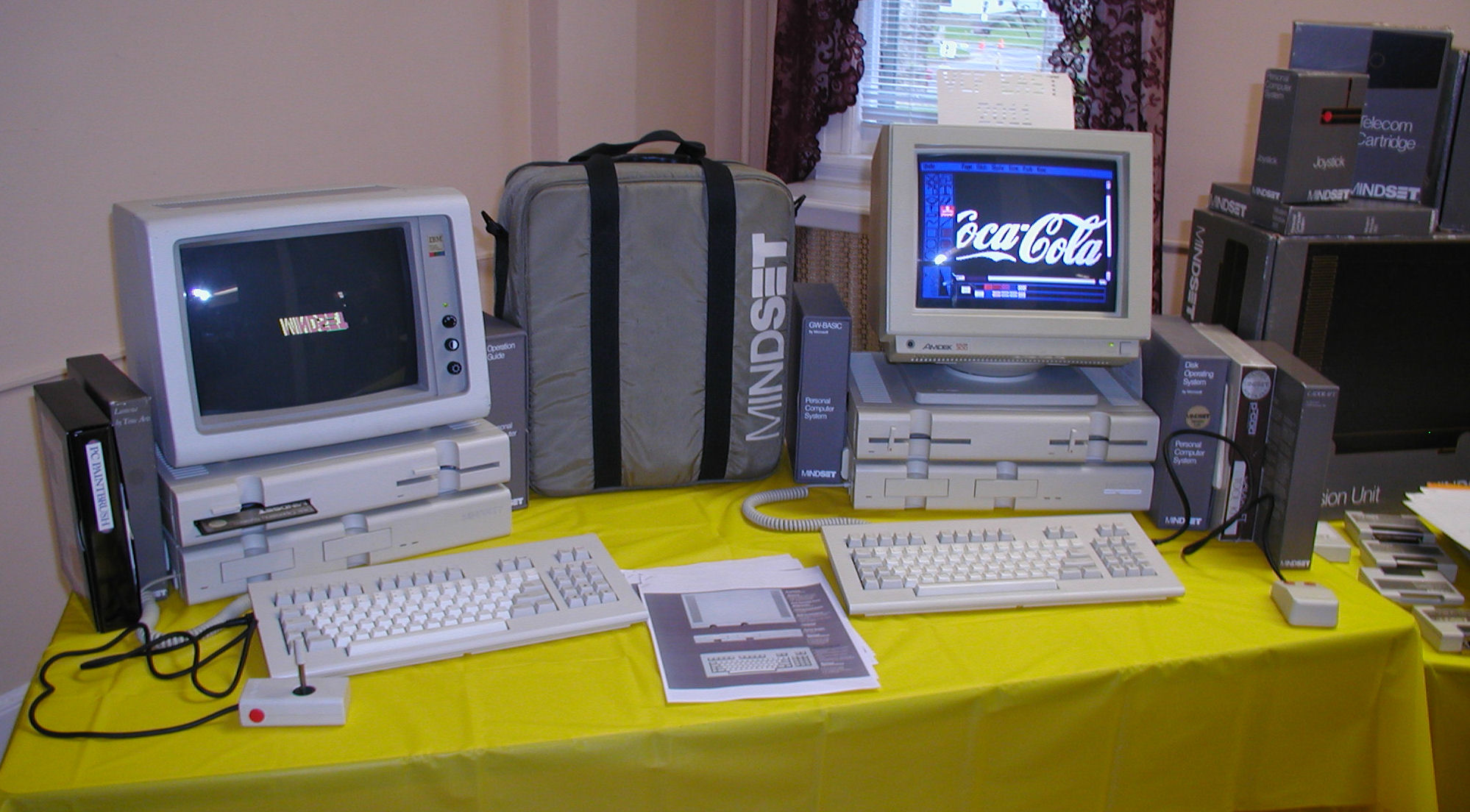
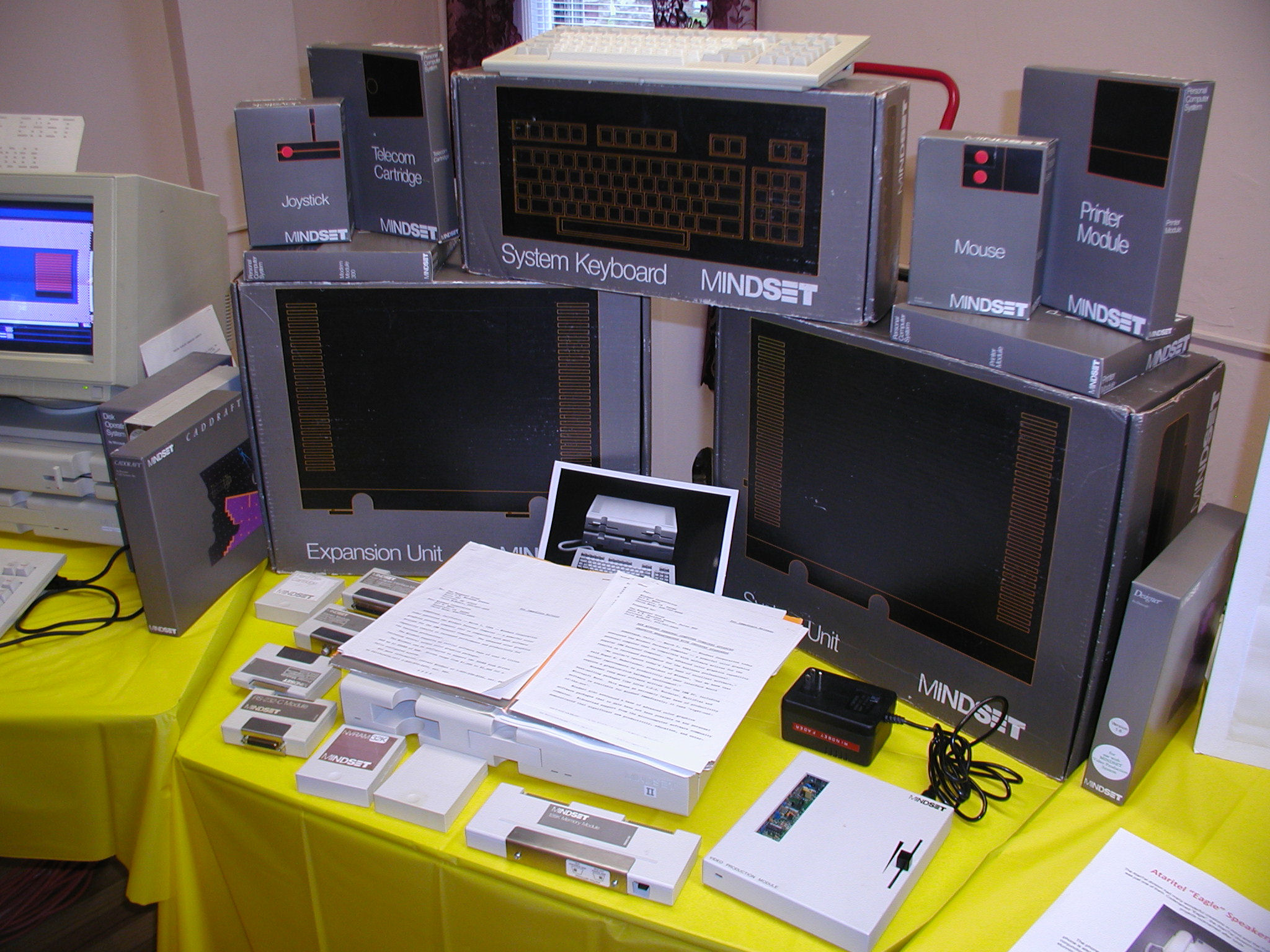
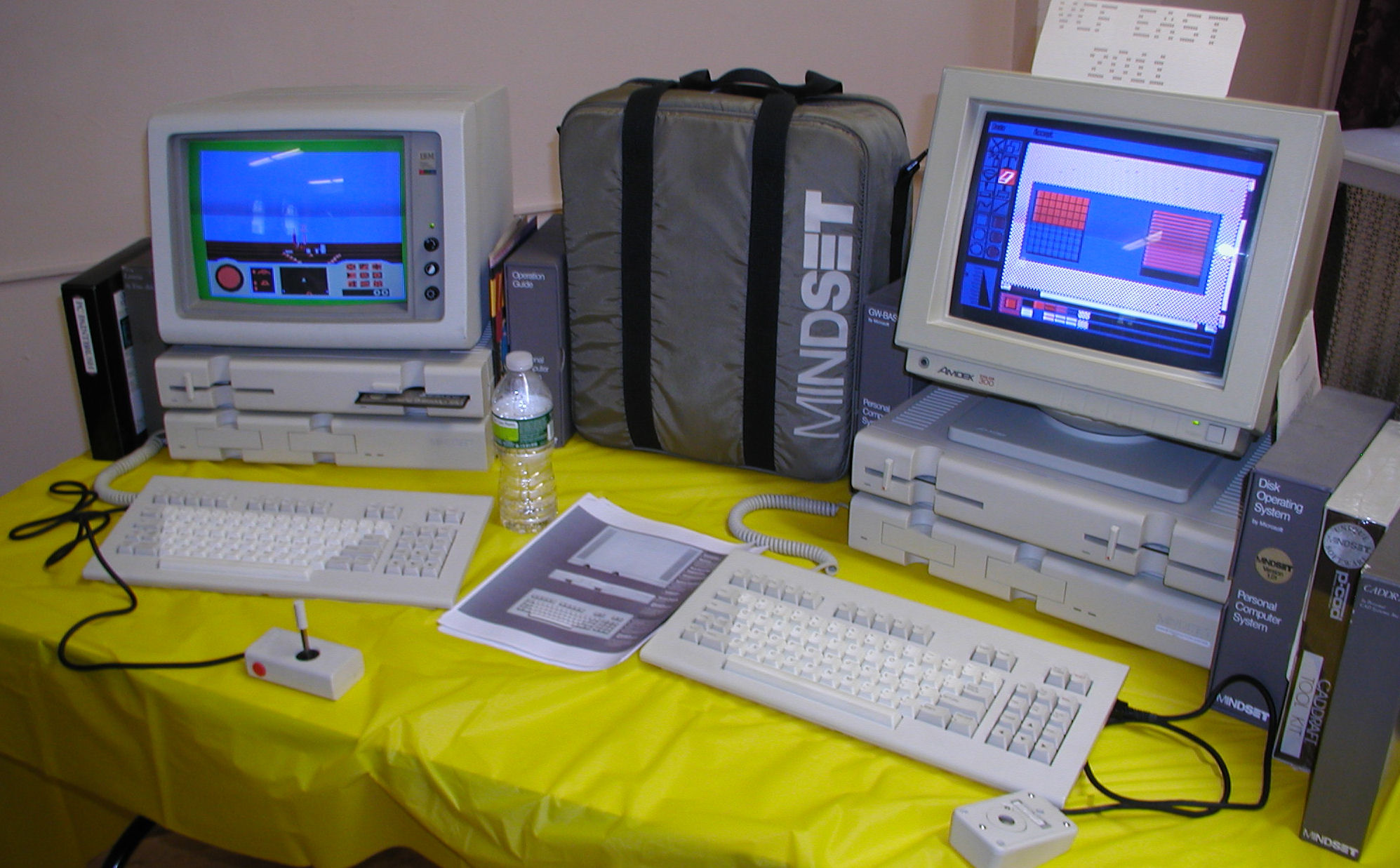
sell my Mindset Computer Corporation Collection.
I am only selling as a whole as I don't want this collection broken
up. I'm gauging interest, please email at: curt(at)atarimuseum(dot)com
Many have seen quite a lot of my collection as it was on display at a
recent VCF East show and one an award.
I have over a 1/2 dozen CPU units, expansion modules, plug in peripheral
modules, keyboards, joysticks, mice, tons of software, applications, and
games, many are in original boxes and are original disks, I have a huge
developers manual, marketing materials, units in boxes, a keyboard in a
box, peripheral accessories in boxes (many in never opened/sealed
boxes), I have one of the only Mindset software carrying case bags, and
much more. Need to put together a more detailed inventory, but it is
extensive.
Here are some photo's of a good bit of the collection (monitors are not
included):
http://vintagecomputer.net/vcf7/Exhibits/Mindset_exhib_Vendel2.jpghttp://vintagecomputer.net/vcf7/Exhibits/Mindset_exhib_Vendel1.jpghttp://vintagecomputer.net/vcf7/Exhibits/Mindset_exhib_Vendel4.jpghttp://vintagecomputer.net/vcf7/Exhibits/Mindset_exhib_Vendel3.jpg
Will also included domain: www.mindsetcomputer.com with sale...
Regards,
Curt
Great, thanks. I'll give the cleaning process a try before a speed
adjustment.
Thanks...Win
----
Almost all the A3 drives that have come my way were malfunctioning. Best
bet is to disassemble them and carefully clean and lube. First, use some
canned air to blow out all the dust bunnies. The original grease used on
the head assembly rails and the spiral-cut plastic stepper wheel
solidifies over the years. I usually use a tiny bit of WD-40 on a swab to
remove the old lubricant, then a bit of Tri-Flow to replace it.
A speed adjustment may very well be needed, but another problem area is
the two trimpots on the top of the drive circuit board. They tend to grow
oxide and become intermittant. Mark the position of the pots with a
felt-tipped pen, then wiggle them with a screwdriver until the little gob
of locking compound breaks. Squirt a small amount of non-residue control
cleaner in the side and work them through their rotation a few times.
Reset to the marked position. You can lock them in place again with a dab
of nail polish, but don't do this until you know that things are working
again! Reseat all the chips on the board and check closely for "black pin"
syndrome. For some reason, the chips in the disk drives seem more prone
to this (more exposure to humidity?) If you see this, pull all of them
and take a contact cleaning tool to the legs.
Finally, take a swab and carefully clean the head with isopropyl alcohol.
I've successfully repaired four or five drives in this manner.
Steve
There has been significant progress over the Holidays. All the Basic
Instruction Diagnostics now execute successfully. Many of the Advanced
Instruction Diagnostics also execute successfully - the Advanced
Diagnostics that fail, do so because they require support from the
Diagnostic Monitor (SMMON) which is not 'linked in' at this time.
I have a design roughed-in for a RH-11 Massbus Controller supporting 8
RP06 Disk Drives. All 8 RP06s disks use a single 8GB Secure Digital
(SD) Disk Card for media. There is still a lot to do before the Disk IO
will be ready to test. I've also implemented an DZ-11 8-port Terminal
Multiplexer, and the KS10-Backplane-to-Unibus IO Bridges.
If anyone knows where to find the KS10 DZ-11 Diagnostic DSDZA Source
code, please contact me.
I have verified that I can use the same 'bits-on-disk' format as SIMH.
That will allow the KS10 FPGA to use any of the freely available disk
images without modification. You also should be able to use the SIMH
Tape IO facilities to create your own disk images.
For complete information, please visit:
http://www.techtravels.org/KS10FPGA/
Rob Doyle
doyle (at) cox (dot) net
A quick update on my Apple III. I used the BNK, ADR and Exp/Got info from
the Apple III RAM test to narrow down the bad RAM chip. I replaced it with
one from an Apple II and it worked. The RAM test completes successfully,
but it does do one odd thing shown in this pic...
http://i.imgur.com/VP98h.jpg
Row 7 gets dashes across it during the second pass and all subsequent
passes. The test, however, continues normally. I ran it over 10 passes
with no problems. Any ideas what the dashes mean?
On the downside, my III still doesn't boot. It does pretty much what it did
before. WIth an SOS disk in the drive, it spins for about 3 seconds, then
nothing. The demo disk does the same thing. The III+ diagnostic disk that
used to boot, doesn't boot anymore and fails with an IO error message.
This makes me think again that there may be a floppy drive issue. Is the
drive calibration method that was mentioned previously the one that is
outlined in the Sun Remarketing Do It Yourself Guide for adjusting Apple
III drive speed...that uses a 60 Hz light source? If so, I guess that's my
next task to try to revive this machine.
Thanks,
Win
Hi
If funds and/or PayPal is an issue, I am willing to barter items instead.
We can make trades for certain computer parts, electronic components, tools,
metals, coins, unused gift cards, shipping materials, scrap, etc. Please
let's discuss! Many times I have just sent (gratis) PCBs to known N8VEM
builders especially those working on tough problems or less popular areas
that need attention.
Times are tough for many these days. Please don't let a lack of cash or
issues with PayPal limit your participation. Thanks and have a happy
holidays!
Andrew Lynch
I have been trying to find if there is a published spec for the DEC LAVC SCA
protocol. The reason I want to find it is that I want to see if I can work
out why my MicroVAX II is failing the net boot, it times out after a while
and falls out of the cluster. I suspect I have a hardware problem, but would
like to use a packet sniffer to work out what is going on. Is such a
document available?
Regards
Rob
Hi,
If there are any builders who would like to participate in the MC68040 SBC
project please let me know.
We are working on an intermediate project at the moment based on the MC68360
which is the integrating glue for the MC68040 SBC. The MC68360 is the
all-important piece that has to work well before even considering the
MC68040 CPU since it is a standalone processor by itself.
There are some spare MC68360 P1 PCBs remaining (see the excerpted status
update below) and the basic board seems to be working. It is booting from
the ROM and partially initializing. More work is underway to further
initialize the MC68360 chip subsystems like timers, UARTs, etc.
The plan is to integrate a Propeller based IO subsystem (VGA display, PS/2
keyboard, microSD mass storage), DRAM, and Flash memories to the final SBC.
This is an ambitious project and will take quite a bit of time so if there
are any experienced MC68040/MC68360 builders that would like to contribute
your help would be greatly appreciated. Additional information is posted
below.
http://n8vem-sbc.pbworks.com/w/browse/#view=ViewFolder¶m=68040%20SBChttp://n8vem-sbc.pbworks.com/w/browse/#view=ViewFolder¶m=MC68360%20P1
Similar to other N8VEM home brew computing project boards these are
free/open source designs including hardware, software, and other related
information.
Please contact me at LYNCHAJ at YAHOO.COM if interested.
Thanks and have a nice day!
Andrew Lynch
-----Original Message-----
[snip]
To: Andrew Lynch
Subject: Re: 68360 - status
Hi Andrew!
I have made quite a bit of progress - if you look at the steps on 9-13
through 9-16 of the User Manual I am at step 11 so I only have a few steps
left.
[snip]
BTW - I have I think 4 extra boards (the other place sent me boards anyways)
so if people want to join in the fun, I can forward you the boards. We are
also going to have to chat on how we proceed from here - looking at the
stuff Alan sent and other errata - the 68040 is not going to be a "glue
less" implementation and will require some GALS or a CPLD.
[snip]
Hi
Recently there has been a bit of renewed interest and an uptick in activity
in the N8VEM SCSI to IDE/SD bridge board project.
http://n8vem-sbc.pbworks.com/w/browse/#view=ViewFolder
<http://n8vem-sbc.pbworks.com/w/browse/#view=ViewFolder¶m=SCSI%20to%20ID
E%2FSD%20prototypes> ¶m=SCSI%20to%20IDE%2FSD%20prototypes
There are still some prototype boards available in case anyone would like to
help bring this project to completion.
The prototype boards do work in that they are booting the debug monitor
(Zapple) and the IO subsystems are checking out.
What we need is the programming to make the Z53C80 SCSI controller work in
target mode with the SCSI host mode controller.
This board project will be free/open source with software, hardware, and
other design information posted to the public.
Please contact me if you are interested in helping out at LYNCHAJ at YAHOO.COM
I realize there are many ways to accomplish this task and the Z80 based
embedded controller board is but one. There may be other valid approaches
however none are free/open source projects AFAIK. Please post a link if I
am mistaken.
Any lessons learned and/or design information from this project could be
readily applied to a follow-on project potentially using different
technologies. However I think it is important to get this first step
working before moving on to another design. I am willing to support a
follow-on design once we get this one working properly.
I believe with a quick Z80 (8 MHz or greater) there should be sufficient
through put for most SCSI-1 applications. It will never be a "speed demon"
but the older vintage/classic/hobbyist SCSI-1 machines probably don't need
one either. Many of the aging SCSI-1 machines are going to go "offline"
forever if the supply of SCSI-1 drives dries up.
Thanks in advance for your consideration. Have a nice day!
Andrew Lynch
Looking to test/service/align a number (10 or so) of double-sided
double-density 3.25 floppy drives and hoping there is someone here in
Canada who has the alignment discs that I could borrow/buy.
These are for setting up some of my older computerized microprocessor
test gear (Fluke mostly)...
Suggestions on aligning are also greatly appreciated!
Thanks!
John :-#)#
Since I don't have hardsectored floppies, I would hope that someone here could help out ?
I am located in Switzerland,costs will be covered .
Jos Dreesen
Since I don't have hardsectored floppies, I would hope that someone here could help out ?
I am located in Switzerland,costs will be covered .
Jos Dreesen
Hi
A quick status of N8VEM and S100computers.com S-100 board PCB
New S-100 LAVA PCBs are on their way and should be here in a week or less.
http://s100computers.com/My%20System%20Pages/Lava-10%20Board/LAVA-10%20Board
.htm
Reordered respin S-100 Console IO PCBs should be here in mid to late Jan
2013
http://s100computers.com/My%20System%20Pages/Console%20IO%20Board/Console%20
IO%20Board.htm
Reordered S-100 regular prototyping boards (just PTH area, no additional
circuitry) will be ordered mid-Jan 2013 with estimated delivery early to mid
Feb 2013
http://n8vem-sbc.pbworks.com/w/browse/#view=ViewFolder¶m=S-100%20regular
%20prototyping%20board
Finally, a couple of new S-100 PCBs are in work and my plan is to order them
in Feb 2013 starting with the S-100 68K CPU board. Please note the V3
version of the S-100 68K has the chips in horizontal layout and has a
completely different appearance than the prototype boards on the webpage.
http://s100computers.com/My%20System%20Pages/68000%20Board/68K%20CPU%20Board
.htm
Immediately followed by the S-100 80286 CPU board (Don't be scared of the
prototype board images since the final board has all the fixes and is clean)
http://s100computers.com/My%20System%20Pages/80286%20Board/80286%20CPU%20Boa
rd.htm
If you are interested in any of the above boards please contact me at
LYNCHAJ at YAHOO.COM
Please note this is a hobbyist project and purely for
entertainment/educational purposes.
By getting these PCBs you are participating in their development at the
N8VEM home brew computing project.
Thanks and have a nice day!
Andrew Lynch
PS, there are a couple of S-100 board projects that are languishing "on the
back burner" and would like any ideas, comments, thoughts, and/or questions
as to what to do with them. The S-100 VDP V2 (V9938 and AY-3-8910 color
graphics and sound generator) and the S-100 uPD7220 GDC (accelerated
graphics VGA monitor compatible - not register compatible - 640x480 or
800x600 at 16 colors - 4 bit planes).
Hi
Things have slowed down a bit on the N8VEM home brew computing project
lately.
I'd like to clear some boards off the shelf to free up some hobby funds and
make room for new projects.
To help move things along a bit I am having the first ever multiple ECB
board "free shipping special"
So far it has been pretty popular. Please see the note on the mini-68000
ECB system though regarding the minimum system.
More information here:
http://groups.google.com/group/n8vem/browse_thread/thread/f240fa29ece4cfae
Thanks and have a nice day!
Andrew Lynch
My Commodore VIC-20 (and the VIC-20 in general) is discussed in this
YouTube video (see link). This will be the last video for a while as I
return to work on Monday after the Xmas break (bummer).
http://youtu.be/hyHNdAhWVmM
Terry (Tez)
Hi all --
Picked up an interesting old "laptop" -- a GRiDCase 1537E. This is a
Tempest-hardened devicewith (I believe) a 386 processor. Also looks to
have an electroluminescent display. Inside there isn't a single exposed
wire or circuit board, so any debugging I might need to dowill be a fun
prospect. At any rate, I didn't get the AC adapter with this thing and
it's got an odd connector that I'm not familiar with. See here:
http://yahozna.dyndns.org/scratch/gridcase/1537/power.png
The connector's abit over 1cm in diameter with three oddly-spaced pins.
I'dlike to build areplacement assuming I can work out the pinouts (and
find/fabricate a mating connector). Anyone know anything about this
machine?Any ideas where to find such a connector?
Thanks,
Josh
What country/nationality are those names? I'm jealous. They sound straight out of a Tolkien novel.
-----Original Message-----
From: "Bill Sudbrink" <wh.sudbrink at verizon.net>
Sender: cctalk-bounces at classiccmp.orgDate: Fri, 04 Jan 2013 16:49:56
To: 'General Discussion: On-Topic and Off-Topic Posts'<cctalk at classiccmp.org>
Reply-To: "General Discussion: On-Topic and Off-Topic Posts"
<cctalk at classiccmp.org>
Subject: RE: Early CD-ROMs was: NASA computers circa 1969
Dave McGuire wrote:
> You didn't work for a flaming asshole of epic proportions
> who went by the name of "Murf", did you?
No, not that I remember. Are you talking about someone at
Meridian? I didn't work there, I worked for AIRS (Automated
Information Retrieval Systems) back then. The guy I worked
for was named Eldon. I collaborated with (over the phone) a
a guy named Wink at Meridian. What was his last name? Like
the chipmunk guy I think... Seville? We were one of Meridian's
first customers on the East Coast. Wink wrote their custom
drivers. Before mscdex, before Yellow Book, back in the dark
days.
Bill S.
geneb writes:
> As far as I know, there was never a known instance of a virus on an 8 bit machine.
"Elk Cloner" for the Apple II, according to Rich Skrenta went wild in 1982. Was written up very nicely in a Scientific American article in March 1985 (good enough that I wrote a "me too" virus based on the article.)
Very similar to what a IBM-PC guy would call "a boot sector virus" (although really there's a little more than that in either the Apple II or PC-clone cases.)
It would be interesting if any of the Apple II disk image archives, have Elk Cloner or lookalikes in them. I once thought about automating such a search as an addition over the effort to index the Apple II disk images floating around on the net. Haven't thought of that in, oh, nearly 20 years now!!!
Tim.
Looking to test/service/align a number (10 or so) of double-sided
double-density 3.5 floppy drives and hoping there is someone here in
Canada who has the alignment discs that I could borrow/buy.
These are for setting up some of my older computerized microprocessor
test gear (Fluke mostly)...
Suggestions on aligning are also greatly appreciated!
Thanks!
John :-#)#
--
John's Jukes Ltd. 2343 Main St., Vancouver, BC, Canada V5T 3C9
Call (604)872-5757 or Fax 872-2010 (Pinballs, Jukes, VideoGames)
www.flippers.com
"Old pinballers never die, they just flip out"
I just stumbled across a sort of show-and-tell of computers used by NASA
in the 1960s. See http://www.youtube.com/watch?v=nrwpXEiTDVk
--
David Griffith
dgriffi at cs.csubak.edu
A: Because it fouls the order in which people normally read text.
Q: Why is top-posting such a bad thing?
A: Top-posting.
Q: What is the most annoying thing in e-mail?
On 01/04/2013 04:49 PM, Bill Sudbrink wrote:
>> You didn't work for a flaming asshole of epic proportions
>> who went by the name of "Murf", did you?
>
> No, not that I remember. Are you talking about someone at
> Meridian? I didn't work there, I worked for AIRS (Automated
> Information Retrieval Systems) back then. The guy I worked
> for was named Eldon. I collaborated with (over the phone) a
> a guy named Wink at Meridian. What was his last name? Like
> the chipmunk guy I think... Seville? We were one of Meridian's
> first customers on the East Coast. Wink wrote their custom
> drivers. Before mscdex, before Yellow Book, back in the dark
> days.
Ok, different gang. Fortunately for you. ;)
-Dave
--
Dave McGuire, AK4HZ
New Kensington, PA
I'm looking for the manuals or copies of my Atlantic Research 4500 protocol
analyzer.
If somebody has a copy for me I would be very happy.
-Rik
PS. I got a spare unit if anyone wants it, it is a but busted and the tape
drive is missing but it seems to work.
Bill Sudbrink wrote:
> Shoppa, Tim wrote:
> > I'm sure somebody here did it. 5150 with a CM153 card for
> > Philips CM100 player?
>
> Yes. That was the test platform for an early CD-ROM company
> I worked for. We also had a Meridian Data CD-Publisher.
> It wrote 9-track tapes that we sent to PDO Holland. They
> would send us back some count of CDs along with the glass
> master. That was what? 1983 or maybe 1984. I had one of
> those glass masters in my office for a while but I've lost
> it somewhere along the way.
>
As I think about it, I'm pretty sure I have a CM110 (the SCSI
interface version) in a box around here somewhere.
Bill S.
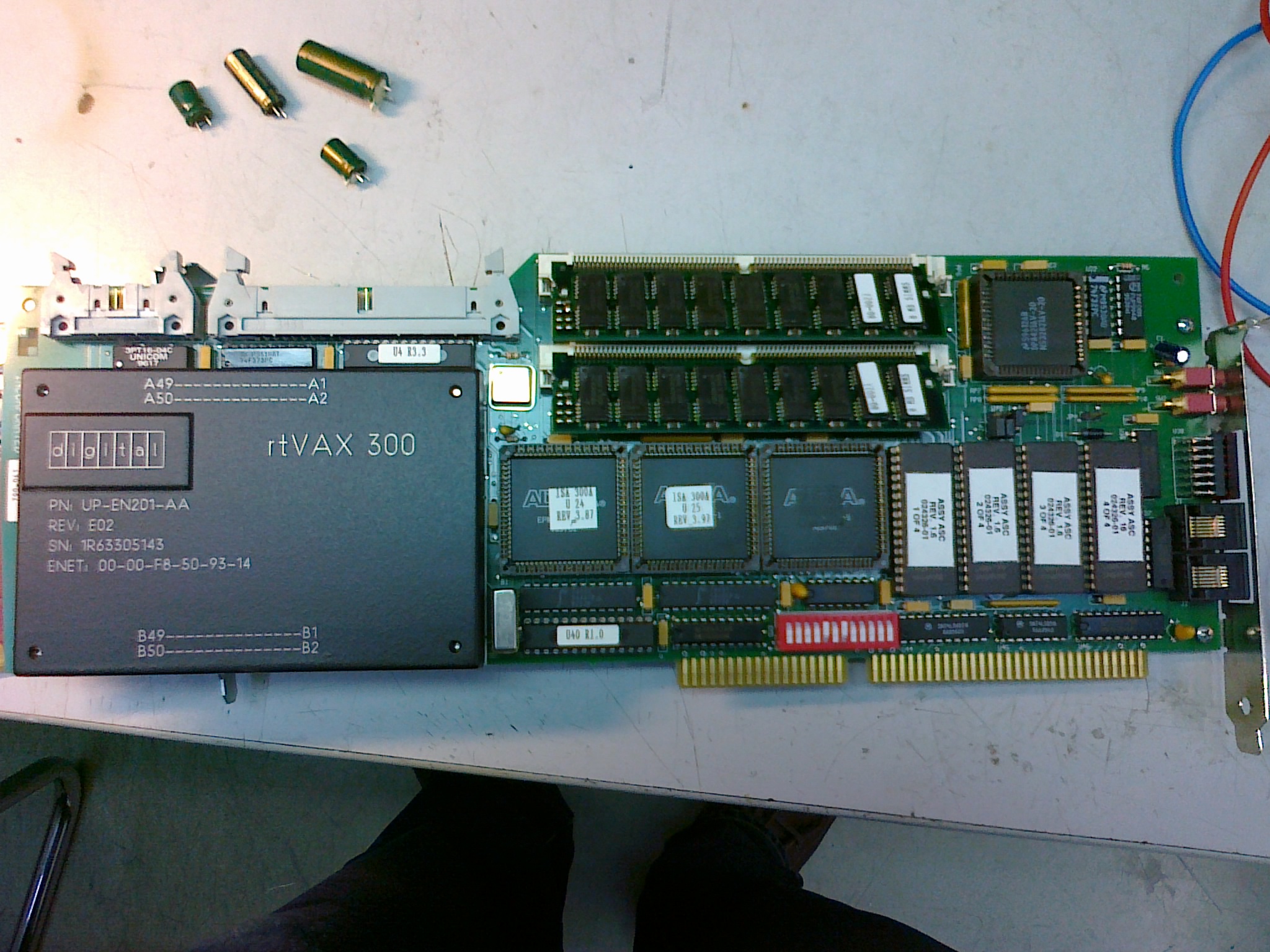
Next time I'll get this:
http://www.tiffe.de/images/11122012114.jpg
Is anything known about this board here (Manufacturer, Adresses,
Switch settings and so on)?
Looks to me like an VAX upgrade to an PC with onboard SCSI, Ethernet
and Serial Ports...
I have 2 2nd rtVAX board here from a friend, this is a VME CPU with
SCSI on board. I should look if I could get it to boot..
Any hints welcome,
Holm
--
Technik Service u. Handel Tiffe, www.tsht.de, Holm Tiffe,
Freiberger Stra?e 42, 09600 Obersch?na, USt-Id: DE253710583
www.tsht.de, info at tsht.de, Fax +49 3731 74200, Mobil: 0172 8790 741
With lots of help from members of this forum and other friends I made
a high-speed paper tape reader emulator from a wire-wrapped interface
board and an Emcraft SmartFusion FPGA evaluation board. The interface
board plugs onto the Posibus interface slots in a PDP-8/L.
I loaded Focal from a BIN paper tape image into a PDP-8/L in about 2
seconds. That equates to about 3000 characters per second.
I put some details about the project here:
https://sites.google.com/a/ricomputermuseum.org/home/Home/equipment/pdp-8-l…
I will make an expanded version of the interface board and change to
the Emcraft SOM FPGA board. That will give me enough I/O pins to
emulate just about any peripheral that you can connect to the Posibus.
It would be possible to make an interface board for the Negibus so
that the peripheral emulator could be used on earlier PDP-8 systems.
--
Michael Thompson
For those of you who like the OLD electronics, here is a free ebook:
http://www.tubebooks.org/Books/Findlay_experimenters.pdf
Cindy Croxton
_____
No virus found in this message.
Checked by AVG - www.avg.com
Version: 2013.0.2805 / Virus Database: 2637/6005 - Release Date: 01/02/13
For those of you trying to deal with old Adaptec cards, like the AHA-15xx
series, EZ-SCSI is needed, since they have no on-board controls, others than
a few jumpers. The software came with some drives, but is hard to locate
now.
You can download the entire program here:
ftp://82.199.101.173/install/System/Driverzzz/CD/SCSI/Adaptec%20EZ-SCSI%204.
01a%20-%201
Documentation is here:
http://www.adaptec.com/en-us/support/_eol/scsi_sw/ez-scsi_4.01/install_sw/ez
scsi_401_readme.htm?nc=/en-us/support/_eol/scsi_sw/ez-scsi_4.01/install_sw/e
zscsi_401_readme.htm
According to Adaptec, this will not work with anything higher than Win95 or
NT, but you can use it in DOS or 3.1
Enjoy!
Cindy Croxton
_____
No virus found in this message.
Checked by AVG - www.avg.com
Version: 2013.0.2805 / Virus Database: 2637/6005 - Release Date: 01/02/13
Good idea. Thanks for the plan. I'll give that a try.
----
And why would he do it with such a great memory board he has? It is just
a matter of finding one (socketed) memory chip! :oD
You can do a simple troubleshooting to discover which chip is defective
without having 4164s there:
Number chips from 1 to 16:
1 2 3 4 5 6 7 8 9 10 11 12 13 14 15 16
Now swap the first and last (1 and 16) and run the memory test
No problems? swap 2 and 15, and run the memory test
No problems, swap 3 and 14 and so on
When you find that the last swap changed the position of memory error,
you know that one of these two chips has problems :o) Since you said you
have a //e, you can find 4164 as the main board memories of the //e.
Is there an image archive of software for the Displaywriter somewhere?
Someone donated one to the Computer History Museum recently, and I went through our archives and have
only come up with a bunch of versions of the CE disk and a single TEXT PACK 1 diskette.
I did image what we have, and put it up under http://bitsavers.org/bits/IBM/Displaywriter
One thing I discovered was you HAVE to degauss the floppy before cloning the CE diskette. It expects tracks 37, 41 and 43
to be blank or it hangs.
Im forced to sell my spare CFFA 3000 for Apple II, this allows you to
use USB and Compact Flash cards on your Apple II, boot disk images
right off a USB Stick
175 shipped in the USA, These are sold out right now
Heres a link to what they are
http://dreher.net/?s=projects/CFforAppleII&c=projects/CFforAppleII/main.php
Mike,
Good info, thanks. I actually have a copy of the ON THREE manual...I
forget where I found it or why I have it, because I wasn't aware that I had
that board until a couple of days ago.
Thanks for the offer of the loaner board. I may take you up on that, but
let me try using the ON THREE manual and making sure the board is installed
correctly and and everything is seated properly. And, if I can pinpoint
the bad chips, I might try ordering some replacements to see if it can be
fixed. If I eventually do swap in one of your loaner boards, I'm wondering
if I can roll the other changes back? It looks like there were a number of
mods made to the motherboard to accomodate the 512K board....including new
ROMs. I certainly don't have the original ROMs to put back.
At any rate, my holiday vacation time and the disproportionate amount of
time I've been able to spend on this hobby, is about to end, so it may take
me a bit of time to get to all of it. But thanks very much for all the
info, I feel like I have a much clearer picture of how the III works and
what I need to do.
Win
Hi Win,
Yes, bad RAM could definitely cause that. The board you have was
manufactured by ON THREE, which got its start as an Apple III users
group. Once Apple turned its back on the III, ON THREE stepped up and
began producing its own hardware and software for the computer. Apple
had advertised the III as being expandable up to 512K, but never
released a board larger than 256K. As the ON THREE engineers
discovered, it required some new ROMs and additional addressing lines,
but they got it working. That 512K board is fairly rare and sought
after by III collectors, as SOS and big programs like Pascal can
really benefit from the extra room.
I'm not sure how easy it is to locate replacement chips for that board
these days. Last time I checked (a few years ago), they were still
available if you knew where to look. I have a few extra RAM boards
for the III (256K and 128K, though - not 512K). I could loan you one
for troubleshooting purposes, if you're interested.
I wrote a quick blog entry a while back about ON THREE's card:
http://www.6502lane.net/2011/01/17/a-look-at-on-threes-512k-memory-board-fo…
Also, I have a PDF version of the user manual that came with it. The
links in that blog entry are dead, but I can upload it, if you want.
- Mike
On 12/31/2012 11:24 AM, Bill Sudbrink wrote:
>>> Ironically, the garbage collected languages lead people to write even
>>> sloppier code than they write in C++.
>>
>> ...and that's saying something!
>>
>>> They think that garbage
>>> collection is a silver bullet that frees them from having to consider
>>> the resource consequences of their implementation.
>>
>> Yes. "I'm a MODERN programmer! We don't have to worry about stuff
>> like managing our own memory anymore!"
>>
>> Morons.
>
> Exactly. The "key phrase" that I encounter is "I don't want to have to
> think about...". If someone I'm interviewing says that, the interview
> tends to end fairly quickly.
Hear hear!
-Dave
--
Dave McGuire, AK4HZ
New Kensington, PA
>> See http://www.youtube.com/watch?v=nrwpXEiTDVk
> I noticed but could not identify:
> 07:13 calligraphic graphics system with hidden line removal. Could be
> an Evans & Sutherland LDS-1, but might be something earlier.
> I've seen this system in several NASA films, but I've never been
> able to get any information on the hardware used.
I scratched my head at that myself. There's a slant to the frame not too different than the perspective you'd get if you had a movie camera pointed at some graphics terminal.
Several technologies I know of at that time, would not result in any such slant:
State of the art for several scientific application in that area, involved pen plotters (black ink on white paper) transferred to photographic negative movie film. (White image on black).
A slightly cheaper approach (used extensively in my area of academia) was line printer paper plots transferred to movie film (again often in negative). Sub-character resolution was possible through choice of characters (not dissimilar to "ASCII graphics" although I know the movies were made using IBM and EBCDIC!)
There was talk of direct-laser-to-film but I never saw it.
Tim.
Mike,
Another follow up that probably sheds a bit more light on my Apple III
issue. I tried copying some additional disk images today. I tried the
CFFA SOS image, but it exhibited the same behavior as the other SOS
image...the floppy drive spins for about 3 sec and then nothing. On a
whim, I tried the RAM test image. It worked and brought up the RAM test
screen and began the test. It stops and indicates bad RAM where shown in
the pic in the imgur link below. There appears to be third party RAM in
this III. Is that common? Is there a way to test without that RAM that
would be recommended? I did reset all of the RAM chips on the board, but
it still fails at the same location.
http://imgur.com/a/c40m0
On the bright side, I'm thinking this is a good sign for the floppy
drive...the down side is obviously RAM issues.
Thanks,
Win
A couple other related questions and a comments. I made a Apple III+
system diagnostics disk and that ran fine too. So it seems like the floppy
drive is Ok, and all of the tests passed except the RAM test, so that's the
big issue. The RAM test disk seems to help narrow down where the bad chip
may be, so I might have a chance to find it without trial and error.
It looks like there are two different RAM chips on the ON THREE board (as
Alexandre mentioned) TMS4164-15NL and D41256C-15. It turns out I have an
extra AST SprintDisk for my Apple IIe with a few D41256C-15 chips. If I'm
lucky enough that one or more of those is the culprit, I may be covered,
otherwise I'll need to source a few chips.
If you look at the end of the ON THREE board in the second pic
http://imgur.com/a/c40m0
there is a white header connector on the ON THREE board that connects to
the male header on the Apple III motherboard. The ON THREE manual
indicates that a gentle rocking should loosen the connector. It is a
strange looking connector. The pins appear to come through from below and
bend at 90 degrees. I've applied quite a bit of force and they are not
breaking free. I'm afraid to pull too hard. Any pointers on how these
connectors work so I can avoid damage?
Thanks,
Win
>
> I made the same experience when I performed a "DEC-format-marathon" with ten
> ST-225 drives which were neither DEC-labeled nor where DEC-formatted before.
> Most of my disk drives where successfully formatted after having entered the
> drive parameters for the "TEST 70" procedure, but in case of some drives,
> the procedure was aborted. These drives where not successfully recognised
> as RD31 and no format was performed by my microVAX-2000 in these cases.
> What I found out is that the drives which were not recognised as RD31's were
> drives with some bad blocks detected when formatted with a PC.
> Can anybody else comment on or has made that experience?
>
I successfully formatted several oddball non-DEC-branded drives rescued from
a skip (dumpster) using a VS2000. It was a long time ago and I don't remember
the details but I suspect some at least had a list of bad blocks on the label.
I seem to recall that I did not have any way of knowing what the correct
parameters were and I found some by extrapolating from the example in the manual
and by trial and error. I agree with the general view that they should be
jumpered as DS3 for the internal drive.
I eventually made a new drive cable so that I could have a "hot swappable"
disk outside the case. This worked great until I came upon one particular drive
which, when I pushed the connectors onto it, the VS2000 PSU promptly switched
itself off. I was somewhat puzzled as I was using an external PSU for the disk
and could not have been overloading the VS2000 PSU or so I thought. I pulled
off the connectors, power cycled the machine and tried connecting the drive
again and the same thing happened. Not to be defeated, I tried connecting all
the cables up and then powering up the VS2000. This time the PSU tried harder,
the machine powered up and one of the wires in the data cable turned itself into
a heating element, melted and nearly set fire to its insulation. It seems that
one of the wires in the data lead to the external drive has a not very well
protected +5V on it and at least one drive variant shorts this to ground...
Regards,
Peter Coghlan.
On 31 December 2012 04:27, Zane H. Healy <healyzh at aracnet.com> wrote:
> Now that is seriously interesting! I knew there was a reason I was keeping
> up with this thread!
Thanks! [*Chuffed*]
I ought to have given due credit to another of the Giant Brains behind
FreeGEM, John Elliott, who is also on the list now, too. John is a
hero and a major force in PC-GEM, CP/M and Amstrad-related
development, emulation and various other areas, too.
--
Liam Proven ? Profile: http://lproven.livejournal.com/profile
Email: lproven at cix.co.uk ? GMail/G+/Twitter/Flickr/Facebook: lproven
MSN: lproven at hotmail.com ? Skype/AIM/Yahoo/LinkedIn: liamproven
Tel: +44 20-8685-0498 ? Cell: +44 7939-087884
On 2013-01-01 19:00, "Rob Jarratt"<robert.jarratt at ntlworld.com> wrote:
>> >-----Original Message-----
>> >From:cctalk-bounces at classiccmp.org [mailto:cctalk-
>> >bounces at classiccmp.org] On Behalf Of allison
>> >Sent: 01 January 2013 03:06
>> >To: General Discussion: On-Topic Posts Only
>> >Subject: Re: What PDP11 OS in 20MB Disk Space
>> >
>> >On 12/31/2012 04:25 PM, Dave McGuire wrote:
>>> > > Straight 11M (non-plus) does. (fits in 10 actually) Early RSTS/E,
> like v8,
>> >should, but not 10 and likely not 9. RT11 does.
>>> > >
>>> > > -Dave
>>> > >
>> >I have RSTS on RL02 so it must fit on 10mb!
>> >
>> >RT11 fits on anything, the whole build kit is two RL02s (boot and kits)
>> >
>> >I know of none that do not fit. RSTS and RSX are big and might have to be
>> >trimmed
>> >a little or some optional part left off.
>
> I am not sure how you would do that. I am following these instructions:
> http://9track.net/pdp11/rsx4_sysgen.
>
> The trouble is that after restoring the RSX-11M+ 4.2 tape, when I reboot
> from the disk it gives repeated disk allocation errors, presumably through
> lack of space. Is there a step that needs to be added when first restoring
> the tape to the hard disk?
Not sure what errors you are seeing, but it sounds weird.
Anyway, the normal way to run M+ from an RL02 was/is to use the
pregenned system for an RL02, which has all the necessary bits stuffed
in, and everything set up. Ready to go.
Generating your own system for running on an RL02 takes some careful
consideration...
Johnny
I have a packet of five BallWriter pens, part number 40C1 06-9 (is 06-9
the date code?) if any one has a use for them they are theirs for the
postage, but as I am in the UK it might be a few dollars.
--
Dave Wade G4UGM
Illegitimi Non Carborundum
Hi!
Good news! A new batch of N8VEM SBC V2 PCBs have arrived!
In addition I just received an email from the PCB manufacturer that the
N8VEM ECB backplane PCBs have been shipped.
They should be here in a couple of days. I am guessing later this week.
Here are some instructions on how to build the N8VEM SBC V2 for the total
beginner but are useful for most any builder
http://n8vem-sbc.pbworks.com/w/browse/#view=ViewFolder
<http://n8vem-sbc.pbworks.com/w/browse/#view=ViewFolder¶m=Building%20the
%20N8VEM%20for%20the%20Total%20Beginner>
¶m=Building%20the%20N8VEM%20for%20the%20Total%20Beginner
The N8VEM SBC V2 and ECB backplane are $20 each plus $2 shipping in the US
and $5 elsewhere.
Thanks and have a happy new year!
Andrew Lynch
Hi all,
I'm cleaning up the overflowing attic. Most of it will probably be rather painfully expensive to ship, so I guess it might be more for the Dutch people on this list. Some items could be shipped abroad, though.
Contact me off-list for details.
All prices listed below are exclusive of shipping costs.
Book:
UNIX Programming Environment soft cover, 15 EURO
USB KVM:
Sweex USB and Audio KVM switch for two machines, 10 EURO
PCs:
AMD XP 1900+ with Radeon x850x, 50 EURO
Compaq/HP D51s EVO, 25 EURO
Fujitsu/Siemens p300 with AHA2940 and 20GB DAT, 25 EURO
Apple:
PowerMac G4 AGP with white Apple keyboard, 25 EURO
SGI:
Indy with Indycam, original keyboard/mouse and SGI 20" CRT, 25 EURO
Sun:
GDM5410 21" Flat Trinitron CRT, 10 EURO
Ultra 5 333MHz/400MB, 15 EURO
Ultra 10 440MHz/768MB, 25 EURO
regards,
reiche
A New Year's look at another one of my classic rest home residents -
that triumph of British minimalism, the Sinclair ZX81.
http://youtu.be/YcE_HqCOTf4
Terry (Tez)
I introduced an error in a recent change to the scripts that generate
bitsavers RSS feeds for PDF and bits.
The symptoms were that the URLs for intermediate directories were
incorrect and the category for files was incorrect.
I believe I have corrected those errors and the scripts should be
working properly again.
--
"The Direct3D Graphics Pipeline" free book <http://tinyurl.com/d3d-pipeline>
The Computer Graphics Museum <http://computergraphicsmuseum.org>
The Terminals Wiki <http://terminals.classiccmp.org>
Legalize Adulthood! (my blog) <http://legalizeadulthood.wordpress.com>
I have a Seagate ST-225 that I want to put into my Micro PDP-11/73. At the
moment I am just trying to see if the disk works at all and if I can format
it in a MicroVAX 2000. It spins up but the TEST 70 and TEST 71 commands fail
on it, unable to determine the type of disk. There are some jumpers for
which I have found some documentation here:
http://stason.org/TULARC/pc/hard-drives-hdd/seagate/ST225-21MB-5-25-HH-MFM-S
T412.html, but I am not sure which is pin 1, and I am not sure what settings
the MicroVAX 2000 wants, or if it needs the resistor termination pack.
Can anyone tell me which jumper settings I need for the disk to work in a
2000? And whether I need the resistor pack installed?
Thanks
Rob
On 2012-12-30 23:00, Glen Slick<glen.slick at gmail.com> wrote:
> On Sat, Dec 29, 2012 at 3:44 PM, Jerome H. Fine<jhfinedp3k at compsys.to> wrote:
>> >
>> >So the quick answer is probably that all M8190 boards are PMI capable, but
>> >the PMI is not activated if PMI memory is not present in the correct
>> >slot(s).
>> >In addition, probably all M8190 boards are happy being placed into a VT103
>> >backplane which will not support PMI activation.
>> >
>> >Of course, I can't guarantee there won't be magic smoke released if the
>> >M8190-AE
>> >is placed into a VT103 backplane.
>> >
> I remain skeptical that everything will just be fine if you place an
> M8190 KDJ11-B into a non-Q22/CD backplane.
>
> If you look at Table 2-9 (page 2-19) and Table 2-10 (page 2-20) in
> EK-KDJ1B-UG_KDJ11-B_Nov86.pdf, won't placing an M8190 into a
> non-C22/CD backplane essentially connect the CA1-CV1 signals in Table
> 2-10 straight through to the AA1-AV1 signals in Table 2-9, and same
> with the DA1-DV1 signals and the BA1-BV1 signals? That doesn't seem
> like something that would allow normal functioning.
I think you are right, Glen. The M8190 is intended to sit in a Q-CD
slot, not a Q-Q. I'd surprised if it works.
However, if you ever want to put an M8190 in a VT103 you need to rewire
the backplane anyway, as the VT103 backplane don't even do Q22 if I
remember right.
> Also, it is clear from Table 2-10 that the PMI signals on the M8190
> only exist on the top (component) side of the board and can only
> communicate over the PMI with memory boards physically located above
> the M8190.
Correct. The PMI memory for PDP-11s work in both Q-CD slots and PMI
slots, but they only perform as PMI memory if they sit above the CPU in
a Qbus backplane.
I'm not sure the PMI memory boards would work in Q-Q slots either...
Johnny
About John's design
If I understand correctly, your are using one of the newest Xcore product,
I guess, mainly for USB "full access", and this new chip is not yet
available, is it ?
Question, because your project seems very interesting to me :
Why did you chose that Xcore product, versus already available
chips like PIC 32 ?.
I am NOT a specialist about chips, but I do not see much difference between
the two,
USB speaking.
Do you take advantage of the multi-core chip ??
To me ( again, I am not a specialist, so pardon the question ) Is complexity
of multi cores
chips "justified" for that kind of interface ?
I mean architecture and compiler learning complexity balanced versus
advantages ??
Or is it just for the learning fun ;-)
Dear Mr. Watzman
I am an IMSAI 8080 owner from Switzerland.
Currently i look for an IMSAI FDC floppy system with CalComp 140 drives.
I startet my search for this floppy system several years ago, but i could never found it.
Now, i'm googling on IMSAI FDC and your name is the first result what i see.
I contact some peoples (Todd Fischer, Herb Johnson, John Monahan and Howard Harte (who never answered)) and some others.
Well, did you now who has one of these and they are willing to sell?
Thanks in Advance
Matt Schoeller
Switzerland
------------------------------
On Wed, Dec 26, 2012 8:29 AM PST Al Kossow wrote:
>On 12/26/12 6:48 AM, Colin Eby wrote:
>> Al,
>>
>> I'm away for the holidays, but could have a rummage at TNMoC when I return.
>
>will do.
>
>I'm trying to work down the backlog of IBM media I have to image over the holiday break.
>One thing I noticed is getting track 0 to read correctly is picky about the controller
>used with Imagedisk. An Adaptec AHA-1522 works correctly with a National DM8473A.
>The Displaywriter supported either single or double-sided drives.
>
>
>
>
who made the drives in the DW? Are they useful for imaging with a modern pc?
In the past I successfully low-level formatted PC-formatted ST225
using XXDP2.5 directly on PDP11/53 with RQDX3.
If I remember correctly, I used ZRQCH.
As I had a machine with RX33 (5"1/4), I prepared a booting image of
XXDP on SIMH, transferred the image to floppy disk with vtserver,
then executed the diagnostic program, inserted the right parameters, and voil?.
It worked like a charm on all the ST225 I have, also on one that have
a lot of defective sectors.
Andrea
Hello ALL !
I have got an strange idea for the last day of the year ( It was time ;-) )
I am wondering about a PCI to EXTERNAL ISA interface board.
Here is what in think of :
PCI interface board INSIDE a present days PC, LINKED TO
external ISA passive backplane. ( outside of the PC )
With , ideally, as discussed before on this thread, DMA possibilities
Does it ( still ? ) exist some ***afordable*** commercial product ?
Does that has been already discussed somewhere on this forum ?
Does someone built that kind of interface , DIY way, in the past ?
Will there be restrictions on this connectivity, if the PC "reverse" ( is run ) under plain DOS
versus running DOS under Windows ??
PLS, remember that I am a new comer on this file, so I may be sligthly
out of topic in this thread. If so , my apology.
Thanks and Happy New Year Everybody !!
> At 4:19 AM +0000 12/31/12, Liam Proven wrote:
>> On 27 December 2012 15:00, William Barnett-Lewis <wlewisiii at gmail.com>
> wrote:
>>> ? I wonder what the state of the art in Atari emulation is?
>>
>> Very good, I believe. There are various emulators for gamers which can
>> emulate different early/original models with great fidelity so that
>> you can run demos and so on - this is the main focus.
>>
>> There are also some emulators for those who wish to run desktop TOS apps.
that's more wait I want :)
>>
>> Also, x86 PC GEM itself is now GPL open-source:
>> http://www.deltasoft.com/Default.htm
>>
>> (The FreeGEM community is where I first "met" CCmper Gene Buckle.)
>>
>> There have been efforts to bring across some of the Atari
>> improvements, but development largely stalled quite a few years ago.
>>
>> On the Atari side, various people wrote replacements of various bits
>> of TOS - the VDI, the AES, the desktop and so on - and some of these
>> parts were FOSS.
>>
>> Eventually, the result was a complete FOSS Atari OS, containing almost
>> no original Atari code but highly compatible. It's called AFROS and it
>> runs best on an emulator called ARANYM, which is designed for running
>> TOS and TOS apps on PCs, rather than games.
>> http://aranym.org/
>
> Now that is seriously interesting!? I knew there was a reason I was
> keeping up with this thread!
more websites to bookmark
>
> Zane
Hello everyone!
I have a question which to some might seem rather obvious to some, but
I cannot find the answer. And guessing by my recent streak of luck
I'll probably find the answer to this question after posting the
question to the list... Nevermind, back on topic.
The question at hand: Can a PMI processor -- in this case a KDJ11-BF
-- be put into a non-PMI serpentine QBUS backplane? Or will the magic
smoke be released.
If the answer is a resounding "no". Any one here have a KDJ11-AC
(M8192-YC) they'd be willing to trade for a KDJ11-BF (M8190-AE)?
I'm also interested in some other QBUS '11 boards, a -- short -- list
follows, in order of precedence:
> DLV11-J/DLVJ1-M (M8043) -- or compatible
> QBUS (non-PMI) memory -- I'd *LOVE* to get an MSV11-QC (M7551-CA, 4MB), -QB (-BA, 2MB) or -QA (-AA, 1MB) memory board; I'd also be fine with a 256KB MSV11-LK (M8059-K*) board
> 22-bit compatible boot ROM board -- e.g. The BDV11 (M8012) revision E.
> QBUS SCSI controller -- I'm really gunning for the CMD CQD-220A/TM, though I'm for any form of QBUS SCSI controller that can be both TMSCP tape and MSCP disk controller at the same time
> DRV11-J (M8049) -- or compatible
> DHV11 (M3104) -- or compatible
> LPV11 (M8027
> DELQA (M7516) -- or compatible
I would love to get all DEC original boards -- save the SCSI
controller, as I would the system to have mostly DEC innards.
If any one can tell from that list, I'm setting up a complete PDP-11
system. In this case replacing one. Don't ask what happened to the
machine that is being replaced be cause I will go on a twenty minute
long rant consisting of nothing but swearing.
Many thanks for any help offered!
Cheers,
Christian G.
I wonder what the state of the art in Atari emulation is?
I'm an old Amiga person rather than Atari one so every so often I get
an urge to go buy an Amiga 4000. Instead I fire up my copy of E-UAE
running AmigaDOS 3.9 and the urge goes away. It runs some old games
better than my A500 ever did and I can run the AGA stuff my older
machines never could without massive modifications.
My eventual goal is to get an old netbook and dedicate it to just
running WinUAE.
Perhaps the OP might find an Atari emulator the same way?
> Date: Wed, 26 Dec 2012 20:09:30 +0100
> From: Jonas Otter <jonas at otter.se>
> On Tue, 25 Dec 2012 20:33:36 -0800, "Zane H. Healy"
> <healyzh at aracnet.com> wrote:
>> At 7:54 PM -0800 12/25/12, Tom Sparks wrote:
>>> >I am looking at buying an Atari ST, witch model should I look into buying?
>> The TT030 is nice very nice and takes a VGA monitor, but I rather
>> wish I'd gone for a Falcon. Of course I got my TT030 nearly 15 years
>> ago, it was hard to get then, I hate to think how hard it might be to
>> get any Atari ST now, or what any Atari computer might cost.
>>
>> Zane
> They are fairly common on auction sites here in Sweden, I got my
> 1040STFM a couple of years ago for about 50 Euro, with 2 joysticks, a
> custom-built flight case and about 200 floppies with pirated games on.
>
> If you are prepared to pay for shipping from Europe, you could have a
> look on ebay.de (Germany) for example, or one of the other European
> national ebay sites. I got mine from Tradera which is owned by ebay
> (www.tradera.com), they turn up there every now and then, mostly 520s
> and 1040s. Shipping would probably be quite expensive though.
>
> Jonas
William
--
Live like you will never die, love like you've never been hurt, dance
like no-one is watching.
Alex White
I have a functioning PDP-11/23+ system (4 Mb RAM, 16-line serial card,
two RL02's; RT-11XM, TSX-Plus) in the half-height "corporate cabinet".
Since I got it running and played ADVENT a few times, I find I never
use it... would anyone be interested in buying it? If so I'd much
prefer you came and picked it up; located in West Plains MO. Email me
for pictures.
thanks
Charles
Mike,
Thanks. If that's the case, let me try making a couple more disks using
different disk images that I can find online and see if I have any better
luck. If not, I'll try the drive speed adjustment. If you don't mind
sending me a pointer for that, it sounds like it would be a good thing to
have regardless of whether I need to use it this time or not
Thanks,
Win
---------
Hi Win,
It sound like the floppy you created from the image is good -- usually
you get the immediate "Retry" message if the III can't recognize the
disk at all. As long as you used the CFFA to create the disk from the
image, just as you would an Apple II disk, it should work.
>From what I've experienced, what you're seeing is usually (but not
always) one of two things:
1) The disk image you used to create the image has a driver installed
for a piece of hardware that isn't present in your system (i.e, a
ProFile drive) and SOS has loaded the driver and is waiting for the
peripheral to respond. SOS is supposed to be smart enough to realize
that hardware isn't there and move on with the loading process, but it
doesn't always work that way.
or 2) your drive needs to be adjusted. I have about two dozen Disk
III drives and every single one of them required a speed adjustment
before they would work when I acquired them. LMK if you need the
procedures for that.
- Mike
------------------------------
On Sun, Dec 30, 2012 2:45 PM PST Chuck Guzis wrote:
>On 12/30/2012 01:37 PM, Chris Tofu wrote:
>>
>>
>> C: Where are you getting this from? I don't see it googling. Does it contain artwork for the DEB board?
>>
>> NM NM NM. Does anyone have one though? Does it simply add memory to the display board?
>
>I've concluded that I must have a differnt Google (my own "Cole Porter",
>if you will permit a Python allusion) than everyone else:
>
>http://m24.museodelcomputer.org/site/doc.html
>
>Enjoy,
>Chuck
>
>
did you stop to think what "NM" meant? IOW I found it.
--- On Monday, December 31, 2012 1:04 AM, Fred Cisin <cisin at xenosoft.com> wrote:
>> >> NM NM NM. Does anyone
> have one though? Does it simply
> add memory to the display board?
> > >I've concluded that I must have a differnt Google (my own "Cole Porter",
> > >if you will permit a Python allusion) than everyone else:
> > >http://m24.museodelcomputer.org/site/doc.html
> On Sun, 30 Dec 2012, Chris Tofu wrote:
> > did you stop to think what "NM" meant? IOW I found it.
>
> Non-Maskable. [interrupts]
>
> New Mexico??!?
.
.
.
NM = nevermind (chatrooms and txt speak)
On Sat, 29 Dec 2012 20:27:48 -0500, Christian Gauger-Cosgrove
<captainkirk359 at gmail.com> wrote:
> Yes, I'm never again letting the machine out of my sight or leaving
> the house without Crazy Psycho Bitch Lady With No Respect For Personal
> Property in tow, and/or the machine and rack bolted to the floor,
> wall, and any available fixed surface. Because*I* didn't do anything
> to lose my entire PDP-11 system beyond living at my university dorm.
> CPBLWNRFPP did something to my system and it is out of my possession
> without any way for me to get it back -- and she can't give me a
> straight story as to whether she threw the machine out, or sold it.
> Personally since she has no idea what the machine was other then an --
> in her words -- "old, dirty, fucking computer" I think she carted it
> to the dump and tossed it. Oh and it was*FAR* from dirty as I made
> sure to keep it spotless (the all white bevel/faceplate drove me nuts
> as it seemed to attract dust from everywhere in a three light year
> radius... just like my piano).
Get Rid Of Her. Now.
Mike,
I read the relevant chapters and have a bit better understanding of the
Apple III...I think. I tried making an SOS disk today using my Apple IIe
and the CFFA3000 with some Apple III dsk images i found online. I used
ProDOS and was able to format the floppy and it appeared to copy the image
onto the floppy. At least it said it was successful, but when I tried
booting the III with it, the drive spun for about 3 seconds and then
stopped and nothing else happened...nothing on the display. Should it work
to copy a floppy like this using ProDOS on a IIe for use on a III? Is
there another utility that would be better suited to copy the disk?
Thanks,
Win
Unlike the II, which is relatively easy to configure to boot to any
(bootable) storage device in nearly any slot, the Apple III tries to
boot only from the internal floppy drive, and as Eric pointed out,
you'd have to roll your own ROM to change that behavior. The CFFA3000
works nicely in the III, but you lose the Drive ][ emulation
capability and you can't boot directly to it.
In the Apple III, everything is seen as a device and requires a driver
that SOS loads as it boots in order to be accessible to the system
during operation. You can't (easily) boot directly to the CFFA because
SOS requires a driver to be able to recognize it. Fortunately, SOS is
close enough to ProDOS that you can use the CFFA in an Apple II to
create floppies from the images you downloaded.
I'd suggest reading this PDF for more on how the III works:
http;//apple2scans.net/scans/manuals/3rd.party/OMHGYA3.pdf
It's the Osborne McGraw Hill Guide To Your Apply III. Pay special
attention to Chapters 3 and 4.
LMK if you have any questions about all this.
- Mike
Hi,
I have managed to get around to having a look at this machine. It is a
model 231.
I am getting nothing on the screen and no beeps when in diagnostic mode.
The PSU is on and the fans are running. I have checked the schematics and
the voltage is correct on all pins coming out of the supply and there is
voltage going into the screen.
The screen is not 'firing' up as I would expect. I am not an expert on CRT's
Anyone know anything about these machines or how to proceed. I have found
online service manuals for the screen and machine as well as full
schematics for both.
Thanks
Dan
On 28 Dec 2012 20:02:21 Chuck wrote:
>Maybe I've got the name wrong--perhaps it was called the EDB--it was a
>display enhancement board added to the M24 and attached to the standard
>controller that provided 16 colors per pixel (IIRC) in 640x400 hi-res mode.
I see, I think you mean the EGC (Enhanced Graphic Color board). I never had an EGC board but I have the user guide of it. The board adds three bit planes to the one of the Indigeneous Card (IND), so it provides 16 color capability to the higher screen resolutions and it adds the flexibility of a color/shades of grey Look-Up Table (LUT)
The video bit planes are laid out as folows:
A0000h-A7FFFh Bit plane 0 (EGC)
A8000h-AFFFFh Bit plane 1 (EGC)
B0000h-B7FFFh Bit plane 2 (EGC)
B8000h-BFFFFh Bit plane 3 (IND)
The MDA card has the following memory layout:
4k of RAM at address 0B0000h for its display buffer.
This address is not completely decoded;
the entire 32k from 0B0000h to 0B7FFFh is filled with repeats of this 4k area.
I/O addresses 03B0h-03BFh.
As you see the memory of Bit Plane 1 overlays that of the MDA card completely. So I think it will cause serious problems.
Are you familiar with the card? Do you have one?
Greetings, Hendrik
On 2012-12-30 19:00, Christian Gauger-Cosgrove<captainkirk359 at gmail.com>
wrote:
> On 29 December 2012 21:08, Toby Thain<toby at telegraphics.com.au> wrote:
>> >Does that follow? PMI is a non-bus (private!) ribbon cable jumper from CPU
>> >to RAM.
>> >
> You're mistaking uVAX memory with PDP-11 memory. uVAXen have the
> ribbon cables, and the CD slot. On the PDP-11 processors and RAM (and
> QBUS to UNIBUS adapter -- KTJ11, I think it is called -- in the 84 and
> 94) the PMI is all on only the CD slots of the board.
Correct, PMI memory on PDP-11 machines is just communicating on the CD
slots. No ribbon cables.
However, I'd like to point out that the 11/83 also can use PMI memory.
The thing to understand is that for the memory to be connected on the
PMI, it needs to set *before* the CPU on the Qbus, and be PMI capable.
The same memory placed *after* the CPU means it acts as normal Qbus
memory. Some difference in performance.
When sitting in the 11/84, the memory sits after the CPU, but all the
first four slots are PMI slots in that box, always.
Actually, PMI is also not only on the CD slots. A few signals in the AB
slots are working differently than in a Qbus as well.
And to point out one last, obvious thing, the PMI on the VAX is a bus,
even through it's on a ribbon cable. Why would that make it not a bus?
Johnny
it's either dead broke or suffering from oxidation/microbial issues. Not worth 120$ to me, but if you're interested perhaps you can talk them down (considerably). Mine was delivered working, but after I pulled it out of storage it exhibited the same behavior as that. Fairly rare, but they turn up.
Chris Tofu <rampaginggreenhulk at yahoo.com> wrote:
> From: Chuck Guzis <cclist at sydex.com>
>
> Maybe I've got the name wrong--perhaps it was called the EDB--it was a display enhancement board added to the M24 and attached to the standard controller that provided 16 colors per pixel (IIRC) in 640x400 hi-res mode.
>
> --Chuck
>
> C: I would love details on that board if anyone has them. Where's Jim Leonard?
There's a GEM driver in three incarnations
(ATTDEBP6.SYS for GEM 2.1
SDDEB7.SYS for GEM 2.2
SDDEB8.EGA for GEM 3.0) that supports the Display Enhancement Board.
The FreeGEM driver source at <http://www.seasip.info/Gem/drivers3.html>
includes the latest source for this driver; it's in the files whose names
begin DEB.
--
John Elliott
----- Original Message -----
From: "Bill Sudbrink" <wh.sudbrink at verizon.net>
To: "'General Discussion: On-Topic and Off-Topic Posts'"
<cctalk at classiccmp.org>
Sent: Thursday, December 27, 2012 9:45 AM
Subject: RE: An interesting article on text-book vrs real-world programming
> Dave wrote:
>
> Where things really count (embedded, real-time systems)
> those practices are still maintained. Although I will
> say that recent CS grads with their "extreme programming"
> and all of that happy horse sh*t are harder to bring on
> board these days. Consequently, we're hiring fewer and
> fewer "young" programmers these days... let them get
> their lumps on someone else's dime, we'll take the older
> more experienced guys that have learned why good practices
> are important.
>
> Bill S.
>
Yup, everyone is waiting for somebody else to train them, good luck with
that.
Some work is being done to get a DMC11 emulation into the SIMH PDP10
emulator. I would like to get DECnet running on TOPS-10 over the DMC11, but
I have absolutely no idea where to begin, I only ever used TOPS-20 and never
with DECnet and never did any admin things on it anyway. Can anyone offer
any pointers on how to get started?
Before anyone asks, I understand that TOPS-10 uses the DMR11, but this is so
similar to the DMC11 that it may not notice the difference or I can fix the
emulation for the minor differences.
Thanks
Rob
In article <03ba01cde440$cf014820$6d03d860$@sudbrink at verizon.net>,
"Bill Sudbrink" <wh.sudbrink at verizon.net> writes:
> Dave wrote:
> > It seems things have gone horrible, 50 years ago the code
> > where I worked was generally good. When I worked on a
> > professional development team we had coding standards that
> > were adhered to, did code walk throughs, and had proper
> > documentation. These days it seems we don't have time for
> > the checks and balances that make code maintainable and
> > reliable.
>
> Where things really count (embedded, real-time systems)
> those practices are still maintained. Although I will
> say that recent CS grads with their "extreme programming"
> and all of that happy horse sh*t are harder to bring on
> board these days.
If you think "extreme programming" is horse shit, then you don't
understand what "extreme programming" is all about.
Go read Kent Beck's book.
Go read The Agile Manifesto.
--
"The Direct3D Graphics Pipeline" free book <http://tinyurl.com/d3d-pipeline>
The Computer Graphics Museum <http://computergraphicsmuseum.org>
The Terminals Wiki <http://terminals.classiccmp.org>
Legalize Adulthood! (my blog) <http://legalizeadulthood.wordpress.com>
Clearing out more stuff
I got a nice Mac SE/30
Working with keyboard and mouse
Will come with 64MB RAM to install and a 2GB 50pin SCSI Drive
$125 shipped
A Mac IIci
24MB RAM 1GB HDD
emachines 16bit VGA Nubus card
Ethernet Card
Dayna Turbo040 40mhz 040 upgrade card.
and a 40mhz Radius Rocket Card installed
$200 shipped or best. Also has a matching Mac monitor to go with it if
you need it. Keyboard and mouse included as well. The radius rocket
is pretty hard to find, lets you run another instance of the mac os on
the card
Still got lots of Apple IIGS RGB Monitors as well
$50 shipped anywhere in the USA
Along with Apple Monitor //s
For 50 shipped anywhere in the USA
Some of the cheap machines
Power Mac 8100 in nice shape at least a 1GB HDD in it and 32MB RAM.
Comes with G3 upgrade card $75 shipped
PowerMac 9600/300, The last six PCI slot mac, really nice, 64MB RAM
4GB HDD $120 shipped
Got the following machines for 50 bucks each shipped
Quadra 610 8MB RAM/250MB HDD
Centris 650 8MB RAM/500MB HDD
Performa 600 8MB RAM/250MB HDD
Mac IIcx 8mb ram/80MB HDD
Power Mac 7100s, all have at least 16MB RAM in them and 500-1GB HDDs
Power Mac 6100s all have at least 8MB RAM in them and 250MB-1GB HDDs,
includes the Performa 6115 and whatnot.
Got multiples of each.
Steve
------------------------------
On Sat, Dec 29, 2012 1:09 PM PST Fred Cisin wrote:
>> > > > SHUGART 801 is SINGLE sided
>> > > > SHUGART 851 is DOUBLE sided.
>
>> > ONCE MORE!
>> > Do you want to read double sided disks?
>
>> > If so, then you need the 851. Option board will certainly
>> > not give you capability of reading double sided disks in a
>> > single sided drive.
>
>On Sat, 29 Dec 2012, Chris Tofu wrote:
>> C:\DERP> But the option board just reads flux. Why couldn't you put a
>> double sided disk in a single sided drive and read it off. My Commie
>> 1541-II used to read the one side of a single sided disk. Maybe I don't
>> have an acceptable understanding of what the Option Board/software does.
>
>Your commode doesn't use index pulse.
>
>With the option board and a double sided disk in a single sided
>drive, you will be able to read the first side of the disk.
>If you flip the disk over and put it in backwards, the
>Option Board SOFTWARE will not work at all, because it won't
>see any index pulse. (NOT USED in Commode, Apple][, and Atari)
>
>IF you repunch the jacket, or modify the drive for an
>additionalindex sensor, so that it sees an index pulse,
>then the Option Board software will still be useless,
>because it can't understand backwards tracks, and they
>never considered adding such a capability to the software
>just because you won't get a double sided drive for your
>double sided diskettes.
>
>IFF you repunch the jacket or modify the drive, AND write
>your own software from scratch for a flux-transition board,
>then there is no reason why you couldn't read the second
>side of the disk by flipping it.
>Is it THAT hard to find a double sided drive??
>
>--
>Grumpy Ol' Fred cisin at xenosoft.com
>
hows about reversing the motors direction, perhaps using a twisty belt for the udder sides? Money is an issue at the moment, considering it migh take the better part of a c note to have it delivered.
On 24 Dec 2012 20:39:59 Chuck wrote:
>It's interesting that you managed to install
>an MDA with the "built in" adapter;
>maybe there's still some life in my
>old Herc Plus card.
I have never succeeded to start up with a Hercules card (or clone) installed. In any case the memory overlaps that of the Indigeneous card, what would cause display problems if start up would be succeeded. As memory serves me well there is a Hercules clone that can emulate an MDA card, but I never had one.
On 24 Dec 2012 20:39:59 Chuck wrote:
>Does the two-monitor setup work for all revisions of the BIOS? Does it
>work if you have the EDA card also installed?
I think it does, but my M24's have the 1.43 ROM version, so I cannot check it.
Mmm, I don't know an EDA card, sorry.
Greetings, H.
Hello,
It's the first time I post on this forum, so please, bear with me ....
About PCI to ISA cards, ** possibly ** with DMA :
Did you check theses guys :
http://www.costronic.com.tw/
They manufacture lot of "interface" boards ( PCI, ISA, etc ... )
and have a lot of things, may be there is something of interest for you ?
( I mean : with DMA )
Clearing out more stuff. Goes on Ebay tonite at 7:00pm
251205551653 Apollo series 400 $49
251205617681 Pdp11/73 & MV2 boards $399
251205572249 Pdp 11/04 Unibus prog console $399
251205610973 DEC DecWriter Correspondent LA12 $199
251205547379 DEC BA23 cabinet shelfs/brackets $39.00
251205601864 Dual 8" floppy system w/unibus Ctrler $189.00
251205593426 Apple Mac IIfx w/ethernet card $99.00
251205606245 DEC VT100 $149.00
251205602838 DEC TU58 tape drive &2 tapes $99.00
Tom P. (tcp1022)
Sorry, My bad. I've actually scanned one or two of these for Al in the dim and distant past. But I'd never done the whole set.
--Colin
Dave McGuire <mcguire at neurotica.com> wrote:
>
> Al is the one looking for them, not me.
>
> -Dave
>
>On 12/28/2012 06:57 PM, Colin Eby wrote:
>> Dave,
>>
>> This is one set of manuals I know TNMoC archive does have (cause I
>> donated them). Are you looking for something in particular? None have
>> been scanned yet. I might be able to do something by special
>> arrangement though. I'm back in the weekend by the 12th.
>>
>> On Fri, 2012-12-28 at 14:53 -0500, Dave McGuire wrote:
>>
>>> On 12/28/2012 12:09 PM, Al Kossow wrote:
>>>> I've been working on getting my S36 maint drawing set uploaded, and
>>>> realized
>>>> that I don't have very many manuals for the system. Does anyone have any
>>>> that
>>>> they'd be willing to have scanned?
>>>
>>> I have lots of S/36 manuals. It will be awhile before I can unearth
>>> them, but when I do, I can likely provide them.
>>>
>>> -Dave
>>>
>>
>>
>
>
>--
>Dave McGuire, AK4HZ
>New Kensington, PA
>
It appears I am clueless about Kaypro machines
* The machines: 4, 4+88, 10, and 1
* Can't get anyone of them to boot. All but the 4+88 boot to a
screen, but nothing else. I have a K1 CP/M disk someone from the
list sent in 2009, and I tried that in all of them, to no avail.
The disk on the 1, at least, seems to work, as it knows when I put
in a non OS disk, and tells me, but nothing else. If it had a read
error, would it not tell me? It does move the head and such when I
insert the OS disk, so it appears to be reading it. Still, it never
drops to a prompt.
* Looking for parts. The 4 needs ESC and 7, the 10 needs 'right
arrow', both the 10 and 4+88 need the little telephone jack in the
KB. 10 needs a new fan, it's getting power, but no spinning. 4+88
needs fuse holder, and 4 needs reset switch. Missing a small screw
on the KB catch as well. Before I start trolling eBay for a donor
Kaypro, I thought I would ask around here.
* The 4+88 needs major help. drives don't respond, screen does not
come up, nothing looks alive. I'd ship it to someone who wanted to
take a look at it, as it'll take me a year to start going through
it. Or, maybe I should put the 4-84's guts into it (keeping the
8088 and extra RAM) and use the rest of the 4-84' for parts?
All except the 4+88 are in good cosmetic shape. The outer top shell of
the 88 is in rough shape, though the KB is in great shape save the RJ14
jack (or whatever they are called)
My regret is that I should have tested the system disk I previously
received as soon as I got it in the mail, but we moved shortly after
receiving it, and have not had the items out of storage since 2009. So,
the disk could have been mishandled by me or the movers in the interim.Jim
--
Jim Brain
brain at jbrain.comwww.jbrain.com
no keyboard unfortunately, but I have one, and could help the buyer get it up and running.
Extremely rare pseudo compatible. I've never seen one o/w on ebay. Shipping is high, but maybe you can talk about that.