Hi All.
I've recently come into a really nice VT-320 terminal, but am having a
hell of a time getting it to communicate with the outside world (mainly
my PiDP-8 and PiDP-11). I've gone to the lowest common denominator,
using a USB serial cable and terminal software to verify everything is
working before digging into making simh output to a serial terminal.
The VT320 only has the DEC-423 MMJ, no RS-232.
I found a number of guides that show how to wire up the DEC-423
connector to a DB-9 RS-232, but so far I have struck out. It will
receive text from the remote computer, but I do not see anything on the
remote when I type on the VT-320.
I have loop backed the TX to RX on the VT-320 terminal, and it does
work. TX=RX Baud rate? in the VT320 settings, and the data bits, parity,
& stop bits match.
DEC-423 (lock tab bottom right, pin one on the left, 6 on the right)
1??? DTR
2??? TXD
3??? TXD-
4??? RXD-
5??? RXD
6??? DSR
For a cross over cable:
423 #2 goes to DB9 #2 (TX to RX)
423 #3 & #4 to DB9 #5 (TXD- and RXD- to GND)
423 #5 goes to DB9 #3 (RX to TX)
423 #1 to DB9 #6 (DTR to DSR)
423 #6 to DB9 #4 (DSR to DTR)
Does this look like it should work? It does leave DB9 RTS and CTS
unconnected.
Thanks!
Does anyone have some good hints on what and how to replace them?
I have a CDC 8 inch floppy drive with a missing pressure pad. Tried to put
some half a millimeter felt cloth with some double adhesive tape to replace
it.
But it didn't work very well. If I gently pushed the upper pressure pad arm
it started to read at least. But it looks like it is possible to over-do
it. I added more padding and then it probably got too thick since it now
failed again. I guess that if there is a bit too much pressure the signal
might be too high in the input amplifier leading to distortion?
What is the best pressure pad material and what are you usually replacing
it with?
/Mattis
> I picked up a microvax 3100 this past weekend from a office that was
> shutting down.
>> I was able to start the system up, it boots up to a login prompt for VMS
> VAX 7.3.
>> I do not have any login info for this machine, is there a procedure i can
> follow to reset a password to an account?
I beg to differ with HP's recommendation (in their doc set) for Devin'ssituation.? HP's description is meant for customer sites to have a copyof usernames/passwords to which they can revert for nasty situationssuch as a corrupted SYSUAF.DAT.? *If* this system has the 'alternate'file, it should have the same problem as the original, of unknownpasswords.? What Devin needs is instructions to break into the system.
I happen to know how to do that (used to work in OpenVMS Engineering).Is that something that should be discussed here?
Thanks,Dick
Something that's always worked for me: when soldering a male DB
connector (DB9, DB25, whatever -- or really any male/pin style
connector), plug it into a mating female connector first. That will hold
the pins securely in place and prevent them from sagging in the plastic
of the body if your soldering iron is too hot or you hold it on too long.
--
**Richard
I am wondering if anyone else has tried using an Android Phone (a Note 10 in
my case) with the default Samsung email client to post to this list?
Whenever I post, even though the message is correctly formatted on my
device, all the CR/LF are removed from my messages. See below for an
example:
-------
> Can it still be registered?>Is the Author find able? Do he still have 8"
floppies? > *** Will it NOT be lost in the mail with COVID 19 ***A deep
googlefu might find the author... just saying...;)
-------
However, when I sent it, it looked like this:
> Can it still be registered?
>Is the Author find able? Do he still have 8" floppies?
> *** Will it NOT be lost in the mail with COVID 19 ***
A deep googlefu might find the author... just saying...;)
Sending from trusty old Outlook 2007 on Win 7 works fine with the list and
emailing people back directly from the phone seems to work fine as well. It
is only when I am replying to the list that the issue occurs. Any
ideas/suggestions? TIA!
-Ali
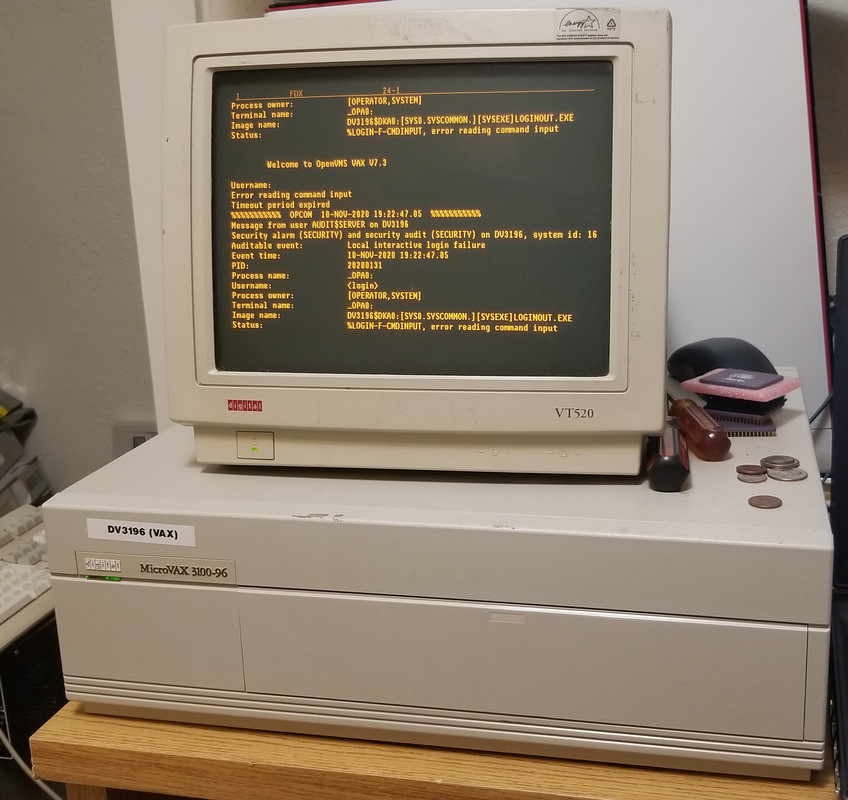
I picked up a microvax 3100 this past weekend from a office that was
shutting down.
I was able to start the system up, it boots up to a login prompt for VMS
VAX 7.3.
I do not have any login info for this machine, is there a procedure i can
follow to reset a password to an account?
Image of system :
https://i.postimg.cc/43bG0nSx/20201111-090018.jpg
Hi All,
I'm working on restoring a DEC PDP-11/23+ for the University of Colorado computer museum and I'm struggling to find a few parts, working or not, needed to complete the system. Please let me know if you have any of these items and would be willing to donate or sell them.
You can see a blog I'm keeping of the restoration at?https://headspinlabs.wordpress.com/dec-pdp-11
When finished, it will be on display at?https://mediaarchaeologylab.com/visit
Thanks,
Steve
...for a Northern Telcom (Telecom?) Spectron Datascope 4000:
https://i.imgur.com/qb4VTpO.jpg
Fingers crossed that someone here knows where it can be had.
Thanks!
g.
--
Proud owner of F-15C 80-0007
http://www.f15sim.com - The only one of its kind.
http://www.diy-cockpits.org/coll - Go Collimated or Go Home.
Some people collect things for a hobby. Geeks collect hobbies.
ScarletDME - The red hot Data Management Environment
A Multi-Value database for the masses, not the classes.
http://scarlet.deltasoft.com - Get it _today_!
Hi All,
I'm looking for a PDP-8/f or m. At a minimum I'd like the chassis with
PSU, front panel, and backplane as I already have enough spare OMNIBUS
boards to build up a basic system, although I'd still be interested in the
boards if you have any.
Depending on the configuration and condition there's a few things I'd
consider trading, namely my PDP-11/34a, AlphaStation DS10, Intel MDS 231,
and KIM-1. If the price it right I'd be happy to buy it too.
I'm in the UK but would be prepared to ship some of the systems
internationally; I can build crates and such.
Regards,
-Tom
mosst at sdf.org
SDF Public Access UNIX System - https://sdf.org
At 08:17 PM 11/8/2020, Bill Degnan via cctalk wrote:
> Thus came into my site, if you can help contact me privatelthanks
>...
> I have an old Syquest 5.25" removable cartridge (44MB) and am
>trying to find a service that will get the graphics data off the cartridge
>for me. If you have any suggestions I'd LOVE to hear them. It seems
>impossible to find anyone with a functioning drive to read this thing.
I was thinking about firing up the old (late 80s?) drive I have in storage
and trying to image the carts I have.
What should I watch for? Any typical failure mode?
- John
Thus came into my site, if you can help contact me privatelthanks
Bill
VintageComputer.net Inquiry Contact Information Name: Robert
Email: robwynia at ------ Phone: 541967----
------------------------- Comments:
I have an old Syquest 5.25" removable cartridge (44MB) and am
trying to find a service that will get the graphics data off the cartridge
for me. If you have any suggestions I'd LOVE to hear them. It seems
impossible to find anyone with a functioning drive to read this thing.
Thanks for your time,
> From: Chuck Guzis
> Perhaps my mistake with 22Disk was not putting a line in that said "Me
> fecit Carolus Guzis Anno MCMLXXXVII" or some such.
Love the Michaelangelo reference. I'm curious as to how many others on the
list got it. (It's carved into the strap on the Pieta. Apparently when
it was first put on display, there was some question as to who'd made, or
something like that.)
Noel
Hi,
Please remember ... TRIM YOUR DARN POSTS!
No one needs to see a hundred+ lines of quoted post just to see
a one line reply, no matter what kind of sandwich it was!
(And, the guy getting the sandwich had the better deal, IMHO :)
thanks,
Stan (the other grumpy guy?) Sieler
Hi,
Offered these in a post last year.
1) VAX DATATRIEVE Reference manual AA-K079E-TE
(this is online but version KE079G?)
2) VAX DATATRIEVE Handbook AA-W675B-TE
(Does not seem to be online? Willing to scan)
3) VAX DATATRIEVE Guide to Writing Reports AA-P862C-TE
For Datatrieve version 4.1
Versions online seem to be for version 3.0?
Willing to scan
Very clean condition: https://imgur.com/a/w9a3YEY
Can post for shipping cost from Toronto ON, Canada.
--Toby
http://mnembler.com/computers_mini_stories.html
"George Dragner always wore a belt with a metal dragon buckle. He was a colorful character known for pissing off management. His most
famous act was tossing a chair through the window at a customer site. The customer refused to believe that the lack of humidity in the room
was screwing up his magnetic tape media. As the tape heads depend on the moisture from the air to prevent the magnetic oxide from being
torn off the media from the friction during a rewind. George broke the window to prove his point. He was right ! "
There is a minimum RH specified for tape, but "tape heads depend on the moisture from the air" ??
At 12:14 PM 27/10/2020 -0500, you wrote:
>Hi All,
>
>I have an EP-1 eprom programmer from BP Microsystems.
>
>The rubber feet melted. It was in my closet. I have no clue how it got
>that hot, or if they
>are just some composition for them to melt.
>
>My question is how do I clean this up? Acetone, paint thinner? I scraped
>off the feet, so there is
>just a few 'streams' of melted rubber down the sides, and a bit that
>somehow got inside (also on the side, not on the electronics).
>
>Just looking for some ideas before I start applying chemicals...
>
>Thanks,
>Kelly
It's not heat. Just some rubber types degrade chemically over time. Cross links between the long
chain hydrocarbons break, and the solid turns to a semi-liquid. Very sticky liquid.
I presume the body of your eprom programmer is painted metal or plastic. So 'acetone and hot air' - NO!
The gunky stuff is not terribly soluble. Mineral turps on a tissue pad, rubbing, kind of works.
Mechanically scrape off what you can first. Use wooden or plastic spatula to avoid scratching paint.
The rub with the pad. Solvents like turps, acetone, IPA etc - always try a little on your surface first
to check the material isn't damaged by the solvent.
Guy
Hi All,
I have an EP-1 eprom programmer from BP Microsystems.
The rubber feet melted. It was in my closet. I have no clue how it got
that hot, or if they
are just some composition for them to melt.
My question is how do I clean this up? Acetone, paint thinner? I scraped
off the feet, so there is
just a few 'streams' of melted rubber down the sides, and a bit that
somehow got inside (also on the side, not on the electronics).
Just looking for some ideas before I start applying chemicals...
Thanks,
Kelly
> The rubber feet melted.
[?]
> I have no clue how it got that hot, or if they are just some composition for them to melt. My question is how do I clean this up?
It is probably not heat that melted the rubber. It?s likely degradation.
Some rubber parts get dry and break, some parts sort of ?melt? and
turn into this sticky, nasty glue.
You already got some hints on how to clean this, but if you are nervous,
you could start off with just isopropanol (that?s the main ingredient
in disinfectant). The advantage here would be that you can?t harm
plastic or electronics with that. You could use the common medical
grade disinfectant, just don?t drink it ;-)
Dennis
I've been helping dreamlayers with his cleanup of the NetBSD/Linux
mopd, ( https://github.com/dreamlayers/netbsd-mopd ) and we were
looking at how it handled different a.out MOP files, specifically
where the files may be little endian
For non MID zero files its easy enough, but little endian MID 0 files
are potentially more complicated.
https://github.com/abs0/netbsd-mopd/commit/6ab8555817f3dff23c506464d302d1a4…
It can netboot Ultrix and the vast panoply of NetBSD MOP boot files in
the various a.out and ELF incarnations http://mop.absd.org/netbsd/
(those that are not broken that is :/ )
I was wondering if anyone had links to hand for any other good sources
of MOP files?
Thanks
David
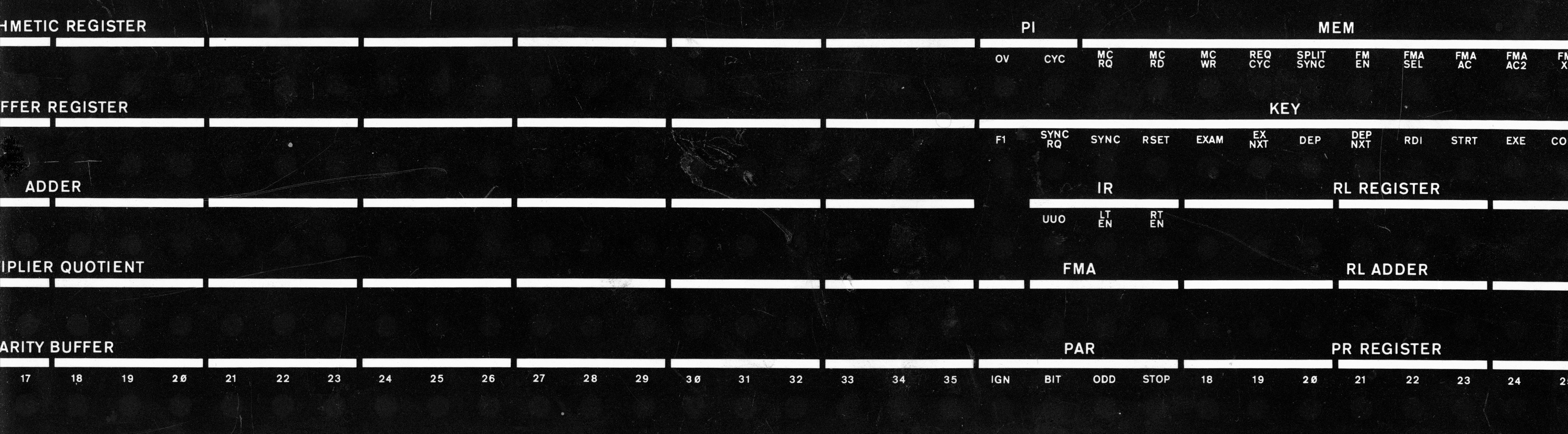
Speaking of DEC fonts, does anyone know what was used on the Data
General Nova machines?
Thanks!
**Richard
IBM 1620 > IBM 1130 > S/360 Model 40 > DG Nova > ...
> From: Toby Thain
> To get closer I'd need better images of the panels.
Hi, I borrowed a DEC inlay from someone (a KA10 CPU bay) and scanned a chunk
of it (as much as I could fit into my A4 scanner :-) at 200 dpi:
http://ana-3.lcs.mit.edu/~jnc/tech/jpg/KACPUPanel.jpg
I have a TC08 inlay, but it's currently being used in my QSIC display (until
we can get the RKV11-F/RPV11-D inlay done :-), and I didn't want to yank it
out. As far as I can tell, it's the same font on the two of them.
> the closest I know of off the top of my head is Akzidenz Grotesk.
The Akzidenz Grotesk Medium is indeed very, very close (other than the zero).
Do you happen to know if that font available for use in non-commercial
settings?
Thanks!
Noel
> From: Chris Zach
> The last board is a new style 11/24 and it doesn't do anything but it
> does have three switch packs. So I just need to find the manual for it
Appendix D in the 003 rev of the /24 TM has the details of the -YA..
> In the meantime the UNIBUS problem also appears to be fixed: The
> problem was that sure enough: One of the memory slot SPC's (4) did not
> have the DMA jumper.
Checking grant line continuity is part of system setup for me; the fact than
on many backplanes, the DMA grant jumpering is wirewrap on the back of the
backplane is a PITA, but back when it wasn't that big a deal. (Heck,
configuration jumpering on boards was all soldered wires BITD!)
The need for grant continuity is actually a characteristic of the _CPU_, not
the bus. I was astonished the first time I played with an /04 (or naybe it
was a /34, I forget), because on them, I'm pretty sure (I can't find it in
the documentation, but I'm pretty sure I remember it) that on power-on, the
CPU checks for grant continuity, and won't work without it. (They all require
the M9302 teminator or equivalent, which has active circuitry to turn around
an unclaimed grant onto the BSACK line.)
When the CPU powers up, it sends grants down the grant lines and expects to
see them back on SACK (from the M9302), and it won't operate if this doesn't
happen. That floored me when I ran across it, because on the older UNIBUS
CPUs I'd worked with BITD (/40's, etc) it was the done thing to be able to
leave a gap in the grant _downtream_ of the last card that could do
interrupts; no possible operational problem.
I'm not sure why DEC added that 'feature'; probably somebody thought it would
make systems more robust, but I bet all it did was generate a bunch of Field
Circus calls. (Kind of like the LSI-11 'feature' where ODT won't start unless
there's working memory at 0 - another wonderful little Easter Egg.)
Ironically, although the QBUS uses _exactly_ the same kind of bus grant lines,
no QBUS processor seems to check their continuity in this way; I habitually
run my QBUS machines without all the slots filled, and F11 and J11 processors
all run fine with open grant lines (after the last card that uses
interrupts). I guess DEC found out the hard way that that check wasn't
useful!
But this, as I said, is a characteristic of the CPU, not the bus.
> Anyone even know why Q-Bus doesn't need termination
QBUS documentation has long ediscussions of maximum cable lengths between
backplane sections, but little about cases where termination on both ends is
not needed. One exception is in the " pdp11 bus hanbook", pg. 128:
If nore than 20 AC loads are included [on a single bacplane], the other end
of the bus must be terminated with 120 ohms.
The clear implication is that with <20 AC loads, termination at the second
end is not needed. No explanation is given as to why, but I had the same
thoughts as Patrick Finnegan - that it's down to the very short bus lengths.
(With a short bus, the reflection from the un-terminated end will be
very close in time - the line length for the lines on a single backplane
is spec'd at a max od about 14"; so about 1 nsec. That's on the
order of magnitude of the bus signal rise times.)
If you think about it, every time you plug in a card, you've added a
short branch to the bus on every bus line (since they aren't normally
terminated at the transmitter/reveiver chips). But very short
branches, so their reflections are even closer in time.
Noel
Those sound like ram chip 4116, quite common once, and still available.
I have a couple dozen tested ones handy if you want them. (From Atari
800 16k ram modules). 250ns to 350ns, depending.
best,
Jeff
On Tue, 2020-10-27 at 12:00 -0500, cctalk-request at classiccmp.org wrote:
> Re: Next project: 11/24. Does it need memory?--Memory sad!
Anyone remember the R65F11? It's a Forth microcontroller: 6502
processor with a Forth kernel in ROM, from the mid '80s.
I was going through some old stuff in storage (looking for something
else) and found an R65F11 with the development ROM and some
documentation for building a development board. Looks like a fun little
project... I have plenty of projects.
If anyone is interested, it's free for actual cost of shipping (could
probably go in a U.S. Priority Mail envelope or small box, not sure
about overseas options).
The backstory: in 1984 I was working for a startup company, and we were
looking at various microprocessors for use in a new product. Being a
fairly skilled journeyman Forth programmer, I was advocating for the
R65F11. I managed to talk the Rockwell sales rep into giving us the
development ROM (usually not easily available). We ended up going with
a 68000 for the project, and I ended up with the R65F11.
> From: Chris Zach
> Next up is the 11/24, this is one of the 5.25 inch rack mounts with a
> CPU, KT24, and no memory.
> First question: Will ODT respond at all with no memory on the Unibus?
My _guess_ is probably, since on other KDF11 CPU's, ODT works with no
memory, but I haven't confirmed that.
My PDP-11/24 chassis (a 5-1/4" BA11-L, like yours) I took apart to get the
backplane out, so I could work out how the busses work (see below), and I'd
need to put it back together before I could try my -12/24.to confirm it. If
you could take some pictures of the insides of your BA11-L, that would be
both a help to the re-assemblhy, and ancentive to do so.
> Can a 128kw memory board from an 11/34 work in an 11/24?
Yes and no. See:
https://gunkies.org/wiki/PDP-11/24
for more. Note "The top 256 Kbytes of the CPU's address space were devoted to
the UNIBUS". So an MS11-L or similar UNIBUS memory can probably be
read/written by the CPU, but it won't appear at 0 in the CPU's address space.
> Or do I need one of the 11/44 boards to make it go?
Whether a KDF11-U will work with no memory at physical 0 is unknown: it would
need at least a special bootstrap (since most assume working memory at 0) and
a special OS load (ditto).
Also, I seem to recall that on the -11/45, with mapping enabled, interrupt
vectors are in Kernel D space, so once running, that machine could operate
with no working memory at physical 0, but I don't know if KDF11 CPU's use
mapped Kernel space for vectors. If you're interested, I can run an
test on a KDF11-A and see.
Noel
This popped up on the radar tonight (on mine anyway).
IBM System 360 30 Console animated mainframe CPU Console 360/30
https://www.ebay.com/itm/324348449949
A bit pricey, but pretty.
Luckily I landed one of the boards to run Larry W's emulation of the
2030 , which will be satisfying for
me.? (And thanks for releasing that work).
Thanks
Jim
Looking to complete a period-correct DEC workstation? Missing the right
mouse? Have I got a deal for you!
Digital 3-button mouse part number 30-44445-01 rev. C02. PS/2
connector, ball mechanism (not one of those fancy new things with the
red light on the bottom).
Free for actual cost of shipping. This wasn't what I was looking for in
storage either.
I've searched for this but couldn't find it...
Does anyone know if the DEC book "RTM: Register Transfer Modules"
published in 1973 is available online? It's an 8.5 x 11 book with
red cover and has 50 pages. I think it came with their RTM kit.
Don
Hi all,
Oddball question here: has anyone ever seen a way to cap off or protect
standard 0.1" pin header jumpers? Maybe there exist jumper plugs that *don't
*conduct across the two pins? I'm looking at a piece of hardware that has
some jumper pins on top of the PC board and I'd like to protect against
anything accidentally making contact. I have seen surface mount 0.05 pitch
pin headers come from their manufacturer with protective caps, but I
haven't been able to find anything to apply to 0.1" pin headers that I
could by aftermarket.
Any ideas would be appreciated!
thanks
brian
Now I'm starting to look through boxes to see if I have another 11/24
CPU. I seem to recall picking a second one up somewhere, I also want to
see if I still have the driver board for the second Plessy core memory.
Might be around, might have been pitched.
So far I did find a box of DZ11's. Not sure why I have a dozen of them,
they might have been from the USPS haul in days of yore. Anyone need a
couple of DZ11's?
The real weird one is a quad board H216. I thought it was a Unibus core
memory board, but it's 8k*19 bits, which means it came from one place:
An MA10 memory box. The only one I may have been exposed to was AI (the
original KA10). So question:
Did AI use MA10 memory boxes?
Did any of that stuff survive?
Anyplace else it might have come from?
Weird stuff. Got a lot of it....
CZ
> (Whether that's all done on the companion driver boards, and the H21x
> card would just bring the wiring of the two banks out to the edge
> connector in parallel, letting the driver board do what it wants, I
> don't know - you'd have to look at the MM11-L engineering drawings/TM.)
> The other possibility is that the PDP-10 memory used these boards in
> pairs.
It's not either!
First, I looked at the MM11-L TM, and it talks about how the H214 has "mats"
(2D arrays of cores), 1 mat per bit; the H214 has 16 mats. So definitely no
effectively 36+ bit wide variant. So, pairs?
Well, I looked to see what PDP-10 memory TM's were extant, and there's one for
the MF10 (A-MN-MF10-0-MAN-1); and glancing in it, it _does_ use the H216 -
with "19 mats" to produce "19-bit word memory banks"! (Exactly how, I didn't
have time to stop and read. It's got to be pairs, but at the bank level, not
board.)
So our guess as to which generation of PDP-10 memories it was used in might
have been wrong...
Noel
Hi,
I posted to <rescue at sunhelp.org> and saw my message got stuck in the mail
queue. Upon a further inspection I saw that the domain has expired along
with `mrbill.net' where the nameservers used to reside and both have been
taken by someone else, taking the name service down for `sunhelp.org'. I
can still reach Bill Bradford's personal page when I connect to the server
by its IPv4 address at: <http://184.94.207.190/>.
I do hope nothing bad has really happened to Bill in these difficult
times. Anybody knows?
Maciej
> From: Chris Zach
> My guess is the H215 has two more core fields on it
I uploaded a (crappy - sigh) image of an H215 I have to here:
https://gunkies.org/wiki/File:H215-core-memory-board.jpg
and it's clearly not symmetrical, but does have a slightly bugger blank space
than yours. It has a label that says "18x8K" (so 16 bits plus byte parity -
for DATOB bus write operations to one byte at a time), which sounds orrect.
> Odd they could fit up to 20 bits, maybe an early ECC (16b+4 ECC?)
No, this way pre-dates ECC memory (the cost of the extra bits - more cores to
string in - was probably more than it was worth), and probably before ECC
disks too (I think the first DEC ECC disk was the RP04).
> I'll bet that it could work in the 11/05 if one of those boards ever
> blow out.
That's my guess too; _but_ there might be some jumpering/etc issues to adjust
the word width. I.e. the PDP-11 parity H215 is 18 bits wide, which is right
for 16-bit words, whereas PDP-10 parity memory would be 36+1 parity bit = 37
bits wide. So there might be 2 banks on one of those cards, and the PDP-11
memory treats them as separate banks, whereas on a -10 they'd be ganged
together in parallel.
(Whether that's all done on the companion driver boards, and the H21x card
would just bring the wiring of the two banks out to the edge connector in
parallel, letting the driver board do what it wants, I don't know - you'd have
to look at the MM11-L engineering drawings/TM.)
The other possibility is that the PDP-10 memory used these boards in pairs.
We do have the MA10 Maint Manual, but in a quick look it looks like it
doesn't use these boards. So maybe a later -10 memory system?
Noel
At 01:30 PM 10/22/2020, you wrote:
>I have seen surface mount 0.05 pitch
>pin headers come from their manufacturer with protective caps, but I
>haven't been able to find anything to apply to 0.1" pin headers that I
>could by aftermarket.
I'd use two jumpers. Hang one off one pin, hang the other off the other.
If you wanted to get fancy, superglue them in the middle.
- John
> From: Richard Sheppard
> There's a piece of core on eBay .. which claims to be H214. The interesting
> thing is the label says 8K x 16 but the silkscreen says 8K x 19.
DEC did that a lot; used one silkscreen (and etch) for two different modules,
with differing componet sets to produce two different boards (e.g the MSV11-D
and -E:
http://gunkies.org/wiki/MSV11-D_MOS_memory
M8044 and M8045 respectively; the boards all say 'M8045' in the etch, you
have to look at the handles). The H214 is the 16-bit wide version of this
board, used in the MM11-L UNIBUS memory:
https://gunkies.org/wiki/MM11-L_core_memory
The parity MM11-LP uses the H215 (an 18-bit wide version), and a G109 instead
of the G110 (again, same etch, some components left off for the G110.
There's also an H213, used in the MM11-K:
https://gunkies.org/wiki/MM11-K_core_memory
which is an 8KB version; the H213 looks identical to the H214 at first
glance, but if you look closely the core mats are only half as dense.
Noel
Hello,Is anyone else having trouble accessing their FTP/Web space on ClassicCmp? I can still access HTML and files i have uploaded but not FTP in for new files. Thanks.-Ali
I was idly browsing early editions of Computer World journal on Google newspapers and found an announcement
and picture of the '449', an experimental aerospace computer built by Control Data in 1967 and touted as
"the world's smallest computer" at 4" x 4" x 9", of which the logic part is a 4" cube and the rest is the battery.
It's on page 3 of Computer World Sep 20 1967:
https://news.google.com/newspapers?nid=v_xunPV0uK0C&dat=19670920&printsec=f…
It seems to me it may have been an analogous machine to the Apollo AGS perhaps and would like to know a bit more
about it, but I've only been able to find a brief mention of the '449-2 Special Miniature Computer' and
that's it. Archive.org hasn't turned up anything. I'm just curious about the tech used, no doubt it used DIPs
or flatpack micrologic and a tiny core plane?
Steve.
US $16K, located in Tucson, AZ, USA.
https://www.ebay.com/itm/Extraordinary-Transputer-collection-Museum-quality…
>From listing:
----------------------------------
Unmatched collection of vintage Transputer based systems includes
2 (TWO) Parsytec X-plorer 16-node "desktop supercomputer" systems
Tested working, both units can be linked together (cable included)
for a 32 node system, tested with Helios
2 x PC (ISA) interface card (IBM meganode) includes on-board transputer
1 x BBK-PCI interface card with dual Parsytec style connectors + super
rare cable
Parsytec P-CUBE system with 8 nodes
So rare that no (other :-) ) images of this unit can even be found
on the internet
2 (TWO) Parsys Supernode SN1000 units (original cost ~$500000)
Includes a total of 128 transputer nodes, and a scsi disk based
operating system
Tested working with an included Sun workstation with VME
Transputer interface board
With original invoices, user manuals, installation DAT tape ++++
14 (Fourteen) Parsytec dual cpu (power PPC + Transputer) Eurocard boards
6 (Six) CSA Quad transputer boards (PART.1) + 7-slot EISA board and
ATX power adaptor
(these boards only need the power pins on the ISA connectors to function)
Set of "red box" Inmos toolkits/compilers
Misc Transputer conference proceedings
Spare 4 slot Eurocard backplane and power supply with Transputer link
connectors installed
Copies of all the major Transputer operating systems (Helios, Idris,
TDS, Parix, Taos, Virtuoso, Strand, Paros etc)
This is a very large lot so shipping will be expensive, pay no
attention to the ebay estimate
contact us for a realistic quote
Will consider delivering "at cost" (van hire + fuel + 2 overnight
motel stops) to the Southwest
states (CA, AZ, NM, UT, CO) if pre-paid by cashiers cheque.
Perhaps something like silly putty would work? Although as a
precautionary tale, the silly putty from the 60s also removed part of
the original ink. I do not know what the current formula would do. As
kids, we used to have fun getting reverse images of the colorful comics
in the Sunday paper :-)
--
Cindy Croxton
Electronics Plus
1613 Water Street
Kerrville, TX 78028
830-370-3239 direct
> From: Chris Zach
> Unibus can get annoyed at a lot of things .. Q-Bus is much simpler
Not sure I'd concur with that latter. In analog terms the UNIBUS and QBUS are
almost identical (which is why the same driver chips such as 8641's are used
with both), and at the digital level they essentially identical (asynchronous
interlocked request/response for read and write; interrupts using
daisy-chained grant lines, with transmitted vectors; DMA, using the basic
read/write protocol to transfer data). The (not very) big differences are that
the QBUS multiplexes address and data onto a single set of lines, and the more
complex multi-level interrupt using a shared single grant line; in both, more
complex than the UNIBUS.
Perhaps you meant 'easier to use', and that may be so, since most QBUS
systems are much smaller (physically).
> If I could disable them I could do a normal DL11 and see what I see
Looking at the docs, I don't see any way to disable the on-board serial
lines. You could probably cut etches to disable them, but I would advise
against that, because there are easier/better ways to go.
It should be quite easy to investigatwe where the problem is: look at the
'read receive 1 CSR' line, on pin 15 of E106 (with the 'halt' switch on). If
that's not hopping around, the CPU isn't running. So then we'd need to look
at the basic clock, and see if that's running; if so, then the CPU chip may
be failed; we'd need to look at the PAX lines to confirm that. If that CSR
line is active, there's a fault somewhere in the console serial line
hardware; first step would be to feed characters into the machine, and see if
they're coming out the UART.
If you don't want to mess with all that, there are CPU boards on eBait for
not too much money. (I'd be interested in buying the non-working CPU board,
if you go that way.)
Noel
Since I'm a bit short of change I thought I'd pass this along.
https://www.ebay.com/itm/APPLE-1-Original-1976-Computer-System-1st-Steve-Wo…
Will
"A designer knows he has achieved perfection not when there is nothing left to add, but when there is nothing left to take away." -- Antoine de Saint-Exupery
"The names of global variables should start with// " --?https://isocpp.org
I spotted this for an auction from the FORMER OYSTER CREEK NUCLEAR GENERATING STATION.
Looks like a pair of RL02 with a pdp something in the middle. I can't make out what model it is from the photo.
Anyone know?
I'm not bidding as it's too far away from me in Los Angeles but someone else might like it. Small stuff usually sells real cheap on this site as the sellers are usually just trying to get rid of it.
Also, there's no current bid. I just would not want it to go to a scrapper.
https://www.bidspotter.com/en-us/auction-catalogues/bscunited/catalogue-id-…
Wayne
> From: Chris Zach
> still nothing coming out of the serial port. Figured I would document
> the settings and see if anyone with an 11/24 can cross-check my settings.
Time to stop trying random things and drop the (metaphorical) Big Hammer.
Look at the bus, and see if it's trying to talk to the console (i.e. ODT is
running).
Alas, I looked at the -11/24 Tech Manual - latest rev here:
http://ana-3.lcs.mit.edu/~jnc/tech/pdp11/dload/EK-11024-TM-003.pdf
and it sez (pg. 4-25):
"Internal addresses; i.e. serial line unit registers .. There is no external
bus cycle performed for an internal address."
So you can't look on the UNIBUS. At least we have a set of prints for it:
http://bitsavers.org/pdf/dec/pdp11/1124/MP01018_1124schem_Aug80.pdf
CPU prints start on pg. 145; the TM will tell you what signals to look for.
Noel
> From: Guy Sotomayor ggs at shiresoft.com
> It looks like it's 11/84 from the badge on the front.
In a 10-1/2" box. Seen them in the docs (forget the model number), never seen
a real one.
Noel
Hello all,
The S-100 stuff is sold and paid for.
GOD Bless and Thanks,
rich!
On 10/18/2020 9:46 PM, Richard R. Pope wrote:
> Hello all,
> It looks like the S-100 stuff is available again. Sorry for the
> confusion!
> GOD Bless and Thanks,
> rich!
>
> On 10/18/2020 12:36 AM, Richard Pope via cctalk wrote:
>> Hello all,
>> The S-100 stuff is sold pending payment. I appreciate the
>> interest and help!
>> GOD Bless and Thanks,
>> rich!
>>
>> On 10/17/2020 10:44 PM, Bruce wrote:
>>> I believe there is an S-100 meuseum - think they specialize in Altare
>>> - but they woul probably be a good home for the stuff
>>>
>>> Cheers!
>>>
>>> Bruce
>>>
>>> Quoting Jeff George <driftwoodturning at gmail.com>:
>>>
>>>> Hi there, I?m sorry to hear about your expected diagnosis, that?s a
>>>> tough
>>>> one. My neighbor Had cancer of the liver last year, he tried the ?Rick
>>>> Simpson oil? treatment along with standard chemo and is cancer free
>>>> today.
>>>> Maybe look into it?
>>>>
>>>> On a selfish note, Im a high school physics teacher in Tn and would
>>>> love to
>>>> find good price on some equipment so that my students could get
>>>> their feet
>>>> wet with some actual good equipment. Scopes, frequency generators,
>>>> vtvm?s,
>>>> dmm?s, etc.. I am a ham radio operator and tinkerer, some skills at
>>>> repairing equipment but not a whole lot.
>>>>
>>>> Please let me know if you have anything appropriate for my students
>>>> at a
>>>> high school budget. Happy to give you my info so that you can
>>>> verify my
>>>> employment.
>>>>
>>>> Jeff
>>>>
>>>> On Sat, Oct 17, 2020 at 10:14 PM Richard R. Pope
>>>> <mechanic_2 at charter.net>
>>>> wrote:
>>>>
>>>>> Hello all.
>>>>> I have 22 S-100 boards for sale. There are two backplanes.
>>>>> One is a
>>>>> 9 slot bare board and the other is a 19 slot fully populated
>>>>> board. Both
>>>>> boards have active termination. There are 8080, Z80, FDC, HDC,
>>>>> Serial,
>>>>> 68030, a Display board, a Front Panel board. There are also 3 Mean
>>>>> Well
>>>>> power supplies supplying the +9VDC and the +_16VDC. There are also
>>>>> voltmeters and amp meters . I want $500 plus shipping for all of
>>>>> it. I
>>>>> can provide a full inventory and pictures for anyone who is truly
>>>>> interested.
>>>>> I probably have cancer and if I do I am dying. I want all of
>>>>> this
>>>>> to go to a good home and not to the landfill. If anyone is
>>>>> interested I
>>>>> have some test equipment, electronic components, and model railroad
>>>>> equipment Please only serious inquires for I tire very easily.
>>>>> GOD Bless and Thanks,
>>>>> rich!
>>>>>
>>>>>
>>>>>
>>>>>
>>>>>
>>>>> --
>>>> Paying Attention, Not a Tutor!
>>>>
>>>>
>>>>
>>>
>>>
>>>
>>>
>>>
>>>
>>>
>>>
>>>
>>
>>
>
>
>
> -=-=-=-=-=-=-=-=-=-=-=-
> Groups.io Links: You receive all messages sent to this group.
> View/Reply Online (#110958):
> https://groups.io/g/HP-Agilent-Keysight-equipment/message/110958
> Mute This Topic: https://groups.io/mt/77650950/89555
> Group Owner: HP-Agilent-Keysight-equipment+owner at groups.io
> Unsubscribe:
> https://groups.io/g/HP-Agilent-Keysight-equipment/leave/3011123/1140944146/…
> [mechanic_2 at charter.net]
> -=-=-=-=-=-=-=-=-=-=-=-
>
>
>
> anyone willing to chip in some money to help me pay for this?
I sent a chunk too. This is a totally great acquisition: I have a KDJ11-B
board that has a bad bus driver chip; I was going to apply an ohmmeter to find
the guilty party, but just looking at the prints will be so much easier.
I see it also includes MSV11-R prints, which is wonderful, since we don't have
prints for those either. Too bad it doesn't include the MSV11-J prints (also
missing), since the -R's are rare and the -J's are relatively common.
Noel
Al Kossow <aek at bitsavers.org> wrote:
> anyone willing to chip in some money to help me pay for this?
> https://www.ebay.com/itm/303733340900
I don't have a PDP-11/84 and likely never will but I just
sent you $150. Bitsavers has saved my bacon multiple times
and it's only right that I support you.
In about a month I hope to be able to deliver the 7-track
tape drive to you. Details later.
Alan Frisbie
Hello all,
The S-100 stuff is sold pending payment. I appreciate the interest
and help!
GOD Bless and Thanks,
rich!
On 10/17/2020 10:44 PM, Bruce wrote:
> I believe there is an S-100 meuseum - think they specialize in Altare
> - but they woul probably be a good home for the stuff
>
> Cheers!
>
> Bruce
>
> Quoting Jeff George <driftwoodturning at gmail.com>:
>
>> Hi there, I?m sorry to hear about your expected diagnosis, that?s a
>> tough
>> one. My neighbor Had cancer of the liver last year, he tried the ?Rick
>> Simpson oil? treatment along with standard chemo and is cancer free
>> today.
>> Maybe look into it?
>>
>> On a selfish note, Im a high school physics teacher in Tn and would
>> love to
>> find good price on some equipment so that my students could get their
>> feet
>> wet with some actual good equipment. Scopes, frequency generators,
>> vtvm?s,
>> dmm?s, etc.. I am a ham radio operator and tinkerer, some skills at
>> repairing equipment but not a whole lot.
>>
>> Please let me know if you have anything appropriate for my students at a
>> high school budget. Happy to give you my info so that you can verify my
>> employment.
>>
>> Jeff
>>
>> On Sat, Oct 17, 2020 at 10:14 PM Richard R. Pope
>> <mechanic_2 at charter.net>
>> wrote:
>>
>>> Hello all.
>>> I have 22 S-100 boards for sale. There are two backplanes. One
>>> is a
>>> 9 slot bare board and the other is a 19 slot fully populated board.
>>> Both
>>> boards have active termination. There are 8080, Z80, FDC, HDC, Serial,
>>> 68030, a Display board, a Front Panel board. There are also 3 Mean Well
>>> power supplies supplying the +9VDC and the +_16VDC. There are also
>>> voltmeters and amp meters . I want $500 plus shipping for all of it. I
>>> can provide a full inventory and pictures for anyone who is truly
>>> interested.
>>> I probably have cancer and if I do I am dying. I want all of this
>>> to go to a good home and not to the landfill. If anyone is interested I
>>> have some test equipment, electronic components, and model railroad
>>> equipment Please only serious inquires for I tire very easily.
>>> GOD Bless and Thanks,
>>> rich!
>>>
>>>
>>>
>>>
>>>
>>> --
>> Paying Attention, Not a Tutor!
>>
>>
>>
>
>
>
>
>
> -=-=-=-=-=-=-=-=-=-=-=-
> Groups.io Links: You receive all messages sent to this group.
> View/Reply Online (#110932):
> https://groups.io/g/HP-Agilent-Keysight-equipment/message/110932
> Mute This Topic: https://groups.io/mt/77630695/89555
> Group Owner: HP-Agilent-Keysight-equipment+owner at groups.io
> Unsubscribe:
> https://groups.io/g/HP-Agilent-Keysight-equipment/leave/3011123/1140944146/…
> [mechanic_2 at charter.net]
> -=-=-=-=-=-=-=-=-=-=-=-
>
>
>
Paul, Jerry,
Thanks for the suggestion to take a look at DataTranslation!
Looking in the bitsavers folder for DataTranslation, I found a 239 page July 1986 Data Translation manual for the DT3362 series of A/Ds. There are 23 sub-models of that board but the DT3362-16SE/8DI specifications matches the ADV11-D (A1008).
The best part is that chapter 8 of this manual has 5 programming examples, two of which use the DMA capability.With a bit of research (and some luck) I think this will give me the info I need.
Thanks again,
Mark
Date: Sat, 17 Oct 2020 02:06:25 -0500
From: Paul Anderson <useddec at gmail.com>
I think they were made by Data Translation.
On Fri, Oct 16, 2020 at 8:00 PM Jerry Weiss via cctech <
cctech at classiccmp.org> wrote:
>
> I just picked a AAV11-D D/A Board for which documentation is also
> scarce. The general design may be similar. I should be able to reverse
> engineer the analog/digital output section for pin-outs. Lacking
> manuals/source code, if someone has an existing driver or software in
> binary, I would be willing to disassemble that for its secrets. Perhaps
> these boards mimic the methods used by ADAC or Data Translation used for
> their Qbus products. Their documentation may also give some insight on
> how to setup these CSR's.
>
> Regards,
> Jerry
>
I've been talking to the guy in NYC who has the storage portion of what
appears to have been part of a Toaster Flyer setup (I forget who, but
someone on the list forwarded details a few months ago) - two 5.25"
full-height SCSI drives, a 3.5" SCSI drive, passive ISA backplane, and some
form of TBC card (made by DPS).
I'm not sure who made the 3.5" drive, but the two FH ones appear to be 9GB
Seagate Elites (I'm assuming they were the two video stores, and the 3.5"
was for audio).
The big question is whether in a Flyer environment the drives run custom
microcode or will have been LLFed to something other than a "standard" 512
byte block size - I believe that the Flyer was really pushing the
boundaries of what was possible when it was current, and the majority of
drives on the market just didn't have the necessary throughput (I see a
"Newtek approved" sticker on one of the Seagates). I know that the storage
was considered "proprietary", but I don't know if that just means that the
filesystem was Flyer-specific (i.e. not AFFS), or if there was more to it
than that.
cheers
Jules
Hello all.
I have 22 S-100 boards for sale. There are two backplanes. One is a
9 slot bare board and the other is a 19 slot fully populated board. Both
boards have active termination. There are 8080, Z80, FDC, HDC, Serial,
68030, a Display board, a Front Panel board. There are also 3 Mean Well
power supplies supplying the +9VDC and the +_16VDC. There are also
voltmeters and amp meters . I want $500 plus shipping for all of it. I
can provide a full inventory and pictures for anyone who is truly
interested.
I probably have cancer and if I do I am dying. I want all of this
to go to a good home and not to the landfill. If anyone is interested I
have some test equipment, electronic components, and model railroad
equipment Please only serious inquires for I tire very easily.
GOD Bless and Thanks,
rich!
So I'm working on this old MS11-L board I have had sitting around
forever. M7891 DK. Goal is to use it in my 11/24 with KT24 MMU.
I've switched the jumpers so it will run on a +12 supply instead of a
+15, and so it will run in an extended Unibus slot as opposed to a
normal unibus.
However I'm stumped regarding the +5v and +5 BBU supply lines. The
problem is the manual says to set the jumper that is above C12 (bottom
of board, two capacitors next to each other, pretty easy to spot) so
that W3 is in and W7 is out if you just have +5v. On this board, W3 is
out, W7 is in, but there are two other jumpers right above them (nothing
is labelled on the board).
So....
Is it the bottom jumper that is +5 or the bottom and the one above that
need to be moved?
This might be why this board never worked right, if the memory refresh
is expecting power on the BBU line and I don't have that then it's not
going to work very much :-) But which jumper is the right one to use?
Thanks!
Chris
Sean -
You might get lucky, IF Jameco still has documentation & software for the board.
I would guess circa 1982-1985 (after IBM XT introduction with 256 kB standard).
?
Japan in 1970s and Taiwan in 1980s ... had major production issues with PCB fabrication and assembly (required higher QC in source materials).
?After-sale? (under warranty) Component-level service bench techs ?
were frequently heard ?swearing? at the incompetence across the Pacific.
?
Thru-hole ?vias? for double-sided boards frequently failed.
Solder alloy and Flux formulations (Asia didn?t want to buy Weller or Ersin/Multicore) were especially troublesome. In many instances, the old solder has to be removed (difficult de-soldering due to impurities in Asian solder).
These problems continued through 1980s,
until the ?bad shops? closed or changed their production operations.
?
Using a Quality 63/37 or 60/40 ?RA? solder (like Kester ?44?), resolves most issue,
other than copper solder trace failures.
greg
===
From: Sean Ellis <seanellis9 at gmail.com>
To: Chuck Guzis <cclist at sydex.com>, "ClassicCMP? <cctalk at classiccmp.org>
Subject: Re: Identifying a Mystery ISA Card
Well, thanks for all the help guys - Finally narrowed it down to a
JE1078 on Stason:
https://stason.org/TULARC/pc/io-cards/I-L/JAMECO-ELECTRONIC-COMPONENTS-Mult…
I can believe this thing was made in Taiwan - I had to repair probably
1/4 of all the joints on the card because they all had gone dry or had
holes in the joints. Have you ever seen solder bubble like boiling
water? That's how bad the original solder on this card was. It also
absolutely stank the whole way through...
one of the white whales.
anyone have OEM documentation for their 5" Elite SMD or IPI drives?
The only thing I've ever been able to find was an installation manual for the SMD verison
I recently acquired an ADV11-D Qbus A/D board and having been working on a RSX11M+ driver for it. It is similar enough to the ADV11-C that the driver I wrote for the -C works ok, but the -D is DMA capable.
It seems to have two extra CSR registers in addition to the CSR, and read buffer. Does anyone have documentation for this board? It is mentioned in the Oct. 88 Microsystems Option Guide and both RSX and VMS supported it. It was also mentioned in the Dec 92 Real Time Products Technical manual.
It has a 40 pin IDC connector that appears to have some amount of differences from the ADV11-C and no where have I seen any info on the DMA capability.
Does anyone have a ADV11-D user manual or XXDP source code for testing it?
Thanks,
Mark
Sean, Fred, and Glen ?
Sorry, late to this ISA card thread.
I worked in Tech Support for an Apple/IBM/HP/Novell retail computer dealer,
during summers in early 1980s, when in Graduate school.
So I saw the ?wide selection? of add-in cards for IBM PC/XT and compatibles.
==
This is a ?Taiwanese generic 6-Pak? Add-In (8-bit ISA) expansion card.
RAM 384 kB; Serial port, Parallel port, Game port, AND Real Time Clock !
Glen is CORRECT, the National Semiconductor MM58167 is the RTC IC.
Texas Instruments bought out National in 2011, data-sheet still available.
The ?solder-in? B1 battery has been cutout (open space below/left of MM58167).
Replacement battery (likely ~ 3 to 3.6 Volt) can be acquired from Digi-Key.
Take measurements and closeup photo of ?B1? Area, to CONFIRM Model and Size.
?
My Quick Guess ?
Tadiran TL series 1/2 AA with Axial pins, 3.6V High Capacity Cylindrical battery
http://www.tadiranbat.com/assets/tll-5902.pdf
Tadiran TL-5902/P .... $6.65
https://www.digikey.com/en/products/detail/tadiran-batteries/TL-5902-P/5125…
greg, w9gb
chicago
===
Date: Thu, 15 Oct 2020 17:34:58 -0700
From: Glen Slick <glen.slick at gmail.com>
To: "General Discussion: On-Topic and Off-Topic Posts"
<cctalk at classiccmp.org>
Subject: Re: Identifying a Mystery ISA Card
On Thu, Oct 15, 2020, 5:24 PM Fred Cisin via cctalk <cctalk at classiccmp.org>
wrote:
>> On Thu, 15 Oct 2020, Sean Ellis via cctalk wrote:
>> I got this (currently exploded) mystery RAM, RTC, and I/O board out of
>> a dead Sanyo luggable the other night, and once I replace the burned
>> up tantalums I'd like to put it in my 5150 so I can get a full 640k of
>> RAM.
>> Question is, does anyone know what this board is? It's a completely
>> anonymous board with not even an FCC ID to go off of. I'm assuming the
>> RAM is at least strapped right; all the banks are full which should be
>> 384k, and the Sanyo was a 256k machine = 640k.
>> Here's a couple pictures; one's an actual picture of the card and the
>> other is a simplified TULARC/TH99-esque vector of what's on the board.
>> https://i.imgur.com/WhO4cco.jpg
>> https://i.imgur.com/uBCkv5G.png
>
> It resembles, although doesn't match, the AST Six-Pack.
> But the AST Six-pack had a clock circuit.
Isn't the 24-pin DIP part number MM58167 ,shown in the images referenced above,
an RTC chip?
I'm back to working on the PDT11/150 again, the bottom floppy is weird:
It doesn't read rx01 disks, period. Top one is fine. So I tried swapping
all of the connectors on the control board so the top one was PD1: and
the bottom was PD0: Sure enough the top drive works fine as PD1: and
bottom is still dead so it's a drive issue.
Pull the drive, put in a spare, button it up, and sure enough it still
doesn't work. Any ideas?
Also I recall my MiniMinc/150 (which is in parts in my shed) had EIS and
FIS, but this one only reports FIS. Did DEC make pdp11/03 expansion
chips that only had FIS?
C
Noticed in another thread an 8L is upcoming on the persons restoration
list. Making separate post so more visible. The G228's have a 20 uF 50V
electrolytic capacitor on them. I have had two short. When they short its
a race between the trace on the board burning up or the backplane 30 AWG
wirewrap wire burning up. One was on an 8/I I was restoring where the
backplane wire providing the power burnt up at power on. Wasn't shorted
before power on. The other was I saw one G228 had a burnt track while I was
washing the cards in an 8/L. I had not applied power at that point so that
was old damage. Usage history is unknown.
As a minimum I would recommend applying current limited 30V to the capacitor
on each card out of the machine before initial power on. Low enough limit may
allow the capacitor to reform without shorting. The same part # capacitor is
still available for protective replacement. The capacitors don't read shorted
before power is applied. Unknown if they will short if the machine is powered
on periodically.
I've head lots of reports of all the failures in 8/L's. I replaced the
one G228 and some bulbs but otherwise the machine was fine. It did need a lot
of cleaning and I did do my normal power supply reform and checkout.
I have a collection of British magazine CDs and DVDs from the mid-1995ish to
2013ish. They contain tools, programs, etc. I tried 5 and they mounted under
Win10 so they should work on old win releases: XP,7,8?
Would anyone be interested in acquiring these? Talk to me and we can work
out how.
peter
|| | | | | | | | |
Peter Van Peborgh
62 St Mary's Rise
Writhlington Radstock
Somerset BA3 3PD
UK
01761 439 234
"Our times are in God's wise and loving hands"
|| | | | | | | | |
> From: Ethan Dicks
> ODT works from my 11/34 with bad RAM,
?? The -11/34 doesn't have 'real' ODT (like the one in the LSI-11's,
KDF11's, KDJ11's), which is in microcode).
The M9301 and M9312 bootstrap ROM boars contain a console emulator, but it's
in macrocode.
Noel
Like most of us, as a result of COVID, I've been mostly stuck at home.
Consequently, I've been going through and organizing a lot of boxes
of old stuff that just accumulated and I did not consider to be part of my
vintage computing collection. However, I have noticed (and chuckled
over) the fact that others are collecting computers and software that I
"just used". Anyway, I'm finding stuff that I think others may appreciate
more than I and I'm wondering about its value.
First, I have what I believe is a pretty early AOL CD and I understand that
it may be collectable. It includes the original silver, blue and red
cardboard
sleeve that reads (in part):
America Online CD-ROM!
IT'S NEW! IT'S FREE!
Now with World Wide Web Browser!
Any thoughts on this would be appreciated. Most of what I find with
Google seems to be related to a boom about five years ago.
I have also found boxes full of other software, along with their original
packaging.
Original DOOM, original Lemmings, Wing Commander, Wing Commander II, Falcon,
several old Microsoft Flight Sims, etc., etc.
Thanks,
Bill Sudbrink
--
This email has been checked for viruses by Avast antivirus software.
https://www.avast.com/antivirus
Ok, with the PDT and the RX02's out of the way I'm running down to the
wire on fixing stuff before I tackle the 8/L's. Next up is the 11/24,
this is one of the 5.25 inch rack mounts with a CPU, KT24, and no memory.
First question: Will ODT respond at all with no memory on the Unibus?
Second question: Can a 128kw memory board from an 11/34 work in an
11/24? Or do I need one of the 11/44 boards to make it go?
Hey all,
I got this (currently exploded) mystery RAM, RTC, and I/O board out of
a dead Sanyo luggable the other night, and once I replace the burned
up tantalums I'd like to put it in my 5150 so I can get a full 640k of
RAM.
Question is, does anyone know what this board is? It's a completely
anonymous board with not even an FCC ID to go off of. I'm assuming the
RAM is at least strapped right; all the banks are full which should be
384k, and the Sanyo was a 256k machine = 640k.
Here's a couple pictures; one's an actual picture of the card and the
other is a simplified TULARC/TH99-esque vector of what's on the board.
https://i.imgur.com/WhO4cco.jpghttps://i.imgur.com/uBCkv5G.png
I agree that whether a student learns has much more to do with the student
than what in particular they're studying.
I quit my undergraduate physics degree when I had a moment of clarity that
even if I managed to squeak through my Partial Differential Equations class
with a C (I did) I'd still be on a trajectory where _solving PDEs was what
I would be doing with my life_.
My undergrad degree is in Ancient Mediterranean Civilizations. My MA is in
History (but, hey, the History of Computing). I dropped out of the Ph.D.
program I was in for a variety of reasons, to be honest crushing depression
probably chief among them, but also because I was a fairly decent
practitioner, and I had more fun playing with computers than I did writing
stories about people who'd played with computers a couple generations
before I had. It being the late 90s, my job prospects were decidedly
better on the Not A Professional Historian side of the fence.
That was 22-ish years ago. I'd been making beer money all through college
and grad school with IT jobs, and I've stayed in IT-related fields ever
since. Consulting, systems administration and engineering, these days
software development-but-also-devops. My lack of appropriate degrees
probably only didn't hurt because I started a not-unsuccessful consulting
business with my mentor after I quit grad school, and by the time I was
ready to move on from that, I had enough years of broadly varied experience
under my belt that it didn't really matter.
But that's tangential. The actual point was: the fuzzy stuff is only
contemptible if you've got Physicists' Disease. History is hard, and it
has a lot more in common with debugging that is obvious at first glance.
In both cases you are presented with "Here's what happened," and it's your
job to figure out "why?" In both cases, the ability to break the end-state
down into a set of much smaller components which contribute to it is
key--and although that ability probably _does_ have a lot to do with innate
personality or preference, it's also very, very much a learned (and
trained!) skill. The thing with debugging is that you usually are afforded
the opportunity the repeat the experiment while changing parameters. With
history, you're not so lucky, and thus you never _really_ know the root
causes (you also usually don't know "what really happened", but by
cross-referencing your sources you may be able to emerge with some sort of
decent-consensus guess), but you can make more or less plausible and
persuasive hypotheses about them. The idea that you are interrogating a
recalcitrant witness is common to both history (and I would guess many of
the humanities and social sciences) and creating and maintaining working
software.
I'll grant that it's _harder_ to surf blithely through an engineering
degree than it is through a liberal arts degree, mostly because there are
less-subjective metrics (particularly in lab courses) as to whether you
actually learned something about what you're supposed to be doing. If I
were being snarky, perish the thought, I'd say that the engineers who
didn't really want to understand what they were doing were pre-meds.
Nevertheless, a degree--and particularly an advanced one--is indeed much
more about the discipline to put your head down and swallow what's put in
front of you than about smarts.
I was told a couple of decades ago I'd regret not having stuck it out for
my Ph.D. I'm still waiting for that regret to kick in; in the meantime,
many others have come and gone.
Adam
> I posted to <rescue at sunhelp.org> and saw my message got stuck in the mail
> queue. Upon a further inspection I saw that the domain has expired along
> with `mrbill.net' where the nameservers used to reside and both have been
> taken by someone else, taking the name service down for `sunhelp.org'. I
> can still reach Bill Bradford's personal page when I connect to the server
> by its IPv4 address at: <http://184.94.207.190/>.
I noticed this, too. Since sunhelp.org uses mrbill.net DNS servers, and
because the server at 184.94.207.190 is still up, we can still see the
content if we make our own DNS, so I configured my server at 192.80.49.4
(athena.zia.io) to answer for mrbill.net, for sunhelp.org, for
fiftieshouse.com, and for lispmachine.net, so if you want to see any of
these, temporarily set your DNS server to 192.80.49.4.
I did this in part to mirror sunhelp.org, but I suspect there are already
mirrors out there.
Sorry to hear about Bill :(
John Klos
Hello.
I have two card cages out of a pair of Linotron 202 phototypesetting machines, and have been hunting for documentation for the Naked Mini systems used in them for over a year now. The Computer Automation CPU boards in the systems have been a complete mystery to me until recently. To make a long story short, I happened to stumble across the patent for the machine (https://patents.google.com/patent/US4254468A/en), which has the same bus configuration as my card cages, and also provides some good evidence that "Naked Milli" 3/05 CPU boards were used.
I've found documentation for the LSI 3/05's instruction set and an informative brochure, but nothing technical. Bitsavers has been a great help in my efforts to uncover more information about this processor, but there's still a lot of technical information that has eluded me (such as the autoload ROM, and how its data is arranged). The LSI-series computer handbook mentions a dedicated manual for the LSI 3/05, but I haven't found anything else about it online.
If anyone has any information about the LSI 3/05, or where I might look for the manual, it'd be greatly appreciated.
Thanks.
I have a Maynard MaynStream tape backup unit from the 1980's.
It uses audio-format cassettes with 1/4" tape, but it's a different
tape composition, and the cassette has a notch in it to tell the device
it's not just plain audio tape. The capacity was 80 MB per cassette.
I also have four ISA controller cards, four cables, and several
cassettes. We used it for backup with IBM PC/AT boxes many years ago.
Does anybody want it? It seems a shame to throw it in the e-waste bin.
Van Snyder
van.snyder at sbcglobal.net
I'm getting in a lot of the HP1000 systems and parts in next week. If
anyone needs any 1k A990, A900, & A600 systems, CPU, memory & interface
cards, cables, panels, connectors or anything else associated with those
lines, let me know as I probably have them. Just note that I'm a
re-seller and not a hobbyist and am selling these items as part of an
end-user consignment deal.. two types of complete HP1000 A990 and A600
are below. Let me know if you need anything, want pictures, or have any
questions.
A990 Server 14-slot Micro 1000 Server (Configured with)
1 x 12990x A990 CPU
1 x 12221B 8MB Memory
1 x C2490A 2GB SE SCSI Internal disk drive
1 x xxxxx? DDS DAT Internal Tape Drive
1 x 12016A SCSI Controller board
1 x 12009A HP-IB Interface board
1 x 12005A Serial Interface board
1 x 12006A Parallel interface board
1 x 12040A Asynchronous Multiplexer Interface (MUX) board
1 x 02430x Voltage Jumper Board
1 x 12230A Front-plane memory connector (CPU to memory connector)
$3,500.00
A600 Server 14-slot Micro 1000 Server (Configured with)
1 x 12105x A600 CPU
1 x 12101B Memory Controller
1 x 12103D 1MB Memory
1 x 12103C 512kb Memory
1 x 12022x disk controller board
1 x xxxxx? floppy drive
1 x C2490A 2GB SE SCSI Internal disk drive
1 x 12016A SCSI Controller board
1 x 12009A HP-IB Interface board
1 x 12005A Serial Interface board
1 x 12040A Asynchronous Multiplexer Interface (MUX) board
2 x 12038x Jumper board
1 x 02430x Voltage Jumper Board
$2,500.00
Feel free to email direct at jesse(at)cypress-tech.com
Thanks
Jesse
Cypress Technology Inc
My grandfather wrote a book, "This is the Way to Study"
SQ3R was the system
Study, Question, Read, Write, Review
Look over the chapter, read the captions of the pics, look at the bold text
then make notes of questions for things that pop up
Then Read the chapter through
Write down more questions
read again to find your answers
then do the problems at the end of the chapter
look over everything again, and see if u understand it all
have someone else quiz u, if needed
then review it all, and u should have a good grasp on it
My college friend says Wow, that is a LOT of work!
Is there an expectation now that being educated is NOT a lot of work?
--
Cindy Croxton
Electronics Plus
1613 Water Street
Kerrville, TX 78028
830-370-3239 direct
If anyone has spare time, and is familiar with discrete mathematics, I
have a friend who is a young college kid and desperately needs a tutor.
His prof just says to read the book, and take online quizzes. He is
failing. If you can help, please email me. He is in Delaware.
--
Cindy Croxton
Electronics Plus
1613 Water Street
Kerrville, TX 78028
830-370-3239 direct
>>> I suspect much of the electronics is fine. It would be good for someone
>>> wanting backup cards.
>> You must be joking. Those cards are done. Any chip that is still
>> operational will likely fail upon or shortly after power is applied.
> Most components can stand soldering temperatures. It is clear
> that it was only hot enough to melt plastics. That isn't even hot
> enough to damage boards.
I have physically seen the equipment in question, in the warehouse. A few
of the cards in the cage may still be salvageable - maybe, with some very
powerful juju. But much of the hardware is damaged *far* beyond any hope of
recovery. As Jim says, the
~~
Mark Moulding
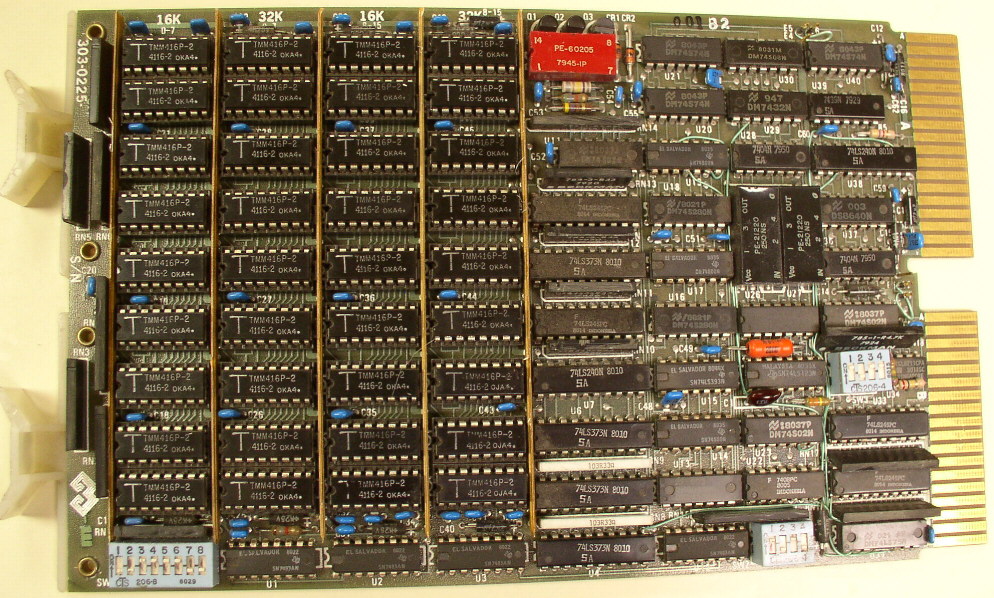
Hi, I'm trying to ID this:
http://ana-3.lcs.mit.edu/~jnc/tech/pdp11/jpg/QBUSMystMem.jpg
mystery QBUS memory card. I think it's a 64KB card, so not very important, but
it's bugging me. The company logo (lower left corner) looks familiar, but I'm
not good with off-brand logos; I'm hoping someone will recognize it. (It we
can locate a manual for it, so much the better; I'm not up to playing with it
to work out what the switches do!)
Noel
I received permission to share this link. These are in a personal
collection in Finland. Don't drool too hard :-)
https://imgur.com/gallery/7TKl5YH
--
Cindy Croxton
Electronics Plus
1613 Water Street
Kerrville, TX 78028
830-370-3239 direct
Hi folks,
I am looking for the following software products for a PDP-11, ideally to
be run on RSX-11M.
RJE/HASP
2780/3780 Protocol Emulator
My aim is to be able to submit a remote job from a simulated PDP-11 on simh
to a simulated IBM/370 on Hercules. The products that I mentioned seem the
obvious way to do this, but anything that works would be helpful.
Cheers
Peter Allan
I've not worked on 8" floppy drives, but have on tons of 5.25" single-
sided drives. Older single-sided ones (usually 35-track from the 70's)
had load solenoids for the pressure pads, as with a double-sided unit.
The pad is to provide good contact between the media surface and the
head beneath. I think older media must have ablated more than latter-
day media does, as it is rare to find a single-sided 5.25" drive with a
load solenoid. The pad is always in contact whenever the drive door is
closed. Double-sided drives of course retained the head-load solenoid
for some years, but eventually those were done away with. So, I think
that unless you are using a drive 24/7, a pad in contact with the disk
should not be a serious concern. That the pad IS properly in contact
is important of course, and pads should be inspected to see that there
is enough 'meat' left on them to provide the pressure needed. Aft of
the pad, at the base of the head-sled pressure arm is a notch into
which the end of the spring rides. Close examination of the sled will
probably show some higher and lower notches into which you can move the
end of the spring, to provide more or less pressure as needed, to tune
a particular drive.
In the old days, someone running a drive on a BBS or other heavy
application might wear a pad out. We'd just steal one from a cassette
tape and stick it on the arm. The cassette tape pad was square and the
originals were round, but it never seemed to make any difference.
These days there are no cassettes floating around to cannibalize, so I
buy felt pads for furniture from Amazon, trim them with a razor and
stick them on a drive I'm refurbishing. Atari, Commodore, Tandy...
Many of the 80's 8-bits used this very scheme on their single-sided
drives and this solution is good for all of them.
I had someone insist to me recently that the felt pads I was buying
were acrylic and the originals were Rabbit Hair and that it was crucial
that the replacements be made of rabbit hair. In practice, and that is
40 years of practice, any old pad will do just fine. If it looks like
the right thing it will serve the purpose. Just pick off the old nub
of a pad and stick on your newly cut one and go.
Common faults I've been noticing are that disk drives made in the 70's,
80's, and 90's are failing in common ways. I attribute these failures
mostly to lack of lubrication. After 30 years they get a bit gummy and
the actuators have to work harder to move the head sled, which puts a
greater load on the darlington drivers which power the actuators, which
causes the drivers to fail. Replacing the drivers will often restore
the drive to working order, but they will fail again in short order if
the original probelm is not resolved. I simply clean the rails and
stepper bands, touch a little wd40 to the rails to free the head sled,
cycle the head back and forth a buncha times manually to exercise it
and distribute the lubricant, then follow that will a little white
lithium grease for a longer-lived lube. Not only will the drive run
better and a lot quieter when lubricated, the loads on the actuators
and their associated electronics are greatly reduced, making for a
like-new drive.
The second thing that is happening quite often is electrolytic
capacitors are failing, leaking or not. I had a pair of drives the
other day which made quite a racket when spinning free even without
media installed. Replacing the electrolytics on the spindle motor's
board got rid of the noise and made it possible to properly tune the
RPM's, which had been just all over the map.
best,
Jeff
> Date: Fri, 9 Oct 2020 02:29:46 -0400
> From: Bob Vines <bobvines00 at gmail.com>
> To: cctech <cctech at classiccmp.org>
> Subject: Tips on reviving a TU56 + TD8E?
> I don't have a TU56 & TD8E _yet_, but really hope to get one fairly soon --
> if successful, they will most assuredly require troubleshooting & repairs.
> Where did you find the source for TDFRMT? Also, where did you find the
> MAINDEC document that matches your version of the TD8E MAINDEC? I ask
> because I've had _great_ difficulty finding MAINDEC docs that actually
> match whatever MAINDEC images I've tried to use.
Bob,
The source for TDFRMT, as well as the rest of OS/8 can be found here:
https://tangentsoft.com/pidp8i/file?name=src/os8/ock/CUSPS/TDFRMT.PAhttps://tangentsoft.com/pidp8i/dir?ci=tip&name=src/os8
Several versions of the TD8E MAINDEC can be found here:
http://so-much-stuff.com/pdp8/software/maindec.php
Only one of them has a PDF, and I haven't checked to see if they fully
match up with the binaries, but the starting addresses of the tests I'd
been checking at least seem to match up with the DHTDAB.DG binary found
here: www.pdp8.net/pdp8cgi/os8_html?act=dir;fn=images/os8/diagpack2.rk05
Regards,
-Tom
mosst at sdf.org
SDF Public Access UNIX System - https://sdf.org
>
> Message: 8
> Date: Wed, 7 Oct 2020 05:59:40 +0000 (UTC)
> From: Thomas Moss <mosst at SDF.ORG>
> To: cctalk at classiccmp.org
> Subject: Tips on reviving a TU56 + TD8E?
>
...
> I've recently bought a TU56 for my PDP-8/e, and am looking for some
> advice on getting it to work.
>
...
> ... I found a copy of the source for TDFRMT so I could see what
> exactly was causing the "SETUP?" error.
>
...
Tom,
I don't have a TU56 & TD8E _yet_, but really hope to get one fairly soon --
if successful, they will most assuredly require troubleshooting & repairs.
Where did you find the source for TDFRMT? Also, where did you find the
MAINDEC document that matches your version of the TD8E MAINDEC? I ask
because I've had _great_ difficulty finding MAINDEC docs that actually
match whatever MAINDEC images I've tried to use.
Thanks,
Bob
> From: Ethan Dicks
> a DEC sync serial board since that part is nowhere to be found right
> now.
I dunno, I see them fairly often on eBait (well, often compared to some other
things, e.g. TU56 parts... :-)
QBUS or UNIBUS? And there are lots of different ones, which I confess I don't
fully understand the difference between (e.g. DP11, DQ11, DU11, DUP11, DV11) -
some of it's single-line/multi-line, and DMA/programmed I/O, but from what few
details I looked at - while doing:
http://gunkies.org/wiki/DP11-A_synchronous_serial_line_interfacehttp://gunkies.org/wiki/DUP11_synchronous_serial_line_interface
there are also differences in exactly which protocools are supported,
etc, etc, etc, etc.
Noel
>Date: Wed, 7 Oct 2020 11:29:43 -0700
>From: Glen Slick <glen.slick at gmail.com>
>Subject: Re: Remote job submission from PDP-11
>
>On Wed, Oct 7, 2020 at 11:04 AM Paul Koning <paulkoning at comcast.net> wrote:
> >
> > > On Oct 7, 2020, at 12:06 PM, Glen Slick via cctalk
> <cctalk at classiccmp.org> wrote:
> > >
> > > ...
> > > I was curious about this DEC M8704 DMS11-DA that sold cheap a few days
> > > ago. It has eight SMC COM5025 "Multi-Protocol Universal Synchronous
> > > Receiver/Transmitter USYNR/T" chips:
> > >
> > > https://www.ebay.com/itm/373243388363
> > >
> > > Apparently it can't do anything on its own. It needs to be connected
> > > to a UNIBUS through a companion KMC11 processor board, which might not
> > > be too common if someone wanted to put together a working
> > > configuration.
> >
> > That model number isn't familiar.
> >
> > A KMC-11 is simply a microprocessor that sits on the Unibus and
> does Unibus cycles to another device on behalf of the host. The
> idea is to offload operations so the host can ask for block
> transfers and the KMC does the individual character I/O operations needed.
> >
> > That said, it clearly is not correct that "it can't do anything
> on its own". The KMC-11 reaches into the device via its Unibus
> CSRs. If you can find a description of its operation, or reverse
> engineer it, you can clearly write a device driver for it that
> doesn't rely on a KMC-11.
> >
> > paul
>
>Well it does appear that M8704 DMS11-DA "can't do anything on its own"
>directly through the UNIBUS. From a quick visual inspection it only
>has power and grant continuity traces on the card edge connectors. The
>connection to the controlling KMC-11 is through the 40-pin Berg
>connector. So without a KMC-11 an alternate interface through the
>40-pin Berg connector would be needed.
My first job at DEC was to release the KMC-11 Programmer's Tools
support for RSX-11.
(I didn't write them from scratch, two other engineers did that, but
I did do final debug and QA)
We provided two firmware kit products; the CommIOP-DUP and DZ, which
controlled the DUP-11 and DZ-11 respectively.
The KMC-11 could do NPR bus transfers to/from the devices, and the
CommIOP-DUP firmware could do Bisync or X.25 type framing so that you
got an RSX-11 driver with a packet interface, vs byte at a
time. The CommIO-DZ firmware provided various customizable state
driven things as you might want for a line driven terminal
concentrator. I'm pretty sure the packages came with the "source"
code, so you could customize it if you could understand it.
The DMC-11 did DDMCP support and was basically a KMC with ROM in the
control store. And it did use that external connector to the
proprietary network interface card, DMC-11DA.
In later years, I wrote and released a KMC Tools package for
VMS-11. That came with a VMS DMA LP-11 line printer driver I authored.
I don't remember if the CommIOP tools were supported. Some VMS
engineers didn't like these products. (another story)
(That didn't stop the Lab products guys in Marlboro from using them
for their applications)
There was a later version called the KMC-11B which doubled the memory
and probably ran faster too. It was the same board as the DMP-11
product which was an improved version of the DMC-11.
These were quad Unibus boards. In the Q bus world, there was a 6502
based I/O processor card developed (outside of Networks) (as one-chip
micros became available) as well.
I have a KMC-11 Programmer's Manual here... I think you'll need a
print set to figure out that connector.
Dave.
So far, two people have asked for "Varian Data 620/i Systems Computer
Manual."
So that I don't have to decide who gets it, I've put it on EBay for a7-
day auction with a starting bid of $0.99.
https://www.ebay.com/itm/224184671124 id="-x-evo-selection-start-marker">
Van Snydervan.snyder at sbcglobal.net
In about 1974, for my senior undergraduate project, I wrote microcode
to convince a Varian V70 that it was actually an IBM 1130.
Being substantially more modern hardware, it was much faster than a
real 1130.
If anybody wants microcode and flow diagrams, and listings for the I/O
simulation (which ran in 620/f mode), I'm happy to send them.
Van Snyder
van.snyder at sbcglobal.net
So far, two people have asked for "Programming HP 21MX Computers."
So that I don't have to decide who gets it, I've put it on EBay for a
7-day auction with a starting bid of $0.99.
https://www.ebay.com/itm/224184669206
It has a cheap "perfect" binding, and it's 3-hold punched, so it could
be disassembled and scanned, but I don't want to be the one who does
this.
Van Snyder
van.snyder at sbcglobal.net
https://pt.gofundme.com/f/exhibition-of-agora-computing
They really need donations so they can get going again. Can anyone help?
--
Cindy Croxton
Electronics Plus
1613 Water Street
Kerrville, TX 78028
830-370-3239 direct
Hi all,
Am wondering if anybody knows how to find a copy of the "Handheld
Systems Archives CD-ROM" that was sold through the domain cdpubs.com
20-30 ywars ago.
/Tomas
Hi All,
I've recently bought a TU56 for my PDP-8/e, and am looking for some
advice on getting it to work.
Over the course of a few weeks I fixed odds and ends with the drive
(motor run capacitors, damaged wires, transistors, etc.), and for a few
days the right drive worked very reliably. I could read existing tapes,
write to them, and format fresh tapes.
(A write-up to this point is here: www.vcfed.org/forum/showthread.php?76935)
(A good source for new motor run capacitors: https://www.ebay.com/itm/142631210678)
However, this changed when I wrote a file to an existing tape, only to
find that the directory structure had somehow been corrupted in the
process. Out of curiosity I mounted a scratch tape that I knew I could
format before and tried to format it again, the result was a
BLOCK NUMBER ERROR PHASE 4.
When running the TD8E MAINDEC it's apparent why - when set to display
the block number in the accumulator for the tape I tried to format,
every third bit appears to stick or glitch out. The tape I think I
corrupted however appears to count up and down the blocks correctly.
(Video here: https://streamable.com/bh8f7p)
I tried swapping the G888s around to see if it made any difference, but
nothing changed. I then turned my attention to the cabling and the TD8E.
Somewhere along the line things got worse, and now running TDFRMT just
results in a "SETUP?" error when trying to format a tape.
I've tried running the TD8E MAINDEC (DHTDAB), and managed to get it to
pass the following tests:
-Operator Intervention
-Data Register
-Command Register
-Initialize
-SDLC, SDLD, SDRC, and SDRC and AC Clear
-Single Line Skip Instruction and Logic Test
-Quad Line Skip Instruction and Logic Test
However, once it reaches the Timing Error Skip Instruction and Logic
Test, it fails with the following:
>TIMING ERROR SKIP INSTRUCTION AND LOGIC
>TIMING ERROR STATUS BIT NOT SET IN COMMAND REGISTER
>
>TIMING ERROR DOES NOT CLEAR WRITE FLIP/FLOP
I also found some tests that check the Data and Command Registers by
accepting input from the switches and displaying the result in the MQ.
These work fine, although though doing so I discovered that I had stuck
bits on the MQ on one of my Major Registers boards. I swapped with a
spare for now and will look at that later.
Lastly I found a copy of the source for TDFRMT so I could see what
exactly was causing the "SETUP?" error. I noticed there's several things
that can cause that error (the JMPs to ERCHK), so I replaced the first
JMP ERCHK with a halt and sure enough it did halt there.
/SEE IF THE DRIVE IS OK
003224 6774 RSTSM, SDLC /LOAD CR TO CLEAR TIMEING ERROR
003225 6775 SDLD /LOAD DATA BUFFER TO CLEAR S Q FLAGS
003226 1162 TAD DT0400 /SET WRITE
003227 1027 TAD DTA /GET UNIT
003230 3257 DCA SAV /STORE IT AWAY
003231 1257 TAD SAV
003232 6771 SDSS
003233 5232 JMP .-1
003234 6774 SDLC
003235 1257 TAD SAV
003236 6774 SDLC /LOAD THE TRANSPORT
003237 6776 SDRC /READ THE COMMAND REGISTER AND CHECK IT
003240 7006 RTL
003241 7004 RAL
003242 7500 SMA /CHECK WRITE TO BE SET
003243 5260 JMP ERCHK /WRITE IS NOT SET <<<---Halts here if changed to HLT.
003244 7004 RAL /CHECK WLO
003245 7510 SPA
003246 5260 JMP ERCHK /WLO
003247 7004 RAL /CHECK SELECT AND TIMING ERROR
003250 7710 SPA CLA
003251 5260 JMP ERCHK /SELECT OR TIMING ERROR
003252 4777' JMS NUDTA /CHECK OTHER DRIVE IF ANY
003253 5213 JMP RSTSM-11 /CHECK OTHER DRIVE
003254 5655 JMP I .+1
003255 1400 STMK
003256 0000 CNTERL, 0
003257 0000 SAV, 0
Does anyone have any hints on what I should check from here?
Regards,
-Tom
mosst at sdf.org
SDF Public Access UNIX System - https://sdf.org
Working on cleaning up my RX02 drives: I've taken the 8 inch floppy
units out of the case/chassis and have been cleaning dust and such off
the whole assemblies.
One thing I noticed: There is a pad opposite the head that comes down
when a solenoid is energized to provide pressure against the read head.
Makes sense, it also has a pad that presses against the floppy disc
itself, probably to keep it from jittering. However I noticed on both
heads that the bracket is adjusted all the way down. This means that
even when the solenoid is not energized the head pad is pressing against
the disk and pushing the disk against the head.
Is this normal? I would think this would result in the floppy always
being pressed against the head and quickly wearing out the disk. The
whole point is to let the disk float against the head, only letting the
pad push things into contact when doing a read.
Do I have this right, and is adjusting that that assembly proper when
the pad puck is not touching the disk when up, but is touching it when down?
C
I have some books I no longer need. Is this a good place to offer them?
WordPerfect Wiorkbook for IBM Personal Computers
Microsoft MS-DOS 5.0 User's Guide and Reference
Microsoft MS-DOS 5.0 Getting Started
WordPerfect Version 6.0 DOS Reference (along with a CD)
WordPerfect Add-Ons Catalog
WordPerfect Software Product Catalog
WordPerfect Version 6.0 DOS Getting Started for the New User
WordPerfect Shell Version 4.0 DOS User's Guide
WordPerfect Version 6.0 DOS Learning WordPerfect
WordPerfect for UNIX 7 Installation and Administration Guide
WordPerfect for UNIX 7 User Guide
WordPerfect for UNIX 7 Clipart Guide
Van Snyder
van.snyder at sbcglobal.net
Hey all, the past couple of weeks I've been working on compiling a
list of all known Lisa software, and trying to determine if it was for
the 1 or 2, if it ran on Office System, XENIX, UniPlus, etc. and the
dumped status of each title. If anyone's got any tips or pointers, let
me know and I'll get the list updated.
https://docs.google.com/spreadsheets/d/1STG0Le_8dMHRLf026x6YfXzRQm2hD0igeZV…