Hi all --
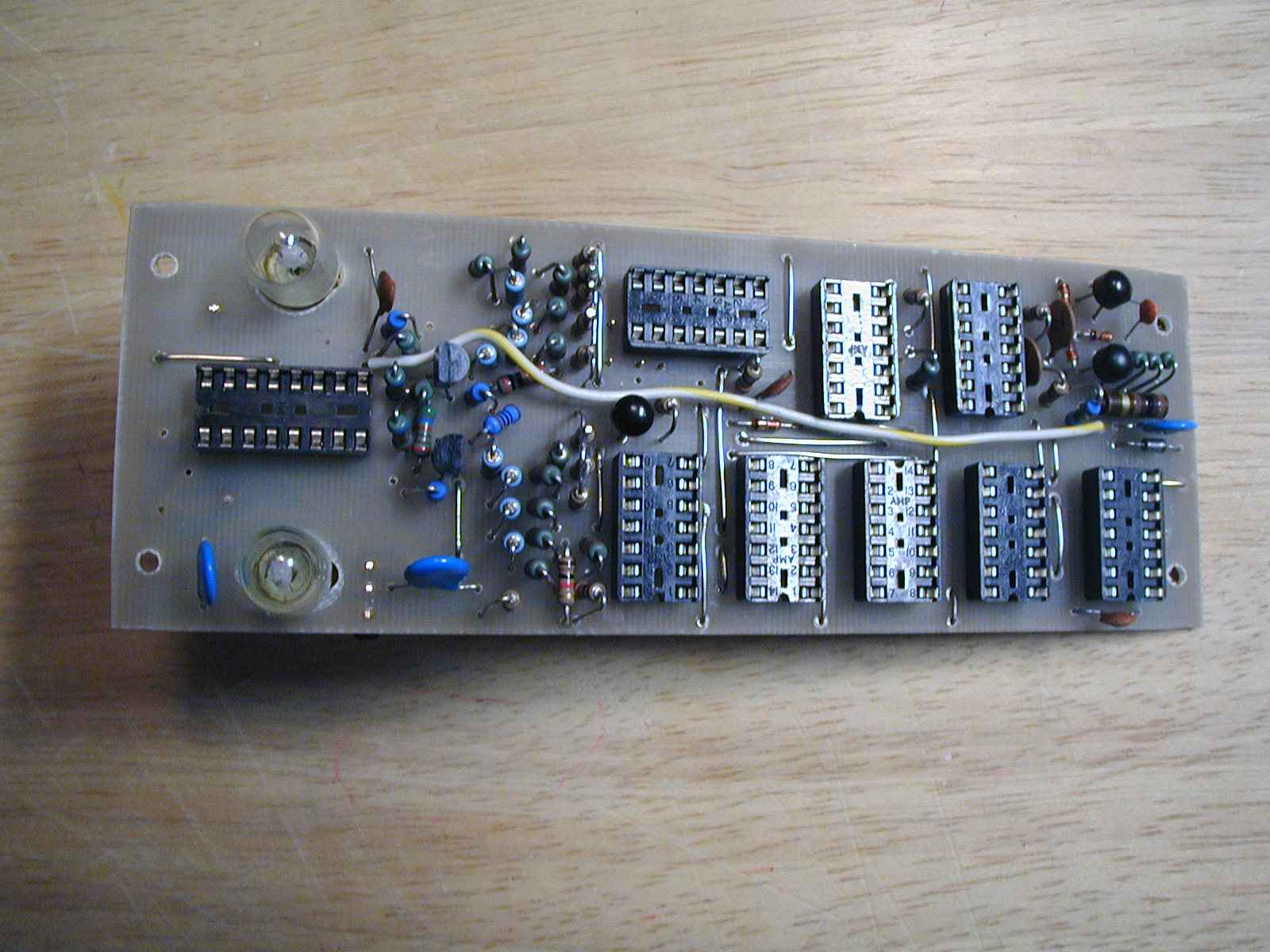
Nearly two years back I picked up some Nova 800/1200 gear, mostly in
pieces. I've been trying to track down power supplies for these for
awhile, thought I'd try asking here again and see if I have any better
luck this time :). Both chassis are the "Jumbo" variety, and take two
power supplies each -- one that provides +/-5 and +/-15 and another that
just supplies dual +5. At the moment I have just one power supply -- a
dual +5 supply.
I also only have one of the "DGC NOVA RESISTOR BD" boards that are the
go-betweens between the backplane and the power supply -- the 52-pin
edge connector from the supply plugs into this board, and the board
plugs into the backplane. I need at least one more of these...
It's relatively unlikely, but if anyone happens to have any 800/1200
power supplies going spare, in any condition, drop me a line.
Thanks again,
Josh
Hi all --
Spring is nearly here and it's time to clear out some space. The
following stuff must go, drop me a line if you're interested. Local
pick-up in Seattle, WA.
Free:
- 2x TI 1500S UNIX workstations. One's an S1505 with a 68030, one's an
S1507 with a 68040. Both power up and pass built-in diagnostics. No OS
media, no drives.
- Honeywell/Bull DPS-6 workstation/server. No OS media, no drives, no
drive controller. CPU, Memory, I/O present. Heavy. A bit dirty, but
will clean up nicely.
For Sale:
- Zilog S8000. This is a Z8000-based machine that originally ran a UNIX
port called ZEUS. System includes CPU unit, two 80mb SMD drive units
(one with cartridge tape drive) and two empty units at the bottom. I
had the system powered up and running a couple of years back, but I have
no OS media (this would appear to be a theme) and the hard drives were
either wiped or corrupted. I have a few spare boards as well. I
actually really like this system, but I need the space. Asking $250.
Thanks,
Josh
Would like to purchase and restore a big mid-80s VAX. Stupidly passed one up recently.
Let me know if you have one you'd be willing to part with- also open to trades.
In the Seattle area, but a little too comfortable with arranging freight shipping...
Sent from Outlook for iPhone
All ?
I?m helping a buddy of mine restore an original XT and original AT and I?m looking for original boot disks for them. I have the AT Diagnostics disk but the other disks I have seem to be bad. Does anyone have images that they could send me or point me to an archive of original disks? Thanks!
Rich
--
Rich Cini
http://www.classiccmp.org/cinihttp://www.classiccmp.org/altair32
I saw a DEC LPS11 Laboratory Peripheral System for PDP-11 somewhere and
was thinking of getting it just because of the Digital nameplate, but I
was too broke. Now I see that an ebay listing[1] of it has the ambitious
Buy It Now price of $1600 -- but that's with cabling and a book of
schematics, and they've tested it out at least a bit; and it has analog
in and out, and several specific boards in it.
The one I found, on the other hand, is untested and doesn't have any
external goodies; it does seem to be populated with boards, but I don't
know what they are. It also seems to be lacking any analog in or out
(unless the "DISPLAY" port is an analog out). I'm wondering if there
would be a demand for this item. If so, I may have to send someone to
pick it up for me when the place is open next.
[1]: http://www.ebay.com/itm/DEC-LPS11-Laboratory-Peripheral-System-for-PDP-11-A…
--
Eric Christopherson
All ?
It?s been a productive two weeks with my pseudo-DEC Heath H-11. I got myself an Emulex UC07 SCSI card and a SCSI2SD SCSI drive emulator. After a week of noodling around with why the on-board diagnostics wouldn?t load (stupid LTC jumper) I was able to confirm that the board and SCSI2SD setup worked. Tonight I built an RD54 image of RT-11 v5.7 using SIMH and dd?ed it to the card and now I have RT-11 5.7 running over SCSI. Yea!
Rich
--
Rich Cini
http://www.classiccmp.org/cinihttp://www.classiccmp.org/altair32
On 2016-Apr-08, at 11:58 AM, Bill Sudbrink wrote:
> I don't know why I bothering to be coy about it...
>
> My unit here:
>
> http://wsudbrink.dyndns.org:8080/images/cyclops-latest/P4060005.JPG
> http://wsudbrink.dyndns.org:8080/images/cyclops-latest/P4060006.JPG
>
> Actually, I'm further along than that, but I
> don't have more recent photos.
>
> Original unit here:
>
> http://www.swtpc.com/mholley/PopularElectronics/Feb1975/PE_Feb_1975_pg30.jpg
>
> Schematic here:
>
> http://www.swtpc.com/mholley/PopularElectronics/Feb1975/PE_Feb_1975_pg28.jpg
Well that's neat. I assembled the Cromemco kit version of the Cyclops ( https://en.wikipedia.org/wiki/Cromemco_Cyclops ) ca. 1976 for a friend with an IMSAI, and built the companion adapter to provide display on an oscilloscope, but I don't know that it was ever made to work.
(The kit version presented an interface for a computer rather than the scope drive of the magazine article.
Hopefully you're more successful with your unit.
(I think you'll find the MC7805 there is indeed plastic not ceramic. Moto produced various power transistors and regulators in those packages (case 90 in Moto parlance) as well as a smaller version from the same plastic material)
A 9V wall wart would probably do for the power supply, or remove the regulator and use a modern 5V switching wall wart (not that I wish to promote wall warts, but if they're on hand . . )
Hey folks,
I've been on a tear trying to resurrect old projects here, and next on
the list is an ADM 3a.
This particular 3a has no horizontal scan. None at all. I just get a
vertical line down the center of the screen. First thing I checked was
the horizontal deflector on the yoke, which seems secure.
Before I go diving into the schematics, I figured I'd ask here: Is
this a common failure mode? Has anyone else experienced no horizontal
scan on a 3a? Any tips on where to look first?
-Seth
--
Seth Morabito
seth at loomcom.com
> From: Peter Koch
> rumours are that kids do place stuff like this into their parents
> basement :-)
I've even heard rumours of parents placing stuff like this into their kids
basements!
(I certainly have some PDP-11's in my daughter's old bedroom! :-)
Noel
> From: Torfinn Ingolfsen
> Most likely a bad solder joint.
That was my first thought, and so I carefully inspected all the pins, but
they all looked good to me. But I suppose it might have been something that
wasn't visually obvious.
Noel
So I just had the incredibly amusing experience of managing to repair an
-11/04 CPU by un-soldering a chip, putting in a socket, and putting _the same
chip_ back in that socket!
Before you go 'WTF?!?!', let me explain what happened.
The CPU wouldn't run, and in poking around, I stumbled on the cause: all the
registers would not 'take' 1's in the 0360 bits. Hmm, 4 contiguous bits -
sounds like it might be a bad register file chip. But before I pulled it, I
wanted to make sure it wasn't some other part of the data path - Mux, ALU,
etc.
So I put a DIP clip on the chip, whipped up a 3-instruction 'scope loop that
would exercise it, and... while I was looking at it, the problem went away!
WTF? So I pull the clip - and the problem comes back. Repeat. Clearly there's
a bad connection in the chip, and the pressure of the clip is 'fixing' it.
So I pull the chip, put in a socket (I always use sockets on repairs, I'm
paranoid I'll overheat the parts - I don't mind living with an potential
eventual bad contact from corrosion), and figure what the heck, let me see if
fiddling with it fixed the bad connection - and sure enough, it now seems to
work!
And if it eventually fails, no problem - it's in a socket, I know where to go
if the machine stops working, those P3101A's are rare and expensive, etc! :-)
Noel
Hi all,
we have been using two Sun 6800 (each fully equipped with 96GB of RAM
and 24 Sparc III processors 1.2GHz) for many years.
Now they are retired and must leave our machine room to make place
for newer machines.
Anybody out there willing to give them a new home? They are very good
in transforming electric energy into heat. And by activating only some of
the processor boards you can regulate the heat flow. Your wife will love to
stand behind it and use it as a whole-body blow-dryer.
Take one for free and you will get another one for no additional costs.
While rearranging our machine room, we found lots of other stuff that must
go away too. Here's the current list:
- Sun E250
- Sun A5200, 2xA5100, D1000 with lots of disks
- Sun E450, 2x, one is still needed for a couple of months
- Sun L1000, 3x, one is still needed for a couple of months
- Sun 6800, 2 fully equipped and a third one for spare parts
- Sun 880 with 12 disks
- Sun 480 2x, with spare processor boards
- Sun L11000 tape library (aka ATL P3000) with 6 drives and lots of tapes
Be warned: You need a truck with lift to transport a Sun 6800.
It's 191x130x61cm and weights approx 500kg. Same thing with
the tape library: 192x72x145cm, approx. 600kg. On the other
hand rumours are that kids do place stuff like this into their
parents basement :-)
I took some pictures and uploaded then to http://flic.kr/s/aHskuakSMT
Peter
When I was at the recycler last week, I saw a lot of really OLD test
equipment. I started looking through it to see if there were things I could
recognize, but the closest thing I could figure out was a 1940s telephone
equipment tester. All of these were portable, with lids that closed with
latches. Probably weighed abt 20-30 pounds each. Any cables that might have
been needed to run the equipment was gone. If things like this are of
interest in the $25 range, then I can pick some up next time I see them.
Unfortunately I have no cell phone numbers for anyone in the DFW area to
tell them to come and see the goodies while I am there, and they will not
let strangers come in and poke around. I am (or was) an electronics tech,
but most of the functions on these old test machines eluded me.
---
This email has been checked for viruses by Avast antivirus software.
https://www.avast.com/antivirus
Hi.
I'm considering to ship an empty full height rack from the USA to Sweden. It is
definitely something I wont find here so it might be worth the cost and effort.
What are my options to get it here safely? If you have any experience I would
greatly appreciate if you could share them.
Thanks in advance,
Pontus.
You should be just fine.
On 4/7/2016 1:38 PM, Bill Sudbrink wrote:
> If you have a circuit which is normally designed to
> operate with an unregulated supply, through a regulator...
> say unregulated +8 through a 7805 to a regulated +5 and
> you want to test it independent of the +8 supply, if
> you leave the unregulated rail unattached and put +5
> switcher straight onto the regulated +5 rail, will you
> damage the 7805? Clearly the VIN is open, but the ground
> pin will still be attached. Would this push voltage
> back through and screw things up?
>
> Thanks,
> Bill S.
>
>
>
--
The contents of this e-mail and any attachments are intended solely for the use of the named
addressee(s) and may contain confidential and/or privileged information. Any unauthorized use,
copying, disclosure, or distribution of the contents of this e-mail is strictly prohibited by
the sender and may be unlawful. If you are not the intended recipient, please notify the sender
immediately and delete this e-mail.
I had one of those Japanese Koan moments recently when someone asked me
"Why do floppy disks stop working?" and I realised I... didn't actually
know. I thought I'd throw it to the group and get some theories/proofs.
Let's work on the assumption we're talking about 5.25" and 3.5" disks.
Several guesses:
- Repeated use slowly wears away the magnetic media layer on the mylar.
- When left in an unprotected state, or a poor environment, damp, mold and
dust can damage the surface, either degrading the magnetic layer or
causing the gap to shrink enough that the drive head physically damages
the disk?
- Quantum fluctuations in the state of the universe, caused by millions of
mostly non-interacting particles passing through a disk in any given
minute, alter the magnetic spin of the ferric atoms causing gradual data
loss over time (mostly tongue-in-cheek)
- Given the lack of use of most floppy drives they themselves pick up
'gunk' and on first reading a diskette after a long time of disuse damage
it.
It _seems_ like when you put a 3.5" disk down for ten years and pick it
back up, a disk that used to work fine no longer does. Of course, after
ten years, it could be your own memory that's failed.
Dare I ask, what's the consensus?
- JP
> > > 1) I have a 12 volt DC supply. 12 volts seems to be
> > > within the VIN range for the 7805s whose data
> > > sheets I've now read. Can I simply apply 12 volts?
> >
> > Yes, but that regulator might get mighty hot! I would
> > not do this for fear of cooking the poor thing.
>
> That's what I figured to start with, before reading the
> datasheets.
If as your photos (in another message) suggest it will run
OK from 8V with no heatsink on the 7805, then I would be
pretty sure it will be OK at 12V if you bolt a reasonable
heatsink to the regulator. Give it a smear of silicone
grease, of course.
-tony
>
> First, a few quick "whys":
>
> 1) The 7805 is actually a Motorola MC7805CP, date
> code 7308 with gold leads. Very hard to exactly
> replace.
Any reason why it would have to be an exact replacement?
In any case, the behaviour of the 7805 if you apply a
voltage to the output with the input floating may well
depend on the manufacturer and even the date (some
devices were improved over the years). Unless you have
a 1973-or-so data sheet from Motorola, I don't think
you know whether it will be damaged or not.
[...]
> 1) I have a 12 volt DC supply. 12 volts seems to be
> within the VIN range for the 7805s whose data
> sheets I've now read. Can I simply apply 12 volts?
Yes, but... The power disipated in the 7805 will increase, in
fact it will be more than doubled. To put it crudely, a linear
regulator acts like an automatic variable resistor. I have no
idea what current the load takes, let's call it I. If you supply
8V, then the power disipated in the 7805 is 3*I watts, if you
supply 12V it's 7*I. This may or may not be a problem.
> 2) Could I place a resistor in series between the 12V
> supply and the 7805 to drop the voltage at the 7805
> to somewhere around 8?
Yes. You need to know the maximum current the load will
draw, which will be much the same as the current drawn
>from the PSU. Then just calculate the resistor to drop
4V at that current.
If you can find one, you could probably use a 7808 to supply
8V to the unit from a 12V supply. Or a 7805 'jacked up' with
a 3.3V zener diode (in series with the common lead to the
extra 7805 only).
My guess is that giving it 12V will be fine though.
What is the device, and do you have any idea how much
current it is going to draw?
-tony
> 1) The 7805 is actually a Motorola MC7805CP, date
> code 7308 with gold leads. Very hard to exactly
> replace.
Is that the big flat plastic package with the wide flat leads? I might
have a few of those around, but I agree, not an easy variant to find.
> 1) I have a 12 volt DC supply. 12 volts seems to be
> within the VIN range for the 7805s whose data
> sheets I've now read. Can I simply apply 12 volts?
Yes, but that regulator might get mighty hot! I would not do this for
fear of cooking the poor thing.
> 2) Could I place a resistor in series between the 12V
> supply and the 7805 to drop the voltage at the 7805
> to somewhere around 8?
Yes, you could do this. Pick an appropriate power resistor, or use a
big wirewound rheostat.
> 3) If I was to "tack on" a jumper between VIN and VOUT,
> would that protect the 7805 and allow me to power the
> circuit with 5 volts?
I would not do this at all.
--
Will
If one were to use a dumb CRT terminal from the early '70s regularly in
this day and age, would it be more prone to hardware failure than if it
were kept in storage or just kept to look at but powered off?
--
Eric Christopherson
Hi list,
the 17th edition of VCF Europe[0] is coming soon! It will take place on
April 30th and May 1st in Munich, Germany. Please be aware that the
information on the English version of the website might be outdated or
less detailed than on the German page, but Google Translate will help.
Also the registration for VCF Berlin[1] in October is open now. We are
looking for speakers, workshop instructors and exhibitors, both for the
regular exhibition and this year's special exhibition on computers and
languages. It will be open for visitors on Sunday, 2nd and Monday, 3rd
of October, as the 3rd October is a public holiday in Germany, but we
are thinking about inviting people to build up on Friday already and
using Saturday, 1st of October as a day just for the participants and
the community. This way there would be more time to talk and see the
other exhibitions. Maybe we could even offer advanced workshops on
Saturday. Come and visit us! Ping me if you need a place to stay.
Regards, Anke
[0] http://vcfe.org/E/index.html
[1] http://vcfb.de/2016/index.html.en
On 04/07/2016 2:18 PM, Bill Sudbrink wrote:
> drlegendre wrote:
>> Not saying it's going to smoke-out, but it does
>> seem like a wonky thing to do.
> I disagree about "wonky" let me try with more
> diagram and less English:
>
> (+8)
> |
> VIN| ceramic cap
> |-----][-----
> ___|____ |
> | 7805 |----------GROUND
> -------- |
> | |
> VOUT|(+5) |
> | |
> ___|____ |
> | LOAD |-------|
> --------
>
> +8 is not currently available (no pun intended).
> I would like to test LOAD without removing 7805
> as it is soldered in place. Is damage to 7805
> likely if alternative regulated current is applied
> at (+5) and (+8) is left open?
>
> Bill S.
>
>
>
Yes, you can damage the 7805 - READ the data sheets...
Raising the Output Voltage above the Input Voltage:
Since the output of the device does not sink current, forcing
LM340/LM78MXX Series 3-Terminal Positive Regulators LM340/LM78MXX Series
3-Terminal Positive Regulators
the output high can cause damage to internal low current paths in a
manner similar to that just described in the ?Short- ing the Regulator
Input? section.
LM340/LM78MXX Series 3-Terminal Positive Regulato John :-#(#
--
John's Jukes Ltd. 2343 Main St., Vancouver, BC, Canada V5T 3C9
Call (604)872-5757 or Fax 872-2010 (Pinballs, Jukes, VideoGames)
www.flippers.com
"Old pinballers never die, they just flip out"
The problem with lifetime warranties is that they're not about the
lifetime of the owner, and they're not about the lifetime of the
product. What it means is "as long as it's a product we're still
selling" (except for those cases where it *really* is the lifetime of
the product.. in which case it means "the warranty is valid until the
product fails").
Does anyone have a list of the capacitors on the analogue board and power
supply for a Mac SE/30?
--
David Griffith
dave at 661.org
A: Because it fouls the order in which people normally read text.
Q: Why is top-posting such a bad thing?
A: Top-posting.
Q: What is the most annoying thing in e-mail?
On Thu, 7 Apr 2016, Bill Sudbrink wrote:
> Maybe I'm overthinking this. If I just put
> regulated +5 on the 7805 VIN will it work?
>
Isn't the minimum input voltage for a 7805, 6vdc?
g.
--
Proud owner of F-15C 80-0007
http://www.f15sim.com - The only one of its kind.
http://www.diy-cockpits.org/coll - Go Collimated or Go Home.
Some people collect things for a hobby. Geeks collect hobbies.
ScarletDME - The red hot Data Management Environment
A Multi-Value database for the masses, not the classes.
http://scarlet.deltasoft.com - Get it _today_!
-----Oorspronkelijk bericht-----
From: Bill Sudbrink
Sent: Thursday, April 07, 2016 10:38 PM
To: 'General Discussion: On-Topic and Off-Topic Posts'
Subject: Voltage regulator with alternate voltage source...
If you have a circuit which is normally designed to
operate with an unregulated supply, through a regulator...
say unregulated +8 through a 7805 to a regulated +5 and
you want to test it independent of the +8 supply, if
you leave the unregulated rail unattached and put +5
switcher straight onto the regulated +5 rail, will you
damage the 7805? Clearly the VIN is open, but the ground
pin will still be attached. Would this push voltage
back through and screw things up?
Thanks,
Bill S.
---------
It is a special situation I have never seen, but I would try to disconnect
the output of the 7805 before connecting a foreign +5V to the circuit.
It is good practice to have a diode reverse connected from output to input
to prevent damage to the 78xx in the case that the output voltage
gets higher than the input voltage. Normally that would not happen, but if
you have a high capacitance at the output and the load is minimal
it could be possible when power is switched off that the input voltage
dropped, but due to the big capacitor at the output the output voltage
did not yet drop. And then that diode in reverse from output to input comes
into play.
Now the input is not connected, but GND and the output are ... I would have
a look at a data sheet of the 78xx series to see what could happen
if the input is not connected, but the output is.
So, if possible, simply disconnect the 78xx output lead first.
- Henk
If you have a circuit which is normally designed to
operate with an unregulated supply, through a regulator...
say unregulated +8 through a 7805 to a regulated +5 and
you want to test it independent of the +8 supply, if
you leave the unregulated rail unattached and put +5
switcher straight onto the regulated +5 rail, will you
damage the 7805? Clearly the VIN is open, but the ground
pin will still be attached. Would this push voltage
back through and screw things up?
Thanks,
Bill S.
Hi Guys
PDP-8/e A panels now shipping
PDP 8/e B panels ship on Friday
PDP-8/ f and /m ship on 14th
I have some extras of the above if you are quick.
Rod (Panelman) Smallwood
Hello,
I'm a modest collector of DEC and PDP11 stuff, I always thank who wrote the
PDP11 field guide with the almost complete list of all the existing
boards...
Now comes the idea: could be useful having a website where the field guide
assume a graphical aspect, including pictures of the parts, descriptions,
and so on?
Of course it would be almost impossible for one alone to do all the work,
but I'm thinking of a sort of wiki, where subscripted users can upload
pictures, informations and documentations.
Maybe something similar already exists?
Thanks
Andrea
*some restrictions apply :-)
Evan Koblentz pointed me to a rescue here in the triangle, NC area back in
August 2015. Some items were set aside for VCFed, but there were A LOT of
books and other media that were up for grabs. Because I'm a sucker, I took
and then carefully cleaned and catalogued them all. The master list is here:
https://docs.google.com/spreadsheets/d/19UYeJlhiVYVExCAO2NSzcAkBww0kEeAYrEG…
There really are 17 boxes, and they really do weigh 780lb or approximately
0.35 metric tons.
They're mostly books (from the 80s and 90s), but there are some floppies,
some boxed sets, and even a small box of VHS tapes.
The previous owner stored all this stuff in abysmal conditions, so there
was a lot of mold (and some dead insects and some live insects, and... you
know how it goes). I cleaned every item as much as possible. Some items had
to be disposed of for safety reasons. That which made it into the
cataloging stage is at least scanable, but if it says 'mildewed' on it, and
you have a mold allergy, you don't want it. I don't know if any floppies
are readable, and unless the catalog says it comes with media, I haven't
got the media. Luckily most items survived relatively intact.
You can have anything in the spreadsheet free of charge provided:
1) You are willing to take WHOLE BOXES at VCF East XI, you let me know by
Weds 4/13/16, and they fit in my car when I pack for VCF. OR
2) You want to come to Durham to pick them up at a prearranged time after
VCF OR
3) You are willing to wait until the next VCF East, and let me know far
enough in advance that I can set items aside for you.
If you want single items, and you don't want to wait until VCF East 2017,
I'll do my best to mail them to you after this VCF is over, but you'll need
to pay for shipping. I would prefer not to ship whole boxes; they're sturdy
moving boxes but they weigh 40-60lb each and I'm pretty sure if you drop
them hard enough the contents won't like it. I'm in Durham, NC 27701.
I don't want any of this to go to recycling, so I'll try to hold it for at
least a year or the next VCF East after this one. After that, all bets are
off.
Let me know if you are interested in any of this stuff, or if you have
questions; in case the mailing list(s) eat it, my email is alexey.toptygin
at gmail dot com. Thanks!
About a month ago I was given a very nice AT&T 4425 terminal, which
was AT&T's OEM of the Teletype 56D. Alas, the terminal suddenly died
on me last week and I'm going to have to dive in and figure out why.
It appears to be something going wrong with the digital board, not the
analog, since sometimes I can get strange characters to show up on the
screen (but not always).
I did my normal searches of BitSavers and Google, but I haven't found
any schematics for the 4425. I don't suppose anybody has them?
At least it looks easy to work on. Kudos to whoever designed the
innards, it comes apart very easily and cleanly.
-Seth
--
Seth Morabito
seth at loomcom.com
Hi classiccmp'ers.
VCF East starts in just 8 days from now.
It's at the InfoAge Science Center in Wall, New Jersey, USA.
Three keynotes: John Blankenbaker (Friday), Stewart Cheifet (Saturday),
Ted Nelson (Sunday).
Three dozen hands-on exhibits.
TWO original Apple 1 computers, including one up-and-running.
Oh and there will be a Kenbak-1 also. :)
A dozen-ish tech classes.
8-bit game programming competition sponsored by Hackaday.
Consignment room.
And the on-site, year-round computer museum is now TWICE as large as
before. Come see awesome stuff such as our circa-1965 UNIVAC 1219B
mainframe.
Kids get in free on Saturday/Sunday.
All the details, along with online ticketing, are at
http://vcfed.org/wp/festivals/vintage-computer-festival-east/.
> Date: Mon, 04 Apr 2016 20:44:26 +0200
> From: supervinx <supervinx at libero.it>
> To: "General Discussion: On-Topic and Off-Topic Posts"
> <cctalk at classiccmp.org>
> Subject: Re: R: RE: RSX-11M trouble
> Message-ID: <1459795466.2891.10.camel at PIV-Ubuntu>
> Content-Type: text/plain; charset="UTF-8"
>
> Il giorno dom, 03/04/2016 alle 19.33 +0200, supervinx ha scritto:
>> Il giorno dom, 03/04/2016 alle 14.59 +0200, supervinx ha scritto:
>>> Hmmm.... RSX-11Mplus 4.2 aren't recognized as TSK images by "normal" 4.2
>> Well... the files have been correctly transferred... i did a DMP on both
>> sides
>> so definitely I need a 4.2 non plus.
> I SYSGENed the 4.8 image on simh, and transferred ICP.TSK, just to do
> another try...
>
> The newly inserted task, showed the same parameters, using TAL ...AT.,
> but issuing a @command causes the same big crash, dropping me on the
> initial ODT monitor.
>
> I did another test, with DMP.
> Only three blocks of the original ICP.TSK are unreadable:
> o73, o107, and o177 (all numbers are in octal), with the usuale I/O
> error -101, and no mention in ELI DU0:/SH
>
> I'm angry: the damaged ICP.TSK is TCP.TSK;3 and I did a purge to make
> room on the disk the first day I got it. Can't remember if another
> version was present...
>
> I've a couple of questions:
> 1)VFY gives me two error I can't clearly understand.
> 000541,000226 owner [1,54]
> file is marked for delete
>
> 000647,000000
> I/O error reading file header -101
>
> How can I associate xxxxxx,yyyyyy to a file name?
> I tried PIP /FI:xxxxxx:yyyyyy/LI with no luck
This is a good question but I do not know the answer.
>
> 2) the .tpc images found in the net, if converted to .tap, are suitable
> for use in TU85em? Having no tape unit, I could try to install
> everything from scratch using a tape emulator.
I would use Simh to boot a BRUSYS tape then copy the tapes to make a
bootable disk.
>
> But the best would be to have 4.2 (*not* plus) tape images or someone
> with a running installation so kind to give me the four damaged files.
>
> VFY seems not to be able to repair the FS...
>
> Thanks
The closest RSX11M (not Plus) distribution I can find is an RL01 distribution of RSX11M V4.1
Since it is disk and not tape it can be directly booted with Simh and it does have a ICP.TSK
that should be pretty compatible with V4.2 since it is from V4.1 Baseline.
You can find this RSX11M V4.1 distribution at:
ftp://ftp.trailing-edge.com/pub/rsxdists/rsx11mplus_4_0_netkit_aq-ew97b-bc.…
It will unzip into 6 RL01 disk images and 3 update E disk images.
Below I mapped the first two disks and found a copy of ICP.TSK
on the 1 disk which is a Baseline image that should run on a range
of different hardware.
sim> sh rl
RL RLV12, address=17774400-17774411, vector=160, 4 units
RL0 2621KW, attached to rsx11m41_1of6_rsxm35.ax-d518e-bc, on line
write enabled, RL01
RL1 2621KW, attached to rsx11m41_2of6_excprv.ax-d521e-bc, on line
write enabled, RL01
RL2 2621KW, attached to rsx11m41_3of6_rlutil.ax-d522f-bc, on line
write enabled, RL01
RL3 2621KW, attached to rsx11m41_4of6_mcrsrc.ax-h927f-bc, on line
write enabled, RL01
sim> b rl0
RSX-11M V4.1 BL35 124.K MAPPED (BASELINE)
>RED DL:=SY:
>RED DL:=LB:
>MOU DL:RSXM35
>@DL:[1,2]STARTUP
>* PLEASE ENTER TIME AND DATE (HR:MN DD-MMM-YY) [S]: 20:36 5-APR-86
>TIM 20:36 5-APR-86
>* ENTER LINE WIDTH OF THIS TERMINAL [D D:132.]:
>SET /BUF=TI:132.
>ACS SY:/BLKS=512.
>@ <EOF>
>
>mou dl1:/ovr/pub/vi
Volume Information
Class: Files-11
Device: DL01
Volume label:EXCPRV
Pack serial: 00000273341
Owner: [1,1]
Protection: [RWCD,RWCD,RWCD,RWCD]
Default: [RWED,RWED,RWED,R]
Processor: F11ACP
>ins $pip
>pip [1,54]i*.tsk/li
Directory DL0:[1,54]
22-APR-83 18:16
ICP.TSK;1 142. C 22-APR-83 17:48
INI.TSK;1 58. C 22-APR-83 17:48
INS.TSK;1 60. C 22-APR-83 17:48
Total of 260./260. blocks in 3. files
>from the RL01 image you should be able to PUTR read and then write to an RX50
as you have done before.
Good Luck,
Mark
So I'm in the process of repairing a couple of M7859 KY11-LB -11/04-34
Programmer's Console boards, and the existing FM Print Set was kind of hard to
read in some areas, so I looked online for another set, and although I didn't
find one, I noticed several other people with the same issue - asking for a
better set.
My brain did eventually turn on, and I remembered DEC's habit of putting
prints for included devices in with print sets for computers, and with that in
mind, I managed to locate another set in the -11/34A print set; that one is a
lot clearer.
To my surprise, they showed a slightly different board from the one in the
existing FMPS available online: in the later version, the four 8093 quad
tri-state buffers between the UNIBUS data lines, and the internal bus, are
replaced by 74173's. I'm not sure quite what motivated this change - no
documentation that I know of refers to the existence of two different
versions.
The PCB is slightly different, but the ROMs are apparently all the same, so
>from the point of view of the i8008, the two versions must look the same. (And
given where the change is, it can't make any difference to the interface
between the card and the front panel, CPU boards, etc, so either version
should work anywhere.)
Anyway, the version in the -11/34A prints didn't include the actual front
console, plus to which the prints there had been heavily marked up by someone
at some point. So I have produced a new set of prints:
http://ana-3.lcs.mit.edu/~jnc/tech/pdp11/MP00015_KY11-LB_Jan78.pdf
which includes the front console pages from the earlier set, and a cleaned up
version of the pages from the -11/34A set for the M7859; hope this is useful
to someone!
Noel
While looking for DECnet documents, I noticed that there's a very large collection at http://manx.classiccmp.org/collections/antonio/dec/ . Probably not news to many, but in case some had not seen it...
Among other things, there are two CD collections MDS-1997-10 and MDS-2000-01. The former contains a rather obscure document, the DECnet Phase IV Token Ring datalink spec. That also includes the Phase IV routing layer tweaks necessary to support token ring -- or other datalinks if you don't want to use the AA-00-04-00 prefix.
paul
Hi,
The board layout is complete and has passed all of the design rule checks from
the board house. I?ll be ordering some boards for me to assemble and test next
week.
I have also received a quote for ?turnkey assembly? where I hand them the files
and get back fully assembled boards. In order to get the price reasonable I have
to have 25 *firm* orders for the boards. I?ll be charging $395/ea + shipping.
If folks could let me know (private emails please) as to the quantity that they want
(don?t send $?s yet) so I know I won?t be $1000?s in the hole on this before I order
the boards.
The timing is that I?ll probably place the order for the boards (assuming sufficient
interest) in mid-May. I?ll let folks know when I have the minimum quantity.
BTW, this is for the MEM11A 128KW SPC memory board (not to be confused with
the UMF11).
TTFN - Guy
>> The closest RSX11M (not Plus) distribution I can find is an RL01 distribution of RSX11M V4.1
>> Since it is disk and not tape it can be directly booted with Simh and it does have a ICP.TSK
>> that should be pretty compatible with V4.2 since it is from V4.1 Baseline.
>> You can find this RSX11M V4.1 distribution at:
>>
>> ftp://ftp.trailing-edge.com/pub/rsxdists/rsx11mplus_4_0_netkit_aq-ew97b-bc.…
>>
>
> Perhaps you did a cut and paste of the wrong link?
>
> Maybe you meant this one instead:
>
> ftp://ftp.trailing-edge.com/pub/rsxdists/rsx11m41_and_update_e.zip
Glen,
Yes, I did paste an incorrect link. Thank you for catching my mistake. Yours above is the correct one.
Mark
Now that I have my 3B2/300 up and running, I'd like to get developer
tools installed. Unfortunately, I can't find any of them on the web
anywhere.
Apparently what I'm looking for are the following packages:
* "C Programming Language Utilities"
* "Software Generation Utilities"
* "Extended Software Generation Utilities"
Apparently these three packages are contained on five diskettes.
If anyone has these, or can track them down, please let me know!
-Seth
Hi Guys
I now have a limited quantity of PDP-8/e Type A Front Panels ready to ship.
Type A is the early kind where the selector switch runs from the 12 o'clock position
anti clockwise to the six o'clock position.
If you have a paid order for a Type A then it will ship to-morrow.
The others will go in the order that I receive payments via PayPal
When they are all gone you go to the top of the list for the next batch.
PayPal Payment as follows $150 per panel plus shipping at $20 per panel,
You can order more than one but to be fair everybody who orders in time gets one and the rest to follow.
Don't worry there will be a new batch of Type A next week.
It gets better there will be a Type B release to-morrow. Same rules as above. Same Pricing
Even better PDP-8/f and PDP-8/m artwork is complete and panels will be made starting to-morrow.
Release 1-2 weeks
Rod (Panelman) Smallwood
Just saw this: http://www.ebay.com/itm/331820201025
In case someone is interested. I was unable to quickly figure out if it
already was archived on bitsavers.
/Mattis
> From: Mouse
> A pity pdos.csail.mit.edu is willing to impair its accessibility for
> the sake of..I'm not sure what..by refusing to serve it over HTTP.
It's the latest cretinous-lemming craze in the world of high tech - we _MUST_
hide all our bits in encryption, because otherwise some dastardly, evil
government agency will peer at them ... or something like that.
Let's all just conveniently ignore the fact that if said government
agency/ies _really_ wanted to know what someone was doing online, they'd
perhaps infect that machine's bloat-/Swiss-cheese-ware, which passes for
contemporary 'best software practices', with a virus that would report every
keystroke ... or something like that.
Never mind! Everyone turning on mandatory HTTPS on their server, refusing to
even deign to talk to you without it, can sleep the oblivious sleep of the
morally superior, rigidly secure in the knowledge that they have done their
bit in the crucial fight of out time, to protect privacy and human rights.
... Or something like that.
Sorry. You pressed one of my hot buttons - one that is connected to several
other of my hot buttons.
Noel
I could do with getting hold of a VR241, but these seem to be pretty
unobtainable. So the alternative is to rig up an adapter of some kind to
work with a VGA LCD, which also saves on space. I came across the following:
http://www.vcfed.org/forum/showthread.php?38450-VR241-substitute-for-Rainbow
-VT240-etc, has anyone else tried this with success?
Regards
Rob
I finally have my own AT&T 3B2/300, and I'm having a heck of a time
getting disk images transferred to physical media.
I have here a set of AT&T SVR3.2 diskette images, apparently made (not
by me) using dd. I would like to transfer them to physical media in
such a way that they're usable by the 3B2/300.
Here's what I know so far:
* 3B2 diskettes are 720KB, Double Sided Quad Density (DSQD) 96tpi
* Each side is 80 tracks, 9 sectors per track, 512KB per sector
* Sectors use 3:1 interleave
* Physical media should be good quality DSDD
* The 3B2 fdc is a TMS2797 (WD 2797 compatible)
* The 3B2 floppy drive is a CDC 9429
On my PC, I'm using a venerable TEAC FD55-GV with the "I" jumper in
place, so at double density it should be spinning at 300RPM.
ImageDisk claims that reading and writing at 300kbps is successful.
I have been using ImageDisk to translate the BIN files I've downloaded
into IMD files with the following commands:
D:\> BIN2IMD DISK1.BIN TMP.IMD /2 /U N=80 DM=4 SS=512 SM=1-9
D:\> IMDU TMP.IMD DISK1.IMD IL=3
(The two-step translation is necessary because BIN2IMD cannot directly
write 3:1 interleaved data unless it's interleaved in the BIN image,
so you have to use IMDU to reshuffle things... it's complicated!)
Anyway, after doing this, what I end up with is a disk that is
_almost_ usable. I can boot off of it, but it fails shortly after
loading the UNIX kernel. I can run the 3B2's "dgmon" floppy
diagnostics on it, and they almost pass, but fail to reliably read and
write during the R/W test.
Now, here's the thing: If I use the exact same media and low level
format it _on the 3B2 itself_, the disks are 100% readable on the 3B2
and pass all floppy diagnostics with flying colors.
So I'm trying to pin down what about my setup is not right.
My pet theory right now is that the R/W gap and Format gap are wrong.
The default values for the gaps when calculated by ImageDisk are
24/64. I've played with 22/32, 34/62, and 42/80, all based on reading
the datasheet and/or old Linux "fdprm" settings, but nothing seems to
make the disks 100% reliable on the 3B2 when written on the PC.
Does anyone have any insight into the gap lengths used by the 3B2? Or,
have you successfully written 3B2 floppies from disk image before?
-Seth
--
Seth Morabito
what is tumble?
Ed#
In a message dated 4/3/2016 12:41:59 P.M. US Mountain Standard Time,
aek at bitsavers.org writes:
On 4/2/16 2:01 PM, william degnan wrote:
> Thanks for that. I could not find much about the 2116A (2114/15) software
> on Bitsavers or the HP museum site. Where else does one go for these
> manuals?
>
I have a bunch scanned, just need to post-process them. Now that tumble
is running in my new workflow, I'll see what I can do.
That is really neat to have an "A"
We have a few manuals in the library and a few paper tapes.
BUT! we recently were shipped crates of paper, some of which I
never saw before in my life.
There are some HP manuals in there Similar to what Al is mentioning.
I will have to look again
to see if we have anything out of the ordinary aside from the basic manual
set.
We have a 2116"B" here which was the Phx Union HS HP-2000 2000A main
processor than became the I/O processor for their HP-2000F when Computer
Exchange Inc. bought it. Unfortunately when I retired in the early 90's I
did not save all the paper tape. I have the stuff in the drawer in the
2000 ACCESS cabinet ( yea was a neat addition to add a pull out drawer in
the cabinet to keep taps, pens and etc in!)
A few white boxes showed up in the garage at home I noticed recently
when cleaning... always grateful to find neat stuff that got misplaced
over 20 years ago....
We will wait to see what Al comes up with and see if a fill is needed
from our sloooowwwwwwwww scanner.....
Ed
I have been looking at my DECmate II recently. I got an Italian version of
WPS 1.0 for it and that works fine, except that I don't have an Italian
keyboard so finding some of the characters is a bit tricky. :)
The machine came with an RD51 hard disk. I can't many references to MFM
disks in DECmate IIs. The disk will sometimes spin up and sometimes remains
motionless. I checked all three of the Darlington transistors on the drive
board and they seemed fine (I checked them out of circuit). However, unless
I have any really persistent problems getting the disk to run, I am not
going to bother trying to make it start reliably.
My main question though is this. From what I can see the WPS software does
not access the hard disk, the manual I have does not mention hard disks. I
executed the function for listing files and it said it found nothing,
whether that attempted to access the hard disk or not I don't know. Should
WPS be able to access the hard disk? Might it have been a later version that
used the hard disk? If not, then would one of the other OSs for the DECmate
II be able to access the hard disk? I don't have any other OSs for it
though, does anyone know where I might find copies?
I also have a graphics option board for the machine, which software actually
uses this option?
Any recommendations for how best to image RX50 diskettes? I want to preserve
the diskettes I have.
Regards
Rob
Pulled these out of the trash
http://petelancashire.com/gallery/main.php?g2_itemId=6062&g2_navId=x09e4617c
The first picture are for VAX the yet to be check in the second photo are
VMS for Alpha.
Now that I have that little VAX 3100 I only want to get it configured. Is
someone other there I should give these to, I want to make sure the
contents are not lost.
Bitsavers.org for example.
-pete
Since I doubt I'm the only one on the list with failing eyes. I thought
I'd ask about monitors. Now, I'll preface this with the fact that I have
some macular degeneration in my retinae. So, I prefer lower resolution
monitors (so that fonts can't get too tiny). I also prefer as many NITs,
CD/M2, candlepower, or whatever you like to call "brightness" as I can
get (again, it's my eye issues).
I was curious what folks liked? Since I mess with a lot of consoles and
still occasionally play with the Amiga or MiST, I like to have the option
to do composite video. Keep in mind is all geared toward retro users. I
konw there is "better" gear than this, now.
Favorite LCD Monitor line: NEC Multisync, Dell Ultrasharp
Favorite CRT Monitor line: Iiyama (Sony Trinitron as a runner up)
Favorite Video Resolutions: 1280x1024 4:3 and 1280x720 (16:9)
Favorite display Devices: SGI O2 CRM graphics, The Voodoo3 for PC, The
VillageTronic Picasso IV for the Amiga.
Favorite retro NTSC/PAL Video capture devices: SGI Indy built-in
composite/s-video, SGI O2 A/V option, Amiga Newtek Video Toaster Flyer,
Quadra 880AV option for Macs, and the Matrox Rainbow Runner for desktop
PeeCee.
Favorite Retro Sound Cards: Gravis Ultrasound for PC, Sound Blaster emu10k
("Pro" PCI cards), Amiga Studio 16, SGI DM8 for SGI/IRIX, Pro Audio
Spectrum for 68k macs.
If we are going further back to the 90's I'd say I liked 640x480 for all
the great artwork done in that res on various platforms and MCGA 320x200
for games (mainly because they finally got 8-bit color that way).
The biggest downside to the NEC monitors is that few of them support
composite or S-Video. The biggest upside is that most of them perfectly
support sync-on-green. Another good monitor in terms of flexibility for
retro use is the Dell 2007FP Ultrasharp. It's 20" I think, but has a
plethora of ports and features.
I also own a Sony Trinitron PVM-20M2MDU medical monitor for my Genesis,
SNES, and Neo Geo MVS conversion system. It's around 50 pounds (22 kilos),
but at 20" it's small enough to keep around. It's tough to beat these for
any type of non-HD video.
I'm getting interested in projectors, too. However, I'm doubting I'll find
one that's bright enough and will do all the video modes I want (ie.. mix
of sync-on-green with composite etc..)
-Swift
I have a PCP-11E board, which I'd like people to comment on, perhaps
point me at some documentation if you know of any. Google is saturated
with references for the three letter acronym for a controlled substance,
nothing much has showed up, and the manufacturer was not very proud of
the board, so that won't reduce ambiguity in searching for info.
It has a z80, and a couple of Parallel I/O chips as well as a Zilog CTC
on it, so it is smelling like some sort of equipment interface or
perhaps a Laser printer or high speed printer board.
Probably has a 2716 chip on it for code, would like to get it imaged and
disassembled.
http://jimsoldtoys.blogspot.com/2016/02/pcp11e-qbus-board.html
I did a quick look at the thing and there are pictures of the overall
board as well as closeups. I guess one could hope to play with CPM on
it if nothing else.
thanks
Jim
> The SYSVMR.CMD shows that the Indirect Command Processor is named ICP.TSK.
> Sadly, ICP.TSK is one of the four tasks that have read issues...
>
> I need another info: BAD is destructive or not destructive?
>
BAD is destructive to the data on the disk!
If there are only four tasks that have read issues you may be able to move just those
tasks over from a good version of RSX-11M with Kermit which you mentioned you had.
> Here I am!
> RSX-11M V4.2 BL38B
>
> I have two RX50 disk units and Kermit.
> 512kb and one RD51 fixed disk.
> I planned to archive separately every [*,*] and image the disks.
> I tried and can write back and read RX50 disks with a properly setup PC.
> I need only RSX-11M installation disks images but I'm confident they can be found somewhere on the net.
> I'll give a look to BRU...
A RD51 drive holds about 10 MB which is about the minimum for a RSX-11M system. The RX50
disks could load a version of Micro RSX which was a pre-GENed RSX-11M system. I used it
one time to recover a non-bootable RSX system disk where someone deleted the RSX11M.SYS
file that the boot block pointed to. I have not seem those RX50 images of Micro RSX on the internet so far.
Since you can read and write the RX50 disks with a PC. Get a copy of PUTR from John Wilson Dbit site
http://www.dbit.com/pub/putr/
to be able to write RX50s in RT-11 which can be read in RSX-11M with FLX. Then get a copy of Simh
>from the GitHub:
https://github.com/simh/simh
Once you have a working Simh PDP-11 emulator (e.g. pdp11.exe) then get a bootable baseline RSX11M disk image
ftp://ftp.trailing-edge.com/pub/rsx_dists/rsxm70.dsk.bz2 (Note: this disk image is actually RSX11M V4.8
The Simh will need a configuration file (e.g. sim.ini) that describes the PDP-11 system it is emulating like this:
sim> do sim.ini
set console log=./console.log
set cpu 11/23, 256K
set cpu idle
set tto 8b
set rq0 rd54
attach rq0 rsxm70.dsk
sim>show rq
sim> show rq
RQ address=17772150-17772153, no vector, RQDX3, 4 units
RQ0 159MB, not attached, write enabled
RD54, autosize, SIMH format
RQ1 159MB, not attached, write enabled
RD54, autosize, SIMH format
RQ2 159MB, not attached, write enabled
RD54, autosize, SIMH format
RQ3 800KB, not attached, write enabled
RX50, autosize, SIMH format
sim> b rq0
and it will boot RSX11M where
this will bring up a baseline RSX11M system. DU3 should be a virtual RX50 that will create a disk image that can be read with
PUTR and moved to a real RX50 or you could use Linux DD to image the RX50.
At any rate the emulated RSX11M system will have the tasks that should be compatible on your real PDP-11. You might also
be able to kermit from the simulated to the physical PDP-11.
At any rate having a virtual RSX11M system to experiment with will help you a great deal in getting your real system running.
If this is too complicated, I could try sending you an RX50 disk image with the tasks you need, but I only have RSX11M V4.8
(I mostly use RSX11M+ V4.6) handy so we'd have to try those .TSKs to see if they might work.
> Well, let me understand better...
>
> 1) VFY reports errors on some files (-4 and -101), but ELI DU0:/SH
> reports no soft or hard errors.
> I have a defective disk or the file system is broken?
>
> 2) No ICX.TSK. Only ICP.TSK, (-4 and -101 errors with VFY)
>
> 3) I've found only tape images for RSX-11M. I have no tape unit.
If you are not getting errors on the disk, then the disk is probably ok and the file
system has some corruption. Remember that an RSX11M system should be
shut down by running shut up to make sure all files are closed etc.
>RUN SHUTUP
BRU can do disk to disk copies but with only one RD51 and no tape it won't help much.
In my RSX work I use a SCSI disk controller like a Emulex UC07 with the SCSI2SD
card that emulates unto 4 DU disks on one microSD card. This makes it very easy to move
large disk images from Simh on a PC to be bootable RSX disks on the PDP-11. It is
easy to back up and very reliable. The SCSI2SD card is only $65 but Qbus SCSI cards
are a bit pricey.
By the way which CPU is in the PDP-11, a 11/23?
Good Luck,
Mark
For anyone who has ever felt the urge to have a USB port on their VAX (or
similar)
http://www.flxd.de/tc-usb/
Now if only we could find someone who wanted to write a lot of VMS driver
code.... :-p
I remember part of the history mentioning they wanted it to be known
as an instrument controller at first....
Ed# _www.smecc.org_ (http://www.smecc.org)
In a message dated 4/3/2016 12:12:19 A.M. US Mountain Standard Time,
nw at retrocomputingtasmania.com writes:
Good work on getting the 2116A working again.
Anyone care to speculate on the initial low sales of the 2116A? was it
because HP weren't well known for producing computers at the time or
was the $22K asking price too high compared with say DEC's less than
$10K for a PDP-8?
I recapped a Mac SE/30 a few months back and only just now put it back
together. After a false start with dirty contacts on the ROM simm and
resulting irregular vertical bars, the machine is working again. There
are no more zipping sounds coming out of the speaker. Two problems
remain:
1) There is slight pincushioning along the bottom of the CRT, about a
third of the way in from the left.
2) The CRT produces a rather noticable and irritating flicker. I don't
remember the one-piece Macs flickering like this.
I think a cleverly-placed magnet might fix the pincushioning and recapping
the analogue board would remedy the flicker. Can I get some thoughts,
commentary, and suggestions on this?
--
David Griffith
dave at 661.org
A: Because it fouls the order in which people normally read text.
Q: Why is top-posting such a bad thing?
A: Top-posting.
Q: What is the most annoying thing in e-mail?
If my house were on fire and I had to pick what to save, near the top of
my list would be my MicroVAX in a BA123 enclosure. It is by FAR my
favorite computer. Sadly, there was a tragic accident and the
ventilation louver, just about the power switch got broken. I know, I
know. How could this happen? I am overcome by guilt. I can't rest until
my poor, sad VAX is fully repaired and back to it's perfect condition.
I've tried to repair it, but not had satisfactory results. Is there
anyone out there that would be willing to sell me a replacement?
Not an essential manual but for completeness I would like to find a
copy. If anyone has one would they be willing to scan it please or I
can arrange to get it done.
The list of manuals for the DECwriter I LA-30 are:
(missing) EK-OLA30-OPLA30 DECwriter User's Manual
(online) DEC-00-LA30-DC1972-08LA30 DECwriter Maintenance Manual
(online) LA30 Engineering drawings Nov-1973
(online) via Manx or bitsavers.
If anyone has paper for these printers in the right size I'd be glad
to have some (whatever would fit in an large envelope). LA30 is fixed
sprocket position, needs 9-7/8 inch wide (1/2 inch pitch x 0.150 inch
diameter feed holes) continuous paper.
The M24 I got the other day has the bus converter, whereas the other M24
that I already had does not. I bought a bus converter for the "old" one, but
then realised I didn't have any mounting bushes or spacers in order to
install it. I thought of removing some of the bushes from the new one to
share with the old one, it wouldn't be as good but at least I would be able
to install the converter.
It looks like I might need some kind of special tool to remove the bushes
>from the new machine. Is there a way to do this with ordinary tools? Does
anyone know if the mounting bushes are any kind of standard part that could
still be bought somewhere?
Thanks
Rob
Won the guy on the big auction site, put the minimum bid down and $50 later
it showed up on the doorstop.
http://petelancashire.com/gallery/main.php?g2_itemId=6027
Sorry for the bad photo's but the sun was going down fast.
Been trying to find the display interface specs, pinout, freqs, etc. but so
far have been overwhelmed with just about everything else.
Other things I guess I'll need are
Also what keyboard should I be looking for ?
What options do I have for an O/S ?
The last time I logged into a VAX was one of many 11/780s the company I
worked for was like 198? something.
A LONG time ago ..
-pete
Hi,
I'm putting the finishing touches on my efforts to re-draw the M865
schematic for the website www.so-much-stuff.com (which has a
collection of similar drawings). I am looking for photos of the
front and back, reasonably square-on, with enough resolution
and light to make out the traces easily. My intent is to "trace
over the traces" with my CAD software (Eagle 6.6), to document
the board while simultaneously verifying the work I've done to
draw the schematic.
Does anyone have photos of the component and solder sides
of an M865? It's the older Omnibus serial card, with the current
loop cable soldered in.
Permission to use the photos on the website would also be
great.
The folks I've found so far who own boards can't get photos of them
for a week or more, and I'd like to finish these drawings before my
motivation fades. (I know from experience how long it can take me
to get back to half-finished projects!)
Vince
--
o< The ASCII Ribbon Campaign Against HTML Email!
I collected some Sun keyboards for a customer, but some are too yellowed for
him to use. They are all complete, including the cable, if it is supposed to
be attached.
I am asking $10 each plus shipping. They are not tested or cleaned. I don't
have any Sun terminals left to test them on.
Type 4, qty 2 (deeply yellowed)
Type 6 USB, Unix, qty 10 (moderate yellowing) 320-1273
Type 6 USB Unix, qty 12 (no or very slight yellowing) 320-1273 asking $20
each plus shipping
Cindy Croxton
---
This email has been checked for viruses by Avast antivirus software.
https://www.avast.com/antivirus
Here I am!
RSX-11M V4.2 BL38B
I have two RX50 disk units and Kermit.
512kb and one RD51 fixed disk.
I planned to archive separately every [*,*] and image the disks.
I tried and can write back and read RX50 disks with a properly setup PC.
I need only RSX-11M installation disks images but I'm confident they can be found somewhere on the net.
I'll give a look to BRU...
Thanks!
>
> Well...
> REM ...AT. worked since an AT entry was present in the TAL output
> INS $BIGIND not
> INS -- File not found
>
> Disk (RD51) has 850 blocks free after some cleaning up. It had 738 before.
> Thank for your answer.
> I'll try your suggestions.
> It's RSX-11 and I've found some troubles on the disk.
> I ran VFY with the /RC option.
> Some files can't be read (it reports -4 and -101 errors, parity error
> and forced error mark).
> INDEXF.SYS itself appears to have a bad spot.
> So I'm tempted to backup all relevant data and reinstall.
>
> BTW there's no [3,54] on the fixed disk.
Ok, if you don't have [3,54] then you must have RSX-11M not RSX-11M+. In that case you
should have two versions of Indirect:
[1,54]ICP.TSK
[1,54]ICX.TSK
ICP.TSK is the default, "full capacity" version and in V4.0 of RSX11M it shows up under TAS as:
>TAS ...AT.
...AT. 1.0 GEN 64. 00060000 LB0:-00114253
so try removing it as you did above and then INS the ICX.TSK and try it.
>REM ?AT.
>INS [1,54]ICX.TSK
>TAS ?AT.
...AT. 9.01 GEN 64. 00060000 LB0:-00114033
It would be good to know which version of RSX-11M you have and also a bit about the configuration.
You mention backing up your data, what disks do you have? To back up a system disk sometimes
it is best to use BRUSYS.SYS which on M should be in [1,51] It is a memory resident version
of BRU (running under RSX11S) that you BOOT and then can copy disks.
Good Luck!
Mark
http://lotharek.pl/product.php?pid=96
I recently picked up one of these devices. I'll apologize in advance if
you folks have already had a discussion about the MiST. Basically, it's an
FPGA that's capable of emulation (for lack of a better term) of many
platforms on a hardware level. I only got mine about two weeks ago, and
I'm still sifting through a ton of material and focused mainly on the
Amiga and ST platforms (stuff I played with as a pre-teen and teen). I
have to say, so far it's pretty awesome.
The coolest feature in my opinion is the standard joystick ports on the
side that "just work" with all the emulation targets. I always favored
using Sega Genesis controllers in those (rather than the rinky-dink little
"red joystick" of the time). They work oh-so-great with this rig.
The only issue is finding a monitor that doesn't have a fit over 15Khz
refresh rates. I use an NEC MultiSync with sync-on-green and all that fun
stuff. I'm still busy getting AROS running on "my Amiga" (which is
represented by an SD card with my ROM image from my A3000 and a metric
crapton of floppy images).
You basically hit a keystroke or joystick combo and you can swap floppies,
reboot, etc.. If you are into any of these, I can recommend the MiST:
* ST/STE (also on SCART 15KHz)
* Amiga 500/600/1200 ( AGA CORE BETA core)
* C64 (partially - still developed)
* Atari 8bit ( 96%)
* Collecovision
* ZX81
* Atari 2600
* ZX Spectrum with AY, aslo with DIVMMC and ESXDOS
* SEGA GENESIS
* Apple II(x)
* MSX
* AMSTRAD CPC (BETA)
* A few others, you'll want to check.
BTW, I'm new to the list (1st post). So, I'll introduce myself. I'm
just another IT worker with a background in Unix systems. I'm 41 and I
started with HP-UX 10.x (high school) and branched out to every kind of
Unix box I could get my hands on (Yes. I'm one of those Unix zealots, but
that might be too gentle a description). I spent the 90's with SGIs (which
I still collect, I have an O2+, two Indys, and a bruzin' Tezro fully built
out). I spent the early 2k's coding for supper as a "security engineer"
(read: writing exploits which I don't much care for now) and some stints
as a Tru64 admin. On the in between gigs and contracts I've touched just
about everything (and in the last 10 years a lot of new Unix hardware).
I've professionally admin'd or coded for IRIX, Solaris, Linux, Tru64
(OSF/1 or Digital Unix for some), FreeBSD, HP-UX, UNICOS, and AIX. As a
hobbyist, I've also tinkered greatly with NetBSD (maybe my favorite),
OpenBSD, and Minix. Then of course there is the spacey or rare stuff I've
put hands on. I'm talking about things like UnixWare, Xenix, SCO, SunOS,
BSDi, DG/UX, NeXTStep/OpenStep, A/UX, and even non-Unix stuff like Sprite,
L4, QNX, HURD, BeOS, Haiku, AROS, Genode, and others. I code fairly well
in C, shell script, and TCL. I code not-as-well in AREXX, Python, Ruby,
PHP, Lua, and a few other scripting languages. I'm pleased to be on this
list, and to make your myriad acquaintances.
-Swift
PS: My spell checker needs and ex-lax after going insane over this email
full of Unix variants and ancient platforms.
The SYSVMR.CMD shows that the Indirect Command Processor is named ICP.TSK.
Sadly, ICP.TSK is one of the four tasks that have read issues...
I need another info: BAD is destructive or not destructive?
Thsnks!
CCNY in NYC has old IBM computers, NIB. He usually sells for high prices on
ebay, but I told him I have collectors who want them, but not at ebay
prices.
He usually sells 8025 with one floppy and 640K and monochrome monitor on
ebay for $145, but he will do $125 off ebay, plus shipping.
8525 with two 8bit isa slots, 8086 proc
model 25s, 30s, 56, 57, 76 and 77
8530's with hard disk and without
<http://imgur.com/a/gLPa2> http://imgur.com/a/gLPa2http://o.aolcdn.com/hss/storage/fss/4e01ff8247d359c02237a965ea8f72af New
in box IIc
Too much other Apple stuff to list.
send email to <mailto:lorenzo at nyce> lorenzo at nyceonline.net
<http://online.net/> tell him Cindy sent you, and to be nice about the
price!
Yes, he will ship internationally.
---
This email has been checked for viruses by Avast antivirus software.
https://www.avast.com/antivirus
Anyone have the multinet 4.1 PAK checksum and install key info? I need to
re-install my PAK and I don't have *doh!* the checksum value. I thought I
did but...nope.
------- Product ID -------- ---- Rating ----- -- Version --
Product Producer Units Avail Activ Version Date Expires
MULTINET TGV 200 F 0 0.0 31-JUL-1997 (none)
A-10098-116512
issued by TGV
thanks
Bill
--
@ BillDeg:
Web: vintagecomputer.net
Twitter: @billdeg <https://twitter.com/billdeg>
Youtube: @billdeg <https://www.youtube.com/user/billdeg>
Unauthorized Bio <http://www.vintagecomputer.net/readme.cfm>
The ?AT. indirect command task will be found in LB:[3,54] and there are three versions of it (ICM.TSK, ICMFSL.TSK, and ICMRES.TSK) if this is a RSX11M+ system. This is the task image that is failing to load is probably ICMFSK.TSK. There is a text file in LB:[1,54]SYSVMR.CMD you can type to your screen:
PIP TI:=LB:[1,54]SYSVMR.CMD
a line in the file is:
INS [3,54]ICMFSL/INC=10000 ! Indirect command file processor
just above that line should be:
INS [1,1]FCSRES/PAR=GEN/RON=YES ! FCS resident/supervisor-mode library
if this is the case then then the ICMFSK.TSK is the one that is failing to load. So after the system boots and the ?AT.
fails, you can:
>REM ?AT.
>INS LB:[3,54]ICM.TSK
>@LB:[1,2]STARTUP.CMD
which should bring the system up. It is likely that you could also use ICMRES.TSK which also uses the FCSRES library. To see if the library is loaded the command is CBD. If you see FCSRES displayed then ICMRES.TSK should also work.
Once the system completes STARTUP.CMD, then you should make a change in the system image [1,54]RSX11M.SYS to use
the ICM.TSK at the next boot up. To do this you need to use VMR which makes changes in the system image similar to the MCR commands
on a running system.
>SET /UIC=[1,54]
>SET /DEF=[1,54]
>INS $VMR
>VMR
Enter filename: RSX11M.SYS
VMR>REM ?AT.
VMR>INS [3,54]ICM.TSK
VMR>^Z (Enter a control Z)
This sequence should cause the next boot to come up and chain to [1,2]STARTUP.CMD cleanly. Then you can rebuild INDFSL with the SYSGEN procedure as described by the previous post.
Mark Matlock
>> -----Original Message-----
>> From: supervinx [supervinx at libero.it]
>> Received: Donnerstag, 24 M?rz 2016, 23:30
>> To: cctalk at classiccmp.org [cctalk at classiccmp.org]
>> Subject: RSX-11 trouble
>>
>> Hi!
>> Got a MicroPDP 11 plus.
>> It seems to be misconfigured.
>> It can't execute .CMD files, reporting
>> Task "...AT." terminated
>> Load failure. Read error
>>
>> No disk errors are reported with ELI DU0:/SH
>>
>> Disk seems to work: I can run .TSK files.
>> The file STARTUP.CMD isn't read at all.
>>
>> Any hints? Which file is executed right before STARTUP.CMD?
>> I see two RED commands and a MOU before it tries to read [1,2]STARTUP.CMD and reports the aforementioned error.
>>
>> Thanks
>>
> Well... no IND.TSK is present :(
> May be they had space issues?
Quote:
?
WinWorld from the past, to the present, for the future
WinWorld is an online museum dedicated to the preservation and sharing
of abandonware and pre-release software, as well as any and all
knowledge associated with such works. We offer information, media and
downloads for a wide variety of computers and operating systems. Our
collection includes abandonware operating systems (like Windows 3.1 or
95), beta operating systems (like Chicago, Whistler, and Longhorn),
abandonware applications (like AfterDark, the epic screensaver
software we all grew up with) and more.
We offer all of our content free of charge to any interested party.
Whether you're doing looking to go down memory lane and re-visit
Windows 3.1, do some research on computing history, or repurpose an
old system that can't run the latest and greatest, WinWorld is here to
help by providing unrestricted access to our entire library at no
charge. We do not accept donations, just download and enjoy. WinWorld
provides you with large amounts of downloads and high quality
information that BetaArchive FTP and Vetusware can't compare with! Get
Windows Abandonware, Games, Macintosh old software and more from our
software library right here at WinWorld!
For news, support and discussion visit WinBoards. No registration is
required to post, so why not drop in and say hi?
?
Impressive assortment of OSes and apps for older PCs, Macs and broadly
related systems -- CP/M etc.
https://winworldpc.com/
--
Liam Proven ? Profile: http://lproven.livejournal.com/profile
Email: lproven at cix.co.uk ? GMail/G+/Twitter/Flickr/Facebook: lproven
MSN: lproven at hotmail.com ? Skype/AIM/Yahoo/LinkedIn: liamproven
Cell/Mobiles: +44 7939-087884 (UK) ? +420 702 829 053 (?R)
I'm presently working on a couple of Sun 4/110 systems. To save time,
does anyone have a bootable Solaris disk image for such - to use with
SCSI2SD? Note sun4 architecture - not sun4c or sun4m.
Also may be on the lookout for a colour frame buffer; mine may be
terminally flaky. Anything that works with a 4/110 - VME or P4 bus.
Thanks
Mike
http://www.corestore.org
'No greater love hath a man than he lay down his life for his brother.
Not for millions, not for glory, not for fame.
For one person, in the dark, where no one will ever know or see.'
>
> Date: Tue, 29 Mar 2016 22:07:37 -0400
> From: Brian Marstella <brian at marstella.net>
> Subject: Re: Here's what happens when an 18 year old buys a
> mainframe...
>
> I'm still kicking myself for passing up an IBM mainframe and a Sun 2000
> that my previous employer no longer needed. I reasoned that I didn't have
> space or power for them; never let logic and good sense dictate your
> actions :)
>
I brought the Sun 2000E home, and its still here. I have to thin the herd a
little so I can make room for some DEC equipment.
--
Michael Thompson
Awhile back a "pre-alpha" version of the PC classic "DOOM" was unearthed
(dated Feb 28, 1993), and it claims to support a "high color" VGA mode.
>From the README.TXT:
"Use High-color DAC (160 x200, but great color!)
(Only newer VGA cards have this-if it looks OK, ya got it)
(This may--okay, will--REALLY screw up the playscreen's
graphics. Just look at the neat colors and don't worry.)"
I've tried it on a number of machines (from the 386 era to a modern PC)
and they all just end up showing garbage when this mode is enabled. I
cannot for the life of me find a reference to this mode existing
anywhere, but I assume it must have worked on *some* SVGA chipset of the
era since ID programmed in support for it. I'm guessing it was cut
because nothing else supported it (and because 160x200 must have looked
awful, even with lots of colors...)
Does this odd video mode ring any bells with anyone out there? Any idea
what hardware to look for that might support it? At this point I'm more
curious about the actual hardware than getting this pre-alpha to run
with it...
- Josh
> From: Fred Cisin
> All this time, I thought that you had to be DEAD before they could take
> your work.
Actually, in most jurisdictions, it's death+N years. In the US, thanks to the
sleaziness of Congress, and the spinlessness of the US Supreme Court, N is
now 70.
Noel
So here's an 11/23+ in a nice BA11 box:
http://www.ebay.com/itm/322046582015
If I wasn't _already_ knee deep in the blasted things, I'd buy it myself! ;-)
The other cards aren't too interesting - an MXV11-A, MRV11-C (I think), a 64KB
memory card, and what looks like an off-brand DLV11-J; and some sort of disk.
Still, not a bad price (so far) for the CPU, box, and a handfull of boards.
Noel
Well...
REM ...AT. worked since an AT entry was present in the TAL output
INS $BIGIND not
INS -- File not found
Disk (RD51) has 850 blocks free after some cleaning up. It had 738 before.
I confess it is in no way a classic machine, but I thought that this
might be of interest to some people here. I had not heard of it before
until a chance retweet from a ZX Spectrum-related account today:
http://rc2014.co.uk/
?
RC2014 is a simple 8 bit Z80 based modular computer. It is inspired
by the home built computers of the late 70s and computer revolution of
the early 80s. It is not a clone of anything specific, but there are
ideas of the ZX81, UK101, S100 and Apple I in here. Built mainly with
parts donated to Nottingham Hackspace and components salvaged from
random bits of equipment, it uses modern PCBs.
It runs on a backplane that hosts the individual modules. This has
standard 0.1? header sockets meaning new modules are simple and cheap
to design and can use Veroboard or even jumper wires to breadboard.
For resilience, most of the modules have been designed on to dedicated
PCBs.
In it?s typical basic form it has;
32k RAM,
8k ROM (running Microsoft BASIC),
3.7628Mhz Z80 processor
serial communication at 115200 baud.
Other modules include 8k x 8 bank switchable EPROM, SD card
bootloader, ZX Printer interface, Blinkenlights, LED dot matrix
display driver, LCD display driver
?
(Errors in the source material.)
More info and purchasing sources:
https://www.tindie.com/products/Semachthemonkey/rc2014-homebrew-z80-compute…
And a (for my money, insane, but) interesting peripheral:
https://hackaday.io/project/9567-5-graphics-card-for-homebrew-z80
--
Liam Proven ? Profile: http://lproven.livejournal.com/profile
Email: lproven at cix.co.uk ? GMail/G+/Twitter/Flickr/Facebook: lproven
MSN: lproven at hotmail.com ? Skype/AIM/Yahoo/LinkedIn: liamproven
Cell/Mobiles: +44 7939-087884 (UK) ? +420 702 829 053 (?R)
Apologies all for the OT; just a few _brief_ replies. If anyone wants a
serious discussion about this, the internet-history list would be the place
to start it.
> From: Charles Anthony
> What they did was 'NAT plus IPV6 will solve everything.'
Yes, but not explicitly; the 'official' IETF position was 'IPv6 will replace
IPv4', and they pretty consistently refused to acknowledge that NAT would
likely play a major role.
I 'sort of' understand the second part - NAT is, architecturaly, very grubby
(for a long list of reasons this is not the place to go into) - but it soon
got the point of ostrich-like refusal to recognize reality - which meant that
instead of an _architected_ approac to using NAT, it mostly got an utterly
'ad hoc' adoption.
> From: Robert Johnson
> So, I'm curious what your objections to v6 are
It's different from IPv4 (i.e. old code can't understand it), but not
different enough (i.e. it doesn't have enough new capabilities to make it
worth switching to - IPv4 has many architectural issues, but that topic is
too complex to go into here).
> how would you solve the shortage of IP addresses?
You have to start by realizing that IPv4 addresses serve at least three
functions: i) identify the communicating device (in the sense that 'Noel
Chiappa' identifies me), ii) says _where_ the thing is in the Internet (like
a street address does IRL), and iii) is used by intermediate switching nodes
to forward traffic. So the first step is to pull out ii) and iii), which can
be done without modifying the hosts, and there are many designs that did so.
Alas, a fuller discussion of this complex topic is not really appropriate
here... Ask on internet-history, if you want to know more.
Noel
> Does anyone have a -YB we can dump?
Can I repeat my plea for this? (And also a -YC?)
> I have a -YA, and will dump that in a few moments
OK, I'm mostly done with the disassembly; available here:
http://ana-3.lcs.mit.edu/~jnc/tech/pdp11/M873-YA.mac
I haven't fully understood the TA11 code (and don't plan to), nor the
DECtape/magtape code (might get to that some day), but the disk and paper
tape code is completely done. (I'm currently loading over serial lines, for
getting the machines running, etc.) The paper tape code is 'interesting'; it
took me a while to figure out _exactly_ how it worked.
It appears (to me, at least) that that code will not function correctly
unless the abs-loader has at least one byte of '0' pad on the end of it, for
two reasons. (See the comments on the listing.) Luckily, my copy of the abs
loader binary has such; although real .LDA tapes have blank leader, of
course, the .LDA files I'm generating don't.
The serial line code in the M9301 (-YA at least, and probably the others too)
uses the identical code, so it has the identical issue.
Noel
Hi!
Got a MicroPDP 11 plus.
It seems to be misconfigured.
It can't execute .CMD files, reporting
Task "...AT." terminated
Load failure. Read error
No disk errors are reported with ELI DU0:/SH
Disk seems to work: I can run .TSK files.
The file STARTUP.CMD isn't read at all.
Any hints? Which file is executed right before STARTUP.CMD?
I see two RED commands and a MOU before it tries to read [1,2]STARTUP.CMD and reports the aforementioned error.
Thanks
I just finished laying out the board for the MEM11A. The last roadblock was figuring out
where the last 3 unrouted wires were. EagleCAD didn?t make it easy to find them and I
haven?t quite figured out how to use the autorouter on Eagle 7.5, so I did this all by ?hand?
(at just under 2000 wires it took a while).
I haven?t re-set the grid from all of the other boards (all thru hole parts) that I?ve done,
so this board is probably not optimal (plus I was getting the hang of doing a 4 layer board).
I ran into a lot of wiring congestion that caused me to reroute the entire board as I moved
parts around. Even with a finer grid pitch it?s unlikely that the UMF11 will fit on a single
SPC board.
I?m going to check the board over for the next week or so before I send it out and about
4 weeks after that I?ll have the first boards that I can populate and try out!
TTFN - Guy
reminds me of myself dragging him big racks of military comm surplus gear
when I was in HD
Keep it up Connor! we are proud of ya!
Ed Sharpe archivist for SMECC _www.smecc.org_ (http://www.smecc.org)
In a message dated 3/29/2016 4:28:17 P.M. US Mountain Standard Time,
jwest at classiccmp.org writes:
Evan wrote...
> Connor is a member of our user group here in the Mid-Atlantic. He's
> been learning at an astonishingly quick rate!
>
He's been a member on this list for quite some time, and is a regular on
the evening crew of the #classiccmp irc channel as well.
He was working on a DG Nova 3 before the Z machine arrived, hope he gets
back to it as well :)
J
Hi
Some gems in there. Will you ship?
How much do you want for the DECsystem-10 books?
/P
On Tue, Mar 29, 2016 at 12:08:28PM -0400, Dave Mitton wrote:
> Guys,
> still trying to clean out my basement... recently I've gathered a bunch
> of PC cards from over the years.
> and some of my old text and data books. Still working on listing some more
> and some various kits of PC software.
> I'm not assuming this is worth much, just rather pass it on, than dispose.
>
> I've put a list (so far) of the stuff on this web page. I have photos of
> the PC cards if interested.
> http://dave.mitton.com/computer_clearance.html
>
> Dave Mitton,
> North Andover, MA
>
>
> ---
> This email has been checked for viruses by Avast antivirus software.
> https://www.avast.com/antivirus
>
Another old thing I've been interested in selling, is my SEIKO
RC-1000 Wrist Terminal.
This watch has a two line 12 character display, where you could also
load text and alarm/reminder data.
I used it for phone lists and meeting reminders. It comes with a
DB25 cable that connects to the watch to download data.
Example on eBay:
http://www.ebay.com/itm/RETRO-1980-s-SEIKO-WRIST-TERMINAL-S501-4000-RC-1000…
I'd been trying to figure out where I misplaced the 5.25" floppy with
the software, until this last weekend, I found it in a stack of old
Infocom game floppies.
Unfortunately, when I stick it in my one remaining working 5.25"
floppy drive, it made a little noise and decided it couldn't detect
formatting. Looking at the diskette, there seems to be some marks on
the oxide. Possibly a head load problem.
It's also possible that it's just an old format this system doesn't recognize.
Anyone in the area (north of Boston) have a working old PC?
This is labeled as an IBM/MS-DOS version. I used it once many years ago.
Does anyone have this software archived or available?
SEIKO PCDatagraph Data Manager circa 1984
Dave.
---
This email has been checked for viruses by Avast antivirus software.
https://www.avast.com/antivirus
Guys,
still trying to clean out my basement... recently I've gathered
a bunch of PC cards from over the years.
and some of my old text and data books. Still working on listing
some more and some various kits of PC software.
I'm not assuming this is worth much, just rather pass it on, than dispose.
I've put a list (so far) of the stuff on this web page. I have
photos of the PC cards if interested.
http://dave.mitton.com/computer_clearance.html
Dave Mitton,
North Andover, MA
---
This email has been checked for viruses by Avast antivirus software.
https://www.avast.com/antivirus
> From: J?rg Hoppe
> this is something every '34 owner must go through.
Urrr, hadn't thought of that! Sigh. I wonder if it'd been mentioned here
before, and I'd missed it because it was before I joined? Luckily, having
that cable in backwards doesn't harm anything...
Well, hopefully this:
http://gunkies.org/wiki/KY11-LB_Programmer's_Console
will save at least some other people...
Noel
So, something I just found out the hard way, while debugging another
'situation' with a PDP-11/04:
The KY11-LB Programmer's Console maintainence manual contains a major error,
in describing the configuration of the 20-conductor flat cable that connectors
the front panel and the UNIBUS interface module (M7859). This is covered in
Chapter 9, "Installation", which includes two figures, Figures 9-4 and 9-5.
Those figures show the 20-conductor flat cable with the red edge stripe
toward the outer edge of the front panel PCB (correct), and also toward the
outer edge of the M7859 (WRONG). On the M7859, the red stripe edge needs to
be oriented _away_ from the outer edge of the board.
If it is plugged in as shown in these figures, the machine will not operate:
the four 'RUN/SR DISP/BUS ERR/MAINT' lights will be on, but nothing else, and
it will not respond to any keys. Fortunately, plugging the cable in reversed
does not damage anything; simply reverse the cable.
Noel
On Tue, May 12, 2015 at 1:41 AM, Eric Smith <spacewar at gmail.com> wrote:
> I designed a simple QUIP adapter for use with solderless breadboards,
> and wired up a Z8-02 MPD along with a 28C16 EEPROM for the program
> memory, a 62256 static RAM, address latch, and decoder. I programmed a
> copy of the Z8671 Basic/Debug interpreter into the EEPROM. To my
> amazement, it worked the first time.
>
> Photos:
> https://www.flickr.com/photos/22368471 at N04/sets/72157652653732622
I had a PCB made of basically the same circuit, with a TLC7705 voltage
supervisor/reset circuit added, and a stuff option for an actual
RS-232 port. I've added photos to the album linked above. Unlike the
solderless breadboard version, it did not work the first time, and I
haven't yet figured out what's wrong with it. The reset circuit seems
to work correctly.
I should have added a bus connector for I/O expansion. I was in a
hurry and it had to be under 100mm square to get the boards made
inexpensively.
Rather than soldering in the exceedingly rare 3M QUIP socket, I
soldered down four 16-position single in line machined-pin sockets,
and plugged the QUIP socket into those.
> From: Jerry Weiss
> Disabling IPV6 was the cure.
I was _extremely_ amused to hear that.
(Backstory: I'm a long-time detractor of IPv6 - I've always thought it's a
rolling ball of digestive byproduct, to be blunt. In fact, if I had still
been on the IESG when it came around, I'd have canned it. Unfortunately, I'd
resigned a while before [for unrelated reasons], something that in hindsight
I've greatly regretted, since it removed my ability to can IPv6. So to hear
that IPv6 is _still_, all these years later, not that crucial to useful
functionality, is very satisfactory to me - it says my assessment was right
on the nose. Long may IPv6 fail to be successful! The single biggest/most
expensive IT failure of all time?)
Noel
TSIA
-----Original Message-----
From: cctalk [mailto:cctalk-bounces at classiccmp.org] On Behalf Of Robert Johnson
Sent: Monday, March 28, 2016 1:36 PM
To: General Discussion: On-Topic and Off-Topic Posts <cctalk at classiccmp.org>
Cc: jnc at mercury.lcs.mit.edu
Subject: Re: AT&T Uverse IPv6 vs. Mac OS X 10.(old)
>
> On Mar 28, 2016, at 7:32 AM, Noel Chiappa <jnc at mercury.lcs.mit.edu> wrote:
>
>> From: Jerry Weiss
>
>> Disabling IPV6 was the cure.
>
> I was _extremely_ amused to hear that.
>
> (Backstory: I'm a long-time detractor of IPv6 - I've always thought
> it's a rolling ball of digestive byproduct, to be blunt. In fact, if I
> had still been on the IESG when it came around, I'd have canned it.
> Unfortunately, I'd resigned a while before [for unrelated reasons],
> something that in hindsight I've greatly regretted, since it removed
> my ability to can IPv6. So to hear that IPv6 is _still_, all these
> years later, not that crucial to useful functionality, is very
> satisfactory to me - it says my assessment was right on the nose. Long
> may IPv6 fail to be successful! The single biggest/most expensive IT
> failure of all time?)
>
> Noel
So, I?m curious what your objections to v6 are (I know there are some very good technical objections, because v6 is unlike v4 enough to be a breaking change from a programatic point of view) - or rather, how would you solve the shortage of IP addresses?
Robert Johnson
--
Gtalk/Jabber:aloha at blastpuppy.com
AIM:AlohaWulf
Yahoo:AlohaWulf
Skype:AlohaWolf
Telephone:+1-562-286-4255
C*NET: 18219881
Email:aloha at blastpuppy.com
Email:alohawolf at gmail.com
--
"Follow the path of the unsafe, independent thinker. Expose your ideas to the danger of controversy. Speak your mind and fear less the label of "crackpot" than the stigma of conformity."
- Thomas J. Watson Sr.
> From: Charles Anthony
> the missing piece of the rounding algorithim has been identified:
> Only round if the mantissa was shifted more then 71 bits.
Wow. I'm really impressed that they implemented that in hardware, back then!
Then again, they threw so many gates at the Multics CPU, I guess they figured
a few more wouldn't matter... ;-)
Noel
The Multics distribution includes ISOLTS, a surprisingly complete and
pedantic processor test program.
It is unhappy with our emulated floating point.
This should be the floating point used by the GE 6xx series and the
Honeywell DPS8 and 6000 series.
There is one particular failure that I am driven to seeking help for.
If the intricacies of mainframe floating point math h/w do not interest
you, time to delete this message and move on.
For add and subtract operations, the operand with the smaller has its
mantissa shifted right and the exponent incremented adjusted until the
exponents match.
>From the DPS8M assembly language manual:
"The mantissas are aligned by shifting the mantissa of the operand
having the algebraically smaller exponent to the right the number of
places equal to the absolute value of the difference in the two
exponents. Bits shifted beyond the bit position equivalent to AQ71 are
lost."
Sadly, ISOLTS complains about our implementation. It does helpfully provide
what it says are the correct answers. Examination of the answers reveals
the it is not the case that the shifted bits are lost; the shift mantissas
are rounded according to rules that I can't quite characterize.
ISOLTS runs many operands through the UFA (Unnormalized Floating Add)
instruction; the current state of my rounding algorithm passes the first 46
tests; fails on the 47th. Everytime I try a different approach, it fails on
an earlier test.
The best rule that I have is: if the shifted mantissa is all ones and at
least one of the bits shifted out was a one, the set the mantissa to 0.
Test #47 adds:
700000000000700000000000 E 31. to
202025452400000000000000 E 102.
ISOLTS expects
202025452377 777777777777 E 102.
and it gets:
202025452400000000000000 E 102.
The emulator should not have rounded in this case; but I cannot figure out
the rule.
I've abstracted the instruction out of the emulator and embedded it in a
standalone test harness that runs the 47 tests.
https://sourceforge.net/projects/dps8m/files/drop/Charles/ufa47.c
Any insights, suggestions for algorithms, reading material would be greatly
appreciated.
-- Charles
Thanks!
I've to dig it, since my RSX experience amounts to two hours.
The IND should have worked before, since there are a lot of user generated .CMD files.
We are now working on the RK8F controller and RK05 drive. The RK8F has
special M7104 and M7105 boards so it will work in the DW8E Omnibus-Posibus
chassis.
The MAINDEC-08-DHRKA RK8E Diskless Control Test showed that a data-break to
address 0000 worked, but did not work to address 7777. After about 4 hours
of debugging we found a dirty connection on an M7102 board in the DW8E
chassis. This prevented one of the CA signals from the RK8F from being
driven onto the Posibus MA.
The DHRKA diag now passes, so much of the RK8K and the DW8E are working.
We bought a new NiCd battery pack for the RK05 and new weather strip to
replace the blower to card cage, and plenum to disk pack seals. There is
also a power supply problem that shows up after the RK05 had been powered
on for 10 minutes that we need to fix.
We have a disk pack that came with the PDP-12, but we don't know if it has
LAPS-DIAL or OS/12 installed. Maybe we will solve that mystery in a few
weeks.
--
Michael Thompson
Lyle would love a scan of it!
Ed# _www.smecc.org_ (http://www.smecc.org)
In a message dated 3/26/2016 9:59:18 A.M. US Mountain Standard Time,
lbickley at bickleywest.com writes:
On Sat, 26 Mar 2016 12:50:02 -0400 (EDT)
jnc at mercury.lcs.mit.edu (Noel Chiappa) wrote:
> Hey, all you PDP-8 people: there's a PDP-8/E-F-M OEM price list going
> on eBay, not very much:
>
> http://www.ebay.com/itm/272187153709
>
> I saw it go past once before, figured someone would notice and grab
> it, but I guess not...
>
> Noel
Thanks, I bought it :)
Lyle
--
Lyle Bickley
Bickley Consulting West Inc.
http://bickleywest.com
"Black holes are where God is dividing by zero"
> Does anyone know of _any_ information about this series of cards?
> ... search as I can, I don't seem
OK, it turns out I needed to be looking for "BM873"; under that, it appears to
be fairly well documented (prints, TM, etc).
> Known variants are the -YA, -YB and -YJ.
Most of the later variants are for use on the 11/40 which is the front end of
a KL10; there's a PDP-10 document online (KL873.MEM) which lists them all in
some detail.
Does anyone have a -YB we can dump? (I have a -YA, and will dump that in a few
moments, here.)
Noel
Does anyone know of _any_ information about this series of cards? They are
quad cards which seem to use two chips of the same types as the M9301 uses
four, with 128 words of memory. They thus must fit between the M792 diode ROM
card, and the M9301, in timing terms. However, search as I can, I don't seem
to be able to find anything on them. Known variants are the -YA, -YB and -YJ.
Noel
Hi Guys
Does anybody have an 8/i or 8/L?. I need a close up pic
of the logo area to the top left of the panel.
In particular the address text under the logo.
The font looks like a made up one and I need to create it.
Thanks
Rod (Panelman) Smallwood
Hey, all you PDP-8 people: there's a PDP-8/E-F-M OEM price list going on eBay,
not very much:
http://www.ebay.com/itm/272187153709
I saw it go past once before, figured someone would notice and grab it, but I
guess not...
Noel
Hello Guys.
To say I'm pleased with the comments on the batch
just shipped would be an understatement.
However you cant just rest on your laurels.
_Batch now in production_
The next batch is already underway and the quantity increased to thirty,
It will consist of 8/e (A and B), 8/f and 8/m .All the artwork is done
and ready
I'm trying to get to a ship from stock situation but I keep getting
pre-orders (not that I mind!!)
_The PDP-8 Product Line So Far_
PDP-8/e (A) before the switch change
PDP-8/e (B) after the switch change
PDP-8/f
PDP-8/m
We also offer to change the address from the standard maynard to galway.
If you find any other address variations I'd be interested.to consider
them as well.
_PDP-8 New Products under consideration _
1. Front panels for any of the other PDP-8 models, Including the
Straight 8 but excluding PDP-8A.
2. Bezels either cast metal as existing or a tough plastic.
The metal ones are big and heavy and awkward to ship.
3. Programmers Console PCB (key and lamp unit) / emulator
4. Integrated version of 1 + 2 above
5. Integrated version of 1 + 2 + 3 above
_
__PDP-11 Product Line_
1. Artwork underway for 11/XX panels (11/70 style)
2. No launch date yet but not a long way off.
_DEC unlisted above or non CPU panels._
I'll look at anything DEC made that uses a flat substrate (Plastic,
Metal or Glass) and has screen printing
_Non DEC panels
_
I'd be intersted in panels from other makers using similar substrates
and screen printing.
I think thats the lot
Regards
Rod (Panelman) Smallwood
_
_
Hi all --
Yesterday I replaced the dead 2N6547 transistor in the H7104 and fired
'er up again. Same exact results. (The timbre of the power supply
whine may have changed slightly, it's hard to tell). So, back to the
drawing board. I tested the replacement transistor after power-up and
it was still good, so at least it wasn't a casualty.
On closer inspection, I found what appears to be a large-ish (maybe
2.5-3mm in diameter) resistor with a hairline crack down the middle.
Testing reveals it to be open-circuit, and looking at the print set
reveals it to be connected to a leg of the transistor I just replaced,
so that seems suspect. I noted no smoke or odor during any of the times
I've powered this thing up (the resistor is on the outside edge of the
supply and I was watching pretty closely at all times) so I assume it
was dead long before I got ahold of this machine and I just overlooked it.
It's listed in the print set as a 1 Ohm, 2 Watt resistor, with a "FUSE"
designation. I'm not entirely sure what I should be searching for for a
replacement; clearly the "fuse" part of the designation is important but
I'm not sure what a modern equivalent is. I've browsed around Mouser
for awhile and I'm not seeing anything obvious. I'm sure this is
obvious to anyone with experience -- can you point me in the right
direction?
Thanks,
Josh
I believe it has the nothing-but-horizontal-bars-in-display problem.
Picked it up in anticipation of working on it someday but I have too much to do.
With keyboard.
I think the system disks and manuals are also around.
Sorry, but I just can't get into packing&shipping stuff this size.
>I'm up in Kamloops but even at the cost of gas (about $120 tghere and back)
I'm tempted to go down and pick >it up if it has not already happened.
Failing that, There's a fantastic place at 304 Victoria drive that
>will accept the machine if you can't find a home for it. I can vet for them
as their specialty is older
>machines.
Oh butts, that was to be emailed to him directly. Sorry guys. >_>'
Hello everyone,
Over the course of the past few days I've made a few repairs to a TEP
FTI990, a TMS9900 based industrial microcomputer built on eurocards. I've
now got it to the point where it boots and runs Eyring's PDOS operating
system.
I have a description and pictures of the system here:
http://vaxbarn.com/index.php/collection/35-tms9900/69-tep-fti990, and an
account of the repairs I did here:
http://vaxbarn.com/index.php/collection/35-tms9900/70-tep-fti990-repair
I have a copy of PDOS version 2.4C, as well as a PDOS programmer's reference
manual. I am looking for additional materials: TEP and PDOS manuals, and
floppies with additional programs. I'd like to get in touch with anyone who
has some knowledge of these systems.
Kind regards,
Camiel Vanderhoeven
I'm up in Kamloops but even at the cost of gas (about $120 tghere and back)
I'm tempted to go down and pick it up if it has not already happened.
Failing that, There's a fantastic place at 304 Victoria drive that will
accept the machine if you can't find a home for it. I can vet for them as
their specialty is older machines.
-John B.
>IBM 5160 system
>IBM 5151 monitor
>IBM clicky keyboard.
>
>Dual floppy with hard drive, but the hard drive is erratic, perhaps a
stiction issue.
>Also some extra floppy drives and untested hard drives.
>
>Mentioned this last year, it's still available, but may soon end up in
scrap if it's not taken.
You are invited to participate in *The Second International Conference on
Electronics and Software Science (ICESS2016)
<http://sdiwc.net/conferences/second-international-conference-on-electronics…>
*that
will be held at the Takamatsu Sunport Hall Building, Takamatsu, Japan on
November 14-16, 2016. The event will be held over three days, with
presentations delivered by researchers from the international community,
including presentations from keynote speakers and state-of-the-art lectures.
*Nov. 14-16, 2016*
*Kagawa University, Takamatsu, Japan*
Submission Deadline Open from now until Sept. 14, 2016
Notification of Acceptance 4-7 weeks from the Submission Date
Camera Ready Submission Oct. 14, 2016
Registration Deadline Oct. 14, 2016
Conference Dates Nov. 14-16, 2016
All registered papers will be published in SDIWC Digital Library and in the
proceedings of the conference.
The conference welcome papers on the following (but not limited to)
research topics: Please check here:
http://sdiwc.net/conferences/second-international-conference-on-electronics…
Contact email: icess16 at sdiwc.net
A student at the Physics Institute at the University of S?o Paulo
(Brazil) reimplemented the Manchester DataFlow machine from the 1980s
using modern FPGA technology. His goal is to evolve the project so it
can be used for current applications.
His advisor was at Manchester at the time of the project and brought a 9
track tape written on a PDP-11 which includes the Pascal sources for a
compiler for the DataFlow machine. There is no equipment locally that
can read the contents of this tape, but it would really help the
student's project to have access to these sources.
I imagine this stuff might be interesting for other people as well, so
perhaps mailing the tape to someone on this list who can read it and put
the content online would be the best option?
-- Jecel
On Mar 23, 2016, at 12:00 PM, cctech-request at classiccmp.org wrote:
> Message: 2
> Date: Tue, 22 Mar 2016 16:34:01 +0100
> From: Mattis Lind <mattislind at gmail.com>
> To: "General Discussion: On-Topic and Off-Topic Posts"
> <cctalk at classiccmp.org>
> Subject: RSX11S
> Message-ID:
> <CABr82SKAPr=Ck92GKPmog9S64GSe2D2Z47A7yS-mFpAeKcGptg at mail.gmail.com>
> Content-Type: text/plain; charset=UTF-8
>
> While archiving a bunch of old 8 inch disks I found disks that apparently
> contain an old RSX11S system. I think it has been used in some kind of
> railroad CTC system.
>
> https://dl.dropboxusercontent.com/u/96935524/Datormusuem/PDP11RX01DISKS/DIS…
>
> It is possible to boot this image in SimH (when setting CPU type to 11/03,
> 11/23 (F11), 11/34 or 11/73 (J11) )
>
> I get this:
>
> sim> b rx0
> XDT: 18
> XDT>g
> RSX-11S V02 BL18
>
>
> DEVICE TT01: NOT IN CONFIGURATION
> DEVICE FT00: NOT IN CONFIGURATION
>> a
> MCR -- 1
>> b
> MCR -- 1
>> ccc
> MCR -- 1
>>
>
>
> So first there is a XDT> prompt. By pressing g or p it starts RSX11S. But
> it seems to be possible to do other things. Commands like "s" and "l" do
> stuff "x" causes:
>
> XDT>x
>
> SYSTEM CRASH AT LOCATION 025276
>
> REGISTERS
>
> R0=000000 R1=177170 R2=003403 R3=157000
>
> R4=012422 R5=000002 SP=157004 PS=000340
>
> SYSTEM STACK DUMP
>
> LOCATION CONTENTS
>
> 157004 157150
>
> HALT instruction, PC: 000572 (MOVB #15,R2)
> sim>
>
> I understand that RSX11S is a scaled down version of RSX11M. An embedded
> RTOS of that day. But what kind of commands are possible at the XDT and
> MCR(?) prompts. I am a little bit curious to understand more about the
> system that it has been running.
>
>
> /Mattis
Mattis,
A good description of what is possible in RSX11S can be found in the manual:
http://bitsavers.trailing-edge.com/pdf/dec/pdp11/rsx11/RSX11S_V4.2_Jul85/AA…
Because you got the MCR - 1 (Illegal Function) response I think basic MCR must have been included in the system. The XDT> is the eXecutive Debugging Tool and is similar to ODT. The X is a command to do a crash dump.
There are not many MCR commands available in RSX11S, but one that you should try is TAL which if it was included in the system sysgen will display all the installed tasks and their status, ATL shows which tasks are active. RUN task name will execute a task that is installed.
The most interesting thing that you might find in the system, if it was included is a task called RSDV1H which displays a live picture of the memory organization and system operation similar to RMD on a RSX11M or M+ system.
RSX11S was designed to be a memory resident real-time priority driven multitasking system. It is booted from a disk but really doesn't have a file system unless it is included in the sysgen and then it only does block I/O type operations. Nonresident tasks can be loaded by a task loader if that capability is sysgened in.
This all sounds pretty limiting and it is but still RSX11S can do a lot when needed. Over 30 years ago, I helped create a system that read data from 8 commodity exchanges & a news wire feed in various formats, then sent DECnet data packets to 10 PDP-11/23s running RSX11S. The 11/23s each had 20 VT100s hung off each one (using DLV11Js and DZV11s) with each commodity trader getting customized screens of data in real-time. The goal was to get data to the traders faster than any other commercial service. News headlines scrolled across the bottom of the VT100 and the trader could request specific stories which were stored in a RMS-11 Indexed file back on the main server which was an 11/44 run RSX11M. The RSX11S systems had no disk and were downloaded the OS over the leased data line running at 9600 baud (fast for the day). The 11/23s ran re-entrant Macro-11 code in 256 Kbytes of RAM (OS, programs, & DECnet).
Best Regards,
Mark
IBM 5160 system
IBM 5151 monitor
IBM clicky keyboard.
Dual floppy with hard drive, but the hard drive is erratic, perhaps a stiction issue.
Also some extra floppy drives and untested hard drives.
Mentioned this last year, it's still available, but may soon end up in scrap if it's not taken.
I have decided to sell off my collection of the above on eBay. I need the money and space and don't want to move them. Just search for my user name, fortran00 (that's double-zero). I am starting with components and will move on to parts, complete systems, docs, software, etc. as I complete an inventory and testing. There are multiples of everything. Deals outside of eBay will be considered, but not for items actually up for auction, as this violates eBay rules. I have a larger discussion of what is available under the listing for Rainbow system units. Everything is tested before sale, but of course I can't guarantee future performance.
Richard Lorenzen, fortran00, NA0L
If anyone happens to have a copy of the PDOS operating system for TMS-9900
systems, I'd like to know, and hopefully arrange some sort of transfer; I
have a TMS-9900 system on eurocards, built by the german company TEP. It was
not working when I got it, but I painstakingly debugged a bunch of problems
out of it with my trusty logic analyzer. I've now got it up and running to
the point where it tries to load the OS from a 5-1/4" floppy disk (79
tracks, 16 sectors, 256 bytes/sector). The BOOT EPROMs contain a bootloader
for PDOS, and I have a PDOS manual, but not the operating system itself.
PDOS was made by Eyring Research Institute, Inc.
Thanks!
Camiel Vanderhoeven
If anyone happens to have a copy of the PDOS operating system for TMS-9900
systems, I'd like to know, and hopefully arrange some sort of transfer; I
have a TMS-9900 system on eurocards, built by the german company TEP. It was
not working when I got it, but I painstakingly debugged a bunch of problems
out of it with my trusty logic analyzer. I've now got it up and running to
the point where it tries to load the OS from a 5-1/4" floppy disk (79
tracks, 16 sectors, 256 bytes/sector). The BOOT EPROMs contain a bootloader
for PDOS, and I have a PDOS manual, but not the operating system itself.
PDOS was made by Eyring Research Institute, Inc.
Thanks!
Camiel Vanderhoeven
Ed at SMECC FOUND:
In the Motorola annual report from 1967
CONTROL
SYSTEMS
DIVISION
The division completed the best year
in its six-year history. Orders increased
40% over the previous year.
Additionally, two significant objectives
were reached.
The first was a move to achieve
international stature in the process
controls field. Early in the year, a
sales and service organization was
established in Puerto Rico to serve
the mushrooming petro-chemical industry
in that area. Also, early in 1968,
the division established a fully owned
subsidiary in England. The subsidiary,
known as Motorola Control Systems,
Ltd., will service the process control
and information processing markets
in the United Kingdom and the European
Common Market.
Second, through product innovation
and sales penetration, the division
took a giant step in achieving its
primary goal ? placing Motorola
firmly in the field of information
processing. At the Fall joint computer
conference in California, the
division unveiled its MDR-1000
Document Reader, the first of a family
of low-cost input terminals for
information processing systems. The
MDR-1000 provides a simple means
for entering data into an electronic
processing system directly from
marked or punched cards and
documents.
This offers systems designers a new,
low-cost method of getting raw data
directly from the source, without
need for skilled data processing
equipment operators.
The initial application of this
"industry-first" is in processing daily
operating information for one of the
Bell Telephone systems. The immediate
success of the MDR-1000 resulted
in an expansion of this customer's
program. Potential applications
for the MDR-1000 in business,
education, industry and government
are virtually endless.
The division's continuing success in
marketing its three major product
lines ? supervisory control systems,
data systems and process controls
systems ? increases its technical
skills and disciplines in the related
field of information processing. The
primary skill involved is computer
technology.
In the area of process control instrumentation,
for instance, the division
received several petroleum refinery
contracts to supply complete networks
of field instruments, plus all
related computer interface equipment.
Three of these major contracts
called for tying in with computers
>from three different computer
manufacturers.
Supervisory control system sales also
gained impetus during the year. A
large system was designed and installed
for the Minnesota Power &
Light Co., and other systems are
under construction for the Getty Oil
Co. and Marathon Pipeline Co.
The sale of additional equipment for
systems installed in previous years
continued to increase during the
year. This segment of the total sales
picture is significant as engineering
development costs were generally
charged against the original sale.
ok lets find one of these readers! sheet and card.... neat!
Thanks Ed Sharpe archivist for SMECC _www.smecc.org_
(http://www.smecc.org)
In a message dated 3/24/2016 1:02:25 A.M. US Mountain Standard Time,
silent700 at gmail.com writes:
I don't know their history as regards computing before the 1980s but
Motorola seems to have had a brief flirtation with data processing in
the form of their MDR-1000 mark-sense and punched-card reader, a
brochure for which I scanned tonight:
http://chiclassiccomp.org/docs/index.php?dir=%2Fcomputing/Motorola
The original had been damaged by mildew and staining, which I tried to
clean up a bit without sacrificing the graphics on the covers, but the
inside fared much better. If you're like me, you'll enjoy some juicy
shots of telco datacomm equipment, too.
I know HP made a similar desktop device but I don't believe this is a
rebadge of any other company's product. Or is it?
As always, feel free to add to your collections, etc.
-j
Hi,
I was considering scanning "PDP-16 Computer Designer's Handbook"
(1971, DEC) and "Designing Computers and Digital Systems" by
Bell, Grason, and Newell (Digital Press, 1972) and have a couple
of questions:
1. Are there already existing scans?
2. What is their copyright status?
Don
I've been asked about doing this for an exhibition.
>From some cursory Googling, it seems that the Z88 has a terminal
emulator, and equipped with a suitable serial cable, you could just
run a cable to a host device with an Internet connection and have a
text-only terminal session fairly readily.
Not much more than that, though.
Has anyone on CC done this?
--
Liam Proven ? Profile: http://lproven.livejournal.com/profile
Email: lproven at cix.co.uk ? GMail/G+/Twitter/Flickr/Facebook: lproven
MSN: lproven at hotmail.com ? Skype/AIM/Yahoo/LinkedIn: liamproven
Cell/Mobiles: +44 7939-087884 (UK) ? +420 702 829 053 (?R)
You are invited to participate in The Fourth International Conference on
Digital Information Processing, E-Business and Cloud Computing (DIPECC2016)
<http://sdiwc.net/conferences/dipecc2016/> that will be held in Asia
Pacific University of Technology and Innovation (APU), Kuala Lumpur,
Malaysia, on September 6-8, 2016 as part of The Fifth World Congress on
Computing, Engineering and Technology (WCCET). The event will be held over
three days, with presentations delivered by researchers from the
international community, including presentations from keynote speakers and
state-of-the-art lectures.
September 6-8, 2016 ? Kuala Lumpur, Malaysia
Asia Pacific University of Technology and Innovation (APU)
Website: http://sdiwc.net/conferences/dipecc2016/
================
*IMPORTANT DATES*
Submission Dates Open from now until August 6, 2016
Notification of Acceptance August 20, 2016 or 4 weeks from the submission
date
Camera Ready Submission Open from now until August 26, 2016
Registration Deadline Open from now until August 26, 2016
Conference Dates September 6-8, 2016
The submission is open until August 6, 2016. Please consider submitting
your papers to DIPECC2016.
SUBMISSION LINK:
http://sdiwc.net/conferences/dipecc2016/openconf/openconf.php
EMAIL:
dipecc16 at sdiwc.net
I don't know their history as regards computing before the 1980s but
Motorola seems to have had a brief flirtation with data processing in
the form of their MDR-1000 mark-sense and punched-card reader, a
brochure for which I scanned tonight:
http://chiclassiccomp.org/docs/index.php?dir=%2Fcomputing/Motorola
The original had been damaged by mildew and staining, which I tried to
clean up a bit without sacrificing the graphics on the covers, but the
inside fared much better. If you're like me, you'll enjoy some juicy
shots of telco datacomm equipment, too.
I know HP made a similar desktop device but I don't believe this is a
rebadge of any other company's product. Or is it?
As always, feel free to add to your collections, etc.
-j
I have just acquired an Olivetti M24. I want to inspect the PSU and I have
removed it from the machine. But I am struggling to remove the only
seemingly removable panel. This is the one with the mains socket and the
on/off switch on it. It looks as if it might be hinged at the bottom, but it
won't pivot out or come away. Does anyone know how to get inside this PSU?
Thanks
Rob
I received my reproduction 8/e panel from Rod Smallwood (aka "panelman")
this week. It looks spectacular compared to the peeling paint on the
original. Rod did not drill the hole for the rotary switch because the
position varies a little depending on the revision of the switch panel. I
put the original panel on top of the new one, marked the rotary switch
location, drilled a pilot hole and successively larger holes. I had to
adjust the position of the AC power switch a little to optimize the
clearance around the switches, but that was easy.
The original panel had rubber bumpers between the panel and the front of
the chassis that I will attach to the new panel with double sided adhesive
tape. The original panel had a tapered relief at the back of the hole for
the AC power switch, but the new one does not. I will use a file or Dremel
tool to remove some of the panel material. Without the relief the panel
will get stressed near the AC switch.
Overall, the workmanship on the panel is spectacular. Now I need to repaint
the 8/e front panel frame, RX01, RK05, and TU56 so they look as nice as the
new front panel.
--
Michael Thompson
I'm selling this interesting off-shoot of IMSAI history. It's a Fulcrum
Data Systems IMSAI 8080 clone in turnkey configuration. Fulcrum was
started by Bruce Wright of WW Component Supply, who competed with
Tom Fischer to buy remaining inventory at the IMSAI bankruptcy sale in the
early 1980s. Fulcrum was eventually sued and had to cease and desist but
not before a few of these systems were sold.
Photos and more information are located here:
http://vintagetech.com/sales/S-100/Fulcrum/
It powers up but I haven't tested the logic. The bus power is fused and
I don't have the fuse caps right now. I can probably round some up with a
little scrounging. Otherwise I tested all the voltages coming off of the
power supply and they are good.
I'm asking $1,200 for the complete system (CPU + dual drive unit) but I'm
willing to entertain offers.
Please inquire directly via private e-mail. You might also want to check
out the other stuff I have for sale by starting here:
http://vintagetech.com/sales/
Thanks!
--
Sellam Abraham VintageTech
------------------------------------------------------------------------------
International Man of Intrigue and Danger http://www.vintagetech.com
Whatsoever a man soweth, that shall he also reap. The truth is always simple.
* * * NOTICE * * *
Due to the insecure nature of the medium over which this message has
been transmitted, no statement made in this writing may be considered
reliable for any purpose either express or implied. The contents of
this message are appropriate for entertainment and/or informational
purposes only. The right of the people to be secure in their papers
against unreasonable searches and seizures shall not be violated.
I'm trying to troubleshoot a TI silent 743/745. When you press the "rubout" key should it print anything like an underscore? Besides sending the rubout character, what does the actual print head do? Backup? Print an underscore?
Thanks,
Corey
corey cohen
u??o? ???o?
Mobile: +1 917 747 1408<tel:+1%20917%20747%201408>
I just acquired one of the guys w/o a display
Looking for the spec's of the display connector.
I have what I believe to be the pinout but nothing on timing, scan rates,
levels etc.
Other identification on the thing is
"1 MB Board internal set as 1st Card"
Upgraded to 9836CU
NO BATT / DOES NOT START / BOOT ?
Model ID tag 9836C / 2210A01010
-pete
> From: Josh Dersch
> I have no excuse, I just get nervous working on these things.
I should hope you do get nervous! Anytime one is working around equipment that
contains lethal voltages, one _should_ be nervous! It helps with...
> I suppose eventually I'll get used to it.
Don't get too used to it, one wants to always be aware and cautious!
(I myself am missing half a nail - and I'm lucky that's all that's missing -
because I got too "used to" working with my table saw...)
Noel
Andrew Grove, co-founder of INTEL, passed away.Truly a giant of our
industry. He made possible, or promoted, the brains and memory chips
that drive our machines, old and new.
I had a Poly 8813, and just found that I still have the System 88 User's
Manual, including the Macro 88 manual, schematics, and 16K RAM
manual/schematics.
I also have some disks that came with the system, though their status is
unknown. I believe many of them were just blank, but there is some system
software and a general ledger program disk.
Anyone want these? The manuals seem to be readily available online already.
--
Ben Sinclair
ben at bensinclair.com
A friend mentioned that there was a thread about the card guides in an 8a
or 8e chassis but I was unable to locate it so I am posting this as a new
thread as it has more relevance than just specifically those card guides.
Nylon is hygroscopic. Hygroscopic means it has the ability to absorbs
water. As nylon ages it drys out. When nylon dries out it shrinks and it
becomes brittle. If a nylon part has not yet cracked or been damaged by UV
it can be restored to almost like new simply by boiling it in water for 15
to 20 minutes. Boiling will force water back into the material and it will
expand and soften.
Do not use a pan with a ceramic type of non stick coating. I almost ruined
a 10" skillet because it imparted a flavor to the coating which then
transferred to the food cooked in the skillet. I don't know what effect
microwaves would have on the Nylon matrix so I suggest you just use
something like a Corning Ware ceramic glass pan on your range.
I was able to restore almost all the unbroken card guides on my 8a. A
couple of them had taken on a permanent bend due to excessive shrinkage.
Some had broken pins. A few of the pieces expanded too much and you could
plug them into the chassis but they bowed away from the edge because they
had lengthened beyond original length. Waiting a few weeks allowed them to
dry out a little and shrink and restored them to original size.
Unfortunately there are no adhesives that will adhere to nylon long term so
it is not possible to repair broken nylon parts in a usable manner. Nylon
while cheap and easy to injection mold was probably not the best choice for
card guides. But then who would ever have expected these machines to still
be coveted 40 years after manufacture.
--
Doug Ingraham
PDP-8 SN 1175
While archiving a bunch of old 8 inch disks I found disks that apparently
contain an old RSX11S system. I think it has been used in some kind of
railroad CTC system.
https://dl.dropboxusercontent.com/u/96935524/Datormusuem/PDP11RX01DISKS/DIS…
It is possible to boot this image in SimH (when setting CPU type to 11/03,
11/23 (F11), 11/34 or 11/73 (J11) )
I get this:
sim> b rx0
XDT: 18
XDT>g
RSX-11S V02 BL18
DEVICE TT01: NOT IN CONFIGURATION
DEVICE FT00: NOT IN CONFIGURATION
>a
MCR -- 1
>b
MCR -- 1
>ccc
MCR -- 1
>
So first there is a XDT> prompt. By pressing g or p it starts RSX11S. But
it seems to be possible to do other things. Commands like "s" and "l" do
stuff "x" causes:
XDT>x
SYSTEM CRASH AT LOCATION 025276
REGISTERS
R0=000000 R1=177170 R2=003403 R3=157000
R4=012422 R5=000002 SP=157004 PS=000340
SYSTEM STACK DUMP
LOCATION CONTENTS
157004 157150
HALT instruction, PC: 000572 (MOVB #15,R2)
sim>
I understand that RSX11S is a scaled down version of RSX11M. An embedded
RTOS of that day. But what kind of commands are possible at the XDT and
MCR(?) prompts. I am a little bit curious to understand more about the
system that it has been running.
/Mattis
Folks,
I've found something I forgot I had; a Baydel Unibus disk controller.
At one time I had 3 or 4 of these in complete systems but carelessly
managed to trade them all away(!) - except this one board.
They were all identical; a pdp-11/04 with a quad Unibus Baydel disk
controller hooked up to an 8" hard drive in a separate rack mount. In
use the Baydel subsystem emulated multiple RK05s.
The part number on the board is B01061. Unusually Google seems to be
utterly silent on the subject; it seems Baydel and these products have
slipped beneath the digital waves without trace. Does anyone have any
information?
I just have the controller board; I don't have any of the hard drives
left. All I remember is the disk was an 8" and the interface is a
single 40-pin cable; so not SMD and not SCSI. Far too early for IDE or
ATA. Any suggestions for what the interface might have been and what
disks might have been used? What hard disks were around in late 70s /
early 80s that used a single 40-pin connector??
Thanks
Mike
http://www.corestore.org
'No greater love hath a man than he lay down his life for his brother.
Not for millions, not for glory, not for fame.
For one person, in the dark, where no one will ever know or see.'
>From the CHM:
"Dear all,
The museum is remembering Andy S. Grove, who passed away last night. Please read David C. Brock?s timely blog post this evening, http://www.computerhistory.org/atchm/remembering-andy-s-grove/
Best,
Kirsten Tashev
Vice-President, Collections & Exhibitions
Computer History Museum"
I met him during my time at Intel, he attended a couple important meetings (acquisitions discussions, company wide technical strategic planning meetings, quarterly meetings). But already in not so good health and not saying much. We sure listened when he spoke up. I remember in particular once when Intel had a really bad quarter because we raised the price of Flash, after misjudging worldwide inventory. We consequently lost a large part of the market to Samsung ? which probably never returned. Most CEOs would have fired the VP, but instead he took the mike and congratulated him for having had the guts to raise prices. We all applauded, but I distinctly remember I wasn't quite sure why... Bless his soul, he brought a company back from the brink of extinction selling RAM at negative margins, to industry dominance in microprocessors with 65% gross margins. That is excessively difficult to do.
Marc
I'm trying to figure out a logistical nightmare to get a number of machines
down there before I commit to any reservations. I'm several hours East of
Vancouver Canada but there is several hundred pounds in Silicon Graphics
workstations, monitors and peripherals I planned to take. My car is far too
small and I am not fully licensed to rent a truck for the week. Best I can
hope is someone else with a large vehicle is going the same direction there
and back. Can totally help to pay some of the costs.
-John
I've just finished a restoration of a TU58 drive. I'm looking for a small
quantity of TU58 tapes (perhaps 2 tapes?) to use with it.
Ideally I'm looking for tapes that have been run through a drive recently
and known to be not shedding oxide.
If anyone has some that they are prepared to part with, please let me know.
I'm happy to pay for the tapes plus shipping.
Thanks - Malcolm.
Hi all --
My call for a VAX-11/750 a month or so ago actually bore some fruit
(locally, even!) and as of a couple of weeks ago, I now have a very
nicely configured 11/750 system taking up most of the basement. The
previous owner got it after it was retired from a local(ish) university
in the mid 1990s and it has not been powered on since then. Apparently
at the time of its retirement the power supplies were exhibiting "random
issues." (No more detail is available than that on the history...)
At any rate, I went through the two power supplies (and the small pilot
supply in the power controller) and found a lot of leaky capacitors (as
in, yellow/brown goo was coming out of maybe 2/3 of them) so I went
ahead and recapped the whole thing.
At the moment I have things running on a dummy load in the 11/750
chassis. (the harnesses are still hooked to the chassis backplane, but
all cards have been pulled, and the backplanes thoroughly checked for
bent pins, etc.) The H7104-C (2.5V) supply seems to be working fine but
the main 5V supply in the H7104-D is not doing so well (and as a result
the other voltages it's supposed to be producing are also not present).
The Power Controller lights up the "Reg. Fail" lamp (I don't know why
the 5V Fail lamp isn't also on) and the 5V supply emits a loud
(somewhere around 400Hz?) whine/squeal. I get about .3V out of it with
a load. Without a load there's no squeal and I get about 5.6V, but
that's not particularly useful.
I've double-checked everything in the H7104-D and there's nothing
obviously wrong (no caps installed backwards, no scorched components).
At the moment the H7104-D is hooked up only to a dummy load, so it's not
anything on the backplane shorting out or causing issues.
This is another one of those cases where I've gotten myself in over my
head with large, complicated power supplies -- anyone have any
experience with these? Any tips?
Thanks as always,
Josh
I have a vintage DEC 19 inch rack with a Kennedy 9400 Tri-Density 9-Track tape drive located in Exeter, NH, USA that needs a good home. If you?re interested I can send some photos, etc.
Thanks,
-Mardy
I saw that there were a post on PDP-8/a systems (and parts).
I have a few 8A100 chassis. These are H9300 with a G8016 regulator board.
No CPU, no memory, no frontpanels. Just the H9300 chassis including the 10
slot backplane, the 50Hz transformer assembly and the G8016 MOS memory
regulator.
BTW. The backup batteries are probably not in good shape any longer.
Nothing is tested so capacitors etc might need checking.
There are also some G8018 regulators, 50 Hz transformers for
8A400/8A600/8A800 boxes, 50 Hz transformers for 8A420/8A620/8A820 boxes
(these are really very heavy).
Then there are two CDC / IMI floppy drives. BR8A5D. Single sided. 8 inch.
http://i.imgur.com/cMp76YA.jpghttp://i.imgur.com/EA91ayu.jpghttp://i.imgur.com/pWpmdX6.jpghttp://i.imgur.com/eP3m06n.jpg
They are in the original box. Not sure if these are new or not. They look
fine. But haven't tested them. I might be able to test if there are
interest.
Then two Tandon TM100-3 Single sided 80 tracks / 96 TPI drives. Tested
working.
http://i.imgur.com/UOnHNNI.jpghttp://i.imgur.com/F4ypilz.jpg
We have one too many of TI SlientWriters. I have no picture of it
currently. But is som 7XX model I think. Printing on thermo paper. Interest?
We have a few DECprinter I aka LA180. A manual can be included as well...
And since we got one LA30 working just fine, we don't need another one.
There is one DECwriter / LA30 available. It is complete but will probably
need care and attention to get working.
Everything is located in Sweden so shipping can be rather expensive for
heavier items.
Trade for something interesting...
/Mattis
I have a PDP 8A for sale. It's kind of a project but as far as I can tell
it's complete, with the front panel.
See photos and information here:
http://vintagetech.com/sales/Big%20Iron/PDP%208a/Chassis%201/
Asking price is $900 obo.
I also have two other PDP 8A systems in various states of disrepair here:
Complete boardset and chassis without front panel - asking $450 obo
http://vintagetech.com/sales/Big%20Iron/PDP%208a/Chassis%202/
Junk system for parts/serious restoration - asking $300 obo
http://vintagetech.com/sales/Big%20Iron/PDP%208a/Chassis%203/
Also please start here and navigate for more computers I presently have
for sale:
http://vintagetech.com/sales/
Please inquire directly with me with any questions.
Thanks!
--
Sellam Abraham VintageTech
------------------------------------------------------------------------------
International Man of Intrigue and Danger http://www.vintagetech.com
Whatsoever a man soweth, that shall he also reap. The truth is always simple.
* * * NOTICE * * *
Due to the insecure nature of the medium over which this message has
been transmitted, no statement made in this writing may be considered
reliable for any purpose either express or implied. The contents of
this message are appropriate for entertainment and/or informational
purposes only. The right of the people to be secure in their papers
against unreasonable searches and seizures shall not be violated.
The decoding of the DEC PDP XX2247 keys has been discussed, but I have not
yet seen decoding for others.
To repeat the data for XX2247, that is 5173757 assuming 7-1 with a center
offset
To add to that knowledge, I'm checking other keys I have. Note - I'm sure of
the XX values of course but the codes have not been tested/confirmed yet; I
will do so and report back.
For every Data General Nova (800, 1200, 1220, 2) & Eclipse (S/130, S/200)
that I have, those keys are all stamped XX2065. The coding appears to be
1353757 (7-1, center offset)
For every HP 2100 that I have, those keys are all stamped XX2946. The coding
appears to be 4557457 (7-1, center offset).
Of course, the advantage is that copies of copies tend to get off, and with
the original code we can all get "original tolerance" keys.
While I'm testing/confirming the codes for XX2065 and XX2946, can anyone
with stamped DG Nova/Eclipse keys or stamped HP2100 keys confirm if their XX
numbers are all the same? I've got enough of each that I'm fairly sure those
keys fit all of those systems, but wanted to check.
Are there other common systems that used Ace keys that we should document
besides XX2247, XX2065, and XX2946? I should probably toss up a quick
website under classiccmp if so.
J
Hello Guys
The latest batch of PDP-8 panels are now reaching
their new owners.
We held shipping until now to make sure we had good product.
The only way you can check the quality is to go through the whole
production cycle
We threw a fair few in the dumpster!
We did extra on the current run and there may be some 8/e Type B (After
the switch change) available.
Next up are PDP-8/f and /m to fulfill existing orders.
I will be making for stock after fulfilling the current order book .
My policy is to ship from prepackaged stock.
We have loads of custom boxes and soft wrap.
We intend to hold manufacturing cycle stock numbers
This means if takes three weeks to make a batch we will stock three
weeks sales.
I'll publish the stock position once a week or by email order enquiry
We will be stocking:
8/e A (pre switch change)
8/e B (post switch change)
8/f (maynard address)
8/f (galway address)
8/m (maynard address)
8/m (galway address)
Later pdp11/XX
Order cycle should be same/next day dispatch against item in stock and
PayPal transfer
Delivery to UK next day, Europe 1-3 days and the US 2-5days
Currency exchange rates are moving all the time and may affect costs.
OEM quantities for reproduction makers of any panel, any
manufacturer may be possible. (Email me)
Bespoke one off for major restorations - email me.
Rod Smallwood (Panelman)
I'm not sure where I should start asking, so I'm starting here ;-)
I have a problem reading TK70 (and probably TK50) tapes in NetBSD 3.0 on a
MicroVAX II. There is absolutely no way of reading a single tape block
with a simple read(). All I get is
mt0: unknown opcode 0x80 status 0xc01 ignored
on the console, and then the driver hangs. The output is generated in
/usr/src/sys/dev/mscp/mscp.c
It is my impression that the code has *never* been tested on real hardware
after all that years. BTW the TK70 is working fine otherwise (e.g. I can
boot the MVII diagnostic tape).
Now for something strange: the same procedure works in SimH (with the same
system installation and kernel). So apparently SimH has a "bug", too. It
doesn't behave like the real device.
Background of the story: I want to image TK70 tapes as TAP files.
Has anyone ever encountered the same behaviour?
Christian
Just wanted to let folks know where the MEM11A (as opposed to the UMF11) is.
All of the verilog code is written for the CPLD and I?ve simulated full unibus transactions
to the FRAM and everything seems to work.
I?m almost done with schematic entry. I just have a few things to clean up and verify.
I?ve done basic component placement (still have to finish placing the 40+ bypass capacitors).
I?m planning on doing a 4 layer board so I can avoid having routing issues due to 3 different
power supply voltages (yea, modern low voltage design meets 5v). I haven?t done a 4 layer
design before, so I?m in for a bit of learning (mainly on how to ?pour? the inner layers).
I?m still undecided if I?m going to place some (or all) of the bypass caps on the backside of the
board. It would make things easier especially around the 100pin CPLD.
At this point I?m hoping to FAB a set of prototype boards in about a month from now (mid to
late April). I?ll hand populate a couple (total prototype FAB run will ~5 boards) and test them
out. I?ll be using my 11/34, 11/40 and possibly my 11/20 for testing these so there should be
pretty good coverage.
I should know pretty quickly after I?ve started debugging the prototypes what the price will be
for the assembled & tested boards. I?ll start taking orders then.
I?ve also decided that the Unibus interface IC?s will be socketed (mainly I don?t want to deal
with the ?wastage? from the assembly house for NLA parts). It also means that if some of
my stock don?t work, it?s an ?easy? fix. For those that care, I?ll be using machined pin
sockets (gold plated of course). Any for any that ask, no I will *not* be making the boards
available without the drivers. I?ll be providing fully assembled and tested boards.
TTFN - Guy
> From: David Bridgham
> how the GE processor mapped each segment to physical memory on its own
> while the x86 maps the segments into a single 2^32 byte linear address
> space first and then maps that to physical memory.
Oh, right, I remember there was a 4GB limit on physical memory (which I
mentioned in an earlier message in this thread), but I'd forgotten the
details.
The paging is done on that 4GB linear address space, so it's separate from
segmentation - on the 645 at least, the two are jumbled in together, which I
find over-complex. I like the clean separation between paging and segments.
> The x86 got this one wrong, in my opinion, as it means you can't have
> full-sized segments if you have more than one effective segment.
Well, but that's in the implementation, invisible to the user (in a properly
done OS). The user-visible architecture is 16K segments (8K local, 8K
global), of up to 4G each, or 2^46 total address space (per process).
Yes, not more than 4GB of them can be resident in memory at any one time, but
I'm not convinced that's a problem.
Noel
> My call for a VAX-11/750 a month or so ago actually bore some fruit
> (locally, even!) and as of a couple of weeks ago, I now have a very
> nicely configured 11/750 system taking up most of the basement.
Some guys have all the luck. Now if anyone in the Southeast has a 750
they're no longer attached to...
Congrats
KJ
I was thinking of using a M9301 board to get a console emulator and some
different bootstraps with the 11/05. But can I just put the M9301 in the
slot where the M930 normally goes? Slot 4 AB.
>From looking in the schematics I get that:
1. The bus grant pull ups on the M9301 is through jumpers. According to the
note they should only be installed on 11/70 systems. But the M930 do pull
these up (no jumpers here) so my guess is that these jumpers should be
installed.
2. The M930 connects much more signals to a common ground. Except for the
normal ones the M9301 uses for ground (AC2, BC2, AT1 and BT1) it also has
connected AB2, BB2, AN1, AP1, AR1, AS1, AV2, BD1, BE1, BV2 to ground.
Reading the pin assignments on a MUD slot I think that putting a M930 into
it could potentially create a lot of smoke. BV2 is -5V and AV2 is +20V if
the appropriate regulator is in the system.
M9301 goes into MUD slots. But can it go into the slot where a M930
normally sits?
My thinking is that it should work. What is your experience?
/Mattis
> From: Charles Anthony
> Slightly at cross purposes here; I was speaking of porting Multics; you
> are speaking of writing a Multics like OS. I was opining that I don't
> think that porting would work due to Multics reliance on very specific
> VM features.
Yes; my un-stated assumption was that the existing Multics code was so tied
to the peculiar Multics hardware (how many instances of "fixed bin(18)" do
you think there are in the Multics source :-) that it would be impossible to
run on any modern hardware except via (as you have so wonderfully done)
emulation. Hence the re-implementation route...
>> I think the x86 has more or less what one needs
Intesting note here: I was just reading Schell's oral history (a
_fascintating_ document), and it turns out he was a consultant to Intel on
the 286 (which architecture the later machines more or less copied exactly,
extending it to 32 bits). So I'm no longer surprised that the x86 has more or
less what one needs! :-)
>> Well, Multics had (IIRC) 4 segment registers, one for the code, one
>> for the stack, one for the linkage segment, and I don't remember
>> what the 4th one was used for.
I pulled down one of my many copies of Organick, and I had misremembered the
details (and of course Organick describes the 645, not the 6180, which was
subtly different). The code has its own set of registers; the PBR/IC (I was
probably thinking of the x86's CS here). Of the four pointer-register pairs
(which are effectively pointers to any segment, i.e. 'far' pointers, in a
sense), two are indeed to the stack and linkage segments, and the others can
be used for other things - one is typically a pointer to subroutine arguments.
> 8 pointer registers ..
> PL1 calling conventions reseverved certain regsiters for frame pointer,
> etc.
Yes, I got the 6180 processor manual, and a bunch of other things, and there
had been significant changes since the 645 (which is the version I was
somewhat familiar with, from Organick). Of the 8 pointer registers in the
6180, I was only able to find the usage of several:
0 - arguments
4 - linkage
6 - stack frame
7 - stack/linkage header
I assume the others (most?/all?) were available for use by the compiler, as
temporaries.
One apparent big change in Multics since Organick was that the stack and
linkage segments had been combined into one (not sure why, as I don't think
having one less segment in the KST made much difference, and it didn't save
any pointer registers); the header in the combined stack/linkage segment
contained pointers to each in the combined segment.
>> You wouldn't want to put them all in the same segment - that's the
>> whole point of the single-level-store architecture! :-) Or perhaps I'm
>> misunderstanding your point, here?
> It's been a long time since I look at the x86 segment model, but my
> recollection is that segments were mapped into the address space of the
> process; that is not how the Multics memory model worked. Each segment
> is in it's own address space; any memory reference was, per force, a
> segment number and offset.
In this last sentence, is that referring to Multics?
If so, that is exactly how the x86 _hardware_ works, but most x86 OS's (in
particular, all the Unix derivatives) don't really use segments, they just
stick everything in a limited number of segments (one for code, one for all
data - maybe one more for the stack, although perhaps they map those two to
the same memory).
> I am unconvinced that Multics could be ported to that architecture
No disagreement there - "fixed bin (18)"!
> an interesting Multics like operating system should be possible
Exactly.
> with he caveat that some things are going to have be done differently
> due to incompatibilities in the memory model.
I'm not so sure - I think you may be thinking that the x86 model is something
other than what it is. It does indeed not have the infinite inter-segment
pointer chaining possible on Multics hardware (where a pointer in memory
points to another pointer which points to another pointer), but other than
that, it does seem to have most of what is needed.
In particular, it has local and global segment tables (indexed by segment
number), and the ability to load pointer registers out of those tables, and
the ability to have most (all?) instructions use particular pointer registers
(including segment selection), e.g. if the linkage segment was pointed to by
the ES register, there is an optional (per-instruction instance) modifier
which causes most (all?) of the normal x86 instruction set to operate on that
segment, instead of the primary data segment (pointed to by the DS register).
Of course, until we get into the details, we can't say positively, but after
reading the manuals, it seemed like it was doable.
Noel
> From: Mattis Lind
> I was thinking of using a M9301 board to get a console emulator and
> some different bootstraps with the 11/05. But can I just put the M9301
> in the slot where the M930 normally goes?
> ...
> M9301 goes into MUD slots. But can it go into the slot where a M930
> normally sits?
I haven't personally looked into doing this in detail, so I can't give a
definitive answer, but your last question here makes alarm bells go off in my
head.
The M930 is designed to go in UNIBUS In/Out slots. These slots do have
different wiring from the A/B MUD slots. (For instance, UNIBUS In/Out slots
have _single_ pins assigned for BG4-7 and NPG, providing 'grant in' or 'grant
out' functionality, depending on if it's an In or Out slot. I don't recall
offhand what function/signal is on those pins in a MUD slot, but I'm pretty
sure it's not a grant!)
I would be fairly astonished if a device intended for a MUD slot would work
in a UNIBUS In/Out slot, and vice versa.
Noel
> From: Mouse
> As for buffer overruns, the point there is that a buffer overrun
> clobbers memory addressed higher than the buffer. If the stack grows
> down, this can overwrite stack frames and/or callers' locals.
Oh, right. Duhhhh! Buffers typically grow upward, no matter which direction
the stack grows. So the two directions for stack growth aren't purely a
convention.
Of course, in Multics, especially with AIM (Access Isolation Mechanism),
stack buffer attacks are much less dangerous. E.g. even without AIM, the
attacker can't load code into the stack, and return to it - generally the
stack segment had execute permission turned off.
And AIM really limits what 'bad' code can get up to. I keep ranting about
it's pointless to expect programmers to write code without security flaws, it
needs to be built in to the low levels of the system (one of Multics' many
lessons - it wasn't _really_ secure until the 6180 moved the ring stuff into
hardware, instead of simulating it in software, as on the 645). And so as
long as we continue to allow Web pages to contain 'active' content (i.e.
code), so that random code from all over the planet gets loaded into our
computers and run, browsers will neve be secure; they need to be run in an
AIM box.
Noel
> From: Mouse
>> simulating a segmented machine on a non-segmented machine, i.e. one
>> with large unidirectional addresses (segmented being a
>> bi-directionally addressed machine) - [...]
> Hm, "unidirectional" and "bidirectional" are terms I'm having trouble
> figuring out the meaning of here. You seem to be using them as,
> effectively, synonyms for "non-segmented" and "segmented"
Yes.
> but I don't see any way in which directionality makes any sense for
> either, so I can only infer I'm missing something.
Imagine a graphic model of the memory in non-segmented, and segmented,
machines.
The former can be modeled as a linear array of memory cells - hence
'uni-directional'. The latter can be modelled by a two-dimensional array -
segment number along one axis, word/byte within segment on the other - hence
'bi-directional'.
Maybe 'uni-axis' or 'bi-axis' would have been a bit more techically correct,
but 'uni-directional' and 'bi-directional' were the first terms that came to
mind - and I didn't think of how they could be confusing (in terms of their
common meanings, when used for flows). Sorry!
Noel
PS: I'm trying to remember all my thoughts about simulating a segmented
memory with a large flat address space. One was that one can prevent pointer
incrementing from 'walking' from one segment into another by leaving a 'guard
band' of a few empty pages between each 'segment'. However, this points out
an issue with such simulation: one cannot easily grow a 'segment' once
another 'segment' has been assigned space above it.
Hi all,
I informed the list when I left the Living Computer Museum, so it seems
appropriate to tell you where I've landed. My new employer was in the news
this week:
http://arstechnica.com/science/2016/03/behind-the-curtain-ars-goes-inside-b…
The second photo is the view from where I ate lunch yesterday. The fun
literally never stops.... living the dream! -- Ian
PS: of course I'm finishing my doctorate - I'm kind of vested in it by now.
:-)
--
Ian S. King, MSIS, MSCS, Ph.D. Candidate
The Information School <http://ischool.uw.edu>
Dissertation: "Why the Conversation Mattered: Constructing a Sociotechnical
Narrative Through a Design Lens
Archivist, Voices From the Rwanda Tribunal <http://tribunalvoices.org>
Value Sensitive Design Research Lab <http://vsdesign.org>
University of Washington
There is an old Vulcan saying: "Only Nixon could go to China."
Does anyone have, or has anyone used, one of these machines?
Specifically the M10/M20 models, with 5.25" disks?
I have a vendor box here with manual and CP/M 2.2 boot disk for the
if800 and I've been trying to make a usable[1] image of the disk,
currently with the Kryoflux and their dtc conversion tool. I sent the
flux reads of the disk off to the KF team and they found it
interesting enough to study, but there is precious little
documentation out there about this machine, much less its disk format.
Looking at the scatter plots of the magnetic flux on the disk, I can
see that it's 40 track and double sided. Converting the dump to a
DS/DD MFM disk image yields many warnings and errors, but also a file
with plenty of discernible strings, so that's at least on the right
track. Images of reads of the two sides done separately show
alternating fragments of the strings of the full read, telling me that
it is a contiguous volume using both sides and not two single-sided
volumes.
One ad I found (mostly in Japanese,) suggests that the if800 drives
are 280K. That's an odd number (to me) for a 5.25" disk.
-j
[1] I have neither the real machine nor an emulator to use them, so
this is mostly just an academic exercise in learning about disk
formats and disk imaging, for now. But AIUI, if the disk's attributes
are known, it should be browsable with a tool like cpmls from the
CPMTools package.
Interestingly(?) both my RK05 and RK05J had an assembly of 3, not 4, 2/3rd
AA NiCd cells for retract, completely decayed of course. I replaced them
with 3 discrete tagged NiMh AA cells (plenty of headroom) soldered and
shrinkwrapped. They work fine, lots of retract force. The clip which holds
them is shaped for only 3 cells so it seems as though there were at least 2
variants. I read the circuit diagram and could see that it would make little
difference whether it was NiCd or NiMh (or for that matter 3 or 4 cells). I
think DEC were a bit overgenerous with the trickle current (though IIRC
NiCds were rather leakier back then).
> From: tony duell <ard at p850ug1.demon.co.uk>
>
> The DEC RK07 (and I assume RK06) used 8 1/2 AA cells in a pack (like
> 2 RK05 retract batteries in series). When I replaced those, I used 2 of
> the cordless telephone batteries (that have been recommended for
> the RK05) in series.
>
> -tony
> From: Charles Anthony
> I desperately want to port Multics to a modern architecture
Funny you should mention this! Dave Bridgham and my 'other' project (other
than the QSIC) is something called iMucs, which is a Multics-like OS for
Intel x86 machines.
The reason for the x86 machines is that i) they have decent segmentation
support (well, not the very latest model, which dropped it since nobody was
using it), and ii) they are common and cheap.
The concept is to pretty much redo Multics, in C, on the x86. The x86's
segmentation support is adequate, not great. The Multics hardware had all
those indirect addressing modes that the compiler will have to simulate, but
the machines are now so freakin' fast (see simulated PDP-11's running at 100
times the speed of the fastest real ones - on antique PC's), that shouldn't
be a huge problem. We did identify some minor lossage (e.g. I think the
maximum real memory you can support is only a couple of GB), but other than
that, it's a pretty good match.
The x86 even has rings, and the description sounds like it came out of the
Multics hardware manual! Although I have to say, I'm not sure rings sare what
I would pick for a protection model - I think something like protection
domains, with SUID, are better.
(So that e.g. a cross-process callable subsystem with 'private' data could
have that data marked R/W only to that user ID. In 'pure' Multics, one can
move the subsystem/data into a lower ring to give it _some_ protection - but
it still has to be marked R/W 'world', albeit only in that lower ring, for
other processes to be able to call the subsystem.)
It will need specialized compiler support for cross-segment routine calls,
pointers, etc, but I have a mostly-written C compiler that I did (CNU CC is
large pile, I wouldn't touch it with a barge-pole) that I can re-purpose. And
we'll start with XV6 to get a running start.
There would be Standard I/O, and hopefully also something of a Unix emulation,
so we could take advantage of a lot of existing software.
Anyway, we've been focused on the QSIC (and for me, getting my 11's running),
but we hope to start on iMucs in the late spring, when Dave heads off to
Alaska, and QSIC work goes into a hiatus. Getting the compiler finished is
step 1.
> but there is a profound road-block: the way that Multics does virtual
> memory is very, very different, and just does not map onto current
> virtual memory architecture.
You refer here, I assume, to the segmentation stuff?
> then you need to extend the instruction set to support the clever
> indirect address exceptions that allow directed faults and linkage
> offset tables
I think the x86 has more or less what one needs (although, as I say, some of
the more arcane indirect modes would have to be simulated). Although my
memory of the details of the x86 is a bit old, and I've only ever studied the
details of how Multics did inter-segment stuff (in Organick, which doesn't
quite correspond to Multics as later actually implemented).
> Then there is subtle issue in the way the Multics does the stack ..
> This means that stack addresses, heap address and data addresses are
> all in separate address spaces
Well, Multics had (IIRC) 4 segment registers, one for the code, one for the
stack, one for the linkage segment, and I don't remember what the 4th one was
used for. (I don't think Multics had 'heap' and 'data' segments as somone
might read those terms; a Multics process would have had, in its address
space, many segments to which it had R/W access and in which it kept data.)
But the x86 has that many, and more, so it should be workable, and reasonably
efficient.
> I think it is possible to move them all into the same space
You wouldn't want to put them all in the same segment - that's the whole
point of the single-level-store architecture! :-) Or perhaps I'm
misunderstanding your point, here?
> Also, Multics stacks grow upward -- great for protection against buffer
> overrun attacks, but a pain in a modern architecture.
Sorry, I don't follow that? Why does the stack growth direction make a
difference? It's just a convention, isn't it, which direction is 'push'
and which is 'pop'?
Noel
> From: Mouse
> Well, what was the largest virtual memory space available on various
> machines?
I have thought, on occasion, about simulating a segmented machine on a
non-segmented machine, i.e. one with large unidirectional addresses (segmented
being a bi-directionally addressed machine) - in fact, I think it was in the
context of the VAX that I went through this mentally.
I don't recall any more the exact outcome of my mental design processes (it
was a _long_ time ago), but I have this vague recollection that it could sort
of work, but that it would be ugly (as in, the compiler would have to simulate
cross-segment pointers, etc - they don't look just like normal pointers as
there has to be provision for binding them when first used, etc).
> Now that 64-bit address space is becoming common
Large unidirectional machines do have one advantage, which is that the
canonical flaw of single-level-storage on a segmented machine is that really
large objects don't fit in a single segment, unless you have ridiculously
large addresses (e.g. 80 bit). When simulating segments on a unidirectional
machine, one can of course make any individual segment as large as one likes
- up to the total size of the unidirctional machine's address space.
Noel
See below:::
>
>> On Feb 23, 2016, at 5:24 PM, Christopher Eddy <ceddy at nb.net> wrote:
>>
>> I have an 11/70 that I want to find a new home for..
>> 11/70 CPU chassis, with CPU rack and cards in place. The CPU control panel is damaged.. all of the toggle caps and switches have been smashed. No paper or tape drives.
>> 11/70 memory chassis, with rack and cards in place.
>> Also, I have a separate 11/70 rack, with no cards, but with a control panel attached. Many WW pins are bent. The caps and switches are again very damaged.
>> I have not powered it, and don't think that I should. I am partway through a couple of projects to restore it, mainly a project to replace the power supplies with PC style supplies, and another project to replace the switch panel with a touch panel + USB that would allow the unit to operate without the switches. I did not complete either project.
>> As it is an incomplete system, or at least the CPU/memory is there, but not complete enough to operate, I was planning to augment it with these projects in order to operate it as is.
>> The ribbon cables that join CPU to memory were just cut in two.
>> Someone was very rough with it.
>> I would like to sell it to someone that wants to proceed with the restoration of it.. but have no idea where to begin.
>> I am in Pittsburgh.
>> Thanks!
>> Chris~
>> 412-369-9920
>> 412-916-7664
>>
Ditto. ?Talked to him last year some time. I think he's a nice guy and cou himself in a situation that any of us and some do end up in. ?Too much of a good thing. Funnier is i always read his posts and could pretty much copy and paste them as my own.?
Either way i think he does have some nice gear but he knows like us the value and isn't looking to get rid of things afaik. Nothing wrong with that. At the time we talked we also spoke about trades being desirable more than cash flow. ? Not sure if he hangs out here or other forums.?
<div>-------- Original message --------</div><div>From: George Currie <g at kurico.com> </div><div>Date:03/14/2016 10:52 AM (GMT-06:00) </div><div>To: "General Discussion: On-Topic and Off-Topic Posts" <cctalk at classiccmp.org> </div><div>Subject: Re: A gold mine for anybody in Austin... </div><div>
</div>On Sun, 13 Mar 2016 18:50:56 -0500, James Vess
<theevilapplepie at gmail.com> wrote:
> Probably true, but it's a weekend and I have time to deal with it so
> we
> will just see how it goes, I have some hope but low expectations.
>
I've communicated with him in the past. He seems like a nice enough
fellow, but IMHO the prices he was asking for his stuff was way to high.
His ads have been in the local CL for a long time now, so I assume he's
not in a big hurry to sell or let things go at firesale prices (though
maybe it's been long enough now that he'd be more open to it).
> From: Charles Anthony
> I get bloody impressed just watching it on the emulator; doing it in a
> production environment must have been spectacular.
Even though I never did do any programming on Multics myself (I had an
account on the MIT system, and logged in a bit), I still feel that _as an
environment for system programming_, it's _still_ far ahead of almost all the
available competition. Unix V6 at least had the grace of simplicity and
incredibly small size; its descendants have lost that, and so to me Linux,
for example, is entirely inferior to Multics.
Which to me is a pretty awesome accomplishment, in a field as fast-moving as
computers - the only thing that even vaguely compares is the A-12/SR-71,
which today, 17 years after it retired in 1998 (it first flew in 1962),
_still_ holds the record for the fastest air-breathing aircraft.
There is one axis along which I concede that things have advanced since
Multics, which is away from monolithic kernels - Multics is pretty much one
big lump in ring 0, except a few things in ring 1.
But the complete structing of the system around a segmented, single-level
memory system (at least, in terms of the environment the user sees) is such a
fantastic idea that I simply don't understand why that hasn't become the
standard. (The ability to map files in, and DLL's, do get a lot of that
power, but in an ad hoc, inelegant, and less powerful way.)
A few now-defunct system (e.g Apollo) picked up on it, but the only OS today
I know of based around the concept is the IBM i, the descendant of the
Control Program Facility OS on the System/38.
Sigh. (And apologies for the rant, it's one of my hot buttons.. :-)
Noel
We started working on the RK05 drive that is part of the PDP-12 at the RICM.
The drve is very clean and in good condition. It will need new seals
between the blower and the card cage, and between the plenum and the disk
pack. I think that 1/2" and 1/4" weatherstrip from Home Depot will work
fine.
The NiCad batteries for emergency head retract are toast. These look like
standard 1.2V 2/3AA 400mAh cells. It looks like some cordless phones use
the same batteries so I can buy an assembled 4.8V battery pack.
Any other suggestions for replacement batteries for the RK05?
--
Michael Thompson
I just was looking at the I/O device code assignments in the 1973
DECsystem-10 System Reference Manual, and happened to notice the entry
for the Type 270 disk file used on the PDP-6.
PDP-6 and PDP-10 device codes are three octal digits, of which the
third digit can only be 0 or 4.
The device code for the Type 270 is octal 270. Coincidence? :-)
I have a Promac-P3 PROM/PAL programmer. I'd like to get rid of it.
I'll give it away, you just have to pay shipping. It includes a copy
of the schematics.
Send email offlist if interested.
>Richard Cini wrote:
>All ?
>
> To close this out, I want to report that with Malcolm?s and Mattis? help, I was able to get RT-11 v4 and v5.03 running on the H-11 using the TU58 emulator.
>
> Avoiding the gory details, the upshot is that there was a bus interrupt issue relating to how the cards were installed ? I had the slot numbering wrong so there was a gap between two cards. RT-11 started booting and then barfed during the boot.
>
> Once I moved the second SLU to the right position, RT-11 booted properly. So, now I have both RT-11 v4 and v5 running on the H-11. Hooray!
>
> Thanks to all who helped push me along on this. I did create a separate Heath page on my Web site for it.
>
>Rich
>
>--
>Rich Cini
>http://www.classiccmp.org/cini
>http://www.classiccmp.org/altair32
>
Congratulations!!!!!!!!!!!!!!
Now that you have a working system, will it be used to run any specific
programs? Based on your descriptions, the most important aspect of
the project was to get the H-11 system to run RT-11. What I am very
curious about is what do you will do with the system now that it is running?
>From what you have stated, both stock versions of RT-11, V04.00 and
V05.03, are being used rather than the Heath supplied versions of RT-11.
Can you please confirm this assumption?
As for the interrupt problems, using an M9047 bus grant card would
probably also have solved the problem - if you have one.
At this point, do you have any other storage other than the emulated TU58?
If so, is it a Heath product or a real DEC product and which storage is it?
Jerome Fine
Folks,
We're refitting the last unrefitted office here and there's a full bookcase
of grey heading for the skip unless anyone wants to take them away? Must
admit in the 12 years I've worked here I didn't realise there was a shelf
of RSTS manuals!
Deadline is late next week so thurs/fri 17/18th.
--
adrian/witchy
Owner of Binary Dinosaurs, the UK's biggest home computer collection?
www.binarydinosaurs.co.uk
This thread is a parallel discussion to a VCF thread that I started last night:
http://www.vcfed.org/forum/showthread.php?51653-Dumping-Images-of-my-VAX-11…
With today being cold and rainy, it seems like a good excuse to turn on my VAX-11/730. I can boot either VMS 5.2 off the RL02 or OpenVMS 7.3 off the R80, if I recall the version numbers correctly. Several months have passed since the last time I worked on the machine. In my last session I began trying to bring up TCP/IP networking, without success.
I want to get raw images of the system's drives off the machine and onto my modern systems. I can think of several approaches, and still more approaches have already been suggested in that VCF thread. I have a number of questions, and I'm also keeping my eyes open for hardware that might help me out. I'm not presently talking to eBay, so that limits my options.
First of all, if I manage to get TCP/IP networking up and running today, is there some way under VMS for me to dump raw disk blocks over the network to one of my UNIX-like systems? Alternately, if I manage to cobble together a Linux box running an older DECNET-aware distribution and bring up DECNET on the VAX, would that give me a way to dump raw disk blocks to a file on it across the network? I'm still quite clumsy under VMS. One of these network-based approaches seem like the only options that I would have any chance of achieving today, assuming that the networking hardware on my 11/730 is even in working order.
I don't think I have the patience to dump an R80 drive across an async serial port, but if I did have the patience, is there some way to accomplish this under a stock VMS 5.2/7.3 installation? Ditto for the RL02 and 9-track tapes.
I have a couple of broken Kennedy 9610 9-track drives in my pile. One has a SCSI interface, so I might be able to interface it to one of my newer machines that have both SCSI and a way to talk to my modern machines, such as my Sun Ultra 60 or my Amiga 3000. Both drives have hub motor drive problems that need to be diagnosed and repaired, though. This might end up being part of my best data path from the VAX to modern machines, but it'll take some time and work.
I can think of a few possible approaches if somebody here has suitable hardware for sale or trade:
* With an MSCP-emulating UNIBUS SCSI card, I might be able to hang a SCSI2SD off my VAX. These seem to be expensive and hard to find, though. I see a UC17 on eBay for $949 OBO. That's a lot more than I'm presently willing to spend, and I'm not on speaking terms with eBay/PayPal right now anyway. I do hope to find a suitable UNIBUS SCSI adapter at a good price, both for possible use in the VAX and for eventual use in my long-term PDP-11/44 project.
* With an M8061 RLV12 card, I might be able to borrow the VAX's RL02 and dump packs on my little PDP-11 half-rack. I already have a QBUS SCSI card for it that I procured a while back. I also have four more RL02 drives out in the pile in the barn for eventual use, but I'd initially borrow the known-working RL02 drive from the VAX, which also happens to be in the same room as my little PDP-11. I don't think I already have an RLV12, but I'll dig through my QBUS cards again today to see if I have one I've forgotten about.
* With some sort of Pertec tape adapter for one of my newer computers, I might be able to borrow the TU80 drive from my VAX (I think it has a Pertec interface; not positive yet) and use it to read/write tapes. It could also eventually get used with one of the Kennedy drives, but the TU80 already works. I might be able to use a PCI card in the Sun Ultra 60 if Solaris 8 can talk to it. Or an MCA card in a PS/2 65 that I recently acquired, running OS/2 Warp Connect 4, also assuming I can get suitable software. Or a SCSI to Pertec interface connected to the Ultra 60 or my Amiga 3000. Or even an ISA card in my crusty 386 clone running DOS 6.22. It would be ultimately nice to connect a 9-track to one of my modern Macs, but I don't expect that to be easy.
* It was suggested that I might be able to cluster the 11/730 with a MicroVAX, and then transfer data onto some SCSI device on the MicroVAX such as a SCSI2SD. I think I'd need to find a fairly turnkey MicroVAX, though, to avoid a bring-up problem that's even bigger than the data transfer problem I'm trying to solve.
--
Mark J. Blair, NF6X <nf6x at nf6x.net>
http://www.nf6x.net/
Does anyone recall an Olivetti ST506-interface drive with a colossal 3MB
capacity? Apparently a full-height 5.25" unit with 4 heads and two platters.
I'm just curious; I always thought that capacities either equaled or
surpassed the 5MB of Seagate's ST506 after they introduced it, so I was a
bit surprised to hear of a drive with < 5MB.
For context, Acorn apparently used them during development of their
external Winchester units for BBC micros (Acorn SASI board, Adaptec
SASI-ST506 bridge, ST506 drive). Production units that I'm aware of had
either a 10MB or 30MB drive fitted (BASF typically, I think). We're talking
1983, or maybe late '82, so considerably after the introduction of the
original Seagate drive.
The only Olivetti drives I'm finding mention of are a 10MB single-platter
drive and a 20MB dual-platter drive. Acorn had close ties with Olivetti, of
course, so I did wonder if Acorn acquired some pre-production drives - but
it seems like a bit of a leap to go from a 3MB dual-platter prototype to a
20MB one.
cheers
Jules
Howdy there folks,
I've been kicking myself for giving away a dying Sun4/260 due to space
issues and moving about 15 years ago and since then my life has settled
I've started looking occasionally to see if I can find another one.
Has anyone seen any of these units in a workable condition that are for
sale or possibly even loan?
I never got a good chance to dig into the one I had and I regret it, just
looking to recoup lost time :)
Thanks,
James
In the previous episode, I was trying to get my M8013 and M8014 RL02
controller pair to pass the diskless controller test, and discovered it had
some sort of stuck bit. Repairing that seemed a little out of my scope, so
I recently found an M8061, and I tried to give it another go today.
However, my system has decided to be flakey again after not running for a
couple months. I removed the '13 and '14 and started up the memory and CPU
diagnostics just to make sure I was in a good starting position. The memory
passes just fine, but the JKDBD0 test no longer starts, and turns off the
run light.
Previously that was because of bad memory, (and it doesn't run at all with
too little memory), but using two tested good M8044's got everything
working.
I reseated everything, and am running with the M8186, two M8044s, M8043,
and the M8012, which was my previous good configuration. The power test
points on the M8012 are good.
I only have two (good, at least before) M8044s for memory, so I don't have
anything handy to swap in.
I think this particular machine just hates me, but assuming it doesn't,
does anyone have other suggestions? Thanks!
--
Ben Sinclair
ben at bensinclair.com
Scruffy Millennials covet old record players because they dig the format;
the National Archives and Records Administration keeps old file players
around because legacy digital data demand them.
"I am preserving every file format that has ever existed on the web, or
that any of you have ever used in your work on a daily basis," said Leslie
Johnston, NARA's director of digital preservation, who spoke at a March 10
FedScoop event. "In one transfer from one agency, we received not only their
email, their Word documents, their PDFs, their PowerPoints -- we actually
received the entire contents of their hard drives."
http://bit.ly/1QVLam4
enjoy -
Ed Sharpe archivist for SMECC
Is there a listing somewhere of what versions of RT-11 work with which CPUs? The Heath H11 uses the LSI-11 which I think is an 11/03 equivalent. Is there a specific version (or maximum version) designed for this CPU?
I tried v4 using a method I found on-line (modifying with SIMH to make it bootable as a TU58 image rather than an RK) but it doesn't work so I wanted to first eliminate the system version as the potential problem.
Thanks!
Rich
Sent from my iPhone
>
> Date: Sat, 12 Mar 2016 07:27:18 -0800
> From: Charles Anthony <charles.unix.pro at gmail.com>
> Subject: Re: Honneywell multics? from panels. the inline phots in this
> message folks -smecc
>
> The panels labeled IOM are Input Output Managers; they connected the SCUs
> to peripheral devices; also sometimes 'IOP' (Input Output Processor).
>
> -- Charles
>
I believe that the IOMs are Input/Output *Multiplexers.*
--
Michael Thompson
Hi Everyone,
I just subscribed on the cctalk mailing list, I thought I?d introduce myself.? The first computer that I ever used was an Alpha Micro AM-100 at my high school, where I had the extra project of figuring out Pascal and explaining it to the teacher.? I?m pretty excited about Eric and Al?s decapping project ? I?m imagining a FPGA-based AM-100 emulator in the future!
In fact, I recently picked up an Alpha Micro AM-1200 that I?d like to get running.?It?s giving a selftest error indicating a memory problem that hopefully I can figure out how to track down. After that, I?ll need to get an OS on an appropriate disk (I don?t think the disk is working). Does anyone here have any info or documentation on these machines, or maybe even some software? The info out on the ?net on these things seems pretty minimal.
Back to the intro: I went to University of Colorado Boulder for Computer Science back in the mid-80s, graduating in 88 after doing a lot of work under VMS and various Unix machines.? I now work for Microsoft (in cloud pre-sales tech), and have a small collection of old computers ? AM-1200, Microvax, Mac SE and HP 9000/300.? I recently picked up a nice ADM-3a that I got working by replacing some RAM chips. ?
Anyway, thanks for your help, and love the conversation!
Ross Sponholtz
rsponholtz at hotmail.com
There is no difference in the LSI-11 board on an H-11 and a pdp-11/03. What DEC did do was cripple Heath's version of RT-11 (called HT-11). It would only work with Heath's H-27 floppy drive unit. The Heath serial, parallel, and memory cards were all compatible with DEC's offerings, AFAIK.
That being said, I personally don't have experience with true RT-11 on the H-11.
-------- Original message --------
From: Richard Cini
Date:03/10/2016 4:09 PM (GMT-05:00)
To: "General Discussion: On-Topic and Off-Topic Posts"
Subject: Re: Which RT-11 for an 11/03
If I have time tonight I'll log the session with "verbose" set on the TU58EM. Again, I'm trying the trick of booting from a TU58 emulator and an RK image with DD as the boot target (supposedly can work but maybe slow). I can see the blocks being read in but it stops and doesn't give me the sign-on banner.
Rich
Sent from my iPhone
and for horrible deep level maint. I would imagine they would be
useful....
they look like something too complex to let operations level people
diddle with...
but are these used with exactly WHICH Honeywell system? If we are
going to display them need to tell the right story in the museum.
Ed#
In a message dated 3/12/2016 7:44:50 A.M. US Mountain Standard Time,
dave.g4ugm at gmail.com writes:
The panels would be pretty much un-used Unlike 360 panels these were
hidden behind doors for most of the time. Assuming the work the same on a
Multics box as on a regular L66/DPS box the only time they were really used was
if you split a 2 x CPU system into 2 x 1 CPU system, or changed the memory
configuration from interleaved to non-interleaved. Pretty sure you could IPL
>from the console.
Dave
From: COURYHOUSE at aol.com [mailto:COURYHOUSE at aol.com]
Sent: 12 March 2016 11:53
To: jws at jwsss.com
Cc: spacewar at gmail.com; dave.g4ugm at gmail.com; charles.unix.pro at gmail.com;
jwsmail at jwsss.com; cctalk at classiccmp.org; Kevin at RawFedDogs.net;
healyzh at aracnet.com; couryhouse at aol.com; couryhouse.smecc at gmail.com
Subject: Honneywell multics? from panels. the inline phots in this message
folks -smecc
ok sent to all the people cc on the multics stuff.. will not go though
on main listserv probably
here are some of the panels think there is more there are at least 2
of each type
one set will make display her at smecc museum in az the other set???
maybe someone want to wire into an emulator <<<grin!>>>
aside from a little dust and bad lighting these things look like
they were pretty unused thanks ed# _www.smecc.org_
(http://www.smecc.org/)
> From: Charles Anthony
> The enormous number of configuration switches is due to the extreme
> modularity of the system. ... Each bank could taken out of service
The really amazing thing (considering the vintage) was that that
reconfiguration could be done with the power on, and the system running!
E.g. MIT had a two-CPU three-memory system; at night, they used (while the
system was running!) to take off one of the CPUs and a memory box, bring them
up as a separate development system, and in the morning, add the 'borrowed'
CPU and memory back onto the main system - without ever shutting the main
system down! People using it at the time could't even tell it had undergone a
mitosis, and then a merge.
Noel
When Multics was officially released as free software a couple of
years ago, there was a flurry of activity aimed at getting some sort
of emulator up and running to run it. Did anything ever come of that
or did folks just lose interest (or find out that the needed
GE/Honeywell hardware was too poorly-documented to write an emulator
of)
Mike
http://www.ebay.com/itm/201536498192
FYI (esp Cameron)
I was the buyer.
The instruction decoder will be decapped, and the microcode roms send to
Eric Smith for reading
While I don't know of any GCOS 8 systems out there, Multics does include
a GCOS batch simulator. Some customers of Multics used it (in preference
to GCOS) because it was actually faster. While I can't vouch for the
completeness or correctness of the GCOS batch system's working under the
emulator, we know that at least some of it works, as the "map355"
command needed to assemble the FNP image works under emulated Multics,
and it uses the GCOS simulator to perform the assembly.
There is also a GCOS TSS subsystem under Multics, but we have reason to
believe that it isn't working quite right yet. There must be some
difficult-to-find emulator bug that is causing issues when running
commands under TSS.
Feel free to check it out. -- Eric
Message: 33 Date: Fri, 11 Mar 2016 20:51:28 -0800 From: Zane Healy
<healyzh at aracnet.com> To: "General Discussion: On-Topic and Off-Topic
Posts" <cctalk at classiccmp.org> Subject: Re: Any word on the Multics
revival front? Message-ID:
<1D0736B9-F398-40BC-AA8E-8DAF80A62C88 at aracnet.com> Content-Type:
text/plain; charset=utf-8
> On Mar 11, 2016, at 6:22 AM, Kevin Monceaux<Kevin at rawfeddogs.net> wrote:
>
> OI hadn't checked on Multics progress in quite a while. Yesterday I
> discovered that the DPS-8/M emulator at:
>
> https://SourceForge.net/projects/dps8m/
>
> is far enough along to boot Multics. I thought some folks on this list
> might be interested in it.
What I?d like to know is if any copies of GCOS-8 exist in the wild. That?s what I?d personally really like to boot on the emulator. I used to be able configure all the IOP?s, IOM?s, CPU?s, etc. from memory, power them up, and boot GCOS-8.
Zane
The panels would be pretty much un-used Unlike 360 panels these were hidden
behind doors for most of the time. Assuming the work the same on a Multics
box as on a regular L66/DPS box the only time they were really used was if
you split a 2 x CPU system into 2 x 1 CPU system, or changed the memory
configuration from interleaved to non-interleaved. Pretty sure you could IPL
>from the console.
Dave
From: COURYHOUSE at aol.com [mailto:COURYHOUSE at aol.com]
Sent: 12 March 2016 11:53
To: jws at jwsss.com
Cc: spacewar at gmail.com; dave.g4ugm at gmail.com; charles.unix.pro at gmail.com;
jwsmail at jwsss.com; cctalk at classiccmp.org; Kevin at RawFedDogs.net;
healyzh at aracnet.com; couryhouse at aol.com; couryhouse.smecc at gmail.com
Subject: Honneywell multics? from panels. the inline phots in this message
folks -smecc
ok sent to all the people cc on the multics stuff.. will not go though on
main listserv probably
here are some of the panels think there is more there are at least 2 of
each type
one set will make display her at smecc museum in az the other set???
maybe someone want to wire into an emulator <<<grin!>>>
aside from a little dust and bad lighting these things look like they
were pretty unused thanks ed# www.smecc.org <http://www.smecc.org>
I purchased a DEC VMS 4.4 source code microfiche set a while back. A buddy
of mine works at a local library where there is a fancy microfiche scanner,
I'm planning to scan it all. Some of the film is scratched pretty bad, does
anyone else around here have this set, so that i can recover the full page
set?
--Devin
I wonder if the tele tessar was a true tessar design or just a use
of 'the name' ? I have seen snipits in google referring to it being a true
telephoto... with a true tessar formula lens IS NOT.
ok the norm for the hassleblad was a80 mm f 2.8 planar...
in the rolliflex the tessar was the entry level lens... the planar the
upgrade.
my first 'real' camera was a 1933 rolliflex with a f3.5 tessar. not
bad at all but a little soft wide open.
I still have this camera. and the low shutter speeds are a little
slow but OTW rest is fine..
In HD I bought an argus c3 from my geometry teacher for $8 and
used it a lot more shots per roll and would operate eye level and
had a pretty good split image rangefinder.. the lens was decent too.
when I went in USAF sold the C# to my brother but kept the
rolliflex ( wish I had saved both! as the argus shot some of my first
press work) adn when in USAF got a SLR.
messages in the bin? then add my address to your contact list?! the
address
In a message dated 3/10/2016 8:31:43 P.M. US Mountain Standard Time,
mgariboldi at gmail.com writes:
2016-03-11 4:25 GMT+01:00 <COURYHOUSE at aol.com>:
> Hasselblad did not use tessar. tesar was a good lens but
certainly
> not the hi end
> ed#
>
Incorrect. There were various, like the *Tele-Tessar*, which appeared for
Hasselblad.
(By the way, your messages usually end up in my bin. Just so you
know...)
- MG
> In a message dated 3/10/2016 8:01:07 P.M. US Mountain Standard Time,
> mgariboldi at gmail.com writes:
>
> 2016-03-10 16:59 GMT+01:00 Zane Healy <healyzh at aracnet.com>:
>
> >
> > > On Mar 9, 2016, at 11:37 PM, Paul Anderson <useddec at gmail.com>
wrote:
> > >
> > > Popular or Modern Photography 20 or 30 years ago had an article on
the
> 10
> > > best lens ever made. I think Zeiss made 3 of them, and they were
the
> only
> > > company with more than one.
> >
> > One of my all time favorite lenses is the Hasselblad 80mm f/2.8
Planar C
> > lens made by Zeiss. Even their low-end Tessar lenses are awesome.
> >
>
> Anything made for Hasselblad could hardly be called 'low-end'. (A bit
> like
> a 'low-end' SGI, there was basically never such a thing... certainly not
> in
> terms of original cost.)
>
> The only truly low-end Carl Zeiss optics are probably the *Pentacon*
> series, made by the post-WW II Carl Zeiss Jena branch of the GDR.
>
>
> Take a look at the Sony a7 series of bodies, people are using RTS lenses
> on
> > them. You can put almost anything on them, and they?re a full frame
> > sensor. I know that the wider lenses might have some fringing issues
at
> > the edges.
>
>
> Which (affordable) lens *doesn't* have imperfect edges, especially
> completely analog lenses without any in-camera digital correction.
(This
> can also be done afterwards, if one knows the possible distortion
values.)
>
> The Sony a7-series aren't exactly cheap. More affordable and rather
good,
> too, are ?4/3 cameras, especially in conjunction with a focal reducer,
if
> the crop is too much of an obstruction. I gain an extra stop of light,
on
> top of reducing the crop, with my M42/Praktica thread mount lenses. My
> thorium-coated Asahi Pentax Super-Takumar 1.4/50's maximum diaphragm is
> effectively widened to an impressive ?/1. On top of that I have in-body
> image stabilization, good high ISO handling and other features, all at
the
> fraction of the cost. On top of that, I can exchange my lenses with my
> dedicated ?4/3 Super 16 digital film camera.
>
>
>
> > I?ve started looking seriously at the a7 series, as it would allow me
> to
> > use a lot of lenses I have, that I can currently only use on 35mm film
> > bodies.
> >
>
> Nothing prevents you from using a full frame lens on a smaller (e.g.
> APS-C)
> sensor body. The crop isn't always a negative, sometimes it can change
a
> mediocre tele-photo prime into an excellent one.
>
>
>
> > Since I started shooting more than just Nikon, it?s a lot harder to
find
> > Nikon lenses I really like. The only AF lens I really like is the
> Nikkor
> > 50mm f/1.4G, at f/5.6 it can compete with my 50mm Summicron.
> >
>
> At ?/5.6 only? Well, that's rough...
>
> - MG
>
ok have sent panel photos to those on this multics convo
anyone else can email me for some or talk to the others do not thing
thins list passes images?
seems these are like he ones in Jim's link below.
we have 2 sets... one we will display here the other set is up in the
air... maybe someone would like to wire it into a big H emulator!
<<<grin!> would listen to all offers...Ed Sharpe archivist for SMECC
In a message dated 3/12/2016 3:06:52 A.M. US Mountain Standard Time,
jws at jwsss.com writes:
On 3/11/2016 11:45 PM, COURYHOUSE at aol.com wrote:
> I have front panels for Honeywell huge black and white with tons
of
> tiny switches and leds.
>
> kind of like these
> http://www.glennsmuseum.com/components/pics/multics_panel_cu2.jpg
>
> http://www.glennsmuseum.com/components/pics/multics_panel_cu1.jpg
>
> some have more white areas is from a 6000? dps8? 8000?
>
It looks a lot like one in the collection which contained the one I have.
This has my panel, as well as ones from when it was listed on Ebay. The
black panel looks like it might be similar to the one you are referring
to.
http://jimsoldtoys.blogspot.com/2016/03/honeywell-6180-system-maintenance-pa
nel.html
thanks
Jim
I have front panels for Honeywell huge black and white with tons of
tiny switches and leds.
kind of like these
http://www.glennsmuseum.com/components/pics/multics_panel_cu2.jpghttp://www.glennsmuseum.com/components/pics/multics_panel_cu1.jpg
some have more white areas is from a 6000? dps8? 8000?
I know some of the large Honeywell machines were used for MULTICS but
trying to figure what panels which machines it was run on as an op sys.
Guess I should know more as my computer business was 2 miles away
>from the plant these were made in in phx but I was too busy working on and
selling HP stuff..
I have tried to find a site that had a definitive group of the panels
on it to use as an ID tool. Oddly it seems we have 2 of each type and as
I remember there are 4 or 5 large ones to a set? ( plus some small
ones)
Drop me a note! any help appreciated Ed# _www.smecc.org_
(http://www.smecc.org) .
In a message dated 3/11/2016 10:11:43 P.M. US Mountain Standard Time,
charles.unix.pro at gmail.com writes:
On Fri, Mar 11, 2016me at 9:02 PM, jwsmobile <jws at jwsss.com> wrote:
>
>
> On 3/11/2016 8:51 PM, Zane Healy wrote:
>
>> On Mar 11, 2016, at 6:22 AM, Kevin Monceaux <Kevin at rawfeddogs.net>
wrote:
>>>
>>> OI hadn't checked on Multics progress in quite a while. Yesterday I
>>> discovered that the DPS-8/M emulator at:
>>>
>>> https://SourceForge.net/projects/dps8m/
>>>
>>> is far enough along to boot Multics. I thought some folks on this
list
>>> might be interested in it.
>>>
>> What I?d like to know is if any copies of GCOS-8 exist in the wild.
>> That?s what I?d personally really like to boot on the emulator. I
used to
>> be able configure all the IOP?s, IOM?s, CPU?s, etc. from memory, power
them
>> up, and boot GCOS-8.
>>
>> Zane
>>
> The problem with GCOS is that there isn't a history I know of that it was
> anything but Honeywells property. A lot of negotiation and persistence
on
> the part of many folks went to getting it to where the Multics code could
> be released. And it was lucky to be saved @ MIT and the CHM with
> donations.
>
> I don't know of anyone with GCOS when it has been mentioned over the
> history of the discussions about this hardware.
>
> Many thanks to Harry and Charles for writing the emulator, and to the
> others reviving the system.
>
> I plan to have a 6180 panel at VCF West and an original 645 board from
the
> first Multics system for show and tell.
>
> thanks
> Jim
>
> I was tentatively planning to be at VCF West with a Multics emulation,
and
as much real hardware as I can chase down (I/O selectric OPCON, maybe a
tape drive, a line printer, ?)
Maybe we can hook up a beaglebone to your 6180 panel?
-- Charles