Hello,
People have been earching for PDP-10 MDL for a long time. Finally, we
found source code for TOPS-20 including slightly bit-rotted ITS support.
It has now been fixed and is up and running in ITS. Twenex people are
welcome to give it a go too. This is published with permission from
Chris Reeve and Tim Anderson:
http://github.com/PDP-10/muddle
Next is, of course, trying to run Zork. How to do that is an entire
research project of its own.
Best regards,
Lars Brinkhoff
Well, the ones listed now have been re-listed at least once. :-(
I was just contacted by the Living Computers Museum. They emphasized they are a 501(c)(3) org. :-)
I donate to the CHM. I will probably give them first shot.
Does anyone in the group have access to documentation for the Cybernex APL-100 video terminal?
All that I've been able to locate is a 4 page brochure for it; they were originally made in Ottawa, Ontario, Canada.
Any help would be greatly appreciated.
I hope this qualifies as classic computing...
Does anyone have the pin-out for the P2 connector on MVME processor boards?
I think that the pin-out would be the same for MVME147, MVME177, MVME162,
etc. and would mate with the P2 adapter board.
I have a x/280 server chassis that has a power supply that's acting up (DC shuts down
after a few seconds)
Anyone have one they can spare? Sun PN 300-1024
http://www.shrubbery.net/~heas/sun-feh-2_1/Systems/Sun4/DCPOWER_Fuji_1024_8…
or has anyone seen this problem before (caps in the DC monitor circuit?)
David Griffith <dave at 661.org> wrote:
> I'm looking for someone who knows TOPS10 / TOPS20 well enough to figure
> out for me why this test program won't compile. Once that's done, I can
> complete the firmware for the USB Panda Display an its support within
> klh10. I'll then make more copies of the USB Panda Display board (and
> maybe overlays) for whoever wants them.
A couple of observations on the following code:
1/ It is written for, and uses TOPS20 syscalls. If you intend to run this
under TOPS10 change the syscalls (LITES% and DISMS%) to the equvialent
TOPS10 counterparts, can be done by including these lines:
SEARCH UUOSYM
OPDEF LITES% [LIGHTS]
OPDEF DISMS% [HIBER]
2/ The program uses the CIRC instruction, which is not present in stock
DEC processors, and possibly not known to MACRO-10. You could try
OPDEF CIRC [247000,,0]
if that is indeed the problem.
[source code trimmed down]
> David Griffith
--Johnny
Howdy,
It seems to go unmentioned here, so here you are. One guy have set up
a public Multics site.
Access via ssh:
# ~$ ssh dps8 at m.trnsz.com
# The authenticity of host 'm.trnsz.com (139.162.119.37)' can't be
# established.
# ECDSA key fingerprint is
# e7:f6:da:31:eb:a0:a5:0b:50:fc:91:96:32:e7:18:f2.
# Are you sure you want to continue connecting (yes/no)? yes
# Warning: Permanently added 'm.trnsz.com,139.162.119.37' (ECDSA) to the
# list of k
# nown hosts.
# Connection from: AAA.BBB.CCC.DDD
# Session starting now, Fri 20 Apr 2018 at 15:34:42 UTC.
#
# BAN.AI Systems Public Access Multics Service
#
# ? ? ??? ? ?
# ?? ?? ? ? ? ????? ??? ??? ???
# ? ?? ? ? ? ? ? ? ?? ? ? ?
# ? ?? ? ? ? ? ? ? ? ????
# ? ? ????? ??? ??? ?????????? ?????
#
# Visit https://ban.ai/multics/ to request a full user account
# Guest print job output at https://ban.ai/spool/anonymous
# Public anonymous login available. Type "enter Guest" to login
#
#
# Multics MR12.6f: BAN AI Systems (Channel a.h001)
# Load = 10.0 out of 300.0 units: users = 10, 04/20/18 1034.7 est Fri
# enter Guest
# You are protected from preemption until 10:35.
# Anonymous user Guest.Guest logged in 04/20/18 1035.0 est Fri from
# ASCII termin
# \cal "none".
# New messages in message_of_the_day:
#
# Welcome to the BAN AI Systems Public Access Multics Service!
... and so on, and so on ... (the '# ' comes from me, to make screen
dump stand out from my own words)
I have none prior experience with Multics, so it is going to be
interesting. I guess.
Source:
AN.AI's Public Access Multics System
https://lobste.rs/s/4ktahz/ban_ai_s_public_access_multics_systemhttps://ban.ai/multics/
--
Regards,
Tomasz Rola
--
** A C programmer asked whether computer had Buddha's nature. **
** As the answer, master did "rm -rif" on the programmer's home **
** directory. And then the C programmer became enlightened... **
** **
** Tomasz Rola mailto:tomasz_rola at bigfoot.com **
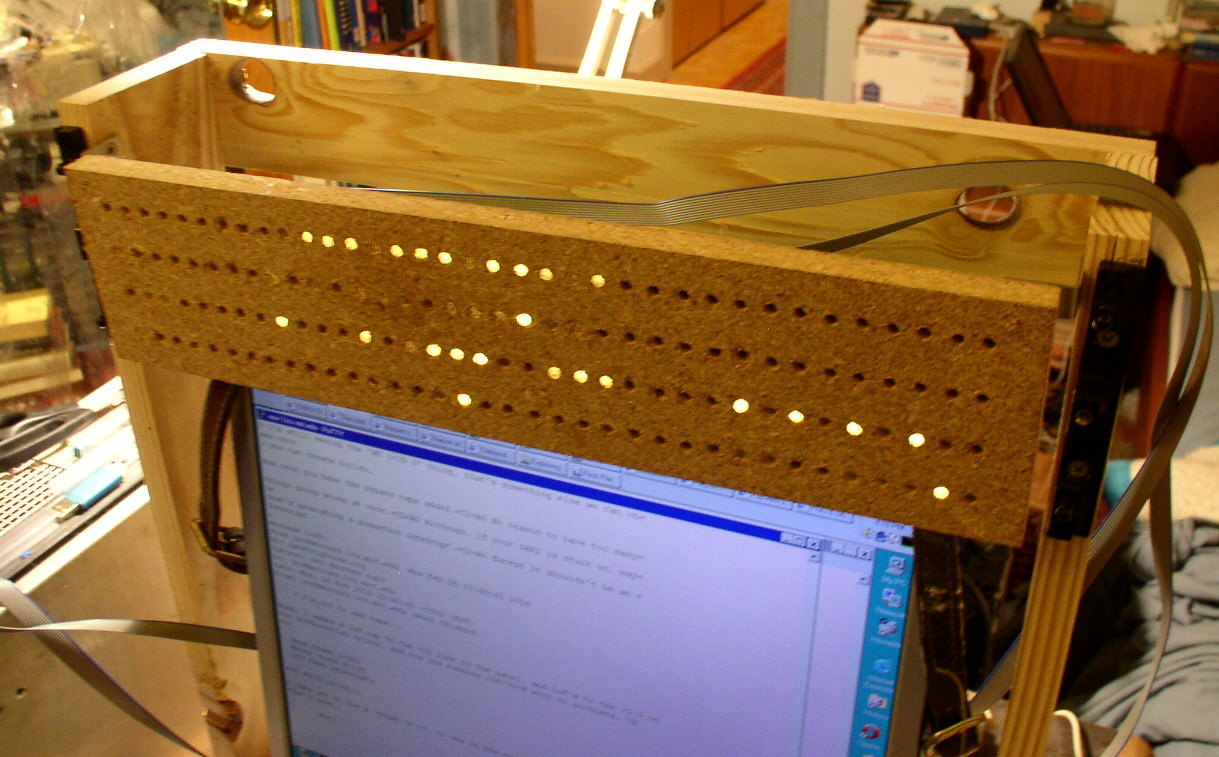
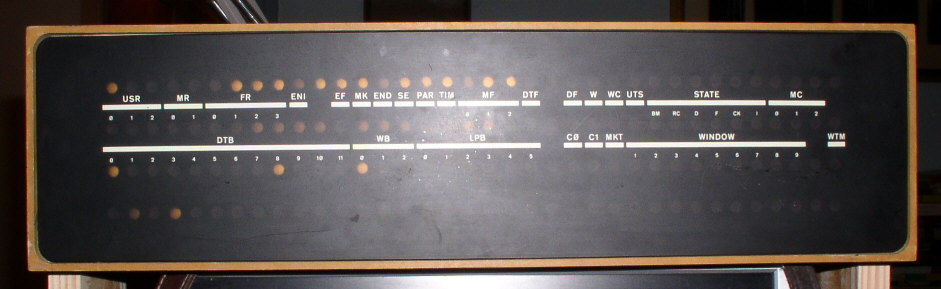
I couple years ago I completed the design for my USB Panda Display[1]
board. This is a modernization of the original Panda Display once
distributed by Spare Time Gizmos[2]. Both devices are intended to be
connected to a more-or-less modern x86-class computer running the klh-10
pdp10 emulator and provide useful blinkenlights. The development of klh10
is once again active, this time on Github[3]. I created my own repo of
klh10 as a means of writing support for my new Panda Display. The
display seems to be recognized and used, but what it displays is
meaningless. I cannot fully test it until I can get the old test program
compiled and working. Once that's done, I'll add my changes to the
PDP-10/klh10 repo and delete my own.
Here's a video of a computer with the old Panda Display running klh10:
https://www.youtube.com/watch?v=g_LcQ5apODg. The creator of that video,
Jan de Rie, got the program that was used to generate that pattern from
Mark Crispin, the creator of the Panda distribution of klh10. That
program appears at the end of this post.
I'm looking for someone who knows TOPS10 / TOPS20 well enough to figure
out for me why this test program won't compile. Once that's done, I can
complete the firmware for the USB Panda Display an its support within
klh10. I'll then make more copies of the USB Panda Display board (and
maybe overlays) for whoever wants them.
TITLE HACK
SEARCH MONSYM
HACK: SKIPA 4,[^D4]
HACK0: SOJL 4,TRAILL
SETZB 1,3
HACK1: TLNE 1,777777
JRST HACK0
MOVE 2,1
CIRC 2,-^D18
SKIPN 4
SKIPA 1,3
IOR 1,3
LITES%
HALT
HRRZ 2,1
MOVEI 1,30
DISMS%
MOVE 1,2
AOJA 1,HACK1
TRAILL: SETZ 1,
TRALL0: LITES%
HALT
MOVE 2,1
MOVEI 1,30
DISMS%
JUMPL 2,TRAILR
LSHC 1,^D37
AOJA 1,TRALL0
TRAILR: MOVSI 1,400000
TRALR0: LITES%
HALT
MOVE 2,1
MOVEI 1,30
DISMS%
MOVE 1,2
TRNE 1,1
JRST HACK
ASH 1,-1
JRST TRALR0
END HACK
[1] https://github.com/DavidGriffith/panda-display
[2] http://sparetimegizmos.com/Hardware/Panda.htm)
[3] https://github.com/PDP-10/klh10/
--
David Griffith
dave at 661.org
A: Because it fouls the order in which people normally read text.
Q: Why is top-posting such a bad thing?
A: Top-posting.
Q: What is the most annoying thing in e-mail?
Hi Jim and all
>Hmm, I guess it does indeed depend on shipping costs, but I am looking
>for a card cage for the 12, and they can be a bit tough to find.
Yea, we tend to use couriers but it runs to a few hundred dollars a pop.
I will send pics off-list sometime next week.
W
Douglas Taylor <dj.taylor4 at comcast.net> wrote:
> I just got one of these and wanted to configure it via the 10
> pin RS232 port on the board.
> Is the port a standard DLV11-J type?
Yes, it is identical. I was the original beta tester on the
SCDC and used it extensively. In fact, the designers called
it "the Frisbie port". :-)
> I have one of those D-bit DLV11-J to DB25 adapters but not
> getting any response.
You may need a null modem. Try swapping pins 2 and 3.
I can send you an genuine Andromeda DB25 adapter if you give
me a mailing address and promise to send me $10. :-)
> Any info on the few jumpers on the board?
They changed between the original Rev. A and final Rev. F
boards. Which one do you have?
I can send you a copy of the manual, complete with all my
editorial comments written on it.
Alan "Packrat" Frisbie
Bill Gunshannon wrote:
> Many of us think that the advent of the x86 architecture is what led to
> masochism.
... or masochism led to the x86 architecture.
> bill
--Johnny
I see some company selling them on eBay for $122.? Are they really worth
anything like that?? I have a couple sitting around here somewhere that I
don't expect to ever use again.? Just wondering if they are worth looking
for to sell.? In this hobby you can always use money for new (well, old
actually)
toys.
bill
3 x DEC Alphas, small deskside models
5 to 6 x Sun pizza boxes one a Sparc 1 prototype
029 IBM Keypunch
The day I can have a 15 cubic yard scrap metal drop box the stuff will
start to be tossed in.
All based on when the rains stop and the ground is hard enough
I can't want much longer
For those that have not seen me post this before
The stuff is near (3 - 4 miles outside of) Banks Oregon USA (look it up on
Google).
I CAN NOT LIFT OVER 10 LBS, PERIOD.
-pete
On Wed, Apr 18, 2018 at 8:17 PM, Mark J. Blair via cctech <
cctech at classiccmp.org> wrote:
> Some of the future reverse engineering projects I have on my to-do list
> involve the CDP1802 processor, which IDA presently doesn't support. When I
> get to them I'll have to decide whether to use dismantler vs. learning how
> to add CDP1802 support to IDA. I'm leaning towards the latter, because IDA
> is so much fancier than dismantler is.
I'd vote for adding it to dismantler.
I had an IDA Pro license at one point, but I seem to have misplaced it, and
it is too old to get me any discount on a new release. I imagine that IDA
has probably improved a lot since back then, but at the time it had a
pretty awful user interface.
If I had an actual business need to reverse-engineer something using a
processor that IDA supported, I'd certainly buy a new IDA license, but I
wouldn't personally invest any time in building add-ons for expensive
commercial software, when there are open source alternatives that may not
be as good, but are generally good enough.
For the 1802, I've used a really crude disassembler written in C. The 1802
instruction set isn't very complicated, so a disassembler for it isn't
either. It's been so many years since I actually disassembled 1802 code
that I'm not sure I still have the disassembler around.
I just got one of these and wanted to configure it via the 10 pin RS232
port on the board.
Is the port a standard DLV11-J type?
I have one of those D-bit DLV11-J to DB25 adapters but not getting any
response.
Any info on the few jumpers on the board?
Doug
These have now been claimed.
Thanks everybody!
Sean I need an address please!
Cindy Croxton
Electronics Plus
1613 Water Street
Kerrville, TX 78028
830-370-3239 cell
sales at elecplus.com
AOL IM elcpls
---
This email has been checked for viruses by Avast antivirus software.
https://www.avast.com/antivirus
TAhanks for that link which fits with my
measurements (nowhere as detailed) of ones actual
ability to do things with "modern" hardware. In
the 1980's I was used to being able to measure
events with 0.2 microsecond precision using a
PDP-11 and my expectation was that the accuracy
was only going to improve as processors got faster.
I ported a program I wrote on the PDP-11 to a
Commodore 64 in 1988 and was using it to measure
finger tapping with a switch array to 1 msec
accuracy. This was done through the simple
expedient of speeding up the sample rate for the
keyboard to 1 KHz and the adding in my 4 external
switches as "keys". Used a 512 K Mac to get the
serial data and display results. To do the same
now would require custom hardware to do the
timing and a USB link to a "modern" CPU or implimentation on a microprocessor
When I attempted to get this same type of timing
accuracy from a PC, found out that it was no
longer easy to get access to interrupts as easily
as before and keyboard latency was longer as now
keystrokes were detected by an on board
microprocessor and sent out as a series of
packets for each keystroke. In DOS and W95 where
one could still easily get at interrupts, then a
serial port could be used to do msec
timing. Once XP and beyond arrived, then the
best temporal precision one can expect from a 3
GHz machine is 15 msec. I suspect the same holds
for Macs and haven't tried running real time
Linux as I either pull out my trusty C64 from
time to time and use it for precision timing
(unfortunately have only one copy of the code on
casette tape so when that goes can't do this
anymore) or I use various microprocessors to do
the job. Have a nice microsecond precision timer
that I wrote for a Propeller chip and feel much
more comfortable programming for it than the
latest windoze bloatware system. The Propeller
has the same amount of RAM as the PDP-11's I
started on, runs 20x faster/core and is fun to
program. The microsecond timer is attached to a
geiger counter to generate random bytes for OTP encryption.
Boris Gimbarzevsky
>On 29 March 2018 at 19:53, Paul Koning via
>cctalk <cctalk at classiccmp.org> wrote:
> >
> > It would be fun to do a "generalized Moore's
> Law" chart, showing not just transistor count
> growth (Moore's subject) but also the many
> other scaling changes of computing: disk
> capacity, recording density, disk IOPS, disk
> bandwidth, ditto those for tape, CPU MIPS,
> memory size, memory bandwidth, network bandwidth...
>
>This is the most telling I've seen in a long time...
>
>https://danluu.com/input-lag/
>
>--
>Liam Proven ? Profile: https://about.me/liamproven
>Email: lproven at cix.co.uk ? Google Mail/Hangouts/Plus: lproven at gmaill.com
>Twitter/Facebook/Flickr: lproven ? Skype/LinkedIn: liamproven
>UK: +44 7939-087884 ? ??R (+ WhatsApp/Telegram/Signal): +420 7002 829 053
I have many cases of SAMS facts schematics and other repair manuals for
everything from stereos, tube TVs, ham radios, turntables, etc. Most apply
to equip from the 60s and 70s or maybe a little earlier. Free to a good home
or they go in the recycle bucket tomorrow.
Cindy Croxton
Electronics Plus
1613 Water Street
Kerrville, TX 78028
830-370-3239 cell
sales at elecplus.com
AOL IM elcpls
---
This email has been checked for viruses by Avast antivirus software.
https://www.avast.com/antivirus
Hi all
I have a TRS-80 Model 2000 B/W Graphics board and a TRS-80 Card Cage
kit (upgrade model 12 to model 16B)
Are either of these worth shipping from the antipodes to anyone?
W
After battling for days with a Dolch 65 that developed the two-tone
beep-of-death on boot, I finally found that it's just my BIOS ROM that has
gone bad. The BIOS happens to be an Award BIOS, says "Award 1998 PCI/PNP
686" on the chip. It's a square chip with pins on the side.
Photo here:
https://drive.google.com/open?id=1OtZ1AU0Hac8RlzTgbgCY4z_qcMlGWXu1
So I thought I might just ask. Anyone has a dead Dolch 65 motherboard from
which I could steal a BIOS chip. The board is actually an Advantech CI6BM-B1
industrial single board computer.
Or alternately, can someone identify what kind of ROM or EEPROM that likely
is, and provide advice on how to read the data from a good chip (I have
another good chip in another Dolch, that's how I found out what my problem
was), and program a similar chip.
Marc
Hi friends. I have a 1990's vintage commercial radio system that uses an 80C85A CPU. I am looking to hopefully modify the firmware to make some small changes in its behavior. The firmware is contained in two EPROMS.
Can anyone recommend a decent disassembler to use with this? Preferably something that ran in windows 10 or windows 7? A dos box would be fine too.
Also, I looked through the dumped contents of the EPROM. In the past I have seen EPROM ascii dumps where most is unintelligible to the naked eye but typically text messages give to the users during interaction with the program are human readable. In this case, the ASCII dump shows only other HEX data. I believe I read that there is a HEX format and that I might need to convert from HEX to BIN before disassembling. Of course, an ideal tool would do both if anyone knows such a thing.
I am not familiar with 8085 stuff but any insight would be appreciated.
Lastly, I wonder if there might be some kind of checksum check to prevent tampering. Is there a common way this is handled in 8085 world? Or is it entirely programmer dependent?
Thanks for your time
Eugene W2HX?
Hey all,
I snagged a Kaypro II a short while ago which I finally got around to
looking at. After some minor TLC to the drives, it's booting.
However, the keyboard appears unresponsive. Pressing keys (with the
exception of caps-lock, the two shifts, and ctrl) results in a buzz/click
>from within the keyboard - if I'm interpreting the schematics right, the
click is actually driven by the system in response to a keypress, which
suggests that my keyswitches are OK (I believe these use a foam disc
approach, which are prone to deterioration) and that keyboard data is being
received OK (at least on some low level).
Any suggestions for possible things to investigate? It doesn't feel like a
memory fault, given that it's using 64kx1 ICs and booting as far as a
prompt, but I suppose it's possible.
On the back of this, I'm in need of three keyswitches, if anyone happens to
have a parts machine and would be willing to sell any. A student of the
machine's previous owner dropped the keyboard years ago and broke three of
the keys off. I have the keycaps, but the switch stems are broken and it
would probably be easier to replace the entire stem portions rather than
attempting to glue things back together.
cheers
Jules
The VAX 4000-200 I exhibited two years ago at VCF East is up for sale:
Restoration Notes:
http://www.vintagecomputer.net/browse_thread.cfm?id=608
I don't need it as much anymore now that it's pretty much a completed
project. It's very upgrade-able though if you have the desire to boost
performance and ports, etc.
The provenance of this machine, I believe, was as part of WVLink a West
Virginia email/gopher/USNET type ISP server in the early-mid 1990's.
I have it set up for telnet communications if interested. Contact me via
http://www.vintagecomputer.net/contact.cfm
Bill
Good condition AlphaServer 300, always been stored in dry conditions.
Photos: https://photos.app.goo.gl/5N66yIlEUCYkuh012
It has a TGA based DEC graphics card that will do 1280x1024 24 bit (it's a
ZLXp-E2 PBXGA-BA) - manual included.
Ultrawide 16-bit SCSI card
Brand new Seagate Cheetah 15K.4 36.7GB,Internal,15000RPM,3.5" (ST336754LW)
HDD
Ultraplex SCSI CDROM drive.
Running OpenVMS Alpha 8.3 with CDE. Can also run tru64 5.x.
All working as it should be. Very quiet system. Can provide copies of media
if required.
?175 + postage at cost.
I can supply an LK461 keyboard and mouse for an additional ?25.
I have one of these, see the photos:
https://photos.app.goo.gl/CnLnSKTCzHETzpOo1
It was bought new by myself a few years back. It can run off a PP9 battery.
?10 shipped in the UK if anyone is interested.
Regards, Mark.
I recently decided to make scan a paperback book that I happen to have two copies of. It is "RSX A Guide for Users by John Pieper? published in 1987 by DEC. I have not seen a copy of it in any of the online sources like bit savers. For anyone just starting out with RSX it is a nice general read that also covers some system topics like backups, etc. similar to the paper back VAX/VMS user and system manager books.
I?d like to make it available online but wasn?t sure how to submit it. It is about 38 MB in size so bigger than an email (at my email).
Since I didn?t have an industrial book shear to remove the binding, I used a belt sander to remove enough go the binding to pull the pages free easily and then used a paper cutter to trim the pages a bit to remove any last traces of glue that would have jammed the scanner. The book is about 360 pages.
Thanks,
Mark Matlock
An interesting 3 hours on PBS last night:
- 'Steve Jobs - One Last Thing': No description necessary.
- 'Long Distance Warrior': McGowan/MCI's David & Goliath battle with AT&T
and disastrous merger with Worldcom.
- 'Digital Man/Digital World': Ken Olsen/DEC's growth and ultimate decline.
(No doubt everyone here except myself had already seen this one ;-)
Interesting comparison of the different styles and personalities of three
men who profoundly influenced the tech world of today and their companies.
Thoroughly enjoyed it.
m
> Lastly, I wonder if there might be some kind of checksum check to prevent tampering. Is there a common way this is handled in 8085 world? Or is it entirely programmer dependent?
One approach that <may> be doable for you is if you have a good ROM with a known checksum, make your changes then calculate the difference between the new and the original checksum and make another change somewhere innocuous to bring the checksum back to the original value. "Innocuous" may be the trick - perhaps some text string you don't care about, copyright notice etc. or maybe there is an empty area in the EPROM you could stick a byte.
Richard Sheppard
On Tue, 4/17/18, Eric Smith via cctalk <cctalk at classiccmp.org> wrote:
> On Mon, Apr 16, 2018 at 7:29 PM, Chuck Guzis via cctalk <cctalk at classiccmp.org> wrote:
>> Disassembly is never lots of fun,
>
> Some of us might disagree.
> But then, some of us might be masochists.
I was just thinking the same thing. This whole discussion
has taken me back to fond memories of writing a 68000
disassembler in AWK (long story).
BLS
> From: Paul Birkel
> the blinky-lights controller panel top-dead-center :->.
Yeah, that's a TC08.
I actually have one of those inlays, it's the only original inlay I have. It
was the model for the large run of blank inlays (black backing with the holes
on the back, but nothing on the front) I just had made. At the moment, it's
sitting in my indicator panel stand with little bits of tape stuck to it:
http://ana-3.lcs.mit.edu/~jnc/tech/QSIC/jpg/PanelMounting.jpghttp://ana-3.lcs.mit.edu/~jnc/tech/QSIC/jpg/DasBlinken2F.jpg
so it can be an inlay for the RKV12. If anyone needs a TC08 inlay, I'd be
happy to trade it for any other inlay (as long as I have one original for
engineering purposes).
Sigh, need to get back to the inlays and take the next step with them!
Dave B and I got derailed trying to find/fix a flaky on the QSIC - on my
prototype, it would occasionally get NXM's running the RK random exerciser I
wrote. I was trying to figure out what the problem was, and I got tired of
the prototype sticking out in my way:
http://ana-3.lcs.mit.edu/~jnc/tech/jpg/tmp/JNCQSIC.jpg
(with the FPGA daughter-board on top, even with short cables, it has to be on
an extender), so I rotated the QBUS chassis 90 degrees so the QSIC was on
top, and took the opportunity to re-order the boards. Bad mistake! Now the
problem has gone away and I can't re-create it!
Noel
> From: Eric Smith
> But then, some of us might be masochists.
I think pretty much by definition if you're into vintage computers, you have
to be a masochist... :-)
Noel
Hi folks,
I know this is a wild long shot, but just in case...
Does anybody have a copy of the source code for the NI Ethernet driver for the AT&T 3B2? AT&T distributed it, but I have never seen a copy in the wild. The package name was "nisrc", if that helps.
If I can't find it, I'll have to reverse engineer the binary. Won't that be fun!
-Seth
--
Seth Morabito
web at loomcom.com
Does anyone know where Motorola's current production chips are described?
http://www.motorola.com/General/prodport.html only partially works and
search is entirely broken because http://search.motorola.com no longer
exists.
--
David Griffith
dave at 661.org
A: Because it fouls the order in which people normally read text.
Q: Why is top-posting such a bad thing?
A: Top-posting.
Q: What is the most annoying thing in e-mail?
I'm pondering upgrading the CPU of a Pacccomm Tiny-2 Mk2 radio packet
controller from a 6Mhz Z80 processor and SIO to 10Mhz parts. My problem
is that the parts already in it appear to be NMOS. The family is still
being made by Zilog, but for 10Mhz parts, CMOS is all they have. Can I
just drop in CMOS, change out the crystal/oscillator and have things work
as expected?
Here's what are fitted to my TNC.
Z84C00BB6
Z80BCPU
29125
Z8440BB1
Z80BSIO-O
29014
--
David Griffith
dave at 661.org
A: Because it fouls the order in which people normally read text.
Q: Why is top-posting such a bad thing?
A: Top-posting.
Q: What is the most annoying thing in e-mail?
I?m not trying to date myself but have things truly sped up? In 1970?s
Toronto I had a classic computer, sorry can?t recall what it was, connected
to a 300 baud modem; by early 80?s had ?zoomed? to 9600 baud. Oh, my! [ A
typical file size to download was probably 1 MB. ] Speed indeed! Yet now,
here in rural Ontario, Canada, I?m at 5MB/s. Yikes! (Friends in Toronto are
at 50MB/s.) We can do the math but content, particularly multimedia, has
swollen in size.[ 1 GB is not unheard of. ] Were classic computing days
that much slower? Happy computing. Murray -:)
<http://www.avg.com/email-signature?utm_medium=email&utm_source=link&utm_cam…>
Virus-free.
www.avg.com
<http://www.avg.com/email-signature?utm_medium=email&utm_source=link&utm_cam…>
<#DAB4FAD8-2DD7-40BB-A1B8-4E2AA1F9FDF2>
As mentioned before , i made a functional copy of the Tektronix 4052 Diagnostic Rom Pack .
PCB's are back, units do work ( minus a small issue with the wrong orientation of the LED's )
Go to
ftp://ftp.dreesen.ch/TEK_DRP
?and find my dokumentation DiagPack_Manual.pdf , decide if this is what you want, and order ( or not...)
Also please read the original TEK doku TEK4052_4054_Diagnostic_Rom_Pack.pdf in order to understand what this unit can and cannot do.
Prices, in short : PCB only 20 Euro/25 USD, populated and tested 60/75, add 20/25 for a fitting 3D printed casing.
And do feel free to construct your own with the data from my FTP site.
This pack should also work on the 4054, but since I do not have such a machine this feature is untested.
Jos, now wondering whether I will ever sell the 20 PCB's I have...
I've found a couple more documents lurking in my desk that I've
completely forgotten about.
The first is a UniSoft Uniplus+ System V User Guide. Circa 1984.
Basically a SysV Unix user's guide. I have no idea what platform this
was intended for, as it's pretty much a generic document. A couple
hundred pages.
The second is a sales kit for CMS Enhancements. Nice slick brochures
for PC, Apple and Sun. No technical documentation, per se--just
something you'd pass out at a trade show (which is probably where I got
it). Circa 1990. Includes the brochure for the CMS 386 PC.
It'll all fit in a USPS PM envelope, I'm guessing.
I want postage only.
--Chuck
Someone in Barnet, North London, post code is EN5 1RJ has two DEC DS-32
drives and IBM Series/1 computer and some drives.
Last wording was Sale or swap.
You may contact them at stuff at pdp8online.com.
Ethan Dicks <ethan.dicks at gmail.com> wrote:
> There are times when video instruction makes sense - describing, for
> example, a chemical reaction that produces major visible change in a
> few moments is better to watch than to try to describe. The vast
> majority of stuff? Teaching programming? I don't want to watch 2
> hours of someone editing text... give me words and perhaps a
> screenshot or two if there's something too complicated to simply write
> about.
How about language courses on audio cassettes?
For instance a course on Macro-10, over several of them?
Yes, it does (or at least did) exist.
> -ethan
--Johnny
Very nice presentation by Frank Griesshammer on the subject of the Hershey Fonts: https://vimeo.com/153653610
He does a superb job explaining how a font invented in 1967 by a mathematical physicist at a US Weapons Lab became essential for the last 40 years of technical writing. And is also an interesting font for actual font designers today :-)
Tim N3QE
[https://www.bing.com/th?id=OVP.0QZVssVrJ4Ynm3h5opaOeAEsCo&pid=Api]<https://vimeo.com/153653610>
Frank Grie?hammer ? The Hershey Fonts<https://vimeo.com/153653610>
vimeo.com
Recorded during TypeCon2015: Condensed in Denver, Colorado In 1967, Dr. A.V. Hershey was working at the U.S. Naval Weapons Laboratory in Virginia; on some of the ...
Well, I don't know what happened to everybody who wanted it
but that Unix-PC is still sitting here and it needs to go.? One more
offer before I scrap it.? Needs to be someone who can pick it up
real soon.
bill
All,
in San Antonio (Texas), I have a Toshiba Satellite 2065CDS/4.3 laptop, Model number PRS206U-A, whose owner wants to give or throw it away (preferred give).
It has a 16-bit ethernet card including dongle and driver floppy, annoying eraser-head cursor control with replacement eraser heads, USB port, 3.5? floppy, CD drive. Starts up to Toshiba screen and shows 160 MBytes of RAM. I watched it boot to Win98 once and fail to boot many times. I think the owner had it dual-booting to Linux as well, but he is having the disk wiped to make sure no personal information goes with it. The battery kept it running for only about 15 seconds on power-disconnect after being plugged in (running) for an hour or two, so probably not much battery life available. I think the freshly-cleaned hard drive has ~ 4 GB of space, don?t know for sure about that.
Let me know if you are interested; I?ll forward inquiries to the owner as I get them.
- Mark
210-522-6025 office 210-379-4635 cell
I find myself in need of a 5.25-inch alignment disk. A few years ago
someone mentioned a source for those, but I can't seem to find it. Is there
still a source, or does anyone have one they'd be willing to sell?
I could use an 8-inch alignment disk also, but don't need that as urgently.
It's not really Classic Hardware, but it does run some pretty classic
OSes.? Anybody here working with the P112?? I have had a couple for
ages but never had time to play with them.? I see them now as a
possible way to manipulate floppies (including 8") from classic systems
so I decided to give it a try.? Problem is, it won't boot anything.? Not the
disk that came with it and none of the images I got off the web.
Anybody here know anything about them?
bill
Hello Folks.
I am selling the following two vintage computing themed domain names:
vintage-computing.compaleocomputing.com
Make an offer on either.
Please of course reply directly to me if interested.
Thanks!
Sellam
On Sun, Apr 8, 2018 at 5:01 PM, Ethan Dicks <ethan.dicks at gmail.com> wrote:
> On Sun, Mar 25, 2018 at 3:48 PM, Ethan Dicks <ethan.dicks at gmail.com> wrote:
>> SN-921
>> https://upload.wikimedia.org/wikipedia/commons/7/74/Sgi_dialbox_sn-921_fron…
>
>>>>> https://github.com/hanshuebner/sgi-dialbox-usb/blob/master/dialbox.py
>>
>> I'm going to test this code out when I have a dialbox in hand.
>
> I have now tried this and am not having success. I have a traffic
> light on the serial cable and I know I'm getting chars out of the host
> and that I don't have TxD and RxD swapped. I'm not seeing any
> responses from the dial box and the python script does all the
> initialization and just sits there. Frobbing the knobs produces no
> blinks on the traffic light and no text from the script.
OK. I got the script working and two things were impediments:
1) One of the SN-921 pinouts running around on the 'net is incorrect,
as I posted. The *correct* place for the ground is DE-9 pin 7. I was
apparently getting enough of a parasitic ground to get chars *from*
the SN-921 but not *into* the SN-921.
As it turns out, it appears the SN-921 as set up for the SGI is mute
except for a single status success byte 0x20. If you send it an INIT
command (also 0x20), it will respond with its success after a fraction
of a second, which leads to another problem...
2) The python script dialbox.py slams the init code and a command to
set the dials to auto-report all at once, before the SN-921 has a
chance to initialize. So to fix that, I added a few extra lines to
send the 0x20 INIT command, pause, check for a 0x20 response (INIT
GOOD) _then_ send the AUTO command (0x50 0x00 0xFF), which sets all 8
dials (one bit per dial) to send back a 3-byte packet when twisted.
With the custom serial cable fixed and the init sequence fixed in the
Python script, I'm now getting the right data stream when I twist any
of the knobs.
I did get a copy of dialbox.c from
http://www.geocities.ws/joekrahn/dialbox.tgz Jim Stephens tracked
down that there was a massive GeoCities scan done in 2009 and the file
I was looking for happened to be scooped up then. There are a number
of dial box and button box command sets in that code which reveals
some of the more complex behavior possible.
Here's a slice of the command byte definitions...
#define DIAL_INITIALIZE 0x20
#define DIAL_SET_AUTO_DIALS 0x50
#define DIAL_SET_AUTO_DELTA_DIALS 0x51
#define DIAL_SET_FILTER 0x53
#define DIAL_SET_TEXT 0x61
#define DIAL_SET_BUTTONS_MOM_TYPE 0x71
#define DIAL_SET_AUTO_MOM_BUTTONS 0x73
#define DIAL_SET_LEDS 0x75
#define DIAL_SET_ALL_LEDS 0x4b
It should be possible to write up a protocol definition from studying
the code. I do not have one of these button boxes so I can't validate
its behavior.
-ethan
Hello, I am trying to find anyone who has recordings of a radio program
>from 1982-1986 called The Famous Computer Cafe. This was broadcast on KIEV
in Glendale, KFOX in Redondo Beach, and NPR through Santa Monica College
(here in 1984-1985).
The program contained numerous interviews with all the movers and shakers
of computers and software during that period, including Bill Gates, Steve
Jobs, and Jack Tramiel. As such, this show is of high historical
importance. There was somewhere between 100 and 200 episodes all told.
I understand it was an extremely popular program among hobbyists at the
time, so was hoping someone from the list might have recordings. If you
have any recordings or know someone who might, please let me know! I have
contacted the show's hosts, but we have only been able to locate a handful
of recordings.
Thank you!
--
Devin Monnens
www.deserthat.com
The sleep of Reason produces monsters.
Anyone interested in buying a Burroughs L8000, currently San Antonio TX? If
so, contact me via http://www.vintagecomputer.net/contact.cfm and I will
put you in touch with the person who contacted me. I already have two or
three of these so....just kidding not personally interested in this.
Bill
Howdy,
Working on fixing an old SGI Indigo of mine in prep for VCF East.
The issue is once any sort of IRIX kernel is running, it craps out
WARNING: Power Failure Detected at a high rate.
The SGI Indigo and a few other similar models could push out
that error on the local console and perhaps network inbetween the time
that AC power was lost going into the power supply and the power supply
had discharged enough for system to die. Pretty impressive and strange!
I was amazed when I first noticed it, of course now it has come back to
haunt me.
I have replaced some of the electrolytic caps in the power supply.
But in the spirit of troubleshooting, does anyone have any sort of
schematics or documentation on the power supply, or the midplane?
This is a R4000 Indigo and has the higher output power supply to support
bigger CPU and graphics.
In the meantime I'm working to document what I can about the power
connector and will publish, but I can only get so far without other
insight.
Thanks
--
: Ethan O'Toole
On Sun, Mar 25, 2018 at 3:48 PM, Ethan Dicks <ethan.dicks at gmail.com> wrote:
> SN-921
> https://upload.wikimedia.org/wikipedia/commons/7/74/Sgi_dialbox_sn-921_fron…
>
> DANAHER CONTROLS Dials DLS80-1022
> https://upload.wikimedia.org/wikipedia/commons/c/cd/SGI_dialbox_DLS80-1022_…
>>>> https://github.com/hanshuebner/sgi-dialbox-usb/blob/master/dialbox.py
>
> I'm going to test this code out when I have a dialbox in hand.
I have now tried this and am not having success. I have a traffic
light on the serial cable and I know I'm getting chars out of the host
and that I don't have TxD and RxD swapped. I'm not seeing any
responses from the dial box and the python script does all the
initialization and just sits there. Frobbing the knobs produces no
blinks on the traffic light and no text from the script.
So... I'm digging deeper and I've found two references to some code
>from around 2002 that can interact with dialboxes, but the sites are
no longer up and the internet archive did not save the binary archive
files. I'm asking here in the hope that someone saved copies 10+
years ago when these files were still being served...
In the following thread on the ccp4bb list, there is a mention of
these archives...
[ in http://www.ysbl.york.ac.uk/ccp4bb/2003/msg00204.html ]
"I'm using SGI dialbox (Part# DLS80-1022) with XFree86 4.0.x under linux,
with modified version of the Joe Krahn's dialbox driver.
You can get the modified version from
http://www.biochem.s.u-tokyo.ac.jp/~ishitani/dialbox/dialbox-new.tar.gz
and the original version from
http://www.geocities.com/joekrahn/ "
So I'm looking for:
dialbox-new.tar.gz
dialbox.tgz
dials.c
Apparently Joe Krahn hasn't done much with Open Source in 15 years
because looking for him has not been fruitful.
Thanks for any bits!
-ethan
After a recent power cut and a series of glitches as the power was
restored, one of my Indys suffered a PSU failure. It's a Sony APS-81
171W unit, SGI P/N 060-0008-001. I've found half a dozen damaged parts,
and I've identified a 150R 1W metal film resistor (R135), two trannies
(Q105, a 2SC4304 and Q106, a 2SC2785) and a couple of small diodes. One
of them (D116) appears to be a 6.2b2 (6.2V 1/2W) zener.
The other one I'm not sure about. On the PCB it's labelled D113, and
it's adjacent to the 2SC2785. It's very small, with a green band at the
cathode end, and the legend "4B" in green - photos at
https://www.flickr.com/photos/pnt103/albums/72157667056183978
Oddly, another Sony PSU I looked at had a diode there that looked
identical except it's marked "4A".
I have an idea what it might be but if anyone actually knows what family
or type/value this is, I'd be grateful for any insight.
--
Pete
Pete Turnbull
A few seminal 8085 programming books available please see album: https://photos.app.goo.gl/Rv7vy9eDrMfGK9gz2
Looking for ?25 including postage to the UK or ?20 plus postage elsewhere.
Regards Mark
jnc at mercury.lcs.mit.edu (Noel Chiappa) wrote:
> Err, which RLV11/RLV12 emulators are you seeing? I know of several RL02
> emulators - Reinhard Heuberger's, and another I can't immediately find my
> saved info on - (and one crazy project that turned a real RL02 into a USB
> device :-), but you still need an RLV11/12 controller.
The only ones I can find now are the ones you mention. Yes, I too can't find
my notes on the second one, whatever it is/was. I was *sure* that someone
had made a Qbus emulator that used SD cards, but I simply can't find any mention
of it now.
Right now, it looks like Reinhard Heuberger's board is the best bet. I haven't
checked with him yet to see if boards or kits are still available. If I could
find a working TDL-12 I would jump on it in an instant. All the older ones
(Dilog, etc.) appear to use ST-506 type drives, which introduces its own set of
problems.
Alan Frisbie
> From: Alan Frisbie
> I need a controller that emulates the DEC RLV11/RLV12 and RL01/RL02
> drives. From my Google searching, I see a couple that use SD or similar
> solid state devices.
Err, which RLV11/RLV12 emulators are you seeing? I know of several RL02
emulators - Reinhard Heuberger's, and another I can't immediately find my
saved info on - (and one crazy project that turned a real RL02 into a USB
device :-), but you still need an RLV11/12 controller.
Noel
Wow. That's unfortunate. Only been in town twice but was definitely part of my scheduled geekdom tour.
So any local stores left for that type of thing? Any word on why the closure?
I've always seen a lot of folks in the store (well my 2 times) but i don't know how many purchased.
null
> From: Bill Gunshannon
> Caution!! The DSD board has some broken chips and bent pins and all of
> them look like they spent time in muddy water.
Thanks for catching that. I looked at it, saw that it was a DLV11-J, which I
didn't need, and so didn't look any harder.
Noel
I picked up a Corvus Concept CPU unit about a decade ago now, and I've
yet to track down any other parts for it. Looking for keyboards,
monitors, drives, peripherals software -- anything. If anyone's got any
parts, please drop me a line.? Always wanted to see one run...
Thanks,
Josh
"peter at rittwage.com" <peter at rittwage.com> wrote:
> You don't want to try to repair the controller? There are some custom
> IC's on there (it appears) but is largely off-the-shelf TTL... I'm
> sure someone on the list has a lot of experience with these and could
> repair it or help.
Indeed, I DO want to repair it, but that is a project for another day.
Right now I need to solve the need for an RL02 emulator, which will let
me quickly solve the current problem.
Again, does anyone have any experience (good or bad) with any of the
RL02 emulators our there?
Thanks,
Alan Frisbie
Hi all,
Recently booted up my B&W Powermac G3, all came up fine including the 17? CRT monitor. However after a second or so, the
monitor gives a ?popping? sound and the image on the screen expands then shrinks. This repeats every few seconds.
I?m guessing the monitor is on the way out - but as this is a complete B&W system - I wondered what the likely cause is?
Thanks
Hi folks,
Has anyone ever replaced the PSU in a DEREP with a more modern equivalent? The PSU is an ASTEC but as usual doesn?t have any markings for ratings or pinouts. I found the tech ref online but for PSU problems it just says ?replace? as I?d expect. Test LEDs on the unit itself (and the fuses) show +5 and +12 at 2A.
This one suffered a bad heat-based death at some point after the fan seized?
Cheers,
--
adrian/witchy
Owner of Binary Dinosaurs, the UK's biggest home computer collection?
t: @binarydinosaurs f: facebook.com/binarydinosaurs <http://facebook.com/binarydinosaurs>
w: www.binarydinosaurs.co.uk <http://www.binarydinosaurs.co.uk/>
I've got a DEC 3000 model 300 and a couple of DEC 3000 model 600 alphas which
failed some time ago and the recent Alphaservers thread has rekindled my
interest in getting them working again.
A couple of years ago, there was another thread "AlphaStation 200 NVRAM Problem"
where the Alpha SROM mini console and various items of useful documentation
were mentioned. I have now made up an adapter (cable and MAX232 line driver /
receiver) as described in that thread to allow me to to talk to the the SROM
mini console in my alphas and I am please to find they are all responsive at
this level. I also found: "DEC 3000 300/400/500/600/700/800/900 AXP Models
System Programmer's Manual Order Number: EK-D3SYS-PM. B01" (d3syspmb.pdf)
which describes some of the internals of the machines in question.
The mini console commands available on the model 300 are very limited compared
to those in the documentation which targets a much later machine. However, it
does have mt (memory test) which is not present on the model 600 for some
reason. Results from this suggests that all 6 SIMMs present are bad in pretty
much all locations. This seems a bit unlikely to me. Perhaps there is a
failure in logic which causes the memory not to be accessed at all?
Unfortunately, the manual does not seem to give any leads on how to diagnose
this further.
The em (examine memory) and dm (deposit memory) commands only accept 32 bit
addresses meaning they cannot to be used to access input/output areas which
require at least 33 bit addresses. However, a little experimentation led me
to the existance of ei and di commands which can do this on the DEC 3000
machines and I found I can use di to update the diagnostic LEDs on the machines.
The DEC 3000 600 machines both (usually) count down to F0 on their diagnostic
LEDs and hang without producting any output on the main console. They do
however produce output on the mini console - for example:
DEC 3000 - M600 SROM 6.1
Powerup Sequence
ff.fd.fb.fa.f9.f8.f7.f6.f5.f4.f3.f2.f1.f0.
sysROM 00000033.000006f1
ioROM 00000033.00000162
MCRstat 11111111.808011c0
bnkSize 00000300.00000c01
memSize 000000c0.000000c0
However, they do not provide the SROM> prompt or accept mini console commands
unless a I engineer another fault condition such as by pulling out one of the
memory risers. I wonder if there is a jumper to enable mini console commands
to be accepted without doing this? Looking around the system board, I see a
pair of jumper pins labelled J9 hidden under the I/O board which looks like it
could do this. Unfortunately, while there is legend on the PCB indicating the
function of all other jumpers, there is none for J9 and it is not mentioned in
the manual either.
On the I/O board, there is one three pin jumper labelled simply "Off" and "On"
and it is jumpered to the "On" side. It is close to the SCSI connector so I
suspect it is more likely to be something to do with termination or termpwr
than the mini console.
One of the model 600s sometimes generates a machine check, like this:
DEC 3000 - M600 SROM 6.1
Powerup Sequence
ff.fd.fb.fa.f9.20.
MCHK
exc_addr 00000000.00001484
biu_stat 00000000.000022d8
dc_stat 00000000.00000007
fill_adr 00000001.f0080050
fill_syn 00000000.00000000
DataExp aaaaaaaa.aaaaaaaa
DataRec aaaaaaaa.aaaaaaaa
MCRstat 11111111.808011c0
bnkSize 00000300.00000c01
memSize 000000c0.000000c0
SROM>
While this can be useful because it gets me to the SROM> prompt, I can't
find anything in the manual which helps me diagnose what might be causing
this. The meaning of the contents of biu_stat might be a useful start.
The 600 machines have a socketed 27C512 EPROM. I assume this must be the SROM
(although I can't see what is serial about it) as the machines fail to update
the diagnostic LEDs or write to the mini console if it is removed. I dumped
the two EPROMs and compared them and they are identical. However, I can't see
any ASCII strings in them. Perhaps the bits are not used in the standard
order? The manual suggests that there are 8 different 8KB SROM images present
and those other than the "standard" one may be used for testing and diagnostics
by setting jumpers. Unfortunatly, there is no further information about these
images.
The manual hints that the System ROM (SYSROM) (actually an FEPROM) is located
at 1 E000 0000 to 1 E003 FFFF, however, looking at the beginning of this area
with ei suggests it is in fact the IOROM (also an FEPROM). Hunting around
some more, it seems that setting bit 9 of the System Support Register at
1 E004 0100 brings in the SYSROM instead (although the manual suggests bit 7
is also involved which seems unlikely as this bit is one of the diagnostic
LEDs).
The format of the headers in the SYSROM and IOROM do not exactly match the
format given in the manual but they are "close". I wonder if this might
be my problem or if the manual is incorrect. If anyone else has a 3000 600,
could they take a peek at their SYSROM and maybe we could compare notes?
It may be possible to map the SYSROM from a running operating system but as
none of my 3000 machines run right now, I am not in a position to try this
myself.
Regards,
Peter Coghlan.
Several days ago I wrote about my joy of finding a TDL-12 disk
controller, emulating four DEC RL02 drives and using a SCSI drive.
Sadly, I discovered that the controller is a dead as a doornail.
It doesn't respond to any bus address at all.
So, I'm back to my original quest: I need a controller that
emulates the DEC RLV11/RLV12 and RL01/RL02 drives. From my
Google searching, I see a couple that use SD or similar solid
state devices. Does anyone here have any direct experience
(good or bad) with any of these emulators? I don't mind
spending money for a good solution.
Thanks,
Alan Frisbie
The new sysadmin at work is clearing out closets full of junk^H^H^H^H
cool old stuff accumulated by the previous sysadmin. There's a big
carton full of PATA hard disks. Most of them are in the 4.3 GB - 20 GB
range, a few larger, a few smaller.
Anyone have any use for these? You can have them for the cost of
shipping, or free for local pickup in Bothell, WA. They're going to be
recycled as scrap if I don't find a home for them.
Today I received a PDP-11 instruction video on a laser disk, part 3 & 4.
The disk partno. is EY-5537E-V2-0001, the title says
'Introduction to the PDP-11, Internal use Only, (c) 1988'
Besides that, no indication if the video stream is NTSC or PAL.
Anybody have a clou?
I want to have the disk read and put the video on youtube eventually.
Ed
--
Ik email, dus ik besta.
I posted this originally on the ArmyRadios mailing list, but I think it's just computery enough that it may be of interest here, too. And maybe somebody here even has the answers to my questions!
I just got an AN/UGC-144 communications terminal. It looks unused, and it came with cables and manuals (-12 and -30, but not including schematic diagrams or component-level details). It powers up, but fails to boot from its internal hard drive. The screen has some bad rows and columns, and the gas spring that supports the display needs to be replaced. I shared a bunch of pictures on Twitter today as I unpacked it and started playing with it, in this thread:
https://twitter.com/nf6x/status/980174491673178112
Here are direct links to some of the more interesting pictures in that long thread:
https://twitter.com/nf6x/status/980198067767947264https://twitter.com/nf6x/status/980202029766230016https://twitter.com/nf6x/status/980263764325941249https://twitter.com/nf6x/status/980302909165338624
I haven't found very much about the terminal online yet, and I expect that I have a long road ahead of me as I try to fix the display and see if anything can be recovered from the hard drive. If the original software isn't present on the hard drive and recoverable, then this may be a great big doorstop! But it may also be a fun reverse-engineering project. I haven't dug into it deeply enough yet to determine whether it's built around an embedded PC-clone architecture or is something completely custom. In any case, I'll naturally want to try to dump and disassemble any ROMs I find inside of it. The CAGE code is for Sypris Electronics, and the boot screen shows a Honeywell copyright notice. I found that it tried to access a blank floppy diskette at boot time in the right drive, but I didn't have an MS-DOS boot diskette handy at the moment to see if it could boot from it. I'll give that a try when I have a chance... but probably after Easter.
Have any software diskettes, programs, disk images, etc. for this terminal made it out into the wild? I presume that there were boot and installation diskettes that were used for hard drive formatting and software installation, and I would really love to get my hands on anything like that... especially if it turns out the the hard drive in my terminal is blank and/or dead. I'll be satisfied if I can use this rig as a dumb terminal for RTTY use, and even happier if I can do anything fancier with it.
--
Mark J. Blair, NF6X <nf6x at nf6x.net>
http://www.nf6x.net/
Hi, All,
Watching some of the recent traffic about what newer Qbus boards will
and won't work with 2.11BSD, I've remembered a thing I was once
looking for. Back when I did DEC hardware for a living, we stopped
buying new stuff after we got a MicroVAX-II. As such, I have plenty
of LSI-11 to KA630 parts but very little from after that era. I do
happen to have 2-3 boards with S-box handles including a KDF-11 CPU
and a SCSI card, a great start to a system. What I don't have is the
enclosure.
I have a BA123 "World Box" and it's great. I know a BA213 is roughly
the same size, but I've never had one. The BA215 looks more
interesting to me as a match for size and power requirements (1 PSU
and 6 slots, half the BA213) but I've never even seen a BA215.
Anyone here have much experience with the BA215? Any "gotchas"? So
far, from my looking on eBay, I think I spotted one loaded as a VAX.
I'm more interested in setting mine up as a PDP-11, so the VAX end of
one is not exactly a selling point to me. An empty box would do just
as nicely.
I'd say 80% of my Qbus work has been with two boxes, the BA-11N and
the BA-23, thus all the S-box questions.
Thanks for any tips, tidbits and stories.
-ethan
According to the 21066 HRM, the processor loads its initial I-stream from the SROM. All Icache bits are loaded from the SROM, including the cache block metadata. The blocks are loaded in sequential order starting with block 0 and ending with block 255. For the 20166, the Icache is loaded LSB first filling from left to right (i.e. bit 0 of LW0 will be the first bit loaded). This is the resulting order of each cache block:
BHT LW7 LW5 LW3 LW1 V ASM ASN TAG LW6 LW4 LW2 LW0
I thought I had some code do unmultiplex each bit stream from an SROM image and then reconstruct the resulting memory image, but I can't find it or I just thought about doing that.
There are probably no perfect answers to this problem. I am looking for
opinions, not criticism. I do not want to start arguments, nor get anyone
here, especially Jay, pissed off.
I found a stack of DEC microfiche a few nights ago. It's probably about 12
inches tall, and contains PM Procedures, IPBs, Manuals, Tech Info, and
several type of Logistics, BOMs, vendors, etc which I will deal with
later. Most of it is "company confidential", not that it matters anymore. The
bulk of my microfiche is still missing.
Several months ago there was a discussion here about breaking up sets. this
is not a "set". It is made up of bunches found in different places at
different times. I'm guessing a "set" of this would be an inch or two
thick.
My short list of options for disposal are as follows in order of current
preference are:
1 Sort to get several sizable sets, sell the rest as partials. A LOT of
sorting
2 Take requests to cherry pick, and sell as few smaller sets. Still a LOT
of sorting.
3 Call Al. Oh, he gets a crack at whatever he needs anyway.
4 Sell it as a lot
5 Sell on e-pay.
6 Put it back where I found it.
The first 3 are going to take a lot of time.
Thanks in advance, Paul
I don't know where you're located, but I'm in the US and have an NTSC
Laserdisc player. If someone can hook me up with a video capture card,
I'd be happy to copy the video for you.
Hi all,
I've now had some success getting MU-BASIC configured and running on multiple terminals under RT-11 V4 in simh, with a hardware configuration similar to that in my real PDP-11/45. I have a serial console + DZ11 in both configurations.
When SYSGEN-ing RT-11 V4, the only speed initialization options offered for the DZ11 lines are 110 or 300 baud. Is there a utility or incantation which will allow me to reconfigure these after RT-11 is booted? I scanned the RT-11 V4 docs last night, but came up empty (there is an "unsupported" SPEED.SAV in the distribution, but it looks like it only works with PDTs, and I couldn't find anything tucked away in the SET command or other places either).
It looks like I could write some MACRO code to try and set this using the .MTGET/.MTSET programmed requests, but I thought I'd ask here in case there is some known prefab way to do this that I missed looking through the docs?
cheers,
--FritzM.
> From: Aaron Jackson
> I have tried three controllers, two r/w modules and two servo
> controllers. I'm beginning to think the drive is fine and there is a
> problem with the RLV21 controller.
Err, think you mean RLV12 QBUS controller board, right?
Anyway, you've already tried ("three controllers") swapping that out?
If you have, perhaps there's a problem with a cable and/or the terminator?
However, at this point, sub-system swapping is probably not going to be the
best way to make progress. I think you're going to have to actually debug the
problem; i.e. dive in and work out what's happening wrong, and why, and trace
it back to the origin.
Luckily, for this generation (and before), DEC produced wonderful technical
manuals, which go into full detail of how the thing works. With that in hand,
the investigative process is a lot easier; you don't have to work out how the
thihg works by looking at the prints, it's all laid out in detail. And tech
manuals for both the RL02 drive and RLV12 controller (EK-RLV12-TD-001) are
available online, as are the prints (MP01282 for the RLV12).
So, I'd sit down with the RLV12 tech man and read through the section on the
drive<->controller bus (section 3.3). Then start looking at what the two are
saying to each other on the bus, and figure out what's actually going wrong.
>From there, you'll know where the source of the problem is, and can chase it
further.
I know this sounds like it would be time-consuming, but when you think about
the time/energy you've already put into swapping things around, chasing this
problem, it won't be.
Noel
Hello all,
As I never came across a complete unit of an early PDP-11 with lights-and-switches console, I decided 5-6 years ago to figure out, if I can't build one of out of different parts. It seemed possible to get there if I focus on parts for a 11/35 or 11/40.
5 years ago, I came accross a backplane for such as system. Two years later, I was lucky to purchase an almost complete board set (one board missing, the M7232) from another classic computer enthusiast. Last year, I got a BA11-F chassis with the power supply.
Over all those years, I looked out for a 11/35 or 11/40 panel (KY11-D), but I never was lucky to come accross one.On epay US, somebody is offering the plain PCB, but the seller says that he cannot ship to Europe :-(
My frustation pushes me now to ask, if anybody on this list has such a panel with the electronics board that he would consider to offer me for some $$$ to help me building a complete machine? I don't mind the panel color, e.g., if it's from a front-end PDP-11 of some bigger DEC system, or if the silkscreen is damaged or even missing. It would be great for me to get an early PDP-11 up and running and connect it to peripherals such as an RK07 that are in my collection.? I am located in Germany. Contact me off-list, if you have something to offer, please.? Best regards,Pierre
------------------------------------------------------------------------------- Pierre's collection of classic computers moved to: http://www.digitalheritage.de
> From: Sytse van Slooten
> digging through the documentation of KL-11 and DL-11 I did find
> references to generating a break (bit 0 in the XCSR). But not on how it
> would be received. ... How did a DL-11 like interface signal the
> reception of a break?
As JohnW says, framing error. FWIW, the UART chips used back then actually
produce a 'framing error' output, which is sent straight into that bit in the
RCSR.
> And how did the operating systems and software deal with it? Was it
> actually used at all?
Different systems used it for different things.
Unix V6 used 'break' on dial-up lines as the signal to switch speeds when you
first connected up - it would try 110, then 150, then 300. (Later this got
extended, I expect - too lazy to check.)
I see the hacked PWB1 Unix at MIT used it to send an interrupt:
if (c & FRERR) {
signal(tp->t_pgrp, SIGINT);
return;
}
That's as far as my knowledge extends, others may know of more uses.
Noel
Does anyone know offhand if the CXY08 (M3119) and DELQA (M7516) work with
2.11bsd?
I think the CXY08 has the same programmer interface as the DHV11, and I'm
hoping it works with the 2.11bsd dh driver. Ditto for the DELQA and the qe
driver. If somebody knows for sure, though, I'd appreciate it if you can
save me the trouble of installing it all just to find out it doesn't work.
Thanks,
Bob
Sorry to keep bothering you all with RL02 questions. I think I am nearly
there.
It seems my head cleaning in a warm bath of isopropyl alcohol was a
success. I bought a tested RL02 pack and loaded it - no bad sounds, I
can extend the heads all the way. So that's good. I have supposedly a
working RL02K pack, and seemingly good heads.
After I load a pack however, it goes into fault mode. Checking through
the test points on my scope, there is no survo burst data until I push
the heads 3-5mm further forward. So it seems to me that the heads are
not loading far enough into the pack.
I loosened the head alignment screws to move the heads all the way
forward, tightened them back up, and tried loading the pack again. It
stopped again, 3-5mm short of track 0. So moving the heads forward
didn't seem to make any difference.
I have tried a different control board, and read/write amplifier board,
with no success.
Has anyone else experienced this? Is there some sensor which I am not
seeing?
Thanks,
Aaron.
--
Aaron Jackson
PhD Student, Computer Vision Laboratory, Uni of Nottingham
http://aaronsplace.co.uk
Hello all,
I would like to try and get MU-BASIC working on my PDP-11/45, under RT-11 V4. The best bits I've been able to find to work with so far are the RK05 image here:
http://bitsavers.trailing-edge.com/bits/DEC/pdp11/discimages/rk05/rt11v4-mu…
...but I've not had much success getting this to work under simh. Using the 1USER.CNF configuration file in this image, no matter how I configure the machine, I get either traps, halts, or stack violations when issuing the first command in basic.
Trying to rebuild MU-BASIC using the indirect files in the image results in a linker barf on some undefined symbols.
Has anybody else here had much luck getting MU-BASIC up and running under RT-11 V4? Is there an alternate image or distribution kit somewhere that I could try to work with?
thanks much,
--FritzM.
I hate to suggest that people actually watch the garbage,
but a recent Safe Auto Insurance commercial features a
girl typing on a TRS-80 Model 4 with the badges removed.
It's the one that starts out with a Disco skit.? The TRS-80
shows up in the very last part.
bill
Don't shoot me, I'm only the messenger. :-)
Hello all,
I've been playing around with some ideas for designing some hardware to
connect peripherals to an fpga for my vhdl pdp-11. One of the things that
should definitely be on there, next to sd cards and leds... are some serial
ports for console terminals etc. I've spent some time to create a prototype
usb to serial thing that handles more than one port. Works kind of neat.
While doing that, I stumbled on the concept of break. Up to now in all of the
pdp2011 history I have ignored it, the serial port that sits at the pdp-11
side of things is about the most minimum that does the job. And that is good
enough for a lot of things, actually - I didn't really miss a break signal so
far.
Anyway, digging through the documentation of KL-11 and DL-11 I did find
references to generating a break (bit 0 in the XCSR). But not on how it would
be received.
That's where the questions start. How did a DL-11 like interface signal the
reception of a break? And how did the operating systems and software deal with
it? Was it actually used at all?
I think to remember several occasions of impatiently banging the break key
back in the day, but it is a bit fuzzy why (and if it had any result).
anyway, I'm trying to judge whether it makes any sense to put effort into
making the break thing work on my serial converter thing... any kind of input
is greatly appreciated!
cheers
Sytse
-------- Original message --------
From: Chuck Guzis via cctalk <cctalk at classiccmp.org>
Date: 3/28/18 10:02 AM (GMT-08:00)
To: Paul Koning via cctalk <cctalk at classiccmp.org>
Subject: Re: RAID? Was: PATA hard disks, anyone?
>I know of no RAID setup that can save me >from stupid.
Chuck,
As we say in my day job "there is no curing stupid" ;)
-Ali
On the AXPpci33 board, the SROM is also an 8 bit device. What happens is that the CPU reads in a bit stream into cache at power up reset, where the specific bit stream is selected by the jumper position on the board. In effect the SROM can contain up to 8 bit streams. Some of them will make use of the SROM console port.
-------- Original message --------
From: Fred Cisin via cctalk <cctalk at classiccmp.org>
Date: 3/27/18 5:51 PM (GMT-08:00)
To: "General Discussion: On-Topic and Off-Topic Posts" <cctalk at classiccmp.org>
Subject: RAID? Was: PATA hard disks, anyone?
How many drives would you need, to be able to set up a RAID, or hot
swappable RAUD (Redundant Array of Unreliable Drives), that could give
decent reliability with such drives?
10 -
Two sets of 5 drive? RAID 6 volumes in a RAID 1 array.
You would then need to lose 5 drives before data failure is imminent. The 6th one will do you in. If you haven't fixed 50 percent failure then you deserve to lose your data.?
Disclaimer: this is my totally unscientific unprofessional and biased estimate. My daily activities of life have nothing to do with the IT industry. Proceed at your own peril. Etc. Etc.
-Ali
On Sun, Mar 25, 2018 at 6:09 PM, Ethan Dicks <ethan.dicks at gmail.com> wrote:
>> SN-921 (2.1mm barrel jack for +5V)
>> https://upload.wikimedia.org/wikipedia/commons/7/74/Sgi_dialbox_sn-921_fron…
>
> http://yehar.com/blog/?p=3471
>
> The (Seiko?) SN-921 can apparently be powered via DE9 or the 2.1mm
> jack next to it...
>
> 1. GND
> 2. SERIAL OUTPUT (?9 V)
> 3. SERIAL INPUT
> 4. POWER IN +5 V
> 5. POWER IN +5 V
> 6. NC
> 7. NC
> 8. GND
> 9. NC
Now that I've poked around in the innards, I can say that this pinout
has a slight mistake in it. It should be:
1. GND
2. SERIAL OUTPUT (?9 V)
3. SERIAL INPUT
4. POWER IN +5 V
5. POWER IN +5 V
6. NC
7. GND
8. NC
9. NC
There are mentions here and there about how to hook up this dial box
using the +5V power jack and DE9 pins 2, 3, and 7. I can confirm from
direct examination that pin 7 is a ground and 8 is NC on the PCB (and
that 4 and 5 are connected directly to the center pin of the 2.1mm
power jack).
-ethan
I don't know if Glen Slick is on this list, but I owe him one!
I am working on an elderly PDP-11/23 system running RSX-11M v3.2 -- too
old to know about MSCP disk controllers like the RQDX1/2/3 and compatibles.
It is only sysgened for RK05, RL01/2, and an incompatible 3rd-party disk,
but neither the RK05 or RL01/2 controllers are present.
To do my work, I thus need an RL02 and controller... OR something that
emulates an RL02. I had planned to post a note here today, asking for
recommendations for RL01/2 (RLV11) emulators, but got distracted.
Instead, I set about making an inventory of several boxes of Q-Bus cards
I had accumulated over the years. Most were DEC, but a bunch were weird
3rd-party controllers, one of which was a TD Systems TDL-12. What the hell
is a TDL-12?
My Google searching led me eventually to Glen's Vintage Computer Info
https://sites.google.com/site/glensvintagecomputerinfo/home
and his page on the TD Systems TDL-12: https://sites.google.com/site/glensvintagecomputerinfo/td-systems/tdl-12
The TDL-12 turns out to be a Q-Bus SCSI controller, emulating up to
four RL01/2 drives -- exactly what I needed! Glen's web page even
includes a PDF of the original TD Systems manual for the board.
So, Glen, whoever and wherever you are, I thank you from the bottom of
my heart for creating and maintaining a web page about this orphan
controller. You have saved me a lot of time, effort, and probably
a bit of money as well.
As an added bonus, Glen also has a page for an obscure HP Q-Bus logic
analyzer card, which I also have. But that's a project for another
day.
Thanks,
Alan Frisbie
Picture here: https://i.imgur.com/ClCw070.jpg
Does anybody know how to talk to this thing?
I've got one of these devices but I don't have a reference for the
protocol. It's a serial device so it's probably not terribly complicated,
but trying to figure it out by throwing random bytes at it might take a few
years. SA23-2780-01 - "Option Instructions IBM 6094 010 Dials for AIX"
should have the description of the protocol, but I can't find this document
anywhere.
https://www.ibm.com/support/knowledgecenter/en/ssw_aix_71/com.ibm.aix.files…
gives some hints on how it is programmed - in particular it alludes to
"setting granularity" (sensitivity) which would be in addition to reading
the dials. Somebody with access to an AIX box and that "special file"
might be able to dig up the commands.
I know IBM has professional archivists so I can try them for the document
referenced above if I can't find it other ways. And I could probably find
the micro-controller inside, hope the ROM is readable, and try to
disassemble that, but that would be a last ditch effort.
Regards,
Mike
-------- Original message --------
From: Chuck Guzis via cctalk <cctalk at classiccmp.org>
Date: 3/27/18 4:43 PM (GMT-08:00)
To: "Tapley, Mark via cctalk" <cctalk at classiccmp.org>
Subject: Re: PATA hard disks, anyone?
Digging around on the pointer from Al to backblaze, I found this, which,
to me is far more meaningful in terms of presentation of data:
Interesting but consistent with my informal observations. My Hitachi enterprise class 4gb hdd are still going strong after multiple power outages and almost 5 years of 24x7 on time. Granted not much reading and writing occurs but the fact that they are spinning is probably the biggest wear and tear on them.
Helium drives? Only if you have the money to replace them yearly and have a RAID 1 set of a RAID 6 volume....
-Ali
While this slightly deviates from classic computers, I've been on the hunt
for a surplus LTO library around the mid-atlantic East Coast for a bit.
The Dell ML6000 which is made by someone else is what has my eye. We have
one at work, lame robot that is very slow at changing tapes and looks sad
compared to the STK machines I used to work around. But the density of the
tape carts stored in the cabinet just can't be beat. I love some of the
larger IBM fridge sized LTO units but the tape density given cabinet size
just isn't there, but the scale out by adding cabinets side by side is
cool -- if I only had a basement. Say 280 carts for huge IBM box versus
133 carts in the Dell unit at 15 rack units high. No brainer.
The Dell ML6000 is also known as Quantum i500, and there is a super sexy
IBM version and also a HP badged version.
A few have popped up down in Florida and AZ for ~$100 or so with LTO3
drives which is ideal. But not proper timing.
I have a LTO5 drive or two for these that came from a trash bin, so in my
case I can upgrade the drives.
Tapes don't generate heat or use electricity when sitting idle, so it
seems ideal to backup my home NAS boxes and hoards of software for classic
computers, arcade / video games and laser show 8 and 16 channel digital
audio tape dumps.
--
: Ethan O'Toole
Guys,
there are updates to the photorealistic PDP-8/10/11/15 panel simulations
for SimH, code name "BlinkenBone".
* Added bigger images for 3000 pixel width screens.
* made PDP-11/70 panel behaviour compatible with the real machine
? (after tests performed at the PDP-11/70 "Miss Piggy" at LCM in Seattle,
? thanks to Rich Alderson & Josh Dersch).
? Oscar Vermeulen's upcoming PiDP1170 replica will also benefit.
* Added Mike Hill's BLINKY animation as PDP-11/70 application.
* Optically enhanced the PDP-10KI10 panel:
? Added rack background of the real KI10 at LCM.
* Merged with SimH code base from march 2018
* Some people want to reanimate a physical panel with "BlinkenBone" too,
or did already.
http://retrocmp.com/projects/blinkenbone/setting-up-a-blinkenbone-project
? Finally I can supply the hardware, a tested set of BeagleBone Black,
BlinkenCape and BlinkenBoard.
? I can't get the price below 200?, there's this penalty for manual
small batch production (including some self-exploit).
Doc root page: http://www.retrocmp.com/projects/blinkenbone
Download: https://github.com/j-hoppe/BlinkenBone/releases
As usual, there are precompiled distributions for Win32, Ubuntu x86 &
x64, Raspberry Pi and Beaglebone.
Just unzip and start some of the shell scripts.
Enjoy,
Joerg
Hi,
My keyboard is dying. I'm looking for a type 7 "UNIX Keyboard" model :
320-1367-02
Picture : https://imgur.com/JUumgkz
I'm in Paris, France.
Thanks
--
??phane
Hi,
I'm selling issues of the famous ACM magazine. I don't have a list, but at
least from 2010 and up.
If you're not in a hurry, shipping cost is quite low, < 6 euros for 2 Kg, <
8 for 3 Kg. Shipping from Paris, France. Note that if you're in France,
shipping is more expensive !
If you're interested, make me an offer.
Thank you,
--
??phane
Hello,
I'm not an absolute expert, but I successfully fixed a couple of RL02 in
the past.
Adjustment to the head is only useful for azimuth, I think. The radial
position will be adjusted continuously using the servo tracks, so there's
no absolute position adjustment at all.
If the drive fails during spinup, I would check at least the following:
- the presence of spindle sector signal after digital conversion of pulses
>from analog signal coming from the pickup.
- having disabled the servo linear motor (there's some jumper to setup,
check the maintenance manual), perform the motor spinup, then load slowly
the heads on the disk by hand, until you find the servo tracks.
- with an oscilloscope check the presence of analog signal of the servo
tracks on both heads, and it's digital counterpart after amplification and
threshold detection (expected level values in the manual). If you see
something strange, e.g missing or too short pulses, try to adjust the gain
with the trimmer on the head board
- enable again the servo, then load again
My 2 cents.
Andrea
I just stumbled on a DTC3250, & "Installation Guide"
8 bit ISA SCSI + 4 floppy
Firmware: "GSH53A"
The floppy interface MIGHT work for HD on a 5150/5160?
(with appropriate software)
Condition unknown
Anybody need one?
--
Grumpy Ol' Fred cisin at xenosoft.com
> F.Y.I. the links to the pictures from the linked to page aren't
> publicly accessible.
As grant has pointed out the pictures will not show up unless you are a VCF member. However, the screws are very similar to this in shape:
https://monsterbolts.com/products/6mm-m6-x-1-0-stainless-steel-button-head-…
I have done some more digging and I believe the screws are Button Head 10mm M6 screws w/ T30 drive. The problem is that the head diameter needs to be 9.2mm wide. The screws above (and most other one's I have found) are 10mm or wider. The HP screws I mentioned earlier are 10.26mm wide and they of course will not clear the side panels.
So again if anyone has OEM Compaq screws they want to part with I am your man.
Thank you.
-Ali
Years ago I was troubleshooting an old SuperMicro beast that was running a
newspaper printing press. It kept shutting down randomly but if I hit the
power button it would come up. Then randomly go down again minutes or an
hour later.
I spent many hours testing and swapping modules in and out of this thing
>from a working machine and at one point it would only power up if the front
box that contained the power switch module and CDROM/floppy were out of the
enclosure and separate on the bench (but still connected to the motherboard
by an data/power cables). If I got a long screwdriver and earthed this
front box to the main enclosure the machine would go down immediately.
Power switch itself tested fine with a meter but I found there was a hidden
reset swtich that wasn't in use so I desoldered and swapped them over. All
problems went away and the customer practically carried me at shoulder
height around the press hall.
--
adrian/witchy
Owner of Binary Dinosaurs, the UK's biggest home computer collection?
t: @binarydinosaurs f: facebook.com/binarydinosaurs
w: www.binarydinosaurs.co.uk
---------- Forwarded message ----------
From: allison via cctalk <cctalk at classiccmp.org>
Date: 27 March 2018 at 13:32
Subject: Re: RL02 Question
To: Aaron Jackson <aaron at aaronsplace.co.uk>, "General Discussion: On-Topic
and Off-Topic Posts" <cctalk at classiccmp.org>
> Long short story. I got my RL02 directly through DEC while I was a
> engineer there.It was a pile of parts in the back lab. The story was it
was pulled
> from a customersite as FS could not make it work at install. Seems
despite being new
> just about everything that could be swapped apparently was and no one
could get it
> to spin up. So I made a deal if I get it working its mine (ok, to be
part of
> the 11/23 in my office, which later would become mine). After
assembling it and
> testing it sure enough it didn't spin and would turn slowly for a few
moments and quit.
> Drag out the meter and start testing voltages. I found the motor starting
> cap (known new) had odd voltages. A bit of ohming out later it was the
crimped
> faston connector at the end of the power line going to the capacitor.
What
> was wrong was crimped but the wire was never stripped so there was no
connection.
> The only thing never swapped was the power wiring harness. The pile of
swapped
> boards and even heads was impressive. I got the drive and word got around
> that it was me that solved the riddle. I troubleshot the problem, and
> didn't swap it to death.
Ok,
A bit too new for this list but still hoping someone can help me out:
I am in need of at least six (prefer 10) Compaq 9000 Series OEM Rack screws
to mount a side panel. I believe these are M6 screws. On the side that had
the panel already mounted the OEM screws are star screws approximately 0.5"
long.
I have looked online and on some of the rack accessory suppliers and have
found M6 screws which I believe are from HP racks. Aside from the fact that
the OEM is a Philip's head (not a big deal - security is not a huge issue)
the HP ones are just a tad bigger.
The length of the HP screws should be okay (I think). However, the flange is
just a bit too big and it catches on the side panel so you can't screw the
screw in all the way (w/o damaging the side panel). The OEM star screws do
not do this.
If anyone has any spares they can part with or knows where I can order some
(and definitely get the OEM ones vs. the after market/HP ones) I would
appreciate it. Thank you!
BTW pictures and measurements can be found in this thread on VCF:
http://www.vcfed.org/forum/showthread.php?62877-WTB-OEM-Compaq-9000-Series-R
ack-Screws&p=507884#post507884
-Ali
For those following from the VCFed thread I have been working on an IBM 5363
that I have managed to get running up to the IPL sign on. For everyone else
this project is being documented at
http://www.vcfed.org/forum/showthread.php?62860-IBM-5363-IBM-System-36
>From there while I know who last owned the machine (from picking it up at
their dock) me and my contact at this company have been unable to dig up the
MASTER or administrator login information. I ahve a couple leads that might
be either the username or password but so far no comnination has worked. Yes
I am aware of the old USENET post regarding cracking the login on a 5362 (
https://groups.google.com/forum/#!topic/comp.sys.ibm.sys3x.misc/Vi57cbw1ofQ
) however the CE panel on the 5363 is a lot more simplified and I cannot do
several of the steps. Also I do not have the system key but I can probably
hotwire it
Does anyone know of an alternate procedure for recovering or finding a lost
MASTER login?
-John
I was trying to put together a minimal PDP-11/03 using a quad width
M7264 CPU and got nothing, no ODT prompt.? I'm not sure the board is
working.
Searching the internet I came across this page which described a M7264
CPU board with a 'bad' MICROM
http://www.datormuseum.se/computers/digital-equipment-corporation/qbus
Quoting the page; "Using a logic analyser showed that the MICROM without
label is not behaving well."
Anyone know how a logic analyser would be used to determine this?? Other
hints to debug this board?
Doug
I just learned from the April 2018 issue of QST that Robert T. "Doc"
Suding, W0LMD, has died. Suding cofounded and was chief design engineer of
The Digital Group, an early microcomputer company in Denver (1974-1979).
Hi all --
I've got an 11/03 backplane here (designated as an "11/03 EA" originally
but marked as "Model changed from EA to AA") inside a small chassis
w/power supply, model "OH780-A."? (So it was at some point in its life
the front-end to a VAX-11/780.)? As far as I can tell, it has a standard
H9270 backplane (4-slot, quad width) in it.
The chassis appears to work fine when I have an actual LSI-11 in there
(I've been experimenting with an 11/23, but I do have an 11/03 boardset
that works in it).
What I want to do with the chassis is use it with a UNIBUS->QBus bridge
I have, as a Qbus backplane for a SCSI controller (and maybe other
things) for my VAX-11/750.? I have encountered an oddity in doing so,
and I've looked at the documentation and I remain puzzled.? The oddity
is this:? If I don't have an LSI-11 CPU board in place in the chassis,
the power supply won't come up properly.? (The +5V appears to pulse, the
kind of behavior I'd expect with a shorted or heavily loaded supply rail
somewhere).
Here's a basic rundown of what I've observed:
- If I put an 11/23 or 11/03 CPU in, everything works fine.
- Doesn't matter what slot the CPU's in either, as long as there's a CPU
board somewhere in the thing, all's well.
- Doesn't matter how heavily or lightly loaded the backplane is; I've
tried it with just a QBus SCSI controller, I've tried it with the
backplane stuffed full of boards.
Since I want to use this as a simple QBus backplane, I don't want to
have a CPU board in place.? I haven't seen this behavior before (but
then, I can't recall trying to run a Qbus backplane without a CPU in it
either).? I thought I knew QBus fairly well, so I assume I'm overlooking
something obvious.? Or perhaps there is a fault here with the chassis,
somehow.? I figure someone here will have the answer immediately and
I'll slap my forehead...
Thanks as always,
Josh
Hi folks,
I'm looking for info on a few 8 pin DIPs that are in a cache battery
module. They're marked thus:
4973 AK W79B
4965 AF W83A
Anyone? I've not traced pinouts yet but maybe someone else's google-fu is
better than mine today.
Cheers,
--
adrian/witchy
Owner of Binary Dinosaurs, the UK's biggest home computer collection?
t: @binarydinosaurs f: facebook.com/binarydinosaurs
w: www.binarydinosaurs.co.uk
Hi all,
is there somewhere a list of DG modules which includes also 3rd
party/OEM, ... like it is available for DEC?
Would be good to know what the following is:
107-000621 02
107-000621 03/11
107-001632-00
107-0016320/02
107-000718-00
107-000181-04
107-000187-16
107-000187-15-30
AB020116-00
107-000621-03
107-001768-02
107-001768-03
107-0017680-1E
107-00053905
Zetaco SCZ-2
>500-453-00 K
>500-542-00 K
Many Greetings
Ulrich
This is in Eugene, OR. I received the following email on the local
Freecycle-type list:
----------------------------------------------------------------
I have all of the "Lane County Commodore Users Group" (LCCUG) inventory
including (but not limited to) the following :
Keyboards, one monitor, transformers, two disc players for 5 1/2 inch
floppies, cassette tape player, games, a whole lot of
instructions, dozens of empty discs, dozens of full discs, and much
more. Plus a 25-plus pound lap top (SX-64) !
More than a regular car trunk can hold . Many items in original boxes.
LCCUG is no longer exists. For a classic computer buff this would be a
gold mine. It is amazing what this old
computer was able to do - 30 years ago!
18th and Chambers area - Eugene.
jimsav97405 at yahoo.com
-------------------------------------------------------------------
I have nothing to do with this offer. FYI
--Chuck
So the PDP8/e used the KC8-EA programmers console which has
incandescent indicator lamps and the PDP8/f used the KC8-FL
programmers console which has LED indicator lamps.
Why?
The maintenance manual says that LEDs are more reliable. The operation
is as far as I know the same. The LED version doesn't need the +8VDC
supply, but that seems an advantage for it. I remember reading that
the EAE had some revision dependencies with the console, so were there
bus timing problems with the LED console that limited it to short
buses?
Maybe this changed over time, but it overlapped long enough for them
to have both described in the maintenance manual and specific to the
application.
Another console question...
Has anyone ever seen a PDP8/i style console for the PDP8/e? Looking at
the way the PDP8/e console functions, it should be possible to time
multiplex all the register to the data bus so they are all visible at
once when the machine is halted.
-chuck
Several list members have asked me about RL cables, etc. I have finally
gone through most of them. If anyone needs any parts, please contact me off
list.
Thanks, Paul
I've got two, the first being an 3000/400 64mb with two 146 gb SCSI-320
drives running on converters, one with openBSD 6 and the other with
openvms 8.4 running headless. I doubt I'll ever be able to find the
monitor, much less the needed cables and keyboard/mouse to turn it into
the desktop it was supposed to be, so I've got a color turbochannel
framebuffer if anyone has any use for it. The second is an alphaserver
ds10l with the 617mhz EV67 processor, 1.5 gb ram and a radeon video card
on the sole pci port, which runs openvms 8.4 on one hard drive and the
most recent available version of unsupported debian linux on the other
(I think it's sid?) as a workstation.
Nekochan.net is a fair resource for hobbyist knowledge, possibly the
only place online where people are still futzing about with Tru64.
comp.os.vms on usenet (or the info-vax email gateway) is where all of
the latest news and deep tech discussion goes on. vcfed.org has a very
healthy DEC forum too.
I asked this on USENET, I don't suppose it would hurt to ask here as well.
Anybody here remember the Andromeda DC11? More importantly, does
anyone still have Andromeda stuff laying around?
The module used something called "Personality Cards" which were
actually just connection adapters for different kinds of disks.
I am trying to find a couple (I'd be happy with one) WPC8F adapters
for connecting 8" disks to my modules.? Any chance anyone has these
taking up space?? Of course, I would also take other kinds of
adapters, well, except for the WPC5FA.? That's for the RX50 and
even I don't have any more of them left.
bill
I have received this for a retired DEC service engineer:
https://i.imgur.com/pJkcsHe.jpg?1https://i.imgur.com/zwpSbrg.jpg
According to the label it is a LSP10-NW made by DEC CSS. Previous owner
claims it is for a KI10. I don't really know.
I have no real use for it except for the flip-chips.
Anyone has a need for such a thing or just the backplane?
/Mattis
Reply to :I note that the Kennedy incremental 7 inch reel drive in the NASA flight
case hasn't attracted a lot of interest.
That sample tape that I got, however does verify that the parity track
on this telemetry stuff is unused. So that explains the 8 data inputs
with no parity on the NASA model.
--ChuckWell, at least ONE person was interested ... Me .... BUT the vendor does not offerinternational shipping ( to France ), and does not care answering mail :-(Though tape transport is already "packed" ;-)Gerard
Melbourne's first Mini Vintage Computer Faire
Various vintage microcomputers will be on display in Mooroolbark this
weekend
More details are available here ->
https://www.facebook.com/events/1935562660092538/
The event runs from 10am to 4pm this Saturday (24 March 2018) and is at:
Mooroolbark Terrace Shopping Centre
66 Brice Avenue, Mooroolbark 3138
Come along and enjoy (subject to any last-minute changes!):
Replica Apple I
Microbees
TRS-80s
Dick Smith Super 80
PDP-8/f with ASR33 Teletype
Original Space Invader machine
..... and much, much more.
I am not an organiser, but will be there as an exhibitor.
If you are within driving distance, please come along and join in. Your
support will help to encourage a larger event next year!
Malcolm.
Hello Folks.
I posted more S-100 gear for sale, including several early MITS Altair
boards. Please follow the link below if interested. The new Altair
listings are right after the update.
http://www.vcfed.org/forum/showthread.php?61192-Sellam-s-S-100-Hardware-Sof…
If interested, please do inquire directly to me by e-mail via <
sellam.ismail at gmail.com>.
Thanks!
Sellam
Hi all --
Got me a Harris Micro-12 (AKA the HB-61000), this is a single-board
computer based around the Harris 6100 (PDP-8 on-a-chip) microprocessor.?
I'm working on bringing it back to life and I'm trying to find docs and
schematics for it.
There's a high-level overview starting on page 5-4 of
http://bitsavers.org/components/harris/1979_Harris_CMOS_Microprocessor_Volu…,
but that's the most I've found.? Right now it looks like the FLAG 2
signal on the PIE chip (HD-6101, discussed in the aforementioned manual)
is holding the 6100's RUN line low; I don't see anything telling the PIE
to do that at reset, nor is anything else attached to that signal that
I've been able to find, so I'm wagering that the chip is faulty at the
moment.? (If I pull the PIE chip out the CPU appears to be running.)?
Schematics and/or docs would make this a lot easier.
Anyone have a copy of these?
Thanks in advance,
Josh
I received these nice binders.
https://i.imgur.com/L80ZGusl.jpg
I think that most of them are already available online. Not sure about the
UCSD Pascal manual?
One of the binders contained some disks.
https://i.imgur.com/FYIBbmjl.jpg
Are these disks available online already or should I dump them? Bitsavers
seems to have the Mac version.
/Mattis
Place your wagers...
How many more years do you think it'll take before decent, practical-sized Alphas, like the DS15, and to some degree, the DS10, will be obtainable at hobbyist-friendly prices?
I have an ES47 I got for a price I could stomach, but it's sans rail kit, drinks power like it's going out of style, and can anchor a 40-ft yacht.
Anyone out there do Alphas anymore?
Hello!
I have four unibus boards that came in a 11/34 which was used for radiation
dose measurement at a hospital.
Three of them are made by Computer Design & Application inc and is a three
board set interconnected with over the top flat cables. It has some kind of
AMD 29xx based bitslice processor with 2903,2910 and 2914 chips. One board
has some kind of dedicated memory one board has 4 TRW chips which I think
are AD converters.
https://i.imgur.com/lMvhxOp.jpg?1https://i.imgur.com/LEVN5Qp.jpghttps://i.imgur.com/kcSnDRy.jpghttps://i.imgur.com/ZfFrq3j.jpg
Then there is some kind of serial com board with four UARTs on it.
https://i.imgur.com/YvnTlxq.jpg
Is there any interest in these boards? Trade for something interesting DEC
stuff maybe? Or something else?
/Mattis
I'm cleaning out my accumulation of "stuff" and there are several
things that aren't worth the effort of putting on ebay. If
anyone on this list wants them, they are yours for the cost of
shipping. The first item is:
QB-5JCAG-SA
Compaq Storageworks
RAID Array 450 V5.4A Platform Software Kit for SUN Solaris
Contains:
AG-R20SE-BE Software CD "RAID Array 450 V5.4A for SUN Solaris"
AE-RBDYB-TE Software Product Description SPD 64.64.05
AA-R20TD-TE Release Notes
AA-R20RD-TE RAID Array 450 V5.4 for Solaris 2.x Installation Guide
AA-R24LA-TE StorageWorks Command Console (v1.1) User's Guide
EK-HSZ50-CG HSZ50 HSOD v5.1 Array Controller Configuration Manual
EK-HSZ50-SV HSZ50 HSOD v5.1 Array Controller Service Manual
EK-HSCLI-RM HSZ50 HSOD v5.1 Array Controller CLI Reference Manual
It weighs just under 5 pounds, so I estimate the shipping cost
would be $10 to $20.
Send me an email if you want it. If I don't hear from anyone
in a few days, it goes into the dumpster.
Alan Frisbie
Ethan Dicks <ethan.dicks at gmail.com> wrote:
> I don't happen to have a VR201 here right now to measure directly (or
> I would just do that), but IIRC, there's a threaded mounting insert on
> the bottom (for the "E.T. Stand", if nothing else), I want to
> fabricate a shelf clip for a VR201 and am seeking the diameter/thread
> pitch for the insert. Does anyone have that info handy? It's likely
> larger than 1/4-20 from what I remember.
There are four brass inserts in a trapezoidal pattern, each threaded
1/4-20 (National Coarse). The trapezoid is 7.0" center-to-center
for the two nearest the screen, and the rear ones are 5.0" center-to-center.
It is 5.0" between the front (screen) pair and the rear pair.
This is for a VR201-B -- other dash-variants may be different.
If there is a base with a single large threaded insert, it may be
an adapter that goes between the VR201 and the stand.
Now, could someone please tell me the pinouts for the 15-pin connector?
I would like to use it to view RS-170 video, if possible.
Alan Frisbie
Hello Folks.
In the continuing saga of sorting through a big batch of Commodore stuff
>from my collection, I've listed 6 different early revision Commodore 64
computers for sale. Complete details and links to photographs are on the
VCFed forums here:
http://www.vcfed.org/forum/showthread.php?62641-Sellam-s-Commodore-Sales-Th…
Please do inquire directly to me by private e-mail for fastest response.
Thanks!
Sellam
Hi, All,
I don't happen to have a VR201 here right now to measure directly (or
I would just do that), but IIRC, there's a threaded mounting insert on
the bottom (for the "E.T. Stand", if nothing else), I want to
fabricate a shelf clip for a VR201 and am seeking the diameter/thread
pitch for the insert. Does anyone have that info handy? It's likely
larger than 1/4-20 from what I remember.
-ethan
> From: Allison
>> What about warm white LEDs, though? ... maybe they are available in
>> bulb replacement form?
> I used a supply of dead bulbs to make mine. a little heat and the glass
> goes, a resistor and a 3mm led and good to go.
Urr, I'm not up to making them! I was really hoping for the plug-in
replacement ones in white... They used to make replacements in red (we
replaced the bulbs in our -11/45 with them, BITD), so I was hoping.
Anyone know of a contemporary source for LED replacements for front panel
bulbs? (Of any colour!)
Noel
> I'll have to redo my kludgy fix to gmtime() ... I guess I'll have to fix
> it for real, instead of my kludgy fix (which extended it to work for
> 16-bit results). :-)
> ...
> And on the -11/23:
> Note that the returned 'quotient' is simply the high part of the dividend.
Heh. I had decided that the easiest clean and long-lived fix was to just to do
it right, using the long division routine used in the V7 C compiler runtime:
http://minnie.tuhs.org/cgi-bin/utree.pl?file=V7/usr/src/libc/crt/ldiv.s
and I vaguely recalled reading a DMR story that talked about that, so just for
amusement I decided to re-read it, and looked it up:
https://www.bell-labs.com/usr/dmr/www/odd.html
(the section "Comments I do feel guilty about"), and it's lucky I did, because
I found this:
Addendum 18 Oct 1998
Amos Shapir of nSOF (and of long memory!) just blackened (or widened) the
spot a bit more in a mail message, to wit:
'I gather the "almost" here is because this trick almost worked... It has a
nasty bug which I had to find the hard way!
The "clever part" relies on the fact that if the "bvc 1f" is not taken, it
means that the result could not fit in 16 bits; in that case the long value
in r0,r1 is left unchanged. The bug is that this behavior is not documented;
in later models (I found this on an 11/34) when the result does fit in 16
bits but not in 15 bits ... which makes this routine provide very strange
results!'
So this code won't work on an 11/23 either (which bashes the low register of
the pair; above). I'd have been groveling in buggy math, again...
Caveat Haquur (if you're trying to run stock V7 on a /23 or /34)!
Noel
> From: Charles Dickman
> Does anyone have DEC bus edge connectors they are willing to sell?
> I would like to do some OMNIBUS interface prototyping and I need a way
> to connect to the bus back-plane.
Have you looked through Douglas Electronics' offerings? They have a lot of
DEC-backplane compatible boards that might be what you want, e.g.:
http://www.douglas.com/index.php/18-de-77.html
this one.
Noel
So, I have discovered, to my astonishment, that the double-word version of the
DIV instruction on the PDP-11 won't do a divide if the result won't fit into
15 bits. OK, I can understand it bitching if the quotient wouldn't fit into 16
bits - but what's the problem with returning an unsigned quotient?
And, just for grins, the results left in the registers which hold the quotient
and remainer is different in the -11/23 (KDF11-A) and the -11/73 (KDJ11-A).
(Although, to be fair, the PDP-11 Architecture Manual says 'register contents
are unpredictable if there's an overflow'.)
Oh well, guess I'll have to redo my kludgy fix to gmtime() (the distributed
version of which in V6 qhas a problem when the number of 8-hour periods since
the epoch overflows 15 bits)! I guess I'll have to fix it for real, instead of
my kludgy fix (which extended it to work for 16-bit results). :-)
I discovered this when I plugged in an -11/73 to make sure the prototype QSIC
(our RK11/etc emulator for the QBUS) worked with the -11/73 as well as the
-11/23 (which is what we'd mostly been using - when we first started working
on the DMA and interrupts, we did try them both). I noticed that with the
-11/73, the date printed incorrectly:
Sun Mar 10 93:71:92 EST 1991
After a certain amount of poking and prodding, I discovered the issue - and
on further reading, discovered the limitation to 15-bit results.
For those who are interested in the details, here's a little test program that
displays the problem:
r = ldiv(a, b, d);
m = ldivr;
printf("a: 0%o %d. b: 0%o %d. d: 0%o %d.\n", a, a, b, b, d, d);
printf("q: 0%o %d. r: 0%o %d.\n", r, r, m, m);
and, for those who don't have V6 source at hand, here's ldiv():
mov 2(sp),r0
mov 4(sp),r1
div 6(sp),r0
mov r1,_ldivr
rts pc
So here are the results, first from a simulator:
tld 055256 0145510 070200
a: 055256 23214. b: 0145510 -13496. d: 070200 28800.
q: 0147132 -12710. r: 037110 15944.
This is _mathematically_ correct: 055256,0145510 = 1521404744., 070200 =
28800., and 1521404744./28800. = 0147132.
And on the -11/23:
a: 055256 23214. b: 0145510 -13496. d: 070200 28800.
q: 055256 23214. r: 037110 15944.
Note that the returned 'quotient' is simply the high part of the dividend.
And on the -11/73:
a: 055256 23214. b: 0145510 -13496. d: 070200 28800.
q: 055256 23214. r: 037110 15944.
Note that in addition to the quotient behaviour, as with the /23, the
'remainder' is the low part of the dividend.
Noel
Hi folks,
I have a question about floating CSR allocation on PDP-11s. Both the 1976 and 1981 versions of the PDP-11 peripherals handbook indicate the floating CSRs are to be allocated starting at address 760010. However, both the XXDP FLOAT program and simh's autoconfig suggest I should set my DZ11 (first floating CSR device in my config) to 760100. Anyone know what gives?
thanks,
--FritzM.
Hi folks,
I have found it very convenient to maintain a simh configuration that parallels the physical hardware configuration of my PDP-11/45. I'm just about to add a DR11-C for a physical interface that I am building -- this will "grab" a floating interrupt ahead of a DZ11 that I already have in the machine.
Does anyone here know of convenient way to inform simh's autoconfig that I wish to insert a DR11-C?
cheers,
--FritzM.
> From: Allison
> you have to pull the panel apart to replace them, gets tiring. Modern
> yellow LEDs are nice and bright, and don't burn out.
> Less digging in the box is a good thing as over time fumble errors can
> hurt it.
Agree about replacing lamps - we switched to LEDs BITD because replacing
burned-out lamps (especially when you're trying to fix some _other_ problem)
when there's something better available is just, silly.
> Modern red leds at 8mA are very much brighter. However the yellow look
> more like lamps.
What about warm white LEDs, though? The ones we used in the QSIC indicator
panel are, to me, pretty much indistinguishable from the lights as I recall
them from BITD. I mean, maybe if I had them sitting next to each other, I
could tell, but... Those are SMD, though, but maybe they are available
in bulb replacement form?
Noel
I am the temporary caretaker of a Sperry UTS-40 "intelligent" terminal (very
green screen, Z-80 based terminal from the late 70's or early 80's) which I
grabbed on eBait for sending parts to Dominique Carlier over in Belgium. The
CRT, power supply and character generator seem to work (gives a very sharp
semi-random geometric display on power-on, sometimes with a few nicely drawn
characters interspersed), but the darn thing does not seem to boot on reset.
The picture goes away and weird sound is emitted from the speaker after a
long beep-of-death. I was wondering if anyone had service documentation. Or
a dump of the firmware. Al, anything that crossed your desk?
Marc
I have a BA11-M box with the usual front panel control, however it was
damaged and all three switches have been sheared off.? The LED's and the
circuit card that connects to the power supply appear to be OK.? I would
like to repair it and put it back into service.? Is there a replacement
for those switches?
Doug
Does anyone have DEC bus edge connectors they are willing to sell? I
would like to do some OMNIBUS interface prototyping and I need a way
to connect to the bus back-plane. In my mis-guided youth I resorted so
sawing them off perfectly good boards. I would rather not do that
again.
If anyone has prototype boards they have designed with fingers or dead
boards they would part I will take them. My methods are crude, but
effective.
-chuck
> From: Steven Malikoff
> I also have a book 'RADAR How it all began' by Jim Brown ...
> incredibly precise recollection of the engineering
Wow, thanks for that incredibly valuable pointer. My copy just arrived, and
it's fabulous; it documents in great detail a part of the story that's
little-known, which is the industrialization of the early radar work. There
are a number of books from people on the research side (Watson-Watt, Bowen,
etc), but not much on the industrial side.
There is an obscure book:
Frank Rowlinson, "Contribution to Victory: An Account of Some of the
Special Work of the Metropolitan-Vickers Electrical Company Limited
in the Second World War", Metropolitan-Vickers Electrical Company,
Manshester, 1947
(which covers a lot of stuff, not just the radar work), but it doesn't have a
lot of technical detail. What it _does_ have a lot of large, excellent B+W
photos of the early CH, CHL etc transmitters (which MetroVick built), but not
much technical detail of them. That book, and Brown's book, are a marvellous
pairing, since he has the detailed description, but no images! A very
complementary pairing.
Noel
All,
More of the stack. if any of this interests you please contact me via Private (not list) email at mtapley at swri.edu.
If you do want something, send me your shipping address and exactly what you want. I'll get back to you with estimated shipping costs (USPS media rate where possible) as soon as I can. You send me payment (any method is acceptable; USPS does not recommend cash in the mail) and I will ship when payment arrives. If you want Fed-Ex or something different from USPS media let me know at your first contact and I will price that for you. If you can afford to send slightly more than costs, I'll collect up the surplus for Cindy and get it to her.
If more than one person wants the same thing, it goes to the person sending me the earliest time-tagged email.
If Al K. wants anything for Bitsavers, he gets priority (even if his is not the first email) up until it leaves my hands.
There will be multiple sets of email from me, each with a short list of things, unless/until someone asks me to quit.
Thanks for your attention!
- Mark
This list is all Books (down to and including pamphlets), no software included.
?????????
Adobe Photoshop for Macintosh, Version 3 (Classroom in a Book), 1994.
American Heritage Dictionary: 3rd edition for Mac. 32 pages.
Communicator 4 quick-study guide. Laminated folder.
DeltaGraph Pro 3 Users Guide, 2nd edition. 1993.
Excel 5.0 Advanced, Macintosh, student manual. Logical Operations. 1994.
Excel: Mastering Excel 5 for the Mac (An Insiders Guide). Thomas Chester and Julia Kelly. 1995.
Eudora Mail Pro, educational use. V. 3.0 user manual & quick reference guide.
FrameMaker. Using Framemaker release 5, Windows and Macintosh. 1995.
Inspiration user manuals. Getting Started manual. Idea book.
Netscape: Official Netscape Communicator 4 Book. Macintosh edition. Pi? James. 1997.
Now Up-to-date and Now Contact (user manuals). (Two different versions, to match the two different versions on disk we have, I imagine.)
Office: Getting Started.
The On-line Research Handbook. Hayden Mead and Andy Clark. 1997.
Port Replicator: Users Guide. Micronpc.com 1999
PowerPoint: Using PowerPoint 4 for Macintosh. Que, 1994.
Quicken version 5.: Users Guide for Macintosh Perform Users.
Quicken 5 for Macs for Dummies. Stephen L. Nelson. 1994.
The Student?s Guide to Doing Research on the Internet. Dave and Mary Campbell, Addison-Wesley. 1995.
vi: Learning the vi editor. Linda Lamb, O?Reilly & Associates, Ltd. 1990.
Word: The Macintosh Bible Guide to Word 6. Maria Langer. ?Includes Power Macs.? 1995.
I have a couple of carts I'd like to read, found a drive today, talks SCSI but not common command set.
It seems to act more like a disk than a tape (read block makes the tape move), but mode sense doesn't
return anything sensible.
The only thing I've ever been able to turn up on these drives is a mention in a Fuji product brochure
> Date: Tue, 13 Mar 2018 14:28:11 -0600
> From: Grant Taylor <cctalk at gtaylor.tnetconsulting.net>
> Subject: Re: cctalk Digest, Vol 42, Issue 13
> Message-ID:
> <6a172546-d8f1-13b9-f843-8fdba5799f09 at spamtrap.tnetconsulting.net>
>
> If power / cooling / noise wasn't an issue, I'd also be interested in an
> Multiprise 3000.
> But, I'm happily married and I would like to keep it that way.
The power requirements aren't that bad, are they?
I think Guy Sotomayor (spelling, apologies if I'm butchering ...) has a
MP3K that I believe I bid against him on eBay once, and he ended up
getting it (which made me feel a bit better). It's what I call a 1/4
fridge size.
There were/are multi MP3K's on eBay currently that I've been watching, and
one didn't know if there was an OS on it (Not sure I'd want to fight that
battle with IBM, although a corner of the Internet lengthy forum post
(yes, anecdotes are not evidence) leads me to believe they at least are
"sympathetic" to hobbyists, but they won't publically admit it. ... but
I still didn't want to chance getting a paperweight. The other one is way
too much for me $ wise.
I have a basement and 220V available. For an IBM Mainframe of my own,
damn the power bill. :) As long as it doesn't have the awful whine of
an Alpha DS10-L I don't think my wife would mind.
I will admit to myself that at some point there will be a limit to how
many systems I can have at the house though running 24/7.... :)
Fred
I am looking into getting a VMS
Machines up and running and or
Open/netbsd you mentioned you had a few to donate or sale thanks.
Sent from my iPhone
> On 14 Mar 2018, at 11:55, Liam Proven via cctalk <cctalk at classiccmp.org> wrote:
>
> On 14 March 2018 at 11:06, Adrian Graham via cctalk
> <cctalk at classiccmp.org> wrote:
>>
>> I'm in the process of giving
>> some of them away though because they take up too much room.
>
> The OpenBSD project are, or were, looking for donations of high-end
> VAXstations. I offered them a VAXstation 4000/60 (Red Hat offered to
> sponsor shipping from London to Canada) but after some
> toing-and-froing, Theo DeRaadt turned it down.
>
> Unfortunately, I believe RH has now lost my machine. :-(
>
> But if anyone is willing to donate a /90 or similar, he might be interested.
>
> --
> Liam Proven ? Profile: https://about.me/liamproven
> Email: lproven at cix.co.uk ? Google Mail/Hangouts/Plus: lproven at gmail.com
> Twitter/Facebook/Flickr: lproven ? Skype/LinkedIn: liamproven
> UK: +44 7939-087884 ? ?R (+ WhatsApp/Telegram/Signal): +420 702 829 053
There are two gzip'ed files up now of analog digitized 9 track data under
http://bitsavers.org/projects/9track containing two files of 16 bit incrementing
data patterns blocked 512 bytes/blk and the tach signal from a Qualstar 1260 running
at 50 ips.
The data can be viewed using Salea's Logic app in simulation mode if anyone has burning
curiosity what a 1/2" tape block looks like.
I made these as test data today for Len Shustek's 9 track readtape project
https://github.com/LenShustek/readtape
Hi Folks.
It's time for the Commodore collectors to get their turn. I've created a
separate thread for Commodore and related items for sale from my
collection. I will be continuing to add Commodore stuff to this thread as
I come across it.
The list is here:
http://www.vcfed.org/forum/showthread.php?62641-Sellam-s-Commodore-Sales-Th…
If you are interested in anything then as usual for fastest response please
do reply to me by e-mail via <sellam.ismail at gmail.com>.
Thanks!
Sellam
During my browsing, I've run across mention of the Emerson "Tape Pac"
2000 series, a half-inch cartridge tape system targeted at
minicomputers, and it seems, the PDP-11.
Here's a mention in IEEE Computer, about the new products at the 1976 NCC:
https://www.computer.org/csdl/mags/co/1976/06/01647391.pdf
(That was about the same time as "The Milpitas Monster")
I can't find of photos of the thing. Has anyone run into one of these?
--Chuck
>> I am not at liberty to post the document.
>
>This?
...
>Also:
...
>If so, it might be this:
...
There's a difference between "I am not at liberty..." and "what anyone
can google...".
On Tue, 13 Mar 2018 cctalk-request at classiccmp.org wrote:
> Date: Tue, 13 Mar 2018 04:25:26 +0000
> From: Benjamin Huntsman <BHuntsman at mail2.cu-portland.edu>
> Subject: AlphaServers
> Message-ID:
> <MWHPR03MB257387ED466A847E328DC5D6E4D20 at MWHPR03MB2573.namprd03.prod.outlook.com>
>
> Anyone out there do Alphas anymore?
I'll pile on with my $0.212 (two cents plus tax).
I started with a VAXStation 4000/90A. Still have it. Absorbed that
system into SIMH and upgraded to a Alphastation (server?) 255. Sold that
the 255 and upgraded again to my current DS10, running OpenVMS 8.3.
Typing on it now in fact, ssh'ed in from $work.
Luckily, I used to work for a company that had data processing services
heavily invested in OpenVMS/DEC/Compaq/HP gear. I'm sure I acquired the
systems over the years for well below market rates.
I could probably sell the VAX 90A for a pretty large sum of $. ... but I
really don't want to ... because then I'd have the money and not the VAX.
:)
If the power bill was free I would upgrade again .... but I have enough
24/7 equipment running in the home office. :) ... and I'm always
hunting for more! (an iSeries, perhaps a Multiprise 3000, etc ... )
Fred
The Quest for a Universal Translator for Old, Obsolete Computer Files
To save bygone software, files, and more, researchers are working to
emulate decades-old technology in the cloud.
by Jessica Leigh Hester
March 08, 2018
https://www.atlasobscura.com/articles/how-to-open-old-computer-files
________________________________
>From the sound of this, it strikes me that several of the
people/organizations that the author spoke to don't know much about
running older software that _will_ work on modern hardware...
--
Liam Proven ? Profile: https://about.me/liamproven
Email: lproven at cix.co.uk ? Google Mail/Hangouts/Plus: lproven at gmail.com
Twitter/Facebook/Flickr: lproven ? Skype/LinkedIn: liamproven
UK: +44 7939-087884 ? ?R (+ WhatsApp/Telegram/Signal): +420 702 829 053
Here is detailed pics of the SGI origin 2000. Its in my shop tonight
hoping we can identify whats here.
Image heavy
https://imgur.com/a/mdlCW
Also these 19 racks came with it and it looks like some old cluster stuff
in them
https://imgur.com/a/feoEq
Greetings,
I have an old PDP-11 RL02 that I would like to read, to preserve its data
for archival purposes. Ideally I would like to extract and store every
block on the disk. I am in southern California but would be willing to
drive a day or so to anyone who still has an RL02 disk drive on a PDP-11 or
VAX and can read it.
I can bring a computer with X/Y/Zmodem/Kermit and RS-232 cables if that
helps.
Thanks,
Paul Hardy
On Tue, 13 Mar 2018, Benjamin Huntsman via cctalk wrote:
> Anyone out there do Alphas anymore?
Well my AS4100 is running OpenVMS even as we speak. I have an Alphastation
500 here doing nothing. I arranged for somebody to get two free DS20Es
last year so, yes, I still do alphas.
Intel? Don't need no stinkin' intel around here.
--
Richard Loken VE6BSV : "...underneath those tuques we wear,
Athabasca, Alberta Canada : our heads are naked!"
** rlloken at telus.net ** : - Arthur Black
All,
I'm looking for info on a George Risk 771 parallel ASCII keyboard. I've got
one but no documentation or existing cabling. I'd like to interface it to
my Poly-88.
Thanks,
Jonathan
As the most obvious example of the impedance mismatch between 370
architecture and 68000 microarchitecture, the 68000 is hardwired to have
eight each data and address registers, not sixteen GPRs, and microcode
can't easily paper over that.
Similarly, the 8087 microarchitecture has hardwired support for binary
floating point normalization, and microcode can't efficiently force that to
do radix 16 normalization.
Both problems could be surmounted (inefficiently) with enough microcode,
but the chips were designed with no significant extra microcode ROM and PLA
capacity.
Hi,
last weekend I cleaned and restored a TI Silent 703 printing terminal.
A rather common type with its whopping 300 baud transfer rate - nevertheless
a piece of history.
It was easy to fix a broken trace on the keyboard PCB (corrosion) and to
roughen the idler roller for better grip on the paper.
Now there is one issue left:
The print head is missing one dot (infinite resistance: burnt out) and one
dot prints weak (resistor seems to have twice the resistance of the others,
which are all around 95 Ohms).
As these terminals were produced in large numbers and the printhead/ribbon
cable combo was a user serviceable part someone might have some spare
parts...
So: if you have a new or used part
#2310472-0001 printhead, thermal
I would be interested.
It is a 10 wire ribbon cable with the print head. It was used in the 703 and
707 and probably also in other devices of the TI 700 Silent family.
Martin
are there scanned ? copies of Honeywell?computer journal in pdf or? ?have several bound? volumes 68-69 ?and??also ?73... ?tightly bound... ?if ?scanned ?already? somewhere will just put on shelf her and consider?no further action
?
ed# www.smecc.org
All,
More of the stack. if any of this interests you please contact me via Private (not list) email at mtapley at swri.edu.
If you do want something, send me your shipping address and exactly what you want. I'll get back to you with estimated shipping costs (USPS media rate where possible) as soon as I can. You send me payment (any method is acceptable; USPS does not recommend cash in the mail) and I will ship when payment arrives. If you want Fed-Ex or something different from USPS media let me know at your first contact and I will price that for you. If you can afford to send slightly more than costs, I'll collect up the surplus for Cindy and get it to her.
If more than one person wants the same thing, it goes to the person sending me the earliest time-tagged email.
If Al K. wants anything for Bitsavers, he gets priority (even if his is not the first email) up until it leaves my hands.
There will be multiple sets of email from me, each with a short list of things, unless/until someone asks me to quit.
Thanks for your attention!
- Mark
This list is all Software. Some of it appears to match the books in the previous list, which is why this is titled round 10B - if you are interested in one of these, let me know to look for the matching manual (if I have it).
?????????
Adobe Acrobat 4.0, education version
Adobe Photoshop 3.0, 8 disks
DeltaGraph Professional for Macintosh. 3 disks. 1991.
DeltaGraph Pro 3. 1994. 4 disks.
EarthLink Sprint Internet Access Software: Total Access 2.0, Mac or Windows, with a book called ?Getting the Most out of the Internet,? third edition, for new users of the EarthLink network, including such information as how to use email.
Framemaker release 5 (for Macintosh). CD-ROM disk, quick reference, Introducing Frame Maker, Installing FrameMaker
Inspiration for Macintosh. V. 4.1a Two disks. 1988-1994. Also 4.1c Updater.
Kensington Mouseworks QuickStart, plus disk, v. 5.04.
MacWorld present Click art disk
Norton Utilities v. 4.0, education
Now Synchronize. 2 disks. For Palm Pilot and Mac.
Now Up-To-Date, and Contact. V. 3.5 for Macintosh. 3 disks.
Now Up-to-Date. 1993. (probably later than the other one? Looks more sophisticated)
Now Contact, 1993.
Ohio Distinctive Software: Executive Diet Helper, Weight Loss Planner, Menu Planner (Macintosh), 1994
Sad macs Utilities, the official companion disk for Ted Landau?s book, Sad Macs, Bombs, and Other Disasters. 1996.
On 03/11/2018 08:19 AM, Al Kossow wrote:
> I've scrapped six of those already. They aren't worth anything.
>
>
> On 3/11/18 1:23 AM, jim stephens wrote:
>> I think this is actually a quad density half inch.? If the guy didn't burn it up (says probably 12v fault) it would be
>> handy.
>>
Isn't that a Kennedy streamer? Sure looks like one.
I note that the Kennedy incremental 7 inch reel drive in the NASA flight
case hasn't attracted a lot of interest.
That sample tape that I got, however does verify that the parity track
on this telemetry stuff is unused. So that explains the 8 data inputs
with no parity on the NASA model.
--Chuck
I won an auction down at Indiana University for an SGI Origin 2000 System
and 19 racks.
Trip was an adventure. Rented a 26ft Penske Truck which was a junkheap in
itself. Off we went. My gf and her best friend went along and had a blast.
7 Hour drive down from Michigan to Bloomington Indiana. In a rainstorm at
dark. Waffle House outside of Indianapolis made for a very nice night.
Got loaded up 9am yesterday morning. And headed home.
Here are pics of the SGIs. And my gf's find an IBM Selectric II. Shes a
typewriter lover.
https://imgur.com/a/XzDXg
Plan now is to start rounding up parts to fix it. It seems mostly cosmetic.
Goal is to have it fully operational by VCFMW.
I also found some historical info on it too
https://www.hpcwire.com/1997/05/16/indiana-u-installs-64-node-origin2000/
Eventually this belongs on display somewhere. I plan to get an inventory
of everything this week. and Im looking for any extra parts that anyone
has for this.
Thanks
This turned up on Fess Bouc yesterday and it was news to me.
It's a DIY replica of an original IBM PC motherboard:
http://www.mtmscientific.com/pc-retro.html
--
Liam Proven ? Profile: https://about.me/liamproven
Email: lproven at cix.co.uk ? Google Mail/Hangouts/Plus: lproven at gmail.com
Twitter/Facebook/Flickr: lproven ? Skype/LinkedIn: liamproven
UK: +44 7939-087884 ? ?R (+ WhatsApp/Telegram/Signal): +420 702 829 053
Folks, sorry for the Sun spam.
Everything was working in my newly acquired 3/260, and the monitor is even starting to shape up.
It was a gorgeous machine until I tried to use the SCSI bus on it.
The controller is dead, very dead. No fuses or obvious things.
No matter the device or chain... including the original disks.
?getbyte error, phase mismatch?
So again I plead- does anyone have a Sun 3 scsi controller, preferably of the internally pinned type, sitting on a shelf somewhere?
Thanks,
- Ian
Date: Fri, 9 Mar 2018 04:53:27 +0000 (UTC)
From: Jerry Wright <g-wright at att.net>
To: "cctalk at classiccmp.org" <cctalk at classiccmp.org>
Subject: 2 long lost systems Needs OS
Message-ID: <1082292210.13919302.1520571207779 at mail.yahoo.com>
Content-Type: text/plain; charset=UTF-8
Hi All,? I'm still looking for the OS media or any manuals for 2 systems 1 is a OSM Zues 4 Early Z80 System,the other is? a Pertec p4010 mini. which uses coax to the terminals.? I can find a little bit on the Pertec 3200 but nothing on the 4010.
Thanks, Jerry
,,,,,,,,,,,,,? Update? ,,,,,,,,, for those that asked and add info
The Zues is cute little desk top system with? a wood top. 16x16, Very simple, but nice.Had its own Multi user OS, Z80,? Seagate? ST-212 HD? 12 meg , 5 1/4 Floppy.? With 10
serial? ports, I would guess this thing would be sweating bullets,? if all 10 ports where busy.
Of coarse this is 2018 and it still runs. That has to say something.? date code is 1984
?Pertec
After doing a little searching . This is a Pertec 3200 series. By the info I have seen,It is a 3230 floor standing model.? The P4010 on the tag is most likely the configuration ???
It has a 70 meg HD (MFM), Bridge board,Tape drive and? 5 1/4 Floppy. 68020 processor
The Coax ports, where fast and The terminals could? be a long distance away. The Bridge board has a 68000 Processor and DPT sticker on the Roms.? Very nicely made Machine.
Each Terminal Had a Z-80 with 64k of Memory in it.
There is a company in? Denver that lists the OS but they have not returned my E-mail Requests Yet ??
- Jerry
I have added some Zues and Pertec? Terminal pictures to this file.
https://www.dropbox.com/sh/xsa6xu6fn9ct6db/AAC93v0xdy0nSuOJQ-1ApGbta?dl=0
Date: Fri, 9 Mar 2018 04:53:27 +0000 (UTC)
From: Jerry Wright <g-wright at att.net>
To: "cctalk at classiccmp.org" <cctalk at classiccmp.org>
Subject: 2 long lost systems Needs OS
Message-ID: <1082292210.13919302.1520571207779 at mail.yahoo.com>
Content-Type: text/plain; charset=UTF-8
Hi All,? I still looking for the OS media or any manuals for 2 systems 1 is a OSM Zues 4 Early Z80 System,the other is? a Pertec p4010 mini. which uses coax to the terminals.? I can find a little bit on the Pertec 3200 but nothing on the 4010.
Thanks, Jerry
Here are a few pictures of the P4010
?Try this again. Let me know it ti fails
- Jerry
https://www.dropbox.com/sh/xsa6xu6fn9ct6db/AAC93v0xdy0nSuOJQ-1ApGbta?dl=0
Does anyone have more info on these Japanse machines. I collected the
infomation I got from the former owner of a PHC-3100. Interesting machines
based on the TMS9900.
http://www.datormuseum.se/computers/others/sanyophc3100-1
I have 32 floppies which was dumped using ImageDisk. 40 tracks, double
sided, FM encoding. But none of these floppies are original so I am not
sure if I have the full OS, whatever that is. I also lack documentation.
>From what I understand they were never sold outside Japan.
Date: Fri, 9 Mar 2018 04:53:27 +0000 (UTC)
From: Jerry Wright <g-wright at att.net>
To: "cctalk at classiccmp.org" <cctalk at classiccmp.org>
Subject: 2 long lost systems Needs OS
Message-ID: <1082292210.13919302.1520571207779 at mail.yahoo.com>
Content-Type: text/plain; charset=UTF-8
Hi All,? I still looking for the OS media or any manuals for 2 systems 1 is a OSM Zues 4 Early Z80 System,the other is? a Pertec p4010 mini. which uses coax to the terminals.? I can find a little bit on the Pertec 3200 but nothing on the 4010.
Thanks, Jerry
Here is a few pictures, This has? a 68020 processor and a build date of 1989
Pertec_4010.zip
- Jerry
|
|
|
| | |
|
|
|
| |
Pertec_4010.zip
Shared with Dropbox | |
|
|
Hi All,? I still looking for the OS media or any manuals for 2 systems 1 is a OSM Zues 4 Early Z80 System,the other is? a Pertec p4010 mini. which uses coax to the terminals.? I can find a little bit on the Pertec 3200 but nothing on the 4010.
Thanks, Jerry
While working at the scrapyard today, i managed to get a couple 386
machines right as they were being dropped off. One is a pakard bell
with monitor, in pristine condition. The other is a Tandy 2500 with
monitor, in rough looking shape but working too. The monitor is pretty
beat up for the tandy but working.
I have been on the look ut for a good 386 mahine for a while now, i
got kinda lucky and picked up two working systems in one day.
The pakard bell is up and running fine, it was a pretty standard
machine and just needed a hard drive.
The tandy 2500 is pretty nice as well, it has a cdrom and a hard drive
installed, although the hard drive is dead and seems to only accept AT
hard drives.
I am still learning about tandy computers, on my other machines, i was
unable to find an 8 bit isa cad that could support newer ide drives.
On the machine i just picked up it looks like a 16 bit isa slot is
free, if i were to install a 16 bit ide hard drive controller for use
with newer ide drives, would it work, or cause some kind of conflict
with the onboard hard drive controller?
The floppy drive is quite dirty but reads disks sometimes, i need to
clean it up. Im hoping to post back with a couple pictures of both the
machines running. I do not need them both, I really like the packard
bell, but if someone absolutely needs a 386 machine with monitor I am
open to offers to get one shipped out and keep the other one.
--Devin
Hi,
I'm trying to repair this monitor, but unfortunately I can't find any service manual or guide with schematics for it.
I found something on www.electronic-circuitry.com<http://www.electronic-circuitry.com>, but it's impossible to download.
Thanks in advance,
Janek Sochaczewski
Happy DEC-10 Day!
It is my honor to announce that we at Living Computers: Museum + Labs
are releasing to the computing community our Massbus Disk Emulator
and all the associated software. This device connects via Massbus
cables to the RH10 and RH20 interfaces on KI-10 and KL-10 systems, to
the RH11 interface on KS-10 and small PDP-11 systems (including the
front end 11/40 on the KL-10), and to the RH70 on the PDP-11/70. The
MDE provides up to 8 emulated RP06 or RP07 disks (represented by disk
files in the format used by the SimH emulation of these systems).
We expect that it will also work with the RH780 on the VAX-11/780 and
VAX-11/785 although we have not yet tested it in this configuration.
The original MDE was designed by Keith Perez in 2005, and emulated up
to four RP06 drives connected to a KL-10. The current generation was
a redesign by Bruce Sherry in conjunction with the restoration of our
DECsystem-1070 in 2012, and initially provided eight RP06 drives on
the RH10. It has undergone continual development, with associated
software created for us by Bob Armstrong, and is now being opened up
for the use of the relevant communities.
To this end, we have placed the design files for the hardware and the
source files for the software to interface with it, along with our
library of Universal Peripheral Emulator routines, on public access
repositories at Github. The URLs for these repositories are
https://github.com/livingcomputermuseum/MDE2https://github.com/livingcomputermuseum/MBShttps://github.com/livingcomputermuseum/UPELIB
These are released under a very liberal license which will allow for
free use of the MDE by any interested party.
Happy Dec-10 Day!
Rich
Richard Alderson, Sr. Systems Engineer
Living Computers: Museum + Labs
2245 1st Avenue S
Seattle, WA 98134
Cell: (206) 465-2916
Desk: (206) 342-2239
http://www.livingcomputerss.org/
The 1969-71 AlphaCom terminal is a candidate for
https://terminals-wiki.org/
Here are some photos
http://www.vintagecomputer.net/browse_thread.cfm?id=502
I got this from the inventor's son. I am unsure how many of these were
made or put into production. The terminal kind-of worked for a while, it
saves forms in core memory and transmits them like a glass teletype (i.e.
datapoint 3300) and would have been a competitor machine. Unfortunately
it's too complex for me to decipher, there are no schematics and I am
unable to get it running again. The Sanyo TV adapted as a display is also
dysfunctional now. Perhaps someone here would like to help me make
progress. I have a ton of photos on my site, linked from the above thread,
but doubtless more research is necessary.
I am located in Landenberg, PA USA near Philadelphia due west of Newark
Delaware.
BIll
I have well over 100, maybe 200 DEC compatible boards which I have no plans
to use. Maybe 20 or so EMULEX, DILOG, ADAC, DATA TRANSLATIONS, and dozens
or other manufacturers. Also the ones that have no company name on them.
They range from a few PDP-8 boards, to Q-bus. Unibus, to VAX.
I hope to have a complete list sometime later this year, bur feel free to
send a wish list (off list)and I will dig through them.
Thanks, Paul
I have at LEAST 5 cases of these old Sam's books. Any interest, or dumpster
fodder? Mostly Zenith and RCA.
Cindy Croxton
Electronics Plus
1613 Water Street
Kerrville, TX 78028
830-370-3239 cell
sales at elecplus.com
AOL IM elcpls
---
This email has been checked for viruses by Avast antivirus software.
https://www.avast.com/antivirus
It is just the manuals. Seth answered me and I am pretty sure he is going to
take them. I don't have the 200 pound hardware anymore.
Cindy Croxton
Electronics Plus
1613 Water Street
Kerrville, TX 78028
830-370-3239 cell
sales at elecplus.com
AOL IM elcpls
---
This email has been checked for viruses by Avast antivirus software.
https://www.avast.com/antivirus