Hi
It seems like I remember doing something
like "copy COM1: FileName" or something.
It seems like I remember there being an issue
with the file name extention. I recall using
something other than .EXE and then changing
it to .EXE with RENAME. It has been some time
but it was something like that.
Dwight
>From: "Joe R." <rigdonj(a)cfl.rr.com>
>
>At 01:08 PM 1/3/05 -0500, you wrote:
>>Hi,
>> Anybody have a stupid DOS trick for importing binary files
>> over a com: port?
>
> Import from what kind of system? If it's another MS-DOS/Windows system
>then LapLink or FastLynx is the easiest. FastLynx has a way to install
>itself to disk-less machines over the cable. LL probably does too. If one
>is a non-MS-DOS system then Kermit is probably best. it's available for a
>LOT of didfferent systems. I haven't used if but Dave Mabry uses it
>successfully to transfer files to and from a PC and the Intel MDSs and
>they're very different machines.
>
> Joe
>
> I have a floppy-less laptop that I want to
>> get Kermit.exe into. If it isn't simple then I'll just write a Hex/Bin
>> program for each side and send the file ASCII. It would have
>> to be .BAS on the laptop side.
>>
>> I realize that taking the drive out and mounting it in the host
>> machine is a good solution, but I wanted to try this first while
>> keeping the machine together.
>>
>>TIA,
>>John A.
>>
>
>
This time it was in the movie Napolean Dynamite. Appropriately enough, it
was when he's in the thrift store looking at crap just before finding the
D-Kwon dance tape. It's in the lower right-hand part of the screen (when
he finds the sai), with half of it being off-screen in the TV edited
version (if you have a cinema TV I'm sure you can see the whole thing)
but you can still tell it's a TRS-80 M4 if you know what you're looking
at.
This movie is a must see for anyone that loves off-the-wall comedies and
either was or had a friend growing up that was a complete dork. Ebert
gave it a thumbs down. Either he took the movie personally or he just
didn't get it. The movie is hilarious.
--
Sellam Ismail Vintage Computer Festival
------------------------------------------------------------------------------
International Man of Intrigue and Danger http://www.vintage.org
[ Old computing resources for business || Buy/Sell/Trade Vintage Computers ]
[ and academia at www.VintageTech.com || at http://marketplace.vintage.org ]
I recently acquired one of these units and am in the process of searching
for manuals or any info AT ALL on this unit! So far I've figured out how to
call up addresses, store data and program it (havn't really done much since
I can't figure out more then how to play with the registers, the output
hardware is alien to me :/) I'd love to get a copy of the rom as it was
written in the manual, comments and all. Also, if anyone has a manual and
wants it scanned, I'll be more then happy to do that for you! And I'm
especially keen to know how to manipulate the speaker and output LEDs
Yes, there is something that can sometimes be done in cases like this (hard
drive won't spin up).
SOMETIMES, the problem is that the lubricant used on the platter surface
has, over time, effectively "glued" the heads to the platter, a problem
called "stiction".
SOMETIMES, when this has happened, you can "break the platters free" and get
the drive to work again. Two things to note, not all instances of "not
spinning up" are caused by this, and sometimes the adhesion is so strong
that the heads will rip off of their positioning arms before they will let
go of the platters. But, in any case, there is nothing to be lost by
trying.
The procedure is to hold the drive in your hand and give your hand (wrist) a
sharp, impulsive "snap spin" centered around the axis of the platter.
Sometimes, if this doesn't work with the drive powered off, it will work if
the drive is powered up while doing this. The point here is to use
rotational inertia to break the "bond" of the head to the platter.
One other note, some early Seagate drives (esp. ST-225, 238 and 251 series)
are VERY sensitive to the voltage on the 12 volt rail, and the drive won't
work (either the spindle or the servo system won't work) if the +12 volt
supply is even one-quarter volt low.
I've been tinkering with this mutt LSI 11/23 system I've got and am trying
to get it running. It's a custom-built system that has a mix of DEC and
third-party boards. It's configured as follows--my apologies if I'm not
conforming to standard DEC notation here [notes in brackets]:
Cage 1
Slot 1: DEC M8186 | CAMINTONN 504 [1]
Slot 2: Dataram Diceon [2]
Slot 3: Data Systems Design A4432-4 | Grant Continuity [3]
Slot 4: Emulex TU0110401 [4]
Cage 2
Slot 1: Emulex Tu1110406 [5]
Slot 2: Grant Continuity | Digital Pathways TCU-50DYR [6]
Slot 3: MDB DLV-11J | DEC M9400 [7]
Slot 4: Empty [8]
Notes:
1. I believe the Camintonn card is memory
2. This has "RK:" written on the handle...an RK05 disk controller?
3. The Data Systems Design card has "DY:" written on the handle.
4. Tape controller; is connected by 25-conductor ribbon cable to adjoining
Emulex card.
5. See note 4.
6. A real-time clock
7. The M9400 has "HB BOOT" written on the board. Is this the boot ROM
card?
8. Does there need to be a bus terminator here?
The DLV-11J is a 4-port serial card. Thanks to those who provided the
documentation to get it wired. I think I have it correct. I've jumpered
pin 3 to the RxD line and Pin 8 to the TxD line on my RS232 port. I've
also jumpered pin 4 to ground as directed.
The system powers up. There are +5V and +12V LEDs on the front of the
panel that come on, and I've checked these lines at the power supply and
they are good. One oddity: the terminal marked -12V is a perfect -0.00 on
my volt meter. WTF?
Anyway, how can I tell if anything is happening inside this thing? I can
hit the BOOT switch and the RUN light goes on. There's a RUN switch with
a momentary HALT position and an ENABLE position. I can hit the HALT
switch and the RUN light goes off. I put the switch back in the ENABLE
position and then hit the BOOT switch and the RUN light goes back on.
I see nothing on my terminal (a PC running Procomm Plus in DOS so I have
real serial ports instead of the bullshit that Win98 tries to pawn off as
serial ports).
I eventually want to boot RT-11 off floppies on this system. I guess I'll
need a disk controller at some point.
I'm completely lame. This is the first DEC system I've seriously tried to
get running so I'm starting from -1 here.
Any ideas?
--
Sellam Ismail Vintage Computer Festival
------------------------------------------------------------------------------
International Man of Intrigue and Danger http://www.vintage.org
[ Old computing resources for business || Buy/Sell/Trade Vintage Computers ]
[ and academia at www.VintageTech.com || at http://marketplace.vintage.org ]
I have Manual IIa for MUNIX 2.06 by Periphere Computer Systeme GmbH to
give away. This is a large (4 hole) white ring binder containing
several hundred pages of tutorial documentation.
Suit German collector maybe? Jochen/Gerold?
Free to whoever wants it, you pay shipping. Speak up (by private mail
to me) within 21 days or it gets recycled.
Ed.
I'm in the process of sorting out a DEC 3000/600 i acquired last year.
However, the PMAG-E turbochannel framebuffer is sick, for example, if I run
tests from the >>> prompt I get this (some detail removed for brevity):
t 1/vdacsig
?TFL: 1/vdacsig [PMAG-DA] (+2+ Pxl[#0]=555555, R[668bd3]=978bd3,
? G[603023]=3a3023, B[2f0af5]=880af5, vsimm=1?)
ERR-MIPS - ROM OBJECT 'cnsltest' REPORTED A SEVERE ERROR
and
t 1/shade
?TFL: 1/shade [PMAG-DA] (+3+ tri smth shd err, indx= 0, stamp= 0)
ERR-MIPS - ROM OBJECT 'pst-q' REPORTED A SEVERE ERROR
Alas what I don't have right now is a DEC 3w3 cable so I can't see what
the card is doing (if anything). Is there any hope here or has the magic
smoke long since departed?
Cheers,
Pete
--
Pete Edwards
"Prediction is very difficult, especially if it's about the future" - Niels Bohr
I'm interested in the same issue too - I've got a TRS80 Model 16B that
was living in an unused bakehouse for a few years - I think it's a box
of dust with some circuit boards in there somewhere :-)
I heard a substance you can use that is non conductive and leaves a
protective film on the board after - I think its CRC 626 or CRC 262 or
similar - someone on the list might know a bit more.
++++++++++
Kevin Parker
Web Services Manager
WorkCover Corporation
p: 08 8233 2548
m: 0418 806 166
e: kparker(a)workcover.com
w: www.workcover.com
++++++++++
-----Original Message-----
From: cctech-bounces(a)classiccmp.org
[mailto:cctech-bounces@classiccmp.org] On Behalf Of Gavin Thomas Nicol
Sent: Saturday, 1 January 2005 3:37 AM
To: General Discussion: On-Topic and Off-Topic Posts
Subject: Cleaning motherboards...
Apart from dusting with compressed air and camel hair brushes, which
removes the dust from circuit boards, are there any recommendations for
cleaning the general grimy file from motherboards?
************************************************************************
This e-mail is intended for the use of the addressee only. It may
contain information that is protected by legislated confidentiality
and/or is legally privileged. If you are not the intended recipient you
are prohibited from disseminating, distributing or copying this e-mail.
Any opinion expressed in this e-mail may not necessarily be that of the
WorkCover Corporation of South Australia. Although precautions have
been taken, the sender cannot warrant that this e-mail or any files
transmitted with it are free of viruses or any other defect.
If you have received this e-mail in error, please notify the sender
immediately by return e-mail and destroy the original e-mail and any
copies.
************************************************************************
>from Fred van Kempen
Al,
Can you ask the list, or anyone, if anyone has an old Seagate ST01
and/or ST02 controller available? I cant post to the list from
my biz address..
--
I think these were PC scsi cards.
On Jan 3 2005, 13:01, John Foust wrote:
> At 12:41 PM 1/3/2005, you wrote:
> > It seems like I remember doing something
> >like "copy COM1: FileName" or something.
> > It seems like I remember there being an issue
> >with the file name extention.
>
> And perhaps something else about setting the mode of the COM1:
> port for bits and binary?
You can't, in MS-DOS. COPY uses ASCII transfers for COM ports and
complains if you try to force binary, because it needs to see a ctrl-Z
to know where the end-of-file is.
--
Pete Peter Turnbull
Network Manager
University of York
On Jan 3 2005, 13:08, John Allain wrote:
> Hi,
> Anybody have a stupid DOS trick for importing binary files
> over a com: port? I have a floppy-less laptop that I want to
> get Kermit.exe into.
You've obviously discovered (or knew) that MS-DOS COPY won't accept the
/B switch when one of the "files" is a device. You're not the first to
have this chicken-and-egg situation with Kermit; the Kermit
distributions have C and FORTRAN programs to turn an EXE file into a
BOO file, which can go over an ASCII link and be decoded by a smallish
BASIC program called MSBPCB.BAS (there are C and Pascal version of
this, too).
There's a description of how it's done at
http://www.ibiblio.org/pub/academic/computer-science/history/pdp-11/rsts/de…
which might save you some time.
--
Pete Peter Turnbull
Network Manager
University of York
Hi.
I have some machines I don't need so I wan't to sell / trade them for
somthing different. I have no urgent need to get rid of this machines.
I will keep them warm and dry. So nobody has to be worried, this stuff
will _not_ go to the dumpster. ;-)
I am located in Kaiserslautern / Germany.
SGI Personal Iris 4D30 (IIRC 16 MB RAM, base 8 bit GFX, no HDD)
Sun Ultra 1-170 (SBus only, no RAM, no HDD)
RS/6000 C10 (64 or 128 MB RAM, 2 or 3 2 GB disks)
RS/6000 3BT (512 MB RAM, 4 GB disk, GXT150 GFX)
RS/6000 39H (256 MB RAM, 4 GB disk, some big dual slot GFX)
RS/6000 40P (??? MB RAM, 2 or 4 GB disk, P9100 GFX)
AlphaServer 1000A 5/400 (192 MB RAM, 6 x 4 GB disk in internal SBB)
All RS/6000 are MCA, they have a CDROM and at least one Ethernet
interface.
The 39H has a minor defect in the PSU. It powers up and runns
perfectely. But if you switch it off for a short time it doesn't come
up. You have to disconnect mains power for some hours. Then it will come
up well again.
The 40P doesn't run stable. Maybe it needs to be "Kreidlered".
The 3BT has some additional SCSI cards, one is HVD.
I need / want:
UniBus Pertec tape, RL02 and SMD disk controllers for my PDP-11/34.
VAX 4000-705A
AlphaServer [48]x00
SGI Onyx 2
(Yes, I have dreams. ;-) If I get a VAX 4000-705A there will be a VAX
4000-400 available.)
--
tsch??,
Jochen
Homepage: http://www.unixag-kl.fh-kl.de/~jkunz/
>From: "Barry Watzman" <Watzman(a)neo.rr.com>
---snip---
>
>SOMETIMES, the problem is that the lubricant used on the platter surface
>has, over time, effectively "glued" the heads to the platter, a problem
>called "stiction".
>
Hi
Actually the surfaces have no lubrication at
all. I had a couple of friends that worked at Seagate
during the stiction problems. It was caused by the surfaces
being too smooth. When the platter stopped rotating,
the air would be squeezed out from between the two
and they would become stuck together. They solved the
problem on later drives by making the platters surface
have a specific amount of roughness.
Machinist that work with gauge blocks understand the
stiction issue. When stacking the blocks they become
stuck together and they have to be forced apart.
Dwight
>>I hope to see the whole thing scanned (and I want to see the scans too).
>And this information is worth how much to you?
I was hoping to get scans of the *ENTIRE* Votrax PSS manual
--
Perhaps you are not a native English speaker.
I just spent over $200 for something I was not particularly interstested
in because you were whining on this mailing list about wanting the documentation.
I am not going to put this information up on bitsavers for free. If you feel
this is worth something to you, put up or shut up.
Hello Ed,
thanks alot for your quick answer !
What do you propose ?
It would be very nice, if you could copy it.
I would transfer some money and you could send it to me.
Would that be ok ?
If you don't have time for such things at the moment: It doesn't hurry, I'm studying and the exams are approaching....
Pierre
> I have a xerox copy of the 11/24 maintenace card (well, err.. it's
> more a booklet). I can give you a copy, contact me off list for
> further discussion.
>
> Ed
________________________________________________________________
Verschicken Sie romantische, coole und witzige Bilder per SMS!
Jetzt neu bei WEB.DE FreeMail: http://freemail.web.de/?mc=021193
Hi everyone and Happy New Year,
This is probably OT because the piece I'm looking for is not 10 y old, however,
it is an item of interest primarily to those with a passion for classic
computing and seems to be absolute unobtainium, much harder to find than
many older items.
The CupreDSU is a unit that allows one to connect a classic router of the
kind used with [F]T1 lines (in my case a MicroVAX with a DSV11 card running
4.3BSD-Quasijarus) to a Copper Mountain SDSL line. Apparently it was
manufactured and sold only very briefly because it is of no use to ordinary
sane people who just want to use their DSL lines like normal people do,
with an Ethernet interface. It is, however, useful to crazy people like
me who for non-objectively-justifiable emotional reasons refuse to use a
modern DSL router with an Ethernet interface and insist on using a Quasijarus
router instead, i.e., connecting the MicroVAX (via DSV11) to the SDSL line
*directly*, without an intervening Ethernet.
The CupreDSU is a V.35 DSU for the SDSL electrical signal and does for SDSL
what typical CSUs/DSUs do for T1 and DDS lines.
Copper Mountain has a page on their website listing all CPE compatible with
their DSLAMs, and according to that page Larscom is the only manufacturer
that ever made a simple DSU, which they called CupreDSU. All other CPE
listed there are Ethernet routers or bridges. The only other unit that
comes even close is the ADC Kentrox CopperSMART, which appears to be a
plain DSU at first glance, but it is also too smart for me. It knows about
Frame Relay frame format and has functions for tampering with the data
passing through it, while I want a raw DSU that passes bits through without
interpreting them in any way.
So I'm running around with my tongue out looking for a Larscom CupreDSU,
which apparently due to being totally useless to 99.9999% of DSL users
is absolute unobtainium. So if anyone here has one they can part with,
I offer $$$.
If I cannot find one, the only other alternative would be to build such a
DSU myself. Does anyone know anything about Copper Mountain SDSL Layer 1
electrical signal format? Has anyone ever tried to reverse-engineer a
CopperEdge DSLAM or one of the routers or bridges compatible with it?
Reading the manuals for various products (bridges, routers and the Larscom
unit in question) I see consistent references to something called SDSL
firmware, separate from the main unit firmware, which is often upgradeable.
This makes me strongly suspect that all those products incorporate an SDSL
Layer 1 circuit licensed from Copper Mountain, and that the SDSL firmware
they are talking about is probably for a DSP used in it. The question is,
how is this circuit interfaced to the rest of an a typical router/bridge
product? Is this circuit implemented in separate chips and there is a
TTL/CMOS-level bit-serial interface lurking in between this circuit and
the rest of the router/bridge, or did they cram the entire SDSL circuit,
including the DSP and flash firmware, into an ASIC together with other
unrelated things? Has anyone poked inside one of those routers/bridges?
TIA for any help,
MS
Date: Fri, 31 Dec 2004 17:11:38 -0800 (PST)
From: aek(a)spies.com (Al Kossow)
Subject: Re: Votrax PSS Auction almost over!
To: classiccmp(a)classiccmp.org
Message-ID: <20050101011138.738694D2F(a)spies.com>
>>I hope to see the whole thing scanned (and I want to see the scans too).
>And this information is worth how much to you?
I'm working on an independent research project about the Votrax Synthesizers
and their workings. For experimentation and also vintage value I purchased a
Votrax PSS about a month ago from eBay, which did not include a Manual or
power supply. Since then I've managed to acquire a manual, but it was the
older, shorter version (the one with the 'cursive' Votrax logo on the
cover). Robert Stek sent me a scan of his manual right before I got mine in
the mail, and it is exactly the same as mine.
I was hoping to get scans of the *ENTIRE* Votrax PSS manual (to post on one
of the manuals-archive sites, since they don't seem to be available
anywhere), but I realized that the shorter version of the PSS Manual doesn't
include the "Operation -- Advanced Procedures" section, it only has an order
form for it.
(My PSS also has the older cursive logo, but it also had some sort of
sticker on the front which is torn and illegible now. There was a NASA
auction a few months ago where a similar PSS with an intact sticker was
sold, but the sticker isn't readable from the picture.)
I know the manual with that auction (and the PSS too, though its hard to see
in the picture) have the newer Votrax 'V' logo on them. I contacted the
seller, who sent me several scans from the manual shown with the auction,
and it DOES include the "Operation -- Advanced Procedures" section! It has
different page numbering throughout the manual too. So I'd like to see that
version of the manual completely scanned also, as a lot of very useful
information is completely left out of the shorter manual.
What I'm *PERSONALLY* interested in would be to get scans from the appendix
of the manual, since thats the only part which I don't already have in some
form. (The seller was *very* nice, and sent me over 15 pages of scans!)
But in the long run, I'd be happiest seeing the whole thing scanned and
posted somewhere for future PSS owners to read.
Jonathan Gevaryahu
jgevaryahu_(a)t_hotmail.com
lord_nightmare_(a)t_users.sf.net
(replace _@t_ with @)
P.S. Does anyone around here have or know where I could get a Votrax VSK or
a VS6(any type) synth? I'm looking for one of those too, for
experimentation.
Hi Joe
Do you or anyone on the list have a programmer with
the right adapter for the 8741?
It almost always requires an adapter.
Dwight
>From: "Joe R." <rigdonj(a)cfl.rr.com>
>
>Hi Dave,
>
> I have a crap load of 8741s (I think!) that are just waiting for a
>project like this! I already have this installed in my MDS-235. I'm sure I
>have plenty of 2716s too but those are common. Hmmm, this might be a good
>opportunity to try out that Stag programmer that I've never used.
>
> I got your other message and will call you some other time. My OL fell
>and messed up her ankle and I'm having to tote and fetch for her and I'm
>worn out. Also just spent three days cleaning %$^%&% HSA hijacker off my
>computer!
>
> Joe
>
>
>At 09:06 PM 12/30/04 -0500, you wrote:
>>Ok, I've been on a kick lately to get my Intel MDS Series II systems
>>working as much as I can. So my interest in them is peaking.
>>
>>I'd like to know who has Series II's on this list, if you don't mind
>>admitting it. I know that Tony, Joe, Steve, Dwight, and a few others
>>do. And Joe can probably supply anyone who wants one with a system.
>>;) Just kidding Joe. You are hanging onto yours as an investment,
>>right? I know I am!!!
>>
>>These last couple of days I copied images of the ROM code that makes up
>>an upgrade for the Series II called iMDX-511. It was all new firmware
>>for the IOC board (4 2716's) and a new firmware in the keyboard (8741A)
>>to implement the upgrade. It turned the RPT (repeat) key into a
>>"function" (FCTN) key. And along with the latest version of ISIS (4.3)
>>you had the capability to hit FCTN-D for "DIR " or FCTN-T for " TO " and
>>many other "soft" keys for ISIS command line shortcuts. It also added
>>cursor addressability to the integral CRT and some attributes, like
>>reverse video, blinking, underline, etc. All stuff that we take for
>>granted today, but in those days it was a big thing!!!
>>
>>Anyway, if anyone is interested I can make the binaries available and
>>help those of you who have these beasts get it implemented.
>>
>>Any takers?
>>Dave Mabry
>>
>>
>>
>
>
Hi
The zener is only needed if the keyboard you intend to
use needs a negative rail. Normally most would need
a 12 volt zener but some need a -15 volt level.
You need to check the current of the keyboard to determine
the right value for the resistor.
As Randy states, the manual is available now. The keyboard
is intended to be connected through this board and this
board has a connection to one of the interrupt lines.
The keyboard is to be a parallel out, 8 bits, w/ + or - strobe.
It has memory mapped video with either characters ( including
Greek ) or block graphics. The output is standard composite
video.
If you ever want to get it working, you can contact me
and I can most likely help you some.
Dwight
>From: "Randy McLaughlin" <randy(a)s100-manuals.com>
>
>----- Original Message -----
>From: <Saquinn624(a)aol.com>
>To: <cctalk(a)classiccmp.org>
>Sent: Monday, December 27, 2004 12:38 PM
>Subject: S-100 Polymorphic Systems card questions
>
>
>> I have a S-100 based system that seems to mostly run, but I have some
>> questions on the video card.
>> It is a Polymorphic Systems card, but looks different from all the
>> examples I
>> could find on the internet
>>
>> Markings are: Polymorphic Systems (c) 1976 I.P.C VIDEO rev 0.0, with most
>> chips aligned vertically
>>
>> The keyboard? port is a 14 pin DIP socket in the upper R.H. corner, next
>> to a
>> 8212 I/O chip.
>> Between this and the VIDEO marking, there are some pads with heat damage
>> that
>> have the symbol for Zener diode across one of them. I have no idea what
>> the
>> component specs are for these pads.
>>
>> Also, 2 questions: does anyone have the DIP switch settings table for this
>> card? 7 switches, currently set at 1 1 1 1 0 0 0
>>
>> and (2) the 8212 interface makes me think that the keyboard is some sort
>> of
>> parallel interface, but the computer came with a DIP header connected to 3
>> wires
>>
>> (bonus question: this card has some jumper wires and a resistor soldered
>> on
>> the trace side of the PCB, is this official, or is this a hack? the joints
>> look
>> sort of "hacky" the resistor goes between +Vcc and pin 20 of the 6571AL,
>> the
>> jumpers are between some of the 74XXX gates on the L.H. side of the card
>> [where the 7805 V.R. is])
>>
>> found it at my church garage sale several years ago, so I can't "ask the
>> owner"
>>
>> Scott Quinn
>
>
>You can find the manual for it on my website:
>
>http://www.s100-manuals.net/Harte-manuals/PolyMorphic/index.html
>
>
>Randy
>www.s100-manuals.com
>
>
>
Hi,
I know this has been mentioned before on the list, but I thought people here
would be interested.
I have printed and produced some classic computer wall calendars for 2005.
I've just reduced the price to US$5.99. You can see them and purchase one
online here:
http://www.digicraft.com.au/calendars
I'm sorry if this is seen as spam.
Andy
Brad Parker <brad(a)heeltoe.com> wrote:
> I think the sdsl firmware is really bits put in an fpga.
Hmm, if this is so, the circuit should be pretty simple, as all the digital
stuff would be in the FPGA, so I would just need the FPGA firmware file.
But what's between the FPGA and the copper line?
MS
Vintage Computer Festival <vcf(a)siconic.com> wrote:
> I've got a bunch of AT&T Paradyne modems in case anyone's interested.
Do you have one with a synchronous serial hand-off (NO Ethernet, no bridge
or router functionality) that's compatible with Copper Mountain DSLAMs?
MS
Rules of thumb are just that. They aren't meant to be Science
but Craft; analysis beyond some point(*) is generally worthless.
Hard drives last longer than food, but not much. Reviving for
data recovery is great, but all of the commodity winchester
types are of limited lifespan. If you get 25K hours, consider
yourself skating on thin ice.
PS: If a drive is dead due to stiction, then rotating it sharply
parallel to the platter (I can't believe rotational direction
matters nor that you can know which way they turn w/o opening),
or rapping during power up, or taking the cover off all work
"a lot". On the latter, the once or twice I've done it I
just wiped everything off with a clean rag first, hit reset,
rotate the platter (finger on enter hub, I forget) then xcopy
(it was some DOS box) the data off.
On those old ST225 type drives, sometimes the little brush
(tab) finger thing that grounds the rotating spindle, on the
bottom outside of the drive (under? the PCB?) squeals. Bend it.
(*) I suppose you could use real methodology to determine
exactly what the failure modes really are, and possibly
disk manu's do that. But there's not much value in it
outside disk-drive {manufacture,repair} worlds. Drive
construction techniques come and go, by the time the likes
of us (non-disk-drive-manu-engineers) figure one thing out,
it's changed again.
I recently acquired one of these units and am in the process of searching
for manuals or any info AT ALL on this unit! So far I've figured out how to
call up addresses, store data and program it (havn't really done much since
I can't figure out more then how to play with the registers, the output
hardware is alien to me :/) I'd love to get a copy of the rom as it was
written in the manual, comments and all. Also, if anyone has a manual and
wants it scanned, I'll be more then happy to do that for you! And I'm
especially keen to know how to manipulate the speaker and output LEDs
Hi Heinz,
Thanks for the very useful information.
>Not, it's not a SuperPet. Not even close. Noting shared
>with Commodore's schematics. No memory mapped video,
>no VIAS.
>From what I can tell, it is/was intended to run the same
Waterloo software as the SuperPET (in 6809 mode) - the document
that I have describes the microWAT and SuperPET as separate
hardware (which they obviously are!), but makes very little
distinction once it gets into the software.
>It used a bank switched eprom board (2532's ?) to run boot/
>the monitor and Waterloo Structured interpreted languages
>(Which were themselves written in a weird C-like compiled
> language called WSL= Waterloo Systems Language)
This is probably how the microWAT and SuperPET are "the same"
when the hardware is different ... It appears that WSL is used
to make the same software run on both platforms. From the
document I have:
"SOFTWARE PORTABILITY
When the 6809 was chosed as the microprocessor for the microWAT
and SuperPET, we realized that microcomputers which incorporated
other microprocessors such as the 68000, 8086, 8088 and Z8000
were about to be announced, and some were even available. It
would, therefore, be unwise to prepare extensive software systems
specifically for the 6809. The systems language WSL is ment to
produce code which is portable. By using WSL to write the language
interpreters, the editor, the library the assembler development
system, and in fact the WSL compiler itself, it should be a
relatively easy job to move or "port" the system to other machines
and interface it with their operating systems."
>The most interesting thing in that whole system was that
>Wes Graham (of Watfor fortran compiler fame) had
>written a copyrighted poem (Haiku) that was an unencrypted
>key required to run the software. The designers chose the rarest,
>hardest to program most obscure Harris 3 supply fuse proms to use,
>so it could not be easily copied.
Can you provide more information - at some point I, if I can gather
enough material together, I would like to try and get the thing to
run - do I need to provide this "key"?
Also, can you shed any light on the 1/2 height completely potted
(ie: sealed from tampering) card that I found wrapped up inside
the system? (See previous posting for complete description).
Any other information/resources you can point me at would be
greatly appreciated.
Regards,
Dave
--
dave04a (at) Dave Dunfield
dunfield (dot) Firmware development services & tools: www.dunfield.com
com Collector of vintage computing equipment:
http://www.parse.com/~ddunfield/museum/index.html
/me just got a early Xmas present.
I got what should be a relatively complete Vax 4000-300, console,
cables, and w/ some form of MO jukebox. Might even have a line on a
small pile of tapes for the thing..
I don't know very little about the spec's on the box, as I literally
just got ahold of it.. Looks like its got a fair bit of SCSI, and
Ethernet in it. I'd guess its only got 32Mb of memory as I only saw
one obvious MS670 memory board. (It took that many chips to make 32MB!?)
The only concern I've got is, while its been stored in doors most of its
life, its been outdoors since Monday, and its gotten _COLD_. I think
it'll need a day or two just to warm up.
I see what appears to be at least some documentation up on bitsavers, at
least the phrase KA670 seems to match up what's on the little tag at the
bottom of the unit.
Does anyone have any other suggested hardware documentation site's they
think would be worthwhile to point me at?
Thanks,
/me goes back to poking at the innards. :-)
David
I have the following ISA cards available from a IBM5160:
1 each 1501435 Color graphics
2 each 1503236 async
1 each 256KB memory 6449021XM
$10 for all.
and an unusual find from in a 5150:
Twin CD ROM drives (Hitachi CDR-36006) with ISA interface card
(CD-IP35A) and cables
$20 for all
These are as is, untested, price plus shipping from 99352
thanks Norm
All this talk about the Intel iPDS has peaked my interest, at least for
now. So I have been doing a little investigation on what exactly I have
and here are some of the details.
The iPDS is an 8085-based portable development system. PDS was said to
stand for Personal Development System or Portable Development System.
Intel's manual called it Personal Development System, so that must be it.
The main processor board (and it was one monolithic system board with
cables to the keyboard, crt, and floppy drive. Besides the main cpu
with 64KB of ram, there was a second 8085 that implemented the keyboard
and crt terminal. So the main cpu only talked through an I/O port to
get "console in" and "console out". The main board also had an 8272 (I
think that was the chip) to control the floppy drive.
It had one internal 96-tpi double-sided floppy drive that held about
650K bytes. It used MFM encoding, I guess required by the 8272.
There were three connectors on the back panel for I/O. One was a serial
port. It was a 25-pin D female. It could be jumpered to appear as a
DCE or a DTE. From the factory it was strapped to be a DCE. That was
probably to be consistent with the MDS-800 and port 1 of the Series II.
The 800 required, and the Series II accomodated an external crt terminal
as the "console". Since the iPDS had an integral console (built-in crt
and keyboard) I strapped my serial port to be a DTE so that I could
connect it directly to a modem. In those days, of course, the BBS was
dominate for communications to the world, and a modem was highly
desirable for that.
There was also a 25-pin D female connector to drive a
Centronix-compatible printer. It used the same pinout as the 800 and
the Series II.
Finally there was a 37-pin D female that could connect up an external
floppy drive. Remember, the standard iPDS from Intel had only one
floppy drive built in.
One very cool option was a second cpu board. It has its own 8085 and
64K of ram. It cabled to the main processor board and would use the
integral keyboard, crt, and floppy with the use of a software semaphore
to prevent both processors from accessing a device at the same time.
Another option was a daughter board that accomodated up to four iSBX
boards. When that was installed you could install one or two iSBX-251
bubble memory cards. Those cards were 128K bytes in size and the
operating systems from Intel would support them as logical disk drives.
You could even boot from the internal bubble device. Very advanced for
its time, I'd say.
Intel, of course, wanted users to take advantage of their ISIS-PDS
operating system. It would boot from the bubble or from the floppy
drive. And with ISIS, the file and device locking routines would allow
both cpu's, if you had the optional second processor installed, to boot,
access files, etc, and you could switch between the processors with a
function key. It was truly a multi-processor system, actually two very
logically distinct computers in one. Often I would be editing one file
while compiling, linking, locating, etc, another file, using both cpu's
that way. Remember, of course, the only operating systems for small
computers like that were single-user, single-tasking.
Intel also sold a version of CP/M-80 V2.2 for the iPDS. But due to
licensing issues, and possibly technical issues, CP/M would only boot
>from one of the two processors. It was simply software in the BIOS to
disable the "B" processor. However, a clever workaround was to have
ISIS loaded in a bubble device, boot one processor from that device, and
let the other boot from CP/M on the floppy drive. There were times that
I would document a project that I was working on using Wordstar on a
CP/M-booted processor while developing code on the ISIS-booted processor.
I have a good collection of software for the iPDS, so if anyone who has
a working machine, I would be willing to send out copies of what I
have. I have made Teledisk images of boot floppies that can be
recreated on an IBM-AT compatible on the HD drive. I also have decent
comm software that will transfer files through the serial port to and
>from a PC.
Oh well, I guess you can see how bored I am to spend Christmas Eve
typing this up, but I wanted to get it written down while it was all
fresh in my mind.
Merry Christmas and Happy Holidays to you all!!!
Dave Mabry
Hi,
UPDATE:
I decided to open the core stack of my spare storage module to check
if the open X wires where repairable.
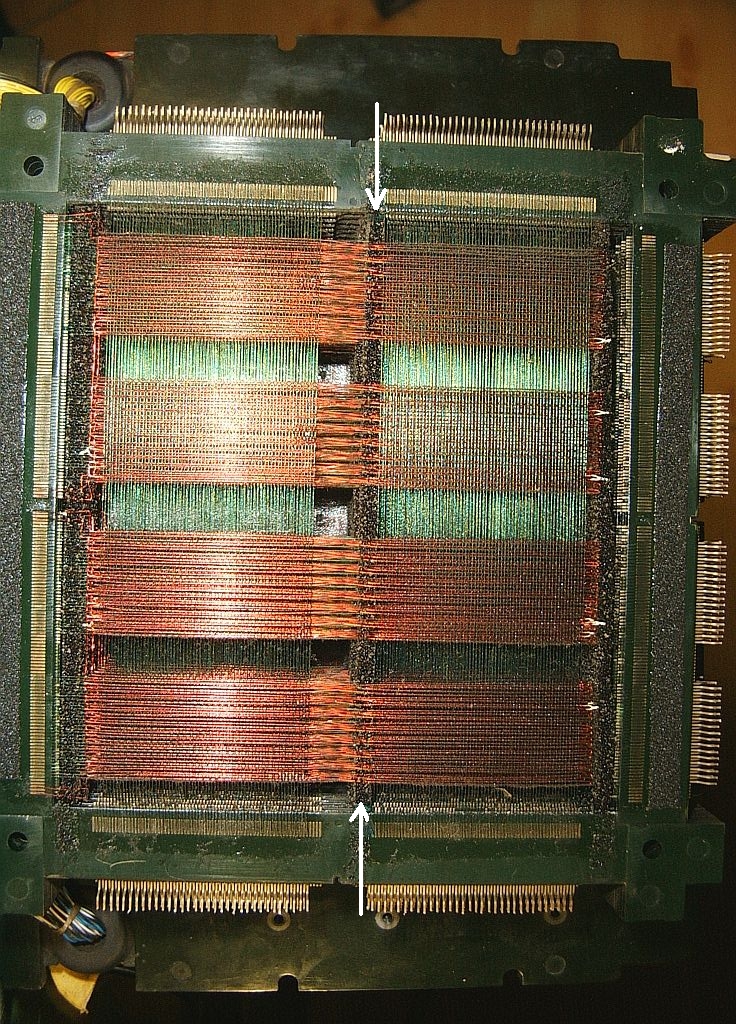
After opening the stack carefully at a plane with two open X wires I found
out that the open spot in the X wires where located at the black 'foam'
which IBM had put in between planes for airflow reasons.
See white arrows in http://home.hccnet.nl/h.j.stegeman/CoreProb3.JPG
The X wires where broken by a chemical reaction between the copper wires
and the black 'foam'. This 'foam' becomes over the years very sticky black
tar. I now also understand why only X wires where open and none of the Y wires.
I also checked the tension/slack in the X/Y wires to see if shrinking (by frost)
could break them. This is not the case.
Conclusion:
It was not the unheated storage of the system (my resposibility)
but the chemical timebomb between the aging 'foam' and the X wires
that caused the defect in all my core modules.
I am now planning for a chip replacement of these core modules.
Henk
that was the seeyuzz river...
At 09:48 PM 12/31/2004, Dave Mabry wrote:
>Who was it who wanted to know more about the multimodule addon board for
>the iPDS? I have a photo that I can send to him. Let me know.
>
>Dave
At 15:33 30/12/2004 -0800, you wrote:
>> Anyone here know anything about the "MicroWAT" computer, which was
>> developed at the University of Waterloo in Ontario Canada around 1980.
>>
>> I just acquired one - this is a small 6809 based computer, which I am
>> told is very similar/somewhat compatible with the Waterloo 6809 coprocessor
>> in the Commodore SuperPET.
>
>Actually, according to my information, it *is* a SuperPET. See
>
> http://www.floodgap.com/retrobits/ckb/secret/pet.html
Thanks - I too found this reference, however it is in error - the MicroWAT I have is
actually a stand-alone computer in a small box with a power supply, small card cage,
three serial ports and an IEEE connector (I have one here in front of me).
I also did uncover a Waterloo document entitled:
"Waterloo Microcomputer Systems for the 1980's"
by D.D. Cowan and J.W. Graham at the University of Waterloo
in which they describe the MicroWAT and the SuperPET as separate systems:
"It was noted that on campus there were more than 1000 'dumb' ASCII terminals, mostly
with CRTs and keyboards, and a study was initiated to consider the problems in their
conversion to personal workstations meeting our specifications. The study led to the
design of the microWAT a prototype of which became operational in December 1980 ..."
"The microWAT is a computer system of one or more circuit boards mounted on a rather
simple bus. A typical system consists of 4 cards, namely the CPU card, 48K RAM card,
64k bank-switched ROM card and the IEEE-488 bus interface card. The system can be
mounted inside most of our ASCII terminals ... If desired or necessary, the microWAT
can be mounted in its own chassis with it's own power supply."
"At the same time as the development of the microWAT, we investigated the possibility
of expanding existing microcomputers by providing them with a large memory so that they
could incorporate our planned software. We modified a PET microcomputer by adding 64k
of bank-switched RAM, a 6809 microprocessor and an RS232 interface. This design
eventually let to the Commodore SuperPET which is a personal workstation similar to the
microWAT".
>From there it goes on to describe the waterloo software and languages, with no real
distinction between the microWAT the the SuperPET - so the above is really all I know
for certain about the microWAT, however it does appear to be distinct from, but related
to the SuperPET.
Once the holidays are over, I will contact the curator of the York museum in Toronto,
as I am certain that he has mentioned to me in past conversation a stand-alone 6809 based
system that was developed at Waterloo - perhaps he will be able to fill in some details,
however if anyone else has information to offer, please do step forward.
Regards,
Dave
--
dave04a (at) Dave Dunfield
dunfield (dot) Firmware development services & tools: www.dunfield.com
com Collector of vintage computing equipment:
http://www.parse.com/~ddunfield/museum/index.html
Blwyddyn Newydd Dda - Happy new year
To all on the list.
I'm a republican - but not in the way you're thinking ! ( :^)
Geoff.
--
No virus found in this outgoing message.
Checked by AVG Anti-Virus.
Version: 7.0.298 / Virus Database: 265.6.7 - Release Date: 30/12/04
The auction for the nearly complete Votrax PSS is almost over! Come on, I'm
hoping someone on the list manages to get it in the end, because it has the
complete manual, including the advanced procedures section and the section
about updating the internal list of substitution words! (the seller sent me
that info)
Here's the auction link:
http://cgi.ebay.com/ws/eBayISAPI.dll?ViewItem&category=162&item=5151487740&…
I hope to see the whole thing scanned (and I want to see the scans too).
Jonathan Gevaryahu
lord_nightmare_(a)t_users.sf.net
jgevaryahu_(a)t_hotmail.com
I am looking to exchange notes and information with anyone else who owns RM05's and/or CDC-9766 300MB SMD drives.
You can contact me off-list: curt(a)atarimuseum.com
Thanks,
Curt
I'm seeking the following software for a client:
Title Publisher
Context MBA Context Management Systems
Open Access Software Products International
Intuit Noumenon Corp.
Aura Softrend, Inc.
Jack2 Business Solutions
The Incredible Jack Business Solutions
Jack Report Business Solutions
Has ya gots any? E-mail me directly and let's talk! Looking to buy and
will pay generously.
Only one more day but I'll beat everyone to it:
Happy New Year!
--
Sellam Ismail Vintage Computer Festival
------------------------------------------------------------------------------
International Man of Intrigue and Danger http://www.vintage.org
[ Old computing resources for business || Buy/Sell/Trade Vintage Computers ]
[ and academia at www.VintageTech.com || at http://marketplace.vintage.org ]
I have an MDS 800, not running, and several iPDS intel development systems.
I also have an Intel 330, a 380 and several 310s for Multibus I systems. A
recent addition is an 80/10 rack mount system (4 slot Multibus I with a SBC
80/10).
I have had all of the development systems go through my hands in the early
90s when we were buying truckloads from intel. I have tinkered with most. About
1993 we sold all of our Multibus cards to Inbus.
Did anyone on the list get the intel IPSC that sold on ebay last month.
Paxton
Astoria, OR
>> From there it goes on to describe the waterloo software and languages, with
>> no real distinction between the microWAT the the SuperPET - so the above isx
>> really all I know for certain about the microWAT, however it does appear to
>> be distinct from, but related to the SuperPET.
>
>Based on that document, yes, it does sound like they are indeed separate
>units. Is there a 6502 in yours, or is it 6809 only?
>
>I'll update my page.
It has only a 6809 in it, which doesn't suprise me, since I don't believe the
6502 is actually used by the Waterloo software once the SuperPET is switched
to 6809 mode.
I am planning an update to my site within the next couple of weeks, and I will
include photos of the microWAT (inside and out), as well as the document that
I have, and whatever other information I can turn up between now and then.
Regards,
Dave
--
dave04a (at) Dave Dunfield
dunfield (dot) Firmware development services & tools: www.dunfield.com
com Collector of vintage computing equipment:
http://www.parse.com/~ddunfield/museum/index.html
Ok, I've been on a kick lately to get my Intel MDS Series II systems
working as much as I can. So my interest in them is peaking.
I'd like to know who has Series II's on this list, if you don't mind
admitting it. I know that Tony, Joe, Steve, Dwight, and a few others
do. And Joe can probably supply anyone who wants one with a system.
;) Just kidding Joe. You are hanging onto yours as an investment,
right? I know I am!!!
These last couple of days I copied images of the ROM code that makes up
an upgrade for the Series II called iMDX-511. It was all new firmware
for the IOC board (4 2716's) and a new firmware in the keyboard (8741A)
to implement the upgrade. It turned the RPT (repeat) key into a
"function" (FCTN) key. And along with the latest version of ISIS (4.3)
you had the capability to hit FCTN-D for "DIR " or FCTN-T for " TO " and
many other "soft" keys for ISIS command line shortcuts. It also added
cursor addressability to the integral CRT and some attributes, like
reverse video, blinking, underline, etc. All stuff that we take for
granted today, but in those days it was a big thing!!!
Anyway, if anyone is interested I can make the binaries available and
help those of you who have these beasts get it implemented.
Any takers?
Dave Mabry
Hi Guys,
Just picked up an Tektronix Model 31 desktop calculator. This is a
fairly old (early 70s) desktop programmable with built in tape storage
and printer.
Looking for information/documenation on it - all I got was the bare
unit (which looks to be in good shape).
Also got a stack of circuit boards from an Olivetti Programma 101
(early 60s) as well as the general reference manual and some programming
sheets - unfortunately the machine itself was "taken apart" many years ago
and this is all that remains - the boards are very interesting and worth
keeping on their own, as they utilize discrete resistor/transistor logic
modules. However, if someone on this list has a Programma 101 in need of
parts, I would rather see them used to heal a whole machine instead of
sitting on my shelf as curiosities.
Regards,
Dave
PS: Also picked up a "MicroWat" - 6809 based computer built by the University
of Waterloo in Canada - if anyone has info please contact me.
--
dave04a (at) Dave Dunfield
dunfield (dot) Firmware development services & tools: www.dunfield.com
com Collector of vintage computing equipment:
http://www.parse.com/~ddunfield/museum/index.html
>From: Tom Peters <tpeters(a)mixcom.com>
>Subject: Re: Powermac 8100/80 RAM question
>To: "General Discussion: On-Topic and Off-Topic Posts" <cctalk(a)classiccmp.org>
>
>I have lots of old 72-pin SIMMs laying around. What are you looking for?
Actually, I have a metric crapload of PC 72-pin SIMMs lying around,
and the Mac that needs more RAM. Just wondering if I could make a
match. It seems like it will, from all the replies, so maybe some of
that RAM can find a home....
Thanks to all for the replies!
Rich B.
1. Very early full height drives had a real "brake",
like a brake shoe on a car, that locks when power is
disengaged. Maybe this is sticking.
2. Very early drives son't have any kind of embedded
servo/voice coil technology - they used a stepper
only. I recall that those didn't like to operate
outside of a narrow temperature range (50-100F),
probably coefficient of expension problems. I remember
that we were so excited when our first Shugart 5M
full height came in we formatted it immediately after
it had been in a UPS truck for days during the winter
- and it produced numerous errors. Two hours later, we
reformatted it and it was fine. So, I don't know how
well the temperature trick will work. It might work
for a few minutes between "too cold" and "too hot"...
=====
-Steve Loboyko
Website: http://juliepalooza.8m.com/sl
Nixie Watch (one-tube):http://juliepalooza.8m.com/sl/complwatch.htm
__________________________________
Do you Yahoo!?
All your favorites on one personal page – Try My Yahoo!
http://my.yahoo.com
I've got someone asking me about a Profile hard drive in a Lisa 2/10. He
says it makes a loud screaming noise when it is running. Maybe bad
bearings?
Anyone seen this with the Profile drives? Any idea if it is fatal? Any
idea if it can be repaired?
Any advise I can pass on would be great.
-chris
<http://www.mythtech.net>
Anyone here know anything about the "MicroWAT" computer, which was
developed at the University of Waterloo in Ontario Canada around 1980.
I just acquired one - this is a small 6809 based computer, which I am
told is very similar/somewhat compatible with the Waterloo 6809 coprocessor
in the Commodore SuperPET.
Looking for any information on it, as well as software (it apparently uses
an IEEEish drive like the PET - in fact, it is possible/likely that a CBM
drive is what it was designed for)
One burning question - when I opened the machine, I found five cards in the
slots - an I/O card, a CPU card (with a bit of ROM), a ROM card, and two RAM
cards - tucked into the gap left by the two remaining empty slots was a small
sealed board wrapped up in a plastic bag.
This board is only perhaps 2-1/2 inches high (1/2 height or less of the other
boards), and is completely encased in a shell, perhaps 1" thick, and is filled
with potting compound - the only part visible is the edge card connector. In
other words, it looks like a 1" x 2-1/2" black box with an edge card connector
protruding from it - it will fit the slots, although I'm not completely
certain which way it goes in (it could face either way).
Anyone know what this board is? Could it be related to the "Secret" little
daughter board in the SuperPET (the one whose function was never documented)?
[If it's like that board, then it would be required for the system to function,
which would lead to the question - why was it unplugged and wrapped up?]
any info or pointers for either the machine, card or both would be greatly
appreciated.
Regards,
Dave
--
dave04a (at) Dave Dunfield
dunfield (dot) Firmware development services & tools: www.dunfield.com
com Collector of vintage computing equipment:
http://www.parse.com/~ddunfield/museum/index.html
Well Hurricane Jeanne has come and gone. This is the fourth hurricane in
6 weeks and the third that's gone through my area. The DEC and intel stuff
sitting outside STILL hasn't blown away! Not too much damage this time, for
the most part everything that could be torn up was destroyed in the
previous storms. However my roof shingles are finally starting to go. The
power companies are getting GOOD at this. This time they had the power back
on the same day! I think there's going to be lots of houses (or vacant
lots!) for sale in Florida real soon. I went to Home Depot this morning
and it was packed with people buying roofing materials and other repair
items. A lot of them also had "Home for Sale" signs in their carts!
I haven't heard from Glen. I know he was without power for five then
seven days from the two previous storms and I think he's about ready to
leave the state.
Joe
Hi,
I'll gladly admit to having one. What a wonderful old beast. Got it a few weeks ago - covered in grime and dirt, but I cleaned up the main box and all the boards and connectors and it runs like a dream now.
It's an MDS-225, and it came with the expansion chasis, double-density disk drive array, ICE-80, ICE-51 and ICE-41 emulators and software and ISIS-II disks. I ran the ROM-based diags and it all came out okay - including the integral disk drive. I need a cable (or pinouts so I can make one) to attach the disk array. I think I'll need the disk array 'cos most of the disks are double density and won't run on the integral drive.
I haven't cleaned up or attached the expansion chasis yet. I'm currently on the hunt for manuals and have got most of them from the net and printed them out. Great stuff. I love this old equipment. I'm still getting used to it 'cos I've never used a diskette-only based MDS.
My current pride and joy is an MDS-Series4 with ICE-85B emulator. I got another Series-4 also (when I got the MDS-225), but, as mentioned in a previous post, this baby's got a RAM error and I don't have enough spare 2118 chips to replace all the current chips, so I'm trying to isolate the chip, but it's kinds hard with no cct diagram. The CRO doesn't show anything wrong, but as the System Monitor comes up I think I'll write a short program to help isolate the fault.
But, as both systems cost me only $88AUD, I can't really complain - even though their bulk is a challenge to the wife as they are in the family room. I don't think she's an "old big Intel box" sorta lady. :)
Oh, thanks again to Dave for the TD images for the iPDS. I'm having a bit of fun with that thing also. Simply marvellous stuff. I got an ISIS-II users guide - thanks Fritz - so I'll be getting into this too. Ahh.. so many projects and things! I love it.
seeyuzz
river