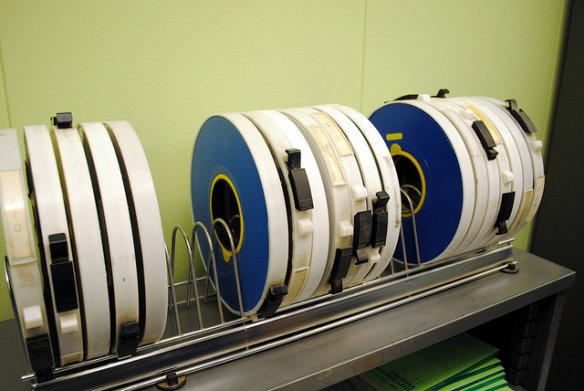
> >>/I hit on the idea of using 16mm move film plastic "cans". Much to my />>/surprise, I found that there is still an active market for these things. /
> On Mon, 8 Apr 2019, Kevin Monceaux via cctalk wrote:
> >/My small 16mm collection is stored on an open reel tape cart. /
> I wonder how tape rings would do on 16mm reels?
You mean the write rings?? They're fixed at the hub size....
As for write rings, most sites had more than they actually need, many
times over.? You really only need as many as you have tape drives...
I've always wanted to make an Olympics logo out of write wrings, but
never could find all the right colors.
I have a couple black ones around the gearshift in my car (like horseshoes).
--
Jeff Woolsey {{woolsey,jlw}@jlw,first.last@{gmail,jlw}}.com
Nature abhors straight antennas, clean lenses, and empty storage.
"Delete! Delete! OK!" -Dr. Bronner on disk space management
Card-sorting, Joel. -Crow on solitaire
> While on the subject of tape storage anyone know if it is still possible to get desktop/table top wire bins to hold tapes in canisters and/or reels? Not that I have that many tapes or anything like that. This would be more for display purposes than anything else.
>
> Something akin to this: ibm51xx.classiccmp.org/CCTalkPics/taperack.png
>
> Do they still make things like this or do I have to find it at university junk sale?
>
>
Those are exactly the "dish rack" things I have two of.? Of course, I
can't remember where I got them.
FWIW, I also have a small rack that holds, uh, 2x4x25 8mm data tapes in
their cases.? Said "dish rack" won't fit on top, though.
--
Jeff Woolsey {{woolsey,jlw}@jlw,first.last@{gmail,jlw}}.com
Nature abhors straight antennas, clean lenses, and empty storage.
"Delete! Delete! OK!" -Dr. Bronner on disk space management
Card-sorting, Joel. -Crow on solitaire
> From: Adrian Stoness
> someones bid on them eh hopefully not a scraper
Well, a scrapper would want to pay as little as possible, so anyone
who wanted to actually save the system should be able to get it.
There are a couple of bids on it, but the amounts are derisory.
I hope Christian's museum can get it!
Noel
This I didn't know.
I bought a Tektronix 4207 color graphics terminal without a keyboard
recently.? Finding the correct keyboard part number seemed to be a
process with great uncertainty, the VintageTEK folks said the correct
one was a 2468.? One of these was for sale on ebay for $300 - no way was
I paying that much!
So I tried one that looked like the keyboard in the TEK catalog of that
period, but with a different part number. The connector looked like the
right one though.? I got one off ebay, and I thought it was kind of
expensive, but it did work with the 4207 terminal.
What I didn't understand was a fascination with the black mechanical
Cherry switches the keyboard used.? These turn out to be extremely
popular with the 'gaming' community.? I don't know if the tektronix
keyboard can be used with a modern PC, I haven't looked at the interface
signals yet.? The modern PS/2 keyboard has a clock and data line, the
DEC LK201 used rs232, so what Tektronix used is anybody's guess.
> whats with the weird tag on this thread?
Oops, sorry.
Clicking on an address in the mailing list viewed as a web page via
http://www.classiccmp.org/pipermail/cctech/2019-April tries to fire up
MacOS X Mail, which I don't want because I use Thunderbird.? So I "Copy
Email Address" and paste it into a Thunderbird compose window To: field,
and it has
cctech at classiccmp.org?Subject=Re:%20'd_subject_line_mess&otherjunk.? I
copied that into the Subject: line, and thought something would do the
right thing with them upon receipt.? Oh well, there I go overestimating
the intelligence of software again.
--
Jeff Woolsey {{woolsey,jlw}@jlw,first.last@{gmail,jlw}}.com
Nature abhors straight antennas, clean lenses, and empty storage.
"Delete! Delete! OK!" -Dr. Bronner on disk space management
Card-sorting, Joel. -Crow on solitaire
> I've noted earlier that the vinyl "hanger strips" for 1/2" magnetic tape
> have been degrading, becoming brittle and simply breaking away,
> sometimes in small particles.
I have about a hundred tapes from various contributors, and have noticed
no age-related [1] deterioration of the seals, probably because mine
don't get handled very much.? About 1/3 of mine have the vinyl hanger
strips, another third the autoload seals, and the remainder are in the
bulky canisters (with several different closures).? I also have a couple
of tape racks (think "dish rack") that hold maybe thirty tapes, but the
canisters are too thick to fit in.
The tapes hang pretty well from the front lip of the wall-mounted wire
shelves (that you can get at most big-box-home-stores) I installed not
for that purpose.
The thing is, I've read and photographed most of them, so I don't need
[2] them anymore.? Their owners, like me, only wanted the data online,
not the media back. Most museums have more than they want or can use, as
well.? Some tapes have common-sense restrictions on redistribution
(Personally Identifiable Information, I think they call it nowadays).
I've even got some new, never-written ones.? But it pains me to trash
them, so I'm open to suggestions.
=
[1] I have dropped and broken a couple of them, but that was due to
insufficient age of the handler...? Some did not survive the reading
process due to oxide-binder aging, but the seals are fine.
[2] In many cases, usually by repurposing extra copies of software
distribution tapes, the most recent data is shorter than the original,
so the tails of older things past the EOF1 label and double tapemark can
be read without much difficulty.? The thing is, I didn't figure this out
until I'd been reading tapes a while, so the earlier ones may yield to
re-examining.
--
Jeff Woolsey {{woolsey,jlw}@jlw,first.last@{gmail,jlw}}.com
Nature abhors straight antennas, clean lenses, and empty storage.
"Delete! Delete! OK!" -Dr. Bronner on disk space management
Card-sorting, Joel. -Crow on solitaire
One of my RL02 drives (that sat for a long time) has developed what appears
to be a sticky head positioner.
But it's only a problem going from the full-retracted position to loading
track 0.
Once it's loaded, the drive will pass all seek and read/write tests.
It takes a surprising (to me) amount of force to pull the heads out into the
disk area (power off, no pack). When they're out there, the arm slides back
and forth easily.
Sometimes it won't load at all - push the load button, light goes out, disk
spins up to what sounds like normal speed, but the heads never move and the
Ready light doesn't come on.
There's supposed to be a Fault after 40 secs but that doesn't happen - it'll
sit there forever spinning but not ready.
If I turn off the power and remove the pack, and pull the positioner out
just enough to avoid opening the Heads Home microswitch (which causes a
Fault light), then it'll spin up, load track 0, and work fine the rest of
the day.
The manual (as usual) only recommends replacing the bad assembly for ease in
field servicing, which is deliberate.
But I don't have a DEC repairman and a warehouse full of parts handy... Is
there some kind of adjustment or lubrication I can do?
If I replace the positioner then I have to realign the heads (not too bad a
job on this drive, though).
Any ideas?
thanks
Charles
I've noted earlier that the vinyl "hanger strips" for 1/2" magnetic tape
have been degrading, becoming brittle and simply breaking away,
sometimes in small particles.
So I set off looking for a low-cost substitute--any hangers that I could
rustle up would probably be on their last legs at this late date.
I hit on the idea of using 16mm move film plastic "cans". Much to my
surprise, I found that there is still an active market for these things.
After getting a few samples, I've discovered that the 800' cans fit a
10.5" reel (virtually all of the tape that I get) quite well. I'm not
yet finished evaluating samples, but here's a photo of a can from Tuscan
Corporation holding a reel of tape:
https://i.imgur.com/KPKg75s.jpg
The cans are vented, so not hermetically sealed. In the case of film,
this is apparently done intentionally, as the acetate base of older film
outgasses acetic acid, which only hastens degradation.
If anyone's interested, I'll continue to post updates. I've got some
>from Larry Urbanski coming in Monday. Larry seems to have the lowest
price on these--about $5.75 each.
--Chuck
Back at VCF PNW, the subject of the Game of Life came up among some peers.
I recall messing with the BASIC version that supported 32 by 32 cells, and
there's also a FOCAL version that can do a whopping 11 by 11 cells.
This was simply not enough. So, I wrote my own implementation and came to
the realization of why more cells may not actually be better...it's
freaking slow!
https://github.com/drovak/pdp8life
I've improved the performance a bit using some caching and other tricks to
skip extraneous processing and twiddling of bits, but running in SimH for
lots of cellular life still takes a while. I haven't been able yet to try
it on the real hardware, and I can't say I'm looking forward to the speed
of the real machine either!
I'm working on a few new versions, which may get wrapped up into some
conditional assembly soon. One version will support both storage and
non-storage oscilloscopes with a VC8E. Another version may work to actually
reduce the size of the bitmap to increase speed; it's all a tradeoff, I
suppose.
Would love to hear some comments if anyone plays with this. And, if someone
significantly speeds things up while keeping the large playing field, I'll
be very happy to hear how!
Kyle
Here's a list of some more stuff if anyone is interested in making
reasonable offers. Probably the last I will have before my demise
when my wife will likely send everything that's left to the skip.
MODULE Description QTY
NUMBER
M9202 UNIBUS connector 3
M9302 UNIBUS TERM 2
ADAC 1632TTL 3
ADAC 1616/32HCO 1
Plessey Peripherals 703185-100C & 701877-100 with Cable 1
Data Translation DT2769/EP057 REV F 1
Data Translation DT2769/EP057 REV J 1
Data Translation DT15150/EP075 Dual D/A Converter Module
M3106 4 Line Async Mux 1
M3106 4 Line Async Mux (w/broken handle) 1
M9060 LOAD MODULE 1
M8017-AA Async Line Interface 1
M8017 Async Line Interface (w/broken handle and berg socket) 1
G7273 NPG AND BUS GRANT CONTINUITY 5
RL Disk Drive Terminators 4
MV-II Function Select / SLU Module 1
A few modules that I ecpect are rare but of limited interest.
Terak 8510 Memory and Video module w/bulkhead connector 1
Terak 8510 Floppy Module w/bulkhead connector 2
Terak 8510 Floppy Module wo/bulkhead connector 2
Terak 8510 RS-232 Serial Module w/bulkhead connector 4
Terak 8510 RS-232 bulkhead connectors 3
Terak 8510 Video bulkhead connectors 2
Condition of the Terak Modules can not be verified.
They were functional at the time they were removed
but I no longer have any functional Teraks to test
them.
Shipping would be the smallest size USPS "If it fits it ships" box
so you can plan accordingly.
bill
a pity there are not? name? captions? ? ?for? those of? us that? do? not? travel? well to be? these in person.
Great photo? collection though!? Ed#
In a message dated 3/31/2019 8:46:29 AM US Mountain Standard Time, cctalk at classiccmp.org writes:
One last spam from VCF PNW 2019 ...
Send us your Photos!? We want to put together a shared photo album so thatpeople can see the event from different perspectives.? It's a Google Photosalbum, so if you are a Google Photos user sharing is easy.? If you are nota Google Photos user or you have concerns/questions please let me know andI'll work out an alternative.
The shared album can be found at:https://photos.app.goo.gl/e2rzk4iT4aHrQUoy6
Help us make VCF events better!? If you were at the event last weekend Ihave a quick survey that I'd like you to fill out.? The survey will help usshape future events.? The survey is anonymous; we are not collecting emailaddresses unless you want to get a chance at a free t-shirt.? (And eventhen, we are only using the email address for that single purpose.)
The survey link is: https://goo.gl/forms/V3DiyxwkpbIOCKn73
Direct feedback by email also works well.
Thanks,Mikemichael at vcfed.org or mbbrutman at brutman.com
> From: Guy Dunphy
> What I want to know is, how do front panels of historic computers so
> often get separated from the rest of the computer?
I suspect it probably happened a while back, before the start of the vintage
computer movement; you need to look at the decisions from the perspective of
back then. (As an example, back then, I was offered the complete PDP-11/45 of
my old group. I was up to my neck in contemporary, important, alligators - I
was on the IESG of the IETF at the time - and didn't have the time to deal
with saving it and moving it to my house; so I let it go - a loss I regret
terribly now.)
Here's what probably happened: the machines were about to be scrapped, and
saving the whole machine wasn't practical - often, in part, because those
machines were _huge_. (The CPU _alone_ of a KA10 would fill an entire room of
a normal house.) So, one has a limit to what one can do. So the choice is to
save the front panel alone... or to save nothing.
Noel
I talked to a recycler today, who said he told his workers to throw out 2000
Model F keyboards last week, but he doubts they did it.
I also asked him about 8088, 2086, and 386 computers. He said they go
straight to the grinder. I told him I will buy them.
Then an HP dealer contacted me, wants to know if I buy old HP stuff. I told
him Apollo and earlier. Let me know if there is something specific HP you
want.
Cindy Croxton
Electronics Plus
1613 Water Street
Kerrville, TX 78028
830-370-3239 cell
sales at elecplus.com
---
This email has been checked for viruses by Avast antivirus software.
https://www.avast.com/antivirus
Just wondering if anyone has come up with a fast way to count the number of
1s in a word on a PDP-8. The obvious way is looping 12 times, rotating the
word through the link or sign bit, incrementing a count based on the value
of the link or sign.
With a small lookup table, you can reduce the total number of loops by
counting multiple groups of bits at a time, but this of course comes with
the cost of using more memory. Any other suggestions?
Much appreciated,
Kyle
At 08:49 PM 5/04/2019 +0000, you wrote:
>Hi Kyle,
>
>hat's a really interesting problem, and the government (NSA) wanted this badly and done FAST.
>
>they asked Seymour Cray to create a specific instruction for this and they called it 'population count'
>
>Anybody know the why and how it is useful?
>
>I am deep in matrix math books and 'classification algorithms' in statistics math, looking into electronics reliability WCCA, so this is an interesting topic.
>
>Randy
If we're considering hardware solutions, then the best way is to build a simple I/O device, with a writeable latch for the data word, fed as address into some nonvolatile memory like a big EPROM or flash, the output of which can be read via a port. Fill the NV memory with the required lookup table (derived by some code written in anything. BASIC for lols.)
So the required code is just one write and one read.
See the size chart: https://en.wikipedia.org/wiki/EPROM
The biggest EPROM made was ST M27C322, 32 Mbit, 2Mx16. 21 Address bits, 16 data bits, 80nS access time.
http://pdf.datasheetcatalog.com/datasheet/stmicroelectronics/6184.pdf
Wasteful though, since the result only needs 5 bits.
For an 8 bit result, 27C4001, 512K x 8 bit, 19 Address bits.
http://www-inst.eecs.berkeley.edu/~cs150/fa02/docs/M27C4001.pdf
If the argument is only a 16bit word, then use a 27512. 64K x 8 bit
Guy
Subject: Re: Yes there is a PDP 10 front panel and Kenbak on Ebay
> > From: Guy Dunphy
>
> > What I want to know is, how do front panels of historic computers so
> > often get separated from the rest of the computer?
>
The other thing that happened on PDP-11/70s was that if your system
was maintained by DEC, the field service group would want to install
the KY11-RE Remote Serial Console Control which replaced the beautiful
front panel with a more or less blank panel with only a key switch. It
let DEC dial in and run diagnostics, and the Blinkin' Light panel was
set aside often in the collection of someone. However the blank panel
still needs the bezel for a good display of it. So unfortunately,
there are more console panels than bezels which often did not get
salvaged at the time the PDP-11/70 was taken out of service.
Mark M.
> From: Al Kossow
> because it's $125 lower than the last one that sold.
> https://www.ebay.com/itm/113190860596
Wow - somebody got a real deal! Looks like the seller listed it as
a BiN with a low (for what it was) price; bet they're kicking themselves
now, seeing what this one is going for, that they didn't go the auction
route.
Noel
The following, which I just sent to TUHS, might be of intererest to some here.
Noel
----
So, a while back I mentioned that I'd done tweaked versions of 'cp', 'mv',
'chmod' etc for V6 which retained the original modified date of a file (when
the actual contents were not changed). I had some requests for those versions,
which I have finally got around to checking and uploading (along with 'mvall',
which for some reason V6 didn't have). I've added them to a couple of my V6
pages:
http://www.chiappa.net/~jnc/tech/V6Unix.html#mvallhttp://www.chiappa.net/~jnc/tech/ImprovingV6.html#FileWrite
Note (per the page) that the latter group all require the smdate() system
call, which was commented out in 'vanilla' V6 (because using it confused the
backup system); the page gives instructions on how to turn it back on.
I have a PDP-11/23+ and the power supply (H786) "last ran when parked" a
year or so ago. But there's no DC output at all today, and the fans are
running so there is AC power...
I also have the original H7861 that came with it, which had a blown chopper
transistor. I couldn't find anything else bad, so I replaced the transistor
and within a few seconds of running, it blew again. :(
So I need some help - I've never been good at fixing switching supplies, not
to mention the high-side hazards.
The simplest solution would be just to replace it with a working unit.
Anyone got one to sell, hopefully cheap? :)
If not, can anyone fix one or both of mine?
thanks!
Charles
any? relation? to? marlys nelson? at? river falls?
Ed#In a message dated 4/3/2019 12:40:06 PM US Mountain Standard Time, cctalk at classiccmp.org writes:
I mean that semi-sarcastically as this list probably knows better already.
=]
--
Anders Nelson
+1 (517) 775-6129
www.erogear.com
On Wed, Apr 3, 2019 at 3:37 PM Anders Nelson <anders.k.nelson at gmail.com>
wrote:
> My god people, stop bidding! There are 6 days left.
> --
> Anders Nelson
>
> +1 (517) 775-6129
>
> www.erogear.com
>
>
> On Wed, Apr 3, 2019 at 2:51 PM Bill Degnan via cctalk <
> cctalk at classiccmp.org> wrote:
>
>> Yes there is a PDP 10 front panel and? Kenbak on Ebay
>>
>> and no, a "best offer" of $250 for the front panel will not be accepted.
>> :-)
>>
>> Bill
>>
>
> From: Bill Gunshannon
> when I get it done I will be glad to provide you with a dump of the
> root and usr partitions. I may be able to do SIMH disk images as well,
> but I have been working mostly with E11.
E11 disk images in files aren't anything odd, just a straight bit-bit copy of
what would be in the parititon. (When I transfer RK05 partitions on E11 to SD
cards for use in the QSIC, I just 'dd' the file holding the partition to the
appropriate blocks on the SD card, and it comes out fine.)
Dunno about SIMH disk imaages (I know the tapes images are tweaked).
Noel
Anybody had any luck with this configuration?
I used VTServer to install it and everything works fine
except for the very last step. It installs completely
and boots from within VTServer with ra(0,0,0)unix. I
issue the "dd if=/mdec/rauboot of=/def/rra0a count=1" and
it completes successfully. But the disk still won't boot.
I have tried it three times now with the same results.
Suggestions?
bill
Hi all,
I just bought this Burroughs BU4400 tape drive:
https://www.trademe.co.nz/Browse/Listing.aspx?id=1999913439
As the seller says, Google comes up empty. Seems strange, I would have
expected some reference somewhere. Does anyone know anything about it?
I'm going to pick it up this evening. It'd be superb as a display piece,
but I'd be really keen to drive it with something and get it reading and
writing.
On that topic, are there any suggestions on how I could get my hands on
a few tapes, preferably with a format this drive can read? The actual
contents aren't important; even blanks would be OK, though not being
able to get it reading before moving on to writing would make the
project more difficult.
Cheers,
Mike
This will mostly interest TRS-80 enthusiasts on this list.
Being a TRS-80 enthusiast myself it has been a long-time dream of mine to
create a specialised TRS-80 search engine but creating a web facing search
engine to crawl numerous sites, index and categorise was quite difficult on
a low budget. For some time I used Google's Custom Search, the ad free paid
version, but Google withdrew that product so it took be back to my starting
point. I could have continued with the ad version but somehow I didn't want
a page full of ads for users of this site. In any case doing it in my own
right gave me a lot more granularity and control.
So after much experimenting and trialling I finally produced the site in its
own right and have just relaunched it. It is, in fact will always be, work
in progress and I'm always on the lookout for more TRS-80 resources to add
to the site and for any advice on omissions, corrections, additions etc. If
you know any sites that I haven't included please use the contact form on
the site to let me know.
Check it out at theretrosearch.com
Thank you!!
Kevin Parker
can anyone help this guy out?
From: Benjamin Carlson <bcarlson at northpointdefense.com>
Sent: Tuesday, April 02, 2019 9:12 AM
Subject: Fwd: Re: MicroVAX
Greta, my name is Ben Carlson and I am attempting to restore an old DEC MicroVAX II for the University of Oklahoma's
collections department (see email below, Kerry is their curator). At this point, I believe I can get the hardware
operating but I have no operating system for itas the Air Force insisted on destroying the hard drive. I have been able
to replace the hard drive and the system has a tape drive and CD-ROM.
Do you have any idea where I might find the OS? Also, any documentation would be great as well.
Thanks for your help!
Benjamin Carlson, PhD, CISSP
Senior Research Engineer
North Point Defense
Rome, NY
(315)571-0221 x 1010
I'm writing a S/360 Model 50 emulator that runs at the microcode level, in
order to drive a Model 50 front panel accurately. I'm about 80% of the way
there, but there are some microcode operations that I haven't figured out.
So I figured I'd ask if anyone has obscure Model 50 manuals that aren't on
bitsavers, or perhaps even the ALDs.
I was surprised at how extremely different the microcode is from the 360
instruction set. I've figured out a bunch of the strange
micro-instructions, such as S47?E, which ORs the emit field into flags 4
through 7. But there are many micro-instructions that still puzzle me,
like F?FPSL4 which maybe a floating point shift left 4 and 1?BS*MB which
does something with byte stats. So if anyone happens to have a Model 50
microcode programming manual sitting around, please let me know :-)
Thanks,
Ken
Hey all --
Trying to track down technical info for a Dilog DQ100 controller. This is
a QBus controller compatible with the RK11 (or RKV11, in this case) that
works with various RK05-compatible drives. (See the brochure here:
http://www.bitsavers.org/pdf/dilog/brochures/DQ100_Brochure_Aug1980.pdf)
At minimum, I'd like to know the connector pinout so that I might wire up a
Diablo 31 to it.
Thanks as always,
Josh
> From: William Donzelli
> It is very likely IBM does not have the information anymore - at least
> not in the archives. ... they simply did not keep much from that era.
> It was probably disposed of back when IBM was in trouble 30 years ago.
Which emphasizes that it's important to make the point to IBM that we
wouldn't be asking for IBM to supply the information; rather, this is about
being able to reproduce info that IBM itself may no longer have.
Is anyone up for tackling IBM? If so, and we need support, I can ask my
Master, Jerry Saltzer, if anyone he knew at IBM is still there - he used to
have a lot of influence inside IBM (he's the person who got FS killed, I was
informed). But that was a long time ago...
> From: Jay Jaeger
> I suspect, but do not know of course, that the reasons that the owners
> would not part with their copies was ... concern over their value
> becoming diminished by having scanned copies around.
One easy way to test that is to have Al ask the person with the ALD's if
they'd be OK with having that stuff scanned if we got an OK from IBM.
Noel
One last spam from VCF PNW 2019 ...
Send us your Photos! We want to put together a shared photo album so that
people can see the event from different perspectives. It's a Google Photos
album, so if you are a Google Photos user sharing is easy. If you are not
a Google Photos user or you have concerns/questions please let me know and
I'll work out an alternative.
The shared album can be found at:
https://photos.app.goo.gl/e2rzk4iT4aHrQUoy6
Help us make VCF events better! If you were at the event last weekend I
have a quick survey that I'd like you to fill out. The survey will help us
shape future events. The survey is anonymous; we are not collecting email
addresses unless you want to get a chance at a free t-shirt. (And even
then, we are only using the email address for that single purpose.)
The survey link is: https://goo.gl/forms/V3DiyxwkpbIOCKn73
Direct feedback by email also works well.
Thanks,
Mike
michael at vcfed.org or mbbrutman at brutman.com
Hi, everyone,
Myself and my friend Mike, representing the Old Calculator Museum,
exhibited the line of Wang Laboratories electronic calculators at the
Vintage Computer Federation's Vintage Computer Festival/Pacific
Northwest edition, at the Living Computer Museum+Labs in Seattle,
Washington this past weekend.
This was the 2nd annual VCF/PNW, and it was clearly a success, as it was
significantly larger than the first event last year (which I went to,
but didn't exhibit at). There were 30 exhibits, all of which were
really interesting, and a good-sized consignment area, as well as quite
a group of guest speakers who had interesting topics to present. Of
course, being held in the Living Computer Museum+Labs was a bonus, as
the museum is an amazing place, with lots of vintage computers up and
running and accessible for people to actually use and experience.
The Old Calculator Museum exhibit consisted of a Wang LOCI-2 and punched
card readers (1st and 2nd-generation card readers), a Wang 360E w/320K
keyboard/display unit;362E with 370 Programmer and 371 Punched Card
Reader; 360SE 4-terminal timeshared calculator package with two 360KT
trig keyboards, 360K, and 320K keyboards, all running simultaneously
off the 360SE electronics unit; a Wang 720C; Wang 600-14TP; Wang
500-14TP; Wang 462 and 452 Programmable calculators; and a Wang C-52.
These are representatives of all of the lines of calculators that Wang
Laboratories made during its years in the electronic calculator market
(1965-1974). All of the machines were running and available for
visitors to play with, with the exception of the LOCI-2 (which has a
thermal issue that manifests after about 3 minutes of operation) and the
500-14TP, which has some kind of problem that renders it catatonic that
I've not yet had a chance to try to diagnose/repair). Also shown was
an original Wang Labs factory spare parts kit for the 300-series
calculators & peripherals, another Wang 360SE electronics package opened
up so people could see the insides, a number of circuit boards from Wang
300-series keyboard/display units, as well as core memory boards from
300-series electronics packages, core memory and circuit boards from
Wang 700-series calculators, and original sales documentation for Wang's
700, 500, and 600-series calculators.
The exhibit turned out pretty well, though I didn't have time to make up
signs to identify the stuff until we actually got there and made
hand-written signs, which turned out to be good enough -- it seems that
people could actually read my chicken-scratch handwriting. The signs
included the retail price at the time the machine was introduced, and
people were stunned that in 1971, a Wang 720C outfitted as the exhibited
machine retailed for $7,000. A lot of people asked how much that would
be in today's dollars, and I was able to use my phone to find
out...about $50,000.
The exhibit was almost constantly busy both days for the whole time the
museum was open, (10 AM - 5 PM), and the folks were all very careful
with the old machines, and had really great questions about them. I
was pretty surprised at how much interest there was in these old beasts.
The crowd was pretty mixed in age, from folks who actually used examples
of the machines in school, to youngsters who were totally shocked that
this is what calculators were like 50 years ago. The machines ran the
whole time the exhibit was open, and amazingly, despite the old
Germanium-based transistors in the Wang 300-series calculators, as well
as fussy magnetic rope ROMs and core memory in the 700 and 600-series
machines, they ran trouble-free. A lot of folks had trouble getting the
machines to give answers they expected because of Wang's unusual math
entry method. Once they were given a simple explanation of the way the
machines worked, they caught on quickly, and got answers they expected.
It was a lot of fun to explain and demonstrate the machines to the
visitors. The Wang 370 Programmer hooked up to the 362E electronics
package was popular. I had a little program punched up on a card that
would perform an iterative approximation of Pi. It'd run for 100
iterations, then stop and display the approximation it had come to thus
far. People were fascinated by the "spinning" Nixie Tubes as the
machine churned away on the iterations. People also liked the 360KT
keyboards hooked up the 360SE simultaneous timeshared calculator
electronics package. They enjoyed it when I demonstrated the two 360KT
keyboard/display units running the Sine of 45 degrees at the same time.
The timesharing between the two terminals was obvious as the calculator
switched back and forth between each of the keyboards as the
calculation, which takes about 25 seconds, was being performed.
Nixie tubes were a big attraction. Many younger folks had never seen
them in person before, but almost everyone knew about them. I think
that the popularization of Nixie tubes in the form of clocks using Nixie
tubes for display has brought Nixies to the attention of folks that
didn't experience them in the day, but have seen stuff online about
Nixie tubes.
I did get a little time to wander around the event and look at the other
exhibits (there were 30 this year!), and the stuff the folks had was
amazing. I was really impressed by Josh Dersch's exhibit of PERC
workstations...it was truly amazing to see these rare machines running!
I really liked Vince Slyngstad's PDP 8/e with a custom Omnibus board
that replicates the vintage (and rare) X/Y analog output board using a
CPLD and a couple of DACs such that the PDP 8/e was running actual
SPACEWAR code and displaying on a Tektronix display tube. There were
a lot of other really great exhibits, including a very complete Atari
800 systems running office productivity tools that made what was
considered a gaming computer into a true office machine that was ahead
of its time. There was a great exhibit of some classic Silicon Graphics
machines running, an exhibit of just about every type of floppy disc and
optical media ever produced (some of which are very rare), and a couple
of exhibits related to accurately emulating classic computers using
contemporary microprocessors to either run vintage "lights & switches"
front panels, or even miniaturized front panels built to look and run
like the original computers. All of the exhibits were well presented
and truly interesting.
Just before the event closed, I took a few minutes so I could go
upstairs to the computer room and take some photos of the KA-10(which
I'd have to say is my favorite vintage computer), when my friend and
exhibit helper Mike came through the doors of the computer room, pointed
at me, and motioned for me to come with him. I had been talking to two
very nice young gentlemen who had a lot of questions about the KA-10,
and had to beg their forgiveness as I had to leave. I followed Mike
down the stairs, and a big crowd of people was there. I didn't realize
it, but the awards ceremony was going on while I was upstairs. Mike
guided me to Mike Brutman, the event organizer, and he presented me with
"The Most Interesting Presentation" award! I was completely stunned.
I never would have thought that a couple of tables of old calculators
with hand-written signs would merit such an award, but I was very
honored and humbled to receive it.
The event was very well-organized. The Living Computer Museum+Labs
staff and volunteers did an amazing job getting the museum set up for
the exhibits, with tables, tablecloths, and chairs all in place and
ready to go when we arrived Friday. Mike Brutman was fantastic! He was
so nice, accommodating, and supportive of my exhibit (which, by
definition, was somewhat outside the "Vintage Computer" realm), as well
as doing a completely amazing job of organizing such a complicated
event. Everything went off smoothly, from the set up Friday night,
through the two days of the event, awards Sunday after the doors closed
to the public, and tear-down and haul out. Our exhibit was the last
one out the door, as it's rather tedious packing these old machines up,
making sure that they are cozily packed within the crates with a lot of
padding in between them. It took my about 2 days to get everything
packed to head up there, and we had a little over two hours to repack it
all after the event closed...we were running like banshees to get
everything packed safely and loaded into the van.
The trip home went smoothly with no problems. I was totally exhausted
Monday afternoon when we got home. Mike and I unloaded all the crates
and stuff from the van into the museum building, and Mike headed home.
I went to the house, sat down on the sofa and turned on the TV, and was
dead to the world when my wife got home from work a few hours later. I
don't remember anything from the time I sat down until she got home.
I haven't unpacked anything yet...I needed a day yesterday to get a
bunch of errands done, and reply to a backlog of Emails that stacked up
while I was away and didn't have time to tend to them. Later this
afternoon, I'll get everything unpacked and back on the display shelves,
and test 'em out. Hopefully everything will work fine after the trip
home.
I want to take this opportunity to thank my long-time and cherished
friend, Mike Weiler, for taking three days off work to come help with
the exhibit. He was a real trooper, helping people understand how to
use the machines, manning the exhibit when I wanted to wander around and
look at the other exhibits and the new machines at the Living Computer
Museum+Labs (including the awesome KA-10 PDP-10 running in the machine
room upstairs...what a treat!), as well as fielding questions when I'd
get engaged with a visitor discussing these old calculators. Not to
mention all of his help packing the stuff up before we left, hauling all
the stuff into the museum when we arrived Friday afternoon, helping get
the exhibit set up and organized, tearing everything down and packing it
up after the event closed and hauling it out to the van and getting it
all packed in for the trip home, and helping to unload it all once we
arrived home. Along with all of that, Mike was a godsend in terms of
helping me keep my cool when I'd get stressed out about stuff. There's
not a ghost of a chance I could have done all of this myself.
I'd also like to thank Mike Brutman for all of the effort and
determination it takes to successfully pull of an event like this.
It was all stunningly well-done!
My thanks also go out to the other exhibitors at the event, many of
which who came over to visit the Old Calculator Museum exhibit and
compliment us about having these old machines running and available for
visitors to touch and operate.
Last, but certainly not least, thanks to the Living Computer Museum+Labs
staff and volunteers for all of the work and support that they provided
for this event. The venue amazing, and makes a perfect place for a
vintage computer festival.
With the success of this year's event, only its second time in the
Pacific Northwest, it is sure to grow even more next year. I am
looking forward to next year's VCF/PNW, where I plan on doing a similar
exhibit of old electronic calculators from the Friden Calculating
Machine Co., with an example of every line of calculator that
Friden/Singer made available for visitors to play with. I just hope my
friend Mike will be up to doing again it next year.
Just before we left, Erik Klein, the organizer of VCF/West, held in
Mountain View, CA at the Computer History Museum during the first week
in August, came to me and invited me to bring the Wang exhibit down to
the event his summer. I was surprised that there'd be interest, but he
was emphatic that it'd be wonderful to have the exhibit there. I was
honored by this request, and told Erik I'd do all I could to try to make
it to this event. Perhaps if I make it, I'll actually have printed
signs to identify the stuff rather than hand-written signs that I made
"on the fly" as we were setting things up, because I ran out of time to
make decent signs. :-) It's a long trip down there from the Portland,
Oregon vicinity, but I'm going to do all I can to make it if at all
possible.
The experience was amazing. I've never done anything like this before.
I discovered that there's really something special about seeing people
amazed by how much things have changed since the 1960's. The
calculators really make it so clear just how amazing it is to have an HP
calculator emulation running on a smartphone...and that the smartphone
has far more compute power, storage, and capability than all of the Wang
calculators on display together, with the emulated HP calculator running
far faster than the original calculator it emulates. It's really crazy
just how far we've come in 50 years...and I just can't even begin to
envision what we'll have 50 years from now. I wonder if the tech we
use today will be on display at vintage computer events in 2069?
A funny note. The whole time I was there on Saturday and Sunday, I was
wearing on my wrist a classic HP-01 wristwatch/calculator. A total of
five people noticed it and commented, and of the five, three knew what
it was, and two were just curious about it because it caught their eye,
but they didn't know what it was. The two that were curious were
completely blown away when I demonstrated it to them. I would have
expected that more folks would have noticed this big gold hunk on my
wrist.
So, that's my "trip report". To all the ClassicCmp'ers that came to the
event, thanks for coming. See you maybe down at VCF/West, and, fates
willing, next year at VCF/PNW.
Rick Bensene
The Old Calculator Museum
http://oldcalculatormuseum.com
In a previous thread I asked for a couple of specific pages from Byte magazine, which I got (thanks to all, especially Peter, for helping out!) But that brings up a bigger issue (no pun intended.)
About a year ago I found the Byte scans on americanradiohistory.org and started reading from the start. I found that those scans were less than great, with many missing pages, pages out of order, pages scanned at resolutions too low to read, and a few other problems. I went searching the web for other scans and, with a few exceptions for individual issues, found that ALL the collections of scans seemed to be the same ones, with the same bad pages.
I certainly appreciate the considerable effort of whoever did those scans, but I think Byte is too important to not have good scans available. Perhaps a project to get those good scans created would be something worthwhile for the members of this list to take on. I realize what a huge project it is. Just going through the currently available scans to find which pages are bad or missing is a large and time-consuming effort. But my opinion is that it is important and worthwhile.
Any thoughts?
Thanks,
Will
"He may look dumb but that's just a disguise."? -- Charlie Daniels
"The names of global variables should start with? ? // "? --?https://isocpp.org
Regarding my earlier request for help repairing an H786 and H7861, it
occurred to me that I could instead use a desktop PC power supply, having
several in the junkbox.
It's even small enough to fit in there once the H786 is removed.
So I patched the wiring harness from the PC supply to the screw terminals on
the backplane... 5 and 12 volts at the terminals, Fault lights on the RL's
went out, but no green light on the KDF-11B.
After a look at the schematics, the simple solution was just to pull the
power monitor daughter-card from the H786, so the power OK lines (8640
buffer inputs, DC OK and Power OK) are not being pulled down. Green light
on, memory test ran, and boots RT-11 from RL02 :) A better fix will be to
drive the DCOK and POK lines from the PC supply, which appears to have a
"P.G." orange wire (I'm betting "Power Good" but will check it out first).
TSX-Plus won't run though, because there's no real-time clock. Looks like a
small transformer and a bit of buffer circuitry is needed to generate a 60
Hz TTL pulse. Or a dongle with a 555 or crystal oscillator. I may have a try
at fixing the original supply before going to the trouble (including
mounting the PC supply in the chassis and jumpering the two ribbon cables
together).
Speaking of trouble, today I learned that the "Restraining Cable Stud"
mentioned in the 11/23 user manual is not just there for decoration. For the
first time (ever), the BA-11S chassis overbalanced and fell out of the front
of the cabinet. It hit the floor with a crash while yanking all the ribbon
cables off (without breaking anything, incredibly, including a near miss to
my feet in socks!)
Perhaps installing that cable is a good idea ;)
-Charles
> From: Ben Bfranchuk
> Now they seem to have have found a SCRAPPED Apollo guidance
> computer and am rebuilding the missing pieces.
Wow. What a great site (and that guy has mad skills, everything from
repairing old Teletypes, through designing boards, to repairing analog
stuff). Just 'wasted' a good chunk of the morning reading back through
it; tons of really neat things (including recovery of the very first
FORTH, along with a lot of Diablo drive - from the Alto - repairs).
As a shortcut, here:
http://rescue1130.blogspot.com/2018/11/
is the backstory on the AGC; about 1/3 of the way down, in "Restoring an
Apollo Guidance Computer, part V".
Noel
> From: Al Kossow
> Decades later, people are still afraid to release them. I tried to get
> 2065 ALDs from someone that had them and they wouldn't give them to me.
Sounds like it's time to have someone high up at the CHM talk to someone
at IBM to get an OK; if you only ask for permission, not for IBM to cough
up the info themselves, that might be doable.
I'd try and get a blanket OK for anything more than 20 years old, i) that
should be long enough that they'd be OK with it, ii) a moving thing like
that would mean you wouldn't have to go back again.
Noel
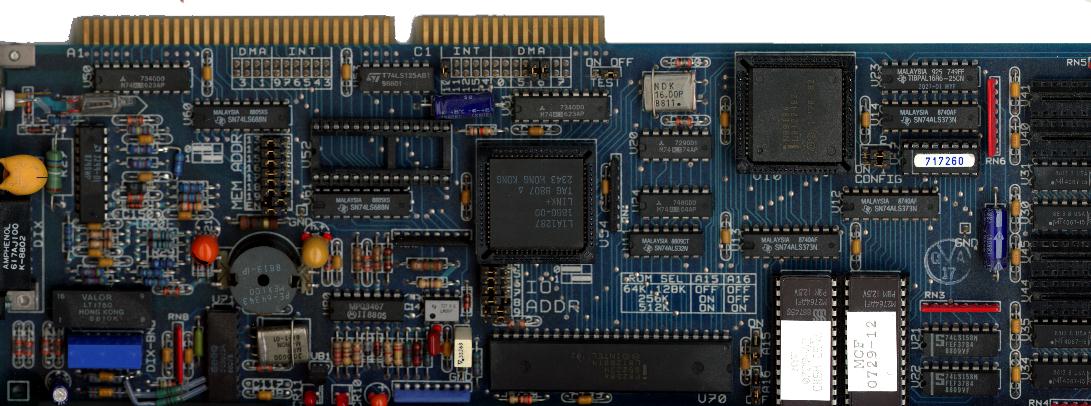
Does anyone have a working Apollo 3C505 ISA ethernet board handy to look at?
The MAME guys are trying to figure out if the boot prom and the firmware eproms are populated.
There is conflicting information on the net. https://jim.rees.org/apollo-archive/photo-gallery/ether-505.jpg
shows no boot prom, but I dumped a boot prom from a board a while ago with 68000 code in it, but didn't dump
any firmware eproms, which would have been an odd thing to forget to do.
Noel Chiappa wrote:
> > It has been in use at STACKEN at least since the beginning of the 80ies
>
> I was meaning before that; somewhere in Scandanavia, I expect? Eh, not that
> important, I guess.
>From Finland. Sold used by DEC Sweden to Stacken, for 1 SEK (aound 20 cents
at that time).
> Noel
--Johnny
/\_/\
( *.* )
> ^ <
> From: Mattis Lind
>> Ah. I wonder where it came from originally?
> It has been in use at STACKEN at least since the beginning of the 80ies
I was meaning before that; somewhere in Scandanavia, I expect? Eh, not that
important, I guess.
>> And it's odd (to me, at least) to see TU56's on a KA10.
> It is TU55s as far as I can see.
Ah, I was confused by an aspect of the pictures on that page which I hadn't
noticed before! The fourth picture in that set:
https://mobile.twitter.com/LivingComputers/status/1102063746019549184/photo…
which is where I saw the TU56's (along with at least one TU55), shows a
different machine! I just assumed all four were of the KA, but the last shows
them in front of a KI.
Although one has to look carefully to notice that, though, as the size,
colours, etc are very similar; it thus looks _very_ similar to the KA in the
first ones.
I'd still love to find out if there are any other KA's left - does anyone
know of any?
Noel
In the Jan 78 issue of Byte magazine a series of articles titled "The Brains of Men and Machines" (also the issue title on the cover) started. EVERY single scan I can find on the web is missing pages 96 and 97, right in the middle of that article. They all (including archive.org) appear to be the same scan. Does anyone have an electronic copy of those pages or a paper copy they would be willing to scan for me?
Thanks,
Will
"He may look dumb but that's just a disguise."? -- Charlie Daniels
"The names of global variables should start with? ? // "? --?https://isocpp.org
torsdag 28 mars 2019 skrev Noel Chiappa <jnc at mercury.lcs.mit.edu>:
> > From: Mattis Lind
>
> > It is KATIA. Peter Lothbergs collection.
>
> Ah. I wonder where it came from originally?
It has been in use at STACKEN at least since the beginning of the 80ies
until maybe mid nineties. STACKEN is the computer club at KTH in Stockholm.
https://techworld.idg.se/2.2524/1.454545/the-stacken-story
I think that some pictures are from the big computer hall I visited when
studying at KTH. But it might be Collosal Cave Computing Center.
> That looks like a relatively 'new' one; the older KA10's had black panels.
> And it's odd (to me, at least) to see TU56's on a KA10.
It is TU55s as far as I can see.
>
> I wonder how many KA10's are left in the world? I have this vague memory
> that
> MIT-AI might have gone to Sweden, but I also have a memory that that was
> the
> plan, but some how it didn't happen?
/Mattis
>
> Noel
>
> From: Mattis Lind
> It is KATIA. Peter Lothbergs collection.
Ah. I wonder where it came from originally?
That looks like a relatively 'new' one; the older KA10's had black panels.
And it's odd (to me, at least) to see TU56's on a KA10.
I wonder how many KA10's are left in the world? I have this vague memory that
MIT-AI might have gone to Sweden, but I also have a memory that that was the
plan, but some how it didn't happen?
Noel
> From: Rick Bensene
> upstairs to the computer room and take some photos of the KA-10
Wow! That's a rara avis indeed; I wasn't sure there were any left. Does
anyone know where this one came from?
Noel
Folks,
I have been able to get the Sun 3/110 to boot using the SCSI2SD board as I
had
asked about earlier (if you want to see the details of what I did, I posted
to the
sun-rescue list...)
However, I can't seem to get more that 4mb to work in the 3/110 chassis (
the 2nd chassis I have is 240v, and so far that doesn't look like it's
switchable
for use in 115v land...)
I've tried the two 4mb boards I have ( both 501-1132 boards ) one has a
gouge in the ground plane but the bulk of the ground plane is intact and
one says Parity Error 3/17/16 ( not my writing, from the person I got it
from
) so I'm assuming that would work but generate an error, similar to
Clearpoint board I have that I can't figure out jumpers for. However I
can't get the machine to even boot with the boards in. In both cases the
lights on the CPU board all light up. Which indicates some form of reset.
I've checked the boards dip switches. They are set according to the FEH as
3 on U3118 and 4 on U3119. Jumper J3102 is jumped as well. I've tried them
with the VME Bus Px03 and Px04 both jumpered and unjumpered. Same results
in
all cases. I don't think it's a power issue, as the machine boots with 3
cards ( I.e. 8mb incompatible sun board or Clearpoint SNXRAM card, with SCSI
card in both cases ). I've tried with and without SCSI card. All same
results.
Soooo, question is, do I just have two bad 4mb cards? Am I missing some
setting? I don't see anything to set on CPU board.
If so anybody got memory cards they're willing to trade that would work in
a 3/110? I've got an 8mb 501-1102 or a 32mb 501-1254 32 mb card to trade,
memory wise. I am trying to build up 2 3/110 machines, so would like 2 4mb
boards at least. I've also got a 3/110 cpu board that has a blown cap to
replace but otherwise works, and a couple SMD drive controller boards. I
also
just realized I have a a Sun 2 VME SCSI board - ( 501-1149 * combo: 501-1045
"Sun-2" SCSI in 270-1059 6U/9U VME )
And of course if anybody has a spare 3/1xx power supply that is configured
for
115v also be interested in that. ( and another SCSI card with an external
connection would be useful )
Earl
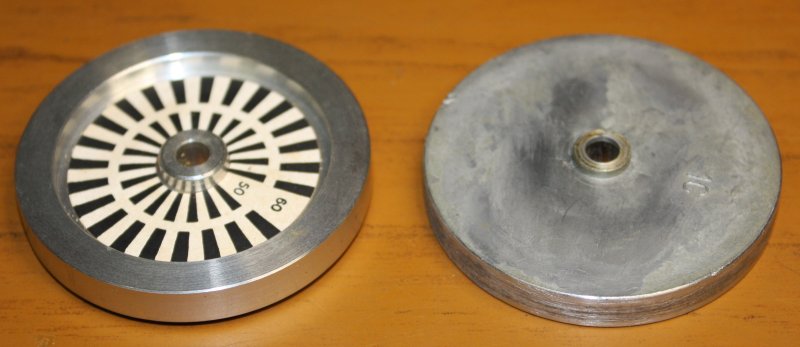
Ok. Those are quite small. So you have one? Or those are not yours?
If you have one, and a way to accurately measure it, making more will be easy for anyone with a lathe.
I could do it, but surely you can find a machinist closer to home?
Guy
At 01:03 PM 10/11/2018 +0000, Riesen Thomas wrote:
>Guy,
>I am looking for small motor pulley ... see pic ...
>Regards
>Thomas
>
>-----Urspr?ngliche Nachricht-----
>Von: Guy Dunphy [mailto:guykd at optusnet.com.au]
>Gesendet: Samstag, 10. November 2018 13:25
>An: Riesen Thomas <thomas.riesen at predata.ch>; General Discussion: On-Topic and Off-Topic Posts <cctalk at classiccmp.org>
>Betreff: Re: 50Hz Pulley for 8" Floppy Drive Mitshubishi M2894-63B
>
>At 12:03 PM 10/11/2018 +0000, you wrote:
>>Hi all
>>
>>Any suggestions where to find two 50Hz-Pulleys for the 8" Floppy drive
>>Mitsubishi M2894-63B?
>>
>>If there also the appropriate ribbon gummies available, I would be very
>>happy.
>>
>>Regards
>>Thomas
>
>
>Do you know what they look like, and the dimensions?
>Because I have these. http://everist.org/pics/misc/IMG_1655_pulley_800.jpg
>
>_Maybe_ they were off Mitsubishi drives, not sure. Had them in a box of floppy drive related bits for a loooong time, and have no recollection of where they came from.
>These are 49.0 mm OD, hole 4.7 mm dia. And this is Australia, with 50Hz mains.
>
>Guy
>
>
>Attachment Converted: "f:\email\attach\Pully_8Zoll_02.jpg"
>
>Attachment Converted: "f:\email\attach\Pully_8Zoll_01.jpg"
>
I ran into an interesting problem. Eric Smith's copytape program assumes two tape marks in
a row is logical end of tape and stops reading.
I've had problems with this before with MPE store tapes, because
they put two file marks at the start of tape so I just keep reading until
I get 10 errors in a row. That also lets me read anything after a logical EOT on 1/2" tape.
Well.. CV is even weirder. One some CV software distribution carts EVERY file has two file marks between them.
I don't expect anyone to have to archive any of these, but I wanted to get this written
down somewhere.
Anyone know what 6502 macro assembler was used for the AIM-65 Monitor
ROM, as shown in the AIM-65 Monitor Program Listing manual, document
number 29650N36L ?
Some of it's identifying features are using .BYT and .WOR (or .WORD)
directives for declaring data, and .MACRO and .ENDM directives for
declaring macros. Use of the macro directives can be seen in the
RM65-5101 Floppy Disk Controller (FDC) Module User's Manual, document
number 29801N02
There are countless 6502 assemblers available now, the exercise here
is to identify the macro assembler that was used at the time. If it is
available to run now the goal would be to run it to assemble source
code exactly in the format that it used and produce identical listing
output. (Modifying the source code to be accepted by a different
assembler to produce identical binary output is not the goal of the
exercise).