Hi, all,
I recently was given a Rockwell AIM-65 single-board computer in nice physical condition, with the original keyboard and keyboard connector cable.
I've downloaded all of the documentation that I can find, and have been trying to get it running.
After doing a thorough visual inspection looking for any sign of detritus, especially anything metallic, as well as making sure all of the ICs were seated in the pretty-lame single-wipe sockets, and checking for any obviously cooked or overheated components.
Everything looked really nice, and quite clean.
All of the required chips were in place, and looked good, including the 6532 RIOT, 6520 PIA for the display, and two 6522 VIAs. All of the LSI's, including the 6502, were Rockwell-made parts, with date codes all within a reasonable time of each other.
I checked across the +5V and GND power supply connection points, and found that it wasn't shorted, another decent sign.
The machine came with all five of the ROM sockets filled with original Rockwell ROMs, including the two-ROM BASIC interpreter, the Assembler ROM, as well as the two Monitor ROMs, all installed in the sockets they should be installed in. The machine had six 2114's (1024x4 static RAM) installed in the lower three banks of user RAM, with two of the sockets unoccupied. I got two known good 2114's from my stock of parts and installed them in the two empty sockets, so that the machine would be in the 4K of User RAM configuration.
I understand that the machine can be powered up with only the +5V supply, but the thermal printer will show as "down", as it requires the +24V supply. The +12/-12 supplies are also not required.
I made sure that the RESET switch worked properly, and tested the KB/TTY and RUN/STEP switches operated properly. I set the KB/TTY switch to KB, and the RUN/STEP switch to RUN.
I found a power supply that provides +5V at 5A, and tested it out on a dummy load to make sure it was healthy and had clean output, and it was fine. I connected it up to the +5 and +5 Return (GND) terminals on the power supply input barrier strip, and held my breath, and switched on the power strip that the power supply was plugged into.
The result. Absolutely nothing.
No sign of any activity on the display.
I didn't expect anything from the printer, because it didn't have its +24V power.
I left it powered for a little bit, checking for any chips that seemed unusually hot or anything else that seemed amiss, and nothing was obviously upset. The CPU chip warmed up slightly to the touch, but wasn't at all alarming in terms of its temperature. I pressed the RESET switch a number of times, and it made no difference. Oh well.
I powered it off, and pulled the ROM chips out, and decided I'd pop 'em in my ROM programmer and compare them to the ROM images I'd downloaded off the net.
The two monitor ROMs verified exactly. The Assembler ROM also verified correctly. One of the BASIC ROMs also verified properly, but the other failed the verification. Hmm...upon READing it into the programmer's RAM, I dumped it out, and low and behold, it read back as all 0xFF's. Oops.. I double checked that the ROM was properly seated in the programmer's ZIF socket, and it was. I tried READing it a number of times, and the result was always the same. This ROM must have expired somewhere along the way. I can blast a 2732 with the proper bits and build an adapter to make BASIC work once I get the thing running, and hope that maybe sometime I might find a good blank OTP 2532 ROM I can blast with the code, or find one already programmed somewhere.
That said, the BASIC ROMs aren't required to get the AIM-65 to "boot up" in the Monitor, nor is the assembler ROM. I decided to set the BASIC and Assembler ROMs aside, and just re-installed the known-good monitor ROMs in the proper sockets.
I double-checked that all of the RAM chips were properly inserted in their sockets by pulling and re-inserting them, as well as the 6502, 6532, and 6522's. The 6520 on the display board is soldered in, so no socket issues there.
I powered it up again, and verified that +5V was present on all of the chips on the board, and that was fine, with every chip showing +5 give or take +/- .02 Volts. All of the GND pins were at 0V, with only tiny (sub-millivolt) noise on GND.
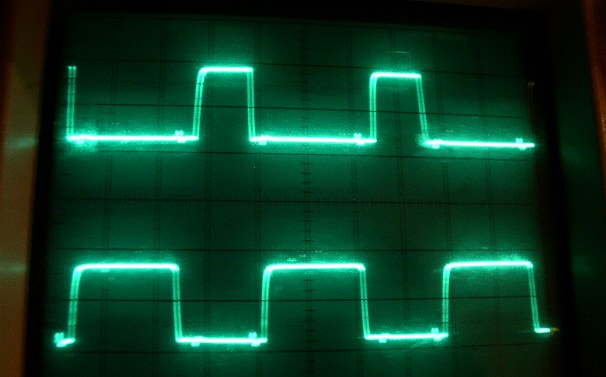
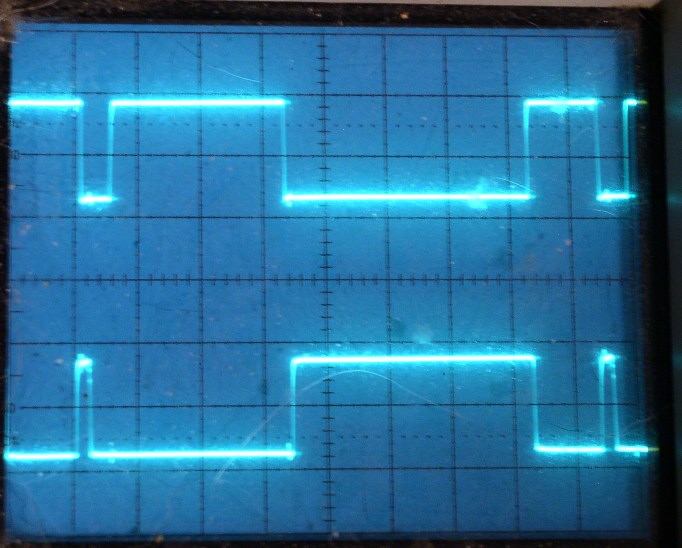
I put a big dip-clip on the 6502, and got out my trusty Tektronix 2465 scope, and figured I check some of the basic stuff, like making sure that the clock generator was running, and that the 6502 properly would generate the Phase 1 and Phase 2 clocks that the rest of the system uses, as well as looking at the address bus and data bus to see if it was doing anything. The clock generator uses a 7474 dual flip flop, which I know have a tendency to go bad, so checking the clock was the logical first step.
I powered it up again after hooking everything up, and probing around showed that the clock generator was indeed running, and had the proper voltage levels, timing, and duty cycle. The thought that maybe it'd be a simple fix, with a bad 7474, went out the window. The 6502 was pumping out the proper Phase 1 and Phase 2 clock signals, and both were very clean and within specifications.
I looked at the address 0 line, and pressed the RESET button, and it'd wiggle for a short period of time, then go high. Hmm... I looked at the other address lines, and while not all of them wiggled, they all ended up at logic 1 after a short period of time, as if the CPU was stuck at address 0xFFFF. I did the same thing watching the data lines, and the symptoms were similar.
They'd wiggle around a bit, then settle at logic 1 and stay there.
I then watched the chip select signals for the ROMs to see if they were being addressed, and indeed, the low ROM was getting selected for a short period of time, then it'd get de-selected and stay that way. The other monitor ROM also got a short burst of select. So...it appears that the ROMs are being addressed, at least for a short time, and the processor is likely executing the code for a short time, but something causes it to lock up.
I checked to see if any of the RAMs were being selected, and at no time during the short period of activity after a RESET did any of the chip selects on the 2114 RAMs go active.
I then checked the PIA (6520) on the display board to see if it was being selected at all. Nope.
Then I looked at the RIOT chip to see if it was being selected, and indeed, it is being selected during the short period of activity, but then, it goes deselected and quiet once the CPU settles in at 0xFFFF on the address lines.
It appears that the address decoding circuitry is at least mostly functional, as the ROMs, PIA, and RIOT are being addressed. It's not exactly 100% sure that the address decoding stuff is working as it should, though.
I thought that perhaps there might be something up with the 6502.
I have a Commodore VIC-20 that works fine, and it has an original MOS 6502 in a socket, so I opened up the VIC-20, pulled the 6502 from its socket, and popped it in place of the Rockwell 6502 in the AIM-65.
The behavior was identical. So, I'm pretty sure that the Rockwell 6502 is good. I should have popped the Rockwell 6502 in the VIC-20 and tested it that way, but didn't want to fuss with hooking the VIC 20 up to an old TV.
I pulled all of the 2114 RAMs out, and popped them into an old calculator that I have that uses 2114 RAMs, and tested them out this way. The calculator ran just fine with the chips from the AIM-65 in place. I'd figure a bad RAM would likely cause the calculator to malfunction in some way. Not a thorough test, but enough of a test to validate that none of the RAMS were dragging the address or data busses down, and that they did properly do reads and writes.
So, with all that said (sorry, I am verbose), I'm kind of at a loss as to what to do next to try to figure out what is wrong with the machine. Does anyone out there have any suggestions? I have a couple of spare 6522 VIA chips, but these shouldn't really be accessed unless the printer is trying to be accessed (which it might be during initialization at least), and the other VIA is for external interface use...and is probably initialized by the ROM, but neither of them should really be actively accessed other than a short burst of initialization. I could swap in my spare 6522's to see if it makes any difference, but I doubt it would make any.
The unknown is the 6532 RIOT chip. I pulled up some data on the chip, and it appears to be a combination of a PIA (like 6520), 128 bytes of RAM (hmm...), and a programmable interval timer. I don't have any spares for this chip, so I can't just substitute in another chip and see if it makes a difference. The RIOT chip is used to scan the keyboard, and, after looking at the assembly source listing of the ROM Monitor, it appears the 128 bytes of RAM in the RIOT chip are used as the storage for the monitor. It appears that RIOT chips can be purchased, I found a place online in the US that has them for $9.95 each. Maybe I'll order one up.
Maybe the RAM in the RIOT chip is not working properly? If that were the case, since it appears that the stack is stored in that RAM, the first time a subroutine was called and a return executed, it'd cause possibly 0xFFFF to be read as the return address, and that's where things go awry.
I guess maybe I need to dig out my logic analyzer, and monitor the address and data busses, and trace out what is actually happening. But, I figured I query the list here to see if anyone might have some other things that I could do that might be easier to identify what's wrong with the thing.
One thing that I have no idea about is the display subsection. Since the display PIA is never selected, I suspect that any code that initializes it and tries to put something up on the display never gets a chance to execute. The "smart" starburst LED display modules are all properly in their sockets, and +5 is delivered to the proper pin on each module, and there's no sign of unusual heating or anything else that might indicate a problem with the display modules. The PIA also has a clean +5 and GND, and doesn't show any sign of overheating.
I have a small Motorola 6809 microprocessor development system with a couple of 6820 PIA's that I could probably write a quick routine to try to initialize the 6820 on the AIM-65 display board, and try to write a message out to the display to test it, but that seems like a lot of work. I'd rather just fix what's up with the AIM-65, and get it running.
Any thoughts from those out there as to what to do next would certainly be appreciated. I always value the collective knowledge of the members of this list.
Thanks,
-Rick
--
Rick Bensene
The Old Calculator Museum
http://oldcalculatormuseum.com
Is there a way to set the reply-to value in VMS 5 mail? I want to send
mail as SYSTEM but anyone who receives the message on the outside world who
wants to reply I'd like it go to to a different email address.
I am working to solve the problem myself, but if anyone knows already and
can help save me the time :-)
Thanks
Bill
How do you run TCBASX.DG (TC01 Basic Exerciser) and TCRANX.DG (TC01 Random
Exerciser)?
When I run TCBASX.DG it almost immediately halts. Pressing makes the TC08
controller lights grind but no tape motion. TCRANX.DG is basically the
same.
Is there any documentation for these two programs?
Thanks,
Marc Howard
There's a weird Sord M23P (I think) from the early 80's at this elderly persons house in Walnut Creek, CA - East of the bay.
She can't pack and ship it - it's too big and heavy. It was actually sent to her by mistake, it was supposed to be sent to my house, 500 miles away.
It's nothing rare or valuable - you can actually have it if you go and pick it up - I really just want it out of her house.
Let me know!
Steve
I've got a few old reels of milk-chocolate brown 7-track tape here and
was wondering if it's possible to date them accurately. The reels
themselves have the Audio Devices name molded into them; the rear white
flange is quite yellowed with age. The tapes have been used quite
heavily as they've been shortened to much less than 2400'.
I know that AD and EMI had a merger agreement with Capitol on their
vinyl business around 1967 and that the result was spun off as EMI.
That leaves the tape business. It seems that CDC acquired some or all
of AD in 1969, but I can find no details.
Does anyone remember these folks? They used to be *the* major tape
supplier in the USA.
--Chuck
Not that I expect anyone to have a need for it, but just for the heck of it :
here are a few datasheets for single cores ( From a Philips Databook 1973 )
ftp://ftp.dreesen.ch/Cores/CoreMemory_core_datasheet.pdf
Enjoy..
Jos
Besides link cleanups and custodial changes, there is now a model-specific
page for the Eagle 450, one of the earliest ColdFire systems extant, plus
performance statistics for many of the machines and several more newly uploaded
freeware games. Hosted on an Alpha Micro Eagle 300.
http://ampm.floodgap.com/
--
------------------------------------ personal: http://www.cameronkaiser.com/ --
Cameron Kaiser * Floodgap Systems * www.floodgap.com * ckaiser at floodgap.com
-- It's not an optical illusion. It just looks like one. -- Phil White --------
> From: Josh Dersch
> how is the backplane in the H11 currently configured? (i.e. what boards
> are in what slots?) Could the issue here be something as simple as a
> break in the qbus due to a misplaced board?
He did mention that he had the console card in the slot next to the CPU, which
I think is what you're referring to - but it shouldn't matter for ODT, which
doesn't use interrupts, only programmed I/O.
A QBUS system will work fine without continuity of grant (interrupt, DMA)
lines to boards which only respond to DATI/DATO (memory, non-interrupt I/O,
etc). Just for grins, I took my -11/03, and plugged the console card in a
bunch of slots down, leaving several empty slots between it and the CPU, and
it worked 'fine': ODT was fine, and it would run "BR ." programs fine, too.
So unless there's actually a break in one of the 'broadcast' bus lines (e.g.
BDALxx, etc) on that backplane, between the CPU slot, and the slot the console
card is in, or something like that...
I suppose it would be worth while checking BDALn, BSYNC and BDIN _on the
console card_ (I'm not sure where he was looking at them, before) just to
rule out the broken bus line possibility.
One thing that's bugging me, though; he said "BDAL3-13 .. are all active and
jump around in some manner". But for the ODT microcode loop trying to read the
console CSR, i.e. 0177560, BDAL7 (0200) and BDAL3 (010) should be 0, i.e.
un-asserted.
So why are they jumping around too? Is this somehow related to the odd behaviour
I was seeing on my machine with no console card, where the BDAL line was behaving
in a way I couldn't understand?
I'm going to look into that more, to try and understand what I'm seeing there,
but it won't be today, which is 'crane day'!
Noel
Apologies for cross-posting. I've added a few new bits and pieces to the
Dick Smith System 80 site. If anyone is interested, take a look at the
first three entries under this link.
https://www.classic-computers.org.nz/system-80/whats_new.htm
Incidentally, this month is somewhat of a milestone. It's 20 years since
the site went live!
Terry Stewart (Tez)
The M7264 CPU thread reminded me of the collection of LSI-11 CPU's that
I have and want to get up and running.? A very useful thread.
This may have been covered some time in the past, but, my question is
"What is the minimum load for the power supply in the BA11-M, -N and
BA23 boxes?"
Is it possible to create a load board, like the board you find in the
sbox BA213 VAX's that ensure a minimum load on the power supply?
Doug
Hi
???? Well we are moving forward.
The 160336 alternate RQDX3 address and vector have been confirmed as OK
by one of our Techno Mages.
So rather than an RX50 I'll give an RX33 whirl. A floppy disk way in
means I can enhance the baseline RT system.
Time to dig out all of the Q-bus controllers and see what else we can add.
I have a Viking SCSI controller. That might be interesting as an
alternative to the CQD.
I think I may have Q bus controllers for my RX01 and RX02. AKA as 'Clonk
City'
11/93 is no end of fun. Best thing since my brother fell in the slurry
pit 60 years ago.
Rod
--
If anybody is interested in building? Jorge Hoppe's Uniprobe, I have some PCB's available. I made a few extra to keep the price down. Price is $40 ea shipped in the CONUS. These have Silver fingers rather than Gold but should still hold up well. Build information is on Retrocomp.
Brian.
> From: Holm Tiffe
>> The "--list" command to 'dd' gives a whole bunch of stuff:
> aha:
> $ dd --list
> dd: unknown operand --list
I was talking about the program I had mentioned in the previous email, "dd
for Windows". The "--list" command to it produced that long list of devices
(the list you edited out of the reply), so it definitely works there.
> Nobody in a PDP11 is interested what Windows thinks about partitions.
Understood, but in my previous email I had given an example using a uSloth
partition:
>> dd-removable if=UnixRoot of=\\?\Device\Harddisk2\Partition0 count=4872 seek=131072
so when your reply mentioned "partitions" ("You have to have an already
existing parition structure on the disk") it was natural to assume you meant
those - especially since there was a plausible reading of your comment
involving them (i.e. 'does "dd for Windows" only work on a disk with an
existing uSloth partition structure on it').
> Most of the PDP11 SCSI Controllers could build two or more PDP11 disks
> out of one physical device. That is what I meant with partition in this
> case .. There is some logical information on the device, you simply
> don't get the entire raw device on the pdp as you possibly think.
That's a good point, and perhaps there's no existing way to write a SCSI disk
>from a Windoze box in a way that the PDP11 SCSI controllers can grok. I don't
know enough about how they work to answer that.
> Tapes have no such restrictions
Right, but one has to have a tape drive; the OP may not.
Noel
Hello,
I'm in the process of cleaning and hopefully restore to operation of a DEC
R80.
The unit has some minor sign of corrosion, however it's VERY dirty, even
inside the hood.
The filters are obviously to be removed and replaced, as they are
disintegrating.
Also foam parts between the boards must be replaced.
Aside from obvious parts, there's something that should be replaced /
cleaned inside the HDA (foams, filters or rubbers), which could damage the
disk permanently in case it's turned on after decades if not "cured" before?
Anybody has some good pictures of the HDA inside, after cover removal?
Thanks
Andrea
(Credit the Quotas thread for prompting this.)
Did anyone ever use process accounting? Did they actually bill
departments (funny money)?
I was always intrigued by process accounting, but never had a use for it
myself.
I guess I can thank process accounting for causing the discrepancy that
Cliff Stole tracked down that became The Cuckoo's Egg. :-)
--
Grant. . . .
unix || die
Hi
??? Well I now have a bootable SCSI drive on my 11/93. Its not RSTS/E
(yet) but it is RT 11 and reliable.
Its a bit baseline but it runs.
So next up was to see if we could get the RQDX3 to co-exist with the
SCSI controller.
I switched the base address to 160336 and it does not stop the SCSI
drive booting as DU0.
Had the RQDX3 been on the normal base address I think you would get the
HD as DU0 and the two halves of an RX50 as the next two drives.
But what happens to the RX50's when you move the RQDX3 to 160336 ?
Rod
--
Hi,
I fired up the 8/A tonight and the TU56's are failing diags. I want to
format a tape for scratch use but I can't find the MAINDEC that does this
(along with flipping up the backplane switch.
Can someone refresh me on the proceedure?
Thanks,
Marc Howard
>
> Date: Tue, 28 May 2019 21:21:43 -0700
> From: Marc Howard <cramcram at gmail.com>
> Subject: How to format Dectape (TC08 + TU56)
>
> Hi,
>
> I fired up the 8/A tonight and the TU56's are failing diags. I want to
> format a tape for scratch use but I can't find the MAINDEC that does this
> (along with flipping up the backplane switch.
>
> Can someone refresh me on the proceedure?
>
> Thanks,
>
> Marc Howard
MAINDEC-08-EUFB should work on both TC01 and TC08 controllers.
--
Michael Thompson
I have an old daisy wheel printer by Hewlett-Packard, their 2601A. We got
this from an estate cleanout and I would like to sell it. It has been
powered up and the power light comes on and the carriage moves to the
starting position. It is a large, very heavy machine. I have it on ebay for
$150 (https://www.ebay.com/itm/223533138720) but that was just a shot in
the dark. There is a better description and more pictures in the listing.
Any reasonable offer considered. I have no way to ship this item from here
but will drop it off at the ups store. The buyer will have to make their own
arrangements for packing and shipping with ups.
Mark
mark at meba.com
Andrea (Brent & Glen)
Nice work spotting the factory ..
Needless to say, it might not even be possible to do anything, but hopefully someone takes an interest!
Hi
???? Due to the help from Glen Slick. (The only guy to answer the
question as asked.)
???? What to do is interesting. How to do it will get you there.
I now have a SCSI drive on the 11/93 that thinks its an RD54 and is
trying to boot RSTS/E.
It fails gracefully during the boot? giving an error message.
So we have a working Hard Drive and Controller on the target system.
No to find out what it does not like.
The transfer rig is now working OK.
So I can try out more drives if needed
Rod
--
> From: Holm Tiffe
> You have to have an already existing parition structure on the disk and
> an OS that knows what todo with that.
The "--list" command to 'dd' gives a whole bunch of stuff:
Win32 Available Volume Information
\\.\Volume{cd4ae459-0daa-11e2-9625-806d6172696f}\
link to \\?\Device\HarddiskVolume1
fixed media
Mounted on \\.\d:
\\.\Volume{f3c65dd6-01af-11e1-a511-806d6172696f}\
link to \\?\Device\HarddiskVolume2
fixed media
Mounted on \\.\c:
\\.\Volume{f3c65dd7-01af-11e1-a511-806d6172696f}\
link to \\?\Device\CdRom0
CD-ROM
Mounted on \\.\m:
\\.\Volume{a531c21e-b869-11d9-9977-806d6172696f}\
link to \\?\Device\Floppy0
removeable media
Mounted on \\.\a:
\\.\Volume{89bdc974-217e-11e8-96f6-00038a000015}\
link to \\?\Device\Harddisk2\DP(1)0-0+7
removeable media
Mounted on \\.\e:
NT Block Device Objects
\\?\Device\CdRom0
size is 2147483647 bytes
\\?\Device\Floppy0
\\?\Device\Harddisk0\Partition0
link to \\?\Device\Harddisk0\DR0
Fixed hard disk media. Block size = 512
size is 20020396032 bytes
\\?\Device\Harddisk0\Partition1
link to \\?\Device\HarddiskVolume2
\\?\Device\Harddisk1\Partition0
link to \\?\Device\Harddisk1\DR1
Fixed hard disk media. Block size = 512
size is 10262568960 bytes
\\?\Device\Harddisk1\Partition1
link to \\?\Device\HarddiskVolume1
\\?\Device\Harddisk2\Partition0
link to \\?\Device\Harddisk2\DR6
Removable media other than floppy. Block size = 512
size is 15833497600 bytes
\\?\Device\Harddisk2\Partition1
link to \\?\Device\Harddisk2\DP(1)0-0+7
Removable media other than floppy. Block size = 512
size is 15829303296 bytes
some of which appear to be entire disks, not partitions.
Since I was trying to write into a specific area of an SD card connected via a
USB adapator, I took the path which seemed to be that of least resistance,
which was to use a partition which covered the blocks I wanted to write.
If I needed to write the boot block (which contains the partition table), I'd
have probably tried using some of the other devices in the list, but since I
didn't need to, I decided not to get diverted from my real goal by trying
other devices.
Maybe it won't work for what he needs to do. But it worked fine for me, doing
something very similar, so I thought I'd mention it.
Noel
Hey all,
I bumped into someone who has some early (mid 1970 on some of the photos
I've seen) PDP-11 bits - front panel and a handful of boards (the
backplane, PSU, rack, peripherals etc. are long gone). The front panel's
branded as "Industrial 11" though, which isn't something I've seen or heard
of before.
Address bus is 16 bits wide, and aside from the branding, the style appears
to be the same as an 11/05 or 11/10. Were there any differences to the
system internally though, or in the standard set of boards fitted, or was
the "industrial" aspect purely a marketing exercise?
cheers
Jules
Hi, sorry about the delayed reply; been dealing with this:
http://ana-3.lcs.mit.edu/~jnc/jpg/backoak/WholeTreeS.jpg
The cranes arrive tomorrow...
> I took a look at all the lines you mentioned. BDAL3-13, BDIN, BSYNC, and
> BBS7 are all active and jump around in some manner.
Hmm. Well, that shoots down the simplest theory; that a CPU BDAL (or perhaps
BDIN) driver (technically, a transceiver) chip is bad; if you're seeing any
activity at all on a line, the driver must be working. So, either both console
cards have an issue, or something more complex is going on.
Here are some pictures to show you what you should be seeing, and what I'm
seeing with an LSI-11 with no console card. First, normal operation:
http://ana-3.lcs.mit.edu/~jnc/tech/pdp11/jpg/BSYN-BDAL_OK.jpg
The top trace is BSYNC, the bottom BDAL10 (which should be asserted for
0177560, the console CSR's address; it's the 02000 bit). The timebase on this
one is 1 usec per division. As you can see, it's in a tight loop reading that
register.
The QBUS spec shows that for a DATI cycle, the DAL lines are set up before
BSYNC is asserted (falling edge here, since the bus lines are inverted).
BDA10 is indeed asserted (low) when that happens; shortly after it goes back
to 0 (high) so that device can put its data out on those lines. It stays high,
so that bit in the CSR must be 0.
OK, now a picture of the bus with no console card:
http://ana-3.lcs.mit.edu/~jnc/tech/pdp11/jpg/BSYN-BDAL_NoCon.jpg
It's a bit hard to interpret what's going on here (note that the timebase is
much larger - 5 usec). The long assertion of BSYNC is undoubtly the CPU trying
to get the console CSR to respond, and eventually timing out. Not sure what
the short assertion following it is - without looking at the ucode for the
ODT, there's no way to know what the CPU's doing.
Even harder to understand is what the BDAL line is doing. It looks like it's
un-asserted (0, i.e. +3V) on the falling (electrically - rising, logically)
edge of BSYN (which would be incorrect - see above). And then it hops around
while BSYNC is asserted, which makes no sense at all to me.
At this point, my best guess at the most likely cause of your problem (given
the 'all the lines are doing stuff') is that both console cards have
issues. Tomorrow, when I'm not outside, I'll try and look at some other BDAL
lines and see if they are doing the same thing with no console card in.
Noel
trying to ID early core stacks from GE 200 series ( like for dartmouth basic machine) or or ERMA. any old times have close up docs or part numbers? I may have found the lost treasure...
we? have a? ?2 each 21 inch? or? ?so? wide? thing? ?with 2? monster ass? stacks? mounted in each one..
one is? intact? and? dirty? but? ? ?intact!
?the other? ?stacks? and? weird other things mounted to metal? frame? work are there? but? ? ?some? stiff is? just? hanging? off it
unit? ?2? might? be? subdivided? and shared .? ? I? have never seen? GE? core? that? was? this? large......
Metal? ?frame? has? log? ?GE? part? number? ? each? stack? has? ?one? ?too
the? game is? afoot!
if? not? solved? rather? ?quickly? they? return to the? warehouse.
thanks? ed sharpe? archivist? for smecc
This just came up on Fess Bouc. I did not know that it existed.
It's an LLVM-backed modern compiler for BLISS.
https://madisongh.github.io/blissc/
--
Liam Proven - Profile: https://about.me/liamproven
Email: lproven at cix.co.uk - Google Mail/Hangouts/Plus: lproven at gmail.com
Twitter/Facebook/Flickr: lproven - Skype/LinkedIn: liamproven
UK: +44 7939-087884 - ?R (+ WhatsApp/Telegram/Signal): +420 702 829 053
I took a look at all the lines you mentioned. BDAL3-13, BDIN, BSYNC, and
BBS7 are all active and jump around in some manner. BRPLY is still the only
line that does not have any activity on it. None of the BDAL lines seem
shorted to ground or to each other. My DLV11-J is configured to essentially
factory settings (J3 set as console, 8 bits no parity) except for the fact
that J3 is at 9.6k baud instead of 300, the address jumpers are exactly the
same as the one you provided.
On Sun, May 26, 2019 at 6:35 PM Noel Chiappa <jnc at mercury.lcs.mit.edu>
wrote:
> Hey, I owe you replies to about a zillion emails; been busy, I'll
> try and get to them tomorrow. A few quick things:
>
>
> > My M8043 (DLV11-J) just arrived today.
>
> Here are the jumpers on mine, which I just pulled from a working system,
> so you can compare and make sure you have them correct:
>
> A5 L
> A9 L
> A12 C
> A10 C
> A11 C
> A8 C
> C2 C
> C1 C
>
> Key: L = jumper from left post to right (component side up, gold pads
> at bottom)
> C = jumper from center post to right
>
> A6 I
> A7 R
>
> I = Insert, R = Remove
>
> B-X-H X-H
>
> I have left out the vectors jumpers, since ODT doesn't use interrupts, and
> the line config jumpers (their setting shouldn't have any effect on the
> ability of the board to respond to ODT).
>
>
> > I have a hard time imagining that both my M8017 and my M8043 are
> > bad, but it could still be possible.
>
> Well, I did mention that the CPU board could have a fault causing it to
> put out a bad address for the console; the other likely cause is that
> both consoles are bad. Not sure which is the most likely.
>
> The blunt hammer debugging technique is to look at the address being put
> out on the bus; you'll need to look at BDAL3-12 and BBS7 (sort of an AND
> of all the high address bits, so devices should work on Q16, Q18 and Q22;
> in fact, the manual says that device should look at BBS7, and hot BDA13
> and up). Best to use a 'scope so you can see what the waveforms look like.
> This is slow and painful, but will allow precise, definitive diagnosis.
>
> If the address is good, look also at BDIN. If that's toggling, it's the
> consoles. Otherwise, CPU issue,which we'll delve into once the data
> points definitively.
>
> Noel
>
Hi
????? Thanks to Glen Slick I now have a old windows xp system running SIMH
???? Its connected to my LAN so web and file access are OK
???? In addition to the normal IDE drive it has an additional SCSI
controller and drive
????? Using SIMH? I have created an image (RD54.dsk) containing a RSTS
system.
???? I am awaiting the final instructions as to how to copy the image
to the SCSI drive in such a way I can connect it to the SCSI controller
in the 11/93 and have it boot.
Rod Smallwood
--
I've been doing more work on my 9000/350 now that I have actual space to
do work on it in. Although the 10b2 is flaky, I can usually coax it to work.
However, the damn thing won't query DNS even though I have a populated
/etc/resolv.conf. It can ping the name server, and if the name server's
name is in /etc/hosts it will resolve it (and even telnet to it), but it
won't talk to it for anything else.
I'm not as adept at HP/UX before 10.20 (my first experience with the OS),
but I understand 8.0 "fails over" to /etc/hosts if it has some issues with
DNS. Fine, but how can I get it to switch *back*? There's no /etc/nsswitch.conf
and I don't think this version supports it anyway.
--
------------------------------------ personal: http://www.cameronkaiser.com/ --
Cameron Kaiser * Floodgap Systems * www.floodgap.com * ckaiser at floodgap.com
-- There is always one more imbecile than you counted on. ---------------------
The Acer PC I was using to write the image to the SCSI drive has gone kaput.
Clearly PSU (not plugtop? mains fuse).
Its a non standard PSU and no schematic available.
Fall back is to get one of the SLU's (other than the console) on the
KDJ11-E going and TU58 it.
Rod
--
Hi
??? Whilst I wait to hear from Glen Slick who has got me this far
(Thanks Glen) I'll restate the problem.
1. I now have an old XP system with SIMH on it (PDP11.exe)
2.? I have created RD54.dsk containing RSTS/E
3. Attached to the system is a 2.1Gb SCSI drive via an adaptec 2940
controller
4. I need a tried and tested list of step by step instructions to put
RD54.dsk on the SCSI drive.
5. The drive will then be moved to a CQD-220A/TM SCSI controller on my
KDJ11-E based 11/93 and must boot.
6. Its just an image copy from one drive to another on the same system.
7. Nobody has come up with a tried and tested list of step by step
instructions yet.
Rod Smallwood
--
> From: Rod Smallwood
> 4. I need a tried and tested list of step by step instructions to
> put RD54.dsk on the SCSI drive.
Well, this isn't a list of directions, but... I've had good luck doing
almost this exact same thing (on a Windows XP box, copy a filesystem in
Windoze file onto a device, in my case an SD card on a USB adapter) with
'dd for Windows', available here:
http://www.chrysocome.net/dd
The command line I've worked out to use is:
dd-removable if=UnixRoot of=\\?\Device\Harddisk2\Partition0 count=4872 seek=131072
I don't recall the exact procedure I used to generate that, but I'm pretty
sure it involved the use of the "--list" command to 'dd', to get a list of
the devices on the system. (The "4872" is the size of the RK pack,
obviously.)
I'm using dd-0.6beta3.zip but there may be a later version that works too.
Noel
Hi all --
Curious if anyone has a spare L0022 memory controller, this allows a
VAX-11/750 to address up to a whopping 14mb of memory (2x4mb, 6x 1mb
boards). I found a couple of the 4mb boards, now I just need to upgrade
the memory controller to be able to use them...
Thanks as always,
Josh
> From: Jon Elson
> Yes, this is most likely a bus timeout
The good news is that it looks like his CPU is 'mostly' working; and if
the NXM is due to a fault on the CPU (e.g. bad bus transceiver sending
the wrong address), that would be fixable (it uses 8641's).
If the fault is in the DLV11-E (and not just misconfiguration), depending on
where the fault is, he might be out of luck with that card; it uses DC005's
for transceivers, which of course are unobtainium now. Still, QBUS serial
interfaces are not rare.
And overall, progress is being made! :-)
Noel
Hi
??? I am working on getting my KDJ11-E based system up.
I have a CQD220A and a SCSI hard drive installed and formatted.
A serial connection to a Raspberry Pi soon brought up the console on the
PDP-11 using TU58FS.
Next will be a second serial line to allow TU58 emulation. SFSG
What is not clear is if I can get a bootable OS (RT, RSX or whatever)?
image onto the Hard Drive using TU58FS.
Any advice as to if and how this could be done would be greatly
appreciated .
Rod Smallwood
--