I have paper copies of a few manuals I have no use for. Most of these
are single-sided photocopies made by others and sent to me for scanning
years ago. These are not originals. Almost all of them appear to be
available on bitsavers, but if you have a penchant for paper, this might
be your chance. Available by post (for whatever it costs to send them
plus the paypal fee) or by arrangement in Reading, UK.
MicroVAX Troubleshooting and Diagnostics. EK-O19AE-SG-005
MicroVAX Dual-Host Systems. EK-338AC-DH-003
VAX-11/780 Unibus Adaptor Technical Description. EK-DW780-TD.001
VAX-11/730 Diagnostic System User's Guide. EK-DS780-UG.002
VAX-11/780 Installation Manual. EK-SI780-IN-002
Translation Buffer Cache and SBI Control Technical Description.
EK-MM780-TD.001
VAX-11/780 Hardware User's Guide. EK-11780-UG-001
VAX-11/780 Console Interface Board Technical Description. EK-KC780-TD.001
FB780 Floating-Point Accelerator. EK-FP780-TD.001
MS780 Memory System Technical Description. EK-MS780-TD.001
* KA780 Centraler Processor Technical Description. EK-KA780-TD.001
* KA655 CPU System Maintenance. EK-306AA-MG.001
The last two (marked *) do not currently appear to be on bitsavers. They
do appear in my index of local files so I'll make them available to Al
sometime soon.
Send emails off-list please.
Antonio
--
Antonio Carlini
antonio at acarlini.com
Hey all - We have had soft-launched it on our website calendar a few months
ago but I wanted to confirm that yes on October 16 - 18 2020 the first
annual "Kennett Classic" weekend is scheduled and a GO; venue booked and
implementation is under way.
The centerpiece of the weekend will be a contest between teams of vintage
computer hobbyists competing for the Kennett Classic Cup, an award to the
team with the best network of vintage hardware based on up-time and
connectivity. There will be a substantial prize awarded to the winning
team. We're really excited to share the details of this event, but stand
by for now. In addition to the on-site teams, we will open the contest to
any qualifying team worldwide. This is a first-of-its-kind world-wide
vintage computing networking event!
We're working on the registration pages now, and once they're live we'll
share all of the details. Think of the Kennett Classic Cup as a car rally
for vintage computers. We have many other activities planned for that
weekend, stay tuned.
Interested?
We look forward to making this a huge success.
Bill Degnan
Kennett Classic
Kennett Square, PA
https://www.kennettclassic.com
Hello,
Does anyone have the "Extended Industry Standard Architecture Revision 3.10"
specification either in printed/book form that they are willing to separate
>from or in some sort of electronic format ala PDF? I am mostly interested in
the sections on the syntax for EISA CFG files. TIA!
-Ali
Hi - I am looking for an IMSAI PCS 80-30 ROM image made for with the
Tarbell 1011 controller and Persci 277..anyone have this? I received a
system and drive but I think the ROM was replaced and since then I was told
the system would no longer boot.
In the meantime I am going to find a drive and controller that is
compatible.
Or, ug, have to try to edit the ROM I have (version 1.1) to operate with
this hardware. I would not having a copy of ROM 1.0 at least to start from
scratch with.
Thanks
Bill Degnan
One shot in the dark if anyone has the DSP development or interface toolkit for
NI's TMS320C30 Nubus cards. I have a bunch of boards but never found any software
to use with them. This is probably LabView 2 or 3 timeframe.
I see NI, who is normally pretty good with keeping manuals around doesn't even
have them online any more for boards like the DSP2300
Hi,
I have access to some DEC items for a month or two before a house is
sold. Photographs are linked here:
https://imgur.com/a/HqxI4JA
I can locate and forward any items, if still available, for actual
shipping costs and any nominal packaging material costs.
Summary:
Hitachi ESDI drives
RX50 drives (many)
TK50 tapes (many)
DEC Professional magazine 1987-1994
DECUS software abstracts
DECUS software catalogues
Controlling Software Projects (DeMARCO)
Programming in C with Let's C (Vine)
Surefire Programming in C (Stewart)
PDP-11 Systems and Options Catalogs 1983-1989
Various databooks, DECdirect, etc
DECUScope magazines
Copies of RT-11 SIG newsletter(s)
issues of digital Canadian Digest, 1980s
DECUS Canada mailings
digital news & review magazines ("The Independent Newspaper & Test Lab
of Open Computing for DEC Sites")
various PDU units (see pic)
RD52/RD53 drives
various empty chassis/backplanes (see pics)
BA23 shells (2)
various tapes, drives (see pics)
As I said, last call, gone in 1-2 months.
--Toby
I have my Sun-4/110C set up and running SunOS 4.1.4.
Were there any fun SunView applications or hacks back in the day?
Other than the demos, the only stuff I currently have is emacstool (built as part of emacs 18.59) and the PLATO client (which I haven?t actually built yet). I know I can read through the comp.sources.unix archives but I figure maybe some folks might remember things to look for.
-- Chris
Hello folks;
I've recently had some free time and decided to look at some hardware
failures in my small collection.? I fixed a couple of analog boards in
the compact Mac department, and a failed scsi disk in one of them
prompted me to test the small stash of such drives that I have.? Turns
out, about half of those marked as "working" in 2015 have failed now in
many different ways.? Oh well... sucks, but it was to be expected...
I decided to image some of the still working ones, both in the stash and
in working machines.?? The one in the vaxstation 2000 (a 1GB scsi with
5.5-2) turned out to have file system corruption (probably from? AC
power failures), which has taken a while to fix.? And then, I remembered
that said system originally came with an RD53 that has sat elsewhere for
25 years.? It passed a read test in 2005.? So I tried to see if I could
read it and maybe image it now, but no go. The disk spins up, initiates
a seek (the arm is not stuck in a gooey stop pad; I've read that this is
a common failure mechanism for Micropolis 1325's; I opened it and saw
the arm move) but then the arm returns violently (clacking) to the rest
position; it does this a number of times (two to four, usually) and then
it spins down. Applied voltages and currents remain ok as this happens.
I've seen plenty of internet content about solving the stuck arm
problem, but not this.
Advice, please?
Carlos.
Here is a strange question. Does anyone happen to know how long unused Laser Printer and Ink Jet transparencies last? Do they go bad, or break down? I have a stack of them, still in the boxes, a lot are unopened. I scavenged them about 10 years ago, when people were getting rid of them.
I wanted them for a Photography Project, that I?ve never had time to try. At this point, I?d like to know if I?m wasting space storing them.
Zane
Never mind, I just realised there was a little "+" sign well away from the
symbol that allowed me to select it. It looks like the symbol is somehow
much bigger that how I have drawn it. I should be able to work it out now.
Regards
Rob
From: Rob Jarratt <robert.jarratt at ntlworld.com>
Sent: 07 March 2020 17:12
To: General Discussion: On-Topic and Off-Topic Posts (cctalk at classiccmp.org)
<cctalk at classiccmp.org>
Subject: Can't Select a Custom Device in Eagle
I have been using Eagle to reverse engineer a PSU schematic. I decided I
needed to make a custom device in Eagle for the transformer. I have done
this and it seems to be fine, except that when I put the symbol on a
schematic, after I have confirmed its position, I can't select it, so I
can't move it or anything.
I have done some web searches but I can't find anything about this. Anyone
know what the problem might be?
I am using the free version, and I am on version 7.2.0. Looks like later
versions are subscription only and I am reluctant to do that because they
could take away access at any time.
Thanks
Rob
I have been using Eagle to reverse engineer a PSU schematic. I decided I
needed to make a custom device in Eagle for the transformer. I have done
this and it seems to be fine, except that when I put the symbol on a
schematic, after I have confirmed its position, I can't select it, so I
can't move it or anything.
I have done some web searches but I can't find anything about this. Anyone
know what the problem might be?
I am using the free version, and I am on version 7.2.0. Looks like later
versions are subscription only and I am reluctant to do that because they
could take away access at any time.
Thanks
Rob
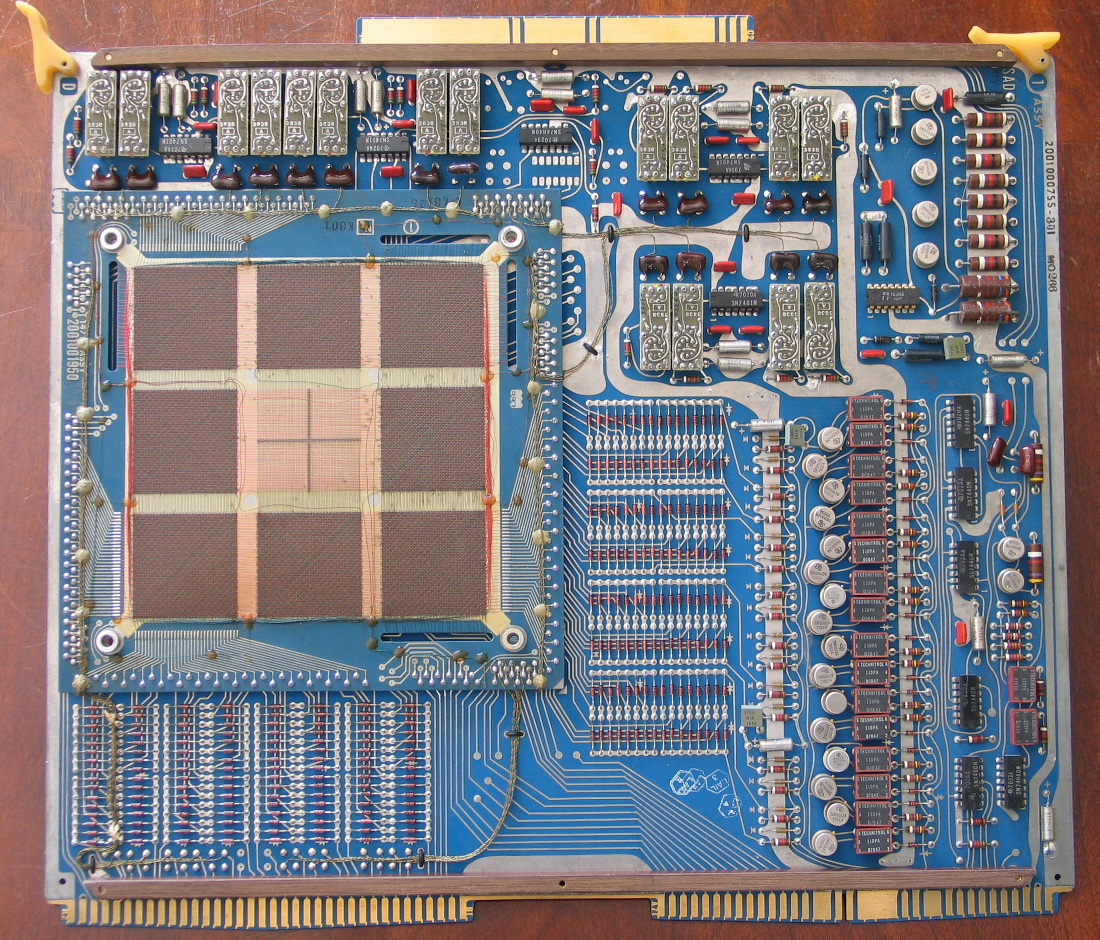
Hopefully collective wisdom can help on this one - does anyone have a clue
what system this core board was from:
http://www.classiccmp.org/acornia/tmp/coresmall.jpg
The curved edge connectors (presumably to make board insertion easier) are
quite distinctive, plus the way the power's fed in via an edge connector on
the "far" side of the board. What's interesting to me is the core ring
size; the TTL ICs on the board have 1970 date codes, but I didn't think
that the rings got quite that small until right at the end of core's era,
more toward the end of the decade.
It seems to be 8 blocks of 64x64, i.e. 4KB. p/n on the main board of
2001000755, and just hidden from view under the core daughterboard is a
logo that says "LEC", which I suppose might be meaningful.
There's a bigger (2181x1863) image as "coreboard.jpg" in the same dir if
more detail helps (I doubt it), but it's 2.4MB so maybe save Jay's
bandwidth by only looking at that one if you absolutely have to :-)
thanks,
Jules
> On Mar 5, 2020, at 05:20, Plamen Mihaylov via cctech <cctech at classiccmp.org> wrote:
>
> ? Does anyone have such machine ? I miss the PSU adapter as well as the Sbus
> framebuffer which connects the LCD panel to the mainboard. Any info is
> appreciated.
I had one, but sold it to someone on this list last year.
I used a generic power supply, one with multiple cord tips and selectable output. However, when I exhibited the BriteLite and had it running all day, the power supply died after a day and a half.
Good luck on finding a frame buffer for it. I don?t remember the details about it, but I took lots of photos of it.
alan
>
> Best regards,
> Plamen
> Date: Thu, 5 Mar 2020 14:23:30 +0200
> From: Plamen Mihaylov <plamenspam at afterpeople.com>
> Subject: RDI BriteLite
>
> Does anyone have such machine ? I miss the PSU adapter as well as the Sbus
> framebuffer which connects the LCD panel to the mainboard. Any info is
> appreciated.
>
> Best regards,
> Plamen
>
I have several BriteLites, including IPC, IPX, and LX versions.
I will see what power supplies go with them.
The Sbus video board is something special for the LCD panel.
--
Michael Thompson
Looking at the datasheet for the 6809 (specifically, the 6809E that
needs incoming quadrature clock), I read that !HALT can be asserted
200nS (for 1MHz part) before falling Q and the CPU will finish the
existing instruction and then go into a HALT state as long as the HALT
line is low during the falling edge of Q.
That's the store from the datasheet, but when I am testing it, I see
that, even if I pull HALT low at the very beginning of the last cycle of
an instruction, the 6809 will not acknowledge the HALT until executing
the next instruction.
My logic is watching for IO address $ff61.? When found, it drops Q
so, to start the HALT condition, I need only:
lda $ff61
Not that the trigger is being performed by the code, so the current
instruction (the lda) should complete and then the CPU should go into
HiZ.? What I see is:
lda $ff61
lda $ff60 <- the next instruction
executed, and THEN the CPU goes into HiZ.
I can deal with this (Yes, I should just look at BS=BA=1, which tell
when to safely use the bus, but I don't have access to those signals for
this project), but I thought I'd see if this was known by all, or if
there is something I am missing.
Jim
--
Jim Brain
brain at jbrain.comwww.jbrain.com
Now that I have my SWTPC 6800 loading and saving programs with paper tape, cassette, and floppy disk (using the Percom LFD-400 controller and their MiniDOS and MPX ?operating systems?), the next logical step is getting FLEX up and running. Unfortunately, I only have the Percom floppy controller and I don?t know if FLEX compatible disk drivers and boot code were ever written for it. Before I go create Percom support for FLEX from scratch, does anyone have any leads?
Mike
On 3/3/20 4:26 PM, Joe George wrote:
>
> Yup! Single sided, single density, 32 hard sectors. And the Wang 2200 had apparently some weird insert orientation, the ?Wang? labels are on the back of the diskettes, opposite side of the manufacturer sticker.
>
> Cheers,
My recollection is that the 8" floppy drives (in a lowboy floor-standing
unit) were vertically mounted and placed to the right of the operator.
The floppy eject button was then closest to the operator and any disk
inserted would be visible from the "rear" of the floppy.
Not nearly as weird as the Altos ACS8000, for example, that mounted the
floppy drives upside-down and horizontally, such that the eject button
was topmost. Those disks do have content labels placed on what we'd
consider the "backside" of the floppy for obvious reasons.
Did any 5.25" floppy-equipped systems do this?
--Chuck
I was watching this video on highway construction in the 1960's (as you do) and noticed what appears to be
a System 360 console, that I couldn't place. Presumably it's some peripheral or CE maintenance panel. I didn't
find it in the Physical Planning Guide (not that that's comprehensive) nor from perusing google images.
I'm a little curious as to what it is.
It's at 23:13 in https://youtu.be/apWSa6QlrTg?t=1393
Thanks
Steve.
>
> On Sun, 1 Mar 2020 at 17:58, Joseph Zatarski via cctalk
> <cctalk at classiccmp.org> wrote:
> >
> > I've started inventorying a lot of the stuff I'd like to pass on here:
> >
> https://docs.google.com/spreadsheets/d/19vhF-o6vx9g7l-D8cvLJ5OPJzpdmU9PTTkn…
>
> I can't see these in the Google sheet, for some reason:
>
> > -Mac network cards (nubus and one for IIsi or SE/30) as well as a couple
> > other accessories (Dayna Mini Etherprint, AAUI transceiver, more
> > accessories to come)
>
> I am interested in an SE/30 NIC and associated bits (transciever,
> AppleTalk bridge).
>
> I am happy to pay international postage. I'm in Prague.
> --
> Liam Proven ? Profile: https://about.me/liamproven
> Email: lproven at cix.co.uk ? gMail/gTalk/gHangouts: lproven at gmail.com
> Twitter/Facebook/LinkedIn/Flickr: lproven ? Skype: liamproven
> UK: +44 7939-087884 ? ?R (+ WhatsApp/Telegram/Signal): +420 702 829 053
Hello Liam,
The NICs I have are Asante brand. They are located in the Apple/Macintosh
category.
https://docs.google.com/spreadsheets/d/19vhF-o6vx9g7l-D8cvLJ5OPJzpdmU9PTTkn…
Unfortunately for you, sale is pending on the SE/30 NIC. If the sale falls
through, you are in line behind one other person. I'm fairly confident that
even if the first buyer falls through, the second in line will not.
If you're still interested in the other accessories, I can have a look when
I get home, get a few pictures put up for you, and we can continue from
there. International shipping should not be an issue, filling out a customs
form is not very hard.
Best Regards,
Joe Zatarski
*TOPS-20*
The set of config files you need to edit in TOPS-20 is found here, about
halfway down the page:
http://www.ldx.ca/notes/tops-20-notes.html
I'll paste it here:
Configuring the system
The *Panda Distribution* README has this to say about initial configuration:
You?ll need to edit the following files. EMACS is installed on this system,
along with TECO and EDIT. [More on these editors later.]
SYSTEM:7-1-CONFIG.CMD to set your timezone
SYSTEM:HOSTS.TXT to define your local host name and network
SYSTEM:INTERNET.ADDRESS to define (again!) your IP address ? must be the
same as in klt20.ini. Also define your netmask here as LOGICAL-HOST-MASK
SYSTEM:INTERNET.GATEWAYS to define your IP gateway
SYSTEM:INTERNET.NAMESERVERS Don?t bother with SYSTEM:INTERNET.NAMESERVERS.
That is the configuration file for DEC?s resolver; although it?s simpler it
has some interoperability problems with MMAILR which haven?t been resolved
yet.
SYSTEM:MONNAM.TXT to define your system name
DOMAIN:RESOLV.CONFIG to define your DNS servers, your default domain
(replacing MYDOMAIN.COM) and any users in addition to OPERATOR who can send
control messages to the resolver.
To actually edit any of those, you'll probably need to ENABLE first, eg:
@ena
$
The dollar-sign ($) prompt indicates that your privileges are enabled.
*Linux Host*
On the host side, I like to convert my ethernet to a bridge so I can add
virtual interfaces easily. Here's the script I use (requires sudo, and
that the user running it be in group adm, and that the tuntap devices be
owned by and writeable by group adm):
#!/bin/sh
eth0text=$(/sbin/ifconfig eth0 | grep "inet ")
HOSTIP=$(echo "${eth0text}" | awk '{print $2}')
HOSTNETMASK=$(echo "${eth0text}" | awk '{print $4}')
HOSTBCASTADDR=$(echo "${eth0text}" | awk '{print $6}')
HOSTDEFAULTGATEWAY=$(/sbin/route -n | grep ^0.0.0.0 | awk '{ print $2 }')
# Change as we add more guest OSes with network stacks
_maxtap=2
#
for i in $(seq 0 ${_maxtap}); do
/usr/bin/tunctl -t tap${i} -u adam -g adm
/sbin/ifconfig tap${i} up
done
#
# Now convert eth0 to a bridge and bridge it with the TAP interfaces
/sbin/brctl addbr bridge0
sleep 1
/sbin/brctl addif bridge0 eth0
sleep 1
/sbin/brctl setfd bridge0 0
/sbin/ifconfig eth0 0.0.0.0
/sbin/ifconfig bridge0 $HOSTIP netmask $HOSTNETMASK broadcast
$HOSTBCASTADDR up
# set the default route to the bridge0 interface
/sbin/route add -net 0.0.0.0/0 gw $HOSTDEFAULTGATEWAY
#
# bridge in the tap devices
for i in $(seq 0 ${_maxtap}); do
/sbin/brctl addif bridge0 tap${i}
/sbin/ifconfig tap${i} 0.0.0.0
done
For some reason this seems to work even though that should be group
netdev. I guess because "adam," who is running the emulator, owns the
tun/tap devices.
I have this in /etc/udev/rules.d/99_net_tun.rules:
KERNEL=="tun", GROUP="netdev", MODE="0660", OPTIONS+="static_node=net/tun"
I don't think that's standard; I think I added that at some point.
And then in klt20.ini, I have a statement that looks like:
devdef ni0 564 ni20 ifc=bridge0 ipaddr=192.168.248.249 dedic=false
And then finally the dnpni20 executable is setuid root.
All of this together gives me a TCP/IP stack on klh10 that allows the
emulator to run as me, not as root, and bridges the TOPS-20 host into my
real network.
Adam
I'm having loads of trouble getting networking going with the Panda
Distribution of TOPS20 and KLH10. Could someone point me to a
step-by-step guide on doing this?
--
David Griffith
dave at 661.org
A: Because it fouls the order in which people normally read text.
Q: Why is top-posting such a bad thing?
A: Top-posting.
Q: What is the most annoying thing in e-mail?
>>
>> Hi.
>>
>> I forgot to mention it?s an eye phone
>> 11 PRO 256gb.
>
> I may be missing something -- *what's* an "eye phone"? I thought you
> were listing vintage kit, not smartphones?
>
> --
> Liam Proven ? Profile: https://about.me/liamproven
> Email: lproven at cix.co.uk ? gMail/gTalk/gHangouts: lproven at gmail.com
> Twitter/Facebook/LinkedIn/Flickr: lproven ? Skype: liamproven
> UK: +44 7939-087884 ? ?R (+ WhatsApp/Telegram/Signal): +420 702 829 053
I believe Kevin replied to the wrong e-mail by mistake. He must be
selling something himself and had a similar subject line.
That said, no hits on my post yet? what, nobody needs nubus ethernet
cards? or various ISA/PCI/PCI-X expansion cards? a dozen computer mice?
DEC Alpha 4100 RAM? some nice combination SCSI/fastethernet cards?
OK, I get that it's mostly junk ;), but no attention at all so far. Keep
checking, getting more stuff in the list every day. I added a recent
section so people can keep up on the recent additions without having to
check the whole list.
As before, I'm in the west suburbs of chicago in case anyone is local
and sees some stuff they want.
I bought some 8? diskette cases and they arrived with a bunch of old software for a Wang 2200 in them. One of the boxes HP was badly water damaged, and the diskettes are shot, but those look like backups of some company software. Diskettes that look like they may still viable include 2 marked ?WANG 2200 MVP Operating System v2.6.2? and one marked ?2200 MVP (Multi-user) BASIC-2 System Platter Release 2.5?. There?s also a box of diskettes of what look like source for something ?GBS Mod 1 Diskette Version?.
I?m not a Wang person and I can?t use these diskettes for anything, does anyone on the list have any interest in them? Is the software worth rescuing or is it already archived somewhere?
If anyone wants them, drop me an email off list. Gimme a couple of bucks to cover shipping and I?ll send you all the ones that look viable.
Joe
> On Feb 29, 2020, at 11:00 AM, cctalk-request at classiccmp.org wrote:
>
>> Anyway, my Googling turned up nothing on the OS, although I did find a Robert Knight at Princeton, but no information on stuff he's done. I will likely email him to ask about it, but wanted to ask here first if anyone knows anything about it.
>>
When you do, please tell him Adam Thornton says ?hi.?
I worked for him at Princeton for a while. IIRC he wrote the LPR RFC.
Adam
National didn't document the opcodes for the HPC in the data sheets. Does anyone have the users manual?
I found the DOS disks for the cross-assembler and c compiler tonight
http://bitsavers.org/components/national/hpc
All,
Next to go is a home-office setup.
Mac Performa 6214CD, PowerPC CPU, 3.5? floppy and CD drive on front face
Apple Extended Keyboard II (NO ADB CABLE)
Apple Apple Desktop Bus Mouse II (round)
Apple Multiple Scan 15 Display (matching, includes cable)
APS external SCSI hard drive enclosure and cable (Centronix on the hard drive end, DB-25 on the Mac end)
Epson Stylus Color 740 ink-jet printer with a spare (unopened) cartridge
UMAX Astra 1220S flat-bed SCSI scanner (NO CABLE - DB-25 connector)
Pile of accompanying software including at least:
DeltaGraph
Now Up-To-Date and Contact
Sad Macs, Bombs and disasters
Retrospect Backup
Astra Scanner Driver
All Free to a Good Home.
You want this if:
a) you can afford shipping or pickup from San Antonio, TX, 78254, and
b) 15 years after ?Take this job and shove it? came out you finally acted on it, quit your job and set up your own home office and accounting business, and now you want to relive your glory days.
All items working when decommissioned, about 15 years back. Fred?s ingenious guarantee (?Guaranteed not to work, double your money back if it does work?) applies. Please, please, please take this as a group, I really don?t want to split it up. If I locate the missing ADB or DB25 SCSI cables in time, I?ll include them, but I?ll double the price :-).
FWIW, this was a companion of the Palm Pilot in my other post.
- Mark
210-522-6025 office
210-379-4635 cell
Reading through the April 85 issue of Byte, I came across a reference to the "S1 Operating System." In Jerry Pournelle's column on pg 361 he talks about this mysterious OS. Here is a small excerpt:
Robert Knight. formerly of
Princeton's computer laboratories. is
an old fan of my books and columns
as well as the creator of SI. which he
had running on an IBM Instruments
CS9000
Anyway, my Googling turned up nothing on the OS, although I did find a Robert Knight at Princeton, but no information on stuff he's done. I will likely email him to ask about it, but wanted to ask here first if anyone knows anything about it.
Thanks,
Will
Googling for "multisolutions inc. s1 operating system" turned up several mentions from ComputerWorld, an S1 operating system pin at Etsy, plus this blog post:
http://mathisliberalarts.blogspot.com/2012/03/?m=0
> One day at Burroughs I received a phone call from a recruiter. Usually I don?t give these headhunters the time of day, but this one mentioned a startup company. It was either intrigue or boredom but I decided to interview. Then I was hired to write compilers which I had been doing for about six years at Burroughs.
>
> The company was a small startup in Lawrenceville, NJ. The CTO was a charismatic engineer named Robert Knight. The CEO was a wealthy businessman, Charles Lombardo, who provided most of the company?s funding. Somehow, maybe because Lombardo?s wife worked on Wall Street, our tiny company, MultiSolutions Inc., actually went public. Even though they actually did not have a product or a revenue stream.
>
> The product, under development, was an Operating System called S1. The marketing department used the slogan ?Unix is a dinosaur, MS-DOS is a toy.? This was in 1984 and it was true that there was an opportunity for a new OS in the marketplace.
>
> To kill any suspense, the OS never caught on. ...
>
Paul
> On Feb 28, 2020, at 10:00 AM, wrcooke at wrcooke.net wrote:
>
> Date: Thu, 27 Feb 2020 19:20:06 -0600 (CST)
> From: wrcooke at wrcooke.net <mailto:wrcooke at wrcooke.net>
> To: cctalk at classiccmp.org <mailto:cctalk at classiccmp.org>
> Subject: Anyone heard of the S1 Operating System
>
> Reading through the April 85 issue of Byte, I came across a reference to the "S1 Operating System." In Jerry Pournelle's column on pg 361 he talks about this mysterious OS. Here is a small excerpt:
> Robert Knight. formerly of
> Princeton's computer laboratories. is
> an old fan of my books and columns
> as well as the creator of SI. which he
> had running on an IBM Instruments
> CS9000
>
> Anyway, my Googling turned up nothing on the OS, although I did find a Robert Knight at Princeton, but no information on stuff he's done. I will likely email him to ask about it, but wanted to ask here first if anyone knows anything about it.
>
> Thanks,
> Will
I work at an astronomy facility. I get to do some fun dumpster diving.
I recently have pulled out of the trash a plugboard with a male and a
female D-Sub 52 connector. 3 rows of pins, 17-18-17. I took the
connectors off the board: there's nothing back there, so this thing only
ever existed so you could plug the random cable you found into it and its
friends to see what the cable fit.
I can't find much evidence that a 52-pin D-Sub ever existed.
Is this just Yet Another Physics Experiment thing where, hey, if your
instrument already costs three million dollars, what's a couple of grand
for machining custom connectors? Or was it once a thing?
(also posted to COFF)
Adam
?Thanks for all the replies to my original post.
I sold the heads separately along with a set of replacement cards and the remote display for $400.
>From It?s operational days I know one of my drum?s long channels (not a register) is bad. The coating ?looks? ok but it?s been exposed (indoors) for decades with ample touching etc but there are no dents or scratches other than the bad channel. As some have said it ?seems? like a durable coating but I have no idea if it would work. I read somewhere there are 2 timing tracks put down at the factory. I have my doubts about this info (I thought the timing circuit laid down the reference tracks in the final stage of power up) but if true I would not expect my drum to work. I have the drum connected to a small motor and belt to spin it (slowly) for demo purposes.
Anybody know what non-magnetic metal forms the drum? Stainless? Nickel?
Cheers
Barry
original post:
> Does anyone have an idea as to the value of a Bendix G15 Drum? Its time to pass mine to another caring collector who would appreciate it but I am not sure how of its value. Obviously it is rare but the market demand is unclear to me.
ANyone interested in a kind of beat up but complete model 32, and you're in
cincinnati to get it today or this weekend let me know by sending me a
message through my web site
https://www.vintagecomputer.net/contact.cfm
This is the fairest way, it takes the requests with a timestamp. I will
forward your info to the donor immediately, in order of receipt. He can
send photos if you need them. On a scale of one to 10 it's in "4-7"
condition depending on your taste. Has a built in phone and reader.
(baudout)
You must be able to physically go to this guy and pick it up this weekend.
Bill
(Just reposting this as it did not appear to appear on the list - there
was about a two week period when I didn't see any CCMP emails for some
reason - apologies if it has already appeared for others).
I apologize if this is OT but I'm hoping someone on the list can help me
fill a gap in my knowledge.
Quick back story - in 1995 my wife and I published a book on her family
history. For anyone interested in genealogy, details are here
https://catalogue.nla.gov.au/Record/2416803
I think we may have done the whole job end-to-end on a 486 before
sending a file to the book printers (we published 500 copies) but my
memory is vague on that point.
Of course the last job I did on the book I backed up the whole thing
(database files, image files, record and document scans etc) to a DC2120
tape. I've even found the tape:
http://koken.advancedimaging.com.au/index.php?/albums/interesting-finds/con…
The wife says that its time for an update to the book so that means drop
all other projects and see if you can get it back off the tape (with an
implied now).
I know that I used a software app called ResQ120 to run the tape drive.
I can't find it (or any info) on-line other than the software came from
Alloy but I suspect I have it here somewhere on a floppy disk so its
only matter of time before I find that assuming the disk is still
readable. Of course over time I have acquired other tape drives from
various salvage/rescue sources but I believe this is the one I used:
http://koken.advancedimaging.com.au/index.php?/albums/interesting-finds/con…
What I'm missing is this - I recall that despite the PC having a floppy
controller I added a separate floppy (or similar or other) controller
(card) for the tape drive (it might have even run on the same interrupt
- I can't remember). As with most stuff, being a prolific rescuer I have
acquired many ISA based cards over the years that appear to be floppy
controllers but I have no idea what I'm looking for to run this tape
drive.
Any clues, info etc would greatly appreciated because I don't want to
have to tell her that it can't be done and you wouldn't want to be
around if she had to hear that :-)
Thank you!!
Kevin Parker
Does anyone have an idea as to the value of a Bendix G15 Drum? Its time to pass mine to another caring collector who would appreciate it but I am not sure how of its value. Obviously it is rare but the market demand is unclear to me.
thank you
?
As previously discussed here, I have a Sun 3/260 that connects to a Sun external storage subsystem containing two 8? SMD drives. The external cabling is a 0.7m D-sub 25-pin (male both ends) data cable for each drive and a paired set of 0.7m D-sub 25- and 37-pin (male both ends) command cables. These cables are straight through connections between internal ribbon cables from the drives (CDC 9720-368 and Fujitsu M2372) to the controller board (Xylogics 451 on a VME adapter).
For reasons described below, I have been unable to buy the original Sun cables. Should off-the-shelf D-sub 25- and 37-pin cables work? I guess electrical shielding/noise could be a concern?
As to why I am looking for alternatives, MemoryX has been my source for this kind of stuff, but they have lost my trust. I ordered a full set of cables from them on 2 Jan and they have gone silent responding to my queries on that order. Then this month they were selling a couple sets of the control cables on eBay. I bought the second set. They marked it shipped, left positive comments about the transaction on eBay, but the cable set didn?t arrive as scheduled last Friday and yesterday they cancelled the eBay auction and refunded what I paid, all without any explanation. They still list the cables on their website, each $100 more than what they were when I ordered them on 2 Jan.
alan
Good afternoon all;
I picked up a ZDS Z183-92 laptop over the weekend alongside a Kodak
Diconix 150 portable inkjet printer.
The prior owner doesn't think he ever had a power supply for the Z183,
although he discovered that it does power up sort-of from the Diconix
power supply wallwart(!)
The underside of the laptop has "12V" - and nothing else - so my
assumption is I need to find a 12V pack of suitable amperage. The Diconix
supply is 9VDC. The 9VDC is enough to bring up the LCD and at least some
of the internals (presumably the +5v ones) to have it _appear_ to POST,
but neither of the disks sound like they're running (either the internal
HDD or the 3.5" drive). I presume the internal HDD requires the +12v to
spin up, but I haven't dug into it yet.
Anywho - if anyone had any documentation on this machine I would very much
appreciate a scan. Or just confirmation what the power supply is supposed
to be outputting would be very helpful.
Thank you!
- JP
50441
Hello list,
this might be of interest for list members located in France (Normandie) or close to it:
There is seller who offers different types of classic systems. Micros as well as larger systems andwhat appears to be a punched card sorter from the 50s. He writes that he has more stuff and that he can send pictures upon request.
Descriptions are in French, but google translate might help out...
https://www.leboncoin.fr/recherche/?text=Informatique%20vintage&locations=B…
Cheers,
Pierre
-----------------------------------------------------------------------------
http://www.digitalheritage.de
Hi All,
I am using an HP 9000 Series 360 with a "Thin LAN" coax card to run a
piece of equipment. The LAN connection is not currently being used.? I'm
wondering if it's possible to connect it to a modern ethernet network??
If so, what could I do with it? I found an adapter on Amazon. I would
like to be able to transfer files and possibly print.? The file systems
are not compatible except for maybe ASCII files.? Anyone have any
thoughts?? Even if I could transfer files into another HP 9000 system it
would be beneficial.
Thank you,
Roger A.
FWIW I have a copy of Version 3.11 from BCPR Services 1990 spec. Contact me
off list if you're interested.
Frank Tuccio KC2QQN
frank at tuccio.net
------------------------------
Message: 7
Date: Sun, 23 Feb 2020 04:14:37 -0800
From: Al Kossow <aek at bitsavers.org>
To: "'General Discussion: On-Topic and Off-Topic Posts'"
<cctalk at classiccmp.org>
Subject: Re: Looking for Extended Industry Standard Architecture
Revision 3.10 Specification
Message-ID: <2dcdf609-2997-b458-eb2a-115fec80f6a3 at bitsavers.org>
Content-Type: text/plain; charset=utf-8; format=flowed
On 2/22/20 11:45 PM, Ali wrote:
> I am surprised that after thirty or so years and many of the original
"gang of nine" being gone the standard has not made its way into the
wild.....
I was as well, which was why I tried digging for it as much as I did
Global Engineering's standards search is really bad. I wasn't able to
determine if they actually still sell it
and I assume BCPR is long gone.
End of cctalk Digest, Vol 65, Issue 16
**************************************
The Panasonic KX-D4930 is a ?Laptop Data Terminal?, which includes both a (non-backlit) LCD screen and a thermal printer in a laptop-like package. It was obviously intended to supplant the Silent-700, and in fact appears to do so quite nicely. It has an internal modem (Bell 212) as well as a 25-pin EIA connection, and can even be run from an internal 12-volt battery.
However, either my Google-fu is exceptionally poor, or there?s truly no copy of its manual available on the Web. I do have the manual for the KX-D20, which is a VT-100 emulation cartridge for the terminal, but not the manual for the base unit itself. Specifically, I?m looking for the (non-VT-100) escape sequences that can control the terminal, if there are any.
If anyone has a paper copy of the manual that could be scanned, I?d certainly appreciate it. In an ideal world, there would also be a service manual with schematics, but that?s probably too much to hope for...
TIA!
~~
Mark Moulding
Come join us at Living Computers:Museum+Labs next month for VCF PNW 2020!
Here is what you can look forward to:
- 24 exhibits, ranging from big iron to 8 bitters
- 6 presentations including one from Bil Herd and one from Joe Decuir
- Our first vintage computer typing contest! (Yes, it will be hilarious)
- A consignment area for buying and selling treasure
- The museum. A very nice museum at that.
Details can be found at http://vcfed.org/vcf-pnw .
Mike