Multitech MPF-PC
http://elazzerini.interfree.it/MP-PC/index-en.htm
What I NEED to make this system alive::
1) new ISA 8bit video card like monochrome, CGA, or VGA card
2) boot disks: they are special because they contain the DIOS loader that
sits between the hardware and the operating system itself to allow the
complete management of the motherboard.
Regards
Enrico
Work is continuing on repairing the H7140 PSU from my PDP11/24.
Now it seems that the surge suppression resistor across the relay has
failed. This resistor is marked as R1 on the printset (p66 and p69) but
actually is two components connected in series. The parts list on p71 of the
printset lists a 3ohm 7W 5% resistor, but it is not 100% clear if this is
supposed to be the surge suppression resistor, although it does seem likely.
The thing is I measured the resistance of the two resistors (in-circuit),
one was open circuit and clearly the failed component, the other measured
10ohms, it might be failing too I suppose.
The two resistors are marked KCC 13-17198-00 8234. I have not been able to
find any information on them, so I can't verify the spec and I don't know
what to replace them with. Does anyone have any information on these
resistors?
Thanks
Rob
I sold a Morrow MPZ80 rev3a S100 CPU board to someone recently (who is
probably on this list). Somehow I didn't notice that the board was
missing chip 15A. I don't have any more MPZ80 rev3a board with that part
still mounted. What I want to do is find someone who has this board in a
working state to dump that PAL for me. I don't have the ability to dump
and burn PALs, but I'm working with some people who do to get this
oversight fixed. If you can't dump PALs, please contact me anyhow so we
can get something set up.
--
David Griffith
dgriffi at cs.csubak.edu
A: Because it fouls the order in which people normally read text.
Q: Why is top-posting such a bad thing?
A: Top-posting.
Q: What is the most annoying thing in e-mail?
Hi
I don't normally post links like this, but this machine deserves a good
home:
http://sfbay.craigslist.org/eby/zip/2493135053.html
I'd take it myself.. but you know... shipping and all that.
Regards,
Pontus.
I recently acquired a PDP-8/L system with BM08 memory expansion and Computer
Operations CO-600 LINC tape drive.
Does anybody have documentation on the BM08 (preferably the 8K additional
core model) or the LINC tape drive? I looked in the normal spots and didn't
find any. The closest was the MC8/L 4K memory option on bitsavers.
If interested pictures are here until I create a real page:
http://www.pdp8online.com/ftp/misc/pdp8l/
> I know the feeling. If I ever learn to drive, I want a DS (an original
> oen, not the modern cars that share the name but don't even have
> hydraulic suspsension :-().
>
> -tony
My motorcycle mechanic has at least 3 DSes, 2 XMs and a Xantia, and a garage filled with spare parts. At least one of the DSes and one of the XMs runs.
I drove a DS once, on a gravel road full of potholes in the south-west of France. Absolutely amazing, it just floated along, one hardly felt the potholes...
OTOH on another holiday in France we were overtaken by one with a whole family in it. A little while later there had been an accident, the DS that had passed us had collided with a lorry. It had been literally flattened, it looked like it had been squashed with a rolling-pin. Very tragic :-(
It would have been nice if they were still made, but with more crash-proof bodywork.
/Jonas
>>The "real" car is called the Cooper Mini. The "fake" car is called the
>> Mini Cooper.:) (I_think_)
> Is it? I am sure we had a car over here called a 'Mini Cooper' that was
> based on the original Mini.
>
> -tony
Mini Cooper was derived from the original Mini by John Cooper and Alec Issigonis and first appeared in 1961. The BMW Mini also exists in a Mini Cooper version, tuned by John Cooper's company, now owned by BMW.
http://en.wikipedia.org/wiki/Mini_Cooperhttp://en.wikipedia.org/wiki/John_Cooper_Works
/Jonas
> Watch "The Italian Job" (The REAL original, not the American remake that
> uses the MAXI-cooper). The original "Italian Job" had a lot of England's
> best actors, and the most fantastic stunt driving footage of any movie.
> To get back closer to topic: the movie has a theme of extreme UK V Italy
> nationalism, with a group of Brits tampering with the traffic control
> computers to pull off a robbery.
Now *that* was a *brilliant* movie. Benny Hill as the mad computer scientist...
I have managed to see it once only :-( the American remake has been on TV several times, not worth watching if you've seen the real one. Like a BMW-"Mini" versus the real Mini...
/Jonas
>
>A year or two back, I had several VT220s available in
>dirty-but-confirmed-working shape from an auto dealer's parts counter,
>and I couldn't generate any interest. These were at FreeGeek
>Columbus, so when they didn't sell intact, they were scrapped out.
>
Are the bits still around? I am looking for a flyback transformer
for a VT220. There are at least two different types but I suspect
the differences are physical only and I could use either type.
Regards,
Peter Coghlan.
>
>From the day I saw the first complete VT100 prototype sitting on the bench
>at the Digital Terminals Product Line offices in Marlboro Mass. I have
>always considered the VT100 to be the classic terminal. It led the way for
>many years and VT100 compatibility was universal.
>
>No other terminal had the impact VT100 did. I can't remember how many
>thousand I sold in the UK whilst at DEC but it was lots.
>
>You cannot get a more classic icon in computing than the DEC VT100.
>
I have kinda mixed feelings about the VT100, possibly coloured by
having to deal with a large batch of secondhand, secondgrade examples
at college. The cases were fragile and yellowed and the keyboards
often could not cope with student use. There were a lot of minor
video faults, typically vertical linearity. Older and grottier ADM5
terminals seemed to be built like tanks in comparison.
The thing that irritated me the most was the loud and grating beep.
They seemed slow for a given bitrate compared to other terminals,
even after turning off the smooth scroll (which was quite cool if
you ever had time to wait for it which noone ever did).
The VT100 protocol was a great step forward but it seemed slightly
over-complicated and bloated. A pity that many writers of terminal
emulators and terminal driver software failed to grasp the point
of it and came up with broken implementations.
I was much happier with the VT220 which seemed to solve a lot of the
version 1.0 issues of the VT100. However, it didn't really look like
a terminal. Maybe a VT220 in a Commodore PET case would better fit
the bill :-)
I have an ADM5 and a VT220 but I would not be interested in having
a VT100.
Regards,
Peter Coghlan.
Hi guys,
Does anyone have a copy of the floppy disc (or possibly CD) which
accompanies the Second Edition of "The SCSI Bus and IDE Interface" by
Friedhelm Schmidt?
I just bought an ex-library copy of this, and the disc is naturally missing.
The local library is showing their copy as "Sold/disposed, content no
longer relevant"...
Thanks,
--
Phil.
philpem at philpem.me.uk
http://www.philpem.me.uk/
I wasn't sure if there might be any parties on the list who would be
interested in old (late 80s/early 90s) vintage IBM PC/RT gear. Also of
potential interest to collectors of the later PowerPC gear as this was
the predecessor. I have several items that may be of interest to
hobbyist/collectors and I really do not have the space for them but
also have no desire to see things end up in the dump if they can find
a good home. Any interest at all?
I do not have a current inventory but I know I have ...
a couple PC/RT 6150 server towers (worked after Y2K, haven't run them
much since)
a couple PC/RT 6152 minitowers (based on a PS/2 Mod 60 w/ add-on RISC
cpu card, think I have one or two that work & another "shell" for parts)
a pair of streaming tape drives (one working, one I don't remember
trying recently)
various monitors, keyboards, mice, tablets, & cards and so forth (some
working, some may need repair)
documentation/software binders for AIX and AOS (BSD)
... if anyone is interested, I can get you an inventory in a few days'
time with more details.
I would be looking for someone to take the whole lot I think, rather
than unload some things & still be faced with the prospect of sending
these off to the dump for lack of space anyway. And ideally someone
who would try to get the old parts back into a functional state or as
a "museum piece" or something like that rather than melting it down
for gold. Not looking for any money, my monetary investment was paid
off by several good years of use over a decade ago. Definitely a "come
and get it" as these are old, heavy and I doubt that they'd be worth
while to ship.
If you are at all interested, let me know -- Thanks!
-j
Jeff Brendle Office: 243 Deike/(814)865-3257/fax
865-3191
Desktop Support Spv. Home: 146 Haverford Circle
Penn State - Coll. of E&MS State College, PA / (814)238-8811
Mailto:bli at psu.edu AOL/MSN/Yahoo! IM - JSBrendle
Hi everyone,
Please consider checking out the book publication funding at -
http://t.co/8iSzNKF
Please help spread the word, "like" it on Facebook and tweet it.
Oh, um, maybe even buy a book? Thanks!
Best,
David Greelish, Computer Historian
President, Atlanta Historical Computing Society
Classic Computing
The Home of Computer History Nostalgia
http://www.classiccomputing.com
Classic Computing Blog
Classic Computing Show video podcast
"Stan Veit's History of the Personal Computer" audiobook podcast
Retro Computing Roundtable podcast
> On Sun, Jul 10, 2011 at 7:23 AM, Michael Thompson <
> michael.99.thompson at gmail.com> wrote:
>
>> Thanks for scanning the manuals. The RICM has an H-11 in the restoration
>> queue.
>>
>> Any chance you have the H-11 schematics?
>>
> Date: Mon, 11 Jul 2011 09:55:10 -0500
> Subject: Re: h11 manuals
> prolly
Any chance you could scan and post them?
--
Michael Thompson
Today I scored an obscene collection of TTL and ECL chips, in a weird
sight unseen sale (the guy was selling the parts drawers as drawers,
and would NOT let buyers see what parts were inside!), but that is not
the point of this post. Well, maybe I am yanking the chains of all
those people that say TTL and ECL is getting hard to find.
ANYWAY...
Also scored was a power unit to an HP 7900A disk - the 14 inch unit
>from the 2100A and friends. Very nice condition, and heavy as sin. I
do not need it, but it was sitting there so forgotten and lonely.
Does anyone need one of these supplies? Very nice condition. I forget
the HP number - 13mumblefooA. I really do not want to ship it, but
could deliver it to MIT or any of the other area hamfests.
--
Will, in 10512
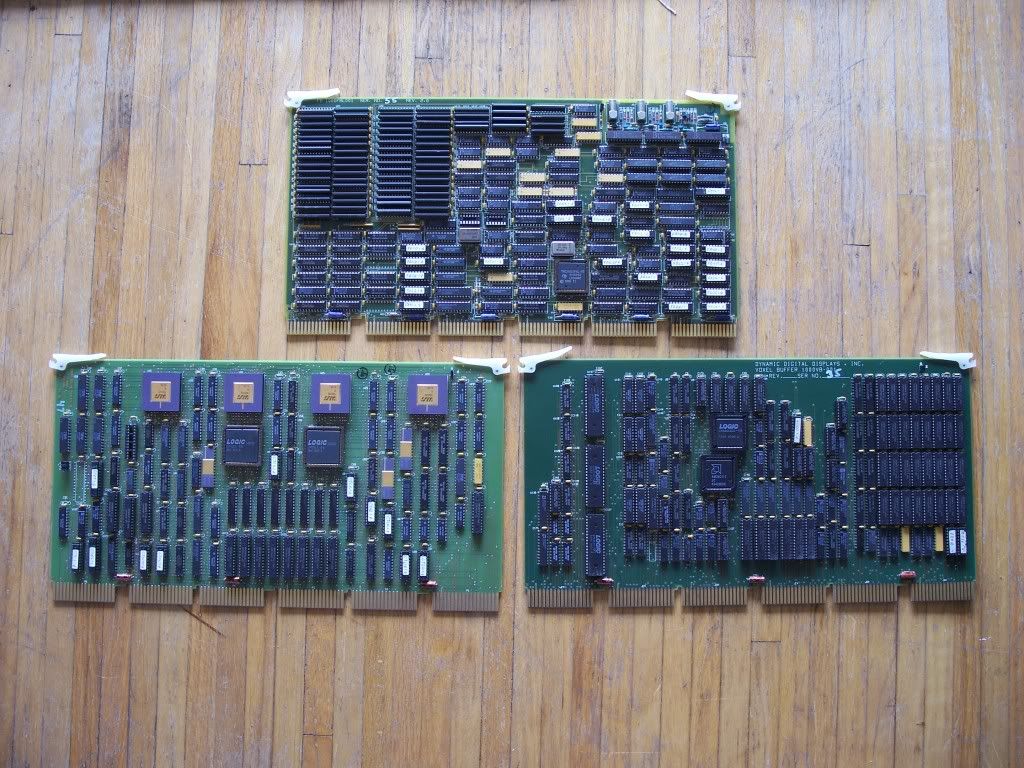
By luck I stumbled across what may or may not be a complete hex-width Unibus
framebuffer board set made by Dynamic Digital Displays.
Now that would be cool in the PDP-11/84. :)
I can identify three of the boards but not all of them:
-FB1000FBL001 Serial 55 Rev. 2 (looks to be the main memory as well as the
D/A logic to output to RGB)
-1000VB-001 Serial 35 (calls itself the "Voxel Buffer")
-1000CTD001 Serial 47 (calls itself the "CTU Board")
These boards can be seen at the following link:
http://i11.photobucket.com/albums/a166/ballsandy/Computer%20related/100_206…
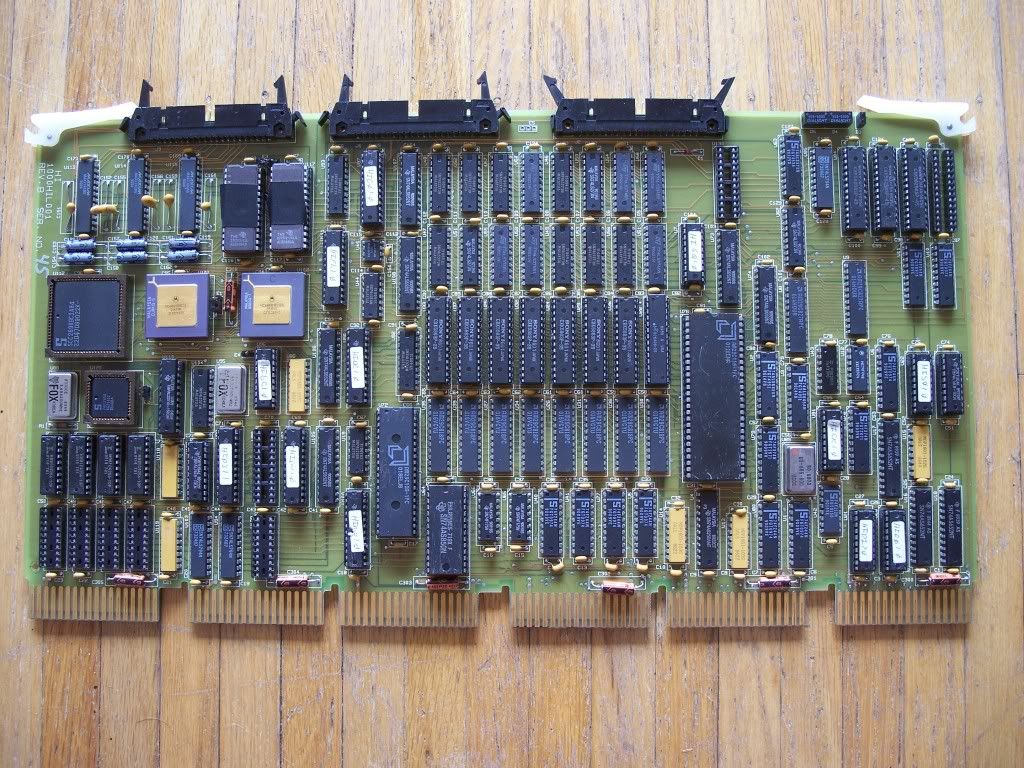
Then there were two other boards that the seller had as well. They may be
related to the previous three and they also might not be.
-1000HIL001 Serial 45 (board calls itself "HI") -
http://i11.photobucket.com/albums/a166/ballsandy/Computer%20related/100_206…
-1000DTD001 Serial 54 (calls itself "DOTS") -
http://i11.photobucket.com/albums/a166/ballsandy/Computer%20related/100_206…
Unlike the first three boards, these ones have "Dynamic Digital Displays" on
them, however the model numbers are similar on their structure.
The unfortunate part is that these boards have connectors on them ("HI"
board has three 40-pin ribbon cable headers, "DOTS" has two 50-pin ribbon
cable headers) so either I'm missing more boards that that talked through
their own bus and not the Unibus, these connectors are for options, or there
is additional hardware/cards I am missing.
I have no way to read the two TMS27C512 EPROM chips and Google has pretty
much nothing about these boards that I can locate and their hand written
serial numbers mean these are something special. Might anyone have further
information on this?
A while back, there was a brief discussion on the list about microprocessor
simulators running on larger systems. Some interest was expressed in the
simulators I was involved with some years ago. I've put together some details
and some code here:
Z80 simulator in FORTRAN IV for the MUSIC/SP IBM mainframe operating system
http://software.beyondthepale.ie/music/z80/
6502 / BBC Microcomputer simulator in FORTRAN and 370 assembly for MUSIC/SP
http://software.beyondthepale.ie/music/y6502/
6502 / BBC Microcomputer simulator in FORTRAN and VAX assembly for VAX/VMS
http://software.beyondthepale.ie/vms/y6502/
All the bits and pieces are provided to run the first two simulators on the
freely available "MUSIC/SP Demo system" running on Sim390 or Hercules and the
latter one on any reasonable VAX/VMS platform or simulator. The original
unmodified code is also there.
With the addition of a BBC Micro BASIC ROM, it is possible to run text based
BASIC programs such as http://software.beyondthepale.ie/bbcmicro/survival/
(an adventure game) on the latter two simulators.
Regards,
Peter Coghlan.
> From:?Adrian Stoness <tdk.knight at gmail.com>
> Date:?Fri, 8 Jul 2011 12:11:57 -0500
> Subject:?h11 manuals
> curently spending an hr a day scanning heathkit h11 manuals so far scaned 4
> seconds of the software referance manual if anyones interested
>
> http://pointdouglas.com/SEBHC/H11/?M=A
Thanks for scanning the manuals. The RICM has an H-11 in the restoration queue.
Any chance you have the H-11 schematics?
--
Michael Thompson
Found during sorting out some boxes, a M9404 (Q22 cable connector)
and a M9405 (Q22 cable connector mirror image). Both are in good nick
(no broken of latches) and each card has 2 50pin berg connector sockets
on them.
I would like to get Eur 20 + postage for it.
I'm in the Netherlands btw.
--
Dit is een HTML vrije email / This is an HTML free email.
http://www.youtube.com/watch?v=Bx5eb5yTDQw
g.
--
Proud owner of F-15C 80-0007
http://www.f15sim.com - The only one of its kind.
http://www.simpits.org/geneb - The Me-109F/X Project
Some people collect things for a hobby. Geeks collect hobbies.
ScarletDME - The red hot Data Management Environment
A Multi-Value database for the masses, not the classes.
http://www.scarletdme.org - Get it _today_!
Political correctness is a doctrine, fostered by a delusional, illogical
minority, and rabidly promoted by an unscrupulous mainstream media, which
holds forth the proposition that it is entirely possible to pick up a turd
by the clean end.
While preparing the paperwork for some donations to the Computer History
Museum, I started wondering about appraising the artifacts donated for tax
write-off purposes. Who would qualify as an appraiser of classic computer
items? I think I'm a pretty good candidate given the time I've spent
selling the stuff on Ebay. Is this something I should run by a lawyer?
--
David Griffith
dgriffi at cs.csubak.edu
A: Because it fouls the order in which people normally read text.
Q: Why is top-posting such a bad thing?
A: Top-posting.
Q: What is the most annoying thing in e-mail?
All --
I?m finally getting around to building the JS-1 joystick replica and
using a D+7A board I got a few months ago. I have the JS built but now I?m
trying to recalibrate the board per the instructions on page 4 and I?m
having trouble getting it to read the right values.
The calibration procedure, basically, starts with putting 2.54v on an
analog input and using a short program to read the input and display it on
the front panel output port of my IMSAM. There are two problems. When
reading the A/D and displaying the input, bit7 is stuck ON. The second
problem is that I can?t get the input to read the maximum positive of 7Fh
(excluding the seemingly stuck bit7).
The version of the schematic I downloaded isn?t a very good scan, and
doesn?t seem to be the same revision as my board (because the adjustment
pots have different reference numbers). There are a few common chips that
touch bit7 (like the LS367) which I can swap, but the others, like the
AM2502 successive approximation converter, isn?t as common.
So before I go swapping chips, does this board have any common failure
mode I should be looking for?
Thanks!
Rich
--
Rich Cini
Collector of Classic Computers
Build Master and lead engineer, Altair32 Emulator
http://www.altair32.comhttp://www.classiccmp.org/cini
> Date: Wed, 6 Jul 2011 23:39:14 -0400
> From: mcguire at neurotica.com
> To:
> Subject: Re: free-open source PCB autorouter software development
>
> On 7/6/11 7:03 PM, Andrew Lynch wrote:
> > You've missed the point entirely. Yes, gEDA includes a PCB layout
> > tool (PCB) which includes an autorouter. However, they are closely
> > coupled and if you want to use the PCB autorouter you must start with
> > gEDA EDA tool set and stay with it.
>
> This is not correct! While there is a well-developed integrative
> path between PCB and the gEDA suite, it is NOT necessary to do all of
> your schematics in gEDA in order to use PCB, nor is it necessary to use
> PCB for your board layouts if you use gEDA for schematics/BOM/etc.
>
Hi,
gEDA is a fine EDA tool set. PCB is a great stand alone PCB layout tool that includes an autorouter. Agreed. However, if you are going to use the PCB autorouter you must use PCB for your PCB layout. For example, how does one get their PCB layout into PCB to use its autorouter if you uses KiCAD, FreePCB, or Eagle? There is no interchange standard AFAIK.
I think we've lost focus on the original topic of this thread so I will repeat it. If you are a software developer with familiarity with EDA and are able to help develop a truly free/open source PCB autorouter this is a great opportunity to help the hobbyist EDA community. This is desperately needed IMO.
Hobbyist PCB autorouters are either non-free or lack support of interchange standards. QAutorouter has promise to open up free/open source PCB autorouting to all the hobbyist EDA toolsets that support Specctra DSN export and SES import such as KiCAD, gEDA, FreePCB, and Eagle.
Please consider. Thanks and have a nice day!
Andrew Lynch
-----BEGIN PGP SIGNED MESSAGE-----
Hash: SHA1
Hi All,
I'm working on a project here
http://sourceforge.net/projects/qautorouter/
It is an auto-router that is written in C++ on Qt application framework,
reads/writes specctra file format and uses a plug-in style of interface
for the router engines.
It is very alpha at this stage, I have much of the UI, file I/O, and the
plug-in API operational. I am working on a "Simple Router" plug-in at
the moment that is implementing a simplified version of the expanding
box algorithm. The Simple Router will be used as a sort of template for
debugging the plugin-api and as a template for developing more
sophisticated plug-ins. Toporouter would be a good one.
In any case, it would be great to get a few other people on-board, a
developer or two that is quite proficient in C++ would be very helpful,
some hands-on with Qt would help a lot too.
Someone to look after the Windows(tm) and Mac OS-X build and release
would be very helpful.
Someone to help with packaging; windows installer, Mac OSX installer,
and linux .deb, .rpm packages would be helpful as well.
If you're interested, please just send me a little about what you can
contribute, and your sourceforge id.
Kind Regards,
Mike Sharkey
-----BEGIN PGP SIGNATURE-----
Version: GnuPG v1.4.10 (GNU/Linux)
Comment: Using GnuPG with Mozilla - http://enigmail.mozdev.org/
iQEcBAEBAgAGBQJOEAlnAAoJEEzVYN3s3Af7lqIIALSmDzQGxAjYBIcZsAcjw++D
gw8LQAvUytUY+4xX6kVkdeA+wjvywZw0+OZKoZXeOjvY39ZNMayKvzWN4zBoUjbc
YMSx9wZ7j6QYU9EBh25hpyGmMg97L5XubY/6zRV/xkvSs9qm8/gMyayBBVBU0sMM
43blOHuELx5WYsFS2uyz/WLWE8vdpxWnDpsqfxOvp2aaRZzzEzvuP5rnj7XTN9KV
TCFe+vT/auZZIEfKzGe9lYLMHgBpccBCr0IYOiRRS3LuCytTTnoscTdzXCiTX1sE
iNBJqbMHjrb64oOs+6P4x10gOSQB8rSRmFOlpQG8puNk7ZRh6ggFxgRTzYM3oZc=
=abfU
-----END PGP SIGNATURE-----
curently spending an hr a day scanning heathkit h11 manuals so far scaned 4
seconds of the software referance manual if anyones interested
http://pointdouglas.com/SEBHC/H11/?M=A
>Message: 17
>Date: Fri, 08 Jul 2011 01:28:43 -0500
>From: Joe Chisolm - Gmail < jchisolm6 at gmail.com >
>Subject: Re: appraisals
<snip>
>The 501(c)(3), in this case the CHM, should give you paper work that
>describes the donation and the value of the donation. ?A few years back
>the IRS issued rulings that said you could no longer just "claim"
>donations. ?You have to have the paper work from the 501c3 org.??
When I worked in Anthropology at the Field Museum in Chicago, we would give donors a letter stating receipt of the donation, but we did not asign a value to the donation. The donor had to get that from a third party appriser. Most other museums that I am familiar with have similar policies (which might even be a part of the tax code).
Bob
All,
I have rescued two 3B1s and there are more available.
Please post here if you are interested.
I would like to post in other forums like
http://www.3b1.info/
but can't find out how to post.
Thanks,
Keith Stanley
On Tue, Jul 5, 2011 at 8:30 PM, Andrew Lynch <lynchaj at yahoo.com <http://www.classiccmp.org/mailman/listinfo/cctalk> > wrote:
> Copied from KiCAD-users mailing list. Hobbyists have long needed a
> free/open source PCB autorouter for their EDA tool suites. One is now in
> development. Please support this project. This is not my project but one
> I
> strongly believe is very good for EDA hobbyists. Certainly useful for
> KiCAD
> and maybe gEDA as well.
>
>
Hi Andrew,
There's this one for gEDA which has been around for several years.
PCB, http://pcb.gpleda.org/news.html
And it's available on sourceforge, http://sourceforge.net/projects/pcb/
And you can track the progress here, https://launchpad.net/pcb/
Why reinvent the wheel ??
They could probably use more coders to support this.
=Dan
-----REPLY-----
Hi Dan,
You've missed the point entirely. Yes, gEDA includes a PCB layout tool (PCB) which includes an autorouter. However, they are closely coupled and if you want to use the PCB autorouter you must start with gEDA EDA tool set and stay with it. There is no import/export capability so if you use KiCAD, FreePCB, EAGLE, etc then you are out of luck. This is the "lock in" which plagues the whole EDA technology because there are few if any interchange standards. There is no way to import/export PCBs in/out of gEDA AFAIK, at least from KiCAD. I can't tell if gEDA supports Specctra import/export necessary to use FreeRouting.net but doesn't appear so.
QAutorouter is a *much* better approach of decoupling the autorouter from PCB layout tool. Any EDA tool set that can export Specctra DSN and import Specctra SES files can use QAutorouter. Also since it has an API which allows multiple different free/open source autorouters to "plug in" the hobbyists can potentially use MUCS-PCB, Topological Autorouter, the gEDA PCB autorouter, the KiCAD autorouter (yuck), or new autorouters. Really the PCB layout tool and the PCB autorouter are so different they *should* be separate tools. Integration just leads to yet more EDA "lock in".
Personally, I won't even consider gEDA since I have 50+ complete boards in KiCAD format. KiCAD is not perfect by any stretch but it supports at least some level of EDA interchange standards (Specctra at least).
http://en.wikipedia.org/wiki/Comparison_of_EDA_software
Thanks
Andrew Lynch
Hello. Looking for a Franklin high speed digital printer, these were made in the 1960's and early 1970's.
The printer is a rack mount unit, and prints on adding machine width paper.
If you know of one, or even any information or manuals I would be extremely grateful for the help!
I have more information on the unit if anyone can help.
Best regards :)
Walter
At 09:57 AM 7/6/2011, Dave Caroline wrote:
>Did you read the comment in one of these threads where I stated Im out of a job
>paying is not an option
Maybe you can get a job at the library, scanning fiche for people.
- John
stuff theres racks side panels random filters parts no boards though case
screws and other random hardware some of the stuff is being tossed if
anyones interested in any of it let me know i will get some pics in the
next
few days my batteries were dead last night on the camera
i rescued a couple things like highdesity double sided floppies going to
go
through them and see what software if any is on them that might be worth
archiving and some 5 1/4 in floppy head cleaner disks new sealed 3M and
some
cases
also found this random plate
http://img534.imageshack.us/img534/6876/pic002sc.jpg
Copied from KiCAD-users mailing list. Hobbyists have long needed a
free/open source PCB autorouter for their EDA tool suites. One is now in
development. Please support this project. This is not my project but one I
strongly believe is very good for EDA hobbyists. Certainly useful for KiCAD
and maybe gEDA as well.
-----BEGIN PGP SIGNED MESSAGE-----
Hash: SHA1
Hi All,
I'm working on a project here
http://sourceforge.net/projects/qautorouter/
It is an auto-router that is written in C++ on Qt application framework,
reads/writes specctra file format and uses a plug-in style of interface
for the router engines.
It is very alpha at this stage, I have much of the UI, file I/O, and the
plug-in API operational. I am working on a "Simple Router" plug-in at
the moment that is implementing a simplified version of the expanding
box algorithm. The Simple Router will be used as a sort of template for
debugging the plugin-api and as a template for developing more
sophisticated plug-ins. Toporouter would be a good one.
In any case, it would be great to get a few other people on-board, a
developer or two that is quite proficient in C++ would be very helpful,
some hands-on with Qt would help a lot too.
Someone to look after the Windows(tm) and Mac OS-X build and release
would be very helpful.
Someone to help with packaging; windows installer, Mac OSX installer,
and linux .deb, .rpm packages would be helpful as well.
If you're interested, please just send me a little about what you can
contribute, and your sourceforge id.
Kind Regards,
Mike Sharkey
-----BEGIN PGP SIGNATURE-----
Version: GnuPG v1.4.10 (GNU/Linux)
Comment: Using GnuPG with Mozilla - http://enigmail.mozdev.org/
iQEcBAEBAgAGBQJOEAlnAAoJEEzVYN3s3Af7lqIIALSmDzQGxAjYBIcZsAcjw++D
gw8LQAvUytUY+4xX6kVkdeA+wjvywZw0+OZKoZXeOjvY39ZNMayKvzWN4zBoUjbc
YMSx9wZ7j6QYU9EBh25hpyGmMg97L5XubY/6zRV/xkvSs9qm8/gMyayBBVBU0sMM
43blOHuELx5WYsFS2uyz/WLWE8vdpxWnDpsqfxOvp2aaRZzzEzvuP5rnj7XTN9KV
TCFe+vT/auZZIEfKzGe9lYLMHgBpccBCr0IYOiRRS3LuCytTTnoscTdzXCiTX1sE
iNBJqbMHjrb64oOs+6P4x10gOSQB8rSRmFOlpQG8puNk7ZRh6ggFxgRTzYM3oZc=
=abfU
-----END PGP SIGNATURE-----
Hello
I will be in Salt Lake City on Thursday July 7th to pick up and move
ATEX computer rack system to Public Storage for now. If you can spare
30 minutes or an hour of your time please contact me by email.
John
----- Original Message -----
From: "Ethan Dicks" <ethan.dicks at gmail.com>
To:
"General Discussion: On-Topic and Off-Topic Posts"
<cctalk at classiccmp.org>
Sent:
Tuesday, July 05, 2011 6:30 AM
Subject: Re: Titan IV Missile Test
Equipment
> > On Sat, 2 Jul 2011, Nick Allen wrote:
>
>
> > The military even has air-insulated
> > boots for use
in the arctic that have a valve on them so they don't
crush
> > your
feet when you're flying.
>
> The nickname for them is "Bunny Boots"
- they look like white Micky
> Mouse boots and the valve is a source of
noob hazing (you tell someone
> new that they have to get the glycol
changed out in their new boots
> and send them to the motor pool/vehicle
maintenance facility, where
> everyone knows the joke...hilarity
ensues).
>
> If you forget to open the valve prior to take-off, they
get darn
> uncomfortable at altitude, and there's so much pressure that
the valve
> sticks (I tried it once intentionally, to see how much they
swelled
> up, and I didn't last until cruising altitude).
>
>
-ethan
Why a valve and not a hole? Surely if it had holes you wouldn't
need to
worry about opening it? Or are there times when you need the valve
closed?
Regards,
Andrew B
aliensrcooluk at yahoo.co.uk
----- Original Message -----
From: "Pete Turnbull" <pete at dunnington.plus.com>
To:
"General Discussion: On-Topic and Off-Topic Posts"
<cctalk at classiccmp.org>
Sent:
Tuesday, July 05, 2011 9:03 AM
Subject: Re: Photographing fiche (Was: DEC
RD53 Manual
> On 05/07/2011 07:50, Dave Caroline
wrote:
>
> >>>> I don't think you need higher
resolution, just more magnification.
> >> More magnification can
make it feasable to photograph one frame of the
> >> fiche at a
time.
> >> Higher resolution may make it feasable to photograph the
entire fiche
card
> >> at once.
>
> You'd need an
awfully high-res sensor to do that!? Back-of-envelope
>
arithmetic:
> If you want something equivalent to scanning a 10.5x8 page
at 400dpi,
> you need 3200 pixels across a (portrait) page.
> The
1978 BA11-K fiche I have in front of me is a low-magnification (by
> DEC
standards one, and it's 16 pages across, but they're landscape
> format
pages, so that works out to 10.5 x 400 x 16 = 67,000 pixels wide,
> and
therefore the sensor would have to be about 67,000 x 48,000 =
>
3,216,000,000 pixels.? Thats 3216 megapixels.
> The 1987 Bulletin fiche I
have in front of me is 25 (portrait) pages
> across.? 400dpi x 8" x 25 =
80,000, which is even worse.
> Even if you accepted 100dpi, you still end
up needing a sensor of about
> 200 megapixels.
>
Would the
hubble telescope do? I assume it's digital because it makes it
quicker to get
images from it, and if it was film-based the film would have
to be huge,
right?
Regards,
Andrew B
aliensrcooluk at yahoo.co.uk
Will a flatbed photo (transparency) scanner not do? My Epson 4180 will
do 4800 x 9600 dpi and I should think a fiche would fit under the light
in the lid without an adapter, or one could make up some sort of fiche
adapter from polystyrene sheet from the model shop. If an entire fiche
does not fit at once, one could scan it in two passes.
/Jonas
I might have this one, can you look on the box and post the exact part number. Is it 28-265?
Thanks, Jim
________________________________________________________________
The information contained in this email is legally privileged
and confidential information only for the use of the individual
or Brown & Toland Medical Group.
Any dissemination, distribution, or copying of this document is
strictly prohibited. If you have received this in error, please
immediately notify the sender by replying to this message, and
then delete all copies of it from your system.
Thank you.
Hi Brian,
My son (age 11) bought the 200-in-1 kit at a garage sale last week but it was without a manual. Do you think you could scan the manual you have and send it to me? I am not much help for him with electronic gizmos I'm afriad.
Thank you,
Jeff Nickel
Hi everyone, could use some help identifying some equipment if you are
up to it.
I know it is some sort of test equipment for the Titan IV Missile, just
not sure what it was used for, and cannot find any literature (maybe you
can help).
Below is a link to the photos of the Titan IV Missile Test equipment,
notice it comes with paper tape ribbon (I assume some code is on it).
Also notice the "Air Pressure Equalizer" knob, this lets air in/our of
the case (it is sealed with a gasket). Do you know why it would have an
"Air Pressure Equalizer" knob? I assume this means it is used in
different air pressures, would this therefore be used in space as
opposed to on the ground in your opinion?
Photos Link:
https://picasaweb.google.com/NeXTprototype/TitanIVMissile3?authkey=Gv1sRgCL…
You should ask on the arocket mailing list:
http://exrocketry.net/mailman/listinfo/arocket
> Message: 6
> Date: Sat, 02 Jul 2011 15:54:16 -0500
> From: Nick Allen <nick.allen at comcast.net>
> Subject: Titan IV Missile Test Equipment
> To: cctech at classiccmp.org
> Message-ID: <4E0F8578.7040901 at comcast.net>
> Content-Type: text/plain; charset=ISO-8859-1;
> format=flowed
>
> Hi everyone, could use some help identifying some equipment
> if you are
> up to it.
>
> I know it is some sort of test equipment for the Titan IV
> Missile, just
> not sure what it was used for, and cannot find any
> literature (maybe you
> can help).
>
> Below is a link to the photos of the Titan IV Missile Test
> equipment,
> notice it comes with paper tape ribbon (I assume some code
> is on it).?
> Also notice the "Air Pressure Equalizer" knob, this lets
> air in/our of
> the case (it is sealed with a gasket).? Do you know
> why it would have an
> "Air Pressure Equalizer" knob?? I assume this means it
> is used in
> different air pressures, would this therefore be used in
> space as
> opposed to on the ground in your opinion?
>
> Photos Link:
>
> https://picasaweb.google.com/NeXTprototype/TitanIVMissile3?authkey=Gv1sRgCL…
Ok, I have this CX-11 which is a half rack full of backplanes & flip-chips
and has also a half sized lights top panel. It's a Unibus controller to talk
to an IBM bus and tag device. There are 2 large 'In' connectors and also 2
'Out' connectors. I do have a manual which describes some generic IBM info,
but I would like to know what kind of device(s) could (if possible) directly
be connected to such a thing?
Thanks,
Ed
--
Dit is een HTML vrije email / This is an HTML free email.
I'll second that plea. I have a full 9221 mainframe (2 IO cages and 5
DASD) but NO cables. Sigh. Haven't found any here in England so far. So if
there are stacks of them eating up space under your raised floor, or in
your garage, please consider me too!
Thanks,
Colin Eby