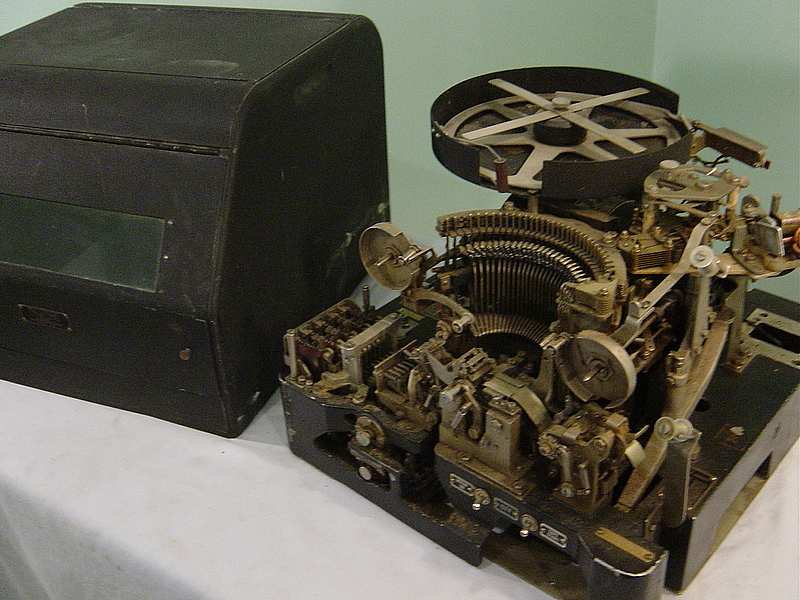
I have a few 8 inch floppy disks coming from a Q1 Lite computer. I tried
reading them on a PC with a Adaptec 1522A floppy controller but it failed
completely.
Then I tried my Catweasel and dumped the raw flux data. The format differs
>from what I have seen before.
I did a quick histogram of the flux lengths and it appears that there are
four groups of sample lengths evenly spaced. Peaks at 30, 48, 66 och 84
samples flux lengths.
The longest flux lengths are interspersed in between more normal flux
lengths in the actual data and I get the same type of result regardless of
reads of the same track and between different tracks. But the relative
frequency is much much lower for the longer flux lengths than the shorter
ones.
An RX02 (MFM ish) had 26, 41, 55 samples as the peaks in the histogram.
As far as I understand cw2dmk software uses 14 MHz setting in the catweasel
so each sample length is around 70ns.
Anyone that has seen this kind of format before? Or is it just a reading
error? I have the same result from several discs though and they look to be
in quite good shape physically.
Link contains histogram files and a raw track flux file.
https://drive.google.com/drive/folders/1URC5i8AsRyP08d_ZhWRovbDp2TMgdj4B?us…
Well my little TK70 here has been squeaking and it looks like the
capstans are frozen/bad. They don't move up and down and they don't spin
well.
Fortunately I have a dead TK70 with good capstans so I figured I would
swap them. Unfortunately I don't have a maintenance manual (does anyone
have one?) so I had to figure out alignment myself. Capstan alignment
seems to be critical, if they are off the unit don't work...
Anyway here is my procedure so far to get the unit to load and unload
tapes on the bench. Not perfect, but a start....
Pulling the capstans requires you to remove the two lock nuts on top
first. I recommend you count the turns from all the way tight if
possible as alignment is critical, and the front and rear ones can be at
different relative heights.
Anyway if you didn't do this you need to adjust the rear height to trip
the optical sensors and the front one to handle tape slew.
Note: All the below is done with the unit on a bench, with a PC power
supply.
The first step is to adjust the rear capstan so the leader tape's wide
hole for the end of tape-stop marker allows light from both LEDs/sensors
to pass through. You do this by tightening the bolt down till snug, then
back off 1/2 turn.
Turn on unit, see if it unlatches. It probably will try to turn the tape
4 times then error out. Fine. Power down, back off the bolt 1/4 turn and
try again.
At some point it will open the latch. Note the # of turns of the bolt
then keep going 1/4 turn at a time till it doesn't work again (too
high). The proper value for your unit in turns is halfway between too
low and too high. Reset the bolt and verify it works several times. For
my unit the right height was about 1.5 turns out.
Then you need to adjust the front capstan. The problem is if the front
is higher or lower than the back you have tape slew errors. Start at the
level of the rear one based on the # of turns minus a bit (1/2 turn).
Then load a tape. It will load, but when you try to unload things will
go bad, the tape will just move forward onto the take up reel 4 times,
and the unit will error out. The reason is it has to read the tape as it
turns to know a tape is loaded (as opposed to the leader where it looks
for the end of leader light). If the capstans are not holding the tape
level against the head it can't read.
Each time it moves forward a bit, try bringing the front up 1/8 turn at
a time. Eventually it will speed up, that means it can read the tape on
one of those moves. It should then unload. Now you have the front
basically set. It will unload the tape, cycle it a few times to make
sure it's working.
That's where I am now. Next step is to see if it will read the tape in
the computer. I'll work on that tomorrow.
Note if you ever shine an led flashlight into a running TK50 or 70 all
hell will break loose as the system will see the light on the tape
sensor and think it has hit BOT. Even worse is if both LED sensors
trigger, then it thinks it is at end of leader and it will throw tape
everywhere.
Ask me how I know....
I've acquired an HP 9000-340C+ and I'd like to kit it out with the maximum RAM, SCSI, and AUI rather than thin Ethernet. Desired:
- RAM boards: HP 98268A RAM board (three of them to get to 16MB, I'd probably buy extra just to be safe)
- AUI LAN board: 98571-66534, aka HP 98235A AUI LAN Upgrade
- SCSI board: HP 98658A SCSI Interface Card
Anyone have any of this stuff that they might be interested in parting with?
I'm also always on the lookout for an HP 98556A 2D/integer graphics accelerator in case anyone happens to have one that needs a home. That's the integer accelerator with a 68020 and some RAM, which piggybacks atop the 98550A (1280x1024 8-bit color card) via its extra Eurocard connector.
-- Chris
> From: Lars Brinkhoff
> I suppose that main computer could be the GE-645 on which Multics was
> developed? And they would still refer to it as G.E.
Oh, it was clearly referring to the Multics machine. I assumed that with the
GE sale being 1970, by '72 it was not a GE machine anymore. But the MIT
Multics site page:
https://multicians.org/site-mit.html
says the H-6180 was installed in November, 1972; shortly after the letter.
Noel
Have one filed in somewhere with all the s-100 boards... now I have a reason to dig it out! Yes... memories of Wirt's projects!
Ed#?? smecc
On Wednesday, December 16, 2020 Bill Degnan via cctalk <billdegnan at gmail.com; cctalk at classiccmp.org> wrote:
Very interesting Stan.
Thank you for sharing this info
Bill Degnan
On Wed, Dec 16, 2020 at 2:43 AM Stan Sieler via cctalk <
cctalk at classiccmp.org> wrote:
> Hi,
>
> Some years back, I was asking if anyone had information about the speech
> synthesizer
> developed for the Altair 8080 by Wirt Atmar of AICS (in New Mexico).
> No "hits".
>
> Most places on the web claimed the Computalker was first, given the date as
> 1976 or 1977.
>
> (Earlier speech synthesizes existed, but they were external boxes that one
> interfaced to,
> or were standalone (often with a large/weird keyboard).)
>
> Today, I stumbled over a fairly bad OCR of Byte magazine from August, 1976
> at
>
> https://archive.org/stream/byte-magazine-1976-08/1976_08_BYTE_00-12_Speech_…
>
> It has two articles about speech synthesizers for S-100 bus systems.
>
> The first is by the Computalker people, who say:
>
> At the time this article
> goes to press, a synthesizer
> module incorporating several
> detail refinements and im-
> provements over the circuits
> of this article is being de-
> veloped by the author and
> associates.
>
> and
>
> A detailed user's
> guide will be supplied with the
> Computalker module
>
>
> Note the future tense!
>
> The second is by Wirt Atmar, whose product *was already shipping*.
>
> Near the end of his Byte article, Wirt lists currently available products:
>
> At the present time, two speech synthesizers
> are both commercially available and affordable by
> the hobbyist.
>
> One is the Votrax produced by:
>
> Vocal Interface Division
>
> Federal Screw Works
>
> 500 Stephenson Dr
>
> Troy Ml 48084
>
> Price, approximately $2,000
>
> Interfacing: Parallel or Serial (RS-232)
>
>
> The second is the Model 1000 manufactured by:
>
> Ai Cybernetic Systems
>
> PO Box 4691
>
> University Park NM 88003
>
> Price, $425
>
>
> Wirt had told me (twenty years ago or so) that he thought his was the first
> for microcomputers (e.g., a user installed card, not an external box).
> Now, I'm sure ... but it was realllly close!
>
> Wirt demonstrated his product at the earlier MITS World Altair Computer
> Conven-
> tion, where it won first prize.
>
> He advertised it poorly/infrequently, since it was mostly a side business.
> And, that shows, since history doesn't remember it.
>
> Stan
>
Has anybody got a DCV54 that they are using?
I am trying to get one working with David Gasswein's mfm board and
having no luck.
The controller is working fine with a standard floppy as an RX33, even
boots the MicroVAX from it.? But on-board diagnostics cannot format or
even recognise the mfm board as a winchester.
Just got the scope out today and found that the drive select lines are
being terminated OK on the mfm board, bit the controller is not even
dropping drive select. (Yes I have tried new cables)
Problem is I don't have anything old enough to test the mfm boards with
other than the Plessey controlelr!
I'm thinking there must be some on-board config that I am missing on the
controller. - It has never had a real mfm drive connected to it.
Any help appreciated,
Nigel
--
Nigel Johnson, MSc., MIEEE, MCSE VE3ID/G4AJQ/VA3MCU
Amateur Radio, the origin of the open-source concept!
Skype: TILBURY2591 nw.johnson at ieee.org
Bill...this just? struck a memory I think I have a Radioshack Digitalker in a packaging? but recall it being just one large chip...? Ed #??? SMECC
On Saturday, February 13, 2021 Bill Gunshannon via cctalk <bill.gunshannon at hotmail.com; cctalk at classiccmp.org> wrote:
On 2/12/21 6:09 PM, Ethan Dicks via cctalk wrote:
> On Fri, Feb 12, 2021 at 6:01 PM Jim Brain via cctalk
> <cctalk at classiccmp.org> wrote:
>> But, I'm sad because no one either has one nor can help me test this
>> one.? So, I cannot enjoy the thrill of making it say inappropriate stuff :-(
>
> I have several vintage speech ICs, but not that one.
>
I do as well.? I have the Radio Shack "Voice Synthesizer IC Set"
sitting on the desk in front of me right now.
bill
I have a bunch of Panasonic/Matsushita 470/940 MB phase-change WORM
discs here--and the appropriate drive (Panasonic LF-5010 SCSI-2) to read
them.
Unlike CD-R media, however, the format of these discs is not anything
standard--they were essentially treated as hard disks. So, adding a
file involves copying the directory and then adding the file information
to the copy. The same applies, of course, for file deletion. If the
drive tries to read a (1,024 byte) sector that hasn't been written to,
it will get an error after a number of retries. I should emphasize that
this drive is *not* fast--throughput seems to be on the order of a
floppy disk.
I can probably (with a bit of head-scratching) figure out the
methodology behind this system, but I'm giving a shout-out to see if
this rings any bells. Phase-change WORM did not enjoy a long life in
the world, being superseded by rewritable media (both CD-RW and MO).
As a point of reference, here's the data from sector 1 of a sample disc
(Sector 0 is not used):
> 00000400 04 0d 04 16 00 0f 0a fe 02 00 20 03 00 03 48 47 |.......... ...HG|
> 00000410 49 42 32 2e 31 31 2d 30 33 2e 30 30 43 72 65 61 |IB2.11-03.00Crea|
> 00000420 74 65 64 3a 20 54 68 72 20 32 32 20 41 70 72 20 |ted: Thr 22 Apr |
> 00000430 31 39 39 33 20 20 20 20 20 31 35 3a 20 32 2e 32 |1993 15: 2.2|
> 00000440 38 3a 35 31 20 20 20 20 4f 70 74 69 73 79 73 20 |8:51 Optisys |
> 00000450 4f 70 74 69 44 69 73 6b 20 28 43 29 20 43 6f 70 |OptiDisk (C) Cop|
> 00000460 79 72 69 67 68 74 20 31 39 38 37 20 2d 20 31 39 |yright 1987 - 19|
> 00000470 39 31 20 20 20 20 20 20 20 20 20 20 20 20 20 20 |91 |
> 00000480 20 20 20 20 20 20 20 20 20 20 20 20 20 20 20 20 | |
If nothing turns up in the community, I'll work out the format and make
details available (as I understand them).
TIA
--Chuck
Most challanging was to figure out to make it say naughty things... and once you did? how it almost caused havoc in AZ
On Tuesday, February 9, 2021 Jim Brain via cctalk <brain at jbrain.com; cctalk at classiccmp.org> wrote:
I suspect the answer to question #1 is no, but thought I would ask.
1) Anyone happen to have a known working Digitalker 54104 IC they are
looking to trade for some cash that does not involve me selling an arm
or a leg :-)?
2) Barring that, anyone have a known working Digitalker-based unit that
might be able to pop in a suspected non working Digitalker IC and test?
I have a Jameco (yep, the parts firm) manufactured Digitalker unit here
called the JE-520 that is my original unit.? It suffered some ROM bit
rot long ago and was not working, but I acquired the ROMs a while back
to repair the unit.
Now, though, as I pull it out for another project, it seems to be
misbehaving.? It's like "address bit 1" on the input commands is acting
up.? For instance, word 48 is "zero", and 49 is "one", but zero will be
followed by "three" and then "zero" and then "three" as one sends values
48,49,50,51 to the unit.? I'm working to confirm the bit 1 on the cable
to the PC is not bad, but initial efforts point to it being the IC.
Jim
--
Jim Brain
brain at jbrain.comwww.jbrain.com
Hi all,
Hopefully the following link works, but someone over on one of the Facebook
vintage groups has this oddball terminal from 1973 that they've been
looking for any information on:
https://drive.google.com/drive/folders/1-2uEFbi3OKBYr06y6yHnygDiLMtw2Qkj
... it's somewhat unconventional in that half the CRT is hidden from view
within the machine, i.e. it only actually displays the top half of the
display to the user - I've no idea if that's because it had a specific
application where space was limited, or if it was simply that memory at the
time was horribly expensive and so it was designed to only use a few lines
(I know some vendors did that, although I think they typically presented
the whole CRT and at least had the option of RAM upgrade to more lines).
The blower assembly seems a little on the homebrew side, but on the other
hand the PCBs and case construction make it seem like a professional product.
The owner says the only label anywhere on the thing is the one on the CRT
saying "Mfd in Japan for Conrac", but that's presumably just the CRT itself
and not the entire machine.
I don't believe there's anything resembling a microprocessor in the system,
it's all just TTL logic (the large white ceramic IC is an ACIA).
Oh, I believe the owner's in Canada, so it may be it was made there and
never exported to other parts of the world.
cheers
Jules
This decade seems to have increased the number of failing things in such
a way that the "to be repaired" backlog is growing much faster than I
can get to diminish it. Argh.? A month ago my trusty HP9000/380 ran just
fine and I booted the different OS's in the SCSI and HPIB drives
connected to it (this particular machine is interesting because the
9000/300 port of NetBSD was partly developed in it: it was Mike
Wolfson's). Yesterday, it failed to turn on; the power supply is dead.?
So I unracked the pile of drives and the computer, checked for obvious
things (the fuse is fine, and nothing in the power supply is swelled up
or leaking, or browned by heat; visually, it looks new; the HV caps seem
to hold a charge).? I need the schematics for the power supply (at least
the output connector; I can work my way back from that)? and also those
for the backplane in this hp9000/380.? A preliminary search at bitsavers
and elsewhere did not help.? Does anybody have these?
In the meantime, I finally improved the mainboard (had the parts for a
long while) from a 380 to a 385 by changing the clock generator, and
replacing the 68040RC25 with an RC33.
I ran this machine as a web server continuously for ten years in the
2000's, totally exposed.? Many tried to hack it... and failed. Another
personal connection to this architecture is that I used Apollos and
hp9000/300 at UW-Madison back in 1989-91.? Boy, did I crunch numbers...
carlos.
What is the best way of dumping the contents of an ESDI disk?
I have an original IBM Enhanced ESDI ISA controller board. Could that be
used under Linux? Or NetBSD/FreeNSD? I googled but didn't find much.
Is there any other way of dumping the disk contents?
In theory it should be just a matter of clocking the raw data and finding
the marks and extracting the data. Has anyone done something similar?
/Mattis
Counting in binary on ones fingers was something I first ran into at
age 11 when found a book on Military Electronics in a surplus
store. Everything simplified, but in computer section found binary
system explained with using fingers to represent bits. That was
something that I used immediately as used to count steps to various
places but after 1000+ steps would often forget where I was so would
increment my binary digital counter every 100 steps. At that age 1
mile was probably about 2500 steps so I my counter would have
overflowed at about 40.9 miles. Also LSB was my left small finger
which seems weird now but suspect that's what illustration in book
showed of how to count in binary on your fingers. Found manual
method easier to use than a pedometer.
>I too count sheep with my fingers, but I never get past zero due to the
>lack of sheep. :-)
>
>Tom Hunter
>
>On Mon, Feb 1, 2021 at 5:34 PM Tor Arntsen via cctalk <cctalk at classiccmp.org>
>wrote:
>
> > On Sat, 30 Jan 2021 at 03:27, dwight via cctalk <cctalk at classiccmp.org>
> > wrote:
> > > If we'd thought about it we could count to 1023 on our fingers.
> > > Dwight
> >
> > Some sheep herders in (IIRC) the Caucasus do, or did at least. I
> > learned about that some decades ago. Counting sheep on their fingers.
> > I use the system sometimes.
> >
> > -Tor
> >
Dear all,
I have been looking to downsize a bit in recent times and am looking to get rid of an IBM AS/400 9404 F10 and an HP 175a oscilloscope. As these things are large they are pickup only in the Petersfield area. I cannot guarantee either work. Although the scope comes with spares and does show some signs of life. It is not my area of expertise and it is probably going to need a full rework, it being from the 60s. The AS/400 is a similar story although will probably be a much simpler task.
Send me an email if you are interested in either one of them or want pictures or have questions. I also realise it is lockdown, but if you send me a line now I can hold them for you rather than them being scrapped.
Thanks,
Al
This evening begins a series of events celebrating the
75th anniversary of the unveiling of the ENIAC at the
University of Pennsylvania.? On the 11th and 18th, the
Philadelphia Venture Cafe will be hosting virtual round
tables with a number of us who have some connection to
the ENIAC and Philadelphia technology.? Included among
the people present will be:
- Bill Mauchly and Chris Eckert, sons of the ENIAC
creators
- Bill Mensch, part of the 6502 engineering team
- Kathy Kleiman, producer of the ENIAC programmers
documentary
(And yes, I'll be there for anyone who wants to get
nerdy and talk about the technical aspects of the
machine and its programming.)
Monday, the 15th is the day of the anniversary, and
there will be a full day of webcasting.? Starting at
10:30 EST, UPenn will be holding a mini-symposium in
recognition of the ENIAC.? Then at 3:30 EST, Unisys
will be webcasting an ENIAC celebration video that
includes a number of panel discussions, as well as
clips from early newsreels, and happy birthday wishes
>from the various locations housing ENIAC artifacts.
More details and links to all the events can be found
here:
http://www.eniacday.org/events/
BLS
On 2/8/21 1:00 PM, Mattis Lind wrote:
> This is highly annoying. Back in 2015 I did exactly this and now I have
> forgotten how.
>
> I dumped a set of RX02 disks with catweasel into .DMK and now I want a raw
> sector image to be able to test them with SimH.
>
> What is a good tool to use? I have some faint memory of glancing through
> hexdumps of .dmk files. Perhaps I did something myself using dmklib by Eric
> Smith? Don't really remember, unfortunately.
>
> But surely someone else has already done this, right?
>
> /Mattis
I wrote my own, not knowing where another one lived. I happen to think
in Java, so that's what it's implemented in.
Description is here:
https://github.com/RetroFloppy/transformenator/wiki/Utility-Functions#dmk2r…
Code is here:
https://github.com/RetroFloppy/transformenator/blob/master/src/org/transfor…
The only thing of interest is the cw2dmk tool would read RX01 disks and
"double" the data - so my tool will make an attempt to detect that and
halve the data back out the other end.
- David
Hello list,
there is an NCR-labelled disk pack offered in the bay with a geometry that I've never come across before:
https://www.ebay.com/itm/353379280282
It seems to be a 14" pack with three platter and six recordable surfaces. The platters themselves are quite thick and the distance between the platters is quite wide compared to the IBM 1316 and 2316 type standards.
Does anybody know if this is really an NCR development or if it is a rebadged pack from another manufacturer?
Any hints to solve this mystery is much appreciated :)
Best regards,
Pierre
PS: I wonder if the seller describing the party dog is describing himself, but partying seemed to be an important part of his life ;)
-----------------------------------------------------------------------------
http://www.digitalheritage.de
Hi all, I wonder if anybody has one with the terminators installed that
can read off the p/n for these SIPs
The manual says they are 8-pin 7 resistor 220/330 ones, but that is not
possible! To put 7 resistor pairs to 220 and 330 you need a 9-pin,
unless you have one resistor SIP for 220 and another for 330!? But there
are 2 so that leaves an odd number! The sockets are 9-pin.? I have yet
to find any 9-pin ones on digikey
cheers,
Nigel
--
Nigel Johnson, MSc., MIEEE, MCSE VE3ID/G4AJQ/VA3MCU
Amateur Radio, the origin of the open-source concept!
Skype: TILBURY2591 nw.johnson at ieee.org
On 2/10/21 1:00 PM, John Many Jars<john at yoyodyne-propulsion.net> wrote:
> So, I have an Apple ][+. It is missing an IC at location a3 on the
> motherboard.
>
> I don't know why. it used to work... I think my mind is going. I have no
> memory or removing it. Anyway, I need another one. The board is marked
> 74166.
>
> Can I put any shift register IC with a similar part no, like this one:
>
> 74166PC | FAIRCHILD | IC DIP-16 Shift Register (icompplus.com)
> <https://www.icompplus.com/en/integrated-circuits/24400/74166PC>
>
> in there, or ?
>
> Thanks,
>
> mark aka john
I have a mobo that has that very part (Fairchild 74166PC), so it's a
good bet it'll work.
- David
Working on fixing a pair of TK70's here to speed up my backups. The TK50
is fine on a TQK70 controller (it streams perfectly) but I am coming
close to filling a tape.
I've managed to assemble a working TK70 out of two unhappy ones, but to
fix the other I need to replace the eject button switch. The
plastic/rubber on it has turned to the usual goo.
Does anyone know the part number for that switch? Taller than a usual
SMD button switch, so a stock one won't work. I could take it apart but
that would be a kludge.
Thanks!
I was just poking around the computerhistory.org website, searching for Knuth stuff.
The second or third hit when I search for "Knuth" is this one: https://computerhistory.org/blog/the-apl-programming-language-source-code/ . It's not just about APL, it actually has a downloadable copy of the source code. And it points to an executable version, apparently a packaged up Hercules running that code.
Nice. I'll have to give it a try.
paul
I suspect the answer to question #1 is no, but thought I would ask.
1) Anyone happen to have a known working Digitalker 54104 IC they are
looking to trade for some cash that does not involve me selling an arm
or a leg :-)?
2) Barring that, anyone have a known working Digitalker-based unit that
might be able to pop in a suspected non working Digitalker IC and test?
I have a Jameco (yep, the parts firm) manufactured Digitalker unit here
called the JE-520 that is my original unit.? It suffered some ROM bit
rot long ago and was not working, but I acquired the ROMs a while back
to repair the unit.
Now, though, as I pull it out for another project, it seems to be
misbehaving.? It's like "address bit 1" on the input commands is acting
up.? For instance, word 48 is "zero", and 49 is "one", but zero will be
followed by "three" and then "zero" and then "three" as one sends values
48,49,50,51 to the unit.? I'm working to confirm the bit 1 on the cable
to the PC is not bad, but initial efforts point to it being the IC.
Jim
--
Jim Brain
brain at jbrain.comwww.jbrain.com
> From: Fritz Mueller
> In at least one case of attempting to recover a pac
BTW, your neat hack to do that only works on the RK11-C, and not the RK11-D:
the latter doesn't implement 'Read/Write-All'.
Noel
> the Unix V6 RK pack formatter ... sets _both_ 'Format' and
> 'Read/Write-All
Oooops; my bad; I mis-read the register description. It's setting 'Inhibit Bus
Address Increment' and 'Format', not 'Format' and 'Read/Write-All'. So ignore my
speculation about 'Read/Write-All' not getting the sector header word from memory.
My bad!
Noel
> Fron: Jon Elson
> The write all function is likely how you format a blank pack.
No, 'Format' is a separate bit in the CSR from 'Read/Write-All', and they do
different things.
The RK11 always re-writes the header word of each sector when it writes a
sector in normal operation; when 'Format' is set on a Write operation, it
merely supresses the 'read header word and check/compare' function (which
normally precedes any disk operation, to make sure the head's at the right
place). Format/Write then goes ahead and writes the header word of the sector,
just as in normal operation. (It is possible to set 'Format' on a Read
operation; that just reads in the sector header words into memory.)
Although in theory one could use 'Read/Write-All/Write' to format packs,
the Unix V6 RK pack formatter:
https://minnie.tuhs.org/cgi-bin/utree.pl?file=V6/usr/source/mdec/rkf.s
sets _both_ 'Format' and 'Read/Write-All', and _doesn't_ set up the sector
header words in the memory buffer, arguing that even with 'Read/Write-All' on,
the hardware is still generating the sector header word contents. (I'm too
lazy to check the RK11-C and RK11-D engineering drawings to confirm that.)
Noel
If you search ebay for "DEC RK11-C Disk Controller", you'll find a listing
of a backplane of flipchip cards, but it's not like any RK11-C I have ever
seen. Am I right, this is a mis-labeled auction?
Bill
> From: Ethan Dicks
> I do have a replica KM-11 set that I need to construct.
You'll need the RK11-C overlays (shown on pg 6-2 of the RK11-c Manual). (My set
of overlays from Guy with his KM11 replica included them; thanks Guy :-).
> From: Fritz Mueller
> The cables are actually in the correct slots -- they connect A30 and
> B30 to the pass-through connectors to support plugging in a pair of
> KM11s from the outside of the rack for debug.
Ah. The Double-Buffered RK11-C doesn't have those; the slots used (looks like
C08 and D08) are used for logic.
Noel
I think we have some old Mac programmers here.
I've dusted off some code that allegedly compiles with CodeWarrior Pro 2, and
it needs CWGUSI, so I installed 1.8.0 (which was on the CW Pro2 Tools CD).
A bit of hacking and everything compiles, but it won't link; it's missing
a symbol _Stdout that CWGUSI apparently requires (I traced it back to a couple
fflush(stdout);
calls). I've got SIOUX, the Metrowerks Standard Library and everything else
I can think of, and while everything else builds, I can't seem to find the
lib with this mysterious _Stdout symbol. Any guesses? Does this sound familiar?
--
------------------------------------ personal: http://www.cameronkaiser.com/ --
Cameron Kaiser * Floodgap Systems * www.floodgap.com * ckaiser at floodgap.com
-- Do I look like I just fell off the turnip truck?! -- Ryoga, "Ranma 1/2" ----
Hello, everyone...
I may have asked here many years ago about this:? Does anybody? have a
binary distribution of Octave for VAX/VMS?? The sources for some early
versions were distributed in the SIG tapes, but I never managed to
complete a VMS build using them.? I tried tracking old octave archives
with binary builds, but they're all gone (it used to be at
ftp.chem.wisc.edu).? I even tried to contact John Eaton about this but
got no response.
Regards,
Carlos.
The guy posted today, saying they're still available...
- John
>From: <highpwr at bellsouth.net>
>To: <greenkeys at mailman.qth.net>
>Date: Sun, 27 Dec 2020 18:23:31 -0500
>Subject: [GreenKeys] Equipment Available
>
>I have the following available for pickup in the Knoxville TN area, it from
>the estate of an old ham buddy that's now in the nursing home with
>Alzheimer's. All was salvaged from his property which was sold to help
>defer his nursing home expenses, and was going to go in the dumpster.
>Really just wanted to save this stuff from the dumpster, and its free to a
>good home, BUT if it works for you (whomever comes and get this stuff) a
>donation that I could forward to his Nephew to help cover his nursing home
>costs would be greatly appreciated.
>
>There are two Teletype Model 35 KSRs and at least one 33 KSR. Also there is
>an model 14 Printing Reperf FRXD (very similar to frxd-1311-04.jpg (800?600)
>(navy-radio.com) <http://navy-radio.com/tty/reperf/frxd-1311-04.jpg> on
>Nick England's site. There may be some other in the future and possibly
>some 11/16 paper tape, but this may be spoken for.
>
>All was stored in a dry outbuilding, but was in the building for well over
>twenty years. It took the best part of a day to dig it out, salvage and
>carry it out of said storage building.
>
>
>
>
>I can provide additional more detailed photos if required, but please don't
>ask unless your really interested and serious. The empty brass nor the gun
>they were fired in are no longer available I'm keeping it.....Ha Ha.
>
>PS this stuff will not be available indefinitely, I don't have the space to
>store it for another twenty years, it will probably go onto the dump or be
>dismantle for parts before the end of February.
>
>Steve
>KM4V
I know it exists, or existed, as there are references all over to it from
the skeletal remains of various BeWare mirrors. However, the package itself
has disappeared. The Intel version is marginally easier to find but if anyone
knows where the *PowerPC* one is (I'll take R3 or R4) please advise.
I guess, since I've got mwcc on it, I could try to reconstruct it, but I
don't know if I would have all the BeOS-specific changes.
--
------------------------------------ personal: http://www.cameronkaiser.com/ --
Cameron Kaiser * Floodgap Systems * www.floodgap.com * ckaiser at floodgap.com
-- My opinions may have changed, but not the fact that I'm still right. -------
This is highly annoying. Back in 2015 I did exactly this and now I have
forgotten how.
I dumped a set of RX02 disks with catweasel into .DMK and now I want a raw
sector image to be able to test them with SimH.
What is a good tool to use? I have some faint memory of glancing through
hexdumps of .dmk files. Perhaps I did something myself using dmklib by Eric
Smith? Don't really remember, unfortunately.
But surely someone else has already done this, right?
/Mattis
Hi all --
Making some progress with the "fire sale" PDP-11/70. Over the past month
I've rebuilt the power supplies and burned them in on the bench, and I've
gotten things cleaned up and reassembled. I'm still waiting on some new
chassis fans but my curiosity overwhelmed my caution and I decided to power
it up for a short time (like 30 seconds) just to see what happens. Good
news: no smoke or fire. Voltages look good (need a tiny bit of adjustment
yet) and AC LO and DC LO looked good everywhere I tested them. Bad news:
processor is almost entirely unresponsive; comes up with the RUN and MASTER
lights on, toggling Halt, and hitting Start causes the RUN light to go out,
but that's the only response I get from the console.
I got out the KM11 boardset and with that installed I can step through
microinstructions and it's definitely executing them, and seems to be
following the flow diagrams in the engineering drawings. Left to its own
devices, however, the processor doesn't seem to be executing
microinstructions at all, it's stuck at uAddress 200.
In the troubleshooting section of the 11/70 service docs (diagram on p.
5-16) it states:
IF LOAD ADRS DOES NOT WORK AND:
- RUN, MASTER & ALL DATA INDICATORS ARE ON
- uADRS = 200 (ZAP)
THEN MEMORY HAS LOST POWER
Which seems to adequately describe the symptoms I'm seeing, but as far as I
can tell the AC and DC LO signals are all fine. (This system has a Setasi
PEP70/Hypercache installed, so there's no separate memory chassis to worry
about.) I'm going to go back and re-check everything, but I was curious if
anyone knows whether loss of AC or DC would prevent the processor from
executing microcode -- from everything I understand it should cause a trap,
and I don't see anything in the docs about inhibiting microcode execution.
But perhaps if this happens at power-up things behave differently? And the
fact that the troubleshooting flowchart calls out these exact symptoms
would seem to indicate that this is expected. But I'm curious why the KM11
can step the processor, in this case.
I'm going to wait until the new fans arrive (hopefully tomorrow or tuesday)
before I poke at this again, just looking for advice here on the off chance
anyone's seen this behavior before.
Thanks as always!
- Josh
Recently acquired an ASR33 with an old EIA (RS-232) Interface convertor
module. ? It came with a two page spec and cable pinout sheet that is
more hole than it is paper. Manufacturer is United Data Services (UDS)
in Phoenix.? Model seems to be 312 A 0568? (might be 0563)? Google
hasn't been much help and Bitsavers is silent as well..? Herb Johnson of
Retrocomputing.com has 312 A 0567 which appears similar but not close
enough to be useful.
Anyone familiar with this unit who could share docs??? (willing to scan
and share if desired)
Steve
Looking at the DEC Pro documentation there's some ambiguity I'm trying to figure out.
The hard drive documentation talks about the "reduced write current" signal. In one place it's explicitly described as relevant to the RD50 only. But later on in the RD50/RD51 chapter the signal is described generally, without any indication that RD51 ignores it.
Does anyone know which is correct? If RD51 also uses it, how does the right value get set? What IS the right value, anyway?
paul
Thanks!??
The radio site aside? from? using low bit rate scan also I think compresses the pdf files.
Ed#
On Wednesday, February 3, 2021 J. David Bryan via cctech <jdbryan at acm.org; cctech at classiccmp.org> wrote:
On Wednesday, February 3, 2021 at 9:25, ED SHARPE via cctech wrote:
> Indeed this site is great for reference but alas are too lo-res for good
> museum display images.
They appear to be scanned at 150 dpi.
The ones here are scanned at 300 dpi:
? http://hparchive.com/hp_journals
? ? ? ? ? ? ? ? ? ? ? ? ? ? ? ? ? ? ? -- Dave
>
>
> Date: Tue, 2 Feb 2021 09:19:08 -0800
> From: Al Kossow <aek at bitsavers.org>
> Subject: Flip-Chip selloff
>
> I don't have any equipment that uses them any more, so I'll be ebaying off
> my
> A-W series flip chips over the next few days. The W's and PT08 boards are
> up now
>
> https://www.ebay.com/itm/184647476832
> https://www.ebay.com/itm/184647420812
>
I am still maintaining a PDP-8/I & TC01, PDP-8/L, PDP-8/S, PDP-9 & TC02,
and PDP-12 for the Rhode Island Computer Museum.
The RICM would happily accept any donated FlipChips, especially the go-fast
B versions and anything else for the PDP-9. You can even get a charitable
tax deduction for the donation.
--
Michael Thompson
At 08:32 AM 2/2/2021, geneb via cctalk wrote:
>On Mon, 1 Feb 2021, Al Kossow via cctalk wrote:
>>and it is the software and the knowledge of what you need to do when
>>recovering media in volume these guys have no clue about
>
>How about helping out instead of bitching from the sidelines?
I was quite eager to hear Kossow's insights. Any engineer or programmer
(or both) worth their salt eagerly seeks and accepts the "but it would be really
handy if it did X, Y and Z" insights, especially if they're coming from
someone with decades of experience in the field in question.
How else will products improve?
- John
Indeed this site is great for reference but alas are too lo-res for good museum display images.
I do use this as a reference source? but need paper copies sometimes? to hi res scan some times!
Ed#
On Tuesday, February 2, 2021 Richard Milward via cctalk <rsmilward at frontier.com; cctalk at classiccmp.org> wrote:
You can find HP Journal issues at
https://worldradiohistory.com/HP-Journal.htm
<https://worldradiohistory.com/HP-Journal.htm>
The World Radio History site is a fantastic resource in general, I use
it regularly.
**Richard
Adam, I have a VAXstation sitting about three metres from me. As is
usually the case, "it worked when I turned it off 20 years ago" I don't
remember how many years ago I turned it off. I think it is a model 30
but casually looking at the box does not show me what model it is. I
pulled out the nicad battery pack many years ago and it is sitting by
my left hand and it does not leak.
I have the system box, the expansion box with its little SCSI disk drive,
the RRD40 and its wierd disc caddies, and the VR--- monochrome monitor,
and probably the keyboard and mouse and documentation if I look around
for half an hour.
I have no idea where you are but I can send it to you for the price of
shipping which would be astronomical I expect. I hesitate to ship the
monitor - that would be had work - but the other components can be managed.
--
Richard Loken VE6BSV : "...underneath those tuques we wear,
Athabasca, Alberta Canada : our heads are naked!"
** rlloken at telus.net ** : - Arthur Black
As long as we?re talking about divesting: if anyone has a VaxStation that they?d sell me for substantially less than eBay prices, I?d be interested. I have a 3100M38, but it doesn?t POST; indeed, a replacement mainboard would be a place I could start. (I did try burning new ROMs and replacing them, but that wasn?t the problem). I?d even consider swapping an 11/730 in unknown condition (this is from the Kaur collection) for a working VaxStation, on two conditions: you have to pick it up, and you have to take an RM80 drive with it and dump it far enough away from my house that no one thinks it was me what done it.
Adam
I have received a few of the above-mentioned DC300-sized QIC carts for
recovery. The usual stuff about tension bands applies, but I'm a bit
stymied.
The official specs for these tapes say that they're SLR 3. I've tried
Tandberg SLR 3, 4 and 5 drives (any of which should be able to read
these) with no luck. I've even tried an SLR2 QIC525, though why someone
would pay for more tape than they need is a mystery.
These would be ca. 1990 and most likely on a Mac, although the latter is
pure conjecture.
Before I unspool some of this tape and have a look with developer, am I
missing something?
--Chuck
> I'm too burned out to look at the engineering drawings and get the part
> number to confirm; I'll do that 'soon'.
The BA11-K FMPS gives the male shell part numbers as 12-09350-06 and -15; the
DD11-C lists the female shell numbers as 12-09351-06 and -15. Those look like
they are DEC numbers:
https://gunkies.org/wiki/DEC_part_numbers
So I'm not sure those are much use. (I'm not going to bother trying to look up
what they translate too; we already have the AMP numbers needed to order them;
so not much to be gained.)
> I took a picture of the male shells, and added it to the CHWiki page
> (I'll add the females tomorrow).
Done.
Noel
TL;DR: getting tired of separating the wheat from the chaff
I have an odd but potentially useful idea for the list server ...
Until we have an AI that can properly read a message and re-write the
subject line,
perhaps the list server would *auto generate* a new subject line
after, say, the 29th reply with the same "Re:".
After 29 "Re: APL\360", the next such msg would have subject line
rewritten to "New topic 1", and the next (up to) 28 "Re: APL\360"
would be similarly re-written (the '28' is decremented for every "Re:
APL\360"
and every "Re: New topic 1").
At that point, the next "Re: APL\360" or next "Re: New topic 1" gets
rewritten as "New topic 2".
(After a reuse counter for a subject has been 0 for two weeks, it could be
reset to 20, to allow much later legitimate replies.)
Yeah, tired of getting hopeful seeing "Re: APL\360" and seeing instead
a discussion of pints, or endianness (big rules, for a number of reasons ...
*even the creator of Intels's memory chip admitted that*), or bit numbering,
or counting sheep!
:)
(And I'm not even complaining about the needless copying of the entire
prior post :)
At 04:58 PM 2/1/2021, geneb wrote:
>I've got one (F7+ Lightning version) and I've used it with 5.25" and 8" disks. I've got plans to use it with 8" disks, but I've not done it yet. You'll need to get the FDADAP from here: http://www.dbit.com/fdadap.html in order to use it with the GW.
Already have one of those. Did you say you have it working with eight inch?
- John