Hi all --
Thought I'd share this fix with you all just in case someone in the
future might make use of it.
Long story short: Got myself a CMD 710/M UNIBUS SCSI controller with
the intent to use it in my VAX-11/750, running 4.3BSD-Quasijarus.
Unfortunately it won't boot (it hangs shortly after "loading boot" is
printed to the console). VMS boots, NetBSD > 1.6 or so boots, Ultrix
boots, but no luck with 4.3BSD.
I spent some time adding some debug spew to the bootstrap (on SIMH) and
testing (on the 750), and the hang is inside udcmd() in
sys/vaxstand/uda.c. I then stumbled on this usenet post:
https://groups.google.com/forum/#!msg/alt.sys.pdp11/61LZNTo9Dgg/Q6dI9om_LIEJ
Which indicates a similar problem with a Viking controller on a
different 4.3BSD variant. The code in Quasijarus is a bit different,
but the cause is the same.
The fix is:
Change line 155 of sys/vaxstand/uda.c from:
if(u->uda_ca.ca_rspint ==0)
to:
if(u->uda_ca.ca_rspdc & MSCP_OWN)
Rebuild, and re-run disklabel to replace the bootstrap.
Hope that helps someone else someday...
- Josh
On Thu, 12/29/16, Noel Chiappa <jnc at mercury.lcs.mit.edu> wrote:
> Interesting factoid about the Bendix G-15: it was designed with the help of
> one of the ACE people (Harry Huskey), and is basically a re-packaged ACE with
> drum instead of delay lines. There's an interesting article by Huskey himself
> in "Alan Turing's ACE" (by Jack Copeland) which discusses the G-15.
Indeed. Huskey is probably one of the most influential, least known
early pioneers. He was one of the engineers on the ENIAC, having
designed the card reader and punch interface units. He spent some
time at NPL and was one of the prime pushers behind the idea of
building a pilot version of the ACE. When he returned to the US, he
designed both the SWAC and the G-15. Later he was on the
faculty at UC Berkeley where three of his advisees were Niklaus
Wirth, Ken Thompson, and Butler Lampson. And he turned 100
early in 2016.
BLS
In a message dated 1/3/2017 1:09:50 A.M. US Mountain Standard Time,
jwsmail at jwsss.com writes:
On 1/2/2017 11:26 PM, Brad H wrote:
> I brought the RFI thing up with him. No response. There is a legit Rev
1 there too asking $3500. I don't find Apple IIs below Rev 0 that
interesting anymore, personally. I think even the legit guy would struggle to get
much above $1500.
The vintagecomputer museum guy on epay is selling mounted and framed
motherboards now for $1500 (might not work noted).
I guess someone would care about low ref Apple 2's but I'm not sure why
there would be any interest. I've got one I bought with the original
packing box, which I have picked and moved twice, which is rare for my
collecting, but I don't know what makes any Apple 2 like that
collectible. As in why are they collectible with low serials / part
numbers.
is there any documentation as to when they were made with those numbers
that would make them significant? The numbers made as Raymond said
would make most of us with Apple 2's millionaires I'd think unless they
have some other significance.
just curious.
thanks
Jim
Jim the vintagecomputer museum guy wants a crazy price for a roll of
teletype punch tape...
I do not understand some of his prices. Ed#
-------- Original message --------
From: Josh Dersch <derschjo at gmail.com>
Date: 2017-01-02 7:37 PM (GMT-08:00)
To: "General Discussion: On-Topic and Off-Topic Posts" <cctalk at classiccmp.org>
Subject: Re: National Semiconductor IMP mini
On 1/2/17 7:22 PM, jim stephens wrote:
> This system looks pretty interesting, though pricey. I'm thinking it
> is going to be a development machine as all the switches and display
> would not probably have been on a production machine.
>
> I don't think National made many minicomputer format machines, in
> their history, someone correct me.? That might make this pretty rare
> on that front as well.
>
> thanks
> Jim
>
> Beautiful-1974-NATIONAL-SEMICONDUCTOR-COMPUTER-model-imp-16p/
> http://www.ebay.com/itm/252700755919
>
Yeah, it's pretty cool but I don't think the seller has reasonable
expectations for actually selling it -- the auction started (I believe)
at $1500 (which may have been a reasonable price), then the seller
raised it to $2500, now it's at $3500 (which is fairly outrageous, in my
>opinion).? I'm not sure what his strategy is.
>Bitsavers has manuals (of course...)
>- Josh
I think he figured toggle switches and lights = $$$$. ?He might be correct, given the obscene money I've seen laid out just for a PDP 8/e faceplate. You never know a) what will motivate a collector and b) when just the right collector for a given item will show up. ?Every day I thank my lucky stars they didn't, for whatever reason, show up for my Mark-8 boards.
Bitsavers
http://bitsavers.trailing-edge.com/pdf/national/imp/4200021C_IMP16C_App_Jan…
is same manual..
the 16 P is the machine in ebay. yea a beauty.
Ed#
In a message dated 1/2/2017 9:28:59 P.M. US Mountain Standard Time,
COURYHOUSE at aol.com writes:
SMECC's book is on 16 c
talks about adding front panel and display etc... 16 sw and 16 led book
dated jan 74
16c seems to designate the card maybe 16 b is inclusive of PS an add
on panel and case..
also have a 8C book too.
ED# _www.smecc.org_ (http://www.smecc.org/)
Odd I was just going though a crate 3 hours ago... what are the odds
In a message dated 1/2/2017 9:15:05 P.M. US Mountain Standard Time,
couryhouse at aol.com writes:
I have manual.
Sent from AOL Mobile Mail
____________________________________
On Monday, January 2, 2017 Josh Dersch <derschjo at gmail.com> wrote:
On 1/2/17 7:58 PM, Brad H wrote:
>
> -------- Original message --------
> From: Josh Dersch <derschjo at gmail.com>
> Date: 2017-01-02 7:37 PM (GMT-08:00)
> To: "General Discussion: On-Topic and Off-Topic Posts"
<cctalk at classiccmp.org>
> Subject: Re: National Semiconductor IMP mini
>
>
> On 1/2/17 7:22 PM, jim stephens wrote:
>> This system looks pretty interesting, though pricey. I'm thinking it
>> is going to be a development machine as all the switches and display
>> would not probably have been on a production machine.
>>
>> I don't think National made many minicomputer format machines, in
>> their history, someone correct me. That might make this pretty rare
>> on that front as well.
>>
>> thanks
>> Jim
>>
>> Beautiful-1974-NATIONAL-SEMICONDUCTOR-COMPUTER-model-imp-16p/
>> http://www.ebay.com/itm/252700755919
>>
> Yeah, it's pretty cool but I don't think the seller has reasonable
> expectations for actually selling it -- the auction started (I believe)
> at $1500 (which may have been a reasonable price), then the seller
> raised it to $2500, now it's at $3500 (which is fairly outrageous, in my
>> opinion). I'm not sure what his strategy is.
>> Bitsavers has manuals (of course...)
>> - Josh
> I think he figured toggle switches and lights = $$$$. He might be
correct, given the obscene money I've seen laid out just for a PDP 8/e faceplate.
You never know a) what will motivate a collector and b) when just the
right collector for a given item will show up. Every day I thank my lucky stars
they didn't, for whatever reason, show up for my Mark-8 boards.
With the "No shipping cash on pickup" proviso the seller provides, I
feel fairly certain no one's biting. But I've been surprised before...
- Josh
SMECC's book is on 16 c
talks about adding front panel and display etc... 16 sw and 16 led book
dated jan 74
16c seems to designate the card maybe 16 b is inclusive of PS an add
on panel and case..
also have a 8C book too.
ED# _www.smecc.org_ (http://www.smecc.org)
Odd I was just going though a crate 3 hours ago... what are the odds
In a message dated 1/2/2017 9:15:05 P.M. US Mountain Standard Time,
couryhouse at aol.com writes:
I have manual.
Sent from AOL Mobile Mail
____________________________________
On Monday, January 2, 2017 Josh Dersch <derschjo at gmail.com> wrote:
On 1/2/17 7:58 PM, Brad H wrote:
>
> -------- Original message --------
> From: Josh Dersch <derschjo at gmail.com>
> Date: 2017-01-02 7:37 PM (GMT-08:00)
> To: "General Discussion: On-Topic and Off-Topic Posts"
<cctalk at classiccmp.org>
> Subject: Re: National Semiconductor IMP mini
>
>
> On 1/2/17 7:22 PM, jim stephens wrote:
>> This system looks pretty interesting, though pricey. I'm thinking it
>> is going to be a development machine as all the switches and display
>> would not probably have been on a production machine.
>>
>> I don't think National made many minicomputer format machines, in
>> their history, someone correct me. That might make this pretty rare
>> on that front as well.
>>
>> thanks
>> Jim
>>
>> Beautiful-1974-NATIONAL-SEMICONDUCTOR-COMPUTER-model-imp-16p/
>> http://www.ebay.com/itm/252700755919
>>
> Yeah, it's pretty cool but I don't think the seller has reasonable
> expectations for actually selling it -- the auction started (I believe)
> at $1500 (which may have been a reasonable price), then the seller
> raised it to $2500, now it's at $3500 (which is fairly outrageous, in my
>> opinion). I'm not sure what his strategy is.
>> Bitsavers has manuals (of course...)
>> - Josh
> I think he figured toggle switches and lights = $$$$. He might be
correct, given the obscene money I've seen laid out just for a PDP 8/e faceplate.
You never know a) what will motivate a collector and b) when just the
right collector for a given item will show up. Every day I thank my lucky stars
they didn't, for whatever reason, show up for my Mark-8 boards.
With the "No shipping cash on pickup" proviso the seller provides, I
feel fairly certain no one's biting. But I've been surprised before...
- Josh
This system looks pretty interesting, though pricey. I'm thinking it is
going to be a development machine as all the switches and display would
not probably have been on a production machine.
I don't think National made many minicomputer format machines, in their
history, someone correct me. That might make this pretty rare on that
front as well.
thanks
Jim
Beautiful-1974-NATIONAL-SEMICONDUCTOR-COMPUTER-model-imp-16p/
http://www.ebay.com/itm/252700755919
> From: Pete Lancashire
> To convert from Muncell to RGB
Interesting. For one colour (D.C. Blue), listed on Charles' page as Munsell
5PB 3/10, that page gives it as 'outside sRGB gamut', whereas the page you
list gives it as sRGB [0,72,145].
Noel
> From: Antonio Carlini
> My scan is ~400MB (and 1090 pages long!)
Even at 1K pages, it shouldn't be anything like that big, if scanned using
the most space-efficient encoding.
For _manuals_, scan at 300 dpi with Black+White encoding (i.e. 1 bit per
pixel), then store as TIFFs with CCITT Group 4 (fax) compression. That does a
typical page of text in ~45KB or so. So you're about an order of magnitude
high....
(For engineering drawings, basically the same, except scan at 600 dpi, to
capture all the small characters such as pinouts.)
Noel
Hi folks,
Happy new year to all!
Is anyone here familiar with the innards of Viewdata? I'm still deep in the
bowels of this Executel viewdata phone system and one thing that it should
be doing but isn't is puzzling me.
The teletext chip is a Plessey MR9735, datasheet here:
http://www.binarydinosaurs.co.uk/mr9735.pdf
It can work in either 'off hours' or 'on hours' meaning effectively 'day' or
'night' mode when there's no broadcast TV signal at night, this is the 80s
remember.
The surrounding circuitry forces Off Hours by pulling high all the incoming
TV signals apart from Line Flyback which is pulled low. The datasheet says:
"When the incoming transmission is turned off, (i.e. Goes 'Off-hours'), this
is recognised by the [On Hours Detector] after at least 300ms of missing
sync. Pulses. An internally generated Composite Sync signal is then switched
to the Composite Sync Out pin."
Since Sync In is pulled high there are never any negative sync pulses (I've
watched this on a logic analyser) so after 300ms Sync Out should become an
internally generated pulse, but this doesn't happen and Sync Out remains a
steady 5V meaning the TV picture is unsync'd.
I know the MR9735 itself is fine as I have a pair of Tandata viewdata
terminals which also use this chip in Off Hours mode and I can swap them
around. The chip itself is receiving a steady 6MHz clock to pin 21 and the
clock divider outputs at pins 20 and 19 are working.
Any clues?
--
Adrian/Witchy
Binary Dinosaurs creator/curator
Www.binarydinosaurs.co.uk - the UK's biggest private home computer
collection?
Rod,
On Thu, Dec 29, 2016 at 8:04 PM, Rod Smallwood
<rodsmallwood52 at btinternet.com> wrote:
> Hi Guys
>
> I have had a quick word with the girls down at the silk screen
> shop.
A couple of years ago I tried to translate the DEC color standards to
RGB based on the colors in the standards on bitsavers. Here is what I
came up with:
http://www.chdickman.com/pdp8/DECcolors/
I think I posted this already.
How have you been doing your color matching? Have you published a
color list for the panels you have made? I am thinking about color
matching for switch handles for example that are in the same colors.
Some enduring standard translation for the colors would be great to
have available in the future.
I never imagined how slippery color was until I tried to do the color
matching from the DEC standards. I had to meet Munsell, Ostwald and
the CHM (Color Harmony Manual, not the Computer History Museum),
before I was done. And Pantone seems to be the Microsoft of color.
-chuck
I've updated my VHDL 1802 core and COSMAC ELF for a newer FPGA, the Xilinx
Artix 7. As usual, the source code in in the github repository:
https://github.com/brouhaha/cosmac/
On the XC7A100T-1FGG484, which is the slowest speed grade, it meets timing
at 62.5 MHz. Since my 1802 core only needs one clock per machine cycle,
versus 8 for the original CDP1802, it runs at the equivalent of a 500 MHz
CDP1802.
I was actually able to run it at 100 MHz (800 MHz equivalent), but that
doesn't meet timing so there's no guarantee that it will work; it is
"overclocking" the FPGA. I can't really imagine any reason to need an 800
MHz equivalent CDP1802. :-)
It has been tested with a few simple test programs and with CamelForth.
The interrupt support and related instructions are still untested.
Eric
> From: Tony Duell
> My first thought is to strip this RA80 (that's why I got it!). This
> will provide me with most of the missing parts
> ...
> Is there any reason to keep the bare, stripped, chassis, or should I
> let it go as scrap metal?
> ...
> Or should I preserve the RA80 as it is, and just use it as patterns for
> the missing bits.
I don't have any problem at all with the concept of stripping the parts you
need off one drive to make the other work. After all, you'd be conserving the
number of complete drives: start with one complete, and one missing some
bits; end with one complete, and one missing some bits.
However, I personally would not dispose of any of the bits, though (except
things which can be easily found, and will continue to be so, like standard
fasteners); once they are gone, they are gone forever.
UNC/UNF parts are easy to source on this side of the pond: I imagine they'd
be easy to find on eBay, or if there's something you can't locate, let me
know, and I can run over to the store and grab it and mail it off.
Noel
> From: Fritz Mueller
> I'll keep an eye out for the interrupt control module.
For your purposes, you could probably get by with an M782 or M7820 (earlier
versions of the M7821); I'm pretty sure they are pin-compatible (the earlier
ones have circuits that aren't quite as good as the one in the M7821).
Noel
> From: Fritz Mueller
> I'd like to track down a an M105 address selector and an M7821 (or
> M7820) interrupt control
These are pretty easy to find on eBait.
Noel
Hi folks:
I've been thinking about trying some PDP-11 interfacing/emulation projects in the new year. I'd like to track down a an M105 address selector and an M7821 (or M7820) interrupt control to keep things simple to start with. Anybody have surplus of these they'd be willing to sell/trade?
Thanks, and Happy New Year, all!
?FritzM.
Hi all --
Got myself a TI-990/189 single-board computer based around the TMS9980
microprocessor (actually, a variant of it, the MP9529, which apparently
differs only in that it has a lower maximum clock and only requires Vdd
of 9.3V or so...)
It was advertised as "it looks like it's working, but who knows" and so
of course it arrived and it's dead. It powers up and nothing appears on
the display, and the CR1-CR4 and SHIFT LEDs are illuminated. No
response whatsoever.
I've spent some time yesterday and today probing the thing and I think
the CPU is dead, but I wanted to run it past the braintrust here in case
anyone has any experience with the 9980...
Here's what I see:
Voltages are all nominal on the +12, +5 and -5 supply; +5 and -5 are
present at the CPU, as is 9.3V for the VDD.
At the CPU:
- CKIN is clocking at the right rate, the phi3 clock generated by the
CPU is also correct.
- IAQ is not pulsing, so the CPU is not fetching instructions
- The Address and Data lines are all zeros with no activity whatsoever
- HOLDA is low, -HOLD is high (so the CPU is not being held)
- READY is high
- MEMEN is low (so no memory accesses are taking place)
- INT0 through INT2 is 010 (which indicates that a LOAD interrupt is
active, more on this later)
I have verified that the POWERGOOD signal is going high after about a
second after power-on, as expected (this causes things on the board to
RESET appropriately). This in turn causes the -LOAD signal from the
Power Up/Reset circuit to go low, which causes INT 1 to go high. (This
is later supposed to be reset, once the CPU's IAQ line clocks after the
first instruction is executed, but since that's dead, well, nothing
happens.)
Based on this, I believe the CPU to be faulty. Anyone have any thoughts
on this?
Given the VDD difference (12V vs 9.3V), I don't think a standard TMS9980
will work; the MP9529 seems to be difficult to source, but it shouldn't
be hard to get 12V to the CPU...
Thanks,
Josh
What happens when a PDP8/e executes an IOT to a non-existent device?
My PDP8/e is skipping when it executes a printer flag test for a
device that is not present.
I tried the following FORTRAN IV program with OS/8 F4 on simh and it
worked fine.
C HELLO WORLD PROGRAM IN FORTRAN IV
C
WRITE(4,100)
100 FORMAT(" HELLOW WORLD!")
END
even with hello spelled wrong.
When I tried it on real hardware it just hung.
It looks like it is stuck in an interrupt loop.
F4 uses interrupts for IO and has its own internal handlers. From the
looks of it, there is an interrupt and it is not getting acknowledged.
When the ISR returns, the interrupt is still there and it just loops.
This is a PDP8/e and the INT BUS lamp is ON. I believe this means that
the interrupt request line on the bus is true. I trace the program and
it enters the ISR and checks a few flags. It finds the line printer
char done flag set and then determines that it was spurious and
returns, ignoring any other device that might be interrupting.
I don't have any printer devices installed, so it is strange that is
skips on the printer char done flag. When there is no device, what
does the IOT do? I would expect a NOP with maybe AC corruption, but
not a skip.
In the ISR, the printer is checked before the TTY and I think the
interrupt is from the TTY.
-chuck
How was the R80 HDA put together at the factory? From reading the printsets,
(R80, RA80, RA81, RA82 -- they all have similar HDA designs), I believe that
the spindle and platters were assembled in the lower half of the 'clamshell'
housing, then the upper part put on and bolted down. Then the positioner/heads
were fitted via the front aperture and bolted in place. Then the head
cables were
plugged into the preamp board on the front cover, this put on the front of the
HDA and fixed with the clips. All in a clean room of course.
Looking at pictures of an HDA without the top cover (search for RA80 HDA
on Google), I wonder how they fitted the positioner without damaging the heads.
There are 2 heads per arm per side on an R80/RA80. There doesn't seem
to be any way to insert a tool to keep them all off the platters. Or was there?
Surely they didn't scrape them over the disk surfaces?
Anyone know? I am not thinking of stripping mine, I am just curious....
-tony
> From: Cory Heisterkamp
> this is likely as close as I'll ever come to having a first generation
> machine
Dude, as far as I'm concerned, if it uses some sort of circulating memory for
main memory (either delay line or drum), it's pretty much first generation (of
course, it all depends on how one defines generations).
(Unlike the very similar - in size/cost/role - Bendix G-15, it doesn't have
the 'next instruction' field in each instruction, to optimize performance,
though...)
Interesting factoid about the Bendix G-15: it was designed with the help of
one of the ACE people (Harry Huskey), and is basically a re-packaged ACE with
drum instead of delay lines. There's an interesting article by Huskey himself
in "Alan Turing's ACE" (by Jack Copeland) which discusses the G-15.
> From: William Degnan
> I am being very careful not to call this "the first personal computer"
Oh, I think a good case can be made. People often cite the LINC as the first,
but the G-15 and LGP-30 were similar in cost and intent, albeit a generation
(at least) older.
Noel
> Date: Fri, 30 Dec 2016 14:10:05 +0100
> From: Pontus Pihlgren <pontus at Update.UU.SE>
>
> (re
http://www.kcg.ac.jp/museum/computer/images/mini_computers/dec/vax11_780.jpg
)
>
> Yes, but it is the taller racks. I had only seen the metal header on
> the PDP-12 and our 8/I with earlier lower racks.
>
> /P
>
My 1972 pdp-8/e has a metal header on an H960 tall cabinet. This was
definitely original (I ordered and commissioned the machine back then).
(Same one as the 8/I in the photograph - no model designation).
In a message dated 12/30/2016 10:49:07 P.M. US Mountain Standard Tim,
chd at chdickman.com writes:
On Sat, Dec 31, 2016 at 12:21 AM, <COURYHOUSE at aol.com> wrote:
> I wonder if there is a PANTONE color chat assignment that DEC
> ever listed? That would allow you to nail it dead on.
Of course it would, but the DEC STD 092 available is not specified in
PANTONE,
If a later version of the standard used PANTONE then it would be done
because PANTONE is the defacto reference today.
When did PANTONE become a standard? I saw the following... but that may
have been a date for ink maybe not paint?
Pantone, as it is today, was founded in 1962, when the company?at the time
a small business which manufactured colour cards for cosmetics companies?
was bought by Lawrence Herbert, who had been an employee since 1956. He
immediately changed its direction, developing the first colour matching system
in 1963. Herbert remains the CEO, Chairman, and President of the company.
Ed# _www.smecc.org_ (http://www.smecc.org)
In a message dated 12/30/2016 9:31:07 P.M. US Mountain Standard Time,
chd at chdickman.com writes:
On Fri, Dec 30, 2016 at 11:14 PM, william degnan <billdegnan at gmail.com>
wrote:
> You can add the industrial/11 blue and red to your color page
That's another problem I think, there isn't any documentation to say
what colors a particular scheme used. I think the PDP8/e is amber and
terra cotta, but that isn't documented as far as I know.
Your Industrial-11 was probably in Bicentennial colors. It sure looks
like American Red, White and Blue to me.
-chuck
I wonder if there is a PANTONE color chat assignment that DEC
ever listed? That would allow you to nail it dead on.
Ed# _www.SMECC.org_ (http://www.SMECC.org)
(with correction)
I wonder if there is a PANTONE color chart assignment that DEC
ever listed? That would allow you to nail it dead on.
Ed# _www.SMECC.org_ (_http://www.SMECC.org_ (http://www.smecc.org/) )
In a message dated 12/30/2016 10:21:32 P.M. US Mountain Standard Tim,
COURYHOUSE at aol.com writes:
In a message dated 12/30/2016 9:31:07 P.M. US Mountain Standard Time,
chd at chdickman.com writes:
On Fri, Dec 30, 2016 at 11:14 PM, william degnan <billdegnan at gmail.com>
wrote:
> You can add the industrial/11 blue and red to your color page
That's another problem I think, there isn't any documentation to say
what colors a particular scheme used. I think the PDP8/e is amber and
terra cotta, but that isn't documented as far as I know.
Your Industrial-11 was probably in Bicentennial colors. It sure looks
like American Red, White and Blue to me.
-chuck
I wonder if there is a PANTONE color chat assignment that DEC
ever listed? That would allow you to nail it dead on.
Ed# _www.SMECC.org_ (http://www.smecc.org/)
Hi, All,
I'm disassembling a vintage program and ran across this bit of code
that is causing emulators to hang...
MYSUB:
LD A,R
JP M, MYSUB
JR Z, MYSUB
CP 0x65
RET M
LD A, 0x32
RET
I know plenty of 8-bit assembler (mostly 6502, 1802, and a couple
others), but I'm by no means expert on the Z-80. It appears that this
subroutine is spinning on the value of the refresh register if it's
zero or negative, then if it's below 0x65, return the former contents
of the refresh register and if not, return 0x32?
If it helps, this is from a CP/M game. I'm wondering if this is some
sort of randomizer or delay routine.
So far, this loop hangs on all three emulators I've tried - simh's
altairz80, simcpm010 for AmigaDOS, and EMUZ80 for Raspberry Pi. I'm
guessing none of these environments emulate specific behavior of the
Refresh register?
Does anyone have any comments or insights about what this is really
doing and what the right thing to do for emulators is? I can patch
this if that's what's needed, but I'd like to understand it first.
Thanks,
-ethan
> From: Jon Elson
> That means it runs one instruction per revolution of the drum?
I don't think it's quite that bad; ISTR something in the manual (BitSavers
has a good selection of them, it was in the Programming Manual, which is
quite interesting to look at) about how 'logical' sequential words were
actually interleaved by some factor into physical locations around the drum
(probably to prevent just this problem).
IIRC, the manual talks about how it's intended as a replacement for a
mechanical calculator (one of the hairy semi-programmable ones, I presume),
so their performance target wasn't that steep.
Noel
Hi Folks,
I recently became the owner of an LGP-30, supposedly in 'working' condition. However, the machine is roughly 2000 miles from me and will need to be transported by freight. Before it's palletized, are there any special precautions I should take to ensure its safe travel. I'm especially worried about the drum (drum lock?), but haven't been able to find a maintenance or setup doc.
Anyone out there with experience or can offer a few pointers?
Thanks,
Cory Heisterkamp
-------- Original Message --------
Subject: WTB: Apple II Workstation Card
From: "Mark J. Blair"
Date: Mon, December 19, 2016 1:31 pm
To: "General Discussion: On-Topic and Off-Topic Posts"
<cctalk at classiccmp.org>
After playing with my Apple IIe all weekend, my new obsession du jour is
to network it with my vintage Macintoshes. So, does anybody have an
Apple II Workstation Card available for sale or trade? Act now, before I
get distracted by another shiny object! :)
--
If by chance, more than one pops up, I'd be interested as well.
I'm aware of the Uthernet card, etc. but I'm looking for the "original"
Apple card that provided Localtalk networking to the IIe.
TIA,
Steve
Well done!
Perhaps glass case it to keep it around?
How many hours into the project?
I am impressed!
Ed#
In a message dated 12/27/2016 6:41:32 P.M. US Mountain Standard Time,
hilpert at cs.ubc.ca writes:
https://imgur.com/a/JNp7m
> AI memo 238: ITS Status Report, April 1972:
>> Actually the Project MAC Dynamic Modelling Group uses a non-paged
>> early offshoot of ITS on their PDP-10.
> So it seems DM kept using the non-paged version of ITS, probably like
> what their PDP-6 did.
No, their KA10 had a paging box, made by System Concepts - probably
programmatically similar to the ones on the other two KA's (looking at the ITS
source would probably verify that).
Note that in addition to the paging box, there were moderately extensive mods
to the KA10 itself (on all three machines) to add a variety of instructions
(to do things like, IIRC, flush the paging entry cache). Did the original KA10
have XCT too? And then there were things like the MAR.
Now, how soon after their KA10 arrived it had the paging box, etc, added I
have no idea - it sounds like they ran it without paging for a while.
Noel
Indeed the opportunity of a lifetime!
Safe travels! Cory!
Ed#
In a message dated 12/28/2016 9:38:25 A.M. US Mountain Standard Time,
coryheisterkamp at gmail.com writes:
On Dec 26, 2016, at 8:49 AM, william degnan wrote:
> On Mon, Dec 26, 2016 at 10:37 AM, Christian Corti <
> cc at informatik.uni-stuttgart.de> wrote:
>
>> On Fri, 23 Dec 2016, Cory Heisterkamp wrote:
>>
>>> I recently became the owner of an LGP-30, supposedly in 'working'
>>> condition. However, the machine is roughly 2000 miles from me and will
need
>>> to be transported by freight. Before it's palletized, are there any
special
>>> precautions I should take to ensure its safe travel. I'm especially
worried
>>> about the drum (drum lock?), but haven't been able to find a
maintenance or
>>> setup doc.
>>>
>>> Anyone out there with experience or can offer a few pointers?
>>>
>>
>> - Remove all tube modules and pack them in boxes (with good padding)
>> - Remove the drum and stuff/pack it separately (remove the belt going to
>> the small motor below the drum and unscrew the drum assembly from the
frame)
>> - Remove all side panels and the cover; there's nothing more annoying
than
>> dented panels caused by fixating the frame to the panel and/or truck.
>>
>> Do you get software and manuals with your machine?
>>
>> Christian
>>
>> PS: Just found the auction... you paid *WHAT*??? Wow... for a machine
in a
>> quite battered shape. What idiot put the heavy Flexowriter on the
fragile
>> top?? Where's the cable connecting the Flexowriter to the computer? Oh,
and
>> it works without a power cable... Sorry, I had to make those comments
;-)
>> Good luck and enjoy playing with your new computer :-)
>>
>
>
> aw come on :-) This is a one of a kind thing. There is a value in
knowing
> you have a project that will keep you busy, assuming you enjoy this kind
of
> thing, for a long time. On the other end will be a lot of new knowledge.
>
> I have manuals for this machine, they're out there. I have a neat
training
> manual that was used by LGP to train new users. They really looked at
this
> thing to be a personal computer. This was some may claim by some
> definition the *first* personal computer.
>
> Bill
Guys, thanks for all the feedback. A challenge? Absolutely. But this is
likely as close as I'll ever come to having a first generation machine,
something unfathomable to me as a kid.
Apologies for the radio-silence, we've put 1200+ miles under our belts
since Monday morning. Today we cross into Alberta. Will keep you all posted on
how it goes.
Thanks,
Cory=
> From: Tony Duell
> Does anyonre know what the thickess is?
0.7 mm. (That includes the paint layer.)
> I also don't know how they are fixed to the plastic header panel ..
> Maybe some kind of double-sided tape?
One of mine (ca. 1970) has a sheet of double-sided tape which covers the
entire thing. (The glue on it appears to have hardened/failed, and the whole
works feel out of the plastic panel.)
Noel
I am starting to fill a spare H960 with my PDP8/e system. Starting as
in cleaning
up the rack, sorting out the power controller, etc....
This is a somewhat odd question for me as I don't normally care about
such things,
but I might as well try to get it right...
Anyway, I have one of those plastic banner panels for the top front of
the rack. It's
missing the insert (just the black plastic part), but I would guess
(based on what I
know of the history of the rack) it would have been the magenta one for PDP11s.
Was there a yellow/brown one for PDP8 systems?
If so, is a scan available anywhere?
Is there any way I can get it printed (and onto what) in the UK? I don't have a
large enough printer to do this.
Has anyone made said panels before? How did you do it?
-tony
> From: Lars Brinkhoff <l
> (What is it with Swedes and ITS?!?)
They're definitely seriously crazy. I myself attribute it to the weather. :-)
You probably already know this, but I doubt everyone does, but shortly after
MIT-MC (the KL ITS) was shut down, a bunch of (crazy - redundant, I know :-)
Swedes showed up at MIT with a shipping container (perhaps under the mistaken
impression that Cambridge was Lindisfarne ;-), and loaded the KL into it,
along with, IIRC, one of the KA ITS machines - possibly AI? They then shipped
the whole thing back to Sweden.
ISTR that they actually got the KL to work, but I don't know what the current
status of the whole works is. (Me, if I'd taken a KA, I would have taken a
second one for spares! The parts in that thing are _seriously_ obscure. :-)
Noel
Hi Guys
Based on the 8/m rack header scan that came in
overnight I have done a quick Inkscape artwork.
Its not production quality, sized or color matched but ok for a prototype.
Printed on aluminium or decal and roll out the air should be possible.
Rod
1
OKIDATA
ML320
5
OKIDATA
ML321
1
OKIDATA
ML320 TURBO
1
OKIDATA
390 TURBO
1
PANASONIC
KX-PP1123
I know that some people were looking for dot matrix printers. This fellow
has refurbished units in stock that he is looking to clear out.
Not affiliated with the seller, and I have not dealt with him before.
Nick Ratansi
CAO, Inc
tel 718 939 7976
dir 718 886 2025
Nick at compuaddons.com
Cindy Croxton
> From: Adrian Graham
> I was born 10 years too late to see it all as it grew. ... these early
> years are fascinating to me.
Well, you _can_ still experience ITS! It runs under a number of PDP-10
simulators (and there used to be an 'open-access' ITS system on the 'net at
its.svensson.org, but alas it doesn't seem to be up any more - although in a
fit of fore-sightedness, I downloaded the source to the HTTP server he wrote
while it was still up).
But you can still download one of the emulators that supports the special ITS
instructions on the PDP-10, KLH's KLH10, and SIMH; instructions, files, etc
here for KLH10:
http://klh10.trailing-edge.com/
and SIMH:
https://www.cosmic.com/u/mirian/its/
which give step-by-stop on how to get ITS running.
Noel
or print it on thick photo paper on a really large printer and glue it in
the plastic header for the rack. - Ed#
In a message dated 12/26/2016 11:10:12 P.M. US Mountain Standard Tim,
ard.p850ug1 at gmail.com writes:
On Mon, Dec 26, 2016 at 10:48 PM, Rod Smallwood
<rodsmallwood52 at btinternet.com> wrote:
>> That's going to be 'fun'.. I can see myself making rollers and a frame
to
>> hold them. And then tryng to get a bit of sheet aluminium, cut it, round
>> the corners etc.
>>
>> -tony
>
> I'm a bit better resourced. I already have access to whats needed. Price
> could be interesting.
Price is one reason for doing it myself. I can see this banner ending up as
the most expensive part of the system (so far that 'honour' goes to an
RX8e board I bought from a reseller about 20 years ago). Another reason
is that having rebuilt just about everything else myself, I am not going to
be beaten by a decorative panel...
-tony
I just sent Rod and Tony 8M metal sign Hi Res check your bad mail
folder
my AOL ends up there often
Rod cam change my 8m scan to say 8E or 8 whatever!
so funny... I found this behind a console radio today - I had not seen
it in over 20 years
It used to be on one of my H-960s that had PDP-8 in it.. fortune it
would tun up on a day with some one in need.
Ed# _www.smecc.org_ (http://www.smecc.org)
In a message dated 12/26/2016 10:56:04 P.M. US Mountain Standard Tim,
paisley at erols.com writes:
> Thanks for the offer. But as yet I don't have a picture. I don't even
> know that the banner existed.
> All I've seen (and got) are the PDP11 ones. I _assume_ there was one
> for PDP8 systems, but
> assumptions can be dangerous.
Hi Tony. Are you talking about the banner for the main system? Or the
second rack?
The PDP/8e one looks like this:
http://www.employees.org/~kirk/images/pdp8e.jpg
A few years ago I had an insert printed out at a local Fast Signs store. I
scanned an original that was beat up and created some artwork for the
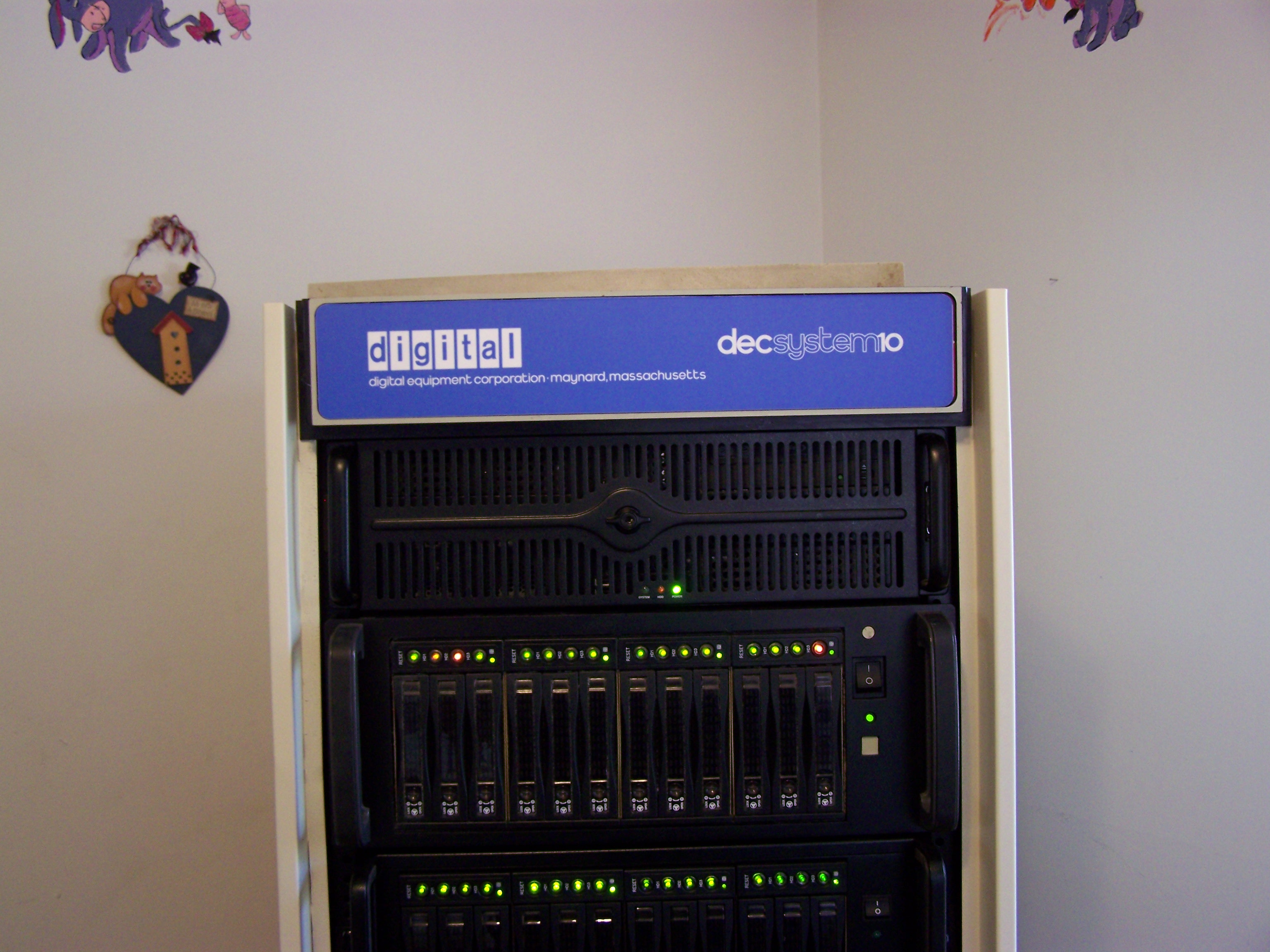
PDP-8e, PDP-11, and a DECSystem10 one (The first 2 were made from actual H960
rack banners. The last one was a whimsical one I created for fun.) I am not
at home right now, but I can look to see if I can dig up the art work. I
don't have one online of my PDP-8e one, but here are the other ones:
http://www.willys-overland.com/rack/100_3452.jpghttp://www.willys-overland.com/rack/100_3456.jpg
Todd Paisley
Re- the PDP-8 one I just scanned.. On the plastic thing on H-960 these
metal logo plates stick right into the front into the recess with gummy
stuff on the back of the metal.
Ed# _www.smecc.org_ (http://www.smecc.org)
In a message dated 12/26/2016 10:56:12 P.M. US Mountain Standard Tim,
ajp166 at verizon.net writes:
On 12/26/2016 04:14 PM, Tony Duell wrote:
> On Mon, Dec 26, 2016 at 9:07 PM, Paul Koning <paulkoning at comcast.net>
wrote:
>>> On Dec 26, 2016, at 4:03 PM, Tony Duell <ard.p850ug1 at gmail.com> wrote:
>>>
>>>> ...
>>> I hadn't realised that they were printed on aluminium. Ouch!. I also
>>> don't know how they are fixed to the plastic header panel, my plastic
>>> panel is 'empty' and I don't see any adhesive residue. Maybe some
>>> kind of double-sided tape?
>> No, the aluminum is adhesive-backed (with a rather potent adhesive).
>> It's similar to what you see in serial number plates on machinery. I
>> have somewhere a PDP-11 banner plate by itself, with the wax paper
>> backing covering the adhesive still in place. If your plastic bracket
is
>> clean looking, it may never have had the panel stuck to it in the first
>> place.
> Odd...The chap who gave me the rack removed the panel (and the fan,
> and the stabiliser feet) for transport and gave me a box with them in. He
> commented that as I was putting a PDP8e in it, I'd probably not want the
> banner that was there (I am pretty sure that the original contents of
this
> H960 was some kind of PDP11 system).
>
> Anyway, spend the day cleaning dust off parts, stripping the fan and
power
> controller, etc. I did not notice any adhesive residue on the plastic
header
> panel. And I think I would have done.
>
> So perhaps the header was blank, or the banner just pushed in (perhaps
> somebody forgot to remove the backing paper...).
>
> -tony
>
Sounds like the banner plate for my 11T (Qbus 11 in a 50inch rack) the
banner holder was such that it could slid in from the end if you took
off the plastic end stop. It has the PDP-11 in in the older reds scheme
on thin maybe .040" aluminium.
Allison
ok Tony and Rod let me know if pic gets though in other message later I
can try to scan in 11x 14 scanner?
when you get the art cleaned up SMECC museum would like hi res
copy too!
i have a few minutes till next post atomic holocaust movie comes on let
me go try the scanner
In a message dated 12/26/2016 8:57:12 P.M. US Mountain Standard Time,
rodsmallwood52 at btinternet.com writes:
On 27/12/2016 01:17, COURYHOUSE at aol.com wrote:
> Tony yes we have one with markings stating and for a 8M that fits in
> the plastic thingis at the top of H-960
> It is in the usual orange pdp-8'ish colors. Odd! Just found it today
in
> my house behid a old radio console. Do you need a pic?
>
> Ed Sharpe Archivist for SMECC
>
>
> In a message dated 12/26/2016 1:09:32 P.M. US Mountain Standard Time,
> ard.p850ug1 at gmail.com writes:
>
> On Mon, Dec 26, 2016 at 8:07 PM, Rod Smallwood
> <rodsmallwood52 at btinternet.com> wrote:
>
>> If you have a picture I'll see what I can do
> Thanks for the offer. But as yet I don't have a picture. I don't even
> know that the banner existed.
> All I've seen (and got) are the PDP11 ones. I _assume_ there was one
> for PDP8 systems, but
> assumptions can be dangerous.
>
> -tony
>
Hi
Would it be possible for me to have a picture as well? I can then
do some artwork.
If possible a scan (two parts is ok) else a photo with camera at right
angles pointing at the center of the panel.
Also a note of the panel size (H x W)
Thanks
Rod (Panelman) Smallwood
Tony yes we have one with markings stating and for a 8M that fits in
the plastic thingis at the top of H-960
It is in the usual orange pdp-8'ish colors. Odd! Just found it today in
my house behid a old radio console. Do you need a pic?
Ed Sharpe Archivist for SMECC
In a message dated 12/26/2016 1:09:32 P.M. US Mountain Standard Time,
ard.p850ug1 at gmail.com writes:
On Mon, Dec 26, 2016 at 8:07 PM, Rod Smallwood
<rodsmallwood52 at btinternet.com> wrote:
>
> If you have a picture I'll see what I can do
Thanks for the offer. But as yet I don't have a picture. I don't even
know that the banner existed.
All I've seen (and got) are the PDP11 ones. I _assume_ there was one
for PDP8 systems, but
assumptions can be dangerous.
-tony
In a message dated 12/26/2016 3:14:49 A.M. US Mountain Standard Time,
terry at webweavers.co.nz writes:
Over this Xmas break I've grabbed some time to add a few bits and pieces to
my Dick Smith System 80 website. Some on the list might find this stuff
interesting, hence the post.
For those who might not know, Dick Smith was a colourful Australian
entrepreneur (and helicopter pilot), who pioneered a chain of electronic
shops. These shops were like the Radio Shack of Australia. The first of
these shops opened in New Zealand in 1981 (or 1982?).
Here are selected pages from the first Dick Smith catalog advertising the
System 80 and accessories to us New Zealanders. The prices are
eyewatering. Sales tax on overseas goods was very high. I think one NZ
dollar was worth about 50 US cents at that time, maybe even lower.
Nevertheless I bought a System 80 as advertised! My wife nearly killed me,
as we were saving up to buy a house (opps!).
Anyway, the PDF is here:
http://www.classic-computers.org.nz/system-80/promotion-selected-pages-1st-d
ick-smith-nz-catalogue.pdf
If you want to see everything I've added, check out the top three entries
in this list:
http://www.classic-computers.org.nz/system-80/whats_new.htm
Tez
Tez - The thing that catches my eye is the S-100 expander so you can use
s-100 i/o devices!
Ed#
Over this Xmas break I've grabbed some time to add a few bits and pieces to
my Dick Smith System 80 website. Some on the list might find this stuff
interesting, hence the post.
For those who might not know, Dick Smith was a colourful Australian
entrepreneur (and helicopter pilot), who pioneered a chain of electronic
shops. These shops were like the Radio Shack of Australia. The first of
these shops opened in New Zealand in 1981 (or 1982?).
Here are selected pages from the first Dick Smith catalog advertising the
System 80 and accessories to us New Zealanders. The prices are
eyewatering. Sales tax on overseas goods was very high. I think one NZ
dollar was worth about 50 US cents at that time, maybe even lower.
Nevertheless I bought a System 80 as advertised! My wife nearly killed me,
as we were saving up to buy a house (opps!).
Anyway, the PDF is here:
http://www.classic-computers.org.nz/system-80/promotion-selected-pages-1st-…
If you want to see everything I've added, check out the top three entries
in this list:
http://www.classic-computers.org.nz/system-80/whats_new.htm
Tez
Hi,
Please forgive me if this OSI document is already on the web somewhere. I
looked but couldn't find it. I have a copy so I scanned it. It can be
downloaded at:
http://www.classic-computers.org.nz/blog/2016-12-25-OSI-CP1-technical-repor…
Feel free to link to it, or place it in other OSI repositories.
Merry Xmas
Tez