Hi All,
Just to let y'all know.. today I picked up a great set of
manuals, (original) diskettes and some hardware from Tim
Majoch, who, due to personal issues, can no longer enjoy
this crazy hobby we all share.
Saved are a full set of RT-11 manuals, the RX50 diskette
kits for 5.4F, some hardware diag diskettes, and some Qbus
boards that are most welcome to me (RQDX1 and DELQA - I
blew up my own RQDX1 *sigh*).
His two Micro11/23s also have found a new home - which is
good, because if they hadn't, I'd have forced myself to
load up two more suitcases, and get yelled at by KLM people :)
Cheers,
Fred-On-The-Move ;)
I've got a whole slew of pre-PPC Macs, parts, hard and floppy drives,
external CDROMs and other miscellanous odds and ends available if anyone's
interested; also a *ton* of old software for OS9 and earlier. CPUs include
several LC series, si's, at least one ci, an SE or two, a 512K, a
nonfunctional Plus, a Performa 550 (all-in-one unit) at least one Classic in
original box, with an IWII in its original box plus assorted cables,
keyboards and whatnot. Have a few extra printers around as well - various
Stylewriters and a couple of (unboxed) IWIIs which do work. Some CPUs have
been fixed up and are running, others are just as-found at my local
recycling area. Just don't have room for all these oldies so now that I've
indulged myself in a little nostalgia by fiddling with 'em I'm ready to part
with them, *free*.
I'm in suburban Boston (Needham, MA) and have no plans to ship any of this
but if anyone wants to communicate with me about taking some of this
material off my hands drop me a line. My regular weekly circuit takes me to
Salem, NH and to Hingham, MA so arrangements could be made to do a handover
in those locations as well. A perfect opportunity to acquaint yourself with
Systems 5, 6,7 and 8x.
Seth Lewin
sml49(a)comcast.net
I am selling a vintage computer collection that I have been working on
for almost 10 years. It contains many computers from many different
companies that span the late '70s, 80's, and early '90s. All systems
come with original software, manuals, books, magazines, videos,
keyboards, monitors, mice, etc...
I have also tried to collect very interesting and rare items including
an original 1978 Apple II Reference Book from Apple, twin Macintosh
512ks with some fantastic accessories, a complete TRS-80 Pocket II
Computer, and many other items.
I could not possibly list everything that I have so I created an
entire web site (not a page) so you can browse through the pictures,
background, statistics, and other information. I have treated these
systems with the greatest care and I think you'll see that when you
browse through the gallery.
If you're a fan of Commodore, Apple, Macintosh, Amiga, TRS-80, Timex,
etc...you'll at least want to browse my pages for a trip down memory
lane.
I'm asking: $575.00 OBO
If you have any questions, please do not hesitate to ask.
You can go to http://www.mmhart.com/Collection.htm for more
information, pictures, etc...
Thanks!
On Dec 30, 16:01, Robert F. Carson wrote:
> Hi Eric,
>
> I saw something you put on the web last year. Do you have an old
> Signetics data book? I'm trying to find a schematic for the inside of
a
> Signetics MC3361 chip. Can you help me. Thanks.
I'm not Eric (you sent this message to a mailing list), but maybe I can
point you in the right direction. The MC3361 is a "radio on a chip" IF
subsystem, not terribly old, made by Motorola and second sourced by
various companies. The MC3371 is very similar. You can find the
Motorola data sheets at
http://home.welfen-netz.de/IngoGerlach/9k6_pr/mc3361c.pdf and
http://www.iweil.com/devices/recievers/mc3371.pdf
The latter is particularly detailed, has a good description, and
several sample circuits.
--
Pete Peter Turnbull
Network Manager
University of York
Does anyone have a pinout for the AM26LS34 quad differential line
receiver chip? It's used in some later Acorn Econet products...
My databooks cover the '30 to '33 only, and a google search didn't seem
to find a datasheet.
-tony
In a message dated 12/30/2003 2:37:10 PM Eastern Standard Time,
nampcjr(a)yahoo.com writes:
<< Know someone working on a PCjr network, that is in dire need of some older
ISA-type (maybe the only type I guess) of IBM cluster adapters. Anyone have
any to give up or know where else to get them? >>
That does not compute. The PCjr does not have ISA slots.
Hello all!
Know someone working on a PCjr network, that is in dire need of some older ISA-type (maybe the only type I guess) of IBM cluster adapters. Anyone have any to give up or know where else to get them?
Thanks
Brian Heise
---------------------------------
Do you Yahoo!?
Yahoo! Photos - Get your photo on the big screen in Times Square
I recently aquired a Franklin ACE 1200. I understand that it is a Apple
II hardware clone that runs CP/M. Is there a good website that documents
this syetem that anyone can recommend?
Also, I have only a single boot disk. I'd be interested in more software
if possible.
TIA,
Eric
On Dec 30, 15:07, Richard A. Cini wrote:
> I'm going through some random sheets of semiconcuctor chips I
have in stock
> and came across the following numbers I can't identify
> COM5016/SMC8013
Baud rate generator
> LMC6494BEN (National, date 9724)
Quad opamp
> UM4382A (UMC, date 8802)
Sorry, don't know.
> MK5175N (Mostek, date 8425)
Ten-number dialler for a phone.
> Then, I found a DS8836 line receiver chip (120 ohm line). What
was this
> used for?
It's a common bus receiver, often used as a pin-compatible replacement
for the 8640 used by DEC (the 8836 is lower current and higher noise
immunity).
--
Pete Peter Turnbull
Network Manager
University of York
Ok all, since the IBM Cluster adapter thread started pulling some threads, I thought I would ask if anyone happens to know of the whereabouts of a Racore power supply that used a DB9 connector to hook into the Racore chassis !!! This is different of course from the standard IBM power supply adapter that powers the PCjr and the Racore Drive II 5.25/3.5" drive kits. One would be greatly appreciated, or schematics on how to convert a PCjr power sidecar brick into a DB9 capable alternative!!!!!
Brian
---------------------------------
Do you Yahoo!?
Yahoo! Photos - Get your photo on the big screen in Times Square
I've been reading over the datasheets for these four chips and have come
across a difference.
On the WD1771:
During the verify stage of a type 1 command, it will only check the
track number against the first ID record it finds. If the ID record has
a CRC error, it will set the CRC status bit and set the INTRQ. If the
Track field doesn't match the Track register, it will set the seek error
status bit and set the INTRQ. Otherwise it will just set the INTRQ.
It will not go looking for another IDAM.
The WD1770, WD1772, and WD1773 search through five revolutions of the
disk until it finds an ID record with the correct track value and a
correct CRC value.
Since I only have 1773s in my collection I can't test if the 1771
actually behaves this way. Does anyone know if the datasheets are
correct in this case?
Also, does anyone know how long the index pulse lasts for 8", 5.25" and
3.5" disk drives?
--
tim lindner
tlindner(a)ix.netcom.com Bright
Hi:
I'm going through some random sheets of semiconcuctor chips I have in stock
and came across the following numbers I can't identify and they aren't in
the 1994 IC Master books that I have.
COM5016/SMC8013
LMC6494BEN (National, date 9724)
UM4382A (UMC, date 8802)
MK5175N (Mostek, date 8425)
I also found the following chip which is some sort of high-current driver
that I'd like to get the data sheet on: NE5090.
Then, I found a DS8836 line receiver chip (120 ohm line). What was this
used for?
Thanks.
Rich
Rich Cini
Collector of classic computers
Build Master for the Altair32 Emulation Project
Web site: http://highgate.comm.sfu.ca/~rcini/classiccmp/
/************************************************************/
It would seem (at least to me) that while H960 racks are not all THAT
uncommon to find, the side panels are. Seems most of the ones I've seen "in
the wild" (and all the ones I have), do not have the grey side panels.
I believe I have seen others mention a lack of those side panels as well. I
would like to find one or two sets (of two) side panels. Does anyone have
spares? I know they won't be terribly cheap to ship. However, a friend of my
dads owns a large metal fabrication/welding place. If none can be found, I
was going to have him make me a set. If I go that route, and others are in
need, I could have him make extras. He would charge to do it, but I'm sure
it would be the "good guy" price.
Any thoughts?
Jay West
I have a friend whose business is about to die due to the lack of a
Procom CC-8 SCSI Enabler. If anyone has a spare one that they would let
go of, please let me know.
Claude Ceccon
On Mon, 29 Dec 2003 09:02:19 -0800, "Shannon Hoskins"
<pds3(a)ix.netcom.com> wrote:
> Is the DEC stuff still up for grabs?
I have takers for all the DEC parts. However, in all cases it's
dependent on shipping costs, etc. Still working on it. I'll put you in
line...
CRC
Hey all,
There are several items I'm looking for, these include:
PDP8A cards:
M8315 - CPU
M8316 - DKC8 Option Board #1
M8317 - KM8A Option Board #2
M8416 - KT8A 128K Memory Management Option
G8019 - BA8C Power Distribution Board
M8357 - RX8E - RX01/RX02 Omnibus Controller
Floating point cards for the 8A
E&L Items from the 70's or early 80's:
E&L outboards
Generally any E&L bread-boarding item
E&L doc's
MMD-1 or MMD-2 systems/docs
MMD-1 or MMD-2 add-on modules such as the EID-1
MMD-1 add on card (adds memory, cassette I/O etc.)
-Neil
Does anybody know of anything interesting places to visit for CC type
items in the Los Vegas area? A friend of mine will be visiting out there
for a couple of weeks and wants to see what he can find. Since Nellis AFB
and Groom Lake are close by are near by I'd think there would be some good
scrap in the area.
Joe
I couldn't wait, had to get the 11/45 off the trailer and dig around in it.
Upon first close inspection, the thing is FILTHY. It will take some very
major cleaning before attempting to do anything with it. However, from a
first looksee - it definitely doesn't look "beyond all recall", it looks
like it will clean up nicely. While very dirty, I can't see any rust
anywhere. Good sign.
Some pictures are at http://www.ezwind.net/jwest/1145
Questions...
There is a separate power supply at the back top of the rack, which powers a
DEC brand backplane mounted "pins forward" in the front. There's also some
lights & switches here. There's some flipchips in it, and lots of what look
to be D/A cards. Does anyone have any clue what this was used for? I took
extra pictures of this part - tried different focus settings & all so
hopefully some will be clear.
Looks like the machine has no FP option, and 8K of core memory. I haven't
decided what OS I want to run on this thing yet, maybe RT11, or RSTS, but I
was really hoping to run 2.9BSD or Unix 7 or some flavor of unix. That's not
gonna happen with 8K of core. I have some RL02's I could put on it. Anyone
want to trade the bits to make it use semiconductor memory in exchange for
the core backplane and core boards? Is FP required for anything I've
mentioned? I'll get it up and running on 8K to test & refurb, but definitely
want to go the semiconductor memory route so I can run one of the above
O/S's. Hey, can this thing use any of the memory boards I have in my 11/44?
Thanks for any advice!
Jay West
Hi everyone, before I put this on eBay, would anyone be interested in buying
this custom ZX-81 / TS-1000 installed in a custom keyboard/case? It's
processor is not installed and case is apart - untested. For pictures see:
http://members.aol.com/mtpro/ts.html
Please make me an offer. Best, David
On Dec 29, 12:54, Fred Cisin wrote:
> On Mon, 29 Dec 2003, Rob O'Donnell wrote:
> > But made me think, following on from a discussion of floppy formats
> > recently, I have an old ST506 style 10Mb HDD buried in the cupboard
for my
> > BBC Micro system. Now I can't remember if it's got ADFS on it or
an Econet
> > server partition, but probably the latter - are there any tools out
there
> > that could read this if I hook it up to a PC,
>
> Very little in the way of usable tools.
[...]
> > or am I best just connecting
> > it back to a Beeb and kermit'ing it all over?
>
> YES!!!!!
I agree with Fred, although the Beeb uses an Adaptec ACB4000 and in
theory you might be able to hook the drive+ACB4000 up to a PC with a
SCSI bus. However, you still have the problem of understanding the
data. Stick to kermit.
--
Pete Peter Turnbull
Network Manager
University of York
On Dec 29, 21:24, Marian Capel / Jos Dreesen wrote:
> My recently acquired 11/34 has an emulex board that has no
description.
>
> It assembly number is cu1110401, it has two 2901 bitslices.
>
> Any pointers as to what it could be ?
Yes, it's a comms card for unibus (CU). It's like a bigger version of
a DZ11, ie a serial port multiplexer. Unfortunately you also need the
panel(s) that goes with it, because some of the serial interfacing is
on the panel.
--
Pete Peter Turnbull
Network Manager
University of York
In all of my Emulex documentation, (plus past experience) makes me believe
it is a communication controller, as the "c" series were comm devices,
and usually it would be a CU11, but I can only find cc11 and cs11 devices
in my emulex books. "S" devices were usually disk related, and "T" were
tape.
Joe Heck
I could be mistaken...
Dan Morgan has a "van full" of HP150 items, available for pick up by
anyone who will drive over to New Hampshire and get it. Where in NH? I'm
not sure, but you can contact Dan to find out.
Reply-to: kml(a)metrocast.net
---------- Forwarded message ----------
Date: Mon, 29 Dec 2003 08:15:49 -0500
From: Dan Morgan <kml(a)metrocast.net>
To: vcf(a)vintage.org
Subject: HP150 stuff
Hello,
I have a small van full of various HP150 etc to give away to anyone or
anyorg that wants such. Includes HP150s, Harddrives, floppy drives,
printers, portables hp100s, software etc, etc. Hate to see this stuff go
off to the landfill if somebody can use/preserve it. Most all of it works,
We are still using an HP150-two with an impact printer. Would dearly like
to find replacement ribbons for the printer to keep that one on line. Any
help there? Otherwise the rest can go. I'm located in NH.
Regards,
Dan Morgan
kml(a)metrocast.net
29Dec2003
--
Sellam Ismail Vintage Computer Festival
------------------------------------------------------------------------------
International Man of Intrigue and Danger http://www.vintage.org
[ Old computing resources for business || Buy/Sell/Trade Vintage Computers ]
[ and academia at www.VintageTech.com || at http://marketplace.vintage.org ]
Spotted this on a UK auction site:
http://sumo.ebid.co.uk/perl/objects/auction.cgi?auction=1067709373-87555-0&…
Terrible description, though something of a bargain. (Seller has a few
other old bits too.)
But made me think, following on from a discussion of floppy formats
recently, I have an old ST506 style 10Mb HDD buried in the cupboard for my
BBC Micro system. Now I can't remember if it's got ADFS on it or an Econet
server partition, but probably the latter - are there any tools out there
that could read this if I hook it up to a PC, or am I best just connecting
it back to a Beeb and kermit'ing it all over?
Rob
On Sun, 28 Dec 2003 17:31:39 -0500, Chad Fernandez
<fernande(a)internet1.net> wrote:
[snip...]
> Just got back from Radio Shack. I bought a fast blowing 250v 2 amp
> fuse
> and installed on in the laserdisc player. Unfortunetly, it blows just
> as fast as the .75amp fuse.
[hack...]
There is a chance that after sitting all that time the filter cap has
become unpolarized. Every time you turn the thing on the current surge
required to charge the cap will blow a fast blow.
What you might try is to get a variac, turn it down all the way, attach
the laserdisk, turn it on and then slowly bring the variac to the full
voltage. This will give the cap a chance to repolarize without pulling
too much current. If the fuse still blows you probably blew the input
rectifier or something else expensive...
CRC
Not sure but subscribe to comp.sys.tandy and ask there
**********
Kevin Parker
Web Services Manager
WorkCover Corporation
e: webmaster(a)workcover.com
w: www.workcover.com
p:+ 61 8 8233 2548
f: +61 8 8233 2282
m: 0418 806 166
**********
-----Original Message-----
From: Bob Brown [mailto:bbrown314@comcast.net]
Sent: Monday, 29 December 2003 2:18 PM
To: cctech(a)classiccmp.org
Subject: getting trs-80 basic programs into pc text files (hp2000
programs)
Now that I've been able to rescue some apple-II based hp2000 programs
>from my old apple disks, put them in pc and load them to
hp2000 emulation, I turn my attention to my large archive of trs-80
based archives.
I took hp basic programs, downloaded them into my trs-80 (saved them as
basic code..of course it wouldn't run on the trs-80, but the trs-80
would hold the code just fine)...these are on cassette.
I know that several emulators for the trs-80 can take cassette
input..what I'm looking for is a path to get the programs loaded from
cassette
with the final destination being a pc text file which I can then easily
upload into my virtual hp-2000.
Any ideas?
thanks!
-Bob
************************************************************************
This e-mail is intended for the use of the addressee only. It may
contain information that is protected by legislated confidentiality
and/or is legally privileged. If you are not the intended recipient you
are prohibited from disseminating, distributing or copying this e-mail.
Any opinion expressed in this e-mail may not necessarily be that of the
WorkCover Corporation of South Australia. Although precautions have
been taken, the sender cannot warrant that this e-mail or any files
transmitted with it are free of viruses or any other defect.
If you have received this e-mail in error, please notify the sender
immediately by return e-mail and destroy the original e-mail and any
copies.
************************************************************************
My recently acquired 11/34 has an emulex board that has no description.
It assembly number is cu1110401, it has two 2901 bitslices.
Any pointers as to what it could be ?
Jos Dreesen
Hi Ray,
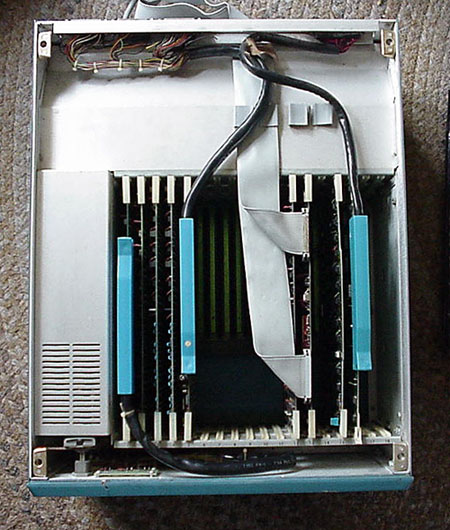
Ok I just pulled the card out of one of my 800s. The terminal connects
to the top center DB-25 connector on the back of the 800. Internally, all
six of those ports connect to one cable that plugs into the top of the
Monitor card. See <http://www.classiccmp.org/hp/mds-800/chas-ful.jpg>. (BTW
You do know that the CPU and FP cards need to be installed in specific
slots don't you? if not, then read
<http://www.classiccmp.org/hp/mds-800/mds-800.htm>. It details the card
order. The first two cards must be in the correct slots. If you have
emulator cards or disk drive cards remove them till you get the system
working, there's some installation specifics about them too). The toogle
switch on the Monitor card needs to be turned towards the card. On the top
RH side of the card are two LSI ICS. Directly below them are two rows of
jumpers (straps) to set the baud rate. The only one installed is the one
>from pad 25 to pad 26. I believe this cards is set for 9600 baud (or MAYBE
19200). I haven't used it in a while but it does work. I just grabbed some
terminal cables at random and the second one that I tried worked so it's
nothing specail. I use the same cable to connect to my SB-180. Down near
the bottom LH side of the card are a few more jumpers. These set the
address of the ROM. Mine has a circuit trace between ped 30 and 31. Your's
should already be set that way.
Once you get everything connected and turned on, press and release the
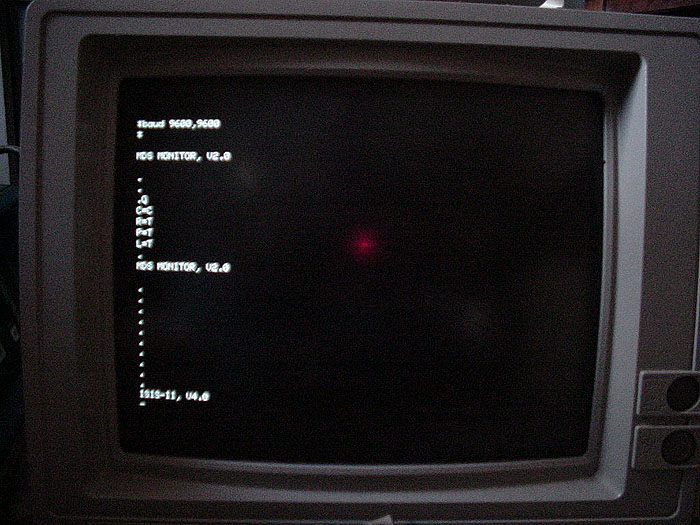
IRQ 1 switch to bring up the ROM monitor amd then press the space bar a few
times. You should get a display similar to
<http://www.classiccmp.org/hp/mds-800/alive.jpg>. You won't get the baud
message, that's from my terminal. You should get the copywrit message and a
dot prompt. You can enter Q to get a list of the I/O reassignments.
To boot the disk drive, first power everything up then load a disk in
drive 1, turn on the BOOT switch (top part down) then press and release IRQ
2. Once the OS loads, turn the BOOT switch down otherwise the CPU won't
register the terminal key strokes. You should get a message like that
shownn at the bottom of the picture above.
Joe
At 10:59 AM 12/28/03 -0600, you wrote:
>Hello,
>
>I saw your MDS-800 systems. I too have some of this stuff. I am trying to
>hook up a terminal to my 800 but having no luck. I have no docs. Do you know
>what connector & its pinout, baud rate, etc. to connect RS-232 to?
>
>Thanks,
>
>Ray
>
Hi Ray,
The connector and pinout are standard. The baud rate depends on the
settings of some jumpers on one of the cards (the Monitor card IIRC). I
think most of mine were set for 9600 baud when I got them. I think the
jumpers can also be set to make the port look like DTE or DCE. I'll have to
check on the jumper settings and get back to you.
Joe
At 10:59 AM 12/28/03 -0600, you wrote:
>Hello,
>
>I saw your MDS-800 systems. I too have some of this stuff. I am trying to
>hook up a terminal to my 800 but having no luck. I have no docs. Do you know
>what connector & its pinout, baud rate, etc. to connect RS-232 to?
>
>Thanks,
>
>Ray
>
Hi, I've just acquired one of these (9826) via ebay, (I remember using one 15 years ago at work).
The one thing I can't remember is whether HPL is supplied with these as standard, or whether all languages are options. (seems pretty daft to ship it without anything)
The other problem is I can't seem to find an HPL command reference/user guide anywhere.
Could you possibly help with either of these queries?
Rototype
On Dec 28, 23:07, Chad Fernandez wrote:
> Tony,
>
> the fuse itself has an "F" inside a "L" looking line. One circular
end
> has a symbol that I can't type and the other has a "237" "UL" and an
"SA".
IIRC, that F-in-an-L is the logo for Littelfuse. It certainly doesn't
mean fast-blow. You probably want a slow-blow fuse for a device like
this. Why? Because in many electronic devices, there's a surge of
current for a short while, when you first switch it on. This is caused
by the capacitors charging up, and is quite normal.
> I find one cylindrical cap that is 200v and 220uf and one 250v .1uf
cap
> that looks like a chicklet (kind of chewing gum). I don't have any
idea
> how to identify a chopper transistor..... could that possibly be
labeled
> "Q1" and have a heat sink on it? I also see a couple transformers
and a
> bunch of resistors an IC and assume most of the D#'s are diodes.
There
> are quire a few "Q#" labeled items too.
Yes, "Q1" is a designation for a transistor, normally. And the voltage
ratings for the capacitors suggest they're close to the mains, which
implies a sitching PSU, not a linear one. The small chicklet cap is
probably an X-rated or Y-rated suppressor cap. The transformers are
probably fairly small (an inch or two on a side), yes? For a linear
supply, I'd expect one big transformer, probably mounted on something
solid; one or more small(ish) ones are typical of a switcher. Anyway,
unless this laservision player is unusual, I'd expect such a device to
have a switcher.
--
Pete Peter Turnbull
Network Manager
University of York
'Tis time to make room around here so that I can get from one end of
the storage room to the other. The following items are up for grabs
(freebee!) - first to holler, first to be served:
**Working Stuff**
Sun Monitor GDM1604-15
Digital Storage Works BA353AF /w RR42-VE CDROM
DEC CRT VR320
Silicon Graphics CRT CM208643SG (modded to bring out sync input)
Sun Laser Printer QA6
Apollo CRT Mod 010700-001 (this unit has double the normal horizontal
freq.)
VAXStation 3500 - Complete unit - boots to the point where it starts
the RA70 which then makes strange noises...
**Parts are Parts**
Sun Four Disk Storage Housings PN595-3286-1 - Nice small four scsi disk
housing w/ps. No disks (2 ea)
Sparkstation 2 (2 ea) - no disk, no video
Sparkstation 10 (2 ea) - one has no disk and no video, the other no
disk, memory, video
Xerox 6993 (branded Sun model 544) - no disk, memory, video
DEC VXT2000+ missing memory card (2 ea)
VAXStation 4000-60 missing disk
Four PC cards from and Intergraph 2-1 workstation (National 32032):
memory, video i/o, i/o (scsi??), and CPU
The above items are in the Tucson, AZ area. I will ship, but you pay
the freight...
Hi Jay, I'm not sure if I'm posting to the thread or to you personally
but I wanted to pass on the following: After purchasing a huge
assortment of DEC stuff my inventory includes a bunch of H960 cabinets
and a stack of grey side panels. I would say the panels are in good to
fair condition. We are located in Melbourne, FL so anyone in need can
come by see them. I have also delivered a few on the I95 corridor. I've
been selling the panels for $20 to $25 each, and an H960 with 2 panels
is $75. I have a few back doors as well for $25 and I have blank front
panels of various sizes. If this doesn't make it to the proper thread
please let me know how to get it there.
Thanks,
Thom
This message may contain confidential, proprietary or legally privileged
information. It is intended only to be read by the individual or entity
named above or its designee. If the reader of this message is not the
intended recipient, you are on notice that you must not, directly or
indirectly, use, disclose, distribute, print, or copy any part of this
message. No confidentiality or privilege is waived or lost by any
mistransmission. If you have received this message in error, please
immediately notify the sender and/or TARINC by telephone at (321)
768-0006 or email at webmaster(a)tarinc.com and delete or destroy any copy
of this message.
Now that I've been able to rescue some apple-II based hp2000 programs
>from my old apple disks, put them in pc and load them to
hp2000 emulation, I turn my attention to my large archive of trs-80
based archives.
I took hp basic programs, downloaded them into my trs-80 (saved them as
basic code..of course it wouldn't run on the trs-80, but the trs-80
would hold the code just fine)...these are on cassette.
I know that several emulators for the trs-80 can take cassette
input..what I'm looking for is a path to get the programs loaded from
cassette
with the final destination being a pc text file which I can then easily
upload into my virtual hp-2000.
Any ideas?
thanks!
-Bob
I have a pair (3 actually) of the above terminal servers - I have them
cabled up, yet the two I have connected seem not to play well together...
the remote terminal (a VT220) displays :
>XDS90L-321, Connection Not Established - Network Not Connected
The other unit is connected to a port on my 11/44, also known good, tested
and working locally to the machine. The first two green leds are on , the
led next to the MMJ ports flashes when I transmit data, but the '#' light
remains, sadly, dark.
I have used a couple of known-good 50 ohm BNC cables between them, tried
powering them down and up while connected - no joy.
I have Googled mightily - found a bunch for sale, lots of references to
them, quite a bit of really esoteric data - but no "User Manual" yet -
save for the pointer to one on a now defunct Compaq site.
So I'm wondering if anyone with some experience with these little
beasties could afford me a clue or two? All I want is a pair, one in the
"Machine Room", one in my office, and a cable (or wireless setup) between
them.
Thanks In Advance!
Cheers
John
Hi all,
I went to Radio Shack last night to buy a fuse for my laserdisc player.
I needed a 125v 2amp fuse. Most of the fuses I saw were rated at
250v. I bought a 250v .75amp fuse, thinking that if I up the voltage I
have to lower the amperage. The new fuse blows instantly. Am I
thinking about this incorrectly? Now, I'm thinking I was wrong since
the fuse still only has 110 voots running through it..... so do I still
need a 2 amp fuse even if it's rated for 250 volts? Can I use a 250volt
2 amp fuse safely?
I mentioned that the .75 amp 250volt fuse blows instantly..... does this
indicate that another problem exists, or would the laserdisc player pull
more than .75 amps? The player has been sitting in my living room,
hooked up, but unused for months. I have had electrical storms here of
course, but all my equipment is on a surge protector, and nothing else
has gone bad.... (amps, dvd player, tv).
Chad Fernandez
Michigan, USA
I recently got a few parts together to build a 486 computer to mess around with OS/2 warp 3 and a few other old OS's.
Now that I got the system together I find the motherboard is dead, my other boards are PCI so I cant use them.
Anybody have an old 486 socket 3 motherboard they dont need? Has to have at least 2 VLB slots and no pci slots. Boards with 72 pin memory slots would be nice but not necessary since I have 30 pin simms around here. I will need a processor also if I cant use my AMD 486/120 or 486/133 on it. The board I have has a 486/66 but I am not sure if its dead or not.
The reason I want VLB is to use my promise IDE caching controller and the Diamond stealth 64 VRAM (with expansion memory board) VLB cards which were pretty fast in their day, that and I dont have an old world VESA machine to mess with.
If you have a board let me know and we can work something out.
>Your mystery card is a security device
>
>MPPi, Ltd., 2200 Lehigh Ave., Glenview, IL 60025 Phone: 312-998-8401
>
>Google a bit it only took 2 attempts for this one.
>
>Device was known as pc-lock, you apparrently have the first model
>
>pc lock II is much better put together.
I had guessed at it being a security card of some kind. I had found that
google hit, which is why I made that assumption.
You however are the first source I have found that can seem to confirm
that fact.
Any idea what it was used for, or was it like many security dongles, a
company bought them and included the checking code in their software, so
it could be for just about anything.
-chris
<http://www.mythtech.net>
As some of you may remember, back in August I started having problems
with my PDP-11/83.
First, the breaker would trip at odd intervals. I moved all the boards
to another box and found that I started getting clock errors. Today,
after many months of being too busy to do any thing more, I took the
power supply from the 2nd box and installed it in the original 11/83
box. After moving all the cards back over and re-connecting all the
cables I finally got the system to boot, no errors! Yay!
On another note, I should have the PDP-11/73 that sits in a desk within
my cube at work up and going soon. The RD-54 arrived yesterday, and I
should be receiving a TK-50 within the next couple of days. After that,
I'll put BSD2.11 on the drive and place the thing on the net.
http://www.smecc.org/arthur_roberts_-_physics_songs.htm
Thanks Ed Sharpe archivist for SMECC
Please check our web site at
http://www.smecc.org
to see other engineering fields, communications and computation stuff we
buy, and by all means when in Arizona drop in and see us.
address:
coury house / smecc
5802 w palmaire ave
glendale az 85301
Hello,
I saw your MDS-800 systems. I too have some of this stuff. I am trying to
hook up a terminal to my 800 but having no luck. I have no docs. Do you know
what connector & its pinout, baud rate, etc. to connect RS-232 to?
Thanks,
Ray
I picked up my 11/45 in TN today, and bought the trailer it was on as well.
Just finished pulling it into the garage. Fortunately, it is very well
packed in cardboard and shipping blankets and tiedowns. However,
unfortunately, my car can't make the curb to get it around the back. So I
have to wait till tomorrow, when a friend comes over with a truck with a
hitch. Then after it's moved to the basement I'll be able to pull the cpu
drawer out and find out just what kind of cpu is in it, what kind of (and
how much) memory, etc. Yay! I'm excited :)
Jay West
Jay,
I have the 1976-77 PDP11 04/34/45/55 processor handbook and
the 1978/79 PDP11 04/34/45/55/60 processor handbook originals. If you
don't find one to keep, you may certainly borrow one or both. Ah hell,
you can keep them, I'll never put one of those systems together and they
have been looking for a good home. Send me an address to mail them to.
regards,
Joe Heck
Hi,
has anyone got any data on the UM8297 floppy disk controller IC?
I found one on a tiny ISA board in the loft the other day (labelled
"FDC-III"). I was hoping it might provide a little more flexibility in
reading non-PC floppies on a PC machine (specifically Acorn BBC - none
of the spare PC motherboards I have kicking around happen to have floppy
controller ICs that do this)
Using the ISA board in a PC with the on-board floppy disk controller
disabled, the drives seek on startup as expected but I can't get any
data from floppies put into them (known-good MSDOS-format disks,
known-good drives, and a known-good data cable). Tried using both DOS
and Linux.
A few thoughts:
1) The controller IC might be broken; I don't know its history. The fact
that it's doing a seek on startup makes me think it's at least
semi-alive though.
2) The motherboard fdc IC might somehow get in the way for data
transfers, despite being disabled in the BIOS (bad design if so!)
3) The chip might need some specific setup from DOS before it'll work
correctly.
4) The chip might be expecting a specific floppy drive type or types to
be attached, or set up in a certain way. I've only tried known-good high
density 5.25" and 3.5" drives so far.
5) Maybe the IC doesn't emulate any kind of standard PC floppy
controller chip, and needs a whole complex driver to function. Yuck.
I'm hoping on 3) or 4) at the moment, with 3) being more useful to me!
If I fit a 5.25" drive say, and set it up as a 3.5" drive in the
motherboard BIOS, then the system halts on startup with a floppy disk
failure as expected - so it does look like the BIOS is trying to talk to
the ISA board with the IC on it and knows that it's there.
There's very little on the ISA board itself - the IC itself, a pair of
7406 chips, and some clock circuitry. No configuration on the board
whatsoever.
As I say, maybe the board isn't strictly DOS-compatible without a
driver, or designed to do some oddball task.
cheers
Jules
(waiting for hangover to go and eyes to start working correctly...)
I was cleaning my office as I prepare to retire, and found several DECtapes
with programs I wrote for a PDP-9 in the mid 70's. I have no listings
available, but would like to read these programs if possible.
--
I have a working DECtape system that can read these. I'm located in
Silicon Valley.