Hello,
The person that refered me to my present job at a datacenter passed away
this past monday. He was a hardware / software engineer for modcomp
computers. He left me all of the computers and documents. there are too
many books to keep, stuff concerning the modcomp computers that is not
saved anywhere else that i can tell.
I have picked up storage containers for all the books, and i can scan it
all. after that, its all probally going in the recycle bin, as i dont know
where or how i would keep such a large pile of paper manuals on hand.
what is the prefered format to upload things to bitsavers in? is pdf
acceptable?
How can i create a pdf that is not too big on file size? Can the text be
recognized and be made searchable within the scanned pdf?
any input would be appreciated, Thanks.
--Devin D.
> From: Mark Kahrs
There's a typo in your original Subject: line: the KL11 is a very early UNIBUS
(probably the very first UNIBUS device ever, looking at the board's Mxxx
number) asyn serial line interface:
https://gunkies.org/wiki/KL11_asynchronous_serial_line_interface
> manx tells me that these documents were known to exist:
> ..
> But they are not online.
I couldn't find out anything about the KM11 with a Web search, but I did see
that it's in the DEC PDP-11 fiche set. My set does have the KM11 Tech Manual.
I've never heard of the KM11, and as I said, there's nothing about it online.
Is it worth doing a CHWiki page for it? (With the fiche, it would be pretty
easy to whip up one covering the basics: functionality, component boards, etc.
> So I can't say whether they are 18 bit compatible.
Huh? The KM11 doesn't plug into the UNIBUS (or QBUS); it's a MASSBUS device (a
solid-state storage device, actually), so it plugs into an RH11 or RH70 or
something like that. (I should work with the VAX MASSBUS controller, too.)
So the question 'is it 18 bit compatible' makes no sense.
Noel
I've read that there is circuitry in the expansion base (BA40A?) has circuitry . Does anyone know what the circuitry does? Is it required for SCSI operation? (I hope not, or I'll have to kludge one up to make use of pk2k SCSI boot-roms!)
> From: Paul Koning
> But the sector format is a different matter. If it's designed for
> PDP-11 and friends, presumably it has a 512 byte sector size. For
> PDP-10 or -20 use you'd presumably want a sector size consisting of
> some round number of 36 bit words.
Actually, the -10/-20 MASSBUS situation is even more complicated than that.
The MASSBUS can operate in 16 or 18 bit data width (for everyone else; this
is totally different from the Q16/Q18/Q22 of the QBUS, which is _address_
width), so it can support 36-bit words directly, using two extra data lines.
So for the RP04 and other disks, and their 'controllers' (at least, the part
that's in the device), they have to be able to turn the bit-stream from the
mass storage device into 18-bit wide words. (And they actually have different
sector formats depending on whether they are in 16- or 18-bit mode.)
What the KM11 does, I don't know (I'm too lazy to go look at the TM); I would
not at all be suprised to find that it can _only_ operate in 16-bit mode
(i.e. the array of memory chips is 16 bits wide, and it just ships a line at a
time from that out in parallel, so there's no way to even produce 18-bit wide
words). The name of the device (KM11) adds weight to that supposition.
Noel
Subject: Re: PDP-11/73 boot issues
References: <87ilytoikj.fsf at carbon.nat.rhwyd.co.uk> <CADBZjLYN9aUTDHJ6=XJwNnNefTUbzyZis4evRS1Coy2r9xcX5w at mail.gmail.com> <87fstxohuj.fsf at carbon.nat.rhwyd.co.uk> <edde8fc9-6e38-3215-970f-34b9f3a95ce0 at alembic.crystel.com> <21789e85-2aa4-3b61-db31-b21fd8c08a03 at dunnington.plus.com> <87czp1obv4.fsf at carbon.nat.rhwyd.co.uk>
User-agent: mu4e 0.9.18; emacs 27.2
In-reply-to: <87czp1obv4.fsf at carbon.nat.rhwyd.co.uk>
Aaron Jackson via cctalk writes:
> Pete Turnbull via cctalk writes:
>
>> On 21/09/2021 20:34, Chris Zach via cctalk wrote:
>>> Can an MXV11 be used in a 22 bit system? I thought it was an 18 bit
>>> device?
>>
>> MXV11-B is 22-bit. MXV11-A is 18-bit but supposedly can be used in a
>> 22-bit system if the RAM is disabled.
>
> Yeah this is a 22 bit card. Josh sent me an xxdp image which I could
> easily boot from my scsi2sd (thanks!). Seems to be reporting an error
> with the CPU unfortunately:
>
> ]] .R ZKDJ??
> ]] ZKDJB2.BIC
> ]]
> ]] ERROR WHILE TESTING BOARD FUNCTIONS
> ]] ERROR # =001166
> ]] ERROR PC =040662
> ]] 043632
>
> This happens regardless of whether W9 is installed or not (supposedly
> disables the LTC register on the CPU?)
>
> I'll see if I can borrow another CPU card form a friend this
> weekend. Unless anyone else has any ideas? Another suggestion on IRC
> was to disable the PSU LTC and enable the LTC on MXV11 but will need to
> look up some details on how to do this.
Had a nice cycling trip this evening to pick up a spare 11/73
card. Unfortunately it did not fix my issues so I'll have to do some
more digging.
Has anyone disconnected the BEVENT line and used a signal generator to
provide the LTC? Curious to try this to figure out if mine is just being
noisy or something.
Thanks,
Aaron
On Wed, 2021-09-22 at 12:00 -0500, cctalk-request at classiccmp.org wrote:
> Currently the Hobbyist Program covers Alpha and Itanium.? We?ve been
> told it will cover x86 at some point.? I for one can?t wait for x86,
> as I don?t really want to add an Itanium to run some of the newer
> software.
>
> Zane
Not even that... looked at the VSI stuff and it is only the newest
Alphas that are supported. 21064/21164 and, I believe, 21264 are not
supported by any release licensed by VSI, and they changed the PRODUCER
key so you can't use those PAKs on DEC/CPQ/HP variants of VMS.
HP stopped issuing new hobbyist PAKs back very early in 2020. I put in
for a renew March or so and never got it. They were so disinterested in
the program that they didn't mention stopping it, so I guess it isn't
surprising that the page is still up.
Isn't VMS DCL pretty close to RSX? Never used RSX, but that is what I
was always told. Anyway, good system, pretty solid, expect to do a LOT
of typing for commands if you're used to UNIX, and don't put any VAX
with a public DCL account on the Internet because there is a huge
security hole in DCL that was never fixed for VAX.
Hopefully a few of the DEC/VMS fans here might be able to help!
I'm on a bit of a quest. I've been given some old VAX/VMS software -- a
cross compiler and some source code -- that I'd like to get running. My
goal is to get the source code building and experiment with the compiler
a bit.
Problem is that I've never used VMS before, and don't have a clue how to
install or use it.
Can any point me to an idiot's guide to VMS, how to set it up and make
it possible to send files to it from my Linux box?
I'm thinking of using SIMH, unless there's a better emulator available.
I'm still waiting on a reply from HP with a hobbyist licence PAK (I've
filled out the form), but I figure I can get started on the learning
while I wait.
Cheers
Phil.
Hi, Chris,
Where are you, and how long is that cable? I believe that I have a
spare that's around 18".
As luck would have it, I'm moving, and today I'm sorting and culling
the graphics cable tub anyway. If I have a spare I'll save it out.
Doc
I now have a 4-plane color graphics card for my VAXstation 2000, and I'd like to actually connect it to a display.
Does anyone have a DEC BC19S cable that needs a good home? For reference, this has a DA15F connector on one end that plugs into the VAXstation, which leads to a box that screws into the back or base of a display and has the RJ11 and Mini-DIN-7 jacks for keyboard and mouse, and then has three short BNC cables coming out of of it for color video.
I have the parts to make a breakout box if I have to but that'd be more of a pain than giving someone money and having a thing arrive in the mail. :)
-- Chris
A few details for the curious:
It's housed in a BA-11 box with 3 controller cards.
The Massbus paddles fit into that box and terminate in flat ribbon cable,
not the massive cables.
The DRAM chips are 4116s.
manx tells me that these documents were known to exist:
PartTitleStatus
EK-0ML11-TD *ML11 Technical Description
<https://www.vt100.net/manx/part/dec/ek-0ml11-td/>*
EK-0ML11-TM *ML11 Technical Manual
<https://www.vt100.net/manx/part/dec/ek-0ml11-tm/>*
EK-0ML11-UG *ML11 User's Guide
<https://www.vt100.net/manx/part/dec/ek-0ml11-ug/>*
But they are not online.
So I can't say whether they are 18 bit compatible.
Hello,
I had asked this question on the tuhs discord channel, no response yet so i
figured i would try here.
I'm working to get my pdp 11/34 and 11/45 running. I was curious what
versions of unix or bsd would work on the machines i have. I wanted to set
up the systems with a bunch of dumb terminals and show them off at a local
maker fair.
If possible too, id like to be able to telnet in to unix or bsd.I was also
curious if a ethernet interface exists for my unibus systems, or if i could
SLIP/PPP serial to another machine,so i could telnet in as well as use dumb
terminals.
On a bit of a side question, did minix exist for the pdp11? There is
mention of it on wikipedia, but ive not found much other mention of it. I
read the minix book, and have used it quite a bit on the ibm pc, so i
figured i would ask if a copy for the pdp 11 is out there.
--Devin D.
Ok, so out of the basement came a Micrapolis 1325 (the old Dec RD53
disk) with what appears to be stuck heads. Rotor tries to move under
power but can only take out slack. Will move backwards a bit.
Is this stuck head, and what would be the best way to free it? The
reason I'm asking is this disk had a SA1000 adapter mounted under it so
I am pretty sure it was a PERQ disk. Which means data may be priceless.
And of course it's stuck.
Thoughts?
CZ
Clive Sinclair died at 81 after a long illness (probably not Covid)
'course now he is touted as being "the inventor of the pocket calculator"
(as with all "FIRST"s, it leaves out a few predecessors,such as Busicom
(1971, whose contract with Intel led to the 4004), Kilby's 1967 "Cal Tech"
at TI, etc.)
I'm not sure, but the HP35 might even have preceded the Sinclair
calculator.
As with all "FIRST"s, an entry can be saved by redefining the field.
Sinclair's was probably the first one costing 5 pounds or less.
..the compatible Device for the Labtool-48 is the Dataman-48, Software
is here: https://www.dataman.com/dataman-4848lv-resources
Regards,
Holm
----- Forwarded message from Holm Tiffe <holm at freibergnet.de> -----
Date: Wed, 22 Sep 2021 07:45:32 +0200
From: Holm Tiffe <holm at freibergnet.de>
To: Jonathan Stone <kiwi_jonathan at yahoo.com>
Subject: Re: Burnable, patched Microvax-2000 SCSI-boot EPROM images?
Ok..sounds good so far..
I have an Labtool-48 Programmer for example..thats an old Promer with an
parallelport. Software is available for an OEM Device and I'm using that.
Forgot in the moment what this was..but I can check that later.
There are at least 3 Versions of the Promer that are more or less
incompatible to the others, there are "upgrades", with other PCBs in
there..last variant is able to do USB..
I'm owning the "plain" variant.
Another from my stuff is an HiLo ALL07, and I have German made GALEP III
and GALEP IV. All with Centronics Interface.. good Promers.
I think it is ok to have old programmers (and old
programmer-conterollers (old Laptops)) dedicated to them.
I never had to program 3,3V Eproms an such things.. every time old
Devices like Eproms, GALS or even TTL ROMs. 82S100 too..
I'm a german.. and sending Eproms from here seems to be the worst case
to me...
Regards,
Holm
A
A
A
A
A
A
A
A
Jonathan Stone wrote:
>
>
> On Tuesday, September 21, 2021, 05:39:23 AM PDT, Holm Tiffe via cctalk <cctalk at classiccmp.org> wrote:
>
> >I've tried this almost 2 years before..and it worked "somewhat".
> >An VS2000 booted up in the first stage but the NetBSD Kernel couldn't
> >mount root since nothing in the loader expected a disk at the NCR SCSI
> >interface on the VS2000. Ragge agreed to look at this (bootcode) on my
> >VS2000, but I'vwe couldn't get an ssh connection from the internet to
> >an VS3100 M76 to which the VS2000 console was connected to..to work..
>
> I once "owned" the NetBSD MIPS port, and I've done VAX assembly and kernel code j(e.g., VMS device drivers). If I can't figure it out by comparison to 3100 code, I'll contact Ragge and set up remote access via a BCC08, a NetBSD laptop, and serial. (At least one of the VS200s is jumpered to Vaxstation mode, and I have two GPX daughter-cards on order.)
>
> >For yure I could burn the proms, but I think I'm on the other side of
> >the pond..
>
> I am located in the San Francisco Bay Area. I came here for grad school and never left.
>
> It may be time for me to buy a PROM programmer. Anyone got recommendations for a budget device? "Amazon's choice" is https://www.amazon.com/dp/B082D5NQ2P. The costlier option includes 10 different sockets, and it claims support for 29xxx and 29Cxxx EPROMs, plus lots of others.
>
> The DEC-badged Data-IO " on eBay is tempting, but expensive, and I don't know where to find software.
--
Technik Service u. Handel Tiffe, www.tsht.de, Holm Tiffe,
Goethestrasse 15, 09569 Oederan, USt-Id: DE253710583
info at tsht.de Fax +49 37292 709779 Tel +49 37292 709778 Mobil: 0172 8790 741
----- End forwarded message -----
--
Technik Service u. Handel Tiffe, www.tsht.de, Holm Tiffe,
Goethestrasse 15, 09569 Oederan, USt-Id: DE253710583
info at tsht.de Fax +49 37292 709779 Tel +49 37292 709778 Mobil: 0172 8790 741
I have noted that the Computer History Museum has a number of
donations from XKL re Toad1.
Rich Alderson might be the resident expert for this set of questions.
two questions are thus prompted, and a third teased.
1. Does that XKL version run on the KLH10 emulator?
2. Is the tape CHM has been archived anywhere it might be available
for download?
and the teaser
3. Has anyone created an SSH Server for TOPS20?
thanks
bob smith
It turns out the Priam 806 8-inch SCSI HDD circa 1984 is likely the first
HDD to have a native SCSI interface. It shipped a few months before the
Xebec Owl which is likely second. AFAIK all earlier units had a bridge
controller to a more conventional interface.
If anyone has any different info as to dates and models I would appreciate
it.
Does anyone know where a Priam 806 might be, or have any documentation? The
former probably belongs in a museum and the latter on Bitsavers. I will
help facilitate either.
Tom
t.gardner at computer.org
Hello all,
I have a Data General Model 5220 MT terminal I picked up recently. Sadly, no keyboard. I am trying to find out if the terminal will use a standard AT keyboard (based on the connector) or if I need to find a special DG keyboard. Any help is appreciated.. in fact any information about this device is appreciated.. I?m finding nothing about this terminal on the interwebs!
Thanks!
Other places to post this:
Sun Help Rescue list - mostly Sun but there is interest in other stuff
too. http://www.sunhelp.org/mailman/listinfo/rescuehttp://www.irixnet.org/ , forum not mailing list but seems to have
taken over from Nekochan for SGI stuff.
Sadly don't know of much in the OVMS sphere, the openvmshobbyist forum
is basically dead now.
Reminder - The Kennett Classic Vintage Computing event is only 5 days away!
Many have already pre-registered for the all day vintage computing workshop
and there are still spaces for exhibitors available. After we break for
dinner there will be a chip tunes show from 7PM - 11PM
115 S. Union St.
Kennett Square, PA
(across the street from the museum shop)
484 732 7041
What to do in Kennett Square? Here is a sampling of restaurants within
walking distance of the event space - bring the family!
https://www.kennettclassic.com/while-at-kennett-classic-food/
Hope to see you there!
Bill
kennettclassic.com <----directions and registration here
Given the hot real estate market, I've received an unsolicited
offer to purchase my office building and I'd like to accept it.
This means disposing of a great deal of classic computer stuff in
the next 30 days. I need to let go of what isn't sparking joy,
as they say these days. At least I saved the pieces. What will
best let me part with it is knowing that it went to someone who
also appreciates it.
I'm located in Jefferson, WI, halfway between Madison and Milwaukee.
I'd prefer in-person pickup over shipping, as I have a shortage of
time and adequate shipping boxes for heavy stuff.
Sure, I'll take cash but I also realize I may need to be giving
it away. I'm debating how to do it. Facebook Marketplace?
eBay pick-up only? Just here on CCC? A web site? I'll work on
a more detailed list and pics of what has to go and I'll figure out
the best way to post. Yes, it's unfortunate that I didn't take
a van-load to VCF Midwest a few days ago.
Off the top of my head, a Microvax, a MicroPDP-11, an 11-23,
a Vaxstation, a Kaypro, two CBM PETs, a Tandy M-100 or two, a
Zilog development system, two PDQ-1, a Sage, some S-100 cards,
piles of other cards for various systems, probably a pile of Amiga
stuff (A500, A1000, A2000, A3000, Toasters, early developer docs),
some C-64 or C-128 and software, some Apple II and clone stuff,
Macs from classic on up, a great deal of 3D related software and
manuals from 80s/90s for Amiga/PC/Mac/SGI, several SGIs, a Play Trinity
video system, Palm handhelds and developer stuff, Compaq and HP
handhelds, a Pertec 9-track, an ASR-33, bare 8-inch drives
and cabling, a number of tube monitors of sizes from large and
SGI and Trinitron down to smaller terminals. A serial terminal
or two. A few dot-matrix printers and lasers and ink-jets.
A stack of Pentium Pro 200 chips, bags of other CPUs and older
memory chips.
I have either the world's largest or second-largest collection of
Terak computers, on the order of a dozen, and nine or ten need to go.
Plus other interconnecting stuff, BNC cable, serial and parallel, etc.
Docs like a decade of SIGGRAPH proceedings, Inside Mac, years of
MSDN CD sets (Intel/MIPS/AXP era), sets of late-80s early-90s
computer magazines (inc. early BYTE and Kilobaud and Dr. Dobbs,
Amiga mags, video industry mags).
A pile of early WISP outdoor WiFi era antennas (dishes, panels,
directionals of various dB, N connector) and associated heavy coax.
Plus a fair pile of more "contemporary" PC stuff from the last 20 years.
Misc cards, VLB, EISA, etc. A bunch of PCs, plus IDE and SATA drives.
Many misc. consumer firewalls.
Some odd laser and optical stuff. A number of older lab-quality
microscopes like a projector scope, several desk microscopes,
a black Leitz Ortholux, an articulated standing Zeiss surgical scope.
A Leitz Focomat II photo enlarger and all the extras.
An AMRAY electron microscope.
And just to put fear in your heart, what doesn't go will go to you
will go to the electronics scrapper and the dumpster.
Send me an email...
- John
Per https://www.tuhs.org/cgi-bin/utree.pl?file=2.9BSD/usr/doc/2.9_kernel.ms
2.9BSD had a driver for it.
On 9/20/21, cctech-request at classiccmp.org <cctech-request at classiccmp.org> wrote:
> Send cctech mailing list submissions to
> cctech at classiccmp.org
>
> To subscribe or unsubscribe via the World Wide Web, visit
> http://www.classiccmp.org/mailman/listinfo/cctech
> or, via email, send a message with subject or body 'help' to
> cctech-request at classiccmp.org
>
> You can reach the person managing the list at
> cctech-owner at classiccmp.org
>
> When replying, please edit your Subject line so it is more specific
> than "Re: Contents of cctech digest..."
>
>
> Today's Topics:
>
> 1. DEC ML11 (Mark Kahrs)
>
>
> ----------------------------------------------------------------------
>
> Message: 1
> Date: Mon, 20 Sep 2021 10:47:46 -0400
> From: Mark Kahrs <mark.kahrs at gmail.com>
> To: "General Discussion: On-Topic Posts Only" <cctech at classiccmp.org>
> Subject: DEC ML11
> Message-ID:
> <CAEokdfcZ3YZZQ7UuYjV0VEy-AJV2R6CkZH+K6aCJC2gXBAH3vg at mail.gmail.com>
> Content-Type: text/plain; charset="UTF-8"
>
> I've been working on a newly donated PDP 11/70 at the LSSM. I just
> discovered it has a ML11 --- an early Solid State Disk. Does anyone know
> of any schematics, user guides, etc?
>
> Thanks!
>
>
> End of cctech Digest, Vol 84, Issue 14
> **************************************
>
I've been working on a newly donated PDP 11/70 at the LSSM. I just
discovered it has a ML11 --- an early Solid State Disk. Does anyone know
of any schematics, user guides, etc?
Thanks!
Went over to chip away at the Bob basement, and this time Alex came with
me. This is not a bad idea as if one of the piles shift and I get stuck
it would be nice to have someone there to call 911. Anyway we cleared
out a lot of the stuff in the tunnel to the Perqs including:
A Franklin computer, in box.
A TRS80 Model 3
An Apollo 3500 or so server box (heavy)
A Sun2 something
A sun 3/60 (I remember these!)
A Sparcserver 10,000 (heavy beyond belief)
Some sort of an IBM AS400 thing (also heavy)
An Apple II/e.
Few more hard drives
Weird scope like things
The good news is the way to the MicroVax and the Perqs are clear. The
bad news is these are Perq2's which are bulky and there is still a
pedestal mounted Sun 3/110 in the way.
Moral: Do not die with a lot of this stuff in your basement. We were far
more able to move this stuff 30 years ago when we were young than today.
We may need more people. 2 hours of working that pile left us both
trashed. Ian, want to come over sometime?
C
Clive SInclair was a British entrepreneur who designed and built very small
computers back in the early days of 8-bit computing. Whether he created a
'first' as Fred argues doesn't lessen his role in microcomputing history.
Let's celebrate pioneers who gave us what we have today.
Happy computing.
Murray ?
Hello,
You mentioned a VAXstation and a Microvax. What encosures are they in? (That will affect shipping costs).
Is the micro-pdp/11 in a BA23 with complete skins?
thanks
-Jonathan Stone
Only 9 days until the 2nd-annual Kennett Classic
URL for more info: https://www.kennettclassic.com/
Download flyer:
https://www.kennettclassic.com/kc2/kennett-classic-flyer-KC-II.pdf
WHAT: Our yearly event to celebrate another year of operations.
WHERE: 115 S. Union St. Kennett Square, PA USA (Between Philadelphia and
Baltimore). The venue is called "The Garage", it's a large ventilated
building located across the street from the museum.
WHEN:
[ 8AM ] the workshop / hackerspace opens
[ 12 Noon - 5PM ] - open to "the public" exhibits
So far we have about 10 exhibits - We could use a few more, please inquire
if interested.
[ 5-7PM ] - Retooling for the music performances / Dinner
There are a dozen restaurants within walking distance and lots to do in
Kennett Square, PA or you can use that time to tour the museum, or just
stay in the building and continue your work
[ 7PM - 11PM ] Live Chiptune / Wave-bending performances!
--BANDS--
AP0C
Inverse Phase
Cheap Dinosaurs
(sound clip links from kennettclassic.com)
QUESTIONS? https://www.kennettclassic.com/contact.cfm
PFT made MOD-U-LINE MCLS modular aluminum enclosures (sides, top and front/back).
The only information on the web is
https://www.ceitron.com/passive/pft.html
Does anyone still have a copy of their brochure?
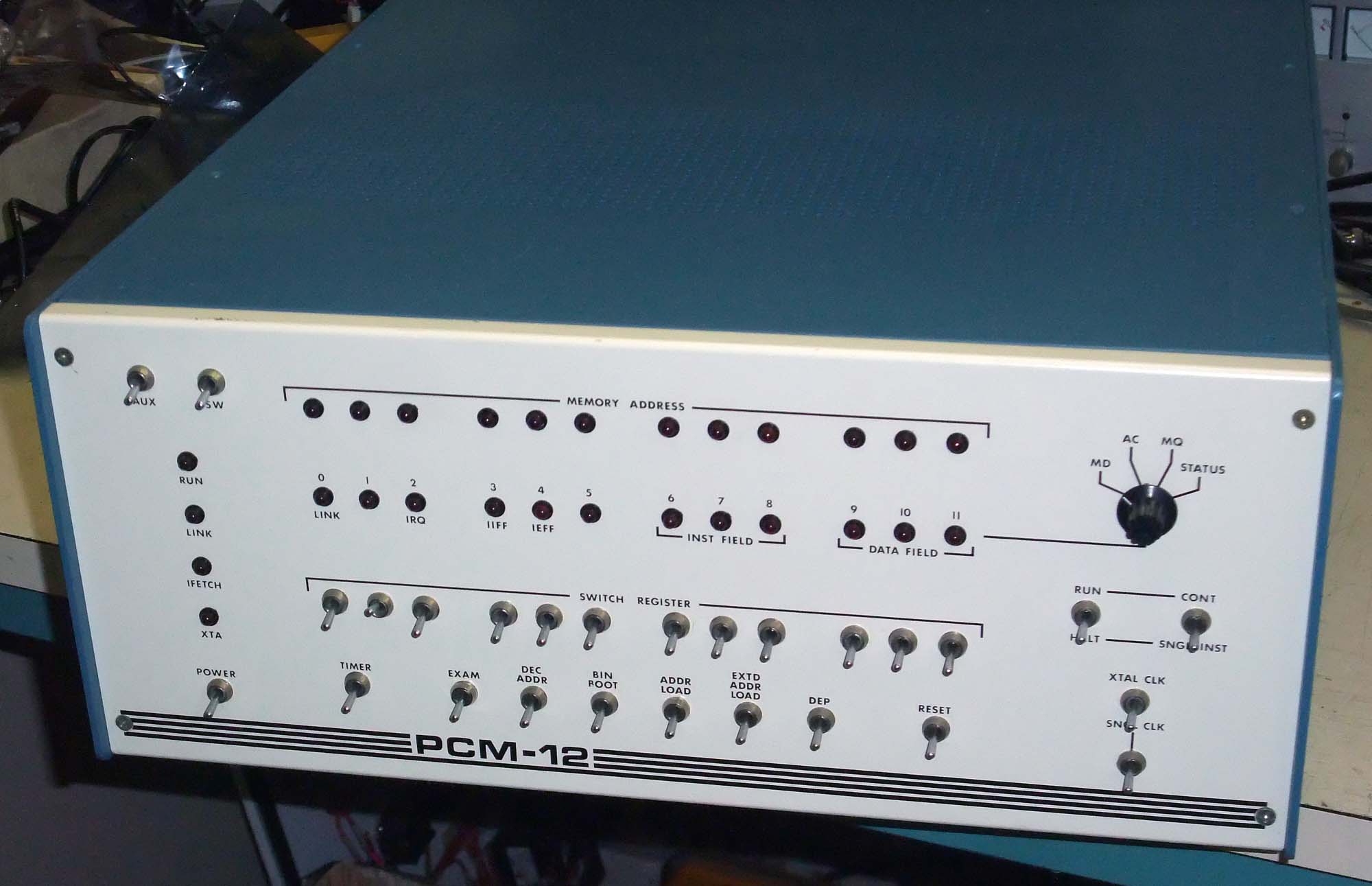
They were used a lot for projects in the 70's and 80's like the PCM-12
The company was bought by Zero Mfg in the 90's. There isn't anyone making
anything like that now.
http://www.dvq.com/oldcomp/PCM12/pcm12-1.jpg
Quick question: I've been cleaning out and repairing an HP5061 supply
for a 1000 computer. However I didn't take a picture of the 4 boards
when I pulled them and I want to make sure they go in the right places.
From the manual (page 99 of 92851-90001_Sections-IXB_Mar-1981.pdf) the
slots are labeled A6-J1 through A6-J5. Does this mean that:
J1 is the
J5 is the control board (A3A5)
J4 is a jumper board for +12 adjustments
J3 is unused (battery backup boards)
J2 is the inverter board (A3A2)
J1 is the pre-regulator board (A3A1)
Seems right but I know how bad things can go :-)
Thanks!
C
Hi,
If anyone is interested, these are available for cost of postage from
Toronto Canada. I will post selected sets but if someone wants the lot,
be quick. First come, first served...
https://imgur.com/MggLbvQ
--Toby
Hi All,
Does anyone by chance have a collection of fans? The one in my Sun Sparc
Classic died and I am having a hard time finding a replacement with the
same specs. Or can anyone recommend a good source?
It's a Nidec BetaV, TA225DC, Model M33402-55
Thanks!
-Kurt
Hi all,
I've been working on a BA11-K PDP-11/34 lately, and wow it sure is a noisy thing...
On my '11/45, the "Boxer" fans were easily disassembled via a cir-clip, and could then have their bearings cleaned/relubed (or worst case replaced). Fan maintenance quieted down the /45 a good bit. But these larger 6" Amphenol units don't look quite as easy to get in to...
Is the plastic rotor on these just a press fit? Any tricks to getting in there for maintenance? Or are these "you have what you have" and the only option if unsatisfied with their current performance to replace them entirely?
cheers,
--FritzM.
I've been having fun this past week trying to get the mechanics of a Canon CX print engine
in a LaserWriter restored. The paper pick and separation rollers have turned to goo.
This got me thinking that people need to start collecting information on rubber parts,
like dimensions, material and durometer values for all of these parts before they fail.
I found nothing on line about making replacement parts for these. No one stocks replacement
parts for anything older than a Canon SX engine (the generation after the CX).
Another problem child are Datamation card readers. It's been 20 years now since the
last ones were pulled out of service after the 2000 election and there seems to be a steady
stream of people trying to make replacements. I think the CHM 1401 guys replaced theirs a
few years ago, don't know if they collected mechanical info or where the repair units were made.
I've also heard that Terry of Terry's Rubber Rollers is recovering from Covid, and a
frequently used place that refurbished typewriter platens has gone out of business.
People have suggested https://www.jjshort.com/Recovered-Rubber-Rollers.php as an
alternative.
With apologies for breaking the threading, as I've just rejoined and I'm
responding to something I've just spotted in the archive ...
Regarding colour separations for scanned documents, GraphicsMagick is
quite capable of producing the required individual colour layers. If
you identify the colours you wish to pull out, you can use the "-fuzz"
and "-opaque" operators to change any given colour range (fuzz uses
Euclidean distance in RGB space) into another one (the current "-fill"
colour).
I haven't finished writing this up, but my workflow tends to be to
produce a Group4 TIFF from the colour scan by simple thresholding (or
first dropping the other colours to white, if they are quite dark), and
then produce all the other separations by dropping black out,
converting your spot colour to black and then thresholding. This way
you get two or more images:
1) PNG(s) containing pixels that are all either white or your spot
colour,
2) a G4 TIFF for the black and white layer.
The PNG must be saved as a two-colour paletted image so that they can
be used as masks in the final PDF. I always apply the black and white
(text) layer on top of every page, so that the fuzzing of the colour
layers doesn't reduce the clarity of the text.
This might sound awkward, but I've found that one fuzz value tends to
work for all the pages when extracting a given colour, so you can
process all pages in a loop. I use the Perl module PDF::Builder to put
my scans together, but I think tumble is capable of overlays too.
PNGs are compressed with deflate. If the spot colours you are
processing apply to text in the document, my first thought was that I
could save a bunch of Group4 TIFFs, one for each colour, and mask those
into the PDF, because Group4 compression is impressive for text. It took
some frustrating experiments before realising the Group4 compression
isn't defined for two colour images in general; it is specifically for
images that are black and white, and PDF won't let you circumvent that!
I've just scanned another document with some blue diagrams and table
backgrounds, if you'd like to see an example:
https://vt100.net/dec/ek-0la75-ug-002.pdf
I might reprocess this later, but for now, I didn't even bother
separating out pages that contain blue from ones that don't; every page
has a blue layer, even if it's blank. If you're wide awake, you may
spot that the blue layer on page 41 doesn't extend to the bottom of the
table. This isn't a processing flaw; the document is actually printed
like that.
Regards,
Paul
Bitraf[1] is moving, and the NDwiki[2] server moves with it. The move
starts Saturday September 11th 2021 at 12:00 hours local time, and is
expected to be completed sometime before midnight.
References:
1) https://bitraf.no/
2) http://www.ndwiki.org/
--
Regards,
Torfinn Ingolfsen
Due to health problems I won't be able to attend vcfmw this year.
I live just outside Champaign, IL, I-57 & I-74, about 2 hours south of
I-80, and 2 hours west of INDY. If anyone is interested in l buying
anything I should be home a few days before, during and after WCFMW.
Please email me with the time and day you would like to stop, and what you
are interested in seeing/buying.
I hoped to hang on to most things for a while, but I'm afraid I'm going to
start letting loose more and more.
Thanks, Paul
I'm located just outside Champaign, IL, I-57 & I-74
I was digging through the internet and found a post where a 3803 was posted for sale, would there happen to still be one available?Preferably a model 2
Thanks,gcnielson at yahoo.com
I just started working on a Data General NOVA 2/10 which is in quite
reasonable cosmetic condition, but has a number of problems.
The system comes with 8 kwords plus 16 kwords of core boards and a
"Cassette I/O" board and the CPU board.
After reforming the "man sized" caps and verified the power rails I took a
leap of faith and plugged in the CPU and the 16 kword core board. I managed
to deposit a few bit patterns and read back mostly what I deposited. After
a few power cycles I could no longer deposit values and read back what I
deposited. I also noticed that a 30 Ohm resistor rated at 3W which
previously got quite warm now stayed cold. That PCB area around that
resistor has cooked in the past and has changed colour - not dramatic, but
it obviously got quite hot in the past.
Unfortunately I didn't find a good schematic specifically for the Nova
2/10. There is one for the Nova 2/4 up on Bitsavers, but it is hard to read
and does not cover the NOVA 2/10 which is not quite the same as the NOVA
2/4. For example the power supply is completely different.
Until now I have been spoiled with quite decent DEC PDP-8/e documentation
and would be surprised if Data General did not provide a similar level and
quality of documentation. Maybe I am looking in the wrong place.
Thanks
Tom Hunter
I have an Interpro 2020 and a couple of HUGE 19" inch Intergraph
monitors. Frankly they are pretty lousy (fuzzy, not all that
luminescent), heavy and awkward.
Free to a Good Home - cables included. But I won't ship them, though
one could pay someone to crate them up and ship them.
I really don't want them around, and so I just converted my Interpro
2020 to use LCD flatpanels with a DB5w5 to VGA cable.
You can read more about my new cable setup for this machine, and see one
of the old monitors, at:
https://www.computercollection.net/index.php/unix-workstations/#interpro2020
JRJ
Can anyone identify this IC?
https://imgur.com/a/CU7Cn8z
This is from an Omega VLF receiver. I don't see many custom parts within
this unit, but perhaps this is one?
Thanks,
Kyle
Hi,
If you're interested, contact me directly.
It was in my apartment for years, I had to move it to the garage, and I
don't like the idea of leaving it there for the winter.
It's a PDP11/40 in a DEC rack. It was in working condition when I got it,
only the memory card had a problem (1 capacitor has been ripped off), but
reading/writing from/to the registers was working.
No need to say that you have to arrange shipping !
Thanks,
--
St?phane
Hi all,
you're invited to the Update computer club[0] public lecture series
"Updateringar"[1]!
When: 2021-09-11, 19:00 CEST
Where: https://bbb.cryptoparty.se/b/upd-0mo-m2u-aq8
The evolution of TECO and EMACS ? hands-on demo
The Emacs text editor has long been an important tool among programmers,
and has a long and rich history. I will talk about the development of
the TECO and Emacs line of editors throughout history. The emphasis is
on practical demonstration of programs found through software
archaeology. True to form, the bulk of the presentation will be
broadcast using ancient technology.
Lars Brinkhoff (ICtech)
The lecture is free and open to everyone.
Upcoming: 2021-10-09, 19:00: Update Computer Club: History and
not-so-certain future. Pontus Pihlgren (Update)
Don't want to miss upcoming events? Subscribe to our low-traffic
announcement list by sending a mail with the body "subscribe announce"
to majordomo at update.uu.se!
Hope to see you there,
Anke
[0] https://www.update.uu.se/index_eng.html
[1] https://www.update.uu.se/wiki/doku.php/projekt:updateringar
Hi folks,
I'm testing a little BlueSCSI adapter (BlueSCSI <https://scsi.blue/>) which
while being aimed at 68K Macs should also work as an 8 bit target for older
VAXen, it's a newer cheaper SCSI2SD solution and I should point out it
works as intended on a Mac Plus so the module itself is fine.
Nobody appears to have tested on small VAXen yet so tonight I dug out my
VLC to give it a go.
Powering up with nothing attached apart from an MMJ/H8571 cable I get
nothing on the console, I'm using PuTTY via a genuine COM1 port on a PC
which is one level above what I used last time I powered the machine up
(FTDI USB adapter to a laptop). Diagnostic LEDs cycle through the tests and
end up at '1111 0011' which according to the manual is 'entering the
console program'.
Clearly the DALLAS has passed the TOY tests, but if it's not happy would
that stop the console displaying? It doesn't matter how I set S3, next step
I guess is to hook it up to a 'proper' VT.
Cheers,
--
Adrian Graham
Owner of Binary Dinosaurs, the UK's biggest private home computer
collection?
t: @binarydinosaurs f: facebook.com/binarydinosaurs
w: www.binarydinosaurs.co.uk
Another query. The foam filter that sits in the front of my 11/24 CPU is
clearly badly degraded and needs to be replaced. What do people replace this
kind of stuff with? I guess it mustn't be too fine, this mesh seems quite
coarse.
https://rjarratt.files.wordpress.com/2021/09/1124-front-panel-2.jpg
Thanks
Rob
I have a PDP 11/24 which I hope to power up soon. The last time it had power
I noticed a bit of a burning smell which I failed to track down. However, I
did notice one capacitor on a memory board has a strange appearance, almost
as if there is some corrosion under the surface, it doesn't seem to be
bulging though, except along the top, but if it is bulging it is very bumpy.
I have a picture of it here:
https://rjarratt.files.wordpress.com/2021/09/wp_20210904_10_15_28_rich.jpg.
It is marked 47uF 30V, but it is also marked 20v as can be seen in the
picture.
I lifted it to measure its capacitance and ESR. It measures about 80uF and
the ESR seems OK. I am unsure whether to replace it, and if so what voltage
rating should I replace it with? I don't understand if this is a 30V rated
capacitor or 20V. It seems that Unibus has some 20V signals, so I guess 20V
might be right? I don't think 30V or 20V parts exist though, so I would need
to get 35V or 25V. Maybe the voltage rating isn't too critical?
Any advice?
Thanks
Rob
Somehow these were sitting in my basement rafters for years.
The tape seems ok on the big reels but I believe one of the small
reels was gummy. Several write rings on the pile too.
I'd rather not have to box these up TBQH but I will if someone
really wants them.
Location Ottawa Ontario Canada
http://www.db.net/~db/tapes.png
Diane
--
db at FreeBSD.org db at db.nethttp://www.db.net/~db