Hi All.
I've recently come into a really nice VT-320 terminal, but am having a
hell of a time getting it to communicate with the outside world (mainly
my PiDP-8 and PiDP-11). I've gone to the lowest common denominator,
using a USB serial cable and terminal software to verify everything is
working before digging into making simh output to a serial terminal.
The VT320 only has the DEC-423 MMJ, no RS-232.
I found a number of guides that show how to wire up the DEC-423
connector to a DB-9 RS-232, but so far I have struck out. It will
receive text from the remote computer, but I do not see anything on the
remote when I type on the VT-320.
I have loop backed the TX to RX on the VT-320 terminal, and it does
work. TX=RX Baud rate? in the VT320 settings, and the data bits, parity,
& stop bits match.
DEC-423 (lock tab bottom right, pin one on the left, 6 on the right)
1??? DTR
2??? TXD
3??? TXD-
4??? RXD-
5??? RXD
6??? DSR
For a cross over cable:
423 #2 goes to DB9 #2 (TX to RX)
423 #3 & #4 to DB9 #5 (TXD- and RXD- to GND)
423 #5 goes to DB9 #3 (RX to TX)
423 #1 to DB9 #6 (DTR to DSR)
423 #6 to DB9 #4 (DSR to DTR)
Does this look like it should work? It does leave DB9 RTS and CTS
unconnected.
Thanks!
Does anyone have some good hints on what and how to replace them?
I have a CDC 8 inch floppy drive with a missing pressure pad. Tried to put
some half a millimeter felt cloth with some double adhesive tape to replace
it.
But it didn't work very well. If I gently pushed the upper pressure pad arm
it started to read at least. But it looks like it is possible to over-do
it. I added more padding and then it probably got too thick since it now
failed again. I guess that if there is a bit too much pressure the signal
might be too high in the input amplifier leading to distortion?
What is the best pressure pad material and what are you usually replacing
it with?
/Mattis
> I picked up a microvax 3100 this past weekend from a office that was
> shutting down.
>> I was able to start the system up, it boots up to a login prompt for VMS
> VAX 7.3.
>> I do not have any login info for this machine, is there a procedure i can
> follow to reset a password to an account?
I beg to differ with HP's recommendation (in their doc set) for Devin'ssituation.? HP's description is meant for customer sites to have a copyof usernames/passwords to which they can revert for nasty situationssuch as a corrupted SYSUAF.DAT.? *If* this system has the 'alternate'file, it should have the same problem as the original, of unknownpasswords.? What Devin needs is instructions to break into the system.
I happen to know how to do that (used to work in OpenVMS Engineering).Is that something that should be discussed here?
Thanks,Dick
Something that's always worked for me: when soldering a male DB
connector (DB9, DB25, whatever -- or really any male/pin style
connector), plug it into a mating female connector first. That will hold
the pins securely in place and prevent them from sagging in the plastic
of the body if your soldering iron is too hot or you hold it on too long.
--
**Richard
I am wondering if anyone else has tried using an Android Phone (a Note 10 in
my case) with the default Samsung email client to post to this list?
Whenever I post, even though the message is correctly formatted on my
device, all the CR/LF are removed from my messages. See below for an
example:
-------
> Can it still be registered?>Is the Author find able? Do he still have 8"
floppies? > *** Will it NOT be lost in the mail with COVID 19 ***A deep
googlefu might find the author... just saying...;)
-------
However, when I sent it, it looked like this:
> Can it still be registered?
>Is the Author find able? Do he still have 8" floppies?
> *** Will it NOT be lost in the mail with COVID 19 ***
A deep googlefu might find the author... just saying...;)
Sending from trusty old Outlook 2007 on Win 7 works fine with the list and
emailing people back directly from the phone seems to work fine as well. It
is only when I am replying to the list that the issue occurs. Any
ideas/suggestions? TIA!
-Ali
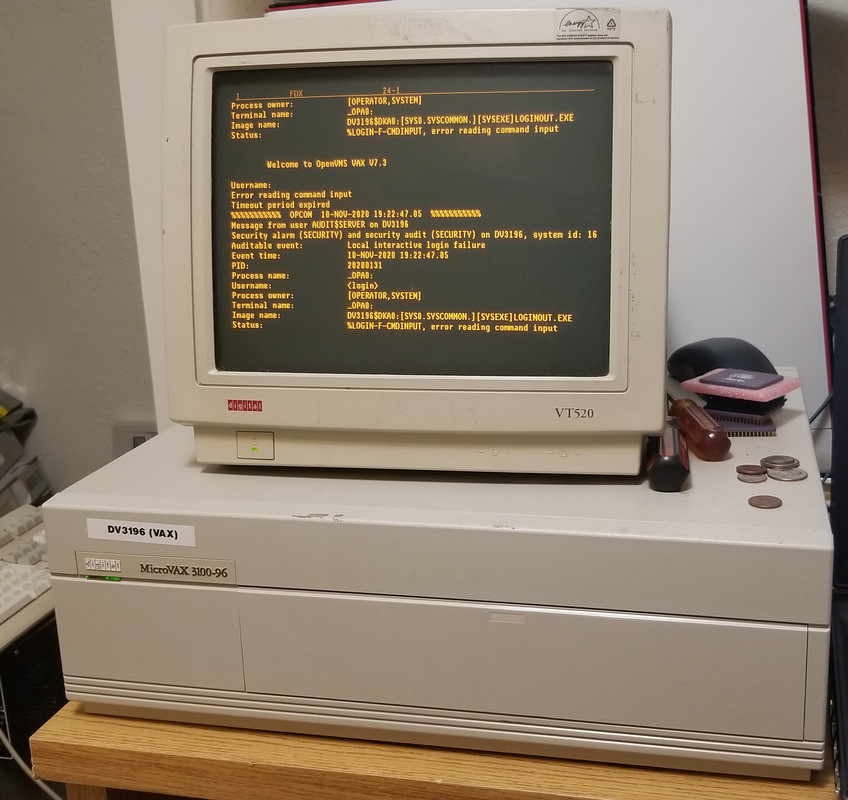
I picked up a microvax 3100 this past weekend from a office that was
shutting down.
I was able to start the system up, it boots up to a login prompt for VMS
VAX 7.3.
I do not have any login info for this machine, is there a procedure i can
follow to reset a password to an account?
Image of system :
https://i.postimg.cc/43bG0nSx/20201111-090018.jpg
Hi All,
I'm working on restoring a DEC PDP-11/23+ for the University of Colorado computer museum and I'm struggling to find a few parts, working or not, needed to complete the system. Please let me know if you have any of these items and would be willing to donate or sell them.
You can see a blog I'm keeping of the restoration at?https://headspinlabs.wordpress.com/dec-pdp-11
When finished, it will be on display at?https://mediaarchaeologylab.com/visit
Thanks,
Steve
...for a Northern Telcom (Telecom?) Spectron Datascope 4000:
https://i.imgur.com/qb4VTpO.jpg
Fingers crossed that someone here knows where it can be had.
Thanks!
g.
--
Proud owner of F-15C 80-0007
http://www.f15sim.com - The only one of its kind.
http://www.diy-cockpits.org/coll - Go Collimated or Go Home.
Some people collect things for a hobby. Geeks collect hobbies.
ScarletDME - The red hot Data Management Environment
A Multi-Value database for the masses, not the classes.
http://scarlet.deltasoft.com - Get it _today_!
Hi All,
I'm looking for a PDP-8/f or m. At a minimum I'd like the chassis with
PSU, front panel, and backplane as I already have enough spare OMNIBUS
boards to build up a basic system, although I'd still be interested in the
boards if you have any.
Depending on the configuration and condition there's a few things I'd
consider trading, namely my PDP-11/34a, AlphaStation DS10, Intel MDS 231,
and KIM-1. If the price it right I'd be happy to buy it too.
I'm in the UK but would be prepared to ship some of the systems
internationally; I can build crates and such.
Regards,
-Tom
mosst at sdf.org
SDF Public Access UNIX System - https://sdf.org
At 08:17 PM 11/8/2020, Bill Degnan via cctalk wrote:
> Thus came into my site, if you can help contact me privatelthanks
>...
> I have an old Syquest 5.25" removable cartridge (44MB) and am
>trying to find a service that will get the graphics data off the cartridge
>for me. If you have any suggestions I'd LOVE to hear them. It seems
>impossible to find anyone with a functioning drive to read this thing.
I was thinking about firing up the old (late 80s?) drive I have in storage
and trying to image the carts I have.
What should I watch for? Any typical failure mode?
- John
Thus came into my site, if you can help contact me privatelthanks
Bill
VintageComputer.net Inquiry Contact Information Name: Robert
Email: robwynia at ------ Phone: 541967----
------------------------- Comments:
I have an old Syquest 5.25" removable cartridge (44MB) and am
trying to find a service that will get the graphics data off the cartridge
for me. If you have any suggestions I'd LOVE to hear them. It seems
impossible to find anyone with a functioning drive to read this thing.
Thanks for your time,
> From: Chuck Guzis
> Perhaps my mistake with 22Disk was not putting a line in that said "Me
> fecit Carolus Guzis Anno MCMLXXXVII" or some such.
Love the Michaelangelo reference. I'm curious as to how many others on the
list got it. (It's carved into the strap on the Pieta. Apparently when
it was first put on display, there was some question as to who'd made, or
something like that.)
Noel
Hi,
Please remember ... TRIM YOUR DARN POSTS!
No one needs to see a hundred+ lines of quoted post just to see
a one line reply, no matter what kind of sandwich it was!
(And, the guy getting the sandwich had the better deal, IMHO :)
thanks,
Stan (the other grumpy guy?) Sieler
Hi,
Offered these in a post last year.
1) VAX DATATRIEVE Reference manual AA-K079E-TE
(this is online but version KE079G?)
2) VAX DATATRIEVE Handbook AA-W675B-TE
(Does not seem to be online? Willing to scan)
3) VAX DATATRIEVE Guide to Writing Reports AA-P862C-TE
For Datatrieve version 4.1
Versions online seem to be for version 3.0?
Willing to scan
Very clean condition: https://imgur.com/a/w9a3YEY
Can post for shipping cost from Toronto ON, Canada.
--Toby
http://mnembler.com/computers_mini_stories.html
"George Dragner always wore a belt with a metal dragon buckle. He was a colorful character known for pissing off management. His most
famous act was tossing a chair through the window at a customer site. The customer refused to believe that the lack of humidity in the room
was screwing up his magnetic tape media. As the tape heads depend on the moisture from the air to prevent the magnetic oxide from being
torn off the media from the friction during a rewind. George broke the window to prove his point. He was right ! "
There is a minimum RH specified for tape, but "tape heads depend on the moisture from the air" ??
At 12:14 PM 27/10/2020 -0500, you wrote:
>Hi All,
>
>I have an EP-1 eprom programmer from BP Microsystems.
>
>The rubber feet melted. It was in my closet. I have no clue how it got
>that hot, or if they
>are just some composition for them to melt.
>
>My question is how do I clean this up? Acetone, paint thinner? I scraped
>off the feet, so there is
>just a few 'streams' of melted rubber down the sides, and a bit that
>somehow got inside (also on the side, not on the electronics).
>
>Just looking for some ideas before I start applying chemicals...
>
>Thanks,
>Kelly
It's not heat. Just some rubber types degrade chemically over time. Cross links between the long
chain hydrocarbons break, and the solid turns to a semi-liquid. Very sticky liquid.
I presume the body of your eprom programmer is painted metal or plastic. So 'acetone and hot air' - NO!
The gunky stuff is not terribly soluble. Mineral turps on a tissue pad, rubbing, kind of works.
Mechanically scrape off what you can first. Use wooden or plastic spatula to avoid scratching paint.
The rub with the pad. Solvents like turps, acetone, IPA etc - always try a little on your surface first
to check the material isn't damaged by the solvent.
Guy
Hi All,
I have an EP-1 eprom programmer from BP Microsystems.
The rubber feet melted. It was in my closet. I have no clue how it got
that hot, or if they
are just some composition for them to melt.
My question is how do I clean this up? Acetone, paint thinner? I scraped
off the feet, so there is
just a few 'streams' of melted rubber down the sides, and a bit that
somehow got inside (also on the side, not on the electronics).
Just looking for some ideas before I start applying chemicals...
Thanks,
Kelly
> The rubber feet melted.
[?]
> I have no clue how it got that hot, or if they are just some composition for them to melt. My question is how do I clean this up?
It is probably not heat that melted the rubber. It?s likely degradation.
Some rubber parts get dry and break, some parts sort of ?melt? and
turn into this sticky, nasty glue.
You already got some hints on how to clean this, but if you are nervous,
you could start off with just isopropanol (that?s the main ingredient
in disinfectant). The advantage here would be that you can?t harm
plastic or electronics with that. You could use the common medical
grade disinfectant, just don?t drink it ;-)
Dennis
I've been helping dreamlayers with his cleanup of the NetBSD/Linux
mopd, ( https://github.com/dreamlayers/netbsd-mopd ) and we were
looking at how it handled different a.out MOP files, specifically
where the files may be little endian
For non MID zero files its easy enough, but little endian MID 0 files
are potentially more complicated.
https://github.com/abs0/netbsd-mopd/commit/6ab8555817f3dff23c506464d302d1a4…
It can netboot Ultrix and the vast panoply of NetBSD MOP boot files in
the various a.out and ELF incarnations http://mop.absd.org/netbsd/
(those that are not broken that is :/ )
I was wondering if anyone had links to hand for any other good sources
of MOP files?
Thanks
David
Speaking of DEC fonts, does anyone know what was used on the Data
General Nova machines?
Thanks!
**Richard
IBM 1620 > IBM 1130 > S/360 Model 40 > DG Nova > ...
> From: Toby Thain
> To get closer I'd need better images of the panels.
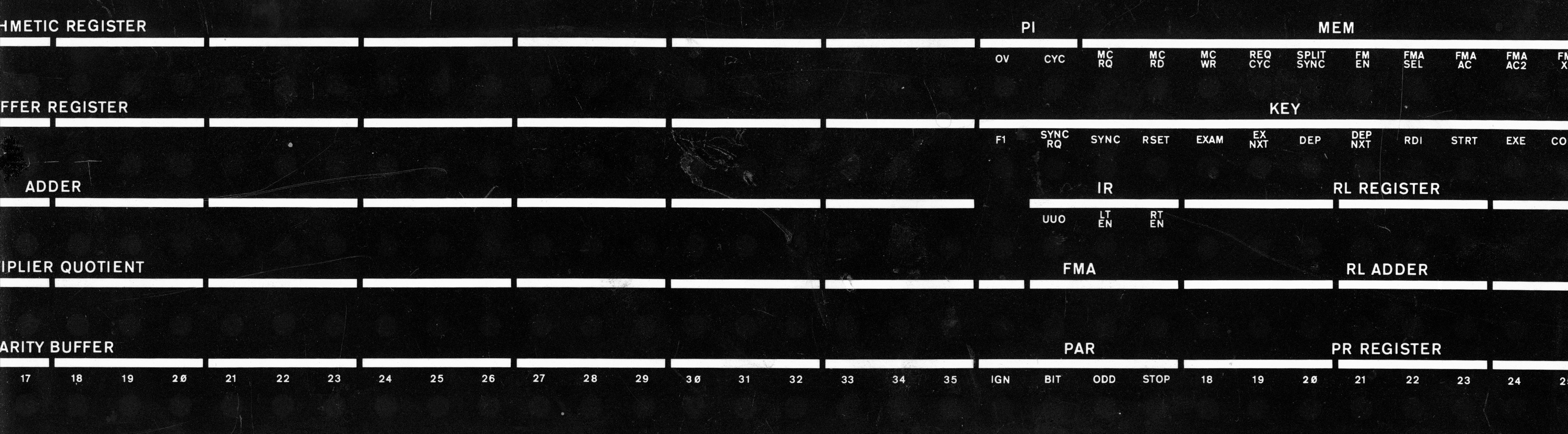
Hi, I borrowed a DEC inlay from someone (a KA10 CPU bay) and scanned a chunk
of it (as much as I could fit into my A4 scanner :-) at 200 dpi:
http://ana-3.lcs.mit.edu/~jnc/tech/jpg/KACPUPanel.jpg
I have a TC08 inlay, but it's currently being used in my QSIC display (until
we can get the RKV11-F/RPV11-D inlay done :-), and I didn't want to yank it
out. As far as I can tell, it's the same font on the two of them.
> the closest I know of off the top of my head is Akzidenz Grotesk.
The Akzidenz Grotesk Medium is indeed very, very close (other than the zero).
Do you happen to know if that font available for use in non-commercial
settings?
Thanks!
Noel
> From: Chris Zach
> The last board is a new style 11/24 and it doesn't do anything but it
> does have three switch packs. So I just need to find the manual for it
Appendix D in the 003 rev of the /24 TM has the details of the -YA..
> In the meantime the UNIBUS problem also appears to be fixed: The
> problem was that sure enough: One of the memory slot SPC's (4) did not
> have the DMA jumper.
Checking grant line continuity is part of system setup for me; the fact than
on many backplanes, the DMA grant jumpering is wirewrap on the back of the
backplane is a PITA, but back when it wasn't that big a deal. (Heck,
configuration jumpering on boards was all soldered wires BITD!)
The need for grant continuity is actually a characteristic of the _CPU_, not
the bus. I was astonished the first time I played with an /04 (or naybe it
was a /34, I forget), because on them, I'm pretty sure (I can't find it in
the documentation, but I'm pretty sure I remember it) that on power-on, the
CPU checks for grant continuity, and won't work without it. (They all require
the M9302 teminator or equivalent, which has active circuitry to turn around
an unclaimed grant onto the BSACK line.)
When the CPU powers up, it sends grants down the grant lines and expects to
see them back on SACK (from the M9302), and it won't operate if this doesn't
happen. That floored me when I ran across it, because on the older UNIBUS
CPUs I'd worked with BITD (/40's, etc) it was the done thing to be able to
leave a gap in the grant _downtream_ of the last card that could do
interrupts; no possible operational problem.
I'm not sure why DEC added that 'feature'; probably somebody thought it would
make systems more robust, but I bet all it did was generate a bunch of Field
Circus calls. (Kind of like the LSI-11 'feature' where ODT won't start unless
there's working memory at 0 - another wonderful little Easter Egg.)
Ironically, although the QBUS uses _exactly_ the same kind of bus grant lines,
no QBUS processor seems to check their continuity in this way; I habitually
run my QBUS machines without all the slots filled, and F11 and J11 processors
all run fine with open grant lines (after the last card that uses
interrupts). I guess DEC found out the hard way that that check wasn't
useful!
But this, as I said, is a characteristic of the CPU, not the bus.
> Anyone even know why Q-Bus doesn't need termination
QBUS documentation has long ediscussions of maximum cable lengths between
backplane sections, but little about cases where termination on both ends is
not needed. One exception is in the " pdp11 bus hanbook", pg. 128:
If nore than 20 AC loads are included [on a single bacplane], the other end
of the bus must be terminated with 120 ohms.
The clear implication is that with <20 AC loads, termination at the second
end is not needed. No explanation is given as to why, but I had the same
thoughts as Patrick Finnegan - that it's down to the very short bus lengths.
(With a short bus, the reflection from the un-terminated end will be
very close in time - the line length for the lines on a single backplane
is spec'd at a max od about 14"; so about 1 nsec. That's on the
order of magnitude of the bus signal rise times.)
If you think about it, every time you plug in a card, you've added a
short branch to the bus on every bus line (since they aren't normally
terminated at the transmitter/reveiver chips). But very short
branches, so their reflections are even closer in time.
Noel
Those sound like ram chip 4116, quite common once, and still available.
I have a couple dozen tested ones handy if you want them. (From Atari
800 16k ram modules). 250ns to 350ns, depending.
best,
Jeff
On Tue, 2020-10-27 at 12:00 -0500, cctalk-request at classiccmp.org wrote:
> Re: Next project: 11/24. Does it need memory?--Memory sad!