Just a reminder that next weekend is my 4th annual Vintage Computer
Festival/Midwest, held at Purdue University's Stewart Center. The
event has speakers from 11am until 1pm each day, and the exhibits are
open from 1pm until 5pm. The ticket price is $5 per day, or free if
you're 17 or under, or have a valid Purdue student ID.
The event is a celebration of the history of computing, and the machine
and people that got us to where we are today. There will be lots of
neat technology, and this year we have a door prize of an IBM PCjr from
1983! The PCjr was IBM's first attempt at an inexpensive home
computer.
I've got several exhibitors signed up, but still have room for more; if
you want to show up to show off your collection, or have a few things
to sell off at the consignment sale, sign up to be an exhibitor at
http://vintage.org/2008/midwest/, or send me an email at this address.
Exhibitors get one free t-shirt and free admission, which is included
in the $10 per table fee.
Pat
--
Purdue University Research Computing --- http://www.rcac.purdue.edu/
The Computer Refuge --- http://computer-refuge.org
I tore apart a couple of assemblies that came out of an IBM "SSA" setup,
these had a small switch panel, LCD, keyswitch (useless since I don't have
keys), and a floppy drive which, when I pulled it out, resembled a PS/2
style drive, though it did have a separate 4-pin power connector and no
faceplate. The short ribbon cable in there went to a single connector (pin
type) that had the power wiring coming out of it as well.
Can anybody use these?
I also have a regular PS/2 floppy drive as well, and no particular need for
it. I'd corresponded with somebody about that a while back, pulled it out
of the box it was in, and it never went anywhere. This one has the single
card-edge connector in the back of it, and again no faceplate.
Either of these items of interest, feel free to contact me off-list.
--
Member of the toughest, meanest, deadliest, most unrelenting -- and
ablest -- form of life in this section of space, ?a critter that can
be killed but can't be tamed. ?--Robert A. Heinlein, "The Puppet Masters"
-
Information is more dangerous than cannon to a society ruled by lies. --James
M Dakin
> Date: Wed, 2 Jul 2008 06:57:09 -0700
> From: "Glen Slick"
> The Colorado Memory Systems Jumperless Tape Controller 026-328 PCB has
> a copyright date of 1990, which predates the ISAPNP specification by 4
> years so it must use a proprietary configuration method.
Argh--bad memory bit--wrong floppytape controller! Yup--CMS used
their own configuration protocol. Linux has a routine that's used by
the ftape driver called fc-10.c that probes for the FC-10 and FC-20
controllers. I'm not sure if you have an FC-10, but it might be
worth a try. The FC-20 that I have in front of me is PCB 026-121.
I've got an FC-10 somewhere, but it'll take some time to dig it out
if you're interested. FWIW, the FC-20 uses an Intel 82078 FDC to get
2Mbps.
Now that I think about it, the FC-10 indeed wasn't PNP; you had to
use a configuration program to set the I/O, IRQ and DMA options.
Programs wanting to use the card simply probed a known range of I/O
addresses to determine what the setup was.
> If it supports FM that would make it useful.
Maybe--it depends on the date code of the 82077AA. Earlier ones
support FM fully; later ones don't. If the 82077AA is in a PLCC
socket, you can replace it with the National equivalent (8477?) to
get full FM support.
But IMOHO, getting an FC-10/20 to work as a generic floppy controller
seems like too much work to me.
Cheers,
Chuck
> Date: Mon, 30 Jun 2008 18:53:36 -0700
> From: "Glen Slick"
> Anyone have any info on a Colorado Memory Systems Jumperless Tape
> Controller 026-328?
>
> It's an 8-bit ISA card with an Intel 82077AA floppy controller. I
> have no intention of using this as a tape controller, but wondering if
> it would be useful as a floppy controller?
I think I've got that one as well as the 2Mb/sec follow-on one in my
hellbox. IIRC, it sets the DMA/port/IRQ via the ISA-PNP mechanism
(which accounts for the extra logic). If you've got an ISA PNP
inventory program, you can easily verify this. An early version of
PNP, but later ISA-equipped PCs support it via BIOS and there is
usually some sort of manual configuration program for those that
don't.
Otherwise, it's pretty much a garden-variety floppy controller,
though I don't recall if all of the ancillary signals are brought out
to the connector (e.g., DISK CHANGE).
Depending on the exact date code and stepping of the 82077, the card
may or may not support writing FM-encoded data.
Cheers,
Chuck
I think that they are out of business.. One of there competitors had a
note on their web site to the effect that since needhams is out of
business, they will give a trade in to their programmer. I have not
been able to get on the Needhams page for 6 months or more.
Les
This discussion of chip programmers prompted me to try yet again to find
something useful for programming chips using Linux. I found the software
info page at www.willem.org which states that the DOS version of the
controlling software is kept current. Now, suppose we run FreeDOS on a
tiny x86 board talking out the rs232 port...
--
David Griffith
dgriffi at cs.csubak.edu
A: Because it fouls the order in which people normally read text.
Q: Why is top-posting such a bad thing?
A: Top-posting.
Q: What is the most annoying thing in e-mail?
Do you happen to know where I can locate one of these drives?
Thank you,
Bill
--
William Marozzi
Engineer Principal
Department of Electronic Systems
Arizona State University at the Polytechnic Campus
I'm looking at buying a Willem programmer to go with my Data I/O 29B.
Mostly I'll be using it for reading existing ROMs and programming
stuff bigger than the 29B can handle.
I've been looking at willem.org, on eBay, and at a couple of non-eBay
sources. The first most obvious problem is that none of the available
variants exactly match the willem.org board revisions, and I haven't
found any cross-reference information.
I'm probably not going for the new "true-USB" board. Any system I'll
run it with has parallel ports.
So...
1) I know a few folks on the list have willem boards. What board
version do you have, where did you get it (if you remember), and are
there any major pros and cons?
2) Does anybody here have experience with Kee Electronics?
http://www.keeelectronics.com/
I'd rather buy direct than off eBay, and they look like a good
product line.
3) Yes, I know the software's Windows-only. If anybody knows of a
sub-$100 programmer with OS X software, I'd be overjoyed to hear about
it. Otherwise, BFD; I have to keep a Windows box for work anyhow.
Any input is greatly appreciated.
Zane, I'm still getting a 554 reject from citrine.aracnet.com
Doc
Hello,
I'm looking for an older version of Ontrack Disk Manager. I need to perform a bad sector check and low-level format for an MFM HD. I actually have 2 legit copies of the program (from the late 1980's), but, of course, I cannot find them now.
Thank you,
Robert Greenstreet
gstreet at indy.net
Watching a few of the [E]EPROM programmer threads got me to thinking about
my EMP-30, made by Needham Electronics. I have not been able to get their
website to come up for months. Anyone know if they have gone out of
business? I noticed that prices for their programmer accessories (e.g.
family modules) jumped substantially a few years ago which is usually not
a good sign.
If they are gone, anyone know what the latest version of their software was?
I know, it was me asking for support of some older Lattic CPLDs which
pushed them over the edge... ;-)
Jeff Walther
Hi Errol
just found your post regarding surplus Interak kit. I
suppose it has gone long time ago.
If not email me bacjk and we can talk.
Regards
Brian
__________________________________________________________
Free games from Tiscali Play - http://www.tiscali.co.uk/play
__________________________________________________________
I'm currently looking at the HP50962 SRM Coax interface PCB. This is a
(custom) netowork card for HP9000/200 copmputers.
I can't indentify one the the ICs, which basically links to the Coax
netowrk cable. It's made by AMD (big AMD logo on it), and carries the HP
house number 1826-1388, which I can't find anywhere.
It's a 24 pin ceramic DIL package, and I've identified some of the pins
:
1 - to ground trhough a resistor (maybe soemthing like Rx gain set)
3 - ground
4,5 - to a pulse transformer, the other side of which goes to the coax
connector. Rx inout?
6,7 - ground
8 - Clock input
11 - Rx Clock output
13 - Rx Data output
15 - Tx Clock (output??)
17 - Tx Enable/
18 - Tx Data
19,20,21 - +5V
22,23 - To 4,5 via low-value resistors (and thus to the pulse
transformer). Tx Out?
Looking down lists of ICs, I wonder if it's related to the AM7960 or
AM7961, but I can't find data on those anywhere.
So :
1) Does anyone have the data sheets on those ICs on-line anywhere? (As
ever, please don't send pdfs or other large files to me here, but if you
have said data sheet as a pdf, I can tell you how to get it to me).
2) Any other ideas as to what that chip might be.
Thanks in advance
-tony
Hello All,
I have available one PDP 11/35 in a 10.5" BA-11 box.
It contains the processor backplane, programmers console,
a cpu with the base processor, EIS option, stack limit, MMU
and a 256Kb memory card.
Next to that is has a 9 slot DD11 expansion backplane, and
optionally a complete RK-11D disk controller.
Please contact me off list with your offer.
Thanks,
Ed
Vinegar! Vinegar! Vinegar! The common household type!
>From a US cook's standpoint, if "vinegar" is specified with no
qualifiers, the type is determined by the application.
If I'm making a salad, a flavored vinegar, such as wine or malt or
even apple cider vinegar is used. Balsamic vinegar has lots of gunk
in it and is used for a more complex, somewhat sweet flavor in
marinades and salad dressings. I'd never think of using it to clean
a PCB. Rice wine vinegar is often used in oriental cooking--somewhat
sticky when the water evaporates.
If I'm pickling (e.g. dill pickles or making sauerkraut), I'll use
distilled white vinegar (usually about a 5% solution) as it's the
least expensive (commonly sold in gallon jugs). The same vinegar is
used for removing lime deposits from a steam iron or coffee maker and
for washing windows (if lime stains are present). Just plain old
dilute acetic acid, source not important.
Brass musical instrument players soak their instrument's valves and
tubing in white vinegar to remove deposits left from saliva. Doesn't
hurt the brass at all and leaves little smell behind.
Sulfamic acid (dry crystals obtained from a paint store) is often
used when cleaning masonry indoors where the fumes of muriatic acid
would be objectionable. It's stronger-acting than vinegar, but less
than muriatic acid and conveniently mixed from the crystals and water
as needed.
Cheers,
Chuck
I recently restored a system that required a TTL serial keyboard. I
initially "hacked" a setup using a VT520 (RS-232) with a "SchmartBoard"
RS-232 to TTL converter.
Then I found several Keytronic RS-232 serial keyboards on eBay from a single
vendor. After reading the specs, I found the keyboard supports both RS-422
and RS-423 by jumper settings. The default setting is RS-422 - which means
that one can use "one-side" of the differential output as TTL serial. It also
defaults to 300BPS - which is what I needed. (The specs say it can do 9600BPS
as well).
For those who care, the keyboard is "driven" by an 8048 8-bit microcontroller.
I bought four of these keyboards in a previous auction from the same vendor
and they are in excellent condition. He now has them listed again as item
#300237350802. Starting bid is $9.95...
Regards,
Lyle
--
Lyle Bickley
Bickley Consulting West Inc.
Mountain View, CA
http://bickleywest.com
"Black holes are where God is dividing by zero"
Paul,
While trying to find a Heathkit ETA-3400 I ran across your message authored
in 2004 requesting a copy of interface/ops manual for this part. I believe
I have the info you are looking for. Please let me know if you still need
the info.
73's
David Finell
N7LRY
Anyone have any info on a Colorado Memory Systems Jumperless Tape
Controller 026-328?
It's an 8-bit ISA card with an Intel 82077AA floppy controller. I
have no intention of using this as a tape controller, but wondering if
it would be useful as a floppy controller?
Anyone have on programming info for this card? In addition to the
82077AA and 24MHz crystal there are 3 PAL16L8 and 2 PAL20L8. That's
probably more logic and what would be needed for I/O address, IRQ, and
DMA routing alone, but maybe not.
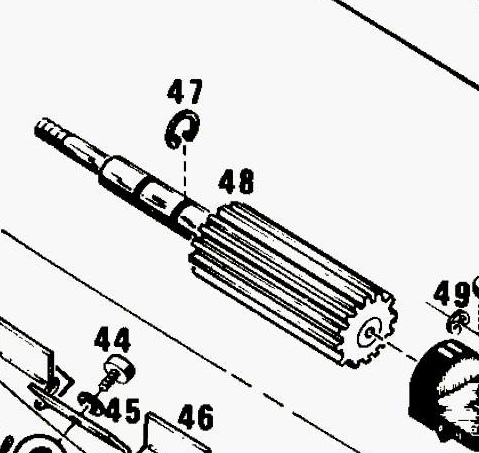
I picked up an HP7260A table top card reader, with the aim of
restoring it to working condition. The major problem has been that
the "pick" roller that moves the card out of the input hopper and
through the first gate had melted into a pile of goo, ending up in a
puddle in the output hopper. I only had to sacrifice four blank cards
(hand fed) before getting one to pass thru the rest of the transport
almost entirely unblemished(*). So far the control/sequencing
circuitry seems to be working, but I haven't checked yet if any data
is comming out the serial port.
Thanks to the HP Computer Museum (www.hpmuseum.org), I found the
maintenace manual, and an image of what the roller looked like (#48 in
the image below):
http://www.ultimate.com/phil/roller.jpg
I used one of these readers when I was in High School c. 1978. Before
finding the maintenance manual I had no memory of what the roller
looked like, but it must have been something soft, with a lot of
gripping power. Any suggestions (short of attempting to cast a
replacemnt out of melted gumi candy)? The axle is a quarter inch or
close, and roller needs to be at least a quarter inch thick.
I'm tempted to drop in on a local rubber products company (Greene
Rubber, in Woburn Ma), but knowing what to ask for would help!
Thanks in advance for any suggestions.
Phil
(*) One pinch roller inside was slightly gooey, and still gives off
blackness, no matter how many times I clean it. The pinch rollers all
have a flat spot from having sat for many years, and I might try to
replace them with O-rings, but it's not the top priority.
Cleaning house since movement therein has become difficult and while
trashing out an old piece of equipment came across a SBC consisting of
a Rockwell 6501 that ran a credit card reader. It has RS232 and what
looks like room for a peripheral chip of some ilk. Viewing at <http://elipsoid.home.comcast.net/IMG_5640.JPG
>.
If there is any interest, first respondent takes it for postage.
CRC
Sellam,
[Top answering, since inline is getting a bit long].
My fix to the array of dots the monitor was to build the Obtronix Apple-1 correctly! The problem was I accidentally swapped two resistors. On
board location D1 (upper left near video connection) R1 should be 1500ohm and the 6 resistors at C2 should be 7500ohm. I had swapped R1 with one of the 6 resistors at location C2 (I don't think the location C2 resistors will cause dots since these are pull-down resistors). I had mixed up a brown with violet, swapping a 1500 ohm resister (brown-green-red) with a 7500 (violet-green-red).
Not being a circuit guy (be nice, y'all) my mistake kinda made sense. If I remember my research correctly, pulses from the character generator and the sync signal generator are "combined" through R1, 1500ohm (for char gen) and R2, 3000ohm (for sync), meeting at the base of the video drive transistor. R1 and R2 *should* have a 1:2 ratio. My mistake (ie wrong R1) made it backwards and 2.5:1. The char gen pulses amplitude was less than it was supposed to be. Crank up the contrast to see the characters better and you start seeing sync residuals aka dots.
Mind you, my analysis may be off.
Do you have a way to contact Yumoto Hirohisa? I'd still like to pass on this information.
BTW regarding Apple-1 photos, I was hoping someone would have copies of those at http://homepage2.nifty.com/56thWAREHOUSE/HAJIME.html
Thanks,
Scott
----- Original Message ----
From: Sellam Ismail <sellam at vintagetech.com>
To: Scott Austin <us21090 at yahoo.com>
Cc: cctalk at classiccmp.org
Sent: Friday, June 27, 2008 5:32:10 PM
Subject: Re: Apple 1 on eBay
On Fri, 27 Jun 2008, Scott Austin wrote:
> Why? In the photos of the monitor attached to the Apple 1, I recognized
> a video problem that I ran into when I built my Repro Apple 1. It's an
> array of small dots across the entire monitor screen. I wanted to
> contact the owner to provide my bit of insight on the problem.
Interesting! I too saw this issue on an Apple-1 I brokered a couple years
back. If you turn down the contrast or something it seems to go away.
What is your fix?
> Does anyone know the Japanese owner(s) of Apple 1('s)?
I have one in my registry. He bought the first Apple-1 I brokered in 2000
(at VCF 4.0).
> At one time I only had the last name of an owner who had two Apple 1's.
> Could it be him?
This particular Japanese owner has two, so maybe/probably. His name is
Yumoto Hirohisa. This is public knowledge, by the way, his story having
been written about in Christine Finn's book, _Artifacts: An
Archaeologist's Year in Silicon Valley_.
> Does anyone have photos of a Japanese owner with his Apple 1?
In fact, there's one in the book :)
I have extra copies available for sale or trade (I think they cost me $20
or so).
--
Sellam Ismail Vintage Computer Festival
------------------------------------------------------------------------------
International Man of Intrigue and Danger http://www.vintage.org
[ Old computing resources for business || Buy/Sell/Trade Vintage Computers ]
[ and academia at www.VintageTech.com || at http://marketplace.vintage.org ]
>From a big lot of stuff I picked up recently, free for cost of
shipping (or local pickup of course) from 60074 USA:
- Tecmar Treasure Chest Technical Reference
- Tecmar Treasure Chest Users Guide
- Tecmar Catalog 104 (memory/tape/hard disk/gfx/video/comms)
- Tecmar Companion Software User's Guide
Would prefer they all went out at once!
Thanks
-j
Does anyone have Eclipse S/140 prom images (or a S/140 whose proms might
be copied)? I'm long Nova 4s and toying with the idea of teaching one to
be an S/140.
--
Chris Kennedy
chris at mainecoon.com AF6AP/AFA6KY
http://www.mainecoon.com PGP KeyID 108DAB97
PGP fingerprint: 4E99 10B6 7253 B048 6685 6CBC 55E1 20A3 108D AB97
"Mr. McKittrick, after careful consideration..."