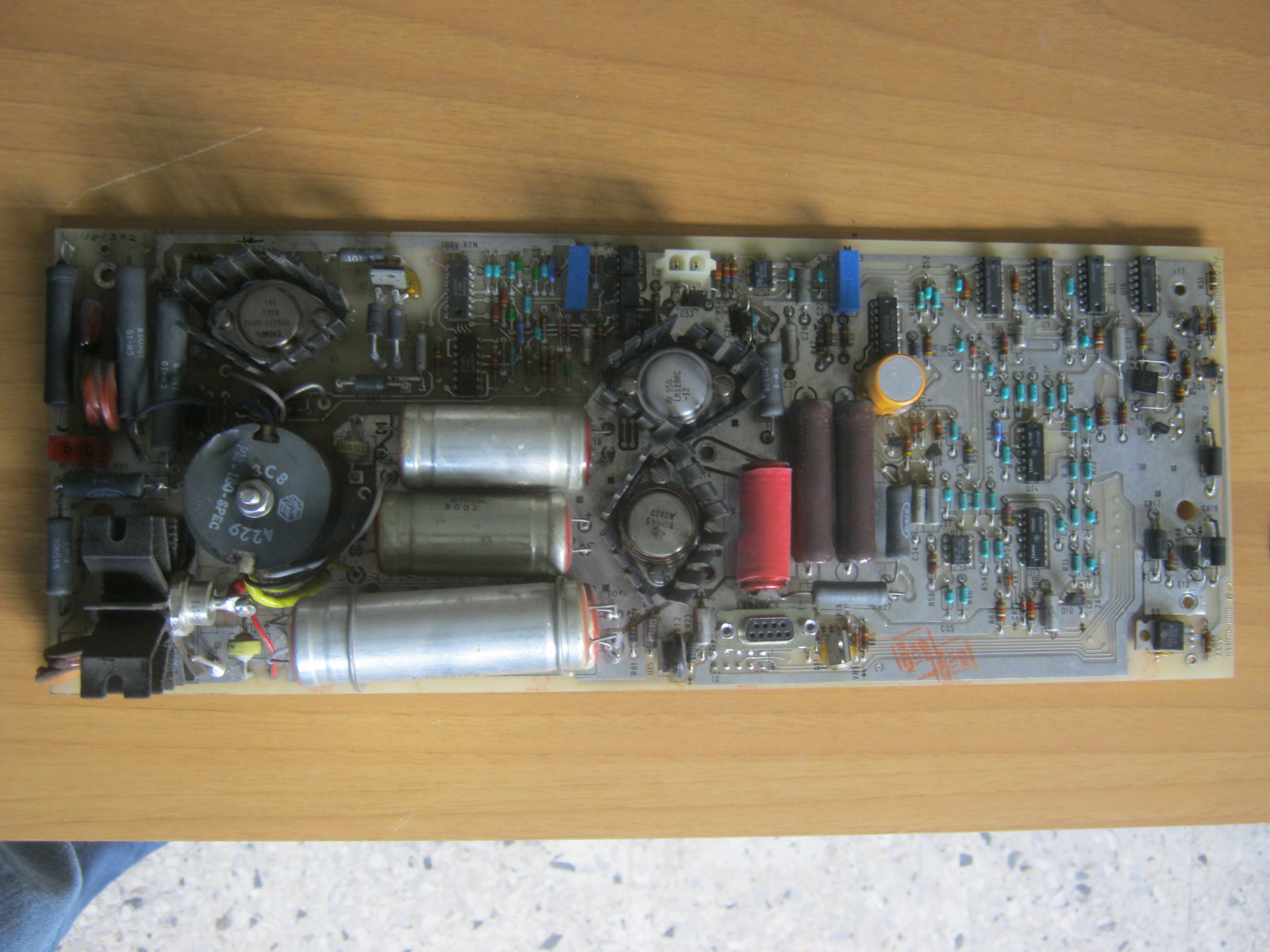
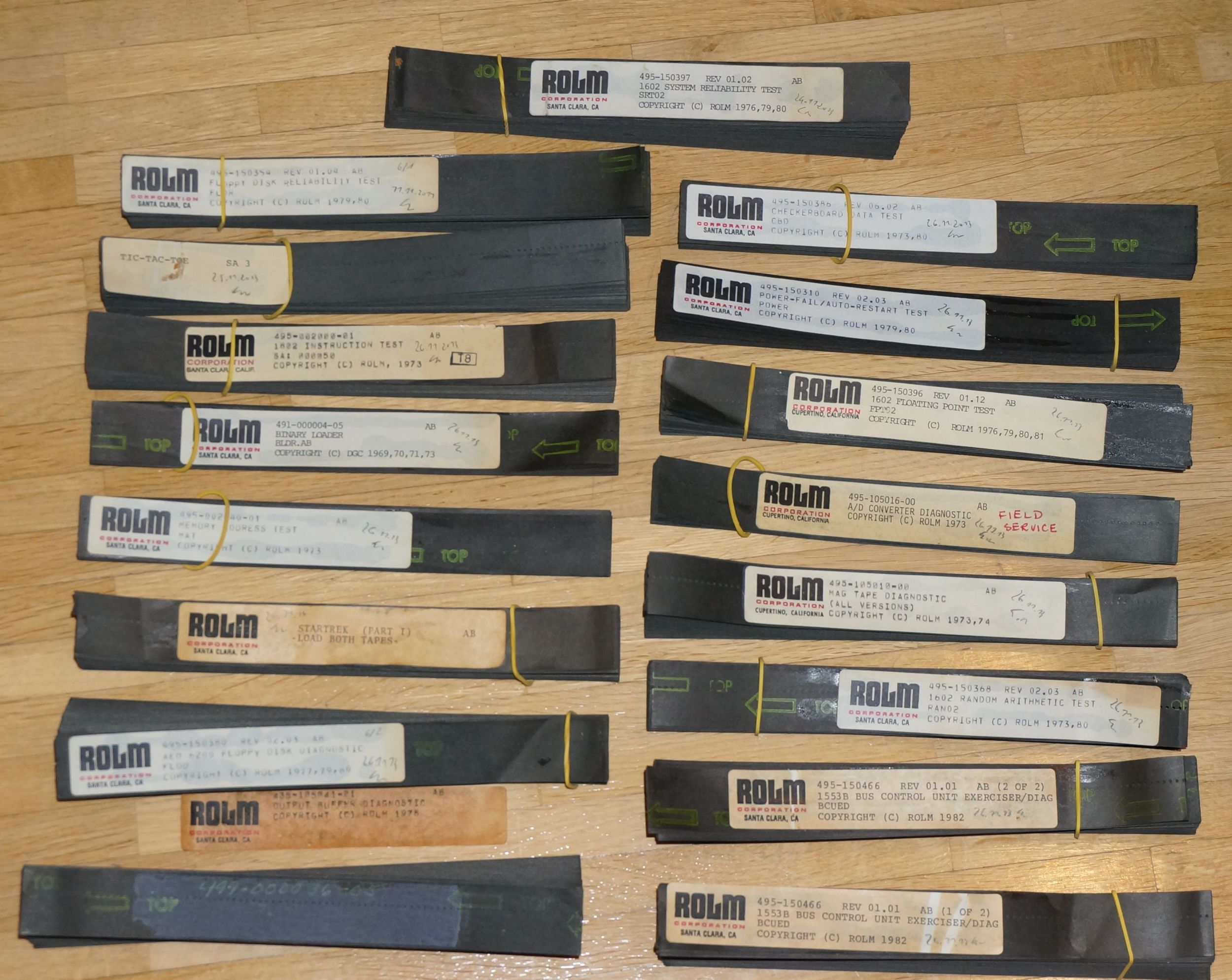
The revival process of the 11/750 continues. The power supplies is working
good and then I started testing the actual machine. But that was not a very
smooth journey to success. I have in total at least three complete CPU
board sets and just after quite a lot of board swapping it got running (I
think).
I had error like:
* Bright red error light
* No response at all on the console
* %C microverify error
* %O microverify error
* An hexdump prompt which non like above bot still not correct.
* etc
Finally I had the
%% which meant that it passed microverify.
Then I used the (second) RDM module (the first one had RAM error) to run
the DPM and MIC test which passed.
The I ran the "Hardcore VAX instruction test" / TU58#7 which also passed
fine.
BUT the Cache / TB diag, TU58#5, give me this:
%%
00000000 16
>>>B
%%
@?ECKAL -- VAX 11/750 Cache/TB Diagnostic
00003488 06
>>>
I am running a BE-S198Q-DE tape image.
Anyone has a listing or description for the ECKAL diagnostic? Is there any
know incompatibilities with certain revisions of boards? Or known bugs?
The machine manage to boot the console tape so I get the BOOT58> prompt.
But I am not sure if that indicate that it is indeed working or not.
So, some help with the Cache/TB diagnostic would be very much appreciated.
/Mattis
I can?t really tell if this is on-topic, but there?s [no|some|much] shame
in trying?
I have a Visual Basic 4 application that I need to run on modern 64-bit
hardware I can do this in a VM, but I really need this VM to be wicked
small, like under a gig. The smallest XP VM I?ve seen is 600MB (which might
be good) but XP is becoming very hard to source these days.
I am bummed that there doesn?t seem to be something like vDOS or DOSBOX for
VB applications. Or? maybe there is?
Does anyone have any suggestions on how I might go about doing this?
m
VB4 is what, mid 90s? How about you upgrade the code?
Bill Degnan
twitter: billdeg
vintagecomputer.net
On May 1, 2016 1:29 PM, "Mike Whalen" <mikew at thecomputervalet.com> wrote:
> I can?t really tell if this is on-topic, but there?s [no|some|much] shame
> in trying?
>
> I have a Visual Basic 4 application that I need to run on modern 64-bit
> hardware I can do this in a VM, but I really need this VM to be wicked
> small, like under a gig. The smallest XP VM I?ve seen is 600MB (which might
> be good) but XP is becoming very hard to source these days.
>
> I am bummed that there doesn?t seem to be something like vDOS or DOSBOX for
> VB applications. Or? maybe there is?
>
> Does anyone have any suggestions on how I might go about doing this?
>
> m
>
To be able to use my parallel port programmer I keep an old (by modern
standards) machine running with Windows XP on it. It is an Abit KV-85
motherboard for AMD processors. In recent times I have had a couple of DIMMs
fail on me.
I am not sure if this is just coincidence, that I have had a couple of bad
DIMMs, or if the motherboard is damaging the DIMMs.
It uses a cheap generic PSU, I checked the PSU for voltage and ripple and it
seemed OK, I also checked voltage and ripple on some of the power pins of
the working DIMM, they seemed OK too (ripple about +/- 20mV), but other than
that, are there any other things I should check?
Thanks
Rob
That is spectacular! thanks for sharing it!
that last picture is why you needed the E with both backplanes .... to
hold all the i/o for all those devices!
Ed#
In a message dated 5/1/2016 11:59:54 A.M. US Mountain Standard Time,
mattislind at gmail.com writes:
I found a really nice PDP-8/e sales brochure while browsing through our
heaps of documentation.
Plenty of nice close up photos and as last picture a system with
everything.
https://dl.dropboxusercontent.com/u/96935524/Datormusuem/pdp8e-sales.pdf
Hi!
Anyone on here collect old Mac 68k gear, and happen to have a PowerBook Duo 280c in decent shape they'd be willing to part with? I'm wishing I hadn't ditched all my old Macs years ago...
Thanks much as always!
-Ben
Anyone here on cctalk consider themselves a file systems expert and have
the credentials or job title to vouch for it? If so, then I need to
interview you ASAP today (in the next hour-ish) for a TechRepublic.com
article. Contact me offline: news at snarc.net.
Not going to discuss the story itself here in public.
Hi Guys
DEC did some interesting things when it came to fonts on
front panels.
Take an 8/e front panel for example. the address is kind of a chalet font.
But they built it out of circles and straight lines and that's what I do.
Then they bunch up the characters until they touch or nearly touch.
(kerning?)
I'd like to recover the DEC fonts and have looked at several font
creator/editors.
Frankly they are dung. Every fancy curve there is but not a straight
forward line and circle method of creating lower case characters
as DEC did it. I do need the ability to enter (or import) the lower
case characters using just circles and lines.
I then need to do the usual font type things like different font sizes,
bold, and character spacing from zero (touching) to miles apart.
Suggestions please
Rod (Panelman) Smallwood
Another Java panel simulation for BlinkenBone is there, the classic
PDP-11/20.
In function and style it fills the gap between the PDP-8 and the later
PDP-11's.
The GitHub distribution starts the 1970 Paper-tape BASIC, download here:
https://github.com/j-hoppe/BlinkenBone/releases
Info
http://retrocmp.com/projects/blinkenbone/simulated-panels/253-blinkenbone-s…
and next page.
Now we have PDP-8/I, PDP-11/20, PDP-11/40, PDP-11/70 and PDP-10/KI10.
Not to mention the PiDP8 replica and soon the PiDP11.
Joerg
I tried starting up my AlphaStation 200 today. All I get is some beeps and
an LED diagnostic code that suggests the NVRAM test failed. I swapped the
battery, as the old one was dead, but it still refused to work. I have tried
connecting to the serial port and got nothing (although I could have a
problem with using the correct cable etc). I even tried flipping the jumper
that takes you to the mini console, to no avail.
Does anyone have any suggestions for reviving this machine?
Thanks
Rob
Dear Paul,
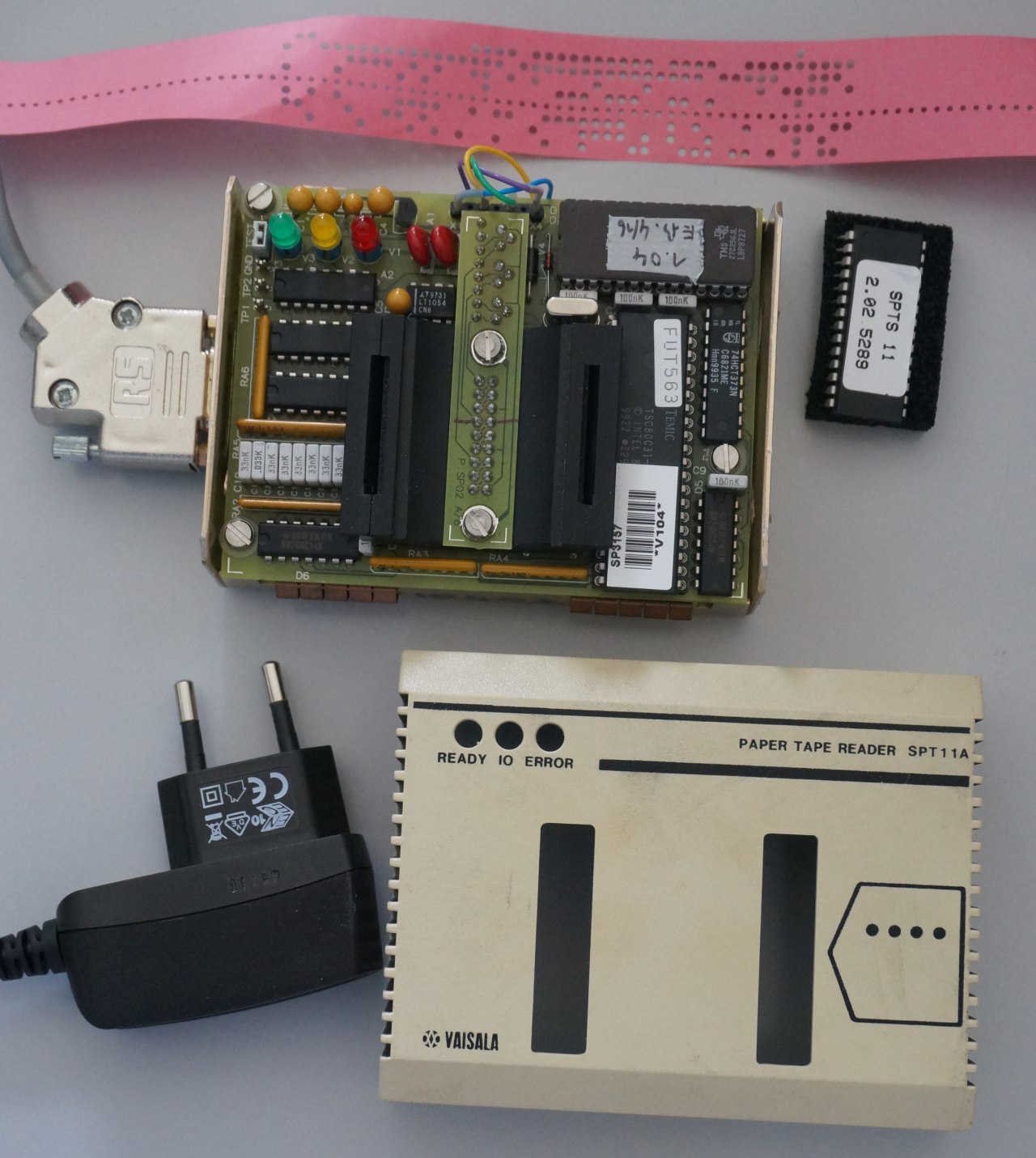
thanks for your email - I acquired the reader several years ago and
did quite a lot of experiments to figure out how to use it with the
original firmware SPTS11, 2.02, 5289 but I never got an answer from
the reader. So the project of Jim to read in the DG tapes was the
reason I needed to address this issue. For your (and the communities)
convenience I placed the original firmware (27C256 type EPROM)...
http://www.baigar.de/electronics/PTR-SPTS11-2.02-5289.bin
...and my new one (also 27C256)...
http://www.baigar.de/electronics/PTR-SPTS11-EB1.01.hex
...onto my server. My new firmware just sends out the data read via
the serial port at 9600, 8N1. A welcome messages tests the serial
communication on starting and during this time the red LED is on.
On getting ready the green LED takes over and the yellow one shows
the state of the sprocket input: For each byte read this LED
flashes. At 9600 the serial port is always faster than you can
pull the tape through the reader, so I do not expect the red
LED (indicate a buffer overflow, byte lost) come on during normal
operation...
The pinout of the Sub-D9 male plug is as usual on serial ports:
5: GND, 2: Data from reader to PC, 3: Data from PC to reader
(not used in my firmware, but original expects some start/config
command here) additionally 7: DC input to reader (in my case 9V).
Hope this helps,
best regards,
Erik.
On Tue, 26 Apr 2016, Paul Birkel wrote:
> Eric;
>
> Would you please share your firmware updates, and any other information that
> you've gleaned regarding the Vaisala SPT11A reader? I recently acquired one
> of these as well but haven't yet started on reverse-engineering it into
> something useful Would prefer to leverage your experience, if you please
> :->.
>
> Good health to You and Yours!
>
> paul
> (from Maryland, USA)
>
> -----Original Message-----
> From: cctalk [mailto:cctalk-bounces at classiccmp.org] On Behalf Of Erik Baigar
> Sent: Monday, April 25, 2016 11:42 AM
> To: jim s; cctalk at classiccmp.org
> Cc: Sherman Foy
> Subject: Re: Data General Nova Star Trek
>
>
> Hi Jim,
>
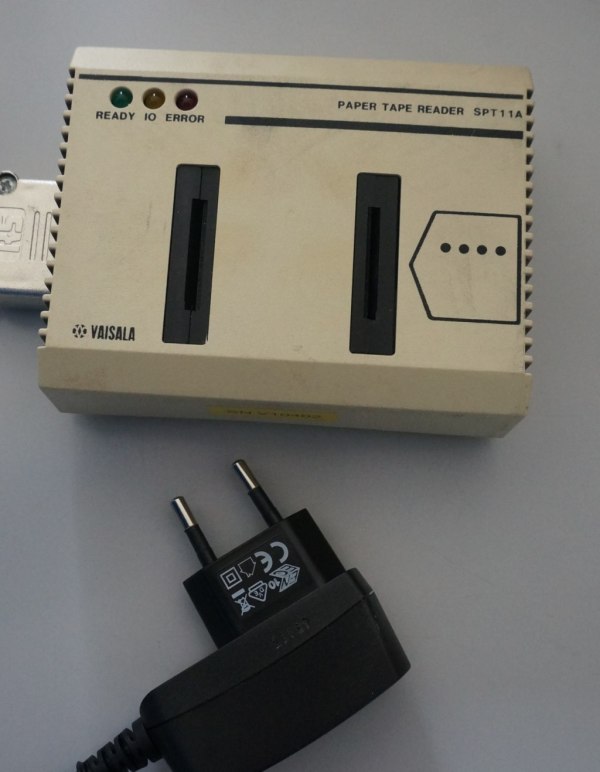
> regarding reading the StarTrek paper tapes I spent some time on the weekend
> to rework my SPT11A manual reader - I got this from an eBay auction and it
> was an accessory for some military receiver (probalby to read in some
> codes). It had a fimrwaere which refused to communicate with a simple
> terminal program, so I reverse en- gineered the hardware and replaced the
> original ROM it by an own firmware which simply sends the contents read from
> PPT to the PC via its RS232C...
>
> http://www.baigar.de/vintage/SPT11A-mod-Internal.jpg
>
> So I'd offer sending this to you as an item on loan to read in your tapes
> and you return it afterwards? I tested it with some data and it works well
> (just slowly pull the paper tape through the reader and use e.g. putty to
> log the binary serial output). After turning on the reader there is a short
> welcome message to verify the serial connection (9600,8N1).
>
> The only question is, whether you can handle the EU style power supply shown
> in the picture...
>
> http://www.baigar.de/vintage/SPT11A-mod.jpg
>
> I ordered USB->RS232C converters and if you have some more time, I'd attach
> one of them to the reader not only doing conversion but also supplying the
> converter with power from the PC.
> Addidionally you should send me your physical address via PM so I can
> prepare for shipping...
>
> Best regards from Germany,
>
> Erik.
>
> -----
>
Hi Guys
Well I made it ! I now have the correct font for the
address line in the masthead on PDP-8/e.
As usual the combined wisdom of the list was the main source of answers.
One point is that are in fact three different fonts in use.
The one for the d i g i t a l name, one for the touching out line font
of the letters pdp and finally that which is used for the address.
The digital name logo sub master I already had left over from my DEC days.
There's also a copy on a web site that has been referred to recently.
The pdp logo I drew and the basis of the address line text was thanks
to Paul Koning's handbook.ttf
My view of the list is "Strength in numbers, Depth in knowledge and Band
of Brothers in spirit".
Thank you everybody
Rod (Panelman) Smallwood
On 04/29/2016 03:10 PM, Bill Sudbrink wrote:
> I want a constant current supply that "pushes" 0.41 Amps.
> A little more googling reveals that the above supply is
> rated "1.67A output". This seems to support the W=AV
> theory. So, do I want a PS labeled "15 watt 36vdc",
> regardless of how many bulbs I want to drive? You say
> "within limits". What specification do I look for to
> understand the limits? Thanks
LED lighting power supplies are generally rated in mA
output, within a range of voltages, such as
350 mA within 24:72 V DC.
Digi-Key stocks something like 10,000 models!
Jon
> From: Liam Proven
>> I think it _became_ popular for two reasons: ... ii) C was a lot better
>> than many of the alternatives _at the time it first appeared_ (for a
>> number of reasons, which I won't expand on unless there is interest).
> I am indeed interested.
OK, have to wind my brain back a _long_ way to remember what it was like
before I met C (which in my case was ca. '77).
Leaving aside places where you absolutely have to have pointers (e.g. device
drivers), the ability to allocate storage dynamically (whether via pointers,
or some alternative if you consider pointers unsafe) is just really key for
many uses, and not everything supported that.
For system work, stand-alone applications, etc pointers are really, really
useful (if not key), and there weren't that many languages with pointers. It
was an absolute revelation to see device drivers written *completely* in
higher-level language in Unix!
Anyway, for languages with that kind of capability, there was PL/I, which
although it was used for the Multics kernel, was rather a large pile; it
included a lot of stuff intended for commercial use.
There was BCPL, which is basically C without types (a _really_ major
drawback) and less terse syntax. Definitely a very nice language (a lot of
Alto software was written in it, for example), and probably the best
alternative to C _at the time_.
I think BLISS was just getting started then, and outside DEC I'm not sure
many people knew much about it. Can't think of any others with pointers, but
my memory is probably failing me.
Algol didn't have (IIRC) pointers or structures - the latter are
fantastically useful when writing network code (which is what I was doing at
the time). Did BCPL have structures? I don't recall.
It's just that a lot of things which we now take for granted, and will be in
any 'reasonable' language (types, structures, dynamic allocation, etc) didn't
exist in all the available alternatives back then.
And some languages had more hairy mechanisms for some things than were
probably really needed (e.g. 'thunks' in Algol, for complicated argument
support - nobody seems to miss that semantics in later languages).
C just seemed to hit a sweet spot for functionality versus complexity - in
the syntax, in the semantics; all over.
> Well, malloc() and free(), anyway.
Especially free()! If you only let people call malloc(), a lot of bugs would
go away! ;-)
> Not everyone's a genius. And those who aren't, often don't know. See
> Dunning-Kruger. Klutzes think they're gods; gods think they're klutzes.
> ...
> So we *need* safe languages for the non-geniuses who think they're
> brilliant.
> ...
> So, keep everyone in the safe space, but offer power tools - like Lisp
> macros - so the brilliant are not held back.
There's a problem, though - the great people probably really need access to
'dangerous' capabilities, which they will use to create great software. Limit
them to the tools you make available to the average programmer, and you might
limit their effectiveness.
But once those more powerful tools exist, everyone and their mama is going to
want to use them, as you point out. With the inevitable result...
I dunno, maybe there's a way to have only 'safe' tools, but do so in a way
that doesn't limit the productiveness of the really good people.
Noel
> From: Swift Griggs
> even though there is *more* overall documentation on the Internet, the
> docs you get with hardware and tools are nowhere near as good as they
> were in the 80s AFAIK.
I think that's partially because the speed of product cycles has sped up;
there just isn't time to get good docs done and out. Also, there's more
competitiveness/'efficiency', and good documentation costs money/overhead.
Wonderful as e.g. DEC Technical Manuals were, I suspect producing their ilk
nowadays is simply beyond the industry's capabilities (in the organizational
sense, not the technical skill sense).
> From: Liam Proven
> C is popular because C is popular.
Yes, but that had to start somewhere.
I think it _became_ popular for two reasons: i) it was 'the' language of
Unix, and Unix was so much better than 99% of the alternatives _at the time_
that it grew like crazy, and ii) C was a lot better than many of the
alternatives _at the time it first appeared_ (for a number of reasons, which
I won't expand on unless there is interest).
> direct memory allocation, pointer manipulation and so on -- are
> widespread /because/ of the C family influence. And I have a deep
> suspicion that these are harmful things.
Pointers, yes. Allocation, not really - a lot of languages have heaps. Did
you mean manual freeing when you mention 'memory allocation', because
technically even something like CONS allocates memory? And one could consider
'auto' variables as 'allocated' - but the 'freeing' is automatic, when the
routine returns.
As to whether those two are harmful - they can be. You have to have a 'clean'
programming style to use them extensively without running into problems. (I
personally have only rarely run into problems with them - and then mostly in
very early C, before casts existed, because of C's wierd pointer math rules.)
I would need to think about this for a while to really come up with a good
position, but my initial sense is that these two are perhaps things that
should be hidden in the depths of large systems, for use by very good
programmers, that 'average' programmers should only be using higher-level
constructs.
(E.g. build a 'system' of routines to manage a certain kind of objects -
like OO languages enforce in the language itself - and the average user
only calls foo_allocate(), etc.)
> I actually hugely admire Linux
> ...
> We are continuing to refine and tweak a 1970s-style OS -- a
> technologically conservative monolithic Unix. FOSS Unix hasn't even
> caught up with 1990s style Unix design yet, the early microkernel ones
> .. It's roughly 2 decades behind the times.
I'm a bit puzzled by your first thought, given your follow-on (which I agree
with).
I'd go further in criticizing Linux (and basically all other Unix
descendants), though - your latter comment above is just about the
_implementation_. I have a problem with the _basic semantics_ - i.e. the
computational environment provided to user code. It was fantastic on a PDP-11
- near-'mainframe' levels of capability on a tiny 16-bit machine.
On modern machines... not so much.
Noel
> On Apr 29, 2016, at 4:10 PM, Bill Sudbrink <wh.sudbrink at verizon.net> wrote:
>
> Paul Koning wrote:
>>> On Apr 29, 2016, at 3:32 PM, Bill Sudbrink <wh.sudbrink at verizon.net>
>> wrote:
>>>
>>> ... The "bulbs" are labeled:
>>>
>>> 15F18120-45 15 watt 36vdc constant current
>>>
>>> I'd like to put four in a fixture and I'm trying to
>>> understand what kind of driver I need and how to wire
>>> it. I was thinking of using a Mean Well LPF-60D-36
>>> like this:
>>>
>>> http://www.ebay.com/itm/Mean-Well-LPF-60D-36-AC-DC-POWER-SUPPLY-
>> Dimmable-LED
>>> -DRIVER-36V-60W-CLASS2-
>> /161857068172?hash=item25af6edc8c:g:9hQAAOSwA4dWHVn5
>>>
>>> and wiring the "bulbs" in parallel to it. But after
>>> realizing that I'm not completely sure what a "constant
>>> current" power supply does and doing a little "googling"
>>> I don't know if that's the right approach.
>>
>> A constant current supply is one that delivers a constant
>> current to a varying load (within limits) just as a constant
>> voltage supply delivers a constant voltage to a varying load.
>
> Ok, I figured that much. The problem/question is why there
> are no Amp ratings on anything? Assuming the DC equation:
>
> Watts = Amps X Volts
>
> I want a constant current supply that "pushes" 0.41 Amps.
> A little more googling reveals that the above supply is
> rated "1.67A output". This seems to support the W=AV
> theory. So, do I want a PS labeled "15 watt 36vdc",
> regardless of how many bulbs I want to drive? You say
> "within limits". What specification do I look for to
> understand the limits?
15 watt 36 V is an odd spec for a device that needs constant current. What it seems to translate to is 400 mA device current, 36 volt nominal operating voltage. That's perhaps 10-12 LEDs in series, since each has a forward voltage around 3 volts, perhaps a bit more.
If you have a supply rated for constant current operation, 36 volt or so, settable current, you could use that, crank the current setting down to 400 mA. If it's a fixed supply (36 volts 60 watts, i.e., 1.66 A) then that would not work.
paul
> On Apr 29, 2016, at 3:32 PM, Bill Sudbrink <wh.sudbrink at verizon.net> wrote:
>
> ... The "bulbs" are labeled:
>
> 15F18120-45 15 watt 36vdc constant current
>
> I'd like to put four in a fixture and I'm trying to
> understand what kind of driver I need and how to wire
> it. I was thinking of using a Mean Well LPF-60D-36
> like this:
>
> http://www.ebay.com/itm/Mean-Well-LPF-60D-36-AC-DC-POWER-SUPPLY-Dimmable-LED
> -DRIVER-36V-60W-CLASS2-/161857068172?hash=item25af6edc8c:g:9hQAAOSwA4dWHVn5
>
> and wiring the "bulbs" in parallel to it. But after
> realizing that I'm not completely sure what a "constant
> current" power supply does and doing a little "googling"
> I don't know if that's the right approach.
A constant current supply is one that delivers a constant current to a varying load (within limits) just as a constant voltage supply delivers a constant voltage to a varying load. Constant voltage is the typical "regulated power supply". Constant current is needed for loads whose behavior is tied to a particular current, especially if those loads have negative dynamic resistance (such as gas discharge tubes, e.g., fluorescent tubes).
If you have multiple loads that want the same constant voltage, connect them in parallel. If you have multiple loads that need constant current, connect them in series, NOT in parallel. The whole point of constant current applications is that the impedance of the loads is not consistent, and if you connect them in parallel, the current through each individual load will not be the correct value.
paul
I've been lurking on the cctech list for awhile and thought I would introduce myself. I hope I'm not breaking protocol by responding to the " Calling all typographers" topic
I am truly amazed by the breadth of knowledge of the Classic Computers Community.
I'm a computer programmer and have worked for a few major metropolitan newspapers for most of my working life.
In college @ Cal State Los Angeles, I worked with PDP 11/45, and, If my memory isn't failing me, CDC 3170 and Cyber 76 computers and the ITS timesharing system.
Even worked with PLATO when it was put on campus as a test system.
First professional job was as an assembly language programmer programming Zentek Zms-90 8080 based terminals for a Classified Ad order entry system in 1977.
So I'm old...
Next job was as the "system programmer"/system manager for a DEC shop running Pdp 11/70, VAXen 780, 785, 8600 and Microvax II with lots of
RM05's and System Industries 9755 and 9775 RM05 look alikes.
I went back to Newspapers when they started using DEC equipment in addition to IBM Mainframes.
Electronics is my hobby and I am starting/trying to accumulate some vintage VAX and pdp 11 gear.
Re: Typography...
My recommendation would be to try Macromedia's (now Fontlab) Fontographer for font creation/modification.
That was the staple in the Newspaper industryand was used to modify existing fonts. It runs on MAC/Win and with it you can take an existing font and easily modify it as needed.
You can adjust glyphs, add kearning and basically design a whole new font and output it as Sun, Adobe type 1, Type 3, Opentype, Postscript, Win bitmap and other formats.
I'm only familiar with the old Version 4. The MAC version had a few more output options that the Windows version so that was the preferred solution.
Version 4 may be available as abandonware.
-- Wayne
-----Original Message-----
From: cctech [mailto:cctech-bounces at classiccmp.org] On Behalf Of Paul Koning
Sent: Friday, April 29, 2016 9:19 AM
To: General Discussion: On-Topic and Off-Topic Posts
Subject: Re: Calling all typographers
> On Apr 29, 2016, at 12:07 PM, Rod Smallwood <rodsmallwood52 at btinternet.com> wrote:
>
> ...
> If anybody has found or made or knows a download URL of any dec font it would help me of I could get hold of it.
My version of the DEC font that's on those bezels and on older handbook covers can be found here: http://www.dbit.com/pub/misc/handbook.ttf
paul
> From: Mouse
> It's true that C is easy to use unsafely. ... I suspect it is not
> possible to eliminate the ability to do stupid things in C without also
> eliminating the ability to do some clever things in C.
Oh so true. Computer science progress seems to be all about improving on
getting the most bang for the buck (i.e. it's really engineering, which is
all about bang/buck ratios - as the saying goes, 'an engineer is someone who
can do for $.10 what any fool can do for $1').
So assembly language is maximally flexible, but very easy to screw up.
Something like C gives you 93% of the flexibility, but with only 40% of the
chances to screw up. (Numbers only approximate, after 2 seconds of
consideration.) So further language development has had to improve on that
ratio; ideally, one should decrease the latter with impacting the former, if
possible - a non-trivial problem.
And of course the optimal flexibility/screwage ratio will differ from
programmer to programmer, and even from project to project. (I once wrote a
condition handler package for C, and elected to do it in assembler - even
though others have done in it C, using longjump(). But there are very few
things where assembler seems a better choice, to me.)
> Note that PDP-11 autoincrement and autodecrement exist only when
> ... the pointers are in registers.
Of course, clever programmers will make sure their code is arranged (not
warped into an non-understandable maze, mind, just... arranged properly) to
do that! :-)
But to really do that effectively, you have to be able to control which
variables are in registers, etc, etc. Modern optimizing compilers like to do
this all for you - and do an incredibly good job, most of the time, to the
point where for most programmers, the compiler does a _better_ job than they
could. So, for 97% of programmers, probably the right thing.
For those who are writing real-time code, know exactly what instructions any
piece of code will compile into, and how many memory references are involved,
not so much. (Back to different strokes for different programmers.)
(Yes, yes, I know those optimizations often aren't portable - I wrote a fair
amount of code that ran on several architectures at the same point in time.
But what was optimal on one was usually pretty good on the others, too.)
Noel
Sorry for the OT post but I'm pretty sure someone here
will know how this stuff works...
An office near me was recently demolished/remodeled.
It had retrofitted LED lighting in fluorescent fixtures.
The remodelers were smart enough to save the "bulbs" but
not smart enough to save the "ballasts" (DC power
supplies). Once they figured out that they couldn't
easily use them, they gave a bunch to me. I'd like to
use them but I'm having a little trouble figuring out
how. The "bulbs" are labeled:
15F18120-45 15 watt 36vdc constant current
I'd like to put four in a fixture and I'm trying to
understand what kind of driver I need and how to wire
it. I was thinking of using a Mean Well LPF-60D-36
like this:
http://www.ebay.com/itm/Mean-Well-LPF-60D-36-AC-DC-POWER-SUPPLY-Dimmable-LED
-DRIVER-36V-60W-CLASS2-/161857068172?hash=item25af6edc8c:g:9hQAAOSwA4dWHVn5
and wiring the "bulbs" in parallel to it. But after
realizing that I'm not completely sure what a "constant
current" power supply does and doing a little "googling"
I don't know if that's the right approach.
Any help greatly appreciated,
Bill S.
I can more or less agree with your sentiments, but given the choice of needing to maintain compatibility between many applications and being able to support multiple architectures such as SPARC and Power Gentoo is really the only choice.
The only real close candidate would be FreeBSD which treats anything that isn't x86 as a second class citizen. I have my own issues with Linux as well, and as I said earlier I would much rather use illumos, but when it comes to business applications that always have to run and always maintain compatibility is new versions come out gentoo is as close to a BSD/Unix that I can get to and maintain compatibility with everything I need.
Use flags can be cumbersome if you have tons of applications such as a desktop system. But that's generally not the case for servers which is really all I care about in this case. For me it's generally just maintaining a set of used flags for each application that I need which is generally pretty minimal per server / container.
Profiles help make Use flags not as cumbersome, but it doesn't quite fix the issue.
Sent from my T-Mobile 4G LTE Device
-------- Original message --------
From: Swift Griggs <swiftgriggs at gmail.com>
Date: 4/29/2016 12:10 PM (GMT-05:00)
To: "General Discussion: On-Topic and Off-Topic Posts" <cctalk at classiccmp.org>
Subject: Gentoo (was Re: strangest systems I've sent email from)
On Fri, 29 Apr 2016, alexmcwhirter at triadic.us wrote:
> Gentoo is powerful because you get to chose your init system, kernel
> options, and every other piece of software that runs on the box.
Other than the swapping init systems, many OSS OS distributions have the
ability to choose what you want to run. Not all are as granular as Gentoo
(but some, say embedded distros, have even more control). There are dozens
of Linux distros as you know, and this degree of control & granularity is
one of the main variable. Ubuntu users want "just-worky-ness", Gentoo
users often want tweakability in the extreme. It all depends on your needs
and value system.
> For example, dovecot on ubuntu pulls in ldap, sasl, etc... On gentoo you
> choose what gets pulled in via USE flags.
I guess there is no accounting for taste. I would not call USE flags a
feature, my opinion is that they are painful in implementation (dragging
around a list of way-too-many little keywords is not fun, IMHO), nasty to
work with and have to look at (some giant wrap-around variables in the
conf file), and make me feel dirty and disorganized. Plus, in my
experience, if you accidentally put in two mutually exclusive or
not-very-well-tested USE flags you are in for a hard time that might be
difficult to track down (ie.. if the effects don't immediately surface).
> CrossDev is also a great to that has helped me port gentoo to SPARC64
> with little to no issues.
Cross compiling is neat, for sure. However, Gentoo doesn't have any unique
claim on that (not that you implied that). Many other OSs have used the
same methodology since long before Linux, much less Gentoo.
-Swift
I just complete a project to reproduce some old game boxes. I got
tired of the ripped and broken boxes I have for my Color Computer
Program Paks. I made a video about it:
https://youtu.be/5L9adQlM7ro
--
--
tim lindner
"Proper User Policy apparently means Simon Says."
Several years ago, Lyle Bickley began negotiations with S&H Computer Systems
to release TSX-Plus (a 3rd party Multiuser Operating System for PDP-11's) as
free software for personal use. As is often the case, this process can take
a lot longer than one would expect.
Once Lyle obtained an initial agreement from the owner of TSX-Plus, he then
had to await the approval from S&H's Board of Directors. Initially, S&H
chose to only release the source code listings for TSX-Plus (which are now
on Bitsavers.org). Unfortunately, the machine readable source code itself
had been accidentally lost when S&H changed PDP-11 computer systems
in-house.
Eventually, Lyle was able to obtain the original SMD hard drive from S&H
containing the latest versions of TSX-Plus, and the layered products
COBOL-Plus and RTSORT (and other software that remains private to S&H
Computer Systems). He transferred the TSX-Plus, COBOL-Plus, and RTSORT files
to an RL02 disk - and using S&H's proprietary licensing software created a
"personal use, serialized version" of TSX-Plus. This version has ALL the
capabilities and features of the commercially licensed version of TSX-Plus.
Subsequently, Lyle was authorized to release this "Personal Use" TSX-Plus
distribution only to individuals that he could vouch for as being
non-commercial users.
After another year or so, he was able to obtain the current agreement and
license to make this "Personal Use" TSX-Plus distribution generally
available for non-commercial use.
Please note that TSX-Plus is NOT public domain software; S&H retains all
rights including ownership. They have provided a free personal use license
available through Bickley Consulting West. There is still a paid commercial
use license available directly from S&H.
We all owe a big "Thanks!" to Harry Sanders at S&H Computer Systems and his
Board of Directors for making this release a reality for all vintage
computer folks! Also, the hobby owes huge thanks to Lyle Bickley for
tirelessly pursuing this for us all! I've always been a huge fan of TSX-Plus
and I'm thrilled there's now a personal (hobbyist) license thanks to Lyle.
The distribution is at http://tsxplus.classiccmp.org
Best,
J
I have been cleaning a PDP-8/e front panel and some of the switches
are not as free as others. The switches are simple slider basic
switches. I have taken similar switches apart and noticed that there
is a brown/red grease on the contacts.
Any suggestions on the proper grease for a low voltage contact.
Chuck
Excellent news. Thank you for making this happen.
--
Will
On Apr 28, 2016 1:22 PM, "Jay West" <jwest at classiccmp.org> wrote:
>
> Several years ago, Lyle Bickley began negotiations with S&H Computer
Systems
> to release TSX-Plus (a 3rd party Multiuser Operating System for PDP-11's)
as
> free software for personal use. As is often the case, this process can
take
> a lot longer than one would expect.
>
> Once Lyle obtained an initial agreement from the owner of TSX-Plus, he
then
> had to await the approval from S&H's Board of Directors. Initially, S&H
> chose to only release the source code listings for TSX-Plus (which are now
> on Bitsavers.org). Unfortunately, the machine readable source code itself
> had been accidentally lost when S&H changed PDP-11 computer systems
> in-house.
>
> Eventually, Lyle was able to obtain the original SMD hard drive from S&H
> containing the latest versions of TSX-Plus, and the layered products
> COBOL-Plus and RTSORT (and other software that remains private to S&H
> Computer Systems). He transferred the TSX-Plus, COBOL-Plus, and RTSORT
files
> to an RL02 disk - and using S&H's proprietary licensing software created a
> "personal use, serialized version" of TSX-Plus. This version has ALL the
> capabilities and features of the commercially licensed version of
TSX-Plus.
>
> Subsequently, Lyle was authorized to release this "Personal Use" TSX-Plus
> distribution only to individuals that he could vouch for as being
> non-commercial users.
>
> After another year or so, he was able to obtain the current agreement and
> license to make this "Personal Use" TSX-Plus distribution generally
> available for non-commercial use.
>
> Please note that TSX-Plus is NOT public domain software; S&H retains all
> rights including ownership. They have provided a free personal use license
> available through Bickley Consulting West. There is still a paid
commercial
> use license available directly from S&H.
>
> We all owe a big "Thanks!" to Harry Sanders at S&H Computer Systems and
his
> Board of Directors for making this release a reality for all vintage
> computer folks! Also, the hobby owes huge thanks to Lyle Bickley for
> tirelessly pursuing this for us all! I've always been a huge fan of
TSX-Plus
> and I'm thrilled there's now a personal (hobbyist) license thanks to Lyle.
>
> The distribution is at http://tsxplus.classiccmp.org
>
> Best,
>
> J
>
>
Hi All,
Hopefully you all read in the "Notes" (and Jay's and my comments) that
TSX-Plus requires RT-11 as a prerequisite.
RT-11 is readily available all over the Internet.
It is also available at on the classiccmp server at
http://www.classiccmp.org/PDP-11/
Cheers,
Lyle
--
73 AF6WS
Bickley Consulting West Inc.
http://bickleywest.com
"Black holes are where God is dividing by zero"
> From: Liam Proven
> There's the not-remotely-safe kinda-sorta C in a web browser,
> Javascript.
Love the rant, which I mostly agree with (_especially_ that one). A couple of
comments:
> So they still have C like holes and there are frequent patches and
> updates to try to make them able to retain some water for a short time,
> while the "cyber criminals" make hundreds of millions.
It's not clear to me that a 'better language' is going to get rid of that,
because there will always be bugs (and the bigger the application, and the
more it gets changed, the more there will be). The vibe I get from my
knowledge of security is that it takes a secure OS, running on hardware that
enforces security, to really fix the problem. (Google "Roger Schell".)
> The Lisp Machines and Smalltalk boxes lost the workstation war. Unix
> won, and as history is written by the victors
Custom hardware for running LISP lost (not sure about Smalltalk, don't know
much about it), I am quite sure, mostly because 'mainstream' CPUs got so much
faster/cheaper, because of the volume. I saw this happening in the AI Lab at
MIT: when you could run LISP on a workstation with a vanilla CPU much faster
than a specialized LISP processor, that's all she wrote. (That effect killed
all sorts of things, not just LISP machines, of course.)
Noel
Does not require three phase.
Complete system, includes sirius video and other fun stuff.
RealityEngine2
Needs to be gone in a week or two- had made other arrangements but they
have fallen through.
Call Ian - two two four 659 four two zero 4
--
Ian Finder
ian.finder at gmail.com
I'm working at the power supply of a 990/5 minicomputer.
The chassis is a 6 slot version, with 20A power supply.
After a few minutes of working, the fuse blow and I found a transistor on
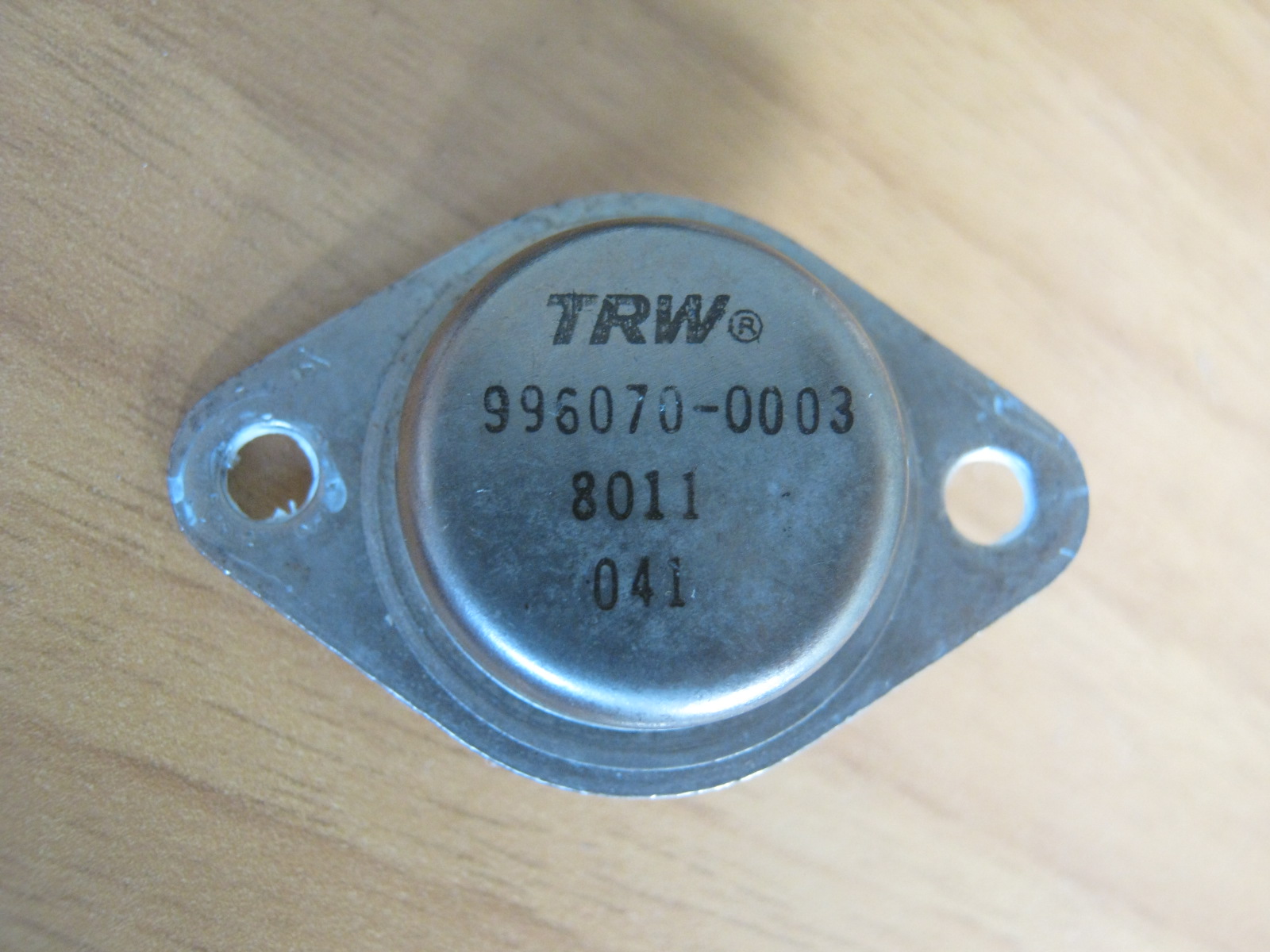
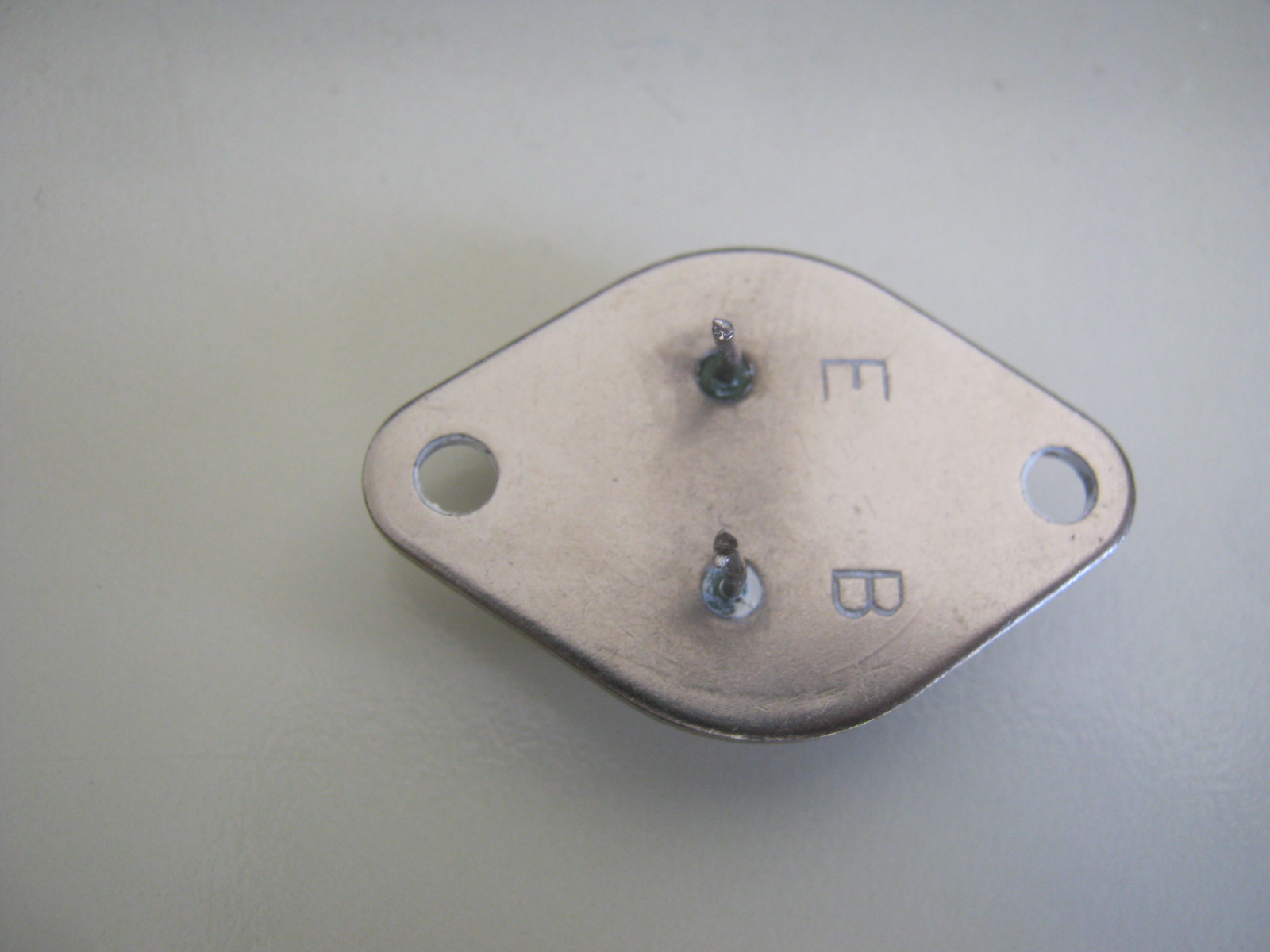
the main power supply board with collector in short circuit with emitter.
The transistor has TRW logo and is market with Texas part number 996070-003,
in addiction with the date code.
Pictures of the transistor here :
http://www.museodelcomputer.org/parts/texas/990_5/IMG_6442_transistor.JPGhttp://www.museodelcomputer.org/parts/texas/990_5/IMG_6445_sotto.JPG
Google give me only a link, were it seem to be an Optek SVT6747 ... another
unknown transistor :(
Someone has experience with this power supply ?
http://www.museodelcomputer.org/parts/texas/990_5/IMG_6423.JPG
Texas part number is 944970-0001
Thanks for any help !
Alberto
------------------------------------------------------
Alberto Rubinelli
A2 SISTEMI ELETTRONICA, INFORMATICA, NETWORKING
Via per Occhieppo, 29 Tel 015 8853203
13891 CAMBURZANO (BI) - ITALY Fax 015 8853202
Mobile +39 335 6026632
Mail : alberto at a2sistemi.it
Web : www.a2sistemi.it
FONDAZIONE MUSEO DEL COMPUTER ONLUS
http://www.museodelcomputer.orgMail:info.museodelcomputer.org
Tel 015 8853201 Fax 015 8853202
------------------------------------------------------
Le telefonate con numero nascosto sono filtrate
Calls with no caller identifier are filtered
------------------------------------------------------
On Thu, 4/28/16, Rod Smallwood <rodsmallwood52 at btinternet.com> wrote:
> Every fancy curve there is but not a straight
> forward line and circle method of? creating lower case
> characters
I'm not sure if you count it as straightforward, but I'd
suggest METAFONT. Straight lines are certainly straightforward.
Circles are a little more fun, but once you get the hang
of the math, most any curve is pretty easy to create.
BLS
On Thu, 4/28/16, Rod Smallwood <rodsmallwood52 at btinternet.com> wrote:
> How about morse by a key made in 1898 . Then cw to ascii serial
> converter and? normal program input after that.
I've often thought of doing that! Though my key dates from more like
the '40s or '50s. I see a weekend Raspberry Pi hack in my future...
BLS
On Thu, 4/28/16, Liam Proven <lproven at gmail.com> wrote:
> Oh, yes, indeed! I have a Plan 9 VM, and I intend to try it on my Pi.
> But it's had relatively little impact on mainstream Unix.
I would agree, given the qualification "relatively." There are several
things that have made their way from the late research UNIX editions
and Plan 9 to the mainstream UNIX world. The unfortunate part is that
they're little bits and pieces and as a result miss the major advantages
by not bringing in the big picture. For example, the proc file system
that most UNIXs have today was originally in either 9th or 10th edition
and is a central part of the design of Plan 9. The _clone() system call
that now underlies good old fork() in Linux is basically the Plan 9
rfork() call. Several UNIXs are starting to graft in per-process name
spaces. There are also a number of research systems that are bringing
in a lot of Plan 9 influence. The only one whose name comes to
mind at the moment, though, is Akaros.
BLS
On Thu, 4/28/16, Rod Smallwood <rodsmallwood52 at btinternet.com> wrote:
> On 28/04/2016 16:32, Jon Elson wrote:
>> Have you tried MetaFont?? I've never actually created a font with it,
>> just used it automatically within the TeX environment.? But, there is
>> a human-readable language that defines the characters.
>
> I haven't where would I find it?
It should be part of pretty much any TeX installation. I don't know if anyone
has packaged it up independently of TeX though. If you don't already
have TeX installed, I'll warn you that the mainstream TeX distributions
are pretty huge. There's a build-from-source distribution called kerTeX
that I use. It's much closer to Knuth's original packaging and I find to be
quite a bit more managable. If all you need is METAFONT, then that
might be a nice way to go.
BLS
On Wed, 4/27/16, Liam Proven <lproven at gmail.com> wrote:
> ... with a few weirdos saying that 6809 was better than
> ... and a few weirdos maintained that Forth was better.
> ... while the weirdoes use FreeBSD.
I've never been more proud to be classified as a weirdo :)
> The efforts to fix and improve Unix -- Plan 9, Inferno -- forgotten.
Plan 9 and Inferno are still around. There are quite a few of
us who still use them on a regular basis. In fact, the Plan 9
updates for the new Pi 3 should be out very soon, and I have
a student currently working on a port of Plan 9 to the Allwinner
A20 found in the Banana Pi and several of the low-end tablets.
> That makes me despair.
I feel much the same way, but it leads me to a little different place.
While I'll probably never be there entirely, I am now at a point where
I am giving serious thought to only running software I write myself.
For example, the file system I run on my home file server (a Plan 9
box) is something I wrote myself. The version of Scheme I use on
Inferno is one I wrote, etc. The truth is if you're willing to be one
of the weirdos, there are still some pretty interesting places to be
in the computing world. There are still interesting languages both
old and new to learn. (I had a blast last summer working with MCPL,
an experimental offshoot of BCPL, and the ENIAC simulator I'm
developing is written in Go.) I find life to be much more enjoyable
and my blood pressure to be much lower as long as I steer away
>from anything that's mainstream or popular.
BLS
> From: Dwight Kelvey
> Has the list gone down or just dropped me again?
Consulting the list archive via the Web:
http://www.classiccmp.org/pipermail/cctalk/
is a good way to see if things are moving.
Noel
> >
>
> Don?t fret, once OpenVMS v9.0 is released, on x86-64, there won?t be any doubt
> as to who won. :-)
>
Sadly, no one won. I doubt any one (well perhaps not anyone) would consider OpenVMS for a new deployment.
Upgrading existing environments, yes, but a new green field site. It would have to have very good reasons.
(I know you will all come out with some, but perhaps one for every 10,000 Linux and/or Windows Server deployments.)
Digital is now a fond memory for most. Both VAX and Alpha are no longer manufactured.
I actually wonder if an FPGA VAX chip could be made that would run faster than existing real VAXEN. That could perhaps form the basis of a nice VaxStation...
... on browsing I found this...
http://h71000.www7.hp.com/openvms/journal/v7/vax_6000_emulator.pdf
Dave
under the heading of d?j? vu, if this unit is a Rockwell Collins mil hand paper tape puller, my old roommate ran the qualification tests on the development of that system. That happened here in Santa Ana @ their Harbor & Warner facility. They drove around the parking lot in the bed of pickup trucks pulling tape and loading systems w/ potholes & speedbumps in the way.
A few list members wanted me to hold on to some boards until they were
ready for them. While looking for then, among hundreds of other non DEC
boards, I came across the following REMEX boards. As far as I can tell they
are for 8s.
Please contact me off list if you are interested.
REMEX 109381, one is a reader only,should be an easy upgrade reader/punch
109883
114143 / 114141
Thanks, Paul
> From: Paul Koning
> while Unix is reasonably secure, application writers have managed to
> create massive numbers of security holes that have nothing to do with
> defects of the OS, and aren't cured by a better OS.
On a secure system (i.e. OS plus underlying hardware), _nothing_ an
application does (whether merely buggy, or guidely malevolent) can i) write
data it's not supposed to have write access to, ii) read such data, iii)
interfere with any another application, etc, etc.
Google '"Roger Schell" oral history', and read that, and the other documents
he mentions there. (By itself, it's a very entertaining and educational read,
even if you ignore the others. It contains an interesting discssion on his
contributions to the security mechanisms of the x86 - which I expect Intel
will someday ditch, because nobody is using them - just like they apparently
ditched segmentation in the latest x86 chips because nobody is using it.
Sigh.)
Yes, a buggy application won't work right, and may crash, but there's no way
to prevent that (although better languages, and programming style, can help a
lot).
Noel
On Apr 26, 2016 2:35 PM, "Ian Finder" <ian.finder at gmail.com> wrote:
>
> Does anyone out there have one of these controllers?
>
> There is an unprotected PAL- the address decoder- and I really need a
dump of it. Many programmers, particularly the BP technologies ones, can
read it
Curious how you know it is not a protected PAL? The PALs are protected on
all of the CMD CQD adapters I have looked at. I can't remember if I
bothered checking the PAL on my CDU-720/M
Jon was always helpful
always cheerful and never snarky
this issad.... very sad indeed
we have lost an ally.
Ed Sharpe archivist for SMECC
In a message dated 4/27/2016 10:09:08 A.M. US Mountain Standard Time,
curiousmarc3 at gmail.com writes:
Oh, what a terrible news. His website is such a tremendous resource for HP
collectors. Researched, organized, encyclopedic. I don?t know how many
times I used it just to get accurate history and technical information on what
I was acquiring, and then for the ensuing restorations. And he linked back
to every single one of my resulting restoration videos or demos. I hope
the museum and site survives his passing and passion.
Marc
From: cctalk <cctalk-bounces at classiccmp.org> on behalf of Rik Bos
<hp-fix at xs4all.nl>
Organization: CCE
Reply-To: "cctalk at classiccmp.org" <cctalk at classiccmp.org>
Date: Wednesday, April 27, 2016 at 2:48 AM
To: "cctalk at classiccmp.org" <cctalk at classiccmp.org>
Subject: Very sad message: the passing of Jon Johnston
http://www.heraldsun.com.au/news/victoria/father-of-three-jon-johnston-died-
in-tibet-during-a-trek-in-the-himalayas/news-story/501c804577a833b0964016bae
87fd318
On Wed, 4/27/16, Sean Conner <spc at conman.org> wrote:
> > The bracketed note in the second paragraph of content on
> > http://www.catb.org/jargon/html/personality.html is exactly the sort of
> > thing I'm talking about here; ESR taught himself TeX by the simple
> > expedient of reading the TeXBook.
>
> ? You mean not everybody does this?
Alas, no, but that's really the point I was getting at with the comment
about knowing multiple languages. It wasn't about the languages
themselves or what value the variety itself brings. I pulled the half
dozen number out of the air just because if I look back over any
6 to 12 month period of my career, I've used a good half dozen
during that period. What's important to me isn't the effect on the
candidate's programming; it's the independence, self-motivation,
and curiosity that learning many languages represents. I also like
to see evidence that the candidate recognizes that no skilled
artisan's toolbox contains only a single tool. My biggest complaint
about new grads is the view that all the world's a nail, because
the only tool in their toolbox is a hammer.
BLS
Has anyone ever seen either A/UX or AIX running on an Apple Network Server
or Apple Workgroup Server? I had several hundred AIX machines running in a
server farm for a while, but even the oldest was POWER4 based, and I've only
done a bit of legacy support for PPC60x-based RS/6000 systems. I don't
belive I've ever seen an ANS or AWS IRL.
I'm curious what the last version of AIX that will run on them. I'm
guessing 4.x. I'm also curious if there is one machine that can run A/UX,
AIX, MacOS, and NetBSD.
Here's a fun fact to know and tell. In addition to an SGI Irix screen
running the "fsn" tool in the movie Jurassic Park, there were several
screenshots of a workstation in that same room/scene running A/UX.
-Swift
On Mon, 4/25/16, Swift Griggs <swiftgriggs at gmail.com> wrote:
> So, the point is that the masses
> don't often pick "great" languages to fixate on.? IMHO, Just
> because I point that out, doesn't make me "foolish, ignorant, narrow
> minded, or short-sighted"
I usually try to stay out of such discussions, but I think it's
important to draw some distinctions here. First, it's not pointing
out which languages/techniques are popular that's narrow-
minded and short-sighted. It's the view that popularity and
"commercial viability" is the primary consideration of value
in education that's narrow-minded and short-sighted. Second,
it's the perspective that's narrow-minded and short-sighted,
not the person who expresses that perspective. Many people
fail to appreciate the distinction between training and education
and as a result see the primary purpose of the university to
be job preparation. That so many people misunderstand the
purpose of the university isn't a reflection on their individual
intelligence or priorities. It's a reflection on the misplaced
priorities of the secondary education system and of society
as a whole. It's the same misplaced priorities that lead so
many students to be so obsessed by the most meaningless
part of the system: grades.
BLS
{Several replies packaged together to minimize list bandwidth use..}
> From: John Willis
> the real promise of the Internet as envisioned by Cerf, Postel, et. al.
> was in the purity of the end-to-end networking connectivity, where your
> personal machine is a node equal in stature to minis, mid, and
> mainframes also participating
We don't have peer-peer at the packet level, true, but a lot of the
philosophical goals many people had back then (which were unspoken, of
course) were in fact met.
i) Information is much more accesible now (and not just Wikipedia, but
government information, etc - stuff you used to legally have access to, but
it required real effort and physical presence to get to). ii) Information is
much more democratic - the 'New Media'. No more three national TV channels
(in the US, replace '3' in other countries.)
Yes, there are issues, but on balance, I think I still prefer post-Internet
to pre-Internet.
> the vapidity of online exchanges quickly reached fever pitch as more
> and more blockheads flooded the network.
This is kind of a corollary to Sturgeon's Law. x% of the world are ^%&-heads;
if you have something that includes the entire population, you'll
_necessarily_ have a lot of ^%&-heads.
> From: Swift Griggs
> The Internet is a large, but still textbook case of what happens when
> you let business-weasels in on something good. They "monetize" it and
> turn it into a combination strip-mall, casino, theatre, porn-shop.
"In a democracy, people generally get the kind of government they deserve."
Real world strip malls, Walmart, etc exist because of _demand_. If people
didn't want that stuff, it wouldn't exist. You want better? Educate
people's tastes.
> I even cringed when I saw Geocities dying. Yeah it was a cheesy service
> but, for example, I have a friend who is a master gunsmith and put all
> kinds of excellent info on a site he made. Now it's gone
Some was saved:
http://reocities.com/newhome/makingof.html
Interesting story...
>> Of course, if class A and B address blocks weren't handed out like
>> candy to children in the early days, IPv4 might have lasted longer.
> I still hate Network Solutions and all the NICs for that, too.
Uhh, by the time we got to that stage, the taps were long turned off.
All the 'space handed out freely' stuff happened back when you went to Postel
for numbers - and a lot of the class A's went i) before the Internet was a
going concern, and ii) in the earliest days, there were _only_ class A's.
> Nowadays, folks create viruses that encrypt and/or destroy the target
> for ransom the minute they can write 3 lines of code in Visual Basic.
> The level of malice and thuggery have gone way up.
See previous Sturgeon's Law comment...
Noel
From: Paul Koning <paulkoning at comcast.net>
>
> HDLC is ok so far as it goes, but DDCMP is superior in every respect. The only reason
> to use HDLC is that you need to talk something that can't be made to speak DDCMP.
>
Like a Cisco router without the DECnet feature set? Or pretty much
anything that doesn't speak DECnet?
KJ
From: Ethan Dicks <ethan.dicks at gmail.com>
>
> DUP-11? Will that do what you need?
>
Not sure, Ethan. I'm been looking at the doco and it's not clear yet
if it's suitable for what I'm trying to do.
Thanks for the pointer.
KJ
Yes, the CSPI box is mounted inside a standard DEC cabinet. I have one of
these things in a VAX, originally part of some sort of chemical analysis
tool.
--
Will
On Apr 26, 2016 9:44 PM, "Jon Elson" <elson at pico-systems.com> wrote:
On 04/26/2016 07:59 PM, Swift Griggs wrote:
> Seriously,
>
> http://tinyurl.com/j46jg4p
>
> http://www.computerhistory.org/collections/catalog/102743645
>
> What in the world is this thing? Some kind of early parallel or vector
> processor?
>
We got a CSPI 6410 and had it hooked to a VAX 11/780. It was probably a
bigger brother to the machine you
link to. There was a big math library that came with it. If you had
really regular matrix operations, such as FFTs, matrix multiplies and
similar classic operations, it could do them quite fast, in the several
MFLOP range. The bigger the matrix (as long as it fit in the memory of the
unit) the better, as the library just set up all the registers, loaded the
data and turned it loose. If you had a bunch of small matrices, it was a
lot less efficient, as it had the same setup overhead for every task.
Yes, it is a vector processor, with a floating-point multiplier and adder,
some address arithmetic logic and a sequencer.
Jon
Seriously,
http://tinyurl.com/j46jg4phttp://www.computerhistory.org/collections/catalog/102743645
What in the world is this thing? Some kind of early parallel or vector
processor? External? How delightfully weird, except there is very little
online about it. Did any of you work with one of these? What kind of
instructions do they use? What is their bus width on the ...uh what? CPUs?
What kind of addressing modes & size(s) do these use? Why does the one
reference talk about the 64k RAM they had? Were these standalone machines
('cause it looks like it goes to a VAX-11 and "LSI-11") ?
This was before my time but fascinating, nonetheless.
-Swift
I have a "MACSIMM" from GGLabs (http://gglabs.us) which I bought from
their Ebay store. Unfortunately they haven't followed up on my request
for information on how to prepare a ROM image for use with the thing. Has
anyone else here used this or a similar device to hack the ROMs of the Mac
SE/30, IIsi, IIci, or IIfx? It's composed of four 39SF010A 32-pin PLCC
chips the special 64-pin SIMM.
--
David Griffith
dave at 661.org
A: Because it fouls the order in which people normally read text.
Q: Why is top-posting such a bad thing?
A: Top-posting.
Q: What is the most annoying thing in e-mail?
There were a few others, as well as some RF devices with the tuned parts
inside the bulb. There were also some oddball types made for weather
balloon use that had the whole transmitter circuit as one unit.
--
Will
On Apr 26, 2016 6:30 PM, "Chuck Guzis" <cclist at sydex.com> wrote:
On 04/26/2016 12:40 PM, Paul Koning wrote:
> This sort of stuff doesn't seem to be all that common; I haven't seen
> it elsewhere. Multiple tubes, like dual triodes or triode/heptodes
> are pretty common, but those are just the active part.
The only "passive in the tube" examples I can think of in US manufacture
are simple between-unit resistors, such as the 6N6.
--Chuck
Does anyone out there have one of these controllers?
There is an unprotected PAL- the address decoder- and I really need a dump of it. Many programmers, particularly the BP technologies ones, can read it
On Apr 26, 2016 3:04 PM, "Ian Finder" <ian.finder at gmail.com> wrote:
>
> The spec sheet from the PAL mfg. (signetics PLS173) seems to indicate
> security fuses aren't an option on the model on my board. I have not
> actually tried yet.
>
Regardless of what the spec sheet does or does not explicitly say, I think
when I selected that device in the BPWin device programmer software there
was an option to protect the device after programming. I'm mobile now, I
can check that later.
On Mon, 4/25/16, Swift Griggs <swiftgriggs at gmail.com> wrote:
>The idea is somewhat that if students learn a
> "good" language that'll teach them some meta-structure that will help them
> later.
Certainly a lot of people do view it that way, but it's not what I was
getting at or how I see it.? Based on my experience, the virtues of
any single language are pretty much irrelevant.? What's vitally
important is that the student emerge with a deep understanding
of how a variety of languages actually work, how they're processed
and how the computer executes code written in them.? If you have
that deep understanding with a sampling of languages that represent
some of the variety of techniques and paradigms (for lack of a
better term), then you'll be able to pick up and adapt to most any
language that comes along.? To tell you the truth, I'm not very
likely to hire anyone who isn't conversant with at least half a
dozen different languages.? To summarize, my focus isn't on the
skills of any particular lanugage; it's on the understanding of the
fundamental concepts, principles, techniques, and mechanisms
that make up the world of computing.
>Then, let me say that the *idea* that I was attacking Pascal via
> Oberon rather than the Ivory Tower Academics is ridiculous.
I did understand the point in your first message to be anit-"Ivory
Tower Academics."? However, my point it is that viewing the people
you have identified as such and dismissing their experience and
expertise is a narrow-minded and short-sighted perspective.
> Your point might be
> logically valid, but ask a 23 year old if they care when they can't get a
> job after giving the uni a quarter million bucks and 4-5 years of time
> they spent being "educated" rather than "trained".
It's interesting that you pick that age as the example.? My daughter
is 23.? For her, the undergraduate experience wasn't about a job
at all.? It was about exploring the intellectual world and (to borrow
>from Thoreau) sucking the marrow out of that life.? In the interest of
full disclosure, however, I should point out that she's not typical
of most college students (although I wish more were like her). She
did grow up in a household that averages more than two degrees
per person and she did triple major in her four undergrad years.
(A proud daddy can't help but brag a little. :) )
> The underlying point I? was making is that schools don't always
> "train" a person ...
I apologize if I misinterpret, but I also detect the suggestion that they
are supposed to.? I don't disagree that they don't train, but I do
disagree that's what their purpose is. I'm not suggesting that
some degree of training coming along with the education is a
bad thing. However, I'm saying that's not the primary purpose
of the university.
>? and that's what I wanted and actually needed.
There seems to be an implication here of an XOR when I look
for an AND. In particular, if I have a candidate sitting across
the interview desk from me, I'm not interested unless they have
both education and training. I expect the education to come
>from a formal environment where people of long experience
can help the student understand many perspectives. I expect
the training to come from self-directed experience. Unless a
candidate shows both the ability to work in a rigorous intellectual
manner and the self motivation to go beyond what they've been
given, I'm not interested.
> all but one of the profs had
> turned off their brains in 1986 and it was the 90's.
It's certainly true that does happen both in academics and
in industry. However, more often than not, the ideas that
were seen as "new" in the '80s, '90s, '00s, and '10s, are
really ideas that the Computer Science community saw,
studied, understood, etc in the '50s, '60s, and '70s. So
what appears to be out of touch is often really a broader
perspective and one worth understanding and learning from.
> True. I wonder though, do you believe that teaching a
> language with almost zero commercial value is justified
> in the name of education because of it's superior "meta"
> qualities ?
I'm not sure I can answer the question as you've posed it.
As I said, I tend to consider the choice of any single
language to be mostly irrelevant. I'm much more interested
in the neural pathways that the student builds as a result
of the experience of coming to understand a large set of
languages. As it turns out, I am currently involved with a
restructuring of the introductory programming sequence at
one university. Our choice of languages was driven by
both pedagogical and vocational considerations. Were
our environment different such that we should have looked
at only one or the other, then we would have chosen
differently. Regardless of what we did pick, we never
intended for the freshman languages to be the only languages
our students knew before graduation. No one or two
languages will give the breadth and depth needed pedagogically.
Neither will any one or two languages suffice for building a
career as a computer scientist.
> Grades aren't meaningless if you have a grant/scholarship
> to maintain or need to get into graduate school.
There are expected minimums, certainly. Based on my experiences
in both academics and industry, I would have my doubts about
whether someone is really cut out for a CS major if they can't
average Bs in their major classes. On the other hand, I have yet
to be in a hiring meeting where one candidate was chosen over
another because they had a 3.5 vs the 3.3 the other candidate
had. For that matter, I always question candidates that come
in front of me who have 4.0 averages. Before I can take them
seriously, I need to see some evidence that learning new things
is a higher priority to them than the grade. It goes back to the
expectation that the candidate show evidence that they can
pick things up on their own as well as in the classroom.
> They have plenty
> of meaning to employers like IBM who might not hire you for
> that entry-level position with a low GPA.
Actually, it's better to consider companies with unenlightened
cutoffs to be simply advertising that they are not where you want
to be.
> They might not reflect some aspect of education or learning
> you think is important, but there is more to going to uni than just
> to get a mind expanding education.
The purpose of the university is the discovery, dissemination,
preservation, and interpretation of knowledge. A necessary, but
not sufficient, part of being well-prepared for a professional career
is the exposure to that breadth and depth of knowledge. I would
rephrase your statement to say that there's more to preparing for
a career than just getting a university degree.
> I think folks who haven't been to school in 20+ years have a totally
> warped view of what is happening nowadays.
I might point out that on this mailing list, you will find people who
are all across the spectrum with exposure to education. Some of
us were students many years ago and haven't had much contact
since. Some of us have been students recently. Some of us have
siginificant faculty experience. As with the experience of changes
in the CS field, I'd suggest that the longer the period of time over
which one has experience with education the less warped the
view of what's happening. However, each individual must
decide for themselves whose opinions and experiences earn their
respect.
> All our code was in C or C++ and we found that none of the students
> from the local universities had those skills.
Although there are plenty who disagree with me, I argue that the
purpose of the university experience isn't the skills; it's the understanding.
I always say I want to hire the preson who I can tell on Friday that
we'll be using Intercal for the project and they'll spend the weekend
teaching themselves the language and come in Monday morning
ready to code in Intercal. I (as well as entrepreneurs I know) have
very little interest in how much experience and skill a candidate
has in a particular language. The reality is no matter what their
experience is coming in, I'm going to have to teach them how to
do things the way I want them done.
> I could only attribute that to the memorize-and-regurgitate
> culture of the schools, but maybe it was just bad luck.?
It's a combination of bad luck and the ill effects of misplaced
priorities filtering up from the primary and secondary school
levels.
As I tell my students, there is a continuum of understanding. At
one end, there is the mere repeat back to me what I've said to you.
If that's all a student can do, then there's not much value in it.
I can simply put the same information into a computer and then
not bother paying a person for it. At the other end of the continuum
is the ability to ask the right next question, the understanding of
how our current knowledge came about, and the understanding
of how to advance that knowledge. My objective in every class
I teach is to help each student move as far along that continuum
as they are capable. The farther along that continuum you move,
the more you will be able to discover what has never been known
before and create what has never existed before.
Many would classify that perspective as "Ivory Tower." They
might say, I can't put food on the table with that attitude. I would
differ with that. I have put food on the table for several decades,
and in only a few of those years were the funds coming primarily
>from the academy. Indeed I have realized that my level of understanding
and my drive to explore, investigate, and create are of significant
value to many. Those who recognize that are willing to exchange
monatary renumeration for the contributions I can make. Those who
don't recognize it self-select themselves out of the pool and I don't
have to worry about them.
Throughout this, it has not been my intention to in any way
dismiss your perspective or to suggest that it is a "wrong"
perspective. Indeed, it's a perspective I'm quite familiar with.
Instead, my objective has been to suggest there's another
perspective whose consideration might lead to deeper understanding.
It is a perspective which attempts to temper the immediacy
of the question of tomorrow's employment with the longer-term
view of how that employment fits into the thousands of years
of human civilization.
BLS
I use Samsung 850 Pro disks exclusively. The main one I tested with was
128GB.
80-pin SCA hot swap Ultra160 SCSI to SATA:
This one I've tested in my O2 and Tezro:
http://www.acard.com/english/fb01-product.jsp?idno_no=240&prod_no=ARS-2160H…
50-pin ultra-scsi to SATA:
This one I've tested in two Indys (R4600 200Mhz and R5k 180Mhz) also a
Challenge S with an R4600 200Mhz CPU):
http://www.acard.com/english/fb01-product.jsp?idno_no=249&prod_no=ARS-2000S…
There is also a 68-pin variant. I've yet to try one because I will
probably get rid of most of my Sun gear at some point in the future.
However, I'd be interested to know if they work well or not. I still play
with older SPARC boxes from time to time.
I've upgraded many of my SGI's to use SSD disks. You don't see tremendous
improvements in throughput (though it does help some). My results testing
with 'fio' showed about 10% throughput increase on most operations overall.
However, the latency becomes much lower. This gives the machine a much more
snappy feel if you use them as desktops. Web browsing is especially
ameliorated (as in, you can almost do it, har har). On my Tezro the
results were pretty dramatic. The quad R16k CPUs still keep up pretty well
with my "modern" PCs for most operations (including browsing). Using
internal SSDs makes the anecdotal experience tangibly improved.
I'm curious if anyone has used one of the 50-pin units to upgrade an Amiga
3000 or older mac. I'm thinking of other machines like one of the slimmer
and more interesting AlphaStations might also be fun to try (or a newer
Multia with the SCSI adapter). Did Atari ST's have SCSI? Without looking
it up, I'm guessing so. That'd be another fun one to test.
Also before someone pipes up saying "The older SCSI interface is going to
limit you too much to feel the difference" let me just say that's NOT been
my experience. As I mentioned, you might not get much throughput increase
(though it will usually improve some), but the numbers don't lie on the
latency which drops outta sight into the sub-1ms range most of the time.
You feel that on desktops, bigtime. Also, if you say "that's not stock!
It's not original anymore!" Please let me just respond now and also say
"Yes, I know that, thank you."
Thanks,
Swift
Is there an equivalent to the DSV11 for Unibus? Or other quick Unibus
sync serial that my Google-fu isn't good enough to find? The DMC11
looks like it can do 56Kbps over V.35, which is better than the
19.2kbps on the DMF32, but it would be useful to be able to push to
256Kbps (or faster). I'm particularly interested in doing HDLC.
KJ
very bogus with the hp 150 business system and they guy claims the 9121
dual floppies was a hard drive....
Ed# _www.smecc.org_ (http://www.smecc.org)
In a message dated 4/20/2016 7:47:24 A.M. US Mountain Standard Time,
oltmansg at gmail.com writes:
On Wed, Apr 20, 2016 at 9:37 AM, geneb <geneb at deltasoft.com> wrote:
> https://www.youtube.com/watch?v=7T1IYdjOpYE
>
> The video is an hour long, but you can skip around. It includes ads for
> machines like the ITT Xtra, IBM PC Jr, etc. The Hayes Smartmodem ad is
> just atrocious. :) There's even ads for IOMega drives and the Promethus
> Pro Modem...
>
>
Is that Bryan Cranston a la Breaking Bad in that video??? Sure looks like
him.
Remember all the accelerator boards for the Mac, Amiga, and even PCs in the
90's ? I've often wished that I could get something similar on my older SGI
systems. For example, fitting an R16k into an O2 or doing dynamic
translation on a 4.0Ghz i7.
I'm most familiar with the Amiga accelerators. I suspect those who
produced them were helped out greatly by a couple of factors. One is that
the hardware specs were very well known and full schematics were available
for most (all?) Amigas. I doubt the same is true of SGI machines. The
other is that many Amigas had processor "slots" (with edge connectors)
rather than some tiny fiddly ball-grid array etc... but I'm not a EE; so
maybe that's bunk.
When I look at these boards they seem like they'd be a LOT of work to
develop and produce. I wonder how they were even economical to make back in
the day. Plus, now the user base will probably only shrink. It's not a
great business model for a hard-to-produce item. It doesn't keep my
techno-lust from wanting it, though.
So, here's the question. Is my dream likely to ever be possible enough that
a boutique shop could pull it off and not lose their shirt on the production
costs and R&D to do it ? I'm encouraged by things floppy emulators that are
produced for these old machines. However, that's probably significantly
easier to make than a CPU accel board.
What do you guys think?
-Swift
> From: Swift Griggs
> it's (currently) a big hassle in Windows to get absolutely every font
> to get bigger at once.
Have you tried right-click on a blank spot on the desktop, 'Properties',
'Setting', 'Advanced'? The window that pops up allows you to change i) on
older Windows, _all_ font sizes (options are 100%, 125%, and custom) at once;
ii) on newer Windows, the size of _everything_ (which includes images, I
think).
Noel
> From: Brent Hilpert
> I'd say the 74181 (1970) deserves a mention here. Simpler (no register
> component, ALU only) but it pretty much kicked off the start of
> IC-level bit slicing.
Yes, it was used in quite a few machines. Among the PDP-11's alone, it is
found in the -11/45, /05, /40, /04 and /34, to name a few that I checked
quickly, and almost certainly others too (e.g. /70).
Noel
> From: Jules Richardson
> I think my personal view is that I'll consider modern replacements to
> things when it's impossible to use the originals - but not simply for
> reasons of speed, cost, convenience.
This sounds like it's not _that_ far from my position, which is that I am
against building modern equivalents for "stuff that is still available and
perfectly functional".
>> running the disks ... risks damaging what are effectively museum
>> pieces.
> There I'd just say run them until they break and can't be fixed, and
> then they can become static museum exhibits.
The problem with that is that I feel that it conflicts with what I feel one of
our main goals ought to be, which is to preserve these machines in running
form, for history and the education of future generations.
Yes, even powering them on risks a failure, but most failures are repairable.
A crashed head, if you don't have spares, is pretty much un-fixable (there's a
whole manufacturing complex needed to create them, which is now gone, and one
can't substitute an alternative part). So I'd run them as little as possible -
and a modern solid-state alternative really helps with that.
(BTW, there's a big debate in the museum world over this sort of topic: some
places won't do any cleaning and fixing of antique objects, retaining them
exactly as they were, and living with the degradation of plastics, etc;
others do restoration, but mark what was done, and make it reversible if
possible; others go all out and restore things to 'like new'. I'm kind of in
camp II, myself.)
There's also a practical down-side to the 'run it as a matter of course till
it fails forever' approach; if one has packs for that drive which one wishes
to read or write, that's no longer possible once the drive is roached
(although someone else could do it for you, but that's not necessarily a
desirable option).
And of course, with the drive dead, the machine may not be runnable unless one
adds a modern alternative - and if one's willing to do that _after_ the drive
is fried, why not before?
> From: Swift Griggs
> I might be laughed at for wanting a Fiero-Ferrari
For a good time, Google 'Jerrari'! :-)
Noel
Hi,
Is there anyone with a good set of 8/e prints who could help me narrow
down some troubles?
My 8/e was working a few years ago, but now it's developed some problems.
It seemed to work fine for about the first 2 minutes that I tried it, but
then it developed these two symptoms:
- Most of the time, upon power up, LOAD-ADDR clears all the random
address lamps, but will not take an address, just all 0s. Occasionally
when I power it up, LOAD-ADDR will permit me to load an address, and
see it's contents as it should. I can then enter other addresses, hit
LOAD-ADDR, and get consistent results looking around at random data in
different memory addresses.
- Regardless of whether it's in the broken load-addr state above or not,
hitting DEP or EXAM just turns on the RUN lamp, and it's then stuck with
RUN on, and non-responsive to any other front panel actions. This happens
irrespective of the position of HALT. I then power-cycle it and it is
back in either broken or working LOAD-ADDR mode as described above, usually
broken.
So far, the only M8330 prints I have found are extremely fuzzy, so I cannot
make out the IC identifiers or match them up to the equally fuzzy schematic.
By board-inspection I identified the 74S74 "run" flip-flop, and in fact I
can un-stick the RUN state by briefly grounding CLR, but still cannot
DEP or EXAM from the front panel -- it gets stuck back with RUN on if I
hit either DEP or EXAM again.
The power supply voltages are right-on. I've reseated and repositioned
the boards. The connectors are very clean. Wiggling boards doesn't change
any of the symptoms. Wiggling switches doesn't affect anything. This is
a very clean 8/e.
Mark
--
Mark G. Thomas (Mark at Misty.com), KC3DRE
Folks,
Thanks to an ordering SNAFU by me I have some 1W resistors spare at 1K,
10K, 220R and 330R. 20 of each. They only cost ukp1 per bag so it's not
worth me trying to send them back.
Anyone? Or do I just bung them in my spares box and use them ad-hoc...
--
adrian/witchy
Owner of Binary Dinosaurs, the UK's biggest home computer collection?
www.binarydinosaurs.co.uk
> From: Dennis Boone
>> it says "Chicago Lock Co" and "GRB 2"
> Aha.
> Cut 215 on Ilco S1041T.
You were able to deduce that from the "GRB 2"? Is that authoritative? If so,
I'd like to add it to the 11/05-10 page on the Computer History Wiki.
Also, I have an original XX2065 (Data General) which I have no use for; if
anyone has an XX2247 they'd like to trade for it (new is fine too), please
let me know.
Noel
Hi Jim,
regarding reading the StarTrek paper tapes I spent some time on
the weekend to rework my SPT11A manual reader - I got this from
an eBay auction and it was an accessory for some military receiver
(probalby to read in some codes). It had a fimrwaere which refused
to communicate with a simple terminal program, so I reverse en-
gineered the hardware and replaced the original ROM it by an
own firmware which simply sends the contents read from PPT to
the PC via its RS232C...
http://www.baigar.de/vintage/SPT11A-mod-Internal.jpg
So I'd offer sending this to you as an item on loan to read in your
tapes and you return it afterwards? I tested it with some data and
it works well (just slowly pull the paper tape through the reader
and use e.g. putty to log the binary serial output). After turning
on the reader there is a short welcome message to verify the serial
connection (9600,8N1).
The only question is, whether you can handle the EU style power
supply shown in the picture...
http://www.baigar.de/vintage/SPT11A-mod.jpg
I ordered USB->RS232C converters and if you have some more time,
I'd attach one of them to the reader not only doing conversion
but also supplying the converter with power from the PC.
Addidionally you should send me your physical address via PM
so I can prepare for shipping...
Best regards from Germany,
Erik.
On Mon, 18 Apr 2016, jim s wrote:
>
>
> On 4/18/2016 12:19 AM, Erik Baigar wrote:
>>
>>
>> Hi Jim, Dear Sherman,
>>
>> thanks for the update. I wish you the very best for digitizing the
>> tape. I can offer reading it using a Facit N4000 (speed can be configured
>> down to 50cps, i.e. around 10cm/s). I also have got a manual reader
>> which unfortunately is broken: I would have to generate a new 80C51
>> chip with the right firmware (not a big issue, but not possible over
>> night). I can offer fixing this and lending it out to you in
>> two or three weeks...
>>
> I'd be glad to help with shipping on that and would use it. I don't have any
> fanfold samples to send to you for testing, but would be glad to have a hand
> version to feed this thru.
>> I'd be really interested in getting hands on a copy to run on my
>> Rolm computers. Are you sure, that there is only a singel tape?
> There are 47 individual tapes in the set. All from 1/4" of fan fold width to
> about 1 1/2" of fanfold width.
>
> I will put up my photographs and videos later today and reply again with that
> information on my blog.
>> As mentioned I have got one tape of a two-tape binary distribution
>> of the StarTrek.
>>
>> Best Regards from Germany,
>>
>> Erik.
>>
>>
>>
>> On Sun, 17 Apr 2016, jim s wrote:
>>
>>> Here is an update on the tape. It is a box of 47 tapes. We got a
>>> volunteer from Charles Anthony to do a video reader for it.
>>>
>>> I have a video I can share of that tape if that is of interest. I was
>>> hoping that it was going to be a basic source tape distribution, but on
>>> looking at it, that doesn't fit with what I can read by eye on the tape I
>>> read, so I bet it is a bunch of binaries.
>>>
>>> The tape is fanfold and will need a very careful handling to read it so we
>>> will proceed carefully. It is pristine now, doesn't look like it was ever
>>> read.
>>>
>>> I will let you know if we need help, but am going to look for a hand
>>> optical reader somewhere for loan or build and attack it that way.
>>>
>>> It has writing on the box that leads me to think it is from a user group
>>> for DG of some sort if that helps you identify the source of it.
>>>
>>> thanks
>>> Jim
>>>
>>>
>>> On 4/16/2016 3:04 AM, Erik Baigar wrote:
>>>>
>>>> Hi Jim,
>>>>
>>>> just out of curiosity: Did you have got a look at the DG Star
>>>> Trek? Is there a chance to get a copy of the tape?
>>>>
>>>> If you need assistance in reading the tape, just drop me
>>>> a note...
>>>>
>>>> Best regards from Germany,
>>>>
>>>> Erik.
>>>>
>>>>
>>>> On Fri, 8 Apr 2016, Erik Baigar wrote:
>>>>
>>>>>
>>>>> Hi Jim,
>>>>>
>>>>> short version: Yes, I can confirm existence of such a software and
>>>>> I'd be highly interested in a copy. Of course I can
>>>>> offer digitizing it ;-)
>>>>>
>>>>> longer version: I am preserving various Rolm (later Loral) 16 bit
>>>>> machines which are hardened, military machines widely comaptible
>>>>> to the DG hardware (1602 compatible to Nova and MSE14/Micro is the
>>>>> hardened Eclipse). If interested, have a look at my logbook...
>>>>>
>>>>> http://www.baigar.de/TornadoComputerUnit/TimeLine.html#HDDsim
>>>>>
>>>>> ...datecodes 10/20/2014 to 12/15/2014 and 2/3/2015 to 2/28/2015.
>>>>> Together with two friends (both maintaining a 1602B and native
>>>>> DG hardware) we built a harddisc simulator to run advanced
>>>>> software (e.g. RDOS). During my efforts I rescued some paper tapes
>>>>> from Rolm (diagnostics)...
>>>>>
>>>>> http://www.baigar.de/TornadoComputerUnit/EB-RolmTapes.jpg
>>>>>
>>>>> ...and among these serious, mighty tapes was one labeled
>>>>> "Star Trek 1/2". I digitized it, but without the second part
>>>>> it is of nut much use, so I am sure that such a game existed
>>>>> for DG hardware. From the first tape I can tell, that it is
>>>>> not just the BASIC listing, but native machine code and there
>>>>> is a copyright message dating 1969-1973 ;-)
>>>>>
>>>>>> The tape pile is fanfold about 10" across in a DG box specially made
>>>>>> for such use.
>>>>>
>>>>> On some occasions I had trouble reading the 30+ years old
>>>>> oiled black tapes due to some holes on the folds being
>>>>> obscured at the from debris of the ageing paper...
>>>>>
>>>>> The very best from Germany,
>>>>>
>>>>> Erik.
>>>>>
>>>>>
>>>>
>>>>
>>>
>>
>>
>
> From: Dennis Boone
> Haven't managed to id the 11/05 key yet.
I have an original (which was used to make a ton of replicas for people a
while back); it says "Chicago Lock Co" and "GRB 2". No idea what the latter
means. The copies were made with Hillman Y11 and FR4 blanks (both work, but
one has to be trimmed a bit, length-wise).
Noel
Hi all,
Can anyone offer any advice on where to find classic computing equipment
in the UK? I've been keeping an looking for a terminal such as vt220 for
quite a while now on eBay without much luck.
Maybe I just don't know the right people?
Thanks,
Aaron
I also picked up a VAX 8350 today (it was a productive afternoon). It
came with a box of maybe 40 RX50 floppies for console and various
diagnostics. A cursory Internet search didn't reveal whether these have
been archived already.
If they haven't already been archived somewhere, I'll take care of
archiving them later this week...
Thanks,
Josh
Hey all --
I'm researching what I need to have on hand to get 4.2BSD installed
running on my 11/750. I'm pretty close to having mass storage working,
I have a SCSI TMSCP tape controller that should do the job in
conjunction with a SCSI 9-track drive, and the VAX itself seems to be
happy. What I don't have is a copy of the TU58 cassette that would have
been provided with the 4.2BSD distribution (at least, according to the
installation documents). This contains utilities for formatting the
disk and copying the root filesystem (from a *real* tape drive) to the
root partition, so they're pretty essential for bringing a machine up
>from scratch.
If I had a SCSI *disk* controller, I could cheat and do the installation
on SIMH (which avoids using the TU58 by cheating in a different way) and
DD the whole thing over, but I'm not so blessed.
I can't seem to track down a copy of this TU58 on the 'net -- anyone
have one squirreled away somewhere, or know where I should be looking?
Thanks,
Josh
Prior to the DEC Rainbow, Chrislin Industries was marketing the 11/23 with
vt103 as a desktop computer. This is a 3rd party vendor. Maybe they were
on to something...
Bill Degnan
twitter: billdeg
vintagecomputer.net
I built a new Elf switch panel, but this time I used two printed
circuit boards for the switches and the bezel.
The bezel PCB has white soldermask with black silkscreen. The next
revision will have black soldermask with white silkscreen, and the
legend font, weight, and positioning changed to more closely match the
original Elf photo in Popular Electronics.
https://www.flickr.com/photos/22368471 at N04/sets/72157667455777465
The 20-pin header has the same pinout as Bob Armstrong used for the
Spare Time Gizmos Elf 2000, but I don't presently have an Elf 2000 to
test it with. For now the main intent is to use the panel for a new
version of my FPGA Elf.
I'm not sure whether I got the wiring of the LOAD switch correct; the
Elf 2000 documentation refers to normally closed and normally open
contacts of that switch, but for a toggle switch that doesn't make any
sense to me. If anyone can tell me which pins of the Elf 2000
connector are grounded when the load switch is active vs inactive,
that would be appreciated.
The 20-pin header should have been right angle; since I only had a
vertical header on-hand, the ribbon cable had to be plugged in before
the switches were soldered in place, and the switches are not flush
with the switch PCB.
The toggle switches and push-button switch are C&K 7101SDV3BE and
8125SDV3BE, respectively, which have 0.42 inch actuator, 0.28 inch
threaded bushing with keyway, vertical PCB mount with V-bracket, gold
contacts, chrome actuator finish, and nickel bushing finish. These
particular C&K switch variants are not very common, so I'll probably
use different ones in the future, without the V-bracket.
I don't yet have enough of the red and white toggle caps, which are
C&K 896803000 and 896801000, respectively. The red button for the
push-button switch is C&K 801803000.
This is a long shot, but does anyone have a Tadpole Sparcbook 3TX hard
drive?
Their existence may be just a myth.
--
Ben Sinclair
ben at bensinclair.com
I just came across two unopened boxes (500 each) of 6"x0" 5.25" floppy
disk mailers.
Anyone want them? You can have them for shipping, FOB 97405.
--Chuck
I am not sure if 5.00 was the first Retail version. I know that for fact there is a 3.2 version released in the blue plexiglass Microsoft retail packaging. The 4.x versions are usually gray boxed with some having OEM/new computer stickers.
-Ali
Byte Jan 1981 page 204 refers to an IBM S-100 microcomputer system IBM
demoed in Europe. Anyone here seen this machine or heard about it?
Bill Degnan
twitter: billdeg
vintagecomputer.net
On Thu, Apr 21, 2016 at 12:07 AM, Raymond Wiker <rwiker at gmail.com> wrote:
> I was a bit surprised to see that it used 2901 with a date code of 1985 -
> the 2901 was introduced 10 years before.
The 2901 was the workhorse bit-slice data path chip for many years.
The A, B, and C suffix parts were progressively faster variants
introduced later. Eventually there were CMOS versions, and 16-bit-wide
versions. While AMD introduced the 2903 and 29203 as functionally
improved (but not directly compatible) 4-bit parts, they weren't
nearly as widely used as the 2901.
Most other bit-slice parts can be considered "also-ran" at best, with
the Intel 3001 and 3002 probably being the next most successful. MMI
tried to beat AMD to market with the 5701/6701, which was very similar
to (but not compatible with) the 2901, but they were late to market
and AMD won.
Motorola offered the MC10800 ECL bit slice series, which were
significantly faster at introduction than the contemporary Am2900
parts, but AMD kept introducing faster 2901s. Some later 2901
variants from AMD and National Semiconductor actually used ECL
internally, but had normal TTL I/O, but the CMOS that followed were
even faster than those.
> From: Jon Elson
> The 11/45 and 11/70 are mostly the same processor. ...
> the data paths boards and FPU are the same part numbers
'Yes' to the FPP (well, there are two versions, the FP11-B and FP11-C, but
they are both identical in the two machines).
'No' to the data paths, though: e.g. the M8100 in the /45 (the board with the
74S181's on it) is replaced by the M8130 in the /70. The two are _very_
similar, but I suspect not interchangeable (examing the prints shows minor
differences).
AFAIK, the only non-FPP board in the CPU which is interchangeable between the
two machines is the M8132 (instruction register decode & condition codes) -
and only to the KB11-D /45 variant, not the -A.
{As always, just want to be accurate! :-}
Noel
> AFAIK, the only non-FPP board in the CPU which is interchangeable
> between the two machines is the M8132 (instruction register decode &
> condition codes)
So it seems like there's an(other) error in the DEC documentation.
If one looks at 11/70 Maintenance Manual (EK-11070-MM-002), it says (pg. 1-3)
that the KB11-C (11/70 later CPU) contains an M8133 ROM and ROM Control
board, the same as the KB11-B (earlier CPU, pg. 1-4), _but_ ...
The KB11-C prints include the drawings for the M8123 (also used by the
KB11-D, the later /45 CPU). Other manuals confirm that the KB11-C uses the
M8123 (see, e.g., the KB11-A,D Maintainence Manual, EK-KB11A-MM-004, pg 1-1).
I _thought_ the KB11-D used two of the same boards as the KB11-C, but then,
when I went to check, to be sure I had the correct info (before sending out
my email intended to "just want to be accurate", sigh), I relied on the DEC
manual... :-(
Oh well, that's what I get for relying on DEC manuals! :-)
Noel
> From: Jules Richardson
> I can't see the point in modern upgrades .. At the point where people
> start adding emulated storage, USB interfaces, VGA display hardware
> etc. it stops being a vintage system and starts being a modern version
> which just happens to still have a few vintage parts.
I agree with you to some degree, but...
Some components are just hard/impossible to find now - like old original disk
drives (seen any RP0x's for sale recently?), or Able ENABLE's - and in any
case running the disks is both non-trivial (power/heat) and risks damaging
what are effectively museum pieces.
So one is left with the choice of modern replacements, or nothing. And I'm
not capable of building an RP0x, but building a board that uses an SD memory
card to emulate an RP0x, that's within my grasp. And it takes a lot less room
and power, to boot.
Also, the _systems_ were designed to have upgrades installed, and did, BITD -
many of which were not conceived when the machine first came out. E.g. our
11/45 at LCS wound up with 1MB MOS memory boards in it (much smaller and less
power-hungry than the original memory), and high-speed LANs, neither of which
were ever envisaged when the machine was built.
I don't see that building, say, a UNIBUS USB interface now is really that
different from building a high-speed LAN board BITD.
I do agree that if you replace stuff that _is_ still available and perfectly
functional (e.g. QBUS memory and processors), you might just as well run a
simulator. But there's a lot of stuff that's not in that category (above).
Noel
Mark J. Blair wrote:
> I also seem to remember an operator's console with two round CRTs on
it,
> but I might have fabricated that memory from whole cloth.
>
I think that you were remembering the console of one of the Control Data
6000/Cyber-70 series computers that you may have seen somewhere. This
series of Control Data machines were famous for their consoles with two
large, round, green-phosphor monitors that used vector drawn-characters
(generated by one of the Peripheral Processors). Most of the normal
system screens were all text, but there were some special programs
written (including a nice graphical chess game, a little program that
would put up eyes on the screens that would look around and blink, and
some others that don't come to mind at the moment.
I operated one of these systems
(a Control Data Cyber 73 --
http://bitsavers.trailing-edge.com/pdf/cdc/cyber/brochures/Cyber70_Mod73
_Feb71.pdf)
at Tektronix in Beaverton, Oregon, from 1977 through around 1980. It
had two CPUs, 131K (60-bit words) of core, ECS (extended core storage),
and 20 Peripheral Processors, a combined punched card reader/punch,
something like 12 "washing machine" type multi-platter cartridge disk
drives (that held something like 300 MB each), two 9-track tape drives
and one 7-track tape drive. It also had a big chain printer that was
noisy, but pretty fast.
The machine had a channel interface to a Modcomp communications
processor (with communication maintained by one or more Peripheral
Processor programs), that provided serial I/O to terminals scattered all
over the company by some kind of serial concentrator that I can't
remember. There was also a big modem pool for dial-in use. The
system ran a locally-modified version of the Kronos Timeshared operating
system. The system was used primarily by engineering departments
(research and product development) for CAD and CAD software development,
circuit simulation (SPICE), cross-assembling microprocessor code, and
mathematical modeling.
The machine was an all-transistor design, based on the CDC 6600
processor. It was liquid cooled, and had a large cooler unit that sat
with the machine that cooled the coolant (water) and circulated it
through the chassis, venting the heat (which was substantial) through a
special venting system. I remember the CDC Field guys talking about
horror stories when there were leaks in the cooling system. We never
had any problems while I was there.
One day I was at the console when one of the big high-voltage rectifier
tubes that were in the console decided to short.
I was watching one of the system monitor displays, and suddenly I saw
the display collapse into a single very bright horizontal line. I noted
that the other display also did the same thing. I also heard a funny
noise that sounded kind of scary, so I started to push my wheeled chair
away from the console, but not soon enough to avoid a shower of sparks
and even some molten metal that spewed out from the console. I had a
few small burns on my arms, and one little blob of molten metal burned a
hole in my pant leg. One of the other operators in the machine room
managed to hit the power switch for the console and shut it off. Then
the fire suppression alarm went off indicating that the Halon was going
to dump soon, so he ran back and hit the override since the sparking and
smoke had settled once the power was off. Despite this, the fire
department showed up (the fire suppression system in the computer room
had a direct line to the fire department), and we had to tell them it
was a (semi) false alarm.
The machine kept running just fine, and we were able to keep tabs on it
with a serial terminal hooked up to the machine that had a program
running that kind of emulated the console displays. The CDC guys were
there very quickly, and ended up having to replace two (IIRC) big
rectifier tubes, and one burnt up power resistor. When they powered it
up, the screens came up just as they were before the event occurred, and
all was well.
I really enjoyed those days. The machine was really cool, and I have a
lot of great memories of those times.
The Living Computer Museum (http://www.livingcomputermuseum.org) in
Seattle, WA, has rescued a smaller version of a system like this based
on the 6500 processor that is undergoing restoration.
Sorry for changing the subject (but at least I updated it in the
Subject: line).
-Rick
--
Rick Bensene
The Old Calculator Museum
http://oldcalculatormuseum.com
A friend building a Z80 system asked me about whether the Z80 /WAIT
signal has any effect during machine cycles that aren't
memory/IO/intack cycles (i.e., neither /MREQ and /IORQ asserted). The
user manual only describes the use of /WAIT for adding wait states, so
I expect it probably only affects mem/IO/intack cycles, but I can't
find anything definitive in the user manual.
I'm hoping someone can save me the time of hooking up a logic analyzer
and running the experiment.
Thanks!
Eric
In development. Inspired by the Spare Time Gizmos STG1861, but not
based on that design. Rev. 0, not yet ready for production:
https://www.flickr.com/photos/22368471 at N04/sets/72157667299828132
It is 2.0 inch by 0.7 inch, with a 24-pin round-pin DIP header to plug
into a normal 24-pin DIP socket (vs. more the common square pins that
won't work with normal IC sockets).
The surface-mount components were assembled onto the board by a
commercial service, which does not do through-hole, so I had to solder
the DIP header by hand. I had to make the pads for the DIP header
very small to squeeze the TQFP CPLD between the rows, so it turns out
to be unsuitable for hand assembly by novices. Since I am not willing
to do the hand assembly for other people, I'm not sure whether this
board would actually be worth selling; I might have too many customers
that aren't able to assemble it successfully.
The CPLD programming is done by a "Tag Connect", which uses pogo pins
to contact the ten gold pads seen on the top of the board. There are
holes near those pads for the Tag Connect's steel alignment pins;
while there is enough clearance on the top of the board, I failed to
consider that the frame of the DIP header on the bottom of the board
would prevent two of the alignment pins from extending far enough. I
had to cut out part of the DIP header frame.
The CPLD code has been written but has not yet been debugged.
From: John Willis
Sent: Thursday, April 21, 2016 8:02 AM
> That's another thing I remember and miss from those days... your average
> ISP would provide NNTP and UNIX shell accounts, as well as a few megs of
> space to put up a personal web site in ~/public_html.
I still read Usenet newsgroups via GNUS under Emacs on my shell account on
Panix, an ISP located in Manhattan, and have a small web site hosted there
as well:
http://www.panix.com/~alderson/index.html
Some things are too important to relegate to a web browser.
Rich
Rich Alderson
Vintage Computing Sr. Systems Engineer
Living Computer Museum
2245 1st Avenue S
Seattle, WA 98134
mailto:RichA at LivingComputerMuseum.orghttp://www.LivingComputerMuseum.org/
I did not use the H800, but I cut my computing teeth on smaller Harris models in college (where my work study job was in the computer center, and I was also a computer science major) and then part-time employment afterwards with the Army Corps of Engineers, which was big on Harris computers at the time. This was in the late 1970s to mid-1980s. I used first a model H150 and then the H550 after they upgraded. I even worked for a contractor part-time who had a Harris H120 (I think that was the model number) in his basement for engineering computing. I don't remember what models the Army COE used at the time - H500s of one variant or another I believe.
I thought these Harris computers were all a great system, the bees knees as far as I was concerned, far better than any full-blown PDP-11 system at the time (and no doubt cost more as well at the time). There are documents on these systems on Bitsavers. Everything was blue in color, and the console was a CRT that ran in block transmission mode, grabbing either one full line or the entire page off the screen at a time, feeding into the DMCP board. The H150 we had in college had two 80 Mbyte CDC drives, and later we added a 300 Mbyte CDC drive when we upgraded to the H550 model. The tape drive was a non-vacuum 1600 bpi drive, and I spent many hours backing up the system onto tape, and then swapping drive packs and downloading everything again. I vaguely recall that we did that drive swapping once a week in the wee hours of the morning.
The Vulcan Operation System (VOS), which later was called VMS, I thought was a cool system, but then I didn't have anything to compare it against. We had Fortran, Basic, Cobal, RPGII, and assembler, plus a version of Runoff so students could write papers that got printed on a Diablo. I spent many hours on that system after hours (I had a key to the college computer center), and even started writing my own tape operating system for fun. We had terminals strung all over campus feeding into the system, connected by long runs of serial cables in the heating tunnels; I spent many hours in those heating tunnels as well, as we had to fix things every time lightning from storms would take out the RS232 chips at either the terminals or on the DMCP board in the computer. I got to know the area Harris field engineer pretty well - he was a chain-smoker that constantly had a cigarette in his mouth, even while working on the computer. I watched him do many a system upgrade to boards, which were all discrete TTL chips and parts that were wire-wrapped at that time.
I'd love to know if any Harris computers still exist today. The ones I knew were all scrapped out years ago. I know if I tried to use one today, I'd get really frustrated with the OS, being as used to Linux/Unix as I am today. Harris did come out with a Unix OS for their computers in the mid-1980s, but I never used it.
Fond memories.
Kevin Anderson
>
> Date: Wed, 20 Apr 2016 20:08:56 -0400
> From: Toby Thain <toby at telegraphics.com.au>
> Subject: Re: High performance coprocessor boards of the 80s and 90s -
> was Re: SGI ONYX
>
> On 2016-04-20 8:02 PM, Michael Thompson wrote:
> >
> > I have a quad-860 VME board for Sun systems in my collection.
> >
>
> Do you have the development environment for it?
>
> --Toby
>
Yes, but it is on a Sun 4/260 that us buried in my collection.
--
Michael Thompson
Hey all --
I resolved the weird failure I was seeing on my 11/750 with the Cache/TB
diagnostic and since it was fairly random I thought I'd share it to save
people from the future (hi, people from the future!) from going through
the same machinations I did.
Issue: ECKAL diagnostic loads, prints banner and halts after about a
second with:
00003488 06
No other diagnostic is provided, and since there don't appear to be any
listings or real documents covering the test, it's not particularly helpful.
What I tried (prior to tonight):
- Checked voltages.
- Double-checked backplane for bent/shorted pins.
- Cleaned and reseated every socketed chip (especially the gate
arrays). On *all* boards.
- Swapped in a spare L0003 (after cleaning, as above).
- Swapped in all the other spares I have (one at a time, again, after
cleaning).
- Cleaned backplane with contact cleaner.
- Removed 2nd UNIBUS card.
- Tried a *third* L0003 card (labeled "GOOD" as of 1996 :)).
No change in behavior whatsoever. Very odd. Very frustrating.
So tonight I thought, hey, why not disconnect the UNIBUS just in case
something odd is going on there. Pulled the Unibus jumper connecting
the two backplanes, replaced with terminator.
ECKAL diagnostic now runs and passes.
So: This particular fault (at least in this case) is due to some oddity
on the UNIBUS. I suspect a problem with NPG grants, but I'm going to
have to go over this with a fine-toothed comb, it could be a bad
controller in there doing something mean.
Hope this helps someone at some future date...
- Josh
Back when I spent a couple of years at UNLV in the late 80s, I had a class in which I was forced to use an account on a Harris H800 computer, if my memory serves me correctly. Being a BSD snob, I felt that was a terrible imposition, much like being forced to calculate compound interest on a stone-age abacus made from partially petrified dinosaur turds. *Without gloves.*
Now, of course, I'm a lot more easy-going, and downright curious about things that might not have been my first choice for a computing environment. Even VMS!
So, does anybody here know anything about that family of computers? I seem to recall getting a tour of the computer room once, and the two front panels of the machine were swung open to reveal two thick, mattress-like beds of twisted pair wires. That seemed nauseatingly primitive to me at the time, but now the memory seems fascinating.
I also seem to remember an operator's console with two round CRTs on it, but I might have fabricated that memory from whole cloth.
--
Mark J. Blair, NF6X <nf6x at nf6x.net>
http://www.nf6x.net/
I wonder if there are any Commodore people out here who could tell me what
practical differences would result from using a Gotek-type
flash-memory-based floppy emulator in place of the C1581's mechanism, vs.
using Jim Brain's uIEC-SD or similar.
I don't know if the thing would even work in a 1581 case, or if Commodore
DOS or JiffyDOS would work with it; but if so, I wonder if the DOS would
work slightly more like the real thing, because it would be actual
C=/JiffyDOS running on an actual 6502, instead of something new running on
a microcontroller. I understand that you wouldn't get any of the
directory-changing commands et al. from the SD2IEC firmware.
--
Eric Christopherson
> From: Josh Dersch
> It's actually a SCSI device the size of a refrigerator.
Given all the largish machines you have, you must have either i) a warehouse,
or ii) a very large basement and a tolerant SO! :-)
Noel
I have spent over 100 hours looking for viable alternatives to selling
computer stuff. Vintage does not have its own place. Bonanza.com is gaining
popularity, but it is not really IT or electronics oriented. Pricewatch.com
and similar sites only deal in reasonably current equipment. VCF does have a
marketplace section, but (and please don't take offense) it is so
rudimentary, and the listings are so outdated, that is does not seem to be
of much use. How do you find what is still available? True auction or
ecommerce software would eliminate stale WTB and WTS listings. There are
many free places to send XML product lists to be added to their comparison
shopping engines, and all of those are very well indexed by Google. If you
make it easy for people to see that it is an open place to buy and sell, 1
page registration, etc., then it will probably grow quite well. If you
really want it to grow, you can get free press releases with many of the
computer related online magazines and communities. If you don't try it, you
will never know J
Thoughts?
Cindy Croxton
Electronics Plus