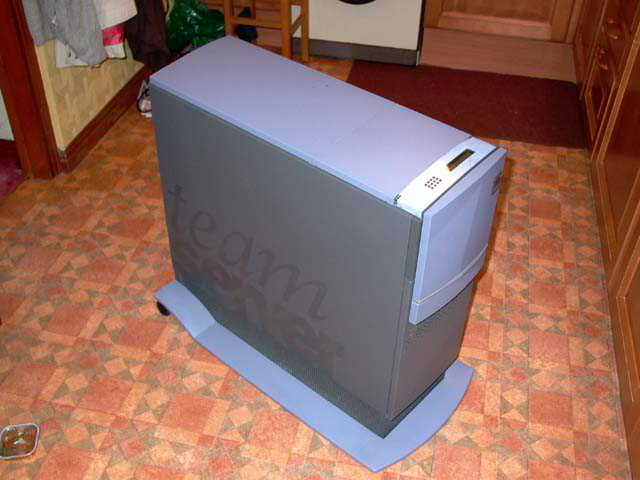
I've got a Data General Aviion 4000 here if anyone wants it.
Must be able to pickup from the SE suburbs of Melbourne, Australia.
It's a large tower case, so it's easy enough to move but too big for me to
ship. Alternatively I'll consider stripping it if you need parts.
As far as I know it has 2 Motorola 88k CPUs, a 1.2GB HDD, a 525MB tape
drive. If the HDD hasn't been erased it should still have DG-UX 4.32 on
it. It has a multiport serial card in one of the VME slots, but I don't
have the breakout box.
There are a couple of catches...
The NVRAM is dead. All but 1 of the SIMMs has been removed and some of the
SIMM socket retaining clips were broken by whoever removed the SIMMs. The
one remaining SIMM is not enough for the system to run, I get a fatal
memory error on power up. It uses 80 pin SIMMs which I assume are DG
specific (DEC 80 pin SIMMs will not work).
I could use the HDD in another system, so if you want the HDD left intact
I'd like another drive to replace it.
Ahh, but Bob, cars are evil..
> I happen to know someone who got really ill this way (it was
> an old car, not a computer though).
Christine Strikes Again...
Seriously, though... yeah, one must be careful when playing with
this stuff.. although I never got electrocuted (yet..), I did once
almost get splattered by a PDP-11/34a in its rack, with the rack
tilting over backwards (where I was...)
--f
At 01:28 AM 11/8/2002 -0600, you wrote:
>On Thu, 7 Nov 2002, Bruce Lane wrote:
>
> > Found on Usenet. The starting bid is a bit high, but perhaps listmembers
> > could pool resources...?
> >
> > I leave it to you to decide. If I were still collecting, I'd chip in a
> > bit myself.
>
>http://cgi.ebay.com/ws/eBayISAPI.dll?ViewItem&item=2068638523
>
>Wow...is this seller legit?
This guy is legit. I'm both sorry and happy to see this auction as I've been
buying various boards and such from him at fairly reasonable prices over
the last couple of years. I've known that they intended to clear out the
inventory at some point, but did not know when. I'm sure that if you have
any questions, he will try to answer them for you, including how much
warehouse space would be required to store the inventory.
--tom
>I wonder if this lot would fill even Sellam's warehouse? ;)
>
>-Toth
I would attend either since both are about a two hour drive from Hartford.
I could also disseminate information through area ham radio groups
Jeff Katz
>I wonder if this lot would fill even Sellam's warehouse? ;)
Doubt it... if you read the auction, it notes that it is
10-12 skids worth of stuff, totalling up to 8000lbs.
Megan
>> well gee... maybe if I had received this BEFORE 9:15 on the 7th I could
>> have taped it and dumped to MPEG for everyone.
>
>Blame it on the person respobsible for moderating messages from
>non-subsribers :) (I sent the message from my main VCF account which is
>not subscribed).
Yeah, fortunatly ScreenSavers runs many many times over.
I got home last night in time to catch the very end of the segment. So I
set my Satallite to record the show at the 2:30am slot, and also the
8:00am slot (my satallite likes to pull the next set of TV listings
around 2:30, and it doesn't seem to have the brains to know not to if you
are recording... what do you want from an MS product!)
If no one else posts a link to an MPEG of the clip, and my tape came out,
I'll make an MPEG Saturday and post it.
-chris
<http://www.mythtech.net>
>Over time, I have accumulated a fair number of official DEC PAK's for
>various of their software systems. Most of these were part of deals
>where I got or bought some company's complete systems room inventory,
>so, systems, periphs, media, manuals and licenses (lock, stock & barrel
>is the expression, imsmr).
>
>Now.. are these licenses still valid? I can't find any date expiration
>and/or software version limitation info on the PAK sheets, so, would
>assume they're still valid...
IANAL, but AFAIK the licences are valid only for the original
company unless you get HP to say otherwise. The deal used to be
that the OS and a few other "intergrated" products (clustering,
decnet etc.) could be transferred with the machine on payment of
a fee (300UKP sticks in my mind here ...). So my view is that
you do not have the right to use those licences, unless you
purchased the company itself, in which case I suspect you
own everything completely.
>needed. I can get a customer's RSX11MPlus license, because I will
>terminate his machine (for him ;-) and move the contents over to mine.
I have no idea what the situation is with RSX/RT11/RSTS ... Mentec
would know.
JMHO
Antonio
Just caught it, very well done (and not just because it had Commodores
on it :-), the host was really enthused by the display and said they may
have him on again some later date (probably with stuff plugged in next time).
He got a chance to show off the Collectible Computers book and a mention
or two of VCF.
And there's an article on their site,
http://www.techtv.com/screensavers/showtell/story/0,24330,3406699,00.html
(sure wish I had their bandwidth!)
--
01000011 01001111 01001101 01001101 01001111 01000100 01001111 01010010 01000101
Larry Anderson - Sysop of Silicon Realms BBS (209) 754-1363
300-14.4k bps
Set your 8-bit C= rigs to sail for http://www.portcommodore.com/
01000011 01001111 01001101 01010000 01010101 01010100 01000101 01010010 01010011
Thanks, John. Panix looks like a good solution, although I don't know if I
can handle real live tech support ;>)
Glen
0/0
----------
> From: John Lawson <jpl15(a)panix.com>
> To: classiccmp <cctalk(a)classiccmp.org>
> Subject: Re: BBSs & PPP
> Date: Saturday, November 02, 2002 4:59 PM
>
>
>
> Glen, check out Panix. www.panix.com
>
> I am am using Pine under Unix, and I telnet into them thru my local ISP,
> no PPP or other stuff required - they also have dial-ups in a good number
> of cities, more near the east coast since they are in NuYawk.
>
> I am using VanDayke's CRT on a Thinkpad, and it has never failed me,
> from living in India to living in the California Sierras, and with my
> cellphone when on the road.
>
> One thing, though, about Panix you might want to bear in mind. When
you
> call them, something known as a 'human being' will answer the phone right
> away, and that person will not only know what you're talking about, you
> will be connected to another one of those 'human' devices, (I have never
> been on hold with them, BTW) and in my few tech calls, the person helping
> me knew precisely what they were talking about and gave me the complete,
> correct info the first time.
>
> I just thought it would be only fair to warn you.
>
>
> Cheers
>
> John
>
>
>
I actually caught the show as it aired, and started up the tape
recorder in time for the segment... I'll see if I can dump it to
a file...
Nice job, Sellam... my only comment is the fact that you didn't
mention the community of collectors out here, or the fact that
we all exchange info...
Megan
In the days before 'net access was commonly available to ordinary folks
like me, I used to spend a fair amount of time on BBSs, so I thought it
might be fun to use my older machines to do some BBSing. Unfortunately,
results from Google suggest that most BBSs are now only Telnet-accessible.
Anyone know where to get a fairly current list of dial-up BBSs?
I'm also having a hell of a time trying to find an ISP which can provide a
dial-up shell account (with POP3 email) which doesn't require PPP or SSH.
I could code PPP drivers for a vintage micro (although it would suck up a
lot of time), but I doubt that I could get both PPP and TCP/IP running on a
system with 64 KB RAM or less.
Anyone know where to find an ISP which provides plain old dial-up access
>from a micro running a terminal program?
TIA --
Glen
0/0
If I am not for myself, who will be for me?
And if not now, when?
-- Pirkei Avot
> Can you point to any webistes that have info about these
> phone systems? Do they pop up on eBay?
I'll go through my notes later for a summary. All manner of excellent,
marginal, and downright bizarre phone gear turns up on eBay. As with
anything else, some is wildly overpriced and some starts out as a
bargain, and may not end up that way. Caveat emptor, double for eBay.
The Panasonic stuff seems to be the friendliest and provices the most
bang for the buck, but this is a hugely subjective topic. Best thing
I can tell you before I run out the door is to check out the
newsgroups comp.dcom.telecom and comp.dcom.telecom.tech on Google
Groups. The "home pbx" thread has come up many times, and there's a
lot of good info archived there.
--Steve.
CORRECTION:
http://dahmer.vistech.net/~jwillis/index.html
-----Original Message-----
From: John Willis
Sent: Thu 11/7/2002 11:01 PM
To: cctalk(a)classiccmp.org
Cc:
Subject: VAX 11/750 Restoration Project
FWIW, my 11/750 restoration project now has a page on my site at
http://dahmer.vistech.net/~jwillis
It is basically a journal format which I will update as I continue
working on the system.
John
FWIW, my 11/750 restoration project now has a page on my site at
http://dahmer.vistech.net/~jwillis
It is basically a journal format which I will update as I continue
working on the system.
John
Well, amidst all of the stellar and superlative Tales and Stories now
filtering in from Moffet Field, I have one small bummer.
Taking our cue from a recent long and nearly-immortal thread on
Oscilloscopes; sub-Tektronix scopes; sub-sub rack-mount Tek scopes -
Marvin and I concocted a nice visual in-joke. I mounted a working RM503
in the rack with my PDP 11/44 and waited for one of the Listmembers to
notice it and laugh. And I waited.... and waited....
Nobody got it! O well....
If Tony Duell had made his way across the pond this year - *he* would
have laughed! maybe...
But anyway, a Pretty Good Time was had by all, though there was not much
working Big Iron on display - partially understandable when the Logistics
of hauling and loading/unloading and setting up larger systems is taken
into account. And I have the scars and bruises to attest to that.
But next year I'm leaving the scope at home.
Cheerz
John
In approximately 3 months I will be moving from Hawaii back to the
mainland and will finally be able to reclaim the computer collection
that has been in storage in my parents' barn since 1996 when I left for
college. I so hope that the old Altair 8800b is still operational. In
highschool I used to use this machine with a 9600 baud modem to call
the local BBS, Wrote papers for school in WordStar, played a
character-graphics version of Aliens and Pacman..
At the same time, I had a 486 DX4 120 with an SVGA and a monochrome
card and monitors (I wrote a tsr that would copy the text contents of
the color display onto the mono with one key combination and clear the
mono with another, very handy while playing TradeWars 2002 on the local
BBS), This machine was always used far more, but the Altair would
always get fired up on a regular basis, often for no real reason. The
first program I ever wrote on it was in BASIC and just bounced a light
back and forth across the front panel display.
I can't wait to see the old machine again! The smell of baking dust,
the vacuum cleaner roar of the hard drive and the 50's Sci-Fi squeal of
the r/w heads moving across the disk, the boxes of 8 inch floppies all
bring back so many memories!
Anyone else out there with an Altair? Is there anyone actually using a
CP/M machine in some productive way? It's sad that even if rats dust
and time have not destroyed the beautiful blue machine, I can never
really trust storing files on it anymore without backing everything up
onto more modern media on my "real" computer (currently an eMac believe
it or not.. what a strange trip it's been).
Since today is a voting day, my votes are for
(1) Providence
(2) Boston
Because of some personal bad experiences with New York, I would
have to vote against it. Anywhere down to Connecticut and I
would attend and exhibit. After New York, down to NJ I would
attempt to attend, but would probably not be able to exhibit.
Megan
Greetings,
A few minutes ago, I discovered that I received the following message.
Can anyone help to save these machines? While I'd love to have a DG
Eclipse, have wanted one for years---which was the first largish
system that I was ever paid to work with, there's no way that I can
get to N.Y. to retrieve then, but perhaps someone else on the list can
save these systems from being scrapped. Alas, there isn't much time to
rescue them, so time is of the essence; I wish I'd seen this e-mail
yesterday.
Quothe Eric Kotz, from writings of Wed, Nov 06, 2002 at 09:47:54AM -0500:
> Hello,
> I saw you are interested in many Data General systems. Where my dad
> works, they have a total of 5 Data General Eclipse systems that
> are being scrapped. 3 work, two are parts machines (parts machines are
> missing the actual racks). I see you guys want Data General hardware-I'm
> wondering if you have any interest in these machines.
> These would be free for the taking. We also have like lots of
> disks/manuals/etc for them.
>
> Now the caveat:These MUST DISAPPEAR by the weekend. If they are still here
> monday, they are scrap. Personally, I can't bear to see these go for
> scrap-they are so unique, and the fact that they work still must be more
> unique. They were in service up until a month ago.
>
> The machines are outside Buffalo, NY. If you have any interest, or know
> someone that does, please send me an email, or call me at 585-758-3274
>
> Thanks,
> Eric Kotz
> eric(a)erickotz.com
>
> ---------------------------------------------------------
> This message has been ROT-26 encrypted for security purposes. Any attempt
> to decrypt this message is illegal under the DMCA.
--
Copyright (C) 2002 R. D. Davis The difference between humans & other animals:
All Rights Reserved an unnatural belief that we're above Nature &
rdd(a)rddavis.org 410-744-4900 her other creatures, using dogma to justify such
http://www.rddavis.org beliefs and to justify much human cruelty.
ouch !
> -----Original Message-----
> From: vance(a)neurotica.com [mailto:vance@neurotica.com]
> Sent: Monday, November 04, 2002 5:32 AM
> To: Fred N. van Kempen
> Cc: cctalk(a)classiccmp.org
> Subject: RE: Bringing up a 10 years dormant VAX 11/750
>
>
>
> What about being crushed by a PDP-11/70?
>
> Peace... Sridhar
>
> On Fri, 1 Nov 2002, Fred N. van Kempen wrote:
>
> > > Agreed, I don't think it would be good if we were to have a
> > > list member killed by a classic computer... Directly or
> > > indirectly...
> > Well, I'd rather be zapped by an PDP-11/70 than a stray bullet
> > from some *hole "out there"..... just a thought :)
> >
> > Stone would read: "Here lies Fred, powered by PDP-11/70.. he couldnt
> > take the power..." :)
> >
> > --f
> >
>
>
John Lawson and I were wondering a short while back, how many Heathkit
ES-400 analog computers are known to still exist in the world? It's
basically the big fat brother of the EC-1.
Here's a picture:
http://www.rdrop.com/~jimw/P0758.JPG
This one was exhibited by John at VCF 3.0 but is now owned by our good
friend Hans and is residing in Munich.
There is another in the Computer History Museum's collection. And I have
just a front panel to one that I acquired several years back.
So how many other people have one of these? And what is the correct model
number? I've always known it as the EC-400, but Doug Coward's website
says it's correct model is ES-400, but then someone just came to me and
said he has a Heathkit catalog listing it as the HS-1. So I'm sure it's
either the ES-400 or HS-1, or perhaps both.
Anyway, are there any others floating around?
--
Sellam Ismail Vintage Computer Festival
------------------------------------------------------------------------------
International Man of Intrigue and Danger http://www.vintage.org
* Old computing resources for business and academia at www.VintageTech.com *
Mike (Kenzie?) asked:
>> If I connect a VT-100 to COMM can I still access the CPU's?
Tony (err... I guess Dr. Duell, unless I get that $%^& Stylewriter working
again... :-) ) replied:
>Alas not. It's an MS-DOS and CP/M machine, and doesn't support remote
>terminals.
Rainbow VENIX was rumored to exist.
1) Anybody know more than that about it?
2) If so, did it support remote terminals? Consoles?
UCSD P-system is on ftp.update.uu.se (for anonymous ftp)
Same questions as above?
- Mark
Sorry to just barge in - I'm an old S100-CP/M type who wishes
he had the time to spend here - but I don't.
I do have 3 Molecular servers with 20meg hard drives and tape
backup, and plenty of interface boards. I had intended some
years ago to put them in a 'senior citizens' complex as a LAN
but time and technology made the project implausible.
These must go - RSN. For sale REASONABLE, or amusing trade.
I'm in San Diego - and yes, Don Maslin has declined.
Vern Wright
vernon_wright(a)hotmail.com
_________________________________________________________________
STOP MORE SPAM with the new MSN 8 and get 2 months FREE*
http://join.msn.com/?page=features/junkmail
A heads up:
I will be appearing on TechTV this Thursday, November 7, between the hours
of 4:00p and 5:30p. I don't know the name of the program or the exact
time (I'll be finding out tomorrow) but this at least gives you advance
warning if you want to catch it.
I'll be bringing along some interesting old computer thingies to show. If
you want to suggest a personal favorite let me know ;)
TechTV is usually in the premium cable TV line-up, so you may not be able
to see the program if you don't have every stupid channel that your local
cable TV operator offers.
More info tomorrow.
Also, my domain name situation seems to have been ironed out. I can once
again receive e-mail (the website has been back for about a day and a half
now; I don't know why e-mail took longer).
--
Sellam Ismail Vintage Computer Festival
------------------------------------------------------------------------------
International Man of Intrigue and Danger http://www.vintage.org
* Old computing resources for business and academia at www.VintageTech.com *
Forwarding this to the classic cmp list 'cause I know some of you are
interested, but I'm not an active reader of this list.
> For anyone interested, here is the 0.3 snapshot of my alpha-micro am-100
> emulator.
>
> http://www.otterway.com/am100
>
> This is the first to boot AMOS and run BASIC! Here's the $README...
>
> --------------------------------------------------------------------------
--
> -------------------
>
> /* AM-100.doc (c) Copyright Mike Noel, 2001-2002 */
>
>
> PREFACE
>
> This software is an emulator for the Alpha-Micro AM-100 computer. It is
> copyright by Michael Noel and licensed for non-commercial hobbyist use
under
> terms of the "Q public license", an open source certified license.
>
> There exist known serious discrepancies between this software's internal
> functioning and that of a real AM-100, as well as between it and the
WD-1600
> manual describing the functionality of a real AM-100, and even between it
> and the comments in the code describing what it is intended to do! Notice
> that this software hasn't reached the 1.0 version yet. In fact it's a
long
> way from it. It's not beta; it's alpha. Use it at your own risk!
>
> Reliability aside, it is not the intent of the copyright holder to use
this
> software to compete with current or future Alpha-Micro products, and no
> such competing application of the software will be supported.
>
> Alpha-Micro and other software that may be run on this emulator are not
> covered by the above copyright or license and must be legally obtained
from
> an authorized source.
>
> As this is written I have permission from Alpha-Micro to distribute AMOS
5.0
> with the emulator so you can get that from me too - but it is subject to
> their terms and conditions.
>
>
> INSTALLATION
>
> Preferred installation is to compile the source on the target machine.
> Tested targets include Red Hat Linux (6.1, 6.2, 7.0, 7,1, and 7.2) and
> Microsoft Windows 98SE and 2000 using Cygwin 1.3.12-2 and 1.3.13-1.
Frankly,
> Windows 98 is not a good target. Windows 2000 and Linux are both OK.
>
> Step Zero. You have at least 12 megs free space - right?
>
> We will assume you have downloaded the source and
> AMOS into a directory on your (running, known good)
> linux or cygwin system; those files being
>
> ./AM-100-0.3.tgz
> ./amos50.tgz
>
> Step One. Create a sub directory and untar the source.
>
> mkdir am
> cd am
> mv ../AM-100-0.3.tgz .
> mv ../AMOS50.tgz
> tar -xzf AM-100-0.3.tgz
> tar -xzf amos50.tgz
>
> Step Two. Compile the source.
>
> make
>
> Step Three. Run it!
>
> ./AM-100
>
> Step Four. What's this message...
>
> "boot failed! Problem with 'dsk0-container' ?"
>
> dsk0-container is the name of the file that represents DSK0
> in the emulator. Similarly, dsk1-container represents DSK1,
> and dsk2-container and dsk3-container do the obvious. Each
> container is 10 megs (19980 blocks).
>
> Since you might already have a dsk0-container, I've packaged
> the AMOS release as dsk1-container. If you have enough free
> space just copy dsk1-container to dsk0-container - if not
> rename instead.
>
> Then run it again!
>
> cp dsk1-container dsk0-container
> ./AM-100
>
> Step Five. It booted - right?
>
> If not contact me & I'll try to help you figure out why...
>
>
> OPERATION
>
> The window you run this in (msdos? cygwin? xterm?) is probably defaulted
> to 25 lines x 80 columns. You need to shrink it to 24x80 (or vue and fix
> won't scroll correctly). One reason I don't like W98 is I haven't found a
> way to do that there...
>
> If you've other containers (dsk1-container, etal) you can mount and
unmount
> them as you like. Can't change without restarting the emulator thou...
>
> All the control keys should work. Esc should work. The Arrow keys,
Insert,
> Delete, Home, End, PgUp, and PgDn should work - at least as I would want
> them to!!
>
> Watch out for ALT keys. ALT C means quit the emulator. ALT T toggles
> instruction tracing. ALT S toggles instruction stepping (which doesn't
work
> in this release). See PS3.C for all the key mappings.
>
> Console output is to STDOUT. Traces go to STDERR. So if you want to try
a
> trace but don't want it mixed with your screen, start the emulator with
>
> ./AM-100 2>AM-100.log
>
> Then all the trace output goes into a file. Watch out - it gets huge very
> very fast. Actually there is also a "user" trace facility, but I'm not
> ready to try and document it yet.
>
> There are some other tricks you can play with STDOUT and STDERR. One is
to
> TEE the STDOUT so that all your console activity gets copied into a file.
> Like this:
>
> ./AM-100 | tee AM-100.lst
> or:
> ./AM-100 2>AM-100.log | tee AM-100.lst
>
> CUT and PASTE works with the STDOUT console window. Access them by
clicking
> on the little icon on the left of the window bar. They are under 'edit'.
> So copy that big basic program off your real machine and paste it into
AMOS
> basic (or edit) (or whatever).
>
> DO NOT USE DIRSEQ. It scrambles directories. I will track that down and
> fix it for the next release.
>
>
> PERFORMANCE
>
> Performance has not been a design consideration. There are dozens of
places
> it could be dramatically improved. My judgment is that's not worth the
> effort. But judge for yourself. On a Pentium 166 laptop with linux 6.2
it
> seems pretty close to what I remember my AM-100 being able to do. The
ways
> that AMOS loops when it doesn't have work are converted into sleeps, so
it's
> pretty low impact even on an old slow box.
>
> Of course on a 2.4 gig p4 it screams. Certainly much faster than the
> AM-1000 I traded in my old AM-100 to buy, but I've no idea how it compares
> to modern systems.
>
> Maybe someone will run some benchmarks???
>
>
> WHAT IS CHANGED/ADDED TO AMOS 5.0?
>
> Not much. The system.mon is a standard mongen of sysbsw.mon and my own
disk
> driver vdk.dvr[1,6]. I patched ps3.idv[1,6] to create ps3new.idv[1,6].
> Ansi.tdv[1,6] is a hack of a vt100 driver I wrote years ago.
System.ini[1,4]
> is a demonstration of bank switched memory. Spoolr.ini[1,4] is just a way
> to test lptspl with output to the console.
>
> Source for vdk.dvr, ps3new.idv and ansi.tdv are not provided simply
because
> I haven't had time. vkd is a one-instruction link to the container file
> disk system in hwassist.c. ps3new is just a branch back to output all
> waiting chars at once instead of just one per clock tick - a performance
> improvement. Ansi.tdv is just an ugly hack for the tcrt calls - the more
> difficult input processing is handled in the ps3.c module of the emulator.
>
>
> WHAT DO I **KNOW** DOES NOT WORK?
>
> Aside from DIRSEQ most stuff seems to work. LISP and PASCAL may not work
> but I know so little about them I'm not certain.
>
> Format 11 instructions (floating point) have only been working a few days.
> They are probably really sick and I just haven't noticed yet. But enjoy
> basic until they bite you!
>
> I also have pretty good reason to think PS.V handling (and 'over/under
flow'
> in general) is not quite right. What the book says is supposed to happen
is
> at odds with what diagnostics check for and what known running programs
do!
>
>
> HOW TO REPORT A NEW BUG
>
> Send me an email (mike(a)otterway.com) telling me what you did, what
happened,
> and why you don't think that should have happened. For example: "I
compiled
> and ran xyz.bas and it crashed saying it couldn't open file aaa.bbb, but
> aaa.bbb was there like it was supposed to be and this program and file
work
> on my real AM-100". So far I'm pretty prompt getting back to people who
> tell me about problems, hopefully that will continue...
>
>
> SOFTWARE DONATIONS
>
> Were you a software developer in the AM-100 heydays? Still have a copy of
> your pride and joy laying around? Why not let others remember with you!
> Let me post a copy for use with the emulator. All donations welcome!
>
>
> CREDITS
>
> A number of people have helped and/or inspired me to write this thing.
>
> There's Jim Battle, who's built web pages and emulators for several
machines
> including the Processor Technology SOL-20 (see
> http://www.thebattles.net/sol20/sol.html) . We share an interest in
> Processor Tech hardware and software and I really admire the way he has
> pulled all that arcane stuff together.
>
> There's Roger Bowler (etal) and the Hercules project (IBM mainframe
> emulator, see http://www.conmicro.cx/hercules). I spent a lot of my
career
> as an OS sysprog, and what that team of people have done is just
> magnificant. Many design elements of my emulator come from them - I even
> borrowed their use of the Q license!
>
> There's Harvey, a guy who saved some of my old books for 20+ years in his
> garage. Some were manuals for my old AM-100! There's Mike, who still has
a
> running AM-100, and was good enough to send me a copy of his wd16 manual.
> There's Rhett who found me a really clean complete copy of amos. There's
> Joe, another guy with a running AM-100 who sent me an assembled copy of
the
> cpu diagnostic and worked with me to get it to run without a monitor. And
> of course there's Alex who has given permission to distribute amos along
> with the emulator so more people can enjoy it.
>
>
>
Hi everyone, I am new to the board, and hope you might be able to help me figure something out.
I have bought locally and resold old computer items over ebay, and I have come across what looks to be an old Honeywell dummy terminal, with keyboard. Here is a link to a pic:
http://server3001.freeyellow.com/maddog1331/honeywell.JPG
What I would like to find out is exactly what I have here, what it hooked into, what kind of value, when it came out, etc...I have checked on the net but have came up with nothing on this.
Any help would be greatly appreciated!
Sincerely,
Mark Saarinen
Kentucky, USA
> Agreed, I don't think it would be good if we were to have a
> list member killed by a classic computer... Directly or
> indirectly...
Well, I'd rather be zapped by an PDP-11/70 than a stray bullet
>from some *hole "out there"..... just a thought :)
Stone would read: "Here lies Fred, powered by PDP-11/70.. he couldnt
take the power..." :)
--f
OK, I'm *jealous*... S/390 card for anything = drool... Um, I have a 4381...
Sure your S/390 is faster, etc. but my S/370XA could crush it flat ;p
Will J
_________________________________________________________________
Surf the Web without missing calls! Get MSN Broadband.
http://resourcecenter.msn.com/access/plans/freeactivation.asp
> 1) I think you mean D9.
K/V/M here means keyboard/video/mouse. In this case (there's video
on a 3w3) it is more a K/M. The D15 (yup) looks like the KVM's used
elsewhere (vaxStations), hence this new question.
> 3) This subject was discussed here at great
> length not more than a week or two ago.
Nope, I wouldn't want to start that one again.
John A.
OK... so your backplane is hosed. Do you have a dummy load to
"load" the PSU with? It probably complains about it not having
a load to work with, hence the REG fail....methinks your PSU is
fine, just not the backplane or its power harness. Remember that
cable harness insulation plastic rots... as well :)
--fred
> -----Original Message-----
> From: John Willis [mailto:cctalk-admin@classiccmp.org]On
> Behalf Of John
> Willis
> Sent: Friday, November 08, 2002 1:43 AM
> To: cctalk(a)classiccmp.org
> Subject: RE: 875 Power Controller/H7104C 2.5VDC PSU/H7104D 5VDC PSU
>
>
> This is very interesting. Removing everything from the
> backplane results
> in only the REG FAIL light coming on. No more +5V FAIL or +2.5 FAIL.
>
> Any ideas?
> -----Original Message-----
> From: Fred N. van Kempen
> Sent: Thu 11/7/2002 4:50 PM
> To: cctalk(a)classiccmp.org
> Cc:
> Subject: RE: 875 Power Controller/H7104C 2.5VDC
> PSU/H7104D 5VDC PSU
>
> Yes. Or in the "final" part of the PSI itself. Because it
> is shorting, the load of the PSU, it's killing the regulators.
> Or, such is my guess..
>
> --f
>
>
This is very interesting. Removing everything from the backplane results
in only the REG FAIL light coming on. No more +5V FAIL or +2.5 FAIL.
Any ideas?
-----Original Message-----
From: Fred N. van Kempen
Sent: Thu 11/7/2002 4:50 PM
To: cctalk(a)classiccmp.org
Cc:
Subject: RE: 875 Power Controller/H7104C 2.5VDC PSU/H7104D 5VDC
PSU
Yes. Or in the "final" part of the PSI itself. Because it
is shorting, the load of the PSU, it's killing the regulators.
Or, such is my guess..
--f
On Nov 8, 0:50, Fred N. van Kempen wrote:
> Yes. Or in the "final" part of the PSI itself. Because it
> is shorting, the load of the PSU, it's killing the regulators.
> Or, such is my guess..
I'd agree. I don't know if the regulators are like those in -11's, but if
they are, and can run safely for a short time without load, I'd try it with
all the boards removed. Anyone know if this is safe?
--
Pete Peter Turnbull
Network Manager
University of York
Load-level? As in on the backplane?
-----Original Message-----
From: Fred N. van Kempen [mailto:Fred.van.Kempen@microwalt.nl]
Sent: Thursday, November 07, 2002 4:29 PM
To: cctalk(a)classiccmp.org
Subject: RE: 875 Power Controller/H7104C 2.5VDC PSU/H7104D 5VDC PSU
John,
"Over Current"- smells like a load-level short.
--fred
> -----Original Message-----
> From: John Willis [mailto:jwillis@arielusa.com]
> Sent: Friday, November 08, 2002 12:22 AM
> To: cctalk(a)classiccmp.org
> Subject: RE: 875 Power Controller/H7104C 2.5VDC PSU/H7104D 5VDC PSU
>
>
> The lights do come on, it's just that the ones that come on are
>
> (o) = lit, ( ) = not lit
>
> ( ) Power OK
> ( ) Over Voltage
> (o) Over Current
> (o) +2.5V Fail
> ( ) +5V Fail
> (o) Reg Fail
> ( ) Over Temp
>
> (o) Power
>
> Have the printsets now, will probably take both units apart for
> Inspection and cleaning.
>
> John
>
> -----Original Message-----
> From: Peter Turnbull [mailto:pete@dunnington.u-net.com]
> Sent: Thursday, November 07, 2002 2:45 PM
> To: cctalk(a)classiccmp.org
> Subject: Re: 875 Power Controller/H7104C 2.5VDC PSU/H7104D 5VDC PSU
>
>
> On Nov 7, 13:43, John Willis wrote:
> > Anyone have any documentation on these units as far as
> > What to do when the fail lights come on?
>
> The Field Maintenance print sets for the PSUs and the power controller
> are available at http://208.190.133.201/decimages/moremanuals.htm
> (part of the DFWCUG Historical CPU Preservation Society). They are
> BIG files.
>
> If an 875 power controller is like an 876, then if the lights
> don't come
> on, reset your breaker :-)
>
> I don't know about the H7104's (I've never seen one up
> close). I assume
> there is something plugged into the 3-pin Power Bus connector, or you
> have the three-way switch in the "local" position, otherwise it won't
> turn on.
>
> --
> Pete Peter Turnbull
> Network Manager
> University of York
>
John,
"Over Current"- smells like a load-level short.
--fred
> -----Original Message-----
> From: John Willis [mailto:jwillis@arielusa.com]
> Sent: Friday, November 08, 2002 12:22 AM
> To: cctalk(a)classiccmp.org
> Subject: RE: 875 Power Controller/H7104C 2.5VDC PSU/H7104D 5VDC PSU
>
>
> The lights do come on, it's just that the ones that come on are
>
> (o) = lit, ( ) = not lit
>
> ( ) Power OK
> ( ) Over Voltage
> (o) Over Current
> (o) +2.5V Fail
> ( ) +5V Fail
> (o) Reg Fail
> ( ) Over Temp
>
> (o) Power
>
> Have the printsets now, will probably take both units apart for
> Inspection and cleaning.
>
> John
>
> -----Original Message-----
> From: Peter Turnbull [mailto:pete@dunnington.u-net.com]
> Sent: Thursday, November 07, 2002 2:45 PM
> To: cctalk(a)classiccmp.org
> Subject: Re: 875 Power Controller/H7104C 2.5VDC PSU/H7104D 5VDC PSU
>
>
> On Nov 7, 13:43, John Willis wrote:
> > Anyone have any documentation on these units as far as
> > What to do when the fail lights come on?
>
> The Field Maintenance print sets for the PSUs and the power controller
> are available at
> http://208.190.133.201/decimages/moremanuals.htm (part
> of the DFWCUG Historical CPU Preservation Society). They are
> BIG files.
>
> If an 875 power controller is like an 876, then if the lights
> don't come
> on, reset your breaker :-)
>
> I don't know about the H7104's (I've never seen one up
> close). I assume
> there is something plugged into the 3-pin Power Bus connector, or you
> have the three-way switch in the "local" position, otherwise it won't
> turn on.
>
> --
> Pete Peter Turnbull
> Network Manager
> University of York
>
Hi All,
Although I am aware of the (VMS) Hobbyist License (which I still dont
have, GRRRRR) which provides licenses (PAKs) for VMS and its layered
thingies, I have a question regarding this.
Over time, I have accumulated a fair number of official DEC PAK's for
various of their software systems. Most of these were part of deals
where I got or bought some company's complete systems room inventory,
so, systems, periphs, media, manuals and licenses (lock, stock & barrel
is the expression, imsmr).
Now.. are these licenses still valid? I can't find any date expiration
and/or software version limitation info on the PAK sheets, so, would
assume they're still valid...
I'm asking, because I want to provide a login services to a VMS, Ultrix
and RSX host for some of my customers, to basically "host" their
application for them. Kinda ASP-ish, old style ;-)
Obviously, this would _not_ be for th Hobbyist License, soo.. licenses
needed. I can get a customer's RSX11MPlus license, because I will
terminate his machine (for him ;-) and move the contents over to mine.
The VMS and Ultrix licenses I already have, but, again, they don't have
my company's name on them.
Does anyone know?
Thanks,
Fred
The lights do come on, it's just that the ones that come on are
(o) = lit, ( ) = not lit
( ) Power OK
( ) Over Voltage
(o) Over Current
(o) +2.5V Fail
( ) +5V Fail
(o) Reg Fail
( ) Over Temp
(o) Power
Have the printsets now, will probably take both units apart for
Inspection and cleaning.
John
-----Original Message-----
From: Peter Turnbull [mailto:pete@dunnington.u-net.com]
Sent: Thursday, November 07, 2002 2:45 PM
To: cctalk(a)classiccmp.org
Subject: Re: 875 Power Controller/H7104C 2.5VDC PSU/H7104D 5VDC PSU
On Nov 7, 13:43, John Willis wrote:
> Anyone have any documentation on these units as far as
> What to do when the fail lights come on?
The Field Maintenance print sets for the PSUs and the power controller
are available at http://208.190.133.201/decimages/moremanuals.htm (part
of the DFWCUG Historical CPU Preservation Society). They are BIG files.
If an 875 power controller is like an 876, then if the lights don't come
on, reset your breaker :-)
I don't know about the H7104's (I've never seen one up close). I assume
there is something plugged into the 3-pin Power Bus connector, or you
have the three-way switch in the "local" position, otherwise it won't
turn on.
--
Pete Peter Turnbull
Network Manager
University of York
On Nov 7, 13:43, John Willis wrote:
> Anyone have any documentation on these units as far as
> What to do when the fail lights come on?
The Field Maintenance print sets for the PSUs and the power controller are
available at http://208.190.133.201/decimages/moremanuals.htm (part of the
DFWCUG Historical CPU Preservation Society). They are BIG files.
If an 875 power controller is like an 876, then if the lights don't come
on, reset your breaker :-)
I don't know about the H7104's (I've never seen one up close). I assume
there is something plugged into the 3-pin Power Bus connector, or you have
the three-way switch in the "local" position, otherwise it won't turn on.
--
Pete Peter Turnbull
Network Manager
University of York
Hi,
I'm looking to cable up an Alpha 3000/300 I just picked
up and am checking on the DEC cable to do so.
There are many: BC(C03,13B,18P,19S,23K)
Do they all have the same pinouts at the D15 side?
sim.: Is a mV2000, vS3100 cable OK on an Alpha?
John A.
Anyone have any documentation on these units as far as
What to do when the fail lights come on?
John Perkins Willis
Software Engineer/Database Architect
Ariel Technologies
(505) 524-6860
jwillis(a)arielusa.com
I checked around but I can't find any info on this model laser. Is there a date on it anywhere? Here <http://www.spectraphysics.com/products/cld_products/stabilite_series.html> is a link the the Stablite lasers on Spectra Physics website. There's also a phone number on that page. I would call them and get the specs for that laser and ask (1) if it's a hard sealed laser (2) if that's the right power suplly for it. Someone clould have just stuck any power supply with it and the wrong PS could certainly cause the problems that you're having. If that is the right PS ask them what the operating current, trigger and operating voltage should be.
Joe
At 10:07 PM 11/6/02 -0500, you wrote:
>On Wed, 30 Oct 2002, Joe wrote:
>
>> Hi Pat,
>>
>> I'm assuming that your laser is helium-neon laser. If so, then if
>> it's 23 years old it almost certainly has what they refer to as a
>> soft seal between the electrodes and glass tube. The problem with the
>> soft sealed lasers is that the helium atoms are small enough that
>> they slowly leak out of the seal. When they do, the mixture ratio
>> changes and the ignition and operating voltage goes up until the
>> laser will no longer operates. That's what it sounds like is
>> happening with your laser. Your's sounds like it's it border line in
>> that the PSU firing voltage can make it fire but the operating
>> voltage isn't high enough to keep it operating.
>
>The laser is a Spectra Physics Stabilite model 24B 35mW HeNe laser, and
>the power supply is a Spectra Physics Laser Exciter model 255.
>
>That seems accurate. I've rigged up a 'line conditioner' to give me a
>cheap pseudo-variac to change the input voltage to the laser power supply
>(the supply is a simple transformer -> rectifier -> capacitor type with a
>current regulator stuck on it, here's a PDF I found:
>http://www.repairfaq.org/sam/255apsch.pdf
>
>Does anyone know what the specs are on that transformer (eg rated output
>voltage), and how far I can (fairly-safely) run it above its rated input
>voltage? Specifically, it'd be nice to know an upper limit so I don't
>explode the HV caps or diodes.
>
>> Further you can't just use a resistor as a dummy load. The laser
>> tube is similar to neon and floresent lights in that it has a
>> negative resistance. That is it has a certain amount of resistance
>> until it fires and then the resistance decreases dramaticly. You
>> have to use a ballast with such devices or else the current will
>> increase drasticly and almost instantly burn out the device. The
>> ignition voltage will be on the order of 20,000 volts but the
>> operating voltage will be roughly 12,000 to 14,000 volts.
>
>By looking at the schematic I linked above, it looks to run at a lower
>voltage than that, but it's hard to tell without a HV meter or knowing
>what the tranformer is outputting.
>
>> Be careful using a scope around these things. It probably isn't made
>> to handle nearly the kind of voltages involved in the laser. You
>> need a good high voltage probe for checking these things. You can
>> use one made for TV repair. They're fairly easy to find and are
>> reasonably priced.
>
>I wasn't going to scope the HV side, and since there is no LV side of the
>power supply, I'm just not going to bother looking at it with a scope.
>Besides, it's a simple enough circuit to troubleshoot with a HV meter.
>
>> If you send me the brand and model tube I may be able to tell you if
>> it's a soft sealed tube and other details.
>>
>> Joe
>>
>> At 04:38 PM 10/30/02 -0500, you wrote:
>> >I know this is a bit OT, becuase it's not really computer related, but the
>> >hardware is at least 23 years old, so that's my excuse for posting to the
>> >list...
>> >
>> >I've got a 35mW HeNe Laser + Power supply that I picked up today for next
>> >to nothing. It seems to be having some problems - the laser (somtimes)
>> >blinks a few times when I first turn it on, and then stops. From the
>> >sound of the power supply it's either a loose connection (which I doubt
>> >after opening it up and taking a good look around) or there's a problem
>> >with the power supply.
>> >
>> >Now, I've never really worked on a HV power supply before, and I'm trying
>> >to be careful when I play with things. First off, does anyone have a
>> >general idea of what sized dummy load ("resisitor") I should try haning
>> >off of the HV output to properly load it? I noticed that the laser tube
>> >has 3x27kohm resistors in series, would a couple watt approx 81kohm
>> >resistor be a good idea?
>> >
>> >Also, does anyone have an idea for a failure mode to look for? I've got
>> >an O'scope, dmm, and various other tools at my disposal, but no
>> >'authentic' HV test/mesurement gear.
>> >
>> >I'm just looking for general guidelines.
>> >
>> >Thanks!
>
>
>Pat
>--
>Purdue Universtiy ITAP/RCS
>Information Technology at Purdue
>Research Computing and Storage
>http://www-rcd.cc.purdue.edu
>
>http://dilbert.com/comics/dilbert/archive/images/dilbert2040637020924.gif
>
>
>>
>
>
Well, here's my "me too VCF writeup," with pictures of VCF and the
computer museum for those who can't get enough...
http://www.portcommodore.com/vcf5/
Larry
P.S. ...and the final programs from the programming challenge!
--
01000011 01001111 01001101 01001101 01001111 01000100 01001111 01010010 01000101
Larry Anderson - Sysop of Silicon Realms BBS (209) 754-1363
300-14.4k bps
Set your 8-bit C= rigs to sail for http://www.portcommodore.com/
01000011 01001111 01001101 01010000 01010101 01010100 01000101 01010010 01010011
>I want the AIM-65.
Sheesh! ... EVERYONE wants the AIM-65.... The random number generator is
going to be thoroughly stresed out over the weekend! :-)
Rich B.
_________________________________________________________________
Add photos to your e-mail with MSN 8. Get 2 months FREE*.
http://join.msn.com/?page=features/featuredemail
I saw this on the info-pdp11 list and thought some of our repository
managers might like his manual to scan or stow. Contact Rob directly,
please.
---------- Begin forwarded message ----------
From: Rob Brown <brown(a)gmcl.com>
To: info-pdp11(a)village.org
Date: Wednesday, November 6, 2002, 8:50:08 PM
Subject: Old documentation
I have in my hand a "Vision II 3220 User's Manual" which describes a
VT220-type terminal from Lanpar Technologies (or maybe Northern
Technologies, both names are used). Probably around 100 sheets,
two-sided. Is there any repository that would like to have this?
--
Rob Brown brown(a)gmcl.com
G. Michaels Consulting Ltd. (866)438-2101 (voice) toll free!
Edmonton (780)438-9343 (voice)
(780)437-3367 (FAX)
http://gmcl.com/
---------- End forwarded message ----------
--
Jeffrey Sharp
To all classic collectors out there:
I have 2 pieces of
Microsystems International MF8008
which I want to sell.
My location is Germany.
Any serious offers by e-mail are welcome.
Best regards,
Michael
________________________________________________________________________________
gesendet ?ber http://mailchecker.de (SSL-WebMail, SSL- WebFTP, FreeSMS)
Tipp: Webmasterhilfe rund um die Uhr: Forum von http://ig-stratokunden.de
After the LUG meeting this evening at a Pub, I learned about a Phillips
beige box with a pair of 8" floppies being used as a coffee table.
Any guesses as to what it could be?
I'm thinking of trading a AS400 9404, or IBM PC 500 server to take over
as a coffee table.
I dropped Leo a line and he replied - he's in Montreal. Somebody
oughta grab 'em....
Not associated, reply directly, blah blah blah.
Doc
From: Leo <flintsoft(a)NOSPAMvideotron.ca>
Newsgroups: alt.sys.pdp11
Subject: PDP 11s available
Date: Tue, 05 Nov 2002 20:31:37 -0500
I just picked up a couple of these old machines as scrap... not
exactly sure of the model.
They have 2, 5" floppys in front, and a small panel with 4 push
switches, and a couple of other switches. They fit a 19" rack and run
on 120v. They have a ton of db25, rs232 ports on the back.
They were running a custom C program and a debugger for a company,
along with the standard operating system. They had at least 3
terminals and 2 printers and a bunch of machine processes running
electrical devices. Something like 18 devices on rs232. One machine
was a hot standby.
I know they were running with LA120 printers and a few screens I
forget the number...191 maybe??, none of which is available... They
were operating last I know, but were simply turned off and replaced.
(by a crappy 386PC network!!) They have been sitting in a warehouse
for the last 8 years, and were thrown out to make room.
They are tremendously dirty!! Looks like parts from a coal mine!! And
they weigh a ton!!
If I had the monitor/keyboard I'd run them for fun, but I don't have
the time to persue another hobby!! And I don't know if the dirt has
ruined the floppys.
Anyone have any interest in this stuff? Also a box of junked 120
printer parts?
Thanks
Hi Pat,
I'm assuming that your laser is helium-neon laser. If so, then if it's 23 years old it almost certainly has what they refer to as a soft seal between the electrodes and glass tube. The problem with the soft sealed lasers is that the helium atoms are small enough that they slowly leak out of the seal. When they do, the mixture ratio changes and the ignition and operating voltage goes up until the laser will no longer operates. That's what it sounds like is happening with your laser. Your's sounds like it's it border line in that the PSU firing voltage can make it fire but the operating voltage isn't high enough to keep it operating.
Further you can't just use a resistor as a dummy load. The laser tube is similar to neon and floresent lights in that it has a negative resistance. That is it has a certain amount of resistance until it fires and then the resistance decreases dramaticly. You have to use a ballast with such devices or else the current will increase drasticly and almost instantly burn out the device. The ignition voltage will be on the order of 20,000 volts but the operating voltage will be roughly 12,000 to 14,000 volts.
Be careful using a scope around these things. It probably isn't made to handle nearly the kind of voltages involved in the laser. You need a good high voltage probe for checking these things. You can use one made for TV repair. They're fairly easy to find and are reasonably priced.
If you send me the brand and model tube I may be able to tell you if it's a soft sealed tube and other details.
Joe
At 04:38 PM 10/30/02 -0500, you wrote:
>I know this is a bit OT, becuase it's not really computer related, but the
>hardware is at least 23 years old, so that's my excuse for posting to the
>list...
>
>I've got a 35mW HeNe Laser + Power supply that I picked up today for next
>to nothing. It seems to be having some problems - the laser (somtimes)
>blinks a few times when I first turn it on, and then stops. From the
>sound of the power supply it's either a loose connection (which I doubt
>after opening it up and taking a good look around) or there's a problem
>with the power supply.
>
>Now, I've never really worked on a HV power supply before, and I'm trying
>to be careful when I play with things. First off, does anyone have a
>general idea of what sized dummy load ("resisitor") I should try haning
>off of the HV output to properly load it? I noticed that the laser tube
>has 3x27kohm resistors in series, would a couple watt approx 81kohm
>resistor be a good idea?
>
>Also, does anyone have an idea for a failure mode to look for? I've got
>an O'scope, dmm, and various other tools at my disposal, but no
>'authentic' HV test/mesurement gear.
>
>I'm just looking for general guidelines.
>
>Thanks!
>
>Pat
>--
>"The Microsoft/IBM FORTRAN was adequate for teaching FORTRAN 77. But the
>performance was AMAZING! It could actually take longer to run a benchmark
>like sieve of Erastothanes with compiled FORTRAN than with interpreted
>BASIC."
> -- Fred Cisin (XenoSoft)
>http://dilbert.com/comics/dilbert/archive/images/dilbert2040637020924.gif
>
>
>
>The idea behind this scam is to file suites they fully know they would
>loose in court. A messy legal tactic, but
>hardly a problem with the U.S. I.P. laws (which are far better than most
>others).
You forgot the most important detail. You file suits you know you will
loose... but only while offering a settlement that is profitable for you,
and cheap enough that it is cheaper for the other person to settle, then
to defend the BS lawsuit.
-chris
<http://www.mythtech.net>
Does someone have the description of what the status codes in the eight LEDs mean ? I know there is a 4000 VLC user guide on-line but that isn't detailed. I also know that a working VAXstation has none of these lights on after power-up completes.
Ethan Dicks wrote:
>My one and only experierience with analog computing was a
dedicated
>device (no patch panel) that calculated energy reserves for the
>planet. It had an LED counter for the year and numerous dials
for
>amount of driving, heating, electricity usage, etc. Physically,
>it was about 3" thick and several feet square. I remember
trying
>out a variety of simulations on it when it was at the local
science
>museum, COSI, some summer between 1976 and 1980.
I remember this as one of those fuzzy childhood memories. In
fact, I was never sure that it actually existed until reading
this message. I know I only had a few minutes to play with it,
sometime in the 70's. I remember asking "what do you do when the
energy runs out?" :) I thought it might have been developed in
the aftermath of the "energy crisis" in 1973.
I can picture the wooden frame, and you could see some of the
circuitry through the front I think...
I hope someone finds a picture of that thingy.
-Frank
>From: "Rich Beaudry" <r_beaudry(a)hotmail.com>
>To: cctalk(a)classiccmp.org
>Date: Mon, 04 Nov 2002 19:18:02 +0000
>
>The AIM-65 has been tested.
I want the AIM-65. I started in computers around 1980 with a KIM.
I do not need it forever; just a month or so to become familiar
with operating it. I can then pass it on to someone else.
If I do get it then I will try to repair it.
--
Paul R. Santa-Maria
Monroe, Michigan 48161
Sellam Ismail wrote:
>The locations I am considering for VCF East 2.0 are Providence, RI, Boston
>proper, or New York City. Basically, somewhere with a large >population
>center, that is central to a greater population center, and >where a lot of
>vintage computer enthusiasts would easily find their >way to.
Any of the above would suit me. I would bring Big Iron.
I would sign up for yer list, but vintage.org seems to have gone AWOL for
now...
Mike
http://www.corestore.org
_________________________________________________________________
Surf the Web without missing calls! Get MSN Broadband.
http://resourcecenter.msn.com/access/plans/freeactivation.asp
Anyone have a extra or unwanted AC adapter for a Gateway 4 Handbook
(486sx-25)? I found this little jewel down at the warehouse yesterday
(forgot I had it) and would like test it out but the adapter port is a
really strange looking one. I do not have anything to hook up to it and the
battery is long dead.
As of lastnight:
-Received key for front panel keyswitch in the mail
-PSU status lights (o) = lit, ( ) = not lit
( ) Power OK
( ) Over Voltage
(o) Over Current
(o) +2.5V Fail
( ) +5V Fail
(o) Reg Fail
( ) Over Temp
(o) Power
John Perkins Willis
Software Engineer/Database Architect
Ariel Technologies
(505) 524-6860
jwillis(a)arielusa.com
Most of my DEC equipment has a serial number beginning
GA or AY. I hope that I am correct in assuming that this
means the equipment was built in Ayr (Scotland) or in
Galway (Ireland). However, I have a relatively early MicroVAX-II
which started life in the third quarter
of 1985. As I have a lot of documentary evidence about
this computer, I'm writing it's biography but I don't know
where it was "born". Its serial number starts with BT. I've googled
about but can't find the information - anyone know?
Doug.
In going thru the old FIDO RB archive I found a msg from a BBS sysop
saying he had received the entire DECUS librairie on MAG tape. Does
anyone on the list have this or is it available somewhere ?
Lawrence
lgwalker(a)mts.net
bigwalk_ca(a)yahoo.com
I've got a brand new AT&T 458 Daisy Wheel printer, that doesn't have a daisy
wheel. A quick glance at Google doesn't turn up anyone who sells apropos
wheels. There is a theory that the 458 is a rebadged Qume. Does anyone
know where to get 458 wheels, or what would be an equivalent printer that I
could find wheels for?
Ken
In going thru an old FIDO DEC Rainbow archive I ran across this post. It
seems all the present fuss about the wonders of mobile computing is not
so new.
Lawrence
.........................................................................................................
Date: 12-12-89 (09:11)
To: FRANK MALLORY
Subject: RE: CELLULAR CONNECTION
From: RON KRITZMAN
Part of the problem with cellular modem connection is
that most telephone modems aren't particularly noise
resistant. The modems ($$$$$$$) made for cellular
incluse their own error correction, but most are
proprietary.
There is a company in Skokie, IL called "Tellular"
which makes a standard RJ-11 interface for cellular
phones. Basicly it plugs in in place of the handset
and gives you a standard modular jack. Plug a phone in
there and pick it up... you hear dial tone. Dial, and
it decodes the touch tones and makes them into what the
cellular unit wants to see. Instant fake "real"
phone. Great for stuff like portable pay phones, etc.
(No, I don't work for them.) As to the portable
(hand held) with an "RJ" its proably a ways off. Most
cellular portables are already "ten lbs. of s*** it a 5
lb. bag" as it is.
---
* Origin: Chicago's BIT WIZ Opus HST (AlterNet 445/689)
(Opus 1:115/689)
lgwalker(a)mts.net
bigwalk_ca(a)yahoo.com
While digging around for some manuals I need I came across these two
calculators:
HP 28S Advanced Scientific Calculator not tested yet.
Casio fx-7700GB Power Graphic with Program-Link. It's missing slide-on cover
and needs to be tested.
It would help if www.vintage.org would respond... I've not been
able to connect for quite some time... I've tried each time I've
seen your message and I get nothing...
Megan
If you can't find anything else, the NatInst doc on the NAT9914 might be
helpful: http://www.ni.com/pdf/manuals/320775.pdf
The NatInst website says the NAT9914 is 100% register and pin compatible
with the TMS9914A in its default power up 9914 mode, so there should be some
info in the NAT9914 doc that also applies to the TMS9914A.
>From: "Dwight K. Elvey" <dwightk.elvey(a)amd.com>
>Reply-To: cctalk(a)classiccmp.org
>To: cctalk(a)classiccmp.org
>Subject: Looking for specs and or app notes
>Date: Tue, 5 Nov 2002 17:08:51 -0800 (PST)
>
>Hi
> I'm looking for data sheets or app notes for
>the TMS9914 GPIB Controller? If anyone has
>any of this stuff, let me know?
>Thanks
>Dwight
_________________________________________________________________
Internet access plans that fit your lifestyle -- join MSN.
http://resourcecenter.msn.com/access/plans/default.asp
> Hmm, I thought that the HDs in the desktop vax's were SCSI,
> but RF would be DSSI. RZ would be scsi, right?
410x's and 410xA's can do both SCSI (RZ) and DSSI (RF), yes.
--f
> Hmm, I thought that the HDs in the desktop vax's were SCSI, but RF would
> be DSSI. RZ would be scsi, right?
Yes. RZ is SCSI, RF is DSSI.
--
Eric Dittman
dittman(a)dittman.net
Check out the DEC Enthusiasts Club at http://www.dittman.net/
Hi,
Cleaning my vt-240, I noticed that there is an "expansion" connector
inside, with enough space for a pretty big board.
Anybody out there has an idea what it was for ?
Documentation ?
cheers
OK I know it's too damned recent to be 'classic' but no bugger anywhere else
seems to have any idea about it...
I have recently got hold of an ICL Sparc Teamserver aka The Purple Peril
( http://www.corestore.org/ts.jpg )
If anyone has ever run one of these, or has a clue how the console is
supposed to work, please contact me off-list... it appears to boot but is
giving me all kinds of grief...
Thanks
Mike
http://www.corestore.org
_________________________________________________________________
Unlimited Internet access for only $21.95/month. Try MSN!
http://resourcecenter.msn.com/access/plans/2monthsfree.asp
John Honniball wrote:
>Sellam Ismail wrote:
> > On Wed, 30 Oct 2002, Tony Duell wrote:
> > > That's never likely to happen. Heck, I didn't even get to
>VCF-Europe...
> >
> > The question is: would you come to VCF UK?
>
>Well, I definately would come to a VCF in the UK! Anybody else?
Although I live in the USA these days, I might just be prepared to come back
and drag out some of the Corestore machines for such an event, they're
mostly in storage in the UK still... pdp-15 anybody?
Mike
http://www.corestore.org
_________________________________________________________________
Get faster connections -- switch to MSN Internet Access!
http://resourcecenter.msn.com/access/plans/default.asp
John Honniball wrote:
>Sellam Ismail wrote:
> > On Wed, 30 Oct 2002, Tony Duell wrote:
> > > That's never likely to happen. Heck, I didn't even get to
>VCF-Europe...
> >
> > The question is: would you come to VCF UK?
>
>Well, I definately would come to a VCF in the UK! Anybody else?
Although I live in the USA these days, I might just be prepared to come back
and drag out some of the Corestore machines for such an event, they're
mostly in storage in the UK still... pdp-15 anybody?
Mike
http://www.corestore.org
_________________________________________________________________
Internet access plans that fit your lifestyle -- join MSN.
http://resourcecenter.msn.com/access/plans/default.asp
I have a ratty old ASR32 Baudot Telex machine (with rotary dial - too
quaint) that I would like to move out. It needs a bunch of TLC... and
someone I know wants the copyholder and pedestal, so those are spoken for.
Otherwise I'm going to part it out and junk the carcass.
I would sorta like to get my initial investment of $25 back, but the
bottom line is it's free for price of pack/ship from zip 95971 in NE Ca.
OR - you pick up, and I help load it in/on your vehicle - no charge.
Speak now or the machine dies....
Cheers
John
Ethan Dicks reminisced:
>My one and only experierience with analog computing was a dedicated
>device (no patch panel) that calculated energy reserves for the
>planet. It had an LED counter for the year and numerous dials for
>amount of driving, heating, electricity usage, etc. Physically,
I remember this! Someone brought it to our high school, circa 1979 or 1980.
It was designed to crater the planet within a limited time span, assuming
limited resources of fossil fuels would eventually expire. (Well, it had to
end eventually...). Everyone in the class played with it for a while, with
5 input consoles active at a time (so one sector might be using fossil
fuels at a horrendous rate while another was relying on nuclear...). Then
me and 4 of my friends took over at the end of the class (fortunately also
the end of the day), and coordinated our actions completely. We all slammed
tech research to the max immediately, max'd out solar, and started
carefully playing nuclear to maintain the environment at a bad but not
disastrous level while we minimized the use of fossil fuels. We lasted
about 5 times longer than anyone else had.
Yeah, if you find a url, post it! I'd like to see that booger again.
- Mark
>Chris ---
> You're not thinking of the LC 550, like what you gave me, are you? Or
>can those use the Performa 550 CD? If so, I could use a CD mailed to me
>also...
Ok, actually yes, I was thinking of the LC 550, but they are the same
machine, minus the fact that the LC didn't come bundled with the software.
However, since my goal is to save myself some time and effort in blanking
the LC 550's and reinstalling an OS and an early version of ClarisWorks,
the Performa restore CD is exactly what I needed to make my life easy.
I got my CD in the mail yesterday. I'll run a dupe for you and mail it up
to yo. I would stick it with the stack of stuff I have for you, but we
both know that means you'll never actually GET the thing... at least not
in this lifetime. :-)
-chris
<http://www.mythtech.net>
I managed to pick up a COMDYNA GP-6 analog computer a couple days ago out
at University Salvage. I initially bought it for its nixie tubes, not
knowing what it was, and then was a bit dissatisfied with the fact that
they were not in great shape.
After taking a few seconds to look at it and try to determine what is was
with all the banana jacks on the front, I thought "Hmm, it adds and
multiplies... google says 'Analog computer'... Wahooo!!"
Does anyone know very much about these? I managed to find this webpage
fairly quickly using google:
http://www.comdyna.com/gp6intro.htm
What kind of applications did they have, etc?
Any info you guys have would be great.
Pat
--
Purdue Universtiy ITAP/RCS
Information Technology at Purdue
Research Computing and Storage
http://www-rcd.cc.purdue.eduhttp://dilbert.com/comics/dilbert/archive/images/dilbert2040637020924.gif
Hey all,
Is anyone familiar with the TDSystems "viking" series of UNIBUS
SCSI controllers? I have a VIK-1055, or so it seems, and could
use some info on it :)
Cheers,
Fred
> I have been looking at MS Visual Studio for some time and
> NOT buying mainly because it seems like there is no choice
> in the matter. Where are the other good prog. environments?
> The ad for MS VStudio shows a guy with serious posture
> problems (get it? No backbone.) and I'm not too ready for
> that experience. Sun/Solaris/Intel has been phased out.
> Phillippe is sleeping with the starfishes.
> I guess that leaves only something for Linux.
Well... its for the Mac, but can do Win32 as well... I use REALbasic.
Think of it as a Mac version of MS Visual Basic, without the MS
attachments.
You write everything on the Mac, and it will compile for Mac PPC (Classic
and Carbon), and Win32. (The v5 due out some time next year will have a
Windows IDE so you can write on Win and compile for all 3 like you can
currently do on the Mac). They claim future versions will be able to
compile for Linux and PalmOS as well.
All in all, it isn't a bad getup.
-chris
<http://www.mythtech.net>
>I have a MAC Performa 550 and a damaged Restore CD.
>
>I can borrow one from a friend.
Sorry, I should have put this with my other response, but I screwed up.
If you can make a disc image file of the CD, and you have a decent
internet connection, I would love a copy of that CD as well (I can give
you an FTP address you can send it to). If you can't send it to me that
way, I'd be willing to give you postage, and a few dollars to cover the
effort for you to dupe a copy for me and mail it to me.
I have 4 or 5 of the Performa 550 in my garage, and I would love to have
a copy of the restore CD for it.
let me know... thanks
-chris
<http://www.mythtech.net>
But does the base install for HP-UX require any codewords? And how is it for
DAT versions? Enquiring minds want to know.
Will J
_________________________________________________________________
Protect your PC - get McAfee.com VirusScan Online
http://clinic.mcafee.com/clinic/ibuy/campaign.asp?cid=3963
I managed to get a hold of a couple more of the UYK-20 computers. Several people on this list have asked for one, unfortunately I have more requests than computers. Does anyone have a suggestion about how to decide who gets one and who doesn't? Or any suggestions about shipping? These are roughly 24" cube and weigh about 160 pounds. I MAY be able to use a friends warehouse and strap them down to a pallet and wrap them with stretch wrap. I don't have time/material/tools to make crates for them but from the looks of them, they look like they'll survive anything. They're located near Orlando Florida.
Joe
Continuing my perusal of the FIDO archive I found a reference to a MSDOS
board supplied for the DecMate II by DEC " xpu board (pc27x-ah) with 256k
for _only_$1285.00 " even tho the DecMate had been discontinued. At the
same time "The PC27XAH board was advertised in Newman's
October catalog for $195." Supports my contention that most of
the companies beloved by us enthusiasts were rapacious. Poor Bill Gates
and other companies being destroyed by home users piracy. Pfaw !!
Lawrence
lgwalker(a)mts.net
bigwalk_ca(a)yahoo.com
Continuing my facinating(to me) perusal of the FIDO archive some stats:
Date: 12-24-89
To: ALL
Subject: DEC ECHO STATS
From: GEORGE DAHLCO, SYSOP 102/
Here's a recent report from Southern California:
QMStat EchoMail traffic report for 1:102/138,
12/24/1989 21:30:45
DEC ECHO CONFERENCES for Period: 12/01/1989 to
12/24/1989
AREA NAME TOTAL AVERAGE DUPES MAX/DAY
MIN/DAY
------------------ ----- ----- ----- ----- --
VAX 161 7 0 22
1
RAINBOW 190 8 0 29
5
PDP-11 22 0 0 6
1
Happy New Year,
George, 102/138-
--- msged 1.999
* Origin: Western Region VAX EC, RAINBOW/PDP-11 Echo
Hub (1:102/138.1)
------------------------------
My,times do change.
Lawrence
lgwalker(a)mts.net
bigwalk_ca(a)yahoo.com
>Are they ALL DX2-50's? I'm looking for a DX-50.
I'll double check, but yeah, I am pretty sure these 4 are DX2-50.
I also have a small stack of 486 CPUs (cpu chip only), and there might be
a regular DX in there (I know there are some SX and DX2's... as well as a
few that the chip is glued to the heatsink, so I'm not sure what they are)
-chris
<http://www.mythtech.net>
>From: "Brian Chase" <vaxzilla(a)jarai.org>
>
>Someone passed this along to me today. It's a current news item, but I
>though it at least tangentially relevant to classiccmp folks. You'll
>get a bang out of this one--quite literally:
>
>-> In September 2002, reports started to surface in the United States
>-> among brand name computer manufacturers that there were problems
>-> with low-ESR aluminum capacitors produced in Taiwan. Apparently, a
>-> poor-quality, water-based electrolyte had been supplied to multiple
>-> manufacturers of low-ESR aluminum electrolytic capacitors in
>-> Taiwan. Our intelligence sources in Taiwan later confirmed that as
>-> many as eleven manufacturers of low-ESR aluminum capacitors in
>-> Taiwan might have been exposed to the poor electrolyte. The
>-> electrolyte, which is a locally produced knock-off of the Japanese
>-> P-50 type water-based system, was produced without the proper
>-> additives required to stave off excess hydrogen gassing. Consequently,
>-> aluminum capacitors produced with the P-50 knock-off tend to fail
>-> catastrophically, by blowing open the rubber seal and leaking liquid
>-> electrolyte on the printed circuit board. These failures reportedly
>-> occur at half the rated lifetime of the components.
>
>http://www.ttiinc.com/MarketEye/zogbi_on_passives_20021014.asp
>
>ObClassicCmp: What are the expected lifespans of various capacitor
>types? I don't have any truly ancient systems, but some of them are
>coming up on the 20 yr mark. When should I look into replacing the
>old caps?
>
>-brian.
>
>
Hi Brian
Not counting defective caps, they can last a long time.
I have an old radio that the electrolytics are still in reasonable
condition and the radio was made in the 50's. I have others
that are only 20 years old and have failed. Switchers put a
higher load on the filter capacitors because of their instantaneous
and rapid demands. These are the most likely applications for
low ESR's. One should check the burst seal and make sure it hasn't
already blown or is bulging.
Electrolytics that have been sitting for several years should
be brought up slowly to reform the surfaces. The best way to do
this is to disconnect and put on a power supply with a high value
current limiting resistor. Many large computer grade capacitors
may have normal leakage in the ma range so choose the resistor
accordingly. Small capacitors in the tens of uF should have
microampere leakage.
Dwight
Hi Pat
The link to the lab stuff was old so I did a little looking
around and found:
http://routh.ee.adfa.edu.au/%7Eirp/Teaching/Control_Theory_2/Labs.html
It shows some uses of the GP-6 for analyzing control
systems.
Dwight
>From: "Patrick Finnegan" <pat(a)purdueriots.com>
>
>On Mon, 4 Nov 2002, Doug Coward wrote:
>
>> You wrote:
>> > One last thing - does anyone have an idea of what the "SW" and "OP" jacks
>> > at the bottom of the front panel are,
>>
>> Here is a quotes from a GP-10 brochure:
>> "The OP termination is the system's mode control bus.
>> For centralized integrator mode operation, the SW
>> switch control is patched to the OP bus."
>>
>> My take on this is that if you are not controlling
>> the operation mode from a digital computer or other
>> external device, then you need to jumper OP to SW
>> for each integrator in order to control the mode
>> from the front panel buttons.
>> IC = Initial Condition mode
>> HD = Hold mode
>> OP = Operate mode
>> RO = Repetitive Operation mode
>
>Ummm, I seem to have an older GP-6 that has no such front-panel switches.
>It just has the 'Y/POT Select', 'X Select' and 'Compute time' knobs on the
>front (along with the 8 coefficient pots). There's also four small
>potentiometers, with a slotted shaft (for using a tweaker screwdriver for
>adjustment) along the bottom of the front (on the banana jack half)
>which are unlabelled.... any ideas what they are for? They seem to be
>missing from the model pictured on COMDYNA's web site.
>
>> > and how to use the multipliers? I
>> > can't quite seem to get them to 'multiply'...
>
>I guess you can attribute my lack of understanding this part to my lack of
>usage of analog computers... sometimes engineers need to be a little more
>reasonable in their descriptions IMHO.
>
>> Here is a quotes from a MICROPATCH brochure:
>> "Two multiplier networks may be arranged as
>> multipliers, dividers, squarers, or square root
>> extractors of input variables. Two attenuator-switch
>> networks are needed to electronically program a
>> multiplier or divider. One output is patched to the
>> "X" terminal; the other is patched to the "Y" terminal.
>
>Ok, got that
>
>> When the network is patched as an input to an
>> operational amplifier that has a resistor as the
>> feedback, the amplifier's output is the product
>> of the input variables. When the network is
>
>Does 'the network' refer to the output of the multiplier ( the terminal
>not labeled 'x' or 'y')? If so, that's what I've been doing...
>
>> patched as the amplifier's feedback, the amplifier
>> output is the quotient of the two input variables."
>
>But I just used up the X and Y inputs, how am I supposed to use the
>multiplier as feedback for the op-amp?
>
>It'd be helpful if someone had an example schematic or block diagram of
>some sort...
>
>Pat
>--
>Purdue Universtiy ITAP/RCS
>Information Technology at Purdue
>Research Computing and Storage
>http://www-rcd.cc.purdue.edu
>
>http://dilbert.com/comics/dilbert/archive/images/dilbert2040637020924.gif
>
>
>
>
Hi
My understanding of the multiply is that you
connect the gray to the input of one of the amps
that show a feedback resistor. The amp inputs are also
gray. You leave all the green leads open. If you
apply a small level to the x and y, the output of
that amp should be the multiply of the x and y.
You can use the pots in the center to create the
small levels used. Remember that there is also
a scale factor involved. K*X*Y= output. I don't
know what the K would be for this setup.
Dwight
>From: "Patrick Finnegan" <pat(a)purdueriots.com>
>
>On Mon, 4 Nov 2002, Doug Coward wrote:
>
>> You wrote:
>> > One last thing - does anyone have an idea of what the "SW" and "OP" jacks
>> > at the bottom of the front panel are,
>>
>> Here is a quotes from a GP-10 brochure:
>> "The OP termination is the system's mode control bus.
>> For centralized integrator mode operation, the SW
>> switch control is patched to the OP bus."
>>
>> My take on this is that if you are not controlling
>> the operation mode from a digital computer or other
>> external device, then you need to jumper OP to SW
>> for each integrator in order to control the mode
>> from the front panel buttons.
>> IC = Initial Condition mode
>> HD = Hold mode
>> OP = Operate mode
>> RO = Repetitive Operation mode
>
>Ummm, I seem to have an older GP-6 that has no such front-panel switches.
>It just has the 'Y/POT Select', 'X Select' and 'Compute time' knobs on the
>front (along with the 8 coefficient pots). There's also four small
>potentiometers, with a slotted shaft (for using a tweaker screwdriver for
>adjustment) along the bottom of the front (on the banana jack half)
>which are unlabelled.... any ideas what they are for? They seem to be
>missing from the model pictured on COMDYNA's web site.
>
>> > and how to use the multipliers? I
>> > can't quite seem to get them to 'multiply'...
>
>I guess you can attribute my lack of understanding this part to my lack of
>usage of analog computers... sometimes engineers need to be a little more
>reasonable in their descriptions IMHO.
>
>> Here is a quotes from a MICROPATCH brochure:
>> "Two multiplier networks may be arranged as
>> multipliers, dividers, squarers, or square root
>> extractors of input variables. Two attenuator-switch
>> networks are needed to electronically program a
>> multiplier or divider. One output is patched to the
>> "X" terminal; the other is patched to the "Y" terminal.
>
>Ok, got that
>
>> When the network is patched as an input to an
>> operational amplifier that has a resistor as the
>> feedback, the amplifier's output is the product
>> of the input variables. When the network is
>
>Does 'the network' refer to the output of the multiplier ( the terminal
>not labeled 'x' or 'y')? If so, that's what I've been doing...
>
>> patched as the amplifier's feedback, the amplifier
>> output is the quotient of the two input variables."
>
>But I just used up the X and Y inputs, how am I supposed to use the
>multiplier as feedback for the op-amp?
>
>It'd be helpful if someone had an example schematic or block diagram of
>some sort...
>
>Pat
>--
>Purdue Universtiy ITAP/RCS
>Information Technology at Purdue
>Research Computing and Storage
>http://www-rcd.cc.purdue.edu
>
>http://dilbert.com/comics/dilbert/archive/images/dilbert2040637020924.gif
>
>
>
>
You wrote:
> One last thing - does anyone have an idea of what the "SW" and "OP" jacks
> at the bottom of the front panel are,
Here is a quotes from a GP-10 brochure:
"The OP termination is the system's mode control bus.
For centralized integrator mode operation, the SW
switch control is patched to the OP bus."
My take on this is that if you are not controlling
the operation mode from a digital computer or other
external device, then you need to jumper OP to SW
for each integrator in order to control the mode
>from the front panel buttons.
IC = Initial Condition mode
HD = Hold mode
OP = Operate mode
RO = Repetitive Operation mode
> and how to use the multipliers? I
> can't quite seem to get them to 'multiply'...
Here is a quotes from a MICROPATCH brochure:
"Two multiplier networks may be arranged as
multipliers, dividers, squarers, or square root
extractors of input variables. Two attenuator-switch
networks are needed to electronically program a
multiplier or divider. One output is patched to the
"X" terminal; the other is patched to the "Y" terminal.
When the network is patched as an input to an
operational amplifier that has a resistor as the
feedback, the amplifier's output is the product
of the input variables. When the network is
patched as the amplifier's feedback, the amplifier
output is the quotient of the two input variables."
--Doug
=========================================
Doug Coward
@ home in Poulsbo, WA
Analog Computer Online Museum and History Center
http://dcoward.best.vwh.net/analog
=========================================
I almost said "Exorbus, Multibus, Aim-65, Oh My!", but I figured most people
wouldn't get it :-D
To those three intrepid individuals who responded to my last "free stuff"
posting (Arcnet/Token Ring stuff), I haven't forgotten you! Give me another
day to sort it out...
OK, the usual rules, I'll decide semi-randomly who gets what in case
multiple people ask for the same thing. I'll take PRIVATE OFF-LIST emails
until the end of the week for those who want stuff. Shipping will be from
USA, ZIP code 01473. You pay shipping, and I'll take PayPal, Money Order,
or check ...
Some of this stuff was donated to me by other listmembers (most notably some
of the EXORbus stuff, I think from Mike D.??, and the AIM-65 was a trade w/
Rich Cini??). If you gave it to me, and want it back, you get top priority,
otherwise it goes to whoever else wants it...
The AIM-65 has been tested and works (with some restrictions described
below), but the Multibus and EXORbus stuff is completely untested ....
AIM-65
- The AIM comes with the external case (not sure if it is original or not),
and photocopies of the manuals. The printer is in bad shape, but I also
have a spare printer that you can swap out. The keyboard is missing a key
(between the "." and right shift), and is a bit flaky (double keypresses,
etc.). The ROM sockets are also corroded, and one is in need of
replacement. There is a full complement of 2114 RAM chips, and all ROM
sockets are full.
MULTIBUS
- Hybricon prototyping board
- Qty. 2 Prototek Wire-Wrapping boards
- Nat'l Semi. BLC-064 64K RAM board -- Missing some RAM chips -- Has 27 x
MM5290J chips
- Intersil MCB 512K Memory Board -- 88 x HM4864-2 chips
- Intel 215G Winchester Controller board -- Has PSBX218A and PSBX217C
daughterboards
EXORBUS
- 20-slot backplane and card cage
- Qty. 2 bus extender boards
- Smoke Signal Broadcasting DCB-4E (floppy Ctrlr? Has FD1791B chip)
- Motorola MEX6820-1 (Dual-PIA I/O board)
- GMS Single Board Computer GMS6506-01-c -- Has 6809 CPU, ports labeled
"I/O", "RS-232", "Printer", "IEEE-488". Also has TMS9914A chip
- Southern Company Services SCSEVDG183 -- Video board? Has CRT5027 and
CRT8002 chips
- Micro-Logus P-VDG SCSEVDG183 -- Similar to above board, but with CRT5037
and CRT8002 chips
- Qty. 2 CMS 9609 MPU Rev. A (6809 CPU 2716 ROMs)
- Qty. 2 Motorola Micro Module 1A CPU boards (6800 CPU, one has 2708 ROMs)
- Qty. 2 Chrislin Industries RAM board -- 32 x 4116 chips, RAM/ROM switch
- Hodge, Taylor, and Associates board -- no markings, 3 x AM2909PC chips, 2
x AM2901BDC chips, 8 x 82S2708 ROMs, signed by "W. Hodge" on the back. All
chips soldered on, no sockets...
- Qty. 2 CMS 9650 Serial I/O board -- 8 x 6850 chips (one has Motorola, one
has AMD)
- CMS 9640 Timer board
- GMS 32K Versatile Memory Board GMS6524-01-B -- Tadiran battery backup,
can hold RAM or ROM, currently has 9 2716 ROMs
- Unknown manufacturer interface board -- Has 2708 ROM, 2 x 6820 chips, a
40-pin connector and a 50-pin connector.
- CMS 9601-501 Utility Buffer/Cable Breakout -- 2 RS-232 ports, not sure
which board it is a companion to....
- CMS 9601-503 Cable Breakout Rev. B -- 8 RS-232 ports, probably goes to one
of the 9650 boards above...
That's it!
Rich B.
_________________________________________________________________
Get faster connections -- switch to MSN Internet Access!
http://resourcecenter.msn.com/access/plans/default.asp
>From: "Patrick Finnegan" <pat(a)purdueriots.com>
>
>On Sat, 2 Nov 2002, Patrick Finnegan wrote:
>
>> I managed to pick up a COMDYNA GP-6 analog computer a couple days ago out
>> at University Salvage. I initially bought it for its nixie tubes, not
>> knowing what it was, and then was a bit dissatisfied with the fact that
>> they were not in great shape.
>>
>> After taking a few seconds to look at it and try to determine what is was
>> with all the banana jacks on the front, I thought "Hmm, it adds and
>> multiplies... google says 'Analog computer'... Wahooo!!"
>
>More info about the one I have - looks to be an early model - with nixie
>tubes intead of the modern LED voltmeter. Also, the problem with the
>display tubes went away when I reseated the display cards in their
>sockets.
>
>After playing with this little guy, I'm suprised at how stable the
>components are - when I'm not touching anything, there's basicall NO
>jitter on the display. It looks like some component values have
>deteoriated or drifted a bit, but seems in nearly excellent shape. I'm
>about to go out to RatShack so I can get some more banana plugs and
>create some more patch cables (assuming that they still sell those...)
Hi
The absolute voltages read are not an issue because you are looking
for relative changes. Still, the resistors and capacitors on the
patch field need to have tight tolerences to get accurate results.
>
>One last thing - does anyone have an idea of what the "SW" and "OP" jacks
>at the bottom of the front panel are, and how to use the multipliers? I
>can't quite seem to get them to 'multiply'...
The multipliers may be over ranging. These usually only work over
a small range of inputs. It might also be that your unit doesn't
include the multipliers. Most analog computing functions don't
require the nonlinear operation of multipliers and use mostly
integrators and adders.
Did you look at the page: http://www.comdyna.com/gp6panb.htm#MULT ??
It describes the use of the multiplier. It needs to be used in
conjunction with an amplifier and feedback resistor.
You might look at the bouncing ball routines for the EC-1.
It looks like you should have 8 amplifiers. I think this is
enough to do this routine with. I'm not sure if the info for
this is on a web page someplace.
Dwight
>
>Thanks for any info
>
>Pat
>--
>Purdue Universtiy ITAP/RCS
>Information Technology at Purdue
>Research Computing and Storage
>http://www-rcd.cc.purdue.edu
>
>http://dilbert.com/comics/dilbert/archive/images/dilbert2040637020924.gif
>
>
>
>
I came across a site today which provided more information on this critter,
and as Fritz had suggested, it is indeed a TurboDOS machine.. I have a copy
of TurboDOS around, but I don't know if Philips used a custom version or ?
Not to mention that I don't have a clue how I'd copy it, or even what
TurboDOS runs on. Here's the link I found to the info on the P3800:
http://www.digidome.nl/philips1.htm Also, the P4500 is a minicomputer of
some kind, apparently.. Not sure if this was one of the rebranded Four/Phase
machines or not, but I wish I had one : )
Will J
_________________________________________________________________
Broadband? Dial-up? Get reliable MSN Internet Access.
http://resourcecenter.msn.com/access/plans/default.asp