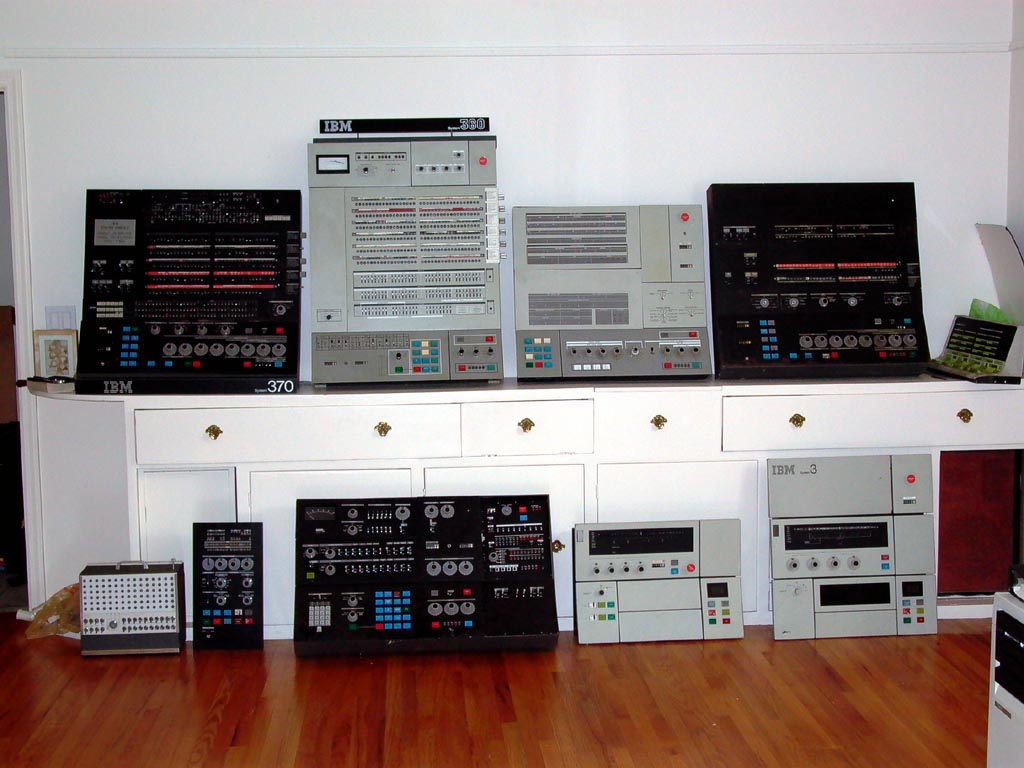
I know some of you all loathe eBay, so ignore if appropriate. For the
rest, I've decided life is going too fast as it is, and this 3B2 is not
getting high enough priority to stay here. So, to someone else it will
go.
http://cgi.ebay.com/ws/eBayISAPI.dll?ViewItem&item=8805689078
Feel free to ask questions if needed.
Jim
Hi, Jeff,
I am looking for the Harris Semiconductor Analog databook. Do you still
have the books you posted on the internet a couple of years ago? If you
do, please reply this email. Thank you.
Best Regards,
K.B.
A manual from Microdata Training and Product Support titled:
Reality 8000 PEP Series Introductory Manual.
It's in fair shape, 48 pages and punched for a 3 ring binder.
E-Mail me off list if you'd like this.
g.
I've got a 3Com Etherlink III manual if anyone wants it.
Covers:
3C509, 3C509-TP, 3C509-COMBO, 3C579 and 3C579-TP
E-mail me off list if you're interested.
g.
Looking for a small plotter I was directed to one of your sites. Do you know anywhere I could get hold of a Tandy CGP-115 new or used?
Regards
Arne Graff
Nope. I paid about $10 for it and I am really happy with it. My
computer can only support one floppy drive and it still works like a
champ! I don't think I can read both floppy drives at the same time
though, but who cares. I can now read all those old disks I have and on
a modern PC nonetheless.
Ram
Steve,
My messages to your cableone.net address are bouncing:
Technical details of permanent failure:
PERM_FAILURE: SMTP Error (state 9): 550 relaying blocked, read new
mail, add 64.233.166.182 to forwarding or enable smtp authentication
in...
- Mike
> Will you be posting the progress to a blog? :)
It really does seem like there needs to be something. CHM
is pretty opaque from the outside (having been a volunteer
for over five years).
I really like like Paul McJones' "Dusty Decks" site
and may use that as a model.
http://www.mcjones.org/dustydecks/
So what does everyone use to manage an exhibit of their collection as
a web browsable thing?
So far I've been hand-editing HTML, but its getting a little laborious
and I'm wondering what sort of open source PHP/MySQL content
management system out there might be apropos for such a thing. I'm
using drupal <http://www.drupal.org> for a web site I'm doing and that
seems to fit well with the collaborative nature of the site, but I'm
not so sure it would be best for managing a collection site.
What do you use?
--
"The Direct3D Graphics Pipeline"-- code samples, sample chapter, FAQ:
<http://www.xmission.com/~legalize/book/>
Pilgrimage: Utah's annual demoparty
<http://pilgrimage.scene.org>
> So, when are you going to catalog and make TAP files of the
> collection of PDP10 tapes at CHM?
It's on the "to do" list for the coming year. My goals for the
first year include reading The LGC collection and CHM's DECtapes.
Yup, I am not staring at $500 or $700 (way too much),
and I am not counting to make big bucks here.
I will have a good look at it this evening, scan the
doc (if I have it) tomorrow and then put it up on
eBay for, say $25 ...!
- Henk.
> -----Original Message-----
> From: cctalk-bounces at classiccmp.org
> [mailto:cctalk-bounces at classiccmp.org] On Behalf Of dwight elvey
> Sent: dinsdag 2 mei 2006 16:24
> To: cctalk at classiccmp.org
> Subject: RE: uScope 820
>
> Hi
> The 499 one is on its second round, after not being sold for 499.
> It is not likely that the 700 one will get much either. It
> seems like I saw one of these get around 300 or so. Remember,
> these are just asking prices.
> These were designed to work with the 8080 but as I recall,
> they were also used with a few others, like the 8085. When I
> worked at Intel, I'd gotten a centronics printer wired for
> 220 50 cycle. I used the transformer from one of these to use
> to step down. I handled the 50 cycle with a gear change on
> the AC motor.
> Dwight
>
>
> >From: "Gooijen, Henk" <henk.gooijen at oce.com>
>
> >Wow, $500 and $700 for that thing? I have one at home with the
> >documentation, and I am sure never going to use it.
> >Guess putting it on eBay will make some money to finance the
> >PDP-11 stuff which is far more interesting than Intel *&@#~$% I will
> >check bitsavers if the doc is available, else I will scan that first.
> >
> >- Henk.
> >
> >
> > > On 5/1/06, Don Y <dgy at dakotacom.net> wrote:
> > > > Hi,
> > > >
> > > > Can anyone verify that this box (1976 vintage) also handles
> > > 8080's?
> > > > I'm *sure* I had an 8080 "personality module" for mine
> but I can't
> > > > seem to find it (nor the overlay or the pod).
> > > >
> > >
> > > FWIW, these two uScope items are both pictured with 8080A probes.
> > >
> > > http://cgi.ebay.com/ws/eBayISAPI.dll?ViewItem&item=8802128045
> > > http://cgi.ebay.com/ws/eBayISAPI.dll?ViewItem&item=5227203002
> > >
This message and attachment(s) are intended solely for the use of the addressee and may contain information that is privileged, confidential or otherwise exempt from disclosure under applicable law.
If you are not the intended recipient or agent thereof responsible for delivering this message to the intended recipient, you are hereby notified that any dissemination, distribution, or copying of this communication is strictly prohibited.
If you have received this communication in error, please notify the sender immediately by telephone and with a "reply" message.
Thank you for your cooperation.
Ram,
I have a couple of those too and they do work great. However I got mine
surplus and haven't taken the time to figure out the jumpers setting. Do
you know what they are?
Joe
At 11:15 AM 5/2/06 -0400, you wrote:
>Not really going to help you, but I had several problems with floppy
>drives on my P4 machine and I finally decided to get one of those dual
>3-1/2 and 5-1/4 inch drives on ebay (I believe it was from Epson).
>Solved all my problems...Now I can read all different types of PC
>formats on a modern peecee...
>
>Ram
>
Wow, $500 and $700 for that thing? I have one at home with
the documentation, and I am sure never going to use it.
Guess putting it on eBay will make some money to finance the
PDP-11 stuff which is far more interesting than Intel *&@#~$%
I will check bitsavers if the doc is available, else I will
scan that first.
- Henk.
> On 5/1/06, Don Y <dgy at dakotacom.net> wrote:
> > Hi,
> >
> > Can anyone verify that this box (1976 vintage) also handles
> 8080's?
> > I'm *sure* I had an 8080 "personality module" for mine but I can't
> > seem to find it (nor the overlay or the pod).
> >
>
> FWIW, these two uScope items are both pictured with 8080A probes.
>
> http://cgi.ebay.com/ws/eBayISAPI.dll?ViewItem&item=8802128045
> http://cgi.ebay.com/ws/eBayISAPI.dll?ViewItem&item=5227203002
>
This message and attachment(s) are intended solely for the use of the addressee and may contain information that is privileged, confidential or otherwise exempt from disclosure under applicable law.
If you are not the intended recipient or agent thereof responsible for delivering this message to the intended recipient, you are hereby notified that any dissemination, distribution, or copying of this communication is strictly prohibited.
If you have received this communication in error, please notify the sender immediately by telephone and with a "reply" message.
Thank you for your cooperation.
At 08:21 AM 5/2/06 +0200, Henk wrote:
>Wow, $500 and $700 for that thing? I have one at home with
>the documentation, and I am sure never going to use it.
>Guess putting it on eBay will make some money to finance the
>PDP-11 stuff which is far more interesting than Intel *&@#~$%
>I will check bitsavers if the doc is available, else I will
>scan that first.
I wish you'd scan the docs. I have both a Z-80 and an 8080 unit that I'd
love to try out (and then sell on E-bay for $700+ :-)
Joe
When I was in the Army (Signal Corps), they told us the 19" standard was
>from Germany, during WWI. It was actually .5 meters and used on all their
early military electronics. But I have no data whatsoever to back this up.
It was just one or two instructors and probably pure bull shit.
Billy
I won the prime computer, I paid more then I really wanted, but there
you go. I was expecting it to go out of my reach though.
I will pick it up sometime this week. Watch this space for info...
Dan
Hi
I worked on British (Strowger Type) automatic telephone exchanges in
the 1960's. The guy I worked for (then 60+) told me they first made
racks 19" to hold a given number of standard relays in a row. (Circa
1920)
Rod
-----Original Message-----
From: cctech-bounces at classiccmp.org
[mailto:cctech-bounces at classiccmp.org] On Behalf Of Chuck Guzis
Sent: 01 May 2006 16:49
To: cctalk at classiccmp.org
Subject: Re: 19" Rack History
IIRC, 19" racks go back before WWII. I'll have to check one or two of
my
old electronics books, but my guess is that the size originiated in the
1920's.
Cheers,
Chuck
> From: Marvin Johnston
> Subject: MS-DOS 1.0/1.1
>
> I was just reading through the MSJ (May 1987) and it has an interesting
> article
> called "Evolution and History of MS-DOS" and some of it is quoted below.
> Does
> anyone know whatever happened to Tim Patterson? I never hear his name
> mentioned,
> and am just curious.
Tim has a web site with more information on MS-DOS
http://www.patersontech.com/
Michael Holley
www.swtpc.com/mholey
Okay, I'm hoping someone who knows a little more about dot matrix printers
than I can shed some light on this issue:
I have a LA50 printer that has a problem where when it prints, it shifts the
text about half a character too far to the right on the left-to-right pass,
and the same on the right-to-left pass. I tried adjusting the "align"
trimmer, but that didn't help.
Has anyone else seen this problem on an LA50, and is there a workable
solution to the problem?
Thanks
Julian
Hi,
Can anyone verify that this box (1976 vintage) also handles
8080's? I'm *sure* I had an 8080 "personality module" for
mine but I can't seem to find it (nor the overlay or the
pod).
(sigh) I've got to get this mess sorted out so finding
things is easier!
--don
Answer: Darned near everyone.
I'm trying to locate a game I used to play on my cousin's computer back in
the early 90s. The game is most likely older than this, but I can't say
how much. (The only other games on this machine was Test Drive (#1) and
some horrendous ASCII golf game)
The game was a top-down dungeon style game (As in the location, rather
than D&D or Zork association). The game used ASCII characters to build out
the 'map' that you walked through using the arrow guys to guide your
character, if memory serves an *, running into monsters and treasure and
the like.
I -think- the dungeon view only took up a portion of the screen, perhaps
the right-half only, and your view was fairly limited to a "if you were in
the dungeon this would be the extent of your eye line" sort of thing.
Pretty nifty.
Does this sound famaliar to anyone? A name would be great, a link would be
disco, and source code would be fascinating.
Thanks all for your hive-mind;
JP
"Gooijen, Henk" <henk.gooijen at oce.com> wrote:
>Ok, I will get to it right away, Johnny!
Good.
>I will see if you changed the hex numbers (back) to octal numbers :-)
Oops. No. I should do that... :-)
>Can somebody explain te difference between
>"VBGEXE ZEMU" and "VBGEXE" and then enter on the VBGEXE
>prompt the file name (ZEMU.SAV) ?
>Hi Johnny,
>
>I can not get access to ftp://ftp.update.uu.se/pub/pdp11/ ...
>anonymous is not accepting my e-mail addresses
>(gooiAToceDOTnl or henkDOTgooijenAToceDOTcom)
>and I do not know the guest account password ...
Weird. Hmm. There is no guest account. The anonymous account should
accept pretty much anything you throw at it as a password.
Try again?
Johnny
--
Johnny Billquist || "I'm on a bus
|| on a psychedelic trip
email: bqt at update.uu.se || Reading murder books
pdp is alive! || tryin' to stay hip" - B. Idol
Oh, what the hell! I sent outside and dug the rest of the stuff out of
the car. Here's what I have:
6800/02/08, 65xx, 8085, Z-80 and 27xx (programmer?). Looks like a nice
collection of vintage stuff!
I have both pods and interface cards for each of them. In fact, this
stuff looks NEW! Most of it is still wrapped in foam plastic sheeting and
it's VERY clean.
Joe
At 05:06 PM 4/26/06 -0700, you wrote:
>Joe R. wrote:
>
>> Is anyone familar with this stuff? I picked up a pile of it a week or
>>two back. The pod that I'm looking at right now if for the 6800/02/08 but I
>>think the others are for other CPUs. Anyone know what system it's for? The
>>interface board uses the same type female connectors as the ss-50 stuff but
>>many more pins and much larger circuit card. I found some mentions on the
>>net but nothing useful.
>>
>> Joe
>>
>>
>>
>>
>I work for arium. What do you have? We are now American Arium, and
>I can at least find out what you have it you send photos or descriptions.
>
>I suspect maybe you either have an analyzer with some trace pods, or
>if you have run control, you may have an EZ/Pro system.
>
>Jim
>
I think the standard probably had its origins a bit further: My 1919
Westinghouse Catalogue lists control desks that have sections of 16,
20, 24, and 32" wide. The section was covered by a panel that spanned
the width of the cabinet - the equipment was intended to be mounted
on this panel. From the drawings it looks like the actual space
within the sections would be an inch or so less - the specifications
are a bit lacking. A 3'x20" rack with side panels ran $817.50!
BTW I just noticed on that someone has a Pascal 3.1 manual on e-bay. Item
number: 7607549442 I think I sent a copy of this to Al to be scaned but
who knows, this may have something different in it.
Joe
Hi,
i'm currently trying to initialize my HP9133L with the HFS file system, but executing MKHFS only
runs into an integer overflow exception ...
... this is independent of the number of volumes that are used (i have to admit, i only have tried
1 .. 3 volumes).
I have a Basic 6.4 at hand as well, with this one, it's possible to initialize the drive, but then,
the volume isn't accessible by Pascal anymore :(
Another issue : is it possible to boot from the floppy within the 9133 ? I can only boot from another
9122 that is connected, but not with the 9133 build in drive, later it's possible to use it normally
Thanks Bernd
Don North wrote:
>I currently work for a big datacom supplier, and design a lot of rack
>mount equipment. The current major datacom/telecom customers invariably
>want all equipment to fit in standard 19" two or four post racks. They
>really don't like the 23" width (not 24" width) at all, and really balk
>at buying a chassis that requires a 23" rack.
And there's also 21".... Of course one notices these things when trying to
mount 19" gear in the rack :).
>More interesting is the concept of 'U' when it comes to racks. All
>equipment is in units of 'U' (a standard 8' rack is 44U), which is
>1.75". So anyone know where 'U' came from, and why it is called 'U'?
Unit?
greetings,
Michiel
Hi Johnny,
I tried again to download 'zemu.tar' via the link on the webpage
http://64.253.97.239/pdp11/pdp11.htm which did work fine last week.
Now I get: "HTTP 500 - Internal server error Internet Explorer" and
the (Windows) text is "The page cannot be displayed. There is a problem
with the page you are trying to reach and it cannot be displayed."
- Henk.
> -----Original Message-----
> From: cctalk-bounces at classiccmp.org
> [mailto:cctalk-bounces at classiccmp.org] On Behalf Of Johnny Billquist
> Sent: maandag 1 mei 2006 10:11
> To: cctalk at classiccmp.org
> Subject: RE: Zemu
>
> "Gooijen, Henk" <henk.gooijen at oce.com> wrote:
>
> >Ok, I will get to it right away, Johnny!
>
> Good.
>
> >I will see if you changed the hex numbers (back) to octal
> numbers :-)
>
> Oops. No. I should do that... :-)
>
> >Can somebody explain te difference between >"VBGEXE ZEMU"
> and "VBGEXE" and then enter on the VBGEXE >prompt the file
> name (ZEMU.SAV) ?
>
> >Hi Johnny,
> >
> >I can not get access to ftp://ftp.update.uu.se/pub/pdp11/ ...
> >anonymous is not accepting my e-mail addresses
> >(gooiAToceDOTnl or henkDOTgooijenAToceDOTcom) >and I do not
> know the guest account password ...
>
> Weird. Hmm. There is no guest account. The anonymous account
> should accept pretty much anything you throw at it as a password.
> Try again?
>
> Johnny
>
> --
> Johnny Billquist || "I'm on a bus
> || on a psychedelic trip
> email: bqt at update.uu.se || Reading murder books
> pdp is alive! || tryin' to stay hip" - B. Idol
>
>
This message and attachment(s) are intended solely for the use of the addressee and may contain information that is privileged, confidential or otherwise exempt from disclosure under applicable law.
If you are not the intended recipient or agent thereof responsible for delivering this message to the intended recipient, you are hereby notified that any dissemination, distribution, or copying of this communication is strictly prohibited.
If you have received this communication in error, please notify the sender immediately by telephone and with a "reply" message.
Thank you for your cooperation.
I'm in need of an MSDOS 2.21 boot diskette for some Kaypro 4/88 (CO-POWER 88
co processor) machines I've restored. I have the Kaypro diskettes to fire up
the coprocessor and 512k memory add-on. The Kaypro co-processor start-up
seems to be tied to MSDOS version 2.21.
Any MSDOS 2.21 boot diskette will do, but perhaps the Kaypro-distributed one
has additional utilities... not sure.
Does anyone have a raw disk image or a teledisk image of a boot diskette I
could download or be emailed? It is, of course, needed in 5.25" 360k format,
but I can boot it and generate what I need worst-case.
Thanks in advance,
-scott
A guy writes to me:
"I have several, Wyse 325 and Wyse 60 terminals. ?The great majority of them
work fine as many were taken straight from work stations that converted to
PCs."
and:
"I also have Frame relay networking equipment including routers and DSU
units. ?Again, mostly working units. ?I also have several componets to a
large R50 AIX computer server. ?They include power supplies, hard drives,
expansion cards, processor boards and many other things."
He's just looking to get rid of it. I'm looking for scrap, and maybe to make
a buck or three. If any of this stuff is of interest contact me offlist and
we'll put something together.
--
Member of the toughest, meanest, deadliest, most unrelenting -- and
ablest -- form of life in this section of space, a critter that can
be killed but can't be tamed. --Robert A. Heinlein, "The Puppet Masters"
-
Information is more dangerous than cannon to a society ruled by lies. --James
M Dakin
Hi,
I'm (slowly) trying to wade through things here with
a goal of "thinning the herd" (sigh -- unfortunately,
no basements, here! :< ).
I have a working CoCo2. What aspects of it should I
*document* before getting rid of it? (e.g., photos,
ROM images, etc.)
Or, is it just not worth my time?
--don
Hi,
I am in the process of converting my AViiON 3000 into
a "media server" (i.e. hook up all my SCSI peripherals
to it so I can read and write different media in one place...
instead of dragging peripherals from one machine to another).
The (old, slow) CD-RW that I had installed in it appears
to be dead/dying. At first, I thought it was an issue
of not liking "home-recorded" CD's. But, it appears
to dislike "real" CD's just as much! :-(
Aside from flashing LEDs, it's hard to tell what, if
anything, it is doing (fans on the AV3000 are loud).
I plan to take the covers off it (the CD-RW) and verify
the hub is spinning, actuator arm is moving, etc.
Other than that, could be a problem in the optics
(which means toss it out...)
It's a Yamaha CRW4260t-NB so its no big loss (though it
does have a strap to allow it to be configured for different
sector sizes).
Any other tricks I can try? Any suggestions for a replacement
drive? (I'm not looking for anything fancy -- just would be nice
to be able to burn CD's on this machine as it has most of my
file archive attached to it)
Thanks!
--don
Dear Sir
I have an LNW 80, two TRS80's, 5" and 8" disk drives and tons of all software imaginable for these machines that I would like to sell. Please make an offer.
Paul Slysh
PS Associates
3047 Ducommun Ave.
San Diego, CA 92122
Telephone 858 453-3810
E-mail paul at isogrid-sst.com
Web site http://www.isogrid-sst.com
Paul Slysh
PS Associates
3047 Ducommun Ave.
San Diego, CA 92122
Telephone 858 453-3810
E-mail paul at isogrid-sst.com
Web site http://www.isogrid-sst.com
Still got about 4 years before it's ontopic, so I'll make it quick.
Does the Sun Blade 1000 support "Suspend" like other Sun Workstations
such as the Ultra 10 and Ultra 60 do? It's more than a little power
hungry, and generates a lot of heat, so I don't want to keep it
running full time.
Zane
--
| Zane H. Healy | UNIX Systems Administrator |
| healyzh at aracnet.com (primary) | OpenVMS Enthusiast |
| MONK::HEALYZH (DECnet) | Classic Computer Collector |
+----------------------------------+----------------------------+
| Empire of the Petal Throne and Traveller Role Playing, |
| PDP-10 Emulation and Zane's Computer Museum. |
| http://www.aracnet.com/~healyzh/ |
> Subject: help...early Zenith multisyncer refusing to sync
>
> dont have the model number handy, was the first unit to sport
> a flat screen (but my SX-64 has a pretty flat screen...hmmmm.
> Perhaps the curvature is more pronounced on larger tubes,
> making teensy weensy ones seem flatter). Plugged in a VGA
> signal...ewwww. What a mess. Not likely Id simply find a
> toasted cap I bet.
If the display in question was a FTM-xxxx (1490 I think) it is a fixed
frequency monitor. 640x480 probably 60-65Hz.
Spent some time this past week trying to get a VAXStation 3500 he
just got to boot. It immediately comes up with:
?64 2 08 FF 00 0000
Then dumps registers, goes through normal tests and declares that
normal operation is not possible. From what I've been able to find so
far is that test 64 is failing, but not what test 64 is...
Does anyone know what the tests are, the meaning of the register dump
and how to proceed?
CRC
"Gooijen, Henk" <henk.gooijen at oce.com> wrote:
>I tried running Zemu in RT11 v5.3 in SIMH.
>It starts and asks for a game file. I entered ZORK1.DAT (from a zork1.zip
>I once downloaded). The ZORK1.DAT is 180 blocks.
>Zemu aborts after some 10 [ZALLOC] messages:
>[ZALLOC]: Insufficient memory]
>We didn't get memory for dynamic data. Aborting...
>[Entered ZEXIT]
>[INPEND: timer cancelled]
>
>and then I am back at the RT-11 dot prompt.
>
>Next I tried ".VBGEXE ZEMU".
>After a [ZINIT], three [ZALLOC] and one more [ZINIT] line, Zemu prints
>"ZEMU/RT X00.19"
>but then I return to the RT-11 prompt!
>
>The last attempt was starting VBGEXE.SAV without a program on the
>startline.
>VBGEXE asks for a program, and I entered ZEMU.SAV.
>Now soem 20+ [ZALLOC] lines are printed, the last lines are the
>following:
>[GETSLN: returning 24. lines]
>[GETSCL: returning 80. columns]
>[GETSTP: returning terminal type 3.]
>[PUTTXT: Address = 066736, count = 14. characters]
><[?7l<[2J,=<[r
>?MON-F-Trap to 4 101566
>.
>
>So, it is getting further. The "<" is actually a small arrow.
>I guess these are control sequences for a VTxxx terminal? Or
NNANSI.SYS >stuff,
>as the zork1.zip file contained a zork1.dat, an .exe and a Nnansi.com
>file
>(thus PC stuff).
>Perhaps this ZORK.DAT file is not correct ...?
>Or does the ZEMU.SAV need somethignfrom the RT-11 environment? Zane has
>build Zemu in RT-11 V5.7, and my version is 5.3 ...
Henk, looking at this, I suspect your third attempt was working fine.
The problems there is probably because Zane built a version that didn't
have all the needed ingredients. I've uploaded a (hopefully) working set
of sources now. Let's see how that fares?
And Zane, I also did the other changes I mentioned in my last mail, so
maybe the now published sources built without any modifications?
Johnny
--
Johnny Billquist || "I'm on a bus
|| on a psychedelic trip
email: bqt at update.uu.se || Reading murder books
pdp is alive! || tryin' to stay hip" - B. Idol
"Julian Wolfe" <fireflyst at earthlink.net> wrote:
> Speaking of which, does anyone know whether it would be more
advantageous to
> run the RSX executables or the RT-11 ones in RSTS/E 9.6?
I haven't tried, but I suspect the RSX version will not work in RSTS/E.
I'm using some of the asynchronous features of RSX, which I believe the
RSX emulation in RSTS/E don't cope with.
You can try, but I think the RT-11 version have a better chance at
working...
Johnny
--
Johnny Billquist || "I'm on a bus
|| on a psychedelic trip
email: bqt at update.uu.se || Reading murder books
pdp is alive! || tryin' to stay hip" - B. Idol
"Zane H. Healy" <healyzh at aracnet.com> wrote:
>>> Hi Zane,
>>>
>>>here is the updated zipped RL02 disk container.
>>>It has Zemu 1.10 just released by Johnny.
>>>I changed the hex fields into octal fields ...
>>>
>>>You might first try the earlier sent zip, and then
>>>this new one, to see a possible difference.
>>>If you want a zip file with the original Zemu 1.10
>>>release from Johnny (without my hex->octal adjustment)
>>>just ask, and I'll zip it for you.
>
>
>OK, here are my quick and dirty results from RT-11 5.7...
>
>?LINK-W-Undefined globals:
>$SAVVR
>PICDAT
>ERPIC
>PICTBL
>DRWPIC
>INTVER
>.SAVR1
>GAMINI
>
>I've added these to the end of ZRT.MAC with the other three undefined
>routines.
>
>The resulting file runs on both 5.7 and 5.4, but I can't figure out
>where my infocom data files are (which probably says something about
>how badly I need to backup my PDP-11). It's to late at night now to
>be booting the PDP-11 up to get them. (Henk, I'll email you the
>binary tonight.)
Whoops! I totally forgot some stuff, I see...
Oh well, that's what happens when things wander out of sync.
Get a new copy, will you. One file was missing: ZPIC.MAC, which
implements PICDAT, ERPIC, PICTBL and DRWPIC.
I've also written a $SAVVR and .SAVR1, which I've put in ZRTLIB.MAC,
which you'll need.
INTVER is a constant, which is just the interpreter version which should
be set. Place it as a global constant in ZRT.MAC.
In RSX, it's currently 103 "C", which probably should be the same in
RT11. So, just place a
INTVER == 103
Finally, GAMINI. You can just let that one do a return.
And maybe then we're in business?
Johnny
--
Johnny Billquist || "I'm on a bus
|| on a psychedelic trip
email: bqt at update.uu.se || Reading murder books
pdp is alive! || tryin' to stay hip" - B. Idol
Addendum to my previous message.
I think you would be best off with several compact 8 to 16 port terminal
servers, placed near the devices they service; that way, you just have
a few long Ethernet cables and a bunch of short serial cables, rather
than a bunch of long serial cables. Uhh, unless of course you want to
take a big, heavy Xyplex Network 9000 off my hands (40 serial ports and
40 Ethernet ports, with room to expand), in which case a big centralized
terminal server is just what you need! ;-)
On the DECserver and similar machines, with a terminal plugged in, you
get a prompt you can "connect foo" to connect to a LAT service, or
"telnet foo" on TCP equipped machines. Some also allow
"connect local port_1" to connect to a local serial port without going
through a LAT service. On machines that support reverse LAT, you can
associate port(s) with a service, and connect to those ports remotely.
You could also connect to the command prompt with MOP and on some
models with LAT, IIRC. On TCP equipped models, you could telnet in
(sometimes to 23 and sometimes to a high port) and get to the command
prompt (sometimes after authenticating). Also, each serial port could
have a high TCP port associated with it for inbound connections. Some
machines could associate an inbound TCP port with a service, for port
rotaries, IIRC. Note that I am painting DECservers, ETS, MAXservers
with a broad brush here; some brands may not support all features.
Oh, and you could also set ports to have a dedicated service, so they
don't get the CLI. And you could set up menus, too.
On the Annex you get a non-DECserver-like CLI from a terminal or
modem dialin, and you can telnet out from there -- or, IIRC, it can be
set to automatically telnet to a given host, or set up with menus.
Coming from the network, you could telnet to port 23 and get a prompt
for which serial port you wanted to connect to. The ports could be
arranged in rotaries and if all ports were busy you could wait for one
to become available. At the prompt for the rotary name you could also
ask for the CLI. Like the DECservers, you can connect directly to ports
by using high TCP ports. (Some models of?) the Annex could also have
multiple IP addresses, if I'm not mistaken, and could be set up so that
a telnet to each address would end up at a different serial port. I
believe Annexes were popular with universities, but some corporations
and ISPs used them too. They later had a "Remote Annex" RAS product
with built-in modems, similar to the Ascend MAX and Livingston PM3.
On the LANrover, if you dial in on a modem, or if you telnet in, you
get a login prompt, and once you authenticate you go to the CLI -- or
a given account could be set in the account database to go straight
to a specific destination. From the CLI you can telnet out, or you can
connect to ports by name. There is no provision for direct telnet to
a serial port by a high TCP port.
-- Adam
> Hi All,
> Does anyone have info or disks for a Data General
> Dasher/One PC? I have one that I'm attempting to restore.
>
> Thanks
> Rob
In a pinch I think it will boot normal DOS. It was a DOS compatible
machine.
OK, so I think I have figured out these "9200T" and "9201T" terminals.
The 9200T has exactly the same case and internal circuits as the 4105
with a different set of ROMs from the 4105. However, as near as I can
tell, the only difference in the ROMs is that the 9200T reports 9200
as the terminal type in setup.
The 9201T has a slightly different enclosure and logic boards. Its
setup reports the terminal type as 4205, ROM version 10 Level 9. This
is obviously an enhanced ROM with what appears to be support for a
larger graphics feature set, including local 2D segments.
The keyboards on both are slightly different, with some of the keycaps
changed in the function key row (setup and dialog are different than on
the 4105) and a mouse port on the back of the keyboard. The connector
is also different, an RJ type jack instead of a large 9-pin DIN style.
So now I'm looking for documentation on the 4205 terminals. There's
nothing on manx or bitsavers.
--
"The Direct3D Graphics Pipeline"-- code samples, sample chapter, FAQ:
<http://www.xmission.com/~legalize/book/>
Pilgrimage: Utah's annual demoparty
<http://pilgrimage.scene.org>
Sonds like 'rogue'. Rogue originally was written for Berkeley UNIX, but
ports were done to early PC's running MSDOS.
Rick Bensene
The Old Calculator Web Museum
http://oldcalculatormuseum.com
-----Original Message-----
From: cctalk-bounces at classiccmp.org
[mailto:cctalk-bounces at classiccmp.org] On Behalf Of JP Hindin
Sent: Saturday, April 29, 2006 4:13 PM
To: cctalk at classiccmp.org
Subject: Lets play name that game; Who has a better memory than me?
Answer: Darned near everyone.
I'm trying to locate a game I used to play on my cousin's computer back
in
the early 90s. The game is most likely older than this, but I can't say
how much. (The only other games on this machine was Test Drive (#1) and
some horrendous ASCII golf game)
The game was a top-down dungeon style game (As in the location, rather
than D&D or Zork association). The game used ASCII characters to build
out
the 'map' that you walked through using the arrow guys to guide your
character, if memory serves an *, running into monsters and treasure and
the like.
I -think- the dungeon view only took up a portion of the screen, perhaps
the right-half only, and your view was fairly limited to a "if you were
in
the dungeon this would be the extent of your eye line" sort of thing.
Pretty nifty.
Does this sound famaliar to anyone? A name would be great, a link would
be
disco, and source code would be fascinating.
Thanks all for your hive-mind;
JP
So, I picked up an IBM "3270 Emulation Credit Card Adapter" off ebay,
which I intend to hook to a 3174 Establishment controller. However,
I'm not having much luck finding any 3270 emulator software that'll
talk to it. Does anyone have any software that'll talk to the card
(and emulate a 3270-style terminal) laying around which will work with
this card? I'd prefer something for OS/2, DOS; I could deal with
Windows 3.1 if I had to, but would prefer not if I don't need to.
I intend to eventually use this in an actual S/390 (or ES/9000) setup
once I get some software, and a machine working to boot it on.
Pat
--
Purdue University ITAP/RCAC --- http://www.rcac.purdue.edu/
The Computer Refuge --- http://computer-refuge.org
Okay, here's one for you historians.
I know that many card readers used both optical as well as electrical
contact technology, but did any use air pressure to sense card holes?
This occurs to me because I've been listening to recordings of old piano
rolls--which used a vacuum system to sense holes--and did their job
remarkably well, considering that the technology's over 100 years old.
Just an idle mind wanting to be amused...
Cheers,
Chuck
I'm lazy tonight. Are there any pin compatible replacments for this chip? It is the SD floppy controller on my TRS-80 EI. It is very sick...
Any sources for 1771 anywhere. I see lots of 197x available.
Kelly
Aak... sorry.
In all honesty, you're better off using a generic FTP client (such as WS_FTP) than a web browser. Doing FTP with an HTTP browser introduces additional overhead that can slow the transfer (at least that's been my experience.
ftp.bluefeathertech.com is the address of interest.
Happy hunting.
*********** REPLY SEPARATOR ***********
On 29-Apr-06 at 10:27 DaveC wrote:
>>I'm pleased to report that, after a much more strenuous than
>>expected upgrade (bloody power supplies!), Blue Feather's FTP
>>archive has been back up since about Tuesday last week.
>
>What's the URL of the FTP site?
>
>Thanks,
>Dave
-=-=-=-=-=-=-=-=-=-=-=-
Bruce Lane, Owner & Head Hardware Heavy,
Blue Feather Technologies -- http://www.bluefeathertech.com
kyrrin (at) bluefeathertech do/t c=o=m
"If Salvador Dali had owned a computer, would it have been equipped with surreal ports?"
has an NCR 53c400 chip, an als245, and not much else.
4 dip swiches, presumably (hopefully) for setting the
id. I have plans for this bad boy...
__________________________________________________
Do You Yahoo!?
Tired of spam? Yahoo! Mail has the best spam protection around
http://mail.yahoo.com
Check out their computer salvage prices. Wow! $200 for XT machines... $25 for 3.5" drives. All the salvage shops I've been to charge a few bucks for such items. Do some folks actually pay those kind of prices for common items?
I've been using GTTY a lot recently and discovered a feature that probably
should have been there from day one: A "clear screen" commmand. Expecially
helpful when you're running diagnostics and are getting errors - then swaping
boards and reruning the diags. Hitting the "clear screen" key (F6) is handy
for cleaning up the old diagnostic messages.
To update your copy to this latest version:
ftp://bickleywest.com/gtty92
Cheers,
Lyle
Note: For those who haven't been following "GTTY" - Its purpose is to act as
a "Glass TTY" for a PDP-8/x, including paper tape reader and punch. It has
"pacing" implemented, and supports baud rates from 110 to 38,400. The "txt"
file includes documentation on both "GTTY" and the hardware modifications for
implementing "pacing" for your PDP-8/x. Source code is included.
Please also note that GTTY defaults to "pacing" mode - but if invoked as
"gtty -n" will turn off pacing.
--
Lyle Bickley
Bickley Consulting West Inc.
Mountain View, CA
http://bickleywest.com
"Black holes are where God is dividing by zero"
-------------Original Message:
From: ard at p850ug1.demon.co.uk (Tony Duell)
Subject: Re: anyone have a terminal server?
<snip>
>Mine are certainly soft-configured. There are, IIRC, no internal DIP
>switches at all. And IIRC, sending it some control codes (it _MAY_ be
>^T^T) gets you some kind of prompt, from which you can configure the port
>setings, logcially conenct ports together, etc.
>I've figured out enough to make the PSU brick for it (just a transformer
>+ fuses), and that sort of thing. I was wondering if there's anything
>that's not obvious...
>-tony
-----------------Reply:
Hmm, they sure sound different from what I've got here; are they made
by Digital Products Inc.? Any idea when?
These units all have internal power supplies.
FWIW, access to the configuration menu is ~~M, but you get a full screen
menu, not just a prompt.
mike
> >
> > > Looks like a Catweasel MK4 would really come in handy.
> Any vendor recommendations with good pricing in the USA?
> > >
> > > Thanks,
> > > AJ
> > >
> >
> > I don't think there are many choices in the US. I've
> normally used Softhut
> > for Amiga related stuff, and have always been happy with them.
> >
>
> Plus they have been around since the C64 time began! :)
Softhut is a good bet. That's who Jens suggests too.
Kelly
> SCSI interface - almost certainly really HP tho' described as "SUN".
It is an 88780. Most interesting thing about it is that it will probably
have the 800bpi option.
> SCSI interface - almost certainly really HP tho' described as "SUN".
It is an 88780. Most interesting thing about it is that it will probably
have the 800bpi option.
Hi,
I've inherited a VW320 but it is missing the drive cage.
If I can get it running, I'd also be looking for some
extra memory for it (wacky 40 bit? modules).
I *think* I can replace the single CPU with a pair
of off-the-shelf "matched" processors?
Or, is this box not worth the time to get it running?
Thanks!
--don
Hi Zane,
here is the updated zipped RL02 disk container.
It has Zemu 1.10 just released by Johnny.
I changed the hex fields into octal fields ...
You might first try the earlier sent zip, and then
this new one, to see a possible difference.
If you want a zip file with the original Zemu 1.10
release from Johnny (without my hex->octal adjustment)
just ask, and I'll zip it for you.
thanks,
- Henk.
> Rats, I was afraid that PUTR was still the only way to do
> this. Can you email me a copy of zemu.dsk? I don't
> currently have a system setup that will run PUTR.
>
> I can at least see if it will still build under RT-11 5.7.
> While I was working on learning MACRO-11 a few years ago,
> real life stepped in, so I doubt I can do much in the way of
> fixing actual problems.
>
> Zane
>
This message and attachment(s) are intended solely for the use of the addressee and may contain information that is privileged, confidential or otherwise exempt from disclosure under applicable law.
If you are not the intended recipient or agent thereof responsible for delivering this message to the intended recipient, you are hereby notified that any dissemination, distribution, or copying of this communication is strictly prohibited.
If you have received this communication in error, please notify the sender immediately by telephone and with a "reply" message.
Thank you for your cooperation.
see lot 8803325888
Price (?50) looks a little on the high side but does include 26 tapes
SCSI interface - almost certainly really HP tho' described as "SUN".
I have bought from company before - they seemed reasonable.
This (very heavy!) drive will almost certainly need manoeuvering down
a flight of stairs. Parking is tight but should be possible.
Andy
On 4/26/2006 07:45 AM, cctech-request at classiccmp.org wrote:
>Date: Tue, 25 Apr 2006 20:49:48 +0100
>From: <a.carlini at ntlworld.com>
>Subject: RE: anyone have a terminal server? - Xyplex, Xylogics, and
> DEC history
>
>David Mitton wrote:
>
> > The former DEC terminal server line was spun off to Cabletron, and the
> > remains live in Enterasys.
>
>The DEC terminal servers did indeed go to Cabletron (as did all
>of NPB iirc). When Cabletron split up, the terminal servers
>ended up in DNPG. I've lost track of them now, but a few years
>ago their "legacy" terminal servers line had been sent off
>somewhere else.
>
>FWIW: Enterasys are no more, having been bought up by some
>management company or other and Riverstone (the other Cabletron
>spinoff) were sold on the block to Lucent (who almost immediately
>afterwards seem set to vanish into Alcatel).
>
>Antonio
>
>--
>
>Antonio carlini
>arcarlini at iee.org
Antonio,
Enterasys is still quite alive. http://www.enterasys.com
They recently moved from NH to near (or in) the old Andover plant.
I'm still in touch with Dave Nelson, who is current co-chair of the
IETF RADIUS Extentions Working Group. Dave worked on DECservers
while in LKG. Looks like they are using the RoamAbout(r) name for
their wireless stuff.
Dave.
http://www.washington.edu/admin/surplus/may2006catalog.html
Catalog info out. It is item number 1
IBM SP2 (7 NODES) MAINFRAME COMPUTER WHICH INCLUDES: Frame has
enhanced HPS Switch, 1 wide node, dual processor, 1GB memory;
2 thin nodes, each with four processors, 1GB memory; 2 thin nodes,
each with four processors, 2GB memory; 2 thin nodes, each with four
processors, 4GB memory;
Each node has 2-9.1GB SCSI disks, 14 disks total, 127.4GB total capacity
Going to be an interesting sale. I used to go to this regularly 10
years ago. I see they have online bidding now.
--
Paxton Hoag
Astoria, OR
USA
I'm totally unfamiliar with the VW320 (which means this is undoubtedly
useless advice), but at least some of the SGI Visual Workstations were
secretly Tyan Thunder 2500 (aka S1867) based, and could be flashed to a far
more forgiving Tyan BIOS. Perhaps there's a similar sheep in wolves
clothing here?
I've got a hex dump here of an Assembler/Text Editor for the 8080,
called (IIRC) ATE. It's what I used on my first computer (8080 S100 8k
+ KC tape). It's about 4k, so I had 4k for source + object, or it could
work as a 2-pass assembler reading the source off tape.
Does anyone know about this? Is it of interest to anyone? I could
either type it in, or scan the listing for someone else :-) The code
would need patching for console & tape I/O, and I don't have any
documentation on how to do this, or even how to use it, but it can't be
too difficult. Forgive me, it's been almost 30 years!
LJW
I've been quiet lately, see http://www.ljw.me.uk/porsche for an idea
why :-(
--
Lawrence Wilkinson lawrence at ljw.me.uk
The IBM 360/30 page http://www.ljw.me.uk/ibm360
I'm getting a little time to go back and work on my 11/45 project...
Tony wrote...
>> So, I would propose the following tests :
>>
>> 1) Make sure you can read/write all bits from external memort. Just write
>> 1, 2, 4 ,8, 16,.... to successive locations using the panel and examing
>> them. Jsut to eliminate a silly fault like a dead data buffer.
If there was a dead data buffer, how on earth could the machine sucessfully
boot and run xxdp+? I will try this test anyways.
>> 2) Run the basic instruction diagnostic if you've not done so already.
>> This should veryify that the data paths are OK.
I am having some trouble finding the right diagnostic for basic instruction
test on the /45. I will find it tonight and post the results.
>> 3) If possible, try some other interrupting device. An obvious one is the
>> console receiver. Wirre a program to : Load all the vectors with .+2,
>> HALT
>> as you did for the line time clock test that's failing.; Read the
>> Console
>> Rx data register to clear the data received bit (if necessary); then
>> enable the receiver interrupt; and go into an endless loop. Then you
>> press
>> a key on the conosle. The processor should halt, but _where_ does it
>> halt. If 4, then it appears the processor is ignoring all vectors.
I think I see what you're saying. After I try the first two tests, I will
need some clarification on this and post again :)
>> Hopefully this will point us in the right direction to look for the
>> fault.
I hope so, I need to get this machine done to consolidate some room the
basement that the wife is eyeing for her use ;)
Jay
-----------Original Message:
Date: Wed, 26 Apr 2006 23:19:17 +0100 (BST)
From: ard at p850ug1.demon.co.uk (Tony Duell)
Subject: Re: anyone have a terminal server?
>> In article <01C6674D.4F8CAD40 at MSE_D03>,
>> M H Stein <dm561 at torfree.net> writes:
>>
>> And I've got a bunch of Digital Products NC16/250 NetCommanders.
>You don't know anything about older NetCommanders, do you?
>I have a unit on my desk here that's got 16 RS232 ports (IIRC it's 8
>plug-in daughterboards with 2 ports on each board). The mainboard has a
>Z80A on it I think, and 4 RAM cards (IIRC 256K bytes each). I also have
>-- somwhere -- some smaller units with 10 ports (6 serial, 4 parallel),
>all on one PCB.
>I can dig out model numebrs, etc, if you think you might be able to help
>-tony
--------- Reply:
Sorry, Tony, much as I'd like to repay you for all the contributions you've made,
I don't think I can help very much.
No info on the old modular units at all, and the '86 price list & brochure I'm
looking at doesn't mention any 10 port models either. I don't have any technical
info in any case, just the Installation/Reference Manual and the Applications
guide for the NC4, NC7, NC8 and NC16. The NC4 (4 serial) & 7 (4 serial, 3 par.)
have configuration switches on the front, while the 8 & 16 are programmed from a
terminal.
If you think there might be anything useful in there, let me know. I do have several
boxes full of manuals for terminals & printers, etc. that I haven't looked through for
quite a while; if by chance I find anything I'll let you know.
BTW, the typical applications are made to order for this list ;-) :
-How to connect 10 VT-100s to a 6 port VAX...
-How to connect 8 terminals to a VAX and a DG...
-How to connect several 9600bd VT-100s to several 1200 bd Hayes modems...
-Using it as an e-mail server for dumb terminals or PCs...
-Switching between a Laser printer & a plotter...
Those were the days... and all that for only US$ 2995 !
mike
On 4/14/06, Fred Cisin <cisin at xenosoft.com> wrote:
> On Fri, 14 Apr 2006, woodelf wrote:
> > a.carlini at ntlworld.com wrote:
> > > I'm sure Knuth mentions "random-sort" as being worse (randomly
> > > shuffle elements, check if order correct, if not then repeat).
> > Sounds like it would have the smallest memory ( data and code)
> > footprint around.
>
> a bit larger than a bubble sort.
> But, at least it would tend to be slower.
It's called bogosort. It's O(N!) if your random number generator is perfect.
Pseudocode from the wikipedia entry:
---------------------------------------------------------------------
function bogosort(array)
while not is_sorted(array)
array := random_permutation(array)
---------------------------------------------------------------------
The only worse (speed wise) sorting algorithm that I know of is what I
call the infinitysort(). It just waits for random physical processes
to sort the array. It is O((BN)!) where B is the size of the objects
in bits. pseudocode representation is...
---------------------------------------------------------------------
function infinitysort(array)
while (not is_sorted(array)) or contains_different_elements(array)
wait
---------------------------------------------------------------------
You could greatly improve this algorithm by changing wait to "generate
a random bit pattern the same size as array"
The fastest sort I know of is the O(1) sort called nosort(). It's pseudocode is
---------------------------------------------------------------------
function nosort(array)
---------------------------------------------------------------------
It's only problem is that its probability of getting the right answer
is equal to the probability that the array is already sorted.
RXed this machine on the weekend. It appears to be an Alpha of
some sort.
Physically looks like a generic ATX PC clone, in a standard ATX
case with powers supply - has PS/2 keyboard/mouse, two COM
and 1 LPT ports.
The board has two standard PCI slots, what appears to be two
extended (64 bit?) PCI slots, and two ISA slots.
Now the parts that don't look so much like a PC:
- The memory consists of an array of 4 DIMMs, which although I
haven't counted them, look like 168pin sockets. But the DIMMs
are about three times the height of a normal DIMM, and do say
"Digital" (as in DEC) on them.
- Honkin big ceramic CPU - has studs in it for mounting the heatsink
directly to the CPU chip.
Under the heatsink is the following printed on the ceramic edge of
the CPU:
DEC 1026J H 9707
PROTO JD0855
(C) (M) DEC 1995
It was pretty well stripped when I got it - Had installed what looks like a
generic S3 PCI video card (ie: looks like a PC card), and some sort
of ISA multi-channel video capture card. The mainboard has 2 IDE and
1 floppy connectors although no such drives or cabling were in it - There
was a SCSI CD in the enclosure, bit no SCSI controller (however several
of the backplates were missing suggesting there might have been
additional cards. The two cards that were in it were not actually fastened
in - so they may or may not belong with it.
Anyone know what this thing might be?
Unfortunately it doesn't appear to do anything - No video, no beeps, no
serial port activity, no toggeling of status lights on the keyboard - does
power-up and down with the front panel button, but does nothing else.
(It occurs to me that if the video card were not the correct one, the Alpha
obviously would not know how to run the x86 BIOS on a PC card and it
might either crash (if it tried to execute it), or get hung up because it
doesn't have a video device it can talk to. (I haven't tried the video card
in a PC, but I will at some point).
It's probably a doorstop, but I wanted to check and see if anyone
recognizes it --- the "PROTO" on the CPU seems interesting ...
Could this be a prototype of some sort?
Regards,
Dave
--
dave06a (at) Dave Dunfield
dunfield (dot) Firmware development services & tools: www.dunfield.com
com Collector of vintage computing equipment:
http://www.parse.com/~ddunfield/museum/index.html
Received a nice addition to the collection today. An OSI Challenger 2P with a monitor and a LOT of cassette software. The really nice part for me was the ton of documentation, newsletters and books that came with it! Ok it isn't really a ton but it sure felt like it when I carried it in from the car. Now to spend time sorting and cataloging everything and checking out the system.
Add the issues of the TRS-80 newsletter and Softside I received the day before and it's been a fun week.
-----
David Williams
http://www.trailingedge.com
From: <a.carlini at ntlworld.com>
> John Allain wrote:
> > Anybody dismiss this as not a Multia yet?
>
>I didn't think that Multias were ATX format.
Correct.
> That sounds a lot more like the later 164LX/SX
> boards (or the equivalent 3rd party boards).
Another possibility are the older PC64 (based on the 21064 or 21064A)
boards, which are actually more baby AT format but have PS/2 connectors for
mouse/kbd. I've got a PC64-275, which was a scorcher circa 1995.
"Eric F." <elf at ucsd.edu> wrote:
> Johnny Billquist wrote:
> > If ZORK were ever to run on any other machine
> > that machine first and foremost would have to
> > have MDL. You know if SDS had that?
>
> A quick scan of my MDL manuals:
>
> "The MDL Programming Language" by Galley & Pfister
>
> and
>
> "The MDL Programming Environment" by Lebling
>
> (both published by Laboratory for Computer Science @ MIT)
>
> show that MDL only ran on ITS, Tenex, and TOPS-20.
All which are operating systems for the PDP-10, which I hope you know. :-)
Johnny
--
Johnny Billquist || "I'm on a bus
|| on a psychedelic trip
email: bqt at update.uu.se || Reading murder books
pdp is alive! || tryin' to stay hip" - B. Idol
Johnny Billquist wrote:
> If ZORK were ever to run on any other machine
> that machine first and foremost would have to
> have MDL. You know if SDS had that?
A quick scan of my MDL manuals:
"The MDL Programming Language" by Galley & Pfister
and
"The MDL Programming Environment" by Lebling
(both published by Laboratory for Computer Science @ MIT)
show that MDL only ran on ITS, Tenex, and TOPS-20.
SDS, on the other hand, ran the CP-V operating system.
So I suppose that Zork never did make it onto an SDS machine.
I do, however, clearly remember an SDS machine on the 9th floor at 545 Tech
Sq. during my tour back in the early 80s. I was a youngin' though, and was
just in heaven being so close to all these cool machines which I had only
been accessing through a TIP from across the country (via the RAND-TIP in
Los Angeles). Furthermore, I only had access to a printing terminal back
home (300 baud, thermal paper, acoustic (loose fitting, noisy) coupler) --
so once I was given the tour, and then a seat at a CRT with a 9600 baud
connection, well, I don't think I slept for 48 hours...
Those were the days... only taking a break at sunrise for a food run with
some of the other all-nighters hanging out there.
Eventually, the folks at RAND caught up with my (non-authorized) usage --
and politely asked my to cease accessing the TIP. This was my first
experience of going through a "withdrawal" syndrome -- I practically lived
on those MIT machines (via their Tourist accounts they gave out.)
-Eric F.
Jim,
I just did a Google search for American Automation EZ-pro and found ebay
auction #7590626029. The pod shown in the picture there looks EXACTLY like
mine including the slope front but mine doesn't have the CPU number on the
box. So it looks like that's what I have. I'll get a more complete list of
what I have tomorrow. Thanks for the tip.
BTW when I searched for American Amutomation before I did find the link
to Arium and I thought that might be what I was looking for but the link
was dead!
Joe
At 05:06 PM 4/26/06 -0700, you wrote:
>Joe R. wrote:
>
>> Is anyone familar with this stuff? I picked up a pile of it a week or
>>two back. The pod that I'm looking at right now if for the 6800/02/08 but I
>>think the others are for other CPUs. Anyone know what system it's for? The
>>interface board uses the same type female connectors as the ss-50 stuff but
>>many more pins and much larger circuit card. I found some mentions on the
>>net but nothing useful.
>>
>> Joe
>>
>>
>>
>>
>I work for arium. What do you have? We are now American Arium, and
>I can at least find out what you have it you send photos or descriptions.
>
>I suspect maybe you either have an analyzer with some trace pods, or
>if you have run control, you may have an EZ/Pro system.
>
>Jim
>
While rummaging around a secret scrapyard, Dan Cohoe and I dug up the
remains of an Intel 432/600 micromainframe, based on the ill fated 432
processor. All that was left in the pile was the plastic case parts and
front panel, power supply and keyboard.
That is all...
William Donzelli
aw288 at osfn.org
Is anyone familar with this stuff? I picked up a pile of it a week or
two back. The pod that I'm looking at right now if for the 6800/02/08 but I
think the others are for other CPUs. Anyone know what system it's for? The
interface board uses the same type female connectors as the ss-50 stuff but
many more pins and much larger circuit card. I found some mentions on the
net but nothing useful.
Joe
> -----Original Message-----
> From: cctalk-bounces at classiccmp.org
> [mailto:cctalk-bounces at classiccmp.org] On Behalf Of jim stephens
> Sent: donderdag 27 april 2006 8:29
> To: On-Topic and Off-Topic Posts
> Subject: Re: F*ck a f*cking duck
>
> with prices like this it seems like it may be time to fab up
> some reproductions, with Hercules SBC's inside blink'n the
> lights. I would almost buy such a gizmo, and have been
> sorely tempted to go for one of the Pdp 8's on a wall that
> are around, and so nice.
Drool on www.pdp-11.nl/homebrew/pdp8/pdp8startpage.html or
www.pdp-11.nl/homebrew/cons1170/cons70startpage.html
Have a *good* look at the front panel of the SBC6120, and compare
it with a real pdp8/e. You will notice that a few switches are
missing. Then check out my front panel ...
Given the Blinkenlight board set, you can build a replica yourself
either by (a lot of) DYI, or by grabbing a panel of eBay and make
a box around it. I am waiting on the arrival of an order of IDC
headers for the I/O Board to finish the 11/70 console ...
- Henk, PA8PDP.
BTW, I will finish the 11/70 console and the first chap that
offers $10,000.- will get it :-) - working, running RT11, Advent
and perhaps RSX with the chasing light pattern ...
This message and attachment(s) are intended solely for the use of the addressee and may contain information that is privileged, confidential or otherwise exempt from disclosure under applicable law.
If you are not the intended recipient or agent thereof responsible for delivering this message to the intended recipient, you are hereby notified that any dissemination, distribution, or copying of this communication is strictly prohibited.
If you have received this communication in error, please notify the sender immediately by telephone and with a "reply" message.
Thank you for your cooperation.
"Gooijen, Henk" <henk.gooijen at oce.com> wrote:
> OK, thanks Johnny.
> I have a day off, but that's for working in the garden.
> This evening (when my back is hurting) I will change the hex values
to octal.
That should fix the first problem, and that should be easy...
> If somebody could make the SYSTEM.MLB avalilable in a .zip file,
would that
> be sufficient to solve the second issue ?
Might. I don't know what macros are used, and what they do.
Remember, I don't really know RT-11.
But, like I said, it might be that just commenting that line out, and
see what macros fail will give you enough clues to what is missing that
you can either safely remove that, or write those macros on your own.
Johnny
--
Johnny Billquist || "I'm on a bus
|| on a psychedelic trip
email: bqt at update.uu.se || Reading murder books
pdp is alive! || tryin' to stay hip" - B. Idol
> As I recall it was connected
> to the controller board in the VAX via a fibre optic cable.
That was the VS-100, which is of historical interest because it was
was what the X Window system was developed on.
GIGIs are raster termials using the REGIS command set.
"REGIS graphics GIGI" turns up a few interesting google hits.
I scanned the two pages from the 1967 HP catalog. You can find it here:
http://www.dvq.com/docs/hp106_107.pdf
It's a very nice quartz standard.
Bob
Message: 30
Date: Wed, 26 Apr 2006 20:03:33
From: "Joe R." <rigdonj at cfl.rr.com>
Subject: HP 106B Quartz Frequency Standard?
To: cctalk at classiccmp.org
Message-ID: <3.0.6.16.20060426200333.18778810 at pop-server.cfl.rr.com>
Content-Type: text/plain; charset="us-ascii"
I can't find this in any of the catalogs that I have. Can anyone tell me
anything about it?
> I can't find this in any of the catalogs that I have. Can anyone tell
> me anything about it?
A heated XTAL oscillator used to derive 5MHz, 1MHz and 100KHz reference
outputs. Short term stability is probably around 1 part in 10^11 with
long term stability an order worse.
Units like this are often used as the master reference at HF, MF and LF
transmitter sites and should be calibrated periodically against a better
reference like a Rubidium standard.
Without calibration this is just as accurate as any XTAL source as the
frequency can usually be adjusted over 1 part in 10^7 and have a fine
tune (which if I remember the HP unit is a voltage input) that has a
range of 1 part in 10^8
Lee.
On Wed, 26 Apr 2006 20:03:33, "Joe R." <rigdonj at cfl.rr.com> wrote:
> I can't find this in any of the catalogs that I have. Can anyone
> tell me
> anything about it?
>
You are the proud owner of an extremely stable 5, 1 MHz, and 100 kHZ
frequency standard. The drift over 24 hours is less than 5x10e-11.
Before atomic standards became "affordable", these beasties were the
secondary standards used in the lab.
CRC
OK, still sifting through this big pile o' stuff from DoveBid :-)
Some of you may recall that the lot included a PEP301 16 MHz System
Controller and I didn't know what it was. Well, its an IEEE-488
system controller built as an interface card and software combination
for a 386 PC clone. Its all branded with Tektronix logos though: main
unit, monitor and keyboard. Although there were no seals, it appears
new in box with a full set of manuals and software diskettes.
The manuals are a stock set of manuals for PC clones of the era
(GW-BASIC, MS-DOS 3.3, owner's manual for the PC) and a manual for the
Tektronix HPIB software utilities. There is this little dinky
pamphlet sort of manual for the keyboard. People seem to be selling
that online for some reason as if you need help in figuring out a
standard 101-key IBM PC keyboard?
I'll be scanning the Tektronix manual and uploading at some point and
try to make some disk images of the non-standard software bits.
--
"The Direct3D Graphics Pipeline"-- code samples, sample chapter, FAQ:
<http://www.xmission.com/~legalize/book/>
Pilgrimage: Utah's annual demoparty
<http://pilgrimage.scene.org>
------------Original Message:
Date: Sun, 23 Apr 2006 15:01:58 -0500
From: "Dave Dunfield" <dave06a at dunfield.com>
Subject: Re: anyone have a terminal server?
>> I'm looking to acquire a terminal server so I can feed all the beasts
>> simultaneously :-).
>Richard,
>I'm not sure if this is what you are looking for ... but I do have a
>spare Newbridge 1032 data PBX. It goes up to 56 ports, and I
>have scads of cards for it, so I can give you the full 56.
>the 1032 is an async data PBX - it supports speeds from 50-19200
>bps, and runs each interface independantly with buffering and
>flow-control to accomodate mismatched speeds (ie: your computers
>and terminals don't all have to run the same speed).
<snip>
-----------------
And I've got a bunch of Digital Products NC16/250 NetCommanders.
Similar to Dave's Newbridge units; 16 ports/256K buffer, RJ-45 RS232
only (110-19200bd) (on one main board, unlike the Newbridge).
Cascade for more ports.
Literature & docs available.
Also some Datagram StatMuxes, modems, line drivers, converters &c.
mike
Looking for a Sony PCGA-PR5 port replicator.
This is a small box with a cable that fits the I/O connector of older
Sony VAIO notebooks and provides access to parallel, serial,
video and keyboard/mouse ports.
I've put a picture of it at:
http://www.dunfield.com/pub/pcgapr5.jpg
It came standard with the VAIO PCG-505G (which is what I am looking
for it for), and probably other sub-notebooks.
Anyone got one kicking around?
Regards,
Dave Dunfield
--
dave06a (at) Dave Dunfield
dunfield (dot) Firmware development services & tools: www.dunfield.com
com Collector of vintage computing equipment:
http://www.parse.com/~ddunfield/museum/index.html
Last week I found a curious looking board marked MYcom Instruments
PLL-DataSender. It has a five position terminal strip on the top edge with
some wires dangling from it, a ZIP socket with what looks like an EPROM (it
has a lable on it so I can't read the PN), an LCD display and six
pushbottons on the bottom edge marked "reset", "mode", "send", "up', "down"
and "<cursor>". I can get a display on it and the cursor move things
around and pull up four different displays but I can't fingure out what
it's supposed to do. Anybody know anything about it?
Joe
I'm looking to acquire a terminal server so I can feed all the beasts
simultaneously :-).
Before a couple days ago, I didn't know anything about terminals servers
beyond the fact that they existed, so consider me a n00b.
I see that DEC has had a line of terminal servers. They look like
they would do the job (my needs are more along the lines of
connectivity rather than fancy features like 3270 support).
Reading around on the net indicates that Xylogics had a good line of
terminal servers, but that the similarly named Xyplex had buggy
product.
I'm not fixated on the DEC brand, but it looks like they made lots of
product over the years making them readily available and reasonably
priced.
I'm looking for at least 16 ports, preferably 32 as I've already got
more than 16 terminals :-). Whether those 32 ports come in one box or
two boxes (or even 4 boxes) is not so much a concern to me as is the
total cost of acquisition. Ultimately this could feed into a public
interactive museum space exhibit on timesharing. At the moment I
could connect the following:
- DEC
LA-120
VT-100
VT-278
- Heath/Zenith
Z-19
- Hewlett-Packard
HP1351A
HP2397A
HP2621A
HP2648A (2)
- Honeywell
VIP 7809
- Lear Siegler
ADM-3A
ADM-5 (2)
- Megatek
Whizzard 1645
- Tektronix
4010
4014
4105 (4)
9200T (6)
9201T (8)
- Televideo
925
- Teletype
Model 43
- Texas Instruments
Silent 700 (2)
- Westinghouse
W1643
Total: 39
Now realistically, I don't think it would be fruitfull to connect all
39 terminals in my collection as i) I plan on liquidating some of the
Tektronxi 9200T/9201Ts, one of the Silent 700s only has a modem
interface on the exterior and the Westinghouse doesn't have a keyboard
and has some sort of weird party line interface. However, even if you
factor all of those out of the picture a 32-port server still only
leaves me a few ports open. I'd probably need to get up to 64 line
capacity at some point.
Suggestions? Currently I've been looking at the DECserver stuff on
ebay; they seem relatively plentiful and it seems that with patience a
good price could be had. There's a bundle of them on govliq right
now, but the operating condition is unknown.
--
"The Direct3D Graphics Pipeline"-- code samples, sample chapter, FAQ:
<http://www.xmission.com/~legalize/book/>
Pilgrimage: Utah's annual demoparty
<http://pilgrimage.scene.org>